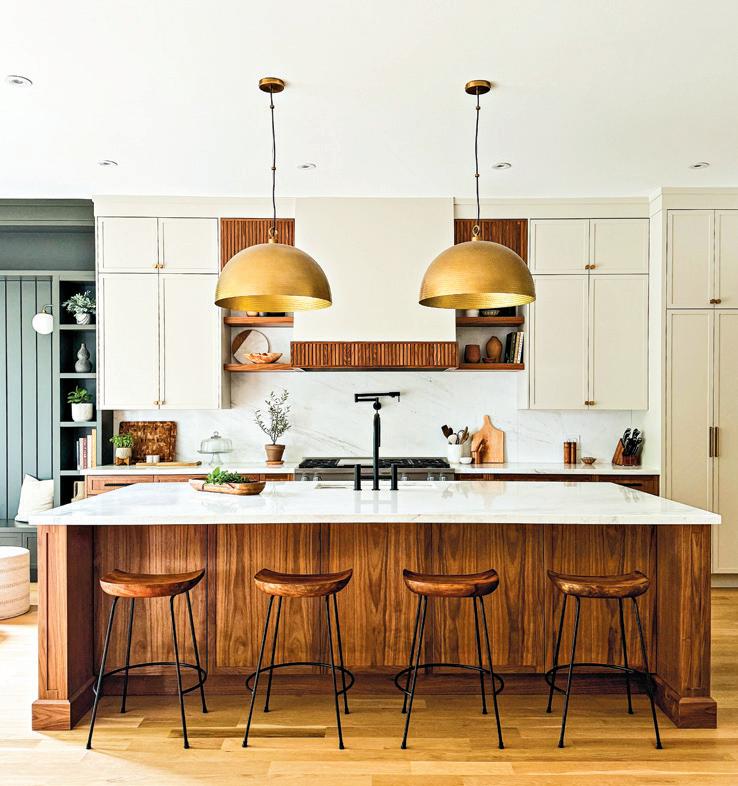
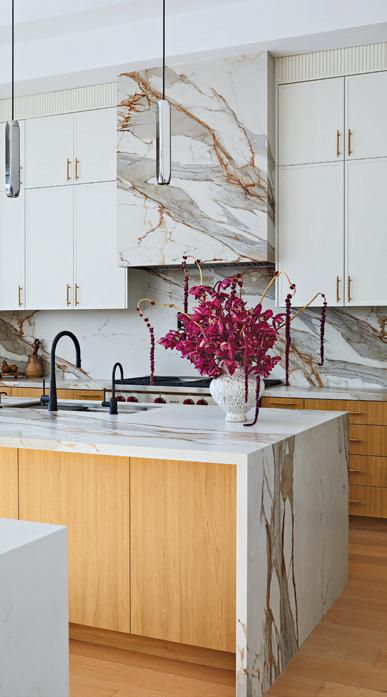
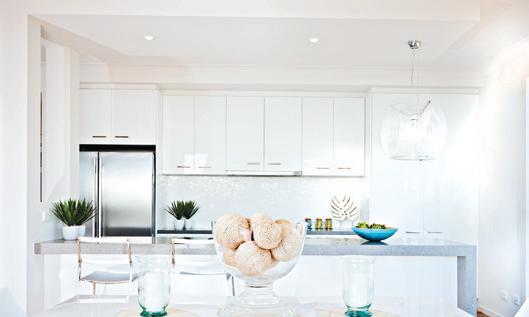
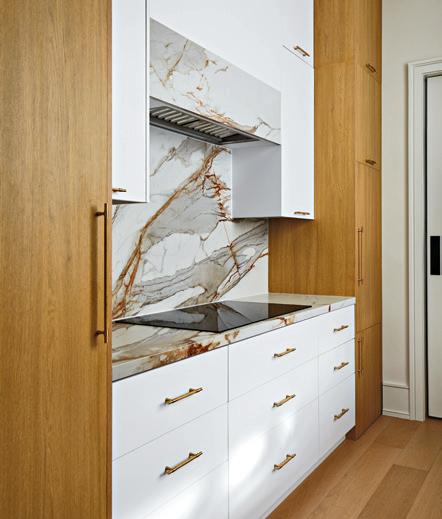
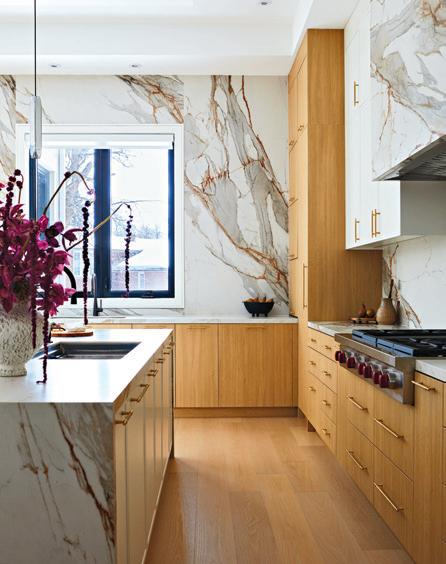
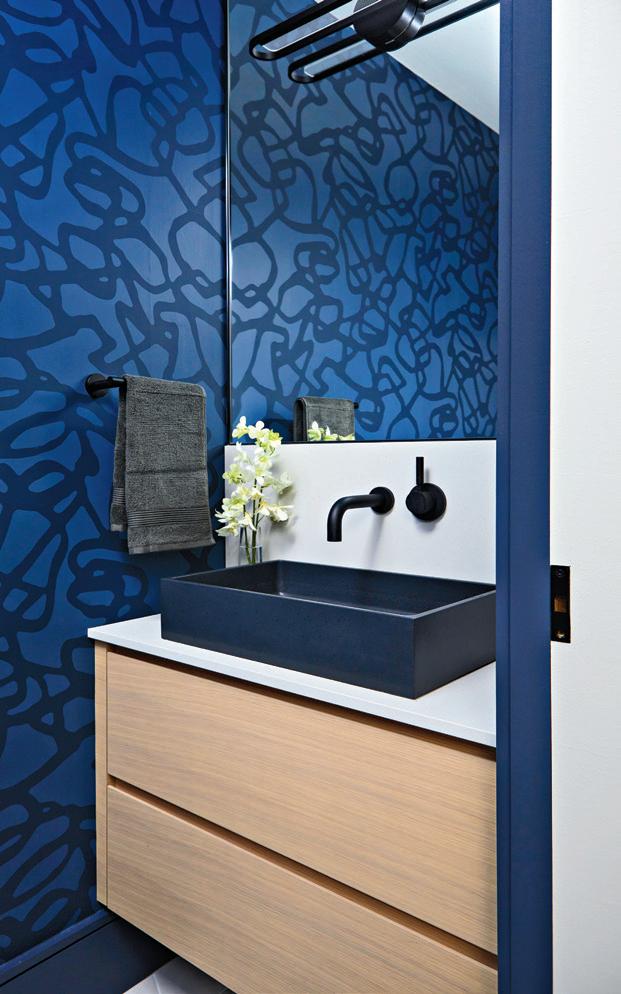
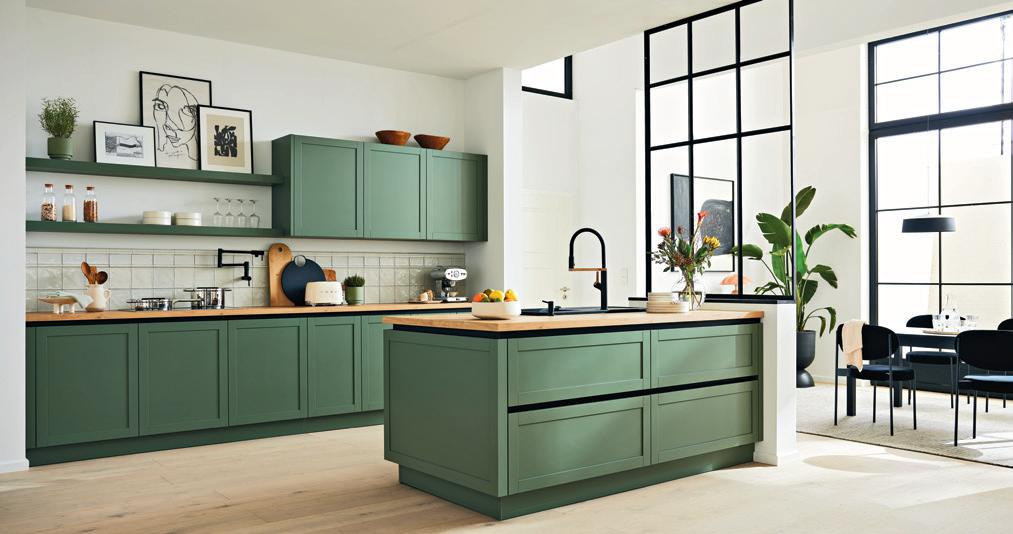
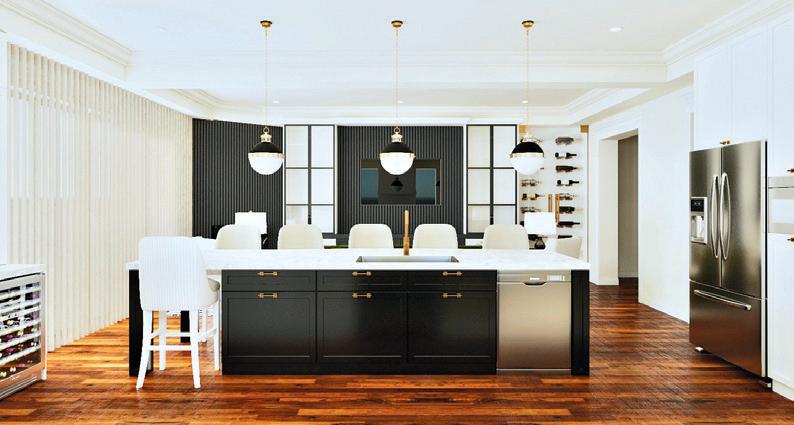
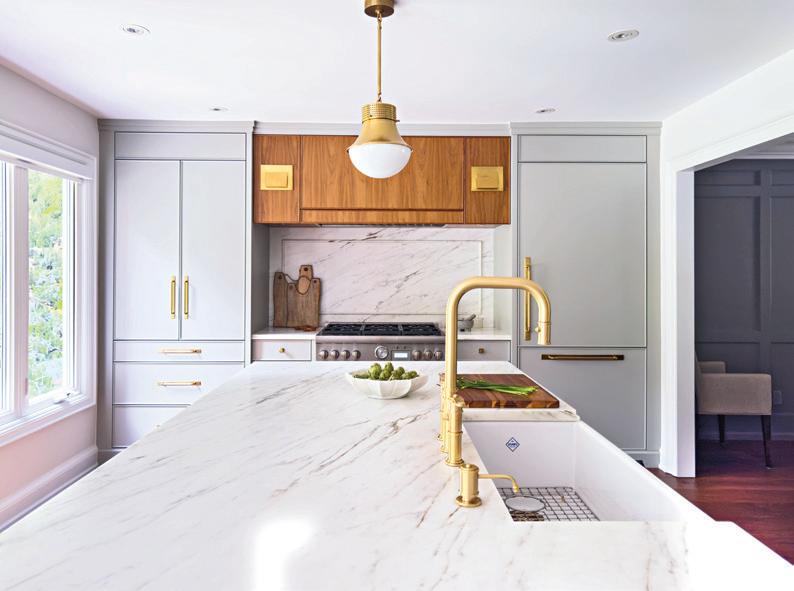
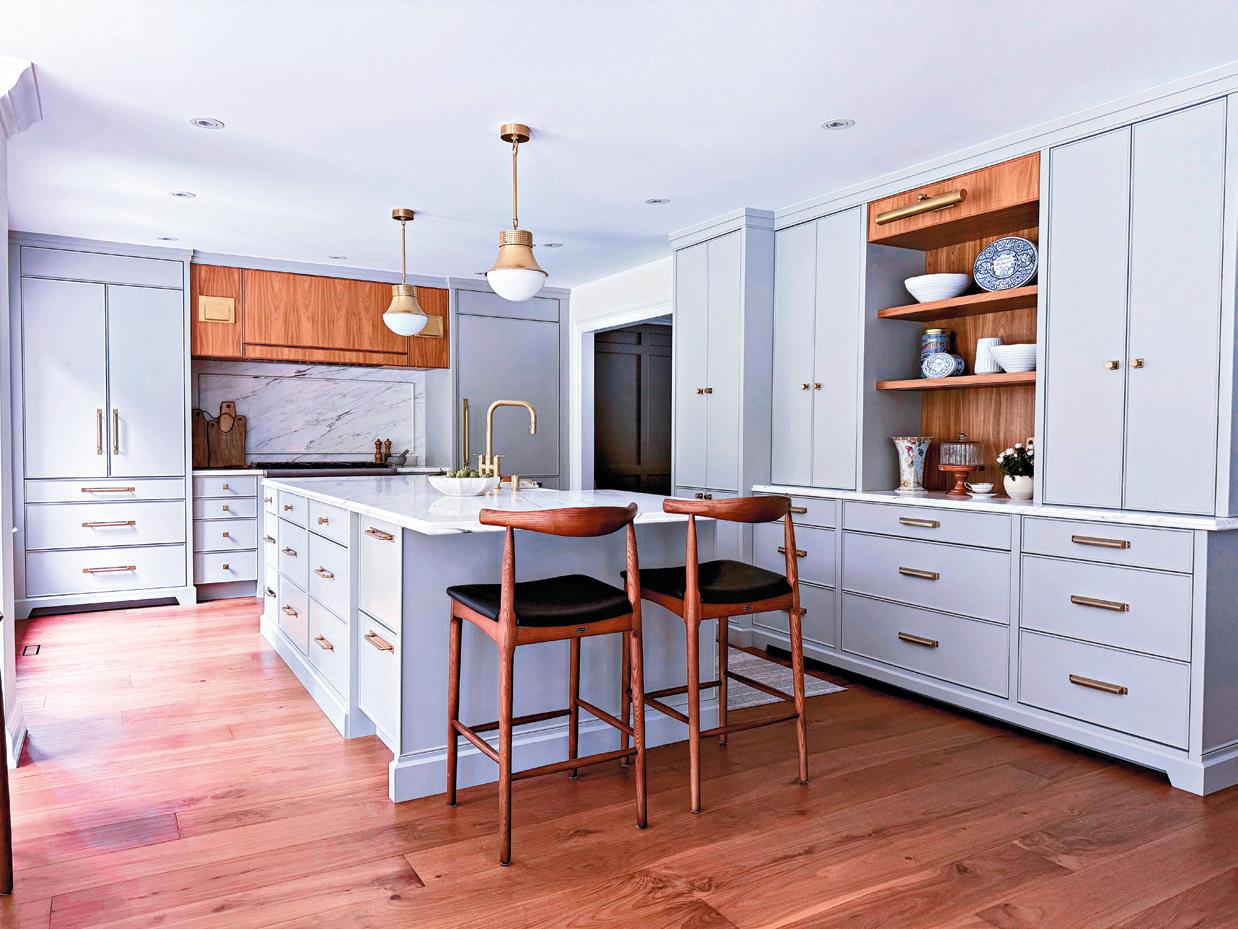
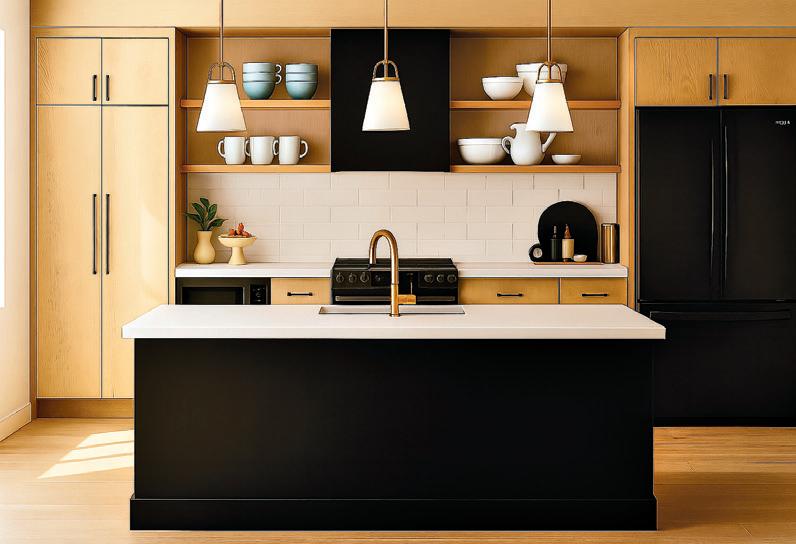
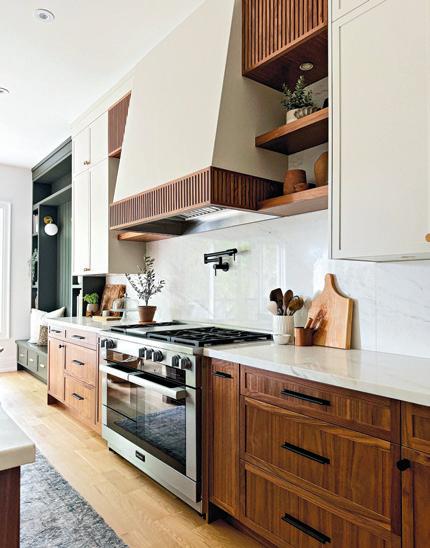
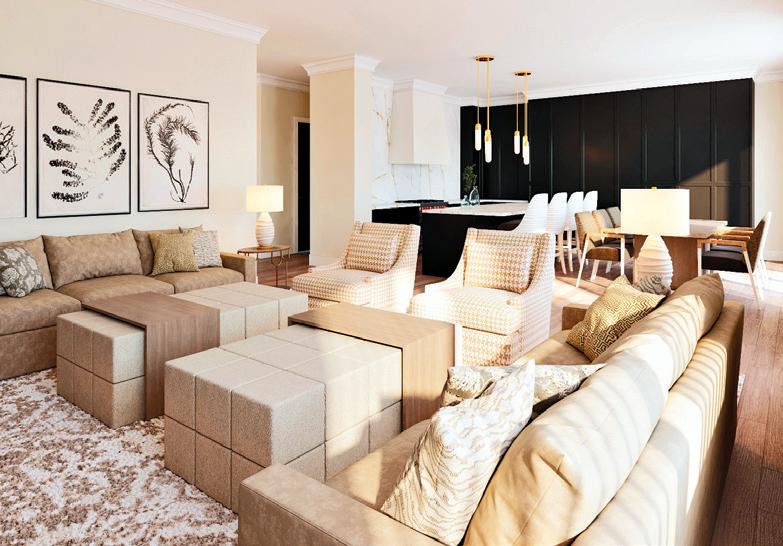
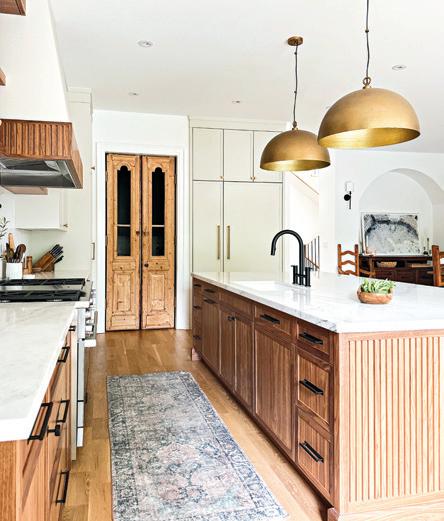
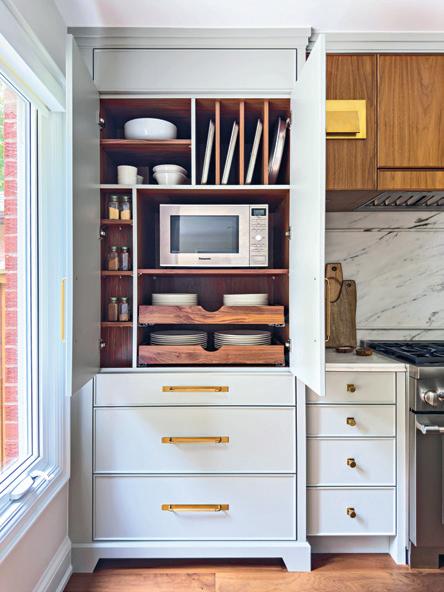
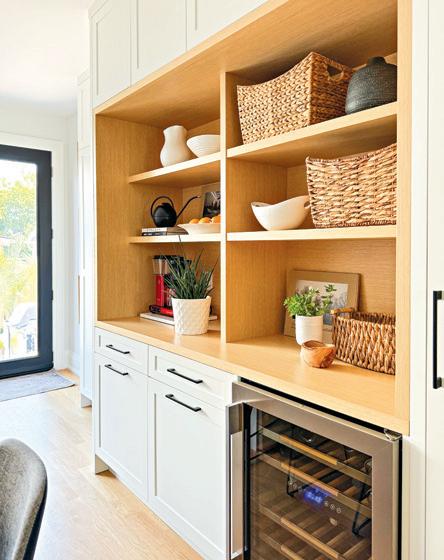
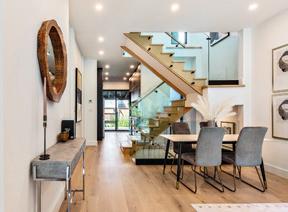
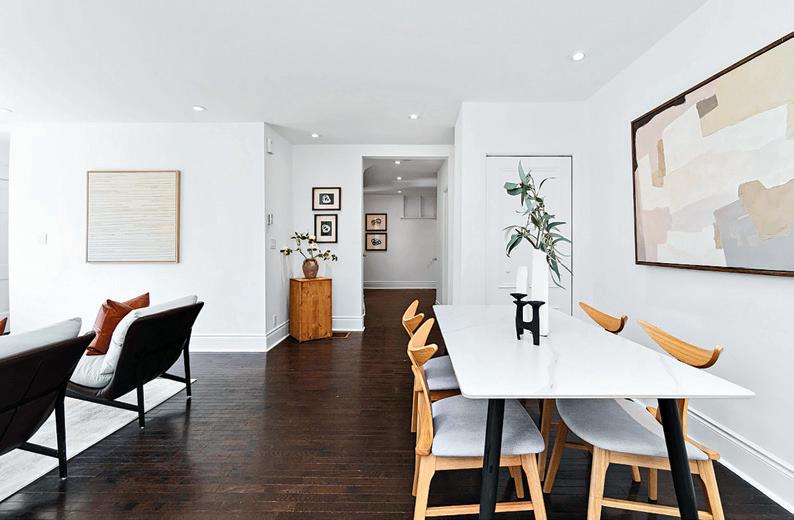
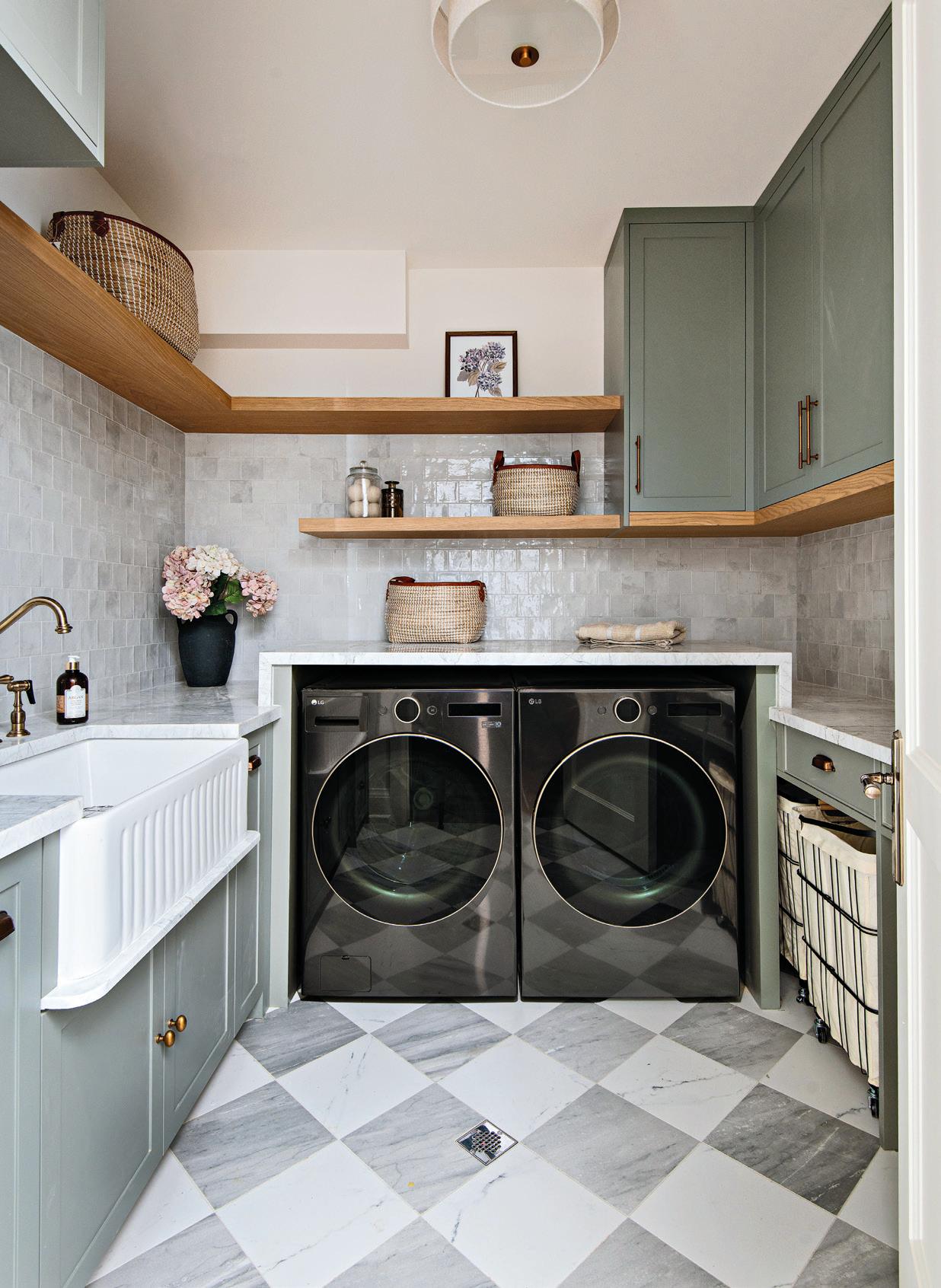
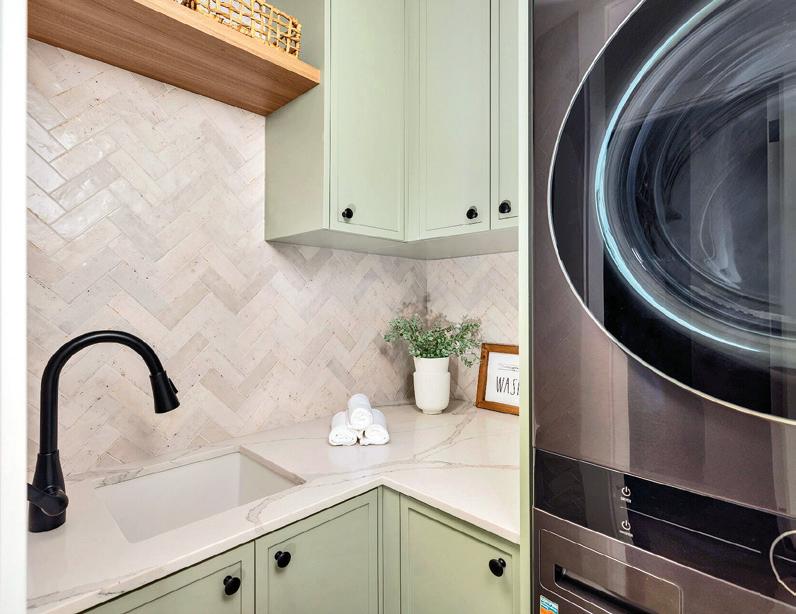
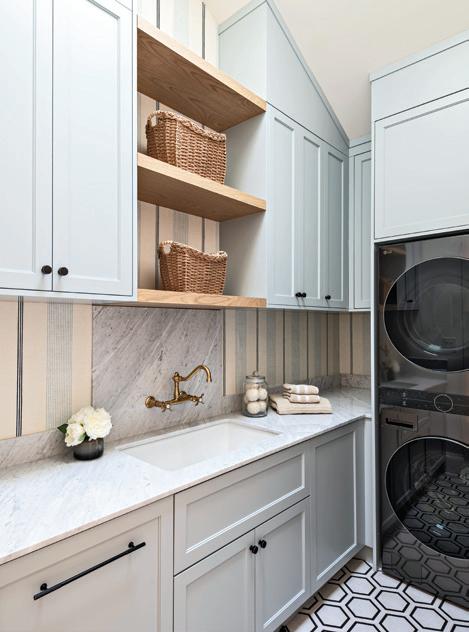
Reflow for the win: This home reflects the homeowners’ lifestyle
45 DESIGN INSPIRATION
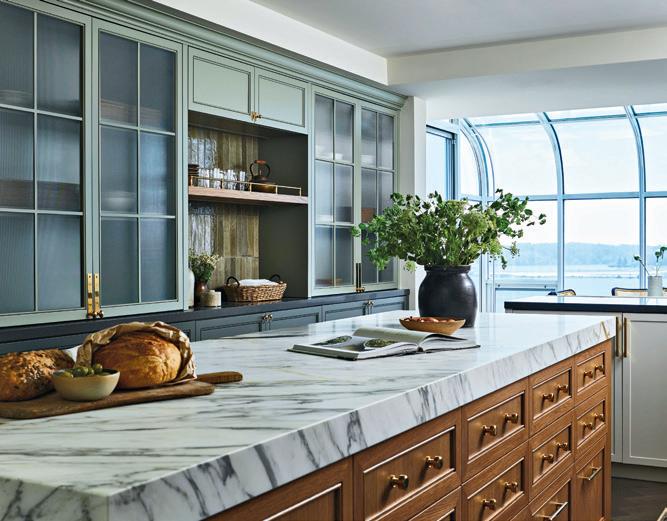
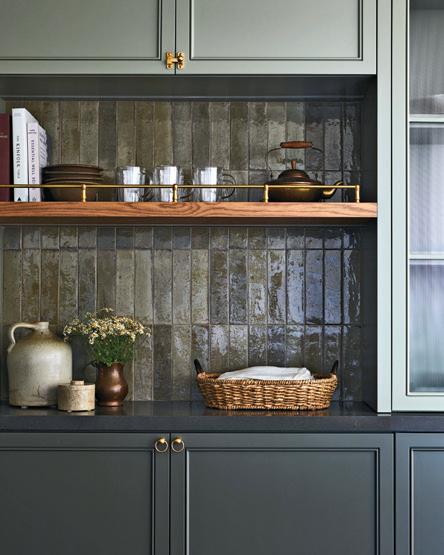
reimagined condo kitchen
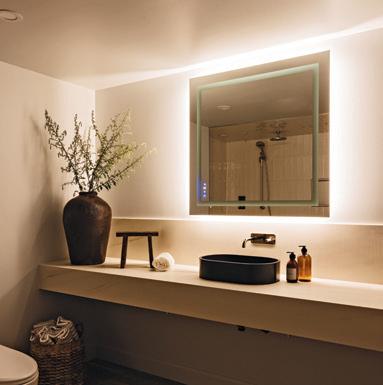
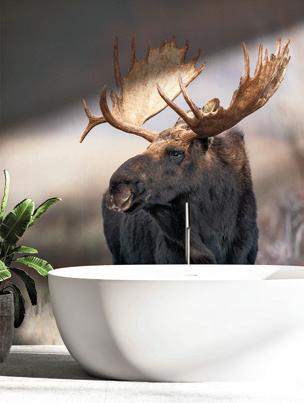
Restorative indulgence: Create a mini spa at home
52 INTERIOR DESIGN
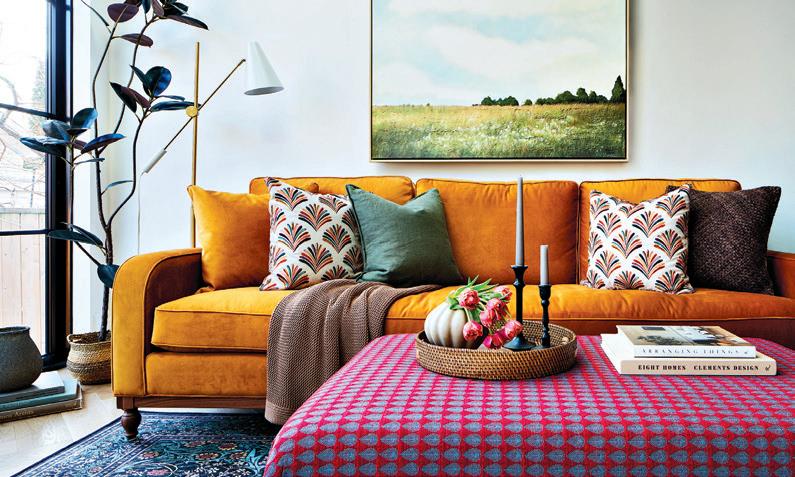
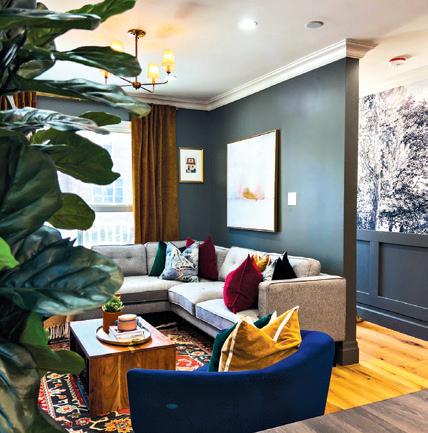
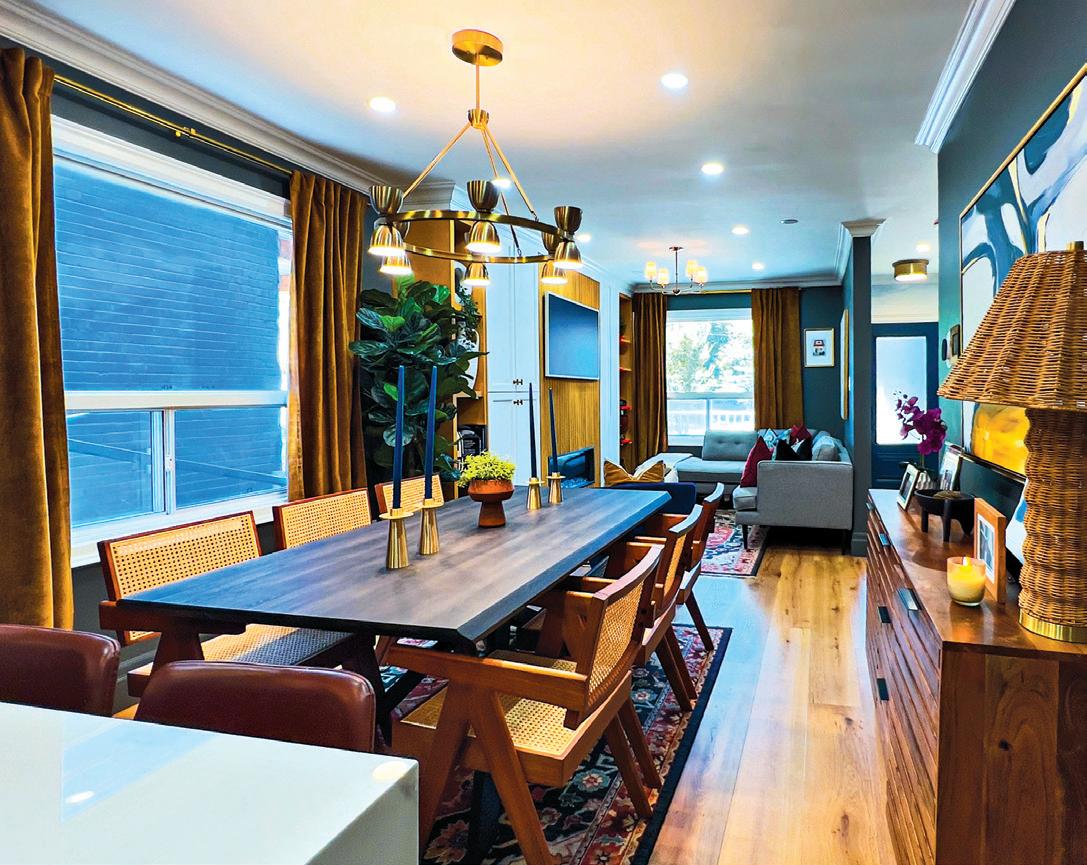
Modern maximalism: Expanded spaces create an emotional connection
57 DESIGN INSPIRATION
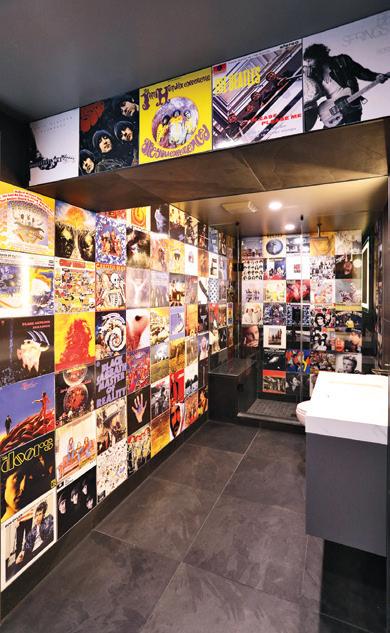
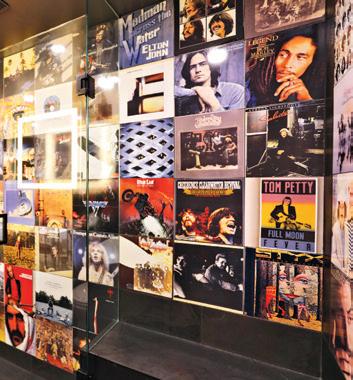
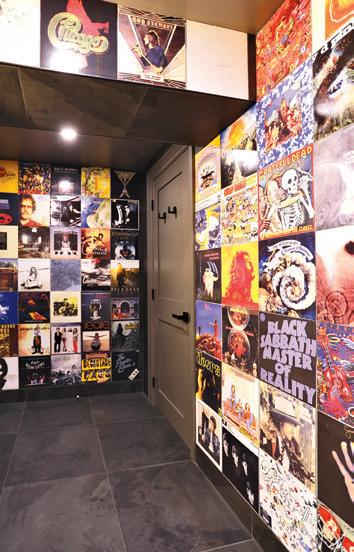
Rock star reno: A music lover’s basement dreams come true
RENOVATIONS
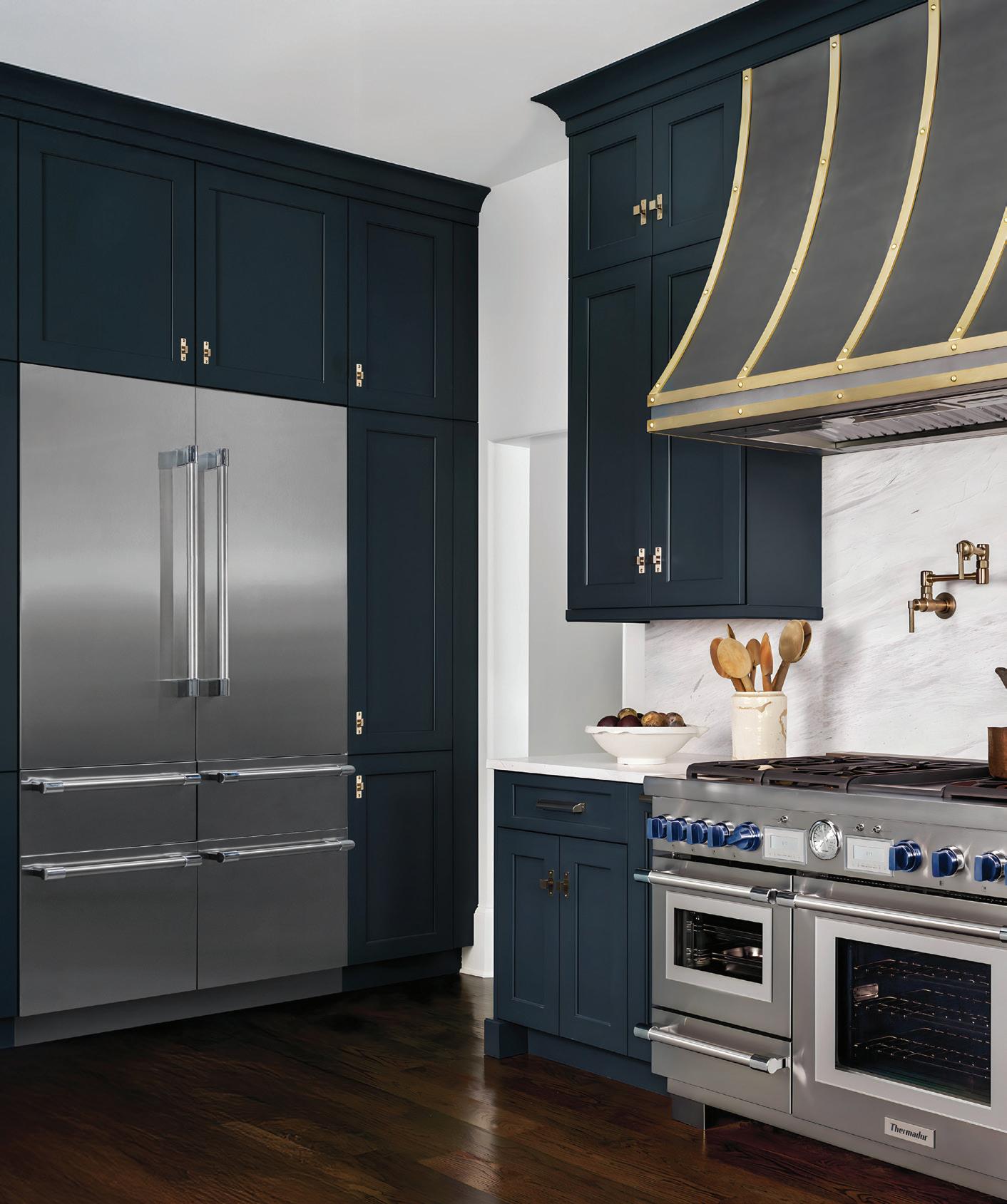
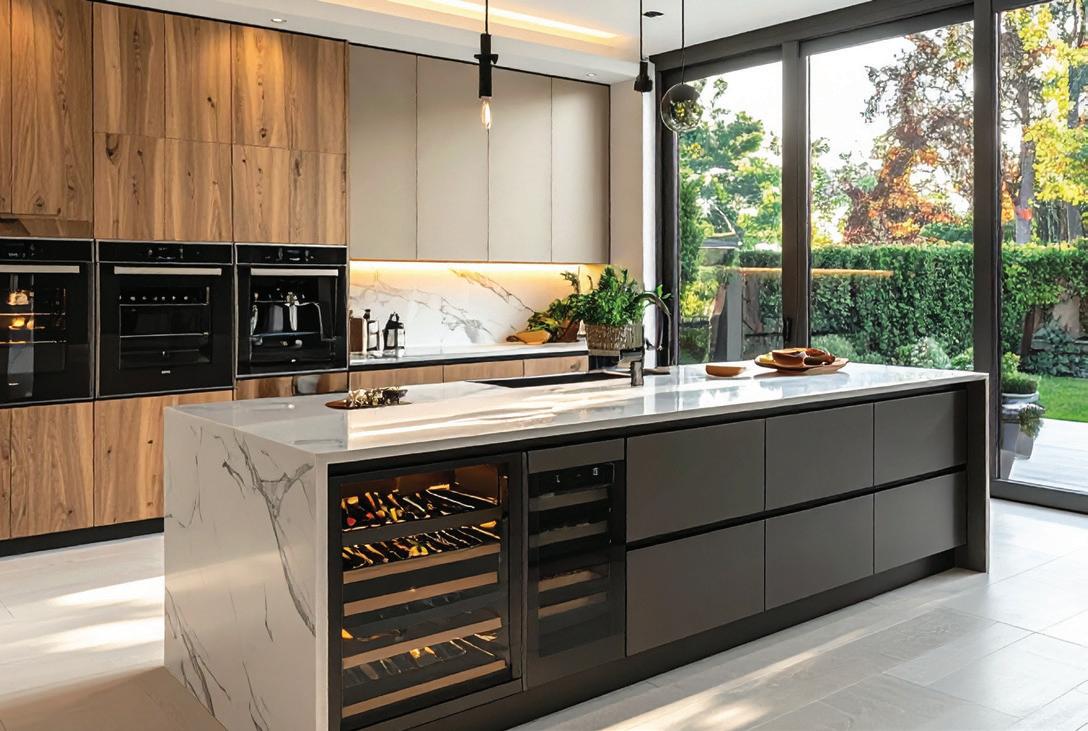
31 BEFORE AND AFTER Experts weigh in on how kitchen design is evolving
DEPARTMENTS
10 A NOTE FROM THE EDITOR Warmth: The word of the day Marlene Eisner, national editor
It’s show time!
Feb 11-12
BUILDEX VANCOUVER
Vancouver Convention Centre West
Feb 26-March 1
Calgary Home & Garden Show
BMO Centre
March 6-15
National Home Show –Toronto
Enercare Centre
March 12-15
BC Home & Garden Show
BC Place
March 26-29
Edmonton Home & Garden Show
Expo Centre
April 9-12
Winnipeg Home & Garden Show
RBC Convention Centre
MARLENE EISNER EDITOR, NATIONAL marlene.eisner@nexthome.ca
Warmth: THE
CWORD OF THE DAY
anadian winters are notorious, but no one will argue that 2026 has so far been particularly rough (except for maybe in British Columbia), testing our resolve with unrelenting cold and double-digit snowfalls. Mother Nature may try to bully us, but we’re prepared – by taking refuge in our kitchens and keeping warm and cosy in the company of friends and family, while cooking up hearty food and drink.
The kitchen is everyone’s favourite room – and the most used. Whether you love to cook, bake, entertain or are a fan of food delivery, a beautiful and functional place in which to prepare, set up and eat makes it easy to forget the blizzard raging outside, at least for a while.
Welcome to our Kitchen Issue.
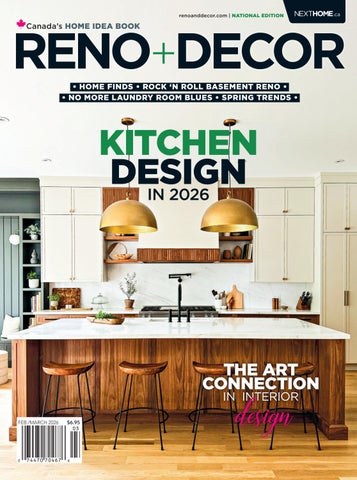
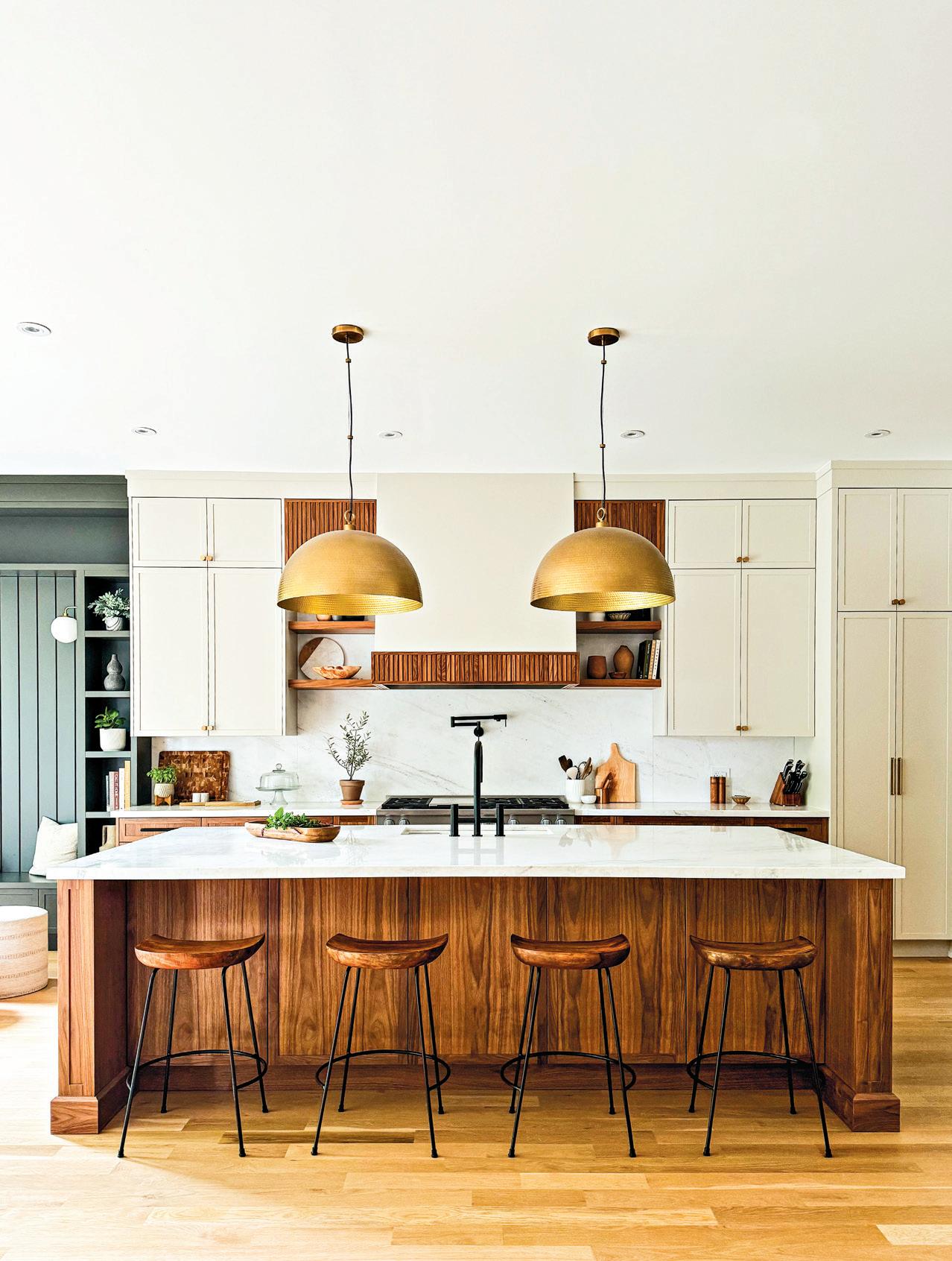
If you’re planning on updating this essential room in the next few months or years, turn to the story on page 31. Find your inspiration in the conversation between Brendan Charters and three industry experts on what’s in – and what’s not – in kitchen design.
On page 52, you can read about how a 15-ft. addition to a narrow Beaches home transformed a small, box-in kitchen into a stylish, functional space with an adjacent family room.
If you’re happy with your kitchen, but are considering other upgrades, in this issue, we touch on almost every room in the house to help you on your home renovation and decor journey.
Turn to page 57 and be wowed by how a retired musician’s dream to pay homage to his music heroes came true in his basement renovation. We guarantee you’ve never seen anything like it!
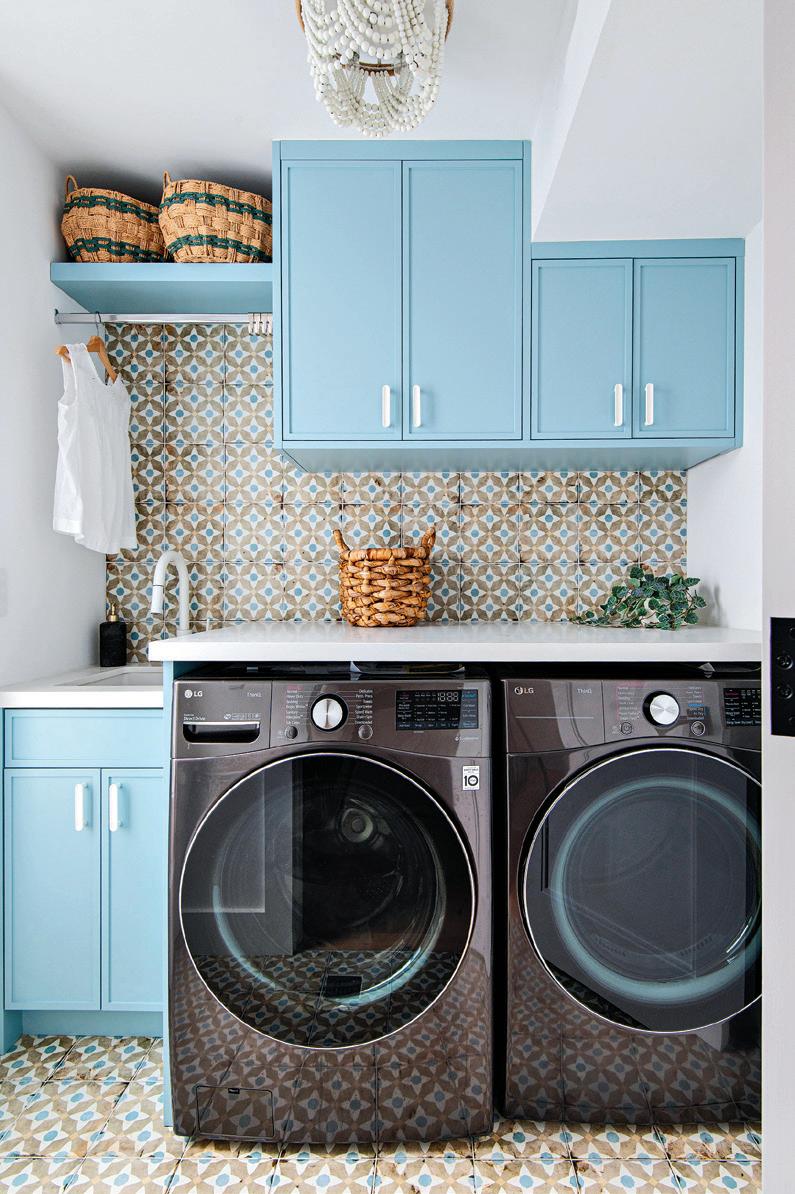
We also have tips on spring trends and for those of you who hate doing laundry, we feel your pain. But, what if we showed you how to turn that humdrum space into something so beautiful and functional, you’d want to do laundry every day? Don’t take my word for it. See for yourself. Go to page 64 and be prepared to be swept away.
Thank you for picking up this issue of RENO+DECOR. Let us know what you think. marlene.eisner@nexthome.ca
The experts dish on what’s trending in KITCHENS
ARIDO ARIDO regulates interior designers in Ontario for the betterment of the profession and in the best interests of the public, sets education and experience standards for members, and advocates for the profession.
BILD With more than 1,300 members, BILD GTA is the voice of the home building, land development and professional renovation industry and is affiliated with the Ontario and Canadian Home Builders’ Associations. The Calgary region (BILDCR) works closely with various levels of government and stakeholder groups to ensure vibrant, established neighbourhoods and new communities in the region.
DDA The Decorators & Designers Association of Canada (DDA Canada) is a professional association that elevates the industry for design professionals, students and suppliers through education, events, training, advocacy and community building.
HAVAN The Homebuilders Association Vancouver is recognized as the leader in the homebuilding industry since 1974. Its knowledgeable, trusted and resourceful members build more than 65 per cent of Metro Vancouver’s homes.
IDC Interior Designers of Canada (IDC) is the national advocacy association for the interior design profession. representing more than 5,000 members, including fully qualified interior designers and related professionals.
NKBA The National Kitchen & Bath Association (NKBA) Ontario chapter was established in 1977 and is where industry members meet to learn what’s out there and what other members offer. The British Columbia chapter, formed in Jan. 1990, has a large provincial membership to facilitate member engagement, professional development and act as a consumer advocate for members, while being financially viable.
CANADIAN HOME BUILDERS’ ASSOCIATION Since 1943, the Canadian Home Builders’ Association (CHBA) has been “the voice of Canada’s residential construction industry,” with about 9,000 member-companies. The Edmonton-region branch engages and serves its core membership of builders, renovators, and general members by advocating on behalf of the residential construction industry in pursuit of members’ success.
RENOMARK RenoMark identifies professional contractors, custom homebuilders and trades who agree to abide by a professional code of conduct. RenoMark members are reliable, ethical and responsive.
æ Sign up to receive digital editions and newsletters to your inbox!
Advertising Call 1.888.761.3313 for rates and info. Email: info@nexthome.ca
Circulation At thousands of high-profile pick-up boxes and racks in the GTA, select retailers and designer showrooms. Plus, top consumer and trade shows.
Canadian subscriptions 1 year = 6 issues – $45 (inc. HST)
Single copy price $6.95 (plus HST). Canada Post – Canadian Publications Mail Sales Product Agreement 43643067.
Copyright 2026 All rights reserved. All copyright and other intellectual property rights in the contents hereof are the property of NextHome, and not that of the individual client. The customer has purchased the right of reproduction in NextHome and does not have the right to reproduce the ad or photo in any other place or publication without the previous written consent of NextHome.
Editorial Submissions from interested parties will be considered. Please submit to the editor at editorial@nexthome.ca.
Terms and Indemnification Advertisers and contributors: NextHome is not responsible for typographical errors, mistakes, or misprints. By approving your content and/ or submitting content for circulation, advertisers and contributors agree to indemnify and hold harmless NextHome and its parent company from any claims, liabilities, losses, and expenses (including legal fees) arising out of or in connection with the content provided, including but not limited to any claims of copyright infringement, unauthorized reproduction, or inaccuracies in the content. Advertisers acknowledge that they have the necessary rights, permissions, and licenses to provide the content for circulation, and they bear full responsibility for the content’s accuracy, legality, and compliance with applicable laws upon approval. Contributors acknowledge NextHome reserves the right to omit and modify their submissions at the publisher’s discretion.
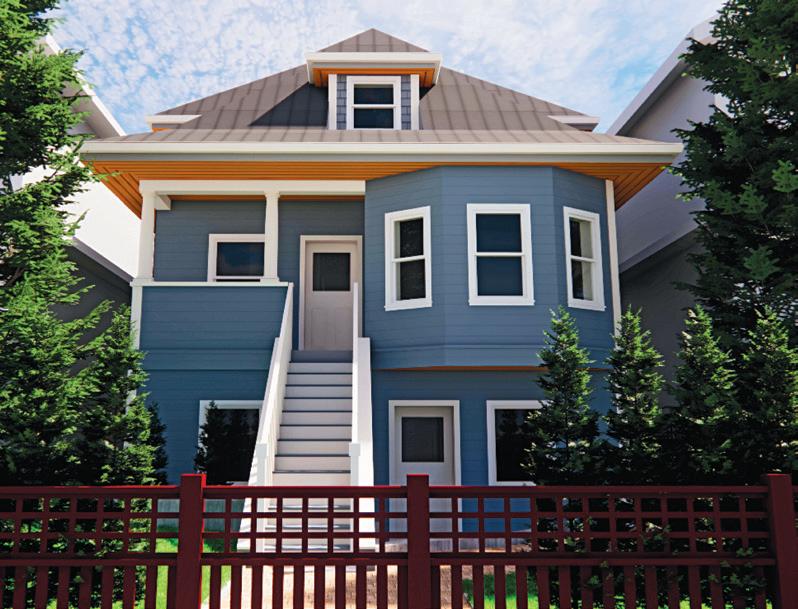
A 1908 HERITAGE HOME, REBUILT FOR THE NEXT 100 YEARS
Do you need to erase history to transform a 1908 heritage home into a high-performance, future-ready house?
With the right team and early planning, it is possible to keep the character, meet net-zero targets and dramatically cut carbon and energy use at the same time.
The 1908 project began with a clear brief from the homeowner. Stay in the neighbourhood. Respect the heritage streetscape. Deliver a net-zero triplex: Restore the main home, add a twobedroom garden suite and build a new three-bedroom net-zero infill laneway home. From there, the scope expanded. The team set out not only to eliminate operational energy use, but also to reduce embodied carbon.
“That’s the carbon people don’t see,” says Barb Silverthorne of Capture Energy. “It’s baked into the materials before you even turn the lights on. If we ignore it, we miss half the picture.”
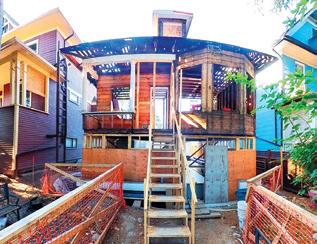
The solution started with deconstruction, not demolition. Instead of crushing the house and sending everything to landfill, the building was carefully taken apart. Windows, flooring and fixtures were catalogued for donation. Old-growth Douglas fir framing was removed piece by piece and preserved for reuse.
“For me, it’s painful to watch a beautiful old home get destroyed,” says builder Todd Best of Best Builders. “That wood has already done a hundred years of work. Why would we throw it away?”
Much of that reclaimed lumber is going straight back into the project. Non-load-bearing walls, backing, feature elements and custom details all benefit from material stronger and denser than most modern framing.
Photo: Smithcraft Architecture
This circular approach does more than reduce waste. It changes the math. Deconstruction creates donation tax receipts, offsets disposal costs and reduces the amount of new lumber required. Planning it at the design stage, not the last minute, made the difference.
“You have to be at the table early,” says Eric Serpas Ventura of Vema Deconstruction. “When salvage is part of the plan from day one, it stops being an afterthought and starts saving real money.”
Performance was the other half of the equation. The house was lifted onto a new carbon-reduced concrete foundation and rebuilt with a tight, highly insulated envelope. Natural materials like hemp insulation replace conventional fiberglass, improving indoor air quality while lowering
embodied carbon. Mechanical systems shrink as the building performs better, not worse.
To meet net zero and qualify for City of Vancouver incentives, the project generates its own renewable energy through rooftop solar, producing slightly more energy than it uses and sending power back to the grid.
For homeowners considering a major renovation, the lesson is clear. Ask different questions. Bring the right people in early. And do not assume the greenest choice means starting over.
For more details on the 1908 to net-zero project, including interviews with the full project team, listen to HAVAN’s Measure Twice, Cut Once podcast episodes featuring this home.
K
KITCHEN indred
Refined simplicity meets resiliency
by OLIVIA BAILEY • photos VALERIE WILCOX
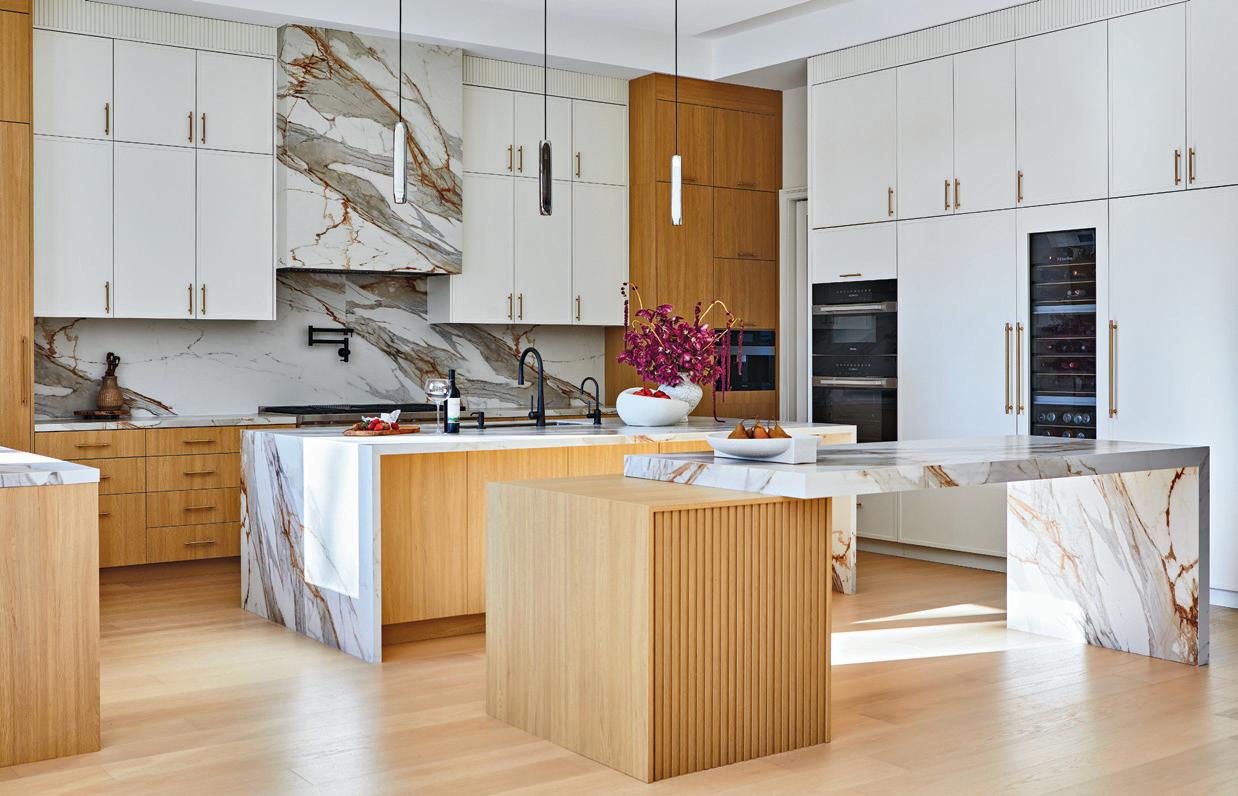
Designing a kitchen for a busy household requires more than aesthetic ambition – it demands an understanding of how a family truly lives. For this custom-built executive home, the clients, a hardworking couple with three energetic children and a perpetually curious dog, wanted a space that delivered refined simplicity without sacrificing resilience. The goal was a kitchen that felt serene and architectural, yet performed effortlessly during hectic mornings, family meals and lively gatherings. Achieving that balance meant approaching minimalism not as a subtraction exercise, but as a process of thoughtful refinement. Every line,
finish and function was chosen to create an intentional environment to support daily life, while elevating the experience of cooking, eating and connecting.
Performancedriven surfaces
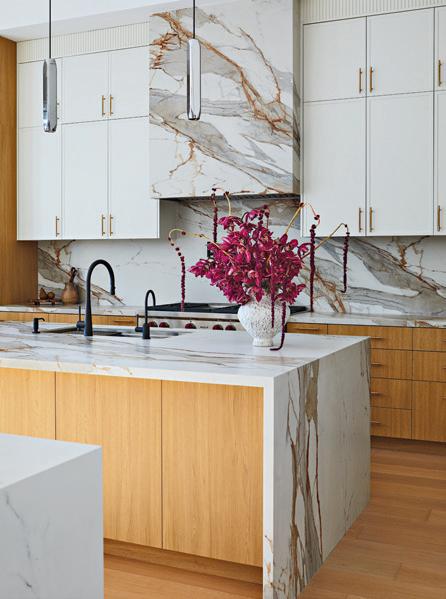
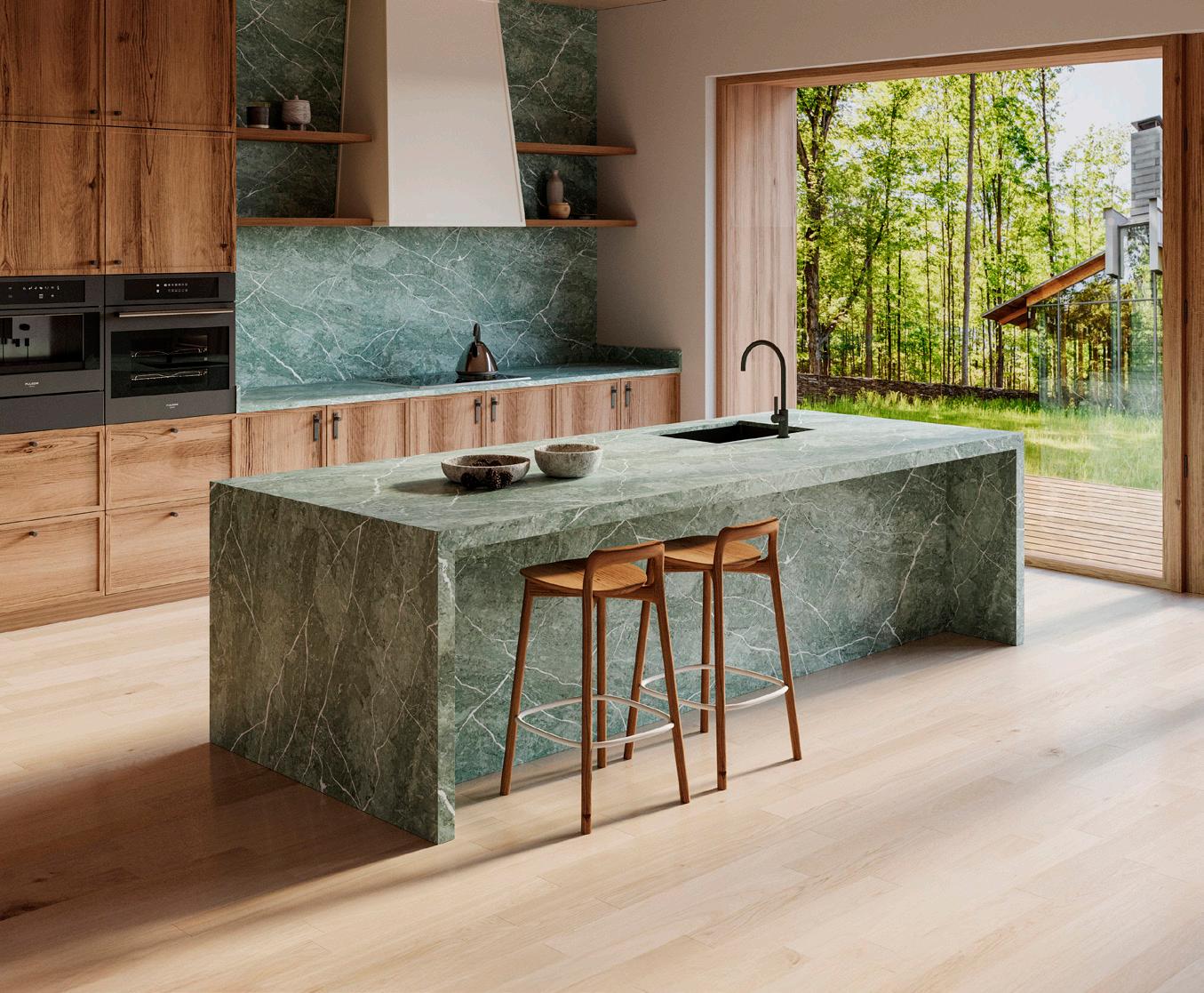
The kitchen’s porcelain countertops and backsplash play a pivotal role in shaping its character and durability. The Italian-made material mimics the elegance of natural stone, while offering a nearly indestructible surface, ideal for a home with several enthusiastic cooks. Heat resistance, stain protection and a consistently smooth finish ensure the counters remain pristine, from late-night
baking sessions to elaborate holiday feasts. For clients who truly use their kitchen, porcelain delivers luxury without the anxiety and time associated with maintenance.
Mix of metals
While I typically avoid mixing metal tones, this project called for a subtle shift from my usual rules. The faucets in a handsome gunmetal finish anchor the room’s modern architecture, introducing depth without overwhelming the palette. Brass knurled handles, however, became essential to the composition. Black hardware would have drawn attention away from the porcelain surfaces – the true focal point – while
brass blended softly into the millwork, allowing the stone and form to lead. The result is a restrained, harmonious interplay of materials that enhances rather than conflicts.
Duel-duty islands
A double island configuration became indispensable for this family’s lifestyle. The primary island functions as the cooking hub, complete with a generous sink and expansive prep space. Parallel to it, the second island shifts roles effortlessly throughout the day: Breakfast table during school mornings, homework spot in the afternoon and a natural serving station when the home fills with guests. Together, the paired islands create a dynamic flow that supports connection, efficiency and ease.
Every inch of usable space is maximized, including concealed cabinetry with push-latch doors on the back of the island. This hidden storage keeps rarely used dishes, seasonal items and entertaining essentials accessible yet out of sight, reinforcing the kitchen’s uncluttered aesthetic.
Crafty cabinetry
Cabinetry is the architectural backbone of the room. Full-height units and long, uninterrupted horizontal cabinets establish visual rhythm, while concealing appliances and everyday items. By opting for integrated pulls, the millwork reads as sculptural and tailored rather than decorative.
These clean lines are more than stylistic; they influence the room’s emotional tone. The clarity of the vertical and horizontal cabinets creates a sense of calm structure, so the eye moves fluidly across the
space. For a family constantly in motion, this sense of order provides a grounding effect.
Warm palette
Colour selection is essential in a minimal environment, where every tone carries weight. Warm, midrange neutrals soften the edges of the modern architecture and remain practical for an active household. These hues shift gently throughout the day, offering nuance without distraction. Avoiding stark whites or heavy darks gives the kitchen an inviting and refined feel.
Natural materials enhance this warmth. Subtle veining in the porcelain, matte cabinetry finishes and thoughtfully placed wood accents add layers of texture that enrich the aesthetic rather than compete with it. The space feels quiet but far from cold – minimal in silhouette, yet characterrich in detail.
Custom elements
Several bespoke features shape the room’s personality: A sculptural hood that becomes an architectural centrepiece; a waterfall island with seamless integrated seating; lighting that provides clarity without visual clutter. These details work together to maintain uninterrupted sightlines to ensure the kitchen functions beautifully, from cooking marathons to quiet late-night moments.
Calming, not cold
This kitchen embodies the idea that minimalism is most successful when it enhances daily rituals rather than strive for perfection. The space is streamlined, warm and deeply personal, a place where function supports beauty and beauty supports active living.
Olivia Bailey is the creative director and principal of Olivia Bailey Interiors, a Toronto-based luxury design studio celebrated for its refined, contemporary aesthetic. Serving Toronto, the GTA, across Ontario and nationally. oliviabaileydesign.com IG: oliviabailey.interiors
Reliable. Committed. Responsive.
Words you wouldn’t typically use to describe a contractor.
Until now.
At RenoMark, we want to change your outlook on renovation contractors. That’s why we developed a code of conduct that all our professional contractors follow, including a detailed written contract for every job, backed by a one-year warranty, and a guarantee that you’ll hear back within two business days.
To find a reliable, committed, responsive contractor, visit RenoMark.ca
POWER
A modern powder room that surprises blue
by SARA DUCK
Powder rooms may be compact, but they’re often the most memorable spaces in a home, especially when designers treat them like a place to experiment with design. Within a complete main-floor renovation defined by modern lines, pale wood accents and a crisp black-and-white palette, the designers of the upgrade incorporated a bold, blue powder room guaranteed to charm every guest who stepped inside.
“The aesthetic of the main level was very clean and modern,” says Jess Dybenko, who with Tamara Robbins Griffith, are principal designers at Kerr + Field Interiors. “But we saw the powder room as a place where we could inject a bit more playfulness. Still cohesive, but with an element of surprise.”
Although the overall home leans monochromatic, the designers pulled from the homeowners’ East Coast roots and West Coast family ties to develop a palette grounded in nature. “Our clients’ art references ocean blues and mountain landscapes,” explains Robbins Griffith. “We wanted this space to echo those influences through shades of blue, concrete and stone, subtle nods that make the room feel personal and connected to the rest of the home.”
Smart planning meets modernism
Powder rooms tend to be tiny, so the use of a pocket door kept the space functional, without feeling cramped. Storage was another key consideration. A custom floating vanity crafted in light oak was chosen, repeating the wood tone
used throughout the main floor. “It has just enough storage, while still feeling airy,” says Robbins Griffith. Polished nickel and black metals seen in nearby rooms were used to maintain flow and visual consistency. But to give the powder room its own personality, they added the power of blue.
The navy concrete sink is an unexpected sculptural focal point that anchors the room. The colour continues with Benjamin Moore’s Hale Navy painted on the baseboards, trim and the interior of the pocket door. The finishing touch? A graphic wallpaper by Savannah Hayes and an artwork by Elsha Leventis.
This powder room stands as a perfect example of a modern, nature-inspired and quietly sophisticated space. “We want people to feel surprise and delight,” says Dybenko. “And in a small space like this, every detail has the chance to shine.”
With more than 15 years’ experience as a magazine editor, writer and content creator, Sara brings her passion for design and decor to our pages each issue. Instagram: @bysaraduck
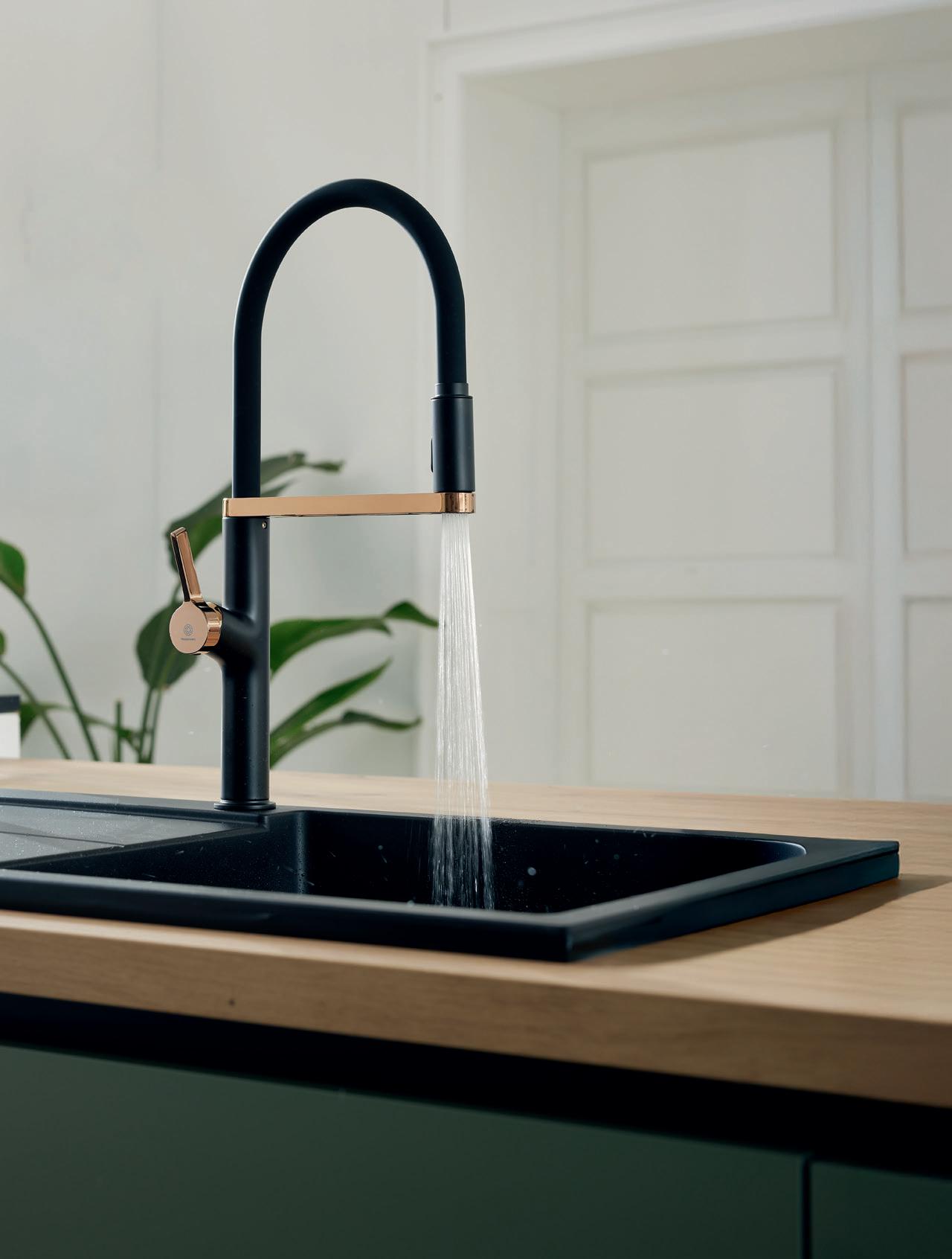
WASSERWERK Premium kitchen faucets manufactured in Germany
PERFECTION THAT LASTS
This claim defines Wasserwerk, a reflection of enduring values, rooted in German craftsmanship and guided by a clear vision for the future. Wasserwerk stands for timeless design, precision and durability, a brand identity that unites aesthetics and enduring functionality. Minimalist in form, high-quality in execution and authentic in appearance. Every line follows a clear idea, every detail a standard.
This holistic design approach was recognized with a special award in 2026: Wasserwerk received the German Design Award in the Brand Identity category. The award was given to outstanding brand identity, its striking visual language and the consistent quality standards that set Wasserwerk apart.
FOR A BRAND THAT LASTS FOR QUALITY YOU CAN FEEL
Premium faucets from Wasserwerk are much more than just functional products. Designed to enhance everyday life, from the first touch in the morning to the final moment at night, they integrate seamlessly into the heart of your home. Designed with the ambition to simplify everyday life — intuitive, precise and crafted with attention to every detail.
Wasserwerk faucets are crafted in our facility in Northern Germany with precision, passion and a commitment to excellence. State-of-the-art manufacturing technologies, carefully selected materials and meticulous quality control ensure that design and durability form a perfect union.
“Manufactured in Germany” is more than a promise — it is a commitment to the future.
Discover your opportunities to enhance your kitchen with our local sales representative: sales@tiraglobal.com or contact our head office: info@wasserwerk-us.com.
A home that reflects the homeowners’ lifestyle
by GELANAZ HEMATI * photos LARRY ARNAL
Reflowwin for the
Before
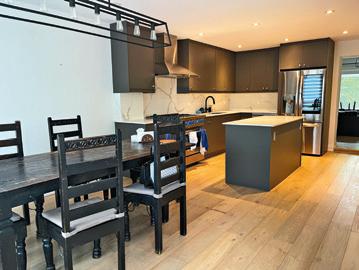
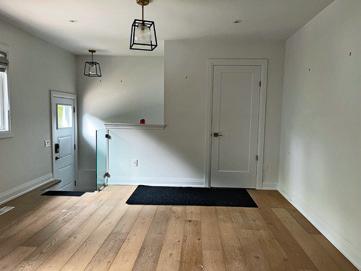
Some homes have all the right ingredients – charm, character and a renovation history – and yet for the homeowner, it still doesn’t feel quite right. This is the story behind a 1,100-sq.-ft. Toronto bungalow,
home to a couple with two young children. Although the homeowners had renovated only five years earlier and invested significantly in their outdoor spaces as well, the inside no longer reflected how they lived. Something about the flow didn’t support their lifestyle routines. There wasn’t enough storage. The kitchen,
Before
though recently updated, felt heavy and stifling because of its darker finishes and the bungalow’s low ceiling. And while they didn’t want another full renovation – especially not in the kitchen – they knew something had to change for the rest of the house to finally feel like home. The homeowners desired a clutterfree environment that made everyday life more comfortable.
Unwelcoming vibe
Problems began just inside the front door. The dining area, with its low ceiling and undefined aesthetic, was an unwelcoming entry into the house. An odd empty area along the wall outside the dining room served no
purpose beyond holding a table. The space needed a visual and emotional upgrade to address the two qualities the home needed most – warmth and a sense of height.
Lightening it up
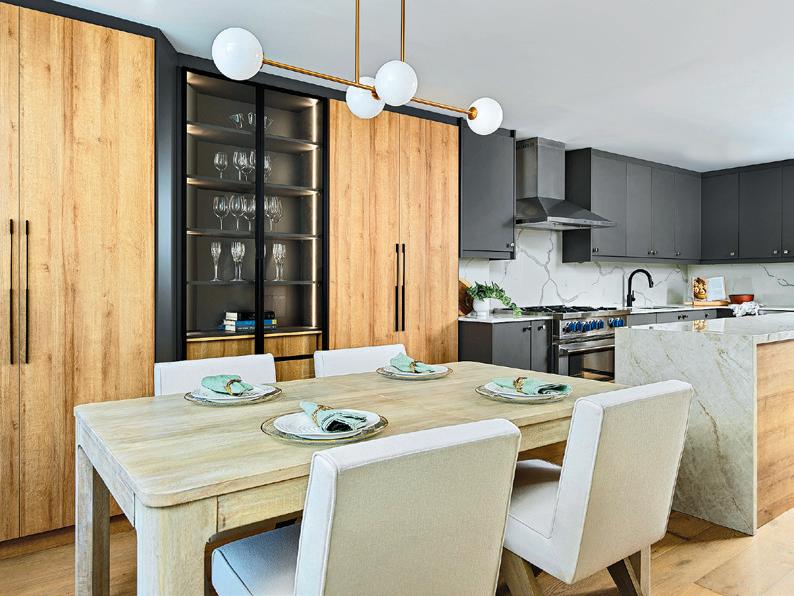
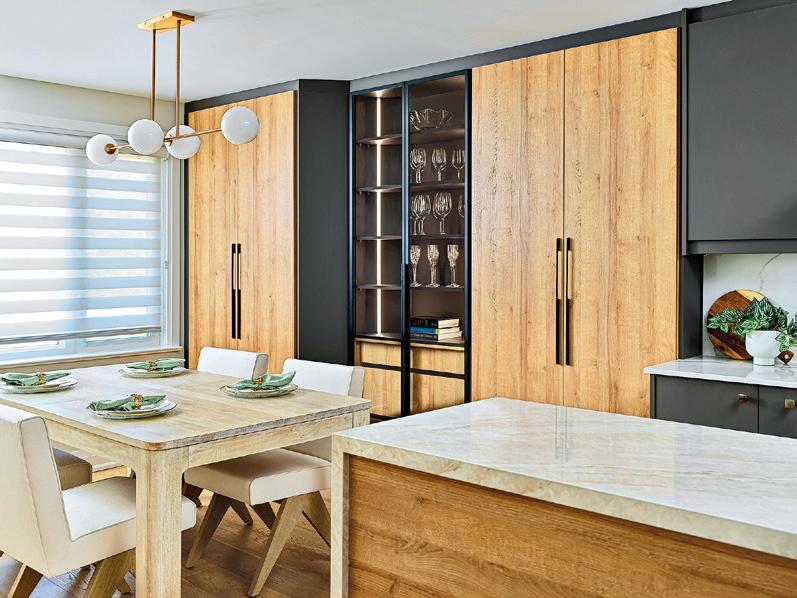
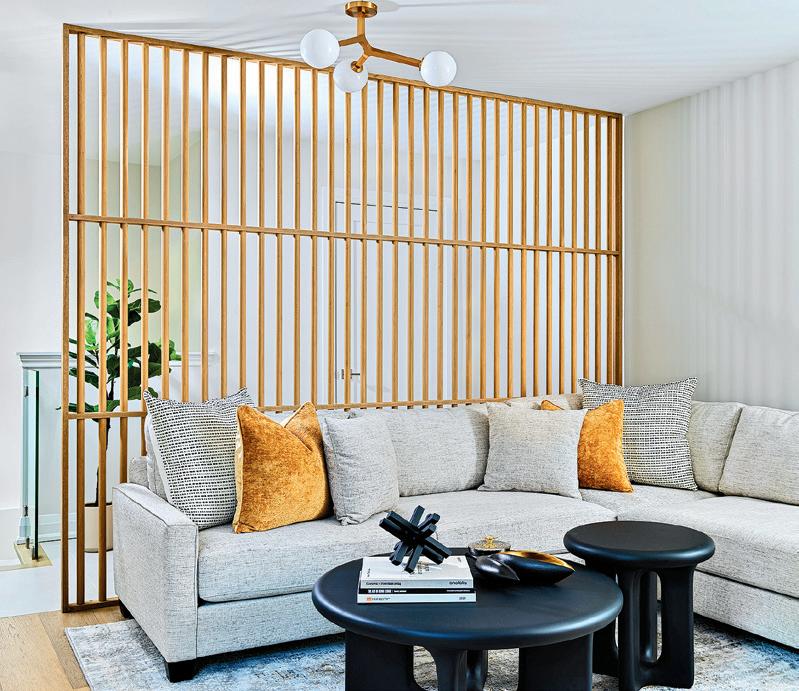
A full wall of floor-to-ceiling millwork in the dining room was added to lift the eye upward, making the ceiling feel taller and the room more spacious. The blend of two wood tones with the adjacent kitchen’s soft
grey hues created a natural continuity, as though the home has always been meant to look this way.
At the room’s centre, glass-door cabinets introduce a moment of lightness, ensuring the wall feels balanced rather than heavy. Behind each door and drawer, thoughtful internal organization supports daily life in a quiet, effortless way. Together, these changes reshape the home’s entrance sequence and redefine the dining area as a warm, welcoming place.
New lighting and calm, neutral furnishings complete the transformation, allowing the space to breathe with a fresh sense of harmony and comfort.
The kitchen story
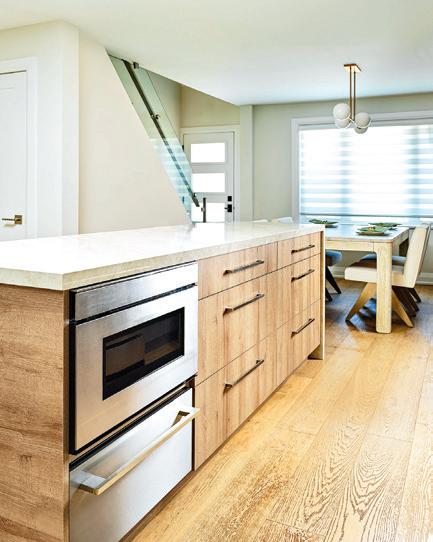
For a couple who genuinely love to cook and bake, the original kitchen island wasn’t pulling its weight. The microwave, buried low under the counter, was difficult to reach, and the surface wasn’t large enough for two cooks to work comfortably side by side. Instead of replacing the whole kitchen, the focus shifted to a single
piece that would change everything – a new, longer island crafted to match the renewed warmth of the dining area. The updated island holds six generous soft-close drawers –all 36 inches wide – designed for easy, organized cooking. The new drawer-style microwave makes access comfortable and safe, while the addition of a warming drawer beautifully supports baking days. But most importantly, the new proportions give two people the chance to chop, prep and cook together without getting in each other’s way. One thoughtfully designed piece can shift the energy of an entire room.
Stairway to storage
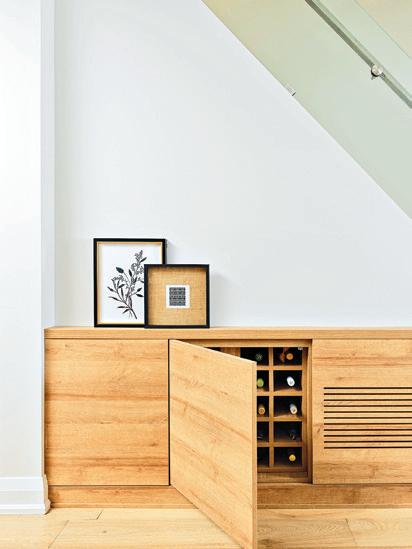
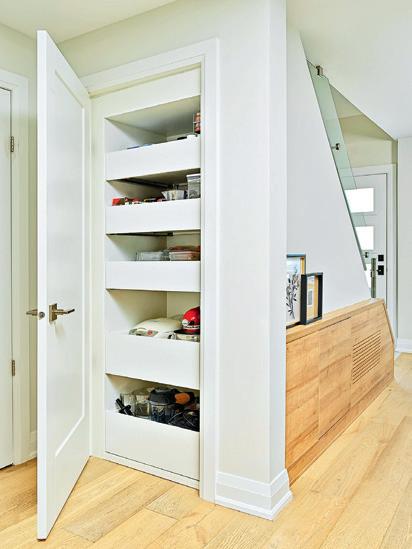
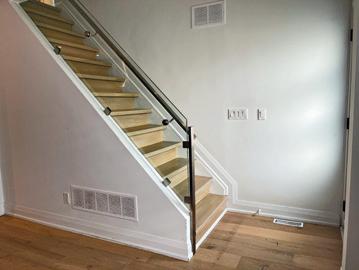
One of the trickiest parts of the upgrade was the under-stair storage in the kitchen. At first glance, it looked promising – a deep closet with a door – but in reality, it was a space where things were placed and forgotten. It was hard to reach, hard to organize and nearly impossible to use well. The space was completely transformed by introducing full-height, heavy-duty pull-out drawers, each efficiently using every inch of depth. On the other side of the stairs in the hallway, is now a hidden wine holder with a shallow shelf above it, perfect for displaying a small piece of art or
Before
Before
keeping keys and chargers handy. The entire area went from a problem corner to a functional and admired feature of the house.
Home office upgrade
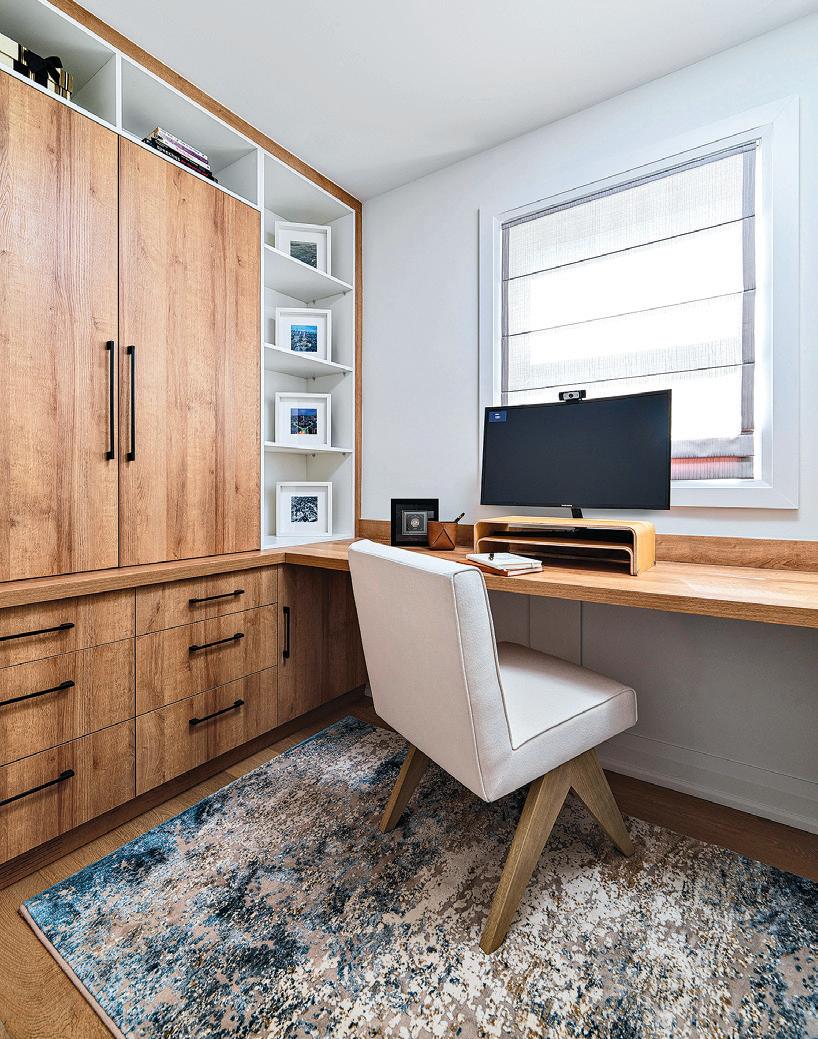
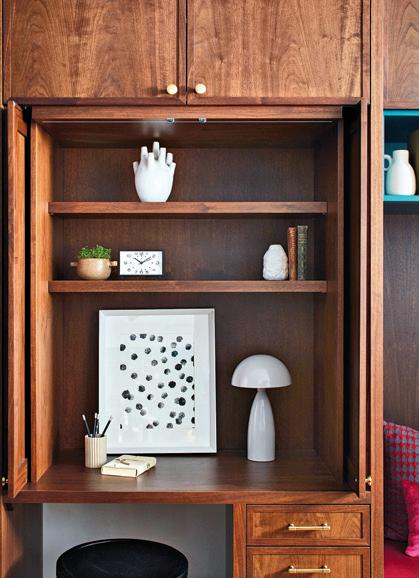
During the previous renovation, a bedroom adjacent to, and accessed from, the kitchen, was transformed into the primary/master bedroom, which included an ensuite bathroom, a walk-in closet and a den. The den was intended to serve as a home office, but the proportions made it feel cramped and limiting. To solve the problem, a generous built-in desk with storage was introduced and tucked neatly underneath and to the side, for a clean, calm, and professional space for virtual meetings or quiet work.
Backdoor entrance
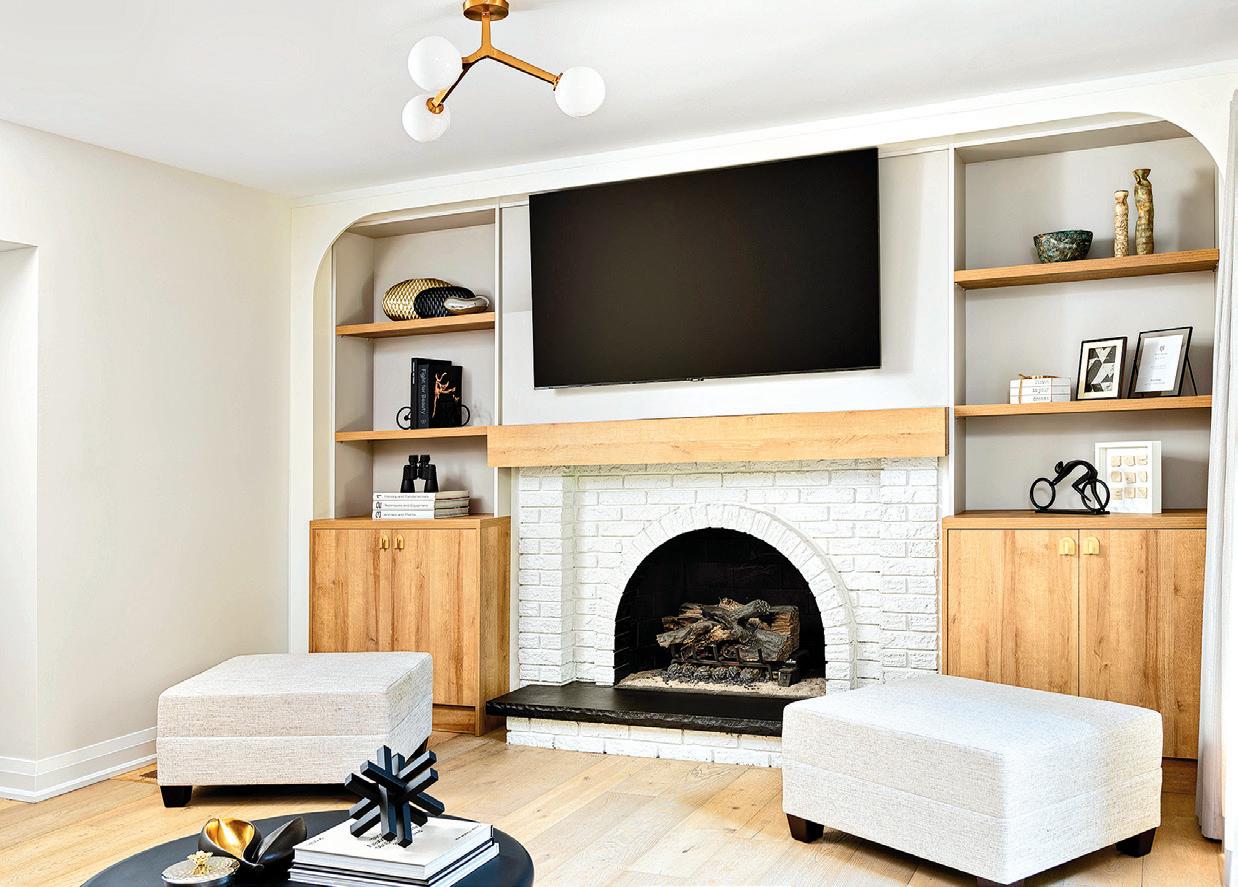
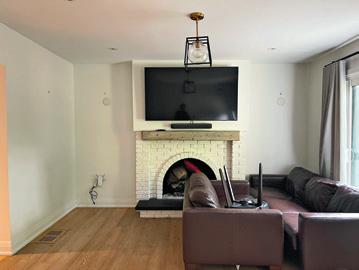
The family often used the door from the backyard as an entrance, especially during the winter, which meant the natural walking path cut across the living room directly to a deep closet. It worked, but it broke the living room’s flow and made gathering feel less cosy. Meanwhile, the existing brick fireplace in the living room had so much charm and character, but the rest of the room didn’t support it. The changes here were about balance – honouring the focal point while introducing practical solutions that didn’t overwhelm the space.
A custom wall unit echoing the tones and textures of the fireplace was placed to anchor the room, offering storage and display areas
without feeling heavy. To gently guide movement through the space, a transparent bamboo partition was added as a warm visual gesture that separates the living zone from the traffic zone, while still allowing natural light to travel freely. The floor beside it, once made of hardwood, was tiled to handle winter boots, creating a durable and beautiful walkway. The room now supports real life and feels inviting, whether it’s just the family or a larger gathering of friends.
A noticeable shift
Walking through the home, there is a palpable shift. The rooms flow, speak to each other and the house feels organized, calm and open. Everything is in its place, and every space has a purpose.
Gelanaz Hemati, founder of the award-winning multi-disciplinary interior design firm Gelanaz & Associates, is based in Toronto and combines architectural expertise with more than 20 years of experience to create refined, high-end residential designs. She also chairs NKBA programs and was a judge on the OHBA and NKBA 2024 competitions. gelanaz.ca IG: gelanazassociates
Ask a Professional
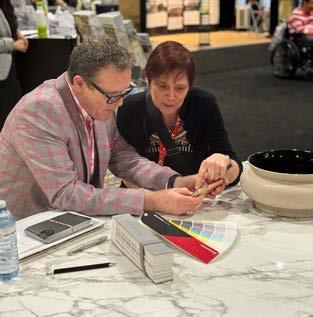
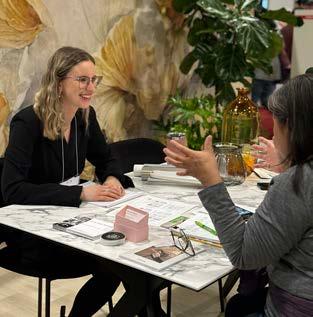
With a new year comes many new home improvement projects and this spring, RENO+DECOR is happy to bring you a onestop-shop for all of your renovation and design questions at the National Home Show.
Every day from 11 a.m. to 6 p.m., from March 6 to 15 at the Enercare Centre, we will feature some of the GTA’s most talented designers and decorators to help you on your renovation and decor journey. Drop by booth 1848 and get a free 15-minute consultation. Be sure to come equipped with your photos, floorplans and samples to ensure you get the most out of your meeting. No question is too simple, no job is too big. Our experts are ready and willing to help you get your project off on the right foot. Along with our free design consultations, you can also pick up free copies of our publications and enter to win an amazing prize package, including a $700 gift certificate from Candace & Basil and a fully loaded toolbox from Stanley Tools.
“I designed the booth as an inviting, experience-driven space that reflects a warm, modern approach to living. Within the space, we layered a palette of soft, neutral tones with natural textures to create a sense of comfort and timeless appeal. Warm materials such as wood finishes and tactile textiles are thoughtfully combined to add depth and visual interest, while maintaining a cohesive and calming aesthetic. Clean lines and an open layout make the space approachable and uncluttered, mirroring how these materials function in real residential environments.
“Through this design, I showcase how well-constructed furniture by Candace & Basil provides a foundation that feels rich and elevated when paired with thoughtful detailing and quality materials. The booth serves as a visual statement and as an interactive demonstration of how warmth, balance, and materiality can transform everyday living.”
– Evelyn Eshun
EVELYN ESHUN
Perspectives on collecting art for your home
An Artful discourse
by MARLENE EISNER
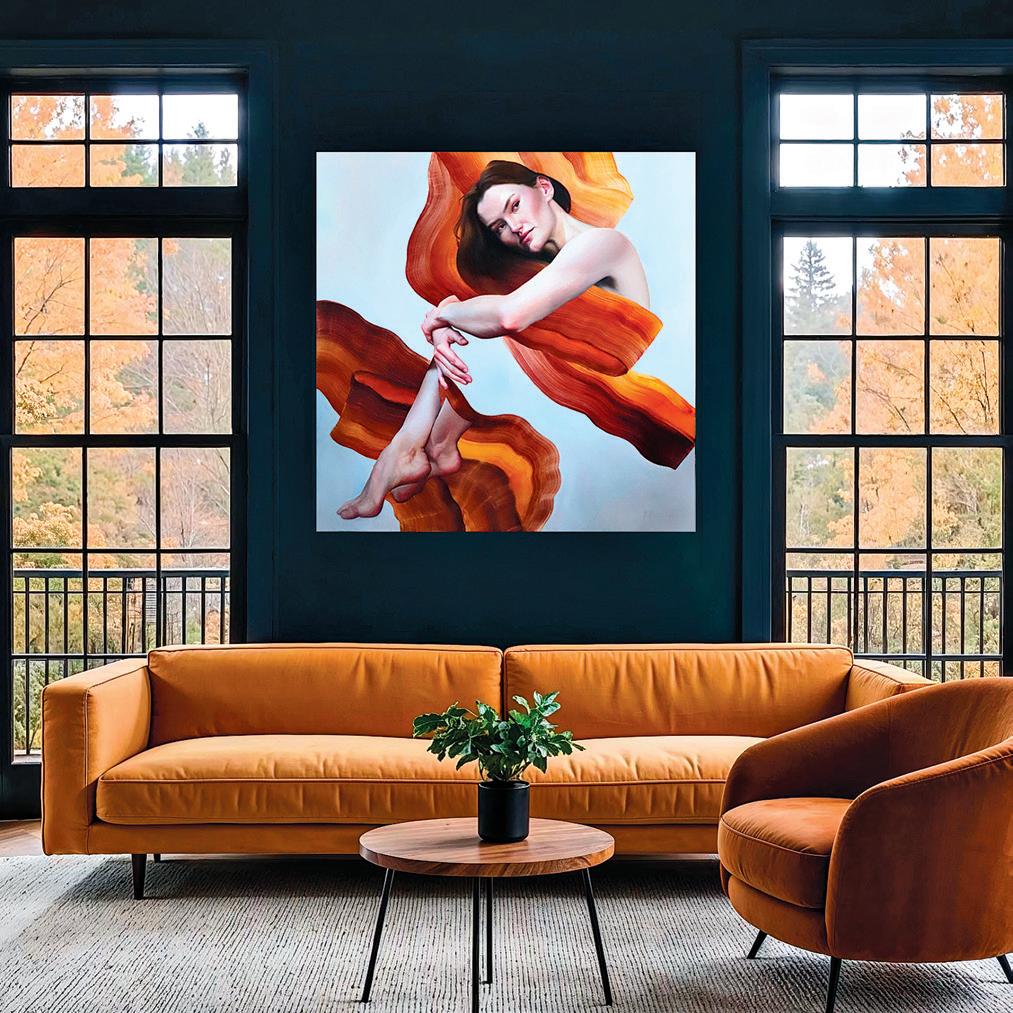
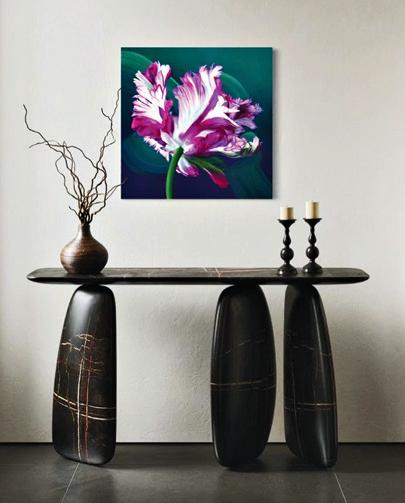
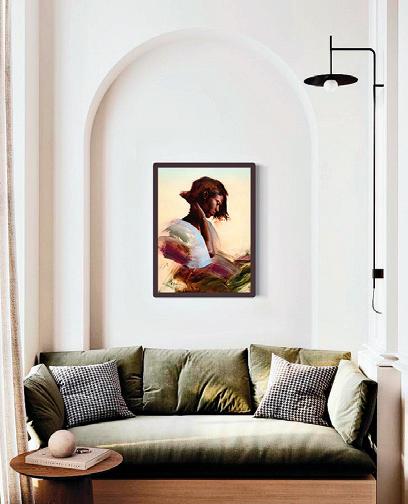
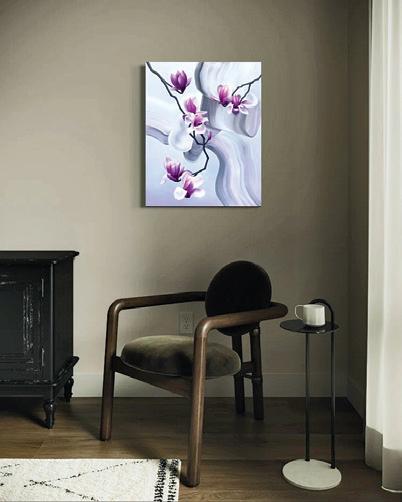
RENO+DECOR spoke with artist Robyn Asquini, a Torontobased, award-winning oil painter who specializes in blending figurative realism with abstraction. Asquini offers her insights into how homeowners can connect with artwork to elevate their home’s aesthetic, as well as suggestions on where to purchase, choose, collect and display art.
RENO+DECOR: WHEN IS THE BEST TIME TO CHOOSE ART DURING A HOME UPDATE?
ROBYN ASQUINI: It depends on why you’re acquiring art. If you’re looking to have a strong statement piece to anchor the room, many people will start by finding a piece they love and use that as a jumping-off point for the colour palette and layout of the space. If you haven’t found a piece that resonates with you before or during the interior design phase, hold off purchasing anything until you find one that does. Don’t rush into buying art. Get familiar with artwork that you like by looking online, visiting galleries and reading art magazines. Art shouldn’t only be about displaying something nice to match your furniture; it should reflect your personal taste and connect with you, as you’ll need to be able to look at it every day and have it add something to your life.
R+D: WHERE IS THE BEST PLACE TO PURCHASE ART?
RA: A great starting point is to visit local galleries or artist networks. This allows you to view art in person and learn more about the work. Galleries can offer valuable insight and help guide you toward artists and pieces that suit your taste and budget. Art fairs are also a great place to get a broad overview of the art market and discover a range of artists in one setting.
Online platforms like Artsy.net allow people to browse galleries and artists internationally, making it easier to research styles, pricing and availability. Some collectors also connect with artists directly through their website, Instagram or other social media platforms. Reaching out directly to an artist can be a great way to start a conversation, whether about available works or commissioning a custom piece.
R+D:
WHAT SHOULD A PERSON THINK ABOUT WHEN CHOOSING ARTWORK?
RA: Most people buy art because it resonates on a deeper level, like a film, song or book that sticks with them, evokes a memory or makes them see the world differently. Experienced collectors often ask themselves a few simple but important questions: ‘Do I love this piece? Can I live with it, even with trends and decor changes? Can I afford it? How does it fit with the rest of my collection?’
Other practical considerations matter, too. Is the price fair for the work? Is now the right time to buy if investment potential is a factor? And does it feel right in the space where it will be displayed?
Ultimately, choosing art is a balance between emotional connection, personal taste and consideration of the context for which you’re buying, like elevating the look of a space.
R+D:
IS ART AS AN INVESTMENT SOMETHING TO CONSIDER?
RA:: Art is considered an asset class and can be bought as an investment but that shouldn’t be the primary reason for purchasing a work. There are so many factors that influence the price and value of art and its potential as an investment.
If you are thinking about the investment potential of an artist, it’s crucial to research the artist’s career trajectory, including their exhibition history, residencies, awards and grants, gallery representation, consistency of practice and media coverage to know how their work fits into the broader historical context and current conversations in Canadian and international art.
R+D: FOR PEOPLE WHO ARE AFRAID TO COMMIT, IS RENTING ART A GOOD IDEA?
RA: Dedicated art rental programs have become increasingly popular, but they can be limited in terms of artist selection and available works. Many galleries and artists, however, will offer installation with a trial or return window, allowing you to see how a piece works in your space before committing to a purchase.
If you’re working with an interior designer or decorator, they can often place the artwork digitally into design mockups to help visualize scale, colour and placement.
There are also online platforms and apps, like Artsy, that offer digital viewing tools to preview how a piece might look in your space.
R+D: HOW IMPORTANT IS THE FRAME? WHAT ABOUT LIGHTING?
RA: For paintings and works on paper, framing plays an important role in enhancing the artwork and helping integrate within a space. A wellchosen frame should complement the piece rather than compete with it. When choosing a frame, think about how it will enhance and not distract from the painting. A contemporary option would be a simple black, white or wood-grain floating frame to keep a minimal aesthetic, or it could have more weight or a traditional look by showing it in an ornate frame that makes it look historical or like in a museum.
If the painting is in a darker section of the house, consider a sconce, spotlights, track lighting or floor lamps that will allow you to better view the work. If the painting or work on paper is next to a window with a lot of light, consider framing it with museum grade glass, so the colours don’t fade over time. Also, some artwork is sensitive to humidity or temperature changes. It’s helpful to ask the artist or gallery what materials were used in the work and to ask for suggestions on how the work can be displayed.
R+D: WHAT IS THE BEST WAY TO HANG OR DISPLAY ARTWORK?
RA: Paintings and photography can be displayed individually as a focal point or grouped together as part of a gallery wall for a curated effect. Smaller works can also be leaned against a wall or placed on a shelf or console, creating a more casual, integrated look within the space. Sculptures and other threedimensional pieces can be wallmounted, positioned on a shelf or displayed on a pedestal or plinth, allowing viewers to appreciate them from multiple angles.
When arranging artwork, consider how it will be seen as people move through the room and whether you want it to serve as a focal point or blend with the surrounding decor. Larger pieces need lots of space to
create a clean, minimal aesthetic, while smaller works can be placed near other objects to spark visual dialogue. In the end, positioning should account for sightlines and breathing room, ensuring each piece can be appreciated.
R+D: WHAT DOES ARTWORK BRING TO THE OVERALL DESIGN OF A ROOM?
RA: Art should elevate a space and engage the viewer visually and intellectually. It should enrich your life, whether by bringing beauty, sparking thought, triggering a memory or creating a connection with the artist or the subject. Collecting art is as much about personal connection, context and cultural engagement as it is about financial value. Ultimately, the work you choose is a reflection of who you are, your tastes, values and lifestyle.
kıtchen, RECONSIDERED
by BRENDAN CHARTERS
Three experts weigh in on how the heart of the home is evolving – again
It’s been two years since we last gathered a builder, an interior designer and a kitchen manufacturer to dissect the state of the modern kitchen. In that short span, a lot has changed – and much has stayed the same.
Post-pandemic life has settled into a new rhythm. Kitchens are still working overtime, but now within tighter footprints, higher budgets and increasingly lifestyledriven use. Add the steady rise of food delivery apps, with roughly one in four Canadians using them regularly, it’s clear the role of the kitchen is evolving from a pure production space into something more layered, flexible and intentional.
To understand where kitchens are headed in 2026 and beyond, we reconvened interior designer Laura Thornton (Thornton Design), Jimmy Zoras (Distinctive by Design Fine Cabinetry Inc.), and Eurodale Design + Build partner Jim Cunningham, for a fresh perspective on what matters most, and what’s okay to toss in the archives.
What is the single most critical thing you try to design, or convince clients to include in their kitchens?
Laura Thornton (LT):
Without question, quality and thoughtful planning. The kitchen is the most used space in many homes, so the things you touch daily need to work hard and stand the test of time. Cabinetry, faucets and hardware aren’t places to cut corners; they’re touched hundreds of
LAURA THORNTON
times a week and need to be durable, functional and beautiful.
But materials alone aren’t the foundation. Planning is. A kitchen should work for your life, not against it. We always start by asking how clients cook, entertain, clean, store and move through the space. A good designer can make anything look pretty; a great one ensures the kitchen actually functions beautifully day after day.
Jim Cunningham (JC):
From a design and build perspective, integration is everything. The most critical kitchens are the ones where architecture, millwork, lighting, mechanical systems and finishes are all considered together, not in isolation. We spend a lot
of time helping clients understand that the success of a kitchen isn’t about one stand-out feature, but how seamlessly everything works as a whole. Proper clearances, thoughtful appliance placement, storage that anticipates real behaviour — these are the decisions that determine whether a kitchen feels effortless or frustrating. When you get the fundamentals right, the space not only looks better, it ages better, too.
Jimmy Zoras (JZ):
Purposeful storage is the most critical element. Every appliance, drink and device needs a permanent home, so the kitchen stays calm, functional and future-ready. When storage is planned properly, from appliance garages to beverage
fridges and hidden charging stations, countertops stay clear and the kitchen works with you, not against you.
What trend feels outgoing or passé? Have white cabinets finally left the building?
LT:
The sterile, all-white kitchen is definitely fading. White isn’t ‘out,’ but it’s being softened and layered with natural textures and contrasting materials that bring warmth and soul. We’re also seeing a move away from heavy upper cabinetry. Instead, pantries, appliance garages and concealed storage free up walls for statement hoods, sconces and open shelving. Kitchens are becoming more expressive, more personal and less cookie-cutter.
JIM CUNNINGHAM
JIMMY ZORAS
JC:
White kitchens still exist, but they’re no longer the default. Clients are more confident now, more willing to embrace wood tones, colour and contrast. From a resale standpoint, warmth has replaced stark minimalism. Functionally, we’re also seeing fewer decorative, but impractical choices. Kitchens today are expected to work hard, and anything that sacrifices usability for looks tends to fall out of favour quickly.
JZ:
White cabinetry hasn’t disappeared, but it’s stepped out of the starring role. In 2026, it’s more often a supporting element, balancing darker tones or highlighting architecture. The shift is toward warmer palettes: Creams, greiges, taupes and natural woods that feel lived-in rather than showroomperfect.
What’s the next “hot” thing for kitchens in 2026 and beyond?
LT:
Kitchens are becoming furnituregrade living spaces. We’re seeing more built-in banquettes, character-rich islands and integrated millwork that
connects the kitchen visually to the rest of the home.
Statement hardware, mesh inserts, decorative wire fronts and hand-finished woodwork are also gaining momentum with a return to craftsmanship. And smart lighting is now essential: Dimmable task zones, ambient glow for evenings and discreet outlets that support real living.
JC:
The biggest shift is toward longevity over trend-chasing. Clients want kitchens that feel current now but still relevant 10 years from today. That means fewer gimmicks and more timeless materials, flexible layouts and thoughtful detailing.
We’re also seeing more interest in concealed functionality. Pocket doors, appliance panels and multi-use islands, for example, are spaces that adapt as lifestyles change without requiring a full renovation.
JZ:
Rather than following trends, I focus on elements with staying power: Full-height architectural backsplashes, warm metals such as nickel and brass, workstation sinks that support real cooking and sculptural hood fans that anchor the space. These are upgrades that elevate form and function longterm.
With urban kitchens shrinking and food delivery apps on the rise, how is kitchen design changing?
LT:
We’re seeing less emphasis on oversized ranges and bulk pantry storage. Instead, kitchens are designed as refined, multi-use spaces, beautiful enough to entertain in, efficient enough for daily routines. Smaller, high-performance appliances and concealed storage are replacing excess.
JC:
Delivery hasn’t eliminated the need for good kitchens; it’s clarified it. Kitchens are now command centres with coffee stations, reheating zones, snack prep, work surfaces and storage hubs. In smaller spaces, clutter shows immediately, so intentional planning becomes even more critical.
JZ:
The result isn’t less kitchen, it’s a more deliberate one. Even if clients aren’t cooking nightly, they still need smart storage, efficient layouts and durable materials. The kitchen remains central to daily life, just used differently.
Best budget bang-foryour-buck for high visual or lifestyle impact?
LT:
Invest in quality the first time. The items you touch daily, such as cabinetry, hardware, faucets and lighting, should all be well-made. Cheap products wear out quickly and get replaced, costing more in the long run. Real value is how a kitchen performs years after the photos are taken.
JC:
Strategic upgrades that don’t require structural change deliver the best return. Lighting, hardware and millwork details can dramatically elevate a kitchen without a full rebuild. It’s about choosing improvements that enhance the daily experience, not just aesthetics.
JZ:
Hardware, without question. It’s the jewellery of the kitchen. Affordable,
functional and visually powerful, the right hardware can transform cabinetry, introduce warmth or contrast and give a custom feel without major disruption.
The last word
The modern kitchen is no longer just a place to cook, it’s a living space, a gathering place and increasingly, a reflection of how we actually live. As footprints shrink and lifestyles evolve, thoughtful planning, quality materials and intentional design matter more than ever. Whether you cook nightly or order in more often than not, a well-designed kitchen still anchors the home, not through excess, but through purpose.
When planning your own kitchen, function is as important as form, and working with experienced professionals who provide written contracts, are licensed, insured and offer warranties, can make the difference between a space that looks good and one that truly works.
Brendan Charters is a founding partner at Toronto design-build firm Eurodale Developments Inc., the 2020 BILD Renovator of the Year. eurodale.ca, @eurodalehomes, 416.782.5690.
LIVING etc.
by SARA DUCK
The latest design inspiration
#Trending
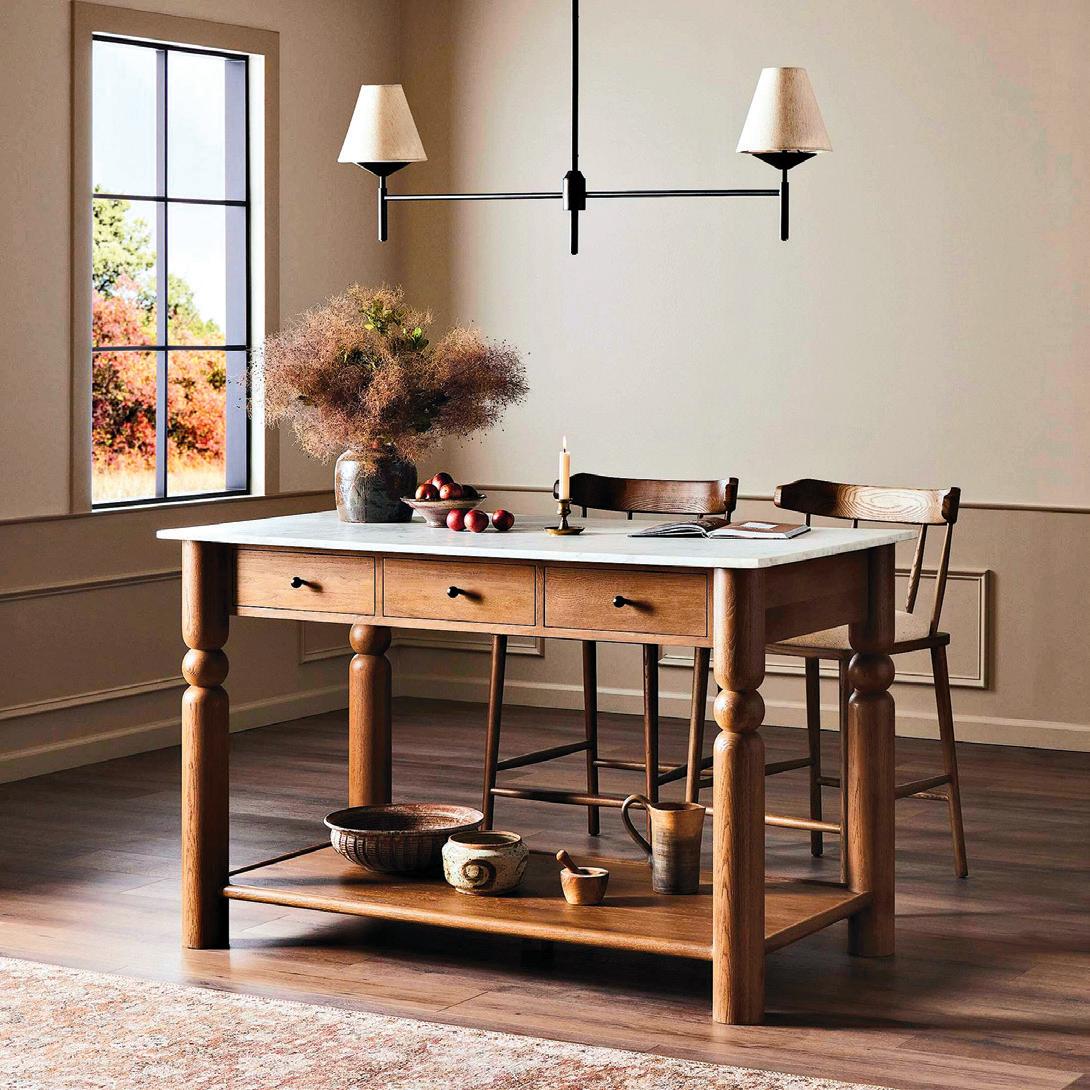
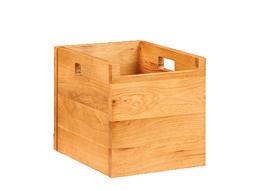
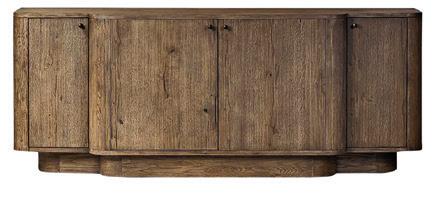
Wooden kitchen islands are having a major moment, bringing warmth, texture and a crafted, furniture-like feel to today’s otherwise streamlined kitchens.
Babette kitchen ISLAND. $4,274. westelm.ca
Pantone’s COLOUR OF THE YEAR
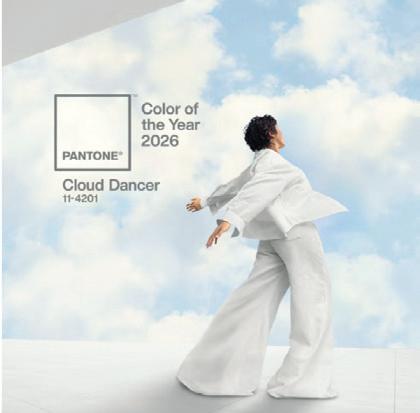
Many in the design community did not predict Pantone’s colour of the year would be a shade of white. But Cloud Dancer feels like a modern reset for homes and minds alike. “Similar to a blank canvas, Cloud Dancer signifies our desire for a fresh start,” says Laurie Pressman, VP of the Pantone Color Institute. “Peeling away layers of outmoded thinking, we open the door to new approaches. An airy white hue, PANTONE 11-4201 opens up space for creativity, allowing our imagination to drift, so that new insights and bold ideas can emerge and take shape.”
In design terms, Cloud Dancer is a neutral with presence – soft enough to calm, crisp enough to elevate and endlessly adaptable for any space.
Get the look
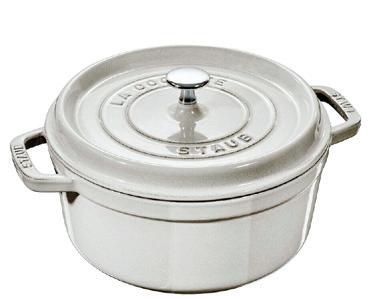
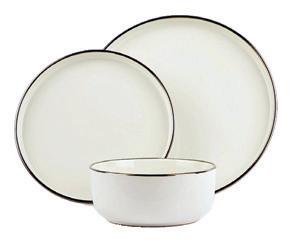
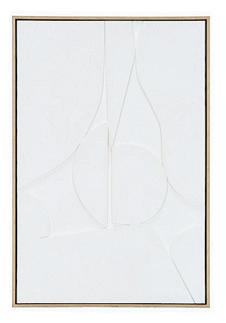
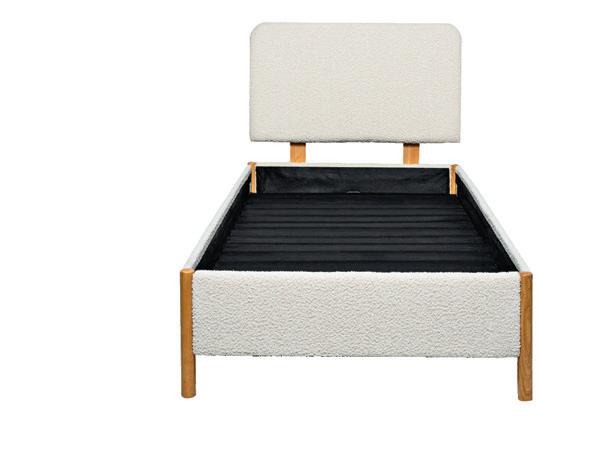
2 1 3 4 5 6
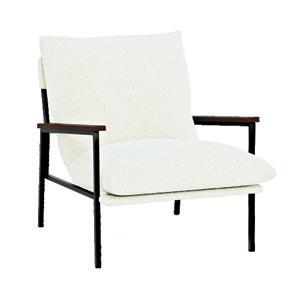
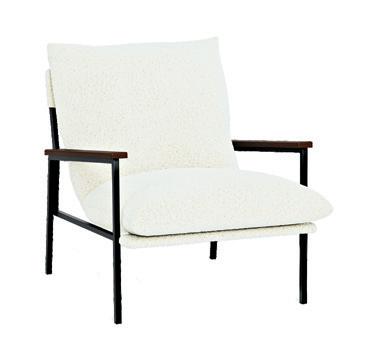
1. Mira accent chair in bouclé. $250. cozey.ca
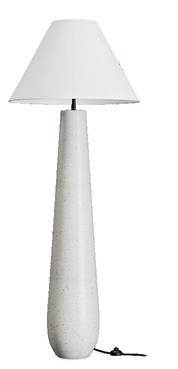
2. Pilar floor lamp in white terrazzo. $469. article.com
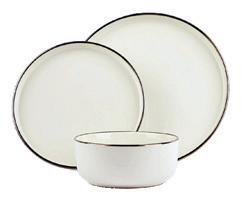
3. Montreal 12-piece stoneware in white. $60. stokesstores.com
4. Orsa painting. $239. structube.com
5. Cast-iron round cocotte in white truffle. $520. zwilling.com
6. 24-piece white flatware set by Jean Dubost Laguiole. $199. linenchest.com
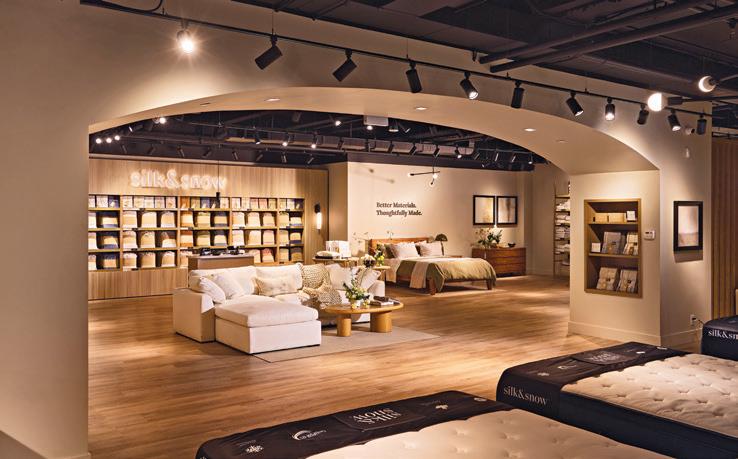
Silk & Snow has opened its second standalone Toronto store in Summerhill, a 2,871-sq.-ft. space that showcases the brand’s full offering with a focused, materialdriven approach. The location brings together its award-winning mattresses, complete bedding and bath collections, the S&S sofa and select furniture pieces. The interior is intentionally understated, creating a calm, tactile environment for customers to experience the products, while echoing the neighbourhood’s refined, residential character. silkandsnow.com
Silk & Snow SHINES IN SUMMERHILL
BATHROOM REFRESH
Updating a bathroom can be surprisingly easy and budget-friendly with a few thoughtful tweaks. Although a new paint colour is one of the quickest ways to transform the space, first consider how the shade will interact with your existing tile, natural light and fixtures. Swapping out accessories such as towels, hardware, shower curtains or even the vanity mirror can also refresh the room instantly. Look for cohesive finishes and materials to keep the space feeling intentional. These small choices add up to a bathroom that feels renewed without the renovation.
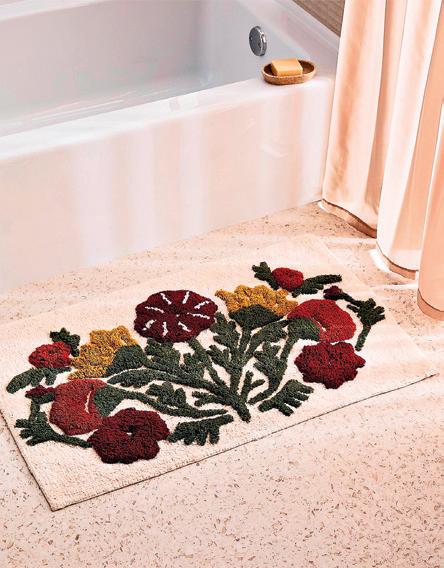
1. Fall flower bathmat. $35. simons.ca
2. Klein wall mirror in brass. $239. article.com
3. Turkish bath towel in isla. $40. silkandsnow.com
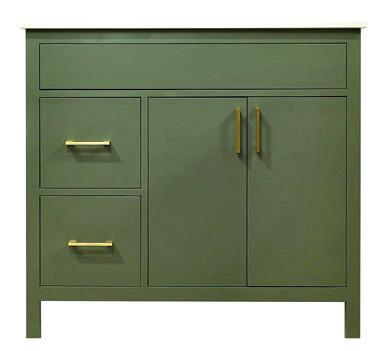
4. Lush Mirea-style bathroom vanity in olive. $899. ibtools.ca
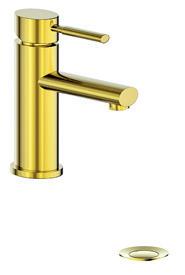
5. Worgl single hole faucet in brushed gold by Vogt. $417. plumbingwarehouse.ca
6. Celestia two-light wall sconce in matte gold by Globe Electric. $79. rona.ca
4 5 1
This compact design is perfect for small space design! 2 3 6
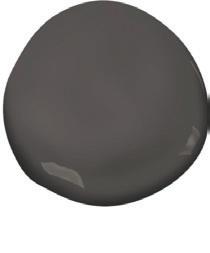
Silhouette AF-655
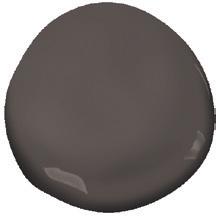
Benjamin Moore’s 2026 colour of the year, Silhouette AF-655, blends deep espresso with subtle charcoal undertones, creating a colour that is grounding, sophisticated and versatile. Perfect for a new bathroom update. benjaminmoore.ca
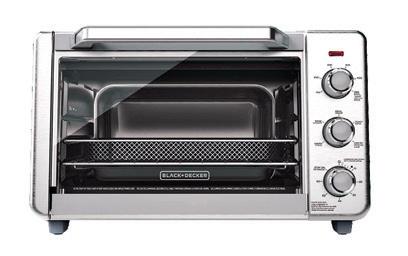
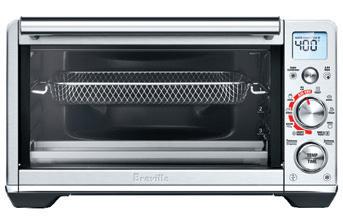
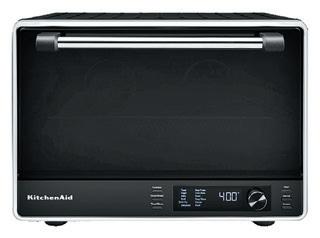
Hybrid toaster-oven/air-fryers blend sleek design with serious function, letting you toast, bake, roast and crisp in one compact footprint. Whether you’re splurging on a premium model or sticking to a budget, these streamlined appliances punch well above their weight in style and performance. HIGH & low
Crisp ‘N bake six-slice air fryer toasteroven in stainless steel by Black & Decker. $149. canadiantire.ca
Dual convection countertop oven with air fryer and temperature probe. $419. kitchenaid.ca MIDI
Compact smart-oven air fryer in brushed stainless steel by Breville. $369. bestbuy.ca
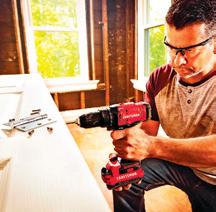
Complete a range of woodworking and metalworking jobs with this V20 Cordless 8-Tool Combo Kit. With 2 batteries and a charger included, you can start the workday with pride and confidence knowing you have the power needed to tackle a full day’s work. Drill, sand, and cut with this kit as you easily retrieve and store tools using the included storage bag, which can also be used to transport your set of tools, batteries, and chargers from one garage or workshop to another.
Spring 2026 home decor trends
Interiors THAT TELL A STORY
by BILHA KANGETHE • photos THE LIFESTYLE LOFT
This spring, interiors are defined less by novelty and more by meaning. Across showrooms, fairs and editorial spaces, one theme stands out: Homes are deeply personal, richly layered and intentionally warm, spaces that feel restorative, expressive and truly lived in.
Storytelling is the guiding principle. Rooms no longer aim to impress at first glance; they reveal themselves slowly through texture, materiality and detail. Every object, fabric and finish has a purpose, forming a narrative that feels authentic to those who inhabit the space.
While trends shift from season to season, they are best experienced
as accents rather than anchors. Timeless proportions, quality materials and thoughtful restraint form the foundation, while accessories, finishes and decorative layers bring freshness and personality. Homes evolve gracefully, telling stories that are uniquely their own.
Mood 2026: Hollywood cottage
One trend reflecting the zeitgeist of our current interiors is Hollywood cottage. First coined by American interior designer, Shea Mcgee, this aesthetic fuses the lived-in charm of cottage decor with subtle glamour, vintage inspiration and layered, inviting interiors. It’s a spirited revival of traditional forms,
reimagined with a playful, modern twist. Hollywood cottage balances personality with sophistication. Rooms are approachable, polished, nostalgic and fresh, familiar yet unexpected. Every detail contributes to a narrative that feels alive, layered and unmistakably personal.
This aesthetic reflects a broader philosophy in spring 2026: Design is not just visual, it’s emotional. Spaces are meant to be felt as much as seen. Homes are storytellers, chronicling the lives, tastes and histories of the people who live there.
A softer point of view
Colour this year steps away from stark contrasts and cool minimalism,
favouring, instead, sun-warmed, grounded palettes. Here, it supports mood rather than demand attention.
A continuing theme, though, is colour drenching, enveloping a space in a dominant hue to create depth, cohesion and atmosphere. Walls, textiles and furnishings can be layered in shades of the same colour to produce a serene yet expressive environment. This approach allows a single colour to unify a space while accommodating accents and textures for visual interest.
Some of our favourite designers favour shades that bridge neutrality and expression – clay-infused tones, softened greens, muted blues and warm off-whites. Paint finishes also play an important role. Limewash and matte surfaces create subtle movement, catching light differently throughout the day.
Anchored by Pantone’s Cloud Dancer, a luminous off-white, designers layer Benjamin Moore’s Silhouette, Farrow & Ball’s Setting Plaster and SherwinWilliams’ Universal Khaki for rooms
that are rich yet versatile. The mood is warm, not heavy, expressive and never overpowering.
Layers that invite touch
Materials and texture are central to a room’s emotional impact. They are not secondary details; they define how a space feels. Interiors are moving beyond sterile surfaces to organic, layered environments that invite touch, evoke warmth and tell a story through every element.
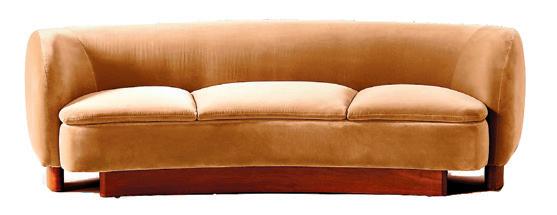
Muir 90-in. camel velvet curved SOFA cb2.ca
Pantone CLOUD DANCER
Wood tones lean darker and richer. Reclaimed timber, burl veneer and vintage pieces with patina bring depth, warmth and a sense of history. These woods, when layered with stone, textured textiles and muted metals, anchor a space while encouraging tactile interaction.
Honed marble, travertine and expressive quartzite extend beyond countertops to create sculptural surfaces. Silver accents, pewter, antique frames and collected silverware add understated shine, while the playful layering of gold and silver with patina finishes introduces depth and intrigue.
Rattan, cane and jute accents bring rhythm and visual warmth, connecting interiors to craft and heritage. Surface treatments such as limewash, plaster and textured walls paired with tactile cabinetry and ornate, playful pairings of zellige tiles, create sensory richness. Textiles enhance softness and tactility. Washed linen drapery, bedding and upholstery exude relaxed elegance, while bouclé, wool throws and handwoven rugs add contrast and a layered sensation.
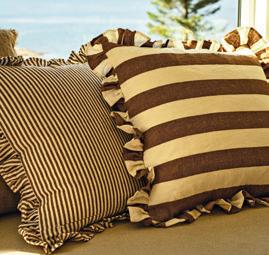
Pattern-on-pattern makes a subtle return, grounded in tradition. Designers mix scales – oversized accent pillows alongside smaller ones – and incorporate embroidered motifs or monograms to add personalized charm. This thoughtful layering creates interiors that feel deeply human.
Comfort meets curated character
This spring, furniture balances comfort, personality and craftsmanship. Soft curves, rounded edges and tailored proportions co-exist with substantial, grounded pieces that convey presence and longevity. Seating is central. Oversized sofas, enveloping armchairs and modular sectionals encourage relaxation and social connection. Natural-fibre upholstery, textured
throws and plush cushions enhance tactile richness, while fringing or tassels add playful sophistication.
Storage and case goods prioritize substance: Deep wood tones, matte finishes, visible joinery and subtle imperfections celebrate craftsmanship. Customization is on the rise, from bespoke cabinetry to upholstered pieces with handembroidered or painted details, reflecting the personality of the space and the inhabitant. Modular, adaptable solutions such as nesting tables or movable storage ensure interiors evolve with daily life.
Spring 2026 furniture is intentionally tactile, welcoming and enduring, anchoring rooms, inviting touch and creating homes that feel stylish.
Spring glow
Lighting is sculptural and expressive. Multiple sources such as ceiling fixtures, task lamps and wall sconces bring warmth and depth. Soft, diffused illumination is prioritized over harsh brightness. Over-scaled pendants, playful lampshades and vintageinspired designs create intrigue, while fixtures such as ‘napkin’ lighting inspired by folded fabric add artisanal charm.
Brass, bronze and darkened steel pair with natural elements such as wood, rattan and hand-blown glass for grounded sophistication. Statement chandeliers, sculptural pendants and asymmetrical wall lights anchor rooms, and smaller lamps highlight textiles and finishes.
Vintage, oversized and custom designs reinforce individuality and craft. Lighting is more than functional; it shapes mood, enhances texture and completes the narrative of a home designed to be lived in.
Interiors that live and evolve
Hollywood cottage defines the mood, a fusion of charm, sophistication and playful whimsy. Colour drenching reinforces this approach, unifying spaces while creating mood and depth. Materials invite touch, furniture blends comfort with character and lighting layers warmth and drama. It’s not about fleeting trends; it’s about enduring experiences. Homes evolve with their inhabitants, grow with time and offer beauty that is emotional and visual. Spring 2026 is about homes that tell stories – personal, layered and intentionally warm.
Bilha Kangethe is the founder and creative director of The Lifestyle Loft. As a certified designer and interior decorator, she has created a company that focses on the needs of each client and customer and helps them curate a lifestyle that is comfortable and economical. thelifestyleloft.com
LAKE FRONT
by SARA DUCK • photos
A re-imagined condo kitchen designed for slow mornings and long conversations
VALERIE WILCOX
The redesign of this lakefront kitchen began with a clear intention: To create a warm, functional and effortlessly elegant space shaped by the shimmering horizon just beyond the windows. From the outset, Olivia Botrie of Dart Studio understood the emotional atmosphere the homeowners were after. “Our clients hoped for an interior that carried a sense of ease,” Botrie explains. “They wanted a space that felt inviting and lived-in, without sacrificing sophistication or design integrity.”
The lake informed every choice. Its calm, expansive presence guided sightlines, seating placement and the materials chosen to support the architecture. As Botrie notes, “The lake views are the star of this space,” and the design stays true to that. A
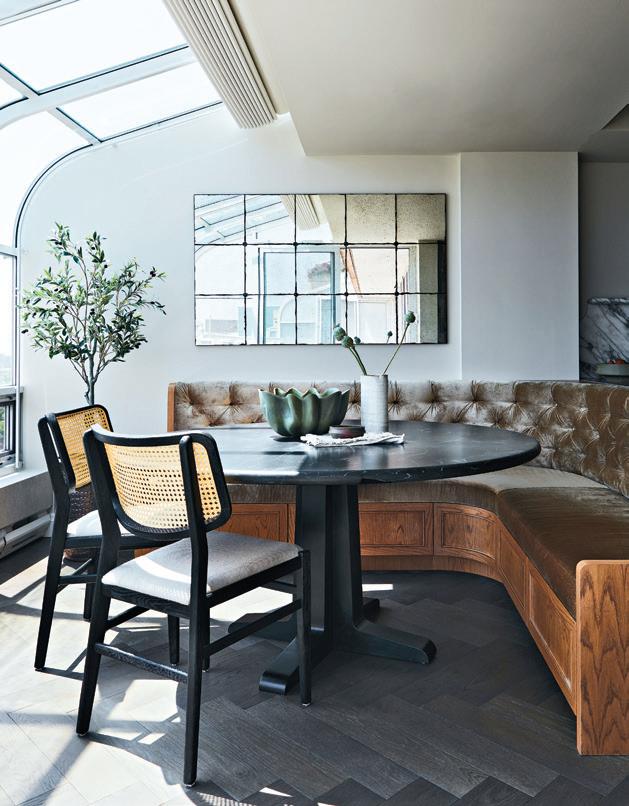
custom banquette, curved to cradle the corner, was placed intentionally for slow mornings and quiet rituals. A perfect place to sit and enjoy a morning coffee while taking in the stunning lake views.
The banquette quickly became one of the home’s most defining gestures. Sculptural yet intimate, it envelopes the dining nook in a continuous sweep. “The banquette was designed as a true focal point, so every detail, from its silhouette to its material, was intentionally considered,” says Botrie. Refined tan upholstery with a soft sheen, made from outdoor-grade fabric to hold up against direct sun exposure, catches the daylight beautifully, while standing up to everyday use. A diamond-tufted back adds depth and texture – an elegant nod to tradition that still feels distinctly modern. Sheer drapery filtres changing light, while keeping the shoreline everpresent.
The previous kitchen lacked storage and flow, prompting a complete rethink of how the room should serve the homeowners. The new plan incorporates thoughtful, discreet storage integrated into cabinetry, tucked beneath the banquette and woven throughout the millwork to ensure practicality never disrupts the refined palette.
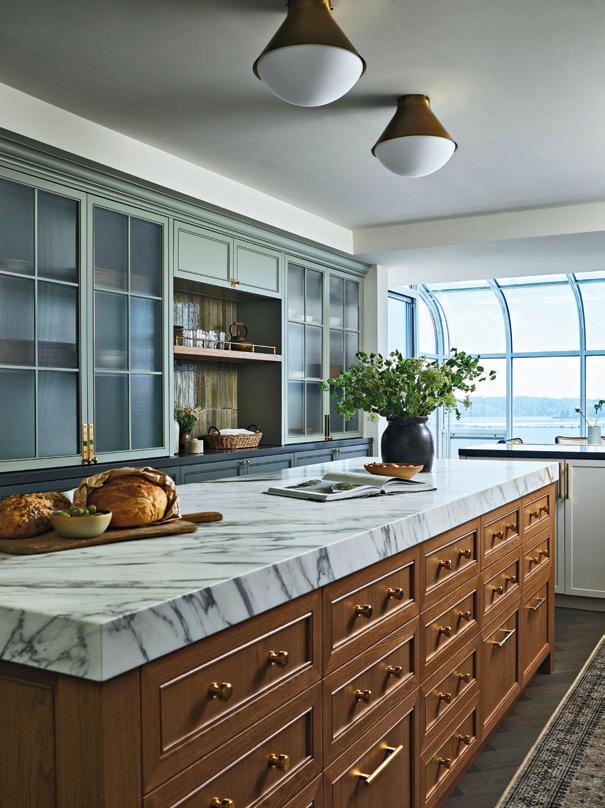
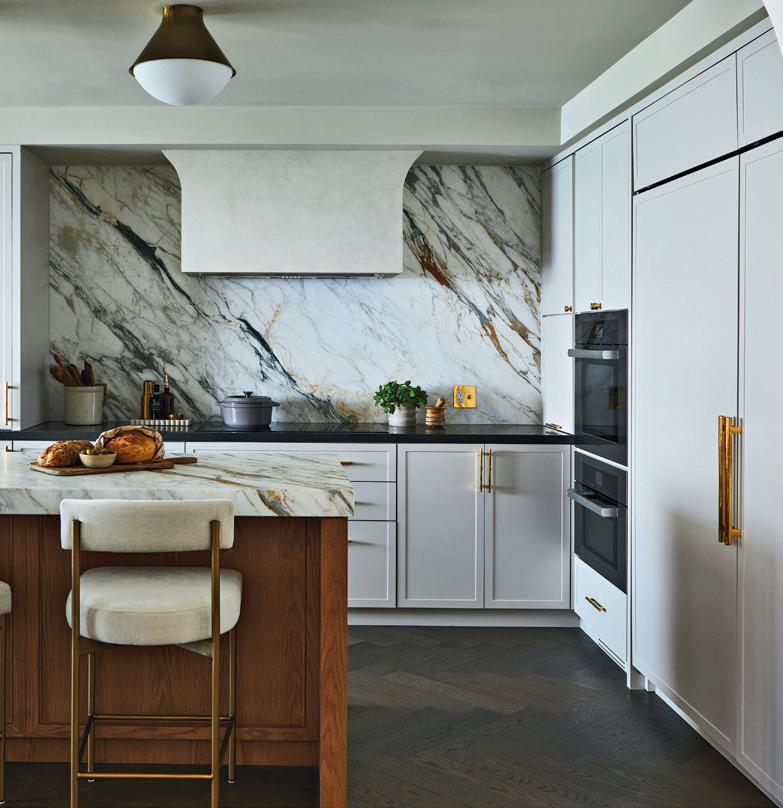
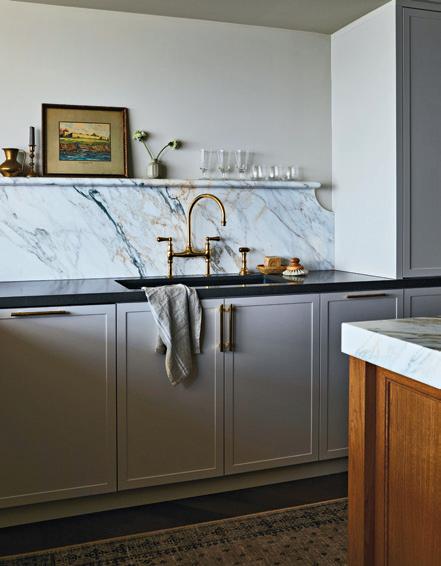
Because the kitchen is quite long, the designers knew they needed to create distinct areas using different materials to create interest and division. “The coffee bar was intentionally designed to feel like a standalone furniture piece, featuring two-toned millwork, a striking tile backsplash and a charming rail detail that adds character,” says Botrie. By reconfiguring the floorplan, the designers were able to dramatically improve flow and purpose. The kitchen was completely reworked to introduce generous counter space and ample seating, transforming it into
a grand, welcoming hub for everyday use and entertaining. “The island is a true workhorse of the kitchen, full of storage and function, while also being beautifully designed.”
Early in the process, their clients fell in love with the natural stone selected for the island and backsplash, a surface defined by warm movement and earthy depth. Botrie recalls: “It was one of the first materials we selected for this space, and the rest of the kitchen was designed around it.” Its blend of brown, taupe and mineral undertones brings quiet luxury without overwhelming the design. A gentle grey quartz along the perimeter introduces subtle contrast,
pulling out deeper hues in the marble, while keeping the palette cohesive. The room’s layered composition never feels busy. Natural textures, tonal woods, smooth metals and soft textiles co-exist with ease, supporting the surrounding landscape rather than competing with it.
Ultimately, the kitchen is an exercise in balance – purposeful, beautifully crafted, modern yet grounded in natural materials. It feels personal, refined and gentle in its presence. Botrie captures its spirit perfectly: “The result is a layered, inviting space that feels thoughtfully curated, yet always keeps the stunning lakefront view front and centre.”
With more than 15 years’ experience as a magazine editor, writer and content creator, Sara brings her passion for design and decor to our pages each issue. Instagram: @bysaraduck
“The banquette was designed as a true focal point, so every detail... was intentionally considered.”
interior design
indulgence RESTORATIVE
by MIMI PINEAU
Create a mini-spa at home
Given the pace and complexity of modern life, it’s no surprise that homeowners are looking to create a restorative oasis at home. With thoughtful planning and inspired design, an upscale bathroom can truly feel like a private spa. Imagine greeting the morning with an energizing self-care ritual or
unwinding with hydrotherapy at day’s end in your own sanctuary of calm.
When designing an at-home spa, aesthetics and function must go handin-hand. A feeling of tranquility is best achieved through visual simplicity. Clean lines and uncluttered spaces allow the mind to rest. Good design anticipates storage needs and amenities to minimize visual noise, while beautifully curated open displays introduce a sense of luxury and indulgence.
Upscale is in demand
Plumbing fixtures naturally take centre stage in any spa-inspired bathroom. Today’s residential market offers an exceptional range of statement fixtures, allowing homeowners to customize their style and experience. A sculptural, freestanding soaker bathtub can act as a show-stopping focal point, defining the room’s overall aesthetic. Sizing is key, but bigger
Photo: Photographie Intérieure Co.
Photo: Mark Olson Photography Inc.
is not necessarily better. A bathtub that is too large can be surprisingly awkward for lounging. Whenever possible, testing models in person at a showroom is a worthwhile endeavour.
Luxury shower spaces remain in high demand. Rain showerheads, body jets, refined thermostatic controls and integrated benches continue to top homeowners’ wish lists. Steam showers are also rising in popularity, valued for muscle relaxation, improved circulation and respiratory relief, with added benefits for skin health and better sleep. Because these features require precise specifications and positioning, early planning is crucial to a successful installation. Where space and conditions permit, a sauna or cold-plunge pool can further elevate the at-home spa experience.
Organic lines set the tone
When selecting finishes, organic and refined materials work best in creating a calming atmosphere. Natural stone and marble introduce depth, variation and visual interest. Tile with clean lines and subtle textures offers an excellent alternative when easy maintenance is a consideration. To balance the harder surfaces typical of bathing areas, introduce softness through cleanlined window coverings and cosy floor mats. Soft, soothing colours and matte finishes on the walls and cabinetry evoke comfort and serenity.
If space allows, consider incorporating a separate room or open area dedicated to rest and therapy. This space may accommodate a chaise longue, massage table, yoga mat or meditation cushion – items that support wellness rituals beyond bathing alone. Furnishings should remain minimal,
preserving the visual simplicity needed for rest, reflection and renewal.
Soothe the senses
Haven’t we all reveled in the luxury of a decadent bathrobe when visiting an upscale hotel or spa? Investing in high-quality bath linens is a worthwhile indulgence. Paired with a wall-mounted towel warmer, it’s true bliss. Neatly stacked towels and robes can be left on display, adding texture and softness to the space. Capture an elevated spa aesthetic with eco-friendly, natural linen towels and bathrobes, which dry quickly and feel divine.
Lighting also plays a principal role in setting the mood of a spa bathroom. Indirect light sources, such as dimmer-controlled wall sconces, cove lighting and concealed accent lighting, help create a serene atmosphere.
Some overall ambient lighting is still necessary for practical tasks such as cleaning, but it should remain unobtrusive. When thoughtfully layered, lighting will enhance the functionality and calmness of the space.
Scent and sound complete the sensory experience. A sprig of eucalyptus or a subtle essentialoil diffuser can instantly shift the atmosphere, while a personalized music playlist adds another layer of
relaxation. Built-in speakers should be carefully coordinated with other ceiling elements, using waterproof units specified for wet or damp areas. Planning ahead for control panels or phone docks ensures everything is conveniently within reach.
Easily keep up with your hydration goals in a delightfully practical way by adding a compact beverage station. A stylish bar cart stocked with mineral water, herbal teas or your favourite natural soda is a simple solution. For those inclined to go further, a built-in beverage fridge or smoothie station can quietly reinforce healthy daily habits.
Designed for ease and flow
The luxury of a spa experience lies in the accessibilty of its amenities, as well as subtle self-care details. A no-stress experience can begin in the earliest planning stages. Working with an experienced interior designer can provide clarity and confidence throughout the process, resulting in a seamless and timeless outcome.
Ultimately, an at-home spa is about creating inner calm and a reconnection to self. Choose the features that bring the most benefit to mind and body. The towels are warm, the lights are dimmed, the playlist is queued – no appointment required.
Mimi Pineau, ARIDO, IDC, NCIDQ is a registered interior designer and owner of Mimi Pineau Design, a full-service studio specializing in thoughtfully designed residential interiors with a chic, modern edge. mimipineaudesign.com.
Photo: Mimi Pineau Design
CUSTOM RENOVATIONS
A family-owned Canadian business since 1979! With over 40 years of renovation experience we are known for our reliability, professionalism and top-tier craftsmanship. We do custom home additions, wholehouse redesign and transformations. Elegantly designed kitchen & bathrooms, legal basement/UDU suites, Condo renovations and commercial renovation projects.
CARICK HOME IMPROVEMENTS
416.781.6671
IG: @carickhomes
FB: CarickHomeImprovements
carickhomes.com
HOME HARDWARE
Build your dream project with the right tools and materials from Home Hardware – Canada’s largest Dealerowned hardware, lumber, building materials, and furniture home improvement retailer with over 1,000 stores across Canada.
HOME HARDWARE
1(877) 940-5081
IG: @homehardware
FB: @homehardwarestores homehardware.ca
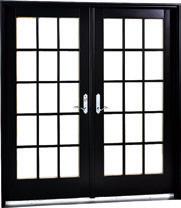
STEEL FRENCH PATIO DOORS
JELD-WEN® steel French patio doors are an excellent investment for homeowners planning a new home build or renovation. They offer energy efficiency, strength, security and are available in various customizations, such as eye-catching colours, finishes, panel designs and glass inserts. Experience the view of a lifetime with top-performing doors at jeld-wen.ca.
JELD-WEN®
jeld-wen.ca
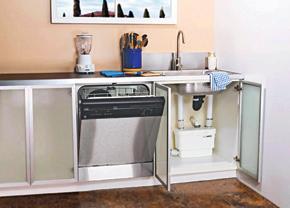
SANIVITE DRAIN PUMP SFA SANIFLO
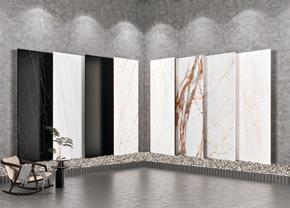
SINTERED STONE
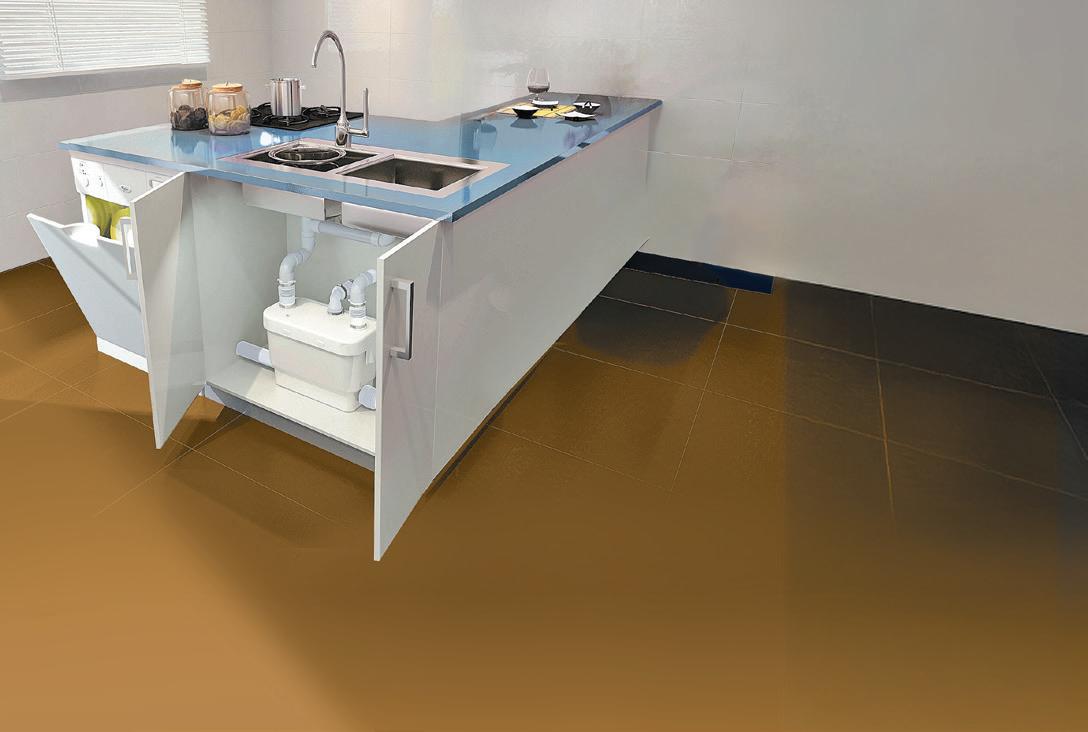
Create the kitchen or wet bar you really want – without breaking concrete. The powerful, compact Sanivite drain pump hides inside cabinetry, quietly handling hot water and grease from multiple fixtures and pumping it away for flexible, design‑forward renovations anywhere.
Discover Vicostone’s new Sintered Stone Collection, where timeless beauty meets unmatched performance. Crafted from nature and refined through innovation, these surfaces bring elegance, strength, and enduring style to every design.
Founded in 2001, Woodsmith Construction has spent more than two decades honing a reputation for excellence. Built on a designthrough-build model, we offers clients a seamless journey from concept to completion.
800.363.5874
IG: @saniflocanada
FB: @saniflocanada sfasaniflo.ca
MAR 12–15
Vancouver Convention Centre West
Are you ready to tackle your to-do list? For all your home and garden projects, find the help you need to get it done at the BC Home + Garden Show
Connect with hundreds of trusted experts, including Kortney Wilson from Life Is Messy , coming soon to Home Network. From kitchen and bath to decks and landscaping, discover the latest trends, find innovative solutions and get practical advice.
interior design
maximalism MODERN
by MARLENE EISNER • photos DONNA GRIFFITH • styling THE PROPERTY STYLIST
Expanded spaces create an emotional connection
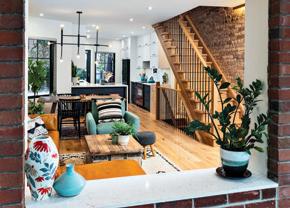
This three-bedroom, two-bathroom 1920’s Edwardian-style cottage is nestled in the Beaches neighbourhood of Toronto. Despite having a narrow footprint typical for the area, the house was recently expanded through a thoughtfully planned and executed renovation that increased the living area to 2,414 sq. ft., from 1,904-sq.-ft., not including the attic.
“We added 15-ft. by 17 ft., on two levels,” says Yvonne Crezel, founder
and principal designer at YCC Design Interiors. “This included 255 sq. ft. for the basement plus the relocation of the stairs leading from the basement to first floor, and 255 sq. ft. to expand the kitchen and create a family room.”
The vision
The homeowners were looking for a kitchen and main floor upgrade that told their story, one that was personal and reflected their tastes and lifestyle and offered an emotional connection. Although the kitchen had been
updated 15 years earlier, space was limited, and the layout was not ideal.
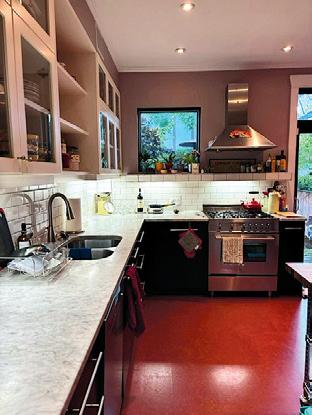
“The original kitchen was small, cramped and made no sense,” says Crezel. “The floors were deep red Marmoleum, the lower cabinets were dark brown and the upper cabinets a few shades off from the pale mauve walls. All colours and materials were competing, and the room was distracting and cold.” The redesign not only focused on improving the kitchen, but the extra square footage also allowed for the addition of a
family room that significantly changed how the family use the space and spend time together.
The makeover
When you walk into the house, you enter a small vestibule large enough
for shoes and coats. Ahead, a set of stairs leads to the second floor while on the main floor, the living room and dining room flow into each other and end at the kitchen, a separate, walled room located at the back of the house. Before the renovation, the kitchen doorway was 36-inches wide.
“We expanded the width of the opening entrance to 46 inches to make it feel more connected to the dining room and the front of the home,” says Crezel. “The extra 15 feet made space for the new family room adjacent to the kitchen.”
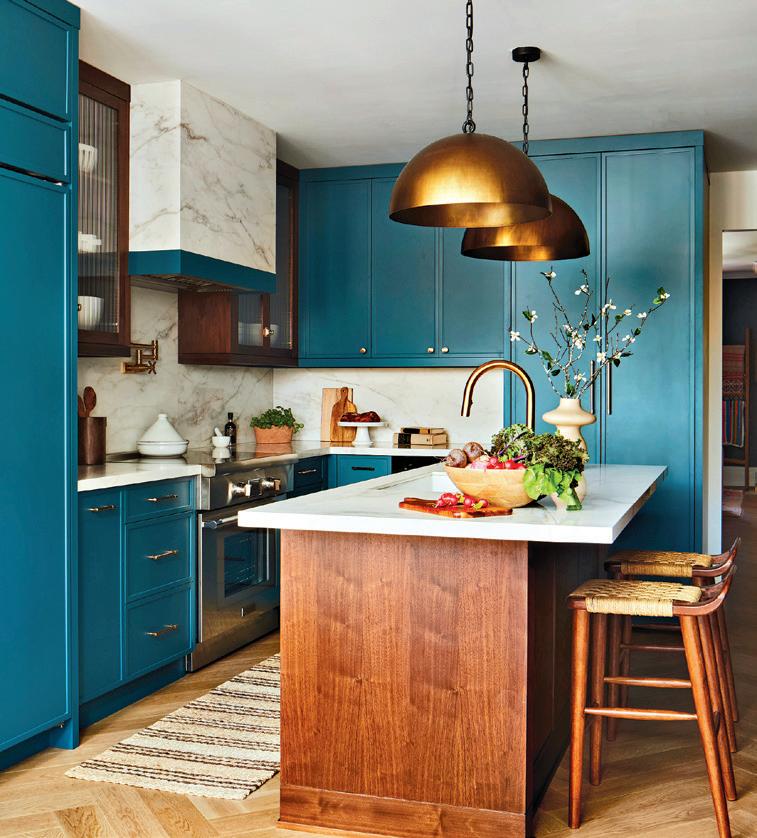
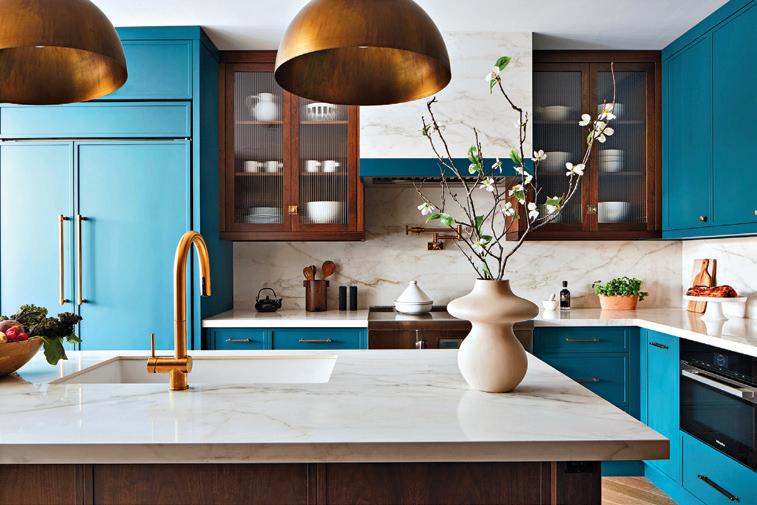
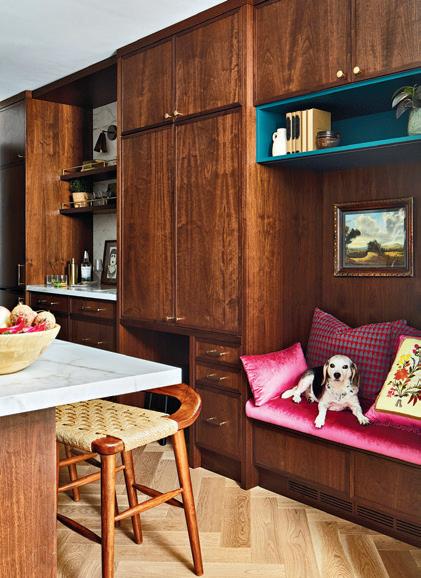
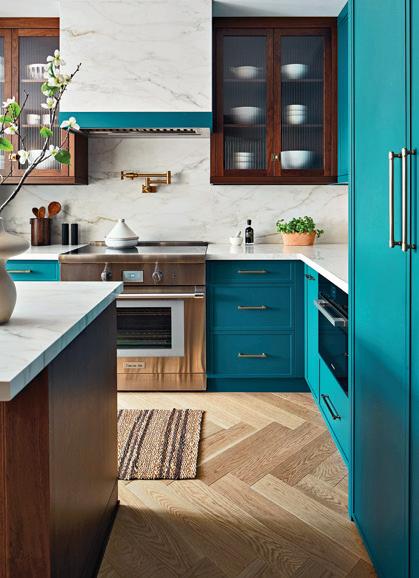
cabinetry in mind, two complementary finishes were used for the cabinets. Walnut offered added warmth and a grounding aspect without competing with the teal, and brass hardware and fixtures provided the sophisticated feel the homeowners were seeking.
style reflects the bold resurgence in modern maximalism, with an emphasis on tactility and sustainability.
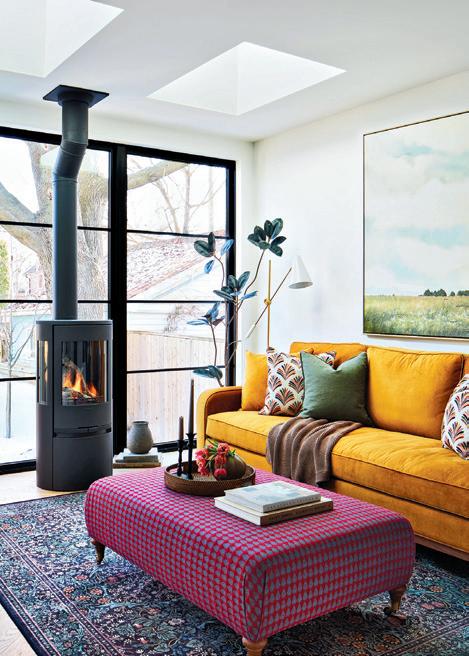
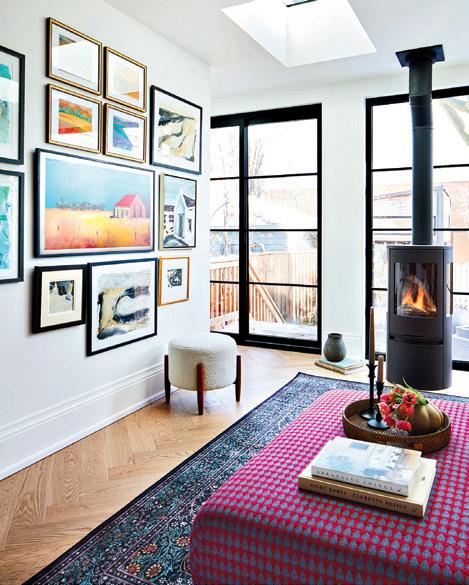
For a seamless look, the flooring on the main level was replaced with white oak in a herring bone pattern. The kitchen now has a walk-in pantry, office space, a sitting nook, a bar and more storage space. To add natural lighting and a spacious feel, three new skylights were installed, and windows, with an oversized glass sliding door that opens to the backyard, occupy the entire back wall of the home. The outdoor space features a gas fire pit and is a much-used gathering place for friends and family.
Design details
To really personalize this home, the couple was open to mixing different styles, bold artwork, eclectic furnishings, vibrant hues and integrating intricate pattern play into the design. One inspiring move was to choose teal as the colour for the kitchen cabinetry. Benjamin Moore Galapagos Turquoise was used as the base colour and the jumping-off point for the final design. Keeping the size of the new kitchen and the scope of the
“I deliberately chose counters that were muted and warm to bring all the elements together cohesively, but to not compete with the walnut and teal cabinetry,” explains Crezel.
Aside from aesthetics, the functionality of the kitchen needed attention. The original space had been cramped with inadequate working areas – it lacked an island, and only had a small free-standing table pushed against a wall. The updated layout incorporated new appliances, and for easy function and flow, the sink was relocated to the new island.
“I wanted the stove and hood to be the focal point of this kitchen and the sink to be situated in the island for practical reasons (next to the dishwasher). I find one spends more time at a sink than a stove and I wanted the clients to be facing the children and the visitors sitting at the island while working at the sink.”
A modern touch
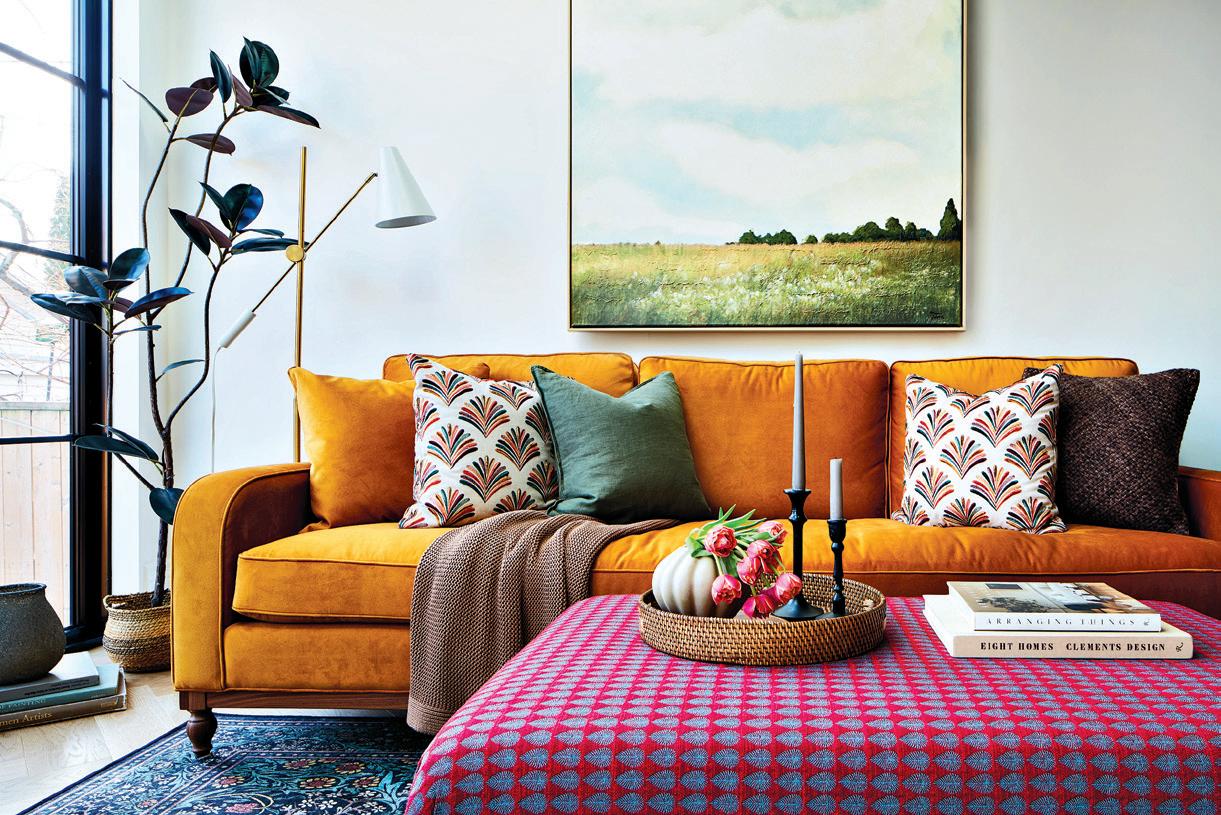
The home’s decor is now highly expressive yet sophisticated. The
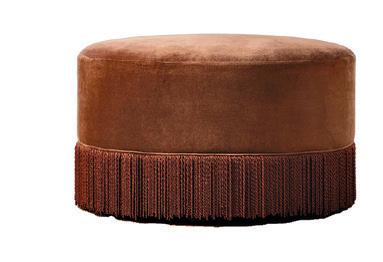
“We used high quality and tactile materials like velvet for the couch and seating nook,” says Crezel. “We chose hand-crafted designs and moved away from fast and trenddriven consumption. The couch and ottoman were custom builds, and the fabrics carefully considered.”
Expressive colour palettes such as jewel tones and warm ochres were incorporated instead of the neutral beige and grey palettes long favoured in home decor, and as a nod to the client, who is an artist, a wall was kept blank as a gallery to exhibit her artwork.
More than a feeling
For this renovation, the homeowners and designer worked closely to make sure every choice was carefully considered and curated to achieve a balance, using layered textures and patterns, mixing wood, metal and plush fabrics. “As typical for a modern maximalism design, this space was designed for a feeling, not just its function.”
The result is a home that is rich in personality, while retaining a refined and curated sensibility.
A music lover’s basement dreams come true
Rock star
by KATHERINE PORATH • photos BAHAR POURPEZESHK
The purpose of this renovation was clear from the get-go: Build a space where the homeowner could play, record and listen to music, and relax with the people he cares about – a home that honours his retirement and opens the door to more joy, connection and creativity.
The space is a 1,559-sq-ft. basement in a bungalow. The goal was to transform an underused lower level into a fully active extension of daily living and entertaining for the client, a recently retired musician, vinyl record collector and lifelong classic-rock devotee. He wanted a place where music wasn’t just heard, but lived. His dream was to create a multi-functional basement that could
serve as a professional-grade music studio, a listening lounge, an exercise area and a comfortable guest space. And at the centre of it all, he wanted a bathroom that paid tribute to the music and artists that shaped his life.
In this home, the basement plays an essential role in everyday living.
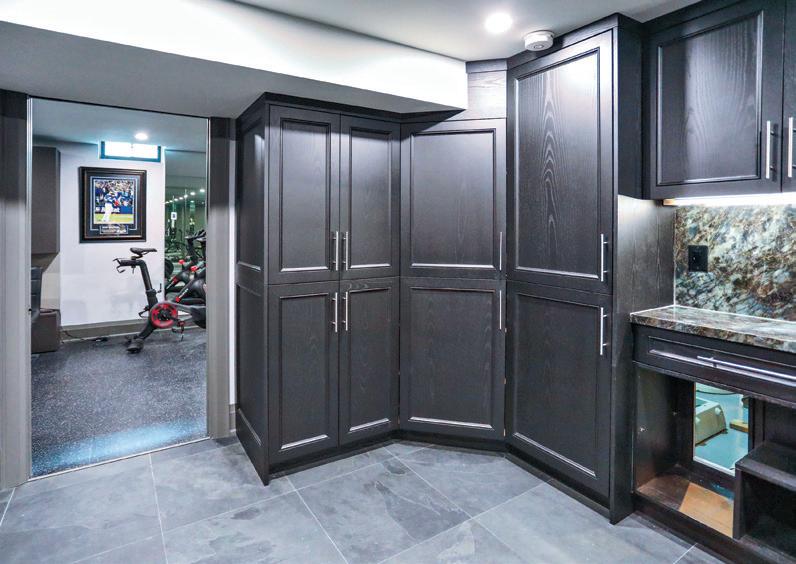
It’s not hidden away – it’s a continuation of the main floor lifestyle, the ideal space to house a studio, lounge, gym, guest accommodations, bathroom and storage – all within one footprint.
That meant thoughtful zoning, acoustical planning and a layout that keeps each area purposeful, without closing in the basement. Balancing acoustics with visual comfort was one challenge. Designing a unique and exciting bathroom that could also withstand humidity and frequent use was another. But these constraints ultimately pushed the creativity further, resulting in a dream come true.
Four main zones
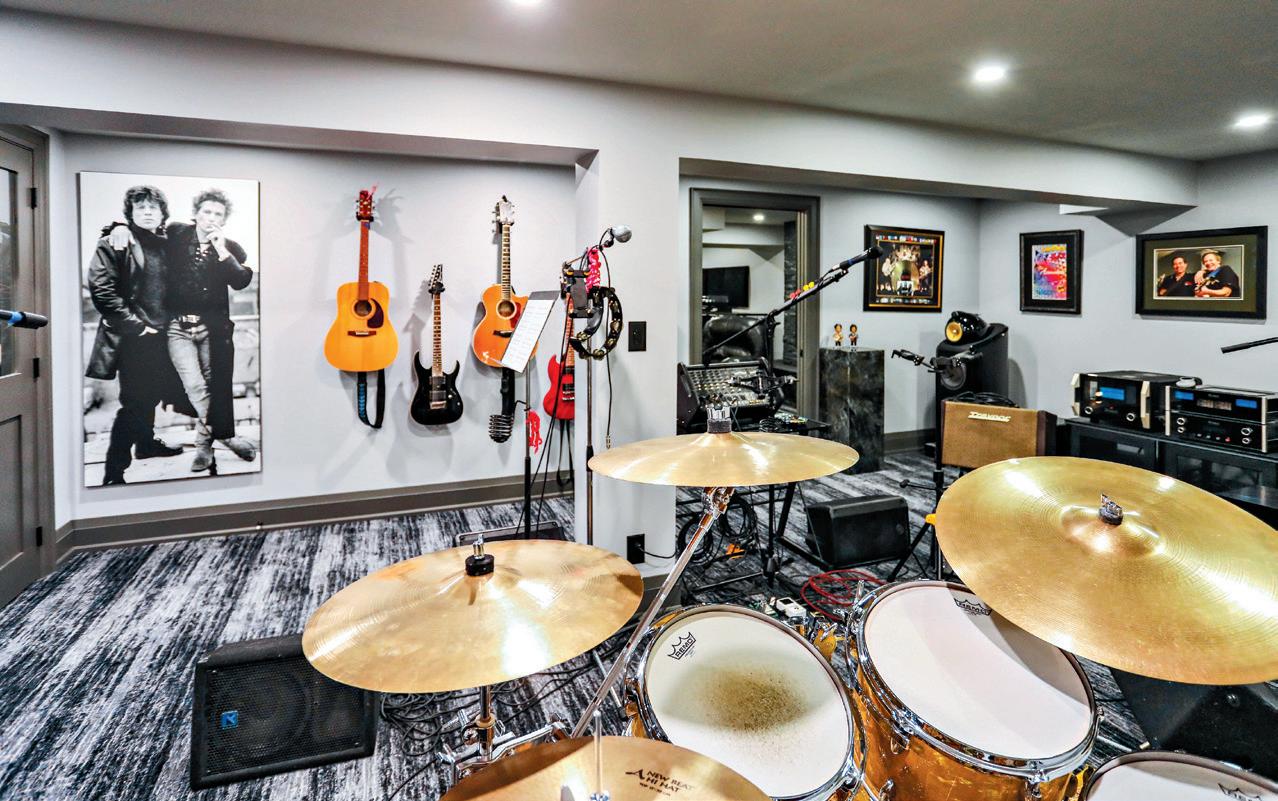
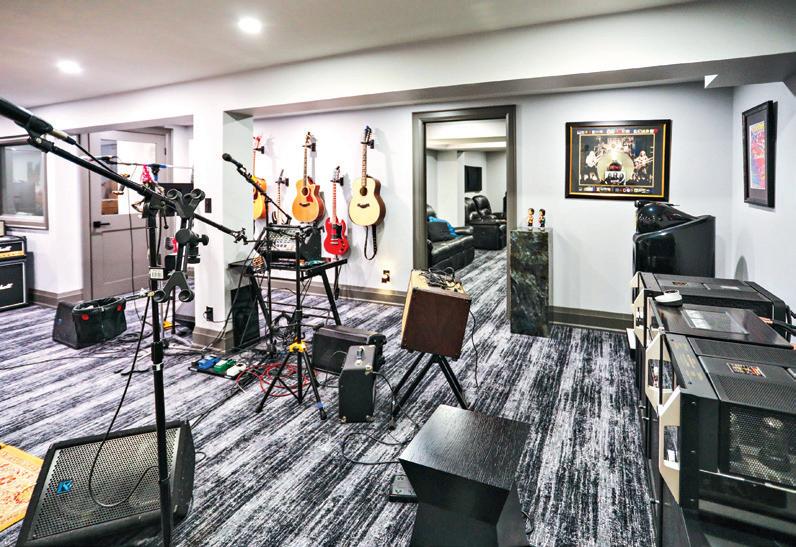
The sound-proof music studio is a dedicated space for playing, recording and rehearsing. Acoustic panels, proper insulation and strategically placed speakers allow the client to play freely without disrupting the rest of the home.
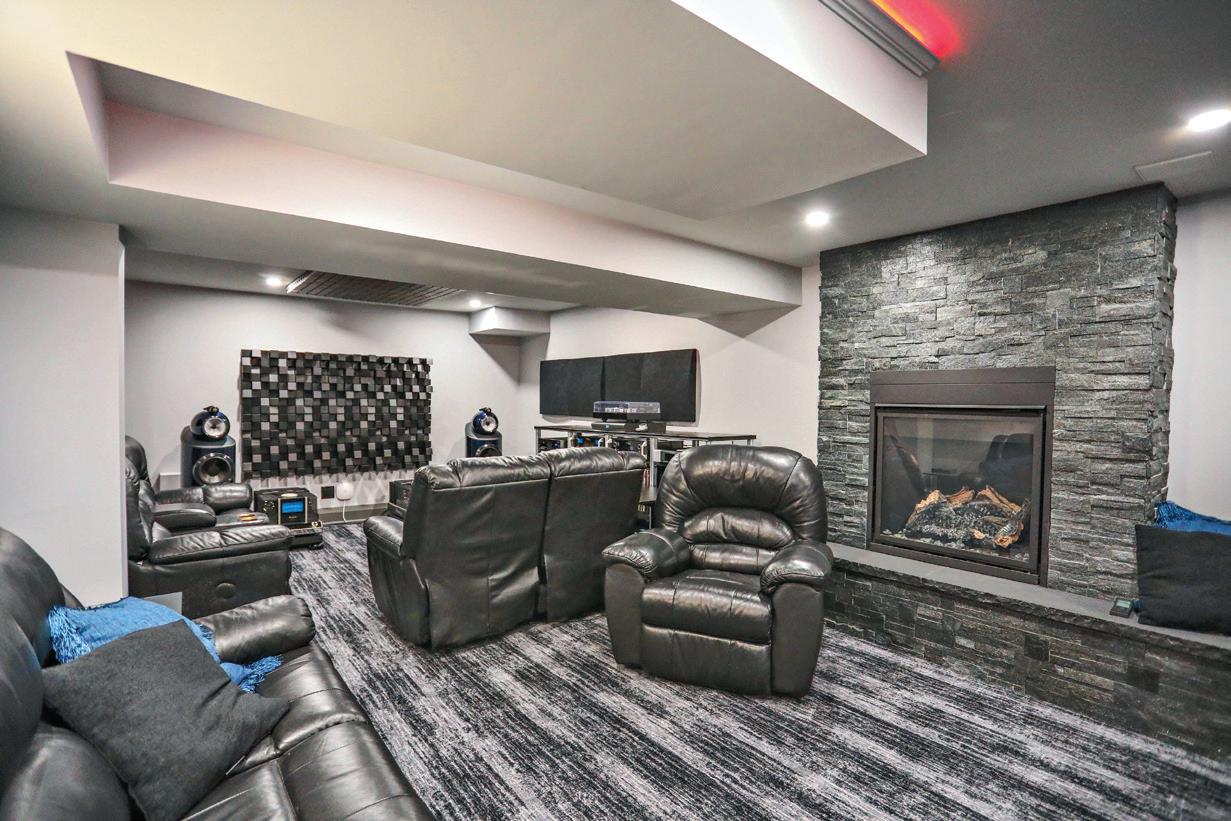
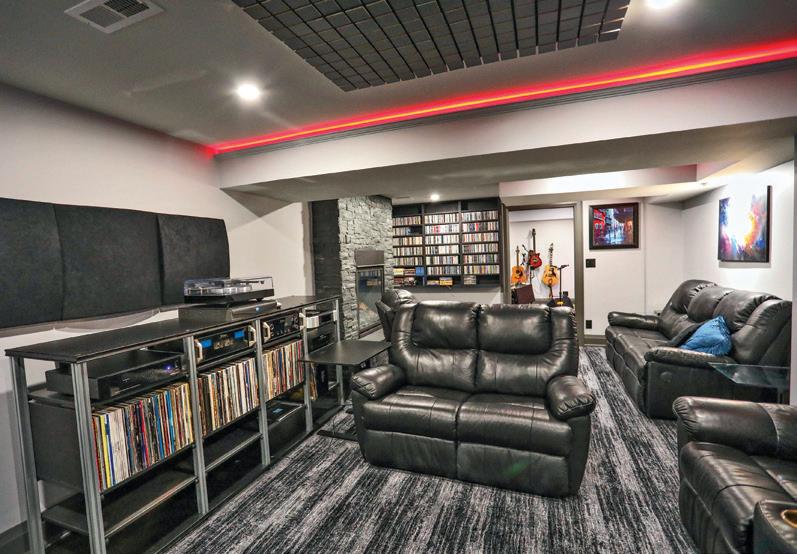
A listening lounge was designed for immersive music enjoyment, with acoustic treatments, comfortable seating, integrated speakers and display space for an extensive vinyl album collection. The original furniture was kept, offering up a relaxed, lived-in atmosphere of a favourite jam-night hangout.
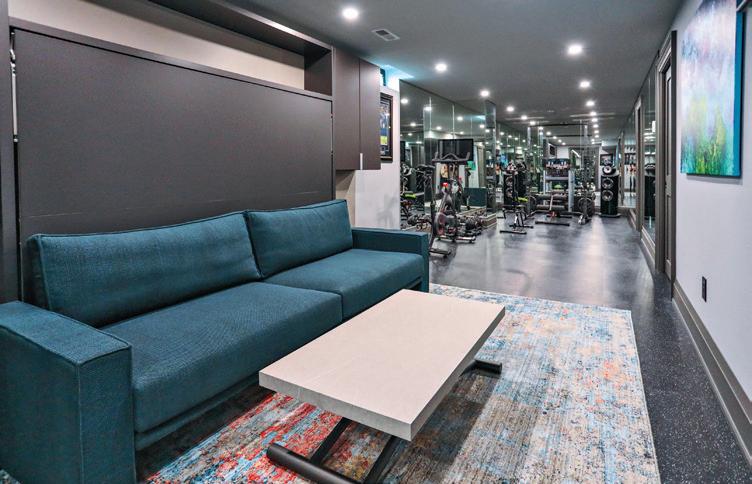
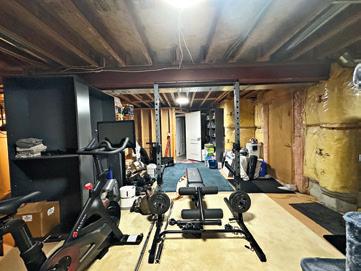
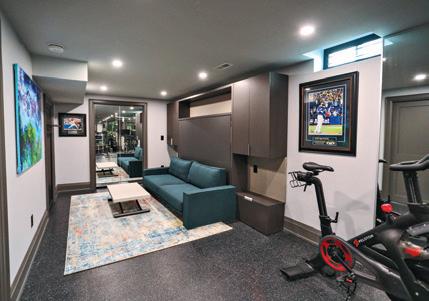
Previously, the workout area was situated in an unfinished space. The renovation combined exercise equipment with an attractive, mirrored wall to support workouts, a sleeper sofa and a discreet pocket door to allow the room to convert effortlessly into a private guest room.
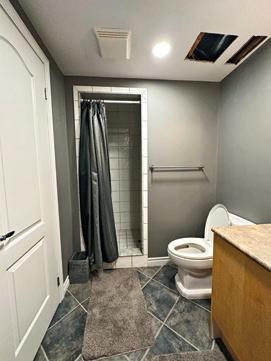
Before
Perhaps the crowning glory in the basement, however, and the one most challenging to design, was the bathroom. Located between the recording zone and the guest bedroom, it needed to comfortably support use by many people during jam sessions and daily functions for overnight guests.
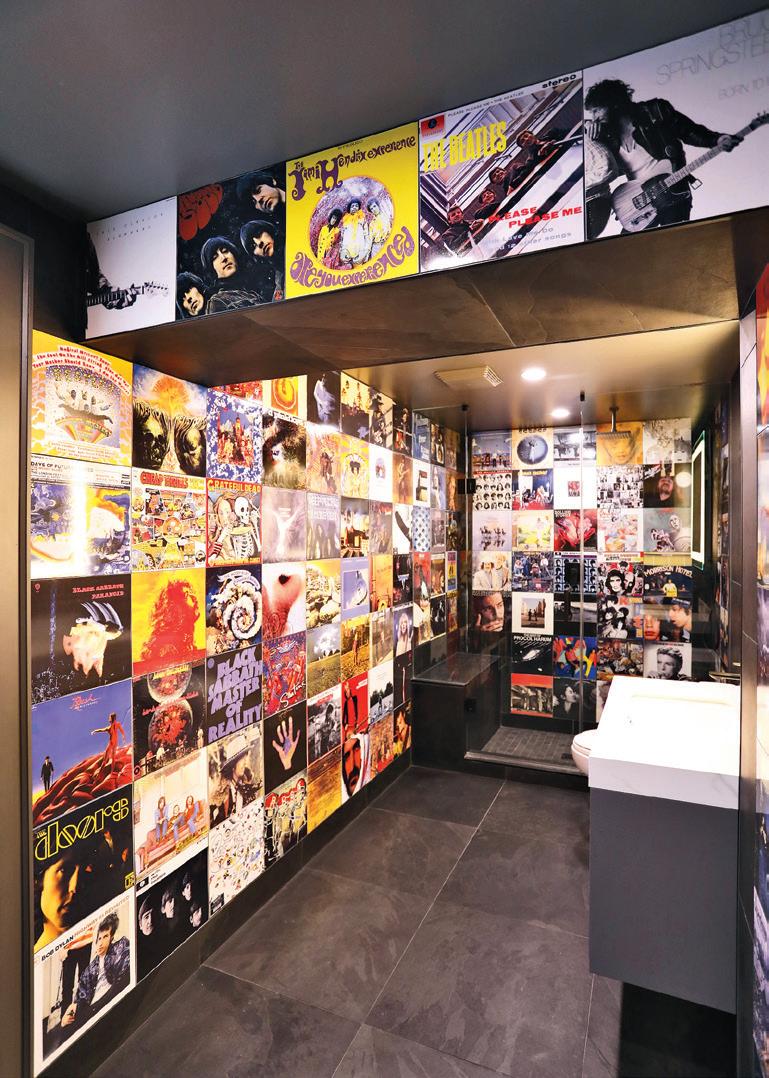
Measuring 6 ft. by 18 ft., it was expanded from the original 6 ft. by 10 ft.
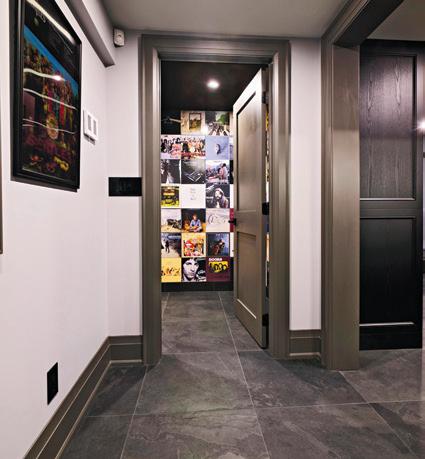
The long, galley-like layout was the perfect template for what the client envisioned – a natural canvas to support an album-cover installation. Every surface, including the walls, floor, ceiling, lighting and fixtures were reimagined to turn the narrow proportions into a strength rather than a limitation.
Never intended to look like a typical bathroom, it was designed as a defining chapter in the homeowner’s larger story – to be a room that carried personal history and design intention in equal measure.
“I’ve loved music passionately since I was nine or 10 years old,” says the homeowner. “When I renovated my basement washroom, I wanted to create something unique, a tribute to the music and the artists that have meant so much to me for so long.” That authenticity became the guiding force behind every decision.
A tribute to rock and roll
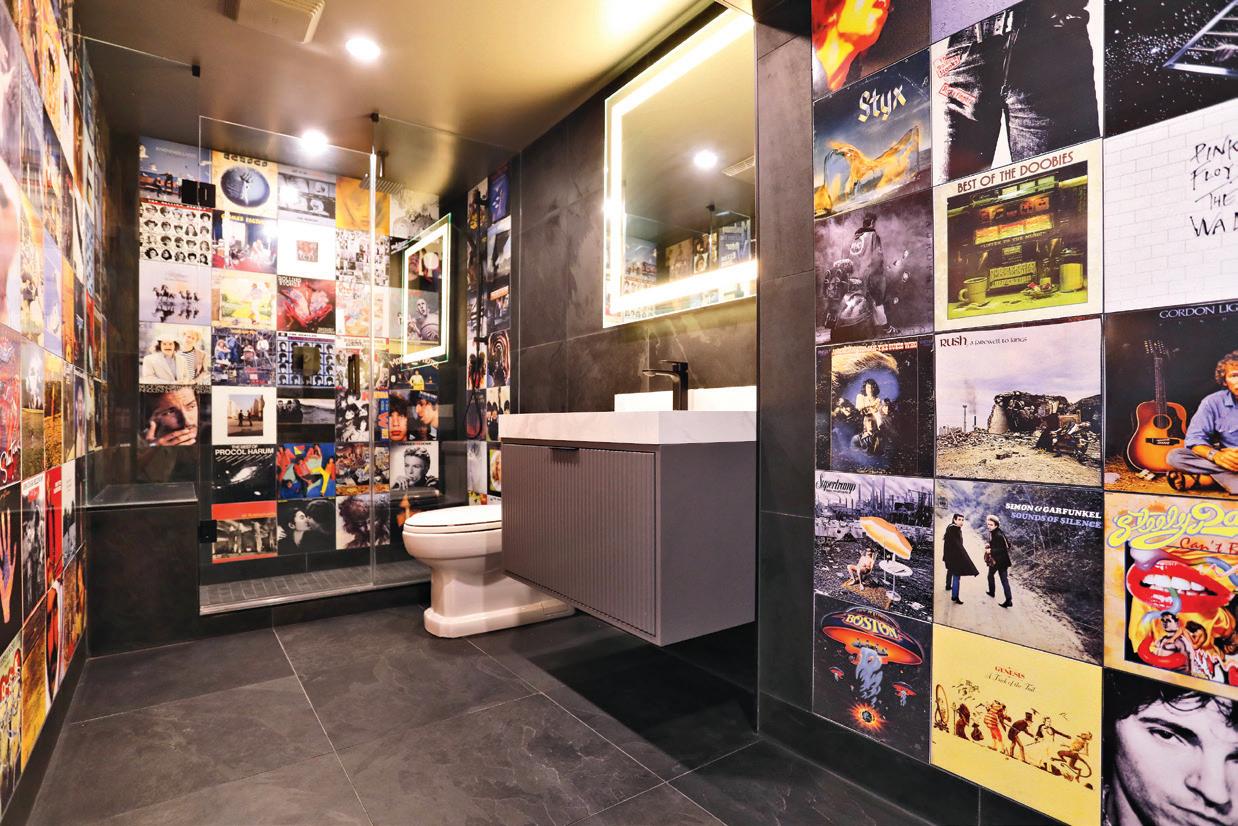
The client’s vision centred on one powerful idea: Turning album covers into architecture. Not wallpaper. Not framed graphics, but permanent, tactile surfaces. He wanted the space transformed into a gallery of his favourite album covers, mounted on ceramic tiles. The result is 192 individual custom ceramic tiles on the bathroom walls and the shower surround. Each tile is unique, but together, they carry a strong visual presence.
To balance it out, the fixtures and finishes were intentionally restrained.
A walk-in shower with bench seating was selected to accommodate users of all ages. A floating wall-mounted vanity in a deep charcoal provides grounding weight without visually crowding the room. The integrated rectangular sink keeps the look clean and architectural. A back-lit mirror delivers even illumination,
while recessed ceiling lighting ensures practical brightness without overpowering the album art. Matte black plumbing fixtures echo the darker tones found throughout the basement and visually connect to the recording equipment nearby. Large-format charcoal porcelain tiles run continuously through the entire basement for visual continuity and repeat the flooring from the main level.
Across the walls now live a litany of some of the most influential albums in rock history, but for the homeowner, the display represents far more than music. “These artists weren’t just musicians, they were cultural icons. Their music and their personas reflect the huge social changes of the 60s and 70s.”
Point of pride
What stands out most in this renovation is the personality
infused into every corner. It’s not a generic basement – it’s a space that reflects the client’s story, passions and lifestyle. The LP-cover tiled bathroom is a true showstopper, but so is the cohesive energy of the entire lower level. The basement is bold, musical, social and full of
life. For the client, the renovation celebrates more than albums. It gives voice to friendship, creativity and the next chapter of his retirement. For the designer, the pride comes from creating a space that feels entirely as the homeowner envisioned, “a backstage pass to joy.”
Katherine Porath is an award-winning interior design specialist known for creating personalized spaces that blend beauty, comfort and functionality, with a focus on kitchens, baths, and whole-home renovations. katherinejoyinteriors.com | IG @katherinejoyinteriors
Before
A company built on reliability and trust
ENCORE Painting
THE BEGINNING
My introduction to painting was equal parts punishment and opportunity. At 15, my mother made me a deal: If I got kicked out of summer camp, I’d have to pay her back. I did get kicked out (apparently smoking wasn’t ‘cool’ to the camp counsellors), and suddenly I owed her $200.
I wasn’t about to disappoint my mom. I started by knocking on doors for College Pro Painters and had her paid back by the end of the summer. By raising my hand every day and asking my manager to put a brush in it, I earned my way into becoming a painter. I was in, and so it began.
WHAT PAINTING TAUGHT ME ABOUT PEOPLE: THE UNEXPECTED LESSONS BEHIND
A 30-PERSON COMPANY
I like to say I didn’t just learn how to run a company; I learned how to run a company because of painting. Not from business books. Not from TED Talks. From job sites. From homeowners debating colour choices like they were negotiating a peace treaty. And then seeing the Encore team bring that inspiration to life.
Some people think painting is simple. Respectfully, I disagree. In fact, I have a theory: You can learn everything about human behaviour by watching two people try to choose a white paint.
Painting is far more about the people than the walls. You need
patience when you have clients who change their minds; resilience, when a room needs ‘just one more coat,’ and creativity when challenges are presented.
It teaches you to read body language, sense tension, resolve conflict and recognize the moment before a decision reshapes a room. Most importantly, painting taught me that people want to feel secure in their homes and respected in their decisions. Trust isn’t earned through perfection alone, it’s built through honesty, follow-through and showing up when you say you will. You can have the best marketing pitch, but it’s not worth anything if you can’t back it up and build trust with your customer.
Our company culture is built on our belief that if you treat people well, the work turns out better, the team stays longer and even the most demanding clients soften when they know you genuinely care.
These lessons became the bones of Encore Painting. Today, my management team and I lead more than 30 painters, each with their own personalities, quirks and preferred brush. We joke that it’s like running a very polite circus. And we say it with affection.
Running a painting company has taught me many lessons, but one over-riding truth: People will rise to the level of the environment you create for them.
Jonathan Sarafinchin
CLEAN sweep
by GOLARA GHASEMI
photos MIKE CHAJECKI
Laundry room renaissance: When utility meets luxury
For years, the laundry room has been treated as a utilitarian afterthought – a small, tucked-away area that was meant to be used, not seen. But this once-overlooked, high-functioning space is undergoing an elegant evolution. Homeowners are rethinking what a hardworking room can feel like, and designers are re-imagining it through thoughtful layouts, warm materials and an experience that is calming and efficient.
This shift reflects a simple truth: People want their homes to support daily life with ease, beauty and even a touch of indulgence. Doing laundry may not be a favourite pastime, but it can certainly happen in a space that feels serene, organized and uniquely tailored to your specific preferences.
From back-of-house to boutique
The most noticeable change in laundry-room design has been the move toward boutique-style aesthetics. Think layered lighting, sculptural hardware, soft-close custom cabinetry and finishes once reserved for primary kitchens. Homeowners are requesting texturally interesting countertop materials, panel-ready appliances and millwork that brings craftsmanship to the forefront.
This elevated evolution isn’t purely decorative. As the laundry room becomes a multi-functional zone often doubling as a mudroom, craft space, pet-wash station or household command centre, the need for durable, long-lasting materials has increased. Porcelain slab counters resist scratching and heat, engineered wood provides moisture protection and modern machines integrate seamlessly behind millwork to maintain a clean, cohesive look.
Design with purpose
The layout of the laundry room is just as important as the finishes.
Homeowners are opting for deeper countertops to accommodate folding, tall cabinets dedicated for cleaning tools and closed upper storage for supplies. Pull-out hampers, sliding drying racks and integrated ironing stations have become laundry room essentials rather than luxuries.
The smooth integration of colour
One of the most defining moments in the modern-day laundry room is the use of colour. As people continue to crave spaces that feel warm and personal, neutrals have become more nuanced and atmospheric. Soft mushroom tones, warm taupe, dusty green and creamy white are dominant palettes in every room, creating a sense of calm, something especially welcome in this room that’s dedicated to chores.
Cabinetry is the perfect place to introduce colour, whether you choose a whisper-soft pastel or a rich, moody hue. These tones pair beautifully with brass or matte black hardware, adding dimension and quiet luxury. Even appliances are stepping into the world of colour, with manufacturers offering muted matte finishes that blend more gracefully into the overall aesthetic.
Another rising trend seen in the laundry room is patterned tile backsplashes and unexpected wallpaper choices. A subtle
“One of the most definingmoments in the modern-day laundry room is the use of colour.”
botanical print or a hand-painted motif can bring personality without overwhelming the function of the room.
If you’re unsure of how bold you want to be, test your chosen colour in natural and artificial light. Laundry rooms often rely on overhead illumination, which can dramatically affect the appearance of a colour. Warm LEDs tend to flatter muted green and taupe, and cooler lighting can make them look washed out or gray.
While colour adds warmth visually, softened acoustics add warmth experientially. With high-efficiency machines running quieter than ever, designers are leaning into materials that further reduce sound, such as panelled walls, textured wallpaper, area rugs and even acoustic ceiling tiles disguised as design elements.
When combined with warm lighting and calming colour, the laundry room begins to feel more like a sanctuary than a chore zone.
Big ideas for small spaces
Even compact laundry areas are benefiting from the renaissance. Vertical space plays a starring role, with stackable appliances, tall cabinets and wall-mounted drying racks making the most of every inch. A small space doesn’t have to feel cramped. Often, limited square footage encourages hyper-intentional design choices – slim-profile wall sconces, floating shelves and integrated ventilation – to keep the space airy and functional.
Widening the lens
The laundry room’s transformation reflects a broader shift in the world of design; the desire for every corner
of the home to feel intentional, comforting and beautiful. With this mindset, utility no longer excludes luxury, and in many homes, the laundry room is leading that conversation. Functional spaces
should uplift, not exhaust. When designed with colour, detail and purpose in mind, the laundry room becomes exactly that, a quiet, luxurious pause in the rhythm of daily life.
Golara Ghasemi is the creative director and principal designer of Toronto-based Studio Golara Design. Noted for crafting bespoke and highly personalized interiors, the studio delivers comprehensive full-service residential design services throughout the Greater Toronto Area. studiogolara.com IG: @studio_golara