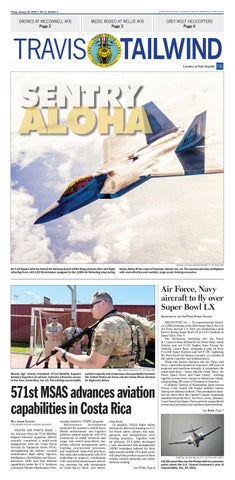
Travis Tailwind: January 30, 2026

Page 1


TRAVIS TAILWIND

SENTRY ALOHA

ARLINGTON, Va. — To commemorate America’s 250th birthday at the 2026 Super Bowl, the U.S. Air Force and the U.S. Navy are conducting a joint flyover during Super Bowl LX at Levi’s Stadium in Santa Clara, Feb. 8.

The formation, featuring two Air Force B-1 Lancers from Ellsworth Air Force Base, South Dakota, and two F-15C Eagles, from Fresno Air National Guard Base, alongside a pair of Navy F/A-18E Super Hornets and two F-35C Lightning IIs, from Naval Air Station Lemoore, is a symbol of the nation’s journey and independence.

While this flyover features the Air Force and Navy, a powerful symbol of America’s 250 years of airpower and maritime strength, it symbolizes the entire joint force – Army, Marine Corps, Navy, Air Force, Space Force, and Coast Guard – working together across every domain to defend our nation, safeguarding 250 years of freedom to America.

A Military District of Washington Joint Armed Forces Color Guard will render military honors during the national anthem. This prestigious interservice team from the Capitol’s region combining members from the Navy, Air Force, Army, Marines, Coast Guard and Space Force provide unparalleled ceremonial precision and national representation.

See Bowl, Page 7

technical data usage, tool control procedures, hazardous material management, parts tracking, procurement processes, and equipment inspection practices. The team also collaborated with SVA leadership to improve coordination with contracted maintenance providers, ensuring the safe sustainment of Costa Rica’s fixed- and rotarywing fleets. In parallel, MSAS flight safety instructors delivered training on U.S. Air Force safety culture, risk management, and standardized crew briefing practices. Together with air advisors, SVA pilots developed a new operational risk management (ORM) worksheet tailored for their daily mission profile. SVA pilot crews will adopt this product as part of their routine mission planning and safety decision-making.

See 571st, Page 4

Maj. Abror Samatov/U.S. Air Force file
Master Sgt. Jeremy Campbell, 571st Mobility Support Advisory Squadron air advisor, instructs a firearms course in San Jose, Costa Rica, Jan. 15. The training course builds
partner capacity and showcases interoperability between the United States Air Force and the Costa Rican Servicio de Vigilancia Aérea.
Staff Sgt. Jerreht Harris/U.S. Air Force file (2021)
A B-1B Lancer flies over the Persian Gulf on a presence patrol above the U.S. Central Command’s area of responsibility, Oct. 30, 2021.
Secretary of the a ir force Public a ffairS

New year needs to lighten wheelbarrow

Hello Beauti ful People!

It’s your Travis AFB “Hype‑man.”

Can you believe January has already come and gone?

I don’t know about you, but I’m already thinking, “Hey 2026, calm down.” It feels like this year hit the green light and slammed its foot on the accelerator.

To support everyone’s well‑being, let’s talk about that feeling of constant momentum and some intentional steps we can take to manage the higher stress levels that often come with an elevated operations tempo. I like to call this approach, “Wheelbarrow Management.”

Think of your capac ity to get things done like an inbox, or better yet, a wheelbarrow. We all walk around with one, and it represents how much we can realisti cally carry. Who puts things into

your wheelbar row? Start with your boss or bosses. Unless you’re self‑employed, your supervisor, manager or commander will give you tasks. If you have a family, your loved ones will place “items” in your wheel barrow that deserve your time and attention. But here’s the most important part: You are the one who ultimately allows things into your wheelbarrow.

Every time you say “yes” to a new project, initiative, group, or board role, you are choosing to add another load. If you consider yourself a high per former, this can quickly become a problem. Without intentional Wheelbarrow Manage ment, over‑commitment can lead to burnout, strained relationships, or reaching the top of the

Drones on duty: McConnell leads in AMC integration

Senior A irm An PAulA A rce

22ND AIR REFUELING WING

See Evalle, Page 4

Exchange invites shoppers to share their best smile for a chance at $1,750 in prizes

TRAVIS AIR FORCE

BASE — Travis Exchange shoppers can turn their best smile into a chance to win big through the Procter & Gamble Best Smile Contest.

From Feb. 6 through Feb. 19, authorized shop pers 18 and older can submit a photo of their smile at ShopMyEx change.com/sweepstakes for a chance to win one of three prizes. The grand prize winner will receive a $1,000 Exchange gift card, while second place will earn a $500 gift card and third place will receive a $250 gift card.

“Smiles are a big part of the connections we make with our shop pers every day,” Travis

Exchange General Manager Cathie Byrns said. “This contest is a fun way to celebrate those moments while giving back to the community we’re honored to serve.”

Winners will be selected and noti fied no later than March 6. No purchase is necessary to enter. For full sweepstakes rules, visit ShopMyExchange. com/sweepstakes.

Department of War and Coast Guard civil ians and honorably discharged veterans who have confirmed their eli gibility to shop online may also enter. Veterans can visit https://aafes.media/ paveterans to learn more about their shopping benefit. DoD civilians can visit https://aafes.media/ cacbenefitspa.

MCCONNELL AIR FORCE BASE, Kan. — McConnell con tinues to expand its operational capabilities with the development and integration of small Unmanned Aircraft Systems (sUAS), or drones, an initiative that now supports a variety of mission sets.

McConnell’s drone program was officially established in late summer of 2024. Capt. Justin Lewis, 22nd Air Refueling Wing sUAS Installation Program Manager, and Tech. Sgt. Bradly Hornberger, 22nd Air Refueling Wing sUAS DET S & ACE Concepts noncommission officer in charge, helped accelerate the integration of drones into squadron opera tions in less than a year of its launch.

Through participation from the 22nd Mainte nance Squadron, 22nd Security Forces Squadron and the 22nd ARW, the program aligns McConnell with the broader Depart ment of the Air Force initiative of employing drones to enhance opera tional capabilities.

“What we’ve achieved is transforming a program without a clearly defined mission into one that’s fully integrated into squadrons,” said Lewis. “This bene fits McConnell’s mission by improving efficiency in areas like aircraft mainte nance, security overwatch, and rapid response.”

feuille, 22nd Security Forces Squadron counter sUAS manager, “It gives us another layer of defense and helps our airmen better detect and respond to threats to keep the base and our people safe.”

Security Forces employ drones in both “Blue Air” and “Red Air” roles. Blue Air supports mission sets such as perimeter sweeps and aerial cov erage during incidents, while Red Air is used as a training tool to simulate adversaries and develop counter drone tactics.

Looking ahead, McCo nnell’s drone program continues to grow beyond maintenance, exercise and security operations.

Explosive Ordnance Dis posal (EOD) is developing its own drone capability and collaborating with the 184th Intelligence Wing to establish a Point Defense Battle Lab, focused on training and developing defensive capabilities.

integrating drones into day to day operations. As the program continues to evolve, drones are becom ing a routine tool that helps strengthen the installa tion’s ability to support the Air Force mission.

Drone usage is also expanding with local law enforcement, local com panies and private users exploring how drones can add to their capabilities, although this can conflict with existing altitude and access restrictions near

private, commercial and military airfields for safety and security reasons, As such, the Federal Avia tion Administration has created www.faa.gov/uas as a one stop shop for all drone operators that want to request authorization to fly in certain areas, regis ter their drones, and more. The FAA also has an FAA flight map for drone oper ators available online, which showcases altitude restrictions.

As drone operations continue to expand both on and off base, secu rity forces emphasize the importance of awareness across the installation. Bellefeuille encouraged airmen to report any unfamiliar activity in the airspace. “Never assume some thing in the sky is supposed to be there,” Bellefeuille said. “If you see a drone or anything that doesn’t look right, contact BDOC (Base Defense Opera tions Center). Better safe than sorry.”

These efforts are focused on expanding how drones are used across the instal lation while building a trained cadre of airmen ready to support emerging mission needs.

With a range of mission sets in place, McConnell is positioned as a leader within Air Mobility Command in

The drones integrated into McConnell’s squad rons are compact drones that weigh just under five pounds and can fold down for transport. Equipped with obstacle avoid ance and high resolution cameras, the drone can be programmed to fly pre determined routes, hover in place, and capture images in a single flight. The cameras can capture close up as well as wide angle shots, providing a level of detail needed for aircraft inspections and security monitoring.

TRAVIS TAILWIND

“The drone is pro grammed to fly to specific waypoints inside of a hangar and capture hun dreds, or thousands, of images of the air craft,” Lewis said. ”In the future, we aim to lever age AI software to identify scrapes, dents, chipped paint, or other damage, creating a 3D model for enhanced maintenance and trend analysis.”

In addition to their imaging capabilities, the drones use a secure data link to transmit images and video, allowing sensitive information to be protected during aircraft inspections and aerial operations.

“Drones are really changing the way we look at base security,” said Tech. Sgt. Isaiah Belle

Senior Airman Paula Arce/U.S. Air Force photos (2025)
A small Unmanned Aircraft System (sUAS) flies in a hangar at McConnell Air Force Base, Kansas, Dec. 10, 2025. The
sUAS is used to enhance installation safety, security and operational awareness across the base.
McConnell airmen operate a small Unmanned Aircraft System at McConnell AFB, Kansas, Dec. 10, 2025.

Nellis medics take the reins, host inaugural Medic Rodeo

NELLIS AIR

BASE, Nev. — Cannon blasts echoed across the desert and a helicopter hovered overhead as the cries of casualties cut through the air. This scenario was no ordinary training day; it was the inaugural Medic Rodeo at Nellis Air Force Base, a grueling race against the clock that would test the skills of the installation’s medics.

While a first for Nellis, the Medic Rodeo draws on a long-standing Air Force tradition, using realistic, high-stress combat scenarios to test battlefield medical skills in a competitive setting.

Staff Sgt. Abey Lewis and Tech. Sgt. Daniel Schmidt spearheaded the effort to bring the event to Nellis, drawing on their own experiences competing at Cannon AFB’s medic rodeo.

“We want to prepare our medics before they are thrown into the fire,” said Lewis. “We want to be the best fighting air force and also be able to bring our people home when they need to come home.”

The competition featured four teams of five, each composed of two clinical medics, two nonclinical medics, and a dedicated coach.

“The teams are made up of people that normally don’t work together directly,” explained Schmidt. “In these scenarios we get them working shoulder-to-shoulder. Everyone has something to bring to the table.”

our team felt in that simulated environment is the same urgency we need to bring every day and continue to train with purpose. This drives muscle memory, strengthens teamwork, and develops the confidence to act decisively in a crisis.”

Emerging victorious in Nellis’ first medic rodeo, Tech. Sgt. Brianna Gonzalez, Senior Airman Christian Macgregor, Staff Sgt. Danielle Dan, Senior Airman Jonathan Fuentes, and Airman First Class Rafael Diaz will be recommended to represent Air Combat Command and compete in the 2026 Medic Rodeo.

KIRTLAND AIR

FORCE BASE, N.M. — The Air Force Safety Center’s Unit Risk Forecasting tool is now available for commanders and unit safety professionals. Unit Risk Forecasting is a machine learning-fueled forecast of squadron risk and the factors influencing increased risk.

The tool utilizes over a decade of historical safety data, unit personnel data, predictive capabilities, and mitigation strategies developed by safety professionals to give commanders and decision makers a visual toolkit to minimize risk at the unit level.

Each squadron’s mishap history and unit demographic information will be used to train the forecasting model. Once the machine learns patterns in the data, those patterns are recorded in a model that takes in squadron information and outputs a risk forecast. Every month, new information is fed into the model, and the resulting risk forecast is displayed in a command summary page. While the Unit Risk Forecasting tool is not a mishap predictor, it is a way to quantify a unit’s risk level and assist commanders and safety staff with risk mitigation strategies. By reducing mishaps, combat power and lethality are increased.

“This tool will help increase combat readiness by reducing mishaps and giving decision makers access to information about mishaps, current and future risk profiles, and top factors driving risk for targeted and efficient risk reduction,” said Chief of Analytics and Chief Injury Epidemiologist Laura Pick. “This is part of a suite of proactive, predictive tools the Department of the Air Force is driving toward to empower commanders’ decisions with data-driven information.” Commanders and safety personnel will have the ability to filter through several variables in the command summary page and see how each variable either drives risk up or down. This gives commanders data to support advocating for scheduling, manning, funding, and other resources or changes. Each risk driver correlates to a series of mitigation suggestions. Mitigation strategies were developed by AFSEC safety experts. The strategy provides a description of what each variable indicates, followed by a series of mitigations a commander or safety professional could address to reduce elevated risk.

“Our intent is to develop analytical tools to assist commanders with See Tool, Page 7

The teams navigated the medical response following a simulated drone strike, progressing through three distinct phases: care under fire, tactical field care, and tactical evacuation care. Adding a powerful layer of realism to the exercise, real patient volunteers acted as casualties during the four-hour scenario. Teams met the challenges of treating battlefield injuries including inhalation burns, broken pelvises, lacerations, symptoms of shock and hemorrhagic shock, necessitating expert blood product resuscitation.

Striving for the highest level of realism, the event was a base-wide effort, using assets from across the installation.

“The Fire Squadron provided access to the burn pit training area, Security Forces provided training weapons and EOD simulated cannon blasts,”

said Lewis. “We wanted to promote as much realism as possible.”

Medic rodeo events use Tactical Combat Casualty Care guidelines to challenge technical skills, leadership, and teamwork, preparing medics for austere environments. Lewis, a certified TCCC instructor, emphasized the importance of TCCC principles.

“TCCC has a special place in my heart,” said Lewis. “It’s all about trauma medicine. Our stateside job is clinical and keeping warfighters ready, but when downrange the focus is trauma medicine.”

For medic rodeo competitor Col. Cody Hess, administrator, Mike O’Callaghan Military Medical Center, the event reflected a broader commitment to readiness.

“This was an incredibly value-added experience,” said Hess. “The urgency

Senior Airman Lauren Clevenger/U.S. Air Force file photos (2025)
Senior Airman Jaiveion Turner, left, a health services management journeyman, is evaluated on his needle decompression skills by Staff Sgt. Abey Lewis, an aerospace medical technician, both assigned to the 99th
Medical Group (MDG) during the 2025 Diamondback Medic Rodeo at Nellis Air Force Base, Nevada, Dec. 9, 2025. The competition showcases the 99th MDG’s commitment to maintaining combat-ready medical teams.
Capt. Hunter Brown, a registered nurse assigned to the 99th Medical Group, prepares pain medication for patient care during the 2025 Diamondback Medic Rodeo at Nellis Air Force Base, Nevada, Dec. 9, 2025. The scenario centered on unexpected drone attacks that struck as teams surveyed a potential expeditionary medical support site to ensure they’re medically ready for deployment.

Grey Wolf helicopters complete first ICBM convoy security mission

MALMSTROM AIR FORCE BASE, Mont.

Two MH 139A Grey Wolf helicopters assigned to the 40th Helicop ter Squadron conducted their first operational Minuteman III intercon tinental ballistic missile convoy, Jan. 8, marking an important milestone in the modernization of Air Force Global Strike Com mand’s nuclear security operations.

The MH 139s shep herded a column of missile maintenance and armored security vehi cles to and from a launch facility located more than 100 miles east of Malm strom Air Force Base without needing to refuel during the six hour move ment, demonstrating the superior capabili ties of AFGSC’s newest helicopter as the Air Force prepares to retire the UH 1N Huey after more than five decades of service.

“Executing our first convoy mission with two MH 139s marks a sig nificant step forward in strengthening our missile security oper ations,” said Maj. Gen. Stacy Huser, 20th Air Force commander. “The MH 139 allows us to con tinue supporting our ICBM enterprise for decades to come with increased speed, range and lift.”

Speed and reach are demanded specifically due to the more than 100 launch facilities dis persed across Malmstrom AFB’s 13,800 square mile area of responsibility that spans diverse topogra phy of prairies, plains and mountain ranges.

Not only is the MH 139 approximately 50% faster than the UH 1N

and can arrive on site several minutes sooner –armed and with twice as many troops on board – it also has enhanced defen sive systems and is built to support missile field secu rity missions across vast and austere terrain.

The recent convoy escort mission gained valuable operational expe rience for AFGSC as 20th AF progresses toward initial operational capabil ity of its Grey Wolf fleet.

“I am incredibly proud of our Airmen who made this success possible,” said Col. Bryant Bevan, 582nd Helicopter Group com mander. “This mission provided us a multitude of lessons learned, which we will utilize as we con tinue to work toward accomplishing IOC for the MH 139.”

The MH 139’s imple mentation into Air Force operations has been an ongoing program for the last several years.

Boeing delivered the first MH 139A to the United States Air Force on Dec. 19, 2019, at Duke Field, Florida. This began combined developmen tal testing for the UH 1N replacement program.

Malmstrom AFB then

hosted a welcome cere mony for the MH 139A on March 9, 2024. The 550th Helicopter Squadron at Malstrom AFB began MH 139 conversion train ing the following month.

The first Initial Opera tional Test and Evaluation flight in support of nuclear security operations was on Jan. 29, 2025.

The MH 139 doesn’t just replace an airframe; it directly upgrades how quickly security forces can mass combat power where it’s needed. It has been evaluated specifi cally for nuclear security tasks that mirror Malm strom AFB’s real world demands: convoy support and emergency response, including launch facility recapture and recovery scenarios that measure how quickly crews can go from idle to airborne.

“Our ICBM mission is the foundation of strategic deterrence, and it demands absolute reliability, secu rity, and readiness,” said Col. Daniel Voorhies, 341st Missile Wing commander. “The MH 139 strengthens nuclear surety by giving our airmen a more capable platform to protect our forces as they carry out the nation’s most impera

tive mission, 24/7/365.”

The first operational use of the MH 139 that occurred on January 8 was described by Malmstrom AFB’s striker airmen as both historic and reassuring.

“The performance of the helicopter was impressive,” said Maj. Nicholas Smith, 40th HS MH 139 pilot. “This test proved that the Grey Wolf can bring all the required firepower necessary to defend our nation’s nuclear force in a real scenario.”

Smith said the helicop ter’s improved Forward Looking Infrared and its avionics systems enhanced his crew’s situational awareness and their ability to support the ground force commander.

“The MH 139 integrated seamlessly and provided an immediate increase in helicopter support capabil ities,” Smith said.

Malmstrom AFB’s mission remains shaped by its northern tiered reality as its remoteness and dis tance defines the fight today – security forces must be able to respond, reinforce and sustain oper ations far from the main installation, often with little margin for delay.

“The transition from

See Wolf, Page 6

Travis Exchange, H&R Block offer military shoppers 10% off

tax preparation

A rmy & A ir Force exchAnge Service Public A FFAirS TRAVIS AIR FORCE BASE — The Army & Air Force Exchange Service is making tax season easy for Travis military shoppers, teaming with H&R Block to provide tax preparation services to authorized shoppers at a 10% discount at the Travis BX. In addition to the dis count, H&R Block at the Travis BX offers: n A free second look tax review program, where H&R Block reviews the previous returns to determine whether filers are enti tled to additional money that was not claimed. n 100% accuracy guarantee in the event of an audit.

n In the event of an error, H&R Block will pay penalty and inter est at no additional cost to the filer. “Access to reliable tax preparation services at the BX reflects an ongoing commitment to support ing the Travis military community beyond the shopping experience,” said Travis Exchange General Manager Cathie Byrns. “Provid ing trusted,

571st

From Page 1

An Intelligence, Surveillance and Recon naissance (ISR) specialist from the 137th Special Operations Wing pro vided tailored instruction on mission planning, sensor employment, and target identification.

Logistics advisors reinforced best prac tices for warehouse organization and haz ardous material storage, while security forces advisors enhanced base defense and gate secu rity procedures through practical, scenario driven discussions.

This engagement lays the groundwork for future aircrew integra tion as air advisors and

ladder only to find yourself standing there alone. A close friend once shared why he stepped away from owning a very successful company. One day, he realized that the most important people in his life. his family and loved ones, were only getting his leftovers.

Wouldn’t you agree that the people who matter most deserve more than leftover time, attention, focus, and love?

When your wheelbarrow is filled to the brim with tasks and commitments, there’s no room left for the goodness that should be reserved for them.

So let’s be intentional about managing our wheelbarrows.

First, if you are a high performer relied upon to

get many things done, ask your leadership to clearly prioritize your tasks. Work them in that order, and don’t stress about trying to eat the entire all‑you‑can‑eat buffet at once. Heavy workloads, like big meals, are best handled one bite at a time. If you are the boss, be mindful of how often you lean on your strongest performers. Spread the workload when you can. Second, don’t over‑commit. When possible, practice saying “no” unless you truly have the capacity to say “yes.”

High performers often dive deeply into new organizations and quickly assume leadership roles. Be selective. Choose only the commitments that fit comfortably in the remaining space of your wheelbarrow.

Finally, be honest with yourself. In five or ten years, most of today’s commitments won’t matter. The relationships

and memories you create with your family and loved ones will. Make sure your prioritization loads your family into your wheelbarrow first.

One last point: Take care of yourself. Regular exercise, sensible eating, and managing a healthy weight are like keeping your wheelbarrow tire properly inflated. A fully loaded wheelbarrow is very hard to push on a flat tire.

That’s it. Sounds simple, but not easy. It’s your wheelbarrow. Be intentional about what you allow into it. Until next time: Be intentional. Be the goodness. And manage your wheelbarrow. Happy Ground Hogs Day.

John Evalle is a retired U.S. Air Force chief master sergeant, who works in the Military Affairs Office, Travis Credit Union. jevalle@ traviscu.org.

SVA pilots prepare to fly together during the next training event. MSAS personnel also strengthened community ties by interacting with students from a local school and organizing a friendly soccer match with SVA personnel, rein forcing the partnership both inside and outside the airfield. The 571st MSAS remains committed to helping partner nations build long term aviation capability. This mission highlights the United States’ continued support to Costa Rica and reflects U.S. Southern Com mand’s commitment to strengthening regional security cooperation through the Theater Maintenance Partnership Initiative.

Airman 1st Class Teniya Caldwell/U.S. Air Force file photos
An MH-139A Grey Wolf assigned to the 40th Helicopter Squadron conducts its first operational mission at Malmstrom Air Force Base, Mont., Jan. 8. The mission
marks the beginning of the replacement of the Vietnam-era UH-1N Huey and represented a key step in modernizing security for the nation’s land-based nuclear deterrent.
Capt. Michael White and Capt. Maxwell Turner, 40th Helicopter Squadron pilots, conduct the first operational mission of an MH-139A Grey Wolf at Malmstrom Air Force Base, Mont., Jan. 8.

WCAP airmen qualify for 2026 Winter Olympics

A ir Force instAllAtion And Mission

ANTONIO-LACKLAND, Texas — Two airmen from the World Class Athlete Program will represent Team USA and the Air Force at the Milan Cortina Winter Olympic Games in February.

Staff Sgt. Kelly Curtis is set to compete in skeleton, while Senior Airman Jasmine Jones will compete in bobsleigh.

Both athletes are part of Department of the Air Force WCAP, which is managed by the Air Force Services Center. The program allows elite airmen athletes to train and compete in national and international sports competitions with the ultimate goal of qualifying for the Olympic Games.

“This accomplishment deserves more than just congratulations. Olympians, you represent the pinnacle of athleticism and the warrior mindset that defines our Air Force,” said Under Secretary of the Air Force Matthew Lohmeier. “We are so proud to have you represent the Air Force and the United States at the 2026 Winter Olympics. Your performance on the world stage demonstrates

a critical link between physical fitness, commitment to excellence and military readiness. With all of our support: go fight, go win, go Air Force!” Curtis, who competed at the 2022 Winter Olympics

in Beijing, China, trains at Aviano Air Base, Italy. Jones, competing in her first Olympic games, trains in Lake Placid, New York. WCAP has seen Olympic qualifiers double since a recruiting strat-

egy revision in 2021 and this is the program’s first ever back-to-back Winter Olympic selection.

“The Air Force Services Center team that supports the World Class Athlete Program is thrilled to see

these airmen qualify as Winter Olympians,” said Col. E. Jonelle Eychner, AFSVC commander. “We invest significant time and effort ensuring their foundational needs are met, allowing them to focus on their sport, compete with confidence and proudly represent the Air Force on the global stage.” Jones and her teammate, Kaillie Armbruster-Humphries, recently took silver in the 2-Woman Bobsled race at an International Bobsleigh & Skeleton Federation World Cup event, held in Altenberg, Germany. Curtis earned silver at a World Cup event held earlier this month in St. Moritz-Celerina, Switzerland, with a late surge from ninth place to the podium. USA Bobsled/Skeleton, the official national governing body for both sports, will hold a training camp in Europe before the games. Curtis and Jones will then travel to Cortina, Italy, to stay in the Olympic village during the competition.

“The People of The United Methodist Church™”
Courtesy photo
Staff Sgt. Kelly Curtis performs in the skeleton race on behalf of Team USA Bobsled.

AF, Royal Netherlands work jointly on aeromedical training

A

RAMSTEIN AIR BASE, Germany — Inside a static C-130J Super Hercules aircraft, airmen assigned to the 86th Aeromedical Evacuation Squadron joined NATO partners from the Royal Netherlands Air and Space Force in a subject matter exchange at Ramstein Air Base, Germany, Jan. 6-9, designed to enhance interoperability and strengthen medical evacuation capabilities.

The exchange, which included the Royal Netherlands Air and Space Force Operational Healthcare Unit, combined hands-on medical training and simulation-based learning while giving attendees insight into each service’s patient care kits and equipment.

By sharing knowledge and observing each other’s methods, both teams gained insight into how allied operations enhance mission execution.

“The biggest takeaway was that we can not only work together in tandem, but we can also work together integrated, taking care of the same patients together,” said Air Force Senior Airman Joseph Pearson, 86th AES mission management technician.

Working shoulder to shoulder, attendees compared techniques, asked questions and walked through various patient care procedures and scenarios. Throughout the week, they operated not as separate units but as partners preparing for the same mission.

Airmen assigned to the 86th Aeromedical Evacuation Squadron and service members from the Royal Netherlands Air and Space Force Operational Healthcare Unit attend a subject matter exchange at Ramstein Air Base, Germany, Jan. 6. The exchange focused on sharing aeromedical evacuation procedures to enhance interoperability and strengthen medical readiness.

“Training together prepares us to take care of a large amount of patients in large-scale conflicts,” said Royal Netherlands Air and Space Force Captain Ramon Van Belzen, Operational Healthcare Unit section lead. “It felt quite

natural to work together, it actually went quite smoothly and quickly [considering we were working] with people we’ve never worked with before.”

Medical scenarios per-

formed in low light added another layer of realism, challenging both teams to adapt patient care to conditions that mirror real-life operational environments.

Training together in these settings fostered teamwork and communications skills where coordination and clarity are critical.

“The most valuable thing that we all received during this training opportunity was learning what our partner forces are able

A rmy & A

satin heart.

n 2 for $9 Dove Promises hearts and M&M’s 10-oz Valentines Day bag.

n 25% off Sour Patch Kids 6.8 oz Valentine’s Day heart.

n $1 off Hershey chocolate hearts, boxes and Reese’s peanut butter hearts.

n $1.99 Elmer 2 oz Chocolate rose hearts.

No matter who’s on your Valentine’s Day list, the Travis Exchange has something for everyone –from tax-free savings on brands including Apple, Samsung and Bose to popular men’s and women’s fragrances.

From Jan. 30 through Feb. 14, Military Star cardmembers can take advantage of 0% interest and no payments for 12 months on fine jewelry and watch purchases of $499 or more when they use their card at checkout. Travis Exchange shoppers looking for treats for their sweethearts can indulge in sweet offers, including: n 15% off Blow Pop Valentine friendship exchange kits.

n $2 off DeMet’s Turtles 9-count rigid heart and 12-count

“Show your loved ones your appreciation without the hassle,” said Travis Exchange General Manager Cathie Byrns. “The Travis Exchange takes pride in providing quality gifts at militaryexclusive pricing for our Nation’s heroes no matter the occasion.”

Shoppers can purchase flowers and plants directly at Exchange flower shop storefronts or place their order online at ShopMyExchange.com with partners Teleflora and save 20% off sitewide or with 1800Flowers.com and save 25% off sitewide. Online flower and food delivery orders are limited to the continental United States. To guarantee delivery in CONUS by Feb. 14, standard shipping orders should be placed by Feb. 6.

From Page 4

the UH-1N Huey to the MH-139A Grey Wolf is one of the first visible steps toward the next era of the Global Strike mission, eventually leading to the full mission integration with Sentinel,” said Tech. Sgt. Samuel Earney, 341st Missile Security Operations Squadron Tactical Response Force flight sergeant. “The transition from the battle-tested Huey to the high-tech Grey Wolf has been bittersweet, but given the increased capabilities of the new helicopter, it makes sense as to why the

Air Force chose to make the move.” Convoy Response Force members working on the ground below the helicopter also appreciated the presence of Grey Wolf helicopters during the movement.

“I think the MH-139 being on a mission is a very good addition to convoys due to the fact that it has a faster top speed,” said Senior Airman Nicholas Scaramucci, 341st MSOS convoy team leader.

“I felt honored to be a part of it,” said Senior Airman Dwight Panton, 341st MSOS convoy team leader. “It was one of those experiences where training and real-world application finally came together.”

Airman 1st Class Rebecca Harima/U.S. Air Force file photos
Senior Airman Joresa May Nolido, right, 86th Aeromedical Evacuation Squadron technician, performs patient care during a medical simulation for service members with the Royal Netherlands Air and Space Force Operational
Healthcare Unit at Ramstein Air Base, Germany, Jan. 7. The 86th AES hosted a subject matter exchange that allowed allied medical personnel to observe U.S. Air Force medical practices and aeromedical evacuation procedures.
An airman with the 86th Aeromedical Evacuation Squadron secures oxygen regulators aboard a C-130J Super Hercules aircraft during a static aeromedical evacuation exercise at Ramstein Air Base, Germany, Jan. 8.
See Royal, Page 7

Bowl

From Page 1

and backseat flights on the F/A-18F with community leaders. As the nation celebrates Freedom

250 throughout 2026, our joint community outreach efforts throughout the week demonstrate our Joint Force’s shared history and enduring commitment to defending freedom and supporting our nation’s independence.

At one of the mostwatched events in the world, the flyover at Super Bowl LX is a visible reminder that America’s military remains united, ready, and dominant –250 years strong.

Air National Guard file

Airman Samir

An F-15E Strike Eagle with the 4th Fighter Wing approaches a KC-135 Stratotanker from the 121st Air Refueling Wing for refueling over the skies of North Carolina, Jan 22.

Royal

From Page 6

to do,” said Air Force Maj. Maria Cruz-Fehr, 86th AES flight nurse. “With us being part of NATO and working with NATO side by side, we actually have a better understanding of our partner’s capacity. We know how they work now and how they operate, and we can essentially create mission success in our aeromedical evacuation missions by saving lives.”

Aeromedical evacuation personnel are required to make quick and complex medical decisions and adapt to changing medical emergencies while ensuring safety. Often working with just a flight nurse

Tool

From Page 3

proactive risk reduction, mishap prevention, and maximized readiness,”

Pick said. “Giving them actionable data to stay one step ahead of potential challenges and risks in their organizations.”

DAF safety is committed to employing emerging and innovative technology tools to provide predictive, and eventually prescriptive, analytical products to drive risk-informed decisions to oper-

and medical technicians aboard an aircraft, 86th AES Airmen are trained to provide critical medical care while transporting injured service members from deployed locations.

Being able to perform these functions while operating in conjunction with NATO allies is crucial to seamless mission execution.

“We were very privileged to be here at Ramstein Air Base and happy to train together,” Van Belzen said. “It was nice to be able to make steps forward for the future, and we hope we have more training opportunities together to increase both our proficiency and interoperability, so we can take care of our patients in the air in whatever circumstances that might be.”

ational commands across the DAF. “Unit Risk Forecasting allows DAF safety to be at the cutting edge of operating in a dynamic, data-driven environment,” said DAF Chief of Safety Brig. Gen. Otis Jones. “By allowing commanders, safety personnel, and decisionmakers to see their unit’s risk level at a glance, their unit’s top risk drivers, and targeted mitigation recommendations, we are enabling leaders to make risk-informed decisions that will safeguard airmen and guardians without sacrificing mission success.”

A Japan Ground Self-Defense Force (JGSDF)

assigned

airdropped approximately 260 paratroopers

Yokota supports JGSDF-hosted multinational airborne exercise

YOKOTA AIR BASE, Japan — U.S. Air Force C-130J Super Hercules aircraft assigned to the 36th Airlift Squadron supported a multinational airborne operation Jan. 17, at Ojojihara Training Area, Miyagi Prefecture, marking the first Japan Ground SelfDefense Force-hosted multinational airborne exercise conducted on Japanese soil.

The operation built on the momentum of New Year Jump Indo-Pacific 2026, which included participation from 14 nations, and served as the tactical phase of a broader training series designed to enhance airborne operational capability and interoperability among allied forces. While NYJIP26 at the JGSDF’s Narashino Training Area in Chiba Prefecture earlier this month was conducted as a ceremonial public demonstration, training at Ojojihara emphasized combat readiness and operational execution.

Operating from Yokota Air Base, four U.S. Air Force C-130J Super Hercules aircraft assigned to the 36th Airlift Squadron delivered approximately 130 paratroopers from the U.S. Army’s 11th Airborne Division to the drop zone in Miyagi Prefecture. The airborne insertion was conducted in coordination with

visual conditions and executed a precise airdrop.

The C-130J’s automated systems assisted crews in generating accurate airdrop run-in profiles, allowing pilots to focus on formation coordination, drop zone communication and air traffic control. The coordinated airlift enabled ground forces to execute the operation as planned.

the Japan Air Self-Defense Force, which employed one Kawasaki C-2 and two C-130H Hercules, both assigned to JASDF Air Support Command to transport paratroopers from the JGSDF 1st Airborne Brigade.

The combined force conducted an airborne insertion and transitioned immediately to ground maneuver, executing reconnaissance and consolidation actions to validate commandand-control procedures and combined maneuver capabilities.

The operation required detailed coordination among multiple airlift platforms operating in the same airspace. U.S. Air Force aircrews synchronized rendezvous points, altitudes and air-

speeds with JASDF C-2 and C-130H aircraft to operate as a single formation prior to the drop. Aircraft spacing and timing were established based on ground force requirements, with all aircraft slowing to a common drop airspeed before paratrooper exit.

“Flying with multiple airlift platforms requires precise coordination from start to finish,” said U.S. Air Force Lt. Col. Stephen Larson, 374th Airlift Wing, C-130J pilot. “Once we establish visual contact, we bring the formation together at the same altitude and airspeed and set spacing based on what the ground force needs for a safe and effective drop.”

Despite low cloud ceilings and reduced visibility, aircrews maintained

“The transition from the New Year Jump at Narashino to a full-scale tactical drop at Ojojihara is where training translates into operational capability,” said U.S. Army Sgt. 1st Class Kael Jordan, 11th Airborne Division, platoon sergeant. “The rehearsals and coordination we conducted beforehand allowed us to execute safely and effectively alongside our Japanese partners.” Prior to the Ojojihara operation, participating forces conducted preparatory training at Narashino Training Area, focusing on procedural alignment, joint briefings and coordination drills. The exercise brought together airborne forces from the United States and Japan to strengthen interoperability and reinforce combined airborne capabilities. The training was conducted as part of a series of linked exercises designed to enhance regional readiness and cooperation in support of a free and open Indo-Pacific.

Harris/U.S.
Yasuo Osakabe/U.S. Air Force file photos
paratrooper
to the 1st Airborne Brigade descends from a U.S. Air Force C-130J Super Hercules assigned to the 36th Airlift Squadron during a multinational airborne exercise at Ojojihara Training Area, Miyagi Prefecture, Japan, Jan. 17. Seven aircraft
from the JGSDF 1st Airborne Brigade and the U.S. Army’s 11th Airborne Division. The exercise marked the first JGSDF-hosted multinational airborne operation conducted on Japanese soil and brought together airborne forces from Japan and the United States to enhance interoperability and airborne insertion capabilities.
U.S. Army drop zone safety officers assigned to the 11th Airborne Division observe soldiers descending from a U.S. Air Force C-130J Super Hercules assigned to the 36th Airlift Squadron during a multinational airborne exercise at Ojojihara Training Area, Miyagi Prefecture, Japan, Jan. 17.

Turn static files into dynamic content formats.

Create a flipbook
Issuu converts static files into: digital portfolios, online yearbooks, online catalogs, digital photo albums and more. Sign up and create your flipbook.