Travis Tailwind: January 23, 2026

Page 1


TRAVIS TAILWIND

READY FOR ACTION

AMOS airmen conduct Exercise Jersey Turnpike

N.J. — Drawing on lessons from real-world events in the Middle East, air mobility specialists completed a three-day crisis simulation at Joint Base McGuire-Dix-Lakehurst, N.J., Dec. 3-5, 2025. Experts from the 621st Air Mobility Operations Squadron and its reserve counterpart, the 514th AMOS, participated in the exercise dubbed Jersey Turnpike. The training immersed participants in a high-stakes scenario inside a specialized facility that replicates an Air Operations Center (AOC) which serves as the nerve center for U.S. air missions. “When a crisis erupts anywhere in the world, the AMOS is the team that gets the call,” said Lt. Col. Michael Gargano, the air refueling control team chief. “We have to be ready to deploy at a moment’s

See Jersey, Page 6

This drive, coupled with his Air Force experience, solidi-

fied his ambition to one day become a squadron commander. Despite setbacks, including initially failing the Air Force Officer Qualifying Test, Kendrick refused to give up. He said his wife and two sons became his driving force, pushing him forward even when he questioned his path. He credits his family, mentors, and fellow airmen for their unwavering support.

Kendrick’s persistence extended to refining his application package over eight attempts. He sought mentorship, improved his test scores, and gained valuable experience at See Travis, Page 6

and contingencies.

Staff Sgt. James Fritz/U.S. Air Force file
Roderick Tapnio/U.S. Air Force
Courtesy photo Lt. Col. Brad Seehawer and Maj. Stephen Lin, both serving with 321st Air Mobility Operations Squadron, and Lt. Col. Alex Vlakancic, 514th AMOS, monitor air refueling on the 613th

AFOSI PJ protects F-35 program amid Finland’s aircraft rollout

Thomas

FORT WORTH, Texas — Long before Finland’s first F-35 Lightning II fighter aircraft touches European soil, its journey begins in places here that few people ever see: inside secure facilities filled with vetted personnel on a Texas production line that builds aircraft for U.S. services and allies across the globe.

And now, as Finland, a full NATO ally since 2023, prepares to introduce the F-35 into service, the Air Force Office of Special Investigations’ Office of Special Projects (AFOSI PJ) has taken on a role in securing the delivery of the aircraft and its associated capabilities.

Those efforts culminated Dec. 16, 2025, when AFOSI PJ leaders attended the rollout ceremony for the Finnish Air Force’s (Ilmavoimat) first F-35A at an industry partner facility in Fort Worth, Texas.

“Protecting advanced technology is inseparable from maintaining deterrence,” said Special Agent Lee Russ, executive director of AFOSI PJ. “Our involvement supports the secure delivery of capabilities without compromising national security.”

That involvement began when Finland was announced as a potential Foreign Military

Pennsylvania airmen train in water survival, ensure readiness

TRAVIS TAILWIND

See AFOSI, Page 3 sTaff

Serving Travis Air Force Base and the surrounding community 1250 Texas St., Fairfield, Calif. 94533 707-425-4646 | Fax 707-425-5924

Publishers: Foy S. McNaughton and T. Burt McNaughton

Advertising Manager: T. Burt McNaughton

Editor: Todd R. Hansen Layout : Aaron Rosenblatt

Travis

Content published in Travis Tailwind is not necessarily the official view of, nor is it endorsed by, the U.S. government, the Department of Defense or the Department of the Air Force. The appearance of advertising in the publication, including inserts or supplements, does not constitute an endorsement by the Department of Defense, the Department of the Air Force or the Daily Republic of the products or services advertised.

Those off base who wish to receive home delivery of Travis Tailwind can call 707-427-6975. For information on paid advertising, call 707-425-4646. Send correspondence to: Travis Tailwind/Daily Republic, 1250 Texas St., Fairfield, CA 94533.

MCKEES ROCKS

Pa. — Air Force Reserve

airmen assigned to the 911th Airlift Wing conducted water survival training at Montour High School, McKees Rocks, Pa., Jan. 10.

Aircrew assigned to the 911th Operations Group are required to accomplish the training every 36 months to stay prepared for potential isolation in bodies of water by learning essential skills – like underwater egress from downed aircraft, parachute disentanglement, raft deployment and self-rescue.

teamwork. To be prepared for any potential conflict, it is essential for aircrew, which includes pilots, loadmasters and aeromedical evacuation teams, to be ready and confident in their abilities if their aircraft goes down over open waters.

life vests and rafts, boarding a raft from the water, setting up life raft canopies and the importance of

“If they end up getting separated, they’re alone and afraid,” said Air Force Master Sgt. Kristopher Peterson, 911th Operation Support Squadron Survival, Evasion, Resistance and Escape section chief. “Everything that we give them, everything that we try and do is to make sure if something happens, those guys have some confidence

See Water, Page 3

The airmen demonstrated various abilities, including swimming in survival gear, inflating
Staff Sgt. Brandon Shuman/U.S. Air Force file photos
Two Air Force Reserve airmen assigned to the 911th Operations Group link up and swim toward a life raft during water survival training at Montour High School in
McKees Rocks, Pa., Jan. 10. The exercise emphasizes coordinated movement and communication following an emergency water landing.
Air Force Reserve airmen assigned to the 911th Operations Group assist teammates into a life raft during water survival training at Montour High School, McKees Rocks, Pa., Jan. 10.

AFOSI

From Page 2

Sales customer and formally commenced after the signing of a Letter of Offer and Acceptance, which authorized key personnel access to U.S. Special Access Programs.

From there, AFOSI PJ supported key milestones throughout the process, including validating personnel access, vetting media to the assembly plant, advising security on counterintelligence risks, and supporting F-35 demonstrations at Hill Air Force Base, Utah, and Luke Air Force Base, Arizona, in late 2020.

For leaders within AFOSI PJ, the event offered a rare opportunity to see years of work come together.

It was a unique and fulfilling moment to be part of such special event.

“For me, [the event] was new because I’m normally in the background,” said Special Agent Gabriela Miller, Special Agent in Charge of AFOSI PJ Det. 9. “We manage security oversight for a broader set of efforts, and the F-35 is one important component of that. Seeing it reach the point of delivering this capability to the warfighter, especially for a partner nation, deepens the appreciation for our team’s collaborative efforts.”

Special Agent Aaron Garcia, who leads counterintelligence, security and cyber professionals at AFOSI PJ Detachment 9, Operating Locations Bravo (OL-B), said his team worked closely with the F-35 Joint Program Office, U.S. services, program partners, international allies, industry partners, and law enforcement agencies.

“I operationally lead a team of highly skilled counterintelligence, security and cyber professionals tasked with executing these safeguards and coordinating a joint global security effort,” Garcia said.

For AFOSI PJ, the laser show rollout event highlighted their behindthe-scenes role in supporting international defense cooperation while maintaining the protection of sensitive information, Russ said.

That support included vetting Finnish personnel authorized to access U.S. Special Access Programs, advising on and accrediting secure facil-

Water

in what they are doing.”

Mistakes happen, and ideally, airmen learn from them during training rather than in the field.

Peterson said the most common mistakes he sees during water survival training are failing to inflate buoyancy devices properly and not checking for sharp objects before boarding a raft, which can result in punctures. Above all, he expressed the importance of working as a team during survival situations.

“If these guys can’t work as a team out on the open ocean and [are] stuck in a raft, it will get miserable after a couple of hours,” Peterson said. “Something’s always to blame. If they can’t get past that, it’s going to cause fighting, it’s going to cause separation between the team and it’s going to make things a lot more difficult.” That breakdown doesn’t just erode morale – it directly affects survival. Once the chaos of a crash settles and reality sets in, teamwork isn’t optional. Especially when injuries are added

ities, establishing initial training environments in the United States, and training and equipping Finnish security professionals with the policies and security mindset required to safeguard U.S. national security information internationally.

That effort extends beyond government organizations and relies heavily on close coordination with industry partners responsible for producing the aircraft.

“The production line is more than a mile long, with parts coming from all over the world,” said Jennifer Rivas, a Program Security Officer for AFOSI PJ Det. 9. “Ensuring the supply chain is secure, for both the United States and our partner nations, requires constant coordination with AFOSI, industry partners, and international stakeholders.”

Rivas added that collaboration was especially evident during the rollout of Finland’s first aircraft.

“When you see new customers come on board and watch the rollout, it’s the culmination of hard work by contractors, partners and our AFOSI counterparts,” Rivas said. “Seeing new countries join, and knowing that teamwork and partnership are in place is a proud moment.”

The first F-35 is scheduled to be delivered to the Finnish Air Force in early 2026 and will go to Ebbing Air Force Base, Arkansas, where F-35A pilot training takes place.

In all, Finland’s program will include 64 F-35As, which will comprise the largest Lightning II fleet in northern Europe. The first aircraft are expected to arrive in Finland the following year.

From AFOSI PJ’s perspective, missions like these, which include integrated security, cyber and counterintelligence operations support more than the F-35 program, Russ said,. They also secure U.S. national security objectives worldwide by preserving strategic advantages and strengthening allied partnerships.

“Upholding national security information is fundamental to maintaining deterrence,” Russ said. “By protecting the technologies behind platforms like the F-35, AFOSI PJ helps ensure those capabilities remain effective for both the United States and our allies.”

to the equation. There are bound to be injuries, especially when a plane hits the water, Peterson said. Members of the team will have to rely on one another to survive.

Water survival is only one aspect of survival training, and it is the mission of the Air Force Survival, Evasion, Resistance and Escape program to ensure highrisk personnel have the knowledge and skills to “return with honor” from hostile environments.

CARIBBEAN

ISLANDS — Airman assigned to the 621st Contingency Response Wing deployed to the Caribbean Islands, Nov. 29, 2025, to support logistical operations and enable rapid global mobility.

Primarily consisting of airmen assigned to the 921st Contingency Response Squadron, the tailored Contingency Response Element included members from the 571st Mobility Support Advisory Squadron and the 621st Contingency Response Wing staff agencies.

The CRE opened a contingency airfield to support tanker logistical operations. The main mission of the 921 CRS is to open, operate, and close airbases in austere environments while maintaining complete self-sufficiency. The CRE accomplished its mission ahead of schedule, allowing operations to start on time and provide handoff to follow-on forces.

Every member of the CRE is vital to accomplishing the mission. From aerial porters and civil engineers to personnelists and financial managers. Although each airman is a subject matter expert in their own respect, the CRW emphasizes the importance of Mission Ready airman.

For example, an intelligence officer will build a tent while a security forces defender helps download cargo from an airplane and a weather forecaster pulls security on the airfield. This cross-functional approach ensures that CR airmen are prepared to handle any challenge and guarantee mission success.

Every mission the CR accomplishes comes with lessons learned and takeaways. Capt. Chris

Delgado, 921st Contingency Response Squadron assistant director of operations and CRE director of operations, learned how important it is to build relationships with host nations. “Building relationships both with the host nation and military partners and getting on the same page early is important,” Delgado said. “We were fortunate the host nation was happy to receive us and showed us everything, which made receiving our

partner forces really easy.”

One of Delagdo’s main takeaways from this deployment is how important contracting is to achieving certain objectives.

Tech. Sgt. Miriam Rodriguez, 921st Contingency Response Squadron contracting specialist, in tandem with Staff Sgt. Paul Diaz, 921st Contingency Response Squadron financial management specialist, proved vital to CRE operations.

“As the contracting officer on the ground, I purchased goods and services to meet sustainment and quality-of-life needs when they could not be met through existing resources,” Rodriguez said. “Having a contracting officer in the CRE is important, but only as part of the larger A4 sustainment effort.”

A4 refers primarily to the logistics efforts within

See CRW, Page 6

Capt. Cassidy Fisher/U.S. Air Force file photos (2025)
Airmen from the 921st Contingency Response Squadron and 3rd Airlift Squadron download cargo from a C-17 Globemaster III in support of Operation Southern Spear at Las Américas International Airport, Dominican Republic,
Dec. 6, 2025. U.S. military forces are deployed to the Caribbean in support of the U.S. Southern Command mission, Department of War-directed operations and the president’s priorities to disrupt illicit drug trafficking.
An aircraft maintenance technician assigned to the 921st Contingency Response Squadron marshalls a C-17 Globemaster III in support of Operation Southern Spear at Las Américas International Airport, Dominican Republic, Dec. 6, 2025.

AL UDEID AIR BASE, Qatar — U.S. Central Command and regional partners opened a new coordination cell at Al Udeid Air Base in Qatar to enhance integrated air and missile defense.

The new Middle Eastern Air Defense – Combined Defense Operations Cell is located in the Combined Air Operations Center on base and comprised of personnel from the U.S. and regional partners.

The Qatar-based operations center, established more than 20 years ago, currently includes representatives from 17 nations who coordinate the employment of military air assets across the Middle East. The new operations cell is designed to enhance coordination and integration for air and missile defense efforts among regional partners.

A B-52 Stratofortress, assigned to the 96th Expeditionary

and F-16

with Qatari

“This is a significant step forward in strengthening regional defense cooperation,” said Navy

Adm. Brad Cooper, Centcom commander.

“This cell will improve how regional forces coordinate and share air and missile defense responsibilities across the Middle East.” U.S. Air Force Central service members will work

alongside regional counterparts at the operations cell in planning multinational exercises, conducting drills and responding to contingencies. The cell will also be responsible for sharing information and threat warnings.

“The [cell] creates a consistent venue to share expertise and collectively create new solutions together with our regional partners,” said Air Force Lt. Gen Derek France, U.S. Air Force Central commander. “This strengthens our integrated air and missile defense throughout the region.”

The formation of the cell follows the opening of two bilateral combined command posts last year for air and missile defense. The new facilities, opened by U.S Army Central in partnership with Qatar and Bahrain, will serve as hubs for integrated air defense planning, coordination and operations.

Sgt. Nicholas A. Monteleone/U.S. Air Force file (2025)
Bomb Squadron, flies
Rafale
Fighting Falcons during Exercise Ferocious Falcon 6 in the U.S. Central Command area of responsibility, Nov. 17, 2025.

321st CRS conduct Exercise Gilded Cage 26-1

Tech. SgT

Devin M. RuMbaugh

621ST CONTINGENCY RESPONSE WING PUBLIC AFFAIRS

WESTOVER AIR

RESERVE BASE, Mass. —

A Contingency Response Element and a Contingency Response Team, formed by airmen assigned to the 321st Contingency Response Squadron, conducted Exercise Gilded Cage 26-1, at Westover Air Reserve Base, Massachusetts, Dec. 1-6, 2025.

The exercise scenario involved deploying a CRE consisting of 88 airmen, and a CRT of 25 airmen to separate operating locations to receive simulated humanitarian aid via aircraft, while maintaining security in the event of adversarial attacks, in a cold weather environment. All three tasks created a complex challenge for 321st CRS airmen to overcome.

“Some of the primary learning objectives for this exercise included manning defensive fighting positions and entry control points, as well as developing base defense

Airmen assigned to the 321st Contingency Response Squadron assessment team and the 621st Contingency Response Group helicopter support team prepare an

plans,” said Capt. John Dever, 321st CRS flight commander. “Our team created these plans and implemented them based on threats that presented themselves throughout the exercise.”

On top of implementing continuous changes in force protection procedures due to adversarial

attacks, 321st CRS airmen were also required to contend with changing temperatures throughout

the exercise.

“With lows dipping into the single digits and multiple days of freezing precipitation and snow, this was an excellent opportunity to learn and overcome the challenges that present themselves and allowed us to understand the effects of cold weather on our equipment,” said Dever.

The exercise was organized by the 621st Contingency Response Group, and introduced new learning objectives, including the operational tests on new Intelligence, Surveillance and Reconnaissance small Unmanned Aerial Systems to improve force protection measures.

“We were able to employ the use of UAS technology as an ISR platform for the first time,” said Dever. “There were growing pains, but the team’s ability to learn, adapt, and innovate ensure we were always a step ahead.”

Along with familiarizing themselves with utilizing

“The People of The United Methodist Church™”
Tech. Sgt. Devin Rumbaugh/U.S. Air Force file (2025)
MRZR to be sling loaded by a Marine Corps CH-53E Super Stallion during Exercise Gilded Cage 26-1 at Westover Air Reserve Base, Mass., Dec. 3, 2025.
See Gilded, Page 6

3rd Airlift Squadron completes AFFORGEN certification event

DOVER AIR FORCE

BASE, Del. — The 3rd Airlift Squadron participated in Joint Pacific Multinational Readiness Center (JPMRC) 26-01 as part of its Air Force Force Generation (AFFORGEN) certification event at Joint Base Pearl HarborHickam, Nov. 3–19, 2025. JPMRC 26-01 is one of the Department of Defense’s largest exercises in the Indo-Pacific region and evaluated the 3rd AS’s ability to execute Air Mobility Command capabilities, enhance total force and joint interoperability, and operate in a high-threat environment. Approximately 125 airmen from Dover Air Force Base forward

From Page 3

the U.S. Air Force.

Rodriguez coordinated with host nation agencies and local commercial vendors to secure sanitation services, transportation, potable water, and portable latrines while using her Spanish fluency to execute purchases efficiently and in compliance.

Rodriguez didn’t act alone in her quest to ensure CRE self-sustainment. She partnered with Staff Sgt. Paul Diaz to manage funds and physically acquire the resources.

“Tech. Sgt. Rodriguez and I worked on procuring everything that was needed to start operations and keep them going, even

Members of the 154th Wing and 436th Airlift Wing unload a fuel truck from a C-17 Globemaster III during an Integrated Combat Turn in support of exercise Joint Pacific Multinational Readiness Center 26-1 at Marine Corps Base Hawaii, Nov. 6, 2025.

deployed with the 3rd AS, including members from the 436th Operational Support Squadron, 736th Aircraft Maintenance Squadron, 436th Logistics Readiness Squadron and the 436th Maintenance Squadron. The squadron also hosted additional units

setting up our follow-on forces,” Diaz said. “We coordinated most of the communication that was going on since we were some of the only Spanish speakers in the unit.”

Diaz continued that without contracting and finance, no matter how urgent a requirement would be, it would be delayed due to fiscal risks and inefficiency causing the mission to slow or stop.

“My biggest lessonlearned is that for a mission to succeed we all depend on each other’s expertise and communication. Every career field has their own lane and set of responsibilities,” Diaz said.

The CRE’s operational success also heavily relied on the specialized skills of air advisors. Building strong international part-

from March Air Reserve Base, Joint Base LewisMcChord and Joint Base Elmendorf-Richardson.

This combined, integrated package of aircrew, operations, equipment and maintenance personnel comprised the 3rd Mission Generation Force Element

nerships is a core mission of the 621 CRW, a task executed by these highly trained individuals.

Master Sgt. Enrique Marquez, 571st Mobility Support Advisory Squadron air advisor, embedded within the CRE to provide language-enabled skills and relationship building capabilities.

“Air advisors come with a particular set of skills that involve cultural sensitivities and habitually interact with partner nation militaries,” Marquez said. “We are prepared to conduct key leader engagements and everything down to tactical-level operations.”

This mission was tailormade for the contingency response airmen of the 921 CRS. Lt. Col. Ryan Strength, 921 CRS commander, emphasized the

Travis

From Page 1

wing headquarters. He acknowledged the challenges of balancing military duties with application preparations, emphasizing the importance of a strong support system.

“Good things come to those who wait, and nothing worth having comes easy,” Kendrick said, reflecting on his journey.

Now a Cyber Warfare Officer, Kendrick is attending a year-long training

program at Keesler Air Force Base, Mississippi, where he will learn to manage and defend the Department of War’s information networks. He aims to leverage his enlisted experience to lead with empathy and empower airmen in his new role.

Reflecting on his journey, Kendrick shared a final piece of advice for others.

“Dream big, pursue your goals persistently, and walk with your head up and eyes open,” he said. “If you find yourself in a waiting season, do what waiters do... and serve.”

(MGFE), which provides all the necessary functions to sustain air mobility capabilities from an expeditionary air base.

“This exercise tested our squadron’s ability to work with international partners and operate in contested environments such as GPS-degraded conditions,” said U.S. Air Force Maj. Charles Clayton, 3rd AS pilot. “This was crucial for certification and preparation for near-peer operations and we successfully demonstrated our ability to deploy as a Force Element comprising many career fields and backgrounds while generating an impressive amount of airlift in a deployed environment.”

The 3rd MGFE demonstrated proficiency in airbridge operations and

See AFFORGEN, Page 7

importance of CR employment and effectiveness of CR airmen.

“We were initial-operating-capability within a handful of hours and then we were FOC [fully-operating-capability] within the time constraints even though the environment didn’t allow an easy accomplishment of that,” Strength said.

“We had to create our plan while on-ground and make tactical-level decisions. And to watch it execute on the timeline makes my heart proud.”

The CRE’s mission was to answer the call, execute the mission, and redeploy. Now, they wait for the next alert, ready to go at a moment’s notice. For Contingency Response, mission success is the only standard.

Gilded

From Page 5

sUAS as an ISR platform, CRE and CRT members were also required to report sUAS sightings and apply counter sUAS tactics, techniques, and procedures. “Counter UAS was a major new training objective for this iteration using an actual drone to act as an adversary, leading to more realistic initial actions from exercise players,” said Capt. Marko Popovich, 621st CRG exercise planner. “The use of a sUAS as an adversary allowed the members of the 321st CRS to respond to the UAS and its movements, requiring them to adjust their movements in accordance with the threat at hand.”

The 621st CRG plan-

Jersey

From Page 1

notice and seamlessly integrate to get missions off the ground.”

The AMOS provides a rapid-deployment force of specialists from 23 career fields, including pilots, logisticians, and medical personnel, who can augment an AOC to plan and execute airlift, air refueling, and aeromedical evacuation missions.

Gargano said the exer-

ners implemented not only sUAS operations and counter sUAS reporting and responses, but also joint and total force partner training integration. Airmen assigned to the 321st CRS Airfield Assessment Team were able to conduct sling load and drop zone training with support from a U.S. Marine Corps CH-53E Super Stallion assigned to the Marine Heavy Helicopter Squadron 772, assigned to Joint Base McGuire-Dix-Lakehurst, New Jersey, and two U.S. Air National Guard C-130J Super Hercules assigned to the 143rd Airlift Wing, Rhode Island Air National Guard. Training exercises like Gilded Cage hone combat readiness for Contingency Response airmen with realistic training scenarios and allow for the development of future exercises.

cise was based on events from this summer in the U.S. Central Command area of responsibility, but the lessons are broadly applicable.

“One of our big training objectives was focused on access, basing, and overflight to set the theater for sustained air operations,” he said. The exercise was a critical training milestone for the 67 personnel who took part. More than 25 of them completed essential qualification or upgrade training, certifying them as ready for future global operations.

Courtesy photo
Then-Master Sgt. Chavis Kendrick, third from right, poses with fellow airmen during a team-building training event earlier in his career. Kendrick previously served with the 60th Medical Group before commissioning.
Senior Airman Mark Sulaica/U.S. Air Force file photos (2025)
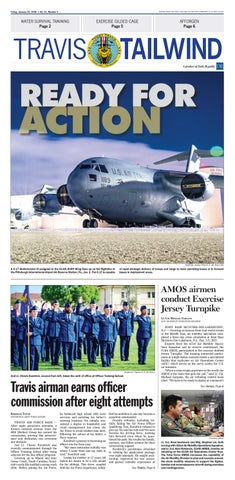
A C-17 Globemaster III assigned to Dover Air Force Base, Del., lands at Marine Corps Base Hawaii to participate in
an Integrated Combat Turn in support of exercise Joint Pacific Multinational Readiness Center 26-1, Nov. 6, 2025.

AFFORGEN

Page 6

passenger floor loading aboard the C-17 Globemaster III, providing approximately 85% of the airlift for the entire exercise. The team also executed critical fuel operations supporting long-range maritime assault missions, including wet-wing defueling from a C-17 to a fuel truck to refuel fighter aircraft.

The 3rd MGFE also integrated with U.S. Army elements, leading to the first successful completion of a High Mobility Artillery Rocket System (HIMARS) dry-fire exercise for the 25th Infantry Division to Wake Island.

“We were able to put together a plan for the 25th ID to go out and validate their training on the HIMARS system and test our capability to deliver those effects as rapidly as possible,” said Tech. Sgt. Jared Soucy, 3rd AS instructor loadmaster.

The integration of joint force operations enhanced the effectiveness of the exercise by

“The fight that we’re fighting is inherently joint international so while air power is great, we can’t do it alone,” Clayton said. “So it’s important to get out there and actually work with those joint partners, and see how they operate and how we can integrate with them.”

The two-week-long exercise concluded with the 3rd AS moving more than 2.4 million pounds of cargo and 2,200 passengers in 196 flight hours. The unit also achieved a 95% completion rate of its desired learning objectives, the highest rate in the past 15 years.

“I think there are a lot of good learning points that came out of this,” Clayton said. “Obviously, when you’re moving this many people halfway around the world to go execute a mission, there are things that you’ve learned that you can do better and there are things that we executed very well on. So I think for the 3rd MGFE, this was an excellent opportunity for us to take some

379th

Staff Sgt a lexiS OrOzcO

U.S. AIR FORCES CENTRAL

WASHINGTON, D.C.

— As the sole operation of its kind in the U.S. Central Command area of responsibility, the 379th Expeditionary Logistics Readiness Squadron Materiel Management Flight is responsible for the Expeditionary Theater Distribution Center, which provides gear to all U.S. branches of service within the region. Airmen at the ETDC work quickly to ensure service members receive mission-essential gear, such as chemical, defensive and individual equipment, vital to the warfighter downrange.

The distribution center manages approximately 362,000 assets. Serving as the primary distribution hub for individual protective equipment, the center supports multiple bases throughout the AOR by issuing serviceable gear, validating inventory and preparing assets for shipment, inspection or redeployment.

accountability across thousands of assets. Equipment is physically counted, verified in the system and returned to storage in an organized sequence.

over 100 service members.

“Our mission primarily is a hub for the AOR,” said Air Force Staff Sgt. Erika Aguilar, noncommissioned officer in charge of the ETDC. “We send out serviceable plates and gear to other bases whenever they need to fill their authorized quantities.”

Accuracy is central to the mission. Senior Airman Ashlynn Suchan, a 379th ELRS technician assigned to the ETDC, explained that the team conducts annual, item-by-item inventories to maintain

“The more accurate the numbers are, the easier it is whenever we have to issue items to forward deployers or ship items out to other bases,” Suchan said. “It shows that we are helping the AOR and staying ready for whatever comes next.”

That readiness proved essential in June 2025, during the 12 weeks of conflict between Israel and Iran, when access to protective equipment became an immediate concern. Airmen at the center worked quickly to equip

“This work is important to me because it shows we are helping to give these items to bases in the area of responsibility,” Suchan explained. “Making sure we’re always ready for whatever comes next.”

Much of that protection begins at the distribution center issue line. Air Force Senior Airman Lajyrish Green, a 379th ELRS technician assigned to the ETDC, demonstrated how airmen assemble deployment-ready A-bags and C-bags containing vests, helmets, plates, first aid kits and chemical defense gear. Each bag is built to individual size and mission requirements, with seri-

alized items tracked for accountability. The center also manages unserviceable and returned assets. Senior Airman Eroni Vatuloka, a 379th ELRS technician assigned to the ETDC, explained that returned equipment is validated by serial number and coordinated for inspection before being redistributed, if serviceable.

At its core, the ETDC mission supports Centcom by safeguarding service members and enabling operations for all military branches across the region. “We provide gear so people can be protected,” Aguilar said. “That is what it comes down to.”

Senior Airman Mark Sulaica/U.S. Air Force file (2025)
Two F-22 Raptor aircraft from the Hawaiian Raptors taxi next to a C-17 Globemaster III during an Integrated Combat Turn in support of exercise Joint Pacific Multinational Readiness Center 26-1 at Marine Corps Base Hawaii, Hawaii, Nov. 6, 2025.
Staff Sgt. Alexis Orozco/U.S. Air Force file (2025)
Airman 1st Class Caleb Morris, a 379th Expeditionary Logistics Readiness Squadron technician assigned to the Expeditionary Theater Distribution Center, organizes equipment within the U.S. Central Command area of responsibility, Dec. 12, 2025.

Turn static files into dynamic content formats.

Create a flipbook
Issuu converts static files into: digital portfolios, online yearbooks, online catalogs, digital photo albums and more. Sign up and create your flipbook.