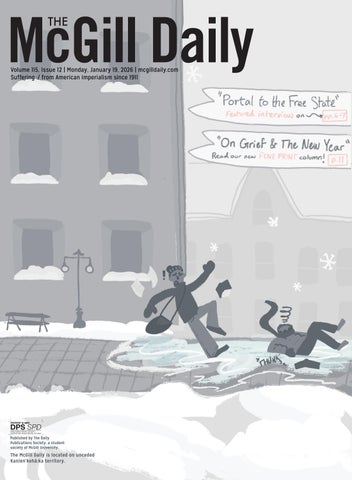
The McGill Daily is located on unceded Kanien’kehá:ka territory.
coordinating editor Andrei Li
managing editor
Sena Ho news editors
Adair Nelson
Justin Friedberg
Mara Gibea commentary + compendium! editors
Ingara Maidou
Sonia Berman culture editors
Isabelle Lim
Youmna El Halabi features editor
Elaine Yang visuals editors
Eva Marriott-Fabre Nikhila Shanker copy editor
Charley Tamagno design + production editor
Cassandra Cohen multimedia editors
Golnar Saegh
Parker Russell social media editor
Lara Arab Makansi cover designs
Golnar Saegh staff contributors
Lisa Banti contributors
Meredith Cloutier, Zoe Sanguin, Helena Cruz da Costa Barros
Lily Tasson, Anneke Goodwin
Alexi Fuentes, Ella Paulin Sophie Kuah
Published by the Daily Publications Society, a student society of McGill University. The views and opinions expressed in the Daily are those of the authors and do not reflect the official policy or position of McGill University. The McGill Daily is independent from McGill University.
ICaPS Must Do More
n 2025, young Canadians experienced unemployment rates not seen since the Great Recession. A survey from Statistics Canada reported that, excluding the COVID-19 pandemic, the “unemployment rate for returning students [aged 15 and older] was 17.9 per cent on average between May and August the highest rate since the summer of 2009 (when it was 18.0 per cent).” These figures are more than just numbers on a chart; ask almost any McGill student about employment prospects, and their response is likely a mix of frustration and uncertainty. As LinkedIn browsing becomes a full-time occupation for Gen Z job seekers, many are asking where the jobs are. This leads one to wonder: what does McGill University currently do, and what could it do better, to help its students and alumni navigate today’s fraught labour market?
Described by CBC as the “perfect storm,” Canada’ s current economic instability was a long time coming, partly due to the ongoing trade war with the United States. As the Governor of the Bank of Canada acknowledged last June, US President Donald Trump’ s erratic threats and tariffs on Canada have "stalled momentum” in the labour market. When combined with post-pandemic inflation and a growing population outpacing job availability, continued economic instability has led six in ten Canadians to believe the economy will only deteriorate further in 2026.
Furthermore, as in most other sectors of society, artificial intelligence (AI) is beginning to transform the Canadianeconomyandyouthemploymentprospects.Ina recent survey of Canadian companies, 23 per cent reported plans to reduce their employee count in 2026 due to increased reliance on AI. The jobs currently threatened by AI are highly repetitive, entry-level positionsthatoftenallowyoungworkerstogetafoothold in their respective fields.
Commenting on the Carney government’s recent efforts to alleviate youth unemployment, the vice-president of Scotiabank Economics said, “they’re going to have to go deeper in terms of how the education and the university systems [are] equipping younger Canadians to enter and stay in the workforce.” When it comes to McGill, Career & Planning Services (CaPS) is responsible for equipping students for the workforce. CaPS provides a range of resources, including “career counselling and advising, skills development workshops, experiential learning and career exploration programs, mentoring, and career and networking events.” Student reviews of CaPS are mixed. While some may find value in the services they offer, others find their instruction to be rudimentary and largely unhelpful. Many students report being redirected towards LinkedIn and Indeed after seeking career guidance from CaPS. “I went to one of their events, and I did a one-on-one consultation,” says one third-year undergraduate. “Most of the information shared at both was nothing beyond basic information that I already knew or could find very easily with a Google search or TikTok.” Additionally, the limit on post-graduation access to CaPS is currently restricted to one year for most services, including “ access to search jobs, book appointments, and attend career events” through McGill’s MyFuture portal. For many, a year simply isn’t enough time to find a job anymore. Amid ongoing concerns over youth unemployment, McGill must reform the quality of CaPS’ assistance. CaPS needs to improve its accessibility and provide greater personalization in guiding students through an everevolving economic landscape. In a job market where it’ s more about who you know than what, CaPS must also do more to directly facilitate connections between students and prospective employers. With our futures on the line, our generation needs all the guidance we can get.
3480 McTavish St, Room 107
Montreal, QC H3A 0E7
phone 514.398.690 fax 514.398.8318
advertising & general manager
Letty Matteo ad layout & design
Alice Postovskiy
“Downright scary” : Montreal’s flu wave strains emergency care
High influenza activity collides with overcrowded ERs as McGill and other campuses return for winter term
Lisa Banti Staff Writer
On December 29, 2025,Urgencessanté logged 1,358 ambulance calls, the second-busiest day in the service’s 30-year history. Despite freezing rain and holiday traffic, paramedicsandphysicianspointedtoa more consistent driver behind the spike:influenza.
For students across Montreal, including at McGill, Concordia, UQAM,andUniversitédeMontréal, thesurgeistangible:it’sshowingup asemptylectureseats,missedshifts, andanillnessthat’slingeringlonger thanmanyexpect.
“I’ve lived in Montreal my whole life,soIusuallydon’tgetsickmuch,” saidaMcGillstudentinterviewedon January 8, her first day back at school. “But I caught the flu that’ s been going around and it left me bedridden for over two weeks. Even talking right now hurts my throat. I’m only starting to feel normal again, aprettyawfulwaytospend NewYear’ s. ”
Asteepcurveandacrowdedsystem
Clinicians have described this season ’s rise as unusually sharp. In a Canadian Press report, infectious disease physician Donald Vinh from McGill University Health Center (MUHC) said emergency rooms are “burstingattheseams” astheprovince grappleswithacombinationoftheflu, COVID-19, and respiratory syncytial virus (RSV). He called influenza the “main culprit,” describing an epidemiological curve that is “downright scary” and rising at a rate thatis “almostvertical.”
Quebec’s own surveillance data backs up the sense of intensity. AccordingtotheInstituteNationalde Sante Publique Quebec’s (INSPQ) weekly respiratory virus reporting, influenza A detections and test positivityclimbedtoveryhighlevelsin late-December and early-January period.IntheweekendingJanuary3, Quebec reported 6,231 influenza A positivetests,andMontreal’sinfluenza Atestpositivitywas27.43percent.The week prior (ending December 27, 2025)washigherstill,withMontrealat 34.31percentpositivity.
For comparison, in the final week of December 2024, Quebec’s overall influenzatestpositivitywas8.4percent (835positivesoutof10,889tests).Inthe final week of December 2025 (Dec 2127),thatfigurejumpedto38.3percent (6,525 positives out of 17,092 tests), morethan4timeshigherthanin2024. The downstream effect is visible in emergency departments. In the same CBC report on Urgences-santé’s record
day, Quebec-wide ER stretcher occupancy was cited at 128 per cent, with Montreal at 135 per cent.Atthe Centrehospitalierde l’Université de Montréal (CHUM),CityNewsreportedthe emergency room was “packed” with159patients,andpatientson stretchers were waiting an averageofnearly17hours.These kindsofdelaysandovercrowded triage areas become harder to manage when large numbers of
residence floors, and winter commutes.Thatimplicationmatters wheninfluenzaisalreadywidespread inthecity.
McGill has previously hosted flu vaccination access points on campus. A November 12, 2025 fluvaccine clinic run through the Ingram School of Nursing and the Student Wellness Hub administered112flushotsinasingle day,withorganizersdescribingthe goalasmakingvaccinationeasyfor
“Put simply: even if many influenza cases can be managed at home, a small increase in severe cases, layered onto an alreadystrained system, can push hospitals past capacity.”
patients arrive with fever, dehydration, breathing difficulty, or complications that requiremonitoring.
Public health experts often caution against drawing big conclusions from anecdotes alone. Still, the collision of factorsthiswinterhelpsexplain why so many Montrealers describetheseasonasunusually disruptive.Influenzaactivityhas been high at the same moment peoplehavebeenspendingmore time indoors, over the holidays and through winter weather, beforereturningtosharedspaces like classrooms, offices, gyms, and public transit. At the same time,clinicianshavepointedtoa broader mix of respiratory virusescirculatingalongsidethe flu, which adds pressure to urgent care and emergency medicine.Andbecausehospitals are already operating near or abovecapacity,surgesdon’thave to be unprecedented to create bottlenecks;theysimplyhaveto besustained.Putsimply:evenif many influenza cases can be managed at home, a small increaseinseverecases,layered ontoanalready-strainedsystem, canpushhospitalspastcapacity.
Universitiesarebuiltforclose contact: packed lecture halls, shared libraries, group projects,
studentsandstaff.
However, the vaccination clinics in November didn’t fully answer the question students are asking in January: what
protections exist once people are back in the same rooms, day afterday?
Students interviewed on campus said they’re less focused on sweeping mandates and more about concrete, low-friction options, clear guidance about staying home when feverish, readily available masks in clinical spaces, and easy routes to vaccinationandadvice.
With emergency services already strained, physicians and public health agencies have emphasized steps that reduce both transmission and unnecessary hospital visits. One is vaccination: in Montreal, public health authorities state that the flu vaccine is free for anyoneagedsixmonthsandolder whorequestsit.Anotheristriage: Quebec health messaging during thissurgehasencouragedpeople tocallInfo-Santé811forguidance when symptoms are concerning but not clearly life-threatening, reserving emergency departmentsforseverecases.
Clinicians also continue to recommendstraightforwardharm reduction: staying home when sick, masking when symptomatic in crowded indoor spaces, and
basic hygiene. None of these eliminate risk, but in aggregate they can slow spread, and in a season defined by capacity limits, slowing spread can translate into fewercrises.
Thiswinter’scrunchisalsolanding inahealthcarelandscapeshapedby earlier tensions. In the fall, Quebec medical students mounted strike action over training conditions and the future of access, with reporting noting fears that policy direction and working conditions could worsen physician availability. Influenza didn’t cause those structural issues, but it exposes them. When stretchers are already full and staff are already stretched, the margin for absorbing a predictable winter surgebecomesthin.
For students returning to campus, that reality raises a blunt question: in a city where ERs are routinely over capacity, what does “normal winter sickness” look like now? And for those currently sick, the answer is immediate and personal: a virus can be ordinary, andstillknockyouflat.
Zoe Sanguin | Visuals Contributor
New Year, New Immigration Policies
The 2026-2028 Immigration Levels Plan and how it
may affect students at McGill
provincially-determined sectors oftheeconomy.
The new policy restricts the number of permanent resident admissions to 380,000 in 2026.
Over the past few years, both Quebec and Canada have been struggling to sustainably contain the rapid influx of immigrants, both as seekers of permanent and temporary residence. While Canada supports the reception ofimmigrantstofulfilleconomic growth, the pace at which newcomers are arriving has been taking a toll on the country's capacity to maintain high quality education, healthcare,andhousing.
In response, the Canadian government has devised new immigration policies as part of their 2026–2028 Immigration Levels Plan, which aims to recalibrate the immigration system to lessen the pressure on these sectors. Their overarching objective is to reduce immigrant intake and limit admission to favour those who meet certain criteria. These include higher job qualifications, proficiency in French, and skills in
Of the permanent resident candidates, the government seekstoprioritizethosewhofall under “economic immigrants” : newcomers with high economic potential based on their work qualificationandcompetencefor
Nominee Program (PNP), in which provinces select immigrants with backgrounds in areas of labour based on particular economic needs. The remaining permanent residencies will be allocated to family reunification and humanitarian aid for refugees andprotectedpersons.
2026 marks the start of a less accessible, more economicallydriven, and highly restrictive admission process for permanent and temporary immigration to Canada.
department of Immigration, Refugees, and Citizenship Canada (IRCC) wishes to lower this number to below five per centby2027.Theoverallnumber of study permits issued was cappedinJanuary2024,eliciting a downward trend of admitted international students. While nearly 675,000 temporary residentsenteredCanadain2025, the target for 2026 is 385,000.
Their overarching objective is to reduce immigrant intake and limit admission to favour those who meet certain criteria specifications.
this provincial requirement was$15,509.
particular jobs. This encompasses the Minister of Immigration Lena Metlege Diab's push for the Provincial
more than doubled, increasing from 3.3 to 7.5 per cent of the population. With the new Immigration Levels Plan, the
From these, 230,000 will be workers and 155,000 students, thisis47percentlowerthanlast year's target “economic immigrants.” Although the policies in the 2026–2028 Immigration Levels Plan do not directly affect current international students at McGill or any Canadian university, they may be an impasse for international students who plan on staying in Canada after graduating. In addition to the Immigration Levels Plan restricting the volume of work and study permits,applicantsinQuebecare required to demonstrate higher proofoffunds,confirmingaccess to annual funds of $24,617 when applying.BeforeJanuary1,2026,
Moreover, the significant reduction of temporary permanent residency programs has limited the options of any McGill international student whowishestoremaininQuebec. For example, the Programme d’experiencequébecoise (PEQ), which was shut down in November 2025, used to allow international students with a CLB level 7 French (intermediate) graduating from Designated Learning Institution (DLI) to fast-track their permanent residency application. Now, this can only be made possible through the Programme de sélection des travailleurs qualifiés (PSTQ). Unlike the PEQ, which offered a predictable pathway to permanent immigration, the PSTQ uses a point system based on specifications like work experience in Quebec, indemand occupations, French expertise, and educational qualifications, among other requirements, with still no guarantee of admission or acceptance.
2026 marks the start of a less accessible, more economicallydriven, and highly restrictive admissionprocessforpermanent and temporary immigration to Canada.Ifthisaffectsyourplans for remaining in Quebec or Canadaafterthedurationofyour studies, it is recommended that you search for alternatives or check your eligibility for the remaining immigration programs. Do not hesitate to reach out to the International Student Services if you need any furtherassistance.
The ISS can be reached at https://www.mcgill.ca/ internationalstudents/.
Helena Cruz da Costa Barros News Contributor
Meredith Cloutier | Visuals Contributor
How “A Portal to the Free State” Creates a New Black Utopia
Evelyn Logan on their newest project, Black identity, and much more.
Ingara Maidou Commentary Editor
Evelyn Logan is a Tiohtià: ke (Montreal)-based artist originally from Georgia, US, whose work revolves around pottery, ceramics,teaching,andwriting. They are also a former Culture Editor at TheMcGillDaily and a current team member of Scatterbrain magazine
I first met Evelyn at a Daily outreach event in September 2024. It was my first month at McGill, and I had been eager to find a new writing community. At the office, I entered a welcoming space that would end up becoming my new little sanctuary on campus. There, I had my first conversation with Evelyn. They were inviting, stylish, and had a buzz of warmth around them that made me feel as if we already knew each other. As one does after meeting someone new, I followed Evelyn on Instagram that evening and was not the least bit surprised to find out that they were an artist. Since then, I’ve been quietly keeping up with their work: liking their posts, reading their blog, going to a few pop-ups, and supporting their endeavours from a distance. However, when they completed “A Portal to the Free State,” their newest ceramic artwork, I was touched so profoundly that I knew it was time to finally put on my big girl pants and reach out to them again.
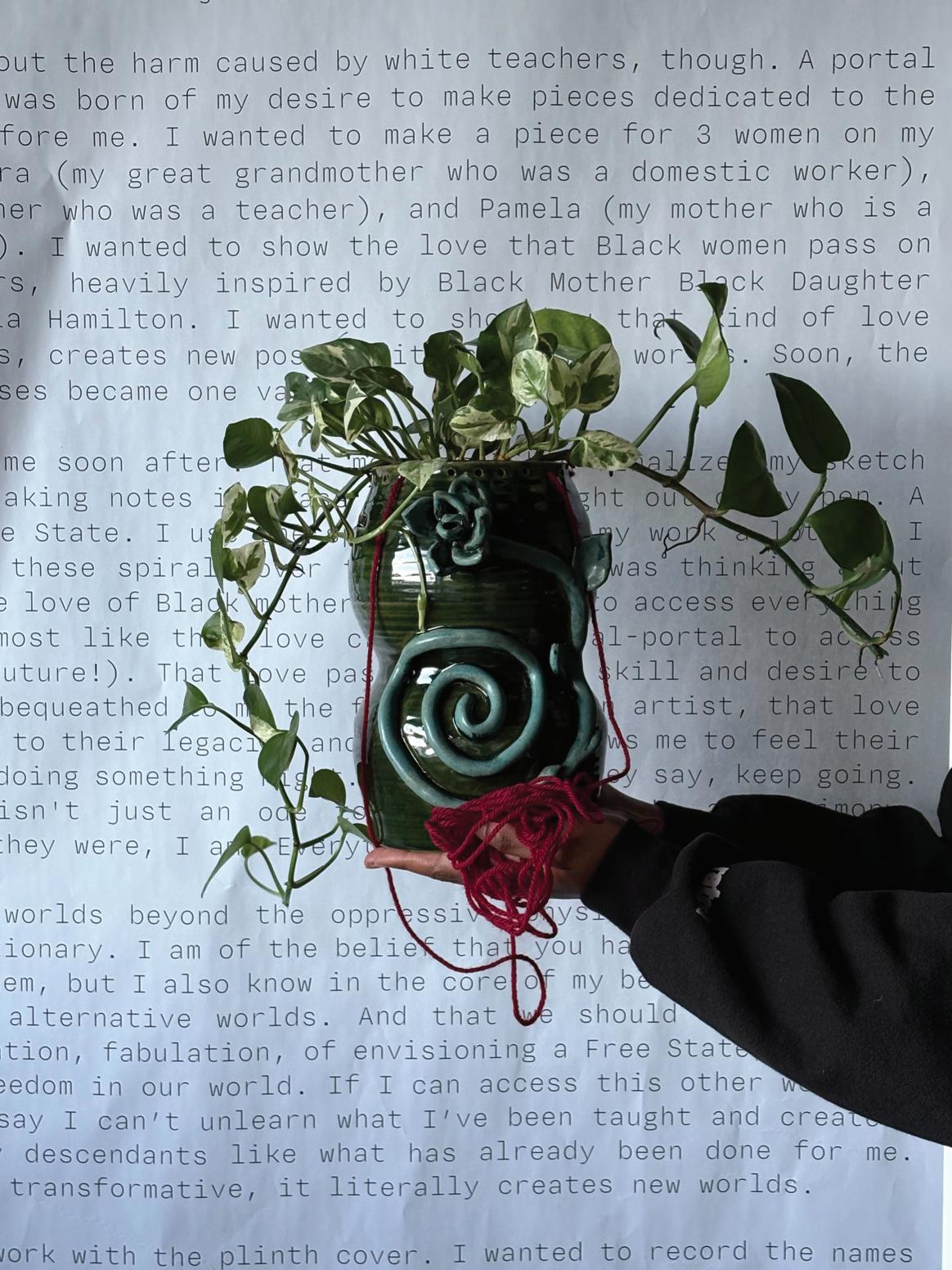
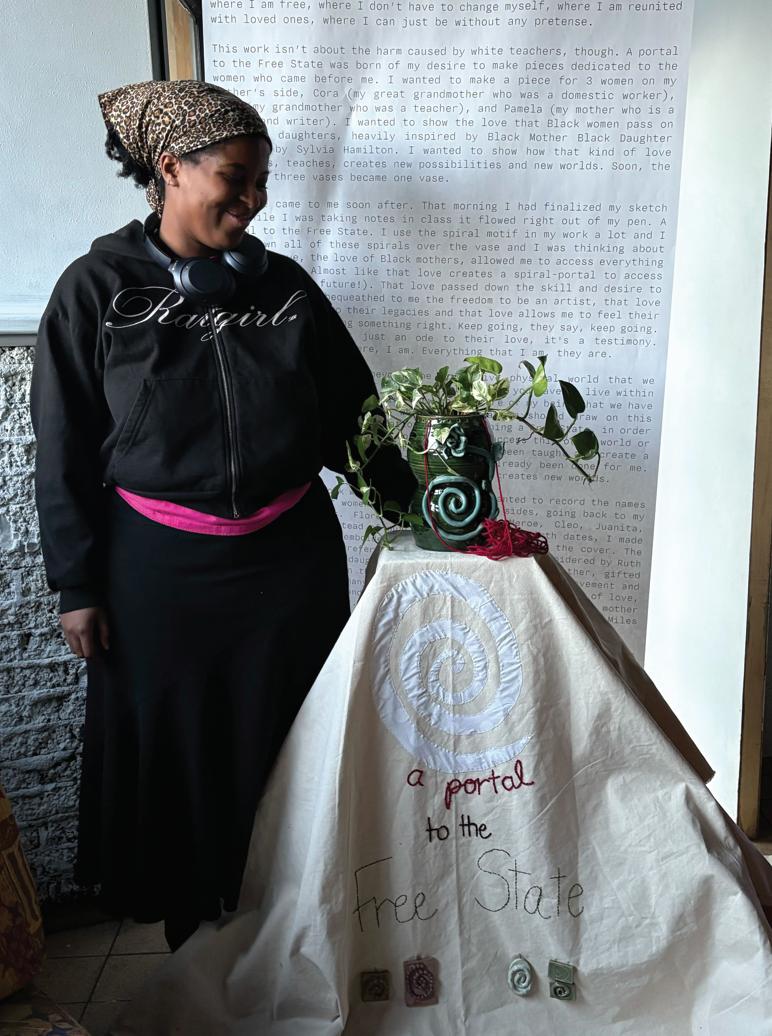
“A Portal to the Free State” is one of Evelyn’s most ambitious projects yet: an earthen-green ceramicvasewithalighter,teagreen spiral at its centre. The vase sits atop a large piece of cotton fabric with the title of the work embroidered in a fine red floss. Charms, representing the women in Evelyn’s family, surround the fabric. The piece was first displayed on December 13, 2025, at Scatterbrain’ s “cocoon/ chrysalis” showcase, with an artist’s statement stating that it aimed to “show the love that Black women pass on to their daughters.” Evelyn believes this love between Black women is a “kind [of love that] preserves, teaches, creates new possibilities and new worlds.” I spoke to them about how “A Portal to the Free State” can takeusintooneofthoseworlds.
This interview has been edited for clarity and conciseness.
Ingara Maidou for The McGill Daily (MD): Before we delve any deeper, could you try to explain how “A Portal to a
comes from my ancestors, and all the people that came before me, and that I have within me. Something else that came out of that class was the idea of a free state. I'm not very religious,
Free State” came about?
Evelyn Logan (EL): I was taking this class called “Race, Gender, and the Practice of Power (HIST 429)” with Professor Melissa Shaw. In that class, we were examining Black women, Black marginalized people, and the way that they show up in historical records. Something that came out of that class was me realizing that there's such a huge depth of knowledge that actually isn't present in the archives, but that
though I was raised Christian, and I think there is this idea that, with all of this insurmountable oppression that Black people face, there has to be something else out there. There has to be another space, or mindset, or way to access the loved ones that you've lost but also a way to access all of that knowledge, beauty, and power that comes from being Black. So I guess that's kind of whattheprojectwasbornoutof.
MD: By being a student at
university and having been raisedinthechurch,doyoufeel as if those structures, where knowledge is transmitted in such particular ways, influencesthewayyougoabout your art?
EL: I think for me, there is always going to be that tension there. Especially because, since movingtoMontrealandstarting university at McGill, I have become more disconnected from the church (but not necessarily from spirituality in that sense). So I think when I look at my art practice and the various things that I'm researching, I always want to get to other voices, not necessarily just the empirical
sources. I will use Instagram, Twitter, and oral histories because there are so many barrierstohighereducationand to being published, or even just gettingyourvoiceoutthere.For me, it's more about trying to genuinely listen, and not just hearing the loudest voices.
MD: I read your artist’ s statement,whereyoutalkabout howyourmom,yourgrandmother, and your great-grandmother all influenced this project. Tell me about these women what are theylike?Whatqualitiesoftheirs did you admire?
EL: So on my mother's side, there's my mom Pamela, and her mother Cleo, and my mother's two grandmothers, Meroe and Cora. I never knew my mom ’s mother, as she ended upgettingAlzheimer'sandthen passed when I was a bit younger, but I've learned so much about her through this project and by asking my mom everything there was to know about her. Cleo was a schoolteacher,andshewasvery involved in the community. My mom recounted all these times where Cleo would drag her to the elders in the community to visit them, talk to them, or cook for them, and how my mom would help set up her classroom. Cleo was extremely loved and well-known in her community because she was very involved. Another thing thatstuckouttomeaboutheris that she was a seamstress. She sewed so well that she would often sew not just for my mom, but also for other mothers and children in their community in Maryland. That really stuck out to me because I’ve always wanted to learn to sew. Cleo's mother was Meroe, and Meroe was alive during sharecropping. She wasn't a sharecropper, though. She owned a store, which was kind of crazy because at that time most Black women were doing domestic work, or they were workinginfields,ormaybethey were teachers. My mother's other grandmother, Cora, was a domestic worker. She worked throughout Mississippi nurturing people, taking care of kids, et cetera. I guess something that I got from all of them is this teaching spirit, which at first I was very proud of. Then for a while when I thought back, I didn’t know if I should be as proud of it, becauseteachingwasoneofthe
Courtesy of Evelyn Logan
only jobs that Black women coulddobackthen.ButnowI'm like, “Yeah,shouldIbeproudof that!” because to have gotten that skill and that passion passed down that's special.
MD: Why ceramics and tangible art?
EL: I started doing ceramics whenIwasinearlymiddleschool becauseIwasn'tveryintosports. Ineededanafter-schoolactivity, and I had tried painting, but I didn'tlikethatandIwasn'tvery good at it. So I was like, “Let me try this.” Um, or not me, my parentswerelike, “You'regonna try something else.” I think it kindofstuckwithme,especially because [making] ceramics is such a process you start with wedging your clay, and then you're putting it on the wheel, and then you're shaping it and centring and doing all these otherthings.What'ssoimportant for me about tangible art is the touch. To form something like that from your brain it takes quite a while to be able to make whatyouenvision.ButIlovethe experimental aspect of it, and I love the tactility. I was in a periodofmylifethatwasalready quite rough. Then we went into COVID, and I felt very isolated as well. So being able to have somethingthatwasjustminefelt so special and unique to me. I just fell in love with the idea of being able to make something, which I didn't have in any other partofmylife.EvenwhenIwas feeling so shit, if I just had my headphones on, and was just touching the clay, I could be chasing that moment where I wouldbeprettymuchcentred.I wouldcentrewithmyeyesclosed, becauseithelpedmefocusonthe feel. I guess it's almost like prayer I'm not religious, but I'm still very spiritual, and it's almostlikeprayer.
MD: One thing I’ve always enjoyed is how much you bring us along in the process of your work, for example with the unglazed pieces you often post. Those photos always gave me a bit of a whimsical and youthful feeling, a bit like watching claymotion animation. So when you referenced Nathalie Batraville’ s face jugs as one of your inspirations,itallstartedtoclick forme,thislovefortheimperfect. Therefore,Iwantedtoask:what called you to document the process of making your art, and not just the final product?
EL: Well, that's what I love the most about it: the documenting. Also, I love Nathalie so much. She's so talented. I'm a good glazer, but I'm not good in the sense that when I'm making a ceramic piece, what is in my head will just come out, which is very frustrating.SoIalwaysjokeand
say that, when I glaze a piece, it's ruined. But that's not actually why I don't post my finished pieces. It's just that I like the process so much better. I'd been doing ceramics for a long time before I decided to makeitacareer,andforawhile I just got really caught up in having pieces done immediately. I feel like when you start producing content, you always have to be having something new come out that's finished and good. And I didn’t want myself to stay in that mental hole, because I was totally in the hole. So now I'm trying to get myself to focus on the process, which also helps me get better. I've noticed I get so much better when I can focus on that. I find the process much more enticing now than a finished product, because there's just so much more that you learn and so much more beauty in the process.
MD: Where do you throw? Could you tell me a bit about your studio?
EL: Studio 3 Tables. It's the best space ever. It's in this old mattress factory, and it's an all BIPOC studio, which is super important because pottery is so white. I think most of the art world is white, but pottery is so white. So it was crazy for me to have found this space on Instagram.
When I joined 3 Tables, I mentioned how I was interested in teaching, and the owner set me and another person up to teach, and they mentored both of us. That was
Henrietta Lacks’ contributions to cancer research. Did that series influence “a portal”?
EL: I always wanted to do a project about Henrietta Lacks. Howmanylivesisshesavingall the time? How much money are these pharmaceutical companies making? Her family's not seeing any of that. At the time that her biography (The Immortal Life of Henrietta Lacks) was written, herfamilywaslivinginpoverty. That's so fucked up. That's why I wanted to make a project about her. And then when I got the opportunity to do “A Portal,” I was thinking I’d continue not only the work that I was doing in that class, but also building upon the “HeLa” series. I want to keep making people think about Black women in a different way.
MD: I feel that Black identity and perceptions of Blackness operate in such a dynamic way. What differences have you noticed between navigating the world as a Black person in the US compared to Canada?
EL: In Georgia, where I went to school, I was considered “lame” because I was just very nerdy.IlovedwhatIwasdoing, but I was so lame. Then, when I came to McGill, all of a sudden everybody thought I was really fuckingcool.TheythinkI'mthe coolestpersonever,andtheyall want to be my friend because I'm so cool, which is just because I'm Black. Here in Montreal, if you're Black? You're cool. But in the States,
There has to be another space, or mindset, or way to access the loved ones that you've lost — but also a way to access all of that knowledge, beauty, and power that comes from being Black.
such a good experience. I had my own class this past fall, and I was just beyond happy. Everybody's so sweet, and it's just so special because we love this specific craft and we're all friends. I'm still getting to know everybody because I haven't even been there for a year yet, but it's so warm and fuzzy. It's also been so inspiring, because everybody is sotalented.AndIfeellikeevery time I step into this space, I'm ready to learn.
MD: Talk to me about your previous ceramic sculpture series “HeLa”, inspired by
Maryland.” And they’d ask, “Why don't you know where you're from in Africa?” And I just said, “Oh, slavery.” It just feltlikepeopleherewereBlack in a different way that I hadn't really interacted with, because even though I knew a lot of people in the States that were first-generation or secondgeneration African immigrants, they still saw themselves as Black American and not necessarily, like, NigerianAmerican. So it's different.
MD: In your artist’ s statement for “A Portal” , you describe learning how to have faith in the idea of another plane or world. For yourself, what does this “Free State” look like?
especially in the south, there are so many Black people that you can be lame, you can be cool, you can be nerdy, or all these different things. Going into McGill, I told myself, “I'm gonna make all of the Black friends.” But I really struggled because I didn't feel like I connected with Black Canadians. And when I would meet people who were from Africa, or Francophone countries, they would ask, “Well, where are you from?” I would say, “Georgia,” and they would be like, “No, girl, where are your parents from?” Then I would say, “Ontario and
EL: When I think about it, practically, it's just a world where you're not forced to choose against your morals. I broke my laptop, but I don't want to buy a new one because it's an Apple laptop and I don’t want to support all of their mining practices in the Congo. But if I need to write an essay, I can't write it on my ass, you know? In a world where people who look like us Black people are suffering and constantly discriminated against, it's even hard to find a way around that without creating more harm. So, I picture a world where you can just live and not harm anyone, where you don't have to be anxious or stressed, and nobody is policing you, and you're not policing yourself.
What do I think it looks like in a fantastical way? It's just lots of green things, and you can just be. There's universal income, and there's universal healthcare, and you don't have to worry about your body or what you need to do to make it work. You can just live. I struggled with writing the artist’s statement for “A Portal”. I’m worried that I wrote it in such a way that I wasn't conveying that I believedthingscanbechanged. The fact that I can even have this idea means that things can change, and it also means that you can change them for yourself and for your friends and family. So I didn't want it tosoundtooimaginary.Ididn't want to fuel any kind of nihilism, but I also think it’ s very valid specifically for Black people to have. What I wanted toinfuseintheprojectwasthat while you're reflecting on the people that came before you, and you're getting to that place and revelling in the fact that you came from something, you can take that power and create your free state. Not just so that you can access that free state from far away, but so you can bring it here. You can bring it here. So yeah, I guess that's what it looks like for me.
On The (Not So Surprising) Smash Succes of HeatedRivalry
Vulnerability and love take the starting line.
Lily Tasson Culture Contributor
Afriend of mine has recently become obsessed with hockey. I can be sure she knows on any given night whether there is a game happening and which teams are playing in it. Once, while sitting across from her in the library, I heard her exclaim with joy having just discovered that her streaming service came with accesstoTSN,aCanadianSports broadcaster. In the midst of our first finals season at McGill, she stayed up to read all six Game Changers novels, written by Canadian author Rachel Reid, in anticipation of the series’ television adaptation: Heated Rivalry. What was *I* doing, while my friends’ conversations progressively began centering aroundthisshow?
As my stress levels faced a meteoric rise, so too did Heated Rivalry's popularity. Originally premiering online on Canadian streaming service Crave on November 28 2025, the show quickly won audiences’, as well as critics’, hearts, becoming the Crave’s most watched original seriestodate.Itwasthenpicked up by HBO Max to be distributed to American and globalaudiences.
The sports romance follows two rival hockey players in the fictional Major Hockey League: Canadian Shane Hollander (Hudson Williams) and Russian Ilya Rozanov (Connor Storrie). The pair first face off in their rookie season, kickstarting a secret love affair that spans a decade as their careers and the perceived animosity between themescalates.
The show’s success might be quicklydismissedandreducedby those who attribute it to the physical attractiveness of the stars and the many steamy sex scenes. However, what has truly captured viewers’ attention is its depiction of the reality of queer existence in men's professional sports.Theclosetedplayersshow tremendous vulnerability as they navigate prejudices that hinder their relationship; a moving portraitoftheflawsofacceptance andinclusioninoursociety.
During their press tour, the show’s cast and crew expressed shockovertheshow’sreception. However, having been an avid TV show watcher since the pandemic (quiz me about
matching the show to the streaming service), I was less surprised. In recent years, the cultural landscape has seen a rise in content about same-sex couples, particularly male ones. Netflix's Heartstopper and Young
Heated Rivalry’s press tour initially targeted media outlets with a largely female audience, such as Teen Vogue. This is deeply political. Love stories made for women typically offer no reprieve from their societal
“The closeted players show tremendous vulerability as they navigate prejudices that hinder their relationship; a moving portrait of the flaws of acceptance and inclusion in our society.”
Royals series, both about young male couples, have large audiences, despite the latter’ s original Swedish dialogue and setting being more foreign to North American viewers. The primary audience of these series tends to lean towards young females,somethingTheNewYork Times recently affirmed in an article containing Heated Rivalry’sstatisticaldemographics. Why would women want to read and watch love stories between two male characters? And why are these shows being marketed towards them?
subordination. In sex scenes, women are often dominated and objectified. When the time comes to be emotionally vulnerable, the woman is relegated to the role of caretaker, tending to her male love interest’s emotional wounds. For female viewers, thisisexhausting.
Hence, it is not only in fantasy stories of princes and dragons thatwelookforanescapebutin the dynamics of HeatedRivalry and other similar shows. When there is no woman in whom the woman might see herself, she
can become a passive observer. If she wants to, she can choose to identify with a male, where she can momentarily occupy a positionofauthorityandexplore masculine aspects of her identity. “Her sexual fantasy needs not equate to her sexual reality,” Professor of Sociology and Sexuality Studies at San FranciscoStateUniversity,Clare Sears tells The Guardian. In mainstream media depictions of same-sex male relationships, both men are vulnerable with each other, with the role of caretaker and investment in the relationship shifting more fluidly between a couple who occupy the same position in the patriarchal hierarchy. This resonates more deeply in the world of men’s professional sports; an environment that fosters and upholds toxic ideals ofmasculinity.
The show might particularly score (allow me this one bad hockey pun) for Montrealers and McGill students, being set and filmed in Montreal and other parts of Canada. Director JacobTierneyandcastmembers such as François Arnaud, who plays hockey captain Scott Hunter, are both from Montreal and have been making promotional appearances in the city since the show’s release.
One of the show’s romantic
leads, Shane Hollander, plays for the fictional Montreal Metros team. It was only fitting that the Montreal Canadiens played the trailer for the series during a recent game on Pride Night,anactthatreceivedpraise as it rebelled against the NHL’ s controversial public stance on inclusionintheLeague.
This is not just an article urging you to watch Heated Rivalry or read GameChangers If it were, I would conclude by praising its embracing of sexual diversity and the underlying love and longing between its characters. A second season has already been commissioned to bereleasedinthenextcoupleof years, if you find you enjoy it. However, more importantly, I hope to convey that it is ignorant to reduce Heated Rivalry to smut and dismiss any of its viewers as simply insatiable. The series holds personal value for viewers, providingahopefulescapefrom harsh realities that women and queer individuals face. Moreover,theshow’spopularity has sparked a public reevaluation among fans of the National Hockey League’ s values and self-presentation, something that continues to be incrediblynecessary.
Winter Break(ing No Contact)
Why going home for the holidays has you talking to your ex
Anneke Goodwin Culture Contributor
Isincerelyhopethatnoonehas to show this article to their best friend who is currently talking to their evil ex. I hope everyone had an awesome break and that the awesomeness from your break was in no way correlated to the bursts of dopamineyougotfromtalkingto your ex again! But the realist in me knows that is not the case for everyone.Agirlcandream.
Whetherit'syourlong-termex from high school, an old situationship, or the same old Hinge talking stages, there is a cultural tendency for people to use the breaks from school (whether one goes home or not) asanopportunitytoreachoutto old romantic partners. This is a noted and understood psychological phenomenon, one I have also noticed circulating within McGill’s student community. Some of you may knowwherethebreakisheading
beforeyouevenleaveMontreal.
Despite my teasingly cautionary tone, this article is in nowaymeanttodissuadeorpass judgment on using breaks to get back in contact with old partners. Rather, it is meant to serve as a social observation. I am a firm advocate for second chances and trusting your intuition. However, as a writer and a student, I feel forced to confront the question of why exactly we do this. There is no one cause for the upward trend of rekindling relationships over breaks, which is rather borne from a combination of factors: equal parts timing, boredom, nostalgia,andalossofidentity.
For some, being at school and tastingindependencehasallowed them to discover a new sense of self distinct from family, childhood friends, and the environment in which they were raised. Subsequently, returning home after having been away for an extended period of time can feel like reverting to this old
identity, which is in turn connected to the people of their pasts. Supporting my personal irritations,Inotedalargeamount ofonlinediscoursedescribingthe feeling of reverting to your 16year-oldselfthemomentyoustep through your front door. This phenomenon explains the revisiting of a failed relationship as well making decisions the younger, more immature version ofyouwould,evenifyourcurrent self would not. You may never catch yourself thinking about a past partner, but suddenly, when found in an environment you once shared, your mindset is transportedbacktoyourcommon past.Moreover,ifyouareinclose physical proximity to this person once more, rekindling a dead spark becomes much more plausible. People often use the very foolproof guise of seeking closure in person over these breaks to test the waters once more.
Boredom and nostalgia also play a crucial role in facilitating
this dynamic. Winter break is a time when life slows down when we have time to think, reflect, and feel. At the same time, we enter an extremely nostalgic environment. The emotionally dangerous combination of boredom and sentimentalitypushyou towards
will they fade out? Are these circumstantial and fleeting opportunities the second chance every relationship deserves or simply false potential? The evidence, the pattern, the trend, leads one to believe that it's not about the partner but about the conditions.Imaynotbegreatwith
The emotionally dangerous combination of boredom and sentimentality push you towards that risky text, no matter whether you’re the one receiving or sending it.
that risky text, no matter whetheryou'retheonereceiving orsendingit.
However, routines return eventually, and normal life resumes. Are these rekindled flames able to withstand that, or
statistics, but based on the experiences of my me and my friends, there is no way so many people have amazing past romantic interests that they’ re somehowdestinedtoreunitewith. That’s not to say that the choices one makes to communicate with their old partners over break are dissociative choices you have no control over or responsibility for. However, that's also not to say these choices are not an accurate reflection of what people truly want. We must all be held accountable for our own actions. Simply because it is a social trend with clear causes does not mean that we lack agency,andthefactthatthisisa shared experience does not meanit'snecessarilyawrong(or right) choice. It is merely worth taking note of the seasonal patterns that affect so many of us, so that we can all think critically about our personal decisions. This would enable us to closely examine our actions and the influence of emotion on them with curiosity and openness rather than judgment, and give us room for personal growthandself-awareness.
If you sought out this article for guidance or moral direction regarding your post-winter break romantic predicament, I apologize for my more critical approach. If I had to conclude this article with some concrete wisdom, I would advise you not to listen to made-up TikTok datingrules(thatisanarticlefor another day) and to trust your gut. That being said, if your friends are saying it's a terrible idea, then maybe, just maybe theymighthaveagoodpoint.
Nikhila Shanker | Visuals Editor
Documentary Festival Brings International Stories to Montreal
Blurring the lines between the private and the political on screen
Ella Paulin Culture
Contributor
The Montreal International Documentary Festival ran from November 21 to 30, 2025, showcasing over 100 films, bothmadeinCanadaandabroad. Thefestivalalsoincludedavariety oftalks,performances,andevents for documentary fans and filmmakers to connect and share theirloveofnon-fictioncinema.
Six Taiwanese filmmakers cametogetheronNovember23in one particularly insightful panel discussion, “Navigating Taiwanese Cinema”, to consider the unique landscape of documentary filmmaking in Taiwan.Theymulledoverwhatit meant to be making films in a context where non-fiction filmmakingwasonlytrulyableto developaftertheliftingofmartial lawin1987.
While many of the panelists’ films handled political questions more directly, such as Wei-Lin Hung’s documentary, K’s Room, which tells the story of a famous Taiwanese English teacher and political prisoner, director YiShan Lo discussed an alternative approach. In her film, After the Snowmelt, in which a young woman returns to the Himalayans to process her grief forafriendwhohaspassedaway, thepersonalcomesfirst.
“For me, it’s an intentional choicenottoincludethepolitical problems of Taiwan. Me and my friend, we met each other at a protest,maybe10yearsagowhen wewerehighschoolstudents[...], soactuallythestory’sbackground is very political in terms of the Taiwan-China relationship, and yet I didn’t include this background in the story,” Lo said duringthepanel.
She hopes, though, that the political context might permeate the film anyway, somehow reaching the viewer in their experienceofwatchingthefilm.
“Through telling the story very personally, I believe that somehow at the end, the historical background will ultimatelycomeout,” Loadded.
Nadia Louis-Desmarchais also found herself navigating the personal-political divide over the course of her seven-year project to document the experiences of biracial women in Quebec. While sheinitiallyintendedtomakethe film entirely in the third-person, using sit-down interviews with other women about their experiences, she realized over
the course of the project that her ownstorywasalsoattheheartof herdrivetomakethefilm.
“It was through meeting those womenthatIrealizedthatevenif we didn’t grow up together, we all had lived through the same things,” Louis-Desmarchais said during a Q&A after the screening ofherfilm.
By chance, it was returning to her father’s collection of childhoodphotographsandhome videos that sparked the idea to weaveherownstoryintothefilm.
“Since it was a film that came together over many years, eventually, I looked in my family’s house, with my father and all the tapes he had filmed. The tapes were all still there, in thehouse,inaverydustylibrary,” Louis-Desmarchais explained.
“And there I found, really, the explanation for who I was. You know, when you see yourself as a child, it’s like seeing the real version of yourself. And it revealedalottome,andthatwas, ultimately, the way in which I began to think about adding my ownpresencetothefilmthrough theseimagesfrommypast.”
As it turns out, audiences resonated with LouisDesmarchais’ blend of the personal and the political the filmwonboththePeople’sChoice Award and the Student Jury
Award,aswellasgainingaspecial mention in the running for the Magnus-Isacsson Award for socially-consciousfilmmaking.
Several films about Palestine alsoearnedawardsatthefestival, including one from McGill’ s own professor of anthropology, Diana Allan. Allan’s film, Partition, combines little-before-seen footage of the British occupation of Palestine from 1917 to 1948 with audio recordings of Palestinian songs and stories. This film, too, weaves the personal in with the political, in moments of direct address from the audio recordings. It was screened by McGill’s Critical MediaLabonJanuary14.
In the short film category, Momentum, which uses footage shot by the filmmaker’s father during the Second Intifada, won the Special Jury Prize. Nada ElOmari’s film is composed solely of these hand-held video recordings, on top of which she paints and writes her own perspectives. Throughout the film, she wonders what pushed her father to record these moments why these people? On screen, there are moments of violence, but also scenes of dancingandchildrenplaying.
As a representative from the Special Jury summed up, “[We award this prize] for a film that
“Directors, editors, cinematographers, and interview subjects were often present in the room, excited to take part in what was often the first screening of their films.”
weavestogethertheintimateand the political, for a daughter revisiting images shot by her father twenty years ago, for time that repeats itself in a loop, a camera that mimics what our spirit could grasp in moments of uprising, and sound that mimics theexperienceoflivingunderthe militaryoccupationofPalestine.”
Over the course of just 19 minutes, El-Omari explores not just the history of the Second Intifada, but also her relationship to her father, and what these images reveal about hisexperience.
While the festival included films from across the world, it ended with a closing film from much closer to home: Andrés Livov’squiet,beautifultreatment of the Lac-Saint-Jean blueberry industry. From interviews with
Multimedia editor
migrant workers who live in blueberry camps to sweeping shots of industrial harvesting machinesandbackdownagainto elderlyinhabitantswhonowpick blueberries for pies, but remember their childhoods of picking by hand to support their families, the film offers a gently kaleidoscopicpictureofQuebec’ s famousberry.
Fittingly,forsuchasoft-spoken movie, Livov opened his speech with a simple statement: “I’ m terrified,” which he repeated a second time, louder, at the audience’srequest.
Despite his hesitancy when it comes to public speaking, Livov obviouslyhasagiftforprompting peopletoopenuponcamera,and an ear for poignant stories or remarks. Although the blueberries are the focus of the film,therearealsodeepwindows into the lives of people who have beentouched,onewayoranother, by the blueberry industry several of whom were present in theroomforthescreening.
The closing film continued a pattern that was present throughoutthefestival:directors, editors, cinematographers, and interview subjects were often present in the room, excited to take part in what was often the first screening of their films. Often, when directors thanked participants in their speeches, those same participants stood up in the audience, greeted by thunderousa applause from all around them. This intimacy and engagementwastrulyfittingfora festival where so many of the films even the ones that dealt with intractable international issues were clearly so personal to their directors, and where so manyofthefilmsblurredtheline between filmmaker and subject, orevenparticipantandaudience.
Golnar Saegh |
The Cynicism Around New Years
Resolutions and a Promising Alternative
Sophie Kuah Culture Contributor
What New Year’ s resolutions have youmadethisyear?
CTV News asked this question to Montrealers, and maybe their responses will resonate with you. Maybe you have made a resolution with a specific goal in mind and have been waiting for the New Year to roll around to kick it off. Perhaps, though, you have not made a New Year's resolution because you do not think the start of the New year is particularly important. Some individuals interviewedagreedwiththis sentiment, as they noted to CTV, “I make resolutions everydaythatareimportant tome.Istartwhenever,” and “Ithinkweshouldalwaysbe improving, not just once a year. ” Another reason why you might not have made a resolution is that you already have a lot on your plate and a New Year's resolution will just to add to your stress. One individual interviewedagreedwiththis sentiment: “We always tell ourselves that we are going to be better the next year, but let’s honest, we don’t really change, do we?” Before writing this article, I firmly stoodinthiscamp.
Why have so many of us rejected New Year's resolutions? Many of us have an approach to resolutions that focuses on large-scale goals, ones that are so distant from our starting points that we struggle to draw the path that will get us there. Yet, we only consider as having reached our final goal, not by the arduous process that we were already brave for committing to. With this one-track mindset, resolutions become daunting tasks. It is no wonder that so many of us reject making them before we have the chance to see them through, if we expect tofail.
There is something about the beginning of a new year that makes me think that something radical ought to be achieved now. When I think “New Year,” I think of big fireworks, big lights, the big ball dropping in Times Square, big cheers, and big hugs; think massive change ought to occur urgently. I reflect on how I often hear,
“This year is going to be my year, I swear” from my friends, peers, social media creators, and those sitcom characters who just cannot seem to get their act together. This high-stakes approach to resolutions implicitly puts pressure on us and others to have a “successful year,” in which we get everything we want bytheendoftheyear. These sky-high expectations have made me feel helpless in the new year because I feel as if Ihavetoadoptanattitudeof “allornothing.” SinceIwant to start playing the jazz saxophone, I should
allows us to make progress on the things we care about withouttheadditionalstress that can lead to failure and resentmentofresolutions.
“Your Theme” by YouTube creator CGP Grey has transformed how I view New Year's resolutions. He presents the idea of centering your resolutions on a general theme. You choose a broad word or phrase and orient yourself around it. For example, instead of reading one book a week, he proposes a “ year of reading,” where the theme stays in the back of your mind. Then, in
It is beautiful that we are ambitious creatures, but many of us bite off much more than we can chew.
maximizemytimeandeffort to be a “good player” as soon as possible, but then I am paralysed. I cannot feasibly imagine achieving these goals at this pace, given that Iamalreadytryingtobestin everythingIamdoingnow –classes, sports, relationships,foodblogging, writing articles – not to mention the assumptions that will be made about my willpower if I fail to follow through.
Inschoolsandworkplaces, we often hear that we need “SMART” goals that are Specific, Measurable, Achievable, Relevant/ Realistic, and Time-bound. SMART goals might work in some contexts, such as meeting short-term deadlines for work and school. However, when it comes to making progress on a task over the course of a year, most people lack the foresight to tell if New Year's resolutions are truly achievable. A 2015 Ipsos survey found that 73 per cent of Canadians break their resolutions. It is beautiful that we are ambitious creatures, but many of us bite off much morethanwecanchew. Instead, I propose we do the opposite of what the SMART framework advises: stay flexible. Throughout the year, unforeseen circumstancesarise,andour goals evolve. Life can be busy, so strict consistency is often unrealistic. Maintaining flexibility
instances when you might want to habitually scroll through social media on your phone, you can reflect on your goal, and make the choice to pull up an article instead. CGP Grey redefines what we tend to think of as “ progress ” and lowers the stakes; we only need to “be a little different in little moments, sometimes.” I want to draw attention to this idea rather than focusing on attempts to make radical changes in the new year. Further, the changes we seek can happen ina “littlemoment” orinthe process, as opposed to culminating in one achievement. Making our goals more flexible increases our chances of success, because it lets us make steady progress, without the pressure of reaching a single large end goal. With this mindset, we can stay motivated and avoid the kind of cynicism about New Year resolutions that discourages us from pursuingwhatwewant. I invite you to reflect on your theme for the year, month, or season. While the date can be arbitrary, consider using a theme as the first step towards reaching your ambitions, howeverslowtheprocessis. Change can start any time, so why not begin now? It may not always feel like we are making progress in the moment, but that might be how we achieve our New Year'sresolutions.
January 19, 2026 mcgilldaily.com | The McGill Daily
Alexi Fuentes Culture Contributor
On Grief & the New Year
2025wasayearfullofbeginnings.IpickeduphobbiesIhaven'tdoneinyears, I tried new things, I made new memories, and I did hard things. I also felt a kindofgriefthatIhaven'texperiencedinaverylongtime.
In2026,I'mstartinganewyearwithoutyou,butI’mstillcarryingthegriefof yourlossaroundwithme.Irememberitspresence onarandomTuesdaywhen I'm out and about; during breakfast on a slow morning; or when I'm on the REMandIrememberthattheplacewhereyou’reburiedis7stopsaway.
Months after your passing, I'm still holding on to many regrets, unasked questions,untold words,andwhat-ifs.Thisisn’ttheendingIwanted,butwho canreallycontrolhowithappens?
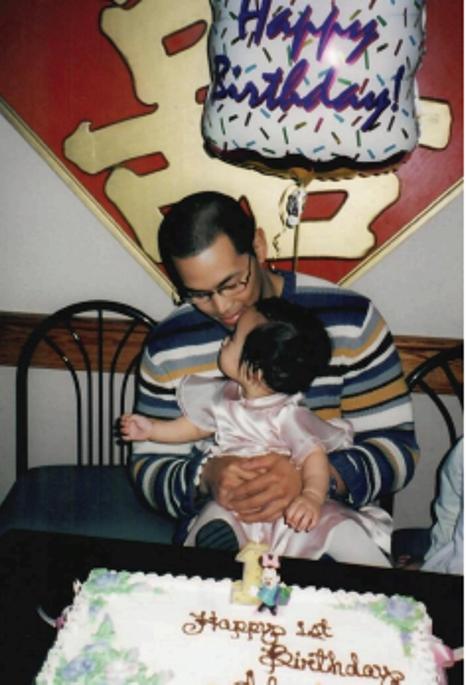
At the same time, I’m aware of how beautiful it is to have even had a beginning withyou.Butastheysay,everybeginningmustcomewithanending.Ijustwish the latter didn’t come so soon. Soon I’ll be older than the age you were in this photo,canyoubelievethat?
Asanewyearbegins,Ihopetobebetteratembracingendingswithgraceand gratitude, learning to let go and be present in every moment. I hope that the griefbecomesalittleeasiertocarry,butIknowit’ssoheavybecauseit’sjusta shellforalltheloveI’mcarryingaswell.
12, 2026
Venezuela After Maduro: Celebration Meets Precedent
Relief is real. So are the legal precedents, the disinformation surge, and the oil incentives that shape what comes next
Lisa Banti Staff Writer
OnJanuary3,2026,UnitedStates
President Donald Trump announcedinaTruthSocialpost thattheUSmilitaryforcescarriedout strikes in Venezuela and captured PresidentNicolásMaduroandhiswife
Cilia Flores, flying them out of the country. Within hours, diasporic celebrations were visible far beyond Venezuela’s borders, especially in Doral, Florida; a Venezuelan hub nicknamed “Doralzuela,” where expatriatesgathered,wavedflags,and praised the operation as the longawaitedendofanauthoritarianera.An era which was marked by systematic repressionofpoliticaldissent,arbitrary detentions,documentedabuses,andby anationalcrisisthathasdrivenmillions ofVenezuelanstofleeabroad.
Behindthescenes,thisreactionisnot hard to understand. For years, many Venezuelans abroad have described exileasapermanentstateofsuspended life:careersrestarted,familiessplit,and a homeland that feels simultaneously intimate and unreachable. When Madurowascaptured,thecelebration was not simply political; it was cathartic,anassertionthatimpunityfor alleged state repression and serious humanrightsabusesisnotinevitable.
However, almost immediately, the storywasfilteredthroughtheattention economy: a flood of posts, some genuine and some fabricated, competedtoframetheeventinvarious ways.Someclaimitwasliberationand long-delayedaccountability,manysaid it was an illegal ‘kidnapping’ and sovereigntyviolation,otherscalledita security-and-drug operation. A few postsevenlayeredonoil-motiveclaims and conspiracy narratives that muddied verification. By January 5, majormediaoutletsandfact-checkers werereportingonanddebunkingAIgenerated images and repurposed videoswhichfalselypresentedMaduro in custody or crowds celebrating in Caracas. In other words, both the jubilation and the backlash were real and so was the manipulation of each acrossplatformsonline.
On January 5, Maduro and Flores appearedinaManhattanfederalcourt and pleaded not guilty to charges including narco-terrorism conspiracy andweaponscountsinvolvingmachine guns and destructive devices. Yet, Maduro called the US operation a “kidnapping.” By the time courtroom photosofthetwocirculated,opinions aboutthelegitimacyandlegalityofthe USinterventionhadalreadysolidified. Thesameday,theUNSecurityCouncil held an emergency meeting in which
Brazil, Colombia, Mexico, Chile, Russia, and China condemned the operation as a breach of sovereignty whichsetadangerousprecedent.
What makes this event so controversial is that it sits at the intersection of two opposing narratives.Thefirstperspectiveon Maduro’s capture has underlying moral and emotional justifications because the removal of a leader accused of repression may appear just. On the other hand, the legal and structural complications of Maduro’s capture blurs the boundariesbetweenarrestandwar. Thisviewquestionsthelegalityofa powerfulstateseizingapresident in aforeigncountryandreframingthe useofforceas “lawenforcement.”
On January 4, 2026, Chatham House argued that the capture and attacks had “no justification in international law,” emphasizing that the UN Charter’s prohibition on the useofforceisnotoptional.OnJanuary 6, the Office of the UN High Commissioner for Human Rights warned that the world is “less safe” when such interventions occur and stressedthatVenezuela’sfuturemust bedeterminedbyVenezuelans.
Nationalgovernmentsechoedthat sameconcern.OnJanuary3,China’ s foreign ministry said it was “deeply shocked” and “strongly” condemned thestrikesandMaduro’scaptureasa blatantuseofforceagainstasovereign state. On January 6, Mexico’ s presidentdenouncedtheintervention as undermining democracy and stabilityinLatinAmerica.Onthesame day, Russia backed Venezuelan vice president Delcy Rodríguez as the country’s interim leader and denounced what it described as neocolonialthreatsagainstVenezuela. None of those statements however seemtohavebeenmadein sympathy for Maduro. Instead, they reflect something more complex: a fear of pastevents.
WhyIraqstillmatters:a dictator’sfallistheeasypart
Theargumentmostoftendeployed to dismiss these concerns is simple; Maduroisviewedasadictator,sothe meansofremovinghimaretreatedas lessimportantthantheresult.
Iraqisacautionaryexampleofhow quickly “liberation” framedbyexternal powers can curdle into a long and violentaftermath.In2003,theUnited States invaded Iraq under the suspicion that Saddam Hussein possessed weapons of mass destruction. Those claims later unraveled: in October 2004, media reports summarized the Iraq Survey Group’s conclusion that Iraq had no stockpiles of chemical, biological, or nuclearweapons.DespitemanyIraqis’
welcomingSaddam’sfall,thatinitial relief did not prevent the rapid unraveling of the Iraqi state. In the first months of the occupation, the CoalitionProvisionalAuthority’sdeBa’athification policy and decision to dissolve the Iraqi army stripped ministries and security forces of theirinstitutionalcapacity,leftlarge numbersofarmedmenunemployed, and helped fuel a growing insurgency and sectarian violence. Over the following decade, that instability and weakened governance contributed to fragmentation, including conditions that enabled al-Qaeda in Iraq and laterallowedforISIStogainground.
ByDecember31,2011,theIraqBody Count documented 120,108 civilian deaths from violence since the 2003 invasion, a verifiable minimum that includes killings attributed to multiple actors, not only US forces. Iraq Body Countreportsthat15,163(13percent)of thosedocumentedciviliandeathswere directlycausedbytheUS-ledcoalition.
The political economy of war also matters here. On August 12, 2008, the USCongressionalBudgetOfficewrote that contractors played a “substantial role” in supporting US military, reconstruction, and diplomatic operationsinIraq.Thatrelianceisnota sidedetail:itshowshowquicklyawar can become an outsourced project, where major decisions about security, logistics, and rebuilding are filtered through contracts- arrangements that can dilute accountability and shape prioritiesinwaysthatdon’treliablyalign withdemocraticstabilization.
ThetakeawayisnotthatVenezuela will become Iraq, but that forcefully removing a regime is often the simplestphaseinregimechange,and that the incentives shaping what comes next, including money, contracts, security partnerships, and resourceaccess,donotreliablyalign with nation-building or democracy. This is why diasporic Venezuelan rejoicingandinternationalalarmcan bothberationalresponsestothesame event:celebrationcanbesincereand anxietycanhavelogicalroots.
Venezuela’s oil is structural, not incidental
Anyanalysisofwhatcomesnextalso hastocontendwiththecentralmaterial stake in Venezuela’s crisis: oil. Venezuela is an oil superpower on paper, despite years of declining production.TheUSEnergyInformation Administration estimates Venezuela holdsabout303billionbarrelsofproven crude oil reserves, the largest in the world.Thatrealityshapesbothexternal interest, internal vulnerability, and the rhetoric surrounding the intervention. IntheimmediateaftermathofMaduro’ s capture, multiple news accounts
emphasized that US officials were already discussing Venezuela’s oil futureandthatglobalmarketswere watching whether Venezuelan heavycrudecouldflowagaintoward GulfCoastrefineries.ByJanuary15, the Trump administration had also escalated its sanctions enforcement atsea,withUSforcesseizinganother Venezuela-linked tanker in the Caribbean.Separately,Chevronwas reported to be in talks with US officials about expanding its Venezuela operating license to increasecrudeexports.
Even during the celebrations of Maduro’s capture, some coverage notedanundercurrentofuneaseabout what comes next, especially after Trump said the US would "run" Venezuela temporarily until what he called a “safe” transition could be arranged. This is not a conspiracy theory,it’showgeopoliticsworkswhen a country sits atop a resource that powersmoderneconomies.Thefearis not simply that the United States removed Maduro. It is that the postMadurostatewillbeshapedaroundoil extraction before Venezuelan civil society can rebuild democratic legitimacyonitsownterms.
TheworryisnotaboutMaduro, it’saboutwhatfollows By January 6, Venezuela had enteredavolatilepoliticaltransition: Maduro in US custody, Delcy Rodríguezsworninasinterimleader, and an international environment split between celebration among Venezuelans abroad and diplomatic condemnation. On January 14, TrumpandRodríguezeachdescribed a phone call as “positive,” underscoring how quickly the US shiftedfrommilitaryactiontodirect engagement with Caracas. Symbolic gestures quickly became part of official politics. On January 15, opposition leader María Corina MachadopresentedTrumpwithher Nobel Peace Prize medal during a
White House meeting: an attentiongrabbing gesture that drew praise from some anti-Maduro supporters, backlashfromcritics,andareminder from Nobel officials that the prize itself cannot be transferred. In the days that followed, Rodríguez’ s governmentannouncedthereleaseof politicaldetainees.Thesemoveswere welcomed by Washington but disputed by NGOs, which said the verified number lagged behind official claims. The information ecosystem is already polluted with AI-generated “proof,” makingiteasier for every side to claim inevitability andharderforthepublictojudgethe legitimacyofthetransition.
The central question, then, is not whetherVenezuelansarejustifiedin celebrating. Many are, and those emotions should not be dismissed. Thequestioniswhethertheworldis watching the beginning of a democratictransition,orthestartof a familiar cycle: dramatic removal, legal controversy, and a battle to controlthestory,allofwhichshapes how legitimacy of the transition is grantedorwithheld.
History suggests that the most consequential phase is rarely the capture. It is the months after the capture, when power is redistributed, violence is either contained or unleashed, and “rebuilding” becomes either a civic project or a contract economy. If unilateral intervention can be normalized by framing it as “policing,” Venezuelawillnotbean exception,itwillbeaprecedentthat other states invoke the next time theydecidetocrossaborderinthe nameofenforcement.