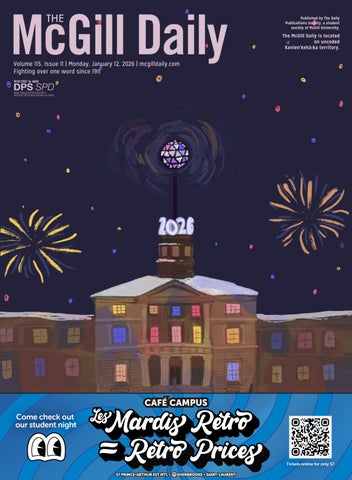
Published by The Daily Publications Society, a student society of McGill University.
The McGill Daily is located on unceded Kanien’kehá:ka territory.
Volume 115, Issue 11 | Monday, January 12, 2026 | mcgilldaily.com Fighting over one word since 1911
Come check out our student night
Rétr� Price�
Tickets online for only $7
2
table of Contents
January 12, 2026 mcgilldaily.com | The McGill Daily
Table of Contents 3 • Editorial Canadian National Identity 4 • News Good People •
Montreal Olympics
9 Commentary • • •
Two-State Solution Decentering Men Contemplating Graduate School
5 • Culture Looking to ChatGPT for therapy • • • •
Learning to be alone iuniversity Review of Island Life Spending Time Alone Fine Print
12 • Compendium! New Year’s Horoscopes
PITCH MEETING WEDNESDAYS @ 6:00 PM DPS OFFICE (1ST FLOOR SSMU BUILDING) LEARN HOW YOU CAN WRITE FOR THE DAILY!
editorial
Volume 115 Issue 11
January 12, 2026 mcgilldaily.com | The McGill Daily
3
editorial board 3480 McTavish St, Room 107 Montreal, QC, H3A 0E7 phone 514.398.6790 fax 514.398.8318 mcgilldaily.com
The McGill Daily is located on unceded Kanien’kehá:ka territory.
coordinating editor
Pan-Canadian National Identity Challenged by Western Alienation
Andrei Li managing editor
Sena Ho news editors
Adair Nelson Justin Friedberg Mara Gibea commentary + compendium! editors
Ingara Maidou Sonia Berman culture editors
Isabelle Lim Youmna El Halabi features editor
Elaine Yang visuals editors
Eva Marriott-Fabre Nikhila Shanker copy editor
Charley Tamagno design + production editor
Cassandra Cohen multimedia editors
Golnar Saegh Parker Russell social media editor
Lara Arab Makansi cover designs
Parker Russell staff contributors
Enid Kohler, Miranda Forester, Lisa Banti, Auden Akinc, Zoe Sanguin contributors
Thomas Germain, Olivia Epstein, Maya Mohammed, Teresa Rodondo Portales, Victor Johansen Villanueva, Julia Lok Published by the Daily Publications Society, a student society of McGill University. The views and opinions expressed in the Daily are those of the authors and do not reflect the official policy or position of McGill University. The McGill Daily is independent from McGill University.
3480 McTavish St, Room 107 Montreal, QC H3A 0E7 phone 514.398.690 fax 514.398.8318 advertising & general manager
Letty Matteo
O
n December 22, 2025, Elections Alberta announced its approval of a citizen-proposed referendum on Albertan secession. As with their last referendum in 2021, Alberta’s current plebiscite challenges the federal centralization of power. The 2021 referendum sought to eliminate the equalization program, wherein the federal government subsidizes provincial healthcare if a province’s fiscal capacity falls below the national average, from the Canadian constitution. This program can be found in other Commonwealth nations such as Australia and the United Kingdom. Alberta argued that their oil wealth was being unfairly redistributed to less wealthy “have not” provinces. Alberta is classified by the federal government as a “have” province, disqualifying it from receiving equalization subsidies because of its natural resource wealth. The provincial government’s opinion was shared by the majority of Albertan voters, with Elections Alberta reporting that “nearly 62 per cent of voters said ‘yes’ to the equalization question.” The 2026 referendum threatens to fragment Canadian unity at a moment when the nation is facing political and economic belligerence from our southern neighbours. One of the most common conceptions of national identity, theorized by Benedict Anderson, is that a nation is an imagined community whose identity can be challenged and reimagined. What constitutes Canadian identity has been contested, particularly through conflicts between the federal and provincial governments. Today, these debates have been re-ignited as American protectionism and economic tariffs weaken North American cohesion. This newest plebiscite was proposed by the citizen-run Alberta Prosperity Project (APP). The APP’s agenda aims to address "high costs of living, federal overreach, paying the carbon tax, equalization payments, and unequal representation," among other action items. Alberta's election agency has approved the current referendum on the province’s independence, and voting will remain open until January 11. However, the APP’s position is not shared by all Albertans. A petition against Albertan separatism with
404,293 signatures was submitted by former Deputy Premier Thomas Lukaszuk to the Albertan Legislative Assembly on December 1. Last November, Prime Minister Carney and Premier Smith signed a memorandum of understanding as a potential compromise between Alberta's interests in expanding bitumen pipelines and accessing British Columbia to export beyond American markets and the federal targets of reducing emissions. This counters the sentiment of Western alienation echoed in the 2021 referendum and makes the 2026 referendum less likely to pass. Ultimately, changing geopolitical conditions in North America are enforcing national unity against provincial referendums. This extends beyond Alberta to Quebec, where referendums on provincial independence have been taking place since the l990s. While Quebec’s motivations to secede differ from Alberta’s, largely concerning cultural preservation and federal decentralization, there is a common sentiment against federal overreach shared by both provinces. Centuries of regional fragmentation have long obscured the bigger picture of pan-Canadian integrity. Now more than ever, it is crucial for all Canadians to present a united front.
Read us online! website Facebook Instagram twitter
www.mcgilldaily.com www.facebook.com/themcgilldaily @themcgilldaily @mcgilldaily
ad layout & design
Alice Postovskiy
All contents © 2025 Daily Publications Society. All rights reserved. The content of this newspaper is the responsibility of The McGill Daily and does not necessarily represent the views of McGill University. Products or companies advertised in this newspaper are not necessarily endorsed by Daily staff. Printed by Imprimerie Transcontinental Transmag. Anjou, Quebec. ISSN 1192-4608.
CONTACT US Coordinating NEWS COMMENTARY CULTURE FEATURES SCI+TECH
coordinating@mcgilldaily.com news@mcgilldaily.com commentary@mcgilldaily.com culture@mcgilldaily.com features@mcgilldaily.com scitech@mcgilldaily.com
Managing PHOTOs ILLUSTRATIONS radio COPY video + Social Media
managing@mcgilldaily.com visuals@mcgilldaily.com visuals@mcgilldaily.com radio@dailypublications.org copy@mcgilldaily.com socialmedia@mcgilldaily.com
4
January 12, 2026 mcgilldaily.com | The McGill Daily
NEWS
“Vulnerability Is Magical” Says CoFounder of Student Mental Health Service Student-run service provides free mental health support based on healing through shared experience Enid Kohler Staff Writer Good People is a bi-weekly column highlighting McGill students doing community-oriented work on and around campus. Because it’s important to celebrate good people doing good things.
2
.5 million people in Canada do not have adequate care to support their mental health needs, according to a 2024 report by the Canadian Mental Health Association. In Quebec, psychological distress among adolescents rose to unprecedented levels in 2025. For young people in particular, the steep cost of mental health care is a significant barrier to accessing psychological services. The mental health needs of students do not go unnoticed by Jesse Millman and Mekhi Graham, both McGill undergraduates studying Cognitive Science. In 2025, Millman and Graham launched their free student mental health service, Eye 2 Eye, which provides psychological guidance constructed upon the shared understandings and experiences of students. Within this framework, students complete an online survey to be connected with a peer who is going through similar struggles — such as loneliness, academic stress, or homesickness — with the hope that their shared experience can lead to psychological healing. Once matched, students receive guidance and tips from Eye 2 Eye team members to navigate their conversations. The Daily spoke with Millman and Graham about founding Eye 2 Eye, men’s mental health, and why emotional vulnerability is so powerful. This interview has been edited for clarity and conciseness. Enid Kohler for The McGill Daily (MD): I want to start with your friendship. How did you meet and begin Eye 2 Eye together? Jesse Millman (JM): Great question. It goes as far back as a McGill friendship can go: to Frosh week. We were both in the Arts & Science Frosh, which instantly set a precedent for a very wonderful friendship. I feel very grateful to have both social and academic aspects of my relationship with Mekhi. I remember the idea [for Eye 2 Eye] coming to me in the summer
after first year. It was a result of having all these similar conversations with people around me, about so many people feeling a little bit stranded and isolated from university culture. I came to Mekhi with the idea in the fall of second year.
JM: We're definitely not antiprofessional help. But I think for these issues specifically, while professionals are trained to help you in many ways, the reality is that they still won't know what it's like to be a first year university student in the social atmosphere that exists in 2025. We think that's Mekhi Graham (MG): I have a where real power is held: in each lot of memories of late night grind other. It’s a very comforting sessions studying with Jesse. I experience to realize, ‘I'm not the remember one day in the library, only person feeling these things,’ we were studying and Jesse was so that's what we're trying to tap like, ‘Yo, dude, I have this idea.’ into. And he pitched it to me. I thought it was super cool. We started MG: Absolutely. Although the brainstorming from there. McGill Wellness Center and Honestly, every time we were therapy in general can be super supposed to be studying for class, helpful for a lot of people, it's also we ended up talking about Eye 2 true that there is just a shortage in Eye instead. We were so excited general. It sometimes can be about it. Probably not the best for difficult to get the services that the GPA, but we ended up with a you need. At the end of the day, pretty cool thing. No regrets. anything that can make mental Now, we have the website up health support more accessible is a and running thanks to Jesse, and really good thing. we have a little team now, working with two other people MD: Was there a defining who are also in cognitive science. moment in your own experience I think we're in a great spot. We're with therapy or in sharing your currently working on outreach feelings that inspired you to start and trying to get it to as many Eye 2 Eye? people as possible. JM: That's a really good MD: If you wanted to pitch Eye question. I don't know if I can 2 Eye to someone in one minute at speak to a specific moment, but in a house party, how would you previous romantic relationships, describe it? I've felt very lucky to explore vulnerability, and being able to JM: Gosh, the amount of one open myself up completely to minute house party pitches we've someone inspired me to share done, you'd think we'd be better at that. I think there's something it. really magical about hearing yourself verbalize something MG: Yeah, we should have a about the way you're feeling for script at this point. Eye 2 Eye is the first time, and being able to meant to be an informal mental articulate it when for months it health resource. It's targeted had only existed in bubbles and specifically at first-year students squiggles around your head. I who are dealing with issues think we should all talk to each related to homesickness and other more, and that's what we struggling to adapt to the new hope the service facilitates. academic and social environment in university. Maybe they're not MG: Absolutely. I can think back really vibing with the party to times in my life where I didn't culture, maybe they just haven't have someone I was comfortable found their people yet.It's also for sharing my feelings with, so I people who might think those would keep them all inside and issues don’t necessarily warrant bottled up. I realized once I professional mental health care. I started opening up more to people, know for a lot of people there's a my problems just felt a little stigma around [therapy], and the smaller, a little more manageable. tendency to think that their struggles aren’t enough to MD: I’m curious about the warrant seeing a therapist. gendered dimension of your work. So the idea behind Eye 2 Eye is In Canada, almost one in two men to give students the opportunity report feeling socially isolated, to talk to someone else who's in and men account for 75 per cent of the same boat as them, who's deaths by suicide across the going through the same things. country. About 67 per cent of men They are then able to make a have never sought professional connection, learn, and grow mental health care before, together. according to the Canadian Men’s
Health Foundation. As two young men leading a mental health service, how would you encourage people of all genders — but especially men — to be vulnerable?
things.” In the context of your work with Eye 2 Eye, what does being a good person mean to you?
MG: To me, it means helping others. Having gone through some of those difficult times in my first year MG: The biggest thing I would and being on the other side of that say to other men is that I don’t now, if there's any way I'm able to see being vulnerable as a give [support] to first years who are weakness. It takes a lot of currently struggling, I think that's strength, but in my experience, what it would mean to me to be a when I've been vulnerable with good person. people, it hasn't led to judgment, but deeper connections. People JM: I think everyone has so much can understand because you're value to their experience and so both human. much to share. There really is an infinite amount to learn from the JM: It would be wonderful if people around us. I think being a we can get some guys who good person is both being willing to haven't opened up in this way listen to what people have to give, before to climb over that barrier and giving in the right way. just a little bit, because I think vulnerability is so magical. Once You can learn more about Eye 2 you grasp it, you unlock the Eye at eye2eyemcgill.ca or on expanse of what you haven’t Instagram, @Eye2EyeMcGill. explored yet, [and all] that exists behind [everything] that you If you know good people doing good may have repressed for so long. things who you would like to see featured in this column, email MD: The theme of this column news@mcgilldaily.com is “good people doing good
Photo courtesy of Jesse Millman
January 12, 2026 mcgilldaily.com | The McGill Daily
News & culture
5
The 50th Olympics Anniversary Montreal’s complicated relationship with the 1976 Summer Games Thomas Germain News Contributor
I
f you take the Green Line north towards Honoré-Beaugrand and exit at Pie-IX, you will find the Olympic Stadium of Montreal just a short metro ride away from McGill’s downtown campus. Arguably one of the most recognizable buildings in the city, it’s one of the many ways that citizens are reminded of the city’s Olympic history. With the Winter Olympics set to begin in Milan this February, discussions of the sports games that unite the world have been brought to the forefront yet again. This year marks an important anniversary for Montreal. Fifty years have passed since the city hosted the 21st edition of the Summer Olympic Games in 1976, an event which has left a profound city-wide impact. Montreal has a complicated relationship with its Olympic past. Controversies about corruption among the event’s organizers and construction mishaps (with the
Olympic Stadium almost not being finished in time) surrounded the event, followed by the financial devastation that the city was left with. With an initial budget of only $120 million (CAD), the city ended up in around $1.6 billion (CAD) of debt. The city only finished paying the cost of the games thirty years later in 2006. These financing failures had political ramifications that still echo today. This is partially due to voter dissatisfaction over the scandals that surrounded the Olympics; which voters associated with the incumbent Liberal Party of Quebec (PLQ) government. In reality, the PLQ had limited ties to the scandals, but the association persisted. Later that year, the province elected the opposing Parti Québécois (PQ), which campaigned for governmental efficiency and anti-corruption, into power for the first time. As a result, Quebecois separatist sentiments increased, becoming a defining feature of Montreal life in the following decades. Separatism still impacts the politics of the province today, as
shown with recent demonstrations in October. The Olympics, however, did somewhat benefit Montreal. In the wake of the event, the city’s tourism greatly increased thanks to an augmented international visibility. Montreal has become a frequent host of other major sporting and cultural events such as Formula 1 and the International Jazz Festival, giving the city more opportunities to promote itself and its cultural development. Montreal also gained improved sporting infrastructure intially built for the games. Much of it is still in use today, such as the Olympic Pool, which sees 250,000 recreational users a year. It is also the host of Canada’s Bell swimming trials, organized to select which swimmers compete for the country. Other venues have been converted into significant landmarks, with the Olympic Velodrome becoming the famous Biodome. McGill University also contains an element of the city’s Olympic legacy, as Olympics field hockey tournaments were hosted at Molson Stadium. The stadium
became the first Olympic venue to use artificial turf and has hosted many events since 1976 beyond McGill sporting competitions: concerts, Alouette football games, and more. A handful of people associated with the university were also competitors or administrators in the games. The 1976 Games are not just remembered for the city that hosted them but also for many athletic success stories. Most notably, Romanian Nadia Comăneci achieved the first perfect 10 in Olympic gymnastics and American Caitlyn Jenner set the world record for points in the decathlon. Furthermore, the competition between various nations became a diplomatic battleground; especially in the midst of the Cold War, which saw communist countries like the Soviet Union use the games as a means to display its power. The 1976 Olympic Games demonstrate the power sports can have on various facets of everyday life. While the event allowed Montreal to showcase its best
features by hosting these major events, it also revealed corruption and scandals that amplified underlying political tensions in the city. Furthermore, the 1976 games demonstrated how sports can foster international community. The Olympics’ global stage united the world through friendly competition and the ability to marvel at incredible feats of athleticism. The International Olympic Committee defines its philosophy, known as Olympism, as an aim to “place sport at the service of the harmonious development of humankind … promoting a peaceful society concerned with the preservation of human dignity,” directed by the Games’ core values of “excellence, respect and friendship.” In other words, the Olympics seeks to create a community united through sport. In the wake of recent cuts of several sport programs at McGill, the legacy of the 1976 Olympics encourages us to reflect on the power of sports and togetherness.
The Yes-Man: AI Is Not Your Friend “ChatGPT therapy” and the danger of non-human advice Olivia Epstein Culture Contributor
A
rtificial intelligence (AI) engines such as ChatGPT are used to facilitate everyday life, and marketed as a means of alleviating people’s workloads. The common usage of AI chatbots is no longer limited to objective tasks; the line between chatbot and friend is beginning to blur. As foretold by the movie Her (2013), a newfound affinity for ChatGPT as not only a friend, but also a therapist, may lead users down a worrisome road, as parasocial relationships to AI cannot supersede human connection. “Parasocial” was Cambridge Dictionary’s Word of the Year 2025, resulting from online talk about celebrity worship and the unreciprocated, one-sided relationships that fans believe they have with their favourite public figures. However, in addition to this is the rise of parasocial relationships with AI engines like ChatGPT. As AI continues to develop in speed and efficiency, more people rely on these engines to assist them with daily tasks like schoolwork. Equally concerning and telling of the times, however, is the perturbing emergence of AI being used to replicate friendship and therapy. Before the mainstream use of AI chatbots, one might have turned to
online communities for support, though the legitimacy of the human connection found in online communities on social media is debatable, it was more or less assumed that if one submitted a dilemma or call for help on a social media platform, it would be met with human replies. One might have also gleaned advice or solace from blogs or articles written by others. However, although the advice offered was human, they did not factor in data the way deceptively personalized responses offered by ChatGPT and other AI engines do. Against the backdrop of AI’s refinement and rising salience the concept of “ChatGPT therapy” has materialized. ChatGPT’s stark therapeutic presence is upheld by widespread loneliness, warned against by the World Health Organization. As society adapts to a post-COVID world, isolation and lackluster social skills have become discernible. ChatGPT can craft seemingly intimate replies thanks to precise detail, which might enable or overly validate the user. Even with a solid support system, ChatGPT’s accessibility makes it all the more compelling as a conduit for help when one’s friends or family cannot be reached; for instance, in the wee hours of the morning. This, along with the fact that using ChatGPT is free, can override therapy as an option. While the impact of ChatGPT
therapists cannot yet be measured, the dark side of using AI to cope with one’s problems has already revealed itself. Reports of young people dying by suicide due to ChatGPT’s intervention (or lack thereof ) further exhibit the peril of overly-validating chatbots. Evidently, preexisting mental health issues are the impetus for these tragedies, pointing again to the bigger issue of the availability of AI as a substitute for therapy. This new reliance on ChatGPT indicates that interpersonal connection and how we define it is actively being revised. As seen in the salience of parasocial AI relationships, friendship no longer solely involves humans. The onesidedness of a friendship with ChatGPT negates the time and labour needed to maintain human friendships, since we don’t need to learn intimate details about AI the way we do a friend. Solace, when found in a perceived “friend” who centers the relationship around the human, results in the loss of human mutuality in friendships. Our need for community manifests itself in the company many are finding in a platform that tends to unblinkingly support their opinions, no matter what those may be. This opposes to the feedback one might receive from loved ones when faced with a tough situation, where truth would be favoured over sugarcoating. ChatGPT’s affability encourages
Zoe Sanguin | Staff Illustrator users to keep using it as a de facto advice column, acting as a “yesman” that can potentially enable unhealthy behaviour. This lack of nuance is dangerous because it can make the user believe they are never wrong. With ChatGPT therapy being such a new phenomenon, the longterm consequences on users’ mental health and society have yet to be fully understood. However, by entrusting ChatGPT with specific details of their lives, it is clear that the line between AI and genuine connection is blurring. I would argue that the ability to lean on AI at any moment obstructs our ability to assess situations on our own. As much as AI engines are trained on data on human behaviour and relationships,
turning to it for advice pillages the foundational human experience of overcoming a challenge: introspection. By getting an instantaneous, sometimes overlyvalidating, response from AI, we inherently deprive ourselves of the time to sit in and reflect on our emotions, as well as the chance to channel it into creative outlets. It is plain that at this juncture, AI’s role in our lives is not entirely reversible, hindering the simple solution of reverting to traditional interpersonal connections built between humans. The satisfaction with ChatGPT’s advice and validation makes swaying the masses against this “therapy” a grueling task, leaving the path forward uncertain.
6
January 12, 2026 mcgilldaily.com | The McGill Daily
culture
Free Time in First Year: A Gift University is the time to figure out who you are Charley Tamagno Copy Editor
M
y first year of university brought about a change to my lifestyle that I hadn’t expected at all: I had significantly more free time than ever before. Until then, my schedule from the age of six onwards had been occupied with school from 8 AM to 3 PM every day. By the will of my parents, I usually participated in an extracurricular of some sort: sports, art classes, playdates, and church. In high school, I finally had the opportunity to elect if I wanted a break, but the busy lifestyle called me back. I tried out for the rowing team, wrote for the school newspaper, and worked part-time at a carousel, only occasionally tackling the pile of homework my classes demanded. In my senior year, when I decided to quit rowing to allow myself some flexibility, I still found myself searching for some time to breathe. Even the summer before my first year of university was jam-packed. While I wanted to work as much as possible to pay the exorbitant rent for my tiny room in McConnell, I also felt the urge to spend every minute seeing my friends and family before I left to go to school two thousand miles away. I had long lists of things to buy, a room to clean, and suitcases to pack. My first days at McGill were a shock. My parents stayed for a few days to help me shop and move in, but soon returned home. Despite barely understanding what Frosh was, I had bought my ticket and picked up my bracelet. I had three days until it began, and I was alone. While the freshman orientation team had organized one or two activities, these were typically in the morning and left me with free afternoons. Of course, I took advantage: my brand-new friends and I explored thrift shops in Little Portugal, hiked Mount Royal, and ran errands for our new homes. However, these experiences were tinged with something foreign: I could do whatever I wanted, with an empty to-do list. My free time felt endless, and it started to scare me a little. When classes began, I was swept up in the new schedule, trying to build connections with my friends and continuing to explore the new city.
Eva Mariott-Fabre | Visuals Editor However, when the temperature started to drop in the late fall of first year, I began to feel that I was missing out on some intangible part of the first-year experience that I would never get back. I missed the community and purpose
What I was missing was the point of being a student: I was not only learning about my major, but also how to live life as an independent adult. that extracurriculars gave me in high school. I spent most of my time now sitting and chatting with friends instead of working on busywork handouts. Meanwhile, back in high school, the eight-hour school days had given me a structure to follow. In an attempt to re-establish a routine, I applied and applied to director and council
positions, missing the mark on many. I’d go to a club meeting or two, feel like I was behind, and promptly drop it altogether. This cycle made me feel like I was never going to get back the time I had lost focusing on school and friendships in my first semester. My joyful time wasn’t what I should have been doing; I started to think I’d never get a job or join a club that I enjoyed. My classes were no longer enough to satiate my desire for community and my need to be productive – even with plenty of assignments to do at any given moment, I felt unsettled that I had so much free time outside of schoolwork. Nobody was forcing me to do my readings, and I had been blessed with a combination of 200-level classes that demanded little more than a couple of hours a week outside of class. Thankfully, as March rolled around, I started to find activities that suited me; wrote for a couple of newspapers, rock climbed, and attended the Linguistics department’s council meetings. However, each of these activities only took up an hour or two of my week, and I still had more free time than I did in high school. At first, this upset me; everyone else still seemed busier than me, and I was stressed that I
was wasting my time. LinkedIn only compounded the issue: my achievements were similar to those of my high school classmates, but in my head, theirs were worth more. Spending my evenings learning to crochet wasn’t helping my future career. Nor was FaceTime-ing my friends from home, or slowly improving on the climbing wall. But as the days passed, each one filled with activities that brought me joy, “productive” or not, I realized a truth of university life that I had to accept. There was no reason to dwell over how I spent my time outside of class, whether it was productive/generative or not. What I was missing was the point of being a student: I was not only learning about my major, but also how to live life as an independent adult. Even today, a semester into my second year, as an editor for the Daily and in classes that demand significantly more care and attention, I catch myself feeling inadequate if I come home early to relax on a Tuesday night instead of staying late at the library or at a meeting. I hear a voice in my brain declaring that I should be dedicating all of my time to a future career; spending the evening making an elaborate dinner and watching an episode of a show with my roommates is
futile. But I’ve learned the importance of rejecting this voice. Anyone, including me, can and should rest, relax, and in doing so will find the time for peace, passion, and social connection in their life. School and extra-curricular activities are incredible ways to find purpose, but they don’t need to fill every hour of your day. It is just as productive and meaningful to make a new recipe, create art, or write an article about these very thoughts that I am currently having. The conclusion I’ve come to is this: university is the time to figure out who you are. You have the freedom to attend just one or two events a club holds to see if it’s for you, and if it isn’t, you have the freedom to move on. When it's not midterm or finals season, or you just need a break, you have the free will to develop new hobbies and try so many new things. Use your first year to dip your toes into everything, and commit to something larger later on. Any student in their first year should know and believe: you aren’t behind. This boundless time is to figure out what brings you joy.
January 12, 2026 mcgilldaily.com | The McGill Daily
culture
7
From Student Life to Island Life The journey to independent filmmaking, as recounted by two McGill alumni Isabelle Lim Culture Editor had no idea what to expect with Island Life. The only clues about the project that co-producer Vincent Copti had sent to me via email were “an intense thriller that might contain violence,” and “watch it with headphones.” Okay. In the morning before my day-long finals grind, I clicked, not yet fully caffeinated, on the link he sent to me. The next twenty minutes would snap me out of my mildly sleep addled daydreaming. Directed by Canadian author Gavin Michael Booth, Island Life is a drama between neighbours. One neighbour plays deafening house music, which drones on in the background throughout the short film’s entire 23-minute runtime; and its organized crime unit neighbours, our protagonists, struggle to lay low in contention with the noise. Shot in one take à la Birdman in a single apartment, the constant tension in Island Life can be attributed not just to the booming background music, but to the volatile frontman of the organized crime unit. Played expertly by local Montreal talent Ben Peters, our protagonist swings wildly between authoritative pack leader and straight-up psychological dictator. Island Life has been admitted into renowned film festivals such as Festival Regard and Fantasia Festival, and has won awards for Best Actor (Ben Peters) and Best Original Screenplay at the Terror in the Bay Film Festival. Island Life has been in the works since 2019, when it was first conceptualized by Andres Cabrera Rucks, the film’s co-producer and writer, when he was still a McGill student. “I woke up in the middle of the night because my neighbour was playing music, and the whole story just came to mind over the next couple of days,” recalls Rucks in an interview with The Daily. At the time, the short film had been produced in conjunction with TVM, McGill’s resident student production house, which Rucks had been a producer at. However, the arrival of the COVID-19 pandemic shut down any possibility of the project’s execution, which would subsequently be delayed. Despite this, Island Life remained in Rucks’s mind, and he would approach Copti, whom he had met at TVM’s training program, to help produce the film at the end of 2021. The two are now part of PanArt Productions, a production
I
company founded by Copti, which helped produce Island Life. “It’s hard to meet people who are as crazy about something as you are,” comments Rucks. “If not for that training session, neither this movie nor our friendship would have existed.” According to Anya Kasuri, President of TVM, the training program is a mandatory facet of TVM membership, teaching basic technical and camera skills. “Besides taking service requests from other clubs at McGill, part of our mandate is to help students carry out their creative projects,” she explained in an interview with The Daily. “A student can come to us with any script or idea, and from there revise it and put together a production team of our members to help realize their vision. We build a community where we get to make films together, and it's great.” The leap from making a student film to an independentlyproduced one is no smooth path. The film industry is notoriously one of the hardest to break into, especially without prior connections. For one, making a film is expensive. Despite The Brutalist’s critical success last year, director Brady Corbet reportedly made zero profit from it, even with the three-and-a-halfhour-long film’s impressively low budget. Moreover, the film industry is saturated with
nepotism and labour shortages. These, along with spikes in production costs and growing concerns of artificial intelligence (AI) replacing key jobs in screenwriting and violating intellectual property regulations, have led to many professionals leaving the industry altogether. Copti and Rucks’s tenacity thus becomes all the more laudable. “We were basically starting from scratch, without many connections in the industry considering how we are both not professionals,” says Copti. “This was our first time making a movie with a real budget and really playing by all the conventions of the film industry.” Facebook groups became their go-to resource for finding art directors, assistant camera operators, and even their director booth. In 2022, casting began, and upon reaching out to the Alliance of Canadian Cinema, Television and Radio Artists (ACTRA), the team screened 158 auditioning actors from Montreal and the wider Quebec area for five roles, narrowing them down through a two-step process entailing an online demo and an in-person audition involving chemistry reads. Casting and employment was only the first hurdle. More onerously, there were cost concerns. The team applied for grants from the Quebec Arts
Council and, towards the end of 2022, launched a crowd-funding campaign, which raised slightly over $16,000. All in all, the budget came up to $40,000 consisting of crowd funds and investments from the crew’s own pockets. “It was really about learning at every stage,” muses Copti. “This whole process has taught us a lot about the independent cinema industry in Canada, and now we’re much better equipped to handle future projects.” “We were the most ambitious that we could be with this project, especially as two nonprofessionals,” expresses Rucks. “Having that much money to work with, creating a one-take short film and submitting it to festivals with no guarantee of success. We probably should have started smaller, on a smaller scale with a smaller budget and team, but we just didn’t.” At McGill, TVM boosts aspiring filmmakers or those simply interested in visual communications by imparting both technical and industry knowledge. “I know many TVM alumni who aren’t currently working in film, but continue to use skills they learned from TVM in their careers,” asserts Nicolas McGuire, former Executive Producer at TVM from 2024 to 2025. “As a marketing major myself, I feel that TVM has taught me a lot of things about the
Léo Lavallée-Moreau marketing industry that I wouldn’t have learned otherwise.” TVM also provides numerous resources for students interested in honing specific applied skills, or just learning about film in general. As the film industry faces a shortage of technically specialized workers, these tools become all the more valuable for aspiring filmmakers. Kasuri, who hopes to work in film, expressed how TVM has familiarized her with the technical and practical side of filmmaking, supplementing the more theoretical approaches of her World Cinemas courses at McGill. “The best thing about TVM is that it's really easy to become a part of it. You just need to want to learn,” states Sascha Siddiqui, TVM’s Graphics Coordinator, who joined TVM specifically to learn how to edit despite not having much prior experience. “We have camera cheat sheets, instruction sheets for editing software, and so much more. Any member who wants to brush up on their technical know-how can also attend our monthly training sessions or tech director’s office hours.”
8
Janueary 12, 2025 mcgilldaily.com | The McGill Daily
Culture/Commenatry
Courtesy of Andres Cabrera Rucks On the note of student filmmaking, Rucks and Copti encourage student filmmakers to be bold in their work and artistic passions, but to be pragmatic about it too. “It all boils down to whether you want to make films as a hobby or as a career,” declares Rucks, whose goal is to live off his work as a full-time screenwriter and producer. “It’s the best time in history to make films as a hobby because you have all the equipment you could ever need and the ability to find like-minded people through the Internet; but arguably the worst time to make films as a career because the market is just so saturated. When it comes to that, you want to make sure that you're telling a really good story that shows off
your abilities in whatever role,” admits Rucks. “I started out making films with my friends in high school, which gradually expanded into starting PanArt Productions and making advertisements for companies,” recounts Copti. “At the time, I wanted to make a living from production. However, when I started working for a public relations agency, I realized the similarities in both of them — you know, Excel sheets, lots of calls and emails — and I realized I could make meaningful films without necessarily having them be my bread and butter. Now, I mostly make films as an activist; not to make money, but to raise awareness of social issues.” Film is a visual medium. If a
picture speaks a thousand words, then a film, surely, speaks at least a million, as it combines both visuals and dialogue. Despite the pressing concerns that surround film and cinema, there remains a sense of optimism in both Rucks and Copti, as well as the students from TVM. “Art will always have a place in the world,” Kasuri affirms, “and I think people are really beginning to appreciate the authenticity that comes with independent filmmaking.” Perhaps they are. Anora, an independent film, swept the Oscars and brought home Best Picture in March 2025. More recently, Materialists, distributed and produced by indie collective A24,
surpassed $100 million in global box office revenue. Good films, especially with the appeal of being shown in IMAX, are bringing audiences back to the theatres. When asked about their hopes for Island Life by way of awards, the PanArt duo are more concerned with the film’s impact on its viewers and staff. “This is the first official film I’ve made that hasn’t had an element of social activism in it,” Copti remarks. “I hope people are entertained, but I also hope to show them that they too can do awesome stuff.” As he puts it, they took many “daring steps” in making Island Life, which created a great deal of uncertainty. However, these also led to many unprecedented, fulfilling outcomes:
going to festivals and meeting new people. “This creativity is part of the movie industry, but even beyond that, I hope to inspire people to take steps out of their comfort zones.” Meanwhile, Rucks just shrugs. “To be completely honest, I've never really even cared about an award,” he says. “I just hope that it helps us, the actors and the crew involved gain some credibility in the industry.” As an afterthought: “Selfishly, I hope people think it’s well-written too.” Island Life is available on YouTube from December 22 on The Film Shortage channel.
Solitude in the Crowd Quiet crowd, close bonds myself — it allows me to soak in someone spontaneously, even if lifted, the sudden Maya Mohammed Commentary Contributor what is happening around me this newly formed bond lasts only possibility of letting uring my first year, I was filled with both apprehension and excitement after moving from a small town on the Canadian East Coast to Montreal. But there was one thing I was convinced of: I wanted to experience everything the big city had to offer, including seeing artists I had long admired perform in-person. Considering I had been forced to indulge in my love for music and art in private, Montreal’s artistic scene quickly drew me in. Not being able to find people to accompany me to concerts, art launches, open mics, craft workshops, etc., did not stop me from trying to attend as many of these events as possible. Reading this may lead people to assume I am an outgoing, extroverted person; however, I consider myself to be quite solitary. I enjoy being by
D
better, whether it is live music, an art exhibition, spoken poetry or the atmosphere of a coffee shop. I am more than happy to wander into a random event, sit at the bar with my book, a glass of cider, and listen to the jazz band playing (which I have done on many occasions at Barbossa; I could not recommend their Monday jazz nights enough). Before confessing this to my friends, I thought attending events alone was a common thing for people to do. Why would I stop myself from enjoying something I’m excited about simply because no one I know is interested in joining me? This, to me, seems more odd than choosing to go by myself — I even admit that, at first, it did not even occur to me that solo dates might be fear-inducing. I appreciate the anonymity that comes with being in a crowd of strangers, as well as the pleasant serendipity of bumping into a friendly face or connecting with
for the night. After an enlightening conversation with a close friend on our different environments growing up, I may have finally identified the small but critical nuance that influences our views on spending time alone: whether we perceive loneliness as externally inflicted or personally intentional. Growing up as an only child, I learned to bear solitude with pride. As an adult, it became a choice I made when I noticed my social batteries running low. It was a good compromise; I was still able to enjoy shows and artistic events without the added awareness or pressure of ensuring my friend was enjoying themselves as much as I was. Yet, for her, solitude seemed to signify a social shortcoming, and often rhymed with the fear of missing out (FOMO). Was it even worth attending an event if there was no one to bond with? Reflecting on post-pandemic times when social restrictions were
the outside world back in seemed daunting for many of us. Our efforts in learning to be comfortable in our own company now seem to have yielded the opposite problem. My tendency to overthink leads me to worry that my recurring desire for solitude might get in the way of my ability to form and maintain long-term friendships. Is our generation, with more options for remote work and solo living, Auden Akinc | Staff Illustrator increasingly struggling with building close social bonds? There whether it’s to plan quality time may not be a solution to achieving a with friends, attend an anticipated perfect balance between investing event alone or just be a homebody. in our friendships and our alone time. Sometimes, what we need is simply to listen to our intuition —
COMMENTARY/Culture
January 12, 2026 mcgilldaily.com | The McGill Daily
9
The Death of the Two-State Illusion A quarter century after the Oslo Accords: were they even feasible in the first place? Victor Johansen Villanueva Commentary Contributor
of support are not enough; few interrupt the interests of their Netanyahu, a wanted war criminal nations have attempted to distance permanent members. Without a in various parts of the globe, has themselves from Israel centralized and neutral stated the possibility of a two-state economically. France had multiple organization capable of enforcing solution in a speech. However, he Israeli defence firms at a recent agreements necessary to produce simultaneously told the UN that any n 1993, the Palestinian expo, despite banning them earlier an autonomous Palestinian state, vote in support of a two-state Liberation Organization and in the year, and as the war the state will not emerge. It is solution should not be passed. Israel signed the Oslo Accords, lighting the path for a two-state solution: a framework ensuring two sovereign states. While the deal pledged a peaceful compromise to the never-ending conflict, more than three decades later, the world seems nowhere closer to achieving this utopic ideal. This begs the question: is the two-state solution even feasible? For the last two years, a nation's “right to exist,” has been a common subject of debate. This discourse revealed the West’s efforts to reassert its moral authority while continuing to protect their political interests through various trade agreements. Canada, the UK, and France formally recognized the existence of Palestine. Meanwhile, the United States, which arguably is one of the most influential international players in the current conflict itself, is one of the few countries that has not formally recognized a Palestinian state. President Donald Trump’s recent claims that he has solved the conflict captures his performative approach to diplomacy. He has taken credit for organizing a ceasefire, which was promptly violated, while also asserting that the US will “take over” Gaza. His recent proposal, the Board of Eva Marriott-Fabre and Parker Russell | Visuals Editors Peace, a newly formed independent commission with the goal of achieving an continues, civilians are still being clear that the institutional Netanyahu is also the architect of independent Palestine has drawn killed despite a supposed structure needed for a two-state the continued wanton killing of significant concern. The ceasefire. This lack of substantial solution does not exist in the UN. Palestinian people. He asserts he commission is headed by Tony solidarity reveals that merely Even if we ignore every political would allow a Palestinian state if Blair, a controversial figure given recognizing Palestine often obstacle, the realities of the certain preconditions are met: the his long history with the Middle absolves these nations from taking situation are damning. The region redrawing of the borders to one that East, dragging the UK into the concrete action towards is geographically split in two. is favourable to Israel, the War in Iraq, and the atrocities supporting Palestinian statehood. Palestinians reside in the West acceptance that annexed land is now Bank and Gaza, with each Israeli, and a requirement for territory operating under rival Palestinian demilitarization. This political authorities: Fatah and does not create a state; it creates a Hamas. Both authorities are at faux-nation susceptible to attack the behest of the economic power and theft from its neighbour, of Israel and, as a whole, Palestine which has repeatedly proven it lacks control over its borders. will take advantage of such that followed. Rather than self The lack of coordinated action This economic and geographical opportunities. To assume that autonomy, this initiative appears from the UN highlights their control came as a result of the these preconditions would be to only cement US control in the failure. Despite the multiple Oslo Accords that were meant to accepted by Palestinians is an region. General Assembly votes to create a allow for the eventual emergence absurd presumption; it does not The UK and Canada recently Palestinian state, the amount of of a Palestinian state. Yet to me, guarantee them selfbegan to take on a more active role effort exerted to aid Palestine has this is the textbook definition of determination and is suggestive in the conflict by sending large been close to none. The security institutional subjugation. The of a colonial Israeli agenda. amounts of humanitarian aid to the council's veto powers only prove lack of action from the If there is any hope for the Gaza Strip. Take for example the UN’s failure to make international community and existence of a two-state solution, Canada, who has pledged 355 meaningful change, as the US Palestinians’ structural it cannot reiterate the colonial million dollars. Meanwhile, the vetoed multiple resolutions dependence on Israel requires systems that initially removed total amount given by the United attempting to end the conflict. By Israel's presence at the Palestinians’ authority. The steps Nations (UN) between 2014-2020 vetoing most of the resolutions negotiating table. However, towards Palestinian autonomy has reached 4.5 billion dollars, and proposed, the US had prevented Benjamin Netanyahu, the current that have been proposed have it has only increased. However, meaningful UN action leaving the prime minister of Israel, is only been reminiscent of these sympathetic sentiments and words organization to stand by, as to not difficult to reason with. same colonial policies. So far, the
I
However, sympathetic sentiments and words of support are not enough...
future looks bleak, and the twostate solution has now, more than ever, been exposed as the carroton-a-stick that it is, absolving the international community from taking action. While I pray that this inaction will change in our lifetimes, without large institutional reform, neutral governing bodies, and changes to past agreements, the two-state solution will remain a fantasy. The question is no longer, is the two-state solution ideal or equitable, but instead, should we continue to pretend that it is even possible? For me, at least, the answer to that is no.
Fine Print Teresa Redondo Culture Contributor
W
hy is saying a simple “goodbye” so hard? Why is turning around and leaving so difficult? Isn’t it part of our humanity —to watch, and let things end, for better or for worse? Yet, it is so difficult to just leave. To leave someone standing there, turn our backs to them, despite never having met their gaze. . Even when a heart claims that it is healed, the tears still fall and the cracks still show, refusing to hold. Why is it so hard to leave places even when we have never felt loved there, even after waiting years in allconsuming pain, where tears were the only proof that we were still alive? Yet, we stay, pretending we are made of titanium. All because of fear. The kind that paralyses us, that makes us feel trapped in this world full of masks. Fear of speaking up, of revealing ourselves. Fear of the unknown, of ending a chapter in this finite book we call life without knowing if the next one will be better. Imagine life as a train station. There are trains that only stop once. We choose whether to stay on the platform or not. Even if it ends up not being the right train, there is always a way back to the start. Do not fear, for time knows where everything belongs. End the chapter, do not fear a “goodbye”. Let them see your back. Step off the platform and enjoy the ride, even if it is not the right one.
10
commentary
January 12, 2026 mcgilldaily.com | The McGill Daily
A Look into Women’s Independence in Media Discourse Decentering men in women’s issues Julia Lok Culture Contributor
C
hanté Joseph’s “Is Having a Boyfriend Embarrassing Now?” has, for the past couple months, been the topic of discourse both in-person and online. In the British Vogue piece, Joseph explores the subject of boyfriends and their modern roles in relationships, especially the role they now play on social media. Heterofatalism, a term described as a “general disappointment with the opposite sex,” is a root cause to the modern belief that boyfriends cause more harm than good. Throughout her article, Joseph observes that, among single women and those with significant others, there is a belief that having a boyfriend is something to feel guilty about. While he suggests that boyfriends are widely seen as embarrassing, the true focus of Joseph’s article is that heteronormativity is being challenged in the modern day – causing the concept of the boyfriend to now be fragile. This is because women don’t need to center men to succeed anymore. Historically, being tied to a man was considered desirable for women. Others looked at you with great accomplishment for having a husband or a boyfriend. On the other hand, if you were a single woman, people pitied you. Take a look at Sex and the City; the entire show is about single women who are constantly being looked down upon by other
many women now have the privilege to achieve what they want without the imposed necessity of a romantic relationship. During most of the 20th century, a woman would have needed to be married to have access to fundamental rights in the United States. For example, it was only with the Equal Credit Opportunity Act of 1974 that an unmarried woman in the United States could open a credit card in her own name. In addition, unmarried women did not have access to birth control until the 1972 Supreme Court case Eisenstadt v. Baird. In other words, rights we now take for granted were not accessible for single American women before the 1970s. Across the world, countless women still lack access to these basic rights. Millions of women do not have the right to participate in society without being bound to a man. In Afghanistan, women’s access to healthcare is dwindling. Hologic’s Global Women’s Health Index determined that “relatively few Afghan women reported getting tested for high blood pressure, diabetes, cancer or sexually transmitted diseases or infections (STDs/STIs) in the 12 months prior. In fact, no Afghan women — zero respondents — said they had been tested for any type of cancer in the past year.” Additionally, in 2021, Taliban authorities made it mandatory for women who are travelling more than 48 kilometres be depend on a man to survive. Joseph’s original article questions women’s reliance on men, and allows us to address the cultural differences and privileges that come with being single and being able to denounce having a male partner. However, the power to decentralize men is not something that every woman has had or will have the privilege of doing. In a world where we are accompanied by a male guardian. continuously fighting for our These women suffer from a lack rights purely because of our of care and autonomy in gender, at the very least, it’s controlling their own health in comforting to know that women, comparison to the Western more so in privileged areas of the women. Instead, their health is at world, don’t have to be associated the responsibility of the men who with a man to succeed. If you have surround them. This is also true or want a boyfriend, there’s regarding their economic nothing wrong with that. As independence, as less than 7 per Joseph made clear, having a cent of Afghan women have a boyfriend is only embarrassing if bank account. The United you center your life around him. Nations estimates that, Moreover, being a single woman worldwide, 43.7 per cent of is something that is now women “lack decision-making treasured rather than looked power over their sexual and down upon. According to Joseph, reproductive health and rights.” being single isn’t an achievement, In many countries, not just nor does it “affirm your Afghanistan, women are being womanhood” anymore. The status denied their rights and have to
If we want to truly decenter men, we need to stray away from the concept that a man is needed to make your life better, whilst also not making them the center of our conversations. couples and always in search of a new relationship. The goal of a long-term relationship rules the main characters’ lives. Romantic relationships have long been deemed necessary to live a fulfilling life; craved because of the comfort of mutual dependence. On the one hand, Joseph mentions that being single, though, should be treasured because it allows for more independence than being a woman in a relationship. On the other hand, it’s not that a woman cannot be independent while she’s in a relationship. She should have the autonomy to do what she wants, including being in that relationship. Yet, it’s also important that we recognize that
Zoe Sanguin | Staff Illustrator of being single is being reclaimed, and is now associated with freedom and choice. To continue on Joseph’s point about centering one’s life around a man, whether single or in a relationship, a woman can be male-centered, which is the primary condition being criticized in her article. Being male-centered may consist of solely posting your boyfriend on your social media, making decisions based on the needs of men, or consistently seeking male validation and attention. It can become a problem because, as one Medium blogger put it, needing a male’s approval for your decisions “puts your self-esteem in someone else’s hands.” In relationships specifically, being male-centered is when a woman “constantly puts her partner’s needs and desires ahead of her own.” It’s harmful to her autonomy, outlook and participation in relationships. But instead of blaming women for this mindset, we should blame how patriarchal society has conditioned women to believe that they need a man to live
happily. While being male-centered is a condition that can be avoided, it’s not easy when society is pushing you to get and keep a man romantically in your life. It shouldn’t be inherently embarrassing to have a boyfriend, so long as he does not become the center of your world. Thus, the current shift away from boyfriends stems from an active attempt to decentralize men. Unfortunately, this debate still centers men, because while we are talking about the decreasing value of the boyfriend, we are simultaneously faulting women for being with men. If we want to truly decentralize men, we need to move away from the concept that a man is needed to make your life better whilst also not making them the center of our conversations. Having said that, we can still recognize that many single women are now much more capable of claiming their independence compared to our past counterparts. While this doesn’t cover all women in the world, as many are still stuck depending on men, it is still a reflection of our changing society and the questioning of heteronormativity and the patriarchy.
January 12, 2026 mcgilldaily.com | The McGill Daily
Commentary
11
To Grad School or Not to Grad School? Why the pressure to have a post-grad plan is peaking, and why students are pushing back Lisa Banti Staff Writer
F
or many undergraduates approaching the end of their degrees, the question of graduate, medical, or law school has shifted from a personal consideration into a shared social expectation. It surfaces in casual conversations, family check-ins, and the quiet comparisons students make while watching peers announce acceptances, internships, or job offers. “What’s next?” is often asked with harmless curiosity, but it can land like an evaluation — one that assumes a good student should already have a clear answer. That expectation is partly rooted in reality: further education is common, and it is often associated with increased opportunity. Statistics Canada’s National Graduates Survey (Class of 2015) reports that 40 per cent of graduates pursued further post-secondary education after graduation. When a large number of your peers choose to keep studying, it becomes easy for graduate school to feel less like one option among many and more like the default route for anyone trying to stay competitive. At the same time, the financial stakes of continuing on are harder to ignore than they used to be. The same Statistics Canada infographic notes that among graduates who did not pursue further education, half had student debt at graduation, with an average debt of $24,000. When debt is already present, committing to additional years of tuition, fees, and living expenses can feel like stepping deeper into a seemingly endless financial tunnel. McGill’s own tuition information reflects that risingcost context, stating that Quebec’s basic tuition rate for 2025–26 is expected to increase by up to three per cent in the following school year. Even if the exact figures vary by residency and program, the trend is clear: education is becoming more expensive, and living costs are rising alongside it. For students who are already stretching budgets, or whose families cannot subsidize extra schooling, graduate studies may be a longterm investment that feels financially out of reach. Even for students who can afford further schooling, the modern case for graduate
school isn’t simply that more education equals more success. The value of an additional degree depends on each student’s circumstances, including the program, the field, and the funding available. Graduate degrees are not universally well-funded, and the opportunity cost can be substantial: years of tuition and living expenses, years spent away from full-time earnings, and, in some cases, time spent in precarious roles that do not guarantee stable employment afterward. Even in fields where a graduate degree improves long-term prospects, the payoff can be uneven, delayed, and closely tied to factors outside a student’s control. Still, for many students, the appeal of graduate school goes beyond prestige. Graduate programs can offer structured training, specialized expertise, mentorship, and access to professions that are closed without advanced credentials. Employment outcomes can also look reassuring in the aggregate: the same Statistics Canada snapshot reports employment rates a few years after graduation of 91 per cent for bachelor’s graduates and 94 per cent for master’s graduates. For students in fields where advanced credentials are essential, the benefits can be concrete rather than symbolic. There is also the emotional reality of graduate school, which often gets smoothed over in the glossy version of “the next step.” Graduate training can be deeply rewarding, but it can also be isolating, competitive, and mentally exhausting. A recent Nature feature revisits the longstanding concern about graduate mental health, pointing to research suggesting master’s and PhD students have reported anxiety and depression at higher rates than comparison groups. That does not mean graduate school is inherently harmful, but it does complicate the idea that it is always the safer or healthier option for an uncertain student after college. If graduate school is not automatically the solution to uncertainty about what comes after graduation, why does it so often function like one? Part of the answer is cultural: in many academic environments, having a plan is treated as a marker of responsibility and maturity, while uncertainty is seen as a
flaw. Students who apply to professional programs are praised for being “driven,” while students who want time to work, rest, or explore may be suggested to explain themselves. The result is a sense of superiority attached to certain post-grad paths, where the most concrete plans, the ones that fit neatly into a title, are treated as more serious than others. Another part of the answer is fear: not necessarily of work itself, but of making the “wrong” first move. When advice from parents, peers, and even instructors boils down to “just get a job”, graduate school can look like a structured alternative with a clear timeline and a recognizable label. For some students, that structure is genuinely helpful. For others, it becomes a way to postpone uncertainty, an expensive pause button disguised as productivity. Adding to that uncertainty is a job market that feels less predictable for graduates regardless of whether they pursue further education, especially as AI reshapes how “entry-level” work functions. Some of the first tasks to be automated or accelerated by AI have been the very tasks that used to help new graduates get a foothold: drafting, summarizing, basic analysis, research support, administrative work, and earlystage content production. The World Economic Forum has highlighted concerns that AI could narrow entry-level opportunities by changing what employers need from junior hires and by shifting which skills are prioritized. The International Labour Organization’s 2025 update similarly stresses that one in four workers globally are in occupations with some degree of exposure to generative AI, and that most jobs are likely to be transformed rather than eliminated outright. In practice, that means graduates may face a moving target: credentials matter, but adaptability increasingly matters too, and even “safe” career tracks can change shape faster than students can plan around. The pressure around planning is also not evenly distributed. Students with financial cushioning can treat graduate school as an exploratory option, a chance to pivot or specialize without catastrophic consequences while those
Golnar Saegh | Multi-Media Editor without that cushioning have to treat it as a high-stakes bet. International students face an additional layer of unpredictability, as education decisions are tangled with policy shifts, paperwork, and changing requirements. Canada’s study permit cap and the related provincial and/or territorial attestation process has added another moving piece to an already high-stakes decision, increasing uncertainty for many prospective students about timing and eligibility. Even when policy discussions are framed around system capacity, students can be left feeling that long-term plans are increasingly subject to forces outside their control. This is where the debate becomes bigger than individual preference. The question is not only whether graduate school is “worth it,” but also whether it is reasonable to expect every graduating student to have a fixed post-graduate plan in a world where costs are rising, pathways are less linear, and external conditions can reshape possibilities quickly. When certainty is demanded in unstable conditions, students may feel pressured to project it:
applying to programs they feel lukewarm about, presenting tentative decisions as final, and keeping their uncertainty private. A more realistic culture would hold space for different timelines and alternate definitions of success, without treating one route as inherently more legitimate than others. With that in mind, graduating students should be encouraged to think ahead. The real issue is the tone of that encouragement: whether it sounds like support or surveillance. “What’s next?” can be an invitation to reflect instead of a demand to prove one’s worth. When the conversation becomes a test, it encourages fear-based decisions. But when it stays as an unbiased check-in, it helps students make choices based on best fit, resources, and their longterm well-being. Graduate school should remain one option among many, neither a default badge of ambition nor a cautionary tale. The most honest approach is also the most human: recognizing that planning is a process, that uncertainty can be daunting, and that a life after college does not have to follow one approved script to be legitimate.
12
January 12, 2026 mcgilldaily.com | The McGill Daily
compendium!
NEW YEAR’S RESOLUTIONS Aries
Taurus
Gemini
(Mar 21 Apr 19)
(Apr 20 May 20)
(May 21 Jun 20)
You are competitive and adventurous. This year you will pick up a new sport. Will it be pickleball, curling, skiing? Whatever it is, you know you will succeed.
This is the year you prioritize yourself and all things cozy. Who needs to go clubbing in the freezing cold when you can bake cookies and watch NetFLix?
You Enjoy learning and developing new skills. This is the year you prove Duolingo isn’t just taking up storage space on your phone.
Cancer
Leo
Virgo
(Jun 21 Jul 22)
(Jul 23 Aug 22)
(Aug 23 Sept 22)
You love spending time by the water. This is the year you FInally plan that summer beach trip with your friends AND FORGET all about Montreal winters.
You’ll never say no to treating yourself to expensive goods. This is the year you FInally start saving for that luxury item you’ve been eyeing.
You love animals. This is the year you Finally Get that pet you’ve been dreaming about.
Libra
Scorpio
Sagittarius
(Sept 23 Oct 22)
(Oct 23 Nov 21)
(Nov 22 Dec 21)
You have a true appreciation for beauty and aesthetics. This is the year you decorate your room and bring your Pinterest board to life.
While you prefer to retain an air of mystery, sometimes secrets are a LOT TO BEAR. This is the year you take up journalLing to manage your innermost thoughts.
This is the year you FInally take thAT big trip, Whether it’s backpacking through western Europe with friends or solo travelling in southeast Asia.
Capricorn
Aquarius
Pisces
(Dec 22 Jan 19)
(Jan 20 Feb 18)
(Feb 19 Mar 20)
You are disciplined and responsible. You stick to your goals year round, so New Year’s resolutions aren’t for you.
You are artistic and creative. This year, you will FInally FInish that project you’ve been too busy FOR.
You feel at peace in nature. This year you will dedicate more time to outdoor activities like hiking and gardening.