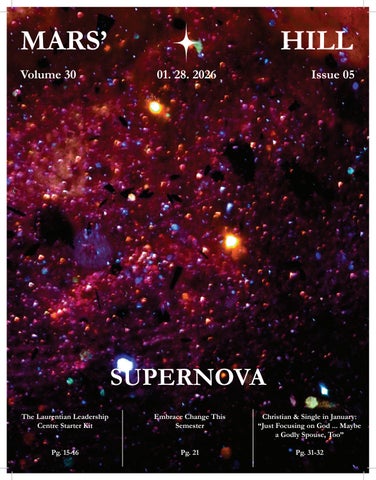
[VOLUME 30] - ISSUE 05 SUPERNOVA

Page 1


THE TEAM

From The Editor

Dear Reader,

The new year often begins for many with resolutions, as local gyms see an influx in memberships, and screen time limits are put in place. We hit the ground running, determined to better ourselves, but sooner or later, many of us completely give up.

Yet it is easy to feel like we are the only ones failing at our resolutions when seeing everyone’s social media highlight reels. However, according to the Associated Press, studies have shown that up to 70 percent of people who make New Year’s resolutions give up within months.

As such, January typically goes like this: We expend all our energy on self-improvement and lifestyle changes, and then we abruptly cease our efforts. This is the heart behind this issue’s theme, “supernova.”

According to the Oxford English Dictionary, a supernova is “a catastrophic explosion of a star, which results in a sudden and enormous temporary increase in the star’s brightness, disperses all or much of its material, and produces an intense burst of neutrinos, gamma rays, and other radiation.” In short, a supernova is the explosive death of a star. While seemingly counterintuitive, the Mars’ Hill team chose this theme for the first issue of

Mars’ Hill

Mars’ Hill is a student publication of Trinity Western University located on the traditional ancestral territory of the Stó:lō people. Floated with funds raised by the Student Association, Mars’ Hill seeks to be a professional and relevant student publication, reflecting and challenging the TWU community, while intentionally addressing local, national and international issues.

Mission to Mars

The mission of Mars’ Hill, as the official student magazine of Trinity Western University, is to inform and entertain its readers, cultivate awareness of issues concerning the TWU community and provide a forum for purposeful, constructive discussion among its members in accordance with the Community Covenant, Statement of Faith and Core Values of the university.

2026 because a supernova expels elements that form stars, planets and living organisms.

Staff writer Adriana Feria-Estrada returns from the Laurentian Leadership Centre and offers her recommendations for incoming students in her starter kit article, while staff writer Emma Helgason challenges us to reflect on surviving, showing up and shifting directions in her article, “Embrace Change This Semester.”

In this issue’s feature, Mars’ Hill commemorates Sessional Assistant Professor of History Steven Hicks as he prepares to retire after 36 years of teaching, and contributor of the issue Emma McFarland describes lessons she has learned from life in the Yukon.

I hope that as you read this issue of Mars’ Hill , you are reminded that you can always start over. Forgetting to read your daily Bible plan does not mean your prior progress was pointless, just like getting a poor grade does not inevitably mean you will fail the course. A supernova is complex, colourful and constantly changing. Yes, a supernova finds a way to begin again, just like you.

Sincerely,

Editorial Policy

Mars’ Hill encourages submissions and Letters to the Editor. Mars’ Hill reserves the right to edit submissions for style, brevity, and compatibility with the Mission, the Statement of Faith, the Student Handbook and the Core Values of the University. Anonymous authorship of any material may be granted at the discretion of the Editor-in-Chief. Opinions expressed in Mars’ Hill belong to the individual authors and do not necessarily reflect those of the editorial board, Trinity Western University, its officials or its Student Association.

Contributors

Lissy

Lebold)

SADIE
ADRIANA
SOFIA
LUCINDA

DECLASSIFIEDS

Too scared to ask out that hot girl from RELS class? Have a thought you’re dying to share? Did a professor say something strange or funny? Do you have some information that you want to get out to the student body? Whatever it is, the declassifieds are here for you.

Submit yours at www.marshillmagazine.com/declassifieds-section

mom

“There are a lot of grandparents who die every December and every April.” -my prof

They were so preoccupied with whether or not they could that they didn’t stop to think if they should.

How do I ask the cute girl in my bio class out? She’s just so pretty and I get so nervous!

You can’t see California without Marlon Brando’s eyes.

How do I get a ring by spring?

Who shot first?

Han Solo or popliteal fossa?

Fall and pray

3 hour classes rock! Why did no one tell me how awesome they are? Getting it all done in one sitting is greatly recommended.

I love my boyfriend

Happy New Year everyone! You’ve got this!!!

FINALLY ASKED HER OUT!! #GRAD26

Emma McFarland

Mars’ Hill reserves the right to edit or reject submissions based on content and/or length. A printed submission does not reflect an endorsement of any kind, nor does it reflect the opinions of Mars’ Hill or its staff, the student association or Trinity Western University.

CONTRIBUTOR OF THE ISSUE

What is your name? Emma McFarland.

What is your major? SAMC major.

Where are you from? I’m from Whitehorse, Yukon.

Why do you write for Mars’ Hill?

I wrote this article for Mars’ Hill because Mars’ Hill values storytelling in a way that is grounded, curious, and willing to wrestle with it. It has created a space for thoughtfulness, honest reflection and culture, and I really admire that about the magazine.

What is your favourite article of clothing?

I adore a classic blue fitted long sleeve.

What is your favourite article you’ve written for Mars’ Hill and why is it important?

My favourite article that I’ve written would have to be “The Yukon: Where Time Slows Down and Your Phone Stops Working” since it’s the only one I’ve done. It’s important to me because it shares about the place I’m from and the community and culture there. I’ve only met two students here at TWU that are anywhere close to the North and I’d like to share the stories that lie in the North with others.

What is your ideal late night snack? I love gruyere and some crackers. Delicious.

Hi

ARTS & CULTURE

Supernova a curated playlist

Supernova — aespa

Saturn — Sleeping At Last

Supernatural — NewJeans

Sun — Sleeping At Last

Purple Rain — Prince

Clean Air — Laufey

Space — Andrew Prahlow

Outer Space — TEUN

Space Song — Beach House

Starman - 2012 Remaster — David Bowie

Sparks — Coldplay

Space Oddity - 2015 Remaster — David Bowie

In the Meantime — Spacehog

Dog Days Are Over — Florence + The Machine

Send Me on My Way — Rusted Root

Artist Spotlight: Lola Loveday

As a Kamloops-born artist, Lola Loveday has been in constant creation mode at TWU, making art that explores themes of feminism and gender equality. Whether it is 3 p.m. or 3 a.m., you can usually find Lola in the studio, surrounded by paint, ink or graphite. Her dedication to her art is inspiring, and it is clear that she is passionate about what she does. And with a name like Lola Loveday, you cannot help but expect something special. Who knows—you might just see Lola’s name popping up in exhibitions around Vancouver in the years to come. For now, you can find Lola in the studio, hyper-focused on her next project.

MH: Can you tell us a bit about your background and how you became interested in art?

LL: I have been doing art for basically my entire life. I do not really have a memory when I am not working or doing stuff with my hands. I did art classes in high school and a few art camps when I was younger. My high school organized art classes in a unique way, with different mediums like drawing, painting and clay all in one class. I think this helped me master a little bit of everything early on.

MH: You have done many paintings here at TWU. Can you tell us about what draws you to painting?

LL: I have always loved painting. I think it is because I can express myself in a way that feels very natural to me. Last year, I did a painting about connection among women, and it was really interesting to explore the idea of “girl code” and the unspoken rules that govern how women interact with each other.

MH: Your artwork often explores themes of feminism and gender. Can you talk a bit about what inspires these themes in your work?

LL: I have always been aware of how women are treated, and I think that is because I grew up with a single father and saw how he was affected by being in spaces that were traditionally dominated by women. I have also been friends with people who do not conform to traditional gender norms, which has made me more aware of the issues that women face. Art has always been an outlet for me to process these thoughts.

MH: What advice would you give to someone who is interested in pursuing art but may be hesitant or unsure of where to start?

LL: I would say just do it. Art is a skill that can be learned, and the only way to get better is to keep practicing. Do not be afraid to try new things and make mistakes—that is all part of the process. Personally, I find myself more scared of ruining the expensive supplies that I work with. If I had unlimited access to all the materials I needed, I would be unstoppable.

MH: Since you are in constant creation mode as an art and design major, do you spend the majority of your time in the studio?

LL: In my first year, I did everything in my dorm. During my second year, I got much more comfortable working in the studio. Now that I am a studio assistant, I spend even more time there. It is a fantastic resource, and I recommend every art student to take advantage of the space. When there is no one there, you can blast music, and when there are people around, it is a great way to get free feedback on your work. It truly is an amazing community we have within the arts at TWU.

MH: What about life after TWU? What are your plans after graduation?

LL: I am not entirely sure yet, but I think I would like to become an independent artist and make a living from my art. I am also interested in exploring different mediums and techniques, like sculpting and working with mylar. Mylar, in particular, stands out to me. It is a type of plastic sheet that can be used to create really interesting effects.

MH: What will motivate you to push past any challenges you may face as an independent artist, and do you think your unique name and style will contribute to your success?

LL: I know this will not be an easy path; however, I have always been drawn to the idea of being an artist. Because I value freedom and autonomy, I want to be able to create work that is true to myself. My name, Lola Loveday, is definitely memorable. While it may stand out in the art world, I believe my art should speak for itself.

“I am more than willing to put in the hard work necessary to make a name for myself as an artist.”

MH: Is there anything else you would like to share with the readers?

LL: I really want to get across to people that art is a skill, as I mentioned earlier, and it is something you can learn. Even for people who think they cannot even draw a stick man, you can do so much more than you think. You just have to have the audacity to try. So get out there and make something; it does not have to be good. I guarantee you will make at least 10 bad pieces of art before you make something decent.

Guillermo del Toro’s Frankenstein: The Domesticated Prometheus

Mary Shelley’s Frankenstein is no stranger to adaptation, having accrued countless films, books, TV shows, graphic novels and other artistic renderings inspired by the text. In just the past few years, three mainstream Frankenstein-related projects have been—or will soon be—released: 2023’s Poor Things, 2025’s Frankenstein and 2026’s The Bride! Clearly, as soon as some narratives, such as Frankenstein, come into being, they stir the creative imagination and bring forth a seemingly never-ending wave of adaptations.

The film Frankenstein, both written and directed by Guillermo del Toro, premiered on Netflix on November 7, 2025. The director had been working on the project since 2007, referring to it in interviews as his “dream project.” Del Toro stated early in his career that he wanted to create an adaptation of Shelley’s novel that was a “faithful Miltonian tragedy.” However, once the project was picked up by Netflix and entered production, he said he had changed his mind and intended to “sing [the story] back in a different key with a different emotion.”

As a long-time fan of Shelley’s novel, I was simultaneously excited and reluctant to watch del Toro’s film. When it comes to adapting any text, there is always the opportunity for a director to fail in a way far more painful than with original material. After watching the film, I found myself of two minds. As a literary purist, I always want adaptations to adhere as closely to the text as possible, deviating only when absolutely necessary. At the same time, I recognize that great art requires the freedom to reinterpret, reimagine and transform.

Del Toro himself emphasized the importance of creative freedom in an interview about the project: “When you create a universal myth, whether it’s Frankenstein, Pinocchio, Dracula or Sherlock Holmes, the myth itself rises so far above the original material that any interpretation is equally faithful if done with sincerity, power and personality. If you think in terms of fidelity to the canon, you would be completely paralyzed.”

There are many aspects of the film that I found compelling. The costumes and set design are remarkably eye-catching and creative, particularly the striking gowns worn by Mia Goth, who is cast as both Victor’s late mother and his brother’s fiancée, Elizabeth. The film thankfully prioritizes practical effects over digital ones, with the makeup and prosthetics on Jacob Elordi, who portrays the Creature, producing one of the more accurate—albeit unusually handsome—depictions of the character. The acting, particularly Elordi’s, is also strong enough to distract from the occasionally on-the-nose dialogue.

However, a significant aspect of the film that bothered me was the nature of del Toro’s reimagining of Shelley’s story. In the novel, Victor is a beloved member of his family and community, adored by his father, younger brother William, his father’s ward (and Victor’s future wife) Elizabeth and his childhood friend Henry Clerval. Victor’s self-directed academic pursuits are encouraged by this circle, and even in the face of his self-induced suffering, he remains supported both physically and emotionally. Therefore, Victor’s decision to disregard the happy, comfortable life awaiting him in Geneva in order to pursue dangerous, unholy scientific experiments emphasizes his arrogance and narcissism.

Del Toro presents an entirely different plot and character dynamic. In the film, Victor’s father is cold, authoritarian and even abusive, forcing his son into scientific education through cruel methods. His brother William is much older than in the novel, and while he appears to love Victor, their relationship is distant. Most notably, Elizabeth is not the Frankenstein’s ward; she is William’s recent fiancée, who openly disdains Victor and his scientific pursuits. Clerval is completely absent from the narrative. Victor’s isolation and lack of adequate and sustained love thus render his actions more justifiable and further conform the story to traditional literary tropes—namely the dysfunctional family as a tragic backstory and unrequited love.

On a larger scale, del Toro’s changes simplify the complex narrative that Shelley built into her novel and, subsequently, its allegorical and mythological significance. Victor’s creation of the Creature speaks to the—notably male—Enlightenment thinkers of Shelley’s time who viewed science as a means of controlling nature and even overcoming natural law and to how dangerous Shelley believed this was. While this concept is not entirely lost in del Toro’s film, it is sidelined in favour of a familial theme.

As mentioned earlier, such changes may be made in order to adapt “outdated ideas” within a text—reworkings of concepts that no longer resonate with or are easily understood by contemporary audiences. However, the moral of Shelley’s Frankenstein is far from antiquated.

“The modern world is full of men from comfortable backgrounds who choose arrogance and greed over the good of humanity, creating ‘monsters’ of many kinds—technological, corporate and militartistic— in order to achieve wealth, fame and ego fulfillment. To take a story that is as applicable to modern audiences as it was to its original readers and conform the narrative to a more typical family drama seems creatively reductive.”

The film also flattens its most infamous character: the Creature. In the novel, the Creature is shown in his pseudo-infancy to be innately “good,” exhibiting naïve curiosity, empathy and kindness. However, the cruelty and violence he experiences at the hands of humans cause him to become a calculated killer, murdering Victor’s innocent associates, William, Henry and Elizabeth, and voicing his willingness to kill thousands more in order to blackmail Victor into creating another creature—a female mate—for him. While the Creature begins Shelley’s story as a victim of circumstance, he transforms into a morally complex, tortured villain hell-bent on revenge and personal fulfillment at all costs.

In contrast, del Toro’s Creature remains a victim for most of the film. The people he kills are mostly—if not entirely—those attempting to maim or murder him, including William, in some manner, with the exception of Victor, against whom he has a reasonable grudge.

Elizabeth is not killed by the Creature on her wedding night; instead, she is accidentally shot by Victor and, at her request, carried away by the Creature to die in a cave. The two develop deep feelings for one another (familial or romantic, it is unclear) during their brief acquaintance in the basement of Victor’s laboratory.

The Creature is portrayed sympathetically enough for Victor to apologize to him for his abandonment when they come face to face in the Arctic. On his deathbed, Victor seemingly absolves the Creature of any death or destruction he directly or indirectly caused, and calls his “son” to simply live his life. Essentially, this reimagining strips the narrative’s primary characters of their complexity in favour of a morally simplified finale.

In sum, if you are a fan of Guillermo del Toro’s previous work, his take on Frankenstein will likely be an entertaining, spooky and heartstring-tugging film for you. However, fans of Shelley’s original work may be left wanting.

COMMUNITY LIVING

Christmas with Professor Calvin Townsend and President Todd Martin

Hamdan Sadiq Chaudhry

Every year, a professor close to many hearts quietly hosts an unsung tradition—one that turns campus into a home during the holidays. A warm Christmas dinner with Professor Calvin Townsend welcomes students into the festive spirit, even when home feels far away. To better understand the heart behind this tradition, I sat down with Professor Townsend to reflect on how the dinner began, what it has come to mean and why it continues to matter.

MH: What originally inspired you to start hosting a Christmas dinner for students who stay on campus during the winter holidays?

CT: I was inspired by two things, one of them being a movie. It is called The Holdovers—a wonderful film. It is a story about a professor spending the entire Christmas break with a group of kids at a prep school. It was four years ago when I realised that, okay, we recruit international students at TWU, and if we are a liberal arts university— one defined by science, truth and justice—then we have to show them hospitality. I went, that’s what’s missing here.

I’ve catered the dinner, bringing in food from a restaurant. For the last two years, we’ve made food and brought it to campus, and this year we held it on Boxing Day. This year I also invited President Todd Martin who cares deeply about this community and the communities within it.

MH: What does this dinner mean to you personally, and how has that meaning changed over the years?

CT: To be honest, it started off as the right thing to do. This is justice given to the other, who is my brother and sister. It’s about unconditional love, unconditional forgiveness and unconditional hospitality. We’re all brothers and sisters. We share this community, but some of our community doesn’t have a voice, and that’s wrong. So, initially, it was an idea. It was political. But what ended up happening is that I fell in love with that community and just spent time with them. What I would like to call some of my best friends on campus are in that community. So for me, that’s where I want to be. I’m not giving up anything by spending my time on this event, because the event is where I find my meaning and where I find my purpose.

MH: For students who may be far from their families during the holidays, what do you hope they take away from this gathering?

CT: [Some of] our international students can’t go home. They are stuck on campus and they’re missing their friends and family. If we are a community, we see [campus] as one family, so we’ve got to look out for each other.

MH: Why do you think small acts of gatherings, like this dinner, matter so much in a university setting, especially during the holiday season?

CT: They bind us together as a community—when we share a space, share a meal and then share conversation.

The Mars’ Hill team extends sincere thanks to Professor Townsend for his continued generosity and commitment to the student community, as well as to President Martin for supporting and valuing spaces of hospitality that make TWU feel like home, especially during the holidays.

The Laurentian Leadership Centre Starter Kit

Last fall, I spent a semester at the Laurentian Leadership Centre (LLC) in Ottawa, Ontario. This program is currently offered each semester and consists of three seminar-based courses, a field placement and housing in a historic mansion. Students earn 15 semester hours and graduate with a certificate in Leadership and Applied Public Affairs. I thoroughly enjoyed my semester at the LLC and would like to offer an evaluation of the program, along with a few recommendations for incoming students.

First, Dr. Jon Waind teaches a course on ethics and public affairs. This class is offered exclusively at the LLC, and I enjoyed it because it teaches Christians how to engage thoughtfully with politics.

Second, the field placement is an excellent opportunity for students to explore an area of interest and develop confidence in their professional skills. For example, I interned with a lawyer who specializes in civil litigation and criminal defence. She entrusted me with multiple files, allowing me to move beyond a theoretical understanding and actively engage with the practice of law.

Third, the program encourages students to become more independent. I learned how to navigate a new city, budget my money, grocery shop and prepare all my own meals. I recommend the fall semester, as students can enjoy the last bit of summer, a beautiful fall and a bit of snow before returning home.

I also encountered a few challenges at the LLC. At the beginning of the semester, I felt hesitant to disagree with my peers during class discussions. However, as the term progressed, I learned how to better express my opinions. I recommend that incoming students have the confidence to engage in conversations, even if it requires them to disagree with others. It may feel uncomfortable at the beginning, but these disagreements are part of discussions. I also felt a bit discouraged at the beginning of my field placement. However, mistakes are inevitable and what is most important is how you respond to them. My advice is to be patient, diligent with your tasks and resilient when receiving feedback.

Finally, I missed my family and friends. I felt homesick partway through the semester, but there are plenty of ways to combat this. I recommend getting to know Ottawa. I loved walking along the canal, exploring local communities and trying new coffee shops—my go-to spots were Ottawa Bike Cafe and Wild Oat Bakery. A friend I made last semester emphasized the importance of finding a local church. This community can be especially helpful when students feel overwhelmed or discouraged. If anyone would like to learn more about the program, I would be happy to meet for a coffee and chat!

Leaving a Legacy: Sessional Assistant Professor of History Steven Hicks retires after 36 years of teaching

As Sessional Assistant Professor of History Steven Hicks enters his 36th year of teaching at Trinity Western University, and his last semester before his retirement in April, he thinks of his students and how they are the legacy that he leaves behind.

Before Hicks became a professor at TWU, he was an undergraduate student in 1981. “I did one year of undergrad here,” he told Mars’ Hill. “I then transferred up to Simon Fraser University, where I did my undergrad and grad degrees, primarily because there was a wider breadth of courses available at SFU at that period of time, and the cost was much less as well.”

After graduating with his master’s degree from SFU in 1989, Hicks found himself in an “odd circumstance” when looking for a position as a university instructor. “The history department at SFU had clipboards with openings at various institutions. And I was looking through it, and I just happened to see that one of the openings on this clipboard was handwritten, saying that there was an opening at TWU for a position in the history department,” he said. Figuring that he would take a look to see what TWU was interested in, Hicks was subsequently interviewed and hired. “So, it was kind of providential that I had that connection to TWU, and somebody had found out about this and just posted a piece of paper on the clipboard.”

Hicks began his career at TWU as a part-time sessional professor teaching one or two courses a semester until he was asked to take on a larger role within the department in 1998. In 2020, Hicks was promoted to assistant professor of history.

The first course that Hicks taught at TWU was 20th century European history; however, he was later asked to set up a series of courses in Arab Middle Eastern history and sub-Saharan African history. “So I have traditionally taught two upper-level classes at the 300 level in modern Arab Middle Eastern history, and two courses in modern sub-Saharan African history,” said Hicks. “I also ended up teaching, for a long period of time, two courses in two 400-level seminar courses, one in the history of the Second World War and one in the history of the First World War, both of which are taught within the global area in our department.” This series of courses includes HIST 371 (Africa Since 1500: From Pre-Colonial to Colonial), HIST 372 (History of Africa Since 1500: From Colonial to National), HIST 381 (The Arab Middle East in the 20th Century: The Politics of Identity) and HIST 382 (Palestine & the History of the Arab-Israeli Conflict).

“My two Middle Eastern courses are certainly amongst my favourites to teach. I teach a course in the history of modern Arab nationalism, and I also teach a course on the history of the Israeli-Palestinian conflict,” said Hicks, noting that the latter is a popular course leading to lots of debate. “And, of course, I’ve always enjoyed my two seminar courses in the First World War and the Second World War.”

When asked what advice he would give to first-year history students, Hicks started by acknowledging that in high school, history is traditionally taught as an “exercise in memorization and regurgitation of names, dates and events,” creating a perception that history is boring. “In fact, history is just the opposite. So my advice would be that, when going into your first year history courses, don’t approach them as a memorization exercise,” he said.

“Here in the history department at TWU, we’re more interested in students understanding how to think critically.”

Hicks also strongly advises students to get to know their professors. “It’s one of the advantages of TWU because we’re a smaller institution. That means that the students that I teach are more than just a student number to me,” he said. “So don’t be afraid to knock on your professor’s door if you have any questions. You know, if they are around and available, they are going to love to talk to you.”

When looking ahead to his retirement, Hicks is eager to spend time with his two grandchildren and looks forward to the birth of his third grandchild in July. Hicks and his wife also anticipate the freedom to travel, with plans to visit family in Ontario, taking a driving tour through the Maritimes and exploring their ancestry in England. He will also continue to take care of his 92-year-old mother, who lives in a senior facility.

Yet, Hicks’ legacy continues on through his students, which he describes as the most important part of his legacy. “Even when our kids were younger, after I’ve been teaching at TWU for 10 or so years, I already began to see students that I had been teaching here at TWU, teaching my kids,” he said. “I had the privilege of seeing how students that had had classes with me, who are now out in the world sharing their experience, sharing their knowledge, sharing their understanding and insights and how I had at least played some role in affecting that.”

In addition to that experience, Hicks acknowledges that in being the third faculty member hired in the history department—with Dr. John Klassen and Dr. Robert (Bob) Burkinshaw starting before him—he had the privilege of creating the global history stream.

“I remember when I accepted this position, one of my professors at SFU asked me, ‘Why did you agree to this position?’ You know, he expected that any courses in Middle Eastern history that I would be asked to teach at TWU would be like biblical history of the Holy Land, so a very carefully controlled study of Middle Eastern history,” recalled Hicks. “And I said, ‘if that were the parameters under which I would be able to teach Middle Eastern history at TWU, I would not have accepted the position.’”

The assurance of having complete freedom to construct his courses is something that Hicks has enjoyed and appreciated about TWU.

“It gave me the opportunity to teach courses in Middle Eastern history and in sub-Saharan African history from a Christian worldview perspective, and for me, that was an opportunity that I just couldn’t pass up.”

But despite leaving behind a course stream he created, Hicks is reassured that the department will continue to thrive. “I have really great confidence in the department and in the faculty members that they will be able to find a way to keep the global stream within the department flourishing down the road, even without me,” he said. “It has been an absolute pleasure to work with them over the years. The people that are in the history department right now are people who have been there for the past 15 years or 20 years. We have established very close relations with each other over that time, and those relationships are part of what I will remember most about my years of teaching at TWU.”

OPINIONS

Embrace Change This Semester

The beginning of the year loves a clean story. A ‘new year, new me’ that comes with a planner and a life that looks manageable on paper. But if this issue’s theme is “supernova,” then we should probably stop pretending change is tidy.

A supernova is not a gentle evolution. It is a star reaching a point where it cannot hold itself the way it used to, so it breaks open into something violently bright. That kind of pressure feels familiar at TWU at the beginning of the semester: Outlook inbox refills, Moodle lights up with new syllabi and the break turns out to have been more of an intermission.

Some of us went home, and some of us did not. Some of us worked full-time over the break. After all, rent, tuition and groceries do not take seasonal holidays. And while we hit submit on Moodle, professors spent the break grading finals, answering emails and building spring Moodle pages.

TWU, for all its rhythms and long walks in the rain, is full of people working toward something. We are all pushing toward greatness.

“However, if you only measure greatness by what other people can see, you will become a stranger to yourself.”

We do not talk enough about the quiet violence of self-growth, the way becoming “better” can feel like tearing off an old layer of skin. The fact that choosing a new direction can mean disappointing people who liked the old version of you.

A supernova does not get to keep its old shape. It cannot, and neither can you. Becoming someone new usually requires abandoning versions of yourself that used to keep you safe. Most importantly, a supernova does not apologize for changing.

That is because there is nothing wrong with becoming unrecognizable to survive. Become unrecognizable to your old habits and become unrecognizable to the version of you who confused productivity with worth. You might even need to become unrecognizable to other people.

The fact is, you made it through last semester and you showed up again. This year, think about yourself and take time to reflect. Reflect not as a performance or a New Year’s resolution that you abandon by mid-February, but as a practice.

Now is the time to notice what makes you feel alive and what makes you feel numb, notice where you are pretending and where you are growing. Then choose one brave change, one decision for which your future self will thank you. That change may make you feel a little unrecognizable; however, that might be the point. Become unrecognizable to the habits that were pulling you down. Ultimately, the version of you who made it through last semester did something admirable: you survived. However, survival is not the finish line; it is the foundation.

Let this semester be your supernova. Not a collapse that destroys you, but a collapse that inspires you to change.

Video Games Are Being Destroyed

Anonymous

This topic may not resonate with everyone reading this, but believe me, there is a deeper meaning here beyond the obvious. I am going to talk about games—yes, video games—specifically those that do not stop pouring out new content, with the primary objective of monetizing and maintaining high player counts.

You might be thinking that this is a good thing, especially if you do not play often or at all.

“Without knowing too much about it, one might assume that having constant content to play with in a digital ecosystem is great: players stay entertained, and studios keep player counts up. But

the

reality is that these games do not do it for the sake of the player, but for the sake of money.”

It is simple, really. What would you prefer: a onetime payment for a product, or four to six payments per year over three years? Games that do not stop pumping out content can charge players for far longer than those that require a single purchase.

This is seen across the gaming industry today. While much of it is driven by how greedy video game studios have become, sometimes we forget to point the finger at another obvious perpetrator in this matter: the player. Us. It is difficuly to blame the player and not get critcism. At the end of the day, we as players are the ones paying for a product, so we are always right.

But if players are also the ones complaining about a greedy industry and subpar games, then we need to stop playing these types of games that just want to hook us with more and more pumped-out content. As a society, we have become accustomed to receiving content of every kind instantly, and lots of it.

This has translated to the gaming scene, as players find it harder and harder to sit through one game without needing a shot of dopamine and content that keeps them hooked. If they do not receive it, there is a simple answer: changing games, or going to the couch to scroll on TikTok for three hours.

Games do not need to be content machines. Players should not need huge updates every month just to remain entertained. This is a direct demonstration of what is happening to us as humans, thanks to the bombardment of content we receive each day online. Sometimes, we need to remember that we are allowed to unplug for a minute and enjoy things that do not demand constant updates or engagement.

The Yukon: Where Time Slows Down and Your Phone Stops Working

Credit: Emma McFarland

The Yukon is not merely a territory. It is a lifestyle choice. One that quietly asks, Are you sure? And then watches you try to start your car at -40 C.

Life in the Yukon has a way of stripping things down to the essentials. Not in a trendy minimalist way—more in a your phone has no service and neither does your ego kind of way. Out here, nature is not background scenery; it is an active participant in your daily plans. Weather is not something you check: it is something you negotiate with.

Let us start with winter, because the Yukon insists on it. Winter here lasts roughly nine months and lingers emotionally year-round. The sun sets at 3 p.m., rises when it feels like it and everyone pretends it is fine. Locals casually say things like, “Oh, it’s not cold today,” while standing in -30 C weather, their eyelashes frozen together in a quiet show of northern resilience. Tourists arrive wearing fashionable coats and leave wearing borrowed parkas, questioning every life choice that led them north.

Then there is summer, which lasts approximately three weeks and must be enjoyed aggressively. The sun does not set, sleep becomes optional and suddenly everyone is kayaking, hiking, camping and saying things like, “We should do this all the time,” knowing full well they will hibernate in a month. Summer in the Yukon feels like the land apologizing for winter by overcompensating with endless days away. Ravens act as if they own the place (and secretly, they do). Bears are respected, feared and discussed in daily conversation with the seriousness usually reserved for weather or politics.

In Whitehorse, Yukon’s capital, you will likely run into everyone you know at the grocery store, sometimes twice, and always when you look your worst. Everyone is somehow connected, either by work, church, high school or that one time their cousin dated your roommate. Privacy is a concept, not a reality.

And yet, despite the cold, the darkness and the questionable cell service, people love it here.

“The Yukon has a way of getting under your skin. It teaches you patience, humility and how to start your car in temperatures that can feel spiritually illegal. It is quiet in a way that makes you listen.”

So no, the Yukon is not for everyone. But for those who stay, it becomes home: a place where the coffee is strong, the winters are stronger and the people are tougher than they let on, usually hidden behind a toque and a very dry sense of humour.

SPORTS

Spartan Spotlight: Tate Calles

MH: What is your year, position and major?

TC: I play on the men’s volleyball team. My position is Libero, and my major is corporate communication.

MH: How did you first get involved with volleyball?

TC: I first got involved with volleyball through my parents. My dad has a girl’s volleyball club team called SKAGIT Island Volleyball Academy (SIVA), and he would always bring me to practice where I would shag balls and sometimes play. He would also bring me to adult open gyms where they would let me play a little bit.

MH: Tell us about your favourite volleyball moment.

TC: My favourite volleyball moment has been playing against UBC this last fall in the north and south gym. Having such a packed gym for that game really helped us win. It was also sweet because it was such a back and forth battle, and I really felt the team was moving as one full unit. After scoring that last point, I felt like we could finally take a breath because the game felt so intense.

MH: What are you most looking forward to for next season?

TC: This season, I’m most looking forward to hopefully making it to nationals. Especially with how last year ended, a lot of the guys have a bad taste and want to show what this team is about and what we are capable of. With this being a lot of guys’ last year, I think it would be sweet to end it on a high note.

MH: What does your time after TWU look like, both for volleyball and a career?

TC: I’m hoping to go pro overseas next year, depending on where I can get a contract, because, as a libero, it is difficult to find one since not many teams take foreign liberos. I would like to play for as long as my body lets me and explore as many different countries as possible through the sport I love. After I’m done with volleyball, I see myself in a coaching role, whether that be coaching a club team or possibly a college team. I would like to stay involved with volleyball in some way and help the sport grow for boys and girls.

CREATIVE WRITING

Goodbye 2025

The year ends and I’m grateful for the release—

Letting it go as the sparks and stars fly.

Emotions linger: rejection, competency, canceled plans.

Winter’s darkness mirrors the heart and mind.

Did we place Christmas in December

Out of desperation?

Or is it redemption from midnight?

Does the hurt from friends and family always

Rock the nervous system?

The year’s grief and anger

Weighs heavy.

Even through apologies, forgiveness, restoration

We carry wounds and scars.

Questioning if someone will stay.

Lack of answers to our greatest desires.

Looming anger that holds back tears.

Depth of loss that hardens the heart.

I know His mercies are new every morning.

But God, I’m desperate that you show Your faithfulness.

It’s hard to find in the bleak mid-winter.

The light needs to be bigger somehow—

Either in my heart or in the tangible sun’s rays—

Bigger to carry me to December 31, 2026.

Still scared to wake to a new day,

Even with redemption around me.

The heart longs for peace, settledness, calm,

But only embraces guilt, wounds, memories, explosions, triggers.

Teasing away at my identity,

Consciously removing the foundation’s level

Even as I build the next.

God, be my Cornerstone,

The Perfect Builder and Carpenter. Be my Rock of Ages.

Because all other ground is sinking sand.

Let the scars of 2025 transform into grace That bridges 2026: Echoing beauty for ashes.

The explosions of sound paint stars in the night sky. May this celebration strengthen the feet of joy

As it walks through New Year’s door.

11:59 holding God’s hand.

We mourn. Sing. Celebrate. Step through again, Even as the tears fall.

12:00 starting again.

We cross the threshold

Tethered to the One whose grace brought us this far And will carry us home.

It is finished.

Onward, Christian soldiers. Further up and further in. Forgetting what lies behind.

Pressing toward His calling.

Soli Deo Gloria

HUMOUR

Christian & Single in January: “Just Focusing on God … Maybe a Godly Spouse, Too”

January at TWU arrives with tons of ambition and unresolved feelings.

Christmas season ends, the new year arrives and suddenly everyone is “focusing on God.” Not dating, not talking, just “discerning.” Very intentionally.

For the guys, heartbreak has a clear solution: lift heavier weights. January 1 arrives and suddenly the gym is filled with a bunch of testosterone-fuelled men who have decided to live more disciplined lives. Emotional damage is no longer processed— it is programmed. Sets are counted. PRs are chased with the same intensity they once had for overthinking one text message.

“I’m just locking in,” he says, benching 225 lb. for the first time, no

thumbs on the bar. Translation: he did not get the girl he asked out at Christmas. He tells his bros he is gonna focus on discipline, growth and becoming the man God is calling him to be. His prayers are short, efficient and usually happen between sets. He asks for strength, patience, clarity and for God not to give him the toughest battles. And maybe, if it is God’s will, a beautiful stay-athome trad wife who is kind, supportive and impressed by his bench.

Meanwhile, the gals are coping differently. She also did not get the guy, but instead of creatine, she buys a concerning number of candles. She journals every thought she has. Worship playlists get sadder. She is focusing on her relationship with God and is also praying very specifically.

Her prayers include gratitude, surrender to God’s will and requests for a handsome six-foot husband devoted to Christ. Someone emotionally available, who leads and listens well and looks good in a quarter-zip. Preferably someone who loves going to chapel but does not raise his hands too high. Every overused Bible verse makes an appearance. Yes, including Jeremiah 29:11. It is highlighted—possibly twice.

She waits very intentionally.

And so January continues to kick off the spring semester at TWU. Everyone is growing, healing and “waiting on God.” The guys are getting jacked. The gals are getting more emotionally articulate. Both swear they are content in singleness while quietly praying for the same thing every day. They sit in chapel, sing the same worship songs and interpret the same lyrics differently. No one ever makes the first move. No one wants to rush God. No one wants to be seen in the atrium explaining a failed talking stage. And when it finally works out for any of them, they will smile and say the same thing with sincerity:

“I wasn’t even looking. I was just focusing on my relationship with God.”

Cami Lavender’s Advice Corner

With the help of the lovely Mars’ Hill team, I received a list of questions from the TWU student body asking for some kind of advice. I am Cami Lavender, and welcome back to Cami Lavender’s Advice Corner! If you’d like me to answer your question in the next issue, just pop it over to me using the QR code below.

From: Milk

What do I do if I have a partner that loves 3.25 percent milk?

Dear Milk.

Step one: Celebrate! Your partner has something that many lack in this day and age: assertiveness. Your partner knows what they want, and they go for it! Milk, you should appreciate your partner very deeply, as they love all parts of the milk. I think they will love all of you as well. That is pretty cool, don’t you think? Pour your lovely partner a tall glass of milk and thank them for their decisive attitude.

From: Martian

What planet is the best planet for me to travel to and why?

There is a wonderful cobalt-blue planet called HD 189733 b, only 65 light-years away. I would recommend this planet because of its sheer violent nature and beautiful colouring. There is no day-night cycle. Instead, one side is perpetually day and the other is perpetually night as it circles its local star. On the warm side of the planet, temperatures will rise to a temperate 1,200 degrees C, with the “cold” side being a few hundred degrees colder. No matter your preferences, you’ll find a place that suits you!

Make sure to bring a kite as well! Thanks to pressure differences between the cold and hot sides of the planet, wind speeds reach almost 9,000 kilometres per hour. Lastly, HD 189733 b has a unique atmosphere containing silica, which means it has a unique cycle much like Earth’s water cycle. Instead of water, however, it rains tiny glass shards sideways, carried by the wind, which moves at seven times the speed of sound. If you ever wanted to know what it was like to stand on a Jupiter-sized sandblaster, this is the place for you!

From: Mr. Maniac

Is it okay to hate something I worked really hard to get into?

It is absolutely OK. I’m sorry that your journey of hard work and diligence has left you feeling this way. I want you to know that your feelings toward this “thing” don’t erase your achievements. You worked really hard, overcame obstacles and maintained consistency. Those are things you should be proud of.

Find peace in how you pushed your comfort zone and know that you’ve improved yourself as a person. Thank yourself for that. Perhaps you changed as you worked towards your goal, maybe without you even realizing it. You’ve experienced more life, made more connections, had more thoughts and your outlook on life has likely changed with it.

At this moment, don’t push away negative feelings for forced optimism. I’m sure it sucks, and it’s important that you address why you hate this thing. Best of luck, Mr. Maniac, with whatever you decide to do moving forward. Thank you so much to the mysterious strangers who submitted these questions, and thank you for reading! If you’ve got something on your mind for next time, send it my way!

Mars’ Hill Is Hiring!

Are you an artistically-or creatively-minded person? Do you want a place to work on your design skills? Mars’ Hill wants you! Apply to be on the 2026/2027 Team!

Email marshill@gmail.com for more information or apply using the QR code below! We’d love to have you.

Turn static files into dynamic content formats.

Create a flipbook
Issuu converts static files into: digital portfolios, online yearbooks, online catalogs, digital photo albums and more. Sign up and create your flipbook.
[VOLUME 30] - ISSUE 05 SUPERNOVA by Mars' Hill Magazine - Issuu