BY: ANGELA LOVELL
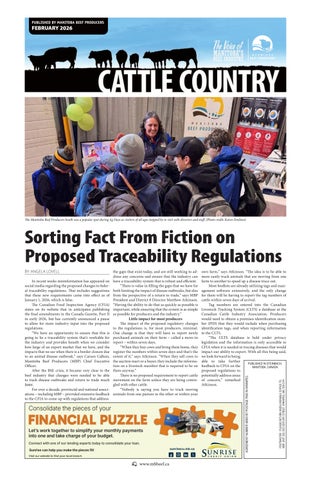
In recent weeks misinformation has appeared on socialmediaregardingtheproposedchangestofederal traceability regulations. That includes suggestions that these new requirements came into effect as of January 1, 2026, which is false.
The Canadian Food Inspection Agency (CFIA) states on its website that in anticipates publishing the final amendments in the Canada Gazette, Part II in early 2026, but has currently announced a pause to allow for more industry input into the proposed regulations.
“We have an opportunity to ensure that this is going to be a traceability system that’s workable for the industry and provides benefit when we consider how large of an export market that we have, and the impacts that we see when there is a border closure due to an animal disease outbreak,” says Carson Callum, Manitoba Beef Producers (MBP) Chief Executive Officer
After the BSE crisis, it became very clear to the beef industry that changes were needed to be able to track disease outbreaks and return to trade much faster.
For over a decade, provincial and national associations – including MBP – provided extensive feedback to the CFIA to come up with regulations that address
Consolidate the pieces of your
the gaps that exist today, and are still working to address any concerns and ensure that the industry can have a traceability system that is robust and efficient.
“There is value in filling the gaps that we have for both limiting the impact of disease outbreaks, but also from the perspective of a return to trade,” says MBP President and District 8 Director Matthew Atkinson. “Having the ability to do that as quickly as possible is important, while ensuring that the system is as simple as possible for producers and the industry.”
Little impact for most producers
The impact of the proposed regulatory changes to the regulations is, for most producers, minimal. One change is that they will have to report newly purchased animals on their farm – called a move-in report – within seven days.
“When they buy cows and bring them home, they register the numbers within seven days and that’s the extent of it,” says Atkinson. “When they sell cows to the auction mart or a buyer, they include the information on a livestock manifest that is required to be on there anyway.”
There is no proposed requirement to report cattle movement on the farm unless they are being comingled with other cattle.
“Nobody is saying you have to track moving animals from one pasture to the other or within your
Let’s work together to simplify your monthly payments into one and take charge of your budget.
Connect with one of our lending experts today to consolidate your loan. Sunrise can help you make the pieces fit!
our website to find your local branch.
own farm,” says Atkinson. “The idea is to be able to more easily track animals that are moving from one farm to another to speed up a disease trace out.
Most feedlots are already utilizing tags and management software extensively, and the only change for them will be having to report the tag numbers of cattle within seven days of arrival.
Tag numbers are entered into the Canadian Livestock Tracking System (CLTS) a database at the Canadian Cattle Industry Association. Producers would need to obtain a premises identification number (PID) that they would include when purchasing identification tags, and when reporting information to the CLTS.
“The CLTS database is held under privacy legislation and the information is only accessible to CFIA when it is needed in tracing diseases that would impact our ability to export. With all this being said, we look forward to being able to take further feedback to CFIA on the proposed regulations to potentially address areas of concern,” remarked Atkinson.

In recent weeks there has been lots of discussion, especially on social media about potential Canadian Food Inspection Agency (CFIA) changes to Canada’s livestock traceability system. Unfortunately, some incorrect information is circulating that said these changes took effect January 1, which is not the case. And there is some misinformation about what the proposed changes could mean for beef producers in their day-to-day operations. I am focusing this month’s column on why traceability is important to our sector, what is being proposed – but not yet enacted or being enforced, and where the matter stands today.
It is also important to note that Manitoba Beef Producers, along with other industry stakeholders such as the Canadian Cattle Association (CCA) had called for a pause on the implementation of proposed changes until such time as beef industry questions and concerns are addressed by the Canadian Food Inspection Agency. The CFIA issued a statement on January 10 where it said that it “will pause any publication of the regulations until the proposed changes are more widely understood and concerns are heard and taken into consideration.” You can read their full statement on page 4 of this edition.
Livestock traceability systems have three main objectives: to reduce the impacts of animal diseases by assisting with disease investigations, to provide accurate and up-to-date livestock identity and movement information, and, to better protect public health and animal health.
The three pillars of traceability are premises identification (PIDs), animal identification (CCIA tags), and animal movement through the recording of move-in data on cattle. An example of how traceability is being used is in the investigations into bovine tuberculosis cases in beef cattle in Saskatchewan and

DISTRIC T 1 TYLER FEWINGS Boissevain-Morton, Brenda-Waskada, Grassland, Deloraine-Winchester, and Two Borders
DISTRIC T 2 MARK SCHRAM
Argyle, Cartwright-Roblin, KillarneyTurtle Mountain, Lorne, Louise, Pembina, and Prairie Lakes
DISTRIC T 3 ANDRE STEPPLER
Cartier, Du erin, Grey, MacDonald, Portage la Prairie, Rhineland, Roland, Stanley, Thompson, Montcalm, Morris, and Ritchot
DISTRIC T 4

MATTHEW ATKINSON President’s Column
a dairy herd in Manitoba. Effective traceability is important for enhancing disease preparedness efforts and helping to minimize the number of affected producers if a disease arises. Traceability systems have also been used to share information about floods and fires in provinces where livestock may have been at risk due to these types of disasters.
More than 40% of Canada’s beef cattle production is exported annually, so maintaining market access is key. Livestock traceability systems support Canada’s disease status reporting to international bodies and export markets, which is important for maintaining trading opportunities and supporting economic sustainability in our industry. The faster a disease investigation can be done and information shared with trade partners, the better.
The federal traceability requirements currently in effect for cattle were introduced in 2000. The proposed amendments to Part XV of the Health of Animals Act — Traceability Regulations have been under discussion between the CFIA and members of the beef value chain for several years. This has included ongoing input from provincial cattle associations like MBP and various national associations. In 2016, nineteen industry organizations endorsed the Cattle Implementation Plan, the sector’s preferred approach to traceability system adjustments. The beef industry has continually provided feedback as the proposed changes have been moving through the government’s regulatory change process, such as the gazetting process. This will continue.
So what types of changes have been proposed, but not taken effect? Key changes for producers include:
A requirement to get or keep current a premises identification (PID) number from the provincial government.
A requirement to include your PID number when you are purchasing approved indicators (tags) and when you are reporting information related to identification of cattle and their movement, and Reporting the arrival of cattle (i.e. move-in reporting) within 7 days.
It is important to note that under the proposed traceability system updates that movement reporting into the Canadian Livestock Tracking System (CLTS) is not required for animal movements within the same farm. As proposed, you won’t be expected to report calves within hours of birth. Calves may be tagged and recorded before leaving the farm, just like now. You will only have to report new animals coming onto your operation (move-in).
There is a proposed exception though for cattle going to/from rodeos/fairs/exhibitions, to community pastures (which is done as a group, not individual tag numbers), and to veterinary clinics, where both their departure from your operation and their return will need to be reported into the CLTS. We recognize there are some questions about these requirements and it is important there is industry alignment on these types
DISTRIC T 5 STEVEN MANNS Cornwallis, Elton, Norfolk-Treherne, North Norfolk, Oakland-Wawanesa, Glenboro-South Cypress, and Victoria
DISTRIC T 6 BRIAN ENGLISH Pipestone, Riverdale, Sifton, Souris-Glenwood, Wallace-Woodworth, and Whitehead
DISTRIC T 7 TYLER FULTON
2ND VICE-PRESIDENT
BYRON FALK De Salaberry, Emerson-Franklin, Hanover, La Broquerie, Piney and Stuartburn, Montcalm, Morris, Ritchot, Spring eld, Ste. Anne, Taché, R.M. of Piney and Reynolds
DISTRIC T 9
TREVOR SUND Alexander, Brokenhead, East St. Paul, Lac Du Bonnet, Rockwood, Rosser, St. Andrews, St. Clements, St. Francois Xavier, West St. Paul, Whitemouth, Woodlands, LGD of Pinawa, Reynolds, Spring eld, Ste. Anne, and Taché
DISTRIC T 10
MIKE DUGUID
SECRETARY Armstrong, Bifrost-Riverton, Fisher, and Gimli
Ellice-Archie, Hamiota, Prairie-View, Riding Mountain West, Rossburn, Russell-Binscarth, and Yellowhead
DISTRIC T 8 MATTHEW ATKINSON Clanwilliam-Erickson, Glenella-Lansdowne, Harrison-Park, Minto-Odanah, Oakview, North Cypress-Langford, Rosedale, and West Lake-Gladstone
of concerns.
As proposed under new regulations, if you sell your calves through an auction market, the auction will report those calves moving in as a group. The purchaser of those calves will then report individual tag numbers when they move onto that operation.
As for the existing regulations and for which no changes are being proposed, cattle must still be tagged before leaving the site of origin. You also need to report tag retirement when animals are slaughtered, exported or die.
The CFIA has a webinar that gives a good overview of what the proposed changes mean. I strongly encourage you to check it out. See: https://www.youtube.com/watch?v=5w3ALso7lg0&t=6s
MBP’s website also has more information about what’s being proposed. Go to: https://mbbeef.ca/ our-news/understanding-proposed-updates-to-livestock-traceability-regulations
Follow along on MBP’s social media for updates as well.
Get a premises identification via Manitoba Agriculture at https://www.gov.mb.ca/agriculture/ food-safety/traceability/premises-identification.html
Begin reporting move-in events to the Canadian Cattle Identification Agency (CCIA). See https:// www.canadaid.ca/ . Get familiar with the Canadian Livestock Tracking System (CLTS) or the CLTS MOBO app which allows for online reporting. The CLTS is managed by the CCIA and it is not a government database. Some of you may opt to use apps and programs which can integrate reporting with the CLTS. The information you report is confidential, protected and only accessed if a disease traceback is needed.
As of now, publication of the final traceability amendments in Canada Gazette II is not expected any earlier than this spring. As noted, the CFIA has paused this process for an undetermined length of time to get more input. MBP and other industry stakeholders will continue to provide that to them based on feedback from our members. If there is another public comment period, I also strongly urge you to make your questions and concerns known to the CFIA. There is supposed to be a one-year window between publication of regulatory changes and when they would come into effect. The beef industry has requested a robust education and awareness process to give all time to prepare. As well, MBP has also advocated with the CFIA for a period of soft enforcement while producers get familiarized with any changes made.
Whatever traceability system changes are enacted must be practical for producers, not add more regulatory burden and should provide clear value for the sector, such as assisting with timely disease investigations and ensuring confidence among our trading partners. Having a well functioning traceability system is very important for the Canadian beef industry for the reasons I’ve explained in this column. If you have questions or concerns, please continue to reach out to us, and explore the resources I’ve identified here to learn more.
DISTRIC T 11
ARVID NOTT VEIT Coldwell, Grahamdale, St. Laurent, and West Interlake
DISTRIC T 12
MARK GOOD TREASURER Alonsa, Lakeshore, McCreary, and Ste. Rose
Greetings folks, and happy New Year! I hope the year is off to a good start and many of you are able to make our 47th AGM on February 11th and 12th at the Victoria Inn in Brandon.
In 2026, Canada’s beef industry remains a very important part of our agricultural and national economies. With approximately 60,000 beef farms across the country (6,000 in Manitoba), the sector is a significant contributor to rural communities, in creating jobs, and in terms of national exports. In navigating the complexities of global markets, free trade emerges as a critical pillar supporting the

CARSON CALLUM Chief Executive Officer's Column
At the heart of free trade is the ability to exchange goods and services across borders without restrictive tariffs, quotas or non-tariff barriers to trade. For Canadian beef producers, this translates into enhanced access to international markets, allowing them not only to sell more beef but also to diversify
Canada-United States-Mexico Agreement (CUSMA) on trade, for example, has bolstered access to the U.S. market, which is the largest importer of Canadian beef. The agreement ensures that Canadian producers can compete on a level playing field, negating tariffs that could impact price. This directly translates to increased revenue for ranchers and farmers, which cascades through the economy, benefiting suppliers, transporters, and local businesses and service providers dependent on the beef industry.
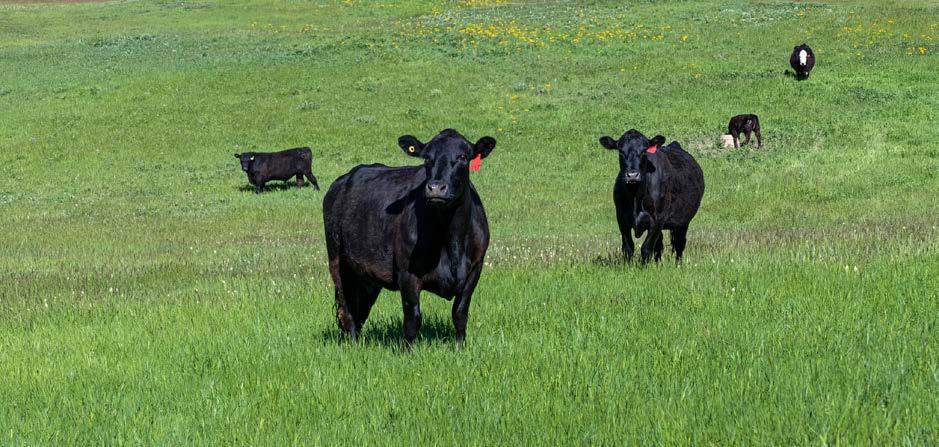
Moreover, free trade encourages innovation and competitiveness among Canadian producers. Facing international competition compels beef producers to improve production techniques, enhance quality, and adopt environmentally sustainable practices. For instance, Canadian ranchers are increasingly using advanced technologies such as genetics and precision agriculture to improve herd health and productivity. This drive for improvement not only benefits the producers themselves but also fosters a culture of excellence that can redefine the industry standards.

There is significant misinformation being shared on social media regarding the proposed changes to traceability regulations under the The Canadian Cattle Association worked with provincial associations and other industry associations to provide input to ensure the regulations follow the Cattle Implementation Plan which was developed and endorsed by the cattle industry.
Health of Animals Act.
Health of Animals Act.
under the The Canadian Cattle Association worked with provincial associations and other industry associations to provide input to ensure the regulations follow the Cattle Implementation Plan which was developed and endorsed by the cattle industry.
CCA will continue to work with provincial members, other beef industry associations and governments to ensure any proposed changes work for producers. We called for and achieved a pause to address the concerns that we are hearing.
CCA will continue to work with provincial members, other beef industry associations and governments to ensure any proposed changes work for producers. We called for and achieved a pause to address the concerns that we are hearing.
The proposed regulatory changes honour the intent of the Cattle Implementation Plan, which was developed by the beef industry and was updated in 2016.
The proposed regulatory changes honour the intent of the Cattle Implementation Plan, which was developed by the beef industry and was updated in 2016.
Traceability data is protected by privacy legislation. A premises identification (PID) number allows anonymized reporting: no producer name, business name or location is provided with each transaction. Associated information is only visible to select individuals in certain circumstances.
Traceability data is protected by privacy legislation. A premises identification (PID) number allows anonymized reporting: no producer name, business name or location is provided with each transaction. Associated information is only visible to select individuals in certain circumstances.
There is no proposed requirement to report cattle movement within a cattle operation.
Proposed NEW Requirements for Producers
Proposed NEW Requirements for Producers
Another pivotal aspect of free trade is its role in ensuring food security. As global populations grow and consumer demand evolves, Canada’s agricultural sector must quickly adapt. By establishing diverse trade relationships, Canada can mitigate risks associated with factors such as market volatility and climate change. If one market experiences a downturn, Canadian beef producers can lean on other markets for stability, ensuring a consistent income stream and
Additionally, free trade helps to reinforce Canada’s position as a global leader in agricultural practices. By engaging in trade partnerships, Canadian beef producers can showcase their commitment to ethical farming, animal welfare, and sustainability. This reputation attracts a consumer base that values not only the quality of beef but also the integrity of its production processes.
A premises identification (PID) number obtained from your provincial government (currently mandatory in some but not all provinces)
A premises identification (PID) number obtained from your provincial government (currently mandatory in some but not all provinces)
Must include your PID number when: Purchasing approved indicators (tags) Reporting information related to identification of cattle and their movement
Must include your PID number when: Purchasing approved indicators (tags) Reporting information related to identification of cattle and their movement
Report the arrival of cattle (i.e., move-in reporting) within 7 days
Report the arrival of cattle (i.e., move-in reporting) within 7 days
If moving cattle to graze at community pasture or comingled grazing, producers will be required to report group movement for departure and return
If moving cattle to graze at community pasture or comingled grazing, producers will be required to report group movement for departure and return cattle operation.
No
Proposed Changes to Current Regulations
No Proposed Changes to Current Regulations
However, the pursuit of free trade does not come without challenges. Producers in Canada must remain aware of potential market distortions and be prepared to adapt to changing market conditions. In addition, ongoing dialogue with trade partners is crucial to address concerns such as sanitary and phytosanitary standards, ensuring that trade can proceed smoothly. This is especially true with today’s evolving global trade dynamics. MBP and the CCA have been driving this message home to provincial and federal governments particularly as Canada, USA, and Mexico begin their negotiations on a new trade agreement. The Canadian beef industry strongly supports renewal of the CUSMA agreement in 2026.
Cattle must be tagged before leaving the site of origin
Cattle must be tagged before leaving the site of origin
Report tag retirement when animals are slaughtered, exported or die
Report tag retirement when animals are slaughtered, exported or die

We offer financial incentives and technical support to help you with energy efficiency upgrades.
In conclusion, free trade is vital for the Canadian beef industry, driving economic growth, fostering innovation, and enhancing food security. As Canadian beef producers continue to navigate the complexities of international trade, the principles of free trade will remain essential in positioning Canada as a leading player in the global beef market. Investing in and promoting free trade agreements will not only benefit producers but will also help to secure a sustainable future for Canada’s agricultural landscape.
Carson
(January 10, 2025 CFIA Statement) The Canadian Food Inspection Agency (CFIA) is aware of public discussion regarding the proposed amendments to Part XV (Traceability) of the Health of Animals Regulations
These amendments are not currently in place and have not been finalized. The CFIA has consulted with industry, associations and governments regarding the proposed amendments and will continue to do so. The CFIA will pause any publication of the regulations until the proposed changes are more widely understood and concerns are heard and taken into consideration.
The CFIA is committed to reducing red tape and regulatory reform and is advancing a number of modernization initiatives to support businesses, while ensuring Canada’s animal health system remains effective, practical, and fit for purpose. Animal diseases continue to occur, and when they do, Canada must be able to respond quickly, accurately, and effectively.
Strong traceability is central to that response. A modern, reliable traceability system allows animals to be tracked through the production system, supports faster and more targeted disease response, and helps limit impacts on producers, communities, and trade. It is also an investment made to protect Canadian animal health and respond to disease threats, like foot
and mouth disease. In practice, better traceability leads to quicker resolution of disease events, greater certainty for businesses, and stronger confidence in Canada’s livestock system domestically and internationally.
The proposed amendments are intended to close gaps in the current framework and strengthen Canada’s livestock traceability system. This supports effective response to disease events, minimizes economic disruption and helps Canadian producers and processors remain competitive at home and abroad, while supporting long-term economic stability for businesses.
Industry has been closely involved throughout the development of these proposed amendments over the last decade. The draft regulations were pre-published in Part I of the Canada Gazette in 2023, followed by a 90-day public comment period. In 2024, the CFIA published a What We Heard report summarizing feedback from producers, industry associations, provinces, and other partners. Since then, the CFIA has continued engagement with stakeholders so that the system is workable while maintaining strong animal health protections.
When the amendments are published, the regulations will include transition periods to support the implementation process — one year for regulated parties before implementation, followed by a graduated enforcement approach. The CFIA will provide guidance, education, and support throughout this period.
The CFIA values ongoing dialogue with industry and remains open to input. Maintaining an excellent, credible animal health system is essential to protecting livestock, supporting producers, and enabling trade.



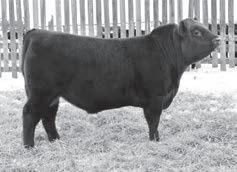
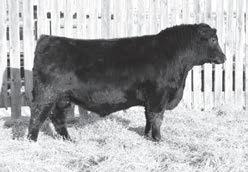
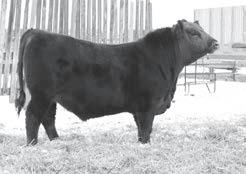

(Joint federal/provincial news release) The governments of Canada and Manitoba have launched a new pilot program that rewards farmers for adopting sustainable management practices with lower premiums as part of the 2026 AgriInsurance program, federal Agriculture and Agri-Food Minister Heath MacDonald and Manitoba Agriculture Minister Ron Kostyshyn announced January 21st
“AgriInsurance is a vital tool for Manitoba producers, helping them manage risk and stay resilient in the face of unpredictable challenges,” said MacDonald. “By working closely with the Manitoba government, we’re ensuring farmers have the support they need to protect their operations as they adapt to changing conditions and can continue growing the high-quality food Canadians rely on.”
The 2026 AgriInsurance program, administered by Manitoba Agricultural Services Corporation (MASC), features updated crop insurance dollar values and will provide Manitoba farmers with predictable coverage for crop production and quality losses caused by natural perils, helping them manage risk and plan confidently for the upcoming growing season.
Total coverage for 2026 is expected to reach $4.3 billion, and farmers will benefit from lower premium rates for most insurable crops. For annual crops, the average premium for producers will be $11.46 per acre in 2026, compared to $13.01 per acre in 2025.
“Manitoba farmers continue to face challenges from unpredictable weather and global market volatility,” said Kostyshyn. “AgriInsurance helps protect their investments and provides a foundation for longterm success. We’re proud to introduce enhancements that reward sustainable practices and expand coverage to meet farmers’ evolving needs.”
As part of its ongoing efforts to support sustainability, MASC is piloting the Forage Advantage incentive, offering a 15 per cent discount on Forage Establishment Insurance premiums for perennial forage crops grown on designated land. Additional discounts may apply to Basic or Select Hay Insurance or Forage Seed Insurance once the forage crop enters production the following year. The 2026 program also includes new coverage for meadow fescue grown for seed.
The AgriInsurance program is designed to provide predictable protection for producers against nat-

ural perils such as drought, excess moisture or other extreme weather event, as well as diseases and pests. Manitoba maintains a high level of participation, with over 90 per cent of annual crop acres and more than 7,300 farms enrolled in the program.
Also, for the 2026 crop year, the list of damaging species will be expanding as part of the Wildlife Damage Compensation program. This change will lead to compensation for crop damage caused by blackbirds and raccoons, and livestock injury or death caused by vultures, eagles, hawks, ravens and other corvidae species.
The governments of Canada and Manitoba support AgriInsurance and Wildlife Damage Compensation under the Sustainable Canadian Agricultural Partnership (Sustainable CAP).
For more information on AgriInsurance, contact a MASC Service Centre or visit www.masc.mb.ca

















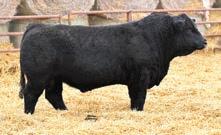




BY: KELLY HYDE, CANADA BEEF
For the fourth consecutive year, Burger It Forward—a cause-marketing initiative led by Canada’s beef farmers and ranchers—is gearing up for its annual campaign, which runs from February 1 to 28, 2026. Organizers are optimistic that this year will be the most successful yet, with upwards of 40 restaurants in Manitoba and highlighted by the campaign’s first-ever expansion into Quebec.

With more than 340 restaurants already enrolled across Canada by mid-December, the 2026 promotion has exceeded its engagement goal of surpassing last year’s participation of over 260 restaurants. This achievement reflects strong recruitment efforts, welcoming back 2025 partners and expanding to new participants.
Burger It Forward supports local restaurants and Canadian ground beef producers while raising funds for food banks at every level. In 2025, the campaign raised more than $61,399 for food banks and sold over 62,431 burgers at the 260-plus participating restaurants nationwide. Locally, Manitoba Beef Producers was pleased to support Harvest Manitoba with a $2,000 donation to relieve food insecurity. Burger It Forward remains an important program to help prevent food insecurity. With food prices continuing to rise, food banks across Canada are struggling to meet increasing demand as more families rely on their support. Consider these facts from Food Banks Canada:
Food banks across Canada now see over two million visits per month (2,165,766), a figure that has doubled over the past six years.
712,000 of these monthly visits are for children.
Food insecurity affects more than the homeless or unemployed: 19% of food bank users are employed, and 70% live in market-rent housing. These numbers underscore the urgent need for initiatives like Burger It Forward.
Beyond supporting food banks, Burger It Forward boosts beef and burger sales during February which is a typically slow period for restaurants. Canada Beef streamlines participation by offering the program free of charge.
Canada Beef and provincial cattle associations handle food bank donations on behalf of participating restaurants, eliminating financial and administrative barriers.
Through collaboration, community support, and a shared commitment to ending food insecurity, Burger It Forward continues to make a meaningful impact across Canada. To get involved, visit burgeritforward.ca in February to find participating restaurants near you.



BY: ANGELA LOVELL
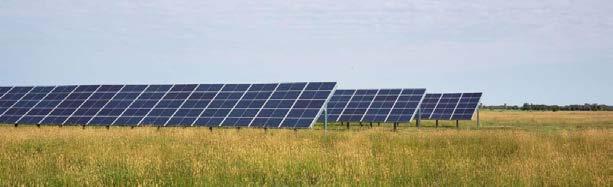
This might be the best time ever for producers thinking about using solar energy on their farms to go ahead with the plan.
Solar technology has improved efficiency, the cost of solar panels and equipment have come down considerably in recent years, and there are currently some pretty attractive incentives to help offset the cost of solar installations.
After reinstating its popular commercial rebate program, Efficiency Manitoba recently increased the rebate from 50 cents per watt to 75 cents per watt installed, and has removed the cap of 50 kW ($25,000) for the total rebate meaning that it can now be used for larger installations. This rebate program stacks nicely with the federal government’s Clean Energy Investment Tax Credit that provides a 30 per cent refundable tax credit to businesses (including farms) against the cost of installing a solar system. The tax credit is expected to be offered until 2034.
In addition, certain clean energy equipment (including solar) qualifies for an accelerated capital cost allowance (CCA) that allows it to be depreciated at rates ranging from 30 to 50 per cent.
“We have the best programs we’ve had since I’ve been working in solar energy,” says Tyler McPherson, solar sales consultant with Powertec Solar, a full-service solar company that has done around 600 installations in Manitoba since 2020. “And the average cost of install has come down from $3 per watt to around $2 a watt, depending on the size of the system, so farmers can get more than 50 per cent of the cost of a system covered between the tax credit and the rebate and they’re not capped [on the size of the install or maximum rebate]. It is a good time for commercial and agricultural customers to install solar.”
For farmers especially, solar is something that could bring some tax advantages to their operations.
“We have got extreme profitability in most sectors right now, and when you’re in a situation where we have such a large amount of tax owing on some of these operations, its an opportune time to invest into something like solar because of the tax credits that you do get,” says Ben Hamm, business development specialist with Manitoba Agriculture. “We know inflation is going to increase our hydro rates over time so why not lock in that value of power by investing in solar and using all these credits. It’s an excellent opportunity to reduce taxes and invest into your own operation.”
A few caveats
But there are a few caveats. Solar may not be feasible for every operation, and producers also need to understand that there are some misconceptions about solar energy production.
“There is some misunderstanding about how solar is implemented,” says Jacob Kettner, founding partner of Powertec Solar. “You are not going to be cutting your Hydro line; most of the systems that we install don’t include batteries because they’re direct to the grid. The solar system ties into the panel and anything that you’re using power for, if you’re generating solar it uses your solar power, and if you’re not generating solar, it pulls power from the grid. You will still have a hydro bill, but the idea is to strategically offset that at the highest value per kWh that you can so you can make a return on your system as quickly as possible.”
Solar is of most benefit to farms that use most of their power in the summer months (peak production is generally considered to be from March to October) because the system does not produce as much power in the wintertime. That makes it ideal for operations like dairy farms where energy consumption is fairly consistent throughout the year, but it can also fit for large grain farms that run a lot of grain dryers.
Because energy production varies throughout the year, it’s important to size the system as closely as possible to the farm’s overall energy needs because if it overproduces, that energy can be sold back to Manitoba Hydro but at a wholesale rate that is much
less than the rate customers pay for energy, having the effect of slowing down the return on investment. Being strategic about solar Hamm installed a 10-kW system on the house at his farm about four years ago and says producers have to be strategic about how they plan their solar system and integrate it so that it provides maximum benefit to their operation.
“Manitoba is net billing so they buy back the excess solar at .04390 cents per kWh and you’re paying 9.5 cents, so it doesn’t help to generate a system that’s too large for what your operation needs because they are buying it back at such a cheap rate,” says Hamm.
To help offset the fact that his system generates more energy than it needs in the summer and less in the winter, Hamm’s solution was to purchase an electric vehicle to utilize some of the excess energy.
“On top of having an electric vehicle using that excess energy, I’ve got a mobile power plant of 200 kW in the truck that can provide mobile power around the farm and power my home for days if there’s no power,” he says. “Electric vehicles also have some accelerated capital cost allowances if you want to purchase that for the farm. All of these things together can generate some tremendous tax savings.”
It’s important to get some advice about sizing a solar system correctly to maximize the return on investment.
“It’s all dependent on the power consumption,” says McPherson. “The size of system that we would recommend would be based off of what your annual power consumption is.”
Advantages of solar
There are many advantages of solar energy, one of which is that it’s clean energy but most people install it for economic reasons and to offset future energy cost increases.
“When you’re creating your own energy, any time there are rate increases they don’t affect you as much because most of your power production is being handled by solar,” says McPherson. “When rate increases happen, it’s a good thing if you’re a solar customer because that means you get a quicker payback from a financial perspective.”
As long as you are installing a correctly sized system there are few issues, but if you are a very high user of energy, Manitoba’s infrastructure, especially in rural areas, may not be capable of handling a larger solar system.
“The grid was built to be a one-way system, and depending on where people are situated, we do run into issues where Manitoba Hydro says this is the maximum size that you can install because that’s what our infrastructure can handle,” says Kettner.
“When we do an install we handle everything from start to finish,” adds McPherson. “It’s not the customer’s responsibility to get permits or deal with Manitoba Hydro, we handle everything with the interconnection, and explain what the costs are to see if they are willing to go ahead.”
Natural Resources Canada’s maps of photovoltaic resources across Canada show that the Prairies have a high potential for solar energy generation, with the City of Winnipeg estimated to be capable of producing 1,277 kWh per watt of solar generation annually.
But what about generation of energy in winter? Is there a problem with snow buildup on solar panels?
Even at the optimal angle of around 45 degrees – which makes it much harder for snow to latch onto smooth solar panels than asphalt shingles – there will inevitably be some snow buildup on the panels. That may not be as big a problem for systems on farms that are ground mounted as farmers typically have the equipment to get out and remove the snow. On a building installation though it can be more of a trade-off.
“If you have south facing roof space on a barn that is ideal because it’s not taking up space on your farm, but you need to do a cost benefit because you might get slightly better production if you ground mount it and put it at the optimal angle, but you could save on the install if you don’t have to put in piles for a ground mount system. If it’s on the roof, it’s not quite the optimal angle, so you are going to produce a little less but you’re going to save on the capital costs,” McPherson says.
Cost of energy determines ROI
The payback period for a solar installation varies depending on whether it is for commercial or residential use, sizing of project, the time of day that the majority of power is being used, and the amount provided by incentives that can be taken advantage of.
There are different incentives and rebates available for solar installations on residential homes that are not quite as attractive as those offered currently on commercial installations, so the payback on these systems is typically longer (around 12 to 15 years).
The price of energy is also one of the biggest factors in calculating the return on investment (ROI) of a solar system. But calculating actual ROI can be tricky. When Hamm installed his system the payback was estimated to be 12 to 15 years, but it depends on what is being taken into account he says.
“Are you taking into account all the credits available or looking at gross amounts because the payback could be 20 to 30 years if you don’t take and account for those credits,” he says. “I did utilize them and the payback came down to about 10 to 12 years. But when I installed it, the energy buyback was at six cents per kWh and now it’s four cents, so the payback goes up to 12 to 15 years. Things change and you have to take that into account.”
“The buyback rate is less important if the system is sized correctly to where you’re not selling back to the grid,” says McPherson. “And if you look at it over the lifetime of the system, even at a nine- or 10-year payback it works out to around 10 to 11 per cent annual return [on the investment],” says McPherson. “Compared to other investments, it’s very competitive.”
A solar system should never be viewed as a potential money maker, he adds.
“You need to look at it as an offset of your own energy costs,” he says. “And with the current commercial incentives you’re offsetting around 50 per cent of your cost within the first year.”
Even with the incentives it requires a considerable investment from the customer to install a solar system, and ideally it shouldn’t all be financed.
“The paybacks on these don’t look as good if you’re borrowing the money to do it,” Kettner says. “If you have the cash and you’re looking for a safe place to invest it, where it’s going to make you a good return, and you know you can cut your costs, this is a great thing to look at.”

January 6, 2026
January 6, 2026
January 6, 2026
January 6, 2026
Calgary, AB — Andrea Brocklebank will become the Canadian Cattle Association’s (CCA) Chief Executive Officer in early March. Brocklebank currently serves as Executive Director for Beef Cattle Research Council (BCRC), a division of the CCA. CCA President Tyler Fulton made the announcement today, citing Brocklebank’s proven track record of strategic decisions and collaboration as critical skills that will ease the senior leadership transition and help ensure CCA is well positioned for the future.
Calgary, AB — Andrea Brocklebank will become the Canadian Cattle Association’s (CCA) Chief Executive Officer in early March. Brocklebank currently serves as Executive Director for Beef Cattle Research Council (BCRC), a division of the CCA. CCA President Tyler Fulton made the announcement today, citing Brocklebank’s proven track record of strategic decisions and collaboration as critical skills that will ease the senior leadership transition and help ensure CCA is well positioned for the future.
Calgary, AB — Andrea Brocklebank will become the Canadian Cattle Association’s (CCA) Chief Executive Officer in early March. Brocklebank currently serves as Executive Director for Beef Cattle Research Council (BCRC), a division of the CCA. CCA President Tyler Fulton made the announcement today, citing Brocklebank’s proven track record of strategic decisions and collaboration as critical skills that will ease the senior leadership transition and help ensure CCA is well positioned for the future.
Calgary, AB — Andrea Brocklebank will become the Canadian Cattle Association’s (CCA) Chief Executive Officer in early March. Brocklebank currently serves as Executive Director for Beef Cattle Research Council (BCRC), a division of the CCA. CCA President Tyler Fulton made the announcement today, citing Brocklebank’s proven track record of strategic decisions and collaboration as critical skills that will ease the senior leadership transition and help ensure CCA is well positioned for the future.
An executive recruitment firm conducted an extensive recruitment process and CCA’s directors enthusiastically accepted their recommendation. “On behalf of the directors, we are excited to welcome Andrea as our CEO,” says Fulton. “We are confident that with Andrea leading us, the Canadian Cattle Association is well positioned to navigate continued global market uncertainty as we work towards renewing the Canada-United States-Mexico Agreement (CUSMA) and other priorities.”
An executive recruitment firm conducted an extensive recruitment process and CCA’s directors enthusiastically accepted their recommendation. “On behalf of the directors, we are excited to welcome Andrea as our CEO,” says Fulton. “We are confident that with Andrea leading us, the Canadian Cattle Association is well positioned to navigate continued global market uncertainty as we work towards renewing the Canada-United States-Mexico Agreement (CUSMA) and other priorities.”
An executive recruitment firm conducted an extensive recruitment process and CCA’s directors enthusiastically accepted their recommendation. “On behalf of the directors, we are excited to welcome Andrea as our CEO,” says Fulton. “We are confident that with Andrea leading us, the Canadian Cattle Association is well positioned to navigate continued global market uncertainty as we work towards renewing the Canada-United States-Mexico Agreement (CUSMA) and other priorities.”
An executive recruitment firm conducted an extensive recruitment process and CCA’s directors enthusiastically accepted their recommendation. “On behalf of the directors, we are excited to welcome Andrea as our CEO,” says Fulton. “We are confident that with Andrea leading us, the Canadian Cattle Association is well positioned to navigate continued global market uncertainty as we work towards renewing the Canada-United States-Mexico Agreement (CUSMA) and other priorities.”
The CEO role is a new designation for the Canadian Cattle Association. “As we planned for Executive Vice President Dennis Laycraft’s retirement and a senior leadership transition, we determined that the description of CEO more accurately reflects the role of our senior staff member,” explains Fulton. “With some small but key changes to the role and the selection of Andrea, we are confident that we have found the right person with the right leadership qualities to lead the Canadian Cattle Association now and in the years ahead.”
The CEO role is a new designation for the Canadian Cattle Association. “As we planned for Executive Vice President Dennis Laycraft’s retirement and a senior leadership transition, we determined that the description of CEO more accurately reflects the role of our senior staff member,” explains Fulton. “With some small but key changes to the role and the selection of Andrea, we are confident that we have found the right person with the right leadership qualities to lead the Canadian Cattle Association now and in the years ahead.”
The CEO role is a new designation for the Canadian Cattle Association. “As we planned for Executive Vice President Dennis Laycraft’s retirement and a senior leadership transition, we determined that the description of CEO more accurately reflects the role of our senior staff member,” explains Fulton. “With some small but key changes to the role and the selection of Andrea, we are confident that we have found the right person with the right leadership qualities to lead the Canadian Cattle Association now and in the years ahead.”
The CEO role is a new designation for the Canadian Cattle Association. “As we planned for Executive Vice President Dennis Laycraft’s retirement and a senior leadership transition, we determined that the description of CEO more accurately reflects the role of our senior staff member,” explains Fulton. “With some small but key changes to the role and the selection of Andrea, we are confident that we have found the right person with the right leadership qualities to lead the Canadian Cattle Association now and in the years ahead.”
Tracy Herbert has been appointed Interim Executive Director, effective March 1. Herbert has led the BCRC's knowledge mobilization program since joining the BCRC in 2011. Laycraft will maintain business as usual at CCA until the leadership transition takes place in March.
Tracy Herbert has been appointed Interim Executive Director, effective March 1. Herbert has led the BCRC's knowledge mobilization program since joining the BCRC in 2011. Laycraft will maintain business as usual at CCA until the leadership transition takes place in March.
Tracy Herbert has been appointed Interim Executive Director, effective March 1. Herbert has led the BCRC's knowledge mobilization program since joining the BCRC in 2011. Laycraft will maintain business as usual at CCA until the leadership transition takes place in March.
Tracy Herbert has been appointed Interim Executive Director, effective March 1. Herbert has led the BCRC's knowledge mobilization program since joining the BCRC in 2011. Laycraft will maintain business as usual at CCA until the leadership transition takes place in March.

Andrea Brocklebank joined CCA in 2004 and held various roles with Canfax Research Services and BCRC before becoming Executive Director of BCRC in 2009. In her current position, she manages the delivery of research through the BCRC and Beef Science Cluster to fund research in areas of importance to the industry. She oversees the administration of funding received through the Canadian Beef Cattle Check-Off, Agriculture and Agri-Food Canada, and other sources to deliver research programming, knowledge mobilization activities, and the Verified Beef Production Plus program Brocklebank is also responsible for leading the development and implementation of the Canadian Beef Research and Knowledge Mobilization Strategy advancing collaborative funding partnerships aligned with the strategy.
ndrea Brocklebank joined CCA in 2004 and held various roles with Canfax Research Services BCRC before becoming Executive Director of BCRC in 2009. In her current position, she manages the delivery of research through the BCRC and Beef Science Cluster to fund research in areas of importance to the industry. She oversees the administration of funding received through the Canadian Beef Cattle Check-Off, Agriculture and Agri-Food Canada, and other sources to deliver research programming, knowledge mobilization activities, and the Verified Beef Production Plus program Brocklebank is also responsible for leading the development and implementation of the Canadian Beef Research and Knowledge Mobilization Strategy advancing collaborative funding partnerships aligned with the strategy.
rocklebank completed a Bachelor of Arts in agricultural studies at the University of Lethbridge and Masters of Science in agricultural economics at the University of Saskatchewan. She was raised on a farm in southern Alberta that she and her husband now manage. Prior to working with the CCA, she worked within the Canadian cattle feeding sector and in agriculture finance and lending.
Andrea Brocklebank joined CCA in 2004 and held various roles with Canfax Research Services and BCRC before becoming Executive Director of BCRC in 2009. In her current position, she manages the delivery of research through the BCRC and Beef Science Cluster to fund research in areas of importance to the industry. She oversees the administration of funding received through the Canadian Beef Cattle Check-Off, Agriculture and Agri-Food Canada, and other sources to deliver research programming, knowledge mobilization activities, and the Verified Beef Production Plus program Brocklebank is also responsible for leading the development and implementation of the Canadian Beef Research and Knowledge Mobilization Strategy and advancing collaborative funding partnerships aligned with the strategy.
Andrea Brocklebank joined CCA in 2004 and held various roles with Canfax Research Services and BCRC before becoming Executive Director of BCRC in 2009. In her current position, she manages the delivery of research through the BCRC and Beef Science Cluster to fund research in areas of importance to the industry. She oversees the administration of funding received through the Canadian Beef Cattle Check-Off, Agriculture and Agri-Food Canada, and other sources to deliver research programming, knowledge mobilization activities, and the Verified Beef Production Plus program Brocklebank is also responsible for leading the development and implementation of the Canadian Beef Research and Knowledge Mobilization Strategy and advancing collaborative funding partnerships aligned with the strategy.
Brocklebank completed a Bachelor of Arts in agricultural studies at the University of Lethbridge and Masters of Science in agricultural economics at the University of Saskatchewan. She was raised on a farm in southern Alberta that she and her husband now manage. Prior to working with the CCA, she worked within the Canadian cattle feeding sector and in agriculture finance and lending.
Brocklebank completed a Bachelor of Arts in agricultural studies at the University of Lethbridge and Masters of Science in agricultural economics at the University of Saskatchewan. She was raised on a farm in southern Alberta that she and her husband now manage. Prior to working with the CCA, she worked within the Canadian cattle feeding sector and in agriculture finance and lending.
rocklebank completed a Bachelor of Arts in agricultural studies at the University of Lethbridge and Masters of Science in agricultural economics at the University of Saskatchewan. She was raised on a farm in southern Alberta that she and her husband now manage. Prior to working with the CCA, she worked within the Canadian cattle feeding sector and in agriculture finance and lending.
The Canadian Cattle Association is the national voice for Canada’s beef cattle industry representing 60,000 beef farms and feedlots www.cattle.ca
The Canadian Cattle Association is the national voice for Canada’s beef cattle industry representing 60,000 beef farms and feedlots www.cattle.ca
The Canadian Cattle Association is the national voice for Canada’s beef cattle industry representing 60,000 beef farms and feedlots www.cattle.ca
There was one resolution arising from the fall 2025 MBP district meetings held in even-numbered districts where director elections were required. MBP’s board of directors also accepted in writing late resolutions for potential debate at the AGM until 9 a.m. Monday, January 5, 2026. No late resolutions were submitted for consideration. The single resolution up for debate is as follows:
District 2: Whereas wildlife such as deer and elk can cause irreparable damage to stockpiled feed and to a variety of crops, as well as to farm infrastructure such as fences; and
Whereas elk and deer populations have been rising in different areas of agro-Manitoba in recent years, with large herds congregating on farms and ranches, and there is strong agricultural producer interest in the provincial government more regularly conducting surveys to accurately determine population numbers; and
Whereas the Wildlife Damage Compensation for Crop Damage program currently limits compensation for extended grazing forages to 45 per cent of the value of loss on swathed or baled crops or forage,
and suitable standing annual crops (e.g. corn) that are intended for grazing, which is not sufficient to meet the needs of affected producers; and
Whereas there are concerns about the potential for disease transmission between wildlife and livestock, which could be very detrimental to the beef industry, as seen with past experiences in Manitoba related to bovine tuberculosis.
Be it resolved to recommend that Manitoba Beef Producers continue to lobby the provincial government to conduct a thorough analysis of elk and deer populations in agro-Manitoba to determine if there are areas of over-population and if additional management strategies are needed, such as increased hunting opportunities; and
Be it resolved to recommend that Manitoba Beef Producers continue to lobby the provincial government to provide financial assistance for fencing initiatives or other risk mitigation practices to help reduce the risk of wildlife eating stockpiled feed; and
Be it resolved to recommend that Manitoba Beef Producers lobby the provincial government and MASC to make changes to the Wildlife Damage Compensation for Crop Damage program
to increase the level of compensation for extended grazing forages so that it is more reflective of the costs producers incur related to the loss of feeding resources. MBP thanks all delegates in advance for their respectful debate of the resolution and topics at hand and also thanks the Parliamentarian for facilitating the debate process. Resolutions passed at the Annual General Meeting are not legally binding on Manitoba Beef Producers but are important in helping to inform sector priorities for action.
MBP thanks all delegates in advance for their respectful debate of the resolution and topics at hand and also thanks the Parliamentarian for facilitating the debate process.
Resolutions passed at the Annual General Meeting are not legally binding on Manitoba Beef Producers but are important in helping to inform sector priorities for action.
The 47th Annual General Meeting, Tradeshow and President's Banquet is set for February 11 & 12 in Brandon. The meeting is free to attend while the dinner is $65 per ticket.
We know this is a busy time of year but we hope you can attend to gain knowledge, to get industry updates and to share ideas about how to keep our beef industry moving forward.
Visit mbbeef.ca/events to register.
Amaglen Limousin
Diamond T Limousin
L&S Limousin Acres


Amanda 204-246-2576 204-823-2286
View bulls & females for sale online at: www.amaglenlimousin.ca
Cherway Limousin
Cheryl 204-736-2878
Bulls & females for sale can be viewed online at: www.cherwaylimousin.ca
Circle Dot Ranch
Wayne Yule 204-383-5390
Breeding Limousin for 45 plus years
Limousin and Limo cross feeder calves for sale
Travis 204-851-0809 Brodie 294-901-1437
2 year old and yearling bulls for sale on farm. email: diamondtlimo@gmail.com
Gutek Limousin
Jeff 204-656-4953
Fork River, MB. 2 yr old polled bulls available private treaty on farm
Hockridge Farms
Brad 204-648-6333 Glen 204-648-5222
Bulls for sale on farm, feeder calves sell on TEAM Auction. email bradhockridge@gmail.com
Lawrence 204-851-1449
Bulls sell March 28th at Douglas Bull Test Station and private treaty on farm
Maplehurst Farms
Bob 204-274-2490 Tim 204-871-0996
Kaitlin 204-871-3489

Bulls for sale on farm, Douglas Bull Test March 28th and Lundar Bull Sale April 4th
Pine Creek Limousin
William 204-851-1835 Brady 204-851-3121
Bulls for sale on farm & Douglas
28th
PROVIDED BY: PUBLIC AND STAKEHOLDER ENGAGEMENT, A DIVISION OF THE CANADIAN CATTLE ASSOCIATION
Beef cattle farmers and ranchers manage some of the most critical wildlife habitat in Canada. By grazing cattle, these producers help maintain intact grassland ecosystems for wildlife to thrive. To recognize this environmental benefit of raising Canadian beef, the Public and Stakeholder Engagement (PSE) program released its newest short documentary, Homes on the Range, on World Wildlife Day in September 2025.
Produced by Story Brokers Media House, the film explores the important role of Canadian beef producers in wildlife conservation, both as a result of the grazing practices they already implement on their farms, as well as the ways they go above and beyond to attract wildlife. By consulting conservation experts from the Canadian Wildlife Federation and the Nature Conservancy of Canada, Homes on the Range presents a third-party perspective on the key role of the Canadian beef industry in conservation work.
Throughout the documentary, beef producers from across Canada are highlighted to share their role in preserving wildlife habitat. Manitoba ranchers Trevor and Melissa Atchison are featured in the film for their work with the Manitoba Burrowing Owl Recovery Program to install artificial nest burrows in their pastures, as well as their use of off-site waterers and targeted grazing of wetlands to preserve the health of riparian ecosystems. This Manitoban case study was presented by PSE staff member Emma Cross at The Wildlife Society’s 2025 international conference as part of a session on grassland conservation along with research from the 2024 National Beef Sustainability Assessment highlighting the key role of Canada’s beef industry in preserving wildlife habitat.
Homes on the Range is aimed at a public audience to drive awareness of the environmental benefits of raising beef cattle on the Canadian landscape. Dr. Carolyn Callaghan, Senior Terrestrial Biologist for the Canadian Wildlife Federation, says in the film that beef producers maintaining extensive grazing practices needs to be recognized by society as “a public service”.
Since its release, Homes on the Range has been selected for eight film festivals, and most recently was chosen for the Winnipeg Real to Reel Film Festival. On the festival circuit, the film won Best Canadian Documentary at the Vancouver Indie Film Festival and Best Nature/Wildlife Documentary at the Canadian International Film Festival.
Homes on the Range also won Best of Show –Digital and received the top prize in the non-specialty video category at the Canadian Agri-Food Marketers Alliance awards. This event recognizes the very best in agricultural marketing, publicity, and industry relations campaigns every year. The film was also screened at the Latornell Conservation Symposium in Woodbridge, Ontario and at the University of Saskatchewan.
Each year, the PSE team conducts consumer research to assess perceptions of how beef cattle
are raised in Canada. In 2025, 80% of respondents rated the Canadian beef industry as good stewards of the land and water. 74% of Albertan respondents agreed that beef is an environmentally friendly food choice, an increase of 14% over the past two years. This increase was driven by an 18% jump in younger Canadians aged 18-29, who have long been a major target audience for the Public and Stakeholder Engagement program. These results demonstrate the impact that positive campaigns like Homes on the
Range can have on consumer trust.
Homes on the Range is available to the public on YouTube, where it has earned over 128,000 views so far. Short form content from the film has gained over one million views on the PSE program’s Raising Canadian Beef social media channels.
The PSE team is happy to help coordinate screening requests for stakeholder groups and events. Reach out to raisingcdnbeef@cattle.ca for more information.



Mar. 3rd Maple Lake Stock Farms Kick off to Spring Bull Sale, Hartney, MB
Mar. 4th Rainbow River Simmentals 11th Annual Bull & Female Sale, FarmGateAuctions.ca
Mar. 5th JP Cattle Co. Annual Simmental & Angus Bull Sale, McAuley, MB
Mar. 8th Premium Beef Simmental Bull Sale, Kenton, MB
Mar. 9th Canadian Central Simmental & Angus Bull & Female Sale, Neepawa, MB
Mar. 9th McIntosh Ranch Online Simmental Bull Sale, FarmGateAuctions.ca
Mar. 11th Mar Mac Farms & Guests Simmental & Angus Bull Sale, Brandon, MB
Mar. 14th 83 South Simmental Bull Sale, FarmGateAuctions.ca
Mar. 14th Rancher’s Select 7th Annual Simmental Bull Sale, Neepawa, MB
Mar. 16th Oakview/Perkin/Triple R Simmental Bull Sale, Darlingford, MB
Mar. 17th Prairie Partners Bull & Female Sale, Killarney, MB
Mar. 18th Van De Velde Cattle & Delight Simmentals Online Bull Sale
Mar. 19th Northern Light Simmentals Bull Sale, Rossburn, MB
Mar. 20th High Bluff Stock Farms Bull Sale, Inglis, MB
Mar. 21st McRuer Simmentals Bull & Heifer Sale, Killarney, MB
Mar. 27th Sunville Simmentals Bull Sale, McCreary MB
April 4th Transcon’s Virden Simmental Bull Sale, Virden, MB
April 4th Lundar Bull Sale, Lundar, MB
April 8th Bonchuk Farms Annual Bull Sale, Solsgirth, MB
MSA_CC Feb 2026.indd 1
The cattle market has opened very strong in 2026. The major price correction from the fourth quarter of 2025 has all but disappeared. Feeder prices in the first half of January are very comparable to the market we enjoyed in late September and early October of 2025.
Many of the feeder cattle are selling for approximately $200 per head offside the cash fed-cattle market and feeder cattle contracts. Cattle feeders are expecting higher offers later in the spring. Feed costs are not increasing, and corn inventory in the south is abundant. All of the fundamentals that drove the market last fall are still in place: a shortage of cattle on both sides of the border, cheap feed, and strong consumer and export demand. Any feeder cattle destined to the grass market are expected to be very strong.
The spread between heifers and steers is expected to narrow during the spring market, as some speculators are looking to purchase heifers to breed and resell in the fall. The heavy cattle will be a little tougher to sell as the fed-cattle market has not rebounded as fast as the feeder market. The yearling market off the grass is currently on par with last fall’s prices. Currently it appears that the cow-calf producer will be in the driver’s seat for at least one more year. Canada had a small increase in the beef cow herd last year. Early estimates in Manitoba show a 1% increase in the cow herd and 1% more herds

very restrictive with a heavy burden on the cattle industry and its producers. After a summit meeting in Saskatoon, the Cattle Implementation Committee was established. The federal Minister of Agriculture at the time, Gerry Ritz, was instrumental in getting the CFIA to listen to industry and he and the government of the day fully supported the traceability movement. This committee was made up of cattle industry representatives from across Canada. The Committee was populated by industry, not government.
The purpose of the committee was to make recommendations to CFIA on the development of an Emergency Management Plan to deal with the containment and eradication of a disease outbreak in Canada. It was a “Made in Canada” plan to deal with the complexities and size of the Canadian cattle industry, a plan that would get Canada back into the international marketplace as soon as possible. This meant building on the existing mandatory ear tagging
them. All of the tags activated from the premises have to be accounted for. Until that happens, the file can remain open. So, if you have an animal with a CCIA ear tag in its ear and it dies on your farm, that tag number needs to be retired. If the animal has never had a tag, CFIA does not really care if it died or not. When cattle are purchased and arrive at your farm, those tag numbers need to be reported so that in the event of a trace back, they know the cattle are at your location. This is all part of protecting the Canadian cattle industry, not spying on your farm.
The CFIA made the announcement on January 10, 2026, that they would pause the implementation of the new proposed regulations.
Those on social media who claim they had no input, or didn’t know changes were being made, must have missed numerous opportunities over many years of public meetings and public information. Obviously, they never attended their provincial beef producer meetings, CCA meetings or industry partner functions such as the LMAC convention.
Everyone is entitled to his or her own opinion. However, that opinion should be based on fact and accurate information, not speculation or social media conspiracy. Your anger should not be directed at the Canadian Cattle Association or Manitoba Beef Producers. Their
I applaud the directors and staff of our beef organizations. I have worked with many of them over the years. We do not always agree, but we share the common thread that we all want what is best for the Canadian industry, to protect these high prices and keep the industry sustainable for generations to come.





Brought to you by Manitoba Agriculture, Livestock Extension Team
Q: The pregnancy rate in my cow herd was lower this past breeding season. I need to ensure the highest pregnancy rate possible for the next calving season. Do you have any advice?
A: Pregnancy rate is a complicated issue. It can be affected by a variety of deficiencies, and every herd can be different.
Here is a list of possible issues and related solutions:
Cow nutrition through the winter can be a challenge for herds where hay and forage supplies may be tight. Feeds like straw, corn stover, dry grass and bullrushes, if they are fed with energy and protein supplements, can carry cows through gestation. However, they won’t work well as a pre-breeding ration. Pre-breeding rations need be on a rising plane of nutrition. This allows the cow to milk, heal her reproductive tract and return to estrous.
Positive energy balance is critical to resume ovulation. The natural breeding season for ruminants often relies on bountiful green grass to provide this positive energy balance. However, herds that start breeding between May 15 and the end of June often do not have enough time on good grass to achieve a positive energy balance. As such, energy supplementation needs to come from either high-quality hay or medium-quality forages, with added grain products.
Pre-breeding rations should provide 62 per cent Total Digestible Nutrients (TDN) and 11 per cent Crude Protein* to achieve normal return to estrous and successful conception (NRC Beef 2000). Thin cows may require higher levels of energy and protein to be ready for rebreeding.
Producers who use straw and rough mature hay for breeding cow diets also need to consider that these feeds can be deficient in nutrients that are important for conception. Special supplementation may be required, to either increase mineral concentration or balance minerals. However, this may hinder the absorption of other minerals.
Vitamin A is also an important nutrient for beef reproduction. Straw products and very mature hay contain lower concentrations of vitamin A than immature forages.
The table below shows that the levels of nutrients in alfalfa hay are superior to those in straw products, so if your rations contain significant amounts of straw or mature residue, we recommend you consult with a livestock nutritionist.
should include a good quality ration through the winter and spring, holding the body condition without over-fattening. If you have a ration and management that was successful in the past, with good hay, grain and mineral, it is worth the same effort prior to the next breeding season. Straw bedding is important and needs to be maintained to insulate the bull from the snow and ground.
A breeding soundness exam, performed by a veterinarian, is also a good insurance policy and should be performed well in advance of the breeding season. If the exam is done early enough, new bulls can still be purchased.
Finally, before the breeding season, the bull should be introduced to an environment similar to the one he will be breeding in. For example, if the bull will be breeding in a wide open, fresh grass pasture, he should be introduced to the same conditions beforehand. That way, his digestive system should already be adjusted to fresh grass. The bull will also benefit by having room to walk and exercise, rather than being limited to a small pen and fed dry hay until the first day of breeding. The fewer adjustments the bull needs to make prior to breeding for the greater his ability to travel and achieve conception on a larger group of females.
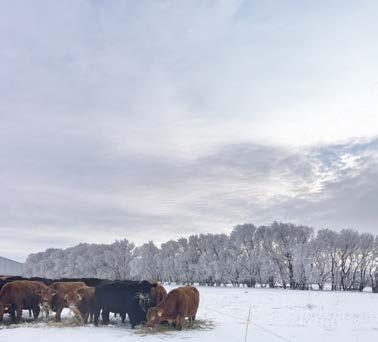
If your herd’s breeding season starts well after pasture release, it can cause conception issues if the pasture is deficient. While the intent of a mid-summer breeding system is to work in harmony with the environment, it can occasionally work against successful conception.
Normally, a cow will flourish once it is introduced to pasture, because energy, protein and vitamin levels are high with immature grass and legumes. However, if pasture is lacking because of previous year sward damage, the nutrition provided might not keep up with the needs for milking and reproductive tract renewal. Producers need to consider that June pasture in Manitoba will normally be very high in digestible nutrients, protein and vitamin as measured in per cent. However, the total number of pounds that can be consumed by the cow may still not meet lactating and conception needs.
To compound the problem, cows may not consume free choice salt and miner al adequately, due to mineral palatability, location of the feeder, or salt availability in the water source or saline area grasses. If your cows are consuming stored feed, they generally consume free choice mineral on a more stable basis. If your pasture is substandard, consider supplementing a grain product mixed with mineral (and salt) for 30 days before breeding. While this isn’t usually necessary, you might need to supplement the cow to bring her up to a positive energy balance to assure conception success. This can also introduce calves to eating concentrates early.
Bulls are 50 per cent of the conception process. However, because of the breed ing ratio of male to female, the bull group only eats one-twenty-fifth of the feed in preparation for breeding season. As such, preparation for the bulls breeding season
In the next issue of Cattle Country, a Manitoba Agriculture forage or livestock specialist will answer a selected question. Send your questions to Elizabeth.Nernberg@gov.mb.ca.
StockTalk for Cattle Country is brought to you by Manitoba Agriculture. We encourage you to email your questions to our department’s forage and livestock team. We are here to help make your cattle operation successful. Contact us today.

Kristen Bouchard-Teasdale Beausejour 431-337-1688 Kristen.BouchardTeasdale@gov.mb.ca
Cindy Jack Portage 204-768-0534 Cindy.Jack@gov.mb.ca
Juanita Kopp Beausejour 204-825-4302 Juanita.Kopp@gov.mb.ca
Elizabeth Nernberg Roblin 204-247-0087 Elizabeth.Nernberg@gov.mb.ca
BY: DR. TANYA ANDERSON, DVM
It is that time of year - a new year and new life on cow/calf operations as calving has begun or will begin over the next few weeks. While the unseasonably warm weather has made those night checks easier, the dampness has created health issues with scours, pneumonia and navel ill risks significantly increased.
Earlier this month I presented Calving 101 aimed for my younger and “new to calving” clientele. We reviewed knowing normal, when and how to assist calving cows and basic care for the newborn calf. In this column, I would like to review the questions to ask yourself before and while pulling a calf that help you decide if that calf comes out the back or needs the side door.
The calf is committed - head/shoulders out but is stuck. You got the calf out but it is unable to get up. Calf was lively when you started pulling and now is flat out with a heartbeat but won’t breathe. The cow or heifer is down. The calf puller broke or bones snapped. These are just a few of the nightmares of a calving gone wrong. Before and during pulling a calf, you must answer the question - “Is it too big?”
Calf pullers are a necessary evil at calving time. Yes, they do exert over 2000lbs pressure but if they are used properly, they save cows, calves and your back. While two strong men pulling is considered “gold standard,” most calving operations don’t have that option. Use your hands and eyes along with the puller and ask yourself the following questions as you start your examination.
1. Can you put your hand in over the top of the calf while exerting pressure with the puller?
If there is room, you should be able to put a hand over the top of the calf’s head/neck as it enters into the bony pelvis. Remember that the shoulders are the “widest” part of the calf - they should not be bulging into the pelvis but they will fill the pelvis as the calf fully enters the birth canal. To better assess this, push down on the puller as you are feeling inside so you can see how the calf is fitting. Remember that natural birthing takes a couple of hours as the vagina stretch-
es. You may have to pull then let off and repeat to get more natural stretching.
2. Do the legs keep crossing over as you are pulling?
Unless the calf is quite small, most calves start the birth process with the toes close together and then slightly crossing as the head and front feet enter the birth canal. As the vaginal tissues stretch, the toes will straighten out. If the shoulders are tight coming into the pelvis, the toes get pushed together and will keep crossing as the shoulders try to squeeze in. This is a flag that the calf is on the large size.
3. Is there lubrication?
The difference between a very hard pull or an easy assist can be lubrication. Dead or decomposing calves, delays after the start of Stage 1 labour or repeated attempts to sort out malpresentations mean less natural lubrication. Use ample amounts of an obstetrical lubricant to minimize damage to the cow and calf.
4. Does the head keep coming with the front legs as you pull?
If the head won’t come into the pelvis with the legs, the calf may be too big. Sometimes the neck needs to be straightened or the nose tipped up to line things up better. But sometimes there is just not enough room. Using a head snare to keep guiding the head into the pelvis as you are pulling can allow you to better assess if the calf will fit. Dead calves often have heads that won’t enter the canal as well - they lack muscle and just flop around. If the head keeps going back with a heifer calving, that means a very hard pull is likely and a cesarean is needed.
5. Is the calf backwards (as in the head will be the last out)?
When starting to pull a backwards calf, be sure to angle the calf puller slightly upwards and reach in to ensure that the stifle does not hook on the front of the pelvis. Sometimes the hips need to be pushed ahead to allow the hindlegs (and thus the stifle) to straighten out. If the stifle locks on the brim of the pelvis (whether pulling frontwards or backwards), the femur bone remains vertical and will snap if you keep trying to pull. These calves seem solidly stuck yet there is lots
of room as you reach in. Pushing the stifle back off the pelvis then allows the leg to straighten out and the calf can easily be pulled. Once the hips start to come in, feel in to ensure that the top of the hip can enter without pressure. The muscles of the hip should never be bulging as they enter the pelvis - if so, that calf is too big. If too tight, the hip joint can be damaged if the head of the femur (the “ball” of the hip joint) breaks. Occasionally nerve or muscle damage can occur resulting in permanent lameness. Hiplocks are also a common reason for obturator nerve paralysis on the cow.
6. How fast is too fast when pulling?
Backwards calvings are an exception - once the birth canal is stretched and the hips have entered into the pelvis, pull fast - going straight out until the mid-ribcage and then angling downward. Once the umbilical cord starts getting pinched by the pelvis, this will stimulate the calf to try to start to breathe. Remember that the breathing end (head) of a backwards calf is the last part out. Get him out fast to minimize meconial aspiration. But be careful to ensure that you don’t start to angle downward too soon and catch the ribs on the pelvis leading to possible rib fractures.
If the calf is coming frontwards, it is best to try to pull in synchrony with pushing by the cow. This helps stretch out the birth canal and minimizes damage to both the cow and calf. Once the calf’s chest is out or if a harder pull and the calf is sticking at the hips, take a break and get the calf breathing. Then you can work to get the calf out. Also remember that there is no need to immediately pull the calf away from the backend of the cow once it is born. Allow the umbilical cord to naturally contract down on its own and allow the feet to remain inside the vaginal canal to minimize the risk of a uterine prolapse.
Never hesitate to reach out to your veterinarian or an experienced neighbor when dealing with a calving crisis. Calving cows is a skill - you won’t get better without asking questions and learning from experience. Here’s hoping for an uneventful calving season!

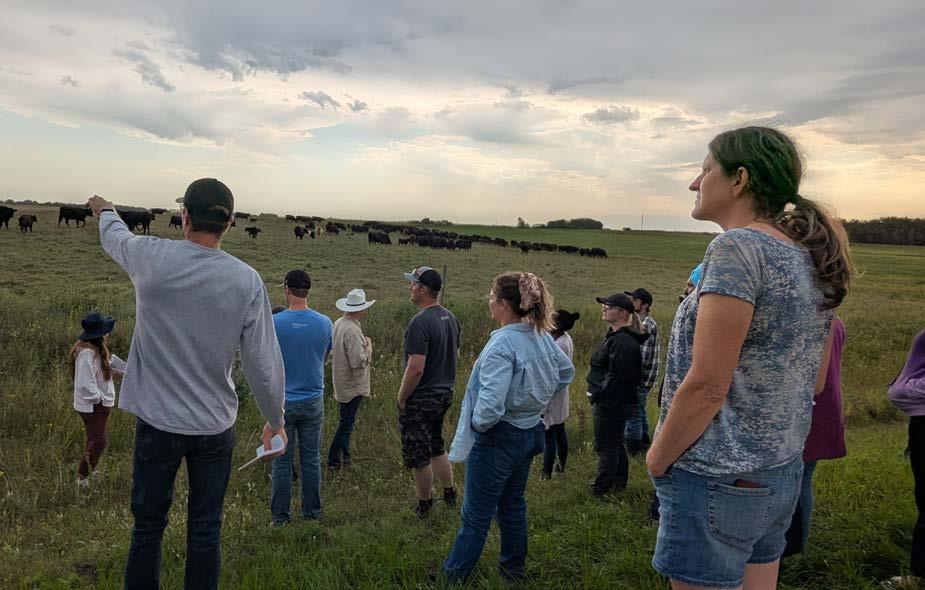
WRITTEN BY PETER FROHLICH, NATIONAL CENTER FOR LIVESTOCK AND THE ENVIRONMENT AT THE UNIVERSITY OF MANITOBA WITH CONTRIBUTIONS FROM MELISSA ATCHISON, MANITOBA BEEF PRODUCERS AND DUNCAN MORRISON, MANITOBA FORAGE AND GRASSLAND ASSOCIATION.
In its second year, the University of Manitoba (UM)-led LEAP project (Leveraging Ecosystems to transform Agriculture on the Prairies) is creating opportunities for researchers and producers to work together to develop more sustainable farming systems. The project is generating information, tools and management practices to co-design resilient and profitable net-zero emissions farming systems using perennial cropping strategies – and systems that mimic features of perennial systems – including those that integrate livestock production.
University of Manitoba researchers and collaborators at the University of Saskatchewan, along with numerous industry stakeholders have been exploring five interconnected research pillars including: (1) farmer leadership, emphasizing co-learning and mental health in sustainable decision-making; (2) First Nations self-determined farming systems, elevating Indigenous knowledge and governance; (3) landscape analyses of farmer-led practices in annual and perennial cropping, as well as “in-between” systems such as cover cropping; (4) use of experimental field studies testing novel integrations of cover crops, intercropping, pollinator habitats, and livestock; and (5) scenario modelling using the Holos platform to assess system-level greenhouse gas (GHG) outcomes and trade-offs.
This novel project is receiving funding through the Natural Sciences and Engineering Research Council of Canada (NSERC) and is already demonstrating its value to producers and project partners. LEAP is validating the ecological contributions of cattle production
Ecological contributions are ways in which individuals, communities, societies, and in this case cattle, contribute to the health and sustainability of the environment. The LEAP project is helping to quantify how systems that include perennial forages or cover crops influence biodiversity, soil carbon, hydrology, and ecosystem services. We recently checked in with Melissa Atchison, Research and Extension Specialist with the Manitoba Beef Producers (MBP) and Duncan Morrison, Executive Director of the Manitoba Forage and Grassland Association (MFGA) to get their perspective on the opportunities this project brings to their organizations.
Atchison says that gaining new insights into how grazing systems interact with broader ecological processes at the landscape scale is important as it strengthens MBP’s policy and advocacy work by
providing credible, region-specific evidence about the ecological contributions of beef production. The results from the research also help MBP align its long-term organizational planning with emerging challenges and opportunities. Atchison adds that this project also demonstrates how interconnected the health of prairie ecosystems is with the viability of beef operations, reinforcing the need for continued collaborative research and communication between all stakeholders.
Assessment of best management practices… now and in the future
Insight regarding the environmental sustainability of best management practices that producers are interested in adopting is important to MBP, and the LEAP project is designed to explore just that. Modeling activities offer the opportunity to understand how different management practices or climatic conditions may affect environmental outcomes now and in the future. Atchison says that MBP hopes to use these insights to guide future programming and to support adaptive management strategies for producers. Furthermore, these modelling activities, together with the ecological insights generated by the project, may inform MBP’s involvement in programs such as Verified Beef Production Plus, ecosystem service markets, carbon programs, or prairie conservation initiatives.
Atchison adds that overall, the LEAP project activities provide MBP with a clearer understanding of how beef production systems contribute to prairie ecosystem function—and how this value can be better communicated, measured, and supported. The co-design approach to the LEAP project where research and project partners are interacting throughout the project provides MBP with the opportunity for input, as well as early access to emerging data and methods, allowing the organization to contribute to evolving environmental policy and market demands related to sustainability.
Transdisciplinary approach to research is showcased in LEAP
The LEAP project is unique in that it offers a holistic approach to study and understand the current status and future benefits of incorporating perennial practices in prairie agriculture. The project addresses perennial agriculture as a whole system, integrating ecological, social, economic, and cultural dimensions, and functions across and beyond academic disciplines with non-academic partners.
Duncan Morrison with MFGA says that the
benefits of the project are vast. Board chairs and producers that are working with MFGA appreciate the transdisciplinary approach of the project and the thorough broad range of topics being explored by the researchers. The LEAP project is generating a large amount of information that will be of use to many stakeholders. MFGA activities focus on regenerative agriculture and strategies to enhance soil health, biodiversity, and climate resiliency in the face of varied climatic scenarios—topics that are also explored in the LEAP project.
Producers are excited to be at the table resulting in a co-design approach to research
The LEAP project emphasizes producer input and includes a co-design and a co-learning approach where producers’ perspectives, representing real world production realities, contribute to the research design. Some of the tools used to engage with producers in the project include online communications, questionnaires, one-on-one interviews and group discussions. The project also engages Indigenous farmers, land managers and community members where researchers participate in Advisory Circle gatherings that are used to encourage open dialogue and knowledge sharing. In the spring of 2025, farmer priorities were identified through a producer survey, and these perspectives are now helping to guide the research objectives of the project.
Morrison says that this co-design approach drew MFGA into this project. The opportunity for producers to be at the table and share their experience and expertise about on-farm practices with the researchers sets this project apart. He adds that for this project to be successful, the information needs to flow both ways— researchers need input and stakeholders need information to come back to them. Producers feel the co-design approach used in the LEAP project is on the right path. They appreciate the high level of communications back to producers through updates and meetings organized by the LEAP team. Producers, commodity groups and researchers are learning from each other, bring their strengths to the table, and work towards a common goal. Their collaborative efforts have already resulted in development of connections and trust between the industry and the research community, working together to create more sustainable farming systems.
For more information on how to be a part of the project and the other researchers and partners involved in LEAP, please visit: www.umanitoba.ca/ agricultural-food-sciences/leap
(Makes about 4 servings)
Ingredients:
Dan Dan Sauce:
2 Tbsps Peanut Butter
¼ Cup Black Rice Vinegar (or Rice Vinegar)
2 Tbsps Soy Sauce
1 Tbsp Tahini
2 Tbsps Cilantro, chopped
1 tsp Garlic, minced
1 Tbsp Ginger, minced
2 tsps Chinese Five Spice
1 tsp Sambal Oelek (Chili Paste)
1 ½ Cups Beef Broth
2 Tbsps Honey
275g Somen Noodles (3 bundles)
1 tsp Canola Oil
1 lb Ground Beef, lean
3 ea Baby Bok Choy, chopped
1 medium Carrot, julienne
½ Medium Red Onion, sliced
5-6 ea Mushrooms, sliced thick
Toppings:
Peanuts, roasted and crushed
Slivered Green Onions Chili Crisp
METHOD:
1. Using a blender or immersion hand blender, blend all ingredients for Dan Dan Sauce until well combined. Set aside until required.
2. Cook somen noodles according to package directions. Rinse with cold water and set aside until required.
3. In a large, tall-sided non-stick pan or wok, heat oil over medium high heat. Brown ground beef until evenly browned with some crispy bits.
4. Add onions and mushrooms and continue to saute until just softened.
5. Then add carrots and bok choy and continue to cook for another 3-4 minutes until all the vegetable are softened.
6. Add Dan Dan Sauce and bring to a low simmer. Lower heat to medium low and simmer for about 5-6 minutes.
7. Stir in cooked somen noodles and serve while hot.
8. Top with desired amount of toppings.

BY: ANNA HYMERS, MBP FOOD EXPERT
As a recipe developer, I’m always looking for ways to put a fresh spin on classic dishes while championing locally raised, high-quality beef. Comfort food is where I really thrive, and for me, nothing beats a big bowl of saucy, slurpable noodles. Many global cuisines do this exceptionally well, and this recipe takes inspiration from Sichuan-style dan dan noodles—bold, spicy, and unapologetically flavourful.
Traditionally, dan dan noodles are built with a spicy sauce, chili oil, pickled vegetables, ground pork, and scallions spooned over thin wheat noodles. I took a few liberties (as one should in the kitchen). I added extra vegetables, because I unapologetically love vegetables, and swapped in lean Manitoba ground beef. Its rich flavour stands up beautifully to the punchy ingredients while keeping the dish hearty, balanced, and proudly local.
Every ingredient here earns its place. Black rice vinegar was a new-to-me addition and quickly became a favourite. It’s deeper and more complex than standard rice vinegar, with a richness that falls somewhere between soy sauce and vinegar. I found it among the Asian condiments at Superstore, but if you can’t track it down, regular rice vinegar works just fine.
Chinese five spice is another standout. This aromatic blend of Sichuan peppercorns, fennel seed, Chinese cinnamon, star anise, and cloves brings warmth, subtle sweetness, and a hint of licorice. If you love black jujubes, you’ll be right at home. And if you don’t (I’m firmly in that camp), trust me, you’ll still love this flavour combo.
Heat comes from sambal oelek, a chili paste that packs a punch. The recipe calls for just a teaspoon, but feel free to dial it up if spice is your thing. If you go a bit too far, a drizzle of that Manitoba honey will bring things back into balance. Chili crisp—an essential finishing touch—adds its own heat and crunch. You can buy it locally or make your own, and once you have a jar, you’ll find reasons to put it on everything. It’s part of what makes dan dan noodles dan dan noodles
I used sōmen noodles for this dish. They’re thin, slightly chewy, and cook in under two minutes. While I’d normally never suggest rinsing pasta, these noodles benefit from a quick cold-water rinse to stop the cooking. The goal is tender noodles that are ready to soak up all that sauce.
Finally, let’s talk vegetables. Baby bok choy adds freshness and crunch, while broccoli florets are another great option. As my spouse likes to say, “their little fingers soak up all the sauce”—which is exactly
what you want. Enjoy—and don’t forget the napkins.