For many years Harris’s famous morning reviver was served over the counter as a remedy, post-revelry, for the roisterous and bibulous of London’s St James’s. With its tinctures of gentian, cinnamon, clove and ammonia, it was the head-clearing jolt needed to start the process all over again. Now, revived as a cocktail bitters, this new version of The Original Pick-Me-Up is no less effective, but a touch more palatable.
STARTER
Maserati Umberto Panini Collection, new Concours des Légendes, Nichols N1A on-track, 250 GTO price shock, Miura at 60 and more
ASTON DB4 GT BERTONE JET
Designed by a very young Giugiaro, the Bertone Jet offered a fresh and stylish take on Aston’s DB4 GT
LE MANS LEGEND REIMAGINED
David Lillywhite speaks to the people behind the GM SV S1 LM – the car credited with saving Gordon Murray’s life
HISPANO-SUIZA H6C BOULOGNE
The spectacular, full-circle restoration story of the Glen Kidston 1924 Hooper-bodied Hispano-Suiza
A close look at several prized items from Dario Franchitti’s personal collection of Jim Clark memorabilia
JIM CLARK COLLECTION
VALLELUNGA PROTOTYPE
Prior to the Pantera and the Mangusta, Fissore built this aluminiumbodied Vallelunga – De Tomaso’s first road car
LEONARDO FIORAVANTI
Before a string of striking own-brand concept cars, Leonardo gave post-1960s Ferraris the stylistic edge
CHEVROLET
XP-800 ASTRO III
Created at a time when the far future seemed mere years away, this was GM’s telescopic look into jet-age travel
TOP 50 MOTOR SPORT LIVERIES
The sponsors, visual associations and team colours we all remember long after the chequered flags were waved
ACQUIRE
Buying a Ferrari 360, collecting drinks posters, peerless art by the late Michael Turner, watches, products, book reviews and more
204 THE LAWYER: PERFECT PROJECT? 206 THE CURATOR: BUYING UP 208
THE DESIGNER: CONCEPTS LOST
THE INTERVIEW: GÉRARD NEVEU 124
Crafted by hand. Defined by detail.
The R810 MiE Radiogram is a masterpiece of design and sound. Each piece is hand-built in England, adorned with exquisite marquetry in Penta-Chord Walnut or Leaf-Line Oak, and finished with a lustrous lacquer that takes weeks to perfect. Limited to just 50 of each finish, every unit is a rare work of art—crafted for those who demand the extraordinary.
Reserve yours today and own a legacy of luxury.
SCAN
ME
R810 MiE – The Pinnacle of English Audio Artistry ruarkaudio.com
LEFT Which cover have you gone for?
Martini, JPS or Gulf? Of course, we’d respectfully suggest that you collect one of each...
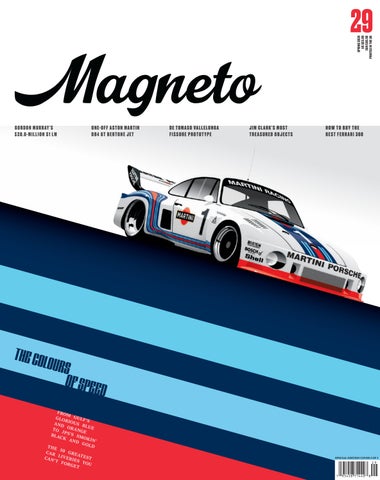
You’ve probably realised by now that we have a tendency to make our lives a little difficult here at Magneto. So, why have one front cover when you can have three?
It wasn’t that we couldn’t choose which of the illustrations to use – it’s just that we loved them so much, we wanted to share more of them. They’re by renowned artist Ricardo Santos, and there are plenty more for you to see in the Top 50 Motor Sport Liveries feature.
Sticking to the ‘difficult’ theme, we were blown away by the Gordon Murray Special Vehicles S1 LM full-size styling model when we first saw it at a private viewing during Monterey Car Week last year. It’s extremely challenging to move around but, thanks to the Petersen Automotive Museum, we were able to photograph it to stunning effect on the facility’s roof. Why try so hard? Because Gordon Murray credits this car with getting him through tough cancer treatment. His wife says it saved his life.
We like to bring you special stories, however tricky they are to arrange. The one-off Aston DB4 GT Bertone Jet, the prototype De Tomaso Vallelunga by Fissore and Simon Kidston’s miraculously restored Hispano-Suiza in this issue also fall into that category.
Oh, and we have launched a new event! It’s a cross between a concours and a literary festival, bringing all those amazing car stories to life at last. It takes places on June 19-21 at Wilton House in south-west England. We think you’ll love it. Details on p28.
David Lillywhite Editorial director
STEPHEN ARCHER
As an Aston Martin historian, writer, author, owner, restorer, racer, tester and veritable marque authority, there are few people better equipped to write about one of the rarest Astons ever conceived. Here, Stephen follows the fascinating flight path of Giugiaro’s DB4 GT Bertone Jet.
PIOTR DEGLER
An acclaimed photographer and a qualified car designer, Piotr’s Made in Italy book is an extraordinary visual portrayal of legendary Italian concepts from Fiat, Pininfarina, Ferrari and others. In creating it, he met most of the automotive design masters – including the great Leonardo Fioravanti, profiled here.
DARIO FRANCHITTI
Three-time Indianapolis 500 victor, four-time IndyCar champ and Daytona 24 Hours winner Dario’s racing hero was fellow Scot Jim Clark. Now executive product and brand director for Gordon Murray Automotive, Franchitti’s admiration for and personal connection to Clark has not waned.
JAMES LIPMAN
Based in California, ‘Jamie’ is a prolifically talented automotive photographer who aims to “capture resonant moments in real-world environments amidst the visual noise around us”. We knew he’d be the perfect candidate to shoot the new GMSV S1 LM on the roof of LA’s Petersen Museum.
1954 Mercedes-Benz
300 SL Gullwing Coupe
Estimate: $1,400,000 - $1,800,000 OFFERED WITHOUT RESERVE
Estimate: $1,300,000 - $1,600,000 OFFERED WITHOUT RESERVE
Estimate: $1,100,000 - $1,400,000
Deputy editor Wayne Batty
Marketing manager
Rochelle Harman
Editorial director
David Lillywhite
Creative director Peter Allen
Features writer
Elliott Hughes
Marketing and events
Hannah-Maria Ward
Managing director
Geoff Love
Managing editor
Sarah Bradley
Designer Debbie Nolan Accounts
Advertising sales Sue Farrow, Rob Schulp
Jonathan Ellis, Sarah Dilley
Lifestyle advertising
Sophie Kochan
Contributors in this issue
Advertising production Elaine Briggs
Stephen Archer, James Brown, Jonathon Burford, Simon de Burton, Sam Butcher, Nathan Chadwick, Sam Chick, Robert Dean, Piotr Degler, Massimo Delbò, Richard Dredge, Dario Franchitti, Martyn Goddard, Rick Guest, Richard Heseltine, Jamie Lipman, John Mayhead, Clive Robertson, David Rodríguez Sánchez, Ricardo Santos, Amy Shore, Dean Smith, Peter Stevens, Joe Twyman, Steve Wakefield, Rupert Whyte
Single issues and subscriptions
Please visit www.magnetomagazine.com or call +44 (0)208 068 6829
Geoff Love, David Lillywhite, George Pilkington Unit 16, Enterprise Centre, Michael Way, Warth Park Way, Raunds, Northants NN9 6GR, UK
Printed on Amadeus Silk and Galerie Fine Silk supplied by Denmaur as a Carbon Balanced product. Made from Chain of Custody certified and traceable pulp sources
Who to contact
Subscriptions rochelle@hothousemedia.co.uk
Events hannahmaria@hothousemedia.co.uk
Business geoff@hothousemedia.co.uk
Accounts accounts@hothousemedia.co.uk
Editorial david@hothousemedia.co.uk
Advertising sue@flyingspace.co.uk or rob@flyingspace.co.uk
Lifestyle advertising sophie.kochan2010@gmail.com
Advertising production adproduction@hothousemedia.co.uk
Specialist newsstand distribution Pineapple Media, Select Publisher Services
The making of Magneto
PROTOTYPES AND PILOTS
Knowing we’d be shooting this issue’s 1964 De Tomaso Vallelunga around the historic Barnsley Main Colliery, we asked drone specialist Sam Butcher to take advantage of the structure’s towering headgear. We tensely watched him inch the camera around the steel framework in a gusty wind. “It’ll be worth it,” said Sam, taking it all in his stride. He was right.
IT’S BEEN FAR TOO LONG
Among the £7 million-plus worth of cars on display at the recent International Historic Motoring Awards, was this issue’s one-off 1960 Aston DB4 GT Jet designed by a young Giorgetto Giugiaro while at Bertone. After accepting the prestigious Lifetime Achievement award, Giugiaro stared intently at the car, musing that he hadn’t seen it in more than 60 years.
ISSN Number 2631-9489. Magneto is published quarterly by Hothouse Publishing Ltd. Registered office: Castle Cottage, 25 High Street, Titchmarsh, Northants NN14 3DF, UK.
Great care has been taken throughout the magazine to be accurate, but the publisher cannot accept any responsibility for any errors or omissions that might occur. The editors and publishers of this magazine give no warranties, guarantees or assurances, and make no representations regarding any goods or services advertised in this edition.
NEW EVENT! CONCOURS DES LÉGENDES
This is our new event, taking place on June 19-21, 2026 at Wilton House near Salisbury in south-west England. It’s best known as the location for TV series Bridgerton but has also hosted car events for years. This one is different, though, with talks and forums throughout the three days from famous names in the car world. Visit www.concoursdeslegendes.co.uk.
SIGN UP TO OUR EMAIL NEWSLETTERS
Magneto’s Weekly Briefing is a curated regular package of the news, features, event reports and previews that matter most to classic and collector car audiences. Meanwhile, our fortnightly Market Briefing previews upcoming events and adds expert analysis of auction results and prevailing market trends. Sign up at www.magnetomagazine.com
VISIT THE MAGNETO WEBSITE
The Magneto website reflects our love for the very best, the rarest and the most special production, prototype, competition and concept cars of every age. For all the news, features, reviews and event reports from the classic and collector car world, plus special offers, upcoming events and buying guides, visit www.magnetomagazine.com
SUBSCRIBE TO MAGNETO
Don’t miss out on any issues of Magneto magazine. You can subscribe for one year for £54 including p&p (€62 or $68, plus postage), or two years for £94 including p&p (€108 or $120, plus postage). Magneto is delivered worldwide in strong cardboard packaging. Please visit www.magnetomagazine.com or call +44 (0)208 068 6829.
Saving Modena’s crown jewels
The Maserati Umberto Panini Collection has been relocated and revitalised. Its origin story is just as dramatic as that of the marque it’s dedicated to
“GIUSEPPE, MY FATHER’S ELDEST brother, had died a few months earlier. He was very connected to Modena,” recalls Matteo Panini. “My father said, ‘In my dream, Giuseppe appeared. He said, “Umberto, you must save i rottami.”’ Rottami means something rusty or old – basically, the old cars. ‘You must go for the city,’ Giuseppe insisted.”
Nearly 30 years later, the Maserati Umberto Panini Collection has been relocated and revitalised with new energy. However, the story of how the Paninis acquired the collection in 1996 has enough drama to rival the Puccini operas performed at Modena’s Pavarotti-Freni Theatre.
The tale begins in 1993, when Maserati owner Alejandro de Tomaso suffered a stroke. In the aftermath, Fiat bought the company outright –but not, as it would find out, all of the
THIS SPREAD
marque’s elements. A collection that included 19 cars, among them a 6CM, a Pinin Farina-bodied A6GCS, an A6G/54 Allemano, a 5000 GT Allemano, a Tipo 61 Birdcage and the Stirling Moss ‘Eldorado’ 420M/58 – and a lot of engines, all stored at the Maserati factory.... these were not part of the deal.
The collection had been assembled by the Orsi family (Adolfo Sr and his son Omer) over the years, and in 1965 they inaugurated the Maserati Museum, the first in the Motor Valley. “It grew into a repository of historical vehicles, spare parts and archival material,” the present Adolfo Orsi says.
However, in the fraught days, weeks and months after Fiat bought into Maserati, nobody seemed to notice that the collection had been otherwise transferred in a share deal, to a company called West SRL. “When
The Maserati Umberto Panini Collection has its roots in the Maserati Museum established by the Orsi family in 1965.
Words Nathan Chadwick
Photography Lorenzo Marcinno
THIS PAGE This reconstruction of a 450S was donated to the museum by a local family. It was built 30 years ago with an authentic engine (no. 4516, originally intended for marine use) and gearbox.
I saw representatives from Sotheby’s, Christie’s and Brooks around Modena, I wondered why they were all there,” Adolfo recalls. “So I made my way to Maserati and asked a couple of people, who told me that de Tomaso was already in contact with these auction houses regarding a potential sale.”
This is where a young Simon Kidston enters the story, having joined Brooks in the summer of 1996 to start its European operation. “One of the first projects, or rather scraps of paper, Robert Brooks gave me was a scribbled name and a number: ‘Call this chap. He’s representing Mr de Tomaso, who wants to sell a collection of Maseratis,’” Simon recalls. “The name was Mario Tozzi‑Condivi. I did not know much about his background, but he had already been a Maserati agent in the UK for many years.”
In late September, Kidston flew to Modena to meet with Tozzi‑Condivi, de Tomaso and his wife Elizabeth ‘Isabelle’ Haskell in the basement restaurant of the Hotel Canalgrande, where de Tomaso had lived for much of his stewardship of Maserati.
“De Tomaso was weakened by his stroke, but strong willed; nobody could push him into something he didn’t want,” Simon recalls. “Almost like a character from a Bond movie –frail, but still in the driving seat. His wife did most of the talking. He listened to advice but knew what he wanted for the cars. Later that day
Maserati factory archivist Ermanno Cozza showed me the collection in storage. He’s a charming man but was clearly sad they’d be leaving. He knew Fiat had been offered the chance to buy them but didn’t have the funds.”
“When Eugenio Alzati arrived in Modena to take charge of Maserati, he inherited a company that was, in practical terms, dead,” Adolfo explains.
“There was no money, of course, but the deeper problem was that the passion which had sustained the marque evaporated. Every door Alzati opened revealed yet another problem left behind by Alejandro de Tomaso.”
“Nobody in Turin cared about Maserati,” says Matteo. “Within two days, de Tomaso took all the cars out and announced that he would sell them at auction because Fiat wasn’t interested. Maserati moved slowly, like an elephant.”
Some believe this was just typical de Tomaso grandstanding, and that the deal had already been done. Either way, the date was set for the Brooks London auction on December 2, 1996.
But what of the cars themselves?
“There were 19 in total, mostly unrestored, although the A6GCS and Birdcage had been,” Simon recalls.
The news spurred Adolfo Orsi into action. “My family didn’t keep the museum for themselves when they agreed to sell the company to Citroën – they could have said, ‘Alright, we’ll sell you the cars, but we’ll keep the
THIS PAGE 1936
6CM (above) was designed to take on British monopostos, while 420M/58 ‘Eldorado’ one-off (right, flanked by 1957 250F) was built for Stirling Moss to compete in the 1958 500 Miglia
museum collection,’” Adolfo says. “My family felt they were part of the firm’s heritage. After 25 years, it was upsetting to see someone attempt to exploit that decision for their own gain.”
Orsi set about saving Maserati’s crown jewels for the nation: “I prepared a booklet explaining the situation, and I sent it to the Italian Minister of Culture. I tried to keep everything confidential to avoid alarming de Tomaso, because if he had realised there was an attempt to block the collection from leaving Italy, he would have immediately moved the cars abroad.”
Adolfo continues. “However, a car collector at the time, Franco Lombardi, published an article making it public that de Tomaso was offering the collection. On October 15 I sent the information to the Minister, and on October 18 I decided it was the right moment to apply pressure on de Tomaso through the Modena press, since he was based there.”
Articles soon appeared in the local media. “The mayor was actively involved, and even members of the Italian Parliament had asked questions about the situation,” Adolfo recalls. He engaged collectors, experts, museums and journalists from both the classic car world and the wider cultural sphere to sign a document protesting the plans. However, there were a few notable absentees: “I also reached out to Luca Montezemolo, then president of the Association of Modenese Industrialists, and Piero Ferrari, yet they declined to sign. Neither gave a reason, but it seemed they did not want to act against Fiat.”
At the time, Italian law dictated that
di Monza.
Government permission was necessary for the export of collectables, artworks, sculptures, paintings and similar items. However, when the Minister of Culture in Rome replied, it said it was not interested in the whole collection.
“The only item under scrutiny was the 6CM Monoposto, because it dated from 1936 and was therefore 60 years old. The minimum age required for export control was approximately 70 years, and the other items were even younger. Consequently, no export restrictions applied, and the authorities concluded that there was nothing to be done,” Adolfo says.
For Simon, time was of the essence – he had heard of the objections while at a friend’s wedding at Villa d’Este. “We had a contract with de Tomaso, but not the cars, which were already part of a big marketing campaign. Having a high-profile vendor change their mind is an auctioneer’s nightmare. We had to find a local transport company at short notice to get the cars to England. They were loaded in darkness onto three open trucks and driven through the night to Brooks’ HQ in London, arriving two days later in the rain,” he recalls.
“We had agreed reserve prices which today make you smile: from memory, the A6GCS Berlinetta was £175,000. Collectors were already converging on our Clapham warehouse to view them. The December auction was looking like a knock-out event.”
Back in Italy, the pressure was on. After the Italian Government refused to get involved, things would fall to a private individual – Umberto Panini.
As Matteo Panini recalls: “Francesco Stanguellini came to the farm, as he often did, to visit my father. He asked, ‘Did you know that de Tomaso is planning to sell all the Maseratis?’
The next day was when my father came to me and said, ‘I had a dream.’”
That is where we came in: to understand Umberto’s motives, you have to understand the man. He made his name with the Panini footballsticker albums before moving into farming. However, as with many in Modena of his generation, the city’s industrial heritage was imprinted on his bones. “My father’s first job was at Fabbrica Candele Maserati, the sister firm that made the motorcycles. It
‘My father saw beyond a piston, cylinder or carburettor. He saw the soul of Modena’
gave him his first pay packet, enough to buy a newspaper or some bread,” Matteo says. “That small beginning marked his entry into manhood.”
He continues: “Modena in those years was a strange mixture of deep Catholic tradition and industrial obsession. You could walk from the cathedral straight into the workshops where crankshafts, radiators, precision tools and racing parts were being machined. I grew up breathing that air. When the future of Maserati’s historic collection came under threat, it was impossible for us to remain indifferent.”
Umberto asked Matteo to handle the initial negotiations. He rushed to de Tomaso’s lawyer, Mr Brancaccio, at 6:00pm. “I introduced myself not as a collector sniffing around a bargain, but
as someone who understood what these cars meant to the city,” Panini explains. “The urgency was real. The cars were already in England, ready for auction. Brooks had obligations to the sellers, and we had to deal not only with de Tomaso but also with those representing him, including his notary.”
Within days, Matteo delivered the deposit in person: “We reached an agreement on the condition that 50 percent of the auction premium be shared with de Tomaso via Brooks, since withdrawing the cars would have forfeited the usual commissions.”
Within a week, the cars were back in Modena, much to the frustration of Simon Kidston. “We grew up together; he was very young, like me,” Matteo laughs. “He was really angry with my family, especially my father, because for Simon this was a huge job.”
“Any auctioneer whose star lots are withdrawn is inevitably disappointed, but I managed to unearth a good 250F in Padova as a replacement cover car,” Simon smiles. “The Paninis have since become good friends and clients, and Adolfo has remained a friend since long before this adventure. It was high drama at the time, but it worked out.”
The Panini family did not even see
the cars before buying – everything was arranged by telephone. “We owe a huge thanks to Ermanno Cozza and Ardilio Manfredini, who guaranteed everything was okay,” Matteo says. “At the time, the purchase cost was over four billion lire – roughly €8 million today – a huge sum, especially in a Communist area of Italy.”
Prior to that dream, the Paninis had no real connection to the 1990s Maserati: “For my father, it was an act of gratitude: thanks to Maserati for giving him a job, for giving him the chance to become a man. For me, it was about the city, to open a museum.” Adolfo vividly recalls the intensity of those weeks. “There were late nights, letters to racing drivers and designers, and co-ordination with the mayor and other authorities. It was challenging but rewarding. Older drivers such as Jim Hall and Cesare Perdisa, as well as designers from Pininfarina and other studios, responded positively to requests for support,” he says. “In the end, the Maserati heritage was preserved. The museum and its collection remained intact, and the cars stayed in Modena, a testament to both the city and the commitment of everyone involved.
“Umberto was dubious about the value; I told him just two cars covered the price. I convinced Eugenio Alzati to buy the engines – Maserati still owns them today – and the deal was closed.”
“My family simply felt a duty – both to our own past and to the city that shaped us,” says Matteo. “It was clear that if we did not intervene, those cars would have been scattered in private collections across the world. Instead, they stayed together. They stayed in Modena, and they remain there today. I dream that beyond the mechanical history, our visitors will take home the memory of a young man, my father, who in blue overalls with a trident on his chest was fortunate enough to see beyond a piston, cylinder or carburettor. He saw the soul of Modena.
“Whenever I walk through the collection, I feel not pride but relief. Relief that we acted when it mattered. Relief that Modena still has its history. Relief that the story did not end in an auction hall in England. And, above all, relief that we listened to that dream.”
More at www.paninimotormuseum.it.
Join us at our exciting new UK event
June’s Concours des Légendes at Wilton House will offer a spectacular new slant on the traditional highend classic car show
ON JUNE 19-21, 2026 WE WILL BE running an all-new event, Concours des Légendes, at Wilton House near Salisbury in the UK’s south-west. It will be high-end car show meets literary festival, focused as much on the people as the cars.
Wilton House is the ancestral home of the 18th Earl of Pembroke, better known as petrolhead Will Pembroke in the car world. He has owned a wildly varied selection of machinery including a Bugatti Veyron, and his current stable ranges from a LowChassis Invicta to a Nissan GTR.
Wilton House already hosts the popular Wilton Wake Up breakfast club car events, and it is also known for its highly successful Wilton Classic & Supercar Festivals that it hosted a few years ago. However, Concours des Légendes is something different, concentrating on the fascinating stories of the car world. There will be guest speakers, spectacular cars and motorcycles, motoring art and even a display of some of the most important Formula 1 crash helmets of the past four decades.
Crucially, there will be on-stage talks in covered marquees on many of the cars, bikes and art. We will have
plenty more special guests to announce, but some of those already confirmed include 1970 Le Mans winner Richard Attwood, Formula 1 driver-turned-artist Stefan Johansson plus designers Peter Stevens, Wayne Burgess and Ken Okuyama.
Auction house Dore & Rees will be running three sales, for classic cars, automobilia, and watches and jewellery. It will also be bringing along stars of popular BBC programme Antiques Roadshow to talk with guests.
All this in the magnificent Wilton House and its extensive grounds.
Visitors will be able to tour the house, famed not only for its renowned art collection – including works by Rembrandt, Van Dyck and Rubens –but also for its use as a set for TV dramas Bridgerton and The Crown, along with many films such as Mrs Brown, Pride & Prejudice, Tomb Raider and Johnny English Reborn
ABOVE Historic Wilton House in Wiltshire will be the backdrop for exciting new event Concours des Légendes.
‘High-end car show meets literary festival, focused as much on people as cars’
There will also be the chance to have the story of your car told on stage, with Hagerty-sponsored Car Stories. If you have a model with an interesting history – whether related to you or further back in its life – then please email us at the address below.
Most of all, this is intended as a relaxed, entertaining and interesting alternative to the usual car events.
Adult tickets will start from £65 per day, plus concessions. For commercial partnerships, or to nominate your car for display or for one of the Hagerty Car Stories, please email info@ concoursdeslegendes.co.uk.
Please see www.concoursdeslegendes. co.uk for tickets and more information.
Photography Amy Shore
1963 FERRARI 250 GT LUSSO
Beautifully Restored in Original Grigio Fumo Livery Coachwork by Scaglietti I Chassis 5127 GT
1974 FERRARI DINO 246 GTS
Formerly the Property of Noted Architect Craig Ellwood I Factory “Chairs and Flares” Example in One-Off Color of Porsche Signal Orange Coachwork by Scaglietti I Chassis 08062
1957 MERCEDES-BENZ 300 SL GULLWING
Late-Production Model
Concours-Level Restoration
1969 LAMBORGHINI MIURA P400 S
Restored in Its Original Arancio Miura Livery Coachwork by Bertone I Chassis 4248
1955 FERRARI 750 MONZA Coachwork by Scaglietti Chassis 0522 M
1967 FERRARI 275 GTB/4
Original Color Grigio Argento over Black Ferrari Classiche Certified Chassis 10387
1960 FERRARI 250 GT SWB CALIFORNIA SPIDER
Concours-Quality Restoration by Dennison International Motorsports I Ferrari Classiche Red Book Coachwork by Scaglietti I Chassis 1963 GT
THURSDAY MARCH 5
FRIDAY MARCH 6
LIVE AUCTIONS
What does Mecum’s 250 GTO result mean for the breed?
Ex-Coombs GTO becomes the fifth most expensive car sold at auction. However, it’s not quite the success it seems
MECUM’S 250 GTO RESULT AT its Kissimmee sale in January provides an interesting marker for the breed, and for Enzo-era Ferraris in general.
The ex-John Coombs chassis 3279 sold for $38.5 million, which places it at number five in the list of the most expensive cars ever sold at auction, ahead of chassis 3851 GT. That car was first ordered by Jo Schlesser and won the Tour de France, but co-driver Henri Oreiller was killed in it at Montlhéry shortly afterwards. It was rebuilt and used in hillclimbs by Paolo Colombo, and it was later sold to Ernesto Prinoth for circuit racing.
It remained with Fabrizio Violati until 2010, before being sold at Bonhams’ 2014 Monterey auction for $38.115m. At the time that result was seen as a little disappointing, with the general view that 3851 GT’s fatal history held it back. However, $38.115m in 2014 equates to around $51m now, which puts a different complexion on Mecum’s 250 GTO.
The bidding in Florida opened at $50m, just shy of the $51.705m achieved by 250 GTO/330 LM chassis 3765 via RM Sotheby’s in November 2023. After getting no sniffs, Mecum dropped to $25m before finding its feet at $31m-$32m, with the final $35m bid (plus fees) taking nearly ten minutes. There was certainly no bidding frenzy – and we should have expected it. After all, the car had been available via private (but very public) brokerage for several years with little interest. Now, $38.5m is not an insignificant sum, but there is a view that the result is somewhat disappointing – 3279 sold for well under Hagerty’s ‘fair’
value of $47.85m. Maybe this reflects the growing change in emphasis in the collector car market? Although Mecum’s 250 GTO has a fascinating story – first owned and then raced by Coombs’ team, then given to Jaguar for technical analysis, it’d seen the likes of Graham Hill and Roy Salvadori get behind the wheel, and it was also the only 250 GTO to leave Ferrari painted white – there were a few issues.
“The car’s replacement engine, exclusively British period race history, right-hand-drive layout, unusual white paint and relative lack of restoration may have put off some US bidders,” Hagerty UK’s John Mayhead noted. “I say ‘relative’ because the car crashed out at Silverstone in 1963 and had to be significantly repaired at the time –although, as racing cars, many 250 GTOs have also suffered such damage.”
We’ve reported before on a scaling back of Ferrari values – although the brand clearly has cachet, as evidenced by the record-breaking Bachman Collection sales in Kissimmee. There are some stark realities about the 250 GTO; the 18-year-old of 1962 will now be 82, so those who saw it racing and were suitably inspired, and have the means to own such a car, are dwindling. Indeed, we’ve seen Ferrari collections come up for sale in Europe and provide disappointing results.
It should also be noted that the most expensive 250 GTO to have sold publicly, chassis 3765, missed its $60m pre-sale estimate. From our conversation with Cavallino’s Luigi Orlandini in Magneto 28, we know that the desirable cars of today’s collector youth are more likely to be
‘There was certainly no bidding frenzy – and we should have expected it’
Testarossas, 288 GTOs, F40s and F50s. And, as it turns out, increasingly 2000s-on cars. At Kissimmee, Mecum saw the record for an Enzo tumble not once, but twice – it now sits at $17.8m – while a 550 Barchetta sold for $1.265m, a 430 Scuderia 16M went for $1.98m and a 360 Challenge Stradale hit $1.55m: all record prices.
So what is the future for the 250 GTO? It’s unlikely that the $80m said to have been paid privately for chassis 4153 GT, featured in Magneto 17, will be bettered, given the prevailing wind for Enzo-era cars. Thoughts then turn to what could be the ‘new’ 250 GTO?
The McLaren F1 has long been touted, but with 106 built maybe only the rarest variants might stand a chance – perhaps the one-of-five LM, or one-of-three GTR. Or maybe there’s an answer from Ferrari itself – the one-of-three F50 GT?
S-expresses
The Group B ban 40 years ago not only curtailed rallying’s wildest era, but also stopped Group S from proceeding. These crazy, unhinged cars were smaller, more powerful and lighter – here are four of the most famous what-might-have-beens
The preamble
The solution
The collapse
Much-delayed, mid-engined, Cosworth-powered Group B warrior arrived just as the category was curtailed. While it still somewhat trailed the leading Lancias and Peugeots in 1986 due to a poor power-to-weight ratio, the car did show some potential, with third place in Sweden being the highlight.
Ford had the mid-engined essentials right, so the focus was on power – for 1987 the plan had been to uprate the BDT turbocharged 2.1-litre inline-four to deliver between 550bhp and 815bhp, alongside heavily revised suspension, aerodynamics and chassis.
The prototypes were never rallied, but around a dozen were used in the European Rallycross Championship, with Martin Schanche taking the title in 1991 with a 650bhp-rated example.
The Delta S4 offered both turbocharging and supercharging, which delivered between 483bhp and 493bhp from a mid-mounted 1.8-litre version of the famed Fiat Twin Cam four-cylinder. It shared very little with a normal Delta – it was a full silhouette machine such as the Peugeot 205 T16.
The supercharger was dropped for a 600bhp twin-turbocharged set-up. Crossed valves meant the turbos had their own manifolds, with a single manifold for the air intake. A carbonfibre/Kevlar body dropped weight to 930kg.
Despite revolutionising the sport with four-wheel drive, Audi had been improbably left behind thanks to its
mid-engined layout, but Audi top brass didn’t like this because it painted the front-engined road cars in a bad light. The motor sport guys secretly built two mid-engined prototypes and headed off to the USSR-led Czech Republic to test them.
What happened next?
Ford chief engineer John Wheeler brought the Group S RS200 to life from 1987-90, and it occasionally appears in Historic rallies. Rallycross cars sometimes come out to play at Pikes Peak, too.
One prototype ECV was built before Lancia saw the way the wind was blowing and devoted its full effort into the Group A Delta. The company continued to develop the engine into 1988 with the Carlo Gaino-penned ECV2 (above), which looks very different to the ECV.
The sole original ECV (the red car shown at the top of the page) went into private hands and was restored in 2010 for use in Historic events. Meanwhile, the ECV2 currently lives in the FCA Heritage Hub in Turin.
Testing went well, so Walter Röhrl was sent to Austria for another go – yet quickly relocated to Germany due to press intrusion. He managed a few km, but was then papped. Furious executives demanded that the cars be destroyed.
Despite destruction under the watchful eye of Ferdinand Piëch, one concept car was hidden away, then went on display at the Audi museum. Recently it was brought to life with a Group B S1 E2 engine.
Tough-as-old boots Celica did the business for Toyota on rough African rallies, but it was left behind on twisty European stages. The future was looking distinctly mid-engined...
Although marginally based on the AW11 MR2 (it shares the floorpan), the 222D weighed around 750kg and had a transverse-mounted four-cylinder turbocharged engine producing as much as 750bhp in 503E form. However, some prototypes used developments of the Celica’s 4T-GTE.
The project started in 1985, and 11 prototypes were believed to have been built – eight of which were destroyed during testing thanks to a mixture of huge turbo lag, a short wheelbase
One black car was sold to a collector in 2017, another remains at Toyota in Germany and the other, a white 50mm-longer example, is in Tokyo.
The next generation of Formula 1 fans are the target of a new range of motor sport books written specially for children
IF YOU’RE A REGULAR READER of Magneto, you’ll know of Maurice Hamilton; most recently, he authored the lead feature in issue 26 marking 75 years of the Formula 1 World Championship. He has been writing about F1 since the 1970s, has covered more than 500 Grands Prix and has produced over 30 motor sport books. He has also been a commentator on F1 races for 20 years. It’s quite a CV…
But now he is writing for a brandnew audience – perhaps the most important one of all: seven- to 11-yearolds. Macmillan Children’s Books has launched a series of Racing Legends books on current Formula 1 drivers –and Maurice has authored them all.
So far the series includes 2025 champion Lando Norris plus George Russell, Lewis Hamilton, Charles Leclerc, Max Verstappen, Oscar Piastri, Fernando Alonso and Carlos Sainz. Each book is priced at just £7.99 in the UK and packed with not just facts on the driver but also extra information on related aspects of F1.
“This came about quite simply,” Maurice told us. “My wife, Viv, was looking in the local Waterstones for books for my grandchildren (aged four and seven), and she reported that there were no books on Formula 1.
This prompted a chat with David Luxton, my literary agent.
“I had in mind a Dorling Kindersleystyle hardback with lots of colour
drawings etc. Macmillan Children’s Books came back to us with a totally different proposal: paperback, black and white – and in several volumes.
To be honest, I was shocked. For a start, I couldn’t see how the subject could be stretched across several volumes. That is when Macmillan explained that each book would be about a specific driver, with certain details of F1 itself included.”
Maurice continued: “Assuming the company knew the market much better than me, I went along with it. And I’m very pleased I did. It’s been brilliant, and my initial fears of comic-style cartoon illustrations were immediately assuaged by the brilliance of Cat Sims, Macmillan’s illustrator.
“When it comes to incorporating various aspects of F1 racing in each volume, I have chosen a link to that driver in question. For example, talking
‘Each Racing Legends book is priced at just £7.99 (UK) and packed with facts’
about Lewis Hamilton led easily to the history of Mercedes-Benz in GP racing; Fernando Alonso prompted an explanation of Spain’s colourful GP history and Spanish drivers in F1; Lando Norris – a look at the feeder formulae (such as F3 and F2). In each case, if there was a landmark result for a particular driver, then the history of that race would be explored. We have managed to cover a great deal, ranging from the above to simple technical descriptions of how engines work and the importance of tyres.”
The next title in the series, Racing Legends: The Greatest of All Time, is scheduled for January 2027. It will be a bumper edition, with 240 pages instead of 176 – and will be an F1 hall of fame, full of legendary drivers from Juan Manuel Fangio to Jenson Button. Please search for ‘Racing Legends’ at www.panmacmillan.com.
EXPERIENCE ITALY WITH CANOSSA
Our events, our style and hospitality, our knowledge of the most beautiful roads and the most fascinating places. We love the scents, colors and flavors of Italy and make them the theme of each of our encounters.
The Object Jim Clark’s 1965 helmet
The Flying Scot used very few helmets throughout his all-tooshort driving career, making this one all the more special
YOU COULD ARGUE THAT JIM Clark, who would have turned 90 in March, was the best driver of his generation. A double World Champion and an Indy 500 winner, his career was tragically cut short in a Formula 2 accident at Hockenheim in 1968. Clark crash helmets are perhaps among the hardest to find, with less than a handful known to exist. Rumour has it that Jim had so few, he would take them back to Jock McBain’s garage in Chirnside, Berwickshire to repaint them each year. Clark wore Bell helmets in 1963, ’64 and ’65, changing to Les Leston for 1966 and then Buco for 1967 and ’68. This Bell Magnum was used by Jim throughout 1965, a year in which he scored six Grand Prix victories and his second World Championship, and won at Indy. The Magnum was introduced in 1963, and it was produced in very small numbers. This particular helmet was inherited by Clark’s nephew, and it currently resides in the Jim Clark Motorsport Museum in Duns, Scottish Borders. It is one of over 250 astonishing race-used helmets that are featured in the upcoming book The Art of Racing: Helmets, which has been curated by regular Magneto contributor Joe Twyman with Ronald Stern, and photographed by Rick Guest of Legacy+Art. Read more in this issue’s book reviews section.
First drive of Nichols N1A
McLaren M1A-inspired newcomer comes from MP4/4 F1 engineering genius Steve Nichols
EVEN LIGHT RAIN SEEMS torrential from inside a helmet. Especially when you’re sitting in a 700bhp monster inspired by Bruce McLaren’s McLaren M1A Can-Am racer. Mercifully, there is traction control, ABS and a ‘tamer’, 450bhp engine setting. But on a damp track, in a sub-900kg rear-wheel-drive car, that still feels like a pretty laissez-faire approach to driver aids these days.
Well, it certainly appears pretty hands-off when I invoke a massive snap of oversteer halfway around the second corner – a tricky, off-camber right-hander. I’m relieved to prevent an embarrassing opening-lap spin –particularly with the Nichols N1A’s creators, Formula 1 engineering genius Steve Nichols and CEO John Minett, watching from the pitwall. This is a car that commands respect.
You’re probably familiar with Steve. He was behind the legendary McLaren MP4/4 that dominated the 1988 season with Ayrton Senna and Alain Prost. Until 2023, it stood as the most successful Grand Prix car of all time. And although Steve’s new N1A is intimidating at first – particularly on a
damp circuit – it doesn’t take long before I can feel his expertise from behind the Alcantara-trimmed wheel. Thankfully, the sun begins to cut through the cloud lingering above Circuito Guadix in southern Spain, so my second run takes place in the dry. More favourable conditions allow the N1A to fully showcase its talents. AP Racing carbon-ceramic brakes create huge stopping power, and the motor sport pedal box is ideal for heel-andtoe downshifting via the six-speed Hpattern ’box. Supple double-wishbone suspension allows me to attack the circuit’s extremities, and body roll is imperceptible. With wheels wrapped in Michelin Cup 2 R rubber, there’s astounding mechanical grip. And grip is precisely what’s needed when I jab the beautifully machined ‘11’ button atop the centre console to unlock 700bhp-plus from the handbuilt 7.0-litre V8. Based on a Chevy LS7 block, this dominates the experience. The soundscape is pure Can-Am, combining the thunderous bark of the exhaust with the metallic howl of the Jenvey throttle bodies behind my left shoulder. It’s intimidating at first, but
‘A proper, analogue driver’s car like the N1A is now a rare and valuable commodity’
THIS PAGE Steve Nichols has put all his experience and knowledge learned over a distinguished F1 career into Can-Am-inspired N1A.
once I acclimatise to the pace – and trust the brilliance of the brakes, suspension and extruded-aluminium chassis – it is addictive.
I return to the pits awestruck – and slightly out of breath at the physicality demanded by driving the N1A quickly. The unassisted steering has prodigious feel yet, combined with the cornering loads, it leaves my neck and left deltoid feeling fatigued. After five laps, my Garmin clocks my heart rate at 106bpm. This is a proper driver’s car.
But a short road drive reveals it’s surprisingly laid back at more sedate speeds, too. The clutch is light and intuitive, the carbon-shelled seats are comfortable and the Perspex screen does a great job of protecting me from wind up to motorway speeds. It would be a very compelling choice for a blast down a favourite B-road.
This pre-production car mirrors the spec of the 15 ICON 88 N1As (£500k apiece) that Nichols will begin to deliver very soon. A wider range of specs will be offered thereafter. I hope the firm can sell as many N1As as it can build; a proper, analogue driver’s car is now a rare and valuable commodity.
Connolly gets a foot in the door
The automotive leather brand launches its own long-anticipated take on the classic driving shoe
opportunity ever since. But now that she’s in charge of Connolly (the firm was purchased by her late husband, Joseph Ettedgui, 25 years ago) Isabel has finally realised her dream of reimagining the driving shoe in the form of the Connolly Driving Loafer.
WE’VE ALL KICKED OURSELVES for missing opportunities, but most of us put the ‘what might have beens’ behind us and move on.
Not Isabel Ettedgui (pictured below), owner of Connolly, the historic driving kit and automotive leather manufacturer that’s been responsible for upholstering everything from Aston Martins to Singers, and from Queen Elizabeth II’s coronation coach to the benches in the House of Commons.
While working for the firm as a designer back in the 1980s, Ettedgui discovered the existence of ‘driving shoes’ during a trip to Monaco: simple, supple loafers with heel protectors and rubber soles dotted with ‘bobbles’ designed to prevent feet slipping off pedals. She tracked down the maker to a factory outside Milan, which had been producing its simply named ‘Car Shoe’ since 1963 – often for high-flying patrons such as John F Kennedy, Sofia Coppola and Gianni Agnelli.
“I bought a pair and took them back to Connolly HQ with the suggestion that we should do something similar – but the people in charge back then rejected the idea,” Ettedgui told Magneto
A few years later, her belief in the idea was vindicated when the Tod’s driving shoe took the high-end car world by storm – and she admits to having been irritated by the missed
The Spanish-born fashion and accessories designer Álvaro González was recruited to develop the new footwear which, Ettedgui insisted, should veer away from the Car Shoe/ Tod’s signature of bobbled soles: “I was determined not to have the bobbles – they make the shoe uncomfortable to walk in, and they wear out too quickly,” Isabel says. “We didn’t want laces or tassels, either – all that stuff is too reminiscent of a boat shoe.”
Instead, González looked to the essential features of a true racing driver’s shoe: lightness and flexibility, plenty of ‘feel’ and a narrow toe to ensure precision when dancing between accelerator, brake and clutch. Using techniques learned from glovemaking, he developed a thin, lightly patterned rubber sole attached with cross-stitching inspired by the leather binding of a sports car steering wheel. For an extra automotive touch, he coloured it British Racing Green.
Uppers are made from soft suede
‘Lightness and flexibility, plenty of “feel” and a narrow toe to ensure precision’
and nubuck assembled using more cross-stitching, while the glove-like construction allows the shoe to wrap ‘with anatomic precision’ around the foot thanks to an ergonomically shaped instep and integrated tongue. Having recently worn a pair for a 500-mile round trip in an Aston Martin DBX, Magneto’s tester can vouch for the lighter-than-air comfort of Connolly’s new Driving Loafer, and for the fact that there really isn’t any need for bobbles – probably even less
so with today’s modern sports cars which, more often than not, have only two, well spaced pedals.
If you are contemplating a pair of Driving Loafers to wear in rainy Britain, however, we recommend going for dark brown rather than ‘sand’ – the latter didn’t seem to take too kindly to muddy puddles...
The Connolly Driving Loafer costs £720 and is available from the Connolly boutique at 4 Clifford Street, London W1 or at www.connollyengland.com.
60 years of the Miura
The birth of the supercar can be traced all the way back to the Miura. Lamborghini first revealed the model to the world as a rolling chassis at the 1965 Turin Motor Show, but it would only take full shape at Geneva the following year
1966 PROTOTYPE
Around five prototypes were built, each using slightly thinner-gauge steel than the production versions. The car that made its debut at the Geneva Motor Show in March 1966 was significantly different – none of the development team had checked whether the 400GT-derived V12 fitted in the car. When it didn’t, they sealed the engine bay and weighed the chassis down with bricks.
1966 P400
Launched with a 3.9 V12, the P400 was a sensation and 275 were sold. The first 125 used 0.9mm steel and were lighter than later cars, which used thicker steel to stop body flex. Cooling, exhaust, ’box and clutch tweaks were made as production went on.
1971 SVJ
First built for the Shah of Iran, Mohammad Reza Pahlavi, chassis no. 4934 had Jota-style improvements applied to the SV base car.
1971 P400SV
This iteration boasted a more significant performance focus – reworked cam timing and carburation, wider rear track and stronger/revised drivetrain elements. It now produced 380bhp. Of the 150 built, the final 96 had a split sump – all previous Miuras used the same oil to lubricate the motor and the gearbox; this led to fears that metal shavings from the ’box could enter the engine. A limitedslip differential became an option. No ‘eyelashes’ around
1968 P400S
Slightly larger induction manifolds and revised cam profiles conjured an extra 20bhp, while revised rear geometry boosted handling, but the main focus was improving refinement. These changes included power windows, chrome window and headlight trim, a better interior finish, plus amends to the switches and controls. In total, 338 were built.
1970 JOTA
Test driver Bob Wallace built a competition-focused Miura with a drastically reduced weight, hopped-up engine and chassis tweaks. It was destroyed in a road crash, but insights made would later inform the SVJ models.
1981 P400 SVJ ROADSTER
2025 LB-SILHOUETTE WORKS GT LAMBORGHINI MIURA
Displayed at Geneva next to the new Jalpa, Countach LP400S Series II and LM001, this one-off was based on the 1971 P400S show car. With pearl white paint, wide wheels and a wing, it was built for Swiss importer Lambo-Motor AG.
Previewed on social media in late 2024, this wide-body kit debuted at the Tokyo Auto Salon. Its flared arches, front splitter, canards and rear wing were only matched in audacity by its floor-hugging suspension drop and lairy wheels. Still, at least the eyelashes were intact.
Earning his stripes
We talk to Portuguese graphic artist and Magneto cover designer Ricardo Santos about his evocative racing livery-inspired work
“I DREAMED THAT ONE DAY I would work at Pininfarina or Italdesign, or else in the design department of a car manufacturer,” says Ricardo Santos, the man behind the three different covers of this issue of Magneto. “I always wanted to study industrial design and specialise in automotive.”
His career – as with his passion for rally co-driving, which we will come to in a moment – has involved several twists and turns; he currently creates livery-inspired artwork, as well as individual commissions for magazines and car brands such as Pagani. “These are projects that I have really enjoyed working on and that have been recognised, which makes me very happy,” he smiles.
Wind back 21 years, however, and the path wasn’t quite so clear – while Portugal offered a degree in industrial design, there wasn’t one that focused on automotive. “I would have had to study abroad, which at the time would have required a very large financial investment,” Ricardo says. “I ended up studying graphic design, mainly because while I was still a student I received an invitation to work at Diário de Notícias, one of the largest and oldest newspapers in Portugal.”
He soon developed a second
ABOVE Santos’ deep passion for cars and motor sport goes back to childhood.
passion for graphic and editorial design, but his love of cars never went away. “I continued to draw them as I had done since I was a child, and I still do today,” he says. Although he can’t pinpoint the exact moment cars took hold of his brain, his proximity to the Estoril circuit near Lisbon, and the hallowed Rally of Portugal stages in the Sintra region, helped develop his passion – something that bursts out of each of his artworks.
His design process begins with a sketch on paper, even if the final result doesn’t match the first idea.
“Sometimes, at a more advanced stage, I may completely change the direction of what I’m doing, either because a new idea emerges or because the initial one doesn’t work. It’s a process that flows naturally,” Ricardo explains.
He can’t pinpoint a favourite livery – but there is certainly a preferred period: “I think it was easier to fall in love with car liveries in the 1970s, ’80s and ’90s; graphically, they were more interesting,” he says. “It was the era of single sponsors, with entire cars painted in the colours of one brand. We
had the cigarette liveries, Brabhams in Parmalat’s milk-carton tones elegantly designed by Peter Stevens, or the incredible, colourful Benetton cars and, of course, the Martini Racing ones. These are all references that remain part of the history of graphic design and motor sport – I love them.”
Swapping the work desk for the codriver’s seat seemed like a natural progression – after all, both require pen and paper. “I always wanted to go beyond illustrations – I had to experience being inside a racing car. I became a co-driver because it seemed like the easiest and most affordable way to go racing,” he explains. So
‘It was easier to fall in love with car liveries in the 1970s, ’80s and ’90s; they were more interesting’
while he made his track debut in a Rover 214 back in 2000, the bug he really caught was rallying.
“The experience has been incredible; exactly what I imagined it’d be,” he says. “Unfortunately, I only do a few events because rallying requires a lot of preparation and stage reconnaissance, which demands time I just don’t have. Still, I’ve competed in some rounds of a national rally championship, non-championship events and crosscountry rallies. It’s been great fun.”
That does beg the question, who’s simpler to deal with: racing drivers or journalists?
“The latter – in my editorial design work, I have always enjoyed making their lives easier; it is a good way to get them to accept my ideas afterwards,” Ricardo smiles.
“Maybe I have been lucky with the editors and writers I’ve worked with, but I’ve never had major issues dealing with them. I always try to make sure there’s no need to cut too much text.”
Find out more about Ricardo’s work at https://ricardo-car-artwork.com.
Words Nathan Chadwick
Expanding on a theme
Further establishing its status as a major event, FuoriConcorso 2026 will take a deep dive into German car culture
“BRINGING ITALIAN RACING cars to FuoriConcorso in 2025 proved to be a powerful concept, and the response confirmed that,” smiles an understandably proud Guglielmo Miani, founder of the event.
“However, automotive culture is vast – for 2026 we want to explore themes that are perhaps less obvious, and in doing so broaden knowledge.”
For 2026’s FuoriConcorso (which takes place on Lake Como on May 16-17), and following celebrations of British and Italian racing cars, the focus turns to German automotive culture under the title of Kraftmeister. “It feels both logical and rich,” Miani says. “It reflects not only engineering, but German attitudes to competition, innovation and business, too.”
Porsche, a long-time supporter of the event, returns for 2026, and BMW, Mercedes-Benz and Audi/VW will form the core pillars. “From there we can explore smaller manufacturers, tuners and sub-themes,” Guglielmo explains. “German automotive culture has enormous depth.”
FuoriConcorso attracts a younger crowd, one spread across the genders – 40 percent of visitors are women –and the German focus feeds into that. “For people aged 30 to 55, German cars were everywhere growing up, and aspirational,” Miani muses.
The other reason for the event’s success, he says, is because it eschews the prize-giving of a conventional concours. “Psychologically I am a collector, and I’m a terrible loser,” he laughs. “FuoriConcorso has no winners or losers, everyone is winning – it is more exciting to share experiences, culture and automobiles with friends rather than a competition to see who has the coolest car.”
Guglielmo sees FuoriConcorso as a vital part of having younger generations understand context. “We present the full historical arc, from the
origins of the industry to today – this automotive culture is increasingly important to manufacturers.”
FuoriConcorso also acts as a launchpad for new hypercars and restomods – a display that moves to Villa del Grumello for 2026. “There’ll be at least one world premiere from a German manufacturer,” he adds.
Alongside the two main event days, there will be previews and dynamic activities at an as-yet-unnamed racetrack on the Thursday and Friday prior to the weekend. “Expansion must feel natural – too long and the magic dilutes; it’s like if we were to do a 12-hour opera, people would fall asleep after a while,” Guglielmo muses; it’s why the event won’t move too far into the fashion world. “Cars remain central; watches will feature more prominently than before, but craftsmanship fits into the Kraftmeister theme. Cars are crafted, which links naturally to art and photography.”
Looking ahead, the FuoriConcorso team will be hosting events in Milan around the time of the Italian Grand Prix in September, and there are several rallies planned for this year.
“We’re working on a book for 2027, and developing a permanent space in Milan – a home for the FuoriConcorso community all year round,” Miani explains. There’s also the Automotive Gallery at Larusmiani’s premises on Via Montenapoleone in Milan, which brings a very special car to the heart of the city’s fashion district each month.
As for confirmed machinery for FuoriConcorso 2026, Guglielmo is keeping his cards close to his chest.
“But if you saw the cars that came last year, you will understand the type that will come this year,” he smiles.
“More and more manufacturers are supporting us, and I think the quality of the event can only grow.”
More details at www.fuoriconcorso.org.
‘FuoriConcorso attracts a younger crowd – one spread across the genders’
THIS PAGE Event founder Guglielmo Miani has big plans for FuoriConcorso.
Eye witness An automobile fit for The Jetsons
From design studio to the road – we were on the ground for the 1988 launch of the out-of-this-world Italdesign Aztec concept
IN APRIL 1988 I HAD A CALL from Jean Lindamood, a senior editor at the US’s Automobile, offering an assignment at Italdesign: “Martyn, Fabrizio Giugiaro has invited the magazine to witness the preparation of the 20th anniversary show cars, heading to the Turin Auto Salon.”
Who wouldn’t take a gig working with Jean? You never knew what would happen. And can you imagine Audi letting journalists into its design studio three days before showtime?
On arriving at Italdesign HQ in Moncalieri, and after the obligatory espresso, Fabrizio gave us a walking tour of several workshops to show us the Aztec, Aspid and Asgard showcar trilogy. Groups of up to seven craftsmen were beavering away on the silver space-age machines. These
were real workshops, with posters of Ferrari Formula 1 cars on the wall and the actual design drawings, complete with cartoon-character doodles made by the workers, lying on the cars.
In one bay, Giorgetto Giugiaro was surrounded by workers commenting on the progress of the Aztec. Despite Jean’s lack of Italian, she pitched in to find out there was a problem that needed sorting. As we headed back to the office, she whispered to me: “Geeeeeeez! It’s three days to media day at the show. Only in Italy!” Ital was wonderful, and for the next two days Jean and I ghosted between workshops where the craftsmen and managers worked around the clock to make the deadline. On the afternoon of April 22, transporters arrived and I was able to shoot the Aztec before it
THIS SPREAD
Martyn visited Italdesign’s workshops to see the finishing touches being added to the Aztec, Aspid and Asgard – and he later witnessed the Aztec on the road.
Words and photography
Martyn Goddard
was whisked off to Turin. I later found out that a couple of Ital staff went with it to give it the finishing touches.
Come press day, the Italdesign stand had a full complement of cars on display. The paint was still tacky, but organised chaos had won out.
Fast forward to July. Ray Hutton, European editor of Car and Driver, offered me a return to Turin, this time to drive the Aztec that I’d watched being built. As with so many Italdesign show stars, it was a working car, not just a clay model. We arrived at the Italdesign factory in our loaned Lancia Integrale 8v, so spirits were high. We met Giugiaro, and Ray completed the interview with Fabrizio translating.
Yes, we could drive the Aztec – but the prova plate meant an Ital test driver would ride shotgun. In at the deep end;
I was shooting from the back of the Lancia on the autostrada, delivery vans swerving as the silver missile took on commuter traffic. To compound this bizarre sight, the 197bhp five-cylinder Audi-powered rocketship was being driven by a chap in a white flat cap, while the passenger smoked a ciggy.
Later, when we cruised the medieval streets of Moncalieri, the Aztec looked out of this world glowing in the evening light. A teenager on a Vespa came around the corner, nearly fell off his scooter and U-turned to take a closer look. And let’s face it, what with its spoof buttons and gauges along the side, and its twincanopy configuration, the Italdesign Aztec was a lot to look at.
Read the full story of the Aztec in our in-depth feature in Magneto issue 28.
Passion project
UK ‘reimagineer’ Theon Design is a big player in the restomod Porsche field. We try its GBR006
AT AN EDITORIAL MEETING NOT long ago, the Magneto team tried to name every Porsche 911 restomod we could. It took a while – and I’m almost certain we missed a few. From Singer to Everrati – and plenty in between –the field is remarkably crowded for what is ultimately a niche corner of the car-enthusiast world.
Among the first names noted was Theon Design, which has been reimagining Porsche’s 964 since 2019. A bona fide passion project, the UK company was founded by Porsche devotee and former JLR, BMW and Lotus designer Adam Hawley.
Sitting before me is Adam’s latest creation: the GBR006. Finished in Ice Green Metallic, it’s a stunning thing to behold in early autumn sunlight, its classic proportions set off by ghosted stripes and voluptuous arches over deeply dished Fuchs-style alloys. With so many contenders for the Porsche restomod crown, the GBR006 must be more than mere eye candy to stand out from the crowd – although that particular box has been well and truly ticked. Everywhere you look
there’s obsessive attention to detail, from the Porsche emblem embossed into the bonnet to the brake light concealed in the rear screen surround.
Even the parts the client will never see – bolts, brackets, sound insulation – have been carefully chosen to be as high quality and aesthetically pleasing as possible. It’s no surprise these cars take in excess of 6000 hours to build.
The sublime show-car presentation conceals potent performance. The entire body – except for the doors – is made from carbonfibre, which sheds 100kg from the kerbweight and, paired with a seam-welded chassis, boosts structural rigidity.
This convergence of engineering and art continues when you open the engine lid. Jenvey ITBs rise from the 3.8-litre flat-six’s cylinder banks to feed a wire gauze plenum, while quilted leather lines the firewall. The 964’s typical rat’s nest of wiring and plastic is no more, and the pared-back look is achieved by relocating the powersteering pump and air-con compressor to the frunk and fitting an aerospacegrade loom that connects via a single
plug and saves a further 30kg. Even the oil filter has a supple leather sheath.
Before becoming so easy on the eye, this particular engine started life as a 3.6-litre from a 964 Carrera. Upgraded heads increase the displacement, aided by racier camshafts, lightweight forged internals and a MoTeC ECU with switchable maps. The result is 407bhp and 293lb ft to the rear wheels. This is the most powerful naturally aspirated engine Theon has ever created.
Slink into the carbonfibre-backed Recaro CS, twist the key and the Mezger flat-six barks before settling to a steady idle. With a quintet of gauges beneath the upright windscreen, and slightly offset pedals, it’s unmistakably
THIS PAGE Attention to detail extends to reworked interior and engine, complete with Jenvey throttle bodies on a 964 flat-six.
classic 911, yet the reshaped door cards and billet-aluminium switchgear hint at something far more special.
Find an empty B-road and that specialness makes itself known. With a kerbweight of just 1150kg, the car feels 21st-century fast as the flat-six howls towards its 7600rpm red line. The power delivery is linear and the throttle response razor sharp, encouraging you to row through the perfectly weighted five-speed gearbox to experience the shove and sound on repeat.
The chassis and steering are equally enjoyable, and the honed 48:52 weight distribution helps cure the 964’s less desirable handling traits without dulling the communicative steering. Five-way-adjustable TracTive dampers keep the body in check yet shrug off the worst of England’s cratered roads, and the 993 Carrera RS brakes are powerful and progressive. From the driver’s seat, this is a very hard 911 to beat.
Does Theon Design still stand out from the restomod crowd? Yes – and at £420,000 before the donor car, it would be a worry if it didn’t. More details at www.theondesign.com.
ANY RESTORATION REQUIRES faith and devotion – but to sign up for something that had lived in storage for more than 25 years, and would need three years of work, takes some doing.
Hertfordshire, UK-based Hilton & Moss began that journey with a client’s DB534 Fire Engine Red 300 SL with a white over cream interior. The colour combination is an acquired taste – it was also seen on famed team owner Rob Walker’s Gullwing. In his case, his wife was once moved to nausea when washing it, so he had it repainted white – it’s now returned to red and is with the Auriga Collection.
The owner of this particular Gullwing, however, simply wanted to fulfil his dream – and that meant a repaint in period-correct DB180G Silver Grey Metallic. Getting to this point involved every part of the Hilton & Moss operation – each stage of the restoration was performed in-house: the metalwork, engine and runninggear rebuild and interior trimming.
“The 300 SL Gullwing is one of the most complex and advanced classic cars there is,” explains general manager William Garrett. “Parts availability is extremely limited, so we had to overhaul rather than replace wherever possible, spending countless hours researching, sourcing and then reworking components to keep everything original.”
This involved preserving authentic hammer markings and stamps in the bodywork, in order to maintain the
THIS PAGE Bringing a longstored classic back to life is involved and exacting.
Labour of love
Three years and 4000 hours – just what goes into a 300 SL Gullwing restoration
car’s hand-crafted origins. The floor tubs were finished in brown-green paint – a nod to Mercedes-Benz’s use of surplus military paint in this area. All alloy components were vapourblasted to replicate their original surface finish, while steel parts were refinished using period-correct zinc, cadmium or black-oxide coatings in accordance with 1950s factory spec.
“Even the body had to be carefully shimmed to the chassis to achieve the right fit and finish, and many parts needed repainting or refinishing to ensure they were appropriate and durable enough for the standard we wanted to achieve,” says William.
This work wasn’t just limited to aesthetics: the crankshaft was cracktested and dynamically balanced, while the cylinder head and valve seats were remachined to restore correct tolerances. The pump for the
mechanical injection was refurbished, with its delivery elements recalibrated to ensure accuracy, and all fuel lines were replated and clear-marked. The original dry-sump lubrication system was also completely rebuilt.
A comprehensive overhaul saw all tolerances on the gearbox and diff reset to factory spec using new bearings, synchromesh components and seals. Suspension parts were stripped, inspected and refinished, complemented by rebuilt lever-arm dampers and factory-rate springs to return the car’s dynamics to as-new. The wiring loom was reconstructed using period-correct sheathing and connectors, and all instruments and switches were restored to their original operation and appearance.
A retrim in the right 1079 Red hide was done in-house. Seat frames, interior panels and carpets were produced in accordance with factory construction techniques. This was complemented by a bespoke luggage set, along with two unique lightweight leather carry bags styled to echo the original factory items. To top it all off, Rudge wheels were fitted.
With such a fine finish, will the car actually be used? “I think in the next few years you’ll see it at a whole mixture of events,” William says. “The customer is looking forward to displaying it on the concours lawns, but this car was also built to drive; don’t be surprised if you see it on rallies or tours.”
More at www.hiltonandmoss.com.
Taking on the world’s most important concours
Pebble Beach is changing leadership. We spoke with outgoing chairman Sandra Button and newly appointed Vince Finaldi about the challenges ahead
IN THE CAR WORLD, THERE ARE few, if any, shows more important than the Pebble Beach Concours d’Elegance. For decades it has been the lead event of the ever-growing Monterey Car Week, and it continues to attract the greatest cars on the planet along with the most influential owners – and hence many of the world’s leading manufacturers.
Additionally, $45 million has been raised for charity by the Concours, with a record $4 million in 2025 alone. This year, too, the Pebble Beach Concours d’Elegance will celebrate its 75th anniversary.
Incredible as it may seem, chairman Sandra Button has been at the helm of the Concours for 40 years – but from October she is stepping back from day-to-day operational leadership to take on a new ambassadorial role. Her
THIS SPREAD
Sandra (far left) hands Pebble Beach to Vince in excellent health.
replacement is Vince W Finaldi, a collector car enthusiast and restorer with a family history steeped in automobiles, along with a remarkable CV that goes from the US Marines to a highly successful law practice, followed by the opening of his own Monterey-based restoration shop.
Amid all this, he has gathered a collection of over 1000 automotive books and manuals, and has owned more than 50 collector cars, including a Ferrari 500 Mondial and 365 GTB/4 Daytona, a Mercedes-Benz 300 SL Gullwing, a Porsche 356 Speedster and several Lamborghini Miuras.
Vince has now joined the senior management team as president of the Pebble Beach Concours d’Elegance.
On October 1, Sandra will become brand ambassador and strategic advisor, continuing to represent the Concours around the world. Under her chairmanship she kept the Concours at the top of its game by strengthening the leadership team, instituting both a Selection Committee and an Advisory Board, increasing the range of cars shown on the Concours showfield, bringing in the
Words David Lillywhite
Pebble Beach Tour d’Elegance and –most of all – consistently engaging with the most significant collectors and enthusiasts around the world.
“I am going to help the Concours for a couple more years after this transition with Vince,” Sandra told us. “By the time I finish that commitment, it will be 2029, and I’ll be turning 70. I still feel like I’m the right person for the job and I’m vital – but there’s so much generational change and so much change in what the focus is for cars, that I think the event needs somebody who is going to lean into the future in a different way.”
So what will she miss most about her current role, we asked. “Well, cars don’t get to Pebble Beach by themselves,” she said. “As much as we say we’re in the car business, I know we’re in the people business really. Getting ready to host all these people and have them come is really exciting as well as challenging.
“And I love my team. I have people here who have been with me for decades, and I was their first boss, as an intern in college, and they’re still here. There are some decades-long
relationships that I’ll really miss.”
And what won’t she miss? “Well, of course it’s a business, and there are things that have to be done that are part of the business. I am very good at the financials and that kind of thing, but managing the budgets and all of that… I will be happy to have that pressure off.
“I think people think of Pebble Beach as maybe being top of the game, maybe being snooty or not approachable. And I think part of my success is that I believe in authenticity and that connection between people, and if I sit next to Prince Michael of Kent or Salman bin Hamad Al Khalifa, the Crown Prince of Bahrain, we just talk like people, right? I appreciate the individuals more than their title or the dollars in their pocket or the kind of cars they own. I just really like people.”
The fundraising for charity has clearly meant a lot, too, as Sandra explained: “It’s interesting to have the opportunity in your professional life to give back so much. And what’s cool about the fundraising that I get to do is the way the Pebble Beach Company
‘As much as we say we’re in the car business, we are in the people business’
Foundation is set up. All the money goes to work. Of course, they have a manager and an administrator, and a team of people there, but the Pebble Beach Company pays for them.
“So every penny of every dollar that’s given goes where it’s supposed to go. [Husband] Martin and I go out of our way to visit the agencies that we give money to. He is great at kicking tyres and saying, ‘Okay, we gave you this much money – what did you do with it? Show us.’”
This is the world into which Vince is now being immersed, although he has been attending the Concours for years. We spoke with him immediately after talking to Sandra: “When I was interviewing for this job, I said, ‘Look, I’m not Sandra. I’ll never be Sandra. If that’s what you’re looking for, then good luck.’ She’s become an institution in the car world, and she is irreplaceable.
“What I hope to do is to be able to carry on what she’s built here, which is a wonderful event, a lifestyle event, something that brings people together and raises a lot of money for good charities,” continued Vince. “So they’re huge shoes to step into – but I consider it a privilege.
“My work as an attorney, especially in the latter part of my career, was really just connecting with people, telling stories, building a team, running a team, being able to inspire the people to follow you and to do really difficult work, without a lot of supervision. And it was also negotiating deals and getting things done. That’s a lot of the stuff Sandra is doing on a daily basis.
“Pebble Beach is the pinnacle concours in the world. So my first plan is just to get in there and to learn everything I can about it, alongside Sandra. To listen to people, listen to the entrants, listen to the judges, listen to the vendors, listen to the manufacturers, and see what people want and what is going great and what can be improved upon. But in the short term, I don’t see any major changes.
“But you’ve got to remember that a
concours is a living, breathing event. Even from year to year, it’s never static. Car culture is always changing. The way collectors collect and use their cars is always changing. The people are always changing. People age out. People pass away, new collectors come in. So the Concours, in order to stay alive and to stay at the forefront, has to take into account those changes.
“That’s one of the reasons why I think the Tour on Thursday is such a great thing, and that’s something I’d like to emphasise even more – it’s where you get the kids interested, and that’s where you keep this whole thing that we have going here alive.”
One of the biggest questions about the Pebble Beach Concours is why pre-war cars almost always win Best of Show. Sandra has heard this time and again, and she has strong views on it: “I think what’s on the field is a reflection of what the enthusiasts want to put forward. You know, there were years when pretty much half the field was Rolls-Royce and Bentley, back in the early 1960s – and then we had a whole bunch of years where a lot of the winners were French ‘teardrop’ swoopy designs.
“It hasn’t even been ten years since we’ve started to have more post-war cars than pre-war, and now the amount of entries we get for post-war cars is substantially more than for pre-war. But you say all that, and then you look at the dynamic of the actual cars in the Winners’ Circle. That’s where, once all that very careful judging is done, you get on to the more
‘If the right cars and the right people get there, everyone has a wonderful event’
emotional moment of choosing a Best of Show winner – and the car that evokes a lot more emotion and has that presence is still usually a pre-war car. It may be the provenance and the history, or it may be the craftsmanship and the fact that it’s a one-off.
“I did a ten-year analysis of which judges voted for which Best of Show winner, because every Best of Show ballot has the ballot holder’s name on it. It’s not anonymous. It’s supposed to be individual, but it’s not anonymous. And the thing that surprised me was the younger Best of Show ballot holders were voting for the earlier cars and some of the older ones were voting for the post-war cars. So when you’ve got 28 cars in the Winners’ Circle, and you are walking around going, ‘Who is the prettiest girl in the room?’, different cars hit you differently – and it’s not generation based, strangely.”
Vince unknowingly echoes this when we talk with him, saying: “I see it [pre-war winners] as a reflection of the people who are involved in this niche. Great cars are always going to be great cars, but I think there are just as many great things about styling and engineering with the 1950s and ’60s cars, especially the race cars. So I do see there being more post-war winners.
“What’s important to me is that you bring in the cars that are important, the cars that people want to see in one meeting place, and let the Concours take its course. If the right cars get there and the right people get there, then everyone has a wonderful event.”
He summed up: “I love the history of cars. I love the automobilia. I love the advertising. I love every bit about it. So it’s going to be important for me to keep that history alive while still recognising the changes that have to be made to make it an event that younger collectors are going to want to go to and participate in.”
If you’re heading to the Pebble Beach Concours d’Elegance this year, you will see both Sandra and Vince – and you’ll see special displays to celebrate the 75th anniversary of the world’s leading concours.
Visit www.pebblebeachconcours.net.
Award-winning restorations
3 years RUNNING at Pebble Beach
How M100 judges
plan to open up concours
events
New judging system aims to future-proof concours while upholding current standards and encouraging future enthusiasts
HOW DO WE KEEP EVENTS
relevant? How do we ensure that new generations of car owners come along to concours? And how do we even make concours judging work for more modern machinery? These questions have been asked for decades, but they are becoming ever more important.
As the quality of restoration and preparation has improved over the years, concours judging has become stricter. There’s a fine line, though: if it’s too strict, it upsets the car owners and can result in very special vehicles missing out on the top prize to examples with less provenance but apparently more accurate adherence to originality, for example. Too lax, and owners of the best cars won’t take the event seriously.
A new judging standard, named M100 (for Modernised 100 points) aims to address some of the current pitfalls of judging. It doesn’t have all the answers, and it’s important to remember that many existing judging systems such as ICJAG already allow a certain number of points for subjective areas such as the history, the owner’s involvement and the rarity of the car in question.
However, experienced judges Chris Kramer and Nigel Matthews have
devised M100 to be more flexible. It made its debut in September 2025 at Salon Privé, and it has since been rolled out at Radnor Hunt, Concurso de Elegancia Costa del Sol and Concours at Wynn Las Vegas. Its biggest yet will be at The Amelia Concours in March, which will be followed by La Jolla Concours, Lugano Elegance, Greenwich Concours, Icons Mallorca and 21 Gun Salute in India.
How and why is it different? Chris explains: “We’re heading towards the 2030s, and the judging processes that are around are either very subjective or super objective, meaning that every nut and bolt counts. What we’re seeing at club-level events, where we’re having a problem, is people getting really nitpicky and just pulling cars apart, forgetting what brings us together –which is to celebrate the car.
“We’re seeing a big change in demographics. The McLaren F1 is already more than 30 years old. It is already a classic car, but it’s also a supercar – even a hypercar. So how are we going to approach that?”
The answer is more flexibility and realism. The M100 judging forms are
ABOVE Salon Privé is among the concours now featuring the M100 judging process.
‘Let’s ready these events for the 2030s. If we don’t have the events, where are we?’
tailored to the requirements of each event, and to the types of cars –classics, supercars and hypercars, race cars and more. Also – and again, some other judging systems already do this to some extent – there will be allowances made for sensible and necessary modifications, such as changes to cope with modern fuels and cooling-system upgrades. For lighting, only the main systems will be judged, so an unfortunate failure of a minor bulb won’t lose the car marks.
Signs of regular driving won’t result in point deductions, either. More unusually, nor will deviations from the original paint material or colour be marked down, as long as the colour chosen is period correct. There are still a total of 95 points out of 100 achievable for objective judging, laid out in alphabetical order, plus five points for subjective judging.
“We need to be very customer friendly,” concludes Chris. “If we don’t have cars, and if we don’t have entrants, the events are going to die. So let’s ready these events for the 2030s. Let’s face it – if we don’t have the events, where are we?”
SHIFT GEARS. SELL SMARTER.
Selling and buying cars shouldn’t be complicated. We built Sotheby’s Motorsport (SOMO) to make it easier, to bring trust, simplicity, and speed to a process that’s too often slow and uncertain. Whether you’re selling or buying, it should just work. That’s the idea.
— Brian Finster, CEO
A Digital Platform Built for Serious Collectors
Buying and selling collector cars has always been about trust; trust in the process, in the people, and in the cars themselves. Sotheby’s Motorsport was built to protect that trust while making it faster and easier for everyone involved.
We’ve combined the expertise and credibility of RM Sotheby’s with a digital-first platform that puts control back in the hands of buyers and sellers. No middlemen. No waiting for the next live auction. Just a smarter way to connect great cars with the right buyers.
At its core, Sotheby’s Motorsport is a peer-to-peer marketplace, a place where verified sellers and qualified buyers meet directly, supported by Car Specialists’ expertise every step of the way. From modern supercars to air-cooled classics, it’s where great cars trade hands with confidence.
Built on Trust. Powered by Technology
Every car listed on Sotheby’s Motorsport is curated and verified by our Specialists, ensuring accuracy, presentation, and peace of mind. We handle the details: photography, listings, marketing, and secure payments, so you can focus on what’s next.
• Substantial market reach. Sotheby’s network of serious collectors and enthusiasts.
• Fast turnaround. List in days, not months.
• Total transparency. Clear fees, set limits, and no surprises.
• Secure payments. Every deal backed with RM Sotheby’s standards.
“The confidence of RM Sotheby’s. The simplicity of digital.”
Proven Results. Real Momentum.
Sotheby’s Motorsport has redefined how serious collectors transact online:
• $198,000 average transaction value
• ~70% sell-through rate
• 27,000+ registered users and growing daily
Behind the numbers are real people, enthusiasts who wanted an easier, more honest way to buy and sell cars online.
The Modern Way to Buy and Sell Exceptional Cars
We believe the best platforms don’t just move cars, they move the industry forward.
Sotheby’s Motorsport is where trust meets technology, and where collectors can buy and sell with ease, confidence, and control.
Visit sothebysmotorsport.com. Register to bid today.
Trusted by collectors. Powered by RM Sotheby’s.
A UNIQUE GIUGIARO-DESIGNED ASTON MARTIN,
THE SUBLIME DB4 GT BERTONE JET TOOK FLIGHT FROM
MARCH 1961’S GENEVA MOTOR SHOW ON A LIFELONG GLOBAL
ADVENTURE – AND IT’S STILL SOARING HIGH TODAY
ASTON MARTIN
DB4
GT
JET
“THERE IS ONLY ONE?” QUIPPED A fellow at the International Historic Motoring Awards dinner in November 2025. The Giugiarodesigned, Bertone-bodied Aston Martin DB4 GT Jet sat next to the stage throughout the evening with elegance akin to that of the greatest grand designs in automotive history. Its sophisticated poise hung over the room as if Sophia Loren was sitting at one of the tables as an unannounced guest. It is mysterious how such beauty is not more celebrated and understood.
How can there be only one such DB4 GT, and how did it come about in the first place –especially given that it appeared so soon into the DB4 GT and Zagato production run?
Aston Martin built 76 DB4 GTs: 74 survive. They were numbered DP199, then 0101 to 0175. There were in addition 20 Zagatos: 19 survive. These were 0176 to 0200, but there were a few outliers in this sequence. The two Project 214 cars had GT chassis numbers for homologation
ASTON
MARTIN
DB4
GT
JET
STEPHEN ARCHER
TODAY THE DB4 GT JET LOOKS
PETITE, GRACEFUL AND KNOWINGLY STYLISH IN A
WAY THAT ONLY A GENIUS DESIGNER COULD ACHIEVE
purposes, but the very last GT chassis number was 0201, a left-hand-drive car that would be shipped to Bertone to be designed and bodied by the great Milanese design house.
So far, so straightforward... but Aston Martin stories are rarely straightforward. The chassis numbers and the build order were only loosely aligned. Once again, FIA homologation for racing and some sleight of hand came into play. When the first Zagato was built, and later shown in London in October 1960, it carried the chassis number 0200 to give credence to the plan that there would be 25 cars. The second Zagato built was 0199 – after which the build order was more as one would expect but still a little haphazard, even to the point that the Project car numbers were right in the middle of the Zagato sequence.
If there was to be another DB4 GT with a special body, it made sense to give it an unplanned-for number; the last, as it would turn out. On December 20, 1960, the second Zagato was sent to Italy, and on the same shipment was 0201 destined for Bertone. This car would in fact be only the 46th DB4 GT built.
The point here is there is a perception the last DB4 GT was the Bertone-bodied car, built perhaps on a spare chassis, maybe even on a whim. This is not so – but how did this undersung masterpiece come about, and what happened to it next?
In the 1960s, the London Motor Show was one
THIS SPREAD
Exotic Giugiaropenned lines cloak stock Aston Martin DB4 GT underpinnings and six-cylinder powerplant.
of the capital’s great annual events, a showcase for Britain’s then-burgeoning motor industry and its design innovations, as well as the announcement of the following year’s models. The show was often front-page news and it was reported on around the world. For continental manufacturers, it was very important to be able to access the UK, which was looked upon as one of the most vibrant markets in Europe.
Progress was being made quickly in the motor industry, yet in 1960 the Jaguar E-type was still a year away, while Ferrari only had the 250 GT and Maserati the 3500 GT. Alfa Romeo was coming up, as was Lancia, but this all meant Aston Martin featured as a star exhibit. Significantly, Zagato also had a stand at this show, where it displayed the Bristol 406 and the sensational new DB4 GT Zagato (chassis 0200). Bertone took note. It was known to Aston Martin, having produced a number of bodies on DB2/4 chassis within the previous five years. These were Bertone-initiated designs, the rolling chassis being sold to the design house. It is perhaps surprising to consider now that Aston Martin was relatively relaxed then about what sort of body was put on its chassis and under its badge. This would not happen today. While the precise commercial arrangement between Bertone and Aston is not recorded, the ‘customer’ for 0201 was Bertone – although the sports car
marque would later help get the model sold.
For Aston Martin, it was a win-win. It had its standard, Touring-designed DB4 GT on offer, then the Zagato-bodied car as well. Perhaps a third Italian stylist would conjure another winning design. Aston had plenty of reason to be confident that Bertone would come up with something good. The 1957 DB2/4-based car had been elegant, albeit angular, but the Alfa Romeo Giulietta Sprint Speciale of 1959 had a standout look and had proven popular.
The great designer Giorgetto Giugiaro was born in 1938 in Garessio in the Piedmont of northern Italy. He joined Bertone in 1959 from Fiat, and he subsequently designed a Bertonebodied Ferrari 250 GT SWB.
This was a machine sympathetic to the 250 PF’s Pinin Farina origins, but the new front-end treatment from Giugiaro gave a strong clue as to where his design thinking was going. Perhaps this was shown to Aston Martin
to give an idea of Bertone’s direction of travel intended for the DB4 GT body.
Giorgetto takes up the story: “The Aston project actually started in 1960... I had been working at Bertone for a couple of years.”
He was just 22 years old when he designed the car, so what guidance or brief did he get? “There was no precise, detailed brief such as the ones we are used to today. I was asked to design a coupé on the DB4 GT chassis. I tried to reinterpret the style of that car in a unique way, as a true one-off. As was my usual practice, I started with the technical drawing (the figurino) at a 1:10 scale, and then we made the full-scale 1:1 wooden model.”
I ask him what were the challenges in making the body work as a design on the Aston Martin chassis? “There were not many difficulties, honestly,” he replies. “I interpreted the shape according to my own taste, while taking into account the brand the car carried. I tried to
maintain the English spirit but with Italian flair. On that car, I remember we kept many parts from the original vehicle: the wheels, numerous interior elements, some handles and so on.”
As can be seen, this carryover of certain Aston parts in the interior mainly concerned the functional components. Giugiaro makes it all sound matter of fact – a trait that I found in common with his late counterpart at Zagato, Ercole Spada. These designers had a job to do, but they worked somewhat from instinct in a very natural way. In short, they were not just talented men, they were highly gifted.
A fascinating aspect of body building in that era was how little time the cars took to draw and build. Giugiaro relates: “In that period, projects were very fast paced: everything was done quickly. This could be a good thing or a bad thing. It took me about a month, a month and a half, to design a car. I’ll give you an example...
“I started designing the Corvair Testudo
ASTON MARTIN
DB4
GT
JET
24 -27 SEPTEMBER 2026
MESSE DORTMUND
prototype on January 2, 1963, and in early March we drove it on the road to Geneva, where we then presented it at the motor show.”
The timescale was almost identical to that of the DB4 GT. Work cannot have started until early 1961, but it was shown at Geneva as a finished, running car on March 15. Ten weeks! It would seem that in the absence of CAD tools and other technology, the job of designing and building a body was much faster than it is today – and bear in mind the complications of the bespoke glass and finishings. It was remarkable.
Giugiaro followed every aspect of the production of the steel-bodied car even after he had handed over the design, but he did not attend the Geneva Motor Show in March 1961. Why? “Because I was doing my military service and I couldn’t leave Italy. I do remember, however, driving it on the road from Turin to Avigliana. I remember the beautiful sound of the car, a wonderful noise from the six-cylinder engine.”
It is not known what Aston Martin thought of the design outcome, but Bertone was very
pleased, and the car was extremely well liked at the Geneva Motor Show, where it was displayed as the ‘Bertone Jet’, and at the Turin Motor Show in November 1961. Its original colours were a pale grey-green metallic over a grey interior, as seen today. It suits the model perfectly.
Finally, I ask Giugiaro how he felt about the car at the time. He replies: “Every project that is done in a very short time, when it’s completed, always has a few points to be critical of when you look back at your work. But since it’s done so quickly, there isn’t even time to reflect on all the aspects that time could give you… suggestions and improvements. These are projects done in a rush. We designers would always like to have time to change, improve and update. It’s always a race against time… but it’s part of our job.”
The DB4 GT Jet was eventually sold to Beirut. Raffi Najjarian of San Francisco recalls the story of its early life: “The person who owned it was my father, Sarkis Najjarian, a skilled mechanic and amateur racer who was the Middle East champion for several years in the 1960s. In about
1961 or ’62 , he and a few colleagues wanted to set up an Aston dealership in the Middle East.
“They approached Aston Martin, which told him it would authorise the plan only if my father agreed to take four cars, including the Bertone Jet. This model was clearly proving difficult to sell, since it didn’t look anything like a ‘normal’ Aston. The car was no easier to sell in Beirut, although my father eventually got rid of it to a Lebanese guy, who later traded it for a Ferrari.”
Najjarian continues: “Sometime during my father’s ownership, he changed the colour from its original light silver-green to a dark metallic green. An American oilman with Aramco in Beirut, called M Ashton Kearney, then bought the Jet and shipped it back home to Texas. My father had more luck with other marques: besides Astons, he was the first official importer of Maseratis and Ferraris to the Middle East. He also competed in the 1962 Monte Carlo Rally in a Lancia.”
Mr Kearney offered the Jet for sale in the October 1966 classified ads of Road & Track magazine, with “about 13,000 miles” for the best
ASTON
MARTIN
DB4
GT JET
offer – all this from an address in Las Vegas.
The Jet would see daylight again in San Francisco in 1986, but by this time it was in very poor condition with significant corrosion. Victor Gauntlett, the then chairman of Aston, purchased it, and the car was sent to Aston Martin Works Service, where managing director Kingsley Riding-Felce oversaw its restoration.
He recalls today: “The car was in a pretty sad state. It had suffered an engine fire... The bonnet was badly burnt, and rust had taken hold in the steel bodywork. Only the sills plus the front and rear aprons are aluminium.
“It was a big job, because we had to make new door skins and fabricate replacement bumpers out of brass. It was quite a challenge configuring them to the body and getting the clearances right, but we wanted to keep it as original as possible. The instruments had to be redone, and searching out missing switchgear in Italy proved quite a task. The Jet was very well made and clearly built to be driven. The styling isn’t very Aston Martin, but we never tired of looking at it.”
While undergoing its restoration, the Jet was bought by Hans-Peter Weidmann, a Swiss Aston collector. The car would go on to take a class win at Pebble Beach and Best in Show at Villa d’Este in 2001. The Aston has the rare distinction of being one of very few cars to return to Pebble Beach, where it’s appeared three times.
Weidmann used the car a lot, covering 35,000 miles in it including an adventurous trip from San Francisco to Vancouver, driving the 950 miles in one night. When interviewed by Octane magazine back in November 2005, he said: “It was intended to be a grand tourer, and that’s just what I use it for.” After Hans-Peter’s passing, the Aston Martin was sold in 2013 by Bonhams to the current owner in Europe.
Giugiaro suggested that he had criticisms of the car at the time, and that is the artist’s prerogative. To be critical now would be churlish – even if one could be. How the eye receives designs changes over the years; I can recall when the DB4 GT Zagato was widely seen as unattractive. People are more styling-literate now, but we should judge a car on its design effectiveness, attractiveness
THIS PAGE Wooden styling buck for Giugiaro’s 250 GT SWB Berlinetta Speciale of 1962 shows a clear design connection with earlier Jet.
and how it has stood the test of time.
There can be no doubt that this ‘semi-notchback’ coupé has a very clever and effective look. The extent to which the design language was mirrored in the 1962 250 GT SWB Berlinetta Speciale shows that the style was well accepted at the time by both Bertone and Ferrari, for whom it worked very well. Giugiaro’s Aston is a balanced masterpiece; its profile in particular is sublime and far more sensual than the other bodies on the GT platform. In truth, the shape is complex; you see different shapes and receive its charm in various ways from alternative angles and even in different lights. The detailing is opulent but not ostentatious, and the interior has a luxury feel that would be appreciated in any of today’s six-star hotels. It is a very special place to sit. The fact that the car is unique is on the one hand regrettable and yet this adds to its presence and sense of importance. For someone very used to driving Astons, the
Jet is a somewhat confusing experience. Under the skin it feels every bit the DB4 GT, although its greater weight gives it a smoother, more comfortable ride than the standard car. The airy cabin is a joy, thanks to the glass seemingly cocooning you and allowing amazing visibility. But the overall sense, and hence the ‘confusion’, is that of grand style that only an Italian could create and a luxury finish that is not seen in the Touringbodied cars because they were also intended to be lightweight competition models. The Bertone could never be a racing machine, but as a grand tourer it is arguably superior to the standard car. Today the DB4 GT Jet looks petite, graceful and knowingly stylish in a way that only a genius designer could achieve. It would be nice to see the car more often; if only there were more.
Special thanks to the Aston Martin DB4 GT Jet’s owner and to Tom Hartley Jnr for assisting with the feature. More at www.tomhartleyjnr.com.
Sign up today to experience the in-depth writing, stunning imagery and award-winning design on the cars, people and stories that really matter
WORDS
DAVID LILLYWHITE
PHOTOGRAPHY
JAMIE LIPMAN
THE S1 LM WOWED MONTEREY, ACHIEVED A RECORD PRICE AT AUCTION AND HAS BEEN A STAR EXHIBIT AT THE PETERSEN AUTOMOTIVE MUSEUM. IT’S ALSO CREDITED WITH SAVING GORDON MURRAY’S LIFE
YOU’RE LOOKING AT THE WORLD’S MOST expensive new car. It sold for $20.63 million in Las Vegas in November 2025; a world record for a new model at auction, excluding charity sales.
Except that the car which was sold doesn’t exist yet. And the ‘car’ you’re looking at here isn’t truly a car. It’s a styling model created ahead of the promised production of just five examples by Gordon Murray Special Vehicles –a new company formed under the Gordon Murray Group umbrella. It’s also the car that is credited with saving Gordon’s life.
The story in a nutshell is this: Murray created the T.50 and T.33 supercars – limited to 100 examples of each model – along with 25 of the more track-focused T.50s, each of which will be named after a specific historic race victory by a Gordon Murray-designed car.
In 2025, Gordon Murray Special Vehicles (GM SV) was created, to provide the next level of exclusivity to customers. Its first two models were shown off during Monterey Car Week in August ’25: the Le Mans GTR and the car shown here,
the S1 LM – both based on the T.50 but the latter very clearly inspired by the McLaren F1.
In case you’re wondering, the ‘S’ stands for ‘Special’, marking it as a creation of Gordon Murray Special Vehicles, while the ‘1’ denotes the first and most significant car to emerge from the brand: hence ‘The Special One’.
The timing seemed perfect: 2025 was the 30th anniversary of the McLaren F1 GTR’s win at the 1995 Le Mans 24 Hours, and it also marked 60 years of Gordon Murray’s design career. The latter was celebrated with a joyous display at the Goodwood Festival of Speed… but all was not quite as rosy as it seemed.
“There’s a special story to this,” explains GMA Group CEO Phil Lee, “because Gordon was very ill. He had cancer – which was a shock to everybody, as you can imagine.”
He continues: “Gordon had the vision of doing Gordon Murray Special Vehicles. He had taken a lot of time talking through the iterations of how we were going to do it, and then there was the shock of his illness – and around that time, a customer came along and said he wanted to work very closely with Gordon on what later became the S1 LM.
“I can honestly say that it got Gordon through the cancer treatment. He was very focused. He went through long, enduring moments of chemotherapy, working alongside the customer, and going away and keeping focused himself. I was speaking to him every week during the
THIS SPREAD
The nods to the McLaren F1 GTR are clear in those tailpipes, the roof scoop, the vents and the spoiler.
worst times, and sometimes every day. He’d send me photos of what he was doing. He’d be writing and sketching. It’s amazing how focused he was on Special Vehicles through the treatment.
“This car is the outcome of that. He is incredibly proud of it and what’s been achieved, and therefore I feel proud and emotional, too. It really is the launch for us in terms of how we go forward as a business.”
Phil was deeply involved from the start –indeed, he was the first employee of Gordon Murray Automotive back in 2019 – and he’s been joined at Special Vehicles by a familiar and popular name: Dario Franchitti. The four-time IndyCar champion and three-time Indianapolis 500 winner is executive product and brand director, and he is charged with ensuring that the finished cars drive just as they should.
“This is one man’s crystal-clear vision of exactly what he wants,” Dario tells Magneto “The customer who commissioned it brought his own designer in to work with our team and our designers. GM SV and GMA are completely different: they have different design teams and different engineering teams, because the GMA guys are pretty busy with everything we have got going on with the T.33, with the T.50s, with finishing the T.50 and with future projects.”
At the time, no one was giving away the name of ‘the customer’, but we did know that he had been the first to order a T.50, before there were even design sketches available. “Joe Macari
OPPOSITE The styling model’s interior features the trademark central driving position and is mostly race-car basic, except for the jewel-like revcounter. There are none of the T.50’s screens.
[GMA appointed dealer] had just told people that there is going to be this new car and it’s going to be really cool,” says Dario.
And then the plot thickened, when it was announced in December 2025 that the Halo Car Group would be making a $120m strategic investment into Gordon Murray Automotive. The managing partners of Halo Car Group are Tarik Ouass and JR Rahn, who have been made directors of GMA. And it turned out that it was the former, Tarik, who commissioned the S1 LM.
Tarik, who grew up in a tiny village in Morocco, had developed a love of sports cars from an early age. He began to have success in business while he was still in his teens, and on his first trip to London he saw a McLaren P1 in a showroom on Park Lane. He was smitten. This led first to his discovery of the history of McLaren and the part that Gordon Murray had played in it, and then to ordering a bespoke P1 GTR named ‘Beco’ that celebrated Ayrton Senna’s 1988 World Championship.
Through this, Ouass ended up getting to know then-McLaren boss Ron Dennis, but he still hadn’t met Gordon – until a chance encounter at The Peninsula Paris in early 2019, where Murray
happened to be checking in at the same time.
“What are the chances?” laughs Tarik when we speak with him (although weirdly we also bumped into Gordon at the same place just a day before this issue went to press, and he confirmed how much he’d enjoyed the project). The two got chatting, and Gordon mentioned his plans for a new supercar – to become the T.50 – and how it would be lighter even than the McLaren F1.
Ouass was smitten: “I just said, ‘Gordon, can I please give you a cheque? I want one.’ A week later, he sent me a contract and I sent my £600,000 deposit; then 18 months later, he does the global reveal. I ended up getting chassis 50.
“I had this idea of doing a heritage special. The GMA badge is blue and green, so I asked if I could have another car so I could do an ‘apple blue’ car and an ‘apple green’ car together, but they were all sold. Gordon offered me an experimental prototype instead, XP2, which was the first car tested, the first tested by Gordon, the first with a working fan and the first to hit 12,100rpm.”
Tarik went on to buy a T.33 and a T.50s, then suggested celebrating the 30th anniversary of the McLaren F1 GTR’s Le Mans win – which is how he ended up commissioning the five
ABOVE Lighting up the Petersen rooftop, the S1 LM styling model sits even lower than the T.50.
Gordon Murray Special Vehicles S1 LMs.
“It wouldn’t be a car to replace the T.50 – it’d be something that you’d have in addition to it, that would give an even more immediate, more focused experience, like an adrenaline shot for a 30-minute or one-hour blast. We [Tarik and Gordon] just got inspired, and then we started working together.”
The learnings from the S1 LM would also be used to build 24 examples of the GM SV Le Mans GTR, which was Gordon’s homage to his beloved longtail Le Mans cars. And when the early images of the resulting S1 LM and Le Mans GTR finally emerged, they – if you’ll excuse the cliché – really did light up the internet.
After initially collaborating directly with Gordon on the design for the S1 LM, Ouass realised that he needed to bring in a professional designer. He homed in on Florian Flatau, who had caught Tarik’s attention with his work for Singer and on the Porsche-based Tuthill GT One.
“I spent five or six hours a day working with him,” says Florian. “He was in LA, so I stayed up until 3, 4, 5 o’clock in the morning. We were feeding that to GMA. Then I started working with engineering and pushing on that end.”
“The designer [Florian] was working and saying, ‘Okay, I’ve got these ideas,’” says Phil Lee. “And Gordon would say, ‘Yep, that’s a great idea,’ or, ‘No, I would never have touched that.’ Gordon
tries to coach in terms of saying, ‘Why don’t you consider it a different way?’ There were compromises, but I can’t think of anything where there was a polarised view. Of course, the cues for doing that was the [McLaren F1 GTR] Le Mans car. It’s clear to see that in the design.”
The influence on the S1 LM is indeed very clear: the overall shape, with a lower roofline than the T.50, and the large, McLaren F1 GTR-like rear spoiler give the first clues. Then there are the fivespoke wheels, the F1-shaped cut-outs around the modern slit headlights, the vents in the front arches, the bridge wing in the front clamshell, the roof scoop, the side intakes, the quad tailpipes and, of course, the round tail-lights complete with slats inspired by the original’s rear grille.
Inside, there are fewer nods to the McLaren F1, but the interior is race inspired with hollow 3D-printed components, exposed carbonfibre and polycarbonate side windows. Still, there are extravagant touches, too, such as the ornate rev-counter in the centre of the dash and a rare quartz crystal from Pakistan in the gearknob.
It’s a recipe that immediately conjures up the McLaren F1 without seeming like a pastiche. The
F1’s designer, Peter Stevens, was less impressed, though, and he took to social media to say so. He criticised the rear spoiler and splitter, and the size of the front and side intakes, but he later softened the blow by saying that he had since corresponded with Florian, who “turns out to be a decent bloke”.
What was picked up less on social media was the lack of the T.50’s rear fan on both the S1 LM and the GM SV GTR Le Mans. Much has been made of the fan’s contribution to the T.50’s handling and the memories of Gordon Murray’s famed 1978 Brabham BT46B F1 ‘fan car’ – so how can these new models get away without it?
The answer is fascinating, and reveals the complexity of the engineering behind the T.50’s design. The fan is thought to add around 200kg of downforce, which crucially isn’t speedproportional. It removes the air from under the vehicle, particularly when the car is being driven aggressively, to make a noticeable difference to cornering on the road and on the track.
The downside is that the fan and its associated electrics add “between 30kg and 40kg” in weight, according to Phil, and consume 6kW of energy. By losing the unit and adding the rear wing to the S1 LM, high-speed downforce is compensated for, even if there’s less at lower speeds. The lack of fan allows an easier, more efficient run for the
exhausts, too. Doing without the fan also leaves some leeway for the energy consumed by the extra cooling needed for the S1 LM’s more powerful engine – more of which shortly.
It’s not just the fan that drops the weight of the S1 LM, as Dario explains. “We’re still working on the details, but we think it will be about 950kg, which is pretty spectacular. Other cars are getting heavier, but we are managing to continue to find ways to make ours lighter. That goes to the detail of this model: every panel is completely bespoke. When we made the T.50, two of the prototypes had very thin bodywork. But it was actually a little too aggressive [in terms of noise levels].
“The T.50s, as a track car, has that thinner bodywork, and this car also has the body thickness of the T.50s [around 0.6mm]. When you’re building one of five, the customer can be this aggressive with the specification because you only… well, I was going say that you only have to make one man happy, but it’s probably two. Ultimately, the other one’s about that tall [Dario indicates the height of Gordon].”
So we know that the finished S1 LM will be lighter than the 997kg (2198lb) T.50. It’ll also be more powerful. Cosworth designed and built the T.50’s V12 with GMA, so naturally it was asked to take the engine a stage further to create one of the lightest and most power-dense V12s in existence.
It uses offset bores to allow a capacity increase from 3.9 to 4.3 litres, with silicon carbide-coated pistons, titanium valves and conrods, plus a drysump lubrication system, to make over 700bhp at a shrieking 12,100rpm. More importantly, there’s 370lb ft of torque, 81 percent of which is available from just 2500rpm. The finishing touch is the new Inconel exhaust wrapped in 18-carat gold-foiled heat shielding with four centrally mounted tailpipes – note the nod to the McLaren F1 in the exhausts and the foil.
Only the S1 LM will ever use this specification of engine, which is the rawest, most powerful version of the GMA V12 yet. It’s solidly mounted to the chassis for even sharper handling, while apparently still minimising unwanted noise and vibration. The manual gearbox (remember those, supercar buyers?) uses a T50s casing with the internals of the T.50, and the shift mechanism has also been re-engineered to provide an even shorter, more direct ‘rifle bolt’ movement. Crucially, the bespoke suspension gives new geometry and a lower ride height than the T.50’s. This should all make the S1 LM feel even more direct and responsive than the T.50 – the ultimate expression of Gordon’s design principles. “With the driver in the middle and the ISG [integrated starter generator], engine, gearbox, muffler and everything in a straight line directly behind, you
very much feel like you are pointing an engine when you’re driving it,” says Phil.
Adds Dario: “It’s not about 0-60mph. It’s not about lap time. When I talk to Gordon about a new project, the first thing I ask him is, what does it feel like to you? It’s about the emotion of driving the car. Nobody needs one of these cars; you buy it because it’s an emotional connection.”
On that subject, Tarik had planned to keep two of the cars for himself. However, along with helicoptering the styling model into Vegas for auction by RM Sotheby’s, he had quietly offered a couple more for sale. The response was so strong that he ended up selling all five and kept only the XP1 prototype for himself.
“They’ve gone to some of the most incredible business leaders and car collectors in the world,” he says. “The reception to the auction was
incredible – the most expensive new car sold in automotive history – but the other cars sold for similar prices as well, so it wasn’t a fluke.”
So when will the new owners get to experience their S1 LMs? The 24 Le Mans GTRs will have started in production by the time you read this and are expected to be completed in just three months. Then it will be the turn of the S1 LM, starting in June 2026. In the meantime, it will be evaluated in a wind tunnel to perfect the aero.
And Gordon? He’s recovering, says Phil: “It’s been amazing to watch. He proved that to not concentrate on the bad things, to keep focused on one thing – this car – is the way to do it.”
This was confirmed by Gordon’s wife at the Goodwood Festival of Speed last year. “She told me that this car saved Gordon’s life,” says Tarik. “She said it was the only thing that carried him through the pain.” And that surely makes it worthy of ‘The Special One’ moniker alone.
Thanks to the Petersen Museum, where the GM SV S1 LM is on display, for its help with this photoshoot, and to Henry Marlowe LLC. See www.petersen.org.
Call of the North! E xperience the magic of the Flying Scotsman, a legendary 600-mile journey through the heart of the Scottish Highlands. Reserved exclusively for pre-1948 cars, this iconic event unites vintage engineering with spectacular scenery, warm hospitality and a spirited yet friendly competition. Beginning in elegant style at Gleneagles Hotel, the route sweeps north through the Cairngorms and Aberdeen before turning south for a champagne finish befitting motoring legends. Crews will tackle 10 challenging Tests and 16 Regularities across historic rally roads, framed by lochs, mountains and everchanging Scottish weather. More than a rally, Flying Scotsman 2026 is a celebration of camaraderie, nostalgia and adventure - an unforgettable return to the golden age of motoring.
Photo: Will Broadhead
SCAN ME
FROM A BESPOKE LUXURY CAR OWNED BY A DAREDEVIL YOUNG ADVENTURER, THROUGH THE IGNOMINIOUS ‘WORKHORSE’ YEARS, TO FINDING ITS WAY BACK INTO THE FAMILY FOLD AND UNDERGOING AN EXQUISITE RESTORATION, THIS IS THE COLOURFUL TALE OF THE GLEN KIDSTON 1924 HISPANO-SUIZA 45 HP H6C ‘BOULOGNE’ BY HOOPER
WORDS
STEVE WAKEFIELD
PHOTOGRAPHY
JAMES BROWN
1924 HISPANO-SUIZA H6C
‘BOULOGNE’ BY HOOPER
“IT’S THE WORLD STAGE WITH THE most valuable entry list. The big league comes out to do battle here, and although we don’t yet know what we’re up against – that’s always a closely guarded secret – I’m told it might include one of the most spectacular vintage cars ever built, the legendary ‘Tulipwood’ Hispano-Suiza H6C, which I’ve always said would win Best of Show once restored.” This was Simon Kidston, speaking on the eve of the August 2025 Pebble Beach Concours d’Elegance.
Four days later, Simon took the wheel of his own Hispano H6C, ordered new by his uncle, Lieutenant Glen Kidston RN in 1924, to cross the famous ramp in front of the Lodge as second in class. It had been a close-run thing, with major US collectors Penny and Lee Anderson Sr scooping the win and then going on to receive Best of Show honours with their ex-André Dubonnet H6C Nieuport-Astra Torpedo, better known as the Tulipwood car.
Later that afternoon, the Kidston Hispano was called up again to collect the Alec Ulmann Trophy for ‘the car that best embodies the combination of excellence in performance and elegance in design’. “It was an emotional day. The Hispano was the most challenging and rewarding restoration I’ve ever been part of,” said an elated Simon. “In a sense we were unlucky that the Tulipwood turned up at Pebble Beach the same year as us – but in another it’s good to reunite two sister Hispano H6Cs that were built just three chassis apart and probably hadn’t been together since 1924.”
The easy bit of the journey to Monterey was a ten-hour flight from the UK to Atlanta on a 747 cargo plane, followed by a 2400-mile, five-day haul across America. Before that, it had been a seven-year process of endless research and painstaking craftsmanship to bring what was originally one of the fastest and most expensive motor cars in the world back to the condition it was in when it was first delivered.
Best known later for his exploits as a ‘Bentley Boy’ who won the 1930 Le Mans 24 Hours with his friend Woolf Barnato, George Pearson Glen Kidston’s early life was spent serving the country in the Royal Navy. Starting as an officer cadet midshipman in May 1912 aged just 12, he left the service in 1928 as a Lieutenant Commander. His adventures are legion: torpedoed and sunk twice the same morning in 1914; surviving a would-be watery grave when experimental submarine X1 became stuck on the seabed; the sole survivor of a flaming airliner in 1928, escaping with extensive burns; walking away from a 95mph crash in the Works Speed Six on the wet 1929 Ulster TT while challenging Rudolf Caracciola’s Mercedes for the lead.
It was while he was in the Royal Navy that Kidston raced a Sunbeam motorcycle at a hillclimb in Hong Kong. From then onwards he lived a life obsessed with speed – on the ground or in the air. Hidden inside a trove of documents from the Glen Kidston estate lies a letter to his sister dated
THIS SPREAD
High-end motoring in the 1920s meant large-capacity engines and exquisite levels of luxury. The ‘Boulogne’ offered both, and more...
March 28, 1924. It talks about jazz, cocktail parties and girls, mentioning that: “On my return I hope to have a Bentley & a ---------- Suiza!”
He was as good as his word, because an early hand-written Hispano factory ledger notes under ‘Types Sport (H6C)’ this entry: ‘11.015 320.003 Londres, Lieutenant Kidston, 1.657 13.6.24.’
As an 8.0-litre short-chassis ‘Boulogne’, in the mid-1920s the Hispano-Suiza H6C was the apogee of design in terms of performance and exclusivity – a model worthy of a wealthy, dashing and single Royal Navy officer with a passion for speed. The Boulogne name came from the firm’s successes racing at the seaside town in northern France in 1922. Starting that year with a 6864cc, twin-overhead-cam engine set in a 11ft 1¼ in shortened and lowered chassis, at San Sebastián in 1923 the company went one step further with larger, now 7983cc units in cars officially entered as Boulognes. The bigger capacity meant speeds of up to 125mph on the straights, and the Hispanos took all before them with a 1-2-3 in the over-4.5-litre class.
Swiss engineer Marc Birkigt, the man behind the Hispano-Suiza marque, pioneered the early use of engines and gearboxes in unit, rather than separated by another driveshaft, and ‘square’
THIS SPREAD
With its Kidston family history and a heroic restoration to bring it back from the dead, the HispanoSuiza is once again living the upmarket life it was built for.
motors with identical bore and stroke. The H6’s powerplant was influenced by his work on aero-engines in World War One. The use of cast alloy with steel liners was notable: even Bugatti used steel for engine blocks during this period. The Hispano also had four-wheel braking aided by an avant-garde servo.
For coachwork, Kidston chose probably the finest carriagemaker in London: Hooper & Co. In the Hooper records held at the Science Museum’s facility near Swindon, there is a notation: ‘New “Hooper” Saloon Limousine No. 6125 fitted to your Type Boulogne Hispano-Suiza Chassis No. 11015.’ Lt Kidston’s name is listed after several cars destined for HM The King. The style of bodywork is elegant, yet practical and purposeful: a two-door saloon for four people allowing its owner to enjoy brisk motoring from the driver’s bucket or a relaxed journey in rear seats, all covered in comfortable grey cloth. Meticulous commissioning noted in the Hooper ledgers includes two huge Zeiss headlamps (£16 9s 0d), ‘GPGK’ monograms on the doors (£2 2s 0d) and a silver-plated Hispano mascot (£1 7s 6d). The colour scheme was an understated Battleship Grey with ‘wings and valences black’. Including the body, with extras, Hooper’s
itemised typed sales ledger totalled £937 5s 3d to be charged to ‘KIDSTON, Lt Glen’. In total, including at least £1350 for the running chassis, the completed machine cost circa £2400. Registered ‘HS 3566’ (Renfrewshire), the car was ready by October 1924 for last-minute display at the London Olympia Motor Show. A fortnight later, Kidston took the big Hispano to Brooklands where, from a standing start, he lapped the banked circuit at 84mph.
Two features in the specialist press the following year revealed the interest in the Kidston Hispano and its dashing owner. Titled ‘A Fine Fleet’, the October 30, 1925 double-page feature in The Autocar ran a sub-heading of ‘Three Fast Cars of Widely Different Types, Used by a Naval Officer who is an Enthusiastic Owner-driver’. Joining a Bentley 3 Litre and Bugatti Type 35 was the Hispano, described as “a unique combination of speed and comfort”. The December 1925 edition of Motor Sport carried a three-page profile of Lt Glen Kidston RN in its ‘Motoring Sportsmen’ series, complete with a picture of him in uniform driving the car on London’s Embankment.
Press coverage at that time was likely due to Kidston’s impending nuptials, one of the society weddings of the year. He married Nancy Soames at St Margaret’s, Westminster in November 1925. Such was the significance of the occasion that it was recorded on film. Grainy footage held at the British Film Institute records bride and groom (the latter in full naval dress attire and decorations) leaving the London church in the back of his personal car – the Hispano-Suiza H6C Boulogne two-door saloon by Hooper. History does not record how long the Hispano was in Kidston ownership. He was a fast and ‘press on’ driver, and a 1920s photograph in a family album shows the front end worse for
wear. Travelling between Grosvenor Square in London, his mother’s home in Glasbury, Wales, his estate in Hertfordshire, the family home, Finlaystone House in Scotland, sybaritic trips to Paris and summers with Woolf Barnato on the Côte d’Azur, the high-speed express is known to have covered 15,000 miles in its first year.
In 1929, now retired from the Royal Navy, Kidston commissioned a new Bentley Speed Six carrying a two-door fixed-head coupé body by Gurney Nutting. It’s safe to assume that by the time it arrived, the Hispano-Suiza was no longer in the Kidston London garages. Tragically, Kidston was killed flying in 1931.
The Hispano’s life took a new turn after World War Two. By coincidence, it was another Scottish Royal Navy Lieutenant Commander obsessed with motor racing, Morin Scott, who owned Boulogne Hispano 45 HP chassis no. 11015. Born in 1922, Scott, too, had been an officer cadet before a commission and wartime active service.
The exotic car’s bespoke Hooper bodywork had not made it through the hostilities, and Hispano enthusiast (he had three) Scott took possession when, as his son Frank recalled in 2024, it was “in terrible condition [with], apart from the bonnet, no original bodywork as it was apparently being used as a recovery vehicle by a garage-cum-scrapyard”. With the aid of Clive Gallop, a consulting engineer involved with the Cricklewood and Dorothy Paget Bentley racing teams, Scott set the car up for club competition, bodying it with a bare, ‘boat-tail’ racing body based on one used by Count Louis Zborowski. The white car was a familiar sight at Vintage Sports-Car Club meetings throughout the 1950s, until the Scott family and the Hispano moved to a sugar plantation in Jamaica.
Around 1957, the limits to the car’s practicalities on the mountainous tropical island soon exposed,
Scott swapped it for a humble modern saloon via a local wheeler-dealer; said dealer sold it in nonrunning condition to a visiting New Zealander, (Christopher) Mark Jennings, there temporarily on business. With Scott’s aid the rear axle was repaired, and the Hispano went with Jennings to New Zealand, where it would remain with him and his family for the next six decades. In later years, bearing yellow and black generic 1920s touring bodywork, it was used with enthusiasm, initially even towing the family caravan.
Jules Heumann, then co-chairman of Pebble Beach and president of the Hispano-Suiza Society USA, had replied to an enquiry from a young Simon in 1993 asking if he knew anything about the fate of the Kidston H6C. The Jennings family confirmed they still owned it, and decades of correspondence ensued. In 2015 they told Simon that Mark Jennings had passed away, and in 2018 a deal was struck that finally brought the car back into Kidston family ownership. It was loaded into a shipping container and landed back on British soil 94 years after delivery.
As Simon recalls: “I’d bought it without really having a plan, just feeling that it was the right thing to do. Friends in the trade congratulated me and assumed I’d just refresh it mechanically. That wouldn’t have done it justice, though. But who could undertake the project to return it to ‘as built’? There is mechanical expertise in France and coachbuilding skill in Italy, but having one company oversee everything was preferable logistically. Then a collector I trust suggested Jonathan Wood in Essex. I went to visit him, liked what I saw and heard, and gave him the go-ahead. In 2019 he got underway.”
The team took stock of what they had: a functioning Hispano H6C of undisputed provenance with all its original 1924 running gear and bonnet, but bearing a homely rebody
LEFT HispanoSuiza dwarfed the Bugatti Type 35 against which it was tested for The Autocar in 1925.
1924 HISPANO-SUIZA H6C
‘BOULOGNE’ BY HOOPER
and with some components such as the radiator and fuel tank replaced with non-original items. With a completion target of October/November 2024 to celebrate 100 years since the car’s debut at the London Motor Show and Glen Kidston’s spirited evaluation at Brooklands in mind, the restoration clock started ticking.
Jonathan’s skilled craftsmen would handle all mechanical matters, and so they commissioned a new machined and billeted crankshaft along with a radiator and fuel tank. The task of precisely recreating the ash-frame alloy Hooper coachwork was given to Jason Rangecroft and Henry Blackburn at The Coachbuilding Company at Lymington on the UK’s south coast. Essex veteran and vintage car specialist Chris Wood (CW Coachworks, no relation) would look after all paintwork in period-correct colours and materials. A one-man trim shop near Milton Keynes was briefed to be ready to start work on the interior when the car was painted and back on its wheels.
Jason and Henry were given the unrestored chassis to create datum points for the bodywork. Once this was done, a ‘slave’ chassis was made up so the Lymington team could work away coachbuilding while Jonathan concentrated on the chassis and drivetrain. Hooper’s reference photograph of the car was blown up and pinned to the workshop wall, a constant companion for almost four years.
Back in Essex, Jonathan had stripped the entire car down, sent the chassis away for correction and painting, then started the engine rebuild. Crank apart, the high-tech ’six was in remarkably good condition with minor corrosion. The original conrods were usable after checking and machining, but a set of original-specification pistons and new steel liners was ordered. Local sculptural metalworker Laurent Amann recreated the complicated aluminium fuel tank ‘box’, bolted and riveted together then ‘tinned’ to prevent leaks.
The most critical part of the restoration process was research, so finding whether the Hooper build records had survived became ever more urgent. When Jonathan and this writer finally made a trip to the Science Museum’s deep storage archives in February 2024, it was a ‘Howard Carter’ moment for the motoring sleuths. The bound volumes revealed the precise specification of the Kidston Hispano in minute detail, costed to the penny and confirming, vitally, its precise colours and materials. Using period swatches from Parsons, the standard vehicle paint manufacturer of the day, 1920s automotive Battleship Grey was revealed to be a darker colour, with hints of green
RIGHT Obsessed with speed, but tragically killed in 1931 while flying, Glen Kidston would be proud of nephew Simon’s successful bid to bring the Hispano-Suiza back to life.
and brown. In March 2024 the body was complete, primed and located at CW Coachworks still on the slave chassis with dolly wheels. Using cellulose – which requires six weeks to dry between coats – Chris Wood carefully painted the body. When finished, the body and chassis were united and sent away for trimming, then returned to Essex HQ for the final fit-out. This included installing the myriad bespoke items specified when new, including a grey harewood Motor Companion with a period eight-day Birch & Gaydon clock. The ‘GPGK’ monograms were applied on each door and, with what seemed like only hours to go, the car was ready for a first unveiling in the Rotunda at the Royal Automobile Club, Pall Mall, on November 19, 2024.
The H6C then went back to Jonathan’s for months of mechanical installation and runningin. By mid-summer 2025 the car was pronounced ‘almost good to go’; after final fettling it was airfreighted to California. Following admiration on the Monterey Peninsula, the Hispano returned to the UK for the Hampton Court Concours of Elegance, where it missed Best of Show by just three votes – but Simon received the Spirit of Motoring award for undertaking the restoration. It was a proud moment for everyone involved, and testament to the herculean task by Jonathan Wood and his legion of specialist craftsmen who worked for 18,000 hours to achieve the result.
Glen Kidston – who had “driven for five or six hours at a high average speed without experiencing any feeling of fatigue”, as reported in the contemporary press, averaging “just over 50mph for distances of 200 miles”, would be proud. After one of his own early trips in the newly
restored Hispano, Simon Kidston said: “It’s got a Jekyll and Hyde personality. One moment you’re riding a wave of quietly menacing torque from that huge 8.0-litre pulling under the long bonnet, but turn the exhaust cut-out lever and you’re in the cockpit of a WW1 fighter plane. In contrast, its three-speed gearbox is commanded by a tall, polished lever that you’d expect on the bridge of a battleship.” The exhaust cut-out, by the way, releases the full soundtrack of the mighty motor.
Jonathan Wood has driven a wealth of rival vintage machines, and he rates the H6C over even the Rolls-Royce Silver Ghost: “It’s not as refined as the Ghost, particularly the valve gear, but the Hispano has so much more power and go. The torque from the 8.0-litre is wonderful, and the gearbox is really good – although you only need top, because it’ll pull from 5mph. Once on the move the steering lightens and has superb feel. The handling also is better than a Ghost’s, and the brakes are fantastic for a vintage car.”
On the Pebble Tour d’Elegance, Jonathan drove the return route from Big Sur back to Carmel: “Simon likes to have the exhaust cut-out open all the time, but from 50mph the sound is left behind. When closed, and with the oil warmed up, the engine feels really refined. At speed it felt very stable and handled impressively. Once back in Monterey the traffic was hellish, but the Hispano kept its cool and never got bothered.”
As far as repeating Glen Kidston’s 84mph run is concerned, the feat has been achieved with the engine now run in. “It felt fantastic,” comments Jonathan. “The brakes are superb, but in reverse they can be a challenge. Then again, its first owner was best known for going forwards.”
ON THE 90TH ANNIVERSARY OF JIM CLARK’S BIRTH, SUPERFAN AND FELLOW SCOT
DARIO FRANCHITTI REFLECTS ON SOME OF THE ITEMS HIS
FORERUNNER ACCUMULATED EN ROUTE TO BECOMING A LEGEND
GIVEN ITS POPULATION OF JUST OVER 5.5 million, Scotland has, proportionally, produced more elite racing drivers than many much larger nations. World Champions in Formula 1 and in the WRC, Grand Prix winners, Le Mans victors and touring car aces have all hailed from Caledonia.
Household names such as Sir Jackie Stewart, Colin McRae, David Coulthard, Innes Ireland and Allan McNish have each excelled at the highest levels of their respective motor sport disciplines over the past seven decades. Two drivers deliberately omitted from that impressive list are double Formula 1 champion Jim Clark and three-time Indy 500 winner Dario Franchitti.
Born in Fife on March 4, 1936, James ‘Jim’ Clark moved with his family to Edington Mains Farm near Chirnside, Berwickshire when he was six. Despite owning properties elsewhere later on in his short life, the farm was always his true home. His stellar motor-racing career may have only started when he was 20, but by the age of 27 he’d become an F1 champion with Lotus. He’d win a second title in 1965 while also taking victory at the Indianapolis 500 that year. Not just a sublimely gifted racer, Clark also qualified as a private pilot and flew his own aeroplane between meetings.
When Jim was tragically killed at the age of 32 while driving for Lotus in a Formula 2 race at the Hockenheimring in 1968, it would be five years before Dario was even born. Yet despite the generational gap, Clark quickly became one of Franchitti’s heroes as the latter rose through the ranks to his own single-seater greatness. Whenever funds allowed, Franchitti collected all manner of Jim Clark memorabilia, surrounding himself with reminders of his idol.
Over the years, he’s had opportunities to drive – and even own – some of Clark’s most significant race cars. A passionate supporter and patron of The Jim Clark Trust, Dario has donated many prized items for display in the museum. What remains, however, is housed within his own remarkable archive – a collection that sits proudly among his wider assemblage of memorabilia in his homeland.
In what would have been Clark’s 90th birthday year, we take a closer look at some of the extraordinary pieces within this collection.
ROCKING CHAIR
THIS 1930S ART DECO bentwood bananastyle rocking chair once lived at Clark’s house, Edington Mains. Dario acquired it with the intention of sitting in it to read, just as his compatriot would have done all those years before.
DARIO SAYS: “There is something comforting about the rhythm of this chair. When I sit here with a book, I can almost imagine Jim doing the same – lost in thought, surrounded by the quiet countryside. It’s a way of feeling connected – not just to his work, but to the person he was.”
JIM CLARK’S
1967 RACE GLOVES
CLARK WORE THESE monogrammed red gloves during some of his most memorable races in 1967. It was a season in which he drove the groundbreaking Lotus 49 to third overall, claiming four GP victories –two more than title winner Denny Hulme. Although small and fragile, they are marked by greatness.
DARIO SAYS: “These gloves are too delicate to wear now, and I wouldn’t even try out of respect, but just holding them is enough to feel Jim’s presence. The monogram is a reminder of the man behind the wheel, his focus, his finesse and the extraordinary skill that defined every lap he raced.”
JIM WORE THIS RACE suit during the 1963 F1 season. As sole tyre supplier, the Dunlop logo was mandatory. Driving the Lotus 25 with remarkable skill and consistency, Clark dominated, winning seven of ten races to secure his maiden Drivers’ Championship and cement his place among F1’s legends.
DARIO SAYS: “With this suit, I feel the determination and intensity that defined Clark’s 1963 season – the races he mastered, the rivals he outsmarted and the precision that carried him to his first World Championship. The badge for the BRDC, which I am proud to currently serve as vicepresident, makes it feel even more personal – a reminder of the club he cherished and the standards of excellence he embodied.”
THESE HEAVILY used goggles, worn by Clark in numerous races, show the marks of countless laps at the limit. Every scratch and smudge caused by the grit and oil of motor racing tells a story of focus, endurance and the intensity of Formula 1 racing during its most dangerous era.
DARIO SAYS: “These goggles once framed Jim’s view of the track – his eyes, his focus, what he saw as he chased every corner and every lap. To hold them now is to glimpse the world from his perspective, even if just for a moment.”
JIM CLARK’S RACE GOGGLES
DRIVING THE STP-sponsored Lotus 38 during his 1966 Indianapolis 500 campaign, Clark spun twice yet still finished second behind Graham Hill – a result long debated due to confusion in the scoring. Whether Jim truly won or not, this jacket remains a wonderful memento from that weekend.
DARIO SAYS: “I wore this jacket at the 2025 Goodwood Revival while celebrating Clark, and nobody suspected it was the real thing. Being there, surrounded by the energy of the event and wearing what Jim once wore, felt like a quiet, personal tribute to him.”
INDIANAPOLIS 500 JACKET
THIS PITBOARD was used to relay vital information to Jim throughout the 1965 Indianapolis 500 – the race he famously won, ahead of Parnelli Jones and Mario Andretti. On this reverse side, the bold ENCO (Esso) sponsorship logo was displayed, while the front (see opening spread) bore Clark’s name in striking type above a chalkboard surface on which his mechanics scrawled lap times, gaps and signals in the heat of competition.
DARIO SAYS: “It is amazing to think that something so simple could play such a crucial role in a race that changed history. With no pit-to-car radio back then, the board was vital and the only source of communication between Jim and the team. The drivers would have had to do more thinking themselves in this era.”
1965 INDY 500 PITBOARD
THIS TROPHY WAS awarded to Jim for his victory at the 1962 British Grand Prix at Aintree. Clark held off fierce competition from top drivers of the era, including Graham Hill, Bruce McLaren and John Surtees, demonstrating his skill, composure and tactical intelligence. The win was a defining moment in his early career and cemented his reputation as one of F1’s rising stars.
DARIO SAYS: “Holding this trophy, you realise just how much goes into earning something like this. Every Grand Prix demands focus, courage and obviously speed over and above anyone else on-track. Jim won ‘only’ 25 in his career, and to be here with one of the 25 trophies is a rare privilege and a quiet reminder of what it takes to truly achieve at the highest level.”
1962 BRITISH GRAND
THESE FLIGHT LOGS detail Clark’s personal travels, charting the journeys he took both for racing and for leisure while flying his own Piper Twin Comanche. They offer a rare glimpse into the life of an F1 driver beyond the track, connecting circuits, tests and visits to cities across Europe.
DARIO SAYS: “I spent days tracking each flight in these logs, matching them with races or test sessions, trying to trace Jim’s life in motion. Every journey tells a story of a life lived at full tilt. The final flight into Frankfurt is logged as going in, but never coming out. That stark reality is a reminder of just how fragile life was for drivers in his era, and how precious every moment truly was.”
JIM CLARK’S PERSONAL
CELEBRATING THE STORIES BEHIND THE CARS WE LOVE
Ι An all-new event with a curated selection of the greatest cars and motorcycles
Ι Meet the designers, engineers, drivers, restorers, collectors and historians
Ι Fascinating talks, interviews and panel discussions throughout the three days
Ι Wilton House fully open to visitors – see its world-class art, sculpture and interior
Ι Plus automotive art, craft workshops, book signings, retail avenue and more
CONCOURS DES LÉGENDES 2026
19 – 21 JUNE 2026
FOR MANY, DE TOMASO EQUALS PANTERA. YET THE MARQUE STORY BEGAN FAR EARLIER, WITH A SERIES OF RACE CARS THAT BROUGHT NO LASTING SUCCESS. THE REAL BIRTH OF THE ROAD-GOING BRAND WE ADMIRE TODAY TOOK PLACE IN THE METAL-FORMING WORKSHOPS OF CARROZZERIA FISSORE, FROM WHICH THE VALLELUNGA FIRST EMERGED
THE YEAR WAS 1986. THE INDELIBLE memory: a teenage car-spotter’s first encounter with a De Tomaso. I blame designer Tom Tjaarda’s sleek and potent lines, a propensity for Italian sports cars and Jungle Book favourite Bagheera for the ease at which that black, delta-winged Pantera GT5 forged its way into my then-young heart. It was only much later on that I learned of the Mangusta and the even rarer Vallelunga that came before.
It’s fair to say that, for most of us, De Tomaso’s Italo-American panther was the gateway into the marque. Conversely, founder Alejandro de Tomaso’s extraordinary Vallelunga was his own portal to the Pantera. Born on July 10, 1928 in Buenos Aires, Argentina, de Tomaso came from a world of politics and cattle ranching but was soon following a greater passion – motor sport. By 1958 he’d finished seventh overall in the ’55 Buenos Aires 1000km with co-driver Cesar Reyes in a Maserati A6GCS, emigrated to Italy, become
PHOTOGRAPHY
SAM CHICK
1964 DE TOMASO
VALLELUNGA BY FISSORE
a test driver for OSCA in Bologna and married his second wife, American heiress Elizabeth ‘Isabelle’ Haskell – an accomplished racing driver in her own right. A short while later, Alejandro finished first in class and won the Index of Performance award at the 1958 Le Mans 24 Hours, crossing the line tenth overall in an OSCA 750S. Driven by ambition, encouraged by his equally enthusiastic new wife and armed with mechanical nous, he began to build his own OSCA-engined race cars. Moving the operation to Modena in 1959, the newly incorporated De Tomaso Modena SpA would eventually build racing prototypes and customer units for entry into various series including sports cars, Indy, Formula Junior, Formula 3, F2 and (even) F1.
As Alejandro would no doubt attest, competitive motor sport is a supercharged money-burner. Selling a couple of specials and track prototypes was never going to bankroll his dreams. Enzo Ferrari had already shown how building road cars for public sale could fund a motor-racing effort. Perhaps this was the catalyst for de Tomaso’s GT project and his firm’s subsequent expansion into production
machinery, or maybe it was his plan all along.
Named after the Autodromo di Vallelunga located just north of Rome, the Vallelunga was Alejandro’s first production road car. That alone makes it pretty special. What’s more, the little two-seater coupé was one of the first midengined road-going sports cars ever built, after the René Bonnet Djet and the ATS 2500 GTS [the latter as featured in Magneto 27].
So when Roger Brotton, owner of De Tomaso specialist Three Point Four, emailed the magazine to say he was finalising restoration work on a Vallelunga Fissore prototype, we were keen to feature it. Rare even in later, glassfibre-bodied production spec – Ghia made just 55 – Carrozzeria Fissore of Savigliano built a mere handful of the pre-production aluminium prototypes.
The Vallelunga name made its inaugural appearance at the Turin Auto Salon in 1963. A De Tomaso Automobili-branded placard propped up against the front wheel of a speedster-style racing barchetta read ‘Vallelunga 1500 Versione Competizione’. While that turned out to be a one-off standalone design, the first part of its name reappeared in the form of a pretty little
1964 DE TOMASO VALLELUNGA BY FISSORE
aluminium-bodied coupé finished in red and presented on the Fissore stand at the same show the following year. Alongside the striking but far less well resolved exterior of the Elva GT160 (also by Fissore), the attractive, neatly proportioned and mid-engined Vallelunga garnered its fair share of attention. Amidst the added excitement of other concept cars including a plethora of rebodied Fiats, Bertone’s Alfa Romeo Canguro – fresh from its Paris debut –and Pininfarina’s fabulous Abarth 1000 Spyder Speciale styling exercise, visitors could not have known they were witnessing the birth of an Italian road-car manufacturer.
An obscure old photograph taken by Rob de la Rive Box of a completely stripped aluminium bodyshell lying derelict in a field is believed – by Roger Brotton and others – to be the nowmissing remnant of that original red show car. So while the 1964 car in our photos is not Fissore’s Turin stand star, seeing it for the first time still brings a smile. Watching it roll off the transporter and onto the Tarmac parking area adjacent to our shoot location left two immediate impressions. Standing just 1.1 metre high and less than 3.8m long, it is absolutely tiny. But then,
THIS SPREAD Horizontal blue stripes on the wheel centre caps are a nod to the Argentinian flag. Italian style, English engine, German transaxle, French steering; the Vallelunga was both partsbin and special.
very few cars from its era aren’t. Secondly, it is rather pretty in a nondescript, unchallenging sort of way. A curvaceous nose, reminiscent of a Ferrari 250 LM but daintier, an unusually framed and generous glasshouse courtesy of wafer-thin pillars, and a Miura-like clamshell back half incorporating an expansive wraparound Perspex window... these are its most distinctive features.
All that transparency makes for a light-filled interior, affording the occupants great outward visibility. The simple cabin consists of a tiddly Ferrero steering wheel, vinyl upholstery and two inset wood-veneered panels housing Jaeger gauges and toggle switches. The pragmatism on display betrays a motor sport mindset that defines much of the rest of the car.
If, like me, you’re partial to the Vallelunga’s exterior appearance, you might also like to know who was responsible for the initial design. The answer is somewhat complicated.
In the wonderfully comprehensive book De Tomaso – Racing Blue Blood, co-authors Marcel Schaub and Alejo Pérez Monsalvo make reference to a styling study, dated May 1962, for a mid-engined De Tomaso GT coupé drawn up by the Franco Scaglione-led Turinese firm CISEI. They then assert that the body design was developed in far more detail by Gianpaolo Tardini of Modena at the start of 1963. A photograph of Tardini’s drawing, showing side,
front and rear views, is very revealing. While in detail it is clearly not the prototype that emerged from the Fissore facility, the essence of the Vallelunga is undeniable.
“We do know that de Tomaso took design sketches to Carrozzeria Fissore,” says Roger. The company’s technical team, led by Mario Fissore and draughtsman Franco Maina, would have needed a basic design from which to develop a complete set of manufacturing blueprints in order to build the prototypes. Interestingly, there’s no mention in the book as to what became of those original manufacturing drawings. It is feasible that an irate Bernardo Fissore had them destroyed, along with everything else connected with Alejandro de Tomaso, after the shrewd/sly (you decide) businessman shifted production to rival coachbuilding outfit Ghia.
It is known that Fissore delivered four prototypes to de Tomaso (all apparently bearing the same chassis number: VL1606), although Bernardo also built one other development prototype. It’s also thought that additional bodyshells were prepared in anticipation of a full production run. Almost certainly without Fissore’s knowledge and co-operation, de Tomaso had Ghia – a company Alejandro would purchase outright in 1967 – re-engineer the design for a glassfibre body. “Quicker and cheaper” was probably all he needed to hear to give Ghia the go-ahead.
Twelve months after the Fissore prototype’s
THIS PAGE De Tomaso’s first road-car cabin was light and airy, but it lacked the style and material quality of most rivals.
debut, Ghia proudly showed the final production version on its own Turin stand. Virtually identical beneath the skin, the most obvious exterior change was the ditching of the full clamshell back end. Instead, just the roof-hinged Perspex rear window lifted up. While this impeded access to the engine, and increased the car’s mass, it made the whole body structure more rigid.
Comments attributed to Paolo Fissore suggest that when Bernardo learned of the ‘betrayal’, he was utterly incensed. It’s speculative of course, but Brotton reckons “there’s a fair chance Fissore wasn’t paid for the prototypes. If he had been, he wouldn’t have had much to complain about”. To this day, the Fissore family aren’t that keen to talk about De Tomaso. However it went down, history attests that the relationship between the two companies ended right there.
What is also certain is that Ghia would have had to create its own set of design blueprints in order to build the re-engineered glassfibre bodyshells, therefore claiming somewhat messy intellectual property rights. Ascertaining true ownership of a car’s design can be complicated,
especially when you factor in the distinct skillset differences between stylist, designer and engineer. The sensible take is that the final car is the product of input from all parties.
However you care to apportion credit for the design of the Vallelunga, its connection to motor sport was evident, as highlighted by its inclusion in an exhibition entitled The Racing Car: Toward a Rational Automobile at the New York Museum of Modern Art in 1966. The Vallelunga employed the same type of pressed-steel backbone chassis that De Tomaso had developed for its sportsracing prototypes. The engine and gearbox were load-bearing, bolted directly to the chassis’ tubular subframe. Motive power came from Ford’s ‘pre-crossflow’ 1498cc Kent four-cylinder fed by twin Weber 40 DCOE carburettors. Tuned to produce 104bhp, it drove the rear wheels through a Volkswagen transaxle coupled with Hewland gearing (four-speed on the earliest cars, five-speed on later units).
Fully independent coil-sprung suspension again followed conventional motor sport practice with unequal-length wishbones up front and a
multi-link rear, all adjustable of course. Front and rear anti-roll bars, rack-and-pinion steering, fourwheel disc brakes with Campagnolo calipers and a dry mass of around 700kg gave it a shot – on paper at least – at sports car greatness. Despite winning critical acclaim for steering feel, chassis balance and handling excellence, significant levels of NVH and a general dearth of mechanical polish dimmed the Vallelunga’s star. Sixty years on, though, any refinement shortcomings have made these models no less sought after.
Roger first heard about this particular car through Marcel Schaub. The Swiss historian and De Tomaso marque specialist had acquired the experimental De Tomaso flat-four engine that Alejandro had originally sent to Holbay in the UK for testing and evaluation. Through his racing contacts, Marcel commissioned English motor engineer Stuart Rolt to rebuild the flat-four and sort its troublesome camshaft-lubrication issue. On a tip from Schaub, Stuart then acquired the prototype Vallelunga in Padua back in 1998. Upon hearing that Rolt was in possession of “a
DRIVING EXPERIENCES OF A LIFETIME
Explore the world from the driving seat, creating unforgettable adventures, incredible drives, fabulous hotels combined with great camaraderie, fun and lifelong memories.
GUIDED SELF-DRIVE ADVENTURES
CLASSIC & SUPER CAR TOURS
MONACO HISTORIQUE ANGOULEME
LE MANS CLASSIC
EUROPEAN TOURS UK TOURS
ICE DRIVING EXPERIENCE WITH ICE DRIVE SWEDEN
small De Tomaso sports car that he had brought over from Italy”, Roger was soon in touch.
Although precious little of the Fissore car’s earliest history is known, Schaub (sadly no longer with us) believed it to be one of the cars that was hillclimbed and raced. What is known is that at some point in the 1970s, it was acquired by an Italian gentleman after it had been quite heavily crashed – on the road, not in competition.
Repairs to damaged mechanical bits and to the bodywork, including a colour change to red, dragged on for 15 years. Sadly, as it neared completion the owner developed terminal cancer. Wishing for him to see the car being driven before he passed away, his family had it hurriedly (“and horribly,” adds Roger) put back together. As a result, bar a few missing bits (mostly trim), the Vallelunga was more or less in one piece when Rolt took ownership. He left the car in Italy for quite some time, using it on occasion for hillclimb events such as the Val Camonica Classic in 2008. A little while later he brought it to the UK with a view to having it fully restored and returned to its original paint colour, which Brotton calls “mint blue”.
“I went down to see Stuart sometime in 2014, and the car came to us on the basis of: ‘You know, work on it a bit when you’ve got some spare time.’ And, like everybody else in this business, you tend not to have much of that. We did get to a point where it was stripped down to its bare bodyshell, but it’s only really in the past six years that we’ve had capacity to make real progress.”
According to Rolt’s sister, Phoebe, the car was registered in Switzerland for a time during the years it was being repaired for the previous owner. Roger reckons that the work was completed in part there and partly in Italy: “The craftsmen who worked on the aluminium bodyshell itself definitely knew what they were doing.”
He’s certain that both front wings are still the originals, despite post-crash photos showing a heavily mangled front on the driver’s side. “We found the holes for the Fissore badge in exactly the right place, but no badges. This convinced us that a serious amount of time was spent pulling these panels back into shape, rather than starting from scratch. There are imperfections, without a doubt, and some of the material elsewhere would definitely have had to be new, but it was obvious that what could be saved had been.”
After an extensive online search for replacement Fissore badges had proved less than ideal, Roger commissioned new ones to be specially made, to original spec. He’d previously had wheel-centre badges made – with the Argentinian flagreferencing blue stripes in the correct, horizontal orientation – thanks to his involvement in the restoration of early Mangustas.
When first stripping the car, Brotton and his team found a small section of the original paintwork below the dashboard that had been partially missed in the respray. However, that
THIS PAGE Once badly crashed, and partially stripped, Fissore’s Vallelunga now looks set to leave its mark on the world once more.
proved too patchy for a reliable colour match. Fortunately, when they removed the fuel tank from its snug home beneath the bonnet, they found an area about three inches long that had not been overpainted in red.
Roger is confident that the paint colour of the finished car is as close a match for the original as possible – although, with Fissore’s official Vallelunga records long gone, that’s impossible to verify. A quite similar colour was available on the Pantera, where it was listed as Verde Acqua.
Other aspects of the restoration included replicating parts of the trim that were either missing or in too poor a condition to retain. “We had one door card, so we could use that as a pattern to produce another. We also had a bit of the original headlining to use as a reference, so that wasn’t a problem, either,” Brotton explains. “The toughest part of the whole job was the lack of information. Of the four cars produced, one was painted white, two in our car’s mint-blue colour and the lost red show machine.”
These details were confirmed by Monsalvo during the Argentinian’s recent visit to the Three Point Four workshop in Barnsley, UK. “When
there wasn’t a matching piece of trim to check against, we’d check against photographs of the white car,” Roger says. “That one was definitely used in competition and was rebuilt in the UK about 15 years ago by classic car specialist Mitchell Motors. I also exchanged emails with Canadian collector Fred Phillips, owner of the other mintblue prototype. That’s when we discovered that there were slight variances between all the cars.
“Ours has a fretted aluminium firewall, a bit like a pegboard. And, as far as I know, ours is the only one that has the aluminium strakes in the luggage compartment. It’s the little details that make each individual car special.”
Upon receiving the car from Stuart Rolt, Brotton realised that an incorrect cylinder head had been fitted, increasing the engine height. He also found a “cobbled-together” foreign thermostat and housing. Fortunately, the original equipment was a still-available off-the-shelf Ford part. “We were very lucky in that the car had its original rocker cover; they are like hen’s teeth,” says Roger. He was also pleased to see the correct door handles were still in place. The final production cars used a quite different version.
Alongside the lack of documentation, perfecting the fit of the clamshell engine cover and the aluminium door frames was a challenge. Seeing the car in profile with the clamshell raised, in the sunshine and away from the workshop, makes the restoration process more than worthwhile.
De Tomaso may have started by building racing machines, but the marque will be overwhelmingly remembered for its road cars. Witnessing one of these prototypes back on the public highway brings its own kind of reward – especially understanding that the De Tomaso we all know started right here.
Thanks to Barnsley Metropolitan Council for providing access to the historic Barnsley Main Colliery, and especially to Roger Brotton at Three Point Four for assisting with the feature. More information at www.threepointfour.co.uk.
LEONARDO
PHOTOGRAPHY
PIOTR DEGLER
WORDS MASSIMO DELBÒ
FIORAVANTI
ALONG WITH GIORGETTO GIUGIARO AND THE LATE MARCELLO GANDINI, STYLE MASTER LEONARDO
FIORAVANTI WAS PART OF A LEGENDARY ITALIAN DESIGN
TRIAD ALL BORN IN 1938. FROM FERRARI DAYTONA TO 348 AND 288 GTO, THE MASTER OF FORM KNOWN AS ‘MR MILLIMETRE’ WAS THE CREATIVE FORCE BEHIND THE PININFARINA HIT FACTORY. THIS IS HIS STORY
IF YOU ARE AGED BETWEEN FIVE AND 105, and you love cars, it is probable that at least once in your life you’ve dreamed of owning a Ferrari. Which one doesn’t really matter, because you’re free to pick from 33 models and 64 different variants... However, it is most likely that your car of choice was created by Leonardo Fioravanti during his 43 years of designing for Pininfarina.
Born in Milan in January 1938, Fioravanti is one of a legendary car-design triad to arrive that same year: him, Giorgetto Giugiaro and the late Marcello Gandini. He is the only one not to hail from Turin – but his career was predestined...
“I always loved cars, and at a very young age I was already able to recognise a model by its engine sound or by very small details,” he recalls. “However, there are three moments that really shaped my whole life. The first was when I spotted a picture of the Nash Airflyte in the French magazine Science & Vie. Its pontoon shape, with both the front and the rear wheels covered, made me decide that, somehow, I’d have to work in the automobile world.”
Then the vision, in 1956, of an Alfa Romeo Giulietta Spyder made his future path clearer
still. “It was simply magnificent – timelessly beautiful and simple,” Fioravanti says. “It was designed at Pinin Farina, and I decided that my working life would be with that company, an atelier capable of creating so much beauty.”
He continues: “My father was an electrical engineer, and I went to the Politecnico di Milano to study aerodynamics. Thanks to a family friend, I was invited to Turin to visit Pinin Farina. While there I showed my sketches directly to Lorenzo Carli [son-in-law of Battista ‘Pinin’ Farina and later the company’s general manager] and Sergio Pininfarina, and they showed an interest that was more than formal.
“When I told them that I’d be willing to quit my study of engineering the very next day in order to work for them, they smiled and suggested I keep on studying, to graduate and then to join them in the firm. They said they would always be happy to hire me and that, one day, I could even be appointed general manager. We were unaware that would be our future for real.”
Fioravanti subsequently graduated from his aerodynamics course: “My teacher was engineer Antonio Fessia, a real genius in charge of the technical department at Fiat. He taught me a lot
LEONARDO FIORAVANTI
– including that an engineer could have a laugh and be teased occasionally. I presented my graduation work in the form of a six-seater, five-door Berlina Aerodinamica; the work got published and the results of my wooden model proved good when tested in the wind tunnel. Indeed, the concept behind this project would, in 1967, be transformed into the BMC 1800 Aerodinamica show car that would inspire cars such as the Citroën GS (1970) and CX (1974), Alfa Romeo Alfasud (1971), Lancia Beta (1972) and Rover SD1 (1976).”
He continues: “To fulfil my passion, I began racing as a student, and I did quite well with my Fiat 500 and then 1500, winning several races and an Italian championship. Those events taught me a lot about vehicle dynamics, aerodynamics and how a racing car should be built, with visibility for its pilot being a priority. All of this would prove very helpful in the following years.
“A few months after graduation, I entered Pininfarina. It was May 1964, almost ten years after my first encounter with the Giulietta, and I was a Style employee. After a few months’ training, during which I was left quite free, I was assigned to a team in charge of developing a design for the Abarth 1000 Speciale. Then I was assigned to the
THIS SPREAD Still working at 88 years old –and diversifying into other products such as these Cicleo concept bicycles – Leonardo says the Ferrari 308 still has a special place in his heart.
From the 1968 Ferrari P6
Berlinetta Speciale Concept and 1971
Berlinetta Boxer Prototype (opposite) to the 1994 Fioravanti Sensiva and 2004 Kite (below), to say Leonardo’s design output has been ‘prolific’ would be an understatement.
Centro Studi e Ricerche (R&D) to test drive the prototypes and the manufactured cars, while starting to push the company to invest in a wind tunnel. I was happy, because to me a test drive was the most revealing way to experience the functional and visual aspects of a car’s design. Plato said that Beauty (with capital ‘B’) is the splendour of truth. To me, in the car world, his truth is the simplicity of form.”
Fioravanti continues: “Then, without planning, it happened: a wealthy US customer bought a 250 LM, but asked Pininfarina to improve it for road use. Because of my racing experience, I was deemed to be the right person to take care of it, and I found myself involved in a Ferrari project. So far, my experiences had been test driving the production cars and adding the rear spoiler to the 365 P ‘Tre Posti’ built for Gianni Agnelli, in order to improve its stability. I simply decided to give ‘my’ 250 LM what I believed to be a more aerodynamic shape, lengthening the front and installing a Plexiglass engine canopy, providing more airflow inside the bay, directly taking off from a revised roof that incorporated part of the door openings.
“I followed every moment of the car’s build in
that I was right by a few millimetres. Some time later, the same thing happened again while I was checking the two sides of a car, which of course it was impossible to view at the same time. From then on, their respect for me grew, and I informally became ‘Mr Millimetre’.
LEONARDO
FIORAVANTI
person, not wanting to risk anything going wrong. That was my dream coming true: freshly hired at Pininfarina, creating a Ferrari special. It debuted, as the 250 LM Speciale, at Geneva in 1965. This was my first time at an international show, and I debuted with a Ferrari. The car’s reception exceeded my most optimistic forecast.
“The Speciale generated a lot of money for Ferrari, but not for Pininfarina and definitely not for me – a sensitive issue. Then it ended up being copied by some of the customer’s friends, and when these were raced they were faster than the standard 250 LM. Enzo was not happy about that, but he definitely noted my name – the young engineer from Milan who dared to beat his cars.”
“With regard to the Pininfarina crew, those guys were, by far, the best specialists in the world. Each one of them was not only passionate about his job and in love with the company, but they were amazingly skilled, capable of facing and resolving ‘impossible’ problems in no time. As an example, after the LM Speciale the pressures on Ferrari to create a road-legal ‘rear engined’ model increased. Aldo Brovarone created the Dino prototype, and only a few years ago he reminded me that I helped the project by covering the front lights in Plexiglass. While doing it he taught me a lot, and these new competencies helped me when I was put in charge of creating the Dino 206-246 for series production. Here I received my first patent – a passion that has followed me ever since – by inventing a small door handle, positioned above the beltline.”
Numerous projects later, Fioravanti made a
Fioravanti goes on: “Talking about names, the 250 LM Speciale got me a nickname, too... When I arrived at Pininfarina, I was very young indeed, and one of only a few not to have come from Turin or surrounding areas. I looked suspicious to the workers – a sort of foreign object. One day during the Speciale build, I noted a difference in height around the windscreen, with the left side lower than the right side, and so I asked the master metalworker to adjust it. They all looked at me, they double-checked
and they confirmed
decision that would change his already successful career forever. Giorgetto Giugiaro once declared that Ferrari’s success was due to the enhanced beauty it got from Pininfarina.
“I couldn’t agree more,” says Leonardo. “As an example, take the 365 GTB/4 ‘Daytona’ I designed. It was not supposed to exist. To my eyes, the 275 GTB, even in its final, GTB/4 four-cam iteration, was not up to the task of representing the best Ferrari GT. It shape wasn’t fresh enough –honestly, it was looking old. So, without being asked, I designed a possible replacement. My inspiration was to keep the front-engined layout but to imagine a more aerodynamic car.
“I mounted on black cardboard several pictures of the 275, enhancing the parts I liked the least, and I went on designing round the clock: at the office, at home on Sunday. It took me a full week of work to come up with something I liked that was technically correct. Indeed, knowing Ferrari, I was quite sure that if the new proposal was ever shown, it would have to keep the 275’s chassis, wheelbase and track to even be taken into consideration.
“As for the headlamps, I kept the same concept as the 275 but, at the same time, I went for a horizontal Plexiglass blade covering the lights. It was a revolution, and it would have required some effort to be homologated, but it looked good. Then came the hardest part: being brave
enough to show Carli and Pininfarina my creation and explain the reasoning behind it. The meeting went as expected: they generally liked the concept, but they agreed that the 275 was too new to be replaced.
“Unbeknown to me, however, it sparked something in them, and during a visit to Maranello they showed my drawing to Enzo. He was curious, and his first action was to have his engineers verify that the rolling-chassis measurements were, as stated, the same as the 275’s. After receiving confirmation, he asked for further development and for a 1:1 scale model to look at.
“We quickly fulfilled his request, but I was not especially happy with the result. To my eyes, the car looked too narrow – a sort of sharpened pencil. Even so, we showed the model to Ferrari. For the first time in my career, I was invited to be in the same room as the legendary man. I was there, watching him inspect every small detail of my work, when he looked directly at me and asked if I was happy with the results. My mouth went dry, but I heard my voice saying that, to me, the car looked too narrow – that a Ferrari could not sport the wheels inside the arches in the same way as a humble Opel. The message was unsaid but clear: the chassis needed to be reworked to have a wider track – and, as a consequence, a wider body was necessary.
“I will never forget Enzo’s eyes staring at me
LEONARDO FIORAVANTI
1971 FERRARI 365 GTB/4 DAYTONA #14191
LHD. Sold new in the USA in 1971. Same owner during 28 years. One of only 16 Daytona Berlinettas originally finished in Oro Chiaro. Black leather interior. Special powerful engine with high compression pistons and slightly radical cams. US title. EU taxes paid.
1981 FERRARI 512 BB #35409
Incredible original mileage of less than 850 kms. In the same ownership for 33 years. Mechanically recommissioned. Original paint and interior. A very special and unique example.
1977 FERRARI 512 BB #20903
One of just 929 carbureted Ferrari 512 BBs built. Very early and desirable example. Beautiful color combinaison of Grigio Alloy over Black interior. Owned for more than three decades by French Ferrari collector and historian Jess Pourret.
–
remember, I was 26 years old – asking what I would change. I knew I’d already gone too far, so I had to tone it down and, consequently, my request was for an extra 6mm of track per side. I used millimetres because traditionally track width is always expressed in this unit. But Ferrari was too smart, and he had already got the message. ‘Okay,’ he immediately answered. ‘Six centimetres in total,’ and off he went. Without showing any emotion, or admitting a limit of one of his creations, he gave me five times more width for the new car – exactly what I needed.
“The modification was quite easy to do: I asked for the model to be chopped in two longitudinally and a 5cm-wide wooden board to be added. I sat inside the cabin to work out the dashboard, keeping in mind what a racer would need to stay in control and focus on the road in front of him. This is when I created the Daytona seats, with the longitudinal stripes to allow for some air circulation and a huge improvement in comfort. The Daytona become a commercial success, and I love to underline that it performed very well in racing, too, winning several times.
“From that moment on, my relationship with Ferrari was often direct, always very honest, with a deep sense of reciprocal respect. We all knew the subsequent car would need a central engine. Ferrari and I continued working on what would become known as the 308 series. When it was almost ready, Enzo put it on hold: the first rearcentral-engined Ferrari could only be a V12 car.
“The 365 GT4 BB debuted in 1971, and it was an immediate hit. I can now reveal the real meaning of ‘BB’. We ‘sold’ it as ‘Berlinetta Boxer’, but myself and several other members of the teams, both at Pininfarina and at Ferrari, were in love
with French actress Brigitte Bardot. However, you can’t name a car after an actress, so we hid the real meaning of ‘BB’ behind a technical definition.”
Fioravanti then returns to focus on the V8. It was a technical first for a road-legal Ferrari, and a model that would change the marque forever, with production numbers sky-rocketing from several hundred per year to several thousand.
“The 308 has a special place in my heart,” says Leonardo. “It’s been so much appreciated all over the world, and it is considered, even today, one of the most beautiful Ferraris ever manufactured. It looks still fresh and modern, half a century on. Probably, looking at it with today’s eyes, I would only make the front slightly more rounded.
“I can only add that, to thank me for this project, Enzo personally gifted me a 308 GTB, a Vetroresina, that sported a more powerful engine and some unique features. To me, the 308 is the perfect representation of my stylistic message, because it is simple, and every piece’s shape is strictly linked with its function.”
From the 308 was derived the 288 GTO and then the F40, two of the most iconic Ferraris ever (and now among the most valuable youngtimers). Always born from the pencil of Fioravanti? “No, this is not correct,” the great man pronounces. “The GTO was my last Ferrari that I personally designed, because with the growth of my career I moved on to directing and supervising other designers’ work. So the F40 and the Testarossa are not the result of my direct work only.
“At Pininfarina it was formally forbidden for a
designer to sign a project, so to spot the name you had to look at the floorline of the sketches. Usually hidden in the black line, or in the prospective drawings behind a wheel, you could spot the designer’s initials. Where you find ‘LF’, it is me.”
He goes on to explain: “Pininfarina was not only Ferrari: we did amazingly well with Peugeot, with the Alfa 164 and GTV, and with the Lancia Thema SW.” In 1988 Leonardo left the styling house and was named deputy general manager of Ferrari, before being appointed general manager of Fiat and Alfa’s internal style centres. In 1987 he had created his own firm, Fioravanti, to create automotive styling projects and study possible technical solutions for the future of mobility.
“I always loved creating, and today I still keep myself busy inventing new solutions,” he says. “I registered my last patent only few years ago. I admit that I’m a big supporter of EVs, something that, soon or later, I strongly believe will replace the internal-combustion engine. I’m quite proud of my 2009 Formula E project, with its innovative, and patented, aerodynamic concept.”
John Lennon once said that life is what happens to you while you’re busy making other plans, but in looking at Fioravanti’s 88 years so far, it seems possible to plan everything and make it look easy.
“I always call myself lucky, or blessed, because of what I was put in the position of creating,” he says. “But just a few years ago, during a meeting, a gentleman come close and told me that what I did is clear evidence that, maybe after all, I was quite good, too. It’s up to you to decide if he was right...”
The Ex - Works Prototipi Bizzarrini, One of Two 1965 Wide-Bodied Fibreglass Independent Rear Suspension Works Cars 1965 Iso Grifo A3/C Corsa £POA
€POA YOB 575, The Ex - Peter Mould, Regarded as Most Original 1958 Lister-Jaguar ‘Knobbly’ £POA
The 2010 Spa 1,000km GT1 Winning, Ex -
2010
Marc VDS
Ford GT1 by Matech
DESTINATION: PLANET EARTH
WORDS DAVID RODRÍGUEZ SÁNCHEZ
WITH ITS EXPERIMENTAL JETSONS
TURBINE POWER AND INNOVATIVE THREE-
WHEELED CHASSIS TECH, CHEVROLET’S
GROUND-BREAKING 1969 ASTRO III CONCEPT CAR GAVE A GLIMPSE INTO THE FUTURE OF TRANSPORTATION. OR DID IT…?
VEERING OFF THE A3Q AUTOMATED highway on which he had been travelling for 30 minutes at a regular 300mph, and joining the much twistier and more entertaining Astrodrome road towards the Xinter Technology Complex IIb, was a weekly routine for Admiral Emilio Herrera in preparation for an incoming Mars launch. Today, however, with good old American heavy metal from the surround-sound hi-fi system pounding the air, he was smiling more broadly than usual. Today he was snugly but comfortably laid down in the self-adjusting, massaging seat of his Astro III, newly leased from the GM Galactic space-fleet vehicles division. Today was his first, unforgettable drive...
General Motors’ turbine-powered 1969 Astro III (internally code-named XP-800) was a major protagonist among the concept cars of the late 1960s and early 1970s created as part of a more general brand-awareness movement worldwide. Although it was a phenomenon that never made it onto real-life roads (the vehicle remained a partially working demonstration dummy), its aesthetic characteristics perfectly qualified it to have co-starred in a space opera revolving around the race to reach the moon, an iconic, long-running comic strip or a saga of best-selling sci-fi novels with strikingly colourful covers.
The Astro III would also have been a most suitable candidate for Captain’s Kirk leisure drives and commutes to Starfleet headquarters in San Francisco, to cite but an example in line with our fantasy opening paragraph. Indeed, the XP-800 project ran parallel to, although unaware of, the gestation period of Gene Roddenberry’s
ABOVE Galactic travel – 1960s General Motors style. Make sure you watch out for Klingons on the starboard bow...
Star Trek series. XP-800 was, however, precedent, inspired much more from within GM designers’ own wildest experiments with rocketage themes than by anybody else’s contemporary space imagineering. Despite being taken as a ‘car of the future’ for decades after its 1969 unveiling at the apex of the extreme wedge-shape conceptcar boom initiated by Bertone’s 1968 Alfa Romeo Carabo, it was already pretty much defined within GM Design by as early as 1965.
An offshoot of the front-engined XP-807 Corvette proposal created by Hank Haga’s Chevrolet no. 2 Studio, XP-800 had been given the official green light, along with its XP code, by December 1963. Surprisingly, it was initially planned as a four-wheeler – but a very unusual one. Its eventual slippery shape and particularly narrow wheels (an idea upon which other GM concepts expanded decades later) allowed for excellent aerodynamic qualities.
Taking the objective to the extreme, by spring 1964 the car had even lost its front wings and the powerplant had been moved to the back. With a further lowered nose and overall height, and its characteristic arrow shape now resting on three points only, even better airpenetration values were achievable. By this time, NASA and the USAF had gained crucial experience by jointly operating three Rockwell X-15 rocket-powered experimental aircraft that were regularly making unprecedented
hypersonic flights to the edge of outer space. These achievements were widely reported upon by the all-powerful media, and as a result GM’s XP-800 project was inextricably linked with these hypersonic manned arrows that boldly explored the much-feared edge of space. For one board review, GM designers even decorated an early XP-800 1:1-scale clay model with Di-Noc film sporting the X-15 script.
Let’s now find out more about the Astro III, thanks to a period press release dated March 4, 1969 – the eve of the Chicago Auto Show...
“The Astro III – a sleek, two-passenger experimental car resembling an executive jet aircraft even down to its tricycle-type wheel arrangement – was announced today by Chevrolet. John Z DeLorean, a General Motors vice-president and Chevrolet general manager, said the new futuristic car will have its first public showing at the Chicago Automobile Show opening this weekend. He said this latest and most dramatic in the family of research vehicles designed for Chevrolet by General Motors Styling ‘is intended to probe future possibilities for turbine-powered personal automotive travel’. ‘Astro I was an exploration in automotive aerodynamics, and Astro II moved a step closer to production reality as a midengine sports GT car,’ DeLorean said.
“William L Mitchell, GM Styling vicepresident, pointed out that: ‘Astro III allows us to study the potential of a new automotive
BELOW Funky period image shows how the power-actuated canopy moves forward and upward to allow easy entrance.
configuration. The car’s near-tricycle wheel layout reflects the latest jet-aircraft practice and provides the basis for exploring new body forms expressive of today’s advanced transportation.’
“Astro III is envisioned as a high-performance vehicle suited for travel on restricted-access or possibly systems-controlled interstate highways of the future. Going beyond an exercise in styling, the Astro III concept is backed by investigations conducted by several groups within General Motors Research Laboratories. A 1:4 scale model of the projected design was tested at an aircraft wind tunnel, and its aerodynamic qualities were found to be quite acceptable.
“With a frontal area of 15.8 square feet, the projected design would require only 20.4 aerodynamic horsepower to drive at 80mph, and at that speed only about 90 pounds of aerodynamic drag would be generated. The drag coefficient, or the measure of the vehicle’s aerodynamic efficiency, was a respectable .352. In the Astro III’s final configuration, improvements were incorporated to reduce this coefficient to an even lower number.
“The rear-mounted Allison gas-turbine engine and the positioning of passengers close to the ground contribute to a low centre of gravity essential for good handling and maximum stability with the tricycle-design configuration. Chevrolet’s newest experimental car has a 94-inch wheelbase and is 195.7 inches long. Its kerbweight is 1970 pounds with two passengers. Maximum width at the rear is 79.6 inches.
“The pearlescent white glassfibre body tapers to a slim nose enclosing twin small-tread tyres on a common pivot, giving the appearance of a single front wheel. A power-actuated canopy moves forward and upward from the passenger compartment to give easy entrance and exit to the specially contoured individual seats. When
the canopy is closed, the overall height of Astro III is only 40.6 inches.
“The car has an aircraft-type interior richly finished in black. The twin front wheels are steered by power-assisted pistol-grip lever controls. Rear vision is provided by closed-circuit television with a viewing screen mounted on a console between the seats. The powerplant for Astro III is the Model 250-C18 gas-turbine engine produced by the Allison Division of General Motors.
“This engine – currently powering military and civilian helicopters – was selected because of its light weight and high power output. It weighs only 139lb and produces 317bhp. It is mounted behind the passengers for increased vehicle stability and is linked to the wide-track rear wheels by a two-speed Hydra-Matic transmission. As with its other Astro research cars, Chevrolet has no production plans for Astro III, but will carefully evaluate the public reaction to the unusual design concepts which it includes.”
Designer Don DaHarsh masterminded the basic layout idea of what would become XP-800 at GM’s Preliminary Design Studio in 1961. He did this via the realisation of a striking-looking tandem two-seater scale model that featured many of the design elements later to be found on XP-800. So aesthetically pleasing was the model that GM utilised it and various renders in marketing material over the following years. Soon after the official XP code was awarded to the DaHarsh-like, triangular Corvette derivative later to be baptised Astro III, the project was entrusted to the secretive skunk-works styling lab called Studio X.
Roy Lonberger was a designer who helped work on the project. He recalls: “By June 1965 I was assigned to Studio X in the basement of GM’s styling studios to work for Mr Mitchell and Robert Larsen (then studio head). Larry Shinoda (Mr Mitchell’s executive assistant on special
projects) would come into the studio from time to time to direct our activities. With both Larry and myself being former designers from Ford, and LA hot rod enthusiasts, we immediately developed a friendship.
“The first car I worked on at Studio X was the three-wheeler XP-800. It had been an ongoing project for a few years, but it did not yet have the aircraft look that Mr Mitchell wanted. It looked more like the final concept when I inherited it in Studio X, except for the windows, retractable headlights and rear wings. I do not take credit for the car, only for having worked on it.
“We turned it from a three-lump collection of elliptical forms into an aircraft look inspired by supersonic transport. After four to six weeks, the model was moved elsewhere and replaced with the buck for the short-wheelbase Toronado XX. Why XP-800 was called the Astro III is puzzling; it was created before the Astro I (XP-842).”
Much of Studio X’s work during Lonberger’s time was focused on giving XP-800 the ideal nose-cone shape. Various ideas were tested on the constantly changing full-size clay model. One was a Ferrari ‘Sharknose’-type nostril treatment. Another tried out a boat-like, vertical-cut prow. Coming closer to the final solution, a large horizontal intake at the front was reviewed, too. None of these looked ‘aeronautical’ enough to Mitchell – until a dihedral, rounded-edge design with integrated indicators and no intake at all was selected. At this point in the aesthetical development, the car would still have sported a periscope-like rear-view mirror over the heads of the occupants (to be replaced by the previously mentioned CCTV in the real thing), whereas the illuminated speedometer located outside of the cockpit, over the anti-reflective black surface of the upper front fuselage section, was retained. Mechanically, different solutions had been
RIGHT The original design evolved to carry a regular Chevrolet V8 behind the passenger seat, and a hinged, vertical-opening top canopy.
considered before opting for the turbine. One of them, built to mock-up stage, implied the use of a regular Chevy V8 placed longitudinally at the rear of the passenger seat, with a gearbox and differential running transversely leftwards. This would reduce the bulkiness of the assembly as much as possible and keep the wheelbase unaltered. No wheelpods nor wings were featured in this integrated but ultimately discarded design, which also boasted a proximity radar enclosed in the nose cone.
Once the design had progressed far enough towards the turbine option, it was time for some serious engineering to take place in order to create a properly running vehicle from this still experimental, and confidential, styling programme. With optimal weight distribution and an ideally located centre of gravity, as well as acceptable handling guaranteed by the theoretical studies carried out previously on the computers of GM’s Robert McLean-headed Research Engineering section, it was now time to figure out a valid mechanical pack to be contained within the predefined sleek, aeronautical glassfibre bodywork.
The two biggest issues to be solved by the R&D divisions sat both ahead and at the rear of the cockpit bulkheads, and required dedicated aluminium castings. At the front end, accessible via the removable nose cone, a hydraulic shock absorber would manage the huge swinging monoarm that supported the steerable assembly of relatively narrow twinned wheels and the intended brake installation in the common hub. Saginaw Division (led by T Ristau) had investigated and developed this type of front suspension/steering system, which – obviously sporting just one wheel – would become fashionable on superbikes such as the 1980s Bimota Tesi and 1990s Yamaha GTS1000 many decades later.
On XP-800’s upper back surface, flanked by two rectangular drag flaps aft on the wings, a small access hatch gave a limited view of the turbine set-up. Commonly used in helicopters of the day, the Allison unit was placed over the transmission and final drive. Protruding from the venturi-tunnel belly beneath were two spectacular, elliptical exhaust nozzles. Fastened to the main body by those small wings, the sidepods fully enclosing the slim rear wheels gave presence and balance to the design while offering a ridiculous drag coefficient figure.
Sufficient budget was allocated to build a running mule to test steering, suspension and other chassis components. This was powered by a Corvair motor, whereas six or seven weeks of aerodynamic trials were accomplished after the fabrication of an instrumented scale model, which was subsequently tested at the Convair wind tunnel in San Diego in June 1965.
With regards to the equally avant-garde cockpit design and engineering, at the project’s inception the work was initiated by JS McDeniel’s Advanced
ABOVE Both minimalistic and futuristic, the cockpit features ‘elevator seats’, a CCTV monitor and joystick-controlled steering.
Interior Studio and later handed to new studio boss Drew Hare. ‘Elevator seats’ such as the ones pioneered on the 1967 Astro I allowed occupant access. Set in between, a monitor to show whether Klingon starships were approaching from the rear was gracefully integrated into a slender central console carrying the right-hand operation grip handle, later to be called a ‘joystick’.
A V-shaped brake- and throttle-pedal set was tailored in true sci-fi style and finished in polished metal. Minimal instrumentation – pared down from that seen in the cockpits of interim clay models – was finally implemented; other than the speedometer and a few basic warning lights, most of the systems wouldn’t be under the control nor the supervision of the pilot. The Automotive Lighting Group, under John Yee, took charge of the monitor-come-rear-view mirror, retractable headlamps and other lighting systems.
With plans for an actual running demonstrator halted and restarted several times under Shinoda, it proved impossible for the desired, finished car to make the anticipated full debut at either New York’s 1968 or Chicago’s 1969 shows. Regardless, an emergency solution was possible for the event at Chicago on March 8-19, 1969.
In record time, the dummy was extensively upgraded, allowing it to adopt the styling concept’s cockpit complete with powered seats and electric canopy (which could be managed from both the inside, via a switch actuator, and the outside, via push buttons on the wings). The rear flaps were moveable and the lights were programmed for regular functionality, while an internal sound
system faked the exhaust-nozzle ‘whistles’.
Of course, the Astro III stunned the crowds at its Chicago unveiling, as well as on the demanding circuit of major venues planned for the rest of the year: New York on April 5-13; the GM Tech Center’s Progress of Power display on May 7-8; and the Detroit Motor Show during November-December.
The chosen colour for both interior and exterior was originally silver, but that changed to black inside with pearlescent white and flat black on the outside for public display. The final trim detailing was the work of Dick Finegan’s Advanced Studio – as confirmed to the author by designer Dennis Myles, who was involved in the work.
As a step on the way towards the 1970 XP-882 Aerovette, right after styling of XP-800 had been fixed at Studio X Bill Mitchell instigated the research of a turbine-powered tricycle. Bearing a similar feel to XP-800, but shorter in length and with its wheelpods integrated into the main body, this project was halted at the 1:1 clay-model stage. Its progenitor, meanwhile, lived a little longer, but sadly it never got beyond the show-demo phase after its 1969 tour de force. The last time it was seen in public, at least until it resurfaced in the 2000s, was as part of the GM exhibit at May-June 1972’s Transpo ’72 International Transportation Exposition at Dulles Airport in Washington DC.
Ever since 1969, the Astro III has featured in every ‘cars of the future’-style book that counts; hundreds of magazine articles and press clippings; design and architecture texts and theses; cartoons, schoolbooks and handbooks; art, car and tech museums; and venues and events worldwide. It’s endured refurbishment, restoration and repaints to stand up to the weight of the years. Nevertheless, some of the background facts and correct names to be credited are being mentioned here for the first time, thanks to the tireless support of GM, Christo Datini and Larry Kinsel, Roy Lonberger and Dennis Myles to the work of the author.
1969 CHEVROLET
XP-800
ASTRO III
WORDS RICHARD HESELTINE
RACING CARS REPRESENT THE EPITOME OF ENGINEERING, THE SKILL AND GENIUS OF THEIR MECHANICAL DESIGN INHERENT IN THEIR BEAUTY. BUT IT’S THEIR LIVERIES THAT REALLY MAKE THEM ZING – THE BOLD COLOURS, STYLING AND LOGOS THAT BECOME INEXTRICABLY LINKED WITH MOMENTS IN MOTOR SPORT HISTORY. FROM ALITALIA TO MARTINI, WITH BASF, JÄGERMEISTER, BFGOODRICH, GOLD LEAF, JOHN PLAYER SPECIAL, GULF AND MANY MORE IN BETWEEN, WE PAY HOMAGE TO THE MOST AESTHETICALLY STRIKING AND MEMORABLE MACHINES EVER TO TURN A WHEEL IN ANGER
TOP 50
MOTOR SPORT LIVERIES
ILLUSTRATIONS RICARDO SANTOS
Interscope
THE Porsche 935 acted as a blank canvas for many great liveries. Of these, the car campaigned by Ted Field was perhaps the most sinister looking. The record-label owner had a keen eye for presentation, this being at a time when black racing cars were relatively unusual (a degree of superstition surrounded the colour). Everything from the transporter to the pitcrew clothing was black with tricolour racing stripes. The Porsche won the 1979 Daytona 24 Hours by 49 laps. Intriguingly, having made black its own, Interscope Racing later opted for a brilliant white hue.
Led Zeppelin
LED Zeppelin’s drummer John ‘Bonzo’ Bonham was a sometime hot rodder who also supported racer Kaye Griffiths. The latter ran his ex-Team VDS McLaren M8D in assorted Formula Libre events, Bonham and the band roping in Richard Evans Design & Art Direction to come up with his special livery for the 1974 season. It looked sensational, and the McLaren won a few times at club level. That said, Griffith also ran the M8D in that year’s Martini International Trophy Supersports race at Silverstone, a round of the Interserie, but spun into retirement.
Team Gunston
CIGARETTE branding was once omnipresent in Formula 1. Money from tobacco outfits enriched many a team owner. However, while it’s generally held that Gold Leaf got in there first in May 1968 via its tie-in with Team Lotus, that wasn’t the case. Rhodesian John Love beat them to the punch, the handy all-rounder employing Gunston fag-packet colours on his privateer Brabham during the season-opener in January of that year. The Gunston livery appeared on umpteen single-seaters, sports-racers and touring cars thereafter, our fave car being Bob Olthoff’s Ford Capri Perana.
Essex Petroleum
SCROLL back to the late 1970s and Team Lotus was in a bind. It was no longer a dominant force, and the John Player Special sponsorship of old was history. A new principal backer was needed, and fast – and into the breach stepped David Thieme. Reams have been written about the enigmatic boss of Essex Petroleum, little of it complimentary. Nevertheless, his striking corporate livery was emblazoned on Lotus F1 cars in 1980-81 (plus the Works Porsche Le Mans entries in 1979). The cars were nothing if not noticeable. Sadly, the Essex colours didn’t make them any more competitive.
Shell
THIS livery didn’t hang around for long, but it was memorable. Gérard Larrousse and Maurice Gélin won the Tour de France Automobile in 1970 aboard a Works Porsche 911 ST that weighed a mere 850kg. The car is remembered for being the lightest of the breed ever completed by the factory, but rather more so for its trippy yellow and red Shell livery. It inspired myriad copyists decades down the line, some clones being more exacting than others. Porsche also appropriated the look for some of its more recent ‘retro-look’ limited editions.
Saudia Airlines
FOR all its undoubted success in F1, Williams rarely seemed to bother with creating harmonious liveries (well, they didn’t make the cars go faster). That said, the early offerings with the Saudia Airlines livery were functional and straightforward, bordering on attractive. It became the principal sponsor in 1978, and continued to back the Grove squad to ’84. Perhaps the most appealing was the 1980 FW08 title-winner. Tellingly, though, you never see a Williams of that era still wearing decals from one of the secondary backers, Bin Laden Construction.
Hugo Boss/Sanax
RARELY has a touring car racer looked better – and rarely has a touring car racer owned a championship with such devastating effect. The AMG-Mercedes 190E 2.5-16 Evolution II appeared in 1992, with Klaus Ludwig dominating in his Hugo Boss/Sanaxliveried Works car. The multiple Le Mans winner claimed the marque’s first DTM title that season, the colour scheme entering into legend in an instant (Hugo Boss had hitherto sponsored Group C Porsches). However, the livery was short lived, because ‘Corporate Silver’ subsequently held sway.
SUCH synergy between sponsor and race car is highly unusual. Volvo famously entered the British Touring Car Championship in 1994 in association with TWR. It did so via the 850 estate car – the safety-first mantra of the Volvo brand, not to mention its oncefamed robustness, being very ‘on brand’ with the principal sponsor Securicor. Volvos were as robust as bank vaults and all that. While you could argue that the livery was a bit slapdash, and the 850s were not hugely competitive, the campaign was a huge success in terms of exposure.
MARCH was once a prolific constructor of racing cars. Nevertheless, its involvement in F1 tended to be of the on/off variety. It would appear, sometimes make a splash, and then disappear, only to reappear once a new paymaster came along. Either that, or it merely acted as a subcontractor. The firm’s 1981 challenger looked lovely thanks in part to its Guinness-Rizla livery. However, it’s highly unlikely that either sponsor felt happy about the lack of coverage provided, given that Derek Daly and Eliseo Salazar managed to qualify only once between them during the first seven rounds.
SCROLL back to 1980, and Apple Computer was some way short of becoming a global colossus. It was the year during which a Porsche 935 K3 ran in its multi-hued livery. The car was fielded by Dick Barbour racing in IMSA and also that year’s Le Mans 24 Hours (it retired). Driver duties were split between Bobby Rahal and Bob Garretson, among others. The Porsche raced for only one season in Apple colours. It has since been returned to the Hawaiian Tropic livery in which it finished second at Le Mans in 1979 when driven by Paul Newman.
Securicor
Guinness-Rizla
Apple Computer
THE BMW M1 resonated with motor sport fans, not least during the two-season-only Procar series (1979-80). This one-make championship saw a roll-call of heroes race identical M1s, but the car was no match for the Porsche 935 in the World Endurance Championship. That said, the Sauber-built, GS Sport-fielded M1 was among the most striking Le Mans cars of its generation, thanks to its BASF livery. It appeared in the 24 Hours in 1981 but retired early on. The livery was less famously applied to Sauber SHS C6 Group C cars a year later.
THIS once-proud Scottish team was resurrected during the 1980s by Hugh McCaig. Following a brief hiatus at the dawn of the following decade, it returned to the fray in the British Touring Car Championship. The Ray Mallock-tended Vauxhall Cavaliers looked decidedly plain during their inaugural season in 1992 but sensational a year later. The saltire livery was conceived by the team’s sometime driver, Harry Nuttall. The future knight was keen to make the most of the team’s Scottish heritage, even if it was now based in England. This remains one of the BTCC’s most acclaimed liveries.
THIS US tyre company has lent its backing – and colours – to umpteen motor sport programmes. However, it was arguably at its artistic peak during the 1980s. The Porsche 924 Carrera GTs fielded by Brumos Racing and HermanMiller with its backing were attractive, but the Mazda-Lola T616 that ran in its colours in IMSA GTP in 1984 was something else entirely. The high point, though, was the Jim Busby Racing campaign in this same category with assorted Porsche 962s thereafter. Cars were driven with winning effect by the likes of Jochen Mass, Bob Wollek and John Morton. They looked fabulous.
BFGoodrich
BASF
Écurie Écosse
AO Racing
FEW latter-day liveries stick around long enough to become notable, but Gunnar Jeanette’s AO Racing outfit is the exception to the rule. The American team unleashed ‘Rexy the Dinosaur’ in 2023, its Porsche 911 GT3 R receiving a decidedly Jurassic livery in time for an IMSA GTD Pro campaign. The ‘look’ was updated thereafter (the addition of a gold ‘tooth’ was inspired), the car winning big on track and with race-goers. So much so, the squad added a concurrent LMP2 programme to the roster for the 2025 season, its Oreca LMP2 sports-prototype being given a ‘Spike the Dragon’ makeover.
Sachs
THE automotive parts giant lent its name and its finances to Dick Barbour Racing in the late 1970s and early ’80s for assorted Le Mans and IMSA bids. The colour scheme became inseparably linked with Porsches, with Barbour’s lead driver John Fitzpatrick winning the 1980 IMSA GT title in a Kremer-Porsche 935. However, for reasons too convoluted to go into here, ‘Fitz’ went his own way a year later and took Sachs’ backing with him. This attractive white and blue livery subsequently appeared on further variants of 935 and 956s.
THE Tom Walkinshaw Racing Rover SD1s invariably looked fabulous regardless of livery, and we were tempted to include the Mobile colours employed when the Works cars ran at Bathurst in 1984. However, we opted for the Bastos livery instead, Win Percy having guided his TWR entry to the European Touring Car Championship title in 1986 with the Belgian cigarette brand’s backing. The relationship with Bastos and TWR soured shortly thereafter, though, after the team was mired in a cheating scandal. Percy was later stripped of his crown.
NO, the name has nothing to do with Jean Graton’s legendary cartoon character (fictional racing driver Michel Vaillant had some great liveries of his own). Here, the name referred to the German heating/air-conditioning outfit, its colours being applied to umpteen Porsches including the 917/30 that was campaigned in the Interserie in the early 1970s. The Team Vaillant livery is perhaps most closely associated with the efforts of ‘Brilliant Bob’ Wollek and Kremer Racing. The squad’s Porsche 934 won multiple times in the German DRM series in 1976. It was a work of art.
TRUTH be told, this wasn’t an overly attractive livery. Nevertheless, it remains one of the most famous in motor sport history, because it is forever associated with NASCAR great, Dale Earnhardt. The famous colour scheme over a black base was ushered in towards the end of the 1987 season. It was done so despite backer General Motors wanting ‘The Intimidator’ to drive a blue car (Goodwrench being a GM brand). Various schemes were mapped out before team boss Richard Childress convinced his paymasters that white lettering over black would be more legible when seen on TV.
THIS brand of jeans lent its backing to a raft of touring cars during the 1970s, most of them BMWs. The lairy red and white stripes with blue lettering became inextricably linked with Luigi Racing. This Italian outfit was a multiple winner in the European Touring Car Championship in the mid- to late 1970s. Its BMW 3.0 CSL ‘Batmobiles’ were nothing if not noticeable, the livery being subsequently carried over onto ‘lesser’ Group 2 5-Series models. Intriguingly, the Works BMW team paid tribute to the colour scheme in 2024 via its M4 GT3 Le Mans weapon.
ODDLY, given that it is rooted in a fashion brand, Benetton produced relatively few attractive liveries. An exception to the rule was the B186. It’s worth recalling that the Italian outfit’s first exposure to F1 was as sponsor to once-proud Tyrrell. It acquired the ailing Toleman team in 1985, the B186 having already been signed off as the squad’s car for the following season. Instead, it was rebranded as a Benetton, and the livery was a thing of wonder (not least the multi-hued wheels that appeared for much of the 1986 season).
Vaillant
UFO
Goodwrench
Bastos
Benetton
TOM Walkinshaw Racing fielded the Jaguar XJR-6 in the 1986 World Sportscar Championship. Silk Cut became the principal sponsor, and the new livery was undeniably striking. Memorable, too. It was conceived by design legend (and TWR’s regular collaborator) Peter Stevens. However, the man himself was less happy with the finished article. His design was reinterpreted by the cigarette brand’s PR people, and the cars’
painters. As such, it wasn’t quite as crisp as it should have been.
The car, which had first appeared towards the end of the previous season, when it was deemed overweight, had gone on a diet for 1986. It won first time out in the Silverstone 1000km that season. The relationship with Silk Cut became a long one, and we’d posit that the XJR-8 that was run in 1988 was prettier. As for the Ross Brawn-designed XJR-14 that dominated in 1991, be still our beating hearts.
BELOW Silk Cut colours adapted beautifully to Jaguar’s XJR-6, XJR-8 and XJR-9... and more besides.
Canon
WE could easily fill half of these pages with Porsche 956/962s given the number of great liveries employed therein. The Canon colour scheme of the Richard Lloyd Racing/GTi Engineering squad was one of the cleaner efforts, and echoed the livery that had hitherto appeared on the team’s 924 Carrera GTs. Former music-industry man Lloyd had a keen eye for design, and had engaged Peter Stevens to decorate his Chevrolet Camaro Z/28 that ran in the British Saloon Car Championship during the early to mid-1970s. It was the start of a long and fruitful relationship, although the Group C Porsche’s design was born of expediency. Lloyd and Stevens went over to Germany to collect the team’s first car, which was white. It was located in an underground car park. Canon wanted some photos of the handover, which meant the car needed to have its new livery. Stevens set to with some sticky-backed Fablon, and a design was born… It was refined thereafter, mind.
Porsche Salzburg
THIS livery is evocative for many reasons, not least because it was applied to the Porsche 917K that won the Le Mans 24 Hours in 1970. Hans Hermann and Richard Attwood headed just six other finishers at the end of a gruelling race amid repeat downpours. It marked Porsche’s first-ever victory in the endurance classic, the 917 having come close to winning a year earlier until late dramas. The livery comprised the colours of the Austrian flag, and also those of Porsche’s factory race team at the time, Porsche Salzburg (much to the annoyance of the Wyer/Gulf squad, which had been under the impression that it would have been leading the charge with the 917, only to learn that it had a direct rival from within Porsche itself).
The white scallops were a decidedly American touch, evoking those hitherto used in custom cars. This template was also used for green and white, white and blue, and so on. The Le Mans-winning colours, meanwhile, were reheated by Porsche years later for the 918 Weissach Package and the 911 GT3 RS Weissach.
ABOVE The last truly beautiful GP car? The 191’s elegance was further heightened by its 7UP livery.
7UP
EDDIE Jordan entered F1 in 1991. He did so with a bang, this being the season in which one of his drivers was jailed for assault, and with the vacant seat going to newbie Michael Schumacher. Most of all, that first year is recalled for the 191. To some, it was the last truly beautiful GP car, its elegance being further heightened by its 7UP livery. Except not all was as it appeared. In fact, Jordan had hoped to tempt Camel away from sponsoring Team Lotus. The cigarette brand had backed
Jordan’s F3000 programme previously, but it wasn’t receptive to jumping ship in F1.
Jordan already had Japanese camera film firm Fuji on the books. Its corporate colours were green and blue. Eddie then tapped the Irish Tourist Board for sponsorship, the use of ‘Irish Racing Green’ being a selling point. 7UP came onboard via a ‘sticker deal’, the hope being that having a high-profile ‘sponsor’ would attract others. Oh, and strictly speaking, 7UP green was darker.
Löwenbräu
AL Holbert left an indelible impression on US motor sport, variously as a driver and as an entrant. He was also a Porsche loyalist, partnering the likes of Derek Bell, Al Unser Jr and Chip Robinson to become the benchmark player in the IMSA GTP category during the mid1980s. His Löwenbräu-backed 962s were always immaculately prepared. Arguably the greatest result was victory for Holbert/Bell/Unser in the 1986 Daytona 24 Hours. These days, it isn’t unusual for endurance races to be settled by a dash to the line due to equivalency formulae being applied. That wasn’t always the case, and 24-hour races were often won by many laps. In 1986, Holbert’s ‘Löwenbräu Special’ prevailed by 49 secs. It was the first time in the race’s history that the top two cars had finished on the lead lap. Tragically, Holbert perished in an airplane accident in 1988. He had by then become enmeshed in Porsche’s ill-starred IndyCar programme, but he had also devised a replacement for the 962, which would have employed Löwenbräu colours had it been built.
STP
THERE was a time when STP was everywhere. It famously came close to upending the established order with dayglo red gas-turbine cars in 1967-68, only to be thwarted at the last gasp both times. It also enjoyed a high profile in drag racing and record-breaking. In 1972, the fuel additives brand made its way into NASCAR via a tie-in with stock car deity Richard Petty. However, the association almost came to an abrupt end following a disagreement over the choice of colour. The driver insisted his cars were painted ‘Petty Blue’, while STP’s equally bloody-minded CEO Andy Granatelli pressed for his lairy shade of red. They eventually arrived at a compromise and combined the two.
While you could argue that the colours didn’t blend particularly well, there is no doubting the importance and longevity of this livery. It marked the jumping-off point for corporate sponsorship in NASCAR, and the STP continued to back ‘The King’ even after he hung his helmet up in 1992.
THE world’s fastest crustacean was, in reality, a March 83G that raced in IMSA GTP from July 1983 to March 1985. The Red Lobster restaurant chain first dipped its toe (claw) into motor sport in 1980, when its logos appeared on a BMW M1 in that year’s Sebring 12 Hours. The logos became conspicuously larger thereafter on this and other cars, until the arrival of the 83G. Here, the Jack Deren Automotive Racing Enterprises squad went for broke. Deren said years later that he dreamed up the livery upon taking delivery of the March. He likened the extended front wings to two giant claws, and envisaged superimposing the lobster over the glassfibre body. He then pitched the idea to Red Lobster, which engaged Stephen Bach to come up with a design. According to Deren, the car was painted 16 times during its competition career. It proved such a huge hit with racegoers that IMSA hired the March to promote its series, displaying the car across the US in between rounds.
Group 44
THE name may have sounded innocuous, but Group 44 was once a major player in motor sport in the US. It was also forever associated with British brands, founder Bob Tullius also being a demon driver with a genius for promotion. Initially running assorted Triumph TRs, the team’s livery was originally white with black stripes. A green flash was subsequently added after Tullius picked up backing from Quaker State motor oil. The relationship would last well into the 1980s. While initially running in regional SCCA categories, some of which were only just above club level, that didn’t stop the outfit’s transporter and mechanics also wearing the team’s colours. Over time, the squad bagged umpteen SCCA titles, and went up into TransAm and sports-prototypes. Group 44 became so adept at marketing that the 1970s saw it take responsibility for the bulk of British Leyland’s North American PR as a whole.
Red Lobster
Brumos
Brock Racing Enterprises
Audi Sport
AUDI’S motor sport activities are forever associated with the colour silver, but it wasn’t always thus. There was a time when it was a white base with light grey, grey black and red (with yellow being added to the mix for a while, too). The original livery never looked better than when Audi eschewed rallying for racing on track in the US in the late 1980s. This was at a time when the brand was reeling from a safety-related media scandal that, despite being spurious, almost did for the company stateside. Audi needed all
the positive media it could muster, and the monstrous 200 Quattro provided that in spades. The steroidal looks and striking colour scheme were just the start of it, the team dominating the Trans-Am series in 1988 to the point that it was banned. Audi rebounded and fielded a 90 saloon-based monster in the rival IMSA GTO series, and we reckon it was the best-looking Audi racer of them all. The team subsequently moved over to the DTM series in Germany, and retained the livery to 1992. We would welcome its return.
BRUMOS has existed in one form or other for aeons, the Florida outfit becoming a Porsche agent as far back as the mid-1950s. It found some degree of fame fielding Porsches in yellow and orange, but became synonymous with red, white and blue under Peter Gregg, who joined the fray in 1965. ‘Peter Perfect’ became co-owner in addition to a formidable competitor on track. An enigmatic and ultimately tragic figure, the former naval officer transformed the squad into a sports car powerhouse, with multiple championship wins in addition to victories in blue-chip races such as the Daytona 24 Hours.
The red, white and blue livery was first applied to the fearsome 917/30 Can-Am car raced by Gregg’s friend and Brumos lifer, Hurley Haywood. It continued to grace race winners following Gregg’s death in 1980. The livery was ‘rested’ in 2013, but it more recently made a comeback on track and in the Pikes Peak Hill Climb. Porsche has also ‘borrowed’ the colour scheme for some of its ‘heritage’ liveries.
PETER Brock set up shop in late 1965 after spells as a GM stylist and Shelby American designer. He had an innate sense of style, and the presentation of his Hino and Datsun racing cars was exemplary. It is worth recalling that Japanese brands weren’t universally welcomed Stateside in the 1960s; Brock choose the red, white and blue livery for the Trans-Am programme with the 510 to denote an ‘American’ livery, and to instil a notion that there was a sense of respect between manufacturer and its target market. The livery also served to make the 510 instantly recognisable, and sexy with it – which was quite an achievement given the starting point. The use of outsized race numbers was also a neat touch. Battles in the 2.0-litre class against Alfa Romeo and BMW opposition soon entered into legend. Variations of the livery were also applied to the 240Z and, more recently, ‘heritage’ packages for newer Z-cars.
THIS SPREAD
Best-looking Audi Sport racer ever (left)? Patchworkeffect Renown Mazda (below) looked great – but not so much the associated MX-5.
ANYONE who was at Le Mans in 1991 will recall Mazda’s big win. Firstly, it was an upset victory, by which we mean the team wasn’t a pre-race favourite by any stretch. Also, this was the first time a Japanese marque had triumphed outright. Then there was the small matter of one of the winning drivers being decidedly unwell. Johnny
Then there was the way it looked. Mazdaspeed fielded three cars in ’91, two of which were a sober white and blue. The winner, by contrast, wore the Renown livery in honour of the Japanese textile firm that had provided pitcrew clothing since 1988. Orange and green really shouldn’t go together, but the patchwork effect – complete with ‘stitches’ –worked a treat. Perhaps not so much on the limited-edition MX-5 in the same hues that was offered thereafter to celebrate the win, though. Top 50
Gold Leaf
Herbert collapsed on getting out of the car after crossing the line. As such, he didn’t make it to the podium. Oh, and the Mazda 787B was the loudest car in Christendom.
IT’S worth recalling that corporate sponsorship wasn’t new in F1 pre-1968, but it had not been overt, either. British GP entrants, and also teams in lesser formulae and other disciplines, had benefitted from the largess of firms such as BP and Shell, only for this to abruptly end in late 1967. Most squads thus had a hole in their coffers. Team Lotus’ Colin Chapman set the pace and tapped Imperial Tobacco for funds. It became the principal sponsor via its Gold Leaf brand. The classic green and yellow colours of old were consigned to history, replaced by crass commercialism. That was the view of some aghast sectors of the media. Nevertheless, the die was cast. You could argue that the Gold Leaf colours weren’t particularly attractive, but they were distinctive. As an aside, the livery was initially set to be applied to Ginetta G12s, a Works three-car Le Mans bid having been on the cards before Chapman got wind…
Alan Mann Racing
GIVEN what he achieved in motor sport, it’s worth pointing out that Alan Mann’s time as a Works-backed entrant lasted less than a decade. He made his mark, though, not least because he raised the presentation bar. He later recalled that he was often mocked by rivals for being too detail-orientated. His cars were always immaculate, his mechanics wore matching overalls... that sort of thing. As for the origins of his red and gold livery, he claimed that it came to him while he was running a Ford Cortina Lotus at the Nürburgring in 1965. It was murky and overcast, and he couldn’t see his car amid a sea of other white and green Cortinas. As such, he decided to make them that bit more visible. There is another version of history, though... The livery may have been conceived within Ford’s own design studio. This would make sense, given that the same department came up with the maroon and silver livery for the Fords run by Broadspeed.
ONE of the most sublime liveries ever to grace a Porsche, the ‘Hippie Car’ was nevertheless not universally well liked in period. Depending on whose version of history you believe, this colour scheme for a Martini Racing 917K was the work of either Anatole Lapine or Dick Söderberg. This makeover was completed inside a week prior to the start of the Le Mans 24 Hours in June 1970, the original design having been a more sober white and red. The remarkable bit is that paint was applied by means of spray cans: 1500 of them.
The Hippie Car became a firm favourite with race fans. Architect of the 917, Ferdinand Piëch, was less impressed: he disliked it on first sight. It’s also worth pointing out that another car also wore this livery in period. The organisers of that year’s Watkins Glen Six Hours wanted the Hippie Car, but it wasn’t available. Instead, the 917 belonging to Finnish squad AAW was repainted for the race in upstate New York. It was resprayed yellow shortly thereafter, though.
Jägermeister
FROM small acorns. This German booze brand got involved in motor sport via the firm’s CEO Günter Mast. He was looking to promote the liquor and initially did so via his cousin, journalist and racer Eckhard ‘Ecki’ Schimpf. Sponsorship began in a small way with backing for Schimpf’s Porsche 914/6, the original hue being a dark green to mirror the colour of Jägermeister bottles. This subsequently became vivid orange, complete with the Hubertus stag of the company logo after matters were more formalised. Schimpf dovetailed writing, competing and running Jägermeister’s motor sport activities from 1972.
A year later, Toine Hezemans won the European Touring Car Championship aboard his Jägermeister-liveried BMW 3.0 CSL, and the die was cast. The same livery was applied to umpteen saloon cars thereafter, to the end in 2000 (our fave being the DTM Alfa Romeo 155 V6 Ti). Then there was the obligatory Porsches – 911 RSRs, 935s and 956/962s among them – and Formula 1 via Hans Stuck’s Works March 741.
Renown
Hippie Car
BMW Motorsport
BMW introduced the standalone Motorsport division in 1972. 3.0 CSL touring car racers appeared a year later sporting the now legendary blue-purple-red livery. While forever associated with a white base, it was applied to other colours, too – and the fact that these go-quicker stripes have never really gone away is testimony to how ‘right’ they were to begin with. According to some sources, the hues were meant to blend the state colours of Bavaria with the corporate livery of Texaco. The blue was the former, the red was the latter and the purple was the result of merging the two.
The stripes were mapped out by the Müller graphic design agency and refined within the studio of Pierre Mendell. An alternate version has it that BMW’s chief of interior design Wolfgang Seehaus was responsible. It’s also worth recalling that relations with Texaco soured almost immediately to the point that the petroleum giant didn’t sponsor BMW. Regardless of who did what, the colours were tweaked through the years (the shade of purple became lighter over time).
Castrol
THE fuel giant has been around for more than a century, and it continues to support motor sport across the globe and in multiple disciplines. The Castrol-liveried Jaguar XJR-9 that won the Daytona 24 Hours in 1988 is perhaps the most dramatic-looking car ever to wear the white, red and green livery. However, to many the colours are forever associated with Toyota. Scroll back to the 1990s, and Castrol backed the Japanese giant in the hotly contested Super GT Championship via the TOM’S Supra, winning the title in 1997 and ’99, but also in the World Rally Championship. Variations on the Celica GT-Four in particular were dominant, and Castol even kept the faith when the Works squad was caught cheating.
More recently, the livery has been seen on a GR Yaris in the British Rally Championship, and also NASCAR and V8 Supercars in Australia. While it occasionally strayed in terms of green becoming the dominant colour, the 1990s look has latterly become the defacto livery everywhere from Sugo to Sandown.
RARELY has a livery worked so well and been so closely connected to a marque. British American Tobacco’s 555 colour scheme was initially grey/blue. It was applied to the early Prodrive Subaru Legacy rally cars, but it wasn’t a success. Then Peter Stevens was roped in as a stylist, the former Lotus man also rustling up the striking ‘metallic blue with gold wheels’ look. Subaru continued to use the colour scheme minus the ‘555’ lettering on Imprezas in later years after BAT switched
allegiances to Formula 1 via its Lucky Strike brand (it later returned to the WRC).
Intriguingly, both names appeared on the BAR F1 cars in 1999. The plan had initially been to run one car with the blue and yellow 555 livery, the other in Lucky Stripe colours. The FIA organising body objected. As such, both cars ran the 555 colours on one side and Lucky Strike hues on the other, with a ‘zip’ appearing between them. The design was born of expediency, but it worked well all the same.
SOMETHING
the nest here, some of BMW’s legendary Art Cars weren’t raced. Nevertheless, those that ventured trackside were campaigned at a high level and, as such, these mobile canvasses deserve to be here: they count as liveries. Strictly speaking, the first car in the long series of kinetic artworks wasn’t devised by BMW. It was conceived by art dealer/ auctioneer Hervé Poulain. The sometime racer approached Alexander Calder to work his magic on a BMW 3.0 CSL, and the end product was raced at Le Mans in 1975 by Poulain, Sam Posey and Jean Guichet. They failed to finish, but reaction to the car was such that BMW adopted the idea as its own. A year later, the brand fielded a CSL with a striking livery by Frank Stella (as with the Calder car, the actual paintwork was done by Walter Mauer). Roy Lichtenstein’s effort on a CSL was next. Arguably the most dramatic of more recent offerings was the Jeff Koons M3 GTS that was fielded at Le Mans in 2010.
BMW Art Cars
Pink Pig
Parmalat
Sunoco
THIS SPREAD
Striking ‘metallic blue with gold wheels’ look came to exemplify Subaru (left). Rothmans seemed
OH, those wacky Germans. A lot of stories surround the origins of this crowd-pleasing livery, but what is clear is that a certain amount of revenge was involved. Porsche’s own styling studio had been tasked with creating a low-drag bodystyle for the 917. Anatole Lapine and Dick Söderberg produced a striking design, but ultimately they lost out to the rival pitch from French outfit SERA, which borrowed greatly from its previous experience with the ultra-streamlined CD-Peugeots. However, the internal studio had signed approval from the boss of bosses, Ferdinand Piëch, that it alone would be responsible for the liveries. The ‘Pink Pig’ was one of them. It was purportedly mapped out by Soderberg and Dawson Sellar as a joke, noses having been put out of joint that the own-brand body design had lost. The livery was first seen publicly during practice for the 1971 Le Mans, complete with the legend Der Trüffel Jäger (The Truffle
THE relationship between Brabham and its main sponsor cooled during the late 1970s, Martini ultimately departing for Team Lotus. Dairy giant Parmalat, which had hitherto sponsored high-level skiing, had moved into F1 with Brabham as a secondary sponsor. It then boosted its involvement after Martini departed, and it became inextricably linked with F1 due in no small part to the arresting blue and white livery adopted in 1980 (another Peter Stevens production). This strikingly simple colour scheme would be a marque constant that decade, and BMW appropriated the livery when it joined forces with Williams in 2000.
As an aside, Parmalat made intermittent returns to F1 during the ’90s, being a partial sponsor of Ligier’s 1996 Monaco GP winner and backer of Pedro Diniz at Sauber. However, the brand’s involvement in motor sport ended abruptly around the time an $8 billion void was discovered in the
THIS American oil giant has been involved in motor sport for more than six decades. This has been in everything from drag racing to F1, but it is forever associated with Roger Penske’s eponymous squad. The Sunoco-backed racer turned entrant was everywhere in the late 1960s and early ’70s. He understood the power of presentation and marketing, and his cars always looked the part – not least the Sunoco dark blue and yellow Camaros that vanquished all-comers in Trans-Am in 1968-69, or the Lola T70 Mk3 that bagged the 1969 Daytona 24 Hours. Then there was the SunocoMcLaren M16B that Mark Donohue drove to victory in the 1972 Indy 500, and the fearsome Sunoco-Porsche 917/30 aboard which Donohue took Can-Am honours a year later. However, it was a Sunoco-backed Penske car that didn’t win which is arguably the most famous – the gorgeous 512M that ran in 1971. It remains among
those between the sponsor and RAM’s principals. Rothmans withdrew its backing in June, Mass having already brokered the link with Porsche. As an aside, it’s worth recalling that Rothmans was also prominent in rallying. It sponsored the Ford Escort RS1800 aboard which Ari Vatanen won the 1981 WRC, the livery being applied to Opels, Porsches, MG Metro 6R4s and BMW M3s thereafter.
Gitanes
YES, it’s another ‘fag-packet livery’, but it’s one that looked gorgeous on the right car. It helped that the blue was the French national racing colour, too – and Gitanes was loyal to that most Gallic of teams, Ligier, for decades. It continued its backing despite the squad descending from championship contender to back-of-the-pack joke. As such, it’s better to remember the good times – and few Formula 1 cars of the ground-effect era were as beautiful as the Ligier JS11 that was campaigned in 1979. We would, however, give an honourable mention to the JS5 ‘Teapot’, which looked unlike any other Grand Prix car when fielded in 1976. It’s worth recalling that Gitanes also lent its corporate colours and gypsy-lady logo to a raft of touring car racers, not to mention Le Mans weaponry and Group 6 sports machines. Then there was rallying, Gitanes backing the Almeras Brothersfielded Porsche 911SC aboard which Jean-Pierre Nicolas and Vincent Laverne won the 1978 Monte Carlo Rally. Rarely has a 911 looked both beautiful and purposeful, and so convincingly.
RALLY fans of a certain age tend to get moist of eye when recalling the Stratos. The Lancia competed in umpteen liveries, Marlboro being the first corporate sponsor, but it’s hard not to picture a Works car that isn’t resplendent in Alitalia warpaint. They complemented each other perfectly. The Italian airline’s white and green arrangement was first applied to an aircraft in 1969, and to Lancia’s rallying pin-up in 1975. Two years later, a new livery design further accentuated the dart-like profile of the Stratos. What tends to be forgotten is the Alitalia’s sponsorship at high level didn’t last long. Lancia’s parent company Fiat placed greater emphasis on the 131 Abarth for the 1978 season, with Alitalia continuing its backing before the Fiat Olio livery began to hold greater sway. But while the boxy 131 Abarth was a wonderful thing, it couldn’t hold a candle to the Stratos for looks and sheer charisma. As an aside, Alitalia had supported Alfa Romeo’s Tipo 33 programme prior to switching allegiances.
Marlboro
THERE was a time when Marlboro was omnipresent in F1. It became forever associated with McLaren, the relationship spanning 23 years. It’s hard not to conjure images of James Hunt during his 1976 title-winning campaign in a red and white McLaren M23D (or puffing on a high-tar gasper for that matter). Either that, or the squad during the Prost/Senna era, when it dominated. It’s worth noting, though, that Woking’s finest wasn’t the only ‘Eff One’ squad to employ this branding. First up, there was BRM in 1972, the relationship souring after only
one season. There was also Iso-Marlboro and Ferrari plus Dallara/Scuderia Italia. It wasn’t uncommon for there to be more than one team racing in Marlboro colours at once, and we haven’t even factored in national F1 series (who can forget Giacomo Agostini driving a Marlboroliveried Williams FW06 in the 1979 Aurora AFX championship in the UK?). Heading Stateside, Marlboro was joined at the hip with Penske, the colours also appearing in global sports car categories on the Porsche 956 and McLaren F1.
BELOW The relationship between McLaren and Marlboro in Formula 1 spanned 23 years.
Alitalia
FOR full disclosure, this livery came tantalisingly close to coming out as no. 1 in our Top 50. It is historically significant, having been applied to winners of hero cars of endurance racing. It earned big-screen immortality thanks to the appearance of Gulf Porsche 917s in the Steve McQueen vehicle Le Mans. Gulf also has the distinction of having become a marque in its own right. More recently, it’s enjoyed a renaissance in sports car racing across the globe and in F1. It’s bundled down to second place here for two reasons. Firstly, there was a significant gap between the glory years and its return to prominence.
Secondly, some members of this parish don’t like the ‘bathroom blue’ and orange colour scheme. The colours aren’t a great match. What is remarkable is that the American petroleum giant’s involvement in international motor sport occurred more by happenstance than planning. While there had been involvement in record-breaking before World War Two, it was Gulf’s vice-president Grady Davis who recognised the promotional benefits of a motor sport campaign. He ran a team of Chevrolet Corvettes in SCCA in his spare time, and then Ford invited him to a test session at Sebring with the GT40. He and JW Automotive Engineering principal John Wyer hit it off, the upshot being that two cars were fielded by Wyer’s squad in the famous colours in 1967. Gulf and its British partner famously won the Le Mans 24 Hours in 1968-69, before running their own-brand Mirages and Porsches. JW Automotive Engineering morphed into Gulf Racing Company Ltd in 1972, and ran its final full season in 1974, by which time the Mirage marque was rebranded as Gulf. The squad competed in only one race in 1975 – Le Mans – which it won at a canter. Gulf branding didn’t appear in top-flight motor sport again for a further 19 years.
John Player Special
IMPERIAL Tobacco ushered cigarette branding into F1 with a Works outfit. It famously did so in association with Team Lotus via Gold Leaf. However, it changed tack in 1972, when it decided to promote the John Player Special brand instead. As such, the squad’s wedgeshaped Type 72s were now black and gold – and looked
all the better for it. It didn’t end there; the firm’s Type 73 F3 cars was similarly branded, the livery also being carried over into the road-model arena. Not that Lotus F1 cars were Lotuses anymore, you understand. They were John Player Specials, but history tends to forget that. However, while the relationship lasted to
1986, there were fallow periods. Contrary to popular belief, JPS colours weren’t applied continuously, not least after Imperial Tobacco pulled out at the end of the 1978 season after Mario Andretti had claimed the World Championship. Martini and then Essex became title sponsors, until JPS returned in June 1981.
Top 50 motor sport liveries
1962 Lotus 24 - Coventry Climax V8
The ex Masten Gregory Grand Prix winning UDT Laystall Lotus 24 also driven to victory at Goodwood by Innes Ireland. Chassis 944 was delivered for the 1962 racing season and was raced in Grand Prix in ‘63 and ‘64. More recently the car has been highly competitive at Goodwood and Monaco Historic GP and is a great car for these events. Complete and ready to race with rebuilt engine, gearbox, new safety equipment and new FIA HTP. A race winning iconic GP car eligible for the best historic race events. Please call for more info.
Acquire
MARKET WATCH
By Richard Dredge
Ferrari 360
If you fancy a modern classic Ferrari as a daily driver, this junior supercar might be the perfect candidate. Here’s how to buy the best
PRODUCING A SEQUEL TO
the F355 was always going to be tough for Ferrari. One of the most beautiful cars ever created, the F355 was highly rated by owners and reviewers alike. However, the Prancing Horse nailed its successor.
When launched at the 1999 Geneva Salon, the 360 Modena was an all-new car that heralded the beginning of a new design approach for Ferrari. Modern, lightweight and sophisticated, it featured the company’s first-ever aluminium monocoque, which was 40 percent lighter than the F355’s steel platform but also nearly 30 percent stiffer, despite being slightly larger. More powerful, roomier, built to a far higher standard and with better brakes and suspension, the 360 left the F355 trailing in its wake. It could also do 0-62mph in just 4.5 seconds.
Where the F1 semi-automatic transmission had disappointed in the F355, it was transformed in the 360, which featured electronics that automatically adjusted the throttle opening when it sensed the driver changing up or down the gearbox. This helped smooth out some of the jerkiness of the previous F355’s set-up. The 360 came with Sachsdeveloped Continuous Damper Control (CDC), which took steering, throttle, braking, acceleration and speed inputs to adjust the shockabsorber settings, thus transforming the ride and handling. With its 180mph-plus top speed, the 360 wasn’t such a junior supercar.
Within a year of the 360 Modena making its debut, the 360 Spider followed suit. Mechanically identical to the coupé, the Spider featured an electro-hydraulic folding roof and carried a 60kg weight penalty thanks to the extra bracing. The ultimate 360 iteration came in 2003. The Challenge Stradale (CS) had the F1 transmission only, but with significantly quicker gearshifts. There were also Sport and Race settings for the traction control –the Sport mode raising the limit at which the traction control would intervene, while Race mode turned it off altogether. The 360 CS also featured titanium springs, carbonceramic brakes, Plexiglass windows, Alcantara-covered carbon seats and a stripped-out interior, along with some carbonfibre exterior panels such as the bonnet.
THE VALUE PROPOSITION
The 360 is one of the most usable Prancing Horses available – and one of the cheapest to buy, too. Most of these cars are cherished, but you’re more likely to find a 360 that has been neglected than one that has been crashed.
Matt Wilton is Bell Sport & Classic’s sales director. He says: “Worthwhile cars start at £50,000, which will secure a 50,000-mile example with a good history. You can pay closer to £40,000 for a car with 70,000-80,000 miles on the clock, whereas the best, lowestmileage manual-gearbox 360s can just about command £100,000. Generally the ceiling is around £80,000 for a right-hand-drive non-F1 360 that’s had some use (10,000-20,000 miles). Left-handdrive cars are worth less than righthand-drive in the UK, but 360s fetch higher prices in Europe, so anyone with a left-hand-drive car is likely to try to sell across the Channel.”
He continues: “About 30 percent of 360s have a manual gearbox, and these carry a £5000-£10,000 premium. Coupés and Spiders are worth similar amounts because both have a following, and production numbers were similar. What affects a 360’s value is its mileage; buyers generally don’t want anything that has done more than 40,000 miles. However, if it has a full history and has been well maintained, any 360 will sell if the price is right – and these are cars that are easily capable of over 100,000 miles.”
Hagerty’s John Mayhead notes:
“Although the 360 Modena is a relatively recent addition to the UK Hagerty Price Guide, Hagerty has been tracking this model in the States for a long time – and prices have almost doubled over the past ten years. In the UK the gap between the best examples and those with a few more miles on the clock is growing: people want the best and they will pay for it. That includes specification: manual gearboxes are in demand on both sides of the Atlantic, and in the US a stick-shift can add 50 percent to the value of a car.”
Matt Wilton expands on this: “A 360’s colour scheme also makes a significant difference to what it’s worth, with silver and Grigio (grey) cars fetching less than Rosso (red) or the dark metallic blue known as Tour de France. Factory-fitted options can also make a major difference to a 360’s value and desirability. Buyers like cosmetic items such as coloured stitching in the interior, Scuderia shields on the front wings, Challenge rear grilles and red brake calipers.”
While regular 360 values have held steady for several years, Challenge Stradale prices have soared. The 360 Modena and Spider aren’t yet in the sights of collectors, but the 360 CS is a bluechip aficionado’s classic. For one of the unusual right-hand-drive editions you need to budget at least £250,000 for something nice –but at the time of writing, DK Engineering was offering an 800mile RHD example for £500,000.
THE NUTS AND BOLTS
A comprehensive service history is imperative for the 360. The interval is 12,500 miles or 12 months; most examples do just 1000-2000 miles each year, but an annual oil change is essential. The 360 requires expert attention; a properly equipped specialist will have the necessary SD2 or SD3 Ferrari diagnostics, which monitor and record every aspect of the vehicle’s running –including the rev-range duration, which betrays if the car has been driven on a race track.
As well as an ECU (Engine Control Unit), there’s a Transmission Control Unit (TCU) that logs clutch and gearbox data; before buying any given car, get a print-out of the ECU and TCU data. The timing belt should be replaced every three years; it’s done with the V8 in situ.
All panels are aluminium, which can corrode; look for bubbling or hairline cracks in the paint. Significant damage suggests the car
THIS SPREAD
More powerful, roomier inside and built to a far higher standard than the F355, the 360 left its predecessor in its wake.
‘A comprehensive service history is imperative; an annual oil change is essential’
has been kept outside, although this can be repaired to as good as new. Put the job off and it will quickly grow in complexity and cost.
The Spider’s electro-hydraulic folding-roof mechanism works brilliantly, and the fit should be superb, but cars kept outside or used a lot can suffer from worn fabric. If the roof doesn’t have a smooth action, one of the various sensors is probably playing up; a diagnostic computer will say what the problem is. Check the castings that make up the front section of the hood frame, because these can snap; the frame has to be stripped and dismantled to weld it up.
Attilio Romano is Bell Sport & Classic’s senior technician. He says: “Even a poorly engine can pull well and sound okay to the untrained ear. Rattles when starting from cold suggest a lack of lubrication to the valve guides if the car has stood for ages. Oil leaks from the cam covers and crank oil seal are common, as is
a tappety engine; some are quieter than others. The butterfly valves can be noisy, but this isn’t usually anything to worry about – although it can be a sign of things working loose, so invest in a health check.”
He continues: “The engine had variable valve timing, and on early cars there was a recall for the variator at the centre of this design, so ensure the work has been done.
From VIN 123399 a redesigned part was fitted; earlier 360s should have this upgraded component. The very first cars can suffer from cracks in the bracket that connects the engine mounts to the chassis, but this can be reinforced. The mounts also do not last long; late in production these were redesigned, and these two later parts should be fitted because they last much longer.”
All 360s have the same six-speed gearbox; the F1 semi-auto has an actuator that allows fully automatic shifting, with a sequential manual option via the paddle-shifters. How
THE DETAILS
the car is driven makes a big difference to clutch life: anywhere between 10,000 and 50,000 miles. In 2003 the TCU was updated with improved software to boost usability and clutch life; this later TCU can be fitted to an earlier car.
The gearbox is strong, but notchy changes when shifting down suggest a new cable is needed. Transmission mounts don’t last long, and while a redesigned part was released, these are also weak; the solution is to fit an F430 mount.
Romano says: “The most likely suspension issue is condensation getting into the balljoints fitted top and bottom. This means corrosion and then wear, leading to knocking as the car is driven; stainless-steel items from Hill Engineering are the best solution. Replacement springs can also transform a 360; they sag over time, gradually damaging the driving experience to the point where the wheels can make contact with the arches.”
FERRARI 360 MODENA VALUES (US)
THE FINAL DECISION
Bell Sport & Classic’s Tim Kearns sold these cars for HR Owen when new. He says: “The 360 really did move things on in terms of build quality and usability, which is why some buyers used their 360s on a daily basis. This was the first Ferrari that could cover thousands of miles per year and just shrug it off, so it’s a shame that buyers now are so keen to take on a 360 with as few miles on the clock as possible.”
That is not the case for Giles Palfreyman, who owns surely the highest-mileage 360 in the world. Currently on 215,000 miles, the 2001 manual-gearbox coupé came into his ownership seven years ago, on 145,000 miles. Giles says: “The previous owner bought the car as a low-mileage example, and then he used it as his daily driver, as I’ve done. Before I bought the 360 I’d had seven Ferraris – and I was very precious about them. I wanted to buy a Ferrari that I could just pile on the miles.
“I spotted this coupé and knew that it had been well maintained. The car was on its original engine and it still is, although one of the cylinder heads cracked at 80,000 miles so that was replaced. But it still uses just half a litre of oil every 10,000 miles. The 360 has cost me around £5000 per year in maintenance, and fuel consumption averages 26-27mpg. It rarely drops below 23mpg, and I’ve seen 32mpg on a run – which is excellent, because I’m not afraid to use the performance when I can. The car is worth a bit more now than I paid for it, so the costs really do stack up. Buy a reasonable-mileage 360 for £65,000 and do a few thousand miles annually, and it’s likely to be worth at least what you paid for it in five years’ time.”
Because the 360 is so fabulous to drive, Giles does so at every opportunity. He explains: “The pleasure of being able to drive a Ferrari every day, without any
1999
360 Modena (coupé) replaces F355. Features all-aluminium construction (chassis, body, engine and suspension), and 400bhp 3586cc mid-mounted V8 with flat-plane crank. Manual or F1 semi-automated manual transmissions available, both with six gears.
2000
360 Spider released with electro-hydraulic folding roof. 360 Modena Challenge introduced for special onemake racing series.
2002
Track-only 360 GT arrives, for privateer racers.
2003
360 Challenge Stradale is 110kg lighter than standard, V8 more muscular at 425bhp. Available only with F1 transmission, 360 CS has 19-inch wheels and is 15mm lower.
2004
Track-only 360 GTC replaces 360 GT.
2005 F430 replaces 360.
guilt, is priceless. In the bad weather I love it even more; I fit winter tyres to drive it all year round. Despite this the car has never been resprayed, although it’s had a few localised paint repairs. And regardless of the huge mileage, the interior is like a low-mileage example. One seat bolster has had a minor repair, and that’s it.”
It’s not just the economics that make the 360 so appealing; it’s glorious to drive, too. Giles notes: “It’s a really good driver’s car. The 360 feels like a big Lotus Exige; really nimble and with a fabulous manual gearchange. It might have ‘only’ 400bhp, but it never feels short of power – which is helped by the long rev range. I’m an active member of the Ferrari Owners’ Club and we do lots of drives out, and although my 360 is often one of the oldest cars in the group, it never struggles to keep up. The limiting factor with road driving is the ability to thread a car through corners, and the 360 excels here.
“I also have a 488, and on most road drives the 360 feels more rewarding because I’m using a much greater part of the performance envelope. With the 488 I’m barely opening it up, so a lot of the performance potential is wasted. And with the 360 having such good
steering, very well judged damping and comfortable seats that enable me to drive for hours on end with no aches or pains, it really is a complete high-performance car – which is why I take it on a two-week trip to Europe once or twice each year. It’s also been incredibly dependable, with just a failed crankshaft sensor and perished bottom hose to contend with so far.”
Evo was just as impressed by the breadth and depth of the 360’s talents, when the magazine first sampled the F355 replacement in 1999. It was blown away by what an improvement the 360 was over the F355: “Don’t be fooled by its soft lines, space, refinement and easygoing nature around town: just below the surface is a hard-edged supercar. It is implicit in the directness of the steering, the bite of the brakes, and especially in the sharpness of the throttle response. Even with a light dab, it feels much more eager than an F355. The Modena moves the junior supercar game on significantly, and it’ll take some catching. For us, life just doesn’t get much better than this.” Thanks to the team at Bell Sport & Classic (www.bellsportandclassic. co.uk) for their help, and to Giles Palfreyman for chatting so freely about his 360 ownership experiences.
RIGHT The 360 Modena’s comparative usability makes it a viable daily driver.
MARKET ANALYSIS
By John Mayhead, Hagerty
Best of British
Values of home-grown classics may have dipped of late, but all is not lost. It’s just a matter of taking back control of the narrative
THIS SPREAD
XKSS values can’t rival the W 196R Stromlinienwagen’s, yet the appetite for Brit-built collector cars is still strong – as the Las Vegas auction price of the S1 LM showed.
2025 WASN’T A PARTICULARLY good year for the values of classic British cars. Hagerty Price Guide values showed nine of the ten manufacturers that lost most value in the year to December were British, from the relatively small HRG and Gilbern, all the way up to the heavyweights Bentley and Jaguar. The latter’s models lost the most, down on average 21.4 percent of their value during the year, although these numbers were inevitably affected by the three Jaguar jewels in the crown – the C-type, D-type and XKSS – which all fell in value.
Hagerty’s Best of British Index, which tracks classic British cars (typically from the 1950s and 1960s) is now at 80 percent of its value when created in 2018, the lowest of any market segment. I’ve written before on these pages about the drops in value of 1950s and ’60s Aston Martins, some of which appear in that Index.
The received wisdom is that these old British cars are a bit… well, old. Compared with modern classics, they can be tricky to drive and relatively uncomfortable, and those who remember their impact when new are a dying breed. The smart money, it says, is going into 1990s and newer classics and in many ways that’s true – 1980s, 2000s and 2020s cars were the only decades showing mean consistent growth over 2025. However, the reduction in value isn’t so evident when you look elsewhere.
For example, Hagerty’s Classic Index, which tracks models of a relatively similar age but from worldwide manufacturers, sits 30 points higher than Best of British. Also, other cars from the same era seem to still demand extraordinary levels of media – and bidder –interest: the most valuable vehicle sold at public auction in 2025 was
the 1954 Mercedes-Benz W 196R Stromlinienwagen (Streamliner), sold by RM Sotheby’s on behalf of the Indianapolis Motor Speedway Museum for a shade over €51 million (£45.1m), making it the second-highest automotive public auction result after the 2022 sale of another W 196R, the Uhlenhaut Coupé, for €135m (then £115m). Their civilian sibling, the 300 SL Gullwing (alloy) was the Price Guide’s second-highest riser of the year, adding £1.2m to its ‘excellent’ condition price.
So just why are these models soaring in value, when their British counterparts are dropping? It’s not a better driving experience: 1950s Mercedes-Benz and Jaguars were both fabulous, advanced for their age and much easier to drive than most cars on the road at the time.
What makes Mercedes-Benz different is that its historic cars are just one element of a compelling narrative which spans everything that wears, or has ever worn, the three-pointed star – and that the brand remains dedicated to the pursuit of automotive excellence, from its place on the Formula 1 grid to its current top-of-the-range AMG GT. Peter Becker, MercedesBenz Classic communications spokesperson, told me that every year the company decides on a strategy for the next period, the marketing department designs a plan, then the historic and event teams provide relevant support.
In 2025, Mercedes-Benz marked the 70th anniversary of the 1955 Mille Miglia victory, so the 300 SLR chassis 10/55 was flown to Pebble Beach and then Dubai for the UAE 1000 Miglia, driven at Laguna Seca and Goodwood, and, of course, used on the 2025 edition of the Mille Miglia in Italy. This historic car was not only fully supported,
‘Despite political and economic challenges, Britain retains a valuable cultural identity’
but also accompanied by a fleet of the brand’s current top models. Mercedes-Benz even controls the market: Becker told me that the company has been collecting the best examples of its own models since the 1920s, and releases some for sale “at the appropriate time”. It’s no accident that, in lists filled with Ferraris, it is Mercedes-Benz that holds all major public auction records including most valuable car (Uhlenhaut Coupé), most valuable historic F1 car (Fangio’s W 196R) and most valuable modern-era F1 car (Hamilton’s W04).
I know that Jaguar has tried a version of the same with its heritage operations, Reborn restoration programme and Continuation versions of its old racers – but it hasn’t been in the financial position to tell as convincing a story over recent years, and its name left F1 more than two decades ago. The unveiling of the new model last year was undoubtedly an attempt to relaunch the brand, but it did what Mercedes-Benz would never do: it separated itself from its history. Gerry McGovern, it seems, has just paid the price for this.
This isn’t another dig at Jaguar, rather an opportunity to say that the game isn’t lost – and one British car brand totally gets it. The irony is it’s not even a major manufacturer, it’s a person: Gordon Murray. The narrative started in Formula 1, when his McLarens famously won 75 percent of every race they entered,
then emerged onto the roads with the F1, a car that redefined a genre in a way that maybe only four or five have done in the entire history of motoring, even before the F1 GTR dominated Le Mans in 1995.
Celebrity ownership didn’t hurt, and F1 prices rose: by 2024, the McLaren F1 LM topped Hagerty’s Collectability Algorithm as the world’s most collectable car. Last November Murray continued that narrative, launching his new S1 LM not at his Windlesham, Surrey headquarters, but dangled under a helicopter at a charity gala in Las Vegas on Grand Prix weekend, where it was auctioned for £20.63m. There were two ironies. First, the car was just a mock-up, the winning bidder simply buying the chance to tweak, then own, the first chassis. The second was that – as carefully worded disclaimers in the auction catalogue made crystal clear – this was not a McLaren. Nobody cared: it has the central driving position, a similar profile to the F1 and, most importantly, Murray’s name on it. Every writer discussed its F1 DNA. Gordon gets it, because whatever badge is on the front, he owns the story – and even the best narrative needs polishing; he chose Las Vegas because that’s where both the publicity and the money were. He also understands that despite the political and economic challenges Britain currently faces, it retains a very valuable cultural identity overseas, especially in the US. But Gordon Murray is 79 years old and has been diagnosed with oesophageal cancer. Someone needs to take up his mantle, and maybe McGovern’s departure from Jaguar will provide the impetus for the company to learn from both Murray and Mercedes-Benz. The Leaping Cat deserves to be the best of British once again.
WATCHES
By Jonathon Burford, Sotheby’s watch specialist
A deep dive into Tudor
These Submariner watches have been meeting the demands of underwater use ever since the 1950s
TUDOR HAS LONG OCCUPIED a distinctive position within the watch industry. Founded in 1926 by Rolex creator Hans Wilsdorf, it was conceived as a companion brand offering reliable, high-quality watches at a more accessible price point. Crucially, this was achieved without undermining the prestige of Rolex itself – a balance few makers have ever succeeded at.
It wasn’t until the mid-1950s that Tudor established its identity in the world of professional dive watches. In 1954 its first Submariner – the reference 7922 – arrived. Designed to meet the demands of underwater use, it offered water resistance, robustness and legibility, but at a lower price than its counterpart at Rolex. This made it attractive to both professionals and enthusiasts.
The 7922 had a 37mm stainlesssteel case, a bi-directional bezel calibrated in five-minute intervals and a self-winding Fleurier-derived calibre 390. Early examples were rated to 100 metres – respectable at the time. The watch was initially produced with a 6mm screw-down crown and no crown guards, creating a clean and utilitarian aesthetic. From the very start, Tudor treated the Submariner as a platform for experimentation. Some early 7922s were fitted with larger, 8mm ‘Big Crown’ winding crowns and thicker cases, reflecting the firm’s ongoing efforts to improve water resistance and ease of operation for divers. These variations illustrate a brand actively refining its professional tool watch during a formative period. This development was accelerated by Tudor’s relationship with the French Navy’s Groupe d’Études et de Recherches Sous-marines. From 1956, Tudor Submariners, including the 7922 and 7923, were supplied for military testing and underwater operations. Feedback influenced Tudor’s move toward larger crowns and more robust case construction, embedding the brand’s Submariner firmly within the tradition of serious professional dive watches. Arriving in ’55, the 7923 (pictured) is the sole Tudor or Rolex Submariner with a manually wound movement, using the ETA calibre 1182. As such, the case was thinner while the dial read only ‘Submariner’ and ‘ShockResisting’. Rare examples feature depth ratings printed in gilt or red,
putting them among the most coveted early Tudor sports watches. The 7923 was also the last Tudor Submariner to use the 6mm crown and the only one fitted with pencilstyle hands and a small lollipop seconds hand. With only around 16 examples publicly recorded, it’s one of the rarest and most debated Tudor references; serial numbers suggest a possible overlap with early 7922s. Tudor then consolidated its design and technical direction, and in 1958 came the 7924, the first Submariner to fully adopt the 8mm Big Crown. Again using the calibre 390, it restored the familiar dial inscriptions ‘Prince’, ‘Rotor’ and ‘Self-Winding’, while doubling the depth rating to 200m. A large lollipop seconds hand was a defining visual feature.
Although short-lived, the 7924 was a pivotal transitional model. It established the larger crown, increased water resistance and stronger professional identity, which would define all subsequent Tudor Submariners, including the 7928.
These early references continue to shape Tudor’s modern design language. When the brand launched its Heritage Black Bay, it drew from the 7922 and 7924, incorporating the straight case sides, Big Crown, domed crystal and distinctive mix of dot, bar and triangle hour markers. The 0-15-minute bezel scale, first seen on the 7924, was also revived, reinforcing the watch’s diving heritage. Early Black Bay dials even carried the vintage Tudor rose and curved text, directly echoing their 1950s predecessors.
Today, early Submariners are increasingly scarce. Most were used as intended, often in demanding environments, and many show worn or polished cases and damaged dials. Exceptional, original examples are highly prized, with the finest now exceeding $100,000 at auction.
In contrast to Rolex Submariners of the same era, which were made in far greater numbers, early Tudor Submariners remain comparatively rare, offering compelling value for collectors who cherish their shared heritage and distinct identity. Some of the best examples to appear in recent years have emerged from Canada, which continues to be an important and still relatively underexplored source of outstanding post-war sports watches.
MOTORING ART
By Rupert Whyte
MICHAEL TURNER, ONE OF THE most influential figures in motor sport and aviation art over the past 70 years, passed away on December 1, 2025 at the age of 91. His long and extraordinary life was defined by artistic excellence, relentless dedication and an enduring passion for the machines – on the ground and in the air –that shaped his imagination from an early age. Turner leaves behind an immense legacy, his paintings having brought to life the excitement, speed and drama of motor racing and flight for generations of admirers.
Born in 1934 in pre-war England, Michael grew up in the London suburbs during a time when the heroism of the Royal Air Force loomed large. The pilots and aircraft that defended Britain during World War Two captivated his imagination, forming the basis of a lifelong attachment to aviation.
As the post-war era ushered in the golden age of motor racing, Turner became equally enthralled by the spectacle of Grand Prix competition. These twin obsessions – aircraft and racing cars – not only influenced his artistic direction but ultimately came to define his professional identity.
Encouraged by his father, a talented amateur artist, Turner began submitting motor sport sketches to Motor magazine in the late 1940s. After leaving school, he completed a year at art college and two years of Army National Service, before joining a London commercial art studio in 1954. There he specialised in automotive advertising and brochures – a discipline that sharpened his technical precision. Come 1957, driven by his deep interest in racing subjects, Turner launched his freelance career.
His reputation grew rapidly. By the 1960s he had become the preferred artist for motor sport event and Grand Prix posters, producing memorable designs
A life most extraordinary
Celebrating the spirit, works and immense legacy of the late, great Michael Turner
ABOVE One of Turner’s five Monaco GP posters created between 1965 and 1970, which have since become iconic.
for the German, Spanish, Dutch and United States Grands Prix. His series of five Monaco Grand Prix posters – created between 1965 and 1970 – became particularly iconic. Having worked on track passes for the Automobile Club de Monaco since 1958, he was a natural choice for the assignment, following in the footsteps of celebrated illustrators Géo Ham and Michel Beligond. In 1963, Turner founded Studio 88, the business through which he published and sold his prints and cards. What began as a practical extension of his freelance work evolved into a cornerstone of his professional legacy. Today, Studio 88 continues to flourish, guided by his son Graham and Graham’s wife, Anita, who remain committed to maintaining the standards of quality and integrity that Michael established
more than 60 years ago.
Alongside his motor sport achievements, Turner built an equally distinguished reputation in aviation art. Two works created for the RAF Museum – one marking the Queen’s Diamond Jubilee flypast and another the Royal Air Force Centenary – stand among the pieces of which he was most proud. His understanding of flight was more than artistic; for nearly three decades, he flew his own ex-RAF de Havilland Chipmunk, gaining personal insight into the sensations he depicted on canvas. Throughout his career, Turner favoured gouache on art board, although he employed quickdrying oils or acrylics for larger works. His distinctive ability to evoke atmosphere, motion and mechanical character made his paintings instantly recognisable and widely admired.
Michael Turner’s passing marks the conclusion of a remarkable career, but his legacy – preserved through his artwork, his influence and the continuing success of Studio 88 – will endure for generations to come.
Writer Rupert Whyte runs Historic Car Art, www.historiccarart.net, selling original works and posters.
COLLECTING
By Nathan Chadwick
For richer or pourer
The auction thirst for drinks posters – of both the alcoholic and the non-alcoholic kind – is only getting stronger
WE ALL HAVE OUR FAVOURITE tipples – and that passion is popping the cork on the demand for classic drinks posters.
Richard Barclay, vintage poster consultant at Bonhams, explains:
“There are several reasons. The first is visual appeal – people often look at a drinks poster and think, that would look fantastic on my wall. Especially if you have a bar at home, or a dining room that suits that sort of atmosphere – they work beautifully. But there is also a strong collector instinct tied to specific drinks. Some people collect Campari, others wine, others spirits. Wine aficionados, for example, love having wine posters on their walls.”
There’s also a historical context – before television or film, posters were the main form of advertising.
“They had to be visually striking,” Richard says. “When you see them today, they still have that impact. It all comes together very naturally.”
There are several key artists to keep an eye out for, but Richard advises that many posters weren’t credited. “People walking down the street responded to the image, not the name,” he says. “That said, artists such as Bernard Villemot –who worked from the 1940s through to the early 1970s – are very important, particularly in France, while Jean d’Ylen is another significant figure. But often you will find stunning posters with no known artist attached, which doesn’t diminish their appeal at all.”
Richard says Campari is certainly a big draw, and absinthe is another. “Not many absinthe posters were produced, so they are quite rare,” he explains. “Even though the Art Nouveau period isn’t as fashionable as it once was, absinthe posters
remain highly sought after. The drink itself was incredibly popular, and there is even an entire book dedicated to absinthe advertising.”
Vodka, particularly Absolut, is another interesting case. “There’s a substantial book devoted entirely to the brand’s advertising campaigns, which shows how important that visual history has become,” Richard says. “Many beer posters are genuinely thought-provoking today, too. Cognac and Armagnac are especially sought after, as are wine posters from Bordeaux and Burgundy. Some of the simplest designs are the most powerful –for example, a Burgundy poster showing nothing more than a
‘People often look at a drinks poster and think, that’d look fantastic on my wall’
woman harvesting grapes, with just the word ‘Burgundy’ beneath it.”
Leonetto Cappiello is an artist whose work continues to rise in value. “He worked extensively in the 1920s, ’30s and ’40s, and produced posters for Campari among others,” Richard says. “When you combine a sought-after artist with a soughtafter brand and good condition, values increase dramatically. A Campari poster by Cappiello that sold for around £1000 ten years ago can now fetch £4000 to £6000.”
Richard has two Cappiello Campari posters on his own walls: “They’re stunning and always start a conversation,” he smiles.
Although Richard is starting to see interest in 1970s ads, and flickers with the ’80s and ’90s –particularly with regard to Absolut – collectors are still focused on the ’50s and ’60s. “That will change. In ten or 20 years, people will move further forward in time,” he says.
“Forward-thinking collectors are already doing so, particularly when they find a strong visual image tied to a subject they love. Villemot produced some remarkable work in the late 1970s and early 1980s, and posters that once sold for tens of pounds are now worth thousands.”
While Bonhams focuses on the higher-end sales, you can still find cheap ’70s, ’80s and ’90s posters.
“Flea markets are an excellent place to start. Antique shops that deal in paper rather than just furniture are another. Auctions can be fruitful, too – estate sales often include small groups of posters,” Richard says.
“The key is looking regularly and training your eye. Over time, you start to recognise what’s special.”
A bit like the drinks themselves… Find out more at www.bonhams.com.
DIVERSIONS
Compiled by Nathan Chadwick and Sophie Kochan
GIEVES & HAWKES X BELLERBY & CO GLOBEMAKERS UMBRELLA
A collaboration with Bellerby & Co Globemakers, this Fielding Umbrella takes its design direction from historical accounts of Antarctic exploration. Its ash hardwood handle carries an engraved Gieves and Hawkes logo, and it costs £345. www.gievesandhawkes.com
NOREV 1994 PORSCHE 964 SPEEDSTER
Limited to 200 pieces, this 1:18-scale model pays tribute to the Porsche 964 Speedster in suitably fresh Mint Green style. The engine lid, front boot and both doors open, revealing a detailed interior. It’s also available in Speed Yellow, and costs £90. www.norev.com
LAURENT FERRIER CLASSIC AUTO HORIZON
This version of the Classic Auto Horizon introduces a new, translucent horizonblue dial to the permanent collection. Housed in a 40mm steel case, it boasts the LF270.01 automatic calibre with platinum micro-rotor, a date display and 72-hour power reserve. It costs CHF45,000. www.laurentferrier.ch
LARUSMIANI CAR TOOL KIT
This hand-made car tool kit features stainless-steel tools presented in a calfleather case, in a range of colours. The hammer, pliers and spanner feature leather-covered handles, while the screwdrivers use hand-finished wooden grips. It costs £1268. www.larusmiani.com
NOMOS GLASHÜTTE
CLUB SPORT NEOMATIK WORLDTIMER ROAM
One of two new limitededition models, the Roam features a galvanised Champagne-gold dial with a sunburst finish, and rhodium-plated hands boasting a white Superluminova inlay. The 40mm stainless-steel case covers an automatic movement. Limited to 175 pieces, it costs £3800. www.nomos-glashuette.com
FALKE CHUNKY KNIT SCARF
This 200cm x 35cm scarf features a ribbed pattern. It is made from a blend of RWS-certified lambswool and recycled polyamide, reflecting a WE CARE approach to responsible materials. Available in black, brown and grey, it’s £120. www.falke.com
DIVERSIONS
CZECH & SPEAKE VÉTIVER VERT
Masculine eau de parfum pays homage to vétiver fragrances with bergamot and mandarin top notes, galbanum and laurel middle notes, and a Haitian vétiver and sandalwood base. 50ml is £105; 100ml £160. www.czechandspeake.com
BBR MODELS ALFA ROMEO 33 STRADALE
Upset that you’ve missed out on a 33 Stradale allocation? This 1:18-scale model brings the model to life in Verde Montreal, a colour made famous by the Giulia Quadrifoglio. Limited to a mere 233 pieces, each model costs €448.35. www.bbrmodelstore.com
BOOK REVIEWS
By Nathan Chadwick
The Art of Racing: Helmets
Where safety meets high art – an engrossing study of motor sport’s most essential item
IN THE GLOSSY, TIGHTLY controlled PR world of modern motor sport – particularly Formula 1 – there are few opportunities for drivers to show anything like their true personalities. There is, however, one exception – the crash helmet.
This book, curated by Joe Twyman with Ronald Stern, with photography by Rick Guest and support from the Magneto team, celebrates motor sport’s most crucial safety item. Over two volumes, it traces helmet history from pre-war to now. While F1 is the main focus, the collection also includes helmets worn in the Mille Miglia, IndyCar, Le Mans and more. Its 683 pages feature at least one helmet from 99 percent of all drivers to have won a GP between 1950 and 2024, and it’s also the first publication to compile a collection of race-used examples from every F1 World Champion.
Among the most beautiful pieces are rare pre-war survivors such as the gold silk cap of Percy Lambert, the first person to cover 100 miles in an hour. By the ’30s, helmet design had evolved into simple cloth caps, such as Carlo Pintacuda’s Mille Miglia headwear, while Bentley Boy Clive Dunfee’s more robust helmet hinted at a safer future.
The book charts the evolution of design and liveries, illustrating motor sport’s shift from plucky amateurs
‘It offers an absorbing and unconventional perspective on motor sport’
to sponsored professionals. Patina is celebrated, as is the ingenuity of ‘home-brewed’ solutions such as the hand-drilled ventilation holes in José Froilán González’s yellow helmet.
Self expression became ever more important in the ’60s, exemplified by Graham Hill’s distinctive rowingclub-inspired design. It’s fascinating to watch drivers become bolder in their visual identities.
There are also stark reminders that helmets serve as protection as well as canvases for design. The book includes those from Niki Lauda’s Nürburgring accident and from Martin Donnelly’s devastating 1990 crash at Jerez – an incident that fundamentally reshaped helmet structural design going forward.
Many personal stories enrich the narrative: Dario Franchitti, Mark Webber, Jean Todt, Zak Brown, Tom Kristensen and Charles Leclerc are among those who contributed directly. Authenticated race histories provide vital context for each helmet, alongside accounts of how they came to reside in their current collections. Many examples are accompanied by archival images, firmly establishing the book as the definitive reference on the subject.
Offering engaging and incisive insight into the technology, artists and racers themselves, this £475 tome – limited to 300 slipcased copies, plus 50 leather-bound, numbered and signed editions at a yet-to-be-defined price – delivers an absorbing and unconventional perspective on motor sport. Visually, each helmet is treated as a work of high art, with every chip, scrape and scratch serving as a reminder of just how close drivers come to defying physics – albeit always in style. www.magnetomagazine.com/store
THIS PAGE Giant two-volume set is the most in-depth – and fascinating – look at motorracing helmets ever produced.
BOOK REVIEWS
The Eternal Futurist
This granular study on the Lancia Stratos Zero concept car is a feast for the senses
FEW CONCEPT CARS HAVE had quite as much impact as the Lancia Stratos Zero, and fewer still continue to captivate many decades down the line. The Stratos Zero is very different – Marcello Gandini may have given the wedge dynamic its debut with the Alfa Romeo Carabo, but the Lancia was if anything rather more extreme. However, the decision to build the car was far more rational; with Lancia absorbed into the Fiat empire, many carrozziere saw possibilities from Gianni Agnelli’s chequebook. Nuccio Bertone had a long history with Lancia, and the idea of a mid-engined model appealed. Of course, all this is well known, but Gautam Sen’s lavish, 336-page, $150 book goes deep
WHITNEY STRAIGHT: RACING DRIVER, WAR HERO, INDUSTRIALIST
THIS authorised biography by Paul Kenny paints a portrait of a man who lived a life larger than most – from racing Maseratis across the world to forging the path of BOAC and RollsRoyce’s aero department, Straight saw it all. Its depth of archive material, sourced from diaries and collections, is fascinating, and it’s well worth a read beyond the car side, which saw him battling the likes of Varzi and Nuvolari. This £25, 376-page book is well worth a read. www.thehistorypress.co.uk
into the creation of this groundbreaking 1970 machine.
For example, the fact that its underpinnings came from a crashed Fulvia rally car is well established – but interviews with insiders reveal that it had to be bought by a staffer to avoid the concept being known as a Bertone one; Lancia wasn’t involved at all.
The book contains a wealth of sketches, period photography and press coverage, but it is the testimony of those who worked with Bertone and Gandini that really seals the deal. It’s a lovingly produced volume, and the pages on the media response illustrate the reaction from Texas to Tokyo – and, more importantly, Turin.
The Quattroruote picture of the
TO mark 65 years since Philip Kohler took his 1959 Land Rover Series II across Europe and Africa, this award-winning book from Martin Port has been reprinted. This time there are unpublished photographs and additional insights into the trip, including a look at the equipment Kohler used during his epic adventure. Beautifully illustrated and a joy to read, the £40, 160-page book comes with a free A2-sized map if you’re among the first 250 people to order it directly from the publisher. www.porterpress.co.uk
Zero sat among the Milanese automotive hoi polloi is legendary – as well as its gate-limboing performance at the Lancia factory that ultimately led to the Stratos production car. All is delved into with great detail. Then there’s the amusing and somewhat tortuous tale of the Stratos Zero’s appearance in Michael Jackson’s Moonwalker film, and the creation of three replicas courtesy of Kevin Pike. Sen also profiles the model’s legacy, firstly via the Lamborghini Countach that followed it, and eventually the Lancia Stratos itself. However, there’s plenty more – the dedication of the Zero’s current custodian, one Phillip Sarofim, to showing off the car around the world is to be admired, and we hear
ADOLFO Orsi returns with his 30th annual granular take on the auction markets. As ever, the data provides fascinating reference points that have become only more valuable due to recent changes in the app market – especially when it comes to estimates versus results. This year’s edition also shines a light on F1 sales over the past 23 years in what’s becoming a key auction hot spot. Clocking in at 432 pages, this £100 book is an excellent reference point for regular buyers and sellers. www.classiccarauctionyearbook.com
about his long-term dedication to acquiring it. Despite the low height and innovative way of getting into it – via the nose – Sarofim says he finds it comfortable to use and good for a spot of touring.
Although the details behind the Zero’s early life are fascinating, this is a car that’s been shot by some of the world’s leading photographers, and it’s a real pleasure to see the final section of the book dedicated to celebrating this. Dalton Watson’s commitment to good paper stock allows images from the likes of Evan Klein, Michael Furman, TED7, RIOCAM, Basem Wasef and others to really shine. This absolutely is a feast for the senses – much like the original concept. www.daltonwatson.com
F1 RACING: THE ULTIMATE COMPANION
AUTOSPORT’S Bruce Jones takes us for a tour around Formula 1’s worldwide realm, diving deep into the geography of the sport. The book charts not only the circuits but also the countries that have served up some of the sport’s most famous, notorious and successful characters. The key moments in each nation’s Grands Prix are remembered, and the photography across its 256 pages is really brought to life on very good paper. Excellent value for money at just £25. www.mombooks.com
CLASSIC CAR AUCTION YEARBOOK 2024-2025
TRANS AFRICA LAND ROVER
3 ISSUES
WHY SUBSCRIBE TO OCTANE NOW?
• Pay just £1.66* each for your first three issues
• All subscriptions now include access to the magazine archive via the Octane digital app
• Never miss an issue
• Money-back guarantee –cancel and we will refund your remaining issues
• Unique subscriber-only covers
Please note our updated website (below). Order and manage your subscriptions online, or call our helpline on +44 (0)20 3966 6695
BOOK REVIEWS
It’s... A... New... Track Record!
From 1962 to 1972 the Indy 500 underwent ground-breaking changes. It’s all chronicled here
TOM CARNEGIE’S POWERFUL
declarations of fresh fastest laps in his role as Indianapolis Motor Speedway announcer – which give this absorbing book its title – got a lot of use in the 1960s. At America’s amphitheatre of speed, the era from 1962 to 1972 saw enormous change, much like in Formula 1. Motor racing was evolving from independent entrants to full manufacturer efforts, and then came aerodynamics. They are important everywhere, of course, but the consequences of getting your maths wrong on the Indy oval do not leave much wriggle room.
Rick Shaffer’s 336-page, $95 tome chronicles this dramatic decade, with the IMS’s 2.5-mile circuit finally becoming fully paved in 1962
SUPERCARS
GIVEN the number of new supercars each year, it is understandable that Serge Bellu has limited the scope of this 240-page book to the 1980s onwards. Even so, readers hoping to see more unusual models from the 1980s-90s may be disappointed; the vast majority of the book is devoted to post-2000 machinery. That reflects just how well stocked this realm of motoring has become. This $59 tome lacks granular detail, but it offers an engaging overview – and you will likely rediscover several cars you had forgotten altogether. www.daltonwatson.com
serving as the kick-off point.
Also in 1962 Parnelli Jones breached the 150mph barrier to land pole – but the wider racing world was already moving to rearengined cars, even if Indy exploits in that configuration had so far been limited. That began to change in ’63, with 11 rear-engined cars among the 33 starters. Although a front-engined machine still won that year, second place for Jim Clark in his Lotus was a marker. It would take until 1965 for the Brit team to secure victory, delivering the first rear-engined Indy 500 win – and it would be repeated a year later by Graham Hill in a Lola.
The decade also saw major experimentation elsewhere. Mickey Thompson’s front-wheel-drive, fourwheel-steering cars pushed the
F1 RACING CONFIDENTIAL
BEHIND the glitz, glamour and well oiled narratives, F1 is a team sport, and in Giles Richards’ 304-page book we learn about the lives and pressures beyond Drive to Survive Yes, voices such as Lando Norris, Toto Wolff and Christian Horner feature, but the most compelling stories come from mechanics, PR staff, race engineers, physios and logistics planners. It is not just the roles themselves that intrigue, but the paths taken to reach them. This £9.99 book powerfully explains why those involved remain so committed. www.mombooks.com
boundaries, while in 1967 the STP-Paxton Turbocar looked the strongest of all. And so it proved: Jones led much of the Indy, only for the transmission to fail with eight miles remaining. A qualifying crash the following year ended the great turbine ‘what might have been’.
The biggest leap came in ’72. With no turbo boost restrictions and engines now making in excess of 1000bhp, the huge speed increase demanded a new driving technique. It’d take another five years to crack 200mph at Indy, but Al Unser’s fastest lap was just 4mph short –and a cool 17mph quicker than Peter Revson’s record 12 months earlier. Just ten years before that, racers were barely nudging 150mph. It is a fascinating tale: each year’s
THE CONCOURS YEAR 2025
PRODUCED by the team behind Magneto, this is the only book to record every class and Best in Show winner from more than 50 top concours. The 300-page volume also highlights trends and new concepts, and features conversations with judges, organisers, entrants and restorers about what it takes to participate at the highest level. There is a timely look at the growing Middle Eastern concours scene, too. The standard book costs £75, while the limited-to-150 Publisher’s Edition is priced at £115. www.magnetomagazine.com/store
new advancements, politics and race reports are lovingly detailed, with anecdotes from those involved woven throughout. The words are backed up by beautiful archive images, in a mixture of black and white and colour, bringing to life a period of extraordinary innovation. It was also an era marked by death and destruction, and while the book doesn’t shy away from stark reality, it commendably avoids macabre fascination – unlike some other titles covering racing in this period.
Lovingly written, well priced and engaging, it is an excellent way to delve into a racing world often dismissed by naysayers, yet one that unfolds like a chess game played at extreme velocity. www.evropublishing.com
PORSCHE 911: ICONS OF EXCELLENCE
WHILE hardcore 911 aficionados will glean little that’s new from Sylvain Reisser’s $59 book, those less familiar with the rarer and more prized corners of the rear-engined sports car world will find it a useful primer. Although there is limited bespoke photography – resulting in variable image quality – and some notable omissions (particularly from the air-cooled era), this 224-page book remains a worthy addition to any growing Porsche library. www.daltonwatson.com
The Lawyer Clive Robertson
From wreck to concours star, the restoration of this 1926 Rally Grand Sport is an exemplary tale
WHO AMONGST US HAS BEEN party to the perfect restoration or has ever heard of such a mythical occurrence? I was of this mindset until September 5, 2025, when I caught sight of YN 3137 being driven around the central water feature at the Hampton Court Concours of Elegance.
I’d first encountered the car in 2019 when the owner, David Foster, had sought advice on how he might obtain a duplicate V5C registration document for a 1926 Rally Grand Sport Type S, which he had bought as a wreck, all but complete, save that the gearbox and radiator were missing. The Rally was one of a plethora of small, light sports cars made just south of Paris, engendered by a change to the taxation regime that decreed cars weighing less than 350kg with an engine displacement of no more than 1100cc would be taxed at the lowest point on the scale. The visually striking body was built in RHD form with a jump seat behind and to the left of the pilot, thereby presenting less frontal area and so benefitting the drag coefficient. A bold, chromed radiator shell and cycle wings completed the picture.
An advert in the sale column of the monthly publication The Automobile alerted David to the car. Due diligence consisted of a photo showing the Rally in its dilapidated state, with the registration number clearly displayed. No physical inspection was undertaken, given that the car was to be rebuilt in its entirety. Documentation was no more than an invoice showing the price but no chassis number. Undaunted, David proceeded, receiving shortly thereafter a badly damaged chassis plate with several stamped but illegible numbers. Returning to our 2019 call, he was keen to know just what he would need to convince the DVLA to issue a replacement registration document. In the context of such an unpromising background, I could but offer generic advice, in terms that he would only have a single opportunity to retrieve the 1926 reg, but that the missing
chassis number might well prove fatal.
Taking this advice to heart, he embarked upon many months’ research, achieving a breakthrough when he discovered that the original Rally Grand Sport records showed both the engine and chassis for each of the three cars delivered to Great Britain. Taking the known engine number, he entered the corresponding chassis number, which incidentally bore no resemblance to the part numbers on the mangled plate. Almost by return of post, and to David’s great relief, a V5C was received, recording him as the keeper of a matchingnumbers 1926 Rally Grand Sport. If he had applied in haste to the DVLA, he would still be in possession of a wreck.
Knowing that there was now real value in his project, David felt confident in setting about a thorough and detailed restoration. Following extensive enquiry of friends and contacts, he was directed to a local
www.healys.com
+44 (0)7768 997439
BELOW David’s methodical and thorough approach to restoration paid dividends in the end.
Perusing Facebook he found a ‘bloke’ equal to the task, but the man in question couldn’t start until winter. Apparently, the coachpaint dries too quickly in the summer months. With the considerable help of Amilcar guru Bob Thredder, the original CIME engine was rebuilt. The elusive gearbox proved to be quite a challenge to source. Eventually David found himself en route to Switzerland, to be informed, when passing Paris, of an alternative prospect. A swift diversion resulted in a satisfactory purchase.
Amilcar owner who had some 60 years’ involvement with the ‘tax racers’, and who recommended the man for the task of restoring the body.
After debate the original body, now residing in David’s loft, was deemed past its useful life. Terms were agreed for the construction of a new body. Reports were emailed to David every Saturday evening showing demonstrable progress, with the finished product being delivered to a very high standard six months later.
Wishing to reproduce the paint to period-correct quality, David resolved that this should be applied by hand.
‘If he had applied in haste to the DVLA, he’d still be in possession of a wreck’
After six years of blood, sweat and tears, David was satisfied that no stone had been left unturned in achieving the highest quality of craftsmanship, so he resolved to put the car up against the best. With the support of Historic racer Tom Hardman, entries would be made for the great English concours of 2025. The Rally Grand Sport Type S debuted at the Brooklands Relived festival in June, before moving onto Hampton Court in the usual glorious sunshine and then to the august halls of the Royal Automobile Club in Pall Mall, in contention for the Best Restoration Award. At the last of these, it lost out to a 1924 HispanoSuiza H6C ‘Boulogne’, described by the judges as “the most exceptional restoration” they had ever seen.
Any other year might have seen the Rally top the podium, and the car can only be described as a triumph for David Foster and his team, all of whom have since become great friends. David was a brave but dedicated individual. Witness a model with no title, near derelict, with components missing or damaged. A car produced in another jurisdiction, and then only in limited numbers. He invested time, garnered knowledgeable advice and sought out the most able craftsman, while managing the restoration on a regular and committed basis: the perfect restoration?
Clive is a solicitor and consultant with London law firm Healys LLP. Contact clive.robertson@healys.com.
SCOTT
The Curator
Robert
Dean
Ignore the doubters – the Range Rover L322 is a great workhorse. Just ask the man who owns one...
THE YEAR BEFORE LAST, MY poor old Ford Transit van died a death and was scrapped. It had done very well at around 270,000 miles before the cambelt broke, turning the engine into a boat anchor.
I next bought a cheap but lovely BMW 323i manual coupé and enjoyed that – I had driven a few, but never owned one. I did about 80,000 miles in it, yet the work it needed was going to cost more money than I wanted to spend on it, and so I gave it to my friend Dom, who was doing some restoration work for my employer.
I subsequently went through the usual agony of what to buy next. The choice was another Transit – which had to be able to tow, so a T350 – or a big 4x4 of some sort. To be honest, I have spent my life in vans and cheap, crappy cars, and I wanted something nice for a change. Also, I realised that I did not need a van full-time anymore, and I would have bought it only so I could do someone else’s work, which didn’t seem fair.
So a 4x4 it was. I did days of research and found that only a few contenders had a towing capacity of 3500kg, which is what I wanted. I also discovered that while late-1990s vehicles were great, they are now a bit long in the tooth for what I needed. However, there is a sweet spot of cars and motorcycles from between 2002 and 2012, where you can buy some very high-end vehicles for pretty reasonable money – even if the electrics from that era are a bit clunky.
What I needed was an economical, reliable car that I could tow with – so I bought a Range Rover L322... Well, it had a 4.2-litre V8 and a supercharger – what’s not to like? It also had thick black leather trim and lovely Cairns Blue coachwork, which turned my head straight away.
Yes, I know… I watched all the disaster movies on YouTube, and listened to everyone saying these cars had cost them a fortune – but in nearly every case they ended by saying
BELOW Yes, it has all the aerodynamic properties of a small cinema – but the L322 is first-class travel on wheels.
that, despite everything, they loved owning their Range Rover.
The universe stepped in to help me find an L322, because I mentioned in passing the idea of buying one to Dom, and he said: “Well, I have one that is for sale if you want to look at it.”
Three days after I bought the car for £3000, the supercharger drive failed – but being the gentleman he is, Dom, from Oilwell Garage, said he would fix it for me for free. While it was stripped down, I paid £600 to have all the pulleys and drive belts changed. There is a kit of bits available for both these tasks, so you know it’s a common job.
By now I was having sleepless nights wondering whether I was facing bankruptcy by my own hand, having made a terrible mistake buying this Range Rover. As it happens, however, I definitely had not. I have discovered that parts are relatively both cheap and plentiful, and that there are a lot of specialists out there. And since that supercharger incident, I have had only one ‘moment’, when the auxiliary electric water pump failed and the car went into limp mode. That cost me £75 for the pump
and about an hour to fix at home.
My work duties subsequently changed slightly, which meant I was doing a huge amount of driving. Since April (we are just approaching midwinter as I write this) I have covered 17,000 miles without a problem. The management light came on at one stage, but the fault lies with the catalytic converter and will be addressed shortly.
Bearing in mind the Range Rover is a petrol V8 with a blower, I get 2324mpg on a run with just me, around the lanes, and in town I get 19-20mpg. Amazingly enough, though, at one point I came back from the West Country with four people, a bootful of luggage stacked up to the roof and a trailer with a fixed-head Jaguar E-type
‘I’ve spent my life in vans and cheap, crappy cars, and I wanted something nice for a change’
on it – and I averaged 19mpg-plus.
Now that might sound awful to anyone with a diesel, but considering the L322 runs on unleaded and has all the aerodynamic properties of a small cinema, I think it’s incredible. Also, as my mate Peter says: “If you want to travel first class, it costs a little extra.”
I’ve seen a great YouTube vid with Harry Metcalfe and Jeremy Clarkson extolling the virtues of the L322, and indeed the prices of them have gone up of late. Mine should be good for about 200,000-plus miles before I need to change it, but fortunately I now have access to a pool car for all the big mileage, and so I can treat the Range Rover more like the modern classic it is and just have fun in it.
No fewer than three people I know have purchased an L322 because of me buying mine, so pick the right one with the right engine and you should be fine. I have to say that they really are fabulous, capable vehicles, and a lovely place to spend time driving.
Keep being part of your machinery. Former Ecclestone Collection manager Robert now runs Curated Vehicle Management. See www.c-v-m.co.uk.
The Designer Peter Stevens
Concept
cars can give a glimpse into the future – but over-promising is an occupational hazard
WHAT
IS THE ‘CONCEPT CAR’
for? A question that is easy to ask and difficult to answer. Company PR people will tell you that it is to predict or signal future directions in automotive design. It might be to test public opinion… but I have never heard of a manufacturer explicitly saying that the model was unpopular and therefore it was being abandoned.
Often, with the way that budgets are allocated or spent in motor companies, concepts are paid for by the marketing division, a group that is pretty well funded. In 2025, more than 84 concept cars were launched – including eight by Toyota and six by Skoda. But with the demise of so many once-traditional favourite motor shows such as Geneva, Paris and Turin, the launches are now in China, Japan or on the internet, where the cars may be computer generated.
However, there is one concept that stands out for a very different reason: the 1981 Ford Probe III. The Blue Oval had been building the Cortina for nearly 20 years; production started in 1962. Early in 1980 there was a plan to produce something startlingly new. Bob Lutz, who was soon to become Ford of Europe’s chairman, asked for something groundbreaking. He handed the project to Uwe Bahnsen, head of design for Ford Europe, who enlisted Ray Everts to put a team together that included a young Patrick Le Quément (later to become chief designer at Renault).
The Sierra was radical for Ford. While it was not the kind of gigantic step that Citroën took when going from the pre-war Traction Avant to the Citroën ID and DS, it was sufficiently challenging to agitate the Blue Oval’s marketing team. Bahnsen therefore proposed a very radical concept car, based loosely on the soon-to-be-announced new Sierra. Ford would show the Probe III at the 1981 Frankfurt Motor Show. The idea was to so alarm the traditionally conservative ‘Cortina Man’, that
when the slightly more traditional Sierra was launched in September 1982, he would breathe a huge sigh of relief and embrace the newcomer.
Unfortunately, things did not quite work out like that. The press mostly dubbed the car as having a ‘jelly mould’ design – the idea of a model with much-improved aerodynamics meant nothing to potential customers, and Audi was yet to present superior aero efficiency as a marketing tool. The gradual changes made to the production Sierra – a three-box silhouette, much more conventional wheel designs and, eventually, a recognisable front grille – dragged the car back into acceptability in the UK, while the German market was less put off by the look of their Taunus.
Concepts that actually made it to become production models are quite scarce. The 1972 Lotus Esprit show car, before the word ‘concept’ was in common use, was one of Giorgetto Giugiaro’s most startling; a truly dramatic sports machine that Lotus’ Colin Chapman had the courage to put into production in 1976, under a team led by Michael Kimberley. The 1989 Acura NS-X show car became the Honda NSX, with production starting in August 1990.
Among this rather short list of concepts that became limited-run
production cars, the early-1990s Jaguar XJ220 and the Dodge Viper RT/10 are two that stand out. In 1995 the Audi TT Coupé was first shown as a concept at the Frankfurt Motor Show. With a design credited to J Mays and Freeman Thomas, it was finally launched as a coupé in September 1998 – although only after problems with the laser-beam welding process, which was required for the ‘seamless’ body appearance, were finally solved.
The Porsche Boxster roadster was first shown as a concept in 1993, but the process of going from show car to production version was not easy, with many parts being shared with the 911 to save tooling costs. When the Boxster was finally launched and in production in mid-1996, there was some press criticism that the concept’s fresh originality, particularly of its interior, had been lost. But at that time it would seem journalists had rather longer memories than the numerous
‘PR people will tell you a concept is to predict or signal future directions in automotive design’
BELOW Could the discarded 2005 Chrysler Akino concept form the basis for a USbuilt ‘Kei car’.
customers who bought the car – and quite possibly ‘saved Porsche’. In 2005, just over 80 concepts were shown to the public. One memorable example, Audi’s Allroad Quattro, soon became a favourite of mine. But who remembers the Mitsuoka Orochi, the clumsy-looking Rinspeed Senso or the Toyota Endo Concept? The Scion t2B Concept foretold a grim, boxy future that seems to be with us now. By 2015, there were a remarkable 103 concepts launched. Whatever happened to the Mazda RX-Vision Concept? Nothing. Seven Kia concepts were shown, and the NanoFlowcell Quant F and Quantino left not a trace of their presence. Meanwhile, the Seat Leon Cross Sport, a funky ‘soft-roader’ that was crisp, restrained and a fine piece of work, also vanished without being given a chance by the VW Group.
In 2025, those 84-plus concepts briefly appeared – quite a few giving more than a passing glance at the 2024 Jaguar Type 00’s brutalist surfacing and threatening stance. Audi, Bentley, Skoda and Toyota have hedged their bets that this styling direction might be the future. The sales successes of various Range Rover models seem to have spawned a number of what could generously be called ‘homages’, or lookalikes. The Geely Galaxy Cruiser and Infiniti QX80 Track Spec and Terrain Spec are good examples.
In among all these cars is the charming little Dacia Hipster, a small, fun-looking concept that is one of the very few that deserve a chance. With Donald Trump suddenly expressing a liking for diminutive Japanese ‘Kei cars’, might this be an opportunity to boost his much-touted US automotive industrial expansion? The President might do well to look back at the attractive 2005 Chrysler Akino for something that could be manufactured domestically; a discarded concept comes good, perhaps?
Peter is a past chief designer for Lotus, McLaren, MG-Rover, Mahindra and more. He’s now a consultant designer.
The Interview Gérard Neveu
The excitement of bringing Rétromobile to New York, from the man whose role it is to ensure this year’s inaugural event reflects the spirit and class of the original
How are the plans for the four-day Rétromobile New York looking?
Great! It is a very exciting project, and we are now entering into the phase when the dream becomes reality. It is happening on November 19-22, 2026. Wherever we talk about Rétromobile New York it generates a lot of enthusiasm and expectation. We strongly believe there’s a space and a future for this event in Manhattan.
Will it be the same format as Paris?
Rétromobile New York is a natural extension of Paris. Rétromobile is not a concourse d’elegance, a race, a rally or a club meeting – it is a complete automotive ecosystem. We describe it as the world’s most exciting pop-up garage, bringing together collectors, dealers, restorers, artists, lifestyle brands and manufacturers. The US is the world’s largest classic car market, with half of all global classics located here and the majority of auction transactions occurring in American cities or by American buyers.
Rétromobile New York brings the same standards, quality and DNA as Paris – adapted to a US audience and marketplace. We can’t say it will be exactly the same, because we are always taking into consideration the local features; nevertheless, the spirit and the content will be very similar.
Why did you choose New York?
It was the most strategic choice. It’s the US’s financial, cultural and media capital, with peerless global visibility. The city offers proximity to a strong East Coast collector base, excellent international accessibility and a diverse audience that extends beyond traditional automotive enthusiasts. It also allows Rétromobile New York to exist on its own calendar, without
overlapping Paris, while benefitting from the city’s infrastructure, wealth concentration and global influence.
At the same time there is no existing major classic car event in Manhattan, and it was important for us to start this new chapter in total respect of the existing calendar in the US. Our main shareholder, Dupont Registry Group, has a very good knowledge of the US market and fully supports the idea that New York is probably the best place to host an event like Rétromobile.
What surprises should we expect?
If I tell you in detail, it would not be a surprise anymore. We are working on superb content including amazing exhibitions – a great floor with incredible cars. Our main target is to attract the best exhibitors in each category; at the end of the day, they are reflecting the real value of the event.
What will you count as a success?
Always very difficult to say when this is a first edition. Of course, we have a business plan and we have built the model of the first show based on specific figures. For the year one we are expecting between 200 and 250 exhibitors and around 70,000 visitors.
As we are looking for a long-term programme, most important will be the level of satisfaction that we will be able to obtain from the car collector community and more globally from our audience. Do it well first, then do it big if you can. The other major factor will be our capacity to deliver an event reflecting all the values coming from the original one in Paris.
Why has Paris been so successful?
First of all, Rétromobile has a heritage of 50 years, representing invaluable experience. Also, the performance
‘New York is the US’s financial, cultural and media capital, with peerless global visibility’
companies such as Gooding Christie’s and Richard Mille on board with us is a guarantee that we have professional and top-performing partners.
Do you cope well with the stress?
delivered by Romain Grabowski and his team is spectacular – a source of inspiration. And I strongly believe they are modernising the format very well while taking care to preserve the original values of the show. Their proposal is a unique and amazing experience for visitors and exhibitors, and this is probably one of the main explanations of their success.
What’s your history with events?
More than 30 years of experience in international sports and live-event organisation, incorporating over 20 years in modern motor sport and including leadership and management with major events and great teams. But I’d prefer to speak about the team we are building for this specific event. In addition, the fact we have famous
When you have to deliver such a big event in a city as demanding as New York, stress is a big part of the job. It is actually healthy to feel a form of stress. If you have a good team, and a good relationship with your clients, partners and suppliers, it helps you to manage the stress a lot. At the same time this is a unique opportunity to be involved in the creation and installation of such a great event. Hopefully the stress is not the most important point. You’re more focused on the fascinating job in hand.
Is there a favourite car that you’d love to bring to the New York show? It’s always difficult to favour one car. We are looking to attract amazing private collections. In the US there is a large number of these, with so many different stories. Also, we really would like to tell great stories and to show incredible cars. If I have to summarise, we have the goal to provide a dedicated stage to share our common passion for classics and automotive with all our audience.
1955 Alfa Romeo Giulietta Sprint
Chassis 24 is the oldest known Giulietta Sprint to original specification
1924 Bentley 3-4 1/2 Litre
Fabulously restored by Paul Grist with 4.5 Litre engine conversion