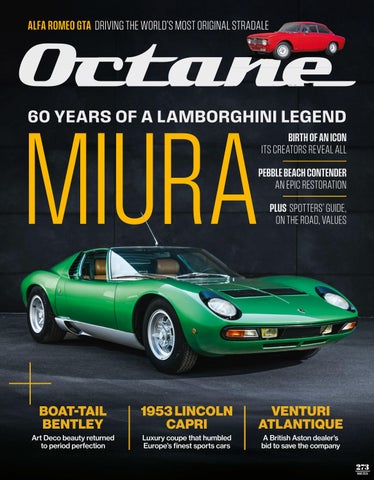
Octane 273 March 2026

Page 1


MIURA

ENQUIRIES

+44 (0) 20 7468 5801 ukcars@bonhamscars.com bonhamscars.com/members

CELEBRATING 60 YEARS LAMBORGHINI

MIURA

• PEBBLE BEACH RESTORATION

• SECRETS OF SANT’AGATA

OFTHE 54 FROM PAGE

• BEHIND THE WHEEL

• SPOTTERS’ GUIDE

• MARKET PERFORMANCE

Features

MI U R A RESTORATION 54

Forensic insight into the expertise that goes into making a Miura ready for Pebble Beach

MI U R A MEMORIES 62

Secrets divulged by Lamborghini’s gods

MI U R A DRIVE 68

A first-timer finally gets behind the wheel

MI U R A MINUTIAE 70

Which is which and what they’re worth

BOAT-TAIL BENTLEY 74

Exquisite Art Deco proof that not every vintage Bentley 3 Litre was bodied by Vanden Plas

VENTURI ATLANTIQUE 84

The French supercar and the British Aston Martin dealer who tried to save its maker

FOUNDRY’S KEEPERS 92

Crosthwaite & Gardiner bought its supplying foundry; Octane visits and feels the heat

ALFA ROMEO GTA 98

Is this the most original racing Giulia of all?

THE OCTANE INTERVIEW 106

Friedhelm Loh, the world’s biggest car collector you’ve never heard of…

THE LOH COLLECTION 110

…and the museum that houses all his cars

1953 LINCOLN CAPRI 116

Unlikely hero of the Carrera Panamericana

EVENTS & NEWS

18

The month’s best events; top dates for your diary; what to expect at Concours des Légendes – the hot new event of 2026

COLUMNS 43

Word from Leno, Bell, Bayley and Coucher

LETTERS 51

Vintage Lancia is a veteran of road trips

OCTANE CARS 126

Rowan Atkinson’s rolling Rolls restoration

OVERDRIVE 132

Driving Kalmar’s astonishing 9X9

GONE BUT NOT FORGOTTEN 136

Willy Mairesse, terrorist talent of many a grid

GEARBOX 138

Car designer and guitarist Wayne Burgess

ICON 140

Celebrating a century of television

CHRONO 142

The esoteric world of mainsprings

BOOKS 144

Influential Stratos Zero gets its own volume

GEAR 146

More top stu for your enjoyment

THE MARKET 148

Insider tips, auction news, facts and figures, cars for sale, Jaguar XJ-S buying guide

AUTOBIOGRAPHY 178

National Motor Museum’s Patrick Collins

WELCOME FROM THE EDITOR

Setting the record straight

‘I NEVER HAD anything to do with the Miura – that was all Gandini.’ Those were the words of the great Giorgetto Giugiaro after he accepted his Lifetime Achievement Award at the International Historic Motoring Awards in November. It is not the first time this stance has been stated or reported, but it is the first time I have heard it from the horse’s mouth and it is something of a novelty, and a relief, to have such certainty applied to the subject.

After all, it is a discussion that has raged in print (including in Octane) for decades, but how did such conjecture over authorship start in the first place and how was it allowed to simmer away for 60 years, to my mind besmirching the legacy not just of one of the most important cars ever built, but also of the two greatest car designers of the 20th Century? Pure mischief, I imagine. I well remember an article in which one journo convincingly described convincingly being shown convincing-looking blueprints and concluding it must be the work of Giugiaro, though others frequently batted back with equally convincing proof that the fact that it was Gandini was beyond dispute.

Yet while such cloak-and-dagger speculation is entertaining to us as journalists and readers, we have been fuelling the flames with barely a thought for the consequences. Indeed, it was only in a recent conversation with Marcello Gandini’s daughter, Marzia, that it dawned on me how distressing this might have been for the great man and his family. That is why we have asked her to contribute to this issue, to give her and her late father’s perspective on the tittle-tattle and how it affected them.

To shore that up, Massimo Delbò has also talked to a load of people who were midwives at the Miura’s birth, relating their recollections of the conception and gestation of the groundbreaking mid-engined supercar. And while we are mythbusting, we thought we might as well find out exactly what it takes to restore such a complicated car that was originally built in such low-tech surroundings, as well as what a seasoned track-tester would think when driving one for the first time.

So, as the wonderful Lamborghini Miura, the John the Baptist of supercars (the Countach, authorship of which has never to my knowledge been questioned, being the Messiah) celebrates its 60th anniversary, this is our chance to set the record straight once and for all.

FEATURING…

MARK

‘They say you should never meet your heroes, but driving a Miura for the first time was an exception to the rule – it was everything I’d hoped for, and has instantly gone into my personal top ten after nearly 37 years of writing about classics.’

Our Lamborghini Miura 60th anniversary celebration begins on page 54

DAVID BURGESS-WISE

‘It’s so refreshing to encounter a Bentley that retains its original Jazz Age bodywork and colour scheme. Not all vintage Bentleys were Vanden Plas-style tourers painted British Racing Green.’ David uncovers the incredible history of this Art Deco 3 Litre ‘Boat Tail’ on pages 74-82

SIMON ALDRIDGE

‘For a kid from the suburbs of London, the Carrera Panamericana seemed so exotic. Bill Stroppe, Chuck Stevenson, Clay Smith – I just wanted to be those guys… and on a sunny day in Essex that dream came true. Squint and it could have been Oaxaca.’

Find out about the unlikely road-race success of the Lincoln Capri on pages 116-122.

GIRARDO & CO / GABRIELE NATALINI

LA DOLCE VITA DELLE AUTOMOBILI

A gathering of the rarest and most significant historic automobili italiane in the heart of historical Rome. Join us for a vibrant three-day celebration of the very best in Roman hospitality, Italian cuisine and luxury style. For exclusive VIP guest packages and entry tickets to the Concorso, visit the website.

anantaraconcorsoroma.com

NEXT MONTH

ISSUE 274, ON SALE 25 FEBRUARY

Most important Astons ever!

20 all-time greats – plus we drive DP 199, the DB4GT prototype

Exclusive! Ultimate concours champion

Under the skin of the Peninsula Best of the Best winner

Ferrari 195 Inter

Driving the super-rare early-1950s luxury GT

Lotus Evora: first and last How Lotus took on Porsche’s 911

Lord Pembroke interview

Inside story on Wilton’s new Concours des Légendes

(Contents may be subject to change)

EDITORIAL

Editor-in-chief James Elliott james@octane-magazine.com

Associate editor Glen Waddington glen@octane-magazine.com

Art editor Robert Hefferon roberth@octane-magazine.com

Markets editor Matthew Hayward matthew@octane-magazine.com

Features writer Elliott Hughes

Founding editor Robert Coucher

Contributing editor Mark Dixon Italian correspondent Massimo Delbò

Inquiries to info@octane-magazine.com

ADVERTISING

Group advertising director Sanjay Seetanah sanjay@octane-magazine.com

Dealer account manager Marcus Ross marcus@octane-magazine.com

Lifestyle advertising Sophie Kochan sophie@octane-magazine.com

Advertising inquiries

Tel: +44 (0)1628 510080 Email: ads@octane-magazine.com

Subscribe online at octane-magazine.com/subscribe Tel: +44 (0)20 3966 6695

Email: customerservice@octane-magazine.com Back issues can be purchased at octane-magazine.com

1961 FIAT-ABARTH 1000 GT BIALBERO

Delivered New to Briggs S. Cunningham Winner of the 3 Hours of Sebring with Bruce McLaren in 1962 First in Class at the Pebble Beach Concours d’Elegance® Coachwork by Beccaris

CABRIOLET

Displayed at the Pebble Beach Concours d’Elegance® Coachwork by Vanvooren I Chassis 57742

1991 JAGUAR XJR-15

From The Curtis Leaverton Collection One of Only 28 Road-Going Versions Recommissioning Performed in 2021 Chassis 028 I Without Reserve

2005 PORSCHE CARRERA GT

From The Curtis Leaverton Collection I Less than 1,900 Miles from New I Freshly Serviced I Without Reserve

THURSDAY MARCH 5

FRIDAY MARCH 6

LIVE AUCTIONS ONLINE BIDDING AVAILABLE VIEW AUCTION PREVIEW AND REGISTER TO BID INFO@GOODINGCO.COM

1937 BUGATTI TYPE 57
2001 FERRARI 550 MARANELLO Coachwork by Pininfarina I Without Reserve

GET 3 ISSUES OF OCTANE FOR JUST £5!

To take advantage of our special offer and get three issues of Octane for £5,either visit octane-magazine.com/subscribe or call +44 (0)20 3966 6695

PUBLISHING AND MANAGEMENT

Managing director Geo Love Editorial director David Lillywhite

Marketing and events manager Rochelle Harman

Marketing and events executive Hannah-Maria Ward

Accounts administrator Jonathan Ellis accounts@hothousemedia.co.uk

Magazine operations coordinator Elaine Briggs

Hothouse Media Unit 16, Enterprise Centre, Michael Way, Warth Park Way, Raunds, Northants NN9 6GR, UK www.hothousemedia.co.uk

OCTANE WORLDWIDE

BUYING YOUR ISSUE OF OCTANE – NEW AND OLD

Print issues

Octane is available at the usual branches of UK shops, such as Tesco, Sainsbury’s, Waitrose and independents, as well as WH Smith Travel. You can order the latest magazine or a back issue, delivered direct to your door, by visiting octane-magazine.com

Digital issues

Download the Octane Magazine app on Android or Apple and you will be able to enjoy the new issue. Alternatively you can source the digital edition via either Zinio or Readly.

Subscribe

You can find superb offers on print and digital at octane-magazine.com/subscribe Order before 13 February to start with issue 274.

Problems with your subscription? Please email customerservice@octane-magazine.com

Syndication and licensing Geo Love geo @hothousemedia.co.uk

Germany Ulrich Sa erling Japan Shiro Horie Netherlands Ton Roks France Yan-Alexandre Damasiewicz Hong Kong, China Chi Chai Chan

Octane is available for international licensing and syndication

24 -27 SEPTEMBER 2026

LOOKING FOR PREMIUM STORAGE AT YOUR DOORSTEP?

A collector’s car is more than just a vehicle — it’s a story on wheels, a tribute to craftsmanship, a legacy in motion. It deserves more than to be locked away in a garage. In THE CARSAFE® Network, your automotive treasure is kept in a climate-controlled, discreetly monitored environment, whether for a season or a lifetime. Our state-of-the-art facilities in Basel, Zurich, Gstaad, Geneva, St. Gallen, Monaco, and London ensure that your vehicle remains in perfect condition. Always protected. Always ready.

Ignition

New Year’s Day classic car meets

1 January

An eclectic line-up of Austin, Frazer Nash, Lea-Francis P-Type, Singer LM Sports and Citroën 2CV welcomed in 2026 at The Old Bull in Inkberrow, Worcestershire. Although typical of many local firstfooter meets up and down the UK, New Year’s Day marked the 75th anniversary of the first episode of The Archers being broadcast by the BBC and the Inkberrow pub is the one on which its Ambridge near-namesake, The Bull, is said to be based. The biggest UK gathering for pre-1997 cars (and later sports and supercars) is traditionally the huge family-focused gathering at Brooklands in Weybridge, Surrey, where thousands enjoy live music, food and much more. Many enjoyed Vintage Stony too.

Peter McFadyen

FROM TOP

Le Jog 6-9 December

A welcome return, following a wellearned year off, for what is reputed to be the UK’s toughest historic rally. After 1500 miles, 20 tests and 25 regularities there were just four Gold Medal winners from the 60 pre-1991 entries that spanned Shaun Harborne and Alistair Leckie’s 1924 Bentley to Norbert and Gerhard Echle’s 1990 Audi 80. They were Kevin Haselden and Ryan Pickering (Mini Cooper S), Mark Godfrey and Martyn Taylor (MGB), Andy Lane and Iain Tullie (Mazda Eunos Roadster), and Eric Michiels and Aswin Pyck (Porsche 924S). Will Broadhead

Bicester Scramble 11 January

The first Scramble of 2026 at Bicester Motion was completely sold out and was a hive of activity. Centrepiece was a phenomenal Tom Walkinshaw Racing celebration, with 50 cars honouring a half-century of the Kidlington outfit. Guests included F1 driver John Watson, designer Ian Callum and hundreds of former staff, while star exhibits were the Le Mans-winning Jaguar XJR-9 and iconic BTCC Volvo 850 estate. Other big attractions included a Group B rally 40th anniversary gathering with the likes of Audi quattro and Ford RS200 on the Orchard Lawn. Tom Shaxson

CLOCKWISE, FROM TOP Cavallino Classic Middle East 5-7 December

The main winners in Abu Dhabi for the fi h running of this showpiece event were a 1965 275 GTB (Best of Show Competizione) and a 1997 F50 (Best of Show Gran Turismo). Canossa Events

Monty Peters

Historic Sporting Trial 30 November

Lee Fulford’s Cannon cresting a hill in an event in which overall winner was Nick Holder, piloting another Cannon. Eric Sawyer

Rallye Harewood 13 December

Harewood Hillclimb was once a stage in three RAC rallies and Rallye Harewood was a chance to see modern and classic rally cars on the hill. Mike Cowlam

Dave Wilcox Memorial Trial 30 December

Elizabeth Thompson gunning her 1929 Austin Seven Ulster on the Pre-War Austin Seven Club event. Steve Shelley

Mille Miglia

Experience China 25-30 November

Some 89 cars, 40 of them from overseas, contested the second running of this 1200km event. The 1957 Abarth 750 of Japanese crew Kiyoyuki Okuyama and Daisuke Saito dominated. 1000 Miglia

ASTON MARTIN VALKYRIE

THE MODEL

The development of this exquisite 1/8 scale model took over two thousand hours of dedicated effort by our team of expert designers and technicians.

Meticulous attention to the finest detail has captured the very essence of the iconic hypercar. The assembly of each model takes 36 hours and is subject to rigorous inspection at every stage to ensure it is perfect in every external and interior detail, ready to take pride of place as the centrepiece of your collection. OUR EXCLUSIVE LUXE PRIVÉ PACKAGE

Zenit International is delighted to offer this exclusive Luxe Privé package that includes an exquisite hand-built model in your choice of two striking colours, a tailor made showcase and a complimentary copy of the beautiful hardcover book, “A Wild Ride - The Making of Valkyrie.”

“A

You will also receive a signed and numbered Certificate of Authenticity attesting to the status of your Luxe Privé model as one of a limited worldwide issue of just 30 pieces in each body colour.

Your model is delivered in a quality leather covered presentation box complete with the iconic Aston Martin winged logo and contrasting feature stitching.

“As a major supplier to the exotic supercar and race car market for over 20 years I have no hesitation in declaring this model of the Aston Martin Valkyrie as simply stunning!”

Paul Barker MD BPA Engineering Ltd

REQUEST YOUR FREE “PROSPECTUS” NOW!

We invite you to send for our free 12 page, full colour, prospectus. It provides a fascinating insight into the design and manufacture of the model along with photographs of the colour options available.

Please request the prospectus at info@interzenit.com, or telephone us on 07517 155630.

Wild Ride - The Making of Valkyrie.” From first sketches to production.
Superb leather covered presentation box with logo and contrasting feature stitching. Free 12 page, full colour, prospectus The
Martin Valkyrie model
by Aston Martin Lagonda Ltd.
1/8 Scale Valkyrie in Candy Red

FROM TOP

Vintage Paris Rally

13 December

The inspiration for the London event in which Octane participated in October (issue 271) had its second outing traversing the French capital in the run up to Christmas. Around 30 vintage cars took part in the dead-ofnight run, starting at Place Vauban; as with the London event, many crews were reassuringly youthful. Entrants, perhaps too formal a word for such a relaxed event, came from the UK and Germany – including a Mercedes 630 driven from the Technik Museum Sinsheim – as well as France, and travelled down the ChampsÉlysées and also glimpsed the illuminated Eiffel Tower, which struggled to compete with the lights and decorations on some of the vintage cars! Sian Loyson

Mille Miglia

Experience UAE 30 November –4 December

Running for 1600km through the UAE and neighbouring Oman, this is the fourth time that this event has taken place. It was won by Artur Moscicki and Mariuz Juszczyk in a 1974 BMW 3.0 CS Coupé, with second place going to the American crew of Jeffrey Gault and Raffaele Conti in a 1953 Lincoln Capri. Saudis Adnan Nouh and Zyad Al Arfaj were third in their 1975 Porsche Carrera. 1000 Miglia

Dates for your diary

28 January – 1 February

Rétromobile

The 50th edition of the Paris show is set to include a special display of the seven BMW Art Cars that have raced in the 24 Hours of Le Mans, including the M1 painted by Andy Warhol. retromobile.com

29 January – 7 February

Rallye Monte-Carlo Historique

Now featuring some closed-road regularity stages, and open to cars of a type rallied between 1911 and 1986.

acm.mc

30-31 January

International Concours of Elegance St Moritz

Held on Lake St Moritz, which by the end of January is frozen to a depth of around 60cm. Classes at the 2026 ‘ICE’ will include Legendary Liveries and Birth ofthe Hypercar. theicestmoritz.ch

30-31 January

Passion for Speed

A special edition of South Africa’s biggest historic racing festival, celebrating the 25th

anniversary of the re-opening of Zwartkops Raceway. zwartkops.co.za

30 January – 1 February

Bremen Classic Motor Show

Starring a group of significant four-wheel-drive road and racing cars, among them one of two surviving Bugatti Type 53s. classicmotorshow.de

30 January – 1 February

Grand National Roadster Show

At the Fairplex in Pomona, California, 500 hot rods compete for the title of America’s Most Beautiful Roadster. rodshows.com

1 February

Haynes Breakfast Club

V-engined cars take centre stage at the Haynes Museum’s February gathering. haynesmuseum.org

6-8 February

SKOPE Classic

Quality racing at Ruapuna circuit just outside Canterbury in New Zealand. Look out for the grids for bone-stock pre-’78 saloons. skopeclassic.co.nz

13-15 February

Cavallino Classic

The 35th edition of the Ferrarionly concours will be held at The Boca Raton resort on 14 February – but the traditional home of the event, The Breakers, will kick things off a day earlier by hosting a display of Best of Show winners from the past 34 years. cavallino.com

14 February

VSCC Pomeroy Trophy

Entries spanning a century of car design compete against one another in this handicap event at Silverstone Circuit. vscc.co.uk

14 February

Concours in the Hills

Hot rods and modern exotics are displayed alongside traditional classics at this relaxed concours in Fountain Hills, Arizona, held in aid of a local children’s hospital. concours2026.raiselysite.com

14-18 February

Rallye Neige et Glace

Based in the French village of Malbuisson, this one very much does what it says on the tin,

serving up wintry entertainment for crews in pre-1998 cars. zoulouracingheritage.com

15 February

Shelsley Walsh Breakfast Club

Shelsley Walsh Hill Climb hosts its first early-morning gettogether of 2026. shelsleywalsh.com

19-22 February

Retro Classics Stuttgart

Some 90,000 petrolheads flock to Stuttgart each year for this show, which welcomes everything from iconic racing cars to scooters. retro-classics.de

20-22 February

Oberoi Concours d’Elegance World-class European and US classics dot the grounds of the Oberoi Udaivilas hotel in Rajasthan, but visitors will also see an array of fascinating cars built and/or bodied in India. theoberoiconcours.com

20-22 February

Race Retro

At Stoneleigh Park the static displays of competition cars will as ever be complemented by thrilling demonstration runs on the Live Rally Stages outside. raceretro.com

20-23 February

1000 Miglia Experience Florida

A regularity rally around southern Florida, beginning on the west coast in Naples, ending on the east coast in Miami, and featuring a stop at Sebring. 1000migliaexperienceflorida.us

21 February

VSCC Exmoor Fringe Trial

The VSCC’s 2026 slate of trials begins with a trip to the forests and muddy fields of Exmoor. vscc.co.uk

27 February – 1 March

A Novice Trial

Based at Hellidon Lakes Hotel in Northamptonshire, and the

Los Clásicos de Cuba, 28 February | Image: Los Clásicos de Cuba

ideal introduction to regularities, driving tests and Tulip books. Training sessions are held on the first two days, and the event concludes with a 90-mile rally. hero-era.com

27 February – 1 March

Sydney Harbour Concours

Hand-picked classics fight it out for Best of Show honours on Cockatoo Island – a UNESCO World Heritage Site close to the Sydney Harbour Bridge. sydneyharbourconcours.com.au

27 February – 1 March

Moda Miami

Headlined by a celebration of the Lamborghini Miura, but featuring classes for everything from ‘Cadillac’s Art Deco Machines’ to ‘Cult Classics & Curiosities’. modamiami.com

28 February

Los Clásicos de Cuba

Held in the heart of Old Havana and showcasing some of the classics maintained by Cuba’s resourceful car enthusiasts. losclasicosdecuba.com

28 February – 19 March

Royal Rajasthan

A drive around India’s largest state, timed so that the crews arrive in Jaipur in time for Holi, the Hindu ‘festival of colours’. bespokerallies.com

1 March

Haynes Breakfast Club

A Continental breakfast this time: the themed paddock is for French cars. haynesmuseum.org

5-8 March

The Amelia Concours

A new schedule for 2026 will see the main concours supported by events including RADwood (dedicated to the cars and pop culture of the 1980s and ’90s) and Cars & Community (a gathering of some 400 cars from across the US). ameliaconcours.com

5-14 March

Route des Andes

A 2650km route winds through the extraordinary landscape of Patagonia, crossing the border between Argentina and Chile several times. rallystory.com

12-15 March

Coppa delle Alpi

Crews in pre-2000 cars tackle 90odd time trials around St Moritz, competing not only for bragging rights, but also for a guaranteed entry in the 2027 Mille Miglia. 1000miglia.it

13-14 March

Three Legs of Mann ‘Relentless’ action on the Isle of Man: entrants in pre-1991 cars will start in front of the iconic IoM TT grandstand, and before the finish will face 16 difficult regularity sections and no fewer than 30 special tests on closed roads. hero-era.com

13-15 March

Phillip Island Classic

The Southern Hemisphere’s biggest historic racing meet, held on Phillip Island, a couple of hours south of Melbourne. vhrr.com.au

BOOK NOW!

Secure your place; make travel plans

Hart Classics Transport Show 21 June

Run by volunteers, this event has raised over £7000 for an Air Ambulance charity in the past two years, each attracting about 250 classic cars, motorcycles and commercials along with trade stalls, entertainment and food. A new venue for 2026 is the Elvetham Hotel; register online to secure a spot on the showfield beside the river. hartclassics.co.uk

Vintage El Clavel 13-19 September

‘A competitive venture to Spain designed exclusively for the older vehicle’. For pre-1946 vehicles only, using asphalt roads and some gravel, this 1600km, six-day event is a first for Rally the Globe and is being touted as a Northern Spain version of the popular Vintage Shamrock event. rallytheglobe.com/rallies/vintage-el-clavel-2026

Tour de Corse Historique 3-10 October

Pictured above, the winner of the Tour or Rally of the Year in the 2025 International Historic Motoring Awards promises a 400-strong entry list, 400km of timed sections, and a total distance of around 1000km for 2026, stopping in some of the island’s most beautiful towns. tourdecorse-historique.fr

Classic Safari 15 March – 11 April 2027

The entry fee may look hefty at £72,800 but there are discounts for early sign-up and a a significant 30% off for under-35s. The event will cover 6500km from Swakopmund in Namibia to Cape Town in South Africa, via Botswana and the Kruger. There are three classes: Pioneer (up to December 1920), Vintage & Vintageant (1921 up to December 1947) and Classic (1948 to December 1975 ), plus invitation classes for pre-1985 4x4s and pre-1985 2WD cars. A once-in-a-lifetime experience. hero-era.com/rallies/2027/03/classic-safari-2027

The ICE St Moritz, 30-31 January | Image: The ICE St Moritz

Racing festivals

Hardcore historic motorsport is at its best and most fierce at these must-see events

Goodwood Members’ Meeting 18-19 April

Goodwood Circuit, Westhampnett, UK

Besides the popular SF Edge Trophy for Edwardian racers such as these, new for 2026 is the Phil Hill Cup for GTs and sports-racers built 1964-66, inspired by the 12 Hours of Sebring – won three times by the great Phil Hill. Look out, too, for the return of the Win Percy Trophy, featuring VIP drivers flogging a variety of saloons from the 1970s and early ’80s. goodwood.com

Grand Prix de Monaco

Historique 24-26 April

Circuit de Monaco, Monaco

Our biennial reminder of the days when racing in the Principality featured overtaking! As in previous editions, there will be eight races, most of them jampacked with classic and vintage Grand Prix cars, and this time the organisers have created a class especially for turbocharged F1 cars from the period 1981-1985. acm.mc

Donington Historic Festival 1-3 May

Donington Park Circuit, Castle Donington, UK

Revamped last year and back with 11 grids for classic GTs, sportsracers, Touring Cars, GP and Formula Junior machines, and early GT3 cars. Appearing for the first time is the MRL Generations Trophy, a fun new one-make series for pre-’66 MGBs campaigned by multi-generation family teams. donington-park.co.uk

Velocity Invitational 29-31 May

Sonoma Raceway, Sonoma, California, USA

Grids featuring iconic competition cars are complemented by static displays representing pretty much all of car culture; here you’ll find everything from Group B rally cars to lowriders. Among the on-track attractions planned for 2026 is an entertaining race pitting 1960s Mini Coopers against muscle cars of the same era. viavelocity.com

Masters Historic Festival 30-31 May

Brands Hatch Circuit, West Kingsdown, UK

The Masters circus comes to Brands with grids for classic 3.0litre F1 cars, Le Mans prototypes and much more. The event serves as part of the ‘Century of Power’ celebrations at Brands Hatch, marking the 100th anniversary of the first sporting event held at the venue – a race between cyclists and cross-country runners! brandshatch.co.uk

Grand Prix de l’Age d’Or 5-7 June

Circuit Dijon-Prenois, Prenois, France

Dijon-Prenois hosts the famous Historic racing meeting that was first staged all the way back in 1964 as an appetiser for that year’s French GP. peterauto.fr

VARAC Vintage Grand Prix 18-21 June

Canadian Tire Motorsport Park, Bowmanville, Ontario, Canada

Organised by the Vintage Automobile Racing Association of Canada, which turns 50 this year, and including the 2026 Kastner Cup for Triumphs. varac.ca

Thruxton Retro

3-5 July

Thruxton Circuit, Andover, UK

The theme this time around is ‘Back to the ’80s’. Spectators will see fondly remembered sports cars, saloons and single-seaters of the decade in action, but plenty of cars from the 1950s, ’60s and ’70s, too, with grids including the popular HRDC Jack Sears Trophy for 1958-1966 Touring Cars. thruxtonracing.co.uk

Pittsburgh Vintage Grand Prix

18-19 July

Schenley Park, Pittsburgh, Pennsylvania, USA

Some 3000 cars are displayed at the Bob O’Connor Golf Course in Schenley Park, and a host more charge around a street course. Look out for the preservationclass ’50s and ’60s sports cars, which race in true factory spec. pvgp.org

BRDC Classic

24-26 July

Silverstone Circuit, Silverstone, UK

The Silverstone Festival is no more (Silverstone will host CarFest over the August bank holiday weekend instead), but historic racing fans can look forward to this event, still largely under wraps but apparently set to feature two all-new grids: ‘GP Icons’ and ‘Endurance Icons’. silverstone.co.uk

Le Mans Classic Legend 2-5 July

Circuit de la Sarthe, Le Mans, France

Absence might well make the heart grow fonder, but no racing enthusiast is going to bemoan the fact that the previously biennial Le Mans Classic is now to be an annual event, with the focus alternating between golden-era cars and more modern machinery. In 2026 it’s the turn of the modern stuff – the GTs and screaming prototypes that raced at Le Mans between 1976 and 2015. lemansclassic.com

Oldtimer Grand Prix Nürburgring

7-9 August

Nürburgring, Nürburg, Germany

Cars spanning nine decades of motorsport history do battle at the Nürburgring. The DRM and DTM grids are always a feast for the eyes here and, with all tickets granting paddock access, you can get up close to the cars and see them being readied for action, too. oldtimergrandprix.com

Rolex Monterey Motorsports Reunion

12-15 August

WeatherTech Raceway Laguna Seca, Salinas, California, USA

Important Toyotas, Nissans, Mazdas and more will tear around Laguna Seca as the 2026 Reunion pays tribute to the great racecars of Japan. weathertechraceway.com

Oulton Park Gold Cup

29-31 August

Oulton Park Circuit, Little Budworth, UK

Classic GTs, single-seaters and saloons are hustled around the pretty, undulating Oulton Park track, which will also host the Cheshire Concours d’Esprit. oultonpark.co.uk

Lime Rock Historic Festival

4-7 September

Lime Rock Park, Lakeville, Connecticut, USA

Alfa Romeo will be the featured marque at the 2026 Festival, where the racing will as usual be followed by a concours and a huge display of cars and motorcycles. limerock.com

VSCC Mallory Park meeting 15 August

Mallory Park Circuit, Kirkby Mallory, UK

The VSCC’s racing season ends at Mallory Park, where spectators will also enjoy the 2026 edition of the bonkers Longstone Light Car Race. vscc.co.uk

Goodwood Revival 18-20 September

Goodwood Circuit, Westhampnett, UK

The Stirling Moss Trophy for pre’63 GTs is said to be the Revival’s most beautiful race, but it’ll be run close by this year’s Lavant Cup, open exclusively to Maserati and Ferrari sports-racers of the 1950s. goodwood.com

Circuit des Remparts

18-20 September

Angoulême, France

Hundreds of vintage and classic cars slide around Angoulême, the walled, hilltop town in western France, carrying on a racing tradition that dates back to 1939. The course, 1279m long and featuring three hairpins and four right-angle turns, remains as laid out in ’39 and, fittingly, the best racing of the event is frequently provided by the grids for pre-war cars, one of which (the Plateau Marc Nicolosi, named after the founder of Rétromobile) is especially for Bugattis. circuitdesremparts.com

Spa Six Hours

25-27 September

Circuit de Spa-Francorchamps, Francorchamps, Belgium

The world’s best circuit hosts a day/night historic endurance race that is preceded by a series of shorter contests for everything from pre-war sports cars to recent GT3 track weapons. spasixhours.com

Imola

Classic 16-18 October

Imola Circuit, Imola, Italy

Peter Auto’s busy 2026 season reaches its climax at Imola, where winners will be decided in series including Group C Racing, Endurance Racing Legends, and the 2.0l Cup – a one-make series for short-wheelbase Porsche 911s. peterauto.fr

Classic

24 Hour at Daytona / Daytona Historics 11-15 November

Daytona International Speedway, Daytona Beach, Florida, USA

The main event here serves up 24 straight hours of entertainment, with six grids of classic competition cars running four times each during a 24-hour period, each outing lasting just under an hour. hsrrace.com

Les 2 Tours d’Horloge 6-8 November

Circuit Paul Ricard, Le Castellet, France

At Paul Ricard in the South of France, teams of up to four drivers in pre-1991 cars contest a proper 24-hour race. Support races this time will include the Trophée Lotus for 1960s Lotus Sevens. vdev.fr

Historic Sandown 6-8 November

Sandown Raceway, Springvale, Victoria, Australia

Historic Sandown always draws an array of Australia’s most thrilling classic competition cars: no owner can resist the prospect of flooring it on Sandown’s two long straights! vhrr.com.au

Classic 12 Hour at Sebring / Sebring Historics

2-6 December

Sebring International Raceway, Sebring, Florida, USA

The Classic 12 Hour (run much like the aforementioned ‘24-hour’ race at Daytona), was pulled forward in 2025, but in 2026 it will again serve as the curtain-closer to the historic racing season in the Northern Hemisphere. hsrrace.com

New UK concours to bring history to life

Wiltshire in June is 2026’s hot ticket for enthusiasts

A NEW CONCOURS is set to take the classic scene by storm this summer. The Concours des Légendes will feature sensational cars and their owners, and uniquely will bring to life their stories over a weekend of festivities in a spectacular setting.

The event will take place on 19-21 June at Wilton House near Salisbury, the home of petrolhead William Herbert, 18th Earl of Pembroke, and already host to the Wilton Wake Up breakfast clubs as well as previously holding the popular Wilton Classic & Supercar festivals.

Familiar to millions through The Crown, Bridgerton and much more, the Inigo Jones-designed Palladian mansion set in idyllic landscaped gardens will now host a very different type of event.

Concours des Légendes will not only showcase scores of exotic, rare and unique cars, but will really focus on the rich history behind the cars and their owners. It will be all about their stories.

The Concours des Légendes will have a main marquee hosting panels with authors, historians, owners, racers, artists and designers, along with smaller, more intimate stages for personal storytelling sessions and book signings, plus curated reader stories, presented by Hagerty.

Visitors can expect a stellar line-up of special guests, with the likes of F1 star turned artist

Stefan Johansson, designers Peter Stevens and Ken Okuyama, legendary test driver Valentino Balboni, Le Mans winner

Richard Attwood plus a raft

of other big names already expressing a desire to be there.

There will be narrated car displays as visitors go around the event, with guided tours by experts highlighting select cars. There will also be displays of F1 helmets, motoring art, an artisan and skills showcase, and a classic car, automobilia and watch auction run by celebrated sale house Dore & Rees, which has signed up as the official Concours des Légendes auction partner. Visitors will also have access to Wilton House, which houses a globally revered art collection including many old masters from the likes of Rembrandt and van Dyck, while the relaxed atmosphere of the event will be soundtracked by live music and there will be tea salons, local

artisan vendors, and themed treats inspired by different automotive eras.

Lord Pembroke, who has owned the likes of Bugatti Veyron, Mercedes 300SL Gullwing and a Low-Chassis Invicta (Octane 195), explained the event’s concept: ‘I love cars. Cars of all shapes and sizes, powers and eras. I love driving them, racing them and taking them on adventures; and the older the car, the more likely that every journey is an adventure.

‘It is these stories that, for me, give a car its true value, far beyond its material worth. Every dent and scratch tells a tale. That is why we cherish patina, and why seeing great cars left in suspended animation in museums feels like a tragedy.

‘I o en feel the same about concours: rows of spectacular machines, o en hugely valuable, admired for their beauty and rarity, but o en with their history polished away.

‘ eir extraordinary lives are rarely to the fore, so I wanted to create an event that celebrates those stories. Tales of adventure from great pioneers, legendary race ba les, entrepreneurs who built their own cars or even marques, and the engineers, cra smen and designers who turned their visions into moving works of art.

‘ ese are the stories we want to share, and the ones that truly bring the cars I love to life.’

His partner in the Concours des Légendes will be Octane’s parent company Hothouse

Media, which also owns Magneto and runs the Concours on Savile Row and the International Historic Motoring Awards.

MD Geo Love said: ‘Wilton Concours des Légendes will combine the elegance of a classic car show with the charm of a literature festival.

‘So many events a ract historic vehicles with amazing provenance or engineering, but

visitors are o en le knowing li le of their histories.

‘Wilton Concours des Légendes will bring those stories to life through workshops, keynote speakers and an a ectionate focus on every car.’

For details, see www. concoursdeslegendes.co.uk; suitable car owners and potential exhibitors should email info@ concoursdeslegendes.co.uk.

SHARE YOUR CAR’S STORY AND WIN BIG!

Share your motoring stories and you could win a bespoke, personalised document case for your classic (worth £400), plus an invitation to the Wilton Concours des Légendes and the opportunity to be featured in Octane magazine.

As part of Octane’s partnership with the new event, we’ll be featuring the best car stories every month in the magazine: all you have to do is share yours and tell us why it should be among them.

When we say stories, it could be about your own background and involvement with classic cars, obstacles you have overcome, or your family’s motoring history. Equally, it could be your car’s history before you even became its custodian – what made it special. Best of all might be your own history with that car, your adventures, the highs and lows, the devotion, the costs, the competition, the companionship, the romance and the nostalgia.

If your story is selected, you will not only have an article in Octane to add to your history le, but a beautiful folio from Jordan Bespoke (jordanbespoke. com) to keep it in and a wonderful excursion to Wiltshire to look forward to.

Simply email james@ octane-magazine.com with your entry in no more than 750 words and with any supporting photos.

Clockwise, from top Wilton House last hosted a major motoring festival in 2015; the TV star estate has 22 acres of manicured lawns on which to hold the Concours des Légendes, so space will not be an issue; the 2015 Wilton Classic & Supercar.

Fun factor trumps returns

HAGERTY HAS announced its annual list of what it considers the current ‘best buys’ in the classic car market, catering for budgets of just a few thousand pounds to £100,000. Hagerty’s valuation specialists use market data to predict the best cars for value for money, desirability and ownership experience. e result is a list that includes everything from pre-war Riley Nine Imp to Ferrari F430 as well as the UK’s favourite van, the Ford Transit Mk1. Other vehicles on the list are the Volkswagen Golf GTI Mk 2, the Porsche 911 (996), Alfa Romeo Spider Veloce, MercedesBenz SLK R171, MGA, Toyota Supra A80 and Vauxhall Viva HC.

‘ e 2026 list really does have something for everyone,’ says John Mayhead, Octane contributor and editor of the Hagerty Price Guide ‘ ese are not high-end collector cars, but the cars that we perceive as o ering the ultimate in value in 2026 when it comes to a ordability and the ownership experience. ese are cars that deliver genuine value in more than just nancial returns, cars that have wri en their own chapters in motoring history and enable owners to write theirs.’

Mark Roper, MD of Hagerty UK, added: ‘ e launch of the Hagerty UK Bull Market List is always extremely exciting for us and for car enthusiasts of all ages. Once again it is a fantastic list of cars that represent great value in so many ways and we look forward to celebrating these cars with owners at numerous Hagerty events throughout the year.’

New feature for Newport e Audrain Newport Concours & Motor Week is to hold a new event this year. e Audrain Supercar & Hypercar Concours d’Elegance includes a 50-mile drive around Rhode Island and then a concours at Fort Adams on Saturday 3 October. It is open to any age of supercar.

‘Jensen’ GT on the horizon

Jensen International Automotive is launching an ‘all-new, ultrahigh-performance, luxury Grand Tourer’ inspired by the Interceptor. As JIA’s rst ‘clean-sheet’ product it will be new from the ground up, based on an aluminium chassis and bespoke V8. See jensen-sales.com.

Trio of new MRL events

ere’s been a triple whammy of announcements from Motor Racing Legends in the past month. To coincide with the centenary of Brands Hatch, it will run the inaugural London Historic Trophy festival featuring ten grids on 19-21 June. en, on 10-12 July, it will venture into France with the Trophées d’Auvergne three-day festival at Charade. Finally, MRL and the BARC will echo the format of the 1970s Tour of Britain with its Rewind Tour Britain, on 27-30 May 2027, for road-legal cars on standard tyres. It will include tracks such as ruxton as well as a special stage at Blenheim Palace.

F40 to share Quail limelight Four of the classes for the 2026 e Quail, A Motorsports Gathering on 14 August have been revealed. ey are e 100th Anniversary of Route 66, e Lamborghini Diablo, e Legacy of Japanese GTs, and e Ferrari F40. e 23rd annual event also promises more than a dozen vehicle debuts. e event’s new Collector series will showcase the fantastic collection of well-known LA petrolhead Bruce Meyer.

Cultural assimilation

e Federation of British Historic Vehicle Clubs (FBHVC) has won UNESCO approval to apply for the UK’s historic vehicle movement to be recognised as an example of Intangible Cultural Heritage, which means it could ultimately be legally safeguarded as part of the UK’s living heritage.

Dirt track heroes

e Petersen Automotive Museum’s new exhibit is ‘Legends of the Dirt’, celebrating the vehicles, technology and culture of the Baja 1000, King of the Hammers races and other o -road motorsport, including the World Rally Championship and Pikes Peak. Standouts include ‘Big Oly’, a Ford Bronco that won Baja in 1971 and 1972. See petersen.org.

Monegasque memories

An exhibition tracing the links between Monaco and the car since 1893 opens at the Grimaldi Forum in the Principality on 1 July. e exhibition, curated by Rodolphe Rape i, will showcase 50 cars, models, posters and rarely seen documents and photos, and will run until September. See grimaldiforum.com.

Tourists finish Kiwi leg

Phil and Will Churchill have nished the 1600-mile New Zealand leg of their Aston Martin Vantage World Tour. Since starting in London in 2023, they have driven 18,000 miles across 15 countries, raising £30,000 for the Campaign Against Living Miserably (CALM); donate at justgiving.com/vantageworldtour. Australia is up next…

Pebble President elect Sandra Button’s successor at Pebble Beach Concours d’Elegance has been revealed. After 40 years, the concours chairman will step back from day-to-day leadership and into a new role as Senior Strategic Advisor and Brand Ambassador after the event’s 75th anniversary in August. Vince W Finaldi will take over as Concours President.

GMA investment injection

Halo Cars Group has invested $120million in Gordon Murray Automotive to boost operations, support Special Vehicles efforts and safeguard the legacy of the brand. Gordon Murray continues as Chairman and Chief Designer, while existing Chief Financial Officer Darren Jukes is appointed Interim Chief Executive Officer.

Cavallino winners reunion

The 35th Palm Beach Cavallino Classic is to bring together previous winners from the past 34 editions, including the 1952 Ferrari 212 Inter Ghia s/n 0191 EL (above). The cars will be showcased on the front lawn of The Breakers on 13 February for an invitation-only event but will be at Boca Raton with the concours cars the following day.

Privé

back in London

After a year off in 2025, Salon Privé London is set to return to the spectacular Royal Hospital Chelsea this spring. The event will take place on 16-18 April and details and tickets are available at salonprivelondon.com.

OBITUARIES

Hans Herrmann

German F1 and sports car racer

Hans Herrmann has died aged 97. He competed in 19 Grands Prix, starting in 1953, and achieved one podium for the Silver Arrows before Mercedes withdrew from racing after the 1955 le Mans disaster. He then raced for the likes of Maserati, BRM, Borgward and Porsche. He was more successful in endurance racing, piloting Porsche to its first overall win at Le Mans, when he shared the 917 with Richard Attwood in 1970. Before his racing career he trained as a confectioner and after the Le Mans win he walked away from racing to honour a promise to his wife Magdalena. See our full obituary at tinyurl.com/4y7xhk9u.

Nigel Dawes

Noted vintage and classic car collector, restorer, model-maker and silversmith Nigel Dawes died peacefully, surrounded by family, on 23 December in Ledbury. He was 87, and formerly and famously resident at 11th Century moated medieval manor house Birtsmorton Court, near Malvern. His first old car was an SS100, sold only recently, bought from his brother Howard, who had paid for it with £500 his father had given him to invest in the stock market. There was a full interview with Nigel in Octane 164.

Gerald Donaldson

Canadian F1 journalist and author Gerald Donaldson has died aged 87. Born in 1938, in Almonte, Ontario, Donaldson wrote more than 20 books on motorsport, including biographies of James Hunt, Juan Manuel Fangio and Gilles Villeneuve. He covered F1 from 1977 and was inducted into the F1 Paddock Hall of Fame in 2018, plus the Canadian Motorsport Hall of Fame in 2020.

3 ISSUES FOR JUST £ 5

WHY SUBSCRIBE TO OCTANE NOW?

• Pay just £1.66* each for your first three issues

• All subscriptions now include access to the magazine archive via the Octane digital app

• Nev er miss an issue

• Money -back guarantee –cancel and we will refund your remaining issues

• Unique subscriber -only covers

Please note our updated website (below). Order and manage your subscriptions online, or call our helpline on +44 (0)20 3966 6695

The Collector

Jay Leno

A lesson in the perils of having a vintage accident

We all enjoy driving our vintage vehicles as well as living vicariously through the pages of this magazine, as gi ed journalists put the pedal to the metal on the German autobahn or tear up the Tail of the Dragon as they speed through the Tennessee/North Carolina border. What we don’t o en hear about are vintage accidents. ese are accidents that, either through be er engineering or safer design, don’t really happen anymore… like the one I had last week. I’m the proud owner of a 1961 Jaguar MkIX. e great thing about this car is it’s one-owner with original black paint and fabulously original red leather interior. Only 51,000 miles. If you didn’t know, you’d think it was only two or three years old. e downside is it came with the Borg Warner automatic transmission, which wasn’t very e cient and leaked like a sieve. By 1961, Jaguar was competing with Cadillac in the US market. It came with power steering, four-wheel disc brakes, upgraded radio and a host of other li le features like a maplight, a clock and li le courtesy lights all over the interior, plus three cigare e lighters. is car is so well-preserved because that Borg Warner transmission is so bad it has been sat in the garage for 20 years unmolested. I really think that’s what saved it – between it leaking so much and slipping all the time, the owner just got fed up. We replaced it with a modern GM 700R4 automatic transmission. I understand this is a fairly common swap. A place in Texas called John’s Cars does a kit that makes the whole deal go pre y smooth and, contrary to some advice we got, you don’t have to pull the engine to swap it out. Once you get the car in the air you can just drop the transmission with the help from all the bits and bobs you get from the John’s Cars kit; it was a one-day job. And it was well worth the money I spent. (I mention this because it seemed like something Octane readers could use.) A er replacing the transmission, rebuilding the radio with those fabulous Bakelite knobs and rewiring under the dash to get all the lights working, it was ready to drive. To say the GM transmission transforms the car is an understatement. Faster acceleration as well as fewer revs at higher speeds make this really a fun car

to drive. I’d just le my garage and was heading home on my usual route when it happened. I was on a busy street and in fast-moving tra c. I was going about 40mph when I put my put my foot on the brake to slow down and the pedal went right to the oor. I quickly hit the pedal again – with the same result.

I’m not a panicky type of person and immediately started looking for holes in tra c. ere were none. Luckily, I was in the le lane and there was a median strip between myself and the oncoming tra c. I quickly jerked the wheel to the le as hard as I could and jumped the curb. I was still travelling fairly quickly, trying to slow down, taking out as many bushes and shrubs as I could at the same time.

I looked over and the light had turned red in the opposing lane and for a brief moment there was no tra c in it. e handbrake is pre y useless, so I jerked the wheel to the le as hard as I could. is brought the rear end around. As I jumped o the kerb, I was facing in the right direction in the other lane. It was also slightly uphill, which allowed me to slow down.

I was only about two miles from my garage and gured I could get home if I travelled slowly and used the handbrake. Just then, I pressed the brake pedal, and it was ne. My mind started racing. Had I been pressing the gas pedal by mistake? Each time I tried to brake, it was ne, yet I was still cautious.

I didn’t have to wait long. At the next light I pressed the brake and once again nothing. OK, I’m not crazy, I said to myself. I somehow managed to nurse it back to the shop and put it up on the li straight away. I thought for sure I had damaged the body, but these old girls have such great ground clearance that all I did was maul one of the chrome rings that go around the hubcaps.

I call this a vintage-type accident because modern cars have dual-circuit brakes – if one circuit fails you can still at least stop. I always laugh when I watch YouTube videos of accidents and the people say ‘Oh, all the brakes failed together at the same time.’ at really doesn’t happen anymore… unless you’re driving a 1961 Jaguar MkIX.

And yes, of course, I’m going to put a dual master cylinder on.

Drive safely.

Jay was talking with Jeremy Hart.

‘I WAS GOING ABOUT 40MPH WHEN I PUT MY FOOT ON THE BRAKE AND THE PEDAL WENT RIGHT TO THE FLOOR’

MONACO HISTORIC TOUR

A TOUR THROUGH PROVENCE TO THE MONACO HISTORIC GRAND PRIX

21ST – 27TH APRIL 2026

Since 2016 we have been organising tours of the south of France to coincide with the Historic, and we are delighted to be returning in 2026 with a 6-night event combining the magic of Provence with a weekend of 5-star hospitality in Monaco.

During the tour we’ll be visiting the finest hotels in Provence, and driving some of the most spectacular roads anywhere in Europe. Then, after lunch on the Friday, we go up a gear and head into Monaco for a packed programme of historic racing, and superb hospitality throughout the weekend.

Entry is limited to just 20 cars (both classic and modern), and we hope that you will join us for an unforgettable week.

For further information, and to receive a brochure please contact Chris Bucknall. chris@v-management.com 01635 867705

v-events.co.uk

The Legend

Derek Bell

Looking back and enjoying a more poetic life

It’s a crisp, wintry morning here in West Sussex. It’s early. I just made a cup of co ee and watched some swans land in the estuary near the ancestral seat. I will never tire of living here. ese li le moments make life seem almost poetic. When you have spent most of your life bouncing o the rev-limiter, it’s nice to stop and appreciate nature in all its beauty.

Well, that’s about as introspective as I get. I suppose I had be er snap out of this reverie and get back to discussing motor racing. I hope you will forgive me tooting my own horn as it were because, by the time you read this, I will have been garlanded with a Lifetime Achievement Award by the Royal Automobile Club.

I think it’s a sign of having stuck around for aeons that you receive this kind of award. is particular one is extra special, though. It means a lot because it comes from Britain’s motorsport body. It was particularly nice that it fell to the Motorsport UK chief David Richards to write and tell me that I was to be honoured.

I have known David for a very long time; probably more than 50 years. He was at the centre of things, even before he founded Prodrive. In a roundabout way, he was partially responsible for me having a stab at rallying, although ‘to blame’ is perhaps more appropriate. He is one of life’s doers and I was very touched when I read his le er.

So, having got that out of the way, I would like to mention a former comrade who is no longer with us. I will be honest with you, I wasn’t aware that Andrea de Adamich had passed way in November until I read something during the Christmas break. I hadn’t seen him in ten years, and hadn’t communicated with him since then.

I liked Andrea. He didn’t look like a racing driver, at least as you might picture one in your mind’s eye. With his curly hair, spectacles and studious appearance, he looked more like an academic, but boy he was quick. He could make an Alfa Romeo GTA dance like no other. He won the European Touring Car Championship, a er all.

He also raced single-seaters for Scuderia Ferrari around the time that I was there, the funny thing being that I don’t recall ever seeing him in Maranello. I know that he fell out with Il Commendatore. I gather he bent one of his precious F1 cars and Enzo Ferrari

wasn’t exactly renowned as a forgiving type. I tend to associate Andrea with the works Alfa Romeo Tipo 33s. He raced them back in the early 1970s when I was driving for Gulf/John Wyer. He was a rival, but a friendly one. Andrea was one of life’s gentlemen. He would always greet you with a smile. He had very polished manners and was the sort of chap you wanted to be around.

Unfortunately, his F1 career rather mirrored my own in that he spent much of his time racing terrible cars, occasionally upgrading to some that were merely OK-ish. I realise that a poor workman always blames his tools, but it’s hard to win races in a car that isn’t fast enough even to get through qualifying. Poor old Andrea’s time in F1 ended badly, too. He got caught up in that ghastly rst-lap shunt that wiped out half the eld during the 1973 British Grand Prix. It le him with serious leg injuries. He never raced again but ran a very successful racing drivers’ school therea er. He was also a road safety advocate. Andrea was very much for giving back; in his case it wasn’t all take-take-take. I admired him a lot for that.

I don’t really ‘do’ links so please forgive me that this column will now meander onto something that greatly interests me. I was thinking of things that I really want to do in 2026, and one of them is to see the Bluebird K7 hydroplane do a run at Coniston Water. I must confess that Donald Campbell was a boyhood hero, and I can clearly recall staying at my grandmother’s house in New Eltham when I looked out of the window and Bluebird passed by on the back of a transporter. I just about fell over. It looked like it was from another world. It’s funny how certain memories fade while others loom large.

Anyway, I read about the Ruskin Museum’s plans for the cra , and have been cha ing with David Barzilay, who does a lot of PR for them. I gather that the plan is to return it to the water again for another run at some point in the spring, and I would love to be there. I have the greatest admiration for those who take on projects of this sort, and I hope they realise their ambitions.

As for the rest of the year, I am hoping for li le other than to enjoy being with my family and my friends. at, and ge ing my bum in some fast cars from time to time. I may be comfortably of pensionable age, but I’m still a teenager at heart.

‘WITH HIS STUDIOUS APPEARANCE, DE ADAMICH LOOKED LIKE AN ACADEMIC, BUT BOY HE WAS QUICK’
‘M

The Aesthete

Stephen Bayley

Time for professional upsets among car designers

ystery surrounds the disappearance of Gerry McGovern.’ Had I been a tabloid headline writer, that would have been irresistible. In December, an excitable Times of India story said Britain’s most famous car designer had been ‘escorted’ from the JLR building. is has since been refuted, but quite a lot of mystery remains. On a ma er unrelated to JLR or even the motor industry, I have been trying to get in touch with Gerry (whom I have known for many years) via a shared acquaintance. No-one is saying where Gerry is or what he is doing. Informed speculation says ‘leave of absence’.

at may be a euphemism, but it begs a signi cant question: why would you sack the man responsible for one of Britain’s best ever products? Why would you let go an individual whose (perhaps outrageous) communications skills got even President Trump talking about moribund Jaguar?

‘ ose’ ads were not to everyone’s taste but they a racted more a ention for Jaguar than anything since the 1968 XJ6, its last great car. ing is, as a creative involved in the luxury trade, McGovern, a man who enjoyed his pleasures to the full, knew whereof he spoke, which made him the perfect spirit familiar for the Range Rover ‘brand’. Best guess is that McGovern’s very cultivated and very visible appetites did not sit well with new management at Tata, JLR’s owners. In my other life I have worked with some of the richest Indians and very sharp acumen is o en matched by very blunt austerity. With Jaguar in a sales crisis, I imagine the teetotal and very disciplined late Ratan Tata (and the culture he le behind) might have found McGovern a luxury his luxury car business could not a ord.

And yet, apart from rapidly fading memories of past sporting and artistic glories, McGovern is surely a prime asset for Jaguar. Like Jony Ive at Apple, McGovern knows so many secrets that, had he le the building, it must have been with an NDA the density and value of precious metal. Jony Ive did not take Samsung’s call and my speculation is that McGovern would not be taking Hyundai’s. is got me thinking about professional upsets with designers and their careers. Is there a theory here? Jaguar has hosted quite a few calamities. e

late Geo Lawson was an agreeable man whose o ce was furnished with jukeboxes and Fender Stratocasters. Not, in my view, prime source material for Jaguar. His S-type was surely the least lovely car Jaguar made. McGovern and Ian Callum had a Mozart-Salieri thing going. e one con dent, wildly creative, outspoken and improvident. e other a tad cautious. But the McGovern-Mozart character could head-bu management. e more polite CallumSalieri could not, hence Jaguar’s journey through the Aesthetic Valley of Tears in recent years.

And let’s not forget Giles Taylor’s XJ, although many have. Whichever way you look at it, this was a disaster. But Taylor went on to Rolls-Royce, where he drew the Cullinan. While the Cullinan is decadent toot that would have embarrassed the Emperor Nero, it has been a success. As HL Mencken knew, you never go bust under-estimating the public’s taste.

More positively, I give you Patrick Le Quément, a ru ing GOAT among the timid sheep of the industry. Le Quément was a car designer of complete originality: his Twingo, Scenic and Avantime were masterpieces. Alas, he was too audacious for Renault’s hommes en costumes gris and Le Quément is now happily designing boats in Cannes.

Recently there has been omas Ingenlath, whose designs were at least as signi cant as Volkswagen Group’s engineering and quality control in establishing the once forlorn Skoda as the premium product it is today. Ingenlath moved to Gothenburg where he performed similar magic, establishing a new design language for Volvo that respects tradition while also being entirely fresh. Indeed, Ingenlath did so well, he ran upstairs two steps at a time to become CEO of Polestar once it was spun-o from Volvo. is was a bad move for everyone. Polestar remains an answer to a question few customers have asked. Ingenlath was replaced by a Mann im grauen Anzug from Opel, of all places. And now, as if nothing happened, he has returned to Volvo. en, in the ma er of design overreach, there is John Z DeLorean, who escaped prison only because his ingenious defence proved FBI entrapment in the ma er of cocaine dealing. And his eponymous car? Surely it counts as the worst thing Giugiaro drew. So, what’s the theory? Creativity is unpredictable. O en dangerous. We would be sorry to be without it. Yet at what cost?

‘WHY WOULD YOU SACK THE MAN RESPONSIBLE FOR ONE OF BRITAIN’S BEST EVER PRODUCTS?’

The Driver

Robert Coucher

Incredible memories of special drives in the Lamborghini Miura

he cars weren’t built by gods, but by mere kids like us,’ said the languid Bob Wallace, Lamborghini’s legendary test driver and development engineer in the ’60s and ’70s. Wallace had an uncanny ability to determine a car’s foibles and sort them out e ectively. And he had his hands full with the Miura P400.

With its Gio o Bizzarrini-designed V12 mounted amidship, the world’s rst supercar looked like a knockout. It embraced pure technical innovation, and its engineering was on a di erent level to that of the local competition. Trouble was, at launch, the Miura was woefully underdeveloped, su ering from severe front-end li , violent oversteer at the limit and a penchant for catching re. ings were remedied to some extent with the later SV model with its sturdier chassis, revised rear wishbones and wider track.

marching along the light alloy panels. It looks every inch the racing car that it is.

‘TAKE CARE NOT TO ADD TOO MUCH JUICE TO THE CARBS, WHICH WANT TO SET EVERYTHING ALIGHT’ ‘T

Some years ago, I got to drive my rst Lamborghini Miura. It wasn’t just any old Miura, it was chassis number 4934, the special SV/J version built for the Shah of Iran. In 1970 Wallace had begun the development of a racing Miura for the J-Appendix in the FIA racing category. e Jota (it’s the Italian name for the le er ‘j’) was stripped and lightened, with around 400bhp extracted from its V12. Unfortunately, this one-o was wri en o on a test drive. e Brescia Lamborghini dealer took a client out and lost it at over 150mph down the autostrada. Reports were that his passenger noticed the driver fainted just before impact.

But the Jota had caught the eye of an uber-car collector, one Mohammed Reza Pahlavi, who ordered his fourth Miura in SV/J spec, one of just six built up by Wallace. It was delivered to the Shah’s chalet in St Moritz shod with Pirelli studded snow tyres! Needless to say, it didn’t cover much mileage – the odometer reading some 5200km – and the car was then sold to actor Nicolas Cage before being re-acquired by an Iranian enthusiast with close ties to the Pahlavi dynasty. e Shah’s SV/J is nished in Rosso Granada – purple to you and me – and looks pumped if not pimped, with its huge rear alloys and 275/75 tyres lling the rear wheelarches, rear side air-scoops, cut-out cooling vents, an exposed front fuel- ller, additional extra lamps and an aggressive front spoiler, not to mention rows of exposed rivets

And to drive? e word ‘careful’ springs to mind. When starting the V12, care is required not to add too much juice into the rampant Weber carbs, which are intent on se ing everything alight. As the engine catches, the wall of intense sound is akin to a sucker punch on your eardrums, thanks to the induction cacophony just behind your head and the exhaust being completely ‘straight through’! e clutch is manageable but the gearlever, with its two- nger indent at the leading edge, requires considerable he to move about the exposed gate. e driving position is enough to give an ergonomist serious backache, being fully simian, with splayed legs and a bus-like steering wheel angle. By this stage, the driver of a modern supercar would be sweating, with white knuckles and a worrisome heartrate.

But ge ing the SV/J onto an open road and dropping the hammer brings new meaning to the term ‘clearing the cobwebs’. With revs on the dial, the supercar of old seems to shrug o all physical inertia as it lets rip. It remains physical from behind the wheel as the gearshi s come from the shoulder rather than the wrist. But the steering lightens and the brakes come up to temperature as the 900kg package allows 385bhp to come alive at 7250rpm. As a styling exercise, the Miura is unbeatable. As a car to drive fast, it remains a real challenge, with a heavy gearshi and twitchy handling.

Further Lambo Miura road-testing was exacted a few years later, on a trip from Gstaad through the Alps to Monte Carlo, celebrating the marque’s 40th anniversary. Strapped into a very well-sorted Miura SV with Lambo a cionado Simon Kidston, I couldn’t get Ma Monro’s tune On Days Like ese out of my head. e awed Miura was instantly at home in the Alps, blasting from one tight corner to the next, the heavy gearshi operating at its best – hot and at full revs – with the wide chassis seeming to swivel de ly from the hips. is turned out to be the drive of a lifetime in a convoy of Lamborghini Miuras, as a re-enactment of the 1966 trip down to the Monaco Grand Prix by Bob Wallace in a P400 from Sant’Agata. No o cial time was posted but Wallace commented: ‘We wanted to demonstrate that all we were doing was not BS.’ He got that right.

Call of the North! E xperience the magic of the Flying Scotsman, a legendary 600-mile journey through the heart of the Scottish Highlands. Reserved exclusively for pre-1948 cars, this iconic event unites vintage engineering with spectacular scenery, warm hospitality and a spirited yet friendly competition. Beginning in elegant style at Gleneagles Hotel, the route sweeps north through the Cairngorms and Aberdeen before turning south for a champagne finish befitting motoring legends. Crews will tackle 10 challenging Tests and 16 Regularities across historic rally roads, framed by lochs, mountains and everchanging Scottish weather. More than a rally, Flying Scotsman 2026 is a celebration of camaraderie, nostalgia and adventure - an unforgettable return to the golden age of motoring.

Photo: Will Broadhead

Letter of the month

Long drives in Lambdas

I HAVE HAD a subscription to Octane for over 20 years, but I read with even more pleasure than usual your feature on driving a Lancia Lambda to Varallo in North Italy. It brought back many marvellous memories of a similar trip I made over 20 years ago in a friend’s Lambda [above].

While I own and drive several Dafs, a Triumph TR5 and an Aston Martin DBS, I have sadly never owned a Lancia myself. Luckily I had two very good friends with pre-war Lancias. I met Andrew Maclagan in 1982, who at the time lived in Brussels, at a Daf Club event. He had owned a 1933 Lancia Augusta since 1963 and he drove this marvellous car all over Europe. I was invited to join him on some beautiful drives to France, Holland and the UK – we once made a day-trip from Brussels to a pub south-east of London because the Lancia Motor Club was having a lunch there. We set o at 4.30am on 2 January in freezing weather with a temperature of -15°C. My ten-year-old son used his ski out t to keep warm.

Andrew’s friend, John Milham, was the long-time custodian of a tuned, supercharged Lancia Augusta and an open-top Lambda, which he also drove all over Europe. For the 80 years of Lancia Lambda celebration in Turin, we met up at my home in Belgium with Bill and Arlene Sebbings (Augusta owners from California) and drove to Turin over three days.

I must admit that I didn’t nd it easy to master the Lambda gearbox without making some crunches when I had to change gear. Just as in your article, John complained on the Grand St Bernard Pass about slow tourists in their modern boxes that prevented him from having some fun!

Twenty years later, John and I drove again to the Villa Lancia to mark 100 years of the Lancia Lambda. Our trip was really very much like the trip in Octane. Sadly, Andrew and John passed away in recent years but the happy memories will remain forever in my mind.

Eugène Lapidaire, Belgium

LETTER OF THE MONTH wins a Ruark R1S Smart Radio, worth £299

Polls show that radio is still many people’s favourite entertainment. With wi-fi and Bluetooth built in, the R1S is not just a radio, but a complete musical solution that’s small enough to fit easily into your house or garage.

Ruark is a family-owned British company, passionate about sound and design. Its aim is to make premium music systems that look and sound fabulous, products that will enhance your home and life, including radios, compact active speakers and all-in-one music systems – all with Ruark’s long high-fidelity heritage at their core. Visit ruarkaudio.com for more information.

A gi from Gordon

I was delighted to be the subject of your Gearbox feature in Octane 272 and wondered if I might make an addition that I would surely have included, had it not arrived just days a er the magazine went to press.

One of the highlights of my career has been working with Professor Gordon Murray, initially on the T.50 engine and subsequently on derivatives thereof. e week before Christmas we were discussing one of these when, out of the blue, Gordon presented me with this half-scale model of the T.50 engine [below].

e model is beautiful but the sentiment even more so –Gordon has always gone out of his way to acknowledge Cosworth’s part in GMA’s success and I’m touched he should acknowledge my role in this.

So, particularly given that you featured Gordon very recently in Octane 267, I wanted to make sure his generosity didn’t go without comment.

Bruce Wood, managing director, Cosworth

Boxster Mk1?

Your Porsche 914/6 versus Boxster piece in Octane 270 triggered a memory as my rst Porsche was a 914/6. e Boxster in the background of my photo [see over the page] belonged to an airline pilot friend and was one of the rst in the UK. ey made for an interesting

comparison, but I preferred mine as I found the Boxster rather soulless. I used to have a home-made sticker in the back window of my 914/6 that read ‘Mk1 Boxster’…

Sadly, the 914/6 was sold during a divorce and headed home to Germany where, several years later, it underwent a full restoration. But my love for the ‘forgotten Porsche’ never waned, so these days I hillclimb a ‘fourteen-four’ that, thanks to a 185bhp, 2258cc hot-rod motor and all-up weight of just 875kg, would blow the proverbial doors off my old 914/6. Having said that, I’d love to have that Metallic Blue ‘six’ in my garage now!

Keith Seume, Cornwall

Do-it-yourself dreamer

I loved the cover feature in Octane 270 about the Eagle E-type Lightweight GTR. These are voluptuous cars as originally made and become even more desirable after a diet and exercise programme. They’re hard to

afford, however, unless you have a rich uncle die who has named you as a beneficiary in his will.

So, not having a rich uncle but having a lot of tools and time instead, I drew up and built two lightweight all-aluminum cars [above]: a two-seater named ‘Lulu’ and a monoposto, ‘Lu2’. After I entered Lulu for the 2021 Hot Wheels Legends competition and it made the top ten, Jay Leno drove it for his Jay Leno’s Garage TV series. With 325bhp and 165bhp, respectively, the cars are street-legal and stupidly fast.

And, yes, they are impractical, so after covering 5000 miles in each I donated them both to the Audrain Auto Museum in Rhode Island for its collection.

How about an article focused on ‘built from scratch’ dreamer’s cars? I’m sure the Audrain museum would let you drive them on your next trip across the pond. Paul Kalenian, Santa Fe, New Mexico

Small cars, huge fun Fascinating to read of the microcar rally in Octane 272. For those who can’t wait until the next one in September, I highly recommend a visit to The Bubblecar Museum near Boston, Lincolnshire, bubblecarmuseum. co.uk. A friend and I made the trip a few years ago and it’s a cracking day out.

six-and-a-half times more horsepower. Jay referred to the sensation of driving the 2+2 as like ‘standing on a rug going 75mph’, and such a tearaway floor covering could get up to about 120mph while the Abarth GT topped out at around 112mph.

It’s probably best not even to think about, let alone quote, any comparative evaluations of the roadholding/handling…

David Buckden, Kent

Luton’s likeable LWB

Mark Dixon’s mention of his Isuzu Trooper in the Octane Cars section of issue 272 brought back fond memories of the Vauxhall Monterey 3.2 V6 auto I ran for a while back in 1995.

On certain days, the museum offers microcar rides – included within the extremely small entry fee – around the backroads that surround it, and the museum itself is packed full. One of the best days out I’ve had!

Graeme Davison, East Ayrshire

Power corrupts

As a devotee of the Chapman dictum ‘Simplify, then add lightness’ and a maniacal admirer of 1950s/60s Abarths, I might have been expected to skip Jay Leno’s column in Octane 272. Why would I want to know anything at all about the ’67 Pontiac 2+2 HO? But I found myself avidly absorbing Jay’s paean to this GM behemoth, enticed by such word-bait as ‘376bhp’, ‘3700-4000lb’ and ‘hood-mounted tacho’.

Now, as American folks like to say, ‘You do the math,’ so here goes: the Pontiac weighs about three-and-a-quarter times more than a Fiat Abarth 750 Record Monza Zagato and boasts over

In essence a Trooper with a Vauxhall badge, it was highly accomplished with its smooth, if somewhat thirsty, V6 petrol engine and auto ’box. Mine was the long-wheelbase model, which was cavernous inside – capable of accommodating two full-size bikes in the upright position with rear seats folded – and decked out with leather upholstery and wood trim. The side-opening rear door was handy, too, although its smart painted glassfibre spare wheel cover was a magnet for thieves; mine was stolen from the car pretty soon after I got it.

In a way the Monterey was a precursor to the luxury SUV genre we now love to hate, but at the time it was innovative, quite good to drive and very practical. I got to like it a lot.

Paul Clark, Rutland

Send your letters to letters@octane-magazine.com

Please include your name, address and a daytime telephone number. Letters may be edited for clarity. Views expressed are not necessarily those of Octane.

DRIVING EXPERIENCES OF A LIFETIME

Explore the world from the driving seat, creating unforgettable adventures, incredible drives, fabulous hotels combined with great camaraderie, fun and lifelong memories.

GUIDED SELF-DRIVE ADVENTURES

CLASSIC & SUPER CAR TOURS

MONACO HISTORIQUE ANGOULEME

LE MANS CLASSIC EUROPEAN TOURS UK TOURS

ICE DRIVING EXPERIENCE WITH ICE DRIVE SWEDEN

THE ITALIAN JOB

Where do you take a Lamborghini Miura if you want it restoring to Pebble Beach standards?

To Italy’s ‘motor valley’, of course

Words Mark Dixon Photography Girardo & Co/Gabriele Natalini
Above and below
About to get stuck in: the Girardo and Cremonini teams pose with the as-bought Miura in Rosso Corsa; body panels turned out to be in remarkably good condition, with original Bertone body numbers throughout; engine was totally rebuilt.

‘When the owner came over to Italy and saw the finished car, we surprised him by having Valentino Balboni come and drive him in it. That was quite an experience for him, to have his freshly restored Miura demonstrated by the most famous Lamborghini test driver of all time. And Valentino wasn’t hanging around. To him a car is just a car. If he saw an overtaking opportunity, he’d go for it, and to hell with worrying about stonechips.’

Marcus Willis, the chief operating officer of UK-based classic car specialists Girardo & Co, is recalling the moment when the American owner of this Miura P400 SV took delivery of a car that had been three years in the restoring. He’d tasked Girardo with overseeing a project to Pebble Beach standards – and, if you want the bestpossible restoration of a Miura, there’s only one place to have it done. Italy, where many of the craftsmen who originally built the cars still ply their trades.

Given the global nature of the classic car business, it’s not surprising that this car’s story encompasses Italy, Austria, Japan, the UK and finally the US. It starts on 27 July 1971, when newly completed Miura P400 SV chassis 4848, finished in Rosso Corsa with Nero and beige interior, was despatched to a Mr Bellavista in Switzerland, clearly a loyal Lamborghini client since he had previously bought a P400, followed by a P400 S. During the early/ mid-1970s, the car passed through three further owners in Austria before ending up in 1976 at Seaside Motors, Yokohama, from where it was bought by Mr Sekine Hideo of Itako City. He was seemingly a fan of Japanese manga and both he and the car were featured in a popular strip called Circuit no Okami, which was also made into an animated film. He would own the car until October 2020.

Time for a whistlestop recap of Miura history. The Miura was launched in March 1966 at the Geneva motor show as the P400, ‘P’ standing for Posteriore, since its 350bhp V12 was transversely located behind the passenger compartment, and ‘400’ indicating the engine’s 4.0-litre(ish) capacity. It was superseded by the broadly similar but more powerful 370bhp P400 S in 1969, while the P400 SV that followed in 1971 was more extensively updated with yet more power – 385bhp @ 7850rpm (an increase found, according to a sardonic quip by Miura expert Simon Kidston, ‘by reprinting the brochure’) – plus a stronger chassis and revised suspension. Visually, the SV was distinguished by flared wheelarches to accommodate wider rear tyres, and it was also the only model for which gold-painted wheels and sills could be specified. The Miura ceased production in 1973 after 758 examples of all types had been built (Lamborghini’s figure; some say 763 to 765), to be superseded by the Countach.

‘The present owner remembers seeing the prototype SV when it was exhibited at Geneva while he was at school there,’ says Willis, ‘and that’s why he wanted it painted in the show car’s Verde Metallizzato rather than the original red. While a red Miura might have seemed the ultimate in the 1980s, today there’s a trend towards more unusual original colours. He decided against having the wheels and sills painted gold, however – that would have been a step too far!

‘We’d already sold him a very special Ferrari 275 GTB that had been restored by DK Engineering to Ferrari Classiche standards,’ Willis continues, ‘and were talking with him about Miuras when this red car came up for sale at DK. We brokered the deal with James [Cottingham] and then oversaw the restoration in Italy. While this kind of project management isn’t our core activity, it’s something that we’re doing more and more. For over three years, I went to Italy every month for three days to oversee the restoration of this car.

Above and bo om le Original red paint colour was changed to the metallic green used on the Miura SV show car; quad Webers for that glorious V12.

LAMBORGHINIS HAVE

MECHANICALLY ALWAYS

BEEN

WAY LESS COMPLICATED THAN FERRARIS, AND THAT’S THE EASY PART’ BOB WALLACE

We’d been given two firm goals: first, that it went to Pebble Beach, and second, that it never had to leave the US again for any further work! We hope – and are confident – that in 30 years’ time the quality of this restoration will have proven itself.’

Restoring the Miura to Pebble Beach standard involved far more than just handing it over to an Italian workshop and collecting the finished result. Several individual specialists were contracted to do specific jobs, all of them based within Italy’s ‘motor valley’, the industrial area around Modena – like Northamptonshire in the UK but with rather more sun. Often they were founded by or employ ‘old boys’ who worked at Ferrari and Lamborghini before striking out on their own, a pool of talent that Willis says is sadly diminishing.

The ’shop around which everything else pivoted is Cremonini Classic, which stripped the car, repaired the bodywork and put it all back together again. Founded in 1986 by Pietro Cremonini, who had worked for coachbuilders such as Bonfatti, Sport Auto and Fantuzzi, Cremonini Classic has restored more Miuras than any other carrozzeria: Willis says that over the course of his visits, no fewer than ten examples were passing through the ’shop.

Then there is Top Motors Salvioli, which looked after all the mechanical aspects: engine, transmission, brakes. Luca Salvioli founded and runs the company, which was recently bought by Simon Kidston – the Top Motors website is well worth a visit to view a beautifully produced video of its history, which includes contributions from Salvioli’s father Orazio and son Davide. Orazio started at Lamborghini in 1967 and headed up its service department, where he was a close colleague of Valentino Balboni –who also appears in the video.

Rewiring the car was handled by Gatti William SRL, a specialist in electrical systems for mainly Italian exotics. William Gatti’s career began at Scaglietti in 1971, working on the electrics of Ferraris being bodied there, and he went freelance in 1986. His son Christian joined in 2003 and now heads this family business.

In terms of history, however, none of the above can compare with chassis builder Marchesi & C – because it made the original chassis for Lamborghini, starting with the 350 GT in 1965 and continuing right through to the Diablo. It still retains and uses the original drawings and jigs. ‘Marco Marchesi, the son of the co-founder Umberto, does not like to use computers!’ says Willis. ‘It’s not that he’s not IT-literate, just that he is a true artisan who prefers to work from paper and with traditional tools.’

So those are the key players in the story. Their brief was to return the Miura to a condition as close as possible to the one in which it left the factory, but retaining rather than replacing original components as much as possible. ‘This was one of the reasons it took so long to restore,’ explains Willis. ‘The owner did not want new material used if original parts could be salvaged. For example, like

many of the car’s components, the metal slats on the engine cover are stamped with Bertone’s individual body number, 738, and although they had become warped with age and heat, and we could simply have fitted a new cover, we chose to restore them – which took a lot more time.’

Fortunately, viewed as a whole, this Miura was in pretty good shape to start with. Aside from one or two parking nudges to the front clamshell, it had never been crash-damaged and it was not seriously rusty. Corrosion can be a massive headache for the Miura restorer because, as with so many cars made in the 1960s, rust prevention was not much of a consideration back in the day. According to Roberto Bertaccini of Cremonini Classic, interviewed for Simon Kidston’s 2020 magnum opus The Lamborghini Miura, rain water gets funnelled through the front air scoop and through the box-section chassis, often leading to serious lower-body and chassis corrosion that requires replacement of the front floor, rear floor and sills.

‘The chassis on this car wasn’t perfect but it wasn’t bad at all,’ comments Willis. ‘It really was a surprisingly good car underneath. We did have to change a section of the floor; it’s double-skinned, where the cabin floor is spot-welded over the structural floor. Fortunately, some new panels are available off the shelf and others can be made by Cremonini to order.’ Lamborghini Polo Storico can supply about three-quarters of a Miura’s major components and new ones are being added all the time.

It goes without saying that the drivetrain of Miura 4848 was completely stripped and overhauled, using modern pistons and conrods. The opportunity was also taken to replace the later-spec split sump – Miura engines and gearboxes originally shared the same oil – with a one-piece unit. ‘Modern lubricants have completely obviated the need for a split sump,’ explains Willis simply. Incidentally, any supposed tendency for a Miura engine to catch fire (as captured by a mobile phone user in London, and widely shared on social media) is now completely curable. It’s caused by overfuelling of a carburettor float chamber, usually due to dirt in a needle valve or a sunk float, and can be prevented by using a modified type of float, a fuel pressure regulator and a return line to the tank.

The most straightforward aspects of a Miura restoration these days are, in fact, the mechanical elements. Legendary test driver and engineer from Lamborghini’s early years, the New Zealander Bob Wallace, who helped develop the Miura, once said that ‘Lamborghinis have mechanically always been way less complicated than Ferraris, and that’s the easy part.’ His contemporary in the service department, Orazio Salvioli, is similarly laid-back. ‘Nowadays there are no problems with the engines,’ he’s quoted as saying in Kidston’s book. ‘I can get any needed parts machined, including gears, by small workshops in the area. There are no difficulties.’

Where there can be di culties, however, is in sourcing the small but vital details, particularly where they relate to the interior. ‘One example was the seatbelts,’ explains Willis. ‘which, for some reason, had been changed in Japan from the original Kangols. We managed to nd two brand-new Kangol belts, still unopened in their packaging, via contacts in Italy. ey cost an arm-and-a-leg but to my mind they were worth it, because when you sit in the car they are one of the few things you touch.’

e interior in this Miura was in very good condition to start with – Willis says that he and the experts are still in two minds about whether it had ever been retrimmed – and was very original, with dashboard gauges stamped for September 1970 and wax crayon marks still visible on the inside of trim panels. is car had never been ed with a radio but the opportunity was taken to add a period-correct Becker Europa unit that conceals some modern enhancements to play DAB and digital les. Because the exterior paint was being changed from red to metallic green, a di erent interior colour was also deemed necessary – and changing the original Nero interior to Senape (tan) meant a retrim, which was carried out by interior trim specialist Bussolari.

‘At the start of the project, Max [Girardo] and I had a long conversation with the client on the subject of colours,’ Willis explains. ‘Generally, we’d suggest a change of colour will not a ect a Miura’s value, provided that it was available from Lamborghini in period. Painting it in, say, a modern blue would be a di erent ma er, however.’

Talking of values, the 64million-dollar question is, of course, how much does it cost to restore a Miura to this standard? Well, certainly not $64million but a fair chunk: this one added up to over €600,000, with the engine and gearbox rebuilds alone accounting for more than €100,000. e total is mind-blowing but it’s still a mere fraction of what the nished car is worth: Miura SVs command far higher gures than earlier examples – an exceptionally nice SV was sold by RM Sotheby’s last year for $4.9million – and this one has been restored by all the best people and is in the best colour. Plus, of course, it’s been shown at Pebble Beach. at was always the ultimate goal and the stars fortuitously aligned in that the car was nished in the middle of an Italian summer, shortly before it needed to be shipped to America for Pebble Beach in August 2025. ‘ at meant it could be tuned in a climate very similar to California’s,’ explains Willis, ‘and we knew it would perform satisfactorily, which might not be the case if it were destined for, say, Argentina in winter.

‘Shakedown tests revealed no problems bigger than a sticky electric window switch and from then on it was just a case of pu ing test miles on the car so that there were no issues once it was in the States. And, when it arrived, it turned out to be fabulous.

‘Besides the Miura being awarded third in the Post-War Sports Touring class, I was lucky enough to be invited to drive it on the Pebble Beach Tour alongside the owner’s wife. While Girardo & Co has taken plenty of special cars to Pebble over the years, nothing has generated such an amazing reaction as this Miura. Regardless of where we went during Monterey Car Week, none of them has come anywhere near for the number of waves, smiles and cheers.

‘Whatever some people may say about interest in classic cars being on the wane, when you see them actually being used – well, it’s just something else.’

THANKS TO the Miura’s owner, and to Max Girardo, Marcus Willis and Alex Easthope at Girardo & Co Ltd in Oxfordshire, girardo.com.

Above and below
New wiring, original chassis drawings, retrimmed seats, rebuilt engine –all in the hands of the very best specialists; debut at Pebble Beach, 2025.

BRINGING THE DREAM TO LIFE

Massimo Delbò talks with Giampaolo Dallara and recalls his conversations with the late Paolo Stanzani on the car that made their reputations Photography Lamborghini

Hard to believe that the Lamborghini Miura is turning 60. But yes, this revolutionary model was launched at the 1966 Geneva motor show, and its principal architects were only in their 20s. This, for them, was a brand new vision of the future. ‘We didn’t intend to create something legendary, we simply wanted to go racing,’ says Ingegnere Giampaolo Dallara. Then just 29 years old, he was technical director of Lamborghini. ‘What would be christened “Miura” was simply our way to try to force Ferruccio to go racing. And when I say we, I’m referring to my partners in this crime: the late Ingegnere Paolo Stanzani and test driver Bob Wallace.’ Stanzani, like Dallara, was 29; Wallace was just 27.

The genesis of the Miura was simpler than many thought. As Stanzani remembered when I met him late in his life: ‘We took inspiration from the two best cars of the period: the Mini and the Ford GT40, two cars far from each other in concept but the best in their respective fields. We “borrowed” Ferrucio’s own Mini to study it in depth, taking the transverse engine and linked gearbox as an idea to save space. From the GT40, we took the central-rear position of its engine, plus the general concept of its mechanical package and the lowest possible overall height.’

When the ‘naked’ rolling chassis was shown for the first time, at Turin in November 1965, it stole the show. Never before had a V12 sports car for the road been seen with so many race-style solutions and such incredible potential. Every coachbuilder visited the Lamborghini stand. ‘It was amazing,’ recalled Stanzani, ‘how the people reacted to this rolling chassis, with the already appreciated 4.0-litre quad-cam V12. The first body design we saw was the one proposed by Mr Bianchi Anderloni of Carrozzeria Touring; he brought his scale model to us, hidden under a blanket. He had the unique benefit of seeing the chassis being delivered to the factory yet his proposal was too traditional, and his company was suffering

From top Paolo Stanzani, Marcello Gandini and Giampaolo Dallara with the product of their

the famous rolling chassis still exists – and is seen here on its arrival at the factory, with Stanzani, Dallara and Bianchi Anderloni.

youthful vision;

nancially, which was already impacting the production of our 400 GT. en, on the very last day, Nuccio Bertone showed up. We thought already that he could be the perfect choice – Pininfarina was too closely linked with Ferrari to be a realistic option. Bertone promised to prepare something special in a very short time.’

And this he did. Marcello Gandini had just replaced Giorge o Giugiaro as Bertone’s chief of style. He was only 27, too, the ideal candidate, in the right place at the right moment. His design was perfect from the very beginning. ‘It was during the Christmas period; the factory in Sant’Agata Bolognese was closed for the holiday and it was snowing,’ remembered Stanzani. ‘Bertone and Gandini showed their drawings. It was so perfect that nobody felt the need to ask for the smallest change. is is when Ferruccio said “I like it. With this we enter legendary status.” And he was proved right as, a er the Miura’s success, Lamborghini’s name was renowned worldwide and nobody ever objected about its heritage any more. e only problem we had been le to solve was the timing. We had less than 90 days to create the car…’

Luckily for the whole team, Gandini was a designer with a technical instinct. And his partnership with Dallara and Stanzani was remembered by all of them as one of the most positive ever. ‘ ere were no divas in the team,’ recalls Dallara. ‘Each one of us was ready to discuss and be proactive in nding solutions, even to meeting halfway on respective needs.’ Stanzani also remembered: ‘We were all so young, very talented but lacking experience. Each brought his knowledge to the table, and every piece of it was taken on board without concern for its source. Perfect teamwork. Gandini

needed a longer wheelbase to have the car looking be er, and we followed on this. We relocated the radiator to allow the front of the car to be lower, and he came back to us by creating rear louvres to help dissipate heat from the engine bay.’

It was not all so straightforward, of course. ‘I can’t forget that we made some mistakes,’ said Stanzani. ‘We agreed that the car needed a single spare wheel well and that it needed to be very e cient. It meant that we preferred a single size of tyre both front and rear, instead of bigger rear tyres for be er roadholding and braking. What if you got a at and you had only a wrong-sized tyre with you? Today I see cars with no spare and I feel like we were cheated!

‘We also spent a lot of e ort designing brand new parts, such as the water pump and so on, to adapt them for the reversed rotation of the engine because of the integrated gearbox. We did that in-house, which should have been more e cient and practical, having that modi cation designed, tested and executed by the manufacturers. Yet to keep the same lubrication oil between the engine and the gearbox was never considered a plus. Indeed, it was made separate during the production of the ultimate series, the SV.’

e nal touches to the raciest-looking road car of the period came from New Zealand, in the form of the late test driver Bob Wallace. While I never met him in person, I have spent a lot of time with his ‘preferred student’ and heir, Valentino Balboni. Valentino tells me: ‘Bob came to Italy to work with racing cars, and devoted his life to them. He created the Miura Jota to ful l this need he had for racing, and test-drove and developed the Miura to be ready for the track. He too was a victim of Ferruccio’s resistance to racing but

he invented the process of developing a new Lamborghini and testdriving it to the limit. ough he was unaware, he did exactly what Norman Dewis did for Jaguar. But Bob was also young and shaped the Miura cockpit perfectly to t him. He was tall and slim and forgot that not everybody – still less in Italy! – had his body shape.’

Only Lamborghini himself is missing from this portrait . ‘Ferruccio was a real entrepreneur,’ says Dallara. ‘He did not want to be bothered with the day-to-day work. He was there when important and strategic decisions needed to be taken, but he had other companies to run, too, and could not be at the Sant’Agata plant 20 hours a day. He believed in his team, he personally picked each one of us, and trusted our work. Sometimes he expressed concerns or at other times his excitement, but the day-to-day was de nitely on us. He liked the Miura concept from the beginning, because he knew it would make the Lamborghini brand famous.’

One of the greatest anecdotes linked to the Miura is the ‘market analysis’ that was intended to estimate how many would be sold. ‘We were at the Geneva motor show and Nuccio Bertone and Ferruccio Lamborghini were on the stand,’ remembered Stanzani. ‘Suddenly, the question arose: “How many do you think we will sell?” Neither wanted to declare a number rst, or to in uence or be in uenced by the other. I was the closest and was put on duty as a referee. I provided two pieces of paper for them to write their estimate for the number of units during a ve-year production run. When I saw their responses, I gasped. Both had wri en the same number: 50!’

Reality proved both men very wrong indeed, as in seven years of production 763 Miuras were made. Yet that initial estimate had an

impact on the way the chassis were ordered. ‘Because of that forecast, the rst order to Marchesi for the Miura chassis was for 15 units,’ Stanzani told me. And because of that, even if there is no logic to it, all the following orders were for 15 or multiples of that number.’

Despite its obvious success, and the legendary aura that surrounded the Miura from day one, Giampaolo Dallara is adamant that ‘we could have done it be er’. As he tells me: ‘ e chassis thickness, just to name one element, had to be increased several times during production to achieve the correct rigidity. e bigger rear tyres nally arrived with the Miura SV, and the decision about which spare wheel well to adopt was made very easy, as the bigger rear tyres wouldn’t have ed under the bonnet. And with the SV, air conditioning became more available, which was another big improvement. Finally we had the separation of engine and transmission lubricants.’

Yet though the SV represented the Miura at its peak, bringing on board all the experience developed during those amazing years, Ing Dallara chose for his personal Miura a very early one: the purist (and purest) P400 (see Octane 176). at was much more recent, however. Back in the day – now 60 years ago, of course – Dallara and Stanzani were each driving a Fiat 500 on a daily basis! Bridging the gap between lived experience and creating the world’s rst supercar was possible thanks only to the incredible talent, skill, insight and sheer audacity of this young team, all of whom clearly had a passion for the job in hand. e Miura is the perfect example of why a business plan alone is not enough – or even necessary. Sometimes you just need to have a dream.

Le , opposite page and this page
Octane’s Italian correspondent with Gandini in 2019 at MAUTO, during his dedicated exhibition at the museum (see Octane 193); Miura construction was very much by hand; V12s line up for transverse fitment behind lucky Miura drivers.

IT’S 60 YEARS since my then 27-year-old father designed one of his masterpieces. Will this anniversary prove the occasion to end the so-called ‘Miura controversy’ once and for all? I hope so. Anyone acquainted with the facts – and anyone who knew my father – already knows that there is no question over the origins of this unique car, so I am amazed that there is a microscopic minority that even now distorts the facts without any foundation.

I would like to end all the speculation with a fact that goes beyond the origin of the Miura: the essence of Marcello Gandini as a designer was never to copy, not even himself, and, as a human being, to live by principles of honesty and rigour that could never be negotiable. It would have been impossible – unthinkable – for him to appropriate a work that was not his own. He never cared about PR, nor was he interested in visibility, and this may have le room for other people’s a empts at misappropriation. He focused only on his urgent creative drive, on looking towards the next project, on doing what nobody had done before. He astonished audiences with the Countach a er the Miura; scandalised with the Zero; seduced with the Carabo, the Urraco, the Lancia Stratos; mesmerised with the Marzal, Sibilo, Rainbow, and Runabout. en the Diablo, the Mini 90, the Supercinq, the Renault Magnum; helicopters; endless patents; extensive research on new construction methods with composite materials and the radical reduction of parts, in the rst two decades of this century. Marcello Gandini’s sole inspiration has been the future, until the last day of his life.

I am o en asked what he thought about these controversies over who designed the Miura. ey obviously bothered him, but not because he wanted to claim or celebrate his past. He was disturbed by the idea that someone could even dare to think of a lack of honesty on his part. I cannot tell you how many jobs he refused because there was no transparency; how many times, faced with evidence of sabotage – indeed, even industrial espionage against him – he reacted with the only weapon he’d allow himself to use, and also the deadliest one: his unsurpassable creativity; how many times he replied ‘ e pleasure of a job well done,’ to those who asked him ‘If I secure this assignment for you, what’s in it for me?’

e Miura’s unique nature stems from Gandini’s singular vision, combined with his encounter with outstanding engineering professionals Paolo Stanzani

CREDIT WHERE CREDIT IS DUE

Marzia Gandini Provera on how her father dealt with ti le-ta le over the Miura’s authorship

Photography Clickart

and Giampaolo Dallara. Each era brings along a speci c context, shared aesthetic paradigms – the so-called air du temps that surely also touched the Miura – but the car is much more than that: it was unprecedented, with unique details such as the eyelashes, the door operation, the harmonious anks and perfect proportions.

I never paid much a ention to this ‘debate’ while my father was with us, respecting his wish not to get involved in such trivial ma ers. Today, however, as Curator of his Studio it is my duty to uphold the truth, especially in an era of unveri ed information and AI-driven false data (we have even seen, in recent times, an actor playing Ferruccio Lamborghini sketching the Miura’s eyelashes on a paper napkin!).

So once and for all let there be no mistake: Marcello Gandini imagined and designed the Miura, a project initiated well a er Giorge o Giugiaro had le Bertone. e same Giugiaro that declared clearly in his recent interview in Octane 271 that he is not the father of Miura, and that it was wholly a Gandini project. My late father and Mr Giugiaro are really the only two people involved and concerned, as they were in late 1965, so we can trust the pair of them to be the de nitive voices on the ma er.

Like my father, I rarely look to the past either, and I have always been more interested in the world’s beautiful things than in pe y quarrels. I believe this is because I have the extraordinary fortune of safeguarding Marcello Gandini’s future rather than his past.

What remains a er a life well lived is not fame, wealth or power: it’s an extraordinary human and professional legacy, made of dreams of the future and unbridled boldness. A message that resides here in his studio, which for 40 years was the heart of his genius – a space permeated by a unique aura, immersed in the silence of nature, both a generator and a container of innovation, passion, and purity.

With young designers, creatives of all kinds, and companies interested in innovative thinking, we meet among his draughting tables, to breathe in the air and aura of this simple yet densely creative space, which invites one to interpret the world around us using only the tools of truth, courage, imagination, and lightness.

Accompanying us, as if he had just stepped out for a moment, is Marcello, with his capacity to amaze, u ering lightly from one invention to another, leaving everyone in awe.

Gandini family memories

Despite driving and writing about classics for nearly 40 years, Mark Dixon had never driven a Miura – until now

VIRGIN BERTH

MY NAME IS Mark and I have a confession. I’ve never driven a Miura. Or, at least, until a couple of weeks ago I hadn’t. While that may seem like a ridiculously pretentious statement, as a time-served classic car journalist I’ve always found it slightly embarrassing that I’d never been behind the wheel of the original supercar. I’ve driven just about every other iteration of older Lamborghini – 350 and 400 GTs, Islero, Countach, Jalpa – hell, I even co-owned a lovely 1970 Espada for a while with fellow Octane contributor Richard Heseltine – but never a Miura. Oh, the shame.

But then… what it if didn’t live up to the hype? Would it be better to live in blissful igorance, rather than finally drive a Miura only to find that it’s a heavy lump, dreadful in traffic, impossible to see out of and useless for anything other than Instagram posts?

I was beginning to think I’d never know. Then I remembered my friend Roger Wood. I first met Roger and his lovely wife Rosie on a Lamborghini event a few years ago, when he suggested that, if ever I wanted to borrow his 1970 Miura P400 S, I should give him a call. Of course, I didn’t really think he meant it. But when I screwed up the courage to remind him of the offer, his response was instant and unequivocal. ‘Of course! When would you like to come over?’

Which is how, on one of late December’s rare sunny and dry days, I find myself opening the driver’s door of his pristine Bianco Miura and trying to figure out how best to insert my lanky frame. For which the solution is: drop bum sideways onto seat, thread left leg fully under wheel and only then try pulling right leg inside, after which I find myself man-spreading in a typically confident Italian driving position, facing instruments that are positioned slightly below nipple height, while what’s left of my hair is just brushing the ceiling.

It’s a promising start. Even though I’m about 6ft 1in tall, I’m still comfortable as I sprawl behind the laid-back steering wheel, and some of the road behind me is even visible in the rear-view mirror through the slatted engine cover. Out front, the view is positively panoramic through that wraparound windscreen, and the swelling curves of both front wings add a distinctly erotic touch.

A couple of dabs of throttle to prime those four Weber triplechoke carbs, turn the key and the 3.9-litre motor grumbles into life. Experimental presses on throttle, brake and clutch show that all the floor-mounted pedal pressures are quite high and the pedal travels long. After some warmth has soaked into the engine fluids, select first gear, goose the accelerator a little – judging how hard to push

isn’t immediately easy – let in the clutch and trundle onto the open road; at least, as open as a congested part of semi-rural Britain can be. Narrow country lanes infested by manic van drivers and yummy mummies in bloated SUVs can’t compare with Italian Job sinuous curves through Alpine passes; my first half-mile is a stressy combination of dodging between parked cars and oncoming traffic. At 106cm high, the Miura is only marginally taller than a GT40 (103cm), which emphasises the sense of vulnerability.

Bumbling along this country road is a good early test of the Miura’s ride quality, however, which is notably good; we can thank a kerbweight of just 1300kg and balloon tyres for that. Already, I can sense that, to drive, the Miura is going to be very like an Espada: a bit of a bugger at slow speeds, thanks to heavy steering and a slow gearchange, but an absolute delight once the shackles are off.

And so it proves. Now we’re approaching a dual-carriageway and those restraints can be, if not entirely released, then at least loosened… The metaphorical as well as physical heart of the Miura is its rear/mid-mounted transverse V12, and this expertly tuned example has a turbine-like smoothness that’s a complex, creamy mixture of mechanical sounds. It’s the noise that thrills as much as dramatic acceleration. You find yourself driving in a lower gear than necessary just so you can listen to it, and it’s entirely up to you how far you push the revs – seven-seven, seven-eight, seven-nine –because there’s no redline marked on the rev-counter; as someone once said (was it Bob Wallace?), ‘the only redline is fear’.

What’s also not in doubt is that this is a car to drive fast, not slow. The engine can stutter a little low-down until it clears its throat, and the steering is so much nicer when the car is carrying a bit of speed and you can thread it through corners with easy fluidity. The gearchange isn’t actually that heavy but you have to move it decisively and the throws are long. The Miura is not a subtle machine.

I needn’t have worried. This car has been everything I’d hoped it would be. Like all the best classics, it’s just challenging enough to be interesting, but the reward is out of all proportion. Years ago, I drove Harry Metcalfe’s famous orange-red Espada out to Italy (see Octane 122) and the car did 3000 trouble-free miles within a week; I have absolutely no doubt that a similar journey in the Miura would be just as feasible, just as enjoyable, and just as practical thanks to a usable luggage compartment behind the engine. Not sure I’m brave enough to run that idea past Roger yet, though…

MIURA SVR (1975)

MIURA P400

A er the Miura’s bare chassis made a splash at the 1965 Turin motor show, the production-ready P400, clothed in delectable Gandini-penned bodywork, stunned the automotive world a year later. In this original form, it was powered by a 345bhp version of the transverse-mounted 3.9-litre V12. It was good for a claimed 172mph – although the front end of the car was notoriously light at speed. Just 265 P400s were produced, making it the rarest of the ‘standard’ Miuras.

Created for German enthusiast Heinz Staber a er a crash in his Miura S, the SVR took inspiration from the Jota but went even further. Lacking initial factory support, Staber sourced parts independently –including Porsche 917 brakes – and commissioned Lamborghini to carry out the build. e result was a one-o , race-inspired special with aggressive styling, bespoke suspension and serious performance upgrades. It was completed in 1975 and later sold to Japan, where it became a cult icon. It was restored by Lamborghini in 2018.

ALL THE

Wonder which one’s which and how to tell? Ma

MIURA SPIDER (1968)

Unveiled by Bertone at the 1968 Brussels motor show, the Miura Spider was a striking one-o shown with no real intention of reaching production. Based on the P400, the car lived an eccentric second life a er being repurposed by the International Lead Zinc Research Organization to showcase metal usage in automotive design, although it was eventually restored to original condition – as featured on the cover Octane 70 in 2009.

Lead Zinc Research of

MIURA P400 S (1968-1971)

e P400 S saw engine output increase to 365bhp with the help of larger intake manifolds and revised cam pro les, while top speed crept to 175mph. Inside, some luxuries arrived in the form of electric windows and a lockable glovebox! Visually it wasn’t much changed, the front end retaining the original’s distinctive headlight ‘eyelashes’. With 338 examples built, the S was the most numerous Miura variant.

MIURAS

MIURA SV/J (1971-1975)

In homage to the Jota, Lamborghini converted six SVs to SV/J speci cation for special clients. Each featured uprated suspension, increased power, and elements of the Jota’s distinctive bodywork, although details vary. One additional SV/J was built from scratch by Lamborghini in the 1980s, and a handful of uno cial recreations exist – as well as a one-o targa-topped version built for Lamborghini’s Swiss importer.

hew Hayward

MIURA JOTA (1970)

Conceived as an experimental racer by Lamborghini test driver Bob Wallace, the Jota was the wildest version built by the factory in period. Changes included aluminium bodywork, a stripped cabin, modi ed aero and 440bhp from a heavily reworked V12. Although designed to comply with FIA Appendix J racing regs, it never got the green light for competition, and the only example built was tragically destroyed in a road crash soon a er being sold, although faithful recreations exist today.

MIURA P400 SV (1971-1973)

e nal production Miura, the SV (Super Veloce), was the best-developed and fastest of the breed. New Weber carbs and re-tuned cam timing boosted power to 385bhp, and the Miura gained a more muscular stance thanks to a wider rear track and bulging bodywork. ose pre y eyelashes were dropped, too. Late in production, a separate gearbox sump was introduced to cure

lubrication issues. Only 150 SVs were built before Miura production ended in 1973.

Lamborghini

MIURA

THE BLUECHIP INVESTMENT

John Mayhead compares the Miura’s stratospheric market climb with that of its rivals

THE LAMBORGHINI MIU really shouldn’t be as valuable as it is. It’s a 1960s Italian sports car, a group that has struggled to maintain values over the past few years as the Baby Boomers who remember them on the roads fade away. Like its direct Ferrari contemporary, the 365 GTB/4 Daytona, it packages a superb V12 engine (producing around 350bhp through a ve-speed manual gearbox) in an undoubtedly beautiful body with a host of cultural references, but it has now outpaced its rival from Maranello in terms of price: the top-of the-range Miura SV is now 40 times its value in 1989; the Daytona just 2.4 times, below the rate of in ation (Chart 1, below).

Some of that rise is due to the starting point: 1989 was an extraordinary time in the classic car world, when Ferrari prices were soaring. Seen as a sure- re investment, the Daytona led the eld, sometimes doubling in price in a ma er of weeks. Meanwhile, Lamborghini was owned by Chrysler and just about to release its new Diablo model to replace the phenomenally successful Countach. e Miura was very di erent to these brash, futuristic supercars

CHART 2 MIURA OUTPERFORMS BLUECHIP RIVALS

that epitomised the Gordon Gecko era of ‘greed is good’. Plus, the Miura remained a 1960s Italian sports car, so keeping one running properly could be challenging and expensive. But even over more recent years, and comparing the Miura to other bluechip sports cars, the model’s value has increased dramatically: since the UK Hagerty Price Guide was started in 2012, the Miura SV has grown from £525,000 to £3m, peaking at £3.2m in 2024 (see Chart 2, above).

Like any top car model, there are a number of factors that explain this. Time has been very kind to the Miura’s design: while other cars of the same period can seem front-heavy, the Miura’s transverse rear/mid-engine layout gives it a pro le that seems later than its time. Hugely improved access to restoration facilities and parts also helps, including the support of Lamborghini’s own Polo Storico historic eet services, meaning that they are now much easier to repair and maintain. e brand, too, has seen a transformation over the past 27 years since Audi took over, including a massive expansion in sales and the development of new, exciting models that have drawn the a ention of collectors to Lamborghini’s back catalogue.

e key factor, though, is that the Miura retains that enigmatic quality of being cool e rst few minutes of e Italian Job help this – the sound and sight of actor Rossano

Brazzi twisting through the Great St Bernard Pass remains one of the top cinematic driving scenes.

But there’s more than that: when current F1 World Champion Lando Norris bought a Miura back in 2024, I’m not sure how a ected he was by a movie that was released before his dad was born. I think he looked at the sla ed rear ’screen, the gated shi and the massive tyres under that clamshell body and fell in love. I know I did, the rst time I spent proper time with one in Sant’Agata Bolognese last summer.

e Miura’s other di erence from the rest of the bluechip set is that it has seen strong value gains across all of its iterations. With most cars, there are the ‘ones to have’ and the ‘also rans’, and this is re ected in the pricing. For the Mercedes-Benz 300SL it is alloy bodies (and alloy engine blocks), Rudge wheels and (for the Cabriolet) disc brakes and hardtops that can make all the di erence to value, and for the Jaguar E-type, the gulf between the value of a standard Series 1 Roadster and a super-early model with an outside bonnet lock can be tenfold. Although there’s a premium for the late, more powerful Miura SV model of which only 150 were built and the extremely rare Jota cars, all versions of the Miura are now extremely valuable, with even a rather shabby example of the P400 being worth very close to £1m.

HISTORIC ROAD RALLY FOR PRE–1985 CLASSIC CARS

500 MILES IN A LAND OF MEDIEVAL CASTLES, MOUNTAINS AND MYTH

IMPERIAL CONCOURS • PENDERYN PROLOGUE • 20/20 TESTS/REGULARITY BALANCE

INCLUDES NEW WAYS TO ENJOY A GREAT EVENT: THE THREE CASTLES TROPHY Road rally open to new entrants: selected pre-2000 modern classics. THE THREE CASTLES TRAIL

New category open to past entrants: simpler roadbook, no competition.

www.three-castles.co.uk

MAKING A

This unique boat-tailed 1927 Bentley 3 Litre has undergone a near-four-year restoration, resulting in concours fanfare. David Burgess-Wise recounts its remarkable life

Photography Gun Hill Studios

‘GLORIOUS.’

That’s marque historian Clare Hay’s verdict regarding the boat-tail body on 1927 Bentley 3 Litre chassis TN1564, and it’s no idle hyperbole. This ultimate development of the ‘skiff’ body style (originated by maître carrossier Jean-Henri Labourdette in 1912) so impressed the judges at the 2024 Hampton Court Concours of Elegance that they voted it ‘Best in Class’ for the 1920s era. Not only that, it also won the Magneto ‘Art of Bespoke’ Award for its peerless bodywork. That was the creation of Martin Walter Ltd, a coachbuilder in Folkestone, Kent, that could trace its origins back to its harness-making beginnings in 1773.

This company bodied only four (or possibly five) Bentley 3 Litres, according to Stanley Sedgwick’s All The Pre-War Bentleys – As New. Indeed, it clad only 14 ‘WO’ Bentleys in all, against the 683 bodied by that most prolific Bentley-bodier Vanden Plas, yet this rare example proves that it was a master of its art.

Nevertheless, the history of Martin Walter is poorly documented, the name of this car’s designer is lost to history, and today the company is chiefly remembered for its invention in the 1950s of the Dormobile motor caravan. If its pre-war bodywork is remembered at all, it’s for the drophead ‘Wingham’ cabriolets built for Vauxhall in the 1930s.

While Edwardian skiff bodies echoed motor launch construction, with carvel-planked bodywork skinned in mahogany – some even had doorhandles shaped like rowlocks – the skiffs of the 1920s looked like road-going speedboats, with vee-shaped windscreens, pointed sterns and front wings that flared outwards like a bow wave parting at speed.

And the Martin Walter Bentley epitomised the style at its zenith, with flared wings fore and aft, teak decking, staggered vee-screen, cowl ventilators and – instead of running boards – side steps shaped like the sponsons

Left and above

Restoration took more than 3½ years and relied on just three photographs for accuracy; archive shot believed to date back to the early 1930s, featuring the wife of one-time owner

of a flying boat; Martin Walter called them ‘landing slats’. There was even a flag socket on the tip of the pointed tail so the proud owner could fly a little burgee from the stern. The car simply sang of the Roaring 1920s – it was one of that exclusive breed that looked fast standing still. As Martin Walter remarked of its ‘special super sports’ body style, ‘special attention has been given to obtain perfect streamline, eliminating wind resistance while preserving graceful lines with practical utility and comfort’.

The man who commissioned this wonderful car was 23-year-old career soldier Lieutenant Francis Ronald Lambert Mears of the King’s Own Royal Regiment, based at Ramillies Barracks in Aldershot. He was obviously a young man of considerable means – the car was said to have cost him £1680, of which the chassis represented £925, so the boat-tail Martin Walter body had cost a hefty £755 (the standard VdP four-seater body was just £200!).

Mears laid down a very precise specification for his new car. Built on the 9ft 9½in ‘light’ Speed Model chassis, it had a ‘C’ Type gearbox (‘more robust and quieter than the original “A” Type, but not so much fun’) and a rather low final drive ratio of 3.91:1; its sporting specification saw fuel feed by hand-operated pressure pump rather than the usual Autovac, and an 18-gallon fuel tank, not the normal 11 gallons.

The chassis had been delivered to the coachbuilder on 15 December 1926 and Francis Mears received his car on 9 February 1927. Unfortunately, his new Bentley was stolen in Kensington within days – perhaps Francis Mears was in London nightclubbing to celebrate his new acquisition. However, it was recovered the very next day, 120 miles away in the Birmingham suburb

of Moseley, with its vee-windscreen smashed and the gearbox damaged – despite its claimed robustness. It must have been a pretty ham-fisted (and lead-footed) car-snatcher who stole the car…

The Bentley’s service record notes that the damaged gearbox was repaired on 28 February, but Lieutenant Mears himself must have been a pretty demanding driver, for when on 11 October the car was serviced and its condition after eight months’ running assessed, it was found to need decoking, the valve seats recut and new valve guides fitted. And in December there was a front-end accident that required straightening of the track rod; at the same time, one of the lightweight Duralumin rockers was replaced. The failure of a similar dural rocker after 17 hours’ hard racing had been the cause of retirement for Thomas ‘Scrap’ Thistlethwayte’s Supersports 3 Litre – coincidentally also a Martin Walter-bodied car – at Le Mans the previous June…

There was another crash in 1928, this time a fairly serious front-end prang that needed two reconditioned front springs, a new offside front stub axle, reconditioned steering and the fitting of reconditioned track rod and steering arms.

In May the next year the engine was decoked again and fitted with new oil scraper rings; it needed another new valve and guide, a radiator fan was fitted, the flywheel teeth were rebuilt and the clutch was relined, all evidence of a heavy-footed driver.

There’s then a hiatus of nearly two years in the car’s service record – and a mystery. We know that Francis Mears was posted to Flagstaff House in the Indian hill station of Ranikhet in Uttar Pradesh – as that address appears in the car’s service history, presumably he took his Bentley with him – and it seems likely that this

Charles Hobbs.

Opposite and above

Skiff bodywork features a number of techniques adapted from the world of boat-building and is highly unusual in a world of Vanden Plas-bodied Bentley 3 Litres; traces of the original colour were found beneath a later repaint and were matched during the restoration.

posting happened during that service interval. The regimental history records that, as part of its rotation of service in India, the 1st Battalion King’s Own Royal Regiment was stationed in Meerut from October 1930 and used Ranikhet– 6132ft above sea level and within sight of the Himalayas – as its summer hill station during the hottest months.

However, the daughter of a subsequent owner stated that her father had said that in 1929 the car had been bought by Angela Sainsbury, allegedly a member of the famous grocery family (though a search of the Sainsbury family tree failed to uncover an Angela), and Clare Hay surmises that this was the ‘late 1927 Bentley Speed Model with a yellow and black boat body’ advertised for £500 in The Autocar for 18 April 1930 by the Sovereign Confectionery Company of Lowton, Lancashire, makers of the ‘King of All Toffees’.

Could it have been? Well, the last address for Francis Mears in the Bentley service record is Bowerham Barracks, Lancaster, and in November 1931 there’s a note that two valves and outer valve springs were sent to J Waites in Lancaster. For the record, the village of Lowton is less than 50 miles by road south of Lancaster.

We’re on firmer gound from then on. With 42,897 miles on the clock, on 30 March 1932 the Bentley was given a sales test by the Bentley service department in Kingsbury, still operating despite the recent takeover of Bentley by Rolls-Royce, and between then and October the car passed into the ownership of Charles Robert Cooper Hobbs of Ripley, Surrey. He was the

proprietor of the Markenfield Garage in Guildford, which he owned from 1927 until his passing in 1985.

Hobbs, who had been summoned for speeding in Richmond Park around that time, was well-known for his 1928 1141cc SS100 Brough Superior motorcycle ‘Moby Dick’, the ‘fastest privately owned machine in the world’, which had achieved 106mph when tested by ‘Castor’ (Dennis May) of Motor Cycling magazine in 1931 and was claimed to be able to top 120mph after further tuning by Brooklands wizard Ted Baragwanath.

The Bentley was an ideal stablemate!

In 1934, Hobbs parted with the Bentley – ‘Moby Dick’ would follow two years later – via ‘G Bartlett’ (possibly the well-known dealer in sports cars, Jack Bartlett). In 1939 garage owner W Short of Park Works, Alfold, Surrey, sold the car to one JS Titchmarsh, who seems to have owned it until 1946, when it was bought by L Allard.

In 1947 it was acquired by Colonel David Eric Livingstone Dickson, who (after Army service) had just joined his solicitor father in the family practice Challinors & Dickson of Hanley, Stoke on Trent. He was to keep the Bentley for the rest of his life; after he died in 1984 his widow had the car totally restored by that legendary ‘purveyor of horseless carriages to the nobility and gentry’ and tall tale teller David ‘Bunty’ Scott-Moncrieff of Leek in Staffordshire. Its engine was rebuilt by Donald Day.

In 1990 the Bentley was acquired by dealer and restorer Ivor Silverstone, and three years later it passed,

‘THE TEAM SPENT MORE THAN 3½ YEARS RETURNING THE BENTLEY TO ITS 1927 APPEARANCE’

via the agency of Richard Procter, into the hands of Allan Noble of the Cyprus Garage in Thackley, near Bradford, West Yorkshire, with 70,061 miles on the clock. Though Allan Noble died in 2013, the car remained in his family until in early 2020 Chris Jaques, who’d long known of its existence, achieved his ambition of owning the unique Martin Walter boat-tail. By then it had just over 93,000 recorded miles to its credit.

Chris – seventh-generation member of the Jaques family, whose company has been a games maker since 1795 and invented the game of croquet in 1851 – was also a skilled New Orleans jazz clarinettist, meticulous restorer of the ex-Whitney Straight Maserati no.3011, and the owner of a delectable 1903 Panhard & Levassor detachable limousine he had rescued from a French château. He entrusted Julian Parker Ltd of Twyford, East Sussex, to restore the car to its ‘as-delivered’ specification. With only three photographs of the car in its original state to guide them, Julian’s team set about the painstaking task of undoing years of unsympathetic restoration that had seen the Bentley painted in that cliché of colour schemes for Cricklewood Bentleys, British Racing Green.

Happily, there were subcutaneous traces of the original ivory white finish to guide them, and Julian’s

team spent more than 3½ years returning the Bentley to its 1927 appearance. Says Parker: ‘We had the car for almost four years – painstakingly researching, restoring and conserving every last detail, from the reinstatement of the original split body panel for flexibility and lightness, to the exquisite marquetry required to restore the curved wooden boat tail.’

Chris sadly passed away in 2023 at the age of 83, without witnessing the result of the restoration. His family had the vision and determination to see the work through to the finish, its crowning glory being the reinstatement of the wheel discs the car had once worn. Their reward was the honours conferred at the Hampton Court Concours.

Adds Parker: ‘After scooping both the Magneto “Art of Bespoke” Award for the bodywork and the Best in Class for the 1920s at the Hampton Court Palace Concours of Elegance, the Bentley was then nominated for the Royal Automobile Club’s Historic Awards for Restoration and – after shortlisting and expert scrutiny of the car – it was declared the winner.’

Chris Jaques would have been very proud.

THANKS TO Julian Parker Ltd, julianparkerltd.uk, and Gun Hill Studios, gunhillstudios.com.

Venturi capitalist

Formerly a French supercar builder, now on a mission to the moon, Venturi was once on course for a rescue by Aston Martin specialist Nicholas Mee

Words Nathan Chadwick Photography Charlie Magee

‘IT’S A BIT like seeing an old girlfriend again,’ muses Nicholas Mee as his former Venturi Atlantique 300 press car glints in the sun. ‘There are a lot of mixed feelings.’ Nearly 30 years have passed since Nick started importing and selling Venturi cars, and then set about with a plan to revitalise the marque with the help of his former boss at Aston Martin, Victor Gauntlett. Much has changed in that time, not least this car’s colour (it was originally silver); Nick went on to become one of the UK’s leading Aston Martin specialists, while the Venturi name became attached to EV projects, running Maserati’s Formula E campaign, setting two-wheel speed records and even helping to develop lunar rovers for Elon Musk. Things could have been rather different.

The company was founded in 1984 as MVS –‘Manufacture de Voitures de Sport’ – by former Heuliez engineers Claude Poiraud and Gérard Godfroy. It developed a car called the Venturi, a midengined coupé to take on Aston Martin, Porsche and Ferrari, with production beginning in 1987 at Cholet. It was based largely around a turbocharged PRV V6, featured lightweight glassfibre bodywork, and soon built a niche following.

MVS became Venturi in 1990, and a revised car arrived a year later (the same year Alpine launched the A610) as the Venturi Atlantique, assembled at new premises in Couëron. The company’s reputation

was further enhanced by the Venturi Gentleman Drivers Trophy, a one-make series run by then-future FIA GT Championship boss Stéphane Ratel, plus efforts in the BPR Global GT Series and at Le Mans. However, all this, plus a largely unsuccessful stint in F1, left the business on the ropes financially, and by 1996 Venturi had a new owner and a new managing director – a Brit by the name of Mike Bishop. ‘A guy that worked for me at the time, Peter Lennon Morgan, had worked with Mike at Lamborghini,’ Nick recalls. ‘Mike’s Lamborghini background made him appealing to Venturi’s new Thai investors, Nakarin Benz, and Peter introduced me to him.’

At the time, having left Aston Martin in 1991, Nick was operating out of a mews showroom in South Kensington, selling classic and secondhand Astons, but he had an eye on new opportunities. ‘I’d known about Venturi since the 1980s, because the founders had been to Newport Pagnell to see Aston Martin on a fact-finding mission for the original cars,’ he says. Tables turned years later when Nick visited the Venturi factory with a view to becoming an importer: ‘I drove the Atlantique. It was brilliant.’

His enthusiasm for the car led to some research. ‘I had access to a big report commissioned by Ferrari on the sports car market in the UK – the demographics, the numbers of people in certain areas that bought cars at certain prices, and so on,’ he recalls. ‘I looked at all that volume and thought, if we can get just 0.5% of that marketplace, we’re going to be in clover.’

Venturi wasn’t making right-hand-drive cars (it wasn’t building many cars at all), but Nick put a deal together to own the rights to the UK market and import them in small numbers. ‘I wasn’t expecting cars coming out of the gates like sausages out of a machine, and I’ve been to places where they’d been out of business for a while and started again – I wasn’t afraid to engage with what was in effect a start-up; they had the product,’ he says. The problem was the legacy left by the previous owners.

‘They’d gone bust and left suppliers in the lurch. Those component suppliers wanted the money upfront, and that’s chronic for cashflow,’ Nick observes. ‘Normally you’d have a supply of parts and then 90 days before you had to pay for them, so a month or two to put your cars together and get them sold. However, I thought the product was good and I had faith in Mike Bishop – he was an industry professional from Norfolk and he had support from Thailand.’

The Venturi works was more assembly operation than full-on factory. ‘The chassis was built by a Dutch truck-building firm, and the glassfibre bodies were laid-up by a local boatyard,’ Nick says. ‘There was a small engineering side of the business, but the one thing that always surprised me was passing the staff canteen, seeing bottles of wine on the workers’ tables. Mike said that if he tried to stop the practice, he wouldn’t have any cars – that’s the French way.’

Venturi had built a test track under previous ownership, which had gone into developing the 400

Clockwise, from above Nicholas Mee is well-known to many as an Aston Martin specialist, here reunited with the Venturi Atlantique press car; talking Octane through the story; late 1990s – the last era of pop-ups; engine availability called a halt on proceedings.
‘Nick put a deal together to own rights to the UK market and import the Venturi in small numbers’
‘Investors came to Nick’s premises for the launch, joined by musician Jay Kay and a few hundred enthusiasts’

GT and its further racing versions. That chassis went on to underpin the roadgoing Atlantique, with naturally aspirated and turbocharged versions of the PRV V6. Meanwhile, Thailand was reaping the benefits of an Asian economic boom. ‘Nakarin Benz’s business plan, when they bought Venturi from the administrators, had been to get manufacturing going and develop the product – lose money for three years, make money for two, and then move it on; I understood that,’ Nick says. ‘It was a risk, but for me that risk was the time and energy spent running and stocking cars, doing PR, the motor shows; I was always going to have cars out of it, so there was always something I could get money back on.’

The Thai investors came to Nick’s South Kensington premises for the grand launch, joined by musician Jay Kay and a few hundred enthusiasts. Jeff Courtney, a former colleague at Aston Martin, was engaged to help with PR and the press offensive began. ‘If you look closely at the original press release, you’ll notice the Venturi badge is the wrong way around – we only had pictures of a left-hand-drive car, so we flipped the image,’ Nick chuckles. Even so, national newspapers and the automotive press soon took interest.

Nick got involved with Car magazine’s comparison test for a cover feature, bringing the first right-handdrive Atlantique from the factory to the UK to take on a Porsche 911. ‘Then there was Vicky ButlerHenderson, Richard Hammond, Top Gear… we took inquiries for regional dealerships, and had a stand at the ’98 NEC Motor Show for ten days.’

Yet it wasn’t all good news. ‘We did a press event at Stableford Park with two cars in appalling weather –and the first people out in one of the cars managed to ditch it,’ Nick recalls. He has other memories of spending time with journalists. ‘We were on a long drive back from Europe with writer Paul Horrell and the photographer Alex P; I’d been told not to ask them what they thought of the car,’ Nick chuckles. ‘I managed to contain myself, but it’s quite difficult over a 24-hour period, when you’re on the same ferry and playing the same fruit machines.’

Eight cars found homes but, when Nick phoned Mike Bishop to place an order for more, things began to unravel. ‘He told me they were going to have to stop

building cars for a while,’ Nick says. ‘When Nakarin Benz had bought Venturi from the administrators, a fairly vital bit of information had not been transmitted.’

The old company had been informed that from a certain date there would be no more engines available. ‘They confirmed that they were stopping building the engines in three weeks. Venturi squeezed another half-dozen out of them.’

The good news was that there would be a new fourvalve engine available, a variant of the PSA/Renault ESL V6 that took over from the old 90º PRV unit. The bad news was that it would take 12-15 months to get the new engine through the legislative process. ‘When you’ve just launched something and started to move them, if you have a hiatus in the supply chain you’ve got to start again – times change and suddenly the car’s not quite so fresh,’ Nick says. He ended up with three more cars – and in 2000 disaster struck.

‘The Thai economy melted overnight, and suddenly the owners of Venturi weren’t in a position to prop up the business. The factory needed to be maintained, production had slowed and there was nothing coming in for them apart from some servicing and the spare parts business,’ Nick explains. And there followed an unlikely sounding plan. Nick had reported directly to Victor Gauntlett during his Aston Martin days and maintained that friendship after leaving the company early in the Ford era. The Venturi prospect offered an alluring possibility.

‘I’d been talking to Victor about it, and I had a client who was part of a Japanese bank in London; I got their support and transmitted an offer to the Thai owners via Mike Bishop,’ Nick explains. ‘We knew they were ten minutes from folding – we committed to spend X amount over the next five years, and the Thai owners could retain 10%. It would have been

Clockwise, from opposite, top Luxurious interior despite proprietory PSA parts; smooth looks were suitably upmarket; Venturi Atlantique 400 debuts at the 1998 British International Motor Show; impressivelooking factory; Nick’s mews-based sales operation; small-scale French production line.

our money that went in and we’d give it four years.’

Despite 10% of a going concern being better than 100% of nothing, to Nick’s frustration the Thai owners rebuffed the offer. ‘In France, if you’re going out of business you effectively pick up your books, go down to the French commercial courts and say “We’re done”, handing it all in.’ Which is the path the Thai investors chose. ‘At that point, for us, the business was gone – the suppliers were burned again, and we were never going to get credit and recover from that position.’

The Venturi name was sold to Monegasque real estate magnate Gildo Pallanca Pastor. The company developed an EV roadster called the Fétish, and has most recently been involved in Elon Musk’s SpaceX Mars rover programme. Back on planet Earth, meanwhile, there’s time to reflect on what Victor and Nick had in mind for Venturi – beginning with bringing production to the UK. That might seem like heresy to Venturi enthusiasts, but Nick believes it reflects the sad reality of automotive aspiration.

‘Who loves French sports cars? That was a tougher nut to crack than I thought it would be,’ Nick says. Though the later twin-turbo ESL V6 was potent, with more than 300bhp, the longer-term plan switched focus to Ford. ‘Through Victor’s connections, we would have potentially got a supply of Duratec V6 engines – he knew a lot of people, and felt confident of the prospects,’ Nick says. ‘The dimensions were fine for putting a turbocharger in that package.’

Though Nick was happy with the way the Atlantique looked overall, he felt it could have been toughened up a little. ‘One discussion involved ditching the pop-ups and having shaped Plexiglass similar to the Fiat

Barchetta’s – pop-ups are always a problem because they’re vulnerable to wet and cold, and you could save some weight and complication,’ he says.

Plans unfortunately foundered and that painful experience meant that Nick rejected an advance from another fledgling supercar builder. ‘We were offered an opportunity to import Pagani – I’d been to the Geneva motor show, and thought the car was fantastic,’ he says. ‘But Pagani was starting off and wasn’t planning to build many cars – the factory was small and couldn’t produce in large numbers. I couldn’t see the business case at the time, though as it turns out they’ve been very successful as a manufacturer.’

Turning his attention to the glorious example in our presence, Nick is sanguine about his Venturi experience. ‘It’s such a shame, because it was a good car; it has a Lotus-style transaxle, Mercedes wiper, BMW brakes. It was all good stuff, and it worked,’ he says, and he remains enamoured with the way it drives. ‘When you sit in it, everything’s in the right place – the gearshift, the wheel,’ he says. ‘It’s got a compliant ride, neutral handling and the turbo’s very addictive.’

He fondly remembers high-speed sorties to Le Mans, keeping infuriated TVR drivers at bay, two Atlantiques running abreast on the autoroutes. ‘I did a lot of miles in those cars, doing Goodwood Festival supercar runs up the hill,’ he smiles. ‘We went about it in absolutely the right way. There was nothing more we could do – the one thing we didn’t foresee was that they might actually not be able to build the cars. You live and learn.’

THANKS TO David Ball, the owner, Nicholas Mee (nicholasmee.co.uk) and Hangar136 (hangar136.com).

Above French, mid-engined Venturi Atlantique was far from Nick Mee’s line in Astons, yet could have complemented it perfectly.

Get closer to the world’s greatest classic and performance cars with the all-new Octane app – redesigned for speed, style, and seamless reading. Enjoy enhanced features, exclusive digital content, and instant access to every issue, anywhere you go.

stuff

When premier historic vehicle specialist Crosthwaite & Gardiner was set to lose its supplier of essential castings, it bought the foundry. John Simister steals a crucible-side view

Photography Crosthwaite & Gardiner

’m on the edge of a seaside town, confronting sand. Fine sand, suitable for making sandcastles with very precise detailing. The sand, though, has come not from a beach near Hastings (the Sussex town in question) but from Cheshire. It is very special sand.

‘Have you ever done this before?’ asks sandmeister Toby. No, I haven’t. ‘Well, it looks perfect.’ This thing I have never done before is to make a sandcasting mould for eight camshaft bearing caps destined ultimately for a Jaguar XK engine, and I’m told it’s good enough for castings to be made from it in a few minutes’ time. I’m chuffed to bits.

The same casting session, using 170kg of LM25 aluminium alloy in total, will also create other parts for historic Jaguars: an XK engine block, a sump for a D-type, and a few timing covers. There will be heat, a gentle pink glow over the crucible of molten LM25, some tightly choreographed movements from five experts with thick gloves, leather aprons and steel-soled shoes as they pour aluminium as thin as water from giant smoking ladles, and a sense of being a very long way from the calm, gentle precision, some of it computer-controlled, of this foundry’s parent company.

So who, and why? This is the Harling Foundry, where molten metal is formed into vital parts for Crosthwaite & Gardiner, one of the most respected companies in the universe of historic car restoration, recreation and component manufacture.

‘About three years ago,’ says Ollie Crosthwaite, managing director and son of co-founder Dick, ‘Lloyd Harling said he was going to retire so we might want to think about what would happen next. Clearly we needed the foundry to continue operating, so we bought it. There was no other obvious solution. And here we are.’

Today the foundry is overseen by James Mitchell, who has an impressive history with what is now Harling’s parent company. ‘I started as an apprentice engineer, progressed to the stores and became the senior buyer. I was the project manager for the Jaguar Land Rover Classic projects, mainly for the C-type, then I came here.’

Those JLR projects, the continuation cars beginning with the Lightweight E-type, all used engines built by Crosthwaite & Gardiner. And the aluminium block used in that E-type is still in demand today, as we have seen. So, what has James taken on?

‘I arrived in September 2022, and learned how it all worked with Lloyd Harling up to Christmas. That was the handover, and from January I was running the place. Everyone else has stayed on. There’s huge experience here.’ We watch one foundryman checking everything is ready for the imminent pour: ‘Bruce, for example, has been here since 1985.’

Harling can cast items in aluminium, iron, bronze, aluminium-bronze and brass. The customer base extends well past historic motoring: ‘We’ve made bronze plaques, railings for Bexhill’s heritage project, heat sinks for modern railway locomotives,’ Ollie reveals, ‘and we’ve just finished two iron gratings for a church floor.’ I look around and see new castings for Ford GT40 brake calipers, finned cylinder heads for speedway motorbikes, Quaife gearbox end casings and, in iron, a cylinder head for a Meadows 4ED four-cylinder engine next to an original one, which Harling has reproduced.

‘I

extremity. Too fast and there will be bubbles and a porous, useless casting. Too slow and the metal won’t flow, instead blocking the channels in the core.

Brass, however, requires a different technique. ‘It’s very smoky,’ says Ollie, ‘so we need to open all the doors and use bellows to blow the smoke away. It has to be poured very quickly and brutally.

‘Clockmakers like the sandcast brass we make rather than high-tensile brass, which we don’t use. We’ve just finished an order for Buckingham Palace. We also make things in leaded gunmetal bronze, which the steam railway and traction engine people like.’

To make a casting you need a pattern. This, broadly, is the item you want to cast but made of wood or, more recently, resin. It could be hand-carved or 3D-printed depending on when it was made, or it could be a resin reproduction of an existing pattern to enable two lots of the item to be

see castings for GT40 calipers, Quaife gearbox, Meadows cylinder head…’

And here is a cylinder block for a Bugatti Type 57, ‘the largest iron block we do’. Casting the iron is quite spectacular. The raw pig iron is heated up to 1400ºC by the copper bars of an electric induction furnace, at which point it’s glowing a light orange. During the pour, globules might escape and sputter smokily across the floor, hence those steel-soled shoes. Such is the heat that an iron casting has to be left overnight to cool before the mould is broken open.

To create the 25kg Meadows cylinder head requires 60kg of iron, because the casting technique leaves a lot of excess metal in the mould, not least that which has solidified in the ‘risers’ – the tubes in the top of the mould through which the molten metal is poured. That excess metal can be melted down and re-used, but only a couple of times in the case of the iron. ‘We need to scrap it after a couple of meltings,’ James says, ‘because it goes very hard.’ The aluminium is more readily recyclable.

There is great skill in the pouring, to avoid trapped air that would ruin a casting and to ensure the molten metal flows to every

cast together, as with my cam bearing caps. Where this can start to hurt the brain is with the areas inside a hollow casting, such as the water jacket in a cylinder head.

The pattern is about 3% bigger than the finished item for aluminium, or 5% for iron, to allow for the shrinkage of the newly cast component as it cools to the right size. It must also have a ‘draught’, a slight slope to its sides so that the sand mould can be pulled away from it, and any parts that tuck under or stick out in a way that would otherwise make it impossible to withdraw the mould from the pattern, or which define a void, must be made separately. The resulting moulds, or ‘cores’, will be stacked in sequence. A Jaguar engine block, for example, requires 18 cores.

And so to the making of the cores, new ones for every new casting. The pattern is mounted in an open-topped wooden box, and very fine sand is thrown by hand, in short, sharp, carefully metered movements, over it. This is the sand from Cheshire: ‘We use 95-grade sand,’ says Ollie proudly, ‘but most other foundries use 80-grade. It’s the

This page

Pouring molten metal into a sandcasting mould is a skill not for the faint-hearted –steel-soled boots are de rigueur in an environment where superheated globules can end up on the floor; the results are new parts for cars that otherwise wouldn’t exist.

‘The gas-fired furnace heats the crucibles to around 740ºC’

reason our castings are so beautiful. Getting the tips of the wings on the Eagle [E-types] logo precisely defined on the cylinder blocks is particularly pleasing.’

The sand must fill every crevice. When the pattern is covered, darker and coarsergrained sand is thrown over it up to the top of the box’s slightly angled sides, and levelled off precisely with a steel bar scraped across it. A resin in the two grades of sand now starts to harden, and a few minutes later the box is inverted, tapped several times with a hammer and pulled off the now-solid sand core. In that core is a perfect impression of the item that will shortly be cast. A few quick passes with a blowtorch to finish the hardening process and reduce the potential for smoke later, and the core is ready.

I look at quite a large core for a side of a Jaguar block. It seems to have cracked into two pieces. Is it broken? No; Harling has made the core-making easier, and less likely to break as it’s separated from the pattern, by dividing the pattern in two. There will be a slightly wavy ridge on the flank of the newly cast block, but this will be machined

off. After bead-blasting and heat-treating there will be no trace of it.

Meanwhile, shiny ingots of LM25 have been melted in the gas-fired furnace that heats the aluminium’s crucibles to around 740ºC. The cores for the next casting session, the one with which this story starts, have been assembled in their boxes with the riser tubes. The pouring begins, starting with the biggest item (the block) and ending with the smallest (my bearing caps). The smoke comes mainly from the resin burning within the sand; that sand will be cleaned and used again later.

When the aluminium has solidified and cooled, much more quickly than happens with iron, the casting boxes are opened, the now-crumbly core is pulled away and the shiny castings are revealed. They will probably have bits of sand stuck to them, and stout aluminium legs protrude where the risers were. These and extraneous bits of casting ‘flash’ – seepages at the cores’ edges – will be chopped off. Back at Crosthwaite & Gardiner, via a heat-treatment specialist if necessary, the castings will be machined

as needed and finished to perfection. Including my bearing caps.

The Harling foundry has other customers in the historic racing world beyond its nowparent company, such as Jim Stokes Workshops and Hall & Hall. But Ollie says it’s a shrinking market, even as the industry embraces new technology. ‘Old-school pattern-makers are getting thin on the ground,’ he says, but 3D printing is replacing that skill, particularly useful if a part has a very complicated core. As for the foundry work, the only apprenticeships are ‘up north’.

However, in Ollie’s view an excessive use of new technology is inappropriate in the world of historic motorsport. ‘There are those who would CNC-machine a hub upright, say, from a solid piece of aluminium, but it looks wrong, too perfect when the original item was cast. It should have the markings of the casting, the texture of the sand. The FIA is to have a meeting soon to discuss the use of CNC components, and they are going to involve the industry, including us, which they haven’t tended to do before.’

This is excellent news for those who appreciate authenticity. And great news for the future of the foundry that Jim Harling, Lloyd’s father, founded under a chip shop in London before decamping to a discreet, rather hard to find, and very old-school shed in Hastings.

VISIT harlingfoundry.co.uk.

Left Simister makes his own attempt on a sandcasting mould; the finished job is considered good enough to make this set of eight camshaft bearing caps for a Jaguar XK engine.

LEGAGY OF BLUEBIRD TOUR THE

Join Octane for a four-day pilgrimage through one of Britain’s most courageous & compelling racing stories.

Travel from Chelsea, where the story began, to Brooklands Museum, the cradle of British speed, before continuing to Coniston - where speed king Donald Campbell CBE pursued his dream in the iconic Bluebird K7.

Along the way, enjoy exclusive talks, private tours, and prime viewing of the Bluebird K7 demonstration runs on Coniston Water, with privileged access as invited guests of the Ruskin Museum.

Take part in your classic or supercar, sharing the journey with fellow enthusiasts.

8th - 12th May 2026

Seeing the light

Known as ‘The Portuguese GTA’, this rarely seen example of Alfa Romeo’s race-bred Giulia is the most original of its type. Richard Heseltine enters the gates of heaven

Alfa Romeo The Portuguese GTA

People are prone to certain behavioural ticks, the sort of misjudgements that depart from rationality. This would be one of them. On entering the environs of an active airbase, the sensible thing to do would be not to cause a commotion; instead, to show decorum. But – and it’s an important but – our Alfa Romeo Giulia Sprint GTA is very loud and, besides, those walls are very high. A quick downshift and a judicious application of throttle would equate to more noise in what is in essence an amphitheatre. Oh, go on, it would be rude not to. God bless open exhausts. Oh, and sorry. Really sorry. Yes, that was immature.

But fun – and few cars make you giggle like a loon quite in the way a GTA manages, even if this is a ‘mere’ Stradale version. It was a homologation special from a period before the term existed. It’s just that this particular car ended up trackside, albeit only briefly, and we are now parked outside the Museu do Ar in Sintra, between Lisbon and the Atlantic, with the airfield circuit of yore only a few metres away. It was here that this car took on the Touring Car establishment way back when and didn’t disgrace itself. What’s more, ‘The Portuguese GTA’, as it has been labelled in some corners of the internet, remains that rarest of things: an Alleggerita without any gaping holes in its backstory.

Its history is known from day one, and it is quite the yarn, but then so is the narrative behind how and why the GTA came into being in the first place. The nationalised Alfa Romeo lent tacit approval to various players after it pulled out of works sports car racing in 1953 (having quit Grand Prix racing two years previously), not least the likes of the tuning great Virgilio Conrero. Nevertheless, Alfa Romeo didn’t return seriously to frontline competition until late 1964 when Autodelta (né Auto-Delta), run by Carlo Chiti and Ludovico Chizzola, became the official competition department. The Giulia Ti Super maintained Alfa’s relevance on-track, playing the underdog to the Lotus Cortina during Ford’s moneyno-object Total Performance campaign.

of the valves was altered from 90º to 80º as the bigger valve heads meant there was insufficient space for a single, central spark plug, hence the new arrangement. The cam covers, bellhousing and sump, meanwhile, were cast in magnesium. This ‘new’ engine produced a relatively tame 115bhp with a compression ratio of 9.7:1, although as much as 170bhp was available. That wasn’t the end of the mechanical makeover, either, as the five-speed gearbox incorporated lighter, drilled cogs and closer ratios: first extended to 42mph, second to 63mph, third to 85mph, fourth to 100mph, and fifth all the way to 125mph.

An early indicator of what was to come occurred during the 1966 Sebring 4-Hour International Touring Car race, which kicked off the Trans-Am series. Jochen Rindt won at a canter. The 1600 GTA went on to dominate the ETCC with three Division 2 titles in four years. The GTA family would in time encompass a substrata of models with differing displacements, including the 1300 GTA Junior that laid waste to the 1.3-litre category, the fatarched, 1750-based GTAm, and the supercharged, Group 5-spec GTA-SA (aka Souvralimentata). Variations on the theme maintained Alfa’s primacy to 1972, regardless of what class they were competing in.

Opposite, clockwise, from top left GTA is stripped for action; you can hear that exhaust; characteristic step-front; gorgeous wood-rim wheel in minimalist interior.

As to how many cars were made, most references claim 493 of the 1600 version plus 494 1300s of varying kinds. However, some marque experts claim to have seen chassis numbers as high as 900 for the larger-capacity GTA. ‘Our’ car, chassis 613338, was dispatched from Portello to Alfa Romeo concessionaire Mocar Lda in Lisbon and registered on 2 March 1966. On 1 July of that year, ownership passed to Luiz Passanha, a rural landowner with familial links to Mocar. Anecdotal evidence suggests that pressure had been applied by younger members of his family. Given that he was close to pensionable age, and not someone immersed in motor racing, this rings true (it replaced a Giulia Super).

There were wins, but a new weapon was needed to take the fight to the Blue Oval and others in the European Touring Car Championship (né Challenge). Enter the GTA, the Alleggerita part of the tag meaning ‘lightweight’. Introduced at the Frankfurt motor show in September 1963, the Giulia Sprint GT borrowed heavily from the Tipo 105 Giulia saloon that had been launched a year earlier. The GTA variant was that bit more purposeful, 273.5kg (603lb) saved by replacing the outer steel skin –aside from the sills and filler cap – with aluminium (panels were stamped out of the original dies). The side glazing, meanwhile, made way for Plexiglass, while the cabin lost such superfluous fittings as sound deadening.

Mechanically, the classic 1570cc twin-cam ‘four’ gained a twin-plug cylinder head, with bigger valves. The angle

Passanha did not get on with the peaky, strung-out GTA, which would explain why it departed his keep 12 months later. The car’s second owner, Jorge Soares Mendes, was more youthful – by four decades. The engineering student’s father, José Soares Mendes, had campaigned an Alfa Romeo 8C 2300 during the 1930s so there was a familial affinity with the marque. The secondgeneration racer campaigned a Giulietta Spider from 1964, and the Portuguese motorsport calendar comprised a handful of temporary circuits, the sort often delineated by haybales and oil drums, plus hillclimbs and rallies.

Soares Mendes participated at Montes Claros, near Lisbon, and at Cascais, where competition in the Grand Touring events ranged from Mini Coopers to Ferrari 250 GTOs. In 1966, Portuguese superstar Carlos Gaspar claimed the Portuguese Touring Car Championship aboard a GTA. Inspired by his exploits, Soares Mendes chopped in his Giulietta for Passanha’s car on 28 July 1967 before using it as his daily driver. Just as night follows day, he soon began entering it in local rallies, some of which were organised by the Instituto Superior Técnico,

Alfa Romeo
Alfa Romeo
‘Fire up and there’s an almighty uproar, one that only gets louder’

where he was studying. Then, in 1968, our hero graduated to the big time.

The Granja do Marquês circuit was located at the Sintra airbase and was first used for racing in 1967. A year later, two clubs organised circuit weekends at the venue: the ACP (Automóvel Club de Portugal) and the local Sport União Sintrense. The ACP event took place on 1-2 June 1968, the second meeting a week later with Soares Mendes among the entry list. The 3200-metre circuit was flat, long, and driven clockwise. There were nine bends and two straights: those responsible for devising the layout had taken full advantage of most of the main runway plus the apron. Soares Mendes was down to compete in a round of the national Touring Car series, where he was up against an army of fast Fords, Mini Coopers and Renault 8 Gordinis.

by marque enthusiast Xavier Moreira, who kept it until 1994, when the car was sold to Manuel Ferrão, again via Ferreira de Almeida.

Clockwise, from above Perfection in profile; mesh grille and bumperless; many competitors saw only this angle; racing in period at Sintra; glorious 1.6-litre twin-cam four.

Lotus Cortina ace Ernesto Neves won the 50-lap race, with Soares placing eighth overall, having averaged just over 63mph. After thrashing the car for almost an hour, he then drove it home. It was the car’s first and last major circuit outing. Inspired by Gaspar’s racer, he painted his GTA’s Campagnolo wheels white, but otherwise the Alfa remained stock. Soares Mendes retained the car until 1971 when it was sold to airline pilot Vasco André Lopes via dealer, António Ferreira de Almeida (although it wasn’t registered under its new keeper until 1976). Eight years later, the Alfa was acquired

The publishing magnate initiated a full-blown restoration, before the car was sold to to José Carlos Abreu Barros, who kept it for five years. Ferrão then bought the GTA back and returned it to the same specification as when Soares Mendes competed, not least painting the wheels white. Which brings us to today. This historic Alfa offers all the correct motorsport reference points, from wire mesh grille to bent-tube doorhandles, not to mention the multitude of pop rivets. Inside, the cloying embrace of the figurehugging bucket seat is instantly racer-like, the slender wood-rim wheel fronts a minimalist dashboard and the mushroomtop gearlever sprouts out of the bulkhead.

Fire up and there’s an almighty uproar, one that only gets louder. Under advisement, you dial in more revs than seems appropriate and dump the clutch. The twin Weber 45s gurgle, spit and cough before the GTA reluctantly bunny-hops off the line. Experience of the model informs you that it is impossible to get rolling without some clutch slip and a lot of noise. And, at a stroke, we are straight-into stop/start traffic on departing a business park in Lisbon where the collection is located. It’s a truculent partner to begin with, but utterly beguiling once the revs rise and you’re onto open road. It comes to life, and how.

The controls are beautifully weighted, the steering ohso-light, tightening the moment the suspension is loaded. That said, it is acutely sensitive to surface imperfections, which rather goes with the territory. It doesn’t tug or fidget, but you need to place the car precisely. You find yourself making constant corrective inputs to keep it on line, but it’s no hardship. Quite the opposite. The steering wheel sits well back relative to that of a regular 105-series GT, and the brake and clutch pivot from the floor while the accelerator hangs, which invites heel-and-toe changes. It might be a Stradale, but it feels like a racer.

There is body roll, which is to be expected, but it’s just so… communicative. Pitch the car into a corner and the nose tucks in cleanly. Exit a bend, plant the throttle and the tail squirms a touch before gluing itself to the asphalt. The application of power doesn’t set it atremble, as with some of its contemporaries. That isn’t to say that you couldn’t get into trouble, but you would have to work at it in a fairly assiduous manner. And it sounds amazing. The deep induction throb is overlaid with the faint whirr and chatter of the chain drive for the twin camshafts. There is no sound-deadening so this fanfare is transmitted into the cabin undistorted.

Fortunately, the all-alloy four-pot is allied to a gem of a gearbox, and you find yourself using it quite a bit. The gate has stiff spring-loading towards the middle plane, where third is up and fourth is down. Moving the lever into second from first involves a conscious effort against the spring-loading and the same again from fourth to fifth,

but you’re never left in any doubt as to which gear you are in. The gearchange is perhaps the best part of a car not exactly lacking in good bits. It is ultra-positive despite the long-ish throw. Given sufficient room, the GTA astounds. It is so beguilingly agile.

Sure, it isn’t particularly fast by modern standards, but it is nervily alive at all times. It’s the way the Alfa deploys its power that renders it so special. It isn’t happy at low revs. However, throttle response is instant past 3000rpm. It will pull to 6000rpm – not that high for a ‘screamer’ –with no faltering or flat-spots, just an unbridled release of energy. The shame of it is that there is no chance of venturing onto the airfield circuit despite early negotiations being encouraging. We would be getting in people’s hair and under the wheels of jets, or something. Fair enough. If nothing else, the drive here was fun. What’s more, it was illuminating, plus there’s still the drive back to look forward to.

The GTA is idolised by the Alfisti, and with good reason. Born for the racetrack, it doubles as a handy road car, albeit one with a low tolerance for heavy traffic. All the received narratives are true. It is exuberant when you want it to be, faithful and predictable when you need it to be, and a car that is all the more desirable for being so difficult to procure. The older the GTA gets, the more exceptional it seems. And driving the most original example you’ll find anywhere proves the point exactly.

THANKS TO Manuel Ferrão and Adelino Dinis.

Friedhelm Loh

James Elliott travels to a quiet corner of Germany to meet the biggest car collector you’ve never heard of

Photography Heinrich Hülser

THE CLASSIC CAR world sometimes behaves as if Friedhelm Loh has come out of nowhere, an unheard-of collector who has burst onto the scene since Covid, waving around wads of cash and buying up all the significant cars for his new museum. Nothing could be further from the truth, on either count: Prof Friedhelm Loh is just discreet. Even now, being interviewed in his huge office at Nationales Automuseum –The Loh Collection, a pained expression crosses his face as you say the name in full.

He reddens slightly and then holds forth with a cocktail of awkward shyness and masterful authority. ‘When we were debating what the name of the museum should be, I was happy with the Nationales Automuseum. I didn’t want ‘The Loh Collection’ because I just don’t put myself out there in that way, but the others were adamant it should be the Loh Collection because that’s how Americans know my cars. This big sign outside with my name on it; I had to pay for it, but it was not my idea.’

Such humility might not be expected from a man who, despite turning 80 this year, is still physically and figuratively huge, worth up to an estimated €14billion according to the internet. His father started Rittal, the family business building electrical enclosures, in 1961, just a few hundred metres up the road from where our interview takes place. When Rudolf died aged just 57, Friedhelm and his brother Joachim took over in 1974 while still in their 20s and supercharged the business. In 1989 they split the divisions between them, industrial electronics and some others to Friedhelm, consumer products to Joachim. With Friedhelm retaining the tech reins of the huge Rittal, it is now part of the Friedhelm Loh Group, which boasts 12,500 staff in 90 countries.

Like his car collection, and befitting a man fascinated by tech in its contemporary context, his industries vary from traditional to cutting-edge: he has a steel company, but also one of the ten biggest software houses in Germany, plus a business that specialises in cooling systems for data centres, and you don’t get more topical than that.

He is unquestionably an extremely shrewd businessman, but he is many other things, too, including a devout Christian, something he mentions several times during our extensive interview.

He is also polite to a fault. I know this because he pretends to remember me from when I first met and interviewed him, when he clearly does not. I will fill in the gaps for you as I did for him. In 2000, Willie Green – whose immense contribution to historic racing and the classic car world deserves greater recognition – was contracted to drive a privately owned Mercedes-Benz W196 at the second Grand Prix Historique de Monaco, echoing André Simon’s drive at Monaco in 1955 when he deputised for Hans Herrmann at the last minute. It was set up by Axel Schuette and I ghosted Willy’s track-test – oddly, no one wanted to let me out in the W196 – and interviewed the owner, one Friedhelm Loh, who quipped even then that he was so far under the radar that most assumed him to be Chinese because of his surname.

And that is how I also know Prof Loh has been a big-league collector for decades: no one who wasn’t ever owned a genuine Silver Arrow. That car later sold at Bonhams for £20m, but he now has other Silver Arrows. Plural. A Mercedes-Benz W154 and Auto Union Typ D, to be precise. When we visit, they are joined by Mercedes’ own W196R Streamliner in the museum’s F1 exhibition.

In other areas Prof Loh is more complex. He repeatedly claims not to be a sentimental man, not in cars nor any other ‘business’ area of his life. Yet all the evidence suggests the contrary. For a start, he has built his museum, like the hub of his business empire, in Dietzhölztal, an area that even some of his cohorts whisper is in ‘the middle of nowhere’. Equidistant from Frankfurt and Cologne, it’s an hour’s autobahn drive to get to the museum, and we spend more on petrol to get our photographer there from southern German civilisation than we spend on his day rate. Germany is a big country, so remote in Germany is more remote than in the UK. And the nerve centre of Loh operations is very remote.

But then this father of three (and grandfather of four) is fiercely loyal to his family, his staff and his region. And to his past. There was never any question where he would build his museum, its purpose being less to share the cars with as many people as possible than to draw as many people as possible to this neglected region.

‘I have a good relationship with my workers and this area. We are just another

‘I don’t buy for me; I try to buy more for the people, buy what they like’

place beside the motorway, so if you want to have a future for this area, we have to help it thrive, otherwise people will leave. Everything we do, we try to make it for the people or to help the region to be successful. We need to draw young people into the area. I’m interested in education and we now have a university campus in the museum!’

There was no history of motoring fanaticism in his family, but the bug bit Friedhelm young: ‘I was about ten when a friend of my father came to visit him in a brand new silver Mercedes-Benz 190SL roadster and I was entranced. I carried the image of it with me all my life and told myself that, as soon as I could afford one, I would buy a 190SL. I finally got one in the mid-1980s and it was not good, so several weeks later I sold it on for the same price. It wasn’t a great start, but it was a start…’

Next came a slew of 1950s Mercedes, Adenauers and the like, but when they all started to ‘look the same’ to Prof Loh he sold them and moved on to Porsches, until the same thing happened and he realised he was never going to be a one-marque kind of guy. Cadillacs came next in the late 1980s, and were the first cars that really stuck –a ’59 and ’61 are the first cars visitors see

when they visit the collection – as he started exploring ever more niche design and technology as well as cultural facets.

He started visiting auctions in the USA and doing road trips from Seattle to Pebble Beach, but still the collection was well under control and numbered between ten and 15 cars in a building in Dillenburg, about 15km from the current site. But Loh was becoming fascinated by cars’ backgrounds. ‘I’m not a collector because I want to drive the cars. It’s nice when I have time to do it, but it was not the main reason. It’s just the question of technology and design. This is why I’m a collector.’

A very private collector until the museum opened. Why did he take that huge step to forsake his relative anonymity? ‘I was never happy to be in the newspapers. Behind the scenes I was active in economic affairs, in politics and so on, but you won’t have seen me. I don’t like it. I do it now because here we have a totally different situation.

‘I am quite well-known and I need to use that to publicise the museum in order to promote the region and to bring people into it. It is also about sharing the cars, of course. Before, I would think that it was nice that I could see a car and friends could see it, but

it didn’t make sense that this collection is open only for one or two or five or ten guys. And I was thinking what should I do? Should I sell everything again? What is my way to go? The museum was my way to go.’

Loh still professes not to cherish specific marques above others, but unsurprisingly those that push the technological boundaries impress him most, along with those with entrepreneurial, cult-like leaders.

Ettore Bugatti is one, Enzo Ferrari another: ‘I was never a fan of Ferrari, wasn’t interested at all, maybe because I am a tall guy who doesn’t fit them physically or personality wise. But everybody who came round would say “You don’t have a Ferrari?” I said, yes, I have no Ferrari. Then I bought my first Ferrari and now you see a lot of Ferraris.

‘Enzo Ferrari is comparable to Bugatti as an entrepreneur and so, yes, I bought Ferraris and that was the reason we had last year a special Ferrari exhibition, which was said to be a real benchmark.’

There are also a lot of racing cars in the collection, but not that many single-seaters.

‘Again, I don’t fit, I’m too big and heavy. But I have done some racing, 4x4s, Raids, rallying in Finland and Russia in winter, which was pretty special.

‘What racing cars we have, we find the same way as the road cars. If you’re a known collector, you get in relationships and you get more and more offers. Too many, sometimes the wrong one and mainly with too high prices, but there are lots of people who make sure you know everything that could be available.

‘In the beginning we went to the auctions to find the cars, see them, make decisions. Today there’s no need to do any of that.’ He smiles wryly, the smile of a man who is plagued daily by brokers and dealers.

It’s noticeable that, despite being well past retirement age, he is the most formally dressed person in the room, booted and suited, squeezing in our interview while flitting between business meetings. It doesn’t look like retirement is on the cards.

‘No, there’s no point. I’m a born again Christian and in my Bible there’s nothing talking about pensions. I have a duty and I want to fulfil it. It doesn’t say that I have to work the same strength all my life and that I will die at my desk, but I think the people who trust in me as the owner of a business, they have the right to feel that this is not a question of a period of time. God has given me the time and I use it to do my job.’

Asked whether he acknowledges having a ‘problem’ with buying cars, Prof Loh is evasive in a way that only a truly addicted collector can be. After much cajoling we discern that he probably has the same number of cars again off-site as in the museum. He lowers his head and softly confesses: ‘Yes, I am still buying.’ He quickly adds: ‘But now I don’t buy for me; I try to buy more for the people, buy what they like.’

Really? ‘Well, obviously I like every car we have, otherwise they shouldn’t be in the museum. If you collect only for yourself, OK, you buy what you like. But if you buy for a museum, you have to have all the different levels, all the different technologies

and designs. You have to have the small cars, not just expensive cars, and the cute cars, they’re the ones that make people smile. Ones they can relate to, the cars grandpa has driven. Emotionally they get more engaged by the cars they saw when they were young.’

Even so, there must be a favourite of his 200 to 300 cars – he remains vague on precise numbers – just one that he would choose to save if disaster strikes. Yes, there is a clear winner: the William GroverWilliams Bugatti Type 35B that won the inaugural Monaco Grand Prix in 1929, and which Loh acquired around a decade ago. ‘It is the thinking that appeals to me. If you

Clockwise, from above 1924 Delage 2LCV GP V12; with Swiss Team Joest driver Marcel Fässler and the 2013 Sebring-winning Audi R18; on the Pebble Beach Tour from Seattle in 2013; the Grover-Williams Bugatti won a FIVA preservation award at Chantilly Arts & Elegance Richard Mille in 2016.

look at the other racers of the time, it is so small and so precisely engineered in comparison. Bugatti won by exploring, by being different. Don’t make copies, make it your way, be an entrepreneur. That’s why I love it, it’s an original.’

With that decided he hauls himself slowly out of the deeply cushioned chair (he is longer than most people, there is more to raise) and heads off to have his picture taken with that very Bugatti. He ambles past an old electrical installation standing proud in the middle of his office. This grey anachronism is one of the earliest electronic switch cabinets, from which his family earned its fortune, though Prof Loh would likely say to which his family owes its fortune. I proffer that having a mid-1960s pult (literally, ‘desk’) in the middle of his office, from the original Rittal factory and wearing paint that renders it legally obsolete, says a lot about him. ‘Yes, it’s my life.’

Inside the Nationales Automuseum – The Loh Collection, the mind-blowing German classic car showcase that opened in 2023

Words James Elliott Photography Heinrich Hülser

It is nothing new to turn a large private collection of classics into a museum, though it is less common in the UK and Europe than the USA (where the tax benefits can be considerable). Even so, to do so on such a scale that you can confidently declare the result a national motor museum – well, that’s a trick not pulled off to my knowledge since Edward Douglas-Scott Montagu, 3rd Baron Montagu of Beaulieu, turned his father’s five-car collection into a visitor attraction in 1952, one that by the early 1970s, when it adopted the title of the National Motor Museum, had ballooned into what was then by far the largest and best collection on public display in the UK.

Germany, of course, is already awash with huge motor museums, but the really big ones tend to be marque-specific and marque-owned. So there was perceived to be space for a large multi-marque facility.

The idea for this museum – equidistant from Frankfurt and Cologne in DietzhölztalEwersbach – started to germinate in 2018,

when Friedhelm Loh’s collection numbered ‘only’ about 100 cars. The museum didn’t open until July 2023, by which time it had grown exponentially, with 25 significant exhibits acquired just since 2022, including a Hunt McLaren and a Nuvolari Alfa. Covid played a part in that gestation, but space was the biggest issue: buildings adjacent to those already accommodating the thenprivate Loh collection became available only when businesses closed, then the team had to get planning permission and turn a mix of old industrial premises and new units into a flowing, atmospheric museum.

The result is a 7500m² facility that houses 161 cars, with plenty more space to store those not currently on display. That is especially necessary because the museum is still acquiring exhibits, voraciously. Only

a handful of cars are on loan for special exhibitions, and the vast majority, such as the F1 celebration that is ‘live’ when Octane visits, or a forthcoming rally extravaganza, are Loh’s. To give an idea, late in 2025 there were five non-Loh cars in the permanent exhibition and seven in the 34-car 75 years of F1 display.

Visitor numbers have hugely exceeded expectations. Considering the location, 30,000-40,000 were anticipated in the first full year, but 80,000 turned up and there were over 100,000 in 2025, 20-25% of those from outside Germany. To give that some context, the maximum number of visitors that the museum can comfortably handle is roughly 180,000 per year.

Other successes were also quick to arrive, including an invitation to the FIA Gala in Baku to be awarded FIA Founding Members Club Heritage recognition just three months after opening. The team found itself on the very stage on which Max Verstappen would receive his Formula 1 trophy, enjoying a surreal moment as all the glitterati of F1 sat and watched a three-

Clockwise, from top left Ferrari 412P against a glamorous backgdrop; there is an actual cinema behind there; 1924 V12 Delage 2LCV Grand Prix car; Facel Vega; museum intersperses everyday cars among the icons; Mercedes W154 and Auto Union Typ D; Kennedy Lincoln; mammoth Bucciali.
‘The set is well-dressed, with Art Deco cinema frontage mixing with remnants of the buildings’ industrial past’

minute video on this rural motoring museum in Germany.

This success and thriving social media has necessitated a full-time museum staff of 11, including three full-timers in the workshop, plus an army of over 60 part-time volunteers in the museum and more on the spanners.

At the helm is Florian Urbitsch, a wellknown name in the motor industry with a long history specialising in events and PR for Mercedes and VAG. He says: ‘I was born in Böblingen, which is across the street from Sindelfingen, so the Mercedes star was lighting my baby bed.’

He joined the museum as one of two executive directors – with Tobias Reichle –a year before it opened. ‘There were plans of how it could be set up, but we were still going back and forth with the architects and discussing how to optimise the space. It was complicated because it was going to be made up of many different buildings that had been acquired over time. It would be centred around a building purpose-built for Dr Loh’s cars, but next door – where the workshop is now – had been a supermarket, there was a fitness studio in what is now the upper level of the museum, and our pre-war hall was a Euro Shop, a shop for cheap stuff. Then there was a glassware outlet and behind, crucial to the whole project, was a factory that made Omnical steam boilers for the textile industry.

‘The factory closed down in 2014 and its acquisition created the possibility of building a public museum. Before that it was too cramped: Prof Loh is a collector, collectors always run out of space. I know this from experience because I have 30,000 model cars so it’s a problem that we both share, but for him on a rather larger scale!’

Aesthetics are important to Dr Loh, in the cars he buys and how he displays them, so the public museum is felt not to be different from how he would have housed his private collection, being a warm, atmospheric environment with plenty to see but no sense of being too tightly packed.

The set is well-dressed, too, with Art Deco cinema frontage mixing with remnants of the buildings’ industrial past, huge pulleys and tackle hanging down amid exposed brick walls, ironworks and masonry. All this sits seamlessly alongside a bank of stateof-the-art Sim racers and a huge slot-car track, plus a superb restaurant and facilities to cater for sizable events.

The main themed display is housed upstairs, overlooked by Dr Loh’s substantial office and library, but that does not mean the rest of the collection is static. Florian says: ‘The special exhibition was 21 cars in the beginning for 100 Years of Le Mans, but for Ferrari Masterpieces we opened another hall so we could accommodate 30 cars. Currently, in the F1 special exhibition

(Grand Prix Icons) we have 34 cars on display. Then there are 125 or 130 more cars in the permanent exhibition.

‘They also rotate for various reasons. First of all, it’s to make it interesting for people to come back, but also we have to take cars out and bring other cars in to drive them, to loan to other museums or exhibitions, to take them to concours or just to exercise them – we try to run every car every year and to do so can take a week of workshop time with Lars Werner, our chief mechanic, and his team for each one.’

Every museum is, of course, more about the exhibits than the buildings, and every car here is not only exceptional but seems to have an equally exceptional back-story. Even from the very start of the timeline, the 1895 Benz Victoria is completely original and had only two previous owners: the Benz family and The Henry Ford museum in Dearborn. Or, more ghoulishly, there is ‘the Kennedy car’, a white Lincoln Continental that was not the car in which JFK died but the last one he exited alive.

The enormous Bucciali TAV 12 is a big draw and greets visitors as they enter the main hall of the museum. It was bought specifically for that wow factor, according to Florian: ‘It was on Lukas Huni’s stand at Rétromobile in 2023 and the biggest crowd was always around it because it looks like it came out of a Batman movie or something.

I feel sorry for the Tatra we have opposite it – most walk straight past, yet it is probably more interesting engineering-wise.’

The equally vast 2005 Maybach Exelero is another big attraction. ‘Everyone knows the car, but until the museum opened, nobody knew where it was even though Dr Loh was the second owner and bought it in 2009. Just two weeks before the museum opened, a German tabloid ran a completely fictitious story that Jay Z had bought it for €22m and given it to Beyoncé.’

It is impossible to run through the histories of all the cars, or even to list them, but there is a strong leaning towards motorsport, whether the ex-Jeff Gordon NASCAR bought from crew chief Ray Evernham, an ex-Dale Earnhardt IROC car, a winner at Talladega in a championshipwinning year, or the Birkin Bentley that ran at Le Mans three times (1928, 1929, 1931). Then there are the F1 Ferraris in which Schumacher won his first and last championships for Maranello, the 2004 car being the most successful chassis in Ferrari’s F1 history after winning eight of its 11 races. There’s also a Ferrari 412P, the third-place car in Daytona and arguably one of the most beautiful cars in the world. Even Ferrari doesn’t have one of its own.

There are genuine Silver Arrows, both Auto Union and Mercedes, the Ferrari 212 Inter Vignale that came second in the 1951 Carrera Panamericana, and the 1952 Mille Miglia-winning Ferrari 250S, the only Audi Le Mans winner not owned by the factory, the 2004 Team Goh car, Nuvolari’s Alfa in which he vanquished the might of Germany’s Silver Arrows, Stefan Bellof’s Porsche 956, Larini’s DTM Alfa 155, and

The

Fangio’s 1957 Maserati 250F in which he triumphed over the Ferraris of Hawthorn and Collins for his most famous win.

And those are the tip of the iceberg. The number of significant road and race cars is mind-boggling, the number of legendary cars that you may have lost track of yet which wound up here even more astonishing. Even so, for a museum that hits so many home runs, there are a few glaring strikes, too. Naturally we enquire. ‘It’s true, there is not a GTO and there’s not a McLaren F1. These are cars for which everyone knows the very high value and it can look quite insensitive for someone who employs a lot of people in the region, especially in difficult economic times. It is the same reason why Prof Loh had no interest in the Uhlenhaut Coupé when that came up for sale.’

So, if cars such as those are off-limits, what exhibits would Florian add from a personal and professional perspective?

‘Personally, I’m a big fan of Lancia so I would probably get an Integrale. Plus, I have a soft spot for crazy Swiss coachbuilders, so a Sbarro Windhound or Monteverdi Safari. From a museum point of view, I think we need a Pagani Zonda. Not just a Zonda, of course, but a significant one.’

Therein lies the philosophy of Nationales Automuseum: ‘We feel that people will make the effort to come to see cars that they can’t see anywhere else. We need to think like that because, to be brutally honest, from a German perspective, we are not

somewhere you would visit unless you are a hiker because there’s the famous Rothaarsteig. From the international perspective, however, we are in the very heart of Germany because we are just an hour from Cologne Airport and 1hr 15min from Frankfurt Airport.

‘Even so, I was quite surprised to see queues when we opened. You know, it’s a Thursday morning in the middle of the week. It’s not half-term, so nobody’s got kids with them. And there was a big queue to get in. When Mr Loh said he was going to build this museum here, everyone thought he was mad and yet people are coming to this area simply because of the museum, which is exactly what he wanted.

‘Plus, of course, more than 50% of the buildings and the cars were already here. And if you are a car collector turning your collection into a museum, you don’t want to go to Frankfurt to see your own cars.’

That’s an important point. In the early days of the museum, staff always used to close the blinds to Dr Loh’s office so that visitors couldn’t see in, but eventually he berated them, saying: ‘Leave them open! I don’t mind. I want to see my cars and I want to see the people looking at my cars.’

It is more than gazing, of course, and the owner regularly takes the cars out for drives, especially at weekends on the glorious and empty roads that surround the museum. Does he have favourites? Let’s just say that staff are careful to make sure that the entirely original, and one of only three certified as such, Mercedes-Benz SSK and the glorious Bentley 8 Litre are never blocked in.

VISIT nationalesautomuseum.de.

Above, from left
1929 Mercedes-Benz 710 SSK is just one of the jaw-dropping cars in the pre-war hall; Ferrari 275/330P and equally exotic friends.

THE UNLIKELY CHAMPION

Lincoln didn’t expect to win the Carrera Panamericana, but three 1950s class victories proved that expectation wrong – and laid the foundations for this Mille Miglia Retrospective entrant

Words Simon Aldridge Photography Andy Morgan
hero Lincoln Capri

The pride was evident in an advertisement that ran in 1953:

‘Lincoln for two years straight won 1st, 2nd, 3rd and 4th place over all stock cars in the Mexican PanAmerican Road Race, 1912 twisting, tortuous miles of the most exacting test of automotive performance ever devised by man.’

The idea of Lincoln as a road-race champion seems preposterous today, but back then Lincoln was the first Ford brand to be sold on a winning performance. It’s a story written by people who became legends themselves – race car builder Bill Stroppe, American champion driver Chuck Stevenson, engineer Earle S MacPherson – and involves the most legendary road races in the world.

To promote Lincoln’s latest overhead-valve V8 and ‘ball-joint’ suspension, Ford West Coast competition manager Clay Smith talked Ford into fielding a Lincoln team for the 1952 Carrera Panamericana. These were the early days of road racing in the Americas: the first Carrera Panamericana was in 1950, likewise the first Pebble Beach Road Race. For 1952, the Carrera was split into two categories, for sports cars and ‘stock cars’, the latter being showroom four-seaters with the only permitted modifications being those available to the buying public as options.

So it followed that Lincoln would list the racing modifications specified by Bill Stroppe as options for its Capri model, and the result was a production car with performance no other manufacturer could match. Lincoln won the stock class in 1952 and 1953, Chuck Stevenson taking the win both times. The cars were so good they even beat a lot of the sports racing cars: in 1953 the Lincoln Capris placed seventh, eighth, ninth and tenth overall. In fact, the winning Lincoln was only 15 minutes behind the sixth-placed Ferrari 375MM and handily beat the highest-placed Porsche, a 550 Coupé factory entry that finished over three hours behind in 32nd place.

The Road Race Lincolns also won in 1954, the final edition of the race. And the 1954-winning car is the only one of the team cars known to survive. It lives at the National Automobile Museum/Harrah Collection, where it is part of the permanent collection and now looks very little like the kind of car that might have been bruised and battered on a gruelling near-2000-mile, eight-stage race from Tuxtla Gutiérrez, Chiapas, to Ciudad Juárez, Chihuahua, battling against the likes of overall winner Umberto Maglioli in a Ferrari 375 Plus. Just finishing was a feat: only 85 of 150 starters made it to the end, and this was its last running as the annual death toll forced the Mexican Government’s hand. It just didn’t look good.

‘Starting near the Mexican-Guatemala border, the fiveday race followed a route that climbed 10,486ft near

Road race hero Lincoln Capri

Mexico City and extended hundreds of miles over mountains and plateaus,’ says Jackie Frady, executive director of the museum. ‘It was driven 1908 miles at an average speed of 92.22mph in 20 hours, 40 minutes and 19 seconds.’ This was faster than the 1951-winning Ferrari 212, which was driven to victory at an average speed of 88.07mph by Piero Taruffi and Luigi Chinetti.

What made the Capri such a success? Well, it wasn’t only the Road Race Lincoln’s reputation that was made in the 1952 Carrera; the key characters involved also became legends. From his ’shop in Long Beach, California, Bill Stroppe became the Lincoln-Mercury division’s go-to guy for racing all through the ’50s and ’60s, winning early 1960s NASCAR races with Mercurys, plus the 1963 Pikes Peak Hill Climb and a ’64 USAC title. He then switched his attention to the desert, Stroppe Ford Broncos famously winning the Baja 1000 consecutively in 1971 and 1972. Race winner Chuck Stevenson became the 1952 AAA (American Automobile Association) National Champion in open-wheel racing. Perhaps most significantly, if less glamorously, Earle MacPherson’s ‘ball-joint suspension’ became the go-to design for everything from hatchbacks to Porsche 911 GT3s, better-known universally as the MacPherson strut.

In 1953 a Lincoln Capri was even entered in the other great road race of the 1950s, the Mille Miglia. It wasn’t a factory effort though, and drivers Joe Santi and Bruno

Clockwise, from opposite A cockpit built for comfort more than speed; glorious 1950s Americana rules outside; class wins on the Carrera Panamericana in 1952 and 1953 for Chuck Stevenson.
‘The sun is bright and the grassland dry –we could almost be in Mexico’

Pozzato were forced out with tyre failure. Fast-forward half a century and multiple Mille Miglia Retrospective entrant Jeff Gault was on the look-out for a suitable mount that could accommodate his tall grandson as co-driver. With Lincoln’s only surviving original race car in a museum, he decided to build his own. The correct 1953-model Lincoln Capri was found, and work began to prepare the car for the 2025 Mille Miglia.

According to museum records, the 1954 Carrerawinning Lincoln racer features a 205bhp Lincoln V8 but no power steering or power brakes. It’s in essence a stock Lincoln automobile with a blueprinted engine, stiffer springs and uprated dampers and brakes. Road & Track magazine tested one in period against a standard car and reported that it used the cam from a Ford truck and solid lifters, to produce stronger top-end performance. There were also reports of the truck crank being substituted, as it was a stronger steel item.

Jeff’s Colonial Blue car was very original, and spec’d from the factory with power steering and brakes, which he elected to keep. The suspension and brakes have been

uprated along the same lines as the Stroppe race cars’, nothing too stiff or modern, plus there are a larger-capacity aluminium radiator, a strengthened rear axle, a 2½in exhaust, and an aluminium-baffled 150-litre fuel tank. Jeff and his build team strove to keep the car looking as periodcorrect as possible, with correct tail-lights containing separate bulbs for brake lamps, indicators and sidelights. Modern spotlamps have been fitted in the original chrome cowlings. Neatly mounted inside the original glovebox is a Brantz Rallye computer and hidden maplight.

MM co-driver Kent Jones of Precision Motor Werks in Marblehead, Massachusetts, built the engine, an original Lincoln Y-block with the steel truck crank, overbored by 30 thousandths and blueprinted. The compression ratio was increased slightly to 9.5:1, and reprofiled cams with solid lifters installed, just as Stroppe did. Kent also worked on the valve ports plus intake and exhaust manifolds to help the engine breathe. The result is a reliable engine that delivers 326bhp and 411lb ft.

The sun is bright today, and the surrounding grassland dry – we could almost be in Mexico. The Lincoln is ticking

Opposite, above and below Inside or out, you wouldn’t be aware of the inspiration for this car, nor its sporting purpose; that all changes under the bonnet, with a V8 tuned for 326bhp.

‘A few blips of the throttle give a sense of the Stroppe-style engine’s character’

over, sounding like an offshore powerboat in dock. It looks purposeful, with an aggressive stance thanks to wider-than-standard steel rims. Entry is easy through the wide door, you sink into the broad leather bench and cinch yourself tight with the lapbelts – Jeff found some new FIA ones that wouldn’t look out of place on a P-51 Mustang. The steering wheel sits nice and close, and your legs stretch out to two broad pedals. Apparently Kent Jones, who is a racer, prefers to left-foot brake because the gap between the two is so great.

Ahead of you is a period-typical American dashboard, full of 1950s futurist motifs. Extra gauges – rev-counter, water temp – are housed in an auxiliary panel below the dash, Stroppe-style, and there’s a voltmeter because the car has been converted to 12V to handle the rally computer. The transmission selector is controlled by your right hand, a handy column-switch rather than a mechanical connection, and you are happy to have four ratios in place of the original three.

Our road route is well-sighted with tight turns and sweepers connected by long straights, and the steering feels a lot more direct than expected. The brakes are strong, too, strong enough that the left-foot technique is best avoided today. A few blips of the throttle give a sense of the Stroppe-style engine’s big-torque, soft-response character, but there’s a hint of urgency in the higher rev range, when the car really takes off. Acceleration on the straights is strong, and the body is well-controlled by the uprated springs and dampers. It feels really natural to

hustle along, the squealing of tyres acting as a useful early warning that you are approaching the limits of adhesion. You can set the cornering attitude on the brakes, then it’s a slow roll of the right foot as you turn in, off the brake and onto the throttle to balance the car in the mid-corner phase. Try to drive it on the nose like a modern car and it will just understeer, with a lot of pitch and roll, but use the weight transfer as you come off the brakes to help those chubby front tyres grip and all is good. With slack wound off, the steering feels accurate and nicely weighted, the power-assistance making it wieldy. It’s easy to imagine why these cars did so well on the Carrera, and how much fun Jeff and Kent must have had on the Mille.

The team arrived at this year’s event with a fresh, untested car and ‘a lot of spares’. Remarkably, the Lincoln ran faultlessly. Jeff and Kent made steady progress up through the field, finishing 93rd from a starting position of 150th. Theoretically, in the modern Mille Miglia, teams should be able to complete the whole 1000 miles at 30mph, but in practice you can be held in a town for an hour and then have to drive flat-out to the next checkpoint. As team manager Alex puts it: ‘It’s a hard race but only 1000 miles. By the end of the week, the front brakes needed adjustment. Other than that the car was good.’

And Jeff certainly enjoyed dicing with the sports racers in his American stock car.

THANKS TO Jeff Gault, Kent Jones, and Alex Skinner at Pristine Classic Cars, pristineclassiccars.com.

ASM R1 Stirling Moss tribute car enjoying track time at

IN THE SPOTLIGHT, HCVA MEMBER:

SNG BARRATT

FOR MORE THAN 40 YEARS, SNG Barratt has been a driving force in the automotive industry, recognised as the leading independent manufacturer and supplier of classic and modern Jaguar car parts. Founded in the UK, the company has expanded its footprint with branches in France, the Netherlands and the United States, allowing it to serve both trade and retail customers with exceptional expertise and an extensive inventory.

SNG Barratt’s passion lies in safeguarding Jaguar’s heritage, offering over 300,000 meticulously crafted replacement and uprated parts that meet the highest standards. The range includes genuine, OEM, high-quality aftermarket and uprated performance parts, all carefully sourced or manufactured to ensure reliability, fit and longevity. To further reinforce its commitment to quality and customer confidence, SNG Barratt now offers a comprehensive twoyear warranty across its parts range, providing additional peace of mind to enthusiasts and professionals alike. Whether it’s an iconic classic or modern Jaguar, the company ensures these vehicles continue to perform at their best for generations to come.

Beyond its Jaguar specialisation, SNG Barratt is part of the MPG Group, a collective of leading automotive heritage brands. This includes Moss, one of the world’s most established suppliers of classic British sports car parts and Mazda MX5/Miata parts, and Rimmer Bros, renowned for its extensive range supporting MG, Triumph and Land Rover models. SNG Barratt is also the custodian of Holden Vintage & Classic, a trusted supplier of multi-marque classic car parts and accessories. This broader reach allows the company to support classic car enthusiasts worldwide. Together, the group provides an unparalleled breadth of expertise and product coverage across multiple marques.

With decades of experience and a steadfast commitment to quality, authenticity and customer satisfaction, SNG Barratt has built a loyal global following and is continuously innovating to meet the needs of enthusiasts and keep history on the road.

Hot topic

A TURNING POINT IN 2026?

There is no escaping the rapid change across the global automotive industry as we witness new challenger brands and regional variations in the shift to EV. But whatever the motive power, modern manufacturing and regulations create vehicles so accomplished that it seems increasingly difficult for manufacturers to build in what we call ‘character’. Something historic and classic vehicles have in spades!

The growing trend for unique experiences and appreciation for things bespoke and authentic is already shaping the future of the historic vehicles sector. Witness the rise of remastered classics and how classic vehicles have become intrinsic to a more visible lifestyle image for many. The way we choose to use our vehicles will continue to evolve and it’s great to see events thriving again. Yet concerns over market values continue to undermine confidence.

That thought led me to study the Hagerty Analysis of the Classic & Collectable Car Market in 2025, which shows signs of stabilising in areas of the market. While 39.3% of over 3000 tracked models still showed a drop in value, mainly older cars and British classics, the data shows the rate has significantly slowed. More positively, with 21.6% up in price and 39.1% remaining static, have we reached a market turning point?

Surely it’s time to be more positive in 2026 by placing less weighting on values and to refocus on enjoyment. As an artform, historic vehicles will continue to provide opportunities and attract investors, but for many enthusiasts appreciating values were simply a bonus to the real motivations around experiences, lifestyle and nostalgia.

Even with modest depreciation and ownership costs, historic and classic vehicles can be a fantastic value hobby and pastime – with the added benefit of preserving our heritage and supporting an industrial sector that keeps valuable skills alive. Enjoying the unique experience of a historic vehicle on the road or track remains the best reason to own one.

You too can support a positive future for our vehicle heritage by joining us as a Trade member, Fellowship member or supporting enthusiast at hcva.co.uk.

Octane Cars

The trials and tribulations of the cars we live with

Blackadder blues

Rowan Atkinson 2004 Rolls-Royce Phantom

I SUCCUMBED. OR, as younger people say, I caved. I’d been looking at my Phantom’s bodywork (the victim of a blow-over respray prior to my renewed ownership, after a white ‘wrap’ was removed) and always found it a let-down. The colour had been badly matched and, on a bright day, the paint surface looked blotchy and coarse. I decided that the car deserved better, so earlier this year P&A Wood in Great Easton, Essex, took the car in for a repaint in its

original, correct Blackadder Blue and I couldn’t be more pleased with the quality of the result. At the same time, I had the woodwork removed and repolished – I couldn’t work out why the surface of the woodwork felt like sandpaper (does the varnish decay with time?) and then realised that it was just airborne overspray from the shoddy blow-over. I mean, frankly…

But the car looks fantastic: in my opinion, it’s a great design that

has aged well. I should, in theory, be a prospective customer for its replacement, the current Phantom VIII, but regrettably I just don’t like the look of the thing. To me, it’s the automotive equivalent of the Difficult Second Album: a peculiar, Picasso-esque distortion of its handsome predecessor. The frontal treatment is brutal and the rear three-quarter view is very odd – all of which is a shame because, technically, it’s a much superior car to mine: faster, quieter, better riding.

Anyway, on to other matters. As you will be aware, modern engine management systems enhance the idle speed of a car when starting from cold, largely to help catalytic converters get up to operating temperature. This isn’t happening on my car: starts from cold can be quite rough, the engine smoothing out only as it warms. For weeks, P&A Wood has been trying to address the issue, leaning heavily, as it is forced to do, on computer diagnostic systems. There’s nothing more depressing,

Clockwise, from left

Apart from a cold-start issue, Phantom performs superbly; leather has already been refreshed; paint being improved after ‘blow-over’ by previous owner; gorgeous wood trim after it was removed and repolished.

after reporting a problem, than to hear the words: ‘The diagnostics aren’t showing any faults.’ Oy. Since then, there’s been a lot of communication with something called ‘Rolls-Royce Technical’, where the car goes online to a centralised facility at R-R. The latter has instigated major and minor reboots of my car’s systems and suggested a whole gamut of solutions, none of which has worked. They suggested checking the fuel pressure sensors and one of the two did have a problem:

both were replaced. But the starting fault remained. They suggested checking leakage of oil from the VANOS variable valve timing solenoids and there was indeed some seepage – and it had started to get into the engine wiring loom. New wiring loom, four new solenoids. But the starting fault remained. We’ve found problems that could cause problems, but not the problem itself. Extraordinarily frustrating. However, apart from the cold starting, the car’s going

beautifully. I’ve always loved its media system, both for its superb sound quality (perfect for CDs) and because, hilariously, like in a ’50s Silver Cloud, the radio can receive Long Wave transmissions on AM. Travelling north through France, you start picking up BBC Radio 4 round about Dijon from a transmitter 500 miles away, near Birmingham. The sound quality is pretty ropey but, when the Russians take out our 5G and internet, we might be grateful for such antiquated facilities.

OCTANE’S FLEET

These are the cars run by Octane’s staff and contributors

JAMES ELLIOTT

Editor-in-chief

• 1965 Triumph 2.5 PI

• 1968 Jensen Interceptor

• 1969 Lotus Elan S4

ROBERT COUCHER

Founding editor

• 1955 Jaguar XK140

GLEN WADDINGTON

Associate editor

• 1989 BMW 320i Convertible

• 1999 Porsche Boxster

• 2001 BMW 525i Sport Touring

SANJAY SEETANAH

Advertising director

• 1981 BMW 323i Top Cabrio

• 1998 Aston Martin DB7 Volante

MARK DIXON

Contributing editor

• 1927 Alvis 12/50

• 1927 Ford Model T pick-up

• 1955 Land Rover Series I 107in

• 1970 Rover 3500S

• 1998 Isuzu Trooper 3.1Td

ROBERT HEFFERON

Art editor

• 2004 BMW Z4 3.0i

DAVID LILLYWHITE

Editorial director

• 1971 Saab 96

• 1991 VW Golf Mk2 GTI

MATT HOWELL

Photographer

• 1962 VW Beetle 1600

• 1969 VW/Subaru Beetle

• 1982 Morgan 4/4

BEN BARRY

Contributor

• 2007 Mazda RX-8

MASSIMO DELBÒ

Contributor

• 1967 Mercedes-Benz 230

• 1972 Fiat 500L

• 1982 Mercedes-Benz 500SL

• 1985 Mercedes-Benz 240TD

SAM CHICK

Photographer

• 1969 Alfa Romeo Spider

JORDAN BUTTERS

Photographer

• 2007 Porsche 997 GT3

ROWAN ATKINSON

Contributor

• 2004 Rolls-Royce Phantom

CHARLIE MAGEE

BERTHOLD DÖRRICH

Contributor

• 1939 Alvis 12/70 Special

• 1958 Austin-Healey Sprite

• 1972 Porsche 911T

ANDREW RALSTON

Contributor

• 1968 Jaguar 240

RICHARD HESELTINE

Contributor

• 1971 Honda Z600

TON ROKS

Contributor

• 1977 Alfa Romeo Giulia

• 1977 MGB V8 Roadster

PETER BAKER

Contributor

• 1934 Sunbeam 25

• 1954 Daimler Conquest

• 1955 Daimler Conquest Century

• 2005 Maserati 4200GT

DAVID BURGESS-WISE

Contributor

• 1924 Sunbeam 14/40

• 1926 Delage DISS

JOHN MAYHEAD

Contributor

• 1946 MG TC

• 1970 VW Type 2 Westfalia

• 1988 Porsche 944

MATTHEW HAYWARD

Markets editor

• 1990 Citroën BX 16v

• 1994 Toyota Celica GT-Four

• 1997 Peugeot 306 GTI-6

• 2000 Honda Integra Type R

• 2002 Audi A2

JESSE CROSSE

Contributor

• 1968 Ford Mustang GT 390

• 1986 Ford Sierra RS Cosworth

MARTYN GODDARD

Photographer

• 1963 Triumph TR6SS Trophy

• 1965 Austin-Healey 3000 MkIII

DELWYN MALLETT

Contributor

• 1936 Cord 810 Beverly

• 1937 Studebaker Dictator

• 1946 Tatra T87

• 1950 Ford Club Coupe

• 1952 Porsche 356

• 1955 Mercedes-Benz 300SL

• 1957 Porsche Speedster

• 1957 Fiat Abarth Sperimentale

• 1963 Abarth-Simca

• 1963 Tatra T603

• 1973 Porsche 911 2.7 RS

EVAN KLEIN

Photographer

• 1974 Alfa Romeo Spider

• 2001 Audi TT

Fourth time lucky

AS THE EDITOR of Octane’s Dutch edition, I’m a serial car buyer. I never keep a car for long because there’s always something else to try and I was under the illusion that, after three Alfa Romeo Giulias, all 2.0-litre saloons, I’d had enough. One day, however, at specialist Balocco Classics in Elst, fate presented me with a unique opportunity. This was a Giulia with everything a person could wish for. It was faggio, the colour of beech leaves in autumn, and it had been backdated. Originally a 1977 Nuova 1300, with the flat trunk lid and plastic grille, it had been rebuilt to resemble the – in my opinion, much nicer – earlier model. The first Dutch owner kept it for 19 years, then it came into the possession of another enthusiast, who shopped at Alfaholics and turned it into a total gem. It wasn’t cheap but, considering the list of well-chosen modifications, it was a bargain.

So, there I was, having coffee with Erwin Arentsen, owner of Balocco Classics. What to do now? Not long ago, I’d sold my Ford Falcon Sprint to buy a BMW Z4 M Coupé. A fantastic car –underrated compared with the M3 – and I wasn’t ready to sell it. Only Alfas like 30-YA-98 don’t come along twice in a lifetime.

Let’s start with the engine. It looks pretty stock but has been completely rebuilt by Vincent and Josri of Scalino Classic Garage and is marked RS160, indicating both the level of tuning and the expected horsepower. The builders have been a little too modest, however, because the dynamometer print-out shows 168.8bhp and 216Nm (159lb ft) at 4000rpm.

The engine has a 1.2.3 ignition system and an Alfaholics stainless steel exhaust. There’s a limited-slip differential and a longer 10:41 final drive ratio, allowing you to cruise at a considerable speed

Clockwise, from left Ton’s ‘once in a lifetime’ Giulia is his fourth; gorgeous 15in wheels; 2.0-litre ‘twink’ good for 169bhp; built in ’77 but earlier in style.

with about 1000rpm fewer on the rev-counter than in a Giulia 1300 or 1600. It sounds beautifully sonorous at that speed, as befits a true Alfa with carburettors, and holding a good conversation is still perfectly feasible.

The aluminium radiator, lightweight battery, new steering rack, GTA-R pedal box and brakes also came from Alfaholics. The latter require firm pedal pressure but you can easily modulate it and brake hard without locking up. The car sits on 7x15in GTA alloy wheels from Alfaholics, it’s been lowered slightly with a fast road suspension kit, and it features lightweight spring plates and various suspension modifications, plus a modified steering rack, again all from Alfaholics. The Dutch contribution to the chassis consists of yellow Konis at the front and red ones at the rear.

Since purchasing it, I’ve made some enjoyable trips, including to the French capital for the Traversée de Paris and to the Goodwood Revival. There have been no significant mishaps, other than a speedometer that started whining increasingly loudly – but, fortunately, Scalino was able to repair it, and also cured some vibration under braking by replacing the tired propshaft with a new, slightly heavier one.

This Giulia is absolutely the best of the four I’ve owned. I only have space at home for two cars and, since I like to have a saloon and a roadster, my other classic is an MGB. Its restoration is almost finished and it includes fitting a V8… more on that next time.

MATHIEUX PANACHO

Devil’s in the detail

I HAD HOPED to start this update by reporting that the RS had provided me with the perfect Christmas present and fired up. Unfortunately, that longed-for moment has had to wait.

The good news is that there are no major problems, just several assorted jobs that needed addressing. My last report showed a table covered in a miscellaneous assortment of parts all looking the worse for wear, but which have now either been refurbished or replaced with new parts. Anti-roll bars have acquired a fresh coat of paint and new bushes, while the sidelight clusters looked shabby against the gleaming white body colour and had a few minor cracks, so new ones have been fitted front and rear.

The smart new ‘salt ’n’ pepper’ carpets have been installed as well as minor interior furniture such as the repainted handbrake lever – ‘minor’ only in the sense that there aren’t too many parts to it. Refitting the electric window lifts caused a headscratching delay that eventually required the services of an auto electrician for a day. The loom connections had been carefully labelled when it was removed but the motors refused to respond when they were reconnected.

As I have noted before now, some of my deviations from factory-original have provoked opprobrium from my Porsche chums who, when it comes to my

car, appear to be fully paid up members of the Originality Police. The latest criticism has been directed at my radio and speaker installation. When, for many years, the RS was my everyday commuting transport, good ‘sounds’ were an essential and I fitted an expensive Blaupunkt radio with doormounted speakers (the factory installation was a dash-mounted, rather tinny-sounding upwardfacing speaker). My chums hate the fact that I cut into the doorcards to fit the new speakers and – I now have to admit – they do look on the clunky side.

For now, however, they will have to stay as there are other more important jobs to do.

Hopefully my next report will be full of brrrmm brrrmm.

additional tyre-bearing surface from these specially designed product lines of cushions to avoid, seriously, the tyre flat spot phenomenon.

ALTairEGO cushions sets offer a tyre-bearing surface +400% greater than when the car is parked on the ground, thus avoiding the tyre flat spot.

3 product lines Comfort STD, Comfort 4RD and SToraway 23 models in respect to your car’s specific kerb weight category, between 500 kg / 1100 lbs and up to 4000 kg / 8800 lbs.

From top 911 RS interior features new carpets; speakers date back to commuting days; engine will fire again soon.

Crushing blow

1970 Rover 3500S

Mark Dixon

MUCH AS I like the satisfaction of working on my own cars, sometimes it’s more sensible to hand a job over to a professional. I’m so very, very glad I did just that when a rear wheel-bearing started to fail on the Rover.

In the first month it covered 1800 trouble-free miles. Troublefree, that is, except for a rumbling noise that was gradually becoming louder, the classic sound of a wheel-bearing that’s on the way out. But at which corner? It was hard to tell, so I drove over to my old friend Derek Magrath near Malvern in Worcestershire to see what he thought.

Derek is a very talented engineer who in the past has done

some pretty major jobs on other cars I’ve owned, ranging from Ford Model A to Lamborghini Espada. In between a couple of mugs of tea, we went for a test drive and then tried jacking up each wheel separately and rotating it by hand to try to identify the source of the noise. It wasn’t immediately obvious but Derek reckoned it was the offside rear, so we booked the car in for him to change it and I went home to order a new bearing kit.

Each rear unit on the Rover consists of two tapered rollerbearing races with a ‘crush spacer tube’ between them. According to the workshop manual, you assemble the bearings in situ and then gently torque them up, the central tube slightly deforming to accommodate this. It’s made possible because one end of the tube is bell-shaped – as we found out – rather than straight-sided. I ordered a complete kit from a specialist in Rover P6 parts, which

was expensive but featured GKN new/old-stock bearings rather than cheap modern parts. It also included a supposed spacer tube. In reality, this turned out to be just a length of steel tube that had no inclination whatsoever to be crushed… After trial-assembling the bearing, Derek soon realised that he was never going to be able to make the set-up work.

However, being the clever chap that he is, he put a fresh piece of tube in his lathe, cut it very slightly overlength and started taking microscopic amounts of material off one end. Fortunately, he then only had to do a couple of trial insertions between the bearing races and additional cuts in the lathe before he could torque the assembly up to exactly the amount of resistance stated in the manual. Job done, and a beautifully quiet and smoothrunning bearing is the result. Just out of curiosity, he then placed the old bell-shaped spacer that came out of the car in his hydraulic press: it started to deform at five tons. However, repeating the experiment with the parallel-sided spacer that was supplied with the bearing kit resulted in 12 tons of pressure needing to be applied – and, because the tube was a close interference fit on the axle, it would have jammed solid anyway the moment it began to distort.

Everyone who owns a classic needs a chap like Derek in their life. I’m very glad he’s in mine.

OTHER NEWS

‘There’s a company that can convert my BMW 525i’s factory stereo to Apple CarPlay. Great – only I’ve also found loads of ancient tapes, so I’ve been revisiting old musical tastes. Plus the Japanese sat-nav thinks I live in Nagano City, which is a giggle’ Glen Waddington

‘The BMW 323i Top Cabrio is back with totally rebuilt Recaro seats – after a sixmonth delay and at twice the price that I’d been quoted. Ouch!’ Sanjay Seetanah

‘When its automatic handbrake failed, my daily driver VW Golf rolled into my 1962 Beetle and left a nasty crease in the engine lid – now beautifully repaired by craftsman Bruce McCloud’

Matthew Howell

‘My Triumph has been doing all the heavy lifting this winter, as usual. New Year’s resolutions are to get the Elan and Interceptor finally sorted’

James Elliott

‘After 37 years of use, the suspension on my Porsche 944 was best described as “clunky” and it’s now had some major surgery. More details in a future issue’ John Mayhead

Left and above
Malvern’s Derek Magrath to the P6’s rescue; old crushable bearing spacer, on left, next to new – useless – one.

Overdrive

Other interesting cars we’ve been driving

Trackbred, roadready

2025 Kalmar 9X9

I’M NOT SURE Denmark is big enough for the Kalmar 9X9. I meet Jan Kalmar at the impressive My Garage, a petrolhead destination in Jutland. Jan is proudly Danish and, as it turns out, the rural roads close to Vejle Fjord twist and turn and rise and fall like English country lanes. His talk of the car setting a sub-7minuter on the Nordschleife has made me pensive, given that this is the ‘hardcore’ driver-focused version. It’s chilly and damp; some of the corners out there look as though they could launch an incautious driver into the wintry fjord water. Yet Jan is clear that the 9X9 has to be enjoyable on the road; its track capabilities are simply an alternative realm.

‘We wanted to beat the 6min 57sec achieved by a Porsche 918 Spyder at the Nürburgring,’ he says. ‘We’re confident we’re there.’ His car is a tribute to the Porsche 959 and nine each of three different specs will be built to customer requirements. This is the prototype, now in its second mechanical incarnation and with 30,000km hard kilometres on the clock. ‘We fail if we do not exceed what they achieved 40 years ago,’ Jan deadpans.

Kalmar may sound familiar thanks to Kalmar Beyond Adventure, his off-road driving experience company that offers drifting on Arctic ice on one hand and trans-Africa safaris on the other, all in highly modified

Porsches, built by Kalmar Automotive – which is also in the restomod business, turning out a tastefully modified 964- or 993-based car every month.

Not that this is a restomod: it’s all about depth of engineering rather than applied aesthetics. In essence here is a 993 (last of the air-cooled generation) with the mechanicals and electronic architecture of the 992 (the current 911). The structure is all-new from the nose to the A-pillar and then again back from halfway down the B-pillar. Every external panel (and much of what you don’t see) is made from carbonfibre. The front suspension is new, rethought and far-reaching in its variance from 911 practice.

Carbonfibre makes it light: the heftiest 9X9 features four-wheel drive and a (metric) 930bhp twin-turbo flat-six with PDK transmission and weighs in at 1395kg. At the other end of the scale is our test car, which used to run the Turbo set-up but is now in Leichtbau (‘lightweight’) mode, with rear-drive, six-speed manual trans, and a 515bhp version of the howling 9000rpm flat-six from a GT3. It weighs 1250kg. Between the two is the 650bhp, 1350kg 9X9 Sport. They retail around the €2m mark, before optional paint and various finishes.

All the 9X9s can achieve an astonishing 1000kg of downforce; the 959, with variable-vane turbocharging, active four-wheel drive, ride height adjustment and even live tyre pressure sensing, achieved no downforce at all. That’s where those 40 years went.

There is much collaboration here, with tyres developed by Michelin especially for the 9X9 (all 27 of them). Recaro has done the seats, TracTive the adaptive damping, Aerotak the body design and aerodynamics, Celeritech the exhaust system, and Carbo Brake has developed carbon-ceramic rotors with worldfirst 3D-printed single-piece titanium calipers. They cost £50,000 per corner. Assembly takes place in Turin, carried out by Danisi Engineering.

During simulation testing, the need for greater downforce in pursuit of that ’Ring lap time meant a request to extend the

wheelbase. That measurement ended up 60mm longer than a 959’s yet fully 120mm shorter than a 992’s, so it’s still compact. There are no separate spoilers; the floor acts as a wing, making this basically a ground-effect car.

It’s easy to get in and get settled on the sparse yet supportive Recaro Podiums (there are no rear seats). The usual 992 twist-knob handles starting and the lack of soundproofing is immediately evident in the low-rev burble and chunter of that glorious 4.0-litre engine. Pedals are floor-hinged, the clutch appropriately weighted, pulling away is easy, the steering feels just-so and becomes ever more impressive as you gain speed, distance and confidence.

Into the corners and you soon find that throwing the 9X9 around becomes second nature. It is immensely stable, there is no sense of pitching under heavy braking nor of the tail squatting under acceleration, thanks to a clever ‘third’ suspension unit at each end, mounted along the centre-line and which extends the scope of each axle and raises the spring rating, thus acting as an extremely effective anti-dive and anti-squat provision. It’s the kind of practice you’ll find in LMP cars. Similarly ingenious is the interlinking of damping from side to side, in effect taking the place of an anti-roll bar.

The ride is firm but never harsh, which is remarkable given the 9X9’s relative lack of mass and its stated intent. Meanwhile, the

Clockwise, from opposite Narrow proportions most obvious from front; clear 959 influence side-on; interior looks 911 but is specific to the 9X9; hooped tail and wing ducts are among few visible aero devices.

steering is straight-talking to your fingertips and that flat-six bellows, yelps, wails and gives its all at your command. As it might in a GT3, but the point here is that the 9X9, despite the Porsche hardware throughout, feels very much its own car. There’s none of the bobbing nose or that feeling of pendulous weight threatening to dominate. Instead, the 9X9 behaves more like a mid-engined car, if one with unusually aggressive turn-in. The front suspension is via wishbones, but they act via pushrods on springs and dampers that are mounted longitudinally and outside the wheelbase. That adjusts the car’s weight distribution and extends its polar moment of inertia. All the fun (and more), but less in the way of heebie-jeebies should you run out of talent.

Going for the lower suspension setting alters its geometry, gaining camber and toe-in and lowering the roll centre. The effect is subtle, though noticeable; there’s more edge, more bite. Exactly what you’d want on a track, should you fancy a crack at that lap-time. The only demerit concerns the brakes, which feature a degree of pre-loading that makes the action feel unnatural (and takes some pre-empting) on these roads, and makes heel-and-toeing almost impossible, despite perfect pedal placement. But as we mentioned, this is a prototype and the cure can be dialled in.

The result is nevertheless enormously impressive: a track-bred car that could take on the most talented new hypercar, yet which can entertain in old-fashioned style on the road.

Not just another restomod

THE WORLD ISN’T short of restomods. Or Defender upgrades. So what does Amsterdam’s e Landrovers o er each arguably saturated market? A lot more than meets the eye…

It was founded 15 years ago when co-owners Peter Zeisser and Daniel van Oort pieced together a Land Rover for an adventure through South Africa on a doomed pursuit of romance. ey stayed in the Netherlands, sold the car, a racted an investor and production grew. e Landrovers has now surpassed 250 orders, employs around 70 and makes 28 cars a year.

ree-quarters of those are as you’d likely anticipate: a lavishly trimmed, V8-powered chunk that commands €382,500 upwards but delivers rarity and almost endless con guration opportunity. Your choice of Corve e powertrains, ample performance, a soulful soundtrack and handling just good enough to keep up. ere’s heaps of appeal plus a depth of quality that’s hard not to love.

But it’s the other quarter that’s really fascinating. For another €100,000, e Landrovers will

fully electrify one of the scru y donor Defenders lining its supply yard. But this is no simple transplant – new assembly points, fully independent suspension, a brand-new electric steering system and quad in-wheel motors create a 4x4 unlike any outside of Merc’s bonkers electric G-Wagen.

Anyone who adores the Land Rover silhoue e but hates the on-road manners should pay

Le and below

You can have your Defender as a V8, but the EV version here is thoroughly re-engineered and impressive.

a ention. is is a supremely easy steer in urban environs, the slow-wi ed helm (and enormous turning circle) of a stock Defender xed immediately and the air suspension soaking up speed bumps with insouciance.

On more open roads, its combined 600bhp is deliciously easy to deploy and the torque vectoring of its independent motors keeps it all broadly in

check; the inevitable challenges of pu ing a tall, 2.9-tonne car through a corner mean you can’t hustle it like a Cayenne Turbo, but the 375-mile range of its enormous 200kWh ba ery is the payo . e Panterra impresses most below its limits, its prodigious power kept neatly in the background when you’re po ering around. Its thro le response is linear, its silence calming and its numerous brake regen levels easily adjusted through the touchscreen. e so ware behind that screen, like almost every part of the Panterra, is designed in-house. e seven years e Landrovers has spent developing this car –gaining another co-owner, Frank Tijs, in the process – has seen it swerve supplier parts to chase its own, more capable solutions. e end result feels surprisingly OEM – perhaps ‘be er than’, when you consider the 3000 hours put into making each one and how tangible those are in the materials, stitching and general ambience. It feels like a new EV wearing a Defender-shaped hat, right down to the extra legroom scooped out by the company’s own, homemade seat bases. Not just another restomod, then. No wonder they’re lining up its tech for other, even more ambitious projects.

THE LANDROVERS

‘Wild Willy’ Mairesse

For a driver so reckless that he terrified the rest of the grid, the Belgian accumulated an impressive haul of silverware

HE WAS A man who was going places, often several places at once. Few racing drivers jousted with jeopardy with such regularity as Willy Mairesse. He was fast and he was committed but all too often he overstepped the mark, assuming he was even aware of the mark’s existence. The Belgian was described by his countryman, journalist Jabby Crombac, as being ‘a nice chap, but, you know, a Gilles Villeneuve without the talent’. His sometime Scuderia Ferrari team-mate, Phil Hill, once opined: ‘I don’t know who he’s going to kill, but I hope it isn’t me!’

With hindsight, this may have been an offhand reading. After all, for someone remembered primarily for connecting with things, many of them immovable, Mairesse did a lot of winning. With cropped hair, furrowed brow and glowering stare, he had the countenance of a prize-fighter. He also had the pugilistic resolve of a man who was of relatively humble stock. His upbringing was diametrically opposed to that of Belgium’s greatest driver of the period, the aristocratic Oliver Gendebien.

Prix of Brussels in 1962.

What tends to be forgotten is that there had been no prior contact between the cars. However, Mairesse well and truly blotted his copybook during the 1962 Monaco GP: he jumped the start and triggered a massive shunt that accounted for Innes Ireland, Maurice Trintignant and Richie Ginther. Then there was a return to Spa for the Belgian Grand Prix, where he led briefly until he out-braked himself at La Source, only to recover and chase down second-place man, Trevor Taylor.

Then it all went horribly wrong. His Ferrari and the Yorkshireman’s Lotus connected, the end result being a visit to hospital for Mairesse, who suffered nasty burns. According to Autosport, the shunt at Blanchimont was actually prompted by Taylor’s misbehaving transmission. It kept hopping out of gear, and did so with Mairesse only an inch or so behind the ailing car. Taylor suddenly had a ’box full of neutrals and his rival nowhere to go.

Mairesse’s reputation for recklessness preceded him. Robert Daley wrote in The Cruel Sport in 1963: ‘A driver can be coldly determined or, like Willy Mairesse, nervous, impatient, slightly inaccurate. He can go off the road so often it begins to seem, to the others, only a question of time. Such men are called “crashers”, and no one feels happy about their futures. Such men appear to be insensitive to the exact play of the car, insensitive to their own lack of this sensitivity, and insensitive to the warning of others.’

Born in Momignies on 1 October 1928, Mairesse embarked on his motorsport odyssey in 1953 aboard a Porsche 356. Three years later, he won the Liège-Rome-Liège rally in a Mercedes-Benz 300SL. Yes, there were crashes – at Silverstone, Chimay, Le Mans and Huy – but there were stellar performances, too, Mairesse making his F1 championship debut at Spa in 1960 in a Ferrari 246 Dino. It was during that race that his bad boy reputation was forged. Mairesse was challenging Cooper driver Chris Bristow when the British charger crashed to his death.

Mairesse soon returned trackside, though, and shared honours in the 1963 Nürburgring 1000 Kilometres with Ferrari team-mate John Surtees. A few months later, he crashed out of the German Grand Prix at the same venue –on the first lap – and hospitalised himself again. He was out of an F1 drive by the time he had been discharged and that was the beginning of the end. There were further wins in sports cars, not least on the Targa Florio in 1966 aboard a Porsche 906 shared with Herbie Müller, but ‘Wild Willy’ clearly hadn’t shaken off his reputation for waywardness. By then well into his 30s, and a father to two small children, Mairesse had thus far avoided The Big One. Then came the 1968 running of the 24 Hours of Le Mans, which was held in September of that year rather than the more customary June. He was sharing a Ford GT40 with ‘Beurlys’ (Jean Blaton). The track was sodden when the tricolour flag descended, Mairesse making an electrifying start to run fifth in the murk as he made his way down the Mulsanne Straight for the first time. Then the car left the road.

Eye-witness accounts as to what caused him to crash differ, but the upshot was that the GT40 cartwheeled into the trees. Mairesse survived but he never recovered. He lost the use of one arm and was distraught at not being able to race again. On 2 September 1969, he headed to his apartment in Ostend, where he ended it all. The racer who had driven at the raggedy edge quietly slipped away after downing a bottle of sleeping pills. It was a sad and poignant end for a man who, on-track at least, had cheated death time and again. Gone but not forgotten

Left Mairesse in his Ferrari 156 after winning the non-championship Grand

A SELECTION OF OUR CURRENT STOCK

Finished in Windsor Red with Magnolia hides and matching beige Wilton wool carpeting. Equipped with the renowned ‘X-pack’ specification V8 Vantage engine, mated to a 5 speed ZF manual gearbox. 1 of only 81 production ‘X-pack’ Vantage Coupe’s, built in RHD and with manual gearbox configuration. In an outstanding condition, having covered 54,500 miles in total and benefitting from an excellent service and maintenance regime. Supplied fully serviced and prepared to our usual high standards in our heritage workshops.

& Co

Wayne Burgess

Former design director at Jaguar Land Rover and now at the DRVN Automotive Group, of Boreham Motorworks Mk1 Escort RS fame

1. We have always had rescue moggies – and still do – but a er we lost one to a neighbour’s dog we went for an ‘indoor cat’ to avoid that tragedy occuring again. We se led on Teddy, a brown tabby Maine Coon, but our female cats wouldn’t socialise with him so we also ended up with Eric and Freddy, a pair of Maine Coon red tabby brothers, and the ‘MC 3’ was formed.

2. My wife didn’t know the colour of my eyes for the entirety of the first summer we were together because I always wore Ray-Ban Aviators! I have a typical ‘North-West bucket head’ and anything else looks weirdly out of scale, so they’ve been my ‘go to’ shades from my early days doing photoshoots in Goth Rock bands to flying gliders in JLR promo videos.

3. During lockdown, our nine-year-old twin boys wanted to watch football on TV so, as my boyhood club was Stoke City, we watched one of their matches… and they won! We later started going to home games as a family, visiting my family in Stoke before the match. It connects me back to my family and my home town and it’s one of few things my fast-growing boys will still do with their very uncool dad!

4. I’ve always loved colognes and Givenchy Xeryus Rouge is a mainstay. It did go out of production but was recently reintroduced and when I first smelled it again so many happy memories came flooding back.

5. In my late 20s, I owned a silver Ferrari 308 GTB and so, when I was in a position to justify a ‘Sunday car’ again, I bought an F355, which to my eyes combines the Pininfarina beauty of the 308 with the muscularity of the 288 GTO and the reliability of a modern car.

6. My dad sang in bands from the ’50s until he died ten years ago. He bought this cheap Italian guitar, a Sha esbury copy, in a thri store in the early ‘70s and taught me my first chords on it. It has the same strings as when he passed away and I feel there’s still a connection to my dad ingrained in them whenever I play it.

7. John Sykes has been one of my guitar heroes since his days with Thin Lizzy in the ’80s, so I upgraded a 1987 Gibson Les Paul Custom to the same spec as his 1978 Custom with chrome hardware and scratch plate. ‘Sykesy’ has been my no.1 stage guitar for 20 years – including my career peak at the Download Festival in 2016.

8. Around 1999 my good friend, semi-pro guitarist and fellow Jaguar Design employee Steve Smith, brokered a deal with Marshall to design a limited-edition Bluesbreaker Amp in collaboration with Jaguar. I got the amazing job of re-imagining it from a Jaguar perspective and Marshall gave most of them to high-profile endorsees like Eric Clapton and Zakk Wylde.

9. I’m a bit of a plane nerd and, since I’m from Stoke-on-Trent, the birthplace of Spitfire designer Reginald J Mitchell, the Spitfire is close to my heart. When I le Jaguar Design a er a wonderful 21 years, Ian Callum gave me the exhaust stub from a crashed MkIX Spitfire that I’d long admired in his o ce.

Television

The creation of the 20th Century’s most virulent narcotic was not as straightforward as you think

A HUNDRED YEARS ago on 26 January 1926, in an attic room in London’s Soho (more famous for ladies of the night than technological breakthroughs), a Scottish engineer gave the first public display of possibly the 20th Century’s most culturally significant invention.

Yet, by the time Baird had relocated from Hastings to two rooms in the attic of 22 Frith Street to pursue his television experiments, he had already been working on the problem for at least three years and had successfully transmitted grainy and wobbly silhouette images, albeit onto a screen barely larger than a Swan Vestas matchbox. Finally, after years of intense and health-debilitating effort and experimentation, he had to concede that he had backed the wrong technology and his system was abandoned. So, despite posterity declaring him to be the man who invented telly, you still have to feel sorry for John Logie Baird.

JLB, as he was known, was far from being the first to tackle the problem of transmitting images electronically. Indeed the term ‘Television’ was coined in 1900 by the Russian scientist and electrical engineer Constantin Dmitrievich Perskiy in a paper outlining the possibility of ‘Television by the means of electricity’ that he presented at the 1900 International World’s Fair, held in Paris.

Drawings had been converted into electrical impulses and transferred by wire as early as 1867, and the first electrical transmission of a photograph was in 1904. The ‘wire-less’ era arrived in the late 1890s and the race to transmit images by radio waves was on.

It was in pursuing an electro-mechanical route that JLB had backed

Left

Baird was first to publicly project moving images, but his system was soon deposed by others, such as Marconi’s, that used cathode ray tubes.

the wrong horse and charged up a technological cul-de-sac. Baird’s solution was based on a long-lapsed and obscure patent taken out by German scientist Paul Gottlieb Nipkow in 1885.

The so-called Nipkow Disc consisted of a rapidly revolving disc with a series of holes arranged in a spiral that scanned an image into a series of lines, with the light from each hole falling on a photoelectric cell that converted it to electrical impulses. Baird’s disc contained 30 holes and lenses, resulting in an image divided into a mere 30 shaky vertical lines and requiring a blistering amount of illumination on the subject. The receiver – or ‘televisor’ – reversed the process and required a synchronised spinning wheel of similar dimensions, making the whole apparatus somewhat cumbersome.

Meanwhile, in the USA, Mormon farm boy and technological prodigy Philo T Farnsworth (a name that could have sprung straight out of a Marx Brothers’ movie) was working on another system. At the age of 14 and already a self-taught expert in electricity, voracious reader of technical literature and fascinated by the idea of ‘pictures that could fly through the air’, Farnsworth had his Isaac Newton moment when working his father’s field. He imagined that if he could bottle it, the parallel lines and to-and-fro traversing of his horse-drawn plough could form the basis of a scanning device, or as he eventually termed it, an ‘image dissector’, to build an image electronically.

Farnsworth concluded that mechanical scanning would remain too slow to provide a decent rate, and opted for a fully electronic system based on manipulating electrons in a cathode ray tube, invented in 1897 by wireless pioneer Karl Ferdinand Braun and used in TVs until superseded by flat-screen technology. Farnsworth successfully transmitted a fully electronically captured television image in his San Francisco lab on 7 September 1927.

Another claimant to the title of ‘Father of Television’ was Russian émigré Vladimir Zworykin, who had in 1923 applied for a patent on his proposed ‘Iconoscope’, a vacuum tube incorporating a scanning electron beam that enabled it as an image-gathering camera. By 1933 Zworykyn was working on developing television for the Radio Corporation of America and, notoriously litigant, RCA sued Farnsworth for patent infringement. The case dragged on for years but failed to prove that the Iconoscope was ever viable and it was settled in Farnsworth’s favour.

The BBC started broadcasting television experimentally using the Baird system in 1929 but abandoned it in 1935 for the much higherresolution 405-line cathode ray system developed by EMI Marconi. In the USA, RCA made a short television broadcast from its pavilion at the 1939 World’s Fair that made headlines but was seen by almost no one as there were approximately only 200 TV sets in the New York area. The following day, 30 April, NBC started its own regular broadcasts into the almost receiver-less ether with a speech by President Roosevelt.

The USA ended World War Two by far the richest country in the world. In 1945 there were 10,000 TV sets in the country; by 1950 that had ballooned to 6million as the nation went crazy for TV, but that still represented less than 10% of the population. By 1960 90% of Americans had access to a TV, with 60million sold. Europe, impoverished by the war, was slower to reach similar levels, but in Britain the 1953 Coronation gave sales a boost, doubling the number of homes with TVs.

In his later years Zworykin, still unashamedly claiming to be ‘the father of television’, would despair of it, declaring: ‘I hate what they’ve done to my child… I would never let my own children watch it.’

Goodness knows how he would have felt if he had lived to witness the grip that the hand-held extension of television has on today’s children and adults alike.

1967 Bizzarrini Stradale 5300 GT

Original Bizzarrini 5300 GT Strada, displayed in 1967 at the Barcelona Motor Show (Feria de Muestras) by Madrid Ferrari dealer TAYRE SL (Juan Quintano). Sold to Fernando Ferrer for 960‘000 pesetas. In 1971 it was given to singer Victor Manuel as payment for four concerts in Valencia. In 1981 N.C. (Seville) registered it to his wife; repaint from grey to red and light race preparation followed, with appearances including Le Mans Classic 2004. Sold in 2014 to L.D.; restored and repainted beige with dark red stripes. Sold in 2022 to the current owner. 2022–23: restoration and historic motorsport build (over EUR 400‘000), beige kept with orange stripes; spring 2025: new high-output engine. Raced in Peter Auto events incl. Le Mans Classic 2025. EU-registered (Spain); 2025 HTP in process. Specs: beige/black, Chevrolet V8 5300cc, 4-speed manual. POA

1980 Sauber BMW M1 Gr-5

After the M1 Procar series ended in autumn 1980, Sauber built two BMW M1s to the Group 5 rules, purpose-built for the 1981 24 Hours of Le Mans, where the Swiss team also raced them. Unlike other M1s converted from Group 4 to Group 5, these were the only M1s built from scratch as genuine Group 5 cars, developed with BMW technical support. They used an all-new tubular spaceframe chassis weighing under 100 kg, and Le Mans-focused bodywork with one-piece removable front and rear sections. The result was about 150 kg lighter than an M1 Procar.

Only three tubular-frame Group 5 M1s were made: two by Sauber and one by Schnitzer in Germany with a turbo engine of around 800 hp. Of the Sauber pair, chassis #81.M1R.01 is the sole survivor; #81.M1R.02 (BASF colours) was heavily crashed and destroyed, although a replica was later built in Germany. This example has an unusually complete file (Swiss “Wagenpass”, Sauber hand-drawn chassis sketches, photos from all eras, race entries, etc.) and fully documented ownership. Restored in 2014 by a former Sauber mechanic involved in the original build, it has since been used for track days, never historic races; the engine has 13.5 hours since rebuild. It can be driven as-is for track use, but would need further work for series such as Le Mans Classic or Peter Auto Classic Endurance, which our BMW M1 workshop can provide. POA

Torque this way

Lépine’s great leap forward – how the power of the mainspring was eventually harnessed

WATCHES ARE QUITE simple in principle. ey need an oscillator, a display and a power source. Horophiles get very excited indeed about oscillators such as free-sprung balances, tuning forks and quartz crystals. In fact, the surest way to get invited outside at any watch event is to argue that a quartz crystal is actually just as interesting as a mechanical balance. e virtues of di erent types of dials and hands, not to mention digital displays, account for thousands of column inches. But what about the poor old power source – the bit of the watch without which nothing happens? You can probably tell me how many beats per hour your watch’s balance runs at, but equally not have a clue what torque its mainspring puts out. Mainsprings deserve be er.

As with so much in watch history, it’s hard to be categorical about who decided to replace the profoundly unportable pendulum and weight system with a neatly coiled spring. What we do know is that, when he wasn’t ge ing into ghts, 16th Century Nuremberg locksmith Peter Henlein managed to make and coil springs small enough that they could power a watch that would t in a pocket (or, more likely, be hung around the wearer’s neck).

Anyone who’s ever had a clockwork racing car will recognise the problem with Henlein’s spring system. e principle is straightforward: winding a ribbon of spring steel into a tight coil stores mechanical energy. As it unwinds, this energy ows through a series of gears, powering the car – or the watch’s – movement. Fully wound, the spring has enough force to dent a skirting board, but it soon weakens to a feeble trickle. Not the end of the world for a child’s toy car, but far from ideal for reliable timekeeping. You need constant torque for that.

Watchmaking needed a way to control and smooth the mainspring’s wayward torque curve. Enter the fusée. is uses a chain, a ached to the mainspring barrel and looped around a conical pulley to compensate for the mainspring’s decreasing torque. e system works – and looks – like a derailleur gear on a bicycle. As the mainspring runs down, the chain unwinds on the cone, using the cone’s larger radius and greater turning moment to even out the torque. Bingo! A more isochronous movement, even if a slightly fragile and expensiveto-produce one.

Don’t fancy a fusée? How about a remontoire? A remontoire is like a second, more controllable, power source. e mainspring imparts

power to a smaller mechanism that stores it and passes it evenly to the balance. When the mainspring no longer has the torque to wind the mechanism, the watch stops. But, like the fusée, it’s an expensive and complicated way to make a watch accurate.

e real leap forward was thanks to downright genius watchmaker Jean-Antoine Lépine. First of all he was smart enough to marry Louis XV’s watchmaker’s daughter, then in 1760 he came up with the ‘going barrel’. Not only does this let you wind the watch while it’s still running but, because only a few turns of the mainspring are powering the watch at any given time (the bulk of the spring is pressed against the inner wall of the barrel), you get a a er, more consistent torque output and be er timekeeping. It’s the system most modern watches still use.

Add in the advances in modern metallurgy, and these 1.5mm tall, 250-500mm long springs can easily power a watch for 50 hours on a single wind, with plenty running up to a week.

So next time you wind your watch, enjoy the technology and history that’s gone into the tiny spring that makes it go.

ONE TO WATCH

Chopard LUC Quattro

A work of art that’s prepared to work eight days a week

WE’LL LEAVE THE ‘ re up the Qua ro’ jokes for another day – in part because Chopard is deadly serious about its four-barrel calibre 1.98. And it has every reason to be. Not only do you get Poinçon de Genèveworthy nishing, but it will run for eight days without needing a wind. is is what would have happened if Mercedes had asked a watchmaker to translate the M198 3.0 straight-six that powered the 300SL Gullwing into movement form.

Nearly 2m of mainsprings, split across four barrels running in series, means a more precise movement because the energy from the four barrels is more evenly distributed.

2016 PORSCHE 911

991.2 CARRERA S

31,000 miles, finished in Agate Grey over black leather. 3.0-litre twin-turbo flat six with PDK gearbox and Sport Chrono. Well specified with PASM, sports exhaust, panoramic roof, Apple CarPlay and full Xpel Satin PPF £69,950

2017 ASTON MARTIN V12 VANTAGE S

Final-year car with 20,000 miles. 5.9-litre naturally aspirated V12 with 7-speed Sportshift III gearbox. Finished in Onyx Black over Obsidian Black leather, highly specified with carbon exterior details. Full Aston Martin and specialist service history £79,950

2023 PORSCHE 911

992 CARRERA T COUPE

GT Silver Metallic over black Sport-Tex, seven-speed manual gearbox, only 17,000 miles, freshly serviced and still under the manufacturer’s warranty £89,950

Lancia Stratos Zero

The

Eternal Futurist

Book of the month

Dalton Watson Fine Books, £110, ISBN 978 1 956309 20 1

‘The experience [of driving it] is like carrying a TV remote for the world… everywhere you go, you can hit pause and everyone around you comes to a standstill,’ says California-based collector Phillip Sarofim, who has owned the Lancia Stratos Zero since 2018. His analogy echoes the experience of Italian magazine Quattroruote’s staff half-a-century earlier, when in 1971 they drove the Zero into Milan and caused such a traffic jam that the police sent up a helicopter to see what was going on. More than half-a-century of stopping traffic and pedestrians proves that the Zero is one of the most enduring concept cars ever made. One of the most influential, too: its cab-forward, wedge-shaped design directly influenced the Lamborghini Countach – designed, like the Zero, by Bertone’s Marcello Gandini – and the Lancia HF Stratos rally car that was named after it. Yet it’s surprisingly small in the metal,

and powered by a humble 1600cc engine.

The Zero has always been a working, drivable concept. Bertone’s head of communications, Gian Beppe Panicco, recalls here how he found and bought a crashed Fulvia 1.6 HF donor car from a secondhand car dealer near Turin and made a spectacular impression when Nuccio Bertone and he turned up to present it to management at the Lancia factory. Bertone revved the engine and, when managers came out to see what the fuss was all about, he drove under the barrier at the guardhouse to stop in front of them. Mic drop, as we might say today.

This book’s author, Gautam Sen, has long had an interest in automotive design, particularly Italian design, and he’s done a typically thorough job of charting the Zero’s career. Starting with a round-up of other significant concept cars, he segues into the early career of Gandini – who is endearingly quoted as saying about the interior of a nightclub he designed in his late teens, ‘It must have been horrible, as the nightclub was a big commercial success’ – and then into the genesis of the Zero, a deliberate counterpoint to his curvaceous Miura.

As Sen points out, the Zero didn’t meet with universal approval from the motoring press at first, and it has taken many decades for its innovative thin-strip lights and flat digital instrument screen to become accepted in mainstream cars. Repainted silver for many years to make minor damage easier to repair, it never dropped completely out of sight –Michael Jackson famously requested it for use in his Moonwalker video – but it’s the enthusiasm of present owner Sarofim to show it and use it that has brought it out into the spotlight again. It’s fitting that one of the greatest concepts ever now has a book worthy of its importance.

GAUTAM SEN

Le Mans 2000-09

The eighth volume in an authoritative series detailing the Le Mans 24 Hours, this colourful and image-packed book covers the years that saw Audi dominate (eight wins out of ten races) and the turbodiesel racer become a force to be reckoned with. What’s remarkable is that the author is also responsible for the top-flight photography, a mixture of action and candid pitlane shots; the text is just as professional, giving a rounded view of each race plus full results for the 24 Hours and associated series.

JOHN BROOKS, Evro, £70, ISBN 978 1 910505 71 7

Land Rover Discovery

The original Discovery kept Land Rover in business, so this quality hardback is well overdue. It covers the first-generation models made from 1989 to 1998 and is packed with rare images, from early design concepts through to special editions, overseas models (including the Honda Crossroad), stillborn derivatives, Camel Trophy vehicles and more. The informative and readable text makes this the definitive history; hopefully the later Discoverys will have their own volumes in due course.

JAMES TAYLOR, Veloce, £35, ISBN 978 1 836 44039 0

Ecurie Ecosse One Glorious Decade

An impressive achievement by Australian enthusiast Les Hughes, this hefty slipcased book tells the story of the short-lived but highly successful privateer racing team Ecurie Ecosse.

Although this is fairly familiar territory, the author’s ‘secret weapon’ has been his close relationship with fellow Aussie the late Ron Gaudion, who by sheer good fortune ended up spannering on the very first D-types at Jaguar after coming over for a working holiday. He stayed in the UK only from 1954 to ’58 but he was pit crew for Jaguar and Ecurie Ecosse in all three years that D-types won at Le Mans, 1955-57! His place in D-type history was largely forgotten after his return to Australia, and it was the author who brought him back into the wider consciousness.

One of the most intriguing aspects is the light thrown on the personality of team founder David Murray, who fled the UK in 1969 due to financial troubles and his involvement in a fatal car crash, which may or may not have led to him being blackmailed. The author has interviewed many significant figures from the Ecurie Ecosse story over the decades but not, sadly, Murray’s secretary Wendy Jones, who joined the team in 1956 and lived until 2025 but was rather reclusive.

As with many self-published works, there are a few minor frustrations – a rather wide-spaced text font, index entries that don’t match the actual page numbers – but overall this is a must-have for any Jaguar enthusiast, full of fascinating images (including some that have been rarely seen, if ever) and at a price that’s very fair for such a substantial piece of work.

LES HUGHES, Bronle Books (order from hortonsbooks.co.uk), £150, ISBN 978 0 646 71039 6

She was doomed to be remembered as ‘the only woman to score F1 championship points’, and this biography of the notoriously private Italian driver – who died from breast cancer, aged just 50 –proves just how talented she was (three outright wins in the World Sportscar Championship, 13 class wins in the ETCC and many more). Based on interviews with over 120 people, it’s a fascinating and intimate tale of a much underrated driver.

JON SALTINSTALL, Douglas Loveridge Publications, £40, ISBN 978 1 900113 24 3

Last year must have been a busy one for the author; besides his new Discovery book (reviewed above, centre), he’s also been busy researching the little-known Ferrari one-offs commissioned by JCB earth-moving magnate Lord Bamford.

Presented as a medium-format hardback, this 128-page book charts the inspiration and build of three Ferrari Specials during the early 1990s and 2000s. The first two –a coupé incorporating 250 SWB and GTO styling elements, and a roadster envisioning what a 1964 GTO convertible might have looked like – were based on 400i running gear; the third is a heavily reworked 250 GT Pininfarina coupé but retaining its 3.0-litre V12. Styling wise, this is the most ambitious of the trio, its spatted rear wheels and wing-top rear lights recalling the 410 Superamerica and various ’50s one-offs.

A genuinely new addition to the Ferrari canon, Taylor’s research sheds light on three little-known cars built to the highest standards by respected British specialists.

JAMES TAYLOR, Porter Press International, £40, ISBN 978 1 913089 12 2

The Bamford Ferrari Specials
Lella Lombardi The Tigress of Turin

BarrySheene by Emma Capener

Another impressively detailed pencil drawing from Emma Capener, this time of the beloved motorcycle racer who became 500cc World Champion 50 years ago. Sheene’s triumph seems almost miraculous in retrospect: Suzuki Japan, hard-up having poured money into the development of the GS750 road bike, gave Sheene no support in 1976, and so his crew consisted of his elderly dad and an electrician. Several times that year, potentially disastrous errors were made in se ing up his Suzuki RG500; Sheene was fortunate to walk away from a crash at Sne erton caused by someone forge ing to fit his brake pins. He had a working bike for the six Grands Prix he entered in ’76, though – and six were all he needed to secure the title. He concluded his business at the Swedish GP, with three races le , and went away on holiday! Prints from £100. emmacapenerart.com

Piloti Evo driving sneakers

Described by Piloti as ‘track-tested but street-ready’, the new Evo was designed to help your feet dance between the pedals of your car, but o ers enough cushioning to be comfortable when circumstances compel you to get out and walk. $225. piloti.com

Ducati 750 SS T-shirt by Foundry Motorcycle

Chichester-based custom motorcycle builder Foundry pays tribute to a bike that no one in their right mind would ever want to modify: the drop-dead gorgeous 1974 Ducati 750 Super Sport. £35. foundrymotorcycle.co.uk

Compiled by Chris Bietzk and Sophie Kochan

Autodromo Monoposto Series Two

The original three-hand, 43mm Monoposto, inspired by the oversized rev-counters of 1950s GP cars, was launched in late 2012 and received a warm reception – but it soon sold out. Happily for those who missed out 13 years ago, Autodromo has refined and reintroduced the design, seen here with an azzurro-coloured dial that echoes the gauges fi ed in many classic Maserati racecars. £765. autodromo.com

1:18-scale Lotus 19 by TecnoModel

An excellent resincast model of one of our favourite sports-racers, the Team Rosebud Lotus 19 that was steered to victory by Innes Ireland in the 1962 Nassau Trophy – a race enlivened by a tropical downpour that turned many of the cars on the grid into spinning tops. £278.95. grandprixmodels.com

Corgi Ecurie Ecosse race transporter

A shrewd move, reissuing this beauty, which was first released in 1961: nobody who buys the 1:48-scale transporter will be able to resist picking up three more Corgi toys to fill it! £74.99. corgimodelclub.com

1967 Chevron Grand Prix poster

A well-preserved relic of racing in the psychedelic era, this poster was produced to promote the second round of the 1967 Can-Am Challenge Cup, held at the old Bridgehampton circuit – a fabulously exciting track with blind corners and roller-coaster changes in elevation. The race was won by Denny Hulme, who was in the middle of a particularly purple patch: he won the first three rounds of the Can-Am season in September of ’67, and the following month he wrapped up the Formula 1 Drivers’ title at the Mexican GP. $965. vintageautoposters.com

The Market

BUYING + SELLING + ANALYSIS

Alpina V8 Roadster sells for record price in Japan

BMW Z8-based roadster sells for almost $500,000 in Japanese classic car sale

THERE’S RARELY MUCH to report from the auction world over the Christmas and New Year period, but an interesting set of results from the first major BH Auction sale in Japan kicked off 2026.

While Japan is not a market that generally gets much international attention when it comes to auctions, it is home to some incredible collections, with increasingly desirable local machinery as well as plenty of European treasures. Leading the ¥507.5million ($3,190,000) sale was one such gem, a 746-mile Alpina V8 Roadster (above). The BMW Z8-based boulevard cruiser set a new world record auction price of ¥78,810,000 ($498,300).

Another highlight of the auction was a rare Tommykaira R-Z GT-R – a very special R34 Skyline GT-R-based coupé – at ¥98,346,000 ($618,000).

Towards the end of 2025, Bonhams was sold to Pemberton Asset Management. As usual, however, it ended the year with its Bond Street auction, where 17 of the 27 classics on offer found a buyer. A 1981 Lamborghini Countach LP400 S took the top spot at a mid-estimate £475,000 sale price. A substantial

selection of ’70s Italians sold, but the scattering of pre-war cars all failed to find new homes. Looking back over the past 12 months, it has been a year of mixed results, but some of the highs have been exceptional. Leading the results for 2025 auctions was, of course, the 1954 Mercedes-Benz W196R Stromlinienwagen, which was sold for €51million by RM Sotheby’s. It’s the second-highest figure paid for a car at public auction, behind only the 2022 sale of the €135million Uhlenhaut Coupé. Perhaps most noticeable to me has been the continued dominance of the results by the modern hypercar brigade, while many (but not all) traditional 1950s and ’60s classics have become ‘better value’ purchases. What does it all mean? John Mayhead explores the wider market opposite. As we now head full-speed into 2026, the next big set of auctions will be focused around Rétromobile, with Gooding Christie’s taking over the official auction spot from Artcurial. As always, these should provide an early indicator of the current state of the European market. Matthew Hayward

£18,980,530 ($25,317,500)

1994 McLaren F1

RM Sotheby’s, Abu Dhabi, UAE, 5 December

£8,606,556 ($11,480,000)

2026 McLaren MCL40A

RM Sotheby’s, Abu Dhabi, UAE, 5 December

£7,594,461 ($10,130,000)

2006 Pagani Zonda F

RM Sotheby’s, Abu Dhabi, UAE, 5 December

£5,696,783 ($7,598,750)

2027 McLaren United AS WEC Hypercar Team

RM Sotheby’s, Abu Dhabi, UAE, 5 December

£4,220,811 ($5,630,000)

2025 Gordon Murray Automotive T.50

RM Sotheby’s, Abu Dhabi, UAE, 5 December

£2,965,951 ($4,007,500)

2022 Bugatti Chiron Super Sport

Bring a Trailer, online, USA, 23 December

£2,913,522 ($3,886,250)

1990 Ferrari F40

RM Sotheby’s, Abu Dhabi, UAE, 5 December

£2,533,986 ($3,380,000)

2014 Ferrari LaFerrari

RM Sotheby’s, Abu Dhabi, UAE, 5 December

£2,316,853 ($3,119,500)

2015 Porsche 918 Spyder Weissach

Bring a Trailer, Online, 30 December

£1,901,427 ($2,536,250)

2022 Ferrari Monza SP2

RM Sotheby’s, Abu Dhabi, UAE, 5 December

Market news: good and bad

It’s been a tumultuous year, but it could be a good time to buy – if you’re not expecting a return on investment

THE 1895 PUNCH cartoon showing a curate telling his bishop that his bad egg was ‘excellent in parts’ is a great analogy for the classic and collectable car market in 2025. Just 22% of models covered by the UK Hagerty Price Guide rose in value in the 12 months to December, with the remainder split evenly between fallers and those that remained static. Some British marques su ered double-digit mean percentage falls in value, notably Jaguar, Frazer Nash and Bentley, and transatlantic classic car shipping, UK to US, was down by 14% from 2024 to a six-year low. Dealers across the price range have been reporting a very odd year, with some months se ing sales records and the next almost dead. British auctions, especially at the top end, have struggled to a ract the best cars; notably, some very valuable British-registered cars were sold outside the UK. And yet there are, undoubtedly, ‘excellent’ parts. At the very top of the market, records have again been set, notably by the Indianapolis Motor Speedway (IMS) Museum sale of the 1954 Mercedes-Benz W196R Stromlinienwagen that set the second-highest public auction sale gure ever with a price of €51,155,000 (£45.1m) last February. British brands made the top ten auction list, too: the Gordon Murray Special Vehicles S1 LM sold for over $20m and the 2026 McLaren Formula 1 car, the MCL40A, sold for nearly $11.5m. Another McLaren, this time a 1994 F1 with high-downforce kit, was in fourth place with a $25.3m sale. Tom Hartley Jnr Ltd reported a £32.33m pre-tax pro t in the last tax year, a er handling the sale of the Ecclestone Collection then selling 20 of Mansour Ojjeh’s cars.

In the real world, Hagerty’s Hot Hatch and Dwood indices showed growth, too, with the Renault 5 GT Turbo up 7.5%, the VW Golf GTI Mk1 1600 up 6% and the Lancia Stratos HF up 12%. Events, too, have shown growth: from Goodwood and Salon Privé to local car meets, everything seems to be bigger and busier.

So far, so similar to the quarterly report I wrote on these pages back in October, but I think we’ve now reached a tipping point. For a few years, those of us

that track the market have accepted the impact of various momentous political and economic events and assumed that soon everything would return to the way it was, but I now think it is unlikely we’ll see another period of sustained, widespread growth in UK classic car prices for decades.

At the top of the market, one of the main reasons is that the money is elsewhere. Of the 119 cars tracked by Hagerty that sold at public auction for more than $2.5m in 2025, ve were sold in the UK and 85 in the US. ere, asset ownership is being more and more condensed into the most wealthy: according to the Fed, the top rst income percentile now hold 22.2% of the assets, up from 17.4% in 2010. To put that in context, the gure had risen by just 2.4 percentage points in the previous 20 years.

It’s no surprise that three of the top ten auction cars were British – McLaren’s Formula 1 car and the GMA S1LM, plus a UK-registered 1961 Ferrari 250 GT California Competizione – yet they sold in the US rather than here. Lower down the price range, market unpredictability has encouraged investors to look for easier ways of making money. Ten years ago, there seemed to be new fractional ownership or classic car investment companies emerging almost weekly, and plenty of individuals buying cars with more than half an eye on the expected pro t they’d achieve in a couple of years. Today, only a handful of speculators remain, and tend to be shi ing their focus towards emerging markets such as the UAE. So, what we’re le with is de nitely excellent in parts but, unlike the curate’s egg, the good and bad bits don’t necessarily a ect each other. Some cars are going up in value because they’re the world’s best, the most exclusive and the most desirable, and the most wealthy people on the planet are competing for them. Others are going up because they’re fun, good value, great to drive, and so demand is outstripping supply; the rest are caught in a complex economic and political environment that encourages people to be careful with their money. It’s the new normal and I don’t see it changing soon; there’s never been a be er time to buy a car just because you love it.

judge

Cars sold for over $2.5m (including

Daily-drive a Daytona winner

Broad Arrow Auctions,

Amelia Island, Florida, USA

THERE ARE PLENTY of cars that claim to offer the racing-car-for-the-road experience, but we can’t think of many that have as much right to the title as this Porsche 911. The slightly unassuming-looking 1965 car, to be offered by Broad Arrow at Amelia Island, served not only as a daily driver for its first owner, but also managed to claim a class win in the 1967 Daytona 24 Hour race!

When first owner Dr Harold Williamson –a World War Two pilot turned orthopaedic surgeon – placed his order for the 911 in ’65, it was intended to be his daily driver. He had been racing a 356 regionally, but factory support for racing 911s was non-existent at that point. Near the end of 1966, however, he

6-7 March Iconic Auctioneers, Stoneleigh Park, Warwickshire, UK 21 Feb

started the process of modifying the 911 ready for the 1967 Daytona 24 and, teamed with long-term Porsche racer George Drolsom, the 911 took first in class and placed tenth overall. Following that epic result, the car simply returned to the road, slipping effortlessly back into daily-driver duties. It competed similarly well in a handful of other races in 1968 and ’69, before being sold. Used sparingly until being put into storage in 1978, it re-emerged in the early 1990s, thankfully preserved due to all that interesting early history. Amazingly, it retains its original engine, gearbox and period racing upgrades. Now fully restored to 1969 specification, it’s expected to sell for $450,000-700,000. broadarrowauctions.com

ANY CAPRI THAT is offered from singlefamily ownership is going to excite the Ford enthusiasts, but this Mk1 3000E – originally owned by legendary racer Jack Sears – will take some beating. Bought by ‘Gentleman Jack’ in 1972, it remained in regular use until his death in 2016. Sears covered over 100,000 miles in the Capri, and the history folder includes MoT certificates going back to 1977. It was passed to his daughter Suzanne, who has cared for it since, with recent work including a brake rebuild, renewed ignition system, bushes and a full service. It is the last of Sears’ cars that will be sold by the family, and is estimated at £25,000-30,000 iconicauctioneers.com

1972 Ford Transit Campervan Brightwells, online, UK 14-18 Feb, brightwells.com

The Transit Mk1 is a feature of this year’s Hagerty Bull Market list, and this Canterbury Savannah II is an extreme rarity. Brightwells suggests that it is one of only four roadworthy examples in the UK. The original owner kept the van for 30 years and it has clearly been loved since, retaining much of its period charm. It’s expected to make £15,000-16,000.

Also Look Out For…

1986 Mazda RX-7 MPC, Runcorn, Cheshire, UK 14 Feb, manorparkclassics.com

While the thought of a rotary engine sends some people running, they’re not actually particularly scary if in good order and you know the right specialists. This UK-market RX-7 has 86,000 miles and looks to be a wellpreserved honest example –described as coming from a private collection. It’s estimated at a tempting £7000-9000.

Not much to look at, if you ask us, but when a photo of this small sketch of a foot was sent to Christie’s via its online ‘Request an Estimate’ service, Old Master Drawings expert Giada Damen sat up and took notice. She quickly booked a plane ticket to the West Coast of the USA to visit the owner, who knew little about the picture – executed in red chalk on paper – except that it had been in his family since the 1700s. The picture was brought to New York to be examined and researched, and, after a round of infrared reflectography and a comparison with works held by The Met in New York and the Uffizi Gallery in Florence, Damen was able to identify it. Our West Coast gentleman, she was sure, had inherited an unrecorded Michelangelo drawing – specifically a study made for the fresco of the Libyan Sybil that Michelangelo painted on the ceiling of the Sistine Chapel around 1510. One of perhaps ten Michelangelo drawings still in private hands, it will be sold by Christie’s in New York on 5 February and is valued at $1.5-2m – more, surely, than the owner dared to imagine when he clicked the ‘Request an Estimate’ button.

2009 Ferrari Scuderia Spider

RM Sotheby’s, Florida, USA 14 Feb, rmsothebys.com

With a 503bhp flat-plane-crank V8 screaming all the way to 8500rpm, and a whole host of advanced chassis tech – including an E-diff and ‘F1-trac’ traction control – the F430 Scuderia ranks as one of the all-time-great drivers’ cars. A run of 499 ‘16M’ versions was built to celebrate the F1 team’s 16th (and to date final) constructors’ title. This sub-6k-mile example is expected to fetch $925,000-1m.

1991 Subaru 284 ‘BRAT’ Mathewsons, Yorkshire, UK

5 Feb, mathewsons.co.uk

This compact 4x4 pick-up has real cult appeal. Here’s a low-mileage UK example, restored by the current owner in 2017 and fitted with a few upgrades sourced from Australia and the USA. It really stands out thanks to the decal kit to match the classic Tamiya R/C car, a matching example of which is included. Mathewsons has applied a £8000-9500 guide price.

AUCTION

23-30 January

Broad Arrow Auctions, online 27-31 January

Mecum, Las Vegas, USA (motorcycles)

28 January

RM Sotheby’s, Paris, France

29 January

Gooding Christie’s, Paris, France

SWVA, Poole, UK

30 January

Bonhams, Paris, France

31 January

WB & Sons, Killingworth, UK

31 January – 1 February

ACA, King’s Lynn, UK 4-6 February

Mathewsons, online 13-14 February

Manor Park Classics, Runcorn, UK

14 February

RM Sotheby’s, Boca Raton, USA 18 February

Brightwells, online 21 February

Morris Leslie, Errol, UK 21-22 February

Iconic Auctioneers, Stoneleigh Park, UK 27 February

RM Sotheby’s, Miami, USA 5-6 March

Gooding Christie’s, Amelia Island, USA 6-7 March

Broad Arrow Auctions, Amelia Island, USA

7 March

Barons Manor Park Classics, Southampton, UK Historics, Ascot, UK 8 March

Hampson, Tattenhall, UK 11-13 March

Mathewsons, online 12 March

Charterhouse, Sparkford, UK (motorcycles) 14 March

Dore & Rees, Bradford-on-Avon, UK 15 March

Aguttes, Paris, France

Artcurial, Paris, France 17-21 March

Mecum, Glendale, USA

18 March

H&H Classics, Newark, UK 21 March

Oldtimer Galerie, Toffen, Switzerland

IN ASSOCIATION WITH

Toyota Supra A80

So-so sales when new, yet starring roles in movies and games have made it resurgent

LAUNCHED IN 1993, the A80 was the fourth generation of Supra and, although usually described as a ‘JDM’ (Japanese Domestic Market) car, it was sold in the US and the UK, where the Turbo version’s 2997cc twinturbo straight-six pushed out 326bhp (plus 325ft lb of torque) and achieved a 0-60mph time of 4.6sec. Yet it didn’t sell well: just over 45,300 were built in nine years, the vast majority (31,701) for the Japanese home market. US sales stopped in 1998; only around 650 were sold in the UK.

Unusually, the car was given a second wind thanks, at first, to the release of the 2001 movie The Fast and the Furious in which the protagonist Brian O’Conner (Paul Walker) uses a Candy

HAGI Value Tracker

Porsche 944 Turbo S

As with so many Porsches, there are myriad permutations of the 944, but, once you’ve got your head around that, the Turbo S coupé adds up. In the last five years it’s outperformed the collectable Porsche market segment by a factor of two, yet can still be considered an inviting value proposition.

With a water-cooled frontengine/rear-transaxle layout and near-perfect weight distribution, the 944, which appeared in 1982 and evolved out of the earlier entry-level 924, handled sublimely. The 944 Turbo arrived in 1985, but here we’re talking about the 944 Turbo S, which appeared in 1988 and then, for 1989 through to 1991, dropped the S designation but retained the S specification. The reason for the narrow focus is that the

Orange Supra prepared by The Shark Shop in California, reflecting a trend that was happening in real life thanks to the Supra’s characteristics of being relatively cheap and easy to modify. It also featured in Gran Turismo and Forza computer games, so it’s no surprise that the car enjoys a young ownership demographic, with 64% of owners quoting with Hagerty born since 1981. Equally, this media presence accounts for the demand for imports into the USA: it’s currently the fifth-most popular classic car imported into the country.

The movie car from The Fast and the Furious was sold at auction in 2021 for $550,000, prompting a sharp rise in prices,

yet, although values peaked in mid-2023 and have been relatively flat since, the Supra A80 still represents good value for money compared with its two period competitors: the Honda NSX Type R and the Nissan GT-R (R33). Today, manual twin-turbo cars are the most collectable, with European (326bhp) examples sought-after. Modifications are a personal choice: most have had some changes made, and values vary depending on what has been done and by whom.

It is also remarkably good to drive, with a soundtrack fit for a blockbuster movie, including that amazing dump valve that puts you right alongside Vin Diesel. John Mayhead

1988 Turbo S and succeeding Turbo models pushed out 250bhp from the 2479cc four-cylinder Porsche engine, a full 30bhp more than the earlier Turbo, translating into a claimed top speed of 162mph, compared with 152mph for the 911 Carrera 3.2. That is a big part of the point, along with the fact that the 2+2 Turbo S was a lot more relatable for every-day fast drivers wary of the notoriously wayward 911.

In 1988, the 944 Turbo S coupé came in at £41,249, whereas the 1911 Carrera 3.2 retailed significantly lower at £37,085. The 944 Turbo S was not so much a stepping stone to the hardcore 911, but part of an overall strategy to broaden Porsche’s market reach.

Those price differentials are even more enlightening today. Over the last five years the 944 Turbo S coupé and 1989-91 Turbo have returned compound annual growth of 10.63%, which is not far shy of the 12.75% returned by the S&P 500 equities measure. More tellingly, it’s more

than double the 4.73% five-year compound annual growth achieved by the HAGI index for classic, collector-grade Porsche models. That’s certainly in line with a market that is broadening out to embrace youngtimers. But here’s the thing: the 944 Turbo S has risen from a low base. Today you’ll find exceptional lowmileage examples with asking prices well beyond £50,000, and high-mileage cars at half and less. Five years ago the top-tier of the 944 Turbo S market was around

5 year price difference +41.8% £40, 326bhp

3997cc

$550,000 5thmost imported classic vehicle into the USA

RECORD SALE: THE FAST AND THE FURIOUS MOVIE CAR, BARRETT-JACKSON, JUNE 2021

£30,000-35,000. If you fear you’ve missed the boat, one salient point is that, though the 944 Turbo S cost substantially more than the 911 Carrera 3.2 when new, today you pay substantially less. That’s relevant because back in the day Car magazine rated the 944 Turbo S as the 3.2 911’s ‘deadliest rival’. HistoricAutoGroup.com

2016 PORSCHE 911R

One of just 991 examples built worldwide, with approximately 72 right-hand-drive cars in the UK, SingleMass Flywheel, alongside Bose Surround Sound, Front Axle Lift, PCCB ceramic brakes, Rear-Axle Steering, and the Light Design Package. Further highlights include carbon floor mats with leather edging, an aluminium fuel filler cap, and an extended black/brown two-tone leather interior with houndstooth inserts.

1974 Rover 3500S Estoura

£25,750 from Graeme Hunt, London, UK

ESTATE CAR CONVERSIONS were not uncommon during the 1960s and ’70s, but it’s fair to say that not all of them were particularly well executed. is very cool-looking Rover P6 is one of between 150 and 170 Estouras known to have been built by FLM Panelcra – and it’s certainly one of the more appealing-looking conversions out there.

Quite a few were converted from four-cylinder 2000 and 2200 models, although the majority are thought to have been based on the desirable 3500 V8. is car, currently o ered by London-based dealer Graeme Hunt, is one of the estimated eight Estouras to have been built using the four-speed manual gearbox-equipped Rover 3500S as a base car. It’s quite a late example, with the heritage certi cate

con rming that it le Longbridge in June 1974, before being shipped straight to FLM Panelcra and converted to Estoura speci cation by December. It was sold by its rst owner in 1979 and the next held on to the car for an incredible 39 years, before it found its way to the most recent custodian in 2019. It has since been fully restored, with fresh paint, carpets, wheels and a mechanical overhaul –including a fully rebuilt engine with Range Rover P38 cylinder heads, along with an uprated MG RV8-spec ve-speed gearbox.

Since the work was completed (at a cost of around £32,000!) the Estoura has covered a mere 600 miles. It’s an interesting and rare version of a brilliant car in what might be the ultimate spec. graemehunt.com

SHOWROOM BRIEFS

2009 Renault Megane R26.R

£31,980

As close to a 911 GT3 RS as you can get in a factory-built hot hatch, and Renaultsport built only 364 of them. This one is in beautiful condition and has covered 47,700 miles. tieroneautomotive.co.uk (UK)

1936 MG NB Magne e $239,500

Thought to be the only NB ever fi ed with this Airline coupé coachwork, it was fully restored and painted in this charming two-tone colour scheme in 2000 and scarcely used since. hymanltd.com (US)

1964 Bentley S3 Continental $387,995 AUD

The Insider

WITH MORE THAN 15 years of classic car auctions behind me and a buoyant end to 2025, I am cautiously optimistic about the year ahead. We’ve all endured a tough 18 months, aside from the market’s characteristic ebb and ow. It’s not as strong but it is rmly back in collector and enthusiast hands. More than ever, cars from our childhood memories are proving to be highlights. ink fast Fords, Renault 5 GT Turbo, Honda NSX and so on. Mileage is a de ning factor in terms of appeal, but it means that higher-mileage classics can represent astounding value. Speaking of which, a current winner has to be the Jaguar E-type, particularly the Series I, which I am con dent will return to the forefront of collectors’ garages – the XK120 is on my great-value list, too.

e upper market echelon shows no sign of le ing up, USA collectors in particular pushing record prices for the most exotic collectable cars, which means that, for most of us, the Ferrari F40 will remain merely a poster on the wall. So, with realism to the fore, my search will be for a big-bumper VW Golf Mk2 GTI 16v… My father should have bought one rather than the sensible ‘daily driver’ when I was in short trousers!

Mathew Priddy Head of Auctions, Historics Auctioneers: historics.co.uk.

Delivered to its first owner in the UK, before heading to the US in the 1980s, this S3 finally se led in Australia in 1988. A six-year restoration was completed in 2021 and it looks beautiful. classicthro leshop.com (AUS)

2000 Fiat Panda Young

€14,900

Although the Giugiaro-styled Panda stopped coming to the UK in 1995, it soldiered on for some time in Europe. This 2000 model has covered a mere 9800km, and is original in every way. cog-classics.com (DE)

PETER BRADFIELD LTD

PETER BRADFIELD LTD

PETER BRADFIELD LTD

PETER BRADFIELD LTD

PETER BRADFIELD LTD

PETER BRADFIELD LTD

PETER BRADFIELD LTD

1934 Invicta S Type

Chassis 165 is one of only 77 S Types built and was fitted from new with the desirable coachwork by Carbodies. The rakish look of the car stems from the underslung chassis and is enhanced by exposed chrome exhausts, 270 polished bonnet rivets and a regiment of louvres on its flanks. The 4½ Litre straight six engine with twin carbs, twin ignition and twin fuel delivery systems all add substance to the style. S 165 was the only Invicta delivered new to India and has paperwork and photographs from its earliest days revealing a colourful international history. More recently the car has been a participant in the Mille Miglia, the Goodwood Revival and some historic rallies. Offered for sale in super mechanical condition with matching number integrity.

Only 208 examples of the R Type Continental were built which means they are rare and accordingly desirable. They also deliver in the driving department, so not just style over substance, which makes them even more sought after. However, some are better than others and the spec of BC 22 A reads like a list of ‘must haves’. Mulliner’s aluminium coachwork is always stunning but the early cars are the elite; they are narrower at the waist and that couple of inches makes all the difference. It is generally acknowledged that the combination of a manual gearbox and lightweight seats is best along with spats over the rear wheels. Add to the list retro fitted air-conditioning, a modern generator and a radiator fan to keep everything cool throughout hot summer use. A few of the early cars had a factory exchange engine upgrade and the ultimate specification was the high compression 4.9 litre

Only 208 examples of the R Type Continental were built which means they are rare and accordingly desirable. They also deliver in the driving department, so not just style over substance, which makes them even more sought after. However, some are better than others and the spec of BC 22 A reads like a list of ‘must haves’. Mulliner’s aluminium coachwork is always stunning but the early cars are the elite; they are narrower at the waist and that couple of inches makes all the difference. It is generally acknowledged that the combination of a manual gearbox and lightweight seats is best along with spats over the rear wheels. Add to the list retro fitted air-conditioning, a modern generator and a radiator fan to keep everything cool throughout hot summer use. A few of the early cars had a factory exchange engine upgrade and the ultimate specification was the high compression 4.9 litre

1925 Bentley 3-4½ Litre

Only 208 examples of the R Type Continental were built which means they are rare and accordingly desirable. They also deliver in the driving department, so not just style over substance, which makes them even more sought after. However, some are better than others and the spec of BC 22 A reads like a list of ‘must haves’. Mulliner’s aluminium coachwork is always stunning but the early cars are the elite; they are narrower at the waist and that couple of inches makes all the difference. It is generally acknowledged that the combination of a manual gearbox and lightweight seats is best along with spats over the rear wheels. Add to the list retro fitted air-conditioning, a modern generator and a radiator fan to keep everything cool throughout hot summer use. A few of the early cars had a factory exchange engine upgrade and the ultimate specification was the high compression 4.9 litre ‘OPWAS’ unit and that is what sits under the bonnet of BC 22A.

Only 208 examples of the R Type Continental were built which means they are rare and accordingly desirable. They also deliver in the driving department, so not just style over substance, which makes them even more sought after. However, some are better than others and the spec of BC 22 A reads like a list of ‘must haves’. Mulliner’s aluminium coachwork is always stunning but the early cars are the elite; they are narrower at the waist and that couple of inches makes all the difference. It is generally acknowledged that the combination of a manual gearbox and lightweight seats is best along with spats over the rear wheels. Add to the list retro fitted air-conditioning, a modern generator and a radiator fan to keep everything cool throughout hot summer use. A few of the early cars had a factory exchange engine upgrade and the ultimate specification was the high compression 4.9 litre ‘OPWAS’ unit and that is what sits under the bonnet of BC 22A.

1360 is a Short Chassis Speed Model still fitted with its original Vanden Plas coachwork. It has been uprated with a perky 4½ litre engine giving it a good turn of speed and mechanically feels good on the road. The talented Mr. Getley at Kingsbury Racing has maintained it. However, a number of previous owners have taken a dogged delight in willfully ignoring the paintwork and it has accordingly developed a depth of patina you could drown in. Its bears its battle-scars and witness marks as badges of honour and has appeared with distinction on at least three Flying Scotsman Rallies and raced at the Goodwood Revival. Concours types and ‘try-hards’ need not apply but will suit any

YK 1360 is a Short Chassis Speed Model still fitted with its original Vanden Plas coachwork. It has been uprated with a perky 4½ litre engine giving it a good turn of speed and mechanically feels good on the road. The talented Mr. Getley at Kingsbury Racing has maintained it. However, a number of previous owners have taken a dogged delight in willfully ignoring the paintwork and it has accordingly developed a depth of patina you could drown in. Its bears its battle-scars and witness marks as badges of honour and has appeared with distinction on at least three Flying Scotsman Rallies and raced at the Goodwood Revival. Concours types and ‘try-hards’ need not apply but will suit any number of bounders, blaggards or cads.

Ticking all those boxes is impressive but this car also spent its early years in the USA, away from corrosive British winters and had a body off restoration in 1996, so it is structurally really good. The meticulous current owner has invested in excess of £ 100,000 in the last few years, including a repaint in the original colour, a new clutch, blue tooth audio, even hazard lights.

1925 Bentley 3-4½ Litre

Ticking all those boxes is impressive but this car also spent its early years in the USA, away from corrosive British winters and had a body off restoration in 1996, so it is structurally really good. The meticulous current owner has invested in excess of £ 100,000 in the last few years, including a repaint in the original colour, a new clutch, blue tooth audio, even hazard lights.

1939 Frazer Nash BMW 328

YK 1360 is a Short Chassis Speed Model still fitted with its original Vanden Plas coachwork. It has been uprated with a perky 4½ litre engine giving it a good turn of speed and mechanically feels good on the road. The talented Mr. Getley at Kingsbury Racing has maintained it. However, a number of previous owners have taken a dogged delight in willfully ignoring the paintwork and it has accordingly developed a depth of patina you could drown in. Its bears its battle-scars and witness marks as badges of honour and has appeared with distinction on at least three Flying Scotsman Rallies and raced at the Goodwood Revival. Concours types and ‘try-hards’ need not apply but will suit any number of bounders, blaggards or cads.

YK 1360 is a Short Chassis Speed Model still fitted with its original Vanden Plas coachwork. It has been uprated with a perky 4½ litre engine giving it a good turn of speed and mechanically feels good on the road. The talented Mr. Getley at Kingsbury Racing has maintained it. However, a number of previous owners have taken a dogged delight in willfully ignoring the paintwork and it has accordingly developed a depth of patina you could drown in. Its bears its battle-scars and witness marks as badges of honour and has appeared with distinction on at least three Flying Scotsman Rallies and raced at the Goodwood Revival. Concours types and ‘try-hards’ need not apply but will suit any number of bounders, blaggards or cads.

So some Continentals are better than others and this is one of the best. Quite mediocre examples were trading at £800,000 and BC 22 A can be yours for less than half of that.

Ticking all those boxes is impressive but this car also spent its early years in the USA, away from corrosive British winters and had a body off restoration in 1996, so it is structurally really good. The meticulous current owner has invested in excess of £ 100,000 in the last few years, including a repaint in the original colour, a new clutch, blue tooth audio, even hazard lights.

The BMW 328 was the best sportscar built before the war. Its spec dwarfed everything else on the market. Frazer Nash knew a winner when they saw one and quickly did a deal to be the importers. BMW built them 45 in right hand drive. JPA 3 is one of these few. It is in superb condition fresh from a 400,000 Euro ‘down to the chassis’ restoration by marque specialist, Thomas Feierabend. All, and I mean all, the mechanical elements were rebuilt and there are over 2000 detailed photographs of these operations. The 328 is the weapon of choice at the serious end of historic rallying with good reason, but they are equally capable on track. Complete with under-trays, tonneau cover, side-screens, car cover and a blizzard of paperwork. This is one of the best and eligible for everything.

Ticking all those boxes is impressive but this car also spent its early years in the USA, away from corrosive British winters and had a body off restoration in 1996, so it is structurally really good. The meticulous current owner has invested in excess of £ 100,000 in the last few years, including a repaint in the original colour, a new clutch, blue tooth audio, even hazard lights.

So some Continentals are better than others and this is one of the best. Quite mediocre examples were trading at £800,000 and BC 22 A can be yours for less than half of that.

Also available

So some Continentals are better than others and this is one of the best. Quite mediocre examples were trading at £800,000 and BC 22 A can be yours for less than half of that.

1953 Bentley R Type Continental 1952 Frazer Nash Targa Florio

So some Continentals are better than others and this is one of the best. Quite mediocre examples were trading at £800,000 and BC 22 A can be yours for less than half of that.

See Website for more details

Jaguar XJ-S

Buying a V12-engined British GT might not seem sensible, but who loves sensible?

THE WORLD CHANGED a huge amount during the 21 years that Jaguar’s XJ-S remained in production. Dictators came and went yet Jaguar’s GT battled through, transformed in a bid to stay relevant in a rapidly evolving world. It’s a car that has taken a while to find its feet in the classic market but, just as it evolved better to meet the demands of buyers when new, it has matured into an increasingly desirable classic grand tourer today. While the E-type has done a great job of hogging the limelight, could the XJ-S finally be due something of a revival? That merits a discussion.

Launched as a direct replacement for the V12 E-type in 1975, the original Series 1 (retrospectively ‘pre-HE’) caused quite a splash. It was a thoroughly modern piece of design, toning down the wood and chrome look that buyers of Jaguars had come to expect. The sleek design was defined by the love-or-hate rear buttresses, but it was the 5.3-litre V12 that really dictated its prospects. Sales didn’t start off brilliantly, thanks in no small part to the oil crisis, and by the early 1980s they had almost stalled.

A ‘High Efficiency’ V12 came along in 1981, but it was the introduction of the six-cylinder 3.6 AJ6 in 1983 that provided a lifeline – with sales benefiting. The targa-roof XJ-SC arrived simultaneously, but it wasn’t until 1988 that a proper convertible version of the XJ-S was launched.

For many, the appeal of an XJ-S stems from the epic TWR racers that did battle in the European Touring Car Championship during the early 1980s. Initially, TWR offered factory-sanctioned modified cars from 1984, featuring a bodykit, different Speedline alloy wheels, a sportier steering wheel and

a number of mechanical tweaks to make the XJ-S a bit more engaging. Special-order options included a 6.1-litre engine conversion and five-speed manual transmission. This eventually led to a more formal partnership and the factory-built JaguarSport XJR-S model from 1988 to 1989; the ultimate 330bhp 6.0-litre version arrived a year later. The most powerful versions of all came from the aftermarket in the form of 7.0-litre Lister conversions.

Beginning the final phase of its life in 1991, under Ford’s stewardship, the model was facelifted and re-branded XJS (without the hyphen). You couldn’t fail to spot the newly flush-fitting glass, which helped the relationship with those infamous buttresses; new rectangular smoked tail-lights, bigger bumpers and new alloy wheels further refreshed it. So did the much-improved 4.0-litre AJ6, followed by a new 6.0-litre V12 in 1992. The inboard rear brakes were dropped in 1993, and the last-of-line Celebration models rounded out production in 1996.

With the earliest cars now past the half-century mark and the final cars reaching 30 this year, it’s fair to say this is a car that spans multiple generations, with mixed appeal depending on where your heart lies. The later cars are by far the best to drive, though they all feel special, especially the V12s.

Like so many large, complicated and frankly uneconomical GTs from the 1970s, the market has not been kind to sellers over the last year or two –you need only follow the auctions to know that. This, of course, has its upsides for those looking to buy, though values of the very best and most desirable examples (the ones you really should be looking at) are generally holding steady. Matthew Hayward

THE LOWDOWN

WHAT TO PAY

Early Pre-HE models are rare, and prices for well looked after and presentable examples are likely sitting in the £15,000-20,000 region; manual cars (rarer still) can fetch a premium. HE models are a slightly cheaper V12 experience at £10-15k.

Straight-six models offer the best value and slightly more reasonable running costs at £7500-12,500. A later 4.0-litre is the pick of the bunch; you’ll pay £15k-plus.

Convertible variants of all versions tend to carry a 20% premium over a similar coupé.

For an XJR-S, expect to spend closer to £30,000 for a tidy example, although the best command more.

LOOK OUT FOR

Buying a bad XJ-S can quickly become ruinous, even to those with deep pockets, so tread extremely carefully. Look for a car with the best possible maintenance history for starters. A specialist inspection is recommended, as even a bad XJ-S might still drive in refined style.

Bodywork on the 1970s and early-1980s cars is the most prone to rust, so check all the usual areas: wheelarches, sills, doors and also the floorpan and suspension mounting points. Post-1991 ’shells were galvanised, though these can still rust –especially around the windscreen trims.

Fundamentally, all of the engines are reliable if maintained, but frequent oil and coolant changes are a must. Listen for timing chain rattles – one of the most common issues – and also inspect for any signs of head gasket failure.

Automatics are generally bulletproof, but make sure shifts are smooth and free of any noises. A knocking can just be the mounting bushes. Manual transmission is rare; make sure the gears engage without crunching.

C HARLES P RINCE

Connaught B-Type Historic Grand Prix Car. Ready to race. Full HTP Papers.

1929 Bentley 4.5 Litre Tourer. A very resaonably priced 4.5 Litre. Matching numbers.

1930 Bentley 4.5 Litre

with extensive racing history.

1925 Bentley 3/4.5 Litre Le Mans. Excellent history. Very reasonably priced.
1926 Sunbeam Super-Sports (Twin Cam) Ex Cameron Millar. Rally history.
1924 Bentley 3 Litre Speed Model. 2 Seater by Gurney Nutting.
Supercharged Le Mans. Totally rebuilt

1965 Ford GT40 MKI: White with black interior. 289 ZF 5 speed transaxle. Comp Halibrands. Period history. Current FIA papers. A racer’s racer!

1971 Alfa Romeo GTV 1750: Burgundy/ tan. 65k miles. Matching #s. Frame-up resto (2020) - full mechanical rebuild. Drives faultlessly. Outstanding cosmetics. One of the best!
1951 Jaguar XK120 Roadster: White/ tan. Soft top. Matching #s. Cosmetically & mechanically excellent. Frame-up restoration.Good panel fit and door gaps. Rust free / clean undercarriage. Ready for the show and rally circuit.
1956 Jaguar XK140 Roadster, White/ red, wire wheels, matching numbers, 72k miles, outstanding mechanical & cosmetic restoration. Ready for the next cruise or show.
1974 Jaguar XKE V12 Roadster: One of a kind, uniquely built. Bare metal repaint, new interior, 5-sp, Webers, SS headers, Alloy radiator, Two tops. Phenomenal driver!
1997 Porsche 993 Sunroof Coupe: Metallic black / gray leather. 59k miles. Well maintained. Excellent paint/interior, PSS10 lowering kit. Outstanding driving & performance.
1959 Alfa Romeo 1300 Giulietta, White/ red, matching #s, 59k orig. miles, 2 owners, bare-metal resto, rebuilt eng., 1470 cc Veloce specs, Webers, 5 sp.. An exhilarating performer.
1965 Porsche 356SC Cabriolet: Matching #s, 1 of 533. 3-owner, full docs, COA. 67k miles. Rebuilt Engine. One repaint. Euro version. Outstanding original throughout.
1951 Ferrari 212 Inter: Vignale / Drogo, Mille Miglia 1952, 1954. Ground up restoration. Race and Rally ready. Unique one of a kind, matching numbers. Piero Drogo, a subcontractor to Ferrari Factory; 400k in resto receipts.

MURRAY SCOTT-NELSON

TAR ROAD ADVENTURES offers a base in the heart of the alpes designed for riders and drivers who want to explore Europes most spectacular roads. Located in the town of bourg d’oisans at the foot of the famous alpe d’huez with secure accommodation, local expertise in easy access to iconic routes across Italy and france.

7 DAY STAYS

Website https://tarroadadventures.com

Instagram @tar_roadadventures

Whatsapp ±447768613700

Email mike@tarroadadventures.com

RACING LINES

Aston Martin and Other Great Classics www.racinglines.uk

are looking for all V8 and V12 Vantage models

2003 DB7 GTA as featured in Aston Martin Driver issue 16 - £29,995. We can offer Winter storage of your Aston in a heated, dry and secure facility near to Winchester in Hampshire. Please get in touch for full details. Contact us for details.

1938 Delahaye 135M Figoni & Falaschi Cabriolet. Concours

1969

Here are the Octane Advertising deadlines for our upcoming editions

Please email ads@octane-magazine.com for your requirements or call 01628 510080

ROLLS-ROYCE Twenty, 1927, Coupé de Ville by Kellner. Two owners for new, 68000 Km. Fantastic original condition.

ALVIS TD21 Graber Super Coupé, 1963 - Single familly owned

CITROEN DS 21 Pallas, 1969 - Restored by Vincent Crescia

FIAT 1400 Cabriolet Bertone, 1951 - For restoration

HURTU Type 2E Double Tonneau, 1904 - Restored

Aug 26 25-Jun 11-Jun Sept 26 23-Jul 2-Jul

MERCEDES-BENZ 170 Sport-Cabriolet A, 1933 - Two owners

DELAHAYE 135 MS, 1953, CL Spéciale by Faget Varnet. Unique prototype, restored to perfection.

MERCEDES-BENZ 170 S Cabriolet A, 1950 - Restored

MERCEDES-BENZ 300SL Coupé, 1955 - Partly restored

PANHARD-LEVASSOR Type B Léger, Tonneau, 1902 - Restored

ROVER 90 Saloon, RHD, 1954 - Two owners I will be exhibitor at Retromobile 2026 in Hall 7.3 , Stand G 068

THE ONLY AUTHORISED WORLDWIDE FERRARI CLASSIC PARTS DISTRIBUTOR

Since 1991, at our premises in Norfolk, we have been producing innovative, practical and functional, multi-award winning ranges of tailored car covers and car storage accessories.

Our Superstretch® indoor car and bike covers are designed in the UK to ensure a perfect, sleek, tailored look. Our outdoor covers consist of three tailored ranges: StormGuard®, SuperStretch® and SuperStorm®. Our waterproof Half-Covers are available Tailored for convertible cars, and Semi-Tailored for all cars.

Our knowledgeable team is here to help. For advice please email us at orders@richbrook.co.uk, or call us on 01328 862387. To see our full range, colour options and accessories visit our website at www.richbrook.co.uk

...Because it’s more than just a car.

ETHANOL-FREE STORAGE FUELS

CFS ethanol-free fuels ensure premium performance whilst being storage stable for at least three years. Our unique blend won’t affect carburettors or injectors, fuel lines, pumps or tanks and ensures easy starting. CFS fuels don’t absorb moisture which can cause corrosion or rust in fuel systems during storage.

+44 (0) 1929 551557

CFS storage fuels are excellent fuels to run on all the time – cleaner burning, easier starting, smoother running and better throttle response. For all types of vintage, classic and modern vehicles. Also available as a leaded.

Available to order from 650+ garden machinery dealers in the UK or call for more information

Situated 5 minutes from the A3 on the Surrey / Hampshire / Sussex borders convenient for Goodwood Discreet secure insulated storage facility for any car or motorcycle.

Onsite service and repair available

For further information Tel: 01420 472 273 E-mail: southlandsccs@gmail.com Web: www.southlandscherishedcarstorage.co.uk

vehicles or an entire collection with spares and motor-cycles too. Our team can assist with any requirement: ● Worldwide vehicle shipping by land, sea and air. ● UK & European enclosed transport using a satellite tracked fleet. ● Bespoke secure vehicle storage in discrete, controlled, monitored facilities.

Established 1978

2019 Aston Martin Vanquish Zagato Shootingbrake

222111 Telephone 01753 644599

2005 Aston Martin Vanquish ‘S’

1967 Aston Martin DB6

Indistinguishable from new in rare Lava red with bespoke black interior.

1959 Aston Martin DB MkIII

Built to Launch specification, 2,745 miles only with full-service history. No 32 of only 99 cars produced, Very rare and collectable and competitively priced at £396,000

Completely rebuilt and now indistinguishable from one of the original 37 cars built. We call this No 38. Fabulous throughout £625,000

2001 Built AC Cobra 289

1997 Aston Martin Wide Bodied Virage Volante, (6.3 Cosmetic)

By Hawk Cars. This is a very well built re-construction that correctly depicts the original cars. It has a sumptuous red hide interior and powered by a 3.9 Rover V8. £45,000

Finished in Oxford Blue with Cream hade interior. 25,000 miles only with huge service history, beautifully kept, very collectable, unlikely to depreciate. £79,950

2008 Aston Martin DB9

In Obsidian black, black interior, 52,000 miles with full service history, beautiful throughout and incredible value at only £29,950

2003 Aston Martin Vanquish

Finished in Tungsten Silver with contrasting two tone pale grey 2+2 interior. Unbelievably good condition, 36,000 miles only with a chronologically kept record of all expenditure. Really not expensive at £49,950

1964 Jaguar series one 3.8 E type Roadster

1966 Jaguar 3.8 MkII

Finished in Carmen Red with black hide interior. Fully restored with a well-documented pictorial restoration file. Just reduced to less than the build cost. £89,950

From the final year of production. Fully restored including a full engine rebuild, Fitted with the essential Overdrive, Just Beautiful. £185,000

Finished in Artic White with unmarked black hide interior. This is a superbly maintained example with just 17,000 recorded miles from new with a complete service history. It is 2+2 configuration with an excellent specification, sitting on multi-spoke alloy wheels with contrasting red brake callipers. Sensibly priced at £59,950

1955 Aston Martin DB2/4

1996 Aston Martin Wide Bodied Virage Volante, (6.3 Cosmetic)

With the later 2.9 engine giving additional power. Evidence in the car file of huge expenditure by previous owners on regular maintenance. Very attractively priced at £135,000

Finished in Rare Cheviot Red with cream hide interior piped in red, 14,00 miles only form new with continuous service history, completely unmarked, Unlikely to depreciate, £ please ask

2009 Aston Martin V12 Vantage

In Hammerhead Silver with Onyx black hide interior. 29,000 miles only, comprehensive service history, seriously quick widow maker. Treat yourself, only £64,950

2007 Aston Martin DB9

RARE 6 SPEED MANUAL TRANSMISSION. Finished in Midnight blue with Sandstorm hide interior. 39,000 miles only with continuous service history. Last owner for 7 years, Extremely well kept. £31,950

1966 Jaguar series one 4.2 E type Fixed Head Coupe

In Carmen red with black hide interior. Upgrades include Power steering, Air Conditioning, 5 speed and an upgraded engine. Simply the best £99,950

2021 289 Cobra Recreation By Hawk Cars who we consider produce the very best Cobra copies. Highly detailed throughout with superb build quality, Rover 3.9 tuned V8 coupled to a 5-speed gearbox, Cobra Rocker covers, adjustable pedal box. Sensibly priced at £49,950 Mobile

Email: martin@runnymedemotorcompany.com | www.runnymedemotorcompany.com

Finished in Opalescent dark blue with red had interior. UK supplied, matching numbers, never raced but built to fast road spec with high compression fully balanced engine, 5-speed Tremac box, uprated brakes and a handling kit, so much better than when it left Browns Lane. It’s a real driver’s car and wonderful value at £49,950

Patrick Collins

Meet the Curator: Vehicles & Research at the National Motor Museum, Beaulieu

I DIDN’T TAKE a conventional route into the motoring museum world. I’ve always been a geek, and I’ve also always been interested in transport and industrial history. I left school at 16 and did a BTEC in Automotive Engineering at Chichester College, then joined the family business – my father’s garage. Dad took it on from his father, who took it on from his father, a millwright who bought the property to set up his workshop, but turned to bicycle, motorcycle and car repairs before World War One.

My father worked on pre-war cars, so among the Sierras there would always be the odd Model T, Austin Seven or Rolls-Royce 20. But by the mid-’90s I had become disillusioned with how the industry was going. Rising costs meant fewer people had big repair jobs done so we’d see good cars that needed a big job, like an engine rebuild, being scrapped and replaced rather than repaired.

Clockwise, from left Patrick joined Beaulieu in 2007 and hasn’t looked back; Beaulieu’s F1 cars; endurance racing greats cheek by jowl with sports cars.

One of my hobbies was sea kayaking and for a few years I worked for the youth development charity Raleigh International as a project manager in Southern Chile, leading sea kayak expeditions out in the archipelago. Then in 2007 my wife showed me an advert for a job. She said: ‘It’s got geek written all over it!’ The National Motor Museum wanted someone to help with enquiries and research, so I applied. I never thought I’d get it, but I knew a lot about motor vehicles and the history of motoring. That was in 2007 and I’ve been here ever since.

I love it here! I spend a lot of time looking through the archives, and there have been so many times when I’ve found something that has blown my mind. For example, we’ve got thank-you letters from the parents and widow of Henry Segrave to his sponsor, Lord Wakefield – Segrave broke several Land Speed Records but died in tragic circumstances. We’ve also got drawings by Ron Hickman, of Lotus and Workmate fame. They were donated by his wife and are of some of the cars he worked on, including what became the Elan and Europa. Often we’ll have authors going through the archives and to see their work come to fruition is brilliant. One recent example is John Mayhead, who wrote Goldie, the biography of Goldie Gardner. It won Motorsport Book of the Year in the Royal Automobile Club’s 2024 awards.

My favourite exhibits include the 1903 Napier Gordon Bennett – it really tells a story. The people who drove those cars were heroes. They’d be tearing along at 80mph on gravel roads. They weren’t strapped in, and they’d be six feet up in the air with their flat caps on. Then there’s the Honda RC162 bike that

Mike Hailwood rode to victory at the TT. I spend a lot of time in meetings discussing future exhibits. We’ll get offered a vehicle – a bequest loan or a donation, for example –around once a day. In 2022 we were contacted by a lady called Mary Sievier, who had a 1965 Bantam BSA. She wanted to donate it. It turned out she was the first British woman to ride around the world on a motorbike, between 1967 and 1976. We have a list of vehicles we’d like because there were stories we want to tell, and people love to see cars from their era, so we need to keep our collection topical while still telling history.

We’ve had a Veyron and we’ve had a few McLarens. We’ve currently got a Bentley Batur next to our Bentley Blower. We’re about to get a McLaren M23, the F1 car from the 1970s. I was nine when James Hunt became champion in that car! We also have four Land Speed Record-holding cars: the 1920 350hp Sunbeam (Campbell’s first Land Speed Record car), Segrave’s 1927 1000hp Sunbeam (being restored to operation by my workshop colleagues in time for its centenary in 2027) and 1929 Golden Arrow, and Donald Campbell’s 1960 Bluebird CN7. We had the 1935 Blue Bird on display back in 2013 when the car visited the UK from its home at the Motorsports Hall of Fame in Daytona. It appeared at the Goodwood Festival of Speed – it was very special to line it up with both its predecessor and successor.

We’re blessed with some fine motor museums in the UK, both large and small, and in many ways we all complement each other by telling different parts of the motoring story. For me the vehicle collection at the British Motor Museum at Gaydon stands out, particularly the various BMC/BLMC prototypes and the MG class record-breakers EX 135/179/181. Elsewhere in the world the Louwman Museum in the Hague is pretty special and I have a hankering to visit the new Moto Guzzi Museum on Lake Como.

1963 ALFA ROMEO GIULIA 1600 SPRINT SPECIALE

Restored to the highest standards by the right people to original specification and matching numbers. Great history. In two significant private collections for 45 years.

1965 MINI COOPER S 1275

An exceptional matching numbers example restored to original specification by the very best. Amazing concours condition and a great driving car. Just beautiful.

1971 MERCEDES 280SL

An exceptional UK supplied example that we have known for many years. Rare original black car with hard and soft tops. Great history and original books.

2014 PORSCHE 991 50TH ANNIVERSARY EDITION

An exceptional example. Very high spec including rare and desirable factory powerkit option. Only 6,500 miles with a full Porsche main dealer service history.

1975 ALFA ROMEO 2000 GTV

An excellent very original UK RHD example. 53,000 miles with a comprehensive history. Just how a 105 Bertone coupe should be. Fully sorted and great on the road.

RM 17-02

Skeletonised manual winding tourbillon calibre

70-hour power reserve (± 10%)

Baseplate and bridges in grade 5 titanium

Power-reserve and function indicators

Case in ATZ white ceramic and grade 5 titanium

Torque-limiting crown

A Racing Machine On The Wrist

Turn static files into dynamic content formats.

Create a flipbook
Issuu converts static files into: digital portfolios, online yearbooks, online catalogs, digital photo albums and more. Sign up and create your flipbook.