VIVANT
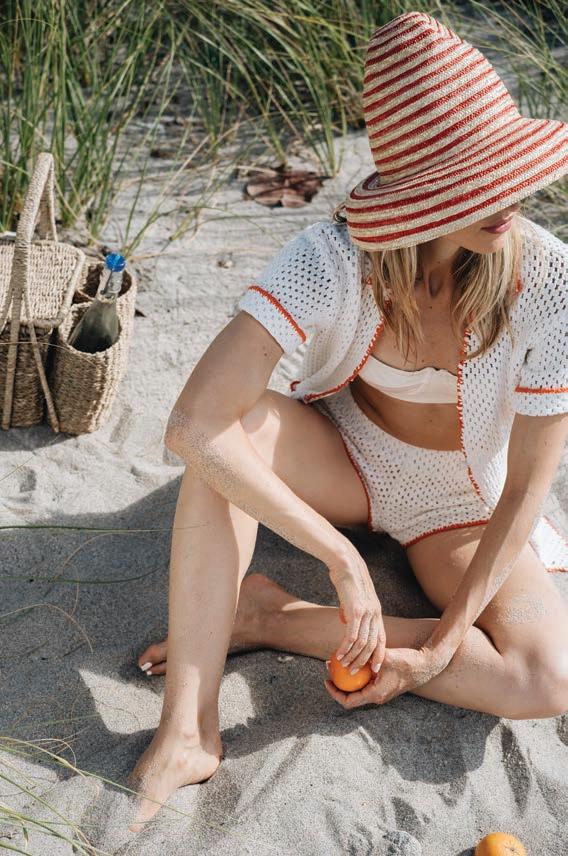


Paradise in the palm of your hand.
Discover a reimagined coastal destination with beautifully redesigned rooms and suites, inspired oceanfront restaurants and bars, and more. 833.917.1333


URSULA VON RYDINGSVARD: STATES OF BECOMING
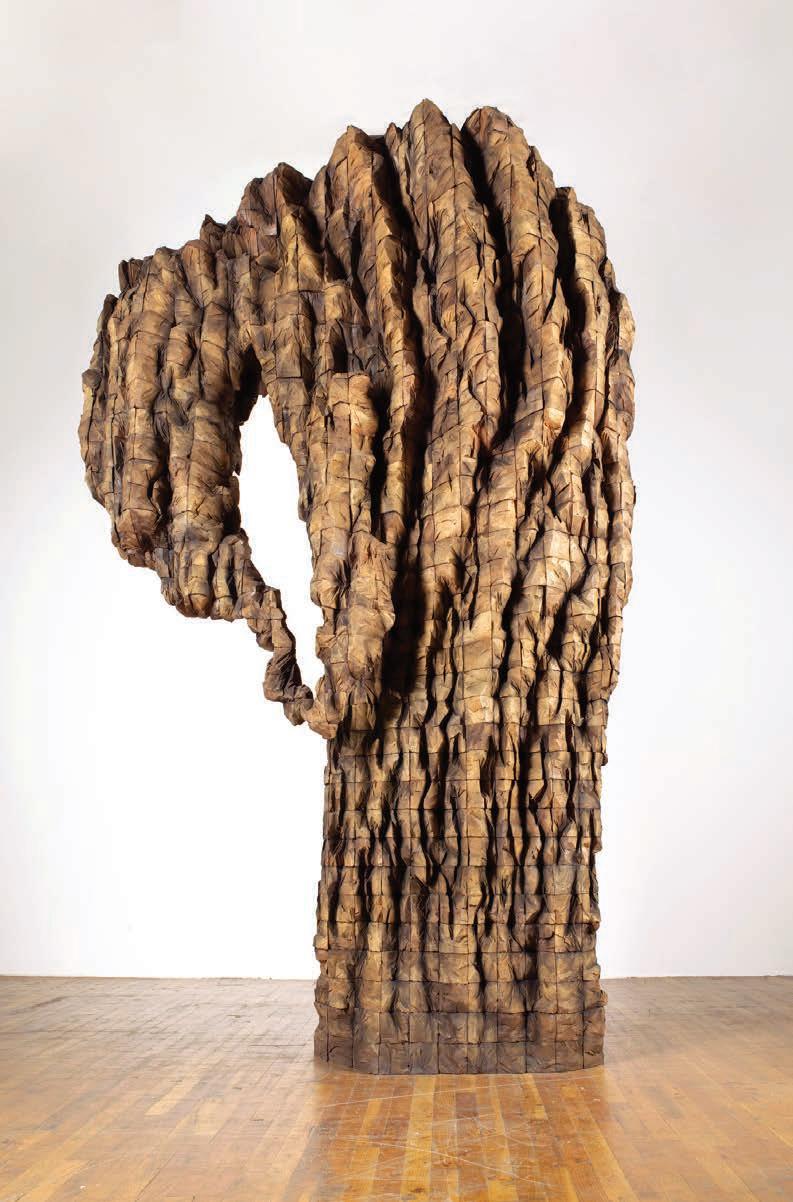
December 4, 2025–May 10, 2026
Bruce Museum Greenwich, CT BruceMuseum.org
Ursula von Rydingsvard (American, b. Germany, 1942), Heart in Hand (wood model), 2014. Cedar and graphite, 126 x 81 x 46 1/2 in. Courtesy the artist, Galerie Lelong, and Talley Dunn Gallery. © Ursula von Rydingsvard, courtesy Galerie Lelong and Talley Dunn Gallery. Photo by Michael Bodycomb.
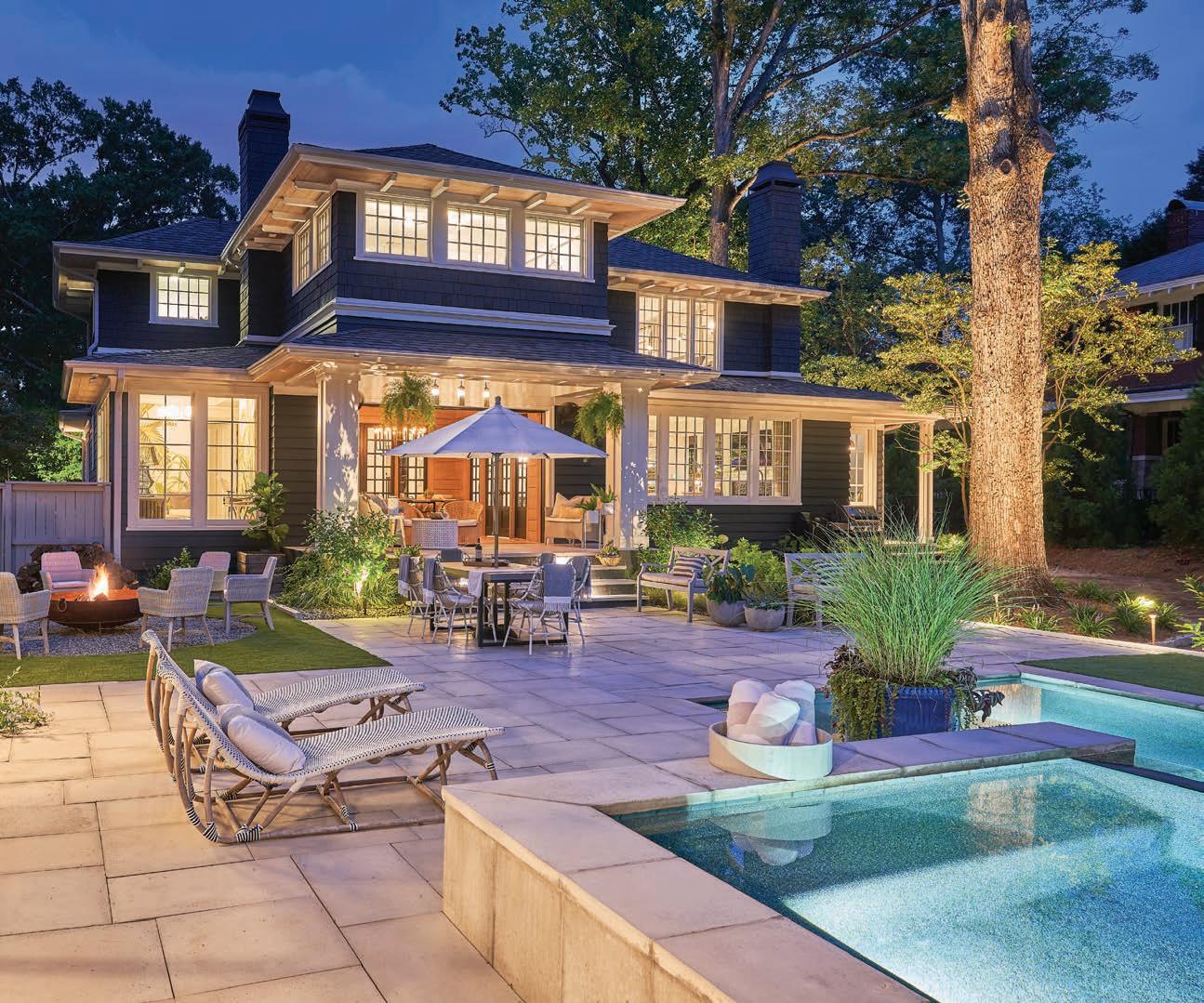

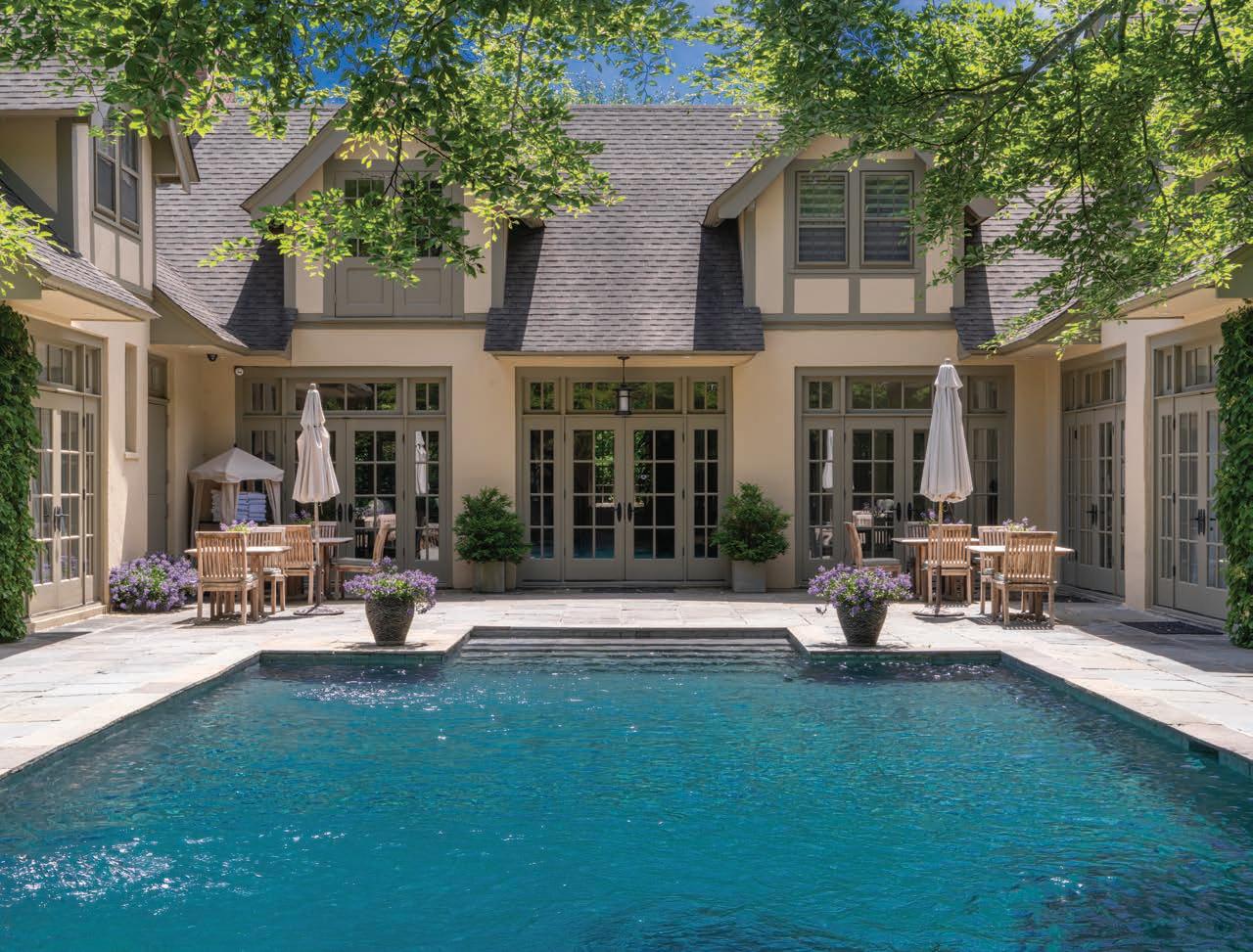
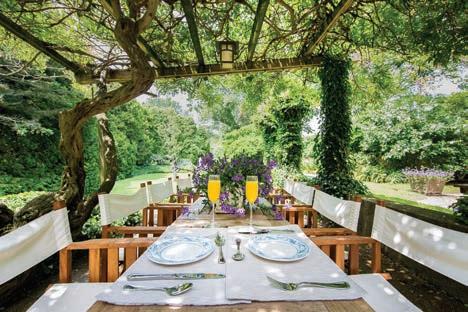
EAST HAMPTON’S MOST BEAUTIFUL BED & BREAKFAST
WHERE HISTORY MEETS INDULGENCE
Step beyond the ivy-covered walls and discover a retreat like no other. From sunlit breakfasts beneath a wisteria canopy to languid afternoons by the sparkling pool, The Baker House 1650 is a celebration of timeless elegance and modern comfort. Nestled in the heart of East Hampton Village, this award-winning English manor invites you to unwind in beautifully appointed rooms, rejuvenate in the tranquil spa, and savor every moment of your escape. Come experience why The Baker House 1650 is consistently named one of the East End’s most enchanting destinations. Reserve your stay today. www.bakerhouse1650.com

VIVANT
Curated Luxury Reimagined
EDITOR IN CHIEF, FOUNDER
Colleen Guilfoile Richmond
ART DIRECTOR
Kim Hall
VP, SALES & MARKETING
Wendy R. Packer
EDITOR AT LARGE
Margaret Bastick Luce
CULINARY EDITOR
Marci Moreau
BOOK EDITOR
Jane Ubell
CONTRIBUTING BEAUTY EDITOR
Margot Richmond
COPY EDITOR
Katelyn Rutt
EDITORIAL ASSISTANT
Morgan Richmond
EDITORIAL CONTRIBUTORS
Marci Moreau
Taylor Freeze
Vivian Ashcroft
Nathalie Dassa
Norah Lawlor
Cover image Rex Yu Photography
We love to hear from our readers, send press releases, inquiries, or comments to Colleen@VIVANT.media. Also, give our Instagram page a follow at @VIVANTpublications For advertising information, contact VIVANT Media Group at colleen@VIVANT.media
VIVANT Magazine is published quarterly by VIVANT Media Group LLC. Reproduction in any manner, in whole or in part, is prohibited without the express written consent of VIVANT Magazine. Material contained herein does not reflect the opinion of the publisher or its staff. VIVANT Magazine does not knowingly accept false or misleading advertisements or editorial. VIVANT Magazine reserves the right to edit all materials for space and clarity and assumes no responsibility for accuracy, errors, or omissions. Articles and photographs are welcome and may be submitted to our offices for review.
Send all submissions to:
Send all submissions to Colleen@VIVANT.media

@VIVANTpublications
VIVANT | 13777 Ballantyne Corporate Park | Charlotte, NC 28277

For an insider's guide to VIVANT Living, sign up for our editorial newsletters by scanning the code here.




EDITOR’S LETTER
There is a particular energy that emerges in moments of transition— when clarity replaces excess and intention begins to guide what comes next. This issue of VIVANT is shaped by that space: reflective yet forward-looking, grounded yet quietly in motion.
From the calm confidence of beautifully designed homes to the discipline of timeless style, this issue is a study in restraint, clarity, and thoughtful living—what remains when the unnecessary falls away.
In Poetry of Home and Nordmarka, designed by Gingham & Gable Interior Design, we spotlight interiors that prioritize longevity over trend—spaces designed for real life, memory, and ease. These are homes shaped by craftsmanship and emotional intelligence, where beauty feels lived-in rather than staged.
Movement and momentum weave subtly through the issue. In Between Seasons, Full Send, I take to the road at a moment defined less by destination than by possibility—where freedom is found in motion itself. Elsewhere, travel is approached with intention, where experience, sustainability, and beauty unfold deliberately.
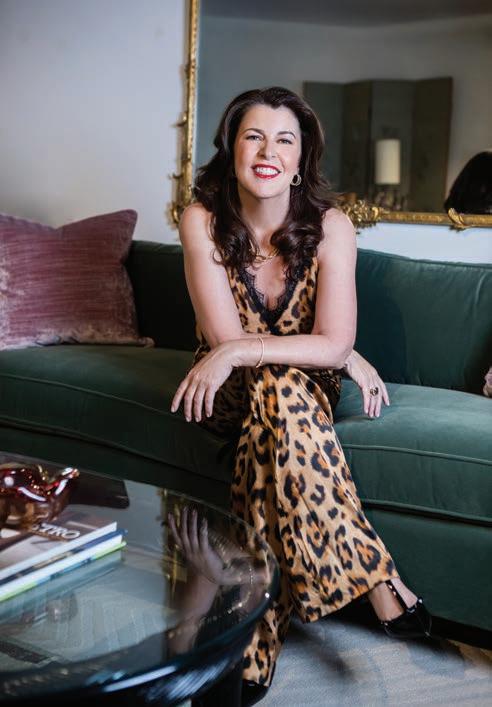
Wellness here moves beyond surface rituals. In Rewired and Whole Person Wellness, we explore how daily habits, sensory cues, nutrition, and environment quietly shape the mind and body over time. It’s a reminder that modern luxury is increasingly defined by clarity, energy, and well-being.
Culturally, this issue is anchored by creatives and visionaries who embody timeless style and substance—from Inès de La Fressange to the designers shaping Holiday House Wellington, where beauty and philanthropy meet with purpose. We are proud to be the Corporate Media Partner and to host the VIVANT Lounge within this year’s showhouse—a space created for conversation, reflection, and connection.
This issue is an invitation to live with intention—to edit thoughtfully, to choose depth over noise, and to design a life that feels both elevated and deeply personal.
With gratitude and joy, Colleen Guilfoile Richmond Founder & Editor-in-Chief VIVANT


At Chelsea Lane & Co., every project is approached as a story in the making. With Palm Beach’s most extensive collection of designer wallpapers and fabrics, the showroom is a destination for those who value interiors with depth and character. Clients experience expert guidance, whether visiting in person, meeting virtually, or accessing the mobile library. Each detail is thoughtfully managed, ensuring a seamless journey from first inspiration to final installation.

Image
THE BOAT
Before the Sails Catch Wind
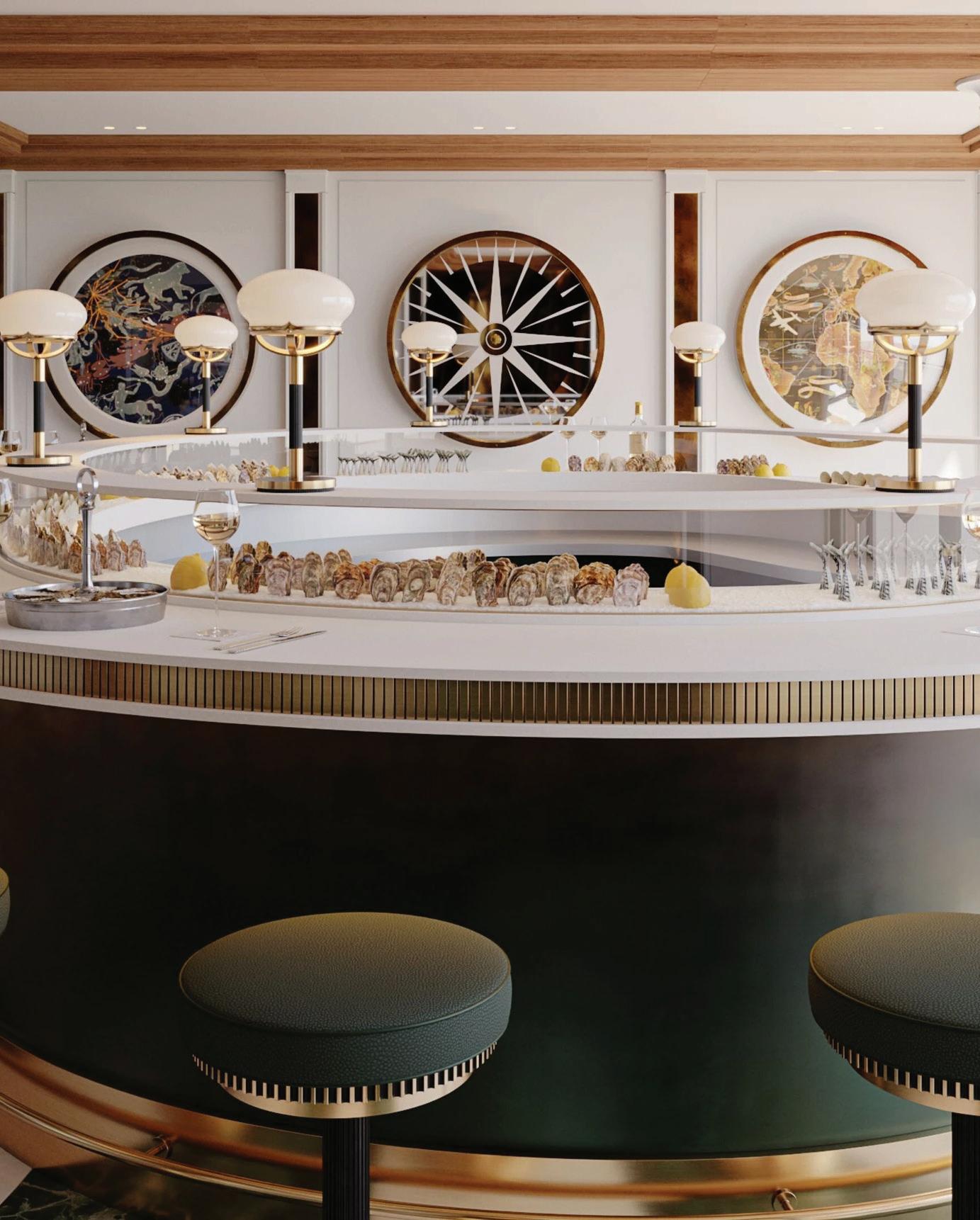
Orient Express hasn’t even set sail yet, but that hasn’t stopped it from thinking several voyages ahead. With a new slate of itineraries unveiled for 2027, the storied name—now under the Accor umbrella—is making it clear that the future of sea travel will be as much about imagination as it is about movement.
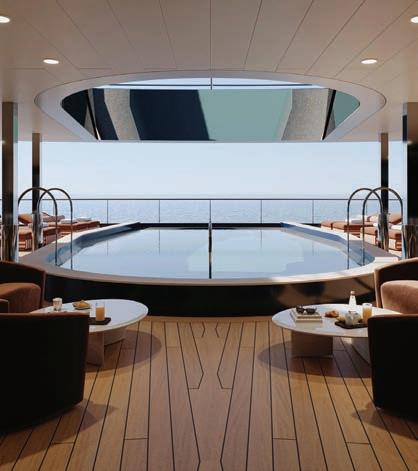
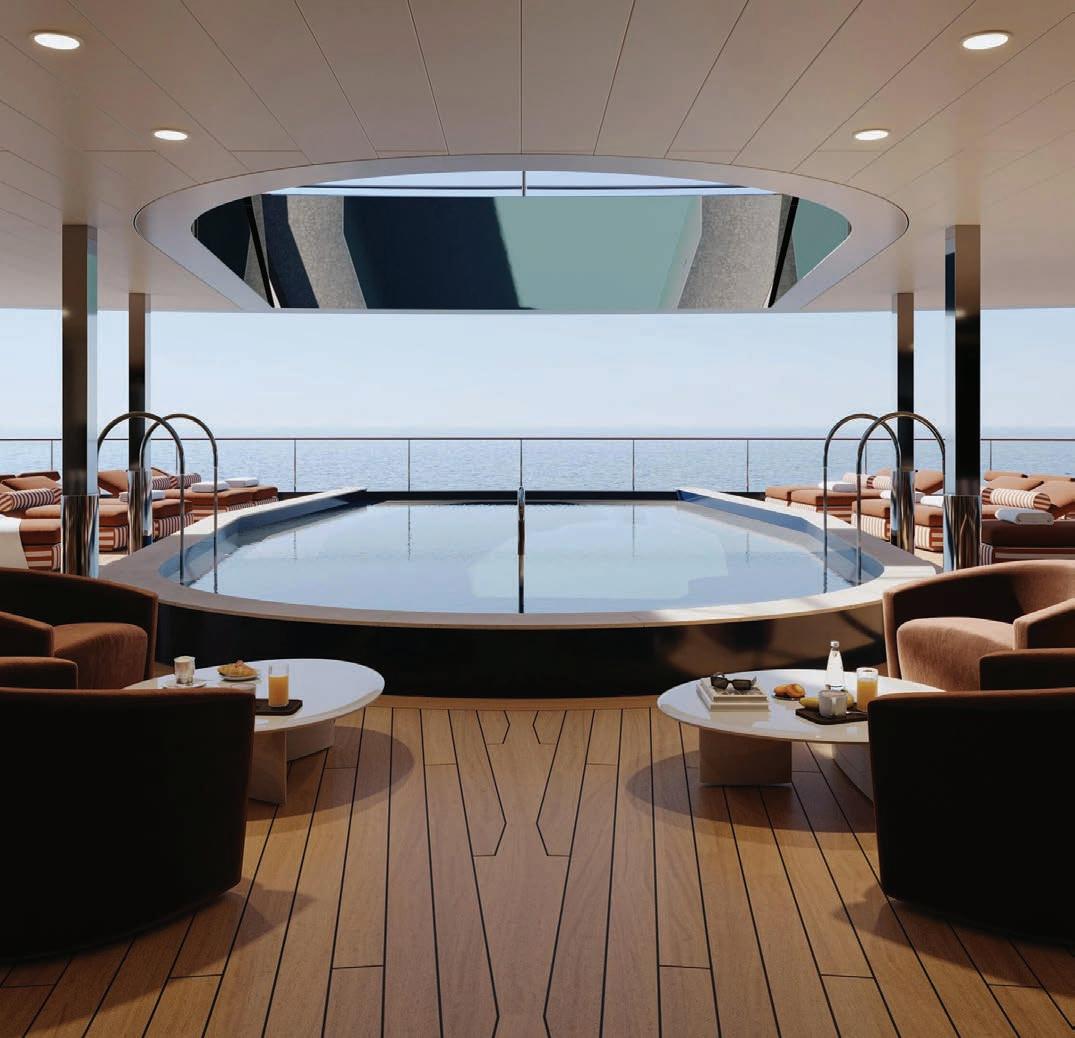
At the center of this next chapter are two sailing yachts, Corinthian and Olympian, designed to reintroduce romance, restraint, and true craftsmanship to the open water. The 722-foot Corinthian, slated to debut in 2026, will begin with an inaugural season through the Mediterranean and Caribbean before expanding its reach. A year later, its sister ship Olympian will join the fleet, opening up new routes across Greece, Turkey, the United Kingdom, and Scandinavia.
The itineraries read less like cruise schedules and more like carefully composed journeys. One Mediterranean route begins in Piraeus, tracing the Aegean and the Sporades before concluding in Istanbul. Another departs Valletta, Malta, winding through the Ionian Sea en route back to Greece. Northern European voyages are equally deliberate: departures from London glide down the Thames and along England’s southern coast before crossing to France, while other sailings follow Britain’s eastern shoreline north to Edinburgh, then onward to Norway and Denmark. A third route begins in Copenhagen, travels the Norwegian coast, and returns south through Scotland before finishing in London.
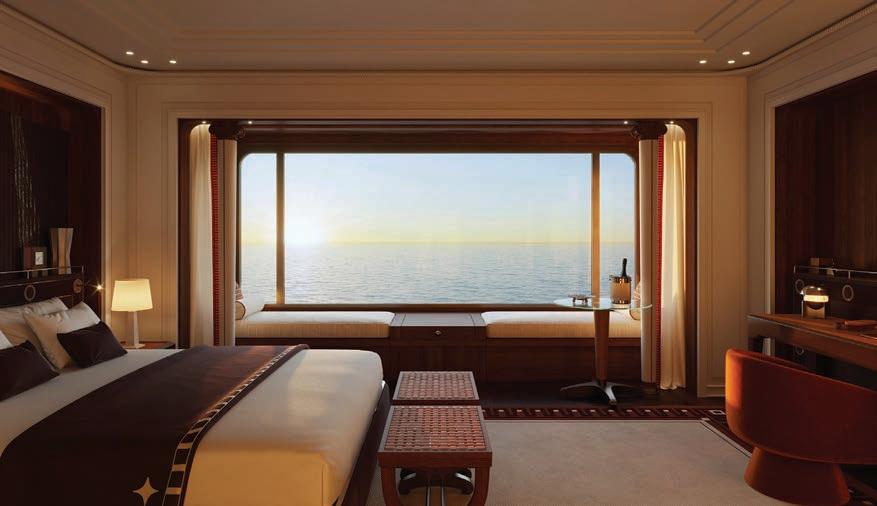
Image by Orient Express
Sustainability is quietly built into the experience. Each journey is planned to take advantage of favorable winds, reducing fuel use and environmental impact. Both yachts are equipped with a cutting-edge SolidSail propulsion system— three towering, adjustable masts with nearly 50,000 square feet of sail—engineered to maximize wind efficiency while minimizing emissions.
Luxury, of course, is non-negotiable. Interiors, overseen by artistic director Maxime d’Angeac, draw inspiration from the golden age of rail and ocean travel, reinterpreted
through a modern, pared-back lens. Each vessel houses just 54 suites, all with expansive terraces or panoramic windows, reinforcing a sense of privacy and intention. Onboard dining is led by Michelin-starred chef Yannick Alléno, while wellness experiences are curated in partnership with Guerlain—ensuring that time at sea feels as restorative as it is transportive.
The result is not simply a new way to sail, but a new way to think about travel altogether. Less about ticking destinations off a list, more about how the journey unfolds. Because long before the sails catch wind, the voyage has already begun.
Image by Orient Express
02
Some watches tell time. T his one makes a point—literally.
The idea began, as many great ones do, over wine. During a dinner at his Napa estate, filmmaker Francis Ford Coppola posed a mischievous challenge to independent watchmaking legend François-Paul Journe: could a watch tell time using an actual hand? Not a symbolic hand or a stylized pointer, but a miniature, articulated mechanical hand with fingers that indicate the hour. Journe—renowned for both his technical rigor and his quiet sense of humor—took the question seriously.
What followed was not a novelty, but an extraordinary exercise in imagination and discipline.
The result was the F.P. Journe FFC prototype, a true one-of-one created specifically for Coppola. On the dial, a sculptural mechanical hand indicates the hours, while the minutes are displayed on a rotating peripheral ring—an elegant solution that balances visual theater with clarity. The effect is playful yet refined, more automaton than ornament.
The mechanics behind the watch proved anything but simple. Journe spent years developing a bespoke movement capable of driving the articulated hand precisely and reliably without compromising performance. Inspiration came from an unlikely historical source: the 16th-century surgeon Ambroise Paré, whose mechanical prosthetic hands employed early systems of gears and springs to mimic human movement. Translating that ingenuity into a modern
wristwatch required not only innovation, but restraint.
Beneath the whimsy lies serious horology. The movement is based on Journe’s Octa architecture, incorporating mechanisms designed to deliver steady power while accommodating the unusual complication. Despite the visual drama on the dial, the watch remains remarkably balanced—proof that technical rigor and creative daring need not be at odds.
At first glance, the FFC may appear surreal—a watch that gestures rather than points—but its appeal runs deeper. It represents a rare dialogue between two creative minds from different worlds: one rooted in cinema and storytelling, the other in precision and tradition. Journe, a defining voice in independent watchmaking, allowed curiosity and humor to lead without sacrificing craftsmanship.
When Coppola later consigned the watch to Phillips in New York, collectors understood they weren’t bidding on a gimmick. After minutes of intense competition, the watch sold for $10.755 million, becoming the most expensive F.P. Journe ever auctioned and the highest-priced watch by an independent maker.
The result confirmed what serious collectors already know: the most compelling luxury objects do more than measure time. They capture imagination, intention, and the courage to take a brilliant detour from the rules.

Image by Phillips
Gin, but Make It Royal
Just when you thought the English countryside couldn’t get any more cinematic, Highgrove—yes, that Highgrove—has gone and bottled it. In partnership with Cotswolds Distillery, the estate has unveiled Highgrove Evergreen, a small-batch gin inspired by the gardens surrounding King Charles III’s private residence.
Think less nightclub lime, more mossy path after rain. This is a gin that wears tweed, knows its hedgerows, and absolutely does not shout. Juniper-forward with subtle evergreen notes, it evokes the quiet authority of the landscape itself—orderly, cultivated, and deeply British in that we’ve been doing this longer than you have.
Beyond the royal association, the intention behind Highgrove Evergreen matters. Proceeds support The King’s Foundation, reinforcing a more modern idea of luxury—one rooted in conservation, craftsmanship, and leaving the landscape intact. Sustainability, but with excellent posture.
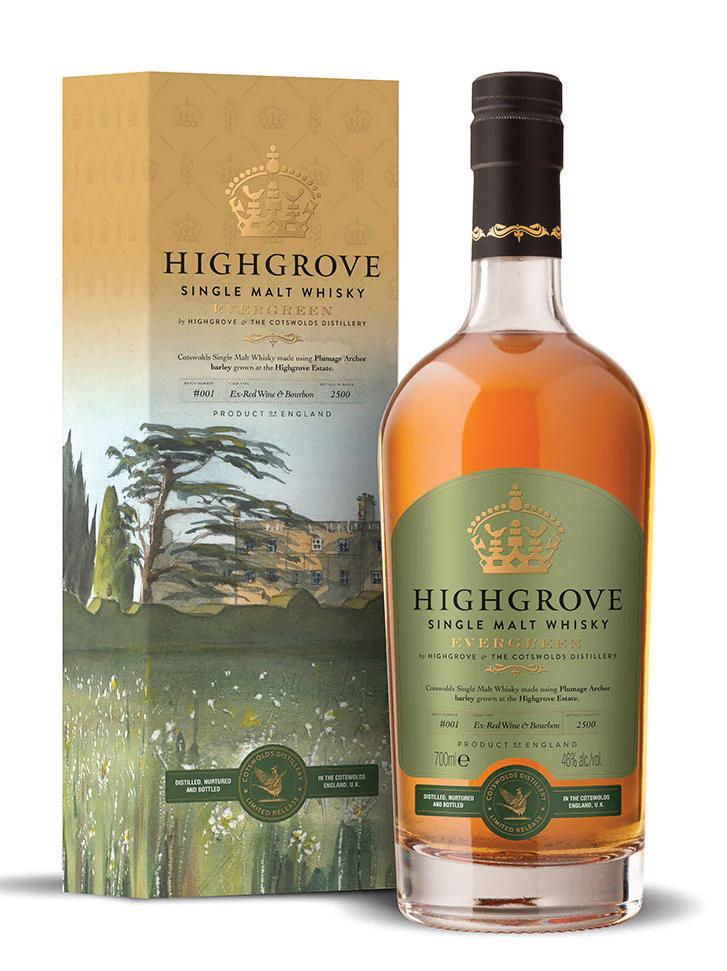
Naturally, this isn’t a gin for muddled fruit or novelty ice cubes. Serve it properly—clean tonic, a restrained garnish, and preferably somewhere green. A terrace will do. A garden is better. Rolling hills are ideal, though we
understand not everyone summers in Gloucestershire. Highgrove Evergreen is less about what’s in the glass and more about the mood it sets—calm, considered, confident. Proof that when heritage meets modern taste, the result doesn’t need to shout to be heard.
Image by Highgrove
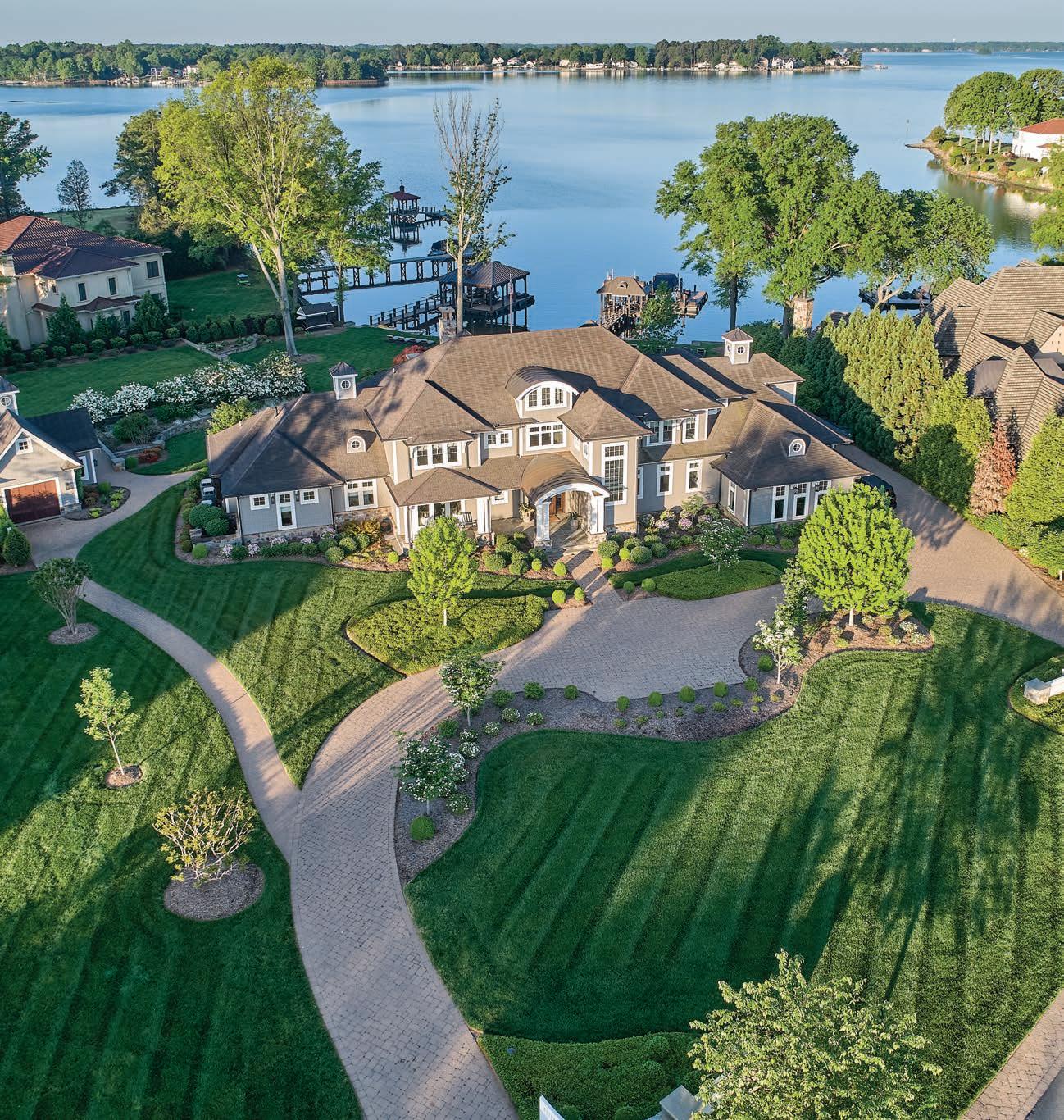

BETWEEN SEASONS, FULL SEND An East Coast road story
By Colleen Guilfoile Richmond
Winter on the East Coast has a way of making you restless. By Spring, you’re already mentally shedding layers, craving light, space, and the promise of movement. Remembered now, out of season, this drive feels less like a summer memory and more like a reminder: fun doesn’t need a calendar.
I picked up the GMC HUMMER EV in New York City, which is not exactly known for welcoming large personalities—vehicular or otherwise. Let’s be clear: this is a big car. On city streets, you feel it immediately. Taxi drivers clock you. Delivery vans pause. There’s a brief, delicious moment of should I be doing this? before the answer becomes obvious: absolutely.
Once you settle in, the size stops feeling intimidating and starts feeling… empowering. Visibility is excellent, steering is surprisingly nimble, and suddenly the chaos of the city feels manageable—almost orderly. Stop-and-go traffic loses its sting when there’s no engine noise filling the cabin. Tight turns feel intentional. The HUMMER EV doesn’t try to blend in, and somehow that makes New York behave.
Leaving Manhattan is where the shift really happens. Streets widen, shoulders drop, and the drive starts to stretch. On the highway, Super Cruise takes over the mental load, turning what’s usually a white-knuckle crawl east into something closer to a glide. Miles pass easily.
Hours don’t feel heavy. This is where the HUMMER EV quietly proves it’s a legitimate road-trip car— comfortable, composed, and confident enough that you stop thinking about range or stops and just… drive.
Last summer, I pointed it toward the Hamptons in that narrow window before the season tips fully into frenzy.
The hedges grow taller, the air lighter, the pace slower. Power is always there when you want it—instant, smooth, and almost mischievous in its silence. And then came the best part.
“Intimidating in the city. Uneniably fun once the road opens up.”
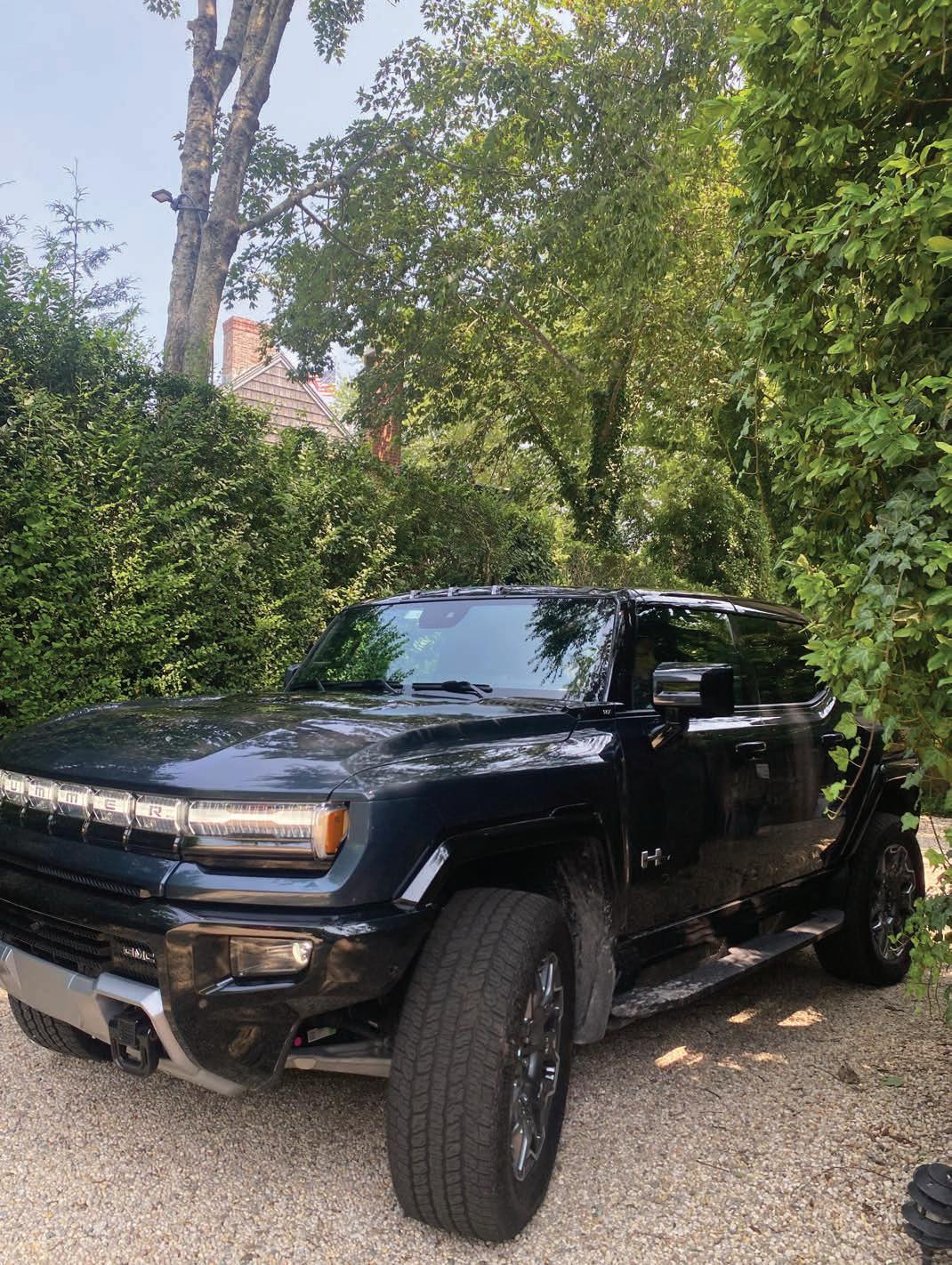
One warm afternoon, beach bag tossed in back, plans intentionally vague, the Infinity Roof panels came off. Tops off, sunglasses on, music up. Suddenly the HUMMER EV wasn’t just powerful—it was playful. Ocean air rushed in, light poured down, and every stretch of road felt like it was daring you to enjoy it. It’s hard not to laugh a little when your car feels less like transportation and more like a very capable summer accomplice.
The Hamptons, for all their beauty, are not easy. Narrow village streets, tight parking, sandy pull-offs you commit to without fully knowing how they’ll end. This is where the HUMMER EV surprised me most. Four-wheel steer made its size feel negotiable— almost cheeky—and expansive camera views turned potentially awkward moments into non-events. Big? Yes. Clumsy? Not even close.
From smooth highways to uneven back roads and beach parking lots, the vehicle adapted without fuss—select the right mode, keep moving. Even charging stops felt refreshingly unbothersome. Grab an iced coffee, answer a text, take in the view. Back on the road.
Looking back now, the drive feels especially relevant. It wasn’t just about getting from city to coast—it was about how seamlessly the HUMMER EV handled both personalities. A little intimidating in the city, in a way that works in your favor. Easy, confident, and undeniably fun once the road opens up.
Luxury doesn’t always have to whisper. Sometimes it smiles, takes the long way, pops the tops, and reminds you that the best journeys are the ones that don’t take themselves too seriously. As we look ahead to warmer days, this is the kind of energy worth remembering—and repeating.



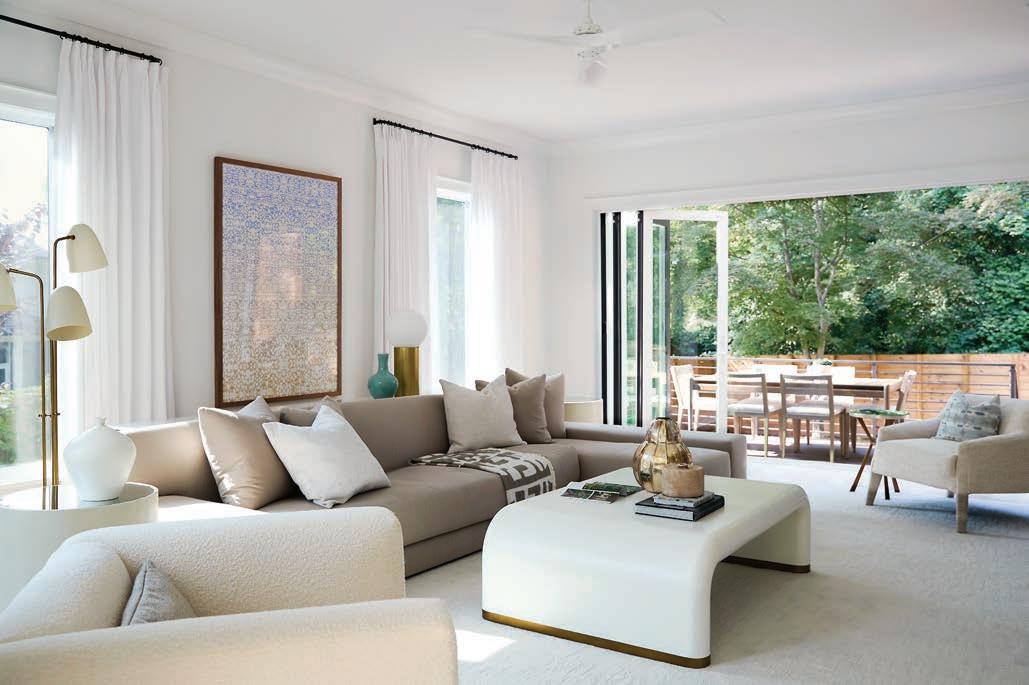
THE POETRY OF HOME
Design: Lisa Sherry Interieurs
Photography: Stacey Van Berkel
For Charlotte-based interior designer Lisa Sherry, home is more than a physical space. It shapes how we feel, how we think, and how we connect with one another. This belief underpins her approach to design –a deliberate, joyful act of curation guided by intention.
Natural materials, measured proportions, subtle palettes, and thoughtful edits create rooms that feel both grounded, expansive and timeless. Every choice serves a purpose, yet nothing feels forced.
For Lisa Sherry, this approach is a design philosophy – and more – an ode to home and a life well lived.
lisasherryinterieurs.com




THE EDIT
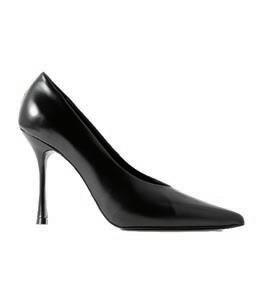
KISS LEATHER PUMPS, THE JUDE
Sharp, decisive, and unapologetic. Shoes that don’t ask questions. thejude.com
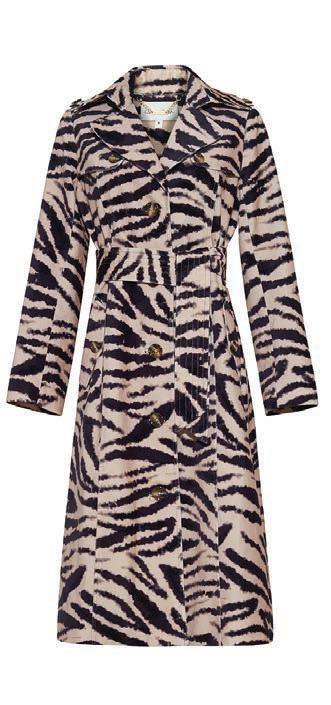
KARLIE TRENCH, CARA
Cara Effortlessly dramatic. Tossed over the shoulders, never buttoned, always on your way somewhere better. caracaranyc.com
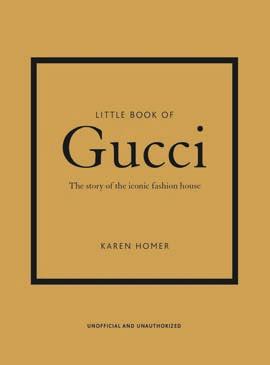
THE LITTLE BOOK OF GUCCI, GUCCI
A style icon between covers. Proof that great taste is always worth revisiting. amazon.com
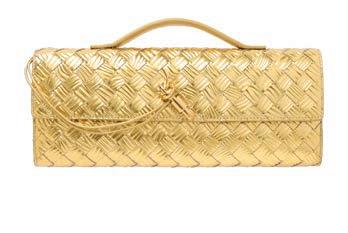
ANDIAMO CLUTCH, BOTTEGA VENETA
Soft structure, instant allure. The clutch you carry like a secret. bottegaveneta.com
AFTER DARK
Winter dressing begins after the first glass. Graphic silhouettes, polished gold, and enduring fashion icons—assembled for nights that rarely end where they start
By Colleen Guilfoile Richmond
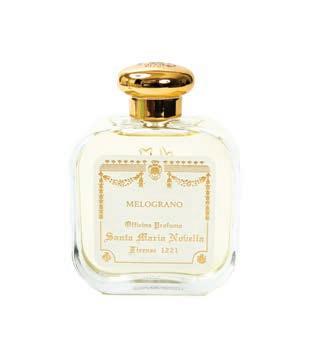
SANTA MARIA NOVELLA MELOGRANO EAU DE COLOGNE, SANTA MARIA NOVELLA
Old-world, intimate, unmistakably elegant. Smells like secrets kept close and evenings that linger. modaoperandi.com
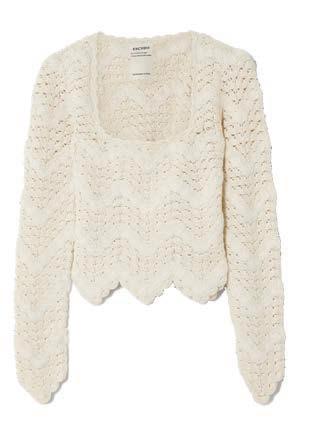
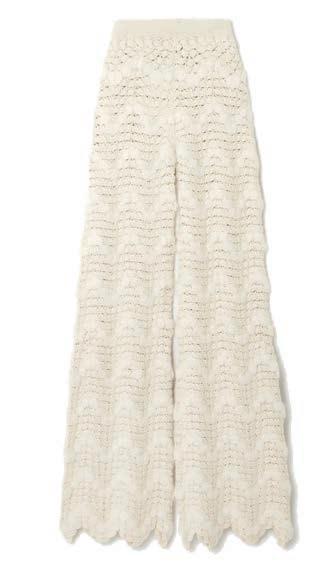
BRISA SCALLOPED CROCHETED ALPACA TOP & PANT, ESVDO
Texture that does the talking. Cozy, confident, and quietly unforgettable. esvdo.com
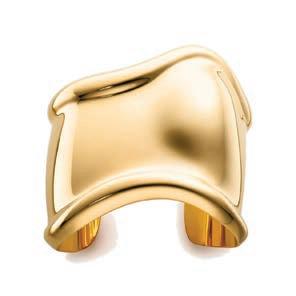
A single, sculptural gesture. The kind of piece that ends the conversation—and replaces every other bracelet. tiffany.com
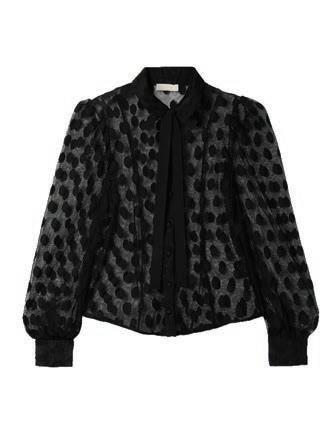
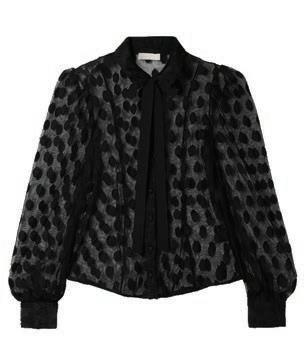
SORAYA TIE-DETAILED FIL COUPÉ MESH BLOUSE, ULLA JOHNSON
Soft transparency with intention. Romantic, but not innocent. ullajohnson.com
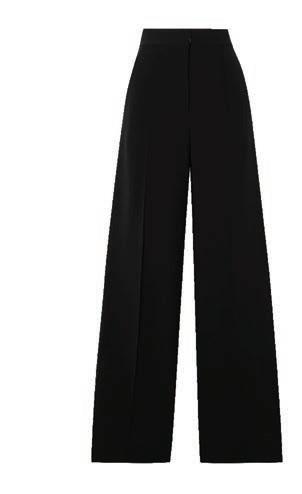
NET SUSTAIN STRETCH-MERINO WOOL WIDE-LEG PANTS, ANOTHER TOMORROW
Tailoring with a conscience. Grounding the look while letting everything else flirt. anothertomorrow.co
VIVANT ÉTERNEL CANDLE, VIVANT MAGAZINE
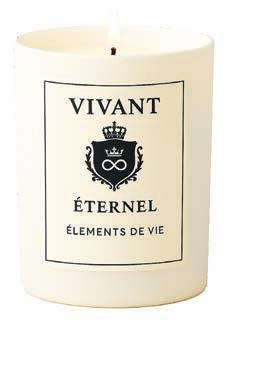
Warm, grounded, and quietly sensual. The final note—long after everyone’s gone. vivantmagazine.com
ELSA PERETTI GOLD BONE CUFF, TIFFANY & CO.

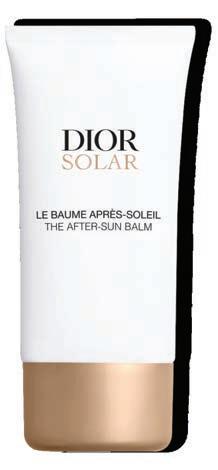
DIOR SOLAR THE AFTER-SUN BALM
Calms, deeply hydrates, and helps keep your tan looking its best. With a fresh, cooling feel and a soft monoi scent, it soothes sun-kissed skin while making the recovery part feel just as good. dior.com
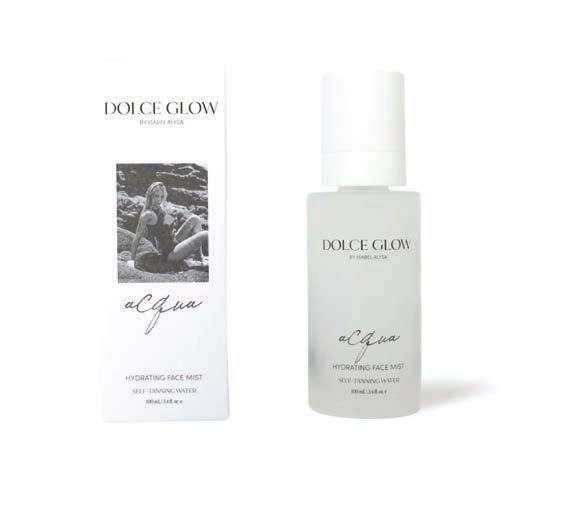
DOLCE GLOW ACQUA
HYDRATING FACE MIST
SELF-TANNING WATER
Delivers a soft, sun-kissed glow in seconds. Part self-tan, part refresher, it works beautifully under makeup or as a dewy setting spray—leaving skin fresh and effortlessly bronzed. dolceglow.com

DERMALOGICA WARMTH OF THE WINTER SUN SET
THE SKIN EDIT
This winter, enjoy the sun with a refined trio of travel-size essentials for hydrated, protected skin— wherever the season takes you. dermalogica.com
Winter Sun Essentials From New York Frost to Palm Beach Days.
By Margot Richmond

SUNSOLVEMD LIPIDRESTORE
VOLUMIZE+ RESTORE SPF 40
A deeply restorative, formula designed to plump the skin and deliver an intensive boost of moisture. sunsolvemd.com
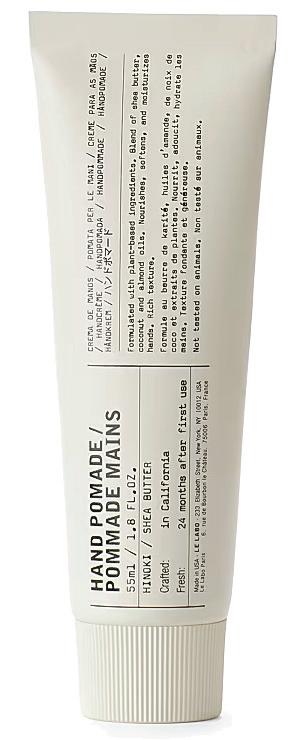
LE LABO HAND POMADE
An ideal companion for days spent skiing. The formula delivers lasting hydration without heaviness, leaving your hands smooth and well cared for from first lift to après. lelabofragrances.com
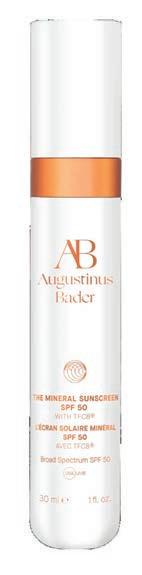
AUGUSTINUS BADER THE MINERAL SUNSCREEN SPF 50
A polished essential for travel days that span climates, whether it’s shielding against reflective snow or bright ocean light— and a reminder that skin protection is always in season. augustinusbader.com

DR. BARBARA STURM ANTI-AGING BODY SET
Hands and body are often overlooked, yet most affected by the sun— this set plays an essential role in preventing premature aging caused by environmental stressors, including UV exposure. drsturm.com
WELLNESS
LIFTED WITH DR. FREDRIC
M. BARR, M.D.,
F.A.C.S.
The art and science of the modern eye lift — precision, subtlety, and the pursuit of natural elegance
There is a particular confidence that comes from looking better without looking altered—not overdone, not obvious, simply refreshed. For me, that confidence arrived in the most unexpected way: through a conversation, a mirror, and a level of precision I didn’t know was possible.
I recently underwent an eye lift with Dr. Fredric M. Barr, a board-certified plastic surgeon and founder of Palm Beach Plastic & Cosmetic Surgery. What struck me most wasn’t just the ease of the experience—but the way he sees. Within moments of standing side by side in the mirror, he calmly pointed out details I had never noticed in a lifetime of looking at my own reflection: one eye slightly larger than the other, one cheekbone subtly higher. It wasn’t criticism. It was clarity.
That moment reframed everything. I realized this is where modern aesthetic surgery truly begins—not with trends or promises, but with proportion, balance, and respect for individuality. Dr. Barr doesn’t isolate features or chase perfection. He looks at the face as a whole, understanding how the eyes relate to the brows, the cheekbones, and the structure beneath the skin. The goal is never to make someone look “done,” but to restore what time has gently softened.

What distinguishes his work most is restraint. There is no push, no pressure, no sense of urgency. Education comes first. Conversation follows. Only then does a plan take shape—one that feels collaborative, thoughtful, and deeply personal. His approach feels guided as much by what he chooses not to do as by what he does.
Equally important is how the procedure itself is performed. Dr. Barr completes eye lifts entirely in-office using local anesthesia, a decision rooted in patient health rather than convenience. General anesthesia does not replicate natural sleep; it temporarily suppresses normal brain communication, alters neurotransmitter balance, and requires the brain to recalibrate once the drugs wear off. This is why many patients experience lingering fatigue, mental fog, or a sense of emotional flatness afterward—effects that, while often temporary, represent a real neurological burden.
For a focused, delicate procedure like an eye lift, that level of systemic stress is often unnecessary. Local anesthesia allows the brain to remain intact and responsive. Patients breathe on their own, cognitive networks remain undisturbed, and recovery begins immediately—without asking the body or mind to rebound from a full shutdown. From a health perspective, it is a gentler, more precise approach that supports clearer, faster recovery.
Friends later remarked that I looked rested, refreshed—but nothing about me looked altered. And that, I learned, is the point. The most successful eye lifts don’t announce themselves. They restore balance quietly, allowing the face to feel like itself again.
I initially did the procedure to restore the look of my eyes—which it did, and then some. What surprised me was how much impact that small, focused change had on my overall appearance. My eyes looked more open, more balanced, and in turn, my entire face looked subtly refreshed. Just as unexpectedly, I found myself equally pleased with how it made me feel—lighter, more awake, and no longer compensating for a heaviness I hadn’t realized I was carrying.
Without that strain, my vision felt clearer. My peripheral awareness sharper. I wasn’t unconsciously working anymore. I was simply seeing the way I once did—and that clarity translated into a surprising sense of energy and ease.
Dr. Barr represents a modern philosophy of aesthetic medicine— one rooted in subtlety, proportion, and respect for individuality. His work doesn’t chase transformation. It honors continuity.
The goal was never to stay the same. It was to look more awake, more balanced, and undeniably better—quietly. For anyone considering an eye lift and looking for a result that prioritizes balance, health, and discretion, Dr. Barr’s approach sets a remarkably high standard.
Dr. Fredric M. Barr, M.D., F.A.C.S.
REWIRED THE LUXURY OF A NEW MIND
Neuroplasticity meets lifestyle design — how daily habits, scent, equestrian rhythm, travel, and space reshape the brain. The future of longevity isn’t louder, faster, or more extreme—it is quieter, more intentional, and neurologically precise.
By Colleen Guilfoile Richmond
Luxury, at its most evolved, is no longer about accumulation. It is about precision—about understanding what truly shapes our inner lives and choosing accordingly.
Neuroscience now confirms what refined living has long intuited: the brain is not fixed. It is adaptive, responsive, and perpetually under construction. Every habit repeated, every space entered, every sensory cue absorbed quietly reshapes neural pathways over time.
This capacity for change—neuroplasticity—now sits at the center of longevity science. In a world saturated with microplastics, endocrine disruptors, and chronic low-grade stress, it reframes brain health as something we design, not something we inherit or inevitably lose.
Few clinicians translate this science into daily life as fluently as Dr. Sabine Donnai, founder and CEO of Viavi, a London-based clinic devoted to proactive, deeply personalized health. Her work sits at the intersection of medicine, environment, and intentional living—and her message is clear: the brain is always listening.

“The brain is always listening— every habit, environment, and sensory cue quietly reshapes how we think, feel, and adapt.”

For much of medical history, the brain was considered relatively static. Neuroplasticity dismantles that idea entirely. The brain is in constant conversation with its environment—responding to what we eat and drink, how we sleep, the light we receive, the toxins we encounter, and the emotional safety of our routines. Architecture, rhythm, and sensory input matter more than we once believed.
This understanding is both empowering and confronting. Empowering because change is always possible. Confronting because chronic inflammation, disrupted circadian rhythms, and constant stimulation don’t simply exhaust us—they quietly sculpt cognition over time. Brain health, in this context, becomes an act of authorship.
Microplastics are now present in water, food, air, and human tissue. The concern is not a single dramatic effect, but accumulation. These materials are biologically foreign and can create persistent, low-grade immune activation. Over time, this background inflammatory noise may interfere with neurotransmitter balance, mitochondrial energy production, and the integrity of the blood–brain barrier. When endocrine disruption is added—particularly involving oestrogen, thyroid hormones, and cortisol—the effects often surface subtly: brain fog, mood shifts, diminished focus. This is not about fear; it is about intelligent risk reduction.
In clinical practice, certain daily choices become non-negotiable—habits that remove unnecessary cognitive and biological load. Clean, filtered water. Never heating food in plastic. Choosing materials that do not leach chemicals. These are not wellness trends, but protective strategies. One decision means little. Thousands of small decisions, repeated daily over decades, define the internal environment in which the brain must function. Neuroplasticity responds to consistency, not perfection. Reduce inflammatory noise and the brain recalibrates; overload it continuously and it adapts in less favorable directions.
Food becomes part of this same architecture. Detoxification is not a cleanse but a system. The gut plays a central role in managing environmental exposure, and a resilient gut barrier, diverse microbiome, and effective elimination pathways allow unwanted particles to exit
rather than recirculate. Soluble fibers—found in legumes, oats, vegetables, and especially mushrooms—act as binding agents. Mushrooms also provide beta-glucans that help modulate immune response, supporting clearance without triggering excess inflammation. Food, in this sense, becomes a daily form of neural defense.
“Luxury today isn’t about accumulation; it’s about designing a life that protects clarity, rhythm, and cognitive resilience.”
Beyond what we remove, what we introduce matters just as profoundly. Scent has a direct neurological pathway, bypassing rational filtering and speaking straight to memory, emotion, and regulation. Ritual scent—through candles, oils, or the natural environment—becomes a subtle neurological anchor. Routine itself is a luxury. The equestrian rhythm of early mornings, natural light, movement, repetition, and recovery creates safety signals for the nervous system. It is no coincidence that environments grounded in animals, land, and cadence often feel mentally clarifying.
Space matters as well. Calm interiors, restrained palettes, natural materials, and visual quiet reduce background cognitive stress. Travel, when designed with recovery rather than velocity in mind, supports neural resilience rather than eroding it. The brain thrives on predictability balanced with challenge, and when we rush constantly, we remove the recovery phase it needs to adapt.
Neuroplasticity leaves us with a powerful truth: the brain is always listening. Every habit is a message. Every environment an instruction. Every repeated choice a form of authorship. In an age obsessed with optimization, perhaps the most refined luxury is not doing more, but shaping less noise, more intention, and a life designed to protect clarity, adaptability, and ease. A well-designed mind, after all, is the ultimate status symbol.
THE FUTURE OF WHOLE-PERSON WELLNESS
By Marci Moreau
For a long time, wellness has been shaped by trends, buzzwords, and rigid rules about how we should live. It’s often been reduced to programs, protocols, and the pursuit of perfection.
But the future of wellness looks different. It’s more personal. More grounded. And, to me, far more powerful. We are finally arriving at that sweet spot, where our stories and science come together creating a stronger framework for optimal well being. Here health is understood not as a checklist, but as something deeply individual.
Whole-person wellness recognizes that health is shaped not only by our biology, but by our experiences, our environments, and the choices we make every day. No two bodies respond in exactly the same way. Our genetic makeup matters but not in the deterministic way we once believed.
Today, one of the most promising tools in whole-person wellness is DNA-based nutritional analysis.
Rather than prescribing a one-size-fits-all approach, nutritional DNA insights help illuminate how an individual’s body processes key nutrients, responds to certain fats and carbohydrates, manages inflammation, and detoxifies environmental exposures.
This information offers context, and a clearer understanding of how food can be used more intentionally
to support the body’s natural strengths and vulnerabilities.
When combined with high-quality ingredients, sustainable food systems, and mindful lifestyle choices, nutritional DNA analysis becomes a powerful guide, helping people move beyond trends and toward nourishment that truly works with their biology.
This is great news because for years, genetics were treated as destiny.
What you inherited was simply what you got.
But research now tells a different story. We have more influence over our health than we once thought. Our genes are not fixed instructions; they’re responsive. They listen. And one of the most powerful signals they receive comes from food.
If the idea that food can influence how our genes behave sounds surprising, nature offers a remarkably powerful example.
Inside a beehive, worker bees and queen bees are genetically identical. Yet they live dramatically different lives. Worker bees labor constantly and live only a few weeks. The queen bee lives for years and has the capacity and strength to create an entire colony.
Interestingly, the difference isn’t genetics. It’s food.
Queen bees are fed royal jelly, while worker bees consume nectar and pollen. Royal jelly doesn’t just provide energy, it activates specific genetic pathways that shape the queen’s anatomy, physiology, and longevity.
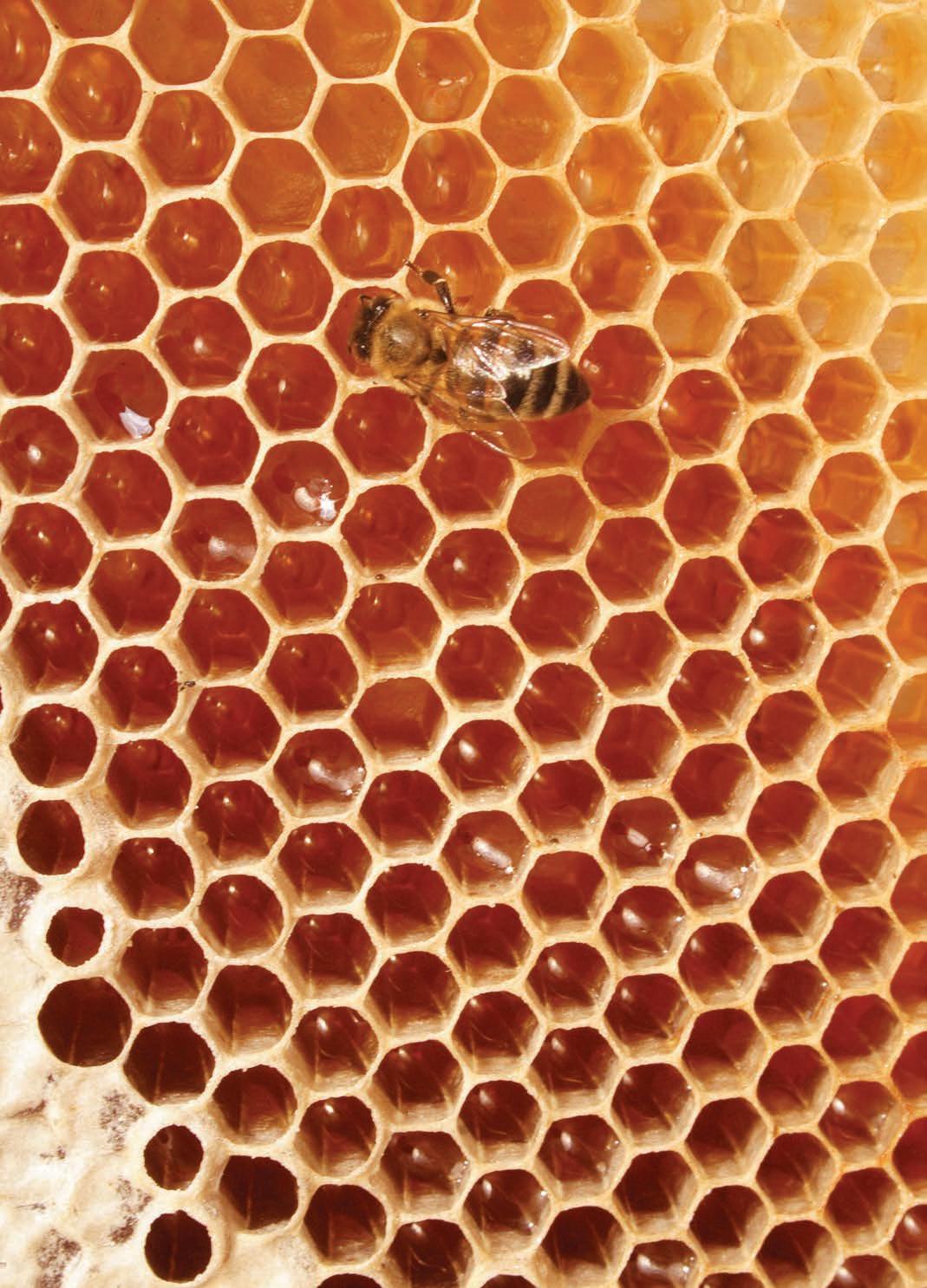
This has become one of the most widely cited examples of epigenetics; the science of how external factors, including food, influence which genes are turned on or off.
Of course, human biology is more complex, but the principle holds. What we eat matters not just as fuel, but as information, shaping how our bodies function over time.
This understanding couldn’t be more important right now.
With PFAS and other so-called “forever chemicals” increasingly present in our environment, the quality of our food matters more than ever. We can’t control every exposure. But we can choose foods that support detoxification, strengthen resilience, and help the body do what it was designed to do.
If food is one of the primary signals shaping our health, then how it’s grown matters. What it contains, and what it doesn’t, matters. Our food must do more than fill us. It must support repair, resilience, and long-term well-being.
In a very real way, we need our food to be the royal jelly. We need our food to be the strongest most powerful source nourishment that supports the best expression of our biology, food that works with us, not against us.
Whole-person wellness is about understanding how our environment, our genes, and the food we eat interact every day, over a lifetime. Armed with that knowledge, we can move beyond trends and rules, and feed our bodies the cleanest ingredients that best support our unique genetic blueprint.
This is where the Future of Whole Person Wellness is going.
Toward cleaner, more sustainable ingredients. Toward food that works with our individual biology. Toward health that is resilient, personal, and finally, truly powerful.
HONEYCOMB MUSTARD VINAIGRETTE
Raw honeycomb contains enzymes, polyphenols, and trace nutrients that are often lost in processed honey. Combined with high-quality olive oil, this vinaigrette supports antioxidant activity, digestion, and metabolic balance, with a quiet nod to royal jelly metaphor and all our Queen Bees. Makes about 3/4 cup.
Ingredients:
• 1 tablespoon raw honeycomb (cut from the comb)
• 2 tablespoons raw apple cider vinegar
• 1/2 teaspoon Dijon mustard
• 1/4 teaspoon sea salt
• Freshly cracked black pepper, to taste
• 1/2 cup high-quality extra virgin olive oil
• Juice and rind of 1/2 lemon
• 1/2 teaspoon freshly grated ginger root
• 1/2 teaspoon freshly grated turmeric root
Place the honeycomb in a small bowl and gently mash it with a fork to release the honey. Whisk in the vinegar, lemon juice, lemon rind, mustard, ginger root, turmeric root, salt and pepper. Slowly drizzle in the olive oil while whisking continuously until emulsified. Taste and adjust seasoning as needed.
Drizzle over any of your favorite greens like arugula or radicchio, roasted vegetables, or shaved fennel. Let it sit for a few minutes before serving so the flavors fully bloom.
Marci Moreau partners with GenoPalate, a science-based nutritional DNA analysis company, to help individuals better understand how their unique genetic makeup interacts with food. This partnership reflects her belief that informed, personalized nutrition is a cornerstone of whole-person wellness. To purchase you own DNA analysis use my discount code MARCIMOREAU
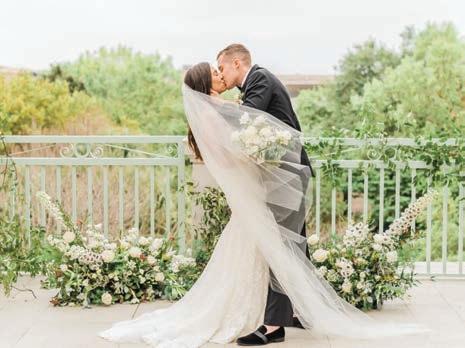
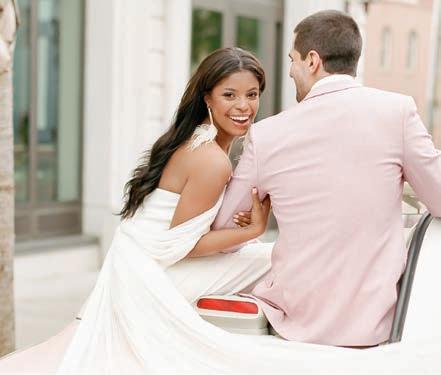
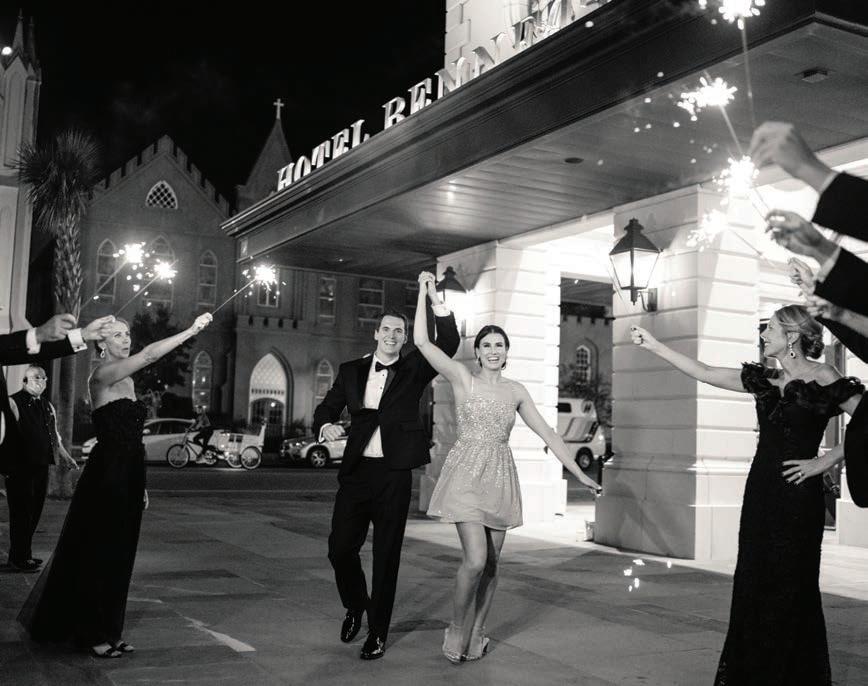
Your Love Story is Now

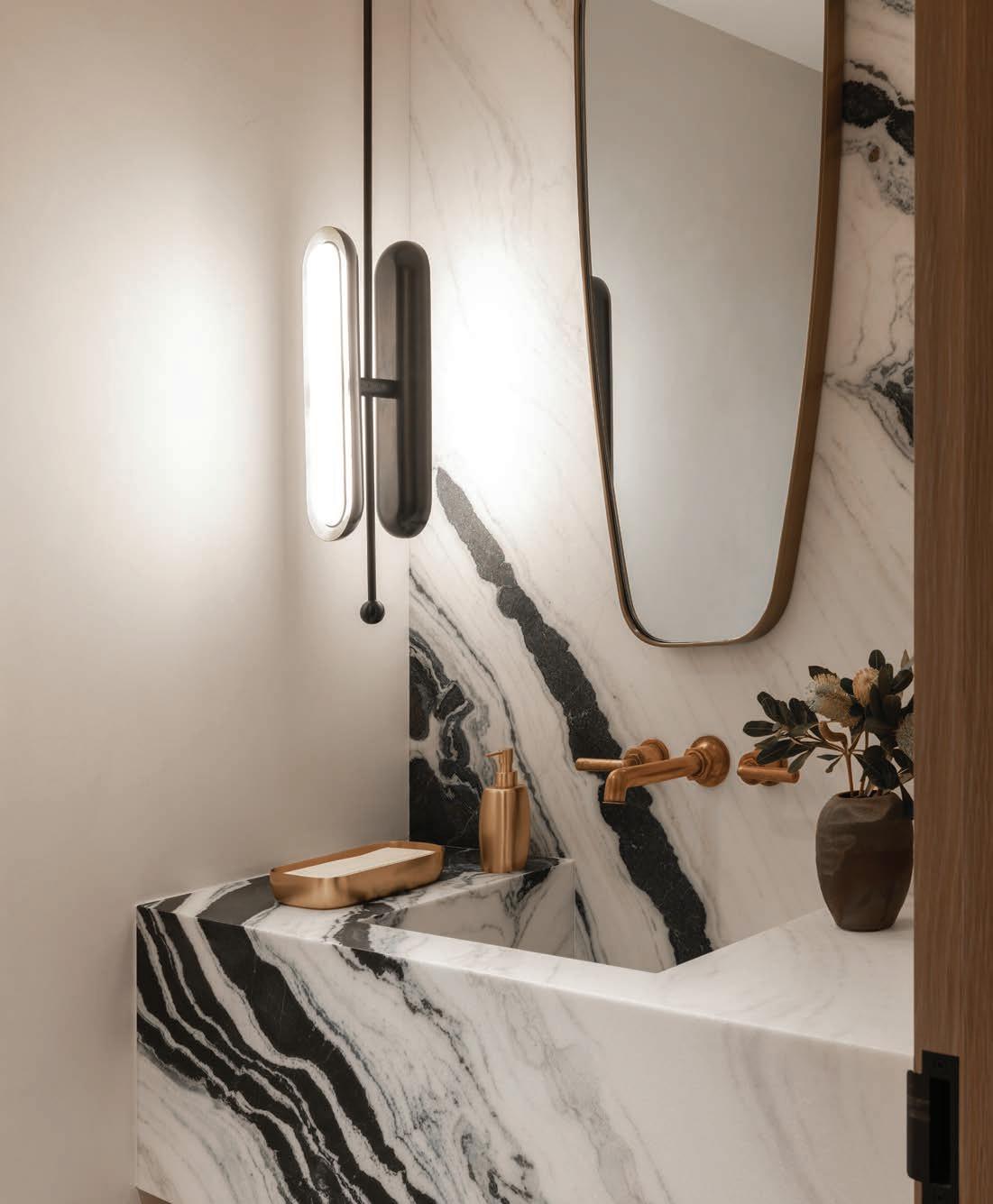
COAST TO COAST
A Designer’s Vision Finds Its Florida Chapter
By Viviane Ashcroft
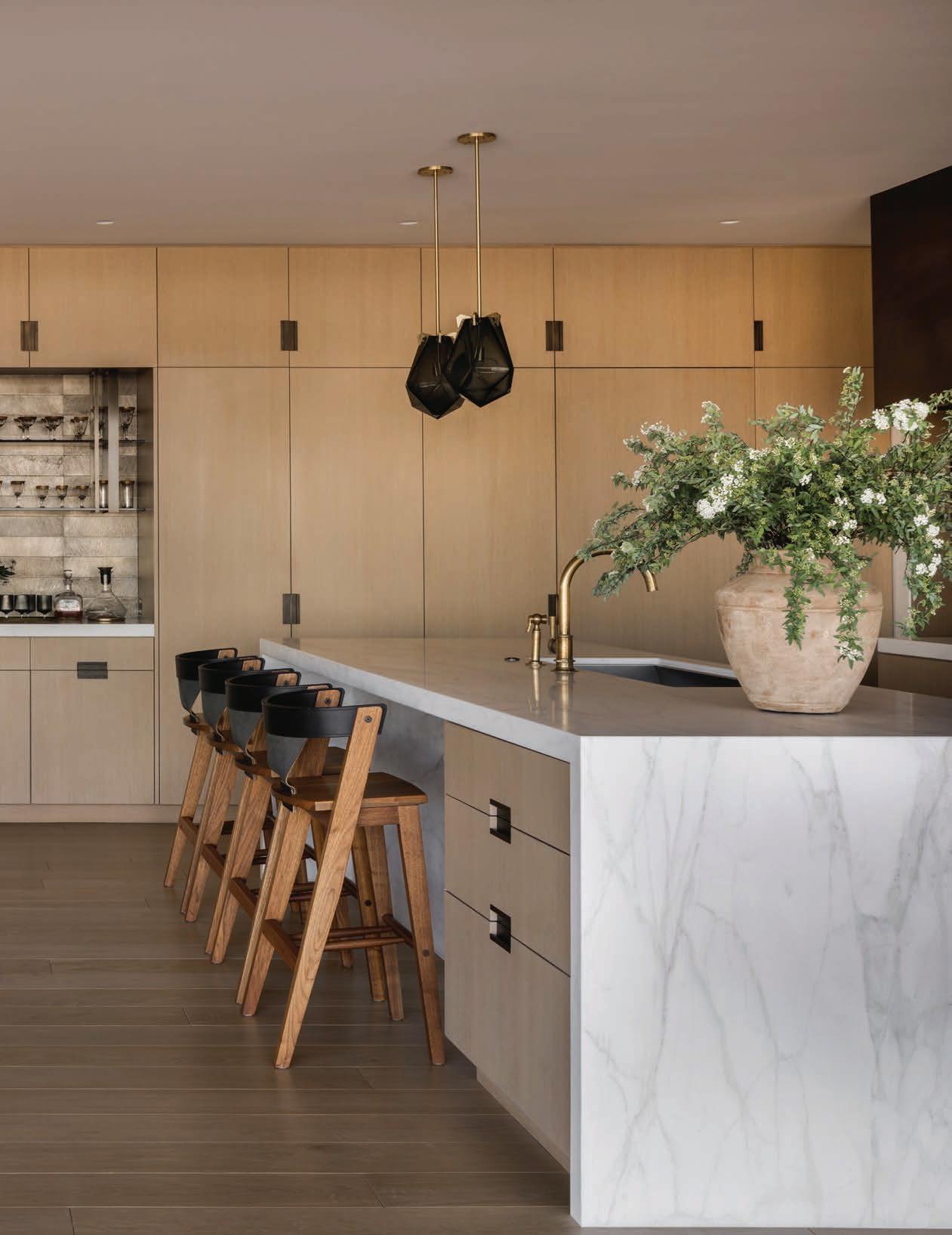
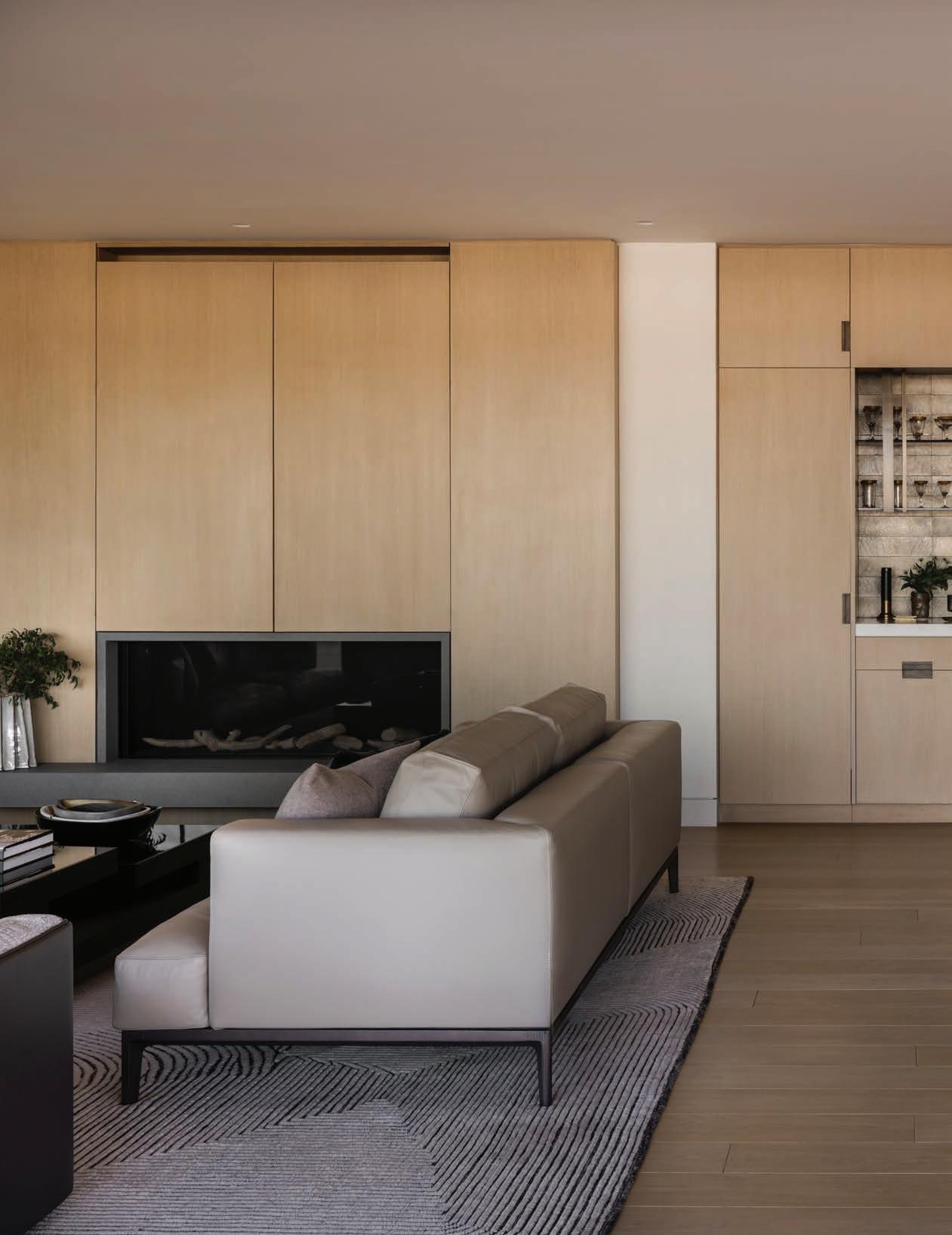
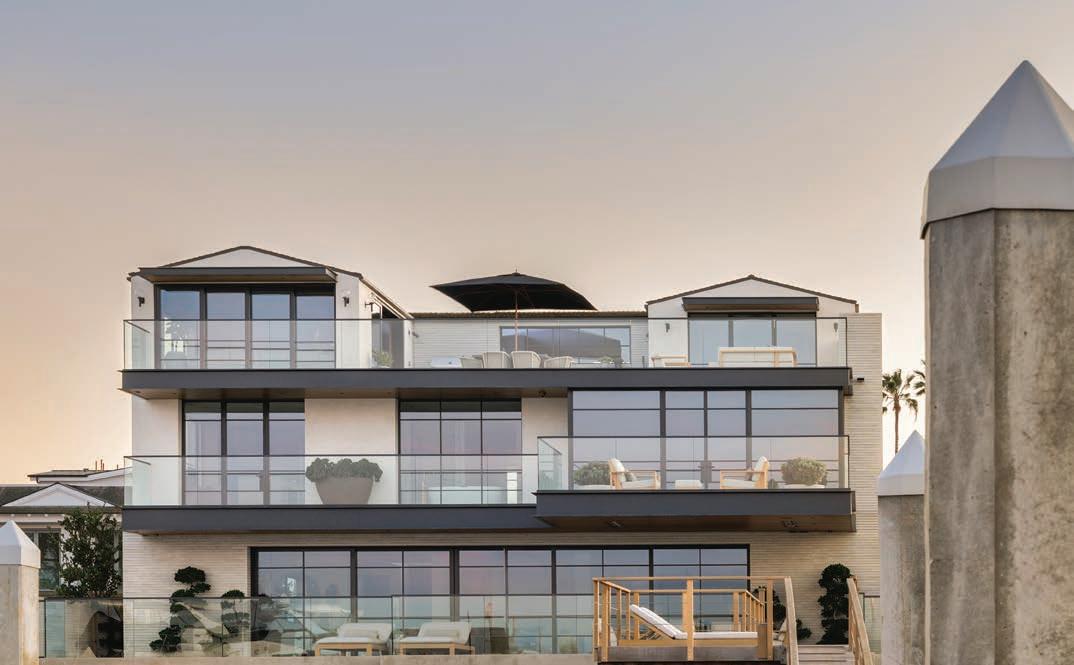
For L Design Interiors, this Newport Beach residence represents a defining moment in the career of its founder and principal, Leah Talanian Marino—one that now bridges coasts and anchors her practice firmly in Florida. While the home sits along Lido Bay in California, its sensibility—layered, restrained, and quietly elegant—translates seamlessly to Florida’s refined coastal lifestyle, where Marino has since relocated and continues to expand her work throughout the East Coast.
The relationship began through a client referral and quickly evolved into a foundation of trust. An initial interiors project led to a deeper collaboration, with both homeowners confident in Marino’s ability to elevate their spaces with discernment and intention. When a long-admired waterfront property on Lido Bay came to market, the decision to purchase was immediate—and despite Marino’s move east, there was no question who would be entrusted to lead the vision.
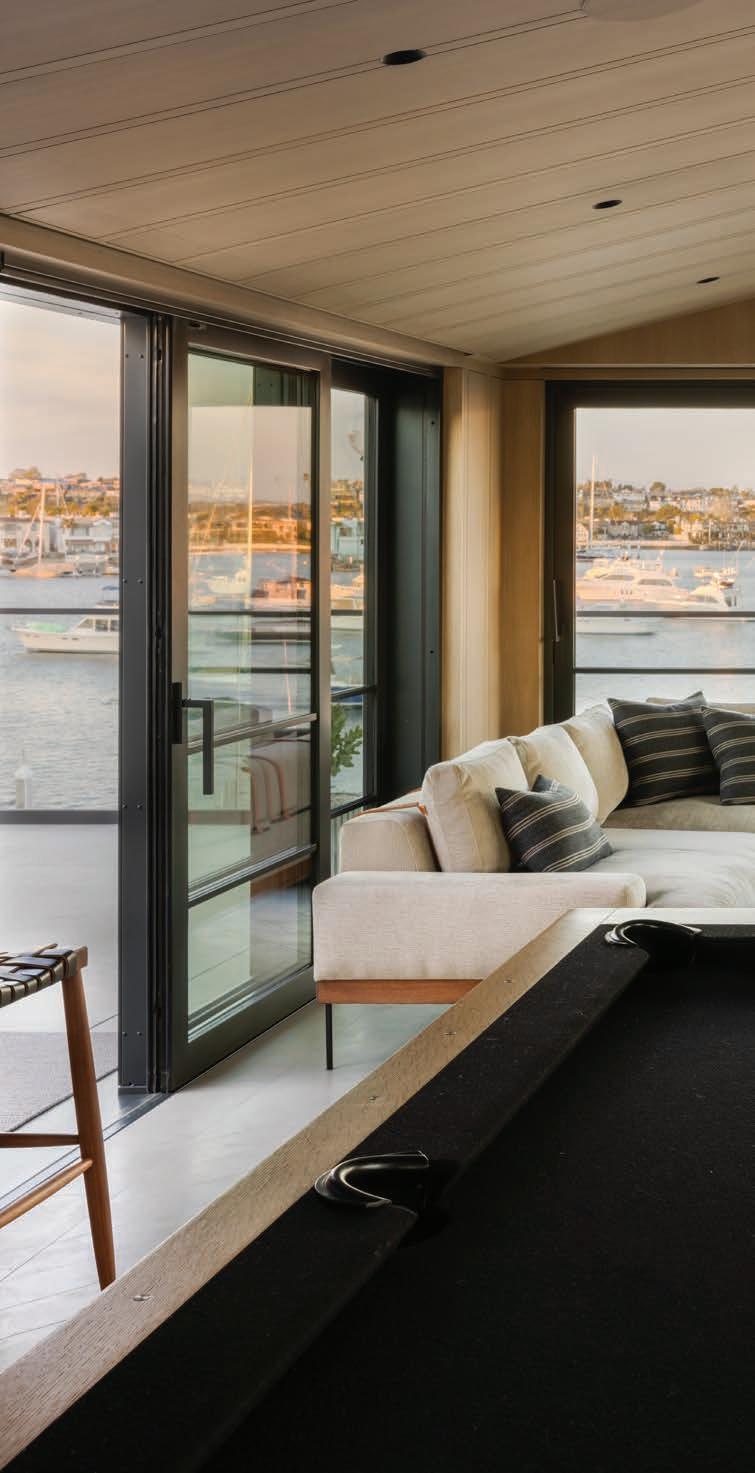
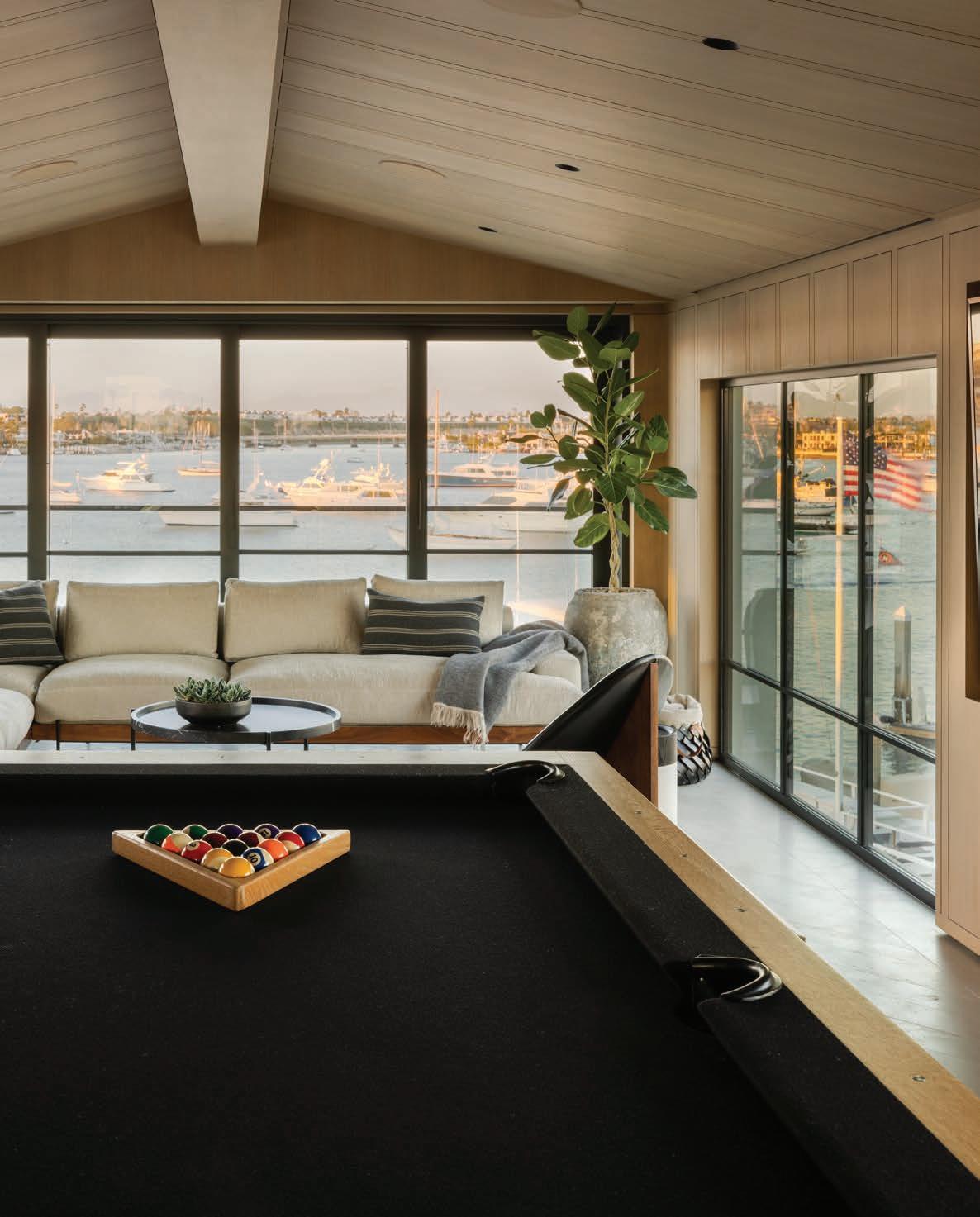
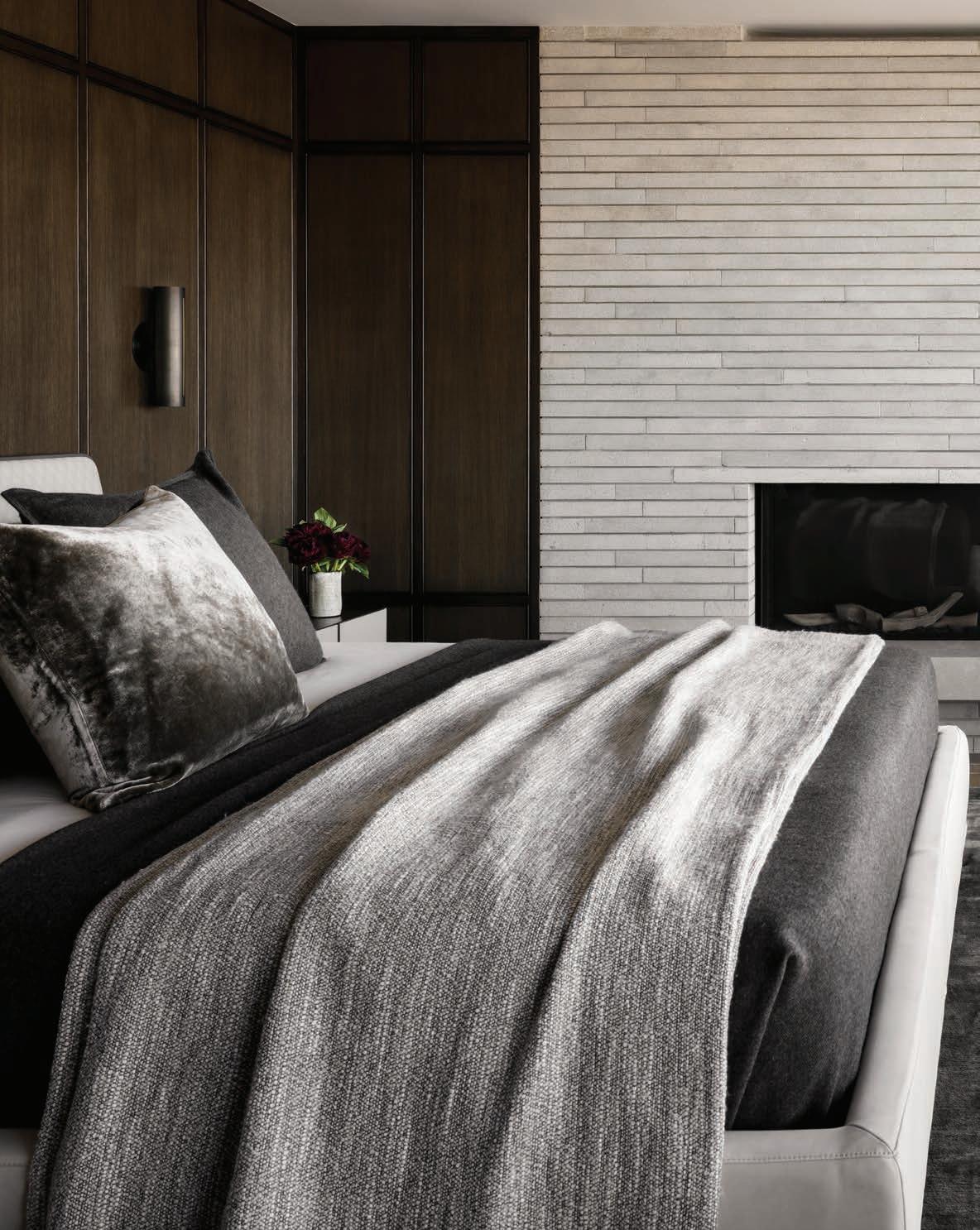
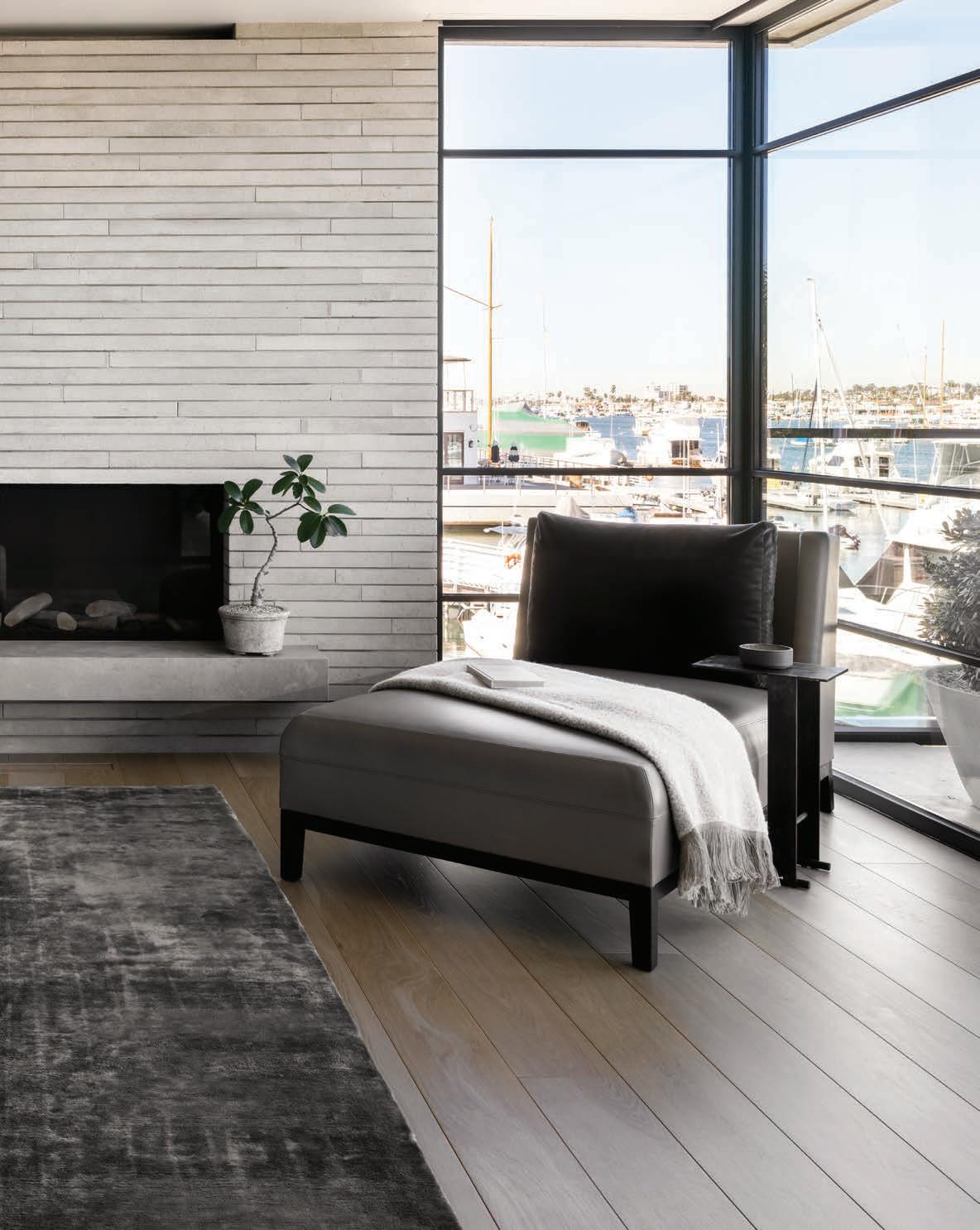
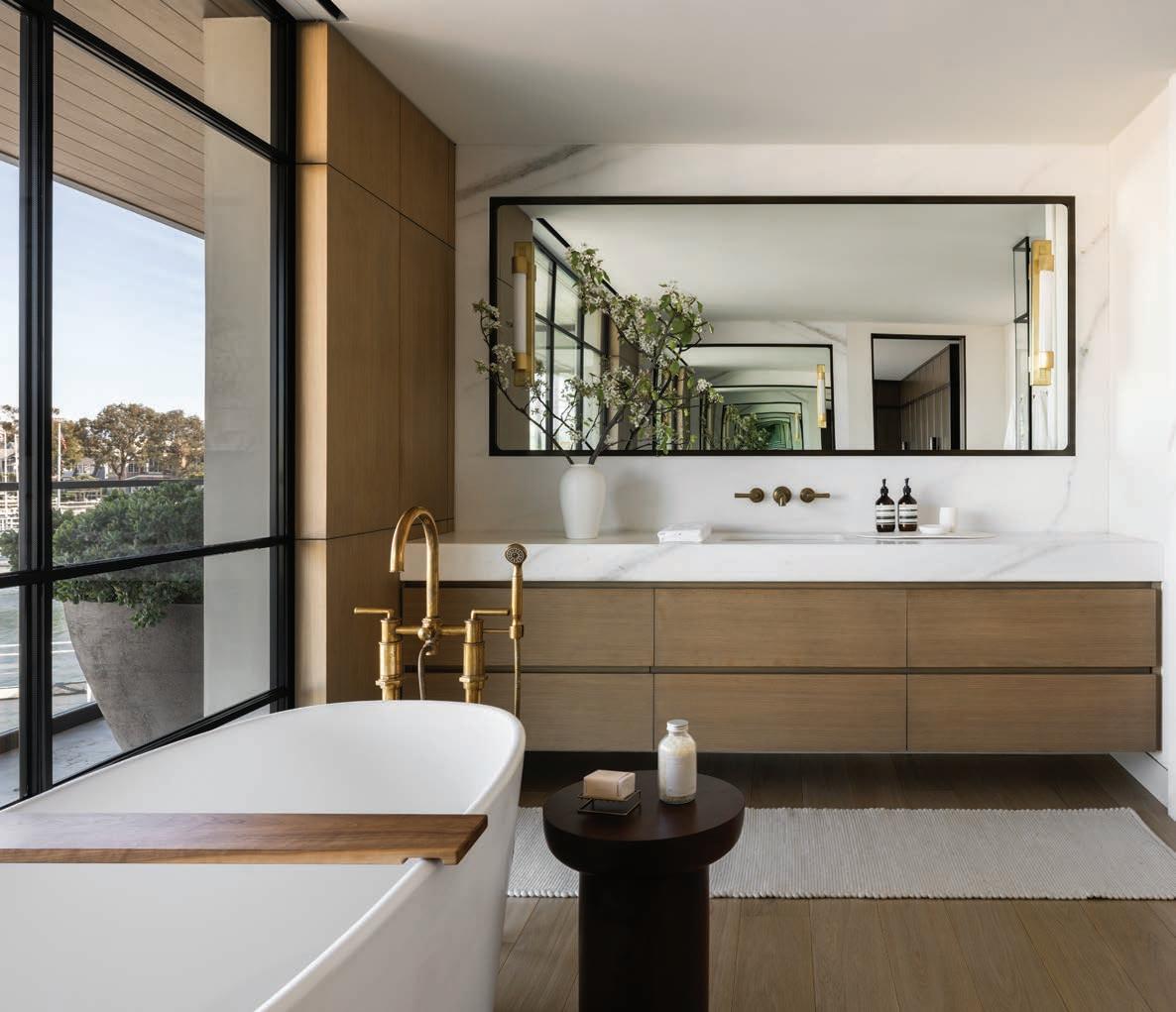
What followed was a fully immersive collaboration. L Design Interiors was involved from the earliest stages, with Marino entrusted to guide the home in its entirety— overseeing everything from floor plans and elevations to exterior architecture, material selections, landscape coordination, and the complete interior architecture, design, and décor. The result is a home that feels cohesive, serene, and timeless—qualities that resonate just as strongly in Florida’s coastal enclaves as they do in California.
Inside, soft tones and warm oak floors establish an inviting foundation, complemented by custom plastered walls and the thoughtful continuation of the home’s exterior stone—drawn inward through the entry and reintroduced in the primary bedroom, reinforcing a sense of architectural continuity throughout the residence. The palette is calm and sophisticated, allowing texture, proportion, and light to shape the experience of each room.
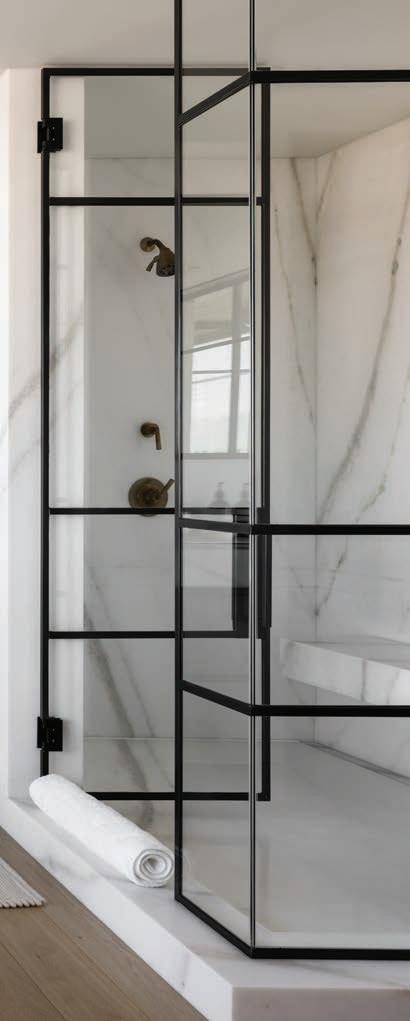
Bespoke furnishings anchor the interiors—an approach Marino favors when a space demands specificity. Custom elements include a live-edge countertop, tailored dining and coffee tables, and a sculptural tufted chaise designed for relaxed evenings and effortless entertaining. Vintage also plays a role: a restored armchair was carefully duplicated to create balance and continuity within the living space, reinforcing the home’s sense of ease and cohesion.
Throughout the project, the collaboration was defined by mutual respect. The homeowners shared their goals and trusted Marino to interpret them with clarity and restraint—an exchange she considers the most meaningful aspect of her work. The result was an enjoyable, collaborative process of designing a home together.
Today, as Leah Talanian Marino continues this next chapter from Florida, the Newport Beach residence stands as a bridge between coasts—an elegant, livable expression of coastal design that transcends geography and speaks directly to the East Coast reader. It is a home designed for gathering, for living, and for making memories that endure.
ldesigninteriors.com
NORDMARKA Alpine Chic in Southern Vermont
Interior Design by Gingham & Gable —
A
mindful mountain retreat where heritage, sustainability, and family legacy converge
By Colleen Guilfoile Richmond
Photography by David McCaughan
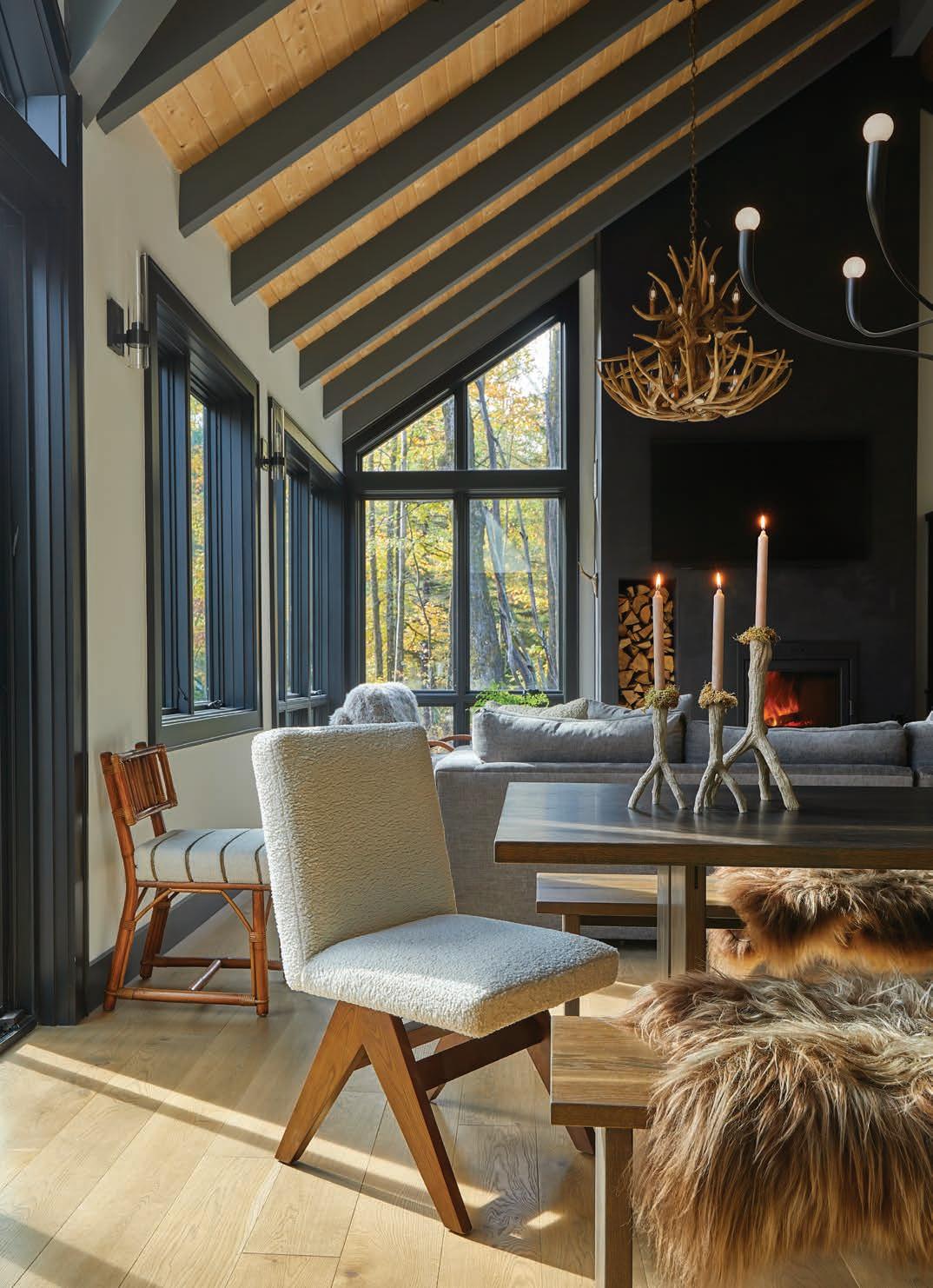
Tucked quietly into the woods of southern Vermont, Nordmarka is not simply a vacation home, it is a deeply intentional retreat shaped around the art of easy living. Designed by Gingham & Gable for an outdoorsy, athletic, and multigenerational family, the reimagined 1980s mountain home balances performance and beauty with rare precision. Every decision was guided by a single goal: to create a place where one can truly kick back, without sacrificing refinement.
The homeowners—a family of five with Irish and Norwegian roots—envisioned a weekend home that could grow with them, host extended family from abroad, and support an active, outdoors-driven lifestyle. Rather than tear down the original structure, the team preserved and expanded it through a seamless addition built in collaboration with local Vermont tradesmen, anchoring the project in craftsmanship and sustainability. That approach proved foundational. Sustainability guided both architectural and interior choices from the outset. “The clients’ decision to maintain the existing
structure while expanding the footprint reflects a desire to be environmentally mindful,” explains designer Lisa Ehrlich “Every interior choice was made with long-term use in mind—a mountain home designed to live peacefully with its surroundings, now and for decades to come.” The result is a house that feels intrinsically part of the landscape rather than imposed upon it.
The name Nordmarka carries deep personal meaning, referencing the forested region north of Oslo where the husband spent his childhood skiing and hiking. That connection to place and memory lives on inside the home through a gallery wall of original family photographs in the lower-level lounge, an evolving archive that will grow as new Vermont memories are made.
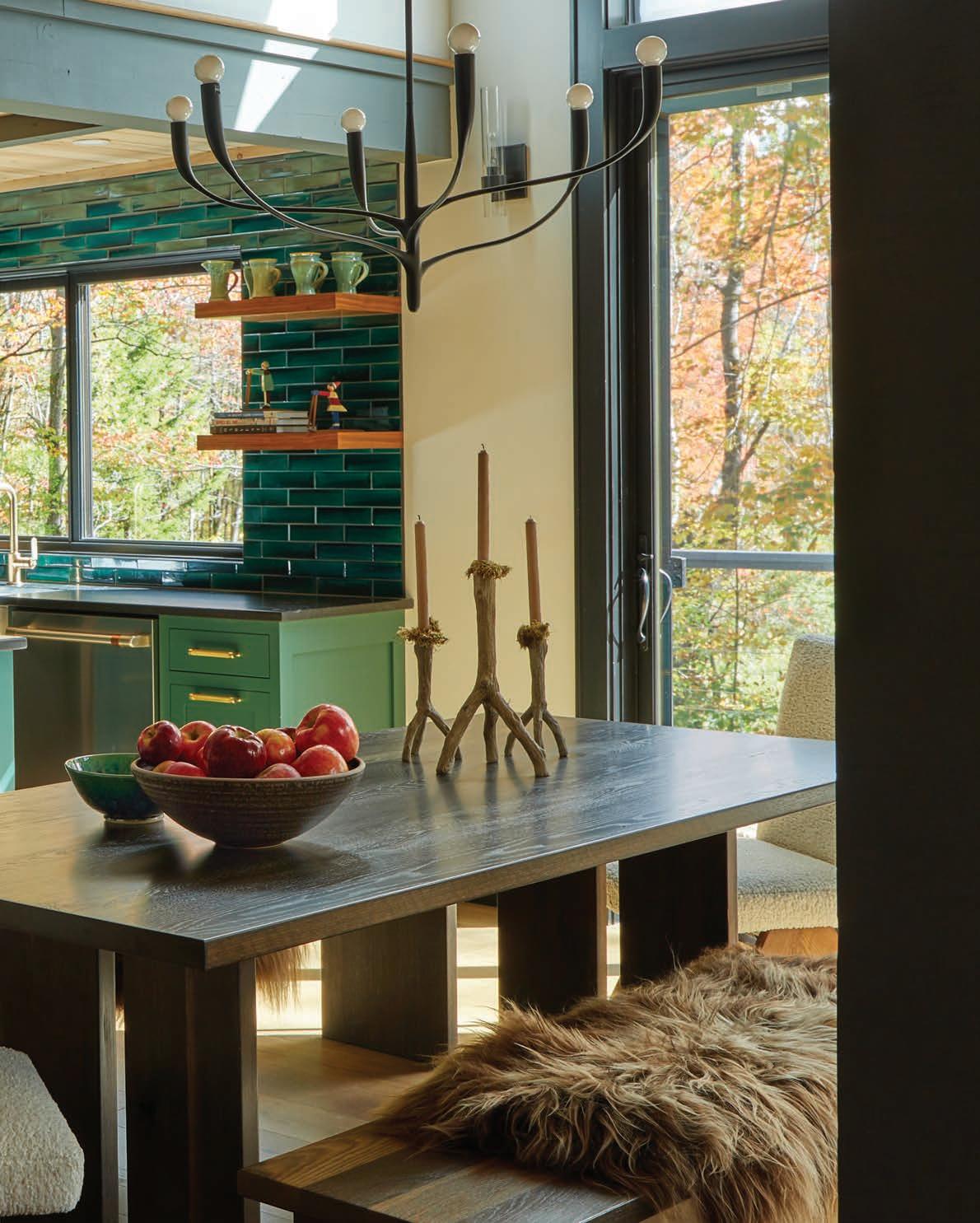
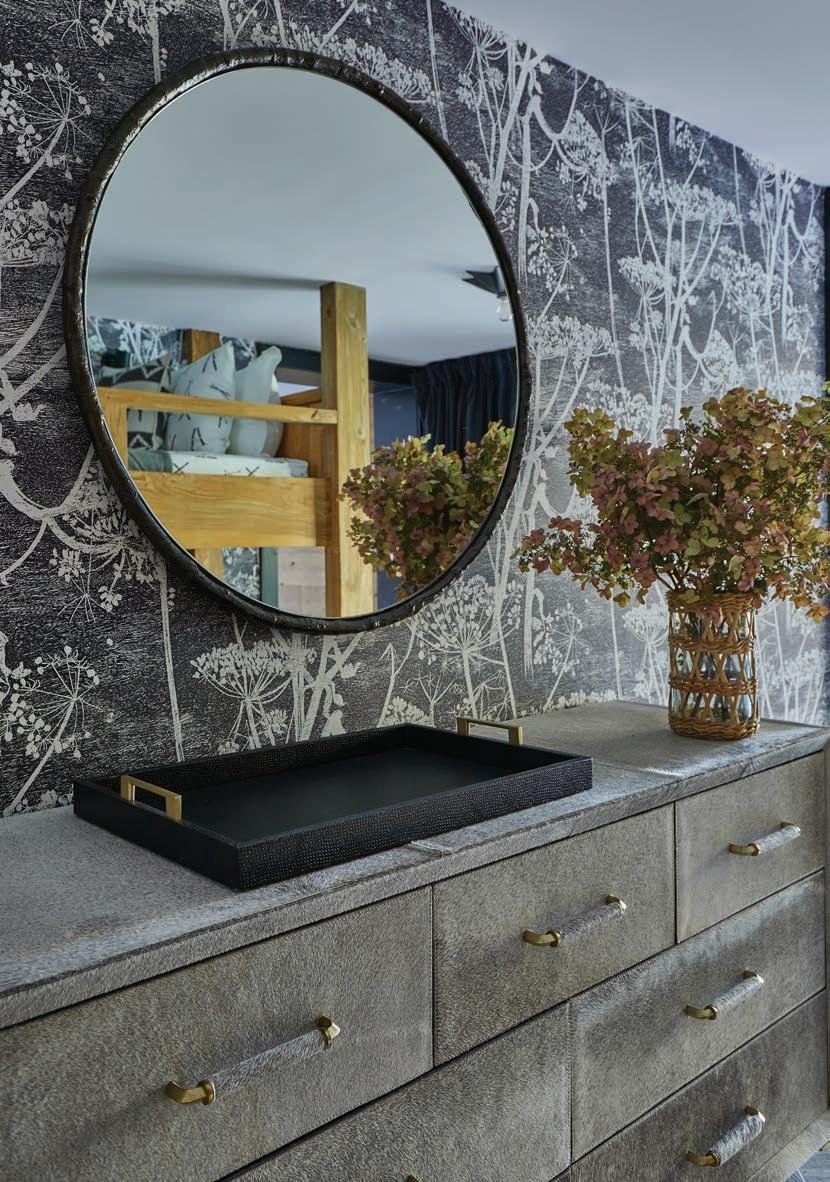
Throughout the interiors, Scandinavian simplicity meets Irish warmth in a careful balance of restraint and richness. Local artisans crafted custom woodwork and built-ins, while furnishings were sourced during a design trip to Round Top, Texas, alongside custom pieces designed specifically for the home. The result is layered yet calm— every element selected to serve both story and function.
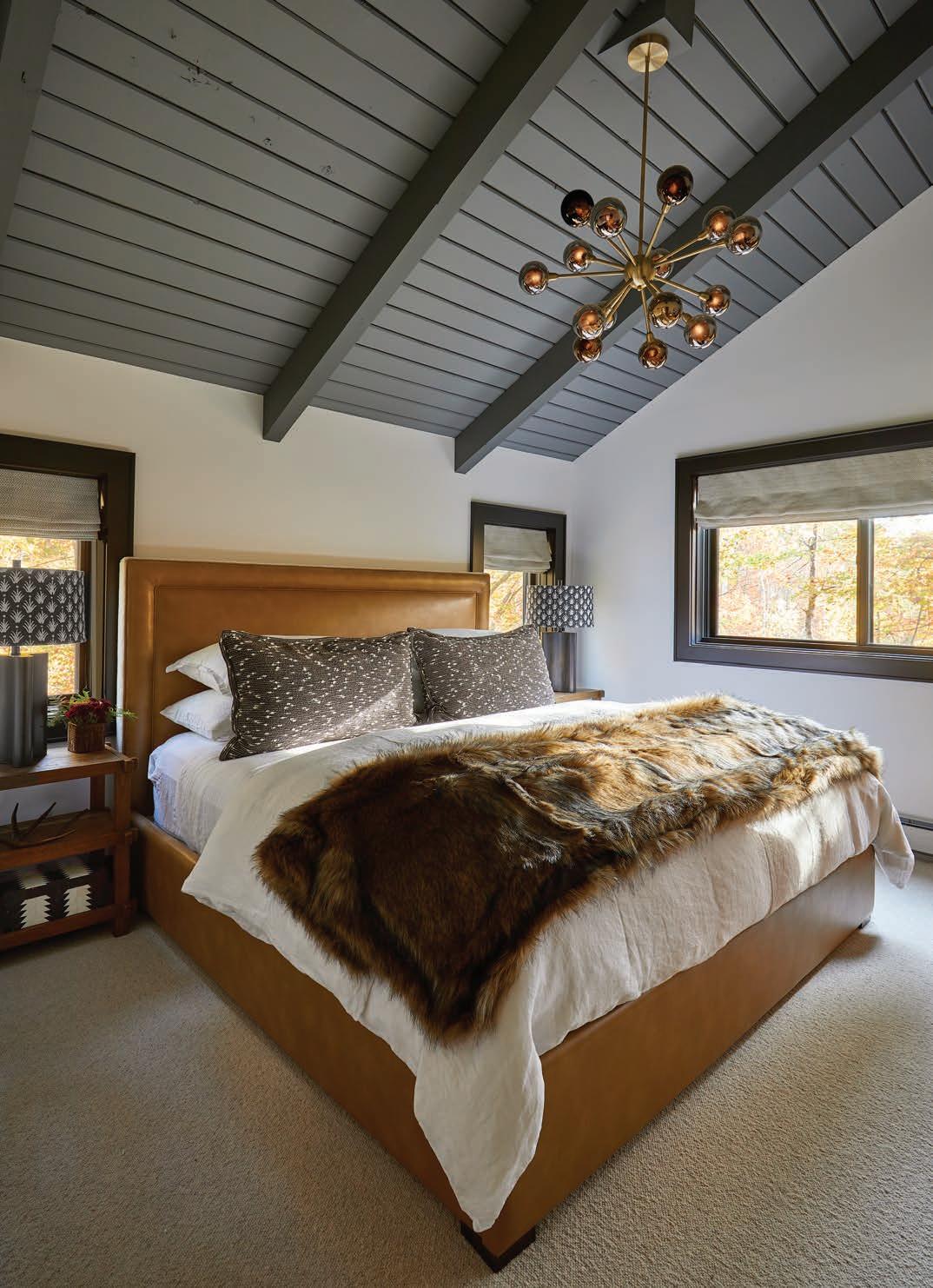
That balance is perhaps most evident in the home’s private spaces. For designer April Shen, the primary bedroom became a quiet anchor for the entire house. “The leather bed with a shearling trim is refined, but still warm and grounded,” she says. “It feels substantial and comforting without ever trying to steal
the spotlight—the detail reveals itself slowly, which feels right for a mountain home.” Elsewhere, tactile choices such as wool wallpaper along the staircase and in the owners’ lounge add depth and softness, elevating everyday transitions into moments of intention.
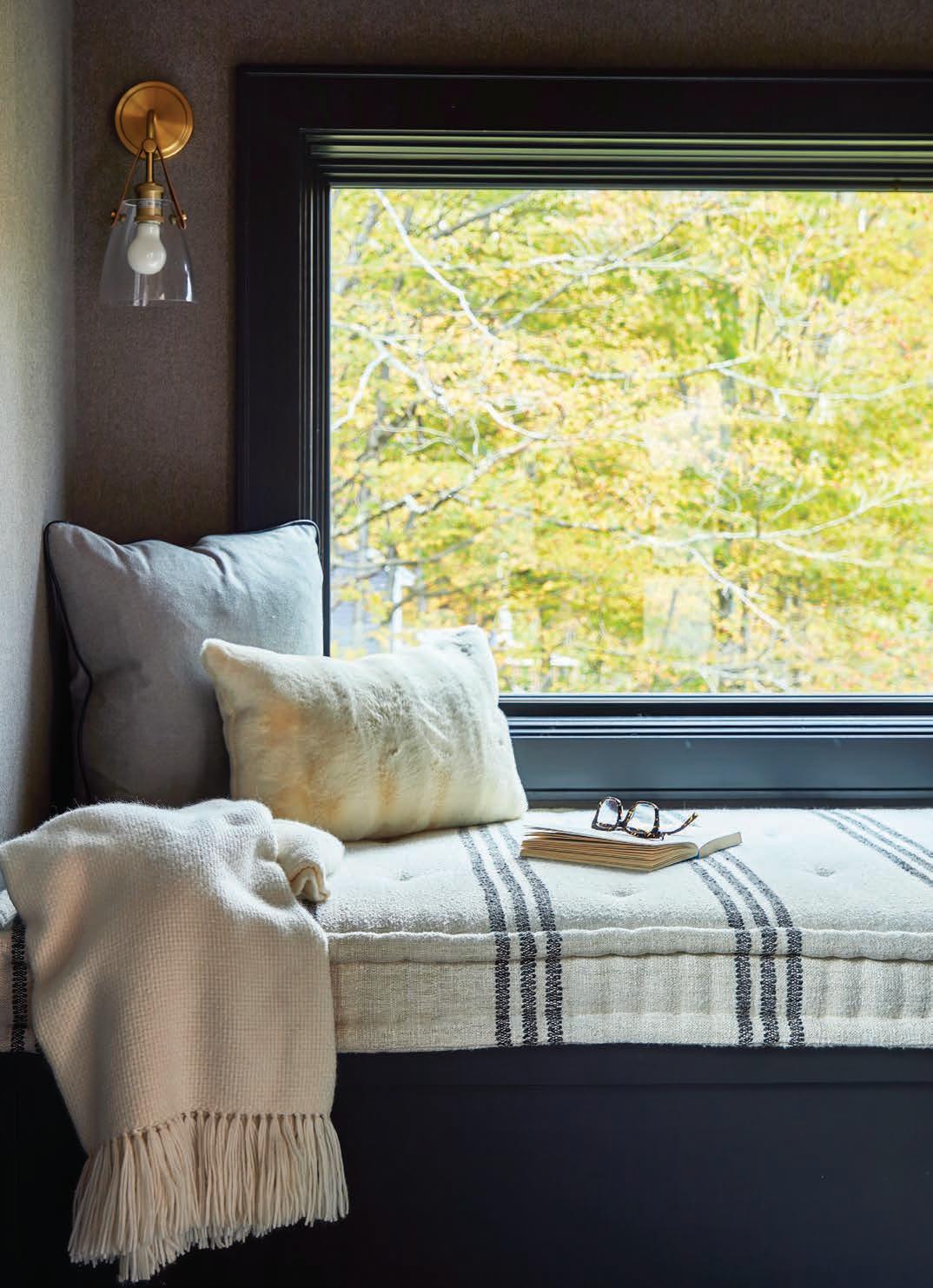
Functionality is the quiet star of Nordmarka. In the mudroom, a mirror offers last looks before heading out, while sturdy hooks accommodate hats and outerwear with ease. A once-overlooked stair landing was transformed into a hybrid lounge, storage, and office, complete with a custom French mattress concealing a deep storage well beneath it. Nearby, a built-in window cushion has quickly become the home’s most coveted spot—for reading, resting, and watching the snow fall.
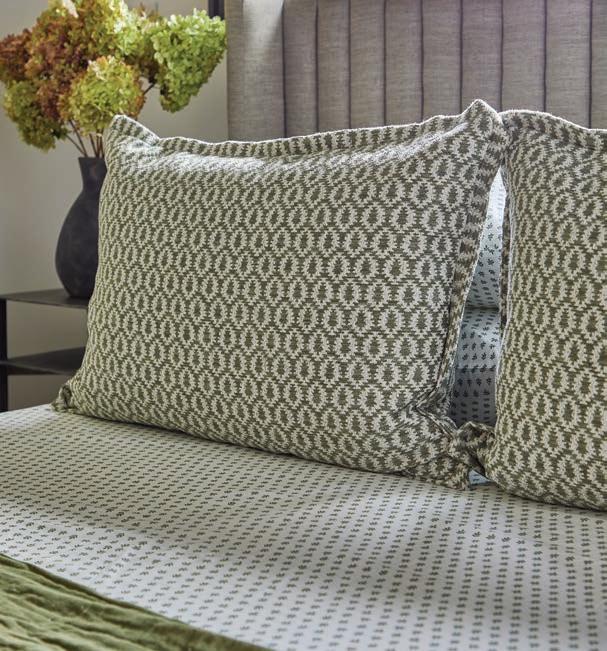
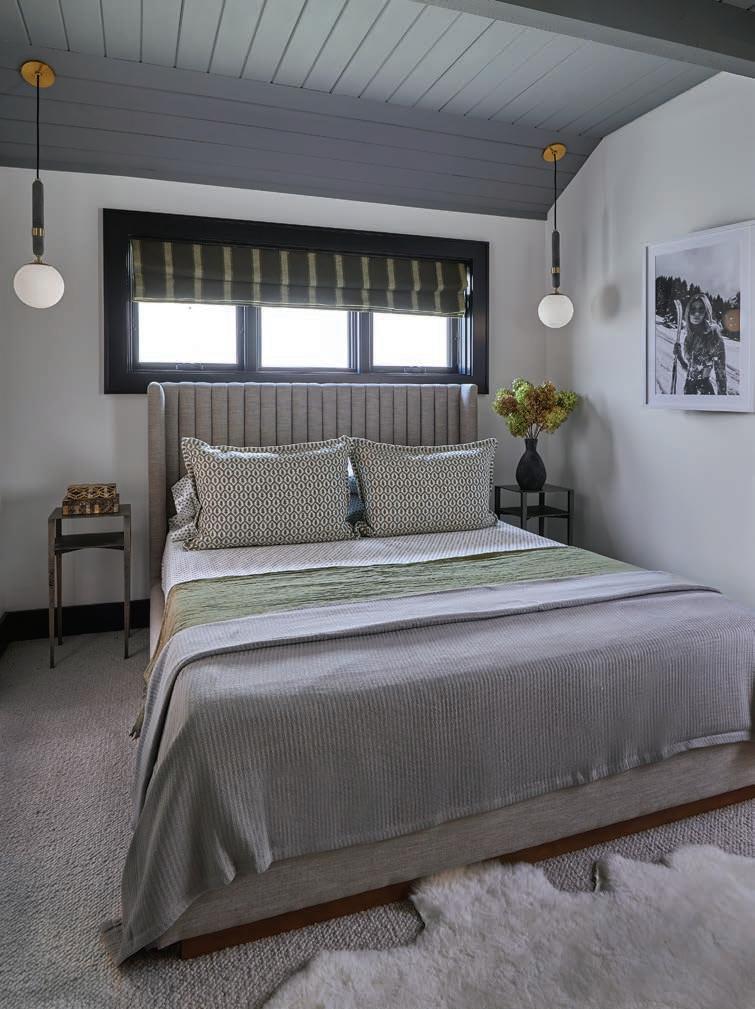
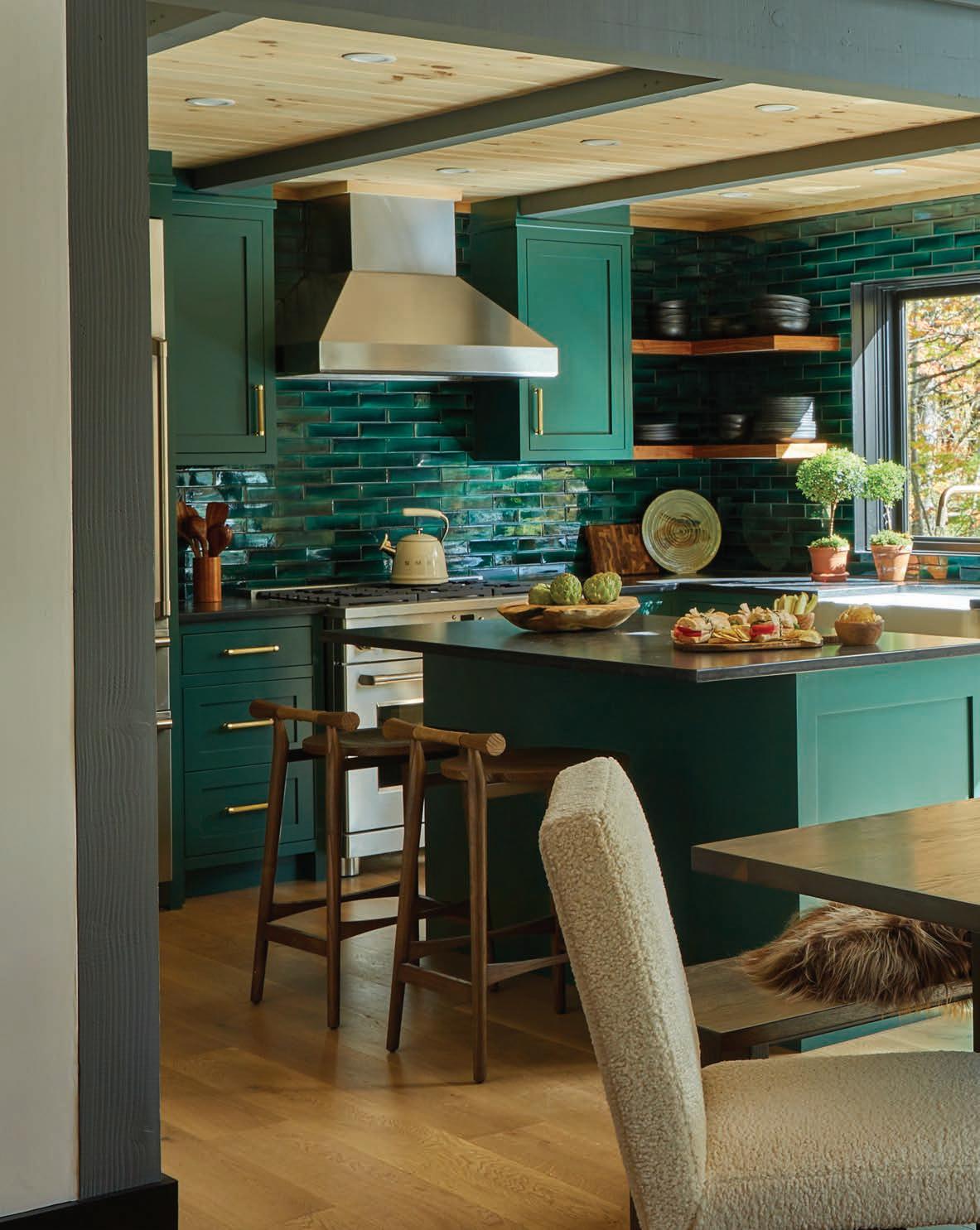
Performance was paramount throughout. Custom sofas were designed specifically for their spaces and upholstered in soft, durable performance textiles, proving that comfort and longevity need not come at the expense of elegance. Dining chairs and a custom banquette follow the same philosophy, while natural fiber carpeting reinforces the home’s commitment to sustainability and relaxed mountain living.
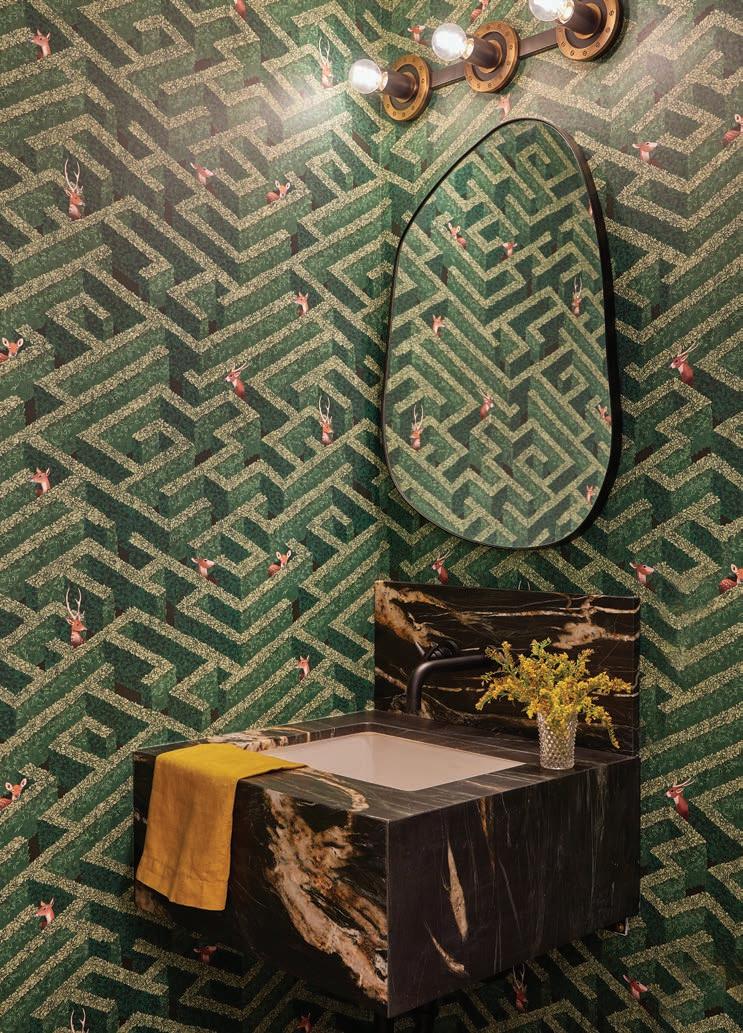
In the kitchen, a concealed walk-in pantry allows for effortless grocery unloading, while open shelving keeps dishware accessible and the space visually open. The fireplace includes a thoughtfully placed wood cubby, enabling the family to stack logs at the start of their stay and enjoy fires without repeated trips outdoors. Throughout the home, discreet drink-drop tables appear beside seating areas—small details that quietly elevate everyday comfort.
Downstairs, the lower-level family room centers around a custom leather corner banquette designed for games, snacks, and casual gatherings. Moveable stools migrate throughout the home as needed, adapting easily to shifting crowds. Custom bunk beds expand sleeping options for visiting friends and
relatives, making hospitality feel seamless rather than logistical. Even the exterior received the same level of care. Outdoor lounge chairs—sourced in the Hamptons—are upholstered in durable, weather-resistant canvas with clean, contemporary lines, proving that outdoor living can be both rugged and refined.
At its core, Nordmarka is a study in thoughtful restraint. There is a place for everything, and in that order comes a rare sense of calm. Designed for muddy boots and candlelit dinners, ski weekends and slow mornings, it is a home rooted in heritage, shaped by performance, and defined by the enduring luxury of living well—season after season.
ginghamandgable.com
HOLIDAY HOUSE A LEGACY OF BEAUTY, COURAGE & RENEWAL
By Colleen Guilfoile Richmond
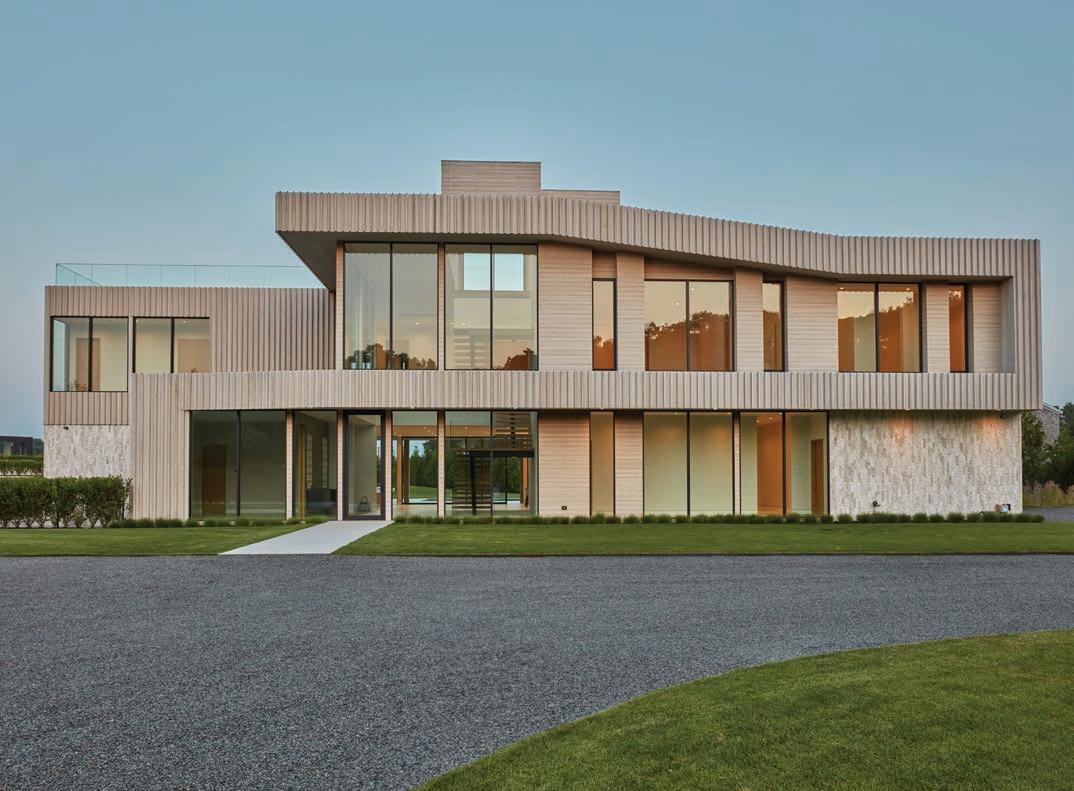
Image by Bespoke. Builder East End Building.
Holiday House returns this season with a resonance that feels especially meaningful. Opening in Palm Beach on March 3, 2026, with its much-anticipated gala and welcoming the public from March 4–May 3rd, the showhouse enters its eighteenth year having become far more than a design destination. What began as Iris Dankner’s personal tribute to survival and the restorative power of beauty has grown into an international movement that blends philanthropy, creativity, and cultural influence in a way no other design event has matched.
Founded in 2008, Holiday House emerged from a moment of profound vulnerability. When Dankner survived breast cancer, she searched for a way to transform her experience into hope for others. She turned to the world she knew best—interior design—and envisioned a home where beauty could serve not as a distraction from hardship but as a form of emotional healing. From that idea came an entirely new genre of design showhouse: each room crafted by a different designer, each space a tribute to life’s moments, and all proceeds directed toward the prevention and cure of breast cancer. Holiday House has since produced thirteen showhouses in New York, seven in the Hamptons, and a London edition, establishing itself as a leader in luxury design showcases.
Its properties have become part of its mythology: a Bridgehampton estate in 2013, a historic Sag Harbor factory in 2014, Water Mill in 2016 and 2019, iconic East 63rd and East 76th Street townhouses in Manhattan, and a sweeping Upper East Side penthouse in 2022. These homes became the canvases upon which designers such as Thom Filicia, Ariel Okin, Melissa Roy, V Starr, Chad James, Vicente Wolf, and Kara Mann have shaped unforgettable rooms.
Standout moments have become part of the show’s lore: the Bridgehampton home that sold just one week into the run; the Watchcase Factory in Sag Harbor, which sold fifty percent of its available residences during the show; and the now-famous young designers’ evenings and wellness activations that turned Holiday House into a seasonal social hub, drawing editors, influencers, philanthropists, designers, and tastemakers from across the country.
Through it all, Holiday House has remained unwavering in its philanthropic commitment. More than 10,000 visitors come to each showhouse, and over two million dollars have been granted to the Breast Cancer Research Foundation—an organization known for funding the world’s most promising research, distributing $57 million in grants this past year alone and maintaining top nonprofit ratings for fiscal responsibility and scientific impact.
Against this rich history, the 2026 edition marks an important new chapter. Set within Farrell Estates Wellington, a new development inside the prestigious Palm Beach Polo Golf & Country Club, the showhouse is positioned among twenty-seven newly built luxury residences ranging from 5,300 to 8,000 square feet and priced between $5 million and $10 million. It is, in every sense, the perfect canvas: expansive, sunlit, architectural, and attuned to the subtropical rhythm of life in Palm Beach County.
For Palm Beach and Wellington, the arrival of Holiday House is more than an event—it’s a cultural moment. Winter in this region carries its own sensory language: golden morning light, lush landscapes, ocean breezes, equestrian movement, polished social traditions, and a vibrant philanthropic calendar. Holiday House brings these elements together, transforming the home into a living gallery of possibility. Designers, given full creative freedom, craft rooms that feel like emotional vignettes—some serene and cocoon-like, others bold, sun-drenched, or filled with theatrical presence. The house becomes a journey through mood and meaning, where visitors flow from space to space with a sense of discovery.
What distinguishes Holiday House—and what makes it so aligned with the tone of VIVANT’s winter issue—is the belief that beauty is not superficial but strengthening. A home can be glamorous and soulful. A room can lift the spirit. A thoughtfully designed environment can inspire renewal. Throughout its history, Holiday House has proven that design, when paired with purpose, becomes a form of healing. It reflects the courage of one woman, the talent of dozens of designers, the generosity of thousands of guests, and the shared belief that life’s most important moments deserve to be celebrated.
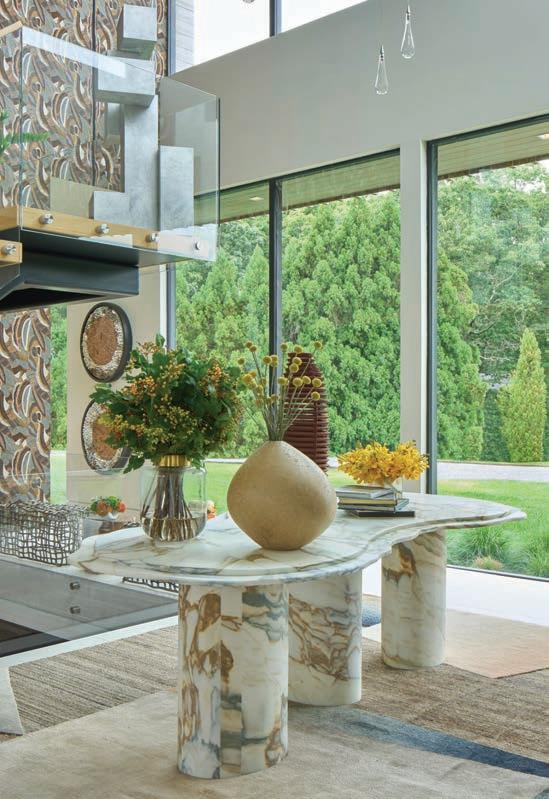
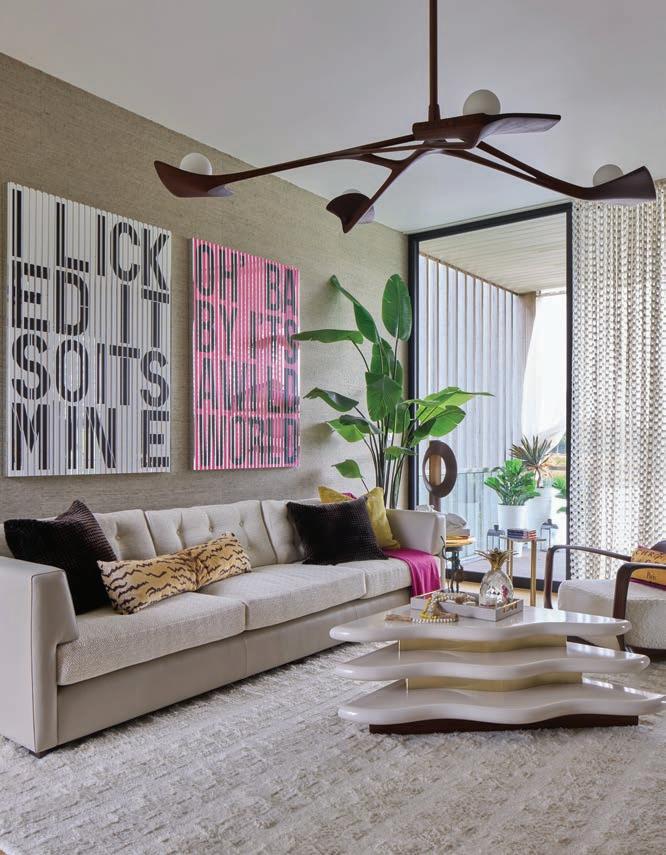
As Palm Beach and Wellington welcome Holiday House this year, the showhouse carries forward a legacy built room by room, home by home, season after season—a legacy of courage transformed into beauty, of community shaped through creativity, and of renewal found in the spaces we choose to call home. This season, VIVANT is proud to host the VIVANT Lounge within Holiday House, creating a gathering place designed for conversation, reading and connection.We cannot wait to unveil the fully completed Holiday House in our next issue—a celebration of its designers, its spirit, and the beauty still to come.
Shelley Cekirge Interiors and photographed by Marco Ricca
KA Murphy Interiors and photographed by Marco Ricca
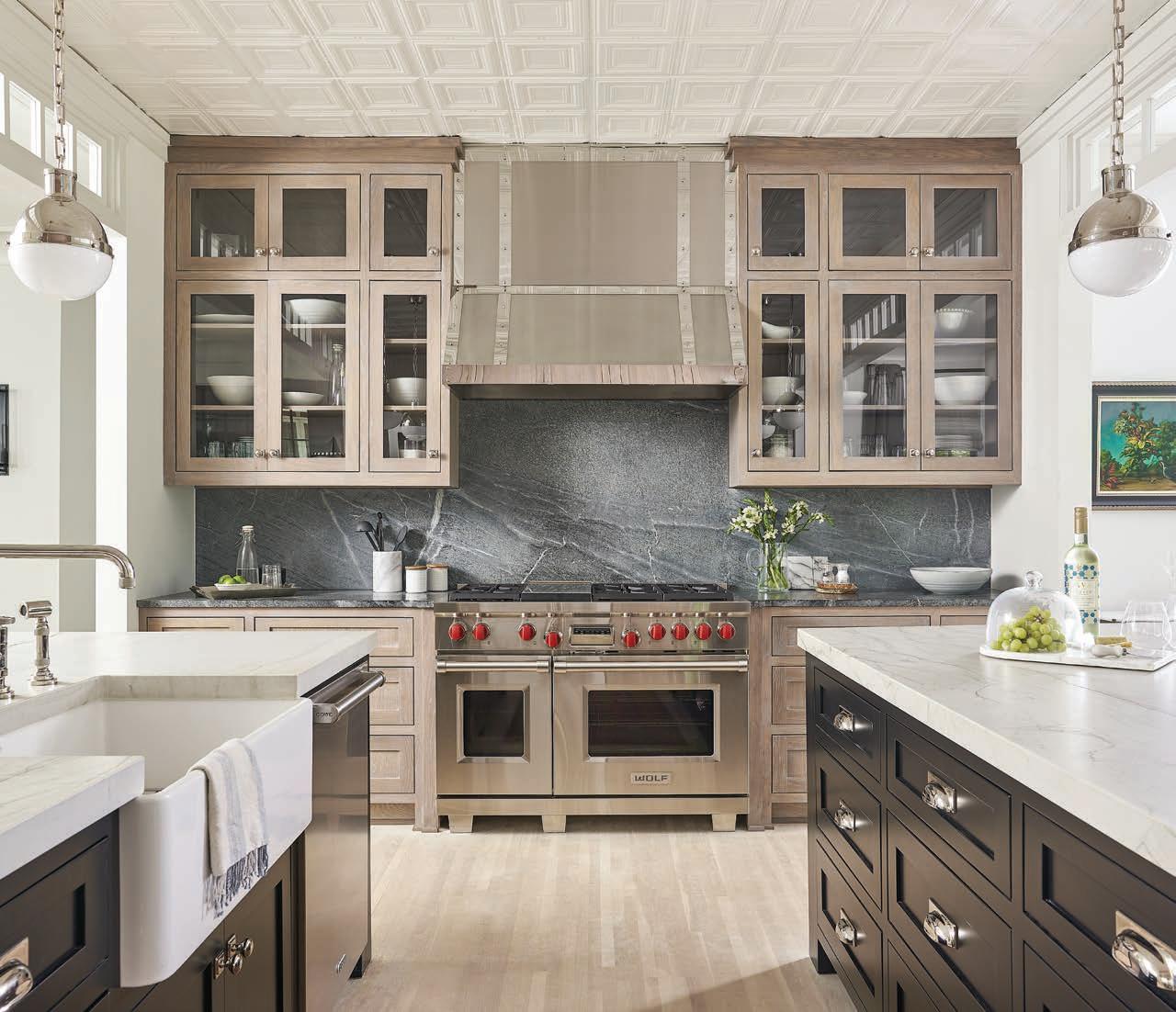
STYLE

The French love affair with black — winter minimalism at its most refined
CHIC, SOMBRE, SUBLIME
By Viviane Ashcroft

Photo by Rex Shooter, on location Paris France
Black, in France, is never merely a color. It is a posture. A philosophy. A quiet declaration of restraint and confidence. While winter elsewhere erupts in sparkle and excess, the French retreat inward — returning, season after season, to the purity of black. In Paris, it is not worn to disappear. It is worn to be precise.
From the slate mornings along the Seine to candlelit dinners in SaintGermain-des-Prés, black is the unchanging constant of French winter style. It reflects the mood of the season: introspective, intellectual, composed. Where other cultures reach for embellishment to combat the cold, the French answer with refinement — a perfectly cut wool coat, a matte cashmere turtleneck, patent leather against stone pavements still wet with rain.
This is not minimalism born of austerity. It is minimalism as mastery.
Coco Chanel crystallized this philosophy in 1926, when American Vogue famously declared her simple black crepe dress “the Ford of fashion,” predicting it would become a uniform for modern women. Chanel’s vision was never about the absence of color, but the elevation of form. She believed luxury lived in subtraction — in the discipline of knowing what to remove.
“Before you leave the house, look in the mirror and take one thing off.” — Coco Chanel
Nearly a century later, French women still dress in her language — letting line, texture, and proportion do the speaking. There is no need for excess when silhouette is everything.
In winter, black deepens in complexity. It shifts from crisp to sensual. Bouclé meets leather. Velvet absorbs light. Cashmere softens its edge. A single gold button becomes an anchor. A silk scarf tied carelessly at the neck becomes the only flourish required. The power is in what is withheld.
“ Black can be young and old. Black can be gentle and strong. Black always says something. ”
— Yves Saint Laurent
It is this restraint that makes French black so compelling. There is discipline in the way it is worn — nothing too tight, nothing too adorned. The body is suggested, never displayed. Mystery remains intact. In a culture fluent in understatement, black becomes the ultimate expression of personal authority.
Yves Saint Laurent, who reshaped Parisian style through tailoring and sensual restraint, famously built entire collections around black in the 1960s, elevating the tuxedo, the sheer blouse, and the sharply tailored suit into enduring symbols of female power.
Beyond fashion, black carries emotional weight in France. It is the color of café nights and art-house cinemas, of winter roses at the market on Rue Cler, of ink on paper, of shadows cast by wrought-iron balconies at dusk. It belongs to philosophy as much as to fashion. It is existential and elegant all at once — echoing the intellectual traditions of Sartre, Beauvoir, and the Left Bank thinkers who made black synonymous with
introspection and quiet rebellion.
Parisian interiors in winter mirror the same aesthetic devotion. Blackened steel, smoked oak, dark marble, soft ivory light. Candles flicker against shadowed walls in Haussmann apartments. The palette is narrow, but the atmosphere is rich. As in clothing, contrast becomes the luxury.
The poetry of black is not uniquely French, yet nowhere is it worn with such emotional intelligence. Japanese designer Yohji Yamamoto, whose Paris debut in 1981 famously redefined European notions of beauty, articulated black’s quiet defiance with clarity:
“Black is modest and arrogant at the same time. Black is lazy and easy — but mysterious. But above all, black says: ‘I don’t bother you — don’t bother me.’” — Yohji Yamamoto
Even in beauty, the French resist seasonal excess. Skin remains natural. A naked mouth. Defined eyes. Black liner softened with intention. Hair worn undone, imperfect by design. The look is never “done” — it is composed.
What distinguishes the French relationship with black is its refusal to trend. It is immune to cycles. Black is not seasonal in Paris — it is permanent. Trend forecasters may declare the return of color every spring, but winter always pulls France back to its most faithful ally. While other capitals chase novelty, Paris perfects continuity.
In a world increasingly intoxicated by visibility, black offers a counterpoint — a return to depth. It slows the gaze. It forces one to look closer. It invites contemplation rather than consumption.
Perhaps this is why the French winter wardrobe feels eternal. Trends fade. Black remains.
This season, as festivities grow louder elsewhere, the most refined statement may be the quietest one of all: a single shade, perfectly executed. Chic in its severity. Sombre in its mood. Sublime in its restraint.

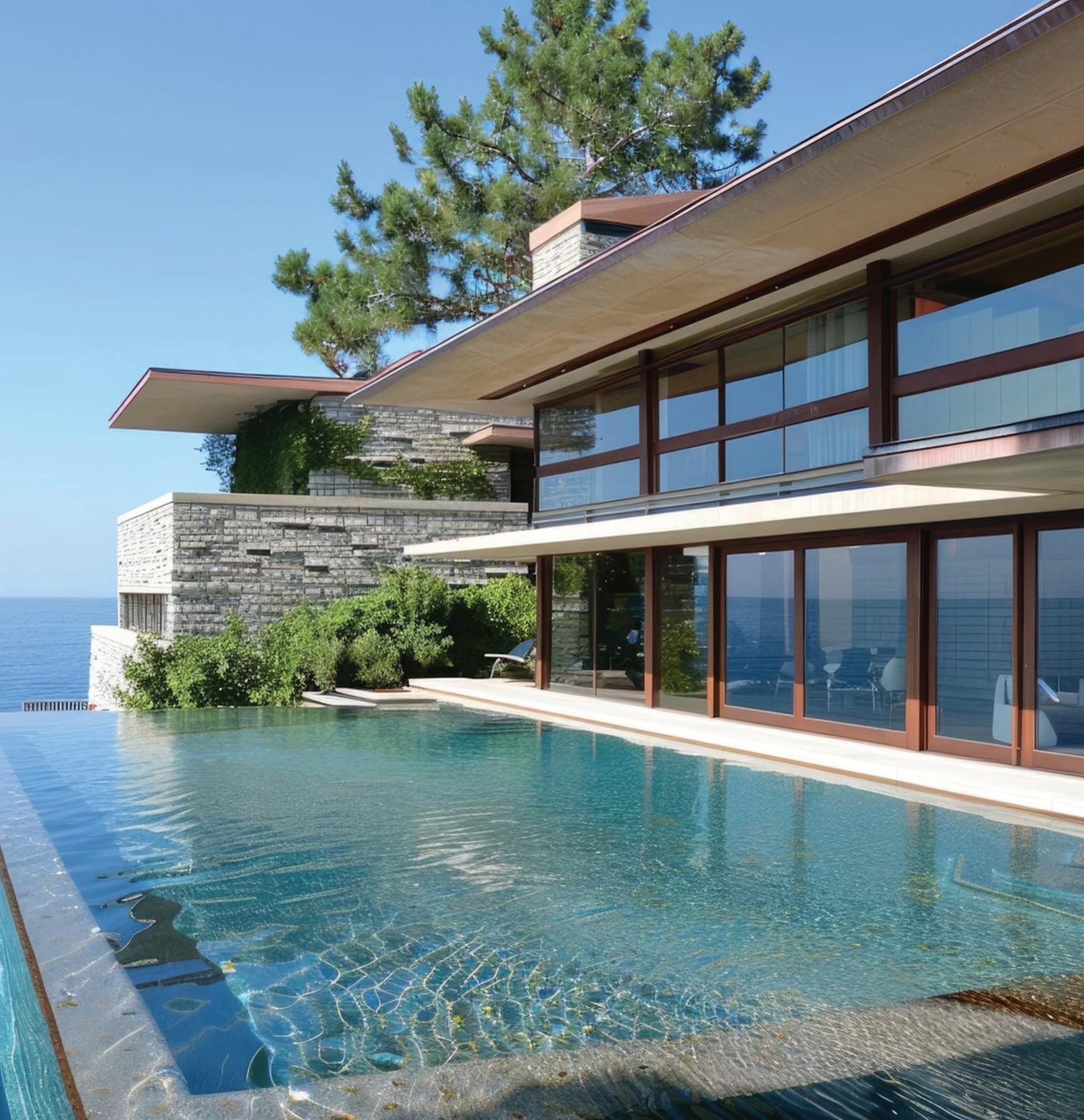
CULTURE
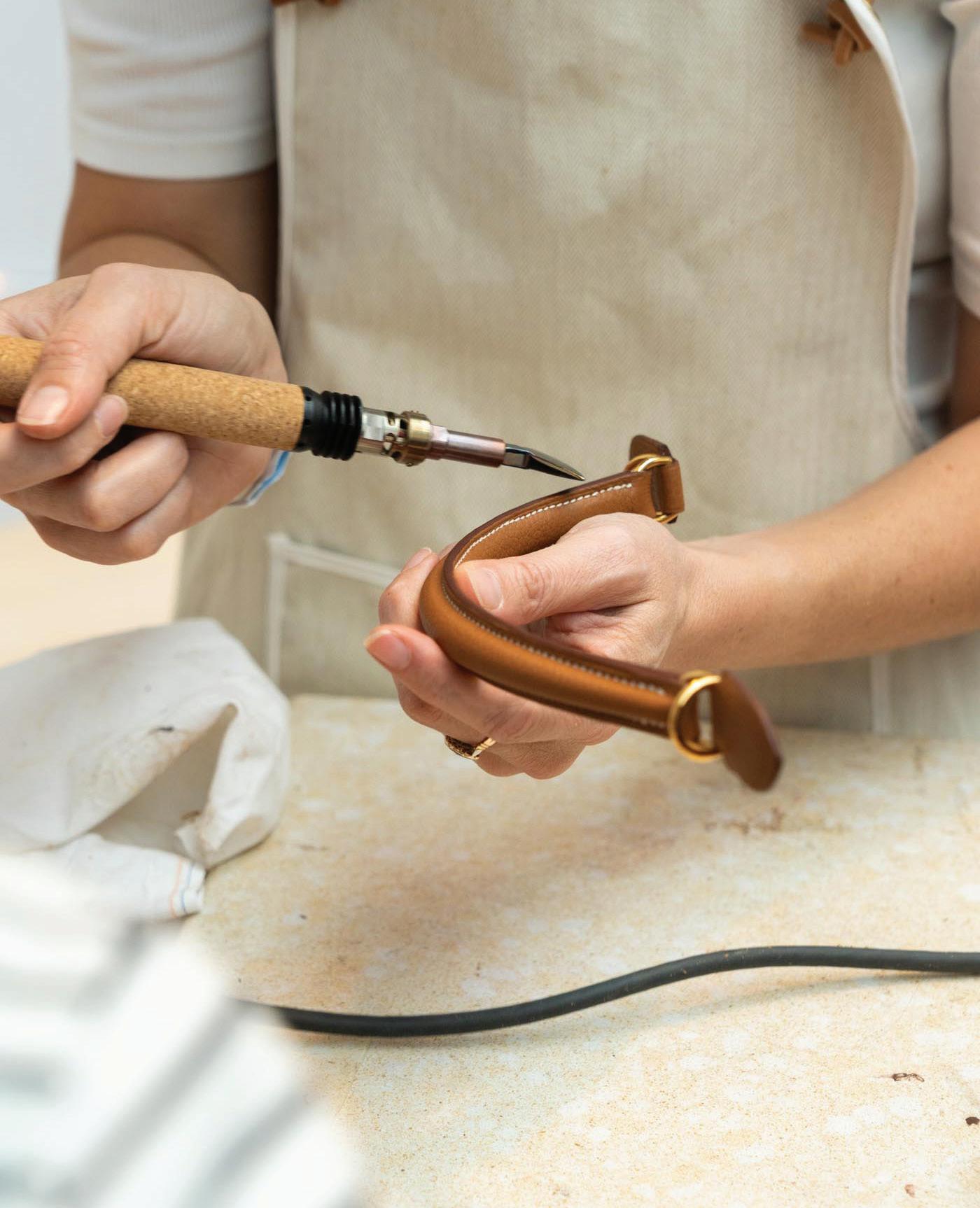
COMITÉ COLBERT, THE CUSTODIANS OF ELEGANCE
For 72 years, the world’s oldest representative association for luxury has embodied the pinnacle of French excellence, preserving and promoting centuries-old savoir-faire.
In 2026, it will mark the 250th anniversary of the United States with a journey through time—celebrating the enduring elegance of a long and beautiful Franco-American friendship.
By Nathalie Dassa
Small hands do great works. And time, it seems, cannot contradict this singular collective, created in 1954 through the vision of perfumer Jean-Jacques Guerlain, son of the creator of the iconic Mitsouko and Shalimar fragrances. Today, the Comité Colbert brings together more than a hundred Houses and cultural institutions dedicated to promoting French savoir-faire and the art de vivre around the world. Once perceived as a frivolous pursuit reserved for the coquette, luxury now
generates billions of euros in revenue and represents nearly 30 percent of the CAC 40. No longer defined by ostentation alone, it has returned to its roots—where the work of artisans “perpetuates the skills learned from their elders,” as Bénédicte Epinay, CEO of the Comité Colbert, explains.
Through centuries of evolution and crisis alike, these Houses have endured, emerging as strategic assets deeply rooted in tradition while serving as powerful ambassadors in global markets.
“America is our primary market. More than sixty Houses and cultural institutions are participating — a record.”
—Bénédicte Epinay, CEO, Comité Colbert
Credit © David Atlan
Credit © Courtesy of Comité Colbert

“The image of excellence in this industry is based on a combination of heritage and modernity, often linked to the historical expertise of a region.” —Bénédicte Epinay, CEO, Comité Colbert
Credit © Courtesy of Comité Colbert
“The image of excellence in this industry is based on a combination of heritage and modernity, often linked to the historical expertise of a region,” Epinay emphasizes. “Examples include Cosmetic Valley, the cradle of innovation in perfumery and cosmetics near Orléans and Chartres, and Glass Vallée, which accounts for 70 percent of global production of luxury glass bottles in northern France.”
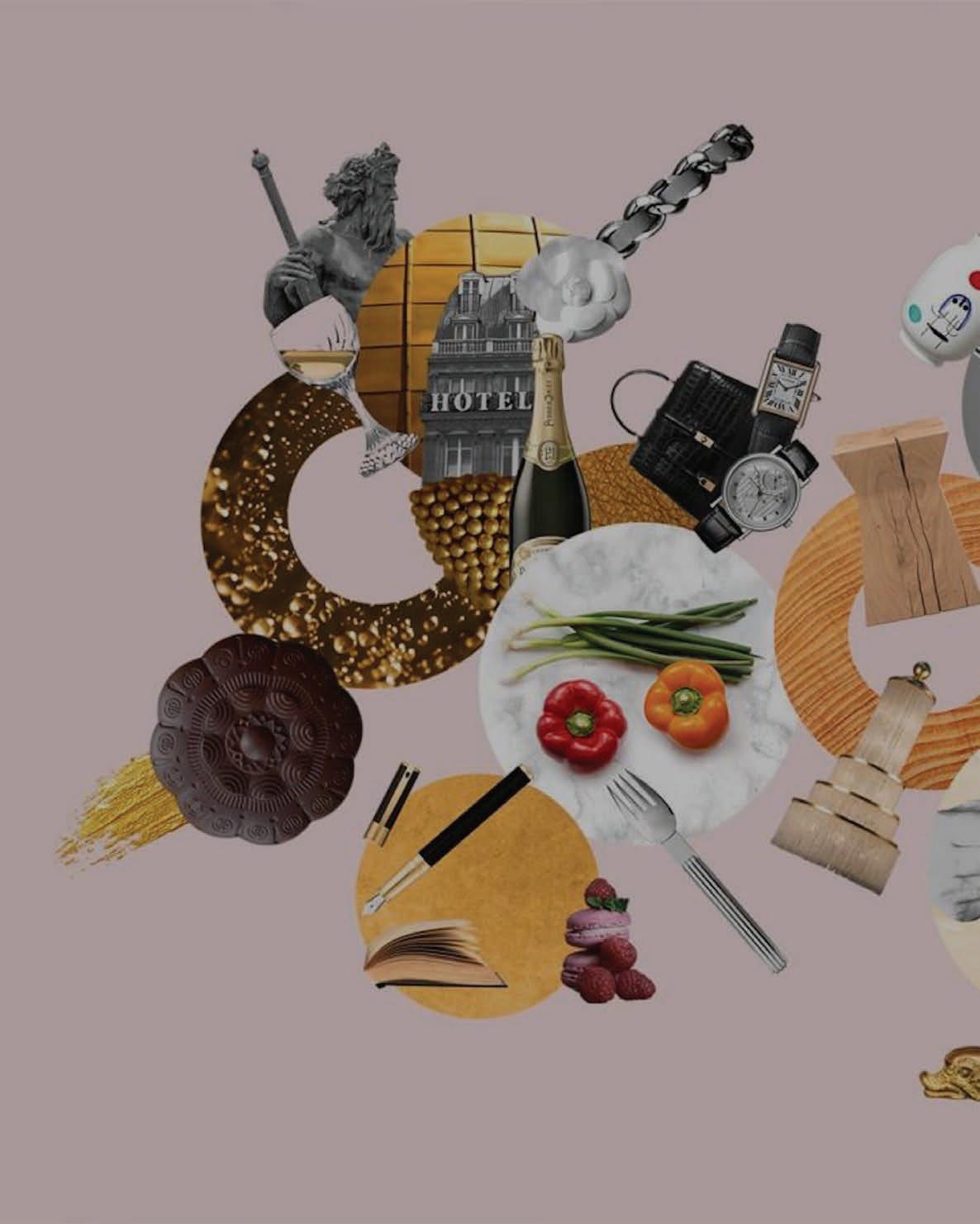
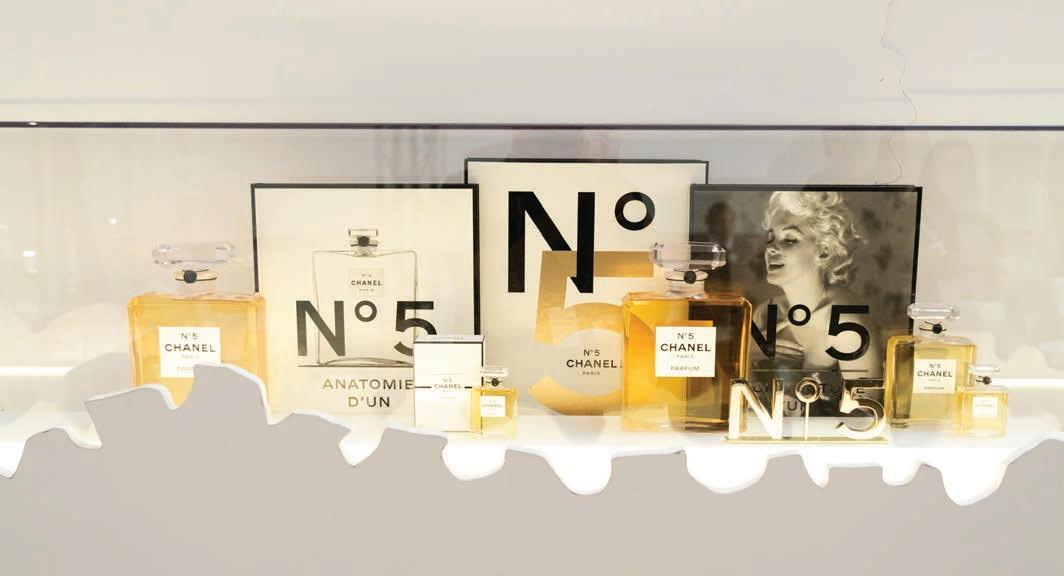
Villages, towns, and regions such as Limoges (porcelain), Reims (champagne), and Lyon (silk and textiles) showcase these ancestral crafts, while Paris has given birth to—and continues to sustain—the most legendary names: Lanvin, Chanel, Hermès, Dior, Louis Vuitton, Cartier, and Van Cleef & Arpels. The Comité Colbert stands at the forefront of this great love affair with the arts and crafts, cultivating and protecting the “made in France” label.
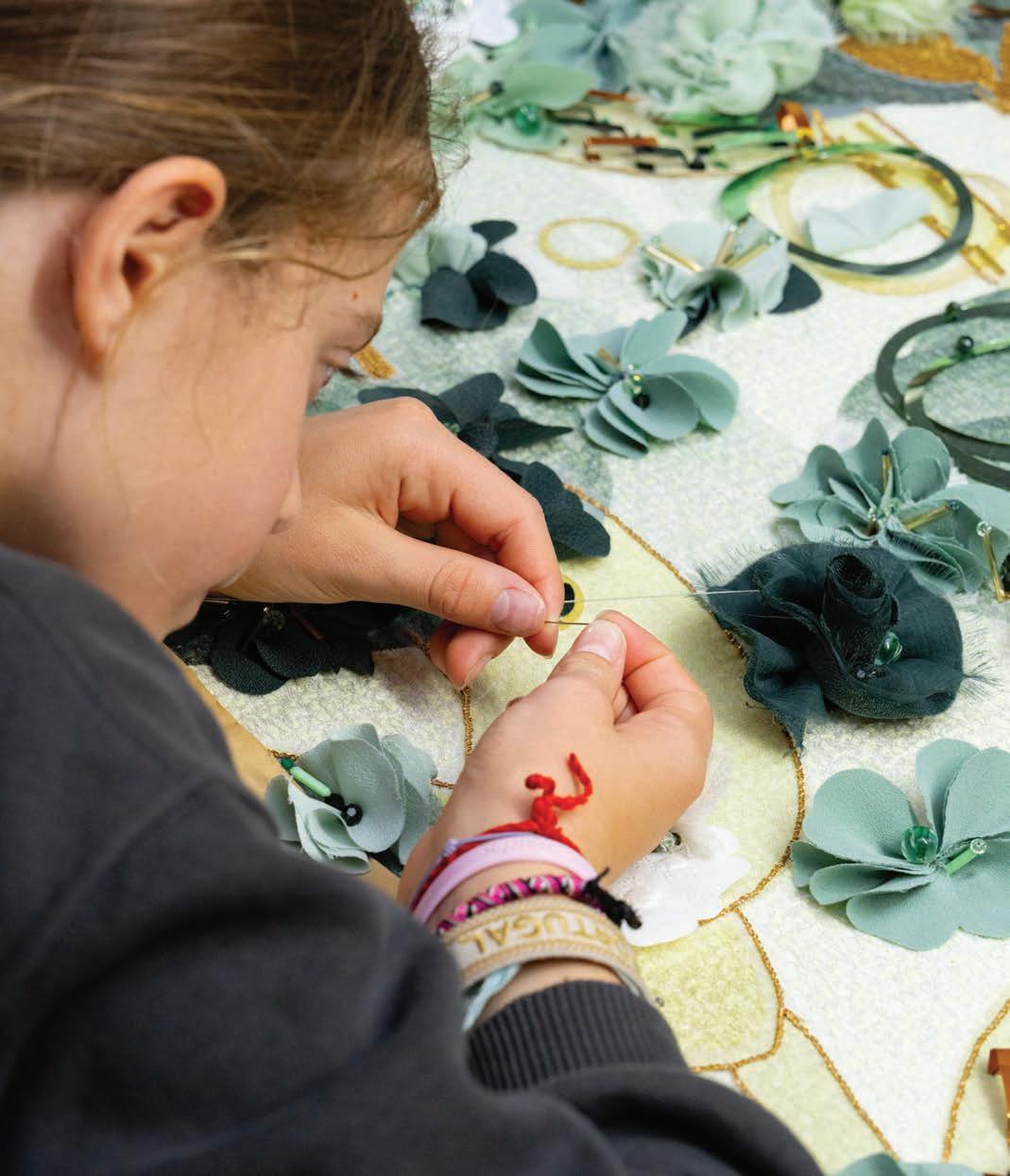
Behind textiles and leather, watchmaking and jewelry, perfumes and cosmetics, wines and spirits, hospitality and gastronomy, tableware and decoration, music and publishing, are passionate men and women who transform French authenticity into an invaluable quality. Each creation carries the value of time, meticulousness, rarity, delicacy, and emotion—often requiring hundreds, even thousands, of hours of work for a single object.
In a 21st century shaped by mass production, fast fashion, digital life, artificial intelligence, and the influence of celebrities and social media, the Comité Colbert remains faithful to its founding principles and long view. Some of its members trace their origins back to the 16th century with Saint-Louis crystal, the oldest House, or even the 9th century with the Monnaie de Paris, the oldest institution. This reverence for time remains the cardinal value shared by all its members.
Today, craftsmanship and technology are shifting perspectives within a dynamic ecosystem that encourages new generations to join the sector and engage with innovation across retail and production. The Comité Colbert continues to link imagination and creativity, experience and emotion, shaping a vision of luxury that approaches the art object—where excellence lies in work beautifully done. In 2022, it launched “Les De(ux)mains du Luxe” (Two Hands of Luxury), a national event devoted to training in the arts and crafts.
The 2026 edition will travel through regions of France before returning to the Grand Palais in Paris in 2027, offering the public rare insight into the life of the artisan.
Yet the most anticipated moment on the horizon is undoubtedly “Hidden Treasures: 250 Years of Franco-American Friendship” (working title), created in honor of the 250th anniversary of the United States Declaration of Independence. “America is our primary market,” Bénédicte Epinay reiterates. “More than sixty Houses and cultural institutions are participating—a record. All of them will pay tribute and share their American story through extensive archives. In budgetary terms, this represents the largest part of my work for the year.” The heritage exhibition will open on May 26, 2026, at The Shed cultural center in New York City, accompanied by live demonstrations of the Houses’ savoir-faire before embarking on a tour across the United States.
The Comité Colbert thus continues to seduce, educate, reward (Chevalier des Arts et des Lettres), create employment, and evolve with consumer expectations and market forces in the digital age. The virtues of slow craftsmanship and creative flow—an artisan’s state of deep commitment—merge seamlessly to ensure that the voice of French luxury continues to resonate across generations.
Credit © Courtesy of Comité Colbert
THE GREAT HANDBAG AFFAIR
Palm Beach’s most glamorous act of generosity
By Viviane Ashcroft
Palm Beach has long understood that elegance and empathy are not opposing ideas. Few traditions reflect that balance as gracefully as the Old Bags Luncheon, a winter ritual that transforms designer handbags into meaningful support for local families and reminds us that generosity, when done with intention, can be both joyful and impactful.
Founded in 1999 by a small group of Palm Beach women supporting the Center for Family Services of Palm Beach County, the Old Bags Luncheon began as a clever idea rooted in community spirit. Guests were invited to donate a cherished designer handbag, gather for lunch, and raise funds for families in need. In just six weeks, the inaugural luncheon came together, welcoming eighty guests and raising $20,000. The name itself was intentionally tongue-incheek, reflecting a confident Palm Beach wit that was playful, self-aware, and impossible to forget.
Over the years, the luncheon has grown into one of Palm Beach’s most anticipated philanthropic events. Each February, the grand ballroom of The Breakers Palm Beach fills with an extraordinary array of handbags — Hermès, Chanel, Gucci, Dior, and coveted vintage finds — sparking spirited bidding and lively conversation. By the time the auction begins, the room hums with raised paddles, shared glances, and the familiar thrill of competition, all in service of something far more lasting than the bag itself.
Beneath the glamour lies a serious mission. Proceeds from the luncheon directly support the Center for Family Services of Palm Beach County, funding critical programs including mental health care, early childhood education, and homelessness prevention. Each handbag sold represents tangible support for individuals and families working toward stability and healing within the local community.
What sets the Old Bags Luncheon apart is its distinctly Palm Beach sensibility. It is not simply a fundraiser, but a reflection of a community that views philanthropy as a form of fluency — an understanding that beauty, privilege, and responsibility are inherently linked. Guests may arrive for the handbags, but they stay for the shared purpose and the quiet satisfaction of knowing their participation fuels real change close to home.
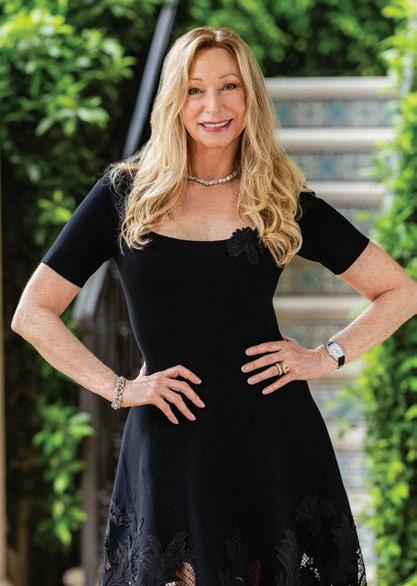
The 27th Annual Old Bags Luncheon returns to The Breakers Palm Beach on February 18, 2026, under the leadership of Event Chairs Lora Drasner and Marzia Precoda. Drasner is an entrepreneur, investor, and philanthropist who serves as CEO of Cosmeceutical Technologies LLC, Managing Director of 3 Seasons Capital, and President
of the Drasner Family Foundation, which has supported arts, culture, animal welfare, healthcare, and underserved communities for more than two decades. Precoda, a former Italian family law attorney now focused on the American criminal justice system, lives between Florida and Geneva and is deeply engaged in advocacy for underserved children, scholarship initiatives, and healthcare causes. Together, they bring both vision and dedication to this year’s luncheon.
As the final bids are placed and the applause fills the room, the enduring appeal of the Old Bags Luncheon becomes clear. In Palm Beach, style has always been more than surface-level, and generosity remains the most enduring accessory of all.
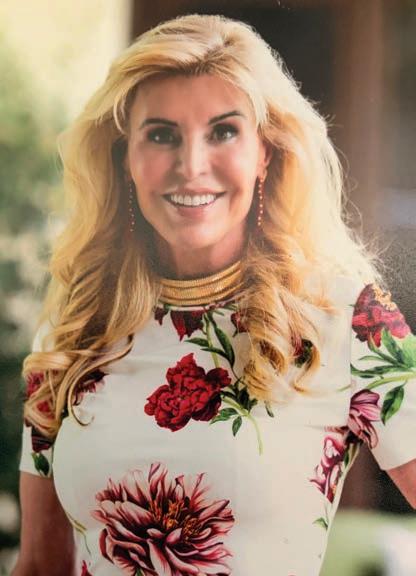
Marzia Precoda
Lora Drasner



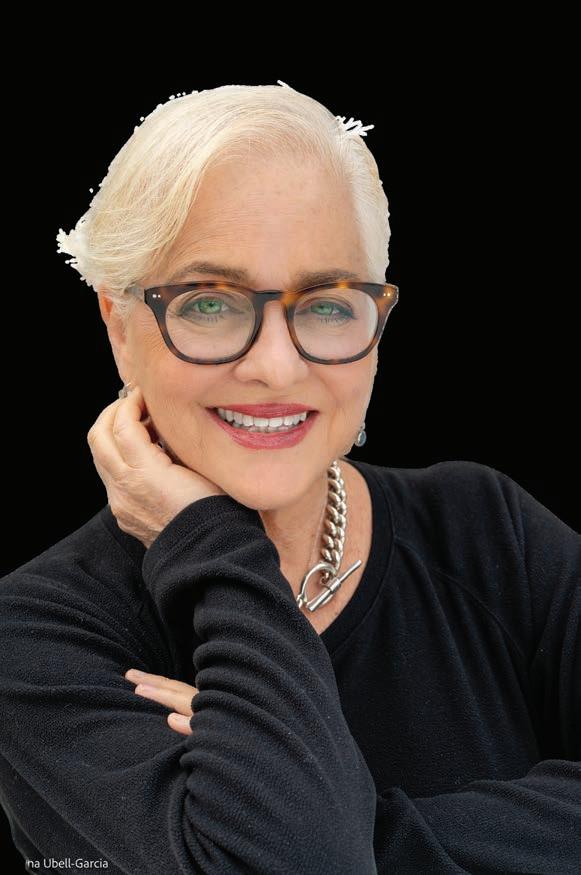
As we step into the new year, my Bedside Reading Book Picks are an invitation to slow down, unplug, and nourish your mental health through reading. Studies consistently show that reading reduces stress, improves focus, and fosters emotional resilience—benefits we all need more of right now. A book offers quiet companionship, perspective, and a safe space to reset your thoughts. Consider starting the year with a personal reading challenge: one book a month, ten pages a day, or a dedicated bedtime ritual. Small, intentional reading habits can create powerful shifts in clarity, calm, and creativity throughout the year.
"One book changed my life and my business. Which book will do that for you?"
--Jane Ubell-Meyer, Founder
Jane Ubell-Meyer, founder BedsideReading.com


BUTTERFLY GAMES BY KELLY SCARBOROUGH
Historical Fiction
In the gilded world of 19th-century Swedish royalty, young countess Jacquette Gyldenstolpe risks everything in a forbidden romance with Prince Oscar. As political tensions rise, a dangerous secret threatens both her future and the fragile new dynasty—proving some games cost far more than the heart.
YOU’LL NEVER WALK ALONE
BY JO GIESE
Memoir
After a devastating accident leaves her unable to walk, avid hiker Jo Giese faces an impossible choice: surrender or fight her way back. This deeply moving memoir is a testament to resilience, gratitude, and reclaiming joy—one step, trail, and triumph at a time.

CHASING THE AMERICAN DREAM BY LORELEI BRUSH
World War II Historical Fiction
When former OSS agent David spots a Nazi war criminal living freely in 1950s America, his pursuit of justice reignites old instincts— and dangerous consequences. What begins as a moral mission spirals into a confrontation with the U.S. government and a reckoning with his own American dream.

THE MIRACLE MORNING AFTER 50
BY DWAYNE J. CLARK & HAL ELROD
Motivational / Self-Help
A modern guide to aging with purpose, vitality, and clarity, this special edition adapts Hal Elrod’s Miracle Morning for life after 50. Blending proven routines with science-backed insights, it offers practical tools to enhance brain health, energy, and longevity—starting each day with intention.




TWINKLE OF DOUBT
BY PATRICIA LEAVY
Romantic Fiction
Celebrated novelist Tess Lee and counterterrorism agent Jack Miller share a love forged through healing and trust— until a deadly threat shatters their peace. As doubt and danger collide, they must decide whether love is strong enough to withstand fear, trauma, and the unknown.
TOUCAN WHISPER, TOUCAN SING
BY ROBERT WINTNER
Fiction
Set along Mexico’s sun-drenched coast, this lyrical novel blends romance, ambition, and survival. As love triangles, secrets, and a seaside murder unfold, passions are tested against tradition— where devotion, freedom, and identity must find harmony beneath tropical skies.
SACRED CROSSROADS
BY MITCH RUSSO
Magical Realism
When a mysterious, glowing key awakens a buried family legacy, Noble Manning must confront truths he’s avoided for decades. As ancient forces stir, he faces a choice between comfort and courage—one that could save his daughter, his town, and himself.
TWO MICE IN NEW YORK: A HOLIDAY ADVENTURE
BY DONNA DALTON
Children’s
When the star atop Rockefeller Center’s Christmas tree goes missing, two clever French mice set off across New York City to find it. From Central Park to Times Square, this festive adventure celebrates friendship, teamwork, and the magic of the holiday season.
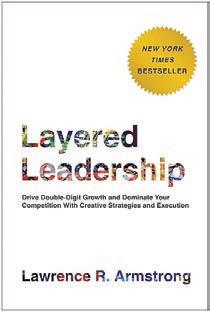
LAYERED LEADERSHIP
BY LAWRENCE R. ARMSTRONG
Leadership / Business
Drawing from decades at the helm of global firm Ware Malcomb, Lawrence Armstrong presents a creative, human-centered leadership model. This accessible guide reveals how mentorship, strategic thinking, and whole-person development can drive sustained growth—even through uncertain economic cycles.
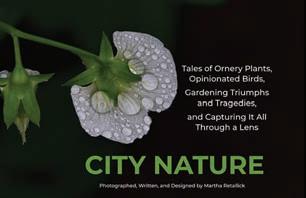
CITY NATURE
BY MARTHA RETALLICK
Gardening / Nature
Part memoir, part guide, City Nature chronicles Martha Retallick’s transformation of a Tucson home into a thriving desert oasis. Through vivid photography and practical insight, she shares sustainable water-harvesting techniques, gardening triumphs, and lessons in cultivating beauty amid scarcity.


AMY’S TRAVELS
BY KATHRYN STARKE
Children’s
Inspired by a true story, this anniversary edition takes young readers on a globespanning adventure across all seven continents. With engaging storytelling and educational elements, Amy’s Travels celebrates curiosity, culture, and the magic of discovering the world—one destination at a time.
WE’RE ALL DEAD HERE
BY JAKE C. RUDQUIST
Young Adult
Twelve-year-old Samuel wakes up as a ghost—with no idea how to get home. As he explores the afterlife with new friends, he discovers unexpected freedoms, haunting truths, and the meaning of growing up when time stands still.
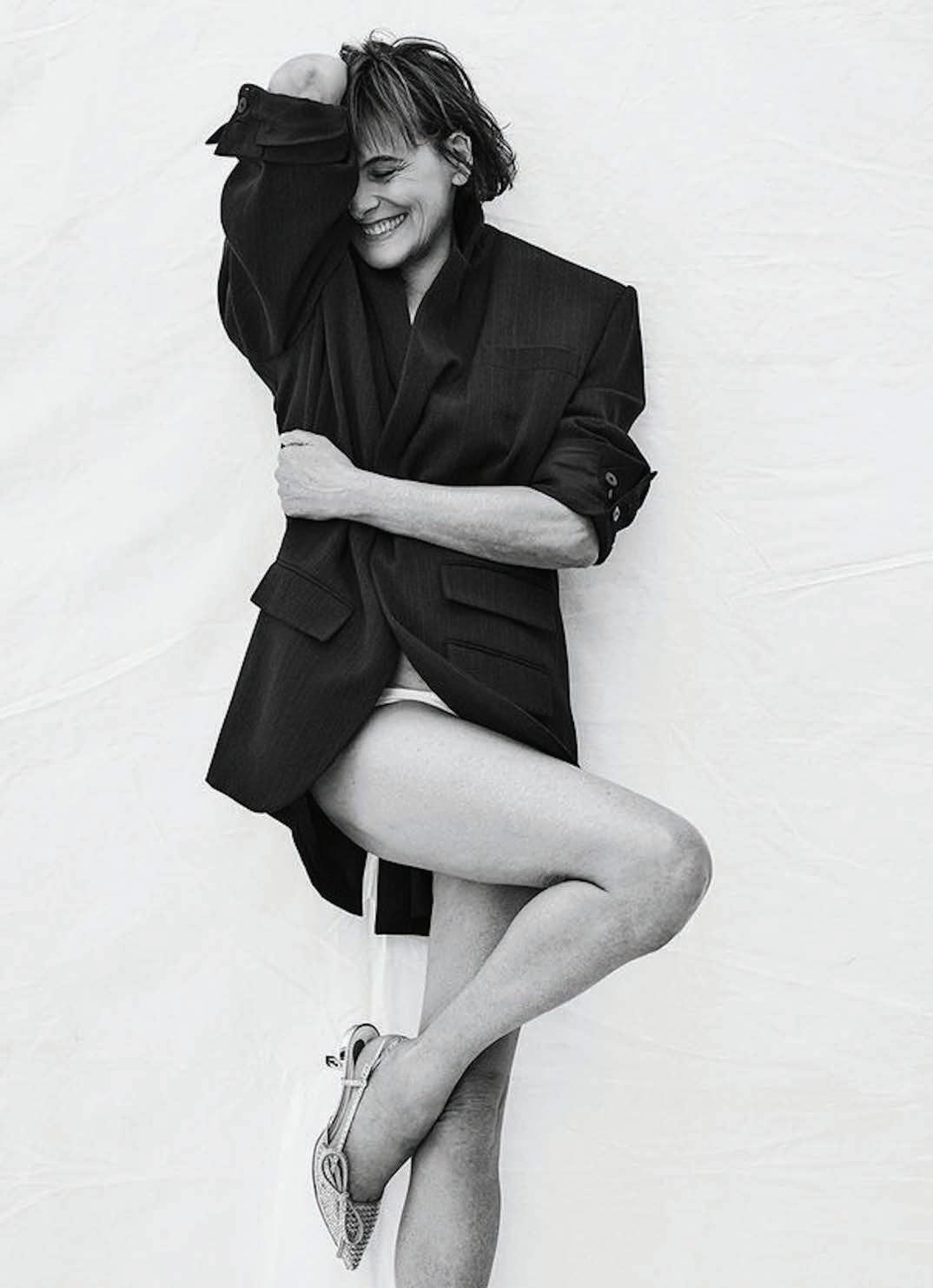
DEINÈSLA FRESSANGE:
STYLE ISA STATE OF MIND
On instinct, independence, and why wandering remains the ultimate luxury.
By Nathalie Dassa
There are women whose presence transcends fashion, whose style feels less constructed than instinctive. Inès de la Fressange is one of them. Muse to Chanel, creator of her own namesake brand, inspiring businesswoman, author, and living symbol of the Parisian woman myth, she embodies a form of elegance that is simple, discreet, and timeless. Today, as she marks the tenth anniversary of her Paris boutique and spends time in Provence, Inès de la Fressange reflects on a life shaped by intuition, independence, and a singular vision of French art de vivre. With us, she goes back in time.


“Wasting
time and wandering around is the real luxury”
There isn’t a single photo of her without a radiant smile. Throughout her career, Inès de la Fressange has “dared to be different from others,” establishing her style at a very young age, very early on, very quickly. Through her collaboration with Karl Lagerfeld for Chanel, she became the reincarnation of Madame Coco. Her professionalism and her sidesteps, where shyness mingled with whimsy, made her a fashion icon in the 1980s, foreshadowing the era of supermodels. She marked the debuts of photographers Paolo Roversi and Oliviero Toscani, while walking the catwalks of some forty fashion shows per season in Paris.
This path, marked by many twists and turns, led her to develop a philosophy of life, where elegance and grace go hand in hand with authenticity and simplicity. “I was a model who worked a lot, and some people told me it was a shame to give up my career for an ‘old’ fashion house like Chanel,” she recalled with humor. “People thought it was for older women, not 25-year-olds. I took a risk by signing the very first exclusive contract, but above all, I followed my instincts. Our choices are also a question of personality.”
Her close relationship with the Kaiser of fashion was decisive, giving her a role that went beyond that of a
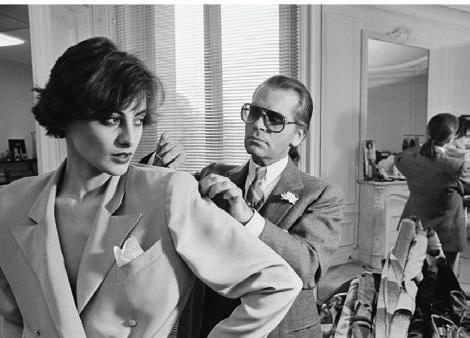
Ines
de la Fressange - Paris 1984
Photo Arthur Elgort

model. “He and I invented what is now known as a ‘brand ambassador,’ without ever having a single meeting,” she continued. “He hinted that I would one day become a stylist. I didn’t think I had that kind of imagination; I was more interested in designing clothes for everyday women. He helped me understand that there was another way to create. He was the best teacher and the best school.”
Inès de la Fressange has never sought to be fashionable, absorbing the spirit of the times without ever going out of style. Even today, she lives her life according to her desires. With her serene beauty, chic in all circumstances, and ability to let go, she showed that aristocracy and popular culture could coexist, without giving it any credit. “I never thought about it or even used that word. At the beginning of my career, I didn’t even give my last name. I only did what I wanted, which could have been frowned upon, but people called it ‘style.’ Over the years, I realized that it was better to go with your gut feeling.”
Her style and grace lie in her courage to remain true to herself. “When I decided to leave Chanel, my friends advised me against it, fearing I would fade into obscurity. But it didn’t seem that daring to me; I had no other choice. It was funny to see how attitudes had changed in seven years.”
Ines de la Fressange et Karl Lagerfeld

Living life to the fullest and not being afraid to follow your instincts are central tenets of her philosophy on life as well as her approach to fashion. “I feel like a little artisan,” she confided. “Over time, you recognize the clothes that help you feel better. When people see my wardrobe, they expect embroidered dresses, long gowns, and a multitude of things, but they realize how simple it is. There are white jeans, sweaters, loafers, men’s shirts, sky
blue and white shirts. Women add accessories thinking it will brighten up their outfits, when it’s they themselves who should be cheerful. They also accumulate too many luxury items when they reach a certain level of purchasing power. Ultimately, this turns them into grannies. We’re not clothes hangers! Clothes are made to make you feel good. And when you feel good, other people think you look good.”
Over a fifty-year career, she has not only touched her own generation, but also new ones, influenced by her style through brands such as Sœur. She remains attentive to the vision and fashion choices of her daughters, Nine and Violette, and their friends. “When you design clothes that you want to sell, you have to keep up with what’s going on. They have good taste and often choose the new cashmere in my wardrobe. I’m proud and happy that they have this sense of style.”
Similarly, heritage and modernity remain strong ties for her, influencing her work over time. “Transmission is important in my profession, where history and fashion intertwine. Even if we draw inspiration from the past, the present moment will always shine through. Many people say they are impervious to fashion, when in fact they are influenced by it without even knowing it. Our desires reflect the spirit of the times.”
She also likes to play with the unexpected. Her 2025 line evokes “serendipity,” where chance discoveries prove fruitful. “The collection says nothing about me, but about my schedule and fortuitous encounters.”
October saw the convergence of several collaborations (Dim, Smeg), marked by the tenth anniversary of her boutique on Rue de Grenelle in Paris. It was a rewarding time, characterized by perseverance and renewal. Reclaiming her brand was a fifteen-year battle. It is also a testament to the strength and elegance of Inès de la Fressange. “Justice was served. As soon as I was gone, it fell apart,” she summed up.
Despite her vicissitudes, she continues to shine. The Roger Vivier ambassador also presented the Salon de l’Héritage, which she designed for Maison Vivier, newly located in an 18th-century mansion on Paris’s Rive Gauche. In November, she released her guidebook, in which the Parisian takes over Provence, not far from her home in Tarascon. She favors slightly gourmet restaurants and local bistros, espadrilles and boots from a saddlery. She might visit the Saint-John Perse exhibition, buy a book by Sartre, and stop by Miu Miu for some loafers. “It’s a mix — and always a state of mind.”

La Parisienne en Provence offers a curated selection of places to visit in the region for those who enjoy “reading under an olive tree, taking a nap, going for a walk, or visiting the markets.” Today, Inès de la Fressange is deliberately slowing her pace. “Wasting time and wandering around is the real luxury,” she says. “2026 will be the year of pottery — a wonderful form of meditation that calms me.”
In an age obsessed with speed, novelty, and visibility, her vision feels quietly radical: a reminder that true elegance is not about accumulation or performance, but about knowing when to pause, when to wander, and when — above all — to follow one’s instincts.
“Clothes are made to make you feel good. And when you feel good, other people think you look good.”
Ines de la Fressange - Photo Paolo Roversi
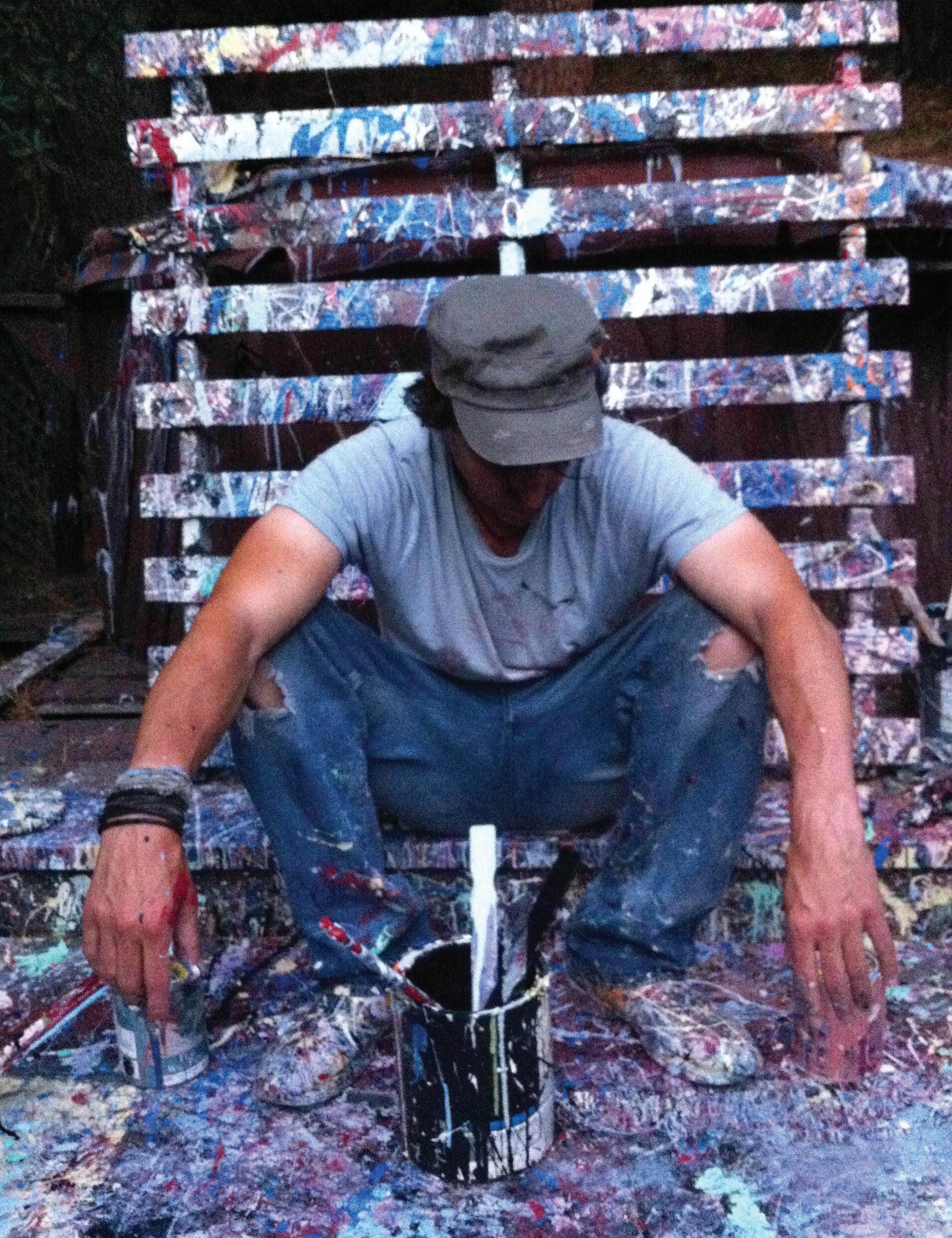

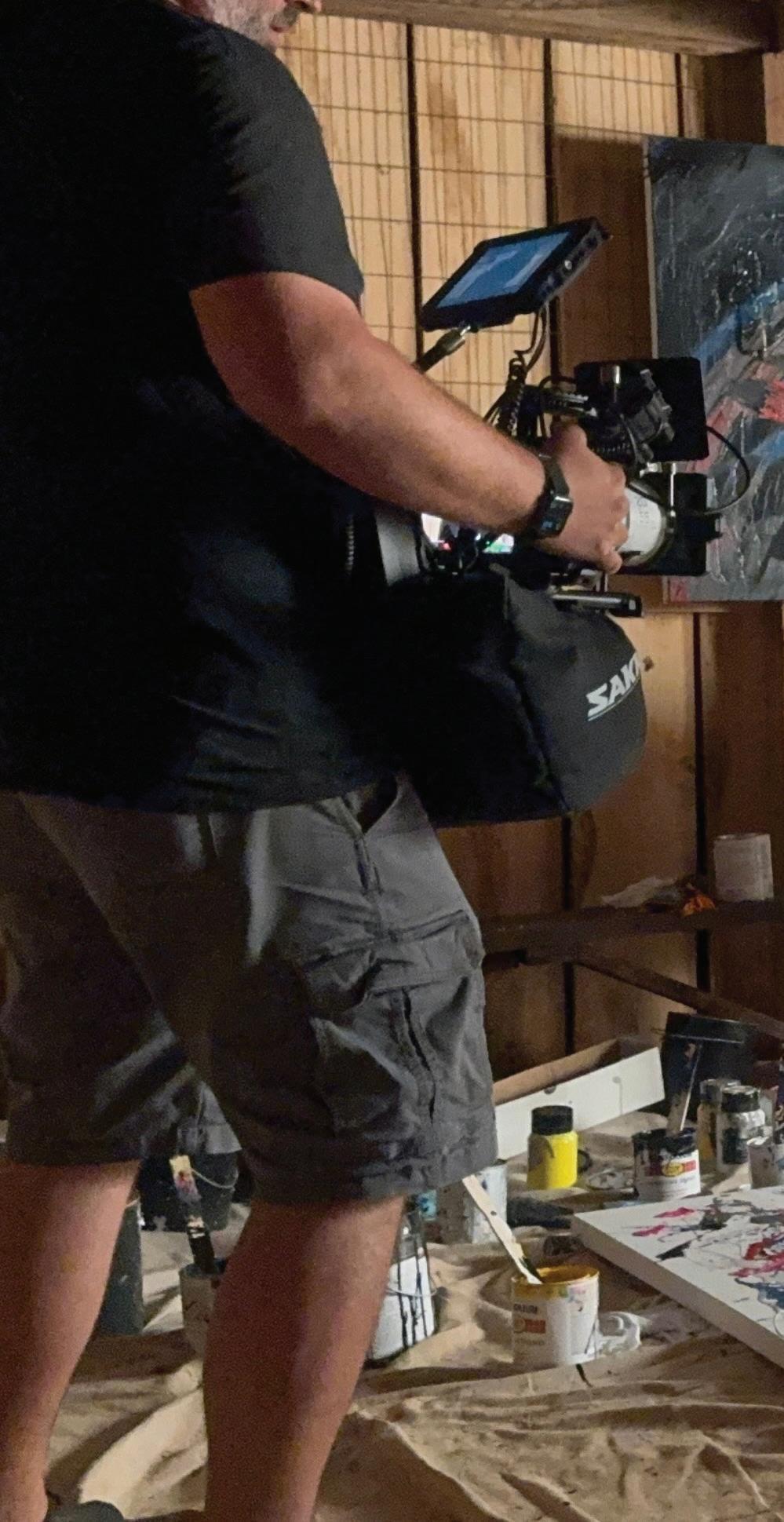
Richard Grieco speaks with a calm, deliberate steadiness that feels earned rather than cultivated. Widely recognized for his breakout role as Detective Dennis Booker on 21 Jump Street—a performance that propelled him into the cultural spotlight and made him one of the most visible young actors of the late 1980s—Grieco rose quickly during an era when television stars became global icons. For someone who has lived so many creative lives—actor, musician, painter, writer, director—there is now an unexpected grounding in his presence, a sense that the momentum of his career has finally aligned into something cohesive and intentional.
“I think it’s about taking control,” he says early in our conversation. “Writing the films, directing them, starring in them, producing them. Bringing everything together.”
“ Before, it was darker. Now it’s about light.”
“ Writing the films, directing them, starring in them, producing them — bringing everything together.”
That convergence defines this chapter of Grieco’s life. It is not a reinvention so much as an integration—decades of creative instinct, public scrutiny, discipline, and resilience now flowing through a single, unified vision. The speed and scale of his early fame gave way to a more inward, expansive exploration of expression, one that moved beyond the confines of a single medium. What emerges today is an artist no longer defined by any one role, but by the continuity of motion itself—creative, emotional, and purposeful.
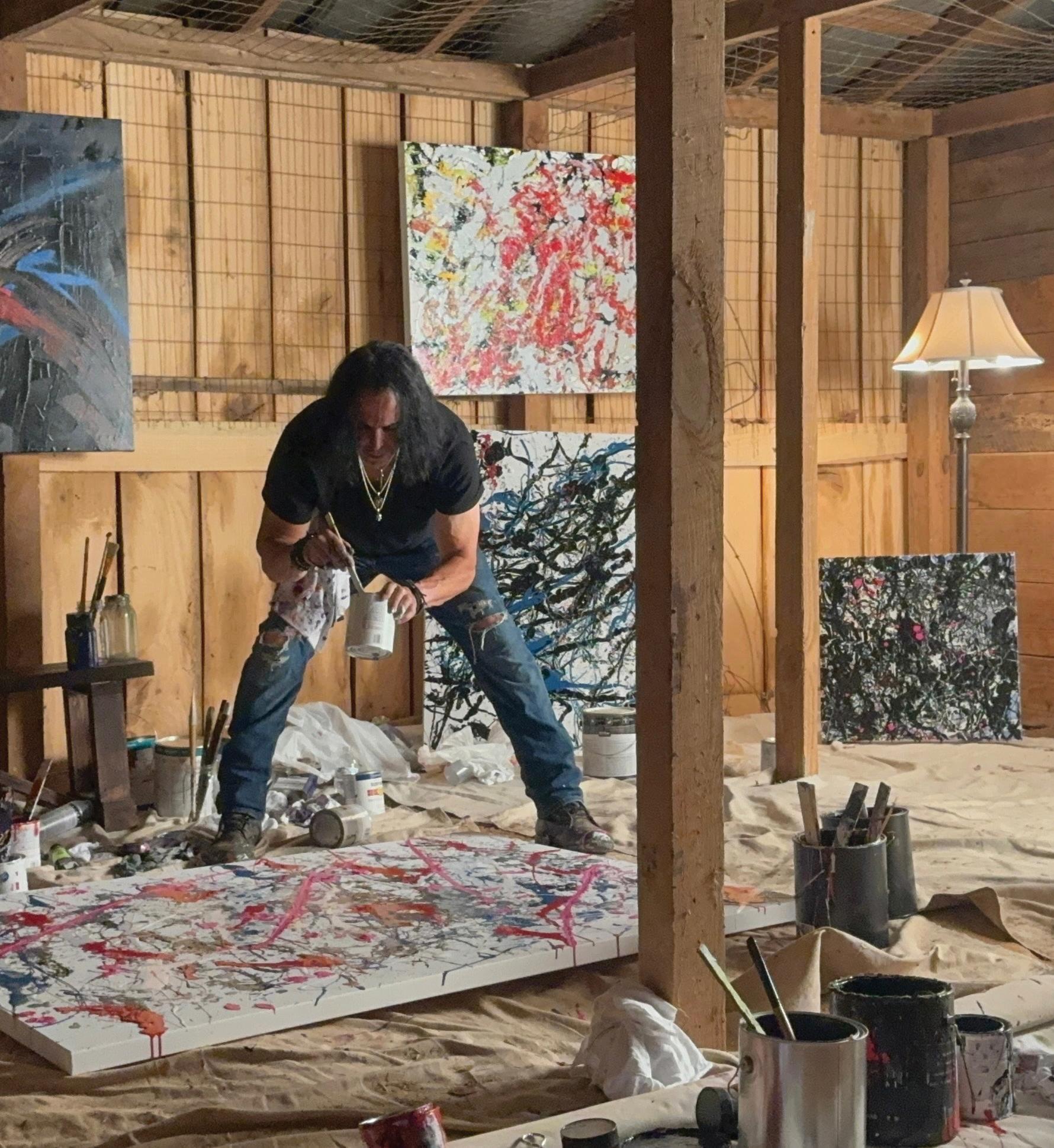
At the center of this moment is The Painter, a script Grieco wrote loosely inspired by his own journey. The story follows an artist given a second chance at life, a man whose paintings absorb the pain, illness, and emotional burdens of others, transforming suffering into something luminous and meaningful. The gift is both miraculous and punishing, a form of service that demands everything from the one who carries it.
“It was like a martyr story,” Grieco explains. “A guy who doesn’t understand why he feels sick, why he’s carrying other people’s weight. And then he realizes— maybe that’s the point. Maybe we’re here to help people. Maybe that’s the legacy.”
The film culminates in a striking final image: a portal opening through an unfinished painting into a radiant field filled with children, free, joyful, unburdened. It is spiritual without being prescriptive, hopeful without sentimentality. A moment of release.
What Grieco did not anticipate was how physically and emotionally demanding the process would become. While filming in Atlanta, he committed to creating ten full-scale
paintings—some monumental in size—before the cameras rolled. Seven days. Fourteen to fifteen hours a day. No phone. No distractions. Just immersion. “I wanted to feel everything,” he says. “Every emotion.”
There was doubt. Exhaustion. Vulnerability. And then, unexpectedly, completion. “I didn’t know if I could do it,” he admits. “But I did.”
Though many associate Grieco with his screen presence, painting has been a constant since the 1980s. For years, he kept the work private, unsure of how it would be received. That changed in 2009, when the late Dennis Hopper urged him to show it publicly. “He told me, ‘It’s not about you. It’s about what they see in it.’ And he was right.”
Today, Grieco describes his work as abstract emotionalism—painting driven not by structure or theory, but by movement, instinct, and emotional truth. Influences like Kandinsky, de Kooning, and Pollock surface not as imitation, but as shared lineage. “It all comes from motion,” he says. “Physical, emotional, spiritual.”
For Grieco, motion is inseparable from authenticity. “You can’t be afraid to make mistakes,” he says. “When you’re not afraid, that’s when you’re real. That’s when the work is alive.”
This philosophy extends beyond the canvas. Hollywood, he notes, prefers artists to stay neatly defined, comfortably contained. Grieco has never fit that model.
“People get confused,” he says, almost amused. “They think you can only do one thing. But real creative people use the whole brain. Acting, music, painting, writing—it all comes from the same place.”
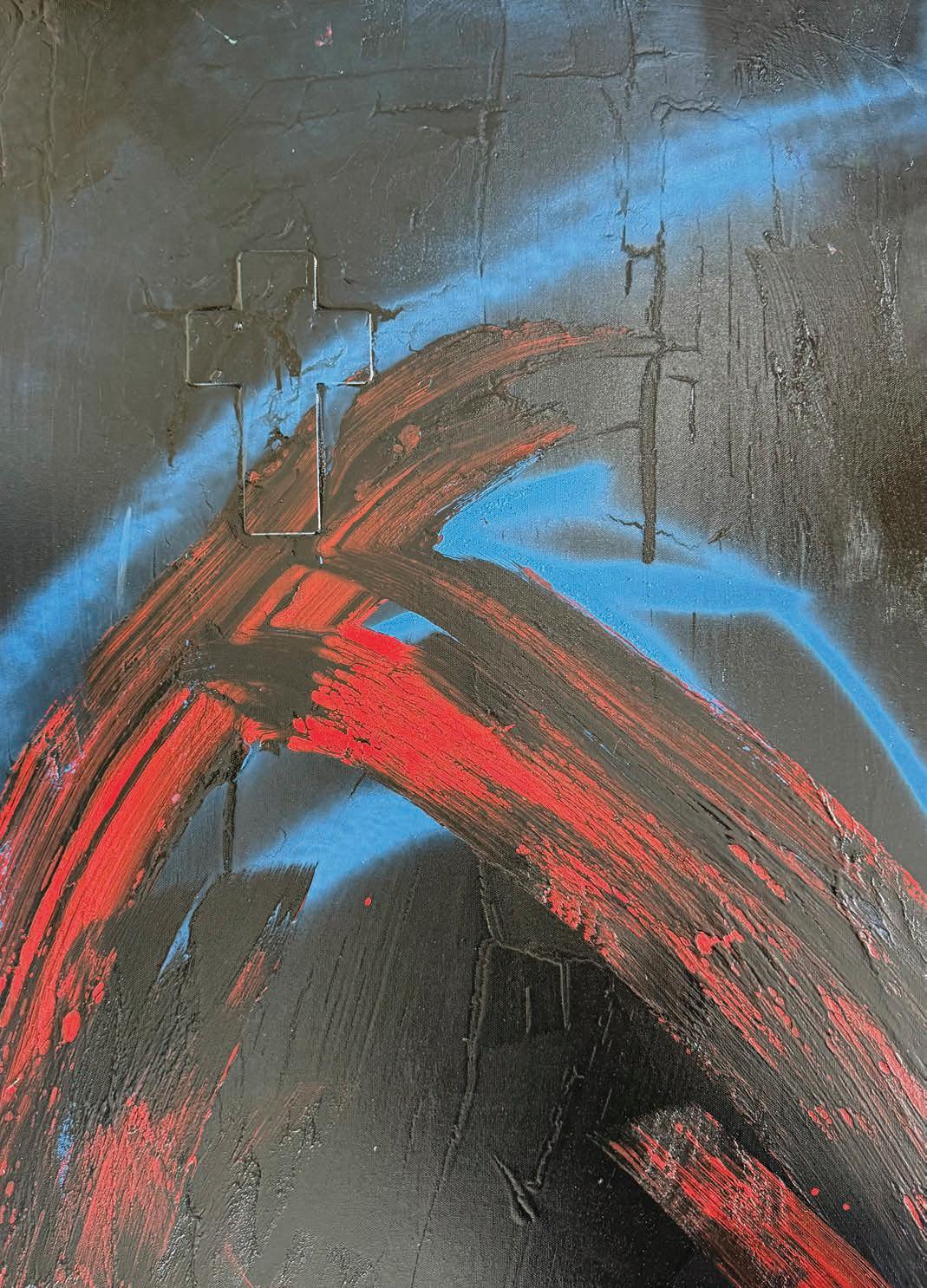

There were moments when that versatility worked against him—roles lost, opportunities redirected, industry politics revealed only in hindsight. But there is no bitterness in his reflection. Instead, there is acceptance. “If I hadn’t gone through that,” he says, “I might never have gone as deep into music. Or painting. Everything led somewhere.”
That sense of purpose runs through the projects now taking shape. Alongside The Painter, Grieco is developing The Gift, a restrained, quietly powerful story about a wealthy man who anonymously
forward. Across mediums, a pattern emerges—one Grieco himself only recognizes in retrospect.
“In the last few years, everything I write is about helping people,” he says. “It wasn’t always that way. Before, it was darker. Now it’s about light.”
That sensibility extends beyond his work. Grieco speaks with equal conviction about small, unscripted moments—a kind word to a stranger, a quiet gesture of generosity, the simple act of noticing someone else’s humanity. “You can change someone’s day with almost nothing,” he says. “A hello. A moment of kindness.”
“ When you’re not afraid, that’s when the work is alive.”
transforms an entire town through unexpected generosity—offering opportunity, dignity, and hope without recognition. Another project, Finding Hope, inspired by one of Grieco’s paintings, follows a man returning to North Carolina after his grandfather’s death, only to uncover a child-trafficking network while assuming responsibility for dozens of children in foster care. It is a story of reckoning and redemption, light emerging from darkness.
Additional work is unfolding in parallel: companion scripts, a book of poems titled Fragments from a Dirty Ashtray, unreleased music finally finding its way
When asked what motion means to him now, the answer feels distilled by everything he has lived.
“Motion is life,” he says. “Painting, acting, writing— it’s all movement. I can’t sit still. I don’t think I’m ever finished. But if it’s pure, if it’s real, I’ll follow it.”
Richard Grieco remains, unmistakably, a man in motion—but not restless, not searching. Moving instead toward clarity, toward generosity, toward a deeper connection between art and purpose. His story is no longer about reinvention. It is about wholeness. About bringing every fragment of a life together and offering it—unflinchingly—back to the world.

The perfect island escape awaits.
Bermuda may feel like another world, but this idyllic getaway is just a two-hour flight from the East Coast. With wide-open spaces, pink-sand beaches and turquoise waters, Bermuda is ready to safely welcome you to her shores.
ESCAPE
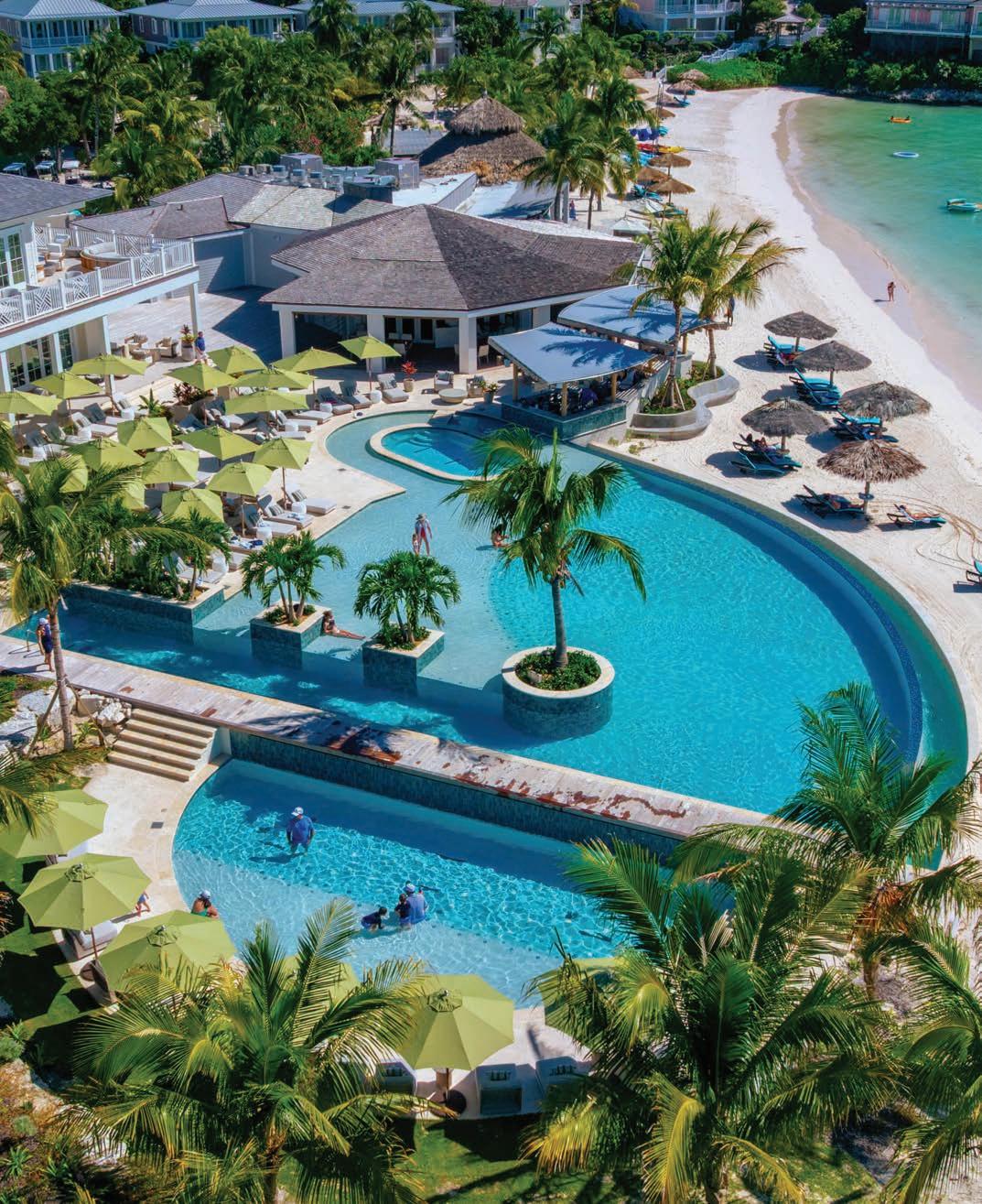
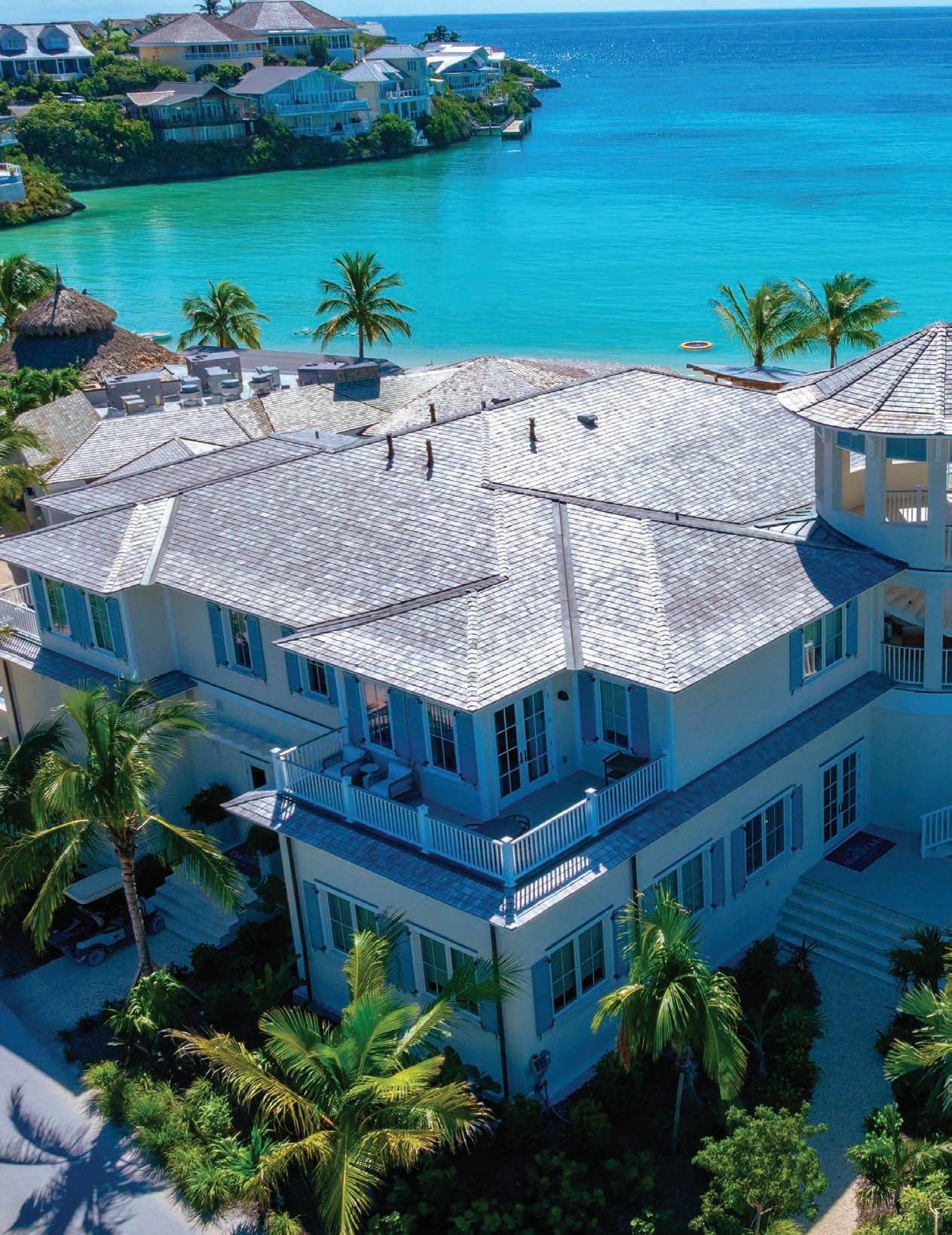
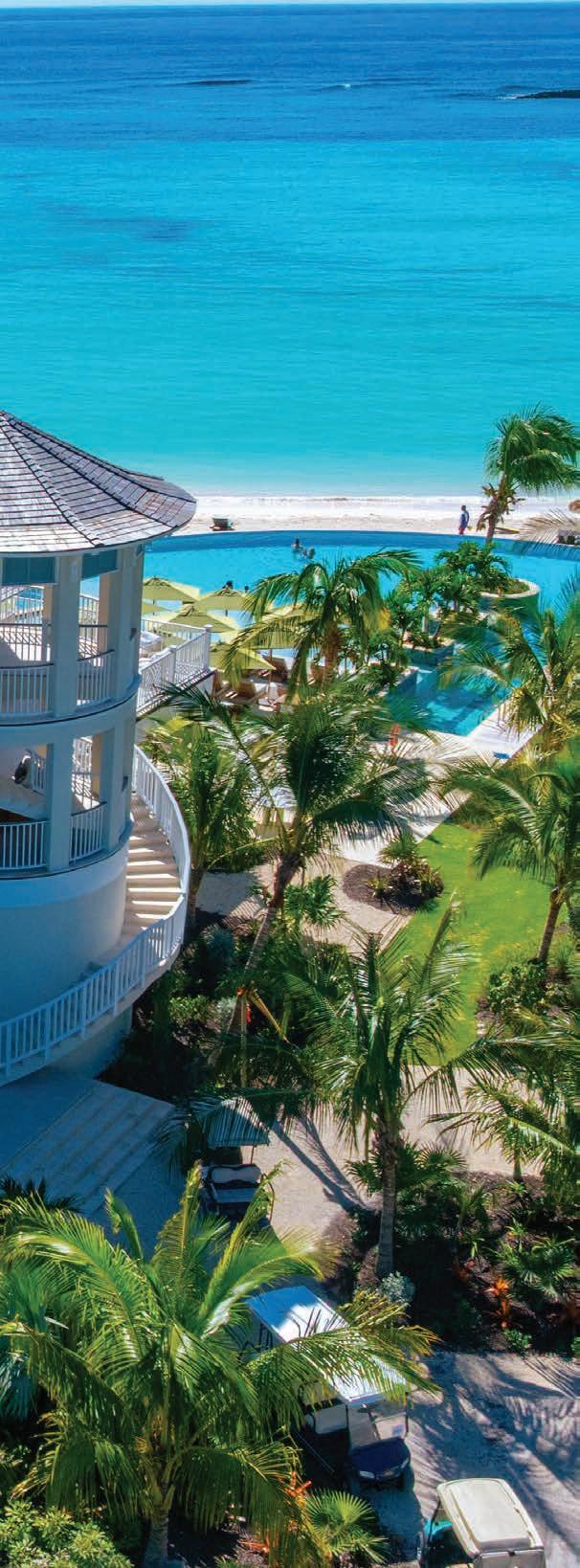
BAREFOOT LUXURY & ISLAND SOUL:
By Taylor Freeze
Some places are beautiful, and some places feel like a secret whispered just to you. The Abaco Club—a private, 500-acre retreat on Great Abaco Island— manages to be both. It’s a sanctuary where “barefoot luxury” isn’t a slogan; it’s a way of life. A place where the turquoise water looks airbrushed, the homes blend effortlessly into nature, and every person, from members to staff, welcomes you as if you’ve always belonged.
Some of my days began the way I wish every day could: yoga overlooking Winding Bay, breathing in the calm as the ocean mirrored the sky. The sound bath that followed lulled me into such deep relaxation I nearly forgot where I was—and yet I’d never felt more present. It’s easy to see how this devotion to well-being will only deepen when the club unveils its new spa village in 2028, an indoor–outdoor sanctuary inspired by the healing nature of water. With meandering paths, ocean-view pools, saunas, cold plunges, and bespoke wellness journeys—from golf recovery to restorative sleep—the forthcoming spa promises to become one of the most extraordinary holistic retreats in the Caribbean. Even in anticipation, you can already feel its gentle imprint woven into the club’s restorative energy.
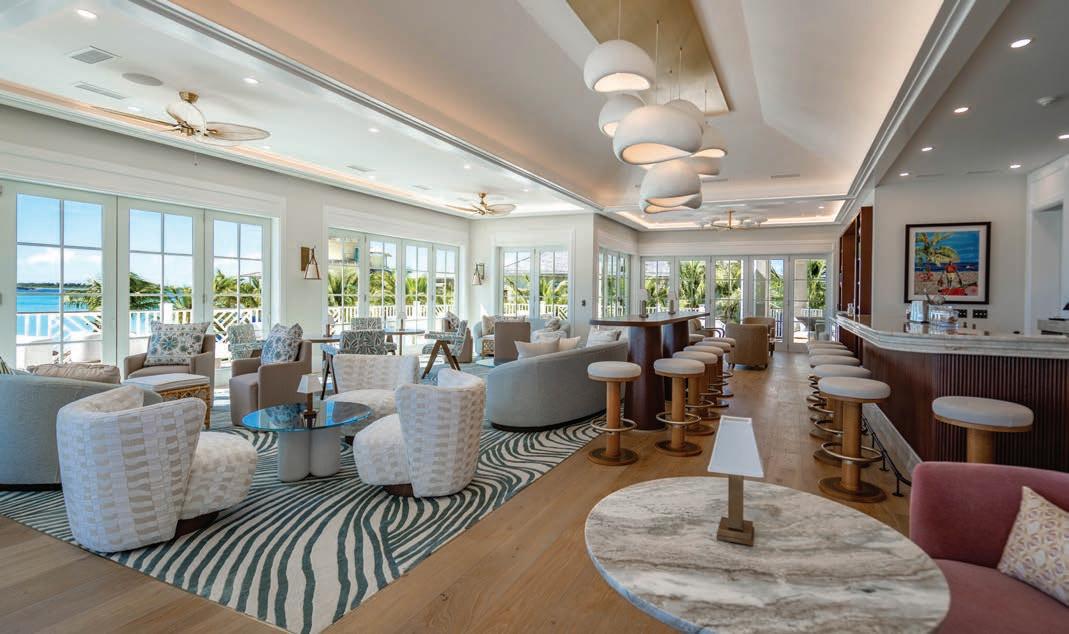
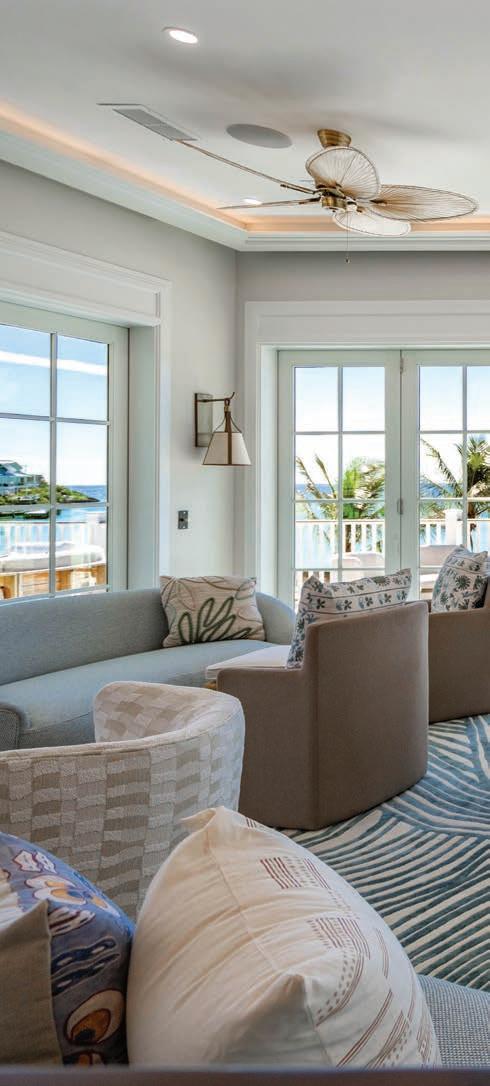
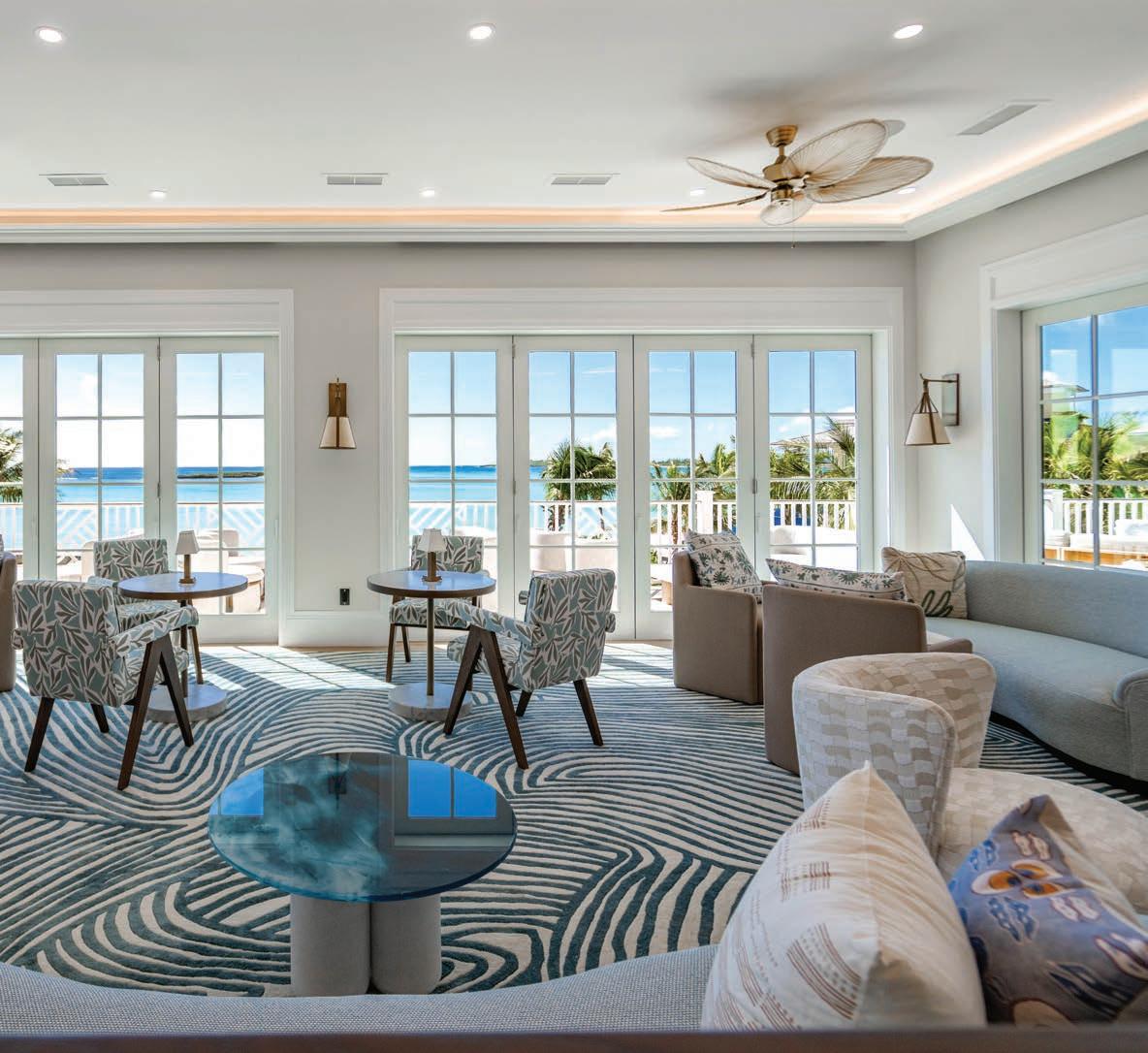
Afternoons unfolded in an entirely different rhythm, full of movement and joy. The club’s two-mile stretch of powder-soft beach became my personal playground. I swam, paddled across water clear as blown glass, and one especially unforgettable day, I tried e-foiling, a club favorite water activity that lets you glide above the waves like you’re bending the rules of physics. Thrilling, peaceful, and utterly addictive.
Though my golf resumé consists mainly of social outings and the occasional Topgolf appearance, The Abaco Club’s Scottish-style tropical links course captivated me instantly.
Ranked the #1 course in The Bahamas, it’s the kind of landscape golfers dream about: undulating fairways framed by ocean blues and soft, Atlantic breezes. My introduction to the course came under the guidance of Toby Young, Assistant Golf Professional, whose thoughtful coaching transformed what could have been a humbling experience into something genuinely rewarding. Standing on those fairways with waves rolling in the distance, I understood why professionals return year after year for the Korn Ferry Tour’s Bahamas Great Abaco Classic. It’s more than a game here—it’s pure immersion.
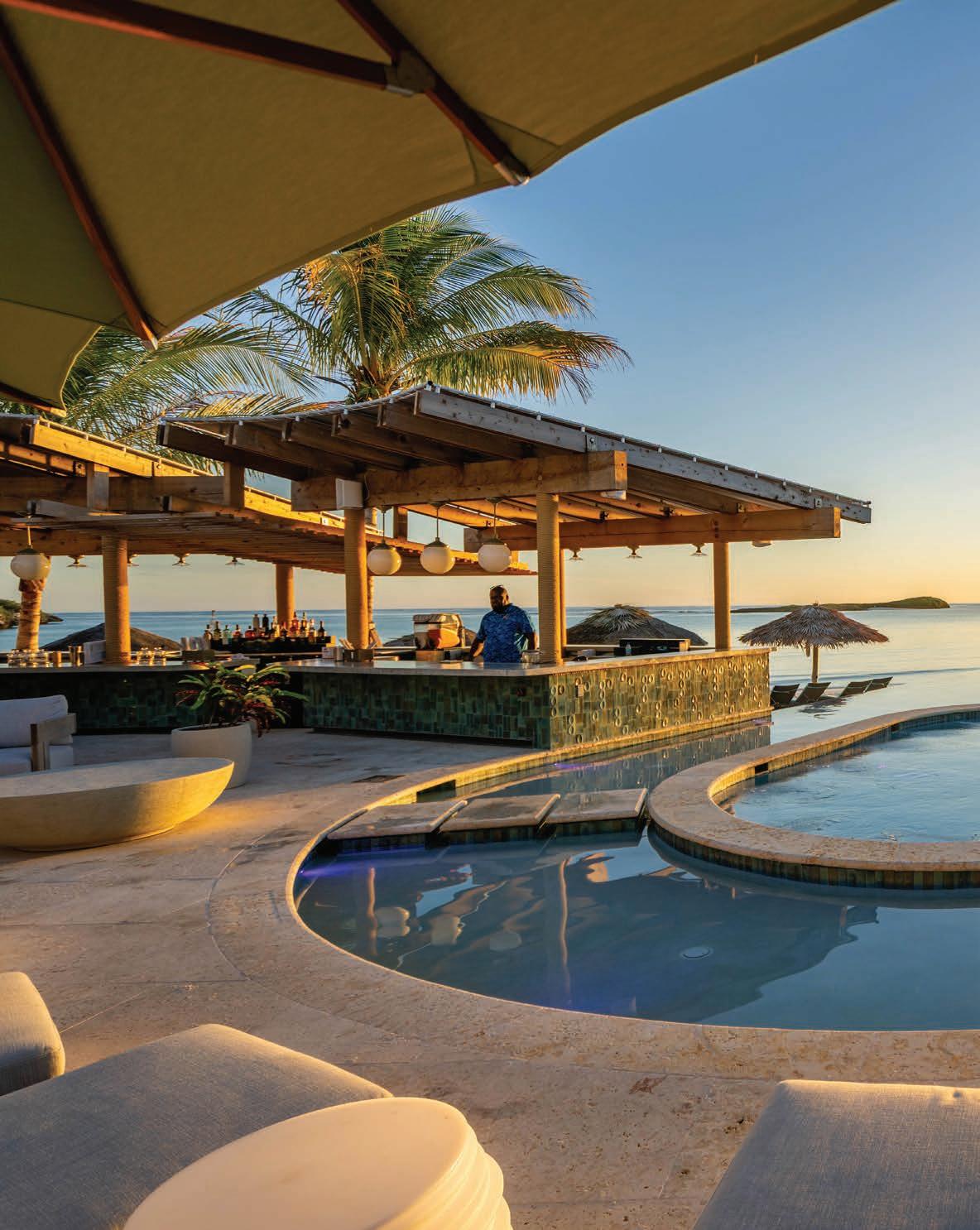
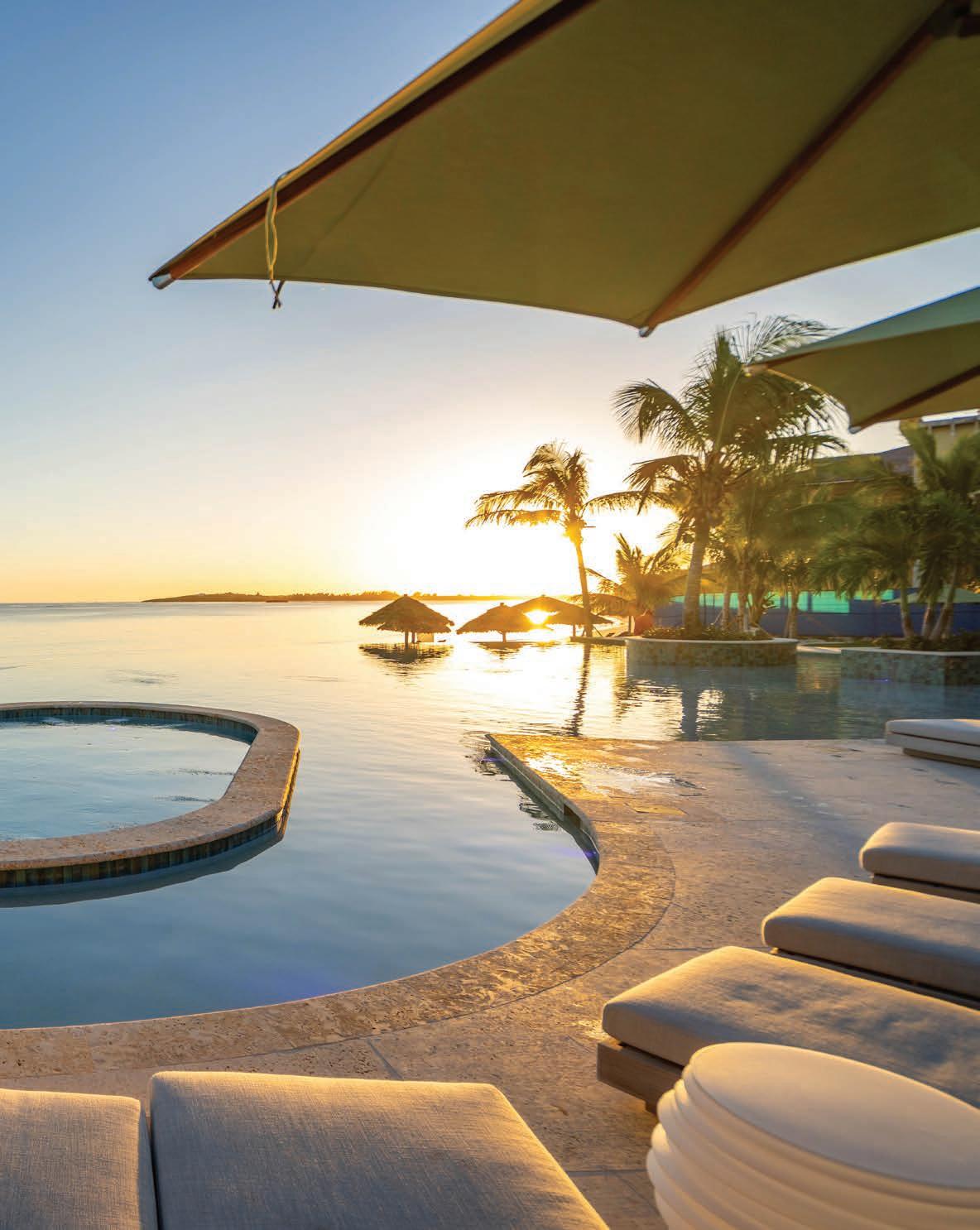
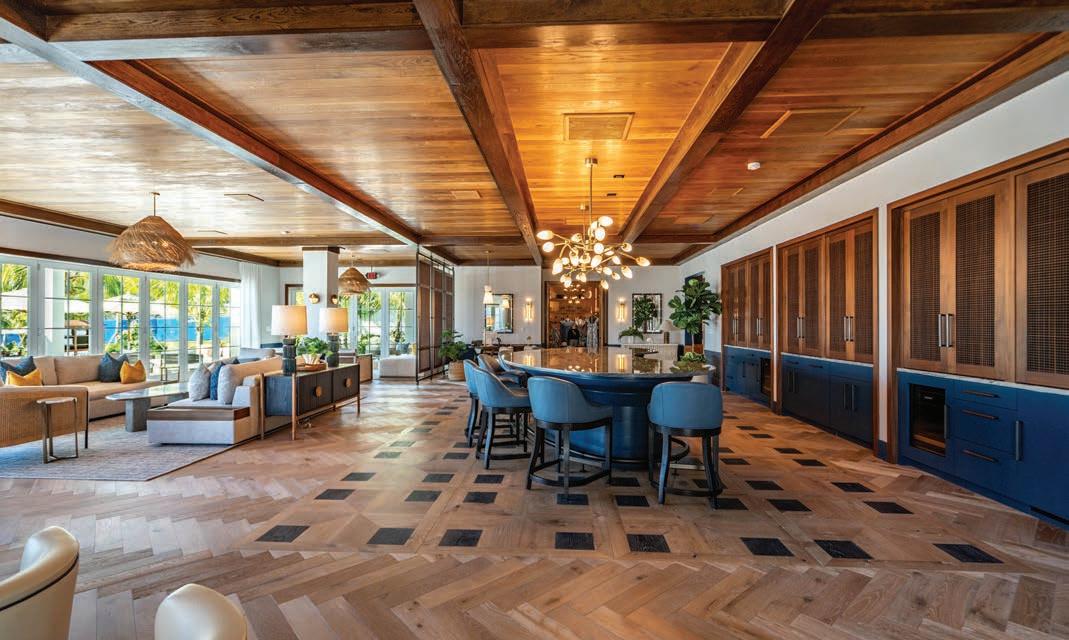
Nature, too, is an inseparable part of the club’s magic. Brilliant Abaco parrots streak across the sky like flashes of green and gold. Sea turtles drift through the quiet bays with effortless grace. Sunsets unfurl in shades of amber and rose. And then there are the island kitties, unexpected ambassadors of charm, who add just the right touch of familiarity to the club’s polished elegance. Somehow, their gentle presence makes everything feel even more like home.
That sense of harmony extends to the architecture as well. The homes don’t compete with the landscape—they echo it. From the coveted Cays Reserve beachfront residences that open directly onto Winding Bay to the turnkey golf-front cottages at The Green with their refined Restoration Hardware interiors, each space feels curated yet unpretentious. And the newly opened Bay Club, with its toes-in-the-sand cocktail bar, infinity-edge pool, cinema, cigar lounge, and thoughtfully designed member areas, beautifully reflects the club’s signature blend of refinement and ease. This is barefoot luxury, perfected.
That feeling carries into the dining experiences, each one a celebration of flavor and sincerity. At the heart of it all is Cem Erenler, Director of F&B Operations, whose passion infuses every space with a sense of warmth and welcome. His hospitality lingers long after the meal ends. Executive Sous Chef Lane Lehman brings the island’s flavors to life with creativity and precision, crafting dishes that honor local ingredients—many sourced from the club’s
hydroponic gardens or trusted local fishermen. From wood-fired dishes at The Beach House to fresh seafood at The Cliff House, from relaxed breakfasts at Flippers Beach Bar to tacos at the beloved Tingum on 5, every bite felt like an invitation to savor the island more deeply.
And woven through all of this are the people who give the club its soul. Fun Bob, the beloved racquets pro, christened by a child and embraced by the entire community, brings joy to every lesson, whether tennis or pickleball. With the newly unveiled Stables racquet complex introducing new tennis and padel courts, a park, and even a fishing pond, his world is about to expand in wonderful ways.
And then there’s Kristi Hull, the Director of Sales whose insight and warmth embody the spirit of the club itself.
The Abaco Club is more than paradise—it’s a feeling. A rare blend of sophistication and sincerity, adventure and tranquility, luxury and barefoot ease. It leaves its mark quietly: a perfect breeze, a perfect meal, an unexpected connection, a sunset that stays with you long after it slips below the horizon.
Cheers to The Abaco Club, as Cem says best: “Glass to glass, heart to heart.”
This island sanctuary will always have a special place in mine.
Photos: The Abaco Club
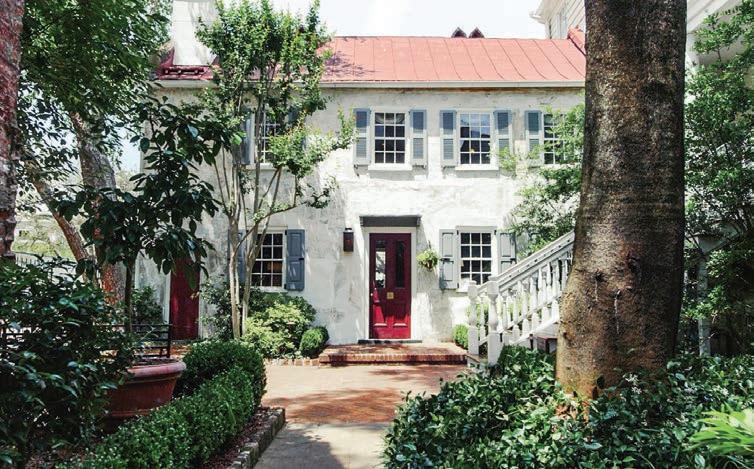
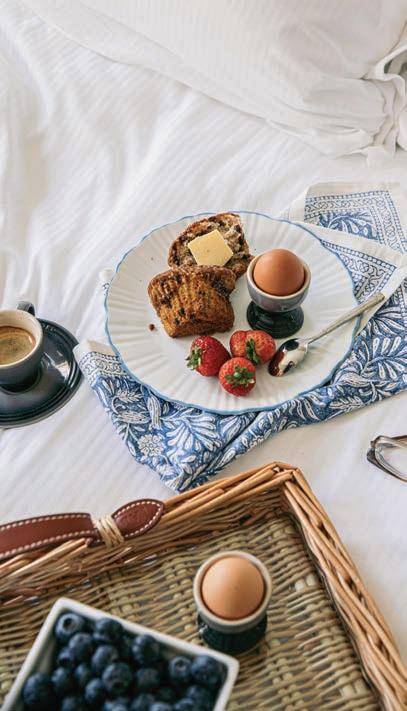
CLASSIC, meet CONTEMPORARY; TRADITIONAL, say “hey there” to SOUTHERN CHIC.
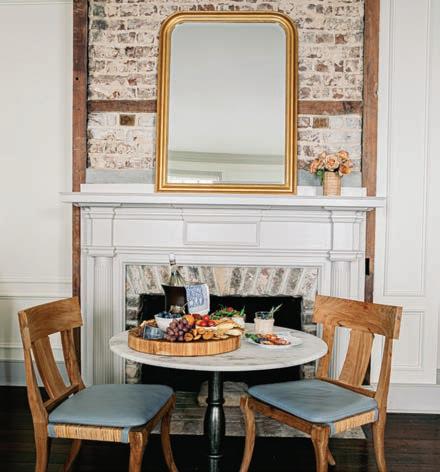
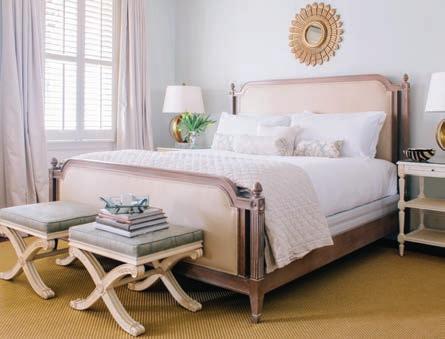
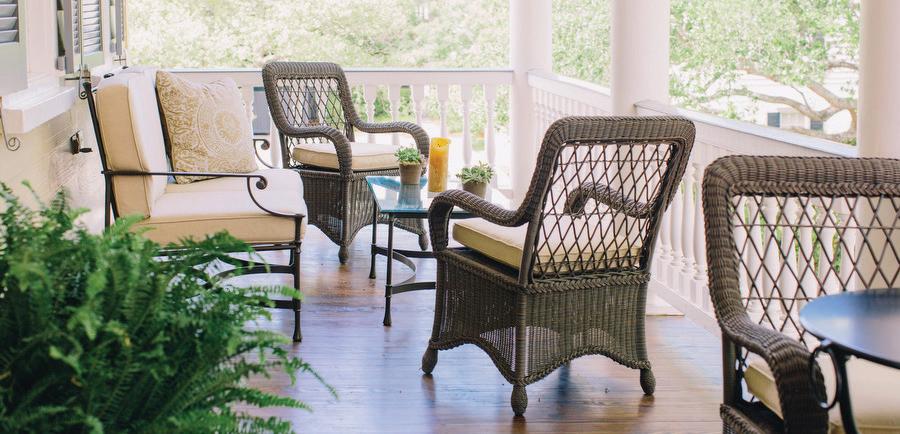
Whether traveling on business or for pure indulgent R&R, Zero George delivers Charleston’s premier boutique hotel experience.
When guests at our award-winning Zero George Hotel kept telling us they wish they could stay longer—much longer—we listened. Now, in addition to our hotel, we proudly offer the Residences at Zero George—luxury that entices you to linger. Five exquisitely designed private residences available for up-to-twelve month extended stays, with all the indulgence and amenities of a boutique hotel at your fingertips. Live like a local, luxuriate like a guest.
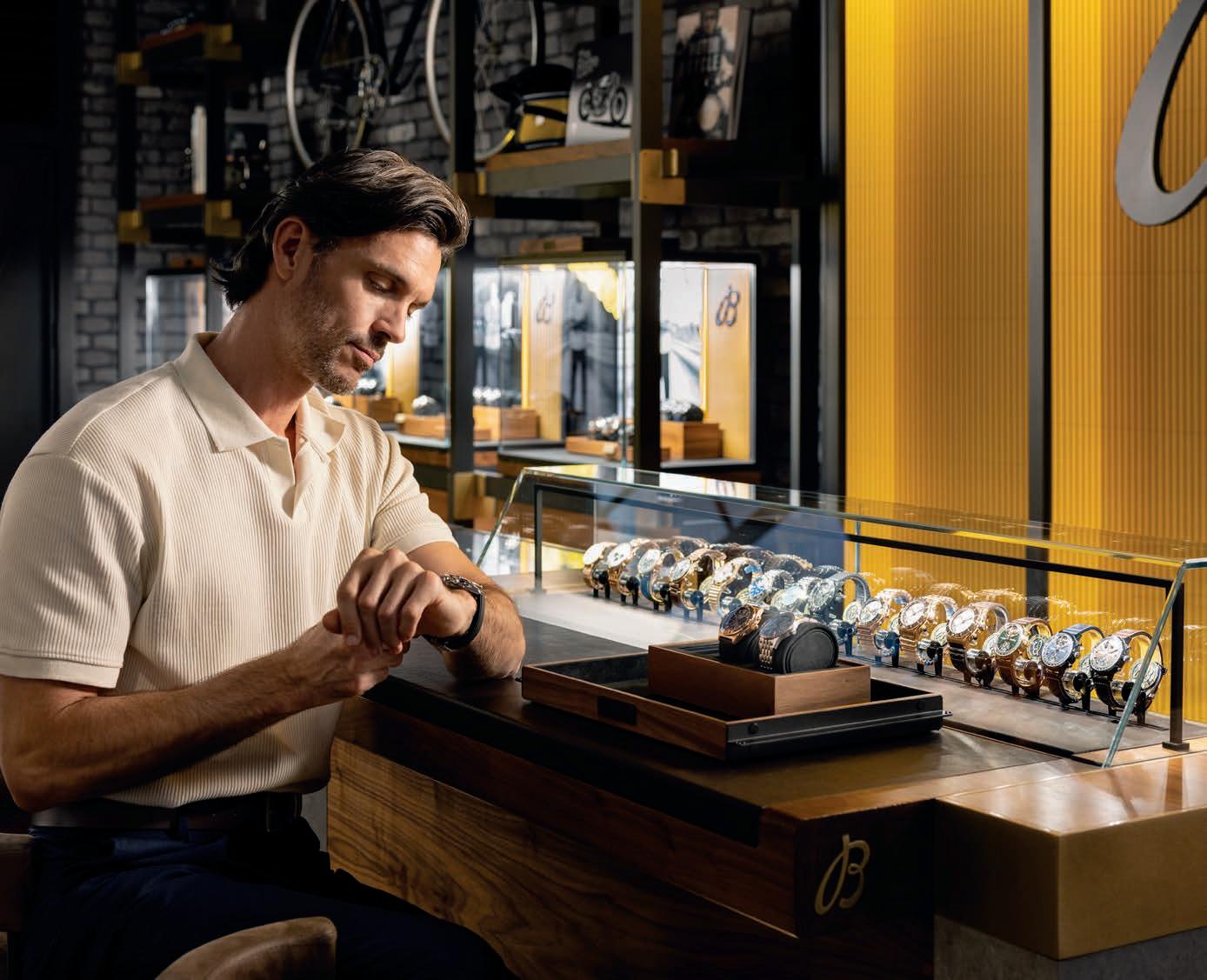
TASTE
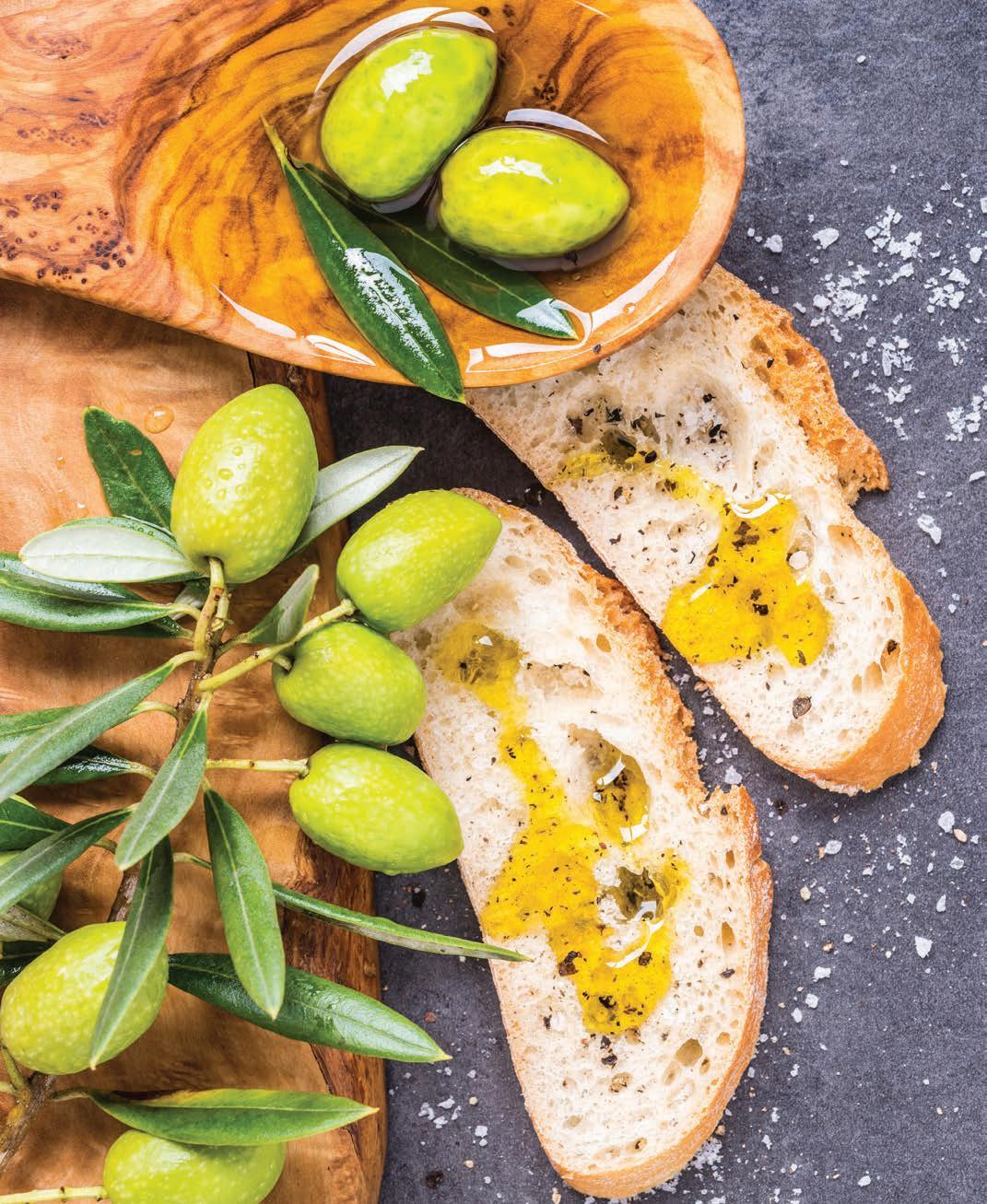
THE INGREDIENT Olive Oil
by Marci Moreau
Ialways knew olive oil was something special, especially in my family. But I didn’t realize just how much it functioned as a cultural icon in my life, shaping how I learned to eat, cook, and think about health long before I ever thought about food in those terms. It was just always there.
For me, olive oil is one of those ingredients that can work the room. It has a natural charisma, with a wide, complex flavor profile, adding dimension to almost everything in the kitchen, creating a glistening veil of shine and significant nutritional value.
Revered as liquid gold, even called the nectar of the gods, olive oil has sustained people not only as food, but as medicine, light, and protection. And in my family, it went even further—playing a role in beauty rituals and, according to my grandmother, even offering protection from evil spirits.
In Italian culture, there is the idea of mal occhio, the “bad eye,” believed to bring misfortune through envy or ill will. Olive oil spearheaded the ritual used to determine whether a curse was present. A few drops placed into a bowl of water would reveal the truth in the way the oil moved. Luckily, we were never cursed—perhaps because of the sheer amount of olive oil we ate, cooked with, and used on our bodies.
All our food was dressed with olive oil, finished with olive oil, and brought to life with olive oil. It was the only fat we used in the kitchen. Vegetables were always lightly sautéed, sometimes with crushed red pepper, sometimes with a little grated cheese. It was simply how our food cooked.
I didn’t realize this devotion wasn’t universal until
middle school, when I watched butter attempt to melt over frozen broccoli at a friend’s house. In my world, butter was for toast. Olive oil was for everything else.
Like a family member, olive oil always had a place at our table. It was always real, high-quality olive oil, never a blend, coming in large metal cans from the Italian market near my grandmother’s house. You knew it was authentic by the way it smelled, tasted, and behaved in food. Authenticity was nonnegotiable.
Olive oil wasn’t just for the kitchen. The same oil we cooked with was used on skin, smoothed on before sun exposure and again afterward to moisturize. We used it for hot hair treatments and even to remove makeup. Looking back, the women in my family rarely showed early signs of aging. Maybe they were on to something.
That kind of magic has deep roots. Olive oil is one of the oldest cultivated foods in the world, traced back thousands of years to the eastern Mediterranean. Olives are harvested at just the right moment, crushed into a paste, then pressed or centrifuged without heat or chemicals—leaving behind something not manufactured, but simply pure.
Today, science gives language to tradition. Extra virgin olive oil is rich in monounsaturated fats, particularly oleic acid, associated with cardiovascular health and reduced inflammation. Its polyphenols act as antioxidants, while its fats help the body absorb essential vitamins from vegetables and whole foods. Used consistently, day after day, these effects are cumulative.
And maybe that’s the point. One quality ingredient, used well, over a lifetime—proof that simple, pure ingredients, close to their natural origins, can be deeply nourishing and remarkably powerful.

CHARLOTTE’S MICHELIN MOMENT: When a City Earns Its Seat at the Table
By Colleen Guilfoile Richmond
No city becomes a Michelin city by accident. That distinction is earned quietly, over time—through discipline rather than drama. When the Michelin Guide turned its attention toward Charlotte in late 2025, it wasn’t announcing a beginning. It was acknowledging a moment that had already arrived.
Michelin has never been interested in hype. Its inspectors don’t follow buzz or social-media heat; they follow craft. They look for restaurants that demonstrate clarity of vision, technical precision, and an understanding of restraint—places where every choice is intentional and nothing feels rushed. For a city to enter that conversation, it must first prove it can sustain excellence without needing constant applause.
Charlotte has been doing exactly that.
For years, the city’s dining culture has evolved
beneath the radar, shaped less by trend cycles than by a steady refinement of taste. In recent seasons, that evolution has taken form through chef-driven tasting rooms, independently owned concepts, and dining experiences that prioritize point of view over volume. Restaurants here tend to favor intimacy over scale, thoughtful service over theatrics, and menus that reward attention rather than overwhelm it. There is a confidence to the best dining rooms in Charlotte—a sense that they know who they are and don’t feel compelled to explain themselves.
Michelin’s attention tends to arrive only after a city has stopped asking for it. The guide rarely rewards places still auditioning for relevance. It watches for discipline, patience, and a kind of self-possession that can’t be rushed. By the time Michelin is paying attention, the work has already been done—and Charlotte is clearly there.
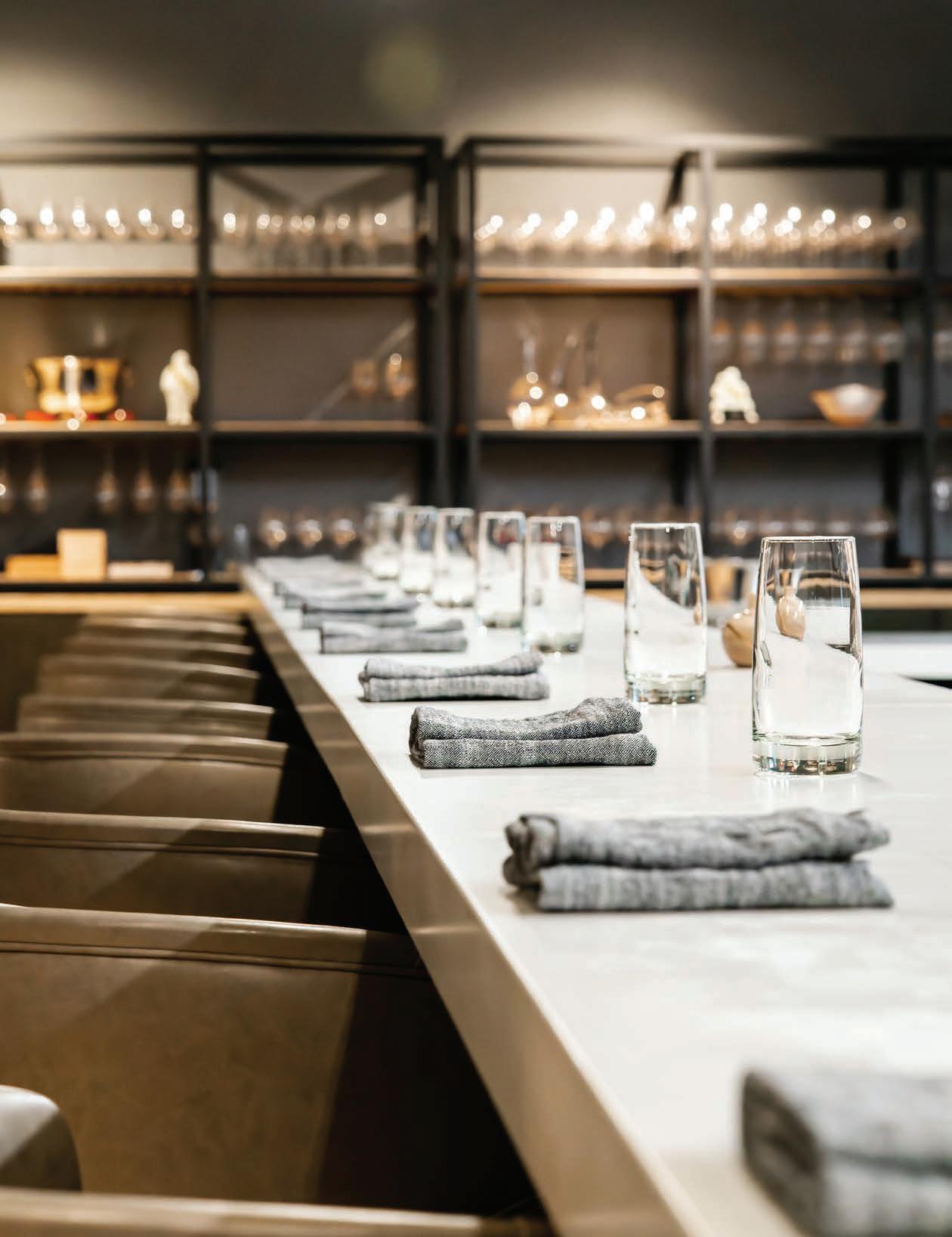
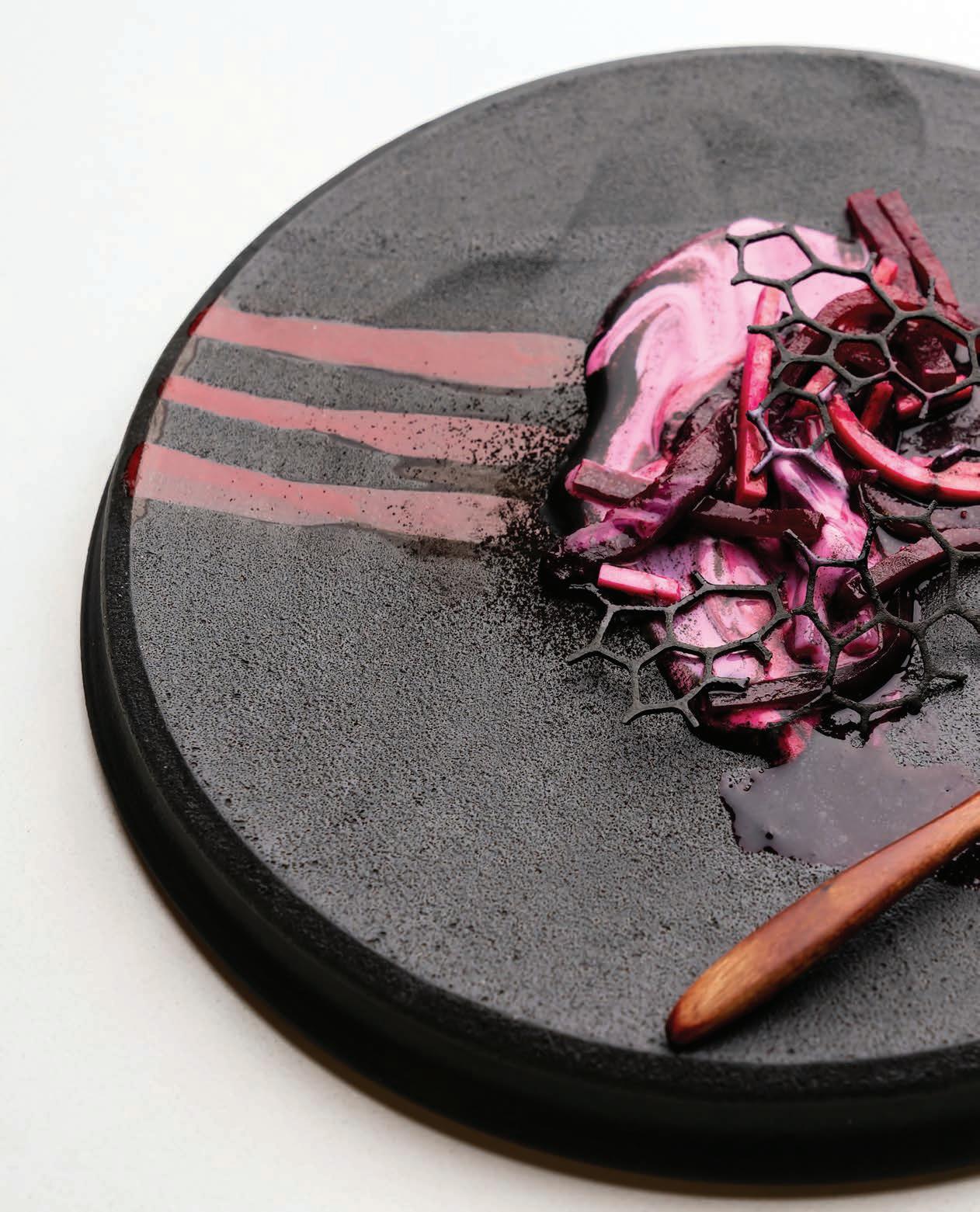
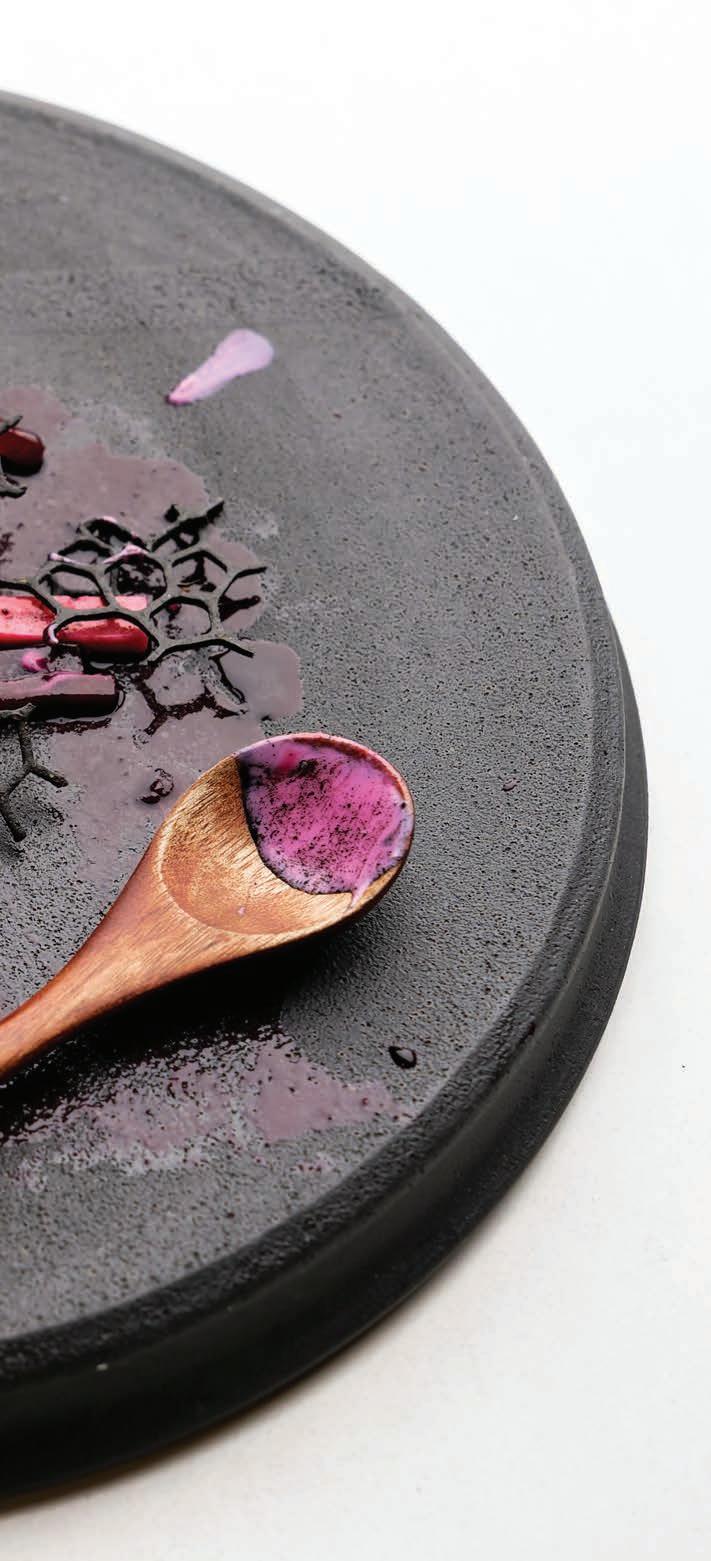
That maturity crystallized when Counter, an 18seat tasting experience, recently earned Charlotte’s first Michelin Star in the inaugural American South guide—along with a Michelin Green Star for sustainability. The recognition felt less like a surprise than a formal acknowledgment of work already done. Counter’s refusal to repeat dishes, its narrative-driven menus, and its long-term vision reflect a broader shift in Charlotte’s food culture— one rooted in intention rather than expansion. Counter did not evolve to attract Michelin’s attention; it existed at that level well before the spotlight arrived. That distinction matters.
There is also a broader cultural implication. Food has long served as a barometer for where capital, creativity, and confidence intersect. As Charlotte continues to grow—economically, architecturally, and socially—its culinary evolution mirrors that trajectory. What follows a Michelin moment is often more telling than the recognition itself. Attention raises expectations. It attracts chefs who value discipline, investors who think long-term, and diners who are curious rather than consumptive. The standard lifts—not just for those recognized, but for those who come next.
For Charlotte, this moment feels less like an arrival than a confirmation. The city earned its seat at the table by doing the work quietly, consistently, and on its own terms. Michelin simply noticed what had already been taking shape.
And that may be the most compelling part of the story: nothing needs to change now that the world is watching. The rooms will remain intimate. The menus will continue to evolve thoughtfully. The city will keep refining its voice—measured, confident, and unmistakably its own.
In the end, Michelin doesn’t define a city’s taste. It recognizes it. And Charlotte’s has been ready.
V

VWELCOME TO V-CITIES, WHERE WE SPOTLIGHT THE VIBRANT REGIONS THAT CAPTURE THE ESSENCE OF VIVANT MAGAZINE. FROM CHARMING COASTAL ENCLAVES TO DYNAMIC URBAN HUBS, DISCOVER THE NEIGHBORHOODS, HIDDEN TREASURES, AND DISTINCTIVE PERSONALITIES THAT DEFINE THE LOCALS WE CELEBRATE —WHETHER IT’S A HIGHLY ANTICIPATED OPENING, OR AN UNDISCOVERED GEM WAITING TO BE EXPLORED.
CHARLOTTE & THE CAROLINAS
CHARLESTON & THE LOW COUNTRY
CT. GOLD COAST
THE PALM BEACHES
NEW YORK
QUEEN CITY, MEET GUARD & GRACE
Forget the hushed, velvet-draped clichés of the traditional steakhouse; Charlotte’s skyline is about to get a shot of pure, high-octane adrenaline. When Guard and Grace makes its highly anticipated debut at 111 E. Carson Blvd in mid-2026, it won’t just be opening a dining room—it will be introducing a new era of “Power Dining 2.0.” Born in Denver under the visionary eye of Chef Troy Guard and his TAG Restaurant Group, this isn’t your grandfather’s smoky lounge. Instead, the Queen City can expect a sprawling, sun-drenched sanctuary of glass and steel, where the luxury feels effortless and the energy is infectious.
The magic of Guard and Grace lies in its ability to balance sophisticated architectural design with a menu that is as playful as it is precise. While the interior will likely mirror the sleek, art-forward aesthetic of its predecessors, the real buzz centers on the massive rooftop space, destined to become the city’s premiere theater for sunset martinis and late-night social scenes. The culinary experience follows suit, anchored by the restaurant’s legendary Filet Flight—a masterclass in indulgence that allows diners to sample grass-fed, Wagyu, and Prime cuts side-by-side. Yet, Chef Guard’s Hawaiian roots ensure the “sea” is never overshadowed by the “land.” Between the oak-fired octopus and the buttery black cod, the menu moves seamlessly from the ruggedness of the grill to the delicate precision of a world-class raw bar.
As Charlotte continues its evolution into a top-tier culinary destination, Guard and Grace arrives as the perfect exclamation point. It’s a venue designed for the rhythm of modern life: a bright, airy space for a midday breakthrough, a sophisticated backdrop for an anniversary, and a vibrant rooftop for that final, lingering cocktail of the evening. Backed by a wine cellar of monolithic proportions and a service style that trades stuffiness for genuine warmth, this Denver export is set to prove that the best way to experience the Queen City is from several stories up, with a world-class steak in front of you and the skyline in full view. Image Credit : Guard & Grace
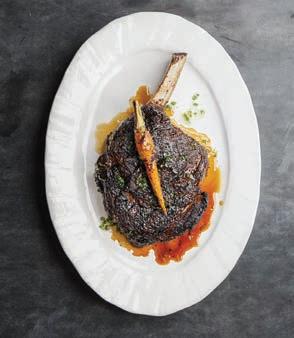
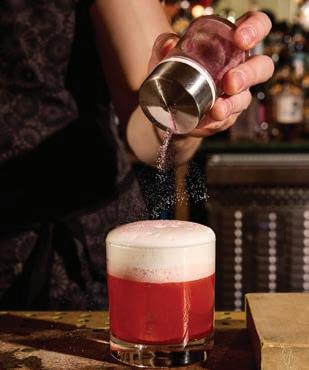
UCHIBĀ BRINGS A NEW EDGE TO THE PLAZA MIDWOOD SKYLINE
If Uchi is Charlotte’s sophisticated anchor for Japanese fine dining, then its rooftop sibling, Uchibā, is the cool, high-energy pulse of the Commonwealth development. While the ground floor below focuses on the hushed reverence of a perfect omakase, Uchibā—opening its doors as the social heartbeat of Plaza Midwood—is all about the buzz. Inspired by the effortless “cool” of Japanese izakayas, this rooftop lounge is designed for those who prefer their handrolls served with a side of city views and a deep list of Japanese whiskies.
The aesthetic here trades quiet minimalism for an urban, moody allure. The centerpiece is a stunning 1,500-square-foot outdoor terrace that feels less like a typical bar and more like a private sky-garden overlooking the neighborhood’s transformation. Inside, the 24-seat bar serves as a laboratory for some of the most inventive cocktails in the city. Expect a menu that leans into the playful side of Japanese cuisine: think pillowy steamed buns, savory dumplings, and smoky yakitori skewers fresh off the grill.
Of course, fans of the brand will still find the hits. You can snag Uchi’s legendary “cool tastings”—like the yellowtail and ponzu-heavy Hama Chili—but the real draw is the “Perfect Pairings” program. It’s a curated shortcut to culinary bliss, matching specific small plates with rare sakes or spirits to ensure every bite hits exactly the right note.
Whether you’re sliding into a booth for a late-night round of bao or catching the sunset with a crisp Suntory highball in hand, Uchibā offers a vibe that is simultaneously raw and refined. It isn’t just a place to grab a drink; it’s a high-altitude social club that captures exactly where Charlotte is heading.
PAUSE STUDIO: THE WINTER RESET
In the fast-paced world of modern luxury, the most valuable currency is no longer just time—it is the quality of our recovery. For the Vivant reader who masterfully balances a demanding career with a vibrant social calendar, the arrival of Pause Studio at the Arboretum this past December is a total gamechanger for Charlotte’s wellness scene. Tucked away in South Charlotte, this new sanctuary trades the sterile, clinical feel of traditional recovery centers for a “threshold” concept, where the city’s frantic energy instantly dissolves into an atmosphere of calm. With private suites, plush linens, and the chic, familiar scent of Le Labo apothecary, the transition from the boardroom to the breathing room is as seamless as it is stylish.
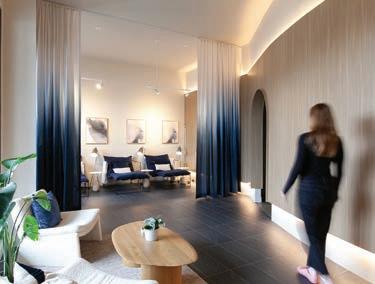
While the space is undeniably Instagramworthy, the real magic lies in its “biooptimization”—a fancy way of saying they use high-tech tools to help your body heal itself faster. The standout is their signature Contrast Therapy, where you cycle between the deep, detoxifying heat of a full-spectrum infrared sauna and the bracing, wake-up-call embrace of a cold plunge. It’s an exhilarating ritual that hits the “reset” button on your nervous system, kicking inflammation to the curb and leaving you with a razor-sharp mental focus. If you’re craving a total digital detox, their Flotation Therapy tanks offer a weightless escape, letting your brain drift into that elusive “theta” state of deep relaxation that a simple nap just can’t touch.
The pampering doesn’t stop at the surface, either. Pause leans into the “glow-up” with full-body LED Light Therapy to boost collagen and an IV Lounge where licensed nurses serve up customized vitamin drips and NAD+ infusions for an instant vitality boost. What makes the Arboretum location so brilliant is how it caters to the high-performer on the go; whether you’re a dedicated biohacker or just need a 30-minute escape between errands, the studio offers world-class wellness on your own sophisticated terms. As we lean into the quiet beauty of the winter season, a visit to Pause is a chic reminder that sometimes the most productive thing you can do for your ambition is, quite simply, to stop.
THE NEW GREEN STANDARD: CHARLOTTE MUSEUM OF NATURE’S BOLD EVOLUTION
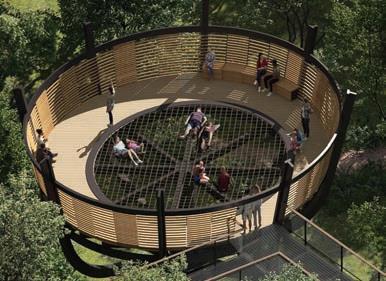
In 2026, Charlotte’s relationship with the natural world will undergo a sophisticated transformation with the opening of the Charlotte Museum of Nature. Replacing the nostalgic Discovery Place Nature in the heart of Freedom Park, this reimagined institution is moving beyond the traditional museum model to create a world-class destination that blurs the line between architecture and the wild. Designed by Liollio Architecture and Hood Design Studio, the new facility reorients itself toward the Little Sugar Creek Greenway, offering a seamless transition from urban life to the lush ecosystems of the Piedmont.
The experience is defined by a "museum without walls" philosophy, where public gift spaces like the "Frog Bog" pond and pollinator gardens greet visitors long before they reach the ticket counter. The architectural centerpiece is undoubtedly the Tree Canopy Walk, a soaring aerial pathway suspended up to 40 feet above the forest floor. This walkway invites guests to traverse the hardwoods of Freedom Park from a bird’s-eye perspective, culminating at "The Nest," a vantage point designed for cloud-gazing and catching glimpses of the distant Charlotte skyline through the trees.
On the ground, the museum’s new animal ambassadors—North American river otters—will delight guests in a habitat viewable from both a ground-level pavilion and an overhead terrace. Inside, the focus shifts to high-concept education within the Naturalist Lab, a space where science experiments intersect with music and art to encourage creative documentation of the environment. From "nose-to-nose" encounters with native reptiles in the Piedmont Explorations gallery to the sensory-rich "Saplings" area for early learners, the museum is designed to inspire a multi-generational commitment to conservation. As a $50+ million investment in Charlotte’s cultural infrastructure, the 2026 opening marks a new era where urban progress and ecological preservation thrive in perfect harmony.
Images : Charlotte Museum of Nature (https://charlottenature.org/)
CHARlotte
Image from Fonda Fina Hospitality CHARLOTTE &
COASTAL COOL MOVES IN: SERENA & LILY OPENS ITS DOORS IN THE FRENCH QUARTER
If there were ever a brand destined for Charleston, it’s Serena & Lily. The purveyors of “elevated coastal” have finally arrived, settling into a space at 32 Cumberland Street that is as historic as it is beautiful. This new Design Shop is a curated sanctuary that manages to feel like a private residence rather than a showroom, blending the brand’s California-cool aesthetic with the refined grace of the Holy City.
The venue itself is a love letter to Charleston’s soul. Housed in a centuries-old building, the shop preserves the city’s architectural romance through exposed brick walls and a beautifully restored antique staircase. This 19th-century backdrop serves as the perfect foil for Serena & Lily’s signature breezy palette, creating an environment where high-end design meets lowcountry heritage.
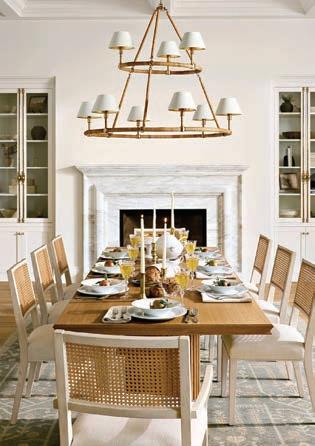
Inside, the experience is defined by texture and personalization. A massive, tactile swatch wall offers access to hundreds of signature textiles and wallpapers, while original works by local artists anchor the space, ensuring the shop feels deeply rooted in its surroundings. For those looking to transform a space, the shop provides on-site design experts and 3D rendering services to help visualize a complete Sullivan’s Island overhaul or a simple room refresh.
The store’s opening has quickly become the cornerstone of a perfect downtown afternoon. After coffee at Sorelle and a stroll through the French Quarter, the walk to Cumberland Street feels like a natural progression into a world of crisp linens and hand-woven rattan. Ultimately, Serena & Lily in Charleston is more than just a retail expansion; it is a homecoming for a brand that speaks the language of the South with a sophisticated, sun-drenched accent.
Visit the new Design Shop at 32 Cumberland St. Open Monday–Saturday 10am–6pm and Sunday 12pm–5pm. Explore the collection at serenaandlily.com.
Image from Serena & Lily
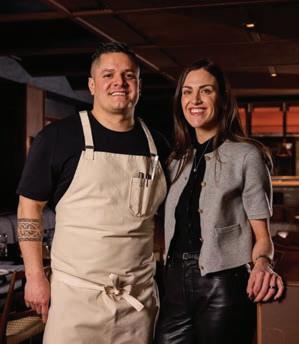
CHARLESTON IS ABOUT TO GET A MICHELIN-LEVEL MEXICAN MOMENT
Charleston’s dining scene is no stranger to excellence, but in summer 2026, it welcomes something quietly momentous: a new Mexican restaurant from Johnny and Kasie Curiel, the acclaimed duo behind Colorado’s Michelin-recognized Fonda Fina Hospitality.
Set to open on Cannon Street, the yet-to-be-named concept brings a refined, coastal approach to Mexican cuisine — one rooted in tradition, restraint, and deep respect for ingredients. This is not trend-driven dining. It’s a thoughtful translation of regional Mexican flavors, reimagined through Charleston’s seafood-rich, seasonally driven lens.
The Curiels are known for deceptively simple plates that reveal layers of technique: wood-fired cooking, nuanced moles, hand-crafted tortillas, and bright, balanced sauces that let each ingredient speak. Charleston’s local fish and shellfish are expected to play a starring role, bridging coastal Mexico and the Lowcountry in a way that feels both natural and new
Housed on the ground floor of The Charlee on Cannon, the space is anticipated to mirror the group’s signature aesthetic — warm, intimate, and effortlessly polished. The kind of restaurant designed for long dinners, unhurried conversation, and one more mezcal than planned.
More than a notable opening, this restaurant signals a shift. A city confident enough to welcome a new culinary voice without losing its own. Come summer 2026, Charleston won’t just be getting a new restaurant — it will be gaining a new point of view.
CT. GOLD COAST
CHARLESTON’S SPOLETO FESTIVAL CELEBRATES 50 YEARS OF THE AVANT-GARDE
For 17 days every spring, Charleston doesn’t just host a festival; it becomes one. As Spoleto Festival USA prepares for its landmark 50th Anniversary Season (May 22 – June 7, 2026), the energy in the Lowcountry is electric.
This isn’t just a birthday party; it’s a cultural collision. Coinciding with the 250th anniversary of the United States, the 2026 program centers on a powerhouse theme: Freedom of Expression
The 2026 Shortlist:
• Acrobatic Opera: Watch world-renowned ensemble Circa transform Purcell’s Dido and Aeneas into a heart-stopping blend of Baroque scores and elite physical theater.
• The World Premiere: Tony winner Denis O’Hare debuts George + George, a punchy, comedic reimagining of the American Revolution.
• Legendary Dance: The Martha Graham Dance Company arrives with GRAHAM100, featuring a new work by Jamar Roberts set to the haunting music of Rhiannon Giddens.
• Jazz & Roots: From the gas-lit Dock Street Theatre to the grand Gaillard Center, the lineup spans from global jazz icons to avantgarde newcomers.
Spoleto is where tradition meets the experimental. Imagine a morning string quartet in a 19th-century church followed by a midnight jazz set in a hidden garden. In 2026, the festival leans into its “Spoleto for All” mission, making the elite world of high art feel inclusive, immersive, and vital.
Pro Tip: The full program drops January 13, 2026. With the 50th-anniversary buzz at a fever pitch, tickets will be the hottest currency in town.
In a year of national reflection, Spoleto 2026 is a 17-day masterclass in the power of the human spirit. If you only travel for art once this decade, make it this.
Plan your season at spoletousa.org.
PHOTO: Copyright- LEIGH WEBBER PHOTOGRAPHY
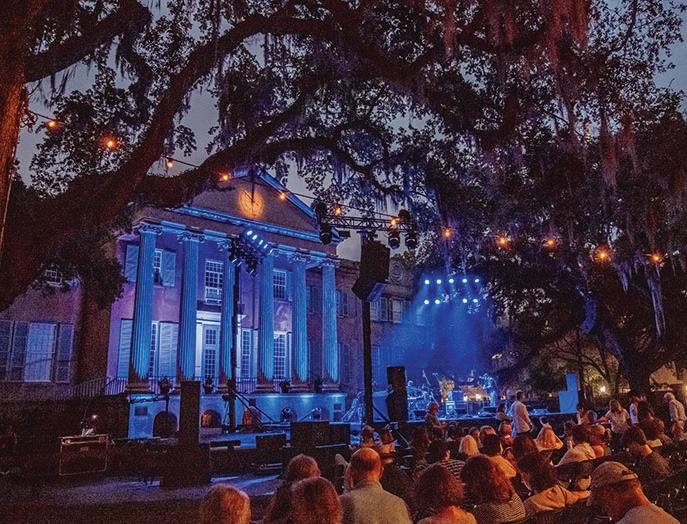
JETSET PILATES IS LANDING IN WESTPORT
Clear your schedule — Jetset Pilates is officially coming to Westport, bringing its cult-favorite reformer Pilates experience to Fairfield County. Known for sleek studios, pulsing playlists, and a high-energy approach to precision movement, Jetset has become the workout of choice for those who like their fitness efficient, elevated, and a little addictive.
Each 50-minute class blends strength, cardio, and core-focused reformer work into a fast-moving flow that delivers serious results — and that signature Jetset burn. It’s Pilates, reimagined for modern schedules and maximal payoff.
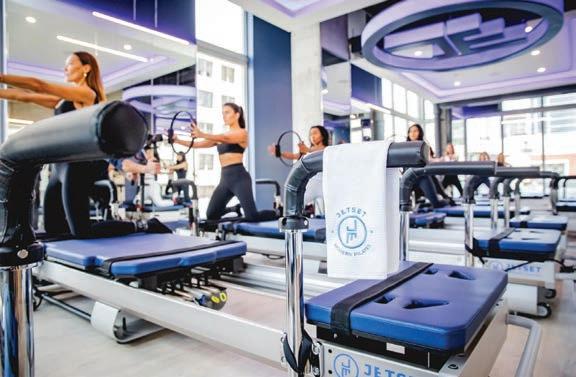
In true V-Cities fashion, Jetset’s arrival isn’t just another studio opening — it’s a new wellness ritual for Westport. Consider this your boarding call.
Fasten your grip socks. First-class abs ahead.
jetsetpilates.com/ct/westport
WESTPORT’S MEDITERRANEAN MOMENT: BLU OLIVE ARRIVES
Westport has a new reason to linger downtown. Blu Olive has officially opened on Railroad Place, bringing a polished Mediterranean-Italian sensibility to one of the town’s most beloved dining corners. Warm, inviting, and effortlessly chic, the space blends coastal European energy with Westport ease—ideal for everything from intimate dinners to lively evenings with friends.
The menu leans into fresh, crowd-pleasing Mediterranean flavors, complemented by a thoughtfully curated wine list and signature cocktails that feel celebratory without trying too hard. It’s the kind of place that works just as well for a casual night out as it does for a “let’s make an occasion of it” dinner.
Already buzzing with local energy, Blu Olive is poised to become a go-to for Westport’s in-the-know diners—proof that Railroad Place continues to be one of Fairfield County’s most delicious destinations.
Blu Olive 36 Railroad Place, Westport, CT
HILL HOUSE HOME OPENS IN GREENWICH, BRINGING EVERYDAY ROMANCE TO GREENWICH AVENUE
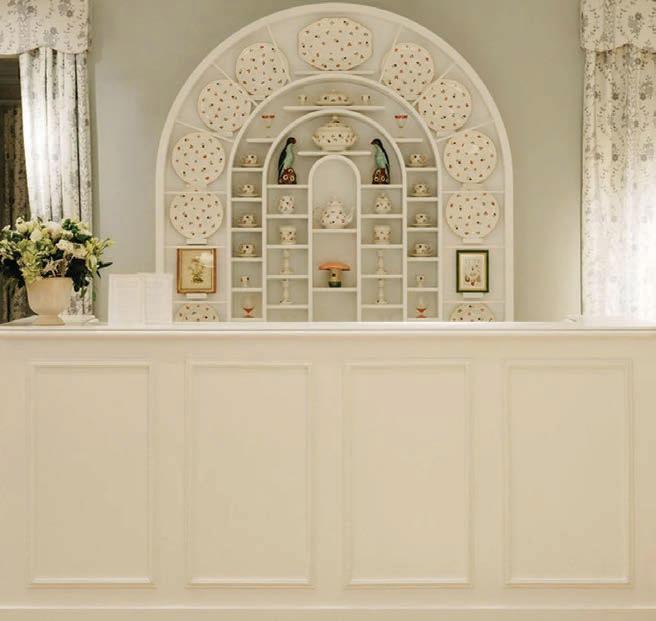
Greenwich Avenue has a new destination for modern femininity with the arrival of Hill House Home, the cult-favorite lifestyle brand beloved for its effortlessly elegant Nap Dresses and thoughtfully designed home pieces.
Founded by Nell Diamond, Hill House Home has built a loyal following around the idea that everyday life should feel beautiful. The brand blends comfort with polish—romantic silhouettes, soft fabrics, and a sense of ease that feels perfectly suited to the rhythms of modern living.
The Greenwich boutique brings Hill House Home’s signature aesthetic to life in a space that feels more like a well-appointed home than a traditional store. Inside, shoppers will find the brand’s iconic dresses alongside sleepwear, accessories, children’s pieces, and select home goods—each designed with the same attention to detail and quietly joyful spirit.
Hill House Home’s opening further elevates Greenwich as a destination for curated, design-forward shopping, adding a brand that resonates with women who appreciate timeless style with a contemporary sensibility. It’s the kind of place you stop in “just to look” and leave with something you’ll wear—or love—again and again.
For Greenwich, it’s a welcome addition. For Hill House devotees, it’s a new local address for all things charming, comfortable, and beautifully made.
Visit: www.hillhousehome.com
CT. GOLD COAST
A TASTE OF MEDITERRANEAN, PALM BEACH STYLE
Palm Beach has long mastered the art of elegant leisure—but this season, it gains a fresh, sun-splashed accent straight from the Mediterranean coast. Enter Tutto Mare, the newest waterfront destination from the beloved Tutto il Giorno family, now anchoring itself along the Intracoastal with charm and Riviera flair.
Set within the storied Royal Poinciana Plaza, Tutto Mare is the first restaurant to bring true Intracoastal dining to Palm Beach—and it feels like a natural evolution of the island’s social rhythm. By day, it’s breezy and relaxed, the kind of place where lunch stretches longer than planned. By sunset, it becomes a golden-hour gathering spot where cocktails sparkle, boats drift by, and conversations linger.
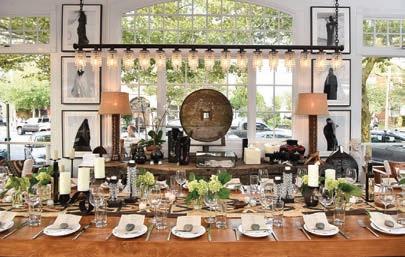
Founded by husband-and-wife duo Gianpaolo de Felice and Gabby Karan de Felice, Tutto Mare channels the Mediterranean lifestyle—unhurried, social, and centered on exceptional food. The menu celebrates coastal simplicity: pristine seafood, vibrant seasonal vegetables, and dishes that feel both refined and soulful, winning guests over bite by bite.
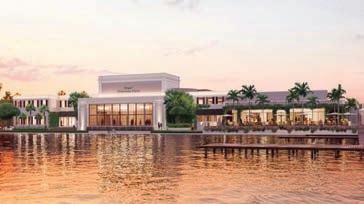
The design mirrors that philosophy. Natural textures, warm tones, and openair seating blur the line between indoors and out, encouraging guests to settle in and stay awhile. With the water glistening just beyond the tables, Palm Beach suddenly feels closer to Capri—or the Amalfi Coast at sunset.
More than a restaurant, Tutto Mare is a mood—coastal dining with confidence, elegance without pretense, and a reminder that memorable moments happen when food meets surroundings together.
Images courtesy of Tutto Mare Instagram: @tuttomarepb
PALM BEACH HAS A NEW FRONT ROW—AND IT COMES WITH AN INTRACOASTAL BREEZE.
Set along the water at the storied Royal Poinciana Plaza, Glazer Hall is redefining what a night out can look like in town, blending cultural ambition with effortless Palm Beach glamour.
Housed within the beautifully revitalized Royal Poinciana Playhouse, the venue spans 24,000 square feet and centers on a state-of-the-art, 400-seat theater outfitted with retractable seating, a sprung floor ideal for dance, and modern production technology. Step outside during intermission and you’re met with open-air terraces and shimmering Intracoastal views— proof that here, the setting is as much a star as what’s happening on stage.
Founded by longtime Palm Beach residents Avie and Jill Glazer, the nonprofit was created with a clear purpose: to inspire, educate, and connect the community through accessible, world-class arts. In doing so, Glazer Hall marks a milestone as the town’s first new nonprofit arts organization in more than 60 years, ushering in a new chapter for local culture.
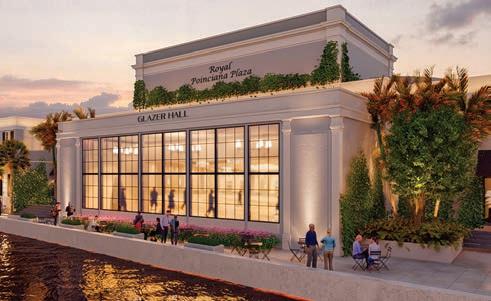
Programming is intentionally wide-ranging and spirited, welcoming music, dance, comedy, film, speakers, and educational events under one roof. From intimate concerts and celebrated performers to ballet and thought-provoking conversations, the calendar is designed to surprise and invite repeat visits. Opened in phases, the lobby debuted in fall 2025, with the full theater set to open in early 2026—just in time to make Glazer Hall Palm Beach’s most exciting new place to gather, discover, and be delighted. glazerhall.org
CHRISTOPHER KING DEBUTS PALM BEACH FLAGSHIP ON WORTH AVENUE’S PREMIER CORNER
Palm Beach, FL — January 2026 — Luxury entrepreneur and creative director Christopher R. King has opened his flagship boutique on one of Worth Avenue’s most coveted corner locations, marking a significant milestone for the emerging luxury house and signaling its arrival among the world’s most respected brands.
The 2,500-square-foot corner flagship at 201 Worth Avenue places Christopher King alongside icons such as Chanel, Tiffany & Co., and Ferragamo—an address long regarded as one of the avenue’s most prestigious retail positions. The highly visible location reflects both the brand’s momentum and its long-term vision of permanence within the global luxury landscape.
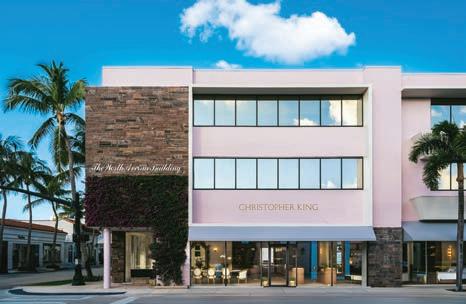
The boutique presents the full Christopher King collection, including leather goods, accessories, tableware, linens, flatware, and furnishings. Every piece is designed by King and produced in his 7,000-square-foot factory outside Florence, Italy. This rare vertical integration allows the brand to maintain complete creative and quality control while preserving generational Italian craftsmanship. Artisans work exclusively with premium natural materials—solid brass, fine Italian leathers, and exotic hides—chosen for their integrity, longevity, and character.
“For me, luxury begins in the factory, with the artisans and the materials,” says King. “That is where soul enters the product. I call it Luxury with Soul.”
With more than 20 years in the industry, King’s Worth Avenue debut reinforces his ambition to build a modern heritage house— one defined by authenticity, transparency, and uncompromising craft.
For more information, visit bychristopherking.com.
Photo credits: courtesy of Palm Beach Post / Biba Social / historic Hotel Biba renderings
THE POLO ROOM PALM BEACH: SEE, BE SEEN, REPEAT
Palm Beach’s social calendar just found its new center of gravity. The Polo Room Palm Beach—the effortlessly glamorous dining destination led by polo legend Nacho Figueras—has arrived at 251 Sunrise Avenue, and it’s already the reservation everyone wants (and the room everyone’s talking about).
Equal parts dinner destination and stylish spectator sport, The Polo Room channels continental polish with a wink. The menu leans luxe and confident: empanadas worth canceling plans for, raw bar and crudos that disappear quickly, house-made pastas, and showstopper entrées like lobster frites. The grill takes center stage with asado-style steaks, fish, and shellfish—served properly, with chimichurri or au poivre—while desserts keep it personal and playful, including Figueras’ family-favorite chocolate mousse and classic dulce de leche crêpes.
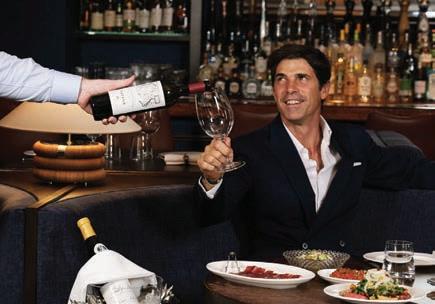
The bar? A scene. Signature cocktails like the Twenty-Two Below Zero ºC Martini (yes, with frozen olives) and the Iceberg Skinny Cosmo fuel the buzz, backed by a globe-trotting wine list boasting more than 300 labels. Inside, the vibe is unmistakably Palm Beach: warm, layered, and quietly confident, with equestrian details and a curated photographic installation by Ricardo “Snoopy” Motran capturing polo icons and island moments from the ’80s and ’90s.
Open for dinner Tuesday through Sunday, The Polo Room Palm Beach is where the island gathers—heels on, martini cold, eyes up. Come hungry, dress well, linger longer.
THE BAKER HOUSE 1650 CROWNED “BEST HOUSE, VILLA OR SERVICED APARTMENT” IN NORTH AMERICA BY CONDÉ NASTJOHANSENS
Global Glory for East Hampton Gem
The Baker House 1650, one of East Hampton’s most celebrated luxury inns, has been named “Best House, Villa or Serviced Apartment in North America” by Condé Nast Johansens at the 2026 Awards for Excellence, held at London’s Kimpton Fitzroy Hotel.
Recognized for its timeless charm, exquisite hospitality, and design that seamlessly blends 17th-century heritage with modern elegance, The Baker House 1650 has become synonymous with refined Hamptons living. The award—one of the most coveted in luxury travel— places the historic East Hampton property among the finest accommodations in the world.
The Condé Nast Johansens Awards for Excellence, now in their 41st year, honor the very best in independent luxury hotels, spas, and venues worldwide. Each winner is selected through a rigorous combination of guest feedback, expert inspection reports, and online voting by discerning travelers.
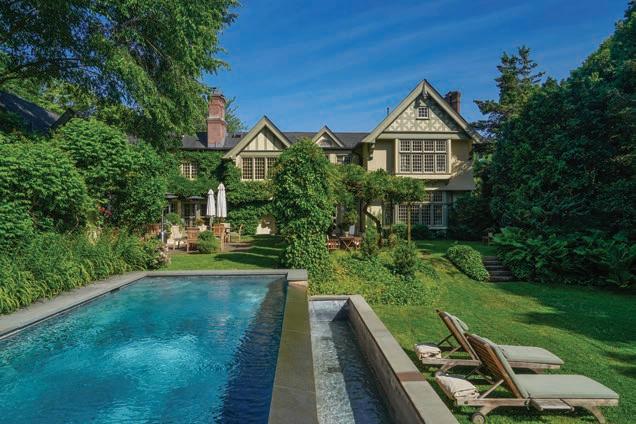
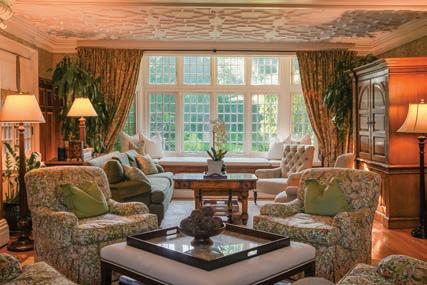
ABOUT THE BAKER HOUSE 1650:
“It’s an incredible honor to receive this global recognition from Condé Nast Johansens,” said Antonella Bertello, Owner of The Baker House 1650. “Our team is deeply committed to creating an experience that captures the beauty, history, and heart of East Hampton. This award is a reflection of that dedication.”
Nestled in the heart of the East Hampton Village, The Baker House 1650 features manicured English gardens, elegant period furnishings, and a tranquil spa, offering guests a uniquely curated retreat that blends history and luxury.
The full list of winners of the 2026 Condé Nast Johansens Awards for Excellence can be found at johansens.com/awardwinners-hub
Nestled in the beautiful, historic Village of East Hampton, NY, The Baker House 1650 is a masterpiece of 17th Century Cotswoldinspired architecture. Throughout the property, guests find a sense of historical legacy and majestic aura from the classic inspired English manor. There’s a balance of old-world charm with modern conveniences and amenities. For more information, please visit www. bakerhouse1650.com
IG: @bakerhouse1650
F: thebakerhouse1650 | X / T: @thebakerhouse
JEAN SHAFIROFF HOSTS HOLIDAY RECEPTION BENEFITING THE NEW YORK WOMEN’S FOUNDATION
Philanthropist, author, and television host Jean Shafiroff hosted and underwrote an elegant holiday reception at her New York residence in support of The New York Women’s Foundation, welcoming 75 guests in celebration of the Foundation’s mission to advance gender, economic, and racial equity across New York City.
Held in the spirit of the season, the evening spotlighted the Foundation’s ongoing work supporting women and gender-expansive individuals through strategic grantmaking and communitydriven initiatives. Rebecca Seawright, New York State Assembly Member, presented Citations to both Shafiroff and the Foundation in recognition of their leadership in philanthropy and their efforts to break cycles of poverty across the city. Fashion designer Malan Breton offered a vocal performance, adding a festive and personal note to the evening.

Leaders from The New York Women’s Foundation expressed appreciation for Shafiroff’s longstanding commitment and for the growing community support surrounding the Foundation’s work at a critical moment for equity and justice. Since its founding in 1987, The New York Women’s Foundation has invested more than $130 million in over 500 organizations, advancing economic security, health access, safety, and leadership development while driving systems-level change throughout New York City.
Notable attendees included Jean Shafiroff, Ana L. Oliveira, Mary Baglivo, Sojourner Rivers, Kerry-Ann Henry, Kimberley Moore, Susan Gutfreund, Madeline Lamour Holder, James Meguerian, Rebecca Seawright, Jay Hershenson, Marc Rosen, Vanessa Noel, Malan Breton, Flo Anthony, Michael Spinks, and Maria and Kenneth Fishel.

LIVING THE MONOGRAM: LOUIS VUITTON CHECKS IN TO SOHO
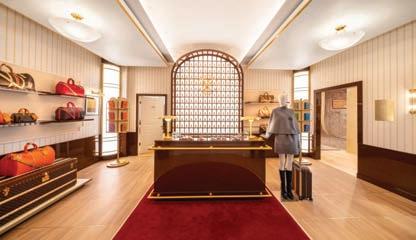
In SoHo, Louis Vuitton has turned its most recognizable signature into a fully immersive experience with the Louis Vuitton Hotel, a hotel-inspired pop-up celebrating 130 years of the Monogram. Designed as a playful journey rather than a static exhibit, the space unfolds room by room—moving from the Keepall Lobby to Neverfull and Speedy-inspired interiors, a subterranean Noé
Champagne Bar, and the sun-washed Alma Terrace that shifts from Parisian café by day to evening glow by night. On-site care and personalization services underscore the maison’s message: heritage isn’t precious if it isn’t lived with. Open through April 2026, the popup feels less like retail and more like a cultural check-in—proof that in New York, even an icon can reinvent itself.
Photos: Brad Dickson Details: louisvuitton.com
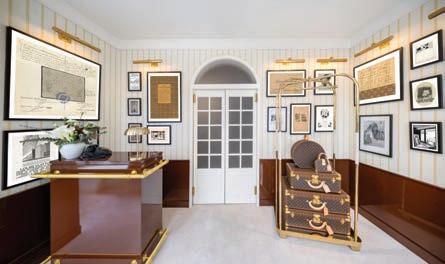
Photo credits: courtesy of Palm Beach Post / Biba Social | historic Hotel Biba renderings
THE VIVANT INDEX
A REGISTER OF CONTRIBUTORS, PLACES & CREATIVE VOICES
ART & CULTURE
• Bruce Museum, Greenwich, CT — 5
• Comité Colbert — 76
• Inès de la Fressange — 86
• Richard Grieco — 91
• Ursula von Rydingsvard — 5
ARCHITECTURE & DESIGN
• Dickens Mitchener — 14
• Gingham & Gable — 52
• KA Murphy Interiors — 64
• Kligerman Architecture & Design — 4
• L Design Interiors — 44
• Layton Interiors — 3
• Shelley Cekirge Interiors — 64
BUILDERS & DEVELOPMENT
• East End Building — 62
• Farrell Estates, Wellington — 62–64
• Kingswood Homes — 9
DESTINATIONS & TRAVEL
• Abaco Club — 101
• Baker House 1650, East Hampton — 6
• Boca Raton, The — 2
• Charleston — 119
• Charlotte — 119
• CT Gold Coast — 119
• Palm Beach — 119
• New York — 119
FEATURE STORIES
• A Designer’s Vision Finds Its Florida Chapter — 44
• Between Seasons, Full Send — 22
• Holiday House: A Legacy of Beauty, Courage & Renewal — 62
• Nordmarka: Alpine Chic in Southern Vermont — 52
FASHION & STYLE
• After Dark — 28
• Chic, Sombre, Sublime — 68
• The Handbag Affair — 80
FOOD & DRINK
• Highgrove Evergreen Gin — 20
• Olive Oil — 110
• The Counter — 114
HOME & INTERIORS
• Coast to Coast — 52
• Holiday House Wellington — 62
• Nordmarka — 52
JEWELRY & WATCHES
• The Watch — 18
WELLNESS & LONGEVITY
• Barr, Dr. Fredric M. — 32
• Lifted — 32
• Rewired: The Luxury of a New Mind — 34
• The Future of Whole-Person Wellness — 38
VIVANT
• Editor’s Letter — 12
• V Cities — 119
• VIVANT Éternel Candle — 28
• VIVANT Lounge at Holiday House — 64
ELYSABETH VINEYARDS IS A BOUTIQUE, FAMILY RUN VINEYARD PRODUCING WORLD CLASS WINES IN THE HEART OF THE HUDSON VALLEY. HANDCRAFTED WITH THE UTMOST ATTENTION TO DETAIL, OUR WINES ARE RICH IN DEPTH AND ELEGANT IN FLAVOR.
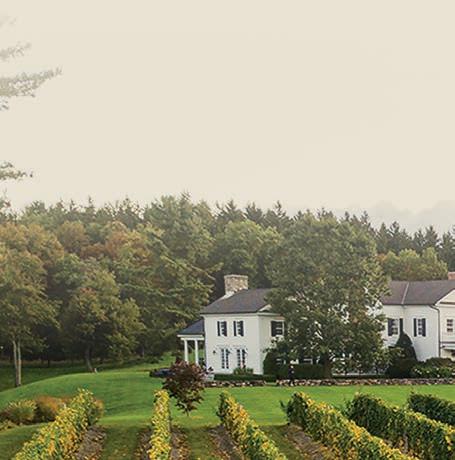
TO ENJOY OUR WINES AT HOME, PLEASE VISIT SPIRITSNETWORK.COM/ELYSABETHVINEYARDS. TO LEARN MORE ABOUT OUR VINEYARD, OUR WINES, AND OUR STORY, YOU CAN VISIT WWW.ELYSABETHVINEYARDS.COM.
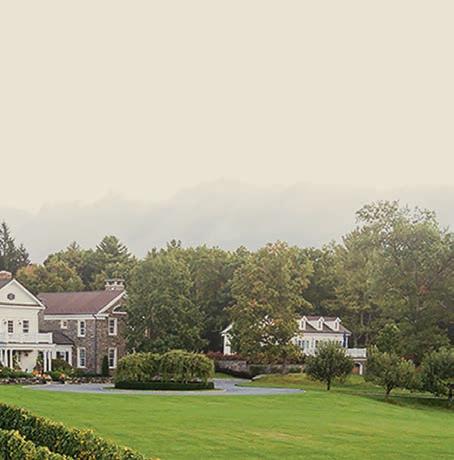
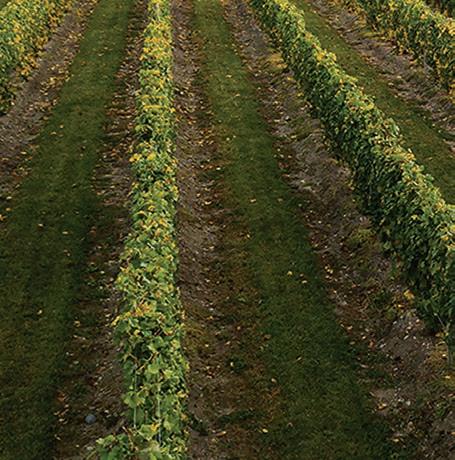
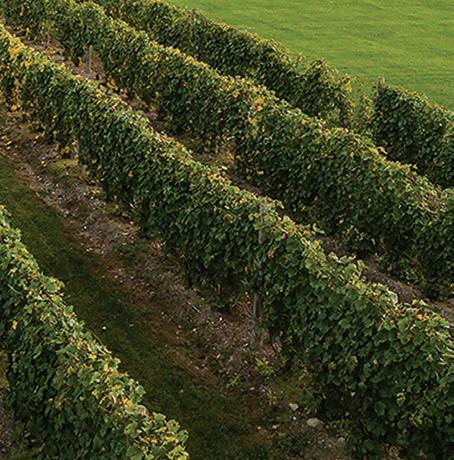
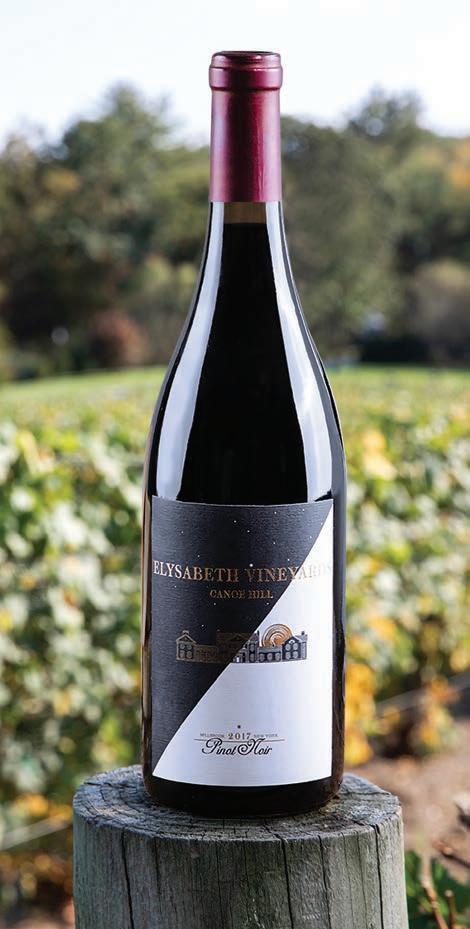

Gary Blaustein