11
The Chamber Sessions: More than meets the eye Thursday 15 January 2026, 6.30pm St John’s Church, Waterloo Generously supported by TIOC Foundation Please note there is no interval in tonight’s concert.
Tonight’s LPO musicians Violas Laura Vallejo Benedetto Pollani
First Violins Kate Oswin
Chair supported by Eric Tomsett
Lasma Taimina
Chair supported by Irina Gofman & Mr Rodrik V. G. Cave
Cellos Kristina Blaumane
Chair supported by Bianca & Stuart Roden
Second Violins Tania Mazzetti
Waynne Kwon
Chair supported by an anonymous donor
Chair supported by The Candide Trust
Emma Oldfield
Double Bass Hugh Kluger
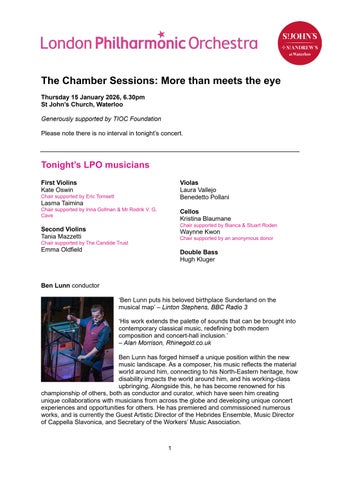
Ben Lunn conductor ‘Ben Lunn puts his beloved birthplace Sunderland on the musical map’ – Linton Stephens, BBC Radio 3 ‘His work extends the palette of sounds that can be brought into contemporary classical music, redefining both modern composition and concert-hall inclusion.’ – Alan Morrison, Rhinegold.co.uk Ben Lunn has forged himself a unique position within the new music landscape. As a composer, his music reflects the material world around him, connecting to his North-Eastern heritage, how disability impacts the world around him, and his working-class upbringing. Alongside this, he has become renowned for his championship of others, both as conductor and curator, which have seen him creating unique collaborations with musicians from across the globe and developing unique concert experiences and opportunities for others. He has premiered and commissioned numerous works, and is currently the Guest Artistic Director of the Hebrides Ensemble, Music Director of Cappella Slavonica, and Secretary of the Workers’ Music Association.
1
Tonight’s music Jean Langlais (1907–91) Suite Bretonne (10’) 1. 2. 3.
Epitaphe pour les marins qui n'ont pas eu de tombe Menuet de cour Danse de village Jean Langlais was a French composer and organist known for his distinctive style which combines rich harmonies with influences from his native Brittany. His music is in a similar vein to that of other prominent French composers of his time, and shares many similarities with Ravel and Dukas. His main body of work is for organ; he was official organist of SainteClotilde in Paris, a role he succeeded from César Franck and Charles Tournemire. Alongside this, Langlais was a professor at the National Institute for the Young Blind, where he had been a student in 1918.
The three-movement Suite Bretonne draws on Breton music and culture, a theme that appears in several of Langlais’s works. The first movement is a memorial to mariners and sailors lost at sea. The second is inspired by court music of the Middle Ages, and the finale depicts the people of Brittany dancing in their village. While preparing for this concert, I corresponded with the composer’s widow, Marie-Louise Langlais, who shared a remarkable detail: although this work was composed in 1938, it remained unpublished until 1999, when the manuscript was rediscovered. Even more striking, it appears never to have been performed since its creation – making tonight its first known public performance. Ben Lunn
John Stanley (1712–86) Selection from Six Concertos in Seven Parts (30’) No. 1 in D major No. 2 in B minor No. 4 in D minor John Stanley was an English composer, violinist and organist whose works epitomise the graceful style of mid18th-century London. His music is typical of its time, displaying influences from Purcell, Boyce and Handel. An exceptionally gifted musician, Stanley became organist of St Andrew, Holborn, at the age of 17, and went on to become the youngest person to obtain a Bachelor of Music degree from Oxford University. In 1779, he was appointed Master of the King’s Music. Alongside his concerti and organ voluntaries, Stanley composed numerous cantatas and oratorios, including The Choice of Hercules and The Fall of Egypt.
2
Stanley’s Op. 2, Six Concertos for Strings, was written between 1742 and 1745. Each of the six concertos follows a similar pattern, consisting of four movements that emulate Corelli’s church sonatas: a slow opening movement, a lively second movement, a steady third, and a cheerful finale – often a minuet: a lively dance with three beats to a bar. All are wonderful works, but for this concert, I have chosen my three favourites: Nos. 1, 2 & 4. Ben Lunn
Sarah Lianne Lewis (born 1988) the blue and the dim and the dark, for double string quartet (10’) Sarah Lianne Lewis is a Welsh composer who writes for both the concert hall and the stage, weaving unusual sonorities into soundscapes that have been described as ‘haunting’, ‘imaginative’ and ‘charming’. Her compositions have been praised for their delicate yet powerful music and have been performed by leading ensembles including the Philharmonia Orchestra, Quatuor Bozzini, the Royal Ballet and Opera, JACK Quartet and the Orchestre National de Bretagne. Former Composer Affiliate with the BBC National Orchestra of Wales (2020–24) and Composer Fellow with the Philharmonia’s Composers’ Academy (2024–25), her music explores themes of connection, climate change and the natural world. Her work has received multiple awards, including the George Butterworth Award (2018), the Welsh Music Guild’s Paul Mealor Award for Young Composers (2021), the Royal Philharmonic Society Award for Chamber-Scale Composition (2025) for her work letting the light in, and most recently, the prestigious Medal y Cyfansoddwr (Composer’s Medal) award at the National Eisteddfod of Wales 2025. Gloaming /g’əʊmɪŋ/ noun: gloaming 1. twilight; dusk. ‘hundreds of lights are already shimmering in the gloaming’ The title of the work takes inspiration from a line of W. B. Yeats’s poem ‘Aedh Wishes for the Cloths of Heaven’: ‘ … Enwrought with golden and silver light / The blue and the dim and the dark cloths / Of night and light and the half-light… ‘. I am fortunate in where I live; close to the sea, and to a large open country park with lakes. Every sundown and sunrise, there are a multitude of birds that can be heard competing with one another for best song. The initial material for this double string quartet was taken from several recordings of these birdsongs, and then lightly manipulated to create pitches and rhythms. Alongside this chirruping, I tried to encapsulate the beauty and fleetingness of the gloaming; the often stunning depths of blue running through the sky immediately after the sunset has finished and before it fully becomes night. Sarah Lianne Lewis
3
Gustav Holst (1874–1934) St. Paul’s Suite (12’) 1. 2. 3. 4.
Jig: Vivace Ostinato: Presto Intermezzo: Andante con moto Finale (The Dargason): Allegro Gustav Holst was an English composer best known for The Planets, and one of the most distinctive voices of early 20th-century British music. A dedicated teacher, he actively promoted writing for amateur musicians, including works for brass bands and school students. St Paul’s Suite is a remarkable example of this, written for the pupils of St Paul’s Girls’ School, where Holst taught. Within the work, we see Holst masterfully balance writing for young performers with his unmistakable musical voice and joie de vivre.
The first movement is a lively Jig; the second centres on a flowing melodic line that continually repeats, a musical device known as an ostinato. The Intermezzo features an exchange between a beautiful melody in the first violins and a contrasting burst of energy. The finale recalls the rhythmic drive of the opening Jig, deftly weaving together the 16th-century English dance tune The Dargason (whose name possibly derives from the Anglo‐Saxon word for dwarf or fairy) and the well-known melody Greensleeves, often attributed to Henry VIII. Holst is regarded as a quintessentially English composer. His fascination with folk music, combined with his deep admiration for the working people of Britain, inspired many of his finest works. What is particularly striking about Holst is that he is rarely thought of as a disabled composer, despite his neuritis being a major reason he did not follow his father and grandfather in playing the violin – an important reminder that disability is far closer to many artistic legacies than we often realise. Ben Lunn
Enjoyed tonight’s concert? We hope you enjoy tonight’s performance. Could you spare a few moments to complete a short survey about your experience? Your feedback is invaluable to us and will help to shape our future plans. Just scan the QR code to begin the survey. Thank you! Retiring collection A retiring collection will be held at the end of the performance in support of St John’s Waterloo’s community programme, Room for You. This initiative works with individuals experiencing homelessness, isolation, refugees, asylum seekers, and the wider local community. lpo.org.uk
4