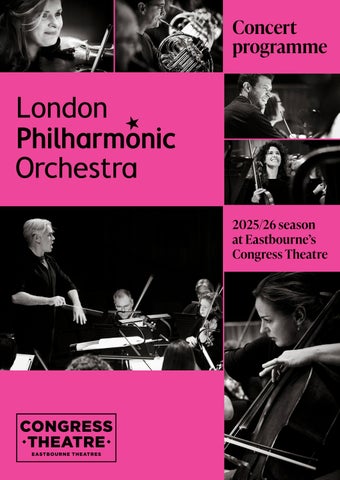
LPO programme 15 Mar 2026 Eastbourne - The Firebird
Principal Conductor Edward Gardner supported by Aud Jebsen
Principal Guest Conductor Karina Canellakis supported by Richard Buxton
Conductor Emeritus Vladimir Jurowski KBE Patron HRH The Duke of Kent KG
Artistic Director Jesús Herrera Chief Executive David Burke
Leader Pieter Schoeman supported by Neil Westreich
Brighton Dome Concert Hall
Saturday 14 March 2026 | 7.30pm
Congress Theatre, Eastbourne
Sunday 15 March 2026 | 3.00pm
The Firebird
Mendelssohn
Hebrides Overture (11’)
Mozart
Piano Concerto No. 23 in A major, K488 (26’)
Interval (20’)
Debussy
Prélude à l’après-midi d’un faune (10’)
Stravinsky
The Firebird Suite (1919 version) (19’)
Dionysis Grammenos conductor
Lukas Sternath piano
Sunday 15 March | Congress Theatre, Eastbourne
Pre-concert performance | 2.15pm
Enjoy the sound of local young talent, as musicians from Create Music give a special free performance in the Congress Theatre foyer. Create Music is part of Brighton Dome and Brighton Festival and the Hub Lead Organisation for the Sussex Music Hub.
The Steinway concert piano chosen and hired by the London Philharmonic Orchestra for these performances is supplied and maintained by Steinway & Sons, London.
The timings shown are not precise and are given only as a guide. Concerts presented by the London Philharmonic Orchestra in association with Brighton Dome and Eastbourne Borough Council.
Saturday 14 March 2026
Welcome to Brighton Dome
Welcome to tonight’s concert by the London Philharmonic Orchestra here at Brighton Dome. We hope you enjoy the performance and your visit here. For your comfort and safety, please note the following: thank you for your co-operation.
Latecomers may not be admitted until a suitable break in the performance. Some performances may contain no suitable breaks.
Interval drinks may be ordered in advance at the bar to avoid queues.
Photography is not allowed in the auditorium.
Recording is not allowed in the auditorium.
Mobiles and watches should be switched off before entering the auditorium.
The concert at Brighton Dome on 14 March 2026 is presented by the London Philharmonic Orchestra in association with Brighton Dome.
Brighton Dome gratefully acknowledges the support of Brighton & Hove City Council and Arts Council England.
Brighton Dome & Brighton Festival with Create Music
Situated in the Royal Pavilion Estate at the heart of the city, Brighton Dome is an arts charity, three historic contemporary live arts venues, a music education service across the region – Create Music – and the biggest curated cross-arts festival in England.
We extend a warm welcome to the members of the London Philharmonic Orchestra and to the artists performing with the Orchestra today – and of course to every one of you, our valued audience members.
The historic theatre in which you are now seated is unique in that it is conceived to be a perfect cube and has fantastic acoustics to enhance your experience of live music. Whether this is your first concert or you are a season regular, we hope you enjoy your experience at our venue. Please speak to a member of our staff if you have any comments you’d like to make about your visit. We thank you for continuing to support the concert series. Please sit back in your seats and enjoy your afternoon with us.
As a courtesy to others, please ensure mobile phones are switched off during the performance. Please also note that photography and recording are not allowed in the auditorium unless announced from the stage. Thank you.
Printed with the planet in mind
The paper used for LPO concert programmes has been sourced from well-managed FSC®-certified forests, recycled materials, and other controlled sources. It is also Carbon Balanced, meaning the carbon impact of its production is offset by the World Land Trust.
Prefer a paper-free option?
Scan here for PDF versions of all our programmes to read or download on your phone or tablet.
Venue Director Neil Jones
First Violins
Pieter Schoeman* Leader
Chair supported by Neil Westreich
Minn Majoe
Chair supported by Dr Alex & Maria Chan
Katalin Varnagy
Alison Strange
Ronald Long
Camille Buitenhuis
Eve Kennedy
Kay Chappell
Maeve Jenkinson
Tayfun Bomboz
Simon-Philippe Allard
Pak Ho Hong
Martin Höhmann†
Alice Hall†
Second Violins
Emma Oldfield Principal
Ashley Stevens
Kate Birchall
Joseph Maher
Lyrit Milgram
Sheila Law
José Nuno Cabrita Matias
Olivia Ziani
Gary Ngan
Joanne Chen
Sioni Williams†
Matthew Bain†
Violas
Alexandros Koustas Guest Principal
Benedetto Pollani
Laura Vallejo
Martin Wray
Chair supported by David & Bettina Harden
Raquel López Bolívar
Joseph Fisher
Jisu Song
Jill Valentine
Toby Warr
Charles Cross
Cellos
Henry Shapard Principal
Leo Melvin
Helen Thomas
Hee Yeon Cho
Henry Hargreaves
Rasmus Støier Andersen
On stage
Julia Morneweg
Edward Mead
Double Basses
Kevin Rundell* Principal
Hugh Kluger
George Peniston
Tom Walley
Chair supported by William & Alex de Winton
Elen Roberts
Ben Havinden-Williams
Flutes
Juliette Bausor Principal
Chair supported by Malcolm & Alison Thwaites
Ian Mullin
Stewart McIlwham*
Piccolo
Stewart McIlwham* Principal
Oboes
Ian Hardwick* Principal
Alice Munday
Chair supported by David & Yi Buckley
Cor Anglais
Adrian Rowlands
Clarinets
Thomas Watmough Principal
Chair supported by Roger Greenwood
Emily Crook
Bassoons
Will Kidner Guest Principal
Emma Harding
Horns
John Ryan* Principal
Martin Hobbs
Duncan Fuller
Elise Campbell
Tom Findlay
Trumpets
Paul Beniston* Principal
Chair supported by the Williams family in memory of Grenville Williams
Tom Nielsen* Principal
Anne McAneney*
Trombones
Mark Templeton* Principal
Chair supported by William & Alex de Winton
David Whitehouse
Bass Trombone
Guy Berry
Tuba
Lee Tsarmaklis* Principal
Chair supported by William & Alex de Winton
Timpani
William Lockhart Guest Principal
Percussion
Andrew Barclay* Principal
Chair supported by Gill & Garf Collins
Feargus Brennan
Francesca Lombardelli
Emmanuel Joste
Harps
Sally Pryce Guest Principal
Tomos Xerri
Piano/Celeste
Iain Clarke
*Professor at a London conservatoire
†Brighton 14 March only
The LPO also acknowledges the following chair supporters whose players are not present at this concert:
An anonymous donor
Sir Nigel Boardman & Prof. Lynda Gratton
The Candide Trust
Ian Ferguson & Susan Tranter
Friends of the Orchestra
Irina Gofman & Mr Rodrik V. G. Cave
Dr Barry Grimaldi
Sir Simon Robey
Victoria Robey CBE
Bianca & Stuart Roden
Ryze Power
Eric Tomsett
Joe Topley & Tracey Countryman
London Philharmonic Orchestra
Uniquely groundbreaking and exhilarating to watch and hear, the London Philharmonic Orchestra has been celebrated as one of the world’s great orchestras since Sir Thomas Beecham founded it in 1932. Our mission is to share wonder with the modern world through the power of orchestral music, which we accomplish through live performances, online, and an extensive education and community programme, cementing our position as a leading orchestra for the 21st century.
Our home is at the Southbank Centre’s Royal Festival Hall, where we’re at the beating heart of London’s cultural life. You’ll also find us at our resident venues in Brighton, Eastbourne and Saffron Walden, and on tour worldwide. In 2024 we celebrated 60 years as Resident Symphony Orchestra at Glyndebourne Festival Opera, combining the magic of opera with Glyndebourne’s glorious setting in the Sussex countryside.
Soundtrack to key moments
Everyone will have heard the Grammy-nominated London Philharmonic Orchestra, whether it’s playing the world’s National Anthems for every medal ceremony of the London 2012 Olympics and Paralympics, our iconic recording with Pavarotti that made Nessun Dorma a global football anthem, or closing the flotilla at The Queen’s Thames Diamond Jubilee Pageant. And you’ll almost certainly have heard us on the soundtracks for major films including The Lord of the Rings
Sharing the wonder worldwide
We’re one of the world’s most-streamed orchestras, with over 15 million plays of our content each month. We’re the most followed UK orchestra on Instagram, the most followed orchestra globally on TikTok, and overall the third most followed globally across all social platforms. In 2024 we featured in a TV documentary series on Sky Arts: ‘Backstage with the London Philharmonic Orchestra’, which was nominated for a 2025 BAFTA. During 2025/26 we’re once again working with Marquee TV to broadcast selected live concerts to enjoy at home.
Our conductors
Our Principal Conductors have included great historic names like Sir Adrian Boult, Bernard Haitink, Klaus Tennstedt and Kurt Masur. In 2021 Edward Gardner became our 13th Principal Conductor, and Vladimir Jurowski became Conductor Emeritus. Karina Canellakis is our current Principal Guest Conductor, and Sir George Benjamin our Composer-in-Residence.
Next generations
We’re committed to nurturing the next generation of musicians and music-lovers: we love seeing the joy of children and families experiencing their first musical moments, and we’re passionate about inspiring schools and teachers through dedicated concerts, workshops, resources and training. Reflecting our values of
collaboration and inclusivity, our OrchLab and Open Sound Ensemble projects offer music-making opportunities for adults and young people with disabilities and special educational needs.
Today’s young instrumentalists are the orchestra members of the future, and we have a number of opportunities to support their progression. Our LPO Junior Artists programme leads the way in creating pathways into the profession for young artists from under-represented communities, and our LPO Young Composers and Foyle Future Firsts schemes support the next generation of professional musicians, bridging the transition from education to professional careers. We also recently launched the LPO Conducting Fellowship, supporting the development of two outstanding early-career conductors from backgrounds under-represented in the profession.
2025/26 season
This season’s theme, Harmony with Nature, explores humanity’s bond with the natural world through works by Beethoven, Sibelius, Mendelssohn, Elgar and Dvořák; masterpieces of an era that saw nature as a mirror of human emotion. Closer to our own time, we’ll hear from composers as diverse as Duke Ellington, John Luther Adams and Anna Thorvaldsdottir, who have all found a source of creative energy in the processes of nature.
Highlights with Principal Conductor Edward Gardner include symphonies by Tchaikovsky, Mahler, Brahms and Rachmaninov; a pair of concerts spotlighting 20th-century Central European composers; an evening dedicated to Elgar; and a performance of Berg’s Wozzeck to end the season. We’ll also welcome back Karina Canellakis and Vladimir Jurowski, as well as guest conductors including Robin Ticciati, Kirill Karabits, Mark Elder and Kahchun Wong. Our lineup of soloists this season includes violinists Anne-Sophie Mutter, Alina Ibragimova, James Ehnes and Himari; cellist Nicolas Altstaedt; and pianists Yefim Bronfman, Alexandre Kantorow and Tomoko Mukaiyama. The season features nine world and UK premieres, including Tan Dun’s choral ‘Ode to Peace’ Nine, and A Tale of God’s Will (A Requiem for Katrina) by jazz icon Terence Blanchard.
The season also sees tours to South Korea and across Europe, as well as another season bursting with performances and community events in our Brighton, Eastbourne and Saffron Walden residencies.
lpo.org.uk
Pieter Schoeman Leader
Pieter Schoeman was appointed Leader of the London Philharmonic Orchestra in 2008, having previously been Co-Leader since 2002. He is also a Professor of Violin at Trinity Laban Conservatoire of Music & Dance.
Pieter has performed worldwide as a soloist and recitalist in such famous halls as the Amsterdam Concertgebouw, Moscow’s Rachmaninoff Hall, Capella Hall in St Petersburg, Staatsbibliothek in Berlin, Hollywood Bowl in Los Angeles, and the Southbank Centre’s Royal Festival Hall. He has also appeared as Guest Leader with many prestigious orchestras across the world. As a chamber musician, he regularly appears at London’s prestigious Wigmore Hall. His chamber music partners have included Anne-Sophie Mutter, Veronika Eberle, Patricia Kopatchinskaja, Boris Garlitsky, Jean-Guihen Queyras, Yannick Nézet-Séguin, Martin Helmchen and Julia Fischer.
Pieter has performed numerous times as a soloist with the LPO. Highlights have included an appearance as both conductor and soloist in Vivaldi’s Four Seasons, the Brahms Double Concerto with Kristina Blaumane, Florence Price’s Violin Concerto No. 2, and the Britten Double Concerto with Alexander Zemtsov, which was released on the LPO Label to great critical acclaim.
Pieter’s chair in the LPO is generously supported by Neil Westreich.
New video series: ‘Humans of the Orchestra’ Scan the QR code to watch our interview with Pieter
Greek conductor Dionysis Grammenos first established himself internationally as a clarinettist. He won a place on the ECHO Rising Stars programme in 2013/14, which led to performances with many major orchestras and at some of the most prestigious venues worldwide. In 2016, he received a Conducting Fellowship at the Aspen Music Festival, and since this time has conducted widely across the world, both in the concert hall and opera pit. He is praised regularly for his innate and instinctive musicianship, the clarity and efficiency of his conducting, and his proficiency in shaping the sound of the orchestra. His performances are profoundly expressive, rich in colour and emotion, and he has been described by Die Welt as ‘one of the most promising stars of tomorrow’.
Dionysis conducts worldwide with orchestras including the Houston Symphony, Belgian National Symphony Orchestra, Vienna Chamber Orchestra, Royal Northern Sinfonia, Athens State Orchestra, Orchestre Symphonique de Quebec, Cameristi della Scala, Lucerne Festival Strings, Ulster Orchestra and RTÉ Concert Orchestra, with soloists such as Khatia Buniatishvili, Renaud Capuçon, Noah Bendix-Balgley, Daniel Ottensamer, Anna Fedorova and Mahan Esfahani. He made his debut with the London Philharmonic Orchestra in February 2024, when he stepped in at short notice to conduct them on tour in Athens.
2025/26 season highlights include a return to the Slovak State Orchestra and a recording project with the Philharmonia Orchestra. With the Greek Youth Symphony Orchestra, he will make his conducting debut at the Concertgebouw Amsterdam and will be joined by Leonidas Kavakos for a performance at the Megaron in Athens.
On the opera stage, Dionysis Grammenos has conducted Puccini’s La bohème with English Touring Opera and New Zealand Opera, receiving praise for ‘one of the best Bohèmes I have heard in recent years’ (Daily Mail) and for his ‘sensitivity and assurance, balancing the orchestra beautifully with the singers’ (The Press, NZ). He has also conducted Rossini’s La Cenerentola at Nevill Holt Opera, Mozart’s La clemenza di Tito at the Aspen Music Festival, and Verdi’s Il trovatore at the Theater Vorpommern. Prior to this, he made his operatic conducting debut in Würzburg with Puccini’s Gianni Schicchi, and has assisted Johannes Debus on productions of Tchaikovsky’s Eugene Onegin and Mozart’s The Abduction from the Seraglio at the Canadian Opera Company.
Dionysis Grammenos is Founder and Artistic Director of the Greek Youth Symphony Orchestra (GYSO). Under his leadership, the orchestra has performed at prestigious venues across the world including Carnegie Hall in New York and St Martin-in-the-Fields in London. Having joined the European Federation of National Youth Orchestras, the orchestra was invited to perform at the opening concert of the Young Euro Classic Festival at the Berlin Konzerthaus. Since 2020, the GYSO has been Orchestra-in-Residence at the Megaron in Athens.
Dionysis trained as a clarinettist at the Franz Liszt University of Music in Weimar, Germany, and in 2008 won the Grand Prix d’Eurovision from the European Broadcasting Union, as well as the title of European Young Musician of the Year – the first wind player ever to receive this title. As soloist, he has performed at the Berlin Philharmonie and Carnegie Hall, with the Vienna Symphony, Norwegian Radio and ORF Vienna, and as an ECHO Rising Star he appeared at many of the world’s top venues including London’s Barbican and the Amsterdam Concertgebouw. He has also made recordings for Naïve and Warner Classics.
In 2009, Dionysis Grammenos was awarded the Leonardo da Vinci World Award of Arts and the Gold Medal of the City of Athens. After his studies in Weimar, he studied conducting at the Würzburg Music University with Ari Rasilainen, and was invited to take part in conducting masterclasses with David Zinman, Bernard Haitink, Patrick Summers and Robert Spano. In 2018, he was selected for the European Young Leaders programme under the patronage of Jean-Claude Juncker, which aims to cultivate a European identity by engaging the most promising talents in initiatives destined to shape Europe’s future.
Lukas Sternath piano
From a very early age, Lukas Sternath’s life revolved around music. Born in Vienna in 2001, he travelled the world as a member of the famed Vienna Boys’ Choir and gave concerts on the most prestigious stages in Europe, North America and Asia. He received his musical training in piano from Anna Malikova and Alma Sauer at the University of Music & Performing Arts in Vienna. In 2025, he completed his Master’s degree at the Hanover University of Music, Drama & Media, studying with Igor Levit and Paul Lewis. Further mentors include pianists Till Fellner, as well as Ingolf Wunder and Sir András Schiff, whose masterclasses he attended.
At the 71st International ARD Music Competition in Munich in 2022, Lukas Sternath caused a sensation – in addition to the First Prize, he was awarded seven special prizes, including the Audience Prize and the Prize for the Best Interpretation of the Commissioned Composition. The previous year, he was a multiple prizewinner at the 63rd International Ferruccio Busoni Piano Competition in Bolzano, at the 14th International Schubert Piano Competition in Dortmund, and at the 17th European Piano Competition in Bremen.
Nominated by the Vienna Musikverein, the Vienna Konzerthaus and the Luxembourg Philharmonie, Lukas Sternath was named an ECHO Rising Star for the 2024/25 season. In 2025, the BBC selected him as a New Generation Artist for the next two seasons. He made his debut at the BBC Proms with the BBC Symphony Orchestra under the baton of its Chief Conductor Sakari Oramo in September 2025, and as part of this prestigious programme will continue to perform with leading orchestras and in recitals across the UK.
This weekend’s concerts mark Lukas’s debut with the London Philharmonic Orchestra. This season he also makes debuts with the Vienna Philharmonic under Tugan Sokhiev in Vienna and on a European tour to Slovakia, Germany, and Luxembourg. Further debuts will follow with the Kammerakademie Potsdam, the Konzerthausorchester Berlin and the Mahler Chamber Orchestra. As a soloist with the Vienna Symphony Orchestra, Lukas will perform in Vienna under the baton of Kazuki Yamada and also tour Germany –the latter conducted by Chief Conductor Petr Popelka. Another highlight of the season will be his return to the Bamberg Symphony Orchestra under Jakub Hrůša, also as part of a German tour. He will give recitals at the Festspielhaus Baden-Baden, the Prinzregententheater in Munich, Flagey in Brussels, and Wigmore Hall in London. In February this year, he launched a ‘Lukas Sternath Cycle’ at the Vienna Musikverein, presenting recitals and chamber music concerts – a first in the history of the venue.
In previous seasons, Lukas has made recital debuts at the Elbphilharmonie Hamburg, the Tonhalle Zurich, the Gewandhaus Leipzig, the Philharmonie Essen, the Ruhr Piano Festival and the Heidelberg Spring Festival. As a soloist, he has collaborated with the Salzburg Festival and the Mozarteum Orchestra Salzburg under Ádám Fischer, the ORF Vienna Radio Symphony Orchestra with Markus Poschner, the Wuppertal Symphony Orchestra with Patrick Hahn, the Vienna Philharmonic Summer Academy with Tugan Sokhiev, the SWR Symphony Orchestra with Giedrė Šlekytė, and the Munich Philharmonic with Andrés Orozco-Estrada.
With his meticulous craftsmanship and formal balance, Mendelssohn stands as one of the most Classicallyinclined of the major 19th-century composers, yet he was also prone to moments of spontaneous Romantic inspiration. This was certainly the case when he visited Scotland with his friend Karl Klingemann in the summer of 1829; in July they were at Holyrood Palace, and Mendelssohn, in his own words, ‘found the beginning of my “Scottish” Symphony [No. 3]’; and on 7 August a visit to the Western Isles had the composer writing home from Tobermory that ‘in order to make you understand how extraordinarily the Hebrides have affected me, I have written down the following which came into my mind’. What followed was the opening ten bars of the Hebrides Overture.
But this was a holiday, and Mendelssohn was not in Scotland to write music. The day after the letter, he took a boat trip to the Isle of Staffa ‘with its strange basalt pillars and caverns’, and it was not until December 1830 (in Rome!) that he completed the work, entitling it Die einsame Insel (‘The Lonely Isle’). Revisions followed – Mendelssohn, fighting to reconcile the Classical and the Romantic, was concerned that it tasted ‘more of counterpoint than of train oil, seagulls and salted cod’ –and the version of the Overture as we know it now, with its dual title of Die Hebriden (‘The Hebrides’) and Fingalshöhle (‘Fingal’s Cave’, after Staffa’s best-known landmark) only emerged in 1832.
Mendelssohn’s original thematic idea remained as the work’s opening, its gently rolling melodic outline and atmospheric accompaniment surely conjuring as instant a vision of the sea as its composer could have hoped for. Its melancholy falling six-note motif dominates the ten-minute work, a warm and shapely rising second theme (first heard on cellos and bassoons) notwithstanding, and undergoes a number of moodchanges. A storm blows up briefly in the central development section, but calm is soon restored, especially in the second theme’s restful return on clarinet, before the coda raises a final squall, again quickly quieted.
By the spring of 1786, Mozart’s considerable popularity with the Viennese public was on the verge of decline. There is evidence that audiences were beginning to find his music over-composed, in the sense of being unnecessarily rich in melodic invention and complicated by chromatic and contrapuntal detail. When fellow composer Carl Ditters von Dittersdorf told the Emperor
‘He is indisputably a genius’, he added: ‘I have never yet found anyone who possessed such an astonishing wealth of ideas. I wish he were not so lavish with them. He leaves his hearer out of breath, for scarcely has one thought through one idea than stands already another, which drives out the first.’
But Mozart may have been thought of as applying a little too much expressive weight as well, for the fact is that even those works of his which seem at first the most straightforward can hold surprising depths, or startle us with sudden turns into new and totally different emotional worlds. Such changeability may have left some listeners feeling uncomfortable, although of course it is just this ability to encompass in one work so many facets of the human condition, and to do it with an unobtrusive ease amounting almost to subterfuge, that makes Mozart’s piano concertos the marvels they are.
K488 was composed in March 1786, at the same time as one of the most generous and humanly perceptive of all operatic masterpieces, The Marriage of Figaro, and it is not unreasonable to suppose that its status as a favourite today owes as much to the contrasting and complex emotions it invokes as to its undoubted and enduring attractiveness.
The first movement is amiable and gentle, with pianistic brilliance rejected in favour of a lyrical landscape on which the sun frequently shines, but in which the occasional threat of clouds prevents things from spilling
Programme notes
into exuberance; even the end of the movement is cheerful in a subdued sort of way. It is the darker side, however, that emerges in the slow movement, although so magnified as to take us into the realms of heartrending pathos. If the Adagio is a relatively rare choice of tempo-marking in Mozart’s concertos, the selection of key, F sharp minor, is a unique one among all his works. And yes, this is the kind of movement only he could have written, cast in the lilting dance-rhythm of a siciliana, and with the anguished complaints of the piano seemingly incapable of consolation from the tender ministrations of the orchestra. It is the piano, however, that in an instant transforms the atmosphere
in the opening notes of the finale, a bustling rondo that brings the work to an exhilarating close as if nothing had ever been wrong in the world.
There is a story of how once, when Mozart was improvising in front of an audience he considered insufficiently attentive, he suddenly broke off, executed a few cartwheels, dived under the table and abruptly left. Such mercurial behaviour is never easier to imagine than when listening to this perfect, priceless concerto.
An announcement will be made five minutes before the end of the interval.
Programme notes
Claude Debussy
1862–1918
Prélude à l’après-midi d’un faune
1894
Debussy’s talent as a young composer was confirmed when he was admitted to the Paris Conservatoire aged just ten years old, but it would be another 20 years before he made his name throughout Europe with a revolutionary new work inspired by the symbolist poetry of Stéphane Mallarmé. Prélude à l’après-midi d’un faune (‘Prelude to the Afternoon of a Faun’), based on Mallarmé’s poem of the same name, was an immediate success. The conductor at its Parisian premiere in 1894, Gustave Doret, described how the audience was held ‘spellbound’, demanding that the work be repeated there and then in an unprecedented outpouring of praise. This was something of a surprise to both Doret and the orchestra, who had their doubts about how this ‘new style’ would be received by the public. ‘Debussy was constantly modifying this or that sonority’, Doret recalled. ‘We tried it out, repeated it, compared it. Once the players had come to understand this new style, they realised that we would have a serious battle on our hands. Of course, Debussy’s name was familiar to the real connoisseurs, but to the general public it was still unknown.’
At the forefront of Debussy’s mind was a desire to create colours – new colours – using textures, harmonies and forms in fresh and often surprising ways.
In Prélude à l’après-midi d’un faune Debussy makes no attempt to transpose Mallarmé’s text, word for word, into music. Instead, he hoped to stimulate the imagination of his listeners, to conjure up a vivid new world of expression and sensuality, to allude to the text of the original poetry but ultimately to transcend it. Using a radical new harmonic palette, hitherto unexplored formal ideas and a dazzling new approach to texture and colour, in this one ten-minute work, Debussy set the stage for a whole new chapter of Western music history, ushering in the dawn of the 20th century, and with it the very concept of modernity.
5. Infernal Dance of King Kashchei and his Subjects –
6. Lullaby –
7. Finale
When in the summer of 1909 Sergei Diaghilev decided to commission a new score for his 1910 Ballets Russes seasons in Paris, Stravinsky wasn’t the first choice. He wasn’t even the second. The author of the ballet’s scenario, Alexandre Benois, wanted to use Nikolai Tcherepnin. Diaghilev favoured Rimsky-Korsakov’s pupil Anatoly Liadov. Unfortunately, Diaghilev had temporarily forgotten one important fact about Liadov: he was an extremely slow worker. With plans already confirmed for the new ballet’s premiere, he turned instead to another, much younger Rimsky pupil – 27-year-old Igor Stravinsky.
It was a bold choice. Stravinsky, though gifted, was something of a late developer, and although earlier in 1909 he’d orchestrated a couple of pieces of Chopin for Diaghilev’s Les Sylphides, this would be his first score on such an ambitious scale. He’d been working on his opera Le Rossignol in St Petersburg. ‘But a telegram then arrived to upset all my plans’, he recalled in his autobiography:
Though alarmed by the fact that this was a commission for a fixed date and afraid lest I should fail to complete the work in time – I was still unaware of my own capabilities – I accepted the order. It was
highly flattering to be chosen from among the musicians of my generation…
Rimsky-Korsakov’s sons loaned him the family’s country dacha, and early in November 1909, Stravinsky got down to work. ‘I worked strenuously at it’, he remembered, though unsurprisingly in the circumstances, the dacha wasn’t the only thing that Stravinsky borrowed from his late teacher. Rimsky had written his own opera on a similar Russian folktale, Kashchei the Immortal, in 1902, and The Firebird is full of orchestral techniques and even melodies learned from Rimsky-Korsakov. (Stravinsky’s Khorovod and Rimsky-Korsakov’s Sinfonietta of 1884 use the same old Russian dance tune).
Still, with his master no longer looking over his shoulder, Stravinsky’s imagination soared. The Firebird is as colourful as Rimsky-Korsakov at his most extravagant –Stravinsky even devised a wholly new orchestral effect, the whispered, iridescent ‘harmonic glissandos’ of the strings during the Introduction. The ballet premiered at the Paris Opéra on 25 June 1910 with Michel Fokine’s stunning choreography and Tamara Karsavina in the title role. Stravinsky, though, was concentrating on his music: ‘The stage and the whole theatre glittered at the
Programme notes
premiere, and that is all I recall.’ Diaghilev was more perceptive. ‘Mark him well’, he remarked of Stravinsky during rehearsals. ‘He is a man on the eve of celebrity.’
This concert suite – one of three created by Stravinsky –follows the story of the ballet. The realm of the immortal demon-king Kashchei is dark and lifeless (Introduction). Enter, in a shower of sparks, the magical Firebird (Dance of the Firebird), hotly pursued by Prince Ivan Tsarevich. The Prince catches the Firebird, and to win its freedom the bird gives him one of its enchanted feathers – the only thing that can break Kashchei’s spells. The Prince now encounters 13 beautiful princesses, enslaved by Kashchei. As he watches them dance a gentle Russian khorovod (round dance), he falls in love; but Kashchei’s attendant monsters swarm round and prepare to turn him to stone in a frenetic Infernal Dance. In the nick of time, the Prince remembers the magic feather. The Firebird re-appears, putting the monsters to sleep with an eerie Lullaby. Guided by the Firebird, the Prince finds and smashes the egg containing Kashchei’s immortal soul; and the spells are undone. While a solo horn sings a quiet folk-song, Kashchei’s petrified victims gradually return to life, and as light spreads across the kingdom, the full orchestra celebrates in a jubilant closing hymn.
We hope you enjoy today’s concert. Could you spare a few moments afterwards to complete a short survey about your experience? Your feedback is invaluable to us and will help to shape our future plans.
Just scan the relevant QR code to begin the survey. Thank you!
Still to come at Eastbourne’s Congress Theatre
Sibelius’s First
Sunday 19 April 2026, 3.00pm
Price Andante moderato for string orchestra
Barber Knoxville: Summer of 1915
Gershwin Selections from Porgy and Bess
Sibelius Symphony No. 1
Nefeli Chadouli conductor*
Nadine Benjamin soprano
*LPO Fellow Conductor 2025/26. The LPO Conducting Fellowship is generously supported by Dunard Fund.
lpo.org.uk
Our 2026/27 concerts in Brighton & Eastbourne will be announced on Tuesday 21 April 2026
To make sure you’re first to receive all the details, sign up to our e-news list now at lpo.org.uk/signup or scan the QR code.
Sat 14 Mar: Brighton Sun 15 Mar: Eastbourne
Nadine Benjamin
Thank you
As a registered charity, we are extremely grateful to all our supporters who have given generously to the LPO over the past year to help maintain the breadth and depth of the LPO’s activities, as well as supporting the Orchestra both on and off the concert platform.
Artistic Director’s Circle
The American Friends of the London Philharmonic Orchestra
William & Alex de Winton
Catherine Høgel & Ben Mardle
Aud Jebsen
In memory of Paul Morgan
In memory of Donald Pelmear
In memory of Rita Reay
Sir Simon & Lady Robey CBE
In memory of Peter J Watson
Orchestra Circle
Richard Buxton
In memory of Nicola Goodman
Mr & Mrs Philip Kan
Neil Westreich
Principal Associates
An anonymous donor
Steven M. Berzin
Irina Gofman & Mr Rodrik V. G Cave
George Ramishvilli
In memory of Kenneth Shaw
The Tsukanov Family
Associates
Anonymous donors
Sir Nigel Boardman & Prof. Lynda Gratton
Garf & Gill Collins
Michelle Crowe Hernandez & Christian Hernandez
Ian Ferguson & Susan Tranter
Stuart & Bianca Roden
Malcolm & Alison Thwaites
Joe Topley & Tracey Countryman
The Williams Family in memory of Grenville Williams
Gold Patrons
An anonymous donor
David & Yi Buckley
Dr Alex & Maria Chan
In memory of Allner Mavis Channing
In memory of Peter Coe
John & Sam Dawson
Fiona Espenhahn
Mr Roger Greenwood
Sally Groves MBE
David & Bettina Harden
Eugene & Allison Hayes
Malcolm Herring
Mrs Asli Hodson
John & Angela Kessler
Mrs Elizabeth Meshkvicheva
Peter & Lucy Noble
Julian & Gill Simmonds
Eric Tomsett
The Viney Family
Guy & Utti Whittaker
Silver Patrons
An anonymous donor
David Burke & Valerie Graham
Mr Luke Gardiner
The Jeniffer and Jonathan Harris
Charitable Trust
Mr & Mrs Andrew Neill
Clandia Wu & Hiu Fung Ng
Simon & Lucy Owen-Johnstone
Andrew & Cindy Peck
Mr Roger Phillimore
Tom & Phillis Sharpe
Laurence Watt
Joanna Williams
Bronze Patrons
Anonymous donors
Miram Al Rasheed
Michael Allen
Gabriela Andino-Benson
Irina Bednaya
Nicholas Berwin
Mrs Amna Boheim
Dame Colette Bowe
Lorna & Christopher Bown
Mr Bernard Bradbury
Dr Anthony Buckland
Desmond & Ruth Cecil
Mr John H Cook
Cameron & Kathryn Doley
Elena & Sergey Dubinets
Harron Ellenson & Charles Miller
Smith
Cristina & Malcolm Fallen
Christopher Fraser OBE
Charles Fulton
Gini & Richard Gabbertas
Jenny & Duncan Goldie-Scot
Mr Daniel Goldstein
David & Jane Gosman
Mr Gavin Graham
Mrs Dorothy Hambleton
Iain & Alicia Hasnip
J Douglas Home
Mr & Mrs Ralph Kanza
Mrs Irina Kiryukhina
Rose & Dudley Leigh
Wg. Cdr. M T Liddiard OBE JP RAF
Drs Frank & Gek Lim
Svetlana London
Graham Long
Richard & Judy Luddington
Mr & Mrs Makharinsky
James Maxey-Branch
Andrew T Mills
John Nickson & Simon Rew
Mikhail Noskov & Vasilina Bindley
Mr Stephen Olton
Nigel Phipps & Amanda McDowall
Mr Michael Posen
Marie Power
Neil & Karen Reynolds
Sir Bernard Rix
Baroness Shackleton
Tim Slorick
John & Madeleine Tucker
In memory of Doris Tylee
Mr & Mrs John & Susi Underwood
Sophie Walker
Jenny Watson CBE
Elena Y. Zeng
Principal Supporters
Anonymous donors
Dr M. Arevuo
Mrs Carol Ann Bailey
Mr John D Barnard
Roger & Clare Barron
Mr Geoffrey Bateman
Mrs A Beare
Adam J. Brunk & Madeleine
Haddon
Simon Burke & Rupert King
David & Liz Conway
Mr Alistair Corbett
David Devons
Deborah Dolce
Sir Timothy Fancourt
Jonathan Franklin
Professor Erol & Mrs Deniz Gelenbe
Steve & Cristina Goldring
Prof Emeritus John Gruzelier
Sebastian Arun Hansjee
Nick Hely-Hutchinson
Michael & Christine Henry
Mrs Farrah Jamal
Bruce & Joanna Jenkyn-Jones
Per Jonsson
Julian & Annette Armstrong
Mr Ian Kapur
Gee Lee
Dr Peter Mace
Mr Nikita Mishin
Allison Mollerberg
Simon Moore
Dr Simon Moore
Mrs Terry Neale
Mr Matthew Pearson
Mr James Pickford
Filippo Poli
Sukand Ramachandran
Mr Martin Randall
Mr Robert Ross
Mr Andrea Santacroce & Olivia Veillet-Lavallée
Aniruddha Sharma
Priscylla Shaw
Michael Smith
Erika Song
Mr & Mrs G Stein
Andrew & Rosemary Tusa
Wolf-Christian Ulrich
Ben Valentin KC
Christine Warsaw
Mr Rodney Whittaker
Christopher Williams Supporters
Anonymous donors
Ralph & Elizabeth Aldwinckle
Alison Clarke & Leo Pilkington
Mr Philip Bathard-Smith
Mrs Martha Brooke
Mr Julien Chilcott-Monk
Miss Tessa Cowie
St Peter’s Composers, Bexhill-on-Sea
Dorothy Hobden
The Jackman Family
Jan Leigh & Jan Rynkiewicz
Mr Mack Lindsey
Mr David MacFarlane
Simon & Fiona Mortimore
Dana Mosevics
Dame Jane Newell DBE
Michael Noyce
Mr & Mrs Graham & Jean Pugh
Emilie Sydney-Smith
Ms Caroline Tate
Craig Terry
Tony & Hilary Vines
Dr Ann Turrall
Dr June Wakefield
Mr John Weekes
Mr C D Yates
Hon. Benefactor
Elliott Bernerd
Hon. Life Members
Alfonso Aijón
Dame Carol Colburn Grigor DBE
Robert Hill
Keith Millar
Victoria Robey CBE
Mrs Jackie Rosenfeld OBE
Cornelia Schmid
Timothy Walker CBE AM
Laurence Watt
Thomas Beecham
Group
Members
An anonymous donor
Sir Nigel Boardman & Prof. Lynda Gratton
David & Yi Buckley
Dr Alex & Maria Chan
Garf & Gill Collins
William & Alex de Winton
Ian Ferguson & Susan Tranter
The Friends of the LPO
Irina Gofman & Mr Rodrik V. G.
Cave
Mr Roger Greenwood
Barry Grimaldi
David & Bettina Harden
Mr & Mrs Philip Kan
John & Angela Kessler
Sir Simon Robey
Victoria Robey OBE
Stuart & Bianca Roden
Julian & Gill Simmonds
Malcolm & Alison Thwaites
Eric Tomsett
Neil Westreich
Guy & Utti Whittaker
LPO Corporate Members
Bloomberg Carter-Ruck Solicitors
French Chamber of Commerce
German-British Chamber of Industry & Commerce
Lazard
Natixis Corporate & Investment Banking
Ryze Power
Virgin Money
Walpole
Preferred Partners
Google
Lay & Wheeler
Lindt & Sprüngli
Mayer Brown
Steinway & Sons
Welbeck
Trusts and Foundations
ABO Trust
Art Mentor Foundation Lucerne
Candide Trust
Cockayne – Grants for the Arts
David Solomons Charitable Trust
Dunard Fund
Foyle Foundation
Garfield Weston Foundation
The Baily Thomas Charitable Fund
The Boshier-Hinton Foundation
The Golsoncott Foundation
Jerwood Foundation
John Thaw Foundation
John Horniman’s Children’s Trust
The Ian Askew Charitable Trust
Idlewild Trust
Institute Adam Mickiewicz
Thank you
Kirby Laing Foundation
The Lennox Hannay Charitable Trust
Lord and Lady Lurgan Trust
Lucille Graham Trust
The Marchus Trust
Margaret Killbery Foundation
Maria Bjӧrnson Memorial Fund
The 29th May 1961 Charitable Trust
PRS Foundation
The Radcliffe Trust
Rivers Foundation
Rothschild Foundation
Scops Arts Trust
Sir William Boreman’s Foundation
The John S Cohen Foundation
TIOC Foundation
UK Friends of the Felix Mendelssohn Bartholdy Foundation
Vaughan Williams Foundation
The Viney Family
The Barbara Whatmore Charitable Trust
and others who wish to remain anonymous.
Board of the American Friends of the LPO
We are grateful to the Board of the American Friends of the London Philharmonic Orchestra, who assist with fundraising for our activities in the United States of America:
Hannah Young Chair
Lora Aroyo
Jon Carter
Alexandra Jupin
Natalie Pray MBE
Dr Irene Rosner David
Marc Wassermann
Catherine Høgel
Hon. Director
LPO International Board of Governors
Natasha Tsukanova Chair
Steven M. Berzin
Shashank Bhagat
Irina Gofman
Olivia Ma
George Ramishvili
Florian Wunderlich
Trusts and Foundations
Principal Partners
Principal Supporters
Major Supporters
Corporate Sponsors
Principal Partner
OrchLab Project Partner
Principal Supporter
Major Supporters
London Philharmonic Orchestra Administration
Board of Directors
Dr Catherine C. Høgel Chair
Nigel Boardman Vice-Chair
Mark Vines* President
Kate Birchall* Vice-President
Emily Benn
David Buckley
David Burke
Simon Burke
Simon Carrington*
Michelle Crowe Hernandez
Deborah Dolce
Simon Estell*
Jesús Herrera
Tanya Joseph
Minn Majoe*
Tania Mazzetti*
Jamie Njoku-Goodwin OBE
Neil Westreich
David Whitehouse*
*Player-Director
Advisory Council
Roger Barron Chairman
Christopher Aldren
Kate Birchall
Amna Boheim
Richard Brass
Helen Brocklebank
YolanDa Brown OBE
David Burke
Simon Callow CBE
Desmond Cecil CMG
Jane Coulson
Andrew Davenport
Guillaume Descottes
Cameron Doley
Lena Fankhauser
Christopher Fraser OBE
Jenny Goldie-Scot
Jonathan Harris CBE FRICS
Nick Hely-Hutchinson DL
Jesús Herrera
Dr Catherine C. Høgel
Martin Höhmann
Jamie Korner OBE
Andrew Neill
Nadya Powell
Sir Bernard Rix
Victoria Robey CBE
Baroness Shackleton
Thomas Sharpe KC
Julian Simmonds
Daisuke Tsuchiya
Mark Vines
Chris Viney
Laurence Watt
Elizabeth Winter
New Generation Board
Ellie Ajao
Peter De Souza
Vivek Haria
Rianna Henriques
Zerlina Vulliamy
General Administration
Jesús Herrera
Artistic Director
David Burke
Chief Executive
Alicia Downie PA to the Executive & Office Manager
Concert Management
Roanna Gibson
Concerts & Planning Director
Graham Wood
Concerts & Recordings Manager
Aimee Walton
Tours Manager
Madeleine Ridout
Glyndebourne & Projects Manager
Alison Jones
Concerts & Artists Co-ordinator
Alice Drury
Tours & Projects Assistant
Nicola Stevenson
Concerts & Recordings Assistant
Matthew Freeman Recordings Consultant
Andrew Chenery
Orchestra Personnel Manager
Helen Phipps Orchestra & Auditions Manager
Sarah Thomas
Martin Sargeson Librarians
Stephen O’Flaherty Deputy Operations Manager
Gabrielle Slack-Smith
Assistant Stage Manager
Finance
Frances Slack
Finance Director
Dayse Guilherme Finance Manager
Jean-Paul Ramotar IT Manager & Finance Officer
Education & Community
Talia Lash
Education & Community Director
Eleanor Jones
Lowri Thomas
Education & Community Project Managers
Ellie Leon
Education & Community Co-ordinator
Monica Rutherford
Education & Community Assistant
Claudia Clarkson
Regional Partnerships Manager
Development
Laura Willis
Development Director
Rosie Morden
Senior Development Manager
Eleanor Conroy
Development Events Manager
Owen Mortimer Corporate Relations Manager
Anna Quillin
Trusts & Foundations Manager
Holly Eagles
Development Co-ordinator
Faye Jones
Development Assistant
Nick Jackman
Campaigns & Projects Director
Kirstin Peltonen
Development Associate
Marketing & Communications
Kath Trout
Marketing & Communications Director
Sophie Lonergan
Senior Marketing Manager (maternity leave)
Katie Vickers
Senior Marketing Manager (maternity cover)
Georgie Blyth
Press & PR Manager (maternity leave)
Said Abubakar, WildKat PR 07983 489 888
Press & PR (maternity cover)
Josh Clark
Data, Insights & CRM Manager
Greg Felton
Digital Creative
Alicia Hartley
Digital & Marketing Manager
Maria Ribalaygua
Sales & Ticketing Manager
Rachel Williams
Publications Manager
Isobel Jones
Marketing Co-ordinator
Cara Liddiard
Marketing Assistant
Archives
Philip Stuart Discographer
Gillian Pole Recordings Archive
Professional Services
Charles Russell Speechlys Solicitors
Crowe Clark Whitehill LLP Auditors
Dr Barry Grimaldi
Honorary Doctor
Mr Chris Aldren
Honorary ENT Surgeon
Mr Simon Owen-Johnstone
Hon. Orthopaedic Surgeon
London Philharmonic Orchestra, 89 Albert Embankment, London SE1 7TP
Tel: 020 7840 4200
Box Office: 020 7840 4242
Email: admin@lpo.org.uk lpo.org.uk
2025/26 season design
JMG Studio
Printer John Good Ltd
Experience the magic of live orchestral music from some of the best seats in the house for less. Simply sign up with your email address, and discounts for our London concerts will be delivered straight to your inbox every month. Plus, get access to drinks offers and exclusive Under 30s events, as well as a free LPO tote bag at your first concert. lpo.org.uk/under-30s ELGAR:
EDWARD GARDNER conductor
LONDON PHILHARMONIC ORCHESTRA & CHOIR
HALLÉ CHOIR
ALLAN CLAYTON | JAMIE BARTON | JAMES PLATT
MAHLER: SYMPHONY NO. 9
Vladimir Jurowski conductor LPO-0139 Released 23 January 2026
Share in the joy of music. Be a part of the LPO.
As a registered charity, it is thanks to the vital support we receive from our individual supporters, corporate partners, and trusts and foundations that the LPO can present such vibrant and varied concert programmes of world-class quality.
Such support also enables the LPO to drive lasting social impact through our industry-leading education and community programme, supporting rising talent, those affected by homelessness, and adults and young people with disabilities – designed to build and diversify the talent pipeline and share the unique joy and power of music more widely.
Donate
Whether you make a checkout donation, give to an appeal, or choose to remember the LPO with a gift in your Will, donations of all sizes make an impact. Your support will help us continue to promote diversity and inclusivity in classical music and nurture the next generation of talent.
Join
Joining one of our membership schemes will not only support the Orchestra and our mission, but will also give you access to a host of exclusive benefits designed to enhance your experience and build a closer relationship with the Orchestra and our family of supporters –from private rehearsals, to members’ bars, private events and priority booking. Membership starts at just £6 per month.
Partner
We’re virtuosos of creative collaboration, expertly crafting bespoke partnerships that hit the right notes. We tailor each bespoke partnership to your strategic business objectives, combining exceptional experiences that deepen client relationships, forge new connections, elevate your brand, and create buzzworthy content that leaves audiences captivated by a compelling brand story.
We’re also passionate about using music and our work to increase social value. By partnering together across a shared purpose and values, we can leave a positive, lasting impact on the communities we engage, deepening your CSR and SDG commitments.
Find out how you can support at lpo.org.uk/support us