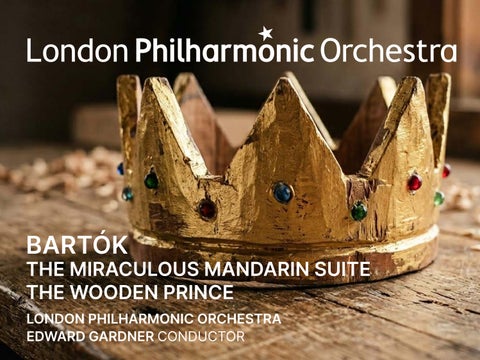

BARTÓK
THE MIRACULOUS MANDARIN SUITE
THE WOODEN PRINCE
LONDON PHILHARMONIC ORCHESTRA
EDWARD GARDNER CONDUCTOR
BÉLA BARTÓK (1881–1945)
THE MIRACULOUS MANDARIN SUITE, OP. 19, SZ. 73
In November 1926, Cologne experienced a musical scandal. ‘Catcalls, whistling, stamping, and booing’, reported one German music journal, ‘which did not subside even after the composer’s personal appearance, nor even after the safety curtain went down’. Not since Stravinsky unveiled The Rite of Spring to a shocked Parisian audience in 1913 had Europe witnessed such a dramatic reception to a new work. According to Bartók, even before The Miraculous Mandarin received its controversial premiere, ‘people had read the plot and decided it was objectionable’, perhaps with good reason. Described in Bartók’s own words, the plot of this one-act ‘pantomime grotesque’ – composed to a story by Hungarian playwright and screenwriter Melchior Lengyel – has all the hallmarks of a horror film:
‘Three [thugs] force a beautiful girl to lure men into their den so they can rob them … The third [visitor] is a wealthy Chinese man. He is a good catch, and the girl entertains him by dancing. The Mandarin’s desire is aroused, he is inflamed by passion, but the girl shrinks from him in horror. The [thugs] attack him, rob him, smother him in a quilt, and stab him with a sword, but their violence is of no avail. They cannot kill the Mandarin, who continues to look at the girl
with love and longing in his eyes. Finally feminine instinct helps: the girl satisfies the Mandarin’s desire, and only then does he collapse and die.’
Published in the influential Hungarian literary journal Nyugat in 1917, Lengyel’s story immediately captured Bartók’s imagination, and he began work on his pantomime ballet the following year. ‘It will be hellish music’, he wrote to his wife that summer. ‘The prelude before the curtain goes up will be very short and sound like pandemonium ... the audience will be introduced to the [thieves’] den at the height of the hurly-burly of the metropolis.’
Bartók’s completed score did not disappoint. Its cacophonous mix of pounding rhythms, blaring orchestration and dizzying climaxes – interspersed with moments of seductive, glittering tenderness – would far exceed the drama of anything he wrote in the years to come. Bartók composed the work during the final months of the First World War, and it is hard not to hear the savagery and horror of the war-torn landscape in music he himself described as ‘breathless from start to finish’.
After its disastrous reception in Cologne, it would be another 20 years before The Miraculous Mandarin
was staged in Bartók’s native Hungary. But his concert suite of the work, which Bartók arranged in 1927, was performed in Budapest in 1928 under the baton of fellow Hungarian Ernö Dohnányi. Comprising around two-thirds of the material in the complete work and played in one continuous movement, the suite concludes with the girl’s struggle with the Mandarin –so in this scenario, at least, he escapes death.
Programme note © Jo Kirkbride
BÉLA BARTÓK (1881–1945)
THE WOODEN PRINCE, OP. 13, SZ. 60
Completed several years before The Miraculous Mandarin, Bartók’s The Wooden Prince was the product of particularly concerted work during the First World War, when the composer and ethnomusicologist’s extensive fieldwork collecting folk songs was curtailed due to the hostilities. Instead, he focussed on compositions for the stage, both this pantomime ballet and his only opera, Duke Bluebeard’s Castle, both of which were created in collaboration with the writer Béla Balázs.
Balázs favoured demotic poetry – using the spoken language of ordinary people. His libretto for Bluebeard, originally intended for his flatmate Zoltán Kodály, was a strong case in point. Removing the ‘happily ever after’ ending of Charles Perrault’s tale, he formed a more psychological rendering of the story told in a manifestly Hungarian tongue.
The same was true of Balázs and Bartók’s subsequent project, which developed out of a visit to Budapest by the Ballets Russes in 1912 (between the creation of Stravinsky’s Petrushka and The Rite of Spring). The following year, the opera house in the Hungarian capital asked Bartók for a new work, which he decided to base on a story Balázs had published in Nyugat – the same
literary journal that would later yield the inspiration for The Miraculous Mandarin. The project took until 1917 to complete, though it quickly became one of Bartók’s most widely performed works – to the composer’s own annoyance, as it often overshadowed pieces he considered far superior.
The ballet tells the story of a prince who cannot reach his princess and instead decides to use a scarecrow version of himself to attract her attention. As a whole, the ballet reflects what Balázs called the ‘common and profound tragedy when the creation becomes the rival of the creator, and of the pain and glory of the situation in which a woman prefers the poem to the poet, the picture to the painter’.
Reflecting the ‘artificial’ elements in the story, Bartók crafted a conspicuous – yet still ingenious – musical structure. A symphonic poem in all but name, the score is in three parts, in which the third recalls the first, albeit in reverse order. Within this mirror-like structure – looking to the arch forms of Bartók’s later works, including his final string quartets and the evergreen Concerto for Orchestra – the music constantly juxtaposes the character of the prince and that of his puppet, who naturally share the same material, albeit
in a different guise. But it is the score’s sheer vivacity that wins through, including its cheeky nods to Wagner’s Das Rheingold at the opening, vivid scene-painting recalling Richard Strauss – an early touchstone for Bartók, before he turned to more local music – and the kaleidoscopic brilliance of the Ballets Russes. Clearly, Diaghilev had missed a trick by not commissioning Bartók when his company visited Budapest.
Programme note © Gavin Plumley
EDWARD GARDNER
CONDUCTOR
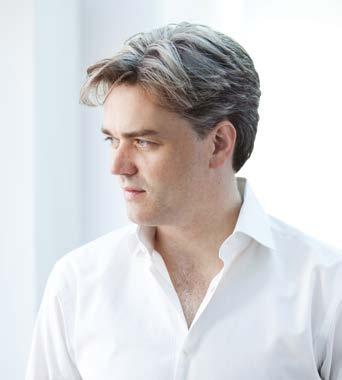
Edward Gardner has been Principal Conductor of the London Philharmonic Orchestra since 2021. He is also Music Director of the Norwegian Opera & Ballet, and Honorary Conductor of the Bergen Philharmonic Orchestra, following his tenure as Chief Conductor from 2015–24.
Previous recordings on the LPO Label include Tippett’s The Midsummer Marriage – which won a 2023 Gramophone Award – and A Child of Our Time, as well as the composer’s Piano Concerto and Symphony No. 2; Elgar’s The Dream of Gerontius; Berlioz’s The Damnation of Faust; Strauss’s Alpine Symphony and Metamorphosen; and works by Rachmaninov, Dvořák, Schumann, Britten, Brett Dean and Tania León.
In demand as a guest conductor, Edward has appeared with the Bavarian Radio Symphony Orchestra, New York Philharmonic, Chicago Symphony Orchestra, Philadelphia Orchestra, San Francisco Symphony, Rundfunk-Sinfonieorchester Berlin, Royal Stockholm Philharmonic and Vienna Symphony. He also continues his longstanding collaborations with the City of
Birmingham Symphony Orchestra, where he was Principal Guest Conductor from 2010–16, and the BBC Symphony Orchestra.
Music Director of English National Opera from 2006–15, Edward has an ongoing relationship with New York’s Metropolitan Opera, where he has conducted
The Damnation of Faust, Carmen, Don Giovanni, Der Rosenkavalier and Werther. He made his debut at London’s Royal Opera House in 2019 in Káťa Kabanová, returning for Werther the following season and the world premiere of Mark-Anthony Turnage’s Festen in 2025. Elsewhere, he has conducted at the Bavarian State Opera, La Scala, Chicago Lyric Opera, Glyndebourne Festival Opera, Opéra National de Paris and Teatro di San Carlo.
Born in Gloucester in 1974, Edward was educated at the University of Cambridge and the Royal Academy of Music. He went on to become Assistant Conductor of the Hallé and Music Director of Glyndebourne Touring Opera. His many accolades include Royal Philharmonic Society Award Conductor of the Year (2008), an Olivier Award for Outstanding Achievement in Opera (2009) and an OBE for services to music in The Queen’s Birthday Honours (2012).
Edward Gardner’s position with the LPO is generously supported by Aud Jebsen.
LONDON PHILHARMONIC ORCHESTRA
The London Philharmonic Orchestra is one of the world’s finest orchestras, balancing a long and distinguished history with its present-day position as one of the most dynamic and forward-looking ensembles in the UK. This reputation has been secured by the Orchestra’s performances in the concert hall and opera house, its many award-winning recordings, trailblazing international tours and wide-ranging educational work.
Founded by Sir Thomas Beecham in 1932, the Orchestra has since been headed by many of the world’s greatest conductors, including Sir Adrian Boult, Bernard Haitink, Sir Georg Solti, Klaus Tennstedt and Kurt Masur. In September 2021 Edward Gardner became the Orchestra’s Principal Conductor, succeeding Vladimir Jurowski, who became Conductor Emeritus in recognition of his transformative impact on the Orchestra as Principal Conductor from 2007–21.
The Orchestra is based at the Southbank Centre’s Royal Festival Hall in London, where it has been Resident Orchestra since 1992. Each summer it takes up its annual residency at Glyndebourne Festival Opera where it has been Resident Symphony Orchestra for 60 years. The Orchestra performs at venues around the UK and has made numerous international tours, performing to sell-out audiences in America, Europe, Asia and Australasia.
The LPO made its first recordings on 10 October 1932, just three days after its first public performance. It has recorded and broadcast regularly ever since, and in 2005 established its own record label. These recordings are taken mainly from live concerts given by conductors including those with LPO Principal Conductors from Beecham and Boult, through Haitink, Solti, Tennstedt and Masur, to Jurowski and Gardner.
lpo.org.uk
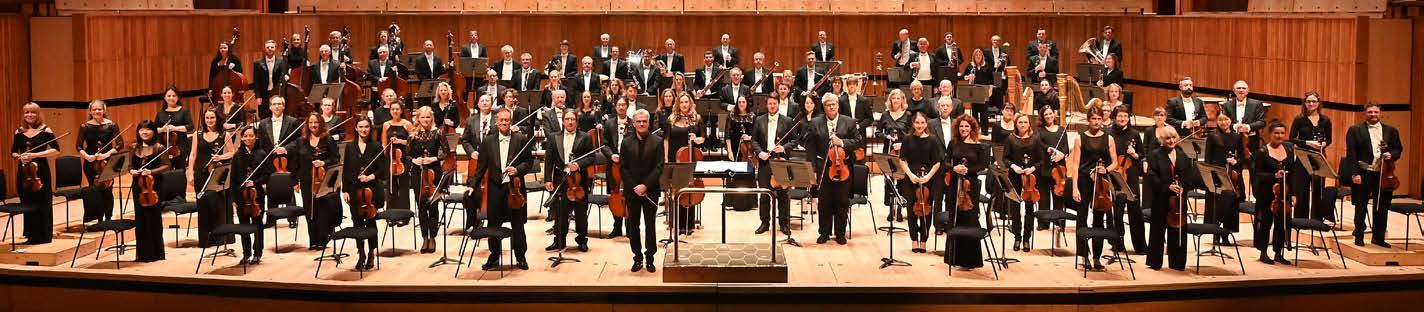
ON STAGE
*THE MIRACULOUS MANDARIN SUITE ONLY †THE WOODEN PRINCE ONLY
FIRST VIOLINS
Pieter Schoeman Leader
(The Miraculous Mandarin
Suite)*
Alice Ivy-Pemberton Leader
(The Wooden Prince)
Vesselin Gellev Sub-Leader
Kate Oswin
Lasma Taimina
Minn Majoe
Martin Höhmann
Yang Zhang
Thomas Eisner*
Cassandra Hamilton*
Katalin Varnagy*
Nilufar Alimaksumova
Ronald Long
Wing Yan Alison Kwok†
Rasa Zukauskaite†
Alison Strange†
Camille Buitenhuis†
Daniel Pukach†
Tayfun Bomboz†
Rebecca Dinning†
Elizaveta Tyun*
Thea Spiers*
Alice Hall*
SECOND VIOLINS
Tania Mazzetti*
Emma Oldfield*
Claudia Tarrant-Matthews
Coco Inman
Ashley Stevens
Nancy Elan
Kate Birchall
Sophie Phillips†
Marie-Anne Mairesse*
Joseph Maher*
Nynke Hijlkema*
Sioni Williams†
Vera Beumer†
Eloise MacDonald†
Anna Croad†
Caroline Sharp†
Pak Ho Hong†
Matthew Bain†
Olivia Ziani†
Paula Clifton-Everest*
José Nuno Cabrita Matias*
Charlie MacClure*
Izzy Howard*
VIOLAS
Benjamin Roskams
Laura Vallejo
Lucia Ortiz Sauco
Martin Wray
Benedetto Pollani
Katharine Leek*
James Heron
Toby Warr
Michelle Bruil†
Melissa Dattas†
Stanislav Popov†
Kate De Campos†
Abby Bowen†
Linda Kidwell*
Julia Doukakis*
Jisu Song*
Raquel López Bolívar*
CELLOS
Henry Shapard†
Timothy Walden*
Waynne Kwon
David Lale
Francis Bucknall
Helen Thomas
Heeyeon Cho†
Leo Melvin*
Auriol Evans*
Sue Sutherley*
Iain Ward†
Ben Rogerson†
Rasmus Støier Andersen†
Julia Morneweg†
Jane Lindsay*
Sibylle Hentschel*
DOUBLE BASSES
Kevin Rundell
Sebastian Pennar*
Hugh Kluger*
George Peniston
Laura Murphy
Tom Walley*
Ben Havinden-Williams†
Catherine Ricketts†
Thea Sayer†
Tom Morgan†
Frances Preston†
Lowri Estell*
Charlotte Kerbegian*
FLUTES
Juliette Bausor
Stewart McIlwham
Daniel Shao
Katherine Bicknell†
PICCOLOS
Stewart McIlwham
Katherine Bicknell†
Daniel Shao*
OBOES
Ian Hardwick
Alice Munday
Sue Böhling
Ilid Jones†
CORS ANGLAIS
Sue Böhling
Ilid Jones†
CLARINETS
Benjamin Mellefont
Thomas Watmough*
Paul Richards
Magdalenna Krstevska†
Bethany Crouch†
E-FLAT CLARINETS
Thomas Watmough*
Bethany Crouch†
BASS CLARINET
Paul Richards
SAXOPHONES
Martin Robertson†
Ethan Townsend†
BASSOONS
Jonathan Davies
Helen Storey*
Simon Estell†
Lorna West†
Llinos Owen†
Gareth Twigg*
CONTRABASSOONS
Simon Estell†
Llinos Owen†
Gareth Twigg*
HORNS
Annemarie Federle†
John Ryan
Martin Hobbs
Mark Vines
Gareth Mollison
Elise Campbell*
TRUMPETS
Paul Beniston
Tom Nielsen*
Anne McAneney
David Hilton†
Joe Skypala†
CORNETS
Tom Nielsen†
Tom Watts†
TROMBONES
Mark Templeton
David Whitehouse
BASS TROMBONE
Lyndon Meredith
TUBA
Lee Tsarmaklis
TIMPANI
Simon Carrington
PERCUSSION
Andrew Barclay
Karen Hutt
Oliver Yates†
Feargus Brennan
Sarah Mason†
James Bower*
Francesca Lombardelli*
HARPS
Sue Blair*
Céline Saout†
Tomos Xerri†
CELESTE
Catherine Edwards
Clíodna Shanahan†
PIANO
Philip Moore*
ORGAN
Clíodna Shanahan*
BÉLA BARTÓK (1881–1945)
19:10 The Miraculous Mandarin Suite, Op. 19, Sz. 73
01 02:41
Introduction (Street Sounds) – The thugs order the girl to the window
02 03:44 The girl entices the old rake
03 03:15 The girl entices the young man
04 02:27 The girl entices the Mandarin
05 04:59 The girl slowly begins to dance for the Mandarin
06 02:04 The dance concludes – the Mandarin chases the girl
47:37 The Wooden Prince: Pantomime ballet in one act, Op. 13, Sz. 60
07 04:30 Prelude
08 04:23 Dance 1 (Dance of the Princess in the Forest)
09 04:25 Dance 2 (Dance of the Trees)
10 10:03 Dance 3 (Dance of the Waves)
11 13:32 Dance 4 (Dance of the Princess with the Wooden Doll)
12 01:45 Dance 5 (The Princess pulls and pushes him and tries to make him dance)
13 01:32 Dance 6 (With a seductive dance she tries to lure him to her)
14 05:39 Dance 7 (Alarmed, the Princess rushes after him, but the forest holds her back)
15 01:48 Postlude
Recorded live at the Southbank Centre’s Royal Festival Hall on 6 November 2024 (The Miraculous Mandarin Suite) & 7 February 2026 (The Wooden Prince)
Producer: Andrew Walton, K&A Productions
Engineer: Deborah Spanton, K&A Productions
2026 London Philharmonic Orchestra Ltd
© 2026 London Philharmonic Orchestra Ltd LPO–0141D lpo.org.uk