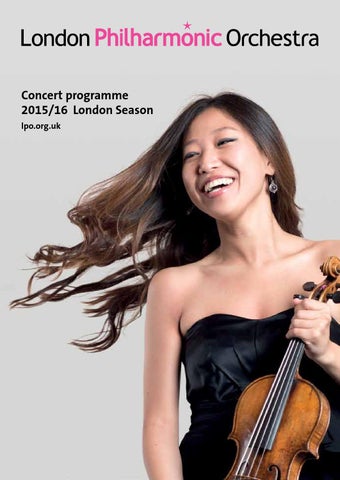
Concert programme 2015/16 London Season lpo.org.uk
Principal Conductor and Artistic Advisor VLADIMIR JUROWSKI* Principal Guest Conductor ANDRÉS OROZCO-ESTRADA Leader pieter schoeman† Composer in Residence magnus lindberg Patron HRH THE DUKE OF KENT KG Chief Executive and Artistic Director TIMOTHY WALKER AM
JTI Friday Series Southbank Centre’s Royal Festival Hall Friday 27 November 2015 | 7.30pm
Liadov From the Apocalypse (9’) Prokofiev Piano Concerto No. 2 in G minor, Op. 16 (31’) Interval Sibelius Symphony No. 1 in E minor, Op. 39 (38’)
Susanna Mälkki conductor Beatrice Rana piano
This concert is being broadcast live by the BBC on Radio 3 Live In Concert – live concerts every day of the week. Listen online in HD Sound for 30 days at bbc.co.uk/radio3
* supported by the Tsukanov Family Foundation † supported by Neil Westreich CONCERT PRESENTED BY THE LONDON PHILHARMONIC ORCHESTRA
Contents 2 Welcome 3 On stage tonight 4 About the Orchestra 5 Leader: Pieter Schoeman 6 Susanna Mälkki 7 Beatrice Rana 9 Programme notes 14 Sound Futures donors 15 Supporters 16 LPO administration
The timings shown are not precise and are given only as a guide.
Welcome
Welcome to Southbank Centre We hope you enjoy your visit. We have a Duty Manager available at all times. If you have any queries please ask any member of staff for assistance. Eating, drinking and shopping? Southbank Centre shops and restaurants include Foyles, EAT, Giraffe, Strada, YO! Sushi, wagamama, Le Pain Quotidien, Las Iguanas, ping pong, Canteen, Caffè Vergnano 1882, Skylon, Feng Sushi and Topolski, as well as cafes, restaurants and shops inside Royal Festival Hall. If you wish to get in touch with us following your visit please contact the Visitor Experience Team at Southbank Centre, Belvedere Road, London SE1 8XX, phone 020 7960 4250, or email customer@southbankcentre.co.uk We look forward to seeing you again soon. Queen Elizabeth Hall, Purcell Room and Hayward Gallery are closed for essential refurbishment until 2017. During this period, our resident orchestras are performing in venues including St John's Smith Square. Find out more at southbankcentre.co.uk/sjss A few points to note for your comfort and enjoyment: PHOTOGRAPHY is not allowed in the auditorium. LATECOMERS will only be admitted to the auditorium if there is a suitable break in the performance. RECORDING is not permitted in the auditorium without the prior consent of Southbank Centre. Southbank Centre reserves the right to confiscate video or sound equipment and hold it in safekeeping until the performance has ended. MOBILES, PAGERS AND WATCHES should be switched off before the performance begins.
2 | London Philharmonic Orchestra
Orchestra News
An easy way to support the Orchestra If you're about to make a purchase through amazon.co.uk, there's an easy way to support us as you shop. By clicking through to Amazon via the link on our webpage below, and placing items in your basket within 24 hours (and buying them within 90 days), the LPO receives a small percentage of your order. This applies to anything you buy from Amazon, not just LPO-related items. So when you're thinking of all the presents you have to buy, please remember us, too! Thank you for your support. lpo.org.uk/news/amazon.html
Classical Live The Orchestra is delighted to be part of Classical Live, a brand new online platform exclusively on Google Play showcasing the great orchestras of the world in recent live performances. It's yet another way the Orchestra is able to expand its reach to new audiences across the globe. The first release is of a concert performed in March this year featuring excerpts from Prokofiev's Chout ('The Buffoon'), LPO Composer in Residence Magnus Lindberg's Piano Concerto No. 2 with Yefim Bronfman as soloist, and Stravinsky's Petrushka. Vladimir Jurowski conducts. classical-live.com Making a NOISE Today we welcome students who join us through the Orchestra's NOISE scheme that entitles students and under 26-year-olds to £4 and £8 seats to selected concerts in London and all four concerts in the Brighton season. As part of the scheme, we recruit student representatives at universities and colleges across London and Brighton to help publicise NOISE: in September we attended Freshers’ Fairs at Brighton University and Sussex University to get as many students signed up as possible, whilst successfully recruiting a student representative from Brighton University. To find out more visit: lpo.org.uk/noise
On stage tonight
First Violins Pieter Schoeman* Leader Chair supported by Neil Westreich
Vesselin Gellev Sub-Leader Ilyoung Chae Chair supported by an anonymous donor
Ji-Hyun Lee Chair supported by Eric Tomsett
Katalin Varnagy Chair supported by Sonja Drexler
Thomas Eisner Martin Höhmann Chair supported by The Jeniffer and Jonathan Harris Charitable Trust
Geoffrey Lynn Chair supported by Caroline, Jamie & Zander Sharp
Robert Pool Sarah Streatfeild Yang Zhang Rebecca Shorrock Alina Petrenko Caroline Frenkel Amanda Smith Galina Tanney Second Violins Philippe Honore Guest Principal Kate Birchall Chair supported by David & Victoria Graham Fuller
Nancy Elan Lorenzo Gentili-Tedeschi Fiona Higham Nynke Hijlkema Joseph Maher Ashley Stevens Dean Williamson Sioni Williams Harry Kerr
Sheila Law Elizabeth Baldey Stephen Stewart Violas David Quiggle Guest Principal Cyrille Mercier Co-Principal Robert Duncan Gregory Aronovich Katharine Leek Susanne Martens Benedetto Pollani Emmanuella Reiter Laura Vallejo Naomi Holt Daniel Cornford Martin Fenn Cellos Pei-Jee Ng Principal Laura Donoghue Santiago Carvalho† David Lale Gregory Walmsley Elisabeth Wiklander Chair supported by The Viney Family
Susanna Riddell Tom Roff Helen Rathbone Sibylle Hentschel Double Basses Kevin Rundell* Principal Tim Gibbs Co-Principal George Peniston Laurence Lovelle Helen Rowlands Charlotte Kerbegian Ben Wolstenholme Lachlan Radford
Flutes Cormac Henry Guest Principal Sue Thomas*
Trumpets Paul Beniston* Principal Anne McAneney* Chair supported by Geoff & Meg Mann
Chair supported by Victoria Robey OBE
Nicholas Betts Co-Principal
Stewart McIlwham Piccolo Stewart McIlwham* Principal
Trombones Mark Templeton* Principal Chair supported by William & Alex de Winton
Chair supported by Friends of the Orchestra
David Whitehouse
Oboes Ian Hardwick* Principal Alice Munday
Bass Trombone Lyndon Meredith Principal Tubas Lee Tsarmaklis* Principal George Ellis
Cor Anglais Sue Böhling* Principal Clarinets Robert Hill* Principal Thomas Watmough Paul Richards
Timpani Simon Carrington* Principal Jeremy Cornes
Bassoons Gareth Newman Principal Laura Vincent Contrabassoon Simon Estell Principal Horns David Pyatt* Principal Chair supported by Simon Robey
John Ryan* Principal Chair supported by Laurence Watt
Martin Hobbs Mark Vines Co-Principal Gareth Mollison
Chair Supporters The London Philharmonic Orchestra also acknowledges the following chair supporters whose player is not present at this concert: Bianca and Stuart Roden
Percussion Andrew Barclay* Principal Chair supported by Andrew Davenport
Henry Baldwin Co-Principal Chair supported by Jon Claydon
Keith Millar Karen Hutt James Bower Harp Rachel Masters* Principal Keyboards Catherine Edwards * Holds a professorial appointment in London † Chevalier of the Brazilian Order of Rio Branco Meet our members: lpo.org.uk/players
London Philharmonic Orchestra | 3
London Philharmonic Orchestra
Vladimir Jurowski produced one of those utterly compelling performances where the London Philharmonic Orchestra seemed to be playing as if their lives depended on it. Bachtrack, September 2015 (4 Stars) Recognised today as one of the finest orchestras on the international stage, the London Philharmonic Orchestra balances a long and distinguished history with a reputation as one of the UK’s most forwardlooking ensembles. As well as its performances in the concert hall, the Orchestra also records film and video game soundtracks, releases CDs on its own record label, and reaches thousands of people every year through activities for families, schools and community groups. The Orchestra was founded by Sir Thomas Beecham in 1932. It has since been headed by many of the world’s greatest conductors including Sir Adrian Boult, Bernard Haitink, Sir Georg Solti, Klaus Tennstedt and Kurt Masur. Vladimir Jurowski is currently the Orchestra’s Principal Conductor and Artistic Advisor, appointed in 2007. Andrés Orozco-Estrada took up the position of Principal Guest Conductor in September 2015. Magnus Lindberg is the Orchestra’s current Composer in Residence. The Orchestra is resident at Southbank Centre’s Royal Festival Hall in London, where it gives over 30 concerts each season. Throughout 2014/15 the Orchestra gave a series of concerts entitled Rachmaninoff: Inside Out, a festival exploring the composer’s major orchestral
4 | London Philharmonic Orchestra
masterpieces. 2015/16 is a strong year for singers, with performances by Toby Spence and Anne Sofie von Otter amongst others; Sibelius enjoys 150th anniversary celebrations; distinguished visiting conductors include Stanisław Skrowaczewski, Jukka-Pekka Saraste and Vasily Petrenko, with Robin Ticciati returning after his debut in 2015; and in 2016 the LPO joins many of London’s other leading cultural institutions in Shakespeare400, celebrating the Bard’s legacy 400 years since his death. The Orchestra continues its commitment to new music with premieres of commissions including Magnus Lindberg’s Second Violin Concerto, and works by Alexander Raskatov and Marc-André Dalbavie. Outside London, the Orchestra has flourishing residencies in Brighton and Eastbourne, and performs regularly around the UK. Each summer the Orchestra takes up its annual residency at Glyndebourne Festival Opera in the Sussex countryside, where it has been Resident Symphony Orchestra for over 50 years. The Orchestra also tours internationally, performing to sell-out audiences worldwide. In 1956 it became the first British orchestra to appear in Soviet Russia and in 1973 made the first ever visit to China by a
Pieter Schoeman leader
Pieter Schoeman was appointed Leader of the LPO in 2008, having previously been Co-Leader since 2002.
The London Philharmonic Orchestra has recorded the soundtracks to numerous blockbuster films, from The Lord of the Rings trilogy to Lawrence of Arabia, East is East, The Hobbit: An Unexpected Journey and Thor: The Dark World. It also broadcasts regularly on television and radio, and in 2005 established its own record label. There are now over 80 releases available on CD and to download. Recent additions include Vaughan Williams’s Symphonies Nos. 4 and 6, Bruckner’s Symphony No. 3 conducted by Stanisław Skrowaczewski and Messiaen’s Des Canyons Aux Étoiles. In summer 2012 the London Philharmonic Orchestra performed as part of The Queen’s Diamond Jubilee Pageant on the River Thames, and was also chosen to record all the world’s national anthems for the London 2012 Olympics. In 2013 it was the winner of the RPS Music Award for Ensemble. The London Philharmonic Orchestra is committed to inspiring the next generation of musicians through an energetic programme of activities for young people. Highlights include the BrightSparks schools’ concerts and FUNharmonics family concerts; the Young Composers Programme; and the Foyle Future Firsts orchestral training programme for outstanding young players. Its work at the forefront of digital engagement and social media has enabled the Orchestra to reach even more people worldwide: all its recordings are available to download from iTunes and, as well as a YouTube channel and regular podcast series, the Orchestra has a lively presence on Facebook and Twitter. Find out more and get involved! lpo.org.uk facebook.com/londonphilharmonicorchestra twitter.com/LPOrchestra
© Benjamin Ealovega
Western orchestra. Touring remains a large part of the Orchestra’s life: highlights of the 2015/16 season include visits to Mexico City as part of the UK Mexico Year of Culture, Spain, Germany, Canary Islands, Belgium, a return to the Concertgebouw, Amsterdam and the Orchestra’s premiere at La Scala, Milan.
Born in South Africa, he made his solo debut aged 10 with the Cape Town Symphony Orchestra. He studied with Jack de Wet in South Africa, winning numerous competitions including the 1984 World Youth Concerto Competition in the US. In 1987 he was offered the Heifetz Chair of Music scholarship to study with Eduard Schmieder in Los Angeles and in 1991 his talent was spotted by Pinchas Zukerman, who recommended that he move to New York to study with Sylvia Rosenberg. In 1994 he became her teaching assistant at Indiana University, Bloomington. Pieter has performed worldwide as a soloist and recitalist in such famous halls as the Concertgebouw in Amsterdam, Moscow's Rachmaninov Hall, Capella Hall in St Petersburg, Staatsbibliothek in Berlin, Hollywood Bowl in Los Angeles, and Southbank Centre's Queen Elizabeth Hall in London. As a chamber musician he regularly performs at London's prestigious Wigmore Hall. As a soloist with the London Philharmonic Orchestra, Pieter has performed Arvo Pärt's Double Concerto with Boris Garlitsky, Brahms's Double Concerto with Kristina Blaumane, and Britten's Double Concerto with Alexander Zemtsov, which was recorded and released on the Orchestra's own record label to great critical acclaim. He has recorded numerous violin solos with the London Philharmonic Orchestra for Chandos, Opera Rara, Naxos, X5, the BBC and for American film and television, and led the Orchestra in its soundtrack recordings for The Lord of the Rings trilogy. In 1995 Pieter became Co-Leader of the Orchestre Philharmonique de Nice. Since then he has appeared frequently as Guest Leader with the Barcelona, Bordeaux, Lyon, Baltimore and BBC symphony orchestras, and the Rotterdam and BBC Philharmonic orchestras. He is a Professor of Violin at Trinity Laban Conservatoire of Music and Dance in London. Pieter's chair in the London Philharmonic Orchestra is supported by Neil Westreich.
youtube.com/londonphilharmonic7
London Philharmonic Orchestra | 5
Susanna Mälkki conductor
Whether in the brisk forcefulness she brought to Mars or the frigid stillness she found in the Saturn movement [from Holst's The Planets], this was a strikingly strong and fresh performance.
© Simon Fowler
John Allison, The Telegraph, July 2015
Susanna Mälkki’s versatility and broad repertoire have taken her to symphony and chamber orchestras, contemporary music ensembles and opera houses across the world. Appointed as the Chief Conductor of the Helsinki Philharmonic Orchestra, effective from the 2016/17 season, she has been Principal Guest Conductor of the Gulbenkian Orchestra since 2013, and was previously Music Director of the Ensemble intercontemporain and Artistic Director of Stavanger Symfoniorkester. As a guest conductor Susanna Mälkki’s recent highlights include returns to the San Francisco Symphony, Los Angeles Philharmonic and Royal Stockholm Philharmonic Orchestra and the Aldeburgh Festival where she conducted the UK premiere of A Pierre Dream: A Portrait of Pierre Boulez conceived by Gerard McBurney. Notable recent debuts include the Philadelphia, Cleveland and New York Philharmonic orchestras, Chamber Orchestra of Europe and Teatro La Fenice.
Conducting is about communicating, so you need clarity above all else in your physical movements ... the whole grand maestro stuff has never really appealed to the Finnish psyche. Susanna Mälkki Summer 2015 saw her return to the BBC Proms conducting the BBC Symphony Orchestra in the UK premiere of Francesconi’s Violin Concerto performed by Leila Josefowicz. This season's highlights include returns to the Chicago Symphony Orchestra, New World Symphony, Bayerischer Rundfunk, Vienna Symphony
6 | London Philharmonic Orchestra
at the Bregenzer Festival, London Sinfonietta and Oslo Philharmonic orchestras. She will also make her debut with the Orquesta y Coro Nacionales de España this month. A renowned opera conductor, Susanna performed The Marriage of Figaro with the Finnish National Opera in August 2014 and followed this with her Staatsoper Hamburg debut, conducting a revival of Janáček’s Jenůfa. In 2011 she made her debut at La Scala, Milan – the first woman to conduct a production there in the company’s history – and returned in 2014. Future highlights include conducting a Francesconi premiere at Opéra National de Paris, where she previously conducted the world premiere of Siddharta, a ballet by Bruno Mantovani, and in 2013 conducted Janáček’s The Makropolous Case. A former student at the Sibelius Academy, she studied with Jorma Panula and Leif Segerstam. Prior to her conducting studies, she had a successful career as a cellist and from 1995 to 1998 was one of the principals of the Gothenburg Symphony. In June 2010 she was elected a Fellow of the Royal Academy of Music in London and she is also a member of the Royal Swedish Academy of Music. In 2011, Susanna was awarded the Pro Finlandia Medal of the Order of the Lion of Finland, one of Finland’s highest honours. This evening marks Susanna Mälkki’s debut with the London Philharmonic Orchestra.
Beatrice Rana piano
Beatrice Rana possesses an old soul that belies her 20 years, and more than a touch of genius.
© Neda Navaee
Gramophone, January 2014
Beatrice Rana has earned international critical acclaim and attracted audiences worldwide after winning the Silver Medal and the Audience Award at the prestigious Van Cliburn competition in 2013. Two years earlier, when aged 18, she was awarded the First Prize as well as special prizes at the Montreal International Competition. She was recently announced as a BBC Radio 3 New Generation Artist (2015–17). Beatrice has appeared in recital in major venues and festivals around the globe, including Tonhalle Zurich, Wigmore Hall in London, Kennedy Center in Washington DC, Portland Piano Festival, Lied Center of Kansas, Spivey Hall in Morrow, Società dei Concerti in Milan, Ferrara Musica and Vancouver Recital Society. In the 2014/15 season, she made her debuts with the Los Angeles Philharmonic and the Detroit Symphony and performed with the Philadelphia Orchestra, RAI Symphony Orchestra and Accademia di Santa-Cecilia and Filarmonica della Scala in Milan. Among conductors Beatrice has collaborated with are Yannick Nézet-Seguin, Sir Antonio Pappano, Riccardo Chailly, Fabio Luisi, Leonard Slatkin, Fabien Gabel, Andrés Orozco-Estrada, Susanna Mälkki, Trevor Pinnock and Zubin Mehta. In 2014, Beatrice Rana was selected to perform at the International Music Festival of the Orpheum Foundation for advancement of Young Soloists at Zurich’s Tonhalle, with the Maggio Musicale Fiorentino conducted by Zubin Mehta. Beatrice now records exclusively for Warner Classics and her debut album with Antonio Pappano and the Orchestra dell’Accademia Nazionale di Santa Cecilia, featuring Tchaikovsky’s Piano Concerto No. 1 and
Prokofiev’s Second Piano Concerto is due to be released this month. Previous recordings inlcudes her first CD with Chopin’s Preludes and Scriabin’s Sonata No. 3 which was released on ATMA Classique in 2012 to great international acclaim. A year later, harmonia mundi released a live recording of her performances of Schumann, Ravel and Bartók.
My approach to music is very personal and I found in music what I couldn’t find anywhere else, which is expressing myself without fear or without being intimidated. For me it’s very difficult to speak in front of people or do something else, but on stage I have no limits. Beatrice Rana, taken from an intereview with Warner Classics Born to a family of musicians Beatrice Rana made her debut as a soloist at the age of nine. She began her musical studies aged four and graduated under Benedetto Lupo at the Nino Rota Conservatory of Music in Monopoli where she also studied composition with Marco della Sciucca. Beatrice currently studies with Arie Vardi in Hannover, Germany. @BeatriceRana
Hear Beatrice perform Prokofiev Piano Concerto No. 2 again: lpo.uk/beatriceranappc2 beatriceranapiano.com
London Philharmonic Orchestra | 7
Radio 3 in Concert
Experience the best concerts from across the UK, every weekday evening from 7.30
bbc.co.uk/radio3 8 | London Philharmonic Orchestra
Programme notes
Speedread Strange, sinister magic haunts both the Russian works in the first half of this concert. Anatoly Liadov’s incomplete From the Apocalypse conjures up the tremulous awe and fantastical imagery of the Biblical Book of Revelation, then just when it seems that a real ‘revelation’ is at hand, the music fades tantalisingly to nothingness. Some things, Liadov seems to say, are best left unspoken. As well as being ferociously demanding for the soloist, Prokofiev’s Second Concerto is one of his most wickedly provocative, devilishly dazzling scores. But at its heart is a more personal, dark utterance. The Concerto is dedicated to a brilliant but intensely depressive friend who killed himself whilst Prokofiev was writing the
Anatoly Liadov
score. The revised version, made ten years later, draws out the elegiac side of the work, most movingly in the finale, where at last the diabolical magician reveals his lyrical heart. Sibelius’s First Symphony also conveys an elegiac message, from its dreamlike opening clarinet solo to its grim, unmistakably tragic ending. But Sibelius refused to be drawn as to what kind of tragedy inspired the music. In any case, as an achievement the First Symphony is also a triumph: the first truly great Finnish symphony, undoubtedly speaking in the accents of Sibelius’s then-oppressed homeland. The radiant optimism of his Second Symphony, begun just two years later, is only just around the corner.
From the Apocalypse
1855–1914
‘A new talent has appeared in our midst, a genuine, thoroughly original, thoroughly Russian talent.' With these words the pioneering nationalist Modest Mussorgsky announced the arrival of the 18-year-old Anatoly Liadov on the St Petersburg musical stage. Fellow composers Cui and Borodin were equally impressed, as was the influential critic Vladimir Stasov. Before long even the initially dubious Tchaikovsky was won over. It all promised so well. But three decades later, as Liadov was approaching 50, another critic, Vyacheslav Karatyghin, noted sadly: ‘He has every conceivable gift: marvellous technique, originality, genuine poetic fancy, abundance of rare humour… and the most he gives us, year in year out, is about ten pages of music.’ Towards the end of his life, Liadov was approached by the impresario Serge Diaghilev to write the music for the Ballets Russes production
of The Firebird. But all too predictably the score failed to materialise, and Diaghilev turned instead to a young, then virtually unknown composer named Igor Stravinsky. Liadov’s upbringing – or lack of it – was partly to blame. His mother died when he was very young, his father when he was 13. Even before then life was chaotic and unsupervised. As a student he was so erratic he was eventually expelled. Understandably, depression was a recurring problem: the world, Liadov wrote, was ‘tedious, disappointing, trying, purposeless, terrible’, and increasingly he sought escape in alcohol. Fortunately, a few musical gems did make it to completion – or, in the case of From the Apocalypse – near-completion. The nine minutes of music we have were composed during 1910–12. It seems Liadov genuinely intended to
London Philharmonic Orchestra | 9
Programme notes continued
compose a final section, but death intervened, and so this brilliant, weirdly atmospheric fragment ends with a portentous drum-roll, eventually dying to nothing. The music vividly evokes the spirit and imagery of these lines from the Biblical Book of Revelation: ‘And I saw another mighty angel come down from heaven, clothed with a cloud: and a rainbow was upon his head, and his face was as it were the sun, and his feet as pillars of fire: And he has in his hand a little book open: and he set his right foot upon the sea, and his left foot on the earth, and cried with a loud voice, as when a lion roareth: and when he had cried, seven thunders uttered their voices.’ But what it is that the seven thunders utter – that is left tantalisingly unsaid.
Sergei Prokofiev 1891–1953
If Prokofiev’s Second Piano Concerto has never been as popular as the First and Third, there is one very good reason: it is ferociously challenging for the pianist. ‘Disgracefully difficult and mercilessly tiring’ was Prokofiev’s own verdict, as he struggled to learn the piano part for the Petersburg premiere in 1913. Three of its four movements are energetic, intense, edge-ofthe-seat fast movements, while the first movement’s relatively relaxed opening – a handful of notes thrown down by clarinets and muted pizzicato strings – turns out to be a kind of bluff. Very soon the piano is working long and hard, and at the heart of this movement comes a hair-raising passage for piano alone – not so much a cadenza as a central climax in which the piano is expected to outdo the orchestra in power and textural richness. 10 | London Philharmonic Orchestra
Recommended recordings of tonight’s works Liadov: From the Apocalypse BBC Philharmonic | Vassily Sinaisky [Chandos] Prokofiev: Piano Concerto No. 2 Nikolai Demidenko | London Philharmonic Orchestra | Alexander Lazarev [Hyperion] Jean-Efflam Bavouzet | BBC Philharmonic | Gianandrea Noseda [Chandos] Sibelius: Symphony No. 1 Vienna Philharmonic | Lorin Maazel [Decca] Minnesota Orchestra | Osmo Vänskä [Bis]
Piano Concerto No. 2 in G minor, Op. 16 Beatrice Rana piano 1 Andantino 2 Scherzo: Vivace 3 Intermezzo: Allegro moderato 4 Finale: Allegro tempestoso
There is, however, far more to the Second Concerto’s ‘difficulty’ than athleticism. Much of this music shows Prokofiev at his most wickedly provocative, delighting in the kind of sinister magic that was to prove so unsettling in his opera The Fiery Angel, begun six years later. Few composers seem to have revelled in adversity as thoroughly as Prokofiev did, at least in his younger days. The St Petersburg Gazette reported the premiere like this: ‘A youth with the face of a high school student appears on the platform. It is Sergei Prokofiev. He seats himself at the piano and starts either wiping the keyboard or testing the keys. All this is done with a dry, sharp touch. The audience is bewildered. Some people are indignant. One couple
gets up and moves towards the exit, exclaiming “Such music is enough to drive you mad”. More listeners follow the first couple. Prokofiev plays the second movement of his concerto. The more daring members of the audience stay to hiss.’ Prokofiev’s response was to play an encore! At the same time, there is more to the Second Piano Concerto’s dark tone than devilish naughtiness. The Concerto is dedicated to the pianist Max Schmidthof, a very close friend of the composer. (In fact the composer’s first wife Lina wondered if they were more than just friends.) Schmidthof was wonderfully entertaining company, but also prone to deep depression. While Prokofiev was working on his Second Piano Concerto he learned that Schmidthof had killed himself, and shortly afterwards he received a farewell letter in Schmidthof’s hand, with what feeling we can only guess.
The real heart of the [Second Piano] Concerto lies in the fourth movement in my opinion, where the tragedy can be understood through the heart of Prokofiev. Beatrice Rana Many believe that the Second Piano Concerto is shadowed by this devastating loss, and that those shadows deepen in the familiar revised version of the score Prokofiev made in 1923–4 – perhaps not so much in the opening Andantino, despite the melancholy tinge of its opening piano melody, nor even in the tiny but manically articulate Scherzo that follows. But the sense of foreboding grows in the thuggish Intermezzo, and reaches its fruition in the beautiful and deeply serious tune that emerges from the Finale’s initial frenzy, and in the piano’s haunting funereal bell sounds later on. Prokofiev summons another display of wicked high spirits for the very ending, but the lasting impression is ambiguous, as though a mask had been temporarily dropped, and at the last minute hurriedly replaced.
Interval – 20 minutes An announcement will be made five minutes before the end of the interval.
London Philharmonic Orchestra | 11
Programme notes continued
Jean Sibelius 1865–1957
When Sibelius’s First Symphony appeared in 1899, he was still in the process of freeing himself from the spell of late romanticism. He may have put Wagner firmly behind him, but the allure of Tchaikovsky was harder to resist: ‘There is much in that man that I recognise in myself’, he wrote to Aino that same year. For all his close involvement in his native Finland’s attempts to break free from Russian political domination, music was another matter. Tchaikovskian touches aren’t hard to find in Sibelius’s First: the sumptuous, languishing major-minor tune that opens the slow movement strongly recalls Tchaikovsky’s 'Pathétique' Symphony, that Sibelius had heard twice in Helsinki since its Russian premiere in 1893 – as does the First Symphony’s tragic ending, firmly in the dark minor key. And yet, despite these clear resemblances, what is most striking about the First Symphony is how much Sibelius is already his own man. Now there is no literary programme to ‘explain’ the form and character: the musical argument must convince on its own terms. His decision to wait until his 30s before tackling his official ‘Symphony No. 1’ is fully justified: although there are elements that invite interpretation – perhaps even hints of some underlying ‘storyline’ – the drama convinces ultimately as music, leaving the listener’s imagination free to dream for him- or herself. The very opening is like nothing else in the 19th-century symphonic repertoire: a quiet drum-roll introduces a long-breathed, mournful, quasi-improvisatory melody on solo clarinet – for many Finns this is strongly evocative of ancient folk-lament. The clarinet finishes its meditation alone, as if lost in thought; then a high violin tremolando announces a striking new motif, echoed by high low strings. This builds to a rock-like climax, with the original string motif now hammered out by brass and timpani.
12 | London Philharmonic Orchestra
Symphony No. 1 in E minor, Op. 39 1 2 3 4
Andante ma non troppo – Allegro energico Andante (ma non troppo lento) Scherzo: Allegro – Lento (ma non troppo) – Tempo I Finale (Quasi una Fantasia): Andante – Allegro molto
The second theme is expertly contrasted: shimmering strings and harp forming a magical haze around delicate, elfin woodwind phrases. The opposition of these two very different elements develops in a gripping musical drama, culminating in another granite-like brassy fortissimo, then a huge crescendo drum-roll is brusquely truncated by two E minor chords from pizzicato strings and harp. The slower second movement also exploits the contrast between two themes: the ‘languishing’ Tchaikovskian tune mentioned above, and a more resolute chordal tune introduced by woodwind and horns. Soon we are in territory that could only be Sibelius: the bare woodwind writing for woodwind alone, the eerie passage for flutes, oboes, timpani and solo cello that follows the first big climax, the rising and falling string figures recalling wind in the tree-tops, or perhaps waves on a storm-tossed sea, look forward to the elemental drama of the tone poem Oceanides or the icy forestscape of his last masterpiece, Tapiola. At last the Tchaikovsky-like tune returns, but in mid-phrase, bringing a kind of uneasy repose. Pulsating pizzicato string chords and a sharply rhythmic motif for timpani launch the pounding dance of the Scherzo. Here the debt is more to Bruckner than Tchaikovsky, though the modal flavouring of the music and the orchestral colours are unmistakably Nordic. Again Sibelius provides strong dramatic contrast in the slower and quieter Trio section, introduced by a plangent motif from horns, tuba, bassoons and cello. But soon the elemental dance returns still more powerfully, this time building to a characteristically brusque conclusion. Sibelius marks his Finale ‘Quasi una Fantasia’ (‘Like a fantasy’) – a direct comparison
with Beethoven’s two Op. 27 piano sonatas (including the famous 'Moonlight'), which both treat conventional forms with unusual freedom. But Sibelius was surely also thinking of Tchaikovsky’s ‘Fantasy Overture’ Romeo and Juliet, and the still more tragic ‘Symphonic Fantasy’ Francesca da Rimini. The Finale’s ardent opening theme for strings is in fact another version of the long clarinet melody that began the first movement, and the sense
of the Symphony coming full circle is underlined by the ending. The ardent second theme builds to a huge climax, then a massive drum-roll fades into two pizzicato string chords of E minor, echoing and intensifying the end of the first movement, now even more final. Programme notes © Stephen Johnson
Our last concerts of 2015 at Royal Festival Hall Friday 4 December 2015 | 7.30pm JTI FRIDAY SERIES
Puccini Tosca (excerpts) Rota Suite, La Strada Respighi Pines of Rome Enrique Mazzola conductor Maria Luigia Borsi Tosca Thiago Arancam Cavaradossi Vittorio Vitelli Scarpia
Wednesday 9 December 2015 | 7.30pm Wagenaar Overture, Cyrano de Bergerac Magnus Lindberg Violin Concerto No. 2 (world premiere)* Beethoven Symphony No. 7 Jaap van Zweden conductor Frank Peter Zimmermann violin *Commissioned by the London Philharmonic Orchestra with the generous support of Victoria Robey OBE, Stiftung Berliner Philharmoniker, Swedish Radio Symphony Orchestra, Radio France and New York Philharmonic, Alan Gilbert, Music Director
Tickets £9–£39 (premium seats £65) London Philharmonic Orchestra Ticket Office: 020 7840 4242 Monday–Friday 10.00am–5.00pm | lpo.org.uk Transaction fees: £1.75 online, £2.75 telephone.
2016 Highlight playing the bard In collaboration with some of London’s leading cultural, creative and educational institutions, the London Philharmonic Orchestra joins Shakespeare400 with a series of concerts in 2016 celebrating the Bard’s love of music, culminating in an Anniversary Gala Concert directed by Simon Callow on 23 April. Join the LPO at Southbank Centre’s Royal Festival Hall and dive into a musical world born of the words of the legendary William Shakespeare. find out more: lpo and shakespeare400 lpo.org.uk/shakespeare
London Philharmonic Orchestra | 13
Sound Futures Donors We are grateful to the following donors for their generous contributions to our Sound Futures campaign. Thanks to their support, we successfully raised £1 million by 30 April 2015 which has now been matched pound for pound by Arts Council England through a Catalyst Endowment grant. This has enabled us to create a £2 million endowment fund supporting special artistic projects, creative programming and education work with key venue partners including our Southbank Centre home. Supporters listed below donated £500 or over. For a full list of those who have given to this campaign please visit lpo.org.uk/soundfutures. Masur Circle Arts Council England Dunard Fund Victoria Robey OBE Emmanuel & Barrie Roman The Underwood Trust
The Rothschild Foundation Tom & Phillis Sharpe The Viney Family
Haitink Patrons Mark & Elizabeth Adams Dr Christopher Aldren Mrs Pauline Baumgartner Welser-Möst Circle Lady Jane Berrill William & Alex de Winton Mr Frederick Brittenden John Ireland Charitable Trust David & Yi Yao Buckley The Tsukanov Family Foundation Mr Clive Butler Neil Westreich Gill & Garf Collins Tennstedt Circle Mr John H Cook Valentina & Dmitry Aksenov Mr Alistair Corbett Richard Buxton Bruno de Kegel The Candide Trust Georgy Djaparidze Michael & Elena Kroupeev David Ellen Kirby Laing Foundation Christopher Fraser OBE & Lisa Fraser Mr & Mrs Makharinsky David & Victoria Graham Fuller Alexey & Anastasia Reznikovich Goldman Sachs International Simon Robey Mr Gavin Graham Bianca & Stuart Roden Moya Greene Simon & Vero Turner Mrs Dorothy Hambleton The late Mr K Twyman Tony & Susie Hayes Malcolm Herring Solti Patrons Catherine Høgel & Ben Mardle Ageas Mrs Philip Kan John & Manon Antoniazzi Rehmet Kassim-Lakha de Morixe Gabor Beyer, through BTO Rose & Dudley Leigh Management Consulting AG Lady Roslyn Marion Lyons Jon Claydon Miss Jeanette Martin Mrs Mina Goodman & Miss Duncan Matthews QC Suzanne Goodman Diana & Allan Morgenthau Roddy & April Gow Charitable Trust The Jeniffer & Jonathan Harris Dr Karen Morton Charitable Trust Mr Roger Phillimore Mr James R.D. Korner Ruth Rattenbury Christoph Ladanyi & Dr Sophia The Reed Foundation Ladanyi-Czernin Robert Markwick & Kasia Robinski The Rind Foundation The Maurice Marks Charitable Trust Sir Bernard Rix David Ross & Line Forestier (Canada) Mr Paris Natar
14 | London Philharmonic Orchestra
Carolina & Martin Schwab Dr Brian Smith Lady Valerie Solti Mr & Mrs G Stein Dr Peter Stephenson Miss Anne Stoddart TFS Loans Limited Lady Marina Vaizey Jenny Watson Guy & Utti Whittaker Pritchard Donors Ralph & Elizabeth Aldwinckle Mrs Arlene Beare Mr Patrick & Mrs Joan Benner Mr Conrad Blakey Dr Anthony Buckland Paul Collins Alastair Crawford Mr Derek B. Gray Mr Roger Greenwood The HA.SH Foundation Darren & Jennifer Holmes Honeymead Arts Trust Mr Geoffrey Kirkham Drs Frank & Gek Lim Peter Mace Mr & Mrs David Malpas Dr David McGibney Michael & Patricia McLaren-Turner Mr & Mrs Andrew Neill Mr Christopher Queree The Rosalyn & Nicholas Springer Charitable Trust Timothy Walker AM Christopher Williams Peter Wilson Smith Mr Anthony Yolland And all other donors who wish to remain anonymous
We would like to acknowledge the generous support of the following Thomas Beecham Group Patrons, Principal Benefactors and Benefactors: Thomas Beecham Group The Tsukanov Family Foundation Neil Westreich William and Alex de Winton Mrs Philip Kan* Simon Robey Victoria Robey OBE Bianca & Stuart Roden Laurence Watt Anonymous Jon Claydon Garf & Gill Collins* Andrew Davenport Mrs Sonja Drexler David & Victoria Graham Fuller The Jeniffer and Jonathan Harris Charitable Trust Mr & Mrs Makharinsky Geoff & Meg Mann Caroline, Jamie & Zander Sharp Julian & Gill Simmonds* Eric Tomsett The Viney Family John & Manon Antoniazzi Jane Attias John & Angela Kessler Guy & Utti Whittaker * BrightSparks Patrons: instead of supporting a chair in the Orchestra, these donors have chosen to support our series of schools’ concerts.
Principal Benefactors Mark & Elizabeth Adams David & Yi Yao Buckley Desmond & Ruth Cecil Mr John H Cook Mr Bruno de Kegel David Ellen Mr Daniel Goldstein Drs Frank & Gek Lim Peter MacDonald Eggers Dr Eva Lotta & Mr Thierry Sciard Mr & Mrs David Malpas Mr & Mrs G Stein Mr & Mrs John C Tucker Mr & Mrs John & Susi Underwood Lady Marina Vaizey Grenville & Krysia Williams Mr Anthony Yolland Benefactors Mr Geoffrey Bateman Mrs A Beare Ms Molly Borthwick David & Patricia Buck Mrs Alan Carrington Mr & Mrs Stewart Cohen Mr Alistair Corbett Mr Timothy Fancourt QC Mr Richard Fernyhough Mr Gavin Graham Wim and Jackie Hautekiet-Clare Tony & Susan Hayes Mr Daniel Heaf and Ms Amanda Hill Michael & Christine Henry Malcolm Herring
J. Douglas Home Ivan Hurry Mr Glenn Hurstfield Per Jonsson Mr Gerald Levin Wg. Cdr. & Mrs M T Liddiard OBE JP RAF Paul & Brigitta Lock Mr Peter Mace Ms Ulrike Mansel Mr Robert Markwick and Ms Kasia Robinski Mr Brian Marsh Andrew T Mills Dr Karen Morton Mr & Mrs Andrew Neill Mr Michael Posen Alexey & Anastasia Reznikovich Mr Konstantin Sorokin Martin and Cheryl Southgate Mr Peter Tausig Simon and Charlotte Warshaw Howard & Sheelagh Watson Des & Maggie Whitelock Christopher Williams Bill Yoe and others who wish to remain anonymous Hon. Benefactor Elliott Bernerd Hon. Life Members Kenneth Goode Carol Colburn Grigor CBE Pehr G Gyllenhammar Mrs Jackie Rosenfeld OBE
The generosity of our Sponsors, Corporate Members, supporters and donors is gratefully acknowledged: Corporate Members Silver: Accenture Berenberg Carter-Ruck We are AD Bronze: Appleyard & Trew LLP BTO Management Consulting AG Charles Russell Speechlys Lazard Leventis Overseas Preferred Partners Corinthia Hotel London Heineken Sipsmith Steinway Villa Maria In-kind Sponsors Google Inc
Trusts and Foundations Angus Allnatt Charitable Foundation The Bernarr Rainbow Trust The Boltini Trust Borletti-Buitoni Trust The Candide Trust Cockayne – Grants for the Arts The D’Oyly Carte Charitable Trust Dunard Fund The Equitable Charitable Trust The Foyle Foundation Lucille Graham Trust The Jeniffer and Jonathan Harris Charitable Trust Help Musicians UK The Idlewild Trust Kirby Laing Foundation The Leche Trust The London Community Foundation London Stock Exchange Group Foundation Lord and Lady Lurgan Trust Marsh Christian Trust Adam Mickiewicz Institute The Peter Minet Trust
The Ann and Frederick O’Brien Charitable Trust Office for Cultural and Scientific Affairs of the Embassy of Spain in London The Austin and Hope Pilkington Trust The Stanley Picker Trust The Radcliffe Trust Rivers Foundation The R K Charitable Trust RVW Trust Serge Rachmaninoff Foundation The David Solomons Charitable Trust Souter Charitable Trust The John Thaw Foundation The Tillett Trust UK Friends of the Felix-MendelssohnBartholdy-Foundation The Viney Family Garfield Weston Foundation The Barbara Whatmore Charitable Trust and all others who wish to remain anonymous
London Philharmonic Orchestra | 15
Administration Board of Directors Victoria Robey OBE Chairman Stewart McIlwham* President Gareth Newman* Vice-President Dr Manon Antoniazzi Roger Barron Richard Brass Desmond Cecil CMG Jonathan Harris CBE FRICS Amanda Hill Dr Catherine C. Høgel Rachel Masters* George Peniston* Kevin Rundell* Natasha Tsukanova Mark Vines* Timothy Walker AM Laurence Watt Neil Westreich David Whitehouse* * Player-Director Advisory Council Victoria Robey OBE Chairman Christopher Aldren Richard Brass David Buckley Sir Alan Collins KCVO CMG Andrew Davenport Jonathan Dawson William de Winton Edward Dolman Christopher Fraser OBE Lord Hall of Birkenhead CBE Rehmet Kassim-Lakha Jamie Korner Clive Marks OBE FCA Stewart McIlwham Sir Bernard Rix Baroness Shackleton Lord Sharman of Redlynch OBE Thomas Sharpe QC Julian Simmonds Martin Southgate Sir Philip Thomas Sir John Tooley Chris Viney Timothy Walker AM Elizabeth Winter American Friends of the London Philharmonic Orchestra, Inc. Jenny Ireland Co-Chairman William A. Kerr Co-Chairman Kyung-Wha Chung Alexandra Jupin Jill Fine Mainelli Kristina McPhee Harvey M. Spear, Esq. Danny Lopez Hon. Chairman Noel Kilkenny Hon. Director Victoria Robey OBE Hon. Director Richard Gee, Esq Of Counsel Jenifer L. Keiser, CPA, EisnerAmper LLP Stephanie Yoshida
Chief Executive
Education and Community
Digital Projects
Timothy Walker AM Chief Executive and Artistic Director
Isabella Kernot Education Director (maternity leave)
Alison Atkinson Digital Projects Director
Amy Sugarman PA to the Chief Executive / Administrative Assistant
Clare Lovett Education Director (maternity cover)
Finance
Talia Lash Education and Community Project Manager
Albion Media (Tel: 020 3077 4930)
Lucy Duffy Education and Community Project Manager
Philip Stuart Discographer
David Burke General Manager and Finance Director David Greenslade Finance and IT Manager Dayse Guilherme Finance Officer
Richard Mallett Education and Community Producer
Concert Management
Development
Roanna Gibson Concerts Director
Nick Jackman Development Director
Graham Wood Concerts and Recordings Manager
Catherine Faulkner Development Events Manager
Jenny Chadwick Tours Manager Tamzin Aitken Glyndebourne and UK Engagements Manager Alison Jones Concerts and Recordings Co-ordinator
Kathryn Hageman Individual Giving Manager Laura Luckhurst Corporate Relations Manager Anna Quillin Trusts and Foundations Manager Rebecca Fogg Development Co-ordinator
Jo Cotter Tours Co-ordinator
Helen Yang Development Assistant
Orchestra Personnel
Kirstin Peltonen Development Associate
Andrew Chenery Orchestra Personnel Manager Sarah Holmes Sarah Thomas Librarians (job-share) Christopher Alderton Stage Manager
Marketing Kath Trout Marketing Director Libby Northcote-Green Marketing Manager
Damian Davis Transport Manager
Rachel Williams Publications Manager (maternity leave)
Madeleine Ridout Assistant Orchestra Personnel Manager
Sarah Breeden Publications Manager (maternity cover)
16 | London Philharmonic Orchestra
Samantha Cleverley Box Office Manager (Tel: 020 7840 4242) Anna O’Connor Marketing Co-ordinator Natasha Berg Marketing Intern
Matthew Freeman Recordings Consultant Public Relations
Archives
Gillian Pole Recordings Archive Professional Services Charles Russell Speechlys Solicitors Crowe Clark Whitehill LLP Auditors Dr Louise Miller Honorary Doctor London Philharmonic Orchestra 89 Albert Embankment London SE1 7TP Tel: 020 7840 4200 Box Office: 020 7840 4242 Email: admin@lpo.org.uk lpo.org.uk The London Philharmonic Orchestra Limited is a registered charity No. 238045. Composer photographs courtesy of the Royal College of Music, London. Front cover photograph: Katalin Varnagy, First Violin © Benjamin Ealovega. Cover design/ art direction: Ross Shaw @ JMG Studio. Printed by Cantate.