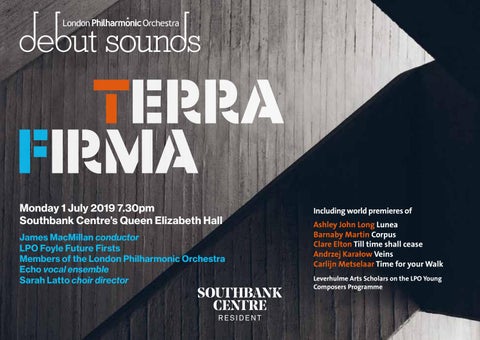
Monday 1 July 2019 7.30pm Southbank Centre’s Queen Elizabeth Hall James MacMillan conductor LPO Foyle Future Firsts Members of the London Philharmonic Orchestra Echo vocal ensemble Sarah Latto choir director
Including world premieres of Ashley John Long Lunea Barnaby Martin Corpus Clare Elton Till time shall cease Andrzej Karałow Veins Carlijn Metselaar Time for your Walk Leverhulme Arts Scholars on the LPO Young Composers Programme
Welcome
Welcome to Southbank Centre We hope you enjoy your visit. We have a Duty Manager available at all times. If you have any queries please ask any member of staff for assistance. Eating, drinking and shopping? Enjoy fresh seasonal food for breakfast and lunch, coffee, teas and evening drinks with riverside views at Concrete Cafe, Queen Elizabeth Hall, and Riverside Terrace Cafe, Level 2, Royal Festival Hall. Visit our shops for products inspired by our artistic and cultural programme, iconic buildings and central London location. Explore across the site with Foyles, EAT, Giraffe, Strada, wagamama, YO! Sushi, Le Pain Quotidien, Las Iguanas, ping pong, Spiritland, Honest Burger, Côte Brasserie, Skylon and Topolski. If you wish to get in touch with us following your visit, please contact the Visitor Experience Team at Southbank Centre, Belvedere Road, London SE1 8XX, phone us on 020 3879 9555, or email customer@southbankcentre.co.uk We look forward to seeing you again soon. A few points to note for your comfort and enjoyment: PHOTOGRAPHY is not allowed in the auditorium. LATECOMERS will only be admitted to the auditorium if there is a suitable break in the performance. RECORDING is not permitted in the auditorium without the prior consent of Southbank Centre. Southbank Centre reserves the right to confiscate video or sound equipment and hold it in safekeeping until the performance has ended. MOBILES, PAGERS AND WATCHES should be switched off before the performance begins. Please note that tonight’s performance will be filmed for LPO promotional and archival purposes.
2
Debut Sounds
Debut Sounds is an annual celebration of the London Philharmonic Orchestra’s New Talent programmes: LPO Young Composers and Foyle Future Firsts. This year we have been delighted to work with Sir James MacMillan as Composer Mentor for the second year, supporting the five Young Composers in seminars and workshops to develop their new pieces. For this season’s brief, the composers were invited to create music based on the form of cantus firmus and use an existing work as the starting point for their music – drawing inspiration from the music, text, or abstract ideas their chosen piece may evoke. Tonight, an ensemble of Foyle Future Firsts and members of the LPO, conducted by James MacMillan, present these five world premieres – each of which is preceded by an a cappella choral work, performed by young professional vocal ensemble Echo. We also celebrate the work of our Composer Mentor with two of his own instrumental works, opening each half of the concert. Visit lpo.org.uk/youngcomposers to find out more about tonight’s composers, and lpo.org.uk/news to watch short films of each of the composers discussing and rehearsing their new pieces.
The 2018/19 LPO Young Composers Programme is generously supported by The Leverhulme Trust and the Adam Mickiewicz Institute as part of the Polska Music Programme. The 2018/19 Foyle Future Firsts Development Programme is generously supported by the Foyle Foundation with additional support from The Mercers’ Company and The Barbara Whatmore Charitable Trust.
Foyle Future Firsts
Š Benjamin Ealogeva
First Violins Lasma Taimina Leader Mathilde Gheorghiu* Kalliopi Mitropoulou Second Violins Nynke Hijlkema Eleonora Consta*
The 16 members of the Foyle Future Firsts programme are talented graduate instrumentalists who aspire to be professional orchestral musicians. We support their transition between college and the professional platform, developing talented players to form the base for future orchestral appointments with the London Philharmonic Orchestra and other orchestras and ensembles around the world. Now in its 15th year, our unique programme has gone from strength to strength. Members are supported and nurtured to the highest standards and we are proud to see current and past Foyle Future Firsts taking professional engagements with the
London Philharmonic Orchestra and other world-class ensembles. Members of the Foyle Future Firsts programme benefit from individual lessons and mentoring from London Philharmonic Orchestra Principals, mock auditions, and the opportunity to play in full orchestral rehearsals throughout the year. They also take part in high-profile and unique chamber performances, and work alongside London Philharmonic Orchestra musicians on Education & Community projects. lpo.org.uk/futurefirsts
Violas Richard Waters Rebecca Stubbs* Cellos Francis Bucknall Daniel Benn*
Clarinets/ Bass Clarinets Thomas Watmough
Harp Anna Astesano*
LPO Chair supported by Roger Greenwood
Piano Imma Setiadi*
Elliot Gresty* Bassoons/ Contrabassoons Simon Estell Emma Westley* Trumpets Anne McAneney
* 2018/19 Foyle Future First
LPO Chair supported by Geoff & Meg Mann
Adam Stockbridge*
Double Basses George Peniston Joseph Cowie*
Horns Duncan Fuller Alex Willet*
Flutes/Piccolos Stewart McIlwham Anna Kondrashina*
Trombones/ Bass Trombones Joe Arnold Benny Vernon*
Oboes/Cor Anglais Amy Roberts Imogen Davies*
Percussion Jeremy Cornes Laura Bradford*
Tuba Christopher Claxton*
3
LPO Young Composers
© Benjamin Ealogeva
Leverhulme Arts Scholars 2018/19
As a double bassist Ash has toured the world with groups ranging from period ensembles to contemporary circus, and his wide-ranging work as a soloist has resulted in the premieres of many new works for solo bass. In 2015 he released his debut solo album, Psi.
final of the competition by Unsuk Chin out of 143 entries from 40 countries, was first performed by the Tokyo Philharmonic Orchestra in May 2018. Barnaby is the only composer from the UK to have received first prize in the history of the competition.
In 2015 Ash was awarded a PhD scholarship by Cardiff University to conduct research into contemporary performance practice and stylistic continuity in composition and improvisation. ashleyjohnlong.co.uk
Barnaby’s work has achieved acclaim and recognition in several other competitions and prizes including the Westminster Cathedral Composition Competition (Omnes amici mei), the DARE New Composers Forum Competition (Stillness), the Berkeley Ensemble’s New Cobbett Prize (Lazarus) and the New Music for St Paul’s Cathedral Competition (Videntes Stellam). Barnaby also received his first nomination for a BASCA British Composer Award in 2017 for his contemporary cantata, The Temptations of Christ. barnabymartin.com
L–R Ashley John Long, Barnaby Martin, Clare Elton, Andrzej Karałow, Carlijn Metselaar Ashley John Long (born 1986) is a composer and double bassist active in a wide range of genres. Since graduating from the Royal Welsh College of Music & Drama he has maintained a busy freelance career which embraces many strands. As a composer he has developed a reputation as a creator of scores that balance fine detail with freedom and flexibility, whilst retaining a strong melodic sense in a soundworld that embraces diverse musical ideas. Recent commissions have included
4
three chamber operas, as well as much chamber music, and his orchestral work Karri was premiered in 2019 by the BBC National Orchestra of Wales. Ash teaches workshops for the Arts Active Trust and has led school-based composition projects resulting in a series of orchestral pieces created in collaboration with school pupils. He has also composed music for media, dance and theatre, as well as several extended works for jazz and improvising ensembles.
Barnaby Martin (born 1991) is an awardwinning composer of contemporary classical music. His compositions have been performed widely in the UK and internationally by groups including the Tokyo Philharmonic Orchestra, the Orchestra of Opera North, the Berkeley Ensemble, the Ligeti Quartet, the Choir of St Paul’s Cathedral, Wells Cathedral Choir and Illuminare choir. In 2018 his work for large orchestra, Quanta, was selected as the winner of the Toru Takemitsu Composition Award. The piece, one of four to be selected for the
Clare Elton (born 1993) is a composer based in London and is currently a Composition Fellow at the Guildhall School of Music & Drama. Clare studied music for her undergraduate degree at
Royal Holloway, University of London with an instrumental scholarship, graduating in 2014 with First Class honours. In 2015 she began a Masters in Composition at the Guildhall, studying with Matthew Kaner and graduating in 2018 with a Distinction. She was generously supported by the Guildhall School Trust and a Vaughan Williams Bursary, and was a Sydney Vale Scholar. Clare’s music has been heard on BBC Radio 3; performed and workshopped by ensembles such as the London Symphony Orchestra, EXAUDI vocal ensemble, Plus-Minus Ensemble and Psappha Ensemble; and performed at venues including Wigmore Hall and Milton Court Concert Hall. Clare’s compositional process often involves collaboration with other artists. Notable projects include a collaboration with writer Edward Einhorn on a chamber opera performed at the Asylum Chapel, Peckham (2018); a collaboration with writer Lila Palmer on a site-specific, immersive opera performed at the London Transport Museum (2017); and collaborations with choreographers on two occasions with performances
at The Place (2016) and Laban Theatre (2017). Recently, Clare has completed a commission from the Barbican and the Museum of London, which involved the composition of an outdoor, site-specific opera performed in May and June 2019 for the Sound Unbound Festival. clareelton.com
Andrzej Karałow (born 1991) is a Polish pianist, composer and improviser. He is currently an assistant lecturer at the Fryderyk Chopin University of Music in Warsaw, and a Doctor of Musical Arts. He is also a laureate of many national and international piano competitions, and has performed in prestigious concert halls in Poland and abroad, as well as with renowned orchestras such as the Warsaw Philharmonic and Sinfonia Varsovia. Equally successful as a composer, Andrzej is the winner of competitions including the Bartók Plus Opera Festival in Hungary, the Karol Szymanowski International Composition Competition in Katowice, and Ablaze Records’ call for electronic works. His works have been performed at concerts and festivals in
the UK, Europe, the USA, Canada and Australia. He is the recipient of several scholarships including the prestigious 'Young Poland’ Scholarship. Andrzej has released two albums: Wir (The Vortex) in 2018, which consists of free-improvised electroacoustic works performed with music producer Jerzy Przeździecki; and After All (2019), featuring 20th- and 21st-century duo works with Spanish saxophonist Pablo Sánchez-Escariche Gasch. Although classical music is Andrzej's main field of activity, he is also open to experiments in electronic and alternative genres, combining techniques and inspiration from various fields of art into his own, unique musical language. andrzejkaralow.pl
Carlijn Metselaar (born 1989) is a Dutch composer based in Cardiff. She is especially interested in creative collaboration and enjoys working with choreographers, directors, librettists and visual artists. She is the winner of a Young Talent Award from the Prins
Bernhard Cultuurfonds, as well as a scholarship for a PhD in Composition at Cardiff University. She studied composition and musicology in Utrecht and continued her studies at the Royal Welsh College of Music & Drama, where she now teaches harmony. This year, Carlijn is Composer in Residence with Welsh National Opera’s Youth Opera, for whom she wrote the short opera Blackout based on a play by Davey Anderson. She wrote Octet for the Berkeley Ensemble with Ty Cerdd’s CoDI Chamber scheme. Her piece Night Parade of Monsters was commissioned by UPROAR: New Music Ensemble, led by Michael Rafferty. Her opera Martine & Martinus was performed at the Dom Cathedral of Utrecht in 2016, for which she received a grant from the Dutch Performing Arts Fund. Other recent compositions include Leap, an orchestral miniature performed by the BBC National Orchestra of Wales, and Well, Actually, a cabaret song about mansplaining commissioned by Musical Movements for the Olga Vocal Ensemble. carlijnmetselaar.com
5
echo
Sir James MacMillan
Sarah Latto | conductor
conductor & Composer Mentor
echo is a new ensemble of young professional singers that came together through Genesis Sixteen, the prestigious young artists’ scheme run by Harry Christophers and The Sixteen. Following highly acclaimed launch concerts in London and Birmingham, echo headlined the Sounds Sublime Festival in July 2017, and made its St John’s Smith Square debut the same month. echo was one of the inaugural Chiltern Arts Festival Take Note artists for 2018, and is an Ensemble-in-Residence at the Ryedale Festival this summer, taking part in a number of performances across the region and as part of the Ryedale Festival Opera's performance of Dido and Aeneas.
James MacMillan is the pre-eminent Scottish composer of his generation. He first attracted attention with the acclaimed BBC Proms premiere of The Confession of Isobel Gowdie (1990). His percussion concerto Veni, Veni Emmanuel (1992) has received over 500 performances worldwide, including by Evelyn Glennie with the LPO at Royal Festival Hall in 2013. In 2014 the LPO under Vladimir Jurowski gave the world premiere of MacMillan’s Viola Concerto with soloist Lawrence Power. Other major works include the cantata Seven Last Words from the Cross (1993); Quickening (1998) for soloists, children’s choir, mixed choir and orchestra; the operas Inès de Castro (2001) and The Sacrifice (2005–06); St John Passion (2007); and St Luke Passion (2013). In 2008 the LPO released on its own label The Confession of Isobel Gowdie under Marin Alsop live in concert at Queen Elizabeth Hall (LPO-0035: see page 9).
The ensemble has quickly developed a reputation for imaginative programming and inventive presentation; often creating audience-immersive concert experiences. The production EXILE at the Brunel Tunnel Shaft featured music from four historical vignettes and was directed by Rebecca Meltzer (Waterperry Opera). More recently, echo received Arts Council and RVW Trust funding for a response to the work of American artist Polly Apfelbaum, which was performed at the Union Chapel, London and Ikon Gallery, Birmingham. echo-choir.com
Sopranos Sally Carr Sam Cobb Hilary Cronin Ellie Sperling Altos Jess Haig Rose Martin Sophie Timms
6
Tenors Ed Woodhouse Will Wright Michael Yeoman Basses Harry Bennett Freddie Crowley John Laichena
Save the date: ‘Meet you in the Maze' Sunday 20 October 2019, 4.00pm The Music Room, Mayfair, W1K 5LF echo performs a programme based on the idea of mazes and puzzles, the navigation of the unknown and the concept of aleatory in art, including music by Arvo Pärt, J.S. Bach and James Blake. Tickets: £12 advance/£15 on door Buy tickets via echo-choir.com
As the LPO’s Young Composer Mentor 2018/19 – his second season in the role – James MacMillan has led seminars with the composers across the year and provided guidance in workshops and rehearsals with the ensemble.
Programme notes first half
James MacMillan (born 1959) They saw the stone had been rolled away (1993)
William Byrd (1538–1623) Lulla, lullaby, my sweet little baby (1588)
Clare Elton (born 1993) Till time shall cease (world premiere)
This is a short fanfare for brass and percussion to celebrate Easter. The brass material is extracted from my musictheatre piece Visitatio Sepulchri, and specifically from the section where the three women encounter three angels at the entrance to the empty tomb. It has a ritualistic sectional structure in which each brass episode (gradually expanding and becoming more complex with each occurrence) is answered by a simple response for percussion.
Lulla, lullaby, my sweet little baby, one of William Byrd's most well-known and beloved madrigals, was first published in 1588 as part of a collection entitled Psalmes, Sonets, and Songs. Also known as the Lullaby for Holy Innocents, the piece is a tender and poignant nativity madrigal, depicting Mary comforting the infant Jesus with the refrain ‘Lullaby, my sweet little baby/What meanest thou to cry?’. Alternating with the refrain is a third-person narrator, explaining the baby's disquiet: the holy family has just fled to Egypt to escape the slaughter ordered by King Herod. The tale is thus a bittersweet one, Mary hushing the restless baby in a tranquil duple metre, while the narrator contrasts in a more dramatic triple metre the serene scene of mother and child with the violence of Herod's wrath. The expressive shift between voices is slow and seamless in an almost cinematic way, as repetitions of the word ‘lullaby’ wind into a polyphonic tapestry connecting the refrain and verse. Jeremy Grimshaw, © TiVo
Rest, rest, for evermore Upon a mossy shore; Rest, rest at the heart's core Till time shall cease: Sleep that no pain shall wake; Night that no morn shall break Till joy shall overtake Her perfect peace. – Dream Land by Christina Rossetti
The fanfare is dedicated to my school music teacher, Bert Richardson. JM
With the title originating from the final stanza of the poem Dream Land by Christina Rossetti, Till time shall cease revolves around the idea of a lullaby. Often sung to children with the intention of soothing and aiding their sleep, the lullaby inhabits the line between sleep and consciousness, dreams and reality.
and exhalation shown through swells in dynamics, fragile air sounds and a rising and falling musical shape. A cantus firmus based on the opening motif of William Bryd’s Lulla, lullaby, my sweet little baby stretches throughout the piece. This cantus firmus melody moves from audibility with a strong presence within the texture, to being concealed in the background, where the piece gradually dissolves into a dream-like state and the music becomes increasingly fragmented and disorientated. CE
Till time shall cease opens with the repetitive rocking motion inherent in lullabies. The rhythm of breathing characterises the music. There is a simple oscillation between inhalation
7
Programme notes first half continued
Antonio Lotti (1667–1740) Crucifixus a 8 (c.1717)
Barnaby Martin (born 1991) Corpus (world premiere)
Antonio Lotti was born in Venice and started singing at St Mark’s in 1687. He later became the organist there and composed operas, masses and madrigals. The Crucifixus in 8 parts is perhaps Lotti’s best-known work, and comes from his Credo in F for choir and orchestra. The vocal lines enter one at a time, building up a richly imitative opening section. The remainder of the piece continues with imitative textures, with suspensions a strong feature of Lotti’s colourful and evolving harmonic language.
Corpus is based on a solo clarinet piece of mine called Hypercubus. The idea of taking a solo work and converting it into a larger piece is inspired by Luciano Berio, who used a lot of his solo instrumental pieces, called Sequenzas, as the basis for other works. Although the clarinet does not play constantly throughout Corpus, it does feature very heavily and every melodic and harmonic component of the piece is taken from the original clarinet work. Both Corpus and Hypercubus take their names from Salvador Dalí’s 1954 painting Crucifixion (Corpus Hypercubus). The painting depicts Christ suspended on a tesseract, which is a threedimensional representation of a four-dimensional cube (a ‘hypercube’). The painting is angular and geometric, but beautiful. This fusion of geometry and art directly influenced my musical setting – Corpus contains a lot of
Crucifixus etiam pro nobis sub Pontio Pilato. Passus et sepultus est. He was indeed crucified for us at the hands of Pontius Pilate. He died and was buried.
8
Henryk Górecki (1933–2010) Nie piej, kurku: No. 3 from Three Lullabies (1984) angular, sharp changes in texture and colour, but these are combined with moments of calm and introspection. On a technical level, my goal was to achieve a feeling of randomness in the music. But when I tried to notate this exactly how I wanted it to sound, it looked very complicated on the page. Instead, I have included a number of passages where the players make their own way through the phrase in their own tempo. This produces the desired effect of randomness but looks a lot simpler. You can hear this effect throughout Corpus, but it is most clearly heard in the climax, where almost every part is playing random, independent patterns. BM
Although a leading figure of the Polish avant-garde during the postStalin cultural thaw, Henryk Górecki was largely unknown outside Poland until a recording of his Symphony No. 3 by the London Sinfonietta with soprano Dawn Upshaw climbed to the top of the British pop charts in the early 1990s. However, the lullaby has been at the core of Górecki’s musical personality since his student days. This often reveals itself in song texts and/or a rocking motion between two alternating notes or chords. This ‘to and fro’ may have had a symbolic or a more fundamental meaning for Górecki, but its musical origins lie in the Polish vernacular tradition. The third of the Three Lullabies, ‘Nie piej, kurku’ (‘Don’t crow, cock’) features a chorale-like melody, with a faster patter in the lower parts, reverting to a hymnic style for the conclusion. It was first performed on 2 August 1991 at the Lerchenberg Festival in Denmark. Adrian Thomas
James MacMillan on the LPO Label Ashley John Long (born 1986) Lunea (world premiere)
Nie piej, kurku, nie piej, nie budź mi Marysię. Nocka była krótka, nie wyspała mi się. Całą noc nie spała, całą noc płakała. Lulajże, Marysiu, lulaj, moja mała. Don’t crow, cock, don’t crow. Don’t wake Mary. The night was short, She didn’t get enough sleep. She did not sleep the whole night through. She wept the whole night. Hushaby, Mary, Hushaby, my little one.
Lunea takes its primary materials from a music box melody written some years ago for another piece that was subsequently abandoned. The sound of music boxes is one of my earliest sonic memories and I’ve always held a fondness for them, finding the gentleness of their sound somehow at odds with the impersonal, mechanistic aspects of their production. This melody forms a kind of cantus firmus; elements of it are constantly present and transformed throughout the work through a variety of procedures. During the early stages of composition, I happened upon a painting by Paul Nash entitled Voyages of the Moon in which Nash transforms his initial inspiration of globular ceiling lamps reflected in a mirror of a French restaurant into something altogether more unsettling and otherworldly.
The sense of cyclic movement within the painting and the interlocking mechanical parts of clockwork music boxes led me to using such a structural approach in Lunea. Each part of the melody is assigned a set of musical materials, each of which has a cycle or orbit within the piece so that at certain points elements come to the fore, which had previously been subsidiary materials, before fading away again. Harmonic and intervallic relationships are subject to such cycles, moving ever inward before the music gradually melts into the sound of massed music boxes. AJL
Interval: 20 minutes
James MacMillan The Confession of Isobel Gowdie Thomas Adès Chamber Symphony Jennifer Higdon Percussion Concerto Marin Alsop conductor Colin Currie percussion £9.99 | LPO-0035
‘These live LPO recordings are the best possible advert for new classical music.’ Financial Times CDs available from lpo.org.uk/ recordings, the LPO Ticket Office (020 7840 4242) and all good CD outlets. Download or stream online via Apple Music, Amazon, Spotify and others.
9
Programme notes second half
James MacMillan (born 1959) Ein Lämplein verlosch (2018)
Grzegorz Gerwazy Gorczycki (c.1665–1734) Agnus Dei from Missa Paschalis (c.1700)
Andrzej Karałow (born 1991) Veins (world premiere)
The title of Ein Lämplein verlosch (‘A little lamp went out’) is a reference to a line in Gustav Mahler’s Kindertotenlieder (‘Songs on the death of children’, after Friedrich Rückert). The song 'Nun will die Sonn’ so hell aufgeh’n' (‘Now the sun will rise again as brightly’) ends ‘Ein Lämplein verlosch in meinem Zelt, heil sei dem Freudenlicht der Welt’ (‘A little lamp went out in my life, Blessed be the light of joy in the world’) and the strings’ mysterious harmonics and shimmering glissandi reflect the atmosphere of Rückert’s lament for the dead.
Known during his lifetime as ‘the Polish Handel’, Grzegorz Gerwazy Gorczycki enjoyed a well-rounded education, studying liberal arts and philosophy in Prague and theology in Vienna, after which he took holy orders in Kraków, fulfilling the role of Magister capellae musices at Wawel Cathedral from 1698 until his death. Gorczycki wrote mainly church music, much of which – including the Missa Paschalis (Easter Mass) – reflects the influence of Palestrina and the Roman School, and demonstrates his mastery of counterpoint.
This piece is based on a multilayered cantus firmus, which was constructed through vertical and horizontal structures in context of colour, harmony and polymelodical lines. These three elements shape an unstable and unpredicable sound landscape. The whole musical material develops from one musical idea (inspired by the developing variation technique), while the narration is shaped as a continuous, organic development of this material.
Programme note © Charlotte Tauber Translation: Michael Jack
Agnus Dei, qui tollis peccata mundi, miserere nobis. Agnus Dei, qui tollis peccata mundi, dona nobis pacem.
Unlike my other works, the inspiration for Veins came from a dream in which inspirations of mountain landscapes connected with visual impressions of flora from fantasy worlds. The holistic picture shows an infinite tree from which branches grow in a massive construction and start to surround the whole landscape. It ends as an infinite and organic net of branches,
Lamb of God, who takes away the sins of the world, have mercy upon us. Lamb of God, who takes away the sins of the world, grant us peace.
10
like a neural system. The listener – and the observer – is in the immovable centre of seemingly static action. The surrounding landscape is slowly evolving and transforming, and the tree is growing little by little to surround the whole scenery: for this reason, an alternative title for this work could be Arborization. The important aspect of the work is an element of sacrum, a mystical chord of tree, which symbolises tranquility and nature's harmony. AK
Judith Weir (born 1954) Ave Regina Caelorum (2014)
The most joyous of the four Marian antiphons, Ave Regina caelorum is generally sung between Candlemas and Easter and celebrates the Virgin in a variety of epithets. Weir’s setting plunges listeners headlong into music that already seems mid-action, so urgent are its dancing triplet rhythms. There’s an innocent ebullience to this opening which, although it gives way briefly to more considered counterpoint (‘Ex qua mundo’) and to a plainchantinspired section for female voices (‘Ave Regina’), cannot keep the smile from its face. Joy bursts out once again in the work’s final bar. This piece was commissioned by Merton College, Oxford as part of the Merton Choirbook, assembled to celebrate Merton College’s 750th anniversary in 2014. It was first performed on 8 July 2014 in Gloucester Cathedral, as part of the Cheltenham Music Festival, by the Choir of Merton College conducted by Benjamin Nicholas. Alexandra Coghlan
Carlijn Metselaar (born 1989) Time for your Walk (world premiere)
Ave Regina caelorum, Ave Domina Angelorum, Salve radix, salve porta, Ex qua mundo lux est orta. Gaude, Virgo gloriosa, Super omnes speciosa, Vale, O valde decora! Et pro nobis Christum exora.
Hail, O Queen of Heaven enthroned. Hail, by angels mistress owned. Root of Jesse, Gate of Morn Whence the world's true light was born: Glorious Virgin, Joy to thee, Loveliest whom in heaven they see; Fairest thou, where all are fair, Plead with Christ our souls to spare.
Time for your Walk is about a recurring feeling of joy and excitement. This recurrence is the cantus firmus of the piece: a sense of delight so irresistible you could almost start singing. This could be a dog realising over and over again that it’s playing in a park, or every time you see the face of a loved one. This interpretation of cantus firms is expressed with two main ideas. The first is a galumphing, leaping gesture which starts in the brass. The second is a tingling texture. The music constantly flows in and out of these two ideas, impulsively taking up new thoughts as it goes. Raucous tutti sections are contrasted with solos and duets which highlight the virtuosity of all the players. After a gentler, more introspective middle section with avian avalanches in the woodwinds, the piece finds its way back to previous material and charges headlong toward the end. CM
Watch short films of tonight’s five composers discussing and rehearsing their new works: lpo.org.uk/news
Date for your diary
LPO Showcase: Foyle Future Firsts Saturday 7 December 2019 6.00pm Royal Festival Hall Foyle Future Firsts: Free pre-concert performance Our new cohort of Foyle Future Firsts 2019/20 present their first performance of the year alongside LPO players: a lively programme of British music. Free entry (no ticket required) lpo.org.uk/showcase
11
The right is reserved to substitute artists and to vary the programme if necessary. The London Philharmonic Orchestra is a registered charity No. 238045. London Philharmonic Orchestra, 89 Albert Embankment, London SE1 7TP. lpo.org.uk