
February 2026
Support Live Encounters.
Donate Now and Keep the Magazine Live in 2026
Live Encounters is a not-for-profit free online magazine that was founded in 2009 in Bali, Indonesia. It showcases some of the best writing from around the world. Poets, writers, academics, civil & human/animal rights activists, academics, environmentalists, social workers, photographers and more have contributed their time and knowledge for the benefit of the readers of:
Live Encounters Magazine (2010), Live Encounters Poetry & Writing (2016), Live Encounters Young Poets & Writers (2019) and now, Live Encounters Books (August 2020).
We are appealing for donations to pay for the administrative and technical aspects of the publication. Please help by donating any amount for this just cause as events are threatening the very future of Live Encounters.
Om Shanti Shanti Shanti Om
Mark Ulyseas Publisher/Editor

All articles and photographs are the copyright of www.liveencounters.net and its contributors. No part of this publication may be reproduced without the explicit written permission of www.liveencounters.net. Offenders will be criminally prosecuted to the full extent of the law prevailing in their home country and/or elsewhere.
Contributors
February 2026
David Rigsbee
Kim Ports Parsons
Terry McDongah
Jordan Smith
Susan Keiser
Richard W Halperin
Lynda Tavakoli
Peter A Witt
Patricia Sykes
Paul Williamson
Luis Cuauhtemoc Berriozabal
Gordon Ferris
Following poets translated from Arabic
by Dr Salwa Gouda
Aicha Bassry
Dima Mahmoud
Fawzia Alawi Alawi
Habiba Mohammedi
Nehad Zaki
Sameh Mahgoub
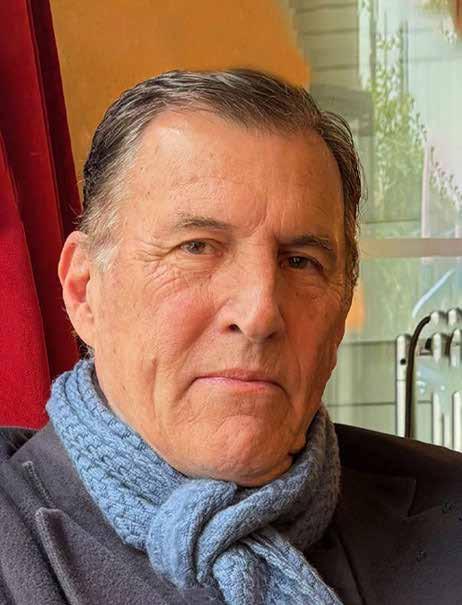
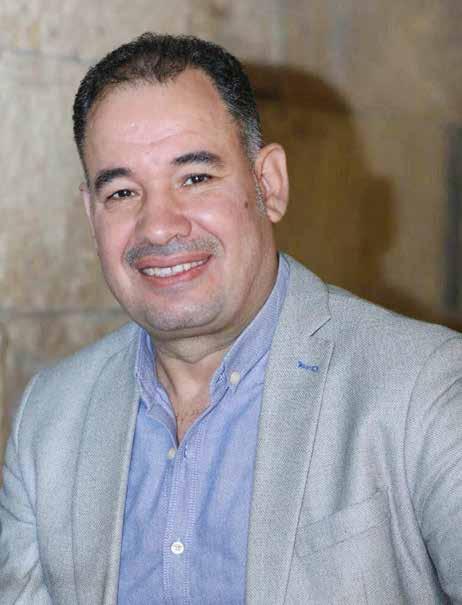
David Rigsbee is the recipient of many fellowships and awards, including two Fellowships in Literature from The National Endowment for the Arts, The National Endowment for the Humanities (for The American Academy in Rome), The Djerassi Foundation, The Jentel Foundation, and The Fine Arts Work Center in Provincetown, as well as a Pushcart Prize, an Award from the Academy of American Poets, and others. In addition to his twelve collections of poems, he has published critical books on the poetry of Joseph Brodsky and Carolyn Kizer and coedited Invited Guest: An Anthology of Twentieth Century Southern Poetry. His work has appeared in Agni, The American Poetry Review, The Georgia Review, The Iowa Review, The New Yorker, The Southern Review, and many others. Main Street Rag published his collection of found poems, MAGA Sonnets of Donald Trump in 2021. His translation of Dante’s Paradiso was published by Salmon Poetry in 2023, and Watchman in the Knife Factory: New & Selected Poems was published by Black Lawrence Press in 2024.
The coda to my chapter from Three Teachers: Kizer, Brodsky, and Rorty.
Letum non Omnia Finit
In October 2019, I flew to Florence to spend some time with my daughter Makaiya, who had recently graduated from Harvard Law and needed to decompress before starting her first job as a public defender in Seattle. She was keen on going to Venice, and so we took a train there. She knew my real reason for wanting to go: to take a vaporetto and visit Joseph Brodsky’s grave in the Isola di san Michele, where Ezra Pound and Olga Rudge were also buried, along with Igor Stravinsky, and Sergei Diaghilev. The walled cemetery was not especially well-kept, although there were markers and arrows aplenty to locate the graves of the noble and noteworthy. We first found Ezra Pound’s grave and spent a few minutes in a photo op, but I was more interested in finding Joseph. Makaiya first spotted the tombstone, and I hurried over to take a look. I had seen photos online, but these did not do it justice in its isolation and semi-neglect. I plucked a flower from someone else’s plot and lay it at the stone, which had his name, first in Russian, then life-dates, then “Joseph Brodsky” in English. A stack of three short lines, as if trying to be a tercet. It’s said that Boris Yeltsin sent boxes of roses to adorn the gravesite but that they wound up at the grave of Pound instead. Both were buried in the Protestant section of the cemetery. On the reverse of the tombstone there is a legend in Latin: Letum non Omnia Finit. Not everything ends in death. Another photo op showed me standing behind the tombstone, looking over and across his space. I remember standing there a long time, welcoming the feelings of care and regret. Nor did I forget Joseph’s remark: “For some odd reason, the expression ‘death of a poet’ always sounds somewhat more concrete than ‘life of a poet.’” I looked older than I felt on that day.
A postcard once came in the mail. There was Botticelli’s profile portrait of Dante. On the reverse, he had written, “This caught my eye. It looks like you, don’t you think?— Joseph.” His reverence for Dante was in line with his respect for the Greats and, to a large degree, the institutions that bound them. One had only to glance at the table of contents of his Collected Poems in English: a roster of classical personages to rival that of his beloved Cavafy. Behind this was the overarching theme of empire, naturally, but that empire took many forms, the most important of which was language. On the one hand, one could never, in Jameson’s phrase, escape “the prison-house of language.” But on the other, poets could build on it. He liked to recite Auden’s lines from ‘’In Memory of W. B. Yeats”: “Time... Worships language and forgives/ Everyone by whom it lives...” “Wystan never wrote anything truer,” he said. If time does anything of the sort, that would mean that time itself was subordinate to language, the very thing that marks humanity off from the rest of nature. Nature, as a result, needn’t take center stage, nor need it lay claim to importance as a background for self-examination, the way it does for the Romantic poets, to whom Joseph was not particularly drawn. However, there is one exception, his poem, “The Hawk’s Cry in Autumn,” an example of magnificence in which the cry from the soaring raptor is the “apotheosis of pure sound.”
The poem, likewise, is soaring. It’s perhaps as close as he gets to a religion of poetry, but the religion also dovetails with Dante, who not only plumbs the depths with Virgil, but flies through outer space with the spirit of Beatrice on a mission to locate the source, God. Unlike Dante, the hawk doesn’t find God, only weather and the earth in rotation. The hawk doesn’t speak either. Its brain is the size of a berry but its “vision” is vision. Its cry is the basis of the language it foretells, though it’s not built to acquire a language that ultimately evolves to offer poetry, the ultimate. There is a paradox embedded in the reasoning that touches all poets.
Joseph often spoke of Dante in these reverential terms. At the time, I only knew the Florentine through John Ciardi’s popular translation of the Inferno. Few of us read beyond, but we intuited (or so we thought) the rest. There was perhaps a basis for taking on what is otherwise an incomplete assignment. The Inferno was graphic; it seized you with its demonic hooks, and you identified with both the sins and the crazy punishments. The Purgatorio was more of the same, but the promise torn from the souls in hell was still in effect for Purgatory’s lucky characters. By the time you got to the Paradiso, it was felt, the journey became more abstract and gauzy, one bubbletrapped soul after another, “warbling hymns,” in Milton’s double-edged phrase, and making discourses on Thomas Aquinas.
Be that as it may, I had begun translating the Paradiso, at the suggestion of Makaiya, who thought it a fitting project for the depressed. I had retired from teaching by then and was recovering from the breakup of an 18-year marriage to my own Beatrice, who also happened to be poet Carolyn Kizer’s daughter, Jill. We had remained friends and had joint interest in the upbringing of Makaiya, but we were set, both sorrowfully, I think, on different paths. It was, in Joseph’s terms, grief canceling reason. Cavafy’s remark lurked in the back of my thoughts: “In the dissolute life of my youth the desires of my poetry were being formed, the scope of my art was being plotted. This is why my repentances were never stable. And my resolutions to control myself, to change lasted for two weeks at the very most.” The breakup with Jill was but an update of my past failures, now set squarely before me, and I felt the need of a sustaining literary project.
I knew that Joseph had taken up translation very early on in his career, and he had much to say about the implications of going from one language to the other. There was the apples-and-oranges issue between Russian and English, for example. Russian was an inflected language. Its beauty and its tools for establishing beauty were builtin: not so much in English. Under these circumstances, what could it even mean to undertake a translation? It would be a golem of a text. In the case of his own poems, Joseph insisted that everything be translated, especially the form, even if that form didn’t correspond to anything native. He was militant on this point. He was more original when it came to translating other poets. For instance, he offered the idea that Cavafy’s work practically cried out for translation because the dandified voices of his speakers brought forth the impression that they were already alienated. So what better way to get this sense across than to suggest that they were speaking across barriers historical, psychological, political, and linguistic? There was no unmediated voice. Even the cri de coeur was mediated, its source buried somewhere under the rubble of history. Joseph mentioned that Dante was in on the joke: his Pilgrim was after all an alter ego, having been translated from the historical self into a character. What’s more, there was the problem of the self-defeating premise, namely the fact that the Dante character admits in the first canto of the Paradiso that this task, though necessary, is only an approximation, a fool’s errand. It fails before it starts. We are not constructed to comprehend what he experiences, and so his tale short-circuits. continued overleaf...
To reach heaven is promised, but having reached it we have no means to express what we’ve experienced. What then of the promise? Joseph said that the paradox was not limited to translation, to Dante, or indeed to any poet. It was inherent to poetry itself, which was situated on a fault-line that changed aspect every which way you turned, but that was nevertheless always there. You have to be on good terms with the silence on the other side so that you could gesture in its direction, solicit the silent void as background radiation impinging at every point on articulation, no matter how articulate the speaker. One could hardly imagine a more articulate speaker than Joseph, whether spurting the implications of paradox in the poetry of Donne and Eliot or simply making a pointed witticism whose miniature delivery ironically expanded the vastness of its meaning. Knowing the paradox of expressiveness was there, like death was there, gave one the idea that construction nonetheless counts. Hence his interest in the sturdy, if old-fashioned, poems of Thomas Hardy and Robert Frost. He praised the well-constructed, thought it succeeded on the merits. It had the virtue of furniture; it served, and you couldn’t imagine living without it. You couldn’t escape the paradox no matter how many Dantes you sent into the field. Or could you?
He knew that the evolution of poetic form depended on coming to grips with time. You could reconfigure time to make it favor you more. And if that were the case, might you not manipulate it? Confine it to a quotational status, unhook it from mortality? If the beauty of a poem inclined you to follow this argument, you might as well reverseengineer Auden’s lines to find that language deifies itself in our hands. No wonder Time worships it and its practitioners. No wonder Time forgives sins. It was wiith the memory of these conversations in mind that I sat down and began translating the Paradiso. As John reminds us, “In the beginning was the Word.” That’s fine, but it was the second word, the counter-word, that brought poetry into being, along with time and paradox. Joseph was frequently on my mind as I made my way through Dante’s poem because his way of thinking, in its tenacity and reach, headed off at once to the Ultima Thule many poets tend to skip on their way to the made thing—and that destination was something else entirely, something appealing to a hawk, who, if he stopped to think about it would fall, like Icarus, out of the sky. A second postcard followed shortly. It said, “If you want a rose, follow your nose.—Joseph.” On the reverse was another portrait of Dante in profile, the nose prominently Roman.
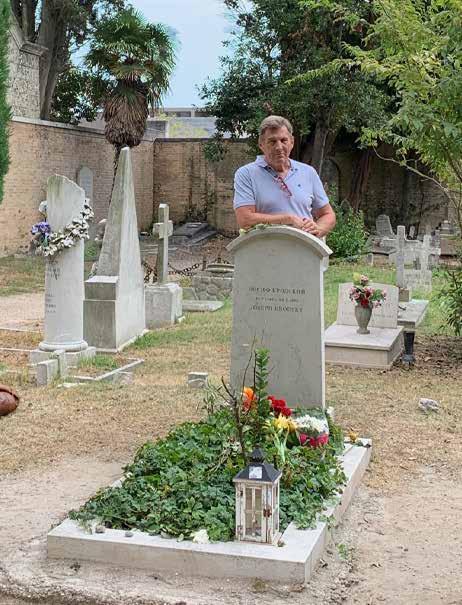
At the grave of Brodsky in 2019.
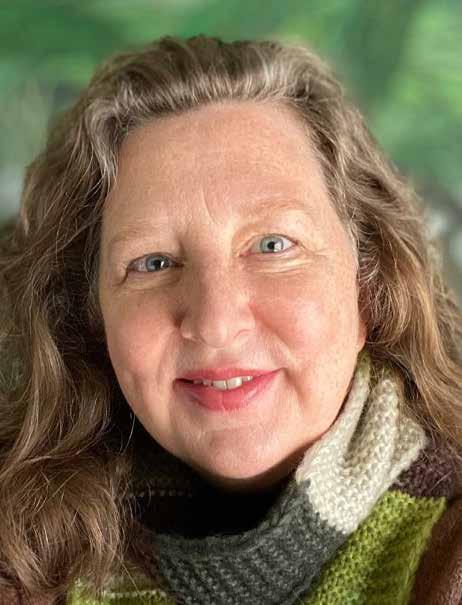
Kim Ports Parsons grew up near Baltimore, earned degrees, and worked as an educator and librarian for thirty years. Now she lives next door to Shenandoah National Park, writes, gardens, walks, and volunteers for Cultivating Voices LIVE Poetry. Her poems have been published in such journals as Vox Populi and Poetry Ireland Review, anthologies such as “Unsinkable: Poetry Inspired by the Titanic” (forthcoming from Salmon Poetry), and nominated for a Pushcart. Her first collection, The Mayapple Forest (Terrapin Books 2022), was a finalist for the North American Book Award, sponsored by the Poetry Society of Virginia. Visit her at www.KimPortsParsons.com.
Anticipatory Grief
Yellow shaft under flicker’s wing in December, echo of sunlight on snow in years past.
Peepers in January. Snowdrops drooping and fading in February heat.
No need for a jacket in March, no oriole flashing its return in the cherry tree.
Hazy embers of pollen dance with wildfire smoke. Sudden gunshots in the woods.
No grand swirl of moths in June’s high beams; the missing flare of a bob white’s call.
Stand in the hover and hum of declining bees. Walk the brittle drought grass.
Mark each day’s burning like an urgent flash of warning from a pockmarked lighthouse.
All-but-lost
Some clear winter morning, when the impossible aroma of hope wakens your senses, pause a moment.
In other fields, dusty hands harvest the ripened grain while fancy bombs steer themselves toward nearby towns.
On rubbled streets across mysterious borders, posters of missing children rattle in a gray and bitter wind.
How can there be anything but bafflement at this wilderness we wander?
The moon sets itself gently down into the crooked clay bowl of the mountain’s rocky arms,
and a kinship for all who have gone before momentarily fills your chest.
Then a keening grows in your throat, presses its swelling note against the next breath.
Peace is an all-but-lost seed in need of fertile ground and rain, or a fragile heirloom wrapped in yellowed paper.
Muster what you can. Brace against that long-forgotten door, stubborn with lack of use and rust, and push—
Outside These Meagre Lines
Planting seeds this morning, purple-podded, asparagus beans, every few inches, along the fence, in bright sun and rich soil, so there’s plenty of room for vines to stretch, for green leaves to unfurl, for orchid-like flowers to open, for long pods to emerge and grow, such luscious abundance to come, a sight for weary eyes.
Outside these meagre lines, down the gravel road, across miles of highway, a plane ride over continents, shackled, trafficked, trucked through security gates, crowded on cold concrete, nearly naked men, no room to stretch, no fresh air, no sun, despair taking root, blank and staring eyes.
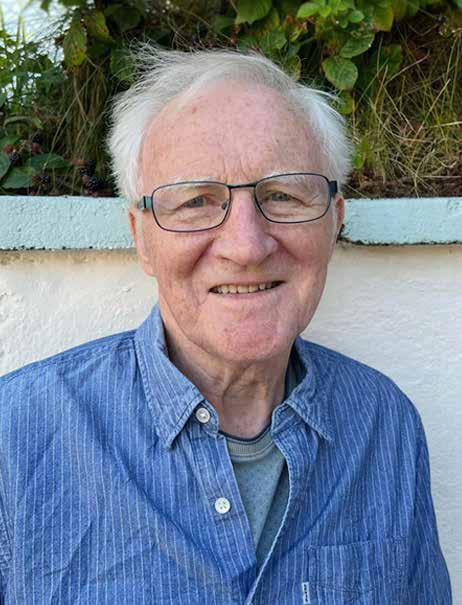
Terry McDonagh, Irish poet and dramatist has worked in Europe, Asia and Australia. He’s taught creative writing at Hamburg University and was Drama Director at Hamburg International School. Published eleven poetry collections, letters, drama, prose and poetry for young people. In March 2022, he was poet in residence and Grand Marshal as part of the Saint Patrick’s Day celebrations in Brussels. His work has been translated into German and Indonesian. His poem, ‘UCG by Degrees’ is included in the Galway Poetry Trail on Galway University campus. In 2020, Two Notes for Home – a two-part radio documentary, compiled and presented by Werner Lewon, on The Life and Work of Terry McDonagh, The Modern Bard of Cill Aodáin. His latest poetry collection, ‘Two Notes for Home’ – published by Arlen House – September 2022. He returned to live in County Mayo in 2019 www.terry-mcdonagh.com
Not from Here
They arrive from god knows where, some bombed out of babyhood, others on the run from hunger and crumbling dreams. To beat the foreign out of them we call them non-nationals, tribe-less-ones who come to us with odd names and languages but they learn so quickly we almost forget they are not native. They don’t forget but they don’t tell us. Some of them are brighter than our own. a teacher told a friend.
Newcomer
Teach me, newcomer, teach me. Teach me how not to smirk and be smug when I see you struggle and teach me to turn my smile to your aid when words fail you and your teeth chatter like hard nails on the doorstep and teach me to understand the small song you sang for us while we rattled out a weary Christmas hymn and teach me to set out for school as a child and to return as a teenager ready to speak up in songs of defiance.
Teach me.
Let me learn the true language of the lark and the white dove –let me learn from you.
Teach me.
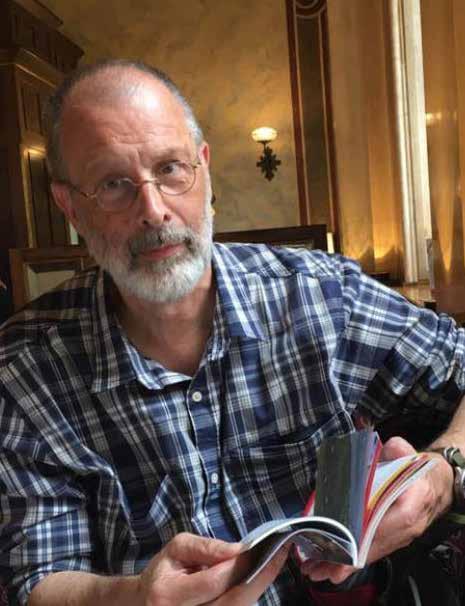
Jordan Smith is the author of eight full-length books of poems, most recently Little Black Train, winner of the Three Mile Harbor Press Prize and Clare’s Empire, a fantasia on the life and work of John Clare from The Hydroelectric Press, as well as several chapbooks, including Cold Night, Long Dog from Ambidextrous Bloodhound Press. The recipient of fellowships from the John Simon Guggenheim and Ingram Merrill foundations, he is the Edward Everett Hale Jr., Professor of English at Union College.
Liberty
Dave calls “Cold Frosty Morning,” and starts it off on his mandolin at a nice comfortable pace. It isn’t morning, and it is only late October, but already we’d had that dawn chill, a light lace of frost on the lawns, an intimation. The rest of us join in—a trio of fiddles, more mandolins, a couple of guitars, a button box, a tin whistle. We are mostly teachers, in one way or another, some retired, one who doubled as a soccer coach and fishing guide, a librarian. We have two guests: a writer winding down a book tour with a residency in my classes who brought along his guitar, and a professional fiddler who plays for contradances around the northeast. We run “Cold Frosty Morning” five times through, and Dave holds up his foot, the usual signal to stop. Joe, sitting next to him, playing the lovely F-style mandolin he made for himself, slides right into “Kitchen Girl,” one of the first tunes we all learned when we started this weekly lunchtime session more than twenty years ago. It’s a good one. We kick the tempo up a little. I stop thinking about all the arrangements and complications and irritations and anxieties of the last month. I’m aware of the dance of my right wrist, of the woody rasp of the fiddle’s low strings under my ear, the sound somehow disconnected from anything I am doing or anyone I am. There’s not much in the world that I like better.
It is a grand session. Our writer guest sings John Prine’s “Please Don’t Bury Me.” The dance fiddler pulls out his twelve-string (another home-built instrument) and leads Lead Belly’s “Go Down, Old Hannah;” later he grabs a banjo for Uncle Dave Macon’s “We’re Up Against It Now,” as close to a political statement as we get. The writer grins. A few faculty and students wander in to listen. Someone calls “Coleman’s March,” a lovely tune, supposedly played by a fiddler on his way to the gallows. Tunes from New England, Quebec, the American south, Ireland. The banjo player has brought along her not-yet-toddler and placed him in his carrier seat in the center of the musicians. He’s smiling.
Of course, there’s a subtext under the shuffle rhythms, the syncopation, the danceable melodies, the group-mind that gets the musicians out of their own heads for the half-dozen choruses. “Coleman’s” is a death march. “Go Down, Old Hannah” is rooted in forced labor and the migrant, relentless, backbreaking conditions that followed reconstruction. “We’re Up Against It Now,” however folksy the singer makes it sound, is an inventory of the havoc modernity caused rural lives and livelihoods and pleasures. The reels and jigs, from Ireland and Scotland and Quebec, carry a legacy of displacement, of exile for all sorts of reasons and the contempt that exiles face. Some well-known fiddle tunes owe their first popularity to the minstrel shows, white musicians in blackface, caricaturing the people whose music they’re playing. Once in a while, one of the players might mention something about a tune’s history. I like that. It’s part of the occasion, but it’s not the whole point.
And except for a few sidebar conversations, neither is the history of any of us. I’ve known some of these people for thirty years or more; some not so much. When I look around the circle, it’s easy to catalogue the losses that people carry: partners or marriages, children, parents, abilities, jobs. And what they have to face up to: a recent stroke, a mother’s house to be sorted after her passing, a spouse’s illness, diagnosed or seemingly undiagnosable, the familiar hassles of familial care treading on job demands. And, of course, the omnipresent political grief of America in 2025. It’s a wonder, I think, that some of us can find the time or the presence of mind to pick up an instrument, get it in tune, learn another jig or reel or song well enough that we can leave the sheet music home (if we ever had it to begin with). It’s not an evasion, not really. The tunes themselves, and the old songs with their stories of violence or with the verses that nobody wants to sing anymore because of the truths they tell about history and suffering and the cruelty of what once seemed like humor, are too much of a presence for that.
But start playing, and the tunes are just notes in our fingers, no matter what the titles might recall, if we even recall the titles when someone has played the first few bars and we join in. Not everyone in the circle has much interest in the history of the tunes, accurate or imagined in a cloud of nostalgia for a country before the past became so contested that we can hardly see it. It’s social music, not, as my fiddle teacher said once, a spectator sport. And not a history lesson, or not just one; saying something about the lineage of the tunes is another contribution to the moment of losing yourself in their music.
Still, going back to Uncle Dave’s “We’re Up Against It Now” reminds me of Peter Matthiesson’s Shadow Country, where Lucius Watson, the son of the sometimes charming and thoroughly murderous Edgar “Bloody” Watson, spends his life like a drunkard spends his bucks at a bar, trying to write a biography that will transform his father from killer to rough-and-ready pioneer of Florida’s cane syrup industry. Lucius has no direction home. The world he grew up in, hunting and fishing, learning and loving the glades and keys and avoiding the truths of his family and the bloodiness of making a living there, is going, going, gone to real estate scams and political connivance, and it was never an idyll to begin with. The Edgar Watson who killed his field hands instead of paying them embodied the violence of that first world, just as much as he prefigures the scheming and profiteering that drive the modernity that shouldered it aside. There’s irony in Lucius’ ramblings through this place that’s both his and not, here and gone, and empathy in Matthiessen’s treatment of his loss-riven life, but not much humor, certainly none of Uncle Dave’s wry tone as he catalogues what the automobile has done to the farmers and 1920s fashions have done to their wives and daughters. But there’s a common recognition of shared witness, implicit in Shadow Country and perfectly clear in Uncle Dave’s slapstick use of the collective “we’re” as he invites us to sing along on the chorus. “We’ re up against it now.”
We’re poised, all of us, between our private attritions and the destructions of a common world, which we know is a hard, often vicious place and always was except when we acted as if it wasn’t. Outside, afternoon darkening, the temperature falling; we’ll have another frosty morning coming. Inside this college common room, a baby is smiling at the center of a circle playing, of all things, “Coleman’s March,” that sweet tune marking an approaching tragedy. We know our history and we know the costs, memorialized in the music we play, just as we know all that’s waiting for us when we leave, but that’s not the first thing on anybody’s mind right now. “Liberty,” calls the next person in the circle, and we start that one off, another good tune as long as it lasts.
In the Pines
He listened to all the versions he could find, From field recordings to MTV, country bands And Cajun, and of course Huddy Ledbetter’s, And if anyone who sang it wasn’t doomed, Still they sounded like they were, and his steps As if he’d actually been there, grew quieter As the mix of needles and duff deepened, Each turn of the trail marked with some Ambiguous sign—jay’s feather, broken Finger of a branch, a whisper or snatch Of song in the boughs, tell me where Did you sleep last night--and he put One foot in front of the other as he’d always done, Which is what we do, because deception is Never where we mean to find ourselves, just These woods we walk through.
Threadbare
His friend said, “I saw how threadbare
My hold on life was,” and he thought
Of the Donegal tweed, second-hand, rewoven
Where the lichen and russet herringbone
Snagged on a bramble when he bent
To deadhead the roses, and the moth hole
Hidden below one lapel, and the streak
Of rust where he draped it on the iron fence, And how it would find its way soon
Enough to another thrift store or braided,
Like his father’s wedding suit, into a rug
Lying for years on the same pine floor
Of the room where they said the vows.
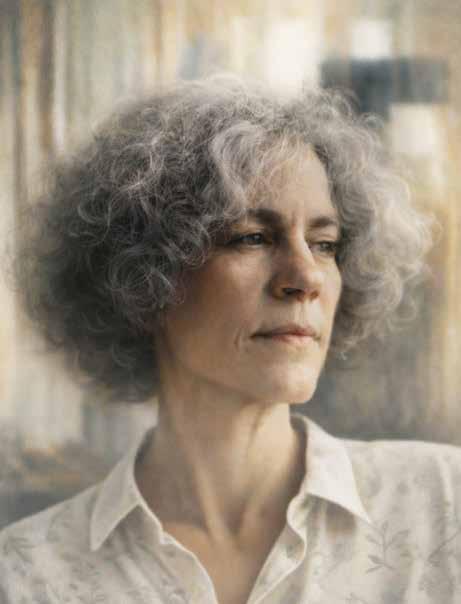
Susan Keiser is an interdisciplinary artist who lives in a restored Gothic Victorian in Beacon, New York. Her photographs have been exhibited in solo and group shows in a wide range of galleries, museums, and art fairs and her poetry has been published in the Stone Poetry Quarterly. She is the winner of The Comstock Review’s 2025 Muriel Craft Bailey Prize. You can find her online at www. susankeiserphotography.com.
Smoking Gun
Jimmy Lock was lucky enough to have parents who were never home. With pockets full of matches and no place to go he was irresistible to us kids who followed him despite stern warnings.
Jimmy Lock bought us cigarettes and taught us to smoke, insisting we inhale though it made us sick. Bored, we pressed the tips through dead leaves, making cinder halos that smoldered orange when we used them to spy at the sun.
Jimmy Lock was too old to be playing with us, except for maybe my sister— I know they were alone in his house once but never found out what happened.
Bad skin, short blonde lashes, I can still see him walking toward me thin lips pressed tight.
No words form. No smile breaks.
Wisconsin Death Trip
1.
Cousin Edna, our relation by habit not blood, owned the town’s only flower shop, which she tended in a wilted kitchen apron, hair tidied in bobby-pinned curls, hands gloved in leather when she handled thorns. Inches taller than me even in her moccasins, she smothered me in a bear hug the day we met and my mother ordered flowers for grandmother Caroline’s funeral—white spider mums for the altar and pink sweetheart roses for the coffin spray. I was the only one surprised it was just the three of us in the pews when the gleaming cherry casket arrived at the door and taped organ music washed over the marble floor stained by streaming glass saints.
Grandmother’s neighbors were all at her wake the night before, bustling past me at the door where I stood refusing to go inside and look at the dead body put to bed in a satin-lined box. But seeing Cary in her coffin was why they showed up—to chat about how well she looked, or not, and to inspect the daughter who left years ago and never visited. The day we picked out the casket my mother told me that when grandmother found out she was dying, she pulled my mother onto her bed to whisper that she hated her, she’d always hated her, and she prayed for her to get cancer too.
Caroline was buried next to my grandfather, his brothers, his parents, and his grandparents, in the last available grave in the family plot. We followed her out of the church, then followed the hearse to the cemetery and watched without speaking as she was lowered into the ground and covered with dirt, grateful for the music coming from a large funeral several plots over, a mixed tape of hymns and pop songs— “How Great Thou Art” and “Dust in the Wind.” My mother held the rose spray in front of her like a shield until the workers were finished and arranged it on the mound.
continued overleaf...
There was a parade the day we left. Heat shimmered the pavement in that crazy way that looks like water and takes the now out of time.
Flags hauled up poles at dawn hung stripes in the too-heavy air as crepe-papered car floats inched by, local luminaries waving in slow motion as they’d been taught was proper and the way it was done by royalty.
Trapped on the wrong side of Main we drove block by block past orange-coned intersections, glimpsing the festivities in noisy bursts, like watching one of those sprocketed old movies played too many times.
It made no sense this parade— the flying batons and Sousa marches— until I remembered the Fourth of July, and the delays caused my mother to panic that we would miss our flight—
a panic that grew on board into quiet cries she was having a heart attack, cries that only I was allowed to hear, until we reached New York and she was fine.
We arrived on the flight path that takes planes over the entire length of the island. Outside my window I watched the fireworks silently flame up from the river.
Rosa pteracantha
is a rose with razor-winged thorns glowing bloody when backlit like waves atop a red sea rolling up each bristled stem of a rose cane of thorns with pearl-budded flowers four–petaled not five blue foliage like pleats on skirts forever pressed like a rose herbarium specimen or a watercolor by Redouté court painter to Marie-Antoinette of the one quote like you Gertrude your Rose Period portrait looking more like Picasso than you, O Gertrude, O so singular Gertrude, you who could not be pretty chose to be wise.

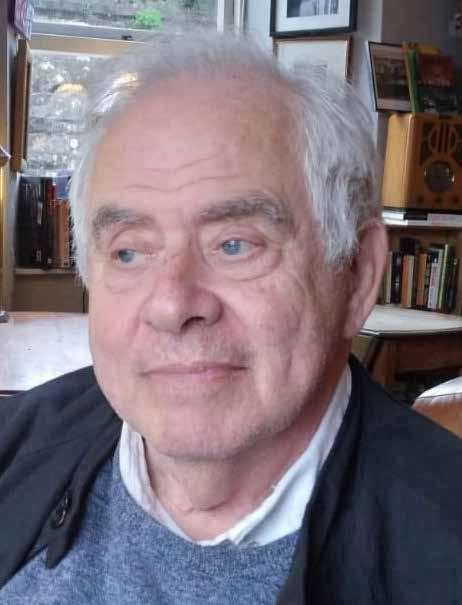
Richard W. Halperin holds U.S.-Irish dual nationality and lives in Paris. On 1 November 2025, Salmon Poetry/Cliffs of Moher brought out All the Tattered Stars: Selected & New Poems, Introduction by Joseph Woods, which showcases 92 poems published by Salmon and by Lapwing/Belfast since 2010 and 26 new poems. On 7 January 2026, Mr Halperin was Special Guest Reader in the First Wednesday Poetry and Open-Mic Series, White House Bar, Limerick.
On January 19, the poem ´Now, Mother, What’s the Matter?’ from the new collection appeared in The Guardian as Poem of the Week.
Compassion, or The Life of Richard Savage
For those who would like to read a portrait written with love, sadness and mercy, of a man who, in life, was often impossible to get along with but who was sweet, I would recommend Samuel Johnson’s ‘The Life of Richard Savage,’ a now-forgotten poet. The essay intermingles Richard Savage’s suffering with Samuel Johnson’s suffering in writing about it.
One has known people for whom one has great affection but who become, over time, impossible. I have known a few such. They had lost their capacity to co-operate with friendship. In that regard, the exquisite portrait of Richard Savage helps me. If mercy can be a métier, may I begin to learn it.
States of Grace
I once had the good fortune to see Julie Harris as Emily Dickinson in The Belle of Amherst. She was in a state of grace. The stock market is illusion. States of grace are quite real. I write these lines in Ireland. John F. Kennedy in his Ireland visit in the summer of 1963 said he would be back soon. Hope, good humour –it is possible in politics. There it was. Over the last few days several people have mentioned that visit to me. He is back. He is all over the place here.
Bowls of Light
I think there is a bond between Samuel Johnson’s common reader and Seamus Heaney’s human chain.
The common reader – not experts –determines what books shall live over the centuries by continuing
to buy them. The human chain –the passing down from one person to the next of a favourite thing –
a book, a bucket, a story – gives strength and reality to our chaotic world. A friend once told me
that his mother, on Saturday night before Easter, would place a bowl of water on the kitchen
window sill, so that when the morning sun hit it, it would become, briefly,
a bowl of light. I am glad he told me the story. I am glad of bowls of light.
Quality and Magnitude
‘Never say you know the last word about the human heart.’ - the opening sentence of ‘Louisa Pallant’
A longtime friend died peacefully here last night. Like me, American-born and raised; a resident of France; a working artist. I am glad – it helps – that a few days ago I reread Henry James’s short story ‘Louisa Pallant.’ In a collection of seventeen of his short stories, commentaries by Clifton Fadiman, in a 1945 Random House Modern Library edition. All the evil in the world – in this case, between mother and daughter – is described, but not entirely understood, in beautifully weighted prose and set in lovely locales amongst the lakes of Italy and Switzerland. This is God Bless America. Quality, magnitude and commerce: Henry James, Clifton Fadiman, Donald Klopfer and Bennett Cerf who founded Random House. Everything aimed at the mainstream. This is Moby Dick, also Modern Library. Madness slowly exposed and left that way. The balm of art. In these instances, American art. In grief, great art – ‘Old Man River,’ ‘Delta Dawn’ – can be applied topically. My friend died. I apply it.
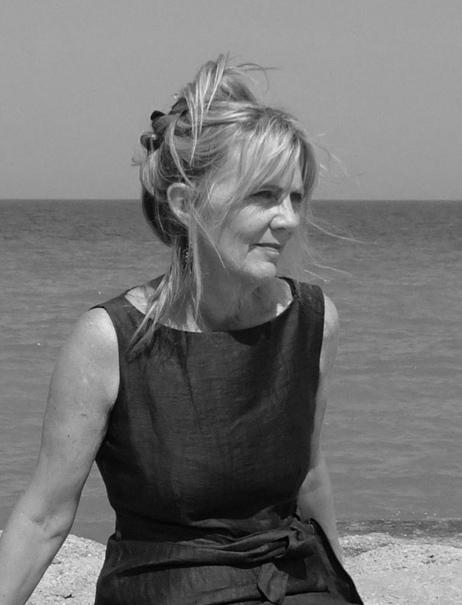
Lynda Tavakoli lives in County Down, Northern Ireland where she has facilitated adult creative writing classes for a number of years and worked as a tutor for the Seamus Heaney Award for schools. She is a professional member of The Irish Writers Centre and has been nominated for both the Best of the Net and The Pushcart Prize. A poet and novelist, Lynda’s work has been published worldwide with Farsi, Spanish and Arabic translations. She has won a number of international poetry and short story awards and been published in numerous journals and anthologies including Live Encounters Magazine, Lothlorien Poetry Journal, The Galway Review, Skylight47, Abridged, CAP Seamus Heaney Anthologies, Eat the Storms, Drawn to the Light Press, amongst many others. Lynda’s debut poetry collection, The Boiling Point for Jam received wide acclaim for its raw honesty and authenticity while her latest collection A Unison of Breaths has been published by Arlen House.
What It Does To You
The intrigue the plain brown envelope the name misspelt the address sketchily penned with malevolence by some unknown hand
Interesting
The opening the folded white A4 the photocopied sheet no prints but mine then (clever) the six lines of loathing magnified in black ink
Really?
The follow up the police the questions the who why what when of the perpetrator the forensics the underlying threat
For Fuck’s sake
The aftermath the wondering the knowing that life has altered just like that the boiling anger at the risk you suddenly need to take just to put your name at the bottom of a bloody poem
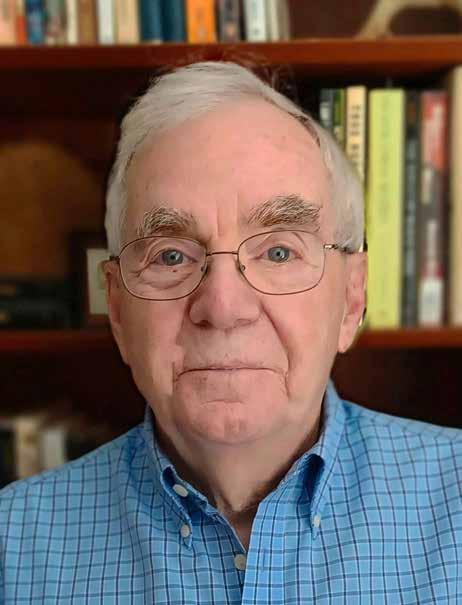
Peter A Witt is a Texas poet and a retired university professor. Peter’s poetry deals with personal experiences, both real and imagined. He is a twice published Best of the Net nominee. His poetry has been published on various sites including Inspired, Open Skies Quarterly, Medusa’s Kitchen, Active Muse, New Verse News, and Blue Bird Word. When not writing poetry, Peter is an avid birder and wildlife photographer.
Median Elegy
Along the median between six roaring lanes, three northbound, three south, the curbside wildflowers weep like mourners at a roadside wake as behemoth tractors descend, twelve-foot blades whirring like rotary guillotines, mowing down unsuspecting bluebonnets, Indian paintbrush, and evening primrose, grinding them into confetti of leaves and crushed petals.
Their severed stems reveal what lies beneath, paper cups, waxy wrappers, the greasy ghosts of fast-food meals, all disgorged by hurried hands too lazy to wait for a trash can, too indifferent to beauty’s brief tenure.
Other drivers murmur their dismay, why not let the blooms finish their final dance? Why the rush to unveil the detritus? They know, deep down, that calls to the highway department will yield only the shrug of bureaucracy, soft-spoken sympathy and no change in the merciless schedule.
Kerrville After the Rain
The Guadalupe River rose like a beast unchained, gnashing at bridges with foam-flecked teeth, its roil a griefquake that swallowed the day, children’s slumber interrupted by sleepless terror.
Picnic tables floated with vicious intent, tangled in branches like forgotten vows, beneath skies that stormshuddered blue to black, while prayers clung to porch rails like ivy.
The river mirewhirled with roiled trees and toys, bibles, shoes, and fireworks now shipwrecked hopes, and silence followed like a stray dog, refusing to leave the wreck behind.
A flag caught in a fence began to twitch, its stars like tears on a wrinkled face, while the wind soulspilled across the fields, and survivors stood, soaked with remembering.
Sunday at the Briar Patch Café
Meet me at our usual spot where yellow awnings bloom like sunflowers spilling gold across the sidewalk, and the tables hum with stories told between sips of strong coffee and laughter that skips like stones.
The street is a soft symphony, chatter and clink, footsteps and breeze, the rustle of leaves overhead a lazy lullaby for the heat-drunk noon.
Meet me where couples lean in like vines, entwined in soft secrets and subtle smiles, while friends scatter joy like confetti over empty cups and crumbed plates,
where a red car naps at the curb, its engine stilled like a dreaming dog, and the windows above watch with the quiet wisdom of stained glass.
Come when the shadows start to stretch, and the golden light slips sideways, we’ll sit beneath the saffron umbrellas, breathe in the scent of syrup and stories, and let the soft spell of the Briar Patch wrap around us like summer’s sigh.
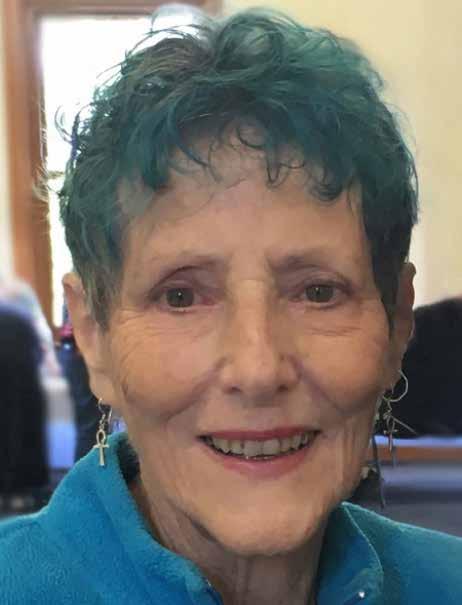
Patricia Sykes is a poet and librettist. Her poems and collections have received various awards, including the Newcastle Poetry Prize, John Shaw Neilson award and the Tom Howard Poetry Prize. She has read her work widely and it has featured on ABC radio programs Poetica and The Spirit of Things. Her collaborations with composer Liza Lim have been performed in Brisbane, Melbourne, Sydney, Paris, Germany, Russia, New York and the UK. She was Asialink Writer in Residence, Malaysia, 2006. A selection of her poems was published in an English/Chinese edition by Flying Island Books in 2017. A song cycle composed by Andrew Aronowicz, based on her collection The Abbotsford Mysteries, premiered at The Abbotsford Convent Melbourne — now an arts precinct — in 2019. A podcast of this work is available on various platforms.
A Need for Gentle Verbs
After ferocities of loss some of the bushfires still burning, the setting sun a fireball, hazed and hazing, casualties rising by the hour wildlife, domestic herds, homes, livelihoods the brutalised earth in the grip of heat’s mirage struggles to open its lungs nights become sleepless packed treasures wait by the door for evacuation orders while helicopters prowl the forest canopy for telltale smoke; mornings become a gift when beneath my feet the foothills continue to breath gently, kindly
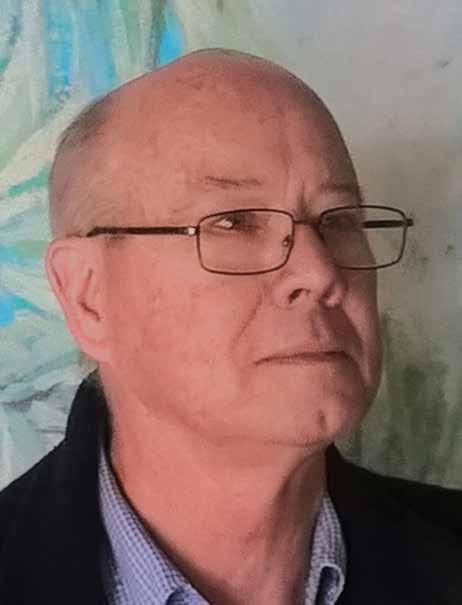
Paul Williamson lives in Canberra. He has published poems on a range of topics in Australia, NZ, the US, UK, Canada and Japan. His collections include A Hint of Eden, Along the Forest Corridor, and Edge of Southern Bright, published by Ginninderra Press. His background is in Earth Sciences.
Memories of Travel
Sydney’s grime and familiar striving
Tokyo with business and blossoms
Bali hoping for sunny peace
Bangkok’s temples and floating shops
Djakarta full of living
Seoul with kimchi and inner strength
Hong Kong busy with commerce
Mumbai’s crowded history
Washington filled by intrigue
Doha flush with oil money
Ottawa in frozen hope
Mexico’s patterned colour
Santiago under clouded Andes
Barcelona’s mystic art
Lisbon with sea swept history
Dublin living its culture
Rome a seed of God
Paris with vistas of art
London where my children were born.