Eileen Casey - Where the Sunbird sings

Page 1


Where the Sunbird sings

Eileen Casey Where the Sunbird sings

Copyright © Eileen Casey 2026

First published by Eileen Casey Ireland

All rights reserved.

No part of this publication may be reporduced or transmitted in any form or by any means, electronic or mechanical without permission in writing from the author and publisher, except by a reviewer who may quote brief passages in a review.

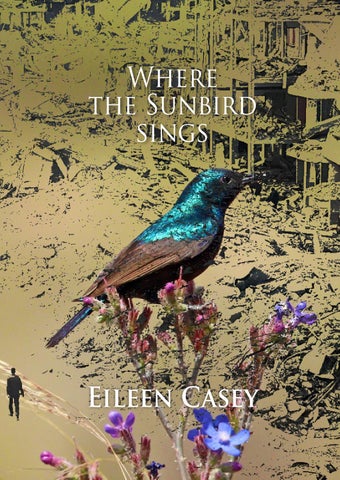
Cover photograph: Palestine Sunbird https://commons.wikimedia.org/wiki/File:Palestinesunbird_Cinnyris_osea_osea) Charles J. Sharp, CC BY-SA 4.0 <https://creativecommons.org/licenses/by-sa/4.0>, via Wikimedia Commons

Cover design/layout/produced by Live Encounters Publishing https://liveencounters.net Email: editor@liveencounters.net

Photo Credit: Mark Ulyseas
© Eileen Casey

Introduction

Feeling helpless in the face of such horrors suffered daily by men, women and children in Gaza, I wanted to write a response. It’s an attempt to explore and expose, to commemorate and ultimately, express painful truths.

Inspiration for these poems come from various areas. I was in Vienna on 7th October, 2023, waking up in a beautiful city to horrendous news. Birds feature prominently in my poetry. In times of unrest, looking at the natural world provides healing energies. How wise this world is. Seasons keep changing no matter what we do. There is a continuity and resilience that’s comforting.

Most of these poems are new. The Power of Poems was runner-up in a Poetry Ireland/Trocaire Competition, 2019 (Love Conquers Fear) while Poet as Peacemaker won the P.E.A.C.E. prize in 1996.

Photo Credit: wesley-pacifico-ZIckJeXqm90-unsplash

7th October, 2023

My first morning in the City of Music. I’m humming The Blue Danube, choosing my clothes, an ordinary task on a day that’s anything but. Held in the soft sway of a waltz, I’m already tasting strange excitements in this Baroque fairytale landscape.

My sister’s not an early riser. Soon I’ll rap on her hotel door; three sharp knocks, our agreed code. After breakfast we’ll stroll Vienna streets cross St Charles bridge, mingle with others heedless with time. Fill up with laughter. We’ll breathe the scent of the river, admire swans detonating light. Perhaps we’ll drink wine over lunch. Later, browse alleyways. Come evening, we’ll attend a concert in Karlskirche, transported by Vivaldi.

In the corner of my room, a newsreader unfolds a chiaroscuro tale, barely making sense. I lean into the screen, disbelief ebbing every last drop of joy. The music of Strauss dies, becomes a funeral dirge. Three sharp knocks later, we hold each other; my sister and I. Cry for the slaughter.

Photo Credit: Mikyoung Cha

Bleach the Sky

Take away morning’s dew juicing spring soil. Tears already drench the earth. Remove giant oaks. They refuse to block the view; provide shelter. Silence warblers – and the blackbird, Crows do more than enough. Let us be content with them.

Send swallows back from whence they came, a one-way ticket. Bleach the sky, every hint of blue gifted to Mars, God of War.

Drain the lakes. Down to muddy depths. Swans soon learn how to fly. Let them go elsewhere.

Time to move on. No more vessels. No more cargoes of hope. Raze the boathouse itself to the ground. Drop anchor into this apathy.

For where’s the good in anything now?

Photo Credit: levartravel-0lWloaFK4Gc-unsplash.jpg

Storyteller

Answer when I call. Bring news of enchanted lands. Let pearled words seduce me. I am willing to believe.

Share news of fledglings, plump as new moons. Parents darting to their care like hummingbirds. Awaken my senses. Let me savour fiery flavours.

Don’t talk of skeleton children, bone thin or dark eyed babies, their light all but quenched. Weave me instead into long, green, grasses rising towards skyscraper clouds.

I won’t accept sounds that haunt me. Wailing mothers. Empty breasts; no nourishment for suckling babes. Don’t dare relate how long it takes to starve. I refuse to listen. It shadows the sun.

Draw back the veil on a marriage morning, as if clearing a mist. Show me a bride, radiant in wedding clothes. Her husband planning their future. Fly me to the very top of Ali al Mintar* so I can look upon a land of plenty.

Don’t bring me stories that refuse sleep, or sensations that crush peace to dust. I beg you Storyteller. Swell my heart. For the span of one whole day, grant me hope.

*Ali al Mintar is the most prominent mountain in the Gaza Strip

Photo Credit: diana-yildirim-NJJUa3irfCs-unsplash.jpg

Flight Paths

In joy or woe, we weave, we flow. We trust our neighbour’s help to navigate our path as flocks of starlings’ flight formations must.

Dark forces gather, filled with greed and lust. Evil ferments such bitter grapes of wrath. In joy or woe, we weave or flow. We trust.

Town-lands of the heart crumble into dust, search clear skies, track the aftermath as flocks of starlings’ flight formations must.

Battle cries at dawn children’s laughter hush, Fluorescent bombs onto starlight grafts. In joy or woe, we weave or flow. We trust.

Tribe unite with tribe. This is right and just. Shadows fade, replaced by sunlit shaft as flocks of starlings’ flight formations must.

Between rise and fall, we seek pastures lush, Soothing hands heal broken lives, bereft. In joy or woe, we weave, we flow. We trust As flocks of starlings’ flight formations must.

Famine

We Irish know about hunger. It’s in our DNA. 1848. Crops fail, potatoes blighted. Whole families found, grass stains greening dead lips. Bellies swollen in grotesque parodies of expectation.

We know the work-house horrors. Separation. Cold. Meagre portions. Young women transported to Tasmania forced to marry strangers, populate while Ireland’s numbers dwindled.

Some Landlords exported grain, greedy regardless. Nothing for tenants already stretched to breaking point. Our history is punctuated by such deeds, creating bitterness and hate.

A shaft of sunlight enters dark days. Relief swells from The Choctaw Nation, A tribe so far away, recognized our plight. Though persecuted themselves, displaced, corralled into reservations, they found it in their hearts to gather what they could, ease our suffering. We thank The Choctaw Nation. Today, our bonds are strong.

Which nations can look Gaza in the eye?

Know that aid, however small ripples outwards like the ocean?

Which nations will leave a legacy?

Generosity and sharing, neighbor helping neighbor?

In Steinbeck’s Grapes of Wrath, A woman bears a still born baby. She offers her breast to an old man dying from starvation. An act of supreme humanity, metaphor for all the ages.

Photo Credit: kevin-mueller-iBER-hi4DyU-unsplash.jpg

Gaza Birds

Hooded Crows, underwings heavy. Undertaker birds, eyes dead as stones. Carrion rows perch on concrete blocks. Line the route to makeshift cemeteries on burial days.

Croaking Crows. Aping sounds of conflict. These birds know the rituals of mourning.

Unlike the humble rooster, symbol of hope. Triumph of domestic routine in a daily grind.

Tiny canaries sing the heartbroken out of despair. Provide distraction, however short lived. Canary males do all the singing. Mostly to entice the female bird. Moulting in late summer, he will not sing, as if loss of feathers also thieves his voice.

In Gaza, men mostly go to war. Stripped of home, wife and children, they also lose their song. Caged by senseless struggle, sipping slow beads of time, clothed head to toe in grime. Such singers no longer have a rhythm or a rhyme.

Photo Credit: https://www.newarab.com/news/over-300-gaza-children

Ring a Ring O’Rosie

After a photograph, Irish Times Review, Saturday, May 31st, 2025

You could be a flock of cockatoos, proudly crested. Or a necklace of wrens, the birds of poetry. Like the ones marked out Michael Hartnett. Proclaimed him poet. But children are not birds, able to fly away. Nor have you pecking beaks to forage with. Yet, there is poetry in your dance.

Hands held, you circle one of your own, singled out in the center of your ring. She’s taking her turn at being special, a right you each possess.

Ring a Ring O’Rosie

A pocket full of posies

Atishoo, Atishoo, We all fall down

A rhyme dredged from childhood springs to my lips. First impression on seeing this photograph. Gaza children playing in the rubble. Behind your playful dance, slabs of smashed concrete resemble broken tombstones. Reveal a terrible truth.

Children of Gaza, you perch on the edge of a world sliding ever closer to the abyss. Yet, you dance. Hand to hand. Wing to outstretched wing.

Commemoration

How will Gaza be remembered?

Poppies bleeding into shallow graves or ivy wreaths placed on cenotaphs? In requiems perhaps; composed for buildings powdered to bone. Reminder each anniversary how homes became hollow shells, curtains fluttering like torn flags.

How will the world remember Gaza? A monument of worn sandals high as shoe slopes at Auschwitz?

In the limbs of the maimed, sculpted from ash? Or in moments of communal silence starved of clamor?

How will I remember Gaza? In slide-shows projected onto my consciousness; dark-eyed children rummaging for scraps. Too weak to grieve mothers, fathers, sisters, brothers. Children thin as Gaza mules pulling carts. Straining under salvage. Even in dreams they will find me.

The Power of Poems

Poems detonate hope, in those who hide in fear along remote hillsides. Poems are sturdy vessels when put to sea, strong enough to navigate stormy waves, rebuild war torn cities so rubble becomes sturdy foundations. Poems don’t turn a stranger from their door. Won’t allow shame or ignorance to cloud their better judgement. Poems replenish and revive, offer shelter, food, warmth. Lend reprieve to those bereft, who fear the sniper taking aim, smell cordite on the wing. Poems pour oil on troubled waters, soothe and salve. Poems dry tears shed in lonely rooms on lonely streets at day-break or at close of day. Inspire other poems in other poets. Poems go about their business, light unquenchable beacons. Poems very presences weaken the same unease Fear thrives upon, stirred up by those who never can be easy. Those who break the homes and hearts of others. Poems release them too from this cycle. And their children.

Poems, like berries on a rowan tree are succulent, rosy food for singing birds.

Photo Credit: Charles J. Sharp - Own work, from Sharp Photography, sharpphotography.co.uk, CC BY-SA 4.0, https://commons.wikimedia.org/w/index.php?curid=69643113

The Sunbird

‘Whenever you face injustice or roughness, remember to defend yourself by finding beauty – document, prove, and defend it because all beauty is resistance.’

- Palestine Poet Tamin Al-Barghoutj

Moving free across borders he remains loyal to his homeland. Often seen in gardens, orchards, citrus groves. Nectar fed. A good life for a bird.

Vibrant, iridescent metallic blue plumage proclaims his gender, females are more muted.

Olives trees decimated, resilience marks the sunbird’s nature; nesting in craters hollowed out by shells. From here, even above gunfire, the sunbird’s song pitches high.

Aftermath

When it’s over, who will put Gaza back together? A political humpty dumpty after a fall. Surely, there’s a re-ordering of chaos, a clean-up of sorts?

Who will hoover up tons of fragmented buildings, boulders powdered to dust? Are there sewers ready to stitch torn fabric swung like chasubles from glassless windows? Blinded by countless detonations. Are there needles with eyes large enough so even a camel passes through?

Where will the urge to put things right come from?

The spirit drained? The maimed? The childless, jobless, homeless, loveless?

How will those despairing excavate their dreams, buried under mounds of hate in places once held precious? Will these dreamers also lose their way? The Theseus thread, like sleep, such a broken thing.

Is there a table round enough for Leaders brave enough to gather with one mind? Hearts opening wide enough for change? Voices loud and clear above the clamour?

Poet as Peacemaker

They fought and bled on battlefields, and yet Sassoon and Brooke blazed against war, in verse, knew truth and lie to be ill-matched, ill-met that peace flames in truth, not rhetoric terse. Men who wage war raise high the coward’s sword leech vainglory from untimely deaths. Those evil deeds become the coward’s hoard hatred stored, more evil they beget. Come poets, renew the powers of peace, to beacon truth where falsehoods are to blame. So bleakest hearts some comfort can release, all hurts to heal where peace has been defamed.

Come poets, blaze the name of peace in verse, let words of truth give comfort and redress.

Pomp and Circumstance

Gaza is not Versailles. No courtiers teetering beneath powdered wigs, fawning over jewelled costumes. There’s no long halls in Gaza, no flirtatious fans hiding excess. In Gaza, homes gutter down like candles. No gilded mirrors reflect faces, corpse white. Versailles sole concession that death comes even for kings.*

In Gaza, there’s nothing but shards, sharp as knives. Sledged to smithereens by gunfire blast. No feasting tables. Or crystal goblets crimson-full. Such colour bleeds from wounds. Open sores. Diseased bodies.

In Gaza, Elgar’s music is silent. Bombs rip skies to shreds. So little to celebrate in any case. Birth so fraught. New-borns signal another mouth to feed.

Gaza is not Versailles. No pomp. Yet, circumstance imprisons all.

*Quote from Sir Thomas More

Map Maker

Camp after camp, in dust or mud season a farmer maps his land. Flood waters wash boundaries away. Winds in hot, dry months scatter fields and fences into empty acres.

Yet, he re-traces his farm. So his family walk land fled from under cover of night; find shelter beneath decimated olive trees. No time to gather keepsakes. Pots or pans. Nothing to carry but the clothes on their backs. The weight of history.

With calloused hands he shapes for his wife a garden. Damask roses, lilies. Scents ready to detonate in craters sculpted by shells. Nesting trees disturbed, sunbirds build homes here.

Earth arcs half-moons under his fingernails. Plants root in soil, centuries deep. Bled into. Nurtured by ancestors’ bones. Knelt upon. Celebrated if blessed by rich yields. Mourned. Tears shed for blighted crops or the loss of a goat.

A farmer and his wife stack fields with barley. Scythe wheat; movements graceful as the desert lynx. Cotton planted in drills flower white to yellow.

Camp after camp;

refuged under galvanised sheets or in buildings roofed by stars, a farmer sows and reaps, mapping out his harvest. So his children remember vibrant colour. Undimmed where sunbirds sing.

Photo Credit: Mikyoung Cha

This Better Life, A Migrant’s Tale

We need more night for the sky, more blue for the daylight (John Ashbury’s ‘Train Rising out of the Sea’)

Birds are plainer here for sure. Feathers dull. And shrill. Blooms too seem jaded; spearing through frozen ground.

No mangrove avenues here. Calypso protests nor dusty tracks for mules.

No tyre mounds stacked to burning height nor galvanized roofs or canvas tents rippling a mirage. Absent too, palm trees. Protection against drought.

(ii)

Everything here’s so orderly. Neat streets. Houses planted in rows. Cold, crisp sheets. A line of beds. Three meals served prompt. Women do not wash

clothes in nearby waters, breaking into dance, like flower heads bursting into seed. No hip-sway in the rinse and squeeze. This better life

in Direct Provision takes away choices, launders, starches, labels. Food comes in plastic containers, always carrots. Paler than an Osprey’s crown.

This better life hacks at mother tongues, shards of broken English prick like thorns. Makes neither fish of one, fowl of the other.

Photo Credit: Mikyoung Cha

Acknowledgments

Acknowledgement and gratitude are due to Mark Ulyseas and Live Encounters. Having such a poetry resource and keeping it afloat for so long is an outstanding achievement.

Lynda Tavakoli. Her fine Gaza poems are an ongoing inspiration. Her generous spirit continues to enrich our poetry community.

Miled Faiza (Teaching Professor of Language Studies, Brown’s University, UK) who is currently translating some of these poems into Arabic. .

Eileen Casey is originally from County Offaly, now based in South Dublin. Casey’s poetry and prose are published in magazines and journals including The Irish Times, Ireland of the Welcomes, Crannog, The Stinging Fly, among others. Her work is also included in anthologies by Dedalus Poetry, Faber & Faber, The Nordic Irish Studies Journal, New Island, Salmon Poetry, The Ulster Tatler,among others.

Awards include: A Sunday Tribune/Hennessy Literary Award (Emerging Fiction), The Oliver Goldsmith International Poetry Prize, and a Patrick and Katherine Kavanagh Fellowship (Poetry), among others. She is author of chapbooks, poetry collections, short stories, prose, (Arlen House, New Island). ‘The Black and Tan Raid on Clontyglass,’ commissioned by County Laois, Culture Ireland, debuted in Mountmellick Community Arts Theatre (2025), ably acted by the Ballyfin Players.

‘Treasure’ (Peatslandgathering) features a short film of Casey’s bog poetry (awarded by Culture Ireland, County Offaly). ‘Peat’ and ‘Bog Wish’ were commissioned by composer Fiona Linnane and featured during Longford Lights (2025) and Birr Vintage Week and Arts Festival (2025). Casey’s work is broadcast on Sunday Miscellany (RTE). Over the years she’s received bursaries and awards from The Arts Council, An Chomhairle Ealaíonn and both Offaly and South Dublin County Councils. She has shown a number of poetry in public places installations, most recent being ‘Palimpsest’ (a collaboration with Visual Artist Emma Barone), in Birr Theatre & Arts, Birr, County Offaly.

Turn static files into dynamic content formats.
Create a flipbook
Issuu converts static files into: digital portfolios, online yearbooks, online catalogs, digital photo albums and more. Sign up and create your flipbook.
Eileen Casey - Where the Sunbird sings by Live Encounters - Issuu