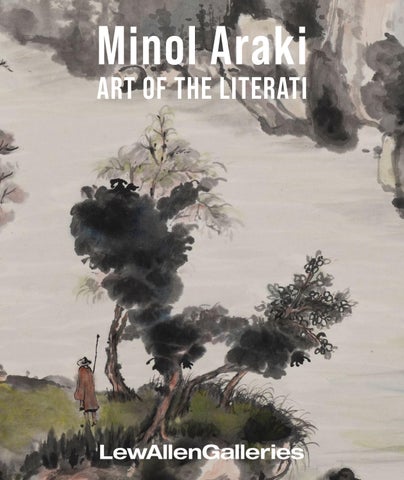
Minol Araki ART OF THE LITERATI


Angry Monkey
ink & color on
36.25 x 72.75
Minol Araki: Art of the Literati
The extraordinary brush and ink paintings in the time-honored Chinese manner made by Japanese-American artist Minol Araki (1928-2010) represents a unique artistic trajectory, distinguished by a practice that remained entirely independent of commercial concerns—a sensibility rarely encountered in the modern contemporary art world. Araki, whose commercial career was a highly successful one as an industrial designer, never sold his paintings during his lifetime, instead pursuing the ideal of building a dedicated museum for his collection, a dream that regrettably was never realize before his passing.
His commitment to painting, kept separate from his professional life, places him within the rare but enduring tradition of the literati (or wenren), a form of Chinese scholar-painting whose roots trace back to the Northern Song period (960–1127). This tradition valued personal erudition and expression over the demands of the market or prevailing fashion. His oeuvre encompassed both smaller, polished works and large-scale paintings, combining the aesthetic of the Japanese folding or sliding screen with the Western format of the mural.
Araki’s body of work is rich with historical and cultural reference. He drew inspiration from local traditions, particularly matsuri, the Japanese festivals where masked dances are performed. In his ink portrayals of birds and monkeys, he followed the lineage of ancient Chinese ink painting, yet infused his subjects with a distinctly modern playfulness and emotional complexity. His abstract landscape paintings demonstrate an innovation in picture space, often altering the fundamental East Asian flow of recession to bring the landscape closer to the viewer while maintaining a dynamic relationship between representation and abstraction. Furthermore, Araki developed a distinctive form of portraiture involving character studies that capture the unique attitudes and inner lives of the sitters with immediacy.

Since the first large show of his work at the Phoenix Art Museum in 1999, Araki’s paintings have been recognized internationally. Today, more than 21 important American and international museums include his paintings and screens in their permanent collections. for its owner of quiescent tranquility.
The lasting power of Forrest Moses’ work resides in its genius for extracting the sublime from the simple. His landscapes transcend mere geography to become spiritual records—not of where he was, but of how he was present in nature. This deep affirmation of tranquil, ephemeral beauty is the legacy that continues to resonate, ensuring that his art will forever remain enduringly engaging. It is the iconic example of what it is to live artfully and to share with others in his art the objects of that life well-lived.
Hong Kong Woman 1979, ink on paper, 18 x 27 in36.25 x 72.75 in

A Bird That Ate a Lot of Rabbits & Turned White 1977, ink & color on paper, 27 x 27 in


Bird by Lotus 1977, ink & color on paper, 18 x 26.75 in


Five Monkeys in the Snow 1979, ink & color on paper, 36.50 x 142 in

ink & color on paper, 17.75 x 20.75 in

Sage on Cliff, 1977, ink & color on paper, 13.50 x 13.50 in


2 Sages in Landscape
ink & color on paper, 35 x 72.25 in


Mountain Village
1979, ink & color on paper, 36.25 x 142.50 in35 x 72.25 in

2006, ink & color on paper mounted on panel, 34.50 x 34.50 in
Mountain Stream

Lone Tree, 2006
Ink & color with gold & mica on paper

The Professor
ink & color on paper, 13.50 x 17.75 in

Boy on Chair
1991, ink & color on paper, 18 x 15.25 in


Mountain Lake and Village 1980, ink & color on paper, 35.50 x 82.25 in


Mountain Village
ink & color on paper, 35.50 x 81.50 in


2001, ink & color on paper mounted on panel, 34.50 x 69.25 in
Peonies

Ben Shahn Red
ink & color on paper scroll, 85.75 x 34.25 in

Ben Shahn Blue
ink & color on paper, 85.75 x 34.25 in