Herman Maril, Legacy of an American Modernist, Catalog

Page 1


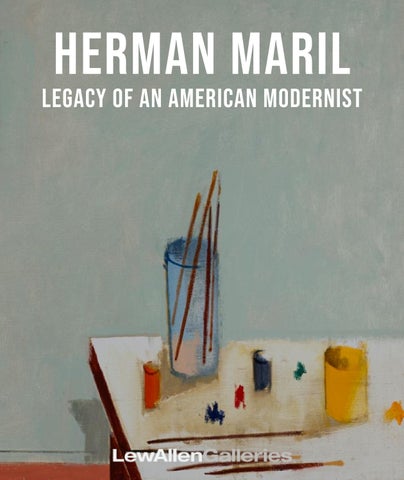
HERMAN MARIL

LEGACY OF AN AMERICAN MODERNIST

Beach #2, 1971, oil on canvas, 40 x 30 in

oil on canvas, 20 x 24 in

Laying Asphalt 1935, oil on canvas, 12.25 x 18 in

HERMAN MARIL - Legacy of an American Modernist

To encounter a painting by Herman Maril (1908 – 1986) for the first time is to discover an artwork of structural grace and intrinsic merit – quiet, composed and “unostentatiously right,” as the critic Kenneth Sawyer once wrote about Maril’s work. This encounter reveals an enchanting paradox: profound emotional resonance achieved through deceptively lyrical simplicity; a sense of elegant stillness in which Maril’s true magic resides. His paintings are gentle invitations, not loud demands. Where the essence of other art can sometimes be captured in a moment’s glance, Maril’s work is more subtle, revealing its treasures slowly. This is the enduring joy of Maril’s art: the more one looks, the more one sees.

Maril’s quiet power is rooted in his lifelong commitment to an aesthetic of “credibility.” His signature reduction of geometric form across landscapes, still-lifes, and figures is a self-imposed discipline that establishes unwavering trust with the viewer. By distilling the observable world to its essential geometries, Maril provides a transcendent vision. This approach transforms every subject—from a simple fishing boat to the most abstracted human form—into an indispensable compositional element. This rich clarity of form guides his work from the intimate dignity of his Depression-era scenes toward the airy, joyful, and optimistic coastal landscapes of his later years.

Maril’s aesthetic, rooted in a reductive philosophy, began with a rare and privileged education in Modernism. At an early age, he was mentored by one of America’s first Modernist instructors, Charles Walther an abstract painter and champion of modernism in Baltimore who was later dismissed from the

Maryland institute for urging his students to experiment with new styles. Through Walther, Maril became a regular visitor with Etta Cone, who, with her sister Claribel, had collected one of this nation’s premier Modern art collections (now housed at the Baltimore Museum of Art), with works by artists such as Picasso, Matisse, and Cézanne. This allowed him to see these masterpieces in full color at a time when his peers typically viewed them only in black-andwhite reproductions. This early education in Cubism and Modernism provided him with a profound foundation for an economy of means as well as color, where art could evoke a powerful emotional response.

During the New Deal era, Maril’s humanistic presentation of life was expressed not only through form, but also in his purposeful use of color. He created an atmospheric mood through an earthy palette—using browns, grays, ochre, and dull yellows—visibly affirming the quiet dignity and honest depiction of hard work. Maril presented uplifting images of human tenacity and resilience, placing the viewer in a mood that affirms life’s hopefulness even amidst bleakness.

Throughout Maril’s works, geometry and composition are paramount. In his seascapes Maril achieves emotional resonance through his signature clarity of form, focusing on fundamental, recognizable elements and consciously utilizing the graphic expanse to convey a “tremendous sense of serenity,” a feeling Maril attributed directly to “the horizontalness of water.” The success of his painting is not found in photographic accuracy, but in the artist’s ability to translate nature’s forms and emphasize powerful compositions. In the work Kendall Lane Beach/Cape Beach, the rendering of the central rock formation

might otherwise be read as an abstract geological mass. In juxtaposition, the figures that inhabit the space serve as a crucial touch point for visual confirmation of scale. This use of the figure as a formal accent, a punctuation in the vastness of the scene, ensures the compositional credibility by establishing a reciprocal relationship: the figure provides human scale for the monumental natural form, which in turn justifies the figure’s presence and dignity within the scene.

This same reductive approach governs his quiet still lifes and interiors. In these spaces, the stage-like setting of the walls and floor compresses the geometry, creating a poised area while subduing the role of traditional perspective. The still life objects themselves—simplified in form and content— intimate a story. Here one sees Maril organizing the objects of his home and studio to create endearing meditative statements. This commitment to formal language is vividly evident in works like Music in the Studio. While the studio space is simplified, the radio is rendered with a surprising degree of narrative detail and dynamic presence. The radio is not depicted merely for its passive function, but as an essential, sensational catalyst that instantly floods the artist’s solitary space with vitality. By stark contrast, the figure on the easel is relegated to the periphery and rendered with a deliberate void of personal detail, revealing Maril’s clear hierarchy: the object carries the external, specific narrative, while the figure is intentionally freed to operate purely as a structural counterpoint.

In Studio with Figure, the human figure retains a structural, formal presence. The human form is subjected to the same geometric forces that organize still life and the landscape, engaging in, as one writer describes, an ongoing

continued on pg 13

Kendall Lane Beach / Cape Beach 1976, oil on canvas, 36 x 48 in
High Dune
oil on canvas, 60 x 40 in
Boy and Dog
1966, oil on canvas, 49.75 x 40 in
Music in the Studio
oil on canvas, 30 x 24 in

dialogue between the geometry of the human form and that of the space displaced by that form. This commitment to visual truth-telling—achieved by prioritizing the honest depiction of the figure’s essential form over subjective emotion— is evident through the intentional restraint of psychological expression, elevates the figure into being both dignified and universal.

This unifying philosophy is consistent with the artist’s evident and declared interest in “the language of paint.” The simple figure thus becomes the consummate expression of Maril’s aesthetic conviction. This core sensibility remained remarkably consistent across six decades of work. While the 1940s and 1950s saw structurally rigid works influenced by early Cubism, his later Provincetown works saw the lines subdued, shifting the focus toward a total

Studio with Figure 1971, oil on canvas, 40 x 60 in

unity of the picture. These later landscapes embrace nature with a freer, more daring, and expansive optimism, reflecting a personal, enticing vision of the external world, often growing in scale to react to the vastness of the coastal environment. This expansive spirit was calibrated through a seemingly more vibrant and mature sense of color and light. He expanded his palette, introducing greens, oranges, purples, and lavender, alongside whites and blues—suggesting a more luminous atmosphere. This combination creates the joyous, lyrical conviction that permeates these later bodies of work.

Herman Maril’s work succeeds in his creation of forms that are so simple and honest that they affirm his belief that grace and emotional truth are to be found in the clarity of form, not the complexity of detail.

Through his subtle, elegantly organized, and deeply felt paintings, Maril distills the essence of the experience of being immersed in the rhythms of the sea and of the land. The ultimate expression of this aesthetic is felt in the act of living with the work. For decades, Maril’s work has generated a sense of serenity, pulling the viewer in and providing just enough information to provoke the eye with an alluring and harmonious quality. To live with a Maril painting is to receive an enduring invitation to experience joy and a sense of profound peace.

Nets and Barn
1951, oil on canvas, 19.25 x 12.25 in
Sunset at Cape Cod
oil on canvas, 30 x 40 in
Back Shore, Provincetown, ca 1980, oil on paper, 9.12 x 12.50 in
Tiger Lilies and Net
oil on canvas, 38 x 32 in
Kitchen Window 1971, oil on canvas, 40 x 50 in
Interior with Dresser
oil on canvas, 40 x 60 in
Studio Corner 1977, oil on canvas, 30.25 x 40.25 in
Still Life with Fish
oil on canvas, 40 x 30 in

Through the Window 1979, oil on canvas, 24 x 30 in

Near Penny’s Place
1971, oil on canvas, 60 x 40 in

Conversation 1960, oil on canvas, 24 x 30 in

Molly and Antique Chair
1971, oil on canvas, 30 x 36 in

Studio and Window 1981, oil on canvas, 40 x 30 in

New Work on the Easel, c. 1986, oil on canvas, 24 x 30

Window and Big Pitcher 1985, oil on canvas, 30 x 40
Italy Fishing Near Bridge
casein on paper, 15 x 18.50 in
Florentine Hills 1973, oil on canvas, 50 x 40 in

HERMAN MARIL - Legacy of an American Modernist

Selected Solo Exhibitions

2025 Provincetown Art Association and Museum, Provencetown, MA

2021 LewAllen Galleries, Santa Fe, NM

2018 Debra Force Fine Art, New York, NY

Cahoon Museum, Cotuit, MA

2017 Debra Force Fine Art, New York, NY

Arkansas Arts Center, Little Rock, AR

2016 ACME Fine Art, Boston, MA (also 2007, 2004)

2015 Sheldon Museum of Art, Lincoln, NE

2014 Harmon-Meek Gallery, Naples, FL (also 2008, 1996, 1990)

2013 Walters Museum of Art, Baltimore, MD

David Findlay Jr Gallery, New York, NY (also 2011, 2010, 2008, 2005, 2003)

2012 The Snite Museum of Art, Notre Dame University, Notre Dame, IN

2009 Walters Museum of Art, Baltimore, MD

Berta Walker Gallery, Provincetown, MA

2008 Ward Museum, Salisbury University, Salisbury, MD

Provincetown Art Association Museum, Provincetown, MA

2003 University of Maryland, University College, Adelphi, MD

2001 University of Maryland, University College, Adelphi, MD

James Graham and Sons, New York, NY

2000 Cape Museum of Fine Arts, Dennis, MA

James Graham and Sons, New York, NY

Galerie Francoise, Baltimore, MD

1998 Butler Art Institute, Youngstown, OH

Galerie Francoise, Baltimore, MD

Adirondack College, Queensbury, NY

1997 Hyde Collection, Glens Falls, NY

1995 Adirondack College, Queensbury, NY

St John’s College, Annapolis, MD

1994 Provincetown Art Association Museum, Provincetown, MA

Terry Dintenfass Gallery, New York, NY

1992 Terry Dintenfass Gallery, New York, NY

1991 Midwest Museum of American Art, Elkhart, IN Academy of the Arts, Easton, MD

Hyde Collection, Glens Falls, NY

1986 Franz Bader Gallery, Washington, DC (also 1983, 1980, 1975, 1972, 1968, 1963, 1962, 1959, 1956)

1984 Wichita Art Museum, Wichita, KS

1983 Forum Gallery, New York, NY (also 1980, 1974, 1971, 1968, 1965)

1981 University of Virginia Art Museum, Charlottesville, VA

1978

American Institute of Arts and Letters, New York, NY

1977 University of Maryland, College Park, MD

1974 Wellfleet Art Gallery, Wellfleet, MA (Also 1970, 1968, 1964)

1967 Baltimore Museum of Art, Baltimore, MD (also 1946, 1937)

1965 Johns Hopkins University, Baltimore, MD

Baltimore Junior College, Baltimore, MD

1963 Athena Gallery, New Haven, CT

1962 Castellane Gallery, New York, NY

1961 Castellane Gallery, New York, NY

1959 Babcock Gallery, New York, NY (also 1956, 1953)

1955 Philadelphia Art Alliance, Philadelphia, PA

1951 Barnett-Aden Gallery, Washington, DC

MacBeth Gallery, New York, NY (also 1948, 1943, 1941)

1950 Whyte Gallery, Washington, DC (also 1947, 1944)

1949 University of Tennessee, Knoxville, TN

1943 Everhart Museum, Scranton, PA

1940 Everhart Museum, Scranton, PA

1939 Wells College, Aurora, NY

New York World’s Fair, New York, NY

Hudson Walker Gallery, New York, NY

1937 Boyer Gallery, Philadelphia, PA

1936

1935

Marie Sterner Gallery, New York, NY

Howard University Gallery of Art, Washington, DC

Selected Group Exhibitions

2023 Refreshments at the Sea: American Artists on Cape Cod, Cahoon Museum of American Art, Cotuit, MA

Selected Public Collections

Adirondack College, Queensbury, NY

American University, Washington, DC

Amherst College, Amherst, MA

Arkansas Art Center, Little Rock, AR

Baltimore Museum of Art, Baltimore, MD

Bezalel Academy of Art and Design, Jerusalem, Israel

Butler Art Institute, Youngstown, OH

Cahoon Museum, Cotuit, MA

Cape Cod Museum of Art, Dennis, MA

Cleveland Museum of Art, Cleveland, OH

Corcoran Gallery of Art, Washington, DC

Delaware Art Museum, Wilmington, DE

Everhart Museum, Scranton, PA

The Federal Reserve, Washington, DC

Jewish Museum of Maryland, Baltimore, MD

John Hopkins University, Baltimore, MD

Howard University, Washington, DC

Maryland Historical Society, Baltimore, MD

Metropolitan Museum of Art, New York, NY

Morgan State College, Baltimore, MD

Museum of Fine Art, Boston, MA

National Academy of Design, New York, NY

National Collection of Fine Arts, Washington, DC

National Portrait Gallery, Washington, DC

New Britain Museum of American Art, New Britain, CT

New York University, New York, NY

Newark Museum, Newark, NJ

Phillips Collection, Washington, DC

Provincetown Art Association and Museum, Provincetown, MA

Santa Barbara Museum of Art, Santa Barbara, CA

The Scottish National Gallery of Modern Art, Edinburgh, Scotland

Senate Office Building, Washington, DC

Smithsonian American Art Museum, Washington, DC

Snite Museum of Art, South Bend, IN

University of Arizona, Tucson, AZ

University of Maryland, College Park, MD

University of Maryland, University College, Adelphi, MD

University of Virginia, Charlottesville, VA

Virginia Museum of Fine Arts, Richmond, VA

Walters Art Museum, Baltimore, MD

Whitney Museum of American Art, New York, NY

Wichita Art Museum, Wichita, KS

Worcester Art Museum, Worcester, MA

WPA Post Office Mural Projects, Scranton, PA and Altavista, VA

Education

1926 Baltimore Polytechnic Institute, Baltimore, MD

1928 Maryland Institute of Fine Arts, Baltimore, MD

Turn static files into dynamic content formats.
Create a flipbook
Issuu converts static files into: digital portfolios, online yearbooks, online catalogs, digital photo albums and more. Sign up and create your flipbook.