

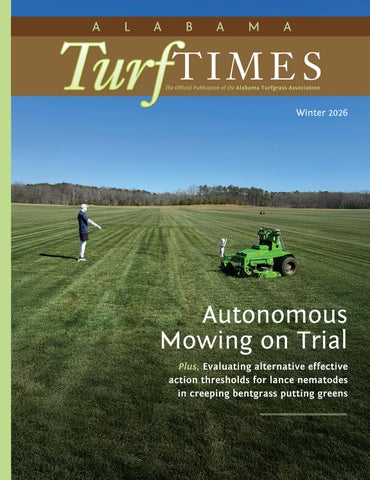
Autonomous Mowing on Trial
Plus, Evaluating alternative effective action thresholds for lance nematodes in creeping bentgrass putting greens
Farm to Fairway. Quality Sod.
Tiftuf Bermuda | Stadium Zoysia | Rebel Supreme Fescue Bluegrass Blends | Zeon Zoysia
Many Varieties Maintained At .500

CONVENIENT DELIVERY

MONDAY (AM)—SATURDAY TO ACCOMMODATE YOUR JOB NEEDS


• Backed By Two Decades of Rigorous Testing
• Requires 38% Less Water
• Maintains Quality and Color
• High Traffic Tolerance
• Over 2 Billion sq. ft. Installed


A New Beginning MY
name is Drew Charcandy and I have the honor to serve as your Alabama Turfgrass Association President for 2026. I have worked in the turf industry in some capacity for 19 years and am currently the Assistant Director of Athletic Fields for the University of Alabama. I have spent many years in the sports turf aspect of our industry as well as seven years in the golf course side of our industry. I have been on the ATA board in some capacity since 2022. I look forward to being able to help grow this wonderful and helpful organization to the best of my ability in the upcoming year.
I would like to thank Patrick Pierce for his leadership this last year serving as our President for 2025, and as past president for 2026. I would also like to thank the individuals who are the backbone of this organization. We all know wrangling a bunch of turf managers and planning meetings is not very easy, so thank you to Melanie Bonds, Tricia Clem, and Kayla Cook. I also want to thank all our sponsors. Without their support our organization wouldn't be possible. So, if you see sponsor reps at an event, please thank them.
As we close 2025 and start a new beginning, I would like to challenge every member to be more active in this great organization. Try and attend one more meeting than you did last year. Attend a road show and get those ever-important pesticide points! If nothing else, reach out every so often to a fellow turf manager and just see how they are doing. Sometimes it is good to hear a voice from someone who understands the battles we all uniquely face day to day. Let’s make 2026 a great year and I look forward to seeing each of you at an upcoming event. Be safe, take care, and Roll Tide!
Drew Charcandy 2026 ATA President


• Beard Equipment Company
• Envu
• FIS Outdoor
• Harrell’s, Inc.
• Jerry Pate Turf & Irrigation
• BWI
• Simplot GOLD
• Agromax
• Chattahoochee Turf
• GreenPoint Ag
• Helena Chemical
• Legacy Turf Farms
• Nufarm
• PBI Gordon
• Regal Chemical Company
• SiteOne
• Southern States
• Sur-Line Turf, Inc.
• Syngenta
Drew Charcandy

2026 Road Show Seminars Announced
The Alabama Turfgrass Association (ATA) is excited to once again hit the road this winter for our annual Road Show Seminars — one-day educational events designed specifically for turfgrass professionals across the state!
Held during the winter months, when turfgrass managers have a little more breathing room in their schedules, these seminars bring industry experts and peers together for a day of learning, networking, and certification opportunities. With five convenient locations across Alabama, it’s easier than ever to join us and stay up to date on the latest turf management practices.
Each seminar is approved for Alabama Pesticide Re-certification Points, as well as points in surrounding states and GCSAA education credits — making this a can’t-miss opportunity to grow your professional credentials while sharpening your skills.
2026 Road Show Topics & Speakers
This year’s lineup features some of the leading voices in turfgrass science and management:
• Turfgrass Diseases and Management –Dr. Amanda Strayer-Scherer, Auburn University
• Nematodes and Their Control –Dr. Aaron Tucker, Auburn University
• Weed Control for Southern Turf –David Lawrence, Alabama Cooperative Extension System
• Common Insect Problems in Home Lawns –Dr. David Han, Auburn University
Dates & Locations
• January 7 – Loxley Civic Center, Loxley, AL
• January 28 – Troy University, Dothan, AL
• February 11 – AWF Lanark Conference Center, Millbrook, AL
• February 18 – Gardendale Civic Center, Gardendale, AL
• February 25 – Jaycees Building, Huntsville, AL
Don’t Miss
Out — Register Today!
Advance registration is strongly encouraged and can be completed easily online at www.AlabamaTurf.org
Join us this winter to connect with fellow turf professionals, earn valuable recertification points, and learn from experts in the industry. We look forward to seeing you on the road in 2026!
Better Built. Quality Results. Period.


Tel:
Fax:
Email:
Tel:


John


David
David


INVESTING IN THE FUTURE OF ALABAMA TURFGRASS
The Vital Work of the ATRF

The Alabama Turfgrass Research Foundation (ATRF) serves as the research backbone of our state’s turf industry. Established in 1997, ATRF is a 501(c)(3) nonprofit dedicated solely to funding research that supports and advances the work of turfgrass managers across Alabama. Since its inception, the Foundation has invested over $200,000 in research that drives innovation and practical solutions for turf professionals.
This year, ATRF is proud to fund two critical projects at Auburn University:
1. Oxadiazon Replacement, led by Dr. Scott McElroy, addressing the urgent need for alternatives to a widely used preemergent herbicide.
2. Tawny Crazy Ant Infestation in Southern Alabama, conducted by Dr. Clint Penick and Dr. Jeremy Pickens, exploring strategies to manage a destructive invasive species threatening sod farms and natural habitats.
These studies are not only timely but essential to protecting the economic and environmental health of Alabama’s turf industry.
Replacing Oxadiazon: Protecting Turf Management Options
For years, Oxadiazon has been a cornerstone herbicide in turf management—valued for its unique properties that don’t inhibit root growth and its flexibility for use on sports fields, sod farms, and golf courses, even putting greens. Its distinct mode of action has also played a key role in rotating chemistries to prevent herbicide resistance.
However, significant regulatory changes in late 2024 have restricted Oxadiazon’s use to certified applicators and limited its application to no more than 30% of managed golf course acreage. The product is now labeled as a potential carcinogen through dermal exposure, raising uncertainty about its longterm availability. Dr. McElroy’s project is therefore crucial—it aims to identify safe, effective replacements that maintain the agronomic benefits Oxadiazon has long provided.
Battling the Tawny Crazy Ant: A Threat to Turf and Ecosystems
Another challenge on the rise is the reemergence of the Tawny Crazy Ant (Nylanderia fulva) in Baldwin County. Once thought to have disappeared from Alabama, this invasive pest is now being detected near sod farms and the Bon Secour National Wildlife Refuge, posing risks to turf operations and native ecosystems alike.
This research effort, led by Drs. Penick and Pickens, seeks to:
1. Assess the extent of current infestations,
2. Detect a naturally occurring microsporidian pathogen that could suppress ant populations, and
3. Develop an integrated management plan combining immediate chemical controls with sustainable, long-term biological suppression.
Unchecked, these ants could spread statewide through turfgrass, mulch, and nursery plants—making this project vital to safeguarding Alabama’s turf industry.
Why Your Support Matters — Now More Than Ever
While ATRF’s research directly benefits every turf professional in Alabama, continued progress depends on industry support. Research is costly, and these current projects represent major investments in the future health of our industry.
As we approach the end of the year, we invite you to consider a tax-deductible donation to the ATRF. Your contribution— large or small—directly funds the science that protects your profession and ensures that Alabama turf remains among the best in the country.
Donations can be mailed to:
Alabama Turfgrass Research Foundation P.O. Box 2887 Auburn, AL 36831
Join the Fun: Support ATRF at the Winter Road Show Seminars
In addition to direct contributions, you can also support ATRF by participating in our 50/50 Raffle Fundraiser at each Road Show Seminar this winter. Raffle tickets are $5 each, 5 for $20, or 12 for $50, with proceeds split between the Foundation and the lucky winner at each event. It’s a fun, easy way to give back—and you just might go home with some extra cash!
Together, through your involvement and generosity, the Alabama Turfgrass Research Foundation will continue advancing the science that keeps our fields, greens, and landscapes thriving. Invest in research. Invest in your industry. Invest in the future of Alabama turfgrass.
A TIME TO REFLECT ON THE PAST AND LOOK AHEAD TO THE FUTURE
By Melanie Bonds
2025 Deep South Turf Expo CELEBRATES TEN YEARS
marks the ten-year milestone for the Deep South Turf Expo. The Expo came on the scene in 2015. It was formed in response to expressed needs by the turfgrass industry in Alabama, Mississippi, Louisiana and the Florida panhandle. Many remembered the days of the regional Southern Turfgrass Conference and longed to again have an event where members could reminisce with old industry friends and organize new networking opportunities. Also, primarily driving the creation of this regional turfgrass conference was the academic community and vendors in this region.
In a joint effort, the following organizations planted seed money and appointed members to an independent DSTE Board. Original partners in this effort are listed below. The Louisiana Turfgrass Association joined the DSTE non-profit in 2025.
Alabama Turfgrass Association
Alabama Golf Course Superintendents Association
Mississippi Turfgrass Association
Gulf Coast Golf Course Superintendents Association
Louisiana-Mississippi Golf Course Superintendents Association
The first DSTE was held in 2015, but much work had gone into planning before that. Bylaws were drafted outlining the number of board members each association could appoint as well as how the profits from the Expo were to be shared. The percentage of profits for each association was based on the income previously received from their individual conference and shows. Prologue Association Management was hired to manage the Expo.
When the DSTE was inaugurated in October 2015 it consisted of a turfgrass conference, trade show, golf tournament, sporting clay competition and a sports field tour. Before a decision was made on the location of the conference and show, various sites were visited including the successful Carolinas GCSA Show. Tricia Clem worked extensively with James Harwell, Executive Director for the Gulf States Horticulture Show at that time, to find out how their popular show was structured. One takeaway was that these associations were rooted to one place, and when possible, worked around the same dates each year.


After researching various sites, it soon became clear that Biloxi, Mississippi was the site that could accommodate the DSTE’s size and potentially be a destination draw for many of the attendees. Contracts were signed with the Beau Rivage to be host hotel and the Mississippi Coast Convention Center to accommodate the conference and trade show.
A major reason for the Expo’s viability for the past ten years is the dedication and commitment our educators showed from the start. The educational committee consists of David Han, Ph.D. (Auburn), Jay McCurdy, Ph.D. (Mississippi State), Scott McElroy, Ph.D., (Auburn), and Bryan Unruh, Ph.D., (University of Florida). Throughout the years this powerful team has recruited some of the best and brightest professors in the industry to provide meaningful, valued education programs at the DSTE.
Our sponsors also embraced the Expo and offered funding and encouragement. We appreciate the commitment of the DSTE Boards and the wise planning they put into the formation our show.
This year was my last year as paid staff for the DSTE. I cherish all the wonderful people I have met there and in the host organizations over the last 25 years. They count as family to me. The time spent at the Expo is packed, but most meaningful is the excitement of greeting friends and always, always making a new friend or two.
President Will Arnett introduces Dr. Eric DeBoer of Louisiana State University. Welcome LTA!
Drone view of the DSTE Trade Show


Sometimes there is so much going on it’s hard to keep track, but I believe you will know you are at the Deep South Turf Expo if…
• You find yourself driving your golf ball on a crystal blue day in autumn at the DSTE Golf Tournament at the Preserve Golf Club.
• You find yourself sitting on the veranda at The Preserve watching the day soften into twilight, enjoying music and having a feast provided by our sponsors at the epic Tailgate picnic.
• You are the recipient of the latest updates in turfgrass research provided by industry leaders supplemented by networking with colleagues at the trade show.
• You win your silent auction item after a hard-fought battle and see Miss Linda’s smiling face when you check out.
• You’re in a gang of folks at the registration desk on Wednesday morning, but you don’t mind waiting because there is always a nearby colleague to catch up with.
• You see that whirlwind Tricia, straightening out anything that ends up tangled.
• Perhaps you find yourself being drafted as a board member to one of the Associations with no idea how it happened.


• Perhaps you find yourself dancing with Dr. McElroy. (It’s rumored that he is a GREAT dancer.)
• Perhaps you have lost your car in the Beau Rivage parking lot and are running late and it is very stressful, but the beautiful coastline calms you once you escape.
• Perhaps you find yourself saying goodbye to dear colleagues and friends, not sure when you will see them again, but hoping it is next year!
In 2026 the Deep South will transfer all conference and exhibitor activities to the Beau Rivage. It is truly turning a new page and there is great optimism for success in the future. I think I can safely say that the Deep South Turf Expo is a royal flush of a show and will continue to grow.
Before ending this, I would like to reiterate how much the DSTE Board has contributed to organization and continuing to provide clear leadership for the conference. The Preserve Golf Club has been wonderful to host our successful golf tournament over the years. I want to thank everyone, but I don’t think there is enough space here (and I am afraid I will leave someone out), but special thanks to our staff, Tricia and Mike Clem, Dr. and Mrs. Wayne Wells, Amanda and Stephen Miles and Kayla Cook for the hard work they put into making this a successful event every year. Love you guys!
Cornhole Fun
Perfect weather for a golf tournament and tailgate picnic at The Preserve Golf Club.
Larry Arnold, Steve Ashburner, Melanie Bonds
DSTE President Will Arnett presents trophy to first place team with Mike Hill and Specialty Turf Supply
YOUR
ALABAMA TURF TIMES


Alabama Turf Times allows you to narrow the focus and get your message directly in the hands of your customers. The magazine is a key benefit of Alabama Turfgrass Association membership – providing valuable research, education, and industry information. Readers can also access the Digital Edition through The Turf Zone website. Archived issues ensure that your advertising will continue to be seen indefinitely, for long-ranging impact. ATA Members Include:
Lawn Care Operators Golf Course Superintendents

Parks & Recreation Supervisors Landscape Contractors
Sports Turf Professionals Commercial Grounds Managers
Equipment Suppliers Sod Producers
Contact us today to learn about effective and unique advertising strategies that target turf industry professionals.
sales@leadingedgecommunications.com
Aerate and Play Right Away!
Decreased down time, increased revenue.
The surface is very “puttable.”
The dots are sand that is level with the turf.


DryJect® is a high-pressure, water based injection system that blasts holes through the root zone and fractures the soil profile. Plus, it automatically fills holes as it aerates.
DryJect® makes a big difference in playability … right away!
ON TRIAL Autonomous MOWING
J. Bryan Unruh – University of Florida


Asthe landscape industry faces mounting labor challenges, tightening environmental regulations, and growing pressure to improve efficiency, the emergence of mowing technologies are generating widespread attention. But do these machines actually deliver on their promises of cost savings, labor efficiency, and sustainability?
A multi-disciplinary team of researchers from Auburn University, the University of Florida, and the University of Georgia has launched a multi-year research initiative to answer that very question. Supported by industry partners and the United States Department of Agriculture (USDA), this effort is part of a larger grant-funded project titled "Landscape Equipment Sustainability Strategies: Do More with LESS." The project involves a comprehensive evaluation of large-platform autonomous mowers to assess their real-world performance, cost-effectiveness, and operational safety across a variety of landscape conditions.
Why This Research Matters
The adoption of automation in turf care is no longer a theoretical discussion. Manufacturers have introduced commercial autonomous platforms, and early adopters are already deploying them on sports fields, university campuses, and business parks, yet independent research remains scarce on the topic.
Most prior studies have focused on small-platform robotic mowers primarily used in residential settings (Figure 1). Traditionally, these machines relied on perimeter wires and random navigation patterns, limiting their efficiency and scalability. However, recent technological advancements—such as real-time kinematic (RTK) positioning and EPOS (Exact Positioning Operating System) navigation—have dramatically improved the precision, reliability, and adaptability of small autonomous mowers. This rapid evolution in positioning and sensing technologies has expanded the potential for autonomy in turf management far beyond the homeowner market.
Building on these advancements, large-platform autonomous mowers, that is, commercial-scale machines capable of operating both manually and autonomously, have now entered the market. These systems aim to address many of the industry’s most pressing challenges, including labor shortages, rising operational costs, and increasing sustainability demands. Our research seeks to evaluate these emerging technologies through a rigorous, data-driven approach to help landscape contractors, municipalities, and turf managers make informed decisions about integrating autonomy into large-scale operations.
What We're Testing & Why It Matters
This project is evaluating large-platform commercial mowers across four equipment categories:
• Manual gas-powered
• Manual battery-powered
• Autonomous gas-powered
• Autonomous battery-powered
Figure 1. A small-platform autonomous mower manufactured by Sunseeker, Inc. (A) and a large-platform, commercial autonomous zero-turn mower manufactured by Mean Green (B).
Landon Erbrick, Paul Bartley, Mark Hoffman and Tanzeel Rehman – Auburn University
We're conducting real-world field trials using standardized test plots with varying levels of landscape complexity, from open square acres to obstacle-rich environments designed to mimic trees, bed edges, and other site constraints. Our goal is to understand how different combinations of power source (gas vs. battery) and operator mode (manual vs. autonomous) influence performance, cost, safety, and usability in professional landscaping scenarios.
What We're Measuring
Across hundreds of acres of mowing in diverse conditions, we’re tracking:
• Labor Efficiency – Time per acre, supervision requirements, and total operator hours
• Energy or Fuel Consumption – Gallons or kilowatt-hours per acre
• Mowing Productivity – Speed (acres/hour) under manual vs. autonomous operation
• Cost of Ownership – Lifetime return on investment (ROI) including equipment price, maintenance, energy, and labor
• Operational Safety & Setup Time – Issues related to autonomous deployment, landscape variability, and required oversight
• Adaptability to Landscape Types – How autonomy performs in simple vs. complex site conditions
Together, these data will help landscape contractors, fleet managers, and municipal buyers evaluate whether, how, and when to adopt autonomous and battery-powered equipment based on real numbers, not hype or pressure.
Safety and Supervision Under the Microscope
We’re also conducting obstacle detection trials using mannequins and field hazards at multiple approach angles to understand how these machines interpret and react to realworld variables (Figure 2).
Our team is especially interested in hybrid operation strategies, where a single operator supervises an autonomous unit while mowing with another, significantly boosting productivity without a full leap into autonomy.
Implications for the Green Industry
This research comes at a critical time. As noise restrictions, emissions regulations (e.g., California AB 1346), and labor shortages reshape the industry, many contractors are asking: What’s the smart next investment?
By delivering field-tested, brand-agnostic insights, our goal is to help professionals:
• Make evidence-based equipment choices
• Optimize labor deployment strategies
• Understand technology limitations and serviceability
• Prepare for future regulations and automation trends

Figure 2. Large-format, autonomous mowers equipped with a RGB camera-based system used to detect obstacles encountered by the mower.
Evaluating alternative effective action thresholds for lance (Hoplolaimus galeatus) nematodes in creeping bentgrass putting greens
Researchers’ data demonstrates that lance nematodes can be identified and quantified using a qPCR (quantitative polymerase chain reaction) molecular method.
By M. Aaron Tucker, Ph.D.
Jon D. Eisenback, Ph.D.
David S. McCall, Ph.D.
Hoplolaimus

Creeping bentgrass putting green decline from damage caused by the lance nematode (Hoplolaimus galeatus) is becoming increasingly problematic yet is not well understood. While more attention has been paid to plant parasitic nematodes in recent years, the problem is not new. Increasing anecdotal evidence suggests lance nematodes are part of a larger disease complex associated with environmental and biotic stresses though limited scientific literature is available. The highest populations of lance nematodes typically coincide with periods of peak environmental stress to creeping bentgrass in August in the northern hemisphere (4). Action thresholds for lance nematodes on golf course putting greens are not well understood, are inconsistent among labs and oftentimes do not coincide with actual reported damage on golf course putting greens. Crow (3) suggested that 200 lance nematodes may cause damage to ultradwarf bermudagrass but also noted no injury in some scenarios with population estimates as high as 1,000 lance nematodes. Damage to creeping bentgrass from lance nematode feeding is speculated to be strongly associated with environmental and other abiotic stress (5, 7).
Nematode samples are commonly sent to diagnostic labs during the spring and summer for assay. Traditional assays require nematode extraction and skillful microscopic identification of individuals, which is time-consuming and often subjective based on expertise. In other areas of turfgrass pathology, molecular methods of identification are commonly used to confirm the presence or absence of a pathogen but have yet to be pursued in great length in identifying lance nematodes (6). A paper by Bae et al. (1) concluded that six Hoplolaimus spp., including H. galeatus commonly associated with turfgrasses, can be amplified using polymerase chain reaction (PCR). These results provide an opportunity for an objective alternative to the routine nematode assay with elutriation and microscopic quantification by using qPCR. Quantitative polymerase chain reaction (qPCR) measures amplify DNA in real time by using selected primers and/or probes. The outcome of a qPCR reaction is DNA amplification noted by a cycle threshold (Ct) curve. The lower the Ct value is, the more DNA is present in a reaction. Utilizing qPCR would be new to turfgrass nematode diagnostics and could provide a new diagnostic tool for management decisions.
The objectives of this work were to create and test a qPCR approach for H. galeatus and evaluate the effect H. galeatus may have on creeping bentgrass root biomass as influenced by nitrogen inputs.
Materials and methods
A qPCR approach
A partial sequence of an internal transcribed spacer (ITS) region of H. galeatus was selected from GenBank (EU515322) based on the work completed by Bae et al. (1). Primers were created from this partial sequence using primer3plus with a coverage of 574 base pairs (bp). The forward primer is 20 bp in length containing 50% GC (guanine/ cytosine) content and the reverse primer is also 20 bp in length with 55% GC content. Both forward and reverse primers have secondary hairpin structures. A TaqMan probe was also created for this region of interest to target amplification of H. galeatus and avoid false positives in amplification. This probe has 23 bp, with a 6-FAM reporter on the 5-prime end and an MGBNFQ quencher on the 3-prime end.
Handpicked samples were placed into 10μl of water and micro pipetted into clean micro centrifuge tubes to a volume of 250μl. Efforts were made with handpicked samples to ensure all nematodes were removed from the original 1.5μl micro centrifuge tube and that no
Figure 1. A sample taken from a
galeatus infested green at Belmont Golf Course in Richmond, Va.
Photo by Aaron Tucker
nematodes remained in the micro pipette tip by removing said tip and washing, with a new tip, nematodes that remained into a clean 1.5μl micro centrifuge tube for DNA extraction. A Qiagen Powersoil DNA kit was used to extract DNA from each sample.
qPCR assays were performed using a Thermo Fisher Scientific Quant Studio 3 (Waltham, Mass.). Each assay included 1μl of each primer, 0.5μl of TaqMan probe, 1μl of template DNA, 9μl of distilled water and 12.5μl of SYBR green master mix for a total reaction volume of 25μl. The qPCR program was modified from Bae et al. (1). Each qPCR run contained a negative control of distilled water in place of the template DNA. Ct values were subject to an analysis of variance with handpicked counts of lance nematodes (ANOVA) in JMP Pro 18 to assess for differences between traditional and molecular methods.
To compare DNA amplification of random samples against traditional nematode counts, samples were collected from Belmont Golf Course in Richmond, Va., from green #2 that was previously assessed for presence of H. galeatus (Figure 1). Selection of sample areas from within the green varied based on green size and shape. Twenty-eight sample areas were selected within this green. Greens at Belmont Golf Course are grassed with 777 creeping bentgrass and are grown on USGA spec soil profiles. Nematodes were extracted using a semi-automatic elutriator (2). Samples included the presence of lance, stubby root, ring, stunt, root knot and spiral nematodes. Nematodes were subject to semi-automatic elutriation, centrifugation and sugar flotation. Both a nematode estimation for loss due to elutriation and a total count for lance nematodes were observed and recorded for comparison with qPCR assays. Ct values were compared with total lance nematode counts by linear regression using JMP Pro 18.
Evaluate the damage influence of lance nematodes on creeping bentgrass root biomass and compare with plant health spectral reflectance


A B

Figure 2. Lance nematode inoculation images. Image A displays approximately 40,000 Hoplolaimus galeatus nematodes in solution, while image B is a visual of soilinjected inoculation using a 1mL micropipette.
Table 1. Summary table of cycle threshold (Ct) values for handpicked samples of 250, 100, 50 and 20. An analysis of variance (ANOVA) was conducted, and differences are denoted by a different capital letters. Results of undetermined equaled no amplification within a reaction.
Ct values of handpicked lance nematodes
nematode

Two-inch diameter plugs of established 007 creeping bentgrass were removed from a dormant golf course putting green at the Glade Road Research Facility in Blacksburg, Va., and were transplanted into two-inch Deepot conetainers (Stuewe and Sons Inc., Tangent, Ore.) in the greenhouse. All existing root biomass below the soil/thatch interface was removed by severing with a knife and the remaining plug was rinsed with water to remove excess soil. Each plug was transplanted to pots pre-filled with a sterile 90:10 sand/peat mixture and backfilled with the same mixture as top-dressing. Pots were placed on greenhouse benches and time was allowed for green-up prior to inoculation and treatment initiation. Plants were inoculated with lance nematodes via soil injection after green-up and a period of 124 days was allowed for acclamation of nematodes to plants prior to the first nitrogen application (Figure 2). Nitrogen applications were made bi-weekly using a CO2 backpack sprayer as broadcast applications. Plots were trimmed daily with grooming sheers at a height of 0.125-inch (.32 centimeter) and watered daily with overhead irrigation to prevent drought stress.
A 5x4 factorially arranged design was implemented that involved five population levels of lance nematodes (0, 100, 500, 1,500 and 3,000) and four nitrogen fertilizer rates (0, 0.2, 0.5 and 1 pound/0, 0.09, 0.23 and 0.45 kilogram) were applied over 16 weeks in the form of soluble urea (46-0-0). A representative of each factor was removed every four weeks and destructively sampled. Destructive sampling included removing nematodes by Baermann trays and a modified Jenkins method followed by collecting dry weights and ashed weights of root biomass present. Root biomass was captured at four, eight, 12 and 16 weeks by drying root material at 140 F (60 C) for 48 hours then sieving soil from root material using a 60-mesh sieve before measuring dry weights. Dry weights of each sample were subjected to a muffle furnace at 932 F (500 C) for eight hours before being measured for ash weights. Root biomass was determined by subtracting ashed weights from dry weights and recorded in grams. Spectral canopy reflectance was collected daily using a PSR 1100 handheld radiometer with a spectral range of 320-1100 nanometers and a sampling bandwidth of 1.4
Figure 3. Linear relationship between total lance
counts obtained through traditional extraction methods and cycle threshold (Ct) values from samples collected at Belmont Golf Course, Richmond, Va.
nanometers. Linear regression of lance nematode counts and root biomass at each destructive sampling, ANOVA comparing lance nematode counts and nitrogen levels and ANOVA comparing lance nematode counts and root biomass were analyzed using JMP Pro 18.
Results and discussion
The results from this research explored new methods of navigating lance nematode identification and quantification by developing alternative action thresholds. The current work adequately addressed both objectives in helping to establish the framework for new alternative action thresholds. First, our data provides clear evidence that lance nematodes can be identified and quantified using a qPCR molecular method. An analysis of variance (ANOVA) of handpicked lance nematodes showed that as nematode counts increased, Ct values decreased (Table 1). When comparing qPCR with random samples, a negative correlation between total H. galeatus counts recorded through elutriation and sugar floatation and Ct values suggest that as counts increase, Ct values decrease (Figure 3). More validation of this work will provide useful, but ultimately there is a clear picture that the methods described herein are successful at identifying and quantifying lance nematodes. These methods will be effective in providing a blueprint for establishing similar methodologies for studying other plant parasitic nematodes that affect turfgrass. Second, our data shows that lance nematodes can have a negative impact on root biomass over time. Destructive samplings at four, eight and 16 weeks showed no differences in root biomass by H. galeatus counts, but week 12 data shows a robust negative correlation that suggests as H. galeatus counts increase, root biomass decreases (Figure 4). Even so, another aspect of this work that must be explored further is the desired effect of nitrogen. The purpose of nitrogen inputs was to provide a gradient of root biomass to provide a sliding action threshold dependent on those inputs. Unfortunately, nitrogen inputs at termination of this study had little to no effect on root biomass (p value = 0.2659); however, the snapshot of data at week 16 of this greenhouse experiment shows that over time, elevated lance populations can reduce root biomass (Figure 5)
four, four-week


Figure 5. An analysis of variance (ANOVA) for nitrogen level on creeping bentgrass (Agrostis stolonifera cv. ‘L93’’) by Hoplolaimus galeatus (Cobb, 1913) Thorne, 1935 counts 12 weeks after initial nitrogen applications. Bars with the same letter are not statistically significant according to Tukey’s HSD (α=0.05).
Figure 4. Linear regression of Hoplolaimus galeatus (Cobb, 1913) Thorne, 1935 counts by root biomass of creeping bentgrass (Agrostis stolonifera cv. ‘L93’’) at four destructive sampling dates. Destructive sampling dates were split into
timings of 4 (A), 8 (B), 12 (C) and 16 (D) weeks after initial urea nitrogen applications.
Finally, when assessing plant health metrics at week 12 we see a relationship between threshold ratio and Normalized Difference Vegetation Index (NDVI) (Figure 6). This is a snapshot of data that indicates that when lance nematodes are affecting root biomass, they can also be reducing plant health. Overall, working with nematodes is time-consuming, laborious and a bit of a mystery due to the complex nature of how they interact with turfgrass plants. With this work we attempted to address some pressing and challenging issues facing golf course superintendents. This work helped lay a foundation to answer some basic questions regarding alternative action thresholds. Future works will continue to explore the challenges golf course superintendents face regarding plant parasitic nematodes because the best results are often moving the needle on what we know and continuing to explore what we do not.
6. Linear regression of root biomass threshold ratio by normalized difference vegetation index (NDVI) at week 12 termination of creeping bentgrass (Agrostis stolonifera cv. ‘L93’’). Root biomass threshold ratio was determined by evaluating Hoplolaimus galeatus (Cobb, 1913) Thorne, 1935 counts/root biomass

Acknowledgments
This research was primarily funded by the Golf Course Superintendent’s Association of America and the Virginia Golf Course Superintendent's Association with supplemental funding from the Virginia Turfgrass Foundation. The authors thank funders for support in advancing knowledge of plant parasitic nematodes in turfgrass systems.
Literature cited
1. Bae, C.H., A.L. Szalanski and R.T. Robbins. 2008. Molecular analysis of the lance nematode, Hoplolaimus spp., using the first internal transcribed spacer and the D1-D3 expansion segments of 28S ribosomal DNA. Journal of Nematology 40(3):pp.201 (https://pmc.ncbi.nlm.nih.gov/articles/PMC2664666/).
2. Byrd Jr., D.W., K.R. Barker, H. Ferris, C.J. Nusbaum, W.E. Griffin, R.H. Small and C.A. Stone. 1976. Two semi-automatic elutriators for extracting nematodes and certain fungi from soil. Journal of Nematology 8(3):206 (https://pmc.ncbi.nlm. nih.gov/articles/PMC2620186/).
3. Crow, W.T. 2021. Managing lance nematodes in warmseason turfgrass. GCMonline (https://gcmonline.com/course/ environment/news/lance-nematodes-turfgrass).
4. Settle, D.M., J.D. Fry, T.C. Todd and N.A. Tisserat. 2006. Population dynamics of the lance nematode (Hoplolaimus galeatus) in creeping bentgrass. Plant Disease 90(1):pp.44-50 (https://doi.org/10.1094/PD-90-0044).
5. Settle, D.M., J.D. Fry, G.A. Milliken, N.A. Tisserat and T.C. Todd. 2007. Quantifying the effects of lance nematode parasitism in creeping bentgrass. Plant Disease 91(9):pp.11701179 (https://doi.org/10.1094/PDIS-91-9-1170).
6. Stackhouse, T., A.D. Martinez-Espinoza and M.E. Ali. 2020. Turfgrass disease diagnosis: Past, present, and future. Plants 9(11):pp.1544 (https://doi.org/10.3390/plants9111544).
7. Todd, T.C., and N.A. Tisserat. 1990. Occurrence, spatial distribution, and pathogenicity of some phytoparasitic nematodes on creeping bentgrass putting greens in Kansas. Plant Disease 74:660-663 (https://www.apsnet.org/publications/PlantDisease/ BackIssues/Documents/1990Abstracts/PD_74_660.htm).
Matthew Aaron Tucker (mat280@vt.edu) is formerly a Ph.D. student in Turfgrass Pathology/Nematology at Virginia Tech and is currently a new assistant professor of Turfgrass Management at Auburn University, Jon D. Eisenback is a professor of Nematology at Virginia Tech and David S. McCall is an associate professor of Turfgrass Pathology and Precision Turfgrass Management at Virginia Tech, Blacksburg.
The research says:
• The data provides clear evidence that lance nematodes can be identified and quantified using a qPCR molecular method. More validation of this work will provide useful, but ultimately there is a clear picture that the methods described herein are successful at identifying and quantifying lance nematodes.
• The data shows that lance nematodes can have a negative impact on root biomass over time. Week 12 data shows a robust negative correlation that suggests as H. galeatus counts increase, root biomass decreases.
• This work helped lay a foundation to answer some basic questions regarding alternative action thresholds. Future works will continue to explore the challenges golf course superintendents face regarding plant parasitic nematodes.
This article originally appeared in the September 2025 issue of Golf Course Management magazine and is reprinted with permission.
Figure
(g).
BWI Companies, Inc. 19 www.bwicompanies.com
Coosa Valley Turf Farms 9 www.coosavalleyturffarms.com DryJect 15
Greene County Fertilizer Co. 19 www.greenecountyfert.com
Jackson Sand 10 www.jacksonsand.com
Jerry Pate Turf & Irrigation Back Cover www.jerrypate.com
Leading Edge Communications 14 www.LeadingEdgeCommunications.com
Legacy Turf Farms 23 www.legacyturffarms.com
North Georgia Turf Company, Inc. Inside Front Cover www.ngturf.com
Progressive Turf Equipment Inc.
Regal Chemical Company 7 www.regalchem.com
Riebeling Farms, Inc.
riebelingfarmsinc@gmail.com
Smith Seed Services
Sod Solutions
www.SodSolutionsPro.com
Southern Specialty Equipment
Super-Sod
Sur-Line


Former ATA Board Member, Larry Balko, hopes his story inspires and educates others and brings awareness to ALS
The voice was a familiar and friendly one.
"Hey, John. It's been a while."
The reception from Larry Balko upon entering his Florida home was a welcome invitation; except it wasn't his voice. Not really, anyway.
A certified superintendent and sales rep in the West Palm Beach area for the past 20 years, Balko was diagnosed five years ago with early onset-bulbar, an especially aggressive variant of amyotrophic lateral sclerosis, better known as ALS, a degenerative neuromuscular disease that affects nerve cells in the brain and spinal cord, causing loss of muscle control. There is no cure.

"After high school, I enlisted in the U.S. Navy and went to San Diego," Balko said through his Eyegaze. "It was there where Biff found Crown Royal and started talking in third-person. Last month, Biff celebrated nine years sober, so he pretty much lives on in so many stories and memories. You can ask anyone, Biff always made the party better."
It would be easy to try to control something like this with your own plan. He has gone through this with such grace and confidence. Others would have given up and been depressed. The way he's gone through this shows that God is bigger than all of this.
Larry and wife Rebecca are eager to share their story, which is one of devotion, love, faith and unyielding support from all corners, including his spouse, his children, his church, fellow superintendents, his employer and not least of all, the staff from the ALS clinic at the West Palm Beach Veterans Affairs hospital who manage his care.
"You know, you have your faith, and you learn to trust that the Lord is in it with you," Rebecca said. "That doesn't mean that you don't have questions.
"He stays so positive, but he's not in denial. But he still has many questions, like 'why me?'”
Larry and Rebecca also want to share their story to bring awareness to this devastating disease in hopes that research scientists might one day find a cure.
"There may be people who read stories like this about people with ALS, and maybe they know someone who has it, or a relative gets it," Rebecca said.

Known as "Biff" to many, Balko, 58, cannot walk or talk. He is unable to eat or breathe without assistance. He only can speak through use of an Eyegaze, a speech-generating device designed specifically to help ALS patients, of which there are more than 30,000 nationwide. The average survival rate for someone with ALS is three years, according to the ALS Association. Twenty percent of those with ALS live five years, and 15 percent live for 10 years or more.
"The disease doesn't determine your days," said Balko's wife, Rebecca. "God determines your days."
A virtual prisoner in his own body, Balko's time is spent exclusively in either a special motorized wheelchair or a hospital bed, yet he refuses to let ALS define him. A cheerful person before contracting ALS, he still has that same jocular outlook.
"ALS makes people who don't know about it feel isolated from you because they don't know what to say, or do. It's better to just rip the Band-Aid off and talk about it. I think one good thing about (talking about this) is it spreads information about ALS, which is important."
Members of LifeSpring Church in nearby Wellington, the Balkos did not have to look far to find faith to help them navigate through this challenge. They have always lived a faith-filled life in their 23-year marriage and were well armed to meet ALS head-on when they received the diagnosis in 2020. They hope that telling their story might help or inspire others about the power of faith.
Larry Balko maintains a positive attitude through his battle with ALS. All photos by John Reitman
Rebecca Balko has tended to her husband’s every need through his battle with ALS.
"Faith has been the cornerstone of our family," said Tatum Edlin of Huntsville, Alabama, one of Larry's two daughters from a previous marriage.
"This picture would be entirely different without it. Without comfort and support from God, he wouldn't have made it this far, and we would be having a very different conversation."
That faith is indeed important.
Early onset-bulbar ALS initially affects the muscles in the head and neck, namely those that control swallowing and speaking. Early symptoms typically manifest as slurred speech and difficulty breathing. That was the case for Balko. Eventually, the disease renders other parts of the body helpless.
The U.S. Centers for Disease Control and Prevention estimates that there are about 33,000 cases of ALS across the U.S. Of those, about 90 percent are considered sporadic, in that they occur randomly and are not genetic, according to the Mayo Clinic.
Also known as Lou Gehrig's Disease, named in memory of the former New York Yankees player who died from the disorder in 1941 at age 37, ALS has in the past five years robbed from Balko the ability to talk, walk, the sensation in his fingers and do so many other things others take for granted.
"He's a tough man," said Balko's other daughter, Charlie Holbrook, who also lives in Huntsville. "A lot of people going through this would become stoic and cold, but not Larry. He's leaned into God."


Long before his diagnosis in 2020, Larry and Rebecca participated in the ice bucket challenge, a viral social media campaign from about a decade ago to raise awareness for ALS, in support of friends who had the disease. An ALS diagnosis of their own was the furthest thing from their minds, when they first entered the VA hospital looking for answers.
"I remember we were sitting on the sofa, and it was not long after his diagnosis and the memory timeline was our video from the ice bucket challenge," Rebecca said. "We had no idea what ALS even was then."
They know now.

Symptoms presented about six years ago as difficulty breathing, a twitch on his right side and slurred speech. Balko, who enjoyed singing, suddenly was unable to hit some of the high notes that once came so easily. Clearly, it was time to seek help.
"He couldn't get his breath, his sinus was blocked 70 to 90 percent, and he had slurred speech," Rebecca said. "They ran a scope down and saw on one side he had a lazy, flat larynx."
Doctors inserted a feeding tube in 2022. That was two years before he needed it, but doctors said getting it sooner than later would ease the transition when it was actually needed. Three years later, it is the only way he receives food and water and takes his medication. Confined to a bed or wheelchair, he has been breathing through a tracheostomy tube and an oxygen machine since last December. Recently, he completed the difficult task of pre-planning his own funeral.
The VA set him up with an Eyegaze tablet as soon as the diagnosis was made, so he could speak into the device and it could bank his voice. Today, it mimics his voice as he visually scans the alphabet to piece together words and sentences.
Among the symptoms of ALS is pseudobulbar affect, the sudden and uncontrollable outbursts of emotion, including bouts of inappropriate laughter and crying.
"Because I have pseudobulbar, I would cry like a 16-year-old girl over a commercial, and I couldn't control," he said. Said Rebecca of the combination of pseudobulbar affect and raw emotion: "It wasn't like a little emotion, but it would be like turning on the faucet and not being able to stop.
"Larry had to learn it was okay, that not all the crying was bulbar and that it was okay. Some of those outbursts aren't necessarily tied to emotion. It's just uncontrollable, almost a switch that you just can't control. But, for him, he also was learning that he was having emotion, and it was okay to have emotion."
He requires in-home healthcare and nurses who monitor his vitals through the night, courtesy of the VA. He also has a devoted caretaker in Rebecca, who has been by his side for every need, whether it is administering medication or using a Hoyer lift to transfer him to and from bed. Every couple should be in love as much as they are.
Their relationship in the face of the most challenging thing they've ever faced is remarkable and refreshing. He still teases her, and she dotes over him and tends to his every need.
"Oh, she is a rockstar," Charlie said. "She doesn't see it that way. She thinks she's just doing what she's supposed to do. Sometimes, I have to shake her and tell her 'what you're doing is incredible.' "

The progression of the disease has been dramatic.
When daughter Tatum and her husband, Konnor Edlin, were married three years ago in Jamaica, Larry was still upright and using a walker. To that end, he and Rebecca were able to attend, and he was even able to dance with the bride. Last October, when Charlie and husband Grant Holbrook were married in Alabama, Larry's condition had progressed to the point where it was unsafe for him to travel that far. The service was streamed live so Larry and Rebecca could watch from home in Florida, where he was able to make a speech through his Eyegaze device over FaceTime.
"It would be easy to try to control something like this with your own plan," said Charlie. "He has gone through this with such grace and confidence. Others would have given up and been depressed. The way he's gone through this shows that God is bigger than all of this."
A graduate of the Auburn University turfgrass management program, Biff was active in the Alabama Turfgrass Association prior to his move to Florida. Balko is a past president and long-time member of the Palm Beach County GCSA chapter. It was early in his career in golf that he earned his nickname.
Rebecca and Larry Balko have relied heavily on their faith since he was diagnosed with ALS.
"It was about the time that Back to the Future came out," he said. "There already was another Larry on staff, so my name on the work board was Biff."
Following a stint at Pine Tree Country Club in Birmingham, Alabama, Balko was superintendent at two courses in South Florida from 2006 to 2014, first at Park Ridge Golf Course in Lake Worth and President Country Club in West Palm. Balko's fellow superintendents in South Florida have not forgotten him.
At last year's Future of Golf Tournament, the largest fundraiser for the 288-member Palm Beach County GCSA, every golfer who won a cash prize donated their winnings back to Balko.
The disease doesn't determine your days. God determines your days.
"That has to be so frustrating," said fellow Palm Beach County superintendent Mike Rienzi of Bear Lakes Country Club. "This is just horrible to watch someone you care about go through that."
When he left President Country Club, Larry shifted gears for a career in sales, first at Golf Safety and BMP Solutions. He followed with sales positions at Diamond Fertilizer, then started his own company, Biff Inc. Before he was diagnosed with ALS he joined Florida Superior Sand.
"I've known Larry since he first came to Florida," said Andrew Arena, president of Florida Superior Sand. "I hired him because he's an honest guy. It's hard to find someone who you know is going to look out for your customer. He's a wholesome guy."
Even through his bout with ALS, Larry still maintains a handful of accounts.
"He came to us, then he got sick. He still maintains the accounts he has," Arena said. "Obviously, if he needs help with them, then we help him. These are relationships he has built, and they are loyal to him and are sticking with him."
Servicing those accounts is about more than just business for Larry.
"When I started 'Biff-ing', I started selling sand," Larry said. "Now, I have 10-ish accounts that text in so I can stay in touch with my friends."


