Journal of the Virginia Turfgrass Council
January/February 2026
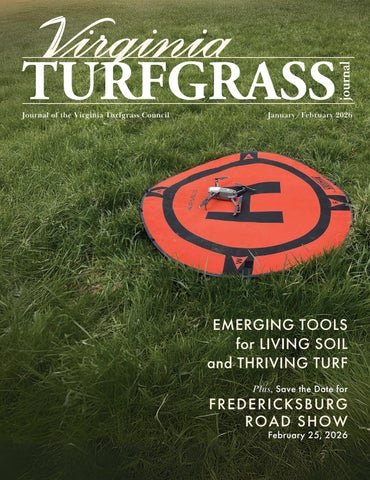
EMERGING TOOLS for LIVING SOIL and THRIVING TURF Plus, Save the Date for
FREDERICKSBURG ROAD SHOW
February 25, 2026
W W W . T H E T U R F G R A S S G R O U P. C O M
AGRONOMIC LAWN MANAGEMENT
(757) 563-8588 FertilizeWithALM.com 404 N E TW ORK STATI O N C H ES AP EAK E, VA 23320 1258 PROGRES S R O AD S UFFO LK VA 23434 2401 B OW LAN D PAR K WAY V I R G I N I A BEAC H VA 23454
NO W HI RI N G Motivated individuals can expect to make $50,000+ their first full year after training. Health Insurance Dental Insurance Matching 401K
Training and Certifications Paid By Company 7 Paid Holidays Community Involvement Flexible & Supportive Work Environment
S C A N TH E Q R COD E TO LEAR N MO R E A B OU T CA R E ER S W IT H ALM
Journal of the Virginia Turfgrass Council | January/February 2026
10
12
16
UPCOMING EVENT
DEPARTMENTS
10 Fredericksburg Road Show
6 President’s Message from Wes Bray
COVER STORY
12 Emerging Tools for Living Soil and Thriving Turf
7 Index of Advertisers 8 Director’s Corner from Beck Stanley
8 Virginia Tech Turf Team
FEATURE
16 Success of the USDA-Funded Resist Poa Project Find this issue, Events and More:
THETURFZONE.COM
4 | VIRGINIA TURFGRASS JOURNAL January/February 2026 www.vaturf.org
Follow for TURFGRASS NEWS, RESEARCH & EVENTS linkedin.com/company/theturfzone
x.com/theturfzone
facebook.com/theturfzone
Contact us today to learn about effective and unique TurfZone marketing strategies that target turf industry professionals.
sales@leadingedgecommunications.com
President’s Message
Are you Ready to Succeed?
M
Virginia Turfgrass Journal is the official publication of The Virginia Turfgrass Council P.O. Box 5989 Virginia Beach, VA 23471 Office: (757) 464-1004 Fax: (757) 282-2693 vaturf@verizon.net PUBLISHED BY Leading Edge Communications, LLC 206 Bridge Street, Suite 200 Franklin, Tennessee 37064 (615) 790-3718 Fax: (615) 794-4524 info@leadingedgecommunications.com VTC OFFICERS
ission: “To ensure that our members and businesses in the Lawn and Landscape Industry succeed through representation, education, and community service.’’
Vision: “To become the industry leader in political advocacy, education, and environmental stewardship in the Lawn and Landscape Industry.’’ Have you trained your staff? Did you take advantage of our various training, educational and service project opportunities the VTC and VTC Environmental Institute provided in 2025? Are your systems in place? Did you take a muchdeserved break? Are you looking around town for opportunities to serve the community and promote one of Virginia’s biggest industries and environmental advocates? How are you going to handle the increased workload that comes from being an industry expert in your segment of Virginia’s green industry? The VTC and VTC-EI are committed to fulfilling our mission and vision statements to enable members to be experts and thus be successful. As we transition to a new Executive Director and thank Tom Tracy for decades of service to promote and improve our industry, we look forward to continuing to provide programs and events that allow members to succeed and be recognized as industry experts under Beck Stanley’s leadership. We need your help. The programs we currently schedule only work because industry experts and VTC members, working with VA co-op agents, Virginia Tech, VDACS, DCR, sponsors and others recognize the importance of education and giving back to our industry. Come to the Bay and the Fredericksburg Road Show only happen because individuals in those areas believe in helping our members succeed. Their commitment to the green industry and their financial support is what allows these programs to grow. Let us help you. As we continue to grow the VTC and VTC-EI we look forward to expanding our events to other areas of Virginia. These events and programs require dedicated individuals and sponsors to be successful. Consider giving back to the industry that helps make you a success and work with us to bring an event to your town. Let’s talk, brainstorm and plan for success. Sincerely,
Wes Bray
VTC President 6 | VIRGINIA TURFGRASS JOURNAL January/February 2026 www.vaturf.org
President Wes Bray Lawns & Gardens Plus (757) 422-2117 Vice President Harris Wheeler, CTP Richmond Public Schools (retired) (804) 475-4561 Secretary / Treasurer Ray Funkhouser PBI Gordon (retired) Past President Phil Bailey, CGCS Isle of Wight County Parks & Recreation (757) 572-1981 VTC DIRECTORS Sam Burris Jack Findling Richard Linsday Bruce Sheppard T.J. Skirsky Craig Zeigler VTC ADVISORY MEMBERS OF THE BOARD Mike Goatley, Ph.D. (Chair) Shawn Askew, Ph.D. Alejandro Del Pozo-Valdiva, Ph.D. Jeffrey Derr, Ph.D. David McCall Ph.D. Dan Sandor, Ph.D. Cynthia Smith, Ph.D. EXECUTIVE DIRECTOR / DIRECTOR OF PROGRAMS Beck Stanley VIRGINIA TURFGRASS FOUNDATION Brandyn Baty (757) 585-3058
Index of Advertisers Agronomic Lawn Management.................. 3
Home Field Fertilizer 804.829.2696 | HomeFieldFertilizer.com
Take the Home Field Advantage and Use Professional Quality Fertilizers for Your Turf
Full Line Distributor of The Andersons Turf & Specialty Group Developer of Contec DG, Foltec SG, and HCU
www.FertilizeWithALM.com
Carolina Green Corp............................... 18 www.cgcfields.com
East Coast Sod & Seed............................... 9 www.eastcoastsod.com
Greene County Fertilizer Co.................... 19 www.greenecountyfert.com
Home Field Fertilizer / Meadowspring Turf Farm........................... 7 www.meadowspringturf.com
Leading Edge Communications................ 11 www.LeadingEdgeCommunications.com
McGill Premium Compost........................... 7
Meadowspring Turf Farm (804)829-2696
MeadowspringTurf.com
info@meadowspringturf.com
www.mcgillsoilbuilder.com
Progressive Turf Equipment Inc................. 14
Your Source for Quality Turfgrass
www.progressiveturfequip.com
Smith Seed Services.................................... 7 www.smithseed.com
Smith Turf & Irrigation................. Back Cover www.smithturf.com
The Turf Zone................................... 5, 9, 19 www.theturfzone.com
The Turfgrass Group........ Inside Front Cover www.theturfgrassgroup.com
Trimax Mowing Systems............................. 9 www.trimaxmowers.com
Virginia Turfgrass Council (VTC) serves its members in the industry through education, promotion and representation. The statements and opinions expressed herein are those of the individual authors and do not necessarily represent the views of the association, its staff, or its board of directors, Virginia Turfgrass Journal, or its editors. Likewise, the appearance of advertisers, or VTC members, does not constitute an endorsement of the products or services featured in this, past or subsequent issues of this bimonthly publication. Copyright © 2026 by the Virginia Turfgrass Council. Virginia Turfgrass Journal is published bimonthly. Subscriptions are complimentary to members of VTC. POSTMASTER: Send change of address notification to VTC, P.O. Box 5989, Virginia Beach, VA 23471. Postage guaranteed. Thirdclass postage is paid at Jefferson City, MO. Printed in the U.S.A. Reprints and Submissions: Virginia Turfgrass Journal allows reprinting of material published here. Permission requests should be directed to VTC. We are not responsible for unsolicited freelance manuscripts and photographs. Contact the managing editor for contribution information. Advertising: For display and classified advertising rates and insertions, please contact Leading Edge Communications, LLC, 206 Bridge Street, Suite 200, Franklin, TN 370643394, (615) 790-3718, Fax (615) 794-4524. Deadlines are the first of the month prior to the following month’s publication. (Example: August 1 for the September issue.)
McGill SportsTurf Premium Compost improves turf aesthetics by adding beneficial microbes to soils, improving nutrient uptake, and increasing porosity in heavy clay soils while improving water capacity in light sandy soils. Create a healthier soil environment and safer playing surface by applying 1/8" – 1/4" of McGill Premium Compost.
For more information go to mcgillsoilbuilder.com or call 844.362.1161 634 Christian Chapel Church Road • New Hill, NC 27562
BLEND
Journal of the Virginia Turfgrass Council | 7
Director’s Corner
Virginia Tech Turf Team Shawn D. Askew, Ph.D. Virginia Tech 435 Old Glade Road Blacksburg, VA 24061 540-231-5807 askew@vt.edu
Unity W
hen I first met Tom Tracy and the VTC in 2018, I had just joined the Virginia Agribusiness Council’s staff, where I had the good fortune to learn from my boss there, Kyle Shreve, and a fantastic board of directors committed to unifying the entire agriculture and forestry sector statewide. Virginia was experiencing historic turnover in its legislature, and Governor Ralph Northam had just been elected. It was an exciting time to be involved in the association space, and I quickly recognized the potential for VTC to be a part of that unification. In the coming months, I will be traveling the Commonwealth meeting with VTC members, recruiting some new ones, and asking you directly what we can do better to address your needs, whether it be education and certifications, assistance with state regulations, help with local issues that may arise, or to explain bills circulating in the legislature. I believe strongly in the mission statement of the VTC – to ensure that our members and businesses in the lawn and landscape industry succeed through representation, education, and community outreach. That is how I view my role, and that is what I wake up everyday thinking about. But another word is on my mind during this transition: unity. If we are to truly protect this industry and ensure the success of all those within it, there is no time for disagreement or grudges. It is my hope that in the coming months and years, you will see this theme of unity emerge and that together, we will look out for the interests of all turfgrass professionals in Virginia. Coming up on January 27th and 28th, we will once again invite you to “Come to the Bay.” This event showcases Virginia Tech’s Hampton Roads AREC and provides attendees valuable training and networking opportunities. If you have never attended, we would love to see you there. If you attend for the first time, I’ll even buy you a beer. In February, we have another valuable education event – our Road Show in Fredericksburg – where several exciting vendors will be on site.
Alejandro Del Pozo-Valdiva, Ph.D. Virginia Tech Hampton Roads Agricultural Research Station 1444 Diamond Springs Rd. Virginia Beach, VA 23455 757-363-3900 adelpozo@vt.edu Jeffrey F. Derr, Ph.D. Virginia Tech Hampton Roads Agricultural Research Station 1444 Diamond Springs Rd. Virginia Beach, VA 23455 757-363-3912 jderr@vt.edu Mike Goatley Jr., Ph.D. Virginia Tech 420 Smyth Hall Blacksburg, VA 24061 540-231-2951 goatley@vt.edu David McCall, Ph.D. Virginia Tech 435 Old Glade Road Blacksburg, VA 24061 540-231-9598 dsmccall@vt.edu
To everyone involved in turf, my door is always open to you. I can be reached via cell at 540-871-9001.
Dan Sandor, Ph.D. Virginia Tech 170 Drillfield Dr. 411 Price Hall Blacksburg, VA 24061 540-231-9775 dsandor@vt.edu
Beck Stanley
WITH SUPPORT FROM:
VTC Executive Director Thomas P. Kuhar, Ph.D. Virginia Tech Dept. of Entomology 216 Price Hall 170 Drillfield Drive Blacksburg, VA 24061 540-231-6129 tkuhar@vt.edu 8 | VIRGINIA TURFGRASS JOURNAL January/February 2026 www.vaturf.org
F O L L O W
F O R
TURFGRASS RESEARCH, EVENTS & MORE
x.com/theturfzone
Specializing in Bentgrass Sod for Greens, Tees & Fairways. Fine and Tall Fescue Regular and Shortcut Bluegrass Kevin Driscoll
Cell: 609-760-4099 | Office: 856-769-9555 KDriscoll@EastCoastSod.com
Upcoming Event
SAVE THE DATE FOR
VT FREDERICKSBURG
ROAD SHOW FEBRUARY 25, 2026 Virginia Credit Union Stadium 42 Jackie Robinson Way Fredericksburg, VA 22401
Join us at the home of the Frederickburg Nationals for a great day of education and recertification.
Last year’s Road Show was a great success!
Pesticide Recertification: 3A, 3B, 5A, 8, 10, 60 and VA Nutrient Management CEU
10 | VIRGINIA TURFGRASS JOURNAL
Don’ t Miss Out ! PROMOTE YOUR BUSINESS IN THE NEXT ISSUE OF
VIRGINIA TURFGRASS JOURNAL
Virginia Turfgrass Journal allows you to get your message directly in the hands of your customers. The magazine is a key benefit of membership in the Virginia Turfgrass Council – providing valuable research, education, and industry information to each member. Readers can also access the Digital Edition through The Turf Zone website. Archived issues ensure that your advertising will be seen indefinitely, for long-ranging impact. VTC members include:
Golf Course Superintendents
Landscape Contractors
Commercial Grounds Managers
Sod Producers
Lawn Care Operators
Parks & Recreation Supervisors
Sports Turf Professionals
Equipment Suppliers
Contact us today to learn about effective and unique advertising strategies that target turf industry professionals.
sales@leadingedgecommunications.com
Cover Story
EMERGING TOOLS for LIVING SOIL and THRIVING TURF It’s
alive – literally! Under your feet, a busy world of roots, microbes, fungi, and soil structure quietly powers everything we see above ground. Once we start paying attention to what’s happening beneath the blades, it becomes clear why soil biology and soil function sit at the center of resilient turf systems. Stronger roots, better nutrient cycling, improved water infiltration, and greater stress tolerance all start with healthy soil - something Virginia turf managers are depending on more than ever as the weather gets less predictable. At the Virginia Soil Health Coalition, we work to help people see just how much the living part of the soil matters. Turf doesn’t thrive because we throw fertilizer or irrigation at it; it thrives because the soil is working the way it’s supposed to. Microbes, fungi, roots, organic matter, pore space, and water movement act together like a quiet underground engine. When that engine is tuned up and humming, everything aboveground looks good. But here’s the fun twist: even though soils are complex and constantly changing, we’ve traditionally managed them with a shovel, maybe a soil probe, and sometimes our best guess. Don’t get me wrong, those tools still matter, but they may only show us part of the picture. The real challenge has always been seeing what’s happening underground in real time. That’s where new technology is stepping up.
12 | VIRGINIA TURFGRASS JOURNAL January/February 2026
RGB drone ready for takeoff — bringing real-time turf and soil insights from above.
Cover Story continued
Sensors, drones, and monitors generate mountains of data. AI is quickly becoming the tool that helps turf managers actually make sense of all that information. We’re entering a phase where AI can:
Tools That Are Transforming Turf Management
• identify patterns in moisture, stress, or compaction Electrical conductivity mapping works almost like an MRI for the soil. It shows how soil composition shifts across a field, helping turf managers reduce disturbance in sensitive spots and tailor inputs more precisely. That lines up beautifully with Soil Health Principle #1: Minimize Disturbance. Drones and aerial imagery take early detection and real-time monitoring to the next level. High-resolution sensors can spot stress. Whether it’s dry areas, compaction, or nutrient issues, drones help managers act earlier and more accurately, boosting root growth and ground cover in support of Principles #2 and #3: Maximize Living Roots and Keep the Soil Covered. And then there’s AI.
• flag irrigation or nutrient issues • integrate multi-year soil test and imagery datasets • build zone-specific recommendations rather than field-average guesses • generate predictive models to guide timing and inputs That kind of precision strengthens Soil Health Principle #4: Increase Biodiversity, whether we’re talking about microbial communities underground or a healthier, more resilient turfgrass system above it.
Better Built. Quality Results. Period. Sports field, Park and Estate Mowers
Contour / Rough Finishing Mowers
Turf Grass Production Mowers
Roller Mower cutting widths: 65”, 90”, 10.5’, 12’, 15.5’, 22’*, 29.5’*
Contour/rough finishing mower: Pro-Flex™ 120B 10’ cut TDR-X™ roller mower 10.5’ cut
Tri-Deck cutting widths: 12’, 15.5’, 22’*, 36’*
* available with bolt-on galvanized deck shells
Progressive Turf builds the right mowers and rollers for any field. For over 35 years they have set and re-set the standards in commercial grade mowing equipment.
WWW.PROGRESSIVETURFEQUIP.COM
Precision. Quality. Performance. Contact Us Today!
1.800.668.8873
Quality built in North America and supported by a world-wide Dealer network.
14 | VIRGINIA TURFGRASS JOURNAL January/February 2026 www.vaturf.org
But remember: AI is a tool, not a replacement for turfgrass expertise and specialists.
What Does This Mean for Soil Health? These technologies – sensors, drones, electrical conductivity mapping, AI aren’t just flashy gadgets. They’re new ways to understand how soil systems function and to apply the four soil health principles more effectively in turfgrass:
When technology makes the invisible visible, turf managers can support the biology rather than fight it. Better information leads to healthier soils, stronger turf, fewer inputs, and fields that are more resilient to everything from drought to downpours. The future of turf isn’t just greener — it’s smarter, more resilient, and more connected to the living world beneath our feet. And as these tools keep improving, so does our ability to support the soil systems that keep turf thriving.
1. Minimize Disturbance
ABOVE
2. Maximize Soil Cover
Fresh off the press: WPA-inspired We Are 4theSoil poster.
3. Maximize Living Roots 4. Increase Biodiversity
Journal of the Virginia Turfgrass Council | 15
Feature
SUCCESS of the USDA-Funded
RESIST POA PROJECT By J. Scott McElroy Professor, Turfgrass Management and Weed Science, Auburn University and James D. McCurdy Professor and Extension Specialist, Turfgrass Management, Mississippi State University
G
iven the current climate surrounding federal funding discussions, we want to provide detailed information about research outcomes from the ResistPoa project. Our goal is transparency about what taxpayer dollars accomplished when this project received funding. For information regarding this project, please see http://resistpoa.org/.
Project Background ResistPoa launched in 2018 as a nationwide initiative to tackle the growing problem of herbicide-resistant annual bluegrass (Poa annua) in turfgrass systems. This four-year, $5.7 million project, funded by the USDA Specialty Crop Research Initiative brought together 16 scientists from 15 universities across the country. The project had clear objectives: develop better management practices for annual bluegrass control, map the extent of herbicide resistance nationwide, and create decision-support tools for turf practitioners. Essentially, we needed to understand how bad the resistance problem really was and give golf course superintendents, sports field managers, and other turf professionals the tools to fight back. Annual bluegrass might seem like a small problem, but it’s not. This weed costs the turfgrass industry millions of dollars annually in control measures and lost playability. When herbicides stop working, managers face expensive reseeding, overseeding, and intensive maintenance schedules that strain budgets and resources.
Major Research Discoveries Nationwide Resistance Survey Our team’s biggest accomplishment was conducting the first comprehensive national survey of herbicide resistance in annual bluegrass. We collected and tested over 1,300 populations from turf sites across five different climate zones. The results were sobering—by 2023, we documented populations resistant to up to nine different herbicide modes of action. This wasn’t just academic research. These findings gave turf managers concrete data about what to expect in their regions. Instead of guessing whether an herbicide might work, superintendents could now reference our maps and data to make informed decisions about their control programs.
Understanding Resistance Mechanisms We dug deep into the science behind why annual bluegrass develops resistance. Through molecular analysis of dozens of populations, we identified specific genetic mutations that allow the weed to survive herbicide treatments. For example, we discovered a novel mutation in the β-tubulin gene that helps annual bluegrass resist popular pre-emergence herbicides like prodiamine. But genetics wasn’t the whole story. We also found that annual bluegrass uses other tricks—enhanced metabolism and reduced 16 | VIRGINIA TURFGRASS JOURNAL
herbicide uptake—to survive treatments. These non-target-site resistance mechanisms were particularly common with ALSinhibiting herbicides like foramsulfuron (Revolver) and trifloxysulfuron (Monument).
Practical Management Solutions Research is only valuable if people can use it. Our team tested alternative control methods that don’t rely solely on herbicides. We demonstrated that aggressive fraise mowing (essentially shaving the turf surface) could dramatically reduce annual bluegrass infestations in bermudagrass turf. While this technique isn’t suitable everywhere, it gives managers another tool in their arsenal. We also examined how cultural practices affect the weed’s competitiveness. Studies in Oregon showed that adjusting irrigation frequency and phosphorus fertilization could influence how well annual bluegrass competes with desirable grasses. These findings are being incorporated into our best management practice guidelines.
Human Factors Research What makes ResistPoa unique is that we have included social scientists to study the human side of weed management. Through surveys and interviews with turf managers, we identified real barriers to adopting better practices: budget constraints, risk aversion, and simple lack of awareness about resistance. We developed a user-friendly decision support tool—essentially a calculator that helps superintendents visualize the long-term benefits of diversified management versus short-term cost savings. This economic modeling helps justify upfront investments in integrated approaches rather than relying on the same herbicide year after year.
Sharing Knowledge From day one, we emphasized getting information to the people who needed it. The project created ResistPoa.org as a central hub for resources, now hosting about 70 educational documents that users can filter by turf system and control method. We produced a best management practices poster explaining herbicide modes of action and effective rotation strategies. This poster was distributed to over 2,000 stakeholders in print and downloaded more than 1,000 times online. Our team organized field days, workshops, and webinars across the country. These weren’t just presentations—they were handson demonstrations where turf managers could see control trials in action and ask questions directly. Perhaps most importantly, we trained the next generation. At least 22 graduate students, 25 undergraduates, and roughly 10 postdoctoral researchers received training through ResistPoa. These students are now professors, consultants, and golf course managers, multiplying the project’s impact. Journal of the Virginia Turfgrass Council | 17
Feature continued
Industry Impact The real test of success is whether the turf industry is actually using our findings. Early indicators are positive. Golf course superintendents are referencing our resistance maps to make proactive decisions about herbicide rotations. Instead of waiting for a product to fail, they’re switching to different chemistries based on what our survey showed in similar conditions. We worked closely with industry advisory panels from the beginning, including golf course superintendent associations, sod growers, and lawn care companies. This collaboration ensured our research reflected real-world conditions and that recommendations fit industry needs.
SAND BASED SOD WITH INFILTRATION RATE OF 11 IN/HR TENSILE SRENGTHwww.cgcfields.com 88% GREATER THAN 1” THICK CUT SOD SHEAR STRENGTH 43% GREATER THAN 1” THICK CUT SOD 866-753-1707
When preliminary results showed certain populations surviving standard herbicide rates, industry partners helped us quickly alert practitioners so they could adjust rates or tank-mix with other products. Seed producers worked with us to test for annual bluegrass contamination and resistance in turfgrass seed lots.
Scientific Output The project generated over 20 peerreviewed publications in journals like Weed Science, Crop Science, and Weed Technology. This wasn’t just about meeting academic requirements—these papers ensure the knowledge is archived and accessible to guide future research and management decisions. Our management guides are “Open Access”—you can download them from the Crop, Forage & Turfgrass Management Journal. Our investigators delivered dozens of conference presentations at weed science and turfgrass meetings, sharing results throughout the project’s duration rather than waiting until the end.
Long-term Value ResistPoa created lasting benefits beyond its four-year timeline. The network of scientists, Extension agents, and industry professionals formed during the project continues to collaborate on turf challenges. We’ve seen the power of coordinated research, and that collaboration model is being applied to other problems. 18 | This article was originally published in Alabama Turf Times, Summer 2025 and is reprinted with permission.
The students and researchers trained under ResistPoa have spread throughout the industry, carrying this knowledge into their new roles. This multiplier effect means the project’s impact extends far beyond the original $5.7 million investment.
GRASS SO GREEN THAT WE NEEDED AN EXTRA “E” Our Liquid Nutritionals & Specialty Fertility Products Are Blended To Feed Plants, Improve Soil Fertility & Build Topsoil
Turfgrass represents a $100 billion industry encompassing millions of acres of golf courses, sports fields, and maintained landscapes. ResistPoa demonstrated how targeted federal investment in specialty crop research can protect this industry and the green spaces Americans value. Annual bluegrass remains a formidable opponent, but the collective action marshaled by ResistPoa has given the industry evidence-based tools to manage this weed sustainably. The project exemplified how integrated approaches—combining science, education, and industry partnership—can tackle complex agricultural challenges effectively.
REFERENCES Bagavathiannan, M. V., McCurdy, J. D., Brosnan, J. T., & McElroy, J. S. (2018). National team to use $5.7 million USDA award to address annual bluegrass epidemic in turfgrass. Texas A&M AgriLife News. Grubbs, B., McCurdy, J., & Bagavathiannan, M. (2019). Poa annua: A plan of action. Golf Course Management Magazine. Rutland, C. A., Brosnan, J. T., McElroy, J. S., & Zuk, J. W. (2023). Survey of target site resistance alleles conferring resistance in Poa annua. Crop Science, 63(5), 3110-3121.
Healthy Turf starts with Greene County Fert. Ship Direct. Pro support always included.
GreeneCountyFert.com
CONTACT US TODAY to learn about effective and unique marketing strategies that target turf industry professionals.
McCurdy, J. D., and others (2023). Developing and implementing an integrated weed management program for herbicide resistant Poa annua. Crop, Forage & Turfgrass Management, 9(1), e20225. Allen, J. H., and others (2022). Herbicide resistance in turf systems: insights and options for managing complexity. Sustainability, 14(21), 13399. USDA-NIFA. (2020–2022). ResistPoa Project Extension and Training Outputs. USDA-NIFA Annual Reports.
sales@leadingedgecommunications.com
FOR OVER A CENTURY,
WE’VE BUILT MORE THAN A BUSINESS. WE’VE BUILT TRUST.
At Smith Turf & Irrigation, our legacy is defined by unmatched service, dependable support, and relationships that stand the test of time. When you choose us, you’re choosing experience and a commitment to excellence that never wavers. Tradition you can trust. Service you can feel. Support you can count on.
NORTH CAROLINA | SOUTH CAROLINA | VIRGINIA | TENNESSEE | BERMUDA