Welcome to this edition of Ignite, where we continue to explore the intersection of research, reflection and classroom practice This issue invites us to consider how teaching can support not only academic progress, but the broader development of students as thoughtful, resilient and emotionally literate learners
We begin with seven principles for high-quality SEND support, emphasising that inclusive teaching is not an optional add-on but the foundation of excellent pedagogy We then turn to Learning
Meet the authors:
ISSUE 4
Outside the Classroom, exploring how experiences beyond the classroom can deepen engagement, foster intellectual curiosity and develop critical thinking Finally, we reflect on emotional literacy and creativity, considering how the arts provide students with crucial opportunities to understand, regulate and express their emotions
Together, these articles invite us to think holistically about learning, combining academic excellence with emotional, social and creative development, and prompting us to continue growing as reflective, responsive professionals
MISIA COLLINS MEG CHRISTMAS MIKE DOWD
Mike has worked as an English teacher for just over 12 years and has been a SENCo in independent schools for six His particular interest is the role metacognition plays in empowering SEND students to become independent learners, and how high-quality teaching and targeted interventions can narrow the attainment gap for students with SEND He is currently completing a Master's in Inclusive Education Leadership
Misia completed teacher training during lockdown, having previously worked in asset management Her particular interest, apart from the benefits of learning outside the classroom, is the role History learning plays in the development of critical thinking skills at school and into adulthood
Meg has been teaching for six years, and as well as harbouring a strong desire for high attainment in the classroom, cares greatly about the benefits of Drama and performance outside of the world of theatre - both for students and adults alike
Seven principles for SEND support, or “High quality inclusive lessons - every lesson, every day”
Mike Dowd - Head of Learning Support
With all the sound and furore around SEND nowadays, even the more observant might be surprised that SEND numbers, though increasing steadily since 2020, are actually slightly lower than 15 years ago And, despite a recent flurry of papers and reviews, the SEND Code of Practice (2014) remains our only governing framework Meanwhile, the landscape around it has transformed entirely SEND is now in the public consciousness far more than 15 years ago, and there is a national trend towards making schools more inclusive For selective, independent schools, navigating this shift towards greater inclusivity requires clarity about what outstanding SEND support actually looks like Below are seven principles to guide that work
1
All children, SEND included, receive the bulk of their education in ordinary subject lessons
For children all over the country, the overwhelming majority of their academic learning happens in normal lessons, in the normal way For decades, the job of Learning Support departments was to pull struggling students from their lessons to have them work in small groups with a teaching assistant who had little of the subject-specific knowledge that had been available to them in the classroom they just vacated This approach, however well-intentioned, separated students from the very expertise they needed The evidence is clear: the best way to improve outcomes for SEND students is through “high quality teaching” (EEF) While targeted, time-limited interventions can play a supporting role, inclusive pedagogy and adaptive teaching must permeate every aspect of the curriculum, woven into the fabric of our lessons: built in, not bolted on
2. You (the classroom teacher) are responsible.
The SEND Code of Practice is crystal clear in stating who is responsible for progress of the
pupils and how their needs are to be met, namely, the classroom teacher and “high-quality teaching” Visit a Year 10 maths lesson if you teach English, and you'll quickly discover the joy of being woefully out of your depth The maths teacher has the curriculum knowledge, pedagogical expertise and student relationships that drive progress; the responsibility is hers This also doesn't mean working in isolation Teachers should be empowered to draw upon LSAs, Learning Support colleagues, pastoral systems and parental input, not to delegate responsibility, but to fulfil it more effectively
3. Needs, not labels.
Taking a "needs not labels" approach means looking beyond the diagnosis to understand the individual: what specific challenges does this student encounter in my classroom? What strategies prove effective for them? Diagnoses provide a crucial starting point - and many parents and students rightly find them empowering and validating - but labels can obscure as much as they inform The ADHD label describes both the student who disrupts relentlessly and the one who sits in perfect, inattentive compliance It might be more accurate to think of dyslexias rather than dyslexia,
such is the breadth of strengths and weaknesses that come with that condition Moreover, the cooccurrence of neurodevelopmental conditions is the rule rather than the exception, and most commonly encountered labels in schools affect overlapping areas of learning, including language, attention, working memory, processing speed and executive functions With the complex picture that is brought about by the various labels and diagnoses, the only rational response is to respond to the needs of the individual student as they present in your individual subject area Rather than asking 'What does this diagnosis mean?', we should ask 'How does this student learn best in my subject, and what specific barriers do they face?'
4. Generally, great teaching for SEND is great for all
“Oh, Miss, I wish you hadn’t scaffolded that task and provided those multisensory resources ” complains the neurotypical child plaintively
Another pines from the corner, “This metacognitive modelling and retrieval practice sure is lowering my standards, Miss!”
(In the unlikely event of this occurring, you can blame me )
Perhaps it is a hangover from when "differentiation" mostly meant "make another worksheet with fewer blank spaces " , but adaptive teaching, and, in particular, adapting for SEND needs is not some perfunctory nod to a checklist of teaching strategies that need cramming into an “outstanding” lesson Done well, it raises achievement for all students, top to bottom Explicit instruction, worked examples, retrieval practice and multisensory encoding aren't "special" techniques but reflections of how all human minds learn A ramp helps wheelchair users, but it also helps people with prams, luggage and delivery carts Similarly, scaffolding and metacognitive modelling help SEND students, but they also help everyone else by reducing cognitive load and making thinking visible
This principle challenges us to see adaptive teaching not as extra work but as excellent pedagogy that enhances learning for everyone
5 High standards for all
Nothing about SEND should denote a lowering of standards Consider a classic example: a student in Third Year with ADHD who persistently disrupts lessons due to difficulties with impulsivity One option in response to this insubordination is to punish him relentlessly throughout the year until the list of misconducts begins to rival Tolstoy for word count Another is the abdication of duty: a gradual lowering of standards where we all learn to accept this poor behaviour A third is to acknowledge that impulsivity is a barrier to this student’s learning and to implement targeted strategies to support self-regulation while maintaining clear boundaries Having a neurodevelopmental condition is not an excuse for lowering expectations but it is an opportunity for additional praise when a student overcomes barriers to achieve their goals We don’t lower the bar; we provide the ladder
6 There is no silver bullet Believe in the cumulative effect of small adjustments
A seating plan that reduces distractions, visual aids that support memory, vocabulary lists, additional processing time unglamourous as they are, modest adjustments accumulate powerfully over days and weeks and terms A Second Year student at KGS is faced with 30 different lessons each week across 16 different subjects An individual adjustment that might seem insignificant in isolation has a compounding effect A dyslexic student given a vocabulary list studies more efficiently, which reduces anxiety, which improves focus, which increases participation It’s not magic, just maths
7. If we can't do it, who can?
I find this to be a very clarifying question. If, in this school, with all the expertise, support, resources, technology and opportunity available to all, they cannot be supported effectively, then where exactly would they be better served? A school is only as good as the progress of its most challenging, vulnerable child If we truly believe every child deserves to work well and be happy, then we must resist the temptation to lower expectations and replace it with the harder work of genuine support High quality teaching isn't negotiable; it's the foundation everything else is built upon - every lesson, every day
Bibliography
Department for Education and Department of Health (2015) Special educational needs and disability code of practice: 0 to 25 years Available at:
https://www gov uk/government/publications/sen d-code-of-practice-0-to-25 (Accessed: 15 December 2025)
Education Endowment Foundation (EEF) (n d ) High-quality teaching Available at: https://educationendowmentfoundation org uk/su pport-for-schools/school-planning-support/1high-quality-teaching [Accessed 15 December 2025].
Hohnen, B , Gilmour, J and Murphy, T (2020) The incredible teenage brain: everything you need to know to unlock your teen's potential London: Jessica Kingsley Publishers Packer, N (2021) The perfect SENCo Carmarthen: Independent Thinking Press
When learning steps outside
Misia Collins - Teacher of History
I recently needed a ‘grounding phrase’ to pull me out of trials marking panic, so I turned to AI When that didn’t work, I thought - use your own brain, Misia I remembered a simple technique - remind yourself of a time you felt excited by your History teaching Bingo Taking a group of pupils to Berlin in October had a palpable reinvigorating impact upon my classroom practice Thinking about the lasting impact it had on the pupils took me (momentarily) out of the panic state
That’s fairly simplistic, obviously A time I was out of the classroom immersed in German Historywhat a surprise it had an energising impact! Yet the more I have thought about the true purpose and impact of Learning Outside the Classroom (LOTC), the more I realised it is possible to bring some of these benefits to how I teach in the QEII, 100 London Road, 70 London Road... you get the picture
LOTC with pupils has been proven to result in increased engagement and deeper understanding of the world around them We probably all know that intuitively Nevertheless, I conducted a very brief piece of research during tutor time with my Sixth Form group They were surprisingly eloquent on the topic of LOTC A Politics pupil spoke of the impact of seeing and hearing politicians debate; she felt it elevated learning in the long-term, by providing practical, real-world application It made me think that pupils may only see us - their teachers - speaking, presenting, fielding questions But these skills are needed from day one of your career How empowering to see them in real world setting
Of course, we can’t get out into the real world as much as we might like during the school term That does not stop us seeking out ways to bring the spirit and atmosphere of LOTC back inside
This has become a focus for me because of this link between LOTC and the real-life skills that we are trying to impart on top of our teaching and learning One of these is the ability to think critically, a key component of which is avoiding groupthink Groupthink in the classroom can present itself as group-not-think that frustrating moment when no one wants to be the first to contribute Reflecting on the benefits of LOTC can help here - what follows is my attempt to link LOTC with skills that may eventually set our pupils apart in personal statements, interviews and beyond
1 Ideas around a ‘ sense of period’ were big when I did my PGCE five years ago Perhaps because none of us were venturing very far everything took on a fresh excitement It’s the acknowledgment that we can go beyond dates and period labels to help pupils recognise the kind of conditions in which people lived - the routine ideas and assumptions that shaped their thinking Work-wise, this might look something like “ today, you are an investigative journalist/archives assistant/newspaper editor!!” We may not be stepping outside, but I can try to suspend their disbelief for 50 minutes, in a bid to increase
2
Intellectual curiosity I have developed a theory, impossible to ever prove, that the kids you see walking to and from school not on their phones will be the most employable in the future. They are the ones noticing, listening. On a school trip, school rules apply = no phones
The way the pupils interact is transformed
According to the International Journal of History, the positive group dynamics that tend to be seen on trips contributes to learning that lasts Essentially, on a trip, it’s OK to show you are enjoying learning Imagine! If we seek even small ways to create this atmosphere within the classroom, then, it could contribute to a culture of
3 Critical thinking The World Economic Forum
Future of Jobs Report 2025 states that this is a skill that thousands of CEOs will be including on job specs in the next 10 years To get good at thinking critically, you need to be asking questions in the first place, before you can test your reasoning By weaving some of the principles of LOTC into lesson planning, the environment for intellectual curiosity can (I hope) be elevated
As teachers, we may not always be able to take pupils out, but we can always bring the wider world in Embedding the principles of LOTC into our daily practice offers learners not just knowledge, but the habits of mind that will set them apart in interviews, workplaces and life
The hidden skill gap - emotional literacy and creativity
Meg Christmas - Teacher of Drama
“Mr Anderson thinks that everything inside him is worthless and embarrassing ” This line, said by one of fiction’s most beloved teachers in the beautiful, but traumatising, Dead Poets Society (1989), is one that I think about a lot While Mr Keating’s approach of placing the spotlight on his most socially anxious student might not fit with modern standards of teaching, there is something about that line that I believe captures well how many of our students consider their own emotions
Anyone who spends more than 30 minutes with a teenager can attest as to their emotional fluctuations - they either do not understand them, cannot control them, think they have no value or are embarrassed by them Scholarship regarding emotions and adolescence is extensive, dating as far back as the Ancient Greeks, with Plato describing young people as “living, and pursuing one ’ s various aims, under the sway of feelings ” (Book 1, pp 65-66, trans Thomson and Tredennick) While modern science attributes these emotional swings to hormones (Susman et Al, 1987), the reasons for emotional instability remain irrelevant - as teachers, we simply work with the emotions that are there
While the phenomenon of teenage emotional outbursts is not new, the landscape our students are navigating is Even as far back as 2009 was concern expressed regarding the wellbeing of children in a world where technology is rapidly developing, with Freier and Kahn Jr investigating the impact of children viewing digital media They found that technology impacts many areas of a child’s development, including how children build knowledge and interact with their peers (Freier and Kahn Jr, 2009) Factor in all that we face today, the impact of COVID and the prevalence of AI, and we are facing challenges for our students that have
not been faced before, and the potential impact of this on the emotional regulation of young people must not be overlooked
Talking with teachers in and out of KGS, it is clear that educators feel there has been a recent uptick in poor behaviour, especially post-COVID, and the evidence supports this - 70% of responses in a recent survey suggested that COVID had negatively impacted pupil behaviour (Team Teach, 2024) Children were also impacted both socially and emotionally, with almost one-million referrals made to CAHMS in 2023-2024 (Children’s Commissioner, 2025)
With whatever biases I have, I believe creative subjects are crucial in the emotional growth of children, and as a key factor in attempting to combat the damage done by all that has been discussed This is backed by research: Larson and Brown, focusing on theatre programmes in American High Schools, found a link between participation in theatre and in emotional regulation, looking specifically at the adapting of expressions in a way that might negate otherwise negative interactions (2007)
In my own practice, I consider how students engage with the roles they play - so often does a
EDIT
student tell me that they are happy to play a part on stage, but are terrified of speaking publicly as themselves
Edit
When they say this, they do not realise how impossible it is to never bring any part of yourself on stage When I ask a student to write a monologue about a character that is lonely, they do not realise what I am actually asking them: think about a time when you have been lonely, and use that to create somebody human Stanislavski argued for the importance of putting oneself in the mind of a character - speaking of the magic ‘if’: how would I feel if this were me in this situation (Stanislavski, 1936) Drama inherently seeks to root students within their emotions, and while to suggest that this automatically leads to complete emotional regulation would not be true, asking our students to be empathetic can only be for their benefit
Art too has benefits in emotional regulation, and studies on emotional intelligence frequently look at how art can establish students as confident and engaged, with one report suggesting that “Art is the most important center [sic] of all biological and social processes of the individual in society” (Vygostky, 1968) Access to art, alongside music, theatre and literature, is key in developing emotional literacy - as Kozhemyakin writes, “the development of emotional intelligence is possible only in a complex” (2018) Few of us would be capable of visiting the art department at KGS without being moved by some of the work on the walls - created by students who perhaps do not realise how much of themselves they leave on the canvas. At the GCSE and A-Level exhibition, I am always touched by how many students paint their mothers
You could argue that being able to show someone how you ’ re feeling through creative means does not guarantee you a better job, and it is for this reason that many deem creative subjects uselessbut emotional regulation, the ability to connect with other people and having a healthy outlet for negative experiences are all skills that, for many
employers, are invaluable And that does not even consider the myriad other benefits that come with studying creative subjects: presentation, fine motor, analytical and evaluative skills are all areas students improve in by engaging creatively By embedding creative subjects into the curriculum, and by all of us, regardless of our subjects, pushing for the importance of creativity within schools, we are setting our students up for happier, more wellrounded and more successful lives - and the root of all this: emotional literacy
Ultimately, we are all being let down by the very forces that are letting down our students - except we are in a position to help them We do not want them to feel like Todd Anderson, believing that everything inside them is worthless or embarrassing (or, as they would say, “cringe”) By helping them form stronger ties to their own sense of self, we can empower them to have courage in what they feel and to express their emotions without worry
Wider CPD opportunities
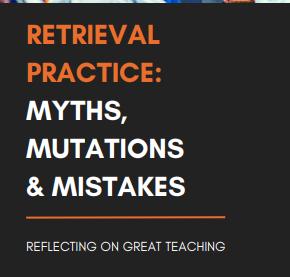
Retrieval practice has become an area of considerable focus for KGS in recent years; Carl Hendrick’s Substack offers a timely exploration of how this powerful learning strategy can go awry through misconceptions and “lethal mutations”: Retrieval Practice eBook
This TES article shows how Ohio charter schools use celebration, competition and visible progress tracking to boost pupil motivation and create a vibrant, high engagement learning culture: What US schools taught us about motivating pupils | Tes