Akehurst unpacks sessions on landscape recovery, nature finance and farm diversification.
INHERITANCE TAX CLIMB DOWN
A major change to the upcoming inheritance tax rules may have been the best possible Christmas present for many family farms, but the fight goes on to persuade the Government to scrap the legislation completely.
After a long campaign against changes to agricultural property relief (APR) and business property relief (BPR) that were threatening to have a huge impact on a number of farming businesses, the Government’s 23 December climb down was warmly welcomed across the industry.
Increasing the tax-free threshold from £1m to £2.5m and allowing it to be passed on to a surviving spouse or civil partner now gives most family farms a £5m buffer before they will become liable for inheritance tax. Figures suggest that the number of farms likely to be affected in 2026/27 will roughly halve.
The news was warmly welcomed by Alan Clifton-Holt, the NFU’s regional board chair for the East of England, who farms near Romney Marsh in Kent, who said it would “make a big difference and help to protect many small and medium-sized family farmers”.
While also welcoming the news, the Country Land and Business Association (CLA) was also quick to stress that the fight was not yet over.
President Gavin Lane commented: "Government should be congratulated for its partial climbdown, which came as a welcome relief. It was a further acknowledgement that their reforms were ill-thought through and deeply damaging.
"We cannot though, pull back on our campaign to reverse the policy in full, simply because what remains is still so dreadful for the rural economy. We are realistic about what can be achieved in the short
term, but will hold all parties' feet to the fire to ensure APR and BPR are, eventually, restored completely."
South East Farmer diarist Monica Akehurst was one of those whose family farm was in the firing line of the legislation and whose Christmas was the happier following the change.
She explained: “We hadn’t quite got around to organising legal advice regarding Labour’s raid on farm inheritance tax. The pressure was on… we knew time was running out fast. It was therefore a huge relief when the Government unexpectedly moved the goal posts by raising the threshold.
“I was out checking stock, my phone pinged with gleeful messages from our offspring, followed by a call from my other half confirming it. It was indeed a pre-Christmas surprise, good news worth celebrating.”
Monica went on: “Well done to everyone who played a part in persuading this government to make this alteration, but I sympathise with the medium to large farming enterprises who will still have tax to find.
“The margins in food production are slim and until a fairer food chain is evolved, finding money to pay this farm inheritance tax will be disruptive, acting as a disincentive for investment. We are told that ‘food is a public good’. In my opinion there should be relief for farmers that primarily produce food.”
Alan Clifton-Holt added: “Farmers pay tax on their income, like everyone else, but the policy as it stood left people facing an unpayable tax bill and looked to threaten the future of many farm businesses.”
The NFU said it had “demonstrated how the plans severely jeopardised farmers’ ability to deliver national food security, cruelly
penalised elderly and vulnerable farmers who were left with no time to reshape their businesses to mitigate against the impact and did little to tackle the issue of people buying land just to avoid tax”.
Announcing the change, Environment Secretary Emma Reynolds said: "Farmers are at the heart of our food security and environmental stewardship, and I am determined to work with them to secure a profitable future for British farming.”
NFU President Tom Bradshaw said the organisation had spent the past 14 months campaigning and lobbying against the worst impacts of the Finance Bill proposals.
He said the original proposals had resulted in “a pernicious and cruel tax, trapping the most elderly and vulnerable people and their families in the eye of the storm”, adding: “The NFU and its members have stood strong for what we believed in.”
Tom went on: “I am immensely proud of all those farmers and growers who have worked with the NFU and supported our campaign. We stood together and supported one another when it really mattered. In the end, it was well-reasoned and rational argument that won through.” He added that more than 270,000 members of the public had also supported the campaign “because they value British food and the working people of the countryside that produce it”.
FARMING IN PROTECTED LANDSCAPES EXTENDED
News that the Farming in Protected Landscapes (FiPL) programme will be extended for three years to March 2029 has been warmly welcomed by the High Weald National Landscape Partnership.
Sally Marsh, co-director of the partnership, said: “Farmers and landowners in protected landscapes like the High Weald are leading the way in sustainable farming and regenerative agricultural practice.
“Since the launch of the FiPL fund in 2021, nearly 500 farmers across the High Weald have benefited from over £2 million for projects to protect the landscape, support our rural economy and manage the environment for future generations.
“We are delighted that this fund is being extended to support our famers so that they can continue this vital work.”
Former South East Farmer correspondent John Marland, who farms in Sussex and chairs the FiPL panel for the High Weald landscape, agreed.
“This is great news,” he said. “There is an extra onus on those of us farming in protected landscapes to balance producing good, affordable food with nature-friendly, sustainable farming. Today’s announcement will help give us confidence to farm and plan for the future.
“These grants have already funded more than 150 excellent projects across the High Weald and I’m very pleased this work can continue.
“What’s important is that the High Weald landscape team is there to support farmers and landowners in making the grant applications. They can do farm visits and offer invaluable suggestions and advice, so there is need to feel put off by the paperwork.”
Farmers can only really have new year’s dreams OPINION
On a recent visit to Dr Johnson’s House, just behind Fleet Street in London, I was reminded that the great lexicographer once described second marriages as “the triumph of hope over expectation”. Whether he was thinking of his wife Tetty’s plight, since she had married Johnson after the death of her first husband, or was lamenting his own situation is not clear. It was certainly an odd union; he was a callow youth of 25 who was yet to achieve anything in life and Tetty was 46.
Whatever it was that prompted Samuel Johnson, who went on to compile A Dictionary of the English Language in 1755, to utter that oft-quoted warning, it occurs to me that it could also apply to farming, surely very much the “triumph of hope over expectation”.
While the Government delivered a welcome Christmas present to the industry in the shape of much-needed amendments to the agricultural and business property reliefs that affect farmers’ inheritance tax liabilities, the way the new year turns out will again be down to luck as much as to farming ability.
Farmers will hope the weather plays ball, that the sustainable farming incentive options are carefully thought through, that global markets are favourable and that livestock don’t fall prey to sickness or disease but only the most optimistic would book a post-harvest Caribbean cruise on the strength of such hopes.
While most people make new year’s resolutions, farmers can only really have new year’s dreams. While losing weight is generally down to taking more exercise, willpower, a better diet and things we can, for the most part control, agriculture is dependent to a large extent on external forces.
But our undaunted industry continues to bounce back, to fight – as it did so successfully in opposition to the ‘family farm tax’ – and to support local communities even when farming itself is under attack.
In just one example of the generosity of spirit so often shown by farmers, NFU West Susex member Rupert Hoare, his wife Sarah and a group of friends and volunteers organised 2025’s Chichester Christmas charity tractor run which saw more than 100 tractors take part and raised a record-breaking £35,500 for the Air Ambulance, Kent, Surrey and Sussex.
Our new year’s hope for 2026 is that the Government begins to recognise the vital contribution farmers make to this country and supports them accordingly. After all, in the words of Dr Johnson, “agriculture not only gives riches to a nation, but the only riches she can call her own”.
EMAIL YOUR VIEWS, LETTERS OR OPINIONS TO: sef.ed@kelsey.co.uk or write to the address on page 3
® MALCOLM TRIGGS - EDITOR
LONG-AWAITED FARMING PROFITABILITY REVIEW
There was widespread support from across the industry for Baroness Minette Batters’ long-awaited farming profitability review, which set out 57 recommendations aimed at improving the viability of farm businesses and making them more resilient.
The former NFU president’s recommendations, which followed an in-depth, six-month review into the issues underpinning farm profitability, will feed into the Government’s food strategy, farming roadmap and land use framework, and prompted an immediate response from DEFRA in the form of a farming and food partnership board.
A DEFRA blog published immediately after the launch said Baroness Batters had “emphasised the importance of improving the use of data to boost productivity, simpler and smarter regulation, and more targeted support for innovation”. In response, it said, “government will strengthen the voice of farmers at the heart of government”.
The author’s successor as NFU President,
Tom Bradshaw, said: “As we continue to face huge and wide-ranging challenges, from geopolitical uncertainty and trade deals that threaten to undermine our marketplace to uncertainty around the future of environmental schemes, extreme weather events, continued price volatility and the unfair family farm tax, this report is right to recognise that reform is needed.
“Changes that will drive competitiveness and profitability, which are critical elements of thriving farming businesses, are also crucial to achieving the government’s own targets for economic growth.
“This is about enhancing the financial resilience and long-term sustainability of British farming – the bedrock of the nation’s largest manufacturing sector, food and drink, worth £153 billion to the economy and an industry that supports more than four million jobs.
“The creation of a new farming and food partnership board with profitability and food security at its heart will enhance collaboration and ensure the government and industry can
work in partnership delivering on the issues that matter most for the sector.
“A commitment to continue working on supply chain fairness is a top priority for all farming sectors, while delivering planning reforms will help underpin growth for the industry. Refocused efforts on growing our exports is also welcome and vital to adding value for domestic producers.
“And while private finance can play a big part in delivering new income streams and delivering for nature, we can’t hide from the fact that significant challenges remain to this [moving] beyond the pilot stage to a truly scalable market delivering financial opportunities for farmers.
“Secretary of State Emma Reynolds recently said that farm profitability was vital to enable the UK agriculture sector to grow. We couldn’t agree more. The NFU stands ready to work with government to deliver our collective ambitions for economic growth delivered by a British agriculture sector that is set up to thrive.”
Welcoming the report, the Country Land and Business Association (CLA) said it underscored the need for “urgent action to build selfsustaining farm businesses”, with President Gavin Lane adding that it “highlights the need for closer collaboration between farming, industry and government, and greater clarity and certainty for farm businesses looking to grow and invest."
He went on: “As this report highlights, profitability across the sector is perilously slim, with farmers battling high input costs, low commodity prices and volatile weather conditions.
“We welcome Minette Batters’ conclusions and urge the Government to work with the industry to build profitable, self-sustaining farm businesses, otherwise food production and nature recovery will be put at even greater risk.
“Now is the time for urgent action. We need a stable policy environment, clarity on farming schemes, real planning reform and a recognition that a joined-up approach to rural affairs is desperately needed across government.”
One of the few cautionary notes was sounded by the Soil Association, which expressed concern over what it saw as a suggestion that pesticide regulation could be weakened.
The association said the report “recommends a switch to a risk-based approach, which would see regulators moving away from the precautionary principle. This could mean allowing pesticides that are likely to be hazardous to be used in farming because there is not yet evidence they have caused harm”.
Policy Director Brendan Costelloe commented: “The last thing the UK needs is a more relaxed approach to pesticides. The farm profitability review's suggestion to switch to a risk-based approach essentially means we throw caution to the wind.
“Time and time again we later see devastating consequences from pesticides that could have been avoided. A more relaxed, risk-based approach would almost certainly increase the number and toxicity of the pesticides that are already driving catastrophic declines in insect populations that simply cannot afford any more 'risk'.
"Nor can farmers afford more declines in pollinators – one of the biggest threats to farm businesses. However, the report is right to call for farmers to have more of a level playing field.
We should not be importing products from other countries using pesticides that are banned here. But we should be striving to level up that playing field, not level down.”
He added: “The report is right that sustainable, regenerative food production must find ways to become profitable. The obvious next move for government is to urgently reinstate the sustainable farming incentive, which provides stability in the short-term and resilience to climate adaptation in the long-term.”
Nature Friendly Farming Network chief executive officer Martin Lines said the review “starkly illustrates the scale of the challenges England's farmers are facing in maintaining the viability of their businesses while navigating extreme weather, climate change and market volatility”.
He said it was “particularly pleasing to see the emphasis on whole-farm approaches and improving soil health and fertility for longterm resilience, and to see nature-friendly and regenerative approaches to farming discussed positively throughout the report”.
But he went on: "However, while Baroness Batters recognises the importance of ELMS [environmental land management schemes], we do not agree that the sustainable farming incentive cannot deliver for both food production and nature at the same time.
“Likewise, while we agree that increasing production of protein crops, fruit and vegetables is vital, we believe that public procurement schemes, market regulation and aligned import standards would all be more effective ways of boosting the market for these sustainable, nutritious foods than using public money to support food production.”
Steve Clarkson, chief executive of Organic Farmers & Growers, said many of the review’s key recommendations “closely align with the principles and demonstrable outcomes of organic farming”, adding: “As such, I hope organic will be explicitly recognised in the Government’s 25-year farming roadmap.”
He went on: “Organic systems are synonymous with championing economic and environmental resilience, which should be seen as two sides of the same coin, as Baroness Batters points out in her review. The recommendation to implement new frameworks that measure the full value of farming in terms of GDP and natural capital
are wholly welcomed.”
The chief executive of the Game & Wildlife Conservation Trust (GWCT), Nick von Westenholz, pointed out: “With nearly three-quarters of the UK land mass used for agriculture, it is crucial that farmers integrate measures that will help the country meet its environmental ambitions with profitable businesses that earn them their livelihood.
"The GWCT’s own experience with our farm at the Allerton Project in Loddington bears this challenge out; producing food alongside nature recovery is proving ever more difficult. Instead, like so many farms, we find non-farming income is proving vital to keeping the show on the road and producing food. Baroness Batters’ report could not be more timely, recognising that farming is the backbone of our rural communities and fundamental to national food security.
“We particularly commend the review's emphasis on farmer collaboration as a cornerstone of future profitability. The report's vision for establishing regional agri-growth hubs as collaborative farmer networks alongside the expansion of farm environmental delivery groups across England's 93 river catchments could be transformative.
“As the review notes, collaboration enables farmers to share costs, access funding streams not readily available to individuals and create coordinated nature recovery while maintaining control of their own farms.”
For GB Potatoes, chief executive officer Scott Walker said: “Baroness Batters’ pragmatic approach underscores the need to value and support primary producers and the broader food sector as the foundation of a sustainable, commercially resilient industry.
“If quick wins, such as addressing barriers in the planning system, are delivered, they will be warmly welcomed. The creation of a farming and food partnership board, with profitability and food security at its heart, is also welcome.”
From the commercial sector, James Farrell, head of rural consultancy at Knight Frank, said the review had brought “a necessary and welcome focus to the business realities of farming”, pointing out: “Farms are, at their core, businesses, and like any other, they must generate profit to remain viable. Profitability underpins the sector’s ability to produce food, sustain rural economies and deliver meaningful environmental outcomes.”
DIFFICULT FOR SOME TO UNDERSTAND
Dear Sir,
I have read most of the reports regarding farm inheritance tax, but many have missed the real issues.
I was asked once what I thought agricultural land was worth. I said that if you wanted to farm it, it would be expensive even if it were given to you.
It is difficult for some people to understand why one can't afford to pay tax if one inherits a farm worth £5m.
At the same time, not many genuine farmers have paid £4/5m for a farm. Often they have been passed down, and the recipient borrows on the assets they have. If they have to pay inheritance tax, they will be financially crippled, or spend the rest of their lives paying back the bank that lent them the money to pay the tax in the first place.
Often the reason land has become so highly valued is that someone down the line has sold land for development or had it compulsory purchased for a road or railway.
This is where the Government should be looking, at land that goes from £10,000 an acre to £500,000 with planning permission. If that's not capital gain, then there is no such thing.
Any farmer who pays £5m for a farm won't be able to pay for it from farming the land. It will be mostly from another business income.
I have some suggested alternatives to the proposed inheritance tax. First of all, if someone inherits a farm with a market value of, say £5m, and there are no charges on the land because it was bought by their grandparents 70 years ago, they could be charged a similar fee to an agricultural rent. It would be paid to the local council and help reduce their shortfall in funding.
If one inherited a large farm of, say, 600 acres, they could avoid the charges by creating a new tenancy for a young farmer and receive a rent rather than paying a rental value to the local authority.
With regards to the tractor protest, I haven't seen one rusty old tractor with no cab being driven down Whitehall; they all appear to be new tractors with a nice warm cab, heaters and a radio.
I do recall having a tractor with no cab. Working in an easterly wind, at lunch time I got off the tractor but couldn’t stand up as I was so cold. And we had less than £12 a week, not an hour, but at least at that time four gallons of petrol cost just under £1.
Laurence Keeley, Herstmonceux, East Sussex
UNDER ATTACK
Dear Sir,
We should not confuse farmers with absentee land owners. Farmers are under attack from all sides, especially from dirt cheap Australian and American imports, and need a much more sustainable deal from the Government.
People who buy swathes of land to avoid tax are not wealth creators. They might have been in the past, but now they look to preserve their wealth rather than invest.
Small and medium-sized farms run by people living and working on their land will likely pay no tax when children inherit from parents or, if they do, only a tiny proportion of what other people pay when they inherit. In any case, the smaller the farm, the more innovative it has to be to survive, in my experience of estates versus smallholdings. This is particularly true in the South East, with its rolling hills and varied geology.
But then, I am one of those rare people who think tax is a good thing, simply because I would rather have an excellent NHS with free dental care, a prompt ambulance service and the ability to see a GP. I also do not read the Daily Mail, or watch the BBC or GB News. I prefer to read balanced reporting, such as is usually to be found in South East Farmer. David Rose, Springfield, Hampshire.
PLEASED TO SPOT ‘SEPTORIA TRITICI’
Dear Sir,
This is a happy thank you for the bottles of Ortega and Pinot Reserve which made up the prize in South East Farmer ’s December crossword/ anagram competition. As the winner, I was delighted to receive them.
My family and I much enjoyed the Ortega with our Christmas Dinner. I am saving the Pinot Reserve to open later this year at my nephew's 30th birthday event and am very much looking forward to both.
Finally, a footnote; as I unscrambled the anagram and saw the answer emerge, it made me smile that in these several decades of my trying to be a farmer this was the first time I had been pleased to spot ‘Septoria Tritici’. Hmmm! Cheers!
Philip Haywood, Stonegate, East Sussex
A POSITIVE STEP FORWARD FOR RURAL AREAS
Changes outlined in a planning consultation document from the Government represent “a positive step forward for rural areas” and could boost growth in the countryside, according to the Country Land and Business Association (CLA).
Plans to speed up house building by simplifying biodiversity net gain (BNG) rules for smaller sites and fast-tracking certain housing projects were included in a consultation document outlining proposed revisions to the national planning policy framework (NPPF).
Welcoming the document, CLA President Gavin Lane said his organisation had been “working closely with government to show planning reform can unlock the vast economic potential of the rural economy.
“The consultation acknowledges the unique challenges faced by rural communities and includes new policies on management of flood risk, energy and water. Now we need planning officers to have better access to training on rural issues and agricultural matters to ensure these reforms deliver for the countryside.”
On changes to BNG, Gavin said: “Exempting the smallest sites from BNG while the planning system is being reformed could help unlock many developments that are currently stuck in the system and supports the CLA’s call for a small number of homes to be built in a large number of villages to help keep rural communities sustainable.”
But he warned that the idea of exempting developments of up to 49 houses from BNG requirements “could kill an emerging off-site market that is funding landowners and managers to do vital work on nature recovery and raising the bar on nature-rich housing development”, adding: “If the natural capital market is hollowed out, England won't be able to deliver on the Environmental Improvement Plan and meet the Government’s own nature targets.”
Roger Mortlock, chief executive of the Council for the Protection of Rural England, said there was “much to welcome” in the consultation document, “not least a focus on urban densification, a recognition of the importance of rural affordable housing and welcome support, including targets, to encourage more SME builders”.
The one thing missing, he said, was targets for building on brownfield sites, adding that the CPRE’s research showed there was room for “at least 1.4 million homes on brownfield sites in England alone”.
Roger went on: “Our main concern remains the rise of speculative development in the countryside, especially in rural local authorities that have seen a massive increase in their housing targets. Every year since 2019, the UK has lost 3,800 acres of countryside on average.
“We are wary of any automatic green light for development in the countryside, including in the green belt, where the Government’s ill-defined ‘grey belt’ isn’t working. Our research shows that the vast
majority of new homes approved on ‘grey belt’ sites will be built on unspoilt countryside, not the disused petrol stations and car parks the Government promised last year.”
Dan Mitchell, planning partner at planning, design and development consultancy Marrons, said the Government was “pulling every lever it reasonably can to get the planning system delivering much-needed new homes”.
He welcomed moves to speed up the local plan process, alongside a government commitment to provide more funding for local planning departments and the Planning Inspectorate.
“There’s a clear strategy from the Government to have universal plan coverage in place,” he said. “It’s an unambiguous statement from the Government to the development industry in 2026 that states: ‘Right –we have unlocked the planning system. Over to you now to deliver’.”
The consultation runs until 10 March 2026.
NEED TO DO MORE THAN SIMPLY GROW FOOD
The need for increased diversification and a focus on collaboration dominated the discussion as farmers debated the future of the industry at this year’s Kent Farming Conference.
While there was no formal conclusion to the well-attended event, organised by Kent County Agricultural Society and held at Detling’s Kent Showground, the need to do more than simply grow food, and to work closely with neighbouring farmers, was highlighted regularly throughout the evening.
Growing food, both speakers and audience members agreed, was simply no longer enough, with farmer and serial diversifier Jeremy Finnis revealing at the end of the evening that 2025 had been the first year in which he had not made even a small profit from growing crops.
Jeremy, owner of C H Cole & Sons, a 2,500-hectare (ha) family partnership owning land alongside The Thames in South Essex, was the first speaker at the event, and stressed the need to “make the most of what you’ve got” before demonstrating how he has done just that across numerous diversifications. After gaining a science degree at Oxford, Jeremy worked for the Ministry of Agriculture, firstly as an adviser and then in a variety of policy areas, including working directly with the then Minister, John Gummer MP.
For the past 27 years he has farmed a range of crops but has increasingly diversified into other areas, including grain storage and renewables, which he described as “a lifeline”. As well as 300 acres of solar PV, shared with a neighbour, Jeremy’s land hosts a power plant described as “the largest single fuel peaker in the world” and which supplies 11% of London’s electricity requirement.
Jeremy also owns the Dell Estate in Scotland, where he has a let livestock farm, sporting and holiday lets, fishing, forestry, carbon capture and a variety of renewable energy schemes. He is awaiting approval for a ‘pumped hydro’ scheme involving Loch Ness which would mean “a 70-year lease at a seven-figure rent if it happens”.
Early in his presentation he showed a pie chart highlighting the way his business has changed and showing turnover from crops dropping from just under 75% in 2010 to less than 50% in 2024.
The evening’s host, Andrew Ward MBE, the founder of Forage Aid and now known for his social media posts on farming, had pointed out earlier that there was “no money in producing food”, adding: “It’s just not right that we can’t make a profit keeping people alive.”
Before introducing Jeremy, Andrew had advised those at the conference to “be a player in the game of life, not a spectator” and
urged them to look hard at their business model, take advantage of the available support and “be proactive”. It wasn’t enough to “hope for increasing grain prices,” he stressed.
Jeremy also pointed out the threats to his Thameside business, including the likelihood of losing 700 acres to the Lower Thames Crossing, although he was hopeful that the scheme would also open up some potential development land. Other challenges had included dumping, burned out stolen vehicles, a rave in the woods, arson and coastal erosion.
In a spirit of honesty, Jeremy also referred to a restaurant project which he said had been “great fun”, but which had been affected by the pandemic and had lost him “a six-figure sum”, highlighting the fact that not all diversifications are an unqualified success.
He also said that his current activity included “getting out of the way of the next generation”, allowing younger family members to begin running the business.
The next speaker, Owen Piper, who runs M A Piper & Son Farms on the edge of the Romney Marsh with father Tim, outlined the partnership’s “intertwined business ecosystem”, a reference to the way the various commercial interests all link together.
As well as growing a wide rotation of crops on 850 ha of arable land, M A Piper & Son calve 240 head of beef cattle, with all progeny finished on farm, giving them between 500 and 700 on farm at any one time and making good use of 350 ha of permanent pasture.
They grow 24 ha of grapes under contract to two wineries and have a further 163 ha of arable land allocated for Countryside Stewardship options. Roof mounted solar PV arrays, 105 ha of woodland, five holiday lets and a range of commercial and residential lettings make up the varied portfolio.
“Our business is not a standout case, we have just adapted incrementally,” Owen said, before outlining the challenges farming had to deal with in terms of land, people, capital and complexity. He also pointed out that diversification added resilience but also created challenges in terms of management.
The final speaker, academic Dr Louise Manning, came to the conference fresh from delivering the Oxford Farming Conference Report 2026, UK Farming: Grasping the opportunities.
Louise pointed out that with the ratio of Government debt to the country’s gross domestic product (GDP) standing at 101%, there was simply no money to support farming. “We are on our own,” she said. “Farmers need to be as agile and proactive as possible.”
In a detailed, data-driven presentation, she also pointed out that the median return on investment for farms in England between 2014 and 2024 was between 0.5% and -0.8% and that in 2024, 8% of farms delivered 62% of the total output on 33% of the farmed area. She said there were four key questions for farmers: What do we want to achieve? What should we keep doing? What should we stop doing? What can we do instead?
A lively question and answer session followed, with both panellists and audience members agreeing that with Government help unlikely, collaboration through clusters and other groups, and a broadening of income streams, was the way to at least survive and preferably thrive.
Bulls & Breeding Females
TIMED online AUCTION
Live 5pm Wednesday 18th March
Final Bidding 5pm Thursday 19th March
Catalogues available mid February from South East Marts Hailsham
English Woodlands Tree Nursery are leading providers of high quality plants and planting services to landowners and farmers across the South.
• Fast quotations
• Expert advice
• Excellent service and delivery
• Full range of accessories
• Plant healthy accredited
OXFORD REAL FARMING CONFERENCE
The Oxford Real Farming Conference has always been good at lifting your eyes from the winter mud and reminding you why farming matters. Going into ORFC 2026, I felt cautiously optimistic. A partial government u-turn on farm inheritance tax, alongside clearer signals on future support, had softened the sense of constant policy churn that has hung over it in recent years.
This year’s conference felt more grounded than many recent editions. Less about diagnosing what is broken and more about asking difficult, practical questions: who benefits, who does the work and who carries the risk when farming is asked to deliver food, nature and public good at the same time?
Now a two-day annual gathering of the UK’s real food and farming movement, ORFC attracts more than 2,000 delegates, offering more than 145 in-person sessions, with 45 livestreamed to a global audience.
HOW CAN WE BE MORE DUNG BEETLE?
Day one opened in the town hall with ceremony and a sense of occasion. We heard from a range of leadership voices reflecting on what motivates them to transform
PRACTICAL LESSONS
Nigel Akehurst unpacks sessions on landscape recovery, nature finance and farm diversification from the 17th
Oxford Real Farming Conference.
food and farming systems for the better.
Regenerative farm vet and new-entrant farmer Claire Whittle shared a dung beetle metaphor that stuck with me, not because it was poetic, but because it was practical. Dung beetles do not debate the problem; they break down the crap that surrounds them and turn it into something nourishing. We should ask ourselves: “How can we be more dung beetle?”
That felt like an unintentional theme for the conference. Progress happens through
accumulation, not announcements.
Later that morning I spoke in the council chamber on a packed panel entitled Water is Life: Helping Clean and Care for It. My eight-minute slot focused on co-facilitating the Pevensey Farmers Cluster Group, a farmer-led attempt to hold viable farming, water management and wildlife recovery together on a working wetland landscape. It is slow, relational work, and often untidy. That tension between ambition and delivery ran through almost every session I attended.
LANDSCAPE RECOVERY: AMBITION MEETS REALITY
The most revealing session for me was Landscape Recovery: Stories from the Pilot. Not because it offered simple answers, but because it openly acknowledged how hard this work is. From the outset, the framing was honest.
“Its purpose is quite simple, but delivery is very complex,” said Chris Davis, deputy director for landscape recovery and schemes development for Natural England, who chaired the session.
Landscape recovery was designed to do what other schemes struggle with: support large-scale, long-term, place-based change. Projects start at 500 hectares, run for 20 to 30 years, typically involve multiple landowners and are designed locally rather than prescribed centrally.
Four characteristics kept coming up: scale, time, bespoke design and blended finance, with public funding intended to unlock private and philanthropic investment rather than replace it.
One project lead put it plainly: “We are not farming units. We are fitting the most appropriate financing mechanisms to what nature needs.”
That distinction matters. Landscape recovery only works if finance follows ecology, not the other way around.
THINKING TIME AS INFRASTRUCTURE
A key insight was the importance of the two-year development phase. This is not bureaucratic padding but funded thinking time, something most farm businesses never get. Projects use it for farmer engagement, ecological baselining, financial modelling, governance design, planning consents and monitoring frameworks.
“You cannot design a 20-year project at application stage," was one observation.
“Not all projects will get all the way through this. This is meant to be rigorous", another. That honesty is refreshing, but it also highlights a risk. Only farms and communities with enough capacity and support can even get to the starting line.
FARMERS FIRST OR NOTHING WORKS
In the Upper Duddon Landscape Recovery
project in Cumbria, a tenant farmer described the cultural barrier clearly: “It is hard to say to farmers ‘We have got a new plan’, because they will just think: ‘Ah, another one’.”
Their response was practical. Pay farmers for their time. Meet regularly. Build trust slowly.
“First of all, we tempted them with beer, and then we said, ‘We are going to pay you to come to the meetings.’”
Over time, attitudes shifted. Farmers learned the language, developed confidence and began shaping the project themselves.
The most important line of the session followed: “If you do not get your farmers with you, landscape-scale recovery is impossible.”
MEASURING HABITATS, NOT HEADLINES
There was realism about monitoring, too. Rather than paying farmers based on whether a particular species appears, something no one can fully control, projects are judged on habitat creation and condition.
“Species come and go. What we are really measuring is habitat," we were told.
Nigel Akehurst
OXFORD REAL FARMING CONFERENCE
SOCIAL OUTCOMES COUNT
Upper Duddon also showed that landscape recovery funds people, not just habitats. Jobs, education, volunteering and access all sit alongside farming. The project now supports nine additional jobs and has become the largest employer in the valley. These outcomes matter for long-term viability but rarely fit neatly into private finance models.
GOVERNANCE AND POWER
A pointed audience question tackled governance directly: what happens when projects move from development into implementation?
The response acknowledged a steep learning curve. Each project forms its own legal entity, but early pilots highlighted the importance of tenant representation and genuine decision-making power.
“Money flow equals power, so we are now checking much earlier who is actually represented in governance.”
DAY TWO: BANKING ON NATURE, ONLY FOR THE RICH?
If landscape recovery explored how nature recovery might work at scale, Banking on nature tackled a more uncomfortable question: who gets to participate once nature becomes something you can buy, sell or trade?
The chair framed it bluntly. Are emerging nature markets becoming a rich person’s
hobby, or can they become business as usual for ordinary farms and communities? Opportunity exists, but access is uneven.
A GROWING STACK OF SCHEMES
One of the clearest contributions came from farmer and Nature Friendly Farming Network CEO Martin Lines, who spoke candidly about the reality of running a farm business today. Income, he explained, no longer comes from one or two predictable sources. Instead, it is built from a growing stack of overlapping activities: food production, environmental schemes, supply chains, water companies, carbon, biodiversity and more, each with different contracts, timescales and reporting requirements.
Food production, he argued, is often the hardest part of that mix to make pay. Margins are thin, costs volatile and risk high, while some newer environmental income streams can offer longer-term certainty. That does not mean farmers want to stop producing food, but it does challenge the idea that food alone can carry the full weight of modern farming expectations.
The biggest barrier, he stressed, is not ideology. It is time, administrative burden and uncertainty. Keeping multiple income streams running in parallel requires constant attention. The risk is obvious; farms with capacity, confidence and connections move first, while others quietly miss out.
AGGREGATION OVER FRAGMENTATION
Again and again, the solution came back to intermediaries. Co-ops, catchment groups and landscape-scale brokers who bundle farms together, translate requirements and connect to buyers. Without them, complexity becomes a filter that excludes rather than enables.
YOUTH, STEWARDSHIP AND CERTAINTY
Another sharp intervention focused on time horizons. Biodiversity net gain agreements last 30 years. The people managing those sites in 2050 are today’s teenagers.
Financing habitat units without financing long-term stewardship, education and participation is brittle. Overlay that with policy churn and confidence collapses. Farmers think in decades. Policy often works in electoral cycles.
FARM DEEP DIVE: GREAT COTMARSH, RESILIENCE IN PRACTICE
After sessions heavy with policy and finance, the farm deep dive at Great Cotmarsh Farm brought things back to farmgate reality.
Run by first-generation farmers James and Katie Allen, the business is shaped as much by constraint as by choice. After
years working as conservation graziers and missing out on multiple farm tenancy opportunities, they were ultimately able to buy the 170-hectare farm outright in 2022 using some family inheritance, securing long-term control of the land in a system where access remains a major barrier for new entrants.
That security has come with its own pressures. James continues to work a demanding, four-days-a-week off-farm job, providing essential income and stability while the farm enterprises develop. A woman next to me leaned over and quietly said she did not know how they managed to juggle so much. It was a fair comment.
Diversification at Great Cotmarsh is therefore not about novelty or doing everything at once. It is about resilience, spreading risk across food, fibre, education, hospitality and environmental markets while being honest about limits. Not everything runs at full capacity all the time, and that is deliberate. Burnout is a bigger threat than a missed opportunity.
Everything is underpinned by a low-overhead, no-debt model. Minimal machinery, out-wintering cattle and no bought-in feed keeps fixed costs low, allowing diversification to grow without financial pressure. Even so, there was little sense that this is easy or endlessly replicable. Regenerative and nature-friendly farming replaces one set of pressures with another, different but no less real.
There was also a refreshingly honest take on direct-to-consumer sales. While important, they are not always sustainable in terms of time and mental load. At Great Cotmarsh, direct sales are balanced with restaurant and wholesale routes to reduce context-switching and protect headspace. True value adding comes from authenticity and traceability; wool into knitwear, hides into leather, honestly priced to reflect time and skill.
Education is not a bolt-on. The on-farm classroom, 60% funded through Funding in Protected Landscapes (FIPL), links farming, food, fibre, fashion and climate literacy, generating income through access payments, grants and bespoke workshops. Agroforestry is treated as long-term infrastructure rather than a quick win.
Some projects, such as the micro-tannery, 80% funded through FIPL, are deliberately strategic rather than immediately profitable, supporting skills and long-term resilience.
Clear role separation within the partnership makes this workable, explained James and Katie. The most relatable insight of all was simple, though; time, not ideas, is the real constraint.
ACROSS THE ROAD: POLICY SIGNALS AND THE NEED TO BE READY
While ORFC was grappling with long-term delivery and lived farm experience, policy announcements were unfolding across the road at the Oxford Farming Conference.
DEFRA Secretary of State Emma Reynolds signalled continued momentum, announcing new sustainable farming incentive options, a further three years of FIPL funding and plans for a farmer collaboration fund, with details still to come. The message was clear; be ready to act quickly. Access often rewards those with partnerships already formed and ideas already sketched, rather than those starting from scratch once guidance is published.
WHAT I AM TAKING HOME
By the end of the conference, a few simple truths had settled. Lasting change depends on time, not as a luxury, but as the mechanism that allows trust, planning and adaptation to happen. Collaboration and engagement are important in their own right and need to be recognised and resourced.
The strongest examples showed finance following the land rather than dictating it, and access shaped by whoever can aggregate, coordinate and share risk. Without that support, opportunity remains uneven.
Resilience came from stacking and consolidation rather than constant expansion, doing fewer things better and giving farms enough headspace to keep going.
With greater clarity emerging around future government support and the slow maturing of nature markets, there are reasons for small family farms to feel cautiously hopeful, provided policy consistency holds and access remains fair.
Tony Juniper captured the mood neatly in his closing remarks on the landscape recovery session: “What was an embryo six years ago is now a toddler, and in a few years’ time it will be running about, giving us all reason for hope.”
GET PREPARED FOR THE CHALLENGES AHEAD
Farming never quite goes to plan, does it? When we get a new diary, one of the first entries made is for prospective calving and lambing dates, weaning, immunisations, and so on, but there are many factors that influence what actually happens in reality. These notes act as timely reminders to get prepared for the challenges ahead. No system is perfect, but I enjoy planning and implementing improvements that benefit animal health while also making our lives easier.
As our family often gets roped in to help at busy times, we try to have pre-event discussions and, afterwards, debriefing sessions. Tea, beer and cake play an integral part in these occasions. Communication is key, and gathering thoughts from everyone involved helps us understand different viewpoints. It isn’t always harmonious, but when the grandchildren chip in it’s welcomed. “Feedback is always gratefully received,” is my son-in-law’s standard reply when I point out that he’s doing something wrong, but to give him his due, at least he’s trying. Becoming part of a farming family can’t be easy.
Winter grazing cattle has its drawbacks. If a heifer comes into season in the shed, for example, there’s a certain amount of pushing about, but this usually settles down and, crucially, they’re confined in a safe place. Out
on the marshes in December, however, it’s a headache we could do without.
I was out checking sheep when I received a phone call: “Do you have cattle grazing the marsh, and if so, are you missing one? The police have just called to say there’s a grey cow loose on the Wartling Road.” As our cattle are Angus cross and therefore mostly black, grazing next to the main Bexhill to Eastbourne road, I replied: “It’s unlikely to be ours, but I’ll go and check.”
Sure enough, I was one short. I realised its mother was a Simmental cross Hereford and her offspring was the only grey one in the bunch. Unfortunately, that was the missing animal. It must have swum the river and crossed numerous ditches to reach the road. Apparently, someone turned it into a field, though we never discovered which one, as we spent two days trying to locate it. Eventually it reappeared on the road, caused chaos, and was seen jumping into land adjoining a herd of Sussex suckler cows.
By then the heifer was completely freaked out and very much mud-coloured. We let it join that herd, constructed a pen and used food to calm it down. A few days later we successfully penned and loaded it and transported it home; no more winter grazing for this one. Its previous companions were quite content, enjoying their freedom and looking smart in their winter coats.
Winter clothing is essential kit when checking out-wintered stock, and I truly appreciate the luxury of heated handlebars on the quad – provided you remember to switch them off. Trust me, it’s a mistake you won’t repeat; a flat battery is no fun. During the cold weather, bird numbers on the wetlands, including lapwing, increased. It was very picturesque when the sun shone on the frozen waterways and the reeds glinted in the light.
In this weather I’ve seen more evidence of foxes in daylight, so I was intrigued to read a comment in Farmers Guardian from a director of research at the Game & Wildlife Conservation Trust: “Continued improvement and restoration of habitat is critical – but without predation management it can be in vain.” A UK wildlife group research study using camera-trap data found that badgers were responsible for 41.7% of wader nest predation, followed by foxes at 23%. I wonder whether these statistics are circulated to their subscribers; country people have known this for years. Luckily, we didn’t have enough snow to warrant taking feed out to stock. No one enjoys thawing frozen water pipes, but personally I prefer cold, bright weather to the wet, misty, mud-making variety. I’m hoping the frosts will curtail parasite and midge activity in 2026.
Pre-dinner Christmas walk, Floss presented me with a present
One week later, more usual levels. According to my rain gauge we had 150mm rain last month
Winter grazing with a heron
Chilly checking stock
MONICA AKEHURST AT THE KITCHEN TABLE
Around us, autumn-sown crops got off to a good start and are well established. I think arable farmers deserve some decent crops this year, but in this unpredictable world none of us knows what the weather –or global markets – will be like come harvest. Hopefully the lamb and beef markets will remain firm this spring, as we have both to sell. The next generation’s monthly farm-gate sales continue to go well, and customers are keen to re-attend; apparently it’s quite a social event. I tend to be occupied looking after the grandchildren, so I have my hands full with general mayhem in the farmhouse.
Hazel and Martin’s Pevensey Cheese Company was pleased with its pre-Christmas sales and received encouraging feedback. Indie Farmer meat sales, both individual cuts and boxes, continue to attract plenty of willing buyers. Although Nigel sells the meat, I think that as my other half and I bred and raised the animals, we also deserve some credit. I’m very happy that the younger generation is extending the use of the farm.
During our Christmas morning walk, Floss the spaniel presented me with a pheasant, which I cooked up for the dogs’ feast.
Nigel loves networking, so he arrived home after attending the Oxford Real Farming Conference full of enthusiasm.
I read Emma Reynolds’ speech to the Oxford Farming Conference in which she talked about setting up a farming and food partnership board “bringing together farmers, food processors, retailers and finance”. She claims “farmers will have a seat at the table when policy is developed”, but I wonder how much notice this government will take of a farmer amongst this lot.
Considering it took from October 2024 through to December 2025 for the opinions of virtually the whole agricultural industry, rural communities, some supermarkets, the 80 Labour politicians who abstained against the whip on 2 December 2025, and even one Labour MP who spoke against it, to be acknowledged at all, the outcome is telling. The resolution to implement farm inheritance tax changes passed with 327 votes. Remember, this included Emma Reynolds and Dame Angela Eagle, who will be chair and deputy chair of this board.
So how confident are you that the voice of the farmer will really be heard?
Oops, drive with care; not a sight you want to see
We
Finally caught up with the adventurous heifer
had turkey. Dogs had pheasant
Farmers across the South East are being encouraged to join in this year’s Big Farmland Bird Count (BFBC), the national annual census of farmland birds run by the Game & Wildlife Conservation Trust (GWCT) and supported by the NFU.
This year’s two-week census, which runs from 6 to 22 February, will be launched at its birthplace, the Allerton Project, the trust’s demonstration farm based at Loddington in Leicestershire,
The idea of the BFBC came from GWCT conservationists working at Allerton, with the first count taking place in February 2014. It has been repeated every year since then, providing vital data that the trust said had “helped us understand which species of farmland birds are in the most serious trouble and how we can help them”.
The organisers pointed out that while many farmland birds had been in decline for the past 50 years, “there are ways in which we can help them during the winter months when food is scarce and temperatures drop. This is exactly what the BFBC tries to highlight”.
As well as providing a snapshot of the bird population on UK farms, the BFBC aims to raise awareness of the important role that farmers and other land managers play in the conservation of native farmland birds. The GWCT hopes to make 2026 “bigger and better than ever” and is encouraging agricultural colleges and universities to get involved.
ANNUAL CENSUS OF FARMLAND BIRDS LANDRAIS E
The GWCT said research at the Allerton Project had shown that managing land in a way that provided suitable habitat, such as sympathetic hedgerow management and supplementary feeding through semi-natural habitats and feeders, could increase both the numbers and species of birds and mammals across the farm and that proving these measures were working by keeping regular records was “vital”.
Joe Stanley, GWCT’s head of sustainable farming at the Allerton Project, said the trust had spent more than three decades “demonstrating how food production and a thriving natural environment can go hand-in-hand”.
He added; “It took a mere three years to increase our songbird numbers by 75%, showing what is possible on a working, commercial farm. The BFBC is a great way for farmers and land managers to get out in the field and demonstrate the great work they’re doing to help nature thrive.”
In February 2025, nearly 359,000 birds were spotted during 1,332 surveys. A total of 125 different species were recorded, of which 26 were red-listed, totalling nearly 140,000 individuals. The most abundant red list species were starling, lapwing, common gull, linnet and fieldfare, while the rarest sightings were of black grouse, bittern, greenshank and golden eagle.
Nearly 65% of farms participating were in agri-environment schemes and 44% provided supplementary feeding of their birds. There were notable decreases in sightings of some species,
including red-listed fieldfares, which were down 52%, long-tailed tits, which were down 27%, and curlew with a 25% drop, year-on-year. On a positive note, recordings of red-listed common gulls were up 112% and sightings of amber-listed kestrels had increased by 182%.
NFU deputy president David Exwood paid tribute to “the invaluable environmental land management schemes that help farmers bring their passion for nature to life”. He went on: “As last year’s Big Farmland Bird Count showed, schemes such as the sustainable farming incentive make a tangible difference in the environmental work farmers do.”
Dr Roger Draycott, GWCT’s director of advisory, added: “Collecting data such as this is vital if we want to demonstrate that agrienvironmental schemes not only help us to reverse the decline in our farmland birds but are also crucial if government wants to meet its target of halting the decline in nature by 2030."
Details of how to take part, bird identification guides and count sheets are available on the Big Farmland Bird Count website at www.bfbc.org.uk
Do you need...
› A new building?
› To build a noise bund?
› To create a hardstanding to store silage or straw?
› To build up an area to prevent flooding
› To fill in an old lagoon?
We may be able to help
We can subsidise your costs by building up areas with subsoils classed as non-hazardous inert waste.
We can gain all planning permissions needed so give us an opportunity to reduce some or all of your costs on your next project or improvement. East Sussex area preferred.
Photo:
DEFRA and the Government have been in a mighty muddle these past few years. Some poorly focused sustainable farming incentive modules were pushed hard, only to be followed by a rapid retreat when funds ran out, leaving farmers irritated and uncertain. Our own frequently extended higher level stewardship scheme now needs updating to accommodate changes for the landscape recovery plan, but cannot be changed before 2028.
This landscape recovery plan is the North East Cotswold Farmer Cluster (NECFC) flagship, outlined in a previous article. DEFRA accepted the outline plan enthusiastically, and then the really hard work began for Tim Field, Caroline Greenwood, Rachel Murphy and key cluster board members charged with converting the agreed outline into a detailed and fully financed schedule of works, with clearly defined and measurable outcomes.
It has taken time and determination over many hours, back and forth, with DEFRA’s planning group, lawyers and officials. The planning group has been excited by, and very supportive of, the project but, as one might expect, there have been difficulties sorting out the many legal and financial questions. Civil servants and risk are uncomfortable bedfellows and, although farmers face risk daily, we are also uncomfortable when backed into a cul-de-sac with no wriggle room.
A landscape recovery company (LRC
LANDSCAPE RECOVERY PLAN
Ltd) was formed to manage the plan and negotiate details with DEFRA as well as with the Forestry Commission and the Cotswold National Landscape (formerly AONB). LRC is the conduit between cluster members and DEFRA that coordinates implementation, remuneration and finances. It will also sell services to companies like British Rail and Thames Water for biodiversity net gain, flood management, carbon sequestration and improved water quality schemes.
Additional income can be added to the base payments agreed with DEFRA, so farmers will see significantly better and more certain margins for their efforts while reducing the risks of cropping increasingly marginal floodprone land. The earning capacity of land in the scheme is calculated to be about £10,000 to £13,000 per hectare.
At last, after much effort, anxieties on both sides have been calmed and agreements signed. We now have lift-off to start the implementation this spring. Yet, despite three years of detailed consultations
back and forth, the Forestry Commission and Cotswold National Landscape still have niggles that were exemplified at a pre-Christmas farm walk on a regenerative farm for cluster members in the project.
The meeting, attended by four people from the Forestry Commission and one Cotswold Landscape board member, started with presentations on the issues and remit of both bodies. We then moved to a field example with a history of erosion to discuss the planned added trees and hedge.
This steep arable field had an excellent winter cover crop. The additions, based on detailed hydrology modelling, were to provide a footpath boundary, amplify water retention, halt runoff and so prevent erosion, while sequestering carbon and adding biodiversity. Everyone acknowledged the seriousness of erosion and that the plans would deliver the objectives, but discussion disintegrated into an unedifying quibble about the impact these few trees might eventually have on the landscape. There will naturally be some visual
Pudlicote in-field pond and wet area changes, but they will be gradual and will greatly enrich the local mosaic. Opinion and whimsy trying to trump science!
The project, covering 3,500 ha, involves 60 farms closest to the Thames and Evenlode headwaters. It will last at least 30 years, with DEFRA funding for 20 years and the company aims to secure further funds to follow on. Gratifyingly few farms have yet to sign up, which means the goals are definitely achievable.
DEFRA insists on retaining a ‘termination for convenience‘ clause (something that is apparently hidden in all stewardship agreements), but the team has negotiated suitable financial recompense should that ever be invoked. LRC will also be responsible for providing outcome data. This will, we hope, enable expansion to other tributaries of the Thames, such as the Windrush and Cherwell. These extensive ecological connections in the Thames headwaters would mirror the exciting Weald to Waves project in Sussex (South East Farmer, January 2026).
The goals and expectations are huge, important and clear; stop downstream flooding and restore riverine health. This will be achieved by holding water in the watershed, stopping erosion and consequent soil loss by increasing river capacity and slowing flow. This should also prevent eutrophication from field inputs.
For our farm, the measures are straightforward. We already have four ponds damming our spring-fed rill and we will add a few leaky dams to slow the flow and trap silt even more. The fields around the rill remain as permanent pasture, with increased plant diversity to vary root depth, alongside more parkland hardwoods. None will get chemical inputs, while manures will be carefully managed and water monitored.
For other farms, works will be more ambitious. Some will create bunds in low corners or shallow scrapes to create winter pools or marshy areas with some reedbeds. Where practical, river meanders will be restored or additional runnels added to increase river volume. Riverside fields will have constant vegetation cover to trap silt from any flash flooding and riverside trees will be increased judiciously with appropriate water tolerant species. These measures will greatly improve riparian health and diversity by
avoiding damage caused by silting, dredging and eutrophication.
The goals are definitely ambitious but entirely achievable. Indices of success are low nutrient levels in the stream, which will also depend upon Thames Water upping its act. Returning index species such as water voles and the rununculus, water crowfoot, are anticipated, while eels would be the gold standard. New habitats created by all these measures will also suit breeding waders such as curlews and green and redshanks.
LRC will be fully occupied for the next few years ensuring all capital works are completed and refining the monitoring process. For the many farms not involved in this scheme we must hope and plan for extension to the Windrush and Cherwell
systems and so really restore the Thames to the state it was before we trashed it.
The Windrush water meadow restoration project progresses, as does winter supplementary feeding for farmland birds. Adopt grant funding from DEFRA is expected to help farmers innovate and increase biodiversity. There is also continuing help to foster regenerative methods and access environmental grants.
There is a real possibility that this cluster of farms and farmers will have a major measureable effect locally that can spread nationally. The cluster members are committed to enhancing the Cotswold environment while maintaining farm production. I am just a mite irked that I will only be around for the start.
Evenlode siltladen flood water
Added river runnel
Willows trapping silt
Field corner flood trap
Clear overflow
Pudlicote scrape and wet area
BUILDING A VEGETABLE BOX BUSINESS
FIT FOR THE FUTURE
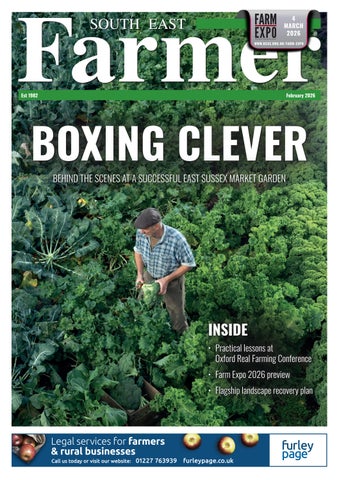
This month Nigel Akehurst visits Barcombe Nurseries, a small but productive market garden supplying around 600 veg boxes a week to local customers in East Sussex. He caught up with head grower Harry Neve and his team to find out more.
Arriving down a narrow country lane in Barcombe, near Lewes, I pulled in opposite a cluster of traditional outbuildings mid renovation. Ahead, a Barcombe Veg Boxbranded electric van sat outside a large, timber-clad barn. As I walked towards the entrance I was met by head grower and manager Harry Neve, who greeted me with a firm handshake and an easy smile. After swapping a few stories from my
recent visit to Oxford for the 2026 Oxford Real Farming Conference, Harry mentioned he was keen to take his growing team along next year. Investing in people, he explained, is just as important as investing in kit or infrastructure. He led me into the packhouse, the operational heart of the business, pointing out cold storage and the box-packing line where around 600 veg boxes a week are assembled. Everything had its place. It felt like a system
that had been lived in, adjusted and improved over time. With the rain easing, he suggested we head out for a tour of the farm.
As we walked, Harry explained that the business had been founded in 1997 by owner and grower Adrian Halstead, who stepped back from day-to-day involvement around five years ago. Harry returned at that point to co-run the farm, a place where he had once been an apprentice.
Photos: Katherine Peachy and Nigel Akehurst
Winter harvesting
Coming back felt like closing a circle. The foundations were strong and the opportunity now was to build on them. We poked our heads into a couple of glasshouses behind the packhouse. It was the first frost-free morning since Christmas, and although the winter salad crops looked a little weathered, there were clear signs of resilience, too. New growth pushing through, quietly doing its thing.
OPENING THE FARM UP
Next door, Harry slid open the door of a glasshouse that had once been little more than a dumping ground; overgrown, cluttered and perpetually on the to do list. “This was one of those things that never quite happened,” he said.
“We’ve got the infrastructure and customer base,” Harry said. “Now it’s about honing what we do with it.”
Workshops, open days and long table meals now sit alongside the veg box scheme. A farm kitchen is being developed with a catering partner, not as a dramatic pivot but as a natural next step.
“We don’t want to turn into a wedding venue,” Harry said. “But bringing people here, feeding them, letting them see the place, that matters.”
It feels less like diversification for the sake of income and more about deepening the relationship between farm and community.
POLYTUNNELS AND CONTINUITY
Now it holds long tables, a pizza oven and space for people. The transformation is striking, not flashy, but full of possibility. Since Harry returned, the focus has shifted from simply maintaining what Adrian built to thoughtfully evolving it. >>
Further down the plot, inside a cluster of polytunnels, beds of chard, spinach and salad brassicas sit alongside asparagus, carrying production through the hungry gap. “Salad is a big part of what we do,” Harry said. “Customers expect it, and it keeps the boxes working.”
KEY FACTS
• Organic vegetable box farm established in 1997 near Barcombe in East Sussex
• Approximately 10 acres in total, with around six acres in active production on the main site
• Additional rented land used for field-scale winter brassica production
• Certified organic by the Soil Association
• Crops include salads, leafy greens, chard, spinach and brassicas
• Summer tunnel crops include tomatoes, aubergines and peppers
• Majority of root crops such as potatoes, carrots and onions are bought in to maintain year round box continuity
• Operates a direct-to-consumer veg box scheme supplying around 600 regular customers, with all orders managed through e-commerce website www.barcombenurseries. co.uk
• Uses a minimal tillage system supported by on-farm compost and green manures
• Water supplied via a spring-fed pond, a reservoir pipeline and mains backup
• Boom irrigation used for field crops
• Hosts on-farm events including workshops and long table meals
• Events glasshouse and farm kitchen currently in development
Early autumn crops
Dan, Harry and Jo
NIGEL AKEHURST VISITS: BARCOMBE NURSERIES
Planting brassicas
The aim is continuity, with crops flowing from inside to outside as the seasons turn. When it works well, it brings a sense of rhythm and reassurance. “If you get a hard frost and everything’s flat,” Harry said, “it’s not just the crop. It knocks the whole week.”
But the system has enough adaptability built into it to recover. Over time, experience has shaped decisions that make those moments easier to manage. Harry talked me through the weekly rhythm of harvesting, washing, packing and boxes going out. “This is what pays the wages,” he said, simply.
Wholesale still happens, but lightly, supplying Infinity Foods largely for visibility and connection. Markets once played a bigger role, but the business has since refined where its energy is best spent.
“They were good for promotion,” Harry said, “but we were losing too much time and too much produce.” Winter, rather than summer, is now the busiest period. Box numbers rise after Christmas, when people are home more, cooking properly again and looking for routine. Production is shaped around that demand, with additional land taken on to bridge the gap through to spring. “That’s when we really need produce,” he said.
FIELDS, CLAY AND COMPROMISE
Out in the fields, the soil tells its own story. Heavy clay, full of potential, but demanding respect.
“You’ve got to be patient with it,” Harry said. “If you rush, you pay for it.” Tunnels buy precious time early in the year, allowing field
work to wait until conditions are right. Barcombe is not no-dig, and Harry is clear about that. “I used to cultivate far too hard,” he said. “You learn.”
Now the approach is measured and intentional. Old crops are flailed, shallow passes made, residues allowed to break down before the next stage. Compost is made on farm and applied sparingly once a year. Where no-dig was trialled in the tunnels, bindweed soon made the decision for them.
“In theory it’s great,” he said with a smile. “In practice, bindweed just takes over.” There is a confidence here in adapting ideas rather than following them blindly. The priority is building a system that lasts.
ACROSS THE ROAD WITH JO AND DAN
We crossed the road to another growing block, where assistant manager Jo Frost and grower Dan were finishing harvesting the last of the leeks.
At the edge of the field I noticed water pipes and asked Harry about irrigation. They irrigate during the summer months, he explained, having invested in a boom irrigator capable of covering the full width of the crop. It has proved one of the most valuable investments on the farm. Water, increasingly, underpins everything. Barcombe is fortunate to have a spring-fed pond alongside a reservoir supply and mains backup, giving the business resilience as summers become drier.
NIGEL AKEHURST VISITS: BARCOMBE NURSERIES
The conversation turned to scale.
“You need to be over 400 boxes for it to really work,” said Jo, who previously worked at Hankham Organics. “Wages, holidays, having a bit of breathing space.” At around 600 customers, Barcombe feels settled and confident. Covid-19 pushed numbers much higher for a time. “We were close to 900 boxes at one point,” Harry said. “It was
doable, but intense.” Now the focus is on strengthening what already exists. Growth, if it comes, will be deliberate and well supported.
Routes matter too. “If you’re driving all day for 20 boxes, it just doesn’t stack up,” he said.
Dense delivery rounds shape the future, with thoughtful expansion now focused towards Eastbourne, where the business also trades at a monthly farmers’ market.
Dan spoke about his own route into growing. He trained at Plumpton College and found the course valuable, but real learning came with repetition. “It gave me a base,” he said, “but you really learn when you’re doing it every day. There’s nowhere to hide,” he added, grinning. Jo nodded. “Some people with loads of qualifications struggle,” she said. “Others just get on with it.”
BACK TO THE CARAVAN
We ended up back at the caravan, a warm and well-designed space for staff. Over mugs of hot tea, it felt like the right place for reflection. Harry, Jo and Dan are effectively full time. Vic runs the box scheme and customer side. Around them sits a wider team of growers, packhouse staff and drivers, swelling through the summer months. At the Christmas meal there were around 16 people, and not everyone could make it.
Marketing has become more intentional, with an external team member handling newsletters, photography, field notes and recipes. It gently guides demand while strengthening the connection between customers and the people growing their food. “The growing is the marketing,” Harry said. “People want to see who’s harvesting the leeks on a Monday.”
Customer emails over Christmas reflected that. Messages of thanks, comments on photos, small reminders of why the relationship matters. Jo reflected on why so many new market gardens struggle. “People grow the veg and hope the customers come,” she said. “Adrian did it the other way round.”
Demand first. Production second. Succession followed naturally. Adrian is now largely retired, still involved, but happy to see the
Jo
Summer in the glasshouse
next generation shaping the future. “He could have sold this land,” Harry said. “But he didn’t want to see it turned into houses.” The long-term picture continues to evolve. A gradual handover, potential asset ownership, nothing rushed.
Before I left, the conversation drifted to flowers and organic certification. Flowers might work, Jo felt, if they fitted the system. Certification, however, remains essential.
“It keeps us honest,” Harry said. “And people trust it.”
As the tea was finished and the day moved on, Barcombe Nurseries felt quietly optimistic. Built on strong foundations, supported by a committed team and rooted in a loyal customer base, it is a business shaped not by rapid expansion but by confidence in what it already does well and belief in where it can go next.
FARMING AND ENVIRONMENT FOCUSED CONTENT CREATION
Storytelling through interviews, features, case studies, photography and short films.
For enquiries contact Nigel Akehurst via email on nigel@indiefarmer.com
Instagram @indiefarmer www.indiefarmer.com
Adrian Harry
Photos: Katherine Peachy
Learn more about Farm Expo 2026 and register for your free ticket: www.kcas.org.uk/farm-expo/
4
BRINGING TOGETHER ALL CORNERS OF THE AGRICULTURAL INDUSTRY
The Kent County Agricultural Society (KCAS), organiser of Farm Expo, is excited to announce that the annual event for the agricultural and land-based industries is returning to the Kent Showground on Wednesday 4 March 2026.
Now in its seventh year, the South East’s premier farm machinery, services and supplies show will build upon last year’s hugely successful event which saw a guest visit from agricultural influencer Olly Harrison (OllyBlogs) and even a surprise appearance from Clarkson’s Farm star Charlie Ireland.
Kent’s top tractor and machinery dealers and farm service companies will be joined at the Kent Showground in Detling by feed merchants, farm technology innovators and a whole host of agricultural suppliers and service providers.
Now a firm fixture in the annual calendar of events for organisers the Kent County Agricultural Society, Farm Expo brings together
farmers, farm workers, land managers, students and agribusinesses from all corners of the agricultural industry.
General manager of the KCAS, Nikki Dorkings, said “Our team is extremely proud to be continuing to grow Farm Expo year-on-year. This year has seen a particularly strong demand for both trade spaces and ticket registrations, which reflects just how important events like this are for the agricultural community in challenging times.
“Farm Expo and our other agricultural events provide the opportunity for farmers, agricultural workers, business owners and those working in related sectors to come together, network, socialise, share ideas and discuss the challenges they are facing.
"Farm Expo is free to attend, with ticket registrations now live, so be sure not to miss the event on Wednesday 4 March, 2026. We would also like to thank our headline sponsor, Talis Independent Financial Advisers."
HIGH-QUALITY AGRICULTURAL BUILDINGS
Burden Bros Construction Ltd is a trusted, practical and reliable firm delivering high-quality agricultural buildings across the South East, with a strong focus on health, safety and compliance on every project.
The company specialises in the design and construction of portal frame agricultural buildings, including grain stores, cattle housing and handling facilities, silage clamps, cold storage units, workshops, equestrian buildings and general-purpose farm structures. The experienced team also delivers groundworks, drainage solutions, concrete works, structural steelwork, demolition and enabling works.
With a proven track record on projects ranging from individual farm buildings to multi-million-pound agricultural developments, Burden Bros Construction understands the practical demands and safety considerations of modern farming. As principal contractor the company can manage every stage of the build, maintaining safe working environments, clear site management and full regulatory compliance from start to finish.
Whether you are expanding, upgrading or replacing existing facilities, Burden Bros Construction delivers robust, safe, compliant and cost-effective solutions tailored to your farm’s needs.
FARM EXPO 2026 PREVIEW
GROUNDED IN LAW, ROOTED IN KENT
Whitehead Monckton’s rural business team has a long history of supporting the region’s farms, estates and rural enterprises. We combine specialist legal expertise with practical insight into the realities of the rural economy, providing tailored advice for clients, whether they are buying or selling land, restructuring, resolving disputes or planning for future generations.
With multi-disciplinary expertise and strong links with the CLA and NFU, we take time to understand you, visiting your premises to ensure our advice is tailored to your needs and delivering support that reflects how your rural business operates.
Whitehead Monckton’s commercial real estate team advises on all rural property matters, including land sales, purchases and tenancies, diversification and development projects, rights of way and mineral or land use agreements. Close relationships with surveyors, agents and planners help us protect your assets and support long term growth.
Our corporate team helps rural enterprises choose the right structure, manage governance and handle mergers, acquisitions, disposals and joint ventures. Our disputes team supports clients to resolve land, boundary, tenancy and partnership issues.
Finally, Whitehead Monckton’s succession specialists support inheritance tax planning, wills and trusts, to secure rural businesses for future generations.
Meet us at Kent Farm Expo or get in touch: Call 01622 698000, email enquiries@wmlaw.uk, or visit www.whitehead-monckton.co.uk
FIRST-CLASS ROOFING AND CLADDING SOLUTIONS
Southern Sheeting is a family-run business with more than 40 years of experience providing first-class roofing and cladding solutions to the agricultural and equestrian communities. The company’s specialist knowledge enables the team to understand the unique needs of farmers, stable owners and others involved in the agricultural sector.
With an unwavering commitment to excellence, Southern Sheeting has become a trusted name in the industry and one that takes pride in offering a comprehensive range of products to meet customers' requirements all year round.
The importance of maintaining farm and equestrian buildings cannot be overstated. Regular repairs to roofing, rooflights and panelling ensure that outbuildings remain in optimal condition to withstand the challenges of the year ahead. Southern Sheeting is here to support successful farming operations by providing quality products, expert advice and exceptional service.
Purchasing specialist materials can be complex, which is why Southern Sheeting’s knowledgeable advisors are happy to help. Registered businesses can also benefit from discounted trade rates. Contact Southern Sheeting’s dedicated sales team on 01342 590142 or email sales@southernsheeting.co.uk, and a member of the team will be in touch.
⚪
⚪
⚪
⚪
MORE THAN 100 YEARS OF SUPPORT
The Kent County Agricultural Society has been supporting education and improvement in agriculture, horticulture, forestry and related industries since its foundation in 1923. It provides grants to Kent Young Farmers’ Clubs and offers university scholarships to students wishing to study in related fields. The society also provides free education on farming to young children through the ‘Farming in the Classroom’ initiative and the Living Land event.
The society’s headline event is the Kent County Show, the
Harvest Installations, set up by Colin Hales in 1979, began with the invention of the Constant Humidity Controller, an award-winning modulating gas burner which maintains the proper humidity or temperature of the air blown through crops during drying.
The business then developed further products, one of which was the Maxi-Stirrer, a gantry-running stirrer for aerating crops which reduces compaction, improves drying efficiency and simplifies the process.
In 2004, after more than 30 years in the industry, Mike Wilson, supported by his wife Jackie, purchased the business and grew it further by developing enhanced hightemperature drying and store controls and building a reputation for managing drying store projects end-to-end.
While doing so, they built a family-run business with their son Matthew and daughter and son-in-law Lisa and Lewis Harvey. They took over when Mike and Jackie retired in early 2020 and now run
region’s showcase event for farming, countryside and rural life. The three-day show, which takes place this year on 3,4 and 5 July, brings together the best food, animals and entertainment that Kent has to offer and reveals the true spirit of ‘the garden of England’.
Alongside its work in supporting education in agriculture for young children and students, the society supports the county’s agricultural and land-based industries and workers through long-service awards and through its recent addition to the annual calendar, The Kent Farming Conference.
ENHANCED HIGH-TEMPERATURE
DRYING AND STORE CONTROLS
the business, which continues to thrive on the core principles instilled by Mike and Jackie – a business built on a reputation for reliable products, excellent service and the knowledge to back it up.
Contact Harvest Installations to enquire about building and project management, drying equipment or the company’s 3D design and fabrication services on 01795 533903.
FARM EXPO 2026 PREVIEW
THRESHOLD RAISED
Welcome news on inheritance tax for the rural sector and family businesses.
In a surprise pre-Christmas announcement, the Government confirmed a significant change to the upcoming inheritance tax (IHT) reforms. The threshold for 100% IHT relief on qualifying business and agricultural assets, originally due to be set at £1 million per individual, will now be raised to £2.5 million from April 2026.
This means spouses or civil partners can pass on up to £5 million of qualifying assets between them, providing a major boost for families, business owners and farmers planning for succession.
WHY THE CHANGE?
The increase follows sustained pressure from the farming community and rural business groups, which warned that the original £1 million cap would have placed significant strain on family farms and agricultural enterprises. The revised threshold is widely seen as a positive step in supporting long-term business succession planning and protecting the viability of rural and family businesses.
This is a sensible approach which provides a more meaningful relief for those affected, many of whom had been worried about the potential impact of the changes as originally announced.
WHAT DOES THIS MEAN?
• Greater relief: The increase offers substantial protection for family wealth, reducing exposure to IHT liabilities that can claim up to 40% of an estate.
• Planning opportunities: With higher thresholds, there is more scope to transfer business and agricultural assets efficiently – but timing remains critical.
• Deadline still applies: The new rules take effect from 6 April 2026, so early action is essential to maximise benefits and avoid delays.
• Early planners: Those who have already taken steps based on the original £1 million threshold are in a strong position. Their proactive planning secures relief, while the higher threshold now offers even more flexibility for future arrangements.
YOU COULD STILL BE IMPACTED
Despite the increase, many estates will still exceed the IHT threshold due to rising property values, investments and pension pots. Proactive planning remains key to safeguarding wealth.
Azets’ specialist tax advisers are ready to help review your estate, explore trust and gifting strategies and plan for succession under the updated tax system.
To discuss your specific circumstances and how to optimise your position, please get in touch:
HAYLEY KINGSNORTH
Partner at Azets
E: Hayley.kingsnorth@azets.co.uk www.azets.com
PRESSURE WASHERS
CLEANING UP
Farmers know the importance of
keeping
equipment, animal
housing
and
yards clean,
and Uckfield specialist Pressure Clean has notched up more than half a century of experience in helping them do just that.
It’s not just a matter of pride. Clean equipment works more efficiently and lasts longer, clean housing is vital for livestock health, and clean yards are not only safer but provide a more pleasant working environment for everyone.
As with most other farming equipment, when it comes to cleaning there is a wide choice of kit, but Pressure Clean, which has a well-established reputation for supplying, servicing and repairing pressure washers and other cleaning equipment across the South East, is on hand to help.
The company, headed up by Gary and Donna Fielding, stocks a wide range of industry leading Nilfisk and Kärcher models that run from the simplest cold water washer through to three-phase hot water machines that will put a shine back on the dirtiest combine harvester.
And while it won’t rival the latest Silicon Valley announcement from tech giants Apple, a March launch of new pressure washers, vacuum cleaners and scrubber dryers from Nilfisk is set to raise the bar further.
While the updates and improvements are still under wraps, the new machines are expected to combine robust build quality with improved fuel efficiency, intuitive controls and easy servicing access.
“From what we have picked up, Nilfisk’s new models will
be designed to perform day in, day out on busy farms, doing everything from tackling caked-on mud to disinfecting housing and cleaning heavy agricultural machinery. We are expecting new models in both hot and cold ranges,” explained Donna.
Meanwhile the other well-known name in industrial cleaning equipment, Kärcher, is celebrating its 90-year anniversary by releasing selected machines in a distinctive, sleek, matt black finish.
Both the HDS 6/12 C and HDS 11/18-4 S Anniversary editions boast not just striking good looks but a free accessory bundle worth more than £200. Pressure Clean will be offering the 11/18-4 S at this year’s Farm Expo while stocks last.
While most new customers opt for portable models, Pressure Clean has seen a noticeable uptake in static pressure washer systems since the end of last year and the trend is continuing into 2026. “These are proving particularly beneficial for customers with fixed wash areas and high daily usage and benefit from built-in frost protection,” explained Gary.
Options include the Nilfisk SH TRUCK 5M-180/970, a robust, stationary hot water pressure washer designed for permanent outdoor placement in parking areas, forecourts or industrial sites.
“With all settings and adjustments conveniently housed inside a lockable cabinet, this unit combines security with operational efficiency,” said Gary.
Pressure Clean also supplies washers from MAC International, which offers a range of zero-emission static machines that the company explained are “meticulously crafted to amplify safety and technical attributes inherent in our static pressure washer collection”, with the range “designed to mitigate the conventional issues stemming from misapplication and misuse”.
A current cashback offer allows customers to save up to an additional £150 on a Nilfisk hot water pressure washer, a deal Donna pointed out gave farmers “an excellent opportunity to upgrade or invest in reliable cleaning equipment with added value”.
Pressure Clean also offers a carefully selected range of secondhand machinery. “All used machines are fully inspected, serviced and tested and come with at least six months’ warranty, providing a cost-effective option for customers who want quality equipment without the cost of buying new, something that is particularly important given the ongoing pressure on input costs,” said Gary.
MAC Zero Emission range
EXCELLENCE IN AGRICULTURAL TYRES
With 64 years of service under their wheels, the experienced team at Watling Tyres knows all there is to know about supplying and fitting agricultural tyres. Established in 1962, this family business has grown steadily over the years and now services farmers and farming businesses across Kent, Surrey, and East Sussex from 14 well-sited locations across the region.
The highly skilled team at Watling Tyres provides a 24/7 operation across the South East, using a 50-strong fleet of specialist vehicles. They meet or exceed the industry standard response time of 90 minutes and can supply and fit a vast range of tyres.
Executive Director Pat Laming attributes the strength of the Gravesend, Kent-based company to its excellent, well-trained, and customer-focused staff. While the company’s focus is on service, Watling Tyres prides itself on offering competitive prices and can fit tyres for anything from a fuel bowser or fruit trailer to a tractor or combine harvester.
Pat noted that with the industry undergoing significant changes, Watling Tyres aims to be a key partner with farmers and growers as the country moves towards providing more of its own food. Watling Tyres will be exhibiting at Farm Expo, where Pat and the team look forward to meeting customers old and new. For more information, please visit www.watlingtyres.co.uk
EXPERT ADVICE AND PRACTICAL SOLUTIONS
BTF Partnership is extremely proud to support the Kent County Agricultural Society and Farm Expo in its seventh year. The show creates a crucial space for connection, support and collaboration opportunities in which farmers and suppliers can come together.
A land agency firm based in the heart of Kent, BTF Partnership is known for providing expert advice and practical solutions with surveying, property management, agency sales, development consultancy,
legal services and more. Whether you are managing a farm, selling an estate or tackling agricultural law, we’ve got the experience to guide you through it all. We are 'hands on', straight talking and fiercely commercial, with a talent for building long-lasting relationships. We don’t just do the leg work; we roll up our sleeves and add value to your business.
Please visit the BTF Partnership stand at Farm Expo, where they will be happy to talk through any proposals, issues or possibilities you may have in the pipeline.
KENT RURAL SCHOLARS
Kent County Agricultural Society is continuing to support nine students per year with the Kent Rural Scholarship scheme, which provides students studying agricultural or landbased degrees with funding of up to £1,000 per year for three years.
Applicants must be a resident of Kent at the time of application and aged between 18 and 25. They should be studying a full-time college or university degree-based course in the UK.
Current recipients of the Kent Rural Scholarship are:
• Lily-Clare Rhoades – studying equine training and management at Hadlow College, joined in 2025.
• Amy Bannister – studying for a BVMSci in veterinary medicine and science at the University of Surrey, joined in 2025.
• Luke Randell -– studying agricultural engineering at Harper Adams University, joined in 2024.
• Fearne Blake – studying bio veterinary science at Hartpury University, joined in 2024.
• Katie Dadswell – studying veterinary medicine at Aberystwyth University, joined in 2024.
• Ashleigh Yates – studying agriculture with animal science at Harper Adams University, joined in 2023.
• Arthur Cairns – Studying veterinary medicine and surgery at Harper and Keele Veterinary School, joined in 2023.
• Beth Kavanagh – studying veterinary bioscience at Harper Adams University, joined in 2023.
Applications are currently open for the Kent Rural Scholarship. Scan the QR code to learn more and apply.
BEYOND ADVICE
PROTECTING THE FAMILY FARM
What farmers need to know before April. Are you ready for the new tax year?
From 6 April 2026 significant changes to agricultural property relief (APR) and business property relief (BPR) will reshape the inheritance tax (IHT) landscape for farmers and landowners. Now is the time to make sure that you are prepared and aware of your options.
A FUNDAMENTAL SHIFT IN IHT RELIEFS
Under the current IHT regime, APR and BPR can offer up to 100% tax relief on qualifying agricultural or business property; a relief that has underpinned succession planning for generations. However, the new rules introduce a combined lifetime cap of £2.5 million per individual (and per trust), drastically reducing the level of protection available to larger estates.
Assets exceeding this £2.5 million threshold will still attract some relief, but only at 50%, exposing the excess to an effective 20% IHT charge.
These changes will apply to:
• agricultural land and buildings (under APR)
• farmhouses, where conditions are met
• shares in farming partnerships or farming companies (under BPR)
• agricultural or trading businesses
• AIM-listed and foreign shares, which will also see relief halved to 50%.
WHY THIS MATTERS FOR FARMERS AND LANDOWNERS
The farming community is particularly vulnerable to these reforms for several reasons:
• High capital value, low liquidity: Many farming estates are land-rich but cashpoor. Meeting a sudden IHT bill on death could force the sale of productive farmland or family homes.
• Multi-generational ownership structures: Farms often pass through generations using a mixture of lifetime gifts, trusts and Wills, all of which will now be subject to stricter cumulative caps.
• Trust fragmentation blocked: The use of multiple trusts to spread the tax burden will be curtailed by new anti-avoidance provisions. Only one £2.5 million cap will be available per settlor, shared chronologically across all relevant trusts. Without careful planning, families may find themselves exposed to substantial tax liabilities, destabilising businesses that were previously safeguarded under the current regime.
SPOUSES AND CIVIL PARTNERS: MAXIMISING THE AVAILABLE RELIEFS
Married couples and civil partners continue to benefit from favourable inheritance tax treatment, and this remains an important planning opportunity under the revised regime. Transfers between spouses or civil partners are generally exempt from inheritance tax, and any unused APR/BPR allowance on first death can be transferred to the survivor.
This means that, in practice, a couple may be able to shelter up to £5 million of qualifying agricultural or business assets at 100% relief before the reduced 50% relief applies. However, relying solely on spousal transfer is rarely a complete solution. The timing of deaths, the structure of ownership and the use of trusts under Wills can all materially affect how much relief is ultimately available.
Careful Will drafting and succession planning remain essential to ensure that valuable reliefs are preserved rather than wasted.
The Furley Page Agriculture and Rural Business team will be at Farm Expo on 4 March, stand 44.
TIME IS OF THE ESSENCE
Although the changes will not take effect until 6 April 2026, the look-back rules for lifetime gifts and trust charges mean that transfers made following the autumn 2024 budget announcements could fall within the new framework, depending on the date of death or trust charge.
Acting now is crucial to:
• review and restructure existing wills, trusts, and partnership agreements
• consider accelerated lifetime transfers while the current rules still apply
• undertake IHT forecasts based on revised asset valuations and relief caps
• secure formal legal advice on the status of farmhouses, tenancies, and business components
• identify any scope for diversification or restructuring to optimise available reliefs.
FINAL THOUGHTS
The forthcoming changes to inheritance tax reliefs represent the most significant shift in rural estate taxation in a generation. For many, the clock is already ticking. Without prompt action, farming families risk seeing the fruits of generations of hard work diminished by tax liabilities that could have been mitigated with foresight and legal guidance.
We strongly urge all landowners and farming families to seek legal advice now. The sooner a comprehensive plan is in place, the greater the protection for your business, your family, and your legacy.
Our expertise in advising farmers and rural landowners and businesses has been recognised by The Legal 500 and Chambers UK, an independent guides to the legal profession. For a confidential consultation, get in touch today.
FRANCESCA HAYWARD
Associate, Furley Page Solicitors
T: 01227 763939 E: info@furleypage.co.uk
W: www.furleypage.co.uk
SALES – PARTS – SERVICE
PROFESSIONAL, EFFICIENT AND COST EFFECTIVE
T D Boxall Ltd is a highly professional, efficient and cost-effective contract spraying and spreading operation with over 45 years of experience in the industry. The company’s full-time staff are competently trained and up to date with the latest equipment and industry standards.
At this year’s Farm Expo, T D Boxall will be showcasing two supply partners in the fertiliser and lime sector, British Sugar with LimeX and Fibrophos and P-Grow.
LimeX is the highest quality agricultural liming product on the market, achieving a 100% reactivity score under the Ag Lime Quality Standard.
As well as correcting soil pH, LimeX delivers additional phosphate, magnesium, and
sulphur, which are equivalent in value to £15 per tonne and help reduce overall fertiliser costs. It is finer than 150 microns, enabling rapid pH correction within four to six weeks.
Fibrophos and P-grow can reduce P&K (phosphorous and potassium) costs by up to 30%. It improves soil health by applying a full range of secondary and trace elements and is a carbon neutral by-product of producing green electricity in the UK. It is supplied in bulk and applied by the company’s experienced staff, saving time and reducing machinery costs.
Representatives from both LimeX and Fibrophos will be on the T D Boxall stand at Farm Expo, or you can call 07801 862102 or email tim@tdboxall.co.uk
LOOKING OUT FOR YOU AND YOUR FARMING BUSINESS
Farming in Kent comes with its own challenges; diverse soils, high land values, planning pressure and constant change. That’s exactly why Sentry’s Kent office is here.
The Sentry team are not advisers looking in from the outside. We farm 20,000 hectares ourselves, and every lesson we learn on our own land feeds straight back into the advice and support we give our clients. It means our guidance is practical, proven and grounded in real experience.
The Kent team supports farmers, landowners and estates with joined-up advice that actually works. That includes farm business planning, environmental schemes, diversification, land and property
SUPPORTING THE FARMING COMMUNITY
Birketts is proud to be part of the South East’s dynamic rural economy. Since opening our Sevenoaks office three years ago, our agriculture and estates team has quickly become a trusted adviser to farmers, landowners, estates and rural businesses across the region.
Birketts combines specialist sector knowledge with a practical, commercially focused approach to help clients navigate the ever-evolving legal landscape affecting agricultural and rural land.
With market-leading strength and a depth of experience and resources, the team advises on the full spectrum of agricultural matters, including land acquisitions and disposals, agricultural tenancies, succession planning, renewable energy projects, diversification ventures, development land agreements and estate restructuring.
We work closely with our clients, land agents, accountants, lenders and other professional advisers to deliver clear, timely and pragmatic solutions tailored to the needs of modern rural enterprises.
Our breadth of experience means we understand the opportunities and pressures unique to the region and are committed to supporting those who drive its rural economy.
To find out how we can support your farm, estate or rural business, please get in touch with our agriculture and estates team.
advice and full finance and accountancy support. We also help farmers buy smarter through procurement and membership services, using the same suppliers and inputs we trust on our own farms.
What really sets Sentry apart is how we work. We’re employeeowned, so everyone you deal with has a stake in your success. It’s personal for us. When your business moves forward, so does ours.
If you want straight-talking advice, local knowledge and a team that genuinely understands farming in Kent, visit the Sentry stand at Farm Expo. We’re here to look out for you and your land, today and for the long term.
SFI UPDATE
Head of Hutchinsons Environmental Services Georgina Wallis gives her views on the latest sustainable farming incentive (SFI) update announced by Emma Reynolds, DEFRA Secretary of State, at the Oxford Farming Conference in January.
While full scheme details are yet to be confirmed, we know that around £2.7 billion will be invested in sustainable farming and nature recovery per year from 2026/27 to 2028/29, with around £2 billion annually invested specifically into environmental land management schemes by 2028/29.
While this is a rise from the £800 million allocated in 2023/24, the funding is expected to be tightly allocated, and for growers who missed out on SFI 2024, securing early access to SFI 2026 will be critical to business resilience.
It is anticipated that further information on SFI 2026 will potentially be released at the NFU Conference on 24 February.
There was confirmation that SFI 2026 will move to a more structured model. In 2026 there will be two application windows; the first window will prioritise smaller farms and those without existing agreements, with a second window opening in September to allow broader access.
DEFRA is aiming for a fairer deal for smaller farms. SFI 2023/24 saw 25% of SFI funding going to just 4% of farms. We can expect to see changes to the scheme structure to distribute funds more evenly, potentially through payment caps or limits on total funding for individual farms. Potentially this could look similar to Countryside Stewardship
GEORGINA WALLIS Head of Environmental Services
T: 07825 431647
E: georgina.wallis@hlhltd.co.uk
Canterbury: 01227 830064 www.hlhltd.co.uk
‘farm wildlife packages’ with a suite of actions to choose from.
This would be introduced to prevent overapplication of specific actions, such as herbal leys (SAM3/CSAM3), which saw significant uptake in SFI 2023/24, and other actions which reduce areas of otherwise productive land.
Alongside SFI reform, the Government announced a £30 million farmer collaboration fund to help groups of farmers work together to improve productivity. This reflects a shift towards encouraging collaboration as a route to improved profitability, building upon the historic facilitation fund model.
On a wider outlook, £500 million has been committed to landscape recovery, focused on longer term support across multiple farms. Countryside Stewardship higher tier funding remains on a controlled roll-out, with invitations sent to identified farm businesses.
There will be changes for upland farmers, too, with a two-year programme focused on farming clusters and diversified income streams. In addition, the Farming in Protected Landscapes programme will be extended for a further three years, with £30 million of funding next year. This scheme is relevant to those farming in National Landscape areas (previously AONBs) and national parks.
Despite the absence of full scheme
AT A GLANCE SUMMARY
• There will be two SFI application windows in 2026.
• The first application window will be in June for smaller farms and those who don’t already have an existing agreement.
• The second application window will open in September for broader access.
• There will be a new £30 million farmer collaboration fund.
• Farming in Protected Landscapes (FiPL) will be extended for a further three years.
• There will be a focus on upland farm support, with a new two-year programme focused on cluster farms and diversified income streams.
• Be prepared to secure early access by reviewing existing practices, including actions to be retained within current schemes as well as new actions that could be introduced. While existing options may change and new options may be added, early review will allow time to develop a clear plan and ensure a smooth application process.
details, it is vital that growers continue to prepare for the opening of the next window. Many SFI 2023 agreements and Countryside Stewardship mid-tier schemes are approaching the end of their term, and understanding which actions suit the farm over the next five years will place growers in a strong position for success under SFI 2026.
LET'S FORGET PATRONISING LECTURES STEPHEN CARR
It was the Oxford Farming Conference so, of course, it was time for the great and the good to take to the stage and make me and every other ordinary farmer feel utterly miserable by lecturing us on how we need to ‘change’ to survive.
Jack Bobo, executive director of the Rothman Family Institute for Food Studies at the University of California, for instance, told us to adjust our mindsets and look at the positives of today’s world so we could tell a “different story” for the future. Mr Bobo said that people “hate change” and “love to talk about our food system being unfair”. Although he didn’t name farmers directly, I’m sure we all got the message that we are backward looking stick-in-the-muds who love nothing better than to grumble about our lot.
Another speaker, Jeremy Moody, secretary of the Central Association for Agricultural Valuers, was also determined to give us a much-needed pep talk. It was time we learned to think for ourselves as business people, rather than as recipients of government support, he told us.
Apparently, we also needed to turn around the narrative regarding farming’s worth and focus on profitability. I’m sure Mr Moody is correct in everything he said, but speaking as someone who has now been farming for over 40 years, I can’t remember a year when I would have been profitable without taxpayer support of one sort or another.
Even beef farmer, now Baroness, Minette Batters and one-time NFU leader thought it was time to give us a good talking to. She’s just delivered her farm profitability review to the Government and has concluded that there are only “two years” left to save farming. Gosh, that’s not long? Apparently we “need to move on” because if we “keep going in this one place” we are “going to fail”.
Like Mr Moody, Baroness Batters felt that profitability was the only way forward for us. She also thought that DEFRA needed to align more with the Department for Business and Trade if it was going to benefit from better export opportunities. Is that the same Department for Business and Trade that, almost immediately after Brexit, rushed to sign catastrophic trade deals with Australia and New Zealand which will allow imports of red meat and dairy products into the UK in a few years’ time, completely free of tariffs? Why would we want DEFRA to align with them?
Thank goodness, then, that the Oxford Farming Conference is over for another year so that we can quickly forget these patronising lectures. Who do they think they are talking to? Anyone who is still farming in the UK in 2026 is, by definition, part of an elite group that has already worked out a way to beat the odds by being in business at all. The words ‘teach’, ‘grandmother’, ‘suck’ and ‘eggs’ spring to mind for some reason?
Precision Soil Sampling
Accurately measure your soil pH, health, organic matter and nutrient
STEPHEN CARR
Stephen farms near Eastbourne in East Sussex in partnership with his wife and four of his daughters. The farm has a pub, the Sussex Ox at Milton Street, which serves the farm's pedigree Sussex beef, Southdown-cross lamb and fruit and vegetables from the farmhouse kitchen-garden.
ANITA HICKSON ORGANISED CHAOS
TIME FOR A CHANGE
Happy New Year to all our readers, and let us hope 2026 will be a healthy and prosperous year.
A huge thankyou to Monty and Zara who did a sterling job stepping in to write this article for me last month. I did try to persuade both of them to become journalists rather than farm but as yet to no avail.
I didn’t want to start the year by whingeing, but so far 2026 is not having much appeal. Milk companies nationwide greeted the majority of milk producers with at least a three to six pence per litre milk price reduction, taking many farmers to an approximate 12 pence per litre reduction over the past few months.
Many farmers in the country were asked to dispose of milk for a few days rather than expecting the processor to pay for the haulage, storage and disposal of milk. At a time when many people cannot afford to feed themselves, it seems such a criminal act to dispose of perfectly decent milk. A world surplus seems to be the route cause, although I am finding it hard to believe that we actually import milk.
A ‘milk glut’ has occurred due to a surge in production across Europe and key countries such as the USA, with lower feed prices
across world markets creating an abundance of raw material. This has increased milk production world-wide, which has in turn outpaced demand for milk. This is set to continue well into 2026, increasing financial pressure on an already pressurised industry.
In 2025 (Jan to July), the UK imported 735,600 tonnes of dairy products, an 11% increase year on year. Surely this must be stopped to enable the UK to become self-sufficient in dairy produce? Many dairy farmers will be under increased financial pressure after this latest round of milk price cuts. In better news, there is hope that the UK corn price may increase as the year progresses.
Please do not suffer alone if you need someone to talk to or just need company. Call the Farming Community Network on 03000 111999 or RABI on 0800 1884444 and they can help or put you in contact with someone who can.
Over the weekend we discovered that our water company had issues with supply and had “run out” of water at our youngstock unit. This resulted in over 500 head of cattle having no water.
After spending many hours on the phone to no avail, Monty loaded up 10 IBCs of water and transported them to the farm; as
we are deemed to be a commercial business, water companies do not have a legal obligation to supply us with water. Many thanks to FGS, who then bridged the gap with a tanker.
Domestic customers have a legal right to have access to water in four hours, but commercial customers have allegedly received a letter from the water company stating that they must ensure that farms have adequate provision to ensure that the cattle have continuous water. I am sure our letter must still be in the post. Many hours were spent moving water to enable the cattle to have access 24/7.
It subsequently transpired that water companies have been filling the reservoirs via tankers for many weeks and eventually a combination of a fault at the pumping station and running out of water would be to blame. Lack of investment in infrastructure would spring to mind; many leaks remaining for many weeks, with no sign of being fixed.
On a slightly more cheerful note, by the time you read this we will have daylight until after 5pm albeit just.
Winter maintenance jobs at home on the farm are in full swing.
Until next time stay safe, and remember our door is always open.
ANITA HICKSON Farmer
TEST FIELDS TO MEASURE SOIL MINERAL NITROGEN
Before we know it, crops will start to grow again and fertiliser spreaders will be back on. Compared to last year, we will have crops well established and will need to assess their early nitrogen requirement.
Before any nitrogen gets applied, it is important to calculate or measure how much nitrogen is likely to be left in the soil and available to the crop. Soil type, previous crop, rainfall and previous manure applications will influence the soil nitrogen supply (SNS) so each farm and field will be different.
Where possible, it is worth getting some fields tested to 90cm to measure their soil mineral nitrogen (SMN) levels to help determine what the SNS is. There is often funding through local water companies for this service. This helps to determine how much nitrogen is required for the spring. If the SNS index is low, then a full nitrogen programme will be required, with early applications likely to be needed. Where the SNS level is high, however, we will be able to cut back nitrogen applications this spring.
Growers are strongly recommended to get their fertiliser spreaders calibrated before applying any fertiliser to ensure an even spread. Most products will spread slightly differently and therefore calibration is essential to ensure a uniform spread. A coefficient of variation over 20% will lead to visible striping in crops and a likely yield decrease. The financial implications of this can be huge, especially where milling wheat is being grown and protein levels are compromised.
Wheat after oats, second wheats and crops after maize will likely have a low SNS and should be a priority for early nitrogen application. Wheat after a legume or oilseed rape will likely have a higher SNS and should not be as high priority for early nitrogen unless the crop is noticeably behind. Early nitrogen applications are designed to aid tiller survival, increase rooting and build biomass, and therefore late drilled and backward crops should be a priority. Any early drilled crops that have a high tiller count won’t want nitrogen too early. Creating a large
By Simon Roberts.
biomass on early drilled crops will only lead to higher disease pressure, especially septoria tritici, as well as a greater risk of lodging.
Tiller survival is also vital for winter barley to ensure enough ears/m2 to optimise yield potential. Winter barley should therefore be targeted early for nitrogen applications to ensure yield potential is maintained.
Nitrogen applications on oilseed rape will depend on canopy size. Earlier drilled crops with large canopies are likely to be carrying significant nitrogen within the crop and may not need pushing too early. Later drilled crops will need encouraging to increase biomass and get the crop to a green area index of 3.5 by yellow bud (GS59). This will be especially important where pigeon damage is evident. Where cabbage stem flea beetle larvae are a concern, early nitrogen will help increase stem size and strength and reduce potential damage this spring.
CCC AGRONOMY
Chichester Crop Consultancy is a farmer member-run co-operative agronomy service that aims to deliver truly independent, research/ science-led agronomy advice with no commercial bias and now covers the South of England.
CCC works closely with Crop Advisors, which supplies independent group purchasing on crop inputs as well as sourcing cover crop/environmental scheme seed mixes.
Simon Roberts
FROM THE FRONT LINE IN
A pleasure at this time of the year, when mud rises to meet rain, is sweeping the yards. A mixture of virtue and necessity, the task is a parcel of peace in which to think. An old shepherd once said that ‘leaning on the gate’ was time well spent. Well, sweeping has that same contemplative benefit. Breakfast is more properly earned once cattle are fed and yards clean.
As predominantly livestock farmers, the cold, dry, crisp weather over Christmas and the new year meant our farm team was able to enjoy the festive period and have a little bit of down time.
On the positive side, scanning for the March lambing flock went well, with only 1% barren and a lambing percentage of 229. However, a 25% reduction since October on our milk price for our dairy herd has been a real hit. Let’s just hope the saying “what goes down must come up” is true!
A pre-Christmas DEFRA announcement brought a much-needed government adjustment to the inheritance tax threshold, allowing many farmers caught up in the perfect storm to enjoy Christmas and step into 2026 with a brighter future for their families and their farms.
However, there is more work on this issue to be done when the time is right, and so many other items on the agenda, including the sustainable farming incentive, farming profitability, TB, avian influenza, planning, farming rules for water and local food infrastructure. The list is endless and at times overwhelming when we also have our day jobs.
On the plus side, between Christmas and the new year I was lucky to be able to check my cattle and sheep on the farm and at the same time admire the hundreds of lapwings that arrived. This is an annual event, but many more arrived and stayed much longer than usual. Hopefully this bears well for the spring breeding season.
I am looking forward to taking part in the Game & Wildlife Conservation Trust (GWCT)’s Big Farmland Bird Count between 6 and 22 February. This is a great opportunity for farmers and cluster groups to collaborate with GWCT, NFU and Sussex Ornothology Society members and collect the data for all the birds on our farms.
I have been filling our Perdix farmland bird buckets with Farming in Protected
WHAT GOES DOWN MUST COME UP
By NFU West Sussex council representative Caroline Harriott, who is also an NFU Farmers for Schools ambassador, a director of Arun to Adur (A2) farm cluster group, chair of Chichester Young Farmers’ Club advisory group and A2A group representative on the South Downs National Park Farming in Protected Landscapes panel. The family farming business, based at Arundel, consists of a 180-cow dairy unit and beef, sheep and arable enterprises on mainly tenanted land.
Landscapes (FIPL)-funded bird seed mix and I am delighted to hear that FIPL funding is set to continue for the next three years. This is a great initiative which helps farmers install infrastructure on their farms which they otherwise couldn’t afford or achieve, such as a milk vending machine.
I was delighted to see that two West Sussex farmers were recognised in the New Year’s Honours List. Former NFU Vice President Gwyn Jones was awarded the British Empire Medal, as was John Holt for his long-standing commitment to sustainable agriculture.
A tenant farmer at Droke Farm, with his wife, son and daughter all part of the organic dairy farm which supplies milk off the farm and also operates a milk vending machine for the local community, John and his family have also played a large part in supporting the local Chichester Young Farmers' Club.
The club recently held its Christmas tree collection in aid of Papyrus, a charity for the prevention of suicide in young people in the UK. Members raised more than £500 collecting over 70 trees in Chichester, Arundel and the surrounding areas. The club meets every Wednesday and has an interesting, varied
calendar of events throughout the year.
There has been a recent spate of quad bike thefts and Sussex Police have been reaching out to farmers to help advise on preventative measures. Do email ruralcrime.team@susssex.police.uk, or contact a member of your local rural crime team who will come and provide advice and at no cost, install DNA kit marking your farm equipment, which can be a huge deterrent. This great initiative is supported by NFU Mutual. Rural crime will be another one of the items on the agenda when we meet our local MPs on farm this spring.
A popular, local on-farm meeting will be held on February 17, the Farming Community Network farmhouse breakfast at Fitzleroi Barn, Pulborough. This is an annual event that brings farming folk together, something that is so vital.
I have to end by congratulating the teams that have organised Christmas charity runs across West Sussex. They were amazing spectacles that bought the public out on the streets. The decorations, imagination and work that was put in was fantastic and over £70,000 was raised for local charities. Quite phenomenal!
• Currently employed as a Registered Veterinary Nurse (RVN) From rhinos in South Africa to dangerous dog legislation in the UK, meet Plumpton College’s veterinary nurse graduate.
How did your journey in veterinary nursing begin?
Growing up, my family dog had a heart condition. Helping manage this and attending regular vet appointments sparked my interest and I decided to explore it further. My journey to Plumpton College started after taking my GCSEs and a level 3 animal management course at Writtle College.
Why veterinary nursing at Plumpton College?
Firstly, it is set in a beautiful location and secondly, Plumpton isn’t a big university campus; the smaller class sizes meant I was able to access greater support from my lecturers. Living in Essex, it was easier to live on campus and I've loved being a part of the community with daily enrichment activities and staff available 24 hours a day if you need them.
Tell us more about the veterinary nursing foundation degree?
The FdSc in veterinary nursing is a threeyear foundation degree of science delivered at level 4 and 5 study. It combines theory with practical skills and the equivalent of a one-year work placement. Learning takes place in the purpose-built veterinary science centre within the clinical suite, which is equipped with the latest veterinary equipment. The course has a great reputation for 100% employability after graduation.
What have been the highlights at Plumpton College?
I spent two amazing weeks in South Africa shadowing vets and the animal management team. One particular highlight was assisting in the sedating and dehorning of a rhino to improve her chances of survival.
Usually a trip like this is once-in-alifetime, but I was lucky enough to visit South Africa again for a second field trip with the behaviour and welfare class. We set up camera traps, learnt how the antipoaching team uses their dogs and took part in shooting practice. We even spotted a newborn rhino in our camera trap footage, which was a huge cause for celebration!
What made you top your degree up with a BSc in Animal Behaviour and Welfare?
There are many aspects of my job as a registered veterinary nurse which benefit from an understanding of animal behaviour. The BSc explores the use of behaviour as an indicator of animal welfare and wellbeing. We study welfare legislation and drivers that change the human perception of animals. I’m studying while continuing to work and plan to become an animal behaviourist.
OPEN EVENT
Book a place at Plumpton College’s upcoming Open Event on 21 March 2026.
You’ve been praised for your research project on XL Bullies. Can you tell us more about this?
In 2023, when the XL Bully was added to The Dangerous Dogs Act 1991, I was working at a veterinary practice. It was a scary time for the dogs, their owners, rescue centres and the veterinary industry. Many owners needed help and advice, and in some cases, chose to euthanize their dogs to comply with legislation. I found this time very difficult to manage and knew that it demanded further research. There is little research into the effects that breed specific legislation has on individual dogs, so I chose to research the perceived impacts on the behaviour of XL Bullies following their addition to the Dangerous Dogs Act 1991 for my dissertation. It is a controversial topic, and continues to be debated.
Tell us more about presenting your research at the British Veterinary Nursing Association Congress?
I wanted to share the research after achieving my grades, so with support from my veterinary nursing lecturer I found that the Vet Nurse Journal was hosting a conference and asking for entries. I was delighted to be accepted. Presenting my research was a great opportunity both personally and professionally.
FUSION 2026 Join Plumpton on 5 March 2026 for VET FUSION 2026, a one-day conference dedicated to shaping the future of veterinary medicine.
Help is not coming, but challenge is…. We cannot wait for things to change; we need to take control…
I am just back from the Oxford Farming Conference and what an invigorating, interesting and inspiring few days it was, too.
On paper the conference is always worth the ticket price, but the reality always far outstrips expectations according to every attendee I speak to, so this year I finally got to go. I attended every session I possibly could, asked questions, found old friends and made new ones.
A few key takeaways; please read Louise Manning’s OFC 2026 report UK Agriculture: grasping the opportunities. As you would expect from Dr Manning, her report pulls no punches, calling for urgent action to reshape UK farming into a confident, mission-led and opportunity driven sector. She interviewed 25 leaders and distributors across the agrifood system, and the report is a challenge to policymakers.
She reports that agriculture in the UK is operating in a ‘BANI’ world. Like many, we are Brittle, Anxious, Non-linear and in an Incomprehensible reality, shaped by forces and economic shocks that are creating an uncertainty we feel we have no control over.
The QR code below will take you to the report and a podcast around its findings. It makes good reading and its benefit will be long term.
One of the first sessions I attended was the McCain Inspiring Innovators session, featuring four bright young minds responsible for innovations in dairy health,
REPORTS
wrangling paperwork and data needs, mentoring, and the opportunity that is the international nut industry.
Thomas McVeigh, of Copperfield Enterprise, is exploring hazelnuts as a high-value, climate resilient crop for the UK. His research forecasts realistic yields of up to four tonnes per hectare with a margin of £5,000/£7,000/ha, supported by shared processing, marketing and export infrastructure. The crop has a long lifespan and relatively low labour costs, and the benefits of carbon storage have Thomas urging growers to identify suitable areas for production and to join him.
Originally, Tom’s assumption was that both walnuts and hazelnuts had potential as a high value crop for UK farmers. He has since travelled the world looking at how markets function and at the new genetics that have brought high performing varieties to the forefront of the international market.
He has two judgements following his investigation; walnuts aren’t naturalised to the UK and therefore the crop is unreliable. California is grubbing up walnuts, and while growers are working year to year and hoping for better ‘next year’, the sector is shrinking rapidly.
Hazelnuts, though, have great potential. Tom visited Oregon, which has 100,000 acres of hazel plants under 10 years old, with the highest yields in the world, and believes
that the UK can match these yields with none of their environmental optimisation.
At £4,000 to £5,000/ha/pa, establishment costs in the UK are about an eighth the cost of planting a vineyard and a fifth the cost of an orchard, with the value closer to that of top fruit.
Tom believes there are three hurdles that need to be overcome:
1. UK growers favour 18mm to 19mm nuts where the market wants 11mm (a move to hazelnuts rather than cobnuts is needed)
2. The variability of varieties in different regions
3. As a commodity crop, each unit has to be at a low price, which means controlling costs and achieving critical scale.
If UK growers planted 20,000 hectares it wouldn’t move the dial internationally but would give us a place at the table. We have the right soil types in our historic nut-producing regions. If the sector joined together with shared storage, processing and marketing resources, it would represent a strong opportunity for tree management experts.
The theme of the Oxford Farming Conference was resilience, with Tom just one example of the excellent presentations and papers that were discussed.
SARAH CALCUTT
ARA g S Chair, Fruiterers Awards Council
RURAL EDUCATION EXPERIENCE
If you are interested in starting an apprenticeship, or think your business might benefit from an apprentice, Hadlow’s dedicated apprenticeship team is on hand to offer help and guidance.
This month sees the 19th National Apprenticeship Week (NAW) take place.
This annual, week-long event, which runs from 9-15 February, showcases and celebrates apprentices, apprenticeship employers, parents, schools, colleges, universities and more.
Hadlow College is part of North Kent College, one of the UK’s leading apprenticeship providers, and offers a number of apprenticeships at its leafy campus in Hadlow, Kent.
APPRENTICESHIP BENEFITS
Apprenticeships offer significant benefits for both individuals and businesses. Around 90% of apprentices stay with their employer after completing their programme, and opportunities are open to anyone in England aged 16 and above, with no upper age limit. This makes apprenticeships a flexible route to gaining practical skills and entering the workforce.
For businesses, the advantages are clear. According to the National Apprenticeship Service, 96% of employers report benefits from taking on apprentices, while government funding covers most associated fees, especially for small businesses. High retention, broad accessibility and low cost make apprenticeships a smart investment in skills, growth and long-term success.
BUILDING FUTURES
Explore apprenticeships at Hadlow College.
SUCCESS STORIES
An apprenticeship can take you pretty much wherever you want it to, and Hadlow College has had plenty of apprenticeship success stories in the past year alone.
Logan Boorman: In December 2025, Logan was named Kent Young Gardener of the Year, recognising his dedication, talent and impact within his local community through his work for Communigrow, a sustainable food education charity based in East Malling. He was able to put into practice many of the skills he learned during his level 3 crop technician apprenticeship at Hadlow.
Pat West: Back in July 2025, Pat become the first person in England to successfully complete the new level 3 advanced sports turf technician apprenticeship standard and achieve it with distinction in all areas.
Pat, who is also head of projects at the historic Crowborough Beacon Golf Club in Sussex, is returning to support the next cohort of Hadlow College apprentices preparing for their own assessments, sharing his experience and offering advice to those following in his footsteps.
Max Sutton: Max became the first person in England to complete the revised level 2 golf greenkeeping apprenticeship standard (version 1.1)
He had to demonstrate skills including tractor operations, mowing, hole changing, bunker and tee ground maintenance and even grass identification, all while maintaining the highest health and safety standards. He passed with flying colours.
Logan Boorman
AT ASHFORD MARKET
STORE SHEEP REACH INCREDIBLE PRICES
As we close the books on 2025, the store sheep trade at Ashford Market has delivered a fascinating story of how supply constraints and strong buyer interest can shape values through the autumn and winter months. From late July through to mid-December, prices for store sheep at Ashford were incredible, reflecting wider national trends and specific regional dynamics in the South East.
The season opened with a solid trade across all classes of sheep. On Friday 25 July, store lambs saw a trade like we have never seen before, with the first running of the show and sale bringing quality pens throughout and a top price of £151/head. This set the tone for August, but numbers were higher than many expected and at this point grazing became tight and suddenly some buyers realised that the turnips weren’t growing.
By the end of August, prices had dipped slightly from that month’s earlier levels, largely due to a heavier entry and slightly softer demand on the day, a reminder that the store trade is finely balanced on local supply and the availability of grazing and forage. In particular, the south-western counties of England, where Ashford-sold store lambs often spend the golden months of their lives, were seeing previously unheard-of levels of drought.
Moving into September, the trade showed a small boost, with good quality lambs on offer.
The second September sale produced a strong entry, but with grass still tight and not a lot of progress with the turnips, the trade remained respectable, although the thought of the wonderful results back in July perhaps caused apprehension for some vendors.
We then hit October; the turnips turned into footballs overnight and, funnily enough, this was when business became a bit hotter in the store lamb ring. Prices rallied to levels we have never seen before, with more faces, including lots of new ones, around the ring as each week passed. There were a few days when I sat on the rostrum to begin selling that I wondered if a coach party had just arrived around the ring!
As we went into November, we simply didn’t have enough lambs to supply the buyers present, and several went home empty handed.
Into the final days of November and the last sale in December, we saw prices that we never thought were possible for store lambs; lambs that in all honestly were going down in quality but were only increasing in value. Average prices at these sales were over £120/ head at times, with the real peak an average of £124/head for all 5,000 lambs sold in one sale, undoubtedly an all-time record.
Looking back over the months from July to December, a couple of clear themes stand out.
Firstly, we sold very similar numbers of lambs across the 2025 season as we have
done for the past two to three years. This is somewhat surprising, as the national flock is decreasing rapidly, and nowhere more so than in the South East. Several sheep were drawn into these sales due to outstanding prices, and the chances are we were stealing some of these numbers from our own Tuesday sale figures, but nobody can blame those vendors for taking that option.
Secondly, I don’t want to have to admit that some of our ‘greener’ minded friends might actually be right, but the climate is in fact changing. This has pushed store lamb vendors to move their operations forward, and those who were once known as October vendors have now become September vendors and in some cases even earlier.
This is purely based on the availability of grazing to these producers and late summer has become challenging for some. The buyers, however, have not quite caught up with this trend, and for the same reason the vendors need to sell, the buyers are struggling to buy. I will be encouraging buyers to get going earlier this year. As the great Bob Langrish often said: “Buy sheep when you don’t want them and sell them when you want to keep them.”
We put more than 75,000 lambs through our store ring last autumn and the average price, with every single lamb included, returned at £111/head. This is impressive considering some of the larger sales in the peak of the drought were averaging well below £100/head. The overall average price per head in 2025 increased by about £15/head on the 2024 figure.
Let’s hope this spring brings fortune to the buyers when they want to sell their hoggets, because we want to see them all back in force on Friday 31 July 2026!
AT COLCHESTER MARKET
GRAHAM ELLIS FRICS FAAV FLAA
For and on behalf of Stanfords T: 01206 842156 E: info@stanfords-colchester.co.uk www.stanfords-colchester.co.uk
The strong beef trade continued through early January, with numbers still short and wholesalers looking to replace stock sold over the Christmas period. It is noticeable, however, that the difference between the price 12 months ago and now has been narrowing, and it will be interesting to see how the trade develops through 2026, with some concerns about excess boxed meat being available, including imported beef.
Let us hope the British public can remember to buy British from local outlets. At least they
BUY BRITISH
should have some certainty about where the stock came from and about welfare standards.
Best cattle in the prime ring in early January were selling at up to 435p/kg from 400p/kg with prices very much based on quality. General run of cattle 350p/kg to 380p/kg with very few below. The strongest demand has been seen for 500p/kg to 650kg animals in the live ring, but still a strong trade for the best heavy weight cattle.
The processing beef trade is still supporting the over age cattle and cull cows, with trade above last year’s levels and animals still wanted. More could be sold to advantage in the live ring.
With numbers of store cattle short in January and late December, prices remain very strong in the store sales. However, a degree of caution was being seen with the potential fall in finished cattle prices, although with the supply so tight throughout the beef industry in the United Kingdom it is hoped that the fall in value, if any, will be small.
There are fewer sheep about than 12 months ago, but trade is similar. With many traditional off-root lamb producers having not purchased the number of store lambs they normally do at the back end of 2025, numbers are likely to be tight. The strongest demand was seen for the lightweight sheep after Christmas, with quality lambs trading from 360p/kg to 400p/kg live weight.
Heavier lambs are at similar levels to 12 months ago, with prices around to 330p/kg to 360p/kg most weeks. Top prices per head are generally around £160 to £180 a head, with very few above. Lamb meat is an expensive commodity, but let’s hope the trade remains at current levels, which will give a reasonable return to finishers.
The cull ewe trade was the strong point of the market during the period, with many more ewes wanted, particularly if they are not fat. More certainly could be sold to advantage for all producers. The seasonal cold spell in January enabled the sheep to come off the roots in good condition, but vendors must be careful about presenting sheep that are not full of dirt and, if necessary, bellied out.
With numbers as stated expected to be short, do keep in touch with the local auctions to advise on selling.
The pig trade was seen to be under some pressure, with prices dropping, but with lower feed input costs a reasonable return should still be obtainable.
Arable crops in the eastern area are looking exceptionally good after
a tremendous early growing season. Harvest prospects are good but this is having some knock-on effect with regards to future grain prices. There is a long way to harvest, so much can change.
We look forward to a year of stablisation in farming. Farmers have had a difficult 12 months, with the tax implications of the budget affecting many family farms and the many increasing costs that farmers are having to bear, including labour costs. It is still a very strong industry, but it needs to be supported by the British public buying British produce.
100% Farm Vets
|
Allied teams: vet tech services, consultants, and front line, dedicated farm animal veterinary surgeons
Catering to all livestock needs: commercial, smallholdings and companion farm animals Meeting the needs of our clients with tailored services, health planning, preventative medicine and emergency care 24/7
Efficient. Sustainable. Productive: Our PRO: services focus on health, welfare and productivity on commercial farms; with access to experienced vets with specific qualifications
Our practices can offer: fertility and advanced breeding services, laboratory diagnostics, second opinion care, access to health schemes, export services and more
KEEPING LAMBS ALIVE
What a welcome present. The announcement that the thresholds for agricultural property relief and business property relief would be raised to £2.5million (£5million for married couples) just a few days before Christmas would have come as a huge relief to many, particularly family farms. The latter group, I suspect, represents a significantly greater proportion of sheep producers than any other sector of the farming industry. The news of positive prospects for the sheep sector in 2026 would no doubt have brought further cheer to sheep produces as the new year got underway.
DECLINE IN THE NATIONAL FLOCK
The 1.7% decrease in sheep numbers (July 2025 census) is a strong indicator of the continued decline in the national flock, (Dec 2024 census -5%), a position that really is unlikely to be reversed in the short term. A fairly lively sheep meat trade towards the end of last year, particularly for culls, would no doubt have contributed towards a further decline. In addition, strong finished lamb prices and some uncertainties at the time encouraged some producers to cash in on ewe lambs that, in different circumstances, may have been retained as replacements. It will be interesting to see the results of the December
years, a steady decline in the European flock, which will help to bolster demand from the export trade to Europe. On the negative side, supply threats from the Antipodes remain as a result of some rather over generous trade deals, although a shrinking New Zealand flock and a continued strong demand from Asian markets, China in particular, helps somewhat to moderate this risk.
2026 LOOKS ENCOURAGING
Overall, with fairly tight supplies and a good trade sheep sector, prospects look encouraging for 2026. Firm prices should help maintain margins, although the impact of last year’s dry weather on forage supplies and quality may necessitate some additional supplementary feeding in the approach to lambing, adding costs. This may be tempered in part by careful feed planning, including some assessments of forage quality.
Cutting corners and costs at such a crucial time can prove to be an expensive option; lamb survival and early lamb growth are dependent on ewes lambing with a good supply of high-quality colostrum and a subsequent plentiful provision of milk. A good intake of quality colostrum is the most important thing a lamb will ever receive and something that will have a major impact on its first 2025 census, which will no doubt show a further reduction.
Add to this an almost inevitable drop in the number of ewes going to the tup in the autumn of 2025 and the impact on ewe performance arising from last year’s dry weather, and there may well be significant tightening in lamb supply this coming marketing season. Fortunately, our own ewes went to the tup in sound condition, but others may not have been so fortunate; for some, lambing percentages may take a bit of a hit as indicated by a number of rather variable early scanning results. In addition, ewes that went to the tup in less than ideal condition may, unless they have regained condition over the winter, lamb down in sub optimal condition, with the potential for a higher than average level of lamb mortality in some flocks.
A similar pattern has emerged from across the Channel with, over the past few
ALAN WEST
A strong set of twin lambs with a good, attentive and milky mum, but losing one of the pair will double the production cost of the other
Sheep farmer
few months of life; achieving a good eight-week weight provides the start required to set a lamb up for the rest of its life and is almost entirely dependent on that first intake of colostrum and an abundance of milk from its mum.
By the time that this edition arrives, most producers will be approaching that final run up to lambing, a point in the production year where little can be done to improve lambing percentage; the maximum was determined in the autumn, and by mid pregnancy, barring any significant trauma or disease, so was the minimum.
With some 75% of lamb growth occurring in the last third of pregnancy, it is time when attention to detail really does become a critical factor. The focus should be on ensuring that we produce good, strong lambs of a sensible weight, born from ewes with plenty of colostrum and milk to provide a good start and reared to around eight to ten weeks, when they really don’t need mum anymore. Lambing is always a bit of a contradiction. It’s a time which brings joy; I have always maintained that if, for me, lambing ceases to be a special time, it is time to give up. But it can also be quite a stressful and challenging time, a time that is eagerly looked forward to but, once underway, one whose end is regarded with just as much enthusiasm.
SENSIBLE LAMB TRADE
With the prospects of a sensible lamb trade, possible reduced lambing percentages and the potential for increased supplementary feeds adding to production costs, attention to detail in the final trimester of pregnancy and post lambing is even more critical to minimise lamb mortality. To our shame, post-lambing losses both nationally and across Europe still hover around the 15% level that it has occupied for decades. Attention to detail is all about attitude; it is almost a given that lamb mortality in a messy and untidy lambing shed will be higher than in a tidy, well-organised shed where there is obvious attention to detail. A lamb costs the same to produce regardless of whether it is dead or alive, but a dead one doesn’t earn you a great deal. Some losses are almost inevitable, but keeping mortality to less than 10% is a good target. Lower would be better, but even this represents a 50% reduction in mortality.
NOT A FAN OF INTERFERENCE
Just a personal note. Each to their own, but I have never been a fan of interference with the lambing process; appropriate assistance as and when it is genuinely required is OK, but even this should follow investigation. Catching a ewe to check progress is really not an excuse for dragging a lamb or lambs out of her, a process that only serves to weaken the vital bond between a ewe and her lamb/s and which simply contributes to the 20% or so increase in lamb mortality in assisted lambs due to infectious diseases.
Good luck to everyone for a successful and not too stressful lambing, and remember that a phone call to a friend who is lambing may be welcome. A problem shared becomes less of a problem.
Proven by
Ewes thrive on Crystalyx, even on poor pasture.
Take Back Control of Supplementation
Improves forage intake by up to 15%
Optimises lamb birth weight to produce healthy vigorous lambs
Lasts up to 3x longer versus other blocks
Alan Collett, Sheep Farmer
CASEOUS LYMPHADENITIS: IS IT PRESENT ON YOUR FARM?
Caseous Lymphadenitis (CLA) is one of those iceberg diseases. I can almost hear the sigh; “iceberg disease” is a bit of a buzzword, and many people tend to switch off when they hear it. However, as a vet, I see CLA crop up in different flocks every few years, and I don’t think it’s a disease we can afford to ignore.
One of my long-term clients is a good example. Every couple of years, CLA shows up in his rams when they are blood tested pre-tupping. Recently, we decided to take a closer look and blood tested a group of his ewes as well.
Several of them came back positive. None had obvious abscesses or looked unwell. While blood sampling, we did find several ewes with lumps on the lower neck. These did not test positive on the bloods, so just to be sure, we cultured the lumps. They turned out to be normal abscesses, most likely caused by brambles.
For those unfamiliar with the disease, CLA is caused by Corynebacterium pseudotuberculosis. It most commonly presents as abscesses in the lymph nodes, typically around the jaw, neck or shoulder, or behind the knee. Animals often appear otherwise healthy, which makes it easy to ignore or dismiss as “just
a lump”. The economic impact, however, can be significant, including higher culling rates due to poor body condition, carcass condemnation, reduced wool or milk production and a shortened productive life.
Where CLA really becomes tricky is diagnostics. Blood testing has become the mainstay, but it’s not perfect. The test is considered 100% specific, meaning false positives essentially don’t exist. If an animal tests positive, it has been exposed to CLA at some point. However, that doesn’t necessarily mean it is currently infectious. Some sheep will clear the infection and never go on to form abscesses, so a positive result doesn’t always equal risk.
On the flip side, test sensitivity is around 94%, meaning false negatives do occur. In practical terms, you can test a group and still miss a small number of infected animals. Culture is another option if an animal has a lump, but opening an abscess, even carefully, carries a real risk of spreading infection within the flock and contaminating handling facilities. In some cases, it can create more problems than it solves.
So what did we decide to do in this flock?
After weighing up the pros and cons, the farmer and I agreed on a pragmatic, riskbased approach. All rams will be blood tested
Sheep farmers have been warned not to ignore a DEFRA consultation around the castration and tail docking of lambs but instead to make their voices heard. The consultation closes on 9 March, with South East Farmer correspondent and well-known breeder Alan West warning that some of the proposed changes “could have wide ranging impacts on sheep producers, adding to cost and complexity at a time when things can already be fairly stressful”.
every six months. On top of that, any animal that develops a suspicious lump in the jaw region will be culled. It’s not a zero-risk strategy, but it significantly reduces the chance of ongoing spread while remaining realistic and affordable.
Perhaps the most important lesson from this case is prevention. CLA is very often bought in. Blood testing rams before purchase, or shortly after arrival, is something all sheep farmers should seriously consider. If more flocks took this approach, we would have a real chance of reducing CLA at a national level, rather than just firefighting it one farm at a time.
CLA may be familiar, but that doesn’t mean we should accept it as inevitable. Thoughtful testing, tough decisions and good biosecurity still go a long way.
He added: “It is an open consultation so anyone can contribute, which makes it even more important that sheep producers make their views known.
“Shrugging it off as a load of nonsense and doing nothing in the hope that it will simply go away is just not good enough. If those of us in the industry take that approach we could end up by default with legislation that nobody wants and which could, at worst, push some out of the sector. “If you value your industry, do something.”
With lambing fast approaching, it is essential to have protocols in place and the medicine cabinet well stocked. For most indoor lambing flocks, housing will be underway or imminent, making this an ideal time to review vaccination plans.
Heptavac P should be administered four to six weeks before lambing to ensure adequate antibody transfer into colostrum. Housing also provides a good opportunity to boost ewes with Footvax in preparation for spring turnout, although this should be avoided four weeks either side of lambing.
Scanning commonly takes place around this time, and it is important to contact your vet if scanning results differ from expectations. Early discussions can help identify potential contributing factors, such as ram fertility or nutritional management.
Following scanning, ewes may be split into appropriate feeding groups based on litter size. This stage also presents an excellent opportunity to body condition score ewes and to consult your vet regarding pre-lambing nutritional requirements and any diagnostics that may be appropriate.
A veterinary visit may be required ahead of lambing to allow for the purchase of POM-V medicines, including anti-inflammatories and antibiotics. Stocking these medicines well in advance is advised, so contacting your veterinary practice early is recommended.
Other useful lambing supplies include artificial colostrum or milk replacer, along with lambing aids such as ropes and a snare. Common conditions to be vigilant for in late pregnancy and early lactation
READINESS FOR LAMBING
Maddy Tyson and Lexi Barnes of Westpoint Chelmsford advise that now is the ideal time to review vaccination plans.
include pregnancy toxaemia (twin lamb disease) and hypocalcaemia. Pregnancy toxaemia may present with inappetence, depression, recumbency and stargazing, while hypocalcaemia typically causes muscle tremors, restlessness, ataxia and recumbency. Both conditions can be fatal if not treated promptly, so veterinary advice should be sought immediately if these clinical signs are observed.
When lambing begins, hygiene is critical in reducing neonatal disease and early lamb losses. Lambing pens should be thoroughly cleaned and well bedded between animals. Particular attention should be paid to navel hygiene to reduce the risk of joint ill; navels should be dipped in 10% iodine at birth and again two to four hours later.
Effective colostrum management is equally important, with lambs requiring 50 ml/kg within the first two to four hours of life and a total of 200 ml/kg within the first 24 hours. Good colostrum intake helps minimise the
risk of conditions such as watery mouth, neonatal diarrhoea and pneumonia.
Careful planning in the weeks leading up to lambing can have a significant impact on ewe health, lamb survival and overall flock performance. Attention to detail, particularly around vaccination, nutrition, hygiene and colostrum management, will help ensure lambs get the best possible start and support a productive season ahead.
If you would like to discuss anything covered in this article contact your local Westpoint practice
Call us today or visit our website: 01227 763939 furleypage.co.uk
WATER RIGHTS AND CLIMATE RESILIENCE
Preparing for a drier South East. By Adam Burden, legal director and Kate Cairnes, senior associate in the agriculture and estates team at Birketts LLP.
Recent events in Kent which saw South East Water declare a “major incident” and thousands of homes and farms left without supply, have highlighted a stark reality; water security is no longer guaranteed. To protect your farm, practical resilience and associated agreements should be considered now to avoid uncertainty if the supply is cut off again in the future.
WHY WATER MATTERS
Agriculture in the South East is heavily dependent on reliable water supplies. From irrigating high-value crops to maintaining livestock welfare, water is the lifeblood of farming, yet the pressures on supply are mounting:
• Climate change is driving hotter, drier summers and more erratic rainfall
• Population growth in the South East increases domestic demand, putting pressure on utilities
• Environmental regulation is tightening to protect rivers and aquifers. Against this backdrop, farmers need to understand their legal rights and obligations and take proactive steps to secure resilience. Outside of mains supplies, many farms typically rely on two key frameworks:
1. Abstraction licences: Issued by the Environment Agency (EA), these licences allow the removal of water from rivers and streams for agricultural use. You will generally need a licence if you abstract more than 20 cubic metres per day. They specify volumes, purposes and conditions. Under the national
framework for water resources, we might expect increasing scrutiny and possible ‘sustainability reductions’ to rebalance shortages going forward.
2. Riparian rights: If your land borders a natural watercourse, you have certain rights to use its water for agricultural purposes, provided the use is reasonable (meeting regulatory requirements) and does not harm others downstream. However, these rights come with responsibilities, including maintaining banks, preventing pollution and avoiding obstruction. Failure to uphold these duties can result in civil claims or regulatory penalties.
BUILDING RESILIENCE
In addition to confirming legal compliance, you should also consider the following:
AUDIT YOUR WATER POSITION
Start with a thorough review:
• If you hold an abstraction licence, check volumes, conditions, and renewal dates
• If you are you a riparian owner, confirm responsibilities for bank maintenance and pollution prevention
• If you are a tenant farmer, does your tenancy agreement restrict water use or infrastructure changes? Seek legal advice before investing in reservoirs or boreholes.
COLLABORATE THROUGH WATER ABSTRACTOR GROUPS
Water abstractor groups (WAGs) allow farmers to share resources and coordinate abstraction during shortages. The EA
encourages these groups as part of its resilience strategy.
INVEST IN STORAGE AND CAPTURE
On-farm reservoirs, rainwater harvesting systems and lined ponds can buffer against supply interruptions. These investments not only reduce reliance on mains water but also support compliance with environmental targets.
FORMALISE SHARED MAINTENANCE AGREEMENTS
Where watercourses cross multiple holdings, disputes over upkeep can arise. Drafting a simple agreement between neighbours clarifies responsibilities for bank repairs, silt clearance and weed control, avoiding costly litigation later.
DEVELOP EMERGENCY PLANS
Consider what happens if mains supply fails or abstraction is restricted:
• Identify alternative sources (e.g. boreholes, stored water)
• Prioritise essential uses – livestock welfare and crop survival
• Communicate with neighbours and local authorities early.
LOOKING AHEAD
Climate projections suggest hotter summers and more frequent droughts in the South East. Farmers who understand their legal rights, maintain compliance and invest in resilience will be best placed to protect production and food security.
UK FARMING IN 2026
This year brings changes in tax reliefs, employment legislation, trade compliance and sustainability reporting, shaping how farmers manage estates and businesses. Staying ahead of these shifts will be crucial for preserving family farms and ensuring smooth operations.
INHERITANCE TAX (IHT) CHANGES
Following months of farmer protests, the Government has revised its proposals for IHT changes. From 6 April 2026, full (100%) agricultural property relief (APR) and business property relief (BPR) will apply up to a combined £2.5 million per individual, rather than the previously announced £1 million cap. Any value above this will receive 50% relief.
The autumn budget also confirmed that any unused allowance can transfer between spouses or civil partners, even if the first death occurs before April 2026. This means couples could potentially benefit from up to £5 million in relief. However, estates above this threshold may still face inheritance tax liabilities on the excess, potentially triggering liquidity issues or land disposals.
EMPLOYMENT LAW CHANGES
Managing seasonal workforces continues to be a challenge for the agricultural sector, and upcoming changes under the Employment Rights Act, introducing new obligations for employers, will mean careful consideration of employment law in 2026 to ensure compliance and protect businesses and workers.
The UK seasonal worker scheme will permit 41,000 visas for horticulture and 1,900 for poultry in 2026, marginally lower than 2025. While providing short-term certainty, farms relying on seasonal staff must still navigate
KEY LEGAL CHALLENGES TO PREPARE FOR
sponsorship rules, wage regulations and working conditions. Employers should ensure contracts and processes are robust and legally compliant and keep up to date with employment law changes, to minimise risks of breaches or claims.
SUSTAINABILITY AND RENEWABLE ENERGY PROJECTS
Diversification and sustainability will be key for UK farming in 2026, with solar and battery storage projects offering valuable income opportunities. These schemes require careful legal planning, as agreements often involve long leases of 25 to 40 years.
Farmers must address rent, access, insurance and reinstatement obligations to protect their interests. Planning permissions, compliance with agricultural use and existing tenancies add complexity, while long-term arrangements can affect land value and succession. Renewable energy projects may also impact APR and BPR eligibility, making alignment with inheritance tax planning essential under the April 2026 reforms. It is important for farmers to seek specialist legal advice to structure agreements correctly and safeguard their assets.
LOOKING AHEAD
Farmers face a year of significant legal change, making early preparation essential. From securing estates through inheritance relief planning to managing workforce and
trade requirements and ensuring sustainability compliance, each area carries risk if ignored. Early engagement with legal and sector specialists can help navigate these changes, protect assets and support long-term resilience.
At Brachers, we work closely with farmers and rural businesses to navigate legal change with confidence. Whether it’s planning for inheritance tax reforms, managing seasonal employment compliance or structuring renewable energy projects, our team combines specialist legal expertise with a deep understanding of the agricultural sector to help protect your assets and secure your future.
BRIGHTWELL
Partner, Employment T: 01622 655281
E: abigailbrightwell@brachers.co.uk
SARAH GAINES
Partner, Property T: 01622 776446
E: sarahgaines@brachers.co.uk
SARAH MANNOOCH
Partner, Estate Planning T: 01622 7677351
E: sarahmannooch@brachers.co.uk
www.brachers.co.uk
Hawkhurst, Kent
Guide Price £230,000
An attractive block of permanent pasture together with mixed broadleaf woodland, located along a country lane. In all, the land extends to 22.93 acres (9.28 hectares).
Ightham, Kent
Guide Price £1,100,000
An exciting development opportunity offering potential to modernise an attractive detatched farmhouse, with planning permisson in place for an additional home within the grounds extending to around three acres (TBC), situated within the village of Ightham.
Hucking, Kent
Guide Price £1,400,000
A truly rare opportunity to acquire an equine smallholding extending to 7.92 acres, together with a pretty detached Grade II Listed Cottage, situated on the North Downs, high quality equestrian facilities with significant income potential from three holiday cottages.
Faversham, Kent
Guide Price £695,000
A range of mainly portal frame buildings which have variously been adapted as residential dwellings (two paying council tax) together with specialist equestrian facilities including stabling and substantial indoor arena. Paddocks and land adjacent extending in all to some 4.43 acres/1.75 hectares.
AVERAGE FARMLAND VALUES HOLD FIRM DESPITE PERIOD OF FLUX
Buyers of farmland took a measured approach in 2025, but farms and estates generally continue to hold their appeal, despite the challenges facing agriculture and the broader economy over the past 12 months.
Analysis of Strutt & Parker’s Farmland Database shows the price of arable farmland in England averaged £11,000/acre in 2025, which is 2% lower than in 2024.
The price of pasture land averaged £8,600/ acre, which is 4% down on the previous year.
However, these prices remain strong by historical standards, with arable values 18% higher than five years ago and pasture values 15% higher (see table for further details).
Sam Holt, head of estates and farm agency for Strutt & Parker, said: “Our data, which is based on sold prices for farms or blocks of land bigger than 100 acres, highlights that average values have softened over the past year, but by less than anticipated.
“When we ran the figures at the end of September, the drop in values was more significant, but the year ended strongly, which lifted average values.”
To give the most accurate picture of actual market conditions possible, Strutt & Parker’s database is updated on a rolling basis using sold prices.
Given it is taking longer for farms to sell than it used to, with uncertainty also dampening activity ahead of the autumn budget, a significant number of deals did not go under
offer or exchange until late in the year.
Mr Holt said: “While average prices remain high, it is important to note there can be a wide variation in the prices paid across both arable and pasture land.
Demand is softer than the 2021/22 peak, and so while the best-located farms are still drawing competition and achieving very good prices, other farms and estates are taking longer to find the right buyer.
“We continue to see some exceptional prices paid for some arable ground; in some instances, we have seen some sizeable blocks of land achieving nearly double the average at over £20,000/acre – and almost 70% of arable land is selling for £10,000/ acre or more.
“However, in some less popular areas we have seen prices fall back slightly, and here lotting is proving important to engage the widest possible pool of buyers. While there will always be exceptions to the rule, we are typically seeing strongest demand for strategic land, cereal and dairy farms, with hill ground slower to sell.”
Supply was down on 2024 levels, but at 92,000 acres was 13% ahead of the five-year average.
As we move into 2026, there is a greater sense of certainty in the market and requests for viewings seem to have picked up since the festive period.
The decision to increase the inheritance tax (IHT) relief thresholds from April 2026
to £2.5m per individual has been widely welcomed across the rural sector.
“While agriculture still faces significant challenges, the change should help to underpin confidence, alongside lower interest rates,” said Mr Holt. “That said, our experience suggests the IHT reforms have had less immediate impact on transactions than perhaps some had anticipated. Demand from non-farmer buyers has remained relatively stable, while a core of expansionminded farmers has continued to drive market activity.”
Farmers accounted for more than half of all purchases in England in 2025, marking the second consecutive year in which their share of transactions has increased. However, it is worth noting that while ‘investor’ buyer types buy fewer farms, they do buy more acres than farmers, as they tend to acquire the larger farms.
Supply was constrained in the second half of 2025, with some vendors choosing to delay marketing their farms until after the budget.
“While this may result in an increase in land coming to the market in spring 2026, we do not anticipate a significant surge in supply. Our expectation is that the volume of land available will remain consistent with current supply levels. If this is matched by a continued improvement in buyer confidence, it is possible that average values could edge upwards by around two to three per cent over the course of the year,” said Mr Holt.
40 ACRES NEAR GATWICK AIRPORT COMING TO AUCTION
A block of land close to Gatwick Airport is to be auctioned by Savills on 10 February.
The 40-acre block of amenity land is on the outskirts of Horley, about 1.5 miles east of Gatwick Airport.
The land is classified as Grade 4 and is a mix of rough pasture with natural regeneration and woodland.
Access is off Peeks Brook Lane, just after the bridge crossing Burstow Stream, which runs along the boundary to the south.
Ben Fletcher, of Savills Auctions, said: “Situated on the outskirts of Horley, this land offers an unusual opportunity to acquire a substantial stretch of amenity land, just 1.5 miles southeast of Gatwick Airport.” The land has a guide price of £225,000.
For more information, contact Ben Fletcher of Savills Auctions on 07974 372499. https://auctions.savills.co.uk/index.php?option=com_bidding&view=commission&layout=details&preview=1&id=20915
CONSTRUCTION
Steel frame buildings.
Sheeting, cladding and oversheeting.
Gutter replacement, repairs and lining.
Steel frame, concrete frame alterations and repairs.
Asbestos removal.
Roof light and sheet changes.
Refurbishments and usage changes.
Demolition, groundworks and site clearance.
24 hour call out in the event of fire or break in.
Roller shutters, sliding and personnel doors.
Condition reports and dilapidation work
before solar panel installation
Mezzanine floors
Insurance and repair work
On
Solar
•
•
•
•
•
•
enquiries@gjelgarconstruction.co.uk
CWP
Fencing
Straining
Straining
Straining
Chestnut
Chestnut
COMPLETE OUR CROSSWORD TO WIN
Biddenden Sparkling Rosé along with a bottle of Kentish
Kiss apple juice
ACROSS
1 Berkshire village near Rivers Pang and Kennet (9)
5 Discarded material such as metal (5)
8 Tiny (9)
9 Part of a foot of a horse (4)
11 Flat or smooth (4)
12 Unclear (7)
13 Perfectly representative of something (14)
15 General feeling of being unwell (6)
17 A small burning particle thrown from a fire (5)
20 Vital (6)
23 Wildcat now extinct in England (4)
24 A draw in chess (9)
25 Area of agriculture land (7)
26 Part of a finger (4) DOWN
1 Frozen dome shaped dessert (5)
2 Musical (5)
3 ---- and chips, traditional English supper (4)
4 Calm and even tempered (7)
6 Shut (5)
7 Cover crop (7)
10 Type of bait used in fishing (4)
13 Type of mathematic equation (9)
14 In close proximity (4)
16 Part of the circumference of a circle (3)
17 Roofing material (4)
18 Used to open a lock (3)
19 Popularly used for soup (6)
21 Fish eggs (3)
22 Run after (5)
23 Citrus fruit (5)
In time for Valentine's Day, a lovely bottle of Biddenden pink bubbles, along with a bottle of Kentish Kiss apple juice. For more information about the vineyards, please visit www.biddendenvineyards.com or call 01580 291726.