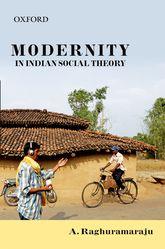
Modernity
in Indian Social Theory A
Raghuramaraju
Print publication date: 2011
Print ISBN-13: 9780198070122
Published to Oxford Scholarship Online: September 2012
DOI: 10.1093/acprof:oso/9780198070122.001.0001
Nationalism
A. Raghuramaraju
DOI:10.1093/acprof:oso/9780198070122.003.0001
Abstract and Keywords
Contemporary India, unlike the West, despite opening itself to modernity, contains pre-modern institutions such as the family. This chapter analyses how the model of Western nationalism fails to realize some important aspects associated with Indian nationalism. It discusses one of the most influential works on this theme by Partha Chatterjee, whose works have revived Indian social theory. One of the underlying assumptions of Chatterjee's formulation is the construction of the monolithic West. This chapter revokes the relation between the idea of nationalism and Western societies and shows its discontinuities. This would entail opening up the contours of Chatterjee's discussion, going beyond
so as to pose anew the question of the politics of this idea in its original context. The chapter also assesses the link between modernity and post-colonialism.
Keywords: India, West, nationalism, Partha Chatterjee, social theory, society, politics, modernity, postcolonialism
essential factors in the making of the nation.
Discussions on Indian nationalism while using theories from the modern West fail to take into consideration the variance between the West and Indian societies. Nation, a modern institution in the West, disinherited the pre-modern, whereas the Indian nation is modern and yet it retains many pre-modern institutions. Given this variance in social status, this chapter examines the
Page 1 of 29
PRINTED FROM OXFORD SCHOLARSHIP ONLINE (oxford.universitypressscholarship.com). (c) Copyright Oxford University Press,
Subscriber: OUP-Reference Gratis Access; date: 13 September 2020
predicament of those theories that failed to take into consideration this social variance. Unlike in the West, contemporary India, despite opening itself to modernity, contains pre-modern institutions like the family, which still plays a very important role in the social and political life of its society. Further, unlike in the West, Indian society has continuously made attempts to retain or recall the past. This chapter focuses on how taking the model of Western nationalism to analyse Indian nationalism fails to realize some important aspects associated with Indian nationalism. I have selected for discussion one of the most influential works on this theme by the well-known political scientist Partha Chatterjee, whose works have breathed new life into Indian social theory.
It would not be an exaggeration to assert the significance of nationalism in the making and unmaking of cultures and societies in the modern world. Partha Chatterjee's work, Nationalist Thought and the Colonial World: A Derivative Discourse? (1986), offers a convenient ground for analysing this significance and for contending with some aspects of its emergence and its variety.
Following a brief exposition of some important perspectives on the idea of nationalism, this chapter presents Chatterjee's appraisal (p.28) and reformulation of them. While explicating one of the underlying assumptions of Chatterjee's formulation, namely, the construction of the monolithic West, an attempt is made to revoke the relation between the idea of nationalism and Western societies and to try to show its discontinuities.
This would entail opening up the contours of Chatterjee's discussion, going
original context. This, I think, would facilitate not only the clarification of certain basic notions surrounding nationalism, both Western and Indian, but also provide for a reformulation of Chatterjee's thesis.
Problematizing Indian Nationalism
The idea of nation in the West is built on the modern notion of individualism clearly formulated by Descartes. The contents and the method of this formulation have already been discussed in the Introduction. The individual in in its original context has been viewed by liberal-rationalists like John Plamenatz (1976), Hans Kohn (1967), Ernest Gellner (1983), and the Marxists, H.B. Davis (1978) and B. Anderson (1983). The nationalist's project for the liberal-rationalist
Page 2 of 29
PRINTED FROM OXFORD SCHOLARSHIP ONLINE (oxford.universitypressscholarship.com). (c) Copyright Oxford University Press,
Subscriber: OUP-Reference Gratis Access; date: 13 September 2020
ideals of nationalism involves, for Gellner
[a] general imposition of a high culture on society, whose previously low cultures had taken up the lives of majority, and in some cases of the impersonal society, with mutually substitutable atomized individuals, held together above all by a shared culture of this kind, in place of a previous complex structure of local groups, sustained by folk cultures reproduced locally and (p.29) idiosyncratically by the micro-groups themselves. This is what really happens (Gellner 1983: 57).
in the Introduction. This nationalist project, it may be noted, is not
have been irreversibly committed. This paradigm of universal history, when confronted by the arguments of cross-cultural relativism, instead of answering the objections of the latter, explains them away by a sociologism according to particularities. Gellner, while confronted by the argument of relativism, evades how we manage to transcend relativism is interesting and difficult, and certainly will not be solved ibid.: 120).
Gellner further asserts that
What is relevant, however, is that we somehow or other do manage to overcome it, that we are not helplessly imprisoned within a set of cultural
expect fully industrial man to be even less enslaved to his local culture than was his agrarian predecessor. (Ibid.)
Anderson cited in Chatterjee 1986: 19). The factors responsible for this production and productive relations (capitalism), a technology of ibid.). This resulted in innumerable and varied idiolects of pre-print Europe to be
Page 3 of 29
PRINTED FROM OXFORD SCHOLARSHIP ONLINE (oxford.universitypressscholarship.com). (c) Copyright Oxford University Press,
Subscriber: OUP-Reference Gratis Access; date: 13 September 2020
Anderson (who belong to the liberal-rationalist and (p.30) Marxist schools, respectively). He argues that there are no substantial differences between Gellner and Anderson and lists three substantive issues on which both concur.
(i) In their recognition of the fundamental change in the ways of perceiving the social world preceding nationalism, while Gellner relates this change to the requirements of industrial society, Anderson relates it,
(ii) Both describe the characteristics of the new cultural homogeneity that is sought to be imposed on the emerging nation: to Gellner this is an imposition of a common high culture on the variegated complex of local folk cultures and to Anderson the process involves the formation of a
(iii) Importantly for Chatterjee, both see in third-world nationalisms a are objective, inescapable imperatives (Chatterjee 1986: 21).
From this Chatterjee concludes that both liberal-rationalists and Marxists have resorted to,
sociologism, i.e. fitting nationalism to certain universal and inescapable sociological constraints of the modern age, or alternatively, reducing the two contending trends within nationalism, one traditional and conservative and the other rational and progressive, to their sociological determinants, or invoking a functionalism, i.e. taking up an appropriate attitude towards a specific nationalism by reference to its consequences of universal history. (Ibid.: 22)
In reducing the problems of nationalism into the paradigm of sociologism, Chatterjee points out that the problem of nationalism has not been formulated as a problem either for epistemology or political philosophy. Away from these received formulations, Chatterjee takes to task the very system of knowledge representing the idea of nationalism, locating nationalism as a problem in the history of ideas and formulating it along a knowledge/power axis that sees thought itself as one which can dominate and subjugate.
By locating nationalism as the problem in the history of political ideas, Chatterjee complicates the relation between Western nationalism and Indian nationalism, showing the latter as a derivative of the former. This is a great and creative contribution. In doing this, however, he comes to take Western nationalism as monolithic, obliterating the distinction between the ideas of nationalism as a form of (p.31) Enlightenment, and goes along with Plamenatz
Page 4 of 29
PRINTED FROM OXFORD SCHOLARSHIP ONLINE (oxford.universitypressscholarship.com). (c) Copyright Oxford University Press,
Subscriber: OUP-Reference Gratis Access; date: 13 September 2020 ibid.).
set the standards for other societies. Other Western societies like Italy and Germany, though in a disadvantageous position in keeping pace with these
Chatterjee 1986: 1). It is obvious that for Chatterjee the idea of nationalism does not pose any significant questions to Western societies themselves. Since it does, we must ask: what is the relation of Enlightenment to the pre-modern societies of the West? Indeed, it can be shown that the relation between the idea of nationalism as a product of Enlightenment and pre-modern Western societies themselves is not a smooth one but consists of stresses and strains. The fact of Italy and Germany possessing the necessary requirements for becoming nations does not by itself make this process of becoming a nation a smooth affair. Western social realities preceding the idea of nationalism seem to have been put to more or less the same ordeals as eastern societies, if not more, given their geographic nearness. In short, Chatterjee's position undermines the Western critique of Western nationalism. This is largely because he does not take into active consideration the tension within the West between the premodern and modern societies.
The conception of rationality underlying the nationalist discourse is derived from the Enlightenment presuppositions of man and society. As discussed in the Introduction, this concept of man as postulated by the social contract 1 nor is it a concept of from reality. Further, this conception of man has been shown by the social contract philosophers to be fashioning a social state whose sovereignty expresses and is an expression of the general will. Specific contents of this will coincide with the idea of nationalism. Indeed, the general will can be viewed as forming the ideological basis of the idea of nationalism.
These presuppositions of Enlightenment thought, in their encounter with the social realities surrounding them, introduce basic discontinuity; in particular, they transform these realities in the self-image of Enlightenment. Specific analytic (p.32) that, according to Gellner, like savage plants, are produced and reproduced
Gellner 1983: 50). These processes are created and maintained by the state, on which the people of the nation are made to depend. Gellner contrasts this dependency on the state, necessitated by the
Page 5 of 29 PRINTED FROM OXFORD SCHOLARSHIP ONLINE (oxford.universitypressscholarship.com). (c) Copyright Oxford University Press,
Subscriber: OUP-Reference Gratis Access; date: 13 September 2020
solely dependent on the state for support (ibid. ). This process of high nation-states transforming the wild pre-modern societies inhabits the logic of exclusion authored by Descartes.
The transformation referred to here is not smooth. It is neither governed by sympathy nor is there an understanding of what is being transformed. As Gellner writes, this transformation is not an awakening of an old, latent, dominant force but
or cultural ones, or both, were being modified, so as to satisfy the new
[and] this period of transition was bound to be violent and conflict ridden.
(Ibid.: 40)
This transformation of agrarian societies into national cultures marks a discontinuity between them, making the discourse of nationalism a discontinuous discourse. The material for recognizing the relation between Enlightenment and Western societies, though easily available in Gellner, has not been noted and problematized by Chatterjee.2 He confines his discussion to exposing the political domination of nationalist thought in the colonial world,
inter-cultural relativism which the new nationalist culture must Chatterjee 1986: 6). Chatterjee levels this charge in the context of the pluralist character of third-world societies. But what of nationalism itself and its relation to Western societies? Chatterjee does not raise this query. Indeed, this relation itself is rendered insignificant given his construction of the West as a monolithic whole; a construction uninformed by the internal tensions within Western societies.3
(p.33) Establishing this relation between Enlightenment and Western agrarian societies and showing it to be discontinuous, in my view, facilitates a better reading of the relation between Western nationalism and Indian nationalism than the one available to Chatterjee. Laying bare this distinction would also facilitate the location of a critique of nationalism not in an amorphous space called the West, or Western nationalism, but pointedly to a particular instance of the West, namely, Enlightenment. The preceding discussion facilitates the claim that not only is Indian nationalism derivative but also that the idea from which it is derived is discontinuous with its own society. That is, the idea of nationalism is not only oppressive and dominating in its application to the third-world, it also seems to be inherently so. This feature of Western nationalism has eluded the attention of Chatterjee. His failure to read the philosophical foundations of modernity and the ensuing internal discontinuity in the context of nationalism in the West did not enable him to read the serious limitations surrounding the
Page 6 of 29
PRINTED FROM OXFORD SCHOLARSHIP ONLINE (oxford.universitypressscholarship.com). (c) Copyright Oxford University Press,
Subscriber: OUP-Reference Gratis Access; date: 13 September 2020
nation there. Reading of nation in the West with these philosophical and social aspects would have enabled him to read Indian nationalism differently. One of the reasons why Chatterjee failed in this is his preoccupation with an aspect of
have enabled him to recognize the internal discontinuities within the West and their implication for the reading of Indian nationalism.4 The other immediate reason for this failure is the unexamined theoretical burden, namely, inhabiting a theoretical terrain instituted by Edward Said. Let me explain this in detail.
Internal Project of Modernity and Post-Colonialism
As discussed in the Introduction, there is deep discontinuity between modernity and tradition in the West. Not recognizing the internal discontinuity seriously affected the post-colonial discourse, which in turn played an important role in the discussions on Indian social theory. Chatterjee participates in this discourse. This section attempts to scrutinize one of the key preoccupations of post-colonial studies, namely, what the West did to the non-West in the form of colonialism. It pushes further the boundaries of this preoccupation by revolving (p.34) the gaze, as it were, to include the issue of what the West did to itself in its project
Nandy 1994: xv). Educing fundamental similitude in modernity's intentionality between its project on its own pre-modern society and on the non-Western societies through colonialism, it points out the ordering of these processes as sequential.
The discussions on post-colonialism have focused largely on how the West sociologically, militarily, ideologically, scientifically and imaginatively during the Said 1979: 3). This task, in fact, institutes the postcolonial thematic, which consists of the subject (European culture during the post-Enlightenment period); the predicate or the object (Orient); and the verb (making, producing). The subsequent discussions on post-colonialism have internalized this thematic and embarked on this task, thus promoting Said to the
Foucault 1994: 350) in the Foucauldian sense. This status is acknowledged by many like Gayatri Spivak who, while tracing the original
Spivak 1993: 56).
Notwithstanding the acceptability of this thematic, the presumed status of its subject, namely, the Occident, particularly the terms alluded to or illustrating it,
Page 7 of 29
PRINTED FROM OXFORD SCHOLARSHIP ONLINE (oxford.universitypressscholarship.com). (c) Copyright Oxford University Press,
Subscriber: OUP-Reference Gratis Access; date: 13 September 2020
together as non-problematic. In contrast, I shall argue that this is problematic as it conceals internal tensions such as modernity's project of transforming its premodern society, thereby conceding to the Occident a stronger agency than is the
Said 1979: 3). (p.35)
Oriental is contained and represented Said 1979: 40
refrains from pursuing this line and he does not locate the origin of this strength. He says:
The point is that in each of these cases the Oriental is contained and represented by dominating frameworks. Where do these come from?
the purposes of the present work is to illustrate, analyze, and reflect upon Orientalism as an exercise of cultural strength. In other words, it is better not to risk generalizations about so vague and yet so important a notion as cultural strength until a good deal of material has been analyzed first.
(Ibid.: 40)
This turning away divulges the underlying exigency to dwell on what the West did to the non-West, thereby evading the internal project of modernity within the West. Said draws material from various sources to illustrate the Occident's construction of the Orient, making the collection eclectic. This eclectic nature 5 In a way, answering the would have enabled him to recognize the internal tensions and the weaknesses question is intriguing as one of the principal inspirations for Said is Michel ibid.:
3).6 Foucault impeccably identified Western modernity as forming the cultural Spivak who assiduously makes use of Foucault, who within the West located Spivak 1988: 76) Having acknowledged this in Foucault, thereby identifying the cultural resources of Orientalism, which Said was trying to dodge, she goes on to interrogate him.
of history in Europe as well as in the colonies? What if the two projects of
Page 8 of 29
PRINTED FROM OXFORD SCHOLARSHIP ONLINE (oxford.universitypressscholarship.com). (c) Copyright Oxford University Press,
Subscriber: OUP-Reference Gratis Access; date: 13 September 2020
epistemic overhaul worked as (p.36) dislocated and unacknowledged parts of the vast two-handed engine? (Ibid.: 281)
refers, though in passing, to Foucault who identified how the eighteenth-century European definition of sanity, sickness, and crime- oppressed, within the West, what this definition excluded, namely, the insane, health, and law, respectively. She points out how this redefinition was employed in constructing the other as
the two-handed engine. One hand of this two-handed machine was on the premodern West and the other on the Orient. Here I would extend her argument, improvise the metaphor of the two-handed engine, which in Spivak's use carries the sense of simultaneity, by resetting it into a sequential temporal order and point out that this redefinition was first implemented within the West and only later did it start engaging with non-Western societies, thus taking the discussion of colonialism away from non-Western societies and into the West. This revolves the gaze set by the thematic of Said, namely, the discussion of how the Occident managed and produced the Orient.
Mignolo 2000). This formulation freezes those internal processes unleashed by modernity on pre-modern Western societies. Unless we thaw and distinguish modernity from colonialism, look into these internal processes, divulge the nature of the subject-hood of the colonizer, attend to the history of this subject, we will not be able to understand the dynamics of colonialism. This is necessary because modernity was an internal project before it turned towards colonizing. Thus there underlies a sequential order. Further, it has not done to the non-West what it has not done to its own societies. The
both within the West and outside. That is, they did not have different programmes for the non-Western societies. Let me discuss the internal project of modernity.
like John Stuart Mill, Arnold, Carlyle, Newman, Macaulay, Ruskin, George Eliot, Said (1979: 14). Nor was it devised primarily to (p.37)
such as universal history and rationality, it must be noted that modernity predates them. The activities of modernity before J.S. Mill are missing in Said's analysis. It was during this period, which dates back to Descartes, that the internal project of modernity was formulated. The logic of exclusion expounded by him has already been discussed.
Page 9 of 29
PRINTED FROM OXFORD SCHOLARSHIP ONLINE (oxford.universitypressscholarship.com). (c) Copyright Oxford University Press,
Subscriber: OUP-Reference Gratis Access; date: 13 September 2020
To revert to the internal project of modernity, the initial periods of modernity are more inward-directed and aimed at transforming its own society according to the tenets of modernity. This internal rather than external preoccupation is evident in what Descartes says about other societies. He says:
It is good to know something of the customs of various people, so that we may judge our own more soundly and not think that everything contrary to our own ways is ridiculous and irrational, as those who have seen nothing of the world ordinarily do. ( )
Referring to the diversity in the customs of other men, he says:
I fact the greatest benefit I derived from these observations was that they showed me many things which, although seeming very extravagant and ridiculous to us, are nevertheless commonly accepted and approved in Ibid. )
Further, he says:
in order to try to choose the best. Without wishing to say anything about the occupations of others, I thought I could do no better than to continue Ibid.: 124)
What is evident from these statements by Descartes is that though he does not look at other cultures to endorse and emulate them, he uses these to guard himself from accepting his own ideas uncritically. He, however, does not Descartes's tone is very sharp while criticizing the older beliefs and practices of 7 If we
for this difference in Descartes's tone. So, at least (p.38) initially, modernity as formulated by Descartes is inward-directed. This internal preoccupation continues even subsequently.
J.S. Mill in his celebrated essay On Liberty declares:
Despotism is a legitimate mode of government in dealing with barbarians, provided the end be their improvement, and the means justified by actually that end. Liberty, as a principle, has no application to any state of things anterior to the time when mankind have become capable of being improved by free and equal discussion. Until then, there is nothing for them but implicit obedience to an Akbar or a Charlemagne, if they are so fortunate as to find one. (Mill 1975 [1859]: 136)
10 of 29 PRINTED FROM OXFORD SCHOLARSHIP ONLINE (oxford.universitypressscholarship.com). (c) Copyright Oxford University Press,
Subscriber: OUP-Reference Gratis Access; date: 13 September 2020
Let us now turn to another instance, namely, Habermas whose communicative socialism developed in the course of anti-imperialistic and anti-capitalistic struggles in the Third World have any bearing on the tasks of a democratic Habermas 1986: 187).
In bringing the internal project of modernity into the present discussion on
seek, at least initially, to dissociate moral and political aspects generally associated with colonialism. For instance, I would contest the view that treats colonialism as predominantly a political programme as held amongst others by Said 1979: 204). In bypassing the moral question of whether colonialism is bad or not, or the political question of whether it is oppressive or liberating, thereby circumnavigating from the Foucauldian formulation of power/ knowledge, I, Nandy 1994: 2).
Looked at from this perspective, modernity springs from an uncertain terrain; is surrounded by insecurity rather than assertion of strength; attempting to overcome weakness rather than issuing out from a strong centre. Its violence is largely the violence of the weak rather than the strong. Unlike many who attributed strength to Cartesian certainty, I would read in Descartes's quest for certainty a sense of insecurity. It is the displaced insecure man's desperate craving (p.39) for certainty. To me certainty is not a cause but an effect, which was caused by the lost centrality. The cause for certainty may not necessarily be by the agent, who already has certainty, asking for more certainty; it may be the insecure displaced self's craving for certainty.
The insecurity of the displaced modern atomized self seems to underlie its
both the fear of and contempt for the other. This psychological state, to designate to modernity what Said said about the West, vacillates between its
Said 1979: 59). Similarly, to use an observation made by Nandy in a
once the people begin to feel that their society is being cleansed of religion and Nandy 1997: 157
11 of 29 PRINTED FROM OXFORD SCHOLARSHIP ONLINE (oxford.universitypressscholarship.com). (c) Copyright Oxford University Press,
Subscriber: OUP-Reference Gratis Access; date: 13 September 2020
encountered its own non-modern and later turned towards the non-Western, premodern societies, thus paving the way for colonialism.
Against this backdrop, I treat modernity as a psychological craving for certainty. It may be true that the political processes in the form of colonialism were the result of these developments but the internal project preceded and may even have been a precondition, like memory in the Bergsonian sense, to its project outside the West resulting in colonialism.8 That is, the ideals of modernity were first lab-tested and experimented within the West before they were unleashed on other societies.9 For instance, colonialism has attempted to homogenize the plural Indian society through its ideology of nationalism and it had positively rejected the local laws. Here it must be recognized that this is subsequent to a similar exercise in the West. The attitude of nationalist ideology towards its own pre-modern Western society is no different from the British ruler's attitude towards the native Indian social practices. Modernity is Janus-like; it is both internalizing and trespassing. So it is necessary to preface our discussion of what the West did through colonialism to the non-Western societies with the 10
This calls for turning the attention from the thematic laid by Said towards the internal project.11
(p.40) Though many post-colonial thinkers like Said have disregarded this internal project, Aime Cesaire partly captures the nature of this project in the
). Cesaire, unlike Said who concedes more
identifying the precarious psychological state. He, however, in his preoccupation to lay bare what the West did to the non-West, thereby ultimately subscribing to Said's thematic, fails to analyse the roots of this sickness, and how this sickness was not born with colonialism or exclusively for colonialism but has a history to it and was functional within the West. Further, Ashis Nandy, whose position is closer to Mahatma Gandhi, aptly captures the psychological state of the
Nandy 1994: xv).
already pointed out, victimizing the other precedes or springs from selfsense of simultaneity with those that reveal the sequential order. Having identified the nature of the subject-hood of the colonizer and explained the others, goes on to discuss how the intimate enemy colonizes the mind. Unlike
Page 12 of 29
PRINTED FROM OXFORD SCHOLARSHIP ONLINE (oxford.universitypressscholarship.com). (c) Copyright Oxford University Press,
Subscriber: OUP-Reference Gratis Access; date: 13 September 2020
many post-colonial thinkers, I wish to bring the internal project of modernity into the discussions on colonialism.
So modernity consists of both an internal and an external project, there is invariance in the intentionality of modernity. In other words, both Said, who laid bare the thematic of external colonialism, and Foucault who excavated the internal project of modernity, have to form part of the discussion on colonialism.12 This combination closely resembles the project of Mahatma Gandhi. Gandhi not only highlighted the politics of external colonialism but simultaneously laid bare the internal project of modernity unleashed on the society of its origin.
To conclude, we have scrutinized a major preoccupation of post-colonial studies, invoked the internal project of modernity, and related it to colonialism. Chatterjee like Said assumes the West to be a (p.41) monolithic and so is unable to recognize the deep discontinuities and thereby read the limitations surrounding Western nationalism.13 He is also not able to recognize the differences in the Indian nation where these deep discontinuities with the past are not present.14
Variations in the Idea of a Nation
Unlike in the West where pre-modern social institutions like family are disinherited, in India family as a social institution continues to play an important role in shaping the nation. In this sense, the Indian nation is a peculiar mix of Aristotle's model of polity, which includes family as its part, and the modern model of nation with its political ideals of citizenship, liberty, and freedom. The Indian nation, though claimed to be based on citizenship, does not, however, exclusively function through it. That is, unlike in the West, where their
Taylor 2009: 39) here in India it is often mediated by these other belongings. Further, in contrast to the requirement of amnesia, which is the essential requirement of the nation in the West, in India contemporary Indian philosophers did not denounce the past, rather they continuously recalled it. It is another matter that their recalling is essentialist. Unlike the nation in the West, which is built on the debris of the pre-modern social realities and with atomized individuals, Indian nationalism as available in the writings of contemporary Indian philosophers contains important inputs from tradition. This is evident from the fact that Bankimchandra Chatterjee recalls Sankhya; Sri Aurobindo and Swami Vivekananda recall Advaita, Yoga, Upanishads, Buddhism, and other such texts; its ethnic communities have not vanished after founding the nation as was the case in the West à la Smith.15 This peculiar feature of recalling what is there, as usually we recall what is not there, is necessitated by the presence of colonialism, which has enveloped the social is recalling what is in front of him/her like making an STD (subscriber trunk
Page 13 of 29
PRINTED FROM OXFORD SCHOLARSHIP ONLINE (oxford.universitypressscholarship.com). (c) Copyright Oxford University Press,
Subscriber: OUP-Reference Gratis Access; date: 13 September 2020
dialling) call to the next room. In this process you have to lean over colonial spaces to reach what is in front of you, that is, the pre-modern.16
These social facts should be taken into active consideration alongside the process of India becoming a nation. If not, our accounts (p.42) of India, its form of nation, might be not only found wanting in our philosophical reading of space (here it is social space) but also lead us to make the mistake of past-tensing a present continuous, an error about time. Now let me discuss one interesting way in which Telugu cinema provides a variation to the Western idea of nation.
Loveless Nation: Revisiting Early Telugu Cinema
One of the major preoccupations of the discussions on nationalism in India is about the idea of nation and not what it consists of. This preoccupation takes the discussion in a particular direction and does not enable the discussants to recognize some aspects that are important to reckon with. To recognize these important aspects it is necessary to turn our attention away from what a nation is to what its constitutive elements are. Once we raise this question, the intellectual path takes us away from the derivative or otherwise of Indian nationalism; from an abstract notion of nation we focus on the particular that constitutes the nation. Consequently, we will recognize not whether this nation is like that one, rather what is there in this nation. This approach invariably treads the path of difference and variance rather than invariance, a lisping aspect, which is derivation. Deflecting from the present preoccupation, let us discuss how family, which is one of the important social institutions in the Indian nation today, figures in early Telugu cinema. Interestingly, this institution stays not as a pre-modern institution or a modern one, but undergoes interesting modifications in the process of ensuring its survival. In order to understand one form of this modification, let us, by recalling the background to this issue, contextualize the discussion.
The abstract and atomized concept of the individual, which forms the bedrock of the modern nation in the West, is endowed with an exclusive and clearly defined notion of rationality. This notion of reason is important too though not for either emulation or mere rejection but to set the terms of modification.
What is important here is that this notion of reason is exclusive and it excludes anything other than cognition from the domain of new individual. In other words, the non-cognitive domains as they are alleged to be not certain and are fleeting in nature do not enter into (p.43) the formation of the nation. The impact of this is noticeable in the fictional domain. In fact, at one place in Shakespeare's play Romeo and Juliet, when the latter says to the former that she passionately loves him, he reminds her that she had said the same thing to her former lover. This non-cognitive that is love invariably lends itself to a tragic end, thus, reinforcing the philosophical project of modernity. So it is the noncognitive aspect that makes the play a tragedy, thereby declaring that nothing
Page 14 of 29
PRINTED FROM OXFORD SCHOLARSHIP ONLINE (oxford.universitypressscholarship.com). (c) Copyright Oxford University Press,
Subscriber: OUP-Reference Gratis Access; date: 13 September 2020
permanent can be founded on anything that is not cognitive. This relation between non-cognitive and tragedy instituted by modernity provides a good clue, though not a tool for imitation to the understanding of fictional domains in India.
Given the variation in the social sphere, namely, the mix of Aristotle's polis and the modern model of nation, let us see how the Indian nation has negotiated this new combination. I will focus on how the new nation in India configures Enlightenment ideals of rationality and traditional institutions of family. How Indian nationalism deals with the non-cognitive aspects such as love and manages without fulfilling the essential requirement of citizenship. The area of discussion will be Telugu cinema.
As a background to the discussion, let me recall two preceding major themes. The first one is the relation between tragedy and emotion in Shakespeare. Love, a non-cognitive aspect, invariably leads to tragedy. This combination recurs in the well-known Bengali novel, Devdas. An important characteristic feature of Devdas is that it is a love story and a tragedy. On one level of reading the text, one might get the feeling that it celebrates love, and this, in fact, is the major running theme in the novel. However, if one pays close attention to the larger symbols one can read the text as sending a warning to those like Devdas who threaten the institution of family. It can be read as suggesting that those who threaten the family have to face the fate of Devdas, which is tragic. In the novel, the last scene is where vultures are seen on Devdas's body. In the last scene in the film, there is a huge gate that clearly demarcates the house, which symbolizes the institution of family, and the outside, which is symbolized by the road. The choice is clearly between family and the road. Parvati struggles, and struggles hard, to reach out to Devdas, who threatens the institution of the family through love, but finally resigns to go back to the family leaving him on the road in a pitiable situation. This can be interpreted as (p.44) suggesting that those who threaten the institution of the family will invariably meet a tragic end. It is this reading of tragic sense more than the celebration of love thematically highlighted in the novel that can open new insights into the reading of this text.
of the text, particularly the tragic sense, makes us conclude that it shows the limits of love and the indomitability of the family as an institution. Viewed from the storyline, it is love that is highlighted, but viewed from the conclusions it is the tragedy of love that is highlighted and the family as an institution stands a winner after it is threatened by love. The reason why this point is important is because either interpretation does not lend any credence to the nation as an institution. Neither love, which is non-cognitive, nor family, which is a traditional institution, provide raw material for the formation of the nation.
Page 15 of 29
PRINTED FROM OXFORD SCHOLARSHIP ONLINE (oxford.universitypressscholarship.com). (c) Copyright Oxford University Press,
Subscriber: OUP-Reference Gratis Access; date: 13 September 2020
Recall that it is the individual who emerges subsequent to the demolition of traditional institutions like the family, together with rationality, that forms the bedrock of a new idea of nation-state in the West. Both these preconditions are absent in Devdas. Moreover, both love and family, depending upon either interpretation discussed earlier, are present. So, with a plot like Devdas, a nation Devdas is a more complex text than Romeo and Juliet. The way in which the complexity of the institution of the family is handled in Indian fiction has eluded the Western imagination. We cannot imagine this kind of treatment of the family in Shakespeare.
To return to the main argument, let me here discuss Maidanam, a Telugu novel, as an extension to Devdas, which is a Bengali novel. This novel by Gudipati Venkata Chalam (1993) is about a married Brahmin woman, Rajeswari, who is neglected by her lawyer husband. He is more interested in his practice and externalities than in his wife. She runs away from the family into the plains with a man called Ameer, who was her husband's client, and he showers his complete attention on her. She finds deep love in him. (This is in contrast to Devdas where Parvati remains within the fold of the family.) This romantic theme is treated very effectively in the novel and like in Devdas it is read as an instance of the celebration of love over family. In the end, we see that Ameer is killed and Rajeswari is jailed. These metaphors of death and (p.45) jail allow us to give an interpretation that is exactly the opposite of the first one, suggesting that those who threaten the family die or get murdered or are sent to jail, thereby indirectly but effectively warning those who threaten the family as an institution. But the broad parallel Maidanam has with Devdas incompatibility between love and family and point out what happens when the former defies the latter. Further, similar to Devdas, neither love nor family looked at from the two different interpretations, can provide raw material for the formation of the nation. This paradigmatic theme provides a background to the themes discussed next.
Telugu cinema has been indirectly responding to the requirement of the new nation and at the same time avoiding the tragedy of Devdas and Maidanam. However, its attitude towards family is complex, or at least ambivalent. In these films, love does not confront family but is sacrificed to reinforce the family and facilitate the growth of new professions like those of the doctor, lawyer, engineer, journalist, and nurse, which are the new requirements of a new nationstate. Let me give a brief description of these films.
Manchi Manasulu (1962)
Gummadi is a blacksmith. He sends his brother, Venu, played by A. Nageswara Rao, to town for studies. Though poor and suffering from tuberculosis, he sends money to Venu who, aware of his brother's poverty, tries to reduce his cost of living by staying in the house of one Ananda Rao (S.V. Ranga Rao) as a paying
Page 16 of 29
PRINTED FROM OXFORD SCHOLARSHIP ONLINE (oxford.universitypressscholarship.com). (c) Copyright Oxford University Press,
Subscriber: OUP-Reference Gratis Access; date: 13 September 2020
guest instead of staying in a hostel. On learning that Rao's wife, Suryakantam, is against letting out part of their house to bachelors as they have a young unmarried daughter, Shanti (Savitri), Venu lies to Rao that he is married. There is another lie: Gummadi's daughter Jaya tells her father that she will not inform Venu about the deterioration of his health. There are two love affairs in this film
back to the main theme, Shanti, when she comes to know that Venu is unmarried, falls in love with him and decides to marry him. They all go to Venu's house, where his brother, Gummadi, before dying, gives Venu the responsibility of his daughter's marriage. Venu had come to know that Jaya was in love with Kumar, but Kumar agrees to the marriage on the condition that Venu (p.46) marries his sister, Radha (Janaki), who is blind. Shanti comes to know about this and forces Venu to agree. Though pained, Ananda Rao understands and sympathizes with Venu. Shanti thinks it is all due to her fate, but gradually comes to regard his refusal not as a betrayal but as a sacrifice. She says that she is ready for this as she does not want to marry a selfish man who cannot keep his word to his brother.
In fact, Shanti, when she comes to know that Venu is not showing affection towards his wife scolds him and helps him love his wife. She asks Venu to take Radha to Hampi. Meanwhile, Mallika, another woman with whom Kumar has had an affair, goes to his place and threatens him. He takes her to Hampi and kills her. Venu, who happens to be there with his wife, reaches the scene of the murder. He meets Kumar on the way; Kumar, while running away stumbles upon his sister Radha. To save Jaya from widowhood, Venu says that he murdered Mallika.
Meanwhile Shanti passes her law degree, in the first class, and takes up Venu's case. She has to argue against her own father. Under the influence of drink, Kumar tells his wife about Mallika's letters. Jaya gives the letters to Shanti (making another sacrifice). Kumar locks Jaya in an abandoned temple where he hides his blood-stained clothes. Jaya prays to the goddess and reaches the court. There is a sensor test. Radha, who is blind, testifies and Kumar confesses and is sentenced to seven years in prison. Shanti hands over Venu to Radha and then leaves with her parents. Here what is important is that Shanti's sacrifice of her love allowed her to pursue the study of law. So, love was sacrificed in pursuit of a profession. One needs to take into account this complex and new development, namely, that now love does not attack the family but is sacrificed in order to restore the old family and to promote a new profession, thereby contributing to the emergence of a new nation.
Velugu Needalu (1961)
Rao Bahadur has an adopted daughter, Suguna. After the birth of his own daughter, Varalaxmi, he sends Suguna to the care of his assistant, who brings her up. Suguna meets Ravi, who is a poet. Meanwhile, Raghu (played by
Page 17 of 29
PRINTED FROM OXFORD SCHOLARSHIP ONLINE (oxford.universitypressscholarship.com). (c) Copyright Oxford University Press,
Subscriber: OUP-Reference Gratis Access; date: 13 September 2020
Jaggayya) returns from London after obtaining (p.47) a medical degree. He meets Suguna, who tutors his nephew at his sister's house. Raghu falls in love with Suguna, but she rejects him because she is in love with Ravi, who they discover later has tuberculosis. Ravi persuades Suguna to marry Raghu and not waste her life on him. He extracts from her a promise that she will serve humanity and not one person. Suguna marries Raghu. Ravi blesses the couple and asks them to dedicate themselves to the service of humanity. Ravi's health deteriorates and they send him to a sanatorium in Madanapalli. There he recovers. When he returns home, Raghu goes to receive him and meets with an accident and dies. Ravi asks Suguna to marry again and she asks him to complete his medical degree. She refuses his request and he refuses hers. Meanwhile, Ravi accepts a proposal from the parents of Varalaxmi.
Rao Bahadur hands over his printing press to Ravi, who sets it right. He changes the name of the press from Raja seva to Navajyothi. Then Varalaxmi misunderstands Ravi's closeness to Suguna. Ravi leaves the house and the press is closed. Varalaxmi realizes her mistake and they come together again. In this film, Raghu and Suguna are doctors and Ravi a journalist. Note that while in Manchi Manasulu it is Savitri who sacrifices her love and encourages Nageswara Rao to fulfil his duty towards his family, in Velugu Needalu it is the other way round. This is yet another instance of sacrificing love for the sake of pursuing a profession.
Dr Chakravarthy (1964)
Dr Chakravarthy and Dr Sridevi are in love and decide to marry. Chakravarthy loves his stepsister very much, who while dying extracts a promise from him that he will marry her husband's sister, Nirmala, to keep continuity in the family. Chakravarthy hesitates but Sridevi persuades him to agree, thereby sacrificing her love to contribute to the family tradition. They start a hospital in the name of Chakravarthy's sister.
Meanwhile, there is another couple: Harinath, an engineer (Jaggayya) and Madhuridevi (Savitri). Chakravarthy sees his sister in Madhuridevi, which is misunderstood first by Nirmala and later by Harinath. They all realize their mistakes and all problems are resolved (p.48) amicably. Here too Sridevi sacrifices her love to pursue a profession (that of a doctor).
Manushulu Mamatalu (1965)
Venu, played by A. Nageswara Rao, loses his father in the Godavari floods. His mother brings him up in the house of Gummadi, who has a daughter played by Savitri. Savitri is in love with Nageswara Rao. Gummadi is also interested in his daughter marrying Rao. But Venu is not interested in marriage and is completely preoccupied in becoming an engineer. Savitri finances Venu's education but she does not insist on his marrying her. She sacrifices her love and agrees to marry Jaggayya, the son of Gummadi's friend. After they are married, Jaggayya takes to
Page 18 of 29 PRINTED FROM OXFORD SCHOLARSHIP ONLINE (oxford.universitypressscholarship.com). (c) Copyright Oxford University Press,
Subscriber: OUP-Reference Gratis Access; date: 13 September 2020
drinking and has an affair with another woman. Savitri endures this problem. Meanwhile Jaggayya secures a civil contract for work on the Nagarjunasagar Dam where Venu joins as an engineer. Venu finds out that the quality of construction is not good and stops the payment of bills. Venu comes to know that Prabhakar Rao, who is related to Jaggayya, has misappropriated the money, and this is the reason behind the poor quality of work. He borrows money from Jaggayya's uncle's daughter, played by Jayalalitha, and finishes the work. Meanwhile, Jaggayya comes to know that Prabhakar Rao has planted a bomb at the construction site to kill Venu. They all reach the site on time and save Venu. Venu finally marries Jayalalitha. Here too there is an attempt to sacrifice love for the sake of a new profession. In several places in the film, Venu refers to the nation and declares that he is not interested in marriage but wants to dedicate his life (as an engineer) for the uplift of the nation.
In all these films, love is sacrificed in order to facilitate an arranged marriage; the woman/man in love not only facilitates this arranged marriage but nurtures it through her/his sacrifices. For instance, Shanti in Manchi Manasulu supports the arranged marriage of the person she was in love with, clears misunderstanding in his marital relationship, nurtures the growth of his marital relationship, and remains unmarried herself. Love is sacrificed to meet the requirements of a new nation. The protagonists pursue the study of medicine, law, and engineering; the new nation-state needs doctors, nurses, lawyers, engineers, and journalists. It is interesting to note that there is an (p.49) attempt to cleanse these professions of the commercial elements associated with them and their association with colonial rule. Thus, these films, which were big hits in their time, reveal some important variations to both Devdas and Maidanam on the one hand, and the Western notion of nation on the other. So Indian nationalism, though derived from the West, has undertaken its own ordering and reordering. That is, unlike in the West, nationalism has not sought to destroy the family, at least not in the way the West did in installing the citizen as the brick of the nation, but sought in its own way to make changes.17 So there is a need to reassess the role of the family in the making of the Indian nation. In this process, there is a need to re-read novels such as Devdas and even Maidanam 18
Thus, we have in this instance, a variation where love is not allowed to culminate in a tragedy. Instead, it is positively sacrificed to form new modern social institutions that a new nation-state needs. While making this formation, it has not given itself to exclusive individualism and it has not disinherited the past or emotions; it continues to retain, though in a modified form, the institution of the family. All these eluded the scholarship that theorized Indian nationalism. Though Chatterjee does not conclude that Indian nationalism is completely derived from Western nationalism, he does not take into active consideration, while discussing Indian nationalism, the variations Indian society provides. In my reading, Chatterjee is led to this situation of not seeing what is in front of
Page 19 of 29
PRINTED FROM OXFORD SCHOLARSHIP ONLINE (oxford.universitypressscholarship.com). (c) Copyright Oxford University Press,
Subscriber: OUP-Reference Gratis Access; date: 13 September 2020
him due to a theoretical burden, namely, preoccupation with modern theories; not reading the project of modernity, particularly its method and the ensuing discontinuity with the past. Recognizing these will enable us to admit the differences between India and the West. Once this is recognized, one begins to see many other interesting things in Indian society.
The next chapter discusses how the distinct relation between modernity and the non-modern in India has not been explored thoroughly, if at all, in the discussion of another important aspect, namely secularism.
Notes:
(1. (2.) It may be noted here that Gellner, though he recognized the relation between Enlightenment and Western agrarian societies, does not question the Enlightenment presuppositions of man and society. He seems to concur with his predecessors about the self-evident truth of these assumptions.
(3.) To circumvent the ballooned thesis of derivativity of Indian nationalism, let me at the outset recall the views of Gandhi and Tagore.
Gandhi says:
suggest that because we were one nation we had no differences, but it is submitted that our leading men travelled throughout India either on foot or in bullock-carts. They learned one another's language and there was no made by nature. They, therefore, argued that it must be one nation. (Gandhi quoted in Iyer 1986: 43)
between communities. That is, the oneness is neither superimposed from above nor is it brought about by removing the differences between communities. Elucidating the difference between the modern nation and communities in India, Tagore says:
Before the Nation came to rule over us [under British colonial rule] we had other governments which were foreign, and these, like all governments, had some element of the machine in them. But the difference between them and the government by the Nation is like the difference between the hand-loom and the power-loom. In the products of the hand-loom the magic of man's living fingers finds its expression, and its hum harmonizes with
Subscriber: OUP-Reference Gratis Access; date: 13 September 2020
the music of life. But the power-loom is relentlessly lifeless and accurate and monotonous in its production. (Tagore 1985: 10)
(4.) The contents of Chatterjee's discussion seem to be broadly limited to Indian nationalism based on the liberal-rationalist ideology, primarily the nationalism of the Indian National Congress. This form of Indian nationalism may have been the dominant form and hence one cannot hastily conclude that Indian nationalism is derivative. Rather, it must be stated that the nationalism of the Indian National Congress, in articulating its concerns within the knowledge systems, which are Western, is a product of a derivative discourse.
What would happen to the derivativeness if one were to consider another instance of Indian nationalism? It is in this context that I shall discuss the ideology of Hindutva as stated in the writings of V.D. Savarkar. The question may arise why this particular instance and not some other? The choice is governed by some significant developments in contemporary Indian politics. The rise in the popularity of the Bharatiya Janata Party (BJP), Shiv Sena, Vishwa Hindu Parishad (VHP), and others, characterized as rightist parties/organizations, and the corresponding decline in the popularity of the Congress, labelled as the centrist party, marks a significant development in the politics of contemporary India. Both have been contestants for power before and after Independence. However, it was the Congress that succeeded in capturing and retaining power till 1975 and after a brief break again between 1977 and 1989, conceding only a little
The scene, however, seems to have been changing with the rise in popularity of the BJP, Shiv Sena, VHP, and other parties. However, the National Democratic Alliance (NDA), which included the BJP, did come to power. The BJP, by claiming
ambivalence in shedding and embracing its erstwhile Jan Sangh-type of fundamentalist predilections, has been working towards larger appropriations. This change necessitates, along with other things, a discussion of the ideology of these parties.
One of the central themes running through the various invocations of Savarkar is political unity. It is around this notion that he weaves his other concerns:
((i)
a common culture and law, what to Savarkar, are pre-British and preIslamic (1964: 46).
((ii)) His plea for developing Western science, technology, industry and knowledge systems in India, to be used for achieving both material
Page 21 of 29
PRINTED FROM OXFORD SCHOLARSHIP ONLINE (oxford.universitypressscholarship.com). (c) Copyright Oxford University Press,
Subscriber: OUP-Reference Gratis Access; date: 13 September 2020
sin to follow the path of violence where it is possible to make progress in a peaceful way. Such were my views when we [referring to Gokhale] Savarkar quoted in Keer 1966: 129).
It is through this forced militancy and not by having a common constitution that India could regain its nationhood and remain united. It is interesting to note that liberals as well as militant nationalists accepted modern science, technology, industry, and the like, which are the products of the Western knowledge system, although the latter intended to use them to establish unity through militancy.
Further, it is this notion of unity that determines Savarkar's friends and enemies. The Indian War of Independence 1857 (1947), he attacks Sikhs for not joining hands with Hindus and Mughals to fight against the British. He observes:
The Sikh princes and people did not wish well to the Revolutionaries even at heart; nor did they remain neutral; nay more, they did not hesitate to aid openly with the English and shed the blood of their own countrymen on the field of the battle. (Savarkar 1947: 496)
On the contrary,
The Hindus as well as the Mohemmedan communities thoroughly sympathised at heart with the revolutionaries and were full of hatred towards the British. (Savarkar 1947: 496)
he
antagonism towards Muslims, particularly the Muslim League, is in the context of the threat to this unity, which he romantically upholds, with the demand for Pakistan. Likewise, his explanation for the causes of the fall of Buddhism in India
Savarkar 1964: 16). Savarkar's concern, it is evident, are clearly political and his tone often propagandistic, being based not on argued facts but managed through the sheer power of rhetoric and emotions.
The concept of Hindutva embodies this principle of unity. Hindutva, to Savarkar, needs to be distinguished from Hinduism. A Hindu need not necessarily accept ibid.: 2). Hinduism is identified with Vedanta philosophy and is not central to a Hindu either; to ibid.). According to Savarkar, Hinduism is not to be the main concern for Hindus and he maintains vedas
Page 22 of 29
PRINTED FROM OXFORD SCHOLARSHIP ONLINE (oxford.universitypressscholarship.com). (c) Copyright Oxford University Press,
Subscriber: OUP-Reference Gratis Access; date: 13 September 2020
Savarkar quoted in Keer 1966: 137
ibid.). The overtly religious nature of Hinduism comes to be charged with political intent, what to Savarkar ibid.: 74). The primary concern of Hindutva is political unity, material prosperity, and military strength. The failure on the part of Indian society not to become a strong nation,
not seeking military means to establish unity. Hence, Savarkar felt the need to ibid.: 142).
Though the ideology of Hindutva threatens to provide a discourse different from the nationalism of the Indian National Congress, it nevertheless comes to replicate the same paradoxes of the latter. Savarkar berates the constitutionalism of the Congress as insufficient to safeguard national unity and affirms militancy as a means to upholding this unity. The affirmation finds justification in the experience of the West, particularly the attempt at fusing the sacred and the profane through religion and science. Savarkar attributes the success of Western nationalism to their having a single unified religion and their ibid.). By way of contrast, he confronts the diversity of Indian society, maintaining that Hindu never looked upon religion as a means of strength and solidarity. This, ibid.).
Thus, we must ask: Is Savarkar's militant nationalism also not privy to the process, which though opposed to the mainstream nationalist discourse, upholds
echoes within Savarkar that reminds one of Mazzini? (Incidentally, Savarkar translated the autobiography of Mazzini into Marathi and often adulates Mazzini in his writings.) Indeed, Savarkar's obsession with unity, to be supported by militancy, his preoccupation with history, politics, modern science, and his seems to concretize the concerns that has animated the post-independent Indian state. What Savarkar's avowed militancy hides is the search for alternative conduits for modernity.
That is, there may well be other instances of nationalism, separate from that of the Indian National Congress and Hindutva that may or may not reflect this contradictoriness of nationalism in the transplanted context. Assuming that they do, are we then to conclude emphatically that the pluralities of nationalisms in
Page 23 of 29
PRINTED FROM OXFORD SCHOLARSHIP ONLINE (oxford.universitypressscholarship.com). (c) Copyright Oxford University Press,
Subscriber: OUP-Reference Gratis Access; date: 13 September 2020
India embody within themselves the same contradictions that overwrite the mainstream nationalist effort of the Indian National Congress, what has been presented by Chatterjee? To reply in the affirmative would be a relatively simple option. Rather, I would argue, that it is within the framework of this question that one begins to think through the inherent limits of Chatterjee's focus.
(5.
However, to Said this distinction is more analytical, and I am looking for a distinction that reveals historical stages. Said implicitly acknowledges historical changes in the Occident's attitude towards the Orient when he says:
From roughly the end of the eighteenth century, when in its age, distance and richness the Orient was rediscovered by Europe, its history had been a paradigm of antiquity and originality, functions that drew Europe's interest in acts of recognition or acknowledgement but from which Europe moved as its own industrial, economic and cultural development seems to leave the Orient far behind (Said 1986: 215).
While acknowledging this awareness in Said, I would like to present the distinction between the pre-modern West and the modern West more sharply than assumed by Said.
(6.) It is another matter that Spivak (1988) in her essay, seems to contest Said's attempt at providing Foucault as a springboard to many post-colonial thinkers to air their views.
(7.) Even in Kant, modernity's other is the pre-modern West. Here the and not yet traversed to outside the West. The scene does change and the gaze moves towards outside West in Hegel. While agreeing with Spivak that there is
would, however, allude to the difference in gaze between Kant and Hegel (Spivak 1999: x). Reckoning this difference might save us from eventually relapsing into the division between West and East.
Further, in highlighting these allegedly Eurocentric statements in the writings of modern Western philosophers like J.S. Mill, Spivak failed to take into
(8.) According to Said, Gauri Visvanathan, in her work The Masks of Conquest, suggests that colonial administrators first created during the nineteenth century Said 1994: 48). This ordering might apparently go against the ordering suggested here. However, I am alluding to larger historical developments within the West,
Page 24 of 29 PRINTED FROM OXFORD SCHOLARSHIP ONLINE (oxford.universitypressscholarship.com). (c) Copyright Oxford University Press,
Subscriber: OUP-Reference Gratis Access; date: 13 September 2020
such as individuation, industrialization, emergence of nation states, all of which took place in the West before they were executed in the non-West.
(9.) Here, while agreeing with Spivak's (1988) criticism that the white man wanted to save the brown woman from the brown man, I would add that the white man referred to here is not the racial white man but the transformed rational man of modernity, who did to his own men and women what he later did to the brown men and women.
(10.) Sartre in his preface to Fanon's The Wretched of the Earth , recognizes only the external colonialism of the West and not the internal project of modernity.
(11.) One of the possible reasons for not recognizing the similarities between these two forms of modernity, internal and external, is that modernity has been understood through the Hegelian metaphor of master and slave. This metaphor is useful to understand the earlier forms of oppression where the master continues to maintain the difference from the slave even after he realizes his dependency on the slave. However, modernity primarily shows either fear or of modernity. Many post-colonial thinkers consciously or unconsciously inherited this metaphor. Here let me point out that Nandy is one of the few post-colonial
here. He diligently distinguishes the modern form of oppression from the earlier form. He says that the former is not or the gods and the demons. It is the battle between the dehumanized self of victims; when they speak of victors, the victors are ultimately shown to be camouflaged victims, at an advanced stage of psychosocial decay. (Nandy 1994: xvi)
(12.) Here, I accept Spivak's (1988) criticism of Foucault and Deleuze.
(13.) Akeel Bilgrami too participated in the theoretical terrain instituted by Said. For more on this, see Raghuramaraju (2010).
(14.) Following Hegelian dialectics and notion of history, Chatterjee goes on to this way of charting, see Raghuramaraju 2006.)
(15.) Yet another difference that surrounds Indian nationalism is partition, a serious tragedy preceding the birth of the nation. This has serious implications,
Page 25 of 29
PRINTED FROM OXFORD SCHOLARSHIP ONLINE (oxford.universitypressscholarship.com). (c) Copyright Oxford University Press,
Subscriber: OUP-Reference Gratis Access; date: 13 September 2020