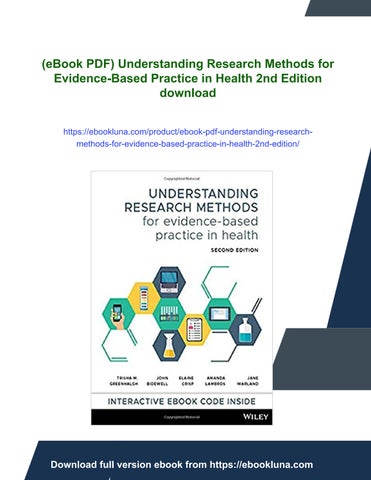
(ebook pdf) understanding research methods for evidence-based practice in health 2nd edition - The l

Page 1


(eBook PDF) Understanding Research Methods for Evidence-Based Practice in Health 2nd Edition

https://ebookluna.com/product/ebook-pdf-understanding-researchmethods-for-evidence-based-practice-in-health-2nd-edition/

(eBook PDF) Statistics for Nursing Research - E-Book: A Workbook for Evidence-Based Practice 2nd Edition,

https://ebookluna.com/product/ebook-pdf-statistics-for-nursingresearch-e-book-a-workbook-for-evidence-based-practice-2ndedition/

(eBook PDF) Evidence-Based Practice for Nurses: Appraisal and Application of Research 4th Edition

https://ebookluna.com/product/ebook-pdf-evidence-based-practicefor-nurses-appraisal-and-application-of-research-4th-edition/

(Original PDF) Psychiatric Mental Health Nursing Concepts of Care in Evidence-Based Practice 9th

https://ebookluna.com/product/original-pdf-psychiatric-mentalhealth-nursing-concepts-of-care-in-evidence-based-practice-9th/

(Original PDF) Research in Nursing Evidence for Best Practice 5th Edition

https://ebookluna.com/product/original-pdf-research-in-nursingevidence-for-best-practice-5th-edition/

(eBook PDF) Effective Teaching Methods: Research-Based Practice 9th Edition

https://ebookluna.com/product/ebook-pdf-effective-teachingmethods-research-based-practice-9th-edition/

UNDERSTANDING RESEARCH METHODS for evidence-based practice in health

SECOND EDITION

TRISHA M. GREENHALGH
JOHN BIDEWELL
ELAINE CRISP
AMANDA LAMBROS
JANE WARLAND

Second edition published 2020 by John Wiley & Sons Australia, Ltd

42 McDougall Street, Milton Qld 4064

Typeset in 10/12pt Times LT Std

© John Wiley & Sons Australia, Ltd 2017, 2020

Authorised adaptation of Trisha Greenhalgh, How to Read a Paper: The Basics of Evidence-Based Medicine, 5th edition (ISBN 9781118800966), published by BMJ Books, used under licence by John Wiley & Sons, Inc., Chichester, United Kingdom. © 2014 in the United Kingdom by John Wiley & Sons Inc. All rights reserved.

The moral rights of the authors have been asserted.

A catalogue record for this book is available from the National Library of Australia.

Reproduction and Communication for educational purposes

The Australian Copyright Act 1968 (the Act) allows a maximum of one chapter or 10% of the pages of this work or where this book is divided into chapters one chapter, whichever is the greater, to be reproduced and/or communicated by any educational institution for its educational purposes provided that the educational institution (or the body that administers it) has given a remuneration notice to Copyright Agency Limited (CAL).

Reproduction and Communication for other purposes

Except as permitted under the Act (for example, a fair dealing for the purposes of study, research, criticism or review), no part of this book may be reproduced, stored in a retrieval system, communicated or transmitted in any form or by any means without prior written permission. All inquiries should be made to the publisher.

The authors and publisher would like to thank the copyright holders, organisations and individuals for their permission to reproduce copyright material in this book.

Every effort has been made to trace the ownership of copyright material. Information that will enable the publisher to rectify any error or omission in subsequent editions will be welcome. In such cases, please contact the Permissions Section of John Wiley & Sons Australia, Ltd.

Wiley

Terry Burkitt (Director, Publishing and Course Development), Lori Dyer (Senior Publisher), Kylie Challenor (Senior Manager, Knowledge & Learning Content Management), Rebecca Campbell (Production Editor), Tara Seeto (Publishing Coordinator), Emily Brain (Production Assistant), Renee Bryon (Copyright & Image Research), Delia Sala (Cover Design)

Cover image: © Irina Tihomirova / Shutterstock.com; © venimo / Shutterstock.com; © Mascha Tace / Shutterstock.com; © Anikei / Shutterstock.com

Typeset in India by diacriTech

Printed in Singapore by Markono Print Media Pte Ltd 10 9 8 7 6 5 4 3 2 1 %%%%%

BRIEFCONTENTS

Abouttheauthorsvii

1.Introductiontoresearch,theresearchprocessandEBP1

2.Askingquestionsandsearchingforevidence11

3.Reviewingliterature21

4.Qualitativeresearch32

5.Quantitativeresearch43

6.Levelsofevidence55

7.Statisticsforthenon-statistician73

8.Mixedmethodsresearch88

9.Sampling97

10.Ethics106

11.Gettingevidenceintopractice114

12.Challengestoevidence-basedpractice124

Index133

CONTENTS

Abouttheauthorsvii

CHAPTER1

Introductiontoresearch,the researchprocessandEBP1

1.1Themeaningof‘evidence-based practice’2

1.2Apprehensiontowardsevidence-based practice5

Decisionmakingbyanecdote6

Decisionmakingbypresscutting6

Decisionmakingbyexpertopinion6

Decisionmakingbycostminimisation7

1.3Beforeyoustart:formulatetheproblem8

CHAPTER2

Askingquestionsand searchingforevidence11

2.1Differenttypesofsearching forevidence12 Informal12 Focusedlookingforanswers13 Searchingtheliterature13

2.2Differencesbetweenprimaryand secondaryresearch13

2.3Effectivesearchstrings13 Stepsforeffectivesearching14 One-stopshopping:federated searchengines16

2.4Otheravenuesforhowtosearch forevidence17 Searchingforinformationusing socialmedia19

CHAPTER3

Reviewingliterature21

3.1Isapaperworthreadingatall?23

Question1.Whowrotethepaper?23

Question2.Isthetitleappropriate andillustrative,andisthe abstractinformative?23

Question3.Whatwastheresearchdesign, andwasitappropriatetothe question?24

Question4.Whatwastheresearchquestion, andwhywasthestudyneeded?24

Question5.Dotheresultsorfindingsanswer thequestion?24

3.2Reviewingthemethodsofprimary researchpapers25

Sampleandsetting:whoaretheparticipants, andwhereisthestudybeing carriedout?25

Whatdata-collectionmethods wereused?26

Howwasthedataanalysed?26

3.3Reviewingthemethodsofsecondary (review)papers26

Question1.Whatisthefocusedclinical questionthatthereviewaddressed?27

Question2.Wasathoroughsearchofthe appropriatedatabase(s)carriedout,and wereotherpotentiallyimportant sourcesexplored?27

Question3.Whoevaluatedthestudies, andhow?28

Question4.Howsensitivearetheresults tothewaythereviewhas beenperformed?28

Question5.Havetheresultsbeeninterpreted sensibly,andaretheyrelevanttothe broaderaspectsoftheproblem?28

Meta-analysesandmeta-syntheses28

CHAPTER4

Qualitativeresearch32

4.1Qualitativeresearchexplained33

4.2Thedifferencebetweenqualitativeand quantitativeresearch34

4.3Qualitativemethodologiesanddata collectionstrategies35

Qualitativesampling36

Datacollection36

4.4Evaluatingpapersthatdescribe qualitativeresearch37

Question1.Didthepaperdescribean importantclinicalproblemaddressedviaa clearlyformulatedquestion?38

Question2.Wasaqualitativeapproach appropriate?38

Question3.Howwere(a)thesettingand (b)thesubjectsselected?38

Question4.Whatwastheresearcher’s perspective,andhasthisbeentaken intoaccount?38

Question5.Whatmethodsdidtheresearcher useforcollectingdata,andarethese describedinenoughdetail?39

CHAPTER10

Ethics106

10.1Ethicalprinciples107

Autonomy:patients/clientsarefreeto determinetheirownactions107

Beneficence:actingtobenefit humankind108

Justice:obligationtotreatfairly108

Non-maleficence:avoidingorminimising harm108

Respectforhumandignity108

Confidentiality:maintenanceofprivileged information,includingtherighttoprivacy andanonymity109

Veracity:obligationtotellthetruth109

10.2Theroleandfunctionofhumanresearch ethicscommittees109

10.3Judgingtheethicalaspectsofa publishedjournalarticle111

CHAPTER11

Gettingevidenceinto practice114

11.1Adoptionofevidence-based practice(EBP)115

Individualbarriers115

Organisationalbarriers116

11.2Encouragingindividualstoimplement evidence-basedpractice116

11.3Organisationalsupportofevidencebasedpractice117

Integratedcarepathways117

Clinicalpracticeguidelines118

11.4Theclientperspectiveinevidencebasedpractice119

Patient-reportedoutcomemeasures (PROMs)119

Shareddecision-making119 Optiongrids120

CHAPTER12

Challengestoevidencebasedpractice124

12.1Whenevidence-basedpracticeis donebadly126

12.2Whenevidence-basedpracticeis donewell126

Guidelinesdevalue professionalexpertise126

Theguidelinesaretoonarrow(or toobroad)127

Theguidelinesareoutofdate127

Theclient’sperspectiveisignored127

Therearetoomanyguidelines128

Practicalandlogisticalproblems128

Theevidenceisconfusing128

12.3Achievingevidence-basedpractice129

Index 133

ABOUTTHEAUTHORS

TrishaMGreenhalgh

DrTrishaGreenhalghisaProfessorofPrimaryCareHealthSciencesattheUniversityofOxfordand apractisingGP.ShecompletedaBAinSocialandPoliticalSciencesattheUniversityofCambridge in1980andamedicaldegreeattheUniversityofOxfordin1983.Trisha’sresearchaimstoapplythe traditionalaspectsofmedicinewhileembracingtheopportunitiesofcontemporarysciencetoimprove healthoutcomesforpatients.Sheistheauthorofmorethan240peer-reviewedpublicationsaswellas anumberofscholarlytextbooks.Trishahasreceivednumerousaccoladesforherwork,includingtwice winningtheRoyalCollegeofGeneralPractitionersResearchPaperoftheYearAward,andreceivingthe BaxterAwardfromtheEuropeanHealthManagementAssociation.In2001,shewasawardedanOBEfor servicestoevidence-basedmedicalcare.

JohnBidewell

DrJohnBidewellisaLecturerinResearchMethodsattheSchoolofScienceandHealthatWestern SydneyUniversity.Fromanearlycareerinschoolteaching,Johnmovedintopsychology,acquiringthree degreeswhilealwaysmaintaininganinterestineducation.Opportunitiesaroseinappliedsocialresearch anddataanalysis,leadingJohninthatdirection.Formanyyears,heprovidedtechnicalandinspirational supporttoacademicandstudentresearchers,coveringeverystageoftheresearchprocessfromconceptto publication,andespeciallydataanalysisandinterpretation,atWesternSydneyUniversity’snursingand midwiferyschool.Johnhasprovidedconsultancyservicesinresearchandstatisticstobusiness,industry andgovernments,andhastaughtresearchmethodsandstatisticstonursing,businessandalliedhealth studentsatundergraduateandpostgraduatelevels.

ElaineCrisp

DrElaineCrispisaRegisteredNurse(RN)andLecturerattheSchoolofNursingattheUniversity ofTasmania,whereshecoordinatesboththeBachelorofNursing(BN)courseandtheTranslational ResearchunitwithintheBN.ThisdualroleenableshertoensuretheBNhighlightstheconnectionbetween researchandclinicalpractice.Shehasalsotaughtresearchmethodstonursingandalliedhealthstudents atthepostgraduatelevel,encouragingclinicianstounderstandanduseresearchevidenceintheireveryday practice.ElaineworkedasanRNinagedcareandintheperioperativeareabeforecommencingherPhD, whichcombinedherloveofhistoryandnursing.Hermajorresearchinterestsarenursingandwelfare history,agedanddementiacare,andnurseeducation.

AmandaLambros

AmandaELambrosisaProfessionalSpeaker,AuthorandClinicalCounselloraswellasapastClinical Fellow.ShehascompletedaBachelorofHealthSciencesattheUniversityofWesternOntario(2001),a PostgraduateDiplomaofEthics(2002),aMasterofForensicSexology(2004)andaMasterofCounselling (2014).Amandahasdeveloped,coordinatedandtaughtevidence-informedhealthpracticetothousandsof InterprofessionalFirstYearHealthSciencesstudentsthroughouthercareer.Amanda’sprivatepractice focusesonrelationships,mentalhealth,andgriefandloss.Providingherclientswiththemostup-to-date andevidence-basedcareisimperativetoher,andshehasastrongfocusonEBP,ethicsandcommunication. Amandahasreceivednumerousaccoladesforherwork,includingNifNex100MostInfluentialBusiness Owners,aTelstraBusinessAwardnominationandaTelstraBusinessWomanoftheYearnomination.

JaneWarland

DrJaneWarlandisanAssociateProfessorattheSchoolofNursingandMidwiferyattheUniversity ofSouthAustralia(UniSA).Sheworkedasamidwifefrom1988to2007,andgainedherPhDfrom theUniversityofAdelaidein2007.JanewasappointedasanacademicstaffmembertotheSchoolof NursingandMidwiferyinFebruary2008,andteachesafoundationalresearchcourseintheundergraduate midwiferyprogram.HerownprogramofresearchisSTELLAR(stillbirth,teaching,epidemiology,loss, learning,awarenessandrisks).Janehasatrackrecordinresearchusingqualitative,quantitativeandmixed methods.ShehasastronginterestinresearchethicsandservedtwotermsasamemberoftheUniSA HumanResearchEthicsCommittee.Janehaswrittennumerousbookchaptersaboutresearch—shehas morethan90publications,includingbooks,chaptersandpeer-reviewedjournalarticles.

Imagineyouaretakingthetimetovisityourgrandfather,Wilf,whohasbeenlivingonhisownforthe pasttwoyears,andrecentlybeganseeingahealth professionalregardinghischronichipandknee pain.Whenyouwalkintohishouse,youseehimin thelivingroomfollowingalongtoatelevisedfitness program—youask:‘Heygramps,don’tyouthink youshouldavoidexercisebecauseofthepainfrom yourosteoarthritis?’.Hesitsyoudownandtells youthat,inshort,he’srecentlybeenexercisingat homeandattendingregularyogaclassesalongside hisstandardcaretodecreasethelevelsofpain inhishipsandknees.Hecontinuestotellyou thathe’salreadyfeelingmuchbettersincehehas startedexercising.Atfirst,youareabitscepticalof thisrevelation,butitturnsoutthatbydoingthese activities,coupledwithstandardcare,yourgrandfatherwillexperienceareductioninhishipandknee painsymptoms,whilegainingconfidenceanddecreasingdepressivesymptoms.1 Infact,thisadvicewas notgiventoyourgrandfather‘onawhim’orbasedonasimpleresearchpaperthatguidedthehealth professionaltoadviseyourgrandfatherofthis;itwasasystematicreview—thehighestlevelofevidence. (Moreonthisinthechapteronlevelsofevidence.)

Nowimaginethat you arethehealthprofessionalandWilfisyourclient.Ratherthanjustproviding ‘standard’practice,thinkaboutthewaysinwhichyoucouldprovide evidence-basedpractice(EBP) apracticethatissupportedbyscientificevidence,clinicalexpertiseandclientvalues—andhowthis practicewillhavesignificantlybetteroutcomesthan‘standard’careforyourclients.Isn’tthisthecarethat youwouldwanttoprovide?Idon’tknowaboutyou...butthat’sthetypeofcarethatIwouldnotonly prefertoprovideasahealthprofessionalbutalsoreceiveasahealthconsumer.Thisisjustthestart— EBPbecomessomuchmoreexcitingfromhereonin.Themoreyouknow,themoreyouwanttoknow. Thisisoneofthemostfascinatingtopicstolearnabout,becauseyoucan’t‘undo’yourlearning.Ifyou allowyourselftheopportunitytobecomeimmersedinthetopic,itwillchangeyourperceptionofnearly everythingyouhear,readanddofortherestofyourlife!

DISCUSSIONQUESTIONS

1. Haveyouvisitedahealthprofessionalinthepast12months?

(a)Ifso,doyoubelievethehealthprofessionalwasanevidence-basedpractitioner?

(b)Howcanyoubesurethatyouwerereceivingevidence-basedcare?

2. Howwouldyoudistinguishevidence-basedcarefromstandardcare?

1.1Themeaningof‘evidence-basedpractice’

LEARNINGOBJECTIVE1.1 Whatdoes‘evidence-basedpractice’mean?

Theaimofthischapterisforyoutostarttounderstand‘research’,the‘researchprocess’and‘evidencebasedpractice’asfundamentallycriticaltoyou—notonlyasanindividual,butalsoasahealthconsumer andahealthpractitioner.Thischapterwillgiveyoutheopportunitytoexploretheimportanceofevidencebasedpracticeandopenyourmindtocopiousreal-worldexamplesthatsurroundyouonadailybasis, whichyoumightnotevenrecogniseasEBP.

EBPismuchmorethanjustreadingpapers.Accordingtothemostwidelyquoteddefinition,itis‘the conscientious,explicitandjudicioususeofcurrentbestevidenceinmakingdecisionsaboutthecareof individualpatients’.2 ProfessorSackettcontinuedtoexplainthatEBPshouldbevisualisedasathreeprongedandoverlappingapproach,alsoknownasa triadapproach:thebestpossibleresearchevidence, clinicalexpertiseandpatientvaluesandpreferences.3

Let’stakeamomenttobreakdowneachoftheseareassoyoufullygraspwhatisbeingconsideredwhen explainingEBP.

1. Thebestpossibleresearchevidence.Asyouwilllearninthechapteronlevelsofevidence,thehigher thelevelofevidence,thebettertheevidenceis.Thinkofitthisway:wouldyoupreferimplementinga newexerciseregimebecauseyourcousintoldyouitworkedforher(Level5—anecdotalevidence),or becauseasystematicreviewofover450000people(Level1—systematicreview)demonstratedthatit wouldhavesignificantresults?Therefore,whenwearelookingat‘bestpossibleresearchevidence’,it isliterallylookingforthebestoptionscurrentlyavailable(becauseyoudon’twanttouseoldevidence). Typically,researchevidenceisupdatedatleastevery3–5years,dependingonthetopic,whichmeans youcouldcontinuouslyimproveyourpractice.

2. Clinicalexpertise.Thistakesintoconsiderationyourexperiences,bothpersonalandprofessional,to helpguideyouinhowtobestcareforyourclients.Youmighthavepreviouslyattemptedsomething yourself—itcouldbeassimpleasusingasalinerinsearoundallergyseasontoalleviateallergy symptoms.Youthenhaveaclienttellyouhowhorribletheirhayfeversymptomsareeachyearwhen theflowersstarttobloom,butarenotsurehowtoeffectivelymanagethis.Inthissituation,youmight explaintothemthatusingasalineirrigationforallergicrhinitisworksquitewellbecauseitthinsthe mucusinthenasalcavityandremovessomeallergens,4 andthatalthoughtheevidenceislow,it’scosteffective,availablewithoutaprescriptionandagoodalternativetosteroidandantihistamineuse.Later on,thatclientmightattemptthis‘remedy’andthenreporttheresultsbacktoyou—youthenbeginto buildyour‘clinicalexpertise’inthisarea.

3. Patientvaluesandpreferences.Therearetimeswhenyoumighthaveresearchedthe‘bestpossible treatment’foryourclient.Fromclinicalexperienceyouareawarethatitwouldworkquitewell,but whenyouexplainthetreatmentorproceduretotheclient,theymightpreferanalternativetreatment; ortheirvaluesorreligiousbeliefswillnotpermitthetreatmentyouhavesuggested.Asyouaretreating yourclients,theirvaluesandpreferencesshouldbethefirstthingthatyoutakeintoconsideration,as thereisnopointincontinuouslysuggestingtreatmentstheyarenotableorwillingtoengagewith. Ifyouareahealthpractitionerworkinginruralorremotelocations,youalsoneedtoconsiderwhether ‘bestpractice’isavailable—youmighthavetoseekalternativetreatmentsbecausetheEBPissimplynot accessibleinyourlocation.

Youmightnowbeasking‘Whatisresearch?’.Essentially,itis‘focused,systematicenquiryaimedat generatingnewknowledge’.Throughoutthisresource,itwillbeexplainedhowthisdefinitioncanhelp youdistinguishgenuineresearch(whichshouldinformyourpractice)fromthepoor-qualityendeavours ofwell-meaningamateurs(whichyoushouldpolitelyignore).

Ifyoufollowanevidence-basedapproachtoclinicaldecisionmaking,allsortsofissuesrelatingto yourclientswillpromptyoutoaskquestionsaboutscientificevidence(figure1.2),seekanswerstothose questionsinasystematicwayandalteryourpracticeaccordingly.

FIGURE1.2 Somethingstoconsiderwhenassessingclients

•Clientpreferences

•Symptoms

•Physical/diagnosticsigns

•Age,sexandethnicoriginoftheclient

•Benefitsversusrisks

•Cost-effectivenessofthetreatment

SackettandHaynessummarisedthefiveessentialstepsintheemergingscienceofEBP5 as:

1. toconvertourinformationneedsintoanswerablequestions(i.e.toformulatetheproblem)(ASK)

2. totrackdown,withmaximumefficiency,thebestevidencewithwhichtoanswerthesequestions— whichmaycomefromtheclinicalexamination,thediagnosticlaboratory,thepublishedliteratureor othersources(ACQUIRE)

3. toappraisetheevidencecritically(i.e.weighitup)toassessitsvalidity(closenesstothetruth)and usefulness(clinicalapplicability)(APPRAISE)

4. toimplementtheresultsofthisappraisalinourclinicalpractice(APPLY)

5. toassessourperformance(EVALUATE).

Hence,EBPrequiresyounotonlytoreadpapersbutalsotoreadthe right papersattherighttime,and thentoalteryourbehaviouraccordingly(and,whatisoftenmoredifficult,influencethebehaviourofother people)inthelightofwhatyouhavefound.Atnotimeshouldonestepbeseenasmoreimportantthan another—allstepsshouldholdequalimportance.Yetifyouhaveaskedthewrongquestionorsought answersfromthewrongsources,youmightaswellnotreadanypapersatall.Equally,allyourtraining insearchtechniquesandcriticalappraisalwillgotowasteifyoudonotputatleastasmucheffortinto implementingvalidevidenceandmeasuringprogresstowardsyourgoalsasyoudointoreadingthepaper.

Greenhalghaddedtothestepsabovetocreatewhatshedeemeda‘context-sensitivechecklistfor evidence-basedpractice’toincorporatetheclient’sperspective,resultingineightstages,asoutlinedin figure1.3.6

Thisresourcehasbeenstrategicallydesignedandwrittensothatyoucangetthebestpossibleoverview ofevidence-basedpractice,especiallyforthosewhoarenewtotheconceptofEBP.Ourgoalisforyouto beabletohaveanunderstandingofEBPsothatwhenyoubecomeapractitioner,youhavetheminimum skillsand knowledge toapplyevidenceandpracticeasanevidence-basedpractitioner.

FIGURE1.3 Ismypracticeevidence-based?Acontext-sensitivechecklistforindividualclinicalencounters

HaveIidentifiedandprioritisedtheclinical,psychological,socialandotherproblem(s),takinginto accountthepatient’sperspective?

HaveIperformedasufficientlycompetentandcompleteexaminationtoestablishthelikelihoodof competingdiagnoses?

HaveIconsideredadditionalproblemsandriskfactorsthatmayneedopportunisticattention?

HaveI,wherenecessary,soughtevidence(fromsystematicreviews,guidelines,clinicaltrialsand othersources)pertainingtotheproblems?

HaveIassessedandtakenintoaccountthecompleteness,qualityandstrengthoftheevidence?

HaveIappliedvalidandrelevantevidencetothisparticularsetofproblemsinawaythatisboth scientificallyjustifiedandintuitivelysensible?

HaveIpresentedtheprosandconsofdifferentoptionstothepatientinawaytheycanunderstand, andincorporatedthepatient’spreferencesintothefinalrecommendation?

HaveIarrangedreview,recall,referralorotherfurthercareasnecessary?

Incidentally,ifyouwanttoexplorethesubjectofEBPonline,youwillnotethatthroughoutthisresource, weprovideyouwithaplethoraofwebsitesthatcanhelpguideyouonthevarioustopics.Pleasedon’tfeel overwhelmedbythevastamountofliteratureavailable—mostofthesitesofferverysimilarmaterialand youcertainlydon’tneedtovisitthemall...justvisitthemifyouareinterestedindiggingalittledeeper intoeachtopic.

LEARNINGOBJECTIVE1.2 Whyarepeopleapprehensiveaboutevidence-basedpractice?

Unfortunately,somepeoplemightbeapprehensiveorgroanwhenmentioningevidence-basedpractice becausetheyhaveheardthroughthegrapevinethatit’sallaboutstatisticsandnumbercrunching.Before wegomuchfurther,let’sclarifysomethingandpopthatbubble!EBPisnot‘allaboutstatistics’.Although yes,statistics,numbers,equations,oddsratios,confidenceintervals,etc.areallwordsyouwillhearin EBP,understandinghowtointerpretandimplementEBPismuchmoreimportantatthispointintime. Numbersaregreatbut,inreality,ifyoudon’tunderstandwhatthenumbersmean,thenyouarenotreally abletoimplementEBP.Alternatively,ifyoudon’tunderstandhowtheresearcherscompletedthemath behindthenumbers,youcan’tdouble-checktheirwork—whichissometimesequallyasimportant.With thisinmind,GreenhalghandDonaldproposedanalternativedefinitionofEBP,whichdemonstratesthe useofmathematics.

Evidence-basedpracticeistheuseofmathematicalestimatesoftheriskofbenefitandharm,derived fromhigh-qualityresearchonpopulationsamples,toinformclinicaldecisionmakinginthediagnosis, investigationormanagementofindividualpatients.7

Studentsregularlyallowtheideaof‘numbers’anda‘newlanguage’toblurtheirexcitementforlearning aboutEBP—pleasedon’tletthishappentoyou.Beopentolearningaboutthetopic,whichwillstick withyoufortherestofyourlife.ThemoreopenyouaretolearningaboutEBP,thebetterthepractitioner youwillbecome!

Thesecondreasonthatpeopleoftengroanwhenyoumentionevidence-basedpracticeisbecausethere areplentyofdauntingnew(andoftenlong)wordsthatlooklikeaforeignlanguage.Whileitislikea newlanguage,absolutelyeverythinginEBPcanbebrokendownintosimpleandmanageablesteps.For example,studentsareoftenstumpedby retrospectivelongitudinalcohortdesign (whichyouwilllearn aboutinthisresource),butoncetheybreakitdown,itmakesperfectsense:

• retrospective —inthepast(thinkoftheword‘retro’)

• longitudinal —overalongperiodoftime

• cohort —agroupofpeople

• design —typeofstudy.

Nowthatit’sbrokendownintomanageablechunks,youinstantlyknowthat‘retrospectivelongitudinal cohortdesign’meansatypeofstudythatwasdoneoveralongperiod,lookingatagroupofpeoplein thepast.So,pleasedon’tfeeloverwhelmedbythewords—theyallmakesense,butsomejustneedtobe brokendownfirst.

Anyonewhoworksface-to-facewithclientsknowsthatitisnecessarytoseeknewinformationbefore makingaclinicaldecision.Healthpractitionersspendcountlesshourssearchingthroughlibraries,books andonlinetoinformtheirpractices.Ingeneral,wewouldn’tputaclientonanewdrugorthrougha newtreatmentwithoutevidencethatitislikelytowork—but,unfortunately,bestpracticeisnotalways followed.Therehavebeenanumberofsurveysonthebehavioursofhealthprofessionals.IntheUnited Statesinthe1970s,onlyaround10–20percentofallhealthtechnologiesthenavailable(i.e.drugs, procedures,operations,etc.)wereevidence-based;inthe1990s,thatfigureimprovedto21percent.8 Studiesoftheinterventionsofferedtoconsecutiveseriesofclientssuggestedthat60–90percentofclinical decisions,dependingonthespecialty,were‘evidence-based’.9 Unfortunately,duetovariousexcusesand limitations,wearestillsellingourclientsshortmostofthetime.

AlargesurveybyanAustralianteamlookedat1000clientstreatedforthe22mostcommonlyseen conditionsinaprimary-caresetting.Theresearchersfoundthatwhile90percentofclientsreceived evidence-basedcare forcoronaryheartdisease,only13percentdidsoforalcoholdependence.10 Furthermore,theextenttowhichanyindividualpractitionerprovidedevidence-basedcarevariedinthe samplefrom32percentofthetimeto86percentofthetime.Amorerecentstudyfoundthatonein threehospitalsarenotmeetingperformancemetrics.Oneoftheleadingreasonswasfailuretoimplement EBP.11 Followingthis,astudysuggestedthatmedicalerrorisnowthethirdleadingcauseofdeathinthe UnitedStates.12 Thesefindingssuggestplentyofroomforimprovement;therefore,withanewwaveof practitioners,hopefullywecanincreasetheapplicationofEBPsothatthemajorityofhealthconsumers arereceivingevidence-basedcare.

Let’slookatthevariousapproachesthatmanyhealthprofessionalsusetoreachtheirdecisionsin reality—allofwhichareexamplesofwhatEBP isn’t ...therefore,pleasedonotpractisethese!

Decisionmakingbyanecdote

WhenTrishaGreenhalghwasamedicalstudent,shewasabletojoinadistinguishedprofessoronhisdaily wardrounds.Onseeinganewclient,hewouldaskabouttheirsymptoms,turntothemassedranksof juniorsaroundthebed,andrelatethestoryofasimilarclientencounteredafewyearspreviously.‘Ah,yes. Irememberwegavehersuch-and-suchandshewasfineafterthat’.Hewascynical,oftenrightly,about newdrugsandtechnologies,andhisclinicalacumenwassecondtonone.Nevertheless,ithadtakenhim 40yearstoaccumulatehisexpertiseandthelargestmedicaltextbookofall—thecollectionofcasesthat wereoutsidehispersonalexperience—wasforeverclosedtohim.

Anecdote(storytelling)hasanimportantplaceinclinicalpractice.13 Itiscommonpracticeforstudents andpractitionerstolistentoprofessors,tutorsandclientsandmemorisetheirstoriesorscriptsinthe formofwhatwaswrongwithparticularclients,andtheiroutcomestouselater.Healthprofessionals gleancrucialinformationfromclients’illnessnarratives—mostcrucially,perhaps,whatbeingill means totheclient.Experiencedhealthprofessionalstakeaccountoftheaccumulated‘illnessscripts’ofall theirpreviousclientswhenmanagingsubsequentclients—butthatdoesn’tmeansimplydoingthe sameforclientBasyoudidforclientAifyourtreatmentworked,anddoingpreciselytheoppositeif itdidn’t!

Wewouldnotbehumanifweignoredourpersonalclinicalexperiences,butwewouldbebettertobase ourdecisionsonthecollectiveexperienceofthousandsofhealthprofessionalstreatingmillionsofclients, ratherthanonwhatweasindividualshaveseenandfelt.

Decisionmakingbypresscutting

Imaginesimplytrawlingtheinternet,magazines,newspapersandinformationpresentedthroughoutall formsofmediaandsimply‘cuttingandpasting’thencreating,forlackofabetteranalogy,ascrapbook oftreatments,cures,etc.—continuouslyalteringyourpracticeinlinewiththevariousconclusions.For example,‘probioticsimproveyourmood’,14 andadvocatingthatallclientstakeprobiotics.Theadvicewas inprint,anditwasrecent,soitmustsurelyreplacewhatwaspreviouspractice.

Thisapproachtoclinicaldecisionmakingis,unfortunately,stillverycommon.Howmanydoctorsdo youknowwhojustifytheirapproachtoaparticularclinicalproblembycitingtheresultssectionofasingle publishedstudy,eventhoughtheymightfailtotellyou:

• themethodsusedtoobtainthoseresults

• whetherthetrialwasrandomisedandcontrolled

• thenumber,age,sexanddiseaseseverityoftheclientsinvolved

• howmanywithdrewfrom(‘droppedoutof’)thestudyandwhy

• bywhatcriteriaclientswerejudged‘cured’

• ifthefindingsofthestudyappearedtocontradictthoseofotherresearchers;whetheranyattemptwas madetovalidate(confirm)andreplicate(repeat)them

• whetherthestatisticalteststhatallegedlyprovedtheauthors’pointwereappropriatelychosenand correctlyperformed(seethechapteronstatisticsforthenon-statistician)

• whethertheclient’sperspectivehasbeensystematicallysoughtandincorporatedviaashareddecisionmakingtool.

Therefore,healthpractitionerswholiketocitetheresultsofmedicalresearchstudieshavearesponsibilitytoensurethattheyfirstgothroughachecklistlikethisbeforesimplymakingdecisionsbypress cutting.

Decisionmakingbyexpertopinion

Inextremecases,an‘expertopinion’mayconsistsimplyofthelifelongbadhabitsandpersonalpress cuttingsofanageinghealthprofessional,whichcouldsimplymultiplythemisguidedviewsofanyone ofthem.Table1.1givesexamplesofpracticesthatwereatonetimewidelyacceptedasgoodclinical practice,butthathavesubsequentlybeendiscreditedbyhigh-qualityclinicaltrials.Seriousharmcanbe donebyapplyingguidelinesthatarenotevidence-based.ItisamajorachievementoftheEBPmovement thatalmostnoguidelinethesedaysisproducedsolelybyexpertopinion!

LEARNINGOBJECTIVE1.3 Howdowegetstartedwithevidence-basedpractice?

Ifmidwiferystudentsareaskedwhattheyknowaboutchildbirthandpainmanagement,theycantalkat lengthaboutthedifferentpainmanagementtechniques,howtheymeasurepainbyhavingaconversation withthewomaninlabour,whatthetextbooksdefineaspain—thelistgoeson.Theyaretrulyawareof theconceptof‘pain’anditsmanagementduringthelabouringprocess.

However,whenthestudentsareaskedapracticalquestionsuchas‘MrsJaneswantsthemosteffective, non-invasiveandnon-pharmacologicalpainmanagementtechnique—whatwouldyouadviseherasher options?’,theyappearstartled.Onestudentreplies‘MrsJanescanhaveabsolutelyanythingshewants tomanageherpain!’—agreatresponse,butitdoesn’tprovidethebestpossibleevidencetoMrsJanes, especiallyifshe’saskingdirectquestions.Theresponsecouldberelaxationtechniques,15 massageand reflexology,16 aromatherapy,17 andsoon—butthestudentwouldneedtorevisetheevidence.Theymay sympathisewithMrsJanes’spredicament,buttheyoftendrawablankastowheretodrawoninformation suchasthis,whichcouldpossiblybetheonethingthatMrsJanesneedsorwantstoknow.

ExperiencedhealthprofessionalsmightthinktheycananswerMrsJanes’squestionfromtheirown personalexperience,butfewofthemwouldberight.Eveniftheywererightonthisoccasion,theywould stillneedanoverallsystemforconvertingalloftheinformationaboutaclient(age,ethnicity,subjective painscale,etc.),theparticularvaluesandpreferences(utilities)oftheclient,andotherthingsthatcouldbe relevant(ahunch,ahalf-rememberedarticle,theopinionofamoreexperiencedcolleagueoraparagraph discoveredbychancewhileflickingthroughatextbook)intoasuccinctsummary.Thesummarywould needtocoverwhattheproblemis,andwhatspecificadditionalitemsofinformationweneedtosolvethat problemandcomeupwithadesiredoutcome.

Sackettetal.,inabooksubsequentlyrevisedbyStraus,18 explainedthatthepartsofagoodclinical questionshouldincludethreecomponents.

• First,defineprecisely whom thequestionisabout(i.e.ask‘HowwouldIdescribeagroupofclients similartothisone?’).

• Next,define which manoeuvre(treatment,intervention,etc.)youareconsideringinthisclient,and,if necessary,acomparisonmanoeuvre(e.g.placeboorcurrentstandardtherapy).

• Finally,definethedesired(orundesired) outcome (e.g.reducedmortality,betterqualityoflife,and overallcostsavingstothehealthservice).

Thus,inMrsJanes’scase,wemightask,‘Inathirty-year-oldCaucasianwomanwithahighpain threshold,twopreviouslabouring/birthingexperiences,nocoexistingillness,andnosignificantpast medicalhistory,whosebloodpressureiscurrentlyX/Y,wouldthebenefitsofsuggestingmassageand reflexologyprovideherwiththedesiredoutcomeofaneffective,non-invasiveandnon-pharmacological painmanagementtechniquetodecreasepainduringlabour?’Notethatinframingthespecificquestion,we havealreadyestablishedthatMrsJaneshaspreviouslyexperiencedlabourandbirthtwice.Knowingthis, werecognisethatshemayhavealsopreviouslyexperiencedinvasiveorpharmacologicalinterventionsand isawareofthediscomfortoflabouringandbirthing.

RememberthatMrsJanes’salternativetoaneffective,non-invasiveandnon-pharmacologicalpain managementtechniqueispotentiallyinvasiveandmayhavesideeffects—onnotonlyMrsJanes,but alsothebirthingprocessand/orthebabyabouttobeborn.Notallofthealternativeapproacheswouldhelp MrsJanesorbeacceptabletoher,butitwouldbequiteappropriatetoseekevidenceasto whether they mighthelpher—especiallyifshewasaskingtotryoneormoreoftheseremedies.

Beforeyoustart,giveonelastthoughttoyourclientinlabour.Inordertodetermineherpersonal priorities(howmuchdoesshevaluea10percentreductioninherpaintostillexperiencethelabourand birthingprocesscomparedtotheinabilitytofeelbelowherbellybutton?),youwillneedtoapproachMrs Janes,notanybodyelseinthatlabouringroom,andstartthedialoguetowardsprovidingevidence-based care.

SUMMARY

Evidence-basedpracticeismuchmorethan‘readinganacademicarticle’.Itincludes,ataveryminimum, thebestpossibleresearchevidenceavailable,clinicalexpertiseaswellasunderstandingtheclient’svalues andpreferences.EBPisnotaboutlearningatechnique,skillandtreatmentmethodologyonceandapplying itfortherestofyourcareer;itshouldbeacontinuousloopoflearningandimprovementbyusingtheAsk, Acquire,Appraise,ApplyandEvaluatemodel.Althoughsomestudents(andevenhealthpractitioners) attempttoavoidlearningaboutEBPbecausetheybelievethatit’sallmath-drivenandhardtounderstand, it’smuchmorethanjustnumbers.Onceyoulearnthetechniques,youwillbegintoseeevidence-based informationallaroundyouandwillcontinuetoapplyEBPthroughoutyourlifeasbothahealthconsumer andeventuallyahealthpractitioner.Whenthebestquestionisformulated,itbecomesmucheasiertofind thebestevidencetoanswerthequestion.

KEYTERMS

evidence-basedcare Carethatisbasedonevidence-basedpractice(supportedbyscientificevidence, clinicalexpertiseandclientvalues). evidence-basedpractice(EBP) Apracticethatissupportedbyscientificevidence,clinicalexpertise andclientvalues.

knowledge Anacceptedbodyoffactsorideasthatisacquiredthroughtheuseofthesenses,reasons orthroughresearchmethods. retrospectivelongitudinalcohortdesign Atypeofstudyconductedoveralongperiod,lookingata groupofpeopleinthepast.

WEBSITES

1 CentreforResearchinEvidence-basedPractice(CREBP):https://bond.edu.au/researchers/researchstrengths/university-research-centres/centre-research-evidence-based-practice

2 CentreforEvidence-basedMedicine:www.cebm.net

3 ‘Whatisevidence-basedmedicine?’, BritishMedicalJournal:www.bmj.com/content/312/7023/71

4 HPNAPositionstatements‘Evidence-BasedPractice’,HospiceandPalliativeNursesAssociation (US):https://advancingexpertcare.org/position-statements

5 JoannaBriggsInstitute:www.joannabriggs.org

6 AustralasianCochraneCentre:http://aus.cochrane.org

7 ‘Evidence-basedinformation’,QUTLibrary:www.library.qut.edu.au/search/howtofind/evidencebased

8 ‘AnsweringClinicalQuestions’,UniversityofWesternAustralia:www.meddent.uwa.edu.au/ teaching/acq

9 ‘Evidencebasedpractice’,UniversityofTasmania:https://utas.libguides.com/ebp

10 ‘Introductiontoevidence-basedpractice’,DukeUniversityMedicalCenterLibraryandtheHealth SciencesLibraryattheUniversityofNorthCarolina:https://guides.mclibrary.duke.edu/ebmtutorial

ENDNOTES

1. M.Hurleyetal.,‘Hipandkneeosteoarthritis:amixedmethodsreview,’ CochraneDatabaseofSystematicReviews 4(2018). doi:10.1002/14651858.CD010842.pub2.

2. D.L.Sackettet al.,‘Evidence-basedpractice:whatitisandwhatitisn’t,’ BMJ:BritishMedicalJournal 312,no.7023 (1996):71.

3. Sackett,‘Evidence-basedpractice,’71.

4. K.Headetal.,‘Salineirrigationforallergicrhinitis,’ CochraneDatabaseofSystematicReviews 6(2018). doi:10.1002/14651858.CD012597.pub2.

5. D.L.Sackettand R.B.Haynes,‘Ontheneedforevidence-basedpractice,’ Evidence-basedPractice 1,no.1(1995):4–5.

6. T.Greenhalgh,‘Ismypracticeevidence-based?,’ BMJ:BritishMedicalJournal 313,no.7063(1996):957.

7. T.Greenhalgh, Howtoreadapaper:thebasicsofevidence-basedmedicine (Oxford:Blackwell-Wiley,2006).

8. M.DubinskyandJ.H.Ferguson,‘Analysisofthenationalinstitutesofhealthmedicarecoverageassessment,’ International JournalofTechnologyAssessmentinHealthCare 6,no.3(1990):480–8.

9. D.L.Sackettetal.,‘Inpatientgeneralpracticeisevidence-based,’ TheLancet 346,no.8972(1995):407–10.

10. W.B.Runcimanetal.,‘CareTrack:assessingtheappropriatenessofhealthcaredeliveryinAustralia,’ MedicalJournalof Australia 197,no.10(2012):549.

11. B.Melnyk,‘Areyougettingthebesthealthcare?Evidencesays:maybenot,’ TheConversation,June9,2016, https://theconversation.com/are-you-getting-the-best-health-care-evidence-says-maybe-not-59206.

12. M.A.MakaryandM.Daniel,‘Medicalerror—thethirdleadingcauseofdeathintheUS,’ BMJ:BritishMedicalJournal 353 (2016):i2139.

13. J.Macnaughton,‘Anecdoteinclinicalpractice,’in Narrativebasedpractice:dialogueanddiscourseinclinicalpractice,ed. T.GreenhalghandB.Hurwitz(London:BMJPublications,1998).

14. L.Steenbergenetal.,‘Arandomizedcontrolledtrialtotesttheeffectofmultispeciesprobioticsoncognitivereactivitytosad mood,’ Brain,Behavior,andImmunity (2015):258–64.doi:10.1016/j.bbi.2015.04.003.

15. C.A.Smithetal.,‘Relaxationtechniquesforpainmanagementinlabour,’ CochraneDatabaseofSystematicReviews 3 (2018).doi:10.1002/14651858.CD009514.pub2.

16. C.A.Smithetal., ‘Massage,reflexologyandothermanualmethodsforpainmanagementinlabour,’ CochraneDatabaseof SystematicReviews 3(2018).doi:10.1002/14651858.CD009290.pub3.

17. C.A.Smith,C.T.Collins,andC.A.Crowther,‘Aromatherapyforpainmanagementinlabour,’ CochraneDatabaseof SystematicReviews 7(2011).doi:10.1002/14651858.CD009215.

18. S. E.Strausetal., Evidence-basedpractice:howtopracticeandteachEBP,4ed.(Edinburgh:ChurchillLivingstone,2010).

ACKNOWLEDGEMENTS

AdaptingauthorforthisAustralianedition:AmandaLambros Photo:©Halfpoint/Shutterstock.com

OPENINGSCENARIO

Imagineoneofyourclients asksyouaquestionthat youdon’timmediatelyknowtheanswerto.How doyougoaboutfindingtheanswer?Onestrategy wouldbetoconductaGooglesearch,butisthat likelytorevealanevidence-basedanswertoyour question?Let’shavealookatoneexample:An olderclientasksyouiftheyshouldspendmoneyon tryingfootorthosesfortheirplantarheelpain. Youarenotsureabouttheanswer,soyougoto Googleandsearchfor‘orthotic,heelpain,effective’youget880000results,manyofwhichare opinion-basedarticlesorcompaniessellingdifferentdevices.IfyougotoGoogleScholaranduse thesamesearchtermsyouget19300hitscovering awiderangeofpeer-reviewedarticles,onlysomeofwhichwillbehelpfulforansweringyourquestion.If yougotoadatabasesuchasPubMedandenterthesamesearchterms,yougetlessthan30hitsandfind anumberofarticlesthatsuggestorthoticsreducepainandimprovefunctioninadultswithacuteplantar fasciitis,withfewrisksorsideeffects.

Thisscenarioshouldindicatethat,whileitmaybetemptingtoanswerclinicalquestionsusingaquick Googlesearch,thismaynotbethemosteffectivemeansoffindingevidence-basedinformation.While searchingforevidenceusingasystematicsearchstrategymayseemdifficultandoverwhelming,itisaskill thatcanbelearnt.Knowinghowtoaccessthesenavigationalwonderswillsaveyoutimeandimprove yourabilitytofindthebestevidence.Consequently,thedevelopmentofskillsinsearchingelectronic databasesisvitalfortheup-to-dateclinician.Thepurposeofthischapterisnottoteachyoutobecomea researcherorevenanexpertsearcher.Instead,theaimistogiveyouthebasicsofsearchingtheliterature toansweraclinicalquestion,whichwillhelpyourecognise: •thekindsofsearchtools,databasesandresourcesthatareavailable •howtochooseintelligentlyamongthem

•howtoutilisethemtoputthemtoworkdirectly.

DISCUSSIONQUESTIONS

1. Howdoyougoaboutkeepinguptodatewithcurrentresearchinyourareaofpractice?

2. Howdoyousearchfornewinformationtoanswerclinicalquestions?

3. Whatskillsdoyoualreadyhaveindatabasesearching?

2.1Differenttypes ofsearchingforevidence

LEARNINGOBJECTIVE2.1 Whatare thedifferentreasonswemightsearchforevidence? Youmayapproachfindingevidenceforpracticeusingthreemainmethods.

1. Informally,almostrecreationally,surfingtheinternettokeepcurrentand/ortosatisfyyourown curiosity.

2. Focused,lookingforanswers,perhapsrelatedtoquestionsthathaveoccurredinaclinicalsettingor thatarisefromyourclientsandtheirquestions.

3. Surveyingtheexistingliterature,perhapsbeforeembarkingonaresearchprojectorclinicalaudit. Eachapproachinvolvessearchinginaverydifferentway.

Informal

Thereareanumberoftoolstohelpuskeepcurrentwithanareaofinterest.Oneoftheseistousean ‘alert’service.Youcansetupanalertfromaspecificjournaltoletyouknowwhenanewissuehasbeen publishedandeventotellyouifarticlesmatchingyourinterestprofileareinthatissue.Amoregeneral ‘Googlealert’canbesetthatpicksupabroadrangeofinformation,includingnewspaperarticles,news reportsandpressreleases.Twitterfeedsarealsousefulforstayingconnectedwithcolleagueswhoshare yourinterestsandpassions.Itisalsoeasytoshareinterestingarticlesandsitesthatyouhavefoundvia otherformsofsocialmedia.

Focusedlookingforanswers

Focusedlookingforanswersshouldtakeamuchmoredetailedapproach,especiallyifwecantrustthe ‘answer’wefindandapplyitdirectlytothecareofaclient.Whenwefindinformation,weneedtoknow howwecantellifitistrustworthyand,ifso,thatitisOKtostoplooking—wedon’tneedtofind absolutelyeverystudythatmayhaveaddressedthistopic.Thiskindofqueryisincreasinglywellserved bynewsynthesisedinformationsourceswhosegoalistosupportevidence-basedcareandthetransferof researchfindingsintopractice.Thisisdiscussedinmoredetailshortly.

Searchingtheliterature

Whenwritinganessayoranarticleforpublication,searchingtheliteratureinvolvesanentirelydifferent process.Thepurposehereislesstoinfluenceclientcaredirectlythantoidentifytheexistingbodyof researchthathasalreadyaddressedaproblemandclarifythegapsinknowledgethatrequirefurther research.Forthiskindofsearching,youneedknowledgeaboutinformationresourcesandsomebasicskills insearching.Asimplesearchofonedatabasecanoftenbeenoughforthiskindofsearching.Although, youshouldbeawarethatifyouwanttosearchsystematically(forexample,asystematicreviewofthe literature),thenmultiplerelevantdatabasesneedtobesearchedsystematically,andcitationchainingneeds tobeemployedtoensurethatyouarebeingthoroughenough.Ifthisisyourgoal,youshouldconsultwith aninformationprofessional,suchasahealthlibrarian.

2.2Differencesbetweenprimaryand secondaryresearch

LEARNINGOBJECTIVE2.2 Whatarethedifferencesbetweenprimaryresearchandsecondaryliterature? Literaturethatreports primaryresearch isfromasingleresearchstudy.Primarysourcescanbefound inavarietyofways.Youcouldlookatthereferencelistsandhyperlinksfromsecondarysources.You couldidentifythemdirectfromjournalalerts—forexample,viaRSSfeeds,table-of-contentsservicesor morefocusedtopicalinformationservices.YoucouldalsosearchdatabasessuchasPubMed/Medline, EMBASE,PASCAL,CochraneLibrary,CINAHL(CumulatedIndexofNursingandAlliedHealth Literature),WebofScience,ScopusorGoogleScholar.

Secondaryresearch reports‘synthesised’findingsandusuallytakestheformofaliteraturereview. Aliteraturereviewwilltypically:

• examinemultipleprimaryresearchpapers

• summarisetheresearchpapers.

Aliteraturereviewofquantitativearticlesmayalsoincludeameta-analysis.Areviewofqualitative literaturewilloftenincludeameta-synthesis,meaningthatthistypeofliteraturehascombinedfindingsto providestrongevidenceonwhichtobasepractice.

Secondaryliteratureisalsousefultoassistyoutoquicklyunderstandwhatisalreadyknownabouta topic;but,ifyouwouldlike(orhavebeenasked)tolocateevidencefromprimaryresearch,thentherest ofthischapterisforyou.

2.3Effectivesearchstrings

LEARNINGOBJECTIVE2.3 Howdoyouconstructaneffectivesearchstring? PubMedisafrequentlyaccessedonlineresourceformostphysiciansandhealthprofessionalsworldwide, probablybecauseitisfreeandwellknown.WhenconductingabasicPubMedsearch,youcanuse twoorthreesearchwords—buttakingthisapproachcharacteristicallyturnsuphundredsorthousands ofreferences,andmanyofthesemaybeirrelevantforyourtopicofinterest.Thisiscertainlynotan effectivewaytosearch,butitistherealityofhowmostpeople do search.1 Itissurprisinglyeasyto improvetheefficiencyofthiskindofapproach,whichcanenableyoutobecomemuchmoreeffectiveat basicsearching.

Simpletoolsthatarepartofmostdatabasesearchengineshelptofocusabasicsearchandproduce betterresults.

Booleanoperators arewords(connectors)placedbetweensearchtermstonarroworexpandasearch. ThecommonBooleanoperatorsareOR,ANDandNOT.

• ORexpandsyoursearchbyfindingstudiescontainingeitherofthespecifickeywords.

• ANDnarrowsyoursearchbyonlyfindingstudiescontainingallofthespecifickeywords.

• NOTnarrowsyoursearchbyexcludingstudiescontainingspecifickeywords.

UsingBooleanoperatorsresultsinmorefocusedresults.Therefore,usingthesesavestimeandeffort byeliminatingmanyoftheinappropriatehits.

Stepsforeffectivesearching

Sayapregnantclientasksyouifhypnosisisausefulformofpainreliefinlabour.Youcouldanswerfrom yourclinicalorpersonalexperience,oryoucouldasksomeoneelseiftheyknew—but,ideally,youwould gototheliteraturetofindtheanswerthere.

Ifyouenteredthewords‘hypnosis’,‘painrelief’and‘labour’intoasearchdatabasesuchasGoogle Scholar,itwouldgeneratemorethan11500hits.Itwouldbetemptingtosimplylookatthefirsttenorsoof these,butifyoudidthat,youmaywellmissimportantstudiesthatansweryourclient’sclinicalquestion. GoogleScholarcanbeanexcellentplacetostartsearchingforatopic,asitwillidentifypublicationsthat arelistedonPubMedaswellasthosethataren’t.Unfortunately,the advancedsearch optiondoesnot providequalityfiltersorlimits,nordoesGoogleScholaracceptBooleanoperators;therefore,inorderto usethesefunctionsyouwouldneedtouseanotherdatabase.Ifyougotoapubliclyavailabledatabasesuch asPubMedandusethe‘advancedsearch’optiontoaddtheBooleanoperatorANDbetweeneachofyour words‘hypnosisANDpainreliefANDlabour’,yougainlessthan45hits!

Source: PubMed2019.

However,thismayhavelimitedyoursearchtoomuch.Inordertohaveagoodlookattheliteratureto answeryourclient’squestion,youcanconstructasimplesearch.

Booleanoperators

IfyouusetheBooleanoperatorORthiswillhelpyoulocateotherarticlesthathaveusedrelatedtermsthat yourfirstsearchmightnothavecaptured.Forexample,youknowthat‘painrelief’mayalsobereferred toas‘analgesia’,sotoincludethesetwotermsinyoursearchyouwouldlinkthemusingOR. Whenconstructingasimplesearch,youneedtoenteralltherelatedtermstogetherusingORtolink them—youwouldneedtodothiswithrelatedtermsforpainreliefandanyrelatedtermsforlabour.This processwillinitiallyresultinalargenumberofhits.Don’tworryaboutthis,asonceyoucompleteyour searchusingtheANDfunctionthisnumberwillbereducedagain.

FIGURE2.1 AdvancedBooleanoperatorsearchonPubMed

Discovering Diverse Content Through Random Scribd Documents

indecent orgy, shared in alike by laity and clergy. The latter chose a local Pope or Bishop, to whom for the time the actual Bishop of the diocese rendered up the attributes of his office. The mock prelate was enthroned in the cathedral, and then a wild scene of profanity was witnessed. Men and women dressed as buffoons, many exposing their nakedness without shame, joined in licentious dances and blasphemous songs, and gorged themselves with roast pork and other coarse viands and intoxicating beverages served upon the altars. In the holy censers were burnt common corks and bits of leather; the holy-water stoups were used for nameless indecencies; and promiscuous prostitution made each sacred edifice a brothel and a Gehenna.

Early in the year 1457 Ambassadors from Duke Ladislaus of Austria came to France to ask from Charles VII. the hand of his youngest daughter, Madeleine, a girl of fourteen, and dowered with beauty if not with wealth. Passing through Lorraine and Bar, King René greeted them, entertained them handsomely, and accompanied them to Tours. The King and Queen of France were at the castle with their three daughters,—Jeanne; Yolande, the wife of Amadeo IX., Duke of Savoy; and Madeleine,—and a numerous and distinguished suite. In the Grand Salle twelve long tables were placed, each seating seven guests. At the first were the two Kings and the Queens with the three Princesses and the Duke of Savoy. The Masters of Ceremonies were the Counts Gaston de Foix, Dunois, and de la Marche, with the Grand Seneschal of France. It was a typical entertainment—lavish, long, and laborious. The first course consisted of white hypocras and “rosties”—horsd’œuvres(?)—served in crystal vessels. The second course offered grands pâtes de chapons à hautegrasse, with boars’ tongues, and accompanied by seven kinds of soup—all served on plates of silver. The third course presented all kinds of game-birds with venison and boars’ heads served on silver dishes. The fourth course was despetites oyseaux on toast and spit, with prunes and salads, set forth on dishes of silver gilt. The fifth course consisted of tarts, orange trifles, candied lemons, and many sorts of sweetmeats, beautifully arranged on

plates and stands of coloured jewelled glass. The sixth and last course was hypocras again, but red, served with oublies—perhaps macaroons and wafers.

The wines which accompanied this regal menu, unhappily, are not mentioned by the chronicler, but the name of Tours in connection with delicacies of the palate has always been a cachetof excellence; its cuisine and its cellars are still unsurpassed in France. The banquet was accompanied by minstrelsy and masque. King René himself arranged the musical programme; indeed, he brought with him some of his famous troubadours. After dinner the august company disposed themselves, some to the merry dance, some to the quiet têtes-à-tête, and some to cards—then so fashionable and so much beloved by the King and Queen of France. A very famous pack was used, the Queens of the suit being Isabeau for “Hearts,” Marie for “Clubs,” Agnes Sorel for “Diamonds,” and Jeanne d’Arc for “Spades,” Kinged respectively by Charles VI., Louis III., Charles VII., and René; and the Knaves, Xaintrailles, La Hire, Dunois, and Barbazan—a quaint conceit!

Upon the death of Louis III., his sister, Queen Marie, came in for a considerable fortune—renounced, be it said, by that most loving of all brothers, René, in her behalf. It was said that the new Duke assigned the whole of his revenues from Anjou to the use of his sister. He settled certain estates upon her which she very quickly and cleverly turned to good account. In person the Queen visited her new properties, dressed plainly in black and without ceremony, inquired into the condition of the labourers and the promise of the harvest, and then, calling to her assistance the well-known financier of Bourges, Jacques Cœur, opened out business relations with England. The vineyards of Anjou—at least, those bordering the Loire were among the most fruitful in France. These the Ministers of the Queen exploited, and opened out a very profitable export trade from the port of La Rochelle. The sweet white vinous brandies of Annis became established favourites of English palates. Anjou cheese, too, was excellent; it still is made from milk of Anjou cows and goats. Crême de Blois was famous long before Roquefort, Cantal, or Brie,

King Charles VII. died at his favourite castle of Mehun-sur-Yèvre, July 22, 1461. He had suffered for a considerable time from an incurable ulcer in his mouth, which denied him the pleasure and necessity of eating. In his last illness Marie was at Chinon; he cried piteously for her to come to him: “Marie, ma Marie!” She hastened to Mehun, and was in time to hold his hand and moisten his heated brow, and quietly he died in her arms—the arms of the truest of wives and noblest of queens. Charles was buried in the royal vaults at St. Denis, and Louis XI., his son, reigned in his stead. Devoted to his mother, her widowhood was lightened by his affectionate regard. His father’s death made no difference in her royal state; the King placed his mother before his wife—Charlotte of Savoy.

Queen Marie bore her consort twelve children; six died in infancy. Her two sons were Louis and Charles; her daughters, who survived, Catherine, Jeanne, Yolande, and Madeleine. She survived Charles but two short years. Enguerrand de Monstrelet speaks thus of her death, which occurred near Poitiers, November 23, 1463: “There passed away from this world Marie of Anjou and France.… She bore all through her life the character of a good and devout woman, ever generous and patient.” Her death was not unexpected, for through trouble, sorrow, and fasting, her frame had become emaciated and her pulse beat slow; she died actually from prostration. Her end was very peaceful in the silent cloisters of the Abbey of Chastilliers in Poitou. She had but just returned from a pilgrimage to the Gallician shrine of Santiago da Compostella. Her body was embalmed and translated in solemn guise to St. Denis, and laid beside that of her husband. Her devotion to him had not ceased at his death, for she had endowed twelve altars in the chief cities of France proper for the offering of Masses for the repose of his soul. Every month she made the practice of visiting the royal tomb at St. Denis to hear Mass and pray for him. At Bourges, of sad and chastened memory, the widowed Queen founded in honour of her consort three considerable benevolent institutions—a hospital for the sick poor, a refuge for poor pilgrims, and an orphanage for illegitimate children.

Queen Marie’s transparent faithfulness and absolute unselfishness is outlined in a famous saying of hers with respect to her relations with King Charles: “He is my lord and master; he has entire power over all my actions, and I have none over his.” Her whole-hearted devotion and her heroic courage have raised Marie d’Anjou far above the ordinary level of her sex, and have elevated her to the very highest throne among the Queens of France.

CHAPTER VII

GIOVANNA II. DA NAPOLI—“SI COMME A REGINA

GIOVANNA!”

I.

“Like Queen Giovanna” was, alas! a common saying in the Two Sicilies what time Giovanna II. was Queen of Naples. A term of immeasurable reprobation, it implied the stripping of the woman of every shred of moral character, the baring of the Queen of every claim to honour. If Isabeau of Bavaria was the worst Queen-consort, then Giovanna II. was the worst Queen-regnant, perhaps, the world has ever seen. Her story needs telling truthfully with care.

Giovanna II., Queen of Naples, was the only surviving daughter of Charles III., “Carlo della Pace,” King of Naples and Count of Provence. Her mother was Margaret, daughter of her great-uncle Charles, Duke of Durazzo; hence her parents were cousins, and were both in the direct line of succession from Charles I., Count of Anjou, the fourth son of King Louis IX.,—St. Louis of France,—who had married Beatrix, Countess of Provence in her own right. Giovanna had seven brothers and sisters, all of whom died in infancy except Ladislaus, born in 1376; she was his senior by five years, having first seen the light of day on April 27, 1371.

Turn static files into dynamic content formats.

Create a flipbook
Issuu converts static files into: digital portfolios, online yearbooks, online catalogs, digital photo albums and more. Sign up and create your flipbook.