extended examples since they all have solutions and answers that are given in the back of the book. Additionally, the fundamental problems offer students an excellent means of studying for exams, and they can be used at a later time to prepare for various engineering exams.
CONTENTS
This book is divided into three parts. The first part covers the analysis for statically determinate structures. Chapter 1 provides a discussion of the various types of structural forms and loads. Chapter 2 discusses the determination of forces at the supports and connections of statically determinate beams and frames. The analysis of various types of statically determinate trusses is given in Chapter 3, and shear and bending-moment functions and diagrams for beams and frames are presented in Chapter 4. In Chapter 5, the analysis of simple cable and arch systems is presented, and in Chapter 6 influence lines for beams, girders, and trusses are discussed.
In the second part of the book, the analysis of statically indeterminate structures is considered. Geometrical methods for calculating deflections are discussed in Chapter 7. Energy methods for finding deflections are covered in Chapter 8. Chapter 9 covers the analysis of statically indeterminate structures using the force method of analysis, in addition to a discussion of influence lines for beams. Then the displacement methods consisting of the slope-deflection method in Chapter 10 and moment distribution in Chapter 11 are discussed. Using these methods, beams and frames having nonprismatic members are considered in Chapter 12. Finally, Chapter 13 discusses several common techniques that are used for an approximate analysis of a statically indeterminate structure.
The third part of the book treats the matrix analysis of structures using the stiffness method. Trusses are discussed in Chapter 14, beams in Chapter 15, and frames in Chapter 16. Finally, Chapter 17 provides some basic ideas as to how to model a structure, and for using available computer software for performing a structural analysis. A review of matrix algebra is given in Appendix A.
RESOURCES FOR INSTRUCTORS
• Mastering Engineering. This online Tutorial Homework program allows you to integrate dynamic homework with automatic grading. Mastering Engineering allows you to easily track the performance of your entire class on an assignment-by-assignment basis, or the detailed work of an individual student.
• Instructor’s Solutions Manual. An instructor’s solutions manual was prepared by the author. The manual was also checked as part of the Triple Accuracy Checking program. You can find the Solutions Manual on the Instructor Resource Center website www.pearsonglobaleditions.com.
• Presentation Resources. All art from the text is available in PowerPoint slide and JPEG format. These files are available for download from the Instructor Resource Center at www.pearsonglobaleditions.com. If you are in need of a login and password for this site, please contact your local Pearson representative.
• Video Solutions. Video solutions offer step-by-step solution walkthroughs of representative homework problems from each chapter of the text. Make efficient use of class time and office hours by showing students the complete and concise problem solving approaches that they can access anytime and view at their own pace. The videos are designed to be a flexible resource to be used however each instructor and student prefers. A valuable tutorial resource, the videos are also helpful for student self-evaluation as students can pause the videos to check their understanding and work alongside the video. Access the videos at www.pearsonglobaleditions.com and follow the links for the Structural Analysis text.
• Companion Website. The companion website, located at www. pearsonglobaleditions.com, includes opportunities for practice and review including video solutions, which provide complete, step-by-step solution walkthroughs of representative homework problems from each chapter. The videos offer:
■ Fully-worked Solutions—Showing every step of representative homework problems, to help students make vital connections between concepts.
■ Self-paced Instruction—Students can navigate each problem and select, play, rewind, fast-forward, stop, and jump-to-sections within each problem’s solution.
■ 24/7 Access—Help whenever students need it.
ACKNOWLEDGMENTS
Through the years, over one hundred of my colleagues in the teaching profession and many of my students have made valuable suggestions that have helped in the development of this book, and I would like to hereby acknowledge all of their comments. I personally would like to thank the reviewers contracted by my editor for this new edition, namely:
S. Chao, University of Texas, Arlington
P. Gardoni, University of Illinois at Urbana-Champaign
J. Marshall, Auburn University
V. May, Dartmouth College
T. Miller, Oregon State University
H. Najm, Rutgers University
T. Ross, University of New Mexico
S. Vukazich, San Jose State University
Also, the constructive comments from Kai Beng Yap, a practicing engineers, and Jun Hwa Lee are greatly appreciated. Finally, I would like to acknowledge the support I received from my wife Conny, who has always been very helpful in preparing the manuscript for publication. I would greatly appreciate hearing from you if at any time you have any comments or suggestions regarding the contents of this edition.
Russell
Charles Hibbeler hibbeler@bellsouth.net
GLOBAL EDITION
The publishers would like to thank the following for their contribution to the Global Edition:
Contributor for the Ninth and Tenth Editions in SI Units
Kai Beng Yap is currently a registered professional engineer who works in Malaysia. He has BS and MS degrees in civil engineering from the University of Louisiana, Lafayette, Louisiana; and has done further graduate work at Virginia Tech in Blacksburg, Virginia. He has taught at the University of Louisiana and worked as an engineering consultant in the areas of structural analysis and design, and the associated infrastructure.
Co-contributor for the Tenth Edition in SI Units
Farid Abed is currently a faculty member in the Department of Civil Engineering at the American University of Sharjah, where he teaches undergraduate courses in structural analysis and mechanics and graduate courses in advanced structural analysis and computational mechanics to civil engineering students. He received his PhD degree in civil engineering from Louisiana State University, and his research interests include computational solid and structural mechanics, advanced mechanics of materials, nonlinear finite elements, and damage mechanics.
Reviewers for the Tenth Edition in SI Units
Farid Abed, American University of Sharjah
Imad Abou-Hayt, University of Aalborg
Samit Ray Chaudhuri, Indian Institute of Technology Kanpur
Kevin Kuang Sze Chiang, National University of Singapore
2.6 Application of the Equations of Equilibrium 74 Fundamental Problems 84 Problems 86 Project Problem 95 Chapter Review 96
4
Internal Loadings Developed in Structural Members 154
4.1 Internal Loadings at a Specified Point 155
4.2 Shear and Moment Functions 161
4.3 Shear and Moment Diagrams for a Beam 166
4.4 Shear and Moment Diagrams for a Frame 176
4.5 Moment Diagrams Constructed by the Method of Superposition 181 Preliminary Problems 188 Fundamental Problems 190 Problems 194 Project Problems 204 Chapter Review 205
5
3 Cables and Arches 206
2 Analysis of Statically Determinate Trusses 98
3.1 Common Types of Trusses 99
3.2 Classification of Coplanar Trusses 105
3.3 The Method of Joints 112
3.4 Zero-Force Members 116
3.5 The Method of Sections 118
3.6 Compound Trusses 124
3.7 Complex Trusses 128
3.8 Space Trusses 132 Fundamental Problems 139 Problems 141
Project Problem 151 Chapter Review 152
5.1 Cables 207
5.2 Cable Subjected to Concentrated Loads 208
5.3 Cable Subjected to a Uniform Distributed Load 210
Analysis of Statically Indeterminate Structures by the Force Method 394
9.1 Statically Indeterminate Structures 395
9.2 Force Method of Analysis: General Procedure 399
9.3 Maxwell’s Theorem of Reciprocal Displacements 403
9.4 Force Method of Analysis: Beams 404
9.5 Force Method of Analysis: Frames 412
9.6 Force Method of Analysis: Trusses 416
9.7 Composite Structures 419
9.8 Symmetric Structures 421
9.9 Influence Lines for Statically Indeterminate Beams 423
9.10 Qualitative Influence Lines for Frames 427 Fundamental Problems 434 Problems 435 Chapter Review 446
Plane Frame Analysis Using the Stiffness Method 628
16.1 Frame-Member Stiffness Matrix 629
16.2 Displacement and Force Transformation Matrices 631
16.3 Frame-Member Global Stiffness Matrix 633
16.4 Application of the Stiffness Method for Frame Analysis 634 Problems 643
Structural Modeling and Computer Analysis 646
17.1 General Structural Modeling 647
17.2 Modeling a Structure and its Members 649
17.3 General Application of a Structural Analysis Computer Program 654 Computer Problems 659 Project Problems 661
Appendix
A Matrix Algebra for Structural Analysis 664
Preliminary and Fundamental Problem Solutions 677
Answers to Selected Problems 705 Index 723
STRUCTURAL ANALYSIS
CHAPTER 1
@ Carlo Allegri/GettyImages
Severe wind loadings caused by a hurricane have caused noticeable damage to the windows of this high-rise building.
TYPES OF STRUCTURES AND LOADS
CHAPTER OBJECTIVES
To introduce the basic types of structures.
To provide a brief explanation of the various types of loads that must be considered for an appropriate analysis and design.
1.1 INTRODUCTION
In this book we will present many of the different ways engineers model and then determine the loadings and deflections of various types of structures. Important examples related to civil engineering include buildings, bridges, and towers; and in other branches of engineering, ship and aircraft frames, mechanical systems, and electrical supporting structures are important.
Throughout this book, a structure refers to any system of connected parts used to support a load. When designing a structure to serve a specified function for public use, the engineer must account for its safety, esthetics, and serviceability, while taking into consideration economic and environmental constraints. For any project this often requires several independent studies, using different structural forms, before a final judgment can be made as to which form is most appropriate. This design process is both creative and technical and requires a fundamental knowledge of material properties and the laws of mechanics which govern material response. Once a preliminary design of a structure is
Beams. Beams are usually straight horizontal members used primarily to carry vertical loads. Quite often they are classified according to the way they are supported, as indicated in Fig. 1–2. In particular, when the cross section varies the beam is referred to as a tapered or haunched beam. Beam cross sections may also be “built up” by adding plates to their top and bottom.
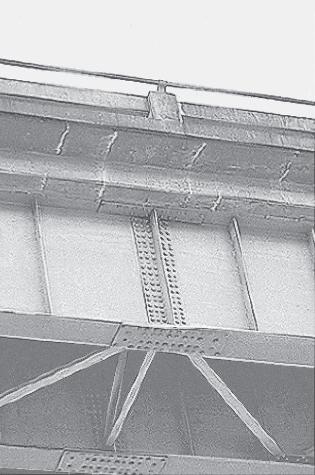
Beams are primarily designed to resist bending moment; however, if they are short and carry large loads, the internal shear force may become quite large and this force may govern their design. When the material used for a beam is a metal such as steel or aluminum, the cross section is most efficient when it is shaped as shown in Fig. 1–3. Here the forces developed in the top and bottom flanges of the beam form the necessary couple used to resist the applied moment M, whereas the web is effective in resisting the applied shear V. This cross section is commonly referred to as a wide flange, and it is normally formed as a single unit in a rolling mill in lengths up to 23 m. When the beam is required to have a very long span, and the loads applied are rather large, the cross section may take the form of a plate girder. This member is fabricated by using a large plate for the web and welding or bolting plates to its ends for flanges. The girder is often transported to the field in segments, and the segments are designed to be spliced or joined together at points where the girder carries a small internal moment.
Concrete beams generally have rectangular cross sections, since it is easy to construct this form directly on the job site. Because concrete is rather weak in resisting tension, steel “reinforcing rods” are cast into the beam within regions of the cross section subjected to tension. Precast concrete beams or girders have a variety of different cross sections, and so they are fabricated at a shop or yard and then transported to the job site.
Beams made from timber may be sawn from a solid piece of wood or laminated. Laminated beams, often called glulam beams, are constructed from strips of wood, which are fastened together using high-strength glues.
Shown are typical splice plate joints used to connect the steel plate girders of a highway bridge.
The prestressed concrete girders are simply supported on the piers and are used for this highway bridge.
Fig. 1–2
Fig. 1–3
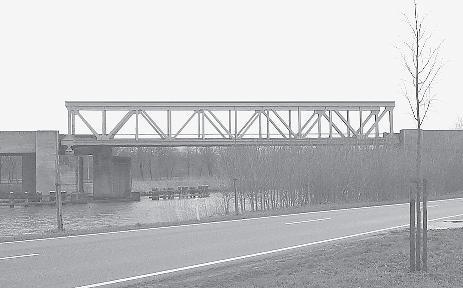
An applied loading will cause bending of this truss, which develops compression in the top members and tension in the bottom members.
Cables and Arches. Two other forms of structures used to span long distances are the cable and the arch. Cables are usually flexible and carry their loads in tension, Fig. 1–6a. They are commonly used to support bridges and building roofs. When used for these purposes, the cable has an advantage over the beam and the truss, especially for spans that are greater than 46 m. Because they are always in tension, cables will not become unstable and suddenly collapse or buckle, as may happen with beams or trusses. The use of cables, on the other hand, is limited only by their sag, weight, and methods of anchorage.
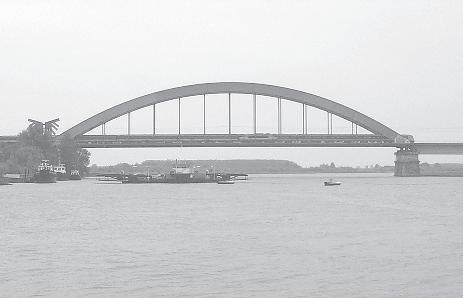
The arch achieves its strength in compression, since it has a reverse curvature to that of the cable. The arch must be rigid, however, in order to maintain its shape. Arches are frequently used in bridge structures, Fig. 1–6b, dome roofs, and for openings in masonry walls.
Fig. 1–5
Fig. 1–6
Cables support their loads in tension. (a) Arches support their loads in compression. (b)
Discovering Diverse Content Through Random Scribd Documents
remain freely available for generations to come. In 2001, the Project Gutenberg Literary Archive Foundation was created to provide a secure and permanent future for Project Gutenberg™ and future generations. To learn more about the Project Gutenberg Literary Archive Foundation and how your efforts and donations can help, see Sections 3 and 4 and the Foundation information page at www.gutenberg.org.
Section 3. Information about the Project Gutenberg Literary Archive Foundation
The Project Gutenberg Literary Archive Foundation is a non-profit 501(c)(3) educational corporation organized under the laws of the state of Mississippi and granted tax exempt status by the Internal Revenue Service. The Foundation’s EIN or federal tax identification number is 64-6221541. Contributions to the Project Gutenberg Literary Archive Foundation are tax deductible to the full extent permitted by U.S. federal laws and your state’s laws.
The Foundation’s business office is located at 809 North 1500 West, Salt Lake City, UT 84116, (801) 596-1887. Email contact links and up to date contact information can be found at the Foundation’s website and official page at www.gutenberg.org/contact
Section 4. Information about Donations to the Project Gutenberg Literary Archive Foundation
Project Gutenberg™ depends upon and cannot survive without widespread public support and donations to carry out its mission of increasing the number of public domain and licensed works that can be freely distributed in machine-readable form accessible by the widest array of equipment including outdated equipment. Many
small donations ($1 to $5,000) are particularly important to maintaining tax exempt status with the IRS.
The Foundation is committed to complying with the laws regulating charities and charitable donations in all 50 states of the United States. Compliance requirements are not uniform and it takes a considerable effort, much paperwork and many fees to meet and keep up with these requirements. We do not solicit donations in locations where we have not received written confirmation of compliance. To SEND DONATIONS or determine the status of compliance for any particular state visit www.gutenberg.org/donate.
While we cannot and do not solicit contributions from states where we have not met the solicitation requirements, we know of no prohibition against accepting unsolicited donations from donors in such states who approach us with offers to donate.
International donations are gratefully accepted, but we cannot make any statements concerning tax treatment of donations received from outside the United States. U.S. laws alone swamp our small staff.
Please check the Project Gutenberg web pages for current donation methods and addresses. Donations are accepted in a number of other ways including checks, online payments and credit card donations. To donate, please visit: www.gutenberg.org/donate.
Section 5. General Information About Project Gutenberg™ electronic works
Professor Michael S. Hart was the originator of the Project Gutenberg™ concept of a library of electronic works that could be freely shared with anyone. For forty years, he produced and distributed Project Gutenberg™ eBooks with only a loose network of volunteer support.
Welcome to our website – the ideal destination for book lovers and knowledge seekers. With a mission to inspire endlessly, we offer a vast collection of books, ranging from classic literary works to specialized publications, self-development books, and children's literature. Each book is a new journey of discovery, expanding knowledge and enriching the soul of the reade
Our website is not just a platform for buying books, but a bridge connecting readers to the timeless values of culture and wisdom. With an elegant, user-friendly interface and an intelligent search system, we are committed to providing a quick and convenient shopping experience. Additionally, our special promotions and home delivery services ensure that you save time and fully enjoy the joy of reading.
Let us accompany you on the journey of exploring knowledge and personal growth!