
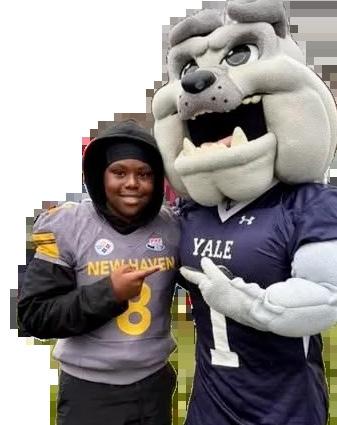


by Andre Botero, Dr. Chaka Felder-McEntire and Myah Salazar Salvador
The following essay was written by Q House Youth Council College Interns Andre Botero and Myah Salazar Salvador, and by Higher Heights Youth Empowerment Programs, Inc. Executive Director Dr. Chaka Felder-McEntire.
On Oct. 29 and Nov. 19, the Dixwell Community Q House Youth Council, in partnership with Higher Heights, the James Hillhouse Cheerleaders, the CT Department of Banking, and CHESLA, hosted two major post-secondary, community-based events that supported the Greater New Haven area.
The annual College and Career Fair took place on Oct. 29 at the Dixwell Q House, welcoming more than 600 high school students, its largest turnout to date. All New Haven public high schools were in attendance in addition to surrounding schools such as Hamden High School, Common Ground High School, Platt Technical High School from Milford, and New Haven Adult Education.
The James Hillhouse Cheerleaders kicked off the event with great spirit and an amazing performance, and they served as volunteers the night before, alongside the Q House Youth Council, to prepare the student gift bags and folders. Upon arrival, students received these gift bags and folders along with an overview of the day’s program from Andre Botero and Myah Salazar Salvador, Q House Youth Council College Interns through Yale’s Dwight Hall Urban Fellows program, who spearheaded both major events.
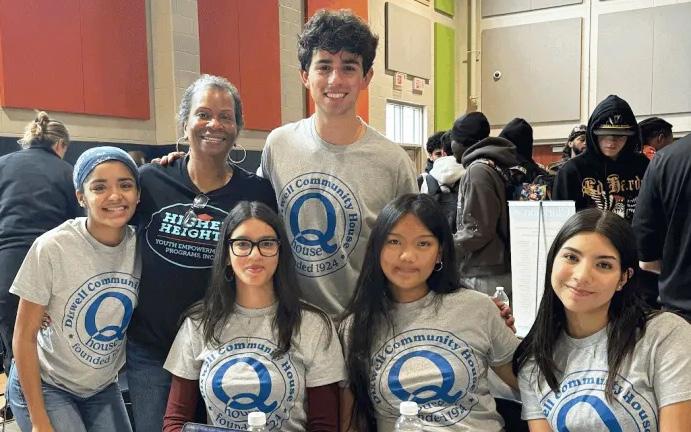
Salazar Salvador noted, “As a student, researching a college or post-secondary institution on their website is not nearly as effective as having a conversation with their representative. As the Youth Council, our priority when planning events for the Greater New Haven community is to provide them with the tools they need to succeed.”
Students then engaged with representatives from more than 60 colleges and
universities, spanning from Florida all the way up to New Hampshire, as well as organizations offering important financial and workforce resources. Now in its third year, the fair intentionally expanded its representatives from Historically Black Colleges and Universities. Many students received on-the-spot acceptances and scholarships.
In addition to colleges and universities, the fair also featured career opportunities,
such as the New Haven Police Department, the Fire Department, the American Job Center, New Haven Hiring Initiative, M&T Bank, and Cornell Scott-Hill Health Center.
Part two of the initiative was the annual Affording College Workshop, held on Wednesday, Nov. 19, in partnership with Higher Heights, CHESLA, Cornell Scott-Hill Health Center, and the CT Department of Banking. Over 150 students
and families from the New Haven area learned about the extensive financial aid opportunities to pay for their post-secondary options, also the largest turnout of the event to date.
Dixwell Alder Jeanette Morrison, Botero, and Salazar Salvador opened with a presentation on the range of tuition for different colleges and institutions, helping families understand the full range of options available. Shannon Reynolds, CHESLA’s Senior Program Specialist; Dr. Chaka Felder-McEntire; and Cornell Scott-Hill Health Center presented on the various financial aid resources available throughout the state. Reynolds focused on tuition-based programs, and Dr. Chaka focused on scholarship opportunities. Cornell Scott-Hill Health Center also shared the immunization process and how college-bound students are able to make their own appointments.
“These two events are not just about college,” Dr. Felder-McEntire reflected, “but about helping students understand all their post-secondary options and the resources to fund them.”
Botero added, “We hope to reach even more students in the coming years so that every young person in the New Haven Public School System has access to the highest-quality resources and opportunities to pursue their goals after high school.”
The community partners look forward to hosting the College and Career Fair alongside the Affording College Event again in October and November of 2026.
by Lisa Reisman
At around 10:20 a.m., a call sounded up and down Sylvan Avenue—and across social media.
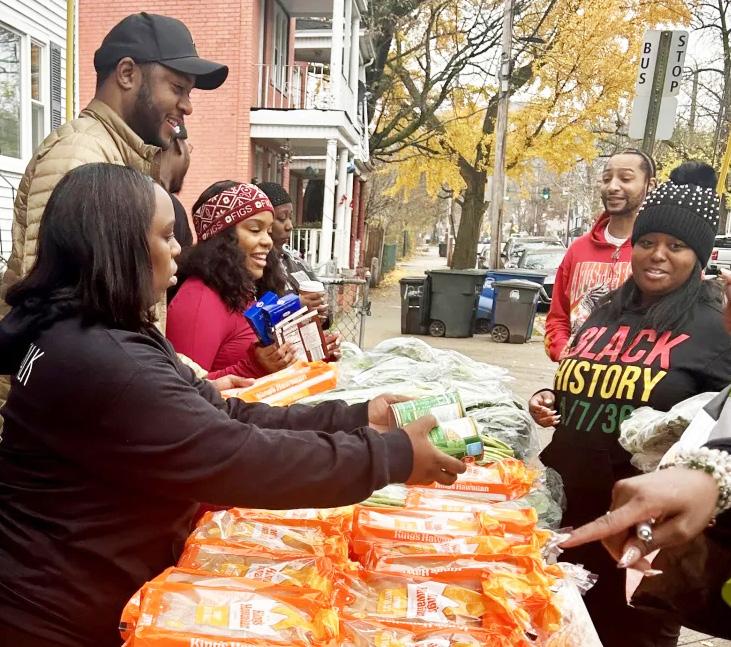
“Get your turkey, your stuffing, cornbread, collard greens, gravy, cranberry sauce, butter rolls, mac and cheese, pull up, come get it,” Daniel Smith, standing before a video camera on the sidewalk fronting Seven Haven, announced.
The occasion was the Thanksgiving Giveback, co-organized by the Gorilla Lemonade team and the Elm City Freddy Fixer Parade Committee last Wednesday. The mission, according to Freddy Fixer Committee President Reese McLeod: “To show our thankfulness by feeding those in need and giving back to the community that built us.”
Sixty-five families registered for the food donation. In all, the two nonprofits fed 70 families, McLeod reported after the event.
“The idea is to get the word out,” said Gorilla Lemonade co-founder Kristen Threatt, observing the action alongside Smith. “Too many people in our commu-
nity are having to choose between rent and groceries.” That’s backed up by recent studies showing a sharp rise in food insecurity in New Haven from 14 percent to 27 percent due to deep cuts in federal funding and increasing numbers of people needing food but not qualifying for programs.
“Do you have everything you need?” McLeod asked a woman, peering into her bag, in the chill late-November air. A turkey and box of stuffing peeked over the top.
“Bless you,” the woman said. Along the table, Krista Gibbs was handing out cans of green beans. On her way to the giveaway, she stopped at a supermarket to buy ten turkeys and 30 mac and cheese boxes.
“This is my community,” said Gibbs, a member of the Freddy Fixer Parade committee. “We take care of each other.” Nuke Rankins, another Freddy Fixer Parade Committee member, agreed; he had come with three large boxes of butter rolls.
“Community comes first, especially at this time of year,” he said, before greeting
a woman and a small child.
“Everyone’s getting two of each of everything,” McLeod was calling out. “Except cranberry sauce. We have limited.” Just then, Hill Alder Angel Hubbard, appeared. “Collaboration is what it’s all about,” she said, as Kevin, the owner of Seven Haven, nodded. “These organizations show up, period, they see our community, the deep needs we have, and they try to address them, and it’s not always on the news. It’s an honor to partner with them.”
Beside her was Shay Taylor. A New Haven native and fourth-year medical student at Howard University, she’s been doing a clinical rotation at Yale New Haven Hospital. She said she posted a request on social media on opportunities to serve the community, and heard back from Threatt and McLeod. “I’m helping to organize,” she said. “This is everything.”
“He’s not on the list?” McLeod was saying. “That’s okay. Stay right there. We’re going to take care of you, okay? We’re going to give you a bag full of everything you need.”
Lucy Gellman
Miriam’s body is somewhere between the town’s water pump and the main square, her mind a tangle of blood and bone. Her mouth twists into a thin, buckling line, and a viewer can feel it in their chest. Her feet find the ground beneath them, but barely. “I wanted to help,” she persists, turning toward another woman who is already a ghost.
“Yes,” the woman says, and her voice comes from outside of her body. Around them, the ground is soaked with human blood, and still somehow bone dry. The olive grove on a nearby hill, so lush and full of life, seems far away. “You wanted to. You could have.”
A delicate, devastating lyricism—and the opening it creates—hums through A Skin of Veils, which ran at the John Lyman Center for the Performing Arts at Southern Connecticut State University last Thursday through Saturday night. Written by Emma Joy Hill and directed by Gracy Brown, the play explores occupation, colonialism, and the use of sexual violence as a weapon of war.
In doing so, it asks a viewer to encounter, reckon with, and answer to the twin horrors of violence and patriarchy, whether they are a world away, or lingering just down the street. It’s now on New Haven to give the show an afterlife.
“This is a play about cycles of war and violence that uses mythology to tell the story,” said Hill, who is also the interim director of marketing and communications at Long Wharf Theatre, before a final run-through last week. “I’m really trying to explore violence onstage … and also to get people to take action [after the show]. The world’s on fucking fire and we need to do something.”
Set in an unidentified war zone, A Skin of Veils tells the story of Miriam (Khabyra Alston Kennie) and her neighbor (Nexxus Ortiz), young women who are coming of age in the midst of an occupation that has turned fear into a form of obedience. As the play opens, Miriam has just married Joe (Cristian Montanez), who is three times her senior but has a soft, pensive side that suggests there is a deeper story there. Neighbor is heartsick and resolved all at once, with a steely demeanor that cracks only in the privacy of those the character trusts.
Around them, violence against women has become an everyday occurrence, with soldiers (Edward Santiago, Davin Garamella, and a chilling Johnathan Christiano) who announce themselves with maniacal laughter, pocket knives and long weapons drawn, ready to strike for the sake of striking. None among them is crueler than Panther (a fierce Jade McGovern), a leader whose cold, calculating edge is hard to watch, and harder still to stomach.
That Miriam and Neighbor try to find joy in this place, that her parents (both played by a shape-shifting Mia Cruz)
have kept her safe for this long, that her Aunt Elizabeth (Kira Kelly, who also plays an unnamed woman) is shepherding new life into the world—all of these feel like miracles in this universe, and in ours too. And all of them, Hill asserts in the course of 90 minutes, are breakable in this world of man-made borders and equally man-made conflicts.
Take, for instance, an early scene in which soldiers barge their way into the town, setting every nerve on edge. The women, who before had been going about their lives, stop in their tracks. One screams and drops a bucket that she’s been filling. Panther, delighted at this havoc, begins to peel an apple, likening it to a woman’s flesh.
“Oh, what men will do when they realize a woman’s heart is a pincushion,” Panther says, and there’s a cool edge that turns to something sickly. “Their skin, you can fold it in your hands.”
Or consider another, in which Miriam and her father are debating what constitutes violence without ever splitting hairs over the term itself. He breathes a sigh of relief because her body is untouched by occupying forces, and she pushes back—“But it was me. It was every woman there!”—in a way that is so fundamental to how women see the need to protect each other. It is both timely and timeless, because violence has existed as long as men have existed.
Hill is a master storyteller, and her ability to weave myth and metaphor (and sacred text, including the Madonna story) into very real, cyclical histories of violence makes her characters feel robust and alive. In every iteration of Miriam, and every breath that Alston Kennie takes on stage, there is a reminder that patriarchy, whiteness and colonialism are all intimate bedfellows; that the chaos, confusion and fear that they breed are part of the point.
Alston Kennie doesn’t do any of it alone. As Neighbor, Ortiz is a revelation, fearless until the facade crumbles, and the audience remembers how deeply human the act of love itself can be. Ortiz crosses the stage, feet ensconced in the soft tan fabric of dance slippers, and becomes a whole library of emotion, everything snugly packed and shelved in order. The actor moves to the front of the stage, face tilted toward the light, and there’s something bold and pugnacious there, rumbling just beneath the surface.
Some of the show’s strongest scenes place Ortiz alongside Alston Kennie, including a pugnacious interchange with Panther and a dance-like sequence that casts their slender, slow-moving shadows against the creamy, thick curtain of a tent. Neighbor pours a cup of water over Miriam’s arched back, and we in the audience remember what it is to hold another human being.
Kelly, who plays Miriam’s aunt Elizabeth, has mastered this same kind of calm, but with a quirky kind of energy that has her talking a mile a minute until she’s




suddenly too quiet. When she is giving counsel to Miriam, she brings a lightness to the play that lifts it up, a reminder not that she is funny or flippant, but that she is strong. At one point, she approaches the town’s water pump with a swishing skirt and a brightness in her laugh, and for a moment it’s possible to forget the violence that exists just paces away. At another, she sinks her feet into the soil, and it feels like a form of prayer.
But it is Hill’s soldiers, a knot of cackling, interchangeable bodies, who are perhaps the most interesting part of this show, in part because they are so very hard to watch. McGovern is frightening, with a kind of vacancy where the general’s face used to be (just imagine John Cameron Mitchell’s Hedwig, but possessed by Satan). Around him, soldiers fall into line, with a transformation of a baby-faced, still-tender recruit (Connor Doughney) that is particularly hard to watch. When Panther turns to him, blade extended, we in the audience know that this can’t end well, and that the precipitous spiral of violence that follows is inevitable.
Christiano, who speaks almost no words at all, is even more unnerving as he walks through the space, an eerie grin plastered onto his face, mask-like in the half-light of the stage. When he laughs, it is the kind of laugh of a yes man, a laugh of someone who is only half-alive.
The result is a play that is nowhere, and therefore everywhere at once. In one world, Miriam could be New Haven’s own very real and very loved Azhar Ahmed, whose parents fled the Nuba Mountains before she was born, hoping that it was enough to keep her safe.
In another, maybe she is Nancy Martinez, who was arrested and detained by Immigrations and Customs Enforcement Agents earlier this year, while dropping her kids off to school in the city’s Hill neighborhood. Or maybe she is one of the 60 women hunger striking in Umm al Khair earlier this year, in anguish over the murder of peace activist Awdah Al Hathaleen at the hands of settlers in the West Bank.
If there are references to other texts here, from the Bible to Lisa Peterson and Denis O’ Hare’s An Iliad to Orlan’s L'origine de la guerre, Hill has also created something that is distinctly in her voice. There’s no setting, but it is impossible to watch and not think of Gaza and the West Bank, where war, starvation and disease, all aided and abetted by American dollars, have upended the very facts of survival and the preservation of cultural heritage. It is equally hard to watch and not think of Ukraine, where rape has been used over and over again as a weapon of war and of control.
But the play is also Sudan, where 13 million people have been displaced by civil war, many fleeing their homes on foot because they know that to stay will be a death sentence. It is Myanmar, where for eight years the country’s Rohingya
Con’t on page 18
by Lisa Reisman
The rain came in torrents. It kept coming. None of the 26 12U New Haven Steelers of the Pop Warner Youth Football League practicing on Bowen Field appeared fazed. Nor did their coaches.
These were the undefeated regional champs for the second year in a row, after all. These are New Haven’s representatives for the national championship tournament in Charlotte, North Carolina next week. These 12- and 13-year-olds know the tenacity it takes to succeed.
Now they face a daunting challenge: to find the funds they need to get to nationals. The Community Development Block Grant from which they annually receive $20,000 in U.S. Housing and Urban Development funds was cut in half this year. For each player, the cost for transportation, hotel, and food, during the nine-day trip is $1,200. And as Daryel Barros, Pop Warner Youth Football League president, put it, “every bit helps.”
Not that they’re unfamiliar with adversity. Since August, “we’ve played in 95-degree heat, downpours like today, and windy days, but we’re out here,” said “team mom” Shatea Threadgill, as the players, clad in yellow-and-black jersey and pads, did tackle drills, danced between cones, and went through offensive formations in the driving rain last Tuesday night.
That wasn’t the only obstacle. “The home games are at Winslow Field in Rockview Housing,” said Barros, referring to the Rock View Circle public housing complex. “The rest of the teams don’t want to come unless we promise them they’ll be safe, so we had to cover the cost of security and police.”
The team just kept winning.

“No matter the challenge, there’s no quit in them,” said Barros. “These kids are talented, they’re determined, they’ve got a great work ethic, and they understand that playing football is a privilege. You gotta earn it. To play football you have to go to school and you have to do well in school.”
Barros has been involved with the Pop Warner League for 32 years. “I’ve seen a lot of positives,” he said. Last year, three players who had come up as New Haven Steelers were in the NFL draft, including Tyler Booker, Teron Mallory, and Prince James Boyd. More than that, he said, “a
lot of my kids went on to good schools, and they’re now productive men in society. We’ve got firemen, police officers, teachers.”
He pointed out LJ Howard, the team’s star receiver and linebacker.
LJ jogged over. “I love everything about football,” he said, rain dripping off his helmet. “It’s one way to release my anger and not get in trouble for it plus it teaches you teamwork and really disciplines you and it’s good exercise,” he said. “Also helps me focus at school because if I don’t do well, I’m not playing.”
“That’s right,” said Threadgill, the team mom, whose son Jay plays wide receiver and linebacker. “Life lessons.” Of the 25 kids on the team, she said, “25 out of 25 are scholar students, and eighteen of them have been playing together since they were six, so it’s kind of a brotherhood, they know each other’s strengths and weaknesses, they’re good influences on each other.”
For her, it’s simple. “We need more people to rally behind our youth, to recognize them doing good so they keep wanting to do good and not wait until it’s too late, when they get in trouble or worse,” she said.
“This is an experience that can shape them for their lives, and more than anything, a way for us as a community to say to these kids, ‘we see you, you matter.’”
“Let’s go. Let’s go,” a coach was shouting, the pounding rain muffling his words. “Buckle down. Buckle down. You got this. We got this. We got this.”
To help the 12U New Haven Steelers get to nationals, visit the team’s gofundme page.
by Staff Report
HARTFORD, CT — Connecticut Attorney General William Tong has joined 21 other attorneys general in filing a lawsuit to stop the federal government from unlawfully cutting off Supplemental Nutrition Assistance Program (SNAP) benefits for thousands of lawful permanent residents, according to a statement from Tong’s office.
Tong and the coalition are seeking to block new guidance from the U.S. Department of Agriculture (USDA) that they said wrongly treats several groups of legal immigrants as ineligible for food assistance, including permanent residents who were granted asylum or admitted as refugees. The attorneys general argue that the guidance contradicts federal law and could impose massive financial penalties on states, and are asking the court to declare the guidance unlawful.
“The Trump Administration cannot help themselves. They are messing with SNAP benefits again,” Tong said. This time they are inventing their own rules to perma-
nently ban legal immigrants — green card holders — from ever receiving food stamps. There is zero basis in the law for this cruel move, and we’re suing to stop them.”
On October 31, USDA issued new guidance to state SNAP agencies describing changes to program eligibility under HR-1, dubbed the “One Big Beautiful Bill.” The new rules narrowed eligibility for certain non-citizen groups, including refugees, asylum recipients, and others admitted under humanitarian protection programs. The USDA memo, however, incorrectly asserted that all individuals who entered the country through these humanitarian pathways would remain permanently ineligible for SNAP, even after obtaining green cards and becoming lawful permanent residents, Tong said.
The coalition of attorneys general emphasized that this position is not mentioned in the bill or in any other federal law. Federal statutes make clear that refugees, asylees, humanitarian parolees, individuals whose deportation has been withheld, and other vulnerable legal im-

migrants become eligible for SNAP once they obtain their green cards and meet standard program requirements, Tong said. The attorneys general argue that US-

John P. Thomas Publisher / CEO
Babz Rawls Ivy Editor-in-Chief Liaison, Corporate Affairs Babz@penfieldcomm.com
Advertising/Sales Team
Keith Jackson Delores Alleyne
John Thomas, III
Staff Writers Christian Lewis/Current Affairs
Anthony Scott/Sports Arlene Davis-Rudd/Politics
David Asbery / Tanisha Asbery
Jerry Craft / Cartoons / Barbara Fair
Dr. Tamiko Jackson-McArthur
Michelle Turner / Smita Shrestha William Spivey / Kam Williams Rev. Samuel T. Ross-Lee
Contributors At-Large
Christine Stuart
www.CTNewsJunkie.com
Paul Bass www.newhavenindependent.org Memberships
National Association of Black Journalist
The Inner-City Newspaper is published weekly by Penfield Communications, Inc. from offices located at 50 Fitch Street, 2nd Floor, New Haven, CT 06515. 203-3870354 phone; 203-387-2684 fax. Subscriptions:$260 per year (does not include sales tax for the in State subscriptions). Send name, address, zip code with payment. Postmaster, send address changes to 50 Fitch Street, New Haven, CT 06515. Display ad deadline Friday prior to insertion date at 5:00pm Advertisers are responsible for checking ads for error in publication. Penfield Communications, Inc d.b.a., “The Inner-City Newspaper” , shall not be liable for failure to publish an ad or for typographical errors or errors in publication, except to the extent of the cost of the space in which actual error appeared in the first insertion. The Publisher reserves the right to refuse advertising for any reason and to alter advertising copy or graphics deemed unacceptable for publication. The entire contents of The Inner-City Newspaper are copyright 2012, Penfield Communications, Inc. and no portion may be reproduced by any means without the written permission of the publisher. 10
By Dr. David Asbery
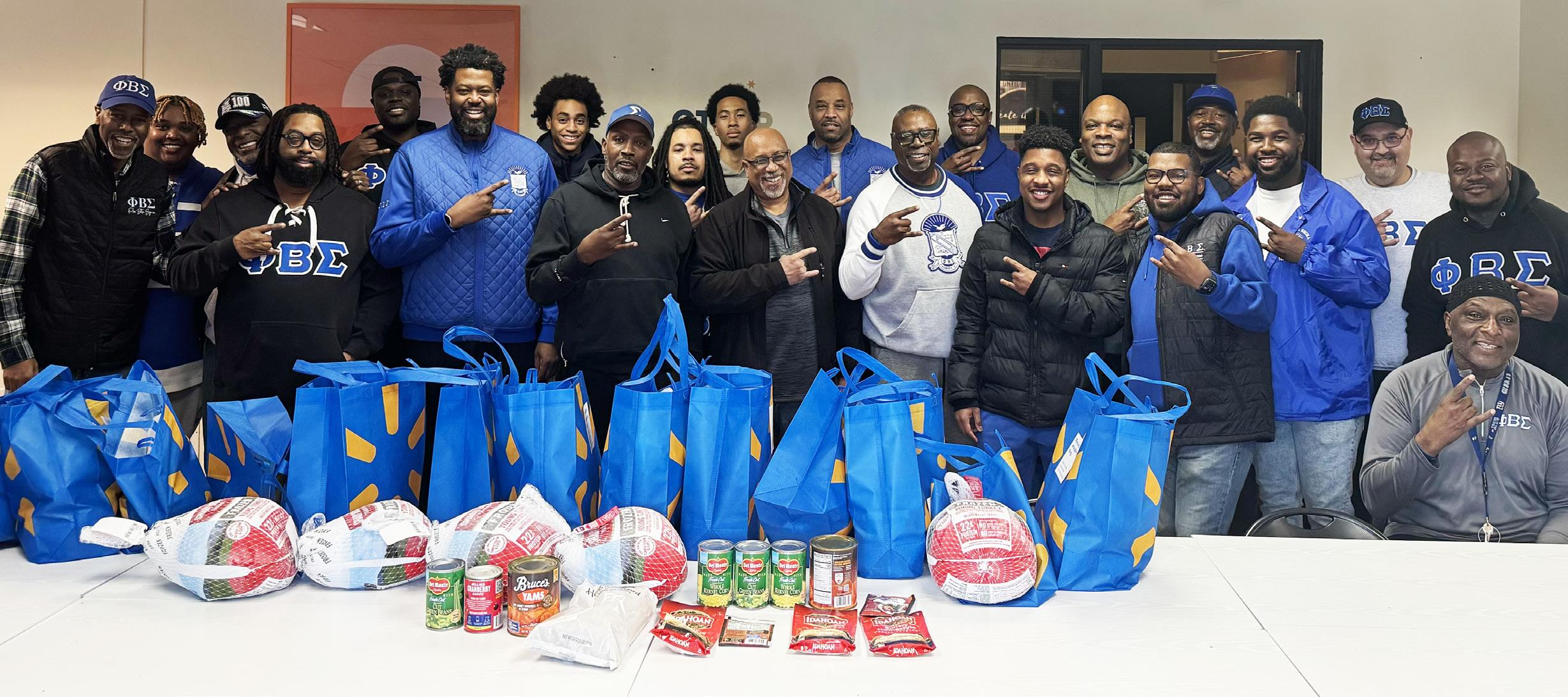
On Saturday, November 22, I answered the call. The brothers of Phi Beta Sigma Fraternity, Inc, Delta Iota Sigma Chapter, asked for help with our annual turkey drive, and I showed up ready to work. As a new member only having been initiated the night before, I’ll admit I wasn’t entirely sure what to expect. Would it be chaotic? Would I find my place?
Whatever uncertainty I walked in with evaporated the moment I arrived. I was met by about 20 brothers who clearly understand the true power of brotherhood. The energy in the room was palpable—a mix of purpose, joy, and genuine community spirit.
From the start, it was a collective effort. We came together, ate together, and packed bags side-by-side. There was an eager anticipation in the air as we waited for our assignments, knowing that the work we were doing would have a direct impact on our neighbors. The efficiency and teamwork were inspiring to watch and even better as immersed myself. When the work was done, the results spoke for themselves. We were able to serve 60 local families. Each family received a big turkey and absolutely everything else needed to prepare a filling, traditional dinner for six people. It wasn't
just about handing out food; it was about ensuring dignity and celebration for families during the holiday season. I want to extend a personal thank you to Brother Don McAulay and Sal Rizza. Their leadership and hospitality made me
feel completely at home amidst the hustle of the event. Their example sets the tone for what this organization represents.
A special shout-out is also due to the five young men who helped us pack bags. Their hard work didn’t go unnoticed. I

wish them the best of luck on their journey toward becoming members of Phi Beta Sigma Fraternity Inc. If their dedication on Saturday is any indication, the future of our brotherhood is in good hands. Leaving the event, I realized that my
initial uncertainty had been replaced by pride. This wasn't just a service project; it was a demonstration of values. We worked as one unit to uplift our community. This is what Brotherhood, Scholarship, and Service looks like.
“I











Melissa Liriano
The following citizen contribution comes from Melissa Liriano, communications coordinator at LEAP (Leadership, Education, & Athletics in Partnership).
On Tuesday, the classrooms and community spaces at LEAP sites across New Haven transformed into spaces of holiday joy. The occasion was the annual “LEAP Thankful Dinners,” a beloved tradition where students, staff, and community partners pause to celebrate the spirit of gratitude before the Thanksgiving break. For the hundreds of children in attendance, the event offered a chance to just be kids. Laughter filled the room as students tied-dyed shirts, played games with their friends, and joked with their counselors in a safe, celebratory environment. But the centerpiece of the evening was the meal itself: a nutritious and delicious spread provided by Momma Kiss Kitchen Cuisine, LEAP and Dixwell Community Q House staff, and an anonymous donor who wants to ensure children have access to healthy, plentiful food. Students piled their plates high with turkey, corn, string beans, yams, rice, and potatoes, a meal that ensured every child could count on a warm, filling Thanksgiving dinner.
The village that supports LEAP made the event an incredible success. Volun-
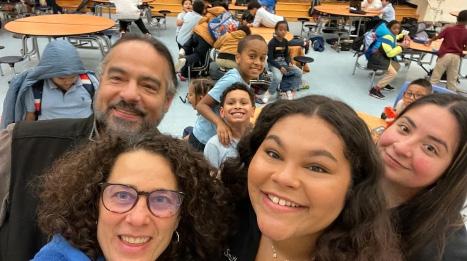
teers from the community, including former LEAP counselors, took time out of their busy schedules to serve food and spread holiday cheer. Parents also contributed to the festive atmosphere, donating drinks and snacks for the children to
enjoy alongside their meals.
At the LEAP Fair Haven South site, housed at the The Family Academy of Multilingual Exploration (F.A.M.E.), the spirit of service was personified by Pablo Juan Garcia, a Project Manager at Dimeo
Construction. Garcia volunteered his evening to help serve meals to 100 students, connecting with the kids and bringing an infectious energy to the food line.
While the food and games brought the excitement, the “thankful speeches”
brought the heart. In a quiet moment during the festivities, students stood up to share what they were most grateful for this year. The sentiments were deeply moving. One student shared that she is “grateful for those who provide for her and teach her,” while another reflected that he is “thankful to live a good life and for God.”
The impact of the season extended well beyond the dinner tables. Thanks to the generosity of CBIZ, Inc., LEAP was able to secure and give away 200 turkeys. The turkeys were distributed to LEAP families and counselors who requested them as well as families who signed up through the Dixwell Community Q House’s Annual Turkey Giveback.
The Q House team worked tirelessly to distribute these turkeys to local families, along with non-perishable food items and baby diapers, ensuring that the wider New Haven community had the resources needed for a happy and healthy holiday. From the hands-on service of volunteers like Garcia to the logistical support of partners like CBIZ, Inc., this year’s Thankful Dinners and Turkey Giveback highlighted the power of partnership. It was a day defined not just by the food served, but by the community that surrounds and supports the families of New Haven.
by Lisa Reisman
At the recent 9th annual Nonprofit Stars Align Awards Breakfast at the Omni Hotel, the superstars of the nonprofit world got to shine—at a time when their landscape seems particularly inhospitable.
That’s on top of being “the hardest working business leaders in Greater New Haven,” as the United Way of Greater New Haven’s Aly Fox, event emcee, put it, “tasked with maintaining a high-functioning business with all the same legal, human resources, and marketing issues, as well as running a charity to raise money to survive.”
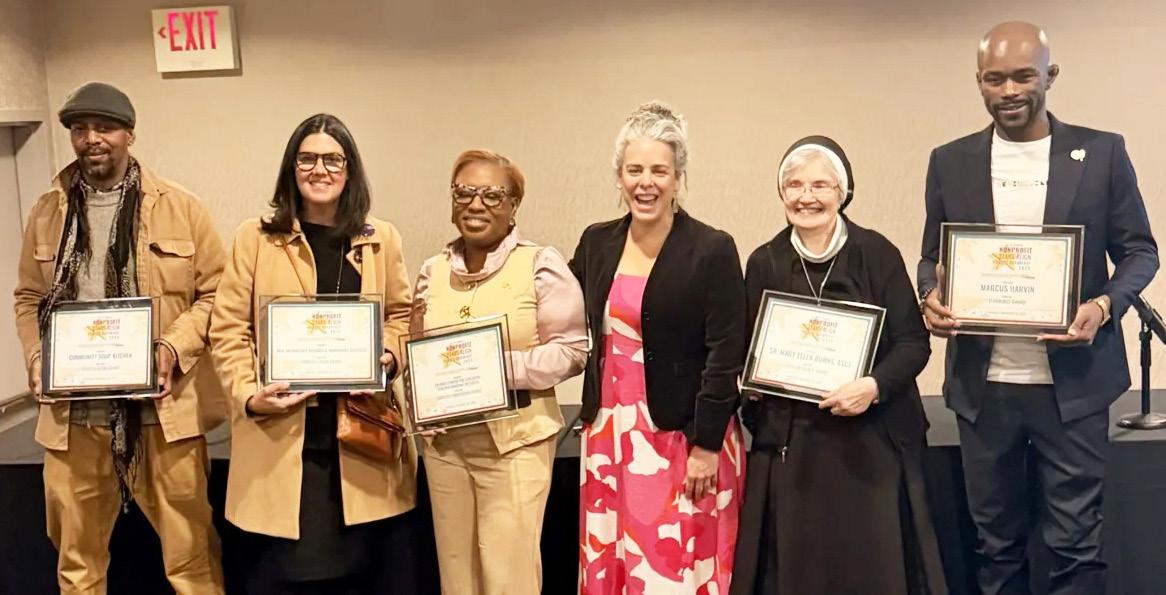
Among the honorees was Marcus Harvin, winner of the Starburst Award, for “transforming the community with a fresh approach” within the past five years.
“This is a wake-up call to those who believe it necessary to situate some of God’s children as others,” Harvin told the 80 in attendance. Three years removed from his release from prison, where he served six years, he founded Newhallville Fresh Starts, which currently distributes 1,200 meals free of charge each week to those in need.
Harvin, an associate minister at Pitts Chapel Unified Free Will Baptist Church and a first-year law student at West New England School of Law, recognized those who helped him on his journey, including his professors with the Yale Prison Education Initiative, and those at the Univer-
sity of New Haven, where he graduated magna cum laude in 2025; as well as the directors at Yale School of Medicine’s SEICHE Center for Health & Justice, where he serves on the Community Advisory Board.
“I stand here before you as unequivocal proof—prima facie proof—that when ostracized individuals are afforded opportunity, excellence will be the end result,”
he said.
Friends Center for Children took home the innovation award for their Teaching Housing Initiative. With a median wage that falls 97 percent below all other jobs, “our early childhood educators cannot afford to meet their basic needs,” program director Miriam Sutton said. The financial worry that saddles them compromises their physical and mental well-being and
also their delivery of early care education, she said.
In addition to the alleviation of anxiety afforded by the dignified free housing,
“the 17 New Haven residents have seen an immediate financial lift with average salaries $23,000 higher than the state average,” she said, with seven more on the way in the next three years.
“The health of the business community
relies heavily on the stability of our childcare system, and that stability begins with educators that make it all possible,” she said, adding that the Friends Center model is being replicated in Boston, Michigan, and Georgia. “Without childcare, people stay at home from your businesses to care for their children, and without people coming to work, our workforce and our economy lose.”
For their collaboration in April that ensured 650 families would continue to get weekly bags of food, the Community Soup Kitchen and Integrated Refugee & Immigrant Services (IRIS) were named Constellation Award winners. Ana Cárdenas, IRIS operations manager, recalled hearing that, due to cuts in federal funding, IRIS no longer had the money to operate its food pantry.
“I realized we share missions because we’re both trying to serve the community, so why not join forces?” said Cardenas, who was new to the CSK board at the time. Since then, the nonprofit, which does not depend on federal funds, is also helping IRIS families with clothing assistance, personal hygiene kits, and basic home necessities.
“Partnerships are the key to us growing stronger,” said CSK Program Director Winston Sutherland, noting the 86,000 meals across multiple locations CSK served in 2024. “This year we tripled that, and that’s due to our partnerships.”
Yale New Haven Hospital is pleased to offer patients and their families financial counseling regarding their hospital bills or the availability of financial assistance, including free care funds. By appointment, patients can speak one-on-one with a financial counselor during regular business hours. For your convenience, extended hours are available in-person at Yale New Haven Hospital once a month.
Dates: Nov. 17, 2025, Dec. 15, 2025, and Jan. 20, 2026
Time: 5 - 7 pm
Location: Children’s Hospital, 35 Park St., 1st floor, Admitting
Parking available (handicapped accessible)
An appointment is necessary. Please call 855-547-4584
Spanish-speaking counselors available.

Lucy Gellman
It was just before 8:30 a.m. on Thanksgiving Day, and the band room at James Hillhouse High School was slowly waking up.
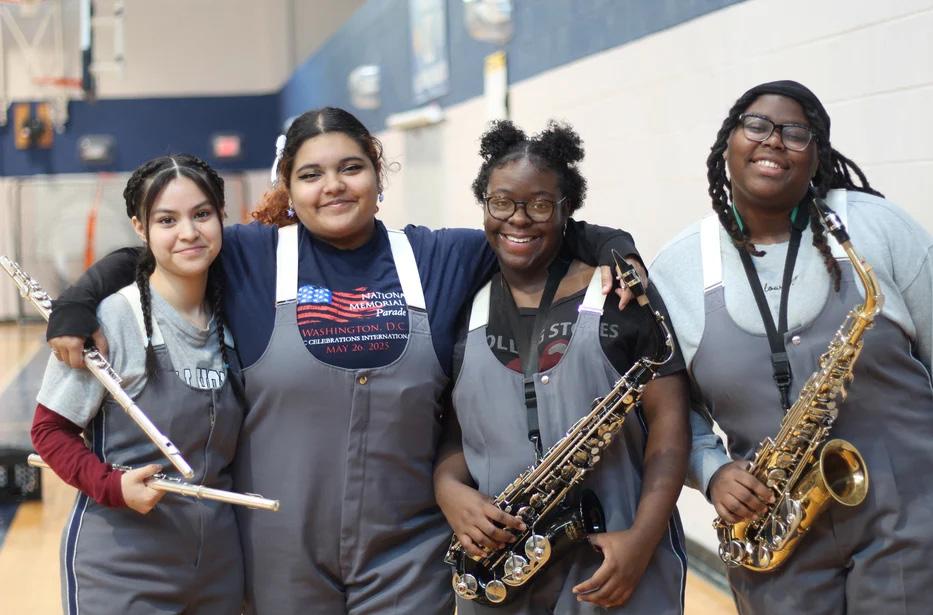
At a table by the door, Zariyah Whitehurst leaned over, fixing a dainty bow in Abby Heredia’s hair. Closer to the center of the room, Zariah Dumas unpacked her saxophone, holding a reed still between her teeth. Brenda Zecua barged through the side door, ready for her first and last Elm City Bowl of high school. Every so often, one of them caught another’s eye, and smiled.
The four, all seniors, are the young women of the 15-member Hillhouse High School marching band, a small-but-scrappy outfit that has played dozens of football games, pep rallies, student functions, Freddy Fixers, and the most recent Memorial Day Parade in Washington, D.C.
On the cusp of their last game day, all four spent warmups nibbling donuts, suiting up, and reflecting on the unexpected and tight-knit friendships that have come out of playing in the band.
The football game, which pits Hillhouse against Wilbur Cross High School, is a longtime New Haven tradition in which band teachers and their young charges often make the most compelling plays of the day. Read more about that, including Cross’ dazzling band and robust tradition of losing the game, here.
“I feel kind of sad!” Heredia said as she got ready, running through the halftime performance of Tevin Campbell’s “Can We Talk” and Drake’s “Nokia” in her mind. “This is my last football game at Hillhouse. I’m just … it’s just fun. It just gets us closer together. I’m sure I’ll come back, because alumni always come back, but it’s not the same.”
Part of that begins with the band itself, which has been in a constant state of flux since Covid-19. After classes resumed in the fall of 2021, band director Josh Smith began to rebuild the group instrument by instrument. By the end of 2022, there was a healthy drumline, horn and woodwind sections, a trusty trombone, and enough sousaphone for a soulful and brassy hook. While it was and is a rotating door— each year, seniors leave, and each year, freshmen join, just like any high school band—he’s a perennial optimist, eyes always focused on the next thing the group is doing.
“It’s part of the norm. This is what it is,” Smith said. “It’s game time. We face our rival team, and we’re just gonna get out there and play. It’s energy! It’s fun! It’s not just for us, but for the audience.”
What he couldn’t have counted on was an affable, bubbly quartet of friends that sprang up in the woodwind section, so magnetically drawn to each other that they feel like they would make a more compelling version of Wicked: For Good. Heredia, who has been playing the flute
since fifth grade, remembered stepping into the band room four years ago not knowing what to expect, and slowly finding her way as she bonded with other girls in the band.
At first, it was only her and Bernadette Karpel, a clarinetist who graduated last year, and returned Thursday morning to see how the band was doing before the game. Then, Whitehurst and Dumas arrived, in time to play enough football games for the Elm City Bowl not to feel particularly stressful. Then Zecua entered the mix last year, mourning a first Elm City Bowl that was too soggy for musicians to participate. Since, the four have become not just fellow musicians, but trusted confidants both on and off the field.
For instance, on “Spirit Day" earlier this fall, Heredia and Whitehurst dressed as Smith, with at least one exaggerated, bushy construction paper beard, Hillhouse band t-shirts, and a matching blue-and-white dad hat for Heredia. All four check in about college applications and the stress of senior year. They have a group chat that’s mostly quiet these days, as the semester reaches its busiest point before break. They’ve unexpectedly become each other’s people.
“It’s different because I haven’t had a circle of female friends [before],” said Whitehurst, who plays the alto saxophone and hopes to attend Winston-Salem State University for journalism next year. “The stuff we talk about, like personal stuff, the things that we feel—it’s a lot of things that we wouldn’t tell anybody else. There’s a lot of trust there.”
“There’s not really much of us so we gotta stick together and help each other out,” chimed in Dumas, who hopes to continue her band education at an HBCU in the fall.
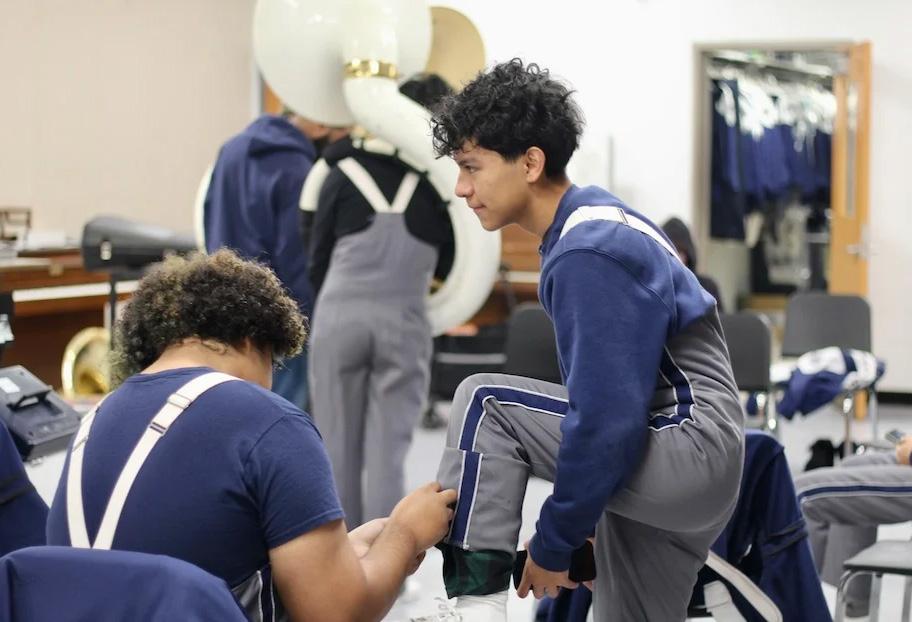
As band members trickled in Thursday morning, signs of that trust sprang up everywhere, from peers’ worried calls to late band members to warmups that reverberated through the floor. As he pulled out his trumpet to play, junior Luis Baez helped William Santos shake off pregame jitters, leaning down to pin up his pant leg so it wouldn’t drag. Santos, a junior who plays the trumpet, joined the band just a few months ago. Thursday found him feeling nervous, and not wanting to let anyone down.
“I’m eating a seafood boil today!” Baez announced glibly to no one in particular, and therefore everyone in the room. As he pinned up one pant leg, he reminisced on years spent with the seniors, many of whom have become his close friends.
He inspected his handiwork, noting the green-and-black checkered pajamas still visible at Santos’ ankles. By the time he had finished, students had started an informal round robin, shouting out things they were thankful for.
Heredia, who had arrived before 8 a.m. with a crochet hook and spool of blue yarn to keep her occupied, took her place in a half-moon of chairs, already a vision of school spirit. Over each eye, she had
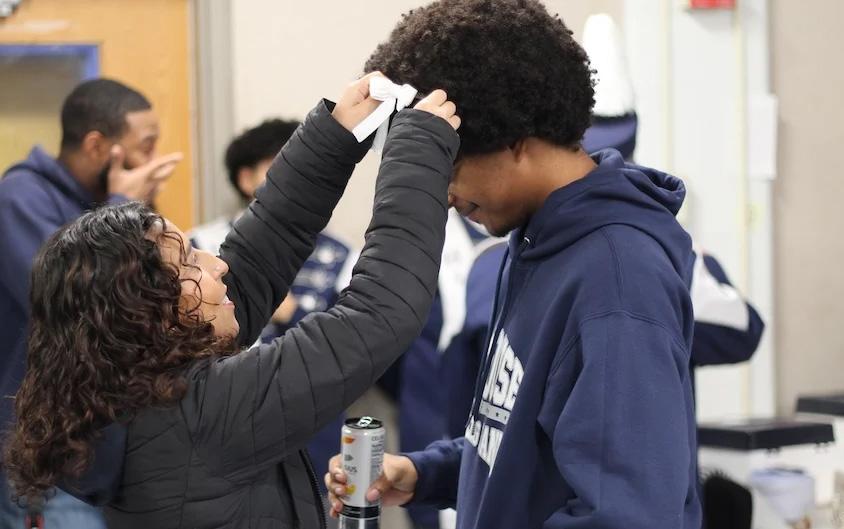
painted three sparkly dots, in the midnight blue that is one of Hillhouse’s signature colors. Blue stars dangled from her ears. A blue-and-white scarf, crocheted explicitly for band appearances, sat waiting over a chair with her matching band jacket.
When Smith opened an app that played a pitch pipe from his phone, she snapped to attention and stood up, the sound of a high C floating through the room. Conversations, of which there were half a dozen going, fell almost instantly to a hush. Slowly, band members joined in, the sound rich and layered until a person
and strong, as though the band were two or three times its size. At the center of the room, blue-and-white clad cheerleaders spread out into five rows, and ran a series of lifts that had bodies dancing in midair. Every so often, their braids and ponytails swished to an inaudible beat, and matching blue-and-white bows flashed brightly across the room.
Baez, waiting to play with his trumpet in one hand, worked to steady his nerves with the chorus of SIX’s “All You Wanna Do,” which he saw with a few peers when it came to the Shubert Theatre earlier this year. Heredia joined in, dropping bars from Hamilton’s “When The World Was Wide Enough” that turned it into a full-fledged celebration of Broadway. Whitehurst, stepping closer, suggested that Epic: The Musical might have a seat at the table. Their laughter, certain but polite, bubbled up through the room.
For Smith, a Hillhouse alum who is still baby-faced at 37, that’s part of the point. As a member of the drumline, he saw firsthand how playing an instrument taught discipline, close listening, sharp focus and coordinated movement. Now, he pays it forward, teaching students to navigate space, keep time, nail blocking, and learn to listen to each other—even if they’re spread out across the 50-yard line. When he was part of the drumline, “we were family,” he said before loading up a wagon with handwarmers and chocolate bars for musicians. Now, he works to make the band room a place that is free of distraction but still warm and friendly, focused on the mechanics and rigor of learning while giving students new skills to build relationships.
That doesn't mean it's not hard: at any given time, there’s a list of two dozen songs on the whiteboard he expects musicians to know, from Tru’s “Hoody Hooo” and Montel Jordan’s “This Is How We Do It” to Whitney Houston’s “I Wanna Dance With Somebody” and Big Tymers’ “Still Fly.”
Back in the band classroom, Hillhouse alum Anisha Santiago echoed Smith's enthusiasm, adding that she’s found the same kind of deep and lasting friendships through music. As a student at North Carolina A&T State University, Santiago is studying music education, with plans to teach after she graduates (she’s currently taking time off to care for her mom). While she played the sousaphone at Hillhouse, she now plays the euphonium, or “eupho,” in band.
could feel it from the soles of their feet up through their arms and fingertips.
Within moments, “Can We Talk” had filled the room, drums bouncing beneath the brassy slide of a trombone and bellow of the sousaphones. It was almost go time.
“When you’re in front of a crowd, the nerves just start pinching you in the stomach,” Baez said between run-throughs.
“You just gotta think, ‘There’s no one here but us. It’s just us.’”
The approach worked. By the time the group had moved to the gym to run its steps one last time, the sound was clear
“This is my life right here,” she said, gesturing around the room. A few feet away, a sugary, chattering cloud had formed where she’d placed boxes of glazed and frosted donuts. “I’ve seen band not only save my life, but save my friends’ lives. This was our outlet. This was our second home. It taught me compassion, it taught me discipline, it taught me to put my best foot forward.”
“It was my dream, and I made it happen,” she said of continuing in the band. Coming back to help the band is a way of showing students “that they can too.”


Evergreen Cemetery & Crematory We’re Here When You Need Us!
• Cremation (Choose to be cremated at Evergreen.)
• Columbarium in the Most Beautiful Cremation Garden
• Reserve your Niche in a secure location pre-need.

• Reserve a Niche for family and friends or purchase at-need to safely place your Loved One in the Columbarium.
• Burial Lots (infant, single, two-grave, or four-grave)
• Monuments & Markers (black, gray, or pink granite)
• Flower placement (single or multiple placement)
• All orders can be placed at the Evergreen office or the website.
769 Ella T. Grasso Boulevard, New Haven CT 06519 203.624.5505 or evergreencem.org



How a 20-year-old student started a nonprofit that feeds over half a million schoolchildren in Kenya a day
by Dollita Okine, Face2FaceAfrica.com
awira Njiru founded Food4Education, a nonprofit that has served over 100 million meals to students in Kenya since its inception. Started in 2012 by feeding just 25 students daily, Food4Education has grown to become Africa’s largest locally led school feeding program.
The idea took hold when Njiru was a 20-year-old international student in Australia and recognized that small amounts of money readily available there could profoundly impact her home country of Kenya.
So she decided to have a local fundraiser. Njiru revealed her initial idea was to cook for 80 people, but the meal was a failure.
“I cooked all the food … and it was not good food. No, it was burnt rice. … cooking for 80 people is a lot,” she recounted during the recent episode of the “CNBC Changemakers and Power Players” podcast.
However, the idea proved successful.
“People gave me $20 each. Raised $1,250 and started feeding 25 kids in my community. And that was the start of Food4Education,” explained Njiru.
Now, every school day, more than 600,000 Kenyan children use a bright wristband, which they tap to receive a hot lunch. Today, what looks like a simple cashless payment represents much more.
“When you give someone food, the first thing, and the first motivation that I have, is to give them dignity,” nutritionist and social entrepreneur Njiru said.
Food4Education is designed with an emphasis on “operationalizing dignity,”

as described by Njiru. This means that every part of their operation, from food preparation to payment methods, is structured to ensure that recipients never feel like they are receiving charity.
“Our kids, our parents, we treat them like our customers,” she said. “They’re not beneficiaries, because they do contribute a subsidized amount, and they do have ownership.”
Njiru recognized that while parents couldn’t cover the full cost of meals, they could still contribute what they could afford through popular Kenyan mobile money platforms.
This system involves parents topping up small digital wallets for their children,
which are linked to wristbands that students scan at lunchtime. This mechanism, which combines parental contributions with government aid and philanthropic support, fosters a crucial sense of community participation.
Njiru emphasized that this approach allows families to feel like active participants in the solution, rather than just being passive aid recipients.
“The anchor of this financing system is a child. Everyone is participating to make sure that the child is able to eat, and by bringing in smart ways where the government can contribute, parents can contribute, and philanthropy can cover the gaps, we’re really able to shift how school feed-
ing happens,” Njiru said.
The nonprofit’s community focus is evident in the local kitchens preparing the meals, which Njiru describes as part of “an ecosystem of economic benefit.” This system includes individuals like Mary, a supplier who began working with the organization in 2012 by delivering meals on a motorbike and has since grown her operation to a network of 65 trucks.
Njiru remarked, “Empowering people like Mary is the bedrock of what Food4Education is about.”
The organization’s staff, mostly parents of the children they serve, feel a strong sense of pride and local ownership. Njiru explained that because staff members are serving their own communities—cooking and distributing meals—they are regarded as heroes. This local connection is seen as “really, really critical,” as community members recognize them as the people who reliably provide food daily.
Food4Education’s simple payment technology provides valuable data, enabling the team to manage their kitchens with greater efficiency.
“In all our kitchens, we have close to zero waste because of how we use technology,” Njiru said, explaining that it can accurately gauge how many meals it will need daily.
“By tapping [the wristband] we’re able to know that a kid is in school today. And by looking at what the trends are, we’re able to know are they likely to come to school tomorrow. So predictive analytics really helps us make sure that we’re not cooking too much, we’re not cooking too little, we’re cooking precisely what we’re supposed to be cooking. And that is a huge thing,” she said.
The global economy suffers a significant blow from hunger, costing $3 trillion annually. In Africa, this issue is particularly acute, leading to an estimated loss of 16.5% of potential GDP, according to Njiru.
The impact of Food4Education’s work is clearly evident in school attendance figures. Njiru reports that when the organization partners with a school, enrollment increases by around 30%.
This intervention leads to more consistent school attendance, which in turn results in improved academic performance. Furthermore, the children’s overall health improves, leading to a reduction in illness.
She emphasized that a school feeding program dignifies the entire community, not just by unlocking a child’s potential, but also by providing jobs and opportunities. This includes farmers who supply the food and the people employed in the kitchens.
Njiru acknowledges the immense scale of the undertaking, calling the effort to feed an estimated 400 million school-age children in Africa “a massive, massive challenge.”
However, she finds daily motivation and focus by visiting Food4Education’s 1,500 schools. “Whenever I go into our schools… it makes me feel that I could do this every day. I could do this for no pay. I would do this any day for the rest of my life,” she shared. This unwavering commitment, she explained, is what keeps her “grounded, keeps me focused, and keeps me thinking, this is possible.” Njiru’s vision earned a spot on the 2025 CNBC Changemakers list.
by Dr. Miranda Ward, Ed.D, MPH, BlackDoctorg.org
We asked minoritized patients how they would feel if their doctor offered them an HIV test during their regularly scheduled visit. The overwhelming sentiment was that they would be offended. Why? They know not all patients are being offered an HIV test and therefore would feel profiled as a good candidate among all the patients seen during the day. We know marital status does not protect against HIV, and neither does age. And, despite some subpopulations having a disproportionate exposure to HIV, we need to normalize sexual health as health. This is why it is imperative that we screen and test all sexually active groups over the age of 13 annually for HIV and PrEP. Screening conversations should include a discussion of sexual history and HIV testing status. These conversations will determine if an HIV test is necessary. If the test comes back positive, the patient should be offered treatment immediately and connected to care. If the test comes back negative, the patient should either be introduced to
(or refamiliarized with) PrEP as the most effective way other than abstinence to prevent HIV. We are working on the Two in One educational intervention to provide clinicians with the tools to screen and test for HIV and COVID, as well as policymakers with recommendations to update current guidelines.
Disproportionate screening
Due to time restraints on clinicians and stigma around HIV and PrEP, minoritized groups are disproportionately screened for PrEP medications. Former CDC guidelines from 2017 delineated the specific groups to be screened for PrEP. These guidelines stated that all sexually active individuals should be screened at least once in their lives, while “sexually active gay, bisexual, and other men who have sex with men, should be rescreened at least annually”. Although the updated CDC guidelines no longer state that these specific groups should be perceived as a high exposure group, the old guidelines still have long-lasting effects. By prioritizing these groups, individuals of other groups who also may be exposed may fall

through the cracks. In 2022, about 22% of new HIV infections came from heterosexual contact. Beyond this, Black individuals have HIV infection rates seven times
higher than white individuals, and Black women have rates twenty times higher than white women. However, these individuals face many barriers to being pre-
scribed PrEP: non-inclusive marketing, clinicians who are not aware of PrEP and who it is indicated for, and clinicians who are cautious about prescribing PrEP to these specific individuals. To combat this, it is important that all patients who are sexually active are screened, regardless of their age, marital status, sexual orientation, or other social identities.
Battling pill fatigue and stigma
PrEP is a medication that is used to prevent HIV. When taken consistently, PrEP reduces the risk of acquiring HIV by about 99%. Currently, there are four FDA-approved PrEP medications: two oral tablet options and two injection options. Both of the oral tablets are a combination of drugs that are taken as one tablet every day. One injectable medication known as Cabotegravir (CAB) is given every two months. This past June, the FDA approved another injectable medication known as Lenacapavir (LEN) to be given every six months. This new option for PrEP can greatly reduce the current
Con’t on page 17
and, well, that really led us down quite a bit of a trail.”


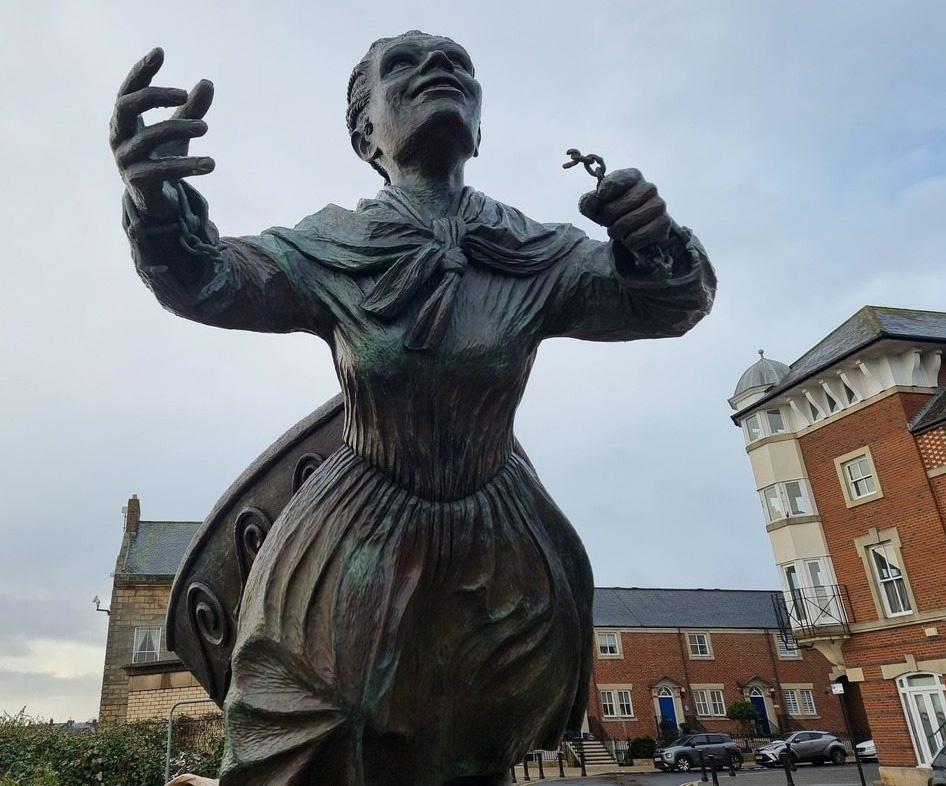
Anew statue honoring Mary Ann Macham, a woman who fled slavery in the U.S. and began a new life in North Shields in northern England, has been installed in the heart of the fishing town.
The bronze sculpture was created by North Shields-based artist Keith Barrett and it stands at the top of the Riverside Embankment Walkway, near where Mary Ann once lived.
Mary Ann hid in woods in Virginia for weeks after escaping slavery and abuse on a Virginia plantation, before stowing away on a ship and ultimately arriving in North Shields in the early 1830s. History says she made it to North Shields on Christmas Day 1831, where she was welcomed by the Spence family, a wellknown Quaker family who have been speaking against slavery and demanding its abolition. Mary Ann went on to marry a local man and thrived in the town thanks to the support she received from the local community. She died at 91.
Before her death, she narrated how she escaped slavery, and the Spence family wrote down the account.
Born in Middlesex County in May 1802, Mary Ann’s father was the son of an estate owner and her mother was one of those enslaved by them.
She was raised by an aunt who later died and by just 12 years old, Mary Ann was sold by a relative and sent to a farm with 200 other slaves. She was abused several times while on the farm for 17 years before she managed to escape and hid for weeks while enslavers searched for her.
Thankfully, a network of people who helped slaves escape smuggled her on to a boat heading to the Netherlands and then to North Shields via Grimsby, Hull and York, BBC reported.
Teacher Steph Towns came across her story while researching Britain’s role in slavery. “I saw a picture of Mary Ann
Towns researched Mary Ann’s story and wrote about it on social media. Nina Brown, a trustee at North Shields’s Old Low Light Heritage Centre, read the post and was fascinated by it.
“The story was so amazing I just thought we’ve got to share this more widely,” she said to BBC, adding, “she was just such a remarkable and brave woman”.
Brown helped organize an exhibition at the center that focused on Mary Ann’s story before a headstone on her unmarked grave in the town’s Preston Cemetery was erected.
To further honor her, a statue inspired by her story was commissioned by North Tyneside Council.
Mayor of North Tyneside Karen Clark said: “Mary Ann’s story is one of extraordinary courage, and it’s right that we honour her legacy in the heart of the town she came to call home.
“This sculpture is a powerful symbol of resilience and community support, values that are still at the heart of North Tyneside today. I’m proud to unveil this artwork as part of our North Shields 800 celebrations, and I hope it inspires reflection and pride in our shared history.”
Barrett also said of the statue. “It has been particularly important to me because North Shields is my home town, and I feel honoured to be able to mark the bravery and insistence on freedom shown by Mary Ann, and the compassion and support for human rights and justice displayed by the Quaker community in North Shields, and all those towns people who enabled her to settle and marry, and live out the rest of her life in safety and freedom.
“I believe that Mary Ann’s story will resonate with the lives and experience of many of us, and wish that she may become a source of inspiration and hope to all who struggle through difficult and dark times, that their chains can be broken and their freedom found.”
Available spots for Pre-K3 and Pre-K4 at Dr. Reginald Mayo, John S. Martinez and other neighborhood schools, for the 2025-2026 school year To apply visit 54 Meadow Street New Haven or online at nhps.net.
Children must be age 3 by September 1,2025
Play Base Learning Curriculum
6 hour day program






by Corynne Corbett, BlackHealthMatters.com
It’s World AIDS Day. It reminds us that talking about HIV in communities of color can still be challenging. Dr. Alftan Dyson, head of strategic medical partnerships at ViiV Healthcare, says people are often surprised HIV is still a thing. “Well, yes, it is a thing. And to the tune of, we have about 39,000 new HIV diagnoses just in the US alone each year,” Dr. Dyson said.
Dyson joined Tamar Braxton and others for a panel called Breaking the Silence, presented by ViiV Healthcare, earlier this year to raise awareness of the HIV epidemic, the taboos and stigmas around prevention, and the importance of mental health.
Dr. Dyson believes the other reason that we don’t hear as much about HIV is because of the communities that are impacted. “Communities of color, in particular, struggle with talking about sexuality, sex, and sexual health in positive ways,” she said.
“A third thing would be stigma, not just around the HIV diagnosis itself, and just in general, like it’s a barrier. I often tell people, HIV is not actually what’s going to cause someone you know to lose life; it’s actually going to be the stigma,” Dr Dyson continues.
“Because you have this stigma that prevents you from seeking care. Sometimes there’s a stigma that prevents you from seeking prevention options.”
There is fear for many surrounding HIV because they can recall the early years of the disease when those diagnosed had short life spans. But things have changed.
“We’ve come to a place now, 40 years later, where we have good antiretroviral therapy, so people who are living with HIV can thrive and do well on antiretroviral therapy, on their medications, and as long as they’re on medicine and achieving undetectable viral loads,” Dr. Dyson said.
Bianca Ordoñez said, “Part of it is the stories we hear about people with HIV.”
“In news stories, we usually see the trauma, the fear, the shame, the moment of that diagnosis, how it destroyed a person’s life. And while that can be true, and while that can be part of the story, it’s not the full story,” she explained.
For example, I’m in a sero discordant relationship, which means that I’m HIV positive and my husband is HIV negative,” Ordoñez said. “Together, we have a beautiful, healthy, HIV negative baby girl. So when telling the story of people living with HIV, I would really rather you guys include HIV as a comma instead of a period.”
Why Tamar Braxton is So Vocal About HIV and HIV Preven-

tion
We know that a lot of what Tamar Braxton does is unplanned, and that was the case with her viral Snapchat video. She told the crowd at NABJ.
“I had no idea that going on my Snapchat, figuring out if someone I was dating was 100,000 other people. It just so happened to go viral, helping this sister feel less alone. To help her understand that her purpose is for a purpose.”
But she also mentioned the media’s obsession with clickbait. “We like stories that are going to get traction. But the truth is, a journalist’s job is to bring the news and what is not news about HIV and HIV prevention. So I’m here to help normalize these conversations and make people less uncomfortable about them,” she said “Why not speak about something important to our community, and that is important to me now, and I mean, I’m going to show up here every time, and so this is a normalized conversation. Having uncomfortable conversations doesn’t make you different; it makes you strong and powerful.”
The singer mentioned data Dr. Dyson shared: at the end of 2023, only 11% of Black folks who could benefit from HIV prevention had received it, whereas 70% of their white counterparts received it.
“That’s news. That’s important information to share in the community.”
Panelist Tamar Braxton lit up the stage with her powerful voice and perspective.
Photo courtesy of ViiV Healthcare.
Yolo Akili Robinson from The Black Emotional Mental Health Collective shared some of the ways they teach in the community. “We have what we call healing circles. So while we think it’s very important to have individual care, you sometimes need to sit in a one-on-one situation. What we do is create collective spaces led by wellness practitioners, ther-
apists, psychiatrists, and other professionals with different healing modalities,” he said.
“And we say, bring your mama, your cousin, your uncle, all them, because we’re going to learn about grief. We’re going to learn about trauma. We’re going to learn about HIV stigma together, as opposed to in these individualized scenarios. We’re going to learn how to process and reframe our emotions together,” Robinson said.
Communities need to be able to move through the uneducation and grief and feel safe.
For outstanding leadership in the New Haven community, Sister Mary Ellen Burns accepted the award on behalf of Apostle Immigrant Services, which provides legal services to immigrants, including those who have experienced abuse, neglect, and abandonment.
Burns, its executive director, thanked Apostle’s clients, whom she called “resilient, brave, talented, and willing to work hard with us so we can help them achieve the goals we’re setting.” She expressed gratitude to the staff and volunteers, people who are “smart and passionate about the work they do and not doing it for the paycheck which is a good thing.”
Acknowledging the unseasonable climate for nonprofits in general, she focused on the positive.
“We are encouraged to be in a city and a state in which both our elected leaders and many residents are committed to welcoming the stranger and to upholding the dignity of all of us who live here,” she said.
“So that just makes it very rich and very possible, and when other things are discouraging, we are encouraged by one another.”
The Town of Wallingford is accepting applications for Maintenance Repair Technician II. Wages: $35.11 to $40.95 hourly. For additional information and to apply online by the December 23, 2025 closing date, please visit: www.wallingfordct.gov/government/departments/human-resources/. Applications are also available at the Department of Human Resources located in Room #301 of the Town Hall, 45 South Main Street, Wallingford, CT 06492. Phone: (203) 2942080; Fax: (203) 294-2084. EOE
Immediate opening for full-time Laborers/Helpers for a fast-paced, growing HVAC/Petroleum company. Position requires flexible work schedule, days and weekends. Some heavy lifting required. Must have a valid driver’s license to run errands. Computer knowledge a plus. Send resume to HR Department, hrdept@eastriverenergy.com, 401 Soundview Road, Guilford, CT 06437.
****An Affirmative Action/Equal Opportunity Employer, including Disabled and Veterans****
The Town of Wallingford is accepting applications for Collections Maintainer III. Wages: $34.62 to $39.22 hourly. For additional information and to apply online by the December 30, 2025 closing date please visit: www.wallingfordct. gov/government/departments/human-resources/. Applications are also available at the Department of Human Resources located in Room #301 of the Town Hall, 45 South Main Street, Wallingford, CT 06492. Phone: (203) 294-2080; Fax: (203) 294-2084. EOE
a quarry and paving contractor, has positions open for the upcoming construction season. We are seeking candidates for a variety of positions, including: Scalehouse Dispatcher/ Equipment Operators and Laborers. NO PHONE CALLS. Please mail resume and cover letter to “Hiring Manager”, Galasso Materials LLC, PO Box 1776, East Granby CT 06026.
Galasso Materials is an Affirmative Action/Equal Opportunity Employer. All applicants will be considered for employment without attention to race, color, religion, sex, orientation, gender identity, national origin, veteran or disability status.
The Housing Authority of the City of New Haven d/b/a Elm City Communities is currently seeking Proposals for Pay
Laundry
A complete copy of the requirements may be obtained from Elm City’s Vendor Collaboration Portal https://newhavenhousing.cobblestonesystems.com/gateway beginning on Monday, November 3, 2025 at 3:00PM

Invitation for Bids
360 Management Group is currently seeking bids from qualified contractors to perform plumbing services. A complete copy of the requirement may be obtained from Elm City’s Vendor Collaboration Portal https://newhavenhousing. cobblestonesystems.com/gateway beginning on
Monday, November 24, 2025, at 3:00PM.
Proposals
The Housing Authority of the City of New Haven d/b/a Elm City Communities is currently seeking Proposals for Communication Media Consultant Firms. A complete copy of the requirements may be obtained from Elm City’s Vendor Collaboration Portal https://newhavenhousing.cobblestonesystems.com/gateway beginning on
Monday, December 15, 2025 at 3:00PM
Invitation for Bids
398-400 Concord Street Drainage System Improvements
The Housing Authority of the City of New Haven d/b/a Elm City Communities is currently seeking bids from qualified firms for drainage system improvements at 398-400 Concord Street. A complete copy of the requirement may be obtained from Elm City’s Vendor Collaboration Portal https://newhavenhousing.cobblestonesystems.com/gateway beginning on
November 24, 2025 at 3:00 PM.
Elm City Communities is currently seeking bids from qualified contractors to perform Moving Services on our property’s agency wide. A complete copy of the requirement may be obtained from Elm City’s Vendor Collaboration Portal. https://newhavenhousing.cobblestonesystems.com/gateway/ beginning Monday, November 24, 2025 at 3:00 pm Monday, November 24, 2025 at 3:00 pm

Looking for a full-time welder in our shop-Skills include but not limited to MIG/TIG welding, plasma ARC-Structural steel and miscellaneous metals.
Please send your resume to: Jillherbert@gwfabrication.com
The Town of Wallingford is accepting applications for Maintainer I. Wages: $25.15 to $30.26 hourly. For additional information and to apply online by the December 15, 2025 closing date, please visit: www.wallingfordct.gov/government/departments/human-resources/. Applications are also available at the Department of Human Resources located in Room #301 of the Town Hall, 45 South Main Street, Wallingford, CT 06492. Phone: (203) 294-2080; Fax: (203) 294-2084. EOE
The Town of Wallingford is accepting applications for Assistant Building Official. Wages: $79,529.00 to $100,878.00 annually. For additional information and to apply online by the December 15, 2025 closing date, please visit: www. wallingfordct.gov/government/departments/human-resources/. Applications are also available at the Department of Human Resources located in Room #301 of the Town Hall, 45 South Main Street, Wallingford, CT 06492. Phone: (203) 2942080; Fax: (203) 294-2084. EOE
The Glendower Group is currently seeking proposals from qualified firms for Architectural & Engineering Services for the Redevelopment of George Crawford Manor. A complete copy of the requirement may be obtained from Elm City’s Vendor Collaboration Portal https://newhavenhousing.cobblestonesystems.com/gateway beginning on Monday, November 10, 2025, at 3:00PM.
Opening for a full time HVAC/Oil/Heating Technician Apprentice. Candidate must possess a technical school certificate in heating, ventilation, air conditioning, oil, propane and natural gas. Send resume to: HR Manager, P. O. Box 388, Guilford, CT 06437 or email HRDept@eastriverenergy.com
**An Affirmative Action/Equal Opportunity Employer including Disabled and Veterans**
The Town of Wallingford, CT is accepting applications for Metering Supervisor. Wages: $115,203 to $144,003 annually. For additional information and to apply online be the November 4, 2025 closing date, please visit: www.wallingfordct.gov/government/departments/human-resources/. Applications are also available at the Department of Human Resources located in Room #301 of the Town Hall, 45 South Main Street, Wallingford, CT 06492. Phone: (203) 294-2080; Fax: (203) 294-2084. EOE
The Town of Wallingford is accepting applications for Collections Maintainer III. Wages: $34.62 to $39.22 hourly. For additional information and to apply online by the December 30, 2025 closing date please visit: www.wallingfordct. gov/government/departments/human-resources/. Applications are also available at the Department of Human Resources located in Room #301 of the Town Hall, 45 South Main Street, Wallingford, CT 06492. Phone: (203) 294-2080; Fax: (203) 294-2084. EOE

The State of Connecticut, Office of Policy and Management is recruiting for a Criminal Justice Grants and Contracts Specialist (Grants and
Maintenance workers needed for the Wallingford Public Schools to work the 2:00 P.M. to 10:00 P.M. shift. Hourly rate: $20.27 to $26.41. Requires some experience in building maintenance work. The closing date will be October 20, 2025. To apply online, please visit: www.wallingfordct.gov/government/departments/human-resources/. Applications are also available at the Department of Human Resources located in Room #301 of the Town Hall, 45 South Main Street, Wallingford, CT 06492. Phone: (203) 294-2080; Fax: (203) 294-2084. EOE
THE HOUSING AUTHORITY OF THE CITY OF NORWALK, CT IS REQUESTING PROPOSALS FROM QUALIFIED INDEPENDENT PUBLIC ACCOUNTING (IPA) FIRMS OR INDIVIDUALS TO PROVIDE AUDIT SERVICES FOR ITS PORFOLIO OF ASSISTED HOUSING AND RELATED PROGRAMS. TO OBTAIN A COMPLETE COPY OF THE REQUEST FOR PROPOSAL DOCUMENTS,
CONTACT GUILLERMO BENDANA, PROCUREMENT SPECIALIST AT GBENDA@NORWALKHA.ORG PROPOSALS ARE DUE AT 2:00 P.M. ON 11/19/2025.
NORWALK HOUSING IS AN EQUAL OPPORTUNITY EMPLOYER. ADAM BOVILSKY, EXECUTIVE DIRECTOR.
Management Group is currently seeking bids


Looking for a full-time welder in our shop-Skills include but not limited to MIG/TIG welding, plasma ARC-Structural steel and miscellaneous metals. Please send your resume to: Jillherbert@gwfabrication.com
LA AUTORIDAD DE VIVIENDA DE NEW HAVEN (ECC/HANH)
Construction Equipment Mechanic preferably experienced in Reclaiming and Road Milling Equipment. We offer factory training on equipment we operate. Location: Bloomfield CT We offer excellent hourly rate & excellent benefits
VALENTINA MACRI RENTAL HOUSING PRE- APPLICATIONS AVAILABLE
INFORME ANUAL DE TRABAJO (MTW) DEL AÑO FISCAL 2024
Contact: Tom Dunay Phone: 860- 243-2300
Email: tom.dunay@garrityasphalt.com
Women & Minority Applicants are encouraged to apply
Affirmative Action/ Equal Opportunity Employer
La Sección II y la Sección VII del Acuerdo de Trabajo de la Autoridad {el "Acuerdo") exige que antes de que la Agencia pueda presentar su Plan y Informe Anual de Tra bajo Aprobado al Departamento de Vivienda y Desarrollo Urbano de los EE. UU. (el "HUD"), debe realizar una audiencia pública, considerar los comentarios del público sobre las enmiendas propuestas, obtener la aprobación de la Junta de Comisionados y presentar las enmiendas al HUD.
Asphalt Reclaiming, Inc seeks:
HOME INC, on behalf of Columbus House and the New Haven Housing Authority, is accepting pre-applications for studio and one-bedroom apartments at this development located at 108 Frank Street, New Haven. Maximum income limitations apply. Pre-applications will be available from 9AM TO 5PM beginning Monday Ju;y 25, 2016 and ending when sufficient pre-applications (approximately 100) have been received at the offices of HOME INC. Applications will be mailied upon request by calling HOME INC at 203-562-4663 during those hours. Completed preapplications must be returned to HOME INC’s offices at 171 Orange Street, Third Floor, New Haven, CT 06510.
HOME INC, on behalf of Columbus House and the New Haven Housing Authority, is accepting pre-applications for studio and one-bedroom apartments at this development located at 108 Frank Street, New Haven. Maximum income limitations apply. Pre-applications will be available from 9AM TO 5PM beginning Monday Ju;y 25, 2016 and ending when sufficient pre-applications (approximately 100) have been received at the offices of HOME INC. Applications will be mailied upon request by calling HOME INC at 203-562-4663 during those hours. Completed preapplications must be returned to HOME INC’s offices at 171 Orange Street, Third Floor, New Haven, CT 06510.
Reclaimer Operators and Milling Operators with current licensing and clean driving record, be willing to travel throughout the Northeast & NY. We offer excellent hourly rate & excellent benefits
HOME INC, on behalf of Columbus House and the New Haven Housing Authority, is accepting pre-applications for studio and one-bedroom apartments at this development located at 108 Frank Street, New Haven. Maximum income limitations apply. Pre-applications will be available from 9AM TO 5PM beginning Monday Ju;y 25, 2016 and ending when sufficient pre-applications (approximately 100) have been received at the offices of HOME INC. Applications will be mailied upon request by calling HOME INC at 203-562-4663 during those hours. Completed preapplications must be returned to HOME INC’s offices at 171 Orange Street, Third Floor, New Haven, CT 06510.
El período de comentarios de treinta (30) días comienza el viernes 1 de noviembre de 2024 y finaliza el sábado 30 de noviembre de 2024. Se pondrán a disposición copias del Informe Moving to Work (MTW) del año fiscal 2024 en el sitio web de la agencia www.elmcitycommunities.org o a través de Twitter, www.twitter.com/ECCommunities o a través de Facebook www.facebook.com/ElmCityCommunities.
Contact: Rick Tousignant Phone: 860- 243-2300
Se le invita a enviar comentarios por escrito dirigidos a: ECC/HANH, Moving to Work FY2024 Annual Report, Attn: Evelise Ribeiro, 360 Orange Street, New Haven, CT 06511 o por correo electrónico a: eribeiro@elmcitycommunities.org. De conformidad con las Secciones II y VII mencionadas, se ha programado una audi encia pública en la que se aceptarán y registrarán los comentarios públicos para el lunes 25 de noviembre de 2024 a las 3:00 p. m. a través de RingCentral: https://v.ringcentral. com/join/185686287?pw=d7db4e4f735df6289ed5adfb24f3f113
Email: rick.tousignant@garrityasphalt.com
Women & Minority Applicants are encouraged to apply
VALENTINA MACRI VIVIENDAS DE ALQUILER PRE-SOLICITUDES DISPONIBLES
MACRI VIVIENDAS DE ALQUILER PRE-SOLICITUDES DISPONIBLES
VALENTINA MACRI VIVIENDAS DE ALQUILER PRE-SOLICITUDES DISPONIBLES
Affirmative Action/ Equal Opportunity Employer
ID de la reunión: 185686287
Contraseña: yaw6Zk28PK
O marque:
HOME INC, en nombre de la Columbus House y de la New Haven Housing Authority, está aceptando pre-solicitudes para estudios y apartamentos de un dormitorio en este desarrollo ubicado en la calle 109 Frank Street, New Haven. Se aplican limitaciones de ingresos máximos. Las pre-solicitudes estarán disponibles 09 a.m.-5 p.m. comenzando Martes 25 julio, 2016 hasta cuando se han recibido suficientes pre-solicitudes (aproximadamente 100) en las oficinas de HOME INC. Las pre-solicitudes serán enviadas por correo a petición llamando a HOME INC al 203-562-4663 durante esas horas.Pre-solicitudes deberán remitirse a las oficinas de HOME INC en 171 Orange Street, tercer piso, New Haven , CT 06510
Contact Dana at 860-243-2300
+12679304000 Estados Unidos (Filadelfia, PA)
HOME INC, en nombre de la Columbus House y de la New Haven Housing Authority, está aceptando pre-solicitudes para estudios y apartamentos de un dormitorio en este desarrollo ubicado en la calle 109 Frank Street, New Haven. Se aplican limitaciones de ingresos máximos. Las pre-solicitudes estarán disponibles 09 a.m.-5 p.m. comenzando Martes 25 julio, 2016 hasta cuando se han recibido suficientes pre-solicitudes (aproximadamente 100) en las oficinas de HOME INC. Las pre-solicitudes serán enviadas por correo a petición llamando a HOME INC al 203-562-4663 durante esas horas.Pre-solicitudes deberán remitirse a las oficinas de HOME INC en 171 Orange Street, tercer piso, New Haven , CT 06510 .
Tractor Trailer Driver for Heavy & Highway Construction Equipment. Must have a CDL License, clean driving record, capable of operating heavy equipment; be willing to travel throughout the Northeast & NY. We offer excellent hourly rate & excellent benefits
HOME INC, en nombre de la Columbus House y de la New Haven Housing Authority, está aceptando pre-solicitudes para estudios y apartamentos de un dormitorio en este desarrollo ubicado en la calle 109 Frank Street, New Haven. Se aplican limitaciones de ingresos máximos. Las pre-solicitudes estarán disponibles 09 a.m.-5 p.m. comenzando Martes 25 julio, 2016 hasta cuando se han recibido suficientes pre-solicitudes (aproximadamente 100) en las oficinas de HOME INC. Las pre-solicitudes serán enviadas por correo a petición llamando a HOME INC al 203-562-4663 durante esas horas.Pre-solicitudes deberán remitirse a las oficinas de HOME INC en 171 Orange Street, tercer piso, New Haven , CT 06510
Email: dana.briere@garrityasphalt.com
Código de acceso/ID de la reunión: 185686287
Contraseña de acceso telefónico: 9296952875
Women & Minority Applicants are encouraged to apply


Affirmative Action/ Equal Opportunity Employer
Números internacionales disponibles: https://v.ringcentral.com/teleconference
Cualquier persona que requiera una adaptación razonable para participar en la audien cia puede llamar al Gerente de adaptaciones razonables (203) 498-8800, ext. 1506 o al número TDD (203) 497-8434.mber (203) 497-8434.
242-258 Fairmont Ave
Seeking to employ experienced individuals in the labor, foreman, operator and teamster trades for a heavy outside work statewide. Reliable personal transportation and a valid drivers license required. To apply please call (860) 621-1720 or send resume to: Personnel Department, P.O. Box 368, Cheshire, CT06410.
2BR Townhouse, 1.5 BA, 3BR, 1 level , 1BA
242-258 Fairmont Ave
242-258 Fairmont Ave
All new apartments, new appliances, new carpet, close to I-91 & I-95 highways, near bus stop & shopping center
2BR Townhouse, 1.5 BA, 3BR, 1 level , 1BA
2BR Townhouse, 1.5 BA, 3BR, 1 level , 1BA
All new apartments, new appliances, new carpet, close to I-91 & I-95 highways, near bus stop & shopping center
Affirmative Action/Equal Opportunity Employer M/F/V Drug Free Workforce
All new apartments, new appliances, new carpet, close to I-91 & I-95 highways, near bus stop & shopping center
Pet under 40lb allowed. Interested parties contact Maria @ 860-985-8258
Immediate opening for a full-time mechanic; maintenance to be done on commercial diesel trucks and trailers. A valid driver’s license is required in order to run company errands efficiently and safely. Send resume to: HR Manager, P. O. Box 388, Guilford, CT 06437 or email hrdept@eastriverenergy.com
Pet under 40lb allowed. Interested parties contact Maria @ 860-985-8258
***An Affirmative Action/Equal Opportunity Employer, including disabled and veterans***
Pet under 40lb allowed. Interested parties contact Maria @ 860-985-8258 CT. Unified Deacon’s Association is pleased to offer a Deacon’s Certificate Program. This is a 10 month program designed to assist in the intellectual formation of Candidates in response to the Church’s Ministry needs. The cost is $125. Classes start Saturday, August 20, 2016 1:303:30 Contact: Chairman, Deacon Joe J. Davis, M.S., B.S. (203) 996-4517 Host,General Bishop Elijah Davis, D.D. Pastor ofPitts Chapel U.F.W.B. Church 64 Brewster St. New Haven, CT
Continuum of Care, New Haven, Connecticut –






241 Quinnipiac Avenue, New Haven which are two bedrooms and rent from $1,950-$2,000 and include heat, hot water and cooking gas, private entrance, off street parking and onsite laundry. I have a couple with washer/dryer which are $2,000. Please bill 241 Quinnipiac Avenue, LLC, 111 Roberts Street, Suite G1, East Hartford, CT 06108.
Also, I have a 3 bedroom unit at 254 Fairmont Avenue, New Haven. They rent for $2,050 and the tenant pays all the utilities. Off street parking and private entrance. Section 8 welcomed.
Full Time Class B driver for a fast-paced petroleum company for days and week ends. Previous experience required. Competitive wage, 401(k) and benefits. Send resume to: HR Manager, P. O. Box 388, Guilford, CT 06437 or email HRDept@ eastriverenergy.com
CT. Unified Deacon’s Association is pleased to offer a Deacon’s Certificate Program. This is a 10 month program designed to assist in the intellectual formation of Candidates in response to the Church’s Ministry needs. The cost is $125. Classes start Saturday, August 20, 2016 1:303:30 Contact: Chairman, Deacon Joe J. Davis, M.S., B.S. (203) 996-4517 Host,General Bishop Elijah Davis, D.D. Pastor ofPitts Chapel U.F.W.B. Church 64 Brewster St. New Haven, CT
CT. Unified Deacon’s Association is pleased to offer a Deacon’s Certificate Program. This is a 10 month program designed to assist in the intellectual formation of Candidates in response to the Church’s Ministry needs. The cost is $125. Classes start Saturday, August 20, 2016 1:303:30 Contact: Chairman, Deacon Joe J. Davis, M.S., B.S. (203) 996-4517 Host,General Bishop Elijah Davis, D.D. Pastor ofPitts Chapel U.F.W.B. Church 64 Brewster St. New Haven, CT
Also, I have a 2 bedroom at 248 Fairmont Avenue, New Haven. They rent for $1,950.00 and the tenant pays all the utilities. Off street parking and private entrance. Section 8 welcomed.
Advertising and the cultivation of existing and new advertising clients is key to the growth and continued success of The Inner-City News. The paper is delivered weekly to businesses, schools, shopping outlets and wherever newspapers can be found. This is a remote sales position.
Work closely with the Publisher and editor to create a successf

Sealed bids are invited by the Housing Authority of the Town of Seymour until 3:00 pm on Tuesday, August 2, 2016 at its office at 28 Smith Street, Seymour, CT 06483 for Concrete Sidewalk Repairs and Replacement at the Smithfield Gardens Assisted Living Facility, 26 Smith Street Seymour.
Sealed bids are invited by the Housing Authority of the Town of Seymour until 3:00 pm on Tuesday, August 2, 2016 at its office at 28 Smith Street, Seymour, CT 06483 for Concrete Sidewalk Repairs and Replacement at the Smithfield Gardens Assisted Living Facility, 26 Smith Street Seymour.
Please bill the Fairmont Avenue to 258 Fairmont Avenue, LLC at the same billing address as 241 Quinnipiac Avenue. I will be the contact person for them to call at 860-231-8080, ext. 161.
A pre-bid conference will be held at the Housing Authority Office 28 Smith Street Seymour, CT at 10:00 am, on Wednesday, July 20, 2016.
Sealed bids are invited by the Housing Authority of the Town of Seymour until 3:00 pm on Tuesday, August 2, 2016 at its office at 28 Smith Street, Seymour, CT 06483 for Concrete Sidewalk Repairs and Replacement at the Smithfield Gardens Assisted Living Facility, 26 Smith Street Seymour.
A pre-bid conference will be held at the Housing Authority Office 28 Smith Street Seymour, CT at 10:00 am, on Wednesday, July 20, 2016.
Bidding documents are available from the Seymour Housing Authority Office, 28 Smith Street, Seymour, CT 06483 (203) 888-4579.
A pre-bid conference will be held at the Housing Authority Office 28 Smith Street Seymour, CT at 10:00 am, on Wednesday, July 20, 2016.
HCC encourages the participation of all Veteran, S/W/MBE & Section 3 Certified Businesses Haynes Construction Company, 32 Progress Ave, Seymour, CT 06483 AA/EEO EMPLOYER Salary (base pay) + Commission to be discussed Potential local travel. Senior Sales Representative Qualifications and Skills: Communicates well and has strong written and verbal communication skills. Knows effective ways to market products and services and learns about new offerings quickly.
Bidding documents are available from the Seymour Housing Authority Office, 28 Smith Street, Seymour, CT 06483 (203) 888-4579.
http://ftp.cbtghosting.com/loginok.html?username=sayebrookevillage
Fax or Email Questions & Bids to: Dawn Lang @ 203-881-8372
LEGAL NOTICE INVITATION TO BID: CONTINUUM OF CARE, NEW HAVEN is requesting licensed and insured contractor bids for their property located at 979 Quin nipiac Avenue, New Haven. Complete first floor kitchen renovation. Scope to include new kitchen layout. Owner to supply new cabinets. Scope to also include new flooring of area. Job also includes complete first floor bathroom renovation. This includes a complete gut (down to studs) of the bathroom. Environmental testing will be conducted by the owner. Scope includes supplying and installing new step in shower stall, vanity, toilet, tile flooring and wall finishes, tile 4ft wainscot is desired, lighting, grab bars by toilet and showers, exhaust fan with motion sensor, and baseboard heating. The scope of work to include floor drain for the bathroom. Scope to include replacement of existing windows, entry doors. Owner to select tile style, colors, and style of faucets and light fixtures. Further detailed information will be given on the scheduled site visit. GC price should include dumpster and permit feeds. Minority/women’s business enterprises are encouraged to apply. A bidding site meeting will be held at 979 Quinnipiac Avenue, New Haven on 11/22/2024 at 1pm. All bids are due by 12/6/2024 at 10 am. All bids, W9, work scope timeline and copy of license and questions should be submitted in writing to Monica O’Connor via email moconnor@continuumct.org or delivered to 109 Legion Avenue, New Haven.
The Housing Authority reserves the right to accept or reject any or all bids, to reduce the scope of the project to reflect available funding, and to waive any informalities in the bidding, if such actions are in the best interest of the Housing Authority.
Bidding documents are available from the Seymour Housing Authority Office, 28 Smith Street, Seymour, CT 06483 (203) 888-4579.

The Housing Authority reserves the right to accept or reject any or all bids, to reduce the scope of the project to reflect available funding, and to waive any
The Housing Authority reserves the right to accept or reject any or all bids, to reduce the scope of the project to reflect available funding, and to waive any informalities in the bidding, if such actions are in the best interest of the
POLICE OFFICER POLICE

Opening for a full time HVAC/Oil/Heating Technician Apprentice. Candidate must possess a technical school certificate in heating, ventilation, air conditioning, oil, propane and natural gas. Send resume to: HR Manager, P. O. Box 388, Guilford, CT 06437 or email HRDept@eastriverenergy.com
September 23, 2024, at
— Republicans who control Congress are considering changes to the name, image, and likeness (NIL) rules for college athletes.
BLACKPRESSUSA NEWSWIRE
By Lauren Burke
Republicans who control Congress are considering changes to the name, image, and likeness (NIL) rules for college athletes. They are joined by two members of the Congressional Black Caucus: Reps. Shomari Figures and Janelle Bynum (DOR). Efforts to contact their office for comment on the SCORE Act were not returned. The legislation could be voted on by the House on Dec. 2.
The SCORE Act, which stands for the “Student Compensation and Opportunity through Rights and Endorsements Act,” would undo the Supreme Court’s unanimous decision in June 2021 that was a major victory for college athletes. The decision paved the way for Name, Image, and Likeness (NIL) rights for college students whose play creates millions in revenues for colleges with successful sports programs. That case, NCAA v. Alston, featured Justice Brett Kavanaugh’s concurring opinion strongly criticizing the NCAA’s claim that student-athletes were amateurs.
But the SCORE Act would permit the NCAA to limit how much schools can spend on NIL deals. It would also control and limit athletes regarding transfers to other schools. The legislation hands more power to the NCAA and shields the NCAA from lawsuits by removing the ability of student-athletes to sue. The

main provision of the SCORE Act would eliminate student athletes’ primary tool for challenging the system of college sports and revenue by eliminating the ability to challenge the system in court.
The SCORE Act would also allow universities to stop athletes from setting up NIL deals that the school says are a conflict with the school’s sponsorship arrangements.
The NCAA sits atop a multibillion-dollar machine built on the labor, talent, and sacrifice of student-athletes who receive only a fraction of the value they generate. Each year, March Madness alone brings in more than a billion dollars in TV revenue, while football powers drive massive ticket sales, merchandising, and sponsorship deals that enrich universities, conferences, and executives.
In a House Rules Committee hearing on the evening of December 1, the discussion centered around free markets and government interference in private contracts. Something that conservatives have long argued they’re concerned about.
“This is the federal government stepping into contracts between two private individuals,” said Georgia Republican Austin Scott as he questioned the need for
the bill.
“These are amateur athletes and they need to be protected. I think we have a responsibility to do that,” said Florida Republican member Rep. Gus Bilirakis, a lead sponsor on the SCORE Act, in response.
Though the SCORE Act benefits the NCAA, it is the players who fill the stadiums, deliver ratings, attract the fans, and fuel the economic engine of the revenue behind the business of college sports. Players on the field have historically been restricted from earning anything close to their true market value. Even with recent NIL reforms, the financial imbalance is staggering: institutions and corporate partners continue to stack revenue into the billions while the “amateurs” on the field who attract the money and do the real work often walk away with a scholarship and sometimes broken promises.
Tellingly, the SCORE Act broadens the employee status ban and asserts that college athletes cannot be considered “employees” on the basis of receiving compensation. That lack of an “employee” designation has deep legal ramifications for student athletes. The change could allow colleges and universities to control an athlete’s time with no ability for the athlete to receive basic labor law protections while attracting millions of dollars to the school through their on-field play.
hide-and-seek.
By Niyoka McCoy, Ed.D., Chief Learning Officer, Stride/K12
Swinging side by side with a friend on the playground. Sharing chalk over bright, colorful sidewalk drawings. Hiding behind a tree during a spirited game of hide-and-seek. These simple moments between children may seem small, but they matter more than we think: They lay the foundation for some of life’s most important skills.
Through everyday play, young children begin learning essential social and emotional skills like sharing, resolving conflicts, showing empathy, and managing their emotions. These social skills help shape emotional growth and set kids up for long-term success. Socialization in early childhood isn’t just a “nice-tohave”—it’s essential for development. Yet today, many young children who haven’t yet started school aren’t getting enough consistent, meaningful interaction with peers. Research shows that there’s a decline in active free play and peer socialization when compared to previous generations.
There are many reasons for this. Children who are home with a parent during the day may spend most of their time with adults, limiting opportunities for

peer play. Those in daycare or preschool may have restricted free play, and large classrooms can reduce supervision and social coaching. Some children live in rural areas, are homebound due to illness, have full schedules, or rely on screens to fill their playtime. And for some families,
finding other families with young children to connect with isn’t easy.
While these challenges can feel significant, opportunities for connection still exist in every community. Families can take simple steps to help children build friendships, create a sense of belonging,
and strengthen social skills. Here are some ideas to get started:
• Storytime sessions at libraries or local bookstores
• Community offerings such as parent-child workshops, art, music, gymnastics, swimming, or sports programs
• Weekly events at children’s museums, which may include art projects, music workshops, or science experiments
• Outdoor exploration, where kids can play with peers
• Local parenting groups that organize playdates and group activities
• Volunteer opportunities where children can participate, such as pet adoption events or packing meals at a food bank
• Classes for kids at local businesses, including hardware, grocery, or craft stores
Some of these community activities are free or low-cost and give kids the chance to build friendships and practice social skills. Parents can also model positive social behavior by interacting with other parents and encouraging their children to play with their peers.
These may seem like small moments of connection, but they can have a powerful impact. Every time your child shares a toy, plays make-believe with peers, or races a friend down the slide, they’re not just playing—they’re learning the skills that build confidence, empathy, and lasting friendships. And it’s good for you, too. Creating intentional opportunities for play also helps you strengthen your own network of parents who can support one another as your children grow together.

By Stacy M. Brown Black Press Correspondent
Federal tax refunds are positioned for a sharp rise next year, with new projections showing that the average payment could increase by about $1,000 for millions of Americans.
Analysts expect the typical refund to reach roughly $4,151 for the 2026 filing season, a major jump from the $3,151 average refund taxpayers received during the 2025 season. CBS News reported that IRS filing data has revealed that the average direct deposit refund for 2025 stands at $3,151, up from $3,092 the prior year.
“When people go to file, they'll be surprised by really, really large refunds,”
Don Schneider, deputy head of U.S. policy at Piper Sandler and one of the report’s authors, said in a recent podcast about the analysis. “In a typical year, we might have about $270 billion in tax refunds, and it'll be that plus another $90 billion.”
Analysts expected a spike to come after the Trump administration’s sweeping tax and spending law was signed in July. The law eliminates federal taxes on some overtime and tipped income and lifts the state and local tax deduction cap from $10,000 to $40,000. All changes were made retroactive to 2025, setting up larger refunds when taxpayers file in early 2026.
Because most Americans receive their refunds within about 21 days of filing, the size of those payments often carries significant weight in household budgets. Next year could bring one of the biggest refund seasons on record.
The benefits will not be evenly shared. Piper Sandler’s analysis shows middle and upper-middle income households, those earning between $60,000 and $400,000, stand to gain the most. That finding matches a Tax Policy Center review that estimated that people earning more than $217,000 receive six of every ten dollars in new tax breaks created by the July law.
High earners will see some limits. The expanded $40,000 SALT deduction begins to phase out for households earning more than $500,000. Lower-income filers are also unlikely to benefit because the higher SALT cap only helps people whose state and local tax bills exceed the standard deduction. Filers must itemize to claim it, which tax experts note is less common among lower-income households.
Schneider said the impact falls primarily on households in the middle of the in-
come distribution rather than those at the lowest or highest ends.
“This isn’t going to the very bottom of the distribution. It isn’t going to the very top of the distribution either,” Scheider said.
Con’t from page 10
stigma that is experienced with HIV prophylaxis. For many years, stigma has existed among clinicians who can prescribe PrEP and among patients who meet the requirements to take it. Part of the stigma around PrEP is potentially being seen taking a daily pill. Taking a daily medication can also contribute to pill fatigue– the exhaustion that comes with taking oral medications. By offering LEN or CAB, we can reduce both pill fatigue and the stigma surrounding PrEP among patients.
Although the current CDC guidelines state to screen for PrEP during a sexual and substance use disorder history, they are not clear on how often that should be. Previous guidelines stated that most individuals only need to be screened once in their lifetime. However, even these guidelines are not clear about when this should be done. Currently, primary care clinicians are severely overburdened.
High patient volumes, increasing administrative tasks, and excessive inbox management have all contributed to the high burnout amongst workforce shortages.
The vagueness of the current CDC guidelines puts more pressure on primary clinicians to fulfill more tasks within a patient visit than is possible. For this reason, it is important to specify when and how often patients should be screened for PrEP. We suggest that patients be screened at least annually. The PrEP screening conversation fits naturally in the sexual history of an annual wellness visit. Screening annually takes the pressure off clinicians during acute care visits and follow-up visits where time is limited, while also providing a clear time period when PrEP screening and education can be achieved for every patient.
There should not be shame and stigma at the doctor’s office surrounding HIV and PrEP. We are working with national partners to update our specific policy gaps and recommendations to reflect the new screening guidelines for PrEP. Clinicians should use these recommendations and guidelines to appropriately screen all patients above the age of 13 annually for HIV and PrEP.
Hay cupos disponibles para Pre-K3 y Pre-K4 en las escuelas Dr Reginald Mayo, John S Martinez y otras escuelas del vecindario, para el año escolar 2025-2026. Para aplicar, visite 54 Meadow Street, New Haven o en línea nhps net
Los niños deben tener 3 años para septiembre 1,2025.
Plan de estudios de aprendizaje basado en el juego
Programa diario de 6 horas
Solo para residentes de New Haven
Para más información Sitio web: www nhps net Teléfono: 475-220-1440 o 475-220-1464 Correo electrónico: NHPS Headstart@newhaven k12 ct us

By Stacy M. Brown Black Press Correspondent
Mother Viola Fletcher, who carried the memory of Tulsa’s shame and the nation’s unfinished business longer than any other living soul, died on November 24 at age 111. She stood as the oldest known survivor of the 1921 Tulsa Race Massacre, the burning of Greenwood, and the attempted erasure of Black prosperity that white mobs tried to silence forever. Tulsa Mayor Monroe Nichols said her death marks a moment of mourning for a city still learning how to reckon with its own truth. “Today, our city mourns the loss of Mother Viola Fletcher, a survivor of one of the darkest chapters in our city’s history,” Nichols stated. “Mother Fletcher endured more than anyone should, yet she spent her life lighting a path forward with purpose.”
She spent that long life fighting for justice that too many leaders tried to bury along with the bodies from Black Wall Street. In Greenwood, she was a child watching terror reshape a world that had promised her nothing but possibility. For more than a century, she bore witness so the country could never again pretend not to know. “Her legacy will be carried forward with the courage and conviction she modeled every day of her life,” Nichols said.
Mother Fletcher’s mission reached the halls of Congress when she demanded reparations for survivors and descendants of the massacre. She testified with a steadiness that shamed a nation still unwilling to repair what it helped set ablaze. She reminded lawmakers she had lived through state-sponsored violence and had lived long enough to see the excuses that followed. She co-authored her memoir “Don’t Let Them Bury My Story” with her grandson, refusing to allow America the comfort of forgetting.
She left her words in the archives of Oklahoma State University through oral histories that insisted history would not escape the sound of her voice. Her labor began early. During World War II, she worked in a shipyard as an assistant welder. Later, she cleaned houses with a determination that carried her well into her eighties. She built a life out of the ashes she was never meant to rise from.
The world took notice of her strength. During a 2021 journey to Ghana, she received the title “NaaLamiley,” translated as someone strong enough to stand the test of time. Her vision inspired the Viola Ford Fletcher Foundation, which promotes education, health, and economic opportunity. Community members honored her in ways large and small, including the gift of custom dentures created to rec-
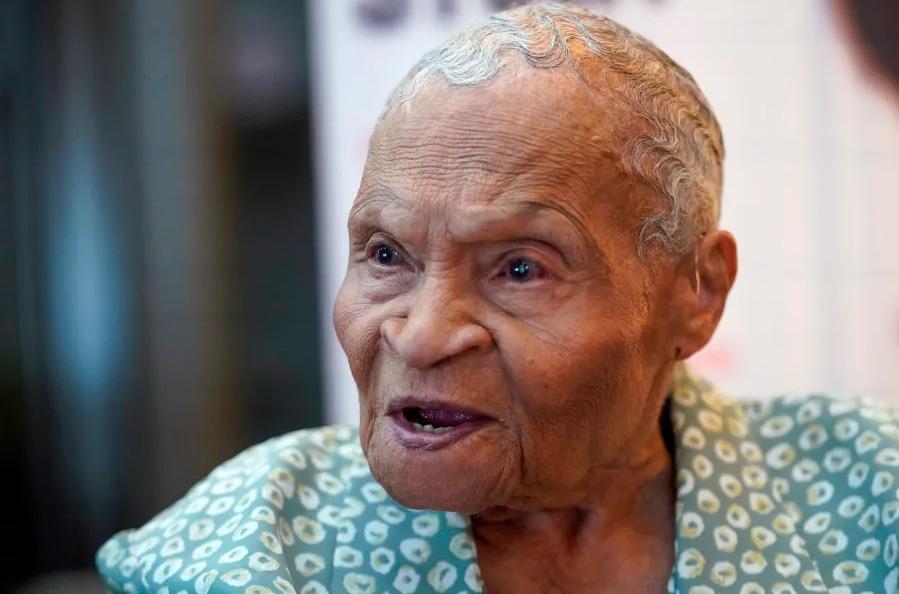

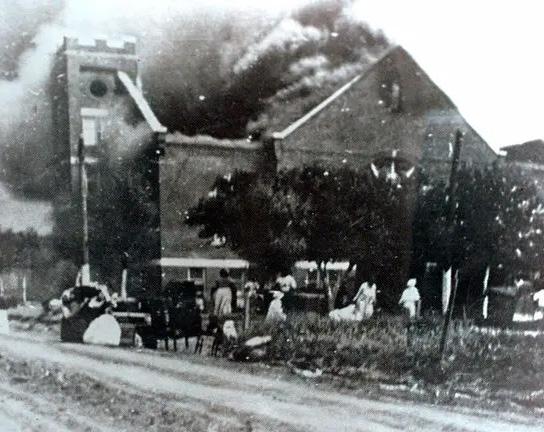
minority has been forced to flee in the hundreds of thousands, and women and girls are among the most vulnerable. It is this country, where women are dying in emergency rooms after they are denied routine reproductive care.
And it is also New Haven, where a woman was allegedly kidnapped by ICE in broad daylight from the corner of Broadway Avenue and Park Street on Thursday, just hours before the play opened. “In an earlier draft of the play, the setting was ‘war zones or everywhere,’” Hill recalled at Wednesday’s tech rehearsal, and that broad approach feels both gutting and totally right.
While the cast does much of the heavy lifting, the set, with stunning shadow work and projections, helps build this world into a physical space. In the Drama Lab’s intimate black box, there are two backlit tents that open into homes, a simple, erratic pump for fresh water, a town square and an Eden-esque olive grove. In the square are bags of red sand, which become a hard-to-watch (and surprisingly compelling) stand in for people as soldiers slash them violently open.
ognize her legacy and impact.
Three years ago, she stood with her brother, Hughes Van Ellis, known as Uncle Red, inside Ghana’s embassy in Washington. She was 108 then. He was 101. Both were sworn in as citizens of Ghana in a ceremony filled with music, dancing children, and the full weight of ancestral return. It was the first time anyone had been sworn in as a citizen inside the Ghanaian embassy. “I’m so grateful to all. I thank you so much for this honor,” Fletcher said before signing her citizenship papers. Her brother echoed her sentiment. “I’m so thankful to Ghana, and all of you,” Ellis stated.
Oklahoma State Rep. Regina Goodwin attended the ceremony, along with journalist Tiffany Cross and Ambassador Erieka Bennett. Bennett spoke of heritage that surpasses borders. “You don’t have to be born in Africa to be an African,” Bennett declared. “Africa is born in you.”
Cross spoke of feeling the presence of ancestors moving through the room, a presence made sharper by the endurance of Fletcher and Ellis. Goodwin said their lives proved that the African spirit cannot be broken. “This is what it’s all about,” Cross stated. “The spirit of Africa, its powerful and rich history.”
Their citizenship ceremony became more than a celebration. It became a reminder that the diaspora carries stories the world still needs to hear, and that the road home is long but never closed. Bennett told the gathering that Ghana opens its doors to all who seek connection. “Welcome home,” she said.
The result, thanks to a 12-student construction crew and scenic designer Douglas Macur, is a place that seems both jarringly real—who among us has not seen footage from tents, some of them reduced to ruins, in the last year?—and fantastical. From the audience, it gives us a sense of stepping into the world of the play, made all the more more urgent by the actors onstage and the writer and director in the wings.
“Every day, they want to keep us—” Brown started to say before rehearsal Wednesday.
“Contained. Silent. Obedient,” Hill finished her sentence. The play, presented with resources on New Haven’s rich and polyphonic community, is intended to push the audience to action.
“It’s what feeds my soul,” Brown said of the challenge she and Hill present to the audience, to take action or remain complicit in a history of violence. “It really is. I feel like I have a true responsibility … the main thing that I want to do is literally a call to action.”
That approach has already gotten the attention of actors. After a long rehearsal Wednesday, Alston Kennie said she is proud to play Miriam, because she feels like she’s helping spark dialogue that needs to happen.
When she sat down with the script weeks ago, her mind first went to Riverbend’s 2005 Baghdad Burning, which tells the story of life in Iraq in the early 2000s, during the first years of the Iraq War. She’s currently reading it for one of the Women' s Studies courses that she’s taking.
“It’s very surreal,” she said of playing the character. “I don’t know how to feel, but I’m honored to play such an important character. For me, it’s [the play is] about having an understanding that when you allow negative cycles to continue to prosper, things never get better.”



Freshly arrived from her honeymoon to her elegant, newly purchased villa, Hedda Tesman (née Gabler) wasn’t born and raised for a life of contented domesticity. When a former lover returns to town, her husband’s academic career and finances suddenly hang in the balance, along with her social standing. A propulsive, fiery, and often funny meditation on romantic dreams and bourgeois ambitions, Hedda Gabler is the portrait of a woman who will stop at nothing to gain control over her own destiny.