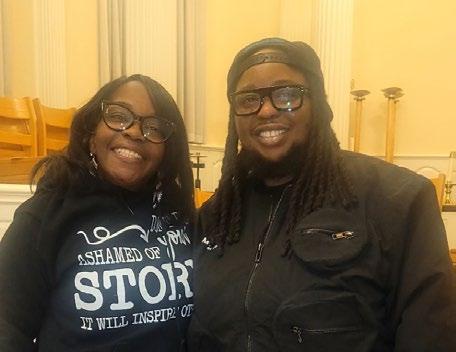


Photo by Boynayel Mota

by Viktoria Sundqvist
As food prices rise and federal funding falls, food insecurity has grown into a crisis greater than currently allocated state resources can address, according to a recently released report.
The persistence of severe food insecurity statewide is the main highlight of the second annual report released by the Commission on Women, Children, Seniors, Equity, and Opportunity (CWCSEO).
Major structural policy changes are needed to fix it, the report concludes.
“The CWCSEO is tasked with ensuring health, safety, educational success, freedom from poverty, and freedom from discrimination, but food insecurity threatens nearly all of those,” said CWCSEO CoChair Karen Jarmoc in a statement. “Hungry kids can’t learn, hungry adults may struggle at work, and hungry residents are at a higher risk of getting sick.”
According to Feeding America estimates, 14.3% of Connecticut residents are food insecure – identical to the national average. This means Connecticut
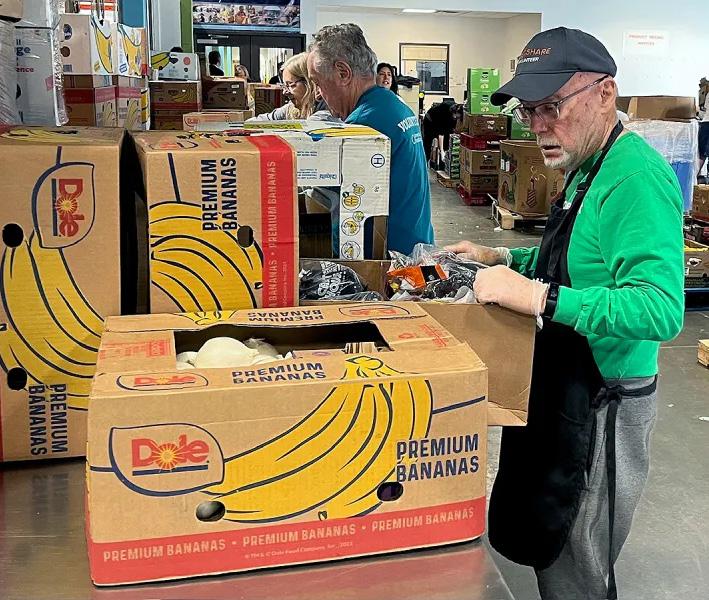
has passed Maine for the highest level in New England, according to the CWCSEO report.
“DataHaven puts the number at an even higher 16%, a slight decrease from 18% in 2024, but notes continued increases among households with children and overall 100,000 more food insecure residents than before the COVID-19 pandemic,” the commission concluded.
Food prices increased 23.6% between 2020 and 2025, and then another 3% in 2025, according to the report. Federal support, however, has decreased steadily since 2022. In 2025, many programs were cancelled and eligibility for the Supplemental Nutrition Assistance Program (SNAP) changed, which made fewer residents eligible.
Connecticut is expected to lose $72 million this year and up to $243 million by 2028, according to the report.
“Food security and food access are critical to the health and well-being of our state residents, and it is an important role of government to consider implementing the best interventions possible to promote
health and wellness through nutrition and food access,” said state Rep. Jaime Foster, D-Ellington.
The report makes a number of policy recommendations to the General Assembly, with the main one being to create a special Food & Nutrition fund in the state budget, with consistent funding. It also reiterates recommendations from the 2024 report, such as creating a food business incubator program in Connecticut food deserts.
It also recommends measuring food insecurity at the state level, imposing new food labeling requirements, and developing food education curricula.
“We must make sure, as a state, that our citizens are not going to bed at night with empty stomachs,” state Rep. Jane Garibay, D-Windsor, said. “That’s not who we are.”
CWCSEO Co-Chair Alan Tan said this report is a good starting point for the state to come together and make sure it does not continue to lag behind its neighboring states.
by Dereen Shirnekhi
The city and the housing authority are teaming up to apply for a $26 million federal grant that would help fund the construction of 538 new mixed-income apartments as part of the first phase of redevelopment of the former Church Street South site across from Union Station.
The Housing Authority of New Haven’s (HANH) Board of Commissioners voted in favor of the submission of that application at its latest regular monthly meeting on Tuesday. Chair William Kilpatrick and Commissioners Kevin Alvarez, Danya Keene, and Elmer Rivera Bello were present. HANH President Shenae Draughn led the meeting, which was held at the housing authority’s headquarters at 358 Orange St.
The board voted unanimously in favor of HANH’s submission of an application for the federal Department of Housing and Urban Development’s (HUD) FY2025 Choice Neighborhoods Implementation Grant to fund phase one of Union Square, a planned 2,490-unit mixed-income housing development at the site of the former Church Street South apartments and current 93-unit Robert T. Wolfe apartment building.
The housing authority bought the 8.27acre, ex-Church Street South site in November 2023 for $21 million.
The Choice Neighborhoods Implementation grant would amount to up to $26 million. Phase one of the project would include the construction of approximately 538 new units facing Union Station, the demolition of Robert T. Wolfe, and the relocation of its tenants.
Displaced residents of the former privately owned, government-rent-subsidized 301-unit Church Street South complex — which was demolished in 2018 after years of neglected maintenance destroyed roofs and walls and poisoned kids with asthma — and Robert T. Wolfe residents will have the right to return to Union Square.
Forty percent of units will be affordable, according to HANH. Income qualifications for those units will range from below 50 percent of Area Median Income (AMI) to upwards of 80 percent.
The grant application deadline is March 9. Click here to read a 2016 article about a previous city attempt, under the Harp administration, to apply for this same federal grant to help rebuild the ex-Church Street South site.
“We know we need to find a better place for those residents,” said Ed LaChance, who is vice president of development for HANH’s development arm, the Glendower Group, about Robert T. Wolfe’s tenants on Tuesday. According to LaChance, the goal is for those tenants to be relocated to one of the newly constructed apartments, rather than off-site.
The housing authority received a $500,000 Choice Neighborhoods planning grant in the fall of 2023 for this same site. For the past two years, that grant has funded feasibility studies, the gathering of data and hosting of community charrettes, and the development of an architectural and neighborhood plan.
While HANH will be the primary applicant, the city will also be a co-applicant on the grant, if the Board of Alders approves a resolution authorizing the application. According to Ed LaChance, it is

necessary for the city to be a co-applicant because it owns part of the property. The rest of the property is owned by the housing authority.
“They’re going to hand it to us eventually,” LaChance said of the city-owned portion.
During Tuesday’s meeting, the board unanimously approved resolutions des-
ignating Community Action Agency of New Haven (CAANH) as People Implementation Entity for the grant, and Glendower Group as Housing Implementation Entity. Both are necessary for the grant application process. CAANH will oversee resident services, education, workforce development, and health initiatives. Glendower will be responsible for development planning and phasing, as well as financing.
The board also approved two other resolutions related to the financing of the project. The first authorized a commitment for HANH to use Project-Based Vouchers (PBVs) to support around 600 of the total 2,490 units to be built at Union Square. For phase one, that will mean 93 PBVs representing the 93 Robert T. Wolfe units that will be replaced. According to LaChance, PBVs boost cash flow, allowing the HANH to qualify for higher bank loans.
The board then approved a resolution to submit a Rental Assistance Demonstration (RAD) application to HUD to convert Robert T. Wolfe to PBVs or Project-Based Rental Assistance (PBRA). According to HANH, the conversion supports the Choice Neighborhoods Implementation Grant application process and is necessary “to preserve the longterm physical and financial viability of the property, address severe capital needs, and facilitate comprehensive, phased redevelopment.”
LaChance estimated that it might take a year to begin construction of phase one, which is projected to take two years.
Union Square is just one major development in the works for that train station-adjacent stretch of Union Avenue. In June 2025, Gov. Ned Lamont announced plans for a $316 million transit-oriented development to be built atop the surface parking lot right next to Union Station. The project will include construction of two 16-story towers containing 470 apartments and 28,000 square feet of retail and commercial space. The first phase of construction is scheduled to begin in late 2026 and finish in early 2028.
by Laura Glesby
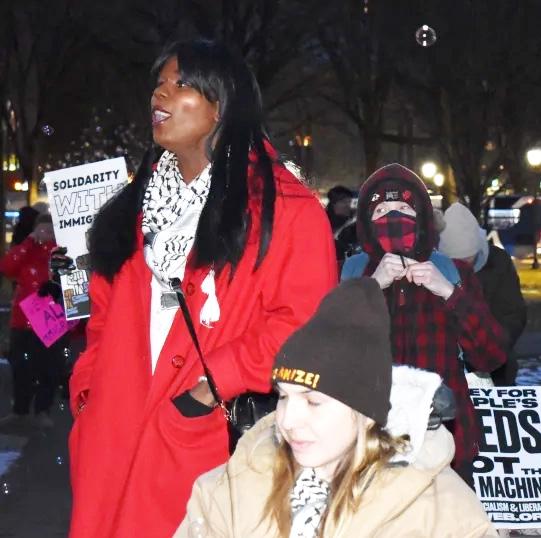
That call and response resounded from a crowd around the fountain on the New Haven Green at sunset on Friday.
Protesters braved the cold to show support for residents of Minneapolis, where Immigration and Customs Enforcement (ICE) agents have shot and killed a civilian, dragged people out of their homes, imprisoned young children to send them halfway across the country to detention centers, and more — all as part of an escalation of immigration enforcement in the city this month.
Many Minneapolis residents stayed home from work and school in protest of ICE on Friday.
In solidarity, among the New Haveners assembled on the Green were local politicians, alternative political parties such as the Party for Socialist Liberation (PSL), and representatives from the teachers union and New Haven Rising.
“Together,” said Carolyn Valcourt of
PSL, “we can show these cowards what real love looks like.”
In addition to calling for the abolition of ICE, rally leaders spoke out against Israel and Zionism, called on Yale to contribute more funding to New Haven, and criticized the Trump administration’s coup in Venezuela.
In the crowd, someone blew bubbles into the sky. Someone else held up an upside-down American flag. Keffiyehs abounded. Several handwritten signs compared Trump to Hitler and ICE to the Nazi Gestapo.
For one of the rally’s speakers, Mary Ghebremeskal, ICE’s crackdown in Minneapolis has literally hit home.
A Yale student from South Minneapolis, Ghebremeskal spoke as a member of Yale’s Somali Students Association.
She’s watched from New Haven as ICE has targeted the Somali community that she grew up in.
Here’s an excerpt from Ghebremeskal’s remarks at Friday’s rally:
I’m from South Minneapolis. I was
born there. And I’m Somali and Eritrean American, so I grew up with that being my community that I lived my entire life around. And I wanted to put in context what it’s like living in South Minneapolis right now.
Outside of South High School (where I went to high school) — outside of Roosevelt High School (which is a mile away from where I went to high school) — there are ICE agents every single day. … ICE agents will ask for people to show their papers when they’re walking to school. When they’re trying to get on the bus. When they’re trying to take the train. Living in a constant state of fear. Every single day, a child is unable to go to day care. Every single day, a student is too scared to go to school. Every single day, a working family is unable to pay rent because they cannot go to work. And when they’re on the streets, it’s illegal to be homeless. When they’re out on the streets, that’s when ICE gets them. Every single day, this is happening in my city. And then the next, and then the next, and then the next.




by Thomas Breen
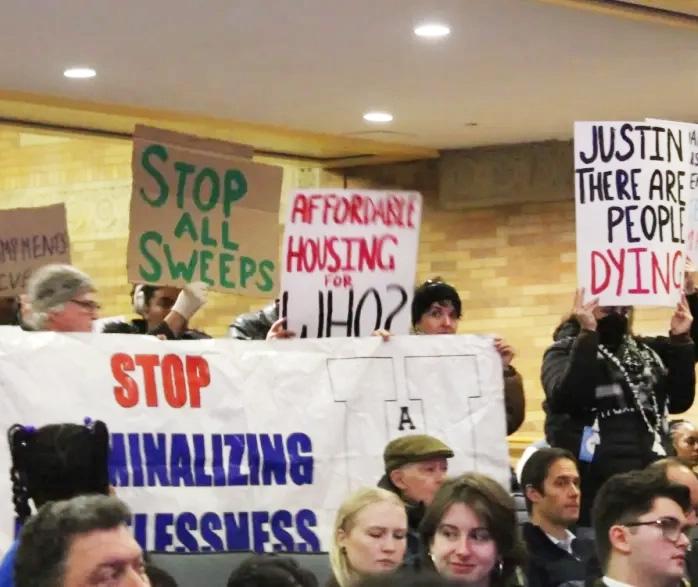
Exposure to the cold played the primary role in the death of a 65-year-old homeless man who spent the night on the Green last month as temperatures dipped below freezing.
The 65-year-old who died on Dec. 11 was named Abdulah Kanchero.
The Office of the Chief Medical Examiner (OCME) determined on Jan. 6 that the cause of Kanchero’s death was “hypothermia due to environmental exposure, with other significant conditions of acute and chronic alcohol use,” according to an OCME spokesperson. The manner of Kanchero’s death was determined to be an “accident.”
Hypothermia is a condition that occurs when one’s body temperature drops to dangerously low levels; a medical emergency, it can harm the functioning of the heart and respiratory systems, and can lead to death.
In a statement sent to the Independent on Wednesday, city police spokesperson Officer Christian Bruckhart said that police started investigating Kanchero’s “sudden death” on Dec. 12.
“Detectives were able to locate video footage which showed much of Kanchero’s movements several hours prior to him being transported to the hospital,” Bruckhart wrote.
That footage begins on Wednesday, Dec. 10 at around 7:18 p.m. and continues to Thursday, Dec. 11 at 7:38 a.m.
Kanchero “is seen interacting with several people in the area of Chapel Street and Temple Street over that time span until a passerby calls 911 at about 7:31AM,” Bruckhart wrote. “He was transported to the hospital about ten minutes later. At
one point, he fell off the bench, which caused a bruise/scrape to his face. There was no indication of any assault seen on video.”
Bruckhart added that an autopsy was conducted by the medical examiner, and that the cause of death was ruled to be “hypothermia due to environment exposure” and the manner of death was an accident. “The autopsy notes also noted a contributory factor to be acute and chronic alcohol use while also noting several other health issues.”
“What happened was a tragedy,” Mayor Justin Elicker said in a phone interview
Wednesday. “It’s heartbreaking.”
He spoke about how the city does “everything we can to ensure that” people have a warm, safe place to stay — especially in dangerously cold weather. Kanchero died on the same week that the city’s two warming centers, at Varick Church on Dixwell Avenue and at the 180 Center on East Street, had reached capacity. A group of advocates for the homeless rallied at City Hall on the night of Dec. 11 and pressured the city to open a temporary warming center at the municipal office building at 200 Orange St. The city closed that 200 Orange warming center
a few days later when it secured money from the state to open a third warming center at the 645 Grand Ave. homeless shelter.
On Wednesday, Elicker said that the city currently has capacity for 166 people at its three warming centers as well as at the Foxon Boulevard hotel-turned-homeless shelter and at Columbus House. (Warming center spaces at those latter two sites are enabled by the state’s activation of a “severe cold weather protocol,” which went into effect Monday night and extended through Wednesday at noon.)
The city’s three warming centers have been all but full this week, Elicker reported, though no one has been turned away. Elicker said that, on Tuesday night, 64 people stayed at the 180 Center warming center, which has a capacity for 66 people; 36 people stayed at Varick, which has a capacity for 40 people; and 40 people stayed at 645 Grand, which has a capacity for 40 people.
“It’s tragic,” Giovanni Castillo — a homeless man and member of the Unhoused Activist Community Team (U-ACT) — said on Wednesday when asked about Kanchero’s death from hypothermia. (Castillo played a key role in advocating for the city to open a temporary warming center at 200 Orange last month.)
Castillo said that he did not personally know Kanchero. He reflected on his and U-ACT’s work, including the week that Kanchero died, in reaching out to homeless New Haveners and helping them find safe places to get out of the cold. “It sucks that we weren’t able to get to him and find him,” he said. “There’s so many homeless people” in New Haven, he added. “It’s hard to know everybody.”
by Adam Walker and Thomas Breen
The Civilian Review Board (CRB) voted Monday night to issue new requests for proposals for an attorney and an administrator, taking steps to fill two key vacancies as the police-accountability body continues to navigate staffing turnover. The discussion and vote took place during the CRB’s monthly meeting, held via Zoom. The CRB provides independent oversight of investigations into alleged misconduct by New Haven police officers.
All members in attendance on Monday — Chair AnneMarie Rivera Berrios, Germano Kimbro, Alder Frank Redente, Ebony Bowden-Moore, Nina Faucett, and Jean Jenkins — voted in favor of issuing both requests.
According to the board’s bylaws, the administrator is responsible for administering subpoenas, managing standardized forms related to civilian complaints and internal affairs investigations, and serving as the board’s administrative liaison with complainants, officials, agencies, the pub-
lic, and police representatives.
The contracted position also oversees day-to-day operations, including scheduling review committees, tracking investigations, recording meeting minutes, and drafting documents, and is renewed annually through the request-for-proposals process every three years.
The board first approved issuing a new request for proposals for an attorney after a previous solicitation expired without resulting in a hire. Rivera Berrios told members that the city had advised the board it would need to reissue the request in order to move forward.
“We were told by the city that we need to put out another one if we want to move forward,” Rivera Berrios said during the meeting.
The board then voted to issue a separate request for proposals for a new administrator following the departure of its previous administrator, Aly Heimer, who board leadership said would not be applying for the position.
“Our administrator is no longer with
us,” Rivera Berrios said.
Heimer joined the board as administrator in February 2023. She told the Independent that she “decided not to pursue a renewal” of her contract.
“I am extremely proud of the work the Board has accomplished during my tenure as Administrator,” she said in a written comment.
She described finalizing a memorandum of understanding (MOU) with the Yale University Police Department and the city “to ensure YPD has an oversight mechanism in place and provides the CRB with quarterly reports;” working with the Board of Alders to update the CRB ordinance to “allow for more flexibility in oversight and codify information sharing;” improving the CRB’s relationship with the New Haven Police Department so that the CRB “now receives un-redacted complaints;” and filling out the board’s bylaws to strengthen leadership roles, clarify member responsibilities, and build opportunities for ongoing training.
She also described growing the board’s

John P. Thomas Publisher / CEO
Babz Rawls Ivy Editor-in-Chief Liaison, Corporate Affairs Babz@penfieldcomm.com
presence nationally by becoming members of the National Association of Civilian Oversight of Law Enforcement (NACOLE). “On a personal level I am grateful to have visited George Floyd Square in Minneapolis during the most recent NACOLE training conference so I could pay my respects. It reminds me to take a moment to honor those who have fought for policing justice for decades and how much we have done and the work yet to do. I sincerely hope someone else from the community will feel empowered to step up and help the CRB push their goals forward.”
When Heimer joined the board, she did so amid mounting concerns about administrative backlogs and internal frustrations. She was tasked with handling day-to-day operations and catching up on years of overdue meeting minutes as the board worked to stabilize its processes.
Now, the CRB’s votes clear the way for the board to begin the process of refilling two positions that play a central role in its oversight work.
Advertising/Sales Team
Keith Jackson Delores Alleyne
John Thomas, III
Editorial Team
Staff Writers
Christian Lewis/Current Affairs
Anthony Scott/Sports Arlene Davis-Rudd/Politics
David Asbery / Tanisha Asbery
Jerry Craft / Cartoons / Barbara Fair Dr. Tamiko Jackson-McArthur
Michelle Turner / Smita Shrestha William Spivey / Kam Williams Rev. Samuel T. Ross-Lee
Contributors At-Large
Christine Stuart www.CTNewsJunkie.com Paul Bass www.newhavenindependent.org
National Association of Black Journalist
National Newspapers Publishers Association
Greater New Haven Chamber of Commerce
Greater New Haven Business & Professional Greater New England Minority Supplier Development Council, Inc.
The Inner-City Newspaper is published weekly by Penfield Communications, Inc. from offices located at 50 Fitch Street, 2nd Floor, New Haven, CT 06515. 203-3870354 phone; 203-387-2684 fax. Subscriptions:$260 per year (does not include sales tax for the in State subscriptions). Send name, address, zip code with payment. Postmaster, send address changes to 50 Fitch Street, New Haven, CT 06515. Display ad deadline Friday prior to insertion date at 5:00pm Advertisers are responsible for checking ads for error in publication. Penfield Communications, Inc d.b.a., “The Inner-City Newspaper” , shall not be liable for failure to publish an ad or for typographical errors or errors in publication, except to the extent of the cost of the space in which actual error appeared in the first insertion. The Publisher reserves the right to refuse advertising for any reason and to alter advertising copy or graphics deemed unacceptable for publication. The entire contents of The Inner-City Newspaper are copyright 2012, Penfield Communications, Inc. and no portion may be reproduced by any means without the written permission of the publisher. 10
Lucy Gellman
Tyra Geter and J’nel Negron knelt among towers of aquamarine, rhodochrosite and heliodor, taking in the low glow of the room. Beside them, Tara Vogt lowered herself to the ground, knees pressed gently to the carpet. The room fell to a hush, even young kids quiet for a rare moment. The musician Arlissa’s voice floated over a speaker, urgent and clear as a bell. Sweep it all underneath the rug / Doesn't mean the dirt won't come up, she sang. The dancers began to roll and rise, arms lifted to the ceiling.
We need a change, Arlissa insisted over the track, and the dancers bent down at the waist, arms extended to their full, wide wingspan. Some amazing grace.
That scene came to the Yale Peabody Museum on Monday afternoon, as the space hosted its beloved and annual MLK Day of Service and Celebration across the building’s three floors. As artists, activists, organizers and culture-bearers fanned out across the galleries, families filled all three floors of the museum, ready to learn about how New Haveners are making King’s vision of social, racial, and economic justice their own.
Nowhere, perhaps, was the day’s call to action delivered with as much grace and propulsion as in David Friend Hall, where dancers from New Haven Academy and Betsy Ross Arts & Design Academy (BRADA) performed amongst millennia-old gem and rock formations from around the globe. Throughout, they worked to tie past to present to future through embodied practice, showing how the genius of Black culture lives on in some of New Haven’s youngest artists.
“To be able to give back in this way, there are no words,” said Carissa Kee, a lifelong New Havener who grew up visiting the Peabody, and now runs the dance program at New Haven Academy. “It’s a very surreal feeling, a priceless feeling. The love being poured into this day, this celebration of Martin Luther King … the dream lives on. I didn’t feel any negative energy in the room.”
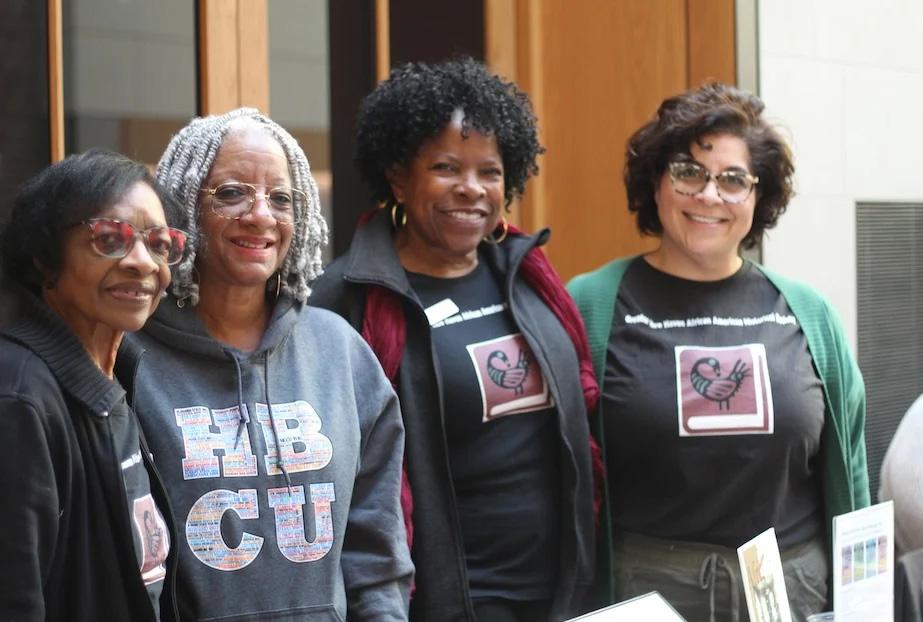
From the moment a person walked through the Peabody’s doors Monday, that sense of hope seemed to be everywhere, from the building’s main hall to zine making stations and community conversations in its program rooms. Beneath the old, soaring bones of a mosasaur, members of the Greater New Haven African American Historical Society (GNHAAHS) handed out information about the organization, inviting kids to a button-making station in one corner of the table. Every few minutes, a new handful of young people seemed to pop up, excited to watch the buttons take shape before their eyes.
“I love it,” said 7-year-old Jaden Martin, who was excited to color in a button design before watching it take shape.
At the other end of the table, GNHAAHS President Rayna Walters soaked in the scene as the hall grew crowded, and conversation rose and fell around her. The
co-founder of Anti-Racism in Action, Inc. (ARIA), Walters said that she is excited for the year ahead. In the next months, she’s focused on growing the organization’s collaborations with groups like the Official Juneteenth Coalition of Greater New Haven (JCGNH) to a new program for budding young archivists.
“I’m really passionate about bringing local history to life,” she said, beaming as 5-year-old Naomi Martin ran to the other end of the table to try her hand at button making, learned that the machine was on a brief break, and still walked away with an MLK-day themed design that she could color in herself.
“It’s so important for us to have these things in the community,” chimed in Naomi’s dad, George Martin. “They [the youth] will be able to learn the history of Dr. King and what he has done not only for African Americans, but for minorities as a whole.”
Those words resonated upstairs, as dancers arranged themselves amidst glass vitrines, shimmering cases and low, dramatic lighting on one side of the room. Around them, a crowd spilled beyond the rows of chairs set up for the performance, with standing room along both sides of the gallery. Closer to the crescent of carpet that had become a makeshift stage, kids sat shoulder to shoulder, crosslegged and fidgety as they waited for the action to begin.
It was there, looking over the space, that dancers took their place on the floor, making themselves still and mollusk-like for just a moment. Once they began moving, they didn’t stop for the next three minutes.
As the music began, swirling around the gallery, they tapped into different moments of dance history, from ballet and lyrical to modern and praise. A verse would start, Arlissa’s voice cracking as she asked for a kinder world, and dancers wrapped themselves in fleeting embraces, their arms drifting in and out again past their sides.
Damage can't be undone / Let's not pretend it disappears, she sang, and Geter and Vogt extended their arms back to the floor, their pointed feet slicing through the air as Negron spun behind them, arms sharply extended. As they began to orbit each other, spinning into blurs of color, arms and legs went airborne, dancers soaring even in the small, confined space. In the audience, someone let loose a spontaneous "Whooo!" and a chorus of praise from the crowd followed.
The song alone, in some ways, feels like the perfect choice for this moment. In 2018, “We Won’t Move” became popular after it was featured in the film adaptation of Angie Thomas' novel The Hate U Give, which tells the story of Black teenager pushed into organizing and activism after police murder of her friend during a traffic stop. Eight years later, the grief and longing at the edge of the singer’s voice still feels raw, as state-sanctioned violence grows its footprint across the country, including in New Haven.


Transformed anew for dance, it became a blueprint for a shared humanity, dancers leaving it all on the floor as they synchronized their movements, and then worked to literally lift each other up and transform into physical supports. So too later in the performance, when all four students took the stage for Beyonce’s 2003 “Crazy In Love” and Alright Slash’s “Otis/NOLA Bounce Remix” that had the crowd cheer-
watch Betsy Ross students coming to the stage.
“Being able to dance shows the good that can happen,” particularly as artists honor King’s life and legacy, she said.
“It shows barriers that have been broken,” chimed in Vogt, a freshman at New Haven Academy who also danced at Betsy Ross. “I’m grateful to be able to dance in the way that I do with the people that I do.”
That momentum, paired with a fierce call to summon and protect Black joy, flowed through BRADA’s performance in the same galleries, first as dancers glided out to Kirk Franklin’s “My World Needs You” and later during a Michael Jackson-Kendrick mashup that had the audience talking back to the dancers. In the first, a lyrical number that invokes worship and praise, dancers harnessed the weight of the world around them, searching for something intangible as they ran, leapt, reached and spun through the space. At one moment, they lifted their arms skyward, as though the force of the dance alone might extend past the ceiling and roof above, and reach right to the heavens. At another, they pulled their arms to their chests and then reached back out towards the audience, a reminder that we are all each other’s keepers. Even in the seconds-long pauses, their bodies forming tableaus against the mineral and rock formations, they seemed to be moving towards a more graceful present, because the world depended on it.
By the time dancers returned to the front of the room, marching around a quartz and sandstone concretion that looked otherworldly, the audience could feel that in every movement, the air electric. Somewhere, “They Don’t Really Care About Us” began to play with persistent, hammering percussion, and dancers moved toward the audience, some of them fighting back smiles and others serious, almost pugnacious. They jogged in place, bare feet hitting the ground in time with the music.
When they looked up, arms at their sides, and let out a piercing and collective scream, it was a release—for the past two weeks, for the past five years, for childhoods upended by violence at home and abroad, for educators who will never be paid enough in a chronically underfunded school system. Jackson sang over the track, a crisp and metallic edge to his voice, and dancers kept moving, legs bending one second, and supporting backbends and breakdancing in the next.
ing, and made it hard not to dance right along.
“I wanted to celebrate hip-hop, which is major to our culture and to our people,” Kee later said, after performing a solo to Andra Day’s “Rise Up” that gave dancers a chance to catch their breath. Geter, a senior at the school who came up through Betsy Ross, agreed, letting herself savor the moment before finding a place to
“Come on girls!” one parent yelled from the front row. Back at the center of the room, a flurry of movement slowed for a moment, as freshman Jaylynne Diaz leapt out onto the carpet. Rocking a shock of pink hair, she locked eyes with the audience, covered her mouth and bent backwards, as though her limbs were suddenly pliable. Around her, fellow dancers’ legs and arms snapped back to attention, bodies springing forward through the space. But it was perhaps what came next that most fit the spirit of the day. As “They
Lucy Gellman
The scene is so familiar, so human, that a viewer can feel it in their body.
Pressed up against a wall, a well-loved couch takes up most of the frame, with blocky, dark stripes stretching against its cotton slipcover. On the cushions, there are layers of rumpled sheets and blankets, cotton and fleece, florals and solids. On the wall, the framed art hangs askew, of a piece with matching pink lampshades.
Potted plants crowd the outer reaches of the frame, their green and yellow fronds reaching out like long fingers.
There’s a need, unspoken and present all at once: this is a common space and also a hallowed one, because it allows a person to lay their body down and know that they can rest.
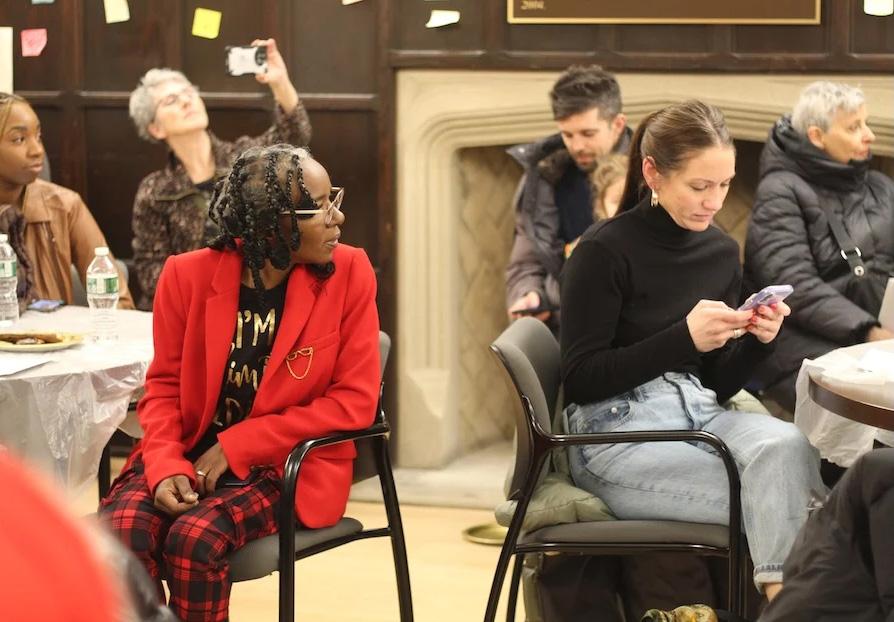
The artwork is one of dozens in Art Without A Home, running through February 3 at Yale’s Afro-American Cultural Center (colloquially called The House) at 211 Park Street. Curated by artist and organizer Sun Queen, the show is a fierce and deeply moving call to action, asking viewers—housed and unhoused, and across the socioeconomic spectrum—to consider the meaning of housing as a human right at a time when it is often treated as anything but. It is doubly affecting in New Haven, where the city’s continuous housing boom often excludes its most vulnerable residents.
Artists include Barbara Kalina, Catherine LaForza, poet Catherine Yates, Howard Oliver, Jesse Wolf, Lady J the Artist, AG, Ronald Ferrucci, Trangerine, Tyree Hughey, Scott McCall, Sun Queen, Tracey Massey and Yoyo. For Queen, a lifelong New Havener and organizer with the Unhoused Activists Community Team (U-ACT) who lives in the city’s Westville neighborhood, it has taken on additional weight this month, after a “Notice To Quit” showed up on her door.
The document, which tells a resident to “quit” or leave a property by a certain date, is often used by landlords as the first step in an eviction process. Queen, who has lived in the same building for 14 years, felt like the rug had been pulled out from under her when she received it. As an organizer, she’s seen the same pattern happen to Black and Brown New Haveners all around her for years.
“This exhibit is now my testament,” she said at an opening last week, as roughly 100 attendees ate dinner together before seeing the show for themselves. “I will survive, but this is what folks are dealing with every day. It’s not just for folks who are living out in the street, who don’t have employment. I’m employed. I have two degrees. And it happens to us all.”
“My hope is for us to come together in community and stop being in silos, because all these things are interconnected,” she added. “I hope that we come together, stand together, speak together and continue to fight for one another.”
True to her vision, the exhibition is both testament and truth-telling from start to finish. In the building’s second-floor gallery, a collection of multimedia art greets
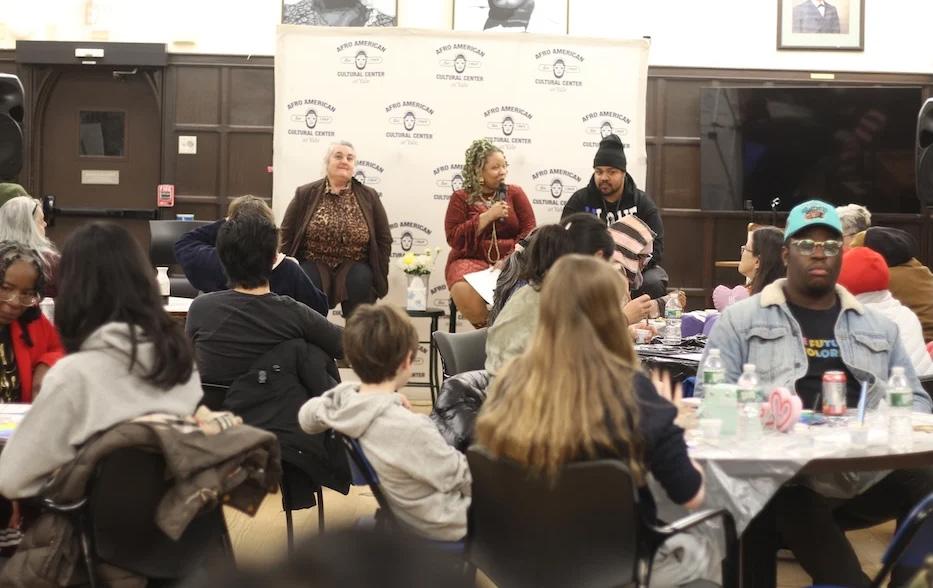
viewers, with works that range from sharp, grayscale photographs on canvas to multi-channel video on loop. There is original poetry, painting, collage and installation art that pushes a viewer to put themselves—literally—in another person’s shoes, lest they believe that access to safe and reliable housing is someone else’s problem. Many of the artists have experienced housing insecurity themselves, lending whole layers of meaning to each work.
In one such grouping, taken by Queen herself, New Haven shifts into focus anew, black and white photographs documenting the people and places caught in the crosshairs of a housing crisis. In one image, taken from below, two people face each other, heavy bags slung over their arms and shoulders. One, at the right, looks down at Queen, acknowledging her presence; the other scrutinizes something in the distance. In the background, a trio walks by, lost in conversation. Further off, cars continue to whiz past as if it’s just another breezy summer day.
But nothing about this scene should be normalized: these subjects are housing insecure, and figuring out where they will go in the heart of a city that has not prioritized their need for shelter. Between the two figures, the heavy, double doors of Trinity Church on the Green appear, and with it the full weight of the moment. Here are two people across from a house of worship—meant to exalt a man who loved the poor and cared for the homeless—searching for safe and reliable shelter. The fact that they may not find it feels like sacrilege.
So too in freeze-frames from the Green, from the nearby courthouse, from a boarded-up Walt’s Cleaners on Dixwell Avenue, still waiting for a promised revitalization from the city. Beneath it, two sneakers hang from the high branches of
a tree, and there’s the sense that there’s a story there the viewer may never know.
Like so much of documentary and street photography, this approach is nuanced and complex: these subjects, so central to the act of picture-making here, are often the same people most quickly rendered invisible by a system that lets them fall through the cracks. Once a viewer has recognized the space as the Green, it’s hard to look at and not think of the scripture unfolding inside the three churches on Temple Street, the warm meals and full bellies at restaurants just across Chapel, the buses heaving and squeaking on their way through New Haven. It all seems too much just like business as usual.
“I am tired of being told this is how it works,” Queen said during her remarks Tuesday, fighting back tears that eventually came. “As if systems aren’t built by hands, as if laws don’t choose who they bruise, as if policy isn’t a language designed to exhaust the poor into silence.”
should stop for a series of oral interviews with residents and organizers at Rosette Village, a collection of tiny homes that has sprung up behind the Amistad Catholic Worker House in the city’s Hill neighborhood.
Down the wall, a viewer can feel those testimonies come alive in a deceptively small sculpture by the artists AG and Yoyo. In the piece, pennies cover a shape made of construction paper, cardboard and popsicle sticks, eye-catching in the sharp contrast of orange, dulled but shiny copper on a field of bright green. At first, it seems like a small piece, easy to miss if you’re going through the exhibition too quickly (which, reader, you should not).
But a second look reveals the work’s genius: a light shining onto the sculpture throws a long shadow of a person in profile onto the wall. They are weighed down by bags on both the back and front of their body, one leg touching down on the ground as the other stands steady. That a viewer can’t see the face is part of the point: this could be any New Havener, including them. The use of a form associated with children’s play and magic-making is especially moving here, turning the idea of make believe and fairy tales entirely on its head.
Back on the other side of the gallery, several vignettes from artist Barbara Kalina may also stop a person in their tracks, telling a story of home and eviction in real time. In one, a figure wedges his body into the open trunk of his car, cradling a cup of coffee as his shoes hang off the edge. Behind him, the minivan is crammed with belongings, suggesting that it is for the moment the only shelter he has. At its lower left, two women stand back-to-back in a narrow, full kitchen, and a viewer suddenly wonders how permanent any of this is.
Around Queen’s works, that message is delivered in as many ways as there are artists in the show. Beside the grouping of photographs from the Green and downtown New Haven, Lady J the Artist has contributed several of her vibrant paintings, including a pair of sneakers that mirror Queen’s photograph, and a tall, slender pair of hands that hold open the pages of a book, bright, eye-catching butterflies finding a place to land as the subject allows herself to be transported.
Across the room, artist Scott McCall has rendered in pencil the weight of legalese, with a heavy, rubber-soled boot that extends from a judge’s gavel, and threatens to crush a small, curled figure laying on the solid base below. Beside it, a collection of portraits from the artist Tyree Hughey suggest that we must create a kinder world for our young people, because the alternative—which is already the present for so many—is too bleak to imagine. Beside it, viewers can and
That’s part of the point, of course: it’s on viewers to realize, as they may in Kalina’s Dear Homeowner series or AG and Yoyo’s shadow puppet or anywhere in between, that very few people are in fact as insulated from the housing crisis as they may think they are. In reality, most viewers here (which is to say, most of us) are likely a few paychecks, eviction letters, or “Notice to Quit” removed from losing their homes. The need to advocate, then, is a collective responsibility that we all share.
Here, Queen’s heart and head (and a sharp curatorial eye, which should surprise no one who has witnessed her organizing work) are very much in concert with each other, with a certain amount of care woven into every nook and cranny of the space. Just outside the gallery’s entrance, two installations face each other, pushing a viewer to action. In one, from the artist Tracey Massey, pairs of boots appear beneath a painting, as if to ask, Where are we going next? Across from them an original poem from Sun Queen sits atop a suitcase, and by a pair of sneakers written with the words Home / Hope / Still Here / Still Trying.
At the far end of the space, meanwhile,
by Donald Eng
HARTFORD, CT — State elected officials and advocates agree that the killing of Alex Pretti, a Minnesota man shot and killed by federal Border Patrol agents Saturday, was a tragedy. Beyond that, though, reactions spit along ideological lines.
Democratic leaders, particularly those in the state Senate, condemned the killing as another dangerous escalation in federal tactics and authoritarian power.
“No immigration enforcement operation should end in death, nevermind a cold-blooded murder like the initial video indicates,” wrote Senate President Martin Looney, D-New Haven, and Majority Leader Bob Duff, D-New Haven. “This is not who we are as a nation.”
Looney and Duff called on state Republicans to join them in condemning the killing.
“Now is the time for all elected officials, regardless of party, to stand together against the dangerous buildup of secret police and militarization of immigration enforcement and to speak with moral clarity against federal overreach that costs innocent lives,” they wrote. “Unfortunately, based on past experience, we expect our Republican colleagues will once


again remain silent on this clear abuse of power, or worse, attempt to deflect attention to entirely unrelated matters rather than confronting what is plainly wrong.”
In response, Senate and House Republican leaders Stephen Harding of Brookfield and Vincent Candelora of North Branford issued a statement calling for a fair and thorough investigation.
“Get answers. Accountability will follow,” they wrote. “In the meantime, we must lower the temperature. The amped up rhetoric, the violence and the political potshots must end.”
The two added the party continued to support legal immigration, law enforcement and victims of violent crime.
“We continue to condemn political violence in all its forms,” they wrote.
Others also weighed in on the killing, with the state’s Black and Puerto Rican Caucus saying the killing demands more than excuses or deflection.
“What occurred reflects a deeper failure: a lack of empathy and an absence of real accountability. Generations before us fought for the right to organize, to protest peacefully, and to speak out in defense of others. Those rights must not come with a death sentence,” according to a statement.
“When federal agents are allowed to kill
citizens who are exercising their voices in protest of violence and brutality, we move dangerously close to autocracy. It sends a chilling message that the government may arbitrarily decide who lives and who dies. That is not order — it is chaos, and it is unacceptable.”
A coalition of immigration organizations including CT Students for a Dream, Danbury Unites for Immigrants, New Haven Immigrants Coalition and more pointed out that ICE has shot three people in Minnesota and that six people have died in ICE custody this month.
“Violent, untrained, masked agents patrolling our neighborhoods, kidnapping, hurting, and killing our neighbors makes no one safer,” they wrote. “The brutality we are witnessing is intentional – to push us into fear and silence. But the people are refusing to stay silent. Across the country and here in Connecticut, neighbors are coming together to protect neighbors. Because community and organization is what will protect us.”
The group called on Connecticut’s elected officials to regulate private companies’ ability to capture personal information and to ensure that the state’s National Guard was not used for immigration enforcement and for the state’s U.S. senators to vote no on additional funding for ICE.




By Abiba Biao
Music floated through the lower level of 1020 Chapel St, winding its way around low tables and handmade, wooden bins that housed sleeves and sleeves of vinyl.
From a record player, a quartet of steady voices rose through the space, tired but clear. Oh Pritchett! Oh, Kelly! Oh Pritchett, open them cells, they called, unearthing a whole history in under a minute. Atop the collections, photographs of Martin Luther King Jr., James Baldwin, Oscar Micheaux, W.E.B. Du Bois, Malcolm X, and Mary White-Ovington looked back. That sound came to the Chapel Street record store GRAILS last Monday, during the shop’s first ever “Freedom Songs,” a day-long listening session dedicated to the music of the Civil Rights movement. Designed to celebrate the life and legacy of Dr. Martin Luther King, Jr., the day invited people to explore social justice and Black revolution through songs, speeches, and poetry of freedom, bringing to the present an urgent and bright roadmap from the past.
“I wanted the day to speak to what it means to mark Dr. King’s legacy in a listening room, rather than in a speech or formal ceremony,” said GRAILS owner King Kenney, who opened the shop in October of last year, in an email afterwards. “Given the wealth of MLK-related commemorations across Yale and the city, I wanted to embrace my role in that celebratory process as both a new member of the community, a record store, and a Black man in America.”
For Kenney, a deep listener and champion of the arts who has worn many creative hats in and beyond New Haven, that process began and ended with the music itself. Originally, he said, he found himself pulled toward “Voices of the Civil Rights Movement,” a recording from the Smithsonian Folkways Collection that came out in 1997, three and a half decades after Dr. King’s March on Washington.
The album, which includes music from the first six years of the 1960s, features recordings by artist-activists such as The Freedom Singers, Fannie Lou Hamer, Betty Fikes, Willie Peacock, Bertha Gober and dozens of others, creating a window into the music that helped build and sustain a movement. While some of the tracks are instantly recognizable—“Wade In The Water,” “This Little Light of Mine,” or “Walk With Me, O’ Lord,” for instance—others contain whole histories that might have otherwise been lost to time, an instant reminder of the weight and importance of history.
“Oh Pritchett! Oh, Kelley!,” sung by the Freedom Singers, for instance, is one of these. In November 1961, Laurie Pritchett—then the chief of police in Albany, Georgia—oversaw the arrest of five Black students from Albany State College, for the ostensible crime of taking up space in segregated waiting and dining areas at the town’s bus terminal. With Asa Kelley, then the mayor of Albany, Pritchett had already been waging a kind of legislative war on Black people, in an


attempt to preserve the violent racial and economic subjugation of Black people in the American South.
But the thing was, the students' presence wasn’t a crime (and not just because segregation is objectively wrong): the Interstate Commerce Commission (ICC) had formally banned segregation in its
facilities on November 1 of that year, following the Supreme Court’s 1960 ruling in Boynton v. Virginia. Students had every right to be there. From prison, Albany State College students Bertha Gober and Janie Culbreth, both also members of the Student Nonviolent Coordinating Committee (SNCC) wrote the words to what
of this history is still fairly recent. Gober and Johnson Reagon, for instance, were still alive and making good trouble until 2023 and 2024 respectively. The Rev. Charles Sherrod, a founding member of SNCC who helped the Freedom Singers grow their activist footprint, departed this world just a year before, in 2022.
Selecting the music is a “never ending process,” Kenney said as the record moved on to another track, and he had a moment to reflect on the weight of presenting this music now, in an era of state-sanctioned violence that can feel like a throbbing echo of the 1960s. That’s what drew him to recordings like Nikki Giovanni’s 1971 Truth Is on the Way, Bobby Hutcherson’s Now, and Lionel Hampton’s Off Into a Black Thing. The anchoring work of the day featured King’s rolling, resonant voice on The Great March To Freedom, which concludes with the oft-quoted “I Have A Dream Speech.”
“In that final passage it arrives at the place the speech holds for all Americans, but for Black Americans in particular: a recorded work of art that functions as an irrefutably unifying national anthem,” Kenney said in an email afterwards. “His booming voice carried a reverential quality, heavy with history, its prescient words still open to personal and emotional translation amid the tumult of modern times.” He added that there is a specific power to listening in a collective setting, particularly when it’s a curated selection on vinyl. Unlike streaming platforms, vinyl has a tactility and intimacy that includes the conditions under which a piece of sound was recorded: it’s a historical document, rather than a track so obsessively worked in a studio that it's flattened out. “A lot of folks would think, like, ‘Oh, I can go online and go to Tidal or Spotify or whatever, and become an expert in this genre,’” he said during the listening session. “The problem is that you have to know that that exists and you have to know what that rabbit hole is. So like a place like this, you could find something around go there differently than what's being recommended to you based on your listening experience.”
While GRAILS has only been open for a few months, Kenney has already noticed the impact of his shop. Sometimes, students from ACES Educational Center for the Arts (ECA) stop by to play chess and ask questions about Kenney’s music selection and listening suggestions. Each day, more proceeds go to the GRAILS Scholars Program, which benefits students at Neighborhood Music School. Often, he meets new people through community events that the store puts on.
It’s becoming—quite by design—a “third space” to find music and history across the Black diaspora and beyond.
became “Oh Pritchett, Oh Kelley.” Decades later, the Freedom Singers— who at the time were students at Albany College, and included voices like Bernice Johnson Reagon, an activist who later founded Sweet Honey In The Rock—are still the voices of a movement, or many movements—and a reminder that much
“The whole store is a diaspora view of how music kind of proliferated across Africa, and Brazil, and Argentina,” Kenney said. “All of that is here in a very real, present way.”
Lucy Gellman contributed reporting.
is perhaps the exhibition’s most sacred work: an altar dedicated to the vital and transformative work that U-ACT has done, and the beloved members the group has lost. It becomes a chance to remember people like 36-year-old Keith Petrulis and 71-year-old Arthur Taylor, both unhoused activists who, with more reliable access to safe housing, shelter, and transportation, might still be with us in a different present.
That’s equally true of 65-year-old Abdulah Kanchero, who died of hypothermia on the New Haven Green last month. A temporary 24/7 warming center at 200 Orange St., used only for overflow, opened during a week of bitter cold just a day later (it is open again this week).
Around them, there are scenes of those still fighting, chief among them Queen and fellow organizer (and Black Lives Matter New Haven co-founder) Ala Ochumare. And in both worlds, that of the living and that of the departed, there is suddenly a level of resilience that no human should ever have to summon. This, in many ways, drives it all home with a crushing weight, making clear how deeply housing is a basic human right.
The show, which uses art as both a doorway and an invitation to get involved in justice work, could not come at a more urgent time. This month, extreme cold has become a near-constant presence in the city, with temperatures that regularly dip below freezing. While the Elicker Administration has in the past three years opened new spaces for unhoused people and families and launched programs like Elm City COMPASS, the need for more humane and robust wraparound services is higher than it’s been in years.
That’s due in part to a whole constellation of issues: cuts to homelessness prevention, healthcare, and food aid on the federal level, New Haven’s own city budget, lack of affordable and subsidized housing in the suburbs; the financial burden that lands on tenants in a city where over 56 percent of property is now tax-exempt. But budgets are moral documents, too: we live in a country that simply doesn’t prioritize the needs of people who are unhoused and housing insecure. In a city with extreme wealth disparity, there's a creeping feeling, affirmed in the show, that it doesn't have to be this way.
Indeed, folks who are unhoused, or risk becoming unhoused, face a larger legal system that is often against them, and a kind of precarious state of survival that can cascade. In the fall of 2024, for instance—well before federal cuts hit emergency food providers—a report on the State of Hunger in New Haven found that 27 percent of New Haveners report experiencing food insecurity. That figure has exploded in the year since President Donald Trump took office. It’s only one of the ways in which hunger, access to care, mental health and wellbeing, and keeping families together are all affected by the basic need for shelter.
“They look down on the homeless and I’m quite sick of it,” said U-ACT member Tammy Varney, who lost her home after

MINNESOTA SPOKESMAN-RECORDER — Council Member Pearll Warren called ICE’s presence “toxic.” “This does not sustain our families in the long term,” she said. “Are we bailing out property owners? This is a band-aid on a bullet wound.”
By Clint Combs | The Minnesota Spokesman-Recorder
The Minneapolis City Council unanimously approved a resolution urging Gov. Tim Walz to impose a temporary eviction moratorium as ongoing ICE raids displace residents, shutter businesses, and destabilize housing across Minnesota.
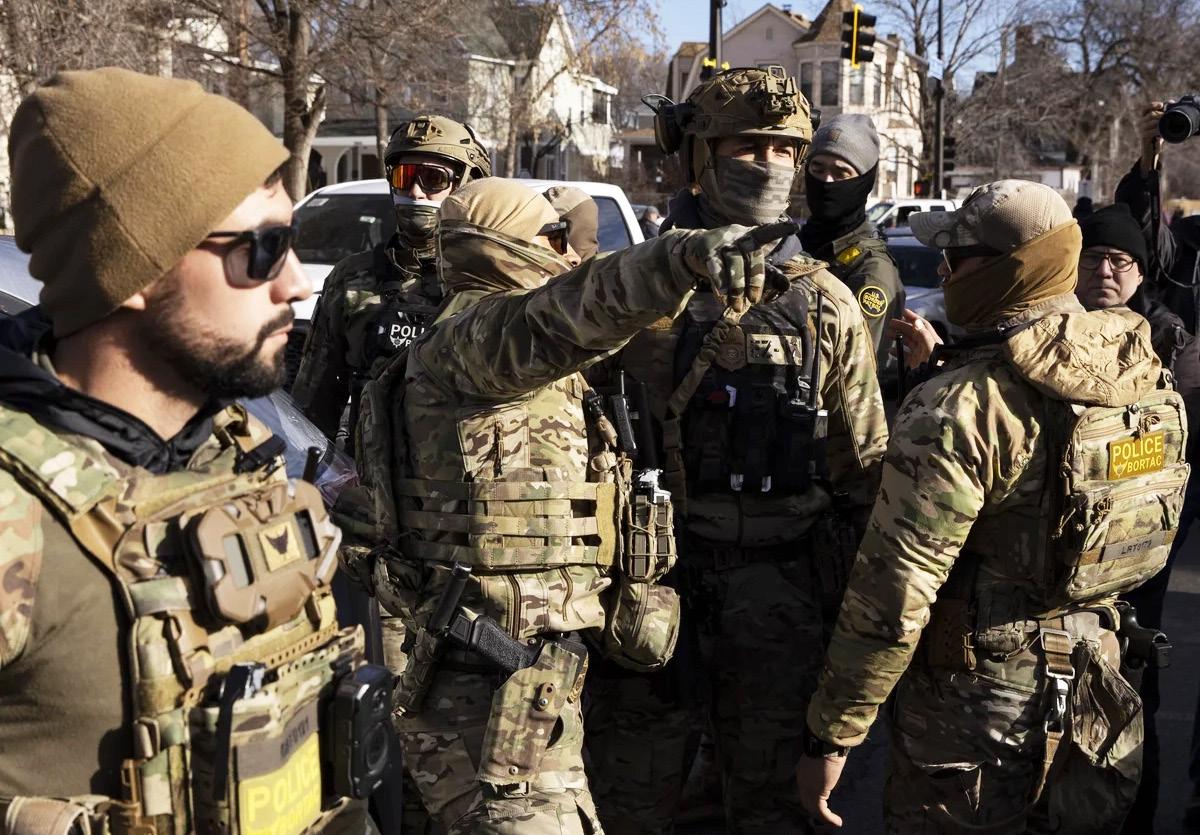
All members of the Minneapolis City Council passed a resolution calling on Governor Tim Walz to impose an eviction moratorium during ongoing Immigration and Customs Enforcement (ICE) raids that have shuttered businesses, closed schools, and strained city budgets.
The resolution, sponsored by Ward 2 Council Member Robin Wonsley, urges Walz to issue an executive order that would prevent evictions for the duration of the federal immigration enforcement operations.
“ICE is creating a statewide crisis that requires our governor to step up and step in and ensure that nobody is evicted without an eviction moratorium,” Wonsley said. “Thousands of vulnerable families and residents are facing eviction as soon as February 1.”
Wonsley also criticized Minneapolis Mayor Jacob Frey and Gov. Walz for deploying police and National Guard, respectively, to respond to protesters and immigrant communities. “Governor Walz and Mayor Frey have been very clear that they are unable or unwilling to use law enforcement to protect residents at this time,” she said.
Council Member Jamal Osman emphasized that only the governor can issue an eviction moratorium. “That’s why we need leadership that stands with families, not leadership that leaves them on their own,” Osman said.
Council Member Jason Chavez praised community members assisting immigrants during the raids. “These are heroes that are literally in our communities, and they’re doing it because they love immigrants,” he said. “So while the federal government wants to demonize immigrant communities, folks in Minneapolis are saying, ‘We love our neighbors.’”
Chavez highlighted the fear facing residents. “The sad reality is that we do not know when this occupation in Minneapolis and in this state is going to end,” he said. “Our neighbors are actually not sheltering in place because they’re scared of being evicted from their rental units.” Chavez urged Governor Walz to act. “We are calling on you, Governor, for an eviction moratorium,” he said. “I am not sure how many more people need to get shot in the leg for you to do your job. I’m not sure how many people need to get killed for you to call a state of emergency. I’m not sure how many homes need to get tear-gassed for you to call for a state of emergency.”

Council Member Lane Brown said, “We know there are solutions embedded in our community, and we know how to plant, grow and share them. But we need Governor Walz to step up and help us.”
Jess Zarik, co-executive director of Homeline, reported a surge in tenant concerns over ICE activity. “Over the last 45 days, we’ve seen a massive increase in calls from tenants specifically regarding the presence of ICE in our communities,” she said. “It’s not limited to Minneapolis or St. Paul. We’re hearing from renters across the state. The fear is widespread and growing.”
Tenants have reported that ICE agents show up in apartment complexes, and landlords allegedly assist them to grant access. “Agents are pulling fire alarms to force people out of their homes, and tenants are being threatened with deportation for asserting basic housing rights,” Zarik said.
Council Member Pearll Warren called ICE’s presence “toxic.” “This does not sustain our families in the long term,” she said. “Are we bailing out property owners? This is a band-aid on a bullet wound.”
Patrick Berry, a formerly unhoused resident now living in Stevens Square, responded to Warren, “‘Band-aid on a bullet wound’ is a poor choice of words considering that a woman is dead.”
Cecil Smith, president of the Minnesota Multi-Housing Association, supported Warren’s argument that the housing market is still recovering from Covid-era rent pauses. “Even this discussion is distracting our ability to attract resources for fu-

ture development,” Smith said. Clyde Warren, a member of the IPG Tenant Union, and fellow union members attended the rally before the Jan. 15 vote. “Whether or not people have status, a work permit, or citizenship, all immigrants are terrified right now,” he said. “This is not the story of one person. This is reality for hundreds and hundreds of our neighbors.”
Warren added, “What we’re seeing is economic harm pushed onto our people through this racist immigration enforcement while housing courts and eviction processes operate like nothing has changed.”
Dex Anderson, a disability advocate and Ward 10 resident, criticized Council Member Linea Palmisano for leaving during public comment. “Good Linea came back in time to hear this because apparently she didn’t want to hear public comment today,” he said.
Anderson emphasized the role of immigrant workers in disability care. “It’s BIPOC people helping people with disabilities with their care tasks, going to the doctor with their needs,” he said. He added that immigrant residents with disabilities are reluctant to seek medical care due to ICE activity.
Anderson described an incident involving Aliya Rahman, who was on her way to a traumatic brain injury center when she was pulled from her car by ICE agents. She ended up unconscious and was denied medical treatment while in ICE custody.
Clint Combs welcomes reader responses at combs0284@gmail.com.

• Cremation (Choose to be cremated at Evergreen.)
• Columbarium in the Most Beautiful Cremation Garden
• Reserve your Niche in a secure location pre-need.

• Reserve a Niche for family and friends or purchase at-need to safely place your Loved One in the Columbarium.
• Burial Lots (infant, single, two-grave, or four-grave)
• Monuments & Markers (black, gray, or pink granite)
• Flower placement (single or multiple placement)
• All orders can be placed at the Evergreen office or the website.


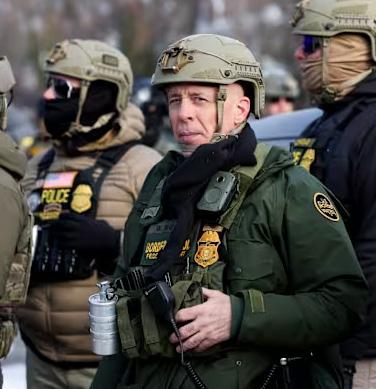
— The state of Minnesota, along with the cities of Minneapolis and St. Paul, filed federal lawsuits against the Department of Homeland Security, alleging that a large-scale deployment of Immigration and Customs Enforcement agents violated the U.S. Constitution and the states’ rights.
Minnesota Sues DHS Over ICE Surge, Citing Constitutional Violations
Minnesota, Minneapolis, and St. Paul have filed federal lawsuits against the Department of Homeland Security, arguing that a large-scale ICE deployment violated constitutional limits and endangered residents, schools, and local services. He and mayors petition court to restrain ICE surge
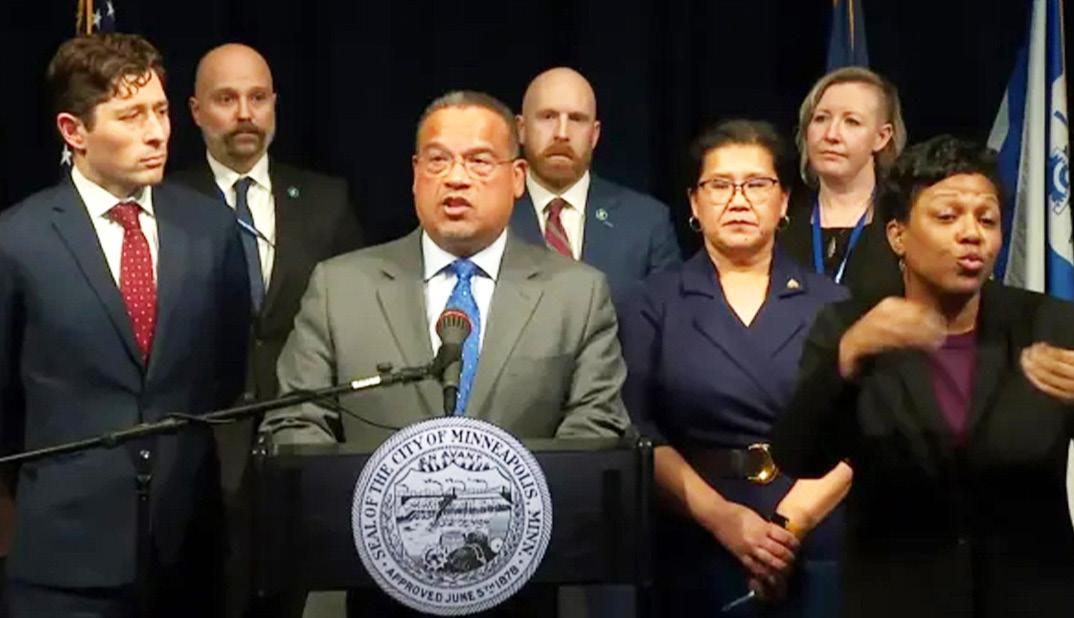
The state of Minnesota, along with the cities of Minneapolis and St. Paul, filed federal lawsuits against the Department of Homeland Security, alleging that a large-scale deployment of Immigration and Customs Enforcement agents violated the U.S. Constitution and the states’ rights.
Attorney General Keith Ellison asked a federal judge to block the federal government from deploying thousands of immigration agents into Minnesota, arguing the action overstepped federal authority.
“We allege that the surge has had a reckless impact on our schools and on our local law enforcement,” Ellison said. “It is a violation of the Tenth Amendment and the sovereign powers granted to states under the Constitution.”
The lawsuit follows reports that ICE agents detained a special education assistant at Roosevelt High School and used chemical irritants against teachers and students, hours after ICE agent Jonathan Ross shot and killed Renee Nicole Good near Portland Avenue and 34th Street in Minneapolis.
Ellison said the state is challenging what he described as “excessive and lethal force” by federal agents, including warrantless arrests and targeting of courts, houses of worship, and schools.
PBS Frontline reporter AC Thompson told Ellison that his reporting crew was
pepper-sprayed by federal agents while covering enforcement activity. “Is this litigation aimed at restraining the use of crowd-control and less-lethal weapons?” Thompson asked. “Our crew was pepper-sprayed today by federal agents. Are you taking action on that?”
Ellison said the state believes the actions are part of a broader pattern of retaliation by the federal government. “We believe that the federal government is persecuting the state of Minnesota because of our political views,” Ellison said.
Minneapolis Mayor Jacob Frey said the surge, which began in December, is expected to cost the city millions of dollars in police overtime.
“We have normal core functions that we are tasked with daily,” Frey said. “We respond to 911 calls, work to prevent murders and carjackings, and continue community policing efforts that have driven crime rates down.”
Police Chief Brian O’Hara said Minneapolis police established a dedicated dispatch operation to handle 911 calls related to encounters with federal agents.
“We had a dramatic increase in calls related to this activity,” O’Hara said. “There is a designated supervisor on duty 24/7 to field those calls and prioritize response as policies continue
to evolve.”
Frey said residents reported incidents of agents in unmarked uniforms and cars detaining American citizens. On Jan. 8, U.S. Border Patrol agents detained two workers at a Target store in Richfield, including 17-year-old Jonathan Aguilar Garcia, who was later released at a Walmart parking lot after agents confirmed he was a U.S. citizen.
“Some of you saw the videos from Target and Roosevelt High School,” Ellison said. “I have received countless calls from people saying they are afraid to go to work, and they’re citizens, not immigrants.”
Retailers including Target, Home De-
pot, and Walmart have faced criticism for allowing ICE to use parking lots as staging areas. Separately, security staff at Hennepin County Medical Center reportedly asked federal agents to leave a stabilization room after an injured person was brought in during an arrest. The agents allegedly refused.
State and local officials argue the incidents reflect what they describe as an ICE “invasion” of Minneapolis and other cities under a pretext of fraud enforcement.
David Super, a Georgetown University law professor, said Minnesota’s lawsuit is distinct from similar challenges in other states because the civil rights claims are being brought by the state itself.
“To prevail, Minnesota must persuade a court that the federal government is acting outside the powers granted by the Constitution and depriving the state of its sovereignty,” Super said. “While DHS has primary authority over immigration, these actions appear to extend against Minnesotans who are neither immigrants nor directly involved with immigration enforcement.”
Super said the court could issue emergency relief, such as a temporary restraining order, though such orders are limited in duration and subject to appeal by DHS. He also noted the case could reach the U.S. Supreme Court, where a conservative majority has previously ruled in favor of the Trump administration in immigration-related cases.
“Surrounding Ms. Good’s car, ordering her out, and shooting her for noncompliance goes far beyond federal authority to control immigration,” Super said. “A court could determine that such interactions with citizens are a core power of the state under the Tenth Amendment.”
Clint Combs welcomes reader responses at combs0284@gmail.com
Senate Republicans are moving ahead with plans to advance a sweeping funding package as a
By Stacy M. Brown NNPA Newswire Correspondent
The federal government is once again facing a shutdown deadline, with funding set to expire at midnight Friday, January 30, just two months after the nation emerged from a prolonged lapse that disrupted lives far beyond Washington.
That October to November shutdown left deep scars across the country. Families who rely on federal nutrition programs saw benefits delayed, reduced, or halted altogether. Some households receiving SNAP and WIC assistance stopped getting benefits entirely, while others received only partial payments. Many of those families are still struggling to recover, juggling rent, utilities, and food costs after weeks of instability caused by the funding lapse.
Despite those recent consequences, Senate Republicans are moving ahead
with plans to advance a sweeping funding package as a single vote, even as Democrats warn that no workable agreement has been reached.
A Senate Republican leadership aide told NBC News that GOP leaders intend to press forward.
“Government funding expires at the end of the week, and Republicans are determined to not have another government shutdown,” the aide said. “We will move forward as planned and hope Democrats can find a path forward to join us.”
Democrats say discussions with Republicans and the White House have not produced a viable solution. A Senate Democratic leadership aide said outreach has occurred but “have not yet raised any realistic solutions.”
The timeline remains tight. The House is on recess for the week, making it unlikely that any revised package requiring
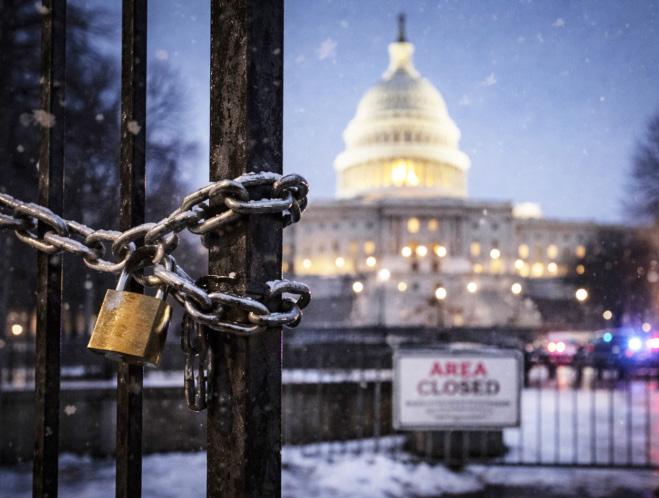
another vote could be approved before the deadline. Severe winter weather has also disrupted congressional schedules, further narrowing the window for negotiations as the clock runs down.
Senate Majority Leader Chuck Schumer said Democrats will block the current Department of Homeland Security funding bill, tying the standoff to broader concerns about immigration enforcement and public safety nationwide.
“Senate Democrats will not allow the current DHS funding bill to move forward.,” Schumer stated. “The appalling murders of Renee Good and Alex Pretti on the streets of Minneapolis must lead Republicans to join Democrats in overhauling ICE and CBP to protect the public. Senate Republicans must work with Democrats to advance the other five funding bills while we work to rewrite the DHS bill.”



FEBRUARY 21 | Saturday 7:00PM


FEBRUARY 26 | Thursday 7:00PM



FEBRUARY 28 | Saturday 7:00PM

The former President and First Lady condemned the actions of federal law enforcement in Minneapolis, saying they're "acting with impunity and engaging in tactics that seem designed to intimidate, harass, provoke and endanger the residents of a major American city."
By Nhari Djan
Barack and Michelle Obama are some of the latest high-profile political figures to speak about the murder of 37-year-old ICU nurse Alex Pretti by federal agents yesterday in Minneapolis, and they’re encouraging Americans to draw inspiration from the peaceful protests in the city.
Issuing a joint statement on social media, the former president and First Lady warned that “our core values as a nation are increasingly under assault.” And they condemned the actions of federal law enforcement and immigration agents in Minneapolis.
“For weeks now, people across the country have been rightly outraged by the spectacle of masked ICE recruits and other federal agents acting with impunity and engaging in tactics that seem designed to intimidate, harass, provoke and endanger the residents of a major American city,” the statement reads. These unprecedented tactics –which even the former top lawyer of the Department of Homeland Security in the first Trump administration has characterized as embarrassing, lawless and cruel – have now resulted in the fatal shootings of two U.S citizens.”
The Obamas also slammed President Donald Trump and his administration, and accused him of further increasing tensions.

“Rather than trying to impose some semblance of discipline and accountability over the agents they’ve deployed, the President and current administration officials seem eager to
escalate the situation, while offering public explanations for the shootings of Mr. Pretti and Renee Good that aren’t informed by any serious investigation – and that appear to be directly
contradicted by video evidence.”
The statement also pleads for federal leaders to cooperate with Minnesota Governor Tim Walz and Minneapolis Mayor Jacob Frey. In reaction to the
murder of Pretti, Walz is asking for the federal government to allow the state authorities to investigate the murder, and Frey requested a restraining order to halt ICE operations in Minneapolis.
The Minnesota and Minneapolis leaders have been battling with the Trump administration for control over their jurisdictions. Attorney Pam Bondi issued several demands to Walz in a letter today, telling the governor that to reduce the presence of ICE in Minneapolis, she wants the state’s Medicaid and supplemental food assistance records shared with the federal government, a repealing state “sanctuary policies,” and for the Department of Justice’s Civil Rights Division to be able to access to Minnesota’s voter rolls to confirm compliance with federal law.
Tensions seem to only be growing, and as the rest of the nation watches the residents of Minneapolis defend themselves against ICE, the Obamas applauded the peaceful protests, saying that Americans should be inspired.
“[Every] American should support and draw inspiration from the wave of peaceful protests in Minneapolis and other parts of the country,” they said. “They are a timely reminder that ultimately it’s up to each of us as citizens to speak out against injustice, protect our basic freedoms, and hold our government accountable.”
NEW YORK CARIB NEWS — In a statement posted on X late Wednesday, the US Embassy in Haiti said Washington would view any attempt to alter the current governing arrangement as a serious threat to national stability, particularly if such moves benefit criminal gangs.
By New York Carib News
The United States has issued a firm warning to Haiti’s Transitional Presidential Council, cautioning against any political actions that could further destabilize the country as international pressure mounts for long-delayed elections.
In a statement posted on X late Wednesday, the U.S. Embassy in Haiti said Washington would view any attempt to alter the current governing arrangement as a serious threat to national stability, particularly if such moves benefit criminal gangs.
“The United States would consider that any person who supports such a destabilizing initiative, which favors the gangs, would be acting against the interests of

the United States, the region, and the Haitian people, and will take appropriate measures accordingly,” the embassy stated.
The U.S. warned that any such maneuver would undermine efforts to establish a minimum level of security and stability in Haiti, where gang violence continues to escalate, and economic hardship is deepening.
The statement comes amid reports of internal divisions within the Transitional Presidential Council, with some members reportedly at odds with Prime Minister Alix Didier Fils Aimé. The precise cause of the disagreement remains unclear, but the council met behind closed doors earlier on Wednesday.
A spokesperson for the prime minister’s office said he could not comment on the situation, while the council’s seven voting members did not respond to requests for comment.
Council chairman Laurent Saint Cyr later issued a statement opposing any effort to weaken government stability at this critical juncture. He emphasized that
Haiti is approaching major institutional deadlines, including February 7, when the transitional council is provisionally scheduled to step down.
“As major institutional deadlines for the nation approach, any initiative likely to fuel instability, confusion, or a breakdown of trust carries serious risks for the country,” Saint Cyr said.
He warned that unilateral decisions or short sighted political calculations could jeopardize the continuity of the state and further burden an already suffering population.
“Haiti cannot afford to make unilateral decisions or engage in short sighted political calculations that would compromise the stability and continuity of the state, as well as the well being of the already sorely tested population,” he added.
Haiti remains under intense international scrutiny as calls grow for elections to be held for the first time in nearly a decade, even as persistent violence and political uncertainty continue to complicate the path toward democratic governance.
The Town of Wallingford is accepting applications for Director of Information Technology. Wages: $137,135 to $174,569 annually. For additional information and to apply online by the January 15, 2026 closing date please visit: www.wallingfordct.gov/government/departments/human-resources/. Applications are also available at the Department of Human Resources located in Room #301 of the Town Hall, 45 South Main Street, Wallingford, CT 06492. Phone: (203) 294-2080; Fax: (203) 294-2084. EOE
Invitation for Bids
General Contractor – Westville Manor Phase I
The Glendower Group, Inc is seeking bids from qualified contractors for General Contractor- Westville Manor Phase I . A complete copy of the requirement may be obtained from Elm City’s Vendor Collaboration Portal https://newhavenhousing.cobblestonesystems.com/gateway beginning on
The Bristol Housing Authority is developing its 2026-2030 Agency Plan in compliance with the HUD Quality Housing and Work Responsibility Act of 1998. A Public Hearing will be held on March 3, 2026 at 11:00 a.m. at Gaylord Towers Community Hall located at 55 Gaylord Street, Bristol, CT.
Information is available for review and inspection at Bristol Housing Authority, 164 Jerome Ave., Bristol, CT during regular business hours. Please call (860) 582-6313 for an appointment.
The Housing Authority of the City of New Haven d/b/a Elm City Communities is currently seeking bids from qualified firm to complete projects that include various architectural, structural upgrades This project involves improvements to three Elm City Communities (ECC) residential properties comprising a total of five (5) dwelling units, located at 759 Quinnipiac Avenue (Units 1 and 2), 1091 Townsend Avenue (Units 1 and 2), and 140 Harrington Avenue, New Haven, Connecticut.. A complete copy of the requirement may be obtained from Elm City’s Vendor Collaboration Portal https:// newhavenhousing.cobblestonesystems.com/gateway beginning on
Wednesday, January 14, 2026, at 3:00 PM.

The State of Connecticut, Office of Policy and Management is recruiting for an Agency Labor Relations Specialist Trainee (Leadership
Request for
Union Square (Church Street South) Phase I Investor Request for Proposals
Elm City Communities (“ECC”), in partnership with The Glendower Group (“Glendower”) and the City of New Haven, invites proposals from qualified equity investors and capital partners for Phase 1 of the Union Square (Church Street South) Redevelopment. This procurement is conducted in accordance with HUD requirements, including 2 CFR Part 200, Rental Assistance Demonstration (RAD), and Choice Neighborhoods Implementation regulations.. A complete copy of the requirement may be obtained from Elm City’s Vendor Collaboration Portal https://newhavenhousing.cobblestonesystems.com/gateway beginning on
Wednesday, January 7, 2026, at 3:00PM.
The Town of Wallingford is accepting applications for Police Officer. Wages: $34.35 to $44.44 hourly plus an excellent fringe benefit package to include a defined benefit pension plan. For additional information and to apply online by the January 30, 2026 closing date please visit: www. wallingfordct.gov/government/departments/human-resources/. Applications are also available at the Department of Human Resources located in Room #301 of the Town Hall, 45 South Main Street, Wallingford, CT 06492. Phone: (203) 294-2080; Fax: (203) 294-2084. EOE
The South Central Regional Council of Governments (SCRCOG) seeks the services of one or more consultants for the following transportation planning studies during the 2026 and 2027 Fiscal Years (July 1, 2025- June 30, 2027): Congestion Management Study, Scenario Planning Study, and Ridge Road Safety Study. Responses are due by January 7, 2026 (12 noon local time). The full RFQ document can be viewed at the Council’s website: www.scrcog.org or can be made available upon request. Contact James Rode at 203-466-8623 with any questions.
Invitation for Bids
General Contractor – The Heights at Westrock

The Town of Wallingford is accepting applications for Collections Maintainer II. Wages: $31.27 to $36.78 hourly. For additional information and to apply online by the January 25, 2026 closing date, please visit: www.wallingfordct.gov/government/departments/human-resources/. Applications are also available at the Department of Human Resources located in Room #301 of the Town Hall, 45 South Main Street, Wallingford, CT 06492. Phone: (203) 294-2080; Fax: (203) 294-2084. EOE

The Glendower Group, Inc is seeking bids from qualified contractors for General Contractor at The Heights at Westrock. A complete copy of the requirement may be obtained from Elm City’s Vendor Collaboration Portal https://newhavenhousing.cobblestonesystems.com/gateway beginning on
a quarry and paving contractor, has positions open for the upcoming construction season. We are seeking candidates for a variety of positions, including: Scalehouse Dispatcher/ Equipment Operators and Laborers. NO PHONE CALLS. Please mail resume and cover letter to “Hiring Manager”, Galasso Materials LLC, PO Box 1776, East Granby CT 06026.
Galasso Materials is an Affirmative Action/Equal Opportunity Employer. All applicants will be considered for employment without attention to race, color, religion, sex, orientation, gender identity, national origin, veteran or disability status.
Immediate opening for a full-time mechanic; maintenance to be done on commercial diesel trucks and trailers. Minimum of three years experience required. A valid driver’s license is required in order to run company errands efficiently and safely. Send resume to: HR Manager, P. O. Box 388, Guilford, CT 06437 or emailhrdept@eastriverenergy. com.
***An Affirmative Action/Equal Opportunity Employer, including disabled and veterans***
The Town of Wallingford is accepting applications for Maintenance Repair Technician I. Wages: $32.34 to $38.04 hourly. For additional information and to apply online by the January 20, 2026 closing date please visit: www.wallingfordct.gov/ government/departments/human-resources/. Applications are also available at the Department of Human Resources located in Room #301 of the Town Hall, 45 South Main Street, Wallingford, CT 06492. Phone: (203) 294-2080; Fax: (203) 294-2084. EOE

The State of Connecticut, Office of Policy and Management is recruiting for a Planning Analyst and a GIS Analyst (Research Analyst) in the Intergovernmental Policy and Planning and the Data and Policy Analytics divisions. Further information regarding the duties, eligibility requirements and application instructions are available at:
https://www.jobapscloud.com/CT/sup/ bulpreview.asp?b=&R1=260108&R2=6297AR&R3=001 and
https://www.jobapscloud.com/CT/sup/ bulpreview.asp?b=&R1=260108&R2=6855AR&R3=001
The State of Connecticut is an equal opportunity/affirmative action employer and strongly encourages the applications of women, minorities, and persons with disabilities.
241 Quinnipiac Avenue, New Haven which are two bedrooms and rent from $1,950-$2,000 and include heat, hot water and cooking gas, private entrance, off street parking and onsite laundry. I have a couple with washer/dryer which are $2,000. Please bill 241 Quinnipiac Avenue, LLC, 111 Roberts Street, Suite G1, East Hartford, CT 06108.
Also, I have a 3 bedroom unit at 254 Fairmont Avenue, New Haven. They rent for $2,050 and the tenant pays all the utilities. Off street parking and private entrance. Section 8 welcomed.
Also, I have a 2 bedroom at 248 Fairmont Avenue, New Haven. They rent for $1,950.00 and the tenant pays all the utilities. Off street parking and private entrance. Section 8 welcomed.
Please bill the Fairmont Avenue to 258 Fairmont Avenue, LLC at the same billing address as 241 Quinnipiac Avenue. I will be the contact person for them to call at 860-231-8080, ext. 161.

360 Management Group is currently seeking bids from qualified contractors to perform on demand roof repair services and annual roof inspections. A complete copy of the requirement may be obtained from Elm City’s Vendor Collaboration Portal https://newhavenhousing.cobblestonesystems.com/gateway beginning on
January 21, 2026, at 3:00PM.
Invitation for Bids
360 Management Group is currently seeking bids from qualified contractors to perform Elevator services. A complete copy of the requirement may be obtained from Elm City’s Vendor Collaboration Portal https://newhavenhousing.cobblestonesystems.com/ gateway beginning on
Wednesday January 7, 2026, at 3:00PM.
Invitation for Bids
Agency Wide Driveway- Repair-Sealing
360 Management Group is currently seeking bids from qualified contractors to perform Driveway Repair-Sealing services. A complete copy of the requirement may be obtained from Elm City’s Vendor Collaboration Portal https://newhavenhousing.cobblestonesystems.com/gateway beginning on
Wednesday January 7, 2026, at 3:00PM.
The Town of Wallingford is accepting applications for Attendant III. Wages: $36.32 to $41.08 hourly. For additional information and to apply online by the January 27, 2026 closing date please visit: www.wallingfordct.gov/government/ departments/human-resources/. Applications are also available at the Department of Human Resources located in Room #301 of the Town Hall, 45 South Main Street, Wallingford, CT 06492. Phone: (203) 294-2080; Fax: (203) 2942084. EOE
Architectural & Engineering Services for RAD/LIHTC Multifamily Scattered Sites & Essex Townhomes Redevelopment
The Glendower Group is currently seeking proposals from qualified firms for Architectural & Engineering Services for the Redevelopment of Scattered Sites & Essex Townhomes. A complete copy of the requirement may be obtained from Elm City’s Vendor Collaboration Portal https://newhavenhousing.cobblestonesystems.com/gateway beginning on
Wednesday, January 7, 2026, at 3:00PM.
By Alyssa Oursler Courtesy of HBCUNews.com
Steps from a Minneapolis police department precinct that burned during 2020’s Black Lives Matter protests, Jamie Schwesnedl climbed into his SUV and plugged his phone into the console. He was beginning his afternoon shift watching for Immigration and Customs Enforcement (ICE) officers in the neighborhood. Through his car’s speakers, community members gave updates about the location of federal agents nearby.
Schwesnedl is one of thousands of residents in the Twin Cities who have joined neighborhood-level rapid response groups in an attempt to disrupt ICE operations in the city. Earlier this month, the Department of Homeland Security (DHS) sent 2,000 federal agents to Minneapolis to carry out the Trump administration’s “largest operation to date” targeting immigrants.
The scope and tactics of the sweep –including door-knocking, racial profiling and aggressive arrests – have angered many residents in Minneapolis, a city with a history of racialized police violence.
Participation in neighborhood watch groups has surged alongside ICE’s presence and ramped up even more since Renee Good’s recent killing by an ICE agent in the city on 7 January. With each passing day, animosity is building.
“It’s very clear that the Trump administration is looking to disguise what is a blatant campaign of cruelty, under this illusion of ‘we’re going after the bad guys,’” said city council member Robin Wonsley. “It couldn’t be further from the truth.”
And yet, the notion that community members must protect and provide for one another, whether because of state violence or state failures, is not new. The police killing of George Floyd in 2020, and the uprising that ensued, also spurred neighborhood-level organizing in Minneapolis.
In Schwesnedl’s words: “2020 never ended.”
Andrew Fahlstrom, an organizer with rapid-response group Defend the 612, said Floyd was killed three blocks from his house. For at least a week during the 2020 uprising, the police disappeared, Fahlstrom said, and the fire department was overwhelmed. According to the city’s review, residents felt abandoned during that time.
“We had to organize our own infrastructure,” Fahlstrom said.
Much of the community response to the current ICE surge – including efforts to document actions by immigration officers, build camaraderie and communication between neighbors, and coordinate mutual aid – builds on existing efforts.

“This is not our first rodeo,” Fahlstrom said.
“I don’t know where Minneapolis police are right now,” Schwesnedl said during his ICE-watching shift. When asked if Minneapolis police was refusing to respond to residents’ calls about incidents with ICE, as many residents have claimed, a department spokesperson simply re-sent a link to the city’s separation ordinance, which prohibits city officials from carrying out immigration enforcement.
During the 2020 protests against police violence, a common call-and-response was: “Who keeps us safe? We keep us safe!” The same sentiment underpins the present. Parents stand guard outside schools in 13F (-10.6C) weather. Mothers are gathering gas masks. People with whistles to warn their neighbors about ICE mill about on corners. People like Schwesnedl patrol the streets.
“We’ve always had to do it ourselves,” Kelly Petersen, one of the founders of the Community Aid Network (CANMN), said. “We have whistles, and we have organizing. That’s all we have against people with huge trucks and guns.”
‘It’s just us, y’all’
Blocks from where Renee Good was killed is George Floyd Square, a memorial for Floyd as well as a gathering and healing space for the community.
“It’s just us, y’all,” Marcia Howard, an educator and organizer, recently told a group of neighbors at the square’s morning meeting. On the purse around her torso was the image of George Orwell’s dystopian novel 1984. “No one’s here to save us,” she said.
Neighbors at the square have met twice
a day, every day, since Floyd was killed more than five years ago. Police are not welcome in the space, while efforts to support the community, such as free clothes, food and medical care, are central to its ethos.
There has been a dramatic resurgence of mutual aid around the Twin Cities, including food drives and fundraisers to support those on lockdown. Demand for food deliveries through CANMN, created during the uprising, doubled in December and again in January, Kelly Petersen, one of its founders, said.
“People are terrified and not leaving their houses,” Jennifer Arnold, the executive director at the non-profit Inquilinxs Unidxs Por Justicia, said. “It is at a level of crisis almost all the time.”
In turn, neighbors are stepping up to help those in hiding: offering rides, laundry, food, rent and other necessities. Becky, whose daughter attends Folwell elementary school, has been driving children with vulnerable parents to school since ICE arrived in December. She asked that her last name not be used due to safety concerns.
“The situation is reminiscent of 2020 in that the government is shooting at us,” she told me. “But the scale of my involvement is greater.”
“It’s heartbreaking. Our inbox, our DMs, are just flooded with people saying: ‘Help us,’” Petersen said. “If you’re local and you’re not slotted into any work right now, there’s never been a better time to get involved. It’s not that hard. You just have to show up every single week.”
Petersen also began ICE watching last
ICE comes around.”
“It feels reminiscent of George Floyd,” Petersen said. “But it’s different. It’s darker.”
For one, the MPD is “intimately accountable to the people of Minneapolis because they live here”, Fahlstrom said. But when federal agents come in, all residents can do is “limit their damage and terror as much as possible”, he said. “They look at us like enemies of the state,” Petersen added.
There has also been a growing number of threats made to community members trailing agents. “You guys gotta stop obstructing us – that’s why that lesbian bitch,” a reference to Good, “is dead,” an ICE agent said to an observer, according to the Minnesota Reformer.
“Peaceful protest is a sacred first amendment right. This was not that,” DHS assistant secretary Tricia McLaughlin told the Guardian when asked about ICE’s policy towards observers. “If you impede law enforcement operations, ignore law commands, and use a deadly weapon to kill or cause bodily harm to a federal law enforcement office, there are dangerous and, in this case deadly, consequences. This was entirely preventable.”
Wednesday – the same morning Good was killed. She had just administered first aid to a woman in Powderhorn park when she heard shots had been fired on Portland Avenue. Good’s wife was in a group chat with Petersen. “They shot my wife in the face,” she texted. It was the last message Petersen read that morning before her phone died. She relayed it to other legal observers around her. “We all just stood there and looked at each other,” she said.
The day after Good was killed, Fahlstrom said this has not had a chilling effect on community defense. “It was exactly the opposite,” he said. “Thousands more people were signing up to do exactly the work that Renee Good was doing, and to carry on her legacy.”
Limiting ‘damage and terror’
While much of the organizing in Minneapolis is taking place on a neighborhood level, organizers in other cities and states are sharing resources and tactics. Organizers with the Chicago neighborhood ICE watch group Protect Rogers Park, for instance, offered training to people in Minneapolis and explained what worked about their systems and what didn’t.
When ICE teargassed a group of protesters blocks from Good’s memorial earlier this week, Sam Luhmann, a 16-yearold from Chicago, was among those on the scene. Luhmann came to Minneapolis the day after Good’s killing.
“I was in Chicago during the heaviest parts of ‘Midway Blitz’, and it was nothing like Minneapolis right now,” he said. “The sheer number. The violence. The aggression. The chemical weapons are on steroids here. No one can breathe when
Just before I joined Schwesnedl for his afternoon commute Tuesday, I heard honking and whistles blocks from my house. An ICE observer – a white student at Hamline University, according to witnesses – had been pulled from his car and taken into custody. A group of observers was gathered near his now-empty vehicle, trying to decide what to do next.
As tensions continue to escalate in the city, so has the federal response. On Thursday, Trump threatened to enact the Insurrection Act, which would grant the armed forces authority to conduct law enforcement activities, to quell resistance to ICE. On Friday, a federal judge told agents not to retaliate against peaceful protesters or stop drivers who are not forcibly obstructing officers.
Also on Friday, the Trump administration began a criminal investigation into mayor Jacob Frey and governor Tim Walz for conspiring to impede ICE. Walz has since “mobilized” the Minnesota national guard and is on standby if needed. On Sunday, the Department of Justice said it is investigating a group of protesters who disrupted church services where a local ICE official is reportedly a pastor. “People around the country need to be organizing,” Fahlstrom said. “Minneapolis is not gonna be the last place that falls under federal occupation.”
During his ICE observer shift, Schwendel began to drive towards agents the dispatcher said were surrounding someone in the neighborhood. But the area was cleared before he could get there, so he made a U-turn. Often, people are snatched too quickly for observers to do anything about it, multiple people said. But the thing about ICE watch, Schwesnedl said: you never know how many people you might save.