Nuclearisthemostreliablepathtoaffordable electricity
In an era where demand for continuous electricity is skyrocketing, driven by the rapid expansion of artificial intelligence, data centers, and electrification across industries, nuclear power appears to be the affordable choice for all 8 billion on this planet.

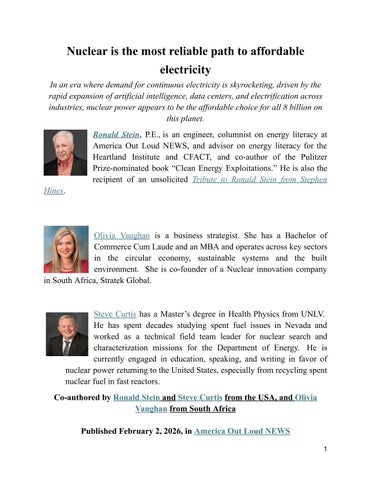
Ronald Stein, PE,is an engineer, columnist on energy literacy at America Out Loud NEWS, and advisor on energy literacy for the Heartland Institute and CFACT, and co-author of the Pulitzer Prize-nominated book “Clean Energy Exploitations.” He is also the recipient of an unsolicited Tribute to Ronald Stein from Stephen Hines.

Olivia Vaughan is a business strategist. She has a Bachelor of CommerceCumLaudeandanMBAandoperatesacrosskeysectors in the circular economy, sustainable systems and the built environment. She is co-founder of a Nuclear innovation company inSouthAfrica,StratekGlobal.

Steve Curtis has a Master’s degree in Health Physics from UNLV He has spent decades studying spent fuel issues in Nevada and worked as a technical field team leader for nuclear search and characterization missions for the Department of Energy. He is currently engaged in education, speaking, and writing in favor of nuclear power returningtotheUnitedStates,especiallyfromrecyclingspent nuclearfuelinfastreactors.
Co-authoredbyRonaldSteinandSteveCurtisfromtheUSA,andOlivia
VaughanfromSouthAfrica
PublishedFebruary2,2026,inAmericaOutLoudNEWS
https://www.americaoutloud.news/nuclear-is-the-most-reliable-path-to-afford able-electricity/
Political leaders are increasingly prioritizing affordability (without the need for subsidies) as a cornerstone of electricity policy. They are now recognizing that highcostsburdenhouseholds,stifleeconomicgrowth,andfuelpublicdiscontentin wealthier nations that are providing taxpayer subsidies to support unreliable electricityfromwindandsolar.
These same political leaders in the wealthier nations are oblivious to the fact that “net-zero” is NOT affordable by the 6 billion living in poverty! Shockingly, 80% of the 8 billion on planet Earth, or more than 6 billion, are living on less than $10/day.
Amid this “worldwide” economic reality backdrop, nuclear energy presents a far superior affordable alternative to unreliable electricity sources like wind andsolar. Economically, it makes no sense to abandon working production methods until new ones can replace the existing and future demand. World citizens are facing thisrealityinhigherelectricityprices.
TheTruthAboutContinuousElectricity
One cannot compare baseload continuous electricity to intermittent windandsolar on a like-for-like basis. Due to wind and solar being unable to provide continuous electricity, those projects are not investable by the private sector and only exist in the wealthier countries that can afford to subsidize their existence with taxpayer subsidies.
However, electricity from wind and solar are unpredictable and intermittent and cannot be used as baseload without 100% back up., meaning continuous sources like nuclear, coal, or gas must be constructed, manned, and ready tobedispatched when the wind stops or the sun sets.Forsolar,wecanpredictnighttimelapses,but wind's unpredictability exacerbates the issue. So, if 1 megawatt of continuous backup is needed for every 1megawattofwindorsolar,whybuildtheintermittent windandsolarinthefirstplace?
Countries like Germany and Denmark, which led with aggressively subsidized wind and solar projects, now suffersomeofEurope'shighestprices.Thisservesas a cautionary tale of a self-inflicted economic disaster that the U.S. can readily avoid. States with high renewable penetration, like California, have seen systemic rises in electricity prices due to full system costs, including that 100% backup requirement. Today, California has the highest electricity cost in America (except forHawaii).
U.S. Secretary of Energy Chris Wright has been clear about such inefficiencies: “Germany invested half a trillion dollars, more than doubled the capacity of its electricity grid, and today produces 20% less electricity than before that investment, selling it at three times the price.” He adds, "We’re in the greatest malinvestment inhumanhistory,"notingthatglobally,$10trillionhasyieldedonly about 6% of electricity from wind and solar, with high penetration driving up pricesandpromptingmassindustryexodus.
It's time for theU.S.toleadwithsaneelectricitypolicies,unlockinginvestmentsin nuclear, coal, and oil & gas. These are the industries that power themodernworld that we know today. Nuclear, in particular, provides continuous baseload power with no harmful pollution during operations, positioning it as the clean, reliable cornerstoneforaprosperousfuture.
Nuclear power excels in delivering stable, affordable electricity, operating at high-capacity factors, often over 90%, to generate power continuously, regardless of weather or time of day. Thistranslatestolowerlong-termcosts,asuraniumfuel isvastlysuperiorintheamountofoutputitproducesasopposedtoothersources.
True Generation IV SMRs, which fit specific criteria including sustainability (effective fuel use and waste minimization), economics (cost advantages and low financial risk), safety and reliability (very low core damage risk and no need for offsite emergency response), and proliferation resistance and physical protection (deterring misuse), are ideally suited for this role. The Department of Energy endorses fast-tracking these technologies as the clean solutions of the future, with 3
systems like the High-Temperature Gas-Cooled Reactor (HTGR), Sodium-Cooled FastReactor(SFR),andMoltenSaltReactor(MSR)leadingtheway.
Unlike those unreliable wind and solar sources, nuclear provides stable, baseload power that ensures reliability and long-term cost savings, making it the optimal solution for meeting rapidly escalating electricity needs without compromising economic stability. To policymakers and voters alike, embracing nuclear, particularly advanced Small Modular Reactors (SMRs), offers a long-term path to electricityindependence,jobcreation,prosperity,andameanstobringthe6billion livinginpoverty,tojointheindustrialrevolution.
The surge in electricity demand is unprecedented. Tech giants such as Amazon, Google, Microsoft, and Meta are backing nuclear power while they are constructing massive data centers to power AI advancements, with facilities requiring six to ten times more power than previous generations. These centers demand round-the-clock, uninterrupted electricity. AI workloads cannot tolerate fluctuations or downtime. U.S. electricity consumption could double by 2050, necessitatinganaroundtheclock,always-availablesupply.
WhatAbouttheGrid?
The inherent safety in Gen IV SMRs, such as passive cooling that enables automatic shutdown without external power, shouldtranslatetoreducedregulatory burdens and shorter build times, addressinghistoricaldelaysinlarge-scalereactors plaguedbyoverrunsandgridconstraints.
SMRs, with capacities between 10 and 300 megawatts, are factory-assembled and standardized, substantially reducing construction timelines and costs and will rapidly benefit from economies of scale. They scale efficiently as demand grows, allowingmodularadditionsforpreciseplanningratherthanmassive,riskyprojects.
Crucially, SMRs serve as behind-the-meter solutions, deployed on-site with reduced exclusion zones due to their safety features. This means large users like industry and data centers avoid waiting for grid connections or burdening existing systems, connecting directly via short, dedicated lines while maintaining grid
interties for resilience. As baseload generators, SMRs supply on-demand, continuouspower24hoursaday,365daysayear.
Distributed designs incorporate continuous refueling systems, eliminating downtime. For example, the Stratek Global High Temperature Modular Reactor (HTMR), with its foundation on the Pebble Bed Modular Reactor (PBMR), requires no refueling shutdowns, with its multi module configuration enabling rotational maintenance on downstream equipment. This allows data centers and industrial users to coordinate system maintenance and redundancy, building in futurescalingfromtheoutsetwhilealigningfutureconstructionwithdemand.
PoliciesandShiftingSentiment
The issue of nuclear "waste" is overstated, it is better termed spent fuel, retaining over 90% of its energy potential. Companies like Oklo are advancing recycling technologies that are integral to the future of affordable and abundant electricity. Countries like France, Russia and China are already reprocessing spent fuel to extract further value and minimizelong-termstorageneeds. Advancedfastreactor recycling (Gen V reactors), such as thatproposedbyOklo,canincreasetheenergy output over reprocessingbyatleasttentimes. Sincemorespentfuelisbeingmade all the time, recycling spent nuclear fuel transforms it into a truly renewable resource.
Recent U.S. policy shifts, including executive orders aiming to quadruple U.S. nuclear capacity to 400 GW by 2050 and partnerships with firms like Cameco, Brookfield, and Westinghouse, give gravitas to the urgency of this potential. Efforts to restart shuttered plants will further revitalize the sector and provide continuouspowerneededbyStates,theirindustriesandcitizens.
Regulators, policy makers and financiers should take these inherent safety characteristics of Gen IV SMRs into account when making long term decisions aboutthetrajectoryofthecountry’sfuture,cuttingtimetolicenseandbuildisnota nicetohave,itisanimperativesteppolicymakersneedtoacton.