Link:
https://robertsinn.substack.com/p/billionaire-investor-robert-friedland?ut m source=multiple-personal-recommendations-email&utm medium=em ail&triedRedirect=true
Please see the link above for the source text.
Link:
https://robertsinn.substack.com/p/billionaire-investor-robert-friedland?ut m source=multiple-personal-recommendations-email&utm medium=em ail&triedRedirect=true
Please see the link above for the source text.
Mining entrepreneur Robert Friedland delivers shock therapy on critical minerals, and the impossible challenges the West faces today.
Robert Sinn
Jan 07, 2026
At the 2025 Energy Business Summit at the University of Southern California Marshall School of Business, billionaire mining entrepreneur Robert Friedland delivered a tour de force dissertation on critical minerals and the raw materials supply chain.
His message was clear and sobering: The world has an insatiable thirst for metals, from surging military budgets to AI data centers and the greening of the global economy, but it does not have a credible way to supply the metals it intends to consume over the next few decades.
The United States is totally dependent on China for almost every critical mineral.
A sampling of the soundbites that I found to be the most insightful and entertaining:
“In this country, people think a ham sandwich comes from a refrigerator. People that are highly educated and live in urban centers, they go to the refrigerator, they open it up, they take the ham sandwich out of the refrigerator. There’s 30 million pigs a month being slaughtered in a river of blood outside Chicago.”
“The price of scandium has no where to go but up.”
Friedland has been pounding the table on scandium recently, including an appearance on Bloomberg. Friedland is Co-Chairman and a non-executive director of Sunrise Energy Metals Ltd. (ASX: SRL), he is also the largest shareholder with a ~19% stake based on the latest reporting. Sunrise’s Syerston Scandium Project in New South Wales, Australia is one of the world’s largest undeveloped scandium resources with 19,000 tonnes of contained scandium metal in resource.
On the daunting scale of copper the world needs to produce over the next two decades:
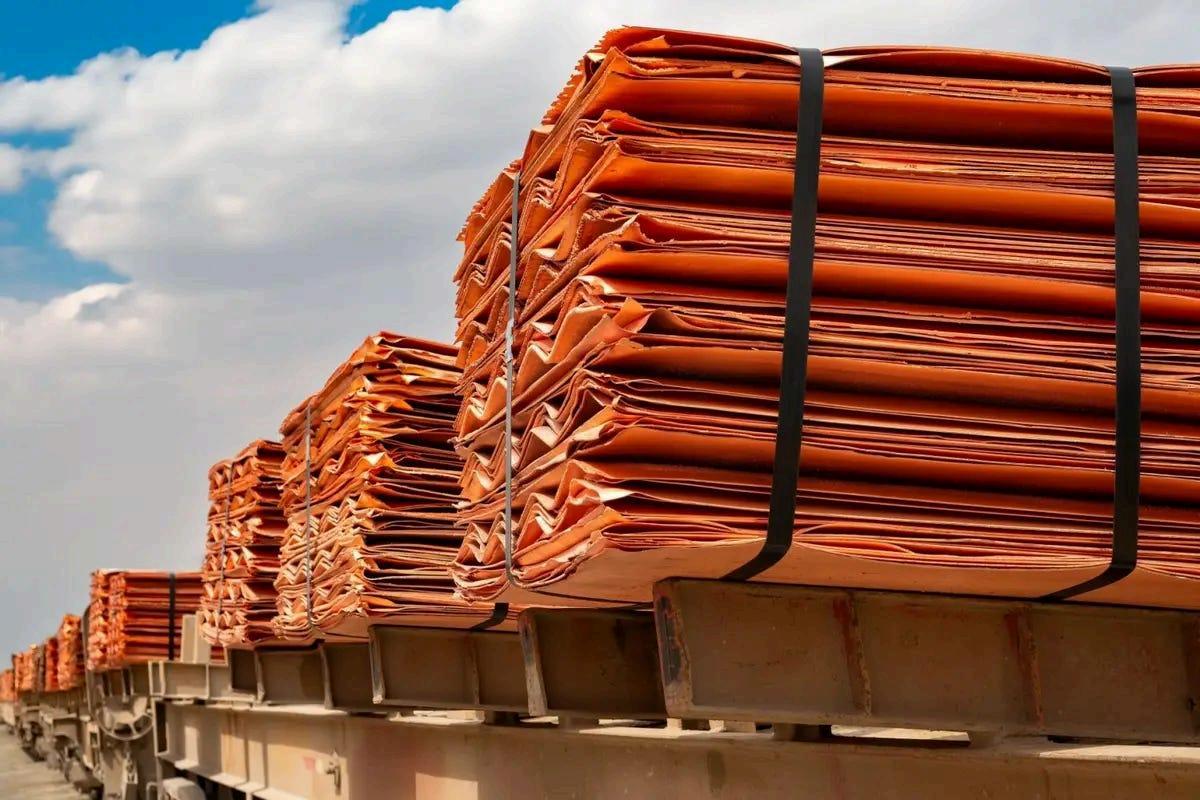
“You can’t build electric cars and windmills and solar and have a modern military without these metals. So, there’s a reason why underwater power cables are so expensive. That’s what it looks like when you put up a windmill offshore Nantucket Island and you want to bring that electricity and be green. It’s all copper, copper, copper, copper, copper. Copper right now, we’re expecting that to be a $270 billion a year market by tomorrow morning. And where’s this metal going to come from? There’s no copper inventory at all.”
“How much copper are we using? We’re consuming 30 million tonnes of copper a year, only 4 million tonnes of which is recycled. That means to maintain 3% GDP growth…..now listen carefully, with no electrification…this is with burning oil and gas. To maintain global 3% GDP growth, we have to mine the same amount of copper in the next 18 years as we mined in the last 10,000 years (combined). In the next 18 years, I’ve got to mine the same amount of copper as we mined the last 10,000 years…without electrification, without data centers, without solar and wind and the greening of the world economy. You people have no idea whatsoever what we’re facing. You’re dreaming.”
On copper, gold, and a ‘failing’ dollar:
“And the energy demand is beyond anything you can possibly imagine. Like, it’s just crazy. And so, we ’ re coming here from the most basic of industries telling you copper is money. You can build your house out of copper bricks. 10 years from now, you can just tear your house down and
buy a fleet of electric Lamborghinis with the profit…because the dollar is failing against copper. The dollar is failing against gold. The dollar is failing against water and food. We face a hyperinflationary era here.”
On solar energy and grid-scale energy storage:
“Solar doesn't work for a mine because the sun only shines five hours a day. Solar is useless unless you have grid-scale storage.”
“As you balkanize what was formerly a just-in-time world economy to a just-in-case world economy, some of these raw materials are going to be of nearly infinite value.”
On AI & drones:
“All this stuff about AI, everything you ' re hearing, it’s a fantasy because we don't have the energy.”
“We failed to regulate AI, it’s out there…..even Indonesia or Turkey can make a great drone. If a million drones are coming at you, if you can't find a way to shoot them down, some of them are going to get through and you die.”
On rare earth metals and escalating competition for raw materials supply chains:
“First of all, rare earths aren’t rare and they’re not earths, they’re relatively common metals. But we lack the processing capability required for most of these metals, and we are entirely dependent on China for most of them.”
“We are going to see a continuing escalating competition for these supply chain issues until we find a way to live with each other. At the moment, the competition continues to intensify and it’s likely to continue to intensify. You will see this in the form of higher and higher raw materials prices when expressed in the United States Dollar.”
Ten key bullet points summarizing Friedland’s presentation:
● Critical minerals are foundational to the energy transition demand for copper, nickel, lithium, rare earths, and others is growing exponentially as technologies like EVs, batteries, wind, and solar scale.
● Current global supply is insufficient prospects for shortages of key metals are serious unless mining and processing capacity expands rapidly.
● Geopolitical dynamics are reshaping supply chains nations are now focused on securing critical materials domestically or with trusted partners instead of relying on integrated global supply chains.
● Copper is central to decarbonization Friedland often calls copper the “king” metal of electrification, essential for grids, EVs, and renewable deployment.
● Innovation in mining technology is essential because traditional mining methods are too slow and too energy-intensive,
he highlights high-pulse electrical power and advanced exploration tech to discover and unlock deposits more efficiently.
● Mining must become greener and more energy-efficient Robert consistently stresses that mining’s carbon footprint needs radical reduction to align with broader energy goals.
● Strategic partnerships with governments and industry matter building trusted, secure critical minerals supply requires collaboration between private companies and national strategic initiatives.
● Capital intensity and long timelines are a reality developing mines and processing infrastructure often takes many years and significant investment, you can’t turn on metal supply overnight, or even over several years.
● New technologies could dramatically reshape production beyond exploration, disruptive tech could change comminution, refining, and even processing light metals and rare earths.
● The broader energy transition depends on breakthrough innovation Friedland often frames critical minerals not just as raw inputs, but as part of a systemic reinvention of how mining feeds into clean energy and industrial strategy globally.
DISCLAIMER: The work included in this article is based on current events, technical charts, company news releases, corporate presentations and the author’s opinions.