





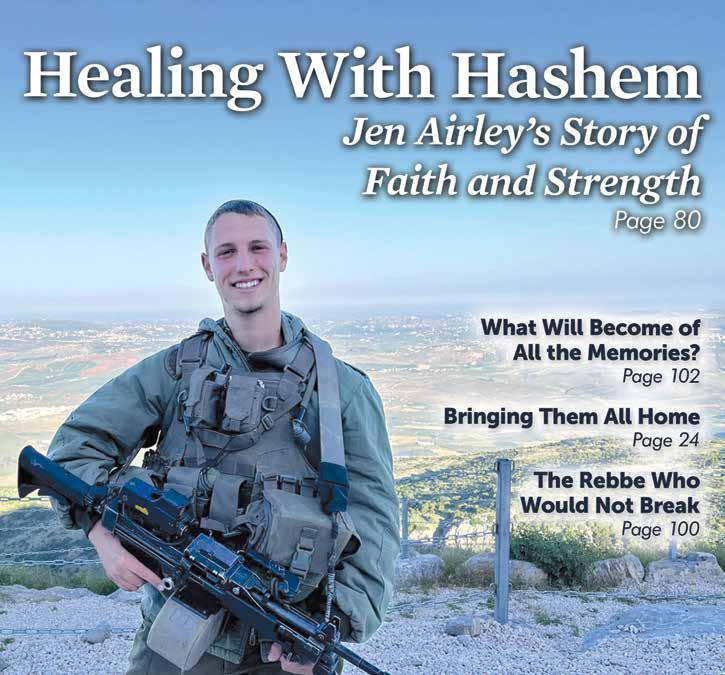

Siach Yitzchok







You know that to-do list that you tuck in the back of your mind for a rainy day?
It’s those little things that have to get done, but you manage to push to the bottom of your list because they’re not as pressing as the daily tasks that need to be completed. Maybe you need to clean out your toy closet or organize your bookshelves or weed through some old papers that should probably all be shredded...
When I heard that we were expecting a big storm, I did what everyone else did – made sure we were stocked up in the house with all things that we tend to run out of. Things like paper towels and tissues and even flour and sugar because snow days usually mean lots of cooking and baking, especially when you have kids at home.
With the house stocked, I anticipated spending time checking off some of those todo tasks. I figured that I don’t need to wait for a rainy day to get them done – a snow day is just as good! But it turns out that snow days are really good days to enjoy the snow. That meant looking outside and marveling at the fast and furious speed with which the flakes were falling. And they were falling really fast and really furious. Add in some sleet, and we had one major storm. Sitting on the couch, taking in the quiet calm of the world blanketed in white, knowing there’s no school or pressing obligations, was cozy and snug.
But the next day the calm was gone. The kids wanted to get out of the house. The snow had to be shoveled. And the world began waking up to the reality that snow is beautiful and tranquil when it falls but then becomes black with soot and hangs around in ginormous, immoveable mountains that make driving difficult and parking impossible.
In that shift from wonder to work, it struck me how quickly moments pass if we don’t stop to notice them. The storm didn’t last long, but the pause it created did something important. It forced us to slow down, to sit still, to put aside productivity and simply be. The to-do list waited patiently, exactly where it always is, while something far more valuable took its place for a few hours: time.
And maybe that’s the quiet lesson of a snow day. Life will always pile back up — just like the snowbanks along the curb — but every so often, we’re given permission to step out of the rush and into the moment. To trade accomplishment for presence. To let the chores wait while we breathe in the stillness.
The lists will be completed – eventually. The snow will melt. But the calm we allow ourselves to feel, even briefly, is what carries us forward when the world starts moving again.
Wishing you a wonderful week, Shoshana

Yitzy Halpern, PUBLISHER publisher@fivetownsjewishhome.com
Yosef Feinerman, MANAGING EDITOR ads@fivetownsjewishhome.com
Shoshana Soroka, EDITOR editor@fivetownsjewishhome.com
Nate Davis Editorial Assistant
Nechama Wein Copy Editor
Rachel Bergida Shana Brecher
Lani White Design & Production
Gabe Solomon Distribution & Logistics
P.O. BOX 266
Lawrence, NY 11559
Phone | 516-734-0858 Fax | 516-734-0857
Classified Deadline: Monday 5:00PM classifieds@fivetownsjewishhome.com text 443-929-4003
PAYMENT VIA CREDIT CARD MUST BE SUBMITTED ALONG WITH CLASSIFIED ADS
The Jewish Home is an independent weekly magazine. Opinions expressed by writers are not necessarily the opinions of the publisher or editor. The Jewish Home is not responsible for typographical errors, or for the kashrus of any product or business advertised within. The Jewish Home contains words of Torah. Please treat accordingly.








Dear Editor,
Why was I one of the first ones out there to wear hostage pins? Why was I, unfortunately, the only one in my shul, and much more, my family, to wear one, each and every single time I wore a suit, without fail?
Why was I the only one attending hostage rallies and events at the Israel Chessed Center? Why did I hear former hostages speak?
It’s because of one reason: I don’t just love Israel. It is literally a huge part of me. Israel is my life.
It started when my closest cousins made aliyah. My attachment grew significantly when I became very close friends with born and bred Israelis, who, to this day, remain one of the few friends I have. Truth be told, I have more close family, and moreover, friends in Israel than in the tri-state.
So when such tragedy struck on October 7, when I heard about Hamas firing rockets into Israel from Gaza, I was extremely worried about the closest, caring friends in my life.
Wearing a hostage pin was a major way how I stood in solidarity with them and innocent Israelis. I was truly heartbroken.
When Ambassador Huckabee took off his hostage pin upon the return of Ron Givili’s body, I was flabbergasted when he said that he would throw it out.
My strong message to him: “ABSOLUTELY NOT!”
That hostage pin, for me, as should be for everyone else, should be stored safely in a drawer, as it has united Jews worldwide like never before. It was not just that October 7 was a day when people were
murdered. Israelis became hostages, mothers became slaves, kids became prisoners. Hamas did sickening acts. They’re the ones who should be in the garbage, burned to ashes.
The pin is one for the history books, similar to how the yellow star is in Holocaust museums.
May nobody ever have to experience this ever again.
A Reader
As the Iranian regime teeters, we should be planning for the day after the regime falls, or the Jews flee. They have grown tremendously in religion in recent years. It would be a shame if they lost it in the turmoil. We should be thinking of ways to assist them in Iran or elsewhere, as the case may be.
Sincerely,
Hoping for the Yeshua
The Midrash says that any talmid chacham that has no “deah,” knowledge, in how to act properly is worse than a “neveilah,” a carcass that wasn’t slaughtered properly. That’s because there’s a certain level of character expected of one who studies Torah. Rav Aharon Soloveitchik, zt”l, adds a stunning point to explain just how low a level such a person becomes. He notes that if needed, a sefer Torah can be written on the hides of a neveilah, yet this talmid chacham is even lower than that.
Pirkei Avot uses the word “deot” to also refer to anger. For everyone, exhibiting anger, according to Chazal, is equivalent to worshipping avodah zarah. One Continued on page 16


who has no control over his anger is out of the hands of G-d with no sense that the happenings around him are messages for him to improve, not lash out.
If one had to pick one person who was the antithesis of anger, it would have been Rav Moshe Hauer, zt”l. He was a man of total sweetness, firm in serving G-d with the right balance but welcoming to everyone with his warm demeanor. Yet, on his desk lies the sefer Erech Apayim, a book on the ways to overcome anger. This gives one an inkling of how powerful the urge of anger must be, if one who showed no signs of it still studied this topic thoroughly.
The gematria of the word kaas equals the word kam, to rise. Anger rises exponentially once tapped into. Being prepared for the notion that every situation has the potential to end up in anger certainly helps, as well as taking in a demeanor that a release of anger is usually a reflection of one’s own shortcomings, not others.
Steven Genack
Dear Editor,
Thanks for your response to my question on Navidaters. I’d like to provide my thoughts on what everyone wrote as I’m Ari*, the author.
The first thing is, there can be better, more appropriate responses than “he’s not for me.” I emphasized this to the shadchan on a more recent date, and the excuse was that she didn’t feel our personalities matched up. I’ll for sure take that any day rather than “he’s not for me”!
Secondly, I sensed a contradiction between polite behavior and the guy doing
everything. I recently spoke with a few mentors about when I was taken advantage of. One in particular suggested a good recommendation: before going out, explain to her the budget for the date and how far we’re willing to drive out. Anyone who doesn’t understand that is a rude, petty person.
One mentor, who is now a proud grandfather, even had the opposite gender – yes, even a GIRL – offer to pay for something. He emphasized that today’s generation sadly lacks proper middos and consideration.
Generosity does indeed go both ways; it is a two-way street. Not that one person should do all the work and be taken advantage of. In my family, I’m proud to say we help, laugh, play, and most importantly, look after each other. My mom would never ask my dad to do something too difficult for him and even tells him to get enough sleep. I’m glad my family taught me this from a very young age.
So girls should indeed take part.
To the one who suggested meeting halfway:
To be extremely honest, the more pleasant dates I’ve had were those accepting this, accommodating my schedule, than those demanding that I always go to their place. I have extremely limited time off from work, and I should avoid taking off, let alone even changing my schedule. While I try to accommodate hers to the best of my ability, I ask for the same.
Why are considerate girls like finding a needle in a haystack? We, for sure, need more like those generous, pleasant ones I went out with. And there’s no excuse to give a vague or inappropriate response.
Ari*



Gen. Zhang Youxia, a longtime close ally of Chinese leader Xi Jinping and China’s top general, has been accused of corruption and espionage.
An investigation into Zhang was announced on Saturday morning in a vague announcement by China’s Ministry of National Defense.
People familiar with the matter have reported that the investigation concerns allegations that Zhang, among many crimes, leaked important technical information about China’s nuclear weapons to the United States; worked to undermine the Communist Party’s unity by building other networks of influence; and abused his authority in the Central Military Commission, the party’s top military decision-making body. He also allegedly accepted bribes in exchange for promotions.
Both Zhang and Xi are “pricelings,” or descendants of important elders or party officials. The fathers of both men fought together during the Chinese civil war, later rising to top positions. The 75-year-old general was initially expected to retire in 2022, but Xi kept him on the Central Military Commission (CMC), the Chinese military’s top leadership body, for a third term.
Zhang allegedly promoted former Defense Minister Li Shangfu in exchange for a significant bribe.
Experts say the investigation constitutes a major escalation in Xi’s crusade against corruption, though many suspect that the Chinese leader’s crackdown is politically motivated.
The military was one of the main targets of a broad corruption crackdown ordered by Xi after coming to power in 2012. The purges reached its elite Rocket Force, which oversees nuclear weapons
as well as conventional missiles, in 2023. Two former defense ministers were also purged from the ruling Communist Party in recent years for corruption.
Another senior member, Liu Zhenli, chief of staff of the CMC’s Joint Staff Department, was also placed under investigation, effectively shrinking the seven-member body into two, with Xi at the top.
“Xi has eviscerated the People’s Liberation Army (PLA) top brass like no leader before him,” noted Neil Thomas, a fellow at the Asia Society.
In a front-page editorial on Sunday, the PLA Daily described the probe as a major achievement, adding that the two generals had “seriously undermined and violated” the Chairman Responsibility System.
Under the system, Xi, as the CMC chairman, is vested with the “supreme military decision-making.” It also serves as the “institutional arrangement for practicing the party’s absolute leadership over the army,” according to China’s government.

On Sunday, at least eleven people were killed and a dozen more were injured when gunmen opened fire on people who had gathered at a football game in Salamanca, Mexico.
The gunmen arrived in multiple vehicles and shot at those who were at the game. Many families had stayed behind to socialize after a match between local clubs. At least one woman and one child were among those killed.
The motive behind the shooting is not yet clear. Guanajuato, the state in which Salamanca is located, registered the highest number of murders in all of Mexico last year.
Neighbors reported hearing at least 100 shots ring out as the gunmen opened fire at the Cabañas pitch in the Loma de Flores neighborhood.
The shooting came just a day after several violent incidents in the city, in which a total of five men were killed and another person was abducted.

20 Guanajuato has seen a spike in violence committed by a number of gangs that engage in the theft of oil and fuel, as well as other criminal activities such as drug trafficking and extortion. Gang members frequently hold up tanker trucks carrying oil and tap oil pipelines belonging to state-run oil company Pemex. Salamanca, which is home to a major Pemex refinery, has been particularly subject to violent gang-related attacks.
Analysts say that the rivalry between the Jalisco New Generation Cartel (CJNG) and the Cartel de Santa Rosa de Lima (CSRL) is behind many of the most brutal incidents.
The gang’s criminal activities are not confined to Mexico, with both the smuggling of stolen fuel and illicit drugs spreading violence into the United States. The U.S. State Department has designated the CJNG as a Foreign Terrorist Organization and, more recently, placed sanctions on the CSRL.

As New York deals with storms and frigid temperatures, people in Australia are sweltering in the heat. Some parts of the continent were dealing with record temperatures of close to 50 degrees Celsius (122 degrees Fahrenheit) on Tuesday as the country sweated through a prolonged heat wave.
The rural towns of Hopetoun and Walpeup in Victoria state registered preliminary highs of 48.9 C (120 F), which would top records set on the day in 2009 when 173 people were killed in the state’s devastating Black Saturday bushfires.
Three forest fires burned out of control in Victoria on Tuesday.
Melbourne, the state’s largest city, also came close to its hottest day. In Melbourne Park, few people came to view the Australian Open tennis tournament as temperatures soared. Inside, organizers enacted extreme heat protocols, forcing closure of the retractable roofs over the main arenas and postponement of matches on the uncovered outer courts. During Tuesday’s quarterfinal between
Aryna Sabalenka and Iva Jovic — the last match played under scorching sun — the players held ice packs to their heads and portable fans to their faces during breaks in play.
Photographers shooting the match were supplied with cushions by organizers to avoid heat-related injuries when they sat down and covered their cameras with towels to prevent the devices malfunctioning in the heat or burning their hands. Fans lined up to stand in front of giant misting fans or sought shelter in air-conditioned areas of the venue.
Temperatures were expected to drop Wednesday, although the heat wave was due to linger until the weekend. The heat wave followed another earlier this month amid one of Australia’s hottest ever summers
On Monday, parts of New South Wales and South Australia states hit record temperatures, some exceeding records set during a destructive summer of forest fires in 2019.
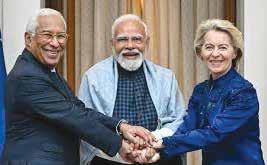
finalized a long pending landmark trade deal.
After nearly two decades of on-off negotiations, the agreement will pave the way for India to open up its vast and guarded market to free trade with the 27-nation EU, its biggest trading partner.
“Yesterday, a big agreement was signed between the European Union and India,” Modi said. “People around the world are calling this the mother of all deals. This agreement will bring major opportunities for the 1.4 billion people of India and the millions of people in Europe.”
Trade between India and the EU stood at $136.5 billion in the fiscal year through March 2025.
The formal signing of the India-EU deal would take place after legal vetting expected to last five to six months, an Indian government official aware of the matter has said. The deal is expected to be implemented within the year.
The agreement comes days after the EU signed a pivotal pact with the South American bloc Mercosur, following deals last year with Indonesia, Mexico and Switzerland. During the same period, New Delhi finalized pacts with Britain, New Zealand and Oman.
The spate of deals underscores global efforts to hedge against trade with the United States. An India-U.S. trade deal collapsed last year after a breakdown in communications between their two governments.
Talks between India and the EU were relaunched in 2022 after a nine-year lull and gathered momentum after President Donald Trump put tariffs on several trading partners, including a 50% tariff on goods from India.
For India, the tariff cuts with the EU will lead to more exports in labor intensive sectors that will help partly offset the impact of U.S. tariffs, said Ajay Srivastava. The deal will also give an immediate price advantage for EU products in India because of some relief from its high tariffs.

Early Monday, a ferry carrying more than 350 people sank near an island in the southern Philippines. Rescuers frantically raced to save the passengers and were able to bring at least 316 people to safety.
They managed to retrieve at least 18 bodies.
The M/V Trisha Kerstin 3, an inter-island cargo and passenger ferry, was sailing to southern Jolo island in Sulu province from the port city of Zamboanga with 332 passengers and 27 crew members when it apparently encountered technical problems and sank after midnight, coast guard officials said.
The ferry sank in good weather about a nautical mile (nearly 2 kilometers) from the island village of Baluk-baluk in Basilan province, where many of the survivors were initially taken, coast guard commander Romel Dua said.
“There was a coast guard safety officer
on board, and he was the first to call and alert us to deploy rescue vessels,” Dua said, adding that the safety officer survived.
Coast guard and navy ships, along with a surveillance plane, an air force Black Hawk helicopter and fleets of fishing boats were carrying out search and rescue operations off Basilan, Dua said.
The ferry had been cleared by the coast guard before it left the Zamboanga port, and there was no sign of overloading.
Sea accidents are common in the Philippine archipelago because of frequent storms, badly maintained vessels, overcrowding and spotty enforcement of safety regulations, especially in remote provinces. In December 1987, the ferry Dona Paz sank after colliding with a fuel tanker in the central Philippines, killing more than 4,300 people in the world’s worst peacetime maritime disaster.

Heavy rains over the weekend triggered a deadly landslide in Indonesia’s West Java province in which at least 17 people were killed, with dozens missing.
The landslide that hit a residential area in the Bandung Barat region early on Saturday was triggered by heavy rains starting the day before, which the weather agency warned could continue in the province and several other regions for another week.
The impacted Pasir Langu village is located in a hilly area of the province about 60 miles southeast of Indonesia’s capital, Jakarta. More than 30 houses were buried by the landslide.
At least 17 people died, agency spokesperson Abdul Muhari said, with 73 people still missing by Monday.
Indonesia’s navy chief Muhammad Ali said on Monday that 23 navy officers were among those trapped. The officers were involved in border patrol training at the time of the landslide, he said, adding that heavy equipment was not able to reach the disaster zone due to bad weather.
Flash floods hit several parts of Indonesia last week, including West Java and


Jakarta, forcing residents to flee their homes and evacuate to higher ground.
The landslide occurred two months after cyclone-induced floods and landslides on the island of Sumatra killed 1,200 people, destroyed homes and displaced over a million residents.
Last week, Mexican authorities arrested “El Botox,” an organized crime figure who has been connected to the killing of an outspoken leader of the state of Michoacan’s lime growers.
César Alejandro Sepúlveda Arellano – also known as El Botox – is the leader of a group known as the White Trojans or Blancos de Troya. The group is known to
blow against extortion” in the state, which is Mexico’s largest producer of limes and avocados.
In October, the body of Bravo, president of the Apatzingan Valley Citrus Producers Association, was found in his vehicle on a road in the area. Bravo had denounced “organized crime’s permanent commercial hijacking of any commercial activity.”

Two weeks after his killing, a gunman killed popular Uruapan Mayor Carlos Alberto Manzo, another outspoken critic of the cartels’ control of Michoacan. The two homicides and the popular outcry that followed spurred the administration of Mexican President Claudia Sheinbaum to send more troops to Michoacan.

This week, the British government said that it will unveil plans to create a new national police force, dubbed the “British FBI,” to take charge on complex investigations such as counterterrorism, fraud, online child abuse and criminal gangs.
work with Los Viagras, a criminal organization allied with the Jalisco New Generation Cartel. The crime figure is supposedly behind the killing of agricultural leader Bernardo Bravo.
There had been 11 arrest orders for El Botox for extortion and homicide. He has also been accused of attacking authorities with explosives.
Michoacan Gov. Alfredo Ramírez Bedolla said in a statement that his arrest Thursday represented “an overwhelming
The National Police Service will bring under the same umbrella the work of existing agencies dealing with terrorism and crime, police helicopters and policing of the roads, and regional organized crime units in England and Wales.
Home Secretary Shabana Mahmood said the new body will lift the burden on the 43 local police forces in England and Wales, helping them focus solely on dayto-day crimes within their jurisdictions.
“Some local forces lack the skills or resources they need to fight complex modern crime such as fraud, online child abuse or organized criminal gangs,” she said.

Mahmood said the current model was “built for a different century” and that the new body will attract “world-class talent” as well as helping to keep a lid on costs by moving procurement to one national force.
It is expected that the number of police forces in England and Wales will be decreased and that there will be changes to how police officers are recruited and managed.

Thousands of people visit Nepal each year, many of them climbing the towering Himalayas and enjoying the picturesque villages. But some people require rescuing via helicopter, which is a critical part of the tourism industry. This week, six
people were arrested after it was revealed that they had been part of a scam of fake helicopter rescues of people who they said had been stranded.
The insurance scam amounted to around $19.69 million.
Police said they uncovered evidence of multiple insurance claims filed for a single rescue operation, chartered flights falsely presented as emergency evacuations, and fabricated medical bills issued with the involvement of private hospitals.
The arrests follow a two-and-a-halfmonth investigation by the Central Investigation Bureau that revealed a trail of forged and manipulated documents.
Three companies had claimed insurance payouts of approximately $19.69 million, according to a police statement.
“This has been a long-standing issue and we have been investigating,” Shiva Kumar Shrestha, the bureau’s spokesman, said.
A 2018 government probe identified 15 companies – including helicopter firms, trekking agencies and hospitals – linked to the lucrative racket. But no action had been taken against any of the alleged perpetrators.


Prime Minister Mette Frederiksen of Denmark arrived in Greenland on Friday for an unannounced visit, as the crisis over Greenland’s future and the alarm over American designs on it seemed to ease but not end.
Frederiksen landed around midday and met privately for about an hour with Prime Minister Jens-Frederik Nielsen of Greenland, a semiautonomous island that has been part of the Danish kingdom for 300 years. The two visited the waterfront of Nuuk, Greenland’s capital, went to a kindergarten, and met with other Greenlandic officials before a short evening walk through the city.
The trip came amid continued pressure from President Donald Trump, who has said the United States needs Greenland for national security, and it appeared to have been meant as reassurance to the 57,000 people who live in Greenland.
“I am first and foremost in Greenland today to show Denmark’s strong support for the Greenlandic people,” Frederiksen told reporters.
Greenlanders have bristled at Trump’s designs on their homeland since he floated the idea of buying it from Denmark during his first term, and they have been adamant that they do not want to be part of the United States.
Frederiksen described the visit as a working meeting and stressed the need for close coordination between Copenhagen and Nuuk. This week has been a blur of political developments for Greenland. Trump sharpened his threats to take the island, threatening tariffs against European countries that opposed him, and then on Wednesday suddenly changing course and saying he was working out a compromise with NATO officials.
Before flying to Greenland on Friday, Frederiksen met with Mark Rutte, NATO’s secretary-general, in Brussels. Trump suggested Wednesday that a conversation with Rutte had produced a breakthrough on Greenland, a claim that Danish officials disputed. (© The New York Times)
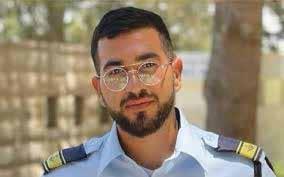
The Israeli army recovered the body of the final remaining Israeli hostage in Gaza, St.-Sgt.-Maj. Ran Gvili, from the alBatesh Cemetery at approximately 2:00 p.m. on Monday. With his return, every hostage kidnapped on October 7 is now home.
According to the Shin Bet, intelligence from an interrogated Palestinian Islamic Jihad terrorist led Israeli officials to Gvili’s remains in a cemetery in the Shejaia–Daraj–Tuffah area of northern Gaza, on the Israeli side of the Yellow Line. Prior to identifying Gvili, the IDF examined the remains of approximately 250 Palestinians. Over 24 hours, the army and 20 dentists worked to identify teeth from exhumed remains.
Hamas did not assist in locating Gvili, though the terror group and Qatari mediators indicated the intelligence may have been accurate.
The IDF suspects Palestinian Islamic Jihad may have buried Gvili, misidentifying his body as that of another terrorist or Palestinian.
The L. Greenberg Institute of Forensic Medicine at Abu Kabir, rabbinic advisers, the police, and the IDF later confirmed Gvili’s identity, after which his family was immediately notified.
Talik, Gvili’s mother, said her son was the “first to go and fight in defense of the Gaza border communities, and the last to be returned—our hero!”
Gvili was held in Gaza for 843 days.
“I embrace Talik, Itzik, and the entire noble Gvili family. I looked them in the eyes and said, ‘We will bring Ran home.’ I promise you, citizens of Israel: We will bring them all home,” Prime Minister Benjamin Netanyahu said. “We all wore the pin, and now that the mission is complete, the time has come to remove it.”
In a video marking the final hostage’s



return, President Isaac Herzog removed his yellow hostage pin.
Gvili’s return was widely celebrated across Israel.
Gvili was killed during the Hamas-led October 7 massacre, after which terrorists stole his body and brought it to the Gaza Strip.
fire a short while later, according to the initial investigation.
According to the IDF’s tally, the death of Asael raises the total of combat fighters killed on or since October 7, 2023, to 924. Around 471 soldiers and reservists have been killed since the start of the military’s ground operations in the Strip on October 27.

Asael is survived by his wife, Hagit, and five children, Tamar, Shaï, Ayala, Gilad, and Noga.
In response to the attack in October, the first deadly incident for the IDF since the start of the ceasefire, the Israeli Air Force launched a wave of strikes against Hamas targets, including a tunnel system previously used by the terror group to hold hostages. The Hamas-run Gaza Civil Defense agency said that the strikes killed at least 21 people across the territory.

On Thursday, Israel, for the first time in history, qualified a bobsleigh team for the Winter Olympics.
Sgt. Maj. (res.) Asael Babad, 38, was an infantryman with the Menashe Regional Brigade’s 941st Battalion, from the city of Bnei Adam. He was seriously injured when Palestinian terrorists attacked soldiers in Rafah on October 19 , 2025, less than a week into a ceasefire between Israel and Hamas. Asael was serving with the
Gaza Division as a heavy machinery operator. Last week, Asael succumbed to his injuries.
According to the IDF, the group of gunmen emerged from a tunnel on the Israeli side of the ceasefire line and fired RPGs at an army excavator, killing two troops of the Nahal Brigade. At the same time, another excavator was hit by sniper fire, wounding two more troops, one seriously and one moderately. Another soldier was moderately wounded by sniper
The team, composed of four athletes and led by pilot AJ Edelman, has been working toward this goal for eight years. In a few weeks, they will arrive at the 2026 Milano Cortina Games. The team includes Edelman, Menachem Chen, Ward Fawarseh, and Omer Katz, with Uri Zisman serving as an alternate.
The Olympic Committee in Israel called the achievement “historic.”
An American-Israeli athlete, Edelman previously represented Israel in men’s skeleton at the 2018 Beijing Olympics.
“Dreams do come true. For this dream, that day is today,” Edelman posted on Instagram, thanking supporters for helping him along the way. “The Israeli


Bobsled Team is now ‘The Israeli Olympic Bobsled Team.’ We are headed to Milan.”
At the upcoming Olympic Games, nine Israeli athletes are expected to compete, including skeleton athlete Jared Firestone; alpine skiing siblings Noa and Banabos Szollos; cross-country skier Attila Mihaly Kertesz; and figure skater Mariia Seniuk.
This year, Israel qualified following a reallocation.
“[T]his has been a 24-year journey
for me—from when we established the first bobsled team in 2002,” said David Greaves, president of the Israeli Olympic Bobsleigh Skeleton Federation.
“That’s a huge sense of pride,” he said.
“To know that we’re contributing in a significant way to the delegation at these Olympic Games is very, very exciting.”
He added that the team is “just so excited to be packing our bags and, once again, standing behind the Israeli flag.”
“At the Olympic Games, with all eyes
group of countries on Thursday in Davos at the president’s Board of Peace signing ceremony. In his speech, Kushner presented an ambitious Gaza reconstruction plan.
“If Hamas does not demilitarize, that will be what holds back Gaza and the people of Gaza from achieving their aspiration,” he declared.
At the end of his speech, he asked opponents of Israel and “Israelis criticizing Turkey or Qatar”—two anti-Israel, terror-supporting board members whose presence has sparked Israeli condemnation—to “just calm down for 30 days.”

“Our goal here is peace between Israel and the Palestinian people. Everyone wants to live peacefully. Everyone wants to live with dignity,” Kushner said, emphasizing that the plan requires cooperation from both Israel and Muslim nations.
Kushner presented the Gaza reconstruction “master plan” as one aimed at “catastrophic success.” He showed a slide depicting a rebuilt Gaza, with tall apartment buildings lining the Strip.
“In the Middle East, they build cities like this—you know, for two or three million people—they build this in three years,” Kushner said. “So stuff like this is very doable if we make it happen.”
The plan, which would begin in Rafah and extend to Gaza City, would also include a seaport and an airport. “[T]here is no plan B,” Kushner said, adding that the U.S. aims to bring “free market” economics to Gaza.
Kushner appealed to countries and business leaders to invest in Gaza’s reconstruction. To rebuild destroyed infrastructure and public services, the board hopes to raise $25 billion in investments.
from around the world, to see the Israeli flag flying at the bobsled and skeleton track is something that will be forever meaningful to all of us.”
President Donald Trump’s advisor and son-in-law Jared Kushner addressed a
He added that Gaza’s GDP could reach $10 billion within 10 years of reconstruction, with annual household income rising to $13,000 due to “100 percent full employment and opportunity for everybody there.”
“It could be a hope. It could be a destination, have a lot of industry, and really be a place where people can thrive,” he said. “It all starts with security, and it all starts with governance.”
Kushner stressed the need for Hamas’ demilitarization. His presentation noted that disarmed terrorists would be “rewarded with amnesty and reintegration,

30 or safe passage,” while others, once vetted, could be allowed entry into the National Committee for the Administration of Gaza (NCAG), a 12-member panel of independent Palestinian technocrats.

On Thursday, U.S. President Donald Trump held a signing ceremony for his Board of Peace, an international body aimed at ensuring peace in Gaza. The event was held in Davos, Switzerland, during the World Economic Forum.
“This isn’t the United States—this is the world,” Trump said of the board. “I think we can spread it out to other things as we succeed in Gaza.”
During the event, a video message from Ali Shaath, chief commissioner of
the 12-member National Committee for the Administration of Gaza (NCAG), was played. Shaath said, “This transition will succeed only if it delivers real, tangible improvements in daily life for Gazans.”
Shaath also announced the reopening of the Rafah Crossing the following week, a move Israel approved after recovering the remains of the final hostage, Ran Gvili, earlier this week.
Officials from the U.S. and 19 other countries attended the ceremony, though Trump has claimed that 59 countries have joined the board. He referred to the group as “the most powerful people in the world.”
While Trump has previously suggested the board could replace parts of—or even the entirety of—the United Nations, he said at the event that it would operate “in conjunction with the United Nations.”
Israeli Prime Minister Benjamin Netanyahu initially criticized the inclusion of Turkey and Qatar, but Israel has since agreed to join the board, although an Israeli representative did not attend the signing ceremony.
Secretary of State Marco Rubio said the board’s top priority would be ensuring peace in Gaza.
Major U.S. allies, including France and Britain, have been hesitant to join.
A senior French official said the charter “goes beyond the framework of Gaza alone” and “raises major questions, particularly regarding respect for the principles and structure of the United Nations.”
European allies also criticized Trump’s invitation of Russian President Vladimir Putin and raised concerns about Trump’s role on the board. Under the charter, Trump will serve as the U.S. representative and lifelong chairman unless replaced by unanimous vote of the Executive Board. As chairman, he holds “exclusive authority to create, modify, or dissolve subsidiary entities.”
TikTok’s Chinese owner, ByteDance, finalized a deal on Thursday to set up a majority American-owned joint venture company to avoid a U.S. ban on the popular social media app used by more than 200 million Americans.
The deal is a milestone for the short video app after years of battles that began in August 2020, when President Donald
Trump first tried to ban the app over
tional security concerns.
TikTok USDS Joint Venture LLC will secure U.S. user data, apps and the algorithm through data privacy and cybersecurity measures, the company said.

The agreement provides for American and global investors, including cloud computing giant Oracle, private equity group Silver Lake and Abu Dhabi-based MGX, to hold a stake of 80.1% in the new joint venture. ByteDance will retain 19.9%.
Dr. William Foege was one of the main people behind the eradication of smallpox. This week, the medical doctor died in Atlanta at the age of 89. Foege was the co-founder of the Task


Force for Global Health and was director of the U.S. Centers for Disease Control and Prevention in the late 1970s and early 1980s. He later held other key leadership roles in campaigns against international health problems.
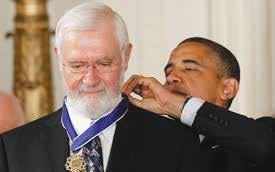
For centuries, around one-third of people who were infected with smallpox died from the disease. Others were left riddled with deep scars on their faces. Smallpox vaccination campaigns were well established by the time Foege was a young doctor. Indeed, the disease was no longer seen in the United States. But infections were still occurring elsewhere, and efforts to stamp them out were stalling.
Working as a medical missionary in Nigeria in the 1960s, Foege and his colleagues developed a “ring containment” strategy, in which a smallpox outbreak was contained by identifying each smallpox case and vaccinating everyone who the patients might come into contact with.
There wasn’t enough vaccine available for everyone at the time, so this method was necessary.
It worked and became pivotal in helping rid the world of smallpox for good. The last naturally occurring case was seen in Somalia in 1977. In 1980, the World Health Organization declared smallpox eradicated from the Earth.
“If you look at the simple metric of who has saved the most lives, he is right up there with the pantheon. Smallpox eradication has prevented hundreds of millions of deaths,” said former CDC director Dr. Tom Frieden, who consulted with Foege regularly.
In 2012, President Barack Obama presented Foege with the Medal of Freedom, the nation’s highest civilian honor. In 2016, while awarding Foege an honorary degree, Duke University President Richard Brodhead called him “the Father of Global Health.”
As the world prepares to mark International Holocaust Remembrance Day

and the 81st anniversary of the liberation of Auschwitz-Birkenau, new data released by the Conference on Jewish Material Claims Against Germany (Claims Conference) underscores both the rapidly shrinking number of Jewish Holocaust survivors and the urgent need to support them.
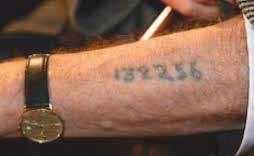
According to newly released figures, an estimated 196,600 Jewish Holocaust survivors are alive globally, residing in more than 90 countries. That number represents a sharp decline from January 2025, when approximately 220,000 survivors were believed to be living worldwide.
Half of all survivors — about 97,600 people — now reside in Israel. North America is home to 18 percent of the survivor population, including roughly 31,000 survivors in the United States alone, representing 16 percent of the global total. Another 17 percent live in Western Europe, while approximately 11 percent reside in countries of the former Soviet Union.
France has the third-largest survivor population, with an estimated 17,300 survivors, followed by the Russian Federation (14,300), Germany (10,700), Ukraine (5,200), and Canada (4,800). Smaller survivor populations are found in Hungary, Australia, Belarus, and dozens of other countries.
The data also highlights the advanced age of the survivor population. The median age is 87, with survivors ranging from age 79 to over 100. Nearly one-third of survivors are 90 years or older, and just over one percent have reached the age of 100. Nearly all — 97 percent — are classified as “child survivors,” having been born between 1928 and 1946. Women make up a clear majority at 62 percent.
In terms of financial and social support, about 34 percent of survivors — roughly 68,000 individuals — currently receive monthly pensions negotiated by the Claims Conference. The remaining survivors are eligible for one-time or annual compensation payments. In addition, approximately 71 percent of survivors have received social welfare services in the past year through more than 300 agencies funded by the Claims Conference.
An additional 67,600 survivors qualified for assistance from the organization’s
Basic Needs Fund, which provides targeted food and essential aid to the most economically vulnerable survivors.
The data serves as a critical reminder for this generation. As survivor numbers rapidly decline, the responsibility to provide care, preserve testimony, and sustain remembrance grows ever more urgent.

Ryan Wedding, 44, won the first snowboarding race he entered. At age 15, he made the Canadian National Ski Team and competed for Team Canada in snowboarding men’s parallel giant slalom in the 2002 Olympics, when he finished 24th. This week, the athlete was arrested in Mexico City and then flown to the U.S. for allegedly being a cocaine smuggling kingpin responsible for many drug-related murders.
After his stint in the Olympics, Wedding moved to Vancouver and began to become a bodybuilder and a bouncer. He grew marijuana at a 6,800-plant warehouse, which the police raided in 2006. Soon, he joined with Iranian and Russian cocaine smugglers.
On October 17, 2024, Wedding was charged by the U.S. Department of Justice with “leading a transnational organized crime group that engaged in cocaine trafficking and murder, including of innocent civilians.” He is charged with multiple felonies, including drug trafficking, leading a criminal organization, three counts of murder, and one attempt to commit murder.
He was one of sixteen people to be charged as part of Operation Giant Slalom in a joint investigation by several federal agencies. Wedding is accused of working with Mexico’s Sinaloa Cartel to transport hundreds of kilograms of cocaine from Colombia through Mexico to the U.S. and Canada. He was on the FBI’s “Top 10 Most Wanted” list and the U.S. government had offered a $15 million reward for information leading to his arrest or conviction.
If convicted of the most serious charges, Wedding could face a sentence of life in prison.


On Monday morning, tens of thousands of nurses and healthcare workers at Kaiser Permanente facilities across California and Hawaii left their positions and went on strike.
More than 31,000 workers across at least two dozen hospitals and hundreds of clinics run by the non-profit health care system walked off the job at 7 a.m. PT, marking the largest strike of health care professionals so far this year.
The striking workers, who are members of the United Nurses Associations of California/Union of Health Care Professionals (UNAC/UHCP), said they are fighting for safe staffing levels and fair wages and compensation.
“Kaiser’s own communications to employees reveal exactly why we are striking,” Charmaine Morales, president of UNAC/UHCP, said in a statement. “Instead of addressing unsafe staffing and patient care concerns, Kaiser is issuing messages that pressure workers not to strike, exaggerate the risks of participation, and encourage employees to report one another. That is intimidation.”
Both sides have been in negotiations since May but are currently in a stalemate. The union filed an unfair labor practice charge with the National Labor Relations Board, accusing Kaiser of walking away from the bargaining table in December.
“Kaiser isn’t strapped for resources. It’s making choices – and those choices are hurting people. It’s time for accountability,” Morales said in a statement at the time.
In a statement, Kaiser referred to the strike as “unnecessary when such a generous offer is on the table” and said the strike has occurred despite a recent agreement to return to local bargaining.
“Despite the union’s claims, this strike is about wages,” a statement from Kaiser says. “The strike is designed to disrupt the lives of our patients – the very people we are all here to serve.”
This is not the first time Kaiser workers have gone on strike. In October, thousands of workers participated in a five-day strike across California and Hawaii to demand safer staffing and fair compensation.
Kaiser’s strike comes amid the largest nursing strike in New York City history with nearly 15,000 nurses walking off the job at five hospitals across the city. The strike, which began two weeks ago, has shown some signs of progress with the New York State Nurses Association – the union representing the workers –saying at least two hospitals have agreed on maintaining health benefits for nurses. Nurses say that they will continue to strike until tentative contract agreements are reached.

They were more interested in joy rides than test drives.
Investigators say that a pair posing as potential customers visited dealerships in Connecticut for more than a year beginning in 2024, where they sought high-end models, such as a GMC Sierra 2500HD Denali Ultimate pickup truck.
Once they zeroed in on the vehicle they wanted, an unidentified male suspect would ask a sales staff member if he could start the vehicle. In some cases, the man swapped the key fob for an inoperable dummy one while a female suspect distracted a member of the sales staff.
In other cases, she would — in about one minute — make a copy of the key fob.
In each case, the targeted vehicle’s key fob was swapped, or cloned, and the same vehicle was later stolen or an attempt was made to steal it, said Chief William Onofrio of the Old Saybrook Police Department, which led the investigation.
After learning of the cases in Connecticut, about a dozen police departments in New Jersey and New York reported nearly identical thefts, Onofrio said.
He said evidence developed by Old Saybrook detectives directly helped in arrests in those states, after detectives elsewhere identified a consistent pattern.
Investigators identified at least 20 vehicles with a combined value of more than $2.4 million that were stolen or targeted by this group across the three states.
The police in Old Saybrook have not identified the male suspect. But the au-
thorities in Connecticut charged Tiffine Kyte, 37, of Johnstown, Pennsylvania, with larceny and conspiracy charges related to the thefts. She was arrested in Warren County, New Jersey, and brought to Connecticut on Jan. 15. She posted a $275,000 bond after she was arraigned the next day in State Superior Court, according to court records. In a case in Greenwich, Connecticut, she was released after posting a $100,000 bond.
It was not clear if the stolen vehicles were recovered.
Onofrio said her arrest was a result of her visits to dealerships in Connecticut towns, including Coventry, Fairfield, Glastonbury, Greenwich, Ridgefield and Old Saybrook.
On February 5, 2025, police officers responded to Vachon Buick GMC, a dealership in Old Saybrook, after a report of two stolen vehicles. The investigation determined that the vehicles were stolen one day after Kyte had visited, the authorities said. (© The New York Times)

According to the Journal of the American Medical Association, colorectal cancer is now the leading cause of cancer-related death among Americans under the age of 50.
In a study published Thursday, the journal reported that colorectal cancer death rates for people younger than 50 have risen by approximately 1 percent annually since 2005, making it an outlier among other cancer types. Since 1990, overall cancer death rates for Americans under 50 have declined by 44 percent.
Although the majority of colorectal cancer patients are over 50, a steadily increasing number of people in their 20s, 30s, and 40s have been diagnosed with the disease in recent decades.
Colorectal cancer was once projected to become the leading cause of cancer death for those under 50 by 2030. However, the new study found that it claimed the top spot in 2023. Researchers determined it was the leading cause of death among the approximately 1.3 million peo-
ple under 50 who died of cancer between 1990 and 2023. Meanwhile, death rates for lung cancer, leukemia, breast cancer, and other cancers have been declining consistently since 2014.
Experts are still uncertain why colorectal cancer deaths are rising among younger people, though they suspect contributing factors may include obesity-related complications, decreased physical activity, changes to the gut microbiome, and unhealthy diets.
One of the study’s researchers, Rebecca Siegel, senior scientific director of surveillance research at the American Cancer Society, urged younger individuals to undergo colorectal cancer screening, especially if symptoms are present. Symptoms include blood in the stool and abdominal cramping. Screening is recommended beginning at age 45, or earlier for those at higher risk.

A jury unanimously found former school police officer Adrian Gonzales not guilty of abandoning or endangering elementary school students during the May 24, 2022, mass shooting at Robb Elementary School in Uvalde, Texas, which left 19 children and two teachers dead.
Gonzales’ two-week trial concluded last Wednesday night after seven hours of jury deliberation. Prosecutors accused Gonzales of failing to fulfill his duty as an officer by allegedly abandoning children during the attack. He faced 29 counts of child abandonment or endangerment — 19 related to the deceased children and 10 related to survivors — and pleaded not guilty to all charges.
Prosecutors alleged that Gonzales waited three minutes outside the school before responding and failed to confront the gunman. It took a tactical team approximately 77 minutes to enter the classroom and eliminate the shooter.
“If you have a duty to act, you can’t stand by while a child is in imminent danger,” special prosecutor Bill Turner told the jury.
Defense attorneys argued that Gonza-
les never saw the gunman and was among the first officers to reach what was described as a “hallway of death.” His attorney, Jason Goss, said Gonzales “put himself in great danger” during the response.
After a teacher gave conflicting testimony, the defense requested a mistrial, though state District Judge Sid Harle told the jury to simply ignore the testimony.
According to an interim report by the Texas House, 376 federal, state, and local officers responded to the incident. Gonzales assisted evacuation efforts and called for a SWAT response, despite the Uvalde police SWAT team head already being at the school.
Pete Arredondo, another officer who responded to the Uvalde shooting, will also be tried for alleged abandonment or endangering of children.

The Trump administration announced on Monday that border czar Tom Homan will travel to Minneapolis to supervise Immigration and Customs Enforcement operations in Minnesota following two recent incidents in which ICE agents killed U.S. citizens.
President Donald Trump said he spoke with Minnesota Gov. Tim Walz, calling the conversation “very good.” Walz’s office described the call as “productive,” noting requests for reduced federal presence and independent investigations into the deaths.
White House spokesperson Karoline Leavitt said Homan will manage ICE operations on the ground “to continue arresting the worst of the worst criminal illegal aliens.”
According to Trump, Homan “has not been involved in that area but knows and likes many of the people there.”
“I told Governor Walz that I would have Tom Homan call him, and that what we are looking for are any and all Criminals that they have in their possession,” Trump wrote. “The Governor, very respectfully, understood that, and I will be speaking to him in the near future.”
Less than a day before Trump’s an-

nouncement, he publicly urged Walz and Minneapolis Mayor Jacob Frey to cooperate with ICE, and requested that Congress pass legislation to end sanctuary city policies.
“The President agreed that he would talk to his Department of Homeland Security about ensuring the Minnesota Bureau of Criminal Apprehension is able to conduct an independent investigation, as would ordinarily be the case,” Walz’s office stated. “The President also agreed to
look into reducing the number of federal agents in Minnesota and working with the state in a more coordinated fashion on immigration enforcement regarding violent criminals.”
The governor, who ended his reelection campaign in January, said last week that he had been subpoenaed in connection with a federal investigation involving several Minnesota Democrats, as federal authorities intensify scrutiny of a long-running fraud case tied to his administration.
According to White House spokesperson Karoline Leavitt, Homan will also be working with officials who are investigating corrupt Somali-linked charities in Minneapolis.
On Saturday, immigration officers shot and killed Alex Pretti, a 37-year-old nurse, in Minneapolis, after Pretti interfered with law enforcement, sparking backlash. On January 7, an ICE agent killed 37-year-old U.S. citizen Renee
in Minneapolis after Good attempted to run over a law enforcement officer with her car.

Early this week, a major winter storm struck the United States from Arkansas to New England, forcing schools to move online, canceling flights, making roads impassable, causing power outages, and bringing ice and freezing temperatures to the South and East. The storm has been linked to at least 20 deaths so far.
Many areas reported more than a foot of snow, while the hardest-hit regions saw up to two feet.
On Monday morning, more than 800,000 power outages were reported by PowerOutage.us, primarily in the South.
On Sunday, parts of Minnesota experienced temperatures of minus 40 degrees Fahrenheit, while many areas in the Midwest, South, and Northeast were hit with subzero temperatures Monday morning. The Lower 48 states were expected to experience their lowest average temperature (minus 9.8°F) since January 2014.
The National Weather Service issued cold weather advisories from Montana to the Florida Panhandle. Wind chills made conditions feel even colder.
“This storm is exiting the East Coast
now, with some lingering snow squalls,” said Allison Santorelli, a meteorologist with the NWS’s Weather Prediction Center. “But the big picture story is the extreme cold. It’s lasting into early February.”
On Sunday, approximately 12,000 flights were canceled, and about 20,000 more were delayed.
According to New York City Mayor Zohran Mamdani, five or more people were found dead outdoors during the storm; their deaths remain under investigation.
Hypothermia killed two men in Caddo Parish, Louisiana, according to the state’s health department.
In Massachusetts, a snowplow struck and killed a 51-year-old woman and seriously injured her 47-year-old husband.
Tennessee reported three storm-related deaths.
In Arkansas and Texas, a 17-year-old boy and a 16-year-old girl, respectively, were killed in sledding accidents.

In January, California experienced a deadly mushroom poisoning outbreak, the state’s public health department announced, reporting three deaths, three liver transplants, and 35 hospitalizations as of January 6.
The mushrooms involved were death

cap mushrooms (Amanita phalloides). Although they closely resemble safe, edible mushrooms, these wild mushrooms contain amatoxins that can cause severe illness or death.
The California Department of Public Health cautioned residents against picking or eating wild mushrooms, advising consumers to purchase mushrooms from reputable stores. The department also noted that death cap mushrooms remain poisonous even after cooking, boiling, freezing, or drying.
The outbreak occurred across Northern California and the Central Coast between November 18 and January 6, affecting individuals ranging in age from 19 months to 67 years.
Common symptoms of amatoxin poisoning include nausea, vomiting, diarrhea, abdominal pain, and dehydration, which may occur within six to 24 hours of consumption. Amatoxins are particularly dangerous because they damage the liver.
tained responsibility,” she said. Tree-rific.
Looking for the perfect pet for your family? Animal rescue volunteers are seeking friendly homes for hundreds of rats that they rescued from a condemned house in Rocky Point, New York.
A group of about ten volunteers spent the last few weeks rounding up the domesticated white rodents at the home that had been overrun by the critters.
Frankie Floridia, president of the Strong Island Animal Rescue League, estimated the group has collected more than 450 rats already and have roughly 30 more to catch.


Truphena Muthoni loves trees. In fact, she loves trees so much that she spent her arms wrapped around the trunk of a tree for 72 consecutive hours.
The 22-year-old earned the title for the longest marathon hugging a tree when she surpassed the previous record of 50 hours, 2 minutes and 28 seconds, which was set by Frederick Boakye of Ghana.
Muthoni previously held the record when she hugged a tree for 48 hours in February 2025.
“The first attempt was a statement, a way to reintroduce humanity to the Earth through a simple, intimate act,” Muthoni said.
“The second attempt was a commitment. I realized that the world needed more than symbolism, it needed endurance, consistency, and proof that care for the planet is not momentary. Doing it twice was my way of saying that climate action is not a one-off event but a sus-
“What makes it challenging catching rats is that they’re in the walls, they’re everywhere,” Floridia explained. “This is a unique situation. We haven’t had something like this ever.”
The group has been working with a local animal hospital to nurse the rats back to health. Many are infected with mites and are suffering from eye infections, bite wounds and other ailments. Two hundred of the rats have been placed in permanent or temporary homes so far.
“A lot of people find them to be less desirable animals or pets, and kind of outcasts of the animal world,” Erica Kutzing, the rescue group’s vice president, noted. “And so, when you love the underdog and you care about the underdog, you tend to be a kinder person.”
The group is still seeking homes for more than 200 of the rats. Kutzing says they’re encouraging people to take in two or three, as rats aren’t solitary creatures.
“These rats deserve a second chance,” added Floridia. “They’re clean animals and can be friendly, like a hamster. They make wonderful pets.”
What a rat race.
If you thought doughnuts on Central Avenue around Chanukah time are a bit out of control, consider these non-kosher


confections being sold in Manhattan.
The store in Times Square is called “I’m a donut?” The Japanese bakery chain opened last spring – and has been bringing gasps of delight and astonishment to fans since then.

This month, consumers have the option of choosing a doughnut with – drumroll, please – an anchovy laid across the top. Inside is even more stomach-churning: three types of cheese – white cheddar, Gruyère, Parmigiano-Reggiano — and creamy Béchamel sauce. Can someone pass the Pepto Bismol, please?
Another supposed masterpiece is a scrambled egg tucked into a doughnut which, like others, lacks the center hole that’s key to the doughnut-noshing experience. When you bite into the crazy confection, a yellow glob oozes out.
The Japanese chain was founded by chef Ryouta Hirako in 2022. It claims to “redefine the very essence of what a doughnut can be.” For now, it’s truly changing the essence and costs a lot of cents – nine dollars for one doughnut.
New Yorkers like things that are a bit crazy, which is why there are lines around the block for the treats.
Dollars to doughnuts, nothing beats a classic kosher jelly doughnut around the menorah.
Ever feel like a failure? Surely, it’s not something you want to advertise. But sometimes, misery loves company – and other people’s failings may just cheer you up.
A new exhibit at Kingsgate Mall in Vancouver is entitled the Museum of Per-
sonal Failures. It was dreamed up by Eyvan Collins.
Collins put up posters across the region seeking exhibits with the headline: “Failures wanted.”
“For me, it’s sort of a combination catharsis/concept exploration,” Collins said. “I guess at this point, what it has become is an anthropological look at what constitutes failure to an individual and what that looks like in material form.”
The pop-up museum features a “wall of reject,” which is plastered with various submitted employment application rejections and firing notices.

Casey Vilensky, a bladesmith with Lynn Valley Forge, submitted a knife he made that turned out to be unsharpenable due to the chemical properties of his quenching oil.
“Failure is a step forward. You don’t go forward unless you fail. You have to be able to look back at your failures, figure out why they failed and change the process and move on,” Vilensky said.
The museum also features tie rods from a failed car repair, a record of “failed songs” from a local music producer, and a stamp Collins attempted to make to promote the museum.
“I got most of the way through before it occurred to me that this was going to make a backwards image,” Collins said.
He pointed out, “Looking at the actual objects, you’re like, ‘This is just a thing,’ but within the context it’s imbued with meaning. It’s interesting looking at a scrap from a person’s life and then to hear the story behind it.”
Sounds like this gallery is going to go bust.
Did you know?
In 1893, the Supreme Court ruled that tomatoes are vegetables, at least for tax purposes.





OThe event brought together community members in support of the
and its continued mission.





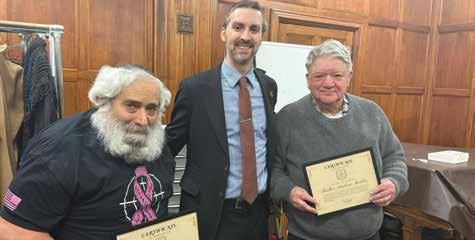

On Tuesday, January 20, the NYPD Shomrim Society held its first meeting of the year at the Edith and Carl Marks Jewish Community House in Bensonhurst, NY. Outgoing President Ben Lieutenant Gelber passed the torch to incoming President Detective Josh Zucker. The incoming board was affirmed by NYS Courts Major Craig Brooks while the incoming President was
affirmed by Deputy Chief Andrew Arias Commanding Officer of Detective Borough Brooklyn South. President Zucker presented achievement awards to Past President and retired Sgt Harvey Hecker for his thirty years of service as newsletter editor and to Past President and retired Lieutenant Andrew Menkes for his service as society historian.

Mrs. Lloyd’s third grade class at Yeshiva of South Shore have been practicing their multiplication facts in an array of hands on centers and activities. At the introduction to the unit, each student received a flip book with multiplication facts 1-12 where they completed it with accuracy and care. Upon completion, the students decorated them with vibrant colors, as to make these handy references bright and colorful. Next, they were laminated and put onto a ring they can keep by their side at their desks. Some of the hands-on centers included “baking cookies” with a specific amount of chocolate chips on each cookie to practice making groups of basic facts and finding multiples. Other activities included a multiplication crossword puzzle, flash card matching game, multiplication scoot game around the

classroom and so much more. Mrs. Lloyd’s students have truly become multiplication mavens!
By Nosson Feldman
At the tefillin workshop at Yeshiva Har Torah, we had the opportunity to have our tefillin checked to make sure they were still kosher and in good shape. Rabbi Kreiser from Keshirat Tefillin came and showed us the correct way to wear our tefillin. He carefully inspected the boxes to see that they were in good condition and that the paint on them was still kosher. It was interesting to watch the sofer examine every small detail, the boxes, the straps, and even the
way they sit on our arm and head. I learned why it’s so important to take good care of tefillin and how even the smallest details really matter. He also taught our rabbis how to adjust them so they can help us when needed, especially since he explained that tefillin should only be adjusted at a certain age. This experience helped me appreciate sofers and tefillin even more and understand the level of care and holiness connected to them. It felt special to feel more personally connected to this mitzvah.




What makes a classroom conducive to learning? It all begins with forethought and clarity. Clarity on curricular goals. Clarity on lesson planning and development. Clarity on establishing effective systems and routines. And of course, clarity and a keen understanding of the children occupying the seats in the classroom.
To this end, Bais Yaakov Ateres Miriam has welcomed Mrs. Hadassah Fruchthandler as curriculum coordinator for the Limudei Kodesh Department, for the 2025-2026 school year. She brings along with her the experience she gleaned from the past nineteen years, during which she dedicated herself to chinuch habanos at Bnos Leah Prospect Park Yeshiva in Brooklyn. She began her tenure there as a third grade Morah, while simultaneously studying for her masters degree in special education. Her involvement in creating school-wide extra-curricular programs morphed into the role of curriculum coordinator, and ultimately she became an assistant principal in the school. Mrs. Fruchthandler credits her educational accomplishments largely to the outstanding mechanchos she was privileged to work alongside for close to two decades.
For Mrs. Fruchthandler, chinuch is a part of her DNA. From the time she was a child, she has been witness to her father’s superhuman dedication as menahel and executive director of Yeshiva Zichron Meilech. For many years, her mother was a classroom teacher at Bay-


it V’gan Nursery. She vividly recalls her grandmother, Mrs. Esther Halberstadt a”h, nee Carlebach, priding herself on being a member of the Carlebach dynasty; leaders of Torah Jewry in pre-war Germany. Guided by this personal “mesorah,” Mrs. Fruchthandler views her chinuch responsibilities not as “a job,” but as a mission; one she embraces with purpose, passion, and her signature warmth and ease.
At Ateres Miriam, the process has begun towards building and implementing a comprehensive Hebrew curriculum for grades 1-8. With an eye on the product BYAM envisions for their graduates, Mrs. Fruchthandler approaches this task with careful and thoughtful planning, and a system of progressive and incremental growth from the bottom-up. This curriculum focuses on skills development, scope of knowledge, and most importantly, integration and cultivation of limudim that will be”H remain with our students for a lifetime.
The BYAM staff culture is unique and commendable; one in which Moros regularly seek guidance in areas such as lesson planning, assessment strategies, increasing motivation, note-taking systems, and modifications for individual students, to list just a few. Mrs. Fruchthandler collaborates with teachers daily, with ingenuity, innovation, and creativity. Each conversation is exhilarating; how to teach a meaningful Shemone Esrei lesson, how to structure a Chumash class, how to engage students while teaching Navi, etc. Watch-
ing the Moros successfully implement the tools and concepts discussed, is a most cherished accomplishment. The sight of a Morah nodding proudly toward a student, as the talmidah looks


back to her Morah with a gentle smile spread across her face, says it all for Mrs. Fruchthandler. It resonated. It clicked. Mission accomplished.

Behind the smooth functioning of every synagogue stands an administrator balancing countless details, expectations, and demands, engaged in tzarchei tzibbur that is deeply meaningful, even as it requires navigating pressures that often go unseen. Thanks to the Orthodox Union’s Pepa and Rabbi Joseph Karasick Department of Synagogue Initiatives, shul administrators can now find support and community through a new curriculum designed to cultivate excellence and leadership growth.
“Shuls are run by people with tremendous mesirut nefesh, focus, and passion,” says Synagogue Initiatives Director Rabbi Adir Posy, who also serves as the associate rabbi at Beth Jacob Congregation in Beverly Hills, California. “While they often have significant experience in business, volunteerism, or nonprofits, shuls are unique institutions, requiring their own playbooks. Synagogue Initiatives aims to help shuls thrive, by providing resources, best practices, and leadership

support and development.”
Launched in December, the new curriculum includes monthly, daylong regional conferences through June and will culminate in a three-day National Shul Professionals Conference in Baltimore in November 2026. About 250 shul professionals are expected to benefit from the yearlong program. Each regional confer-

ence spotlights a core theme relevant to shul administrators, while also creating a forum to network and grow professionally. Topics include time management, event planning, leveraging technology, and financial planning, among others.
The conferences are being hosted in major cities with significant numbers of shuls — New York, New Jersey, Chicago, Florida, Los Angeles, and Toronto — to enable wide participation from synagogues with different budgets. For those unable to attend in person, all sessions are recorded and accessible online.
“Being able to benefit from professional development in your own city, without having to fly or worry about accommodations, opens the door for more shuls to participate regardless of their budget,” says Synagogue Initiatives Operations Coordinator Rebecca Levy.
“A big part of these conferences is the valuable networking opportunities between sessions,” says Rabbi Posy. Levy adds, “Beyond practical skills and scalable resources, the programming offers a sense of community.”
The feeling of being among peers was especially impactful for Esther Frankel, the director of Administration at Congregation Beth Jacob, which counts about 600 member units. In partnership with the Rabbinical Council of California, Beth Jacob hosted this month’s regional conference, entitled “Human Resources in Today’s Shul.”
“I really appreciated being in a room with other professionals who completely understand the work that we do — with all its amazing perks, but also its difficult and stressful aspects,” Frankel says. “It really makes one feel supported.”
The conference explored nurturing a
culture of volunteerism, as well as various aspects of human resources, including halachot, legalities, and effective communication. Presenters included Chicago Rabbinical Council Av Bet Din Rabbi Yona Reiss, attorney Jeremy Mittman, a specialist in labor and employment law, OU Assistant Director of Human Resources Rachel Joffe, and Rabbi Aryeh and Sharon Kaplan, co-directors of the JLIC community at UCLA.
Among the conference highlights for Frankel was Rabbi Reiss’ session on the halachic guidelines of HR and learning practical ways to recognize and thank volunteers to advance a shul’s culture of volunteerism. She also appreciated a session that presented strategies for having clear and courageous conversations in difficult situations. Frankel is looking forward to attending future sessions.
Steven Myers also attended the December session. As the Executive Director of the Young Israel of Woodmere (YIW) — one of the largest Orthodox synagogues in the U.S. with 1,200 member families — Myers appreciates the valuable insights and takeaways he gains from Synagogue Initiatives programming. He says the latest conference he attended was no exception.
Reflecting on the curriculum’s impact, Myers is grateful to the OU for its ongoing commitment to shul administrators and the strength of synagogue life.
“It is clear how much time, effort, and resources the OU invests in supporting shul administrators,” he says. “The organization recognizes how critical the role is to the success and stability of our shuls, and their commitment to continually improving these programs is deeply appreciated.”

By Rebbetzin Sara Hopkovitz, Young Israel of Hewlett
In commemoration of Internation-
al Holocaust Remembrance Day on Tuesday, January 27, 2026, world renowned speaker and author Mrs. Marion Blumenthal Lazan from Hewlett, New York, was invited to address the United Nations General Assembly. She shared her Holocaust experience before the global community, a reminder to all of the harrowing effects of antisemitism and war.
Twenty years ago, on January 27, 2006, the United Nations Department of Public Information held the first worldwide observance of the International Holocaust Remembrance Day in the General Assembly room at the UN Headquarters January 27 marks the day that the Soviet Red Army liberated Auschwitz-Birkenau 81 years ago in 1945, testifying to the world the atrocities that occurred throughout the war. To remember the Holocaust is to honor the victims and he -

roes, and continuous education of “Never again” is imperative in order to combat antisemitism and build bridges of peace. Marion is no stranger to standing in front of a large crowd to share her story. With her regal poise and composure, she always dazzles her audience, keeping everyone captive to her eternal message. She is a powerful orator who can connect to people of all ages. Marion has made it her mission to provide a firsthand account of the war to educate the younger
generations. She always stresses the importance of having a positive mindset to overcome challenges and hardship. In addition, she impresses upon her listeners to exercise religious and cultural tolerance, and to spread love, respect, and compassion. Marion shares her remarkable memoir in the book “Four Perfect Pebbles,” recalling the tragic war years that molded her childhood. The book has also been translated into Dutch, German, Hebrew and Japanese.

Marion’s strength and determination have no bounds. She and her late husband Nathanial were one of the founding members of the Young Israel of Hewlett, hosting the shul in their own home during the shul’s formative years. And Marion’s impact continues on. She still loves to share her story—and remains highly in demand for speaking engagements.
Kol hakavod, Marion! May you continue to inspire thousands more for many years to come!



Ochizuk from Rabbi Landsman, and an uplifting kumzitz led by the world-famous Jewish musician Chaim Dovid. Thank you to everyone who joined and special thanks to Rabbi Russek for coordinating and planning every detail.
n Motzei Shabbat, January 17, the Yeshiva of Central Queens (YCQ) hosted a beautiful Melave Malka in the Old City of Jerusalem. Alumni studying in yeshiva and those who have made aliyah joined together with families visiting for winter break for a truly special event.
The evening featured a night of reconnecting with one another, words of
It was truly heartwarming to witness the enduring bond of alumni so many years after graduation. The evening served as a touching reminder that no matter where life takes you, you are always part of the YCQ family.

New York State Assemblywoman Stacey Pheffer Amato passed a State-wide resolution in the New York State Assembly to declare January 27 as “International Holocaust Remembrance Day.”
This year marks the 81st Anniver-
sary of the liberation of the Nazi concentration and extermination camp Auschwitz-Birkenau. The State-wide resolution is an official declaration that commits New York to remembering the atrocities of the Holocaust as it “...represents the darkest period in the civi-
lization of mankind and must always be remembered in order to prevent its reoccurrence anywhere else in the world.”
“We must always commemorate the 6 million Jews who were murdered during the Holocaust and pay tribute to their
memory. It is our responsibility to never let hate go unchecked, and most importantly, that we never forget. May their memories forever be a blessing,” said Pheffer Amato, the only Jewish elected official in South Queens.
Anew generation of young artists presented their first gallery exhibition this month as Mercaz kindergarteners, first graders, and second graders showcased their work at One River School of Art + Design in Woodbury. The evening exhibition featured artwork created during the students’ first semester after-school enrichment art club, one of up to 10 programs organized by the Parent Teacher Association each semester.
The One River art club is a popular choice for younger students. Throughout the semester-long session, the program
At SKA, a love of learning does not end when the bell rings. One shining example is the school’s Weekly Wisdom program, a voluntary initiative that reflects SKA’s commitment to meaningful, self-motivated Torah learning.
Weekly Wisdom is built around shnayim mikrah. Each week, participating girls study the weekly parsha along with Rashi’s commentary. This is not a
introduces students to a variety of artistic mediums while building foundational skills and exploring creative concepts.
The semester culminated in a gallery exhibition event that extended learning beyond artistic development into building self-confidence. Students beamed as they led parents and friends to their drawings and paintings, neatly and professionally displayed on the gallery walls. After working hard on the pieces for weeks, their sense of accomplishment in sharing their work filled the space with positive energy and pride.
“It was a joy to see the children so
proud and excited to see their work displayed at the art show,” said Rebecca Moskowitz, a parent of one of the student artists. “We’re grateful to Mercaz for giving our children the opportunity to engage in this creative outlet through the school’s Enrichment program.”
The art club is one of many after-school enrichment programs offered at Mercaz. Each year, the PTA runs a wide variety of programs for all ages across two 10-week sessions. Other offerings include chess, multi-sports, gymnastics, martial arts, Snapology, coding, jewelry making, Mishmar, and more.

class requirement, nor is it teacher-driven. Instead, students choose to take part, committing themselves to consistent learning and personal accountability.
To support their efforts, each participant receives a pocket-size edition of the ArtScroll Rashi Chumash, making it easy to learn anytime, anywhere. On Mondays, students take a brief quiz to demonstrate that they have completed the week’s learning.
What makes Weekly Wisdom especially meaningful is that it is student-monitored. Girls track their own progress, encourage one another, and take ownership of their learning. The program fosters independence, discipline, and a genuine connection to Torah, qualities that extend far beyond test scores.
Weekly Wisdom is just one of many student-led, voluntary learning opportu-
nities at SKA. Time and again, SKA students demonstrate that when given trust, resources, and encouragement, they rise to the occasion, choosing growth, depth, and commitment on their own initiative. Through programs like Weekly Wisdom, SKA continues to cultivate not only strong students but also motivated young women who value lifelong learning and take pride in setting high standards for themselves.

By Raymond Cohen, Esq.
In many Orthodox Jewish communities, owning a home often reflects years of effort, careful budgeting, and long-term planning. Homes are where families grow, children are raised, and daily life unfolds. For many, a home is one of the most significant responsibilities they carry.
Yet there is a growing risk that many homeowners remain unaware of: title theft.
Title theft happens when criminals steal a homeowner’s identity and fraudulently change ownership records. Once that occurs, unauthorized transactions can follow—such as loans taken out against the property, fraudulent leases, or even a sale without the owner’s knowledge.
What makes this especially troubling is that it often happens quietly, with no immediate red flags.
Unfortunately, this is no longer a rare occurrence. Members of frum communities across the country have already experienced it firsthand. Many homeowners assume they are protected, only to later discover that standard title insurance generally covers issues prior to the time of purchase, not fraud that occurs years later.
That gap has created an opportunity that bad actors increasingly exploit.
Some services today focus on monitoring, alerting homeowners after suspicious activity appears in public records. While alerts can be helpful, they usually come only after a fraudulent filing has already been re-




corded, at which point untangling the situation can be stressful, time-consuming, and very expensive—often costing the property owner many thousands of dollars to resolve.
LandLock was created with a different approach: prevention first.
LandLock works by verifying ownership and identity and securely associating the property owner’s verified identity directly with the property, making it extremely difficult for a fraudster to impersonate the owner.
LandLock then records a copyrighted warning document directly on the property’s title with the county.
This document signals to title companies, banks, mortgage lenders, real estate brokers, buyers, and real estate attorneys that enhanced verification through LandLock’s platform is required before any transaction can occur—whether a sale, mortgage, lease, or other change affecting the property.
In addition, LandLock monitors online real estate broker platforms and “for sale by owner” websites for
suspicious activity tied to the property, adding another layer of awareness. The goal is not to wait for a problem to appear, but to make a property far more difficult to interfere with in the first place.
LandLock’s system is designed to work not only for individually owned homes, but also for properties owned by trusts, limited liability companies, and corporations, and it is effective for commercial properties as well.
In Jewish communities, where homeowners juggle family, work, and communal responsibilities, proactive safeguards can make a real difference. Protecting a home’s title is not about fear—it’s about taking reasonable steps to protect something that took years to build.
Sometimes awareness, combined with a visible layer of protection, is enough to prevent serious problems before they start.
For more information, visit landlock.com or call 866-LANDLOK (866-526-3565).


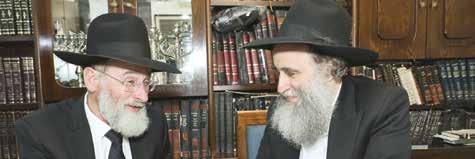
SBy Chaim Gold
ometimes opportunity calls and the only thing that a person should do is grab the opportunity while it is still possible. The message that leading Gedolei Yisrael have issued in advance of the start of Perek Arvei Pesachim in the Dirshu Amud HaYomi program is too chap arein, to join now, so as to upgrade your learning to new levels while simultaneously transforming and elevating your Seder night and your entire Pesach!
The Gedolim are calling on Yidden all over the world to seize the amazing opportunity by joining the Amud HaYomi program starting on Sunday, 14 Shevat/ February 1, when the program will begin Perek Arvei Pesachim, the perek that contains all the geshmake Gemaras about the Seder night. If you start Arvei Pesachim with the program, you will finish before Pesach. What an amazing opportunity to truly “live” the Seder and to make sure that your Seder won’t ever be the same!
On Rosh Chodesh Shevat, HaGaon HaRav Isamar Garbuz, shlita, Rosh Yeshiva of Yeshiva Orchos Torah, issued a powerful and compelling letter calling on Yidden to join the Amud HaYomi. His letter comes in the aftermath of a call last year by the senior Gadol Hador, HaGaon HaRav Dov Landau, shlita, Rosh Yeshivas Slabodka. In Rav Landau’s seminal letter written a year ago during the month of Kislev, in his own handwriting, he described the unique opportunity that Amud HaYomi afforded Klal Yisrael. He wrote:
How important, how vitally necessary it is to learn the entire Masechta… page by page with the Amud HaYomi
program. It is even important for those who have already learned and have already been deeply engaged in this Masechta to join and learn the Amud HaYomi together with Klal Yisrael.
Learning the Gemara combined with [learning] the specially published booklets [Iyun HaAmud] containing chiddushim from the meforshim and many important halachos related to the Gemara [learned in the Amud HaYomi] is a very worthy undertaking that brings out the greatness and the strength of the Torah.
With faithful bracha,
Dov Landau,
Now, in advance of the commencement of Perek Arvei Pesachim, Rav Isamar Garbuz, has issued his own letter.
Rav Garbuz writes:
It is already more than two years since the Torah organization Dirshu has established a program to learn Shas with the Amud HaYomi, where lomdim learn one amud every day and therefore merit to have an eternal kinyan in yedias haTorah.
This is a wonderful development for everyone, also for bnei Torah who spend most of their day immersed in the learning of sugyos b’iyun. It is well known that [bnei Torah] who [have a seder] where there is a set amount of Gemara to cover every day gain a tremendous amount in their depth of understanding of Torah by learning full masechtos. This is especially true with the learning of the Amud HaYomi due to the fact that every month [Dirshu publishes] Gilyon Oholei Ha’amud, that contains wonderful, indepth chiddushim on the sugyos being learned in the Amud HaYomi.
Rav Garbuz goes on to urge the general community to grab the opportunity to
learn Perek Arvei Pesachim
Now that [the Amud HaYomi] is beginning to learn Perek Arvei Pesachim, this is certainly a wonderful opportunity to join the program because by joining now, the learner will be able to complete the perek in advance of this coming Pesach. There is no simcha like the simchas haTorah combined with the simcha of Yom Tov. When a person comes into the Yom Tov of Pesach after having been deeply immersed in learning about Pesach and the seder night, he is able to talk in learning with clarity about so many relevant sugyos and spar in the battle of Torah with others. There is no simcha like the simcha of clarity in Torah that comes through deeply debating the sugyos!
Rav Garbuz then continues that once a person has tasted the sweet taam of the Amud HaYomi by learning Arvei Pesachim, he will certainly want to go to the next level.
After Pesach, they will go m’chayil el chayil, and begin Masechta Yoma [on Yom Kippur] which they will learn until the coming Yom Kippur.
This will provide tremendous benefit because the lomdim will be able to learn about the Yom Tov of Yom Kippur in advance of that holy day.
As the Amud HaYomi has become one of the staple limudim for Klal Yisrael many have found that the slower pace of learning truly connects Jews to Torah. The fact that they can understand what they learn at a deeper level intensifies their bond with Torah in a profound way.”
Another important benefit of joining is the protection learning Amud HaYomi affords Klal Yisrael. Several months ago,
right before the Amud HaYomi embarked on Masechta Eruvin, the Slabodka Rosh Yeshiva, HaGaon HaRav Moshe Hillel Hirsch, shlita, said, “This limud has the power to protect Klal Yisrael at time when its enemies seek its destruction. Everyone knows the difficult situation in which the Torah world finds itself.”
He then exclaimed, “What saves us?! Only an increase in Torah learning and in honor of the Torah. I hear that people from all walks of life have undertaken to learn the Amud HaYomi. Many kehillos have adopted it as their kehillah’s official learning seder. The increase in learning Torah and kavod haTorah is beyond belief. This is what can save Klal Yisrael!”
The Amud HaYomi program which was launched two years ago in Vienna at the Sofiensäle Hall, the same hall in the same city where the Daf HaYomi had been established at the Knessiah Gedolah one hundred years previously, is now almost completing its fourth major masechta, Maseches Pesachim. Currently, there are more than one thousand Amud HaYomi shiurim across the globe from Brooklyn to Be’er Sheva, Melbourne to Lakewood, Antwerp to Mexico City… wherever you go, Yidden are learning the Amud HaYomi, attending shiurim on Amud HaYomi and enjoying the slower paced limud that enables them to digest, review and truly gain a kinyan in the amud
Now is the time to join the Amud HaYomi. You will see that if you do, your life will never be the same!
To join the Amud HaYomi and to complete Arvei Pesachim by this coming Pesach, contact Dirshu at info@dirshunj. org or at 1-888-5Dirshu.



1. The Wright brothers made their first attempt to fly on December 14 of what year?
a. 1903
b. 1914
c. 1923
d. 1934
2. What color is the Black Box on planes?
a. Bright orange
b. Hot pink
c. Bright yellow
d. Black
3. According to a Cornell University study, what is the most commonly served drink on airplanes?
a. Coffee
b. Water
c. Tomato Juice
d. Coca-cola
4. During Operation Solomon in 1991, a modified Boeing 747 carried how many Ethiopian Jews to Israel?
a. 476
b. 598
c. 724
d. 1,088
5. What is the average annual salary of a Delta Airlines pilot?
a. $97,000

b. $132,450
c. $201,178
d. $440,200
6. According to U.S. government data, what is the most common cause of flight delays in the United States?
a. Mechanical problems
b. Airline staffing shortages
c. Airport congestion
d. Weather
Answers:
Wisdom Key:
5-6 correct: You know so much about airports, you can probably even navigate JFK Airport!
3-5 correct: Not bad…like LaGuardia.
Which of the following is the only one which is not a real airport?
Batman Airport
Useless Loop Airport
Black Tickle Airport
Moron Airport
Eek Airport
Pickle Lake Airport
Tsili Tsili Airport
Shafter Airport
Wagga Wagga Airport
Flin Flon Airport
Mysore Airport
Bloodvein Airport

0-2 correct: It must be difficult to spend your whole life hiding from people that your middle initial stands for Newark?
Deadhorse Airport
Danger Bay Airport
Gaspe Airport
Monkey Mia Airport
Snake River Airport
Chicken Airport
Fox Airport
Duck Airport
Pietarsaari Kruunupyy Airport
George W Bush Airport
Answer: George W Bush Airport

You finally figured out how you know the person sitting on the other side of the gate…and now it is waaay too late to say hello.
The guy who grabbed you for Maariv is asking you if you davened Shacharis yet.
Someone sits on the seats across from you and you say, “Excuse me, that’s my bedroom.”
You checked the departure board so many times that you are considering checking into Departure Board Anonymous.
Since you ate so many, you are done with granola bars…for at least 20 minutes.
Your kid asks you for $9.50 to buy a Coke, and you think it’s a bargain.
You actually deleted all of the duplicate photos on your phone (actually, no, nobody is ever committing to such a deletion).
You listened to 17 podcasts about frum guys that made millions but are most proud of the fact that they learn every day, give tons of tzedakah, started 17 chessed organizations, and are very humble.

You actually consider buying a neck pillow and a book about mindfulness.
You wrote a 1,500-word memo to yourself explaining why you will never ever go away again for mid-winter vacation and still had time to check up on house rentals for next mid-winter vacation.
You figured out that the reason for the delay is not because they are waiting for the plane to arrive from Cincinnati; after all, Cincinnati is an hour and a half from here and we’ve been waiting for 14 hours.
You see a crease slowly developing on the gate agent’s jacket.
You wonder why you didn’t just fly private…then you wake from your daydream.
You consider getting on a flight to Detroit because you just gotta get out of this airport already.
Your flight finally departs…but you fell asleep from exhaustion and missed it. (You should have said hi to your old buddy across the gate. Then he wouldn’t have thought that it would be too awkward to wake you and let you know that the plane is leaving.

A woman waits anxiously at the airport while her husband attends a skydiving lesson. Later, a pilot delivers troubling news: “Your husband fell from 4,300 in The Air. He was wearing full safety gear. The gear failed to open in time…and yet he was not injured.” How can this be true?
Answer: 4,300 in the Air is the name of the airplane. It never left the ground.



VBy Rabbi Berel Wein z”l
ictories and triumphs inevitably are followed by letdowns, frustrations, and sometimes even disappointments. The high point of the story of the Exodus of the Jewish people from Egypt is recorded in this week’s parsha with the eternal song of Moshe and Israel at the Reed Sea. The exultation of Israel at seeing its hated oppressors destroyed at its feet knew no bounds. It is as though
its wildest dreams of success and achievement were now fulfilled and realized. However, almost immediately, the people of Israel, faced with the problems of the real world which seemingly never disappear no matter how great the previous euphoria may have been, turn sullen and rebellious. Food, water, and shelter are all lacking. And even when Moshe provides for them the necessary miracles that are

required for minimum sustenance in the desert of Sinai, their mood of foreboding and pessimism is not easily dispelled. And this mood is heightened by the sudden unprovoked attack of Amalek against the people of Israel. Again, Amalek is defeated by Yehoshua and Moshe, but the mere fact that such an attack occurred so soon after the events of the Exodus has a disheartening effect upon the people. The moment of absolute physical triumph is not to be repeated in the story of Israel in the Sinai desert. But physically speaking, the experience of the desert of Sinai will hardly be a thrilling one for Israel. So, it is with all human and national victories. Once the euphoria settles down, the problems and frustrations begin.
ments. Victories bring high, if sometimes unrealistic, expectations. Measured realistic response and realistic assessments are necessary to harvest the fruits of such victories.
The less grandiose our expectations are the less painful our disappointments become. The generation of the descendants of those who left Egypt, who were now accustomed to the grueling challenges of the desert and who had not shared in the euphoria of the destruction of the Egyptian oppressor, were much better equipped to deal with the realities entailed in conquering the Land of Israel and establishing Jewish sovereignty and society there. Our times have also witnessed great and unforeseen accom-
The less grandiose our expectations are the less painful our disappointments become.
In relating the miracle of the sweetening of the waters at Marah, the Torah teaches us that “there did the L-rd place before them laws and justice and there did He test them.” There are many interpretations in Midrash, Talmud, and rabbinic literature as to what those “laws and justice” were. But it is certainly correct to say that the main “laws and justice” that were taught to Israel at Marah was that the problems of life go on even after miraculous victories and great achieve -
plishments here in Israel. But because of that very success, we are often given over to disappointment and frustration at the current unsolved problems that still face us. We would all wish to sing a great song of exultation and triumph over our enemies and problems. With G-d’s help, we may yet be able to do so. Yet until then, we would be wise to attempt to deal with our realities and problems in a moderate, practical, and wise fashion.
Shabbat shalom.


By Rav Moshe Weinberger
Adapted for publication by Binyomin Wolf
On this Shabbos of the Song at the Sea and the Song of Devorah, let us understand more deeply how women and mothers are the source of our ability to succeed in this world.
The men sang, “I will sing to Hashem for He is very exalted…” (Shemos 15:1). And regarding the women’s song, the pasuk says, “And Miriam called out to them, ‘Sing to Hashem for He is very exalted…’” (ibid 21). Why was it Miriam who led the women’s song?
We see that many years earlier, when she was just a child of six years old, Pharaoh decreed, “Throw every newborn son into the river” (Shemos 1:22).
According to Chazal (Sota 12a; Shemos Raba 1:19), Miriam’s father Amram, the greatest sage of the generation, gave up all hope and separated from his wife, and all the other men followed suit, lest they give birth to children who would immediately be murdered. It was only little Miriam who stood up and started a movement against the despair which had overtaken the entire generation: “Father! Your decree is worse than Pharaoh’s!” He brought her argument before the beis din, and he and they agreed with Miriam. Only Miriam’s courage was able to overcome the despondency that had infected the leaders of the generation.
We see something similar in this week’s haftarah in which the general Barak and the rest of the men were overcome with fear of the Kena’ani army and their general Sisra. When the pasuk says, “The caravans ceased, the travelers walked on crooked paths” (Shoftim 5:6), Rashi explains that this was because “the Jewish people were afraid to travel because of the enemy.” Normal

life stopped because the people were paralyzed with fear.
And even when Devorah communicated the prophetic message that Hashem would deliver Kena’an into their hands, Barak was still afraid. He told her, “If you will go with me, then I will go, but if you will not go with me, I will not go” (ibid. 4:8). She agreed and thereby led the entire army to victory.
But this decisive defeat of the enemy’s will to fight came through another woman, Yael, who personally assassinated Sisra in his own tent (ibid. 21)! Devorah herself acknowledged the fact that Jewish women brought about the victory in the song she sang celebrating Hashem’s deliverance. She relates how life stopped for the Jewish people “until I, Devorah, rose up, until a mother of Israel rose up” (ibid. 5:7). Chazal tell us that the Jewish people’s victory in this
war arose from the feminine side. They say the same thing about our victory on Purim, when victory also came through a Jewish woman, Esther.
How were Miriam, Devorah, Yael, and Esther able to revive the hopes of the Jewish people when no one else could?
We see the power of a “mother of Israel” to inspire confidence, bravery, and strength in the people. While the men carried the physical weapons, klei neshek , the Jewish mothers used something even more powerful than weapons, but which shares the same Hebrew root word: neshikos, kisses. A mother has the power to speak to her children, her husband, or the entire Jewish people and tell them, “You can do it! Hashem is with you! You will succeed!”
After the salvation at the sea in this week’s parsha, the men proudly said, “I will sing to Hashem!” But where did
they get the strength to sing? There is a backstory. When the pasuk says, “And Miriam called out to them, ‘Sing to Hashem,’” who was she speaking to? The men? The women? Both? The word for “them” in the pasuk is masculine, not feminine, which could indicate that Miriam was speaking only to the men, or, at the very least, to both men and women. According to one opinion in Chazal, Miriam was speaking not just to the women but to Moshe and the elders as well.
According to this opinion, the men received the strength to sing from Miriam, the woman who, as a child, had saved the Jewish people from despair of Pharaoh’s decree! Right after the Song at the Sea, Moshe told us, “If you will listen to the voice of Hashem, your G-d, do what is straight in His eyes, hearken to His mitzvos, and observe His laws, I will not place on you the entire sickness that I placed on Egypt” (Shemos 15:26).
The pasuk says “sickness,” singular, rather than sicknesses, plural. According to the seforim hakedoshim , she saved the Jewish people from the most debilitating sickness of all – despair. As a child, and again at the sea, she told her brothers and sisters, “Be alive! You can do it! Hashem is with us!”
The womb is called the “source” of life in Hebrew, makor. And the numerical value of that word is equivalent to the word for “will” or “desire,” ratzon. Jewish women and mothers build us up from womb to tomb so that we have the capacity to get out of bed and do what we need to do to connect to Hashem and build the world.
The feminine side of Shabbos empowers us in a similar way. When the Shabbos Queen arrives, we sing in Le -

cha Dodi , “Shake yourself off! Arise from the dust! … Awaken, awaken! For your light has arrived. Arise, my light!” Devorah, too, sang, “Wake up, wake up! [said] Devorah. Awake! Awake! Utter a song!” (Shoftim 5:12). On Shabbos, we are healed from that sickness of the six days of the week – heavy-heartedness, sadness, and despair, which often debilitates us even more than the swords of our enemies.
Tu B’Shvat comes out this week. On this day, when the earliest-blooming trees awaken from the inactivity of winter in Eretz Yisroel, we eat from the seven fruits for which the land of Israel is praised, including the tamar, the date. According to the pasuk , Devorah judged the people sitting under the Tomer Devorah, the date palm of Devorah (Shoftim 4:5). Why a date palm specifically? According to Chazal, the secret of the date is that “just as the date has only one heart [pit], so too the Jewish people have only one heart for their Father in Heaven” (Sukkah 45b).
One of our Jewish mothers, Tamar, also gave life to Dovid HaMelech and Moshiach because she did not give up hope of carrying on Yehuda’s lineage,
even when he gave up. Commenting on the pasuk , “The tzaddik blossoms like a Tamar, he grows like a cedar in the Lebanon” (Tehillim 92:13), Chazal say, “Just as the date palm has a beautiful appearance and all of its fruits are sweet and good, so, too, the son of David will
Swerdlov, a Chabad educator in Crown Heights, wrote the following about her parents, particularly her mother:
My parents have always been inspiration to me, as well. I was born in Russia and came to America when I was a little girl. Life was not easy for us,
Only Miriam’s courage was able to overcome the despondency that had infected the leaders of the generation.
be beautiful of appearance and all of his deeds will be sweet and good before Hashem” (Midrash Shochar Tov on Tehillim 92). Moshiach’s great-grandmother Tamar gave him and all of us the wherewithal to live beautiful lives. My wife showed me a beautiful article that illustrates this perfectly. Several rebbetzins and educators were interviewed. One woman, Mrs. Miryam
but I didn’t know it. My father walked with his cane his entire life, but he was never bitter. He would say in Yiddish, “Pick up your cane in your hand and start walking.” That is how we lived. We were taught, no matter what life gives you, you keep walking.
Although I have limited memories of my mother, since I was so young when she died, I do remember that she
would sing constantly while working in the kitchen. Sometimes, she would sing liebedig songs, and sometimes, she would sing slow songs. I could always tell what mood she was in by what songs she sang. I learnt from her that no matter what you are going through, you must put yourself together, put on the best you have, put on your makeup, comb your sheitel, and walk out with your shoulders back and your head held high, because you can do it.
That is what Jewish women like Tamar, Miriam, Devorah, Yael, Esther, and Mrs. Swerdlov’s mother bring to us. Through their love and belief in us and Hashem’s providence, they tell us, “You can do it!”
Just like Miriam and Devorah, may the merit of Jewish women herald the time when we will “sing to Hashem a new song” (Tehillim 98:1) with the coming of the great-grandson of our mother Tamar, Moshiach Tzidkeinu, soon in our days.
Rav Moshe Weinberger, shlita, is the founding Morah d’Asrah of Congreagation Aish Kodesh in Woodmere, NY, and serves as leader of the new mechina Emek HaMelech.



By Rabbi Avrohom Sebrow
Every Shabbos night seudah at the Cohen household was special. This particular week, the air was thick with the aroma of kugel and roast chicken, but for Uncle Dov, there was one singular, pressing priority. He was ready. The glistening, braided challah loaf was firmly in his hand, the resonant bracha had been recited with customary gusto, and the chorus of “Amen” had barely faded. His stomach, an extremely reliable internal clock, was already rumbling its objection to any further delay.
He lifted his knife, cut a perfect slice, and poised himself for a moment of pure, carby satisfaction. But as he scanned the length of the heirloom mahogany table, the moment shattered. The tiny, silver-capped glass saltshaker was nowhere near him.
His eyes finally located it, far across the crowded landscape of fine china. It was firmly, almost militantly, clutched in the hand of his youngest niece, Chaya, who was completely oblivious to the silent crisis unfolding at the head of the table.
Uncle Dov, a man who prided himself on patience, began a quiet campaign. First came the gentle cough, a subtle clearing of the throat. Then the pointed glance, alternating carefully between the challah in his hand, the empty space beside his plate, and the shaker in Chaya’s grip. Still nothing.
Finally, he escalated to silent dramatics. Leaning forward, he caught Chaya’s eye and mouthed the word “salt!” with the deliberate over-articulation and expressive intensity of a stage actor. The effort strained his facial muscles, but it worked. The little shaker began its slow, deliberate journey toward him.
When it finally reached his waiting hand, Uncle Dov let out a gasp of relief. He sprinkled a little salt onto his piece and then savored the crisp exterior and fluffy interior, now perfectly seasoned. He leaned back in his chair like a man who
had faced adversity and emerged victorious, releasing a deep, contented sigh. Was all this drama necessary? Was his conduct halachically correct?
No.
The Gemara in Berachos teaches that salt must be brought to the table before one recites Hamotzi. Two explanations are offered by the Rishonim, cited by the Acharonim, and both are brought by the Mishnah Berurah (167:27).
The first reason, quoted in the name of the Shulchan Aruch HaRav, is a matter of kavod habracha. The bread upon which Hamotzi is recited should be eaten in a dignified and enjoyable manner. If throughout the meal one eats bread with salt, but the very piece used for the bracha is eaten plainly, that would reflect poorly on the blessing itself.
The second reason, cited by the Vilna Gaon, is more practical. Knowing the first reason or simply as a matter of personal taste, a person will want salt on their first piece. If the salt is not nearby, he may be tempted to say, “Pass the salt” after reciting Hamotzi. This is forbidden. One may not make any interruption between the bracha and eating the bread. Therefore, Chazal required that salt be on the table beforehand so that one would not come to make a hefsek.
While it is true that, bedieved, even if one did ask for the salt after Hamotzi, the bracha would still be valid, Chazal did not want us to rely on bedieved situations.
The Shulchan Aruch rules that today, this halacha is no longer strictly applicable. Our challah is sufficiently tasty on its own and does not require salt. Likewise, the second concern falls away, since no salt is needed, one would not be tempted to ask for it after the bracha.
Nevertheless, the Mishnah Berurah permits a brief pause before Hamotzi for salt or a different dip. Although we generally minimize the gap between washing and the bracha, this short delay is permit-

ted. However, the clear implication is that after the bracha, one should certainly not wait even for a moment. If the salt was not near Uncle Dov, he should have simply eaten the challah as is.
The reader may wonder: if so, why are we still so makpid on salt today?
The Torah states, “Al kol korbancha takriv melach,” on all your offerings you shall offer salt (Vayikra 2:13). The Gemara in Menachos (20a) explains that salting every korban and mincha is a mitzvah. The Rambam rules that a korban brought without salt is invalid.
Chazal teach that our table is compared to the mizbe’ach. This is due to the mitzvos performed there, such as feeding the poor and speaking divrei Torah The Mishnah Berurah cites this comparison as practical halacha: our behavior at the table must reflect its elevated status. Accordingly, the Rema rules (167:5) that it is a mitzvah to have salt on the table before reciting Hamotzi, just as salt was present on the mizbe’ach . He even writes that this serves as a segulah for protection from suffering.
Importantly, one fulfills this mitzvah simply by having salt on the table. There is no requirement to actually put salt on the challah. The Rema does not argue on the Shulchan Aruch, who explicitly says there is no need.
The Mishnah Berurah does, however,
cite a custom al pi Kabbalah to dip the challah three times in salt. Uncle Dov, as described above, did not fulfill this custom anyway. All the more so, he should not have made any interruption after reciting Hamotzi and cutting his slice. Granted, bedieved his actions were acceptable, and no new bracha is required, but l’chatchilah we avoid all breaks before eating.
It would seem from the Mishnah Berurah that even one who wishes to fulfill the custom of dipping three times should still eat first and only then ask for it.
According to the Vilna Gaon’s explanation, one could argue that if people are makpid to eat the first piece specifically with salt, then the halacha effectively reverts to its earlier form. Salt must be present before Hamotzi, lest one come to interrupt afterward, just as in the days of the Gemara.
Which means that next Shabbos night, Uncle Dov should check the table before making the bracha or resign himself to eating the first bite without salt.
Rabbi Avrohom Sebrow is a rebbe at Yeshiva Ateres Shimon in Far Rockaway. In addition, Rabbi Sebrow leads a daf yomi chaburah at Eitz Chayim of Dogwood Park in West Hempstead, NY. He can be contacted at ASebrow@gmail.com.

By Rabbi Yair Hoffman
For decades, the value of a perutah – the minimum halachic monetary unit – has hovered at approximately two or three cents. This meant that virtually any coin in circulation other than a penny, including the humble nickel, was halachically significant enough to trigger the mitzvah of hashavas aveidah, the obligation to return a lost object. However, with the unprecedented surge in silver prices, we have crossed a historic threshold. As of this writing, the mitzvah of hashavas aveidah no longer applies to a found nickel.
The Calculation:
How a Perutah is Determined
The Shulchan Aruch (Choshen Mishpat 88:1) rules that a perutah is equal to
half a grain of pure silver. Based on the calculations of the poskim, this translates to 1/1244th of a troy ounce of silver. To determine the current value of a perutah, one simply takes the spot price of a troy ounce of silver and divides it by 1244.
As of January 26, 2026, the current spot price of silver is approximately $109.76 per troy ounce. Silver has experienced an extraordinary rally, having risen from approximately $29 per ounce at the start of 2025 to over $100 per ounce today – an increase of nearly 280%.
Applying the formula: $109.76 ÷ 1244 = $0.0882 (8.82 cents)
This means that a perutah is now worth nearly nine cents. A nickel, worth


only five cents, is therefore less than a shaveh perutah and does not trigger the mitzvah of hashavas aveidah. However, a dime, worth ten cents, still exceeds the value of a perutah and remains subject to the mitzvah.
For a nickel to lose its halachic significance, silver would need to reach a price where 1/1244th of a troy ounce exceeds $0.05. The calculation is simple: $0.05 × 1244 = $62.20. When silver crossed $62.20 per troy ounce, the perutah officially exceeded the value of a nickel.
This historic moment occurred on Thursday, December 11, 2025, at approximately 8:15 a.m. Eastern Time, when silver was trading at $62.30 per troy ounce. By that afternoon, silver had surged further, touching an intraday high of $64.21 per ounce. Since that date, silver has continued its meteoric rise, and the gap between the perutah value and a nickel has only widened.
Hashavas Aveidah: The Halachic Fundamentals
Now that we understand the new monetary reality, let us review the essential halachos of hashavas aveidah:
1. The Minimum Value Requirement. For the mitzvah of hashavas aveidah to apply, the item must be worth at least a perutah (CM 262:1). If it is worth less than a perutah to the finder, but more to the one who lost it, such as a
driver’s license, there is still a mitzvah. Rav Elyashiv, zt”l, ruled that most people view a pen as nearly worthless, and therefore, pens are considered less than a shaveh perutah and there is no need to be machriz and announce that it was found (Kuntrus HaShavas Aveidah p.31).
2. The Severity of Violation. If you find a lost object which qualifies for hashavas aveidah and keep it, you violate three Torah mitzvos – two negative commandments and one positive one. If you simply ignore your obligation to return something, you violate one negative mitzvah.
3. The Obligation to Announce. Lost objects need to be announced. Nowadays, poskim have ruled that an advertisement in the paper also qualifies as an announcement (see Chavatzeles HaSharon CM #28).
4. Who is Obligated? Men and women are equally obligated in this mitzvah, but older people are exempt if returning the item would be embarrassing for them.
5. Abandoned Objects. Objects that are clearly abandoned, such as something found lying in the street, do not have to be returned.
6. Items Found in Stores. Items without identifying marks found in a store belong to the finder, unless it is a section of the store exclusive to the owners. The reason the storeowner’s property does not acquire it for him is because it is not a watched property, a chatzer hamishtameres (SA CM 260:5).
7. Vending Machine Change.
Money found in a vending machine change slot belongs to the finder (ruling of Rav Azriel Auerbach cited in Kuntrus Hashavas Aveidah p. 30).
8. Yei’ush : Loss of Hope. The mitzvah of hashavas aveidah applies only as long as the owner did not give up hope of finding the item. Giving up hope is called yei’ush. The owner gives up ownership at the point of yei’ush. If, however, you found the item before the owner gave up hope, then there is an obligation to return it (CM 262:3). There is a debate in the Rishonim as to why this is so. Tosfos (BK 66a) understands that the obligation of returning the item has already kicked in and must still be fulfilled even if there is loss of hope. The Ramban (BK 26b), on the other hand, explains that the picking up of the lost item renders the finder a guardian over the item.
9. Simanim: Identifying Marks. There is a concept in halacha that a person is always checking his pockets. Therefore, if the item is very important and had no identifiable marks, we can assume that he gave up hope.
What are considered identifying marks (simanim in halacha)?
(A) Unique marks found on the object
itself; (B) If the owner identifies where the object was lost and it is rare to lose such items there (CM 262:9); (C) If the owner identifies how the object was packaged (CM 262:35); (D) If the owner identifies how many of the item was lost (CM 262:3); (E) If the owner identifies
owner lost hope in recovering it (CM 259).
11. Kiddush Hashem and Chillul Hashem. It is proper to return all lost items in order to make a kiddush Hashem, to sanctify Hashem’s Name. There is a full-fledged obligation to return items that one is technically exempt from re -
There is a full-fledged obligation to return items that one is technically exempt from returning if not doing so may possibly result in a chillul Hashem.
the specific weight or size of the object.
Money, however, is not considered to have identifying marks (CM 262:3).
10. Heavy or Large Items. Likewise, we can assume that an owner gave up hope on a very heavy item or a large item when there are no simanim, identifiable marks. Likewise, if it was lost in flowing river waters, we can assume that the

turning if not doing so may possibly result in a chillul Hashem (CM 266:1). Thus, all bank errors must be returned as soon as possible.
The dramatic rise in silver prices has created a new halachic reality. While it may seem strange that a nickel no longer carries the same halachic weight it once did, this is a natural consequence of
our monetary system and the fluctuating value of precious metals. Of course, one should always strive to return lost items lefnim mishuras hadin, beyond the letter of the law, and certainly to avoid any possibility of chillul Hashem. Nevertheless, it is important to be aware of the technical halachic parameters, as they affect many areas of monetary law beyond hashavas aveidah, including kinyanim, kiddushin, and damages.
May we all merit to fulfill the mitzvos of the Torah with understanding and precision, and may our careful observance of bein adam l’chaveiro bring about a kiddush Hashem.
Note: Silver prices fluctuate constantly. Readers are encouraged to check current silver prices when making halachic determinations. As of this writing (January 26, 2026), with silver at approximately $109.76 per troy ounce, a perutah equals approximately 8.82 cents.
This article should be viewed as a halachic discussion and not practical advice. The author can be reached at yairhoffman2@ gmail.com.


By Barbara Deutsch
Iknew that the baby would be named after Bob – I just did. I had made it clear during the shiva that any new babies born, boy or girl, it’s my expectation that our grandkids, married or not, know that it’s what I would like now and in the future.
I have a broken filter; I have a tendency to let things slip out that maybe I should keep to myself. Bob was beloved by all who knew him, especially his family; my expectation of a name for a boy is not a pipe dream or ridiculous.
Every family has baby-naming sagas.
When our granddaughter Ayelet gave birth to a beautiful baby girl just three weeks after Bob’s passing, I proposed (mostly in jest) that the name Avrahama be put on the table for consideration. Ayelet and Daniel named her Sarah after Bob’s mother, Ayelet’s great-grandmother, our family’s beloved matriarch, Anyu.
Just a few weeks ago, Ayelet and I were in a local seamstress’ shop getting a dress tailored (the fixing cost more than the dress so she decided to donate it) when a woman walked in with “just one question” for the seamstress. While the woman waited for the answer, she struck up a conversation with me.
“You look familiar,”, she commented. After some complicated Jewish geography, we figured out that the woman, Goldie, knew me from the Mimosa building in Florida; her parents had participated in the weekly Friday night widow’s dinners that my in-laws hosted.
When my father-in-law passed away, Goldie’s dad continued to make kiddush for the Mimosa widows. I remember that Anyu made special sugar-free cookies just for him.
I introduced Ayelet and her baby Sarah to Goldie; I explained that this precious baby as well as another great-greatgrandchild Sari, daughter of Jakob and Nomi, bear my mother-in-law’s name. The woman exclaimed to Ayelet: “Do you have any idea how fortunate you are to be
able to give the name of such a great lady to your child?”
Anyu (Sorah) had such a significant impact on all of her grandchildren and great-grandchildren that even when there are B”H living and, of course, departed relatives with Anyu’s same name, our grandchildren will go to great lengths to find a way to connect their baby girl to her.
Elly and Gab, named daughter number two Kayla Rochel; Kayla means crown in Yiddish. Anyu was the crown of our family. The name Rochel is in honor of Anyu’s mother; she died in Auschwitz during the Holocaust.
All of our grandkids know!
When Bob and I named our children, it was very important to Bob that each child have a Torah (not Yiddish) name. Additionally, the Torah and secular names had to somehow match. Bob’s full name was Robert. As a child, it bothered him that though there were four boys in his class named Robert – Mordechai, Shloimi, Naftali and him – not a single boys’ Torah and English names lined up.
Idana, a former Flatbush student of mine, had as her “Hebrew” name, Idel. In high school, her Israeli rabbi teacher called her out on it; this teacher gave her an alternative “real” Hebrew name, Ilana. When Idana’s next test paper had taken points off for the misspelling of Ilana, she complained. “Rabbi, I don’t know how to spell this name. It’s not mine.”
Idel/Ilana learned how to spell her name correctly.
Bob was the most mild-mannered of men; it was particularly funny to listen to his reaction to the names of boys and girls who had Torah names which did not line up with their obviously matching English ones, for example, when a Yitzchak was called Daniel or when a Sorah was named Jennifer.
In naming our children, we did our best to follow Bob’s guidelines: Yisroel Dov Asher is Ivan Dov, Miriam Mirel is Meredith Liza, and Rochel is Rachel.
We messed up with the multiple names for Dov and the middle names for our two girls. Dov is named after a young Deutsch brother who stepped on a land mine during the war. Out of the blue, my dad, Zyda, who rarely spoke up but got chatty during naming time, insisted that naming a baby after someone who died young was a bad omen.
Following much debate with suggestions like Noach and Methusaleh (Bob was not a fan of any addition to this hero’s name), we chose to add Asher after Bob’s maternal grandfather.
Our girls also had last-minute sameday changes during Bob’s naming aliyah
We wanted to name our daughter Meredith Miriam Aliza – Miriam to honor Bob’s paternal grandmother; Aliza for my beloved uncle, Luzer. He had come to me in a dream and consoled me that all would go well during a glitch in my pregnancy.
Naming the first girl baby born into the Deutsch family was a big deal; there had been no females for many, many years. Right before the naming, Bob’s dad Apu (Avi’s brother Pinchas Shmuel called Shmuel is named for him) mentioned that his mother’s name was Mirel, not Miriam. If we planned to name our baby girl after his mom, that was the name we needed to give her; Mirel is a Yiddish name, not a Torah one.
And so, Miriam Aliza became Miriam Mirel; we called her Meredith Liza. She told me recently that she only realized in high school that Aliza is not her Hebrew name.
Rachel was supposed to be Rochel Shira – Rochel after my dad’s mother and Shira for the parsha. During the naming, my dad flipped (again) and in strong Yiddish made it clear: “My mother’s name was Rochel, just Rochel, that’s what her name will be.” (“Ruchel nor Ruchel iz de numen.”)
As it turned out, Rachel was not born on Shabbos Shira. We liked the

name and decided to use it as her English middle name.
As was the custom with most Jewish parents 40 odd years ago, our girls Rachel and Meredith are called by their English names. Even Rachel, who lives in Israel, is still Rachel. Ivan Dov, on the other hand, has always been called Dov. When he was a baby, everyone would ask us if he was named for the peace symbol, the white dove. Strangers would hold up two fingers in salute and call out “peace out” when they heard us say his name.
During the turbulent ‘60s Bob and I were peaceniks; that concept was not so farfetched, but no!
To this day, we are asked why we named him Ivan. My major in college was History with a double minor in Education and Russian; we both liked the strength that the name Ivan suggested, it matched Yisroel, and met Bob’s naming guidelines.
Even before texting and WhatsApp, I rarely called Dov in his office. On the day that I did, his secretary answered.
“Hi, can I please speak to Dov?”
“I’m sorry, there is no Dov here.” I hesitated.
”Sorry, I think you might call him Ivan,” I corrected myself.
“Who is this?”
“His mother.”
“Sorry, so sorry, I’ll see if he is available,” she stammered in response.
I had forgotten that Dov had started using Ivan for law school and work.
We were blessed with parents who lived long and mostly healthy lives. We never took for granted that
our parents were able to participate and enjoy the love and devotion of great-grandchildren; Anyu lived to see a great-great-granddaughter, Dalia Leah, named for my mother, Lea. During the shiva for Anyu, Dalia pointed to her picture and called her name.
We were very pleased with not needing a name.
Avraham (Avi) Deutsch is named after Bob; his English name is Robert. Bob may have an issue with the matching, but Yoav and Michal felt that it was important to give him both names. I’m pretty sure that there will be no one who will call him Bob; people may call him some form of Mr. Deutsch when he gets older. Throughout Bob’s work life in schools, he was known as Mr. Deutsch. When Bob and I would go to dinner with younger friends, many of whom had sons who were in his class at DRS, hosts and guests would call me Barbara and refer to Bob as Mr. Deutsch.
At a baby’s bris milah, the name is not known or shared before the ceremony. During the bris, the father whispers the name into the ear of the person honored with kriyas ha’shem , giving the baby his name.
At Avi’s bris milah,, the honor of nam-
ing was given to Rabbi Elliot Schrier, rabbi of Bnei Yeshurin in Teaneck and among Bob’s favorite students. In Rabbi Schrier’s Shabbat Shuva address, he referenced Bob and spoke about lessons learned with him.
After the bris, Rabbi Schrier searched me out to share how meaningful it was for him to get this privilege. During the sha-
which prevents the Angel of Death from identifying the child before the bris milah; a folk belief from times of higher infant mortality.
Not sharing the name avoids pressure from relatives and allows parents to change their minds without public announcement. This certainly worked for us.
This makes the bris milah the moment wherein his destiny is bestowed.
lom zacher which Rabbi Schrier attended with his son Coby, we shared fond memories. As Rabbi Schrier left the bima, Coby commented on the naming, “Dad, you got to give the name of your beloved teacher.”
There is the “Soul Connection”: The name isn’t truly “given” until the baby enters the covenant, the bris milah. The neshama of the person for whom he is named shines fully then, thus making it the proper time for the name to be given.
There is “Superstition” (Bubbe Meise)
There is metaphysical significance wherein a child’s name is prophetic and tied to its destiny. This makes the bris milah the moment wherein his destiny is bestowed.
One of our grandsons’ names was changed after his bris milah; his first and middle names were switched. Before his father made the switch, he asked a rabbi how the name change would affect his destiny. The rabbi’s response: “A baby’s destiny is unclear. No one really knows
what the future of the original name will be, so who knows if his future won’t be a better one with his new name.”
I have been told that having a name within the first year of loss is a huge zechut. For me, coupled with the pride and joy is the finality that resonates on so many levels.
Welcome Avi/Bob/Mr. Deutsch.
Baby Avi’s parents, Michal and Yoav, are well aware of their grandfather’s magnificence; Yoav spoke eloquently about him at the bris milah I am confident that there will be a day when Avi will run into a random stranger who will tell him how lucky he is to have been named after such a great man, Avraham ben Pinchas Shmuel.
There is no doubt in my mind that that day will come.
Barbara Deutsch is the former associate principal at HANC, middle school principal at Kushner, and Dean of Students at Yeshiva of Flatbush. A not-retired educator, she is trying to figure out life in Israel through reflections on navigating the dream of aliyah as a wife, mother, grandmother, great-grandmother and friend.



By Hershel Lieber
Over the years, I have written about most of the destinations that we traveled to—most, but not all. In particular, I have not included two trips that we made to the Ca ribbean islands during the 1980s. At that time, we were enamored by a vision of vibrant turquoise ocean waters surrounding pristine white coral sand beaches, set against a backdrop of swaying palm trees. That panorama evoked feelings of pure relaxation and leisure. The thought of watching the sunrise and observing the sunset to the soft splashes of waves against the shoreline filled our imaginations. Swimming in sun-drenched waters and cooling off under the shade of a palm tree were also part of the picture we envisioned.
Did that picture-perfect scene materialize? Yes and no. There were definitely times when the scenery matched our dreams. But on many occasions, we found it difficult to reconcile our fantasy with reality. The main reason was that we could only truly enjoy beaches that were uninhabited. Not that such beaches didn’t exist, but finding them often meant seeking out isolated areas that were not necessarily nearby.

fellow Jews, or overseeing yeshivos in Kishinev—elevated many of our travels. Traveling became more meaningful
Swimming in sun-drenched waters and cooling off under the shade of a palm tree were also part of the picture we envisioned.
toured cities and experienced the world’s historical and cultural diversity. Yes, we enjoyed our trips to the islands, but we found other journeys more meaningful.
St. Maarten, St. Martin, St. Barthélemy & Saba
Our trips to the islands were generally enjoyable, but over the years, our tastes changed and our lifestyle underwent a significant transformation. Journeys with a distinctive purpose—such as kiruv projects, davening in Poland during the Yamim Noraim, teaching
when we connected with other Jews. Sightseeing became more insightful when we visited great national parks or

In November 1981, we took an eightday trip to the island of St. Maarten/St. Martin. A bit of geography and history is in order. The island, part of the Lesser Antilles in the Caribbean Sea, is divided between Dutch St. Maarten and French St. Martin. Both are overseas possessions of their respective governments, the Netherlands and France. Tourism is the main industry on both sides of the island, employing more than 85% of the workforce. Marigot is the capital of St. Martin, and Philipsburg is the capital of St. Maarten. Although Dutch and French are the official languages in their respective sectors, English is widely spoken and understood.
We arrived on a Thursday in Philipsburg and took a taxi to Grand Case, a small
town in St. Martin. We rented a condo with a kitchen and a balcony overlooking the ocean, which would be our home through Sunday. Before sundown, when beachgoers left for dinner, we enjoyed a swim in the warm, sun-soaked waters. We walked along the beach lined with eucalyptus trees as the sun set and night fell.
On Friday, there was some rain, and we spent time shopping for luscious fruits and vegetables for Shabbos. Shabbos itself was spent in the comfort of our condo—davening, learning, enjoying our seudos, and, of course, napping.
On Sunday, after a quick early-morn-
ing dip in the ocean, we boarded a small plane from Philipsburg to the island of Saba, another Dutch territory. Saba is known for its dramatic volcanic landscapes, lush rainforests, steep cliffs, and world-class hiking and scuba diving. There are no beaches on the island at all. Our 19-seat Windward plane offered magnificent views of the entire island. We took a taxi tour that covered all the major towns, including the capital, aptly named The Bottom. The houses, with their white wooden walls, green shutters, and bright red roofs, created a charming, storybook appearance. We spent only about three hours on Saba but enjoyed it immensely.
After returning to Philipsburg, we waited for our next flight to Gustavia, the capital of St. Barthélemy. St. Barthélemy, commonly known as St. Barts, is an overseas possession of France, famed for its high-end tourism, pristine beaches, and duty-free shopping. Gustavia’s picturesque harbor, filled with yachts and Swedish-style architecture, reflects the island’s unique history, as it was originally founded by a Swedish trading company.
After arriving, I rented a Mini Moke jeep, and we settled in for the night. On Monday, we explored the charming town and then found a deserted stretch of the beautiful

St. Jean Beach for a swim. On Tuesday, we visited Shell Beach, named for the small shells that cover its entire surface. While difficult to walk on, the water was crystal clear and warm. We continued on to Corossol, where we purchased basketware from local artisans.
At one point, while attempting to drive up a steep hill, I learned the importance of knowing how to drive a stick shift. I not only failed to make it up the hill but instead rolled backward from halfway down to the bottom, carefully steering to avoid overturning into a ditch. Baruch Hashem, we made it down safely. That was the end of stickshift driving for me.

On Wednesday, we returned to Philipsburg in Dutch St. Maarten. The city is extremely touristy, filled with restaurants, shops, and casinos, most of which held little appeal for us. We did, however, pick up some gifts for the children. On Thursday at noon, we boarded our flight home, having spent a relaxing vacation enjoying Hashem’s beautiful gifts to mankind.
In December 1985, we took a fourday trip to Barbados. The former British colony has been an independent country since 1966, yet it retains its British heritage alongside the culture of the African ancestors of its former slave population. We left New York on Sunday morning and arrived in the capital city of Bridgetown late that afternoon. By the time we settled into our hotel, it was already nighttime.
The next day, we truly took it easy: sitting in the sun, swimming a bit, and
taking a sailboat ride. Our hotel was beautifully landscaped, with ample alcoves that allowed us to sit privately without being distracted by other guests. Later in the afternoon, we sat apart from a cocktail party taking place on the terrace and enjoyed the rhythmic sounds of West Indian music. The instruments included the iconic steelpan, bongos, and indigenous rattles. In the early evening, we took a bus to Speightstown, where we admired early colonial architecture and the historic waterfront.
On Tuesday, after another relaxing morning, we took a bus to Bridgetown to explore the large duty-free bazaar and visited Pelican Village, where local handicrafts were sold. I don’t recall buying anything. In the evening, we walked from our hotel to see the Glitter Bay Resort, whose lush gardens stretch from the road to the sea. Soft lighting illuminated the grounds, creating gentle glows amid delicate shadows. Once again, we strolled to the accompaniment of calypso and reggae music.
Our final day, Wednesday, was a


background
repeat of the previous two—relaxing, swimming, and soaking in the final rays of sunshine—before returning to a Brooklyn winter of snow, sleet, and slush. It was a very short trip, but it was still a vacation that gave us time to connect and reflect.
Lieber has been involved in kiruv activities for over 30 years. As a founding member of the Vaad L’Hatzolas Nidchei Yisroel he has traveled with his wife, Pesi, to the Soviet Union during the harsh years of the Communist regimes to advance Yiddishkeit. He has spearheaded a yeshiva in the city of Kishinev that had 12 successful years with many students making Torah their way of life. In Poland, he lectured in the summers at the Ronald S. Lauder Foundation camp for nearly 30 years. He still travels to Warsaw every year – since 1979 – to be the chazzan for Rosh Hashana and Yom Kippur for the Jews there. Together with Pesi, he organized and led trips to Europe on behalf of Gateways and Aish Hatorah for college students finding their paths to Jewish identity. His passion for travel has taken them to many interesting places and afforded them unique experiences. Their open home gave them opportunities to meet and develop relationships with a variety of people. Hershel’s column will appear in The Jewish Home on a bi-weekly basis. Speightstown street scene
By Gedaliah Borvick
Tucked into the quiet neighborhood of Bayit Vegan, a Jerusalem street bears the name Yitzchak (Isaac) Breuer (1883–1946) – jurist, philosopher, and grandson of Rabbi Samson Raphael Hirsch – whose ideas helped frame a distinctly Orthodox response to Jewish statehood. Naming a street for Breuer honors the thinker who insisted that the return to Zion would matter only if the homeland were governed by Jewish law.
Born in Pápa, Hungary, and raised in Frankfurt, Breuer absorbed his grandfather’s doctrine of torah im derech eretz – the integration of Torah and worldly life – and recast it for a national stage. Where Rabbi Hirsch sought harmony between faith and modern culture, Breuer envisioned Torah im derech Eretz Yisrael: a Jewish society in which Torah would guide public, legal, and civic institutions.
After earning rabbinic ordination

and a doctorate in law, Breuer became a leading thinker in Agudat Yisrael and later headed Poalei Agudat Yisrael. When the Nazis rose to power, he immigrated to Jerusalem in 1936, representing Orthodox Jewry before the British Peel and Anglo-American Commissions and advocating for a Torah-based Jewish society.
Breuer’s stance toward Zionism was complex but principled. He opposed secular Zionism, which he believed sought to construct a Jewish state without a Jewish soul, yet he refused to ignore the unfolding drama of Jewish history. He admired Herzl’s determination to restore Jewish nationhood but insisted that ultimate authority must belong not to political institutions but to Torah itself. The Balfour Declaration and the rapid growth of the Yishuv convinced him that divine opportunity was at hand. He called this a “legitimate revolution”: not reshaping Torah to fit modern realities but reshaping modern realities so they could conform to Torah.
This conviction placed Breuer between two camps. He rejected the isolationism of ultra-Orthodox groups that withdrew from national life without offering a constructive vision, and he criticized religious Zionists who, in his view, risked sanctifying the state above halacha. Instead, he charted a middle course: active participation in building the land, coupled with unwavering commitment to Torah as the foundation of public law, economics, and culture.
To give this vision practical form, Breuer proposed the creation of Bina La’ittim, an institute to train rabbinic
scholars fluent in the real-world needs of a modern society – from agriculture to municipal governance. He did not live to see the declaration of the State of Israel in 1948, but his final years were devoted to preparing for it. For Breuer, the Jewish nation must be an Am HaTorah – a country bound by divine law. Only Torah, he believed, could prevent Jewish national rebirth from becoming spiritually hollow.
Walking down Yitzchak Breuer Street today, surrounded by yeshivot and schools, one can feel how his challenge still reverberates. Israel continues to wrestle with the relationship between religion and state, between timeless law and modern power – questions Breuer confronted long before independence.
Isaac Breuer was not a Zionist in the political sense, but he was a revolutionary in the deepest Orthodox sense. He saw the upheavals of the twentieth century – migration, the British Mandate, and statehood itself – not as reasons to dilute Torah but as opportunities to realize it in public life. Naming a street after him in Jerusalem is more than a tribute. It is a reminder of his enduring challenge: to build a Jewish society in which eternal halacha, not the mood of the moment, remains sovereign.

By Malkie SchulM an
This is not Jen’s first interview about her son, Binyamin Meir Airley, a precious chayal who was killed in Gaza six weeks after the start of the October 7 war. She speaks about him often. She gives comfort to others, and she says that doing so gives her strength. Jen does not appear downcast or depressed. On the contrary, she’s upbeat and positive. Still, there is no escaping the reason for our conversation: the loss of her beloved 21-year-old son.
Binyamin’s story begins with his parents, though probably more with his mom.
“I grew up in Hollywood, Florida, knowing I’d eventually make aliyah. The question was more when, not if,” Jen relates. “My family was very Zionistic. Almost all our vacations were spent in Israel.”
Except for one brother, Jen’s immediate family still live in the States; all her aunts, uncles, and grandparents have made aliyah. Her husband’s background is different.
“My husband is from Manchester, England, and he’d probably still be there today if he hadn’t married me,” Jen says with a smile.
When Jen completed her seminary year at Midreshet Moriah in Israel, she was ready to stay for good.
“I wanted to join the army and never go back to America. But when I found out women couldn’t be paratroopers and jump out of planes, I decided to do Shana Bet instead.”
She returned to the States after doing Shana Bet,
though Israel was never far from her life. It was during a vacation back in Eretz Yisrael a few visits later that she met her future husband, Robert.
“We met on a Jerusalem street when he was there for a few years learning in yeshiva. We started talking, then dating, and a year later we were married.”
The Airleys spent a total of six years living in Brooklyn and Cedarhurst before making aliyah 19 years ago and settling in Ramat Beit Shemesh.
Family was always at the center of the life they built together.
“Our girls are our bookends,” Jen shares. “Our oldest and youngest children are our daughters. We have four boys in the middle. Binyamin was our oldest son. From early on, Binyamin’s life was about service to his country and his people. But,” she adds, with a definite twinkle in her eye, “also, about having a good time! He was lively, deeply connected to nature, and not into school. Not even one little bit.”
To give a taste of his antics in yeshiva, Jen shares the following story. In seventh grade, Binyamin took a ball of aluminum foil and placed it inside the new school microwave. He turned it on for twenty minutes and left the room while the microwave went up in flames. The next day, Binyamin showed up with a new microwave paid for with his own money to replace the one he’d destroyed. He even toiveled the new glass tray himself. “So, he took responsibility for what he had done. But this was a typical Binyamin school scenario.”
By the time he’d ended his educational career, Binyam-
in had been in schools all over the country, from Tzfat to Eilat. For him, it was all a party. It just meant more people to be friendly with.
Wherever Binyamin went, he knew somebody. People loved him and gravitated toward him. At first, he thought of becoming a psychologist because he was so intuitive and caring and such a natural with people. However, that idea fizzled out when he discovered how much schooling it would take. In the end, he decided to become a mental health counselor for teens at risk, working outdoors, which was where his heart was. In fact, the last school he attended asked him to remain on as a counselor.
At the same time, Binyamin felt deeply committed to protecting the land of Israel. Even as a younger teen, before he carried a gun, he volunteered in Yehuda and Shomron to guard vulnerable communities.
“He was one of a group of idealistic people,” Jen explains, “who would volunteer to protect areas where Arab infiltration is a real concern.” They set up small farms, often on hilltops, planting fruit trees, raising cows and sheep, and building makeshift homes. “Usually, there’s one to three families at a time living on the farm, living very simply, exposed to the elements.”
At age 16, Binyamin built himself a house.
“Well, really more like a fancy tent,” admits Jen. “For a few years, there was no running water; instead, a hose extended from the rest of the community, and the electricity was supplied by a small generator. He took the cows out to graze, cooked eggs over an open fire, ate pita and hummus, and was completely content.”
The particular farm Binyamin was connected to was in a community called Neve Tzuf and had three families living on it. It was one of a number of such outposts, along with places like Nili and Eish Kodesh, established to protect surrounding communities.
When Binyamin was in eleventh and twelfth grade studying in Eilat, he’d often return home and go straight to the farm for Shabbat. He continued doing guard duty while learning in a hesder yeshiva in Tzfat. And even after he became a paratrooper in the army, he’d often go back to the farm to help with guard duty when he came home.
Binyamin was very into the land of Israel being built and producing. Jen recalls that on erev Sukkos, right before the war broke out, he arrived home looking filthy and smelly.
“You’re not going to believe what I did,” he told her. “I’ve been planting a vineyard.”
He’d taken off a week from the army to do construction work to make money. He hired a tractor, bought supplies –a gate, seedlings – and spent a full day planting three rows of a vineyard in Neve Tzuf. He hadn’t put the irrigation system in place, probably because he expected to come back and do it, so many of the seedlings didn’t survive.
“That year, on the first Yom HaZikaron after he was killed, we went out as a family to Neve Tzuf and spent the day planting fruit trees and more vines, and the rest of the chevra from the farm put in the irrigation system so things could continue to grow.”
Jen points out that in those years Binyamin wasn’t there because of any army obligation. The army then was not involved in guarding these fringe communities.
“Only more recently, in the past year and a half, has the army become unofficially involved in helping these farms get started,” she says. “Back then, it was purely idealistic. Families volunteered because they were committed to settling and protecting the land. Binyamin did it because he believed this was what he was meant to do for Am Yisrael and Eretz Yisrael. And he did it with no regard to the danger that it entailed.”
Everyone thought Binyamin was older than he was. “He thought he was older than he was, too,” Jen says with a wry laugh. “He just had confidence. There was a maturity about him.”
She describes what happened as the army explained it to the family afterwards. Three weeks into the ground operation in northern Gaza, there was a terror incident. Three terrorists were shooting at soldiers, and then they ran into a house. Forces already engaged in combat were trying to eliminate them, using RPGs and other weapons.
Binyamin’s team had been called to the battle scene but had not yet been called to enter the fray. They were not far away on standby. From where he was, Binyamin could see that commanders were already involved, and that the situation was chaotic. It was one of the first real battles of the war in northern Gaza.
“He saw what was going on,” Jen explains, “and he felt a strong sense of responsibility.” At some point, Binyamin left his team and went toward the commanders who were already engaged. Others were told to pull back, but he, mature and confident-looking Binyamin, wasn’t.
A commander from a different battalion decided to enter the house to make sure all three terrorists were neu-
tralized. One had been confirmed dead, but it wasn’t clear whether the other two were. The commander, a Druze officer named Jamal Abbas, went in with his right-hand man, Shachar Friedman. Binyamin pushed forward and joined them.
“He said he had the Negev,” Jen says. “It’s a very heavy machine gun, one of the most powerful weapons. They would need that ammo.”
Inside the house, a terrorist was lying dead on the floor, which led them to believe the others had also been killed. Unfortunately, they didn’t realize one terrorist was still alive, hiding behind a couch. He opened fire and killed all
“He died doing what he wanted to do, protecting Jewish soldiers. That’s both an
three of them.
It was Shabbos, Parshat Toldos, November 18, 2023. Jen shares that, especially when it comes to her children, she often has unexplainable premonitions, for both good and bad. Sometimes, she’ll feel a twinge of fear and send messages to her kids asking if everyone is OK. She’ll send up a heartfelt prayer to Hashem, asking Him to keep her children safe and to keep Am Yisrael safe. She believes these moments are wake-up calls from Hashem, reminders to turn to Him in prayer and gratitude.
Other times, the feeling is more positive. She gives an example. “The other day, I woke up at 1:10 in the morning. I thought, why did I just wake up? ‘I guess, for no reason,’ I said to myself and turned back to sleep. Twenty minutes later, my daughter called and asked me to meet her at the hospital – she was in labor. She’d woken at 1:10 am also.”
But that Shabbos morning was different. Jen says she felt antsy in shul.
“It was after kriyas Torah. I couldn’t focus, and I had to leave shul. I left with my 9½-year-old daughter, Chana, and when I arrived home, I began to cry hysterically. I didn’t know what to tell my daughter because I had no idea what was wrong. So, we decided to recite Tehillim and learn
Sefer Mitzvat HaBitachon.”
It wasn’t until a few hours later that her husband, who had been napping on the couch downstairs, woke Jen from her nap and urgently told her to get dressed and come downstairs.
“As soon as I left my room and saw the soldiers at the staircase,” Jen says, “I knew what it meant. I also understood the Biblical phrase: ‘Vayidom Aharon, and Aharon was silent,’ when he learned of the death of his sons. There was nothing to say other than ‘Baruch Dayan HaEmet.’”
When Jen asked the soldiers what time Binyamin was killed, they replied between 9:30 and 10:30 in the morning, the time she’d gotten agitated and left shul.
When she speaks about it, Jen is very open.
“Do I understand Hashem’s ways? Of course not. Do I know why He chose to take my son? No. But I do know that Binyamin was hand chosen.”
She explains that when she first heard what had happened, her immediate concern was for Binyamin’s friends.
“I’m close with their mothers. I was worried that maybe they’d also been killed.”
It turned out they weren’t even there.
“It was like Hashem was saying, ‘Everyone move out of the way. This is for Binyamin, Jamal, and Shachar.’”
She adds that Binyamin was one of two Negev machine gunners in his unit. That was how he trained. But when he entered Gaza, he was reassigned as a chapak magad, a bodyguard to the battalion commander.
“We were happy about his new assignment because we thought it meant he’d be safer now,” Jen explains. “He and a crew were in charge of equipment for the paratroopers. He wasn’t a Negevist anymore, the guys who are usually the first ones in on the battle scene.” What they didn’t know was that the other Negev gunner had broken his finger and that Binyamin had been reassigned back to that dangerous role.
Looking back, Jen says the event was full of hashgocha pratis. The Airleys heard that even before this episode, Binyamin had gone into the house and that he’d slipped and fell inside while other soldiers were lobbing grenades into it. He could have been killed then, but he wasn’t. It was only later, when he reentered the house, that he was killed.
“He died doing what he wanted to do, protecting Jewish soldiers,” Jen says. “That’s both an honor and a blessing for me.”
Since Binyamin’s death, Jen says she doesn’t take anything for granted.
“A person can choke. A person can get into a car accident. We know nothing. If it’s your day, it’ll happen somewhere, somehow.”
Even before the war, Binyamin risked his life countless times protecting Am Yisrael.
“That boy had nine lives. It was never a given that he would make it home every day.”
Her daughter once asked her if she worries.
“Of course, I worry,” Jen says. “But I worry less now, because I put it on Hashem. I tell Him, they’re Your kids.”
She says she knew that was true before, but now it’s even more clear.
“When He decides, all we can ask is that it be with rachamim.”
Jen shares a favorite memory of Binyamin that motivates her to this day. Three years ago, Jen and Binyamin ran the Jerusalem Half Marathon. They were jogging up a
hill when Binyamin put his hand on her back to push her forward. “I’m like, ‘Dude! Stop pushing my back!’” Jen recalls. “‘You want to go ahead? Go ahead! I’m taking it slow and steady.’” Later on, he started pushing her back again, and again she told him to go ahead without her. “I want to stay with you,” he’d answered simply. Jen says, “Sometimes, today it’s uphill going. But that’s when I feel Binyamin’s hand on my back, still there, pushing me forward.”
Although these days she feels more vulnerable, Jen also trusts more.
“I trust that Hashem knows what He’s doing. I know He loves us. I know He loves me.”
Though she isn’t at this point able to say to G-d, “Thank You for the loss of my son,” one day, “B’ezrat Hashem, I will be able to. I’m just not there yet.”
When she talks about faith, Jen says her relationship with Hashem has deepened.
“We were always good ‘buddies.’ I counted on Him all these years for everything. But now that trust has really been put to the test.”
Nevertheless, alongside the pain, she continues to see Hashem’s kindness and blessing in her life and her family’s life, her new healthy grandson, for instance. “As much as He is Baruch Dayan HaEmet, He’s also HaTov VeHaMeitiv.”
Jen admits she lives with more significance, intention, and clarity.
“I see Hashem’s guidance in ways I didn’t notice before. I see how exactly He coordinates things, all the time.”
She doesn’t sweat the small stuff anymore. “I was such a planner. Every hike, every vacation, everything was planned.” Now she gives it up to Hashem. For example, it was her daughter’s bat mitzvah recently. Normally, Jen would have spent a lot of time planning it, but the previous month also happened to be the month of Binyamin’s yahrtzeit, which took up all her time and headspace. “At the end, I had two weeks to put the bat mitzvah together, and I said, ‘OK, Hashem, You got this.’ And He did.” Not only that, but only days before the bat mitzvah Jen was busy with her older daughter helping with labor and delivery of her new grandson, then organizing the shalom zachor and bris.
“The more you count on Hashem, the more you can count on Him,” she maintains. “And it all came out so much better than I could have ever done myself!”
Another recent incident occurred while at the hospital with her laboring daughter. She texted a friend who worked on the maternity ward to see if she was on duty. Actually, it wasn’t her friend’s shift that morning at all, but Hashem worked it out and a short while later, her friend was by her side.
When asked what keeps her thriving today after suffering such loss, Jen answers without hesitation: “Emunah. Family. Community. Our friends and the Jewish nation as a whole.”
She speaks about witnessing redemption unfold before her eyes. The prophets speak about this. “We’re seeing history happen. The land of Israel is flourishing like never before. Vineyards,” she says. “There are so many of them, everywhere I look, I see vineyards!”
She connects what she’s experiencing to the words of Rabbi Akiva, who spoke about a time when older people would once again be seen walking the byways of Jerusalem while children would be seen playing in its streets. “We’re witnessing that promise come to life.”
She also identifies with the vitality of Eretz Yisroel.
“The army, the technology, the ability to defend ourselves – it’s all a gift from Hashem. I feel privileged to be part of this redemptive process. Seeing everything come together like this helps me keep going.” She adds that she also derives inner resilience from her husband and her children. “My chavrutot empower me as well, emotionally and spiritually.”
Dedicating time and energy to meaningful acts, especially in support of those who’ve served their country either directly or their loved ones, is also a source of strength. And, in reality, that sense of purpose and responsibility to help war victims has taken shape for Jen in a very tangible way.
“When Hashem sees us caring for one another, He’s ready to open all the storehouses and give us everything.”
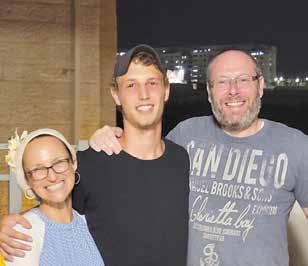
Beit Binyamin began as a home the Airley family purchased in Tzfat as a financial investment, with plans to turn it into vacation rentals. Construction was already underway when the war broke out, and six weeks later, Binyamin was killed. At that moment, the focus changed.
“Suddenly,” observes Jen, “things like choosing the trendiest kitchen cabinet handles didn’t matter anymore.”
What mattered was what they could do for others, especially those affected by the trauma of the war.
“We could have kept it as a private investment, but instead we chose it as our call to action, to open it to Am Yisrael,” Jen shares.
From then on, they began the process of turning it into a retreat for individuals directly affected by October 7, including soldiers, wives of soldiers, bereaved families, members of ZAKA, and survivors of the Nova massacre.
“It was amazing hashgacha,” she maintains. “Hashem sent us the perfect director, therapists, coaches, medical workers and the staff came together naturally.”
It was bashert that most of the construction had already been completed before the war so that within a few
months of the war starting, they could open the house as a healing space. For the last year and a half, Beit Binyamin has already hosted thousands of people.
“People can come and be pampered. It’s beautiful with its amazing panoramic view of the Meron mountains. It has everything someone would need to relax and heal.
“This project,” continues Jen, “is part of how my husband and I are choosing life. We want our other children to see how we go on. Of course, they see me cry – we cry together – but they also see our joy and how we’re choosing to live. Instead of asking lama, why, we are asking l’mah, what can we do with this? How can we make the world a better place? How can we keep shining Binyamin’s light?”
Jen’s message to Am Yisrael is simple: Give.
Binyamin and other young men and women like him gave the ultimate sacrifice for the Jewish people. They were willing to put their life on the line for another Jew and for Eretz Yisroel, that’s why they joined army. If there’s anything we can learn from these Kedoshim, these “kodesh hem,” it’s to put another Jew before ourselves, even if it means being inconvenienced. In some way, we need to be moser nefesh and put someone else first.
Giving lends strength and purpose and creates connection and achdus in our lives. It creates feelings of love between fellow Jews.
“Taking care of Hashem’s children is what we’re meant to do,” maintains Jen. “Just as a parent wants nothing more than for their children to get along and when they observe that behavior, they’re ready to give their kids whatever they want, so, too, when Hashem sees us caring for one another, He’s ready to open all the storehouses and give us everything.”
Trust in Hashem is also so important, she says. We don’t have to understand everything, but we do have to trust. We may not know why something happens, but that doesn’t mean it isn’t right. Who are we to think we know better than Hashem?
Jen also stresses the importance of keeping our bodies healthy. As an exercise physiologist, essentially a physical trainer with medical expertise, Jen understands how integral physical health is to emotional and spiritual well-being.
“I was a choveshet (medic) with Magen David Adom,” she says. “I needed to be able to get to emergency situations quickly. I needed to be physically agile to do that. And also,” she adds with a smile, “when the Beit Hamikdash is rebuilt, I want to be in good enough shape to get there, navigate the crowds, and still be able to dance my heart out.”
Ultimately, beyond the value of selfless giving, what Jen hopes people take from the story of her deep and tragic loss is a keener appreciation of the beauty of our nation and the love Hashem has for His people.
“Come home,” she implores. “Eretz Yisrael is a land of blessing. Be with the Torah of Eretz Yisrael.”
She speaks of Jews around the world as scattered pieces of a huge puzzle.
“Here is where we belong,” she maintains. “Here is where the puzzle comes together.”
For Jen, this is not just belief but lived truth. It is the story she carries, the message she shares, and the hope she continues to hold onto.


By Eliyahu RosEnBERg
t was during the summer. I was in the country in Woodridge, New York, on a Friday afternoon,” Shloime Dachs recalls. “And suddenly, I began to put my tefillin on.”
“Um, Shloime,” his wife called out. “Why are you davening?”
He turned to her, visibly confused.
“What do you mean? It’s Shacharis. I didn’t daven yet,” he replied.
For some reason, Shloime forgot that he was upstate. He forgot it was the afternoon. He forgot that he had davened Shacharis. Somehow, as he wrapped his tefillin straps around his arm, his surroundings faded. The country vanished. He thought he was back home — in Brooklyn, over 100 miles south — davening at the Agudah of Avenue L.
“Well, my wife suddenly started to get nervous,” Shloime recalls.
Later, she heard him talking to a musician on the phone. He was reconfirming the man’s Sunday job. Then, shortly afterwards, he called the same musician again
and had the exact same conversation. And that’s when Shloime’s wife realized that something was up. Something was wrong with his mind.
“Friday night, Hatzalah came. And they realized that this was something serious,” Shloime shares. “They rushed me to the hospital. I ended up in Hackensack Medical.
“And they realized that I had a slight tumor in the back of my head.”
The news was soul-shattering. Shloime thought of his family. His wife. His children. His newborn baby. From one day to the next, his vibrant world — his life as a musician, as a husband, as a father — threatened to collapse.
“It was very scary. We didn’t know what was going to happen,” he recounts. “To make a very long story short, baruch Hashem, the word got around. Rabbi Paysach Krohn was in Europe at the time.
People began to say Tehillim all over the world. And apparently, they said I needed a shunt to drain water that was staying in
Tehillim works. Tehillim is such a powerful tool. a nd so many people need our Tehillim. say it every day. it is the most powerful tool.
The meaning of life is to find your gift. The purpose of life is to give it to others.
We have a gift, and we have to not only find it, experience it, and develop it, but we also have to do chessed with it and use it to reach people… The world is built on chessed.
my head. And baruch Hashem, when they gave me a little nick in the head, it drained right away.
“They watched me for several hours – I never ended up needing the shunt – and when they ended up taking one more X-ray on Sunday, they were stunned.”
His medical team was shocked by the results.
“I don’t know. I thought we saw a little something. A growth. Something on the bottom of your head,” he recalls them saying. “But we don’t see it anymore… It’s gone.”
The next day, Monday, Shloime returned home. In his words, it was “literally nissim.” The tumor was gone.
Fast forward to Thursday. Shloime was scheduled to sing at Camp Simcha. He decided not to cancel, despite his health scare. So, come Thursday, less than a week after his sudden hospitalization, there he was, performing for children in Chai Lifeline’s summer program.
“I can’t thank Hashem enough for that quick recovery — that it was nothing. And I never take it for granted. I mean, they showed us pictures of my head. They said there’s something there. And all of a sudden, it wasn’t there anymore,” Shloime explains, attributing the miracle to all the Tehillim Jews around the world said for him.
“Tehillim works. Tehillim is such a powerful tool. And so many people need our Tehillim. Say it every day. It is the most powerful tool.”
* * *
There’s a famous saying that encapsulates Shloime Dachs’ decades-long career in the Jewish music industry as a talented vocalist and the founder of the Shloime Dachs Orchestra.
“The meaning of life is to find your gift.
The purpose of life is to give it to others,” he shares. “I didn’t understand it until I got much older: We have a gift, and we have to not only find it, experience it, and develop it, but we also have to do chessed with it and use it to reach people… The world is built on chessed.”
That’s the reason he loves what he does. He can’t describe how unbelievable it feels to sing at people’s simchas, to see them at their happiest moment. Or to visit a hospital to bring joy to a child in need of a refuah sheleimah
“I don’t take it for granted,” he says. “It’s such a gift, and it’s so special to do what you love.”
Shloime Dachs’ career began when he was a kid. His mother recognized that her son had an aptitude for music. He started singing before he learned to speak.
“She says I was carrying tunes as a very young child, always taking spoons and forks and banging. She saw that I had music in me from a very young age. And that’s when it started,” Shloime recalls.
She enrolled him in several choirs, including the Miami Boys Choir. He sang on 613 Torah Avenue. He was the vocalist on Country Yossi’s famous parody song, “Then He Potched Me.” He even had the merit of performing for the Lubavitcher Rebbe not once, but twice.
Inspired by Jewish music legends Rav Shlomo Carlebach, Avraham Fried, and Mordechai Ben David, Shloime flourished into a musical giant in his own right. All the while, he had your run-of-the-mill Jewish childhood, with camp and yeshiva and the like.
But then, right after his bar mitzvah, Shloime’s parents got divorced.
“Baruch Hashem, I was very fortunate that my parents did not put us, as children, in the crossfire and use us as

pawns. My father moved out and moved around the corner from us. I got to go to shul with him every Shabbos. My father was very supportive, financially, in every way. And when my mother would get a flat tire, she would still call him and say, ‘Hi, I’m stuck. I have a flat,’ or ‘I got a little fender bender. Can you help?’ It was very, very unique,” he shares.
“When they came up to Camp Torah Vodaas to visit us, on visiting day, they came together. When my sister and I were in Eretz Yisrael together in seminary and yeshiva, they came together to visit us on Chanukah. So, we had a very unique experience, and we were very fortunate and very lucky. Not everybody has that,” he reflects.
“What I do want to convey is that those people who are in this situation — the last thing you want to do is put your children in the middle. It happens a lot, but you’re only hurting the child. And they remember, and they resent it when they get older.”
When Shloime first got married, he worked as the head counselor of a day camp with five hundred boys. Though he couldn’t remember every camper’s name, there was one boy, in particular, who really stuck out to him. The kid was lovable in every way. A serious learner. Great at sports. Smart. Funny. Happy-go-lucky.
But, the next summer, the kid was gone. So, Shloime called the boy’s mother to check in.
“Hi, I’m just curious. I noticed your son isn’t in camp this summer. Is everything OK? Did he go to sleepaway camp?” Shloime asked.
The boy’s mother sighed.
“So, she ends up telling me that she went through a very tough year. She got divorced. She has no money. And her husband refuses to pay for day camp. So, her son’s stuck with her in her small apartment. Basically, to get at her, he wanted their son to be in her hands, day and night,” Shloime recounts.
Shloime’s heart broke for the child.

band?” Shloime replied.
“Don’t bother. Every rav tried to call him and convince him,” she said.
“Can I try? I have nothing to lose.”
She said OK
Shloime dialed up the kid’s father and spoke from his heart.
“Listen, I’m not coming from her side, your side. I just want to tell you from my own experience: you’re hurting your child. He needs to go to camp, he needs to interact with children, he has to thrive. By killing his summer, you might be hurting your ex, but you’re hurting your son in the long run much more,” Shloime exclaimed. “And he’s going to grow up, and he’s going to remember those summers when he wasn’t with his friends. He’s going to resent you for it. I’m telling you, do the right thing.”
The next morning, the boy was back in camp. The kid’s mother was shocked.
“She said she couldn’t believe it. And I told her that I didn’t say anything crazy. I just told him the facts; I lived through it. It’s so important that you get along and try to keep it as healthy as possible,” Shloime declares. “I’m not saying my parents are the norm, but in those days, it was much more hidden and uncommon. I was embarrassed. I didn’t want my friends, coming over for Shabbos, for playdates, to see an empty chair at the head table. It wasn’t easy. But today, it’s so much more common. So, therefore, all the more so, make sure that your child is OK. Don’t let them be hurt by it.”
Years ago, when Shloime was very involved with NCSY, he wanted to help the organization bring public school children closer to Yiddishkeit. So, he struck a deal with them: the organization would offer a free tape of Shloime’s music to any kid who was interested.
He figured it was a long shot. Anyway, he reasoned, why would public school kids be interested in Jewish songs when they have secular music?
Fast forward a few decades. A few years ago, Shloime and his wife were visiting Eretz Yisrael when, suddenly, he encountered a Breslov man who, in his words, “spoke perfect English.”
“Shloime Dachs?” the chassid inquired.
“Yeah?”
“Oh, wow! I’m from Pittsburgh. And my first Jewish music, the first song I ever heard, was the cassette tape that you mailed me 25, 30 years ago from NCSY,” the Breslover remarked.
He explained his journey to frumkeit: how his experiences in NCSY and his exposure to Shloime’s music, as a public school student, led him to become a baal teshuva and move to Israel.
Shloime was stunned. It was a clear message from Hashem: the timing. Everything. He had no idea that his NCSY tapes inspired anyone. What were the chances that he’d randomly encounter one of the boys he inspired decades later in Israel?
That experience reminds Shloime of a story he heard from Rabbi Paysach Krohn.
“It’s a story about a man who was 70 years old, a Jewish man living in Dallas, Texas, with a ponytail and tattoos. And he decides, ‘I’m 70. I’m Jewish. I have to visit the Holy Land. I want to go see my heritage.’ So, he gets on a plane, goes to Israel, and has falafel. And then, of course, Friday night, he puts on his cardboard yarmulke and goes to the Kosel HaMa’aravi.”
Standing 20 feet from the Western Wall, he spots a Yerushalmi, a Jewish man wearing a gold bekeshe and a fur hat, accompanied by two young children with little white yarmulkes on their heads. He sees the man swaying back and forth, back and forth, over and over again — shuckling passionately while davening in front of the Kosel. The Texan is amazed, so much so that, for 20 minutes, he can’t take his eyes off the Yerushalmi man. Something about that sight — the man praying so purely and passionately — inspired him.
Shloime explains.
The man heads to the local kosher bakery, tells a frum person the story, and asks: “If that Jew I saw lived in Dallas, Texas, where would he pray?” The 70-year-old is directed to an Orthodox shul two blocks away. Then, he pays the synagogue’s rabbi, Rabbi Rodin, a visit and recounts the story.
“And he tells Rabbi Rodin something incredible. He says, ‘I’m donating $50,000 to your synagogue because of what I saw. And I’m putting in my will that, after I leave this world, your shul will get another $50,000.’ Rabbi Rodin spoke at the man’s funeral, told over the story, and $100,000 came to Rabbi Rodin’s hands,” Shloime Dachs continues.
“Rabbi Krohn, in his eloquent way, says the story doesn’t end there. Can anyone imagine when this Yid, who was davening at the Kosel, goes up to Olam Haba?”
“Yankele, you gave $100,000 to a shul in Dallas, Texas. Come, you’re going to the Kisei HaKavod,” the malachim tell the Yerushalmi Yid.
“No, no, no,” the man replies in Yiddish. “You have the wrong person. It’s not me. I’m a seventh-generation Yerushalmi. I never left Eretz Yisrael in my life. I don’t speak English. I don’t even know where Dallas, Texas, is!”
“No, you’re the right person,” the angels explain. “Your actions caused someone to be so moved that, 6,000 miles away, he gave $100,000 to a shul because of you.”
It’s, in Shloime’s words, “a powerful lesson for all of us.”
“Do you mind if I call your ex-hus -
“But sure enough, I can’t tell you how many hundreds of cassette tapes I ended up mailing out to these public school kids,” Shloime says.
“Fast forward, he had a beautiful two weeks in Israel. He comes back to Dallas, Texas. And one of the first things he does is he looks for an Orthodox person so he could tell them over the story,”
We don’t realize the power of kiddush Hashem; how people are watching us; how we represent G-d and the Jewish people with our every action. It’s a tremendous responsibility, but it’s also an incredible opportunity. We often think that we need to do something big in order to inspire others. But very often, it’s the “little” things — the way we daven, the way we treat others, the way we simply go about our day-to-day lives — that truly leave an impression.
Sometimes, just one word, one smile, one tiny act of kindness could change a life.

Moderated by Jennifer Mann, LCSW of The Navidaters

Dear Navidaters,
Thank you so much for taking my question. I really gain a lot by reading your insight every week!
I am 24, work as an administrative assistant in a preschool, and the man I’m dating is 25 and does cash advance and accounts payable for a nursing home company. Things are going very well. He’s funny, caring, has great middos and yiryas Shamayim, and is a pillar of the community in the chessed he does. One thing started to bother me, and it’s becoming more and more prevalent as I get to know him and his family. The truth is, he and his family are very attached to their dog. So much so that when I went over for a Shabbos meal for the first time a few weeks back, the dog was actively part of the meal, sitting on the side by the table and constantly barking and nudging for food, which they gave to him straight from the Shabbos table.
Additionally, he began taking the dog with him whenever we went out. I didn’t think much of it the first time, as it was an impromptu Sunday afternoon walk in the park when we both realized we had some free time in our schedule. However, a few days later, when we went to this nice outdoor cafe for lunch, I found it very hard to concentrate on what he was saying as I constantly felt the dog at my feet under the table. The breaking point was when I thought he was paying me a friendly compliment, ultimately to find out that it was, in fact, the dog whose actual name was “Princess.” When I tried bringing it up, he kind of just laughed it off and attributed it being just “shtick.”
While I am really tempted to put my foot down and give the ultimatum of it being either the dog or me, I am nervous that it can put a real strain on our relationship, considering aside from this, he’s really everything I can look for in a significant other, and assuming it works out and we get married, the dog is going to be back at his parents’ house anyways, and not in the everyday picture.
I would very much appreciate your insight on the matter, Bracha*
Dear Readers,
We want to offer YOU an opportunity to be part of the discussion! Please email us at MichelleMondShadchan@gmail.com, subject line “reader’s response,” if you would like to participate in the new “A Reader’s Response” columnist spot. We will send you a question and publish your answer in an upcoming Navidaters edition. If you have a question you would like the Navidaters to answer, please reach out to this email as well.
Looking forward!
Michelle, the “Shadchan”
Rebbetzin Faigie Horowitz, M.S.
People without pets don’t get how they become part of a family. They become family members, literally. Dogs, especially, have personality. You need to understand that and see if you can live with it even if the dog doesn’t leave the home when the young man gets married. Another thing to think about it is the young man’s “shtick.” He may be a playful kind of guy who enjoys entertaining people and animals. Can you enjoy that with him? Does it endear him to you? Do you laugh together? Think about it. If the answer is no, then despite his having many checks in the boxes on your list, I doubt if you will be compatible long-term.
The Shadchan
Michelle Mond
Bracha,
You are really standing at a crossroads between two valid perspectives, and it’s important to look at both clearly. One option is continuing forward with a guy who you seem to truly admire, while accepting that a dog is part of the package. The other option is stepping away and starting again, knowing that whoever you date next will also arrive with his own attachments and quirks that will require
flexibility of a different kind.
One of the realities of dating is that no one comes perfectly aligned with our comfort zone. Every relationship requires bending. And trust me, as a shadchan and dating coach, I have seen those women who pride themselves on “getting everything” while never bending and they almost always date unsuccessfully until they learn the art and importance of flexibility.
The question is never whether you will have to bend but where. What matters is whether this particular issue is something you can truly live with, not tolerate quietly or resentfully, but accept in a way that allows the relationship to move forward.
It is also important to be realistic about expectations. People who are deeply attached to their pets usually do not change that attachment. Giving an ultimatum or hoping that marriage will naturally make the issue disappear is rarely effective. You cannot expect him to become less attached to his dog. What you can examine is whether you can shift your own perspective, especially in light of how much you value him. You mention that if things progress, the dog would likely remain at his parents’ home. That is huge! It will take a big part of the headache out of your mind. But remember, it does not erase what the dog represents in his life and in his family culture.
From my experience as a shadchan, I have seen this go both ways. I have seen people decide to stretch themselves, embrace a pet they never imagined having, and build happy marriages. I have also seen dating couples part ways over pets because one person could not get past it.
Before making any declarations or ultimatums, I would encourage you to pause and ask yourself one question. If nothing about the dog situation changed, could I still see myself building a respectful and happy life with this guy? If the answer is yes, then the work ahead is internal, not external. If the answer is no, then it is kinder to acknowledge that now rather than hope it will resolve itself later.
This is a personal decision, and there is no right or wrong answer. What matters is choosing with self-awareness, both for yourself and for him.
Dr. Jeffrey Galler
This is a ruff situation! Your boyfriend is a dog lover. You are not a dog lover.
Barking up the wrong tree?
When your boyfriend brings his dog along on dates, he is very, very clearly sending you a message. He is telling you that having a close relationship with his pet dog is very important to him. And he is hoping and expecting that you will accept and agree with what he deems very important to him.
Dog lovers love their dogs like family. That’s a reality that won’t change.
By contrast, you would like to feel that you are the primary “Princess” in his life. And you are repulsed by the dog’s annoying and unsanitary presence at the Shabbos table.
This is a serious lifestyle issue. Are there any positives?
I expressed my reservations about this relationship to my wife, who besides being my partner, is also my best friend and harshest critic.
She gave me the look that all husbands recognize, and said, “Jeffrey, Jeffrey, why are you so negative lately?”
So, let’s explore some positives in your relationship with your boyfriend. First, it is very special for a young woman to meet and date a young man who shares a mutual attraction and who seems to share the same values, goals,
One of the realities of dating is that no one comes perfectly aligned with our comfort zone.
and aspirations.
Second, while you are not a dog lover, you are not an actual dog hater, and you are not medically allergic to dogs.
Third, are you ready to give up a really good guy, because of a dog? Perhaps you can negotiate some sort of understanding with him.
Should you at “leashed” try?
Aside from this dog issue, it sounds like you are ready to fall in love with this guy.
May I suggest that you have one of those, “If-we-would-get-married…” conversations. Explain, very gently, that in your newlywed home, there will be room for only one princess and that you will not be comfortable living with a pet dog.
Now, because of his work with nursing homes, he is probably adept at negotiating. He will probably respond, “Would you possibly agree to have a pet dog, after we will be married for a while?”
You can respond that at this point, it is unlikely that you would ever agree to having a dog. But if, hypothetically, a dog ever enters the picture, there must be clear boundaries. The dog will never be allowed into the bedroom, will not be eating from the plates, fingers, or mouths of humans, and that the husband will always be responsible for feeding, walking, cleaning, and caring for the furry friend.
What’s the bottom line?
The bottom line here will be whether the dog-lover is willing to prioritize his human partner over a dog and if the non-dog lover might be able to accept a pet dog as part of the package.
The situation could actually be much worse. Imagine if he would be a dog lover and she would be a cat lover. In that case, the relationship could really be cat-astrophic.
Samantha Weissman
Dear Bracha,
About six months ago, our family inherited a dog. She’s a cute little dog and has been the best thing for our fam-
ily. The one thing our family is makpid on is that we do not bring the dog out if someone is uncomfortable or without asking if the dog can be around –during Shabbos meals, especially. When it’s just our family, she has free reign around the house and just sits under the Shabbos table after we have given her enough challah, of course!
You failed to mention if the dog came up in conversation on dates beforehand. We don’t know if you have a fear or a dislike of dogs. Is it a big dog or a little dog? It does make a difference for different people. Did you discuss having a
The Navidaters
Dating and Relationship Coaches and Therapists
Dear Bracha,
First, I want to slow this down a little, because there are actually two different things happening here, and they’re easy to blur together. One is the dog. The other is your internal experience. And the second one matters more.
Right now, it sounds like you’re not just annoyed. You’re uncomfortable. Distracted. A little displaced. Maybe even feeling like you’re competing for space and attention in moments that are supposed to be about connection and presence. That’s not dramatic. That’s human.
There’s a big difference between “I don’t love dogs” and “I don’t feel emotionally centered or grounded in the dynamic that’s being created here.”
It’s not really about Princess. It’s about where you feel placed in the relationship experience.
You’re 24. You’re dating intentionally. You’re showing up for connection. And in moments that should feel inti-
dog in your home after you get married? Does he want one?
Keep in mind that after you get married, that dog will be a big part of your life when you spend Shabbos and yomim tovim together. Whether you like it or not, you must get it out in the open that you are uncomfortable with the dog being at the Shabbos table. You can tell this young man that you would prefer the dog not join on dates without consulting with you first.
There must be an equal amount of respect when it comes to a pet – while he loves his dog and you respect that, he needs to respect that it’s not always appropriate to have the dog tag along.
What matters is how you feel now and how your feelings are handled now.
If you do not get this out in the open now, you will build up a very strong resentment and the whole relationship will be over. Wishing you much hatzlacha!
mate, focused, and relational, there’s a third presence pulling attention, energy, and emotional space. That can quietly create a feeling of “Where do I fit here?”
That’s important information.
Now here’s the part I want to gently reflect back to you: The urge to jump to an ultimatum usually comes from overwhelm, not clarity.
“Either the dog or me” isn’t actually about boundaries. It’s about frustration, powerlessness, and not knowing how to express a softer truth.
And the softer truth sounds more like:
“I want to feel like I’m the center of the moment when we’re together.”
“I want our time to feel focused and present.”
“I want space to build connection without constant distraction.”
“I want to feel prioritized emotionally.”
Those are reasonable needs. Healthy needs. Relational needs.
You don’t need to threaten the relationship to honor them. Instead of making it about the dog, make it about your experience. Something like: “I really like you, and I feel good with you. But I’m noticing that sometimes when we’re together, I feel distracted and not fully present because of the dog being part of every interaction. I want our time to feel like it’s about us getting to know each other, building something, being in our own space.”
That’s not criticism. That’s self-awareness. That’s honesty. That’s maturity.
Also, pay attention to how he responds. Not defensively. Not dismissively. Not minimizing it as “just shtick.” But whether he can actually hear your experience without mocking it or brushing it off.
Because this isn’t really a “dog issue.” It’s a responsiveness issue.
Can he take in your feelings? Can he adjust? Can he make relational space for your comfort? Can he prioritize connection when it matters?
Those are long-term relationship
qualities, not small things. And one more honest truth. You’re telling yourself a future story to calm the discomfort:
“It won’t matter when we’re married.”
“The dog will stay at his parents’ house.”
“It won’t be in our daily life.” Maybe.
But relationships aren’t built on future hypotheticals. They’re built on current dynamics.
What matters is how you feel now and how your feelings are handled now. So, no ultimatums. No power plays.
No dramatic lines in the sand. Just clarity. Presence. Self-trust. And a simple, grounded conversation rooted in your experience, not blame.
Because the real question isn’t: “Is the dog too much?” The real question is: “Do I feel seen, centered, and emotionally prioritized in the relationship dynamic?”
Listen to that answer. Your body and nervous system already know it.
Sincerely, Jennifer

So apparently, we have two kinds of birds now. We’re like a bird sanctuary.
The chickens you know about, I think. And then last week, I talked about how my son brought home two quails, which he got from my brother-in-law, who got them from his brother, who’s amazing at figuring out what to bring the people he comes to for Shabbos. And my brother-inlaw decided, “Give them to Mordechai! He already has chickens in his backyard!”
Quails: they’re like chickens but smaller! That the actual chickens will beat up, given the opportunity! In other words, they’re indoor chickens.
But it was exciting! Quails! Like the Bnei Yisrael ate in the Midbar after they complained! My students complain when they have chicken on the bone, so they would have complained about the quail, too, because it’s like chicken on the bone but smaller.
When we first got them, we said, “If we can keep them with the chickens, then fine; but if not, we have to get rid of them.” Then we found out we can’t keep them with the chickens, so we said, “Yeah, but what if we kept them long enough that we can try quail eggs?” Because quails hit adulthood faster. Chickens are babies for five minutes, and then they’re teenagers for five months, during which they’re not as cute but they’re not laying eggs either. Whereas quails –within two months – are adults the size of babies that lay eggs the size of olives.

By Mordechai Schmutter

So we said, “Let’s keep them for now, and that way, we’ll have eggs in a month and a half.” Maybe less! We didn’t know how old they were, because they’d been in four people’s hands before we got them.
We also didn’t know what genders they were. With chickens, even though you don’t know at first, by the time they’re adults, everyone knows how to eyeball the difference. With quails, we have no idea. What do adult quails even look like?
Then I saw something that said that girl quails are bigger. So I said, “OK, this one’s bigger.” But then even if we had two of the same gender, one is still going to be bigger.
And keeping them for eggs also assumes they’re kosher. It’s not so pashut. When it comes to chickens, some breeds are kosher, but some don’t have a mesorah. With quails, it’s a lot easier: only one breed has a mesorah. And only according to some hashgachos.
I did figure that they were probably kosher. I have this theory – I don’t know if it’s true – that there’s a certain baseline level of intelligence that if an animal is over that line, we can’t eat it. For example, dogs keep sheep from mindlessly wandering off, and dogs aren’t kosher. Predator animals have to be smart enough to hunt prey and develop strategies… prey animals have to be smart enough to hunt grass. Prey animals are like, “Look! I found grass! Let’s eat the grass and then go to the bathroom on the same grass! And then step on that grass!”
I know this from my chickens. And quails are like chickens, but far less intelligent. For example, chickens run away from danger. They run away from everything, actually. Last week, I hung a shower curtain on the side of their coop to protect them from the wind, and they all injured themselves trying to get away from it.
Granted, it was not a new shower curtain.
Quails, meanwhile, run away from danger and then toward danger and then away again and then toward it again. That way they feel like they’re making progress and getting their steps in.
And I’m not a danger! I’m coming over to see if they have enough food.
“Well, not anymore. They just ran through it.”
My point is that if chickens are kosher, quails are even more kosher. There’s nothing more kosher than quails.
But I can’t pasken based on my theories, obviously.
I do have a rabbi who tells me if my chickens are kosher. So I thought, “Does the chicken rabbi know anything about quails? Probably not, right? He’s a chicken rabbi.”
Of course, he knew.
Not only did this rabbi know about quails, it turns out he’s the main keeper of bird mesorah in America. He also knows the history of why peacocks don’t have a mesorah anymore.
So he asked, “What breed do you have?”
“I don’t know. I got them fourth hand.”
So I called my brother-in-law’s brother, and I asked, “Where did you get the quails?” that way, I could maybe call the farm.
He said, “I don’t know; some farm outside Lakewood.”
So I asked, “Was there any kind of sign of what breed it was?”
And he said, “I don’t know. Oh, I think it said jumbo. Is that a breed?”
So I sent the rabbi some pictures. I didn’t know what he was looking for exactly, so it was a lot of pictures. And also some videos, because when I get close enough to the quails to take a picture, they run away. And then back.
And the rabbi said, “They might be kosher, but I need to see them in person. Why don’t you bring them into my office?”
So I asked, “Where’s your office?” and he said, “Manhattan,” and I said, “Oh.”
So he said, “If you want, you can send them in with another rabbi who works here,” and I said, “I can bring birds to a rabbi and ask him to bring them on the subway?” It wouldn’t be the weirdest thing on the subway, but it would be the weirdest thing I’ve asked a rabbi.
So I put the quails in a pet carrier and sent them to Manhattan with another rabbi, Rabbi T., who lives near me. I knew that this rabbi worked there, because I’ve had three of his children as students. I called
him and said, “Can you please bring some birds to Manhattan for me and show them to the bird rabbi?”
And he said, “I guess so,” because I’ve had three of his children as students.
I threw some food into the carrier, too, and then I thought, “What if they get thirsty? Should I put a little bowl of water in there for the rabbi to spill?”
So I put some fruit in there, because I figured that way they’ll get some hydration. Like I threw in some grapes – cut in half, of course, so they wouldn’t choke.
Meanwhile, my mother-in-law, who’s in kashrus, came to town that day on business, and she asked, “Where are your quails? I wanted to see them!”
And I said, “They went to the city. They had a meeting with a rabbi at the OU.”
And she said, “How did they get a meeting?”
But on the other hand, you’re using a schnapps glass. So cute!
My kids are excited to add quail eggs to everything. They asked, “Can we dip the fried chicken in quail eggs?” And I said, “No! Do you know how many quail eggs that would take? And no one would know the difference!”
We do get a kick out of giving them out and seeing people’s reactions. Like my brother came over for Shabbos, and his kids are weirdly into hard-boiled eggs, so I boiled up a dozen of these and gave them out for Shabbos party, and his kids went nuts. It was the healthiest Shabbos party I’ve ever served.
And there are other uses, too. You can put them on your Seder plate or use them to class up your Seudah Hamafsekes!
“Come on the floor! Have a tiny egg!”
“Is it a k’beitzah?”
It wouldn’t be the weirdest thing on the subway, but it would be the weirdest thing I’ve asked a rabbi.
Anyway, Rabbi T. came home that night and told me that the bird rabbi said four things:
1. They’re both kosher.
2. The bigger one is the girl.
3. We’re feeding them way too much fruit.
And then the girl started laying the very next day! It’s like she was waiting for a psak. “Oh, I’m the girl? Fine; I’ll lay eggs.”
Anyway, now I know in hindsight how to tell the difference between the boy and the girl: if you try picking up the girl, the boy will bite you. Or her. He’s not picky. Whereas if you try picking up the boy, the girl does not care.
So now we get to figure out how the eggs are!
They taste about the same. They’re adorable, though, in case that’s what you’re looking for in an egg. “Would you like some eggs? They’re adorable!”
Especially if you make tiny sunny-side ups. They cover almost a whole snacker. Each egg is about a sixth the volume of a chicken egg. If you wanted to make a regular-size omelet, you would need to check 12 tiny eggs for blood spots. And deal with six times as much shell falling into the glass.
“Not even close.”
I’m not sure how to get more quails, though, so we can get more than the equivalent of one omelet every two weeks. Longer, if she keeps running through the eggs and breaking them.
I keep leaving some of the eggs in the cage in case she wants to hatch them. I’m like, “Look! The pile’s getting bigger!” And then she sees me and runs through the pile, and half the eggs break. And then we have to make an emergency tiny omelet.
Is there another way to get quails? I would have to find out where my brotherin-law’s brother got his quails, and even he doesn’t know. Or I can get quails from somewhere else, and then send them into Manhattan so they could meet the bird rabbi. I haven’t met the bird rabbi. We communicate through carrier pigeon.
And anyway, if we are getting more birds, I think I want peacocks next.
Assuming I can get Rabbi T. to agree to bring them on the subway.
Mordechai Schmutter is a freelance writer and a humor columnist for Hamodia and other magazines. He has also published eight books and does stand-up comedy. He can be contacted at mschmutter@gmail.com.


By Sara Rayvych, MSEd
Holding that tiny bundle, it’s hard to imagine they will become an adult. They start off so young and helpless that it’s hard to see past the frequent feedings and changings. Even as they grow, we still see them as those sweet babies, and it’s hard to transition them towards adulthood.
Our goal as parents is not simply to build children but to shape their future and create healthy adults. This process takes years and by necessity has to happen slowly. If we go too fast, we are throwing them into situations they are not prepared for, yet if we never let them move forward, we are stunting their development. It’s a fine dance, and one that requires a frequent change of direction or steps.
Gaining independence is a slow process consisting of many small steps. What may seem to an adult as too minor to mention may be an exciting milestone for a child. Every move our children make on their own is one more step towards independence. Learning to feed and dress themselves are big milestones in early childhood, as is potty training. For teens, it may be learning to drive and being able to go out on their own. Everyday household tasks, errands outside the home, and interacting with others are all potential areas to earn independence.
It’s important to remember that children may make mistakes. More accurately, parents should expect children to make mistakes. It’s part of the learning process and is normal. The little boy once showed up to preschool with his shirt inside out and slightly misbuttoned. His bag had a note for the morah letting her know he was starting to dress himself. The morah proudly complimented him on his dressing skills as he beamed. He may not have done the job correctly, but he tried and did his best. As adults, we want everything done
a certain way, but insisting on perfection can prevent children from gaining the skills they need for independence. Our support and encouragement are important, but children also require confidence to take the next step. Parental criticism can erode that budding self-esteem. Children should be praised for trying their best and gently corrected when absolutely necessary.
It’s truly difficult for parents to gauge the appropriate pacing. We don’t want to hold them back, but we also don’t want to push them into something they are not prepared for. Unfortunately, there is no set formula to estimate an appropriate pace. Parents need to think carefully and use their best judgement in deciding when a child is ready for any given step.
Along with the exciting word “privilege” comes the less noted one, “responsibility.”
It’s important for those two words to go together. Each big step they take needs to be matched with the appropriate levels of responsibilities. Parents should explain what is expected, and children need to follow through. Parents may need to hold off on privileges that are not earned or maintained. For example, a child who doesn’t look both ways may no longer cross the street independently.
Al Pi Darko
Each child is different, and Mishlei reminds us to bear this in mind throughout our parenting. It’s natural to want to know a set age when we should expect a child to reach a developmental milestone. There may be norms and suggested ages to guide us, but none of those can accurately tell us exactly where our unique child is holding. Hitting milestones of independence is developmentally determined and needs to match the particular child and their needs. Age is one factor, and we can’t ignore it. It would be inappropriate to allow a toddler to babysit themselves for a few hours, regardless of how mature they may

seem in their playgroup. It would also be inappropriate to insist upon picking out a teenager’s clothes each night before they go to school. Toddlers need supervision, and teens need autonomy in many personal decisions.
Age is the main factor in most people’s minds, but it’s not sufficient. Even within any given age range, we can see a multitude of developmental levels. For example, there are four-year-olds that can be left unattended in a room for a bit and trusted to continue eating their snack nicely. There are other four-year-olds that could wreak havoc and cause danger in less time than it takes to sneeze. These tots will require constant supervision.
The child’s individual personality is a major factor. Some children are naturally more mature than others. Additionally, some children are natural risk takers, while others are more cautious. There are strengths and weaknesses to all middos, but we need to match the child to the task. A child that is naturally an adrenaline seeker is not going to be trustworthy in situations that a more hesitant child can be relied on. Conversely, a hesitant child may be less capable than a more outgoing child when it comes to asking for assistance from an adult. Depending on the exact setting, the same middah can be either a strength or a weakness. It’s our job to appropriately match the child to the task.
We all have our personal strengths and weaknesses. Implicit in this is that we all have areas we are stronger in than others. It’s expected that a child may be very strong and ready for independence in one area but completely ill-prepared in another. For example, a child may be ready to hang out with their friends and enjoy the local pizzeria independently but not mature with money. This particular child could certainly enjoy lunch with their friends, but their
parents would be wise to give them the correct amount of cash and not a credit card.
As they take each new, exciting step, we may need to provide a little support and encouragement to help them get there. We also need to fortify them with the knowledge of what is expected and how to accomplish each step. When something is so familiar to us, we easily forget that it’s not obvious to a child new to that task.
Becoming “big” and independent is very exciting for kids. They may be nervous or hesitant, but it’s also thrilling for them. They look forward to each new thing they can do and can’t wait until they’re big enough for the next step.
Parents will be excited to see their child take those big kid steps, but it’s also emotionally difficult. Their little one is getting older and will never again be that tender age. Each independent step they take is one step away from us and needing us. This, too, can be painful for parents. It’s important for parents to acknowledge and honor their own feelings while not holding back their youngsters.
As we bring our children from infancy to adulthood, we will encounter many challenges but also much joy. With wisdom, patience and lots of siyata dishmaya, we can enjoy the nachas of seeing our precious little ones develop into the next link of the mesorah.
Sara Rayvych, MSEd, holds a master’s degree in general and special education. She has been homeschooling for over 15 years. Sara provides personalized parent mentoring services, addressing a variety of general and specific parenting concerns. She can be contacted at Sara. Rayvych@gmail.com with comments, questions or for private consultations.

By Etti Siegel
Q:Dear Etti,
My middle school son has a hard time with memorization. That makes school difficult for him. Any tips? - Concerned
A:Dear Concerned, I’m so glad you wrote in, because this is something I see all the time with wonderful, capable middle school children who are being asked to memorize so much.
Memorization can become a real stumbling block, not because a child isn’t smart, but because his brain simply doesn’t hold onto information easily in the way school often demands. What’s important to know right away is that difficulty with memorization is very rarely about ability. More often, it’s about how information is taken in, how often it’s revisited, and the pressure a child feels when he’s afraid he won’t remember.
Many kids try to memorize by rereading quietly again and again. It looks like studying, but the brain doesn’t really “grab” the material that way. Memory strengthens when the brain is active. When a child says information out loud, explains it to someone else, or tries to recall it without looking, he is actually building pathways that help it stick. Even writing things from memory, not copying, but closing the book and trying to reproduce what he learned, helps tremendously because it forces the brain to retrieve rather than simply recognize.
Another big piece is time. Long, exhausting study sessions usually backfire. The brain remembers far better in short, focused bursts spread over time. A few minutes here and there, revisiting the material multiple times over several days, is much more powerful than one long night of cramming. When review is spaced out – the same day, the next day, a few days later – information slowly moves into long-term memory. Without that spacing, boys often feel like everything “disappears,” which can be very discouraging.
For many middle schoolers, especially boys, visual support also plays a huge role. When material is highlighted in key words, color coded, organized into small sections, or turned into something they can see rather than just hear, their brains have more hooks to hold onto it. Even rhythm or tune can make a difference. I’ve watched boys who struggled to remember straight text suddenly succeed when they chanted it, put it to a pattern, or learned it with a beat.

But perhaps the most important piece is emotional. When a child starts to feel that memorization is his weakness, anxiety creeps in. Anxiety blocks recall. Then he forgets more, which increases frustration, which increases pressure, and the cycle continues. Gentle encouragement, calm practice, and helping him see progress in small steps can rebuild confidence and actually improve memory because the brain works best when it feels safe.
I want to reassure you that many strong thinkers struggle with rote memorization. These are often children who understand deeply but don’t naturally store details without support. With the right methods, active review, repetition over time, and lowering the emotional stress around remembering, I’ve seen children make remarkable progress and, even more importantly, regain their belief in themselves as learners.
Gentle encouragement, calm practice, and helping him see progress in small steps can rebuild confidence and actually improve memory.
studying but don’t actually build memory. These simple shifts can make a big difference.
• Start small and keep it short. Ten focused minutes beats an hour of frustration. Several brief review sessions spread across days help the brain store information far more effectively than cramming.
• Make memory active. Reading silently is the weakest strategy. Saying information out loud, covering the page and recalling it from memory, or explaining it to someone else forces the brain to retrieve information, and retrieval is what strengthens memory.
• Use writing as a memory tool. Have your child close the book and write what he remembers in his own words. Even partial recall helps build stronger pathways than copying notes.
Your son is not alone, and he is certainly not incapable. He simply needs tools that match how his brain works. With patience and the right approach, memorization can absolutely become manageable for him.
Hatzlacha,
- Etti
Quick recap for anyone interested in these strategies
• Memorization is not about “working harder,” it’s about working smarter. When kids (people) struggle, it’s often because they’re using methods that feel like
• Lean into visuals. Color coding, highlighting key words, charts, diagrams, or quick sketches give the brain extra hooks. Many people remember what they see better than what they only hear.
• Break information into chunks. Small sections learned well feel manageable and prevent overload. Mastery of one piece builds confidence to move to the next.
• Add rhythm or pattern. Chants, tunes, or a steady beat can transform difficult material into something memorable, especially for language-based or text-heavy subjects.
• Review before forgetting. A quick check the same day, the next day, and again later in the week helps move information into long-term memory.
Mrs. Etti Siegel holds a MS in Teaching and Learning/Educational Leadership and brings sound teaching advice to her audiences culled from her over 35 years of teaching and administrative experience. Etti is an Adjunct at the College of Mount Saint Vincent/Sara Shenirer. She is a coach and educational consultant for Catapult Learning, FACTS Education Solutions, Brienza Academic Advantage, Yeled V’Yalda; is a sought-after mentor and workshop presenter around the country; and a popular presenter for Sayan (a teacher-mentoring program), Hidden Sparks, and the Consortium of Jewish Day Schools. She is a frequent contributor to Hamechanech magazine and The Journal for Jewish Day School Leaders and has a weekly column in The Jewish Home. She can be contacted for questions and comments at ettisiegel@gmail.com.


By Bassy Schwartz, LMFT
Something changes for many parents once their daughters hit the teenage years. Conversations that used to feel natural now feel loaded. Innocent comments spark irritation. A daughter who once talked freely now offers silence, sarcasm, or quick shutdowns. You catch yourself thinking, What happened? Where did she go?
What makes this especially disorienting is that many of these girls look like they’re doing fine. They’re responsible. Capable. Often impressive. There’s no obvious crisis. And yet parents feel it immediately: the distance, the tension, the sense that whatever they’re offering isn’t landing. You might find yourself walking on eggshells, unsure whether to speak up or step back. And the harder you try to fix things, the wider the gap can feel.
In my work, I see this over and over. It’s rarely about doing something “wrong” or not giving enough guidance. Most of the time, the tension comes from something quieter: she’s not sure it’s safe to show how she really feels. That fear makes her pull back, even when she wants to stay close. She wants to share, but sharing has felt risky. A question might turn into a lecture. A sigh might feel like disapproval. And so, she keeps it in.
Adolescence intensifies everything. Feelings come fast and strong, long before a teenager has the ability to step back and make sense of them. At the same time, girls become exquisitely sensitive to how they’re received. Tone matters more than content. Timing matters more than intention. A raised eyebrow or a sharp “Why are you like this?” can undo an entire conversation. Even a well-meaning attempt to advise or reassure can land as pressure. She may pull back, retreating not because she doesn’t want connection, but because connection feels fragile.
The girls who struggle most quietly are often the ones doing everything “right.” They’re thoughtful, conscientious, and deeply aware of expectations. They don’t

want to be difficult. So they contain themselves. They manage their reactions. They monitor their words. And over time, that containment turns inward into anxiety, self-doubt, or emotional distance. Parents sense it but can’t quite get a handle on it. It’s subtle. It’s frustrating. It’s heartbreaking in a way that leaves parents feeling helpless. What I’ve noticed over time is that it’s
mission: “I was upset and didn’t know how to say it.” Those moments aren’t dramatic, but they are meaningful. They are the cracks where connection can grow.
This is hard for many parents. Most of us were not taught to sit with strong emotion. A distressed teenager can trigger urgency, fear, or a reflex to regain control. But often, the most grounding thing a parent
Often, the most grounding thing a parent can do is surprisingly simple: stay present.
rarely about finding the right words. The shift usually happens when the emotional tone of the interaction changes. Girls tend to stay engaged when they sense that their feelings won’t cost them closeness, that being upset won’t automatically turn into a lecture or a strained silence. When they don’t have to work so hard to stay composed, they’re more likely to stay present. Sometimes, it’s a long silence followed by a quiet comment. Sometimes, it’s a little ad-
can do is surprisingly simple: stay present. Slow the moment down. Let it be messy without rushing to clean it up. A calm presence says more than any advice ever could. Sometimes, it’s enough to just sit together on the couch while she scrolls through her phone, offering a quiet, steady presence. Sometimes, it’s letting a conversation drop for a night and returning later with a soft, “I noticed we got off track. Want to try again?”
The specifics don’t matter as much as the
feeling that someone is there, steady, and willing to meet her where she is.
Reaching a teenage daughter rarely looks dramatic. It happens in these small, unglamorous moments; listening without interrupting, letting a conversation end unfinished, coming back later and saying, “That didn’t land the way I wanted.” Over time, these small moments accumulate into trust. And trust is what keeps a daughter coming back, even when she’s pulling away, even when she seems like she doesn’t need you.
Teenage girls won’t remember every conversation from these years. What they will remember is how it felt to be with you. Whether they felt managed or met. Pressured or understood. Whether they felt like they had to protect themselves or could safely let someone in. These are the moments that shape her confidence, her resilience, and ultimately the way she learns to relate to others.
We teach our daughters many important things: responsibility, faith, empathy, perseverance. But lessons without connection rarely stick. When they feel emotionally reached, those lessons finally have somewhere to land. When they feel seen in the small, messy, imperfect moments, they learn something far more lasting: that they matter, just as they are.
And that, more than anything we say, may be the single most protective thing we can give them.
Bassy Schwartz, LMFT is the founder of Core Relationships, a boutique therapy practice in the Five Towns offering individual, couples, and family therapy. Her work centers on helping clients build safer, more authentic connections by healing the patterns that block intimacy and trust. Bassy is trained in Emotionally Focused Therapy (EFT) and integrates trauma-informed care and relational insight in her approach. She believes therapy is not about “fixing” people — it’s about creating the safety to be fully human.


By Noah Rothstein
“Undaunted:
How the Sixth Lubavitcher Rebbe, Rabbi Yosef Yitzchak Schneersohn, Saved Russian Jewry, Reimagined American Judaism, and Ignited a Global Jewish Renaissance,”
by David Eliezrie
Toby Press, ISBN 978-1-59264-726-2, Hardcover, 563 pages. Published 2025
At the age of ten, Yosef Yitzchak Schneersohn was arrested for the first time. He had stepped in to defend a Jewish butcher who was being beaten by a police sergeant in the marketplace of Lubavitch. The sergeant accused the boy of ripping the badge off his uniform and had him thrown into a dark jail cell. Alone and frightened, the boy did what he had been taught: he began to recite the Mishnayos he had memorized. When his father, Rabbi Shalom Dovber, returned to town and heard what happened, he praised his son. “It was a good thing that you did, to protect a decent, upright Jew, and if you suffered for a few hours – so what?”
That episode, which Rabbi David Eliezrie recounts early in his new biography, captures something essential about the man who would become the sixth Lubavitcher Rebbe. He would be arrested six more times over the course of his life, including a death sentence in the notorious Shpalerka Prison in Leningrad in 1927. He faced down czarist oppression, Soviet persecution, and Nazi terror. He was forced to start over again and again, in Rostov, Riga, Warsaw, and finally Brooklyn. Each time, he rebuilt. The title of Eliezrie’s book, suggested by his three granddaughters, says it plainly: Undaunted.
“Undaunted” is published by Toby Press under Koren Publishers Jeru -
salem (korenpub.com). Most Orthodox Jews today know of the seventh Lubavitcher Rebbe, whose shluchim can be found in nearly every city in the world. Far fewer know the story of his father-in-law, the man who made it all possible. Eliezrie, a Chabad shliach in Yorba Linda, California, spent years filling that gap, traveling to Russia and Latvia to visit the places where the Rebbe lived. He drew on seventeen volumes of the Rebbe’s letters, thousands of first-person accounts, and archival sources that previous historians did not have access to. The result is the first comprehensive English biography of Rabbi Yosef Yitzchak Schneersohn, known to chassidim as the Rayatz or the Frierdiker Rebbe. It is a work of Jewish history, not just Chabad history.
The book moves chronologically through the Rebbe’s life, beginning with his childhood in Lubavitch, the small village in White Russia that gave the movement its name. Eliezrie draws on the Rebbe’s own extensive diaries and memoirs, which he began keeping as a boy at the encouragement of his teachers. These early chapters are rich with stories of the chassidic world that existed before the First World War: the pilgrims who streamed into Lubavitch for the holidays, the elder Ccassidim who shared stories of previous Rebbes, the intense bond between father and son
as the Rashab prepared his only child to lead.
The Rebbe’s father was frequently ill and away seeking medical treatment, leaving the young Yosef Yitzchak to find solace among elderly chassidim. “Due to my personal distress, I became a regular visitor to the room of Reb Chanoch Hendel, many times sleeping on a bench,” the Rebbe later wrote. He would sit with them through the night at farbrengens, absorbing their stories and their faith. That world shaped him. It also vanished. The German invasion of 1915 forced the family to flee Lubavitch, and they never returned. The town’s last synagogue was shuttered in 1936. The Holocaust erased the last Jewish presence there.
Eliezrie devotes significant attention to the Rebbe’s years of leadership in Soviet Russia. In 1920, after his father’s death, the Rayatz became Rebbe in Rostov. He was forty years old. The Bolsheviks were consolidating power, and the Yevsektzia, the Jewish section of the Communist Party, had launched a campaign to eradicate Jewish religious life. Synagogues were closed. Rabbis were arrested. Teaching Torah became a crime. The Rebbe responded by building an underground network of schools, mikvaot, and yeshivot. He trained young men and sent them across the Soviet Union to strengthen Jewish

communities. He knew the risks. Many of those he sent were arrested, tortured, and exiled to Siberia. Some were executed.
The chapter on the Rebbe’s arrest in 1927 reads like a thriller. He was taken from his home in Leningrad in the middle of the night by armed agents of the GPU, the Soviet secret police. He was accused of counterrevolutionary activity and sentenced to death. International pressure, including intervention from Latvian and German diplomats, led to a commutation of the sentence to exile, and eventually to his release. On 12 Tammuz, the Rebbe walked out of prison. That date is still celebrated by Chabad chassidim as a holiday of liberation.
Forced out of Russia, the Rebbe settled in Riga, Latvia, and then Warsaw. He continued to direct the underground network in Russia from abroad, sending funds and directives through secret channels. When the Nazis invaded Poland in 1939, he was trapped in Warsaw. The rescue effort that followed is one of the most remarkable episodes in the book. American diplomats, working through back channels, reached out to a senior Nazi economic official who had connections to the German military. The request made its way to Admiral Wilhelm Canaris, head of the Abwehr, Germany’s military intelligence. Ca -
naris assigned a team of officers, some of them of Jewish descent, to locate the Rebbe in the ruins of occupied Warsaw. German soldiers searched the bombedout Jewish neighborhoods, asking after a chassidic rabbi while the city was still under siege. They found him. The Rebbe and his family were escorted out of Poland, through Berlin, to Latvia, and eventually to the United States. A Nazi admiral helped save a Rebbe. Eliezrie documents this story with care, drawing on interviews with descendants of those involved and historical research by German scholars. It is a reminder that even in the darkest moments, unexpected alliances can form.
The Rebbe arrived in New York in March 1940. He was fifty-nine years old, in fragile health, and had lost almost everything. The final section of the book covers his decade in America. He arrived in a Jewish community that was, in his words, racing down the highway of assimilation. Most American Jews saw Orthodoxy as a relic of the old country. The Rebbe saw something else. He believed that America offered an unprecedented opportunity to rebuild Jewish life on new foundations. He established yeshivot, sent young
men to cities across the country to open schools, and laid the groundwork for what would become, under his sonin-law and successor, the global Chabad movement.
Eliezrie tells the story of Rabbi Sholom Posner, who was sent to Pittsburgh in 1943 to start a yeshiva. Posner was forty-two, spoke little English, and had no experience running a school. Local Jewish leaders told him there was no need for a yeshiva in Pittsburgh. He went door to door trying to enroll students. He wrote to the Rebbe about his struggles. The Rebbe responded, “You dig a hole and plant seeds, and I will water it with my tears.” By 1950, the school had one hundred students. Similar stories unfolded in Worcester, Buffalo, Rochester, and a dozen other cities. The Rebbe was planting seeds that would bear fruit long after his passing.
The book does not attempt to cover every aspect of the Rebbe’s life. It does not explore in depth his vast Torah writings, which fill over two hundred volumes. What it does is place the Rebbe in historical context, showing how he navigated the upheavals of the twentieth century while remaining rooted in the spiritual traditions he inherited.

Eliezrie writes that the Rebbe “stood at the apex of history,” facing each era’s unique threat to Jewish survival with determination and faith.
One theme runs through the entire biography: the Rebbe’s boundless love for every Jew. Whether writing to a young girl in McKeesport, Pennsylvania, who had started a Shabbos club, or directing the rescue of Jewish children from convents in postwar Europe, he treated each person as if they were the only one who mattered. “I am a Jew who was instilled with ahavas Yisrael,” he once said, “and the idea that we must put our lives on the line for Judaism and for another Jew.”
Eliezrie closes with the story of the Rebbe’s yahrzeit in 1951, when his son-in-law, Rabbi Menachem Mendel Schneerson, finally agreed to become the seventh Rebbe. The passing of leadership from one generation to the next is described with restraint and dignity. The seventh Rebbe built on the foundation his father-in-law had laid, expanding Chabad into the largest Jewish organization in the world. Today, the two are buried side by side in Queens, and hundreds of thousands visit their resting place each year.
The book arrives at a moment when stories of Jewish resilience carry particular weight. The Rebbe faced circumstances that would have broken most people. He did not break. He adapted, rebuilt, and kept going. His example speaks across the decades.
Eliezrie quotes the Rebbe’s own summary of his life’s work: “I am my father’s disciple. He endeavored for forty years never to compromise on even the minutiae of Jewish ideals.” That is what it means to be undaunted. It is not the absence of fear. It is the refusal to let fear determine what you do.
For readers who know the Chabad movement primarily through its current presence in communities around the world, this biography offers essential context. It shows where the movement came from and what it cost to build. For readers interested in twentieth-century Jewish history, it offers a window into a world that was destroyed and a leader who carried its memory forward. And for anyone who has ever wondered what it looks like to hold onto faith through impossible circumstances, the Rebbe’s life provides an answer.
The Rayatz’s yahrtzeit is this week, on Yud Shevat.
By Miriam Liebermann
Awhile back, I had visited the Amud Aish Memorial Museum/ Kleinman Holocaust Education Center located in Mill Basin, Brooklyn. The exhibits were riveting and inspiring. Driving home, my friend Malkele asked me, “Miriam, how do you discuss the Holocaust with your grandchildren?”
I was taken aback by this question. In truth, at that point in time, I had not yet spoken to my grandchildren about this era. I had been remiss. As a grandmother – a role that I take quite seriously –perhaps I should be sharing the stories of spiritual heroism with these young ones. Each of us is a link in this monumental chain. We, too, have a role in educating and inspiring our young ones. And as the survivor generation ages and passes on, our role in this realm becomes even more crucial.
There are various books, written with great sensitivity, available in our Judaica shops that are appropriate for children that would enable us to introduce this difficult era to our younger ones. Over the years, various educators have tackled this period and created materials that are used in our yeshivos and day schools. This museum is a fabulous resource for our community. I have an additional suggestion for you. Perhaps, my dear readers, you would like to join me as together we delve through the archives in Amud Aish, seeking out those items that will assist us in telling the story.
I am a child of survivors. I assume that many of you are also children of survivors. My dear friend Gali Berkowitz points out that 6 million were killed. Our parents obviously were among the relatively few who survived. Why did they survive? So we, both you and I, should be born and carry on. We have a purpose in being alive. We must use our time well. We must cherish our very lives and the opportunities that life presents us with. And we must share the inspiration, the tales of spiritual heroism with our young ones.
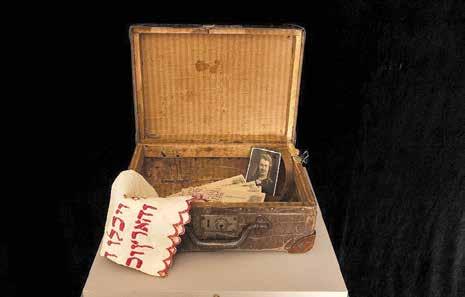
Abie Rotenberg, the legendary songwriter, sings, “What will become of all the memories? Are they to scatter with the dust in the breeze?”
With the help of the Amud Aish Memorial Museum, we will hold tightly to these memories. And we will share these
a case in the Amud Aish Memorial Museum. Every item displayed there has a story…always a moving, poignant story. Let me share this one with you.
Chaya Horowitz lived with her parents and her two sisters, Kaila and Rivka, in Budapest. In March 1944, the Nazis
Chaya held onto it tightly, the only memento of her beloved sister Rivka and her childhood home.
memories with our children and grandchildren and, please G-d, one day, our great-grandchildren. The Jewish people will live on…
Chaya’s Prized Possessions
It is a simple challah cover, quite old, a bit threadbare and stained. It is cream colored with red-scalloped embroidery spelling out the words of the Leil Shabbos Kiddush. This challah cover is sitting in
marched in, creating havoc and terror. In June 1944, Kaila was deported to Auschwitz. In October 1944, Rivka was deported to Bergen-Belsen. November 1944, Chaya and her parents were ordered to leave their home and enter the ghetto. Each person carefully calculated exactly which items should be taken along. What was absolutely necessary for survival?
Packed into the Horowitz valise was the challah cover that had graced their
Shabbos table during better days. Chaya well recalled how Rivka had painstakingly worked on making it, anticipating the joy their parents would experience when she presented this special gift to them. Rivka’s anticipation became reality; each Shabbos, as her handiwork graced the Shabbos table, Rivka’s heart would soar with pride and joy. Holding onto this cherished challah cover enabled Chaya to connect with her beloved family. As she fingered the lettering – the very lettering Rivka had embroidered – she felt Rivka’s warmth and felt connected. Whilst admiring the candelabras gracing the sides of the cover, Chaya could visualize her beloved mother as she kindled the Shabbos candles.
Also included in this valise was a photo of Kaila, along with final postcards written by their grandfather, Reb Yehoshua Zelig Grunfeld, 85 years old at the time he had penned those messages. His son, Reb Moshe Chaim, had been the rav of the Sajoszentpeter Ghetto. Father and son, together with daughter-in-law and children, were deported to Auschwitz and murdered.
The years following were filled with unspeakable pain. Rivka was murdered in Bergen-Belsen. Kaila was killed in Auschwitz. Only Chaya miraculously survived, as did the challah cover. Chaya held onto it tightly, the only memento of her beloved sister Rivka and her childhood home. It was evidence that her beloved sister had actually existed and had once been an integral part of her life. Chaya also held tightly to the photo of Kaila. For over 65 years, Chaya kept this challah cover, with its special case, in a safe place, together with the photo and those postcards from her Zayde, doing her utmost to access those long-ago memories of a carefree, joyful childhood, spent in the embrace of parents, siblings and extended family members.
Chaya knew that her days were coming to an end. As she prepared for her

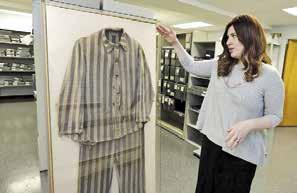

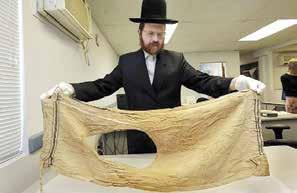
ultimate journey, she asked that this precious challah cover be buried with her, along with the photo of her sister Kaila and the postcards. Even in death, she did not want to part from her beloved family. But as the time grew closer, Chaya realized that her initial plan was far from ideal. The challah cover, once buried with her, would cease to exist. The photo and cards would disintegrate. And so, Chaya decided to donate these cherished items to Amud Aish, in the name of her beloved sisters.
Thank you, Chaya. Thank you for sharing your most precious possessions with us, for sharing your heart.
Below is the last letter written by
Rivka. She had been marched out to the Ujpest Sport Stadium in Hungary on Oct 24, 1944, and was deported from there directly to Bergen-Belsen, Germany.
Sweet parents and everybody, I want to advise you that in this moment I am at the sport stadium in Ujpest in the pouring rain. Everything I have is soaked. I forgot my hood at home. On my bed I left my white comb in a case. But it doesn’t matter because I have another one, and I can also borrow one. My snow boots would have come in very handy. Please fix my canvas boots right away. I will write you if I have a permanent place, where you can send the

above-mentioned items. In a quarter of an hour, we are leaving…and going to be sorted for work… Otherwise I will be okay except that I am very tired. But I will get used to it. I didn’t sleep at all… How are you my dear mother? Take care of yourself. Don’t worry about me… I send my kisses and regards to everyone… I think I have a fever and I need my strength. We have to complete a 15 kilometer walk… My Chaya, I kiss you separately. I kiss Father’s hand and Mother’s.
Love, Rivka Horowitz
Chaya, Rivka, Kaila, I hear your story. Rivka, I see the lovely challah cover you
created as a young girl. As I read your moving letter, I sense the young, thoughtful, affectionate, respectful daughter you were. Kaila, I see your photo. I see your innocent, youthful, beautiful face. All the visitors to Amud Aish affirm your existence. The three of you lived, you loved, you made a difference in this world. In the world of truth, you are all reaping your rewards. United once again, you are basking in the love and devotion of beloved family. Yehai nishmasam tzrurum b’tzror hachayim.
To arrange a tour of the Amud Aish Museum, contact Mrs. Chavi Felsenberg at 917-494-8689.



By Naomi Nachman
I wrote this soup recipe about 12 years ago in the middle of a blizzard made from ingredients I found in my fridge and pantry. With all the snow around us from the blizzard last week, I thought it would be a good time to share this soup again. My house smells so good when I make this soup. I will serve it when the kids come in from the snow to warm their bodies and souls.

Ingredients
◦ 1 tablespoon olive oil
◦ 1 cup large onion, diced
◦ 1 large jalapeño pepper, seeded with ribs removed
◦ 3 stalks celery, diced
◦ 1 sweet potato, peeled and cubed
◦ 3 Gala apples, peeled and chopped
◦ 1 package (6 ounces) dried, cooked sausage cut in ½ inch rounds
◦ 1 bunch kale, chopped, about 6 cups
◦ 2 cloves garlic, minced
◦ 1 teaspoon cumin
◦ 1 can great northern beans
◦ 4 cups chicken or vegetable broth
◦ 1 can (14.5 ounces) diced tomatoes, undrained
◦ 1/2 teaspoon salt, or to taste
◦ 1/4 teaspoon ground black pepper
◦ Dash sriracha (optional)
In a large soup pot, heat olive oil over medium-high heat. Add onions, pepper, celery, sweet potato, apples and sausage. Sauté, stirring occasionally, until onion is translucent.
Reduce heat to medium-low. Add kale, garlic, cumin, and can of great northern beans; cover and cook for two minutes.
Add stock, diced tomatoes, salt and pepper; cover and cook for 15 to 20 minutes, until vegetables are tender.
If using, add a dash of sriracha to the bowl just before serving.


I actually have to thank Congresswoman Ilhan Omar, because she has served as the perfect poster child for why we need a closed border and why we need to stop importing people from third-world countries who have no respect for this country, no respect for our laws and those who enforce them.
- Tomi Lahren, Fox News
You had every opportunity to stay home, but you told me: “Dad, I will not leave my friends to fight alone.” The whole nation is with you. I am proud of you, my son.
- Itzik Gvili, father of Ran, HY”D, at an IDF ceremony for his son whose body was recovered from Gaza after being held for 843 days
We opened the casket, we touched you, and after two and a half years, you remained completely whole. For those who don’t know—Ran was the 250th body found during the excavations. In Gematria, the number 250 equals “Ran.” This is just one more sign we received from you. You are everyone’s child, and I am so proud to be your father. I miss you every second. I love you, and I miss you.
Izanami
- The former name of Oracle co-founder Larry Ellison’s yacht (which is a concept in Japanese mythology) which he changed because he realized that read backwards it spells “I’m a Nazi”
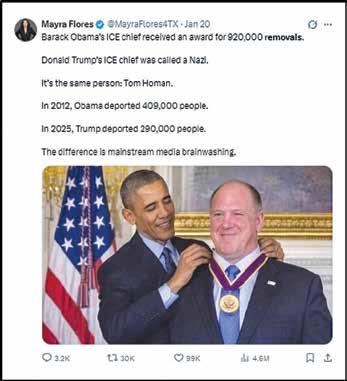

- ibid., at his son’s funeral

Israel Recovers Body of Last Hostage in Gaza
- CNN
Remains of Last Israeli Hostage Found in Gaza.
- NBC
Israel Says the Remains of Final Hostage in Gaza are Found.
- Politico
Hamas Hands Over Body of Ran Gvilli, Closing Chapter for Israel
- The New York Times
It’s important to tell the whole country that this is not just about resistance here in Minneapolis. It’s about love. We are showing something far more powerful and consequential here, which is love.
- Minneapolis Mayor Jacob Frey in response to two ICE agitators who interfered in arrests getting killed, one while driving into an ICE officer and the other because he had a loaded gun which may have discharged



What an honor to have Al Gore boo.
- Commerce Secretary Howard Lutnick responding to former vice president Al Gore—who has been wrong on every climate change prediction, including claiming that by 2016 Mount Kilimanjaro would no longer have any snow (it got 9.7 feet last year and is on track for that this year again)— booing him at Davos because he doesn’t like the Trump administration’s climate policies


Trump said at Davos, “You’d all be speaking German if not for us.” Which really [upset] the French, once the speech was translated into Arabic.
- Greg Gutfeld
I think Gavin Newsom may be cracking up, some of these things he’s saying. I think he may be in over his hairdo.
-Treasury Secretary Scott Bessent taking aim at Democratic California Gov. Gavin Newsom and his political stunt at the World Economic Forum in Switzerland
Newsom…may be the only Californian who knows less about economics than Kamala Harris.
- ibid.
I have no problem with Gavin Newsom being candid and open about his feelings about our president on United States soil. To go over to another country, Switzerland, to go over there and to be in the presence of other European leaders, speaking against the President of the United States — I’m not down with that.
- ESPN commentator Stephen A. Smith
Say whatever you want here, as a governor from the opposite side of the aisle of a state in the United States, on American soil — fine. But I’m one of those people: when we go somewhere else, it’s America first.
- ibid.
I want to die on Mars, but not on impact.
- Elon Musk at Davos
I’m Somali, I’m proud to be Somali. Um, to me, being Somali isn’t just eating bananas with rice. It’s a lot. It’s uh, it’s uh, it’s an interesting thing. It’s very hard to describe what it means to be Somali and what it means to be American, but it’s like a cultural fusion. It’s kind of like the bananas and rice, you know. People don’t really see, like, you know, it’s a, people don’t think, oh, you can eat bananas with rice. But that’s what it’s like to be Somali and American. It’s like that combination of banana and rice, but you’re going to get what I mean.
- Nasra Ahmed, a 23-year-old St. Paul resident, who claims that she was assaulted by federal agents, at a press conference with Democrat politicians
We have always supported any efforts to reinforce international stability.
- Russian President Vladimir Putin on being invited to join President Trump’s Gaza Board of Peace


You have these masked, federal officers with very little identification — sometimes no identification — wearing plain clothes and masks and we have a Stand Your Ground law that says if you reasonably believe your life is in danger and you’re in your house or in your car or on your property, that you can defend yourself with lethal force.
- Arizona Attorney General Kris Mayes (D), in a recent interview suggesting that people should shoot ICE officers
There is something wrong in Minneapolis. We need a city-wide behavioral health assessment. People have completely lost reality.
- Former Minnesota Vikings captain and University of Minnesota football star Jack Brewer commenting on the political violence being stoked by the left in Minnesota
I hope President Trump sends in the National Guard. We need curfews. We need real consequences for attacking law enforcement. These men and women should be able to do their jobs and go home to their families safely.
– ibid.
We’re deporting their voters. That’s part of what’s happening, and it’s blowing up their whole plan.
- ibid.
You are winning! ... Trump is in retreat!
- MSN NOW’s Rachel Maddow encouraging agitators to continue interfering with ICE’s ability to do their work, despite the death of two agitators


We have got children in Minnesota hiding in their houses, afraid to go outside. Many of us grew up reading that story of Anne Frank. Somebody is going to write that children’s story about Minnesota.
- Minnesota Gov. Tim Walz after an armed agitator was shot by ICE while interfering with their attempt to arrest an illegal criminal
Anne Frank was targeted and murdered solely because she was Jewish. Leaders making false equivalencies to her experience for political purposes is never acceptable
- Statement by the U.S. Holocaust Memorial Museum, in response to Walz’s comments
At some point on the flight, [Trump’s] going to emerge from the cabin and start prowling the hallways to see who is awake. I want him to think it’s a staffer who fell asleep. I don’t want him to see his Secretary of State sleeping on a couch and think, “Oh, this guy is weak.”
- Secretary of State Marco Rubio in a recent interview revealing that he goes to unusual lengths to avoid being caught napping by President Trump during overseas flights on Air Force One
I’m not going to say. It’s an embarrassing amount.
— Alex Honnold, 40, declining to specify his pay beyond saying it was in the “mid six figures” for scaling Taiwan’s 1,667-foot Taipei 101 without harnesses for a Netflix special
Actually, if you put it in the context of mainstream sports, it’s an embarrassingly small amount. You know, Major League Baseball players get like $170 million contracts. Like, someone you haven’t even heard of and that nobody cares about.
- ibid.


DAVOS, Switzerland - President Donald Trump’s Greenland fiasco has done Europe an unintended favor. His erratic bullying has forced European leaders to recognize that they need independence from an unreliable America – and to break with their own moribund economic and security policies.
Trump monopolized the headlines at the World Economic Forum here this week, threatening a Greenland invasion and then backing down, giving him the media dominance he craves. But the deeper conversation was something different – an open European rebellion against Trump and a bracing dose of honesty at a gathering where polite avoidance has been an operating principle. Europeans this week stopped pretending that their economies will revive if they keep slipstreaming behind America, the global hegemon.
Europe’s stagnation has been a background theme of nearly every Davos conference I’ve attended for 25 years. Changing that status quo was hard, while following America’s lead was easy. But Trump has shifted that balance in his second term. He has transformed the transatlantic alliance into a humiliating exercise in tariffs, White House demands and insults. European leaders played along for most of last year, but by this week, they were fed up.
Canadian Prime Minister Mark Carney, whom I’ll count here as an honorary European, put it bluntly in a speech to the forum: “We are in the midst of a rupture, not a transition.… When the rules no longer protect you, you must protect yourself.” Carney listed a string of independence measures his country is taking, including a new “strategic partnership” with China. Given Trump’s nonsensical Canada-bashing, who could blame him?
Europe needs to fix an economy that “still lags behind that of the U.S.,” said
By David Ignatius

While urging change, he also celebrated Europe’s reliability and order in contrast to Trump’s disruptive policies: “Having a place like Europe, which sometimes is too slow, for sure, and needs to be reformed for sure, but which is predictable, loyal … it’s a good place.”
Trump administration officials paraded through Davos like a triumphant army, further galvanizing Europeans. Christine Lagarde, the widely admired head of the European Central Bank, found Commerce Secretary Howard Lutnick’s tone at a dinner Tuesday so dismissive that she walked out, according to a source who was there.
Greenland was a trigger, but the deeper anger was over what Macron described as economic “vassalization,” at a moment when Trump is in imperial overdrive. European leaders know they are being left behind by an AI-powered surge in the U.S. economy. Europeans want to join in that boom – and they finally seem to recognize that the European Union’s rules and
regulations, and its heavy tax burden, are stifling the growth they need.
European leaders want their own version of “Liberation Day.” That means new trade partnerships with Latin America, Africa and Asia, and an understanding with China that it must share technology if it wants access to the E.U. market. But most of all, it means creating innovation-friendly economies at home – with fewer rules, lower taxes and a less rigid welfare system.
Europe needs an “urgency mindset” about economic reform, European Commission President Ursula von der Leyen told the forum. “Europe must speed up its push for independence.… The world has changed permanently. And we need to change with it.”
The reform pathway was clearly marked by Mario Draghi, former head of the ECB, in a September 2024 report on declining European competitiveness. “A wide gap in GDP has opened up between the EU and the US,” he wrote in a fore -
word. Since 2000, he noted, real disposable income had increased almost twice as much in America as in the EU.
“Europe largely missed out on the digital revolution led by the internet and the productivity gains it brought,” Draghi wrote. Just four of the world’s top 50 tech companies were European, he warned. Of the billion-dollar “unicorns” founded in Europe between 2008 and 2021, nearly 30 percent moved abroad to escape taxes and restrictive regulations.
Draghi’s message was clear to every European business and political leader I’ve talked to over the past two years. But in Britain and Europe, weak leaders haven’t been able to implement reforms – and Euro-sclerosis seems worse than ever. A study cited by Deutsche Bank found that a year after Draghi’s report, only 11 percent of his 383 recommendations had been adopted. Trump may have helped break that impasse.
Trump’s takeover play in Greenland gave Europe a moment of shock therapy – bursting a bubble of passivity and deference. By the end of the week, Trump had backed off his demand to buy the island, facing united opposition from European leaders and a sell-off of U.S. stocks and bonds. Greenland was an icy TACO, as many Trump watchers had predicted. But for Europe, it was a wake-up call.
Trump complained at Davos that Europeans should be thanking him for all the great things he’s done for them. This time, he may actually be right. The Greenland putsch might finally have shocked Europeans into taking control of their destiny –and beginning the economic reforms they need to survive as prosperous countries.
The transatlantic alliance won’t collapse after this crazy week in Davos, but it’s going to be different.
© 2026, Washington Post Writers Group


By Marc A. Thiessen
President Donald Trump is right:
The United States needs Greenland for its national security. But it doesn’t need to actually own Greenland; Trump can easily address U.S. security concerns without taking full control of the island. Indeed, the model lies on another island just 90 miles off our shores – at the U.S. Naval base in Guantánamo Bay, Cuba.
In February 1903, President Theodore Roosevelt signed a lease agreement with Cuban President Tomás Estrada Palma giving the U.S. the right to “coaling and naval stations” at Guantánamo. Under the agreement, the U.S. recognized “the continuance of the ultimate sovereignty of the Republic of Cuba” over Guantánamo while Cuba agreed that “the United States shall exercise complete jurisdiction and control” over the base. In 1934, as part of a new “Cuban-American Treaty of Relations,” the two countries locked in the lease, which they agreed would continue in perpetuity “so long as the United States of America shall not abandon the said naval station of Guantánamo or the two Governments shall not agree to a modification of its present limits.” To this day, despite the rise of a hostile communist dictatorship on the island that would love to kick America out, the U.S. remains in full operational control of Guantánamo.
Gitmo offers the perfect model for solving the dispute over Greenland. The U.S. does not need to own all of Greenland; it can just lease the parts it needs. After all, less than 1 percent of Greenland is inhabited, and approximately 80
percent is covered by an impenetrable ice sheet more than a mile thick. All that’s needed is enough land to establish a series of military bases along Greenland’s narrow coastlands to allow the U.S. to control the new sea routes being created by receding Arctic ice, project force into the Arctic to counter Russia and China, and establish ballistic missile defense stations as part of Trump’s Golden Dome. (Today, there is one U.S. military base in Greenland).
Trump should task the Pentagon to identify the military bases it needs to build in Greenland and then renegotiate the 1951 defense treaty with Denmark to lease them. Using the Cuba arrangement as a precedent, Denmark would maintain jurisdiction over more than 99 percent of Greenland’s territory and “ultimate sovereignty” over 100 percent – while the U.S. would have exclusive jurisdiction and control over the territory and waters where it establishes bases. The treaty should also permanently enshrine the U.S.’s existing right to free navigation and overflight over the entirety of Greenland, and create the option to lease additional bases in the future as needed.
In addition to bases, the treaty should bar any Chinese or Russian migration or investment on the island. And it should include an agreement – like the ones Trump has reached with Australia, Ukraine, Japan and other friendly nations – to jointly develop Greenland’s enormous unexplored stores of minerals and rare earth elements. As an incentive, the U.S. could share the profits with the people of Greenland

through annual dividend checks, much as the state of Alaska gives its residents a share of state oil revenue.
A leasing arrangement would solve another political problem for Trump. As Sen. Bernie Sanders (I-Vermont) recently pointed out, Greenland’s population benefits from Denmark’s generous Scandinavian social welfare system – including free universal health care, free college tuition, 52 weeks of paid parental leave and five weeks of paid vacation. If Greenland became part of the U.S., Sanders asks, does that mean that all Americans will be entitled to the same benefits? What would justify providing them to new U.S. citizens but not the rest of America? Under a lease option, however, Denmark would retain sovereignty over Greenland’s populated areas – and thus responsibility for subsidizing social welfare spending for its citizens. Problem solved.
Right now, the U.S. pays Cuba $4,085 a month in rent for Guantánamo – but since the 1959 Cuban Revolution, the communist regime in Havana has refused to cash the checks. The U.S. could make a more generous deal in Greenland, but it would still be much cheaper than buying the island outright. Why pay billions for useless ice-covered tracts of land, when all that’s really needed are some strategic coastal tracts?
A lease agreement would give the U.S. all the control it needs. If it can maintain “complete jurisdiction and control” of a Naval station in Cuba over the objections of the hostile communist regime, then it can certainly maintain it over any bas -
es established with the cooperation of a friendly NATO ally.
Another possibility: Incentives could be created for the people of Greenland to one day choose to join the U.S., as is their right under their agreement with Denmark – much as the people of Puerto Rico have repeatedly voted for affiliation with the U.S. As part of the 1998 Good Friday peace agreement, Britain maintained sovereignty over Northern Ireland, but all residents were given the right to have Irish passports. Greenland’s populace could similarly be allowed to apply for U.S. passports. The agreement might even stipulate that if a majority of Greenlanders claimed U.S. citizenship, a referendum on whether to formally join the U.S. would be triggered. Measures like a right of U.S. residency for Greenland citizens could enhance the free flow of people and goods, just as would exist if Greenland were a part of the U.S. All this would create a state of de facto shared sovereignty, even as Denmark maintained “ultimate sovereignty” – unless and until the people of Greenland chose otherwise. This is the path to a win-win-win for the U.S., Greenland and Denmark. As a real estate guy, Trump believes in the importance of ownership. But the experience of Cuba has shown that possession is nine-tenths of ownership. If it leases military bases in Greenland in perpetuity, the U.S. will have what it needs to protect its national security – and a path to de-escalate the current tensions.

By Aryn Baker

At a bustling money changer in northwestern Syria, a 46-yearold farmer gripped a plastic card like a lifeline. She had never heard of cryptocurrency, but the card held $500 of it to help restart her farm after nearly 14 years of civil war.
As a teller confirmed the total and cashed out the account, the farmer, Hala Mahmoud Almahmoud, smiled with relief and paused to give thanks. Where had such technology come from, she asked.
The answer surprised her: Afghanistan.
Blockchain-based cash transfers are not the kind of innovation that many people would expect from a country better known for its repressive Taliban leadership, which views the internet with suspicion. But in a nation that has largely
turned its back on the world, an Afghan startup is building tools that it hopes will transform how humanitarian aid is delivered in countries shattered by conflict.
“We’ve lived through these challenges ourselves, so we know how to develop an approach that works,” said Zakia Hussaini, 26, a programmer at the startup, HesabPay, which designed the technology driving Almahmoud’s card.
An early proponent of the platform was the United Nations High Commissioner for Refugees. The agency uses it to support more than 86,000 families in Afghanistan in one of the biggest public blockchain aid initiatives in the world. Mercy Corps, which donated the funds to Almahmoud, worked with HesabPay to expand its reach to include Syria, and programs for Sudan and Haiti are in development.
In Syria, getting money from abroad can be complicated. Cash is scarce, international banks steer clear of the country, and remittance firms like Western Union can charge as much as 10% in transfer fees. HesabPay allows organizations like Mercy Corps to sidestep those roadblocks.
Sanzar Kakar, the Afghan American entrepreneur behind HesabPay, used to run Afghanistan’s leading payroll processor. But the U.S. withdrawal from Afghanistan in 2021 and the Taliban’s return set off a financial collapse. Sanctions put a halt to international transfers, and the central bank unraveled.
To address the country’s increasing financial insecurity, Kakar turned to blockchain. He built HesabPay, named after the local word for “account,” as a phone-based app that enabled instant
transfers from one digital wallet to another, bypassing banks and the Taliban government. The Afghan government has since granted his business a license to operate officially as a financial institution, he said.
Today, the platform has more than 650,000 wallets in Afghanistan, of which about 50,000 are in regular use, moving approximately $60 million a month in stablecoins backed by the afghani, Afghanistan’s currency.
Since February 2025, the U.N. has used HesabPay to deliver nearly $25 million via 80,000 digital wallets to vulnerable Afghans returning home, said Carmen Hett, the corporate treasurer of the U.N. refugee agency. “This helps reduce transaction fees, waiting periods and enhance traceability, real-time monitoring and accountability
of transactions,” she said.
It is not surprising that organizations like Mercy Corps and the United Nations are turning to blockchain-based money transfers to deliver aid, said Ric Shreves, an expert in decentralized finance solutions and the president of the Decentralized Cooperation Foundation. For such organizations, he said, “it’s almost all upsides, compared to the way aid has traditionally been delivered.”
But there are still risks, he said, especially when the payment systems are based on local-currency stablecoins, as they are in Afghanistan. (In Syria, the cryptocurrency in HesabPay wallets is backed by the U.S. dollar, a more stable option.) Just as wallets can be shut down for interacting with sanctioned individuals, they can also theoretically be shut down by a country’s central bank for political reasons.
“When we provide people with a nonphysical means of doing transactions, that also means there’s a possibility that those transactions could be blocked through technological means,” Shreves said. Digital currencies are demonstrably safer than cash, he added, but they still cannot be stashed under a mattress.
In recent years, aid groups have increasingly turned to cash as a fast and dignified form of assistance. But cash has a flaw: It is hard to track. Donors want proof that their money reaches the right hands. Since President Donald Trump slashed U.S. foreign assistance early last year, groups like Mercy Corps
safeguards, like a real-time dashboard that tracks wallet activity and crosschecks it against international compliance databases. The company says the system is designed to detect illicit activity like terrorist financing, money laundering and online scams, and to raise an alert the moment suspicious
Today, the platform has more than 650,000 wallets in Afghanistan.
have come under even more pressure to demonstrate their impact and integrity.
That is where blockchain comes in, creating a digital trail that records exactly how much was sent, to whom, and where it was spent. That mix of speed and accountability could be “a way to win back trust from those who have come to doubt the usefulness of aid,” said Scott Onder, Mercy Corps’ chief investment officer.
HesabPay comes with additional

transactions appear. For aid donors, it offers a level of oversight rarely possible in fragile states.
During a recent online demonstration, Nigel Pont, the company’s senior adviser for humanitarian affairs, clicked on a purple dot representing a HesabPay agent in Afghanistan. Dozens of pale blue beneficiary wallets fanned out, showing recent transfers. Another click revealed where the money went next. Then one wallet pulsed red with a
potential scam alert — an awkward moment in a live demo, but exactly the kind of risk the system is built to expose.
“From an aid donor perspective, that’s immensely valuable,” said Pont, who previously served as chief strategy officer at Mercy Corps. “A system that can automatically flag a fraud risk means you can check it out immediately instead of waiting six months for a report that somebody stole 20 grand.” No system is entirely corruption-proof, he conceded, but then again, a bag of cash is not, either.
Abdul Halim Hasan, 22, who was waiting in the same line as Almahmoud for his turn at the money changer in Syria, said he imagined that one day he could use HesabPay as a regular bank account, receiving funds, making payments and saving money safely. But for the moment, it was enough that his HesabPay card allowed him to gain access to money he needed to restart his life after war.
“I certainly want to see this method spread in Syria,” he said.
© The New York Times


What does it say about a country where some rudimentary knowledge about the Holocaust is commonplace, but where misleading analogies about it are a routine occurrence in public discourse?
You can ask the same question about the use of the most important term to come out of the Shoah.
The word “genocide” was coined in its aftermath to describe the systematic mass slaughter aimed at the extermination of a single people. But in a country where it is estimated that about three-quarters of American K-12 students get lessons on the murder of 6 million Jews by the German Nazis and their collaborators, it is regularly misapplied to the efforts of the descendants of the survivors of the Holocaust to defend themselves against an attempted genocide.
As the world commemorates International Holocaust Remembrance Day this week on Jan. 27, the most important question to be asked about public discussion is not so much how to expand education programs devoted to the subject. Rather, it is whether Americans are being taught anything that will help them to understand the topic or what it means today. Even more to the point, it may be necessary to acknowledge that much of what is being taught in schools or said at the ceremonies that will mark this day may actually be doing more harm than good.
As a result, the reaction of the Jewish community to the fuss made about the date ought not to be gratitude for the undoubted efforts of many educators and public officials for keeping the memory of the Six Million alive. Rather, it should be to doubt not only the value of these efforts, but to tell
By Jonathan S. Tobin

many of them that we’d appreciate it if they simply stopped talking about it.
The point being: If you are promoting memorialization of the Shoah while at the same time dishonoring the memory of the heroes and martyrs of the Holocaust by appropriating their fate to promote some entirely unrelated cause or to express particular displeasure with someone or political foes, the response of the Jewish world should be to tell them to stop.
Even more important, those who cry crocodile tears about the suffering of dead Jews who were slaughtered by their persecutors more than 80 years ago, while smearing live Jews with false charges of genocide, have forfeited their right to speak about the subject.
Unfortunately, that is the proper response this year to all too much of what
will be said at countless commemorations of the Holocaust. The subject has been weaponized for political purposes or even to buttress the surge of antisemitism that has spread around the globe since the Hamas-led Palestinian Arab attacks in Israel on Oct. 7, 2023.
One fact that should be noted is that the Jewish people have still not recovered demographically from the disaster of the Holocaust, during which approximately one-third of all Jews alive in 1939 were murdered. Today, the global Jewish population is still far smaller by a factor of about 3 million people than it was in 1939, with half the Jews alive today living in Israel.
Yet many of those who will publicly beat their breasts on Jan. 27 in sorrow about the Six Million are effectively neutral or even in support of the war that Palestinians—
backed by much of the Arab and Muslim world, and fashionable opinion elsewhere— are waging against Jews.
Rather than joining them alongside political leaders, journalists, scholars and celebrities who have been part of a growing effort to demonize the one Jewish state on the planet, the response of the community to such events should be a loud and emphatic, “No, thank you!” Honoring the memory of the Holocaust is a sacred obligation. Yet it cannot be done effectively or have any real meaning in a context divorced from the current struggle for Jewish survival against a rising tide of bigotry, hatred and violence.
It is entirely true that Holocaust deniers are not only still among us but that their visibility and ability to reach the ignorant and ever-gullible consumers of conspiracy theories is greater than ever. For that, the internet can be thanked for the way it has enabled fringe figures once confined to the fever swamps of public discourse to be visible to large audiences. The willingness of podcasters, like former Fox News host Tucker Carlson, to mainstream hateful figures like faux historian Daryl Cooper and neo-Nazi Nick Fuentes plays a large part in this.
But as much as the promotion of these hate-mongers’ lies about the past remains problematic, far too much discourse is distorted among those who don’t believe such falsehoods, though still decide to traffic in Holocaust language and references.
When Minnesota Gov. Tim Walz compared efforts by federal officials to enforce existing laws against illegal immigrants, especially those who have committed crimes, to the efforts of Nazis seeking to
capture Jews like Holocaust diarist Anne Frank, the problem isn’t just the cynical appropriation of her memory to pursue a political agenda. Walz is far from the first to behave in this manner. Some on the political right have done the same thing when it comes to opposition to abortion. But in recent years, opponents of President Donald Trump have made false comparisons of him to Adolf Hitler or claimed that he is a Nazi or fascist. It has become so ubiquitous that it almost isn’t worth it to single any of the offenders out.
The problem is not that Walz is unaware of the Holocaust. We know he is not. He is like so many people who have come of age in an era when most Americans possess at least a rudimentary understanding of the basic facts about what happened under the Third Reich. And yet, he and the many others who invoke Frank’s name or use epithets linked to the Holocaust when attacking political foes apparently don’t understand it at all.
Far too much of what passes for Holocaust education is rooted in an attempt to universalize it—to render it not merely more understandable to contemporary audiences but to separate it from its context and the history of antisemitism. In that way, some otherwise well-meaning educators have sought to use it to teach everyone to be nicer to each other and to avoid slipping into racial or religious prejudices. But as scholar Ruth Wisse has taught , antisemitism is not a garden-variety form of hate or intolerance. And it is not merely the oldest hatred. Rather, it is specifically used as a political weapon over and above the way imperfect human beings are prone to slip into unkind or even mean behavior.
The universalization of the Holocaust and the way students are taught a slimmed-down summary of this chapter of history—in brief lessons crammed into the school year—has had unforeseen consequences. It has led to something that survivors, whose numbers are fewer and fewer every year, never envisioned when they began the campaign to spread knowledge of their experiences.
The Holocaust has become a metaphor for anything that people dislike. The predilection to treat anyone with whom we strongly disagree as if they were Hitler is not just a product of the hyper-partisan tone of 21st-century politics or the extreme polarization of the Donald Trump era. It is also the result of the way it has been universalized to the point where many, if not most, ordinary people think it
was just a bad thing that happened a long time ago—not the specific result of millennia of Jew-hatred and the powerlessness of nearly an entire people.
Equally unfortunate is the way much of the educational establishment has embraced toxic leftist ideas like critical race theory, intersectionality and settler-colonialism. So-called “progressive” teachings have largely captured primary, secondary and higher education to the point where a generation of Americans has been indoctrinated into believing not merely in concepts that exacerbate racial divisions, but ones that promote the idea that Jews and Israelis are “white” oppressors.
result that could only be accomplished by the sort of genocidal war that Hamas and its allies are waging.
Our answer to them and others who are either silent about the misappropriation of the Holocaust or join in the blood libels against living Jews while lamenting the fate of dead Jews must be unequivocal.
We must tell those, like Walz, who misappropriate the memory of the Six Million, or utter such falsehoods about genocide, like New York City Mayor Zohran Mamdani and others on the intersectional left wing of
tions like the United Nations, which in 2005 voted to establish International Holocaust Remembrance Day on the anniversary of the liberation of Auschwitz on Jan. 27, 1945. These agencies that claim to speak for human rights and justice for all countries in the world have become cesspools of antisemitism and engines of the war against the Jewish state.
For too long, too many members of the Jewish community have treated the promotion of Holocaust education or ceremonies honoring the dead as more important than efforts to defend the living.
It’s also true that, as important as teaching young Jews about the Shoah is, it must be linked to learning about the importance of Israel, as well as the life-affirming nature of their heritage and faith.
The subject has been weaponized for political purposes or even to buttress the surge of antisemitism that has spread around the globe.
This movement produced the proHamas campus mobs that have targeted Jewish students for intimidation, discrimination and violence since Oct. 7 at universities around the world. Participants are shockingly ignorant of the history of the Middle East, even as they chant slogans endorsing Jewish genocide (“From the river to the sea”) and terrorism against Jews everywhere (“Globalize the intifada”). What they have also done is to appropriate the word genocide, which Holocaust survivor and lawyer Raphael Lemkin coined to describe the Nazi effort to exterminate the Jewish people.
Their claim that Israel’s just war of self-defense against Hamas terrorists is “genocide” is a blatant lie. If applied to any other conflict, it would mean that every war that has ever been fought, including the one waged by the Allies against the Nazis, would be considered genocide. That not only drains the word of its actual meaning. It is, like the libelous efforts to smear Jews as Nazis, a classic trope of antisemitism.
Yet many on the political left, which has embraced this lie about Israel, are also prepared to join in mourning the Holocaust. Some, including that small minority of Jews who, for distorted reasons of their own, join in these antisemitic denunciations of Israelis and their supporters, even claim that they are inspired by the history of the Shoah to speak out against Israel now. Some even support efforts to eradicate the Jewish state—a
the Democratic Party, that Holocaust commemorations should be off-limits to them.
The same applies to global organiza-
Above all, we must stop allowing the memory of what happened 80 years ago on Europe’s soil to be used by those who support or are neutral about those seeking to carry on the Nazi project of Jewish genocide. The failure to call an end to this misuse of Jewish history will only contribute to more tragedy.
Jonathan S. Tobin is editor-in-chief of JNS (Jewish News Syndicate).

By Neil MacFarquhar
During the 12-day war with Israel and the United States last June, Iran’s supreme leader reportedly retreated to a bunker beneath his sprawling compound in central Tehran, avoiding public appearances and all electronic communication.
That bunker mentality resonates with many Iran analysts as a metaphor for the 37-year rule of Ayatollah Ali Khamenei, 86, over the Islamic Republic. He has created a static, authoritarian system resistant to change. The twin pillars of that system remain his ideological fixations — the refusal of any political or social changes that might dilute the power of the regime, and implacable enmity toward the United States.
“He is an obstructionist; I do not see him late in life compromising on ideology and his legacy,” said Sanam Vakil, the director of the Middle East and North Africa Program at Chatham House, an international affairs think tank in London. “Whatever it takes to stay in power down to the last Iranian, he’s very keen to keep this system intact and sees it as an existential and ideological struggle.”
For more than 25 years, each new round of nationwide protests, which in recent times have erupted with increasing frequency, has been met with ever more brutal repression. Thousands of protesters have been shot dead on the streets or imprisoned and at times executed. The latest killings, along with the anticipated start of hanging protesters after summary trials, prompted President Donald Trump to threaten U.S. military intervention.
Although the protests and hence the bloodshed have slowed in recent days, the U.S. threat created a dilemma for Khamenei and his enforcers, analysts said. Escalating repression might prompt an American attack, but allowing the protests to grow could present a real challenge.

In either case, the situation is likely to widen the yawning gulf between the government and the Iranian people.
Few expected Khamenei to show restraint for long.
“He sees compromise as an avenue to further weakening and unraveling of the Islamic Republic,” Vakil said. “Of course, the irony is that his inability to compromise is also leading to the weakening and unraveling of the Islamic Republic.”
Khamenei’s default argument has long been that Iran’s problems, and certainly any instability, are caused by enemies at home, or especially abroad, intent on destroying the country.
“The enemy’s plots must be recognized,” he said in public remarks during the first week of the current unrest. “The enemy does not rest.”
Among other issues, he described the volatile swings in the foreign exchange rate that helped prompt the demonstrations as “the work of the
enemy.” Sometimes, he says the enemy is “world arrogance,” a favored pseudonym for the United States, or Israel, which he has called “a cancerous tumor that must be removed.”
Khamenei’s predecessor, Ayatollah Ruhollah Khomeini, remains the symbol of the 1979 revolution that overthrew the shah and ushered in the Islamic Republic.
He established the regime’s abiding intolerance, fomenting terror against any challengers, first with mass executions of officials from the shah’s reign and then by turning on his leftist allies. Khomeini described protests against his rule as a war on G-d, condemning opponents as “wild animals” who deserved to be shot.
Guardian of the Revolution
When Khomeini died in 1989, Khamenei, a protege who had been president of Iran since 1981, emerged as the consensus candidate for supreme leader. He had been jailed six times under the shah and had lost the use of his right
arm after a failed assassination attempt.
As a midranking cleric, Khamenei lacked the exalted religious credentials required for his new role. So the clergy quickly anointed him an ayatollah, and in 1994 elevated him to the status of marja , or a source of emulation for all Muslims. He also carries the title Vali Faqih, meaning the most senior guardian of the Shiite Muslim faith. He has not left the country in decades.
Khamenei was conscious of his lower religious status. “I am an individual with many faults and shortcomings,” he said at the beginning of his rule. “I am truly a minor seminarian. However, a responsibility has been placed on my shoulders, and I will use all my capabilities and all my faith in the Al-mighty in order to be able to bear this heavy responsibility.”
He set about concentrating power in his own hands, giving him the last word in all matters of state in order to safeguard the revolution and the vision of Khomeini.
Khamenei controls the judiciary and appoints the head of state television, as well as the men on the Guardian Council that vets election candidates. He names the ministers running key national security departments including interior, defense, intelligence and foreign affairs.
He has fostered Iran’s nuclear program while denying that Tehran is pursuing weapons, and built the system of regional allies that crumbled over the past two years with the collapse of the regime of Bashar Assad in Syria and the decimation of Hezbollah in Lebanon.
Khamenei alone appoints the commanders of the Revolutionary Guard and the Basij, the powerful armed forces established as a kind of separate militia to preserve the revolution.
He has also expanded those forces while creating a rotating inner circle of men whose backgrounds mirrored his

manders.
Although the system is opaque and difficult to analyze, his apparatchiks have remained deeply loyal. They have not broken publicly with him despite the government’s many economic and military failures.
That solidarity means repeated unrest has failed to produce any substantial cracks in the regime.
Significant nationwide protests erupted in 1999 over the shuttering of a reformist newspaper; in 2009 over presidential elections widely believed to be rigged; in the late 2010s over rising prices of basic goods including fuel; and in 2022 over the death of a woman killed in custody after being accused of not wearing a proper hijab to cover her hair.
Each flare-up amplified calls for change and even for the downfall of Khamenei. The last bout, titled, “Women, Life, Freedom,” also led to more women challenging the often draconian enforcement of the mandatory hijab law. The violence against demonstrators also escalated each time.
The protests have weakened the regime, but not fatally, and it remains unable to address the social and economic issues that form the root of the public’s dissatisfaction.
Modern Iranian society has evolved to be more urban and connected to the outside world, with more educated women, analysts noted. But Khamenei has not changed with it.
million people remain hard-core supporters of the regime, analysts said. But they estimate that most Iranians view the supreme leader as a corrupt, murderous dictator whose animosity toward the West has left the country bankrupt and isolated.
Washington has long criticized Iran’s human rights record and portrayed the regime as a menace to its people, to the
Most Iranians view the supreme leader as a corrupt, murderous dictator whose animosity toward the West has left the country bankrupt and isolated.
Sweeping economic sanctions that sharply limited sales of Iran’s oil have severely contracted government spending, while rampant inflation has left the public poorer and more hostile.
Roughly 20% of the electorate of 61

ingly paranoid about enemies both real and imagined, analysts said, and remains deeply suspicious of the threats presented by internal dissent, reform and foreign influence.
The American and Israeli attacks on Iran last June killed dozens of elite military commanders and top scientists, while also weakening the country’s nuclear facilities. Iran’s retaliatory strikes on Israel killed 32 people and injured hundreds while causing relatively minor structural damage.
Khamenei portrays the outcome as a victory, not least because the regime endured.
region and the wider world. Khamenei has always responded to the accusations by saying they are rooted in hostility over Tehran’s rejecting the hegemony of what he calls “the Great Satan.”
Through it all, he has grown increas-
“It has been proven that the Iranian nation, by relying on its own capabilities and under the shadow of faith and righteous action, can stand firm against corrupt and oppressive arrogant powers and convey the call to Islamic values more loudly than ever before,” he said in a speech in December right before the latest demonstrations.
© The New York Times


By Christina Goldbaum
BEIRUT — After U.S. forces seized Venezuelan leader Nicolás Maduro, Secretary of State Marco Rubio cast the Latin American country as a regional platform for Iranian influence, and accused the government of hosting Hezbollah, the Iran-backed Lebanese militant group.
Rubio told CBS that among the reasons for capturing Maduro on Jan. 2, the U.S. wanted to ensure that Venezuelan leaders “no longer cozy up to Hezbollah and Iran in our own hemisphere.” He pressed Venezuela’s new leader, Delcy Rodríguez, to sever ties with both Iran and its proxy, Hezbollah.
Even if she does, it may not have great impact on an already weakened Hezbollah. The group, which had been the dominant political and militant power in Lebanon for decades, was battered by a war with Israel and faces mounting pressure from the U.S., Israeli and Lebanese governments to give up its weapons.
U.S. authorities have long accused Hezbollah of complicity in drug trafficking and money laundering schemes in Venezuela.
How did Hezbollah get involved in Venezuela?
Hezbollah’s connection stemmed from the relationship between Venezuela and Iran. Two oil-rich countries under U.S. sanctions, they were bound by anti-American ideology and helped each other evade U.S. sanctions.
Iran and Venezuela have maintained economic and political ties since before Iran’s 1979 revolution, which brought an authoritarian clerical regime to power. Both were founding members of OPEC.
After the revolution, Venezuela was one of the first to recognize Iran’s new regime. The relationship deepened after Maduro’s predecessor, Hugo Chávez, became president in 1999.
In the following decades, Iran invested billions in Venezuela’s oil and energy sector, along with other housing and industrial projects that often had little to no financial return, but gave Iran a foothold in the United States’ backyard.
That opened the door for Hezbollah to make inroads in Venezuela.
How deep are Hezbollah’s ties in the country?
U.S. authorities have long accused Hezbollah of using Venezuela as a base for drug trafficking and money laundering in collusion with Venezuelan officials. But experts say those illicit schemes do not seem critical to Hezbollah’s operations.
Most evidence of the illicit revenue streams stems from a U.S. Drug Enforcement Administration initiative launched in 2008 to disrupt Hezbollah’s financing networks. That investigation found that Hezbollah was involved in trafficking cocaine from Colombia through Venezuela and colluding with Venezuelan officials to move cash, contraband and Hezbollah personnel.
One of the investigation’s most prominent resulting criminal indictments involved Ayman Saied Joumaa, who holds dual Lebanese and Colombian citizenship. A federal grand jury indicted him for running one of the region’s most sophisticated international drug smuggling and money laundering networks. Joumaa, who was never arrested, has not publicly commented on the charges.

Hezbollah made millions through Joumaa’s network, according to U.S. authorities. The network paid Hezbollah operatives to help move its narcotics and illicit funds through Beirut’s international airport, among other routes, they said.
U.S. authorities accused Venezuelan officials of facilitating Hezbollah operations in the country. They accused the Venezuelan state airline of operating flights between Caracas, Venezuela; Damascus, Syria; and Tehran, Iran, that carried Hezbollah members and weapons.
The DEA also said it found evidence of Venezuelan politicians issuing passports to Hezbollah fighters and coordinating cocaine and weapons trafficking between Maduro’s government and Hezbollah.
Hezbollah and Venezuelan officials have denied these allegations.
“As for us in Hezbollah, we have no organizational, financial, security, military, or any other kind of presence in Venezuela,” Hassan Fadlallah, a Hezbollah member of the Lebanese parliament, said this month.
How important is Venezuela for Hezbollah finances?
Hezbollah experts remain skeptical that Maduro’s capture will greatly affect Hezbollah’s operations. Analysts say the relationship between Hezbollah and Maduro’s government, though rooted in shared anti-American sentiments, had little practical value for Hezbollah.
“The relationship between Venezuela and Hezbollah is primarily a symbol-
ic one,” said Kassem Kassir, a Lebanese political analyst and expert on Hezbollah who is close to the group. “Practically, nothing has changed with Hezbollah after the fall of Maduro.”
Many also question how important the illicit revenue streams outlined by U.S. authorities actually are for the militant group’s operations in Lebanon today.
“If you look at the different pieces of these links, you see very thin evidence of Hezbollah’s having widespread involvement” in illicit schemes in Venezuela, said Mohanad Hage Ali, a senior fellow at the Carnegie Middle East Center in Beirut. “We haven’t seen enough evidence that the organization is relying heavily on drug trafficking, like the Taliban did in Afghanistan, in funding its operations,” he added.
Hezbollah’s External Security Organization, an arm of the group focusing on operations outside Lebanon, appeared the most heavily involved in Venezuela, Hage said. But that wing is much smaller and less active than it was at its peak in the early 2000s — lessening the blow from the upheaval in Venezuela today.
The vast majority of Hezbollah’s financing comes from Iran, experts say.
So for Hezbollah, the much more immediate concern is the effect that the weakening of the Iranian state, and the current unrest in Iran, will have on its ability to fund its Lebanese proxy.

By Avi Heiligman
While the recent news of the capture of Venezuelan President Nicolas Maduro came as a surprise to many, the operation had been methodically planned for months. This wasn’t the first time in history that American troops had been deployed to apprehend a Latin American dictator who had been indicted on drug charges. In December 1989, under the direction of President George H. W. Bush, tens of thousands of American troops took part in the mission to capture the Panamanian leader. Operation Just Cause was the invasion of Panama and the subsequent apprehension of Manuel Noriega.
The American relationship with Noriega had not always been so cold. In the 1960s, he was on the CIA payroll and worked with the U.S. to halt illegal drug shipments. However, he simultaneously accepted money from drug dealers, and by the mid-1980s, the Reagan administration opened investigations into his activities. In 1988, Noriega’s forces defeated a coup, and in May 1989, he nullified the results of a nationwide election in which he was badly defeated. The situation deteriorated further when the Panamanian government declared on December 15 that a state of war existed between the U.S. and Panama. The next day, an unarmed American Marine officer was killed at a roadblock, and another officer and his wife were detained and harassed by Panamanian troops. As Noriega began threatening the neutrality of the Panama Canal, President Bush made the decision to invade.
Roughly 300 aircraft were involved in the operation as well as 27,000 troops from many different units across the military branches. These included paratroopers from the 82nd Airborne Division, the 4th Psychological Operations Group (PSYOP), the 75 th Ranger Regiment, the 96th Civil Affairs Battalion, Tactical Air Control units, Pararescuemen, several military police units, the 7 th Special Forces Group, the 7 th Infantry Division, elements of the 5th Infantry Division (Mechanized), marines, a reconnaissance battalion, and Navy SEALs from Teams 2 and 4.
`Just before 1 AM local time on December 20, 1989, the American invasion of Panama began. Approximately 1,300 Rangers and 2,700 paratroops took part in the largest nighttime combat airdrop since World War II. The Rangers flew in C-130 Hercules and C-141 Starlifter aircraft and quickly seized their targets after their low-altitude jump. The 82nd jumped at the international airport with the objective of linking up with and supporting the Ranger’s mission. Ten M551 Sheridan tanks were also dropped from the Hercules aircraft, but two were lost in the landing. The overall mission was a success as they achieved speed and surprised the enemy.
The SEALs were assigned three specific missions. The first was to isolate the PDF (Panamanian Defense Forces) on Flamenco Island, while the second was to capture Noriega’s private jet at Paitilla Airfield. The third objective was to destroy his personal boat anchored in Balboa Harbor. Forty-eight SEALs were deployed for the Paitilla Airfield mission – a significant number considering their usual way of conducting operations. As they approached their target, the SEALs came under heavy fire. The original plan was to capture or disable the plane, but after coming under fire from the PDF, they decided to destroy the plane completely. Four SEALs were killed in the operation, and nine were wounded at the airport. This mission was heavily scrutinized afterwards, with some saying that it should have been assigned to the Rangers or Delta Force, who were better trained to seize airfields. The other two objectives for the SEALs saw better results. Four divers, equipped with C-4 explosives packed in haversack canvas bags, swam toward Noriega’s boat, the Presidente Porras, and succeeded in blowing it sky high.
Other targets around the country were quickly seized by American forces. Fort Amador, a strategic base shared by both countries, presented a unique challenge as American families lived in close proximity to PDF barracks. Consequently, the situation needed to be handled with extreme caution. Airborne units, along with scouts from the 5th Infantry Division and
engineers, secured the fort which was also strategically placed near the Bridge of the Americas and the Pacific entrance to the Panama Canal. Government buildings that were essential to national operations were secured by military police and prevented forces loyal to Noriega from regrouping.
Delta Force operators broke into Carcel Modelo Prison and rescued American citizen Kurt Muse. Called Operation Acid Gambit, the mission ran into a few problems, including the crash of the MH-6 Little Bird helicopter carrying Muse away from the prison. Four Delta operators were wounded in the crash, but they all survived. A short while later, an extraction team from the 5th Division came and rescued everyone in an M113 armored personnel carrier.
While the Navy SEALs prevented Noriega from escaping by destroying his boat and plane, the dictator still remained at large. A massive manhunt was underway with a $1 million bounty on his head, so Noriega decided to seek refuge at the Vatican’s embassy. PSYOP teams went into action and played loud music 24 hours a day until the Vatican complained to President Bush. After other tactics were employed, a disheveled Noriega emerged on January 3, 1990, and he was taken to the United States to face charges.
The results of Operation Just Cause saw the return of democracy to Panama as Guillermo Endara, the winner of the previous election, was sworn in as president. Twenty-three American military personnel were killed in the operation, and 300 were wounded. Many of the American soldiers and units went on to serve during Operation Desert Shield and Desert Storm, which began in the summer of 1990. The new tactics and equipment used during Operation Just Cause proved the effectiveness of a joint operation that rapidly completed its objectives to achieve its military and political goals.




Avi Heiligman is a weekly contributor to The Jewish Home. He welcomes your comments and suggestions for future columns and can be reached at aviheiligman@gmail.com.


DU N DURT
Power & Soft Washing
We clean siding, stucco, decks, driveways, concrete, pool patios, pavers & sidewalks.
Say goodbye to grime, mold & allergens!
Call/WhatsApp: 718-688-2964
Email: dundurtny01@gmail.com
THE LEATHER SHOPPE
The spot for all your custom leather Judaica. Tallis/tefillin bags, lulav and esrog bags, havdallah sets, challah covers, shtenders, pesach sets, matzah/afikomen bags.
WhatsApp: (732) 523-0007 or email: theleathershoppe732@gmail.com for a full catalog. We ship.
PEACEFUL PRESENCE STUDIO
Men’s private yoga, Licensed Massage & Holistic Health Guidance 436 Central Ave, Cedarhurst Info. & free video training www.peacefulpresence.com 516-371-3715
GERBER MOVING
Full Service Moving Packing Moving Supplies
Local Long Distance. Licensed Insured 1000’S Of Happy Customers Call Shalom 347-276-7422
HANDYMAN AVAILABLE
For big or small jobs, Sheetrock, carpentry, painting, electrical, plumbing, install & repair appliances Call Ephraim at 347-593-4691
MANAGEMENT STAFF WILL ASSIST
you with: * Obtaining Medicaid and Pooled Income Trust
* In-home Assessments, Individual and Family Counseling
* Securing reliable home care assistance
* Case and Care Management services
Dr. S. Sasson, DSW, LCSW (718) 544- 0870 or (646) 284-6242
HAIR COURSE:
Learn how to wash & style hair & wigs. Hair and wig cutting, wedding styling
Private lessons or in a group Call Chaya 718-715-9009
ZEVIZZ WOODTURNING JUDAICA
Challah knifes, batei mezuzah, besamim holder, kiddish cups, havdalah candle holders, yad for sefer torah, pens, stenders, bowls and more 952-356-2228
MY MOTTO IS DON’T WAIT TO buy real estate
Buy real estate and wait
Your realtor for life
516-784-0856 Alexandra at Realty Connect USA
REAL ESTATE MANAGEMENT
Services – Do Not Manage Your Properties Alone!
Contact Aliyah Suites for all your real estate management needs and affordable office space near you! (516) 366-1049
Management@aliyahsuites.com
Marc Jeret (MJ)
Team Leader & Licensed Real Estate Agent




















classifieds@fivetownsjewishhome.com • text 443-929-4003
CEDARHURST
Prime Restaurant Location For Lease.
For more information: Call/Text/WhatsApp Owner: (516) 206-1100
5 TOWNS - OFFICES FOR LEASE
250SF to 500SF Offices in Inwood & Cedarhurst Utilities, Internet & Parking incl. with some Kosher kitchen - Minyan Next to LIRR - No broker fee Call/text/Whatsapp: 516-206-1100
Don’t Get Stuck With a Two Story House Ya Know, It’s One Story Before You Buy It But a Second Story After You Own It!
Call Dov Herman For An Accurate Unbiased Home Inspection InfraredTermite Inspection
Full Report All Included NYC 718-INSPECT Long Island 516-INSPECT www.nyinspect.com
ROCKAWAY PARK – INVESTMENT
10-Unit Free Market Multifamily
Fully Rented | Strong Cash Flow Approx. $295K NOI Offered at $3.75M Principals Only Call/Text Sam - 929-334-7601
DELIVERY PERSON NEEDED
to deliver this Newspaper every Thursday morning to locations in Brooklyn. Must have Mini van or SUVand availability to work Consistently every week.
Good pay - Please email gabe@fivetownsjewishhome.com or call (917) 299-8082
MAKE A DIFFERENCE!
Be a Direct Support Professional F/T & P/T and flexible positions available Brooklyn, Queens and 5 Towns $18.05-$18.30 per hour
855-OHEL-JOB or resumes@ohelfamily.org
A Five Towns Real Estate Company is seeking a full-time Bookkeeper. The right candidate must be proficient with QuickBooks and Excel. They must also be self-motivated, organized, detail oriented, reliable, and able to work independently or as a team player. Warm, frum office environment with excellent salary & benefits. Please email resume to HR@capsprop.com
YESHIVAT KOL YAAKOV
In Great Neck, NY, is seeking general studies teachers for both the elementary and middle schools, for the upcoming academic year. Mon-Thur afternoons. Competitive salary, warm and supportive environment. Send resume to m.kalati@kolyaakov.org
For current school year, starting from end of January: Seeking assistant teacher for General Studies. Candidate should have skills to take over for teachers if needed. Far Rockaway area boys’ school, M-Th, PM hours, strong support. Excellent salary. Possibility to continue for next year. Send resume to teachersearch11@gmail.com






classifieds@fivetownsjewishhome.com • text 443-929-4003
ARE YOU A DOULA?
Or have a passion to be? Come join our great referral group and get access to a vast new clientele through Medicaid.
JUST CALL 347-668-7886
REGENTS EXPERT
Tutoring regents in Algebra and Geometry A Darchei Torah instructor. Guaranteed results Text 347-491-8045
WhatsApp 347-767-1755
HASHAVAS AVEIDA
Looking for a
in a Kosher Kitchen in the Five Towns area. Five days a week, Sun-Thurs, 12-8 PM. Starting Rate $35.00 hour.
If possible, please send a resume with contact information.
Email: rbt@vkkosher.org
Phone: 845-782-4615

5 Towns area Nursing Home management office seeking a Regional/Corporate level MDS Nurse to work in our office. Must be an RN. Regional experience preferred. 2-3 years MDS experience with good computer skills required. Position is Full Time but Part Time can be considered. Great Shomer Shabbos environment with some remote options as well. Email: officejob2019@gmail.com
A multi-tasker needed for general office work. The ideal candidate is someone who is detail-oriented, responsible, and can take ownership. Looking for someone who is eager to learn, and expand his/her skill set while possessing the ability to work independently and as part of a team. Experience with Excel required. Five Towns location. In-office position only, not remote. Please send resume to 5tpart.timecareer@gmail.com
Apple airpods found on Wednesday morning on the way to the Woodmere dock. To claim, 516-351-8105.
HALASHON
Text 516-303-3868 with a time slot of your choice to be careful on lashon hara. Be a part of the 1,000 people for klal yisroel!
BEIS HAMEDRASH CONG.
Chasdei Uvois Oshpitzin Talmidei chachomim are willing to learn mishnayos, say kaddish and be the shliach tzibbur to daven for the umid on the yartzeit yom hashanah of your parents or close relatives or loved ones To arrange please call Rabbi Miller 917-445-6220






















By Rivki D. Rosenwald Esq., LMFT, CLC, SDS

Have you perfected your packing? This is, under-ratedly, a very involved experience for most people.
Sometimes, it’s for a short overnight trip or a family vacation. Other times, it’s a holiday trip to Israel or packing a child for summer camp.
Regardless of the purpose, packing is something you have to develop your own style for getting done. And it can also be a major stress point.
What to take?
How to pack it?
How to keep things separate?
How to fit it all in?
Packing can become a truly intricate experience.
Some people have those awesome packing cubes. You can zip similar items into each one, and it keeps you organized. But it also keeps you zipping and unzipping and checking bag after bag to find each assorted item. So, if that’s your thing— gezunterheit.
Another option is using Ziploc bags. They make it easier to see what’s inside, but everything slides in every direction, making it less stable. And if you haven’t released all the air before sealing the bag, you may be using far more suitcase space
than you planned.
Now think about a holiday trip to Israel.
You not only have to figure out the clothing but also the food. Are you cooking at home and shlepping it across the world, or are you arriving in Israel and spending your vacation cooking up a storm?
And sadly, what I learned is that perishables are not covered by the airlines. Time and money down the drain.
Was I smart enough to buy everything in Israel for the holiday at that point? No. I went home and started cooking again. Luckily, this time it arrived with me – on time. But talk about being a risk-taker! I had a ton of company, besides my family,
Well, G-d, or at least the airlines, had another plan.
I once cooked everything in America, vacuum-packed it, froze it, and transported it. I was pretty impressed with myself, since I needed to be there for a quick trip. I figured I could drop the food off and know it would be waiting for me when I returned shortly for the Sukkos holiday.
Well, G-d, or at least the airlines, had another plan.
Three days after I arrived, my defrosted, smelly, formerly delicious homemade meals showed up. The garbage couldn’t even accommodate them all in one trip.
coming for meals.
Such is one of the challenges of packing for a pilgrimage across continents.
Another fun – or not so fun – packing saga is camp preparation. It becomes a year-long endeavor.
The parent-packer must be up on what’s cool and what isn’t. What do kids need to bring at their particular age and stage? Are they ready for sandwich makers and mini-fridges, or just filling up those giant snack boxes? And will everything they want to bring fit into the limit-
ed cubby space provided by camp?
Then there are those mini drawer units everyone started bringing, which help smuggle in a little more of their coveted stuff—so parents have to be on top of that, too.
Packing, stacking — and what’s lacking?
All of this becomes a constant packing concern. Eventually, we may ask ourselves: Do we really want to figure this out time and again, or would we rather just stay home and live out of our familiar drawers?
Yes, this is the packing dilemma— again and again.
If you’ve found a better formula, yippee for you.
If not, welcome to the club.
And if it’s any comfort, at least you’re not alone.
Rivki Rosenwald is a Licensed Marriage & Family Therapist working with both couples and individuals and is a certified relationship counselor. Rivki is a co-founder and creator of an effective Parent Management of Adolescent Years Program. She can be contacted at 917-705-2004 or at rivkirosenwald@gmail.com.