InsuranceNewsNet Magazine | February 2026

Page 1


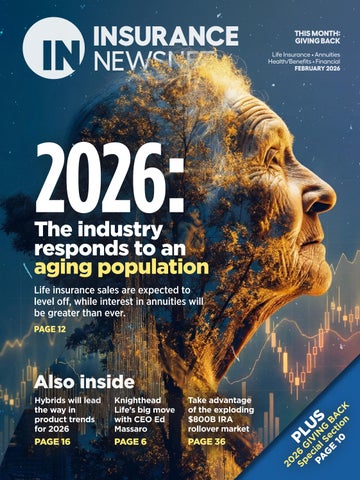
2026:

The industry responds to an aging population

Life insurance sales are expected to level off, while interest in annuities will be greater than ever.

PAGE 12

Also inside

Hybrids will lead the way in product trends for 2026

PAGE 16

Knighthead Life’s big move with CEO Ed Massaro

PAGE 6

Take advantage of the exploding $800B IRA rollover market

PAGE 36

SOLVE DEBT

Producing life insurance agents are adopting a more disciplined way to help clients eliminate debt while building long-term capital — without ideological “banking” concepts or fragmented tools.

Debt is the problem clients feel most. It delays investing. It compresses cash flow.

Most strategies force a tradeoff:

• Pay down debt — and end at zero

• Build capital — while ignoring debt

Debt2Capital™ was built to bridge that gap.

It is a system-based approach that moves clients from debt reduction to capital formation through a controlled, repeatable

Why Debt2Capital™ Is Emerging as an InsurTech Product of the Year Contender

Debt2Capital™ begins where real conversations begin: with debt

From there, the system carries each case through a single, controlled workflow:

• Structured debt and cash-flow analysis

• e-Application

• Underwriting

• Policy issue

• Ongoing, system-led service

No handoffs. No fragmented tools. No stalled cases.

Instead of requiring advisors to explain complex theories, the system guides clients from debt reduction into long-term capital accumulation.

What Makes Debt2Capital™ Different

A Debt Strategy That Doesn’t End at Zero Applies disciplined debt-reduction logic while redirecting cash flow toward long-term capital — reducing liabilities while building assets over time.

Built for Real Underwriting

Designed to work efficiently for clients typically between ages 25–60, aligning strategies with underwriting realities rather than illustrations alone.

Ongoing Engagement That Protects Results

System-led follow-up keeps clients engaged beyond payoff milestones, reducing lapse risk and dependence on annual reviews.

One System. One Flow.

Illustration, application, underwriting, compliance, and service — all inside a single login.

What Producing Advisors Gain

• Cleaner debt-first conversations that naturally lead to capital planning

• Strong cash-value performance within fully underwritten parameters

• Faster movement from application to approval

• Next-day commissions on issued policies

• Higher persistency driven by system-led engagement

Debt2Capital™ doesn’t ask advisors to sell a belief system. It gives them a repeatable process for solving debt without sacrificing the future.

Ready to see the system in action?

Who Debt2Capital™ Is Designed For

Built for life insurance agents working with debt-conscious clients who want to:

• Eliminate debt without ending at zero

• Redirect cash flow toward long-term capital

• Reduce underwriting friction

• Deliver consistent outcomes through infrastructure — not manual effort

It is not designed for ideological debates, shortcut seekers, or unmanaged growth.

Bottom Line

Debt2Capital™ is not another debt concept chasing attention.

It is a modern system that turns debt elimination into capital formation — cleanly, efficiently, and repeatably

Your Trusted Annuity Partner

Help

IN THIS ISSUE

INTERVIEW

6 Knighthead’s big move CEO Ed Massaro guides Knighthead Life confidently into the U.S. annuity market with fresh tech, clean balance sheets and a long-term commitment to advisors.

BONUS FEATURE

16 Hybrids will lead the way in product trends for 2026

Consumer behavior shifts and technological advances will drive product innovation in the coming year.

FEATURE 2026: The industry responds to an aging population

Life insurance sales are expected to level off while interest in annuities will be greater than ever.

HEALTH/BENEFITS

32 Beyond stop-loss: Smarter claim strategies for a high-cost era By Bruce

The stop-loss market has grown rapidly in response to the volatility of large claims.

ADVISORNEWS

36 Take advantage of the exploding $800B IRA rollover market

An in-service rollover offers the best of both worlds.

INSURTECH

38 AI is here, but who will regulate it?

IN THE FIELD

18 Building momentum By

Lonniece McDonald wants to make financial literacy accessible to all.

LIFE

24 Key person life insurance keeps small businesses afloat

Key person life insurance continues to be underused as a planning tool for small businesses.

ANNUITY

28 Looking for retirement flexibility? Annuities are the answer By Brad Pistole

Annuities get clients safely from Point A to Point B.

Artificial intelligence comes with questions of privacy rights, potential discrimination and other possible misuses in need of regulatory oversight.

BUSINESS

40 Growing together: The power of professional study groups

By Michelle Bender

Building a small village of likeminded professionals takes time.

IN THE KNOW

42 The intelligence revolution: Insurance in the fourth industrial era By Sue Kuraja

The speed at which data is processed has outpaced the framework that governs it.

The shift toward holistic retirement planning

When it comes to planning for retirement, clients aren’t buying products anymore. They’re buying outcomes.

That may sound like a subtle shift, but it’s seismic. For decades, retirement conversations were built around a familiar menu of options: a life insurance policy, an annuity, maybe some managed money in the mix. Each item did its job, often well, but in its own silo.

Today’s clients are demanding something different. They want a retirement plan that feels integrated, intentional and resilient — one that addresses longevity risk, health care risk, income risk, tax risk and even vocational risk as work lives extend into later years. They want clarity, not a collection of product brochures.

And that shift isn’t just coming. It’s happening right now.

Longevity: a new fear

Today, with celebrities living longer (Betty White, Ed Asner, Dick Van Dyke, etc.) and performing well into their 80s (Paul McCartney, Willie Nelson, Bob Dylan), clients are now acutely aware of longevity.

With the realization that they could live a very long time, many begin to fear they will outlive their savings. This is an especially real fear, as many watched parents or relatives outlive their assets. Others saw long-term care devastate retirement savings. Social Security clearly will not be enough to provide security, given ongoing inflation and cost-of-living increases that are not keeping pace.

The result: Clients are more open than ever to income solutions, and not only annuities but also “income engineering” — layered strategies that may include guaranteed products, systematic withdrawals, registered index-linked annuities and, increasingly, LTC hybrids.

Advisors who meet longevity fear with a product pitch will struggle. Advisors who meet it with a plan will win the next decade.

LTC is forcing its way back into the conversation

If agents thought the LTC conversation was fading, 2026 is proving the opposite. State-run LTC programs, starting with Washington and now spreading, are waking consumers up. Carriers are responding with redesigned LTC, life/LTC and annuity/LTC offerings that are simpler, more flexible and easier to underwrite.

Despite previous LTC product issues and ensuing consumer doubts, we’re entering what feels like a second LTC renaissance — but it’s one that demands holistic integration.

Income, assets, health, taxes: The silos are crumbling

What clients expect today is not a financial plan and a protection plan — it’s one plan. They want to know:

• How income will be created

• How income will be protected

• How health costs will be covered

• How taxes will be minimized over 30 years

• How their spouse will be protected

• How their money will last as long as they do

These are not siloed questions. They are one integrated conversation. And integration is quickly becoming the differentiator between agents who compete on product and agents who compete on value.

Advisors must evolve

We are witnessing the maturation of the independent agent’s role. The agent of the past sold financial products. The advisor of the future solves financial risks.

That means:

• Expanding the conversation beyond accumulation

• Bringing income planning into the earliest meetings

• Understanding how taxes affect sequence-of-returns risk

• Positioning LTC as essential, not  optional

• Using annuities not as alternatives but as core retirement infrastructure

And perhaps most importantly, embracing collaborative planning. Retirement today often requires teaming with accountants, estate attorneys or health planning specialists. The best advisors are those who orchestrate — not those who operate alone.

A once-in-a-generation opportunity

The market is clearly signaling that consumers want holistic retirement guidance — and they trust human advisors more than ever when decisions get complex. That dynamic has created a moment of opportunity for our readers and the entire independent distribution channel.

At InsuranceNewsNet, we’ll continue bringing you the stories, insights and tools that help you stay ahead of this shift — because the future of retirement planning isn’t about selling what you have. It’s about understanding what clients truly need.

And right now, what they need most is someone who can bring the whole picture together.

Dick Van Dyke hit a 100-year milestone on Dec. 13, 2025.

Accelerating retirement goals.

STRATEGY INDEX 7

The premium enhancement will be applied to all premium payments made during the FIRST THREE YEARS of the contract.

ANICO STRATEGY INDEX ANNUITY PLUS 7

This ad is not available for use in Oregon. Neither American National nor its agents provide tax or legal advice. You should consult your own tax or legal advisors concerning your specific circumstances. 1.) The premium enhancement will be applied to all premium payments made during the first three years of the contract. This amount is subject to change at any time; please refer to our current rate sheet for the latest offering. American National and its agents do not guarantee the performance of any indexed strategies. The Declared Rate Strategy earns interest at an interest rate we declare at the beginning of each Contract Year and is guaranteed for one year. When a person buys this annuity, the person is not buying an ownership interest in any stock or index. Indexed strategies earn interest related to the performance of an Index. Whether an indexed strategy earns interest or not and how much interest is earned is dependent on several factors: index performance, participation rate, cap and segment term. The performance of the index cannot be predicted over any given period. Past history of the Index is no guarantee of future performance. There is not one particular interest crediting strategy that will deliver the most interest under all economic conditions. All Segment Terms are not available in all states. Availability of strategies and Segment Terms subject to change monthly.

for complete details.

‘Credit score penalty’ doubling the cost of insurance

In all but three states it’s often more expensive for homeowners to have poor credit than it is to live in an area with a high risk of natural disasters.

That’s due to insurers adding a “credit score penalty” to homeowners insurance in every state except California, Maryland and Massachusetts. The penalties can devastate families just trying to get by and live out their dream of homeownership, said Michael DeLong, research and advocacy associate for the Consumer Federation of America.

The CFA issued a recent study finding that homeowners with low credit scores (FICO scores of 630 or below) typically pay nearly $1,996 more per year for homeowners insurance than identical homeowners with high credit scores (about 820). On average, it added up to almost double the premium cost, a roughly 99% “credit penalty.”

The credit-score penalty varies greatly by state, the CFA found. A typical Pennsylvania homeowner can expect to pay 181% more each year due to having a low credit score compared with someone with a high credit score — all to insure the same kind of house in the same location.

LAWSUIT BLAMES BIG OIL FOR CLIMATE-DRIVEN INSURANCE RATE HIKES

Washington state homeowners insurance rates increased by 51% over the past six years. In a new lawsuit, a pair of residents say oil companies are to blame for driving climate change. Filed in the U.S. District Court for the Western District of Washington, the lawsuit seeks class action status and names Exxon Mobil, Shell, Chevron, ConocoPhillips, and the American Petroleum Institute as defendants.

The companies, the lawsuit states, “were well aware ... that climate change associated with the sale of fossil fuel products would result in extreme weather events and rising sea levels, and they invested heavily to protect their own assets, infrastructure and operations from them and invested to continue and

expand their conduct that was contributing to climate change.”

Federal courts have not ruled on the merits of whether oil companies can be held liable for climate change. They’ve mainly ruled on jurisdiction. Historically, federal courts have dismissed climate tort claims as raising political or policy issues outside judicial authority.

GLOBAL ECONOMIC GROWTH WILL MODERATE AS THE LABOR FORCE SHRINKS

Global economic growth is expected to moderate over the next 15 years in relation to prior decades, according to economists at The Conference Board. Eric Lundh, The Conference Board senior global economist, predicted underlying demographic trends will become more challenging and limit economic growth contributions from labor — especially in mature economies such as the U.S. and Europe.

In addition, economic growth in both

The market will punish people if we don’t have an independent Fed.”

emerging and mature economies is set to slow, but emerging economies will continue to be the most significant drivers of global growth.

The U.S. economy is undergoing transformation in the midst of a growth slowdown, said Yelena Shulyatyeva, The Conference Board senior U.S. economist. The aging population and changes in immigration policy are two major factors impacting economic growth.

NEARLY HALF OF AMERICANS MORE STRESSED HEADING INTO 2026

We’re one-twelfth of the way into 2026, and nearly half of Americans say they are more stressed heading into this year than they were at the beginning of last year. This is according to the 2026 New Year’s Resolutions Study from the Allianz Center for the Future of Retirement.

Among Americans who say they are more stressed financially compared with last year, the top reasons include costs of day-to-day expenses (54%), income is too low (46%), not saving enough for an emergency fund (39%), too much debt (35%), high health care costs (34%) and lack of job security (33%). Health care costs and lack of job security in particular rose significantly from last year.

With that sense of job insecurity, more Americans say they will start or continue looking for a new job in 2026 (56%, up from 47% last year). Still, many are planning to stay put and take part in “job hugging.” Seven in 10 (71%) who are not likely to look for a job say it’s because it seems safer to stay where they are in the current economic environment.

Bank of America Chairman and CEO Brian Moynihan

With Kansas City Life Insurance Company’s Critical Illness Rider (CIR), your clients can access their life insurance death benefit when they are dealing with a covered critical illness, which can present them with unexpected medical expenses.

While your clients are focusing on what’s most important – getting well – the CIR may help relieve some of the financial burden.

• Clients can gain access to up to 80% of the policy’s specified amount as a living benefit.

• At death, remaining life insurance benefits are paid income tax free to beneficiaries.

• The rider can be used more than once, but only once for each defined critical illness and no more than once every 12 months.

• There are no premiums or costs with this rider.

CEO ED MASSARO guides Knighthead Life confidently into the U.S. annuity market with fresh tech, clean balance sheets and a long-term commitment to advisors.

An interview with Paul Feldman, publisher

Knighthead Life enters the U.S. annuity market with a rare advantage: deep experience but no legacy baggage.

After years of building a strong international annuity business and a disciplined reinsurance operation, the company acquired a clean, fully licensed platform and built modern systems from the ground up. The result is a lean, technology-forward carrier, built for speed, transparency and consistent market presence.

Knighthead focuses on simplicity and service, said Ed Massaro, CEO and Chief Investment Officer of Knighthead Insurance Group and Knighthead Life. Its Staysail 3, 5, 7 Multi-Year Guaranteed Annuity (MYGA) lineup gives agents clear, flexible options that match real client needs.

“We have a plan,” says Massaro. “We started with a multiyear guaranteed annuity, and we’ll develop a fixed indexed annuity product. We might develop some fixed indexed annuity products over time. It’s about making sure we can be competitive and provide best-in-class service to all our stakeholders.”

In this interview with InsuranceNewsNet Publisher Paul Feldman, Massaro discusses Knighthead’s journey into this new market and what he sees in the company’s future.

Paul Feldman: Tell me a little bit about yourself. What was your background before joining Knighthead?

Ed Massaro: I’ve spent about the past 30 years in the financial services industry. First in the investment banking and leveraged finance world: J.P. Morgan, Salomon Smith Barney and UBS. I was always in a credit and capital markets role. About 15 years ago, I moved over to join and help grow Knighthead Capital Management, which is a credit asset manager and manages about $10 billion of assets today.

I had been on the banking side of the business, then moved to the asset management side of the business with my partners. I was responsible for business development and the operations of the company and looking at new opportunities, and that’s what brought us to insurance. Back in 2010, we were watching what both private equity and some asset managers were doing in the insurance

business. I guess most notably we were seeing what Apollo and Athene were doing, and folks like Greenlight Re and Third Point Re, on the property/casualty side.

As asset managers and credit folks, we felt that life and annuity was a business we could understand. It had cash flows that were very much in tune with credit and originating credit and being able to pay people back with fixed income and floating rate securities.

Our interest shifted to what was happening in the market; how could we provide retirement services? First, internationally. Second, and now most

first year we did $25 million of premium in 2015, and today we write just shy of $500 million.

Again, we’re small for the U.S. market, but we are the No. 1 provider in the international market. Many of our clients and policyholders are in Asia, Latin America and parts of Eastern Europe, where they don’t have access to dollar-denominated annuities. We can sell to them through our Knighthead Annuity & Life business, which is based in the Cayman Islands.

As we grew, we saw an opening among middle-market U.S. carriers in need of capital relief. They were looking for rein-

What did we do? No blocks, no legacy. This was not a grow at all costs. It was, “Let’s find partners, let’s learn the business, let’s grow with them.”

recently, domestically in the U.S. My interest has always been in credit, leveraged finance, asset management, and as we all know, that’s a big part of what drives our fixed indexed and fixed annuity market today.

Feldman: It’s always exciting to have a new entrant in the market, especially Knighthead because you’re already an A-rated company; you’ve been doing this for a long time. I’d love to hear that story.

Massaro: We started Knighthead Annuity & Life Assurance in 2014, after four or five years of analyzing the market. Knighthead Annuity & Life Assurance Co. was our first carrier. We saw an opportunity to provide annuity products not to the U.S., which is very developed, but to the international markets. So we started just selling MYGA and FIA products to the non-U.S. market.

In our view, that was an underserved market; it wasn’t massive, but there was a need — a niche market — for a highservice provider to provide transparent products. The international market uses it for retirement, uses it for accumulation — a little bit more so than the U.S. In our

surance partners. In 2017 we jumped in and said, in the $500 million to $1 billion of reinsurance flow premium, we see a real opportunity to provide good partnership to carriers in the U.S., and we started our reinsurance business.

What did we do? No blocks, no legacy. This was not a grow at all costs. It was, “Let’s find partners, let’s learn the business, let’s grow with them.” We have six cedent carriers on our books, all flow transactions, all multiyear. We’ve been at this for seven, eight years with our carriers, and we went hand in hand with them pricing monthly MYGAs and FIA products. So, while we are “new” to the market, we’ve obviously learned a lot from our partners. We’ve seen the winners and maybe some mistakes that have been made over the past five or seven years. But part of the ultimate plan was to find and capitalize our company so that we’d have three business lines: our international direct, our reinsurance business of U.S. annuities, and then we believe that we could get a fair share of the U.S. market directly. We acquired a carrier that had 46 licenses, great people and some great systems. It didn’t have any legacy business. It was ready-built to get going, but, frankly, it just never did. But it had created the

platform. We stepped in, hoping to add a little bit of expertise and some capital, and we used that to launch our U.S. direct product. We really started selling in January last year. People often say, “Hey, there are plenty of annuities carriers out there and there are some great ones and there are some big ones.” We thought we’d take the same tack: high service, white-glove service — a boutique company offering competitive rates. We will ultimately grow, but it’s not growth at all costs.”

Being new to the market, you don’t have legacy blocks, you don’t have legacy systems. So, we can choose. We have fresh technology. We can turn premiums around; we can tell people where their policy stands. That’s a big lift, but you must do it carefully. We want to make sure we’re not falling down on the job for our policyholders or our distribution partners. We know you must be consistent, you must have technology and you must have capital.

and then, ultimately after some time, go to banks and broker-dealers.

We’re reasonably well known by a handful of U.S. banks and broker-dealers who serviced offshore clients. Ultimately, we think we’ll partner with those folks in the U.S. We are absolutely looking at the direct-to-consumer channel. Some of our peers are doing some very interesting things and have been very successful in that market. We’re looking at it. I think technology’s going

People often say,
“Hey, there are plenty of annuities carriers out there and there are some great ones and there are some big ones.” We thought we’d take the same tack: high service, whiteglove service.

We have a plan. We want to have capital so that we can be consistent. We started with a MYGA and we’ll develop FIA products. We might develop some FILA products over time. It’s about making sure we can be competitive and provide best-in-class service to all our stakeholders.

Feldman: When you say “the U.S. direct,” some people think you’re writing direct to consumer, but it sounds like you plan on using distribution.

Massaro: Right now, we’re using independent marketing organizations exclusively. We’ll expand into the bank and broker-dealer channel over time. As an example, in the international business where we sell to non-U.S. people, 90% of that distribution is through banks and broker-dealers. So, we’re also somewhat unique. Most carriers new to the U.S. come to the market like we did, use the independent or IMO channel

to bring us there. I think it will bring younger people into the world of annuities at some point. But right now, I’d say we’re starting more in a traditional way with some six IMOs who have partnered with us to distribute our product.

Feldman: Your initial entry into the industry was MYGAs. What makes your MYGAs different, better or more interesting for an agent?

Massaro: The MYGA market continues to be strong. I think of the MYGA product as your fullback on the football team: You have to have one. It must be competitive. They’re commodity-like, but I think they become noncommodities when you do a few things. You can issue the policy in a quick turnaround, you can answer people’s most important policyholder questions, and you can provide options. Our Staysail 3, 5, 7 product is our

MYGA-branded product name. We offer clients three buckets. In the MYGA market, there are some folks who say, “I’m not going to touch this money. I want the best rate in the market.” We give them a simple interest rate, we show them the compounded rate, and they look at it and say, “I’m not touching that for five years. I know I don’t need it. I’ll pick this option in your riders.” Others say, “I want to have an income product. I’m happy to have a nice big coupon crediting rate, and every month I’m going to do systematic withdrawal.” And we’re happy to price that and happy to take a certain business mix in that match so that we give that agent and that client a solution.

And then there are some folks who say, “I don’t really know. I might need the money. I might not. I might need to make withdrawals. I still want a competitive rate.” I think our Staysail with our liquidity and no-liquidity riders — and how we’ve priced those — gives the agent the opportunity to have those three discussions. There are others like that in the market, but I feel we have a good rate and we have that optionality and we also can answer the questions and offer service. It’s given us some pretty good mindshare. We are right on target for where we wanted to be. That’s how I’d say we’ve positioned Staysail in a very full market. We’ve been near the top on rates. You must have a good rate. But I think people will look at the rate and look at those other things and say, “How does this fit into my portfolio, and does it give me some optionality?” I think we’ve done reasonably well there, and the uptake has been what we’ve expected.

Feldman: There are so many indexes out there. What is Knighthead thinking about which route you’re going to take? The Standard & Poor’s model? Or some of the other models that are aggressive but have good track records? What are your thoughts on that?

Massaro: We will absolutely have a base S&P option. We will absolutely have a fixed option.

I think our approach will be a competitive group of indices, but we expect 50% to 60% of the clients we’re going to be looking to attract to take the S&P option. But will there be a balanced option? Will there be an all-equity option? Will there be a balanced with maybe a commodity component? Yes, but I think it’ll be with indexes that are well tested and that will give you good performance. We really don’t want to be on the aggressive side.

I think over time we’ll offer maybe some income products, too. But we’re going to come into the market as sort of a competitive, transparent, high-service model to establish ourselves. Because again, we’re thinking over the next five years, “Where do we get to, and what does our product portfolio look like?” We want to make sure we get it right. But sometime this year you should see an FIA offering from Knighthead Life.

Feldman: What’s the difference in the buyer mindset in the international market compared with the United States?

Massaro: The international buyer wants dollar assets because they live someplace where they’d like to have some dollar exposure, which they can’t get in their home country. And they want something — here’s where it’s similar to the U.S. market — that is safe and “guaranteed.” You’re living in Argentina or you’re living in Mexico City, and you have investments and you could be highly successful. Our target client in international has a net worth of between $1 million and $6 million — some have much more. They want a portion of their portfolio outside of that jurisdiction in dollars and with an A-rated counterparty. So, their real motivation is accumulation and the ability to give that to their beneficiaries.

For our international clients, only about 10% of our business is FIA and 90% is MYGA because of their focus. The U.S. folks are willing to take a little bit of, “Hey, I’m happy to be principal protected, but I want a little upside, and I’ll buy 50% MYGA, 50% in FIA.” The

real mindset is capital preservation, great counterparty, and working with a jurisdiction that is fully transparent, fully reporting: Cayman. So, that’s the difference. But it is used less for income in international, more for estate planning and preservation of capital.

Feldman: It sounds like it’s part of a diversification plan.

Massaro: It absolutely is. And, historically, they’ve bought structured notes, they’ve bought fixed income products. But they’re thinking, “Well, wait a second, my fixed income interest rates go up. I don’t want a structured note that has some equity exposure. I pay big fees.” They like that they don’t pay a load. We’re paying the distribution partners there just like we do here. And they get a fair rate.

Feldman: How do the age ranges compare internationally versus in the United States?

Massaro: They are very similar. The international market may skew a little bit younger. I’d say, on average, we are seeing across that book around 60, versus what I’d call 65 or 68, maybe in a broader book in the United States. But it’s the whole spectrum. We sell up to about year 80, just like we do in the States.

Feldman: Service is important these days. There’s nothing worse than dealing with an outsourced service.

Massaro: We self-administer, and I’ll be the first to tell you, we’ve made our mistakes. But I think we’ve minimized those mistakes because we’ve been able to control our volumes and we want to grow with our volume. But if there’s a problem, if an agent has a problem, they know who to call.

I get on the phone with agents three times a week, but not all those conversations are about problems. The good news is, though, when you control your own destiny, you can fix it and you can make sure if you have a deficit in one area, there are great third-party administrators. Some of our seeding clients have terrific service. We’ve decided to do it ourselves. It’s costly, but I think, in the long run, it pays off.

SPREAD LOVE GIVING BACK

February is all about love,

and what better way to

celebrate than by highlighting their commitment to supporting communities. Our February Special Section showcases companies that exemplify the true meaning of giving back.

A Thriving Insurance Organization Built on Giving Back

at GCU PAGE 10

A Thriving Insurance Organization Built on Giving Back

GCU’s fundamental commitment to giving back helps GCU agents differentiate their own business, provide more perceived value to their clients, and help them do well while doing good in their communities.

It’s an age-old concept that feels remarkably fresh today: caring for and doing good by others. That fundamental notion is one of the unique aspects of GCU that personally attracted me to the organization. I came to recognize the rare opportunity I had to continue to build a rewarding career for myself while, at the same time, build up the community around me. I could feel good about the work that I, the GCU team, and our agent partners were doing together because every success we had would directly benefit the people we serve as clients while also helping our neighbors in the community who need support. It is an idea that has been embraced for generations yet feels brand new and tremendously relevant when discovered today.

GCU is a not-for-profit, member-owned fraternal benefit society. We exist to help our clients (we call them members) attain financial security through our first-class annuity and life products and other benefits. Through our agents we provide an excellent portfolio of solutions including Fixed Deferred Annuities, Fixed Indexed Annuities (FIA), Single Premium Immediate Annuities (SPIA), Whole Life Insurance, and Term Life Insurance.  Beyond products, GCU also promotes camaraderie, friendship and mutual support via good works in the community (that’s the fraternal part). Still, we proudly support our IMOs and independent insurance agents in the same way traditional carriers do — by providing highly competitive commissions on annuity and life insurance sales — but here is how we differ significantly. As a 501(c)(8) not-for-profit, tax-exempt organization, our mission drives our decisions — supporting our members and local communities is part of who we are. That commitment is not something we put into practice just once or twice a year or on special occasions. It is a pledge we deliver on every day of the year.

We are committed to Main Street, not Wall Street. Being a not-for-profit fraternal benefit society originally founded by blue-collar laborers, we’re admittedly a bit different than traditional carriers. We are member owned, not publicly traded. Instead of our objective being making profits for shareholders, we focus our efforts on helping secure the financial futures of our members and giving back through meaningful community initiatives. Our GCU organization, our members, and our agents give back to their communities throughout the year via fundraising events, scholarships, and volunteering opportunities. Simply put, the GCU family is comprised of hometown people of faith guided by their values and a commitment to protecting the assets and well-being of others.

That commitment to giving has been part of our organizational makeup since the very beginning more than 133 years ago. While you may not be familiar with GCU (admittedly, we’re not a household name), our roots run deep. In the mid-1800s, the Greek Catholic Church (Byzantine Catholic Church today) was comprised of Rusyn (ROO-sin) immigrants who had come to America from Eastern Europe. These

people of faith commonly supported their families by working hazardous jobs in industrialized America’s burgeoning coal mines, iron mills and steel mills.

Unfortunately, due to the high level of risk associated with such work, commercial life insurance companies consistently refused to insure them. In response, church members came together to form “lodges” at multiple Greek Catholic Church parishes specifically to create a way to provide much needed financial

Stephenson
GCU’s commitment to community and country goes back generations. This is a photo of GCU members supporting the War Bond efforts in the 1940’s.

security and protection. Each lodge would pool money from its members to help ease the burden on impacted families. Building on the success of the idea, it was decided to bring those lodges together for greater effect, and the Greek Catholic Union (GCU) was established in the winter of 1892 with a mere 743 members and $600 in total assets. That single caring gesture seeded our financial strength and secures our future through our continued commitment to, “Protecting Families, Promoting Faith and Fellowship, Strengthening Communities.”

GCU has grown from humble beginnings to a multibillion-dollar organization. Today, GCU has grown to more than 49,000 members across America, and $2.79 billion

SPREAD LOVE GIVING BACK

yond, at GCU we are dedicated to proactively establishing and maintaining meaningful relationships with our agents, being responsive to them and their needs, and acting as a true partner in their success. We recognize the importance of their role and expertise, and we welcome them as vital and valued members of our family and our community.

As mentioned at the outset, I was personally drawn to GCU by the rare prospect of being part of an organization that provides tremendous professional growth potential while simultaneously doing purposeful, highly beneficial work in a growing number of communities. GCU is now delivering this invaluable combination of good and prosperity in 32 states across America, plus

in assets under management. Along the way, we have weathered the storms of war, numerous bear markets, financial depressions, inflation, and recessions. GCU has not only survived but has thrived through it all and continues to expand on its mission. And that strength continues to be recognized. GCU has once again earned the AM Best Financial Strength Rating of A- (Excellent).*

This fundamental commitment to giving back helps GCU agents differentiate their own businesses. Offering proven financial products that can provide the security individuals and families need, while also benefitting others around them is a value our GCU agents — and their clients — can embrace. In addition to selecting a resource that can provide the security they need for their family, we believe that people want to do business with an agent and an organization that also has strong values and is providing a tangible, positive impact on lives in their communities. When our agents and their clients can do well while also doing good for those around them, it is undeniably a win-win scenario — one that helps differentiate GCU agents from the rest of the pack.

Serving another vital community … our Agents. Beyond the enterprise-wide commitment to serving local communities, I am proud to say that GCU is equally committed to our community of independent agents. Despite being in an age of increasingly impersonal service, within our industry and be -

the District of Columbia. I encourage any agent who is driven to do well while also doing good by others to give GCU a closer look. I am confident that they, like me, will quickly discover how tremendously rewarding it can be to be associated with an organization that is committed to growing business while giving back meaningfully to an expanding community.

An invitation to purpose-driven agents.

We wholeheartedly believe that the more you know, the better GCU looks. If you are an agent who is driven by values and is looking for opportunities to grow your book of business while also serving the people of your community, take a few moments to explore GCUusa.com . Or reach out to us directly at (855) 306-0608 to discuss how you could immediately begin having greater impact on lives while positively impacting your business.

* A- (Excellent) rated by AM Best since 1980. AM Best is a third-party independent credit rating agency that rates an insurance company on the basis of the company’s financial strength, operating performance and ability to meet its obligations to policyholders. A- is the fourth highest rating out of 15 categories and was affirmed for GCU in November 2025.

GCU employees and members assisting children in the local area to shop for new winter outerwear through the WTAE-TV & Salvation Army Project Bundle Up in October 2025.

2026:

The industry responds to an aging population

Life insurance sales are expected to level off, while interest in annuities will be greater than ever.

The past year was a growth year for U.S. life insurance sales, with momentum building each quarter. For annuities, the story was even bigger, with 2025 showing a continuing sales surge and annuity sales hitting quarterly and yearto-date records.

The new year promises to see a cooling off on the life side of the industry, while annuity sales will continue to show strength, according to LIMRA. One main factor influencing the industry: the aging of the U.S. population.

Consumer interest in life insurance has leveled off but remains higher than prepandemic levels, Bryan Hodgens, head of LIMRA research, told InsuranceNewsNet.

“We saw a nice little bump up in life insurance sales during the pandemic that sort of sustained itself, but it’s flatlining a little bit at this point,” he said.

LIMRA predicts individual life insurance premium in 2026 to increase between 2% and 4% over the prior year.

“Looking at that 2% to 4% growth, I think a couple of different factors will drive it,” Hodgens said. “I think we will see more of that growth in accumulation products, and we [will see] growth in the final expense market.”

LIMRA’s 2%-4% premium growth prediction “is pretty much in line with what we’ve been saying over the last several years,” he said. “It’s interesting that 2025 was a bit of an acceleration over that to the 2%-5% that we predicted for that year, which was a bit of an outlier.”

But that projected premium increase will not impact all product lines equally.

Indexed and variable universal life could see a drop in sales, Hodgens predicted.

“We’ve seen a lot of run-up in those product lines in 2025, and it really started late in 2024, [but] we’re not seeing as many bigger policies and larger premiums being written. I think that market, that opportunity, is sort of maturing. So I think we’re going to see a little bit of a pullback there.”

Economic factors will influence life insurance sales as consumers have many products and services competing for their dollars.

“I think that when you look at the consumer and the demographic, you look at

increased tightening of economic conditions — unemployment, high consumer prices and there’s still this pesky little thing called inflation sitting out there — I think that it impacts the disposable income that’s available for life insurance, and it’s competing against other investment products. I think this will continue to play out in 2026.”

An aging population also will influence life insurance sales in 2026, Hodgens said.

LIMRA recently conducted a study with Capgemini on worldwide demographics, in which LIMRA surveyed the under-40 consumer.

“The reality is that whether it’s in the U.S. or outside the U.S., we have an aging population,” Hodgens said. “We have fewer people coming in behind it. Birth rates are down. People are delaying some of their life events — things that typically have been triggers for life insurance purchases — such as getting married, having kids, buying a home. All of those traditional triggers for life insurance purchases are getting delayed and happening less frequently.”

While the younger generations don’t appear to be quite ready to buy life insurance yet, the over60 population has become a saturated market, he said.

Annuity sales could set another record in 2026

While life insurance premium is expected to level off in 2026, it’s a completely different story when it comes to annuities.

LIMRA predicts annuity sales will set another record this year — between $438 billion and $485 billion in total sales. One big factor driving those sales will be the growth of in-plan annuities.

Annuities are increasingly being incorporated into employer-sponsored retirement plans — especially 401(k), 403(b) and other defined contribution plans

“We’ve sold this group a lot of life insurance over time, and we’ve tapped out that market to a certain degree. How much more growth will we get out of that?”

That leaves Generation X, generally referred to as people born between 1965 and 1980. The older members of this age group are hitting age 60, while the youngest are in their mid-40s. This group is looking at a looming retirement as well as financial obligations to both children and aging parents and is a prime market for annuity products.

LIMRA is working with the Alliance for Lifetime Income and will focus some of its research on Gen X in 2026, Hodgens said.

“For annuities, Gen X is right in the sweet spot,” he said. “We know that the average age for purchasing an annuity is around age 64. The U.S. is in Peak 65 right now and Gen X is approaching retirement age, so we see Gen X as a good market for annuities.”

— as plan sponsors look for ways to help employees convert savings into predictable retirement income. Recent legislative changes, particularly under the SECURE 2.0 Act, have expanded how annuities can be used inside these plans.

“We’ve seen this movement over the last several years, with annuity products now available in the workplace, and we will see more of that adoption there. So I think that’s a growth engine for the annuity space overall going into 2026,” Hodgens said.

He said falling interest rates might make deferred fixed annuities less attractive, and he expects to see some pullback in that category. But growth in other annuity categories — especially registered index-linked annuities — will continue to soar.

“ This particular product has seen record growth, year over year, every year since the product was brought to market in 2011, and 2026 will be no different,” Hodgens said. “We predict 2026 will be another record year for RILAs.”

Hodgens

Demographics drive product innovation

An aging population is not only driving sales in certain product categories, but it is also driving product innovation.

Living benefits inside life insurance products will continue to increase as consumers look for ways to pay for future long-term care, Hodgens said.

“We will see more innovation in life/ combo policies, where long-term care riders have been included in life insurance,” he said. “I think you’ll see other types of living benefits that will show up on the life insurance side. But for longterm care, it plays into the demographics of an aging population.”

LTC riders, which Hodgens described as “essentially accelerated benefits.”

“If you have a guaranteed income stream built into your annuity products and you have a long-term care rider associated with that income stream, the accelerated benefit allows you to accelerate that — maybe double that or triple that income stream that you would get because you’re in a long-term care event.”

Annuities with LTC riders are relatively new to the market. “We don’t see a lot of growth in this yet, but I do think we’ll see some of that uptick over time because the opportunity is there,” Hodgens said.

Living benefits are becoming increasingly popular with consumers who are at least a decade or so away from needing care.

“Younger generations are looking at these combo policies and buying them now, saying, ‘It’s cheaper for me now. I know I’ll need it after watching my parents and grandparents face long-term care needs,’” Hodgens said.

With the majority of Americans predicted to need some kind of care in their later years, the life insurance industry “is leaning back into this long-term care space because they see the opportunity,” he said. Carriers have learned how to better model future risk and price products more accurately.

LTC riders aren’t just for life insurance. More annuity products also are including

I think you’ll see other types of living benefits that will show up on the life insurance side. But for long-term care, it plays into the demographics of an aging population.

Technology improves the buying experience

Consumers demand a better buying experience, and the industry will continue to personalize that experience in the digital environment, Hodgens said. Artificial intelligence will play a greater role as well.

“AI is already playing a role,” he said. “Insurance companies can look at consumers and have predictive data analytics on those consumers, looking at their buying behavior and demographics, and having predictive models on how to approach consumers and how to personalize that experience.”

AI already is at work as insurers collect data about consumers and personalize the buying experience for them.

“How carriers are underwriting, how

they’re processing things, how the industry’s having customer service experiences

— AI is already there, and it’s already having a positive impact,” Hodgens said. “Now when you multiply it forward, it’s only going to get better.

“I think that we’ll start to see AI and technology as they try to transcend more into the consumer experience and the advisor experience. Advisors will be able to connect quicker and better and more efficiently and [make it] more personalized to the consumer. The consumer will be able to connect to the advisor. We’ll see some interesting breakthroughs and some really cool things going forward. It will be a better client experience, a faster and more personalized experience.”

Holistic planning will continue

The trend of holistic planning shows no signs of going away. Hodgens said that advisors and the industry must tailor advice and position products to appeal to younger generations.

“But what doesn’t change is, what is life insurance for? It’s a product of risk mitigation, of dying too soon, of having liabilities and having loved ones you want to take care of.”

What has changed, he said, is to think about life insurance in terms of what else it can do other than providing a death benefit. Can life insurance do something for the policyholder while they are still alive?

“I think that will be the big shift from a planning perspective around the living benefit side of life insurance and annuities. On the annuity side, it’s the flip side of life insurance — it’s the risk mitigation of living too long. Do I have enough income to last during my lifetime?”

Hodgens said advisors who want to incorporate annuities and life insurance into holistic planning can provide clients with what he called “a beautiful little lineup of income and risk spectrum across those products.”

Susan Rupe is managing editor for InsuranceNewsNet. She formerly served as communications director for an insurance agents’ association and was an award-winning newspaper reporter and editor. Contact her at srupe@ insurancenewsnet.com.

LAYERING DISABILITY INSURANCE PLANS

65%+ INCOME REPLACEMENT

THE LAYERED SOLUTION

The High Limit Disability income protection plan was developed specifically to meet the needs of those needing supplemental disability insurance. A High Limit Disability plan through Lloyd’s of London provides coverage to those who would like to obtain more protection beyond their existing inadequate disability plans. Our goal is to provide at least 65% replacement of income. Lloyd’s of London is the only market that makes this available.

As incomes increase, the issue and participation limits of traditional Disability Insurance carriers decrease. To properly insure a highly compensated individual at 65% of income, multiple disability income plans are often required and are layered to provide sufficient income protection.

The following scenario illustrates the way income protection plans can be layered to provide an individual with 65% coverage of monthly income.

EXECUTIVE

INCOME:

STUDY

Hybrids will lead the way in product trends for 2026

Consumer behavior shifts and technological advances will drive product innovation in the coming year.

Industry experts believe both a shift in the average American consumer’s behavior and technological advancements will drive innovation in life insurance and annuity products in 2026.

While LIMRA maintains that more mainstream products such as registered index-linked annuities and indexed universal life will continue to see growth and innovation in the months ahead, industry leaders who spoke with InsuranceNewsNet unanimously agreed there will be a strong focus on new hybrid products.

“You’re looking at products that are hybrid in nature, that cover ailments or disabilities or long-term care, et cetera, during the lifetime of the policy,” Samantha Chow, vice president and global head of life, annuity and benefits at Capgemini, said. “We tend to refer to those as living benefits — not to be confused with living benefit riders that have existed for eons in

the industry but more specifically to the benefits that can be used during someone’s lifetime.”

Chow said the insurance industry had “seen a little bit” of this in the last quarter of 2025, but she believes it will gain more traction in the year ahead. And in her view, the catalyst is that the demands, needs and desires of American consumers both young and old have changed.

“We’ve been talking about it here at Capgemini for the last couple of years, how the perspective of the next generation of buyers has changed. Even those who are buying today above that 40 age rank are still looking at life insurance very differently outside of tax savings and high net worth scenarios,” Chow said. Ron Gura, co-founder and CEO of bereavement support provider Empathy, described this holistic approach to planning for life and loss as a “comprehensive” strategy carriers could adopt in

2026 and going forward.

“We do see a lot of hybrid products, but I think the title is more ‘comprehensive products.’ People are looking to make sure their offering is more cohesive. They’re shifting from talking about protection to financial advice — everyone is looking to make this more about holistic planning versus here’s a policy for this and here’s a policy for that,” Gura said.

He believes 2026 will see a continued shift in approach for life insurance to become an “ongoing care relationship” rather than purely transactional, and “continuity of care benefits” could even become table stakes over time.

Upcoming sales trends in life and annuities

On the more traditional side of life insurance, Karen Terry, corporate vice president and director of LIMRA Life Insurance Research, said carriers are expected to continue bringing simplified solutions and accumulation-oriented products throughout 2026.

Chow
Gura

LIMRA’s data shows new indexed UL premiums were up 16% year over year towards the end of 2025, while variable UL premiums were up by 35%. Meanwhile, new whole life insurance premiums were up 11% — “the biggest growth since at least 1990.”

“Indexed universal life will remain a priority, and final expense and simplified whole life will continue to expand,” Terry said. “IUL and variable universal life continue to dominate premium growth. Whole life remains relevant, with final expense products fueling record policy growth. Some carriers are also prioritizing simplified underwriting and accelerated issuing to improve accessibility.”

Meanwhile, Keith Golembiewski, assistant vice president and head of LIMRA Annuity Research, noted an expected focus on RILAs and innovation in the in-plan annuity space as carriers seek to further diversify their product mix with an “all-weather portfolio type of solution.”

LIMRA has already projected RILA sales will hit more than $75 billion for 2025 and that the trend will continue through 2028.

“LIMRA expects the industry will continue to see innovations around registered index-linked annuities,” Golembiewski said. “New crediting methods, indices and guaranteed living benefits will help drive activity.”

At the same time, he said LIMRA expects innovation on the advisory side via “more fee-based annuities and contingent deferred annuities” that allow clients to “maintain control of assets and how they are invested, while adding guaranteed income or protection.”

The era of hybrid

One of the biggest trends expected to come in 2026 is a significant rise in hybrid solutions as carriers race to launch product lines that meet new consumer needs.

For instance, Chow pointed to Guardian Life’s SafeGuard 360, which bundles whole life insurance with longterm care and disability coverage in one hybrid solution.

“There are a couple of examples out there where a whole life policy cash value accumulation can be used for loans

Hybrid products are positioned as alternatives to stand-alone LTCi, and carriers are likely to expand these offerings given the growing need for long-term care services.

and financial planning, but outside of just being a life insurance policy it is critical illness, disability, income and long-term care. It can be used for any of those scenarios,” Chow explained.

LIMRA also identified LTC as an “arena ripe for innovation” from both the life insurance and the annuities standpoints. Terry pointed out that this rising interest in hybrid products aligns with new consumer preferences for flexibility and financial security.

“We are seeing awareness of the need for long-term care funding solutions and interest in life/LTC combination products, especially among millennials and caregivers. Hybrid products are positioned as alternatives to stand-alone LTCi, and carriers are likely to expand these offerings given the growing need for long-term care services,” Terry said.

“Annuity/long-term care hybrid products have been on the minds of annuity carriers for many years, and 2026 could be the year that we see more products as insurance companies figure out the economics and risks associated with these products,” Golembiewski added.

In the annuities space particularly, Chow pointed out that hybrid solutions can address consumer fears about “putting money in something they might lose” or may not be able to access when they need to.

They want “that growth and ability to say, if it’s your annuity and you pass, then those funds would go to the next beneficiary or the next annuitant. Bandhan’s iRetire or AXA’s WealthAhead are other good examples of that,” she said.

Additionally, hybrid products are expected to play more of a role for working professionals, whether they receive benefits through their employer or individually.

Gura projected that “lines are blurring” between group and individual benefits and 2026 could see “more caregiving solutions shifting into life insurance, and

specifically long-term care riders.”

“Voluntary products will become more common,” Chow suggested. “You’re also seeing more voluntary life insurance products coming in that are kind of variable universal life products that are portable. This is what I expect to see more of in 2026 and into 2027.”

Innovation driven by artificial intelligence

Chow also suggested continued advances in technology could open the door for flexible products that adapt as the policyholder’s life changes.

“I think it’s something that we might see some of in 2026 — more advanced in 2027 — just because it’s going to be complex. This is a life insurance policy that has other types of benefits, financial growth and investment growth built into it, but it changes as your life stage changes,” she said.

She also expects AI to fuel digital engagement in life insurance and annuities, helping agents identify the right type of products for clients while also facilitating consumer education.

Golembiewski believes — for annuities particularly — AI-driven innovation in the coming months could surpass what’s been seen in the last two decades.

However, Chow noted that carriers still must tackle the tedious task of updating legacy systems and “technical debt” that has existed for decades and “prevents a lot of good use of AI.” “ There will be a lot of cleanup, getting the data estate prepped and ready to use AI. We’re going to see a lot more of that, and that’s prep for a lot of these flexible products,” she said.

Rayne Morgan is a journalist, copywriter and editor with more than a decade of experience in digital content and print media. Contact her at rayne.morgan@innfeedback.com.

Golembiewski

Lonniece McDonald wants to expose more people of color to the financial profession while helping students and underserved communities improve their financial literacy skills.

Lonniece McDonald describes herself as “a budget-nista with a passion for financial literacy.”

She discovered at a young age she had a talent for saving money as well as for helping people.

“I tell people that when I was 7 years old, I would save all the money I would get from my grandparents for my birthday or whatever. Then when it was closer to Christmas, I would listen in on conversations among the adults in the family to get an idea of what they would like for gifts and I would give them something with the money I had saved,” she said. “I liked saving money and I liked helping people, and this was a way I could do both.”

McDonald’s interest in saving money and helping others led her to a career in financial services. She is a wealth planner at a wealth advisory firm for ultra high net worth individuals and multigenerational families.

Her efforts to inspire other women of color to pursue careers in the profession as well as her dedication to promoting financial literacy earned her a Financial Planning Association Diversity Scholarship.

By the time McDonald graduated from high school, she knew she wanted a career in finance. But it was her time as an undergraduate at SUNY New Paltz that solidified that decision.

“I took my first personal financial planning course. I didn’t know that financial planning was a profession,” she said. “During that time, I also had an opportunity to teach a financial literacy workshop. I was talking to my peers about your credit score and all the factors that go into it. The students in my workshop wanted more information and kept asking questions. That’s when I realized there’s a need for this.”

Talking came naturally

McDonald said that talking about financial literacy came naturally to her.

“Usually when people are doing public speaking, it’s daunting, but I felt like I was in my element,” she said. “Something told me I needed to figure out what this career is going to be.”

Graduating from college in the middle of the pandemic meant that finding a job was challenging. But McDonald eventually started working in the field and learned that sales was not something she enjoyed. She found her place in wealth management and earned her Certified Financial Planner designation soon afterward.

“The CFP designation marries this passion for financial literacy with the ideal of serving people, and there’s a plethora of things under that umbrella,” she said.

‘Everyone needs financial planning’

Even though McDonald focuses on high net worth and ultra high net worth clients, she also will work with those who don’t quite fall into a higher income bracket.

“I believe that everyone needs financial planning,” she said. “No matter your income or your tax bracket, it’s something that’s universal, and that’s why I try to help out where I can.”

McDonald said her clients have varied needs, and those needs can change as their life circumstances change.

“I’m a planner, so I typically run plans,” she said. “But, for example, we had a client who is thinking about purchasing a new home. They would like to sell the home they’re currently living in. So, I run a scenario to see whether they can afford to make that move. Some clients are thinking about their estate plan and others are looking at ways they can give money to future generations in their family.

“There is no one service that fits all. A client could be fine for three months, but the next thing you know, they come to us with some pressing issues, so it varies.”

A need for diversity

While McDonald was working on her CFP designation, she became aware of the shortage of people of color — particularly women of color — in the financial services profession.

“I realized, ‘Wow! There are not a lot of people of color in this field, let alone women of color.’ I realized there’s definitely a gap. I’m constantly promoting this profession to ensure there are more people of color entering it. I’m always willing to sit down with people and talk to them about my process, creating that exposure.”

She also loves to return to SUNY New Paltz, where she received a degree in finance, to talk to students.

“I’ll let them know, this is a career. This is a profession that is available to you. I share with them that I’m always here as a resource and they are free to connect with me if they want to learn more about it.”

Exposure to the profession is one way McDonald believes more women of color can be attracted to financial careers.

“When I was in school, I didn’t know this was a career you can have,” she said. “It would have been nice to see some representation, to have someone come out to my school and talk about this. There are a lot of college programs that exist, and having a partnership with

“I believe that everyone needs financial planning. No matter your income or your tax bracket, it’s something that’s universal, and that’s why I try to help out where I can.”

the Fıeld A Visit With Agents of Change

those individuals who are already out there doing some of this work would be helpful.

“I think that a lot of students, especially women of color, don’t know this is a path for them, let alone see people who look like themselves in the industry. So creating that exposure partnership with college readiness programs would go a long way. But I also believe putting yourself out there is important, getting involved in the community is helpful.”

McDonald said she believes her volunteer work in financial literacy education has an added benefit of exposing people of color to someone who works in the profession and perhaps can inspire some of them to consider it as a career.

“I’m out there trying to help others and build some momentum here,” she said.

A spark for education

When McDonald presented her first financial literacy workshop to some of her SUNY New Paltz classmates, it ignited a spark to educate others about improving their financial awareness.

Today, she is a frequent workshop presenter, sharing her knowledge with everyone from family and friends to college students and members of the community.

She volunteers with My Money

McDonald holding her award at the 2025 FPA Annual Conference: “I was also incredibly honored to receive the FPA Diversity Scholarship Award. Thank you to FPA and to everyone who made this opportunity possible. As always, I left the conference with meaningful connections and a renewed sense of inspiration. I’m more motivated than ever to make a positive impact in this industry and within my community.”

Workshop, a New York-based nonprofit whose objective is to help community members develop financial strategies for a successful future.

“It’s a nonprofit organization that looks to bridge the gap between people of different backgrounds who don’t have access to financial literacy. There’s definitely a need out there,” she said. “Sometimes I teach students who are in high school or college. Sometimes I work with members of underserved communities or people of color. And I also work with survivors of domestic violence. It’s a broad range of individuals.”

When conducting workshops, McDonald said she finds that the first session gets people thinking. By the second session, the questions start to flow.

“They’re rolling in with questions like, ‘Why should I pay down my loan?’ ‘How do you budget?’ ‘If you had $10,000, where would you invest it?’

“Questions can range from small things, such as ‘I’m trying to save X amount of dollars. What is the best way to do that?’ and go all the way up to higher-level subjects like ‘How would you put crypto in your portfolio?’

Looking ahead, McDonald said she would like to serve a broader range of individuals in her practice.

“I think that financial planning is a

tool. It’s a resource that everyone needs, and I don’t want to be limited based on someone’s income or their tax bracket. I’d love to work with folks who come from underserved communities, but also folks who have acquired wealth and everything between. I don’t want to pigeonhole myself. I think I can make a real impact in communities that haven’t had the opportunity to be exposed to financial education.”

A self-described “gym rat” who loves working out in her free time, McDonald said she sees a lot of parallels between physical fitness and financial wellness.

“I hope to host a few fitness courses in the future. Maybe that’s like, you know, come sit with me and talk about your finances, and then after that, burn off some steam. I’m big on not only financial wellness, but physical and mental wellness. If I could marry all three of those, that’s what I would do in the future.”

Susan Rupe is managing editor for InsuranceNewsNet. She formerly served as communications director for an insurance agents’ association and was an award-winning newspaper reporter and editor. Contact her at srupe@ insurancenewsnet.com.

Paper forms. Phone calls. Hard work and dedication to each and every client.

Whether it’s life insurance, disability, long-term care, or annuities, DBS provides the support advisors need — from illustrations and advisor presentations to application coordination and underwriting management. Every case. Every client. Every asset level. We make insurance easier to underwrite and easier to place:

• Life, Disability, LTC, and Annuities with full-service support

• Professional illustrations and client-ready presentations

• Application and underwriting oversight that keeps cases moving

• Top compensation and production bonuses

150+ years of combined experience. Proudly independent. Always focused on helping you serve your clients with clarity and confidence.

Reaching the social media generations

How does the life insurance industry reach young adults who get their information from online influencers? The rise of social media is one contributing factor to young adults’ decision to purchase life insurance, Steve Wood, research director at LIMRA Consumer Market, said.

The 2025 Insurance Barometer Study showed 62% of consumers use social media to gain insights into financial products and services. “What that means is that they’re not going to Google to find your dot-com website,” Wood said. “They’re going to TikTok, Instagram, Facebook and YouTube. The industry must be as visible in those spaces as possible.”

But the increased use of social media to obtain information also means an increased probability of finding disinformation online, he cautioned.

“On social media, you are competing with influencers who are charismatic but not necessarily licensed. I tell life insurers to lean on brand, lean on longevity. Some of our member companies have celebrated their 150th year. Tell real-life stories of how life insurance helped a family. Be transparent about who you are, keep the message simple.”

CARRIERS URGED TO IMPROVE FLEXIBLE PREMIUM POLICY PRACTICES

The Life Insurance Consumer Advocacy Center is asking life insurance companies and agents to improve communication and transparency practices regarding flexible premium policies.

Flexible premium policies are part of universal life policies. Regulations require that whatever a consumer pays into a policy be referred to as a “premium,” regardless of how the amount was determined or whether it will be enough to maintain the policy for the long term. Many consumers who hold these flexible premium policies are led to believe the premiums they pay will be sufficient to sustain the policy until the death of the insured. They are unaware of how flexible premiums work and are often surprised when, after paying premiums faithfully for

many years, they are told by the insurance company that their policy will lapse if premiums are not increased, sometimes by large amounts.

FLAWED DEATH DATA PUTS BENEFITS AT RISK

The Social Security Administration maintains the only federal database that insurers are required to periodically check for deaths. Issues with the database, however, have resulted in millions of families risking delayed or lost life insurance benefits. Today, only a fraction (16%) of deaths in the U.S. are captured in the Social Security Administration’s Death Master File, or DMF. The DMF was created to facilitate terminating monthly Social Security checks for those recipients who have died. Insurance companies have used the DMF for the same reason — terminating monthly annuity checks when the annuitant has passed. But not all insurers

QUOTABLE

TikTok and Instagram are not the way in which these products are bought.”

are as thorough with the death claims on life insurance as they are on annuities, said Dick Weber, president and chief consultant for The Ethical Edge.

Some of the information in the database now comes from scraping the internet for obituaries. Weber notes, however, that there are more than 40,000 news outlets today providing 67% of the needed death data via obituaries. But so many obituary sources are unwieldy and inconsistent and thus insufficient for tracking. In addition, it is becoming less customary for families to post (and pay for) a published obituary.

TERM OR PERM? THE ANSWER IS …

It’s a long-standing question. Which life insurance is best: term or permanent? Researchers at Ohio State University say a combination of both is best.

Researchers conducted a study of how different life insurance product types were related to whether households had adequate financial resources if an income earner died. They didn’t compare permanent and term life insurance directly, but they calculated how likely households with different life insurance products were financially prepared compared with those with no insurance.

The result? Households with both term and permanent life insurance policies were most likely to be ready for income loss after an unexpected death, when compared with those with no insurance.

Key person life insurance keeps small businesses afloat

Key person life insurance is an essential, underused safeguard for small business continuity.

Small-business owners are no strangers to risk. From the economy’s ups and downs to unforeseen operational challenges, the path to success in the world of small business can seem uncertain or even dangerous.

However, one often-overlooked risk is the potential loss of key employees or owners whose expertise, leadership or client relationships are difficult or impossible to replace. For advisors serving the small-business community, recommending key person life insurance isn’t only about selling an insurance solution; it’s about protecting their client’s future.

The underused safety net

Despite its critical role, key person life insurance continues to be underused as a planning tool for small businesses. Many owners recognize the need for property, liability and cyber insurance, but they hold back when it comes to insuring their most valuable asset: their people.

This kind of unconscious resistance is certainly understandable. After all, insurance is an emotional transaction. The insurance conversation can force owners and employees to consider uncomfortable questions about mortality, health and other “what ifs” they would rather not think about. When we add concerns about HIPAA and personal privacy (for example, employees might worry about sharing their own sensitive health information for a policy they don’t directly benefit from), it’s no surprise this coverage is all too often put off for another day.

It’s clear, however, that procrastination and inaction can lead to less-than-positive, even dire, outcomes. For example, if

a business relies on a founder, top salesperson or specialist whose sudden absence would negatively affect operations or revenue, the lack of a financial cushion could lead to layoffs, lost clients or even closing the business. As insurance professionals, our job is to help our clients see that planning for the worst is a sign of wisdom and strength. It’s not something to put off for another day.

Addressing complexity

Another barrier is the common but mistaken perception that buying key person life insurance is a complicated, drawn-out process. Plus, business owners might push this decision to the back burner because they don’t know where to start, or they worry about extra time and administrative efforts that might be needed to put the coverage in place.

In this situation, the agent’s role as a trusted advisor comes into play. By demystifying the process, explaining the underwriting steps and laying out the policy’s benefits, a smart producer can turn dithering and delay into decisive action. The message is simple: Securing key person coverage is more straightforward and affordable than business owners imagine.

Beyond death: The power of living benefits

Modern key person policies have evolved to address more than just the risk of death. Many now offer living benefits, including riders that include payouts in cases of critical or chronic illness, such as heart disease, stroke, cancer or cognitive impairment. This evolution is especially important for small businesses. It means the policy can be a financial lifeline, not only if a key person passes away, but also if they’re unable to work due to a serious illness or injury. This flexibility can be very appealing to clients that want protection against multiple risks beyond the ultimate one.

For example, a business that protects its owners and key employees with living benefits riders can access funds if someone is diagnosed with a qualifying illness. This helps cover lost productivity, recruitment costs or even temporary leadership gaps. This added layer of protection can mean the difference between weathering a storm and shutting down the business for good.

Real-world impact: Case studies

The true value of key person life insurance is revealed in the stories of businesses that

have faced the unthinkable and survived. Here are some examples:

1. Staying afloat during transition

A local business, owned by a majority shareholder, purchased a $250,000 key person life policy insuring his own life. Five years later, the owner died from cancer. The tax-free proceeds allowed the business to stay afloat during a turbulent transition. The new owner had the necessary breathing room to refocus and adapt, retain customers, and eventually even grow the company. Without the policy, the business might have folded, leaving employees and clients in limbo.

2. The policy’s value as an asset

Another business owner secured a $2 million policy before retirement. Although she is no longer actively involved, her family continues to pay the premiums, recognizing the policy’s value as an asset. Now, the family is exploring the possibility of selling the policy to investors, which would unlock cash for new projects and strengthen the company’s balance sheet. This demonstrates how key person policies can serve as versatile financial tools, not simply emergency parachutes.

3. A comprehensive approach

One business owner took a comprehensive approach, purchasing key person life insurance with living benefits for three owners and the company office manager. They appreciate knowing they’re protected in the event of both death and critical or chronic illness, helping ensure that the company has resources to respond to a broad range of scenarios, not just the worst case.

4. Protecting all business partners

In another business, two partners were hesitant to include key person coverage in their portfolio. When their agent raised the topic during a discussion about commercial liability, they were relieved to know they had a trusted advisor who would guide them through the process.

The agent explained that without coverage, the death of either partner could result in the deceased partner’s shares going to a family member — potentially somebody with no interest or experience in the business. With key person insurance, the surviving partner can buy out the shares, keeping the company stable and relationships in place.

Four formulas for valuing a key person

Establishing the value of a key person for insurance is more art than science, but the following four formulas can guide business owners and producers toward a reasonable decision.

1. Multiple of salary

This simple method multiplies the key person’s annual salary by a factor of between three and 10. The higher the salary, the higher the multiple that may be justified. However, if the salary is below industry standards, when choosing a multiplier, think about the person’s unique contributions and how difficult it would be to replace them.

2. Business life value

Estimate the annual loss to earnings if the key person were to die. Discount this loss by an appropriate interest rate to calculate its present value, then multiply that number by the number of years the person would have worked until retirement. For example, a $50,000 annual loss discounted at 10% over 25 years would yield a value of about $113,450.

3. Contribution to profits

Determine how much of the company’s excess earnings — those above the expected return on book value — can be attributed to the key person. Capitalize this portion to determine their value. For example, if the key person contributes 50% of $110,000 in excess earnings, and you use a capitalization factor of 8.33, the value would be $458,150.

4. Discount of business value

If the death of the key person would reduce the business’s value by a certain percentage, simply apply that discount to the total business value. For example, a 30% discount on a $500,000 business would value the key person at $150,000.

The agent’s role: Trusted advisor and educator

For agents, these examples are more than stories; they’re proof of the real-world effects of thoughtful planning. Our role as insurance professionals goes beyond quoting premiums. We also must educate our clients about the risks of delay, address their emotional and privacy concerns, and show them that key person insurance is a solid step toward ensuring business continuity.

Plan today for a secure tomorrow

Key person life insurance isn’t just another insurance product in our sales toolbox. It’s an essential risk management tool for small businesses. As insurance professionals, we have a responsibility

to help our clients work past their discomfort and worries and guide them to make decisions that protect not only their employees and customers, but also their legacies.

Of course, the best time to plan for a crisis is before one occurs. By making key person insurance a vital part of every business owner’s strategy, we know that when the unexpected storm arrives, our clients are well prepared to guide their businesses through the rockiest of shoals and into a safe harbor.

Keith Wallace is senior benefits manager with Trucordia. Contact him at keith.wallace@ innfeedback.com.

ANNUITY WIRES

New York Life nips at Athene with 50% sales bump

New York Life sold 50% more annuities through three quarters than in 2024, LIMRA reported in recent sales rankings.

The rankings show New York Life hot on the heels of perennial sales leader Athene Annuity & Life, with $24.8 billion in sales. Athene sold $26.8 billion worth of annuities through Q3, a 4.3% decrease from last year.

Corebridge Financial, Equitable Financial and Allianz Life of North America rounded out the top five. Massachusetts Mutual Life took the biggest drop, falling from third place and $19.4 billion in annuity sales through Q3 2024 to eighth place and $14.3 billion in sales this year.

Total annuity sales increased 4% to $121.2 billion in the third quarter of 2025, setting yet another quarterly sales record, LIMRA reported. It marked the eighth consecutive quarter of $100+ billion in sales.

Annuity sales totaled $347 billion through Q3, up about 4% year over year.

PENSION BUY-IN SALES UP, PRT SALES DOWN IN Q3

Single-premium pension buy-in sales jumped 328% in the third quarter to $4.3 billion, according to LIMRA’s U.S. Group Annuity Risk Transfer Sales Survey. It is the highest quarterly sales for buy-in products recorded.

In a buy-in, plan sponsors purchase an annuity contract from an insurer, and the contract that is held by the pension plan as an asset while liabilities remain on the plan sponsor’s balance sheet.

Third-quarter pension risk transfer sales fell 32% over the year-ago quarter. The results were 137% higher than the second-quarter results. In the third quarter, total pension risk transfer new premium was $10.6 billion. For the year, total PRT sales were $21.6 billion, down 48% year over year.

INSURANCE COMPACT: ANNUITY DESIGNS GETTING MORE COMPLICATED

Regulators are seeing more guaranteed living withdrawal benefits attached to non-variable annuities. And those products are “quite complicated,” said Katie Campbell, an actuary with the Interstate Insurance Product Regulation Commission.

“It takes quite a bit of time to understand what they’re doing and understand the examples,” she said during the National Association of Insurance Commissioners’ fall meeting.

Known as the Insurance Compact, the IIPRC is a multistate agreement that allows states to coordinate on regulation and create a uniform product review standard.

The compact reviews life, annuity, disability income and long-term care insurance products. For the year to date, the compact received 925 filings, Campbell said. About 35% of them are individual annuity products and 37% are life insurance products.

“We’re seeing more complex index strategies,” she said of annuities. “Recently we’re seeing … minimum guaranteed crediting in those index strategies. it’s not just a return on the index; it’s you’re guaranteed a certain return.

AGS SIDE WITH DEFENDANTS IN PENSION RISK TRANSFER LAWSUIT

A group of state attorneys general, led by Iowa AG Brenna Bird, waded into a pension risk transfer lawsuit to defend the soundness of annuities.

The December brief supports Lockheed Martin Corp. in a lawsuit over its choice of Athene Annuity and Life Co. in a PRT deal. The brief, joined by attorneys general in nine additional states, equates the lawsuit claims with an attack on the efficacy of the state-based insurance regulation system

Plaintiffs allege that Lockheed selected Athene as its annuity provider “in violation of their strict fiduciary responsibilities” and that “Athene was not the safest available option.” Lockheed, which filed a motion to dismiss, made two separate deals with Athene:

On Aug. 3, 2021, Lockheed transferred $4.9 billion in pension obligations and plan assets for 18,000 beneficiaries. On June 27, 2022, it transferred another $4.3 billion in obligations for 13,600 beneficiaries.

After a Maryland district court judge denied Lockheed’s motion to dismiss in March, the company appealed to the U.S. Court of Appeals for the 4th Circuit. Several PRT lawsuits are proceed

Looking for retirement flexibility? Annuities are the answer

Different annuity types have different features, but they all share the same basic purpose.

Aclient came to me with $500,000 and a deceptively simple question: “How can I ensure I have $1,600 each month in retirement without running out of money?” Like many who are approaching retirement, he worried that market volatility, taxes and inflation would drain his savings too quickly. He needed a way to maintain his lifestyle without the fear of running out of funds.

My answer? Annuities.

For advisors, understanding annuities is not simply about selling the product but about feeling confident in applying one of the many tools available to achieve client goals. Annuities are a savings vehicle that provides guaranteed income and growth opportunities.

Annuities at a glance

At their core, annuities are contracts with insurance companies that convert savings into a steady stream of income. They can help clients manage longevity risk, protect principal and add predictability to a retirement plan.

Although annuities come in many forms, their basic idea is simple: provide guaranteed income and flexibility in how that income is structured. Think of them as different models of cars. Each has unique features, but all share the same basic purpose: getting clients safely from point A to point B.

Types of annuities

Annuities come in several forms. Each type and subtype offers distinct features and trade-offs. Understanding the many forms and their purpose helps advisors match clients with the right product for their needs. The following are some of the more common annuities used today:

» Fixed indexed annuities: FIAs

protect the client’s principal from market loss while allowing for growth tied to an index. A key advantage is the ability to add an income rider, such as a guaranteed lifetime withdrawal benefit or a lifetime income benefit rider. These riders transform the annuity into a personal pension, ensuring a guaranteed income stream for life.

Riders must be chosen at purchase, which means advisors should do their best to understand the client’s needs through the planning phase to ensure a rider is the best one for their goals.

» Variable annuities: VAs provide greater access to market growth but also expose the client’s principal to loss based on market fluctuations. These annuities are best suited for clients who already have other guaranteed income streams and can tolerate more risk.

VAs can also include income or death benefit riders, although these come with higher costs. On average, VAs carry fees of about 3%, compared with roughly 1% for FIAs.

» Multiyear guaranteed annuities:

A MYGA functions much like a bank certificate of deposit, but with tax-deferred growth. Clients deposit a lump sum and receive a guaranteed interest rate for a set period, such as three, five or seven years. Because there are no annual 1099s on interest, MYGAs often appeal to clients seeking predictable returns without risk of losing funds to market variability. Think of this annuity as the “set it and forget it” option, because much like a CD this allows clients to grow their savings without much management.

» Single premium immediate annuities: SPIAs are designed for clients who need income right away, hence the “immediate” title in the annuity. Funded with a one-time premium, clients begin receiving payments immediately and can structure the plan for a set number of years, or for life.

way to extend tax advantages and address longevity risk.

Which annuity is right?

With so many types available, the best annuity always depends on the client’s purpose; not all types are best suited to all clients. Advisors should focus first on what the client needs their money to accomplish, then match the annuity structure that best meets those needs.

Here are some questions to ask yourself when determining which annuity is the best.

» Do they need income now or later? Immediate income needs often mean a SPIA. If they instead are looking to grow their funds over time, an FIA with an income rider can provide guaranteed income later.

» Are they prioritizing securing or growing their funds? Risk-averse cli-

Once advisors understand the types of annuities and how to select which ones best fit their client, the next step is integrating them into the overall retirement strategy.

Although SPIAs typically pay lower compensation to advisors, they remain a valuable tool for fiduciary planning when the client’s top priority is reliable income starting now.

» Qualified longevity annuity contracts: QLACs allow clients to delay required minimum distributions until age 85 by shifting a portion of their individual retirement account assets into the contract. For tax-sensitive or high-net-worth clients, this deferral can prevent them from being pushed into higher tax brackets.

Consider a client who is inheriting a spousal IRA in retirement. They could move the IRA funds into their own name and purchase a QLAC to delay withdrawals. This annuity would help them remain in a lower tax bracket during retirement and continue receiving funds while growing them over time. QLACs are not suitable for everyone, but they offer a unique

ents often prefer MYGAs or FIAs, which guarantee principal and minimize volatility. Growth-oriented clients with higher risk tolerance may consider a VA.

» What type of retirement savings do they have, and what is their taxable principal? An annuity funded by a Roth IRA can provide tax-free income and inheritance advantages. A traditional IRA or 401(k) rollover will mean fully taxable withdrawals. A nonqualified cash annuity keeps the principal tax-free but taxes the growth, and withdrawals are taxed on a last-in-first-out basis.

» Focused on leaving a legacy? Death benefit riders or Roth-funded annuities can support estate goals while minimizing the tax burden for heirs.

Keep in mind that the type of annuity matters less than the purpose behind it. Advisors who have a deep understanding of their clients’ needs and the types of annuities available are far more likely to

arrive at the ideal solution.

The bucket method — flexibility in action

Once advisors understand the types of annuities and how to select which best fits their client, the next step is integrating them into the overall retirement strategy. One of the most effective frameworks for this is the bucket method.

The idea is to divide assets into different buckets based on their purpose and withdrawal timing. One bucket covers essential, guaranteed income. Another bucket allows for growth and inflation protection. A third might focus on estate planning to provide heirs with a tax-advantaged inheritance.

Take the case of the client mentioned earlier; he came to me with $500,000 in savings and needed $1,600 per month to cover living expenses. The solution was to carve out enough of his retirement savings to purchase a SPIA, which immediately provided $1,600 per month for life. That established the client’s income needs to ensure his daily expenses would be met in retirement.

With the remaining funds, we moved capital into an FIA with an income rider. This allowed the account to grow over time, providing the client with a second income stream he could activate to alleviate inflation and additional costs. The combination of immediate and deferred income gave both stability and flexibility.

Annuities used with purpose give advisors a way to replace fear with confidence. The client with $500,000 in savings is one example: By carving out part of his savings for guaranteed monthly income and letting the rest grow for future needs, we built a plan that met today’s expenses while preparing for tomorrow’s inflation.

That’s the power of annuities — not a one-size-fits-all product, but a flexible strategy to turn uncertainty into peace of mind.

Brad Pistole is president of the Ozarks Retirement Group and the long-standing host of Safe Money Radio. He is a 15-year member of Million Dollar Round Table with 11 Top of the Table qualifications. Contact him at brad.pistole@innfeedback.com.

HEALTH/BENEFITSWIRES

Flexibility is the future of financial wellness benefits

SECURE 2.0 introduced innovative provisions that allow plan sponsors to tailor benefits to meet diverse employee needs. The legislation gives employers the ability to provide benefits that help address the issue of employee student debt, as well as meet other financial needs.

Two-thirds of organizations are looking to enhance their benefits choices over the next three years while employees who have more choices say they are twice as likely to say their benefits meet their needs, according to WTW.

An employer flex contribution can give workers options to direct funds toward saving for retirement, reducing health care or child care costs, or paying down student debt. Flexible choice designs address employees’ short-term strain, enhance the employee experience and support health care cost pressures.

AETNA TO COVER IVF FOR SAME-SEX COUPLES

U.S. District Judge for the Northern District of California Haywood Gilliam Jr. approved a preliminary agreement for a class action lawsuit requiring Aetna to cover fertility treatments for samesex couples — treatments such as artificial insemination or in vitro fertilization — as it does for heterosexual couples. It is the first case requiring a health insurer to apply this policy nationally across all of its enrollees. An estimated 2.8 million LGBTQ members will benefit.

Under the settlement,  Aetna will also pay at least $2 million in damages to California-based members who qualify. Those who may be eligible must submit a claim by June 29, 2026.

Previously, Aetna’s policy required enrollees to engage in six to 12 months of “unprotected heterosexual sexual intercourse” without conceiving before qualifying for fertility benefits, according to the class action complaint. The policy allowed for women “without a male partner” to access benefits only after undergoing six to 12 cycles of artificial insemination unsuccessfully depending on age.

Lawyers argued that the policy fundamentally treated LGBTQ members differently and effectively denied them access to the benefit, which can be prohibitively expensive for many people.

WHAT’S BEHIND HSA, FSA ADOPTION?

Health savings account and flexible spending account users and nonusers have some common attitudes and behaviors, said Heather Ruff, Visa senior account executive, health care and employee benefits. Consumers continue to feel they are taking better care of their health, although they are concerned about the lingering effects of COVID-19. Consumers also are spending more money on health care and worry about their ability to pay for health care needs.

About two-thirds of FSA users say they budget for health care “extremely well” or “very well,” compared with only 43% of nonusers, she said. More than half (56%) of FSA users said they would cut back about one-third of their over-the-counter medications or treatments such as vision or dental if they didn’t have an FSA.

The lack of familiarity with HSAs

QUOTABLE

Employer-provided health coverage is not immune from the health care affordability crisis that is tightening its grip throughout America.”

continues to grow. Ruff said 34% of HSA users know little or nothing about their account — up from 24% in 2023. More than 4 in 5 nonusers (81%) said they know little or nothing about HSAs — an increase from 74% in 2023.

“We still have many barriers in place to getting people to understand and adopt HSAs,” she said.

HEALTH INSURANCE GIANTS TIGHTEN GRIP ON MARKETS

The American Medical Association’s latest study of competition in health insurance markets shows that in the vast majority of metropolitan areas across the country, health insurers hold outsize market share, leaving patients with fewer choices and higher costs.

Nationally, the 10 largest health insurers by market share were: UnitedHealth Group (16%), Elevance Health (12%), CVS (Aetna) (12%), Cigna (9%), Health Care Service Corp. (8%), Kaiser Permanente (6%), Centene (3%), Blue Cross Blue Shield of Florida (2%), Blue Cross Blue Shield of Michigan (2%), and Highmark (2%).

Collectively, however, Blue Cross Blue Shield insurers would lead the list with a combined commercial market share of 43%.

About 1 in 5 U.S. adults skip filling a prescription due to its cost at least once a year.

Source: KFF

— Katherine Hempstead, senior policy advisor at the Robert Wood Johnson Foundation

The # 1 Overlooked Marketing Strategy

(If you’re seeing this… it’s working.)

Feel like your messages to agents and advisors are vanishing into the inbox black hole?

Financial professionals are swamped with emails vying for their time, attention, and business.

Make sure your message gets the attention it deserves by leveraging this overlooked strategy:

Contact an Account Director today about securing your spot in the “Golden Inbox” at 717.441.9357.

The “Golden Inbox” is an UNTAPPED opportunity for carriers, IMOs, and fintechs to get marketing results that drive ROI for YEARS.

Beyond stop-loss: Smarter claim strategies for a high-cost era

More employers are turning to stop-loss as a financial buffer against unpredictable and severe medical events.

Catastrophic medical claims are no longer outliers. They’ve become a routine challenge for brokers and their self-insured employer clients. Whether it’s a million-dollar cancer treatment, an organ transplant or a high-cost specialty drug regimen, the financial impact of a single claim can destabilize an entire plan year and drive up stop-loss premiums for years to come.

Stop-loss insurance remains a critical line of defense. In today’s claim environment, it’s not enough to simply cap losses. Brokers must help their clients combine stop-loss coverage with strategic claim review, negotiation and pricing tactics that reduce spend before a claim hits the deductible and long before it triggers catastrophic thresholds.

The shifting ground beneath stop-loss

The stop-loss market has grown rapidly in response to the volatility of large claims. More employers, especially in the midsize group segment, are turning to stop-loss as a financial buffer against unpredictable and severe medical events. However, two key dynamics are altering how that protection performs.

First, the frequency of multimilliondollar claims has increased dramatically Sun Life reported that million-dollar claims rose by 8% on a claims-per-millioncovered-employees basis between 2023 and 2024, with those claims up by 50% over the period 2020-2024. Medical inflation, the introduction of costly advanced therapies, hospital and health system consolidation and the elimination of lifetime benefit limits have made large claims more common than ever before. What was once an outlier has become routine.

Second, as stop-loss carriers experience rising loss ratios, they are responding with more restrictive underwriting. Premiums are increasing, contract terms are tightening, and carriers are applying

more scrutiny to how employers manage and document their claims.

This shift exposes plan sponsors who lack proactive cost-containment strategies. Without a process to reduce or contest inflated claims early on, employers are left vulnerable to overpaying, regardless of whether those claims ultimately breach the stop-loss threshold.

When protection becomes a false sense of security

Stop-loss insurance is designed to protect a plan from catastrophic losses. While it caps exposure at the top, many plans overlook what’s happening at the bottom, where the bulk of unnecessary costs accumulate. This is where financial leakage often occurs.

Several recurring problem areas contribute to inflated claims. Out-of-network charges are often submitted at rates far above what the market considers reasonable. In-network facility claims, although seemingly protected by contracted pricing, may be governed by vague or loosely enforced terms, leading to inconsistent reimbursement.

Billing errors — such as duplicate charges, unbundled procedures or misapplied coding — frequently go undetected. High-cost services such as dialysis and infusion therapy are often billed on a recurring basis without proper pricing controls in place. In some cases, treatments that are experimental or not medically necessary are approved and reimbursed as standard care.

Without intervention, these issues not only drive up costs but can also jeopardize reimbursement from the stop-loss carrier. If a large claim is poorly documented or lacks justification, it may be contested or denied during stop-loss review. That’s

Prospective negotiation can secure fair pricing before treatment occurs, while post-service negotiation remains essential for bringing inflated charges down to market-based levels. The result is faster resolution, lower costs and fewer disputes reaching arbitration.

2. Comprehensive claim review and auditing

Many high-cost claims are paid with minimal oversight. A line-item audit or diagnosis-related group validation can reveal inaccurate coding, duplicate charges, misapplied modifiers or inflated drug and supply costs that often go unnoticed.

In today’s high-cost landscape, brokers have an opportunity to move beyond coverage selection and into true risk advisory.

why a more disciplined approach to managing claim-level detail is essential, even before stop-loss comes into play.

Three strategic levers to strengthen financial protection

To reduce risk exposure and build a stronger financial foundation, brokers should guide their clients toward combining stop-loss coverage with a more active approach to claims management. Three strategies in particular can make a significant impact: negotiation, review and independent clinical validation.

1. Claim negotiation

Claim negotiation is no longer reserved for occasional out-of-network surprises. It has become a critical tool for managing the cost of both high-dollar innetwork and out-of-network claims across all care settings.

What differentiates effective negotiation today is expertise. Highly experienced negotiators who are licensed health insurance adjusters and trained in the regulatory, financial and clinical nuances of claims bring far more credibility to the table than automated systems or call center models. Their professional credentials allow them to interpret contracts, assess coding validity and present defensible offers that providers respect.

Plans that engage certified coders and pharmacists — professionals trained to analyze both clinical and financial accuracy — achieve more defensible outcomes. Their findings not only drive savings but also strengthen the documentation needed for stop-loss reimbursement.

By auditing claims prepayment and post-payment, employers can avoid paying inappropriate charges altogether and demonstrate to carriers that their claims are managed with due diligence and accountability.

3. Independent clinical validation

Medical necessity continues to face scrutiny from regulators and stop-loss underwriters alike. When large or complex claims arise, independent clinical reviews provide the unbiased verification that care was necessary, appropriate and consistent with plan terms.

Conducted by board-certified specialists, these reviews help establish whether treatments are not appropriate, experimental, investigational or misclassified. They also serve as defensible documentation in the event of a stoploss audit or appeal.

Plans that integrate this level of review early in the claim life cycle not only ensure compliance but also safeguard their financial stability.

Why this matters to stop-loss carriers and brokers

Combining stop-loss with disciplined claim management enables brokers to move beyond policy placement into true risk advisory.

Plans that demonstrate expert-led oversight — where licensed adjusters, certified coders and clinical reviewers are involved throughout the claim life cycle — are seen by carriers as lower risk, better documented and easier to underwrite.

That credibility pays off. These plans often earn more favorable renewals, fewer lasered members and greater flexibility in contract structure. For brokers, guiding clients toward this level of rigor strengthens trust with both carriers and employers — proving their value extends well beyond renewal season.

Takeaways for brokers

In today’s high-cost landscape, brokers have an opportunity to move beyond coverage selection and into true risk advisory. That means engaging clients in strategic conversations about how claims are being managed, not simply about how they’re being insured.

Brokers should ask tougher questions about the client’s claims oversight process, explore partnerships with vendors that specialize in negotiation and clinical review, and help clients track performance metrics that reflect measurable savings.

Just as importantly, brokers should help employers see that cost containment isn’t a one-time effort. It requires ongoing attention to patterns, payment integrity and operational accountability.

Stop-loss coverage remains essential in today’s market, but it’s not a stand-alone solution. As catastrophic claims become more frequent and more costly, combining stop-loss with smarter negotiation, thorough claim review and clinical validation is the key to long-term financial sustainability. Brokers who lead with this mindset help their clients build stronger, more defensible health plans and prove their value well beyond renewal season.

Bruce D. Roffé, P.D., M.S., H.I.A., is the president and CEO of H.H.C. Group. Contact him at bruce.roffe@ innfeedback.com.

One million? Pretty good start.

A million bucks doesn’t make you rich

The U.S. has the most millionaires of any country in the world — 23.8 million of them — but two-thirds of them don’t consider themselves wealthy. That was among the findings of a recent Northwestern Mutual study that also found a majority of millionaires believe their financial planning needs improvement.

So, what is causing so many millionaires to not consider themselves wealthy? Several factors contribute to this perception, explained Mark A. Mascarenhas, private wealth advisor and director of investments with Haven Wealth Advisors, a Northwestern Mutual Private Client Group. First, where someone lives can have a huge impact on living , such as in major cities, where housing and health care costs can significantly deplete assets.

Additionally, millionaires often compare themselves to peers within their social circles , Mascarenhas said. As they accumulate more wealth, they tend to associate with even wealthier individuals, making the notion of “wealthy” a constantly shifting benchmark.

The study also said that high net worth Americans are the most concerned about the possibility of outliving their savings, the impact of taxes in retirement and planning for possible longterm care needs.

Millennial dilemma: House vs. retirement

Millennials are facing an unprecedented financial squeeze: 58% of them feel they must choose between homeownership and retirement security, according to an Advisor Authority study.

A new era of advisor support for caregiving

Caregiving is shaping families in a powerful way. As more households take on this responsibility, financial professionals — utilizing holistic planning around health, wealth and connection — are an important resource in helping to guide families.

According to the 2025 Caregiving in the U.S. report, released by AARP and the National Alliance for Caregiving, 63 million Americans in the U.S. now identify as caregivers , a 50% increase from the last time the survey was conducted, in 2015. More than 40% of caregivers now provide high-intensity care, which includes complex medical tasks such as administering injections. Although only 22% report receiving formal training, many caregivers are independently learning new skills to better support their loved ones.

Working with a financial professional can help alleviate caregivers’ mental stress as well as their financial challenges . Recent New York Life research shows that 85% of Americans working with a financial professional are confident in their ability to meet their financial goals, compared with only 58% of those not working with a financial professional.

45% of consumers have not taken any action to prepare an estate plan.

Source: MDRT

The survey pointed out that as housing prices accelerate ahead of median income wage growth, millennials face a fundamentally different financial environment from that of their parents , resulting in their adopting different approaches to wealth building.

More than a third (35%) of millennials cited rising housing costs as the biggest obstacle to their retirement readiness, and 46% believe that mortgage or home equity loans pose the biggest threat to their achievement of a secure retirement.

IT’S ALL ABOUT BALANCE

It’s tough to predict your clients’ future needs. So what you need is an indexed universal life product that balances protection with the potential for accumulation.

Life Protection Advantage can provide that balance. It offers long-term death benefit protection, as well as the ability to access a potential cash value while they’re still living. All this from a company they already know and trust.

No one can predict the future, so help your clients find the balanced features they need in an IUL, with Life Protection Advantage.

Take advantage of the exploding $800B rollover market

Position yourself as a rollover expert and get in front of the “money in motion.” •

The amount of money in Americans’ retirement accounts has almost doubled in the past 10 years, and it’s rolling over to individual retirement accounts at the rate of $800 billion annually and growing. This chart shows that the growth in retirement plans has almost doubled in the past 10 years.

Total deposits in retirement accounts grew from $23.9 trillion in 2015 to $45.8 trillion by the end of the second quarter of 2025, the Investment Company Institute reported.

The total amount of retail rollover activity is projected to be $855 billion in 2025 and could reach $1.15 trillion by 2030, according to a LIMRA study. This growth is driven by factors such as increased job turnover, greater participation in employer sponsored plans, and a growing workforce.

The big question is: Why are so many retirees and preretirees choosing to roll over their plans to IRAs? Here are seven of the top reasons:

1. Consolidating assets. Many who are planning for retirement have their retirement savings in as many as 10 different accounts. When it comes time to calculate their required minimum distributions, it’s easy to make a mistake that could result in a 25% penalty. Consolidating plans can simplify life and reduce the chance that clients fail to take the correct distribution after turning age 73.

2. Having a w ider range of investment choices. 401(k), 403(b), Thrift Saving Plans and other plans offer certain investment choices chosen by the

Source: Investment Company Institute

plan administrator or custodian. IRAs can cover the universe of investment choices including real estate, private equity, precious metals, cryptocurrencies and annuities. Company-sponsored plans are typically limited to mutual funds and bonds.

3. Converting assets into guaranteed income. When retirement time comes, a reduction in income usually comes with it. Many retirees are replacing earned income with guaranteed lifetime income riders that can be added to many fixed indexed annuities.

4. Reducing fees and loads. Company-sponsored plans usually come in on the high side of management fees. While the participant is still working and making contributions, they are enjoying company matching deposits. One of the biggest attractions of contributing to company plans is the free money the employer contributes. When the employee retires and no longer makes contributions, the company matching contributions are gone forever.

5. Reducing or eliminating risk. When plan participants are young and

in their peak earning years, their time horizon is far in the future and their risk tolerance is still on the high side. When the same participant is nearing retirement and the time when they will need their savings to supplement their income, too much risk can derail their retirement goals.

6. Encountering too many restrictions in 401(k), 403(b), TSP and other plans. Company-sponsored plans are more different than they are similar when it comes to accessing the funds. Some plans make accessing your funds simple while others make it next to impossible. IRAs are under the same set of IRS rules when it’s time to access funds.

7. Roth conversions. 401(k) plans are permitted to allow in-plan Roth conversions; however, it is an optional feature, and the specific plan must be amended by the employer to offer this provision. Roth conversions have gained increasing attention due to the extension of the Tax Cuts and Jobs Act of 2017 that was made permanent in July 2025 by the One Big Beautiful Bill Act.

We are currently in the fourth-lowest tax brackets in the past 100 years, making now the ideal time to consider converting to the tax-free Roth.

Insurance companies, independent marketing organizations and advisors are gearing up to capitalize on the conversion opportunities. New conversion software is available that helps agents and advisors explain the advantages of converting in simple terms that resonate with consumers.

Although the OBBBA has made the current tax brackets permanent, this could all change with a new administration and a new Congress, so now is the ideal time to convert.

Consider that an IRA rollover is not the best option for everyone. If your prospect is in a company plan and intends to work past age 73, they will not be forced to take distributions as long as they continue to work for the employer that sponsors that plan. They can delay taking required distributions until they retire. This exemption does not include plans from previous employers.

Know the difference between rollovers

There are two ways to do a rollover:

1. Indirect rollover

2. Direct rollover

Knowing the difference is crucial! Here is a simple example that explains indirect rollovers.

The check is made out to the plan owner. The plan owner cashes the check, then writes their check to the new custodian of their choosing. This can only be done once in a 365-day rolling period, and the rollover money must be sent to the new custodian within a 60-day deadline.

Here is what could go wrong. Tim Consumer has 2 IRAs — one for $50,000 and one for $250,000. In January, Tim does an indirect rollover with his $50,000 IRA and gets his check to the new custodian inside the 60-day deadline. All good so far. Tim is pleased with how smoothly the transaction went and decides in March of the same year to roll over his $250,000 IRA the same way. But he just went astray of the IRS regulations. His $250,000 IRA is no longer tax deferred, and Tim will get a tax bill based on the entire $250,000.

Indirect Rollover

Direct Rollover

The graphic shows the advantages of doing a direct rollover whenever possible. Direct rollovers don’t have a 20% mandatory withholding for taxes, and Tim can do as many direct rollovers as he chooses. No taxes are due because Tim never had constructive receipt of the funds.

There are many advantages of rolling plans to an IRA:

1. Safety of principal with fixed annuities.

2. IRA annuities can generate a guaranteed income for life.

3. Consolidating plans into one IRA can simplify calculating RMDs.

4. Reduce or eliminate fees and loads.

5. Reduce or eliminate market risk.

The good news is the participant doesn’t need to wait until they retire to do a rollover from most company-sponsored plans. Most plans allow for an in-service rollover after the participant turns age 59 ½. An in-service rollover allows the transfer of retirement funds from the current employer’s plan (like a 401(k) or 403(b)) to another eligible retirement account, such

as an IRA, while the participant remains employed at the company. This differs from a standard rollover, which typically happens after leaving a job. Confirm with the plan administrator that your client is eligible for an in-service rollover and understands all the rules.

An in-service rollover offers the best of both worlds. The client can protect the proceeds from a market correction and, in most cases, continue to make tax-deductible contributions and continue to receive company matching funds.

What are your action steps?

Learn everything you can about rollovers, and position yourself and your practice as a rollover expert and get in front of the “money in motion.”

David F. Royer is president and CEO of DLCA Enterprises and author of The Top 10 IRA Mistakes: How To Avoid IRA Tax Traps. Contact him at david.royer @innfeedback.com.

AI is here, but who will regulate it?

State and federal regulators are heading for a showdown over who will write the rules for AI.

Insurance companies are a full go on incorporating artificial intelligence into everything they do. Behind the scenes, however, there is uncertainty over the scope of AI regulations and who will be writing them.

Surveys by the National Association of Insurance Commissioners revealed high current or planned AI usage across various sectors: health insurers, 92%; auto insurers, 88%; home insurers, 70%; life insurers, 58%.

More than 90% of insurance executives identified AI as a top strategic initiative going forward.

In short, AI is here and it is a powerful tool that is changing the insurance industry from beginning to end. That comes with questions about privacy rights, potential discrimination and other possible misuses in need of regulatory oversight.

The NAIC has been slow to meet the AI challenge, consumer representatives say. In December 2023, the NAIC adopted the

Model Bulletin on the Use of Algorithms, Predictive Models and Artificial Intelligence Systems by Insurers.

The bulletin carries no authority and “will be effective in any particular state only if it is adopted by that state and would apply to any insurer holding a certificate of authority to do business in the state,” the law firm BakerHostetler explained in a blog post.

“[I]nsurers are expected to develop and maintain a written program for the responsible use of AI systems,” the law firm wrote. “The model bulletin also encourages insurers to use verification and testing methods ‘to identify errors and bias’ and the potential for unfair discrimination in predictive models and other AI systems.”

Evaluation tool pilot

While some NAIC regulators preach caution on moving ahead with a fullfledged AI model law, the Big Data and Artificial Intelligence Working Group is moving forward with an AI evaluation tool for insurers.

The AI Systems Evaluation Tool is a risk-based framework with questionnaires and checklists designed for state insurance regulators to assess how insurers

use AI, focusing on financial stability and consumer protection.

The working group proposed the AI evaluation tool over the summer. Regulators are not required to use it, but it is another option when performing market conduct exams, Iowa Insurance Commissioner Doug Ommen said during a fall meeting.

Regulators are committed to kicking off a pilot program in 2026 to test the tool. Ten insurance companies are set to participate in the pilot, Ommen said.

The structure of the pilot was still under discussion when this issue went to press. But it will be followed by an evaluation period to help refine the AI Systems Evaluation Tool, Ommen said during a December meeting.

“At the conclusion of the pilot period, we’ll then hear from the pilot group and consider lessons learned from this tool and consider refinements,” he said. “It’s important to understand that the pilot itself will be very instructive.”

The Feds want control

Federal interest in AI poses a challenge to NAIC’s initiatives.

On Dec. 11, President Donald Trump signed an executive order titled “Ensuring a National Policy Framework for Artificial Intelligence,” which aims to promote “United States leadership in Artificial Intelligence” by preempting state AI laws and regulations.

The Trump EO is a deregulatory move with a view “that state-level safety, biasmitigation, and transparency requirements

risk imposing ideologically driven constraints on AI outputs and hamstringing the innovation needed for the United States to win the AI race,” the law firm Gibson Dunn concluded in a client alert.

The EO explicitly calls out Colorado’s AI Act as an example of a problematic state law, the law firm noted.

Colorado’s AI regulation for the insurance industry aims to prevent unfair discrimination based on protected classes when using AI, algorithms and external consumer data. It is considered one of the toughest and most comprehensive laws to date.

Trump’s order “ directs the Attorney General to establish an AI Litigation Task Force . . . whose sole responsibility shall be to challenge State AI laws.”

State insurance regulators are adamant that they alone regulate the insurance industry. Many were not shy about issuing rare criticism of the Trump administration on the AI order.

“[W]e are greatly disturbed with the recently signed Executive Order that aims to limit the ability of States

to regulate artificial intelligence,” the National Council of Insurance Legislators said in a statement. “[I]t’s vital that state legislators have the ability to develop policy that protects our constituents. Those constituents have been steadfast in asking for safeguards against the current unknowns surrounding AI, and it’s important that they not be deprived of statebased policy solutions.”

NCOIL comprises state legislators who serve on insurance committees within their state legislative body. In May, the organization spoke out when a proposed 10-year moratorium on state authority over AI was being considered by Congress.

‘Unintended consequences’

The NAIC was more direct, stating that Trump’s executive order “creates significant unintended consequences.”

“This could implicate routine analytical tools insurers use every day and prevent regulators from addressing risks in areas like rate setting, underwriting, and claims processing—even when no true AI is involved,” the NAIC statement said.

The EO “could disrupt well-established processes that ensure fairness and transparency in insurance markets and safeguard consumers from unfair or discriminatory practices. It introduces legal uncertainty, which may weaken the insurance market by delaying business decisions, deterring investment, and postponing essential consumer protections,” the statement continued.

Gibson Dunn takes a dim view of the EO’s chances of superseding state authority over AI.

“[T]he likely bases that the DOJ would have to challenge state AI laws are those stated in the EO: preemption or unconstitutional regulation of interstate commerce,” Gibson Dunn writes. “Neither would likely succeed.”

InsuranceNewsNet

Senior Editor John Hilton covered business and other beats in more than 20 years of daily journalism. John may be reached at john.hilton@innfeedback.com. Follow him on X @INNJohnH.

Growing together: The power of professional study groups

Building a small village of likeminded professionals takes time.

As a financial services professional, I find that having a strong network of like-minded individuals is pertinent to avoid stagnancy and to continue providing quality service. Being a solo financial advisor can often feel isolating, so having trusted peers outside the office not only provides camaraderie, but also challenges us to think differently and grow. Access to large professional associations such as Million Dollar Round Table opens the door for creating those connections, especially through smaller MDRT study groups.

Study groups provide an opportunity to help a large organization feel small, allowing members to establish deep relationships and connections. As I became more involved with MDRT over the years, I had the opportunity to get to know several incredible women. Over time, I observed their personalities,

business structures and approaches to client service, and I realized how closely our values and energy were aligned. At that point, I was at a stage in my business where I recognized the importance of having a strong support system, so I was eager to become part of a group of women dedicated to bettering and supporting one another.

It takes time

Building a small village of like-minded professionals isn’t an immediate process — it takes time to develop those connections and determine who you feel most comfortable with. Before I joined the study group, I often found myself expressing how much I admired their deep connections and the accountability and support they had cultivated within their group. At the time, I was part of a co-ed group, but I felt it wasn’t providing the level of support or accountability I needed to truly challenge myself and grow professionally and personally.

Over time, as our trust and friendships grew, the group invited me to join. I knew immediately that an all-female group was

the right fit for me. Being surrounded by women who understand the unique challenges and dynamics of being a female financial advisor created a safe space where I could be fully open about my vulnerabilities and struggles — something I might not have felt as comfortable doing in a co-ed environment.

Joining my study group led to deeper, more valuable conversations. Not just about business strategies and growth but also about personal challenges like balancing motherhood, managing family responsibilities, navigating career transitions and facing professional hurdles unique to women in our industry. Finding a group that provides professional accountability alongside deep, personal and emotional support creates a unique environment where trust and openness thrive.

Find the right people

The first step in forming a successful study group is to find the right people. Look for advisors who share similar values, have a growth mindset and are willing to both give and receive honest

feedback. It’s less about having identical businesses and more about having diverse perspectives with a shared commitment to accountability.

For example, our group intentionally sought out women at similar stages in their careers but with different areas of expertise. This has allowed us to learn from one another while relating on a per sonal level. Creating a safe space where members feel comfortable enough to ex press potential shortcomings and reach out for help will allow each member of the group to feel fulfilled.

Strengthening personal connections

A study group thrives on shared goals and values, creating a mutual benefit for every mem ber. By committing to each oth er’s success — personally and professionally — we drive longterm growth. In my group, we tackle tough business decisions together, offer honest feedback and celebrate every win, no matter how small. This blend of accountability and encour agement builds deep trust and strong connections. As we grow, we create a safe, sup portive space to be vulnerable and navigate the challenges of balancing demanding busi nesses with personal and fam ily responsibilities.

recommend setting clear expectations and structure from the beginning. Decide how often you’ll meet and whether you’ll meet virtually or in person. Outline the types of conversations you want to have — from business strategy and client service to personal and professional growth. Be intentional about support and encourage-

Professional development

Regularly sharing practice management strategies and tools with the study group helps each member’s firm run more efficiently. We’ve exchanged ideas on staffing, including how to design career tracks for team members and create competitive benefit packages to attract and retain top talent. We also share technology recommendations that can streamline processes and enhance client service, such as advanced note-taking systems or finan-

By committing to each other’s success — personally and professionally — we long-termdrivegrowth.

Study groups don’t have to stop at business development — once those bonds are created, it becomes natu ral to support each other through various personal challenges and growths. This is where an all-female group really shines, as we all can be vulnerable on very personal items such as marriage, children and divorce, and relate to each other on a deeper level. As we continued to achieve our goals as a group, we began to rely less on our business coaches and more on each other for professional and life advice. Having a genuine support system that is uplifting both personally and professionally has allowed us to provide the best possible service while reaching and exceeding our goals.

Align on expectations

Once you have the right members, I

planning. During our year-end meeting, we set our professional and personal goals for the year ahead, then break them down into actionable quarterly milestones. At our midyear meeting, we check in on those goals, address challenges and identify what needs to happen to ensure we finish the year strong.

Each of us takes a portion of the meeting to share our wins, no matter how big or small, and to be open about what we’re struggling with. This allows the group to offer support, advice and accountability so no one ever feels alone in navigating their business or personal challenges.

For example, I expressed to the group that I wanted to improve the efficiency of my post-meeting follow-ups with staff. They encouraged me to try mobile dictation software, which I initially resisted. With their continued encouragement, I eventually implemented it — and it has been a game changer for streamlining my firm’s follow-up process. Discussing complex strategies and potential business ideas has helped us grow as leaders and support our teams’ success. When sharing lived experiences, there’s an unspoken understanding that fosters genuine connections. This combination of personal empathy and professional accountability not only strengthens relationships but also accelerates growth as advisors and individuals. Joining a study group offers the chance to share ideas, learn from others’ experiences and gain insights that each advisor can immediately apply to their practice. Ultimately, when the sense of community and collaboration is the driver, being part of a study group can become one of the most rewarding and transformative decisions of any advisor’s career.

Michelle L. Bender, CFP, is the president and senior advisor at Potomac Financial Consultants. She is a 14-year MDRT member, with 10 Top of the Table qualifications. Contact her at michelle.bender@innfeedback.com.

the Know In-depth Discussions With Industry Experts

The intelligence revolution: Insurance in the fourth industrial era

Data and artificial intelligence combine to create the insurance industry’s version of the movie War Games.

When Matthew Broderick portrayed a gifted high school student in the 1983 movie War Games, he set out to have a bit of mischievous fun by hacking into what he believed was a harmless system only to discover it was a military supercomputer. This careless act brought the world to the brink of thermonuclear annihilation!

The film captures an early warning: Mankind’s ability to acquire and apply knowledge has crossed a threshold. We have surpassed that threshold now. Our relationship between knowledge and action has been fundamentally altered by the widespread accessibility of artificial intelligence for everyday knowledge workers. The recent demarcation of this shift is evident in the near-zero cost of accessing these systems, many times through freemium models where the users share their collective knowledge and judgment to help train and refine large language models.

From the bottom up: Knowledge workers as data stewards

Normalized, everyday workflows are quietly structuring how work gets done and how value is created. What begins as a freemium individual productivity tool

adopted to improve writing, research, planning and problem-solving scales far beyond the individual. The bottom-up adoption has forced corporate and institutional environments to accelerate their own AI adoption, and that adoption is growing faster than governance, policy and risk frameworks can keep pace.

At a recent Microsoft AI Skills Fest, the presenters said that “88% of organizations lack confidence in their ability to detect or prevent sensitive data loss.” They also said that “more than 80% of the corporate data remains ‘dark,’ meaning it isn’t classified, protected or governed.”

The lesson in War Games still applies today, and that lesson is that machines are not dangerous. But delegating judgment to them without boundaries is dangerous.

The modern knowledge worker now plays a dual role; they are the steward and the source, acting as the gatherer, subject matter expert and originator

with regard to the data that fuels AIdriven intelligence.

As AI continues to be embedded into institutional decision-making, the responsibility carried by individual data contributors scales alongside it. The distance between everyday inputs and systemic outcomes is shrinking. The intelligent evolutionaries realize that data is capital, AI is the catalyst and governance is the safeguard. Accelerating a process toward improved outcomes also accelerates the consequences. Intelligence is no longer scarce or centralized — it is broadly accessible to anyone who knows how to ask the right questions.

From the top down: Institutional responsibility in the future of insurance

By the turning point in the movie War Games, the system no longer distinguishes between practice and reality.

We are not only scaling opportunity, we are scaling risk and new responsibility!

The supercomputer drives real-world responses. Data stops being informational and becomes actionable. Now we are no longer confined to this fictional tale, today, the growing reality across institutional environments is that the speed at which data is processed has outpaced the framework that governs it.

We have seen that the business of insuring data risk has soared, alongside the rise in the business of sorting, governing and operationalizing the data. Cyber risk, privacy liability, AI exposure and data integrity are now insurable categories. These are clear signs that data has become both a critical asset and material risk within the insurance ecosystem.

Having vast amounts of data, however, does not equate to readiness or success. The data is valuable when it is contextualized, governed and integrated into a decision-making framework. Technological debt, security hurdles, corporate fragmentation and legacy infrastructure all remain significant obstacles to proving institutional readiness.

“AI that withstands regulation and real-world pressure is explainable by design, and keeps humans in the loop. The future belongs to governance-first organizations that turn opaque neural models into transparent, programmable AI, translating learned patterns into auditable rules that build trust at scale,” said Hasan Davulcu, professor in the School of Computing and Augmented Intelligence at Arizona State University. Davulcu teaches AI governance, explainable AI and the responsible deployment of intelligent systems.

The most effective organizations are those that possess the culture and corporate fortitude required to modernize responsibly. Just like the knowledge workers of today, Matthew Broderick made a strategic decision. In the movie, he forces the supercomputer to play tic-tac-toe against itself to the point of exhaustion. It reached every possible outcome and a conclusion it had never been programmed to consider: “The only winning move is not to play.” In the future of insurance, progress will belong not to those who act the fastest, but to those who know when restraint, boundaries and governance are the most intelligent moves of all.

The movable middle: Rails that hold the system together

In the 1983 movie War Games, a military supercomputer named WOPR was designed to do one thing extremely well: process vast amounts of data faster than any human ever could. Its purpose was efficiency. It removed emotion, delay and human error from decisioning.

If the bottom up reflects adoption and the top down reflects governance, then the movable middle is where the future of insurance is built. This layer bridges individual choices with institutional mandates. It is the layer where decisions have balance-sheet consequences. Parties within the movable middle include C-suite decision-makers, underwriting committees, capital strategy teams, risk officers, other finance leaders and platform builders. Within the movable middle, data is no longer abstract — it is quantified, securitized and financed.

While the retail side is talking about AI for marketing campaigns, digital assistants and workflow optimization, the institutional players are using AI to evaluate portfolios, structure deals and support securitization strategies. What is less visible to the broader audience is the magnitude of deal structuring that occurs behind the scenes to make this possible.

Securitization transactions routinely involve tens of millions of dollars per deal. Each transaction involves extensive analysis, actuarial validation, scenario modeling and investor-grade structuring that will need to withstand capital markets scrutiny — unlike traditional insurance risk-transfer deals that focus primarily on transferring risk through negotiated coverage terms.

Insurance securitization represents a structured opportunity to recapitalize the global insurance industry at scale as the industry enters its first true modernization cycle in decades. Supporting this shift is a growing class of platforms that operate between underwriting functions and capital markets. These technology platforms introduce efficiency, transparency and analytical discipline into how risk is priced,

structured, monitored and ultimately financed.

Much like forcing a system to run every scenario until it reveals its true constraints, this infrastructure requires that insurance risk be examined, stress-tested and understood before capital is committed. By enabling integrated workflows across pricing and structuring, performance reporting, valuation, and life cycle management, this layer of infrastructure helps translate underwriting decisions into decision-grade information for institutional investors.

In the fourth industrial revolution, transformation does not fail for lack of intelligence; it fails when the middle layer cannot support the weight placed on it. It is the risk-taking layer, the market-making layer, the financial and metric layer where decisions are grounded in evidence. It is where data becomes capital, where AI becomes infrastructure, and where the future of insurance is stabilized or unintentionally destabilized. In this layer, traditional insurance deals become a financeable asset class, marking a critical step in aligning insurance, data and capital markets for the next phase of evolution.

Sue Kuraja has been in the financial services industry for 20 years, with more than 15 years of experience in business development, scaling insurance and financial services product distribution. She is an avid researcher of emerging trends in the tech space and their ability to modernize the insurance industry. Sue is dedicated to transforming the insurance industry and growing tech-ed knowledge within the broader insurance marketplace. She may be contacted at sue.kuraja@innfeedback.com.

Education is the equalizer between surviving and thriving

Financial literacy introduces the language of money. Financial education teaches people how to use it.

Ididn’t find the financial services industry — the financial services industry found me.

I came to this profession as a second career. Before that, my life revolved around basketball. After college, I played professionally in the United States and Europe. That was my first career, my passion career and the path I expected to stay on. When injuries brought that chapter to an abrupt end, I entered a period of transition that forced me to take a hard look — not just at what I would do next, but also at how prepared I truly was for life beyond the court.

What I had at that point were discipline, resilience and a level of financial success. What I lacked was what most people call financial literacy. I now describe it differently.

Financial education was not part of my environment or my schooling when I was growing up. No one taught me how

money actually works, how decisions compound over time, how risk shows up in real life or how financial choices today shape options tomorrow. Like many people, I earned money before I understood money.

That gap became unmistakable when my first career ended.

In the shadows of transition from my first career to what would become my second, I learned a truth that still guides my work today: Education is the equalizer between surviving and thriving. Not information. Not terminology. Education. The kind that translates understanding into action.

Financial literacy vs. financial education

What most people refer to as financial literacy is often presented as knowledge: concepts, definitions and highlevel explanations. While literacy is valuable, literacy alone is incomplete. Information without application rarely changes outcomes.

That’s why I focus on financial education. Financial education is practical and foundational. It teaches the fundamentals and shows people how to apply them. It takes abstract ideas — such as interest, time and risk — and turns them into usable decisions people can make in their

Financial literacy introduces the language of money. Financial education teaches people how to use it.

everyday lives. It answers the real questions: What comes first? What matters most? How do I apply this to my situation?

Financial literacy introduces the language of money. Financial education teaches people how to use it.

When I began educating myself, I wasn’t planning a career change. I was trying to understand how the money I had earned could either work for me or work against me. Over time, that education, combined with a desire to help others avoid the same blind spots, became my second career and my purpose.

Even people who work hard and earn well may lack foundational financial education. Backgrounds differ. Exposure differs. Experience differs.

Meeting people where they are

As financial professionals, we know educated individuals make better decisions and are more likely to achieve long-term security. Still, too many efforts assume everyone starts from the same place.

They don’t.

Even people who work hard and earn well may lack foundational financial education. Backgrounds differ. Exposure differs. Experience differs. Effective education must reflect that reality.

If I were coaching a group of players who had never touched a basketball, I wouldn’t start with complex plays. I’d start with the fundamentals — how to hold the ball, how to dribble, how to move with intention. Only then does advanced skill make sense.

Financial education works the same way. For those with little exposure to finance, education must begin with basics: earning, spending intentionally, saving consistently and understanding how money grows. Talking about advanced strategies before those fundamentals are established creates confusion, not confidence.

Education as a community commitment

As NAIFA’s 2026 president, I’ve spent time engaging with members of Congress on the importance of community-based

financial education delivered by financial professionals who live and work in the communities they serve.

The goal is simple and deliberate.

We are not entering communities to sell products or introduce unnecessary complexity. We are there to teach fundamentals and offer practical tools people can use immediately, along with education that respects lived experiences and builds confidence through understanding and application.

These efforts align closely with the mission of the House Financial Literacy and Wealth Creation Caucus, which NAIFA strongly supports. At the state level, NAIFA chapters continue advocating for personal finance education as a high school graduation requirement. Today, 30 states have taken that step, recognizing that financial fundamentals are as essential as math, science and language skills for young people stepping into adulthood.

Why financial professionals matter

Financial professionals are uniquely positioned to lead in this space. We are members of our communities. We understand local challenges, economic realities and practical constraints. More important, we know that good advice starts with education, not products.

Empowering people to make informed financial decisions for themselves is central to our responsibility. When individuals understand the fundamentals, they are better prepared to plan, manage risk, prepare for retirement and build generational wealth.

Once people know how to dribble, we can help them decide when to drive the lane, take the shot or make the extra pass. From the backcourt to the boardroom, I’ve learned that financial education is more than a skill set. It is a catalyst. Done well, it doesn’t just change individual outcomes. It changes lives and nourishes communities for generations to come.

Christopher Gandy, LACP, is the founder of The Legacy Wealth Group in the Greater Chicago area. He is NAIFA’s 2026 president. Contact him at christopher. gandy@innfeedback.com.

INN Academy is your sales gamechanger! Learn from legends like Bill Cates, Tom Hegna, and Joe Jordan with flexible, high-impact video training.

Why Act Now?

• Crush Sales Goals: Master secrets of top performers.

• Learn Fast: Flexible, on-demand training.

• Instant Impact: Apply skills and see results.

“The courses have really impacted my growth with all the motivational content available. I love watching videos where the speaker tells personal stories they have encountered throughout their career.”

State-level trends to watch in 2026

Independent contractors

In 2025, the New Jersey Department of Labor & Workforce Development introduced a regulatory proposal that would redefine who qualifies as an independent contractor in the state. While not aimed directly at the profession, the broad language could be interpreted to mean that regulatory requirements, compensation structures and product offerings eliminate independent contractor status — effectively requiring professionals to become employees of every carrier they write for.

latory issues affecting financial professionals.

After major federal shifts in 2025, states will lead in 2026. Here are the trends to watch.

Balancing budgets

States must balance budgets annually, so federal tax changes will directly impact 2026 state budgets. With reduced federal support, legislatures will likely consider new revenue strategies, including tax proposals and decoupling from the federal code.

Taxes

New taxes and tax increases will likely be debated as a way to balance budgets and keep state coffers full. Taxes can come in all variations, but we have seen some variations discussed more than others in the past couple of years.

with its own risks.

» Wealth tax: Creation of new tax structures such as mark-to-market or taxes on net worth. These come under the mantra of “tax the rich” but also put states that consider these taxes at a significant disadvantage to others that don’t have such a tax structure in place. Although many of these proposals claim to tax billionaires, you can expect that marker to change over time.

» Premium tax: We remain diligent in our partnership with the American Council of Life Insurers in opposing any increase in premium taxes that would then be passed on to advisors or the clients they serve.

» Sales tax expansion to financial planning: This has popped up in red states and blue states and would assess sales tax on the advice and services the profession provides its clients. Finseca remains opposed to any tax that increases and, in the end, hinders access to financial advice.

Thousands of pages of comments were submitted in opposition, and efforts are underway to introduce legislation carving out the profession. However, this issue will carry into 2026, and other states may consider similar regulatory changes.

Long-term care

State interest in long-term care continues. Washington state’s program moves forward, while Massachusetts is exploring statewide solutions.

Overall, with the reduction of Medicaid funding to states slated to begin at the end of 2026, conversations around LTC are likely to continue. Finseca continues to promote the need for private sector products to be part of any LTC solution.

The unanswered question

With so many legislative and gubernatorial seats up for election in 2026, we will continue to ask whether legislators and governors running for reelection want to pass legislation that increases taxes. Some of the federal financial impact won’t hit until the end of 2026, which means some of the items we posed here could be even more likely to gain traction in 2027.

But whichever year it does occur, state legislative activity can happen quickly. Tax threats, in particular, tend to pop up most during last-minute budget negotiations and special sessions, with passage weeks, sometimes days, after introduction.

Melissa Bova is Finseca’s senior vice president of state affairs and policy. Contact her at melissa.bova@innfeedback.com.

Some of the federal financial impact won’t hit until the end of 2026, which means some of the items we posed here could be even more likely to gain traction in 2027.

How advisors can guide clients beyond doubt

The real challenge isn’t building the financial plan — it’s believing in it.

Every advisor has encountered it: a client who walks in with a dream that feels out of reach and is burdened by doubt or overwhelmed by the scale of what they hope to achieve. Whether it’s sending kids to college, buying a car or simply staying afloat, these goals are often more attainable than they seem with the right guidance and support.

The real challenge isn’t building the plan — it’s believing in it. Advisors excel at turning uncertainty into confidence by connecting financial decisions to what matters most. When clients understand the deeper purpose behind their goals, the word “impossible” starts to lose its grip and progress begins.

Turning crisis into confidence

Several years ago, a client with a modest income came to me after being laid off. As the primary provider for his family of six, he was unsure how he would make ends meet. Together, we took a realistic approach to his current situation; we restructured his budget, eliminated nonessential expenses and adjusted his tax withholdings. This became the foundation for a five-year plan that allowed him to support his family and gradually rebuild his savings.

These first steps were simple but powerful. They led him to be disciplined with saving and investing after securing a new job, ultimately putting all four of his kids through college. Now in his 60s, he often tells me that without that initial plan, he might have gone broke. Guiding clients to achieve what once felt out of reach often doesn’t require dramatic changes or windfalls, but steady steps that build lasting confidence.

Lead with listening to identify purpose and build trust

I believe advisors are in the relationship business first, the emotional-intelligence business second and the investment business third. Clients often care less about how much they make and far more about how much they might lose. That fear can cloud good judgment. My message is simple: “Let me get the ulcers — your job is to enjoy life.” When clients understand the purpose behind their plan, they are far more motivated to stay on track.

I encourage advisors to follow the 80/20 rule: Talk 20% of the time and listen 80%. Clients will tell you what matters most if you give them space to do it. When people feel heard and understood, trust forms naturally, and that trust becomes the foundation for every confident financial decision that follows. In the case of my client who was unexpectedly laid off, he expressed how sending his kids to college felt “impossible” in his moment of crisis but was very important to him in the long term. This led us to attach that personal purpose to the steps of his plan to make it feel more tangible. Creating a financial plan should be framed around more than numbers alone so saving no longer feels like a sacrifice and starts to feel like self-care.

However, when clients bring expectations that aren’t realistic, honesty is key.

Yet optimism should never be lost. I often use the analogy you can’t harvest before you plant. You must be willing to sow the seeds, water them and let them grow over time. Financial success works the same way. It requires patience, sacrifice and a willingness to stay the course.

Achieving seemingly impossible goals is not about promising perfection or predicting markets. It’s about guiding clients toward a mindset where progress feels possible, even in uncertainty. As advisors, we have the rare ability to be both architects of strategy and anchors of clarity. By replacing panic with patience and fear with focus, we become the steady voice clients need most when stakes feel the highest. This is the kind of impact we should all strive to make every day.

Shane Westhoelter, AEP, CLU, is the founder and CEO of Gateway Financial Advisors. He is a 14-year MDRT member, with 10 years at the Top of the Table. Contact him at shane.westhoelter@innfeedback.com.

Like this article or any other?

Take advantage of our award-winning journalism, licensure and reprint options. Find out more at innreprints.com

Start 2026 workplace benefits education now

Poor understanding of benefits presents several challenges to employers.

Although the 2026 open enrollment season is months away, LIMRA research suggests now is the time to start educating workers about their benefits to generate more engagement next fall. Data from LIMRA’s BEAT study reveals that many workers struggle to understand their benefits and desire more frequent communication.

Fewer than 6 in 10 employees believe they understand their insurance and retirement benefits well. For younger workers, self-reported knowledge is even lower, perhaps because they have less experience with these offerings.

Understanding also varies considerably by product. Employees feel the most knowledgeable about dental and medical plans — benefits they tend to use at least occasionally — and least confident in their understanding of disability and supplemental health plans.

Lack of knowledge undermines participation

Poor understanding of benefits presents several challenges to employers. First, when employees don’t understand their benefits, they are less likely to choose to enroll. Low participation can impact the long-term success of a benefits program as well as leave employees without important financial protection.

In addition, workers with low benefits knowledge are less willing to spend money on benefits — about $100 less per month, on average — compared with workers who have a very high understanding.

Moreover, employers offer benefits as an attraction and retention tool. If their workers don’t know about or appreciate the value of their benefits packages, companies may

Percentage of employees who feel they understand their insurance benefits well, by number of educational resources available

Improving benefits communication

Clearly, benefits communications are falling short. Only 53% of workers say their employer conveys benefits information to them very or extremely well, with younger employees giving the lowest ratings.

What can we do to improve communication? Research points to several promising strategies for enhancing employees’ understanding of their benefits.

» Use multiple channels. The more different types of educational resources employees have available, the better they understand their benefits. Employees all have unique learning styles and prefer to absorb information in different ways. A multichannel approach increases the odds that workers will receive benefits information in a manner that works for them.

» Summarize the value of benefits. Workers who receive total compensation statements — which summarize the total value of an employee’s compensation and benefits package — report a better understanding of their insurance and retirement plans. These statements can help workers recognize the full value of the investment their employer is making in them, beyond just their salary.

» Provide personalized guidance. When considering the educational resources they used during open enrollment, workers say the most helpful opportunities

were those that allowed them to talk to someone or get advice. The most helpful resource was one-on-one in-person benefits meetings — while group meetings, interactive recommendation tools and phone consultations all ranked within the top five.

» Communicate throughout the year. Employees who receive benefits information periodically throughout the year, rather than only during open enrollment, report a better understanding of their benefits.

Poor employee understanding has been a persistent, ongoing challenge for the workplace benefits industry, particularly when it comes to nonmedical and voluntary benefits. Improving the situation will require a multipronged approach and collaboration from numerous stakeholders, including carriers, brokers, benefits technology providers and employers.

The potential payoff is big — employees who understand their benefits well are far more likely to be satisfied with their benefits offerings; only 18% of workers who do not understand their insurance benefits are satisfied with them, compared with 73% of those who understand them extremely well. By improving education, the industry can lift benefits satisfaction and help workers make the optimal choices for their future financial security.

Kimberly Landry is associate research director, LIMRA Workplace Benefits Research. Contact her at kimberly.landry@innfeedback.com.

Source: 2025 BEAT Study: Benefits and Employee Attitude Tracker, LIMRA

The most successful agents, brokers and advisors are often the most informed. Get the news, tips and sales strategies you need to keep your business thriving during COVID-19 and beyond. Our award-winning journalists cover topics from legislation to sales techniques — all with the goal of helping you sell more, faster and easier.

Customize your news and stay informed online:

» Life, health, retirement, AUM, property & casualty news and more

» Full access anytime/anywhere on the web, tablet or your smartphone

» Industry-first access to breaking news, expert tips, and more

Turn static files into dynamic content formats.

Create a flipbook
Issuu converts static files into: digital portfolios, online yearbooks, online catalogs, digital photo albums and more. Sign up and create your flipbook.