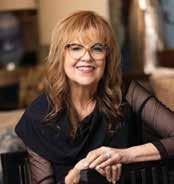
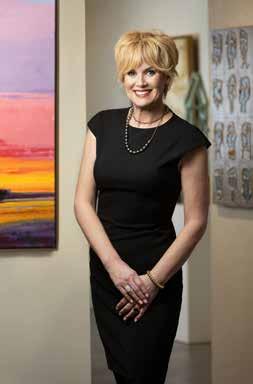
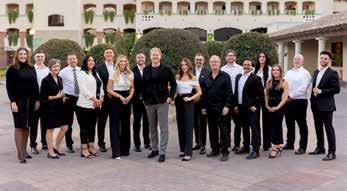
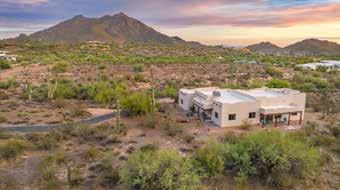
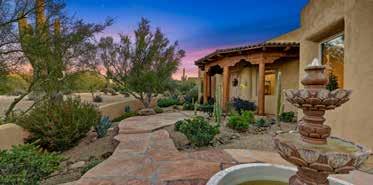
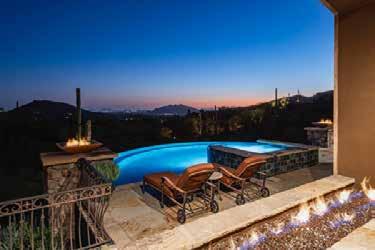
Actively selling Desert Mountain since January 1995, Karen draws on her experience of having designed four custom homes and building two “Golden Nugget” award winners, to provide the detailed expertise Desert Mountain clients require. Her knowledge of the community and exclusive attention to Desert Mountain properties allows her to provide detailed knowledge of the community’s history, club operations, design review, and other issues important to members.
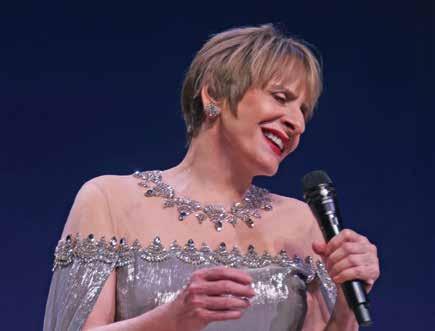
Patti LuPone | 2/16 Ragtime:
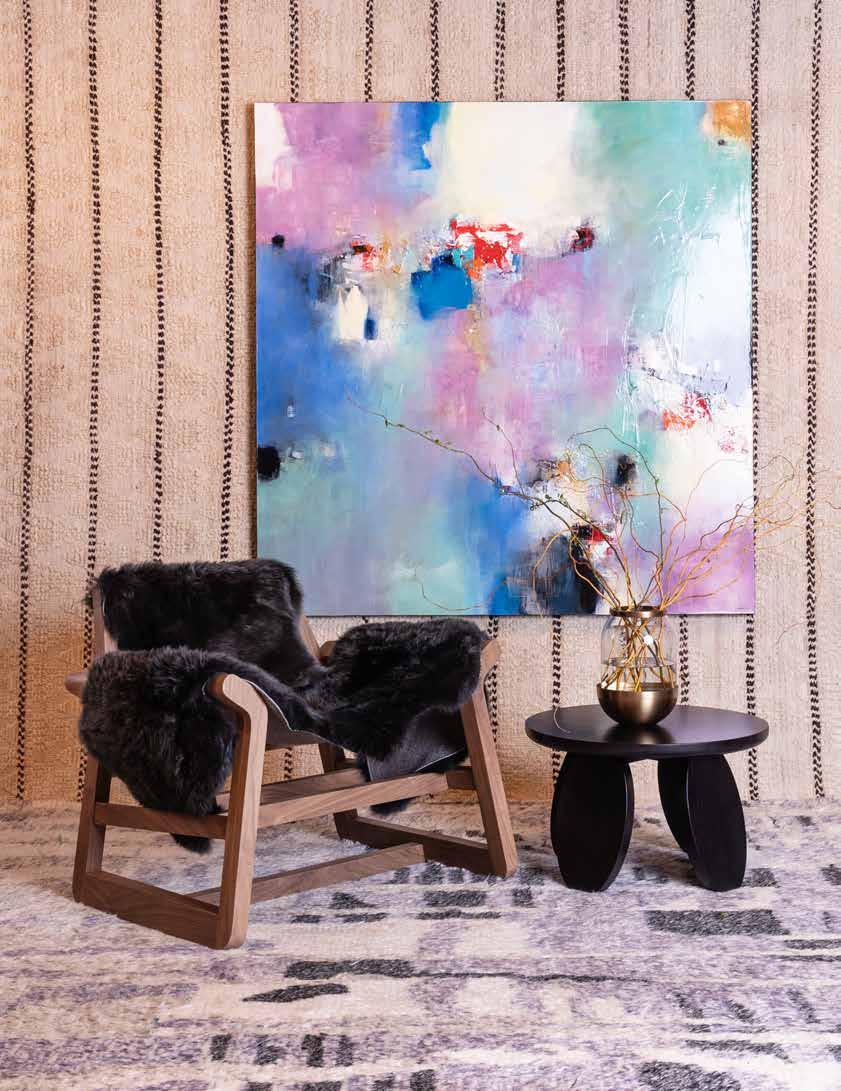
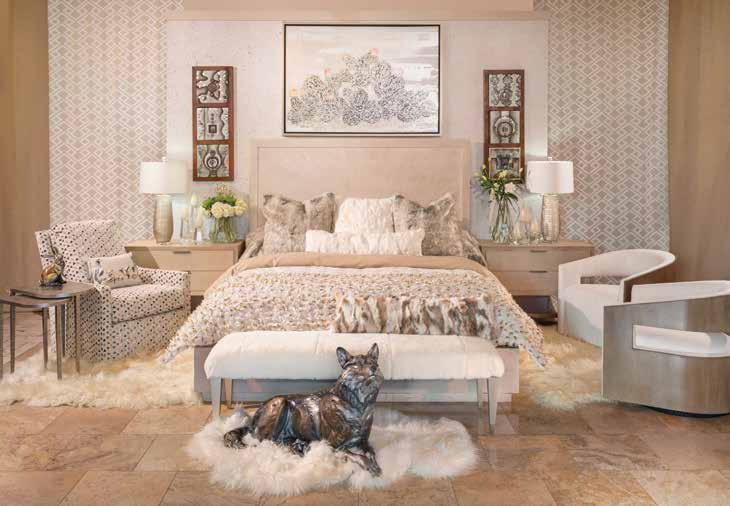
CREATING A SOPHISTICATED ROMANTIC BEDROOM EXPERT INSIGHTS FROM SUE B
A romantic bedroom isn’t just about aesthetics — it’s about creating a sanctuary where luxury meets intimacy.
Begin with Timeless Foundations: Anchor your bedroom with a neutral-hued sunburst platform bed — an enduring statement of elegance. Pair this with generously proportioned nightstands, each featuring sleek drawers for both style and function.
Curate Inviting Seating: Introduce plush swivel chairs for savoring morning coffee by the fireplace and a refined bench at the foot of the bed that offers a graceful solution for stowing bedding at night and serves as an elegant seat for dressing.
Layer with Opulent Textiles: Transform your bed into a haven of comfort by layering sumptuous fur pillows, tactile hides, an eyelash-textured bed scarf and a bespoke duvet cover — each element contributing to a rich, tactile experience.
Infuse Glamour with Metallic Accents: Elevate the ambiance with metallic finishes — consider gleaming lamps and a sophisticated nest of tables beside your seating area, adding a touch of modern glamour.
Select Art with Impact: Curate artwork that commands attention and sets the tone for the space, ensuring each piece resonates with your personal aesthetic.
Above all, enjoy the creative process and have fun crafting your sanctuary. Visit our showroom to explore the furnishings and accessories that will transform your bedroom into a romantic retreat.
SUE BICKERDYKE Allied ASID
THIRD THURSDAY ART NIGHT
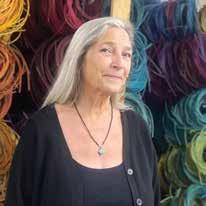
THURSDAY, FEBRUARY 19 FROM 4 TO 7 PM Marilyn Evans
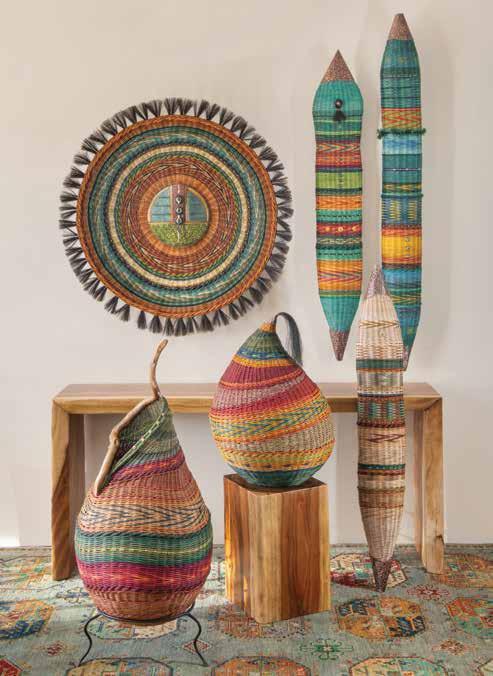
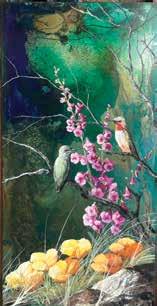
ARTIST MARILYN EVANS
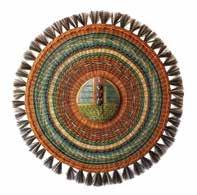
Custom Dyed Rattan
THIRD THURSDAY ART NIGHT
THURSDAY, FEBRUARY 19 FROM 4 TO 7 PM Meet & Celebrate Artists
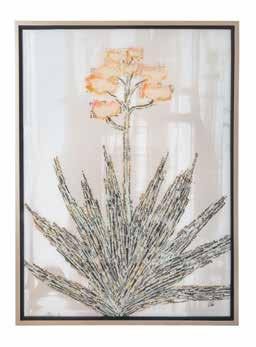
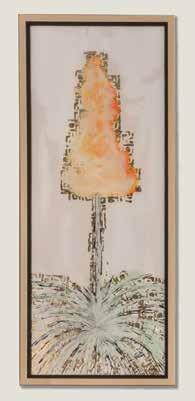
RENE PALOMINO Agave, 42” by 59”
TREVOR SWANSON
A Color Filled Glow, 24” by 12”
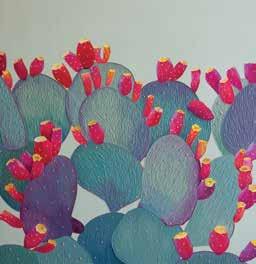
BRIT HANSEN Candy Cactus, 36” by 36”
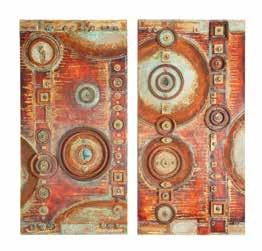
JOE & MARY AXTON-GIDDINGS Circularity, 24” by 48”
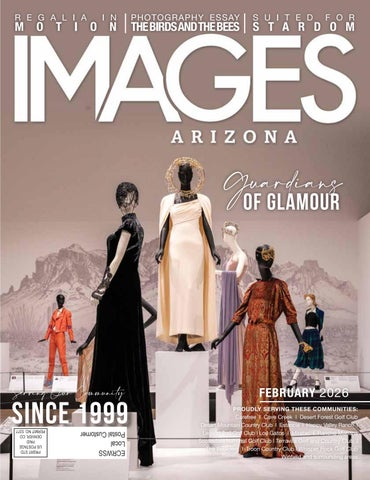
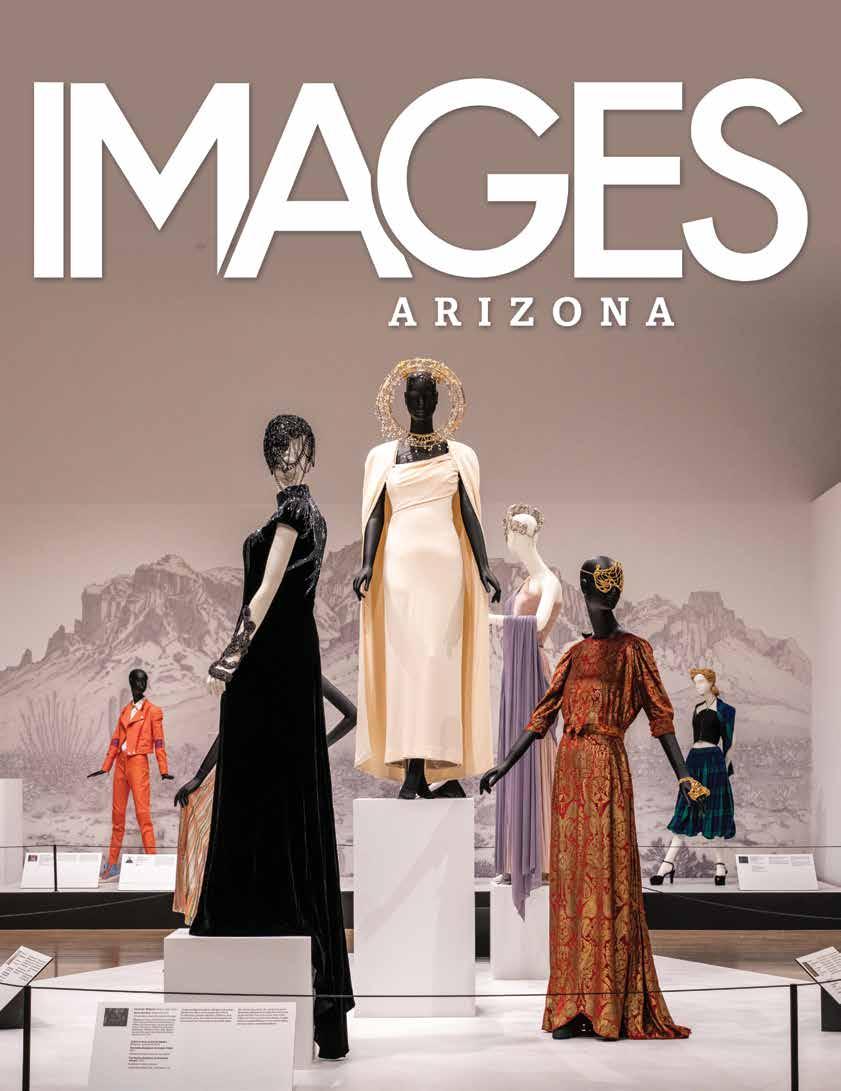
44 Guardians of Glamour When Stars Align
52
82 Community
70 Captured Wild photo essay
S ANDERSON LINCOLN
PUBLISHER
Shelly Spence
MANAGING EDITOR
Joseph J. Airdo
GRAPHIC DESIGNER
Meaghan Mitchell
CONTRIBUTING WRITERS
Joseph J. Airdo
Francine Coles
Shannon Severson
PHOTOGRAPHERS
Francine Coles
Loralei Lazurek
ADVERTISING SALES
Cindi Calcinari 860-966-3271 cindi@imagesaz.com
From the Publisher
Fashion has always been more than fabric and thread, more than silhouette and color. At its finest, fashion is wearable art — a collaboration between vision and craft, between what inspires us and what we choose to carry into the world. In February, when winter’s chill still lingers but light begins to shift toward spring, we find ourselves drawn to beauty that transforms the everyday into something extraordinary.
This month’s issue of Images Arizona celebrates fashion as the art form it truly is. We’ve filled these pages with stories of celestial inspiration meeting gemological mastery, of craftsmanship so exquisite it defies categorization, of pieces designed not simply to adorn but to evoke wonder. From jewelry that captures the cosmos to designs that blur the line between sculpture and style, we’re exploring how artistry manifests in what we choose to wear and cherish.
These conversations about fashion extend far beyond a single issue. Over the coming months, you’ll discover more compelling fashion stories — both in these pages and on our website at imagesarizona.com, where we continue to showcase the intersection of art, design and personal expression. Fashion, after all, is not seasonal but constant, evolving with each artist’s vision and each wearer’s story.
Images Arizona P.O. Box 1416
Carefree, AZ. 85377 623-341-8221
shelly@imagesaz.com imagesarizona.com
What we wear tells the world who we are, what we value, what moves us. Whether it’s a piece of jewelry crafted from untreated sapphires or a garment designed with architectural precision, these choices reflect not vanity but artistry — the human impulse to surround ourselves with beauty, to carry meaning close to our skin, to express through form what words cannot capture.
This is fashion as art, art as life. From our family to yours, we wish you a month filled with beauty, inspiration and the courage to wear your story boldly.
Happy Valentine’s Day!
Shelly Spence Publisher, Images Arizona
Photography by Loralei Lazurek
FEBRUARY 10–21
Tuesday through Saturday 10 a.m.–5 p.m.
Discover Studio Renn’s world of beautifully imperfect fine jewelry, where abstraction meets artistry. Each piece celebrates the off-center and unexpected — antique-cut diamonds set in blackened gold, signature Cacti settings, and designs that blur the line between art and adornment. Experience jewelry that invites you to immerse yourself in imagination.
LUMINOUS BY BROOKE WITH ROBERT PROCOP
MARCH 3
Tuesday 4–7 p.m.
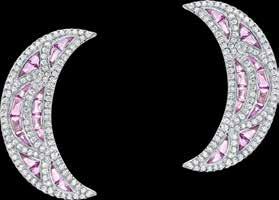
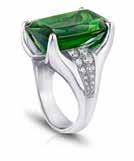
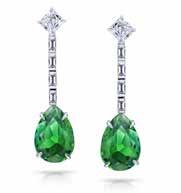
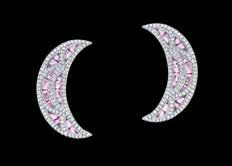
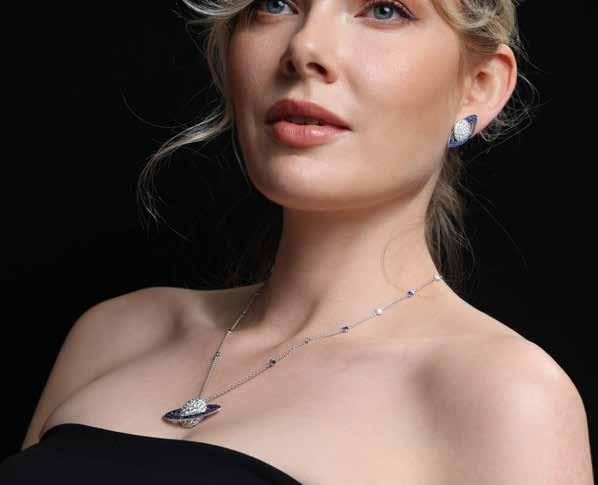
Experience an immersive celebration of Luminous — Brooke Shields and renowned gemologist Robert Procop’s celestial jewelry collection, three years in the making. This extraordinary showcase features jewels inspired by lunar cycles, accompanied by authentic moon and Mars meteorites.
GOLDEN GEOMETRIES THE ARTISTRY OF ALEX ŠEPKUS
FEBRUARY 20–21
Friday and Saturday from 10 a.m.–5 p.m.
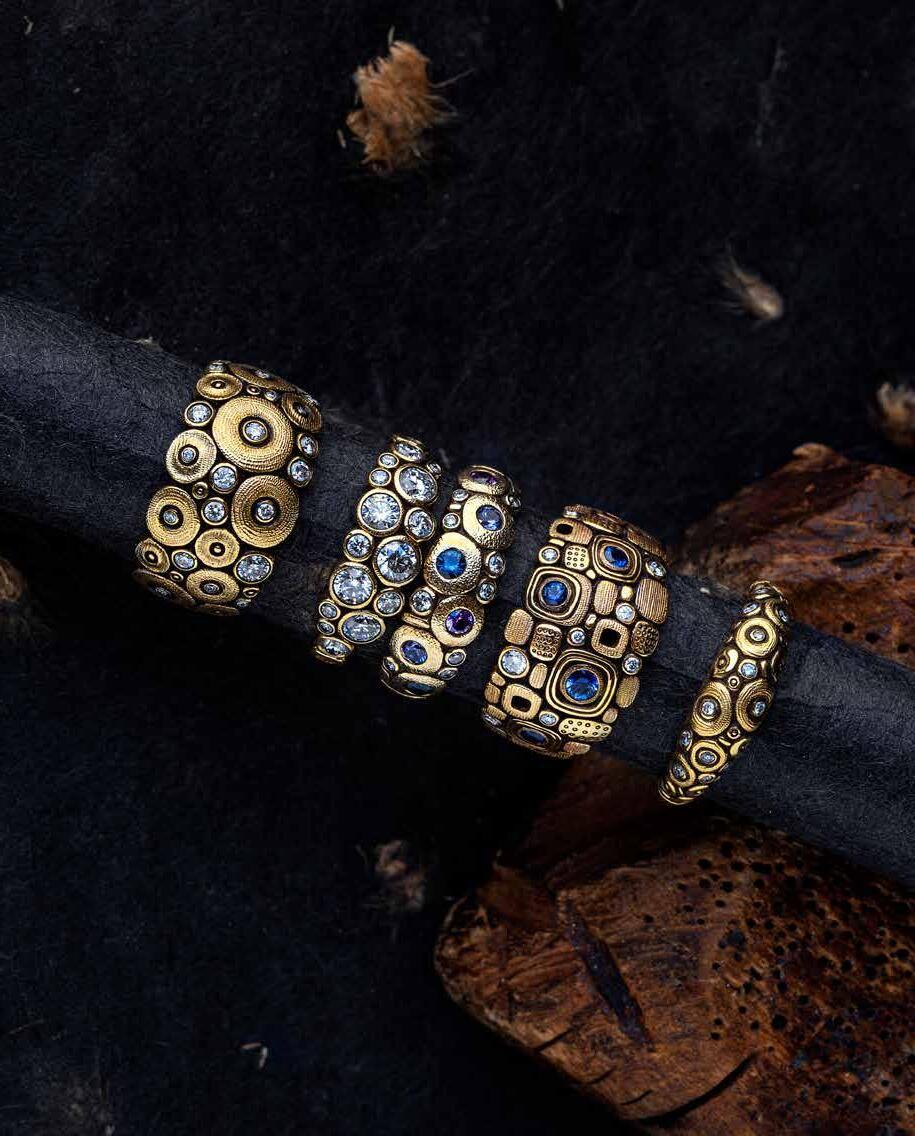
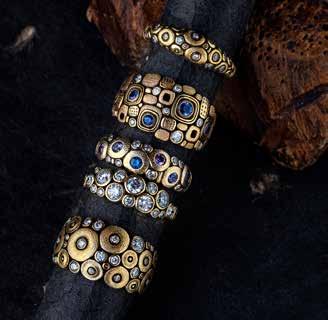
Enter the extraordinary world of Alex Šepkus, where microscopic artistry meets unparalleled vision. Each 18-karat gold masterpiece showcases intricate geometric patterns and textures that transform jewelry into wearable sculpture. Experience these collectible treasures that have captivated museums and connoisseurs worldwide.
OPULENCE! A HIGH JEWELRY EXTRAVAGANZA
MARCH 3–14
Tuesday–Saturday 10 a.m.–5 p.m.
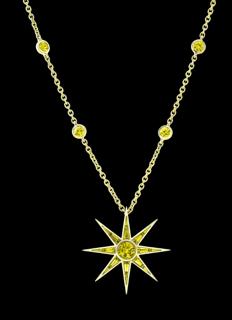
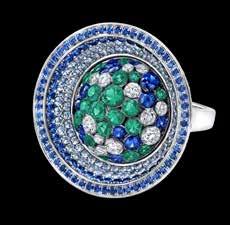
Immerse yourself in the pinnacle of luxury with our high jewelry showcase featuring David Gross, Robert Procop, David Weisz and many others. Master jewelers, each representing generations of expertise, present exceptional gemstones set in breathtaking designs.
Grace Renee Gallery is a refreshingly beautiful way to explore fine contemporary art in the breathtaking shadows of the Sonoran Desert foothills of Carefree, Arizona. Artfully designed jewelry, inspiring sculptures, spectacular wall art, stunning ceramics and more await.
UPCOMING EVENTS
ALISHAN JEWELRY SHOWCASE
MARCH 20–21
Friday and Saturday 10 a.m.–5 p.m.
Experience Alishan’s journey into mixed metals where ancient meets contemporary through opposing colors and bold contrasts. Each handcrafted jewel exudes individuality and elegance — bold yet classic, organic yet refined — demanding to be seen in person to appreciate the extraordinary attention to detail.
When Stars Align
Brooke Shields and Robert Procop Bring the Cosmos to Carefree
Writer Joseph J. Airdo
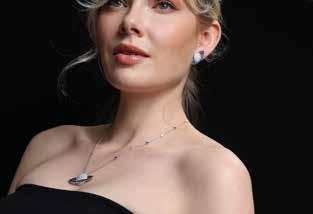
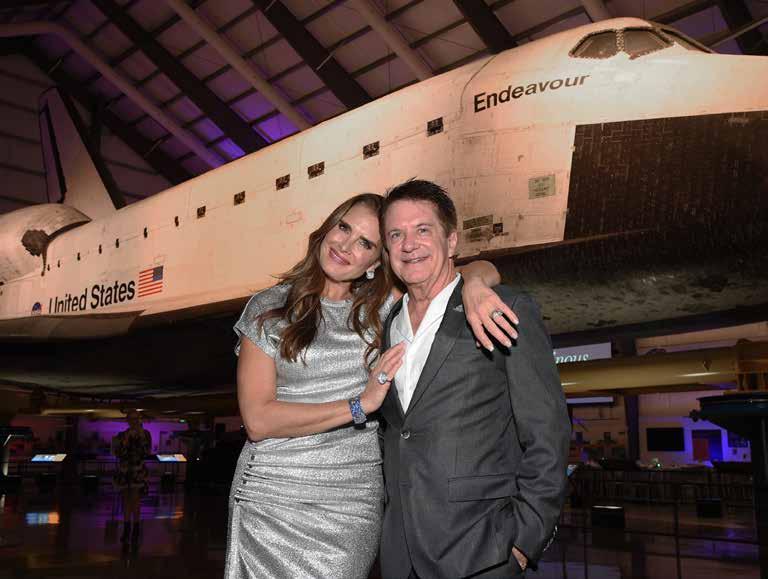
On March 3, Grace Renee Gallery will invite guests into the world of “Luminous” — Hollywood icon Brooke Shields and master gemologist Robert Procop’s jewelry collection that captures three years of celestial devotion, designed to evoke the wonder of the cosmos. While the duo won’t be present in person, their vision arrives fully realized, born from a decades-long friendship and mutual fascination with the night sky.
The immersive experience recreates the collection’s original debut beneath the wing of the space shuttle Endeavour at the California Science Center. Moon and Mars meteorites will accompany the jewelry, alongside original design sketches that reveal how artistic vision and technical precision converged. For Procop — formerly the Crown Jeweler of the United Kingdom and Shields’ collaborator on philanthropic jewelry projects — the marriage of romance and rigor defines his work.
“Our initial conversations centered on the aesthetics of a piece, then on its feel and the feelings it would evoke,” Shields says. “How would a bracelet best lie on a wrist? How could we best capture and reflect the light? They would sketch independently, then come together to see how best to combine their designs.”
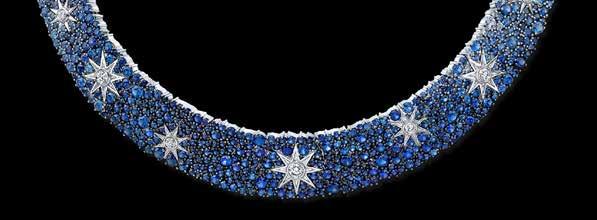
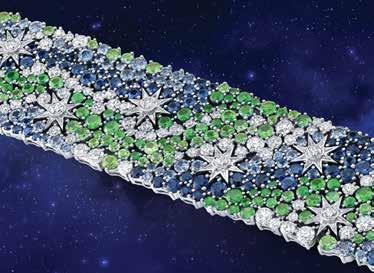
The technical challenges were formidable. Hand-faceting sapphires to a point — mimicking distant stars — demanded extraordinary skill.
Bringing the stars to life proved challenging. Fortunately, Robert has curated a group of master artisans who have expertly hand-crafted magnificent sculptural jewels of the finest materials and workmanship.
What distinguishes Procop’s work extends beyond craftsmanship. While approximately 95% of sapphires in today’s jewelry market are heat-treated to enhance color and clarity, every stone in “Luminous” remains entirely natural — just as Mother Earth intended it. For Shields, who has collected celestial-themed jewelry for over two decades, the pieces possess what she calls “liquidity” — a fluidity that evokes gazing at a moonlit sky.
For Natasha Lazorova, jewelry curator and head gemstone expert at Grace Renee Gallery, hosting this collaboration represents validation of the gallery’s exacting standards.
“There are only a handful of people who have been able to achieve not just the prominence, but the level of craftsmanship that Robert has — the design, the craftsmanship, the whole gestalt,” Lazorova says. “It doesn’t matter what name is on it. It has to come back as absolutely, hands-down stellar. The quality has to be stellar. That’s where Robert checks the box and raises our bar.”
But “Luminous” offers more than aesthetic pleasure. Proceeds benefit the Los Angeles-based House of Ruth, providing shelter, counseling and childcare for homeless families escaping domestic violence — a cause both Shields and Procop champion passionately.
“Through all of this beauty of creation, there’s also this beauty of giving,” Lazorova reflects. “As women, we have all gone through difficult moments. We have to be able to step back at some point and recognize that the difficult times we’ve been through are nothing compared to what other women have been through.”
Our initial conversations centered on the aesthetics of a piece, then on its feel and the feelings it would evoke. How would a bracelet best lie on a wrist? How could we best capture and reflect the light? They would sketch independently, then come together to see how best to combine their designs. Brooke Shields
The gallery has educated its clientele to appreciate not just acquisition, but artistry: construction techniques, historical context, and the stories behind each piece. That discernment matters when encountering jewelry this rare.
Following March 3’s immersive experience, the “Luminous Collection” will remain on view at Grace Renee Gallery through Saturday, March 7, welcoming anyone seeking to experience the marriage of celestial inspiration and gemological mastery.
Collectors who decide to own these pieces should choose how and where they want to wear them. Those who cherish them, wear the collection at both cocktail and black-tie events, as well as every day with jeans and a T-shirt.
When the gallery darkens on March 3 and the showcases illuminate like celestial bodies, guests will experience what happens when Hollywood vision meets gemological mastery — when three years of devotion culminate in wearable astronomy. Though Shields and Procop won’t attend personally, their signatures will grace each certificate of authenticity, a reminder that some collaborations transcend presence, leaving behind something luminous.
gracereneegallery.com
EXPERIENCE
‘Luminous’ by Brooke Shields and Robert Procop
March 3 // 4–7 p.m. // Grace Renee Gallery Historic Spanish Village // 7212 E. Ho Road, Carefree 480-575-8080 // gracereneegallery.com
GRACE RENEE GALLERY PRESENTS
David Rothermel
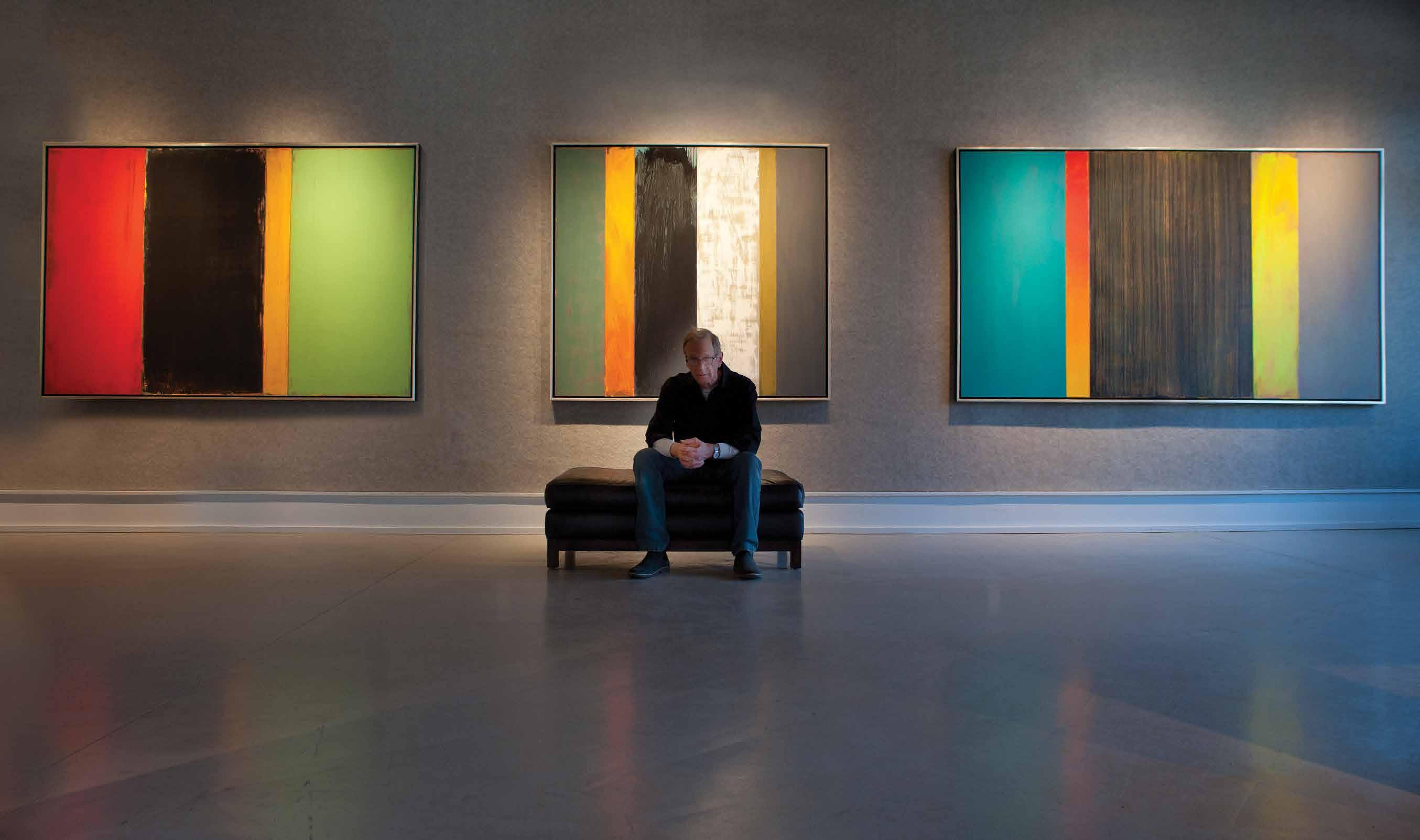
Come meet David and view his bold, colorful paintings on display in our gallery located in Historic Spanish Village. Wind down from your week while enjoying wine and light appetizers with the artist.
Thursday, February 19
4–7 p.m.
Community
THROUGH
FEB. 22
IN YOUR WILDEST DREAMS
The Phoenix Zoo’s Savanna Gallery presents a vibrant and imaginative exhibition celebrating the intersection of creativity and conservation. Featuring the work of four talented artists, the exhibit offers bold color palettes, whimsical depictions of animals, and thoughtful reflections on the natural world. This unique blend of artistry and advocacy encourages visitors to rethink our relationship with wildlife while enjoying a joyful, visually captivating experience. $39.95. 9 a.m.–4 p.m., Savanna Gallery inside the Savanna Grill, Phoenix Zoo, 455 N. Galvin Parkway, Phoenix. phoenixzoo.org
THROUGH
MARCH 8
MILLION DOLLAR QUARTET
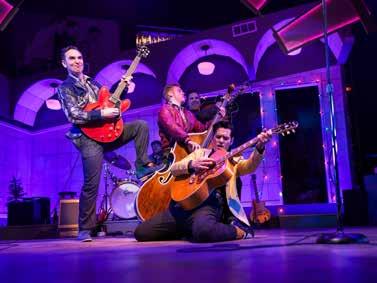
The Phoenix Theatre Company presents the Tony Award-winning musical inspired by the iconic 1956 recording session at Sun Studio that brought together Elvis Presley, Johnny Cash, Carl Perkins and Jerry Lee Lewis. Featuring electrifying renditions of rock ‘n’ roll hits, this show captures the energy, talent and camaraderie of four music legends.
FEB. 13
Writer Joseph J. Airdo
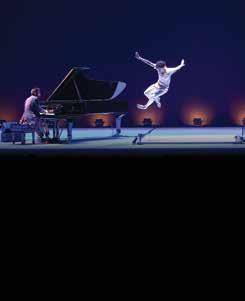
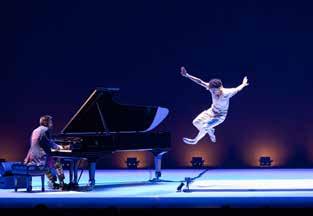
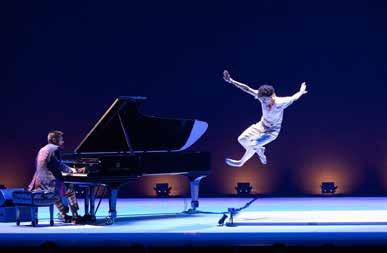
COUNTERPOINT: CONRAD TAO & CALEB TEICHER
Presented by Arizona Musicfest, this collaborative performance features pianist and composer Conrad Tao alongside choreographer and dancer Caleb Teicher. The duo explores the interplay of their distinct artistic traditions through harmonic, rhythmic and theatrical counterpoint. $53+. 7:30 p.m. Pinnacle Presbyterian Church, 25150 N. Pima Road, Scottsdale. 480422-8449; azmusicfest.org
$60+. See website for times. Hormel Theatre, 1825 N. Central Ave., Phoenix. 602-254-2151; phoenixtheatre.com
THROUGH
MARCH 29
ARIZONA FINE ART EXPO
This 10-week juried art show features more than 120 renowned and emerging artists working in onsite studios. Visitors can watch the creative process in mediums ranging from painting and sculpture to glass and jewelry, or explore the two-acre sculpture garden. $12; discounts available. 10 a.m.–6 p.m. 26540 N. Scottsdale Road, Scottsdale. 480-837-7163; arizonafineartexpo.com
THROUGH
MARCH
29 CELEBRATION OF FINE ART
Under the signature big white tents, 100 artists set up working studios for the 36th annual exhibition, allowing collectors to connect directly with creators. The event features 40,000 square feet of art in diverse mediums, a sculpture court and the weekly Art Discovery Series on Fridays. $12; discounts available. 10 a.m.–6 p.m. 7899 E. Mayo Blvd., Scottsdale. 480-4437695; celebrateart.com
THROUGH MARCH 29 COME FROM AWAY
The Phoenix Theatre Company stages the remarkable true story of the small Newfoundland town that welcomed 7,000 stranded travelers in the wake of Sept. 11, 2001. As fear gripped the world, the “plane people” found unexpected friendship and compassion in Gander, proving that humanity can shine through even the darkest times. $60+. See website for times. The Phoenix Theatre Company, 1825 N. Central Ave., Phoenix. 602-2542151; phoenixtheatre.com
FEB. 1
MADAMA BUTTERFLY
Arizona Opera presents Puccini’s timeless masterpiece, a heartbreaking tale of hope, longing and ultimate sacrifice. The visually stunning production follows the young geisha Cio-Cio-San as she awaits the return of her American naval husband, only to face a devastating betrayal. Performed in Italian with English and Spanish supertitles. See website for prices. Saturday 7:30 p.m.; Sunday 2 p.m. Symphony Hall, 75 N. Second St., Phoenix. 602-266-7464; azopera.org
FEB. 2
THE BARRICADE BOYS
Presented by Arizona Musicfest, this West End sensation returns with their new show, “Broadway at the Movies.” The performance blends pop, rock and swing classics with stories from their careers in major productions including “The Phantom of the Opera” and “Wicked.” $58+. 2 p.m. and 7:30 p.m. Highlands Church, 9050 E. Pinnacle Peak Road, Scottsdale. 480-422-8449; azmusicfest.org
FEB. 2–8
WM PHOENIX OPEN
The “Greatest Show on Grass” returns to TPC Scottsdale for its 91st edition, drawing PGA Tour stars and the largest crowds in golf. See website for prices and schedule. TPC Scottsdale, 17020 N. Hayden Road, Scottsdale. 480-5854334; wmphoenixopen.com
FEB. 6–8
THE MOUSETRAP
Desert Foothills Theater pays homage to its inaugural season with a 50thanniversary production of Agatha Christie’s legendary murder mystery. The world’s longest-running play traps a group of strangers in a snowed-in guesthouse, where a police sergeant must uncover which of them is a killer before they strike again. See website for prices. Friday 7 p.m.; Saturday 2 p.m. and 7 p.m.; Sunday 12 p.m. Cactus Shadows Fine Arts Center, 33606 N. 60th St., Scottsdale. 480-488-1981; dftheater.org
Community
FEB. 9
AMAZING ARTIST SERIES: GEORGE GRUEL
Photographer George Gruel shares his journey from illustrator and designer to early digital photography adopter. This session, part of a collaboration between The Sonoran Arts League and The Holland Center, explores his visual discipline and extensive travels. $10. 10 a.m. Holland Community Center, 34250 N. 60th St., Scottsdale. 480-488-1090; hollandcenter.org
FEB. 9
JAZZ AT LINCOLN CENTER PRESENTS THE GREAT AMERICAN CROONERS
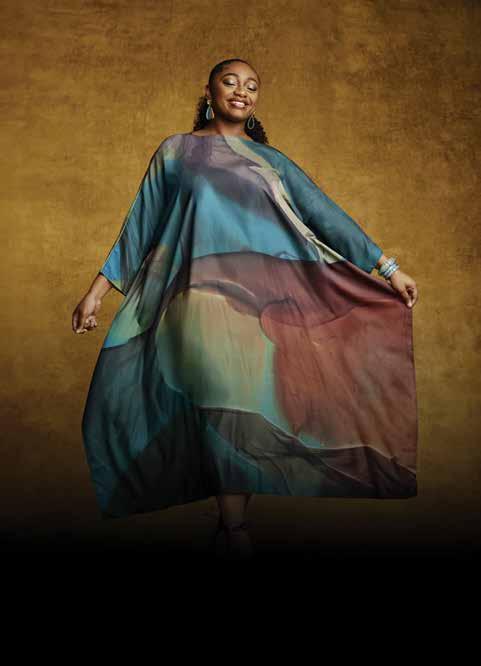
Presented by Arizona Musicfest, this dazzling evening revives the golden age of jazz with the velvety melodies of icons like Frank Sinatra, Tony Bennett and Bobby Darin. Featuring vocalists Benny Benack III, Robbie Lee and Shenel Johns, the program includes timeless hits woven together with stories about the legendary performers who made them famous. $47+. 7:30 p.m. Highlands Church, 9050 E. Pinnacle Peak Road, Scottsdale. 480-422-8449; azmusicfest.org
FEB. 12–22
Writer Joseph J. Airdo
SCOTTSDALE ARABIAN HORSE SHOW
The 71st annual event brings nearly 2,000 of the world’s finest Arabian horses to WestWorld of Scottsdale for top-tier competition in dressage, western pleasure and halter classes. In addition to the arena action, families can enjoy behind-thescenes barn tours, meet-and-greet sessions with horses and a shopping expo featuring 200 vendors. $15; discounts available. 8 a.m.–5 p.m. WestWorld of Scottsdale, 16601 N. Pima Road, Scottsdale. 480-515-1500; scottsdaleshow.com
FEB. 10–21
STUDIO RENN SHOWCASE
Discover Studio Renn’s world of beautifully imperfect fine jewelry, where abstraction meets artistry. Each piece celebrates the off-center and unexpected — antique-cut diamonds set in blackened gold, signature Cacti settings, and designs that blur the line between art and adornment. Experience jewelry that invites you to immerse yourself in imagination. Free. Tuesday through Saturday 10 a.m.–5 p.m. Grace Renee Gallery, Historic Spanish Village, 7212 E. Ho Road, Carefree. 480-575-8080; gracereneegallery.com
FEB. 12–15
ALICE (IN WONDERLAND)
Ballet Arizona presents Septime Webre’s extraordinary interpretation of Lewis Carroll’s beloved classic, accompanied by live music from the Phoenix Symphony. This spectacular production blends ballet with contemporary dance to create a whimsical journey through Wonderland, featuring breathtaking sets, striking costumes and unmatched athleticism. See website for prices and times. Symphony Hall, 75 N. Second St., Phoenix. 602381-1096; balletaz.org
FEB. 16
PATTI LUPONE: MATTERS OF THE HEART
Presented by Arizona Musicfest, threetime Tony Award winner Patti LuPone celebrates the 25th anniversary of her acclaimed theatrical concert. Matters of the Heart explores the complexities of love through electrifying performances of more than two dozen songs, ranging from Broadway favorites to contemporary hits. $73+. 7:30 p.m. Highlands Church, 9050 E. Pinnacle Peak Road, Scottsdale. 480-422-8449; azmusicfest.org
FEB. 19
CAREFREE ART NIGHT
Local and regional artists showcase their work at participating galleries during this monthly celebration. Enjoy live music, refreshments, artist talks and demonstrations. Free. 4–7 p.m. See website for participating galleries and event map. visitcarefree.com/artnight
Tuesday–Saturday 10 a.m.–5 p.m.
DAVID GROSS FINE GEMSTONE COLLECTION
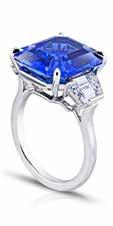
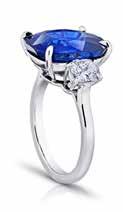
Each bespoke jewel the David Gross Group creates has its own character, its own story. The spectacular quality of each gemstone is further enhanced by the finest craftsmanship and elegant award-winning design. 7212
Community
FEB. 19
ARTIST RECEPTION: DAVID ROTHERMEL
Meet celebrated American artist David Rothermel, whose vibrant paintings capture the luminous beauty of the Southwest landscape. Join us for an evening with this master colorist whose work transforms natural wonder into timeless art. Free. Thursday 4–7 p.m. Grace Renee Gallery, Historic Spanish Village, 7212 E. Ho Road, Carefree. 480575-8080; gracereneegallery.com
FEB. 22
MOZART SYMPHONY NO.
35
Presented by Arizona Musicfest, Maestro Robert Moody leads the Festival Orchestra in a celebration of the organization’s 35th anniversary with Mozart’s “Haffner” Symphony, known for its fiery energy and dazzling finale. The program also features Christopher Tin’s “The Drop That Contained the Sea,” a choral and orchestral masterpiece exploring the significance of water through ancient poetry and a global narrative. $56+. 3 p.m. La Casa de Cristo Lutheran Church, 6300 E. Bell Road, Scottsdale. 480-422-8449; azmusicfest.org
FEB. 19
THE TEN TENORS
Writer Joseph J. Airdo
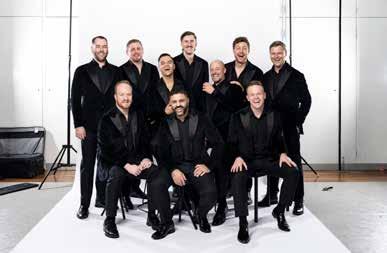
Presented by Arizona Musicfest, this celebrated Australian ensemble marks its 30th anniversary with a show blending classical crossover, Neapolitan classics and classic rock anthems. Known for soaring harmonies and dynamic stage presence, the group performs signature medleys and brandnew arrangements created exclusively for North American audiences, all delivered with their trademark charm. $47+. 7:30 p.m. Highlands Church, 9050 E. Pinnacle Peak Road, Scottsdale. 480-422-8449; azmusicfest.org
FEB. 24
RACHMANINOFF & BRAHMS
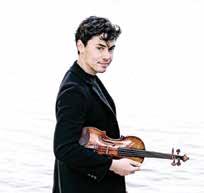
Presented by Arizona Musicfest, this orchestral evening features the Festival Orchestra performing Rachmaninoff’s Symphony No. 2, celebrated for its lush melodies and emotional depth. The program also highlights violin virtuoso Ben Beilman performing Brahms’ Violin Concerto, a work showcasing his deep, rich tone and passionate artistry. $56+. 7:30 p.m. La Casa de Cristo Lutheran Church, 6300 E. Bell Road, Scottsdale. 480-422-8449; azmusicfest.org
FEB. 27
AMERICAN PORTRAITS
Presented by Arizona Musicfest, the Festival Orchestra celebrates America’s semiquincentennial with a musical journey through the nation’s history, from the Revolutionary War to the Roaring Twenties. The program features Aaron Copland’s “Lincoln Portrait” and selections from Gershwin’s “Porgy and Bess,” concluding with patriotic favorites like “America the Beautiful” and “The Stars and Stripes Forever.” $65+. 7:30 p.m. La Casa de Cristo Lutheran Church, 6300 E. Bell Road, Scottsdale. 480-422-8449; azmusicfest.org
FEB. 28
FOOTHILLS FOOD BANK FARMERS MARKET
Foothills Food Bank & Resource Center hosts its monthly farmers market, featuring artisan breads, spreads, sweets and fresh local produce. Shoppers can enjoy a relaxed market morning while supporting small businesses, with a portion of all sales benefiting the food bank’s programs for neighbors in need. Free. 10 a.m.–1 p.m. Foothills Food Bank & Resource Center, 4250 E. Carefree Highway., Cave Creek. 480488-1145; foothillsfoodbank.com
MARCH 1 THE PLANETS & TCHAIKOVSKY
Presented by Arizona Musicfest, Maestro Robert Moody concludes the Festival Orchestra Week with a performance featuring British pianist George Harliono, the silver medalist of the 2023 International Tchaikovsky Competition. Harliono performs Tchaikovsky’s Piano Concerto No. 2, followed by Holst’s orchestral blockbuster The Planets. $56+. 3 p.m. La Casa de Cristo Lutheran Church, 6300 E. Bell Road, Scottsdale. 480-422-8449; azmusicfest.org
MARCH 3
LUMINOUS BY BROOKE WITH ROBERT PROCOP
Experience an immersive celebration of Luminous — Brooke Shields and renowned gemologist Robert Procop’s celestial jewelry collection, three years in the making. This extraordinary showcase features jewels inspired by lunar cycles, accompanied by authentic moon and Mars meteorites. By invitation. 4–7 p.m. Grace Renee Gallery, Historic Spanish Village, 7212 E. Ho Road, Carefree. 480-575-8080; gracereneegallery.com
MARCH 6–7
M3F MUSIC FESTIVAL
North America's most celebrated nonprofit music festival returns to Steele Indian School Park, donating 100% of proceeds to local charities. The 2026 lineup features Mau P, Peggy Gou, Polo & Pan, Big Wild and others, performing across multiple stages amidst immersive art installations and local food vendors. $100+. See website for schedule. Steele Indian School Park, 300 E. Indian School Road, Phoenix. m3ffest.com
MARCH 6–7 SCOTTSDALE FAMILY ARTSFEST
Celebrating its fourth year, this free festival moves to the Scottsdale Civic Center to showcase the creativity of Scottsdale Unified School District students. The event features live performances by SUSD bands, choirs and orchestras, a special show by Arizona Opera, interactive art workshops and the Alli Ortega Empty Bowls Fundraiser benefiting Scottsdale Community Partners. Free. See website for schedule. Scottsdale Civic Center, 3939 N. Drinkwater Blvd., Scottsdale. 480-499-8587; scottsdalearts.org
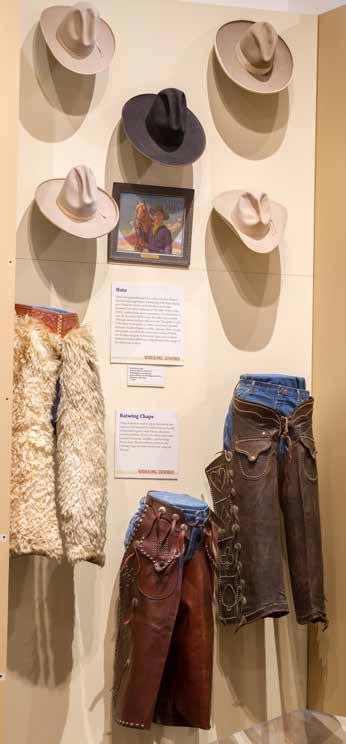
The rhinestone cowboy never existed on the open range. Neither did the perfectly pressed denim or the sideburns that defined Clint Eastwood’s 1970s swagger. But stand in Western Spirit Museum this winter, and you’ll realize something extraordinary: the line between costume and couture, between Hollywood fiction and frontier function, dissolves into something far more interesting — a complex American myth told through leather and silver.
A new exhibition opening this season reveals how Western style conquered both the corral and the camera — and it’s in fascinating conversation with the museum’s ongoing collection.
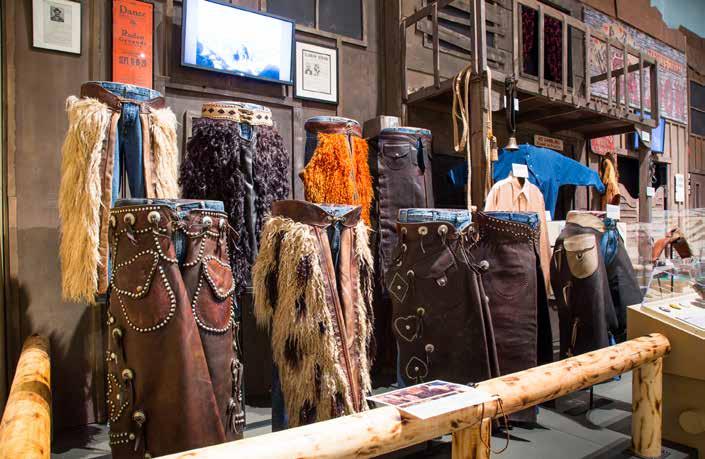
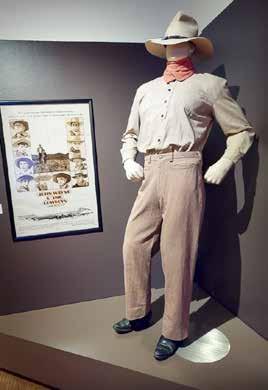
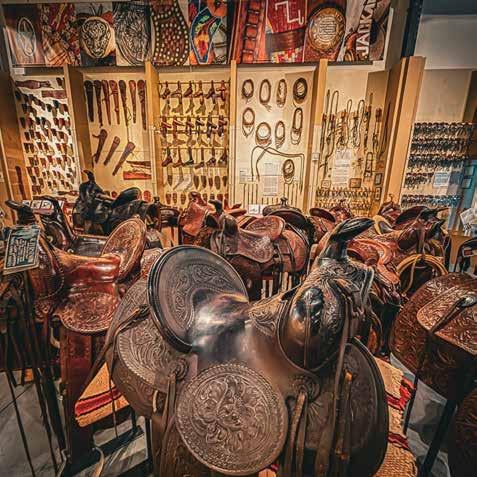
“Still in the Saddle: A New History of the Hollywood Western,” presents screen-worn costumes from John Wayne, Robert Redford, Charles Bronson and Dustin Hoffman. Meanwhile, the museum’s “Spirit of the West” collection showcases 1,400 artifacts from Scottsdale gallerist Abe Hays, including working saddles, spurs and gauntlets — pieces that required thousands of hours of tooling and engraving, rivaling any European luxury house in their bespoke craftsmanship.
“Our popular conceptions of what is historical change over time,” says Andrew Patrick Nelson, the museum’s chief curator. “If you were to see a photo of movie cowboys from the 1920s with their giant hats, most folks today would likely
Chaps, The Abe Hays Family Spirit of the West Collection
How the West Was Worn
Costume Meets Couture at Western Spirit Museum
Writer Joseph J. Airdo // Photography Courtesy of Western Spirit Museum
think, ‘Well, no, that’s not right. It’s got to be Clint Eastwood with the short-brimmed hat.’ But if I were to show you a photo of actual cowboys from 20 or 30 years earlier, they would look far more like those 1920s movie cowboys than the movie cowboys of the ‘70s or today.”
The costumes in “Still in the Saddle” tell their own story of survival and reinvention. Many pieces were never museum-bound relics but working garments returned to Western Costume Company’s warehouse, altered, aged and redeployed across multiple films. A coat worn by John Wayne in several pictures may have been modified for other productions. Charles Bronson’s jacket had been transformed multiple times before a collector acquired it.
“These were working pieces,” Nelson explains. “So these garments aren’t locked in time the way that a movie is frozen in time. They have a life of their own.”
But Hollywood’s vision was always aspirational. When “Butch Cassidy and the Sundance Kid” sparked a global trend for corduroy jackets and mustaches in the 1970s, it proved that cinema didn’t just document the West — it designed it.
Chaps and Stetson Hats, The Abe Hays Family Spirit of the West Collection
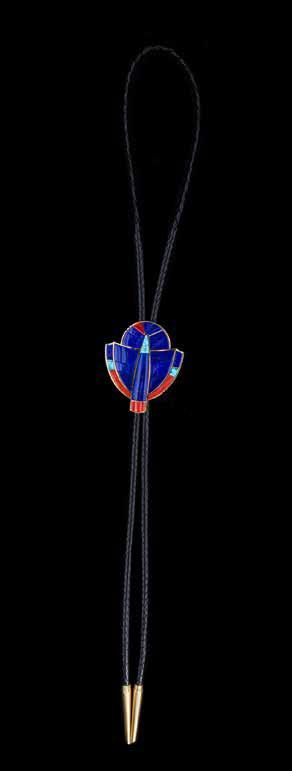
Left Top: Richard Chavez, Bolo Tie with Inlay, Richard A. Gates Collection
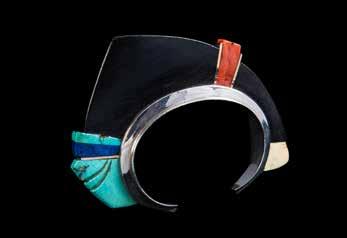
Left Bottom: Charles Loloma, Ironwood Cuff Bracelet made for Georgia Loloma c. 1975, Richard A. Gates Collection
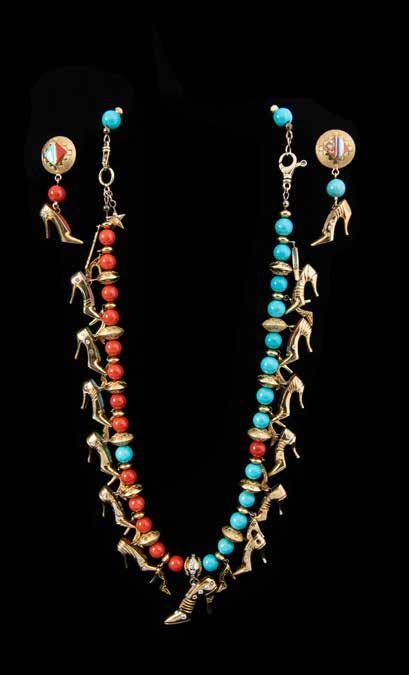
Right: Jesse Monongya, White Women Moccasins, Richard A. Gates Collection
The “Spirit of the West” collection offers a different kind of glamour: the uncompromising artistry of necessity. Consider the parade saddles created by makers like Edward H. Bohlin, known as the “Saddlemaker to the Stars.” These pieces feature hand-tooled floral carving and sterling silver mounting — accessories in the truest sense, comparable to a Hermes Birkin in hours invested and skill required.
“The craftsmanship in some of these pieces is truly astonishing — levels that perhaps rival European luxury accessories,” Nelson says. “A saddle, through its tooling and engraved silver or gold inlays, could tell a story about who you are.”
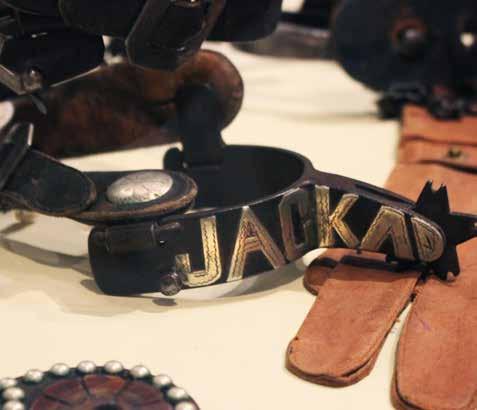
Then there are the spurs — particularly the California style with massive rowels and intricate silver inlay. These weren’t merely functional. They were jewelry for the boot, status symbols broadcasting wealth and skill across the range. The engraving techniques draw heavily from Mexican vaquero traditions, an artistic lineage that resurfaces in March when Western Spirit
Still In the Saddle
opens “From Earth to the Stars,” featuring pieces from the Richard A. Gates Collection of Native American Jewelry.
That exhibition, featuring visionaries like Charles Loloma and Jesse Monongya, will trace how Spanish silverworking techniques merged with Indigenous aesthetic systems — another story of adaptation, innovation and the transformation of utility into high art.
“We approach the Western as a truly multimedia genre here at Western Spirit Museum,” Nelson says. “By treating Western art as holistically as we can, we get to incorporate all these different traditions and begin to make connections between them.”
The craftsmanship in some of these pieces is truly astonishing — levels that perhaps rival European luxury accessories. Andrew Patrick Nelson
Bell-bottoms or buckskin, rhinestones or rawhide — each iteration reveals what makes Western iconography endure. It’s powerful not because it’s simple, but because it’s complex enough to mean different things simultaneously. The cowboy hat isn’t just a hat. It’s a piece of American bespoke design, equally at home on a Hollywood soundstage or on the open range, forever adapting while somehow remaining unmistakably itself.
westernspirit.org
Oscar Crockett, Spur for Jack Massey, c. 1920, The Abe Hays Family Spirit of the West Collection
Saddles, The Abe Hays Family Spirit of the West Collection
Writer Shannon Severson
Bedouin Heritage Gallops Into Scottsdale
Regalia in Motion
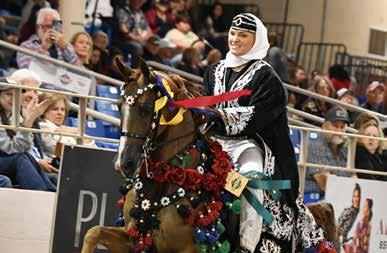
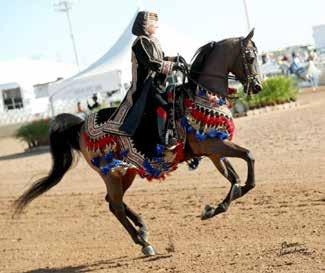
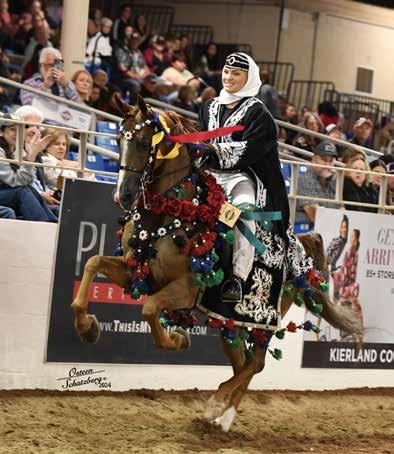
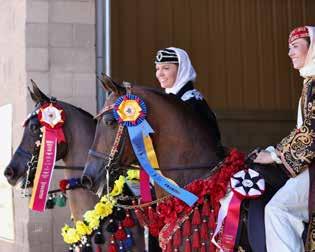
Steady hooves stride confidently over dusty ground, tassels swaying in time with each step. A flash of silver from an ornate bridle catches the light as a rider, enrobed in layers of richly decorated fabric in jewel-toned hues, expertly guides the steed. Horse and rider are a singular, moving sculpture echoing Bedouin legend and history.
This intriguing scene could be from the pages of Lady Anne Blunt’s “Bedouin Tribes of the Euphrates,” an 1879 travel narrative that captured Victorian-era imaginations. But instead, the setting is our own Sonoran Desert and the worldrenowned Scottsdale Arabian Horse Show and Shopping Expo, held Feb. 12-22 at WestWorld of Scottsdale.
As the gate clicks open to the arena and a hush falls over the crowd, an idealized time machine effect materializes. Color takes motion as embroidered motifs, scarves and headdresses slide into view, accentuating the noble beauty of the Arabian breed and the dedicated community of competitors who prize them. A brilliant thread connects
Blunt’s tales of the breed and Bedouin traditions to the beauty and artistry displayed in the ring today — Arabian horse breeders still trace the pedigree of modern bloodlines to Middle Eastern desert stock.
“Mounted Native Costume is more than a competition; it’s a living history lesson,” says Melissa Schalles, executive director of the Arabian Horse Association of Arizona.
“It honors the Bedouin people of the desert and the Arabian horse they so carefully preserved, and it remains one of the most meaningful and captivating classes at the Scottsdale Arabian Horse Show. Authenticity is essential. In a modern show environment, this class provides a powerful connection to the desert origins of the Arabian horse and the Bedouin culture that shaped the breed.”
While the capes, cowries and keffiyeh count for a quarter of the overall score, the distinctive fashion of the Native Costume category is unique to the Arabian ring. Each year, Scottsdale launches the season in style as riders, breeders and makers descend from across the country —
Photography Courtesy of the Arabian Horse Association of Arizona
Photo by Osteen Schatzberg
and around the globe — to test and display craftsmanship and horsemanship.
“The Scottsdale show is the most important Arabian show of the year,” says Janice McCrea Wight, who has served on the board of the Arabian Horse Association of Arizona in multiple capacities over four decades and now heads the public relations committee.
As a breeder, Wight has produced numerous champions in Scottsdale and internationally. She has traveled the world as an Arabian Horse Association Level 1 judge since 1981, adjudicating national championships in five countries.
“We try to depict how Arabians would appear in the Middle East, to be as authentic as possible with a little added bling,” she adds with a laugh. “Since it’s the first show of the year, it’s the runway in fashion. People break out their new outfits and riding apparel. It’s kind of like Fashion Week for Arabians.”
Schalles adds that Mounted Native Costume features a strong group of competitors for judges like Wight to assess.
“Exhibitors come from across the country specifically to showcase these horses and costumes,” she explains. “While it’s a specialized division, it’s a highly anticipated one and deeply respected. Even people unfamiliar with Arabian horses stop and watch because it’s so striking — one of those classes where the audience genuinely pauses and leans in.”
Wight traces her interest to a family tradition of breeding, riding and costume-making, a legacy passed down by her mother, Lois McCrea, now 105, who began breeding Arabians in 1959 and still enjoys watching the show.
“Horses are good for the soul,” Wight says, noting that she had anticipated during her first visit to the show at age 12 that she would one day live in Scottsdale. “One of my costumes was made by my mother after a trip to Egypt in 1967. She brought back a pair of stirrups from a Cairo market. To this day, I still own those stirrups. My mother made three different native costumes for me. My dad joked that he went for years and never saw our dining room table — she was always building a costume. The pageantry is so important.”
Schalles stresses that Scottsdale stages both the tradition’s ancient roots and modern iteration.
“Mounted Native Costume has a long-standing tradition at the Scottsdale Arabian Horse Show and is a meaningful part
of the event’s identity,” she explains. “Scottsdale has long been a stage for honoring the Arabian horse’s heritage, and this class does that in a powerful and authentic way. One of the things that makes our event special is that we don’t just present this history in the arena; we invite the public to experience it firsthand.”
A general admission ticket allows spectators to meet an Arabian horse, try on Mounted Native Costume-inspired attire, sit on an Arabian horse and receive a complimentary photo. This experience is singular to the Scottsdale show and reinforces the Arabian Horse Association of Arizona’s commitment to education, heritage and community engagement.
“This is what makes the Scottsdale Arabian Horse Show ‘The Greatest Horse Show on Earth,’” Schalles says.
She highlights the community of makers that take costumes from dream to reality behind the scenes, noting that a relatively small number of highly specialized designers — many of whom are internationally known — put hundreds of hours of work into creating authentic attire for the class.
“Some exhibitors spend years collecting or commissioning pieces, making each costume truly one of a kind,” Schalles
notes. “These designers are artisans in every sense of the word. Many costumes are passed down or carefully preserved, adding even more depth and history to each presentation.”
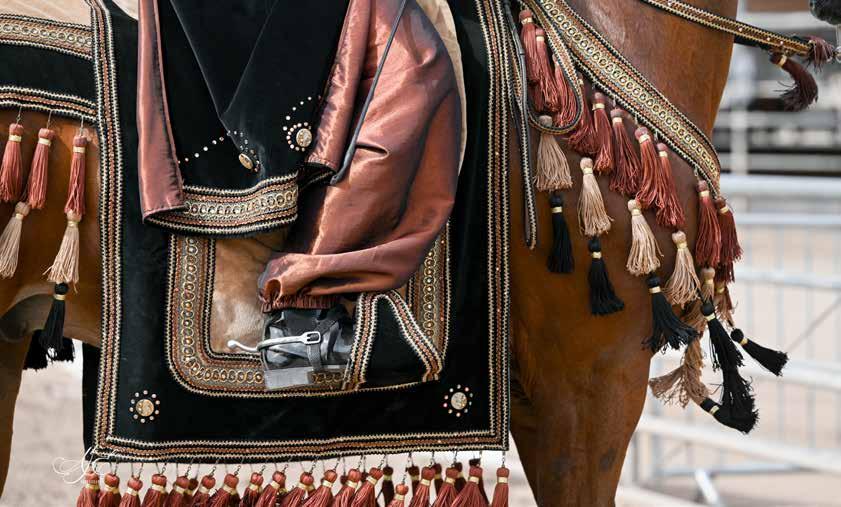
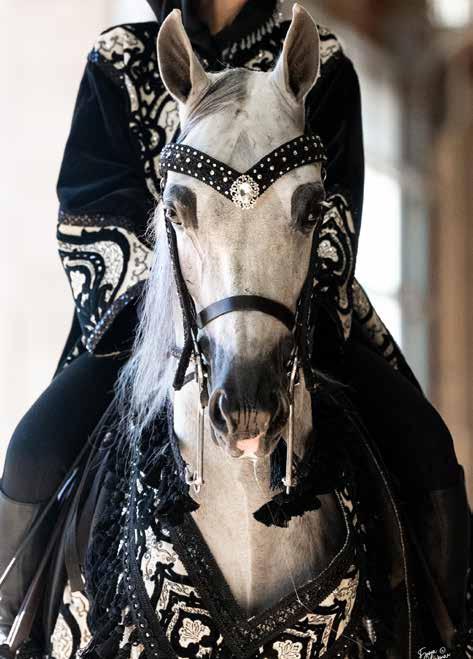
The rider’s costume and horse’s kit — collectively called regalia — carry both symbolism and structural logic. Their flowing forms nod to Bedouin dress used for concealment and mobility, necessary for the ghazu (desert raid), while costume construction choices meet mechanical realities. Trainers add pieces incrementally — cloth first, then metalwork, then full kit — until the horse accepts the regalia as part of its own moving mass. Everything must balance as a vision in which poetry, skill, artistry and horsemanship are rendered in kinetic form.
Beneath the intricate metalwork, tassels and layers of velvet and satin, anchor points and saddle pads serve as load distributors, directing mass toward the horse’s centerline and reducing yaw and roll. Within the rider’s aba (cape) and thobe (robe), flexible boning holds the shoulder line away from the rider’s neck and horse’s withers, preserving the silhouette without irritating the animal.
Hidden panels beneath the horse blanket keep decorative breastplates positioned and prevent shifting during movement. A center-back split in the cape’s hem allows the fab-
Photo by Kaylee M
Photo by Osteen Schatzberg
Behind the Bling: The Lexicon of the Desert
Mounted Native Costume regalia draws on Bedouin traditions in which ornament functioned as portable wealth, tribal identification and practical protection against wind and sand. In the Scottsdale ring, those meanings mingle with deliberate engineering and craftsmanship— every piece is judged for authenticity and fitted to preserve both the horse’s comfort and the team’s motion.
Thobe — The rider’s foundational robe, typically a long, flowing gown of silk, velvet or satin that grounds the overall silhouette. The cut, weight and hidden seaming affect how the aba (cape) lies and must evenly distribute weight across the rider’s shoulders.
Aba — The cape or outer robe that acts as the outfit’s dramatic “wings.” Often fully lined with weighted hems and integrated boning in the yoke to preserve shape and reduce torque. Split vents, gussets or inverted pleats allow the fabric to appear as one continuous piece at rest but open cleanly while in motion.
Keffiyeh — The rider’s headdress or wrapped scarf. Obscured pins or wires hold its shape. Any decorative pins or metalwork must be secured against wind displacement. Judged for neatness and authenticity.
Woven bridle/headstall — The horse’s headgear of hand-worked leather or braided cord, sometimes wrapped with silver thread or bullion. Decorations threaded into the brow bands may include cowrie shells, beads or filigree—traditional markers of status, portable wealth and lineage. To protect the horse’s cheeks, fit must be precise.
Tasseled neck/throat strap — The horse’s “jewelry” of straps and necklaces draped across the chest and neck, often tasseled and beaded, sometimes with cowrie shells or coins. Placement is deliberately low so as not to interfere with the bit or breathing. Leather backing prevents irritation from rubbing.
Breastpiece/breastplate — This broad, decorative collar is the eye-catching chest piece resplendent with stamped silver, coinwork or filigree. Often mounted on leather, metallic elements are made to throw light toward the judges. Placement is low enough to allow shoulder rotation; reinforced padding protects the skin from metal edges.
Loin cover/crupper cloth — Decorative textile draped over the horse’s hindquarters. Similar to the human’s aba, it is finished with vents or a center-back split for unimpeded movement of the hind legs. Hem weights have a similarly low center to reduce aerodynamic lift.
Photo by AJE Photography
Even people unfamiliar with Arabian horses stop and watch because it’s so striking — one of those classes where the audience genuinely pauses and leans in. Melissa Schalles
ric to part cleanly over the horse’s hindquarters, finished with bound edges that create the illusion of a continuous hem at rest. Pleats and gussets expand as the horse moves, channeling airflow to prevent the cape from billowing uncontrollably.
Photo by Emma Chapman
Safety and skin protection are paramount. Primary fastenings pair with concealed safety loops that can be quickly released if the fabric snags. Riders make subtle adjustments — sitting slightly deeper and keeping their hands steady — to preserve balance and gait integrity while the garment reads as weightless.
Native Costume is more than decoration; it’s part of the overall score. Specifications are unique to the class, and rules of attire and performance elements must be executed to perfection. Extreme speed is penalized; this class moves in walks, canters and hand gallops.
“It’s written into the rules,” Wight explains. “It does no good to go fast. The cadence of the horse, performing gaits properly and correctly — that’s what’s important.”
Arabians’ intelligence and versatility have always been prized for transport, herding, ranch work and companionship, roles reflected today in the high value breeders and exhibitors place on the ancient breed. Historically, Bedouin families often allowed their prize mares to sleep inside their tents, emblematic of profound personal connection to these stately creatures. The reverence remains, even if stables have replaced tents.
The many capabilities of Arabians come into sharp focus at the Scottsdale show, with youth to adults competing in a multitude of class disciplines including Western, English, Halter, Ranch Sport and Reining as the world converges to celebrate the breed.
Scottsdale Arabian Horse Show
Feb. 12–22 // 7:30 a.m.–7 p.m. // WestWorld of Scottsdale 16601 N. Pima Road, Scottsdale // $15+; discounts available // scottsdaleshow.com
In her 19th century account, Blunt praised the Bedouin traditions of honor, hospitality and bonds built over shared meals and coffee around campfires in the Arabian Desert. At WestWorld, the social ritual has adapted but persists. The showgrounds become a modern camp where breeders, riders and makers reconnect beneath dusky desert skies and stadium lights.
scottsdaleshow.com
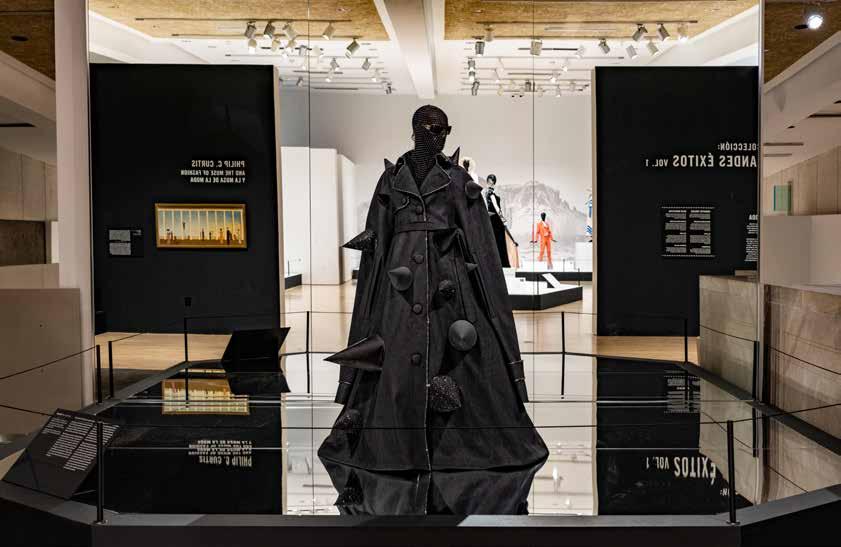
Guardians of Glamour Inside the Phoenix Art Museum’s Fashion Vault
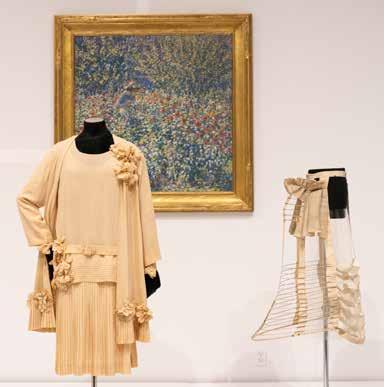
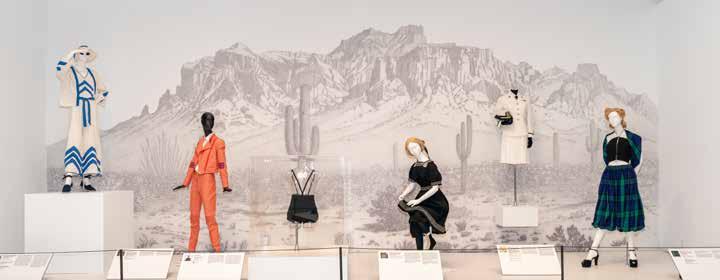
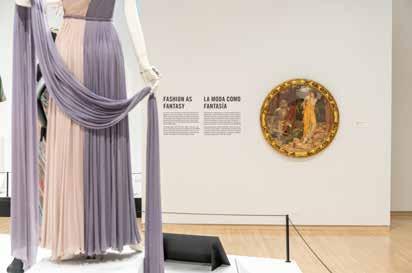
Deep in the climate-controlled vaults of Phoenix Art Museum, a Balenciaga ballgown hangs motionless in the dark, its silk faille skirt frozen midswirl. Nearby, a 1780s robe à la française waits alongside a paper bikini from 1966, a Geoffrey Beene sculptural masterpiece, and a Dior purchased at a church resale.
More than 9,000 garments span these temperature-regulated aisles — centuries of fashion history pressed into padded hangers and acid-free boxes. What visitors see in the Kelly Ellman Fashion Galleries represents less than 1% of the collection. The rest lives here, in this archive that rivals the holdings of museums in New York, Los Angeles and beyond.
Writer Joseph J. Airdo // Photography Courtesy of Phoenix Art Museum
Fashion is art and will stand as such. These women had a message: that this is an investment in a craft, an artistry, and things worth collecting — things worth standing next to a Monet. Helen Jean
Helen Jean, the Jacquie Dorrance Curator of Fashion, knows every corner of this textile universe. She’s been here since 2007, when she arrived as a curatorial assistant under the legendary Dennita Sewell. Nearly two decades later, she’s become the primary guardian of a collection that began with a radical idea: that fashion deserves to stand beside a Monet.
“It’s a great honor to get to work with the collection, first of all,” Jean says. “I’m one in a line of a few curators who have helped guide it, and I work with a team of extraordinarily talented people who are experts in their own areas of object handling and research.”
Her days oscillate between the cerebral and the physical. Some mornings find her diving into research rabbit holes, tracing the provenance of a newly acquired piece or discovering unexpected connections between the fashion collection and other museum holdings. Other days, she’s in the vault with Fashion Collection Manager Rebekah Monahan and fashion intern Summer Rye, carefully padding a mannequin’s hips or carving foam to accommodate the exact proportions of a 1950s cocktail dress.
“As we craft the show and start to see these looks come together, that’s always very special and exciting,” Jean says.
The work combines artistry with engineering. Her background teaching mathematics in fashion design — a course that most people find surprising — turns out to be essential in this world of precise measurements and structural integrity.
“Fashion design is fundamentally based in mathematics,” Jean explains. “Patterns are geometry. The fit around the body relies on understanding stretch — whether you’re turning the horizontal and perpendicular grain on its bias to take advantage of that diagonal stretch in the cloth, or introducing a synthetically derived fiber like latex or spandex into the weave so it has stretch on its own.”
She points to one of the collection’s treasures: the Paper Dress Archive, which captures a fleeting moment in 1966 when Scott Paper Co. launched a mail-in campaign. For $1.25, customers could order a disposable dress in bold op-art graphics or red bandana prints. The fad exploded overnight. Mars Candies, Butterfinger, Dove Soap, Viking Kitchen Appliances, AT&T — suddenly everyone wanted to create “beautiful walking billboards.”
“That’s really where the conversation about technology, fashion, science, and style comes together,” Jean says. “The invention of aniline dyes in the 19th century, the discovery of dry cleaning chemicals — some of these breakthroughs were accidental, others came from searching for answers to completely different questions. That’s the juicy part of this conversation for me. That’s what gets me really excited.”
THE AUDACIOUS BEGINNING
In 1966, when the fashion collection formally began, Phoenix was far from a fashion capital. The museum itself was only 7 years old. The decision to collect haute couture in the middle of the Sonoran Desert seemed, at best, improbable.
But Naomi Kitchel — the first woman on the museum’s board of trustees — had a vision. She assembled a group of extraordinary women with means, connections, and most importantly, fabulous wardrobes. Clare Boothe Luce, the playwright who wrote “The Women,” brought not only her own couture but her experience as a fashion editor and foreign ambassador. Sybil Harrington contributed pieces from her family’s collection. They all knew Stella Blum, then curator at the Metropolitan Museum of Art’s Costume Institute.
“When I say that some of these early pieces seeded the collection, I mean some of our most magnificent, oldest garments come from the Harrington family, from the Kitchels, from Clare Boothe Luce,” Jean says.
One of Jean’s favorite origin stories involves Adrienne Schiffner and the Grosvenor family. As a young girl,
WINE FESTIVALS
Sip, savor, and celebrate! Step into Arizona’s most unforgettable festival experiences, brought to you by Vermilion Promotions. Whether you’re an art lover, wine connoisseur, music enthusiast, or a culinary explorer, Vermillion curates an immersive celebration where creativity, flavor, and community come together in perfect harmony. Free admission.
Kierland Fine Art & Wine Festival
Jan. 31- Feb. 1, 2026
Tubac Festival of the Arts Feb. 4-8, 2026
Wigwam Fine Art Festivals Feb. 13-15, 2026
Oro Valley Art & Wine Festival Feb. 28-Mar. 1, 2026
High Street Art Festival Mar. 7-8, 2026
Stagecoach Village Art & Wine Festival Mar. 20-22, 2026
SanTan Art & Wine Festival Mar. 28-29, 2026
Schiffner remembers sitting on a bed in New York when her grandmother’s steamer trunk arrived from Detroit, filled with the family’s turn-of-the-20th-century gowns.
“She remembers these beautiful gowns being laid out on the bed, and the Met curator Stella Blum is there, and the ladies from Phoenix Art Museum — our first curator, Jean Hildreth, and Naomi Kitchel—are there selecting these garments to be the magnificent first pieces of the collection,” Jean recounts.
The founding members established something crucial: a standard. This collection would mirror the magnificence of the museum’s paintings and sculpture. Fashion would be treated as art, deserving to stand alongside any masterpiece in the permanent collection.
“Arizona Costume Institute was founded with a mission statement that actually alludes to that — that this collection is going to grow as artwork,” Jean says. “Fashion is art and will stand as such. These women had a message: that this is an investment in a craft, an artistry, and things worth collecting — things worth standing next to a Monet.”
THE LIVING EXHIBITION
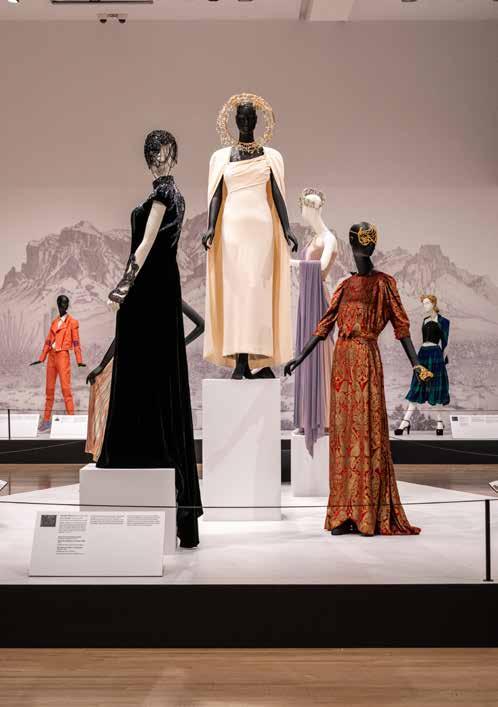
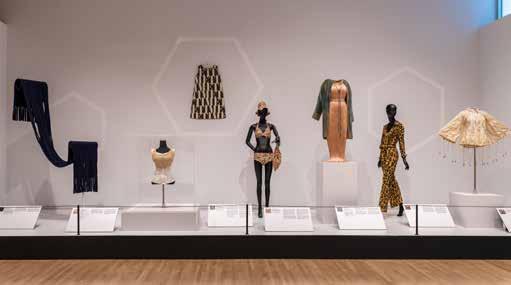
“Greatest Fits (Vol. 1): The Art of Archiving Fashion” opened in October 2024 as the museum’s largest collections-based fashion endeavor to date. The exhibition sprawls across three Kelly Ellman Fashion Galleries
Helen Jean, Jacquie Dorrance Curator of Fashion at Phoenix Art Museum
Photo by Airi Katsuta and Courtesy of Phoenix Art Museum
on the mezzanine level, and it does something unusual: it changes. This is a “living” exhibition, with garments rotating in and out over 18 months to showcase more than 100 pieces from the permanent collection.
The decision to focus the middle gallery on silhouette — creating a striking monochromatic display of all-black and all-white garments — came from both pedagogical and practical considerations.
“How do we approach learning about major fashion changes throughout time? We look at those silhouettes,” Jean explains. “Creating that elegant monochromatic view became very stunning, I think — a way to draw people into a gallery they might not normally walk into. Color can be very chaotic, and it can be off putting to some people.”
The strategy also addresses a persistent question: Why does fashion belong in an art museum? By stripping away color and focusing purely on form, Jean invites viewers to see these garments as sculptural objects, divorced from their practical use.
“We want visitors to step back, blur their eyes a bit, and take in what they’re seeing — divorced from any practical considerations like whether you could sit down or bend over in it,” she says. “That’s not what we’re discussing here.”
The exhibition closes March 1, making way for “Greatest Fits: Vol. 2,” which will debut this spring. Where “Vol. 1” explored the grand gestures of fashion — the sweep of a ball gown, the architectural drama of a bustle — “Vol. 2” will become a jewel box of tiny wonders.
“Our audiences will be introduced to our tiniest objects: shoes, pocket watches, hats, jewelry, scarves, those teeny tiny Judith Leiber pearl boxes covered with hundreds of Swarovski crystals,” Jean says. “When we’re looking at it historically, we’ve got these wonderful bonnets, and you have this entire language of flirtation that you can employ when you’re partially obscured.”
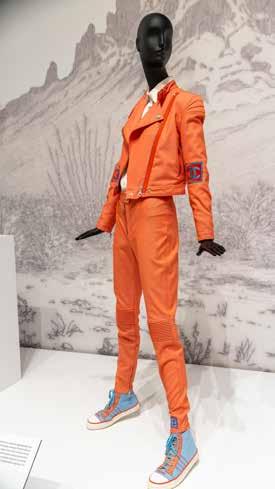
The shift from macro to micro will also showcase pieces from the collection’s four major archives: Anne Bonfoey Taylor’s midcentury couture (Balenciaga, Charles James, Givenchy), the Paper Dress Archive, the Geoffrey Beene collection, and the Emphatics Store holdings featuring avant-garde designers like Azzedine Alaïa, Thierry Mugler, and Jean Paul Gaultier.
THE SPIRIT IN THE SEAMS
What separates fashion from other art forms is its intimate relationship with the human body. A painting hangs static on a wall. A dress remembers movement — the sway of a waltz, the pressure of a belt buckle, the scent of perfume in its fibers.
“I think a lot about that scene in ‘Beetlejuice’ when the wedding gown comes back to life,” says Jean, who has a background in theater. “At first, I’m thinking, ‘How did they do that? How did they make that happen?’ But then I buy into the scene emotionally, and by the end, it’s just tragic. That idea of the spirit still being there? That’s what I feel when I work with these garments.”
Every garment carries what curators call provenance: who owned it, who wore it, how it came to the museum. Jean cherishes these backstories as much as the technical details of construction or the designer’s reputation. One Dior in the collection was purchased at a church resale — the only way its owner could ever access haute couture. She wore it and loved it so completely that it
EXPERIENCE
now holds a special place in the museum’s holdings, its double provenance enriching its narrative.
“Someone wore that piece. A life happened in it,” Jean says. “It could have been a special moment like a wedding. We have christening gowns — ceremonial moments frozen in fabric. Sometimes it’s something they clearly danced in, and we can tell because the front is rubbed away where their partner’s belt buckle pressed against it.”
This bodily connection makes fashion exhibitions uniquely challenging. Visitors instinctively want to touch textiles in ways they’d never approach a painting.
“We wore it. We have an intimate relationship with it,” Jean explains. “That’s why we have to keep an extra eye on people in the fashion gallery — we touch clothing instinctively. We walk through a store and just reach out.”
The sensory pull of fashion extends beyond touch. It’s the sound of stilettos on marble, the weight of a hat, the way lipstick tastes, the rustle of taffeta.
“All of these sensory experiences,” Jean says. “The act of grooming is part of it too. When we look at romance films from the ‘20s and ‘30s with those beautiful vanity tables set up for beauty rituals — spending time with feathers and elaborate setups — that’s all happening again right now. That’s not new.”
Fits (Vol. 1): The Art of Archiving Fashion Through March 1 // Phoenix Art Museum’s Kelly Ellman Fashion Galleries // 1625 N. Central Ave., Phoenix $28; discounts available // 602-257-1880 // phxart.org
BRINGING GHOSTS TO LIFE
Perhaps the most critical — and least visible — aspect of fashion curation happens behind the scenes: creating the body that will inhabit each garment. Jean and her team never alter a historic piece to fit an existing mannequin. Instead, they build custom forms for every installation.
The team works with traditional tailor’s dress forms, torso mounts on poles, and Styrofoam blanks that mount maker carves to exact specifications. They pad with everything imaginable, collaborating with specialists who have backgrounds in theatrical prop-making. The goal: to make each garment appear as though a living person has just stepped away.
“Properly mounting a garment ensures that every time it’s on view, it looks as though a real human is wearing it,” Jean says.
Sometimes they dress a full mannequin with head and hands, creating a complete tableau. Other times, they opt for an “invisible mount” — just the garment floating in space, presented as pure sculpture. The decision depends on the story each piece needs to tell.
As Jean walks through the galleries one final time before “Vol. 1” closes, she pauses before a rotating lineup of silhouettes: an 18th century robe à la française beside a 1950s Dior New Look beside a contemporary sculptural piece. Sixty years of intentional collecting, preservation, and scholarship have led to this moment — and to the thousands of garments waiting in the vault for their turn to tell their stories.
“We consider ourselves one of a handful of museums that boasts such large holdings with such high-quality works that are so representative of such a vast time period of history,” Jean says. “We’re very lucky to have all of this wonderful support.”
In the end, that’s what the “Greatest Fits” series achieves: proof that those founding women in 1966 were right. Fashion does deserve to stand beside a Monet. And in the climatecontrolled vaults of Phoenix Art Museum, 9,000 pieces of wearable art are waiting to prove it.
phxart.org
photo essay
Bruce Moore
Photographer
Writer
J.
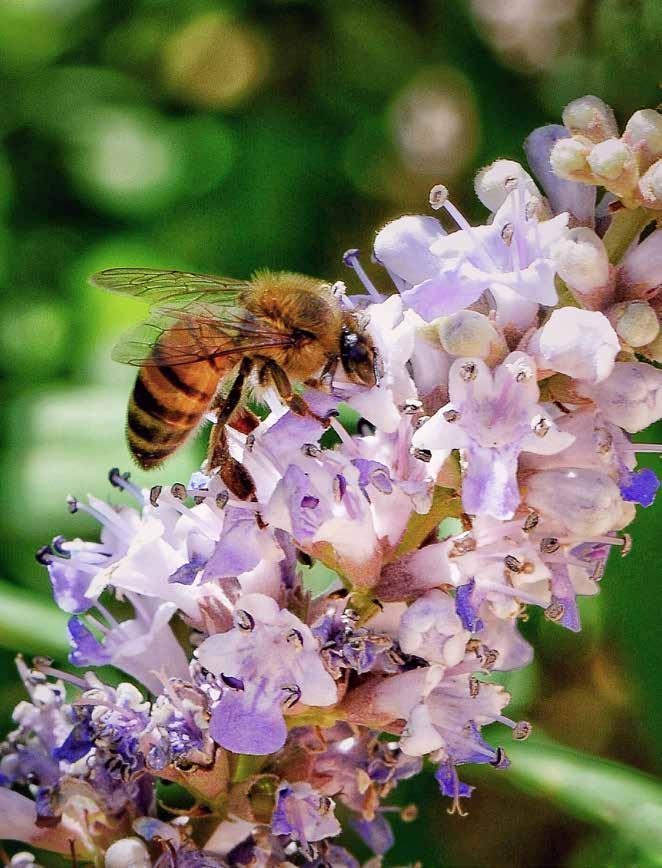
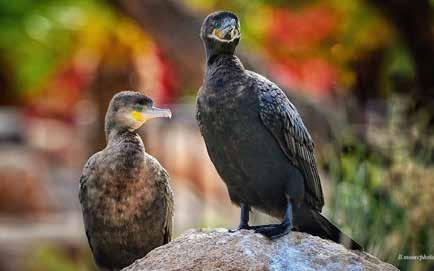
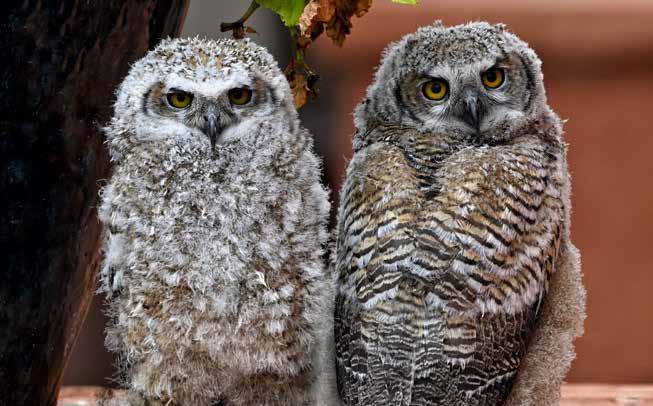
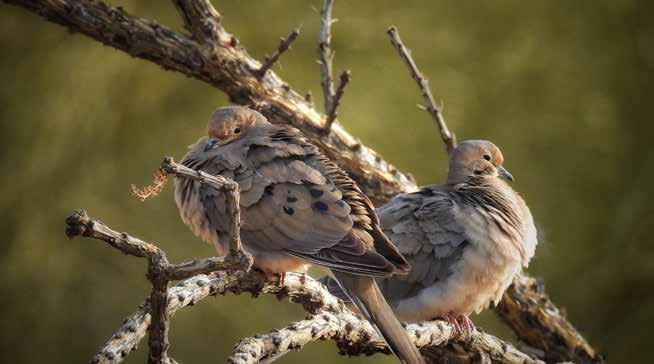
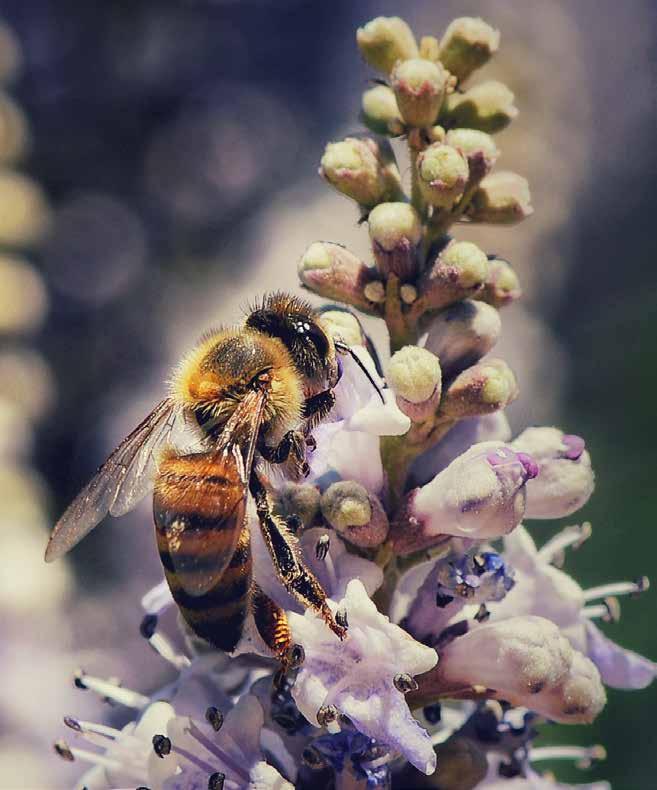
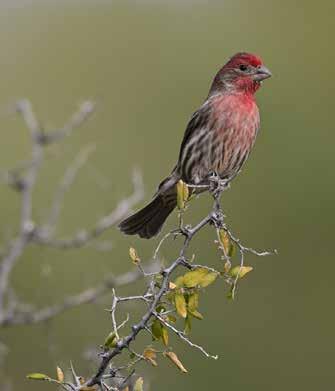
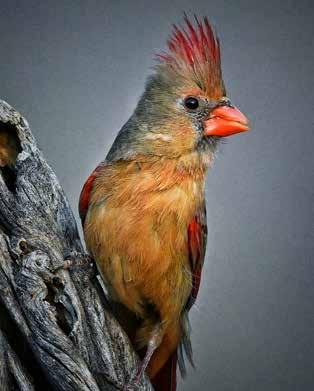
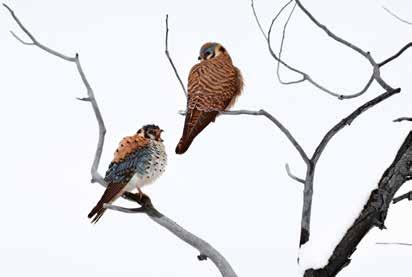
Bruce Moore’s lens captures what most parents can’t explain: the quiet intimacy of mourning doves and the purposeful dance of desert pollinators.
The Birds and the Bees
Every parent dreads it — that awkward conversation, the one that starts with stammering and ends with relief when it’s finally over. But for photographer Bruce Moore, “the talk” is less about fumbling explanations and more about quiet observation. Armed with his Nikon Z9 and the patience of a man who’s learned that the best moments can’t be rushed, Moore has spent countless mornings documenting the Sonoran Desert’s most photogenic residents: the birds and the bees.
This Valentine’s Day, we’re celebrating his work — not because his images capture torrid love affairs or elaborate courtship dances, but because they remind us that connection happens everywhere, even when we’re not looking for it. A cardinal perched on a saguaro. A bee making contact with a desert marigold’s stamen. These aren’t grand romantic gestures, but they’re intimate nonetheless — quiet moments of purpose and partnership that unfold just outside our windows.
“I love photographing mourning doves,” Moore says. “An interesting fact about them is that they mate for life, which
in today’s world of disposable relationships is somewhat comforting and reminds me of days gone by.”
When asked how love has shown up in his own life, he offers an Albert Einstein quote from his undergraduate days: “You can’t blame gravity for falling in love.”
“Love takes work,” he adds. “You have to accept that maintaining a loving relationship requires effort from both people. I’ve had my ups and downs like most people, and I’ve learned to rely on my photography to help me through the down times while simply enjoying the good moments when they come.”
Perhaps that’s the real lesson of “the talk” — not the mechanics of attraction, but the understanding that connection, whether between doves or people or a bee and a bloom, requires showing up. Moore shows up at dawn with his camera. The bees show up for the lavender and desert marigolds. The mourning doves show up for each other, year after year. And in capturing these moments, Moore reminds us that sometimes the most romantic thing we can do is simply pay attention.
Joseph
Airdo // Photography by Bruce Moore
When setting up for a bird or bee shoot, it’s like grounding yourself in a quiet moment, watching and listening and getting into a state of relaxation. For me, it’s part of the creative process, and it gives me a great deal of pleasure to just be in the moment. Bruce Moore
Most — if not all — photographers love to photograph more exotic birds like eagles, egrets, herons and ospreys. Those birds generate more of an adrenaline rush for the photographer. For me, though, doves generate more of a calming, peaceful vibe, which is often very welcoming when I need to escape the madness and chaos we face in our world today. Bruce Moore
When bees collect pollen, it’s sort of like a chaotic dance — going from one flower to another — and there’s a certain rhythm to it. Recognizing that rhythm gives me a better chance to anticipate and capture the angle and shot that I’m after.
Bruce Moore
Meet the Photographer
Growing up in Vandalia, Ohio, Bruce Moore watched his grandfather document family gatherings and became intrigued enough to buy a red plastic camera with money he earned selling flower seeds door-to-door. But life — military service during Vietnam, raising a family, building a career — got in the way of that childhood fascination.
It wasn’t until later, after moving from Ohio to Hawaii to Texas and finally to Anthem, that Moore picked up the camera again, this time with the kind of focus that only comes from having lived long enough to know what matters.
“I have always leaned toward a creative process,” he says. “I could never draw or paint, so photography was a perfect outlet for me.”
These days, Moore shoots primarily with Nikon Z8 and Z9 mirrorless cameras, often using a 105mm f/2.8 macro lens for close-up work or a 70-200mm f/2.8 for birds in flight. His approach is decidedly old-school in an age of digital manipulation — he uses a free app called Snapseed for basic post-processing and avoids the “plug-ins and swap-outs” that dominate contemporary photography.
“I believe my job as a photographer is to capture what God has created, not to take bits and portions of nature that don’t exist in that image and plug them in to make something that isn’t really real,” he explains.
That philosophy has served him well. As a member of the Photographic Society of America, Moore has won numerous first-place judging competitions, competing against photographers who are experts with Photoshop and Lightroom. He’s also recently become a PSA-sanctioned judge, evaluating submissions for camera clubs throughout the country — proof that composition and vision can triumph over technical wizardry.
3-bruce-moore.pixels.com
Writer Susan Kern-Fleischer
When Camera and Canvas Capture the Same Desert
Shared Vision
Astunning desert sunrise. Light and shadow playing across a jagged canyon as a river winds through it. Majestic saguaros standing sentinel as a storm approaches in the distance.
For Tom Conner and Robert Elenbaas, the beauty of the Southwest is more than something to behold. Both artists feel drawn to explore rugged hiking trails, peaceful forests and other landscapes off the beaten path to observe, document and share their experiences through their art.
The scenes they experience may be similar, but Conner chooses to express nature’s beauty through colorful, impressionist realistic oil paintings while Elenbaas uses his camera to capture moments in time through stunning black and white and color photography.
Both artists will showcase this shared reverence for the Southwest at The Finer Arts Gallery’s Feb. 20 Art Affaire, where their work takes center stage in the Cave Creek gallery’s semi-annual refresh. The event marks the unveiling of six months’ worth of new paintings, sculpture, photography, glass, wood, fiber, ceramics and jewelry from the
gallery’s roster of 50 diverse Arizona artists — a space known as much for its daily artist demonstrations as for its welcoming atmosphere.
THE ARCHITECT’S EYE
As a child growing up in North Carolina, Tom Conner loved to paint and draw. Later, after graduating from North Carolina State University’s School of Design with a degree in architecture, he continued to draw and paint in his free time. It wasn’t until Conner moved to Arizona in 1994 that his true art education began.
“I moved to Arizona on a whim and didn’t think I was going to stay, but I fell in love with the beauty of the Southwest and never left,” he says.
He began backpacking, rock-climbing and camping with other architects and eventually started venturing out on his own, bringing his paintbrushes, oil paints and canvases to paint plein air.
“Architecture is creative in its own right, but there are limitations based on building codes, city ordinances, costs and other factors. While I enjoy working full-time as an archi-
Evening Aglow // Photo by Robert Elenbaas
Light is what every artist or architect strives to capture in a scene or a design. Light can enrich colors, create edges, soften forms and create a focal point. Without light, there is no personality.
Tom Conner
tect, I cherish the time I have painting either in my home studio or outside,” he says.
The essential quest for him in both painting and architecture is similar: Light and form are in partnership to reveal the nature of one another.
“I am always in the pursuit of capturing greater truths,” he says. “Light is what every artist or architect strives to capture in a scene or a design. Light can enrich colors, create edges, soften forms and create a focal point. Without light, there is no personality.”
Primarily a landscape artist, Conner is inspired by legendary California impressionists and Western artists, including Edgar Alwin Payne, William Wendt and Maynard Dixon. His work has evolved from traditional smooth, tight brushstrokes to impressionist realism, characterized by visible, short brushstrokes, a focus on light and atmosphere, vibrant colors, soft edges and fewer details to convey mood and movement.
He prefers working with oil paints, painting with thick impasto style to add texture and depth.
“I like to break an object down into smaller bits with loose, free brushstrokes to let the image sing,” he says. “I also like that oil is forgiving. I am constantly scraping down paint to adjust the composition or color of a scene.”
Conner’s biggest challenge painting plein air is weather, and when he is painting in his studio, he prefers to listen to music or a ballgame.
“I don’t watch TV after work. Painting is how I relax,” he says.
Some of the work he does is from photographs he took while hiking. “The hope is that I’m painting the same scene I experienced when I took the photo. As a viewer, you shouldn’t be able to tell the difference between a studio painting and plein air,” he says.
Always curious, he is open to trying new techniques and experiences to hone his skills.
“I have stretched myself to do urban nocturne paintings and have gone out with friends during the summer to capture the city lights plein air. I wear a headlamp and it’s tricky to achieve. I have also dabbled in other media, and I still do a weekly life drawing class, but I don’t think I will ever get tired of painting landscapes,” he says.
And while he has traveled throughout the world, he prefers to focus on painting the desert and other Southwest scenes.
“There is a subtle beauty in the desert. It is rugged, the quality of light is different, there is a crispness to the air and clean colors that are fun to capture. You have to look for the beauty, but it is definitely there,” he says.
DISCOVERING NATURE’S BEAUTY — DAY AND NIGHT
Like Conner, Robert Elenbaas embraces any chance to explore rugged trails, hidden valleys and other remote areas of the Southwest. An Anthem resident and one of the coowners of The Finer Arts Gallery, he is passionate about discovering nature’s beauty both during the day and at night.
The fine-art photographer and adventurer will go on long treks to unique places that he can’t describe in words. So he uses his camera, the changing light and shadows and his keen skills in his “digital darkroom” to capture the awe of breathtaking landscapes and the profound beauty of the night sky.
As a child growing up in Southern California, Elenbaas had a box camera that he would play around with, but it wasn’t until he was in college that he really became interested in photography.
Peralta Springs // Tom Conner
Carved // Tom Conner Sunset Gold & Chasing Winds // Tom Conner
I tell new photographers to think like a plein-air painter. You have to think about the scene, the light and what made you stop in that spot in the first place. Robert Elenbaas
“My father traveled to Hong Kong for business around 1970. I asked him to buy me a 35mm SLR camera. After college, I started to do wilderness backpacking with friends, to places one can get to only by hiking or riding a horse. I would try to capture in photographs the beauty and wonder of these places so I could share them with other people,” Elenbaas says.
After completing his residency training, Elenbaas worked for 15 years as an emergency medicine clinical pharmacist before becoming executive director of the American College of Clinical Pharmacy. In his spare time, he would travel or backpack to remote areas with his camera.
The advent of digital photography became a gamechanger for Elenbaas as it opened a new world of photography for him as an expressive art form. His digital darkroom allows him to “think like a painter,” which gives him much more flexibility to emphasize or deemphasize certain aspects of each photo.
“All of my images are free of AI,” he says. “There is nothing in my images that was not originally there. I simply try to help people see things in nature that they don’t normally see or appreciate, either because of the limitations of human vision or because they just don’t take the time to really see what’s in front of them.
Tom Conner brings an architect’s precision to his impressionist landscape paintings, often venturing into the desert with paintbrushes and canvas to capture scenes plein air.
Robert Elenbaas, co-owner of The Finer Arts Gallery and Anthem resident, uses his camera to capture what the human eye often misses — from the soft shadows of Golden Hour to the breathtaking sweep of the Milky Way over the Arizona desert.
“A great example would be my nightscape photos of the Milky Way, star trails, lunar eclipses and timelapses of meteor showers. A lot of what we are able to do today in terms of nightscape photography would have been difficult to do in the predigital age. I really enjoy being out at night. It’s very humbling when you realize the vastness of our universe and the night sky.”
Elenbaas is very intentional in his use of light, and he often finds the best lighting during the golden hour of the early morning or at dusk when the light is soft and the shadows are long.
“The word ‘photograph’ means to draw with light,” he shares. “As a photographer, I am capturing and recording light. I need to be aware of what the light is doing — whether it’s a warm, cool or a reflective light. I’ve created some interesting photographs during the middle of the day, when the sunlight is harsh. It’s about knowing how to use the light.”
Elenbaas is inspired by other fine-art photographers as well as landscape painters.
“I enjoy viewing paintings in museums, particularly the older work at the Hudson River School in New York ... those painters’ ability to render the landscape was amazing and very inspirational,” he says.
He also enjoys teaching others about photography.
“I tell new photographers to think like a plein-air painter. You have to think about the scene, the light and what made you stop in that spot in the first place. You need to consider what you want your photograph to communicate. To paraphrase Ansel Adams, ‘You don’t take a photograph, you make it,’” he says.
Elenbaas includes the Japanese kanji “wa” on each photograph as part of his signature logo. In common usage, “wa” translates as “harmony” and “peace,” as in being in harmony with one’s environment and in a peaceful state of mind.
“My goal is that my images serve as visual metaphors for the emotions I felt when the shutter clicked,” he says.
thefinerartsgallery.com
EXPERIENCE
Art Affaire
Friday, Feb. 20 // 5–7 p.m.
The Finer Arts Gallery // 6137 E. Cave Creek Road, Cave Creek Free // 480-488-2923 // thefinerartsgallery.com
Writer Joseph J. Airdo
Suited for Stardom Behind
Tthe Seams at Phoenix Theatre Company’s ‘Million Dollar Quartet’
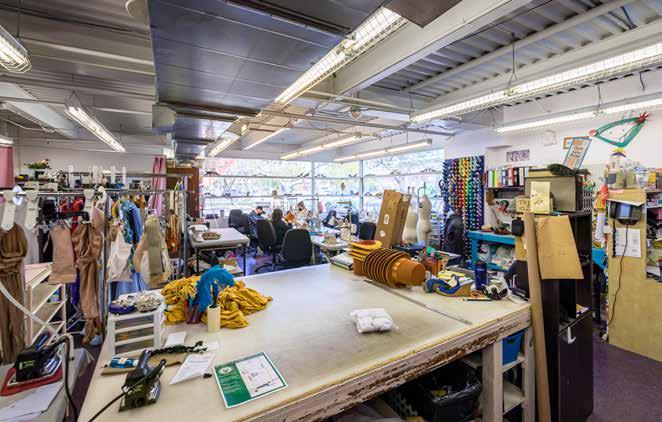
he morning hum begins quietly. At Phoenix Theatre Company’s costume shop, Martha Clarke surveys her domain — an industrial atelier where bolts of fabric stand sentry beside sewing machines, where the ghosts of Elvis, Johnny Cash, and Jerry Lee Lewis hang on rolling racks, waiting to be inhabited. This is where theatrical magic meets couture craftsmanship, where a team of drapers, stitchers, and artisans engineer rock ‘n’ roll swagger one reinforced seam at a time.
“Usually, there’s some quiet time right at the beginning of the morning where everybody’s getting settled,” Clarke, the company’s costume director, explains. “The draper will be looking over her notes and plotting out the plan for the day — if she hasn’t already. That plan is based on what we need to be working on, plus what fittings we’re going to have that day with actors, and whether there are any meetings she needs to be involved with.”
It’s a Tuesday in the thick of building “Million Dollar Quartet,” the Tony Award-winning musical that cap-
tures Dec. 4, 1956 — the singular night when four young musicians gathered at Sun Records in Memphis for what would become legendary. The production, running through March 8 in the Hormel Theatre, demands more than nostalgia. It requires resurrection. And resurrection, Clarke knows, requires meticulous planning.
“Once that gets going, it’s just kind of the flow for the day, depending on whether we’re in fittings or whether the designer is going to be at the shop,” Clarke continues. “Sometimes they come in for fittings, of course, but they’ll also come in if we’re starting a new show. They’ll be looking for things in storage that can work in the show. They’ll be making shopping lists.”
The team — a draper, stitchers, a first hand, and an apprentice — moves with practiced choreography through the shop. Clarke herself juggles production meetings for multiple shows simultaneously, coordinating the intersection of designer vision, director expectation, and the physical reality of what five human bodies can build be-
I think our regular patrons know that there’s a lot of talent back here that nobody ever sees. But for somebody who might be interested in fashion and isn’t finding their place, this is legitimate work.
Martha Clark
fore opening night. Today, that reality includes a particularly delicate challenge: dressing actors as people the audience recognizes instantly.
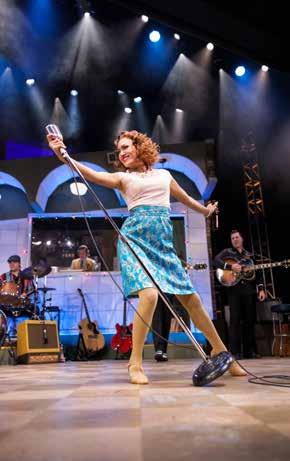
When you’re costuming Elvis Presley, Johnny Cash, Carl Perkins and Jerry Lee Lewis, the audience arrives with expectations etched in collective memory — the swagger of Elvis’ unbuttoned shirt, the Johnny Cash black-on-black silhouette, the whole mythology of rock ‘n’ roll youth captured in polyester and denim. The shop works from photographs, television appearances and the designs of costume designer Adriana Diaz, who collaborated closely with director Scott Weinstein. Each musician had a distinctive brand — Elvis’ untucked rebellion, Cash’s ministerial severity, Jerry Lee’s wild-child energy. The costumes must read instantly to someone in the back row while flattering the specific actor who inhabits the role eight times a week.
“When an actor’s body type isn’t quite the same as the historical figure — if they’re very different — we have to make the costume as close to the character as possible, but also flattering and comfortable to the actor wearing it,” Clarke explains. “We’re not trying to squeeze them into something that’s too restrictive for their movement or put them in something that makes them look or feel like something’s not right. They need to feel good. In this show specifically, they need to feel sexy. They need to feel like idols.”
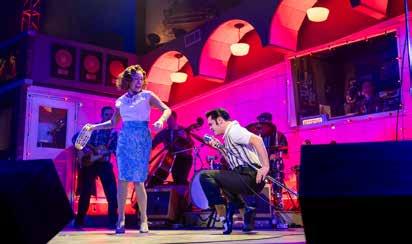
But feeling like an idol is only half the equation. These aren’t museum pieces displayed behind glass. They’re workhorses. “Million Dollar Quartet” delivers more than 20 classic hits — “Folsom Prison Blues,” “Hound Dog,” “Great Balls of Fire” — with the actors playing instruments live. Every guitar chord, every pivot, every lean into the microphone threatens a seam. The engineering happens in fittings, where Clarke and her team interrogate each garment’s performance capacity. What movements happen in this costume? Where is the stress?
“We absolutely take movement into consideration,” Clarke says. “The choreography isn’t particularly extreme — nobody’s doing splits or dropping to their knees — but we still have to ensure the costumes can handle the action without ripping a seam.”
They select fabrics not just for period accuracy but for durability. If a fabric can’t survive the run, duplicates get made as insurance. For the actor playing Elvis, there’s hidden strategy beneath the iconic open-shirt swagger. The costume shop has engineered an undershirt cut low
and dyed to match the shirt color, creating an invisible barrier that absorbs sweat while maintaining the period silhouette. It’s a solution born from practicality — polyester doesn’t breathe like cotton, and two-show days demand backup plans.
This balance between authenticity and endurance requires strategic sourcing. The rockabilly aesthetic — camp collars, cuffed denim, knit polos, blue suede shoes — remains commercially viable 70 years later, which helps. But finding pieces that capture 1956 while surviving 2026’s performance demands requires resourcefulness.
“A lot of that stuff is out there already,” Clarke says. “There’s a whole rockabilly fashion market you can tap into. So you can find things that are very close to what you need and then just adjust them a little bit.”
The shop becomes expert at modification. One jacket built for the principal actor gets reconstructed for the understudy using fabric from a different garment, creating a visual cousin rather than a twin. Shoes get purchased
Photo by Billy Hardiman
from specialized reproduction retailers, then modified — painted, distressed, adjusted by local cobblers to look more historically accurate. Clarke’s team has become adept at knowing when to build, when to buy and when to blend the two.
This resourcefulness isn’t just about problem-solving — it’s about understanding why these silhouettes endure. The revival of 1950s menswear in contemporary fashion isn’t accidental. Those silhouettes — fitted without being restrictive, casual without appearing careless — occupy a sweet spot between formality and ease that resonates across decades.
“It’s flattering. It looks cool,” Clarke observes. “I think especially for young men, it’s something different that has a little more flair, but it’s still masculine. It’s casual most of the time, but without looking dumpy. They can put on one of those collared knit short-sleeve sweaters that are kind of fitted and they look slick — they’re not just in a T-shirt and jeans. There’s a little more finish to it.”
She points to the living culture around vintage dance — jitterbug enthusiasts who dress in periodappropriate clothing for authenticity. One of her former apprentices, now a full-time stitcher, dances regularly with her partner, maintaining a wardrobe that would fit seamlessly into “Million Dollar Quartet.” It’s this living tradition that makes the costume shop’s work both easier and more meaningful.
That former apprentice represents another dimension of the shop’s work: cultivating the next generation of theatrical artisans. The Phoenix Theatre Company’s costume shop operates under Actors’ Equity Association contracts, which mandate specific quality standards. The work must be impeccable — not only for opening night but for the entire run. Productions here can extend for months, and costumes must maintain their integrity through repeated cleaning, hot stage lights and the mechanical wear of nightly performance.
“The quality is pretty solid,” Clarke says. “We want to put out costumes that are made well, not only so they look as good as they can, but also so they last. Our production runs can be pretty long, so the costumes have to be well-made to maintain throughout the run of the show and not start to look too rough around the edges.”
Meeting those standards requires skilled hands, and the talent pipeline draws from Arizona’s educational institutions and from the broader theatrical world. Clarke herself taught at Stephens College before returning to the Valley, where she now mentors the artists who will become the next generation of costume directors and drapers. Her full-time stitcher studied at Stephens College years ago when Clarke was teaching there, returned to Arizona, and eventually joined the Phoenix Theatre shop Clarke now directs. It’s a small, talented world built on relationships and shared craft.
“Our current apprentice is the student of the wife of a fellow draper I worked with at the Utah Shakespeare Festival,” she explains, illustrating the interconnected web of theatrical craftspeople. “When I’m not running a shop and being a costume director, the other profession I go to is draping or pattern-making. So there are a lot of connections, because people work in lots of different places.”
The shop actively cultivates this emerging talent, hiring apprentices and entry-level craftspeople with the goal of elevating their skills. It’s an investment in the Valley’s cultural infrastructure — training the artisans who will sustain Arizona’s theatrical ecosystem for decades to come.
“You always need those beginning-level people,” Clarke notes. “If you can get them and help them develop their skills, they become an even higher commodity, and you want to keep them around.”
For Clarke, this mentorship represents a larger truth about the work itself. For those who imagine costume design as frivolous or secondary, she offers a different perspective. This is legitimate, challenging work requiring technical mastery, creative problem-solving and stamina. The days stretch long. The challenges can be maddening. But the fulfillment runs deep.
Alyssa Chiarello as Dyanne and Nick Voss as Elvis // Photo by Brennen Russell
Alyssa Chiarello as Dyanne // Photo by Billy Hardiman
Cast of Million Dollar Quartet // Photo by Brennen Russell
“I think our regular patrons know that there’s a lot of talent back here that nobody ever sees,” Clarke says. “But for somebody who might be interested in fashion and isn’t finding their place, this is legitimate work. And you can do really well doing this work. You’re going to have a different type of creativity than what comes from fashion design.”
The distinction matters. Fashion design imagines clothing for the everyday or the avant-garde. Costume design builds character, constructs narrative, tells stories about people who either were or could have been. Both require vision. Both demand craft. But costume work adds layers of collaboration — with directors, with actors, with the material constraints of what a human body can build before a deadline.
“It’s good, fulfilling work,” Clarke reflects. “And it’s hard. I mean, there are some really long days. We run into some pretty crazy challenges sometimes — like if something’s not working quite right, or we can’t quite get something to do what we want it to do. It can be really hard and challenging, but it’s also very fulfilling.”
On stage, when the lights hit and the first chords of “Blue Suede Shoes” fill the Hormel Theatre, the audience sees only the magic — four legends brought back to life, young and hungry and electric. They don’t see the hidden undershirts, the reinforced seams, the carefully sourced shoes painted to look like 1956. They don’t see the Tuesday mornings in the shop, the draper plotting her day, the apprentice learning to distress denim, the intricate calculus of making an actor feel like an idol while ensuring the costume survives another two-show weekend.
But Clarke and her team know. Every stitch carries intention. Every fabric choice serves the story. Be hind the seams, world-class artistry happens daily in the Valley, hidden in plain sight, building the illu sions that make us believe.
phoenixtheatre.com
Thomas D. Mangelsen Brings Half a
Century of Patience to Phoenix Zoo
Captured Wild
The salmon arcs through Alaskan air, its silver body twisting in that millisecond between river and sky. Below, a massive brown bear’s jaws hang open, waiting. The fish will land perfectly — impossibly — in the bear’s mouth, frozen forever in what has become one of the most recognizable wildlife photographs in history.
Thomas D. Mangelsen spent a week camping 20 feet from a bear trail to capture that single frame in 1987. No digital manipulation. No game farm shortcuts. Just a photographer, his previsualization, and the patience to wait for nature to reveal itself. Now, that iconic image — “Catch of the Day” — anchors “A Life in the Wild,” a touring exhibition featuring 40 of Mangelsen’s most resonant photographs on display this season at the Phoenix Zoo’s Wild Side Gallery.
For nearly 50 years, Mangelsen has traveled to the wildest corners of all seven continents, documenting polar bears in the Arctic, tigers in India, and the diversity of wildlife across the American West. His work has earned him designation as Conservation Photographer of the Year, BBC’s Wildlife Photographer of the Year, and recognition by American Photo
magazine as one of the 100 Most Important People in Photography. The late Jane Goodall and former National Geographic editor-in-chief Bill Allen have said he is among the most important nature photographers of his generation.
“His photographs have an impact that stays with you,” Allen has said. “They allow viewers to momentarily escape from their busy lives and dwell inside big, humbling landscapes. Rather than being mere documentarian in their purpose, they also reveal personalities of wild, sometimes imperiled animals, reminding us that they are creatures of remarkable sentience.”
The Phoenix Zoo exhibition, running through May 31, showcases photographs printed on a dramatic scale — some up to nearly 9 feet across — transforming the gallery into an immersive journey through landscapes and wildlife encounters that span decades of dedication. Among them: “Polar Dance” (1989), which National Geographic called one of the most important photographs of our time for prompting viewers to ponder climate change consequences; “Mountain Outlaw” (2014), portraying a grizzly bear charging head-on through snow; and the legendary “Catch of the Day.”
Writer Joseph J. Airdo // Photography by Thomas D. Mangelsen
A Change of Seasons, 1998, Thomas D. Mangelsen
If there’s a God or supreme being for me, it would be the feeling of nature, the spirit of nature. I look to nature to heal me. Thomas D. Mangelsen
“We are honored to welcome Thomas D. Mangelsen to the Phoenix Zoo, not only as a globally acclaimed photographer but as a powerful voice for wildlife conservation,” says Bert Castro, president and CEO of the Phoenix Zoo. “His upcoming visit and this remarkable exhibition bring inspiring energy to our Art on the Wild Side program and offer our community a meaningful opportunity to connect with wildlife in a profound and memorable way. This is truly a milestone moment for the zoo and our guests.”
Mangelsen will appear in person at the Phoenix Zoo on Feb. 27 for a special evening that includes his presentation at the Doornbos Discovery Amphitheater, up-close animal encounters, hors d’oeuvres and beverages, and
a visit to the Wild Side Gallery to view the exhibition. Tickets for the limited-capacity event are $75 per person.
The artist’s appearance offers a rare opportunity for collectors and photography enthusiasts to hear directly from Mangelsen about the stories behind his most iconic images — stories that often span years and require the kind of dedication that has become increasingly rare in the digital age.
The story behind “Catch of the Day” embodies everything Mangelsen represents: meticulous preparation meeting serendipitous opportunity, all filtered through decades of honed skill and intimate knowledge of animal behavior.
Light in the Forest, 1998, Thomas D. Mangelsen
“The magic of ‘Catch of the Day’ started with pre-visualization,” Mangelsen recalls. “I saw an article in Alaska Airlines Magazine on my way to Anchorage while working on a film about cranes. The article showed bears at the falls at McNeil River and Katmai — a dozen of them below and on top of the falls — with fish jumping everywhere.
“I knew about that location and honestly thought all the pictures had already been taken. There were thousands of them out there. But then I wondered: Was there any chance of getting a headand-shoulders picture of a fish right in the face of a bear? Just a really tight portrait? I’d never seen one before, and I thought that would be something different. Bears jumping, fish jumping, a dozen bears in the falls — that was already done.”
Mangelsen secured the only available camping spot — 20 feet from a bear trail along the lakeshore — and equipped himself with Kmart camping supplies and freeze-dried food. He spent a week shooting 15 rolls of 36-frame film at ISO 50, a glacially slow speed by today’s standards.
“I realized I couldn’t react fast enough looking through the viewfinder, so I used a remote and just clicked the shutter,” he explains. “I didn’t even know if I got it. I knew I was close a couple times. It was probably six weeks later when I finally saw that frame — after getting back to the office and the processor.”
The resulting photograph has been accused countless times of digital manipulation, an accusation that both amuses and frustrates Mangelsen.
“It kind of pisses me off because I spent most of my life — from 20 years old on — learning the skill of the camera, my craft, animal behavior, being able to pre-visualize something like that,”
he says. “I never saw a picture like it before. Still haven’t. Now it’s said to be the most copied photograph on Earth — everyone trying to get it.”
That authenticity — the knowledge that every image in Mangelsen’s portfolio was captured in the wild under natural conditions — distinguishes his work in an era of rampant digital manipulation and photographers who rent “wildlife models” by the hour from game farms.
“What excitement is that? It’s boring to me,” Mangelsen says bluntly. “People who say, ‘I’ll fix it in the computer later’ — that’s not photography to me. Photography is not manipulating images you didn’t actually get. You’re making it up. It’s a phony photograph.”
His philosophy extends beyond technical purity to encompass a deeper spiritual connection with his subjects. When asked about the long hours spent waiting in blinds, Mangelsen describes entering what others have called a “zen zone.”
“I just shut everything else out,” he explains. “Someone can be talking right in my ear, but if something’s happening, I don’t hear them. I can’t let them distract me because I have to pay attention to subtleties. If there’s a God or supreme being for me, it would be the feeling of nature, the spirit of nature. I look to nature to heal me.”
The exhibition arrives at the Phoenix Zoo as part of its Art on the Wild Side program, which features rotating exhibitions throughout the year in both the Wild Side and Savanna galleries. The program selects artists whose work inspires deeper appreciation of wildlife, conservation and the natural world through photography, painting and mixed media.
Rainwalk, 2002, Thomas D. Mangelsen
“We are thrilled to bring ‘A Life in the Wild’ tour to the Phoenix Zoo,” says Jean Bingham, trustee and member of the zoo’s Arts Committee. “Thomas D. Mangelsen’s legacy as both an artist and conservationist offers guests a rare opportunity to experience nature’s beauty and power through his extraordinary images.”
For Mangelsen, showing his work at zoos represents an essential democratization of wildlife experience. Not everyone can spend 42 days watching cougars at the National Elk Refuge or travel to photograph polar bears in the Arctic — but they can encounter these animals through his lens, surrounded by living examples in ethical institutions.
“I think for people or children, especially those who may never have the opportunity to see a bobcat or a cougar in the wild, these institutions are invaluable,” Mangelsen says. “People who don’t have the luxury that I have with my profession — and I guess it is a luxury, though it’s also what I would
do even if I wasn’t a professional — they need the opportunity to see these animals.”
Perhaps most powerfully, Mangelsen’s work demonstrates photography’s continued capacity to influence conservation policy and public consciousness. He spent 20 years documenting Grizzly 399, a legendary bear in the Greater Yellowstone Ecosystem who raised 18 cubs before being killed by a car in 2024. The resulting books, PBS films and “60 Minutes” coverage reached millions, building public support for bear protection and lower speed limits in wildlife corridors.
“So yes, absolutely — photography does change people’s attitudes,” Mangelsen insists. “Now, some people you can never change. Those are lost causes. But for many others, these images matter.”
EXPERIENCE
Among the Redwoods, 2000, Thomas D. Mangelsen
Mountain Outlaw, 2014, Thomas D. Mangelsen
American Kestrels, 1984, Thomas D. Mangelsen
Standing before “Polar Dance” or “Catch of the Day” in the Phoenix Zoo’s Wild Side Gallery, viewers confront not just technical excellence but something rarer: visual evidence of what patience, dedication and reverence for the natural world can reveal. In an age of AI-generated imagery and instant gratification, Mangelsen’s work stands as both testament and challenge — a reminder that the most powerful images still require showing up, waiting and allowing nature to surprise us on its own terms.
“My goal is to create an image that would hold up against a painting — a moment in time,” Mangelsen reflects. “Sometimes it’s what they call ‘the decisive moment.’ Ansel Adams talked about it, CartierBresson too. It’s that moment you capture.”
And sometimes, that moment takes 50 years to master.
phoenixzoo.org
Polar Dance, 1989, Thomas D. Mangelsen
Writer Joseph J. Airdo
Bagged & Tagged Blue Bird’s Textile Transformation
Walk into any Fry’s, Safeway or Bashas’ across the Valley, and you’ll find it stacked near the baking aisle — a humble flour sack bearing a cheerful bluebird inside a circle. For many shoppers, it’s simply a pantry staple. But for Diné families and Indigenous communities across the Southwest, Blue Bird flour is something far more resonant: a symbol of home, resourcefulness and cultural identity that has transcended the kitchen to become an unlikely fashion icon.
Opening Feb. 6 at the Heard Museum, “Blue Bird” traces the remarkable journey of Cortez Milling Co.’s signature product from treasured fry bread ingredient to contemporary Indigenous fashion statement. The compact yet illuminating exhibition features button shirts dyed in vibrant pinks and blues, floor-length skirts paired with denim jackets, hand-stitched tote bags and even face masks
— all crafted from the distinctive cotton flour sacks that have been a fixture in Native pantries since the company’s founding in the 1930s.
“Blue Bird flour is something we often use — we meaning Native people — for fry bread and tortilla recipes, especially out here in the Southwest,” says Olivia Barney, the exhibition’s curator. “But what I’ve come to learn is it’s pretty much beloved throughout Indian Country.”
Barney, whose Diné (Navajo) family introduced her to Blue Bird during childhood visits to the reservation, grew up watching her grandmother transform simple ingredients into culinary tradition. Those early morning lessons — kneading dough to the perfect consistency, watching it react with hot grease — were never just about food. They were about continuity, resourcefulness and the art of making something meaningful from what’s available.
Photography Courtesy of the Heard Museum
Toni Williams (Northern Arapaho), Shirt, c. 2015. Blue Bird Flour bag cloth, Rit Dye. Collection of Kathy and Bill Howard.
Whether it’s the food or the clothing, it always comes back to the people: the gathering, the connection.
Olivia Barney
“That’s what my grandma used,” Barney recalls. “I still remember that experience of her teaching me to make fry bread. These moments — they’re just an everyday part of life. And I think that’s why it becomes so important. Blue Bird has incorporated itself into our everyday lives in that way.”
But the exhibition reveals how that everyday connection extends far beyond the kitchen. The same cotton sacks that once held high-gluten flour have become canvases for contemporary Indigenous designers, who transform the iconic logo into wearable art. It’s a practice rooted in economic necessity — during the Depression, resourceful matriarchs from a wide range of cultural backgrounds sewed flour sacks into dresses and shirts when fabric was scarce — that has evolved into something more complex: a deliberate reclamation of identity through fashion.
“When we talk about artistry and what Native people do, we reimagine things,” Barney explains. “We’re not going to just toss it out. We’ll use it for something else. You love this thing and you want to use it for something else instead of throwing it away. What can you make from it?”
It’s not merely nostalgia or clever marketing — it’s the visual language of survival, adaptation and pride.
Toni
For visitors who might recognize the logo from powwows or restaurants serving Navajo or Indian tacos, the exhibition offers a deeper understanding of why this particular brand has become what Barney calls “an everyday part of our lives.” It’s not merely nostalgia or clever marketing — it’s the visual language of survival, adaptation and pride.
The physical quality of the fabric itself tells part of the story. Despite initial assumptions about burlap-like heaviness, the cotton weave is surprisingly lightweight and soft — comfortable enough for daily wear. Artists such as Toni Williams use Rit dye to transform the natural beige sacks into jewel tones, then cut and assemble them into contemporary silhouettes that range from business casual to streetwear cool.
“When I saw the denim jacket by Kathleen Tom-Garcia, I thought, ‘I love that,’” Barney says of one piece featuring a Blue Bird back patch. “You get to see a wide range of what’s possible.”
The exhibition also includes paintings depicting the fry bread-making process and pre-colonial Indigenous bread traditions, contextualizing Blue Bird within a longer continuum of Native culinary creativity. It’s a reminder that resourcefulness and reinvention aren’t new concepts — they’re ancestral practices finding fresh expression.
“There are two separate but connected things happening in this show,” Barney notes. “On one hand, I want to talk about fry bread and pay homage to those cooking traditions. But I also want to showcase this beloved art form in different ways — specifically, the repurposing of the flour sacks themselves.”
EXPERIENCE
Blue Bird
“It goes back to those core concepts of community, reusing and upcycling,” Barney says. “Whether it’s the food or the clothing, it always comes back to the people: the gathering, the connection.”
In an era of fast fashion and disposable culture, Blue Bird’s journey from flour to couture statement carries particular resonance. These aren’t garments born of trend cycles or algorithm-driven aesthetics. They’re testaments to Indigenous ingenuity — proof that fashion, at its most meaningful, is never just about what we wear, but about who we are and where we come from.
heard.org
9:30 a.m.–5 p.m. // Heard Museum // 2301 N. Central Ave., Phoenix // $26; discounts available // 602-252-8840 // heard.org
The Long Quiet
Ginger Sykes Torres (Diné) and Sherry Denipah Sykes (Diné), Face mask, 2020. Blue Bird Flour bag cloth, printed pattern fabric, elastic. Gift of the artists, 4968-3.
Williams (Northern Arapaho), Bag, c. 2015. Blue Bird Flour bag cloth, Rit Dye. Collection of Kathy and Bill Howard.
Achieve your Best Body
A N D R E S T O R E Y O U R H E A L T H
PP e r s o n a l i z e d a n d D o c t o r -
S u p e r v i s e d W e i g h t L o s s
The Center for Integrative Healing & Wellness’ medical weight loss program integrates FDA-approved medications with a natural and holistic approach to address the underlying biological and physical issues responsible for weight gain
In addition to losing weight and keeping it off, The Center for Integrative Healing & Wellness’ medical weight loss program provides clients with the tools they need to reduce the risk of coronary artery disease, stroke and type 2 diabetes as well as optimize hormones for energy, health and longevity.
T h e M o s t C o m p r e h e n s i v e &
S u c c e s s f u l P r o g r a m A v a i l a b l e
The Center for Integrative Healing & Wellness’ medical weight loss program is designed to help clients be the healthiest they have ever been, in the best body that they have ever had.
Regardless of the amount of weight you want to lose, the spa-like clinic’s Integrative Team will monitor and guide you throughout the process of reaching your goal. Our clients typically lose 15–20% or more of their body weight an average of 53 pounds in 6–12 months
Best of all, the program ensures that patients maintain lean muscle mass and keep the weight they lost off for life. That is because, unlike other programs, our weight loss program looks not only at scale weight but also takes into consideration body fat, muscle mass and water weight, which all affect one’s ultimate goal
P R O G R A M
Tait Ludwick
In just over two years, Poppy’s Office has evolved from a heartfelt tribute into one of Arizona’s most acclaimed cocktail destinations. The bar’s recent recognition by the Arizona Restaurant Association — winning Most Creative Handcrafted Cocktail Program at the 2025 Foodist Awards — confirms what discerning guests have known since opening: This is where innovation, hospitality and genuine connection converge.
Behind the bar, Beverage Director Tait Ludwick, now nominated for Top Mixologist at the 2026 Foodist Awards, continues to push creative boundaries while honoring the establishment’s founding vision of bringing people together. His latest menu marks a sophisticated evolution, taking guests on a global journey through thoughtfully curated flavor profiles.
“This iteration was built with a strong cultural lens, focusing on globally inspired profiles that showcase ingredients, techniques and traditions from around the world,” Ludwick explains.
The opening cocktail, Mint Condition, sets the tone immediately — a bright, herbal composition bringing together mint, coconut, yuzu, sage and Earl Grey. As guests progress through the menu, drinks like Golden Pavilion and High Tea highlight carefully sourced teas including oolong and hojicha, reflecting the bar’s commitment to cultural diversity and intentional craftsmanship.
Dining Guide
Responding to evolving guest preferences, the team has dedicated an entire page to zero-proof offerings and expanded their low-ABV cocktail selection — a thoughtful acknowledgment of the industry’s shift toward mindful drinking without compromising on creativity or sophistication.
Beyond the regular menu, Poppy’s Office has made its Spirit Dinner series a cornerstone offering, hosting immersive pairing events every three weeks. These educational experiences pair various expressions of featured spirits with specially curated dishes, with upcoming dinners featuring prestigious distilleries like Buffalo Trace.
Responding to guest feedback, the bar now offers Liberty Station’s full food menu, enhancing the experience for those seeking more substantial dining alongside their cocktails. The back bar continues to expand with highly allocated spirits, offering one of the most impressive selections in the North Valley.
As Poppy’s Office looks ahead, the focus remains unchanged: creating a space where family, friends and community gather while celebrating the craft of exceptional cocktails.
ARTISAN CHOCOLATE BARS
Recipe
These handcrafted chocolate bars rival anything from a boutique chocolatier, yet they’re surprisingly approachable for home cooks. The technique is straightforward tempering, while the toppings offer endless customization — from candied bacon and mint cookies to freeze-dried berries. Consider them a sophisticated Valentine’s Day gesture that demonstrates genuine effort, or simply an elevated treat for your own dessert repertoire. The variations are limited only by imagination: toasted nuts, toffee shards, dried fruit, even crushed waffle cones for textural contrast.
Yield: 4 bars
INGREDIENTS:
3 strips thick-cut bacon Flaky sea salt 1/3 cup packed brown sugar, divided 1 pound quality chocolate (milk, dark or bittersweet), chopped 5 mint Oreo cookies, broken into small pieces
1/4 cup freeze-dried strawberries and blueberries
DIRECTIONS:
5. Gently unmold bars and wrap individually in parchment or cellophane. Writer and Photographer Francine Coles thefancypantskitchen.com
1. Preheat oven to 350 degrees. Arrange bacon strips on a wire rack set over a rimmed baking sheet. Sprinkle with half the brown sugar and bake 15 minutes. Flip strips, sprinkle with remaining sugar, and bake an additional 15 minutes until deeply caramelized. Season with sea salt and cool completely before chopping into small pieces.
2. Set a heatproof bowl over a pot of barely simmering water (double-boiler method). Melt chocolate, stirring occasionally, then remove from heat while keeping bowl positioned over pot to maintain temperature. Alternatively, microwave chocolate in 30-second intervals, stirring between each, until just melted.
3. Arrange four chocolate bar molds on a sheet pan. Divide melted chocolate among molds, wiping any condensation from the bowl’s exterior before pouring, and smooth tops with an offset spatula.
4. Garnish bars with candied bacon, cookie pieces, or freeze-dried fruit as desired. Rest at room temperature 15 minutes, then refrigerate until firm, about 20 minutes.
Backing to the Tonto National Forest, this newly remodeled home captures Arizona living at its best! The views are amazing! Hurry on this one. Definately a hard to find gem! $1,195,000.
Enjoy one of Scottsdale 55plus communities in this beautifully appointed home! Premium lot has no neighbors behind you. Enjoy a community heated pool and spa and pickleball! $1,000,000
$1,650,000 Gorgeous home on elvated lot with matching four stall barn! Mesmerizing views on this expansive patio. Call Today!
Beautiful territory home on an elevated 2.88 acres giving you a vast 360 degree view of the mountain backdrop! $1,195,000!
Land and Luxury! We represent some of the best view lots available and can introduce you to a Luxury Builder that fits your home desires! Call us for more information!
Untouched 163 acres of Sonoran Marvel! Tucked away just north of the Town of Cave Creek and the shadows of the Tonto National Forest, Spur Cross Ranch and the BLM, this amazing property abuts an additional 50-acre parcel that has been preserved. Build your private estate or family compound. Or hold for the future. “Don’t wait to buy land, buy land and wait!” Mark Twain $5,750,000
North Scottsdale-Carefree Office
34305 N. Scottsdale Road Scottsdale, AZ 85266 P. 480-488-2400
CAREFREE SERENITY
Build Your Dream Home - Close to Shops @ Easy St - Boulder Outcroppings Debbie Omundson 480-375-1522 See Video: www.CarefreeProperty.com
Award-winning builder J.P. Malone, 3 Bed / 3 Ba / 3160 SF / .89 acres A Rare blend of Quality & Character. Erika Willison 602-550-9595
6160 sq ft | 4 bed | 5 bath | 4 car garage with exceptional outdoor spaces to enjoy sunrise coffee, fireside sunset cocktails, and starfilled evenings in complete privacy. Joanie Barreiro 480-235-2776
This home commands attention without shouting—offering an oasis that is both serene and awe-inspiring. Step through the grand entryway into a world of elegance. The expansive open-plan living area features soaring ceilings, where light pours in through the doors perfectly framing panoramic views of the surrounding mountains and desert. The home’s craftsmanship and attention to detail are immediately evident in every corner: custom beam work, soft Venetian plaster, warm hardwood floors, natural stone and brick accents all seamlessly flow throughout the space. Neutral tones create a serene atmosphere that invites both calm and sophistication, making every room feel like a sanctuary. Joanie Barreiro 480-235-2776 FULL GOLF MEMBERSHIP AVAILABLE
$1.35M - Guarded Bellasera w/ Casita – 4/3.5/3G - Premium Renovation Debbie O or Susan F, See Photos & the Video: CarefreeProperty.com
DESERT MOUNTAIN
Refined Living in Seven at Desert Mountain, Impeccably Upgraded throughout 3 Bd/3.5 Ba Monique Pacurariu 831-325-1511
THE MIRABEL CLUB
PRICE REDUCED!
PATRICK RICE 970-846-5461
$2,100,000 3 BEDROOM, 4 BATH
This exceptionally well maintained Villa is located in the HEART of The Mirabel Club and only steps away from the clubhouse. It is surrounded by beautifully landscaped open space. A PERFECT RETREAT!