F
R
O
Z
E
N
F R O N T I E R S
PHOTOGRAPHY ESSAY
D AW N ’ S P R O M I S E
D
C
R
H
I
A
V
I
N
N
G
G
E
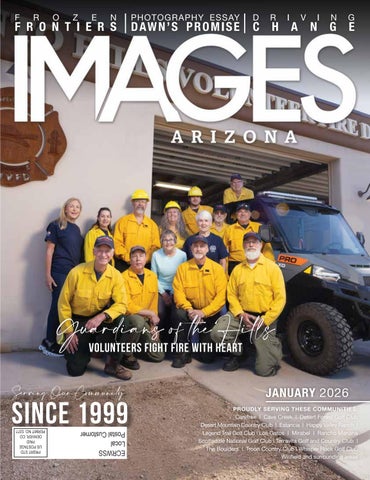
JANUARY 2026 PROUDLY SERVING THESE COMMUNITIES: Carefree l Cave Creek l Desert Forest Golf Club Desert Mountain Country Club l Estancia l Happy Valley Ranch l Legend Trail Golf Club l Los Gatos l Mirabel l Rancho Manana Scottsdale National Golf Club l Terravita Golf and Country Club l The Boulders l Troon Country Club l Whisper Rock Golf Club Winfield and surrounding areas Serving our community Since 1999
2 0 2 6 January
1
ECRWSS Local Postal Customer
PRSRT STD US POSTAGE PAID DENVER, CO PERMIT NO. 5377
DON’T LET AGE CHANGE YOU. CHANGE THE WAY YOU AGE. REVERSE OSTEOPOROSIS NATURALLY INCREASE MUSCLE STRENGTH AND BALANCE DOCTOR LED COMPREHENSIVE BONE HEALTH PROGRAM
Call Now: 480-881-5621
Exclusively At The
THE CENTER FOR INTEGRATIVE HEALING & WELLNESS BioStrongStudio.com 2
January 2 0 2 6
36600 N. Pima Rd, Suite 103, Carefree, AZ 85377 Serving our community Since 1999
®
We brought the power of Compass to North Scottsdale
Meet Karen Baldwin, North Scottsdale Luxury Specialist
Karen Baldwin, REALTOR (480) 694-0098
®
Actively selling Desert Mountain since January 1995, Karen draws on her experience of having designed four custom homes and building two “Golden Nugget” award winners, to provide the detailed expertise Desert Mountain clients require. Her knowledge of the community and exclusive attention to Desert Mountain properties allows her to provide detailed knowledge of the community’s history, club operations, design review, and other issues important to members.
FEATURED LISTING 37200 N Cave Creek Rd 1082 SCOTTSDALE, AZ 85262 OFFERED AT $4,595,000
30+
$2B+
Years in Desert Mountain
Closed Sales
1200
Homes Sold
Serving our community Since 1999
Not intended as a solicitation if you are currently working with a real estate agent.
100
Top Sales Associate 2024 2 0 2 6 January
3
4
January 2 0 2 6
Serving our community Since 1999
OFFLINE IS THE NEW LUXURY
AZADI FINE RUGS Since 1790
Fine Contemporary & Antique Rugs 7001 N Scottsdale Rd @ Indian Bend Scottsdale, AZ SCOTTSDALE (480) 483-4600 SEDONA (928) 203-0400 JACKSON (307) 734-0169 TELLURIDE (970) 728-4620 www.azadifinerugs.com
BELLA FINE GOODS Be Inspired
Fine Jewelry Home Furnishings Fine Art 36889 N Tom Darlington Dr @ Bashas’ Center Carefree, AZ CAREFREE (480) 488-7062 SEDONA (928) 282-0255 JACKSON (307) 201-1848 TELLURIDE (970) 728-2880 www.bellafinegoods.com
Serving our community Since 1999
2 0 2 6 January
5
6
January 2 0 2 6
fu l l s e rv i c e i n t e r i o r d e s i g n & fu r n i s h i n g s w w w. o m d e s i g n g r o u p. c o m - 4 8 0 . 9 1 5 . 0 1 2 9 Serving our community Since 1999
Broadway Stars Laura Benanti & Norm Lewis | 1/16
Counterpoint | 2/13
Morgan Freeman’s Symphonic Blues Experience | 1/8
Jazz at the Lincoln Center Presents: The Great American Crooners | 2/9
The Dreamboats | 1/31
Patti LuPone | 2/16
David Foster & Katharine McPhee | 3/28
The Barricade Boys: Broadway at the Movies | 2/2
Festival Orchestra | 2/22 - 3/1
NORTH SCOTTSDALE’S
PREMIERE CONCERT DESTINATION 50+ CONCERTS FROM OCTOBER – APRIL 480.422.8449 | AZMUSICFEST.ORG Serving our community Since 1999
SEASON SPONSOR
2 0 2 6 January
7
8
January 2 0 2 6
Serving our community Since 1999
Serving our community Since 1999
2 0 2 6 January
9
ARIZONA’S CHOICE to REPRESENT FINE ARTS, ANTIQUES & COLLECTIBLES
Everything we touch turns to sold!
C a l l to d ay to s c h e d u l e a free consultation! 10
January 2 0 2 6
Serving our community Since 1999
5880 West Bell Road, Glendale 623.878.2003 EJSAUCTION.COM
CREATING COMFORT, CURATING SOPHISTICATION: INSIGHTS FROM SUE B.
Our latest showroom vignette demonstrates how comfort and sophistication work in harmony to create spaces that feel both luxurious and livable. At the heart of this setting lies a wedge-shaped sofa — perfect for curling up with a book or enjoying a cinematic escape. Upholstered in sumptuous chenille and complemented by off-white nutria fur pillows, it invites you to sink in and stay awhile.
SUE BICKERDYKE Allied ASID
A gray boucle chair and an off-white leather chair introduce a sophisticated interplay of color and texture, while meticulous stitching transforms the leather chair into a sculptural statement piece. Anchoring the space is a tribal-patterned area rug in serene blues and grays, its sumac weave ensuring both durability and contemporary Southwest flair. The coffee table, crafted from petrified wood, radiates earthy elegance and harmonizes with the rich tones of Amy Lay’s bison painting. Flanking the artwork are three-panel mixed-media pieces by AxtonGedding, which offer endless arrangement possibilities. Sliced agate drink tables add organic luxury. The vignette is adorned with a curated selection of accessories — blue glass, onyx, and oversized pottery vessels — each chosen to enhance the palette. Peeking over the back of the sofa, a covey of bronze quail by Bryce Pettit adds a whimsical yet refined touch, completing the composition. Every element, from furniture to art, is thoughtfully selected to inspire and delight — proving that true luxury lies in the perfect balance of beauty and comfort.
Creating Comfort, Curating Sophistication
36889 N. Tom Darlington Dr. Suite B1, Carefree, AZ | 480-595-0171 | suebickerdyke.com Hours: Mon. thru Sat. 9am - 5pm Appointments are Welcome at sue@suebickerdyke.com Allied ASID Serving our community Since 1999
2 0 2 6 January
11
THIRD THURSDAY ART NIGHT FEATURING AMY LAY
THU R S DAY, JA NUARY 1 5 F RO M 4 TO 7 PM Artist Speaking at 5:15PM
AMY LAY
ARTIST AMY LAY Oil and Charcoal on Canvas
Three Lovelies, 36” x 48”
Creating Comfort, Curating Sophistication 12
36889 N. Tom Darlington Dr. Suite B1, Carefree, AZ | 480-595-0171 | suebickerdyke.com Hours: Mon. thru Sat. 9am - 5pm Appointments are Welcome at sue@suebickerdyke.com Allied ASID
January 2 0 2 6
Serving our community Since 1999
THIRD THURSDAY ART NIGHT
T HU R S DAY, JA NUARY 1 5 F RO M 4 TO 7 P M
RENE PALOMINO
Agave, 42”x 59”
TREVOR SWANSON
Sky Reaches, 28”x 60”
JOE & MARY GIDDINGS
Platters 22” Round
SUE KRZYSTON
The Gourd Rattle, 24” x 30”
BRIT HANSEN
Candy Cactus, 36” x 36”
BRYCE PETTIT Quail Family, life size
36889 N. Tom Darlington Dr. Suite B1, Carefree, AZ | 480-595-0171 | suebickerdyke.com Hours: Mon. thru Sat. 9am - 5pm Appointments are Welcome at sue@suebickerdyke.com Allied ASID Serving our community Since 1999
2 0 2 6 January
13
What's inside
20
28
Frozen Frontiers
34
Community
Guardians of the Hills
56
photo essay
14
January 2 0 2 6
40
Driving Change
82
RECIPE
Serving our community Since 1999
SANDERSON LINCOLN
Serving our community Since 1999
2 0 2 6 January
15
Shelly Spence
MANAGING EDITOR Joseph J. Airdo
GRAPHIC DESIGNER Meaghan Mitchell
CONTRIBUTING WRITERS Joseph J. Airdo Francine Coles Shannon Severson
PHOTOGRAPHERS Francine Coles Loralei Lazurek
ADVERTISING SALES Cindi Calcinari 860-966-3271 cindi@imagesaz.com
Images Arizona P.O. Box 1416 Carefree, AZ. 85377 623-341-8221 shelly@imagesaz.com imagesarizona.com
From the Publisher
PUBLISHER
There’s something profoundly hopeful about January mornings in Arizona. As the first light touches snow-dusted peaks and frost-silvered desert, the landscape itself seems to exhale and begin again. The new year arrives not with fanfare but with quiet renewal — dawn painting the sky in colors no artist could replicate, mountain trails leading to sanctuaries most will never discover. This month’s issue of Images Arizona celebrates winter’s hidden gifts and the spirit of renewal that comes with turning the calendar. Each new year offers a fresh canvas — the promise of a day not yet written, adventures not yet begun. We’ve filled these pages with invitations to explore not the well-trodden paths, but the earned destinations where beauty reveals itself only to those willing to slow down, to show up, to be present. These truths — that renewal requires presence, that the most rewarding destinations demand intention — extend far beyond mountain trails. They shape how artists approach their work, how communities nurture new initiatives, how individuals commit to growth. Throughout these pages, you’ll encounter people and places embodying this spirit: those who show up consistently, who embrace change with courage, who create beauty through dedication. The landscape teaches us, but so do the talented, generous, innovative souls who call Arizona home. This is the gift of beginning again — and we’re honored to share it with you. From our family to yours, we wish you a year filled with discovery, wonder and moments that take your breath away.
Submission of news for community section should be in to shelly@imagesaz.com by the 5th of the month prior to publication. Images Arizona is published by ImagesAZ Inc.
Happy New Year!
Copyright © 2026 by ImagesAZ, Inc. All rights reserved. Reproduction, in whole or part, without permission is prohibited. The publisher is not responsible for the return of unsolicited material.
16
January 2 0 2 6
Photography by Loralei Lazurek
Shelly Spence Publisher, Images Arizona
Serving our community Since 1999
MEET YOUR 3RD GENERATION
Local Jeweler
DESERT MOUNTAIN APPRAISALS
DIAMOND UPGRADES
RETAIL SHOPPING ROLEXES* LUXURY WATCH BUYERS
ESTATE BUYERS
“OVER 1,550+ 5 STAR REVIEWS!”
JEWELRY/WATCH REPAIR CUSTOM DESIGN
*We buy, sell, and trade pre-owned Rolex® watches. We are not an authorized Rolex® dealer nor affiliated with Rolex USA or Rolex SA. All trademarks are the property of their respective owners.
Carefree Location: 7212 E. Ho. Rd, Suite 12-1 Carefree, AZ 85377 480-590-5419 Serving our community Since 1999
2 0 2 6 January
17
ALESSA JEWELRY SHOWCASE
JANUARY 23–24
Friday and Saturday 10 a.m.–5 p.m. ..
Experience the visionary artistry of Alessa Jewelry, where five generations of craftsmanship meet contemporary design. Founded by Yuvraj Pahuja, each collection weaves together his Indian heritage and global influences, creating pieces that celebrate unity in diversity.
.. .. . .. . .. .. ..
..
..
.
. ..
..
..
.
.
STUDIO RENN SHOWCASE
FEBRUARY 10–21
. ..
.
Tuesday through Saturday 10 a.m.–5 p.m.
..
..
.
. ..
..
..
.
Discover Studio Renn’s world of beautifully imperfect fine jewelry, where abstraction meets artistry. Each piece celebrates the off-center and unexpected — antique-cut diamonds set in blackened gold, signature Cacti settings, and designs that blur the line between art and adornment. Experience jewelry that invites you to immerse yourself in imagination.
. .. . .. .. . .. . .
GOLDEN GEOMETRIES THE ARTISTRY OF ALEX ŠEPKUS
FEBRUARY 20–21
.. ..
Friday and Saturday from 10 a.m.–5 p.m.
.. . .. . .. .. . ..
..
..
. ..
..
..
.
.
Enter the extraordinary world of Alex Šepkus, where microscopic artistry meets unparalleled vision. Each 18-karat gold masterpiece showcases intricate geometric patterns and textures that transform jewelry into wearable sculpture. Experience these collectible treasures that have captivated museums and connoisseurs worldwide.
Historic Spanish Village | 7212 E. Ho Hum Rd. # 7, Carefree, AZ | 480.575.8080 | GraceReneeGallery.com
18
January 2 0 2 6
Serving our community Since 1999
LUMINOUS BY BROOKE WITH ROBERT PROCOP ..
..
MARCH 3
..
..
..
..
. ..
..
Tuesday 4–7 p.m.
.. . ..
Experience an evening of celestial wonder as Brooke Shields and renowned gemologist Robert Procop unveil Luminous — a collection three years in the making. This immersive celebration features extraordinary jewels inspired by lunar cycles, accompanied by authentic moon and Mars meteorites.
.. .. . .. .
Grace Renee Gallery is a refreshingly beautiful way to explore fine contemporary art in the breathtaking shadows of the Sonoran Desert foothills of Carefree, Arizona. Artfully designed jewelry, inspiring sculptures, spectacular wall art, stunning ceramics and more await.
UPCOMING EVENTS
.. .. ..
..
..
..
. ..
MARCH 3–14
Tuesday–Saturday 10 a.m.–5 p.m.
..
OPULENCE! A HIGH JEWELRY EXTRAVAGANZA
.. .. .. . .. .. ..
Immerse yourself in the pinnacle of luxury with our high jewelry showcase featuring David Gross, Robert Procop, David Weisz and many others. Master jewelers, each representing generations of expertise, present exceptional gemstones set in breathtaking designs.
Historic Spanish Village | 7212 E. Ho Hum Rd. # 7, Carefree, AZ | 480.575.8080 | GraceReneeGallery.com Serving our community Since 1999
2 0 2 6 January
19
Frozen Frontiers Arizona’s Hidden High Country Writer Joseph J. Airdo West Fork // Photo Courtesy of USDA Forest Service, Coconino National Forest
T
he first heavy snow changes everything. Gates swing shut across forest roads. Plowed pavement gives way to unmarked white. The crowds that mobbed these lakes and trails all summer vanish, leaving the high country to those who understand that Arizona’s most compelling landscapes emerge only when wrapped in winter silence.
Between December and early April, when road closures turn casual destinations into earned expeditions, Arizona’s mountains reveal a different character entirely. This isn’t the Arizona of resort brochures or commercial ski hills. These are places where preparation matters, where solitude becomes the reward, and where the landscape — simplified to snow, trees and occasional wolf tracks — offers something increasingly rare: the chance to be genuinely alone in transformed wilderness.
20
January 2 0 2 6
Serving our community Since 1999
ALPINE HEART
Hannagan Meadow sits at 9,100 feet along Highway 191, serving as the spiritual center of the White Mountains. The historic lodge provides warmth and lodging, but the real attraction sprawls beyond — vast meadows rimmed by dense spruce-fir forests, Nordic ski trails disappearing into the timber, and elk emerging at dawn from the tree line. Families return here season after season, generation after generation, to the same sledding hills and snowshoe trails their parents and grandparents knew. Just west lies Williams Valley Winter Recreation Area, where old-school sledding happens without commercialization. No groomed runs, no ticket windows, no infrastructure — just a beloved community hill and the instruction to bring your own sled. The nearby Railsto-Trails rest stop on Route 260 offers steeper terrain for serious sledders, while Toboggan Hill Trailhead near Greer continues the tradition with nothing more than a Forest Service parking lot and slopes worn smooth by decades of use. But the White Mountains’ most evocative winter destinations require genuine effort. Crescent Lake, a 100-acre alpine gem at 9,000 feet, sits just 2 miles north of Big Lake yet becomes completely vehicle-inaccessible from December through early April. The snowshoe approach — the only approach — rewards with a frozen mirror reflecting subalpine forest and the satisfaction of reaching a place most will never see in winter. Winter fish kills necessitate spring restocking, making this a truly seasonal destination that exists fully only when buried under snow. Pole Knoll Recreation Area near Greer spreads 18 miles of interconnected trails through terrain at 9,000 feet. Originally designed in the 1980s by a U.S. Forest Service employee seeking somewhere to ski after work, these routes carry evocative names: Red Tail, Osprey, Raven, Meadowlark. The Summit Trail climbs 800 feet to White Mountains views, while gentler loops wind through ponderosa and aspen groves. Unlike commercial operations, Pole Knoll remains beautifully undeveloped — trails, snow, silence.
In your corner & around the corner.
Jeremy Mueller Ins Agcy Inc 3 locations to serve you: Scottsdale Rd/101 602-388-8382 Pinnacle Peak/Pima 480-515-5223 Carefree 480-488-2800 www.jeremymueller.com
Like a good neighbor, State Farm is there.®
For wilderness seekers, Escudilla Mountain shelters Arizona’s third-highest peak at 10,916 feet in the far eastern mountains. Winter transforms the 6.6-mile round trip into genuine mountaineering, gaining 1,600 feet through territory that shelters Mexican wolves, elk and
Availability and amount of discounts and savings vary by state. State Farm Mutual Automobile Insurance Company State Farm Indemnity Company State Farm Fire and Casualty Company State Farm General Insurance Company Bloomington, IL State Farm County Mutual Insurance Company of Texas State Farm Lloyds Richardson, TX State Farm Florida Insurance Company Winter Haven, FL
Serving our community Since 1999
2 0 2 6 January
21
These are places where preparation matters, where solitude becomes the reward and where the landscape — simplified to snow, trees and occasional wolf tracks — offers something increasingly rare: the chance to be genuinely alone in transformed wilderness.
USDA Photo by Lance Cheung
black bears. Recent trip reports note total solitude — entire days without encountering another human. Mount Baldy Wilderness, while its 11,421-foot summit remains off-limits on Apache land, offers the East and West Baldy loop exploring the Little Colorado River’s headwaters through subalpine forest. Winter transforms this 16-mile journey into an expedition through ancient Douglas firs where you’ll likely be the only hikers for miles. The Blue Range Primitive Area — the only such designation remaining in the National Forest System that hasn’t been reclassified as wilderness — offers 173,762 acres of rolling ponderosa hills and deep canyons along Arizona’s eastern border. Winter visitors find wolf tracks, ecological diversity despite 2011 Wallow Fire impacts and profound isolation.
NORTH OF THE NOISE
While Snowbowl draws weekend crowds, Flagstaff’s winter magic happens elsewhere. Arizona Nordic Village offers more than 40 kilometers (24 miles) of groomed trails and 15-plus miles of marked snowshoe routes through
22
January 2 0 2 6
ponderosa pines northwest of the city. What distinguishes this sanctuary isn’t just the trail system but the remote yurts and cabins scattered across acres of forest. Weekdays feel nearly private — watching snow sift through trees, hearing only the swish of skis and Steller’s jays overhead. Lake Mary, just southeast of Flagstaff, transforms completely under winter conditions. While Lower Lake Mary often lies dry, Upper Lake Mary sometimes freezes solid enough to invite ice anglers and lakeside wanderers. Locals flock here for sunrise walks along wind-scoured dikes, watching for elk herds in meadows beyond. When access roads close, the basin becomes stark, beautiful and visited only by those seeking genuine off-season peace. Mormon Lake reaches peak magic after deep snowfall. When conditions allow, local enthusiasts groom a network of cross-country trails weaving through meadows and old-growth pines. The Mormon Lake Ski Touring Center provides a low-key hub far from commercial operations. On bluebird mornings, the frozen lake glows against snowdusted ponderosas.
Serving our community Since 1999
Hart Prairie Road and the trail to Bismarck Lake offer lesstraveled routes on the San Francisco Peaks’ western flanks. Forest Road 151 winds through ponderosa and aspen glades with Hochderffer Hills to the west and the peaks looming between branches. When winter closes roads to vehicles, snowshoers and skiers discover this meadowstudded landscape transformed, following the 1.5-mile trail to Bismarck Lake where elk, deer and raptors gather. Lockett Meadow and Inner Basin Trail, famous for fall aspens, become winter destinations when snow closes Forest Road 552. Winter buries the meadow and Inner Basin under deep snow, creating opportunities for backcountry skiing and snowshoeing to 9,792 feet. The narrow road that intimidates summer visitors becomes impassable, turning this into a trek-in destination where elk herds emerge at dusk. For serious backcountry enthusiasts, Kendrick Peak Wilderness harbors the 10,418-foot highpoint of Kaibab National Forest. The 9-mile round trip gains 3,000 feet through fire-scarred ponderosa transitioning to higher elevations. Winter transforms this into a serious undertaking, with snow accumulations past 9,400 feet and ice-covered upper sections requiring microspikes. Isolation increases dramatically in winter — you might encounter only a ranger with a dog. Kachina Peaks Wilderness along the south face of the San Francisco Peaks offers the 5-mile Kachina Trail through old-growth forest at 8,800 to 9,500 feet. The trail crosses dramatic lava cliffs from 600,000-year-old eruptions and winds through ancient Douglas fir, limber pine and fern meadows. Winter snow accumulations make this genuine backcountry territory, far from Snowbowl’s crowds.
THE RIM’S HIDDEN EDGE
The Rim Lakes area — Woods Canyon and Bear Canyon — sees road closures that create both challenges and opportunities. Woods Canyon sits atop the rim surrounded by ponderosa pine, Douglas fir and oak, its 52-acre surface freezing over in harsh winters. Those willing to approach on snowshoes or cross-country skis find solitude in terrain mobbed during summer. Willow Springs Lake near Payson becomes an ice fishing destination known primarily to locals in the region. The 158-acre lake, with an average depth of 60 feet, freezes solid from December through March. It is inaccessible by vehicle but perfect for adventurous ice anglers. Summer crowds disappear entirely as winter transforms the lake
Serving our community Since 1999
2 0 2 6 January
23
USDA Photo by Lance Cheung
Big Lake // USDA Photo by Lance Cheung
Fay Canyon // Photo Courtesy of Coconino National Forest, U.S. Forest Service
into a windswept sheet of ice where only the most dedicated anglers venture. Christopher Creek area along the Mogollon Rim receives reliable snowfall averaging 15 inches annually, with February typically bringing 4.6 inches. The See Spring Trail follows Christopher Creek to cascading springs at the rim’s base, becoming a winter landscape of iced-over cascades and snow-laden pines. Summer camping territory transforms into a quiet winter retreat accessible from Payson.
SOUTHERN SANCTUARIES
Arizona’s sky islands receive surprising snowfall, creating alpine environments in unexpected places. Mount Graham in the Pinaleño Mountains near Safford stands as the state’s most prominent peak at 10,720 feet. Winter road closures from Oct. 15 through April 15 force hikers to start from Shannon Campground at 9,170 feet, creating a genuine winter ascent. Swift Trail becomes a snow-covered service road through pick-up-sticks forests, with summit temperatures cold and winds howling across this isolated sky island.
24
January 2 0 2 6
Rose Canyon Lake, at 7,000 feet on Mount Lemmon, closes its gates from mid-October to mid-April. Determined anglers and hikers walk the mile-long paved road down to this 6-acre alpine lake surrounded by ponderosa pines. The transformation from summer crowds to winter silence is complete — serene lake views, snow-dusted pines and mountain solitude unexpected just 30 miles from Tucson.
EARNING WINTER
These destinations share requirements: preparation, respect and a genuine appetite for solitude. Summer’s casual accessibility vanishes behind snow gates and road closures. Crowds evaporate. The landscape simplifies — snow, trees, silence, occasional wildlife tracks. Pack layers. Carry emergency gear. Check road conditions. Remember that cell service disappears in these sanctuaries. But for those willing to earn their winter experience, Arizona’s hidden high country offers something increasingly rare — the chance to encounter true solitude in landscapes transformed by snow into something approaching the sacred.
Serving our community Since 1999
Serving our community Since 1999
2 0 2 6 January
25
INTERNATIONALLY
ACCLAIMED
AMERICAN ABSTRACT ARTIST
. . . . . . . . . . . . . . . . . . . . . . . . . . . . . . . . . . . . . . . . . . .
G R A C E R E N E E G A L L E RY P R E S E N T S
David Rothermel Come meet David and view his bold, colorful paintings on display in our gallery located in Historic Spanish Village. Wind down from your week while enjoying wine and light appetizers with the artist.
Thursday, February 19 4–7 p.m.
26
January 2 0 2 6
Serving our community Since 1999
ARTIST
DAVID
ROTHERMEL
FEBRUARY 19,
2026
FEATURED SELECTED COLLECTIONS:
Phoenix Children’s Hospital Revlon, Inc. General Motors Corporation Pennsylvania State Museum Joe Walsh/Eagles National 3M Corporation Hilton Hotels President George W. Bush Two Dolphin Hotel Union Pacific Railroad
. . . . . . . . . . . . . . . . . . . . . . . . . . . . . . . . . . . . . . . . . .
Historic Spanish Village 7212 E. Ho Hum Rd. # 7 | Carefree, AZ 85377 480.575.8080 GraceReneeGallery.com
Serving our community Since 1999
2 0 2 6 January
27
Community
Writer Joseph J. Airdo
JAN. 16 A NIGHT ON BROADWAY WITH LAURA BENANTI AND NORM LEWIS Presented by Arizona Musicfest, Tony Award winner Laura Benanti and Tony Award nominee Norm Lewis unite for a special evening of Broadway music. $53+. 7:30 p.m. Highlands Church, 9050 E. Pinnacle Peak Road, Scottsdale. 480-4228449; azmusicfest.org
JAN. 9–11 CAVE CREEK FINE ART & WINE FESTIVAL The 16th annual festival returns to Stagecoach Village, showcasing local and regional artists with bronze, clay, glass, metal and wood sculptures in an openair plaza. Guests can enjoy live music, festival food and wine tastings from local wineries on Saturday and Sunday. Free. 10 a.m.–5 p.m. Stagecoach Village, 7100 E. Cave Creek Road, Cave Creek. 623734-6526; vermillionpromotions.com
JAN. 10 DARK SKY PRESENTATION Astronomer Mark Johnston takes guests behind the scenes of his recent scientific adventure to a 16,500-foot Chilean observatory atop the Andes Mountains. Johnston will narrate his documentary and answer questions following the screening. Free; RSVP required. 10:30 a.m. Desert Foothills Library, 38443 N. School House Road, Cave Creek. 480-488-2286; dfla.org
JAN. 10 GRAND OPENING OF DAISY MOUNTAIN FIRE STATION NO. 144 The Town of Cave Creek and Daisy Mountain Fire & Medical invite the community to celebrate the grand opening
28
January 2 0 2 6
of Fire Station No. 144, a new facility designed to bolster wildfire protection and expand emergency medical services for the Desert Hills and Cave Creek areas. Visitors can meet local firefighters, tour the station and enjoy activities for all ages while learning about the enhanced safety resources now serving the region. Free. 10–11 a.m. Daisy Mountain Fire Station No. 144, 2402 E. Cloud Road, Desert Hills. cavecreekaz.gov
JAN. 10 NEIL BERG’S THE '70S Presented by Arizona Musicfest, this concert relives the golden age of rock ‘n’ roll with hits and stories from iconic artists including Elton John, Fleetwood Mac, Queen, The Rolling Stones and David Bowie. $54+. 2 p.m. and 7:30 p.m. Highlands Church, 9050 E. Pinnacle Peak Road, Scottsdale. 480422-8449; azmusicfest.org
JAN. 12 AMAZING ARTISTS SERIES: TED LOOMIS The Sonoran Arts League and The Holland Center present mixed media and encaustic artist Ted Loomis. A U.S. Air Force combat veteran and former Boeing technologist, Loomis will discuss his creative process, which spans painting,
Serving our community Since 1999
photography and sculpture. $10. 10 a.m. Holland Community Center, 34250 N. 60th St., Scottsdale. 480-488-1090; hollandcenter.org
JAN. 12 ENJOYING AND UNDERSTANDING LOCAL BIRDS The McDowell Sonoran Preserve is home to more than 190 of Arizona’s 300 bird species. McDowell Sonoran Conservancy expert Rick Pearce explores the habitat, diet and behavior of these desert residents, offering binocular tips and advice on spotting elusive species like raptors and hummingbirds. Free; RSVP requested. 3:30 p.m. Holland Community Center, 34250 N. 60th St., Scottsdale. 480-488-1090; hollandcenter.org
JAN. 13 THE GREAT DESERT ESCAPE Author and historian Keith Warren Lloyd recounts the largest prisoner-ofwar escape in North America during World War II, detailing the 25 German sailors who tunneled out of the Papago Park Prisoner of War Camp. Free; RSVP requested. 5 p.m. Holland Community Center, 34250 N. 60th St., Scottsdale. 480-488-1090; hollandcenter.org
JAN. 15 CAREFREE ART NIGHT Local and regional artists showcase their work at participating galleries during this monthly celebration. Enjoy live music, refreshments, artist talks and demonstrations. Free. 4–7 p.m. See website for participating galleries and event map. visitcarefree.com/artnight
JAN. 16–18 WINTER CAREFREE FINE ART AND WINE FESTIVAL Thunderbird Artists welcomes art lovers to downtown Carefree for a showcase of more than 155 juried fine artists, featuring bold paintings, beautiful sculptures, photography, jewelry, and more. Enjoy live music, gourmet food, decadent chocolates, and wine tastings. $5. 10 a.m.–5 p.m. Carefree Desert Gardens, 101 Easy St., Carefree. 480837-5637; thunderbirdartists.com
JAN. 16–MARCH 29 ARIZONA FINE ART EXPO This 10-week juried art show features more than 120 renowned and emerging artists working in onsite studios. Visitors can watch the creative process in mediums ranging from painting and sculpture to glass and jewelry, or explore the two-acre sculpture garden. $12; discounts available. 10 a.m.–6 p.m. 26540 N. Scottsdale Road, Scottsdale. 480-837-7163; arizonafineartexpo.com
JAN. 17–MARCH 29 CELEBRATION OF FINE ART Under the signature big white tents, 100 artists set up working studios for the 36th annual exhibition, allowing collectors to connect directly with creators. The event features 40,000 square feet of art in diverse mediums, a sculpture court and the weekly Art Discovery Series on Fridays. $12; discounts available. 10 a.m.–6 p.m. 7899 E. Mayo Blvd., Scottsdale. 480443-7695; celebrateart.com
Serving our community Since 1999
2 0 2 6 January
29
Community
Writer Joseph J. Airdo
JAN. 18 ARIZONA CONCOURS D’ELEGANCE Arizona’s premier collector-car event showcases 100 rarely seen vehicles in a professionally judged exhibition. The upscale lifestyle gathering features classes celebrating 140 years of Mercedes-Benz, 125 years of Indian motorcycles, midcentury station wagons, dune buggies, European sports/racing cars, and modern supercars. Enthusiasts are encouraged to dress in period costumes, with awards for best outfits and top vehicles. Proceeds support local arts programs and Make-A-Wish Arizona. $75+. See website for schedule. Scottsdale Civic Center, 7380 E. Second St., Scottsdale. 480-499-8587; arizonaconcours.org
JAN. 17–25 BARRETT-JACKSON SCOTTSDALE AUCTION Celebrate automotive history as thousands of rare, unique and valuable vehicles cross the auction block at Barrett-Jackson’s world-class event in Scottsdale. Enjoy live entertainment, thrill rides, celebrity appearances, food and shopping in the vast Exhibitor Marketplace. See website for prices and schedule. WestWorld of Scottsdale, 16601 N. Pima Road, Scottsdale. 480421-6694; barrett-jackson.com
This lecture explores the evolution of medicine from the 20th century to the present, examining how disease control increased life expectancy and how artificial intelligence might shape the future. Jim Sherbert, former Holland Center board chair, leads the discussion on the structure and function of today’s medical industry. Free; RSVP requested. 4 p.m. Holland Community Center, 34250 N. 60th St., Scottsdale. 480-4881090; hollandcenter.org
JAN. 18 GARRISON KEILLOR AT 83
JAN. 24 ANNIE AUDITIONS
Presented by Arizona Musicfest, the beloved storyteller and humorist brings his signature blend of standup, storytelling and song to Scottsdale with special guests Heather Masse and Rich Dworsky. Keillor’s performance centers on the theme of cheerfulness, featuring “News from Lake Wobegon,” sung sonnets and duets ranging from Bob Dylan to Paul Simon, concluding with an audience sing-along of American classics. $66+. 7:30 p.m. La Casa de Cristo Lutheran Church, 6300 E. Bell Road, Scottsdale. 480-422-8449; azmusicfest.org
30
JAN. 20 AMERICAN MEDICINE
January 2 0 2 6
Desert Foothills Theater holds open calls for adults, teens and children ages 7 and older to join the cast of this Tony Award-winning musical. Participants must reserve a five-minute time slot online and prepare one minute of a song in the style of the show; vocalists should bring backing tracks on a mobile device to play via a provided Bluetooth speaker. Video submissions are also accepted if received by the audition date. The Holland Center, 34250 N. 60th St., Scottsdale. 480-488-1981; dftheater.org
Serving our community Since 1999
JAN. 24 DRIVE ELECTRIC ARIZONA Presented by experienced vehicle owners John Martinson and Peter Culin, this interactive event offers guests the choice to ride in or drive a variety of electric vehicles. Attendees can explore EVs on display and learn about the cost benefits and exhilarating experience of ownership. Free; RSVP required. 11 a.m.–3 p.m. Desert Foothills Library, 38443 N. School House Road, Cave Creek. 480-488-2286; dfla.org
JAN. 24 FOOTHILLS FOOD BANK FARMERS MARKET Foothills Food Bank & Resource Center hosts its monthly farmers market, featuring artisan breads, spreads, sweets and fresh local produce. Shoppers can enjoy a relaxed market morning while supporting small businesses, with a portion of all sales benefiting the food bank’s programs for neighbors in need. Free. 10 a.m.–1 p.m. Foothills Food Bank & Resource Center, 4250 E. Carefree Hwy., Cave Creek. 480-4881145; foothillsfoodbank.com
S U R PA S S I N G E X P E C TAT I O N S O N E S A P P H I R E AT A T I M E
DAVID GROSS FINE GEMSTONE COLLECTION
Each bespoke jewel the David Gross Group creates has its own character, its own story. The spectacular quality of each gemstone is further enhanced by the finest craftsmanship and elegant award-winning design. Left: 13 carat asscher cut sapphire with trapezoid diamonds Center: 11 carat royal blue sapphire with diamonds Right: 10 carat emerald cut blue sapphire with diamonds
7212 E. Ho Hum Rd. # 7 | Carefree, AZ 85377 Hours Tue.–Sat. 10 a.m.–5 p.m. By appointment Sun. and Mon. 480.575.8080
GraceReneeGallery.com Serving our community Since 1999
2 0 2 6 January
31
Community
Writer Joseph J. Airdo
JAN. 23–24 ALESSA JEWELRY SHOWCASE Experience the visionary artistry of Alessa Jewelry, where five generations of craftsmanship meet contemporary design. Founded by Yuvraj Pahuja, each collection weaves together his Indian heritage and global influences, creating pieces that celebrate unity in diversity. Free. 10 a.m.–5 p.m. Grace Renee Gallery, Historic Spanish Village, 7212 E. Ho Road, Carefree. 480-575-8080; gracereneegallery.com
JAN. 27 6,000: A NIGHT OF CHANGE Pearl at the Mailbox hosts a human trafficking awareness event in Desert Mountain featuring a keynote by author and survivor Sheri Lopez. Marking the release of her book “6,000,” the evening explores grooming prevention and includes a Mexican dinner buffet. See website for prices and location. 6 p.m. 602-321-0074; pearlatthemailbox.org
JAN. 29 BINGO NIGHT Soroptimist International of Happy Valley of the Sun hosts a fundraising evening featuring a taco bar, desserts, drinks, games and prizes, with raffle opportunities and extra cards available. Proceeds support the organization’s mission to improve the lives of women and girls through education. $40. See website for time. The Holland Center, 34250 N. 60th St., Scottsdale. sihappyvalleyofthesun.org
JAN. 31 THE DREAMBOATS Presented by Arizona Musicfest, this Canadian quartet brings back the golden age of rock ‘n’ roll, infusing the sounds
32
January 2 0 2 6
of the 1950s and 1960s with fresh, contemporary energy. The group delivers a high-energy performance featuring hits reminiscent of icons like Elvis Presley, Chuck Berry and the Beatles, keeping the spirit of the era alive for a new generation. $47+. 2 p.m. and 7:30 p.m. Highlands Church, 9050 E. Pinnacle Peak Road, Scottsdale. 480-422-8449; azmusicfest.org
JAN. 31 PARADA DEL SOL PARADE & TRAIL’S END FESTIVAL Kick off Scottsdale’s Western Week as more than 150 colorful floats, horses, marching bands and community groups march down Scottsdale Road in the beloved Parada del Sol Parade. The fun continues with the Trail’s End Festival — an all-ages block party in Old Town Scottsdale with live music, a kids zone, and a variety of food and merchandise vendors. Free. Parade: 9:30 a.m.–noon; Festival: noon–5 p.m. See website for parade route and event highlights. scottsdaleparade.com
FEB. 2 THE BARRICADE BOYS Presented by Arizona Musicfest, this West End sensation returns with their
Serving our community Since 1999
new show, “Broadway at the Movies.” The performance blends pop, rock and swing classics with stories from their careers in major productions including “The Phantom of the Opera” and Wicked.” $58+. 2 p.m. and 7:30 p.m. Highlands Church, 9050 E. Pinnacle Peak Road, Scottsdale. 480-422-8449; azmusicfest.org
JUBILATE CONSERVATORY ENROLLS FOR SPRING Now located in Spanish Village in Carefree, Jubilate Conservatory of Music is currently registering students for the spring 2026 semester. Supported by Kiwanis of Carefree, the school offers programs for children and adults of all ages, including Music for Mommy and Me, Littles on Fiddles, choir, orchestra, and private instruction in piano, organ, voice and strings. See website for prices and schedule. Jubilate Conservatory of Music, 7211 E. Ho Road, Suite 24, Carefree. 480-993-6147; jubilateconservatoryofmusic.org
KIWANIS CLUB FUNDS 1,000 MEALS The Kiwanis Club of Carefree this fall provided funding for the Foothills Food Bank to distribute 1,000 holiday
meals to families in need throughout the Desert Foothills. Initially intended to support both Thanksgiving and Christmas, the full allocation served families at Thanksgiving alone, responding to a one-third increase in food assistance requests compared to the previous year. kiwaniscarefree.org
LAND PRESERVATION GROUP AWARDS GRANTS Desert Mountain’s Land Preservation Group, the Desperados, has awarded philanthropic grants to two local nonprofits: Carefree Park and the Sonoran Arts League. The contribution supports Carefree Park’s mission to preserve the final 48 acres of accessible Sonoran Desert in Carefree and advances the Sonoran Arts League’s efforts in art education and community programming throughout the Desert Foothills. dmdesperados.org
NEW LICENSE PLATE SUPPORTS ARIZONA WINERIES The Arizona Department of Transportation has introduced the Verde Valley Wine Trail specialty license plate, now available to all Arizona motorists. Proceeds from the $25 annual fee include a $17 donation to the Verde Valley Wine Trail, a nonprofit organization dedicated to advocating for sustainable vineyard practices, promoting responsible driving and encouraging tourism in northern Arizona’s wine country. The colorful plate is available for both standard vehicles and motorcycles and can be ordered online through the Motor Vehicle Division. azmvdnow.gov
Serving our community Since 1999
2 0 2 6 January
33
Guardians of the Hills Volunteers Fight Fire with Heart
Writer Joseph J. Airdo Photography by Loralei Lazurek
T
he radio crackles at 2 a.m. Lightning has struck somewhere in the Tonto Hills, and with gusting winds fanning the flames, what starts as a flicker can become an inferno in minutes. In this exclusive desert enclave — where 150 homes nestle against 7.9 million acres of Tonto National Forest — the difference between a contained brush fire and a catastrophic wildfire often comes down to 3–8 minutes. That’s how long it takes the Tonto Hills Volunteer Fire Department, under the leadership of Fire Chief Rick Holasek, to get water on a fire. “When you’re facing an actual wildfire, you want to know there’s something in place to protect you,” says Ann DiChiara, administrative president and fundraiser for the nonprofit,
34
January 2 0 2 6
Serving our community Since 1999
When you’re facing an actual wildfire, you want to know there’s something in place to protect you. Ann DiChiara
all-volunteer department and a recently retired neonatal intensive care nurse from HonorHealth. “Right now, we only have one truck. When those winds pick up and flames are 10 feet or 20 feet high, it’s a whole different situation. That’s when you realize: We really need some serious power out here.” It’s a sobering assessment from a woman who has spent two decades serving her community — first as a firefighter, now as a leader and organizer. But DiChiara isn’t sounding an alarm; she’s rallying support for a critical mission that extends far beyond Tonto Hills’ borders.
A LEGACY BUILT ON NEIGHBORLY COMMITMENT The Tonto Hills Volunteer Fire Department traces its origins to 2000, when residents Lou Frederick and Ed Voss recognized the isolation their small community faced. With emergency response times stretching 18 to 22 minutes from the nearest station, these early pioneers embodied what Scott Bell, retired captain and training officer, calls “classic cowboy mentality.” “Lou’s philosophy was simple: when a neighbor needs help, we’ll be there,” says Bell, who spent nearly 20 years volunteering with the department while simultaneously serving as a Southwest Airlines captain. “It wasn’t just about fire emergencies — we ended up getting to know our neighbors extremely well. We all came from different backgrounds and had various opinions and beliefs, but when someone needed help, everyone came together.”
Serving our community Since 1999
2 0 2 6 January
35
That ethos remains the department’s foundation. Whether it’s rattlesnake removal, medical emergencies, or searching for a neighbor with Alzheimer’s who wandered from home, THVFD volunteers respond to whatever their community needs. They’ve installed AED machines throughout the neighborhood — some purchased by residents themselves — because a 15-minute response time for chest pain is simply too long. They’ve trained in wilderness first responder techniques along with wildland firefighting protocols to bridge the gap until Rural Metro arrives. They’ve even mastered the art of convincing stubborn neighbors to actually get into ambulances. “There was one neighbor who fell down a 60-foot ravine behind her house,” Bell recalls. “She managed to crawl back up in the dark, but she had severe head contusions. She was actually unbuckling herself from the stretcher in the ambulance and pulling out her IVs, trying to leave because she was afraid nobody would come pick her up from the hospital. Bell said, ‘Don’t worry — I’ll come get you.’” These kinds of moments — intimate, urgent, fundamentally human — define what it means to be a volunteer firefighter in one of Arizona’s most exclusive communities. The department’s 20-plus volunteers don’t just protect property; they safeguard the lives and wellbeing of neighbors who have become friends.
LIVING ON THE EDGE OF WILDFIRE Geography makes Tonto Hills particularly vulnerable. The community sits at the wildland-urban interface, bordered by Tonto National Forest to the north and Desert Mountain to the south. When the Cave Creek Complex Fire roared through the area in 2005, burning 248,000 acres, THVFD volunteers stood alongside their mutual aid partners holding the fireline as planes dropped fire retardant slurry nearby. “The only thing that saved us was a change in the wind and a rainstorm at 3 a.m.,” Bell says. “If that hadn’t happened, our community and the community of Desert Mountain could have been lost.” That near-miss galvanized the community. In 2021, Tonto Hills achieved Firewise community designation, and the fire department now proactively visits homes — especially those of new property owners — to offer guidance on creating defensible space and fire-safe
36
January 2 0 2 6
Serving our community Since 1999
landscaping. DiChiara, who helps welcome new residents through an informal committee, provides information packets emphasizing the importance of clearing at least 30 feet around homes. “Homeowners often reach out to us to ask if their property looks safe, and the fire department is happy to offer advice,” DiChiara says. “We really work well as a community when it comes to fire mitigation. Everyone is engaged and willing to help, which makes all the difference here.” But community engagement, while compensate for inadequate equipment.
essential,
cannot
The department currently operates with one dependable brush truck — a 2007 vehicle on long-term loan from the U.S. Forest Service. When THVFD received it in 2017, the diesel turbocharger was out, the transmission wasn’t working, and it needed significant repairs. The truck carries 300 gallons of water — not much by structural firefighting standards, but critical for initial attack on brush fires. Combined with the team’s intimate knowledge of local terrain and rapid response capability, it has proven invaluable. But a single truck, now approaching two decades of hard service on rugged forest roads, leaves the community dangerously exposed. The department’s second truck required so many repairs that it was beyond saving. In its place, they purchased a side-byside utility vehicle that can deploy 400 to 500 feet of hose connected to standpipes throughout the community. While useful for small incidents, it’s not equipped to carry water — a critical limitation when fires move fast. The mathematics of wildfire spread are unforgiving. In the 15 minutes it takes Rural Metro to climb the hill from Carefree, a half-acre fire can triple in size — even more with wind. By the time outside agencies arrive, flames that THVFD could have contained in minutes become multiacre threats to homes.
A PRACTICAL PATH FORWARD The solution doesn’t require a $200,000 brand new truck. Quality used brush trucks — regularly upgraded by professional departments — are available for $40,000 to $60,000. That’s THVFD’s target: a well-maintained vehicle with a functioning pump that can serve as primary equipment, allowing the current Forest Service truck to become backup. “We just need a reliable vehicle we can count on during a fire,” DiChiara says. “If we need two trucks on site, we have to make it happen for the safety of everyone.”
ART & WINE FESTIVALS
Sip, savor, and celebrate!
Step into Arizona’s most unforgettable festival experiences, brought to you by Vermilion Promotions. Whether you’re an art lover, wine connoisseur, music enthusiast, or a culinary explorer, Vermillion curates an immersive celebration where creativity, flavor, and community come together in perfect harmony. Free admission.
Stagecoach Village Art & Wine Festival Jan. 9-11, 2026 Mar. 20-22, 2026
Kierland Fine Art & Wine Festival Jan. 31Feb. 1, 2026
Wigwam Fine Art Festivals
Feb. 13-15, 2026
Tubac Festival of the Arts Feb. 4-8, 2026
Oro Valley Art & Wine Festival Feb. 28Mar. 1, 2026
High Street Art Festival Mar. 7-8, 2026
SanTan Art & Wine Festival
Mar. 28-29, 2026
“Place Where Butterflies Land” Kim Seyesnem Obrzut
vermillionpromotions.com
623.734.6526
Serving our community Since 1999
2 0 2 6 January
37
When you’re facing an actual wildfire, you want to know there’s something in place to protect you. Ann DiChiara
“This little development truly needs help to get a fire truck, and we’re grateful for any support the community can provide,” DiChiara says. The stakes extend beyond one small community. If a fire isn’t stopped at Tonto Hills, it moves south toward Desert Mountain and its high-value homes, or north into millions of acres of national forest. THVFD serves as the first line of defense not just for its own residents, but for a broader swath of North Scottsdale.
The department has made progress through persistent grassroots fundraising. Small community events — typically organized by DiChiara — raise $2,000 to $4,000 at a time. Local businesses like Harold’s Cave Creek Corral and Raven’s View have provided tremendous support, hosting fundraisers and rallying neighbors. Sunny Parker, founder and president of Arizona Foothills 911, has become an irreplaceable asset by connecting THVFD with volunteer and professional fire departments across Arizona. These partnerships have yielded training opportunities, equipment donations and ongoing support that help THVFD provide safer, better-equipped service to their community. Parker also launched a Facebook campaign that secured new helmets for every firefighter — vital equipment the department's limited budget could not otherwise afford. These efforts demonstrate both the community’s commitment and the challenge of reaching a $50,000 goal through small increments. With approximately 150 homes in Tonto Hills, even broad participation yields modest totals.
That support network has proven crucial throughout the department’s history. The U.S. Forest Service has been a keystone, providing the foundation to keep THVFD standing. It has volunteered hundreds of hours of training, supplied the department with surplus wildland uniforms and equipment, and secured the long-term lease of the current brush truck — resources that helped THVFD become a capable wildland firefighting force. Mutual aid agreements with agencies from the U.S. Forest Service, Rural Metro and Cave Creek have strengthened regional preparedness, while organizations like Marie Peck’s Fetch Foundation have supplied specialized equipment, including FIDO bags for animal rescue and resuscitation. “It truly took contributions from various communities to make our fire department possible,” Bell says. Now, the department needs that collaborative spirit to help secure its future.
EXPERIENCE
Tonto Hills Volunteer Fire Department Fundraiser
Saturday, Feb. 14 // See website for time, location and price // tontohills.net/thvfd
38
January 2 0 2 6
Serving our community Since 1999
ANSWERING BACK For readers considering how to support THVFD, the need is straightforward: funding for a quality used brush truck that can reliably serve the community for years to come. But support can take multiple forms beyond direct donations. The department welcomes assistance with grant writing — whether for government grants, municipal programs or foundation funding. Connections to retired equipment from professional departments could prove invaluable; many agencies regularly upgrade trucks that would serve THVFD perfectly. Even expertise in navigating the surplus equipment market or fundraising strategy would make a significant difference. For DiChiara, the vision is both practical and profound: a fire department equipped to protect its community today while inspiring the next generation of volunteers to carry the mission forward. “For our residents, having a reliable fire truck isn’t just a luxury — it’s a safety necessity,” she says. In Tonto Hills, that necessity is born from two decades of neighbors answering the call — showing up for medical emergencies, snake removals and wildfire threats with equal dedication. It’s a legacy built on Lou Frederick’s simple philosophy: when a neighbor needs help, we’ll be there. Now, these volunteers are asking their broader community — from Desert Mountain to North Scottsdale to the entire Valley — to answer that call in return. tontohills.net/thvfd
Support Tonto Hills Volunteer Fire Department
Printed from Chase for Business
Scan in your banking app to pay:
TONTO HILLS VOLUNTEER FIRE DEPARTMENT, t...r@gmail.com
Every dollar brings THVFD closer to a reliable brush truck that can protect the community for years to come. Your tax-deductible donation to this 501(c) (3) nonprofit directly funds equipment that saves lives and property in Tonto Hills and surrounding areas. Scan this QR code with your phone to donate securely online.
Serving our community Since 1999
2 0 2 6 January
39
W
hen Gregg Tryhus was first asked to help envision relocating Arizona State University’s golf teams from Karsten Golf Course to Papago, he saw more than just a new practice facility. He glimpsed the future of Arizona golf itself — a future where collaboration trumps competition, where nonprofits share resources instead of siloing them, and where the state’s $6 billion golf industry speaks with a unified voice. That vision became reality this fall, when the Arizona Golf House officially opened its doors at Papago Golf Club, becoming the nation’s first collaborative hub uniting the state’s leading golf nonprofits under one roof. “Gov. Doug Ducey told me, ‘If golf isn’t organized at the table, it’ll end up on the menu,’” Tryhus recalls, explaining the catalyst that transformed his initial vision into something far more ambitious
40
January 2 0 2 6
than a simple office building. “That led to the formation of the Arizona Alliance for Golf — uniting nonprofits and private organizations to advocate for golf.” The stakes, as Tryhus knows intimately, are higher than most Arizonans realize. Golf’s annual water usage comprises less than 2% of the state’s total, while agriculture accounts for more than 70%. Yet when water restrictions loom, it’s often golf courses that face scrutiny. Agriculture generates $23 billion in economic impact; golf generates $6 billion. Neither figure includes property taxes, real estate absorption, hotel stays, or the presence of 700,000 golfers calling Arizona home. “We didn’t need to reinvent what already existed,” Tryhus says. “We just needed to amplify it, improve messaging and show people how they can participate.”
Serving our community Since 1999
Driving Change Arizona Golf’s New Collaborative Hub Tees Up Unprecedented Unity
The 11 major nonprofits now headquartered at the 14,000-square-foot facility represent Arizona’s golf ecosystem writ large. The Arizona Golf House tenant list reads like a comprehensive directory of the state’s golf community: Arizona Alliance for Golf, AZ Caddie and Leadership Academy, AZ GOLF, Cactus and Pine Golf Course Superintendents Association, Evans Scholars Foundation, First Tee – Phoenix, Greater Southwest Club Management Association of America, Junior Golf Association of Arizona, LPGA*USGA Girls Golf – Phoenix, Southwest PGA, and Youth on Course. For Tryhus, who spent six years volunteering with ASU’s athletic department helping restructure the Sun Devil Club, the journey to this moment required patience and strategic partnerships. When Michael Crow asked him to help relocate the university’s golf teams, an innovative partnership between ASU, the City of Phoenix, and the Arizona Golf Community Foundation was formed, with Tryhus positioning himself as a third-party link between public and private sectors.
Gregg Tryhus, founder of the Arizona Alliance for Golf, has spent more than 30 years building relationships across Arizona’s golf industry to create the collaborative vision now realized at the Arizona Golf House.
“Phoenix leased Papago to ASU, which assigned it to the foundation, with ASU — under Dr. Morgan Olsen and his team — keeping asset management and oversight rights,” Tryhus explains. “From there, with a significant gift from the Grubb Foundation, we developed what’s now Lou’s Bar & Grill — a highly successful community restaurant. We created Evie’s Pavilion, a versatile meeting space, and secured a state-of-the-art facility for the ASU teams and improved the golf course.”
Writer Joseph J. Airdo // Photography by Loralei Lazurek Serving our community Since 1999
2 0 2 6 January
41
Early planning considered a traditional office building with enclosed suites, but budget and timeline constraints prevented that vision from materializing within the three-year construction window. In hindsight, Tryhus says, the delay proved fortuitous. “Not building that old-fashioned office building turned out to be lucky, especially given the shift in the last six to eight years toward collaborative workspaces,” he reflects. “Instead of sectioned-off offices with walls, Golf House is designed for open communication — people sit next to one another, and collaboration happens naturally.” The architectural philosophy, designed by Douglas Fredrikson Architects, built by Wespac Construction and overseen by ASU’s architecture and construction teams, between June 2024 and May 2025, reflects what Tryhus calls “moderately spartan” luxury.
With 700,000 golfers in Arizona, the possibilities for making a positive impact on the quality of life for everyone are endless. Gregg Tryhus “Golf is good for everyone,” says Gregg Tryhus, whose vision for the Arizona Golf House extends beyond the game itself to workforce development, youth mentorship and environmental stewardship.
“There are glass garage doors that open to bring the outdoors in, along with straightforward heating and air-conditioning systems,” Tryhus says. “The facility features a public area that anyone can rent for events, as well as a boardroom available for private functions.” This revenue-generating public space serves a crucial function: it allows the Arizona Golf House to avoid charging rent or operating expenses to the nonprofit tenants working in the back of the building. The design intentionally blends public gathering areas with private tenant spaces that remain connected and accessible — a physical manifestation of the collaborative spirit Tryhus envisioned from the start. “Because of this setup, people are already talking, sharing ideas, and working together,” he notes.
42
January 2 0 2 6
Serving our community Since 1999
“Scheduling conflicts are easier to avoid, and the ability to walk down the hall and, for example, ask someone for help with the AZ Caddie program or get data on how many First Tee kids live in a certain part of town becomes effortless.” The collaboration extends beyond daily operations. Katie Prendergast, executive director of the Arizona Alliance for Golf, oversees all implementation efforts and a board featuring influential leaders including Visit Phoenix President and CEO Ron Price, Arizona Lodging and Tourism President and CEO Kim Sabow, and Experience Scottsdale President and CEO Rachel Sacco. “We’re not just delivering hospitality day to day but working alongside people who shape that industry,” Tryhus says. “Now, the very individuals who lead these major organizations are active members of the Arizona Alliance board. They realize that golf is deeply embedded in the heart of Arizona’s hospitality network.” The interconnected ecosystem Tryhus has built extends beyond the Golf House itself. He describes four overlapping circles: Papago, the Alliance, Golf House, and the Arizona Golf Fund — a philanthropic vehicle established through the $2.1 billion Arizona Community Foundation, founded by Bert Getz. “With Katie and Jock Holiman, we’ve created a website and portal for the Arizona Golf Fund, providing those who want to give back a clear pathway to help protect and grow the game by helping the nonprofits serve Arizona on an even larger scale,” Tryhus explains. The Arizona Golf House’s impact on youth programming particularly animates Tryhus. The resident nonprofits collectively reach more than 150,000 kids annually through various mentorship and educational programs — a figure most Arizonans don’t realize. “Whether it’s your daughter or son who wants to get involved — become a junior caddie, join First Tee, or try any other program — all the opportunities are accessible there,” he says. “It used to be difficult to find and connect with these nonprofits; now, they’re centralized.” For Tryhus, the mission transcends golf instruction. It’s about instilling values. “If we teach kids to finish what they start, play it as it lies, handle their challenges and treat others with respect,
Serving our community Since 1999
2 0 2 6 January
43
Gregg Tryhus (center), founder of the Arizona Alliance for Golf, stands with former Gov. Doug Ducey (left) and longtime Valley of the Sun automotive industry leader and philanthropist Dan Grubb (right), whose leadership on the alliance board has embedded the Arizona Golf House within the heart of Arizona's hospitality network.
44
January 2 0 2 6
Serving our community Since 1999
the game can truly shape their futures in positive ways,” he says. “That’s the real mission.” Looking ahead, the Arizona Golf House is designed to become a center for workforce development, offering real-world training, internships, and career placement in golf, hospitality, tourism, and philanthropy. The facility will also serve as a research hub, collaborating with Arizona State University, University of Arizona, Grand Canyon University, and Northern Arizona University on projects ranging from drought-tolerant grass strains to improved water-use efficiency. Several tenant organizations already maintain robust internship programs. AZ GOLF regularly recruits interns. The Club Management Association of America Southwest Chapter partners with Northern Arizona University and other local higher education institutions. The Junior Golf Association of Arizona trains ASU interns each summer, and First Tee – Phoenix recently welcomed its first ASU intern with plans to expand. “Arizona probably has the most sophisticated statewide irrigation systems in the country — because we have to,” Tryhus notes, addressing the sustainability concerns that prompted the Alliance’s formation. “Water here is extremely expensive.” He cites Gov. Bruce Babbitt’s “brilliant” 1986 decision to cap golf courses at just 90 acres of turf — a strict limitation requiring careful site selection and responsible management. “We never overwater,”Tryhus emphasizes. “In fact, we’re laser-focused on figuring out how to use less water for grass and actively reducing our turf footprint. We’re continuously removing grass and making every effort to be responsible stewards of our water resources.”
Serving our community Since 1999
2 0 2 6 January
45
46
January 2 0 2 6
Serving our community Since 1999
But sustainability, in Tryhus’ view, encompasses more than agronomy and research efforts. It means workforce development, helping people find meaningful careers, and protecting the industry that supports 66,000 jobs across Arizona. It also means Papago, managed daily by Daryl Crawford and Mike Conner of Troon, needed to be designed and operated as the sustainable and profitable business it has become. “Perhaps most importantly, sustainability to me also means safeguarding the values the game brings: economic impact, integrity, respect, all of it,” Tryhus says. “By allowing all these elements to work together — environmental, economic and social — we’re supporting the values that shape our way of life.” The choice of Papago Golf Club as the site carries symbolic weight. As a public and municipal facility, it represents golf’s democratic promise — affordability and accessibility for everyone, regardless of economic status. “I believe the Alliance’s role is to protect the game, which has always been a significant part of my life,” Tryhus reflects. “When I was given the opportunity to help move the ASU teams to Papago, I saw the chance to help Papago become what it was meant to be — a place where golf is accessible to everyone. Once you establish that, no one can take it away because it’s a public facility. It’s not the kind of place someone can just sell out from under you, and that’s what made the effort worthwhile for me.” Having worked in Arizona’s golf industry for more than 30 years, Tryhus leveraged deep relationships to bring the Golf House vision to fruition. Those same relationships now populate the Alliance board and tenant organizations, creating an interconnected network poised to amplify golf’s impact across the state. The Alliance’s tagline — “Golf is good for everyone” — was created by Mike Petty, who has been involved with Tryhus from the beginning. It reflects their shared belief that the game’s benefits extend far beyond those who play it. Property values increase in golf communities. Heat island effects diminish where courses provide tree canopy and green space. Charitable fundraising flows through golf tournaments, generating more than $100 million annually for Arizona nonprofits. The WM Phoenix Open alone, hosted by the Thunderbirds at TPC Scottsdale, has raised $110 million for Arizona charities since 2012.
Serving our community Since 1999
2 0 2 6 January
47
Gregg Tryhus leveraged deep industry connections and strategic partnerships with ASU, the City of Phoenix, and the Arizona Golf Community Foundation to transform Papago Golf Club into Arizona’s hub for community golf.
“It’s not just about golfers — the benefits extend to nongolfers in a very real way,” Tryhus insists. As the Arizona Golf House enters its operational phase, Tryhus sees his role shifting from visionary to facilitator to cheerleader. The infrastructure is built. The partnerships are forged. The nonprofits are collaborating daily under one roof. Now comes the work of maximizing that collaborative advantage. “What’s next is for the tenants to take this as far as they can in the Arizona golf world,” he says. “Golfers will continue to give their time, money and advocacy to help protect the game. The system is in place.” His vision for long-term impact is both ambitious and pragmatic: if each of Arizona’s 700,000 golfers learns the industry’s economic and environmental statistics, they become advocates — at home, in coffee shops, on golf courses with friends. Golfers have always served as mentors to kids. The possibilities for positive impact multiply exponentially. “With 700,000 golfers in Arizona, the possibilities for making a positive impact on the quality of life for everyone are endless,” Tryhus says. Standing at Papago Golf Club, where the Sonoran Desert landscape frames perfectly manicured fairways and the new Arizona Golf House gleams in the afternoon sun, Tryhus’ vision feels both realized and just beginning. The building is complete. The organizations are collaborating. The foundation is laid. What happens next depends on how Arizona’s golf community embraces the opportunity Tryhus has created — not just to play the game, but to protect it, grow it and ensure its values shape future generations. “I truly believe that,” Tryhus says, returning to the Alliance’s central message. “Golf is good for everyone.” azgolfhouse.org
48
January 2 0 2 6
Serving our community Since 1999
Serving our community Since 1999
2 0 2 6 January
49
Writer Joseph J. Airdo // Photography Courtesy of Col. Mark Tillman
An Arizona Aviator’s Air Force One Legacy
Above & Beyond O
n the morning of Sept. 11, 2001, Col. Mark Tillman gripped the controls of the world’s most recognizable aircraft as chaos erupted across America. From the cockpit of Air Force One in Sarasota, Florida, he watched the second plane slam into the World Trade Center’s South Tower on a small television screen. In that moment, the weight of command crystallized: the safety of the President of the United States — and the continuity of American government — rested entirely in his hands. “By the time the second plane hit the tower we knew the country was under attack and at that point the decision was made to do like we always do for the continuity of government — relocate the president of the United States,” Tillman recalls, his voice still carrying the gravity of those moments that redefined a presidency and a nation. Today, the man who commanded Air Force One through America’s darkest hours lives quietly in Scottsdale, his extraordinary career a testament to Arizona’s remarkable tradition of producing the military’s most elite aviators. From his home near Pinnacle Peak — where dust and horses once defined the landscape — Tillman reflects on a journey that took him from Williams Air Force Base to the pinnacle of military aviation, then back to the desert he’s always called home.
50
January 2 0 2 6
THE ZERO FAIL MENTALITY Tillman’s path to Air Force One began, fittingly, in Arizona. After earning his chemical engineering degree from Tulane University, he found himself at Williams Air Force Base near Mesa in 1981, transitioning from rocket propulsion engineer to pilot. The five years he spent there as a T-37 instructor pilot weren’t just about learning to fly — they were about absorbing a philosophy that would define his career. “Everyone at Air Force One trains constantly,” Tillman explains. “Nobody wants to be the one on the crew who fails, so you’re always pushing yourself to be better than everyone around you. There are 200 to 300 people all striving for the same standard of excellence.” That standard — what the Presidential Airlift Group calls “Zero Fail” — became more than doctrine; it became identity. When President Bush selected Tillman as the nation’s 12th presidential pilot in 2001, he inherited command of an operation where perfection wasn’t aspirational — it was mandatory. “We simply don’t let the president down,” Tillman says. “That’s the beauty of a highly trained crew. We’re the experts in the air — fixed-wing assets. That’s what we’re about.”
Serving our community Since 1999
We simply don’t let the president down. We’re the experts in the air — fixed-wing assets. Col. Mark Tillman
From Williams Air Force Base instructor to commander of the world’s most important aircraft, Col. Mark Tillman’s career embodies the “Zero Fail” mentality that defines presidential aviation operations.
THE DAY THAT CHANGED EVERYTHING The morning of Sept. 11 tested every principle Tillman had learned. As President Bush attended a reading event at Emma E. Booker Elementary School, Tillman and his crew monitored reports from New York. When the second tower was hit, the mission became clear: protect the president and ensure government continuity, regardless of his desires to return immediately to Washington. “He couldn’t get back to Washington right away, as much as he wanted to,” Tillman remembers. “We simply weren’t sure whether Washington was safe. We sat in Sarasota, Florida, watching the north and south towers get hit. Then, as the president was moving toward us, the Pentagon was hit. We were told there were still more aircraft that had been hijacked.” The challenges multiplied exponentially. Communication systems failed. Reports flooded in of truck bombs and car bombs in Washington. Secretary of State Colin Powell was airborne, returning from Peru. Defense Secretary Donald Rumsfeld disappeared into the chaos at the Pentagon. “We could not gather the secretary of state and secretary of defense together to speak with the president,” Tillman explains. “Those were challenging times. But we did what we’ve always done.” What they had always done was train for the unthinkable. Tillman executed what he describes as a near-vertical takeoff from Sarasota, spiraling Air Force One upward at maximum climb rate to avoid potential surface-to-air threats. The fog of war created false alarms and conflicting reports, but the crew’s training held firm. “All the training we had prepared us to make it happen,” he reflects. “The radio operators established communication with all the right people around the world. Everything played out as it should have when facing a serious threat against the United States.”
Serving our community Since 1999
2 0 2 6 January
51
INTO THE WAR ZONE If Sept. 11 tested Tillman’s crisis management skills, President Bush’s surprise Thanksgiving visit to Baghdad in 2003 showcased his ability to execute the impossible. The mission — flying a sitting president into an active war zone for the first time in history — required absolute secrecy and flawless execution. “The beauty of it was that it came from the very top down,” Tillman recalls. “The president’s mission was clear: ‘I’m going to have Thanksgiving dinner with the troops.’ But he gave me specific instructions — if anything goes wrong, the mission is aborted immediately. He wasn’t going to take any chance that service members could be injured because of his visit.” The operational security was extraordinary. Of the 70 people who flew that day, only four crew members knew the destination until the last moment. Even the troops in Baghdad remained unaware until Air Force One emerged from the darkness at Baghdad International Airport. “They were alerted at the last second, and they reacted perfectly — did everything exactly as they should have,” Tillman says, his admiration evident. “The same was true for the U.S. military protecting BIAP in Baghdad. They didn’t need to know the president was coming. Our ground support included Delta Force and others, and only one person was initially briefed.” The mission nearly faced compromise when a commercial airliner pilot radioed London air traffic control, asking if the aircraft below was Air Force One. Despite controllers’ denials, the pilot responded with knowing laughter: “OK, cheerio, Air Force One.” Tillman immediately briefed the President on the potential security breach, but no intelligence reports surfaced, and the mission continued.
52
January 2 0 2 6
TOP LEFT: Col. Mark Donnelly with President George W. Bush and First Lady Laura Bush aboard Air Force One, where attention to both security and comfort defined every presidential mission. // Photo Courtesy of Col. Mark Donnelly TOP RIGHT: Col. Mark Donnelly with President George W. Bush during the early months of the Bush administration, representing the seamless transition of presidential flight operations between commanders. // Photo Courtesy of Col. Mark Donnelly ----
The Presidents’ Pilots Col. Mark Tillman represents just one chapter in Arizona’s remarkable tradition of producing presidential pilots. The state’s connection to the elite world of presidential aviation extends back decades, with multiple commanders of Air Force One calling Arizona home. Col. Mark S. Donnelly, who served as the 11th presidential pilot from 1997 to 2001, flying for both President Clinton and early George W. Bush, embodies the deep Arizona roots that seem to cultivate exceptional aviators. Donnelly earned his private pilot’s license at age 16 from Sawyer Aviation in Phoenix, riding his bike to Deer Valley Airport when his mother couldn’t drive him. “My mother was a pilot, and she inspired my interest in flying,” Donnelly recalls. “She earned her private pilot’s license during World War II, which was pretty amazing.” After attending pilot training at Williams Air Force Base — the same Arizona facility where Tillman would later serve — Donnelly rose through the ranks to command Air Force One during a period he describes with characteristic humor. “We used to joke that we operated on ‘Clinton standard time’ because President Clinton, when he engaged with someone, would stay involved in the conversation until he was truly finished,” Donnelly describes. “During one flight on a 12-passenger Gulfstream, President Clinton stuck his head into the cockpit to thank us and, by the way, started talking to us about golf. We chatted for maybe five minutes about golf before he climbed out of the plane and went on his way.” After retiring from Southwest Airlines, Donnelly has remained deeply connected to Arizona’s aviation community, particularly through sport flying. “I’m also a glider pilot,” he explains. “After I retired from the airline, I bought a sailplane and now I fly out near the town of Maricopa. What I really enjoy is the challenge: using my skill and knowledge of air currents and the atmosphere to stay aloft.” Donnelly and Tillman are also joined in Arizona’s presidential pilot tradition by Col. Scott Turner, a Scottsdale native who served as the 13th presidential pilot under Barack Obama. Turner’s journey from local high school graduate to Air Force Academy distinguished graduate to commander of Air Force One represents the full circle of Arizona’s contribution to elite military aviation. This concentration of presidential pilots in one state speaks to something beyond coincidence — perhaps the vast skies and pioneering spirit of Arizona naturally cultivate the kind of aviators capable of shouldering the ultimate responsibility of presidential flight operations. Serving our community Since 1999
Achieve your Best Body
AND RESTORE YOUR HEALTH
P
Personalized and DoctorSupervised Weight Loss The Center for Integrative Healing & Wellness’ medical weight loss program integrates FDA-approved medications with a natural and holistic approach to address the underlying biological and physical issues responsible for weight gain. In addition to losing weight and keeping it off, The Center for Integrative Healing & Wellness’ medical weight loss program provides clients with the tools they need to reduce the risk of coronary artery disease, stroke and type 2 diabetes as well as optimize hormones for energy, health and longevity.
The Most Comprehensive & Successful Program Available The Center for Integrative Healing & Wellness’ medical weight loss program is designed to help clients be the healthiest they have ever been, in the best body that they have ever had. Regardless of the amount of weight you want to lose, the spa-like clinic’s Integrative Team will monitor and guide you throughout the process of reaching your goal. Our clients typically lose 15–20% or more of their body weight — an average of 53 pounds — in 6–12 months.
Best of all, the program ensures that patients maintain lean muscle mass and keep the weight they lost off for life. That is because, unlike other programs, our weight loss program looks not only at scale weight but also takes into consideration body fat, muscle mass and water weight, which all affect one’s ultimate goal.
PROGRAM BENEFITS Metabolic/Hormone Lab Testing & Analysis Body Composition Analysis GLP-1a (Semaglutide, Tirzepatide) Nutritional & Fitness Consultation / Customized Plan Micro-dosing for modest weight loss needs Hormone Management Telemedicine Support Led by Board Certified Physician
Don't wait, Call 480-881-5621 Today for a Free Consultation!
S e r v i RD n g o u#103 r c o m m CAREFREE, u n i t y S i n c e 1 9 9 9AZ 85377 | DRFABIO.COM 36600 N. PIMA
2 0 2 6 January
53
Now a Scottsdale resident and sought-after leadership speaker, Col. Mark Tillman reflects on his journey from Arizona’s desert training grounds to the cockpit of Air Force One during America’s most challenging hours.
Cols. Mark Donnelly (left) and Mark Tillman in the Air Force One cockpit during the transition of presidential command. // Photo Courtesy of Col. Mark Donnelly
President George W. Bush prepares to meet with troops at Al Asad Air Base, Iraq, during one of the numerous missions Col. Mark Tillman flew into combat zones throughout the commander in chief’s presidency.
THE MAN BEHIND THE OFFICE Flying presidents requires understanding not just aircraft systems and security protocols, but the human beings who occupy the world’s most powerful office. Tillman’s observations of President Bush reveal a leader far different from his public persona. “President Bush and his family, including Mrs. Bush, are deeply devoted Christians with extraordinary moral character,” Tillman reflects. “Their ability to connect with all Americans was remarkable. I was amazed by how President Bush would greet people at the foot of the stairs and remember their names.” The president’s compassion revealed itself most powerfully in his interactions with military families, particularly those who had lost loved ones. “He took such pride in meeting them — especially the families of the fallen — sitting with them, listening, and talking about the profound loss they’d experienced,” Tillman recalls.
54
January 2 0 2 6
That compassion extended to Tillman’s own family. His daughter, who calls herself “handicapable” and uses a walker and wheelchair, became a particular favorite of the president’s. “Every time he’d come to the cockpit, he’d ask me, ‘How’s my little buddy doing?’” Tillman remembers. “He would invite her to the T-ball games at the White House — the Challenger events. At one of the games we attended, before opening the game, he asked if his little buddy was there. She made her way to the front, and he handed her a baseball and gave her a hug. That’s what he’s about — he takes care of people.”
Serving our community Since 1999
BACK TO BASE After eight years at the controls of Air Force One, Tillman faced a choice available to few: where to spend the rest of his life. The answer brought him full circle to Arizona, specifically to Scottsdale, where Bruce Halle of Discount Tire offered him a position flying corporate aircraft. The transition from flying the First Family to serving the Halle family proved remarkably seamless, reflecting shared values that transcended the difference between government and corporate service. “After the military, I always wanted to move back here,” he admits. The Scottsdale he remembered from his Williams Air Force Base days — “kind of a dusty horse town” — had transformed into a sophisticated desert metropolis, but the essential appeal remained. From his Cessna 340, which he owned until recently, Tillman would take visitors on aerial tours showcasing Arizona’s hidden beauty. “The beauty up there isn’t just the Grand Canyon — though that’s obviously spectacular,” he explains. “The entire state is beautiful. Flagstaff with snow-capped mountains, then back through Prescott — it’s incredible how much beauty exists when people think it’s just a hot desert.” Today, Tillman channels his Air Force One experiences into speaking engagements, sharing leadership principles forged at 40,000 feet during national crises. The core message remains unchanged: Trust your team, train relentlessly, and never accept failure as an option. From his Scottsdale home, Tillman represents more than just one man’s remarkable career. He embodies Arizona’s extraordinary contribution to American aviation history — a tradition that includes multiple presidential pilots who chose to call the state home. As Tillman looks back on his journey from Williams Air Force Base instructor to commander of the world’s most important aircraft, the arc seems both improbable and inevitable. In the desert where he learned to fly, he found his calling. In the crucible of national crisis, he proved his worth. And in the Arizona landscape he’s always loved, he’s found his peace.
Serving our community Since 1999
2 0 2 6 January
55
photo essay Photographer Karen Shaw
56
January 2 0 2 6
Serving our community Since 1999
Writer Joseph J. Airdo // Photography by Karen Shaw
Photographer Karen Shaw captures the transformative beauty of Arizona sunrises, inviting us to rediscover the hope and possibility that greet each new day.
Dawn’s Promise T
here is something profoundly hopeful about witnessing a sunrise — particularly in January, when the world collectively exhales and begins again. In the early morning stillness, before obligations and noise intrude, the sky transforms into a theater of possibility. Colors bloom across the horizon in strokes no human hand could replicate, reminding us that nature remains the greatest artist of all. For photographer Karen Shaw, these ephemeral performances over Arizona’s high desert have become both meditation and mission. Morning after morning, she positions her kayak on the glassy surface of Watson Lake near Prescott, camera ready, waiting for light to ignite the granite cliffs and marshy riparian areas that frame her compositions. Each dawn presents a fresh canvas — literally and metaphorically — offering what Shaw describes as “the promise of a new day and a chance to begin again.”
sciousness. Yet Shaw’s dedication transcends seasonal symbolism. Her practice embodies a deeper truth: that beauty surrounds us daily, freely offered, requiring only our presence and attention to receive it. The resulting images capture more than scenic vistas. They document moments of grace that most of us sleep through, and in doing so, they issue a quiet invitation. Shaw photographs not to hoard these experiences but to share them, hoping viewers will “appreciate just how beautiful this area is and discover the many wonderful locations where they can experience these sunrises for themselves.” In an era of endless digital distractions, Shaw’s work reminds us that some of life’s most profound experiences remain analog, requiring nothing more than an early alarm and willingness to step outside. The sunrise, after all, performs for an audience of anyone willing to show up.
This sentiment resonates particularly in January, when resolutions and renewal dominate our collective con-
Serving our community Since 1999
2 0 2 6 January
57
photo essay
Watson Lake draws me back morning after morning, both for kayaking and for the remarkable variety of sunrise scenes it offers. The tall granite cliffs and marshy riparian areas create unique compositions that transform with each day’s light. Karen Shaw 58
January 2 0 2 6
Serving our community Since 1999
Sunrises are a fresh canvas to create on — they represent the promise of a new day and a chance to begin again. Karen Shaw
Serving our community Since 1999
2 0 2 6 January
59
photo essay Photography has taught me to breathe, to be still and to take it all in, and to be patient. I love how I feel photography has brought out the artistic part of me. Karen Shaw
60
January 2 0 2 6
Serving our community Since 1999
Meet the Photographer Karen Shaw’s path to becoming a photographer began not with a camera, but with movement. Born and raised in Southern California, she has spent a lifetime in motion — hiking, mountain biking, kayaking and rock climbing through some of the West’s most spectacular terrain. For years, she documented these adventures casually, capturing memories without necessarily pursuing artistry. That changed nine years ago when she retired to Prescott. The move provided two essential ingredients for artistic development: time and inspiration. “Since retiring in the Prescott area, I definitely have more free time to create and discover new beauty,” Shaw explains. “The wide open spaces and abundance of lakes provide a much better backdrop than urban sprawl!” What began as casual photography evolved into something more intentional. Shaw found herself drawn repeatedly to Watson Lake, where the interplay of water, granite and light offered infinite compositional possibilities. “I see something different — or in a different way — every time I go out,” she says, noting that the lake became both studio and sanctuary, a place where technical skill and spiritual practice merged. Her approach balances preparation with spontaneity. Shaw positions herself strategically — “in a new spot on the lake each time, ideally with interesting foreground subjects and clouds in the sky” — then employs technical precision to capture what unfolds. She balances lower ISO settings with higher aperture numbers, ensuring adequate light while achieving greater depth of field. The result: images that feel both crisp and dreamlike. Beyond landscapes, Shaw has developed a particular fascination with the migratory birds that pass through the Prescott region. Photographing from her kayak, she has discovered “so many beautiful and unique species” that travel through Arizona’s high desert. This dual passion — for dramatic skies and delicate wildlife — reflects her broader artistic philosophy: that photography has taught her “to breathe, to be still and to take it all in; and to be patient.” That patience yields dividends. Shaw’s work has been published in regional magazines celebrating the Prescott area, and now in Images Arizona — an achievement she considers a highlight of her photographic journey. More importantly, her images fulfill their intended purpose: they inspire viewers to seek their own encounters with Arizona’s magnificent mornings.
Serving our community Since 1999
2 0 2 6 January
61
Writer Susan Kern-Fleischer
Doug Fountain and Jon Linton Bring Heritage and Healing to EXPO Doug Fountain, a Spirit Lake Dakota Sioux sculptor and direct descendant of Chief Sitting Bull, creates masks and totems using thousands of hand-prepared feathers — each representing a prayer of thankfulness.
Spirit & Lens T
wo artists arrive at the 22nd annual Arizona Fine Art EXPO carrying more than their work — they bring transformation. Doug Fountain, a Spirit Lake Dakota Sioux sculptor descended from Sitting Bull, turns thousands of hand-washed feathers and prayers into masks and creates contemporary totems with a primitive edge. Jon Linton, a documentary photographer who spent years bearing witness to homelessness and war, now points his camera toward healing: the light and geometry of Southwest landscapes. Both are among more than 30 new artists joining the show this year, and both understand that making art is an act of reclamation. The Arizona Fine Art EXPO opens Jan. 16 and runs daily for 10 weeks through March 29 under the “festive white tents” on the southwest corner of Scottsdale and Jomax roads. More than 90 diverse artists work in 124 patron-friendly studios within a 44,000-square-foot space, where guests can meet the artists, watch them create, and learn about their inspiration and techniques. Art is for sale and commissions are welcomed. Rick Long, who co-owns Arizona Fine Art EXPO with his wife, Ji, said this year’s show promises to be one of the most memorable yet. “Our goal is to support the artists and provide immersive, memorable experiences for guests that showcase our artists’ creativity and skills,”
62
January 2 0 2 6
Serving our community Since 1999
Long says. “We’re excited to welcome more than 30 new artists to this year’s show. We also devoted a lot of time to expanding our sculpture garden, and we’ll be offering more entertainment this year throughout the show.”
SYMBOLS OF STRENGTH AND SURVIVAL When Doug Fountain was growing up in Florida, he never thought much about his Spirit Lake Dakota Sioux heritage or the fact that he was a direct descendant of the legendary Chief Sitting Bull. His mother, one of 11 children, grew up on the Spirit Lake Nation Reservation in north-central North Dakota. She didn’t talk much about her experience attending the Fort Totten Industrial School, a U.S. government-run boarding school for Native American children. It wasn’t until his grandmother came to visit that he learned how the school was a harsh assimilation center. Fountain’s father served in the U.S. military and later became a builder, working in architecture and construction. Fountain credits his passion for threedimensional art and his innate ability to work with his hands to his father, whose ancestors came from England and France. After high school, Fountain attended college in Florida and in Colorado, where he trained as an architectural engineer and then as a professional photographer. He also minored in music, and to this day, he strives to create contemporary sculptures that “sing.” A self-taught artist who spends part of the year living in Phoenix, Fountain believes he was called to his creative work to elevate the awareness of tradition in the culture of Native Americans — to their universal love and respect for the Earth and all its elements. “Each dot represents a prayer of thankfulness, each triangle represents unity and each rectangle represents family,” he says of his art. “These symbols represent the strength of character, their struggle to survive, and their honor and deep respect for Mother Earth and Father Sky. All these elements come together to create the journeys and experiences of our lives.” He describes his artistic process as “mind-boggling” and says it can sometimes take a full year to create one mask.
Serving our community Since 1999
2 0 2 6 January
63
I’m always seeking truth through my camera lens, and I use my camera as a social justice instrument. Jon Linton Photographer Jon Linton shifted his lens from documenting war zones and homelessness to capturing the healing light of Southwest landscapes after experiencing compassion fatigue.
The Long Quiet
“It’s a lightweight foam core that is very dense,” he explains. “I do a scratch coat of plaster and then I do a textured layer of Venetian plaster where I add color and wax. I start with a trial using cutting and palette knives.”
The process begins with materials. He sources his feathers from a large aviary in Florida that breeds more than 1,100 birds. The feathers he purchases have fallen off the birds. Over the span of one year, he works with thousands of feathers, which require a rigorous, labor-intensive cleaning process — hosing, multiple tub washes with protective gear, a gentle machine cycle, then dried to restore natural oils. He creates each mask using a layering technique. He says he must be extremely focused, especially when it comes to adding the feathers. “I will sometimes look at a mask 10 times before finding the right feathers that work,” he says. While the Sioux never created totems, Fountain was inspired by other cultures. He began creating colorful totems to achieve a different look from his masks. “I love totems from the Pacific Northwest, and I was inspired by the elegant architecture of the Greeks and Romans,” he says. “I have always been drawn to the shapes and forms on totems, and I like that I can create contemporary totems with a primitive edge.” He creates the structures on a 3D printer and wraps them with a fiberglass tape.
Fountain credits his success and the enormous interest in his work to his firm belief in positive affirmations, a genuine belief in himself and his joy in creating it. “The biggest reward is when I learn that my art has touched someone’s spirit,” he shares. “The greatest lesson I’ve learned over the years is to honor your heart and live by your heart.”
FROM WITNESS TO HEALER In some ways, fine art photographer Jon Linton has come full circle — back to that memorable, peaceful time 15 years ago when he photographed wild mustangs at Monument Valley. It was a black-and-white photograph that would change his career. While visiting Santa Fe, Linton had the chance to show his street and landscape photography to renowned photographer Ray Belcher. “Ray stopped at that photograph and told me that it was magical. He encouraged me to show my work and said that photographers could go a lifetime and never capture such an incredible moment in time,” he says.
EXPERIENCE
Arizona Fine Art EXPO
Jan. 16-March 29 // 10 a.m.-6 p.m. // 26540 N. Scottsdale Road, Scottsdale // $12; discounts available // 480-837-7163 // arizonafineartexpo.com
64
January 2 0 2 6
Serving our community Since 1999
Linton cherishes his many adventures exploring the Southwest, but he is equally passionate about advocating for the homeless and other underserved populations. In 2007, he began documenting and helping unhoused men and women living on the streets of Phoenix. His “I Have a Name” street photography series expanded to other cities as Linton traveled with volunteers in a colorful outreach bus to bring attention to the unhoused crisis. Recently, philanthropist Adam Bronfman was so compelled by Linton’s street photography that he felt inspired to produce a film, “I Have a Name,” that captured the homeless crisis in a new light. Linton’s passion for social justice also extended internationally. In 2022, he accompanied a painter friend to Ukraine to document the war atrocities from the Russia-Ukraine war. “I’m always seeking truth through my camera lens, and I use my camera as a social justice instrument,” Linton shares. “I captured imagery of war-torn villages and displaced Ukrainians and raised money to feed people in those villages. When I returned in June 2022, I had a small exhibition in Bisbee, and used the funds to support a Ukrainian orphanage.” While he will always advocate for human rights, Linton found himself feeling exhausted and empty. “I experienced compassion fatigue,” he says. “I decided that the ills of society that I had seen along with the horrors of war had left me essentially broken. I needed some time for myself, and I decided to concentrate solely on my fine-art photography.” Linton is back to exploring the vast beauty of the Southwest and seeking soulful moments, like the time he photographed the wild mustangs at Monument Valley. “I’m honored that ‘I Have a Name’ lives on as a film in a very meaningful way. It also allows me to focus on my creative life, and my work has gotten stronger as a result,” he says. He is also looking forward to exhibiting his new black-andwhite and color photography at the Arizona Fine Art EXPO, where he will have a double booth to showcase his work in a more in-depth, expansive way. “I’m proud to be one of the artists who is leading the way to make Arizona Fine Art EXPO one of the premier shows in the West,” he says. arizonafineartexpo.com
Serving our community Since 1999
2 0 2 6 January
65
Writer Shannon Severson
Arizona Concours d’Elegance Celebrates Automotive Artistry Photo Courtesy of Jammie Cheatham
Rolling Revelry W
ith wheels bumping along miles of rocky, rutted wagon trails, a woman and her two sons set out on an unprecedented journey through Germany’s BadenWuerttemberg region. The trip was fraught with challenges — steep hills that required pushing from her sons and local farmers, a clogged fuel line repaired with a hairpin, a short-circuited wire and snapped drive chain, and suspicion from perplexed onlookers — but Bertha Benz completed the 12-hour, 65mile trip to see her mother in August 1888.
fully curated vehicles for a juried event that co-chairman Chuck Stanford Jr. says is part “rolling art exhibit and part high-quality auto show.” The elite event is made possible by a dedicated team of nearly 200 volunteers, and all profits are donated to MakeA-Wish Arizona, the founding chapter of the organization that grants wishes to children with life-threatening medical conditions. Wish Kids even attend the show, are
Without her husband Karl’s knowledge, Bertha took the first long-distance road trip in the world’s first automobile, and the publicity jump-started public interest in — and demand for — the fledgling Benz Motorcar Company’s invention. Germany memorialized Bertha’s route in 2008, and Mercedes-Benz will celebrate its 140th anniversary in 2026. Here in Scottsdale, “Sculpture in Motion” is the theme of the eighth annual Arizona Concours d’Elegance on Sunday, Jan. 18. One of just 100 replicas of the original Benz Patent-Motorwagen that launched a revolution in personal transportation will be on display, along with 100 carePhotos Courtesy of Jammie Cheatham
66
January 2 0 2 6
Serving our community Since 1999
interviewed by the emcee and collaborate to award a special trophy to their favorite vehicle of the day. “It’s a cool aspect of the event,” Stanford says, estimating that more than $300,000 has been donated to that worthy organization over the history of the concours. Scottsdale Arts is a key partner, lending the lush grounds of the recently renovated Scottsdale Civic Center as the setting for an open-air museum that welcomes discriminating automobile and art enthusiasts alike. “We are thrilled to partner with the Arizona Concours d’Elegance again this year,” says Gerd Wuestemann, Ph.D., president and CEO of Scottsdale Arts. “We are looking forward to another great event featuring these rolling works of art, with Scottsdale Civic Center serving as a magnificent backdrop.” Stanford says the various stages and amphitheater at the venue spotlight sponsors and advertisers while creating excitement for the awards presentation. The winners of each class drive to “center stage” to receive their trophies. From those, a Best of Show winner is selected from both the pre- and postwar eras. “Show cars are always grouped by pre- or postwar,” Stanford explains. “There was a period when, due to World War II, very few cars were produced from 1940 to 1947, but the technological advances during that time were significant. A 1950s car is dramatically different from a 1930s car.” Attendees can also choose their era when it comes to fashion — and win prizes for doing so. Dressing in period fashion or classic garden-party looks is a hallmark of this refined event. Smartly dressed vehicle owners and visitors spend the day meandering through up to 15 classes of vehicles, admiring the curves and chrome amplified by warm Arizona sunshine that dances across
Serving our community Since 1999
2 0 2 6 January
67
Every car has a story, and some of the stories are truly unique and exciting. Some have won races or been owned by famous people. Others have been in the same family for 100 years.
1964 Amphicar // Photo by Guynes
1967 Lamborghini Miura // Photo by Bob Golfen
1950 Jeepster // Photo by Reavis
the fine leather coachwork of a gray Art Deco-style 1934 Cadillac V-16 Convertible Coupe or the sleek headlights of a limited-edition, fly yellow 2003 Ferrari Enzo that looks fast even at a full stop. While luxury vehicles and granting the wishes of critically ill children are at the heart of this glamorous event, Stanford says they also like to have a little fun with rotating specialty categories each year. “Fun in the Sun” is one such class this year, celebrating the beach movies of the 1960s and 1970s. A metallic purple 1968 Meyers Manx gives Newport Coast dune buggy adventure vibes, while the pale green 1964 Fiat 500 stirs up visions of summer days by the water in some far-flung town hugging the cliffs of the Ligurian Sea on Italy’s Riviera.
“It’s the first time we’ve done something like this — to have a nostalgic, whimsical class of cars,” Stanford says, noting that he was prompted by collectors who had some of these fun, throwback vehicles that were classics in their own right but might not normally be part of a show like the Arizona Concours d’Elegance. After all, people connect with different cars for different reasons. As the Scottsdale-Phoenix area is a car town with Cars and Coffee meetups on any given weekend, it can be tricky to find vehicles that truly stand out. Stanford and his co-chair, Ed Winkler, lead a yearround committee to seek out exceptional cars — both in design and provenance.
EXPERIENCE
Arizona Concours d’Elegance
Sunday, Jan. 18 // 9 a.m.–4 p.m. // Scottsdale Civic Center // 3939 N. Drinkwater Blvd., Scottsdale $90+ (discounts for youth, students and active military) // arizonaconcours.org
68
January 2 0 2 6
Serving our community Since 1999
“In Scottsdale, people bring out million-dollar cars without a second thought,” Stanford points out. “To pull together a display of cars attendees have never seen is our mission. We search far and wide to get an extreme selection of vehicles from the dawn of motoring right up to modern-day supercars.” The high standards of 50 international judges set the Arizona Concours d’Elegance apart from many other shows. Each judge is an expert in the cars they are judging and spends time with every owner and every car, meticulously poring over the details of each rolling work of art’s condition, authenticity and provenance. It is the only Arizona car show to be ranked as a Plus show by the standards of the International Chief Judge Advisory Group. “We take the judging rules very seriously,” Stanford reveals. “We are particular and nonpolitical. Ratings are based on score sheets and not personal preference — also known as ‘French rules’ — meaning historical importance, originality and authenticity take priority over a car just being pretty. “Many old cars have been dressed up or modified over the years because a restorer took liberties and made them more attractive or stylish than the original factory version. ICJAG Plus also means the Arizona Concours d’Elegance is very well-administered and organized — and very particular about the integrity of the judging. That helps bring wonderful cars to the concours and allows us to get important cars from top collectors.” The ICJAG points system rates 20 different categories. Each entry begins with 100 points, and marks are subtracted from there. A subjective “bonus” of up to three points can be added as special recognition of provenance. There may be scratches on the hood, for example, but if those scratches are there because of a successful racing career at Le Mans, those imperfections become part of a vehicle’s legacy. “Every car has a story, and some of the stories are truly unique and exciting,” Stanford shares with enthusiasm. “Some have won races or been owned by famous people. Others have been in the same family for 100 years.” It’s those stories — the history, artistry, fine craftsmanship and dedication to preserving these mobile works of art — that drive Stanford, Winkler, their dedicated volunteers and Scottsdale Arts to present this distinctive event. The growing number of Arizona Concours d’Elegance attendees and collector submissions is evidence that, year after year, this spectacular event rolls on — and just keeps getting better. arizonaconcours.org
Serving our community Since 1999
2 0 2 6 January
69
Writer Joseph J. Airdo // With Reporting by Christina Fuoco-Karasinski
Cancer Foundation Creates Community for Families Ava's Garden at the Arizona Cancer Foundation for Children serves as a peaceful retreat for families. // Photo by Keri Meyers
From Heartbreak to Haven
W
hen Chrisie Abramo’s daughter, Ava, was diagnosed with Stage 4 neuroblastoma at 18 months old, the aggressive pediatric cancer launched the family on a 3 1/2year odyssey across the United States seeking the best care. “During that time, Ava endured more toxic treatments than most adult cancer patients,” Abramo recalls. “Due to the extreme nature of her treatments, her teeth slowly disintegrated, her hair was gone, and eventually her kidneys failed.” Exhausted from the relentless battle, 5-year-old Ava told her mother she didn’t want to fight anymore. Two days later, she died. “In her final days, my family and I watched as her fragile body shut down,” Abramo says. “She looked at me and said, ‘Mommy, I don’t want to feel like this anymore.’” That profound loss became the catalyst for the Arizona Cancer Foundation for Children. Nearly a decade after Images Arizona first featured Abramo’s journey in 2015, the Scottsdale-based nonprofit has evolved from a homebased operation into a comprehensive 12,000-square-foot facility that has become a lifeline for Arizona families navigating pediatric cancer.
70
January 2 0 2 6
“I will do whatever it takes to support these families,” says Abramo, who serves as president and founder.
FROM LIVING ROOM TO LEGACY When Images Arizona last visited ACFC, Abramo was working from her home with more than 100 volunteers, having served 200 families since the foundation’s 2014 launch. The organization had just moved into a Scottsdale office and was preparing for its third annual fundraising gala, hoping to raise $150,000. The growth since then has been remarkable. Since 2014, ACFC has served 10,000 individuals. In September 2022, the foundation moved into a 12,000-square-foot facility that Abramo calls “a home away from home” for families in crisis. “Parents always joke that the kids would live here if they could,” she says. “We make it about the whole family. We have a respite room for the parents and caregivers.” The foundation now operates from a sprawling facility that houses an Imagination Station play area, a teen center with gaming consoles and lounge seating, a Paint Splatter Room where families unleash creativity, an art studio for therapeutic expression and Baxter’s Kitchen — a full dining space that seats 40 and sends families home with premade meals.
Serving our community Since 1999
When my daughter passed away, we didn’t have anyone because the hospital went away, and I didn’t know what to do. I never want anyone to feel like that after their child passes away. Chrisie Abramo THREE PILLARS OF SUPPORT ACFC’s mission rests on three pillars: social, emotional and financial support. Each addresses the devastating isolation that accompanies a pediatric cancer diagnosis. The social pillar includes birthday parties for cancer warriors, end-of-treatment celebrations with music and entertainment, and special events throughout the year. The foundation’s toy store — filled with games, books and even bicycles — allows children to choose items that bring them joy during treatment. “Everyone loves the boutique, a place where kids with cancer can be kids,” says Jen Mackay, board of directors member and longtime supporter whose husband, Jim “Bones” Mackay, caddies for professional golfer Phil Mickelson. “Most of our families never get to experience anything like this. It’s pure sunshine.” The Education Center provides tutoring and school reintegration support for patients and their siblings — addressing a need Abramo knows intimately. “No one ever looked at me or my son and said, ‘How are you feeling?’” she says, reflecting on her experience as Ava’s mother and a sibling caregiver. Emotional support includes counseling from licensed mental health professionals, a K9 therapy program featuring Leo — ACFC’s in-house therapy dog — and volunteer therapy dogs, and a Calming and Respite Room equipped with state-of-theart massage chairs where exhausted parents can find moments of peace. “We wanted to create a place where families could come and have all the programs and services in one location,” Abramo says. “We offer counseling services offsite now but plan to bring them onsite next year.” Chrisie Abramo, president and founder of the Arizona Cancer Foundation for Children, holds a portrait of her daughter, Ava, who died at age 5 from neuroblastoma in 2012. Ava’s memory inspired the creation of ACFC, which has served 10,000 individuals since 2014. // Photo by Keri Meyers
Serving our community Since 1999
2 0 2 6 January
71
Ava Holder, whose courage and spirit continue to inspire the Arizona Cancer Foundation for Children’s mission to ensure no family faces pediatric cancer alone.
The Wellness Program offers sound bowl therapy, meditation, yoga and wellness events promoting holistic healing for the entire family. Financial assistance remains a cornerstone of ACFC’s work. The foundation provides direct support ranging from $500 to $2,000 per family, helping cover medical bills, rent, groceries and transportation costs. A wellstocked pantry offers household essentials and toiletries, alleviating financial burdens during treatment. The foundation also provides end-of-life financial support, covering medical and funeral expenses during families’ darkest hours. “Life doesn’t stop when you receive a cancer diagnosis,” says Maria, mother to a cancer warrior named MJ. “Having financial assistance from ACFC made a huge difference in just being able to live with integrity. With the help of ACFC, we didn’t have to put up our house for sale.”
COMMUNITY CHAMPIONS Chrisie Abramo’s Scottsdale-based nonprofit has evolved from a home-based operation into a comprehensive facility that provides social, emotional and financial support to Arizona families navigating pediatric cancer. // Photo by Keri Meyers
ACFC’s growth reflects the North Scottsdale community’s philanthropic spirit. Arizona Diamondbacks first baseman Paul Goldschmidt and Jim Mackay have served as honorary chairs for the foundation’s signature fundraising events, lending their celebrity to amplify the cause. At the foundation’s annual Ava’s Tree House Gala on Dec. 5, Goldschmidt and his wife, Amy, demonstrated their continued commitment by pledging $100,000 as a match-
72
January 2 0 2 6
Serving our community Since 1999
THIRD THURSDAY JANUARY 15 FROM 4-7PM
GALLERY MICHÉLE 100 Easy Steet, Suite 1 480-313-8447
BELLA FINE GOODS 36889 N. Tom Darlington Drive 480-488-7062
ADELANTE
7212 Ho Hum Road, Suite 14 480-488-1285
LOCAL FINDS 99 Easy Street, Suite 210 623-715-6921
JEWELRY ARTS IN CAREFREE 42 Easy Street, Suite 3E 914-356-3368
JEWELRY ARTS IN CAREFREE 42 Easy Street, Suite 3E 914-356-3368
SUE BICKERDYKE INTERIORS & ART GALLERY 36889 N. Tom Darlington Drive
THUNDERBIRD ARTISTS GALLERY 99 Easy Street, Suite 235
SONORAN ARTS LEAGUE GALLERY
7275 E. Easy Street, Suite A104
ŽIVEL NATURAL CREATIONS
99 Easy Street, Suite 230 623-329-5341
SUE BICKERDYKE INTERIORS & ART GALLERY
36889 N. Tom Darlington Drive
73
2 0 2 6 January
Serving our community Since 1999
ing gift to encourage 10 donors to contribute $10,000 each. The gala drew 350 attendees and featured a performance by an ACFC children’s choir — cancer warriors themselves singing to celebrate hope and resilience. “When Ava was diagnosed with cancer at such a young age, it was a shock to our family,” Jim Mackay told Images Arizona in 2016. The Mackays were neighbors with the Abramos during Ava’s battle. “Since we were neighbors at the time, we immediately became involved. Our kids were friends with Ava and her siblings, and we were there every step of the way.” The Mackay children launched Ava’s Angels, a youth philanthropy program dedicated to supporting children with pediatric cancer — ensuring Ava’s legacy continues through the next generation. The foundation hosts Ava’s Tree House Gala and a golf tournament as its primary fundraising events. About 50% of ACFC’s budget comes from the two fundraisers, with the remaining 50% from foundations, grants, individual donors and tax-credit donations.
A FOREVER FAMILY What distinguishes ACFC is its commitment beyond treatment. The foundation provides end-oftreatment services and ongoing support, ensuring families don’t vanish into the void Abramo experienced when Ava died. “That family becomes a part of our family, forever,” she says. “They’re invited to come to our community events. They can always shop in our pantry, our clothing market. Many families come back and become part of our community, which is unique. When my daughter passed away, we didn’t have anyone because the hospital went away, and I didn’t know what to do. I never want anyone to feel like that after their child passes away.”
74
January 2 0 2 6
Serving our community Since 1999
Visitors to ACFC are greeted by volunteers and welcomed with personalized signs bearing the family’s name — a simple gesture that signals they matter. “We welcome grandparents, whomever they want to bring,” Abramo says. “We want everyone to be seen and heard and cared for.” Abramo and her team have visited children in their last days, offering presence when words fail. “When we offer financial assistance to families who need to repair a car, pay rent or provide for funeral services, I feel deeply gratified to be a part of this organization,” says Ben Hayes, president of Freestone Insurance Group and ACFC board member.
LOOKING AHEAD Since its founding more than a decade ago, ACFC has maintained its trajectory of growth and impact. “We are on track to keep growing,” Abramo says. “Our longterm vision is to help every child in Arizona who is diagnosed with cancer. We want to be a part of their journey.” The foundation plans to expand its Education Center programming and continue enhancing its facility to better serve families. In Arizona, nearly one child per day receives a cancer diagnosis — about 350 families annually confronting an unimaginable reality. For those families, ACFC offers not just financial assistance or emotional support, but community, dignity and hope. “One of the greatest gifts Arizona Cancer Foundation for Children brings to families is creating community among those who are going through the same nightmare,” says Bill Finch, ACFC board member. “It’s important to give them a place where they can be together and interact.” The Minnesota native remains humbled by what she has built in her daughter’s memory. “Being available to the family and the child is really heartwarming and really nice,” she says. “I have to pinch myself every day.” For Abramo, the foundation represents not just Ava’s legacy but a promise: that no family will walk the devastating path of pediatric cancer alone, and that every child — even in their darkest hour — will be seen, heard and cared for. azcancerfoundation.org
Serving our community Since 1999
2 0 2 6 January
75
Writer Joseph J. Airdo
How an Unsung Desert Hero Nurtures Giants Photo by Jonathan Geiger
The Saguaro’s Secret Ally
I
n the wake of recent saguaro losses across Arizona, a question echoes through our communities: Will new giants rise to take their place? The answer lies in an intricate dance of survival, where an unassuming shrub plays a starring role in the life cycle of the Sonoran Desert’s iconic sentinel. The humble bursage bush, often dismissed as a nuisance by homeowners and landscapers alike, holds the key to the saguaro’s future. This vital “nurse plant” stands as nature’s silent guardian, orchestrating a remarkable partnership that has shaped our desert landscape for millennia. In the harsh Sonoran environment, where temperatures soar and water is scarce, this unassuming shrub creates microhabitats essential for the survival of countless desert species, most notably our beloved saguaros. “Of the 40 million seeds produced by a saguaro in its lifetime of nearly 200 years, only one or two may grow to maturity,” explains Brenda Olive, Desert Awareness Committee’s volunteer coordinator. “If the seed is lucky enough
76
January 2 0 2 6
to be eaten by a bird that defecates a scarified seed that lands in a bush, it has a chance. The most likely bush to take care of the seedling is the bursage bush.” This extraordinary botanical partnership unfolds over decades, beginning in the deepest shade of the bursage’s protective embrace. Like a devoted parent, the bush shields its adopted saguaro child from the desert’s harshest elements, providing the perfect conditions for the cactus’ precarious early years. “It provides shade and hides the young cactus among its woody interior for the first 10 years,” Olive says. “During the first five years, the saguaro focuses on establishing its root system, which spreads in all directions just below the surface. By the end of 10 years, it appears just above the bursage bush.” The bursage bush’s nurturing influence extends far beyond its role as saguaro guardian. Throughout the Sonoran Desert, these modest shrubs create vital nurseries for an
Serving our community Since 1999
Of the 40 million seeds produced by a saguaro in its lifetime of nearly 200 years, only one or two may grow to maturity. Brenda Olive Photo Courtesy of Saguaro National Park
Photo by Jim Morefield
impressive array of desert flora, fostering biodiversity in what might otherwise be barren expanses. “Many other plants get their start underneath the protection of these bushes as well,” Olive notes. “I’ve had an ocotillo get its start that way as well as tree seedlings, cholla and the pincushion cactus, also known as the smallest cactus in the Sonoran Desert.” In addition to its role as nature’s nursery, the bursage bush serves as a critical component in the desert’s complex ecological web, providing both environmental stability and sustenance for wildlife. “The bursage bush also exists for erosion control to keep the desert floor intact when the monsoons apPhoto by Sheila Sund
Serving our community Since 1999
2 0 2 6 January
77
Saguaro Panorama - Photo by John Fowler
pear,” Olive explains. “During the summer months, I have witnessed the quail and cactus wren feeding on the seeds within the burs of the bursage bush when there was nothing else to eat. Those seeds are very nutritious.” Yet despite its profound ecological importance, the bursage bush faces an uncertain future. Modern development practices and aesthetic preferences often lead to the wholesale removal of these essential plants, creating gaps in the desert’s natural succession that may take generations to repair. “As I drive through our area, I see very few yards with bursage bushes. It appears to be the first plant bladed away when construction begins,” Olive laments. “When they begin to grow back, they are treated like an unwanted weed. They are trimmed into balls regularly, so no burrs develop. They even cut them down to their base for some odd reason.” The consequences of losing these essential plants could be devastating for future generations of saguaros, which already face significant survival challenges. A stark reminder of their fragility comes from history: “When the Southern Pacific Railroad from Texas to California was being constructed, workers tried to transplant hundreds of saguaros of all different sizes, and all of the saguaros died,” Olive shares. “This was the first time a plant was protected by the U.S. government and turned into a national monument called the Saguaro National Monument, today a national park.” As stewards of the Sonoran Desert’s legacy, residents and developers alike bear the responsibility of preserving these vital nurse plants. Each bursage bush protected today represents countless future possibilities — from towering saguaros to thriving wildlife populations. Understanding and appreciating these humble heroes of the desert landscape is the first step toward ensuring their survival. “Now that you have read what it takes for a saguaro to get a start in life, you know it is a process that depends on one other important plant,” Olive concludes. “The bursage bush is critical for the growth of our mighty saguaros. Therefore, please leave it on your property and thank it for being there!”
78
January 2 0 2 6
Serving our community Since 1999
The Saguaro Story For five decades, the Desert Awareness Committee has educated residents about our unique desert ecosystem. Its first book, “The Fragile Desert,” remains a cornerstone resource for understanding the Sonoran Desert’s complex web of life. This excerpt from the book’s signature chapter reveals the remarkable journey of our iconic saguaro: “Saguaros grow slowly. A 10-year-old plant may be only inches high. The first decade of life is the most risky. Around 50 years of age, the saguaro produces flowers. The first flowers appear in early May; they open at night and close in the heat of the day, never to open again. “The first arm appears at approximately 60 years of age. Maturity is reached around 150 years of age. Fertilization occurs as birds, bees, moths and bats feed on the pollen and nectar. In June, the fruit turns red and ripens. It falls to the ground where coyotes, squirrels, insects, javelina and rabbits feed on the fruit and seeds. “Saguaros grow in the Sonoran Desert and nowhere else in the world. A saguaro 50 feet tall may weigh 10,000 to 12,000 pounds.” For copies of “The Fragile Desert” or information about desert education programs, contact the Desert Awareness Committee through the Holland Center at 480-488-1090. hollandcenter.org
Arizona’s Only Cigar Lounge with Indoor Golf & Shooting Range
• Premium Cigars • Official Opus X Dealer • Full Bar – 50 Bourbons • Two Scenic Patios • 14 TVs • Non-Smoking Areas • Indoor Golf & Shooting Range • Pinball Machines
37555 Hum Rd. (Corner of Hum and Cave Creek) Carefree, Arizona 85377
480.575.0993
www.SticksGolf-CigarLounge.com
Serving our community Since 1999
2 0 2 6 January
79
The theatrical saganaki arrives tableside with flames dancing across cheese, while house specialties like spanakopitakia and rich, layered pastitsio deliver authentic Greek comfort.
I
n Carefree, where distinctive blue umbrellas punctuate the desert skyline, Athens on Easy Street has spent five years transforming Mediterranean dining into an art form. What began with Sandy Athenson’s dream — shared during a dental appointment — has blossomed into a beloved institution where the ancient Greek principle of philoxenia, or welcoming strangers as honored guests, guides every interaction. The Athenson family — Sandy, Julie, their son Augie, and his wife Rita — have created more than a restaurant. Their expanded patio becomes a theater each Saturday when lamb slowly rotates on the outdoor rotisserie, its aroma drawing diners from across the Valley. Inside, marble countertops and warm wood tones evoke the tavernas of the Greek isles, while the atmosphere strikes that rare balance between sophistication and genuine warmth. The menu showcases both time-honored traditions and creative innovation. The theatrical saganaki arrives tableside with flames
A Greek Family’s Gift to the Desert
ATHENS ON EASY STREET 121 EASY ST., CAREFREE 480-618-0014 // ATHENSONEASY.COM
80
January 2 0 2 6
Serving our community Since 1999
Dining Guide dancing across cheese, while house specialties like spanakopitakia — crafted from treasured family recipes — and rich, layered pastitsio deliver authentic Greek comfort. The bar program pushes boundaries with inventive cocktails like the Me Mou Piece, a surprising watermelon margarita elevated by muddled cherry tomatoes that creates a refreshing interplay of sweet salinity and light acidity with tequila. For those seeking respite from the kitchen after the holiday season, Athens on Easy Street offers full and half trays of their signature Greek specialties — pastitsio, moussaka, spanakopita, alongside Julie’s renowned baklava and custardy bougatsa. Whether you’re settling in for mezze and conversation or bringing home a Greek feast, this family-owned establishment continues to prove that the best meals are those shared with care.
Serving our community Since 1999
2 0 2 6 January
81
MULLED APPLE CIDER
82
January 2 0 2 6
thefancypantskitchen.com
Writer and Photographer Francine Coles
Recipe
This fragrant mulled cider transforms humble apple cider into an aromatic elixir perfect for Arizona’s crisp winter evenings. The interplay of warming spices — cinnamon, ginger, nutmeg and cloves — mingles with bright citrus notes to create a sophisticated cold-weather beverage that fills your home with the essence of the season. Unlike its spiked cousin, this alcohol-free version celebrates the pure, complex flavors of quality apple cider enhanced by carefully balanced aromatics.
Makes: 2 quarts
INGREDIENTS: 2 quarts apple cider 1/2 medium orange 2 cinnamon sticks, or 1/4 teaspoon ground cinnamon 4 whole cloves 2 bay leaves 1/2 teaspoon ground nutmeg 1/2 teaspoon ground ginger, or 1 rounded teaspoon freshly grated ginger 1 tablespoon light brown sugar (optional, for added sweetness)
DIRECTIONS: 1. Pour apple cider into a large pot or Dutch oven. Squeeze juice from the orange half directly into the cider, then add the juiced rind to the pot for additional flavor.
2. Add cinnamon sticks, cloves, ginger, bay leaves and nutmeg to the pot, stirring gently to 3. 4. 5.
distribute the spices. Bring mixture to a boil over medium-high heat, then reduce to low and maintain a gentle simmer for 15 minutes, stirring occasionally to coax out the spices’ aromatic oils. Taste and adjust sweetness, adding brown sugar if desired. Stir until fully dissolved. Strain through a fine-mesh sieve to remove spices and orange rind. Serve immediately in heatsafe mugs or glasses, garnished with fresh orange zest, thin apple slices or cinnamon sticks.
The strained cider keeps refrigerated for up to four days; simply reheat gently on the stovetop or in the microwave, taking care not to boil.
Serving our community Since 1999
The MOHR Group
MORE THAN $300 MILLION SOLD!! CALL 480-204-2619
Beautiful Benny Gonzeles unit in Cave Creek! Gorgeous flooring, granite, spectacular views! Walk to the eclectic town of Cave Creek! $520,000! Call Kendal at 303-549-8224
$1,695,000 Gorgeous home on elvated lot with matching four stall barn! Mesmerizing views on this expansive patio. Call Today!
Charismatic Territorial on 2.8 acres and endless views! Split bedroom floorplan, 3bedrooms plus a den. $1,195,000
Chance of a lifetime to own 163 Acres of lush Sonoran Desert that sits alongside 50 acres of preserve land! $5,750,000
Land and Luxury! We represent some of the best view lots available and can introduce you to a Luxury Builder that fits your home desires! Call us for more information!
Kendal, Janet and Ryan SINCE 1985
GO TO MOHRHOMES.COM FOR MORE INFORMATION, DRONE SHOTS AND PHOTOS OR CALL US AT 480-204-2619. FOR A PRIVATE VIEWING. Serving our community Since 1999
2 0 2 6 January
83
56 ACRE MOUNTAIN
North Scottsdale-Carefree Office 34305 N. Scottsdale Road Scottsdale, AZ 85266
P. 480-488-2400
56 Ac - Rare Opportunity for Family Compound - Level & Hillside - Views Debbie Omundson, 480-375-1522, see the Video: CarefreeProperty.com
STYLISH
4.7 ACRES
$1.35M Re-imagined in 2025. N Scottsdale; 4BR, 3CG; 2852 SF on .57 acres; Pool, Spa & Views! Erika 602-550-9595 Darrin 602-882-9700
$ 395K - Private Location to Build - Level & Peaceful - Gorgeous Sunsets Debbie Omundson, 480-375-1522, more info: CarefreeProperty.com
DESERT MOUNTAIN
$1,599,000 Remodeled desert oasis nestled in the heart of Desert Mountain with two luxurious private primary suites.
FULL GOLF MEMBERSHIP AVAILABLE
DESERT MOUNTAIN
Refined Living in Seven at Desert Mountain, Impeccably Upgraded throughout 3 Bd/3.5 Ba Monique Pacurariu 831-325-1511
THE MIRABEL CLUB
This home commands attention without shouting—offering an oasis that is both serene and awe-inspiring. Step through the grand entryway into a world of elegance. The expansive open-plan living area features soaring ceilings, where light pours in through the doors perfectly framing panoramic views of the surrounding mountains and desert. The home’s PATRICK RICE craftsmanship and attention to detail are immediately evident in every 970-846-5461 corner: custom beam work, soft Venetian plaster, warm hardwood floors, $2,200,000 3 BEDROOM, 4 BATH natural stone and brick accents all seamlessly flow throughout the space. This exceptionally well maintained Villa is located in the HEART of The Neutral tones create a serene atmosphere that invites both calm and Mirabel Club and only steps away from the clubhouse. It is surrounded sophistication, making every room feel like a sanctuary. S e r v i n g o u r c o m m u n iby t y beautifully S i n c e 1 9 9 9 landscaped open space. A PERFECT RETREAT! Barreiro 480-235-2776 2026 84JoanieJanuary