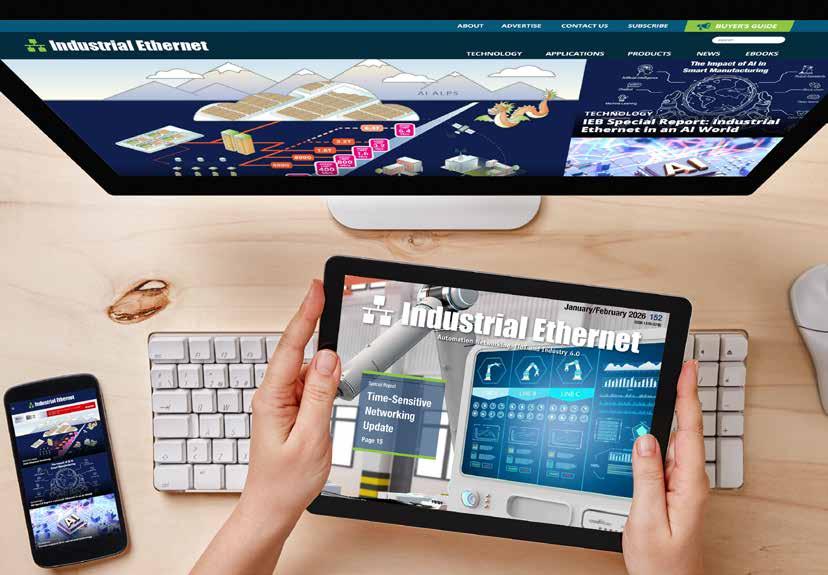
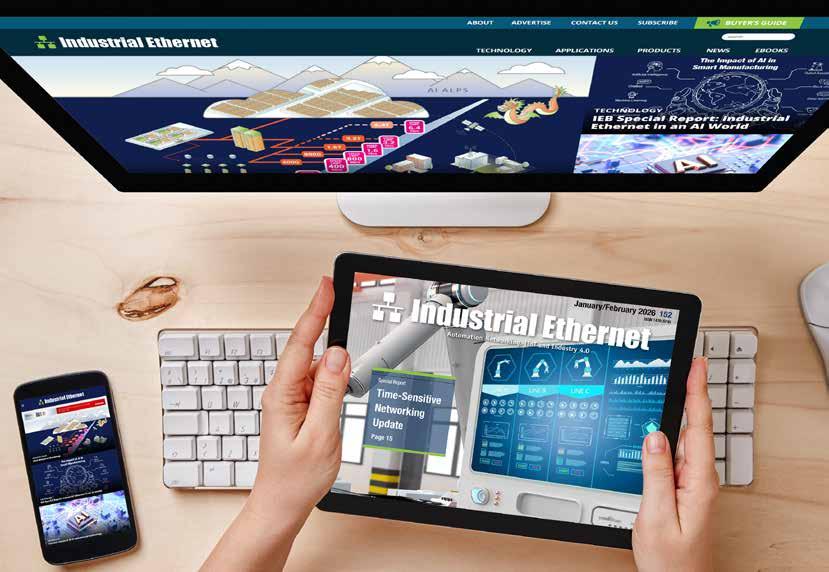
The best of both worlds ... the in-depth technical features our readers expect, but now also a daily blog with the latest product news and industry updates.
The Industrial Ethernet Book has been rebranded Industrial Ethernet, but it's still the only publication worldwide dedicated to Industrial Ethernet automation and machine control networking, the IIoT and Industry 4.0. The difference is a deepened focus on a daily blog to deliver more and deeper content (more product news, industry updates and technology focus) to keep our readers fully informed ... while also delivering the Industrial Ethernet magazine they have come to expect.
Industrial Ethernet
TABLE OF CONTENTS
AI and Digital Transformation
The announcement of the expansion of the partnership between Siemens and Nvidia to make Industrial AI a reality has created a stir in industrial markets. The Industrial Ethernet website, in the twelve hours after posting a press release on the partnership, saw web traffic jump more than 500%.
Here is a portion of what an Nvidia press release said about the partnership in June 2025.
"In 2022, the companies announced a partnership to bring the industrial metaverse to life by connecting technologies from the Siemens Xcelerator portfolio to the NVIDIA Omniverse™ platform. The partnership has since expanded to include collaboration in generative AI, industrial AI and robotics. Siemens integrates NVIDIA technology throughout the Siemens Xcelerator platform.
Announced earlier this year, Teamcenter Digital Reality Viewer represents a significant leap forward in product lifecycle management-based visualization, bringing real-time ray-tracing capabilities directly into Teamcenter to enable companies to seamlessly visualize and interact with photorealistic, physics-based digital twins of their products, allowing for faster, more informed decisions.
By coupling NVIDIA Blackwell GPUs with Siemens’ computational fluid dynamics software, Simcenter Star-CCM+ customers can simulate and test products virtually with significantly enhanced speed. For example, using Simcenter Star-CCM+ software accelerated by NVIDIA Blackwell and NVIDIA CUDA-X™ libraries, BMW Group and Siemens achieved a 30x speedup for transient aerodynamics simulations of entire vehicle geometries.
Siemens and NVIDIA are also redefining how factories operate. A new line of Siemens Industrial PCs, certified for NVIDIA GPUs, drive powerful AI-supported industrial computing, withstanding heat, dust and vibration, and allowing for 24/7 operation.
Advanced AI agents will work seamlessly across the Siemens Industrial Copilot portfolio, executing entire AI-powered processes without human intervention. Siemens’ Industrial Copilot for Operations brings generative AI to shopfloor operators and will be optimized to run on premises with NVIDIA RTX PRO™ 6000 Blackwell Server Edition GPUs.
The expanded partnership between Siemens and NVIDIA is poised to drive a next wave of innovation in industrial manufacturing. With Siemens spearheading the transformation of industries and NVIDIA accelerated computing, the companies are enabling the deployment of AI solutions on the shopfloor with unprecedented speed and efficiency."
It will be fascinating to see what comes next. Al Presher
Published by IEB Media Corp., 1247 Anthony Beach Rd., Penn Yan, NY, 14527 USA ISSN 1470-5745
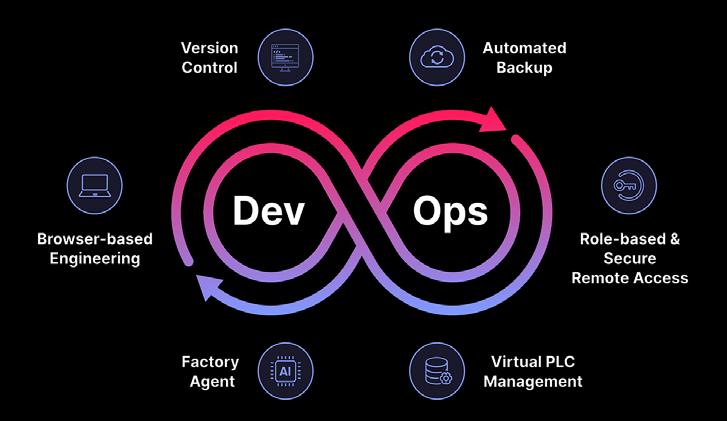
Software Defined Automation: 32 New Products: 42
PLCopen Remote Robot Control through PLCs & Process Control
PLCopen has released two notes on technical topics: "Mastering Remote Robot Control through PLC" and "PLCopen and Process Control".
Mastering Remote Robot Control through PLC
PLCopen is proud to present the latest advancements from its Robotics Workgroup, focused on simplifying complex robotics automation. Members have been working diligently to streamline Siemens’ Standard Robot Command Interface (SRCI) into a more accessible format, tailored for Coordinated Motion Control.
PLCopen is excited to announce its ‘Release for Comments’ of the Motion Control Part 4: Coordinated Motion specification. The PLCopen version retains the key functionalities from SRCI but presents them in the well-known PLCopen look&feel. Retaining less than 10% of the original size, while preserving 80% of the essential features, mainly focused on elaborate kinematics.
Without changing anything with regards to the interface or information model, meaning the 20+ robot suppliers who have collaborated on making the SRCI, can therefore easily implement the user friendly PLCopen specification. The SRCI enables robot control from a Siemens PLC for multiple robot vendors.
The PLCopen Motion Control Part 4 update enables robot control from multiple PLC vendors for multiple robot vendors, which unlocks the door to far broader integration possibilities across the automation industry.
The PLCopen Robotics Workgroup’s goal is to make robotics programming accessible for more industries, and with the newly released version for comments, we invite feedback from our members and others. This is a significant step toward standardizing and simplifying robot control for industrial automation.
The PLCopen Motion Control Part 4, version 2.0 – Release for Comments can be downloaded with this link from the PLCopen website. We look forward to receiving your feedback and comments on this document by February 18, 2026 at the latest. Comments can be made directly in the pdf file and sent to info@PLCopen.org. With this feedback PLCopen will create the official release 2.0.
Read more on the integration of the SRCI functionality into the PLCopen Motion Control specification and how this enables robot control from your PLC.
PLCopen and Process Control
As part of our ongoing efforts to drive standardization and interoperability in industrial automation, PLCopen will start a new workgroup exploring the incorporation of the function blocks developed for the O-PAS standard into a new PLCopen specification for process control.
What is O-PAS?
The O-PAS (Open Process Automation Standard) is an open, interoperable, and vendor-neutral standard developed by the Open Process Automation Forum (OPAF) to enable flexible and modular process automation systems. It is designed to replace traditional, proprietary DCS’ with a standards-based, plug-and-play architecture, allowing components from different vendors to work seamlessly together. O-PAS is based on existing industry standards, such as (among others)
IEC 61131 & IEC 61499.
Part 6.4 of the O-PAS defines a set of standard function blocks to ensure interoperability, consistency, and comparability across different process automation systems. These FBs provide a reference model with standardized inputs, outputs, and behaviors. By establishing a uniform function block framework, part 6.4 supports modular automation, making it easier to adopt open, vendor-independent control solutions.
PLCopen is starting a new work group to create a new PLCopen standard for the process automation. There will be a kick-off meeting on January 20-21, 2026 in Wernigerode, Germany. If you are interested in this activity and want to learn more about it please contact Roeland@PLCopen. org.
News by PLCopen.
The PLCopen Robotics Workgroup is focused on simplifying complex robotics automation.
Machine learning for all automation sectors
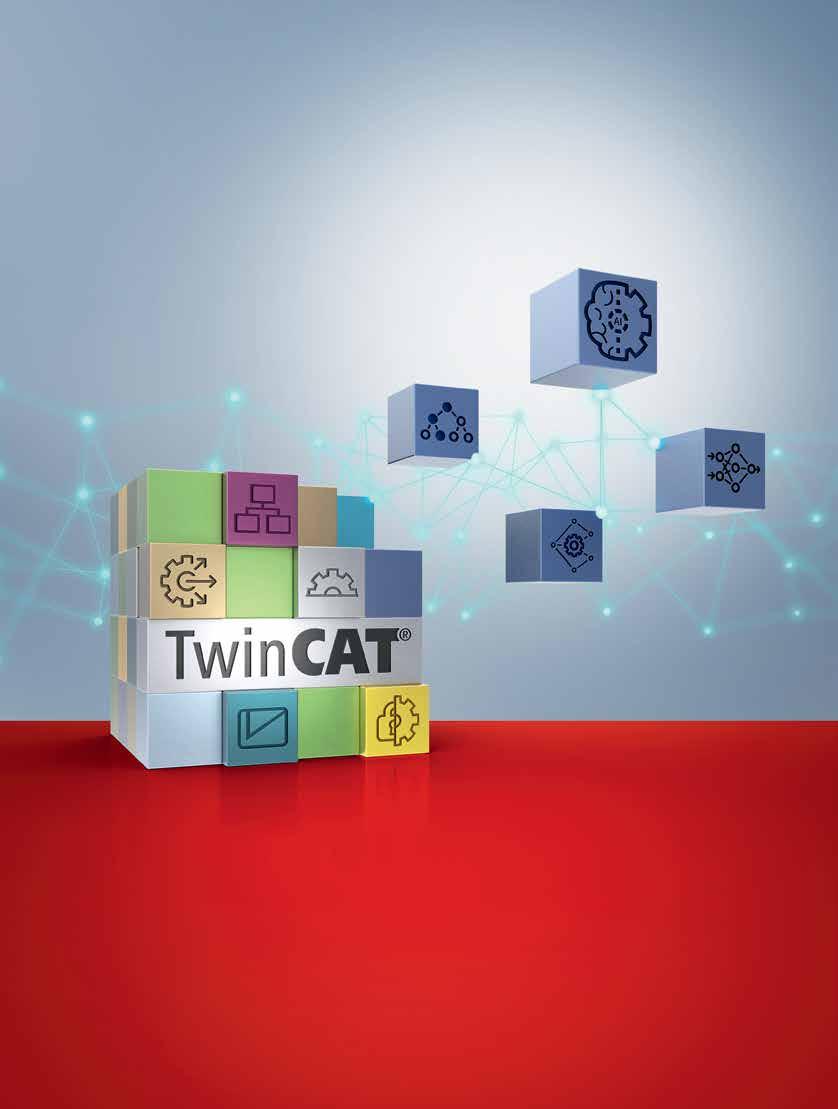
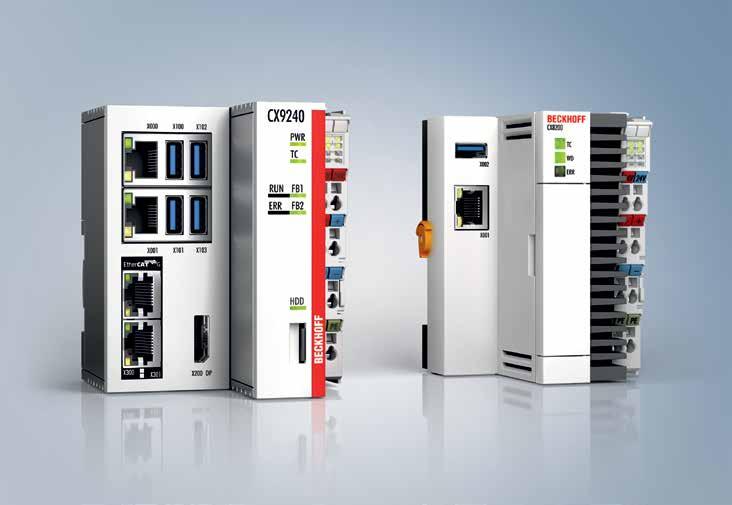
TwinCAT Machine Learning: AI is simply integrated into the control level
AI models as a function block in the PLC: AI as a component of the control code
real-time execution on the standard control IPC: in sync with motion, sequential logic, vision, and much more acceleration of complex AI models: Beckhoff IPC with NVIDIA GPU and interface from the PLC
automated training of AI models: AI model creation that doesn't require AI expertise
open interface for trained AI models (ONNX): trained AI with interoperability
AI model lifecycle management: model updates without compilation, stop, and restart
Digital Transformation driven by AI & IIoT Megatrends
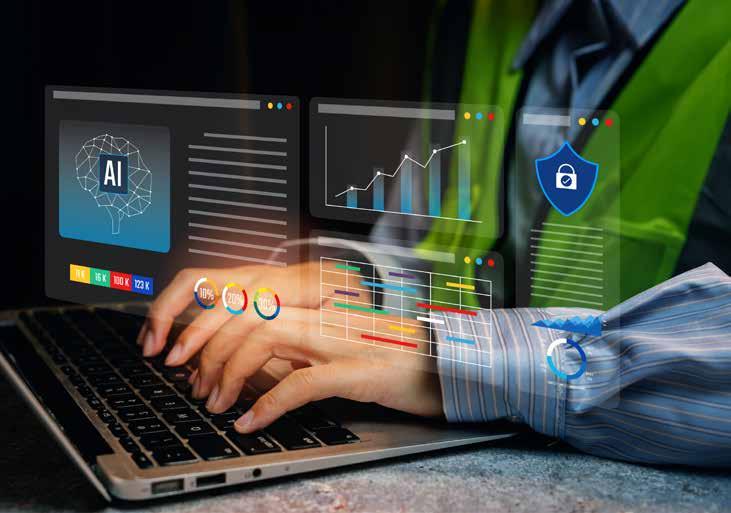
The full impact of Industrial AI is still a future possibility but the writing is already on the wall about its potential to transform edge computing and enterprise connectivity in the quest for digital transformation. In this special report, industry experts weigh in on the megatrends, and enabling technology solutions.
FOR AN UPDATE ON DIGITAL TRANSFORMATION, Industrial Ethernet magazine reached out to industry experts to get their perspective on the latest megatrends driving next generation industrial automation networking solutions.
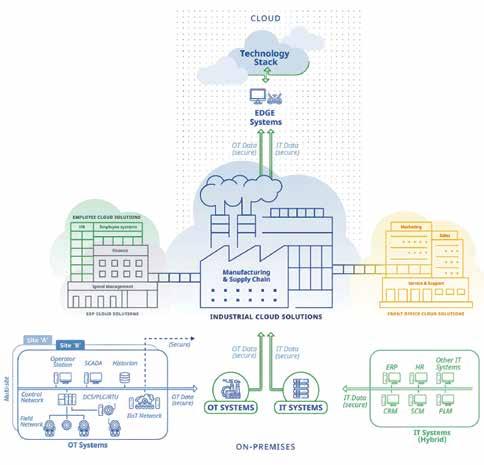
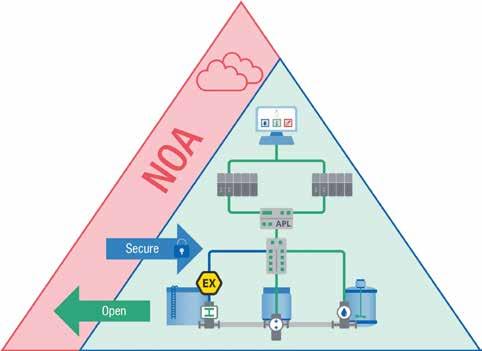
According to experts, the future is a world where software-defined, data-centric platforms will create a fusion of AI with edge computing and emerging connectivity technologies. It's a world where AI and the Digital Twin will redefine industrial machinery, and where Ethernet-APL and NOA Open Architecture will move us toward systems where secure, standardized access to data is aided by interoperable, vendor-neutral data exchange.
But at its core, digital transformation is focused on industrial communication, device integration and management, and new solutions for enterprise connectivity.
Evolution of AI and Edge Computing
New ways to measure, compute, predict, automate, and orchestrate.
According to Amy Schantz, vice president of engineering and new product development for Emerson’s Machine Automation Solutions business, generative and foundational model AI is evolving and increasingly focused on edge computing solutions in 2026.
“One of the biggest trends is generative and foundation model AI with large language models and various agents,” Schantz told Industrial Ethernet recently. “Much of the future of AI is unknown territory, and the potential for it to create new challenges can be unnerving, especially as we consider AI’s use in real-time, mission-critical applications.
However, what we do know is that enabling intelligent automation with the help of AI copilots and agents is going to be central to both user experiences and increased productivity.”
Schantz added that, connected to AI, is evolving and increased focus on edge computing. Process upsets on the factory floor are incredibly disruptive, so teams must anticipate equipment failure and plan maintenance intervals. Edge computing brings AI resources close to the source of reliability issues to track and trend equipment health, helping personnel make critical decisions in real time. Edge computing is also unlocking improved quality, with vision systems more easily included in quality control, for example.
“Organizations are also generating tons of data today, so we need zero trust and
“Connected to AI is evolving and increased focus on edge computing. Edge computing brings AI resources close to the source of reliability issues to track and trend equipment health, helping personnel make critical decisions in real time,” Amy Schantz, vice president of engineering and new product development for Emerson’s Machine Automation Solutions business.
continuous monitoring models for our cybersecurity so we can continue to protect that data,” Schantz said. “Data also needs to be managed and contextualized so it can feed the AI tools and ML models providing operational decision support. Emerging data fabrics and real-time analytics will help provide a boundless automation vision for context and observability to bring value to data from the floor to the edge and into the cloud.”
IIoT successes
Schantz said that the point is that IIoT is going to help us measure, compute, predict, automate, and orchestrate as we move forward in industrial systems. The existing and upcoming trends like GenAI and foundational models, edge computing, next-generation cybersecurity, and data fabric, will be coming together to make operations faster, smarter, more unified, and more secure.
IIoT-supported modern workers will increasingly improve their ability to communicate with their systems. Natural language interfaces and reasoning will bring alarms, logs, maintenance notes, and more together to help personnel make more informed decisions much faster. Knowledge synthesis across all the data will help staff understand and interpret what is going on in the factory, which will not only help operators feel more comfortable and effective but will also drive consistency.
“Ultimately, that increased decision support will help make every worker the company’s best worker—the distinctions between performance of different shifts will start to disappear and variability will be easier to manage. In an era of workforce shortages and a generation of workers moving between roles far more frequently, this capability to lock in institutional knowledge will become a critical driver of competitive advantage,” she concluded.
Industry applications
Schantz said that, in manufacturing, the evolution of edge computing has opened many opportunities to deploy solutions. For example, there is AI at the edge quality inspection—an example that we’re implementing at Emerson facilities. Using next generation PACSystems IPC platform combined with PACEdge, users can quickly and easily pass or fail equipment in quality inspection using AI tools and real-time inference. This solution can be scaled but remains air gapped in the factory, providing a low latency solution while allowing security to remain paramount. Edge analytics are also being deployed to deliver predictive maintenance for rotating equipment. Connected worker technologies are driving operational excellence, with AI copilots providing troubleshooting assistance in both operations and maintenance, and augmented reality overlays supporting
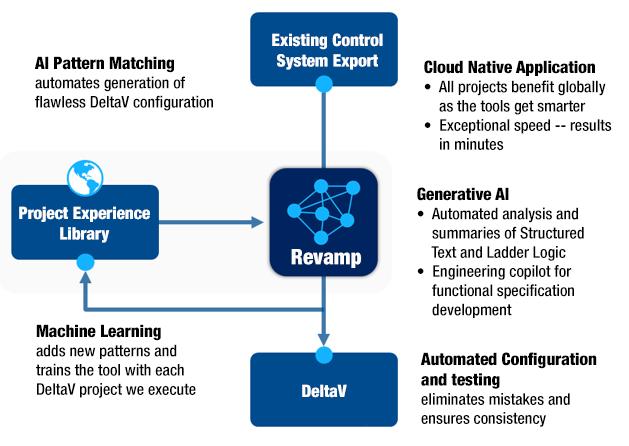
Revamp is a perfect example of the use of AI/LLM in shaping the evolution of Digital ransformation. It allows users to modernize legacy systems by automated analysis and summaries of the PLC code. This is particularly important for legacy applications where upgrading is an issue due to cybersecurity concerns. It also puts data into context for modern IT/OT environments.
decisions in the field.
In the process industries, edge computing helps improve critical operational metrics such as flare monitoring, valve performance, compressor behavior, and more. In addition, predictive corrosion and leak detection are critical capabilities being improved by increasing ability to use multimodal data. Data fabrics are also the foundation for new enterprise operations platforms built on scalable software-defined control, industrial AI, and zero trust cybersecurity to bridge existing automation with modern technologies, enabling unified data intelligence, advanced optimization, and autonomous operations.
Commercial buildings and smart infrastructure are also seeing benefits with increased energy optimization driven by real-time AI for HVAC control, occupancy detection, and more. Predictive maintenance for equipment such as elevators, HVAC, and pumps brings value in reduced failures and reductions of 10-20% in energy usage.
Challenges for automation engineers
“Right now, data is siloed, and industry needs to move toward unified, contextualized data to make the dramatic shifts in operational excellence that are necessary to meet today’s marketplace needs,” Schantz said.
Successfully leveraging that unified, contextualized data as part of a boundless automation vision will support the evolution that will reimagine the way factories operate. That data is going to feed the AI engines that drive toward fast, effective resolution and improvement. It feeds the FMEA and
root-cause analysis tools that help predict failures and suggest resolution workflows to maintenance personnel. It drives real-time analytics and GenAI agents and copilots that will build a new engineering workforce model, where engineers focus more on engineering judgement and system architecture, and less on coding and paperwork.
“Ultimately, we’re on a path where siloed data is becoming unified contextual data, making it possible for engineers to deliver faster project cycles and easier scaling that will help unify operations, drive innovation, and increase efficiency,” Schantz said.
“Unified, contextualized data will feed the more secure, next-generation automation technologies that provide fast response, are infinitely and intuitively scalable, and provide instantaneous decision support across every competency from the factory floor to the head office boardroom,” she added. “The result will be a transition to more autonomous operations, predictive rather than reactive maintenance, and faster engineering, development, and deployment cycles.”
Software-Defined, DataCentric Platforms
Future brings fusion of AI with edge computing and emerging connectivity technologies.
Karthik Gopalakrishnan, Solutions Consultant, Yokogawa, said that AI in combination with edge computing software solutions and emerging connectivity are the technologies and megatrends shaping and enabling the
evolution of Digital Transformation in 2026.
“AI has moved from experimentation to large-scale operational deployment, particularly in industrial environments where edge AI enables real-time decisionmaking directly at machines and devices,” Gopalakrishnan said.
“At the same time, open standards such as OPC UA, MQTT Sparkplug B, and Open Process Automation (O-PAS) are replacing proprietary architectures, enabling multivendor interoperability. Emerging connectivity technologies—including private 5G, Wi-Fi 7, and Ethernet - APL—are providing deterministic, high-bandwidth, and secure data transport from field devices through the enterprise. Together, these trends are transforming IIoT systems into softwaredefined, data-centric platforms capable of continuous optimization.”
Enabling technologies and solutions
Gopalakrishnan said that the IIoT delivers hard real-time, synchronized control across multivendor systems without proprietary fieldbuses, making it possible to implement controllerto-controller and motion applications on standard Ethernet. Edge AI allows inference and anomaly detection to occur within milliseconds at the device or production line, reducing latency, bandwidth, and dependence on cloud availability.
Ethernet APL extends Ethernet all the way to intrinsically safe field instruments using two-wire power and data, unlocking rich diagnostics and faster commissioning. MQTT Sparkplug B standardizes industrial data context and device lifecycle management, dramatically reducing integration effort
Secure connectivity based on standards provides pathways for communication.
compared to custom MQTT or traditional point to point architectures.
Industry impact
“Manufacturers are deploying private 5G networks to support autonomous mobile robots, machine vision, and flexible
production layouts with seamless mobility,” Gopalakrishnan said. “Process industries are adopting Ethernet APL and NAMUR Open Architecture (NOA) to extract diagnostics and operational data from brownfield plants without disturbing core control systems. Digital twins—fed by real-time IIoT and
edge analytics—are being used to optimize production, energy usage, and maintenance strategies, while open DCS architectures based on O PAS are demonstrating lower lifecycle costs and faster system upgrades. These applications are gaining traction because they directly address long-standing operational constraints.”
Looking ahead, he concluded that technologies are creating a series of important benefits moving forward that will impact smart manufacturing.
“Open standards eliminate vendor lock-in and reduce the engineering effort required to integrate heterogeneous systems. Deterministic networking and edge computing resolve latency and reliability issues that previously limited advanced control and AI use cases,” Gopalakrishnan said. “Open architecture technologies provide practical pathways for modernizing legacy brownfield plants without disruptive rip-and-replace projects. In parallel, compliance-driven cybersecurity frameworks, such as the IEC 62443 directive, are embedding security-bydesign into automation systems, transforming security from an afterthought into a core engineering discipline.”
Turning steel into gold
How AI and the Digital Twin will redefine industrial machinery.
Rahul Garg, VP for Industrial Machinery Vertical Software Strategy, Siemens Digital Industries Software, said that technologies such as the
Digital Twin are helping to bring automation dreams into reality.
“Becoming a digital enterprise is no longer optional. Combating labor shortages and decreasing profit margins have driven machine builders in the industrial manufacturing industry to jump into their digital transformation journeys,” Garg said. “Solutions such as the Digital Twin and AI— including traditional, generative and now agentic—have helped businesses become more flexible, resilient and efficient while setting the foundation for increased automation that keeps the human in the loop. “
“Digitalization is now the key to competitiveness; and the comprehensive Digital Twin combined with digital threads are the foundation of digitalization, connecting every stage of a product’s lifecycle, from concept to manufacturing, into a single source of truth,” Garg said. “Additionally, digital threads unify processes and systems, enabling seamless collaboration across departments and promoting the integration of new technologies.”
AI and comprehensive digital twins: democratizing digital transformation Garg’s view is that the dynamic shift in industrial machinery, driven by the integration of AI across design, operations and supply chains, will continue to disrupt the sector for years to come. Accessibility is key as AI capabilities accelerate, and enterprises of all sizes look to modernize their systems and processes. Updating business processes
may initially seem intimidating for SMBs and brownfields, but there are solutions that ease access to automation and AI processes which are growing increasingly important as talent gaps continue to widen.
Large language models (LLMs), for example, have been empowering workers to dabble with AI. Only last year, many manufacturers began deploying LLMs to fill in knowledge gaps and bridge human and machine operations. Starting with these simple tools gives designers and engineers time to adapt to new solutions so that the company can determine their specific AI needs and build from there. Incrementally leveraging AI-infused solutions that address engineering and manufacturing needs will ultimately simplify the adoption of more complex and powerful solutions on the horizon.
Once a company knows where and when to include AI in its operations by identifying value use cases, it can begin training in-house AI models. At this point, machine builders, for example, can fully integrate generative AI and agents into their processes to create new engineering and manufacturing content and even automate complex workflows.
Achieving a more automated factory that is ready to face a volatile landscape starts with a plan. To create a solid plan, OEMs should look to the Digital Twin for virtual commissioning. It is crucial to test how and where certain processes will work before integrating new machines or processes into more traditional workflows. The Digital Twin of the factory creates an accurate, real-time virtual representation of their factory that
"Solutions such as the Digital Twin and AI—including traditional, generative and now agentic—have helped businesses become more flexible, resilient and efficient while setting the foundation for increased automation that keeps the human in the loop,” -- Rahul Garg, VP for Industrial Machinery Vertical Software Strategy, Siemens Digital Industries Software.
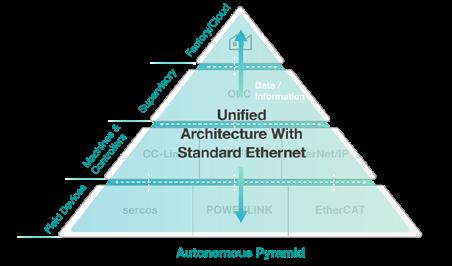
"A key enabler is the adoption of standard Ethernet as a universal communication backbone, now extended to the field level with Ethernet-APL, a version of Ethernet designed for long-distance, high-speed, and intrinsically safe connectivity in process plants. Standardized data models such as NOA, an open architecture concept for secure, standardized access to device and process data, and PA-DIM, a standardized model for representing device information, are enabling interoperable, vendor-neutral data exchange” -- Hermann Berg, Head of Industrial Automation, Moxa Europe.
is accessible for workers across teams and disciplines.
Harmonizing humans, robots, and automation through digitalization
“Digitalization does not always mean scrapping old, reliable equipment and replacing it all with new machinery. Many OEMs have seen ROI from integrating collaborative robots (cobots), or robots that aid human workers during production,” Garg said.
“Cobots enable seamless integration between automated and manual systems, allowing machine builders to put them where they are needed without upending processes that work for them. Leveraging cobots, a brownfield environment can quickly evaluate how to upgrade operations and become a state-of-the-art facility.”
Garg added that a factory that has fully integrated the Digital Twin can also implement AI in tandem to supercharge operations. Machine builders can create immersive settings that perfectly imitate physical factories and production lines to accelerate robot training and programming. In this virtual classroom, robots can practice tasks, address common challenges and develop problem-solving skills in just hours, rather than months or even
years.
Digital Twin and AI capabilities further lay the groundwork for budding technologies such as humanoid robots. Humanoids are poised to shake up the industrial manufacturing space and will likely enter the factory floor within the next few years. As a result, virtual commissioning powered by the Digital Twin will become even more important. Virtual commissioning will be at the heart of harmonious operations between humans, cobots, smart robots and humanoids; enabling the factory to forecast human interactions with automated systems and equipment.
The pivot from hardware to software
“With the rapid advancements in technology, industrial manufacturing is under pressure to tackle skill shortages, unpredictable supply chains, and increasing demand for more resource-efficient and sustainable production,” Garg said.
Autonomous operations help machine builders address current challenges and position them to tackle future ones. As part of this shift, automation is transitioning from hardware-based devices to software-defined functionalities. Software-defined automation (SDA) combines information technology (IT)
flexibility with operational technology (OT) robustness.
Now, instead of relying on fixed hardware for functionality, SDA uses software to control, enhance and update features, making it more adaptable and scalable. Brownfields, for example, can take special advantage of SDA because it enables connection between legacy equipment and systems to more modern data-driven services and applications. Once these machines are connected, older factories can begin to craft their own digital thread and move towards greater automation and accelerated operations.
Journey, not destination
“Industrial machinery is entering its next golden age. Success in 2026 will hinge on the industry’s ability to stay afloat as the AI revolution keeps or even accelerates its momentum. For machine, equipment and component manufacturers, the digital enterprise model represents a transformative approach where every aspect of the business is interconnected through data, automation and real-time insights,” Garg concluded.
“By integrating the Digital Twin and leveraging AI, organizations can move beyond outdated, fragmented systems and build
flexible frameworks that address both current and future challenges. As more companies adopt this approach, it has become clear that embracing digital transformation is imperative to ensuring sustained agility and long-term success in this new age of manufacturing.”
Ethernet-APL and NOA Open Architecture
Secure, standardized access to data, driven by interoperable, vendor-neutral data exchange.
“The evolution of digital transformation in process automation is being driven by several converging megatrends and enabling technologies,” according to Hermann Berg, Head of Industrial Automation at Moxa Europe.
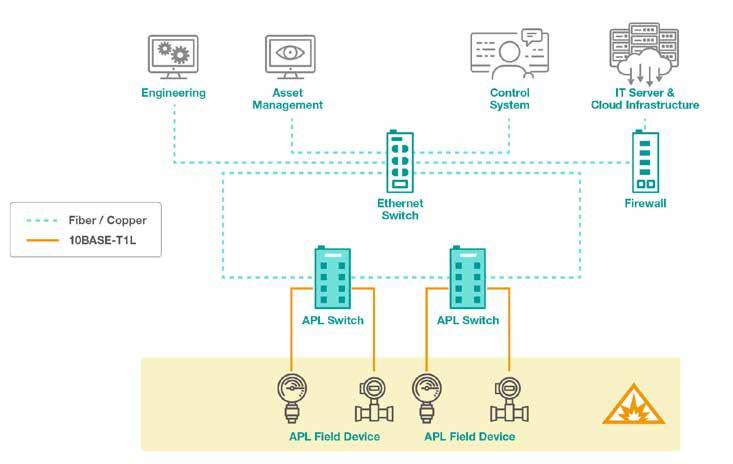
“A key enabler is the adoption of standard Ethernet as a universal communication backbone, now extended to the field level with Ethernet-APL (Advanced Physical Layer), a version of Ethernet designed for long-distance, high-speed, and intrinsically safe connectivity in process plants. Standardized data models such as NOA (Namur Open Architecture), an open architecture concept for secure, standardized access to device and process data, and PA-DIM (Process Automation Device Information Model), a standardized model for representing device information, are enabling interoperable, vendor-neutral data exchange,” Berg said.
He added that this is essential for scalable and flexible digitalization. The AAS (Asset Administration Shell’), a digital twin concept providing a standardized digital representation of assets, supports integration across the entire lifecycle. Together with advanced cybersecurity mechanisms, these technologies create a secure, future-proof infrastructure that supports Industrial IoT, predictive maintenance, and data-driven optimization. This foundation is enabling process industries to accelerate their digital transformation, unlocking new efficiencies and business models.
IIoT application successes
Berg said that standard Ethernet and Ethernet-APL enable uniform, high-bandwidth connectivity from the enterprise level down to field devices, reducing traditional silos and proprietary protocols. This allows for real-time data access and seamless integration of IT and OT systems. Standardized data models like NOA and PA-DIM ensure that data from diverse sources is structured, contextualized, and easily consumable by analytics and AI applications. The AAS further enhances interoperability by providing a standardized digital twin for every asset. Combined with robust cybersecurity, these solutions enable secure remote access, scalable cloud integration, and advanced IIoT applications
NAMUR Open Architecture (NOA) enables IT applications to securely access data from process control systems, the core of chemical, petrochemical, and pharmaceutical production, without compromising system integrity. Implementing NOA starts with securing the OT network, beginning in the Core Process Control (CPC) zone. This includes updating network segmentation between the CPC and the IT systems that use production data. The next step is connecting field devices to the OT network and establishing data paths from OT to IT systems.
such as predictive maintenance, process optimization, and adaptive control. Compared to legacy systems, this approach dramatically reduces integration effort, increases flexibility, and accelerates innovation in process automation.
Applications in industry
In the process industries, these technologies are being applied to enable open, modular automation architectures and to support the integration of both legacy and new assets. Ethernet-APL is being deployed in greenfield and brownfield projects to connect field instruments directly to digital platforms. NOA and PA-DIM are facilitating standardized data exchange for condition monitoring, asset management, and regulatory compliance. The AAS is being used to create digital twins that streamline engineering, commissioning, and lifecycle management.
A particularly promising application is the secure, remote firmware update of field devices. With open, standards-based connectivity across the entire plant, operators can efficiently manage firmware updates for a diverse range of devices, ensuring security patches and feature enhancements are deployed consistently and with minimal disruption. This capability, previously limited by proprietary protocols and fragmented networks, is now becoming a practical reality. It helps to maintain cybersecurity, improve device performance, and extend asset
lifecycles.
Other applications gaining traction include predictive maintenance, remote diagnostics, and process optimization, all of which rely on secure, standardized data flows. The anticipated impact is a significant increase in operational efficiency, reduced downtime, and the ability to rapidly adapt to changing market and regulatory requirements.
Challenges and ongoing impact
“These technologies address key challenges such as system complexity, vendor lock-in, and cybersecurity risks. By leveraging standard Ethernet and open data models, engineers can design modular, interoperable systems that are easier to maintain and scale,” Berg said. “Ethernet-APL simplifies field device integration and supports intrinsic safety requirements NOA and PA-DIM can reduce engineering effort by providing standardized interfaces for data access and analytics.”
“The AAS enables consistent asset management across the lifecycle. Robust cybersecurity mechanisms ensure that digitalization does not compromise plant safety or reliability,” Berg added. “Moving forward, these technologies are expected to continue enabling innovation, helping automation engineers focus more on value creation than system integration, and supporting process plants in staying agile and competitive in a rapidly evolving digital landscape.”
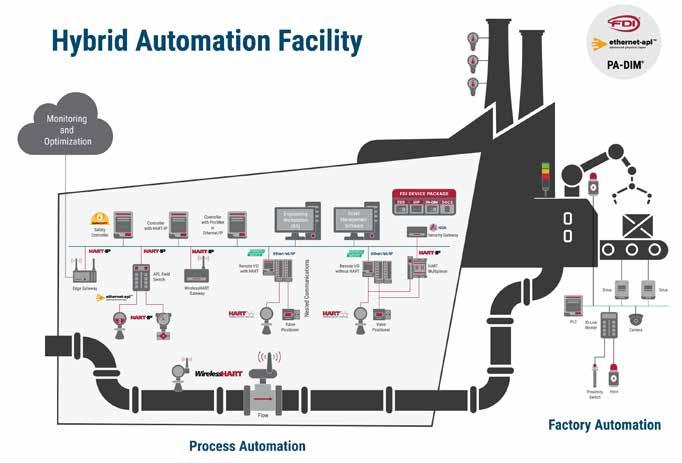
"Ethernet-APL technology is gaining broad traction as a new physical layer for devices in automation facilities, allowing end-to-end Ethernet connectivity from the plant floor to the cloud. Ethernet Advanced Physical Layer (Ethernet-APL) is a protocol agnostic physical layer that provides open interoperability and high-speed data transfer,” -- Paul Sereiko, Director- Marketing and Product Strategy at FieldComm.
The Core of TransformationDigital
Industrial communication, device integration and management, and enterprise connectivity.
FieldComm Group focuses on three areas of technology that form the core of digital transformation: industrial communication, device integration and management, and enterprise connectivity.
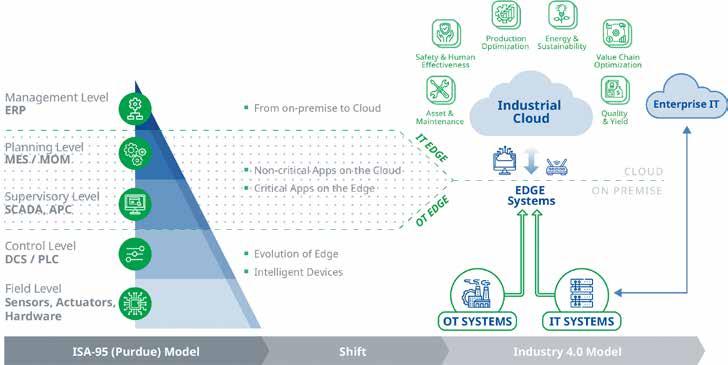
According to Paul Sereiko, DirectorMarketing and Product Strategy at FieldComm, “Ethernet-APL technology is gaining broad traction as a new physical layer for devices in automation facilities, allowing end-to-end Ethernet connectivity from the plant floor to the cloud. Ethernet Advanced Physical Layer (Ethernet-APL) is a protocol agnostic physical layer that provides open interoperability and high-speed data transfer directly from the field-level to control and higher-level enterprise applications.”
Sereiko said that industrial protocols like HART that have previously been bound by slow physical layers are now being recast to support high speed communications via Ethernet-APL and Single Pair Ethernet (SPE) technology. The broad base of users familiar with HART technology can now leverage their existing knowledge base to take full advantage of HART-IP over Ethernet with no
additional training requirement.
“The industrial internet of things (IIoT) requires sensors to be deployed wherever physical measurements are needed. To manage these devices, operators want unified device integration within their device and asset management systems,” Sereiko said. “This allows devices using different protocols to connect and communicate in a standardized way and provides access to intelligent data for analytics and predictive maintenance. Device integration technologies like Field Device Integration (FDI) and Field Device Tool (FDT) are designed to make this standardized integration into higher-level systems possible.”
He added that, to make sure that information from these intelligent devices is understood throughout the enterprise, users are beginning to deploy device information models used in conjunction with OPC UA technology. Process Automation Device Information Model (PA-DIM) forms the basis of NAMUR Open Architecture and will become a commonplace feature in industrial instrumentation devices and systems.
Synergies working together
Sereiko said that, while each of the solutions described above provide benefits to users engaged in digital transformation, the real
benefits accrue when all are used together. Developing and deploying sophisticated plant optimization programs requires secure access to massive amounts of easily understood information from the devices operating at the lowest level of the Purdue model, the field instruments.
“Today’s consumers of this information, basically sophisticated IT and machine learning systems, face almost insurmountable challenges in economically accessing the information. For example, the IT system will generally not be able to understand protocolspecific information from the automation system, the instrumentation cannot provide sufficient data due to bandwidth limitations, and information is lost in protocol translation,” Sereiko said.
“So, for the past decade, suppliers and standards organizations have been working together to chip away at these issues. Fortunately, the technologies are now well thought out and ready to deploy,” he added. “All the technologies discussed are either in commercial deployment, small scale plant trials, or in R&D evaluation at facilities around the world including Germany, China, and the United States. Ethernet-APL is being installed in many locations.”
Al Presher, Editor, Industrial Ethernet
Siemens and NVIDIA to develop Industrial AI operating system
Using AI, Siemens and NVIDIA have a goal to reinvent the entire end-to-end industrial value chain, from design and engineering, to manufacturing, production, operations and into supply chains.
SIEMENS AND NVIDIA ANNOUNCED A significant expansion of their strategic partnership at CES to bring artificial intelligence into the real world. Together, the companies aim to develop industrial and physical AI solutions that will bring AI-driven innovation to every industry and industrial workflow, as well as accelerate each others’ operations.
Joint goals include:
• Siemens and NVIDIA to build AI-accelerated portfolio including AI-native electronic design, AI native simulation as well as AI driven adaptive manufacturing and supply chain
• Siemens and NVIDIA to design next generation AI factories
• Siemens and NVIDIA to optimize operations through shared innovation
To support development, NVIDIA will
provide AI infrastructure, simulation libraries, models, frameworks and blueprints, while Siemens will commit hundreds of industrial AI experts and leading hardware and software.
“Together, we are building the Industrial AI operating system – redefining how the physical world is designed, built, and run - to scale AI and create real-world impact,” said Roland Busch, President and CEO of Siemens AG.
“By combining NVIDIA’s leadership in accelerated computing and AI platforms with Siemens’ leading hardware, software, industrial AI and data, we’re empowering customers to develop products faster with the most comprehensive digital twins, adapt production in real time, and accelerate technologies from chips to AI factories.”
“Generative AI and accelerated
computing have ignited a new industrial revolution, transforming digital twins from passive simulations into the active intelligence of the physical world,” said Jensen Huang, founder and CEO of NVIDIA.
“Our partnership with Siemens fuses the world's leading industrial software with NVIDIA's full-stack AI platform to close the gap between ideas and reality — empowering industries to simulate complex systems in software, then seamlessly automate and operate them in the physical world.”
Accelerating the Entire Industrial Lifecycle
Siemens and NVIDIA will work together to build AI-accelerated industrial solutions across the full lifecycle of products and production, enabling faster innovation, continuous optimization, and more
At CES, Siemens AG and Nvidia announced expansion of their AI partnership to develop and implement Industrial AI solutions.
resilient, sustainable manufacturing. The companies aim to build the world’s first fully AI-driven, adaptive manufacturing sites globally, starting in 2026 with the Siemens Electronics Factory in Erlangen, Germany, as the first blueprint.
Using an “AI Brain,” – powered by software-defined automation and industrial operations software, combined with NVIDIA Omniverse libraries and NVIDIA AI infrastructure factories can continuously analyze their digital twins, test improvements virtually, and turn validated insights into operational changes on the shopfloor.
This results in faster, more reliable decision-making from design to deployment, raising productivity while reducing commissioning time and risk. The companies aim to scale these capabilities across key verticals and several customers are already evaluating some of the capabilities including Foxconn, HD Hyundai, KION Group, and PepsiCo.
With the partnership expansion, Siemens will complete GPU acceleration across its entire simulation portfolio and expand support for NVIDIA CUDA-Xlibraries and AI physics models, enabling customers to run larger, more accurate simulations faster. Building on that foundation, the companies will advance toward generative simulation by using NVIDIA PhysicsNeMo and open models to provide autonomous digital twins that deliver real-time engineering design and autonomous optimization.
Advancing electronic design automation for accelerated computing
By applying industrial AI operating logic to semiconductors and AI factories, Siemens and NVIDIA will accelerate the engines of the AI revolution. Starting with semiconductor design and building on NVIDIA’s extensive use of Siemens’ tools, Siemens will integrate NVIDIA CUDA-X libraries, PhysicsNeMo and GPU acceleration across its EDA portfolio with a focus on verification, layout, and process optimization – to target 2-10x speed-ups in key workflows.
The partnership will also add AI-assisted capabilities such as layout guidance, debug support, and circuit optimization to boost engineering productivity while meeting strict manufacturability requirements. Together, these capabilities will advance AI-native engines for design, verification, manufacturability and digital-twin approaches to shorten design cycles, improve yield, and deliver more reliable outcomes.
Designing next generation AI factories
Siemens and NVIDIA will also jointly develop a repeatable blueprint for nextgeneration AI factories – accelerating the industrial AI revolution and providing the high-performance foundation for their AI-accelerated industrial portfolios.
This blueprint will balance the nextgeneration high-density computing demands for power, cooling and automation while
ensuring technologies are well positioned for both speed and efficiency - optimizing the full lifecycle, from planning and design to deployment and operations.
The combined effort bridges NVIDIA’s AI platform roadmap, AI infrastructure expertise, partner ecosystem and the accelerated power of NVIDIA Omniverse library-based simulation with Siemens’ strengths in power infrastructure, electrification, grid integration, automation, and digital twins. Together, the companies aim to accelerate deployment, increase energy efficiency, and improve resilience for industrial-scale AI infrastructure worldwide.
Optimizing operations through shared innovation
Siemens and NVIDIA aim to accelerate each others’ operations and portfolio by implementing technologies on their own systems before scaling them across industries. NVIDIA will assess Siemens offerings to streamline and optimize its own operations and offerings, and Siemens will assess its own workloads and collaborate with NVIDIA to accelerate them and integrate AI into Siemens’ customer portfolio. By accelerating one another and improving their own systems, Siemens and NVIDIA are creating concrete proof points of value and scalability for customers.
Siemens AG
Learn More
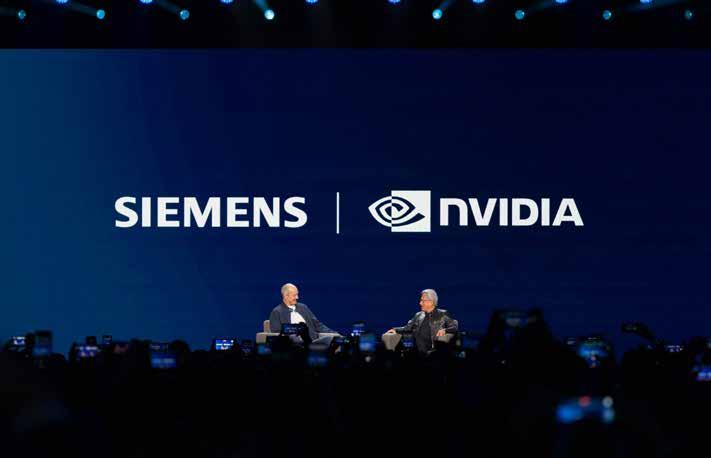
CES 2026: Jensen Huang (on the right), founder and CEO of NVIDIA, and Roland Busch (on the left), President and CEO of Siemens AG, announce the expansion of their partnership to build an Industrial AI Operating System.
Special Report: Time-Sensitive Networking Update
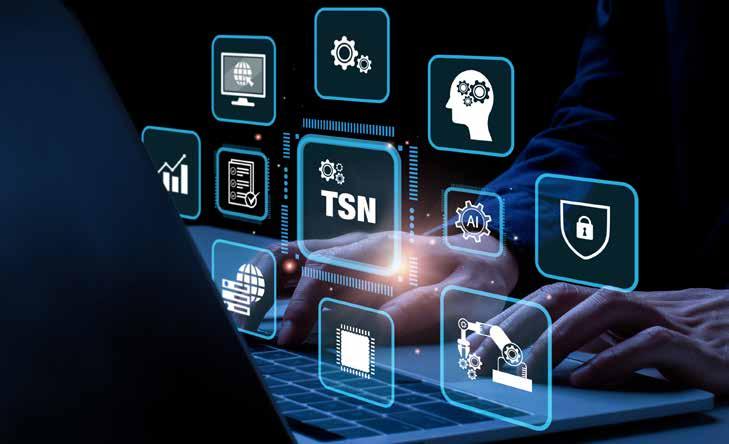
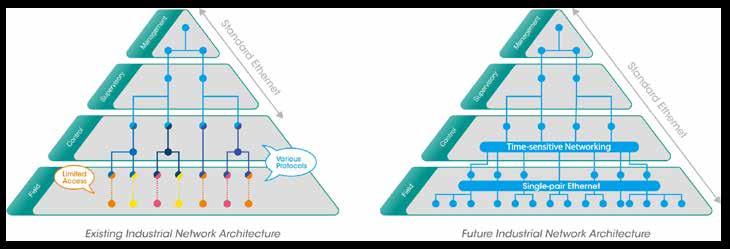
The ability to provide deterministic communication over standard Ethernet networks, and achieve converged network performance, is the main premise behind TSN technology. Industrial suppliers weigh in on why TSN is now increasingly considered a strong candidate for scalable, multi-vendor smart manufacturing networks.
TIME-SENSITIVE NETWORKING SOLUTIONS ARE pressing ahead based on a goal of providing deterministic communication over standard Ethernet and converged industrial networks.
The update from technology suppliers is that growing support for TSN standards has resulted in increased integration of IEEE/ TSN features into Custom-Of-The-Shelf (COTS) network chips for Ethernet end-nodes and switches as well as support in popular operating systems such as Linux.
The argument is that TSN is gaining momentum in factory automation as manufacturers are looking to move toward open, unified network architectures and closer IT/OT convergence. As standards and industry profiles mature, TSN is increasingly considered a strong candidate for scalable, multi-vendor smart manufacturing networks.
Digitalization of Modern
Manufacturing
Technology addresses the challenges of deterministic communication over standard Ethernet, and converged networks.
“Time Sensitive Networking (TSN) has become established in factory automation because it addresses the challenges of digitalization in modern manufacturing,” John Browett, General Manager for CC-Link Partnership Association Europe. “These divide into two main areas: deterministic communication over standard Ethernet and converged networks. Traditional industrial networks often rely on proprietary protocols or segmented architectures to guarantee real-time performance, which limits flexibility and scalability. TSN
changes this paradigm by introducing IEEE 802.1 standards that enable precise time synchronization and traffic shaping on converged Ethernet networks.”
Browett said that manufacturers are increasingly adopting TSN as they address digitalization and smart factories, where machines, sensors, and IT systems must share a common infrastructure without sacrificing real-time control. TSN allows motion control, safety-critical traffic, and OT/IT non-critical TCP/IP data to coexist on the same network, reducing complexity and cost.
Deployments have been rolled out in over a 100 different manufacturing corporations worldwide, which is driving machine builder support and in turn device vendor adoption. Sample applications are automotive
"Time Sensitive Networking (TSN) has become established in factory automation because it addresses the challenges of digitalization in modern manufacturing. These divide into two main areas: deterministic communication over standard Ethernet and converged networks.," -- John Browett, General Manager for CC-Link Partnership Association Europe.
assembly lines, packaging systems, food and beverage, semiconductors and consumer electronics, where deterministic performance and interoperability are essential. As more device vendors certify TSN compatibility, adoption is accelerating, supported by open ecosystems and standardization efforts such as IEC/IEEE 60802 and TIACC that make TSN a future-proof choice for industrial automation.
Specific TSN technology benefits
Browett said that TSN delivers three core benefits that make it highly attractive for factory automation: deterministic communication, network convergence, and vendor-neutral interoperability. Unlike traditional Ethernet, TSN guarantees bounded latency and jitter through time-aware scheduling and traffic shaping, ensuring that critical control data arrives predictably even under heavy network load. This is vital for applications like motion control and robotics, where microsecondlevel timing accuracy is non-negotiable. Second, TSN enables convergence of IT and OT traffic on a single Ethernet infrastructure.
This reduces cabling, simplifies network design, and lowers lifecycle costs compared to maintaining separate networks for control and enterprise data. Third, TSN is based on open IEEE standards, making it vendorneutral and future-proof, unlike proprietary real-time Ethernet solutions that lock customers into specific ecosystems.
“Compared to some current industrial Ethernet technologies, TSN offers scalability beyond factory floors, extending into edge computing and cloud integration without sacrificing determinism,” Browett said. “Its ability to coexist with standard Ethernet traffic while maintaining real-time guarantees sets TSN apart as the foundation for truly integrated smart manufacturing networks.”
TSN adoption is strongest in industries where precision, flexibility, and interoperability are critical. Automotive manufacturing is a leading sector, driven by complex assembly lines that require synchronized motion control and real-time quality monitoring. TSN enables these environments to integrate robotics, vision systems, and safety devices on a single converged network, reducing complexity and
improving responsiveness.
Packaging and food & beverage machinery builders are also early adopters, as these industries demand high-speed coordination between multiple axes and rapid changeovers for customized production runs. TSN’s deterministic performance ensures smooth operation even as data volumes grow with IIoT sensors and predictive maintenance systems.
Additionally, semiconductor and electronics manufacturers are adopting TSN for its ability to support ultra-low latency control alongside large volumes of process data. System integrators serving these sectors see TSN as a way to future-proof installations, offering customers a migration path from proprietary fieldbus systems to open, Ethernet-based architectures. Overall, TSN appeals to machine builders and end-users seeking to combine real-time control with IT/OT convergence for smarter, more agile production environments.
Impact
of TSN technology
“In the next three years, TSN is expected to become a cornerstone technology for smart manufacturing, enabling unprecedented
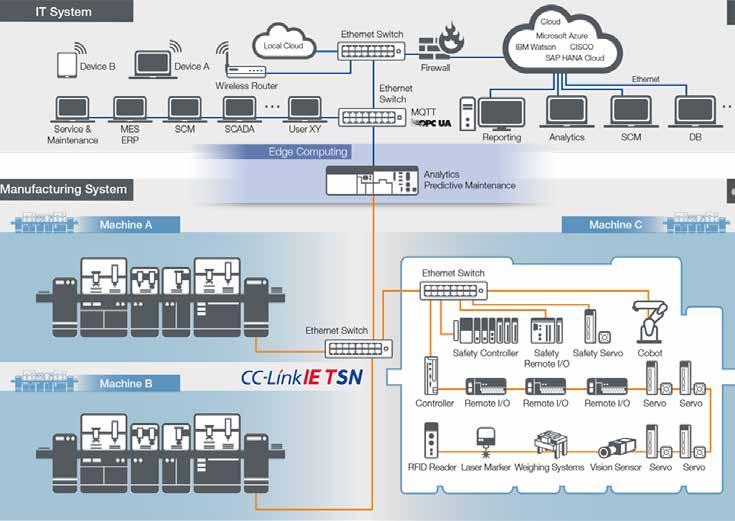
The industrial network connects assets to intelligence.
levels of integration and flexibility,” Browett said. “As more device vendors and automation platforms adopt TSN standards, manufacturers will gain the ability to consolidate control, safety, and data traffic on a single Ethernet backbone. This convergence will simplify network architectures, reduce hardware costs, and accelerate deployment of advanced digital solutions such as predictive maintenance and AI-driven analytics.”
He added that TSN will also play a critical role in enabling edge-to-cloud connectivity without compromising real-time performance. This capability is essential for closed-loop optimization, where production data informs immediate adjustments to improve efficiency and quality. Furthermore, TSN’s interoperability will foster multivendor ecosystems, reducing vendor lock-in and encouraging innovation.
“Expect to see TSN integrated into nextgeneration controllers, drives, and industrial PCs, making it a default choice for new installations and retrofits. As digitalization initiatives mature, TSN will transform factory networks from isolated islands into unified, deterministic platforms that support both operational excellence and digital transformation,” Browett said. “Finally, activities like IEC/IEE 60802 and TIACC will
ensure that there is standardization across the industry, ensuring TSN will be a truly open technology base as we move into the future.”
Growing Support for TSN Standards
Integration of IEEE/TSN features into Custom-Of-The-Shelf (COTS) network chips for Ethernet end-nodes and switches.
According to Gunnar Lessmann, Master Specialist Profinet and TSN - PLCnext Technology, Business Area Industry Management and Automation, Phoenix Contact, “More and more automation devices can support TSN standards. This is possible thanks to the integration of the corresponding IEEE/TSN features into Custom-Of-The-Shelf (COTS) network chips for Ethernet end-nodes and switches, as well as support in popular operating systems such as Linux.”
Lessmann said that this integration enables device manufacturers to produce products more easily and cost-effectively on platforms which are available from multiple manufacturers with a wider chip variety. In earlier times, e.g. expensive FPGA technology was necessary to support TSN.
In the meantime, international standardization activities such as IEC/ IEEE 60802 and TIACC cover manufacturerindependent profiling and testing of TSN platforms. IEC/IEEE 60802 and TIACC are set up by Standards Development Organizations (SDOs) such as Avnu Alliance, CC-Link Partner Association, ODVA, OPC Foundation, and Profibus & Profinet International. By working together, these SDOs are committed to providing end users with confidence that their IEC/IEEE 60802 compliant devices will coexist fairly at the TSN level on shared networks, regardless of differences in manufactures or differing supported automation protocols.
“With the availability of suitable platforms and products, TSN will increasingly find its way into automation solutions of many application areas, not only factory automation,” Lessmann added.
Preferred choice in factory automation applications
“The biggest advantage of TSN is the integration of multiple disciplines in a common, converged network. This makes it possible to use video streams, real-time communication, alarms and events, highprecision time synchronization, motion control applications and other TCP/
"More and more automation devices can support TSN standards. This is possible thanks to the integration of the corresponding IEEE/TSN features into Custom-Of-The-Shelf (COTS) network chips for Ethernet end-nodes and switches, as well as support in popular operating systems such as Linux," -- Gunnar Lessmann, Master Specialist Profinet and TSN - PLCnext Technology, Business Area Industry Management and Automation, Phoenix Contact.
IP communication in a single network,” Lessmann said. “One converged network reduces effort and costs for planning, installation, maintenance and operation of machines and systems compared to solutions that are using separate networks for each discipline.” T
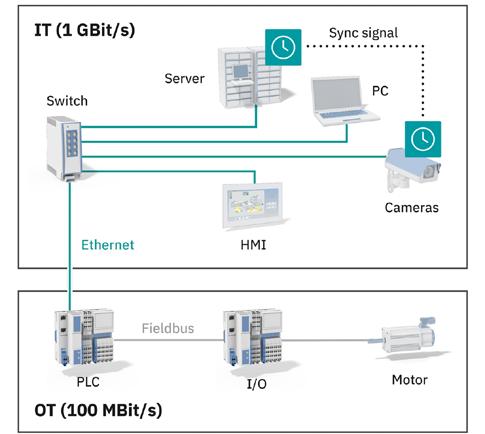
Lessmann added that separated Networks for IT and OT are today’s standard in factory automation (see diagrams). While one encapsulated communication system is used for real-time-critical applications (Fieldbus). A separated network is installed for all the other more “IT-like” traffic. This separation should be overcome leading to the following picture:
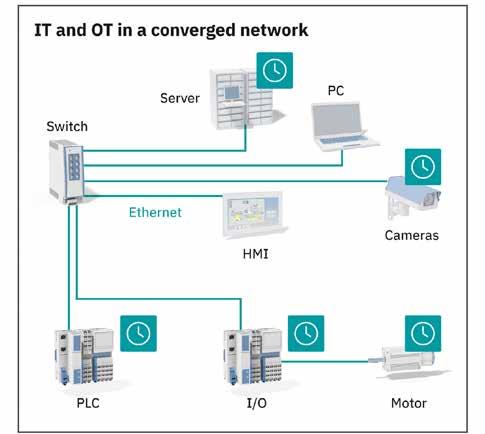
In a converged network all devices regardless of whether OT or IT are integrated in a single network. One prerequisite for such a network is the availability of Ethernet bandwidth of minimum 1Gbit/s in devices of the TSN-backbone. Nevertheless, devices with lower link-speeds like 100Mbit/s can be connected and used if this case is specified by the particular SDO. E.g. with Profinet, existing devices can be used in combination with those supporting TSN.
Types of applications and customers
Lessmann said that, in addition to the use in classic factory automation scenarios, applications of renewable energy generation such as wind farms should be mentioned. Due to increased requirements of grid operators, an entire wind farm, for example, must be able to react within milliseconds to new setpoint values of the grid operators.
This is only possible if the communication and control applications of all participating devices are synchronized with each other. Furthermore, it must be possible to provide events in the energy grid with highly accurate timestamps whose resolution is better than 100μs. Both cases are not possible without the application of TSN standards. This makes TSN also an enabling technology for the energy production of the future.
Furthermore, the COTS integration mentioned above enables the use of TSN in combination with virtual PLCs on standard hardware and thus completely new use-cases like realtime-critical motioncontrol applications running in data centers. This requires a converged network as precondition.
The next 1-3 years?
“We expect the integration of TSN features into the products of all well-known automation manufacturers and SDOs. Along with the standardization of profiles and tests, the functionality, quality and interoperability
Networks.
Network with TSN.
of TSN solutions will increase,” Lessmann said. “This is a continuous process that will continue over the next 1-3 years and behind. Depending on the capability of the SDO to
integrate existing devices into new TSN networks, a smooth transition from today’s separated networks to one integrated TSN network is possible.”
Separated
Converged
“TSN is gaining momentum in factory automation as manufacturers move toward open, unified network architectures and closer IT/OT convergence. By enabling deterministic, low-latency communication over standard Ethernet, TSN supports tighter synchronization for real-time control across machines, sensors, and controllers. As standards and industry profiles mature, TSN is increasingly considered a strong candidate for scalable, multi-vendor smart manufacturing networks,” -- Hermann Berg, Head of Industrial Automation at Moxa Europe.
According to Hermann Berg, Head of Industrial Automation at Moxa Europe, “TSN is gaining momentum in factory automation as manufacturers move toward open, unified network architectures and closer IT/OT convergence. By enabling deterministic, low-latency communication over standard Ethernet, TSN supports tighter synchronization for real-time control across machines, sensors, and controllers. As standards and industry profiles mature, TSN is increasingly considered a strong candidate for scalable, multi-vendor smart manufacturing networks.”
Unique technology benefits
Berg said that TSN stands out in factory automation due to its unique combination of deterministic Ethernet, time synchronization, and traffic prioritization. Unlike traditional Ethernet or proprietary solutions, TSN
provides standardized mechanisms to help ensure deterministic delivery of time-critical data with minimal jitter and bounded latency, which is essential for real-time control and safety applications. Its open, standards-based approach allows seamless integration of devices from multiple vendors, reducing vendor lock-in and future-proofing investments.
TSN also supports network convergence, enabling both control and non-control traffic to coexist on a single network without compromising performance. This flexibility can simplify network design and maintenance, while supporting the scalability required for modern manufacturing environments.
TSN gaining a foothold in smart manufacturing
“We’re seeing interest from OEMs, system integrators, and end customers that need deterministic motion/control traffic alongside standard IT data on the same Ethernet infrastructure, especially where multi-vendor interoperability is a priority,”
SOURCE: MOXA
Berg said. “Key sectors include automotive manufacturing, semiconductor production, and process industries such as packaging and intralogistics, where precise coordination of robots, sensors, and controllers is critical.”
He added that customers implementing digital transformation strategies, such as predictive maintenance, adaptive manufacturing, and integrated quality control, are leveraging TSN to unify disparate networks and support time-critical control traffic alongside standard data on the same Ethernet infrastructure, enabling seamless data flow from the edge to the cloud.
Use cases show how TSN has enabled flexible production lines, improved machineto-machine communication, and supported the integration of legacy equipment with new digital platforms. These examples demonstrate TSN’s value in both greenfield and brownfield environments.
Looking ahead
“In the next 1–3 years, TSN is expected to accelerate the digital transformation of manufacturing by providing a robust foundation for converged, real-time industrial networks,” Berg said.
“Manufacturers will benefit from increased operational efficiency, reduced downtime, and enhanced flexibility as TSN enables seamless integration of IT and OT systems.”
“The adoption of TSN will also facilitate the deployment of advanced applications such as AI-driven analytics, digital twins, and autonomous production lines,” he added. “As industry standards continue to evolve and more interoperable devices become available, TSN will drive the shift toward open, scalable, and future-ready manufacturing architectures.”
CC-Link Partner Association provides CC-Link IE TSN Compliance Certification to Analog Devices’ Industrial Ethernet Time-Sensitive Networking switches.
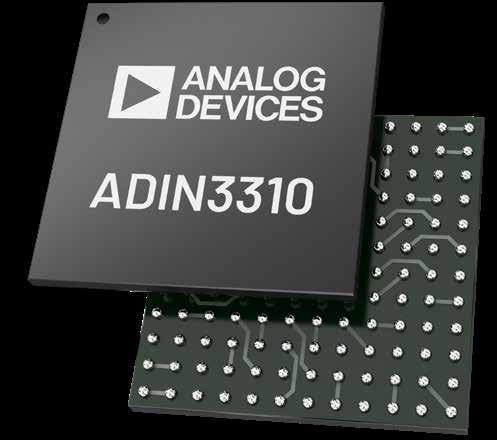
THE CC-LINK PARTNER ASSOCIATION (“CLPA”) announced that two products, ADIN6310 and ADIN3310 provided by Analog Devices, have passed the “CC-Link IE TSN Recommended Network Wiring Parts Test: Switch Certification Class B and Class A”. These are the first ADI products to achieve this certification.
Smoothing the way for smart factories
As manufacturing sites increase in size and become smarter, the requirement is to build integrated networks that can efficiently manage operations and enable precise control. This means gathering data from every kind of equipment and mechanism in real-time, conducting instant analysis, and then swiftly returning control signals.
CC-Link is an open network specification for data communication among devices from various manufacturers. The specifications were publicly released in 2000. As a result, the CLPA was set up in the same year as a neutral body to manage specifications and promote the global adoption of CC-Link.
The CC-Link IE TSN standard, which certifies these ADI products, is the Industrial Ethernet (IE) specification of CC-Link. It supports Time-Sensitive Networking (TSN), which provides the precise time synchronization that standard Ethernet is incapable of doing. TSN enables the integration of IT and OT networks by supporting a single network for both critical, real-time data (such as production line monitoring) and non-realtime data. This enables remote monitoring of production lines and real-time operational coordination among multiple devices, with the result of increasing productivity, efficiency, and safety.
About ADIN6310 and ADIN3310
ADI’s ADIN6310 (6-port) and ADIN3310 (3-port) Industrial Ethernet TSN-compliant network switch ICs are differentiated by their Ethernet port count. Both support operation across multiple communication speeds and have secured CC-Link IE TSN certification for both 100 Mbps and 1 Gbps connectivity. TSN includes core standards covering key functions such as time synchronization, traffic scheduling and preemption—all of which are supported by the ADIN6310 and ADIN3310.
ADI’s ADIN6310 (6-port) and ADIN3310 (3-port) both have secured CC-Link IE TSN certification for 100 Mbps and 1 Gbps connectivity, supporting core TSN functions like time synchronization, traffic scheduling, and preemption.
ADI offers evaluation boards for system manufacturers that integrate the switch IC, PHYs, a host processor, and power supply units. By designing products that adapt ADIN 6310 or ADIN3310, developers can design systems that are fully CC-Link IE TSN-compliant. The switch IC products and the evaluation boards are both already being mass produced and shipping.
CLPA anticipates that this major product certification will speed up the global adoption of CC-Link IE TSN, aiding in the continued advancement of smart factories in Japan and around the world.
Why CC-Link IE TSN Matters
CC-Link is an open network specification that has enabled data communication among devices from diverse manufacturers since 2000. The CC-Link IE TSN standard, which now certifies ADI’s switches, is the Industrial
Ethernet specification that brings TimeSensitive Networking to the factory floor. TSN delivers the precise time synchronization that standard Ethernet cannot, enabling the integration of IT and OT networks by supporting a single network for both critical, real-time data and non-real-time data. This enables remote monitoring of production lines and real-time operational coordination among multiple devices, with the result of increasing productivity, efficiency, and safety. This means manufacturers can gather real-time data from every piece of equipment, analyze it instantly, and send control signals back with minimal delay. The result? Enhanced productivity, efficiency, and safety—hallmarks of the smart factory revolution.
CLPA and Analog Devices
Learn More
Strategic approaches to industrial cybersecurity
Cybersecurity is an ongoing effort that requires regular evaluation and adaptation. Leverage the ISA/IEC 62443 standards to elevate how your company approaches cybersecurity challenges. Regular risk assessments can protect industrial networks against costly disruptions and operating losses.
ACROSS MULTIPLE INDUSTRIAL SEGMENTS, there is an increasing awareness and emphasis on improving cybersecurity in industrial data networks. Engineers and plant managers seek up-to-date insights into the most current risks and prevalence of cyberattacks. They recognize the importance of robust security measures and are looking for fresh insights into the best technologies (hardware and software) to incorporate into their networks. Along with the right technology, adopting more resilient and effective cybersecurity network design and operating concepts, such as the principle of least access and defense to offer flexible and reliable approaches to protecting industrial data and industrial networks. This includes understanding and
applying the key concepts of the ISA/IEC 62443 set of standards that helps secure industrial automation and control systems.
Constant threats and vulnerabilities
As industries increasingly adopt the principles of Industry 4.0 (I4.0) – integrating physical processes with advanced digital systems – the importance of robust cybersecurity measures becomes paramount. I4.0 emphasizes connectivity, data sharing and automation. That means once-isolated industrial systems need to be linked with each other and with enterprise IT networks.
It’s true that while this connectivity is essential to improved productivity, flexibility and real-time data insights promised by I4.0,
the connectivity also exposes networked industrial systems to an expanding and evolving cyber threat landscape.
Several significant challenges include: Legacy infrastructure: Across many industrial sectors, existing sensors, control devices and networking systems can be decades old – still serviceable but using protocols and older digital technology that is vulnerable.
For example, a pump house operating for decades without connectivity may now need to send data to a centralized digital twin for monitoring and predictive maintenance. This connectivity improves operational control, but it also introduces risks. Legacy systems were not designed with security in mind, making them attractive targets for cyberattacks when
While it’s not possible to completely future-proof industrial networks against the next cyberattack, the right investments can enable you to build a resilient cybersecurity framework that protects against current threats and adapts to future challenges.
connected to modern networks.
Increased targets: Connecting and expanding industrial data networks also exposes the potential targets that cybercriminals could exploit. Since so many production systems or remote operations now interface with cloudbased analytics platforms that lie at the heart of enterprise IT resources, potential weak links multiply if they lack modern security features. These vulnerabilities are exacerbated by the sheer scale of smart digital devices woven throughout an I4.0-enabled business. Devices including sensors, actuators, programmable logic controllers (PLCs) and network routers and switches are all potential targets.
Constantly evolving threats: These vulnerabilities are compounded by the rise of sophisticated cyber threats, with hackers and criminals constantly evolving to get past cybersecurity systems. Attackers continuously refine their methods, targeting vulnerabilities in both hardware and software. For example, unpatched devices, outdated protocols or misconfigured access controls provide entry points for attackers.
Ransomware has become a significant issue across industries, including industrial operations. In one scenario, a hacker might gain access to a factory's control systems and lock operators out until a ransom is paid. Such attacks can halt production, disrupt supply chains and incur significant financial and reputational costs.
IT and OT misalignments: Traditionally, information technology (IT) departments have focused on securing data networks, while operational technology (OT) teams prioritize the reliability and safety of physical operations. Both play critical roles in maximizing the value, performance and safety of their network assets.
Until recently, IT organizations in many companies took the lead in maintaining cybersecurity systems and best practices without fully engaging the OT departments or understanding their unique needs. This divergence often results in disconnected security practices, leaving gaps that attackers can exploit. Without a unified approach, the organization as a whole remains vulnerable.
The human factor: Human error is a critical vulnerability in industrial cybersecurity. Misconfigurations, such as improperly set access controls or unpatched systems, are common mistakes that create exploitable weaknesses. Additionally, phishing attacks targeting employees can grant attackers access to sensitive systems. For example, a technician might inadvertently connect a compromised personal device to a secure network, introducing malware. The lack of cybersecurity training among OT personnel further exacerbates this issue, as many operators are unfamiliar with evolving cyber threats and best practices.
Key tools to advance industrial cybersecurity
There are no magic bullets to these and other cybersecurity challenges. They need to be addressed with the right investment in time, resources and technology and be part of a complete approach that industrial companies follow as they connect, build and upgrade industrial network capabilities.
Industrial data network designers and OT leaders can benefit by considering four types of tools to begin building robust and responsive cybersecurity platforms in their operations.
Implementing ISA/IEC 62443: Standards like IEC 62443 provide a comprehensive blueprint for securing industrial systems by aligning IT and OT practices. What sets ISA/IEC 62443 apart is its adaptation of IT cybersecurity practices to industrial environments. Its key concepts include:
• Principle of least access: Restricting user and device permissions to the minimum necessary, reducing potential damage from breaches.
• Defense in depth: Implementing multiple layers of security controls, such as firewalls, encryption and access controls, to protect critical assets, even if one layer is compromised.
• Zones and conduits: Segmenting the
network into secure zones with conduits controlling data flow between them, protecting sensitive data and limiting the spread of potential breaches.
By following IEC 62443, an organization can implement segmentation to isolate critical systems from general operations, minimizing the potential impact of a breach. An added benefit: Applying the ISA/IEC 62443 approach can help foster collaboration between IT and OT teams, ensuring that security measures are consistently applied across the entire organization.
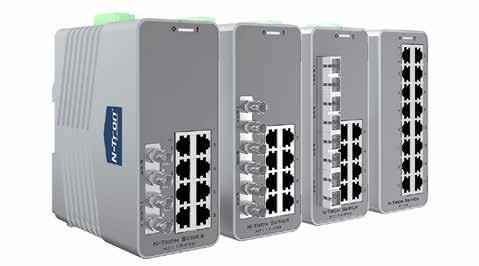
Advances in industrial network hardware: Today’s leading industrial data systems suppliers now offer products such as managed industrial Ethernet switches and advanced network gateways that feature built-in capabilities that make it easier to secure industrial networks and apply ISA/IEC 62443. Managed switches like N-Tron’s NT5000 Series enable network segmentation, creating isolated zones and controlling traffic flow to reduce the attack surface.
For instance, they can limit communication between devices to only those necessary for specific operations, preventing malware from spreading across the network. Advanced gateways like Red Lion’s FlexEdge edge automation platform provide encryption, firewalls and protocol conversion, ensuring even outdated devices meet modern
N-Tron's NT5000 managed Ethernet switch.
cybersecurity standards.
Powerful industrial network software: There is also a new generation of industrial network software tools featuring powerful tools for managing and enhancing industrial cybersecurity. Platforms like Red Lion’s Crimson® 3.2 configuration software allow for streamlined protocol conversion, such as translating unencrypted Modbus data into secure OPC UA protocols, ensuring safe communication across networks (especially those with embedded legacy technology and network communications). The use of encrypted tunneling or conduits such as MQTT (with TLS) or OpenVPN can also gather and transfer your data safely and securely.
Platforms like N-Tron’s NT5000 web-based GUI and N-View software support easy-toimplement access control lists, RADIUS authentication and data encryption, helping organizations enforce strict security policies. For example, a facility using this kind of software can ensure that only authorized personnel access critical systems, reducing the risk of insider threats or accidental breaches. Vulnerability databases: The risks related to cyberattacks are shared by virtually every entity, every person that links to the Internet. These shared risks can be addressed with information-sharing tools.
Access to vulnerability databases, such as those maintained by CISA or equipment vendors, lets industrial companies proactively identify and address potential weaknesses in their systems. These databases catalog known vulnerabilities for specific hardware and software, allowing teams to patch or mitigate risks before attackers can exploit them. By integrating this resource into regular risk assessments, organizations can stay ahead of emerging threats and maintain robust defenses.
Future-proofing industrial cybersecurity
Protecting industrial data networks against cyberattacks is a never-ending challenge, just like improving manufacturing productivity and efficiency. OT and IT professionals recognize there will always be new threats and areas of vulnerability that have to be addressed.
There is a range of best practices and technology solutions that industrial operations can implement. One of the best steps industry can take is to fully apply the approaches established by the ISA/IEC 62443 standards to both the design of their industrial networks and the processes and procedures within their plants.
As companies expand their networks or upgrade legacy systems to current technology, implementing the zones and conduits principle should be a critical aspect of network design. This should include assessing which edge devices and managed Ethernet switches
incorporate features that make it easy to build zones and conduits into the network.
Using managed Ethernet switches to create separate zones for different security levels ensures that a compromised device in one zone cannot affect systems in another. This approach reduces the attack surface and enhances control over network traffic, which is particularly crucial in environments with legacy equipment.
To effectively implement the tools offered by ISA/IEC 62443, IT and OT teams need to enter into new levels of collaboration. Both are responsible for the digital technologies that drive their companies, and that responsibility must include cybersecurity.
IT departments bring expertise in data security, while OT teams understand the unique demands of industrial systems. For example, aligning IT practices like encryption with OT requirements for real-time performance ensures secure and reliable operations. By fostering open communication, consistent security measures following the ISA/IEC 62443 principles can be more easily implemented across their entire network.
While the right technology is important, adjusting and upgrading how everyone within an industrial enterprise interacts with and uses their connected systems is just as critical to sustaining industrial cybersecurity.
Educating personnel on cybersecurity best practices is critical to reducing human error, a common source of vulnerabilities. For example, training operators to recognize phishing attempts and properly configure access controls minimizes the risk of breaches. Making sure they don’t connect personal devices that are not secured to network assets is another best practice that needs routine
reinforcement.
Routine risk assessment is vital. Organizations must routinely inventory and update their digital assets, evaluate vulnerabilities and determine their tolerance for risk. For example, identifying legacy equipment with outdated protocols allows teams to prioritize security upgrades –particularly if a manufacturer or industrial operation acquires a business or new locations and needs to integrate newer assets into the overall network.
This assessment helps allocate resources effectively, improving security while balancing operational needs. Working with technology suppliers with in-depth knowledge of the features and capabilities of industrial network hardware and software can provide a valuable resource as companies invest in improving cybersecurity.
Cybersecurity is an ongoing effort that requires regular evaluation and adaptation. Leverage the ISA/IEC 62443 standards to elevate how your company approaches cybersecurity challenges. Regular risk assessments combined with investments in technology upgrades and employee training can protect industrial networks against costly disruptions and operating losses.
While it’s not possible to completely future-proof industrial networks against the next cyberattack, the right investments can enable you to build a resilient cybersecurity framework that protects against current threats and adapts to future challenges.
Barry Turner, Product Manager - Connect, N-Tron® by HMS Networks
Red Lion's FlexEdge controller
2026 Ethernet Alliance Roadmap driven by AI/ML
Artificial Intelligence and Machine Learning are driving the roadmap extending Ethernet speeds to 3.2T and beyond. Ethernet's progression towards higher speed interfaces, the widening variety of interconnect options, and advancements in power efficiency are ensuring that Ethernet can meet the needs of AI/ML workloads.
THE ETHERNET ALLIANCE 2026 ROADMAP SETS a new course for connectivity. The refreshed roadmap defines Ethernet’s evolving role in AI, automotive, and next-generation connectivity, spotlighting emerging trends shaping tomorrow’s networks.
Ethernet Alliance roadmap
The Ethernet Alliance, a global consortium dedicated to the continued success and advancement of Ethernet technologies, announced the public release of its 2026 Ethernet Roadmap. Initially debuted during TEF 2025: Ethernet for AI, it highlights the technologies, trends, and breakthroughs set to define the next era of high-performance, AI-driven networking.
Ethernet is evolving to meet AI’s insatiable appetite for speed and scale. The latest Ethernet Roadmap shows how upgrades like 1.6 Terabits per second (Tb/s) interfaces,
As AI reshapes the digital landscape, cloud and service provider networks are converging to deliver new levels of scale, speed, and intelligence. Ethernet continues to advance with innovations such as 1.6 Tb/s connectivity and Linear Pluggable Optics (LPO), enabling the performance, efficiency, and reach required to power AI-driven workloads across every domain.
How Ethernet speeds have increased since 1980.
Linear Pluggable Optics (LPO), improved copper and fiber options, and energy-efficient designs will facilitate growth in AI, cloud services, business, automotive, manufacturing, and edge computing.
“A half-century down the road, Ethernet has reached its next turning point,” said Peter Jones, chair, Ethernet Alliance. “The 2026 Ethernet Roadmap shows how Ethernet is staying ahead of network changes, delivering the correct mix of performance, power, and flexibility as AI becomes central to what we do every day.”
The 2026 Ethernet Roadmap highlights a deepening convergence as hyperscalers adopt 100G–800G interconnects, telcos roll out advanced optical transport for 5G and AI, and enterprises transition to 2.5G/5G/10G BASE-T with higher-speed optical uplinks to support next-gen Wi-Fi and AI-enabled workplaces.
The roadmap also outlines the increasing use of automotive Ethernet in software-defined vehicles, the arrival of Wi-Fi 7 and 8, and how industrial networks are changing with time-
Total throughput (data rate) may be achieved in three general ways: (1) Aggregating multiple lanes; (2) Increasing the per lane bit rate; (3) Increasing the bits transferred per sample (Baud). This chart shows how multiple lanes can be used to generate similar speeds. The per lane speed times the number of lanes determines the total link speed.
sensitive networking (TSN), BASE-T1 PHYs, and combined 5G/Wi-Fi/Ethernet systems that enable automation in real time.
As global electricity needs rise, the 2026 Ethernet Roadmap emphasizes the industry’s concentration on more bandwidth per watt, better optics, and new cooling and powermanagement, each a key to responsibly growing AI and facilitating Ethernet’s continued expansion and advancement.
Here are some of the technical advancements and highlights from the roadmap report.
Speed and throughtout
Total throughput (data rate) may be achieved in three general ways: (1) Aggregating multiple lanes; (2) Increasing the per lane bit rate; (3) Increasing the bits transferred per sample (Baud) . The chart on the previous page shows how multiple lanes can be used to generate similar speeds. The per lane speed times the number of lanes determines the total link speed.
Signaling methods
Signaling Method Transitions: Non-Return-toZero (NRZ) used for 25Gb/s per lane and below; Four level Pulse-Amplitude Modulation (PAM4) for 50Gb/s per lane; Coherent signaling (both in-phase and quadrature modulation) for 100Gb/s per lane and above.
Optical evolution
The ever-increasing demand for power efficiency in data centers is driving the transition to new levels of system and optics integration, such as Co-Packaged Optics (CPO), Co-Packaged Copper (CPC), and LPO/LRO. As data centers deploy higher and higher link speeds, the power consumption of SERDES links and the optical modules increase significantly. The need for reduced-power optical solutions is fueling innovation and creativity in this market. To meet diverse deployment needs, retimed, halfretimed, and linear optical modules each offer varying levels of signal processing and power efficiency to optimize performance across different network architectures.
Interconnect technologies: pluggable modules
The current high-speed optical market is dominated by retimed optics, but there is rapidly growing interest in linearbased solutions for optical modules which dramatically reduce the module power
evolution driven by the needs of data centers.
consumption. Linear Pluggable Optics (LPO) / and Linear Receive Optics (LRO) are emerging techniques which remove all/some of the retiming circuitry found in traditional optics. These implementations utilize common pluggable form factors of QSFP, QSFP-DD, and OSFP and are primarily targeted at 400GbE and higher markets.
A fully linear optical module can operate at around half of the power of a similar retimed device. LRO is a half-retimed solution which achieves some of the power reduction while providing a higher quality transmitted optical signal.
Download the 2026 Ethernet Roadmap
The 2026 Ethernet Roadmap is available for download at the Ethernet Alliance website: https://bit.ly/EA-2026EthernetRoadmap.
Interconnect technologies: pluggable modules
Ethernet Alliance Learn More
Optical
Technology predictions: what's ahead in 2026
Industry experts give their opinions on major technology trends and crystal ball predictions in the areas of Artificial Intelligence, WiFi technology, Industrial Cybersecurity, and Electronics and Connectivity Design.
LOOKING AHEAD TO 2026, INDUSTRY EXPERTS are predicting changes that will reshape the industrial landscape in the areas of computing, artificial intelligence, the future of WiFi and industrial cybersecurity. Here is a summary of what they expect:
Decentralized AI will appear in new-generation humanoid robotics by the end of 2026, and we’ll see the rise of analog AI compute.
Wi-Fi is entering a powerful new growth phase, with Wi-Fi 7 scaling fast while the groundwork for Wi-Fi 8 and mmWave is laid.
Cybercriminals are entering 2026 with new capabilities powered by artificial intelligence, automation, and increasingly sophisticated deception techniques.
As people rely more than ever on digital services, smart devices, and online communication, threats are growing in both scale and complexity.
Artificial intelligence (AI) will continue to transform every major industry sector over the next 12 to 18 months, driving exponential demand for computational resources while causing major bottlenecks in both compute power and connectivity.
Decentralized AI in 2026
Decentralized AI will appear in new-generation humanoid robotics, and we’ll see the rise of analog AI compute.
As the year comes to an end, Analog Devices is looking ahead to 2026, and which technological advancements will create new opportunities and shape our daily lives. They are pleased to share the insights and predictions of Massimiliano “Max” Versace, VP of Emergent AI, Analog Devices.
Prediction: Decentralized AI will appear in new-generation humanoid robotics by the end of 2026.
By late 2026, decentralized AI architectures merging sensing with neuromorphic and in-memory compute will transition from pilot programs to early commercial deployment. We’ll see humanoid robotics systems getting a bit closer to biological systems, where local circuits in sensory organs and spinal pathways handle reflexes and balance, allowing smoother, more adaptive movement,
"Decentralized AI will appear in new-generation humanoid robotics, and we’ll see the rise of analog AI compute," Massimiliano “Max” Versace, VP of Emergent AI, Analog Devices.
drastically reduced power consumption, and freeing the central brain to “think and plan.”
These technological leaps will start with intelligent sensors that embed novel AI compute, such as neuromorphic and in-memory-compute architectures, directly within the sensor. The combination of decentralized AI and novel AI compute architecture will dramatically reduce latency and power consumption, allowing always-on AI at the edge and freeing larger processors to focus on higher-level reasoning, planning, and learning, rather than micromanaging continuous sensorimotor control loops. By enabling real-time, low-latency AI processing at the edge, robots will become more efficient, responsive, and capable of near-biological sensory-motor skills. This shift will power a step change in their ability to engage complex, dynamic environments with fluid, reliable coordination and pave the way for practical and pervasive humanoid robotics.
Prediction: In 2026, we’ll see the rise of analog AI compute.
Historically sidelined due to scalability and precision limitations, analog compute is reemerging in 2026 as digital architectures face energy, latency, and memory bottlenecks with no solution in sight. This is especially
critical in edge environments where real-time responsiveness and power efficiency are a must.
Analog AI compute uses the physics of the sensing and computing substrate to perform computation, transforming energy directly into AI inference. This is a different approach to AI compute vs. conventional digital processors, which separate sensing from computation. Analog AI collapses these layers into a unified framework where intelligence begins at the sensor itself.
By the end of 2026 we’ll see initial deployments and adoption of this technology, particularly in robotics, wearables, and autonomous applications, where analog AI enables real-time responsiveness, smoother interactions, longer battery life, and more natural behavior in the devices they power.
Wi-Fi predictions for 2026 and beyond
Ten predictions with Wi-Fi entering a powerful new growth phase, Wi-Fi 7 scaling fast and the groundwork for Wi-Fi 8 and mmWave is laid.
The Wireless Broadband Alliance (WBA), the global industry body dedicated to driving the seamless and interoperable service experience
“It is clear that Wi-Fi is becoming fundamental as the digital backbone of modern business. From Wi-Fi 7 and 6 GHz to Wi-Fi HaLow and OpenRoaming, we’re seeing rapid innovation turn into real deployments that improve user experience, unlock new services, revenues and reduce costs for operators and enterprises,” -- Tiago Rodrigues, President and CEO of the Wireless Broadband Alliance.
of Wi-Fi across the global wireless ecosystem, has shared its 10 predictions for Wi-Fi in 2026 and beyond.
Detailed in full in the “WBA Industry Report 2026”, these predictions point to Wi-Fi entering a powerful new growth phase, with Wi-Fi 7 scaling fast while the groundwork for Wi-Fi 8 and mmWave is laid. Equally, 6 GHz, Wi-Fi HaLow and mesh are extending reliable coverage from homes to factories and smart cities, while offload, fiber, satellite and LEO-powered in-flight services are turning Wi-Fi into a ubiquitous, carrier-grade connectivity fabric that underpins both 5G today and 6G tomorrow.
Tiago Rodrigues, President and CEO of the Wireless Broadband Alliance, said: “It is clear that Wi-Fi is becoming fundamental as the digital backbone of modern business. From Wi-Fi 7 and 6 GHz to Wi-Fi HaLow and OpenRoaming, we’re seeing rapid innovation turn into real deployments that improve user experience, unlock new services, revenues and reduce costs for operators and enterprises. As 5G and, in future, 6G increasingly converge with Wi-Fi, organizations can design connectivity to achieve the outcomes they need, whether that’s smarter factories, more resilient cities or new ways to engage customers. The WBA is helping the ecosystem make that leap together.”
Wi-Fi Predictions for 2026 and Beyond
1. Wi-Fi 7 adoption to accelerate: 2025 saw industry adoption of Wi-Fi 7 rapidly gather pace, with consumers and enterprises eager to harness the 6 GHz spectrum band and the advanced new features of the standard. Reflecting this strong interest in Wi-Fi 7, shipments of APs supporting the standard rose from 26.3 million in 2024 to a projected total of 66.5 million in 2025. ABI Research anticipates that this transition to Wi-Fi 7 will accelerate further in 2026, with a forecast annual shipment number of Wi-Fi 7 APs at 117.9 million.
2. Standard Power 6 GHz to gain further traction: Standard Power (SP) 6 GHz got off to a rocky start, with protracted regulator certifications and limited infrastructure options. Now that there is greater clarity on the regulatory landscape of SP 6 GHz, and that a wider selection of SP 6 GHz enabled equipment has emerged, we expect that 2026 will see SP 6 GHz deployments accelerate. Large public venues, education, and the industrial manufacturing verticals will be the keenest adopters of the technology. We also anticipate that additional regulators will make moves on authorizing SP 6 GHz in 2026.
3. Early prototypes of Wi-Fi 8 to emerge: Although the official Wi-Fi 8 (802.11bn) standard won’t be finalized for several years,
we saw the first wave Wi-Fi 8 chipsets being unveiled at the tail-end of 2025. We expect this to be followed in 2026 with a broader array of Wi-Fi 8 chipset announcements, and the revealing of many early prototype Wi-Fi 8 APs. A handful of these prototype Wi-Fi 8 APs will be seen early in the year at MWC 2026.
4. Wi-Fi offload gains in prominence with OpenRoaming: A plethora of trends will act to spur investments into Wi-Fi offloading in 2026. For mobile carriers, the challenge of grappling with ever-increasing traffic on their cellular networks, alongside the need to improve connectivity experiences for their customers, will drive them to expand their Wi-Fi offloading capabilities. Many smart cities on the other hand will look to leverage Wi-Fi offloading to provide both residents and tourists with continuous free connectivity, as well as enabling a range of new applications, from smart traffic to disaster prevention. Additional advancements in OpenRoaming in 2026 will help to drive this trend further.
5. Wi-Fi HaLow momentum accelerates: Following many successful trials from the WBA, 2025 was the year that Wi-Fi HaLow truly found its feet and commercialization of the technology began to scale up. Throughout the year we saw numerous new chipset and infrastructure announcements, alongside the successful running of the first Wi-Fi HaLow Global Summit and the launch
“Cybercriminals are entering 2026 with new capabilities powered by artificial intelligence, automation, and increasingly sophisticated deception techniques. As people rely more than ever on digital services, smart devices, and online communication, the threats facing everyday users are growing in both scale and complexity," -- NordVPN.
of a new marketing program for Wi-Fi HaLow from the Wi-Fi Alliance. We expect the momentum behind Wi-Fi HaLow to continue in 2026. This will include additional product announcements, and exciting deployments which demonstrate the real-world applications of the technology.
6. Greater clarity on how Wi-Fi and 6G will converge: The WBA’s vision statement for 6G highlights how the upcoming 3GPP standard will be built around a collaboration with Wi-Fi and on harnessing both technologies for the achievement of the greatest cost-effectiveness and operational efficiency. As the cellular industry gradually begins to gear up for 6G throughout 2026, we expect that we will get further clarification on the exact nature of the 6G/Wi-Fi collaboration.
7. Wi-Fi on airplanes witnesses a major advancement: The Quality of Experience (QoE) for in-flight Wi-Fi is set to undergo a major enhancement with the emergence of connectivity underpinned by Low Earth Orbit (LEO) satellite constellations, which have the potential to enable significantly faster speeds, lower latencies, and uninterrupted connectivity. 2026 will see a multitude of airlines, including British Airways (BA) and United, adopt in-flight Wi-Fi solutions supported by LEO satellite constellations for the first time. BA, alongside many others, will at the same time make Wi-Fi access available for free to all passengers,
irrespective of their travelling class, greatly expanding in-flight Wi-Fi access.
8. Advances in broadband access improve and expand connectivity: Fiber penetration will continue to rise across 2026, with the number of fiber broadband subscriptions reaching a new record of 808.7 million at the end of 2026, up from an estimated 776.3 million at the close of 2025, which itself was a major leap from the 745.5 million at the end of 2024. At the same time, the continued expansion of satellite broadband will help to enable reliable, high-performance connectivity to the unconnected and underserved. Accordingly, the total number of worldwide satellite broadband subscriptions will increase from 6.76 million at the close of 2024 to 12.67 million by the end of 2026.
9. Mesh adoption continues to rise: Consumers are increasingly turning to Wi-Fi Mesh to extend coverage and eliminate blind spots throughout the home, as well as to enable the delivery of additional services. In the early 2020s much of the demand came through the retail channel, but Internet Service Providers (ISPs) are now beginning to scale up their Wi-Fi Mesh deployments in an effort to raise ARPUs (Average Revenues Per User) and to improve customer Quality of Service (QoS). Reflecting this growing demand, annual shipments of Wi-Fi Mesh equipment are projected to rise from 41.7 million in 2024 to
a total of 63.6 million in 2026.
10. Important progress on Integrated Millimeter Wave (mmWave) Wi-Fi (802.11bq): With the Project Authorization Request for 802.11bq initiated back in December 2024, the 802.11bq working group has now begun exploring how Wi-Fi can best utilize the 60 GHz spectrum band. Whilst project completion is not expected until 2029, 2026 should provide us some insight into the direction which the 802.11bq standard will take, and how the industry plans to leverage the band for the delivery of the high-gigabit, low-latency wireless transfer of data.
Cybersecurity Outlook 2026:
From Quantum Risks to ‘Evil GPT. Experts at NordVPN reveal five emerging cyberthreats set to mark a new era of digital danger.
Cybercriminals are entering 2026 with new capabilities powered by artificial intelligence, automation, and increasingly sophisticated deception techniques. As people rely more than ever on digital services, smart devices, and online communication, the threats facing everyday users are growing in both scale and complexity. As new tools and tactics continue to emerge, it’s crucial to stay informed about the risks ahead and understand the forces shaping tomorrow’s attacks.
“AI models in every industry—from autonomous vehicle sensors and high-resolution medical imaging to vital defense systems and real-time control systems on factory floors—generate massive amounts of data while requiring high-speed connectivity, advanced power delivery and efficient thermal management,” -- Aldo Lopez, SVP and president, Datacom and Specialty Solutions, Molex.
Five 2026 Cybersecurity Risks
Risk of Internet Monoculture
The growing monoculture of the internet presents a significant risk. The widespread use of the same cloud providers (like AWS), CDNs (like Cloudflare), and productivity suites (like Google or Microsoft Office) means that a failure in one service can affect millions of users, reducing the internet's resilience.
This monoculture makes hacking more profitable because even a small gain per person, when scaled across millions of users on a single platform, results in large earnings for criminals. Historically, using heterogeneous networks (Sun Microsystems, Linux, Windows servers) made systems less appealing targets by increasing the cost for attackers.
“Because the digital ecosystem nowadays is largely monocultural, everyone becomes a target. Online, there is no such thing as being uninteresting. Any small piece of data, even something as simple as DNS records, can be sold, aggregated, and monetized. Simply existing online makes you a target,” explained Adrianus Warmenhoven, cybersecurity expert at NordVPN.
Increasing misinformation through new channels
Over the course of 2025, it was observed that on discussion platforms like Reddit, as well as other social media and streaming platforms, sensible security measures and online privacy
habits were often ridiculed by other users. This trend is expected to increase in 2026, with serious repercussions for individual online safety and privacy.
Criminal organizations, which are sometimes better organized than legitimate businesses, have dedicated marketing and advertising units aimed at promoting poor security habits to keep users vulnerable. Capable of spending significant funds, these organizations are increasingly likely to buy or create influencers to promote insecure habits or products with weaker security standards
AI-driven vulnerabilities and accelerated cyberattacks
AI tools, such as ChatGPT, often store chat histories in the browser's local storage, making sensitive conversations vulnerable to info-stealers. Despite warnings, many users continue to share sensitive topics with AI. While attackers will increasingly target such information, AI companies also use user data to train their models.
“2026 will also see a dramatic escalation in AI-powered offense and defense. AI has altered the accessibility and sophistication of cybercrime, lowering barriers for less technical actors while amplifying the capabilities of experienced criminals”, says Marijus Briedis, CTO at NordVPN.
Cybercriminals are already experimenting with autonomous AI systems that can probe networks, identify weaknesses, and exploit
vulnerabilities with minimal human oversight. These systems can learn, iterate, and adapt, making attacks faster and harder to predict, supporting phishing campaigns or social engineering. Advanced AI models like "Evil GPT" are easily and cheaply available on the dark web, often for around $10.
Erosion of trust
Trust is expected to become one of the biggest security challenges in 2026. As more services become fully cloud-based, authentication processes will be increasingly targeted. This includes deepfakes, voice cloning, realistic synthetic personas, automated phishing chats, and hyperpersonalized attacks that blur the line between authentic and artificial.
Criminals will create entirely fake synthetic identities, combining real user data with fabricated information, to access cloud accounts, open bank accounts, apply for credit, and commit crimes for years before detection. AI-enabled scams and fraud will increase productivity for criminals and make fraudulent websites and services increasingly difficult to detect. Ultimately, trust in digital devices and services may erode completely.
Viability of quantum security threats
“The quantum computing market is projected to surpass $5 billion in 2026, with much of the new investment aimed at commercializing its
impact beyond niche applications. As a result, cybersecurity will become a major focus”, explains Marijus Briedis, CTO at NordVPN.
Quantum computing is approaching a threshold where current encryption standards may no longer be secure. Although largescale quantum attacks are still years away, cybercriminals are already conducting “harvest now, decrypt later” operations—stealing encrypted data today with the expectation that quantum breakthroughs will allow them to decrypt it in the future.
Once quantum decryption becomes viable, decades’ worth of private information could be exposed. For organizations and individuals alike, quantum resilience should no longer be a future concern but a current priority.
“As the borders between the physical and digital worlds blur, cybersecurity is no longer just a technical issue but a societal one. It’s like teaching a child to eat a sandwich but not how to brush their teeth. Digital education has focused on literacy (how to use devices) whereas the focus must shift to digital hygiene, cultivating good security habits. In 2026, this will become more important than ever,” concludes cybersecurity expert Adrianus Warmenhoven.
Electronics and Connectivity Design Predictions for 2026
Top 10 predictions fueled by far-reaching impact of Artificial Intelligences across major industries.
Molex, a global electronics leader and connectivity innovator, is predicting that artificial intelligence (AI) will continue to transform every major industry sector over the next 12 to 18 months, driving exponential demand for computational resources while causing major bottlenecks in both compute power and connectivity. AI-driven data proliferation and processing are creating new opportunities and obstacles for design engineers across fast-growth sectors, including automotive, aerospace and defense, consumer electronics, data centers, industrial automation and MedTech.
“AI models in every industry—from autonomous vehicle sensors and highresolution medical imaging to vital defense systems and real-time control systems on factory floors—generate massive amounts of data while requiring high-speed connectivity, advanced power delivery and efficient thermal management,” said Aldo Lopez, SVP and president, Datacom and Specialty Solutions, Molex.
“In 2026, we will remain steadfast in helping remove critical bottlenecks in compute power and connectivity while working with customers, suppliers and partners worldwide to develop future-ready, AI-driven infrastructures he added”
Top 10 Predictions for 2026
1. High-speed interconnects remain essential to delivering the speed and density to enable AI/Machine Learning workloads in modern hyperscale data centers
Communication between major compute elements, like GPUs and AI accelerators within a data-center server or chassis, necessitates a mix of high-speed backplane and board-toboard solutions designed for 224Gbps PAM-4 speed, along with high-speed pluggable I/O connectors that support aggregate speeds up to 400/800Gbps while providing a path to 1.6T.
2. Energy consumption hampers datacenter scaling, propelling advancements in thermal management
The heat generated by high-performance servers and systems needed to scale generative AI applications while supporting the transition to 224Gbps PAM-4 has exceeded traditional solutions relying on air-cooling technology. Developments in liquid cooling, including direct-to-chip cooling, immersion cooling and passive components that enhance active cooling, will continue to gain traction and exploration over the next 12 to 18 months.
3. Demand escalates for Co-Packaged Optics to support “scale-up” architectures
Co-Packaged Optics (CPO) is considered essential for handling GPU-to-GPU interconnectivity in AI-driven architecture. Designed to deliver ultra-high bandwidth density directly at the chip edge, CPO enables much higher interconnect density while reducing power consumption and electrical signal loss.
The focus on CPO is expected to intensify in the coming year, as it has been developed specifically to address the massive power and bandwidth demands of hyperscale data centers and AI/ML clusters.
4. Specialty fiber optics accelerate MedTech and aerospace and defense innovations
Specialty fiber optics offer high-precision links with immunity to Electromagnetic Interference (EMI). No wider than human hair, optical fiber increasingly powers highresolution imaging equipment, like MRI and CT scanners, while delivering concentrated laser energy for non-invasive therapeutic treatments. Fiber optics also address engineering challenges in satellite and space systems to transmit vast volumes of data over long distances with minimal signal degradation.
5. Rugged, reliable and miniaturized solutions gain momentum across every major sector
The use of compact, durable connectors that thrive in harsh environments has long dominated automotive as well as aerospace and defense applications. Pushing boundaries for greater reliability in very small form factors
has now permeated consumer electronics 6. Electrification continues to accelerate, driving demand for high-speed, high-power connectivity
Electrification trends in military land systems are gaining ground, with growth in Electric Vertical Take-off and Landing (eVTOL) systems, which need lightweight, miniaturized and rugged MIL-SPEC connectors and cables. An early proponent of zonal architecture for next-gen electrified vehicles, Molex connects multiple sensors, cameras, radar, LiDAR and other technologies while prioritizing the role of hybrid or mixed connectors needed to handle power and high-speed signals associated with in-vehicle networks.
7. Mandates for modular solutions and open standards grow across most industry sectors
An active participant in the Open Compute Project (OCP), Molex is developing nextgeneration data center cooling technologies and modular hardware specifications to enhance hyperscale system performance, efficiency and modularity. Close alignment with industry standards groups in aerospace and defense also empowers Molex to focus on reducing size, weight, power and cost (SWaP-C).
8. 48V architecture gains traction as universal standard for power efficiency
48V architecture is rapidly becoming the universal standard for power efficiency in AI-driven data centers and next-gen vehicles. A power architecture enabler, Molex drives innovation in 48V technology to solve thermal density challenges and reduce cabling weight in automobiles while addressing power spikes caused by generative AI workloads in data centers in support of the OCP Open Rack v3 (ORV3) standard.
9. Personalization continues to shift, thanks to emergence of agentic AI
Agentic AI adapts readily to changing conditions, aiding real-time decision making and personalization. In automotive, this translates to advances in autonomous driving and in-cabin experiences that function more like a third living space. On factory floors, real-time access to data and adaptive humanmachine interfaces improve productivity and operational efficiency.
10. Demands for supply optionality and regional manufacturing grow amid global trade volatility
Investments in AI-driven data ecosystems will propel digital supply chain intelligence to support demands for new, regional supply networks and localized manufacturing amid shifting trade policies. The result requires increased supply chain resilience amid growing demands for increased predictive procurement intelligence.
Al Presher, Editor, Industrial Ethernet.
Software Defined Automation Next-Generation Platform
Leveraging Industrial DevOps, security, and artificial intelligence (AI) capabilities, this new solution delivers Industrial DevOps, security, and AI capabilities for industrial controller management at scale.
A cloud-centered platform provides a single pane of glass for control systems that is built for ease of use, speed of implementation, and scale across the largest manufacturing networks.
AT SPS 2025, SOFTWARE DEFINED AUTOMATION announced the general availability of its nextgeneration solution for industrial controller management at scale. Leveraging Industrial DevOps, security, and AI capabilities, the cloud-centered platform provides a single pane of glass for manufacturers’ control systems. It is built for ease of use, speed of implementation, and scale across the largest manufacturing networks.
Software Defined Automation
“The tools automation engineers are expected to use as part of their daily routines are outdated and fail to get the job done without many workarounds,” said Dr. Josef Waltl, Founder and CEO, at Software Defined Automation.
“We are on a mission to give these engineers the tools they deserve and enable them to manage their controllers like modern software systems," Waltl added. "Today we are delivering an approachable, efficient vendor-
agnostic software-defined control plane that empowers teams with a modern environment for more efficient factories.”
Modern experience for more efficient factories
From faster deployments to streamlined onboarding of users and devices, the platform is designed to reduce complexity for an automation engineer. Intuitive workflows and flexible organization models allow teams to manage devices, project versions, and pipelines from one site to hundreds.
The redesigned console allows engineers to manage both users and industrial controllers at a very large scale through policy-driven access rights management, multidimensional asset organization, advanced workflows, and reporting, including at-a-glance status for all devices managed in the platform.
In addition, Software Defined Automation is previewing a custom Terraform provider for its platform that automates the creation/update/
deletion of users’ SDA resources. Terraform is an industry-standard infrastructure as code (IaC) tool that allows users to create and manage resources in different systems, such as cloud environments. This is one further step to code controller architectures for better resource management and versioning of an entire system’s configuration.
Software Defined Automation’s Version Control now integrates with GitHub, which is used increasingly by manufacturers and machine builders as a centralized versioning tool. The integration, currently in preview, links GitHub repositories with the SDA project repository so that users can track versions in GitHub and compare code changes for binary or text files and graphical languages, including function block diagrams and ladder logic, in the SDA platform.
The web-based OrchestrationSuite tool from SEW-EURODRIVE offers an on-demand suite that simplifies industrial automation by enabling software to be deployed, managed, and updated via a single platform. It combines cloud-based engineering environments, secure remote access, and AI-supported functions in a flexible solution.
SEW-EURODRIVE has also introduced OrchestrationSuite, powered by Software Defined Automation, to simplify industrial automation implementations by enabling software to be deployed, managed, and updated via a single platform.
The web-based OrchestrationSuite tool from SEW-EURODRIVE is an on-demand suite that simplifies industrial automation by enabling software to be deployed, managed, and updated via a single platform. It combines cloud-based engineering environments, secure remote access, and AI-supported functions in a flexible solution. Now, the Bruchsal-based drive and automation specialist is taking another step forward: In collaboration with its partner company Software Defined Automation Inc. (SDA), OrchestrationSuite is being further developed to make it even more transparent and powerful for users.
“The partnership with SDA allows us to coordinate the workflows of OEM development (Dev) and end customer operations (Ops) across the entire automation cycle, thereby transferring principles from the IT world directly into the installed OT (operational technology),” explained Dr. Hans Krattenmacher, Chief Innovation Officer (CIO) at SEW-EURODRIVE. “Our customers benefit from simplified software provisioning for PLCs, robots, and drives, centralized versioning and availability of updates and backups – all of which is manufacturer-independent, secure, and scalable via the cloud.”
The MOVI-C® drive and automation platform from SEW-EURODRIVE is fully integrated into the OrchestrationSuite. This enables the OrchestrationSuite to provide consistent web-based access to engineering tools, such as MOVISUITE®
and MotionStudio®, in order to efficiently control and automate the configuration, commissioning, and operation of MOVI-C® components. Thanks to open interfaces, third-party tools can also be seamlessly integrated. Engineers can work directly in the browser without having to install local software – a real efficiency gain.
The powerful platform enables fine-grained access control for users, groups, devices, and projects and supports the secure remote provisioning of various automation software. Automated backup and recovery processes minimize downtime, while transparent version tracking across different PLC providers ensures maximum traceability. AI-powered features automatically document PLC code and translate it into humanreadable language. In addition, individual pipelines (automatic executable task lists) can be configured for automated updates and backups of entire device fleets – including control software, setups, and firmware.
“Our vision at SDA is to turn factories into software systems,” said Dr. Josef Waltl, Chief Executive Officer (CEO) of the software manufacturer based in Boston in the US and Garching near Munich. “The collaboration with SEW-EURODRIVE shows how this vision is becoming reality: The intuitive OrchestrationSuite is a change driver. It works independently of systems, locations, and manufacturers, simplifies the lifecycle management of all automation resources, strengthens cybersecurity in industrial environments, and supports the path to the software-defined factory. Together with SEW-EURODRIVE as our partner, we are creating next-level automation with the software of tomorrow – today.”
In addition to its extensive support for Siemens TIA Portal, Software Defined Automation now delivers comprehensive backup capabilities for SIMATIC STEP 7 from V5.7. In addition, live value backup for instance data blocks, safety blocks, and tag values from Siemens SIMATIC S7-1200 and S7-1500 controllers is now in preview.
Support for SFTP and Server Message Block (SMB) protocols, now generally available, expand backup and restore of a wider variety of controllers, including KUKA robots.
Advanced security reduces gaps in protection for industrial controllers
With the increase in volume and sophistication of cyberthreats across the manufacturing industry, the need to better protect a factory’s core intellectual property (IP)—industrial controller code—persists. Software Defined Automation’s expanding security capabilities are built on a zero trust architecture to help safeguard industrial operations, strengthen reliability, and ensure operational resilience.
In this release, Security Hub and custom roles are generally available. Security Hub includes a vault that enables secure credential storage for PLC devices and projects as well as automated credential rotation for select PLC vendors. Custom roles allow administrators to define policies by asset type, action, document, and project, and associate those
policies with specific users or roles. By making the assignment of permissions consistent and repeatable across large numbers of users and devices, organizations reduce risk, improve efficiency, and easily scale governance.
Detailed audit logs that establish clear trails of user actions, system events, and changes with the platform are available as a public preview. By tracking, recording, and preserving digital activity, audit logs improve security, accountability, compliance, and operational integrity in the production environment.
Pragmatic AI automates routine tasks for enhanced operational efficiency
The new Software Defined Automation Factory Operator, available as a private preview, is an intelligent assistant that handles routine tasks and processes, such as interactively creating and querying assets or generating custom insights into backups or device status. It frees engineers up for more productive work so they can fast track innovative development cycles.
Factory Agent, Software Defined Automation’s tool for AI-generated code documentation, has also been updated with a private preview that provides explanations of differences between project versions. It delivers an overview, detailed analysis, and the functional impact of any changes, helping users understand versions, troubleshoot, and
write better code updates.
Meeting customer needs with more support for common automation vendors
With this latest release, Software Defined Automation increases its support for the automation vendors most often used by its customers. New and expanded support includes Beckhoff TwinCAT 3.1 Build 4026, B&R Automation Studio 3.0.90 and 4.12, CODESYS, Rockwell Automation Studio 5000 v37, SEW-EURODRIVE MOVITOOLS MotionStudio 6.60, and Siemens SIMATIC Manager 5.7 and TIA Portal v20.
Availability
Software Defined Automation’s next-generation platform is now generally available for all new and existing customers in six languages, and anyone can sign up for a 14-day trial at www. softwaredefinedautomation.io/sda-trial. Live value backup and audit logs are available as public previews, while the Terraform provider, GitHub integration, Factory Operator, and Factory Agent comparisons of versions are private previews available to select customers.
Technical article by Software Defined Automation.
Learn More
Factory Agent Explanation of Differences.
Ins and Outs of Industrial Remote I/O Systems
I/O refers to the connectivity that lets control systems interact with physical equipment. “Input” is the data flowing from a field device to the controller, while “output” are the commands from the controller to perform actions. An I/O module manages communications, acting as a bridge between the controller and the devices.
THERE ARE TWO PRIMARY TYPES OF I/O: LOCAL and remote I/O. When it comes to industrial settings, the latter is the more common. This article aims to help you gain a better understanding of the basics of industrial remote I/O.
What Is Remote I/O
Also known as distributed I/O, remote I/O is a system where an I/O module and multiple field devices operate in a decentralized location far away from a main controller, often because the harsh industrial environment may damage the controller. More often than not, this controller is a programmable logic controller (PLC), but can also be a DCS, RTU or industrial PC.
Sensors or other field input devices are connected to the remote I/O module, sharing information such as temperature, pressure, vibration, chemical properties, light intensity, and flow rates. These data signals are transmitted back to the I/O module and the PLC. Once processed by the PLC, output data is transmitted to valves, motors and other final actuators, essentially telling them what to do in response to the input data.
Signals are sent on high-speed twisted pair wires and fiber optics using Ethernet/ IP, Modbus TCP, Profibus or other protocols. To enable communication between remote I/O modules and the PLC, an adapter module is installed in the local PLC rack serving as the gateway between the PLC’s backplane/protocol and the remote I/O network.
Benefits of Remote I/O
Remote I/O has been the industry standard for 20+ years for very good reasons. Here are the real, practical advantages of using industrial remote I/O systems instead of traditional centralized home-run wiring:
Lower wiring costs: Remote I/O systems substantially reduce the amount of wiring that needs to be run. Instead of running hundreds of individual wires from field devices back to the central PLC cabinet, a single network cable is run from the PLC to the I/O modules, alon g with running short local wires from the field devices to nearby I/O modules. To expand, the company simply adds another I/O module and plugs it into the existing network. Plus, a faulty module can be hot-swapped in minutes without rewiring dozens of field cables.
Diverse Configuration Options: Due to the
Antaira’s LMP-1002G-10G-SFP-24 is a Gigabit PoE+ managed Ethernet switch embedded with 8 Ethernet ports and 2 SFP+ slots.
flexibility that a remote I/O setup provides, a greater variety of hardware configurations can be created. For instance, I/O can be mounted directly on the machine, eliminating local junction boxes entirely. Different topologies are also possible depending on the factory’s layout.
Facilitating Communication in Harsh Environments: In many industrial plants, a PLC can’t be deployed close to field devices due to harsh environmental conditions. In instances of extreme temperatures, strong vibration, or moisture, the PLC must be installed in a safe space—in or near a control room—while the I/O system is located near the instrumentation.
Integrated diagnostics: Diagnostics are built-in down to the channel level meaning that issues like wire breaks, short circuits, and under/over voltage is reported into PLC tags or HMI. Instead of spending hours using a multimeter, technicians identify issues quickly.
Disadvantages of Remote I/O
While remote I/O systems offer benefits, they also pose a few disadvantages that you should be aware of compared to traditional point-topoint wiring. Drawbacks include:
Vulnerability: All of the signals being communicated in a remote I/O system rely on a single point of communication between the PLC and the remote I/O portion of the hardware. If this point becomes interrupted or lost, all of the data being received could get lost. In
SOURCE: ANTAIRA
addition, users would likely lose the ability to control the hardware. To minimize this risk, it is important to implement redundant communication channels within a remote I/O system.
Hidden costs: While remote I/O systems save a considerable amount of money by reducing wiring needs, certain hidden costs can emerge if you aren’t careful. For example, users should know that when implementing remote I/O in a system, they will need to configure all of the additional I/O modules. This can take a considerable amount of time in a large system when even one module in the system is changed.
Cybersecurity risks: If not appropriately segmented by VLANs or firewalls, IP-based remote I/O (EtherNet/IP, PROFINET, OPC UA) exposes the control system to the plant network and potentially to external attacks.
Latency: EtherCAT, PROFINET IRT, Sercos III and other real-time industrial Ethernet protocols are very fast; however, standard Ethernetbased remote I/O like EtherNet/IP or Modbus TCP can introduce jitter and non-deterministic scan times that are problematic for fast motion control or safety applications.
Ethernet Switches in Remote I/O
Managed Ethernet switches play a critical and often under-appreciated role in remote I/O systems, especially when the remote I/O is based on protocols like EtherCAT, PROFINET IRT, EtherNet/IP, SERCOS III, and Modbus TCP. Without switches, remote I/O systems can be slow, unreliable, or impossible to build over longer distances.
Antaira Ethernet switches provide remote I/O with traffic segmentation and bandwidth management, QoS, IGMP snooping, diagnostics, security and redundancy. Switches offer a highspeed, reliable “highway” carrying the real-time I/O data packets between the PLC and the remote I/O modules. Many Antaira switches also deliver IEEE-compliant Power over Ethernet (PoE) technology, combining data and power transmission through a single Ethernet cable to streamline installation, reduce infrastructure costs, and simplify ongoing maintenance.
Henry Martel, Field Applications Engineer, Antaira Technologies, LLC.
Learn More
NIS2 is redefining cybersecurity for industrial & energy systems
Security must become a continuously evolving process, embedded in design, maintenance and strategic supply-chain decisions. Fortunately, those who act early can turn compliance into competitive strength, using automation and real-time data to make resilience measurable and stay ahead of potential threats.
NIS2 RAISES THE BAR FOR EUROPE’S CRITICAL infrastructure — and the directive’s implications are long-term. For industrial operators, it places cybersecurity as part of operational excellence. As the global landscape changes, security must become a continuously evolving process, embedded in design, maintenance and strategic supplychain decisions.
In September 2025, a ransomware attack on Collins Aerospace interrupted check-in and boarding systems at major European airports, heavily impacting Heathrow, Brussels, and Berlin. The attackers never breached the airport’s core IT — they didn’t need to. One compromised supplier
was enough to paralyze a critical service. Here, Stephan Nobis, business development manager at automation supplier COPA-DATA, discusses why Europe’s critical infrastructure must move from compliance to continuous cybersecurity — or face severe risks.
Incidents like the Collins Aerospace cyberattack should serve as a warning for Europe’s critical infrastructure. They show just how fragile the digital backbone of transport, energy and manufacturing can be when cybersecurity stops at the organizational level.
To counter these risks, the European Union’s (EU) new Network and Information Systems Directive (NIS2) demands that
cybersecurity goes beyond firewalls and passwords. The directive requires additional visibility, accountability and resilience — not only within an organization’s own individual systems but across its entire ecosystem.
NIS2 marks a turning point for industrial and energy companies. Cybersecurity has moved from a box-ticking exercise to something that can define an organization’s survival.
Setting the scene
Directive (EU) 2022/2555, or NIS2, is the EU’s most ambitious cybersecurity legislation to date. It aims to establish a
NIS2 marks a turning point for industrial and energy companies. Cybersecurity has moved from a box-ticking exercise to something that can define an organization’s survival.
high common level of cybersecurity across the EU, expanding protection to a wider range of sectors including energy, transport, healthcare and digital infrastructure. The directive requires early warnings and strict reporting of significant incidents within 24 hours.
Companies must therefore adopt risk management measures covering access control, encryption, zero-trust architecture and business continuity planning. What distinguishes NIS2 is its reach — the directive doesn’t stop at the network edge. Supply chains, cloud services and software providers are now included in the security perimeter. For many industrial players, this will bring a radical shift from compliance to continuous vigilance.
What NIS2 really changes
The first Network and Information Security Directive was adopted in 2016 and laid the foundations for the new, more stringent directive. NIS2 addresses gaps exposed by years of fragmented national rules and rising cross-border threats. The new directive forces operators of essential and important entities to build cybersecurity into every layer of their operations, from policy and procurement to their daily processes.
Organizations covered by NIS2 must now implement documented risk management frameworks, report incidents within tight timeframes and prove that technical and organizational measures are in place to prevent disruption. This includes continuous monitoring, identity and access management and business continuity planning such as backup management and disaster recovery.
The penalties for failure are steep. Non-compliance can mean fines of up to two per cent of annual global turnover for essential entities (critical sectors such as energy, digital infrastructure, banking and transport). Moreover, the consequences of a penalty can go beyond the financial, seriously impacting an organization’s credibility.
Safeguarding essential entities
Industrial and energy companies form the backbone of Europe’s critical infrastructure, and their exposure to cyberattacks is growing. These companies face heightened obligations under NIS2. Production lines, grids and control rooms once isolated from the internet now depend on cloud systems, smart sensors and real-time data exchange. Each new connection expands the potential surface for attack.
Meanwhile, the convergence of IT and OT systems has created new vulnerabilities in automation and industrial control networks.
In today’s connected operations, OT systems are no longer the ‘islands’ they once were and are susceptible to attack. The US Cybersecurity and Infrastructure Security Agency (CISA) highlights that attacks on industrial control systems (ICS) increasingly exploit remote access, weak segmentation and unpatched devices.
NIS2 makes cybersecurity more than just an IT problem – it’s an issue of overall operational control. Protecting uptime now depends on managing digital risk as thoroughly as physical safety. Grid stability, load management and even supply continuity hinge on the security of interconnected systems.
The weakest link
The Collins Aerospace ransomware attack showed that third parties can be a weak link in even the best defended systems. NIS2 directly targets this weakness. It makes organizations accountable not only for their own defences, but also for the cybersecurity measures of their suppliers, contractors and service providers.
According to the European Union Agency for Cybersecurity (ENISA), third-party risk is now one of the fastest-growing vectors for critical infrastructure attacks. Compromised software updates, insecure cloud configurations and unmonitored vendors can all become entry points for disruption.
Under NIS2, companies must treat their supply chain as part of their operational network. That means assessing partners’ risk exposure, enforcing contractual cybersecurity clauses and integrating monitoring into central Security Information and Event Management (SIEM) and Security Operations Centre (SOC) systems. Resilience now depends on visibility across every digital connection.
From regulation to readiness with smart software
Complying with NIS2 involves designing security into the heart of industrial operations. Choosing smart software platforms created with security in mind, such as COPA-DATA’s zenon, is a crucial step. Built for automation and energy environments, its functionalities already support many of the directive’s technical and organizational requirements out of the box.
zenon’s security-by-design approach reinforces access control and communication integrity through role-based user management, encryption and certificate handling. It offers centralized monitoring, enabling continuous visibility across multiple distributed sites, while alarm management and event logging can detect
anomalies early and feed security events into existing SIEM/SOC systems.
Business continuity and resilience is equally critical. zenon’s redundancy and disaster-recovery features safeguard availability during incidents, supporting continuity plans required under NIS2. Automated reporting closes the loop — providing transparent records for audits and regulatory notifications without manual intervention.
To further strengthen compliance, COPADATA’s development process for zenon is certified according to IEC 62443-4-1, ensuring alignment with NIS2’s expectations for documented and continuously improving security practices.
In addition, COPA-DATA offers structured upgrade paths and Service Level Agreements (SLAs) that keep systems up to date and fully maintainable. These agreements provide the verifiable documentation auditors require, helping organizations demonstrate that their software environment is consistently compliant with evolving NIS2 obligations. zenon also offers forward and backward compatibility — making it simpler to install new versions and thus keep securityrelevant updates consistently applied.
In particular, its built-in backup handling supports the NIS2 mandate for defined backup- and recovery-processes: zenon projects can be backed up and restored at any time. The result is a practical framework for operational confidence, where cybersecurity becomes integrated into the system’s everyday intelligence.
The future of security
NIS2 raises the bar for Europe’s critical infrastructure — and the directive’s implications are long-term. For industrial and energy operators, it places cybersecurity as part of operational excellence. The challenge now is both cultural and technical. As the global landscape changes, security must become a continuously evolving process, embedded in design, maintenance and strategic supply-chain decisions.
Fortunately, those who act early can turn compliance into competitive strength, using automation and real-time data to make resilience measurable and stay ahead of potential threats. Platforms like zenon show the shift is already happening and that cybersecurity isn’t just a box to tick. It’s a system that thinks ahead, in an era where foresight may be the most valuable security control of all.
Stephan Nobis, business development manager at automation supplier, COPA-DATA.
Learn More
KBK crane system for engine overhaul at Cummins Germany
Konecranes installs custom KBK crane system for engine overhaul at Cummins Germany. The company implemented the crane solution based on its modular Konecranes KBK workstation crane system with a lifting capacity of 1,600 kg.
CUMMINS DEUTSCHLAND GMBH HAS EXPANDED its large engine overhaul center at its Groß-Gerau site to include industrial component cleaning. For the safe transport of engine components within the work area, including transfer to an adjacent hall, Konecranes implemented a crane solution based on the modular Konecranes KBK workstation crane system with a lifting capacity of 1,600 kg. The system takes the existing building geometry into account, enables electrically driven load movements, and meets safety requirements through configurable travel speeds.
Initial situation at Cummins Germany
At the service and repair center in GroßGerau, engines with outputs ranging from 13 to 2,600 kW are completely disassembled, overhauled, and rebuilt using original spare parts. The installation of a new washing machine for engine components necessitated a reorganization of the internal material flow, as cleaning is now integrated as a fixed process step.
Project requirements (technical specifications)
Since the relevant hall area contains static columns and permanently installed utility equipment, a crane system had to be developed that would allow access to the entire workspace without altering the building structure. All structural conditions were thoroughly considered when determining the column positions for the crane system.
Another key criterion was the later possibility of extending the KBK crane track into the adjacent hall, in order to transfer components directly to two existing Konecranes bridge cranes.
For ergonomic reasons, only electrically driven axes were specified (lifting, trolley, and crane travel). Furthermore, the control system had to be designed to allow fine adjustment of travel speeds in order to permit only low speeds in safety-critical areas – particularly to minimize crushing and collision risks.
Other function-relevant criteria:
• Load capacity 1,600 kg across the entire working area
• Use of freestanding steel superstructure
1,600
• The steel structure and KBK crane system can be flexibly expanded at any time.
• The modular crane system allows for the
optional retrofitting of additional crane bridges.
• Fulfillment of all relevant design criteria for use in multi-shift operation.
Konecranes supplied a
kg KBK solution that adapts to the hall geometry and enables the safe, electrically operated transport of the engine components to the adjacent hall bay.
A crane system that, despite supports and installations, fully covers the area and can later be extended to the existing bridge cranes.
Statement from the project management team
“The challenge was to cover the entire work area with crane technology, despite the existing hall structure, fixed installations, and a central support in the load path. Through a customized steel structure and the use of the modular Konecranes KBK system, we were able to implement a solution that took the existing building geometry into account while still ensuring the complete material flow between the washing machine and downstream processes,” said Bernd Böhringer, Sales Engineer Light Lifting Equipment.
At the Groß-Gerau service center, the material flow has been reorganized, as a new component washing machine will now be a standard step in the overhaul process for the 13–2,600 kW motors.
Technical implementation by Konecranes
Konecranes implemented the solution based on the modular KBK workstation crane system. The system consists of cold-rolled KBK II-H steel profiles with high inherent stiffness, capable of supporting loads of up to 2,000 kg even over larger spans. The steel structure’s supports were positioned asymmetrically to avoid any further disruption to the existing hall. This creates the largest possible, continuously usable work area.
The KBK crane runway was designed to allow for future load transfer to the adjacent hall, where it can be handled by the existing overhead cranes. All movements are electrically powered and controlled via an ergonomic control switch. During commissioning, the travel speeds were individually adjusted to meet customer requirements, which also enhances workplace safety.
Results and benefits for Cummins
With this system, Cummins has a reliable, user-friendly, and flexibly expandable crane system at its disposal, covering the entire material flow from dismantling and cleaning to subsequent processing steps.
The high-quality components used ensure an ergonomic work environment with efficient operation and minimal noise. This allows the operator to maintain full control over the load at all times, work safely, and concentrate fully on the process without distractions.
Thanks to its modular design, the plant can also be easily expanded in the event of future process changes without any intervention in the building or foundation structure.
Application story by Konecranes GmbH.
Learn More
At the Groß-Gerau service center, material flow has been reorganized, as a new component washing machine will now be a standard step in the overhaul process for the 13–2,600 kW motors.
Bernd Böhringer, Konecranes GmbH, in front of the installed KBK system, which, thanks to its adapted steel construction and modular components, enables optimal area coverage despite structural constraints.
Pioneering new NearFi technology
NearFi plug-and-play contactless couplers for industrial applications enable the real-time transmission of power and Ethernet data across air gaps of a few centimeters.
RS Group, a high-service global product and service solutions provider for industrial customers, offers Phoenix Contact’s pioneering new NearFi contactless power and data transmission technology, which is designed to save time and money by eliminating costly, wear-prone pluggable connectors and slip rings, and the expensive unplanned downtime they cause, in industrial environments.
NearFi technology
Practically speaking, NearFi technology is akin to near-field communication (NFC) but scaled up and supercharged for far greater functionality and application suitability.
Like NFC, NearFi is a contactless technology that enables the real-time wireless transmission of inductive power and data across an air gap of a few centimeters. But while NFC technology is limited to maximum data and power transmissions of 424kbit/s and 1W, which is insufficient for transferring large files or providing continuous power, NearFi technology delivers data transmission speeds up to 100Mbps and can transmit up to 50W of power over the air.
It’s also protocol independent and capable of full duplex transmission, and it uses a synchronous, bit-oriented transmission method for real-time contactless communication — rather than the packetoriented transmission method that other current radio transmission technologies rely on — which results in near-zero latency. The only power and data transmission technology with lower latency than NearFi technology is a physical cable. So, unlike NFC, NearFi couplers function just like Ethernet cables.
Other advantages of Phoenix Contact’s new NearFi couplers include electromagnetic compatibility and plug-and-play functionality, the combination of which enables quick, easy, and cost-effective installation and implementation with no frequency planning, networking expertise, or configuration required.
They can also reliably transmit power and data while rotating at up to 1,400 RPMs — which makes them well suited for slip rings and other rotating equipment in the food and beverage, wind energy, robotics, medical, and automated manufacturing industries — and while separated by non-metallic materials, like wood, glass, and plastic.
This enables their use in clean room applications in semiconductor, food, and pharmaceutical manufacturing operations and sealed enclosures in virtually every industrial market segment.
NearFi plug-and-play contactless couplers for industrial applications provide critical convenience, versatility, ruggedness and reliability, along with time and cost savings.
NearFi couplers’ novel characteristics also make them ideally suited for use in maintenance-intensive robotics applications, rotary tables, workpiece carriers, and automated guided vehicle systems (AGVS) and well-positioned for use in future developments, including time-sensitive networking (TSN) and Open Platform Communications Unified Architecture (OPC UA), which, when combined, can create deterministic, real-time communications systems optimized for modern automation and IIoT applications.
The new NearFi couplers have compact, rugged, and durable IP65-rated housings equipped with LED indicator rings and are currently available in versions designed to transmit power or both power and data. They can also accommodate up to 5mm of lateral misalignment and several degrees of angle offset, depending on whether you’re doing power or data, which offers a fair amount of mounting freedom.
“We’re thrilled to offer our proprietary
new NearFi couplers through RS,” said Danny Walters, Product Marketing Specialist –Wireless and Surveillance at Phoenix Contact USA. “RS customers are exactly the type of customers we had in mind when developing NearFi technology. Industrial customers are inundated with challenges, including supply chain disruptions, labor shortages, rising costs, operational inefficiencies, unplanned downtime, modernization and digitalization, environmental concerns, and harsh environments. And several of these challenges are provoked by the traditional pluggable power and data connectors and slip rings that NearFi couplers are designed to replace. So, the convenience, versatility, ruggedness, reliability, and time and cost savings that NearFi technology delivers has a measurable impact on their operations.”
RS Group and Phoenix Contact Visit Website
SPE M12 hybrid connectors
Single Pair Ethernet (SPE) M12 connectors enable about 20% more power and 10 times faster data rates for real-time communication and advanced protocols. SOURCE:
The latest SPE M12 hybrid connectors from TE Connectivity enable about 20% more power and 10 times faster data rates for real-time communication and advanced protocols. The new design offers a Single Pair Ethernet (SPE) hybrid connector in M12 format.
This development helps enable users to connect systems and machines within factory floor networks. As a SPE pioneer and key contributor, TE supports industrial customers in leveraging the latest SPE technology –driving faster and broader market adoption.
TE’s latest SPE M12 hybrid connectors, which comply with the IEC 63171-7 standard, support the integration of power-demanding field devices into the network and transmit large amounts of data in real time to the control system or the cloud.
The compact SPE M12 hybrid connectors support the transmission of high-speed data and unprecedented current levels over a single cable. This makes this connection technology excellent for robotics systems and drives, as well as for future IIoT applications in automation technology. In particular, the trend toward miniaturization is supported, as devices (eg. cobots, grippers, sensors and vision systems) can feature higher performance within the same M12 form factor and without increasing space requirements.
Latest SPE M12
interface delivers more data and power
Single Pair Ethernet data supports up to 1 GBIT/second. Power offered is 2x8A at 50V. Existing hybrid connectors that meet IEC 610762-113 standard, deliver only 2 x 6 A and 100 Mbit/s, restricting high-power devices and
The compact SPE M12 hybrid connectors support the transmission of high-speed data and unprecedented current levels over a single cable.
fast data exchange. TE’s latest SPE M12 hybrid is an industrial connector that combines data and power transmission in a single interface. It supports high-speed data transmission at up to 1 Gbit/s, helps enabling real-time communication at data rates 10 times higher than in previous industrial applications. The 2 x8 A power supply supports the operation of power-demanding components up to approximately 1 kW.
TE has developed the connector for harsh environments and designed it to be highly robust with an IP67 protection rating. It supports interoperability between devices and manufacturers thanks to its standardized mating face. Its integrated design simplifies cabling, prevents cable clutter, and lowers installation costs.
Communication takes place via advanced
SOURCE: TE CONNECTIVITY
Ethernet protocols, reducing the need for gateways and fieldbus couplers. Developers and designers of plants and systems can incorporate the standardized and futureproof SPE M12 interfaces into their designs, increasing planning reliability and reducing development costs.
Overcoming former M12 connector limitations
Conventional M12 connectors have limitations in terms of power and data transmission. This makes it difficult to meet the requirements of Industry 4.0. The existing barriers are to be overcome by the IEC 63171-7 edition 2 and corresponding products, which extend adopted SPE standards to the M12 hybrid format.
TE’s latest SPE M12 hybrid connector consistently follows this approach. It supports trends such as decentralization, miniaturization, and digitalization in industrial environments and provides for a high degree of interoperability between devices even from different manufacturers.
From engineer’s vision to technological reality
As a founding member of the SPE Industrial Partner Network and one of the leaders in user organizations and standardization bodies, TE is driving the extension of the new IEC 63171-7 standard for an extensive industrial SPE ecosystem. The latest version marks a significant step forward in the development of connectivity and of Industry 4.0 adoption.
TE Connectivity
Visit Website
Automated creation of AI models
TwinCAT 3 Machine Learning Creator from Beckhoff extends the engineering workflow in TwinCAT 3 to include the automated creation of AI models without prior knowledge of data science.
TwinCAT 3 Machine Learning Creator (MLC) from Beckhoff extends the engineering workflow in TwinCAT 3 to include the automated creation of AI models – which can be done directly by automation and process experts without prior knowledge of data science. The focus has so far been on image processing, but is now being expanded to include the analysis of time-based process signals.
In addition to the TwinCAT 3 MLC Computer Vision extension package, TwinCAT 3 MLC also offers the TwinCAT 3 MLC Signals and Time Series module. This extends the range of functions to include the analysis of time-based process signals – often crucial for industrial applications, as current, temperature, and vibration curves provide valuable information about the state of processes, components, and tools. The models created with TwinCAT 3 MLC Signals and Time Series detect patterns and deviations in real time based on the relevant data, enabling predictive maintenance, process optimization, and anomaly detection directly in the control environment.
Applications in the field of anomaly detection include the detection of motor malfunctions (bearing damage, imbalance, mechanical
problems) based on current, vibration, or acoustic signals as well as wear detection on milling and drilling tools based on spindle currents. Process-integrated quality monitoring can be implemented, for example, in welding processes using current and voltage curves or in cutting and packaging processes using servo motor currents. Examples of process optimization
include dynamic adjustment of adaptive process parameters, reduction of energy consumption based on load profiles and forecasts, or predictive control of complex systems.
BOX Series Industrial Computer
NUC(S) Ultra 300 BOX Series, Industrial Computers that are designed specifically to unlock AI performance.
ASRock Industrial announced the NUC(S) Ultra 300 BOX Series, powered by Intel® Core™ Ultra processors (Series 3). Built to unlock every dimension of AI performance, the new series takes compact computing to the next level, delivering up to 180 TOPS of AI inferencing power with up to 16 CPU cores, advanced Xe3 graphics, and NPU 5.0 for AI acceleration.
Featuring up to dual 2.5G LAN, support for 8K quad displays, high-speed DDR5 7200 MHz memory, and Wi-Fi 7, the NUC(S) Ultra 300 BOX Series delivers exceptional responsiveness for AI-enhanced work environments, digital creation and immersive visual experiences.
Key Features
Intel® Core™ Ultra processors (Series 3): Integrated CPU, GPU, and NPU, the processors deliver up to 180 TOPS of AI inferencing power, offering intelligent acceleration for next-generation computing, from creative workflows to data-intensive multitasking.
High-Speed Memory & Storage: Supports up to 128GB DDR5 7200 MHz memory, two SO-DIMM slots for high-bandwidth data processing.
8K Quad Display Output: Drives up to four 8K
displays through HDMI 2.1 TMDS and DisplayPort 2.1 (from USB4) /1.4a (from Type-C).
Comprehensive Connectivity: one USB4/ Thunderbolt™ 4, four USB 3.2 Gen2 ports, and dual Intel® 2.5 Gigabit LAN, while the NUCS Ultra 300 BOX offers one USB4/ Thunderbolt™ 4, five USB 3.2 Gen2, and one Intel® 2.5 Gigabit LAN for versatile high-speed
connectivity across both models.
Wi-Fi 7 and Bluetooth 5.4: Ensures fast, stable wireless connections and low-latency communication.
ASRock Industrial
Learn More
Beckhoff Automation
Mobile App for SCADA in Cloud
Redesigned mobile app for Emerson’s SCADA in the Cloud drives more efficient, optimized operations.
Emerson’s DeltaV SaaS SCADA mobile app has been updated to empower operators and technicians with more visibility, awareness and customization options regardless of location. The new app will empower operators and technicians to do more in the field from their mobile devices, helping teams in critical industries like oil and gas, specialty chemical and others achieve more efficient, optimized operations.
Operators and field technicians increasingly rely on mobile applications for SCADA solutions to help them monitor and manage production on the go, manually input data, change settings and issue commands and simplify the work of recording chart estimates from anywhere across a plant or facility. However, today’s most efficient and effective teams need more robust mobile applications and a user-friendly interface to allow them to do more from anywhere. The redesigned mobile app for DeltaV SaaS SCADA is designed to give operators and technicians the control
and clarity they need to be effective in the field, without the need to drag a laptop along with them.
The rebuilt DeltaV SaaS SCADA mobile app provides an entirely redesigned user interface (UI) for more intuitive viewing of critical operations information. Via the new UI, users can create and customize their own reports, allowing them to compare multiple sensors and locations to have better visibility into how operations are working in the field. The new UI also delivers alarms via push notifications, helping ensure operators and technicians are made aware of problems as quickly as possible.
Users also gain access to new route planning features. They can create and manage routes/runs on the fly directly from the mobile app, making it easier to customize runs to their specific schedules and daily plans. An operator or technician can view the stops on the route at any time to quickly see which are in alarm and can seamlessly pass location information directly to the
mobile device’s mapping app to be guided to locations.
“Today, many operators and technicians are using mobile devices as their primary interface to their SCADA systems,” said Dawn Marruchella, vice president of Emerson’s Guardian software and solutions business.
“We’ve redesigned the DeltaV SaaS SCADA mobile app from the ground up with this in mind —delivering a more seamless, intuitive way for users to access all the key information they need, in the format they desire, from anywhere across their plant, facility, or enterprise.”
DeltaV SaaS SCADA’s mobile app also features new widgets to simplify operation, making it easy for users to quickly see total alarms for selected locations and comparison of volumes produced.
Emerson Visit Website
New app will empower operators and technicians to do more in the field from their mobile devices, helping teams in critical industries like oil and gas, specialty chemical and others achieve more efficient, optimized operations.
TwinCAT 3 CoAgent for operations
TwinCAT 3 Machine Learning offers artificial intelligence in sync with the application. AI at control level makes it possible to execute neural networks and machine learning algorithms directly in TwinCAT runtime.
The TwinCAT 3 CoAgent from Beckhoff provides support as an AI-based assistance system with dialog-oriented interaction. This was previously focused on software engineering, but can now also be used directly in machine operation.
TwinCAT 3 CoAgent for Engineering (TE1700) supports control programmers by working as a personal assistant to provide precise code suggestions, smart optimizations, and automatic documentation. The new TwinCAT 3 CoAgent for Operations (TF1700) module now brings this agentic technology to machine operation too. The CoAgent monitors process values, detects deviations, and supports service technicians in diagnosing faults. Intelligent alarm evaluation reduces false alarms, prioritizes faults, and shortens the time it takes to rectify them. TwinCAT 3 CoAgent for Operations also supports the creation of automated evaluations and reports, thus ensuring greater transparency and quality in system operation.
TwinCAT CoAgent for Operations continuously monitors process values, log files, and KPIs, detects deviations, and initiates a structured problem-solving process together with service
personnel. This process ranges from forming a hypothesis and making an evidence-based diagnosis through to concrete proposals for action, including step-by-step instructions.
TwinCAT CoAgent for Operations is being established as an interactive service agent that makes ongoing operations more intelligent,
from faster troubleshooting and improved transparency to a consistently higher quality standard in reporting.
Beckhoff Automation
Edge IoT gateway utilizes ARM
Eurotech redefines Edge IoT for critical infrastructure with the launch of the ReliaGATE 15A-12.
The Industrial IoT sector is undergoing a rapid evolution, demanding software-defined edge nodes capable of running containerized workloads on cost-effective platforms. This transformation is driven by the need for greater flexibility, reusability, security, and the ability to deploy intelligent applications directly at the edge: where data is generated.
In response, Eurotech has introduced the ReliaGATE 15A-12, a rugged IoT gateway based on the Arm® compute platform designed to bridge the gap between embedded legacy systems and cloud-native edge computing.
“The ReliaGATE 15A-12 was designed to align perfectly with this transition,” said Marco Carrer, CTO of Eurotech. “It supports containers and modern programming languages, enabling customers to evolve from fixed-function firmware to scalable, reusable application architectures. This product was engineered specifically to meet the needs of companies leading the charge in deploying edge intelligence to serve both operational and sustainability goals.”
The ReliaGATE 15A-12 reflects Eurotech’s strategy to enable real-world digitalization in regulated, mission-critical industries such as
water infrastructure, energy, manufacturing, and smart transportation. Its secure-by-design architecture — featuring secure boot, TPM 2.0, tamper detection, and OTA updates — ensures robustness and compliance, while its flexibility supports long-term innovation in the field.
Among its first real-world applications, the ReliaGATE 15A-12 is already supporting the
digitalization of water infrastructure, enabling remote monitoring, connected system visibility, and data-driven insights that strengthen sustainability and resilience.
Eurotech
Learn More
SBCPRO-X51 single board computer
New 3.5" SBC with Intel® Amston Lake Atom® x7211RE processor for demanding industrial and IoT applications.
The FORTEC Group has introduced a new 3.5" Single Board Computer (SBC) SBCPRO-X51, featuring the Intel® Amston Lake Atom® x7211RE processor. The SBCPRO-X51 simplifies modern industrial computing and significantly expands the capabilities of a standard 3.5-inch SBC. Thanks to its flexible M.2 expansion modules, the SBC can be configured for a wide range of industrial applications.
The SBCPRO-X51 is engineered for demanding industrial and IoT environments. With its wide operating temperature range from –20°C to +85°C, fanless architecture, and guaranteed long-term availability, it delivers a dependable, high-performance platform for building future-ready embedded systems.
Embedded technology with long-term availability
“In the embedded industry, the lifecycle of many platforms is very short – new generations arrive quickly, and older ones often disappear just as fast,” explained Stefan Zieboll, Product Manager Embedded at FORTEC Integrated.
“The SBCPRO-X51 is deliberately designed differently: it is not a short-term trend product, but a robust base for industrial applications that need to run stably for many years. It is a reliable platform for developers, purchasers, and product managers who require planning certainty and depend on trustworthy hardware," he added.
Flexible,
robust, and versatile for industrial use
To support a wide range of application scenarios, FORTEC Integrated offers several M.2 expansion modules—including a USB-C M.2 module that enables display connectivity through a single USB-C cable. This single interface carries power, DisplayPort video, and touch functionality.
For larger, high-resolution 4K displays, a dedicated V-by-One M.2 module is available. With broad compatibility from eDP to V-by-One, the SBCPRO-X51 can drive anything from compact TFT panels to large-format displays, ensuring seamless integration with diverse project requirements.
Additionally, classic industrial interfaces such as GPIO and serial COM ports are available without the need for extra adapters. For integration into IoT infrastructures, the SBCPRO-X51 features two 2.5 Gbit Ethernet ports and optional Wi-Fi.
Its rugged design is built for uninterrupted 24/7 operation in industrial environments, offering strong resistance to vibration, shock, and electromagnetic interference.
The new 3.5" Single Board Computer (SBC) SBCPRO-X51 from FORTEC Integrated.
Control, Edge AI, and Image Processing
The SBCPRO-X51 is powered by an Intel® Amston Lake-N Atom® x7211RE CPU. This energy-efficient multi-core processor is well suited for control tasks, Edge AI workloads, and advanced image processing. With DDR5 memory support and three M.2 socketsaccommodating NVMe flash storage, Wi-Fi modules, or cellular connectivity, the platform delivers exceptional performance and outstanding configuration flexibility.
On the software side, the SBCPRO-X51 supports Windows 11 IoT LTSC, various Linux variants, and common embedded tools. Long-term support and software maintenance are integral to the concept, along with guaranteed long-term hardware availability. Alternatively, the BPCPRO-X51 is offered as a fully integrated Box PC solution.
FORTEC Integrated Visit Website
SOURCE: ISTOCKPHOTO
USB-C M.2 module enables display connectivity through a single USB-C cable.
Real-time DIN-rail computing for machine vision applications
Picking, inspection, and measurement: Cincoze DIN-Rail computer MD-3000 provides real-time compute for machine vision.
The rugged edge computing brand, Cincoze, has launched a new high-performance, scalable DIN-Rail computer series (MD-3000), the flagship model of the Machine Computing MAGNET product line.
The MD-3000 series excels in vision-driven smart manufacturing applications, with four major advantages: Superior Performance (powered by Intel® Core™ Desktop-grade processors), Flexible Expansion (supporting over a dozen function modules), Compact Design (only 150 mm in height), and DIN-Rail Mounting combined with two patented designs: the Dynamic Thermal Mechanism and Smart OTP (Over Temperature Protection).
Since its launch, it has been favored by smart manufacturing system integrators. The MD-3000, acting as the “real-time brain” of the production line, can analyze, judge, and respond to on-site information and images in real time, giving the equipment the intelligence to “see, judge, and act.” This makes it a solution and effective computing platform for machine vision and smart manufacturing on the factory floor.
In smart manufacturing, bin picking is a critical step for realizing materials handling automation.
Smart bin picking
In smart manufacturing, bin picking is a critical step for realizing materials handling automation. By combining 3D vision with AI algorithms, a robotic arm can instantly
The MD-3000 series excels in vision-driven smart manufacturing applications.
identify, locate, and precisely pick parts. This type of application relies on stable and powerful computing performance to execute real-time image recognition and trajectory calculations.
The MD-3000 can be equipped with a 14th Gen Intel® Core™ CPU (35–65W), providing high-speed computing and low-latency
response to ensure synchronized image recognition and arm control. Its standard DIN-Rail mount allows for direct installation in control cabinets or equipment enclosures. The maintenance area and operating interfaces are located on the front, making installation and maintenance more intuitive and convenient. Automated appearance inspection systems
have become the core of quality control on the manufacturing line.
Appearance inspection
Automated appearance inspection systems have become the core of quality control on the manufacturing line. Using highresolution cameras and deep learning algorithms, they can quickly identify surface flaws, foreign objects, and labeling errors, ensuring product consistency and aesthetic quality.
The MD-3000’s modular scalable design provides flexible I/O expansion, allowing selection of 2-, 4-, or 6-slot expansion. These can be flexibly combined with over a dozen function modules, including I/O interfaces, PoE functionality, M.2 expansion slots, and 2.5-inch storage devices. This allows for the integration of multiple light sources, trigger signals, and image storage based on the
requirements of different production lines.
With a compact chassis height of just 150 mm, the unit’s volume is close to that of a PLC, allowing flexible integration into various inspection equipment control cabinets. This offers a significant advantage in spaceconstrained automated production line environments.
Dimensional measurement is the final line of defense in the manufacturing process to ensure that parts conform to design specifications.
Dimensional and precision inspection
Dimensional measurement is the final line of defense in the manufacturing process to ensure that parts conform to design specifications. When integrated with 2D/3D vision, laser, or structured light technology, the system must process massive amounts of geometric data in real time to provide feedback on process precision.
The MD-3000 can be expanded with various wireless transmission and communication interfaces (WiFi, GSM, GNSS, etc.), allowing measurement data to be uploaded instantly to a central system for analysis and tracking. The MD-3000 passes multiple stringent industrial standards, demonstrating its superior ruggedness and reliability, including wide temperature (-40°C to 65°C), wide voltage (9–48VDC), and industrial environment EMC standards (EN 61000-6-2 / 6-4).
This ensures stable operation even in environments with vibration, high heat, and electromagnetic interference, making it a reliable edge computing platform for highprecision measuring equipment.
Learn More
Cincoze
Dimensional measurement is the final line of defense in the manufacturing process.
CX82xx and CX9240 Embedded PCs
Space-saving microcontrollers boast modern multi-core CPUs, double main memory and fast 1 Gbit interface.
The ultra-compact CX9240 (left) and CX82xx Embedded PC series (CX8200 shown) open up entirely new application areas with modern multi-core ARM Cortex™ A53 processors.
New ultra-compact CX9240 and CX82xx embedded PCs from Beckhoff Automation open up new application areas by offering modern multi-core ARM Cortex™ A53 processors. Space-saving microcontrollers boast modern multi-core CPUs, double main memory, and fast 1 Gbit interface.
Embedded PC series
The new CX82xx Embedded PC series from Beckhoff uses a modern ARM Cortex™ A53 processor architecture with two cores, offering more computing power for ultracompact controls.
Released at the same time, the CX9240 features the 4-core version of this processor and is even more powerful. The increased power in these microcontrollers does not come at a cost in terms of size.
The CX82xx series measures just 71 mm x 100 mm x 73 mm (W x H x D), while the CX9240 is only slightly larger at 84 mm x 100 mm x 91 mm (W x H x D).
The CX82xx Embedded PC series is a further development of the existing CX81xx series and combines higher computing power with a compact format for a wide range of automation tasks.
The fast ARM Cortex™ A53 processor offers a 64-bit architecture, higher clock frequency of 1.2 GHz and two CPU cores available in an ultra-compact format. This advanced CPU with the same low power consumption expands the range of application options.
In addition, the series features a 1 Gbit Ethernet interface and double 1 GB LPDDR4 RAM for main memory. Currently, the CX82xx Embedded PC series includes the following devices:
• CX8200 with Gbit interface
• CX8210 with Gbit and EtherCAT slave interface
• CX8280 with Gbit and RS232/RS485 interface
• CX8290 with Gbit interface and
second, switched Ethernet port for various protocols including EtherNet/ IP, PROFINET, and BACnet
The CX9240 Embedded PC represents a further development of the CX9020 and also has a 1.2 GHz ARM Cortex™ A53 CPU. The more powerful processor with four cores is used here. The CX9240 features two independent 1 Gbit Ethernet interfaces, which enable significantly higher data transfer rates.
With 2 GB LPDDR4 RAM, the main memory has also doubled compared to the predecessor device to handle even more complex automation and control tasks in a microcontroller format.
Here are links to more information:
• CX82xx
• CX9240
Beckhoff Automation Visit Website
Enhanced HMI & automation solutions
Darveen expands DPC-9000 Series with new N97 platform for enhanced industrial HMI and automation. SOURCE:
Darveen is enhancing its DPC-9000 series with the addition of the latest Intel® Alder Lake-N N97 platform. Already widely adopted across HMI, automation, and industrial control applications, the upgraded models deliver stronger performance and greater efficiency while maintaining the series’ broad size options from 12" to 21.5"—ensuring seamless integration into modern industrial environments.
Upgraded architecture for superior performance
Built on the Intel® Alder Lake-N N97 processor, the DPC-9000 Series delivers improved computing power, faster multitasking, and higher power efficiency— for real-time data acquisition, responsive touch interaction, and rich graphical interfaces.
Broad size range for maximum application flexibility
Available in five popular sizes from 12" to 21.5", the series features durable multitouch projected capacitive (PCAP) displays with excellent scratch resistance. This wide size offering provides system integrators and equipment manufacturers the flexibility to tailor installations for machine panels, control cabinets, and industrial terminals.
Industrial-grade design for harsh environments
The DPC-9000 Series is built with an IP65-rated aluminum alloy front bezel and a robust metal chassis, protecting against dust, water spray, and external impact. Its fanless thermal design and wide operating temperature range ensure reliable 24/7 performance in factories, production floors, and outdoor control enclosures.
Versatile I/O and expansion options
The system offers abundant connectivity, including multiple COM ports, USB, Ethernet interfaces, and M.2 expansion slots for Wi-Fi or 4G/5G modules. Additional storage options make it easy to integrate with industrial automation systems and IoT platforms.
Integration-friendly for faster deployment
Supporting panel-mount and VESA installation, along with a modular internal design, the DPC-9000 Series enables seamless integration into HMI interfaces, machine control stations, automated equipment, and monitoring consoles.
Ready for modern software platforms
With support for Windows 10/11 and Linux, the DPC-9000 Series offers broad software compatibility, ensuring smoother deployment across current and future industrial applications.
As smart manufacturing, automation systems, and industrial self-service kiosks continue to expand, HMI solutions must provide strong computing and real-time responsiveness. The DPC-9000 Series is designed precisely for this evolution. Powered
by the N97 platform and reinforced with industrial-grade engineering, it delivers the reliability required for continuous operation and harsh environmental conditions.
For more information about Darveen DPC-9000 Series, please visit: https://www. darveen.com/product-category/industrialpanel-computer/industrial-panel-pc/ windows-platform/dpc-9000-series/ Darveen Visit Website
DARVEEN
The DPC-9000 series features durable multi-touch projected capacitive (PCAP) displays.
The DPC-9000 series leverages the latest Intel® Alder Lake-N N97 platform.
New servo cables for drag chains
HELUKABEL is expanding its HELUCHAIN cable portfolio for highly dynamic drag chain applications.
With two new servo cables (HELUCHAIN TOPSERV 201 and 211 PVC UL/CSA), Helukabel is introducing two high-quality servo cables designed for long-travel, sliding applications such as material handling and port systems. Users can choose between two jacket materials tailored to the demands of different applications and operating environments.
The servo cables are designed for connecting servo motors in drive systems. These orange servo cables include an additional shielded twisted pair for motor temperature monitoring or brake control. With a minimum bend radius of just 7.5 × d (outer diameter), they deliver exceptional flexibility for highly dynamic drag chain applications.
HELUCHAIN_TOPSERV_PVC_PUR
Users can choose between two outer jacket materials. The cost-effective PVC option offers high durability under continuous movement, while PUR is ideal for applications requiring oil resistance, low-temperature performance, or halogen-free materials. Both versions feature shielding with 85% coverage and a flat braid angle to minimize electromagnetic interference (EMI).
One key factor behind the durability of these cables is their pressure-extruded inner jacket. This construction fills the gaps within the stranding, precisely guiding the
The two high-quality servo cables are designed for long-travel, sliding applications such as material handling and port systems.
conductors along the cable length while maintaining stable contact of the overall shield during bending.
As a result, HELUCHAIN TOPSERV cables can withstand millions of bend cycles in real-world operation—even in extreme applications.
The servo cables are available with power conductor cross sections ranging from 1.5 to
6 mm². These robust servo cables deliver longlasting durability and help ensure reliable machine and plant operation—even under demanding motion conditions.
Helukabel GmbH Visit Website
SOURCE: HELUKABEL
Users can choose between two outer jacket materials. Both versions feature shielding with 85% coverage and a flat braid angle to minimize electromagnetic interference (EMI).
OneConnect Unified Cloud Platform
Allied Telesis has unveiled OneConnect, an upcoming cloud-based platform designed to unify and simplify network management across wired, wireless and WAN infrastructures.
Allied Telesis has unveiled OneConnect, a cloud-based platform designed to unify and simplify network management across wired, wireless, and WAN infrastructures.
Developed to help organizations streamline operations and accelerate automation, OneConnect will deliver real-time visibility, AI-driven assurance, and seamless orchestration, all managed through a single pane of glass.
Built on a secure, scalable, and multitenant cloud architecture, OneConnect will provide enterprise IT teams, Managed Service Providers (MSPs), and partners with a comprehensive view of their entire infrastructure through an intuitive cloud interface.
OneConnect is designed to make network control faster, smarter, and more efficient for every organization.
“With OneConnect, Allied Telesis is reimagining network management for the cloud era,” said Rahul Gupta, Chief Technology Officer, Allied Telesis. “It’s not just about connecting devices – it’s about giving customers and partners the intelligence, simplicity, and flexibility to run their networks effortlessly. Our AI network assistant acts as a virtual expert available 24/7. It empowers users to save time and effort, allowing them to focus on higher-value tasks and enjoy greater autonomy”.
OneConnect’s redesigned interface gives customers direct access to detailed network data through a single, unified dashboard. This enables IT teams to quickly monitor performance, identify and resolve issues, and make informed decisions without switching between multiple tools. As a result, customers benefit from faster troubleshooting, improved operational efficiency, and a more streamlined network management experience.
A preview of the future of network management
OneConnect brings together four key capabilities in one unified platform:
Visibility: Real-time insight into network health, performance, and usage through a unified dashboard.
Orchestration: Zero-touch provisioning, automated configuration, and intelligent updates that simplify operations and speed up deployment.
Assurance & AI: Predictive analytics and network automation to detect issues early and maintain peak performance.
Application Integration: Open APIs, RADIUS, and SNMP support, enabling integrations with partner ecosystems and third-party tools, extending visibility with complementary applications and across endpoints, IoT, and connected devices.
Simplifying operations and empowering partners
OneConnect is built to deliver measurable advantages for both end users and partners:
For End Users: Unified cloud-based management that simplifies daily network operations; faster deployment through zero-touch onboarding and automation; continuous innovation through seamless cloud updates; and improved efficiency and lower total cost of ownership (TCO).
For Partners and MSPs: Multi-tenant architecture to manage multiple customer environments from a single interface; easier customer onboarding and scalable service expansion; and opportunities to build new recurring revenue streams through managed cloud offerings
Simple, flexible licensing
OneConnect will introduce a simple, subscription-based licensing model designed for transparency and ease of use. Customers and partners alike benefit from uniform pricing and co-term flexibility, allowing mixed device types to be managed under a single contract renewal cycle. This approach removes complexity, shortens procurement times, and ensures predictable costs, making OneConnect both scalable and cost-effective for growing networks.
Intelligent automation with a built-In AI Network Assistant
At the core of OneConnect is the AI-powered networking assistant designed to make network management smarter and more proactive. This helps users find configuration answers, automate updates, and troubleshoot performance issues, and will evolve into a fully autonomous agent capable of continuous network optimization.
Secure and scalable by design
OneConnect’s cloud-native architecture ensures high availability, global scalability and enterprise-grade security. The platform includes role-based access control (RBAC), tenant isolation, and compliance with GDPR and other international data protection, security and privacy standards, guaranteeing that networks remain secure, compliant, and resilient.
Availability
OneConnect is being introduced to customers and partners through an early access phase that highlights its powerful cloud management and AI-driven capabilities.
This marks the first step in a continuous evolution, with enhanced automation, analytics, and orchestration features scheduled for progressive release in the months ahead.
Allied Telesis Visit Website
OneConnect is designed to make network control faster, smarter, and more efficient for every organization.
Product releases from Belden
New product releases include the first Belden Industrial Access Point for deterministic, low-latency Wi-Fi 7 and a range of premium cables and products to meet evolving automation and smart infrastructure demands.
Belden has announced the launch of new products designed to enhance performance, security and reliability across automation and smart infrastructure environments.
Remote IP CMR.CMX cable
Belden RemoteIP Indoor/Outdoor CMR/ CMX Cable is backed by Belden’s expertise in manufacturing premium products and meets IEEE 802.3 application standards. The RemoteIP Cable achieves 10 Mbit/s transmission at 215 meters, 100 Mbit/s transmission at 200 meters, and 1 Gbit/s transmission at 130 meters.
Safe-T-Line cables
Belden Fire-Resistant Safe-T-Line LPCB rated Cables with Stranded Conductors combine LPCB-certified safety with rapid installation. Built with stranded conductors for superior flexibility, these cables meet BS 6387 CWZ and EN 50200 standards for proven reliability under fire and offer unique toolless strippability to significantly reduce installation time.
Industrial access points
The new Belden Industrial Access Point delivers deterministic, low-latency Wi-Fi 7 for robotics, logistics and automation. Get dualconcurrent 5 GHz/6 GHz, fast roaming and built-in diagnostics for seamless connections that help disparate systems work in harmony.
DataTuff fiber cable
Belden DataTuff Mining Grade Fiber Cable is designed for longevity and low maintenance. The cables resist rodents, abrasion, impact, fungi and fire, while supporting real-time safety monitoring and seamless connections that unlock new possibilities across every layer of mining operations.
IAF-240 Industrial Firewall
The Belden IAF-240 Industrial Firewall now integrates with Industrial HiVision Network Management, features an optional Intrusion Prevention Pro module, and offers flexible software subscription extensions. This next-gen industrial firewall provides enhanced control, scalability, and long-term value.
Push Pull Cordsets
Lumberg Automation M12 Push Pull Cordsets now feature new angled variants. The M12 Push Pull Cordset installs easily, even in tight spaces, without tools or screwing in. It conforms with IEC 61076-2-010 and meets standards for vibration and external force resistance.
REVConnect FlexPlug
The Belden Single Pair Ethernet (SPE) REVConnect FlexPlug revolutionizes commercial building connectivity by simplifying singlepair Ethernet installations for smart building
applications, enabling extended reach and space savings.
GREYHOUND Ethernet Switches
Hirschmann 19” rack mount GREYHOUND 125/126 Ethernet Switches create better connections and boundless possibilities, streamlining installation and lowering total cost of ownership via PoE—no extra power supplies needed.
Waterdog direct burial cables
Belden Waterdog New Generation Direct Burial cables facilitate better connections between in-building and outdoor devices. Rugged Waterdog cables feature waterblocking material to withstand harsh conditions
Network security solution
macmon NAC version 6.4.0 enhances network security and simplifies management with new Ethernet/IP capabilities for OT environments and EAP-FAST for stronger 802.1X authentication, ensuring only authorized devices connect and effectively limiting attack surfaces in converging IT/OT networks.
Belden
Learn More
Next-generation button-integrated HMI
Next-Gen SPC-800 V2 Series offers button-integration HMI for industrial automation applications. Monitor version equipped with HDBase-T 2.0 technology, enabling long-distance video transmission up to 100 meters.
Advantech has announced the release of its next-generation button-integrated HMI series — SPC-800 V2, featuring both Panel PC and Monitor versions. This series is designed to deliver greater flexibility, durability, and efficiency across heavy machinery, robotics, and automated production lines.
Building on customer feedback and the proven success of the SPC-800 series, the new SPC-800 V2 introduces major mechanical and operational advancements, including customizable front control panels, enhanced back-housing design for simplified cabling, and universal mounting options such as VESA, pole, arm, and ceiling mounts.
The monitor version is equipped with HDBase-T 2.0 technology, enabling longdistance video transmission of up to 100 meters, ensuring high reliability in largescale industrial environments.
Highlights
• 15.6"/21.5" FHD Display with 16:9 aspect ratio and P-CAP multi-touch control.
• Powered by Intel® Core™ (14th/13th/12th Gen) processors for high performance* (Panel PC only)
• Flexible mounting options – supports CP40 (Rittal), CS-480 (Bernstein), VESA, arm, ceiling, and pole mounts
• Customizable control panel design to meet specific application or customer requirements
• Built-in HDBase-T 2.0 for 100 m longdistance video transmission
• Long-term product availability with global service and supply chain support
Boosting operation efficiency and performance
The SPC-800 V2 is available in 15.6” and 21.5” FHD multi-touch displays and powered by Intel® Core™ i3/i5 processors (14th/13th/12th Gen)* with up to 64GB memory capability of two DDR5 SODIMM to deliver high responsiveness and graphical performance for data visualization, machine control, and robotic operation. Its IP65rated, silicone-free enclosure ensures superior protection against dust and water,
suitable for harsh factory environments.
Designed
for flexibility and customization
To adapt optimally to the needs of each machine, Advantech SPC-800 V2 series, both panel PC and monitor, offers a fully customizable front control panel. This ranges from visual adaptations and logos to various operational elements such as emergency stops, illuminated ring keys, RFID scanners, and push buttons in different colors. This flexibility empowers machine builders, system integrators and manufacturers to design operational interfaces that fit specific workflows, ensuring ergonomic, safe, and efficient machine control.
Simplified cabling and flexible mounting
Redesigned with an improved rear housing structure, SPC-800 V2 simplifies cable routing, easy terminal block access and maintenance to reduce setup time and improve serviceability. Its expanded wiring compartment supports direct terminal connections while maintaining full IP65 protection. Supporting VESA, pole, arm, and ceiling mounts, as well as Rittal CP40 and Bernstein CS-480 B.Flex standards, it enables effortless integration into diverse equipment layouts and space-constrained environments.
Advantech Learn More
New SPC-800 V2 introduces major mechanical and operational advancements, including customizable front control panels.
Robust M12 industrial power connectors
The new LÜTZE M12 Power connectors ensure reliability under harsh conditions in industrial applications, and ease of installation for use in automation, control technology, and mechanical engineering.
Automation specialist LÜTZE has expanded its portfolio with a new series of rugged M12 circular power connectors for field wiring. The new connectors have been developed for demanding industrial applications and offer high efficiency, reliability, and ease of installation for use in automation, control technology, and mechanical engineering.
The new LÜTZE M12 Power connectors impress with their durable housing made of nickel-plated brass, providing reliable protection against dust, moisture, and mechanical stress. With an IP65 protection rating and an operating temperature range from -40 °C to +85 °C, they are suitable even for harsh environmental conditions. The innovative push-in technology with spring connection enables simple, tool-free, and intuitive installation, reducing assembly times by up to 30% – an efficient solution for modern control cabinet and machine construction.
The M12 Power connectors are designed for conductor cross-sections up to 2.5 mm² and cable diameters up to 13 mm. They ensure a secure and vibration-resistant connection with 360° shielding for reliable EMC protection.
Both male and female straight connectors with L, T, K, and S coding are available for applications with DC 63 V / 12–16 A or AC 690 V / 12–16 A. Ferruled and solid wires can be terminated using the quick push-in technology, and stranded wires use the easy-
to-open tabs for termination which are color coded for easy identification.
Unmanaged Industrial Ethernet switches
N-Tron unmanaged Ethernet switches support mission-critical operations in rugged environments.
The new N-Tron® NT110-FX2, NT113-FX3 and NT112-FX4 switches provide unmatched performance and reliability in harsh industrial environments. HMS Networks—a manufacturer of technologies that empowers industrial organizations to control, connect and visualize their data—is pleased to announce the launch of the N-Tron NT110-FX2, an unmanaged Ethernet switch with 2 fiber ports, the NT111-FX3, an unmanaged Ethernet switch with 3 fiber ports, and the NT112- FX4, an unmanaged Ethernet switch with 4 fiber ports, designed for industrial applications needing dependable performance for mission-critical applications under harsh conditions.
The new NT100 unmanaged series offers exceptional reliability and performance for data acquisition, Ethernet I/O and process control.
Compact in size with eight high performance copper ports (10/100BaseTX RJ45) and 2, 3 or 4 100BaseFX fiber ports, the switches are housed in rugged industrial metal enclosures. The new switches offer high shock and vibration tolerance. The RJ45 ports have built in ESD and surge protection. Fiber ports are available
with SC or ST connectors in multimode or singlemode configurations. Users benefit from an exceptional 1.2M hour MTBF rating, in slim, space-saving designs that operate in temperatures from -40°C to 85°C.
For robust network support, the NT110-FX2, NT111-FX3 and NT112-FX4 unmanaged switches support full wire speed communication. Each
model employs store-and-forward technology with support for full and half duplex operation. Two 10-49 VDC power inputs are provided for redundancy.
HMS Networks Learn More
Lütze
Industrial Ethernet magazine & blog
The best of both worlds ... the in-depth technical features our readers expect, but now also a daily blog with the latest product news and industry updates.
The Industrial Ethernet Book has been rebranded Industrial Ethernet, but it's still the only publication worldwide dedicated to Industrial Ethernet automation and machine control networking, the IIoT and Industry 4.0. The difference is a deepened focus on a daily blog to deliver more and deeper content (more product news, industry updates and technology focus) to keep our readers fully informed ... while also delivering the Industrial Ethernet magazine they have come to expect.