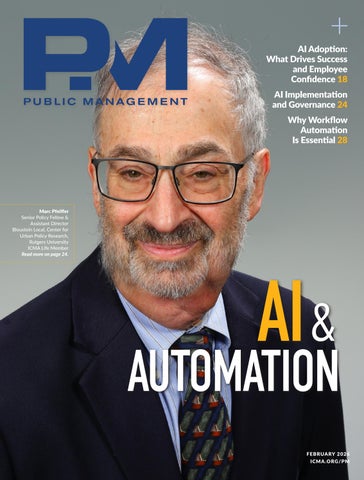
PM Magazine, February 2026: AI and Automation

Page 1


The AI Edge

APRIL 8-10, 2026 | ORLANDO, FLORIDA

Save $200! Register by Feb 23!

This conference will spotlight the growing potential and necessary guardrails for the rapidly expanding AI frontier. You’ll gain practical guidance, exposure to new technologies, and a broader perspective on how AI can efficiently and effectively improve local government operations.

Democracy and the Public Trust

MAY 13-15, 2026 | PHILADELPHIA, PENNSYLVANIA

Save $200! Register by March 30!

2026 marks the 250th anniversary of American democracy, yet today’s public servants continue to face heightened polarization in their communities. We will explore how to restore and maintain public trust, addressing heightened polarization and how to strengthen democracy at the local level.

AI Adoption in State and Local Government: What Drives Success and Employee Confidence?

Results from a recent survey by MissionSquare Research Institute

Zhikun Liu, PhD, CFP®

AI in Your Municipality: Implementation and Governance

Move beyond the hype to thoughtful AI adoption that serves your community’s priorities.

Marc Pfeiffer, assisted by Claude.ai

Beyond Digitization: Why Workflow Automation Is Now Essential for Local Government Modernization

Government workflow automation technology is helping agencies modernize services, improve efficiency, and deliver better outcomes for residents.

Jon Lavietes

Breaking the Cycle of Rising Costs While Supporting Priorities Collier County, Florida’s story

Chris Fabian

Emergency Communication: Lessons Learned from a Regionalized Approach, Part 3

Where theory meets practice in emergency communication implementation

Orel Rhodes, Maddie Luster, Lauren Champion, Griffin Moreland, Teagan

Trammell, Jennifer Enloe, Jack Lefavour, Jack Callahan, Justin Bosse, Abbey Anderson, Brooke Free, Ross Jackson, Miner P. “Trey” Marchbanks III, and Elizabeth Walker

18

If multiple properties are generating crime problems, then choose the right regulatory strategy.

Shannon J. Linning, PhD, Tom Carroll, ICMA-CM Daniel W. Gerard, and John E. Eck, PhD 44

Global Exchanges, Local Impact

How U.S.–Australian local government exchanges encourage community resilience, innovation, and lifelong connections.

Autumn Monahan, David Biggs, and Gavin Carnegie

DEPARTMENTS

2 Executive Director’s Corner Continuing the AI Conversation

4 Ethics Matter!

Algorithm as Public Servant

8 In Our Region

Recommended Reads for Local Government Leaders

12 The Heart of Service

10 Reasons to Love and Honor City/County Management

14 Local Gov 250

A Throwback to 1987

16 Future of Professional Management Fund

In celebration of the 25th anniversary of ICMA’s Credentialed Manager program, we’ll be acknowledging each author that holds the credential with this gold icon ICMA-CM in each issue of 2026. 44 40

“Why I Give to the Fund” with Peggy Merriss

48 Insights

From KPIs to Council Conversations: Embedding Performance Data in Local Government Decision-Making

51 Assistants and Deputies Growing the Next Generation

52 Professional Services Directory

International City/County Management Association

Continuing the AI Conversation

ICMA remains committed to helping you navigate evolving technology as a local government practitioner.

The many faces of artificial intelligence (AI) are top of mind for our members. It was the top issue identified in our most recent member survey, and a frequent topic of discussion when members gather. Earlier this year I was invited to the Large Cities Executive Forum and AI was a topic of innovation and excitement as well as concern and frustration.

We hear about innovative applications for practical AI tools, and we also hear concerns about the strain data centers are having on our local infrastructure and utilities. There is an interest in regulating the local impact, and other levels of government are interested in pushing aside local government’s ability to implement those regulations.

ICMA has a long history of helping our members navigate technical issues. One of the important leadership challenges we face is translating technical issues to inform

International City/County Management Association

icma.org

February 2026

ICMA has moved!

Stay tuned for more details on our new office space at 660 N Capitol St NW, Suite 700, Washington, DC 20001.

Over the years, technological changes—from word processors and computers to the internet, smart cities, cybersecurity, and now AI— have been constant in local government management and service delivery.

Public Management (PM) (USPS: 449-300) is published monthly by ICMA (the International City/County Management Association) at 660 North Capitol St NW, Suite 700, Washington, DC 20001. Periodicals postage paid at Washington, D.C., and at additional mailing offices. The opinions expressed in the magazine are those of the authors and do not necessarily reflect the views of ICMA.

COPYRIGHT 2026 by the International City/County Management Association. All rights reserved. Material may not be reproduced or translated without written permission.

REPRINTS: To order article reprints or request reprint permission, contact khansen@icma.org

SUBSCRIPTIONS: U.S. subscription rate, $60 per year; other countries subscription rate, $155 per year. Printed in the United States. Contact: 202/289-4262; subscriptions@icma.org.

POSTMASTER: Send address changes to Public Management, ICMA, 660 North Capitol St NW, Suite 700, Washington, DC 20001.

ARTICLE PROPOSALS: Visit icma.org/writeforus to see editorial guidelines for contributors. For more information on local government leadership and management topics, visit icma.org.

effective policy decisions. In 1973, one of our longstanding ICMA publications, Management Information Services, was dedicated to helping our members navigate the evolving technology of word processing! Technological changes— from word processors and computers to the internet, smart cities, cybersecurity, and now AI—have been constant in local government management and service delivery.

Continuing this tradition, this month’s PM is focused on AI and automation and how our members are implementing new technologies to enhance service delivery in their communities. We also share insights from a recent MissionSquare Research Institute survey. MissionSquare’s Research Institute is an important partner for ICMA in sharing insights our members care about, especially as they relate to workforce issues.

Public Management (PM) icma.org/pm ICMA 660 North Capitol St NW Suite 700 Washington, DC 20001

EDITORIAL: khansen@icma.org

ADVERTISING SALES: Natalie Matter Bellis The YGS Group natalie.matterbellis@ theygsgroup.com 717-580-8184

ICMA MEMBER SERVICES: 800.745.8780 | 202.962.3680 membership@icma.org

ICMA

Creating and Supporting Thriving Communities

ICMA’s vision is to be the leading association of local government professionals dedicated to creating and supporting thriving communities throughout the world. It does this by working with its more than 13,000 members to identify and speed the adoption of leading local government practices and improve the lives of residents. ICMA offers membership, professional development programs, research, publications, data and information, technical assistance, and training to thousands of city, town, and county chief administrative officers, their staffs, and other organizations throughout the world.

Public Management (PM) aims to inspire innovation, inform decision making, connect leading-edge thinking to everyday challenges, and serve ICMA members and local governments in creating and sustaining thriving communities throughout the world.

Our upcoming Local Government Reimagined Conference (LGRC) in Orlando, April 8–10, is focused on The AI Edge. This is an opportunity for you to learn from peers and identify practical and scalable solutions for your own jurisdiction. Local Government Reimagined is ICMA’s innovation brand, and the conferences are curated experiences that focus on key issues our members are wrestling with.

PRESIDENT Michael Land* City Manager Coppell, Texas

PRESIDENT-ELECT

your community could benefit from this experience. Registration is open at lgr.icma.org.

Another valuable resource for local governments is the GovAI Coalition. The GovAI Coalition is led by the city of San Jose, California, but brings together parties of interest from all levels of government and sizes of jurisdictions. Members hail from Libson, Maine (population 9,700) to Doral, Florida (population 83,000) to Juneau, Alaska (population 32,000), and include large jurisdictions like San Jose and St. Paul, Minnesota. GovAI offers templates and resources that are truly for communities of all sizes.

A smaller conference allows teams of employees from the same organization to share a learning experience and collaborate on how emerging applications can be adapted in their own community. We hope you will consider who from ICMA

Andy Pederson*

Village Manager Bayside, Wisconsin

PAST PRESIDENT

Tanya Ange*

County Administrator

Washington County, Oregon

VICE PRESIDENTS

International Region

Meighan Wark

County Administrative Officer

Huron County, Canada

Lungile Dlamini

Chief Executive Officer

Municipal Council of Manzini, Eswatini

Jānis Lange

Chief Executive Officer

Riga City Municipality, Latvia

Midwest Region

Jeffrey Weckbach*

Township Administrator Colerain Township, Ohio

Cynthia Steinhauser*

Deputy City Administrator Rochester, Minnesota

Cori Burbach*

Assistant City Manager Dubuque, Iowa

Mountain Plains Region

Pamela Davis

Assistant City Manager Boulder, Colorado

Sereniah Breland

City Manager Pflugerville, Texas

Penny Postoak Ferguson*

County Manager Johnson County, Kansas

Northeast Region

Steve Bartha*

Town Manager Danvers, Massachusetts

Brandon Ford

Assistant Township Manager Lower Merion Township, Pennsylvania

Kristy Rogers* Town Manager Milton, Delaware

I hope you find practical insights in this month’s PM, and I look forward to seeing you at an upcoming ICMA event in 2026!

Southeast Region

Eric Stuckey City Administrator Franklin, Tennessee

Chelsea Jackson

Deputy City Manager

Douglasville, Georgia

Justin Smith

Assistant City Manager Pelham, Alabama

West Coast Region

Nat Rojanasathira*

Assistant City Manager Monterey, California

Elisa Cox*

City Manager

Rancho Cucamonga, California

Katie Koester*

City Manager Juneau, Alaska

* ICMA-CM

ICMA-CM

Managing Director, Lynne Scott lscott@icma.org

Brand Management, Marketing, and Outreach

Senior Managing Editor Kerry Hansen khansen@icma.org

Senior Editor Kathleen Karas kkaras@icma.org

Graphics Manager Delia Jones djones@icma.org

Design & Production picantecreative.com

Algorithm as Public Servant

How AI is reshaping local government and raising ethical dilemmas

A city council meeting in a small town. A motion passed. A line item signed. A system installed. Maybe it’s a predictive model that promises to make emergency dispatch faster. Maybe it’s a tool that determines eligibility for housing benefits. The people in the room go home thinking they’ve done their jobs. And they have.

PROFESSOR

RENÉE

CUMMINGS, a 2023 VentureBeat

AI Innovator Award

winner, is an AI, data, and tech ethicist, and the first data activist-in-residence at the University of Virginia’s School of Data Science, where she was named professor of practice in Data Science.

But the next morning, a video goes viral. A grandmother denied food assistance. A teenager flagged for surveillance. One line of code, buried deep in the decision logic, carries the weight of centuries of inequality and now it’s everywhere. No government decision is truly local anymore. Not in the age of TikTok. Not when livestreams and YouTube clips can turn bureaucratic procedure into social media spectacle. What was once a zoning call, a procurement contract, or an automation rollout is now a meme, a movement, a mess. The distance between city hall and global headlines is measured in milliseconds.

Behind every administrative act now looms the presence of artificial intelligence. It may be invisible to most—the procurement officer clicking through software options, the case manager relying on a risk score—but its influence is not. AI systems are quietly scripting the futures of communities, counties, cities, countries, and continents. Sometimes invisibly. Sometimes catastrophically. And while AI is optimizing the human experience and reimagining business models across disciplines and industries,

Only principled, prepared, proactive, and ethically vigilant leaders can ensure AI is trustworthy and serves the public good.

it is also creating new ethical and safety challenges as fast as it solves old ones. These systems mimic human cognition. They give our computers a humanlike feel. But they do not give them human judgment.

It was inevitable: we’ve entered an era where the algorithm has become a public servant. The question is, who does it serve? Budget forecasts shaped by predictive models. Service delivery prioritized by scoring systems. Procurement driven by recommendation engines. And behind it all, a promise: faster, smarter, cheaper governance. Realtime service delivery excellence.

But promises aren’t policies. Systems don’t solve politics. And algorithms, in the hands of government, become more than math; they become moral actors. Consider the child welfare algorithm in Pennsylvania that assigned risk scores to families. These weren’t technical glitches. They were devastating design decisions and bad algorithmic policy that punished the poor, the marginalized, the historically underserved.

Several high-profile scandals have revealed the dangers of using AI and algorithmic tools. In 2016, ProPublica exposed the COMPAS recidivism algorithm for its racial bias, disproportionately labeling Black defendants as high-risk and raising concerns about fairness and transparency in sentencing. In 2020, Detroit police wrongfully arrested Robert Williams, a Black man, due to a faulty facial recognition match, highlighting the technology’s high error rates for people of color and sparking national outrage. Similarly, the LAPD’s use of the predictive policing tool PredPol until 2019 led to the over-surveillance of Black and Latino communities without proven benefits, prompting its cancellation. Together, these cases illustrate how opaque, datadriven systems can reinforce systemic bias, undermine due process, and erode public trust when deployed without accountability.

In July 2025, the federal government issued its AI Action Plan under Executive Order 14179: Removing Barriers to American Leadership in Artificial Intelligence. National in scope, but its weight falls squarely on local shoulders. City and county governments aren’t just implementers of AI policy. They are test beds. Sandboxes. Risk zones. First responders. And the plan asks a lot:

• Train a new AI-ready workforce—from electricians to data technicians.

• Adopt ethical procurement processes, including bias audits and impact reviews.

• Oversee AI infrastructure, balancing economic gains with environmental responsibility.

• Align local regulations with national standards or risk losing federal funding.

• Engage the public not just in deployment, but in design.

In theory, these are steps forward. In practice, they are seismic shifts in how local governance operates. It’s easy to talk about AI in the abstract. Easier still to sell it as salvation. But in the real world, the city manager of a southern town might wake up to find a software-triggered benefits cutoff that hits hundreds of residents. The deputy commissioner may have to explain to a mother why her son was misidentified by facial recognition, wrongfully arrested, traumatized. The mayor may be in conflict with a police chief who swears the AI tool works even as community trust collapses.

AI doesn’t just automate decisions. It codifies judgment. It scales error. It erases nuance, the very thing local government is designed to understand. And it does all this behind closed doors, proprietary code, trade secrets, and black-box algorithms that even public servants can’t access, let alone explain.

So how do you govern the invisible? The outsourced? The unaccountable? You start with clarity. You build capacity. You take stock.

Know Your Systems. Conduct an AI inventory. Know where algorithms live—budgeting, hiring, emergency response, permitting, service delivery. Audit for vulnerabilities. Deploy due diligence. Think duty of care. Consider a duty to warn. Always uphold due process.

Set Procurement Standards. Don’t buy what you can’t govern. Every AI contract should include transparency, auditability, explainability, impact assessments, change management strategies, crisis response plans, and business continuity plans.

Establish Oversight. Form interdisciplinary committees: IT, legal, HR, equity officers, and—most importantly—residents and community stakeholders. Interdisciplinary teams are a competitive advantage. Remember: if AI has limits, you have a duty to warn.

Invest in Literacy. Your staff doesn’t need to be engineers, but they do need to understand what these systems do—and what they hide.

Engage the Public. Hold town halls. Run workshops. Share surveys. Host design sessions. Let people see and shape the systems that shape their lives.

Because AI, for all its power, doesn’t see context. It doesn’t see history. It doesn’t see the mother working three jobs or the teenager raising his siblings. It sees data points. Probabilities. Risk scores. And it moves fast. But these decisions aren’t just metrics. They impact human lives.

Indeed, the algorithm is now a public servant. But it is one without accountability, unless we build it in. One without empathy, unless we demand it. One without understanding, unless we code it and ensure good governance of all AI systems.

Every algorithm carries a deeper story: a story about trust. About confidence. About access, equity, and opportunity. But trust is fragile. It may not survive another scandal rooted in a system no one understands or a decision no one can explain.

AI is not just a tool for outsourcing responsibility. It is a test of our values. The public servant of the future may be an algorithm. But only principled, prepared, proactive, and ethically vigilant leaders can ensure AI is trustworthy and serves the public good, and is designed, safely and responsibly, with the public interest in mind.

T HANK YOU , ICMA STR ATEGIC PA RTNERS

ICMA CEO/Executive Director

Julia D. Novak wishes to thank those organizations that have partnered with ICMA at the Strategic Partner level.

We are grateful to partner with organizations that share ICMA’s commitment to creating and sustaining thriving communities. These partnerships help us connect local government professionals with the solutions they need to make real impact happen. Thank you for all you do. ICMA is the leading organization for those committed to creating and sustaining thriving communities throughout the world—and seeking the right solutions to make it happen. Learn more at icma.org/strategic-partners.

Current strategic partners as of January 15, 2026.

A Day With ICMA

This exclusive event series offers ICMA members a unique opportunity for shared engagement with ICMA leadership, professional growth, and meaningful peer-to-peer connection.

March 4 | Phoenix, Arizona

June 17 | Issaquah, Washington

Calendar of Events

September 16 | University of Kansas

Space is limited, so register early!

Don’t miss your chance to be part of these vital conversations.

UPCOMING EVENTS

SheLeadsGov: Leading While Living

February 5 | Virtual Huddle

Better Public Meetings

February 11–March 4 | Training Series

ICMA Innovation Bootcamp

February 17–March 13 | Training Series

A Day with ICMA | Phoenix, Arizona

March 4 | Workshop Series

SheLeadsGov: Own Your Influence

March 5 | Virtual Summit

From Data to Decisions: A Tax Increment Financing (TIF) Webinar Series

March 25–April 8 | Training Series

Effective Supervisory Practices

April 9 | Training Series

Local Government Reimagined Conferences

April 8 | The AI Edge | Orlando, Florida (Early Bird Rate ends February 23)

May 13 | Democracy and the Public Trust | Philadelphia, Pennsylvania (Early Bird Rate ends March 30)

For a full listing of events and details, visit icma.org/events. Shop all courses at learning.icma.org.

Recommended Reads for Local Government Leaders

Two ICMA regional directors discuss books that inspired them.

KATE FITZPATRICK is ICMA’s northeast regional director (kfitzpatrick@ icma.org).

“In Our Region” is PM’s new column written by ICMA’s regional directors. In this edition, two outgoing regional directors each share a book that influenced their careers. Their book reviews, while covering different periods in U.S. and world history, reveal a common thread about the importance of nurturing community to ensure its survival.

As a reminder to ICMA credentialed managers, you can receive 10 hours credit for each professional book that you read.

Randall Reid, Former Southeast Regional Director

What book did you choose to highlight and why?

In 2024, to commemorate the upcoming 250th anniversary of our country, I dedicated myself to reading books that would deepen my understanding of America’s significance. Among these, I chose to highlight The Roots of American Order by Russell Kirk. This work is a comprehensive portrayal of America’s foundation and is an insightful depiction of the unique balance of “liberty and order” that our founders achieved.

How did the book encourage you to think more broadly or change your mind about an issue?

Reading Kirk’s work made me appreciate the uniqueness of America’s experiment in governance and renewed my respect for the wisdom inherent in our founding documents. The book asserts that America’s founding was a deliberative selection from various Western cultural influences, based upon common theological beliefs and shared aspirations for a selfgovernment that affirms individual rights. The founders designed a democratic republic, drawing on historical precedents, and documented their reasoning in the Federalist Papers. Kirk prophetically warned critics of Western civilization that “nations are like trees; it will not do to hack at their roots, though we may prune their branches,” and reminds us that these roots of liberty are not self-sustaining and must be “watered” through a renewed respect for the traditions and institutions that made our country possible.

Interesting for public administrators, Kirk highlights five cities (Jerusalem, Athens, Rome, London, and Philadelphia) and describes in detail their contributions to American’s political foundations. Similarly, Kirk covers historical movements such as the Protestant Reformation, and highlights the work of Plato, Aristotle, Cicero, Augustine, Locke, Hobbes, Calvin, and Burke, to name only a few who influenced our well-educated founders. One reads and sees clearly it is not by accident we have a written Constitution and Bill of Rights, the classical architecture of the physical structures in DC, federalism establishing intergovernmental relationships, and governing systems with checks and balances.

What practical strategies from the book could be applied in local government?

A principal lesson from Kirk’s book is the importance of each individual local official being educated in and actively reinforcing American civic heritage and values in their daily roles. The council’s dais is a stage for continuing a three century-old production of democratic theater that reinforces the “liberty and order” we cherish.

Did you find anything in the book that was particularly relevant to your region?

Kirk provides timely warnings for public officials in an era marked by cultural fragmentation and partisan deception. He asserts that order must precede freedom and justice if society is to flourish; without moral and social order, chaos and violence may ensue. Maintaining “liberty and order,” along with our public institutions and federalist system, becomes difficult when public officials contribute to or foster disorder as recent sanctuary city litigation and ICE enforcement represent.

Have you already implemented any ideas from the book?

I have been encouraging ICMA colleagues to seize the opportunity presented by the 250th anniversary to celebrate America’s story, highlight our civic values, and welcome those who embrace them. Localgov250. org is one way of doing so.

2026 LOCAL GOVERNMENT EXCELLENCE AWARDS

Celebrate What’s Possible in Local Government

Nominate Leaders and Innovations Shaping the Future of the Profession.

Every day, dedicated local government professionals are transforming communities, strengthening trust, and delivering meaningful results.

The Local Government Excellence Awards honor the individuals and programs that elevate our profession with breakthrough initiatives that address critical needs with creativity, courage, and impact.

Now it’s your turn to shine a light on them.

Nominate a colleague, team, or program that has made a difference through bold innovation, outstanding leadership, or unwavering commitment to public service. U.S. and global nominations are welcome. Explore the award categories and submit your nomination at icma.org/awards.

Nomination Period:

January 12, 2026 – March 16, 2026 icma.org/awards

PROFESSIONAL AWARDS

• Academic Contributions to the Profession

• Advocacy for the Profession

• Career Excellence

• Development of New Talent

• Excellence in Leadership as an Assistant

• Early Career Leadership

• Good Governance

PROGRAM AWARDS

• Community Equity and Inclusion

• Community Health and Safety

• Community Partnerships

• Community Sustainability

• Strategic Leadership and Governance

Help us celebrate the people and programs changing local government for the better. Scan to submit your nomination today.

For questions about the nomination process, contact Joyce Lee Brown at jlee@icma.org

2025 LGE Program Award Winners from Austin, Texas

What book did you choose to highlight and why?

The latest book I picked up is Leadership: Six Studies in World Strategy by Henry Kissinger. I am a bit of a history buff, and I love reading about leadership, so Kissinger’s perspective really caught my attention. He was both a colleague and an observer of some of the world’s most influential leaders. With the polarization and rise of authoritarianism we are seeing today, I wanted to learn more about leaders from the past 50 years who have shown a range of leadership styles.

How did the book encourage you to think more broadly or change your mind about an issue?

Kissinger’s main point is that the best leaders operate at the crossroads of two big questions: how do you balance the past with the future, and how do you connect the values of your people with their aspirations? That might sound a little abstract (classic Kissinger), but he brings it to life with real-world case studies. Kissinger examines six leadership traits: humility, will, equilibrium, transcendence, excellence, and conviction. As someone who’s read a lot of history, I thought I knew these leaders pretty well, but the case studies gave me a much more nuanced view. For example, I never ranked Richard Nixon very highly as a

world leader, but Kissinger’s behind-the-scenes stories helped me understand Nixon’s approach to leadership, diplomacy, and negotiation in a new way.

What practical strategies from the book could be applied in local government?

Working in local government is just as complex and nuanced as the situations Kissinger describes. One of our biggest challenges is finding common ground among people who might have strong disagreements. I was especially struck by the story of Konrad Adenauer, who took a tough but realistic approach to helping post-WWII Germany move forward—admitting national guilt and working toward reconciliation. That really highlighted the importance of humility in public policy for me.

Did you find anything in the book that was particularly relevant to your region?

Many ICMA members in the Mountain Plains Region (soon to be Region B) are dealing with polarization, political contempt, and growing skepticism toward professional local government managers. The example of Lee Kwan Yew, Singapore’s leader, really resonated with me. He managed to bring together different factions and focused on the nitty-gritty of economic policy and social harmony, which led to Singapore’s success. On our scale—whether it’s a city, county, or region—we can learn from that approach: focus on the fundamentals, deliver great services, and build a stronger community.

Own Your Influence

Confident Local Government Leadership for Changing Times

SheLeadsGov Virtual Summit

March 5th | 11:00-2:00 PM ET

In times of change, women leaders are a key part of driving local government work and they often face barriers to recognition. This March, join bold practitioners and rising leaders for strategies and insights to help you thrive in your career. Register today!

10 Reasons to Love and Honor City/County Management

In honor of Valentine’s Day, a reminder of why those of us in this profession love what we do.

ROD GOULD, ICMA-CM is chairman of the board of HdL Companies, a former ICMA Executive Board member, retired city manager, consultant, and supporter of all those who toil in local government service. (rodgould17@gmail.com)

DR. FRANK BENEST, ICMA-CM is a retired city manager and currently serves as a local government trainer and ICMA’s liaison for Next Generation Initiatives. (frank@frankbenest.com).

JAN PERKINS, ICMA-CM is vice president of Raftelis, a local government management consultant and facilitator, retired city manager, and a believer in good government and in the city management profession. (jperkins@raftelis.com)

Our profession has weathered over a hundred years of change and is still the most common form of local government in the United States and 40 other countries. Much has transpired at the global and local levels during that time, and the council-manager form has adapted and evolved.

We are asked, “Do you still recommend local government management with all of the pressures involved these days?” Our answer is “yes.” While challenges, stresses, and headaches abound, the work done by city and county managers is essential. Those in the top local government job and those in other management roles are doing meaningful work. Their careers are focused on creating better communities and strong organizations. The work matters for strengthening our civil society and making lives better for those we serve.

The three of us have served a number of cities as city managers. We remain involved today helping leaders as they grapple with improving governance, developing employees, and enhancing communities. We’ve listed 10 reasons why we love this profession. It’s February, so here is our valentine to all of you who practice or aspire to be in city and county management.

1. You Make a Lasting Difference. You can improve your part of the world by focusing on one community at a time. You are in a position to have a positive impact on people’s lives. Many people you will never meet will benefit from your commitment to making a difference. Whether it is in advancing safety of the community, rebuilding critical infrastructure, enhancing quality of life, or promoting environmental sustainability, what you do matters to real people. As city or county manager, you have direct influence over dozens of services, projects, and activities that shape and build community. You can build a legacy that matters to people in the community.

2. You Promote Local Democracy. The top management job is a cornerstone of local representative democracy. You respect the role of the elected body. You encourage the public to participate in community affairs. You guide your staff to openly communicate

with the public and do their best work on behalf of the community. As city or county manager, you are at the vortex of communication, information, and decisionmaking between local elected leaders, professional city staff, and community leaders. The executive has an affirmative duty to ensure that the will of the people’s representatives is skillfully and ethically carried out with public transparency, civic participation, and a long-term view. You have a key role in making local representative democracy work.

3. You Enjoy a Professional Network. You get to work with some exceptional people bound together by a commitment to public service. Many servant leaders drawn to local government are altruistic and driven by the communitarian ideal—we all do better working together for the common good. We collaborate and support one another in the trials and difficulties of this highly specialized public service.

We jointly develop new strategies, techniques, and approaches to vexing local problems. Good ideas and innovations are openly shared and disseminated. These facts bind us together as a profession for mutual success.

In local government management, we interact with elected and appointed officials of character, intelligence, humor, idealism, compassion, and drive. Some will become life-long friends who will enrich your life. Camaraderie and teamwork are great benefits of the local government management profession.

4. You Thrive on Action. Our job is never dull and rarely predictable. The profession covers multiple disciplines with a diversity of residents, businesses, and visitors. You encounter so many issues and dilemmas that you are never bored. Communities are always evolving. Development, macroeconomics, social patterns, technology, demographics, and external influences all play a part in change—whether it is intentional or happenstance. The manager must help the community to adapt and thrive in constant change. The pace can be hectic. If you revel in a variety of challenges in your work, city/county management will appeal to you.

5. You Learn Something Every Day. One thing is for certain: nothing is static. City/county management offers a laboratory for learning. There is no chance for complete mastery given the diverse functions that managers oversee. People who are curious and want to know the “why” as well as the “what” are a good fit for this profession. There is ample opportunity to learn, change your point of view through new knowledge, and become inspired.

The range of services in any local government is vast. It is no small feat to acquire knowledge about each of them, whether it be law enforcement, fire and emergency services, planning, code enforcement, public works, the arts, health, criminal justice, environmental services, parks, recreation, senior and youth services, housing, economic development, redevelopment, mobility, social services, intergovernmental relations, human resources, finance, information technology, or more.

6. You Help Others Be Their Best. City and county managers build successful teams. This is such a highly satisfying part of the job. The team includes both the governing body and the local government’s staff. The chief executive helps elected officials do the public’s business through positive governing norms. The manager leads their organizations in a way that gets the right people into key positions, with the team working in sync for the community’s benefit. It takes leadership and backbone, along with interpersonal, coaching, and mentoring skills. Some talent will be developed internally and rise through promotion; some will come externally. Supporting young people in local service is crucial. The key is a common commitment to excellence and teamwork. A good city or county manager is always at the chemistry set improving the team through organizational development and succession planning. You can build a legacy.

7. You Commit to a Code of Ethics. We’re all members of a noble and collegial profession with standards, ethical codes, and values. ICMA seeks to make this profession real for all its

members by instilling the obligations and expectations of a highly respectable profession. This means committing to the ICMA Code of Ethics and going about your work every day with that code underlying your actions. It not only underpins our profession, but it makes the job so much easier when you have the north star of professional ethics to guide you on difficult decisions.

8. You Really Get to Know Your Community. Cities and counties are fascinating and never truly alike. Each has its own history, traditions, leaders, development patterns, strengths, gaps, culture, and community feel. Every community is made up of people with their unique personalities and interests. There are service clubs, street fairs, art exhibits, sports events, and more. If you like people, you are in the right job. If you are a student of how people live, work, and recreate together, cities and counties are learning laboratories. Even long-term managers comment on how fast things change and their jobs along with it. By virtue of our positions, we get to know people in our communities in ways few can.

9. You Develop Transferable Skills. The local government management skill set is in demand throughout the United States and internationally. Most of us will serve in more than one community in our careers and much of the expertise, experience, training, and understanding is transferable across jurisdictions despite their differences. Serving in several local governments adds richness to a career in local city or county management and keeps the manager learning and growing. And when the manager is ready to enter a second phase or “encore” career, the skills learned can be quite useful.

10. You Make a Good Living. City and county managers are paid decently for their public service work, and enjoy good benefits such as healthcare, leave time, insurance against injury, and often pensions. They can generally afford a comfortable home, vacations, decent schools and colleges for their kids, and to live with dignity and security in retirement. It is a career with a healthy living attached to it.

Bonus: You Accumulate Good Stories. In one’s career, a city or county manager will accumulate many stories. These can be poignant and tough, quite funny, or even bizarre. Consequently, you will be able to top any story at a cocktail party.

That’s our list. We suspect you will have others based on your own experiences.

We would be remiss if we didn’t say that there is much fun to be had in this profession. You will go to special events, sing happy birthday at a staff party, flip pancakes with your city council at a community breakfast, and more. A job is not all seriousness. Your staff will appreciate your lightheartedness along with your focused attention to getting things done.

In closing, our communities need and deserve great leaders at the top – both elected and appointed. Being a city or county manager, despite many challenges, can make a huge difference in the lives of the people who live in their communities. It’s a profession that is satisfying, rewarding, and worthy of respect.

A Throwback to 1987

Written nearly four decades ago, John Nalbandian’s article reminds us that American democracy lives in the everyday work of local government.

In his 1987 article “The Evolution of Local Governance: A New Democracy,” John Nalbandian makes the case that local government was changing in an important way. He argues that communities were moving away from a model where public administrators stayed firmly behind the scenes—focused mainly on efficiency, expertise, and neutrality—and toward a more hands-on, people-centered approach to democracy.

Nalbandian describes this shift as a “new democracy,” one where local government leaders help bring people

together rather than simply manage programs. In this model, administrators act as facilitators and conveners, helping residents, elected officials, and community groups talk through tough issues and work toward shared solutions. Because many local problems aren’t purely technical, Nalbandian argues that success increasingly depends on listening, communication, and ethical judgment, and not just professional know-how. When done well, this approach strengthens democracy by making residents feel more connected to the decisions that shape their communities.

That message feels especially timely as the United States approaches its 250th anniversary. The country was founded on ideas of self-governance and civic involvement, and those ideals are often felt most directly at the local level through city councils, school boards, neighborhood meetings, and community initiatives. Nalbandian’s article reminds us that democracy doesn’t only live in national elections or historic documents; it lives in the everyday work of local government.

At a time when trust in public institutions is often fragile, Nalbandian’s vision offers a hopeful reminder: local government can still be a powerful space for democratic renewal. By engaging residents, encouraging dialogue, and tackling problems together, communities can keep the spirit of American democracy alive—not just by celebrating its past at 250 years, but by actively practicing it every day.

Read the full article by scanning the QR code or at icma.org/documents/evolutionlocal-governance-new-democracy.

Learn More about Local Gov 250

In collaboration with other local government associations, ICMA is commemorating America’s 250th anniversary by celebrating the “democracy at the doorstep” facilitated by cities, counties, regional councils, and tribal governments. Learn more at localgov250.org.

Measuring What Matters

“Why I Give to the Fund” with Peggy Merriss

“This form of government has been good to me, and it’s important to me to give back in time, talent, and resources.”

As the Fund turns 40 in 2026, we are connecting with longtime donors about why they have given so much to the Fund for so long, their hopes for the future of the profession, and how the Fund can support that vision. We spoke with Peggy Merris about her inspirations to give.

What inspired you to become a donor?

I hold a deep value that we’re here to make the world a better place, and the Fund is another way for those that want to help as much as they can—beyond my contributions to my organization or my community. When I served on the ICMA Executive Board, there was an expectation that ICMA leadership and engaged members contributed to the Fund. You can’t just call for help when your community’s form is up for a change—we all have to be ready to support each other, and a strong Fund balance is a key step.

Serving as ICMA president, and serving the profession nationally and internationally, seeing the important work professional managers do all over the world keeps me motivated. This form of government has been good to me, and it’s important to me to give back in time, talent, and resources. And if not me, who?

How do you see the role of the Fund evolving in the next decade in terms of advocacy and education around professional management given challenges of public awareness?

The Fund has promoted and defended the council-manager form and professional management for 40 years. It’s a great legacy, and I believe we should be doing more than defense and advocacy. We need to be showing how professional local management makes a community a better place in a way that people understand.

I think we need something like the spirit of Life, Well Run, but not a short campaign—a new part of the Fund’s DNA. Meaningful stories of “the how” that we can get in front of people, that our members can post on their website, state association websites, and share at state conferences and municipal and county association conferences.

A lot of elected officials don’t understand “the how” either. Easily accessible educational tools to help members explain the council-manager form and professional management to their new (and recurring) governing body officials would be greatly beneficial in moving that needle.

Today, this also goes beyond the questions of the form itself. When it’s the manager getting personally abused (I don’t have the answer, but I do have the question), how do we get support to managers with tools to address these personal attacks? How do we stand up personally for our ICMA members when they are being attacked?

What I do know is that by the time we are in reaction mode, it’s getting to be too late. We all need to be proactive, so the manager feels they are getting support from somewhere. We need to focus on supporting and defending the individual as we do the form itself.

Lastly, as we encourage more members to donate, it’s important to support member professional development, education, and succession planning; the “future” part of the Fund. Advocating for and defending the form is critical, but if there’s no one who wants to be a manager tomorrow that’s still a problem. And for my friends, when we get together to share “war stories” at conferences, don’t forget there are students listening. Remember to include why you still do the work—those inspirational gems that keep us coming back, despite the oddities.

What would you say to someone considering a donation to the Fund but unsure of its impact?

The impact over 40 years is evident and real—the Fund has helped defend, promote, and advance professional management and the council-manager form in hundreds of towns, cities, and counties, with a good deal of success. But I want new and recurring donors to think about the future of the profession, how the Fund can focus on “the good stuff” for how professional management really makes a difference, and how we can develop today’s and tomorrow’s managers. How? With new and better metrics, but more importantly with great stories of why the profession is important and how it can be multidimensional in addressing our toughest civic challenges—how there are different ways to get there, and how we all learn from one another to make the world a better place.

About The Fund

ICMA’s Fund empowers communities nationwide by advancing professional local government management. The Fund invests in advocacy, education, and leadership development — ensuring the adoption and retention of the council-manager form and professional administration to build public trust, raise public awareness, and cultivate current and future leaders. Contributions directly sustain research, outreach, and support for the vital work that keeps our communities efficient, accountable, and resilient.

AI Adoption in State and Local Government What Drives Success and Employee Confidence?

RESULTS FROM A RECENT SURVEY BY MISSIONSQUARE RESEARCH INSTITUTE

Artificial intelligence (AI) has moved from a distant concept to everyday practice in state and local government. From document automation to resident-facing chatbots, AI is reshaping how public agencies operate,

the

skills teams need, and how employees experience their

work.

MissionSquare Research Institute’s recent survey of 2,000 public employees reveals a nuanced picture: while nearly half of employees already use AI tools at work, attitudes toward these technologies vary widely, influencing morale, productivity, and even retirement planning engagement. This article explores what drives successful adoption, addresses workforce concerns, and offers actionable recommendations for local government leaders.1

What emerges is a clear pattern: adoption success is not just about the technology’s capabilities; it is fundamentally about people— comfort, preparedness, communication, and confidence in the integrity of outputs. In the survey, nearly half of employees report using AI tools at work (46%), yet only 17% do so daily, suggesting AI is edging toward the mainstream but is not yet fully embedded in day-to-day workflows.

Importantly, the research captures outcomes beyond input metrics: more than half of respondents report improved work quality and productivity, and more than 60% perceive that communities are satisfied with AI-enabled services. Employees also report feeling comparatively knowledgeable about AI—even when formal training lags—highlighting a readiness that leaders can harness with structured programs.

Nevertheless, concerns persist: data security and privacy, output reliability (including the risk of hallucinations), and job displacement fears are salient for many, reinforcing the need for transparent policies, oversight, and human-in-the-loop practices. This study offers a rare, employee-centered lens on what drives adoption, what impedes it, and how leaders can implement AI in ways that lift service quality without eroding trust.

Current State of AI Adoption

AI is being deployed across a range of functions, from automating routine administrative tasks to enhancing resident engagement

through chatbots. Departments reporting moderate or advanced adoption often cite improved turnaround times and reduced manual errors as major benefits.

Based on the survey, AI applications in government increasingly fall into two clusters:

1. Internal efficiency tools (e.g., drafting, editing, summarization, routing, and document processing).

2. Resident-facing capabilities (e.g., chatbots for FAQs, appointment scheduling, and translation).

On the resident-facing side, agencies are implementing AI-powered chatbots to handle FAQs and appointment scheduling, and using language translation tools to make public information accessible to non-English-speaking residents. These applications illustrate how AI can streamline operations while improving inclusivity and service delivery.

Figure 1. Frequency of Workplace AI Use

Crucially, adoption remains uneven. Smaller jurisdictions and those with constrained IT capacity may be slower to implement or may rely on commercially available tools rather than customized solutions. This research suggests implementation pacing matters: moderate adoption correlates with the strongest positive service-quality impacts, while aggressive, advanced rollouts can introduce complexity that dampens outcomes without adequate training and support. This finding argues for measured expansion—pilot, learn, standardize—rather than a wholesale push.

Workforce Impacts and Concerns

Employees report tangible productivity gains—more than half see improved work quality and faster throughput— while communities register satisfaction with AI-enabled services (over 60% ‘very’ or ‘somewhat’ satisfied where assessed). These are encouraging signals that AI can augment public service without sacrificing the human touch. At the same time, employees are candid about risks. Data privacy and security lead concerns (45%), underscoring the responsibility to protect personally identifiable information (PII) and sensitive operational data. Reliability is next (37%), reflecting awareness of hallucinations, potential reliance on irrelevant or outof-date materials to build the AI tools, and misclassification in predictive models. Job displacement anxiety is not dominant but significant: one in five employees is very or extremely concerned about AI replacing their function, even as 63% express minimal concern.

Figure 2. Top Employee Concerns

Concerns map closely to implementation experience. The results of the survey analysis show that morale tracks with preparedness: Employees who feel ‘very prepared’ for AI exhibit three times higher odds of positive morale, while those who feel unprepared or highly anxious about job replacement report markedly lower satisfaction. For leaders, this translates to two mandates: (1) build preparedness through training, change management, and clear role definitions; and (2) address job security fears head-on, explaining how AI reallocates time toward higher-value tasks rather than replacing human judgment. Transparency—about where AI will be used, how outputs will be reviewed, and how staff will be supported—preempts rumor and builds buy-in.

What Drives Successful Adoption?

Preparedness and comfort are critical as the adoption is fundamentally behavioral. Among employees who are very comfortable using AI tools, 81.6% expressed interest in applying AI for financial decision-making, compared to only 14.8% among those not at all comfortable. Preparedness amplifies this effect. Employees who are “very prepared” have dramatically higher odds of positive morale and greater openness to new tools. This creates a virtuous cycle: training and clear governance boost comfort; comfort increases adoption; adoption, when supported, improves service quality and morale.

Practical tactics include establishing departmental AI champions, co-developing

use policies with staff, and implementing human-inthe-loop review for any outward-facing content or decisions. Leaders should prioritize low-risk, high-yield use cases first—drafting correspondence, summarizing meeting notes, routing documents—before piloting more complex analytics or predictive models. Sequencing matters: MissionSquare Research Institute’s data indicates that moderate implementation tends to yield the best net outcomes, whereas rapid, advanced rollouts can outpace user readiness and support infrastructure.

Finally, position AI as a complement, not a replacement. Based on a latent class segmentation analysis from our in-depth study of employee perspectives,

early-adopter segments (AI-integrated consumers and employer-driven AI users) show strong usage of both AI tools and human financial professionals, suggesting that technology increases engagement rather than supplanting expertise. Communicating that AI extends capabilities—lowering barriers to information, accelerating routine tasks, and personalizing guidance— helps diffuse zero-sum fears and invites participation.

Beyond the Workplace: AI and Retirement Planning

One consequential insight from this research is the tight coupling between workplace AI familiarity and personal retirement planning engagement. Employees who use AI at work are more than twice as likely to use AI for retirement planning

(56.5% vs. 26.2%), and those very comfortable with AI are vastly more interested in employer-sponsored tools (81.6% vs. 14.8%). This pattern reveals an adoption pathway public employers can actively cultivate: build competence and confidence in everyday workplace use, and participation in AI-enabled financial wellness follows.

Why does workplace experience drive personal finance engagement? Familiarity reduces perceived risk. Employees who use AI for drafting, translation, or scheduling see practical reliability—and its limitations—firsthand. That grounded understanding lowers psychological barriers to trying a retirement income estimator or goal-tracking tool. The institute’s segmentation analysis results from the deep dive study make this concrete.

Figure 3. Comfort vs. Interest in Employer Tools

Five distinct groups emerge: AI-integrated consumers (18.9%), employer-driven AI users (27.7%), AI-comfortable minimalists (30.8%), skeptical adopters (13.5%), and traditionalists (9.1%). These segments differ not only in AI usage, but in financial behaviors and preferences. The segmentation analysis highlights five distinct profiles requiring tailored strategies.

AI-integrated consumers show the highest engagement, with 93.6% using AI for retirement planning and 72% working with financial professionals—proof that technology complements human guidance.

Employer-driven AI users favor employersponsored tools (83.2%) and thrive with institutional support and secure access.

AI-comfortable minimalists prefer simple, self-service tools like

income estimators and progress trackers.

Skeptical adopters need reassurance and gradual exposure, making education and peer testimonials effective.

Traditionalists show minimal interest—12.1% in employer tools and only 2.4% using AI for retirement planning—underscoring the need to maintain non-AI options for inclusivity.

For plan sponsors and employers, the strategy should reflect these distinct needs. Start with tools that have broad appeal (income estimation, goal tracking) and layer more sophisticated capabilities (tax-efficient withdrawal strategies, investment rebalancing suggestions) as confidence grows. Pair feature rollout with communication that emphasizes security, oversight, and complementarity with human advisors. AI cannot and should not replace fiduciary guidance; it should equip participants with personalized insights and nudge them toward informed decisions.

Finally, this study reminds us that technology adoption follows diffusion patterns, not demographic stereotypes. Comfort and confidence—not age or education alone—drive engagement. That is good news: leaders can influence comfort through training, transparent communication, and handson experience. By linking workplace use to retirement planning tools, employers create a reinforcing loop of familiarity and value: staff learn AI in low-risk tasks; they apply it to personal financial goals with institutional support; they build confidence that carries back into their work. The result

Figure 4. Employee Segments by AI Adoption

support their financial wellbeing. In a labor market where recruitment is challenging and retirement eligibility is rising, employers who invest in AI-enabled engagement can improve retention, strengthen benefits utilization, and demonstrate a culture of innovation that attracts talent.

Ultimately, AI is a tool. Its value depends on governance, training, and the people who wield it. The data suggest that public-sector employees are ready to learn and ready to lead—provided they have clear guardrails, reliable support, and a meaningful voice in how AI is applied. That is the promise leaders can fulfill: technology that augments human judgment and expands public service capacity, delivered with integrity and empathy.

ENDNOTE

EMPLOYEE GROUPS/SEGMENTS

Key Takeaways

• AI adoption in state and local government is growing but remains uneven across jurisdictions.

• Preparedness and comfort are critical drivers of successful AI integration and employee morale.

• Workforce concerns focus on data privacy, reliability of AI outputs, and job security.

• Linking workplace AI experience to retirement planning tools significantly boosts engagement.

• Leaders should implement phased rollouts with robust training, transparency, and governance.

Recommendations for AI Adoption

• Invest in training and communication to build confidence.

• Address job security concerns transparently.

• Start with simple, high-impact applications before scaling complexity.

• Review AI outputs regularly to maintain trust.

• Leverage early adopters as internal champions.

• Align AI initiatives with organizational values and community priorities.

• Integrate AI planning with workforce strategies to address recruitment and retirement trends.

is a workforce more capable of harnessing AI’s benefits across domains.

Conclusion

AI is no longer a distant concept for state and local governments—it’s here, reshaping workflows, service delivery, and even employee expectations. Its success depends on how leaders bring employees along. This research illuminates a possible path: build preparedness, nurture comfort, and implement with care. In practice, that means starting with low-risk applications, communicating transparently, and pairing AI with human expertise.

The link between workplace AI and retirement planning underscores a broader opportunity: when employees experience trustworthy, useful AI on the job, they are more likely to embrace tools that

1 This article is based on a MissionSquare Research Institute and Morning Consult survey that took place in January 2025 and two resulting reports: “Artificial Intelligence in the Workforce: A Survey of State and Local Employees” and “Artificial Intelligence in Public Workforce: An In-Depth Study on Employee Perspectives and Retirement Planning Implications.”

REFERENCES

MissionSquare Research Institute, Artificial Intelligence in the Workforce: A Survey of State and Local Employees (June 2025), https:// research.missionsq.org/content/media/ document/2025/5/Artificial_Intelligence_ StateLocal%20Employees.pdf.

MissionSquare Research Institute, Artificial Intelligence in the Public Workforce: An In-Depth Study on Employee Perspectives and Retirement Planning Implications (September 2025), https://research.missionsq. org/content/media/document/2025/8/ AI_StateLocal_In-Depth.pdf.

MissionSquare Research Institute, News Release: 1 in 5 Public Sector Workers Fear AI Overtaking Their Jobs (June 16, 2025). https://research.missionsq.org/posts/news/ new-data-from-missionsquare-researchinstitute-finds-1-in-5-public-sector-workersfear-ai-overtaking-their-jobs

MissionSquare Research Institute, 2025 State and Local Workforce Report (July 2025), https://research.missionsq.org/content/ media/document/2025/5/2025_State_ Local_Workforce_Report.pdf

ZHIKUN LIU, PHD, CFP® is vice president and head of MissionSquare Research Institute.

IMPLEMENTATION AND GOVERNANCE AI IN YOUR MUNICIPALITY

Move beyond the hype to thoughtful AI adoption that serves your community’s priorities.

Like any new technology, the introduction of AI chatbots just over two years ago has led to varying approaches to adoption among local governments. Today, many municipalities have transitioned from cautious, and in some cases, enthusiastic experimentation, to fully integrated AI-enabled applications in their daily workflows. Understanding where you are on this journey and how to proceed thoughtfully is critical to successful implementation.

Additional AI Resources for Local Government

These organizations provide free resources, training, and peer networking opportunities to help local governments navigate AI implementation. All three organizations offer resources specifically designed for the public sector, emphasizing responsible and ethical AI adoption that serves the public good.

InnovateUS — innovate-us.org

• No-cost, self-paced, and live training on AI, data, and digital skills for public sector professionals.

• Courses include “Using Generative AI at Work,” “Scaling AI in Your Organization,” and “Responsible AI for Public Professionals.”

• Curriculum created by and for government employees.

• Over 115,000 learners from 150+ government agencies.

• Interactive workshops on AI procurement, human-centered design, and ethical AI implementation.

Government AI Coalition (GovAI Coalition) — sanjoseca.gov/GovAI

• Led by City of San José with 2,000+ public servants from 700+ local, county, and state governments.

• Free template policies, AI vendor questionnaires, procurement guidelines, and AI FactSheet tool.

• Cross-agency collaboration through regular meetings, working groups, and annual summit.

• Gives local governments a collective voice in shaping AI development.

• Tools aligned with emerging national standards.

• Helps agencies jumpstart AI governance programs without starting from scratch.

Apolitical — apolitical.co

• Global learning platform serving 200,000+ public servants in 160 countries.

• Online courses, workshops, and peer communities on AI, climate, sustainability, equity, and governance.

• Courses co-developed with Oxford, the London School of Economics, and Georgetown.

• Government AI Campus with specialized AI learning resources.

• Access to best practices and global peer connections.

• Platform co-designed and funded by governments.

How Municipalities Are Using AI

Municipalities are typically using AI in four ways, often simultaneously:

Formal policy use Authorized use by specific individuals or offices. These policies require engagement with tech managers to manage costs, integrate with existing systems, and ensure sound security practices. Proper governance ensures the responsible allocation of resources while effectively managing risks.

Shadow IT—When employees use unsanctioned technology without management approval. This is likely the most common approach today, especially with widely available free chatbot services like ChatGPT, Microsoft Copilot, or Google Gemini. While these tools can boost productivity, they create security vulnerabilities and data management concerns.

Locally built applications—When techsavvy employees develop AI programming skills (aka “vibe programming”) to create chatbot-based applications. These tools can be used to complete forms, prepare documents, or respond to public inquiries, thereby enhancing productivity.

Integrated applications—Existing and new vendor products incorporating AI capabilities, from video and GIS applications to customer service chatbots. Vendors are rapidly embedding AI into their products, often with limited transparency regarding how these systems make decisions or process information.

Addressing Each Approach

Formal policy: Develop comprehensive policies covering data privacy, security protocols, and appropriate use guidelines. Review past Tech Updates columns from PM (December 2024,1 February 2025,2 and August 20253) for detailed perspectives on these issues.

Shadow IT: This is a tricky issue—acknowledging it obligates you to ensure its appropriate use. Consider developing guidelines for safe AI use that strike a balance between innovation and security. Creating channels for employees to suggest uses and tools can help bring shadow IT into the light.

Locally built applications: These can be highly engaging but must operate openly with carefully considered policies. Implement monitoring functions to track usage and maintain control over it. Creating an innovation sandbox with appropriate guardrails fosters creativity while managing risks.

Integrated applications: Vendor materials often suggest that AI solves everything and must be adopted immediately. Don’t believe the hype. While AI will affect many aspects of government administration, thoughtful implementation beats rapid adoption. Review existing policies to determine which ones might be affected when vendors add AI capabilities, particularly those related to internal controls in finance or data privacy in public safety.

Evaluating New AI Applications

When considering new applications, vendor claims are

often sweeping and ambitious. Sound diligence includes:

• Having your tech team review infrastructure compatibility, security, bandwidth requirements, data management practices, and alternatives.

• Talking to peer governments that have deployed the product.

• Checking competing products to ensure you’re selecting the best solution.

• Understanding workflow implications and effects on employee training and responsibilities.

• Reviewing union contracts to determine if changes require negotiations.

• Projecting comprehensive costs and determining appropriate purchasing methods.

• Ensuring vendor contracts allow data export if you switch providers later.

Critical Implementation Considerations

Budget and Resources:

While free chatbots serve as an entry point, AI incurs costs both upfront and in the long term. Initial costs often include licenses, hardware upgrades, consultant fees, and training. Ongoing costs may consist of subscriptions, maintenance, and updates. Start with small pilot projects to demonstrate value before requesting larger investments. Remember that savings often take time as people adjust to new workflows.

Staff Training: Even excellent AI tools fail without proper training and careful timing. Use a step-by-step approach rather than sudden workflow changes. Identify staff members who are interested in becoming champions

and let them help others. Be clear that AI should augment your staff, not replace them. Getting employees involved early reduces resistance. Consider varying comfort levels with technology and create multiple training options to accommodate different learning styles.

Accessibility: AI systems must serve all community members fairly. When deploying resident-facing AI, such as chatbots, ensure they are accessible to people with disabilities and non-English speakers. Test with diverse groups before full launch. If your AI makes decisions that affect residents, understand how it was trained and monitor the results to ensure that no groups are disadvantaged. Check with vendors to determine if their systems were developed and trained with these issues in mind. Always maintain traditional service options for those without internet access or technological comfort.

Vendor Relationships: Before signing contracts, consider system compatibility with your existing infrastructure. Look for solutions using open standards rather than proprietary formats. Understand data security and appropriate use policies. Have your attorney review contracts carefully, particularly data storage policies, to ensure they meet public records disclosure and retention requirements. Understand the risks of potential vendor “lock-in” and how they can be managed.

Building Public Trust:

Residents may worry about government AI use if there is no proper communication. Given the sensitivity of different use cases, consider

involving the community early through public meetings, website updates, and council presentations. When AI is being trained or used to make recommendations, clearly explain what data you’re using, how decisions are made, and what human oversight exists. For significant applications, especially those involving facial recognition or surveillance, consider creating a citizen advisory panel. Transparency prevents misinformation and builds confidence.

Governance and

Compliance: Larger organizations can consider establishing an AI committee with members from IT, legal, finance, and key service departments to develop policies and ensure consistent implementation. Establish clear rules for who can approve AI deployments and how they will be monitored and managed. Stay informed about rapidly changing state and federal regulations that affect AI use, particularly in areas such as privacy, transparency, and human oversight. Professional associations, such as ICMA, GFOA, and state municipal leagues, can help track new requirements.

Measuring Success: Have a plan to evaluate results, tracking time savings, cost reductions, error rates, staff satisfaction, and resident feedback. Be willing to adjust or discontinue systems that are not delivering the expected benefits. The best implementations include continuous improvement processes and periodic reviews to incorporate feedback and new capabilities.

Moving Forward

Be transparent about AI deployment within

your community. With significant public attention on AI, transparency about its governmental use will prevent rumors and misinterpretation. For municipalities with tech advisory boards, this falls under their purview, providing an opportunity for citizen input and oversight.

Successful AI implementation requires balancing technology possibilities with organizational realities. Understanding the risks and rewards is critical. Avoid being swayed by promotional hype or vendor pressure. Learn from organizations with implementation experience. AI is the latest in society’s technology evolution. Manage it well through thoughtful policies and implementation—don’t let it manage you. By carefully addressing these considerations, your municipality can effectively leverage the benefits of AI while avoiding common pitfalls. Remember that technology should support your community’s priorities, not dictate them. Always keep people—both staff and residents—at the center of your AI strategy.

ENDNOTES AND RESOURCES

1 https://icma.org/articles/pm-magazine/ tech-updates-local-governmenttechnology-policy

2 https://icma.org/articles/pm-magazine/ tech-updates-public-policy-andsurveillance-tech

3 https://icma.org/articles/pm-magazine/ tech-updates-technology-policies-yourcommunity

MARC PFEIFFER is a senior policy fellow and assistant director at Bloustein Local, a unit of the Center for Urban Policy Research at Rutgers University (marc.pfeiffer@rutgers.edu), assisted by Claude.ai.

Beyond Digitization Why Workflow

Automation Is Now Essential for Local Government Modernization

Government workflow automation technology is helping agencies modernize services, improve efficiency, and deliver better outcomes for residents.

It is fair to say that your average resident expects a self-service, friction-free user experience when interacting with organizations, at least for basic transactions and interactions. In the private sector, people are largely used to being able to access a website or download an app to sign up for a service, deliver relevant information, or check the status of an order or delivery.

Behind the scenes, these seamless interactions are increasingly powered by sophisticated automation that moves information efficiently, reduces human intervention, and ensures consistency at scale. Phone calls and chats are reserved for exceptions, complex issues, and the occasional case that falls through the cracks.

Sadly, this digital experience is still a distant reality for much of the public sector. Thousands of cities and counties still force their residents to come to a local office to file forms in person. A “digital” option might spare constituents the office visit, but it often still requires them to print forms from the municipality’s website and email scanned PDFs of completed paperwork. Upon submission, those forms may as well have entered a black hole, from the resident’s perspective. Status updates often aren’t provided, leaving the applicant to harangue the office via phone or email to ascertain when their application or notice will be processed. This gap isn’t simply the result of outdated websites; it reflects the absence of workflow automation that moves information efficiently through an organization and keeps both staff and residents informed.

Much to people’s chagrin, agencies that haven’t entered the digital age oftentimes won’t have an immediate answer to their status queries. The staffer answering the phone has no visibility into who still needs to review an application and where a submission stands. A form could be stuck in any reviewer’s inbox or it could simply be waiting for a signature on someone’s desk.

Workflow automation becomes the connective tissue between today’s process improvements and

tomorrow’s AI-enabled

government.

If one employee has questions for another, delays and misunderstandings could ensue. If a half-dozen stakeholders need to confer on a particularly tricky case, the process can get convoluted in a hurry. And let’s face it; many city and county governments are already short-staffed to begin with since it is difficult to compete with private-sector salaries. As this issue explores the many dimensions of automation, it’s worth noting that workflow automation—the automation of the processes that power government operations— remains one of the most significant yet underutilized opportunities for impact.

While automation is transforming everything from data analysis to communications, the automation of workflows— the day-to-day sequences of reviews, approvals, and interactions that drive public services—continues to represent a foundational modernization strategy for government agencies.

From Digitization to Transformation: The Role of Workflow Automation in Government Agencies Program directors and department heads are challenged to meet the

demands of citizens to improve service delivery, and be easier to work with in general, without an increase in staff or funding. Nobody would argue against a digital transformation; the question is how to make the transition within a reasonable timeframe and budget.

Technology is obviously part of the answer, but in successful digital journeys, it is usually not the answer in and of itself. Rather, it is a tool that helps execute a broader vision and business plan. Leaders and their IT departments are challenged to figure out which solutions actually drive meaningful organizational change.

Amid the broader conversation about automation, workflow automation— software that automatically routes essential documents to appropriate reviewers in proper order with autogenerated alerts and similarly saves final documents without human intervention—stands out. It targets the operational heart of government: the processes that route documents, approvals, communications, and decisions. When these workflows run smoothly, the entire organization becomes more responsive, predictable, and efficient.

Agencies are finding that workflow automation can be one of these foundational

technologies that truly doubles as a true leadership strategy—if utilized correctly. Many public entities turn to workflow automation to merely digitize their current review chains, and the removal of paper and manual labor from processes does yield faster approvals with fewer errors and lost documents. However, those municipalities are failing to maximize the technology’s potential impact.

Workflow automation is a means to reimagine how government can deliver those same services. It can enable easier intra- and interdepartmental collaboration and empower employees and third-party partners to engage in deeper synchronous or asynchronous communication without stalling initiatives. The technology not only simplifies business process makeovers, it empowers the people executing important initiatives on the front lines to continually reconfigure services and back-end operations to meet changing constituent priorities, economic climates, and political realities. Moreover, workflow automation provides managers with real-time visibility into bottlenecks, performance metrics, and compliance risks—data that strengthens oversight and supports evidence-based decision-making.

When nontechnical employees are emboldened to adjust workflows so that they serve residents better, governments are well on their way to creating a culture of continuous innovation. And in the AI era, transformation will be even closer in reach as staff will be able describe how they want to simplify

government in plain English (or other languages, for that matter) as they design their processes. In this sense, workflow automation becomes the connective tissue between today’s process improvements and tomorrow’s AI-enabled government.

How does this look in practice? Here are two instances of workflow automation helping to deliver better service to residents with greater efficiency.

How Workflow Automation Improved City Planning Services

in Los Angeles

Up until a few years ago, the protocols for obtaining approval from the Los Angeles City Planning Department on new construction projects was onerous and time-consuming for both applicants (developers, contractors, homeowners, etc.) and employees. Residents had to come in person to one of three branch offices to submit a lengthy paper application and a trove of paper documents (e.g., blueprints, maps, images, etc.).

Evaluation of these applications was anything but straightforward. Multiple city planners had to engage in extensive dialogue over several highly complex technical elements of these proposals. Unfortunately, LA City Planning’s review chain was laid out in a basic linear progression where one person passed files and comments along to the next. As cases bounced back and forth between reviewers’ desks, it became tougher to keep track of open issues and who still needed to provide comments. Things only got more complicated when city planners had to contact applicants with

When governments automate

not just forms, but the workflows behind them, they unlock entirely new levels of collaboration, transparency, and service quality.

Modernizing Internal Government Workflows with Automated Review and Collaboration Tools

further questions. LA City Planning had no organized way to track and disseminate the key takeaways from these conversations, which could be stuck in an employee’s brain or inbox.

When the department implemented an integrated digital forms–workflow automation–e-signature solution, it was able to create a new process that accommodated the collaborative nature of city planners’ interactions with residents and each other. Applicants could file these extensive applications and large accompanying files online, with an interface that automatically highlighted fields that needed modification or correction with each step. Submission packets were automatically routed to the first employee in line, who used an online checklist to confirm that the application contained all required components. From there, each subsequent reviewer could “tag” others in the system with specific questions and comments. No matter how many times a case went back and forth between city personnel, a built-in content management system would reconcile simultaneous changes

to ensure that any person looking at these files was working off the latest version.

All documents and activity associated with each case— including accompanying correspondence, in order and with audit trails—were stored centrally and made accessible to authorized personnel via an intuitive dashboard. Thus, any employee could view an upto-date status of an application for themselves or on behalf of inquiring applicants, although there were fewer phone calls from the latter as autogenerated email alerts kept them apprised on where their submission stood. Moreover, the ability to sign and pay for approved plans remotely spared citizens trips to the office.

This example highlights a key theme in this issue’s focus on automation: when governments automate not just forms, but the workflows behind them, they unlock entirely new levels of collaboration, transparency, and service quality.

Check out the full story of how Los Angeles City Planning modernized its development application process at simpligov.com/case-studies/ la-city-planning-modernizesdevelopment-applicationprocess.

Workflow automation can transform internal processes just as dramatically. One of the most common examples in the world of city and county government is the review of highly critical executive documents. Known as “red folders” or “blue folders” in some agencies, these files require many stakeholders to give input or authorization, often more than a dozen. This process, too, involves a high degree of collaboration and multiple rounds of correspondence between reviewers. Formal sensitive document review chains of this kind are used in a variety of departments, including child services, health and human services, and human resources, among many others.

Linear, paper-based reviews cannot accommodate the dynamic nature of this process. It isn’t uncommon to see multiple copies of documents floating around on people’s desks or stuck in their inboxes. With no central oversight, employees are left to call or walk around the office to triangulate where a folder stands and decipher who still needs to review and sign documents. It isn’t rare to see folders take two or three months to finalize, with many being deemed “incomplete” at the end due to components being scattered all over the place.

Like LA City Planning, agencies have used workflow automation to ditch sequential routing in favor of a system that facilitates simultaneous reviews and tagging of individuals in order to enable intricate

dialogue and extensive backand-forth. A dashboard that can help parties identify and relieve bottlenecks quickly can shave processing time by as much as 90 and increase accuracy by the same degree.

In the broader context of automation, these internal improvements demonstrate how workflow automation supports responsible governance by reducing risk, eliminating inconsistencies,

and providing leaders with clearer oversight.

Four Steps for Government Leaders to Launch a Workflow Automation Strategy

In each of these cases, workflow automation resulted in better service, a reduction in backlogs, greater speed and consistency in processing, and increased capacity without adding headcount. The most important

Why Workflow Automation Matters for City and County Managers

Do More with Less

• Increase staff capacity without adding headcount.

• Eliminate manual, repetitive tasks.

• Reduce burnout and backlogs.

Get a Handle on What’s Really Happening

• Real-time visibility into bottlenecks.

• Clear dashboards for reporting and oversight.

• Consistent processes across departments.

Reduce Risk

• Built-in audit trails.

• Standardized reviews and approvals.

• Fewer errors and missing documents.

Improve the Resident Experience

• Faster turnaround times.

• Self-service digital forms; fewer in-person office visits.

• Automatic status updates.

Scale Modernization Across the Organization

• Start with one workflow, expand quickly.

• Empower employees to design—and redesign—workflows.

• Works across permitting, HR, HHS, procurement, and more.

Workflow automation isn’t just an efficiency upgrade. It’s a practical leadership strategy for building a modern, resilient, and residentcentered government.

common thread: it helped these agencies create a truly modern operation, one with an intuitive digital experience for both residents and employees and a high degree of transparency and oversight.

For city and county managers navigating a rapidly evolving automation landscape, workflow automation offers a practical, achievable starting point for modernization, one that delivers measurable improvements without requiring major new investment in IT infrastructure.

Of course, getting to this place is easier said than done. That said, with the right guidance, this level of innovation is well within reach of local government leaders. Here are some quick tips for spearheading a workflow automation–led transformation:

1. Start Small: Pick one manual process that is obviously in need of a renovation, one that is slow, cumbersome, and giving employees and constituents fits. Once stakeholders see the benefits of one automated workflow, it will be easier to sell other departments on using it to revamp their business.

2. Prioritize Userfriendliness: Workflow automation should be intuitive to the point where the people who will actually be executing these processes can design them. In other words, it should be a tool for department heads and line-of-business managers, not IT departments. If the solutions are easy to use and effective, it gets even easier to spread the gospel throughout the organization.

3. Make Your Journey AI-Driven: It’s not modern if users don’t have the option to

use AI to help brainstorm better ways to design and lay out workflows via voice commands.

4. Flexibility is key…:

As the old saying goes, transformation isn’t a destination, it’s an ongoing process. Employees not only need to be able to configure new, innovative workflows, they need the power to ramp them up and down just as quickly as the needs of the agency and the residents it serves change.

5. …And So Is Compatibility: Workflow automation needs to work with legacy infrastructure. If it doesn’t integrate with existing records databases easily, it is nearly impossible to deliver seamless end-to-end user experiences and processes.

Workflow

Automation: A Strategy, Not a Tool When done right, workflow automation isn’t just a tool to deliver a modern, more efficient government, it is the transformation strategy itself. Within a broader automationfocused agenda, it becomes the connective layer that ensures people, processes, and technology work together, enabling governments to deliver consistent, predictable, and transparent services at scale.

Government leaders across the country are rethinking how essential services are delivered. If you’re exploring how workflow automation can support your transformation strategy, there are proven frameworks, case studies, and best practices that can help guide the journey.

JON LAVIETES is content marketing manager at SimpliGov.

Breaking the Cycle of Rising Costs While Supporting Priorities

Collier County, Florida’s story

From the wind-down of federal stimulus funding to declining revenue and escalating costs, we are in a tough budget cycle. As ICMA noted in December 2025, local and state governments face the challenge of maintaining fiscal stability amid federal appropriations, uncertainty, and policy shifts.1

It’s no surprise that, as a frequent speaker on prioritybased budgeting, I am seeing growing interest in reimagining budgeting.

The reasons for this interest are clear. Government is facing the twin challenges of balancing tighter budgets while aligning scarce resources with key initiatives. To meet

these challenges, governments are adopting priority-based budgeting methodologies to fund ambitious goals while still saving money.

Priority-based budgeting is breaking the cut-or-tax binary by aligning line-item budgets with the most important government priorities. It’s a move away from describing your department’s business in line items and moving toward talking about the programs, services, and priorities your organization aims to achieve. It’s a paradigm shift.

To illustrate the impact of taking a new look at budgeting, I am sharing how a Florida county’s

adoption of priority-based budgeting has met ambitious goals of saving money and supporting priorities.

After more than a decade of rising costs and annual property tax hikes, Collier County, Florida, faced a decisive moment. Residents wanted change, and county leaders found themselves grappling with a complex web of challenges. With more than 600 separate county services, recurring budget growth, and deeply ingrained practices, it became clear that only a fundamental transformation would restore long-term fiscal discipline and deliver genuine value to the community.

The Challenge: Seeking a Remedy for Property Tax Hikes and Inefficiencies

Collier County property taxes had been increasing for 13 consecutive years, fueling resident dissatisfaction and eroding public trust. Services had multiplied across departments, resulting in significant overlap, including duplicated work and mounting inefficiency. Budgeting had become a cycle driven by incremental annual increases, with spending rising to keep pace with inflation or expanded service demands. But budgeting was not explicitly tied to actual community priorities or measured outcomes.

In response, elected officials responded with a mandate for lower taxes and more efficient government. “We had to do something radical to begin the process,” says Chris Hall, county commissioner.

Hall and fellow commissioners tackled the issue, working late into the night during a budget workshop to approve a plan to hold taxes steady while making tough spending cuts. They then began searching for a solution they could partner with in the process, a commitment that would reshape Collier County’s future financial operations.

The Solution:

Priority-Based Budgeting Drives Data-Informed Transformation

The county turned to priority-based budgeting. Using Tyler Technologies’ Priority Based Budgeting software, Collier County established a framework to assess every service offered, scoring more than 600 county programs for cost, impact, and legal mandate. Through AI-powered analysis and ROI optimization reports, Collier County identified $40 million in immediate savings, consolidated departments, and redirected resources to programs aligned with both government and public priorities.

Hall explains, “By using artificial intelligence, setting up a dialogue, and making decisions with data, we were able to move forward fairly rapidly.”

As Collier County learned, AI is well-suited to the priority-based budgeting process. Governments have ample fiscal data in the ledgers

and line-item budgets stored in their ERP and finance systems. But it can be hard to see the big picture across multiple departments. At the line-item level, it’s easy to get lost in the weeds.

That’s where the priority-based budgeting methodology using AI comes in. Priority-based budgeting is an evolution of (not a replacement for) line-item budgeting. It links line-item expenditures to programs, layering in data on the populations those programs serve, how they are funded, whether they are mandated, and how they support agency priorities.

By looking at programs and services holistically to determine their broader impact, priority-based budgeting pinpoints expenditures aligned with overall community goals and reveals opportunities for resource reallocation and alternative revenue generation.

This enabled Collier County leaders to make better decisions. The process translated data into a story

AI is well-suited to the priority-based budgeting process.

and a common language that county leaders and residents could understand, trust, and act on. By surfacing opportunities to optimize resources, it also ensured the budgeting process looked beyond taxes and cuts in a way that was more transparent to constituents, building public confidence that tax dollars were being used responsibly.

“The innovation from the data allowed us to make decisions that were not emotional, not wondering if we should or if we shouldn’t,” says Hall. “It allowed us to make decisions based on the pure data. If we had to close a service, we had the data to prove it and to show why. If we needed to increase a service somewhere, we could do so with a fee, with a grant, with

general fund tax money, with tourist development funds, etc. It was those kinds of ideas coming to us from the data that empowered us to make such decent decisions so quickly.”

A Different Way of Thinking About Budgeting

Priority-based budgeting is an innovative and powerful alternative to traditional government budgeting. But it requires an optimistic, open-minded approach from public officials.

We’ve trained ourselves to speak to resource scarcity and think about cuts. We have to shift our perspective to think about optimizing resources and aligning programs with priorities. The priority-based

budgeting process required a significant shift in mindset and practice, particularly for team members who had spent decades working within the old systems.

To make a successful transition, Collier County invested in targeted workshops and engagement, empowering employees to take ownership of new data and models.

Hall notes that getting staff buy-in is a key to success.

“The first thing that I would recommend is to have a serious discussion with your leadership,” he says. “You have to get buy-in from them. You have to communicate the vision, communicate the passion, communicate the need to your staff and to your leadership, so that they join you in this. This is the new standard. It is the new way of life. And every one of our department heads and directors understands that.”

As an example of doing business differently, the county used the methodology to identify opportunities for public-private partnerships for projects and smart-fee structures, creating new revenue streams while better aligning county assets with community needs. In its first year, Collier County partnered with outside organizations to invest more than $16 million in asset development, including sports and recreation facilities.

Through steady engagement and commitment to transparency, the budget managers and county leaders moved away from the status quo, setting clearer guardrails for resource allocation and program strategies. The county’s budgeting workshops soon became

The Priority-Based Budgeting Difference

Unlike traditional line-item budgeting models, priority-based budgeting aligns resources and funding with community priorities and outcomes. Priority-based budgeting:

■ Gives government leaders tools to analyze spending, reallocate funds to initiatives their community values most, and build for the future with the right programs in place.

■ Examines programs and services holistically across departments to determine their broader impact, enabling leaders to make betterinformed budget decisions.

■ Takes the line-item budget and translates it to the organization’s priorities.

■ Helps leaders in challenging fiscal conditions allocate resources strategically and create new funding models for lower-priority programs.

venues for collaboration, with stakeholders and residents beginning to see the impacts firsthand.

The Results:

Savings, Tax Relief, and Sustainable Investments in Community Priorities

Collier County’s results were immediate and sustained. Property taxes remained unchanged for two straight years, halting 13 years of increases. The initial priority-based budgeting effort unlocked $40 million in savings, all without eliminating essential services.

A total of $150 million in redirected resources allowed for strategic investment in high-impact programs and the consolidation of overlapping departments.

Staff reported that decisions were faster and more precise, and both commissioners and managers gained the confidence and practical tools needed to keep Collier

County fiscally responsible and responsive to evolving public needs.

Through priority-based budgeting, the county was able to visualize spending.

“The three main rules of real estate are location, location, location, and the three main rules of budgeting are identify, identify, identify,” says Hall.

Thanks to its work, the county was able to put its programs into four different categories in a quadrant.

• High cost, high impact.

• High impact, low cost.

• Low impact, high cost.

• Low impact, low cost. This view enabled the county to prioritize its return on investment. In addition, the software provided insights into program redundancies, further optimizing savings.

“We saw that we were doing things just because we’ve always done them,” says Hall. “We saw in some areas that we need to step up here, and we can implement this and

increase our service here and not do it at an additional cost to the taxpayer.”

ENDNOTE

1 https://www.mgocpa.com/perspective/ state-local-government-operationalchallenges-2026/#:~:text=5%20 Key%20Operational%20Challenges%20 for,how%20effectively%20you%20 can%20respond

CHRIS FABIAN is senior director of product strategy for Priority Based Budgeting at Tyler Technologies. He has helped more than 300 government entities and schools implement prioritybased budgeting. Chris is the co-founder of what is now Tyler’s Priority Based Budgeting. This budgeting methodology leverages machine learning and AI to predict and identify prioritybased budgeting opportunities and savings. He has served as an internal business consultant for local government. (chris. fabian@tylertech.com)

EMERGENCY COMMUNICATION Lessons Learned from a Regionalized Approach, Part 3

Where theory meets practice in emergency communication implementation

In our previous articles, we have discussed the importance of emergency communication plans along with the wide array of disasters that a community can face. In this article, we will provide you with tangible steps so that your community can be prepared for an emergency. Throughout our time in the Rio Grande Valley (RGV), we gathered information through focus groups, meetings with key stakeholders, and community leaders to learn about the community, obstacles, and current emergency management methods. To best understand the problem, we needed to understand the context of the RGV, including local stories, priorities, and obstacles. From this context, we found that

data-driven, low-cost solutions are obtainable with the following methods.

Focus Groups and Town Halls

These community gatherings served as essential touchpoints for listening, learning, and trust-building. They allowed our team to directly engage with critical stakeholders to collect real-time input, clarify confusion, and provide an opportunity for participants to voice localized concerns that might not appear in surveys or other forms of assessment. To ensure relevance and clarity in our findings, we categorized focus groups based on participants’ professional and community roles. Our team prioritized engaging three critical sectors:

Local Community Leaders: respected residents with established trust within neighborhoods and marginalized communities.

Nonprofit Leaders: direct service providers familiar with the on-the-ground realities of vulnerable populations.

Emergency Managers and Government Officials: key decisionmakers responsible for public safety, resource allocation, and coordination.

Several focus groups were intentionally designed to work with one sector at a time, creating space for candid feedback about barriers, breakdowns, and potential solutions unique to that group’s experience. This approach helped uncover sector-specific challenges

(such as nonprofits’ difficulties with interagency coordination or residents’ concerns about inconsistent messaging) while also identifying opportunities for collaboration between roles. Insights from these sessions informed targeted recommendations that respond to each sector’s unique pain points while supporting holistic, community-wide emergency preparedness.

Focus groups and town halls also presented opportunities for building cross-sectoral bonds. There are many natural obstacles that are formed during a response. One of the issues is departmental and organizational silos (fragmentation). Utilizing specific focus groups gives an open but directed conversation between organizations and departments to lay the

groundwork for a longer-term partnership. The focus groups themselves cannot be the end of the conversation, although they open the door to collaborating. Many individuals met for the first time and found shared frustrations over general response procedures.

By bringing together diverse voices, these forums fostered deeper understanding, more collaborative planning, and the potential for long-term partnerships that can strengthen emergency communication efforts well beyond crisis events. More than a tool for information-gathering, it is hoped that these meetings were the first step in building foundational trust that develops when stakeholders interact consistently and transparently over time.

Community Engagement

It’s not just a supplemental aspect of emergency planning; it’s foundational. In Region 10, our team recognized early on that effective emergency communication strategies could not be developed in a vacuum. They had to be built in partnership with the people most affected by emergencies: the residents themselves. That’s why nearly all of our focus groups were conducted in person across the RGV. These face-to-face interactions were essential in building authentic relationships and gathering context-specific insight that goes far beyond what surveys or online meetings can achieve.

These in-person conversations allowed us to tap into the lived experiences

of diverse residents, local leaders, and nonprofit stakeholders. They revealed not just logistical barriers to emergency response, but also emotional and cultural ones, such as a deep-seated distrust of government communication or a lack of awareness about available services.

Engaging in person, in the communities where these emergencies occur, underscored the importance of cultural competence, language accessibility, and localized trust-building. When someone shares their story in their neighborhood, surrounded by familiar faces, they are more likely to open up and offer honest feedback. This made our data more accurate and our recommendations more grounded.

Importantly, this approach highlighted the community’s capacity for resilience. We found that many residents, while under-resourced, were deeply committed to protecting their families and neighbors. They were not passive recipients of aid; they were willing collaborators, eager to contribute to the planning process if given the opportunity. Our focus groups became a space for co-creation rather than extraction. For local governments, this model offers a powerful reminder: communities are not liabilities to manage during a crisis; they are assets to mobilize before it ever begins.

This kind of community engagement also has long-term implications. When residents are included in emergency

planning discussions, they are more likely to trust the systems put in place. They are more likely to share accurate information with their neighbors, follow safety protocols, and provide grassroots support to others. And they are more likely to hold local leadership accountable for ensuring that emergency preparedness is inclusive, accessible, and well-practiced. Engaging communities from the start not only strengthens emergency response, it builds social cohesion and trust, two factors that dramatically increase a community’s ability to recover from disaster.

Leveraging Students and Volunteers

While our engagement in Region 10 did not directly involve students or volunteers in the dissemination of emergency materials, our team identified this as a promising, community-based strategy for increasing preparedness, particularly in resource-limited regions. As graduate students at

the time of this project, we were immersed in our local Bryan–College Station community and saw firsthand the power of student-led initiatives in shaping public dialogue, supporting outreach, and driving civic engagement. This lived experience inspired us to explore how student energy and volunteer involvement could be applied to emergency communication efforts in places like the RGV.

We recognized that students, especially those engaged through schools, universities, or youth-serving organizations, are uniquely positioned to support public information efforts. Equipping them with accessible, bilingual emergency preparedness materials, such as pamphlets or flyers explaining what to do in various emergency scenarios, offers a cost-effective and scalable method for community education. Though the immediate goal isn’t deep subject matter expertise, this approach can foster long-term awareness. When a student

takes home a flyer and discusses it with family, it initiates a cycle of informal education. Over time, these microinteractions can collectively build a more prepared and informed community.

Moreover, students often serve as cultural and linguistic bridges in regions like the RGV, where language barriers can complicate emergency communication. Many young people act as informal translators within their households, and involving them in emergency messaging could help ensure that information reaches linguistically diverse and hard-to-reach populations. In this way, students can help break down the very barriers that often prevent equitable access to emergency preparedness information.

Volunteers, too, offer a valuable and underutilized resource. Whether through churches, local nonprofits, or neighborhood associations, volunteers can serve as trusted messengers, extending the reach of emergency

communication strategies far beyond official government channels. They can assist with distributing materials, organizing preparedness events, or even supporting social media outreach during active emergencies. These efforts are particularly helpful in communities with limited technological infrastructure or public funding.

Significantly, engaging students and volunteers also cultivates a culture of civic responsibility. When young people or community members are empowered to take an active role in preparedness, they begin to view themselves not just as potential victims of disaster, but as contributors to collective resilience. This shift in perspective is vital: emergency management cannot succeed through top-down mandates alone. It must be rooted in shared responsibility.

Ultimately, while we did not implement this strategy during our fieldwork in Region 10, we strongly recommend it as a low-cost, high-impact approach

TCMA Region 10 Capstone Team (2023–2024). Not Pictured: Brooke Free]

for other local governments and emergency managers. By activating the social networks already present within a community, particularly those driven by student involvement and volunteerism, emergency communication can become more localized, more inclusive, and more effective

Know How to Reach Your Community

The work that we did in Region 10 was tailored to their specific needs and emergency situations. While your area may be prone to different emergency threats, many of the plans we had for Region 10 are applicable to your area as well. Focusing on clear, consistent messaging along with having an updated chain of command are just a few of the steps that can help create an emergency plan. The first thing that all communities require in emergency planning is an updated chain of command. Emergencies are often unexpected, and ensuring all emergency officials are listed with up-to-date contact information is crucial. This should include city, county, state, and federal contacts. All emergencies are first local emergencies, but when higher levels of officials are called in, it should improve the recovery process, not eliminate the plan. In addition, round tables and mock emergencies should be executed to guarantee that the emergency plan is understood and actionable.

Emergency situations understandably cause panic for many people, even those not directly affected. Making sure those tasked with running city social media accounts, as well as those who will meet with the press, share the same message is

vital. With social media and the internet being many people’s first source for news coverage during times of emergency, it is also vital to combat misinformation as much as possible so that those impacted are not misinformed, causing them further harm.

In addition to the importance of proper, clear communication, understanding how to best communicate with your community is also crucial. Not all emergencies happen out of the blue, so for those such as incoming winter storms or hurricanes, where models can project when it is set to hit, make sure to get the message out to people. This involves more than allowing for local news and city socials to post about the upcoming events in your community. It may also mean asking religious leaders to tell their congregations about an event or having a handout sent home with all kids from local schools so that families are aware. Emergency preparation information is for all people, not just those with a phone or a TV or those who speak English.

As community leaders, it is essential to know how people in your community receive information. As we previously mentioned, the importance of holding focus groups and meeting with community leaders is knowing how best to get the attention of those in the community. While in many communities having the mayor or other elected officials hold press conferences may be the best way to reach a large group of the population, in other communities it will be through the local news reporter posting about it on social media or a local religious leader reaching out. As government officials, we must realize that in emergencies,

we must be willing to work with those outside of the government, as the safety of the community must be our top priority. This is not to say that the responsibility to inform the community does not also fall on those in the government, but that in these situations, no stone should be left unturned.

On behalf of the Texas A&M University Bush School Graduate Class of 2024, we would like to extend our heartfelt gratitude to the Texas City Managers Association (TCMA) Region 10 for allowing us to collect data and conduct research within your communities. Your support has been invaluable in fostering our academic growth and equipping us with the skills necessary to make meaningful contributions to public service.

A special thank you to the late Elizabeth Walker for her outstanding contribution to our team at Texas A&M University. Her unwavering dedication to public service and mentorship has profoundly inspired us. Her support exemplifies the commitment and passion that drive impactful change within communities across Texas.

We sincerely appreciate the opportunity to collaborate with TCMA Region 10 and look forward to applying the insights gained through this experience to serve the public good. Thank you, Elizabeth!

GRIFFIN MORELAND is assistant to the city manager, Pecos, Texas, USA.

TEAGAN TRAMMELL is management analyst II, Sugar Land, Texas, USA.

OREL RHODES is executive assistant to the general secretary/CEO, Baptist World Alliance.

JENNIFER ENLOE is captain of field operations, Texas A&M University Police.

JOHN “JACK” LEFAVOUR is executive officer, Longenecker & Associates.

JACK CALLAHAN is coal community development manager, Navajo County and Apache County, Arizona, USA.

MADELINE LUSTER is public relations, Bixby, Oklahoma, USA.

LAUREN CHAMPION is digital opportunity coordinator, Texas Broadband Development Office.

JUSTIN BOSSE is associate fleet analyst, fleet transfer –Houston.

ABBEY ANDERSON is assistant to the city administrator, Spring Valley Village, Texas, USA.

BROOKE FREE is director of sales, OsteoStrong – Houston.

ROSS JACKSON is a policy analyst, Right on Crime, Texas Public Policy Foundation.

MINER P. “TREY” MARCHBANKS III is a research scientist, The Bush School of Government and Public Service, Texas A&M University.

†ELIZABETH WALKER served as assistant city manager, Brownsville, Texas.

A REGULATORY APPROACH TO REDUCING CRIME

If multiple properties are generating crime problems, then choose the right regulatory strategy.

This is the third in a three-article series about high-crime places.

A Store Robbery Problem

In the 1980s, violent crime surged, and convenience store robberies were particularly troublesome. Research noted that some convenience stores were particularly vulnerable—those with windows covered with advertisements and staffed by a single clerk, for example.

In July 1986, following a spate of convenience store robberies, the Florida city of Gainesville passed an ordinance mandating specific robbery prevention actions at all city convenience stores: keep windows clear so passersby can see in, situate the point-of-sales terminal so it is visible from the street, reduce cash available and post signs informing would-be robbers that the store has little cash to be taken, upgrade lighting in parking areas, install security cameras, train night clerks in robbery prevention, and require two clerks after dark. A comparison of the year before and the year after these requirements went into effect showed a 65% reduction in convenience store robberies overall and a 75% reduction in nighttime robberies.1

In previous articles in this series, we described placeby-place problem-solving. Gainesville took a different approach. After a careful analysis of the convenience store robbery problem—including examining local data, studying cities that had regulated convenience stores, reviewing research on the topic, and consulting with convenience store owners—Gainesville took a regulatory approach. It would regulate all 47 of its convenience stores. The use of regulation to reduce crime at places is our subject in this article.

Regulation of Crime Places

Regulation has an advantage over place-by-place prevention; it can facilitate crime prevention at multiple places simultaneously (see Table 1). When a particular type of place (e.g., bars, apartment buildings, parking

garages, motels, or convenience stores) is contributing to the local jurisdiction’s crime load, and each place of that type has standard features that increase its vulnerability to crime, then regulation makes sense. With convenience stores in Gainesville, these conditions were met. So, instead of working with each store individually, the city decided to regulate all convenience stores to reduce robberies.

Means-based Regulation

If Gainesville in the late 1980s had one, two, or three convenience stores where most of the robberies occurred, then the place-by-place approach we discussed in earlier articles would have made sense. Substantial reductions in robberies at extreme robbery stores would have addressed most of the convenience store robbery problem. But Gainesville’s convenience store robberies were only mildly concentrated. About half of the 234 robberies over five years were at 12 stores (with eight or more robberies each), but only two stores had zero robberies during this period.2 And, 38 stores had two or more robberies over the five years. Although a few stores seemed particularly robberyprone, most stores had robberies. Therefore, it made sense to tackle the problem by regulating all stores rather than addressing it one store at a time.

The type of regulation used in Gainesville is sometimes called means-based regulation. Means-based crime-place regulation has two features, as Gainesville illustrates. First, it requires compliance with rules governing how places are managed. In Gainesville, these include restricting the amount of cash available to robbers, improving lighting and

Places

Selection

Outcome

Place by

One place at a time (e.g., a convenience store)

The place has far more crime than other places (e.g., a single store has many robberies).

The place has far fewer crimes than before (e.g., the convenience store’s robberies are typical of other similar stores).

Authority Usually, it can be accomplished within existing ordinances and laws.

Many places of the same type (e.g., all convenience stores)

The type of place stands out (e.g., convenience stores have many robberies).

There are fewer crimes across all places of the type (e.g., convenience store robbery in the city drops a great deal).

May require the local council’s establishment of a regulatory framework

Advantages Allows tailored solutions for each place Will enable solutions to many places and can facilitate sustained reductions through compliance monitoring

Disadvantages

Setting up a regulatory process can take a long time and may generate opposition. iStockPhoto/NCHANT.jpg

Place-by-place can be slow, and it is difficult to sustain improvements if places backslide.

Figure 1. Place-based Problem Solving or Place-based Regulation
Place Regulation

surveillance, and mandating that two clerks be on duty after dark. Second, all places of a type have to comply. In Gainesville, the regulations affected all convenience stores: the store with 14 robberies was affected just as much as the two stores with zero robberies.

There are four limitations to means-based regulation. First, there is often limited evidence that the required prevention methods will work. Second, the city or county will have to inspect all regulated places to ensure compliance, thus increasing business and government costs. Third, businesses will have difficulty substituting more cost-effective prevention tactics for the mandated prevention. Fourth, compliance does not

guarantee crime reduction, as it can be superficial. These limitations make it more likely that regulated businesses will vigorously oppose enabling legislation proposed by city or county officials.

Fortunately, there is a second form of regulation that can overcome these limitations.

Ends-based Regulation

In the early 2000s, the city council of Chula Vista, Southern California, grappled with the high volume of calls to police from motels.3 Police were ripping through tax dollars handling these calls despite police efforts to get motel owners to improve crime prevention at their places. The police crime analysis unit had undertaken an in-depth analysis

Versus Ends-Based Regulation

Regulates Focuses on compliance with prescribed processes and technology

• Interior visibility

• Lighting

• Camaras

• Staffing

of the problem. Among the many facts they uncovered was that the bulk of the calls came from a small number of the city’s 24 motels. The most troublesome motels were not concentrated in a single bad area; they were scattered, often near non-troublesome motels. This was, like most crime problems, not a neighborhood problem, but a place problem.4

The solution recommended by the police and adopted by the city council was to regulate motels. The city used an endsbased regulatory approach by enacting a permit-to-operate ordinance for motels. All motels required an operating license from the city. To maintain that license, a motel had to keep its number of calls to the police to no more than 0.61 calls per

room per year. The police chose this number because it was the median call rate—half the motels fell below it, so those motels were automatically in compliance.5

Within a year of creating this regulation, all motels were below this threshold, though a few struggled to remain in compliance. An evaluation by researchers at California State University–San Bernardino showed a 70% reduction in motel crime following the regulations, with the biggest reductions among the few motels causing the most trouble.

Chula Vista had applied a form of ends-based regulation of crime places.6 The city did not tell motels how they should operate their businesses

• Training Focuses on the volume of crime in the place Calls to police per room per year

Who decides Government City Property Owner Motel owners and managers

Who is burdened All facilities of type regulated

Evidence for required techniques Mandated techniques should be evidence-based.

Best applied when

Crime type is rare, and a single event is too catastrophic to be tolerated. Elimination is the goal.

All convenience stores Places that exceed the crime threshold, many regulated places have little burden

Limited and ambiguous evidence

Robberies were not rare and cannot be eliminated (they can be reduced).

None is needed since the property owners pick what they think will work.

Crime is common, so the goal is to reduce it. Elimination is not the goal.

Half of the motels, which exceed the threshold

Does not apply

Motel crimes fit this requirement.

Figure 2. Means

(as occurred in Gainesville with convenience stores). Instead, the city set a limit on how many calls a motel could generate to keep its business license. Many of the motels were comfortably under this limit, so the regulations had little impact on them. A few hotels were above the limit, but not terribly above. They had to make some changes. And a small number of motels (about four) were far above the limit. They would have to make big changes. Although the police department suggested crime prevention changes to the motel owners, it was the owners who had the ultimate choice of what to do.7

End-based regulation focuses on outcomes. This allows the managers of regulated places to decide what they need to do to comply. And for most places, they have to do little or nothing. So, the burden of the regulation falls on the most crime-prone places. Compliance can be easily verified without site visits: examine police reports. Ends-based regulations overcome the limitations of means-based regulations. First, because ends-based regulation does not mandate specific prevention techniques, it does not require the government to guarantee a mandated technique’s effectiveness. Second, compliance monitoring is easier because the police do not have to visit the places, just count crimes reported from them. Third, businesses pick the prevention techniques that work best for them rather than having to implement a standard technique that might not fit. And fourth, because compliance locks in crime reduction, superficial compliance with mandated techniques is no longer an

issue. These advantages may make ends-based regulation more palatable to regulated businesses.

Nevertheless, there are limitations to ends-based regulation. It should not be used when the crime of concern is so severe that no occurrences are tolerable. We would not use it to prevent school shootings or aircraft hijackings, for example. For these sorts of crimes, means-based regulation is the better option. Ends-based regulation is best used for ordinary, high-volume crimes where there is little expectation that they can be eliminated entirely. Another limitation is that ends-based regulation requires a relatively error-free crime reporting system. We would not want crimes to be misattributed to regulated places, nor would we want crimes at these places to be mistakenly unattributed to the regulated place.

There are many forms of end-based regulations. A city could charge fees or impose fines if demands on police exceed a defined limit. Another city could not send police to the place once the regulatory threshold is reached (for example, a retail store who refuses to implement crime prevention measures and instead calls the police almost daily about minor shoplifting).8

A city or county could even mix ends- and means-based regulation: below a threshold, the means a place uses to stay in compliance is up to the place manager, but if the place is persistently above the threshold, then the jurisdiction mandates particular means for keeping crime down. It’s also important to consider the crime types occurring and potential harms.9 Many cities that have

passed ordinances to address excessive calls to police, for example, will have exemptions in place for certain types of calls (e.g., domestic violence) so as not to discourage the reporting of personal violence.10

Conclusions

For city/county managers desiring to drive down crime, a place-based approach is often a useful strategy.11 In this and our two previous articles, we have listed three options. First, for situations where crime is highly concentrated at a very few places with little in common, a place-by-place problem-solving approach may be best. If places of the same type are vulnerable (as was the case in Gainesville and Chula Vista), then a regulatory approach is worth considering. For high-volume crimes, an ends-based approach may be useful as it focuses directly on crime reduction, allows easy compliance monitoring, and permits place managers to tailor their solutions to be in compliance. If the crimes are severe, so that a single occurrence is intolerable, a means-based approach is probably the best option.

ENDNOTES AND RESOURCES

1 Clifton, W. (1985). Convenience Store Robberies in Gainesville, Florida: An Intervention by the Gainesville Police Department. https://popcenter. asu.edu/sites/g/files/litvpz3631/ files/52-Clifton.pdf

2 Linning, S.J., Carroll, T., Gerard, D.W., & Eck, J.E. (2024). Is crime widespread? Public Management, 106(10), 30-32. https://icma.org/articles/pm-magazine/ crime-widespread

3 Schmerler, K. (2005). Disorder at Budget Motels. Problem-Oriented Guides for Police. Guide 30. U.S. Department of Justice, Office of Community Policing Services. https://popcenter.asu.edu/content/ disorder-budget-motels-0

4 Bichler, G., Schmerler, K., & Enriquez, J. (2013). Curbing nuisance motels: an evaluation of police as place regulators. Policing: An International Journal of Police Strategies & Management, 36(2), 437–462. https://doi. org/10.1108/13639511311329787

5 Bichler, G., & Schmerler, K. (2020). Crime and disorder at budget motels in Chula Vista, California. In M.S. Scott & R.V. Clarke (eds.), Problem-Oriented Policing: Successful Case Studies (pp. 201-213). New York, NY: Routledge.

6 Eck, J. E., & Eck, E. B. (2012). Crime Place and Pollution: Expanding Crime Reduction Options Through a Regulatory Approach. Criminology & Public Policy, 11(2), 281–316. https://doi.org/10.1111/j.17459133.2012.00809.x

7 Linning, S.J., Carroll, T., Gerard, D.W., & Eck, J.E. (2025). Can the police solve all public safety problems? Public Management, 107(1), 40-44. https://icma.org/articles/ pm-magazine/can-police-solve-all-crimeproblems

8 Zidar, M. S., Shafer, J. G., & Eck, J. E. (2018). Reframing an obvious police problem: Discovery, analysis and response to a manufactured problem in a small city. Policing: A Journal of Policy and Practice, 12(3), 316331. https://doi.org/10.1093/police/pax085 9 Desmond, M., & Valdez, N. (2012). Unpolicing the Urban Poor: Consequences of Third-Party Policing for InnerCity Women. American Sociological Review, 78(1), 117–141. https://doi. org/10.1177/0003122412470829

10 Payne, T.C. (2017). Reducing excessive police incidents: Do notices to owners work? Security Journal, 30, 922-939. https://doi. org/10.1057/sj.2015.2

11 Linning, S.J., Carroll, T., Gerard, D.W., & Eck, J.E. (2025). How can you SCRAP crime proposals that are likely to fail? Public Management, 107(2), 36-40. https://icma. org/articles/pm-magazine/how-can-youscrap-crime-proposals-are-likely-fail

SHANNON J. LINNING, PhD, is an assistant professor in the School of Criminology at Simon Fraser University in Vancouver, Canada.

TOM CARROLL, ICMA-CM is city manager of Lexington, Virginia, USA.

DANIEL W. GERARD is a retired 32-year veteran (police captain) of the Cincinnati Police Department, USA.

JOHN E. ECK, PhD, is an emeritus professor of criminal justice at the University of Cincinnati in Cincinnati, Ohio, USA, and a lecturer at the School of Criminal Justice at Rutgers University in Newark, New Jersey, USA.

GLOBAL EXCHANGES, LOCAL IMPACT

How

U.S.–Australian local government exchanges encourage community resilience, innovation, and lifelong connections.

ICMA has collaborated internationally for more than 100 years. Members have been traveling around the world participating in donor-funded programs, teaching at universities, attending events, and exchanging best practices. One of the strongest connections has been between local government professionals in the United States and Australia.

Autumn Monahan: From Ashes to Action— Bega Valley’s Resiliency Journey

In June 2025, ICMA member Autumn Monahan, administrative services director, Issaquah, Washington, traveled to Bega Valley Shire Council in New South Wales, Australia, to learn more about natural disaster management as a recipient of the Tranter-Leong Fellowship. She shares lessons learned and benefits of the ability to experience local government in other parts of the world.

From the devastating Black Summer fires to record-breaking floods, Bega Valley Shire Council has faced challenge after challenge. And through every disaster, one value remained at the heart of the council’s response: people come first.

Home to 36,000 resilient locals, Bega Valley is nestled between breathtaking hillsides and sparkling seas on Australia’s stunning south coast. I traveled to Bega Valley in June 2025 and studied the community’s inspiring resiliency journey.

A History of Disasters

Starting in 2018, a series of disasters continually tested Bega Valley, starting with the Tathra Bushfire. Caused by a tree falling onto an electrical line, 40 mile-per-hour winds fanned the bushfire across thousands of acres of forest and farmland. Within hours, 69 homes were destroyed, and it was quickly clear the speed and scale of the fire overwhelmed emergency response.

Five months later, the Yankees Gap Bushfire started on private property, and

four additional homes were lost. While the community members and council staff focused on recovery efforts, little did they know greater challenges were ahead.

Following the Tinderbox Drought—a severe three-year streak of significant rainfall deficits—Australia’s historic 2019–2020 bushfire season erupted. In Bega Valley, the fires first raged in December 2019, and lasted 64 horrific days. Four people lost their lives and 467 homes were destroyed, along with 1,000 shed and outbuildings. Close to 70% of the shire was burned, making it the most catastrophic natural disaster in Bega Valley’s modern history. Compounding disasters came next, including a series of significant floods and the COVID-19 pandemic.

Recovery and Revitalization

To organize its recovery efforts, Bega Valley leadership essentially created a new internal team focused on three

key areas: community health and wellbeing, rebuilding infrastructure, and economic development. A majority of this team was staffed with current employees, meaning day-today positions needed to be temporarily backfilled to ensure continuity of operations. The creation (and many years later, dissolution) of this team was a massive undertaking by human resources to recruit, hire, and support.

Most all the council’s employees also lived in the shire, and many were personally affected by the bushfires, highlighting the need to provide social and emotional support to internal staff following such a traumatic incident.

Lifelong Learning

Now years later, Bega Valley leaders have clear advice for communities like mine in Issaquah, Washington, that have yet to face a significant wildfire: education is key. While our community members may believe they are prepared, after they are asked a series of “what if” questions, it’s often clear more work needs to be done.

Bega Valley has plenty more lessons learned to share with other communities, including:

• Organize a recovery fund ahead of future disasters. Partnering with a trusted nonprofit can facilitate taxdeductible contributions.

• Make a business continuity plan to accommodate longterm staffing needs.

• Encourage resilient development, considering where and how structures are built.

• Leverage betterment opportunities, guided by the principle of not just restoring infrastructure but improving what was lost in previous disasters.

Japanese Gardens in Cowra, New South Wales, Australia
Autumn Monahan with councilmembers

• Remember that each response is unique and should be tailored to your community’s specific needs. People come first.

This trip was incredibly valuable for me as a professional who has dedicated more than 17 years to serving one city. Shadowing public servants in a completely different part of the world gave me fresh insight into new team structures, processes, and leadership styles.

At the same time, I was also struck by the many similarities our local governments share, especially the ongoing challenge of managing rising costs with limited revenue options. I’m grateful to remain connected to several colleagues at Bega Valley Shire Council, and together we plan to keep exchanging ideas. Though oceans apart, our communities face many of the same challenges. And together, we’re shaping solutions that reach far beyond our borders.

David Biggs: Long Lasting Global Connections— California/Australia Exchange Program

While Autumn’s trip to Bega Shire Valley Council happened quite recently, ICMA members have been taking part in these types of exchanges for many years. David Biggs, ICMA Life Member and retired city manager, participated in an exchange organized by the League of California Cities’ City Managers Department more than 20 years ago, and his connections last to this day.

While now retired, I had the immense pleasure to participate in the CalCities City Managers Department Australian Exchange Program in 2000. I was the economic

development director in Huntington Beach, California, and hosted Graham Apthorpe, then director of economic development from Cowra, New South Wales (NSW), in our home. He shadowed me on the job and also attended the department meeting in Palm Springs. I travelled later that year to Australia and attended the Local Government Managers Association Conference in Batemans Bay, NSW.

While Graham and I have kept in touch over the past 25 years, a recent trip to Australia allowed me to make a daytrip to Cowra to reconnect with him. Graham has retired from the Cowra Council as the director of corporate services and returned from retirement once to serve as interim general manager. Cowra is known for its infamous prisoner of war camp, where 1,000 Japanese prisoners made the largest escape attempt of World War II, which led to the deaths of 231 Japanese prisoners and four Australians. I toured the camp site, the POW cemetery, and the new Japanese garden, built after the war as part of a reconciliation effort. Graham played an important role in the enhancement of the POW camp

site, which is now a historical attraction for the region, and played a leadership role in the reconciliation efforts, which continue today.

The visit to Cowra also afforded the opportunity for me to meet Paul Devery, current general manager of the Cowra Council. Paul also participated in the Department Australian Exchange in 2009 when he was paired with the now-retired Santa Clara city manager Jennifer Sparicino. Both Australians recounted the great experiences they had and the long-lasting friendships and collegial relations made because of the exchange. My professional career and approach to my local government roles benefitted from my own exchange experience and perspectives, which were broadened as a result. Now, 25 years later, the dividends of the exchange program are still being realized.

Gavin Carnegie: ICMA-LGPA NSW Strategic Alliance— Australian Delegations Tour U.S. Cities

These exchanges also include delegations traveling to the U.S. to learn more about U.S. local

government best practices. For the past 15 years, ICMA and Local Government Professionals Australia (LGPA) have maintained an organizational relationship and have worked together to provide exchange opportunities for their members. ICMA and LGPA NSW1 staff have helped to provide contact information for local governments with projects of interest. Gavin Carnegie, executive manager, LGPA NSW, shares how recent exchange opportunities have allowed for new perspectives and have helped to shape local government professionals’ careers in Australia.

How It Started

In 2022, LGPA NSW focused on the professional development of senior leaders in local government. This demographic is highly educated and busy, making them selective about their professional development opportunities. We needed something significant to attract their attention, and the largest local government gathering in the world—the ICMA Annual Conference—became our drawcard. To enhance the program, we decided to visit

Cowra Prisoner of War Camp

nearby communities to explore their most interesting and innovative projects, meet their senior leadership teams, and discuss pressing issues. What started as a “nice idea” quickly became the most significant and engaging element of our delegation to the USA, with leaders connecting across the globe over similar challenges and sharing valuable insights.

Study Tours

Coinciding with ICMA Annual Conferences

The scope of local government is incredibly broad, and while the USA and Australia differ in some of the services they deliver, they share many common challenges and issues. Our first visit was to Texas, coinciding with the 2023 ICMA Annual Conference in Austin. We explored a shareduse pathway, a cool pavement program, restoration of a downtown precinct and a town hall, along with a rehabilitated illegal dump. Additionally, we discussed intangible projects with senior leaders, including drone technology, autonomous vehicles, and bitcoin. The engagement was evident, and the feedback was universally positive, as senior leaders expressed how inspiring it was to see and experience the thoughtful work being done for the communities. Interestingly, the cool pavement program, which piqued the interest of

several delegates, has been used in Australia, but we had to travel to Texas to discover it!

The following year, the conference was held in Pittsburgh, so we divided our visits between the Washington, DC and Pittsburgh areas. The projects we encountered ranged from two flood mitigation projects created to adapt to climate change, new urbanism community planning, and a missle site rehabilitated into community parkland, as well as intangible initiatives such as financial counselling for residents and an education program called the Residents Academy. Once again, this was an incredibly engaging element of the delegation. A participant who attended both years—Paul Bennett, general Manager of Tamworth Regional Council—provided the following testimonial:

The LG Professionals

NSW ICMA delegation provides an incredible development opportunity for professional staff at any level of the organization. The global insights and learnings around the issues we are experiencing in Australia provide a whole new

perspective on how we might deal with these challenges. The individual council visits provide handson, practical examples of innovative solutions to common challenges, while the ICMA Annual Conference is a spectacular aggregation of leadership, knowledge, and experiences from across the globe that cannot fail to inspire. If you want to go to the next level of leadership, then you have to make the commitment to participate in this fantastic program.

The visits are truly inspiring, showcasing projects that thoughtfully incorporate the aspirations and goals of the communities they serve. While the outcomes of these projects may vary, they share common themes: the use of public spaces to foster connection, a focus on environmental sustainability, and a commitment to community-driven initiatives. This year, we were excited to travel to Florida for our third U.S. delegation, visiting councils in Miami, West Palm Beach, Lakeland, and Tampa, looking at challenges such as climate resilience, urban planning, and partnerships to support our communities.

Bringing the Exchange Ideas Back Home

We recognized that not everyone can afford the time and money to travel to the States, and several leaders expressed interest in a more

accessible option. Therefore, this year we created our first domestic delegation in NSW, aligned with our annual conference. We visited four councils, each with various projects and community goals, and the engagement was comparable to our U.S. delegation. One delegate noted that we rarely knock on our neighbors’ doors and ask to be shown around, and there is great work being done on our doorstep. This feedback has inspired our 2026 delegation, which will include a second delegation to NSW, another to Victoria, and a third to New Zealand.

I believe all professionals should consider the exploratory experience that a delegation offers. It provides an opportunity to be inspired by other professionals in local government and to continue celebrating the remarkable work our industry does for the communities we serve.

ENDNOTE

1 LGPA NSW has a strategic alliance agreement with ICMA and is the lead association for eight local government associations in Australia who form the LG Professionals Australia Federation.

AUTUMN MONAHAN is administrative services director of Issaquah, Washington, USA.

DAVID BIGGS, ICMA-CM is an ICMA Life Member and retired city manager.

GAVIN CARNEGIE is executive manager of Local Government Professionals Australia, New South Wales.

Graham Apthorpe, David Biggs, and Paul Devery

From KPIs to Council Conversations: Embedding Performance Data in Local Government Decision-Making

A practical framework for moving performance measures from dashboards to the dais

While many public organizations deliver excellent services to their communities, many fewer measure or benchmark the services they provide, and fewer yet share these performance metrics publicly or during open meetings. In fact, most municipal key performance indicator (KPI) frameworks never make it past the city’s intranet.

However, these metrics can and should be used in a multitude of ways, including budget development, council reports, and public engagement strategies. A successful KPI framework does more than guide staff; it reassures elected officials and builds trust with the public we serve.

When developing performance metrics, it’s important to know your audience. While frontline supervisors may track highly technical, micro-level measures, delivering those same metrics to the executive team, elected officials, or the public can be confusing and downright irrelevant.

1. Designing with Decision-Makers in Mind

Effective enterprise-level KPIs are not just numbers; they are strategic tools that focus on a carefully selected set of high-impact measures. These measures should directly support your city’s or county’s core priorities, ensuring every data point drives meaningful change rather than overwhelming stakeholders with information. By aligning frontline work with long-term vision, you create a cohesive narrative that resonates with decisionmakers and the public alike.

For example:

Public Safety: Tracking 90th percentile fire response times with year-over-year comparisons highlights both improvements and areas for growth. Beyond accountability, this data also informs long-term planning, helping the city determine where new fire stations may be needed and how to prioritize apparatus investments to maintain or improve service levels.

Infrastructure Investment: Monitoring the percentage of a high-visibility park redevelopment completed against approved budgets, defined scope, and project deadlines provides a transparent view of progress. This not only tracks whether the project is on time and on budget but also reassures council and residents that resources are being managed responsibly and that promised amenities will be delivered as planned. Over time, this kind of reporting builds confidence in the city’s ability to execute major capital projects effectively.

Economic Development: Tracking the number of active development projects and estimating their future tax revenue provides a clear picture of economic vitality. Beyond measuring activity, these indicators help the city anticipate growth-related service demands, forecast long-term revenue capacity, and demonstrate to residents and investors that the community is attracting sustainable development. This linkage between projects and future fiscal health builds confidence in both the city’s growth strategy and its ability to fund future priorities.

It is important to remember that metrics should do more than reflect priorities; they should tell a compelling story about progress and impact. Presenting data monthover-month as well as year-over-year keeps stakeholders engaged and informed, fostering confidence in your strategic efforts.

2. Building Organizational Buy-In

Adoption improves when departments co-design KPIs with leadership. The goal is to develop measures that are both relevant and understandable, while guarding against the temptation to go too deep, too fast. A useful starting point is a simple conversation: “What does your department do and why does that matter?”

This approach helps identify plain-language metrics that resonate beyond technical staff. For example, in public works, the measure of “linear feet of pipe replaced” can be reframed as “percentage of water system upgraded to reduce breaks and service disruptions.” The

shift ties technical activity to a tangible service outcome: fewer water outages for residents.

Similarly, in community development, “number of zoning applications reviewed” each month serves as a workload measure but not a quality indicator. By reframing it as “percentage of zoning applications reviewed within 30 days of submission,” the focus shifts from volume to reliability—showing the council and community how consistently projects move forward on schedule.

A successful KPI framework does more than guide staff; it reassures elected officials and builds trust with the public.

In the city of Roswell, Georgia’s rollout, initial KPI workshops brought together department heads and staff from across the organization. Led by the city’s planning, performance, and innovation team, these sessions emphasized clarity and outcomes rather than technical jargon. Once a KPI was established, the follow-up conversation became just as important: “What is your current performance in this area? What should it be? And why?” These probing questions encouraged leaders to set realistic targets, explain variances, and connect data to strategy.

This process not only promoted shared understanding but also created energy and ownership across departments. Staff saw that KPIs weren’t simply numbers to report, but tools to improve performance and demonstrate accountability to residents and council.

Figure 1.

Figure 2.

Weekly: Supervisory Meetings

Biweekly: Department Staff Meetings

Monthly: Business Reports with the Executive Team

3. Embedding KPIs into Governance Processes

To truly harness the power of KPIs and drive meaningful impact, they must be seamlessly woven into the fabric of your organization’s governance and management routines. This proactive approach ensures continuous performance enhancement through consistent review and strategic alignment. Consider the following engagement points:

• Weekly: Supervisory meetings focusing on actionable insights.

• Biweekly: Collaborative department staff meetings fostering accountability.

• Monthly: In-depth business reports shared with the executive team for informed decision-making.

• Quarterly: Transparent management reviews with council (presented in a public meeting) to foster trust and community involvement.

• Annually: Integration of key KPIs into budget presentations and long-term planning sessions to shape future success.

By embedding KPIs into these pivotal touchpoints, you can empower your organization to stay agile, transparent, and relentlessly focused on achieving strategic goals.

The key is to make data usable for decisionmakers, not just reportable for compliance.

Think of a quarterly report highlighting a fire department’s 42-second reduction in response time or a community park project at 65% completion. These aren’t just statistics; they are vital insights that guide resource allocation, sharpen strategic focus, and demonstrate accountability.

When KPIs are embedded into legislative processes, elected officials gain clear, compelling metrics that inform decisions and build confidence. Done well, this moves beyond routine management and becomes transformational leadership that drives transparency, agility, and excellence across the organization.

4. Turning Data Challenges into Strategic Success

The Challenges Faced: Like many municipalities,

Quarterly: Management Reviews with Council (Public Meeting)

Annually: Integrated into Budget Presentations and LongTerm Planning

Roswell had no shortage of data, but much of it was buried in desperate technical systems that made extraction and visualization difficult. Some departments lacked KPIs altogether, while others tracked dozens of measures without clarity on which ones truly mattered. The result: leaders were overloaded with information but underinformed when it came to making decisions.

Turnaround Strategy: We adopted a simple principle: less, but better. Each department focused on identifying three to five core KPIs that best reflected service performance and outcomes. We standardized reporting templates, ensuring that data could be rolled up seamlessly for the executive team, and incorporated into quarterly management reviews with the mayor and council. This structure kept attention on the most meaningful measures while reinforcing consistency across departments.

The Early Wins: Although the rollout had its challenges, the impact was clear: department directors began to see how their data connected to both organizational strategy and their teams. The executive team gained a clearer view of service gaps and successes, allowing for sharper resource allocation. Because the city council now received regular, structured performance updates, trust and accountability grew stronger, moving the conversation from feelings and anecdotes to evidence.

Why It Matters: Roswell’s experience shows that focused data strategies can turn complexity into clarity. The key is to make data usable for decision-makers, not just reportable for compliance. When leaders see the right metrics consistently and in context, it shapes better conversations and smarter policy decisions.

The Takeaway for Local Governments

Performance frameworks succeed when they move beyond spreadsheets and into governing conversations. By curating metrics with decision-makers in mind, securing organizational buy-in, and embedding KPIs into councilmanager processes, local governments can turn data into a strategic asset. The payoff is real: more informed decisions, stronger council-manager trust, and a public that sees measurable progress on the priorities that matter most.

Growing the Next Generation

The power of youth engagement programs

Over the past decade, trust in government has steadily declined. That trend has been well documented in PM articles, academic research, and countless surveys. Running parallel to this decline is another challenge that local governments are feeling every day. Interest in local government as a career path has also decreased, making recruitment and succession planning more difficult than ever. In addition to challenges with finding employees, even finding volunteers for advisory boards and other volunteer opportunities are becoming increasingly challenging in this ever-challenging environment.

As public managers, responding to complex and longterm challenges is part of the fabric of who we are. Whether the issue is infrastructure, service delivery, or organizational culture, we are wired to look for practical solutions. The same mindset needs to be applied to rebuilding trust in government and cultivating interest in public service, particularly among younger generations.

One program that has helped the city of DeLand take meaningful, long-term steps in that direction is a youthfocused public engagement initiative known as the DeLand School of Government. The program was created in 2006 through a partnership between the city of DeLand, the DeLand and Greater West Volusia Chamber of Commerce, and Volusia County Schools. At the time, there was a clear gap in how much students understood about how their local government functions and how decisions are made.

The mission of the program then, and still today, is to provide relevant, hands-on, and comprehensive learning opportunities for students interested in government, public service, and political science. Along the way, two additional benefits became clear. The program exposes students to local government as a viable and rewarding career option, and it encourages them to become civically engaged, whether by attending public meetings, serving on advisory boards, or eventually running for elected office. Taken together, the DeLand School of Government has become a practical way to help grow the next generation of local volunteers and leaders.

The program runs concurrently with the school year, with students meeting off campus once a month. Each session focuses on a different aspect of local government operations and combines presentations, site visits, and hands-on activities. Students interact directly with department directors, elected officials, and community partners. The program concludes with a mock city commission meeting where participants experience firsthand the dynamics of agenda setting, public comment, and decision making.

Over time, the program’s impact has grown. Its success led to expansion into a neighboring community, and in 2014, it was recognized by the Florida League of Cities with a municipal achievement award in the citizenship category.

Funding for the program is shared among the city, the school district, and the chamber of commerce. Annual costs are modest and primarily cover meals, transportation, and basic program supplies. Approximately 15 students participate each year through an application and competitive selection process. Demand consistently exceeds available spots, driven largely by student word of mouth and the support of a dedicated high school faculty advisor.

Over the past 20 years, more than 300 students have completed the program and gained a deeper understanding of how their local government operates. The long-term value of that exposure is difficult to measure, but the outcomes are encouraging. One former participant went on to graduate from law school and now serves as a circuit court judge in the community. Each year, current students tour her courtroom, learn about the judicial branch, and participate in a mock trial. While none of the program’s alumni have yet joined the city of DeLand workforce, it feels less like a question of if and more a matter of when.

Some of the lessons learned through the years are straightforward but important. First, early exposure matters. Many students enter the program with little understanding of what local government actually does day to day. Second, relationships matter. Direct interaction with professionals humanizes government in a way that textbooks and civics classes cannot. Finally, patience matters. Programs like this are long-term investments, not quick fixes, but the payoff is a more informed, engaged, and prepared generation of future leaders and volunteers.

At a time when trust in government and interest in public service are both under pressure, local governments have an opportunity to be proactive. Youth engagement programs like the DeLand School of Government are one way to start rebuilding that trust while strengthening the future talent pipeline for our profession and for our communities.

MIKE GREBOSZ, ICMA-CM is assistant city manager of DeLand, Florida.

Turn static files into dynamic content formats.

Create a flipbook
Issuu converts static files into: digital portfolios, online yearbooks, online catalogs, digital photo albums and more. Sign up and create your flipbook.