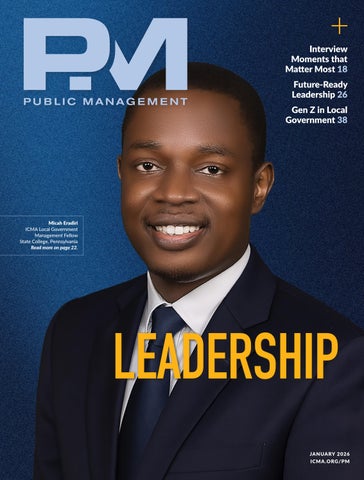
Interview Moments that Matter Most 18 Future-Ready Leadership 26 Gen Z in Local Government 38
Micah Eradiri ICMA Local Government Management Fellow State College, Pennsylvania Read more on page 22.
LEADERSHIP JANUARY 2026 ICMA.ORG/PM
Retirement and Beyond For over 50 years, we’ve supported public service professionals with retirement solutions tailored to their needs. Moving forward we’ll be expanding our mission: offering not only workplace retirement plans, but new ways to deliver on the needs of our customers by supporting individuals and their families as their financial lives change. At MissionSquare, you don’t have to choose between scale and service. We are, and will remain, a company that prides itself on delivering outstanding service, effortless technology, and quality investments. For more information, visit www.missionsq.org.
448950-1225
JANUARY 2026 VOL. 108 NO. 1
CONTENTS
In celebration of the 25th anniversary of ICMA’s Credentialed Manager program, we’ll be acknowledging each author that holds the credential with this gold icon ICMA-CM in each issue of 2026.
8
F E AT U R E S
14
38
Facing challenges, fostering collaboration, and leading with purpose Rod Gould, ICMA-CM Dr. Frank Benest, ICMA-CM & Jan Perkins, ICMA-CM
Why the youngest generation in the workforce is critical to local government’s future Emma Roniger
18
Emergency Communication: Lessons Learned from a Regionalized Approach, Part 2
Beyond the Title: What Makes a Professional City/County Manager
The Interview Moments that Matter Most in Local Government Leadership What interview panels are really listening for and what candidates should consider in their preparation Mary Jacobs
22
Why Hiring International Talent Matters for the Local Government Workforce Expanding workforce pathways to include international students and immigrant professionals is not only inclusive but also a strategic necessity for the future of local government in the United States. Micah Eradiri
Generation Z in Local Government: Who They Are and How to Engage
42
Examining the types of mass casualty incidents, traditional and non-traditional methods of communication, and the barriers that exist By Jennifer Enloe, Jack Lefavour, Jack Callahan, Griffin Moreland, Teagan Trammell, Orel Rhodes, Maddie Luster, Lauren Champion, Justin Bosse, Abbey Anderson, Brooke Free, Ross Jackson, and Miner “Trey” P. Marchbanks III
Fighting Neighborhood Crime One Address at a Time The benefits of addressing a problem property can spread beyond its boundaries. Shannon J. Linning, PhD, Tom Carroll, ICMA-CM Daniel W. Gerard, and John E. Eck, PhD
4 Ethics Matter!
6 Local Gov 250
Call for Content: Local Government and Its Role in Democracy
8 Insights
The Opportunity of a Lifetime for Local Government Leaders The 40th Anniversary of ICMA’s Future of Professional Management Fund
Bringing a greater sense of humanity to local government management is the only way to drive meaningful change. Katie Reid
Digital Trust: Why Local Government Leaders Must Show Up Online
Preparing for Tomorrow
10 Inside ICMA
Future-Ready Leadership for a Complex World
30
2 Executive Director’s Corner
Our Commitment to Democracy Is at the Core of Ethical Leadership
46
26
D E PA RT M E N T S
12 Women in Leadership
Better Together: Building Community and Careers Through Connection
50 Assistants and Deputies
30
Practical Tactics for Excelling in the Second Chair
52 Tech Updates
Essential Technology Questions (and Answers) for Decision-Makers, Part 2
Transparency, credibility, and influence now live on digital platforms. Here’s how to navigate visibility with confidence and purpose. Brigette Zorn
54 Senior Advisors
Remembering Our DNA
34
56 Professional Services Directory
Still Serving: Veterans in Local Government Building connections between military veterans and municipal management Peter Troedsson, ICMA-CM
54
International City/County Management Association J A N U A RY 2 0 2 6 | O F F I C I A L P U B L I C AT I O N O F I C M A | 1
EXECUTIVE DIRECTOR’S CORNER
Preparing for Tomorrow How ICMA’s programs are empowering members to meet the challenges of 2026 and beyond BY JULIA D. NOVAK, ICMA-CM
Public Management (PM) begins 2026 with
JULIA D. NOVAK,
ICMA-CM
is executive
director of ICMA.
a topic that speaks directly to the heart of who we are as professional local government managers—leadership. I hope you will think about your own development needs for the coming year and how you can prepare yourself for the challenges we face in local government. In 2026, ICMA is offering several new events and bringing back programs our members have historically enjoyed. Leadership Programs: The Williamsburg Leadership Institute is back, and we will offer two cohorts of the Gettysburg Institute. We had twice as many applications for the next cohort of Leadership ICMA as we have capacity for—we know you are eager for this cohort-based programming. Our team is retooling the 2025 experience to ensure that we build on success and change features to adapt to member feedback. We will look at how we can support additional cohorts while ensuring a smaller group experience for participants moving forward. We are filling key vacancies on our own professional development team at ICMA to ensure we are staffed to support your training and professional
development needs. There is definitely “more to come” as 2026 begins. Local Government Reimagined: Our innovation brand—Local Government Reimagined (LGR)—has been tailor made to address two significant areas in which you’ve asked for support. ICMA will host two LGR events in 2026. Artificial intelligence will be featured in Orlando, April 8–10; and civility, with a focus on democracy and the public trust, will be the focus in Philadelphia, May 13–15. Registration is open for these major events at lgr.icma.org. A Day with ICMA: We are also piloting three new, smaller gatherings called “A Day With ICMA,” where ICMA leadership will come together with members to discuss “Disruptive Trends and Adaptive Challenges.” We will gather in Phoenix, Arizona; Issaquah, Washington; and Lawrence, Kansas to connect, share, and listen to your hopes for the profession and our organization. All of this is designed to equip you to lead in the current context. What got us where we are today will not keep us here, and it’s important to do the work to prepare yourself to meet these challenges. Public Management (PM)
International City/County
Public Management (PM) (USPS: 449-300) is published monthly by ICMA (the International City/County Management Association) at 777 North Capitol Street. N.E., Washington, D.C. 20002-4201. Periodicals postage paid at Washington, D.C., and at additional mailing offices. The opinions expressed in the magazine are those of the authors and do not necessarily reflect the views of ICMA.
icma.org
COPYRIGHT 2026 by the International City/County Management Association. All rights reserved. Material may not be reproduced or translated without written permission.
EDITORIAL OFFICE: pm@icma.org
January 2026
REPRINTS: To order article reprints or request reprint permission, contact pm@icma.org.
Management Association
SUBSCRIPTIONS: U.S. subscription rate, $60 per year; other countries subscription rate, $155 per year. Printed in the United States. Contact: 202/289-4262; subscriptions@icma.org. POSTMASTER: Send address changes to Public Management, ICMA, 777 N. Capitol Street, N.E., Suite 500, Washington, D.C. 20002-4201. ARTICLE PROPOSALS: Visit icma.org/writeforus to see editorial guidelines for contributors. For more information on local government leadership and management topics, visit icma.org.
2 | PUBLIC MANAGEMENT | JANUARY 2026
icma.org/pm ICMA 777 North Capitol Street, N.E. Suite 500 Washington, D.C. 20002-4201
ADVERTISING SALES: Justin Wolfe, The YGS Group 717-430-2238 justin.wolfe@theygsgroup.com ICMA MEMBER SERVICES: 800.745.8780 | 202.962.3680 membership@icma.org
ICMA Creating and Supporting Thriving Communities ICMA’s vision is to be the leading association of local government professionals dedicated to creating and supporting thriving communities throughout the world. It does this by working with its more than 13,000 members to identify and speed the adoption of leading local government practices and improve the lives of residents. ICMA offers membership, professional development programs, research, publications, data and information, technical assistance, and training to thousands of city, town, and county chief administrative officers, their staffs, and other organizations throughout the world. Public Management (PM) aims to inspire innovation, inform decision making, connect leading-edge thinking to everyday challenges, and serve ICMA members and local governments in creating and sustaining thriving communities throughout the world.
The Credentialed Manager program: The final activity I will mention is the work the Credentialing Advisory Board has been doing to improve the Credentialed Manager program. The ICMA-CM designation distinguishes our members who have both substantial lived experience as generalists and a commitment to ongoing personal/professional development to ensure they are prepared to address adaptive leadership challenges. In addition to enhancing the credentialed manager program experience, we are introducing two events exclusively
for ICMA credentialed managers. In August 2026, we will offer two Credentialed Manager Summits where members with the ICMA-CM designation can gather with peers, discuss their learning journey, and engage in leadership development and training with committed colleagues. As you consider your own professional development goals for 2026, I hope the range of courses offered by ICMA will effectively address the training needs for both you and others within your organization.
PRESIDENT
Midwest Region
Southeast Region
Michael Land* City Manager Coppell, Texas
Jeffrey Weckbach* Township Administrator Colerain Township, Ohio
Eric Stuckey City Administrator Franklin, Tennessee
PRESIDENT-ELECT
Cynthia Steinhauser* Deputy City Administrator Rochester, Minnesota
Chelsea Jackson Deputy City Manager Douglasville, Georgia
Cori Burbach* Assistant City Manager Dubuque, Iowa
Justin Smith Assistant City Manager Pelham, Alabama
Mountain Plains Region
West Coast Region
Pamela Davis Assistant City Manager Boulder, Colorado
Nat Rojanasathira* Assistant City Manager Monterey, California
Sereniah Breland City Manager Pflugerville, Texas
Elisa Cox* City Manager Rancho Cucamonga, California
Penny Postoak Ferguson* County Manager Johnson County, Kansas
Katie Koester* City Manager Juneau, Alaska
Andy Pederson* Village Manager Bayside, Wisconsin PAST PRESIDENT
Tanya Ange* County Administrator Washington County, Oregon VICE PRESIDENTS
International Region
Meighan Wark County Administrative Officer Huron County, Canada Lungile Dlamini Chief Executive Officer Municipal Council of Manzini, Eswatini Jānis Lange Chief Executive Officer Riga City Municipality, Latvia
Northeast Region
Steve Bartha* Town Manager Danvers, Massachusetts
ICMA Executive Director
Julia D. Novak, ICMA-CM
Managing Director, Brand Management, Marketing, and Outreach
Lynne Scott lscott@icma.org
Senior Managing Editor
Kerry Hansen khansen@icma.org
Senior Editor
Kathleen Karas kkaras@icma.org
Graphics Manager
Delia Jones djones@icma.org
Design & Production
picantecreative.com
* ICMA-CM
Brandon Ford Assistant Township Manager Lower Merion Township, Pennsylvania Kristy Rogers* Town Manager Milton, Delaware
J A N U A RY 2 0 2 6 | O F F I C I A L P U B L I C AT I O N O F I C M A | 3
ETHICS MATTER!™
Our Commitment to Democracy Is at the Core of Ethical Leadership Examining historic democratic principles and what this means for us in 2026 BY JESSICA COWLES
The year 2026 marks the milestone of 250
years of democracy in the United States. While the associated events of the American Revolution spurred a movement for democratic (with a small “d”) government to gain a foothold across the globe, in the United States we still struggle to live up to the U.S. Constitution’s lofty ideals:
JESSICA COWLES is director of ethics at ICMA (jcowles@icma.org).
“We the People of the United States, in Order to form a more perfect Union, establish Justice, insure domestic Tranquility, provide for the common defence, promote the general Welfare, and secure the Blessings of Liberty to ourselves and our Posterity, do ordain and establish this Constitution for the United States of America.”
4 | PUBLIC MANAGEMENT | JANUARY 2026
Perhaps we should view the words in the U.S. Constitution’s preamble as aspirational. Maybe the ideals are meant to be on a continuum that we can never fully complete. That may help explain why half of the United States thinks our country is on the right track and the other half believes democracy itself is in peril. The Study of Democracy Matters
I’ll confess something: I have always been a nerd for democracy. I didn’t have a poster of the latest ’90s heartthrob in my bedroom; I had a copy of the U.S. Constitution on my wall instead. I’m sure this is at the heart of why I continue to choose this profession despite its challenges. I found an undergraduate home surrounded by other government geeks at a small public and international affairs school within Michigan State University—James Madison
I didn’t have a poster of the latest ’90s heartthrob in my bedroom; I had a copy of the U.S. Constitution on my wall instead.
College—where I majored in political theory and constitutional democracy. Fun fact: Steve Batha, an ICMA Executive Board member and co-chair of the Committee on Professional Conduct, was in this program at the same time! One of the program’s highlights is education through the Socratic Method. According to Brigham Young University, it is “often used to promote critical thinking … the answers to questions are not a stopping point for thoughts but instead are a beginning to further analysis and research.” For the thousands of members I have talked with over the years about ethics dilemmas, you already know how this experience has shaped my approach to those “gray area” situations in the profession. I’m getting to experience what democracy means today through the eyes of my middle school daughter. Her class had a field trip to Yorktown and Williamsburg, Virginia, in the fall, then she visited the National Archives to view the United States’ founding documents. Together we watched the documentary, “The American Revolution,” and discussed her enlightening perspectives over the dinner table. Through a modern lens, we can see many similarities between that time and what we experience today. I think this is why ICMA’s Code of Ethics addressed this value first in what this profession stands for in Tenet 1: “We believe professional management is essential to effective, efficient, equitable, and democratic local government.” Ethics Theme for 2026: Local Government’s Commitment to Democracy
As noted by Local Gov 250 (localgov250.org), a national effort to honor the role of local government as the U.S. approaches its 250th anniversary: “…While the Constitution goes to great lengths to separate powers and define federalism, the most widespread level of government, local government, is not mentioned at all. In the United States, there are more than 36,000 general purpose local governments. Despite their lack of introduction in the country’s founding documents, local governments are closest to the people that live and work in places large and small in America. Local jurisdictions provide a substantial part of the services, utilities, and infrastructure necessary for modern life. Maybe more importantly, these same local governments are bastions of democracy where public meetings are held, constituents are engaged, and elections are managed. Much of the American democratic experiment has played out in our nation’s cities, counties, towns,
and townships. Most people know that the Declaration of Independence was drafted and more than a decade later the constitutional convention was held in Philadelphia, one the earliest local governments in the United States.” This initiative encapsulates the role ICMA has in delivering democracy to the doorstep in our communities. ICMA will operationalize this commitment in 2026 through several key initiatives:
Local Government Reimagined Conference focused on democracy and public trust. The event takes place May 13–15,
in Philadelphia, Pennsylvania, and celebrates the work of ethical, professional local government management despite the heightened political polarization that plagues our communities.
Ethics training that emphasizes the profession’s values. In our webinar series, we’ll
build on the success of the inaugural 2025 series for members by going in-depth on the ethics topics that matter to you most. In the meantime, catch up with these free resources that further the profession’s commitment to democracy: • This article recaps a webinar that highlighted both a practitioner’s and the Braver Angels approach (icma.org/ articles/pm-magazine/ethics-mattertm-meriting-publicstrust) with the extensive resource list prepared for this webinar (icma.org/page/general-ethics-guidance). • Three practitioners offer advice to preserve our democratic institutions, public processes, and the council-manager form of government in this article (icma.org/articles/pm-magazine/ defending-american-democracy-local-level). Guest authors for the Ethics Matter column. I’m excited to share that in April, Steve Bartha (town manager in Lexington, Massachusetts) joins me as a fellow wonk in commemoration of the Battle of Lexington in April 1775, the first military engagement in the American Revolution. For context, as British soldiers marched to nearby Concord, they clashed with Lexington militia on the town common. The British fired shots that resulted in the deaths of eight U.S. colonists known as “the shot heard ‘round the world,” marking the beginning of the U.S. campaign for independence. Free, in-person ethics training for ICMA-affiliated state associations. ICMA delivers engaging, well-structured
presentations that meet the state association’s needs to promote the importance of ethical leadership and management in the local government management profession. More to Come
I optimistically look forward to ICMA’s 2026 efforts that further our profession’s commitment to democracy. We’ll share the event dates and more details in the Leadership Matters newsletter. J A N U A RY 2 0 2 6 | O F F I C I A L P U B L I C AT I O N O F I C M A | 5
LOCAL GOV 250
Call for Content: Local Government and Its Role in Democracy Join us in celebrating local government as we approach America’s 250th anniversary. In 2026, the United States will commemorate and celebrate the 250th anniversary of the Declaration of Independence. As noted by the Semiquincentenial Commission (america250.org/americas-250th), formed by Congress to support and encourage national, regional, and local activities for the celebration: America’s 250th anniversary is about more than reflecting on our past, it’s about honoring the contributions of individuals who built this country, the innovations that put this country on the map and a man on the moon, and imagining what the next 250 years might look like for our children and the generations to come. Much of the American democratic experiment has played out in our nation’s cities, counties, towns, and townships. Most people know that the Declaration of Independence was drafted in Philadelphia—one the earliest local governments in the United States—and more than a decade later, the constitutional convention was held there. Despite their lack of introduction in the country’s founding documents, local governments are closest to the people that live and work in places large and small in America. Local jurisdictions provide a substantial part of the services, utilities, and infrastructure necessary for modern life. 6 | PUBLIC MANAGEMENT | JANUARY 2026
These same local governments are bastions of democracy where public meetings are held, constituents are engaged, and elections are managed. Over the next year, ICMA will be celebrating alongside a collaboration of local government associations and interested professionals to educate and celebrate the “democracy at the doorstep” facilitated by cities, counties, regional councils and tribal governments. Learn more about this collaboration at localgov250.org. With this in mind, we are asking for any content that you may have that connects and celebrates local government and its role in democracy. Written content may be used as feature pieces in PM magazine, enewsletters, or modified into podcasts. For submissions and questions, contact research@icma.org.
Calendar of Events There is Still Time to Submit Your Nomination for the ICMA Executive Board ICMA invites you to consider the unique background and perspective that you can bring to the association as a board member. ICMA’s regional vice presidents represent members in their geographic region and play a critical leadership role within the local government management profession. Learn more about the role and expectations of board service, the nominations and election process, the 2025–2026 schedule, and eligibility requirements for your region by visiting icma.org/icma-executive-board-nominations-process. ICMA strongly encourages individuals who are interested in pursuing this leadership opportunity to reach out to their regional director or email icmanominations@icma.org.
UPCOMING EVENTS Common Sense Strategies for Talent Management | NASPO January 7 | Free Webinar ICMA Executive Board Nominations January 8 | Nomination Materials Submission Deadline Modernizing Budgeting: A Transformational Shift to Priority-Based Budgeting January 14–28 | Certificate Program
Emerging Leaders Development Program 2.0 January 27–June 30 | Leadership Development Program Harvard Kennedy School Senior Executives in Local Government Program | William Ferguson Jr. Scholarship January 31 | Application Deadline
Limited Spots Remaining: ICMA Williamsburg Leadership Institute Rediscover the timeless lessons of leadership from Williamsburg in the 1770s and explore how they illuminate today’s civic challenges and opportunities. Through immersive historical experiences and engaging dialogue, participants will connect the principles of America’s founders to modern issues of governance, civility, and change. This transformative program empowers local government leaders to apply enduring values and lead their communities with integrity, vision, and purpose. Scan to register today!
For a full listing of events and details, visit icma.org/events. Shop all courses at learning.icma.org. J A N U A RY 2 0 2 6 | O F F I C I A L P U B L I C AT I O N O F I C M A | 7
INSIGHTS
The Opportunity of a Lifetime for Local Government Leaders
My Harvard Kennedy School journey from application to graduation, all made possible with the Ferguson Group scholarship BY MICHAEL PLEUS, ICMA-CM
This year, I was honored to receive the
MICHAEL PLEUS,
ICMA-CM is city
manager of DeLand, Florida, USA.
Ferguson Group scholarship to attend the Harvard Kennedy School’s Senior Executives in State and Local Government program. I’m deeply grateful to the late William Ferguson Jr. for his strong belief in local government management, as well as the continued commitment of the Ferguson Group, which has helped public management professionals access this outstanding opportunity for many years. I would also like to thank ICMA and the selection committee for their time and commitment to the selection process for the scholarship. When I first decided to apply, I had spent nearly 25 years in the public management profession, but I was searching for experiences that would enhance my contributions to the profession and my community. I learned about the program at the 2018 ICMA Annual Conference in Baltimore, and realized that I knew several graduates and discussed their experiences with them. Hearing their stories convinced me that the program could be life-changing. I first applied in 2019, and after not being selected, a friend encouraged me to try again. I applied in 2020, but the program was cancelled due to the COVID-19 pandemic. I reapplied in 2023 and 2024, and in 2025, I was selected. I still remember getting that call from Chris Gendell, the Ferguson scholarship program manager at ICMA. I was thrilled! I could not wait for my Harvard experience to begin. Leading up to the program, we had a Zoom call with faculty chair David King and program manager Christian Flynn, who explained the program logistics in more detail and gave us instructions on using Canvas, the learning management system. Soon, the reading began, and there was a lot of it! I tackled the first week’s materials early to get a head start—a step I strongly recommend. Even with that head start, there was a lot of required reading throughout the program. Soon after, I packed for Cambridge. I had been to Boston for the 2013 ICMA Annual Conference, but I hadn’t explored Harvard or Cambridge. They used to host program participants in the dormitories, but we were hosted at the DoubleTree Suites, just a short walk to Harvard Kennedy School. I arrived the day before the
8 | PUBLIC MANAGEMENT | JANUARY 2026
program started, and I was excited to check into my room and begin my tour of the Harvard campus. I walked on the trail that ran along the Charles River, then on to the Kennedy School building, and began to take in what would be my home for three weeks. The Senior Executives for State and Local Government program falls under the Executive Education program at the Harvard Kennedy School. Its purpose is to help program participants navigate the greater demands placed on state and local government at a time where they face a skeptical and divided constituency. The program is an intensive, threeweek experience designed to stretch and strengthen public leaders. Through faculty-led case studies, simulations, and peer dialogue with officials from across the United States and around the world, we explored topics ranging from adaptive leadership and negotiation to equity, public communication, crisis management, creating public value, and innovation. What stood out most was how to lead through uncertainty and build coalitions across divides—skills that are urgently
needed in government today. The program pushed us to reflect not just on policy, but on purpose, and how to align values with public service. My cohort included city managers, assistant city managers, mayors, finance directors, union officials, municipal police officials, state legislators, state officials, county officials, and school board officials from 19 states, Canada, Ireland, England, and Pakistan. Faculty chair David King described the program as an ecosystem for exploring public policy issues with the toolkit that they help us create in the first two weeks. We delved into adaptive leadership, creating public value, negotiation, political structures and public engagement, using evidence and data, generative AI, finance, economic development, and emergency management. We also spent a day together on Thompson Island participating in Outward Bound, a
great exercise in team building and creative problem solving. In the classroom, participants are encouraged to, as Professor Marty Linksy would put it, “raise the heat” to explore the more challenging issues often left unexplored because they can be so divisive under normal circumstances. We used the toolkit we built in the first two weeks to solve three case studies selected by the class in week three. The case studies were presented by the cohort as public policy issues that they were trying to solve in their community. We acted as consultants tasked with developing solutions, and then presented our recommendations to the class. On the final day, we had a graduation ceremony, received our certificates, and began the hard process of saying goodbye to our new friends. The three weeks passed rather quickly, but the
friendships and connections we made will last a long time. We experienced a lot together and opened up to each other, allowing ourselves to be vulnerable. As a result, we were able to discuss challenging public policy issues we face in our own communities with individuals that may have very different views than we do. However, throughout the experience we all remained committed to respectful discourse and “sharpening the saw” toward the goal of becoming better public servants. After returning home, we committed to implementing key takeaways from the program and chose “accountability buddies” from among our peers to check in with regularly. All in all, this was an incredible experience. If you want to take your career to the next level, I encourage you to apply for the scholarship to participate in this outstanding program.
Solutions for Backflow Valves Fire Valves Fire Hydrants
Secured by
866-308-9911
www.backflowtheft.com info@backflowtheft.com
800-422-2866
www.laigroup.com sales@laigroup.com
J A N U A RY 2 0 2 6 | O F F I C I A L P U B L I C AT I O N O F I C M A | 9
INSIDE ICMA
The 40th Anniversary of ICMA’s Future of Professional Management Fund A look at how far we’ve come and where we’re headed from here How It Started
Growing the Strategy for the Future
Like many lasting endeavors, the ICMA Future of Professional Management Fund began with a vision for the future and the passion of dedicated members and staff. Initially established as a foundation to separate dues-related activity from advocacy efforts, the Fund has not wavered in its support for professional management, the profession, and the adoption and retention of the council-manager plan.
In 2025, long-time donors met with ICMA Executive Director Julia D. Novak to discuss long-standing and new challenges to make the role of professional management more visible and to ensure support for council-manager government. They agreed on the need for a renewed focus on fundraising to support a broader agenda: (1) to embrace professional and leadership development for managers and (2) to explore new ways to promote the council-manager
Past Successes, Current Challenges
For 40 years, the Fund has supported advocacy efforts nationwide with many successes and lessons learned. What has not changed is that professional management is under constant challenge. In the August issue of PM Magazine, Phil Kiraly wrote about how strong partnerships help defend and advance the form and the importance of communicating the value of professional management. Sharing the stories about the difference that professional management makes increases the public’s trust in government professionals to serve the best interests of the community. With Fund support, this year the city of Blythewood, South Carolina, adopted the council-manager form. In Conroe, TX; Pueblo, CO; and Ketchum, ID, teams launched efforts to adopt the council-manager plan, sparked important conversations about transparency and accountability, and the need for a new strategic campaign to help communities learn more about why professional management matters.
10 | PUBLIC MANAGEMENT | JANUARY 2026
Where We Stand Today • • • •
Corpus (restricted) balance: $2,890,000* Unrestricted balance: $540,000* 2024 contributions: $54,436 2025 contributions: $90,522 (as of December 18, 2025)
*As of Sept 30, 2025. Second quarter financials will arrive after this issue goes to print.
Goals • • •
40th Anniversary Fundraising Goal: $120,000 Stretch Goals: Increase donations to $140,000 to support additional efforts Baseline: $8,000 per month
Timeline
form and professional management before a challenge occurs. These efforts require strengthening relationships with state associations, national partners, and others. They also require educating elected officials and stakeholders on the benefits of professional management and supporting research that demonstrates how council-manager government can make a community stronger, more resilient, more ethical, and more responsive. Donations Matter
Your support matters! Donations to the Fund make it possible to provide sustained advocacy for council-manager governance and to provide the tools and support needed for the future of the profession, and for the professionals needed to lead and manage our communities. Help Tell the Stories
There are many ways you can support this fortieth anniversary initiative. This year, we are collecting stories. Send us a story about how council-manager government has made a difference in your community and encourage friends and colleagues to contribute. Our goal is to have 40 stories to celebrate 40 years. • Share a video testimonial, media spot, or other resource that highlights the value of the council-manager form or professional management. • Send us a statement, quote, or challenge about public service and professional management that is inspiring to you. • Share what has inspired (or would inspire) you to give to the Fund. • If you have never donated to the Fund, explore how the Fund has supported professional management and watch the new video, “Council-Manager Form of Government Works Best,” at icma.org/thefund. Consider donating any amount. • If you have given before, consider signing up for a small monthly or quarterly donation within your budget. Make a difference this year by sending your stories, links, quotes, and ideas to rcarty@icma.org or fund@icma.org, or donate at icma.org/thefund! Look for updates throughout the year on these new efforts, our 2026 fundraising goal progress, and ways you can support the council-manager plan and the development of capable and ethical professional managers. You can support the proud tradition of a profession dedicated to nonpartisan, accountable local government in this transformative era.
Recent Activity Adopted Council-Manager Plan
• • • • • • •
Blythewood, SC Deer Park, OH Eagle Lake, TX Hilliard, OH Ithaca, NY Mattoon, IL Redbank, NJ
Retained Council-Manager Plan
• • • • • • • •
Austin, TX Bensenville, IL Evanston, IL Freeport, IL Maywood, IL Orland Park, IL Portland, ME Sacramento, CA
Enhanced Management
• •
Glencoe, IL Portland, OR
1985: ICMA Endowment Fund for the Profession Replaces Endowment Established in 1978* “The foundation was created…because a clearer distinction could be made between member contributions and ICMA’s general fund.” (Communication No.1173, September 1985) • Enhance public awareness and understanding in local government and the role of local government managers. • To support and promote activities that assist members of the profession with personal and professional development. 1987: Fundraising Campaign Launched ICMA launches a fundraising campaign to raise $1 million by the conclusion of the ICMA 75th anniversary celebration in 1989. 1997: ICMA Foundation Renamed “Fund for Professional Management” “The endowment fund was created with the idea that we would raise $1 million on the basis of time giving, and that proceeds of that fund would supply our needs to support professional management.” (Committee on the Profession Minutes, July 1997) • Build a Corpus of $1 million. • Use additional revenues to support professional management activities. 2012: Life, Well Run Campaign Launched The marketing campaign highlighted the role and value of professional managers and generated outstanding content for local, state, and national distribution. In the first two years, $1.3 million was raised. 2020: Future of Professional Management Fund Created “The Fund” was created as an umbrella fund from the remainder of Life, Well Run assets and the unrestricted funds from the Fund for Professional Management to focus on activities to advance future professional management. 2025: Scope and Strategy Renewed to Enhance Fund Usage • The new focused Fund strategy includes: Advocating for professional local government management and professionals. Supporting adoption and retention of councilmanager government. Supporting the development of professional managers. • The ICMA annual conference drive raised nearly $50,000 between registration and closing session! *In 1978, the ICMA Endowment was established “for the purpose of recognizing, assisting, promoting, sponsoring, or honoring those individuals, institutions, and programs which advanced, improved, and enhanced the profession, as well as the skills and knowledge of local government officials and citizens.” (PM Special Report, March 2002). Five separate funds were combined to create this new endowment.
J A N U A RY 2 0 2 6 | O F F I C I A L P U B L I C AT I O N O F I C M A | 11
WOMEN IN LEADERSHIP
Better Together: Building Community and Careers Through Connection How local government professionals in Minnesota are working toward a more inclusive profession— one conversation at a time. BY RENEE EISENBEISZ
Since 2015, the Minnesota City/County Management
Association (MCMA) has taken purposeful strides to support the advancement of women in local government. Originally created as a task force, MCMA’s Women in the Profession committee adopted the mission to foster connection, build leadership pathways, and address the ever-present challenge of work-life balance. The committee has developed innovative programs that create space for support, conversations, and celebrations. Among them, the Coffee and Careers roundtable series. Coffee and Careers events are informal, topic-based gatherings designed to connect women working in local government at all career levels. Whether held virtually or in-person, these conversations offer a space for women to share challenges and successes, seek advice, and strengthen their networks. The format is simple, but the impact is profound. Participants leave with new ideas, meaningful peer support, and the affirmation that they are not alone in navigating the complexities of public service. This program directly reflects the goals of ICMA’s SheLeadsGov initiative, which calls for the profession to innovate, inspire, and impact. SheLeadsGov, a global ICMA program launched to champion gender equity in local government, provides a critical framework for supporting women’s career advancement, fostering inclusive leadership, and addressing persistent gender-based challenges. According to ICMA’s 2024 Career Advancement Survey, 87% of respondents agreed that women face more barriers to leadership than men, citing factors such as exclusion from decision-making, lack of mentorship, and difficulty balancing personal and professional roles.
MCMA’s Women in the Profession committee embraces these challenges head-on. In addition to Coffee and Careers, the committee also hosts sessions at MCMA’s conferences. Past topics have included gender stereotypes across generations and self-advocacy. This year’s session was a roundtable discussion on incorporating fun at work and included a lively conversation that underscored the importance of joy and well-being in high-pressure careers. It featured wellness initiatives like the Stop the Clock program in Chaska, Minnesota, and friendly intercity competitions such as the “Battle of the Burbs” among Eden Prairie, Edina, and Plymouth—programs that foster camaraderie and employee engagement. A crucial component to this committee’s success is the understanding that advancing women in the profession isn’t the work of women alone. Men play an essential role as allies, mentors, and advocates. Their participation in committee efforts and presence at events like Coffee and Careers sends a strong message that gender equity is a shared goal—one that benefits organizations, teams, and communities alike. At its core, the committee’s work echoes the SheLeadsGov vision: creating inclusive environments that make space for women to lead, grow, and thrive. This includes pushing past the traditional constraints of mentorship and work-life balance to redefine what professional success looks like in today’s municipal world. By investing in connection— through a casual coffee chat or a meaningful forum—the committee reinforces a culture where women can show up authentically, advocate boldly, and support each other fully. In Minnesota and beyond, the message is clear: when women in government support each other, everyone benefits. Programs like Coffee and Careers prove that leadership development doesn’t always require a formal workshop or a conference badge; it can begin with an invitation to talk, share, and grow. Together we are building a more inclusive, more supportive, and a more effective local government profession.
In Minnesota and beyond, the message is clear: when women in local government support each other, everyone benefits.
RENEE EISENBEISZ is assistant city manager of Shoreview, Minnesota, USA.
12 | PUBLIC MANAGEMENT | JANUARY 2026
ALIGN FUNDING TO YOUR HIGHEST PRIORITIES WITH
AI-POWERED BUDGETING Tyler’s AI-powered Priority Based Budgeting platform and framework enables governments to easily and quickly uncover budget savings, identify revenue possibilities, better allocate funds, and create sustainable, fiscally responsible budgets.
SCAN THE QR CODE TO LEARN MORE!
Beyond the Title
What Makes a Professional City/County Manager Facing challenges, fostering collaboration, and leading with purpose BY ROD GOULD, ICMA-CM DR. FRANK BENEST, ICMA-CM & JAN PERKINS, ICMA-CM
14 | PUBLIC MANAGEMENT | JANUARY 2026
I
t’s tough being a city/county manager today. Increased polarization, problems without real solutions, employees switching jobs quickly, more avenues of social media and disinformation, reduced public trust, threats to public officials, major fiscal problems with stagnant revenues, convoluted intergovernmental relations, the rapid rise of AI, and more all combine to put pressure on those in the top job. The need for talented, highly ethical professionals as city/ county managers has never been greater. A truly professional manager brings many advantages to local government. This has been the case for more than 100 years. Yet, what defines a professional from just the holder of the title has changed over time. While the ICMA Code of Ethics and Declaration of Ideals have much to offer on this subject, this article delves a little deeper into some of the less discussed
skills, understandings, and characteristics needed by today’s city/county manager. The previous generation of managers often came up through the ranks of the operating or administrative departments and did stints as assistant to the city manager, deputy city manager, or assistant city manager before being tapped for the top job. Often these baby boomer managers hold advanced degrees in public policy, public administration, or business administration. That route remains today, but the path is now so much wider, which expands the pool of available leaders. More people are coming to the top job from department director positions, and individuals from outside local government are transitioning to city/county management. Private industry, nonprofit, or community leadership credentials are increasingly common in city/
This work is tremendously rewarding but is not for the faint of heart. The noble meaning and purpose of your work must sustain you. county manager appointments. This adds to the diversity of backgrounds and perspectives, while also introducing a need to learn the unique aspects of the role. Most city/county management professionals are highly skilled people of character and integrity who have a good idea of the job they are moving into. It is a point of pride to be a member of this profession. Some people, though, have moved into the position of manager without enough grounding in the role to be successful. Some are attracted by the salary and may
severely underestimate the demands of the position. When they do not succeed, they not only fail for themselves, but they set back their communities, organizations, and even the reputation of the profession. It is damaging to staff and council alike to have unprepared individuals appointed into the top job.
Unique Roles and Tips So, let us suggest some unique roles and a few tips for those aspiring to join the ranks of top local government managers and be most successful: 1. Come to the job with enthusiasm. The top job
in a city or county is about leadership. Staff, council, and community members look to the manager for inspiration. Find the fun in the work and create an environment that encourages people to want to be part of building something together. No one wants a “downer” boss at the top. Inspiring others to greatness is a big part of the manager’s job.
2. Know and Commit to the Values of the Profession. Values define
any profession. It’s important for a city/county manager to understand and really
believe in these. We need to lead with these values and set the example. The local government management profession is defined by these core values: • Respect for council/manager roles. • Transparency. • Accountability. • Social equity. • Environmental responsibility. • Community as partner. • Civility. • Ethics. These values shape our professional behavior. Our communities count on us to model these values, our staff look to us for how to behave, and our governing bodies watch how we work. 3. Know your lines in the sand. Your commitment to
representative democracy, the council-manager form of government, and the ICMA Code of Ethics must be unshakable. During your career, one or more of our core values is likely to be sorely tested by elected officials, community leaders, or even members of your own staff. You need to know what your clear lines are so you can act with principle and resist pressure. It can mean being willing to be fired or to resign, depending on the situation. There are many examples of managers having to take such stands. Personal realities (family obligations, loss of income, or more) can cloud a response to a situation that a manager needs to make. For some individuals, it may be that stepping back
J A N U A RY 2 0 2 6 | O F F I C I A L P U B L I C AT I O N O F I C M A | 15
into a different job is better on a personal level if the hardest decisions are not realistic for you. Local governments need talented department directors, assistants/deputies, and others, and nonprofits need skilled executives. Examples where managers have had to take a stand include severe interference with administration in the form of directives to hire or fire officials, approve contracts outside the purchasing process with those politically wellconnected, pressure to provide inequitable service to one part of the community, or demands to ignore council decisionmaking to pursue pet projects of individual councilmembers. City/county managers have to resist these pressures and be consistent in doing so. If you can’t, then you may not really be able to provide the leadership that is needed in the top job, or at least in that community. In our experience, managers who have had to leave due to taking a principled stand on an ethical issue have been able to promptly rebound for the better. 4. Know a Fair Amount About a Lot of Things.
The old idea about knowing a little bit about a lot of things isn’t really enough in local government management. You don’t have to be the expert, but you do need to have a firm handle on some of the best practices in a wide range of disciplines. It means continuously learning about finance and budget, human resources, police, fire, emergency management, streets, water,
Supporting the council also The true professional shines in means helping them establish norms and expectations for times of distress. You may be tied how they work together and how they work with you and Supporting the council in knots inside, but your public staff. also requires helping them set goals that they can rally face is positive, determined, around in their policy roles. may not come naturally steady, and focused on solutions. This to elected officials who are
waste water, storm drainage, traffic control, capital projects, leisure and cultural services, parks and open space, libraries, human and social services, planning and land use, code enforcement, economic development, redevelopment, homeless strategies, information technology, climate issues, housing, intergovernmental and community relations, sustainability, and risk management. The list goes on. Then there are the soft skills of negotiation, conflict resolution, team building, effective listening, and leadership. Becoming proficient enough in these technical and adaptive skills for the manager role requires continually assessing your knowledge base for gaps and filling them with training, attending conferences, asking questions of experts, reading, and direct observation. Knowing your own knowledge gaps is also important as you hire or promote assistants who can bring complementary skillsets and abilities. Seeking out coaches and mentors can be helpful. If you are lacking some knowledge of the key areas of local government, you may overly rely on department staff
16 | PUBLIC MANAGEMENT | JANUARY 2026
to interpret for you. While it’s essential to hire the best subject matter experts and expect them to lead their operations, you need to know what questions to ask and what constitutes complete answers. Your council also expects you to understand the community’s perspectives as you bring forward professional recommendations or answers to residents. 5. Be Adept in Supporting Elected Officials—Fairly.
Much of a city manager’s time is spent advising and assisting elected leaders. You must bring out the best in the council as a body, while treating each member with courtesy and respect. This doesn’t mean treating everyone exactly the same because each elected official is different, but it does mean supporting them fairly. And it means always providing equal information to all councilmembers. They come to their position with different backgrounds, needs, and styles. It is crucial that you do not play favorites or are not even perceived as playing favorites or acting in a “political” fashion in your dealings with councilmembers.
more focused on constituent issues, but it is an important role of a city/county manager. As chief executive, your role also includes providing advice and guidance that isn’t always welcome. Or it may be welcome by some and not all members of the council. It means saying “no” regularly. It demands emotional maturity and a calm disposition. If you are conflict averse and want to please everyone, this job is not for you. Sooner than later, that will catch up with the manager and conflict will result, regardless of attempts to avoid it. 6. Constantly Strengthen the Senior Leadership Team. It takes a committed
and effective team to get things done, whether in a small community or a large one. Experienced and knowledgeable department heads are key to success. Hence, the city manager must cultivate the best possible group of senior leaders—people who work well together, strive for excellence, and support each other’s success. It means giving candid feedback to your direct reports that helps them improve and achieve their career goals in a constructive manner. It requires insulating them from council politics and standing up for them so that
they may focus on essential functions. It involves leading continuous improvement and providing consistent support. It also entails developing the next departmental leaders by “growing your own” inhouse. Sometimes, it requires letting someone go who has served the city/county for a long time, but despite coaching and training, cannot consistently get the work done or who generates too much organizational broken glass. 7. Become a civic engagement and public information ninja.
Today’s public can range from supportive and happy to suspicious, angry, disengaged, and divided. How do you gain and retain trust and confidence in today’s world, especially when things go sideways? How do you get everyone into the act and still get action? Holding hearings, sending newsletters, and curating an engaging website are baseline methods and important, but they are not enough. These days, the manager must be social-media savvy, energizing staff to find creative ways to engage a busy and possibly hostile community. Staying focused on the goal of getting accurate factual messages out to residents and businesses and showing eagerness to try new approaches to reaching people is an important role of today’s city/county manager. The most enlightened policy or program can be misunderstood or rejected by the public without engagement as it is being created or good information about its intent and impact. Most importantly, you
must be willing to engage in authentic conversations with different stakeholder groups and listen to all perspectives. You must be truly open to these conversations and be willing to modify your course of action based on what you hear. 8. Acquire alligator skin.
This work is tremendously rewarding but is not for the faint of heart. You may have your integrity, intelligence, loyalty, and motives challenged by loud advocates and even elected leaders. It is not always pleasant. You must remain calm. Rarely is it personal when anger is directed toward you. Many of your critics will not understand your role. The noble meaning and purpose of your work must sustain you. 9. Lead in emergencies.
There will be rough times. Human-made or natural emergencies, scandals, very public mistakes, and occasional tragedy may befall your city. You must stand up as a leader in these times of testing. Everyone needs to see that the manager has a plan and is moving ahead in the face of the storm. You may be tied in knots inside, but your public face is positive, determined, steady, and focused on solutions. Your messages must inspire confidence without giving false hope. It is a difficult line. The true professional shines in times of distress. 10. Live self-care and resilience. There is
no end to the work of a professional city/
county manager. Done right, local government management takes sustained effort. There can be regular crises and multiple fires burning at any given time. Cumulative stress can take its toll. The city council is unlikely to monitor your activity and tell you to take a vacation. (Lucky if they do!) You must self-regulate. All the usual advice about the need for sleep, decent diet, exercise, healthy habits, partner/family time, hobbies, and time away apply—times three! Take care of yourself as a city/county manager. 11. Stand Up for Local Democracy.
Unfortunately, local democracy is under assault. In some jurisdictions, we have angry mobs trying to disrupt and take over public meetings. Democracy in America has been built over time on an intergovernmental system and that is now changing in ways that impact local governments, such as federal agencies withholding funding authorized by Congress to our communities. City/ county managers and other senior leaders need to help elected officials stand strong and counter threats to local democracy.
Be Prepared, But Not Deterred Serving as manager is filled with possibilities to make a lasting positive difference for thousands of people. It also brings with it innumerable chances for conflict and controversy. Our
local governments need effective managers—people to run our organizations. In today’s environment, maybe more than ever, the top leader must navigate ongoing change, be a guiding light for staff, assist the governing body in their policy role, and step up during crises. And, by the way, to sustain yourself, you must enjoy the job along the way. People who enjoy what they are doing are more likely to have others enjoy working with them. The good news is that city/ county managers are made, not born. It takes considerable effort to prepare for this high-impact profession. Effective managers embrace the challenge, continually seek to learn and grow, and provide leadership that others wish to follow.
ROD GOULD, ICMA-CM is chairman of the board of HdL Companies, a former ICMA Executive Board member, retired city manager, consultant, and supporter of all those who toil in local government service. (rodgould17@gmail.com) DR. FRANK BENEST, ICMA-CM is a retired city manager and currently serves as a local government trainer and ICMA’s liaison for Next Generation Initiatives. (frank@frankbenest.com). JAN PERKINS, ICMA-CM is vice president of Raftelis, a local government management consultant and facilitator, retired city manager, and a believer in good government and in the city management profession. (jperkins@raftelis.com)
J A N U A RY 2 0 2 6 | O F F I C I A L P U B L I C AT I O N O F I C M A | 17
The Interview
Moments
that Matter Most in Local Government Leadership BY MARY JACOBS
What interview panels are really listening for and what candidates should consider in their preparation
18 | PUBLIC MANAGEMENT | JANUARY 2026
M
ost ICMA members have sat on both sides of the interview table. We have prepared our own answers, served on panels, advised colleagues, and considered how candidates might perform under public scrutiny long after the interview ends. Even experienced local government professionals can be surprised by the weight interviews carry. It is not that the questions themselves have become more complicated. Many are familiar and predictable. Panels are listening for how candidates demonstrate judgment, credibility, and alignment with public service values. They are also observing how candidates support their teams and navigate governance expectations. This applies across management levels, not only city or county manager searches. Whether the role is a department director, assistant director, or other management position, interviews offer the primary opportunity to convey both technical competence and leadership qualities, including decision-making, problem-solving, and navigating complexity. A handful of interview moments often shape how candidates are perceived. Those moments reveal how a leader thinks, listens, and responds when the stakes are real. The eight sections below highlight the crucial moments that often stand out in an interview.
1. Accountability and Ownership
Questions about failures, setbacks, or missed goals are rarely intended to trap candidates. Panels are listening for how candidates take responsibility, explain outcomes, and reflect on their own role when things do not go as planned. In local government, where decisions are public and affect staff, teams, and the community, accountability carries particular weight. Strong candidates describe their role clearly and provide context without defensiveness. They explain what they learned from the experience and how it shaped subsequent actions. The focus is not on the misstep itself, but on the insight gained and the positive influence on both team and organizational outcomes.
2. Self-Awareness and Feedback
It is common to encounter questions about development areas, past feedback, or challenging situations. Panels often use these discussions to gauge whether candidates understand themselves and can respond effectively over time, revealing self-awareness, accountability, and a growth mindset. Candidates are most effective when they are candid about real areas for growth. They describe concrete steps they have taken to improve, such as adjusting habits, refining approaches, or seeking targeted mentorship. By showing that they reflect on their behavior and actively work to develop, candidates convey maturity, credibility, and readiness to take on complex leadership responsibilities.
A handful of interview moments often shape how candidates are perceived. Those moments reveal how a leader thinks, listens, and responds when the stakes are real. 3. Working Within Governance
Leaders at all levels often face questions about how they navigate policies, interpret regulations, coordinate team decisions, or engage with elected officials, boards, and other oversight bodies. These discussions reveal whether a candidate can balance governance expectations, organizational priorities, and team responsibilities while maintaining accountability to both internal and external stakeholders. Candidates who stand out demonstrate awareness of their role within the team and organization, while understanding the perspectives and priorities of governing bodies and the broader community. They describe how they have provided recommendations, facilitated discussions, and balanced differing viewpoints to achieve results. By showing an ability to align with governance structures, exercise sound judgment, and lead across internal teams and external oversight bodies, candidates convey credibility, leadership, and the capacity to make decisions that are defensible, effective, and aligned with public service values.
4. Judgment Under Pressure
Interviews often explore how candidates handle challenging and high-stakes situations, from everyday operational decisions to urgent issues with significant consequences for staff, the public, or governing bodies. Panels listen closely for how candidates weigh competing priorities, make decisions under stress or uncertainty, involve their teams, and maintain composure when pressure is high. Candidates stand out when they can clearly describe examples from both routine and high-pressure circumstances. Strong responses demonstrate thoughtful prioritization, steady judgment, and the ability to delegate effectively while keeping teams informed and supported. By acknowledging contributions, maintaining clarity, and guiding others through complex situations with confidence, candidates convey leadership presence, credibility, and the capacity to manage complexity while sustaining trust. J A N U A RY 2 0 2 6 | O F F I C I A L P U B L I C AT I O N O F I C M A | 19
5. Managing
Conflict and Difficult Relationships Conflict is an inevitable part of local government work, whether involving colleagues, departments, unions, elected officials, or community members. Interviews often explore how candidates handle disagreements and navigate challenging relationships, offering insight into their leadership style, judgment, and ability to maintain organizational effectiveness amid tension or differing perspectives. Strong candidates acknowledge that outcomes do not always go as planned and describe how they address conflict respectfully and professionally. Effective responses emphasize attentive listening, clear and transparent communication, appropriate boundary-setting, and a focus on shared goals rather than assigning blame. By demonstrating support for their teams, balancing competing viewpoints, and maintaining trust and collaboration during difficult conversations, candidates convey emotional intelligence, credibility, and the capacity to sustain productive relationships across the organization and with external stakeholders.
6. Career Transitions
It’s typical to encounter questions about career interruptions such as short tenures, job losses, or transitions. Panels are listening for candidates’ ability to recognize patterns in their own behavior, respond to guidance, and demonstrate maturity when reflecting on performance and career decisions over time. Organizations want leaders
Candidates who prepare thoughtfully can highlight experiences that demonstrate judgment, adaptability, and leadership in real situations. who can learn from experience, maintain credibility, and provide stability to their teams. Candidates who are are candid about career transitions and acknowledge challenges without shifting responsibility onto others are those who stand out. They describe lessons learned from difficult experiences and how they’ve applied these insights to strengthen their effectiveness. By showing reflection, active development, and the ability to learn from experience, they convey readiness to grow in complex organizations while maintaining trust with both teams and oversight bodies.
reasoning and a thoughtful approach to complex situations. They reflect candidates who are prepared, have considered relevant examples in advance, and can highlight how those examples connect to the needs of the community they hope to serve. Such answers show the ability to clarify expectations, weigh trade-offs, and communicate intended actions effectively. They convey preparedness, practical judgment, and the ability to navigate real-world challenges while keeping teams, the organization, and stakeholders in mind.
7. Demonstrating
Technology, and Modern Expectations Interviews increasingly explore how candidates respond to change, adopt new tools, or manage evolving work environments. Questions in this area often ask candidates to describe how they have implemented new technologies, adapted processes, or addressed emerging challenges. Panels are attempting to evaluate how candidates think through technical changes, integrate them responsibly, and ensure alignment with organizational and community needs. Responses that resonate show flexibility and practical judgment. Candidates who
Readiness Through Scenarios and Examples Interviews often include situational questions, case scenarios, or requests for examples of past work. Panels are listening for evidence of judgment, problemsolving, and the ability to apply knowledge in context. These questions reveal how candidates think through challenges, sequence decisions, and anticipate consequences. They also provide insights into how the candidate is likely to fit within a community’s own organization and culture. Answers that leave an impression show clear
20 | PUBLIC MANAGEMENT | JANUARY 2026
8. Adaptability,
can describe how they evaluated new approaches, introduced or supported specific tools, or helped their teams adapt to new workflows or organizational practices demonstrate readiness for dynamic roles. Highlighting experiences that connect technology, process changes, or evolving team structures to the organization’s mission or the community’s expectations reinforces awareness of impact, accountability, and leadership in modern local government environments. Interviews are not only a review of past accomplishments. They give panels a chance to see how candidates think, make decisions, and interact with people across the organization. Candidates who prepare thoughtfully can highlight experiences that demonstrate judgment, adaptability, and leadership in real situations. Preparation also allows them to show how they support their teams, engage with stakeholders, and navigate complex challenges. When candidates convey reflection, readiness, and insight into their approach, panels gain a sense not only of what they have achieved, but also of how they are likely to contribute to the organization’s goals, culture, and mission.
MARY JACOBS is ICMA’s new managing regional director. A former ICMA board member with 28 years’ experience in city management, she was also a consultant and recruiter before joining the ICMA staff. (mjacobs@icma.org)
The Senior Executives in State and Local Government Program at the Harvard Kennedy School is hailed as a life-changing, transformational career development opportunity unlike any other. The William Ferguson, Jr. Scholarship, awarded by ICMA, and named in honor of The Ferguson Group founder, will be awarded to an ICMA member to attend the 2026 program.
Criteria: • Must be an ICMA member. • Must meet other scholarship criteria. • Application deadline: January 31, 2026.
Apply at icma.org/harvard Funded by ICMA Corporate Partner
Why Hiring International Talent Matters for the Local Government Workforce Expanding workforce pathways to include international students and immigrant professionals is not only inclusive but also a strategic necessity for the future of local government in the United States. BY MICAH ERADIRI In August 2023, I walked into Village Hall in Roselle, Illinois, to begin what would become a defining moment in my career. I had arrived in the United States from Nigeria just days earlier to begin my master of public administration degree program at Northern Illinois University. With no U.S. experience, no network, and no guarantee of opportunity, I became the first international student from NIU’s MPA program to secure a municipal internship in their first semester. That village’s decision changed my life and, in many ways, it redefined what’s possible in the American local government workforce.
Today, I serve as the only international student in the 2025 ICMA Local Government Management Fellowship, supporting community planning and policy development for the borough of State College, Pennsylvania. My journey— from Nigeria to Roselle to State College—is more than personal. It’s a workforce strategy waiting to be scaled.
The Case for International and Immigrant Talent Local governments across the country face staffing shortages, generational transitions, and a growing demand for more inclusive service
22 | PUBLIC MANAGEMENT | JANUARY 2026
delivery. Yet while workforce strategies often focus on recruitment or retention, one opportunity remains widely underexplored: the international student and immigrant talent pool. These professionals— many of whom are earning master’s degrees in public administration, policy, urban planning, or public health—are highly trained, deeply motivated, and often come with a wealth of lived experience navigating complex systems. What they often lack is access.
What International Talent Brings to Local Government
1. Cultural Fluency and Empathy—Immigrant
professionals are wellpositioned to understand
the nuanced needs of diverse communities. In Roselle, my Nigerian background helped me connect with residents and stakeholders in meaningful ways, whether I was updating municipal code or helping craft community outreach language. 2. Systems Thinking from Global Perspectives—
My prior work in Nigeria gave me insight into how different nations approach governance, budgeting, and policy execution. That global lens has informed how I now evaluate zoning ordinances, rental licensing frameworks, and housing policies in Pennsylvania.
3. Adaptability and Resilience—Starting from
scratch in a new country— culturally, academically, and professionally—requires a level of grit that translates directly to high-stakes, highimpact municipal work.
The Challenges We Face Despite these strengths, international students and
Starting from scratch in a new country—culturally, academically, and professionally—requires a level of grit that translates directly to high-stakes, high-impact municipal work.
immigrant professionals often remain sidelined due to: Work Authorization Constraints: Many
municipalities are unfamiliar with F-1 OPT/CPT programs or H-1B pathways and avoid hiring otherwise qualified candidates due to perceived risk. Credential Bias: Degrees or leadership experience from abroad are frequently discounted or misunderstood in hiring decisions. Unclear Advancement Pathways: Even when
hired, immigrant staff are rarely tracked into leadership pipelines or succession planning programs. Isolation in the Workplace: Without peer
networks or visible role models, retention becomes harder, and leadership potential is left unrealized.
Roselle Took a Chance and It Paid Off What makes the village of Roselle exceptional is not just that they gave me an opportunity, but also how they J A N U A RY 2 0 2 6 | O F F I C I A L P U B L I C AT I O N O F I C M A | 23
integrated me meaningfully into the fabric of municipal work. During my internship, I had the opportunity to be involved in contract negotiations and renewal discussions, contribute to policy updates and municipal research projects, support code modernization efforts, and assist with improvements to the village’s records management system through the implementation of Laserfiche. These were not theoretical assignments, but real-world experiences that allowed me to better understand the complexity and responsibility of local governance. This opportunity was made possible through Northern Illinois University’s MPA internship placement initiative. This longstanding program actively connects students with local municipalities through a structured and viable matching process. The support and relationships fostered by NIU’s department of public administration continue to play a critical role in helping emerging professionals gain early exposure to public service careers. Roselle’s decision to invest in an international student during their first year in the MPA program reflects a broader vision of workforce development—one that embraces talent, regardless of origin, and recognizes the potential impact of inclusive hiring practices.
What Local Governments Can Do Today To reimagine the local government workforce in ways that are sustainable, equitable,
At a time when many municipalities might hesitate due to visa concerns, the borough of State College chose to see potential instead of barriers.
and future-ready, we must act intentionally:
1. Create Internships Open to International Students. Partner with local
universities’ international student offices and clarify work authorization options (CPT/OPT). Start with project-based work and track success stories.
2. Invest in Onboarding and Mentorship. Offer
early-career international hires support in understanding municipal norms, public sector culture, and leadership development opportunities. 3. Review HR Policies on Sponsorship. Consider
whether your municipality may qualify as a cap-exempt H-1B sponsor through partnerships with universities or nonprofits. Even if capexemption is not available, local governments can still file under the regular H-1B lottery
24 | PUBLIC MANAGEMENT | JANUARY 2026
system, which remains a viable option for recruiting highpotential international talent. 4. Showcase Immigrant Staff Contributions.
Highlight immigrant team members in newsletters, on staff pages, or during onboarding events. Visibility increases belonging and retention. 5. Engage Associations like ICMA and NFBPA.
Encourage national organizations to create fellowships, training tracks, and mentorships that actively recruit international and immigrant professionals.
A Final Reflection The borough of State College made a thoughtful and forward-looking decision when they welcomed me as a Local Government Management Fellow—fully aware of my international background. At a time when many municipalities might hesitate due to visa concerns, they chose to see potential instead of barriers. That decision wasn’t just inclusive—it was visionary. It reflected a belief that borders do not define leadership in local government, but rather passion, perspective, and a commitment to public service.
My journey from arriving in the United States with nothing but conviction to contributing to high-impact municipal projects in Roselle, and now supporting community planning in State College underscores what becomes possible when institutions choose to invest in potential, not just precedent. For every international student who dreams of making a difference through public service, there must be a local government willing to open the door. Let this be a call to action: the future of local government leadership is already here. It speaks many languages, holds many passports, and carries with it a vision that is global in origin but deeply local in impact.
MICAH ERADIRI is an ICMA Local Government Management Fellow with State College, Pennsylvania. Originally from Nigeria, he also leads the Rose Eradiri Foundation, which provides educational funding for disadvantaged students in Nigeria.
CHOOSE YOUR LEARNING ADVENTURE!
The AI Edge
Democracy and the Public Trust
APRIL 8-10, 2026 | ORLANDO, FLORIDA
MAY 13-15, 2026 | PHILADELPHIA, PENNSYLVANIA
This conference will spotlight the growing potential and necessary guardrails for the rapidly expanding AI frontier. You’ll gain practical guidance, exposure to new technologies, and a broader perspective on how AI can efficiently and effectively improve local government operations.
2026 marks the 250th anniversary of American democracy, yet today’s public servants continue to face heightened polarization in their communities. We will explore how to restore and maintain public trust, addressing heightened polarization and how to strengthen democracy at the local level.
LEARN MORE AND REGISTER TODAY! LGR.icma.org Questions: conferenceteam@icma.org Sponsorship Opportunities: msherman@icma.org
Registration is open! Reserve your seat today! Team rates are available!
Future-Ready Leadership for a Complex World
Bringing a greater sense of humanity to local government management is the only way to drive meaningful change. BY KATIE REID
F
or the last decade, I’ve been in rooms with Australian leaders at the local, state, and federal levels, designing and facilitating approaches to systemic reform and transformation. The challenges have been wideranging, from new approaches to critical infrastructure and policing to managing water across jurisdictions and tackling modern slavery. Amid the
diversity and complexity of these challenges, one emerging pattern is consistent. The type of government leaders making the greatest impacts is changing. Rather than leading with more charisma, authority, or analytical data, they lead from a place of personal vulnerability, greater relational curiosity, and the courage to engage from a position of care. Care
26 | PUBLIC MANAGEMENT | JANUARY 2026
that connects individuals and diverse experiences with personal agency. This creates new capacity for entire systems to come together to articulate, design, and drive different futures for their communities.
Complexity Is Evolving the Context for Leadership The geopolitical landscape is shifting, natural disasters
are intensifying, and artificial intelligence presents fundamental questions about how public services should be ethically and responsibly modernized. Community leaders are increasingly at the front lines of complex issues, where reason, relationships, and resources must coalesce into response. The leader who is able to make a difference in complex
challenges knows how to serve in the role of convenor, participant, or promoter. They know how to empower networks and resources in their communities through co-design, innovative policies, and more fluid, reimagined partnerships and alliances. These emergent leaders inherently understand that change in these contexts is messy, not linear. A multipath pursuit more than a single destination. City and county managers can both incorporate these emerging competencies into their leadership practice and seek to identify and amplify others who demonstrate them.
Four Emerging Competencies for Managers Navigating Complexity 1. Broad Boundaries on Context, Constituents, Catalysts, and Connectors
It is tempting for any leader to compartmentalize complex challenges. To artificially segment an issue into simple cause-and-effect scenarios, sound bites, and structures of existing departments, strategic plans, and budgets. Complexity requires an approach that is more nuanced, emergent, and enduring. First, a wide-frame view is needed to understand how people, institutions, incentives, and relationships have contributed to creating a situation. Then, we must map the interactions across systems, such as those that maintain the current state or can amplify new approaches, to understand what may be intentionally (or unintentionally) compounding
Effective leaders must understand the spectrum of sentiment and experience that exists, meet people where they are, and continuously build bridges to a coherent and compelling future—even if it isn’t fully known.
issues or influenced if changes are made. The field of cybernetics brings a helpful transdisciplinary way to understand, monitor, and influence these dynamic feedback loops between people, technology, and their environments. I once had a government program sponsor—passionate about innovation and participatory design—ask me to help her include as much of “the system” as she could in designing a fundamentally different approach to major transport projects. I was handed the artifacts to understand the system: an organization chart of government departments, a process flow for government decision-making, and an Excel sheet with “important” stakeholders. Our first activity became expanding the frame to think about the system through a resident’s lens, including every public and private entity, process, technology,
J A N U A RY 2 0 2 6 | O F F I C I A L P U B L I C AT I O N O F I C M A | 27
platform, and interaction that might be affected, involved, or influential in the context of transportation. This led to an entirely different mission statement for the program, different considerations of risk and opportunities, and conversations with contributors who had no precedent for previously being in a room together. The nature of the strategy and program plan completely changed, addressing and harnessing dynamics in the wider system that might have otherwise worked against the strategic intent rather than with it. Another example of the power of system thinking is the role that veterinarians have come to play in many municipal actions to combat domestic violence. Research has shown that up to 70% of domestic abuse perpetrators are concurrently abusing or neglecting pets.1 By including veterinary clinics, animal hospitals, and associated local nonprofits in the system map of domestic violence in a community, new points for early intervention emerge for identifying victims and providing earlier support.
Questions to Add to Your Toolkit: How do we bring
a wider frame to defining, reimagining, and addressing a complex challenge? Who has a vested interest or different perspective into this space? What existing data or technology platforms are part of this system? What natural ecosystems need to be considered? How will we understand the impact that incremental changes are having across the system? Through what vantage point(s) are we mapping a system and what blindspots does it create? 2. Sense-making Across Complex Systems
Stakeholders are traditionally treated as isolated, onedimensional players. They can be consulted. Mapped. Heard. Informed. Managed. Surveyed. Analyzed. City and county managers have always served as a living bridge between the public, elected officials, and the departments that translate public priorities into services. The temptation with growing investment in AI-driven data and agents will be to narrow this bridge and replace it with a stream of widening analytical information. It will appear more cost-effective, objective,
28 | PUBLIC MANAGEMENT | JANUARY 2026
and efficient. These enhanced digital capabilities are useful, but should place more onus on a manager’s mandate to cultivate strong civic connections, empowerment, and participation. I love Nora Bateson’s frame of “warm data” to understand the limitations of purely analytical approaches to decision-making.2 Leaders who know how to convene and harness relational data understand their role first and foremost as sense-makers rather than decision-makers. Sense-makers embody a deep curiosity about the lived reality of what communities need, feel, and experience and why. They bring an embodied, deep listening approach to discern the morale, value, safety, trust, and well-being that sit in the space between facts. They see people as the community, not players in it. AI can in itself provide managers with enhanced forms of participatory democracy and sociocracy. For instance, platforms such as Remesh, and others rapidly emerging in the field, can be used to facilitate dynamic conversations at scale with dispersed audiences. These digital platforms can enable two-way engagement, rich discussions, and rapid access to qualitative data. Free text responses can be gathered from thousands of collaborators simultaneously, translated into multiple languages, analyzed live for trends and patterns,
shared back transparently across participants to ratify and validate strong and divergent themes. Then summarized in real time so new questions can be formed and posed by facilitators live in the same session. Questions to Add to Your Toolkit: What questions
does the data raise? Do we understand the relationships across our community and how elements interact? Have we engaged the community in defining the problem before designing solutions? Do we understand the diversity of constituent agendas? What potential historical patterns might be unintentionally reinforced through the data analysis we are receiving? How can we use technology to better enable more active participation and visibility of outcomes in our community? 3. Cultivating the Conditions and Vision for Alternative Futures
Outcomes from most attempts to adapt or transform are not determined by the best technical experts, plan, or funding model. They are determined by the belief, capability, and contextual agency that people across a system used to turn intentions into actions and iterative improvements. Community members need to understand the evolution and drivers of a change, play a role in defining the different futures that are possible, and be treated as co-owners of the outcomes, with timely access
to tools, information, and opportunities for refinement and course correction. As humans, we can only tell where something is when we understand where it sits in relation to something else. This speaks volumes for the level of coherence, transparency, and communication required from managers in communities confronting complexity. Effective leaders must understand the spectrum of sentiment and experience that exists, meet people where they are, and continuously build bridges to a coherent and compelling future—even if it isn’t fully known. This requires a community vision for the future big enough to hold multiple agendas, beliefs, ways of working, course changes, and lessons along the way. Complex problems need space and time to be navigated, not just solved. In these circumstances, communities require managers who act as stewards of common ground that enables diverse groups to continuously build new capability and adapt as new insights and opportunities emerge. When data revealed that the prevalence of modern slavery in local Australian communities was being significantly underestimated, the insight was shared across law enforcement, victim support services, government bodies, and religious organizations. This cross-sector collaboration enabled a coordinated push to raise public awareness and shift both national and local conversations. By working together, these groups amplified their impact, resulting in a compounding effect on public understanding and engagement.
Complex problems need space never neutral. It has the ability to create power imbalances, and time to be build alliances, prime responses, imply preferences, navigated, not and create a sense of scarcity just solved. or abundance. Using insights from data to drive targeted, collective action can be incredibly powerful. It not only streamlines efforts and resources to address short-term concerns, but also builds new connections and patterns of interaction between institutions. Questions to Add to Your Toolkit: Who has a stake in
overcoming this issue? Where do different community agendas, beliefs, and intentions overlap? Are we holding enough space for multiple contributing factors, objectives, and approaches to coexist? Could more impact be made if there were new relationships, structures, or platforms for collaboration? Does the system possess data and tools that could be shared more broadly? How will insights we discover be shared in a way that builds trust and capability across the whole system? 4. Capability-building Through Communications
How government leaders, and the communities they serve, talk about the past, the present, and future is not trivial. Science shows how storytelling fundamentally shapes the way individuals think about themselves and what is collectively possible and important. Neural coupling demonstrates how storytelling leads both the speaker’s and listeners’ brain activity to synchronize, especially in regions tied to emotion and meaning-making. Language is
Meaning is also influenced by context. Government leaders who resonate broadly are often intentional in maintaining simplicity and avoiding overintellectualized or technical language. How and when something is said, and who says it, is as important as what is said. Navigating complexity with groups who don’t usually interact requires accessible language and continuously synthesizing and sharing contributions with strong situational awareness. At times, directly addressing the need for agreement on shared definitions may be critical to be able to move forward. Misalignment in intent often starts as misalignment in language. In New Zealand, a broad initiative to engage a community in reimagining the future of a port after its damage in the Kaikoura earthquake intentionally began with a more universal language of visuals. A temporary, physical space was established as a dedicated engagement point that invited laughter, play, and extreme metaphors as participants used an unfurling mural of butcher paper to co-create a story of the past, present, and future of the port through their own lenses. A new, shared vocabulary was found through the stories and words that emerged, eventually creating a visual and verbal storybook anchored not in rational concepts of containers and economic contribution but in pride, resilience, regional stability, and a sense of connection to the world.
These foundational strategic narratives always bring to life two critical insights in a system: 1. The multiple lenses any single element can be seen through. 2. The words, concepts, and language that provide connective tissue across diverse groups and agendas. Questions to Add to Your Toolkit: What does listening to
others reveal about similarities and differences in language and perception of challenges and opportunities? Is the language we use to engage intentional and open? Are we artificially segmenting a system in how we engage with it? Do we create safe and respectful spaces for engagement? Are we engaging through multiple mechanisms, including play, visuals, and storytelling? How do different narratives or frames reveal what is visible or possible in the future?
Conclusion It has never been more important for city and county managers to bring an enhanced sense of humanity, not simply resident input, back to the center of municipal operations, policies, and decisions about the future. ENDNOTES AND RESOURCES
Ascione FR. The International Handbook of Animal Abuse and Cruelty: Theory, Research, and Application. West Lafayette: Purdue University Press (2008). 2 https://www.warmdata.life/ 1
KATIE REID is a former partner in PwC Australia’s Government and Public Sector practice. She is a visiting fellow in the Australian National University’s College of Systems and Society and has recently been appointed director of regenerative impact and innovation at WWF Australia.
J A N U A RY 2 0 2 6 | O F F I C I A L P U B L I C AT I O N O F I C M A | 29
DIGITAL
TRUST
Why Local Government Leaders Must Show Up Online BY BRIGETTE ZORN
Transparency, credibility, and influence now live on digital platforms. Here’s how to navigate visibility with confidence and purpose.
I
n a recent Pew Research Center study, U.S. adults who regularly get news from social media influencers were asked to name the first one that came to mind. Their answers? Philip DeFranco, V Spehar, Tucker Carlson, Carlos Eduardo Espina, and MrBeast. That’s right, people get their news from an over-the-top YouTuber whose infamous give-aways captivate our kids.
It might be funny if it weren’t so sobering. As someone who studies influence and helps local leaders build trust, this study reflects a shift I’ve seen coming for a while: news today is increasingly shared not by traditional institutions, but by people who speak plainly and show up regularly on digital platforms. For local government professionals, this shift can
30 | PUBLIC MANAGEMENT | JANUARY 2026
no longer be ignored. Many administrators hesitate to engage online due to real concerns like limited capacity, fear of public criticism, or legal uncertainty. But silence in the digital space doesn’t protect public trust. It erodes it. Worse, it creates a vacuum that can quickly be filled by misinformation or emotionally charged voices who may not understand your work or share your values.
The reality is you don’t need to go viral to lead online and you don’t need to compete with the outlandish content created by MrBeast. You just need to be visible and credible to your community.
Digital Presence Is a Governance Tool, Not a Gimmick Gone are the days when public communication flowed primarily through local newspapers, press releases, and town halls. Today, residents expect information to appear in their feeds, and what they see online determines whether they feel informed, included, and represented. According to Pew, individuals who can name a specific news influencer report stronger emotional connections to those figures and are more likely to follow their content.
That insight holds another key lesson for public leaders: digital visibility builds relational trust. In a time when civic trust is fragile, your ability to communicate clearly and consistently in digital spaces is not just helpful—it’s part of your job. Whether you’re navigating infrastructure investments, a public safety issue, or a tight budget cycle, having a strong digital presence can help demystify your work and build community confidence. In my experience working with local leaders, the decision to avoid social platforms is often driven by fear. Fear of being misunderstood. Fear of public criticism. Fear of doing it wrong. But we need to ask: Is our fear doing more harm than good? If civic engagement is essential to democracy,
In a time when civic trust is fragile, your ability to communicate clearly and consistently in digital spaces is not just helpful— it’s part of your job.
then engaging residents in modern, accessible ways is part of our responsibility. The public square has changed. So must we.
Flat Posts Don’t Build Trust, People Do If your social media platforms are only sharing links, press releases, or voiceless graphics, your message is likely getting buried. The algorithm won’t prioritize it, and neither will your residents. What makes someone feel connected to a leader isn’t an official logo or an on-brand graphic, it’s the eye-catching appeal of a real person who is communicating in a human way. That’s why influencers like MrBeast have become trusted voices, even when they aren’t public officials or subjectmatter experts. They show
up with their faces and their voices. They speak plainly. They tell captivating stories. And they’re doing it in formats the internet favors. In their Q1 2025 earnings call, Meta reported a major spike in video engagement on both Instagram and Facebook, especially during a brief TikTok outage. People are not just scrolling for information. They’re looking for video and personal connection. They are looking for you. The trend is consistent across platforms: • On LinkedIn, video posts generate five times more engagement than textonly updates. Live video generates 24 times more. • Substack reports that 82% of its top-earning creators now use audio or video, up from just over 50% the year before.
J A N U A RY 2 0 2 6 | O F F I C I A L P U B L I C AT I O N O F I C M A | 31
• YouTube is the second largest search engine and the second most visited site after Google. The message from our media ecosystem is loud and clear: if you want to build trust and connection at scale, video is your most powerful tool. And have you noticed? We’re also in an era where written content is everywhere and not all of it feels real. AI tools like ChatGPT now have hundreds of millions of users. Our devices are flooded with captions, newsletters, emails, and comments that may look polished but lack a personal voice. That’s exactly why video is cutting through the noise. It’s a credibility signal. A native dialect of modern influence. When a leader speaks directly to the camera—even briefly—it communicates something powerful: I’m real. I’m present. I understand how to use the tools of this moment. Leaders need to show up in a way that reflects the communication culture we’re living in now. If your community never sees your face or hears your voice, you are not just missing a communications opportunity, you’re missing a moment to lead.
Having a strong digital presence can help demystify your work and build community confidence.
Legal Considerations: Understand the Rules, Then Step into the Room A crucial part of stepping into digital visibility is understanding your responsibilities under the First Amendment. In Lindke v. Freed (2024), the U.S. Supreme Court clarified that when public officials use their social media accounts to carry out official duties, they are engaging in “state action” and must follow constitutional rules around public discourse.
If your account shares announcements, solicits feedback, or communicates policy, courts may consider it a public forum. That means: • You cannot block users or delete comments based solely on viewpoint. • You should adopt a clear, viewpoint-neutral policy for moderation and post it publicly. • You must be consistent in how you label, present, and use your account. Done thoughtfully, communicating more effectively online is not only legally sound, but also vital to our democracy.
How to Lead Online Without Doing It All Yourself Most leaders are managing complex responsibilities. The goal here is to equip you with easy content ideas that can scale and then empower you or your team without adding even more to your plate. Here’s how: 1. Clarify your communication lane.
Pick one or two key themes like project updates, policy explanations, staff spotlights— and make them your digital signature. 2. Practice, but be real.
Residents trust people more than institutions. When posting a video, it may make sense to practice first but try not to lose your authenticity. Speak plainly. Let your personality and values shine through. 3. Build a rhythm, not a reaction cycle. Don’t wait
for a crisis. A weekly video post will build consistency and familiarity over time. That steady presence matters more than the occasional “perfect” announcement and puts you in a better position, with more 32 | PUBLIC MANAGEMENT | JANUARY 2026
credibility, when a crisis requires enhanced communication. 4. Model civility and clarity. By communicating
openly, even when stakes are high, you can model the tone and transparency you want to see reflected back from your community. 5. Empower your team. If you’re not the one
posting, make sure your communications staff or designated social media managers are equipped with the right voice, policies, and training to act on your behalf.
If They See You, They Might Care More Imagine if social media users saw their mayor, city manager, administrators, or public information officer in their feeds regularly. Not just during campaign season or before a bond initiative, but every week. Sharing their authentic reflections. Showing progress. Owning mistakes. Telling stories. What might that do for local trust? For voter turnout? For civic engagement? If we want communities to care more about local issues, we must meet them where they are and communicate in ways they understand. Digital leadership isn’t a trend. It’s an extension of ethical, engaged governance and using your digital influence thoughtfully will make local government feel closer to the people it serves. Influence today lives online. Let’s make sure the right voices are showing up there.
BRIGETTE ZORN is a strategic communications consultant.
2026 LOCAL GOVERNMENT EXCELLENCE AWARDS
2025 LGE Program Award Winners from Austin, Texas
Celebrate What’s Possible in Local Government Nominate Leaders and Innovations Shaping the Future of the Profession. Every day, dedicated local government professionals are transforming communities, strengthening trust, and delivering meaningful results. The Local Government Excellence Awards honor the individuals and programs that elevate our profession with breakthrough initiatives that address critical needs with creativity, courage, and impact.
Now it’s your turn to shine a light on them. Nominate a colleague, team, or program that has made a difference through bold innovation, outstanding leadership, or unwavering commitment to public service. U.S. and global nominations are welcome. Explore the award categories and submit your nomination at icma.org/awards.
Nomination Period: January 12, 2026 – March 16, 2026 icma.org/awards PROFESSIONAL AWARDS • Academic Contributions to the Profession • Advocacy for the Profession • Career Excellence • Development of New Talent • Excellence in Leadership as an Assistant • Early Career Leadership • Good Governance
PROGRAM AWARDS • Community Equity and Inclusion • Community Health and Safety • Community Partnerships • Community Sustainability • Strategic Leadership and Governance
Help us celebrate the people and programs changing local government for the better. Scan to submit your nomination today. For questions about the nomination process, contact Joyce Lee Brown at jlee@icma.org
Still Serving: VETERANS IN LOCAL GOVERNMENT
34 | PUBLIC MANAGEMENT | JANUARY 2026
Building connections between military veterans and municipal management BY PETER TROEDSSON, ICMA-CM
It’s
almost a cliché, but in the military there’s an acronym for almost everything. Ask any military veteran what “PCS” means and they’ll readily explain to you that it means moving from one duty station to another, with all the headaches of picking up a whole household and uprooting children, or leaving the family behind while the military member goes to the new duty station unaccompanied. You’ll have to press the veteran again to find out what the letters actually stand for: permanent change of station. During my 30 years of service in the U.S. Coast Guard, the
irony never escaped me. There was nothing “permanent” about a PCS. In fact, during my 30 years, we had 15 PCS moves and I don’t hold the record. Others moved even more frequently. After graduating from U.S. Navy flight training in Pensacola, Florida, my career as a helicopter pilot took me from Pacific Coast to Atlantic Coast to Gulf Coast, and even overseas as an exchange pilot with the Royal Navy. Along the way, I became proficient at landing a helicopter on a ship, became an instructor pilot, flew over 5,000 hours, and prosecuted hundreds of
search-and-rescue cases and law enforcement patrols—and had two babies born in my aircraft. I obtained two graduate degrees and a fellowship at the Council on Foreign Relations, and was fortunate to command two major units: the Coast Guard’s Air Station in Savannah, Georgia, as well as the Group/ Air Station in Astoria, Oregon, a unit that was like a small city, with 200 housing units, an industrial facility, medical and dental clinic, fire department, piers, lifeboat stations, and more. During an assignment as chief of staff of the Coast Guard’s Eighth District in New Orleans, the largest district in the Coast Guard, where we managed operations on the Gulf Coast and the nation’s inland waterways, we responded to the Deepwater Horizon disaster and managed the multi-year cleanup effort. Operational risk management, emergency preparedness, public affairs, leadership: the experience gained during those 30 years was invaluable. It was a rewarding career, but I count myself fortunate indeed to be in a post-military career that’s also very rewarding—one in which I can continue to serve the public and which makes use of much of that experience. In 2014, I retired from the Coast Guard and accepted an offer as deputy city manager in Bothell, Washington. I served my “city manager apprenticeship” there under the very helpful coaching and mentorship of city manager Bob Stowe. And today, I’m fortunate to be in my ninth year leading the city government in Albany, Oregon. ICMA has been there every step of the way during the last 11 years, helping me to learn and grow in this second career.
Although my helicopter pilot skills sadly go unused, I’ve found that the experience I accumulated over the course of a 30-year military career has served me and my communities very well. In local government, we’re motivated by ICMA’s mission: “to advance professional local government through leadership, management, innovation, and ethics.” We’re dedicated to the vision of “creating and sustaining thriving communities.” We are continuously looking for opportunities to work toward that mission and vision. One of ICMA’s key priorities is to grow the local government profession by hiring new and diverse talent. Recognizing that military service members who have separated from active duty represent a large pool of leadership and management talent, ICMA is taking concrete steps to be able to tap into this unique talent pool. The challenge is two-pronged:
J A N U A RY 2 0 2 6 | O F F I C I A L P U B L I C AT I O N O F I C M A | 35
1. Increase visibility among military personnel with respect to the opportunities in local government for skilled leaders with a passion for service. 2. Build awareness among local governments of this pool of trained leaders and managers, many of whom retain a passion for continued service. It’s a big pool. About 200,000 men and women leave military service every year to transition back to civilian life. They may be leaving after a single fouryear enlistment, or they may be retiring after 20 or more years serving our nation—or somewhere in between. Over the course of my military career, I watched as my colleagues left active duty and went to work for defense contractors, consultants, manufacturing industries, the federal government, and many other sectors. Rarely did I see anyone go into local government. Why? Why is this talent pool relatively untapped? Hiring veterans into local government positions can bring measurable value to communities. They bring the advanced technical and specialized
training and skills learned in their MOS (military operational specialty): information technology, logistics, engineering, cybersecurity, aviation, and healthcare, among many others. They bring the certifications that are often required in those specialties, which are directly transferrable. And hiring authorities can be assured that veterans have been trained beyond those technical skills. After years of rigorous training, early leadership responsibilities, and high-stakes teamwork, veterans are likely to demonstrate the following characteristics, welcomed in any local government: Proven leadership and discipline. Veterans have
been entrusted with immense responsibility, often under high-stress conditions. Their leadership skills are tested in real-world scenarios, making them well-equipped to both lead and follow: to lead departments, manage teams, work collaboratively in team environments, and uphold accountability in local government roles.
Commitment to service.
Military service is public
36 | PUBLIC MANAGEMENT | JANUARY 2026
service that requires deep commitment. Veterans bring that commitment and accountability to their civilian roles, aligning naturally with the mission of local government— to serve the public interest. Veterans are taught to take responsibility for their actions and those of their teams, with core military values that emphasize devotion to duty and ethical conduct. Strong work ethic and adaptability. Military
personnel are trained to complete tasks efficiently, adapt to rapidly changing environments, and work under tight deadlines. These skills are invaluable in any profession where employees need to manage multiple priorities and serve diverse communities. Accustomed to regular professional training, veterans have to learn quickly and adapt well to new systems, technologies, and processes.
Experience working with diverse teams. All veterans
have worked in multicultural and multidisciplinary teams. They’re accustomed to collaborating with individuals from various backgrounds, which in turn fosters inclusive
decision-making and enhances community engagement. Many have deployed internationally and developed strong interpersonal and cross-cultural communication skills. Problem-solving under pressure. From logistics
to crisis response, veterans are problem-solvers—often with limited resources and incomplete information. They’re trained to assess situations quickly, formulate solutions, and execute effectively—qualities that contribute to resilient and responsive local governance. Experience in high-stress, or even life-threatening situations, builds emotional resilience and often an ability to remain calm and collected under pressure, and to manage stress—essential in demanding roles. Security, risk management, and emergency preparedness knowledge. Many veterans
have firsthand experience with emergency response, security protocols, and risk management. This knowledge is particularly valuable in roles related to public safety, utilities, information technology, transportation, emergency
About 200,000 men and women leave military service every year to transition back to civilian life. That’s a large pool of leadership and management talent. services, and community resilience planning. As a bonus, veterans bring a diversity of experience and a different lens to innovation— often shaped by unique experiences acquired only in the course of military service. The inclusion of veterans not only strengthens operational effectiveness but also enriches the civic fabric of our communities and has a positive impact on civic engagement. Hiring veterans into visible local government roles can inspire broader civic participation, particularly among other veterans and underrepresented groups. It shows a community’s commitment to inclusivity and to leveraging the broad range of its human capital. Now let’s be real. Those 200,000 veterans leaving service every year are as diverse as the American society from which they came. They
come from a wide variety of backgrounds, and with varying degrees of skill, competence, and ambition. Not all want to continue in public service. For those that do, when applying for a post-military job, they’ll be competing with many other highly qualified candidates. Our responsibility as local government managers is to act in the best interests of our communities and hire the best people we can for the jobs we have. Veterans intuitively understand this and don’t expect any “special” consideration. Those of us who are working to build this bridge connecting veterans to local government acknowledge these facts. Our goal is simply to address the two-pronged challenge by: 1. Raising awareness among veterans about the very rewarding career that’s possible in local government. 2. Dispelling the myths and misperceptions surrounding the hiring of veterans that often stand in the way of giving a veteran a chance. Not all veterans are rigid and hierarchical leaders. In fact, very few are. Not all veterans find it difficult to adapt to civilian life and structure. Many are yearning to return to civilian life. We want to dispel myths, clear up misperceptions, and help educate about the value of military experience. Acting on the imperative to be more inclusive of veterans and recognizing the need to be able to tap into that large pool of leadership and management talent, ICMA stood up the Veterans Advisory Committee in 2019 to help connect veterans to the local government profession. The committee advises ICMA on the development and
improvement of programs aimed at growing the talent management pool for the next generation of local government managers by engaging the veteran community. Veterans Local Government Management Fellowship: The committee
also builds relationships between the veteran community and local governments and supports efforts to recruit separating military service members into the profession. The Veterans Local Government Management Fellowship (icma.org/vlgmf) is a program that places separating service members in local government offices to gain the experience and knowledge to begin a career in local government. City Manager Senior Fellowship Program: The
committee also supports partnerships between installation commanders and surrounding municipalities through the City Manager Senior Fellowship Program (icma.org/cmsfp). The program matches Army assistant installation commanders with city or county managers for a five-day shadowing experience. These two fellowships are a great way to get involved and help build relationships to promote greater awareness and connection between the military community and municipal managers. The local government profession can represent a continuation of a call to service for a veteran. The skillsets learned and used in the military can translate into a myriad of functional civilian career fields. Neither of the two cities in which I’ve worked since my military retirement had need for a helicopter pilot. Although
my pilot skills sadly go unused, I have found that the experience in leadership, personnel management, financial management, risk management, emergency management, and public relations, accumulated over the course of a 30-year military career, has served me and my communities very well. I remain very grateful to that city manager who hired me as his deputy and provided me with an apprenticeship, to the Albany city council who took a chance on a candidate whose city management resume was not a lengthy one, and to ICMA for helping me to make my way up a steep learning curve. Help us dispel the myths. Let’s get better about taking advantage of this part of the labor pool. Look for an opportunity to give a veteran a PCS move into a local government position! ICMA’s Veterans Advisory Committee, made up of volunteer ICMA members from across the United States, is committing to raising awareness of the veteran talent pool and how to access that pool to increase the number and quality of candidates for employment in municipal government. Learn more about ICMA’s resources for veterans at icma.org/ veterans/resources or email veterans@icma.org.
PETER TROEDSSON, ICMA-CM is a retired captain of the U.S. Coast Guard and city manager of Albany, Oregon. He serves as chair of the ICMA Veterans Advisory Committee.
J A N U A RY 2 0 2 6 | O F F I C I A L P U B L I C AT I O N O F I C M A | 37
Generation Z in Local Government Who They Are and How to Engage
Why the youngest generation in the workforce is critical to local government’s future BY EMMA RONIGER
eneration Z (generally considered to be those born between 1997 and 2012) is entering the workforce. But the workforce hasn’t fully accepted their place and purpose—not just in the private sector, but in government, too. There is a vast array of opinions being voiced, both positive and negative. Before we can dive into what Gen Z brings to the table and how to engage with them, we must first look at what holds them and other future generations back from working and participating in government. We need to understand who they are and what can be done to encourage them. 38 | PUBLIC MANAGEMENT | JANUARY 2026
Gen Z has the power and potential to do a lot of good things. They need to be taken seriously, properly educated in civics, and given opportunities that lead them toward a stable and prosperous career in public service. Gen Z accounts for approximately 20.81% of the U.S. population,1 making up about 18% of the current workforce.2 But while they’re a large part of the U.S. population, they constitute less than 2% of government employees nationwide.3
Youth and Government Education Educating our youth and facilitating their growth regarding their knowledge of local and state government is important to how they go about participating in government later in life. Do they trust it?
Do they know their governor’s name? Do they know how bills are made and passed? “The 2023 Annenberg Civics Knowledge Survey found that about one in six Americans could not name any of the three branches of the U.S. government; and a significant portion of Americans did not know what rights are protected under the First Amendment.”4 This data is startling; we are relying heavily on current as well as future generations to lead our government with prosperity. If the majority are unable to decipher the basic principles of America, this is something that should worry us all and push us to revolutionize civic education and do better for our children.
How Do We Market Public Service to the Youth? There are various ways to try and market public service to youth to create an attractive career and atmosphere for them. Each generation that we have seen is different. An article written by CliftonLarsonAllen LLP highlights 10 strategies to attract younger talent to government careers. To name a few, they highlight transparency, offering competitive compensation and benefits, providing a modern work environment, highlighting your social impact, and creating a positive experience.5 It is incredibly important to openly promote transparency and open communication within the organization. Times are ever changing. We can either take part in this change or we can wait for the change to happen to us. To recruit younger generations to get involved, it would be beneficial to further explain organizational
J A N U A RY 2 0 2 6 | O F F I C I A L P U B L I C AT I O N O F I C M A | 39
strategies, highlight social impact, and foster a positive work environment.
How Will Gen Z Impact the Next 250 Years? Reflecting on the upcoming 250th anniversary of the United States, naturally we think about what the next 250 years will bring. It’s clear that Gen Z will do a lot to change the trajectory and landscape of local government and reinvent it completely. I have found that this generation does not care about the spotlight that working in public service shines
on you. They are not in it for recognition; they want to create a world where everyone is seen as equal and given opportunities that confirm they are deserving of a life that is kind to them. Gen Z has grown up in a time that was ever changing and in constant turmoil. Through their ability to hold a positive light, they have the opportunity to create positive and substantive changes. To this generation, democracy is critical; they are for the people, wholeheartedly. In the last few decades, we have continued to see people
40 | PUBLIC MANAGEMENT | JANUARY 2026
While Gen Z accounts for about 18% of the current workforce, they constitute less than 2% of government employees nationwide. struggle and there hasn’t been enough done to help those who need it the most. Gen Z has the power to change that. They have demonstrated a clear
commitment to supporting the community and sustaining its prosperity, and they have shown their capacity for holding government accountable, always
striving to maintain the highest degree of public service.
What Does Gen Z Have to Say? Leah Beatty, an MPA student at the University of Kansas, had insightful comments to add when asked, “Why do you think Gen Z isn’t getting into local government? What is holding them back?” She replied, “I think how combative government has become can create a sense of fear or nervousness to pursue any career in government. However, young individuals aren’t
educated in local government and don’t understand that it’s not the same as it can be in higher levels of government. Truly, what I think is holding them back is the unknown and fear of how things may continue in the future.” Some respondents from the survey chose to be anonymous, but what they had to say was important. When asked the question, “What frustrations do you have with the older generations’ views on Gen Z, and how could that impact willingness to join?” one answer was that “they think we’re lazy.” Similarly, Anna Hoy, a rising 2L at the University of Kansas School of Law, said, “Gen Z is not lazy. We have just learned to adapt to new technologies that make us smarter and more efficient. I also don’t agree that entire generations can be spoiled. We have been through hardships just as every generation has.” Lyndon Le, a recent political science graduate from Wichita State University, was asked, “What does the American Dream look like to you, and how is it different from what we learned in grade school?” He answered, “The American Dream has been a key defining factor in what makes the United States a great country. The idea was that anyone could come to the United States, work hard, and eventually own their own house, buy a car,
and start a family. It is the land of opportunity. This dream has been plagued with complications of politics and greed. These complications have widened the gap between the working class and the exuberantly wealthy, reducing forward financial mobility for the middle to lower class. To me, the American Dream is still the same… the dream has just become significantly harder to achieve.”
new, whether it be a new social media trend or an icebreaker before a meeting; Gen Z wants to see personality in government. This is a serious job, but that does not mean that you can’t have fun with it. Gen Z is creative and ready to take on the biggest issues of our country, and more specifically, what our cities and counties are facing every day. When they are fighting for something that they believe in, there is nothing stopping them from achieving that goal.
What Can You Do to Engage? To engage Gen Z, you need to Revised and reprinted from the meet them at their level. They have shown that they are looking Kansas Government Journal to make the most changes at a ENDNOTES human level. They want to lead 1 Veera Korhonen, “Population strong communities that are full distribution in the United States in of culture and diversity. When 2024, by generation,” (July 2024) asked to describe their generation Statista, https://www.statista.com/ statistics/296974/us-population-sharein one word, Gen Z provided by-generation/. positive answers—words such as 2 Kyle DeMaria (ed.), Ian Page, Kevin and Zoë Zemper, “Changes in trailblazers, adaptable, passionate, Reuss, the U.S. Labor Supply,” Trendlines, U.S. and creative. Gen Z is here to Department of Labor Employment Training Administration, August make an impact, help others, and and 2024, https://www.dol.gov/sites/ create generational change. dolgov/files/ETA/opder/DASP/ Trendlines/posts/2024_08/Trendlines_ Don’t fear Gen Z, embrace August_2024.html them with open arms. They are 3 Caroline Whistler et al., “Transforming Workplace Culture to Attract Gen Z to the full of knowledge and grit; they Public Sector,” (December 2024) Stanford just need a true and real chance Social Innovation Review, https://ssir. org/articles/entry/workplace-cultureto prove it. Offer them a seat at public-sector-gen-z. the table. They want to feel like 4 William H. Woodwell, Jr, “Connecting their voice is not only heard Civic Education and a Healthy Democracy: How Carnegie Corporation but listened to. Invite them to of New York and Its Allies Are meetings to observe and ask Supporting the Drive for State-Level Policy Change,” Carnegie Corporation for their input. You could be of New York, (March 2024): 1-20. surprised at just how insightful https://media.carnegie.org/filer_ public/22/95/2295320e-52f4-4653they are. 868d-38c362c64f5d/carnegie_civics_ Also, be willing to be flexible. policy_2024.pdf?_gl=1*7nymjh*_gcl_au Don’t be afraid to try something *MjAzODEwMjY4OC4xNzUwNzg0
To this generation, democracy is critical; they are for the people, wholeheartedly.
MzE1 5 Robert Pavao, “10 Strategies to Attract Younger Talent in Government,” (December 2023), CliftonLarsonAllen, https://www.claconnect.com/en/ resources/articles/2023/10-strategies-toattract-younger-talent-in-government.
EMMA RONIGER is a management intern at the League of Kansas Municipalities.
J A N U A RY 2 0 2 6 | O F F I C I A L P U B L I C AT I O N O F I C M A | 41
EMERGENCY COMMUNICATION
Lessons Learned from a Regionalized Approach, Part 2 Examining the types of mass casualty incidents, traditional and non-traditional methods of communication, and the barriers that exist BY JENNIFER ENLOE, JACK LEFAVOUR, JACK CALLAHAN, GRIFFIN MORELAND, TEAGAN TRAMMELL, OREL RHODES, MADDIE LUSTER, LAUREN CHAMPION, JUSTIN BOSSE, ABBEY ANDERSON, BROOKE FREE, ROSS JACKSON, MINER P. “TREY” MARCHBANKS III, AND ELIZABETH WALKER
C
ontinuing from last month’s article on emergency management in the Rio Grande Valley (the first of a three-article series), this article will walk through key findings drawn from extensive research conducted over the course of a year. While these findings largely focus on the Rio Grande Valley (RGV), the types of disasters discussed and methods used at all phases of the emergency have broad applicability in urban and rural areas throughout the United States and even internationally. Local governments’ geographic closeness and intimate knowledge of their communities make them the best actors to respond
to mass casualty incidents (MCIs). An MCI is a “single geographically focused event, which produces casualties of a sufficient number and severity that special operations and organizations are required at the scene.” MCIs can be either naturally occurring, such as the result of a flood, earthquake, or wildfire, or they can result from man-made actions, either accidental (i.e., a hazardous waste spill) or intentional (i.e., acts of terrorism). Both man-made and naturally occurring MCIs are increasing in frequency. In 2001, there were three active shooter events as defined by the FBI; by 2021, that number rose to 61. From 1966 to 1975, there were 12 documented mass shooting events, while from 2013 to
42 | PUBLIC MANAGEMENT | JANUARY 2026
2022, there were 170 mass shooting events. The frequency of naturally occurring MCIs (specifically ones categorized as billion-dollar disasters) has been steadily on the rise since the 1980s. In the 1980s, the average number of billion-dollar disasters stood at 3.3, and by the 2010s, the average rose to 13.1. The diversity of events that can be classified as MCIs and their increasing frequency are what make emergency planning an essential function of any local government entity. It is imperative for local government entities to understand the available communication methods for alerting residents of impending danger and the barriers they may face in receiving these communications.
Common Disasters Local Governments Manage Naturally occurring disasters are the most frequent MCI events in Texas, with flooding from severe weather being the most common culprit. Despite the 126 severe storms that hit Texas from 1980 to 2024, there are still coastal regions that have not conducted official flood projections as part of their emergency planning efforts. In TCMA Region 10, Hidalgo and Cameron counties are two current examples where a flood projection has not yet been completed at any level of government (federal, state, or local), despite the increasing frequency and magnitude of events such as hurricanes. TCMA Region
10 is vulnerable to flooding due to the water levels of the Rio Grande that rise during storms, creating flooding concerns for rural communities much farther inland. In a Category 5 hurricane, storm surge would result in nearly half of the land in Cameron County and over a third of its population being underwater. Robust infrastructure built to withstand flooding is the primary defense for many towns, but under-resourced and low-capacity rural communities are unlikely to be able to pursue these methods due to financial constraints or limited staff capacity. In areas where infrastructure improvements may not be feasible, focusing on revitalizing emergency communication equipment
and procedures can help reduce confusion and loss of life. While it is crucial for a local government to put resources toward preparing for the most likely MCI in their area, such as flooding for the RGV or tornadoes in the Midwestern United States, local governments must not ignore the possibility of other less common naturally occurring and man-made MCIs that could impact their community. According to FEMA, 99% of counties in the U.S. have experienced a flood event. More than 40% of insurance claims filed through the National Flood Insurance Program were for geographic locations outside of FEMAdesignated risk zones. This highlights the importance
of preparing for all MCIs regardless of their likelihood to occur. This is not to say that there are not certain MCIs that will be more prevalent, but to illustrate the need to have emergency communication plans in place that employ both traditional and non-traditional communication methods to handle a variety of MCIs.
Traditional and Nontraditional Methods of Communication There are both traditional and non-traditional methods of communication, and both must be employed during emergency situations. Technology-based (non-traditional) methods of communication are at the forefront of both the present
and future of emergency management. Chief among technology-based emergency communications is the use of alert systems. Colleges and universities provide excellent case study examples of how an alert system can be used to reach a large number of individuals in a short time by leveraging multiple communication platforms. The University of Texas Rio Grande Valley has an emergency alert system that disseminates information to university-affiliated individuals through a variety of communication methods, including SMS (text messages), email, voice messages, and university social media outlets such as Facebook, Instagram, and X (formerly known as
J A N U A RY 2 0 2 6 | O F F I C I A L P U B L I C AT I O N O F I C M A | 43
TCMA Region 10 Capstone Team (2023–2024). Not Pictured: Brooke Free]
Twitter). Local governments could easily replicate this kind of emergency alert system to share time-sensitive and critical information with their residents during an MCI. Another technology-based method is e-government platforms, such as city websites, where a large volume of information and available resources can be found in a single location. Social media, another non-traditional method, requires proper training of municipal employees on the various platforms to fully unlock its benefits. Training recommendations include government communication department employees being taught how to utilize multilingual communication on multiple platforms, such as Facebook, X, and SMS, depending on the demographics of a given municipality and the possibility of a secondary language being spoken in the region. While many have access to technology, there are still widespread areas in Texas, mainly in rural areas and those along the border, where access to up-to-date technology is
almost nonexistent. A 2019 study by the National Digital Inclusion Alliance highlighted the RGV’s lack of digital connectivity; three of the five least-connected cities in the nation are located in this region. The city of Brownsville recently addressed this issue through a public-private partnership, which expanded broadband accessibility for its residents. Unfortunately, the lack of access to technology permeates nationwide, especially in low-income areas. According to Pew Research, only around 24% of adults in households making less than $30,000 owned a smartphone, 43% do not have home internet, and 41% do not own a desktop or laptop. It is in these areas where traditional forms of communication, such as radio and TV, are the most effective ways to disseminate information. People remain an essential component of these traditional methods. Human qualities, such as empathy, cultural understanding, and nuance, cannot be replicated by technological systems, making them indispensable in the emergency management
44 | PUBLIC MANAGEMENT | JANUARY 2026
process. These qualities must be emphasized in training along with technological competency. While both traditional and non-traditional methods of communication have pros and cons, a municipality can leverage the pros and mitigate the cons that lead to more effective emergency communication. Employing both methods and engaging with all forms of governments—both vertically (local, state, and federal) and horizontally (NGOs and nonprofits)—is the ultimate recipe for success.
Barriers to Effective Emergency Communication Another area of consideration for a city or county looking to establish or update its emergency communication plan includes identifying and addressing barriers to effective communication. One of the most common issues that local governments face is language barriers. In fact, 67.8 million U.S. citizens speak another language at home other than English, underscoring the
growing language diversity of the country. Language barriers hinder emergency response, emphasizing the need for multilingual communication strategies. Whether it be traditional or non-traditional methods of communication, due to Texas’s bilingual nature, information must be disseminated in both Spanish and English. Google Translate and QuickSpeak are tools that can help facilitate the translation process, making it easier to adapt messages for various linguistic groups. However, it is important to consider the nuances of translation when adapting messages for different languages and dialects. For example, when translating from English to Spanish, a single English word may have varying degrees of urgency or meaning in different Spanish dialects. For example, “warning” translates to “aviso” in Spanish and does not carry the same degree of urgency as its English counterpart. Accordingly, translation issues can have devastating impacts. During a devastating F4 tornado in 1987 in Saragosa,
Texas, a small West Texas town predominantly inhabited by Spanish speakers, 151 out of 183 residents sustained injuries. This high injury rate was partly due to emergency weather alerts being broadcast exclusively in English on television. Consequently, many residents had to rely on Spanish radio for information. However, the situation was exacerbated by communication challenges within Spanishspeaking communities, stemming from Spanish radio stations’ direct translation of the term “warning,” which led to unclear messaging. Effective communication accounts for these linguistic variations and tailors the translations accordingly for the specific target audience. Bridging the technology divide between individuals of different socioeconomic backgrounds is needed to ensure equal access to critical information during emergencies. Collaborating with local media outlets catering to diverse linguistic communities, such as nonEnglish radio stations and newspapers, facilitates the dissemination of multilingual emergency information. In 2014, the National Weather Service Brownsville/RGV implemented a Spanish early weather alert/warning system. The system includes two Spanish-only radio stations in Pharr and Harlingen that disseminate weather-related emergency alerts across the entire RGV. There are also socioeconomic barriers to effective communication. Economic disparities in many regions of Texas, including the RGV, contribute to low levels of emergency preparedness
and resiliency. Residents with lower incomes tend to be less equipped to handle emergencies, often due to limited resources and access to information. Another socioeconomic barrier is age, albeit this is more nuanced than other barriers. While older adults are often more vulnerable, some research suggests they may be more knowledgeable during a disaster due to their lived experience, specifically if they have suffered property damage or loss. Lastly, a lack of infrastructure in a region is a barrier that can significantly inhibit the effectiveness of emergency communication. Adequate infrastructure ensures essential information can be disseminated quickly and reliably through multiple channels, such as landlines, cell phones, the internet, and television. However, in areas with limited or outdated infrastructure, such as rural areas, these channels may be unavailable or unreliable, hindering the timely dissemination of critical information. Additionally, physical infrastructure, such as well-maintained roads, bridges, and public transportation systems, is critical for safe evacuation and access by emergency responders. Reliable electricity and backup power systems are essential for maintaining communication channels and other vital services during emergencies. Addressing these infrastructure challenges through investment, maintenance, and support is necessary to ensure effective emergency communication and response, particularly in communities with limited access to essential services. The geographic diversity of communities in the
RGV is another barrier to communication. Communities there range from large urban centers like Brownsville to small rural areas like unincorporated colonias (communities located primarily along the Texas-Mexico border, often characterized by substandard living conditions and a lack of basic services such as water, sewer, and paved roads). Rural communities often face significant challenges during emergencies, even when not directly impacted. These areas typically have less access to resources such as medical care, communication, infrastructure, and funding than their urban counterparts. Rural communities often absorb evacuees when emergencies strike nearby urban centers, straining their already limited resources. Low levels of broadband access, less funding, and inadequate infrastructure, such as emergency shelters and roads, make it difficult for rural areas to support the influx of people. While we, for the sake of article length, will not delve deeper into these additional barriers, it is important to keep them in consideration when building emergency communication plans. The final article in the series will provide you with the steps to take to implement or update your emergency communication plan. This article was originally very citation-heavy, and because of this, we removed citation markings to aid in readability. If you would like to access the cited version of this article, you may do so at bush.tamu.edu/wp-content/ uploads/2025/10/ Article-2-Cited-Version.pdf.
If you would like to read the originally published report from Spring 2024, as submitted to the Bush School of Government and Public Service at Texas A&M University, you may do so at bush.tamu.edu/wp-content/ uploads/2025/10/SR-TCMAREGION-10-EMERGENCYCOMMUNICATIONPLAN.pdf.
JENNIFER ENLOE is captain of field operations, Texas A&M University Police. JOHN “JACK” LEFAVOUR is executive officer, Longenecker & Associates. JACK CALLAHAN is coal community development manager, Navajo County and Apache County, Arizona, USA. GRIFFIN MORELAND is assistant to the city manager, Pecos, Texas, USA. TEAGAN TRAMMELL is management analyst II, Sugar Land, Texas, USA. OREL RHODES is executive assistant to the general secretary/CEO, Baptist World Alliance. MADELINE LUSTER is public relations, Bixby, Oklahoma, USA. LAUREN CHAMPION is digital opportunity coordinator, Texas Broadband Development Office. JUSTIN BOSSE is associate fleet analyst, fleet transfer – Houston. ABBEY ANDERSON is assistant to the city administrator, Spring Valley Village, Texas, USA. BROOKE FREE is director of sales, OsteoStrong – Houston. ROSS JACKSON is policy analyst, right on crime, Texas Public Policy Foundation. MINER P. “TREY” MARCHBANKS III is research scientist, The Bush School of Government and Public Service, Texas A&M University.
J A N U A RY 2 0 2 6 | O F F I C I A L P U B L I C AT I O N O F I C M A | 45
FIGHTING NEIGHBORHOOD CRIME ONE ADDRESS AT A TIME The benefits of addressing a problem property can spread beyond its boundaries. BY SHANNON J. LINNING, TOM CARROLL, ICMA-CM DANIEL W. GERARD, AND JOHN E. ECK
46 | PUBLIC MANAGEMENT | JANUARY 2026
This is the second in a three-article series about high-crime places.
Problem Properties and Hot-Dot Radiation In last month’s article, we showed how the police can be handcuffed by high-crime properties and how super controllers hold the key to
making a difference.1 Some of these properties cause problems beyond their boundaries. Driving down crime at these high-crime properties will improve overall neighborhood safety. Consider the following example. Residents of the Franklin neighborhood in Provo, Utah, repeatedly called the police about issues such as illicit drug distribution, drug use, overdoses, assaults, trespassing, sexual offenses, thefts, and impaired driving.2 When residents called for help, the police responded and arrested people involved in illegal activities. But this arrestfocused police response had little effect on neighborhood crime rates; new offenders would come along and repeat the same behavior, or arrested offenders would return to the same activities after their release.3 So, rightfully frustrated, residents kept calling. Tired of responding endlessly to the same calls involving the same people, the Provo police decided to try a problemoriented approach.4 They analyzed patterns in the calls for police service. Many of the neighborhood’s calls could be traced back to a single address. The police realized that one four-unit dilapidated apartment building had been generating an average of 135 calls for service a year for over a decade. To put that number into context, the Provo Police respond to an average of 150,000 calls for service annually. At the time, Provo had 33,000 households. If each Provo household generated the same number of annual calls for police service (135) as this one problem apartment building, the 114 officers of the Provo police would have
received nearly 4.5 million citizen calls for service yearly.5 The apartment building was an example of the law of crime concentration; a few cause the most.6 The police probed further; they learned that the property had developed a reputation as a haven for people experiencing homelessness, mental health issues, and substance abuse. The three tenants, all behavioral health patients, were repeatedly victimized. Collectively, the tenants called the police 184 times in five years. One tenant, besides being regularly victimized, was also suspected of committing six crimes. Data analysis also linked 911 calls at other properties in the neighborhood to the apartment building. Nearby residents reported that “crimes being committed at this address were bleeding onto their property diminishing property values and scaring away potential customers at surrounding businesses.”7 Crime was radiating from the problem apartment building to other properties;8 it was facilitating illegal activity nearby—such as burglary and theft—to fund the offenders’ substance use. Crime researchers call places like the Provo apartment hot-dot radiators. They are high-crime places (i.e., properties) that increase crime at neighboring places.9 A key feature of hot-dot radiators is that there is no deliberate attempt to encourage crime at nearby places; crime nearby is merely an unfortunate byproduct of bad place management decisions at the radiator.10 Since radiators—like the Provo apartment—drive crime in the area, arresting offenders who target nearby properties won’t solve the
problem. If you do not address problems at the radiator, it will remain a neighborhood crime attractor, used by either the same or new offenders. Despite resident calls coming from properties all over the Franklin neighborhood, the data showed that this was a place problem, not a neighborhood problem. So, the police decided to adopt a place-based strategy. Provo police contacted the property owner with hopes of creating a partnership. The owner wanted to demolish the building and build a larger complex but could not due to zoning restrictions. So, the owner took no interest in the property, other than collecting subsidized monthly rent checks. Fortunately, the lack of cooperation did not deter the police. They decided to continue their place-based approach, but this time with the help of some super controllers.
When Property Owners Aren’t Cooperative As we noted last month, crime-ridden properties often have many other problems not related to crime. Unsurprisingly, the police documented poor conditions at the Provo apartment building, including mold growth, insect and vermin infestation, sewage backups, non-functional heating systems, a lack of smoke detectors, and building code violations involving the electrical system. The numerous infrastructure problems created many safety hazards for the building’s tenants. Enforcement of these health and safety violations was outside of the police department’s authority; the violations were the responsibility of other city agencies. The Provo police assembled a team of super controllers
J A N U A RY 2 0 2 6 | O F F I C I A L P U B L I C AT I O N O F I C M A | 47
to compel the owner to change the conditions at the apartment. Super controllers, acting in their formal capacity, have some type of legally enforceable relationship with the property owner11 and can mandate change or invoke sanctions for non-compliance, including shutting down a problem property. The police identified four super controllers: 1. The housing authority, who applied pressure to the county’s behavioral health agency as their mental health clients resided in the building and the agency assisted with subsidizing the residents’ monthly rental payments. 2. The fire marshal, who discovered numerous fire code violations and issued violation orders. 3. The city building inspector, who issued several emergency repair orders to the building owner. 4. A civilian zoning enforcement division of
the city, who uncovered a
city licensing requirement that permitted building safety/health inspections, which facilitated the joint inspections and violation orders.12 The housing authority convinced the behavioral health agency to move their clients out of the problem apartment building, which ended the guaranteed monthly rental income for the owner. The zoning officer, building inspector, and fire marshal jointly issued emergency work orders and notices of violations to the property owner. The owner was put on notice that if they did not correct the violations, the building would be condemned. They also warned that their team would be making regular monthly inspections of the property to monitor compliance. The property owner promised to fix the property, but weeks went by with no action. The joint team of
48 | PUBLIC MANAGEMENT | JANUARY 2026
super controllers continued their inspections, issued more notices of violations/noncompliance and eventually the owner chose to sell the property. Provo police and the other city regulatory agencies involved in the project met with the new owner and outlined the building’s problems. The new owner renovated the building and began renting the units to new tenants. Using a team of super controllers to change conditions at a long-term problem property worked. Calls to the Provo police about the building stopped. And calls to police from properties around the building immediately dropped nearly 50%. A year later, calls to Provo police had dropped 92%.13
Other Crime Radiation Types to Consider When dealing with a problem property, in addition to hot-dot radiators, city/county managers and police officials need to
be aware of two other types of crime radiators that may occur: veiled-dot radiators and cold-dot radiators. Veiled-dot radiators
are places that, with the encouragement of place owners/managers, serve as hosts for consensual crimes. The scrapyard in last month’s article is a prime example. The scrapyard owner regularly purchased stolen metals thereby encouraging thieves to victimize nearby properties. There are many other examples. A few owners of auto wreckers will encourage catalytic converter theft throughout a city. A few convenience store owners will encourage shoplifting at nearby properties to stock their shelves. Because these crimes are consensual, the people involved are unlikely to report criminal activity. So, veiled-dot radiators will likely appear as low-crime or crime-free properties in police report data. They will not attract attention, unless police
actively look for them.14 And until police connect the crimes to the radiator and address problems at the radiator, the police will continue playing a game of whack-a-mole traveling perpetually from call to call. Cold-dot radiators
are low- or no-crime places that unintentionally create or increase crime at nearby places. Some transit stations, for example, can be cold-dot radiators. Offenders know that vehicles parked nearby are often unattended for an extended period, so they have time to break into them. Unlike hot- or veiled-dot radiators, cold-dot radiators do not intentionally attract offenders for criminal purposes. Instead, offenders encounter them while going about their daily activities and take advantage of the opportunities for crime. Colddot radiators are difficult to identify from aggregate police data. Often, experienced patrol officers and investigators can identify them.15 The bad news about crime radiation is that what happens at places doesn’t always stay at places; they spread crime. But the good news is that if you address problems at crime radiators, you usually spread benefits. Crime researchers call this a diffusion of benefits.16 Not only will crime decline at the place, but crime will also decline across the neighborhood.
Conclusion The Provo apartment example teaches us three lessons. First, sometimes what appears to be a neighborhood crime problem is actually a place problem. It only takes a single, poorly managed property to generate a lot of crime in an area. Police need to gather intelligence and analyze
data to determine if they are dealing with a crime radiator. And if a place is radiating crime, then suppressing crime at that place can create a diffusion of benefits; once the new owner addressed the problems at the Provo apartment, not only did crime on the property decline, but crime at nearby properties declined, too. In short, it’s more efficient and effective to treat places than to treat neighborhoods.17 Second, crime radiation is not always obvious. This is particularly important when dealing with veiled- and cold-dot radiators that appear crime-free in police report data. Neighborhood residents may be calling about crime on their properties and will expect the police to take action on their respective properties. Residents may not know that another property is driving the problems they are experiencing. The police need to identify the connection between residents’ calls and the crime radiator. Third, crime radiation is often best addressed by the place managers of crime radiators. If crime problems are caused by a place, then police repeatedly arresting offenders is unlikely to solve the problem.18 Instead, you need to adopt a place-based strategy to change conditions at the radiator.19 But when place managers are uncooperative, you can get super controllers involved. Crime-ridden properties often experience other non-crime problems. So, marshaling agencies who can pursue health and safety concerns, building code violations, unpaid tax liens, occupancy limits, and the like tend to also cut crime at and around these places. What if you had a lot of the same types of places—motels
or convenience stores, for example—that are experiencing problems? Next month, we look at regulatory approaches to address problem properties. ENDNOTES AND RESOURCES
https://icma.org/articles/pm-magazine/ when-high-crime-properties-handcuffpolice 2 Provo City Police Department (2021). Crime and Disorder at the “Dog House.” Submission to the Herman Goldstein Award for Excellence in Police Problem Solving, Center for Problem-Oriented Policing. Retrieved from: https://popcenter. asu.edu/sites/default/files/provo_city_ pd_beebe_properties_2021.pdf 3 https://icma.org/articles/pm-magazine/ do-more-arrests-reduce-crime 4 https://icma.org/articles/pm-magazine/ do-solutions-crime-need-be-complicated 5 Provo City Police Department (2021). Crime and Disorder at the “Dog House.” Submission to the Herman Goldstein Award for Excellence in Police Problem Solving, Center for Problem-Oriented Policing. Retrieved from: https://popcenter. asu.edu/sites/default/files/provo_city_ pd_beebe_properties_2021.pdf 6 https://icma.org/articles/pm-magazine/ crime-widespread 7 From page 3 of: Provo City Police Department (2021). Crime and Disorder at the “Dog House.” Submission to the Herman Goldstein Award for Excellence in Police Problem Solving, Center for Problem-Oriented Policing. Retrieved from: https://popcenter.asu.edu/sites/ default/files/provo_city_pd_beebe_ properties_2021.pdf 8 Linning, S.J., Bowers, K., & Eck, J.E. (2024). Crime radiation theory: the co-production of crime patterns through opportunity creation and exploitation. Crime Science, 13, 32. https://doi. org/10.1186/s40163-024-00234-6 9 Eck, J.E., Linning, S.J., & Bowers, K. (2024). Does crime in places stay in places? Evidence for crime radiation from three narrative reviews. Aggression and Violent Behavior, 78, 101955. https://doi. org/10.1016/j.avb.2024.101955 10 https://icma.org/articles/pmmagazine/do-residents-matter-mostreducing-crime 11 Sampson R., Eck, J.E., & Dunham, J. (2010). Super controllers and crime prevention: A routine activity explanation of crime prevention success and failure. Security Journal, 23(1), 37-51. https://doi. org/10.1057/sj.2009.17 12 Provo City Police Department (2021). Crime and Disorder at the “Dog House.” Submission to the Herman Goldstein Award for Excellence in Police Problem Solving, Center for Problem-Oriented Policing. Retrieved from: https://popcenter. asu.edu/sites/default/files/provo_city_ pd_beebe_properties_2021.pdf 13 Provo City Police Department (2021). Crime and Disorder at the “Dog House.” 1
Submission to the Herman Goldstein Award for Excellence in Police Problem Solving, Center for Problem-Oriented Policing. Retrieved from: https://popcenter. asu.edu/sites/default/files/provo_city_ pd_beebe_properties_2021.pdf 14 Eck, J.E., Linning, S.J., & Bowers, K. (2024). Does crime in places stay in places? Evidence for crime radiation from three narrative reviews. Aggression and Violent Behavior, 78, 101955. https://doi. org/10.1016/j.avb.2024.101955 15 Linning, S.J., Bowers, K., & Eck, J.E. (2024). Crime radiation theory: the co-production of crime patterns through opportunity creation and exploitation. Crime Science, 13, 32. https://doi. org/10.1186/s40163-024-00234-6 16 Clarke, R.V. & Weisburd, D. (1994). Diffusion of crime control benefits. In R.V. Clarke (ed.), Crime Prevention Studies (vol. 2; pp. 165183). Lynne Rienner Publishers. Retrieved from: https://popcenter. asu.edu/sites/g/files/litvpz3631/ files/library/CrimePrevention/ Volume_02/08clarke.pdf 17 Eck, J.E., Linning, S.J., & Herold, T.D. (2023). Place management and crime: Ownership and property rights as a source of social control. Springer Publishers. https:// link.springer.com/book/10.1007/978-3031-27693-4 18 https://icma.org/articles/pmmagazine/do-residents-matter-mostreducing-crime 19 https://icma.org/articles/pm-magazine/ can-police-solve-all-crime-problems
SHANNON J. LINNING, PhD, is an assistant professor in the School of Criminology at Simon Fraser University in Vancouver, Canada. TOM CARROLL, ICMA-CM is city manager of Lexington, Virginia, USA. DANIEL W. GERARD is a retired 32-year veteran (police captain) of the Cincinnati Police Department, USA. JOHN E. ECK, PhD, is an emeritus professor of criminal justice at the University of Cincinnati in Cincinnati, Ohio, USA, and a lecturer at the School of Criminal Justice at Rutgers University in Newark, New Jersey, USA.
J A N U A RY 2 0 2 6 | O F F I C I A L P U B L I C AT I O N O F I C M A | 49
ASSISTANTS AND DEPUTIES
Practical Tactics for Excelling in the Second Chair Part tradecraft manual and part pep talk, ICMA’s new guide is indispensable for ACAOs.
BY MARTY HUGHES
There is a particular kind of pressure that
comes with being an organization’s second-in-command. As the assistant chief administrative officer (ACAO), you are expected to know everything the CAO knows plus whatever the CAO forgot they knew, be ready to step in at a moment’s notice, and still somehow stay on top of projects, mentor staff, and “keep the trains running” with your assigned departments. To help with this juggling act, ICMA’s ACAO Committee assembled a task force that produced the new First-Time Assistant Chief Administrative Officer’s Guide. It’s a manual designed for anyone stepping into—or even thinking about stepping into—their first ACAO role. It also serves as a refresher for those who have been in the seat a while. Think of the guide as part tradecraft manual and part pep talk: it does not claim to make you all-knowing, but it does show you how to be reliable. The ACAO role occupies an unusual institutional crossroads of leadership, experience, and expectation where you’re expected to have some answers even as everyone else is still sorting out the issue. The authors tackle that reality by organizing its advice around practical information rather than lofty leadership slogans. The guide is aimed squarely at recent MPA graduates, department heads, assistant-to roles, and managers coming in from other arenas such as nonprofits, the private sector, or the military. It doesn’t dance around the obvious: the transition into public administration is both technical and relational. You’re learning unfamiliar systems, regulations, and procedural guardrails at the same time you’re navigating new personalities, political dynamics, and the unwritten rules that keep an organization functioning. What’s In the Guide (And Why It Matters)
MARTY HUGHES is assistant city manager of Kennesaw, Georgia, USA.
ICMA invests in training, peer-to-peer exchange, knowledge-sharing, and lifelong learning for local government professionals. Whether you are a young manager just starting or a seasoned veteran, ICMA aims to offer tools, resources, and learning opportunities to help you stay effective. At its core, the guide lays out three mission-critical areas for first-time ACAOs:
50 | PUBLIC MANAGEMENT | JANUARY 2026
THE FIRST-TIME ASSISTANT CHIEF ADMINISTRATIVE OFFICER’S GUIDE
October 2025
1. Relationship management with the CAO and elected officials. The ACAO must be both a force
multiplier for the CAO and a credible point of contact for councilmembers, department heads, and external partners. The guide breaks down how to establish scope, where to push and where to pull back, and how to present options, not problems, to the CAO. 2. Shifting from doer to director. Many new ACAOs are promoted for technical competence and/ or leadership skills. Delegation, coaching, and project oversight become important. We must become the traffic engineer who keeps the cars moving instead of seeing them in a traffic jam. 3. Operational fluency. This is the nuts-and-bolts territory of managing a local government: budget calendars, capital planning touchpoints, labor relations
fundamentals, interdepartmental coordination, and emergency operations roles. The guide does not aim to replace specialized training, but it maps where those specialties live inside the organization so a new ACAO can ask the right questions and avoid missteps. Practical Takeaways You Can Use Immediately
The guide presents numerous takeaways for quick implementation. Here are things you can do tomorrow that move the needle: • Create a 90-day transition plan and share it. Put your priorities in writing and run them by the CAO, key directors, and even your mentors. It creates alignment and reduces questions; it’s all about effective communication. • Establish a delegation dashboard; track who is doing what. The dashboard will prevent chaos, ensure continuity, and helps you keep your hands out of the wrong cookie jars. • Build a briefing template. Staff appreciate clear options and well-defined recommendations. A standard template for meetings keeps presentations tight and reduces follow-up work. • Schedule regular one-on-ones with direct reports and the CAO. These are the conversations where friction is resolved before it becomes theater. This is also the time for two-way feedback. • Know the ethics and rules that bind your organization. ICMA’s Code of Ethics is more than aspirational; it’s a governance tool. The guide encourages ACAOs to be proactive about ethics and transparency. Who Will Find the Guide Most Useful
While it’s targeted at first-time ACAOs, the guide’s value extends further. Aspiring ACAOs considering the move
Whether you’re stepping in, stepping up, or supporting someone who is, the guide should shorten the learning curve and reduce avoidable mistakes.
The ACAO role occupies an unusual institutional crossroads of leadership, experience, and expectation. You’re expected to have some answers even as everyone else is still sorting out the issue.
will get a realistic preview of the job. Department heads being asked to act in an interim ACAO role will find quick orientation aid. CAOs will discover a checklist for onboarding and mentoring their new ACAO. In short, whether you are stepping in, stepping up, or supporting someone who is, the guide should shorten the learning curve and reduce avoidable mistakes. No single handbook will cover every local government’s quirks, contracts, or political culture. This guide is deliberate because the goal was to give you a framework. It should point you toward subject matter experts and critical thinking. A Closing Word
The bottom line: Being an ACAO can be the best job in local government and the most exhausting. You get to shape policy, mentor staff, and keep the organization flexible. However, you also inherit the organized chaos, the late-night texts and emails, and the expectations that you will always have the answer. ICMA’s First-Time ACAO Guide does not remove the stress; it reduces some of the guesswork to being a leader in local government. Always remember that you will still make mistakes, as any good leader will do, but the challenge is to make fewer of them and recover faster. Download the guide for free at icma.org/documents/ first-time-assistant-chief-administrative-officersguide. In 2026, the ACAO Committee will host a follow-up webinar that takes a deeper dive into the guidebook, breaking down key concepts, offering real-world applications, and addressing the questions that inevitably surface once the dust settles. Keep an eye out for more information—you don’t want to miss the next round of insight. J A N U A RY 2 0 2 6 | O F F I C I A L P U B L I C AT I O N O F I C M A | 51
TECH UPDATES
Essential Technology Questions (and Answers) for Decision-Makers, Part 2 Practical guidance on auditing IT infrastructure, managing technology budgets, staffing IT roles, and adopting AI technologies BY MARC PFEIFFER
This two-part series was written to address
questions that elected and appointed officials may have about technology and its impact on their agencies. We are asking and answering tech questions that you might be wrestling with to help you understand your existing systems and make sound decisions. IT Infrastructure and Assessment 1. How do we audit what we currently identify as the most significant vulnerabilities or bottlenecks? Are there systems we’re using that are becoming unsupported or risky to keep running?
MARC PFEIFFER, an ICMA Life Member, is a marginally retired New Jersey town administrator and state agency manager. He is currently a senior policy fellow and assistant director at Bloustein Local, a unit of the Center for Urban Policy Research at Rutgers University. (marc.pfeiffer@ rutgers.edu)
Conduct a simple inventory first by listing all software, including version numbers and the dates of their last updates. Anything over three years old without recent updates is a red flag. Verify if vendors continue to provide security patches—unsupported software is a liability waiting to happen. Focus on systems handling sensitive data (payroll, resident records, financial data). Free tools like the Cybersecurity Infrastructure Security Agency’s Cyber Security Evaluation Tool can identify basic vulnerabilities.1 For most towns, your cybersecurity insurance provider will provide basic assessment services. Otherwise, plan on budgeting $5,000 to $10,000 annually for a professional security assessment. The biggest risks are usually: • Outdated Windows servers and operating systems (i.e., older versions that Microsoft no longer fully supports, like Windows 10). • Unpatched software. • Weak password policies. 2. Our staff complains that some of our software is slow or crashes frequently. How do we determine whether we need hardware upgrades, software updates, or a complete system replacement?
Start with the simplest fixes: ensure your software is up to date and that your computers have sufficient memory (8GB is the minimum, but 16GB is recommended for today’s software). If problems persist after updates, hardware limitations or software that has outgrown your
52 | PUBLIC MANAGEMENT | JANUARY 2026
needs are likely the cause. Rule of thumb: Computers over five years old typically need replacement, especially if they are running modern software. Before making major investments, document specific problems: • Crashes when opening large files suggests memory issues. • Slow startup might indicate hard drive problems. Sometimes, a $200 memory upgrade resolves a problem that would otherwise require a $2,000 computer replacement. IT Staffing and Budget Planning 3. We typically approve technology spending year by year. Should we consider multi-year technology plans? How do we budget for the ongoing modernization costs in addition to the upfront expenses?
Move to a one- to four-year technology planning cycle that is updated annually. Technology has predictable lifecycles: computers last (at best) three to five years, while major software systems are updated regularly with periodic significant version changes. Annual planning leads to crisisdriven spending and missed opportunities for coordinated improvements. Create separate budget categories for different types of IT spending: • Ongoing costs (personnel and contractors, licenses, maintenance, support). • Planned replacements (hardware lifecycle). • Improvements/new capabilities. This prevents the feast-or-famine cycle where you spend nothing for three years, then need everything at once. Key planning elements: • Hardware replacement schedules: plan to replace desktop/laptop computers every three to five years. • Software licensing and subscription costs. • Cybersecurity investments: one-time purchases for hardware and software/service subscriptions. • Staff training: includes training costs in any major system upgrades or implementation—typically 10–15% of the project cost, plus ongoing cyberwriting of employees. The biggest mistake is treating technology as a one-time purchase rather than an ongoing operational expense. Most modern systems and services require monthly or
annual fees rather than upfront costs—plan for the total cost of ownership, including maintenance, updates, and eventual replacement. Note: While computer hardware and related software can be financed through capital bonds or leases, an increasing number of costs are becoming operating expenses that are paid through subscriptions. Consider shared services or developing an IT consortium with neighboring municipalities to spread costs and access expertise you can’t afford individually. Document what you currently spend on tech across all departments–many municipalities are surprised to discover hidden technology costs scattered throughout their budget. 4. I work in a small town where a contractor manages our network and security. At what point do we need to consider hiring staff and transitioning to full-time or hybrid roles?
The decision depends more on operational needs than specific dollar thresholds. Consider moving to internal staff when you experience frequent delays due to contractor availability, security incidents that require an immediate response, or daily operational issues that necessitate a local presence. Key indicators for change include: • Calling for IT help more than twice per week. • Experiencing security vulnerabilities due to delayed updates. • Staff productivity is suffering from IT delays. These suggest you need more responsive, on-site support than contractors typically provide. A hybrid model may be right for you. Hire one IT generalist internally for routine work while retaining specialized contractors for complex projects, security assessments/management, and after-hours emergency support. This provides you with responsive daily support while maintaining access to expertise that you can’t afford to have on a full-time basis. That person can also be your “tech expert” to advise you on technology decisions. Questions to consider: • How long do we wait for the contractor’s response to urgent issues? • Are we experiencing downtime that impacts operations? • Do we have staff that are comfortable handling basic troubleshooting? • Can we afford the full cost of an employee (salary plus benefits, typically 1.25 to 1.4 times base salary)? Here, too, shared services or partnering with other municipalities to create a regional IT consortium can help by sharing full-time IT staff. That provides professionallevel support at a fraction of the cost of hiring an individual. The hidden costs of contractor-only models include lost productivity and increased security risks from delayed responses.
New Technologies 5. Our staff are starting to use AI tools like generative AI chatbots for work tasks, and vendors are pitching us AI solutions. How should we approach the use of AI in our municipal operations?
Start with a simple AI policy before the technology outpaces you. The key issues are data protection, accuracy, and transparency with residents about AI use. Immediate steps: Create guidelines about what data can and cannot be entered into AI tools. Some public AI chatbots (like ChatGPT and others) retain and learn from inputs, unless your plan (free or paid) makes it clear that it does not. For chatbots (e.g., ChatGPT, CoPilot, Claude. ai, Gemini, etc.) that retain and learn, ensure that sensitive resident information, legal documents, or confidential data is not uploaded or used as training data for the model. This is a data security issue, not just an AI issue. Low-risk AI applications to consider: • Drafting initial versions of routine communications. • Summarizing meeting notes. • Answering basic questions on your website. • Helping with research on policy topics. These can save staff time without major risks if properly supervised. Ensure there is always a “human in the loop”—treat chatbot output as “draft” and not a final document or action. If the chatbot provides references or links to sources, validate the links and claims. Feel free to ask for source information when data is presented. “Trust but verify.” AI systems sometimes create false information (“hallucinations”), and catching it before using the output is crucial. High-risk applications to avoid: • Letting AI make decisions without human reviews. • Providing legal advice without an attorney reviewing it. • Any process where errors could harm residents or create liability (again, actions without a human in the loop). Knowledgeable staff should regularly review AI output to prevent mistakes. Vendor evaluation: Be skeptical of AI solutions that can’t explain how they work or make decisions. AI can be amazing, but you don’t need to be the first. Many “AI” products are just regular software with AI marketing. Ask potential vendors for specific examples of other municipalities that have used the same system and their results, then check with them directly. Don’t forget to ask about the costs of training the AI system and include the time or funding needed for proper project management. Transparency policy: Decide early whether and how to disclose AI assistance to residents. For example, if AI helps draft responses to public comments, residents should know that a human has reviewed and approved the final response. The goal is to leverage AI’s efficiency while safeguarding resident data and upholding accountability. Start small, learn from experience, and expand gradually. ENDNOTE 1
https://www.cisa.gov/resources-tools/services/cyber-security-evaluation-tool-cset J A N U A RY 2 0 2 6 | O F F I C I A L P U B L I C AT I O N O F I C M A | 53
SENIOR ADVISORS
Remembering
Our DNA The enduring call of local government management BY MIKE LETCHER, ICMA-CM
At the dawn of the Twentieth Century, our
MIKE LETCHER,
ICMA-CM is
senior vice president of the Mercer Group LLC and an ICMA senior advisor in Arizona.
profession was borne from an effort to confront and correct the corruption and dysfunction that characterized government during the Gilded Age. As an idea, and a promise, emerging from the Progressive Era, we took our first steps toward improving the effectiveness and efficiency of local government. Through the Great Depression, the era of post–World War II suburban growth, the Great Society reforms, and the economic booms and recessions that followed, local government managers have stood beside our communities. Our ICMA Code of Ethics has continuously provided guidance and resolve, reinforcing a commitment to integrity, accountability, and leadership grounded in the public good. It has ensured that we never surrender even an inch of ground to anything contrary to good governance. We are not often praised for our service to the communities we love. Most residents do not know our names or understand the many ways we make their everyday lives better. Yet, in every corner of the country and across the world, the bond we share as professionals is strong. Through the joys, disappointments, and often the pain that accompany this calling, we find strength in one another. This truth has become even more profound to me during the near decade I have served as an ICMA senior advisor in Arizona. The collegiality, mentorship, and unwavering support between professionals is among the greatest attributes of ICMA and reinforces the purpose behind our work. At the recent ICMA Annual Conference in Tampa, a city manager reminded me how important it is that we share gratitude—not only for what we accomplish in our own careers, but for what we have achieved collectively as a profession. We must remember that we carry the same DNA as those first pioneers who professionalized local government in this country. We inherited their courage, their reform-minded spirit, and their dedication to
54 | PUBLIC MANAGEMENT | JANUARY 2026
We carry the same DNA as those first pioneers who professionalized local government. We inherited their courage, their reform-minded spirit, and their dedication to ensuring government earns the confidence of the people it serves. ensuring government earns the confidence of the people it serves. Each day—whether we work in the shadow of skyscrapers or overlooking the wheat fields of our heartland—we continue to get up, show up, and make a difference in our communities. We are quiet leaders, but our impact is profound. And we must remember: God only gives us so many summers and springs. I am grateful for the path that led me to serve as a city manager, and now to guide the next generation as a senior advisor. It remains an honor and privilege to have been entrusted with the stewardship of communities and the mentorship of those who will lead long after us. As we look toward the future of local government, let us continue to honor and protect our professional DNA; our unwavering commitment to ethical governance, service above self, and the belief that strong communities are the foundation of a strong democracy. We are part of a legacy more than 100 years in the making, and every day we choose to serve, we strengthen it. ©bridgegroupllc
Cut through the noise The only job board devoted to management and management-track positions, the ICMA Job Center is the single best career resource for job seekers and employers alike.
FOR JOB SEEKERS
FOR EMPLOYERS
• Find the top local government management and management-track jobs. • More early and mid-career opportunities.
• Reach ICMA’s members, the largest audience of dedicated local government professionals worldwide.
• Search by function, geographic location and population, salary, and job type.
• With more than 12,000 unique visitors and over 150,000 page views each month
Get started with the ICMA Job Center at icma.org/jobcenter | Follow us at @ICMAjobcenter
Join today at our introductory rate
Elevate Your Impact If you care about community planning, you belong at APA. Membership connects you to trusted resources, meaningful networking, and opportunities to grow your influence in the field. Planning.org/Join/ICMA
J A N U A RY 2 0 2 6 | O F F I C I A L P U B L I C AT I O N O F I C M A | 55
MARKETPLACE | professional services
IS YOUR COMMUNITY MISSIN OUT ON CRITICAL RANT FUNDIN ? BellTower Consulting Group specializes in helping cities and counties WIN with grants.
SERVICES: Grant Research Grant Writing Grant Award Management Grant Training and Coaching
www.grantsforcities.com
WIN MORE GRANTS S By Building Staff Capacity
The Grants Lab 8-week, online, live training 1 flat rate for up to 5 participants from each agency 2 hours of 1-on-1 coaching Learn more at: haydayservices. com
56 | PUBLIC MANAGEMENT | JANUARY 2026
+ Organizational assessment + Strategic planning + Executive recruitment, coaching, and performance evaluations + Communication and outreach + Financial analysis and rate studies + Technology and data management www.raftelis.com / info@raftelis.com
Budgeting is one of the most important responsibilities that local government managers undertake every year. The new book, A Budgeting Guide for Local Government, Fourth Edition, provides new tools and methodologies to produce effective budgets that yield the desired results.
MARKETPLACE | professional services
Trusted advisors transforming communities
Budget season is upon us!
Learn more at icma.org/budgetingguide. Providing Executive Search and Consulting Services to Local Governments nationwide since 1972
Ralph Andersen & Associates 9 1 6.63 0 .4 9 0 0 w ww. ra lph an de rse n . co m
ICMA CAREER GUIDES ICMA’s Career Guides are local government professional toolkits to help you thrive, from finding a position to succeeding as a first-time manager, or how to break into the profession from another field, and preparing the next generation BREAKING INTO LOCAL through internships and GOVERNMEN T Fellowships. A Guidebook
January 2025
icma.org/careerguides
for Career Tran sitions
Scan to download it for free! J A N U A RY 2 0 2 6 | O F F I C I A L P U B L I C AT I O N O F I C M A | 57
GE T BACK TO D OI NG W HAT M ATT ERS , W IT H O U T MI S SI NG T H E H E AD LI N ES T HAT M ATT ER. Headlines your peers are reading
• Navigating free speech: What first responders should know
• How to manage encounters with Second Amendment auditors
• Emergency management challenges rise as resources dwindle
Subscribe today to ICMA SmartBrief on Public Safety
It’s free. It’s weekly. It’s delivered straight to your inbox. INTERESTED IN ADVERTISING? CONTACT US TODAY: ELIZABETH.KAUFMAN@FUTURENET.COM