Holland & Knight Aviation Brochure

Page 1


www.hklaw.com

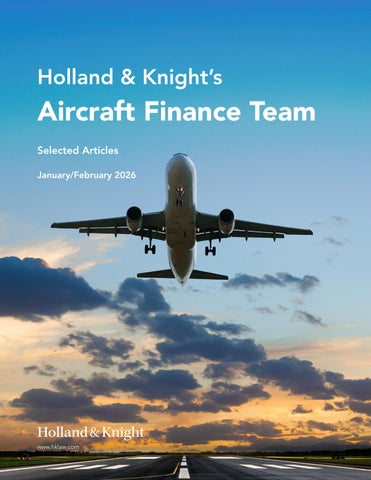
Aircraft Finance Team

Backed by approximately 2,200 lawyers and other professionals in 35 offices throughout the world, Holland & Knight’s Aircraft Finance team provides strategic counsel to our aviation clients at every stage of their business. Our team advises on a wide range of matters, including transactions, litigation, employment, insurance, product liability, repossession and restructuring efforts, such as bankruptcy and workout matters. We guide clients through complex regulatory sanctions, general aviation policy issues and environmental compliance and provide support during investigations involving antitrust, the National Transportation Safety Board and Federal Aviation Administration.

Put Our Experience Work for You

Holland & Knight has a long-standing reputation as a global leader in aviation finance law. This reputation has been earned through years of experience and involvement in cutting-edge and traditional, complex transactions in domestic and cross-border acquisition, financing, securitization, restructuring and leasing of aviation assets. Our clients include the world’s 20 largest aircraft leasing companies, major U.S. and international airlines, investment funds, investment banks, corporate jet owners, government guarantors, high-net-worth individuals and other key players in the wider aviation industry ecosystem. We pride ourselves on our responsiveness in a fast-paced environment where deals typically involve parties in multiple and disparate time zones. With lawyers dedicated to this practice on both the East and West coasts of the U.S., as well as in London and Latin America, we work as a single, connected team, placing client relationships first.

Understand the Aviation Business

Our attorneys are active on legal committees of key industry associations and working groups, and we regularly lead educational seminars on topical issues and thought leadership industry matters.

Supporting the Aviation Industry

Leader in Aviation Finance Law

Our team is involved in a large number of high-profile, cuttingedge transactions that have earned us a leading reputation in the industry.

Global Perspectives

Our diversity provides clients the benefits of a pool of experienced professionals who reflect the industry’s international marketplace and community.

Our industry knowledge has been accumulated over decades of work with leading industry participants, which enables us to support a wide range of clients on complex matters with a comprehensive and genuine “value-added” service that goes beyond legal excellence.

What Others Say About Our Firm

We are consistently recognized as leaders in the legal profession, earning accolades for service, responsiveness and results.

2026 Best Lawyers “Best Law Firms”

Received national first-tier rankings in 42 practices, including in Transportation Law

2026 Chambers UK

Holland & Knight ranked among top aviation law firms; recognitions for Partners Debra Erni, Victoria Koob and Richard Sharman in Asset Finance: Aviation Finance

2026 The Legal 500 United Kingdom

Recognized Holland & Knight among the leading firms for Finance: Transport Finance and Leasing, naming Debra Erni a “Leading Partner” and recommending Michael Holt, Victoria Koob, Richard Sharman and Joe Snell; Holland & Knight was also recognized for the Transport: Aviation category, naming Victoria Koob a “Leading Partner” and recommending Debra Erni and Richard Sharman

2025 Chambers High Net Worth

Holland & Knight recognized in Band 1 of the Global-wide Private Aircraft category, including individual rankings for Giles Cornwall, Juan Carlos Ferrer and John Hoover

2025 The Legal 500 United States

Holland & Knight ranked Tier 1 in Transport: Aviation and Air Travel – Finance, with Phillip Durham and John Pritchard listed as Hall of Fame, Richard Furey and Nathan Leavitt as Leading Lawyers, Cynthia Liu and Danielle Santucci as Rising Stars, and Brian Daigle and Audrey Sung as Recommended

2025 Chambers USA

America’s Leading Lawyers for Business Guide

Holland & Knight recognized nationally for Transportation: Aviation – Finance; John Pritchard named Senior Statesperson; Phillip Durham and Nathan Leavitt recognized Nationwide

2025 Chambers Global

The World’s Leading Lawyers for Business Guide

Holland & Knight named among the world’s leading law firms in the area of Global Asset Finance, including individual rankings for Phillip Durham, Nathan Leavitt and John Pritchard

2022 Law360

Holland & Knight’s Transportation Practice named Practice Group of the Year; Partner Victoria Koob named among Rising Stars in Transportation

“Holland & Knight’s aviation finance team is truly outstanding. They possess an exceptional understanding of the aviation market and financing structures, combined with top-tier legal expertise The team is highly dedicated, efficient and polished, ensuring that every matter is handled with precision and delivered in a smooth and seamless manner.”

– 2025 Legal 500 United States Transport: Aviation and Air Travel Finance

“Holland & Knight’s team stands out for its responsiveness and solution-driven approach.” – 2026 Legal 500 United Kingdom Transport: Aviation

“Holland & Knight are one of our go-to firms, The lawyers are excellent and very responsive, and deliver as you would expect.”

– 2025 Chambers Global Asset Finance

Aviation Finance: 2025 Sanctions Update and 2026 Outlook

Export controls and economic sanctions have remained an active and evolving area of laws and regulations that continue to impact the aviation industry in 2025 – both contributing to and arising as a result of an increasingly uncertain global geopolitical landscape. Since assuming office in January 2025, President Donald Trump has significantly relaxed sanctions on Syria while continuing to target China through U.S. export control regulations, albeit in an oftentimes uneven manner that is also significantly impacted by larger U.S.-China trade negotiations. The European Union has also forged ahead in adopting its 18th package of economic sanctions measures against Russia’s energy, banking and military sectors as it continues to ramp up pressure on Russia to end the war in Ukraine. Many recent developments in the regulatory landscape (as well as companies’ ongoing compliance with existing regulations such as Article 12g of Council Regulation (EU) No 833/2014) continue to necessitate that companies in the aviation industry have adequate compliance programs and due diligence processes in place. The sections that follow highlight key recent developments in 2025 that impact aviation finance and leasing transactions, as well as lessons that can be learned as companies look forward to 2026.

Russia Sanctions and Export Control Restrictions

Following Russia’s invasion of Ukraine in 2022, the U.S. and EU have both implemented sanctions and export controlsrelated measures against Russia and Belarus, which has assisted Russia in its wartime efforts. In particular, the EU imposed no Russia and Belarus contractual prohibition requirements on EU exporters (including sellers and lessors of aircraft, engines and parts) in Article 12g of Council Regulation (EU) No 833/2014 and Article 8g of Council Regulation (EC) No 765/2006, respectively. Aircraft leasing companies, along with maintenance, repair and overhaul firms (MROs) and airlines alike have continued to develop their form sanctions language (or determined what constitutes acceptable language given current flight operations) in response to the EU regulations. Negotiating the specific contractual prohibition clauses remains a key point in aviation finance and leasing transactions.

While the EU has recently adopted its 18th package of economic sanctions measures against Russia, the Trump Administration’s actions against Russia have been more inconsistent. The Trump Administration previously threatened a range of punitive measures for Russia’s ongoing war in Ukraine, from sanctions on Russia’s “shadow fleet” of oil tankers to secondary tariffs of up to 100 percent on countries that still trade with Russia. However, President Trump has most recently backed away from such threats following his summit with Russian President Vladimir Putin in Alaska on Aug. 15, 2025. Thus, any potential for additional U.S. sanctions against Russia is subject to change and must be considered against the backdrop of larger U.S. efforts to secure a peace deal in Ukraine.

Despite such developments, the U.S. has continued to require a license to export, reexport or transfer (in-country) to or within Russia or Belarus any item subject to the U.S. Export Administration Regulations (EAR) and specified on the Commerce Control List. While the License Exception Aircraft, Vessels and Spacecraft (AVS), commonly known as the “temporary sojourn” exception, remains available for flights to Russia that comply with the relevant conditions under 15 C.F.R. § 740.15, U.S. government agencies continue to focus enforcement efforts on the illegal smuggling of U.S.origin aircraft parts to Russia. Specifically, in April 2025, as a result of a joint investigation between the U.S. Department of Commerce’s Bureau of Industry and Security (BIS) and FBI, a Russian national was sentenced to 70 months in prison for his role in a conspiracy to export controlled aircraft parts and components from U.S. suppliers to Russia and launder money in connection with such scheme. In addition, in February 2025, an Israeli freight forwarder was sentenced to two years in prison for illegally exporting aircraft parts and avionics equipment from U.S. manufacturers and suppliers to Russia, including for the benefit of certain sanctioned Russian airline companies. Such smuggling schemes oftentimes involve a sophisticated network of freight forwarders, shell companies and third-country parties that obscure the ultimate destination for such aircraft parts and components. The heightened U.S. enforcement focus on the illegal export of U.S. aircraft parts to Russia will likely continue in 2026 and is yet another reason companies should ensure screening and due diligence processes remain robust and are able to identify red flags in any potential transaction.

China Military End User Restrictions

In recent years, the U.S. has become increasingly focused on controlling exports to China and Hong Kong, especially in high-tech industries such as semiconductors and, more recently, aircraft engines and parts and avionics equipment. Though the export of U.S.-origin aircraft engines, parts and equipment to civilian end users in China is generally not subject to U.S. export licensing requirements, the EAR in 15 C.F.R. § 744.21 prohibits the export, reexport or transfer (in-country) of civil aircraft parts and components if such items are for a “military end-use” or a “military end-user” in China (among other countries). The terms “military end-use” and “military end-user” are defined broadly, and the Military End-User List in the EAR is not exclusive. As a result, if certain Chinese entities or counterparties engage in both civil and military activity (i.e., Chinese MROs who may service both civilian aircraft and military assets) or have ties to the military (i.e., the Commercial Aircraft Corp. of China (COMAC)), there is an increased risk that transactions with such entities could be scrutinized.

In recent months, the Trump Administration has reportedly suspended export licenses to GE Aerospace for the sale of aircraft engines to COMAC but then subsequently permitted GE to restart such shipments following ongoing trade negotiations with China. There have also been further reports of the Bureau of Industry and Security (BIS) notifying U.S. companies that certain of their aircraft parts or avionics equipment destined for China now require a license for export due to the risk of such items being exported for a “military end-use” in China. U.S. measures against the export of U.S.-origin aircraft parts and equipment to China are constantly evolving and remain subject to larger negotiations with China on trade policy. However, the EAR grants BIS broad authority to restrict such exports if the U.S. views there to be a risk that such exports will be destined for a military end use or military end user in China. This is in addition to the U.S. Department of the Treasury’s and U.S. Department of Defense’s inclusion of certain Chinese aviation entities, including COMAC, on other lists that restrict U.S. investment or impose restrictions on such entities participating in U.S. defense contracts. Potential inclusion on these other restricted party lists could also constitute a red flag that such entities may be considered a military end user by BIS. As a result, U.S. companies should continue to closely monitor developments and conduct adequate due diligence on any exports destined for China.

Lifting of Syria Sanctions

On June 30, 2025, President Trump issued Executive Order (EO) 14312, which removed U.S. sanctions on Syria effective July 1, 2025, following the Treasury Department’s Office of Foreign Assets Control’s (OFAC) previous issuance of General License 25, which had authorized transactions otherwise prohibited by the Syrian Sanctions Regulations. Sanctions, however, remain on Bashar al-Assad and his associates, human rights abusers and persons linked to Syria’s past proliferation activities, among other parties. The EO also directed further actions to be taken, including with respect to Syria’s State Sponsor of Terrorism designation that, once finalized, will revoke the vast majority of U.S. trade restrictions imposed on Syria. Thus, at this time, the full impact of the EO on U.S. export controls restrictions on Syria remains unclear and the comprehensive controls on exports to Syria under the EAR appear to remain in place. The EU has similarly lifted most of its economic sanctions against Syria.

As a result of recent developments, there has been an uptick in requests from airlines to aircraft lessors to operate flights to Syria. While U.S. sanctions against Syria have been removed, as noted above, comprehensive U.S. export controls remain on Syria at this time. The temporary sojourn exception under the EAR remains available for flights to Syria; however, the exception is quite restrictive with respect to the export of U.S.-origin spare parts to Syria, which may significantly limit the ability of airlines to recover aircraft on ground (AOG) in Syria. That, coupled with potential issues in obtaining adequate insurance coverage for flights to Syria, may cause aircraft lessors to more closely scrutinize such requests.

Conclusion

Due to the ever-changing geopolitical landscape, companies in the aviation industry should remain vigilant and closely monitor regulatory changes. In addition, companies should ensure their compliance programs remain robust and that employees are conducting sufficient screening and know your customer (KYC) diligence on new counterparties in transactions. Any red flags or sanctions risks should be adequately addressed before proceeding with such transactions. In addition, each company should continue to review and update required or best practice sanctions language in its agreements.

Aviation Outlook

The global aviation industry is undergoing a period of significant transformation, marked by a robust post-pandemic recovery and renewed growth momentum. In 2024, passenger traffic surpassed pre-pandemic levels, with more than 5 billion travelers projected for 2025 – a milestone that underscores the sector’s resilience and adaptability.

Market Recovery and Growth Drivers

The resurgence in global air travel is driven by both structural and cyclical factors. Passenger demand has rebounded strongly, with Revenue Passenger Kilometers (RPK) expected to grow at an average annual rate of 4.2 percent through 2044. The global commercial fleet is forecast to expand from just over 27,000 aircraft in 2024 to nearly 50,000 by 2044, supported by 43,600 new deliveries – approximately three-quarters of which will be single-aisle aircraft.

This growth is underpinned by rising middle-class populations, increased affordability of air travel and expanding global connectivity, particularly in emerging markets. Notably, the share of global traffic within and to/from emerging markets has risen to 60 percent, and these regions are expected to account for more than half of the global fleet by 2044. The industry’s ability to adapt to shifting consumer preferences with evermore diversified service offerings has further fueled recovery and expansion.

Operational and Financial Challenges

However, despite strong demand fundamentals, the aviation sector faces persistent operational and financial headwinds. Supply chain disruptions continue to constrain aircraft production, with both airframe and engine manufacturers struggling to restore pre-pandemic output levels. This has led to delivery delays, increased aircraft utilization and greater reliance on extending the economic life of existing fleets. Labor shortages, particularly among pilots and skilled technical staff, are driving up costs and limiting capacity growth. Geopolitical tensions and regional conflicts introduce additional uncertainty, impacting fuel prices, route planning and overall market stability. The financial environment is further complicated by an uncertain interest rate outlook, dampening activity in aviation debt and securitization markets.

This increasingly complex environment poses a real challenge, be it in respect of fleet renewal strategies or financing models or operational efficiency, all of which in turn demands more agile and innovative approaches from industry participants.

Sustainability and Digital Transformation

Sustainability and digital innovation have become central pillars of the industry’s strategic agenda. Environmental, social and governance (ESG) imperatives are driving investments in sustainable aviation fuel (SAF), emissions-reducing technologies and operational efficiencies. However, scaling SAF production and achieving meaningful emissions reductions require coordinated action across the value chain, including from governments, fuel suppliers and industry stakeholders – yet, recent trends suggest an increasingly divergent approach to ESG matters in different markets, making such coordination incrementally more challenging.

On the other hand, digital transformation is accelerating, with airlines and airports adopting advanced technologies such as “digital twins,” generative artificial intelligence (AI) and predictive analytics to enhance operational efficiency, maintenance and the passenger experience. Cybersecurity has emerged as a critical concern, prompting the adoption of comprehensive frameworks aligned with international standards to safeguard increasingly digitalized operations.

Future Outlook

Strategic opportunities abound in fleet modernization, with nearly 80 percent of today’s fleet expected to be replaced by 2044. This transition offers significant potential for investment in next-generation and fuel-efficient aircraft using innovative financing structures with the participation of both incumbent and new providers of capital. Lessors, particularly those with scale, will be particularly well placed to grow their market share.

Notwithstanding growing headwinds, sustainability is likely to remain a central focus, as regulatory and societal pressures accelerate the adoption of SAF, emissions-reducing technologies and comprehensive ESG frameworks.

Mergers, acquisitions and strategic alliances will continue to reshape competitive dynamics. Regional carriers are increasingly partnering with global airlines to expand network reach and optimize resource utilization, and consolidation will continue to be a key feature of the aviation landscape.

Conclusion

The global aviation industry continues to demonstrate remarkable resilience, and it is well equipped to overcome emerging challenges and seize new opportunities – but its trajectory will be shaped by its ability to adapt to a complex and rapidly evolving environment and embrace potentially profound and transformational change. Strategic foresight and coordinated action will be essential to ensuring long-term success and shaping a more sustainable, connected future for global air travel.

2025 Aviation Bankruptcy Update

In keeping with the past five years, 2025 has continued to be an active time for airline restructurings and liquidations. The two largest U.S. aviation Chapter 11 proceedings that commenced during 2024, Spirit Airlines and GOL, both concluded during the first half of 2025 by successfully confirming a Chapter 11 plan of reorganization. While GOL has thrived since exiting Chapter 11, Spirit Airlines filed a second Chapter 11 case (commonly referred to as a “Chapter 22”) only a few months later. Regional airline Silver Airways LLC and its affiliate, Seaborne Airlines, commenced proceedings under Chapter 11 but saw those cases converted to liquidations under Chapter 7 only a few months later when they were unable to effectuate going concern transactions or obtain sufficient financing to support their operations in bankruptcy. Brazilian airline Azul began 2025 by closing the latest of its out-of-court restructurings. However, by the end of May, only a few short weeks later, it filed proceedings under Chapter 11, as its out-of-court restructuring transactions proved insufficient to resolve its ongoing liquidity, operational and capital structure woes.

GOL’s journey through Chapter 11 took a traditional path, pursuing a comprehensive restructuring of its outstanding operational and financial indebtedness. At the time when GOL filed for bankruptcy, it had not begun formal negotiations with all creditor constituencies regarding their treatment under a proposed Chapter 11 plan. As such, GOL spent 20 months in Chapter 11 securing new financing, negotiating with aircraft lessors, developing a fleet plan for bankruptcy emergence and reaching settlements with bondholders and other key creditor constituencies. Those negotiations culminated in a Chapter 11 plan that all impaired creditors (i.e., creditors that would not be paid in full) had a chance to review and vote upon. All creditor classes eventually voted to accept the GOL plan.

Spirit Airlines filed its initial Chapter 11 cases in late November 2024 and proceeded to speed through the plan confirmation process. Unlike GOL, Spirit chose to forgo any sort of operational restructuring in favor of a limited balance sheet reorganization effectuated by swapping a chunk of its existing senior secured bond debt for the equity of the reorganized company. Spirit obtained confirmation of a plan for its 2024 case in late February 2025 and emerged from bankruptcy in March 2025, 87 days after filing.

Spirit’s quick trip through its first Chapter 11 case was possible because it had negotiated a comprehensive restructuring framework (including proposed plan treatment) with substantially all impacted noteholders before that case began. Under the Spirit plan, debts other than those of the impacted noteholders (including aircraft lease debts) were left “unimpaired” (meaning that such debts would continue to be fully repaid, notwithstanding the bankruptcy filing). Given that Spirit’s proceeding only restructured its balance sheet, operational issues were not addressed. By summer 2025, it became clear that Spirit required more than just a balance sheet reset. In mid-August, Spirit announced a going concern warning in the quarterly report issued for its first-quarter post-bankruptcy and within two weeks had filed a second Chapter 11 case. Based on the statements made at Spirit’s first-day hearings, it is clear that Spirit intends a comprehensive restructuring of its operations during its second trip through Chapter 11.

Silver Airways and Seaborne Airlines filed their Chapter 11 cases at the very end of 2024. For several months they sought financing and tried to sell their operations as a going concern. A lack of progress in obtaining financing or a viable buyer, as well as a lack of confidence in the debtors’ management, led some of Silver/Seaborne aircraft lessors to take back their aircraft back at the end of the 60-day Section 1110 period, while the airline was still operating. The retrieval process was impeded by the airline’s refusal to cooperate and required court intervention but ultimately was successful. Although the airlines did ultimately obtain debtor-in-possession (DIP) financing, it proved insufficient to support their operations, especially after the debtors’ projected revenues were significantly impacted by a maintenance issue that caused operations to shut down over the 2025 Memorial Day weekend. Silver’s assets ultimately were sold, but the airline ceased operations before closing, leaving behind millions of dollars in unpaid administrative expenses and employee wages. A Chapter 11 trustee was appointed to oversee the sale of Seaborne, after which the cases were both converted to Chapter 7 liquidation proceedings.

Like many other airlines that were shut down during the COVID-19 pandemic, Azul entered 2025 with significant financial debt and deferred lease obligations. During the years since the end of the pandemic, Azul had implemented a series of out-of-court restructurings of its debt in an attempt to forestall bankruptcy (even while many other Latin American airlines were restructuring in U.S. Chapter 11 proceedings). Beginning in the fourth quarter of 2024 and continuing through April 2025, Azul negotiated and closed the latest such transactions. Despite this, in May 2025, a few weeks after the last of these out-of-court transactions closed, Azul commenced its own Chapter 11 cases.

Like Spirit, Azul commenced its restructuring with prenegotiated restructuring support agreements entered into with certain of its senior secured lenders and certain other key constituencies and plans to exit Chapter 11 within a few months. Unlike Spirit, Azul is using Chapter 11 to effect operational and other changes, including rejecting and renegotiating aircraft equipment leases, implementing a new fleet plan and seeking to discharge its prepetition unsecured debt.

Conclusion

After such an active restructuring year, it’s hard to speculate exactly what form (or forms) the next wave of airline restructurings will take in 2026. Successful consummation of the Azul proceedings according to its targeted timeline could mean that the next wave of restructurings will proceed according to shorter timetables (with more terms negotiated in advance of the formal court proceedings). However, Spirit’s quick return to Chapter 11 may signal a pivot back toward longer, more “traditional” comprehensive restructurings, similar to GOL and past airline Chapter 11 cases. Either way, Holland & Knight looks forward to working with the lessor community to help write the 2026 chapter of airline restructuring history.

Primary Contacts

William Coleman

Partner | Miami

+1.305.789.7427

william.coleman@hklaw.com

Brian Daigle

Partner | San Francisco

+1.415.743.6953

brian.daigle@hklaw.com

Debra Erni

Partner | London

+44.20.7071.9938

debra.erni@hklaw.com

Michael Holt

Senior Counsel | London

+44.20.7071.9918 michael.holt@hklaw.com

Zhandos Kuderin

Senior Counsel | New York +1.212.513.3241 zhandos.kuderin@hklaw.com

Nathan Leavitt

Partner | San Francisco

+1.415.743.6944 nathan.leavitt@hklaw.com

Barbra Parlin

Partner | New York

+1.212.513.3210

barbra.parlin@hklaw.com

Richard Crowley Consulting Counsel | New York

+1.212.513.3244 richard.crowley@hklaw.com

Phillip Durham Partner | Chicago and New York +1.312.715.5736

+1.212.513.3381 phillip.durham@hklaw.com

Richard Furey Partner | New York

+1.212.513.3439 richard.furey@hklaw.com

Victoria Koob Partner | London +44.20.7071.9912 victoria.koob@hklaw.com

Cynthia Liu

Senior Counsel | Dallas +1.212.969.1311 cynthia.liu@hklaw.com

Douglas Lionberger Partner | Houston and New York

+1 713.206.3297 +1.212.513.3891 doug.lionberger@hklaw.com

John Pritchard Of Counsel | New York +1.212.513.3233

john.pritchard@hklaw.com

Brian Smith Partner | Dallas +1.214.964.9464

brian.smith@hklaw.com

Joe Snell

Senior Counsel | London

+44.20.7071.9936

joe.snell@hklaw.com

Richard Sharman Partner | London +44.20.7071.9913

richard.sharman@hklaw.com

Jovi Tenev Partner | New York +1.212.513.3218

jovi.tenev@hklaw.com

Turn static files into dynamic content formats.
Create a flipbook
Issuu converts static files into: digital portfolios, online yearbooks, online catalogs, digital photo albums and more. Sign up and create your flipbook.