
Selected Articles
January/February 2026


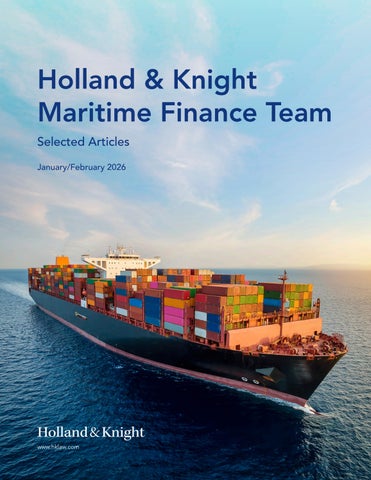
January/February 2026
Backed by approximately 2,200 lawyers and other professionals in 35 offices throughout the world, Holland & Knight’s Maritime Finance Team concentrates its practice on business-critical maritime, offshore and cruise industry transactions. Our team is dedicated to delivering unsurpassed representation to our clients.
Maritime transactions are becoming increasingly varied and complex, but our maritime finance attorneys have an in-depth understanding of the industry. Our deep bench of legal professionals has extensive ship finance, tax, corporate, litigation, regulatory and bankruptcy experience.
Complementing this industry knowledge, our team also includes corporate lawyers who regularly execute all types of maritime industry business transactions, including public and private company mergers and acquisitions, public and private equity and debt offerings, proxy contests, joint ventures and formation of private investment vehicles.
Our lawyers are strategically located on all U.S. coasts – East, Gulf and West – as well as in Mexico City, Monterrey and Bogotá.
We have been involved in numerous high-profile global transactions that have earned us a leading reputation in the industry.
Our lawyers have extensive experience in a wide scope of
Our commitment to the maritime industry is demonstrated by our participation on the boards of maritime organizations, industry groups and bar associations and in seminars and conferences.
Our industry knowledge has been accumulated over decades of work with leading industry participants, which enables us to support a wide range of clients on complex matters with a comprehensive and genuine “value-added” service that goes beyond legal excellence.
We are consistently recognized as leaders in the legal profession, earning accolades for service, responsiveness and results.


2026 Best Lawyers “Best Law Firms” Guide
Earned national first-tier rankings in 42 practices, including Admiralty and Maritime Law
2026 The Best Lawyers in America Guide
Nearly 900 attorneys listed, including 11 lawyers ranked in the area of Admiralty and Maritime Law

2025 The Legal 500 United States Guide
Recommended in the practice areas of Transport: Shipping – Finance, Transport: Shipping –Litigation and Regulation; Holland & Knight attorneys ranked nationally include Michael Timpone, Jovi Tenev and Sophia Agathis; attorneys Richard Furey, Cynthia Liu, Gerald Morrissey III and Kurt Plankl are also recommended


2025 Chambers USA Guide
America’s Leading Lawyers for Business 291 attorneys ranked among leaders in their industries, including seven maritime attorneys; Holland & Knight attorneys Sophia Agathis, Jovi Tenev and Michael Timpone are ranked nationally in Shipping Finance [USA Nationwide]
2025 Chambers Global Guide
The World’s Leading Lawyers for Business Firm recognized in several categories, including Shipping: Finance and Shipping: Litigation; 36 lawyers recognized among the best in the world, including two in shipping; Holland & Knight attorneys Jovi Tenev and Michael Timpone are ranked nationally in Shipping Finance [Globalwide]
2023 Who’s Who Legal: Transport Guide
21 attorneys listed among the world’s best transport lawyers, including two in shipping

2022 Law360
Holland & Knight’s Transportation practice named “Practice Group of the Year”
“Simply the best transportation practice in the U.S.”
– Transport: Shipping – Finance respondent USA,
2025 The Legal 500 USA
“Holland & Knight has a seasoned leadership and a broad knowledge base.”
– Shipping Finance respondent Global, 2025 Chambers Global
By Manny Levitt and Cynthia Liu
The maritime shipping sector has become a key target of sanctions policymakers and enforcement agencies in the U.S., European Union and United Kingdom as government authorities in these jurisdictions seek to advance national security objectives in part through countering deceptive and illicit maritime shipping practices. The strategic targeting of the maritime shipping sector for sanctions has continued to intensify in 2025, raising compliance risks for an increasingly broad range of maritime industry stakeholders. Given the costs that can arise from these issues through penalties and litigation, companies in this sector should 1) familiarize themselves with sanctions evasion “red flags” highlighted in guidance issued by enforcement authorities, 2) assess the risks most relevant to their cross-border activities, markets, clientele, investments and operations, and 3) devote appropriate resources to implementing risk-based compliance measures.
Statutes authorizing sanctions to be imposed on actors involved in undertaking certain shipping and other maritimerelated dealings with Russia, Iran, designated terrorist organizations and North Korea have existed for more than a decade1. Nonetheless, the targeting of vessels and other maritime-related companies allegedly associated with sanctions evasion “networks” ramped up significantly during the Biden Administration, following the G7’s imposition of a “price cap” on Russian-origin oil in 2022. In addition, the U.S., EU and U.K. have continuously announced sanctions designations to counter efforts by vessels and related entities (referred to as the “Shadow Fleet” or “Dark Fleet”) to evade U.S. sanctions and avoid compliance with the price cap or other sanctions prohibitions.
In 2025, the sanctioning of maritime entities and Shadow Fleet vessels has continued to intensify in the U.S., EU and U.K., although the focus of U.S. sanctions authorities has moved much more aggressively toward parties allegedly controlled by or working for or on behalf of sanctioned Iranian entities and other designated terrorist organizations (including Hezbollah and the Houthis). This shift in U.S. sanctions priorities aligns with the “max pressure” campaign on Iran and its proxies in the region announced in President Donald Trump’s National Security Presidential Memorandum 2 (NSPM-2), which called for, among other things, a “robust and continual” campaign to “drive Iran’s export of oil to zero, including exports of Iranian crude to the People’s Republic of China.”2 Likewise, increased sanctions actions targeting vessels and shipping companies associated with the Houthis have followed the Trump Administration’s redesignating the group as a Foreign Terrorist Organization (FTO) on March 4, 2025.3 The maritime industry has also been impacted by the Trump Administration’s designation of cartels operating in the Western Hemisphere as FTOs as well.
Maritime Sanctions Targets: By the Numbers
Recent statistics underscore how the maritime shipping industry has, along with the oil and gas energy sector, become a front line of sanctions policy for the U.S., EU and U.K. Well over 300 vessels, mostly tankers, have been individually added to the U.S. Department of the Treasury Office of Foreign Assets Control’s (OFAC) Specially Designated Nationals and Blocked Persons (SDN) List4 in 2025 so far, which does not include vessels now subject to blocking sanctions as a result of their being 50 percent or more owned by SDNs5 or vessels sanctioned by U.K. or EU authorities, each of whom has designated hundreds of Shadow Fleet vessels and associated entities involved in transporting Russian oil and gas. As a result, since 2024, the total number of OFAC-sanctioned vessels registered with the International Maritime Organization increased by more than 46 percent to over 1,800 (including both individually designated vessels and vessels with sanctioned owners/operators). According to industry reports, well over 1,400 vessels are now individually identified on sanctions lists maintained by the UN Security Council, OFAC, European Commission, U.K. HM Treasury and Switzerland’s State Secretariat for Economic Affairs (SECO), representing increases of more than 30 percent since 2024 and 130 percent since February 2022.6
OFAC has announced approximately over a dozen rounds of sanctions designations targeting vessels, entities and individuals engaging in illicit shipping practices or enabling or facilitating sanctions evasion in 2025. The vast majority of these entities are allegedly involved in the trade and transport of oil and gas from Iran or other embargoed jurisdictions or FTOs, although more recent sanctions designations have targeted bulk cargo shipping lines associated with Iran as well.7
Based on OFAC press releases announcing these designations, the scope of maritime shipping stakeholders affected or targeted by sanctions is broad. In addition to vessels, sanctions targets have included:
• shipping and logistics companies
• technical and commercial managers for vessels and other vessel service providers
• vessel brokers
• oil and gas traders
• financial institutions (including hedge funds)
• vessel insurers
• port operators and port service providers
• corporate directors and administrators
• corporate formation companies
• so-called “teapot” refineries (primarily in China)
Geographically, many of the designations targeted parties located in the United Arab Emirates (UAE), Hong Kong, Oman, Singapore, Malaysia, China and the Marshall Islands, as well as the EU and U.K. (jurisdictions not historically targeted by U.S. sanctions authorities).
OFAC and the Treasury Department’s Financial Crimes Enforcement Network (FinCEN) have issued updated guidance on “red flags” for maritime sanctions evasion and noted the regulators’ recommendations regarding the due diligence necessary to spot and address red flags.8 Red flags signifying potential sanctions evasion include:
• use of vessels that are uninsured or use of sanctioned, new or untested insurance providers for no apparent business reason
• use of vessels that have undergone frequent name changes or reflagging in different third-country jurisdictions or by registries not authorized to provide flagging services for a particular jurisdiction
• involvement of “exchange houses” registered in Hong Kong or the UAE or “trading companies” located in close proximity to Iran
• falsified cargo, vessel or transaction documents
• disabled or manipulated Automatic Identification System (AIS) data
• ship-to-ship (STS) transfers or irregular voyages
• blending or relabeling oil as originating in other jurisdictions
Compliance challenges are increasing for the maritime sector as it faces increased scrutiny from sanctions authorities in multiple jurisdictions and increased types of business, legal and reputational risks under sanctions regulations and other counter-terrorism laws implicated by any dealings with FTOs. This is happening as sanctions evaders continue to employ strategies to avoid detection or obfuscate the involvement of SDNs, presence of sanctioned cargo or a party’s connections to embargoed jurisdictions.9 This increased sanctions risk can create downstream complications for maritime industry stakeholders, including disputes over contractual clauses in charter parties, insurance coverage, and how to dispose or address allegedly “blocked” cargo or vessels (particularly when the cargo or vessel becomes blocked midvoyage). Companies are expected to engage in more thorough “Know Your Customer” or “Know Your Cargo” processes to ensure, for example, that vessel buyers are not straw purchasers or that charterers are not obfuscating their or their cargo’s ties to sanctioned entities. For certain parties, reviewing vessel history, including automatic identification system (AIS) data, ownership and flag registration, is becoming a baseline compliance expectation.
This trend has meant greater resources being spent on complying and detecting risks associated with a growing body of sanctions prohibitions, which continue to evolve. In this environment, increasing institutional awareness of the risks and red flags, incorporating compliance obligations in contracts and implementing procedures to address relevant risks are essential steps to mitigate potentially costly and disruptive sanctions issues that may arise.
1 See, e.g., Section 1244 of the 2012 National Defense Authorization Act, which prohibits transactions with Iran’s shipping industry and mandates sanctions on financial institutions supporting Iranian maritime trade. See also the Iran Freedom and Counter-Proliferation Act (IFCA) of 2012, which targets Iran’s ports, shipping and shipbuilding sectors by requiring secondary sanctions against foreign parties facilitating transactions for Iranian maritime entities. See also the Countering America’s Adversaries Through Sanctions Act (CAATSA) of 2017, Pub. L. 115-44 (Aug. 2017); See, e.g., Executive Order 13846, “Reimposing Certain Sanctions with Respect to Iran,” 83 Fed Reg. 38,939 (Aug. 6, 2018).
2 White House: National Security Presidential Memorandum/NSPM-2 (Feb. 4, 2025). NSPM-2 also called on the U.S. Department of Justice to “pursue all available legal steps to impound illicit Iranian oil cargoes” and disrupt efforts by the Iranian government to evade U.S. sanctions and export controls.
3 U.S. Department of State Secretary Marco Rubio press statement: Designation of Ansarallah as a Foreign Terrorist Organization (March 4, 2025).
4 The SDN List, which is maintained by OFAC, identifies individuals, entities and vessels that are subject to blocking sanctions due to their connection to targeted countries, terrorism or narcotics trafficking. U.S. persons are, with very limited exception, prohibited from engaging in nearly any dealings with SDNs as well as their property.
5 OFAC: Revised Guidance on Entities Owned by Persons Whose Property and Interests in Property Are Blocked (Aug. 13, 2014).
6 S&P Global: Maritime shadow fleet – Formation, operation and continuing risk for sanctions compliance teams in 2025; European Commission press release: EU adopts 18th package of sanctions against Russia (July 17, 2025).
7 OFAC: Treasury Takes Massive Action Against High-Profile Iranian Network (July 30, 2025).
8 OFAC: Guidance for Shipping and Maritime Stakeholders on Detecting and Mitigating Iranian Oil Sanctions Evasion (April 16, 2025); FinCEN: FinCEN Advisory on the Iranian Regime’s Illicit Oil Smuggling Activities, Shadow Banking Networks, and Weapons Procurement Efforts (June 6, 2025).
9 Sanctions violations are strict liability offenses where even non-U.S. parties can be liable for “causing” a U.S. person (e.g., a financial institution) to violate U.S. sanctions.
By Sophia Agathis and Nicholas Kaasik
The ship finance industry continues to evolve in a manner previewed in years past by regulatory action and evolving lender profiles. This Holland & Knight article explores recent trends in traditional bank lending and the rise of direct and private credit lenders. Key topics include the impact of Basel IV in Europe, proliferation of revolving credit facilities, burgeoning role of direct lenders, impact of the Nordic bond market and effects of the suspended U.S. Trade Representative (USTR) port fees on lease finance strategies.
One of the seemingly evergreen narratives in ship finance is the still-unclear impact of Basel IV on lending by European banks. Basel IV, the latest iteration of global banking standards, was implemented in the European Union at the beginning of 2025. It aims to strengthen regulation, supervision and risk management. However, the full extent of the impact of Basel IV on ship finance remains unclear and has led to a cautious stance among many European banks.
European banks are historically, and continue to be, major financiers for shipowners. Basel IV has a significant impact particularly on European banks and has led to a more selective approach to new ship finance deals. Going forward, European banks are likely to prioritize top-tier shipowners with better credit ratings. For smaller owners or those with less-predictable earnings, access to traditional bank finance remains challenging. This uncertain environment is prompting both lenders and borrowers to explore alternative structures and partners.
Another conspicuous trend is the increasing use of revolving credit facilities (RCFs) by shipowners. Traditionally associated with corporate borrowers, RCFs have become commonplace among shipping companies, particularly those with strong earnings and credit profiles. The flexibility of an RCF allows shipowners to draw, repay and redraw funds as business needs evolve, positioning them to capitalize on market opportunities or weather unexpected downturns.
In the past few years, several high-profile shipowners have secured substantial RCFs, often with tenors of five to seven years. These facilities are typically provided by syndicates of international banks, demonstrating that where risk is deemed acceptable, traditional lenders remain competitive. The preference for RCFs reflects both the stronger financial position of many shipowners and a broader industry focus on the future – shipowners recognize the cyclical nature of shipping and want to ensure liquidity for fleet renewal, expansion or opportunistic acquisitions. RCFs have also emerged as a key tool for established public and private companies simplifying their capital structure through a global Norwegian or U.S. bond financing. In these instances, the RCF typically is positioned as senior or pari passu with such bonds rather than the sole source of debt financing.
It is no secret that when traditional bank lending becomes more selective, direct lenders – private credit funds, other “alternative credit providers” and institutional investors – have stepped in to fill the void. Initially, these alternative financiers focused on high-margin, higher-risk credits: smaller shipowners, distressed deals or less-conventional asset types. Over the past year, however, there has been a marked expansion in the role of direct lenders.
Direct lenders have established a key role in competing head to head with traditional ship finance banks, offering competitive terms and structuring bespoke solutions to more-established shipowners willing to pay a higher coupon for execution certainty and flexibility. The growth in direct lending is driven by a slightly higher-rate environment, narrowing the gap between bank interest rates and fees and a nonbank lender’s interest rate of return, ample liquidity in the private markets, investors’ search for yield and the flexibility these nonbank lenders can offer. Unlike traditional banks, direct lenders are not constrained by the banking regulations affecting traditional ship finance banks, allowing direct lenders to move quickly and tailor structures to complex needs. Direct lenders market their ability to close quickly and provide certainty of execution. This evolution has increased competition in ship finance and provided shipowners new options beyond the traditional bank-led paradigm.
The most notable headline in ship finance in the last year has been the introduction, and now suspension, of port fees by the USTR targeting Chinese maritime interests. The introduction of these fees in early 2025 sparked a surge of interest in structuring voyage planning, ownership, management and financing arrangements to minimize the impact. While certain shipowners calling at U.S. ports in October 2025 faced significant costs and expended significant time and effort prior to October 2025 to understand and restructure their fleets to avoid such costs, the future of these port fees remains to be determined.
Of particular note in 2025 was the increased concern regarding refinancing Chinese sale-leaseback financing structures for vessels that call in the U.S. Over the past decade, sale-leaseback transactions with Chinese lessors with higher advance rates and lower capital costs became a popular way for shipowners to finance their vessels. The USTR port fees appeared to be specifically unfavorable to Chinese sale-leaseback financing structures, given the registered owner in a Chinese saleleaseback is typically ultimately owned by a Chinese entity, which would trigger a payment obligation for the vessel upon arrival at a U.S. port.
This potential adverse impact on companies with Chinese sale-leaseback financing structures has caused some shipowners to consider the traditional debt facilities provided by banks or direct lenders and avoid Chinese saleleasebacks in order to avoid additional expenses when calling on U.S. ports.
One of the most active sources of capital for shipping companies over the past year has been the Nordic bond market, with several high-profile shipowners raising capital for a variety of asset types – most notably, cruise vessels and tankers. The continued ability for shipowners to access the Nordic bond market, with its relatively light and flexible issuer covenants, has influenced the broader borrowing landscape. Shipowners, observing the advantages offered by these flexible bond terms, are increasingly attempting to negotiate similar bond terms with their banks and direct lenders. As a result, lenders are facing pressure to adapt and incorporate these bond-like terms to remain competitive and attractive to shipowners.
The past year has seen considerable evolution in the ship finance market. European bank lending faces uncertainty with the introduction of Basel IV, prompting a more selective approach to borrowers with better credit ratings. Revolving credit facilities are in vogue among well-capitalized shipowners seeking flexibility. Direct lenders are not only growing in numbers but also in ambition and are now courting established industry names. Meanwhile, the introduction of the nowsuspended USTR port fees brought a wave of interest in moving away from Chinese sale-leaseback financing structures. As 2026 unfolds, adaptability and a nuanced understanding of both traditional and alternative finance options will be essential for shipowners, investors and lenders navigating this shifting landscape.
By Sophia Agathis and Nicholas Kaasik
Private equity has over the past 15 years played a key role in the U.S. maritime industry, and today’s regulatory landscape in the U.S. makes the U.S. maritime industry ripe with further opportunity for private equity funds. With new legislative efforts and a government focus on supporting U.S. shipbuilding and the U.S. flag fleet, private equity funds – both U.S. and foreign – are looking for ways to capitalize on the resulting opportunities. Two areas stand out: the excitement generated by the Shipbuilding and Harbor Infrastructure for Prosperity and Security for America Act of 2025 (SHIPS Act) and the growing interest of foreign private equity firms in the U.S. Jones Act market.
The Trump Administration and Congress both have expressed interest in strengthening U.S. shipbuilding capacity and modernizing U.S. maritime infrastructure. On April 9, 2025, the Trump Administration issued an executive order focused on revitalizing the U.S. maritime industry. Meanwhile, there has been bipartisan support in Congress for the SHIPS Act. If passed, the legislation would make significant investments in the U.S. maritime industry and expand requirements for the use of U.S. flag vessels in certain trades.
These developments present new investment opportunities for established private equity players active in the U.S. maritime industry as well as those new to the industry, and we have seen a wave of interest in the potential impact of the SHIPS Act. Among other things, investors – including private equity funds – are examining ways to invest in shipyard modernization and other U.S. maritime infrastructure, with the prospect of federal incentives and increased demand for U.S.-built vessels making potential investments more attractive. The SHIPS Act, if passed, would provide substantial federal funding for shipbuilding projects and likely lead to a surge in demand for modernized shipyards and new vessels.
Alongside growing attention from U.S. funds, foreign private equity funds are also showing increased interest in investing in vessels and companies operating in the Jones Act trade. With its smaller size, aging assets and restrictive ownership requirements, the Jones Act market has historically seen limited interest from international investors, but this is changing.
Notably, however, the path to investment for foreign funds is not straightforward. The Jones Act imposes strict U.S. citizen ownership and control requirements on vessels that operate in the U.S. coastwise trade. For foreign private equity funds seeking to make investments in, or form joint ventures with, companies operating in the U.S. coastwise trade, ensuring compliance requires significant care and attention to how these investments are structured.
Foreign funds must undertake rigorous compliance assessments and partner with eligible U.S. operators to participate. Investments by foreign funds in the Jones Act are often structured as joint ventures with U.S. operators that preserve U.S. citizen ownership and control. These structures must be carefully designed and monitored to avoid exceeding the permitted foreign ownership thresholds and ensure that company management and control meet statutory requirements. Noncompliance can have severe consequences, including substantial fines and the potential loss of a vessel’s eligibility for coastwise trade.
In addition to strict regulatory requirements, foreign private equity funds investing in the Jones Act market must also navigate different commercial expectations regarding the debt financing of Jones Act assets. While both U.S. and foreign sponsor-backed companies are often accustomed to debt financing arrangements that preserve maximum company flexibility, such terms are often significantly more borrower-friendly than those available from lenders financing Jones Act assets.
Despite these challenges, interest by foreign private equity funds in Jones Act investments continues to grow. With the increasing possibility of significant government support for the expansion and modernization of the U.S. maritime industry, anticipate this interest to grow further and expect both U.S. and foreign private equity funds to play a defining role in the future of the U.S. maritime industry.
Holland & Knight’s experienced attorneys are here to help clients take advantage of these new opportunities. In the past year, we have significantly expanded our market-leading Maritime Finance Team to better assist U.S. and foreign private equity clients in navigating the complexities of the Jones Act market. We provide comprehensive guidance on compliance assessments, partnership formations and Jones Act-compliant joint venture structures, helping our clients achieve their investment goals while mitigating risks. For further information or updates on market trends, please contact any member of our team.





Sophia Agathis Partner | New York +1.212.513.3466 sophia.agathis@hklaw.com

Douglas Lionberger Partner | Houston and New York +1.713.244.8221 +1.212.513.3891 doug.lionberger@hklaw.com
Kurt Plankl Partner | New York +1.212.513.3421 kurt.plankl@hklaw.com
Richard Furey Partner | New York +1.212.513.3439 richard.furey@hklaw.com


Mike Timpone Partner, Head of Transportation Finance Team | New York +1.212.513.3476 mike.timpone@hklaw.com
Nicholas Kaasik Senior Counsel | New York +1.212.513.3388 nicholas.kaasik@hklaw.com


Cynthia Liu Senior Counsel | Dallas +1.214.969.1311 cynthia.liu@hklaw.com

Gerald Morrissey Partner | Washington, D.C. +1.202.469.5497 gerald.morrissey@hklaw.com
Jovi Tenev Partner | New York +1.212.513.3218 jovi.tenev@hklaw.com
Michael Holt Senior Counsel | London +44.20.7071.9918 michael.holt@hklaw.com
Zhandos Kuderin Senior Counsel | New York +1.212.513.3241 zhandos.kuderin@hklaw.com
Joe Snell Senior Counsel | London +44.20.7071.9936 joe.snell@hklaw.com