ESG Report 2022-2024

Page 1


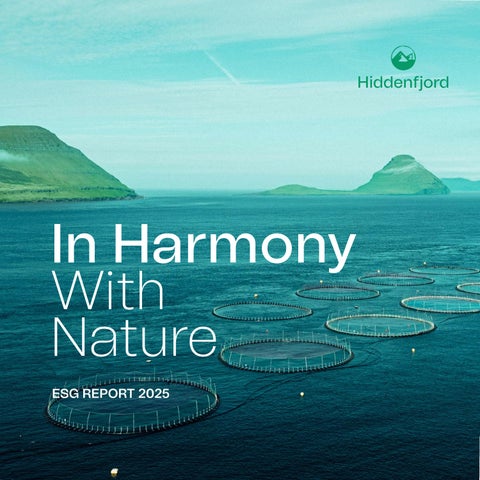
In Harmony With Nature

ESG REPORT 2022–2024

At Hiddenfjord, we believe we have a responsibility to do what we can to reduce our carbon footprint

Contents

Why Report on Sustainability?

Hiddenfjord is a Faroese, family-owned business that farms salmon in harmony with nature.

Since we began salmon farming in the early 1980s, sustainability has always been our highest priority. Growth comes second. We must ensure sustainable, long-term farming in the fjords where we operate and play our part in securing sustainable aquaculture across the Faroe Islands.

It is also our responsibility to set high standards for animal welfare and to do everything within our capability to ensure that our operations do not cause unnecessary pollution or emissions – neither here in the Faroe Islands nor abroad.

The purpose of this sustainability report is to describe how Hiddenfjord works with environment, social responsibility, and governance (ESG), ensuring that both our farming and our overall operations remain sustainable and in harmony with nature. This is Hiddenfjord’s second sustainability report, and it is based on the VSME (B) standard.

With this report, we want to show what we at Hiddenfjord are currently doing – and plan to do – to reduce our environmental impact. We aim to present this in a way that is clear, honest, and holds us accountable. We also want to highlight what we believe authorities can do to ensure the most sustainable aquaculture industry possible in the Faroe Islands. Future generations should have equally good, or better, conditions to live in and alongside nature than we have today.

Integrity and openness are cornerstones for us. We believe that environmental progress depends on transparency, and that the industry must acknowledge its challenges in order to solve them. Therefore, we consider it our responsibility to disclose the environmental impact of our operations.

Atli Gregersen, CEO

About Hiddenfjord

NACE industry classification: A3.2.1 Marine Aquaculture, A3.2.2 Freshwater aquaculture

Addresses and coordinates:

Address

Administration Við Ánna, 512 Norðragøta, Føroyar

Freshwater facility Á Fútakletti, 360 Sandavágur, Føroyar

Processing facility Bryggjan 11, 380 Sørvágur, Føroyar

Land-based facility Sørvágur Bakkavegur 11, 380 Sørvágur, Føroyar

Land-based facility Miðvágur Innara Bryggja 10, 370 Miðvágur, Føroyar

Land-based facility Suðuri í Bug Oyrargjógv, 360 Sandavágur, Føroyar

Land-based facility Velbastaður Gamlarætt 2, 176 Velbastaður, Føroyar

Land-based facility Vestmanna Nesvegur 11, 358 Válur, Føroyar

Sales in Denmark Nordsøen Forskerpark

Willemoesvej 2

9850 Hirtshals

Sales in USA

About Hiddenfjord

68 Commercial Street

Building C – Floor 2

Portland, ME 04101

P/F Luna Á Fútakletti

360 Sandavágur Faroe Islands

Coordinates

62° 11’59’’ N

06° 44’31’’ W

62° 05’55’’ N

07° 08’14’’ W

62° 04.6968’ N

07° 21.6175’ W

62° 04.6968’ N

07° 21.6175’ W

62° 02.8625’ N

07° 09.4598’ W

62° 06.0913’ N

07° 07.5784’ W

61° 58.3724’ N

06° 50.1876’ W

62° 08.167131’ N

07° 07.5784’ W

57° 35.188̒ N

09° 58.798̒ E

43° 39.414̒ N

70° 14.994̒ W

Freshwater facility

Sea farming

Processing facility

Administration

About Hiddenfjord

The Hiddenfjord Story

Hiddenfjord is a 100% Faroese-owned salmon farming company. Brothers Atli and Regin Gregersen own and operate the business, which farms Atlantic salmon. The board consists of Regin Gregersen, Atli Gregersen, Jón Atlason, and Barbara Annikudóttir Gregersen.

Hiddenfjord was founded in 1929 under the name p/f Fiskavirkið in Syðrugøta and originally produced salted, dried cod. The company was run by Jóan Pauli Gregersen – the grandfather of the current owners on their father’s side – together with local villagers. Their goal was to create jobs and secure a livelihood for the community.

Hiddenfjord also traces part of its history back to the operations of S. P. Petersen in Fuglafjørður, founded in 1887 by the great-grandfather of the current owners on their mother’s side. S. P. Petersen was an innovative company focused on producing high-quality products while maintaining strong commercial performance.

These two ideals shape Hiddenfjord today. While we aim to run a progressive and competitive business, we are equally committed to contributing to the development of the Faroe Islands by strengthening the country’s aquaculture sector. As a family-owned

company, we have freedom to have an idealistic focus on sustainability and to act according to our values and long-term vision.

Hiddenfjord began farming salmon in 1982. Today, we operate large-scale aquaculture activities across the Faroe Islands. Smolt are raised at our freshwater facility at Fútaklettur, and salmon are stocked in Sørvágsfjørður, Miðvágur, Vestmanna, Hestfjørður, and Suðuri í Bug in Vestmannasund. All fish are harvested and quality-graded at our processing facility in Sørvágur.

A pioneering company

Hiddenfjord is a highly innovative company that has led the way with many groundbreaking initiatives over the years. We maintain short lines of communication between staff and management. Responsibility is distributed broadly, and employees are consulted when decisions are made. As a result, ideas are quickly recognized, and the path from concept to action is short.

All of our employees contribute in different ways to developing our operations. Encouraging responsibility, creativity, and initiative throughout the company is essential, because our employees play a vital role in our progress and success.

Our Philosophy

Values

• Sustainability

Our operations must be in harmony with nature and have as little environmental impact as possible.

• Integrity and Openness

We strive to be honest and reliable, and our operations are open and transparent.

• Innovation

We value research and have the courage to pioneer new solutions that improve our operations.

• Financial Prudence

Aquaculture involves significant risk. We work to maintain financial strength to support investments and withstand challenges.

Goals

• To realise the full potential of the Faroe Islands as a salmon-farming nation, for the benefit of the entire country

• To reduce our CO₂ emissions

• To continue producing the world’s best salmon

• To ensure animal welfare

• To be a good workplace where every employee feels valued

Market Position

Strong Market Presence

Hiddenfjord is today recognized as one of the world’s leading and most reliable salmon brands. With a clear vision of producing world-class salmon, Hiddenfjord has in recent years implemented a number of initiatives to further improve quality and sustainability. These efforts have paid off, reflected in steadily increasing demand from customers in international markets.

Since our major decision in 2020 to stop using air freight, our brand has strengthened significantly. We now hold a strong market position in both the United States and Europe, where fresh salmon and fillets are shipped by sea and delivered to our customers every week.

Today, approximately 10% of our products are frozen salmon fillets. A key part of our strategy is to ship an increasing share of these frozen fillets by sea to markets around the world.

Continuous Harvest & Supply

Through coordinated and well-organized harvesting, we ensure that our customers receive Hiddenfjord salmon every week.

The

Luxembourg

Belgium

Greenland

Cyprus

Switzerland

Sweden

Thailand

Poland

Czechia

Lithuania

United

Weight

Quantity:

17,619 tons gutted weight (2024)

17,411 tons gutted weight (2023)

14,069 tons gutted weight (2022)

Quality

Hiddenfjord salmon is known for its freshness, excellent taste, and long shelf life. The reasons include farming in exposed locations, a strong focus on animal welfare, and a stress-free harvesting method. The salmon is packed less than three hours after harvest, and we maintain full control of the cold chain throughout transport – from our processing facility in Sørvágur to customers abroad. This ensures consistent product quality and extended shelf life.

Stress-Free Harvesting

Hiddenfjord’s harvesting method is unique. When the salmon are ready to be harvested, they are gently

guided toward the harvest site. There, the salmon are allowed to rest before calmly swimming into a harvest pen. This approach ensures a stress-free harvest, as the fish are rested and only a small number are harvested at a time.

Hiddenfjord is one of the few aquaculture companies that does not use well boats for harvesting. Our experience and research show that this stress-free harvesting method has a significant positive impact on both the quality and shelf life of our products.

Nutritional Value

Hiddenfjord salmon is a naturally healthy food rich in high-quality protein, omega-3 fatty acids, vitamins, and minerals.

The image shows how the daily requirements of an adult are met with 125 g of Hiddenfjord salmon, according to the reference values.

About Hiddenfjord

1) NRV: 1) NRV is nutrient reference value from REGULATION (EU) No 1169/2011 OF THE EUROPEAN PARLIAMENT AND OF THE COUNCIL of 25 October 2011 on the provision of food information to consumers

2) AI: Adequate Intake: The recommended average daily intake level from Dietary Reference Values for nutrients: Summary report, 2019 European Food Safety Authority (EFSA)

Sustainable Aquaculture

The Faroe Islands are exceptionally well-suited for salmon farming. The stable sea temperature – typically between 6 and 11 degrees Celsius – and high-water quality provide excellent conditions for salmon. However, challenges related to sea lice and disease have emerged over time. This makes it essential to manage farming responsibly to ensure long-term sustainability for both current and future generations. Strong and appropriate regulations are necessary to secure responsible and environmentally sound aquaculture development.

The 2003 Reform – A Turning Point in Faroese Aquaculture

Hiddenfjord began its farming operations in 1982. At that time, several farmers operated in each fjord, and multiple generations of salmon were present simultaneously. This structure led to significant sea lice and disease problems, which over time spread between generations and farming companies within each fjord. Mortality was high and continued to increase. It became evident that this system was not sustainable and had to be changed if aquaculture was to remain viable.

In 1998, Hiddenfjord took the initiative to pursue a new regulatory approach, which – after considerable

effort – resulted in a new farming legislation for Faroese aquaculture introduced in 2003. Three core principles formed the foundation of this reform:

1. One farmer per fjord

2. Only one generation in each farming area at a time

3. Mandatory fallowing periods between production cycles

The 2003 Reform is the main reason the Faroese aquaculture industry today provides such a substantial foundation for livelihoods in the Faroe Islands. After 2003, Faroese aquaculture developed into one of the best-managed industries in the world, and these strict regulations have since inspired sustainable aquaculture practices globally.

Since the reform, salmon farming in the Faroe Islands has grown significantly. The reform greatly reduced diseases that spread only short distances without a host, meaning that many disease-related challenges almost disappeared. However, the reform was not fully effective against sea lice, which can travel long distances without a host.

Sea Lice – An Industry-Wide Challenge

The biggest challenge facing Faroese aquaculture in recent years has been sea lice, which have led to frequent treatments, more disease outbreaks, and high mortality. When sea lice levels are high in one fjord, the infection pressure increases across neighboring fjords throughout the Faroe Islands. Sea lice are therefore an externality and a shared problem for the entire industry.

The significant challenge posed by sea lice has driven us to develop and refine a wide range of preventive strategies over many years. We have invested in expertise by hiring specialists and engaging with the latest scientific research. Our continuous efforts and development work have taken us a long way forward.

In the coming years, salmon farming in the Faroe Islands is expected to grow substantially. If the current lice regulation is not revised, it is likely that the total number of sea lice will increase as well, which could lead to even greater challenges.

For this reason, we have for many years advocated for a strong and appropriate sea lice regulation. The regulation has been tightened several times in recent years, and this is reflected in improved sea lice numbers. However, because the current regulation sets a limit on sea lice per fish, there is a significant risk that the total number of sea lice in the Faroe Islands will grow as the number of salmon increases. It is therefore essential that the regulation is redesigned to manage sea lice based on total sea lice numbers rather than sea lice per fish.

Just as with the development of the strict 2003 Reform, the authorities carry a major responsibility in developing the sea lice regulation so that growth in the aquaculture industry can continue on a safe and sustainable foundation for the benefit of all Faroese salmon farming.

Innovative Initiatives

Below, we describe several of our most significant and successful initiatives, which have resulted in fewer sea lice, better growth, reduced need for treatments, and lower mortality.

Because sea lice have been the greatest challenge in aquaculture for many years, they have also been the main driver behind much of our development initiatives.

Short Time at Sea

The shorter the time the salmon spend at sea, the lower the biological risk from lice and disease. Our most significant and groundbreaking initiatives to reduce time at sea are the production of large, high-quality smolt on land and a strong focus on achieving good growth once the salmon are in the sea.

This part of our preventive strategy creates a positive cycle: fewer lice are released into the environment, and the need for treatments is reduced.

Production of High-Quality Smolt

A key foundation for shortening the time at sea is laid at our freshwater facility. Our skilled staff have worked systematically to improve both smolt production and smolt quality. We closely follow scientific research and have had the courage to test new solutions. This is clearly reflected in improved welfare and growth in the sea phase.

Many different initiatives have contributed to this progress. For example, Hiddenfjord has continuously sought out roe from broodstock with the best genetic characteristics. High water quality is also essential. Among other measures, we have made major efforts to keep temperature and CO₂ levels low in the water to ensure that the salmon can fully realize their growth potential once they enter the sea.

Large Smolt – A

Major and Risky

Investment

In 2010, Hiddenfjord became the first aquaculture company in the world to make the bold decision to produce large, high-quality smolt. Expanding the freshwater facility at Fútaklettur was a major and risky investment.

The decision to produce large smolt was driven by the need to reduce problems caused by sea lice. The larger the smolt are at the time of transfer, the shorter the

salmon need to remain at sea, which naturally results in fewer lice and fewer biological challenges.

The development of large-smolt farming at Hiddenfjord has sparked significant interest across the industry, and we have welcomed farmers from around the world who come to learn from our experience. We continue to increase smolt size and have set a goal of stocking smolt with an average weight of more than 800 grams.

Smolt Weight

Hiddenfjord Others Faroe Islands Norway Scotland Iceland Chile

Strong Growth Performance

It is essential that the salmon thrive so they can fully realize their natural growth potential and thereby reduce the time spent at sea. Achieving this requires skilled and attentive staff.

Efficient feeding is crucial for strong growth. Feeding practices must ensure that every salmon eats until it is full, while keeping feed waste as low as possible.

Since the early 2000s, we have used cameras in all pens, allowing us to monitor feeding behavior from

our onshore feeding stations. Today, we use cameras positioned below the water surface to detect feed pellets and control the feeding process. The system is almost entirely computer-controlled, ensuring that the salmon receive feed until they are full and that only minimal feed is wasted.

Hiddenfjord’s exposed farming sites have high water exchange rates, ensuring clean and healthy conditions for the salmon to grow in.

Natural Lice Eater

Lumpfish eat sea lice and play an important role in our efforts to control sea lice. Since 2014, we have worked systematically with the use of cleaner fish as part of our preventive lice strategy.

Using cleaner fish in aquaculture is relatively new. Although cleaner fish are an effective tool for reducing sea lice, mortality among cleaner fish is still too high.

Hiddenfjord has been actively involved in research on cleaner fish and their welfare, and in 2024 we hired a veterinarian responsible solely for cleaner fish. Among other initiatives, we have led efforts to develop vaccines against two bacterial diseases, and these have proven effective.

We are convinced that without the lice-eating effect of cleaner fish, more treatments that carry a greater risk of increased salmon mortality would be needed.

Farming in Exposed Locations

It was a major step when Hiddenfjord began farming in exposed locations as early as 1988, and since then we have continued to develop and refine exposed-site farming.

At exposed farming sites, strong currents makes it much harder for sea lice populations to build up. The high water exchange rate also ensures consistently good water quality in the pens and keeps the seabed beneath them clean.

Hiddenfjord has been a pioneer in exposed farming, and we can confidently say that we farm in the most exposed aquaculture sites in the world.

Current Tamers

– Another Breakthrough Innovation

In close collaboration with a Faroese engineering consultancy, we have developed a current tamer that makes it possible to farm salmon in strong-current environments where farming was previously unthinkable. Since 2021, we have carried out extensive measurements, calculations, and modeling to determine how to reduce water current enough to enable farming.

The result is a groundbreaking solution. Through skilled staff and technical expertise, we have continuously refined the design, and the system has now proven that it is possible to farm salmon in areas where natural conditions once set limits.

The strong and consistent water exchange provides excellent water quality for the salmon and keeps the seabed beneath the pens clean. In addition, the current helps prevent sea lice from accumulating. We are proud to be leading this development, which is already attracting attention both in the Faroe Islands and internationally. We are confident that this technological innovation will be adopted elsewhere in the years ahead.

Social Responsibility

The Hiddenfjord workforce has grown significantly over the past five years. In 2024, the company employed 456 people, corresponding to 357 full-time equivalents.

We place great emphasis on being a good workplace – one where every employee feels valued and treated with dignity, regardless of age, gender, background, language, religion, sexual orientation, skin color, or disability. At Hiddenfjord, we regularly organize staff events that help build relationships and strengthen workplace well-being.

Our employees are a vital part of our development and success, and it is essential to foster both responsibility and innovation among staff and within the

company as a whole. It is important that all employees receive training and the knowledge needed to perform their tasks safely. We aim to prioritize skills development, and we hold annual internal courses on fish health and welfare, hygiene, biosecurity, and safety.

In 2025, we will introduce a whistleblower system that allows employees to report concerns or issues anonymously. This is part of our work to cultivate a transparent and supportive workplace culture. We will also establish clear targets relating to staff turnover, sick leave, the number of employees in protected employment, and workplace injuries, which will be reported in future sustainability reports.

357

453 employees

33%

Nationalities

Our workforce includes employees from 22 different countries.

Rudda Føroyar

Rudda Føroyar is an organization that, among other activities, arranges an annual national cleanup day in the Faroe Islands. Since 2018, more than 1,000 people – individuals, institutions, and companies – have participated in the cleanup. Rudda Føroyar is part of the international initiative Let’s Do It World!, which mobilizes around 20 million people globally each year to clean up their local environments. The overarching goal of the initiative is to help create a clean, healthy, and litter-free world.

Hiddenfjord has been a main sponsor of Rudda Føroyar every year since 2019. In addition to financial support, we and our employees participate in the cleanup day annually. It is an enjoyable event that helps raise awareness and cultivate positive attitudes. By supporting Rudda Føroyar, we contribute to protecting nature and keeping the Faroe Islands clean and beautiful.

Aquaculture Apprenticeship Program

– Building the Future of Sustainable Farming

Hiddenfjord has helped support the establishment of a four-year vocational apprenticeship program in aquaculture. The program, which combines on-the-job training with classroom education, plays an important role in ensuring a sustainable aquaculture sector by developing skilled workers and raising the overall level of knowledge in the industry.

The education ensures that students learn essential topics such as fish health and welfare, while also placing strong emphasis on sustainability and responsible farming practices. We offer this vocational program to our employees at both the freshwater facility and the sea farms, and we are pleased that many have chosen to take advantage of this opportunity.

Employee Buses

– A Sustainable Initiative for Staff and the Environment

Hiddenfjord has acquired two electric buses that employees can use to travel to and from work. The buses run according to staff work schedules and ensure a sustainable, safe, and free transport option. Weather in the Faroe Islands can be challenging, so we have planned the routes as closely as possible around where our employees live.

We are committed to strengthening employee well-being and hope that shared transportation will support this while also reducing car traffic and its associated CO₂ emissions.

CO₂ Reduction Initiatives

It is evident that climate change is one of the greatest challenges facing the world today. For years, experts have warned that we must reduce CO₂ emissions* before it is too late.

At Hiddenfjord, we believe we have a responsibility to do everything we can to reduce our carbon footprint. As a family-owned company, we have both idealistic and financial freedom to take decisive action now.

We therefore set out to reduce emissions across every part of our operations – and chose to begin with the initiatives that would have the greatest impact.

The figures presented on the next page were calculated by the consultancy Asplan Viak AS and independently verified by the Research Institute of Sweden (RISE). To ensure that individual events do not distort the results, emissions are measured over a three-year period in accordance with the Product Environmental Footprint (PEF) methodology.

*There are several types of greenhouse gases, each with different effects. To create a unified measure, all emissions are converted into CO₂ equivalents. CO₂ emissions therefore represent the combined impact of all gases.

You can read more about our emission-reduction initiatives on the following pages.

Results of Initiatives

Completed initiatives

Potential future initiatives

Employee buses

100% solar energy at the freshwater facility

Cardboard packaging

Emissions without initiatives

Emissions with future initiatives Ending air

Performance Measurements

The chart shows that total emissions would have been 123,669 tons of CO₂ if no initiatives had been implemented.

Our decision to stop using air freight has been our single most impactful sustainability initiative. By ending all air freight to Asia and America and switching to sea freight only, we reduced total emissions by 45,859 tons (calculations assume that all exports to Asia and America in 2024 would otherwise have been flown rather than shipped).

The second-largest initiative was switching to feed with a lower CO₂ footprint, which reduced our emissions by 20,500 tons of CO₂.

Hiddenfjord has the largest solar panel installation in the Faroe Islands. This renewable energy initiative reduced emissions by 60.7 tons of CO₂.

Altogether, these initiatives reduced our emissions from 123,669 tons of CO₂ in 2019 to 57,495 tons of CO₂ in 2024.

A fourth initiative aimed at lowering emissions has been converting part of our fresh product packaging to sustainable materials (cardboard boxes instead of polystyrene).

We continue to work actively to reduce our carbon footprint. Potential future initiatives include expanding solar energy production, generating electricity from wind power, reducing emissions from employee transport, and increasing the share of products shipped in sustainable packaging.

In 2020, we took a bold and forward-looking step: we became the first aquaculture company in the world to completely stop transporting salmon by air. With this decision, we have succeeded in reducing our long-distance transport emissions by 94%. For five years, we have proudly and responsibly shipped all our salmon by sea.

A large share of the world’s salmon is still flown to distant markets. The United States and Asia are markets willing to pay relatively high prices, with the strongest demand for the freshest products. Financially, air freight to these markets can be attractive – but the environmental cost is significant.

Shipping salmon to New York by air results in 7.1 kg of CO₂ emissions per kilo of salmon. Shipping the same salmon by sea results in 0.35 kg of CO₂ per kilo. This difference leads us to ask: Is it ethically right to transport food by air?

We are very proud to have stood firmly by this decision, even though it means we cannot always reach certain high-paying distant markets with fresh product. One major advantage of our choice is that we now maintain full control of the cold chain – from the moment the fish is packed until it reaches the customer. This stable and unbroken cold chain has a very positive effect on both quality and shelf life.

CO₂ Emissions from Production

The world’s growing population is increasing the demand for food. This means that the production of healthy foods with low CO₂ emissions must expand. Compared to other protein-rich foods, salmon is nutritious, rich in high-quality protein, and has a relatively low carbon footprint. For this reason, salmon farming is expected to play an important role in meeting the world’s rising demand for food.

From 2022–2024, the CO₂ emissions from our production – including harvesting and packing – were 3.5 kg of CO₂** per kilo of gutted salmon. This makes our salmon a very climate-efficient raw material. However, if the salmon is transported by air, the CO₂ emissions increase dramatically.

We are very proud that our focused efforts to reduce CO₂ emissions are producing results. Emissions from production in the 2022–2024 period decreased by 31% compared with 2019–2021.

Compared with the average emissions of the Norwegian aquaculture industry***, our emissions are 31% lower. The majority of CO₂ emissions from production come from feed.

** CO₂ emissions are based on economic allocation, meaning that emissions are distributed among all products derived from a salmon (gutted fish, fillets, heads and frames, trimmings, etc.) according to their sales value.

*** Source: fhf.no

CO₂ Breakdown

Feed

The main reason for our low CO₂ emissions from production is our shift to a more marine-based feed with significantly lower CO₂ emissions, combined with the fact that we have lower mortality than the industry as a whole. This means that a relatively large share of the feed and energy we use in our production becomes finished product.

Low mortality together with effective feeding means that at Hiddenfjord we use relatively little feed to produce one kilo of salmon. In the years 2019–2021, we used 1.10 kg of feed to produce one kilo of salmon (live weight). For the period 2022–2024, this number is 1.19 kg.

Electrification

Electricity and oil use account for a large share of the company’s CO₂ emissions. Therefore, in 2022 we hired an energy engineer dedicated to identifying solutions and implementing initiatives to reduce emissions from these sources. Today, all our feed barges are powered by electricity via cable to shore, and we have made significant progress in transitioning our vehicles and heating systems to electric alternatives. We expect all vehicles to be fully electric by 2028.

Number of vehicles 2022 2023

The transition to electric heating of buildings is also underway. We are replacing oil-based heating with heat pumps and other electric systems. Our goal is that by 2028, no oil will be used for heating.

Heating 2022 2023

These transitions – combined with expansions in our operations that require substantial electricity – will significantly increase our energy demand in the coming years. For this reason, it is essential that electricity production becomes as sustainable as possible, as quickly as possible.

Solar and Wind Energy

The sun is an inexhaustible source of energy, and we can harness it to generate electricity for our operations in a sustainable way. A major advantage of solar panels is that they have very little environmental impact when installed on existing buildings.

Hiddenfjord installed its first solar panels in 2022. Since then, we have added panels to several of our rooftops, and today we operate approximately 75% of all solar panels in the Faroe Islands.

Since 2021, we have also measured wind conditions in the hills above our smolt facility with the aim of installing wind turbines. The measurements show that this is feasible, and we are now actively working toward establishing wind power in the area. Once there is political approval for these installations, it will become possible to produce a substantial share of our electricity demand from renewable sources.

Better Waste Management

Hiddenfjord manages waste in accordance with current Faroese legislation. The company sorts waste into categories such as plastic, metal, cardboard, and organic waste. Waste that cannot be recycled is either incinerated with energy recovery or landfilled. The parts of our operations that generate waste include sea farming, the freshwater facility, the processing plant, and administrative offices.

Hiddenfjord has set a goal to further improve waste sorting in the coming years. Our aim is to reduce the amount of waste sent for incineration and increase recycling. To achieve this, we will prioritize improved facilities, clearer procedures, and better training in sorting of waste.

Reduction in emissions from production of packaging

Sustainable Packaging

When we decided to stop transporting our salmon by air, we saw a valuable opportunity to rethink our packaging. Shipping by sea instead of air allows for a much more stable cold chain. This has given us far better conditions for replacing traditional polystyrene (ESP) boxes with a more sustainable cardboard alternative.

We developed a cardboard solution with a significantly lower CO₂ footprint than polystyrene. Today, a portion of our fresh salmon products is delivered to customers in sustainable cardboard packaging. With this, Hiddenfjord has taken another important step toward more sustainable aquaculture and export practices.

CO₂ Calculations

From 2019 to 2024, Hiddenfjord’s production grew by 42%, while our CO₂ emissions decreased by 39%. This proves that growth and reduced emissions can go hand in hand with the right measures and a focused commitment to sustainability

CO₂ Targets

1. Reduce Scope 1 and 2 emissions by 50% by 2030 compared to 2019

2. Reduce Scope 3 emissions by 60% by 2030 compared to 2019

3. Significantly increase recycling of waste across all our operations

4. All vehicles and buildings must be electric by 2028

Animal Welfare & Health

As a farming company, we have a responsibility to ensure fish health and welfare. We pay close attention to maintaining the best possible conditions for our fish at all times.

Good water quality, sufficient space, high-quality feed, and effective vaccination and disease prevention are all essential. Fish must not be exposed to unnecessary stress, and we place great emphasis on minimizing handling throughout their lifecycle.

At both our freshwater facility and our sea farms, we have skilled biologists and veterinarians who ensure that fish are cared for according to high welfare standards. Our veterinarians create health plans for all our farming sites, conduct monthly inspections, and ensure that our staff receive annual training in caring for both salmon and cleaner fish.

We have never used hormones in our salmon production and have not used antibiotics since we discontinued their use in the early 1990s.

Strong fish health and welfare result in relatively low mortality at Hiddenfjord compared with the global aquaculture industry, where mortality rates are around 15%. We work continuously to reduce mortality even further. From 2022 to 2024, mortality at Hiddenfjord averaged 10.5%*.

*Source: Sp/f Avrik

Plenty of Space for Every Salmon

Faroese aquaculture legislation states that density in the sea pens may never exceed 25 kg/m³. This means that the pens contain at least 97.5% seawater and no more than 2.5% salmon. As a result, the salmon in our pens always have plenty of space.

Key Biological Figures 2022–2024

1.19

10.5% 0 Use of antibiotics

Biodiversity

It is very important that our farming is in harmony with nature and that we ensure it does not have unnecessary impacts on biodiversity. This includes how we and our suppliers take responsibility for protecting biodiversity both locally and globally.

Feed

We use feed with a relatively high content of marine raw materials. This high content requires us to ensure that these raw materials come from responsible fisheries. We are therefore pleased that our main feed supplier, Skretting, uses only raw materials sourced from certified fisheries. In 2024, 98.7% of the fishmeal and oil were certified; 1.3% came from legal bycatch and trimmings from fish for human consumption.

Another raw material in the feed is soy, which has often been linked to deforestation. Skretting uses only certified soy and therefore does not contribute to deforestation.

Water

At Hiddenfjord, it is primarily the freshwater facility that requires large amounts of water. The freshwater facility is strategically located to ensure good access to both river water and spring water. We have agreements with the relevant landowners for the use of this water.

Over the past 15 years, our freshwater facility has increasingly used RAS systems, where approximately 97% of the water is recycled. In 2025, all our freshwater facility halls will operate with RAS systems.

In the sea farms and at the processing plant, the water comes from the municipal water supply.

Seabed

Since 1998, the environmental authorities have required regular seabed assessments for all our farming sites when the biological biomass is at its highest. An independent laboratory conducts these assessments, and the results show that the impact on the seabed beneath the pens is limited. The assessments also show that the impact is usually almost gone before fish are stocked again. In other words, the impact is small, limited to the period with the highest biomass.

The monitoring system is strong and encourages us to take necessary measures to ensure that we do not have lasting effects on the local environment. We are satisfied with our performance and remain below the thresholds set by both the Environment Agency and us.

Wildlife Around Our Operations

We have a particular responsibility to ensure that our activities do not unnecessarily affect the wildlife in the fjords. Many species can be seen around aquaculture sites, including birds, seals, and various fish species. For this reason, we participate in research projects aimed at increasing knowledge about how our operations effect local wildlife.

Since 2019, together with the Faroese aquaculture industry and FIRUM, we have taken part in a research project that examines the impact of Faroese aquaculture on Faroese sea trout.

We are also pleased that a new research project has now been launched to study whether Faroese aquaculture affects saithe.

We also participate in research projects on birdlife at our farming sites so that, together with experts, we can take effective measures to protect the birdlife around our operations.

We value research and are pleased to take part in relevant projects that study the effects of aquaculture on local wildlife, and we consider such research both welcome and important.

Use of Chemicals

Using chemicals is our last resort in the fight against sea lice, after a wide range of preventive measures have been tried, such as larger smolt, faster growth, farming in exposed locations, the use of cleaner fish, etc.

Sometimes, when preventive measures against lice are not sufficient, it becomes necessary to treat the salmon. This is done either through medicated feed or bath treatments. These substances are approved by the authorities and are only administered under the direction of certified fish health experts.

Our operations must be in harmony with nature and have as little environmental impact as possible

Theme Hiddenfjord

Turn static files into dynamic content formats.
Create a flipbook
Issuu converts static files into: digital portfolios, online yearbooks, online catalogs, digital photo albums and more. Sign up and create your flipbook.