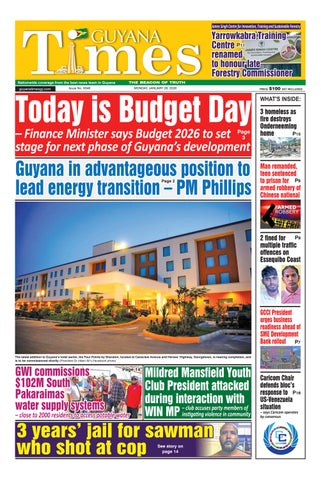
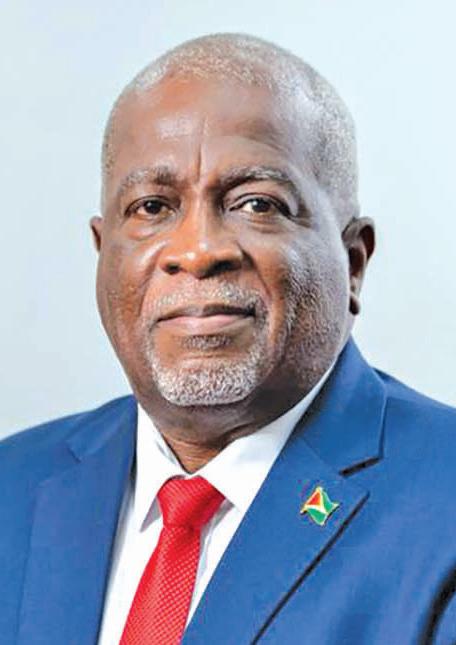
Yarrowkabra Training Centre renamed to honour late Forestry Commissioner P11
Finance Minister says Budget 2026 to set stage for next phase of Guyana’s development
3 homeless as fire destroys Onderneeming home
– close to 2000 residents to access potable water
2 fined for multiple traffic offences on Essequibo Coast
GCCI President urges business readiness ahead of SME Development Bank rollout
Man remanded, teen sentenced to prison for armed robbery of Chinese national Caricom Chair defends bloc’s response to US-Venezuela situation – says Caricom
by
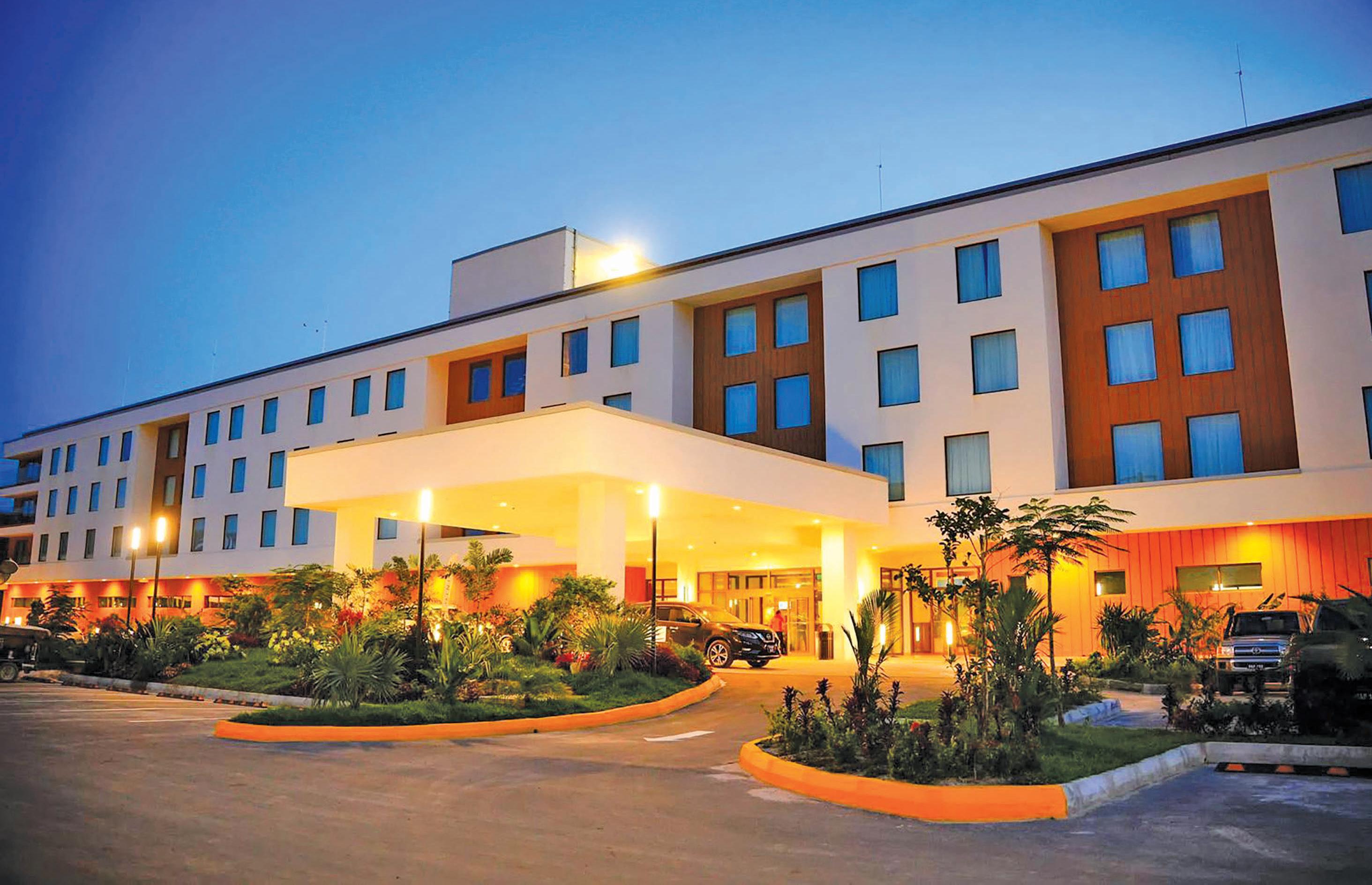
The latest addition to Guyana’s hotel sector, the Four Points by Sheraton, located at Caneview Avenue and Heroes’ Highway, Georgetown, is nearing completion, and is to be commissioned shortly (President Dr Irfaan Ali’s Facebook photo)
Guyana in advantageous position to lead energy transition – PM Phillips
Endowed with an abundance of natural gas coupled with vast renewable energy sources including solar, wind and hydropower, Guyana is being positioned to be a leader in energy transition. This is according to Prime Minister (PM), Brigadier (Ret’d) Mark Phillips, who holds responsibility for Guyana’s energy sector.
“By harnessing these clean and renewable energy sources, we are modernising our energy systems to bolster national economic growth, improve energy access, decarbonise the power sector and reduce dependence on imported fossil fuels. In doing so, Guyana is in an advantageous position to continue leading an energy transition that is environmentally responsible, equitable and development-oriented, ensuring prosperity and well-being of our people and doing our part in safeguarding the planet,” he posited. The PM made these remarks in a message to commemorate today’s observance of International Day of Clean Energy 2026. According to Phillips, this occasion is a reminder of the urgent global imperative to transition away from high-emitting fu-
els and invest strategically in sustainable energy solutions. He noted that clean energy is not a luxury but a necessity for people to grow, thrive and to lead productive and meaningful lives. To this end, the PM outlined that Guyana’s approach portrays a strong national commitment to a just energy transition: one grounded in robust public and private partnerships, shared investment and collective responsibility to low-carbon development. He said that under the nation’s sustainable development plan for preserving its natural resources and ecosystems – the Low Carbon Development Strategy (LCDS) 2030 –Guyana has forged a roadmap that integrates renewable energy with the responsible development of natural gas.
“This balanced approach seeks to deliver an energy matrix that is affordable, dependable and aligned with our decarbonisation goals.
Achieving these objectives requires concerted efforts from Governments, businesses and citizens alike. It underscores our Government’s vision to embed sustainability as a way of life, to protect present and future generations and the planet, fully in keeping with this year’s theme,
“Clean Energy for People and Planet”,” Phillips stated. He pointed out that in Guyana’s dynamic energy landscape, natural gas has emerged as a reliable, efficient, and lower-emitting source of energy that offers a real and timely solution to meet the country’s rapidly expanding energy demand.
Gas-to-Energy Project
Through the Government’s landmark investment in the 300-megawatt (MW) Gas-toEnergy (GtE) Project currently under accelerated construction at Wales, West Bank Demerara (WBD) in Region Three (Essequibo IslandsWest Demerara), the adaptability of natural gas will be leveraged to transform the power sector, reduce electricity costs by 50 per cent and support the domestic production of liquefied petroleum gas (LPG) for cleaner household cooking. But beyond its immediate energy benefits, the PM said the GtE Project is expected to enhance industrial competitiveness and strengthen the national energy mix, complemented by longer-term renewable energy ambitions to ensure that electricity remains affordable, reliable and sustainable for all citizens.
“Natural gas has long
been used as a primary fuel for power generation and in the production of a wide range of materials and chemicals, underscoring its versatility and economic significance. As the largest investment in electricity generation in the country’s history, and the most substantial Engineering, Procurement and Construction (EPC) contract undertaken to date, the Wales GtE Project is expected to double electricity generation capacity, enhance reliability, reduce fuel imports and stabilise energy costs. Lower energy costs will translate directly into financial relief for households and busi-
nesses, increased disposable income and expanded opportunities for local investment and enterprise countrywide,” PM Phillips noted. The GtE Project involves the development of a 300-MW combined-cycle gas turbine power plant, an integrated Natural Gas Liquids (NGL) facility, and upgraded transmission infrastructure, utilising gas piped from the Liza Field offshore Guyana. The facility will process the natural gas, converting it into electricity and marketable gas products to maximise the value of Guyana’s natural resources. The project is at an advanced stage of development, with full operations anticipated in the latter part of 2026. Looking ahead, however, a second GtE Project is earmarked for Region Six (East BerbiceCorentyne) to further catalyse Guyana’s energy transformation. Under the leadership of President Dr Irfaan Ali, the People’s Progressive Party/ Civic (PPP/C) Government is pursuing this initiative to support large-scale sustainable energy development.
According to PM Phillips, “This second gas project will further diversify Guyana’s economy and strengthen resilience against fluctuations in global oil and gas mar-
kets. By 2030, a second gas line is expected to be brought ashore, to reinforce our longterm energy security.” The PM went onto outline that the Wales and Berbice GtE initiatives are part of a comprehensive national energy buildout that also includes the long-awaited 165-MW Amaila Falls Hydropower Project, utility-scale solar farms, solar mini-grids, and modernised transmission and control infrastructure. “Energy access and climate action are shared global responsibilities. Clean energy has the power to transform lives, improve education, healthcare, productivity and economic opportunity, while serving as a cornerstone for achieving (Sustainable Development Goal #7) SDG7: ensuring access to affordable, reliable and modern energy for all by 2030.” “Guyana is doing its part, decisively, responsibly and with clear strategic vision. Our national energy agenda extends beyond powering homes, industries. Our clean and renewable energy goals are fundamentally about securing a prosperous, sustainable and low-carbon future for current and future generations,” the PM posited in his message to mark International Day of Clean Energy.
Prime Minister, Brigadier (Retired) Mark Phillips, who holds responsibility for Guyana’s energy sector
BRIDGE OPENING
The Berbice Bridge will be closed to vehicular traffic on: Monday, January 26 –09:05h-10:35h and Tuesday, January 27 – 10:20h-11:50h.
FERRY SCHEDULE
Parika and Supenaam departure times – 05:00h, 10:00h-12:00h, 16:00h, 18:30h daily.
WEATHER TODAY
Thundery showers are expected during the day and into the night. Temperatures are expected to range between 23 degrees Celsius and 29 degrees Celsius.
Winds: North Easterly to East North-Easterly between 2.68 metres and 4.92 metres.
High Tide: 09:54h and 10:36h reaching maximum heights of 2.42 metres and 2.26 metres.
Low Tide: 16:02h reaching a minimum height of 0.82 metre.
Today is Budget Day
Premised on a vision for continued economic transformation, empowerment of Guyanese, modernisation of social services and deployment of technology among other priorities, the Dr Irfaan Ali-led People’s Progressive Party/ Civic (PPP/C) Government will be unveiling its fiscal plan for 2026 today. Budget 2026 will be presented to the National Assembly by Senior Minister within the Office of the President with Responsibility for Finance, Dr Ashni Singh. This will be the PPP/C’s first national budget since being re-elected to office at the September 2025 General and Regional Elections. While President Dr Irfaan Ali had previously outlined his Government’s vision of a modern Guyana, Budget 2026 will be the ‘engine’ that lays the groundwork for the continuation of the country’s development surge. Minister Singh emphasised, in an article published by the Department of Public Information (DPI) on Sunday evening, that the fiscal plan is grounded in the PPP/C 2025 manifesto that was presented to the people of Guyana. That 2025 manifesto was developed through consultations with the private sector, civil society, youth and women groups, religious organisations and citizens across the country. According to the Finance Minister, the manifesto serves as the guiding framework for the policies, priorities and investments outlined in the budget. Central to this agenda he noted, is a country ripe with opportunities.
“And by upliftment, I refer to opportunities in literally every sphere of life, whether it’s opportunities to educate yourself and or to get a skill or training or certification, opportunities for employment through the massive job creation that we are seeing and that we will continue to see, opportunities for entrepreneurship and in particular, the establishment and growth of small businesses in Guyana,” Dr Singh stated.
Budget grounded in manifesto
One of the highly anticipated initiatives is the US$200 million Guyana Development Bank, which will increase access to financing and support for Small and Medium Enterprises (SMEs). The Government aims to make this operational by the end of the first quarter of 2026. Budget 2026 will make funds available to commence the first set of 40,000 new homes as promised in the Government’s manifesto. It builds upon the more than 50,000 house lots distributed by the Government in its 2020-2025 term.
Increased spending on health, education, infrastructure, potable treated water, digitalisation, Amerindian development and targeted support for the vulnerable are among the main priorities that will be outlined in the national fiscal plan. Importantly, an increase in the ‘Because We Care’ cash grant, old age pension, public assistance, among other social support initiatives, is expected to be announced in the upcoming budget. Additionally, a menu of attractive fiscal measures aimed at driving the expansion of key industries, including agro-processing, tourism and industrialisation, is expected to be revealed during the presentation on Monday. The incentives are expected to
attract both local and international investors, creating new opportunities for employment, investment and business development for thousands of small businesses. Many of these measures were outlined by President Ali during an address to the nation back in December 2025 during which he presented his Administration’s policy agenda for the economic and social transformation of Guyana and its people over the next five years.
Human development
Just last week, Minister Singh explained that at the core of Budget 2026 is a commitment to human development and noted that the fiscal plan will focus heavily on creating oppor-
tunities for citizens to improve their lives and livelihoods.
“The Guyana that we are building is a Guyana that is full of opportunities for every single Guyanese citizen to uplift themselves,” Dr Singh stated. To ease the cost-of-living pressures, the Government has pledged to maintain its policy of no new taxes over the next five years, while also introducing tax reductions for individuals and businesses. Special incentives are expected for SMEs in agriculture, animal welfare organisations and veterinary clinics, with some businesses eligible for little to no corporate tax.
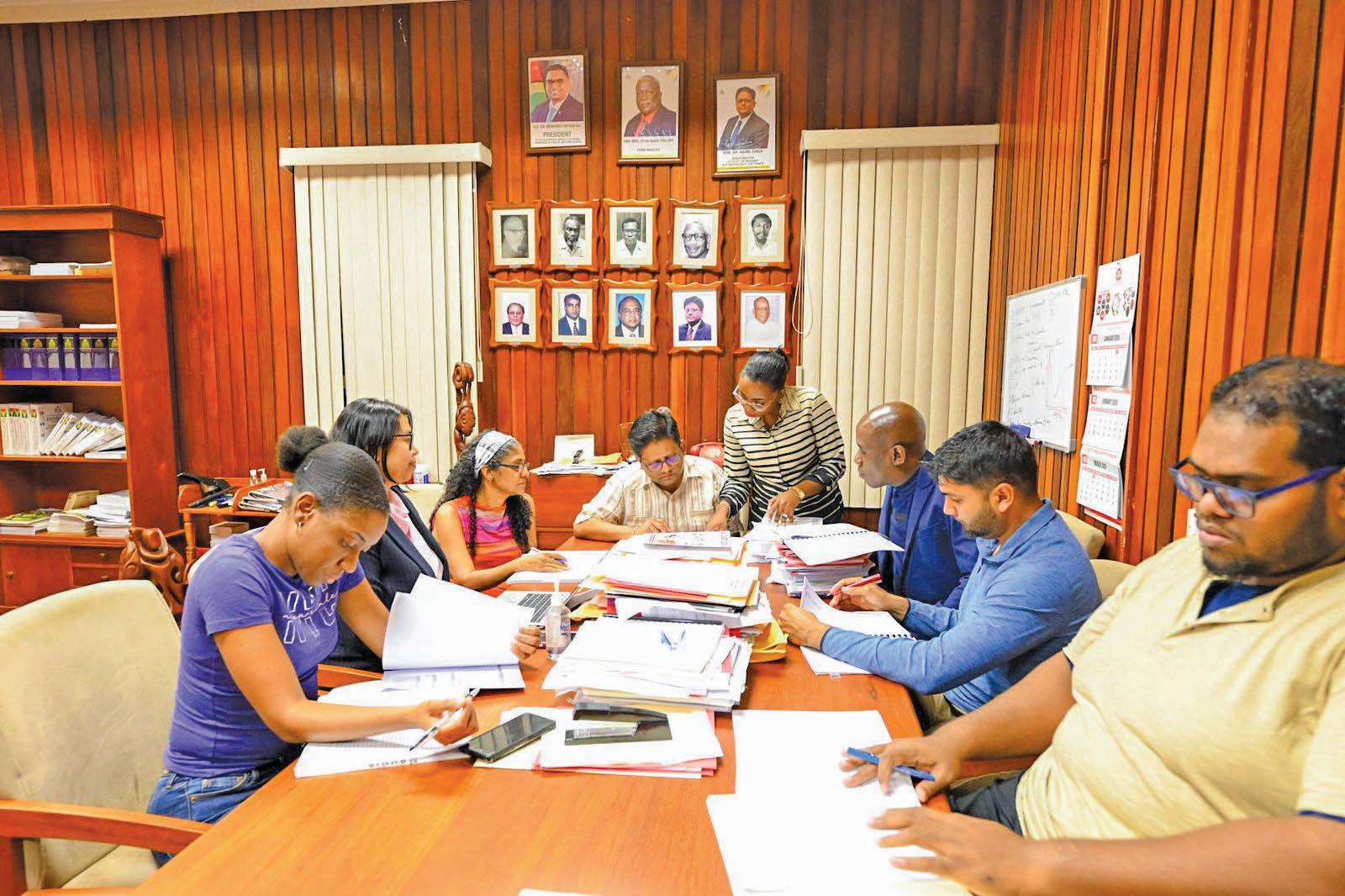
Senior Finance Minister Dr Ashni Singh and budget staff at the Ministry were putting the finishing touches on Budget 2026 throughout the night ahead of today’s presentation to the National Assembly
Today, the 13th Parliament will be convened for the Government to present its Budget 2026 for debate and eventual passage. This is not an inconsequential function of the institution, but it has, unfortunately, been overshadowed by an event that will precede the presentation – the election of the Leader of the Opposition (LOO) by a caucus of all Opposition Members of Parliament.
The Speaker has been trenchantly criticised by the Opposition and a section of society for the time he took to schedule the Opposition caucus on January 26. This is three months after the first convening of Parliament on November 3, 2025, which was itself two months after the Sept 1st General Elections. That election had upended 60 years of political history when a new political party – We Invest in Nationhood (WIN), launched three months before the election – snagged a significant segment of the PNC’s traditional base. It secured 16 seats to the APNU/PNC’s 12 and the PPP’s 36, the latter forming the government and the first two the Opposition.
The appointment of the LOO is specified by Article 184 of the Constitution which states “the Leader of the Opposition shall be elected by and from among non-governmental members of the National Assembly at a meeting held under the chairmanship of the Speaker of the National Assembly who shall not have the right to vote.” As can be seen, there is no specified time-frame within which the selection of the LOO must be made. The Speaker in his deliberate judgement chose to have it precede the first substantive meeting of the National Assembly.
Inter alia, the leader of WIN is an individual sanctioned by the US OFAC and slapped with 11 indictments for allegedly smuggling four tonnes of gold to the US and underinvoicing several luxury cars shipped to Guyana. The Government had been attempting to satisfy its obligations under an Extradition Treaty it signed with the US, while the WIN leader retreated to the local courts to block the extradition that would have ended with his trial in the US courts. The Opposition and its partisans have launched vitriolic attacks against the Speaker, accusing him of supporting “a Government vendetta” against the WIN leader.
Returning from a series of foreign trips – including a convention of Commonwealth Speakers in India – the Speaker explained his position on the WIN Leader. He notes that Azruddin Mohamed is an “international fugitive” who, if he becomes the LOO – a constitutional role – would be a “stain on Guyana”. Not unexpectedly, WIN has taken umbrage at this position and accused the Speaker of “bias”, when he should be “impartial”. Some have even called for his resignation.
However, this completely misstates the function and duty of the Speaker: he must be impartial in matters between MPs, but has a duty to protect the institution he chairs. We note the foundational historical moment in 1523 when the Speaker of the English Parliament, Sir Thomas Moore took a moral position to oppose the absolutistinclined monarch Henry VIII to establish the right to freely express one’s opinion in Parliament as sacrosanct.
This does not mean that the WIN leader is guilty of the charges. But when he has been afforded the opportunity to defend himself in a court of law and rejects that opportunity, then the stain on his name can percolate into that of the institution in which he holds such an important role. MPs are described as “honourable” and it would seem that in the judgement of the Speaker, the WIN leader should voluntarily avail himself of the opportunity to clear the stain on his name.
Sir Thomas Moore bravely demonstrated that Parliament is a living institution and should evolve to deal with new exigencies. Speaker Nadir has acted in that noble tradition.
Mark Carney invoked Thucydides at Davos – what people get wrong about this ancient Greek writer’s take on power
By Neville Morley
In his speech to this year’s World Economic Forum at Davos, Canadian Prime Minister Mark Carney mourned the demise of international cooperation by evoking an authority from ancient Greece.
“It seems that every day we’re reminded that we live in an era of great power rivalry, that the rulesbased order is fading, that the strong can do what they can, and the weak must suffer what they must. And this aphorism of Thucydides is presented as inevitable, as the natural logic of international relations reasserting itself.”
Journalists and academics from Denmark, Greece and the United States have quoted the same line from the ancient Greek historian when discussing Donald Trump’s demand for Greenland. It is cited as inspiration for his adviser Stephen Miller’s aggressive foreign policy approach, not least towards Venezuela.
In blogs and social media, the fate of Gaza and Russia’s invasion of Ukraine have been interpreted through the same frame. It’s clearly difficult to contemplate today’s world and not react as WH Auden did to the collapse of the old order in 1939: “Exiled Thucydides knew.”
The paradox of the “strong do what they can” line is that it’s understood in radically different ways. On the one hand, it’s presented as a description of the true nature of the world (against naive liberals) and as a normative statement (the weak should submit).
On the other hand, it’s seen as an image of the dark authoritarian past we hoped was behind us, and as a condemnation of unfettered power. All these interpretations claim the authority of
Thucydides.
That is a powerful imprimatur.
Thucydides’ insistence on the importance of seeking out the truth about the past, rather than accepting any old story, grounded his claim that such inquiry would help readers understand present and future events.
As a result, in the modern era he has been praised both as the forerunner of critical scientific historiography and as a pioneering political theorist. The absence of anything much resembling theoretical rules in his text has not stopped people from claiming to identify them.
The strong/weak quote is a key example. It comes from the Melian dialogue from Thucydides’ History of the Peloponnesian War. In 416BC, an Athenian force arrived at the neutral island of Melos and demanded its surrender. The Melian leaders asked to negotiate, and Thucydides presents a fictional reconstruction of the subsequent exchange.
The quote comes from the beginning, when the Athenians stipulated that they would not claim any right to seize Melos, other than the power to do so, and conversely would not listen to any arguments from principle. “Questions of justice apply only to those equal in power,” they stated bluntly. “Otherwise, such things as are possible, the superior exact and the weak give up.”
Within modern international relations theory, this is sometimes interpreted as the first statement of the realist school of thought.
Scholars like John Mearsheimer claim that Thucydides identified the basic principle of realist theory that, in an “anarchic” world, international law applies only if it’s in powerful States’ strategic inter-
est, and otherwise might makes right. The fate of the Melians, utterly destroyed after they foolishly decided to resist, reinforces the lesson.
But these are the words of characters in Thucydides’ narrative, not of Thucydides himself. We cannot simply assume that Thucydides believed that “might makes right” is the true nature of the world, or that he intended his readers to draw that conclusion.
The Athenians themselves may not have believed it, since their goal was to intimidate the Melians into surrendering without a fight. More importantly, Thucydides and his readers knew all about the disastrous Athenian expedition to Sicily the following year, which showed the serious practical limits to the “want, take, have” mentality.
So, we shouldn’t take this as a realist theoretical proposition. But if Thucydides intended instead simply to depict imperialist arrogance, teach “pride comes before a fall”, or explore how Athenian attitudes led to catastrophic miscalculation, he could have composed a single speech.
His choice of dialogue shows that things are more complicated, and not just about Athens. He is equally interested in the psychology of the “weak”, the Melians’ combination of pleading, bargaining, wishful thinking and defiance, and their ultimate refusal to accept the Athenian argument.
This doesn’t mean that the Melian arguments are correct, even if we sympathise with them more. Their thinking can be equally problematic. Perhaps they have a point in suggesting that if they give in immediately, they lose all hope, “but if we resist you then there is still hope we
may not be destroyed”. Their belief that the gods will help them “because we are righteous men defending ourselves against aggression”, however, is naive at best. The willingness of the ruling clique to sacrifice the whole city to preserve their own position must be questioned.
The back and forth of dialogue highlights conflicting world views and values, and should prompt us to consider our own position. What is the place of justice in an anarchic world? Is it right to put sovereignty above people’s lives? How does it feel to be strong or weak?
It’s worthwhile engaging with the whole episode, not just isolated lines – or even trying to find your own way through the debate to a less bad outcome.
The English political philosopher Thomas Hobbes, introducing his classic 1629 translation, noted that Thucydides never offered rules or lessons but was nevertheless “the most politic historiographer that ever writ”. Modern readers have too often taken isolated quotes out of context, assumed that they represent the author’s own views and claimed them as timeless laws. Hobbes saw Thucydides as presenting complex situations that we need to puzzle out.
It’s remarkable that an author famed for his depth and complexity gets reduced to soundbites. But the contradictions in how those soundbites are interpreted – the way that Thucydides presents us with a powerful and controversial idea but doesn’t tell us what to think about it – should send us back to the original. (The Conversation)
Neville Morley is a Professor in Classics, Ancient History, Religion, and Theology, University of Exeter
The iconic Stabroek Market clock tower rises above the Demerara River shoreline among the new, modern constructions in Guyana’s capital city, Georgetown (A Path to Travel photo)
Guyana’s democratic test is not about comfort, it’s about confidence
Dear Editor,
On Monday, our Parliament will address two significant matters, firstly, the presentation of the national budget and secondly, the election of a new Leader of the Opposition.
While the budget will shape economic priorities and hopefully bring additional and more tangible results for the people such as increased public servants wages and salaries, the latter decision has attracted disproportionate attention. Yet beneath the controversy lies a clearer political reality, one that speaks less to instability and more to the confidence of Guyana’s democratic institutions.
The likely election of Mr Azruddin Mohamed as Leader of the Opposition has generated debate because of his personal legal circumstances locally and abroad and the broader implications for Guyana’s international image. Such concerns are not without ba-
sis. However, democracy is not designed to yield only comfortable or convenient outcomes. It is designed to follow rules especially when those outcomes provoke discomfort.
Guyana’s Constitution is unambiguous. The Leader of the Opposition is determined by parliamentary arithmetic arising from free and lawful elections. Voters chose the composition of the National Assembly, and that choice however contested cannot be overridden by local or external pressure nor subjective judgments without weakening democratic legitimacy.
What is often overlooked in this discussion is the extreme imbalance of political power within the current Parliament. The fact is Mr Mohamed would assume leadership over what is arguably the weakest and least experienced opposition cohort in Guyana’s modern parliamentary history. With the exception of
a small number of former PNCR/AFC parliamentarians who make up the opposition and a few who now aligned with the WIN party, most of the opposition MPs possess minimal political or legislative experience. Institutional memory is thin, parliamentary skill uneven, and strategic cohesion largely untested.
Numerically, the challenge is even starker.
Mr Mohamed would preside over the smallest opposition bloc ever to produce a Leader of the Opposition. In a legislature where numbers determine committee influence, procedural leverage and legislative outcomes, this opposition lacks the capacity to meaningfully constrain executive authority. In practical terms, it poses no serious threat to governance. This stands in sharp contrast to the governing People’s Progressive Party/ Civic (PPPC), which commands an overwhelming majority and benefits from
deep institutional knowledge and experience. That dominance is reinforced by the national popularity of President Mohamed Irfaan Ali, whose administration has overseen visible transformation across every region of the country. Major investments in infrastructure, housing, healthcare, education, agriculture, energy and more, all of which have tangibly reshaped communities and citizens’ lives and strengthened public confidence in the executive, numbers don’t lie.
Beyond policy delivery, President Ali’s leadership style has further consolidated authority. His accessibility, pragmatic engagement, his down to earth, hands-on and grounded public presence have resonated positively across traditional and non-traditional political constituencies alike. The result is an administration that governs from a position of strength, electorally secure, politically confident, and in-
Outgoing British High Commissioner is an outstanding person
Dear Editor, I recently encountered the outgoing British High Commissioner to Guyana, Jane Miller, not at a formal function or behind security barriers, but on the streets of Georgetown near the GPO. She was walking among vendors and ordinary Guyanese, unaccompanied by entourage or ceremony. What struck me was not merely her presence there, but how she was present. She was not “shopping”
in the casual sense as she examined local handicrafts. She was engaging—making eye contact, smiling, greeting people and acknowledging them where everyday life unfolds. In a country where public office can sometimes feel distant from the lived realities of the people, this quiet attentiveness spoke volumes.
I took the opportunity to express my appreciation to her for consistently speaking up for justice,
democratic accountability, and good governance during her tenure. Her response was simple but deeply telling: she warmly extended her hand to shake mine. It was a small gesture, yet one that conveyed humility, openness and respect—qualities too often missing in public life.
Leadership that listens, that does not shy away from speaking when it matters and that remains grounded among the people leaves a lasting impression. High
Commissioner Miller’s approach demonstrated that diplomacy need not be aloof to be effective, nor distant to be principled. As she concludes her service in Guyana, I wish to express sincere gratitude for her respectful presence, moral clarity, and human touch. Guyana has been well served. She is, indeed, a great lady!
Yours sincerely,
Devanand Bhagwan
Today is Budget...
FROM PAGE 3
stitutionally dominant.
Against this backdrop, fears that the elevation of Mr Mohamed represents a destabilising moment are overstated. Even under ideal circumstances, leading an opposition against a popular, well-resourced, and experienced government is a formidable challenge. Under the present conditions, novice leadership, an inexperienced parliamentary team, and minimal numerical leverage, the role is largely symbolic. The opposition may scrutinise, but it cannot seriously disrupt. I might me wrong but time will determine.
Critics argue that Mr Mohamed’s political emergence may be driven by self-interest. That may or may not be true. But democratic systems are not designed to adjudicate motive; they are designed to regulate conduct through law and institutions. The absent a domestic judicial ruling or constitutional disqualification, allegations and foreign sanctions cannot replace due process without undermining sovereignty.
Internationally, Guyana’s decision will be observed closely. The country’s growing strategic importance ensures that symbolism matters. But yielding constitutional procedure to
local or external discomfort would signal fragility, not responsibility. Mature democracies are defined not by the absence of controversy, but by their adherence to rules when controversy arises. Hence, I welcome the election of the Opposition leader.
It is also worth remembering that the Leader of the Opposition does not wield executive power. The office exists to question, critique, hold the Government accountable and represent dissent not to govern. The executive remains firmly in control of policy direction and national development. Ultimately, Guyana is not being asked to endorse a person; it is being asked to respect a process. This moment does not expose executive vulnerability; it underscores executive strength. The Government governs from a position of dominance and legitimacy, while the opposition remains constitutionally necessary but politically constrained. That is not democratic failure. It is democratic confidence, so let the opposition leader be elected.
Yours sincerely, Jermaine Figueira, Former Member of Parliament
Infrastructure development
Meanwhile, the Finance Minister had noted that too that infrastructure development remains a key priority, with major projects including a new fourlane Berbice River Bridge, a Corentyne River Bridge,
Other anticipated measures include abolishment of net property tax on individuals; flat tax rates on double-cab pickups; creation of special investment zones with tax exemptions; home improvement assistance for households. With the aim of providing opportunities to small businesses. The Government also plans to remove corporate taxes on income earned by companies engaged in childcare provision services and elderly care facilities. In fact, funds will be allocated in 2026 budget for co-investment in child and elderly care facilities, on the condition that the facilities benefiting from tax and concessions agree to a suitable cap rate for their services. Meanwhile, as part of a push for a more humane society and the safeguard of animal welfare, Budget 2026 will include financial support to non-Governmental organisations (NGOs) involved in animal care and welfare and institutions providing such care.
expansion of the Cheddi Jagan International Airport (CJIA) terminal and municipal airports in Lethem and Rose Hall, as well as improvements to hinterland airstrips. In agriculture, the Ali-led Administration will continue to place strong emphasis on food security with plans to engage farmers on examining ways to encourage and incentivise diversification across the sector and diversification within crops. There will be mega-scale opportunities available in livestock, dairy, mega farms, sugar, etc. The Government will be incentivising the private sector to form partnerships and consortiums to invest in these
opportunities, making them sustainable, profitable and resilient.
Today’s presentation of Budget 2026 will follow last year’s $1.382 trillion budget, which was presented under the theme, ‘A Secure, Prosperous, and Sustainable Guyana.’
Approximately one week after today’s budget presentation, lawmakers will engage in critical deliberations that will define the nation’s fiscal priorities and economic trajectory for 2026. Subsequently, the House will dissolve into the committee of supply that will examine each line item for the various Ministries and Government agencies.
Page Foundation
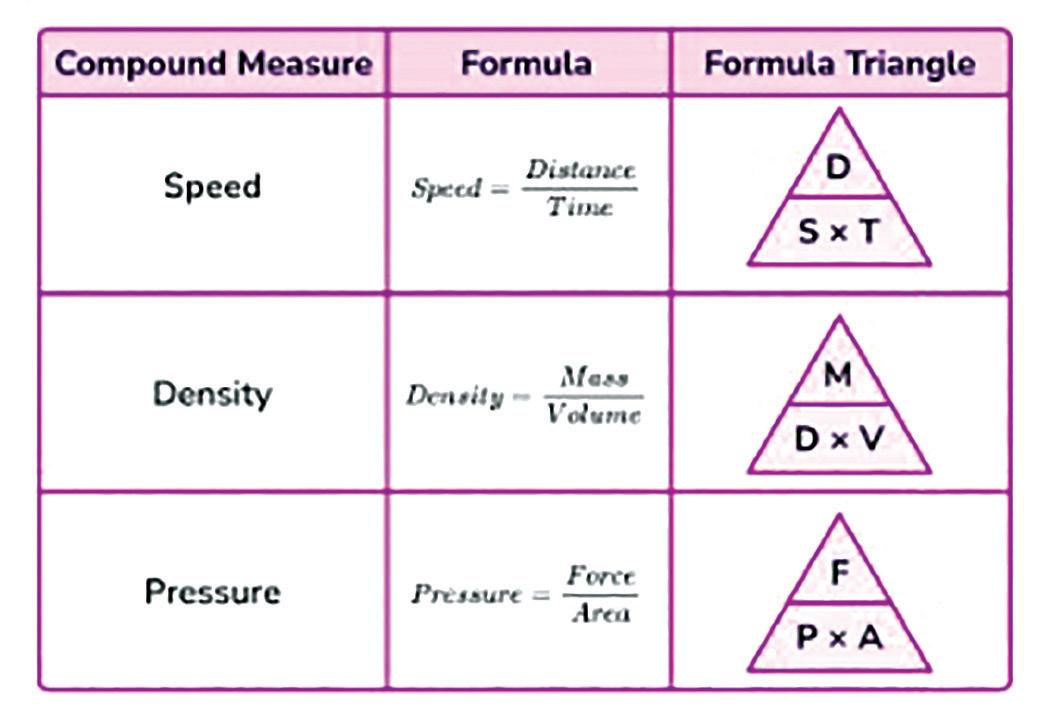
Compound measures
Compound measures are measures which are found from two other measures.
Speed, density, and pressure are among the most common compound measures studied.
To calculate the value of a compound measure, we need to know the value and the units of the other two measures.
● Speed
Speed is a compound measure made from dividing a unit of distance by a unit of time. Speed is therefore a measure of how
You will need:
6 pieces of equal sized and square sheets of paper. The maker here used pieces of paper that are sized 3.5″x3.5″ (9×9 cm)
Instructions:
Steps 1-7: Fold the first sheet vertically, then horizontally and diagonally respectively, in both directions. Unfold.
Step 8: Fold in the sides so that the paper looks like the one in the picture numbered 8.
Step 9: Repeat steps 2-8 with
all 6 sheets.
Common units for speed include metres per second (m/s) and kilometres per hour (km/h). Miles per hour (mph) is associated with the speed of a vehicle.
To calculate the speed of an object, we use the speed formula, Speed=distance/time
● Density
Density is a compound measure made from dividing a unit of mass by a unit of volume. Density is a measure of how much matter there is in a certain volume.
Common units for density include grams per cubic centimetre (g/cm3) and kilograms per cubic metre (kg/m3)
To calculate the density of an object, we use the density formula,
Density=mass/volume
● Pressure
Pressure is a compound measure made from dividing a unit of force by a unit of area. Pressure is therefore defined as the force per unit area. Different units of pressure include Pascals (Pa) where one Pascal is equivalent to
To calculate the pressure an object makes with a surface, we use the pressure formula,
Pressure=force/area
Step 10: Join two of your folded triangles by inserting two of the tips inside the tips of the other triangle. Step 11: Flatten, now it should look like this.
Step 13: Make creases sharp, now it should look like this.
Step 12: Now comes the tricky bit, which means you must open up the center part where the two triangles meet and press with your fingers to create two creases and a square opening.
Step 14: Continue building your star by adding one triangle at a time and repeating steps 1013, until all six triangles are joined together. Finish off by inserting the two tips of triangle No 1 into the two remaining openings of triangle No 6. Your star is ready! If you like you can make holes with a needle and thread a string for hanging. (Adapted from craftandcreativity.com)
By AlBerto ríos
The bright night sky, Doorway to everything —
In all that black All those stars: Salt. Pinpricks.
White fireworks. Perlite.
We look up Pulled into the immensity,
Lifted into the limitless–As if it were a hole
We are falling into, Up instead of down.
We stand on the earth, Breathe in the night. It is all too big. We go back inside.
(Source: Poetry [January/February 2026])
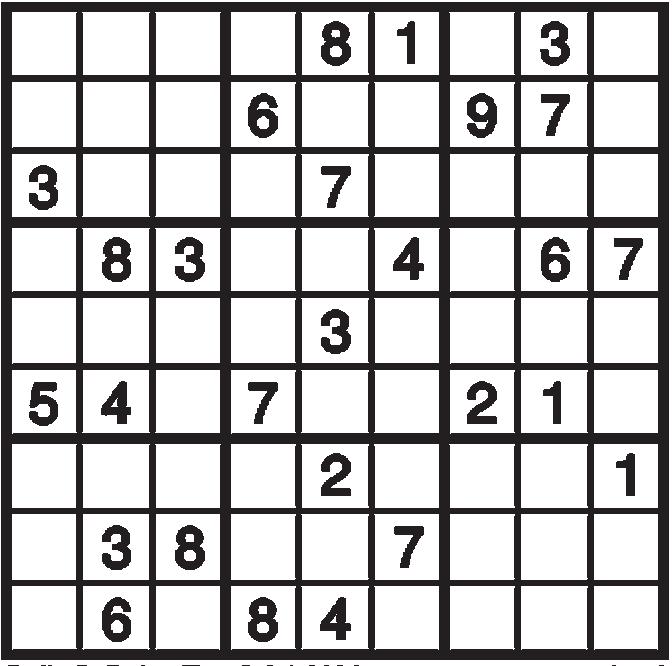
Write an engaging story about a memorable photograph you have seen
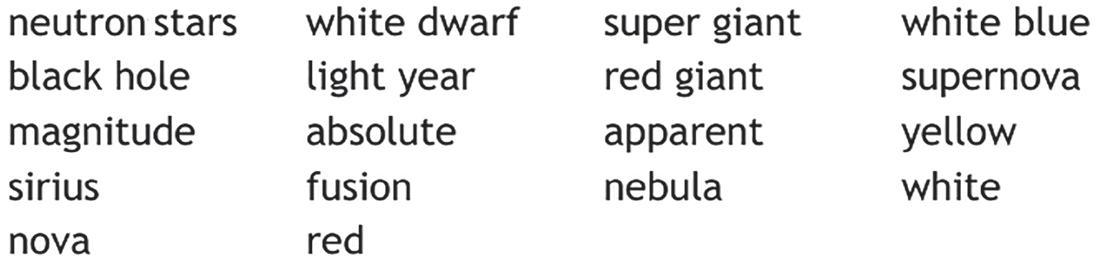
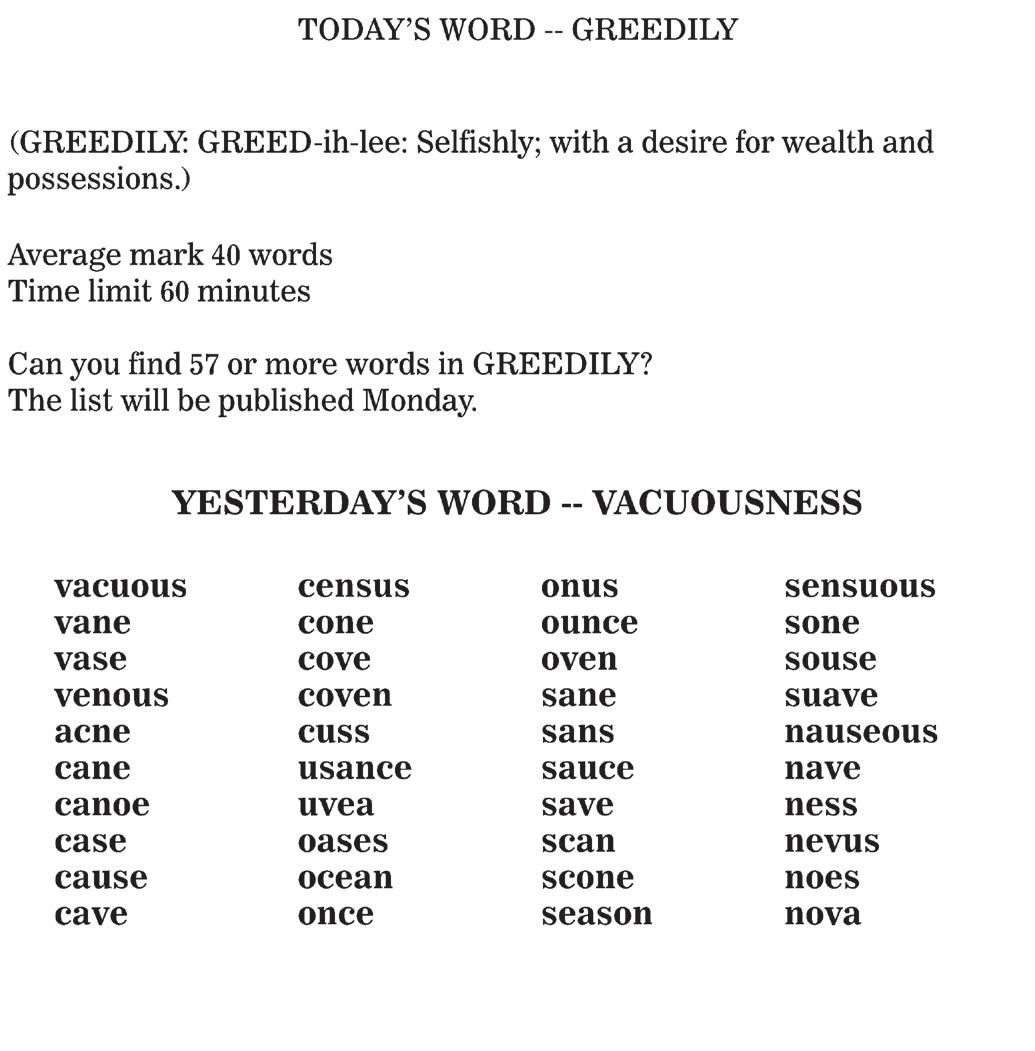
WORD SEARCH
GCCI President urges business readiness ahead of SME Development Bank rollout
President of the Georgetown Chamber of Commerce and Industry (GCCI), Kathy Smith is urging small and medium-sized enterprises (SMEs) to ensure their records, systems and project proposals are in order, as the Government moves closer to operationalising its long-anticipated SME Development Bank. Speaking during a recent episode of the Starting Point podcast, Smith said the new financing institution could be transformative for local businesses, but warned that access to funding will depend heavily on preparedness. “That would be a game changer,” Smith said, noting that while financing opportunities exist, many businesses fail to qualify because they are not properly structured. “The issue that we are having is that some of them – you cannot trace them. And financial institutions want to give, they want to partner, they want to invest in businesses that they can trace.” Smith emphasised that businesses must operate transparently, maintain proper invoicing and quotations and separate personal finances from company ac -
counts.
“The company’s money is not your money. You are a separate entity from your business,” she stressed. “If you are to reinvest, if you are to grow your business, you must ensure that the company money can reinvest itself.” The GCCI President said many small businesses also underprice their services out of fear, a practice she cautioned against. “Do not price yourself into regret,” Smith said. “They are fearful of pricing based on their talent, their time and what it takes to invest into the business.”
Women entrepreneurship Smith, who made history as the first woman to lead the 135-year-old chamber, said her presidency has focused on strengthening confidence among women entrepreneurs, who now account for 46 per cent of GCCI’s membership. “I felt that I’ve given confidence to women in business,” she said, explaining that more women have begun joining committees and participating actively since her election. As part of that effort, GCCI has expanded its Centre for Women in Business, with a focus on
agro-processing, branding, packaging and marketing.
Smith said the chamber has also secured additional donor support to expand the programme.
She also highlighted ongoing work to integrate more women into the oil and gas sector, particularly in technical roles and contract access. “We still need to guide them,” she said. “A lot more women need to be in technical positions in the oil sector. Then it’s need for financing because some of them are getting the contracts, but don’t have the finance to execute.” Smith underscored the importance of
networking, cautioning that such events must be treated as serious business opportunities. “When you turn up to a networking event, turn up with your business card, turn up with a brochure,” she advised. “Let them know your talent, let them know your skill, let them know what you can bring to them.” She also acknowledged the unique pressures women face in business spaces, particularly balancing professional and domestic responsibilities and said GCCI has been advocating for workplace childcare solutions. “One of the things that we are pushing with is for busi-
nesses to create a space for a day and night care centre for your employees,” Smith said, pointing to recent implementation by one GCCI member as a model for others.
Private Sector optimistic Looking ahead to the 2026 National Budget, Smith said the Private Sector remains optimistic, citing visible infrastructure development and increased Government engagement. “I am excited every time I go somewhere and see the development of our country,” she said. “I can trace the Government’s budget increase and the investment in this country.” She
noted that the 2025 budget, which stood at approximately US$6.6 billion, was unprecedented and credited it with accelerating infrastructure works nationwide “We might have some faults and the fault is that we are getting there,” Smith said. “That’s a Guyanese that is building that small road there. Have some patience with them.” Smith said GCCI has maintained regular consultations with Senior Minister in the Office of the President with Responsibility for Finance, Dr Ashni Singh and remains confident that Private Sector proposals will continue to shape fiscal policy. “The Government has always been a strong partner,” she said. “If we are to carry that brand of being the fastest-growing economy in the world, the Private Sector… must be strong and robust.” As she approaches elections for a second term, Smith said her focus remains on strengthening the chamber and expanding opportunities for women and small businesses. “I have let women know that this role is for you,” she said. “You have to be bold. You have to be courageous. You have to stay in the room.”
Police urge motorists, businesses to cooperate amid Georgetown traffic challenges
With traffic congestion continuing to challenge motorists in Georgetown, police officers across multiple divisions have called on the public to cooperate with law enforcement to ensure safer and smoother roads. Speaking on a recent televised Episode of Road Safety and You, Sergeant Louis Browne, stationed at Regional Division 4A (Georgetown) and attached to the Brickdam Police Station Traffic Department, highlighted the unique challenges his team faces in Central Georgetown. “Basically, the traffic department at Brickdam – we control Central Georgetown, where we know that the traffic situation there on a daily basis is very, very busy,” he said. “Due to the volume of traffic there, it is more accident-prone than ... 4B, 4C and the other districts. But we are working to mitigate against accidents, obstructions and all these things. Sgt. Browne appealed for public cooperation. “Members of the public, we are pleading with them to work hand in hand with the police. Ever so often, we have persons stopping, obstructing the traffic, which would cause a major congestion in Georgetown. Central Georgetown is very busy. You come to do your business, stop properly to the corner of the road, work hand in hand with the police so that we can have a smooth flow, they can get about their business, and everybody would be happy.”
Meanwhile, Inspector Peter John, of Regional Division 4B (East Bank Demerara) and attached to the Madewini Police Outpost, emphasised the importance of planning ahead, particularly for airport-bound travellers. “From time to time, the traffic would be really congested, but my ranks normally control in the field as to managing the traffic so that we can get a free flow at all times,” he said. “I would like to plead to the public so that they could leave like two to three hours before the checkin time, or before their flight, so that they could catch a flight. It’s not due to the police stopping them, but it’s due to the congestion of traffic heading to the airport.” He also advised motorists picking up relatives to allow sufficient time to traverse heavily trafficked routes. “For both ways, if you’re going to pick up relatives, or if you’re going to drop off to catch a flight, you need to ensure that you give yourself enough working time to traverse that east bank carriageway.”
Ongoing construction challenges
On the other hand, Sgt. Maurice Smith, stationed at the Sparendaam Police Station in Regional Division 4C (East Coast Demerara), highlighted the impact of ongoing construction on traffic flow. “Our district covers from Success all the way to the Industry arch. However, the traffic situation within the
Sparendaam Station District is a bit tedious, I would say, in the morning hours, due to the East Coast Corridor being a main access point that receives traffic all the way from Berbice and other locations, from Region Five, Region Six, persons working their way into Georgetown. However, we’re experiencing a heavy buildup of traffic due to ongoing construction work on the railway embankment.”
Sgt. Smith explained the systems in place to manage congestion. “At seven hours, with directions from our traffic officer, we would commence a lane, which would commence from the Laboone Intention (LBI) Public Road, all the way to Ogle Highway. We would have ranks placed at strategic points… controlling the flow of traffic, vehicles entering and exiting the toward lane. We would also have additional motorcyclists roving those third lanes to ensure that we don’t have persons overtaking or undertaking the line of traffic that would cause an obstruction.” He also issued a stark warning to commuters about unsafe driving practices.
Unsafe, inconsiderate practices
“A vehicle overtaking on the inside, which would be the path where the pedestrians should be walking, that is very dangerous. However, due to the system being put in place by our Government to catch those drivers breaching the toward lane, it is a
good implementation. And it is causing a lot of drivers to be on the alert. Passengers travelling in public transportation, a word of caution: speak to the driver, speak up, because your life is at risk. Your life is important and don’t sit down and accept lawlessness or substandard behaviour. Speak up because if you speak up, at least you might be saving not only your life but also other lives.”
The officers also addressed challenges posed by business operations and illegal parking. Sgt. Smith noted, “During the Christmas period, we would find that you have a larger volume of traffic, especially along Regent
Street. Now, what we do on a yearly basis, we go around to the different business owners along Regent Street. We sensitise them. Yes, you want to keep parking for your customers, but it’s not lawful for you to take market signs and place it along the roadway so that you can reserve spots. The road is for everyone.” He further warned motorists about obstructing articulated vehicles. “Parking a vehicle on a turn is very dangerous. Around that area, we have a lot of articulated vehicles traversing. If a lorry comes to negotiate a turn and a vehicle is parked there, it can cause an accident and a buildup of traffic.” The pro-
gramme also highlighted efforts to enforce vehicle regulations. Sgt. Smith explained that trucks found violating parking rules are actively managed. “That truck would be on the road on a daily basis. Once the ranks working on that truck find persons parked illegally, they would be clamped. The rider issued a ticket. If they run a sign, they would be signed a document, taken to the station, signed a document, and given a date for court.” Throughout the programme, police reiterated that public cooperation, patience and compliance with traffic regulations are essential to prevent accidents and congestion.
President of the Georgetown Chamber of Commerce and Industry (GCCI), Kathy Smith (left) during the Starting Point podcast
2 fined for multiple traffic offences on Essequibo Coast
Two men were fined after pleading guilty to several traffic-related offences when they appeared before the Anna Regina Magistrate’s Court last Friday. Jason Conway, a 20-year-old labourer of Richmond Housing Scheme, Essequibo Coast, was charged with failing to have an identification mark (rear), contrary to Section 13 of the Motor Vehicle and Road Traffic Act, Chapter 51:02, and breach of the conditions of a General Dealers Permit, contrary to Section 19(e)(ii) of the same Act.
The offences were committed on Sunday, January 18, along the Riverstown Public Road, Essequibo Coast.
Conway appeared before Magistrate Tariq Mohamed on Friday, January 23, where the charges were
read to him and he pleaded guilty to both. He was fined
$130,000 for failing to have an identification mark, in default of three months’ imprisonment and $15,000 for breaching the conditions of his General Dealers Permit,
in default of one week’s imprisonment.
In a separate matter, Devon France, a 26-yearold labourer of Lot 257 Onderneeming, Essequibo Coast, was charged with driving without a licence,
operating an uncertified motor vehicle and driving an uninsured motor vehicle, all contrary to the Motor Vehicle and Road Traffic Act, Chapter 51:02. The offences occurred on Friday, January 16, along the Onderneeming Sand Pit Access Road, Essequibo Coast. France also appeared before Magistrate Mohamed on Friday, where he pleaded guilty to all charges. He was fined $40,000 for driving without a licence, in default of three weeks’ imprisonment; $5,000 for operating an uncertified vehicle, in default of one week’s imprisonment; and $25,000 for driving an uninsured motor vehicle, in default of two weeks’ imprisonment. Both matters have since been concluded.
Man remanded, teen sentenced to prison for armed robbery of Chinese national
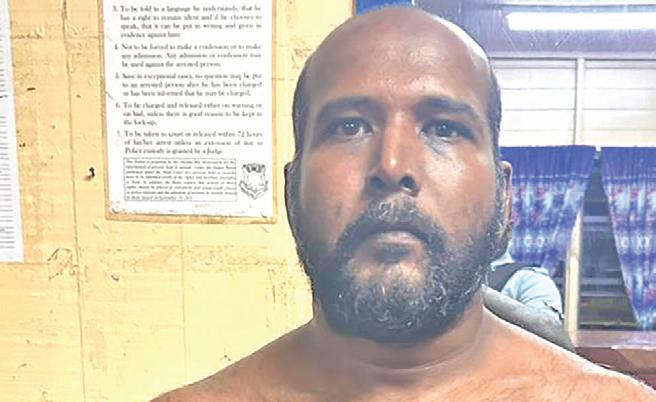
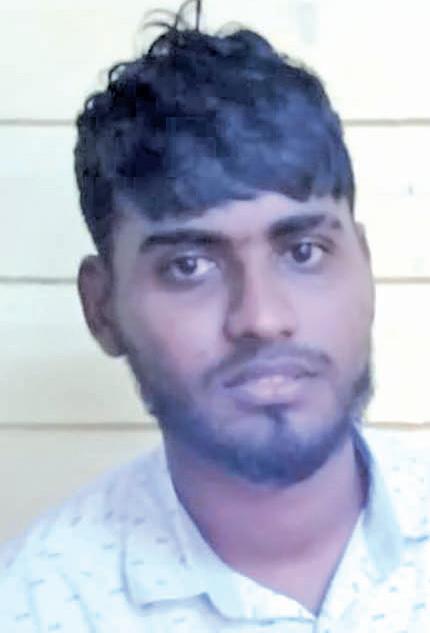
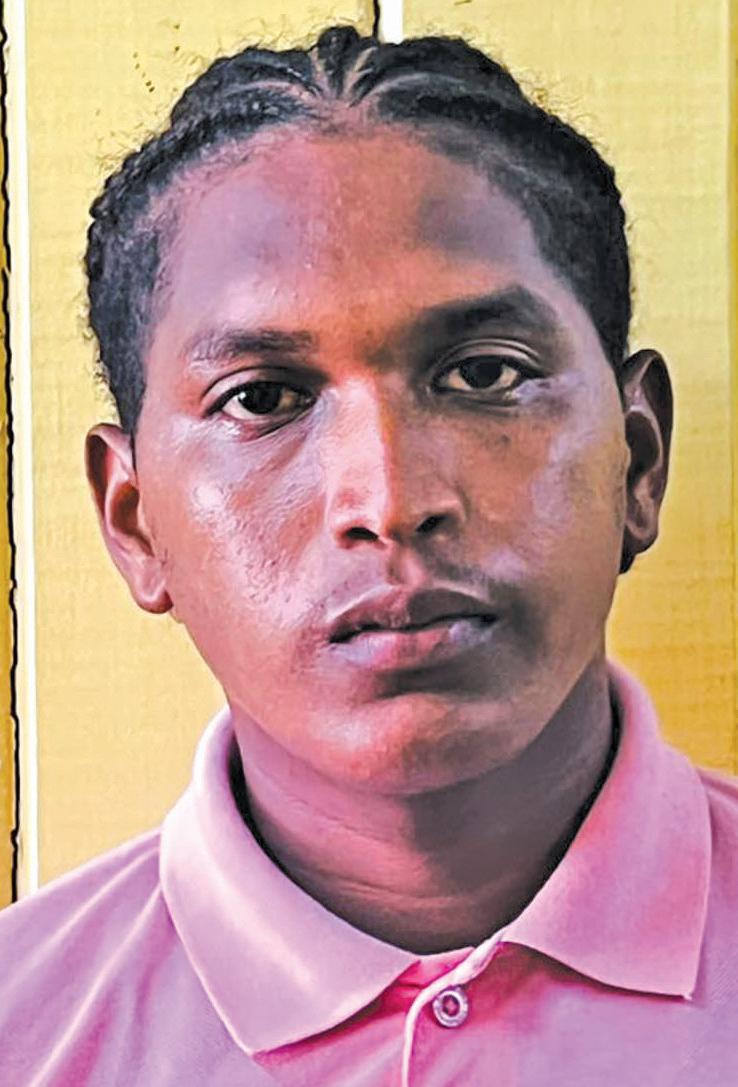
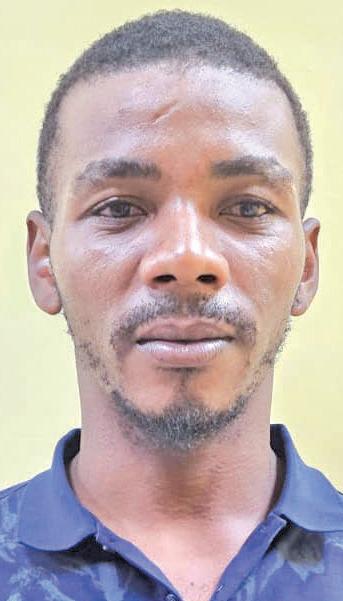
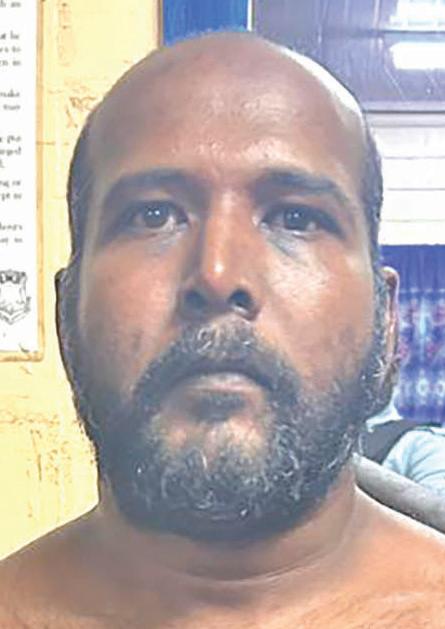
Aman and a teenager, charged in connection with an armed robbery committed earlier this month on a Chinese national on the Essequibo Coast, were last Friday sent to prison – one remanded, the other sentenced – after they appeared at the Anna Regina Magistrate’s Court. Carlos Anthony Scott, also known as Bowman, a 26-yearold labourer of Lot 534 Onderneeming Sand Pitt, Essequibo Coast, was arrested on Wednesday, January 21, by ranks of the Bartica Police Station. He was subsequently charged on Friday by
Remanded: Carlos Anthony Scott
detectives attached to Regional Police Division No. 2 with Robbery Under Arms, contrary to Section 222(c) of the Criminal Law (Offences) Act, Chapter 8:01. Scott is accused of committing the offence on Sunday, January 11, 2026, at Lot 23 Zorg Public Road, Essequibo Coast, against Lin Sp, a 42-yearold Chinese national and businessman. When he appeared before Magistrate Tariq Mohamed on Friday, the charge was read to him, and he pleaded not guilty. He was remanded to prison and the matter was adjourned to February 20 for disclosure of state-
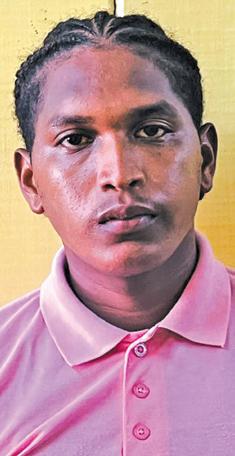
ments. Also charged in the matter was a 17-yearold labourer of Lot 438 Onderneeming Sand Pitt, Essequibo Coast. The teen was arrested on the same date and charged with the same offence of Robbery Under Arms, arising from the January 11 incident involving the Chinese businessman.
The teen appeared before the same Magistrate on Friday, where he pleaded guilty to the charge. He was sentenced to two years and three months’ imprisonment.
Police investigations into the matter have since been completed.
Foisting… …or posing
After all the hullabaloo, we’ve arrived at the big day we’ve been waiting for – Parliament being convened for our politicians to listen to Budget 2026!! Your Eyewitness never thought he’d be saying that about a budget reading -- where the biggest excitement is generated by counting how many glasses of water Ashni will need for his performance!! But today at the Convention Center ain’t really about reading the Budget, is it??
And imagine this is another TRILLION DOLLAR BUDGET!! Meaning we will be hearing about getting that long-awaited $100,000 cash grant to every red blooded –and breathing – Guyanese adult!! So what’s really going down?? You’d had to’ve been living under a very remote rock not to know that it’s all about what the Speaker of the House describes as the start of the shame that’s gonna come by having Sanction Man – “an international fugitive” – as our Leader of the Opposition – the LOO if you don’t mind!!
Those who are oldsters – like your Eyewitness! –would have known the deep shame we had to endure for years when Burnham rigged elections right, left and centre – and unleashed the army to intimidate us. Your Eyewitness still remembers attending a foreign university and students wanted to know how it felt to be from the country that murdered Walter Rodney. And there was no uprising by the people!! Ahhh…the shame!! The shame!!!
So, here it is…over 100,000 people voted for the international fugitive Sanction Man! And this being Guyana where we all know each other’s business and know what went down with the gold smuggling and worse!!! – doesn’t it bother them?? Is this where our Guyanese moral compass is pointing?? That we need a “Scamp Man” to tell us what to do?? And most incredibly, he’s gonna be chosen today by Opposition MPs as their LOO!! That’s right…the PNC ain’t even ashamed about being whupped by the international fugitive at the polls – and will be voting for him to be their LOO!! It could be that they see something of Burnham in him??
Anyhow, your Eyewitness knows the truth of the folk idiom “time longer than twine”!! He knows that sooner rather than later that US extradition order for Sanction Man to be escorted to a Miami Court gonna be approved. And being the LOO, he’ll find out that the higher they rise, the harder they fall!!
…on integrity
Chicken Man – who Norton picked to be APNU’s Parliamentary Delegation head – has come out to cuss out the Integrity Commission something terrible!! Seems he feels they’re giving PPP/C Ministers a free pass!! But they say when you point your finger accusatory at someone you should realise that at the same time you’re pointing three fingers at yourself!
And so it is with himself and that fella Sanction Man he’ll be electing as his LOO!! They’ll now have to declare THEIR income and assets to the Integrity Commissionand if they’re out of synch it’s EXAMINATION TIME!! The burden of proof will shift to them to show where they got their outsized assets!!
From the evidence the Yanks have furnished, we know things ain’t kosher!! Their salami gonna be sliced very, very thinly!!
…sweetness
Your Eyewitness is pretty chuffed to see that the proposed Sugar refinery is proceeding full steam ahead!! This ain’t just a vote of confidence in sugar – but in our dear land of Guyana!!
Jason Conway and Devon France
Guyana to host Caribbean’s largest disaster management conference in December
Regional and international partners will gather in Georgetown, Guyana, later this year to strengthen collaboration, share knowledge and advance disaster risk management across the Caribbean. These engagements will unfold at the 14th Caribbean Conference on Comprehensive Disaster Management (CDM 14) that is set for December 7 to 12, 2026 – an event which, Prime Minister (PM) of Guyana, Brigadier (Ret’d) Mark Phillips, says will bolster the region’s disaster resilience.
“This year, Guyana is set to host the Comprehensive Disaster Management
Conference, the Caribbean's largest disaster management conference, bringing together regional leaders to advance disaster resilience,”
PM Phillips stated. The CDM is spearheaded by the Caribbean Disaster Emergency Management Agency (CDEMA), which said this premier event will see regional and international experts, policymakers and practitioners come together to explore innovative strategies for disaster management and resilience building in the Caribbean.
PM Phillips made this revelation recently as he reflected on the work done by his office over the past five
years and planned initiatives for the future. Among the areas that fall under the Office of the Prime Minister
(OPM) is disaster management. According to the PM, a nation's strength is measured by its ability to protect its people in times of crisis as such, he noted that since 2020, the Guyana Government has prioritised disaster preparedness through the Civil Defence Commission (CDC).
Civil Defence Commission
“From 2020 to 2023, the CDC demonstrated exceptional response capability,” Phillips declared. This, he pointed out, was demonstrated during the COVID-19 pandemic, when the CDC established emergency shelters and quarantine facilities. Similarly, he noted that while the 2021 floods tested their resolve, the Commission managed shelters and supported those displaced. Then in 2023, the CDC commissioned the Region Nine Emergency Operations Centre. And when wildfires and El Nino conditions threatened communities, the CDC mounted coordinated operations. The Commission also hosted Exercise Trade Winds in 2023, showcasing Guyana's growing regional capabilities. Additionally, throughout 2024 and 2025, the CDC maintained continuous operations. Moreover, the CDC Multipurpose Building was commissioned last year as well as hosted MECODEX 2025, an international exercise testing countries’ coordination and decision-making in complex emergencies. Among the Commission’s achievements over the years is the development of the National Oil Spill Contingency Plan which was bolstered by a series of national response exercises conducted to strength-
en the local burgeoning oil and gas sector. In fact, Guyana’s legal framework for environmental protection was further strengthened with the passage of the Oil Pollution Prevention Act in Parliament last year. This year, PM Phillips said the disaster risk management legislation would be enacted and there will be upgrades to the National Emergency Operations Centre. In addition, plans are afoot to establish more regional operations centres in Regions Eight and Nine. According to the PM, however, central to the Government’s approach is investing in people. To this end, thousands of persons have been trained across all regions in emergency response and disaster risk management since 2020. This capability was on display when Hurricane Melissa devastated Jamaica in October 2025. Guyana responded immediately with relief supplies and personnel, which also demonstrated the country’s regional solidarity. In fact, Jamaican PM Andrew
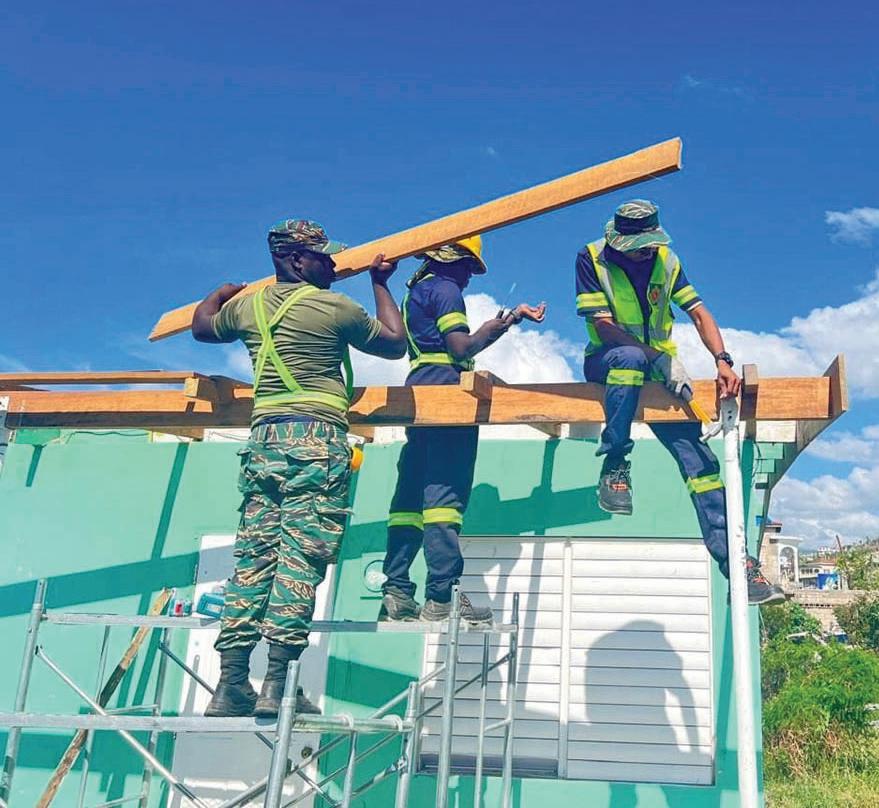
Holness, just over a week ago commended officers from the Guyana Defence Force (GDF) for their professionalism, discipline and tangible impact in the country as it recovers from the natural disaster. A contingent of over 40 members of the GDF’s Engineers Battalion travelled to Jamaica in December 2025 to support post-disaster recovery and reconstruction efforts. PM Phillips went on to assure in his recent update that moving forward, the Guyana Government will continue to invest in disaster risk management, early warning systems and emergency operations to safeguard the lives and livelihoods of people across the country. Citing that a great deal of work lies ahead, the PM stated, “…Through sustained investments in energy security, digital infrastructure, disaster preparedness and human capital development, we are building a resilient, inclusive and prosperous Guyana that will benefit present and future generations.”
Prime Minister, Brigadier (Retired) Mark Phillips
GDF officers assisting in re-roofing homes affected by Hurricane Melissa in Jamaica
James Singh Centre for Innovation, Training and Sustainable Forestry Yarrowkabra Training Centre renamed to honour late Forestry Commissioner
Amajor chapter in Guyana’s forestry history was marked on Friday with the renaming of the Yarrowkabra Training Centre (YTC) in honour of the late James Singh, a former Commissioner of Forests of the Guyana Forestry Commission (GFC), whose work helped shape sustainable forest management
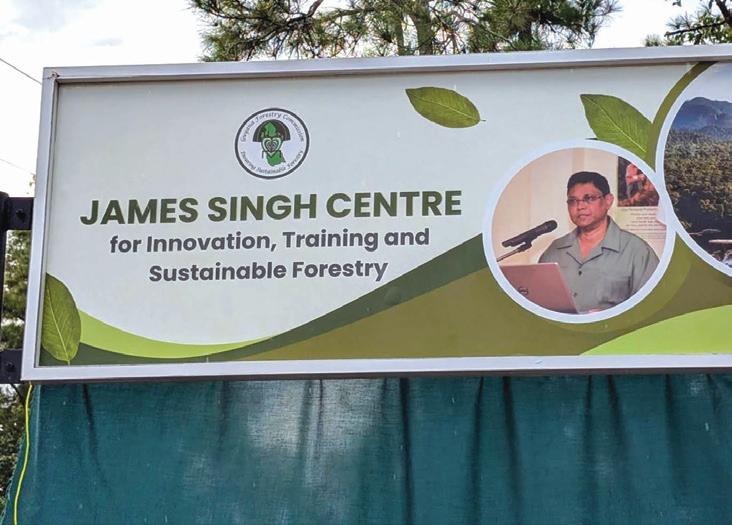
in the country. The facility will hereafter be known as the James Singh Centre for Innovation, Training and Sustainable Forestry, a move that recognises Singh’s decades of dedication and service to the GFC and his role in strengthening forestry training, research and education.
Located at Yarrowkabra, along the Soesdyke-Linden
Highway, the centre has been a cornerstone of forestry development since its establishment in the 1960s. Over the years it has equipped thousands of Guyanese with practical experience, skills and technical knowledge to support sustainable use of forest resources. James Singh, who served the GFC in several senior capac-
ities from 1998 until his passing in June 2025 was deeply and immensely involved in the development and expansion of the training centre. Under his guidance, the facility evolved beyond research to include structured training programmes aimed at building a skilled and disciplined workforce. Speaking at the ceremony, Minister of Natural Resources, Vickram Bharrat said the centre represents the values or professionalism and stewardship that Singh championed throughout his career. He noted that the training provided at the facility has contributed significantly to Guyana maintaining one of the lowest deforestation rates globally, while remaining among the most forested countries in the world.
“This centre has produced generations of foresters who helped shape Guyana into one of the most forested countries in the world, with one of the lowest deforestation rates,” he said.
Also addressing the gathering, Minister within the Ministry of Housing and Water, Vanessa Benn highlighted the centre’s
broader role in national development. She said the institution not only imparts technical skills, but also instils discipline, a sense of service among trainees and responsibility princi-
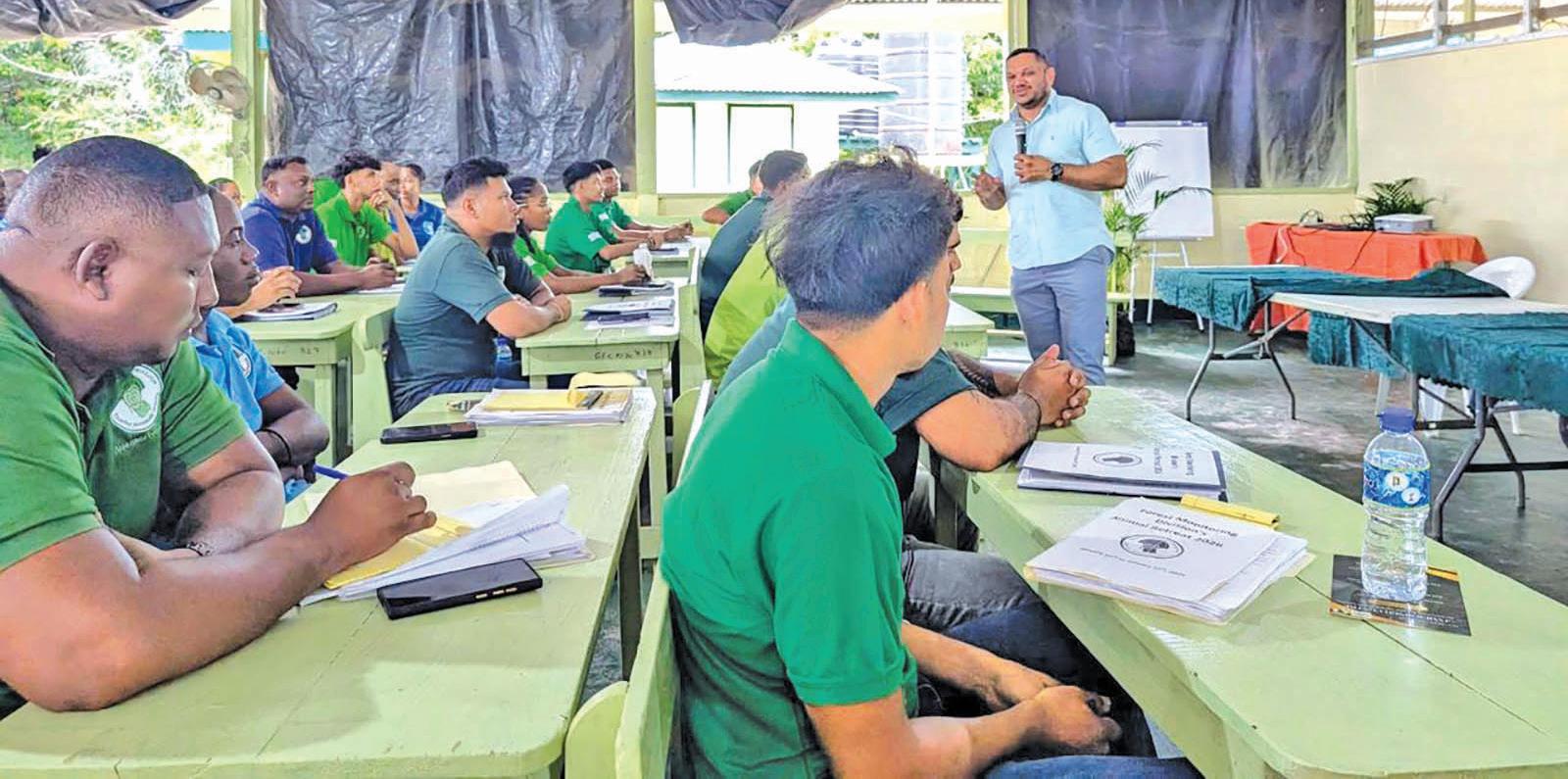
Forestry Commission, who were participating in their annual training retreat from January 2224. The retreat is held for staff of the division to improve their skills, knowl-
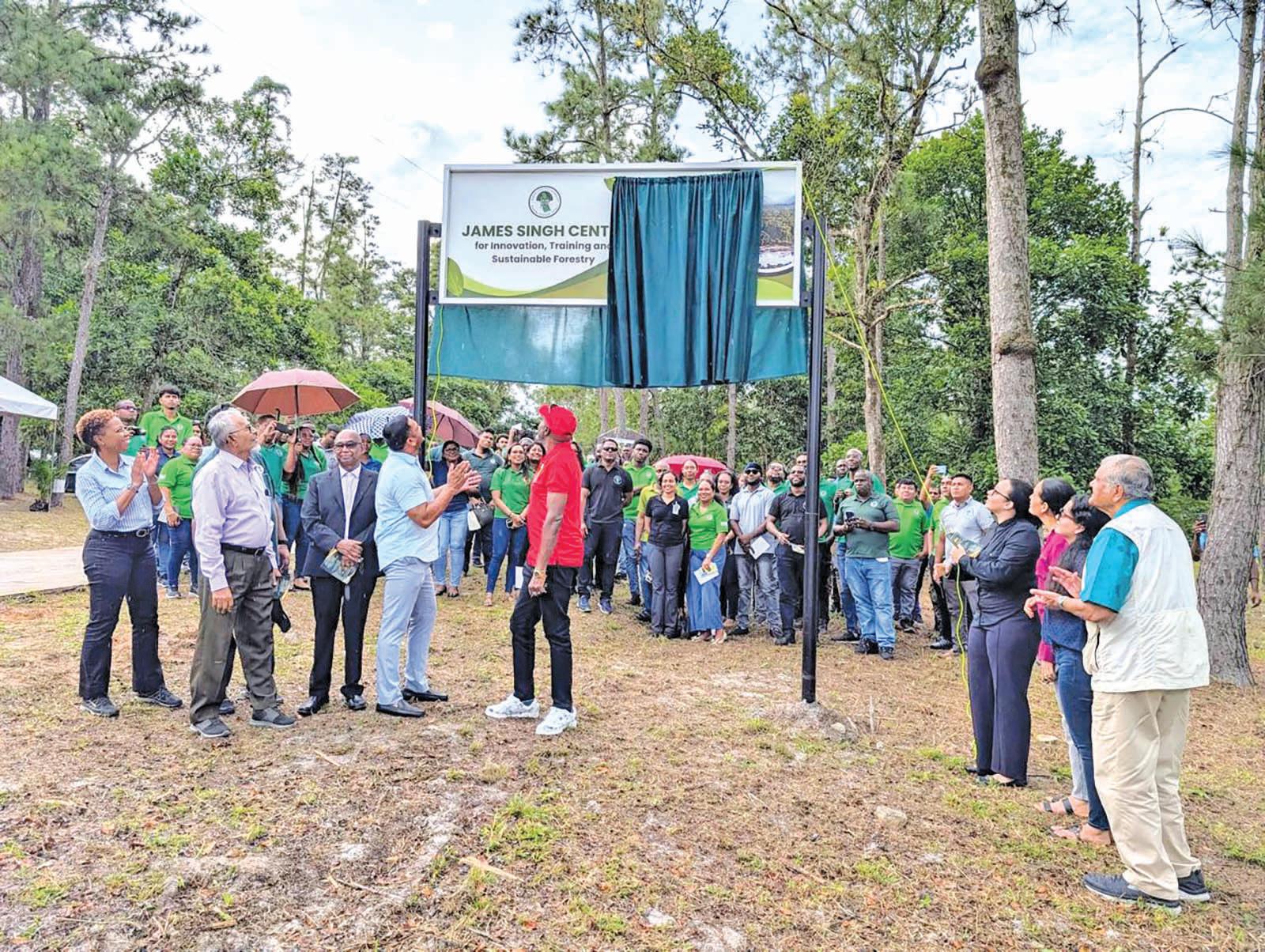
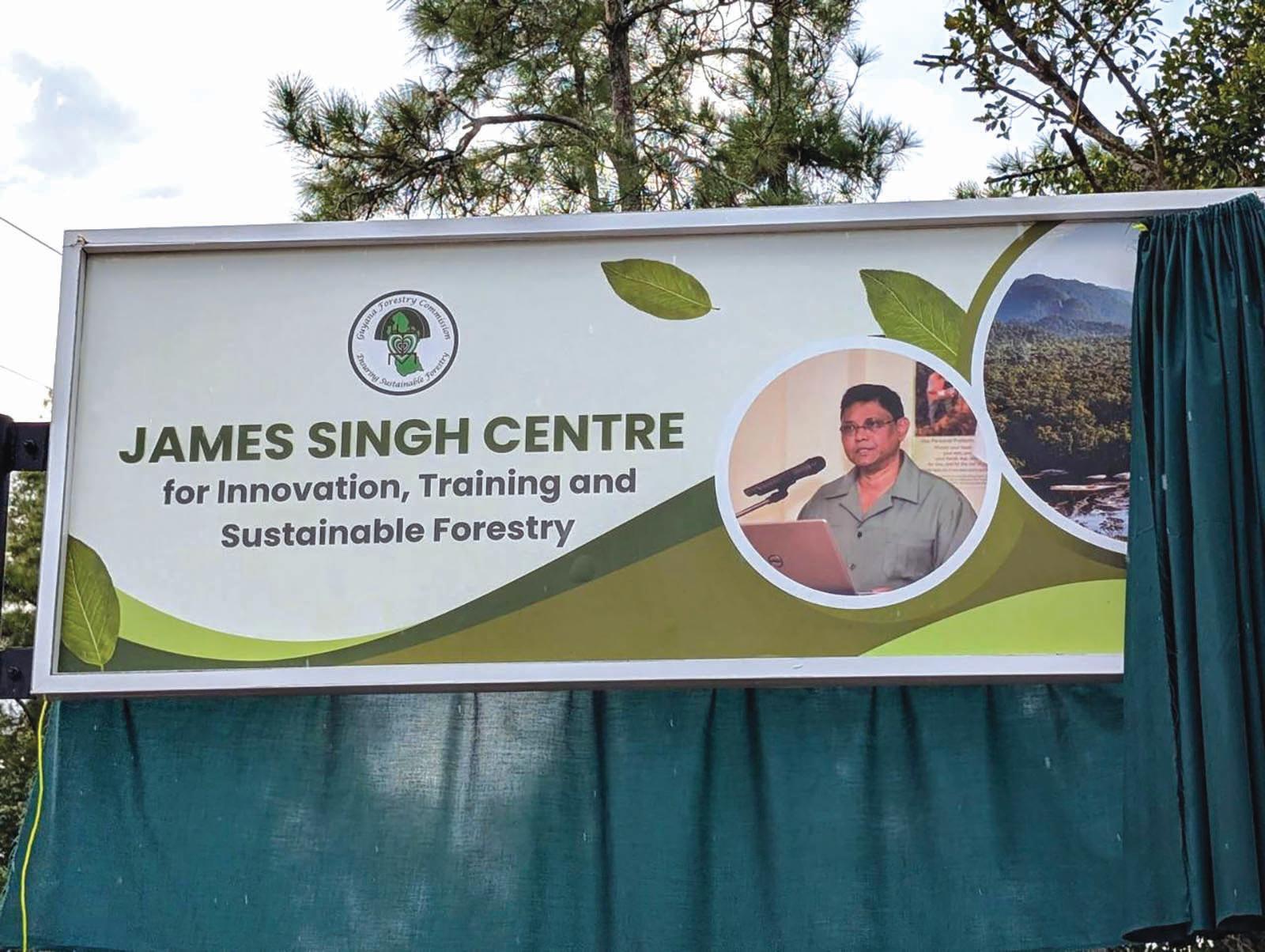
ples that Singh embodied in his leadership. Family members of the late forestry leader were also present at the ceremony, as officials unveiled the new billboard bearing the centre’s new name. Following the renaming of the facility, Minister Vickram Bharrat, engaged with staff of the Forest Monitoring Division (FMD) of the Guyana
edge of the sector and to boost overall camaraderie, the GFC noted. During the engagement, the Minister encouraged the staff to maintain a high standard of professional conduct, while reiterating the importance of the forestry sector to national development and environmental sustainability.
Family members pull back the curtain to reveal the new James Singh Centre for Innovation, Training and Sustainable Forestry at the renaming ceremony as Minister of Natural Resources, Vickram Bharrat and Minister within the Ministry of Housing and Water, Vanessa Benn applaud
Minister Vickram Bharrat engages with staff of the FMD after the event
The billboard bearing the centre’s new name
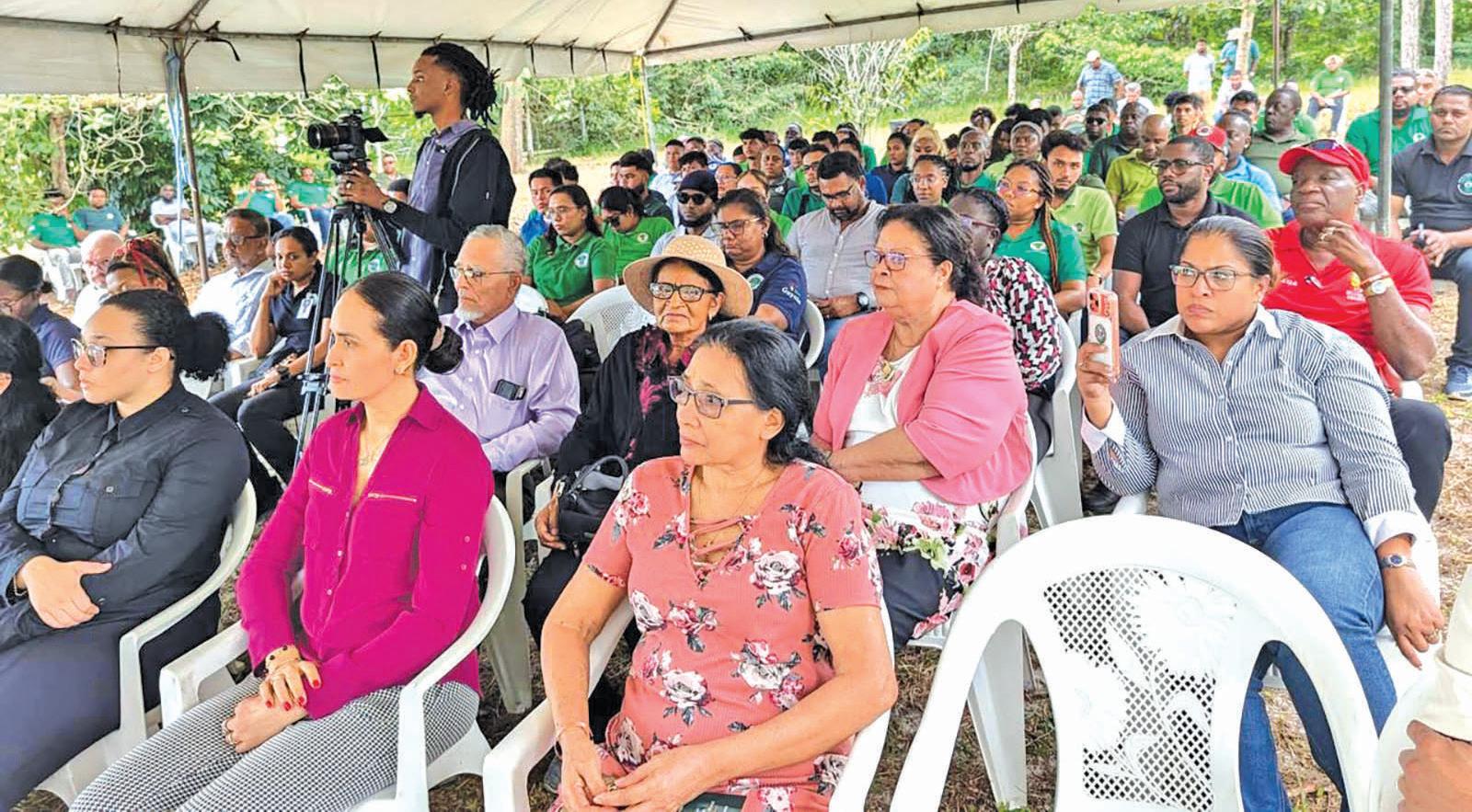
A section of the audience at the occasion
Guyana’s investment climate remains
“very good” – Foreign
Minister
The recent toppling of the Nicolás Maduro regime in neighbouring Venezuela has not impacted the investment climate in Guyana, according to Foreign Affairs and International Cooperation Minister Hugh Todd. Instead, he declared that Guyana continues to be an attractive destination for foreign investments. “I don’t recall that investors were worried. I have not seen the indicators on that. But what I know is that Guyana is a very attractive destination for investment, and you’ve seen all of the evidence of that most recently. The President has been opening hotels for the last four to five weeks and a lot of these investments are foreign direct investments.”
“So, I think the investment climate in Guyana is very good. Exxon and the operators are here. We’re carrying on with our business of governing this country,”
Minister Told recently told reporters on the sidelines of an event in Georgetown, where he was asked whether investors were concerned about the recent developments in the neighbouring Spanish-speaking nation. For decades, Venezuela has deployed a number of aggressive tactics against Guyana, including – as recently as last year, as it continues to lay spurious claims to more than twothirds of Guyana’s landmass – the entire Essequibo region and a portion of the country’s Exclusive Economic Zone (EEZ), where successful oil operations are ongoing offshore by United States (US)based oil giant ExxonMobil and its partners.
On January 3, however, Venezuelan leader Nicolas Maduro and his wife were captured in Caracas by the US military and taken to New York, where they have been indicted on sev-
eral charges. Nevertheless, with the toppling of the Maduro regime, it is anticipated that the aggression from Venezuela will wane – something which the Government of Guyana welcomes. “The President has spoken extensively on ensuring that we protect the people of Guyana, to ensure our resources are protected and to ensure that
everyone can go to bed at night feeling safe, knowing that they can get up the next day and go to work and go about their business. And I think we’ve achieved that. We want to maintain that,” Todd posited. He went on to add that, “The President is actively engaged with his international partners or with our international partners, so
that you can rest assured that he will explore every option available to ensure that Guyana and the people of this country are safe.”
International Court of Justice
Back in March 2018, Guyana had approached the International Court of Justice (ICJ), seeking a final and binding settlement of the 1899 Arbitral Award, which established the boundaries with Venezuela. That matter is still pending before the World Court, but Guyana is confident of a favourable judgment sometime later this year.
In fact, Minister Todd said the recent developments in Caracas are not likely to cause any delays in the case. “You’ve seen the performance of the legal team over the last several years. And I think you are confident also in the team, as we are confident. I think we have a very strong team and we are very focused.
But of course, we have to remain cautious. But we are very confident that we will have a ruling in our favour,” Todd stressed. Moreover, one of Guyana’s agents in the ICJ case, Carl Greenidge, believes that the latest developments in Venezuela could see a reduction in military aggression against Guyana. “The change in the relationship between Venezuela and the US in the immediate future is likely to put on hold Venezuela’s military ambitions towards Guyana because I don’t think they’ll be in a position to realise that,” Greenidge, a former Foreign Affairs Minister, recently told local news agency OilNOW. Currently, Guyana’s legal team is awaiting a date for oral arguments to be heard on the merits of the case before the ICJ deliberates on its final judgement, which will be binding on the two countries.
Mildred Mansfield Youth Club President attacked during interaction with WIN MP – club accuses party members of instigating violence in community
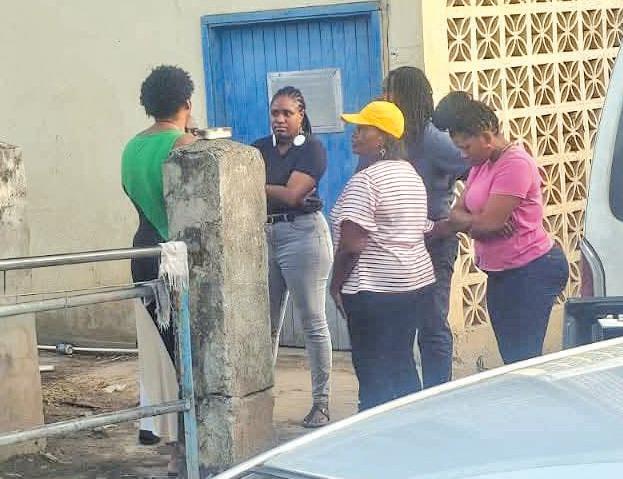
The Mildred Mansfield Youth Club (MMYC) has strongly condemned the assault on its President Andrew Daly during what it described as a “heated and unnecessary” interaction with community members which was instigated by leaders of the We Invest in Nationhood (WIN) party and led by the party’s Member of Parliament (MP), Tabitha Sarabo-Halley. The incident occurred on Saturday in front of the Club, located
on Durban Street, Werken-Rust in Georgetown, where the WIN parliamentarian had gone to engage residents. But according to the MMYC in a statement on Sunday, this attack did not happen in a vacuum. “It was the direct result of rising tensions fuelled and instigated by the leadership of the We Invest in Nationhood Party, who continue to insert themselves into community matters in a reckless and divisive manner. Their repeated interference pro-
motes distrust, inflames emotions and fractures the unity that communities like ours depend on to function peacefully.” “We view this as an irresponsible provocation which resulted in the unfortunate outcome of violence. The Mildred Mansfield Youth Club will not accept or normalise this dangerous behaviour,” the missive detailed. For over 50 years, the MMYC has served as a pillar of youth development, community ser-
vice, discipline and empowerment. The club said it has worked consistently and constructively with Werk-en-Rust and other neighbouring communities to uplift young people, build social cohesion and create opportunities. The MMYC said it hates to see this progress collapse because of “petty politics,
manipulation or division.” Nevertheless, the club stressed that it will not be distracted, intimidated, or derailed by those who see community spaces as platforms for conflict and political disruption. “The MMYC calls on the WIN party leadership to cease and desist from actions that undermine communi-
ty trust and which lead to the creation of hostile environments. The wellbeing and safety of residents, especially young people, must never be sacrificed for attention or political gain,” it posited.
Against this backdrop, the MMYC emphasised its commitment to peace, partnership and progress. It declared that the club will continue to work as it always has, with Werken-Rust and communities across Guyana and will continue to defend the integrity of the MMYC and the safety of those who serve it. “Violence has no place in our community work unless that work is to end the violence and build better relations to ensure the wellbeing of community dwellers,” the MMYC declared in the missive. Meanwhile, the WIN party has denied the accusations in a statement following the incident on Saturday.
“An engagement took place between Mr Daly and us as we sought clarity on the matters reported by the residents of the community. During this exchange, unfortunately, an individual approached the gathering and assaulted Mr Daly. It is important to note that WIN doWes not condone violence in any form,” the party stated.
Foreign Affairs and International Cooperation Minister Hugh Todd
WIN MP Tabitha Sarabo-Halley outside the Mildred Mansfield Youth Club on Saturday
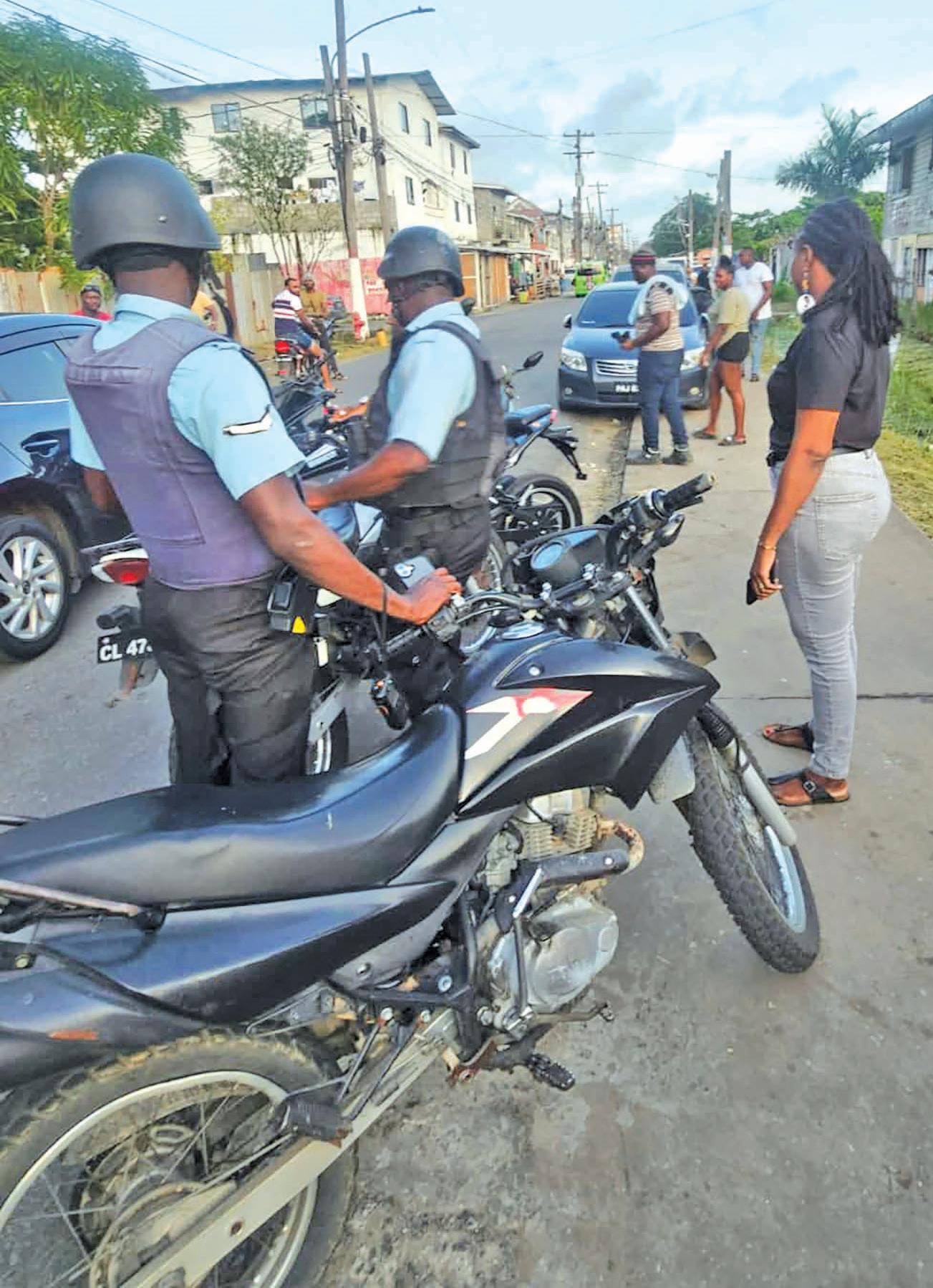
WIN MP Sarabo-Halley with Police Officers after the MMYC President was attacked on Saturday
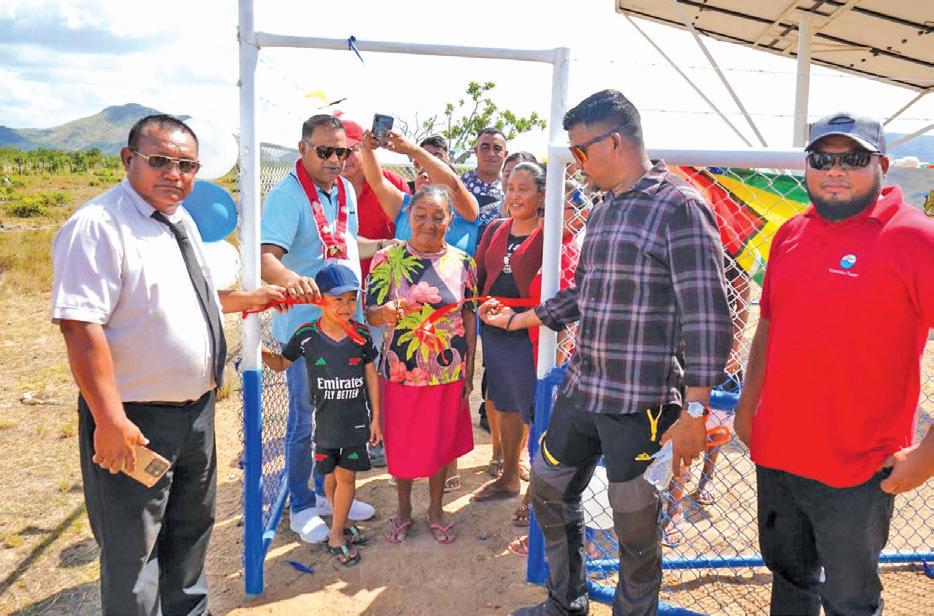
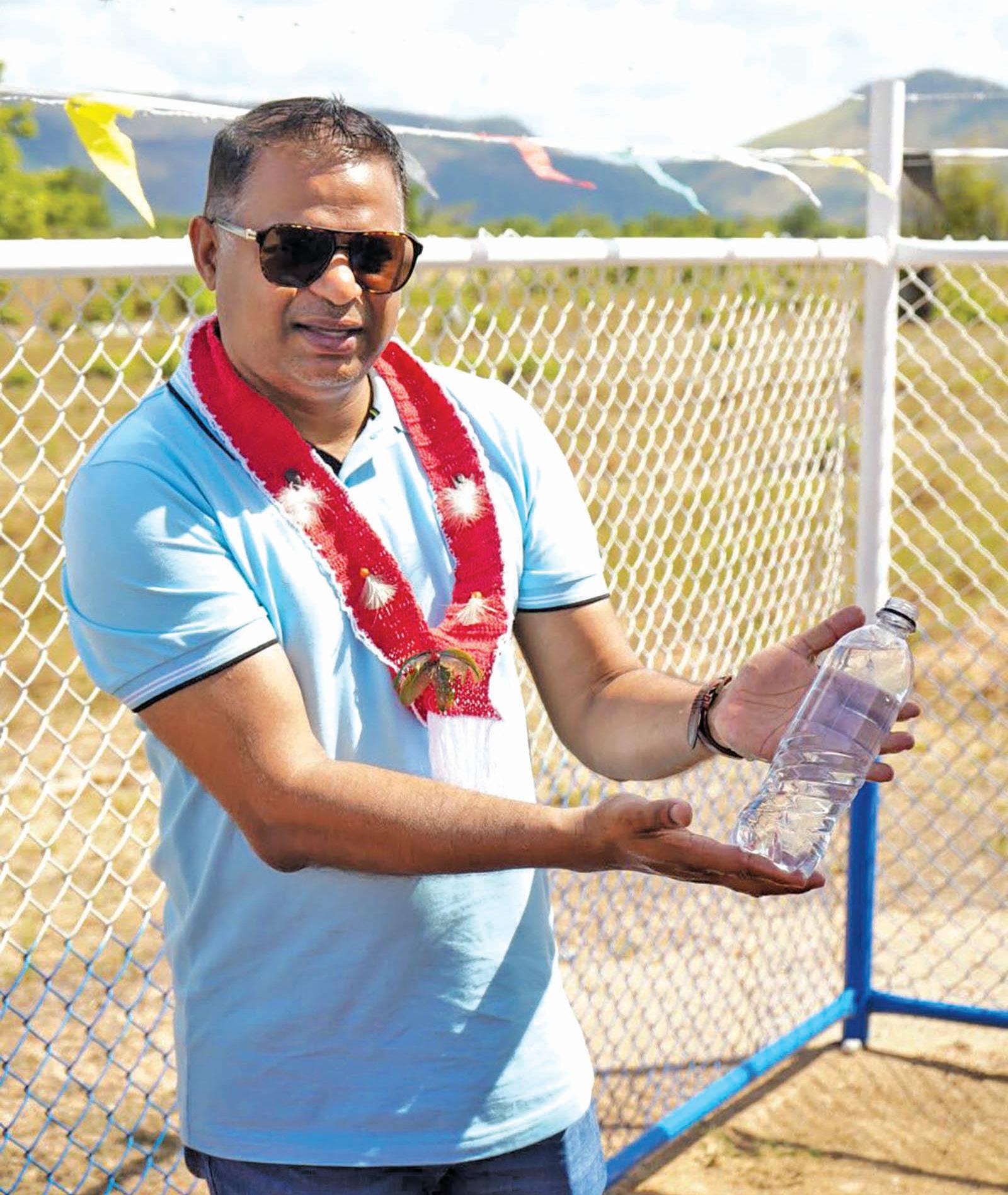
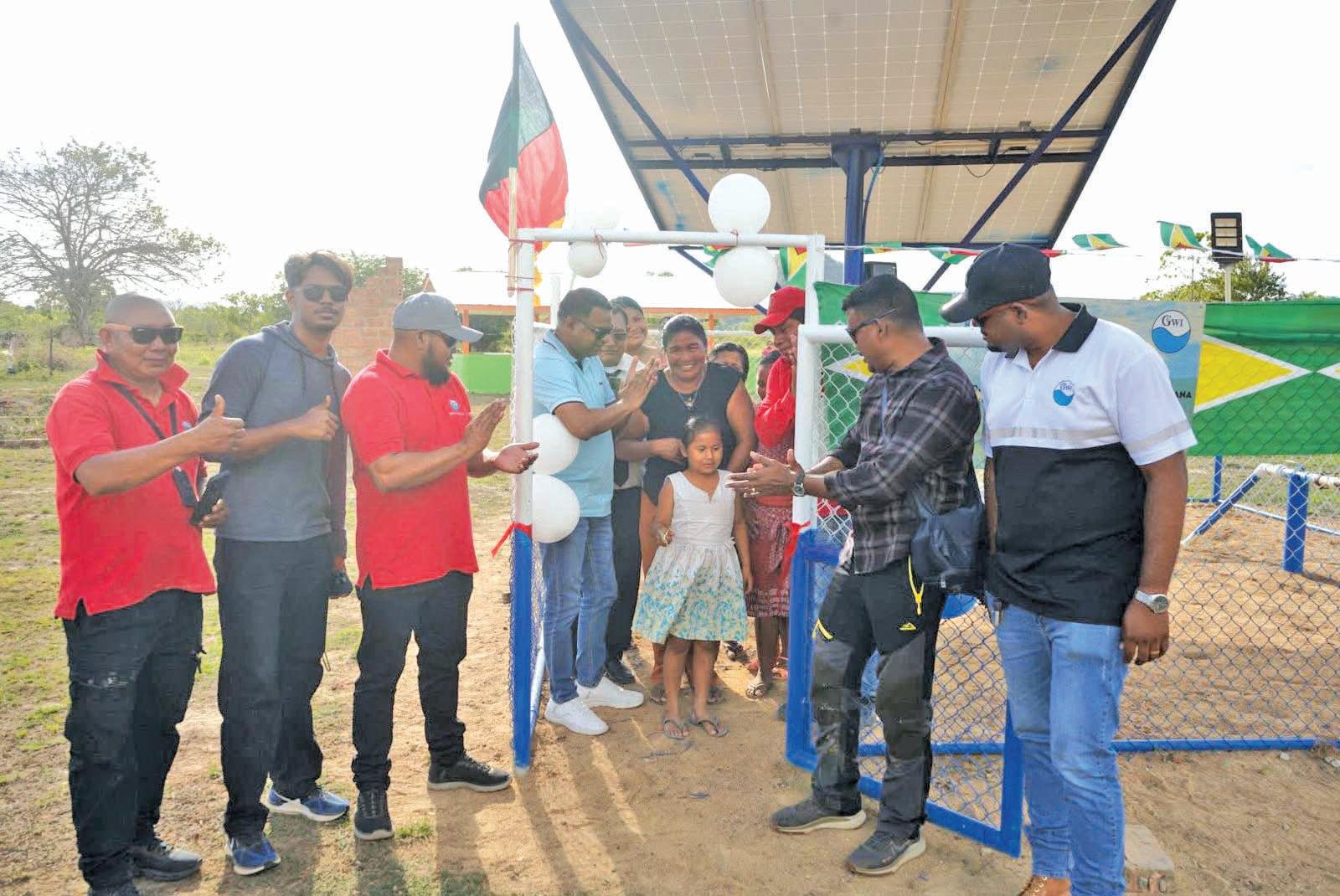
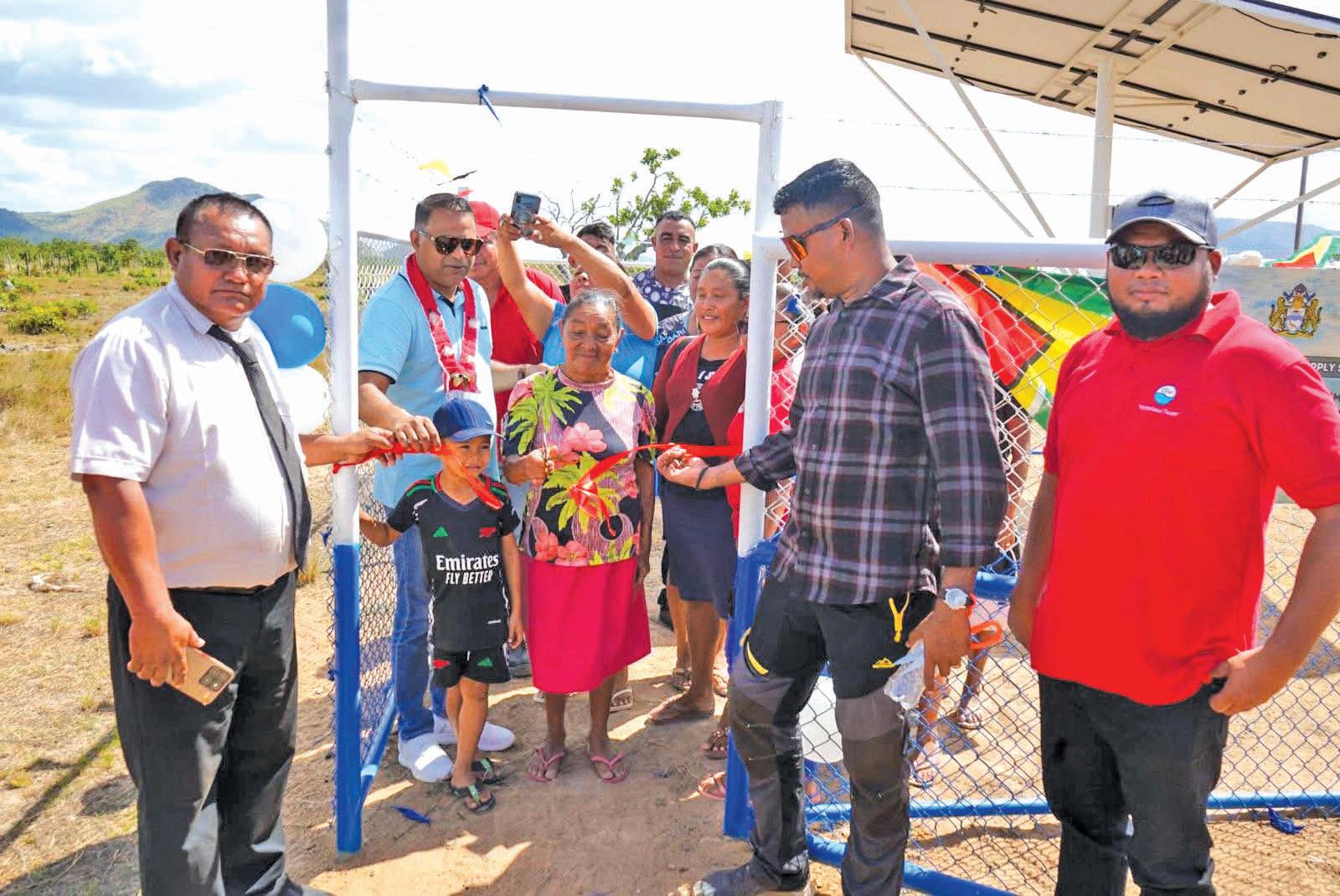
GWI commissions $102M South Pakaraimas water supply systems
– close to 2000 residents to access potable water
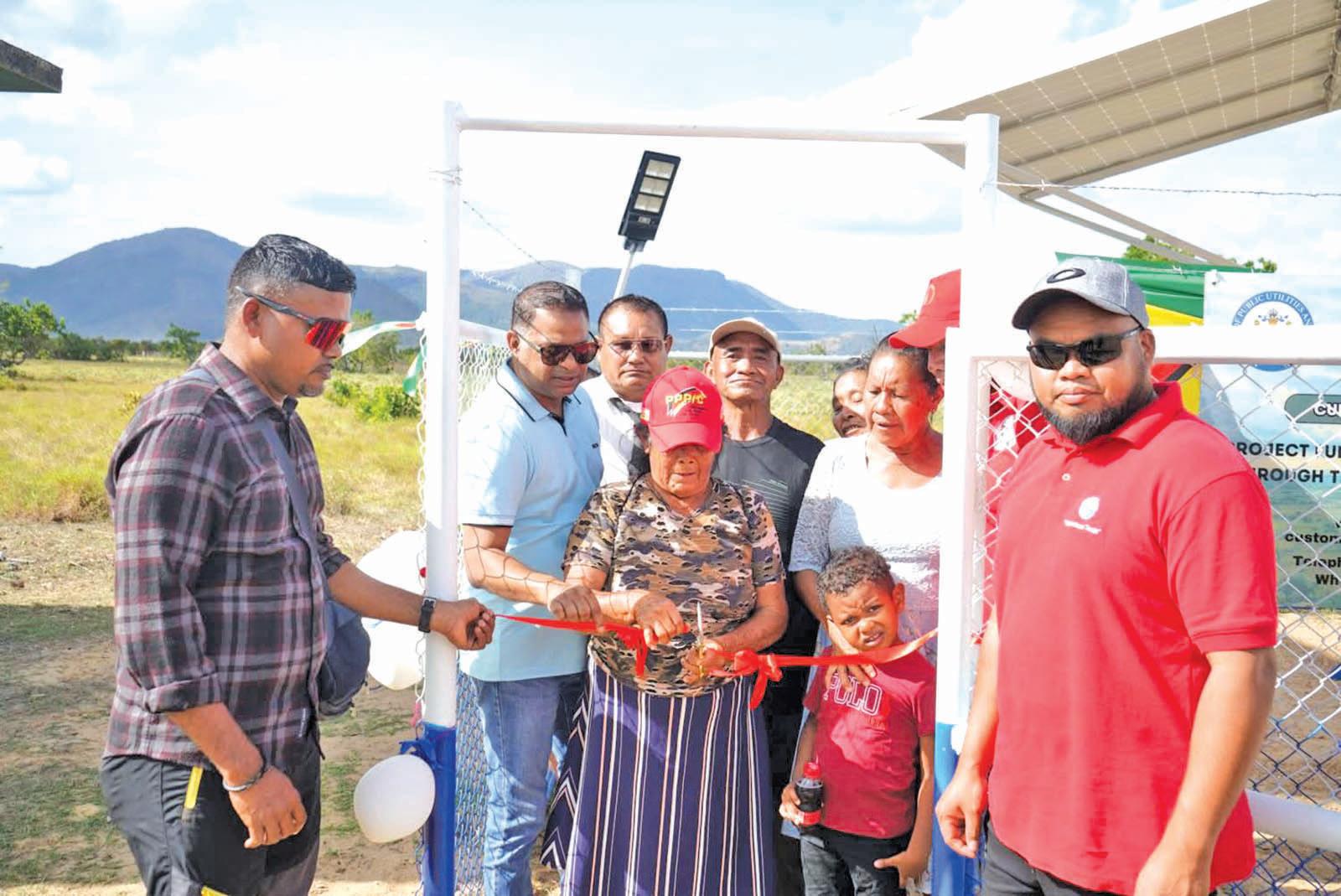
Residents of Karasabai, Curicock, Wichabai and Jawari villages in Region Nine are set to benefit from improved access to potable water following the commissioning of four new water supply systems on Friday. The projects, representing a combined investment of $102 million in hinterland development, have brought near-universal access to safe drinking water to 1,865 residents. The Minister of Public Utilities and Aviation Deodat Indar, led the simple commissioning ceremonies alongside village leaders and technical officials from Guyana Water Incorporated (GWI). He noted that Karasabai now has 98 per cent water coverage, while Jawari, Wichabai and Curicock have each achieved full coverage within their settled areas.
Within Karasabai itself, two new 150-milimetre (mm) PVC wells were drilled in Section two and the Airstrip View area at a cost of approximately $36 million. These facilities, powered by independent photovoltaic (PV) systems and protected by secure perimeter fencing, now serve 127 households.
Minister of Public Utilities and Aviation,
that the investments in the water sector were part of a $30.4 billion investment package delivered to the region during President Dr Irfaan Ali’s first term in office. Indar reminded that the value of this initiative also lies in the local labour used to bring it to fruition.
“We are bringing the people in the community to be part of the execution of the de-
velopment... they are paid, they learn a skill and they become skilful to move that skill to other areas,” he said. He added that the investments in these water systems are a testament to the Government’s commitment to ensuring that no village is left behind in its quest to bridge the gap in water access between the coast and the hinterland. The efforts
3 years’ jail for
who shot at cop
Aaim to ensure that even the most remote indigenous communities have a reliable, year-round water supply. GWI’s Hinterland Services Director, Ramchand Jailal and other technical staff from the water utility company, as well as Regional Vice Chairman, Daniel Aguilar and Toshao David Albert also participated in the commissioning ceremonies.
sawman
In the three satellite villages of Jawari, Wichabai and Curicock, similar wells were drilled and distribution lines installed.
The Minister told residents that the Karasabai water supply projects have delivered near-universal access to potable water, improved public health conditions and strengthened
water security across the sub-district. The interventions by GWI through targeted drilling, system upgrades and expansion into satellite villages have significantly increased coverage in all communities, with near universal access achieved.
Minister Indar underscored
36-year-old sawman was sentenced to three years’ imprisonment after pleading guilty to discharging a loaded firearm with intent at a police constable on the Essequibo Coast. Dhanraj Persaud, also known as Javin or Beer, from Onderneeming Sand Pit, Essequibo Coast, appeared before the Anna Regina Magistrate’s Courts on Friday, before Magistrate Tariq Mohamed. Persaud was charged with discharging a loaded firearm with intent, contrary to Section 55(a) of the Criminal Law (Offences) Act, Chapter 8:01. The of-
fence was committed on Wednesday, October 23, 2024, at Onderneeming Sand Pit and involved Police Constable Ramesh Singh, who is attached to the Suddie Police Station. When the charge was read to the accused, he was not required to plead as the offence is indictable. However, an Application for Summary Disposal (AJA) was made by the prosecution, after which Persaud pleaded guilty. Following his plea, Magistrate Mohamed sentenced him to three years’ imprisonment.
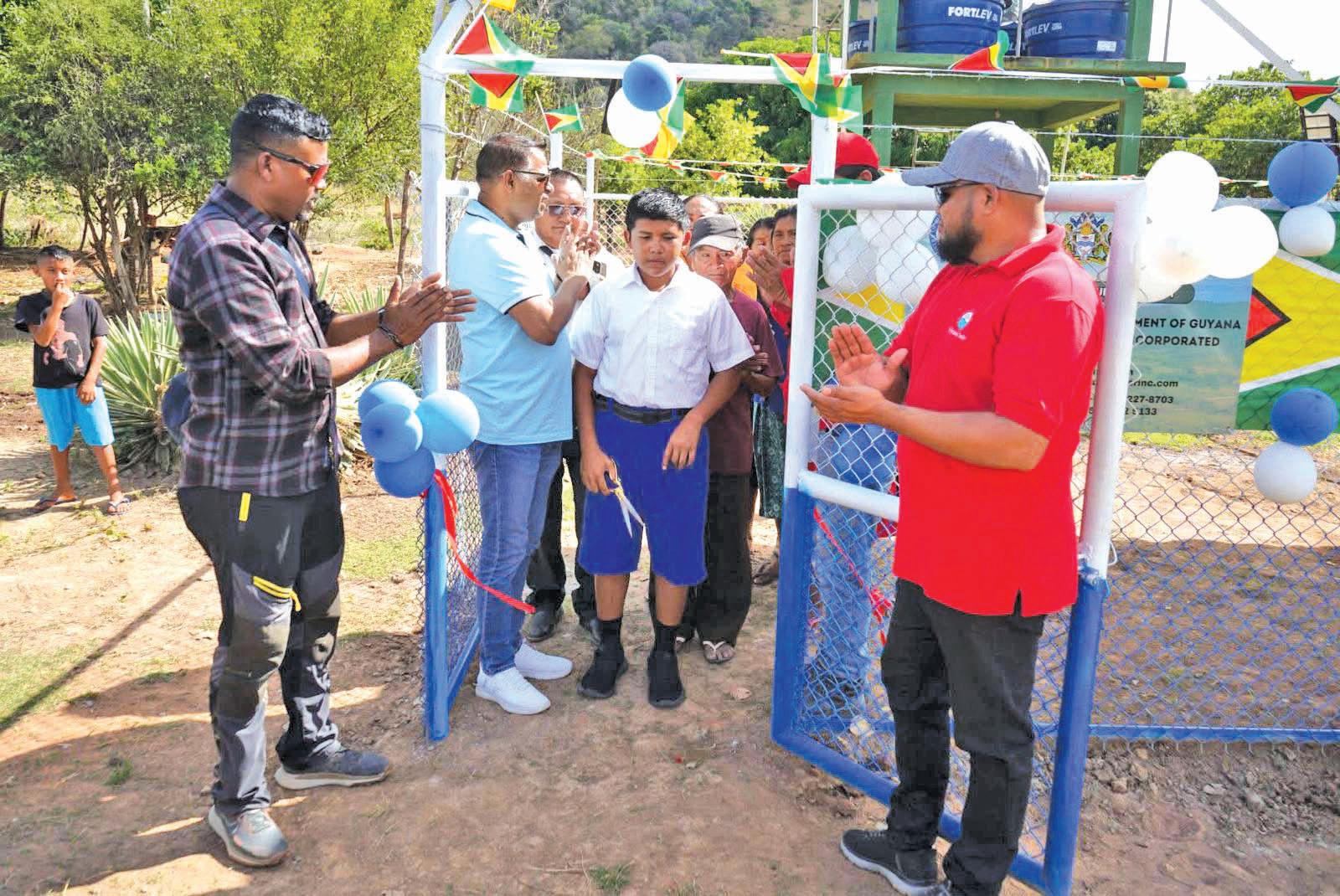
The ribbon cutting ceremony at the four villages
Deodat Indar, displays a bottle of water from a water supply system during the event
Dhanraj Persaud
Bringing the same quality of education to every Guyanese
– MoE highlights role of Guyana Digital School in modernising education
The Ministry of Education said that the Guyana Digital School is playing a critical role in reshaping the way students access learning, as the country continues its transformation into a more technology-driven education system. According to the Ministry, while the traditional “talk and chalk” method has indeed produced some of the nation’s brightest minds and have formed the foundation of education in this part of the world, global changes and national development have made it necessary for the evolu-
Mischka White-Griffith, Chief Planning Officer of the Ministry of Education
tion of education. It was noted that the platform allows educators to engage students in a digital space that they’re used to, making learning accessible and relevant. This approach became especially important during the COVID-19 pandemic where all were forced to transfer to a technological way of living. The pandemic highlighted the need for flexible education systems capable of functioning despite disruptions. Beyond the pandemic-related challenges, the Guyana Digital School serves as a bridge of education from the coastal re-
gion to the hinterland. By placing learning materials online, students in the hinterland will have access to materials of the same quality despite their location. The platform initially focused on providing materials for the fourth and fifth form students, however, the Ministry has revealed that the first and second form students have already begun logging on, demonstrating the strong interest. Plans are underway to make learning materials available for the grade seven to nine students, along with additional features expected to be
rolled out soon. In an interview, Mischka WhiteGriffith, Chief Planning officer of the Ministry of Education, emphasised that while the Ministry is embracing technology, digital learning will not replace the teachers or the traditional classroom. Instead, this initiative is meant to complement face-to-face learning, providing content in multiple formats, catering to different learning styles and increasing student engagement. “If our children are going to be on devices, let them be on the device in a constructive manner while
they can have fun because the material is fun, but it’s also serious. So, they’re learning in the way they’re comfortable while being in that space. That is their new home.”
The Ministry believes that by combining traditional teaching methods with digital tools, students will be prepared for a life beyond school. The ultimate goal, officials say, is to produce a generation of productive citizens equipped to thrive in the modern workforce and contribute meaningfully to Guyana’s growing economy.
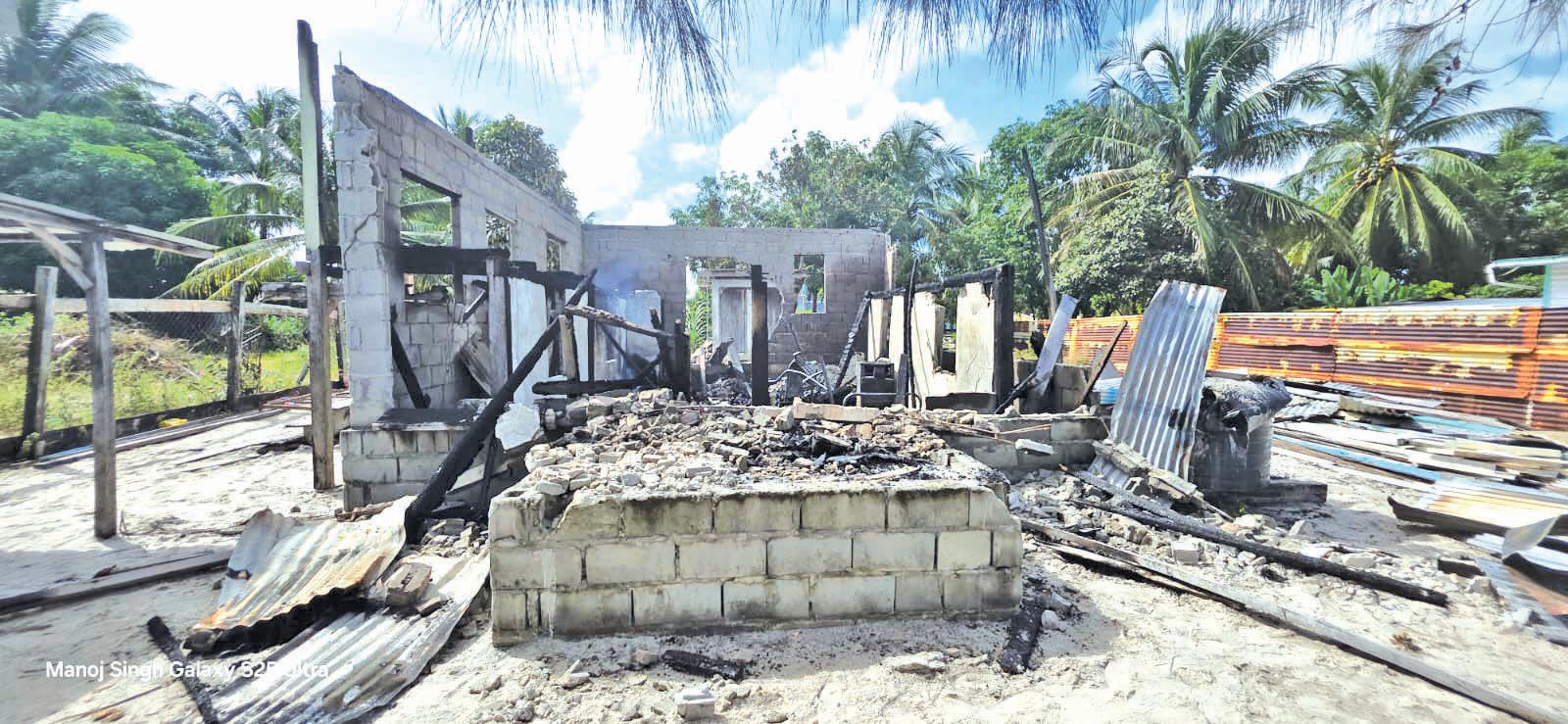
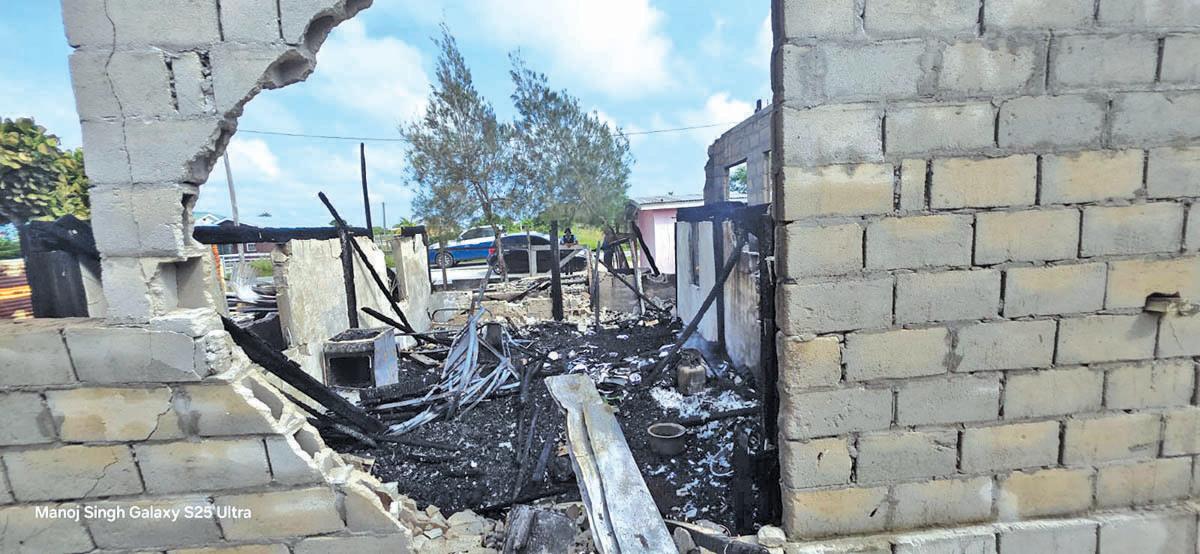
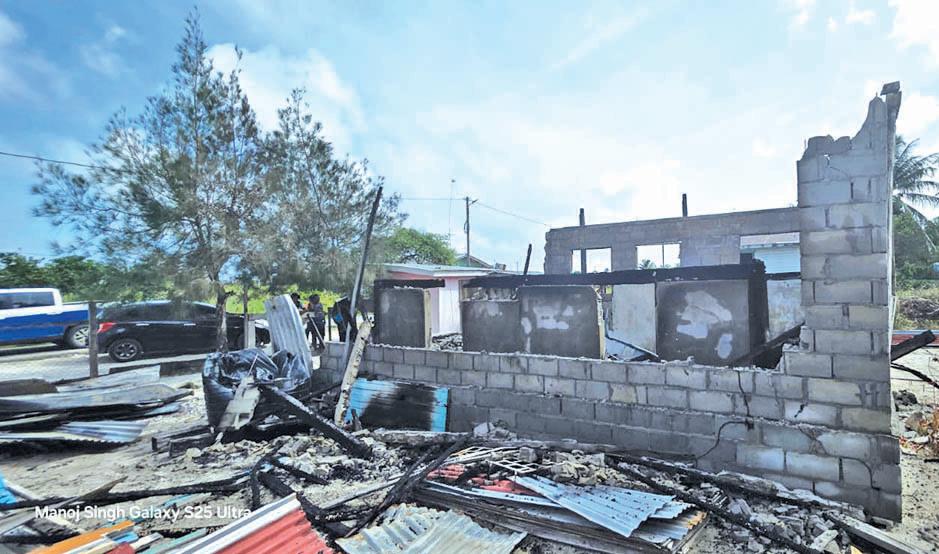
3 homeless as fire destroys Onderneeming home
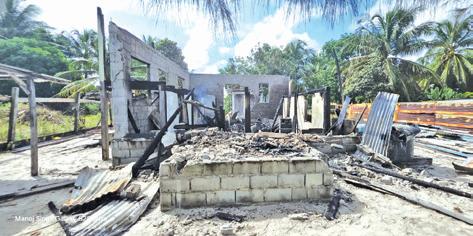
Three persons were left homeless after a fire destroyed a wooden dwelling house at Lot 509 Onderneeming
Sand Pit, Essequibo Coast, on Saturday night. The fire occurred at about 22:30h on Saturday, according to reports and completely
destroyed the one-storey wooden structure, which was painted pink and surrounded by an incomplete concrete building that was
still under construction.
It was reported that the house is owned by Sasha Prince and was being rented by Junior Henry and his wife, Ravina Ramcharran, who resided there with their son.
According to a neighbour, Maria Alphonso, she was at home when she observed fire coming from the front of the house and raised an alarm. Henry later told investigators
that he and his wife had left home at about 22:00h to visit a friend and were informed approximately 30 minutes later that their home was on fire.
The Guyana Fire Service (GFS) responded with Water Tender #125 and Water Bowser #129, led by Section Leader Tirbawan, along with a team of firefighters. By the time fire tenders arrived, the entire structure
was already engulfed in flames. The blaze was eventually extinguished, and no injuries were reported. Ranks of the Guyana Police Force (GPF), Regional Division No. 2, visited the scene at about 23:00h. The matter was reported to the police at approximately 22:50h. The cause of the fire remains unknown and investigations by the GPF and GFS are ongoing.
The aftermath of the fire at Onderneeming Sand Pit
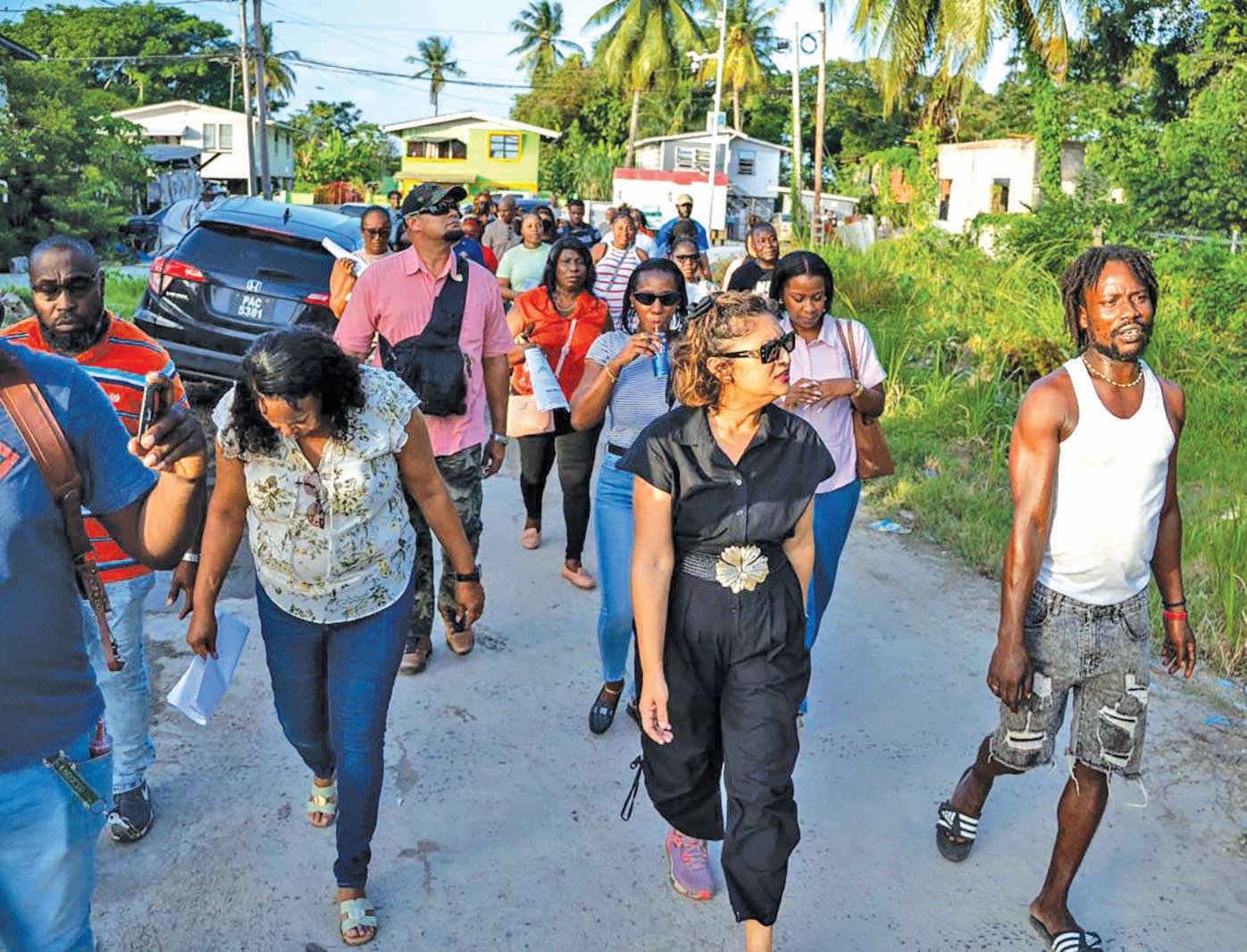
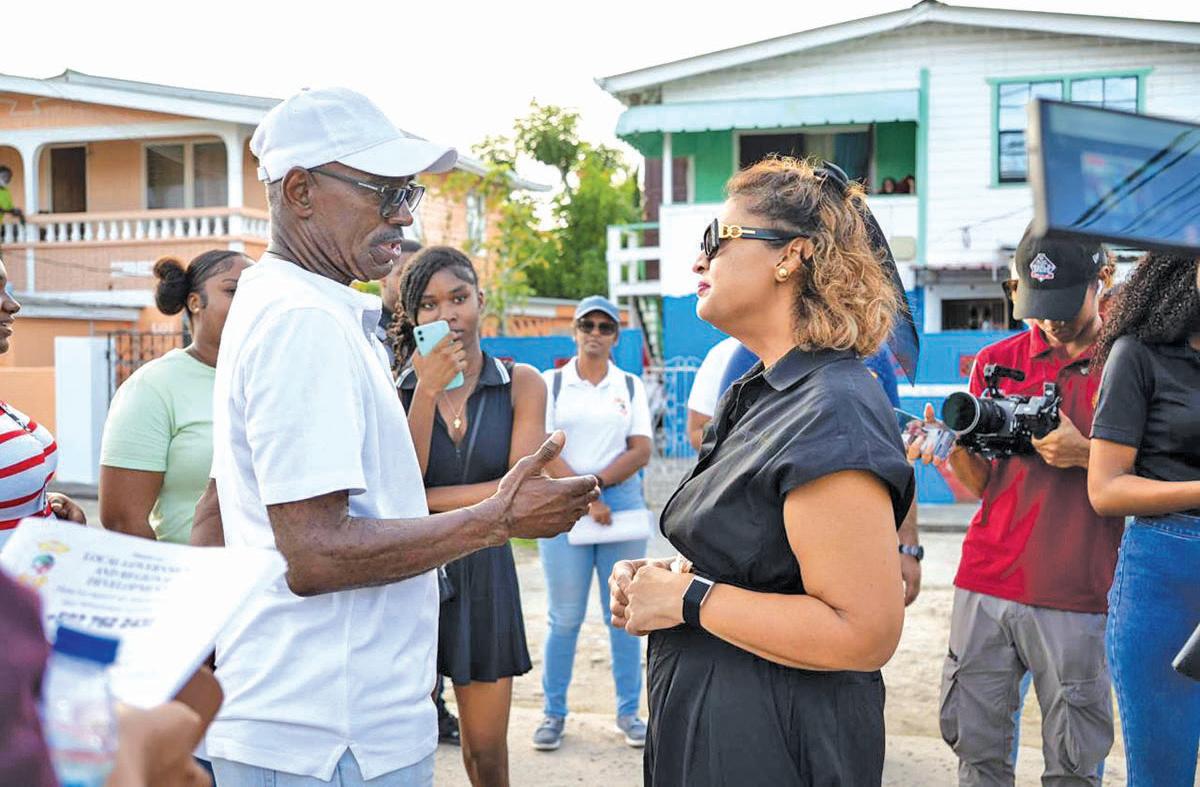
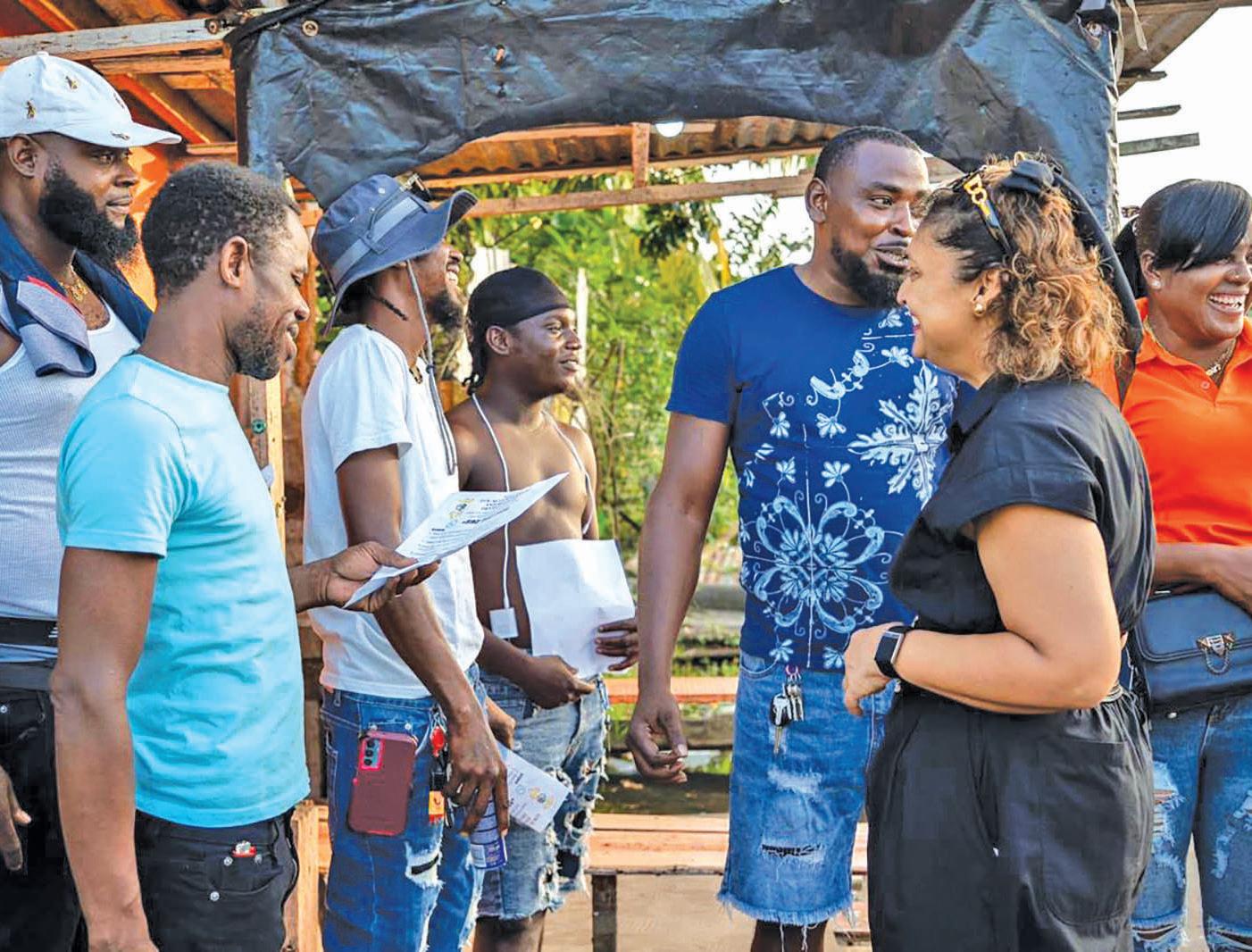
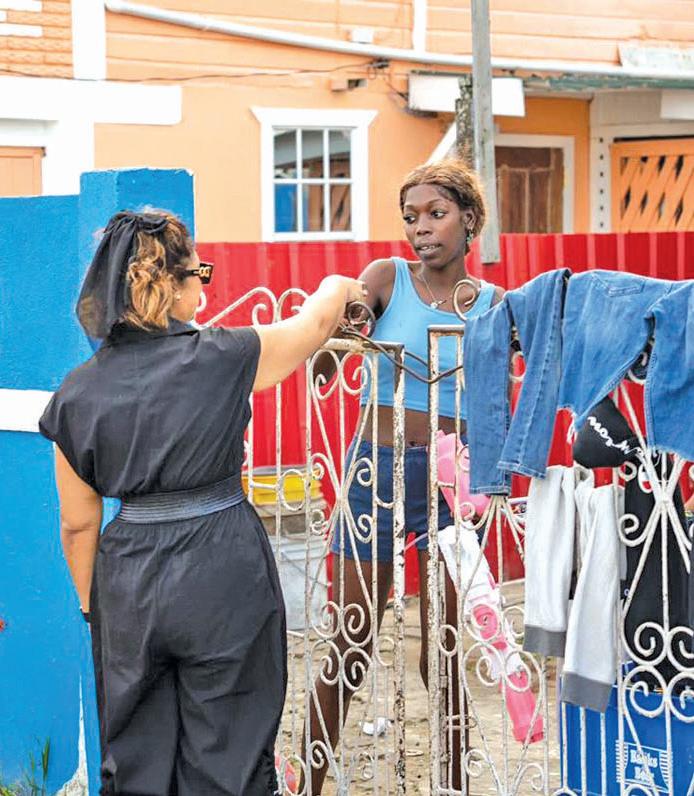
Minister of Local Government continues to promote WhatsApp Help Desk in Festival City, North Ruimveldt
Continuing her community outreach drive, Minister of Local Government and Regional Development, Priya Manickchand, visited Festival City, North Ruimveldt, to promote the Ministry’s WhatsApp Help Desk. This initiative aims to strengthen communication between citizens and the Ministry, providing a
direct platform for reporting local issues, such as drainage, sanitation, road maintenance and street lighting. Residents were encouraged to use the Help Desk in order to ensure faster responses and improved monitoring of service delivery. During her visit Manickchand engaged with residents, listening to their concerns and high-
lighting the role of citizen participation in enhancing local governance. She expressed that the Help Desk is not just a complaints mechanism: it is a tool for accountability and partnership. Minister Manickchand explained that the platform allows for quicker responses, better coordination with regional and neighbourhood
–says Caricom operates by consensus
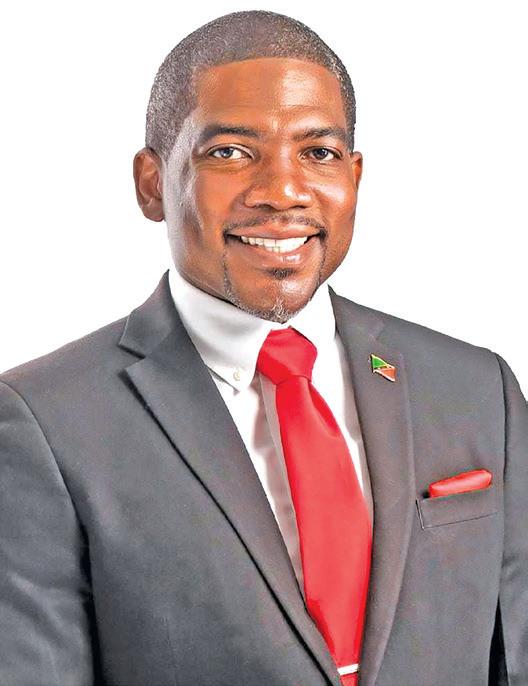
Caricom chair and St Kitts and Nevis
Prime Minister (PM) Dr Terrance Drew has defended Caricom’s initial response to reports of Maduro’s arrest following a United States (US) military operation in which at least 75 people were reportedly killed. The Caricom Bureau convened an urgent meeting involving Jamaica, St Kitts and Nevis and St Lucia, later issuing a statement reaffirming the bloc’s commitment to “the fundamental principles of international law and multilateralism enshrined in the UN (United Nations) Charter, includ-
ing sovereignty and territorial integrity of States and respect for human dignity.” Notably, the statement stopped short of explicitly declaring the operation a breach of international law, instead reiterating calls for peaceful dialogue through diplomatic channels to safeguard Venezuela’s stability, democracy and prosperity. The bloc also signalled its willingness to support such efforts. That cautious tone drew sharp criticism from former St Vincent and the Grenadines PM Dr Ralph Gonsalves, now opposition leader, who described the response as inadequate.
In an exclusive interview
with Guardian Media, Drew stood firm, stressing that Caricom operates by consensus.
“I will say clearly, I am not the Prime Minister of Caricom, I’m not the President of Caricom. I am the Chair of Caricom, who at this time coordinates and helps to reach consensus as part of how we function. And therefore, that statement is a statement that was reached by consensus. And I stand by the consensus position of Caricom at this particular time.” Asked whether Caricom harbours concerns about US interference in the internal affairs of states, particularly elections, Drew
democratic councils (NDCs) and improved monitoring of service delivery across communities.
The Minister conducted a walk through sections of Festival City, examining vacant parcels of land that could be transformed into playgrounds and recreational spaces for children and youth. She noted that structured recreational facilities contribute to community development, youth engagement and social cohesion. Minister Manickchand reaffirmed the Ministry’s commitment to people-centred development and said efforts are being made to promote the WhatsApp Help Desk and explore community spaces nationwide. Minister Manickchand reaffirmed the Ministry of Local Government and Regional Development’s commitment to sustained community engagement, responsive governance and people-centred development, noting that initiatives such as the WhatsApp Help Desk and the exploration of commu-
nity recreational spaces are critical to improving service delivery and enhancing the quality of life for citizens. Residents are encouraged to utilise the Ministry’s WhatsApp Help Desk, which can be accessed via +592 762 2431. The Ministry will continue its sensitisation efforts in communities across the country as it works to strengthen communication, build trust and ensure that the voices of residents remain central to local Government decision-making.
said the issue has not arisen at the regional level. “From a Caricom perspective, that has not been discussed, that has not been brought up, but Caricom is always of the position that democracy should be promoted, should be strengthened, should be assisted where possible. So, I would say the Caricom position would always be that, we would like to see democratic Governments in countries. That’s one of our principles. However, we adhere to the principle as Caricom of non-interference.” Amid rising rhetoric and strained diplomacy, some observers have raised the spectre of a Brexit-style rupture with-
in Caricom. Drew dismissed the notion, saying he is not aware of any member state seeking to withdraw.
His comments come as an attempt to steady a bloc rattled by Persad-Bissessar’s remarks, which drew public rebuke from Antigua and Barbuda PM Gaston Browne. Browne argued that Trinidad and Tobago has benefited disproportionately from regional trade arrangements; a point that continues to seethe within smaller economies.
Drew said the bloc’s economic, trade and institutional benefits remain far greater than its flaws, and urged leaders to see the cur-
rent tensions as an opportunity for renewal rather than retreat.
“Am I worried that there’s a country, a nation who at this time would want to pull out? I am not privy to that information and I frankly don’t think so at this particular time.”
“So I would say that at this time nobody is threatening to leave Caricom and while Caricom is not perfect, I want all of us to reflect on how much we benefit from Caricom and sometimes we benefit and we don’t even recognise that we are benefiting from Caricom.”
(Source: Trinidad & Tobago Guardian)
Local Government and Regional Development Minister Priya Manickchand interacts with members of the community during the outreach in North Ruimveldt
By Dr Tariq Jagnarine
Understanding obesity
Obesity is not just about appearance or body size. It is a medical condition where a person has excess body fat that places serious strain on the heart, blood vessels, joints, and internal organs.
In Guyana, obesity is increasing rapidly and affecting both adults and children, often without people recognising it as a health threat.
Many Guyanese see weight gain as a normal part of ageing or a sign
HEALTH TIPS Obesity – A growing health emergency
Obesity is no longer a personal issue; it is a national health concern affecting productivity, healthcare costs, and quality of life.
What health workers are seeing
Doctors and nurses across the country increasingly care for patients in their 30s and 40s with conditions once seen mainly in older adults. These include diabetes requiring medication, high blood pressure needing multiple drugs, joint problems limiting movement, and breathing difficulties during sleep.
In many cases, people are shocked to learn that their weight is contributing directly to their illness. Some only make the connection after suffering a heart attack, stroke, or serious complication. By then, weight-related damage has already taken a toll on the body.
Causes of obesity
Obesity develops when the body takes in more en-
of good living. Others believe that being “thick” or “solid” means strength. Unfortunately, excess weight is closely linked to many of the most dangerous diseases affecting our population today.
Why obesity is a serious problem in Guyana
Obesity is one of the main drivers behind the rise in diabetes, high blood pressure, heart disease, stroke, and certain cancers. It also worsens existing health conditions and makes treatment more difficult.
Health facilities across Guyana are seeing more people developing chronic diseases at younger ages. Many of these conditions share one common factor: excess body weight, especially around the waist.
ergy from food and drinks than it uses through daily activity. Over time, this excess energy is stored as fat. In Guyana, several factors contribute to this imbalance.
Diet plays a major role. Frequent consumption of sugary drinks, sweet snacks, fried foods, large portions of refined carbohydrates, and highly processed foods increases calorie intake while offering little nutritional value.
Physical inactivity is another major factor, especially as more people work long hours sitting and have little time for exercise. Stress, poor sleep, and emotional eating also contribute to weight gain.
Who is most at risk
Although anyone can
become overweight, certain groups are more vulnerable. Adults over the age of thirty are at higher risk, particularly those with sedentary lifestyles. People with a family history of obesity, diabetes, or high blood pressure are more likely to gain excess weight. Children and adolescents are also increasingly affected, especially when exposed to unhealthy foods and limited physical activity from an early age.
Women who gain excessive weight during pregnancy and do not lose it afterward may also face increased long-term risk. Importantly, obesity can occur even in people who appear active or strong, especially if excess weight is concentrated around the abdomen.
Signs that excess weight is affecting your health
Obesity often develops gradually, making it easy to overlook. Some warning signs include increasing waist size, shortness of breath with mild activity, joint pain, fatigue, and difficulty sleeping. Many people also develop related conditions such as high blood pressure, elevated blood sugar, or high cholesterol without obvious symptoms.
Because these changes happen slowly, people may adjust their lifestyle rather than recognise a health problem. This is why regular check-ups are essential.
How obesity is assessed
Health workers assess obesity using simple measurements such as body weight, height, and waist circumference. These measurements help determine
whether a person’s weight places them at increased risk of disease. A large waist size, in particular, is a strong warning sign of dangerous fat around the internal organs.
Assessment also includes checking blood pressure, blood sugar, and cholesterol, as obesity often affects these systems together.
depression, and social isolation. In severe cases, it reduces life expectancy and quality of life.
Managing obesity: What can be done
Obesity can be managed, and even modest weight loss can bring major health benefits. Treatment usually begins with lifestyle changes, including healthier eating,
most effective approach. Healthy habits should begin early in life and continue through adulthood. Choosing home-cooked meals more often, limiting sugary drinks, staying physically active, and getting enough sleep all reduce the risk of excess weight gain.
Families play a critical role by modelling healthy behaviours and encouraging children to be active. Communities and workplaces can also support healthier choices by promoting physical activity and access to nutritious foods.
A message to parents and families
Childhood obesity is becoming increasingly common and sets the stage for lifelong health problems. Encouraging active play, limiting screen time, and offering healthier meals can protect children’s future health. What children learn at home often shapes their habits for life.
Obesity is not about
Health complications linked to obesity
Obesity significantly increases the risk of serious health complications. These include type 2 diabetes, high blood pressure, heart disease, stroke, kidney disease, and certain cancers such as breast and colon cancer. Excess weight also places stress on the joints, leading to chronic back pain and arthritis.
Obesity can affect mental health as well, contributing to low self-esteem,
increased physical activity, and behaviour change. Small, realistic changes such as reducing sugary drinks, controlling portion sizes, and walking regularly can lead to meaningful improvement over time.
Some individuals may need additional support, including medical advice, counselling, or medication. Seeking help early improves success and reduces complications.
Preventing obesity
Prevention is the
blame or shame. It is about health, well-being, and the future of our nation. Excess weight increases the risk of many serious diseases, but these risks can be reduced through awareness, early action, and support.
Do not wait until diabetes, high blood pressure, or heart disease force change. Small steps taken today can prevent major illness tomorrow.
A healthier Guyana starts with healthier choices, one person, one family, one community at a time.
Caricom Chairman: No reason to suspect T&T complicit in Maduro’s capture
Caricom chair and St Kitts and Nevis
Prime Minister Dr Terrance Drew has moved to rubbish claims of regional suspicion, insisting there is no suggestion within the bloc that T&T was complicit in Venezuela President Nicolas Maduro’s detention by the US on January 3.
In an exclusive interview with Guardian Media, Drew said T&T remains an important Caricom member and that no accusations have been levelled against it by fellow states.
“I can say that that has not been a question that has arisen for discussion among the bloc,” he said.
T&T’s Foreign and Caricom Affairs Minister Sean Sobers and Defence Minister Wayne Sturge were adamant that T&T played no role in the US op-
Dr Terrance
and Nevis
eration to capture Maduro.
Since the United States operation that led to the arrest of Venezuela’s ousted president, Nicolás Maduro, Trinidad and Tobago has found itself standing apart from much of the Caribbean.
The Government’s public praise for the United
States military action against illegal drug running in the Southern Caribbean and Venezuela — an action many international relations experts have questioned — has fuelled fresh questions about T&T’s place within a fractured regional bloc strained by diplomatic tension.
Those questions have sharpened in the wake of Prime Minister Kamla Persad-Bissessar’s description of Caricom as an “unreliable partner”, a remark that reverberated across the region.
Against that backdrop, speculation mounted over whether T&T’s position on Venezuela had placed it at odds with its Caribbean neighbours — or worse, whether it had quietly crossed a red line.
(Source Trinidad & Tobago Guardian)
Venezuela frees dozens of political prisoners, human rights group says
Aleading Venezuelan human rights group says at least 80 political prisoners have been released under pressure from the US.
Alfredo Romero, head of Foro Penal, said his group was verifying the identities of those freed from prisons across the country on Saturday – and more releases were likely to take place.
It is the latest batch of detainees released since the US seized Venezuelan President Nicolás Maduro in a raid, and took him to New York to stand trial on drug-trafficking charges earlier this month.
On Friday Venezuela’s interim President Delcy
Rodriguez said more than 600 prisoners had been freed – but Foro Penal says this figure has been inflated. Romero announced the releases on social media. In a post on X, Foro Penal lawyer Gonzalo Himiob said the number of releases could rise above 80 “as we proceed with verification”.
Previously, Foro Penal said that many of those freed in recent weeks have not had the charges against them dropped.
This has left them in legal limbo and they have been barred from speaking in public, the group said.
Before this weekend’s developments, the group had confirmed the release
of just 156 political prisoners since 8 January. Some domestic opposition figures and at least five Spanish nationals are among those confirmed to have been freed so far.
Human rights groups and activists have long accused the government of using detentions to muzzle critics. The Venezuelan government has denied holding political prisoners, insisting they were arrested for criminal activity.
Many were detained after the 2024 presidential election, when Maduro claimed victory despite opponents and many countries disputing the results.
(Excerpt from BBC)
US Treasury sanctions one of Caribbean’s largest narcotics traffickers, network
The US Department of the Treasury’s Office of Foreign Assets Control (OFAC) on Thursday designated five Costa Rican nationals and five Costa Rica-based entities for their involvement in narcotics trafficking and money laundering.
Luis Manuel Picado Grijalba, known as “Shock,” and Jordie Kevin Picado Grijalba, alias Noni, identified as leaders of the South Caribbean Cartel, were sanctioned the OFAC of the U.S. Treasury Department. According to a Department of the Treasury press release, the network is responsible for transporting multi-ton quantities of co-
caine from Colombia, storing the drugs in Costa Rica, and ultimately shipping them to the United States and Europe. Luis Manuel Picado Grijalba, the leader of this network, it added, is one of the most prolific drug traffickers operating in the Caribbean.
The sanctions also include Estefanía McDonald Rodríguez, Shock’s wife, and her mother, Anita Yorleny McDonald Rodríguez, a former director of the Costa Rican Institute of Fisheries and Aquaculture (Incopesca) and allegedly in charge of logistical tasks within the drug group.
OFAC added Tonny Alexander Peña Russell,
alias “La T”, to the list, identified as the alleged armed wing of the cartel and described as the head of the group of hitmen working for Shock.
All of these people remain in custody, with the exception of Estefanía, who traveled to London, England in early 2025 and is now on the run.
Shock was arrested in the UK December 2024, and is currently being held pending a final decision on extradition to the United States. In August 2025, Noni was arrested in Costa Rica and is also being held pending a final decision on extradition to the United States.
Cuban official accuses US of ‘piracy’ against sanctioned Caribbean island
ACuban diplomat has accused the United States of “international piracy”, as Washington continues to block Venezuelan oil from reaching the Caribbean island in the wake of the US military attack on the nation and abduction of President Nicolas Maduro.
Carlos de Cespedes, Cuba’s ambassador to Colombia, told Al Jazeera on Saturday that the US is imposing a “marine siege” on the country.
“Cuba is facing more powerful US threats than it has in the 67 years since the revolution,” de Cespedes said, referring to decades of punishing sanctions and military threats.
“The US is carrying out international piracy in the Caribbean Sea that is restricting and blocking the arrival of oil to Cuba.”
Since US forces abducted Venezuela’s Maduro earlier this month, the flow of oil from the country to Cuba has all but come to a halt.
Venezuela has been the main oil supplier to Cuba in recent decades.
US President Donald
Trump said earlier this month that there would be “zero” Venezuelan oil headed to Cuba now that Washington is exerting its influence over Caracas under the threat of further military strikes.
The US has also been intercepting and seizing Venezuelan oil tankers in the Caribbean – a move that critics say amounts to piracy.
Cuba had close trade and security relations with Maduro’s government.
Nearly 50 Cuban soldiers were killed during the US abduction of the Venezuelan leader.
Washington has had hostile relations with Havana since the rise of the late President Fidel Castro after the communist revolution that overthrew US-backed leader Fulgencio Batista in 1959. The Trump administration boasts several anti-Cuban government hawks, including Secretary of State Marco Rubio, who is of Cuban descent. (Excerpt from Al Jazeera)
B’dos PM rejects Opposition party’s claims election called too soon
Barbados Prime Minister Mia Mottley has rejected claims by Democratic Labour Party political leader Ralph Thorne that the upcoming general election was called too soon.
Thorne, speaking at the DLP’s islandwide rally on Saturday, suggested that the election call had created “disarray” because, according to him, the voters’ list — due on January 31 — had not yet been finalised by the Electoral and Boundaries Commission (EBC).
“As you know, January 31 has not come, so before that statutory period has arrived, an election has been called, which has thrown the whole thing into disarray…the election has been called before the list has been completed, and that is wrong,” Thorne said.
However, while can-
vassing at the R&B Bar in St John later that evening, Mottley urged the opposition leader to “read the law”.
She cited Section 13(1) of the Representation of the People Act, which states that “the commission shall cause to be prepared and shall publish not later than the 31st of January in every year, a register of electors for each constituency and a register of foreign service electors entitled to vote at any election”.
“That register was published on the 15th of January, before I announced the election last weekend, and therefore constituted the official 2026 register. So let us first of all put aside that misinterpretation of what the law actually says. Having said that, once an election is called, preliminary lists are published,” Mottley said.
She reminded the public that fewer than 48 hours remained for persons who were not on the list or who needed to update their place of residence to do so. Mottley also again rejected allegations that anomalies in the voters’ list were linked to any “partisan consideration”.
“In every election since 1991, there have always been anomalies. What has happened, therefore, is nothing that is unique or any partisan consideration. I heard him when he said that (late Prime Minister David) Thompson’s family, some of them, were off, but I also want to say that (former BLP MP) Gline Clarke’s children were also off. Therefore, this can in no way be any kind of partisan action. That is why we have been saying continuously, check the list,” she said. (Barbados Today)
Barbados Prime Minister Mia Mottley
Democratic Labour Party leader Ralph Thorne
Cuba’s President Miguel Diaz-Canel waves a Cuban flag during a march outside the US Embassy in Havana, to protest against Washington’s aggressive policies in the region
Caricom Chair,
Drew, Prime Minister of St Kitts
Around the World
Power plant outages surge in Eastern US amid restricted gas supplies, frigid weather
Power plant outages surged along the eastern United States on Sunday as constricted natural gas supplies and frigid temperatures cut the electricity output of the region’s generation fleet.
The PJM Interconnection, the largest U.S. regional grid that serves 67 million people in the East and Mid-Atlantic, reported nearly 21 gigawatts of generation outages, with most of that capacity being forced offline. Those outages represented about 16% of PJM’s Sunday afternoon demand of 127.4 GW.
On Sunday afternoon, PJM issued a pre-emergency order mandating that some customers in its curtailment program curb their electricity use. Customers in the program get paid to curb their electricity during critical periods.
PJM’s order sought to ease an upswing in demand in PJM’s territory while asking some generator operators to preserve their run time for colder weather and higher electricity demand later in the week.
Without native supplies of natural gas, the Eastern seaboard relies on a pipeline network that is historically constricted during extended bouts of frigid weather, said Pieter Mul, a grid expert and associate partner at PA Consulting’s energy and utilities practice. PJM’s outages are higher than the grid planned, Mul said, adding that there is less flexibility in the PJM system than a few years ago
because of power plant retirements and a surge in demand from data centers.
PJM’s territory also is hurt by bottlenecks in its transmission system of high-voltage power lines, hindering the transfer from west to east. For example, cheap power in Illinois on Sunday - sometimes dipping into negative prices because of abundant wind energy - could not be moved to help out other sections of
PJM.
As snow and sleet hit the major cities of Boston, New York, Philadelphia and Washington, DC, the power grid also lost access to solar power in the afternoon from an increase in cloud cover.
Meanwhile, power prices in PJM and the electric grids for New York and New England surged between $400 and $700 per MWh Sunday afternoon, grid operators reported. The increases reflected demand that continues to top grid operator forecasts.
ISO New England, which serves a six-state region that includes Boston and Hartford, reported about 20.2 gigawatts of demand at 1:45 p.m. EDT, or greater than a projected peak load of 19.5 GW expected later in the day.
With constricted natural gas access, nearly 40% of the New England grid’s output came from oil-fired power plants. Natural gas, usually the grid’s main source of fuel, accounted for just 30% of the grid’s fuel source for power plants. (Excerpt from Reuters)
Bangladesh slams India over fugitive ex-PM Hasina’s 1st public address
Bangladesh’s Ministry of Foreign Affairs says it is “surprised and shocked” that fugitive former Prime Minister Sheikh Hasina has been allowed to make a public address in neighbouring India, where she fled in 2024.
“Allowing the event to take place in the Indian capital and letting mass murderer Hasina openly deliver her hate speech … constitute a clear affront to the people and the Government of Bangladesh,” the ministry said in a statement on Sunday about the address – Hasina’s first since she was ousted.
Hasina, 78, has lived in exile in India since August 2024 when a student-led
People
uprising ended her 15-year rule, which was marked by allegations of widespread rights violations, including attacks, imprisonment and targeted killings of opposi-
cling
tion figures, dissenters and critics.
She was sentenced to death in absentia by a Dhaka court in November for incitement, issuing an
order to kill and inaction to prevent atrocities during her government’s crackdown on the 2024 uprising, in which more than 1,400 people were killed.
The Foreign Ministry’s statement said Hasina “openly called for the removal” of the interim government and issued “blatant incitements to her party loyalists and the general public to carry out acts of terror” to derail the upcoming election.
The ministry added that her speech set a “dangerous precedent” that could “seriously impair bilateral relations” with India, which has so far ignored Bangladesh’s request to extradite Hasina. (Excerpt from Al Jazeera)
to treetops as “worst floods in a generation”
T
ens of thousands of people in Mozambique are being rescued as rising waters continue to devastate the southern African nation – the worst flooding in a generation.
Areas of the capital, Maputo, are also under water. Teams from Brazil, South Africa and the UK have been helping with life-saving rescue operations.
”For me, this is the first
sweep Mozambique
time I have experienced a calamity of this magnitude. Elders say a similar disaster took place in the 1990s,”
24-year-old mechanic Tomaz
Antonio Mlau says.
Mlau and his family, who live near Marracuene – a town 30km (19 miles) north of the capital, Maputo – woke up to find their house inundated after the Inkomati River burst its banks.
Mlau, his wife and two children have found refuge
at one of six centres – schools and churches – that are so far sheltering about 4,000 people.
Many of those gathered at Gwazamutini Secondary School are farmers from the low-lying areas with livestock and rice fields.
”We lost everything in the floodwaters, including houses, TV sets, fridges, clothing and livestock -cattle, goats and pigs. Our farms are under water. I am a farmer. I grow quality rice,”
Amsterdam prepares to “ban the fatbikes” amid rise in serious accidents
After a marked rise in accidents – particularly involving children – thick-tyred electric bikes the Dutch call “fatbikes” are to be banned in some parts of the Netherlands.
But it is not without controversy.
“It’s nonsense!” said Henk Hendrik Wolthers, 69, from the saddle of his wide-tyred, electric Mate bike. “I drive a car, I ride a motorbike, I’ve had a moped and now I ride a fatbike. This is the quickest means of transport in the city and you should be able to use it.”
An increasing number of road safety experts, doctors and politicians in the Netherlands disagree.
Although motor assistance on e-bikes is limited to just over 15mph, many fatbike riders modify the factory settings to reach speeds of 25mph in the Vondelpark.
The safety organisation VeiligheidNL estimates that 5,000 fatbike riders are treated in A&E departments each year, on the basis of a recent sample of hospitals.
“And we also see that especially these young people aged from 12 to 15 have the most accidents,” said the spokesperson Tom de Beus.
Now Amsterdam’s head of transport, Melanie van
der Horst, has said “unorthodox measures” are needed and has announced that she will ban these heavy electric bikes from city parks, starting in the Vondelpark.
Florrie de Pater, the chair of the Fietsersbond Amsterdam cycling association, said that the rise of illegal bikes, plus a lack of enforcement, was scaring old people and children off the roads. “Because of the dangers of those who are cycling fast, especially older people over 55 or 60 simply leave their bikes at home,” she said. “We also hear that parents no longer dare to let their children cycle to school.”
The brain injury specialist Marcel Aries, a consultant at Maastricht University Medical Center, said more authorities needed to consider controversial bans, alongside the helmet requirement for children on electric bikes from 2027. Wolthers, the fatbike owner, agreed that the problem was in letting children ride these powerful vehicles. “Children go through red, they don’t signal and they also can’t assess the traffic,” he said. “Hospitals have a chilling term for them: potential donors.” (Excerpt from The Guardian)
US climber scales
Taiwan’s tallest building Taipei 101 without ropes
Usays 67-year-old Francisco Fernando Chivindzi.
At least 642,122 people have been affected since 7 January by flooding – particularly in southern and central regions, with 12 deaths recorded so far, according to provisional data from the National Institute for Disaster Risk Management and Reduction.
In total 125 people have died in Mozambique since the rainy season began in October. (Excerpt from BBC)
S climber Alex Honnold scaled the Taipei 101 skyscraper without ropes or safety netting on Sunday, watched by thousands of cheering and waving fans as he clambered up one of the world’s tallest buildings.
”Sick,” Honnold said as he got to the top spire of Taiwan’s tallest building after his 91-minute ”free solo” ascent, which was organised and broadcast live by Netflix.
”What a beautiful way to see Taipei,” he told reporters
after his mission, which was postponed by a day due to wet weather.
The 508-metre (1,667foot) Taipei 101, which dominates the city’s skyline and is a major tourist attraction, was the tallest building in the world from 2004 to 2010, a crown currently held by the Burj Khalifa in Dubai.
The climb, with no safety equipment, took place with the full support and permission of Taipei 101 and the city government. (Excerpt from Reuters)
Power lines covered with ice are seen during a winter storm on January 25 in Nashville, Tenn (The Guardian photo)
A person drives a wide-tyred fatbike through the Vondelpark in Amsterdam
Former Bangladeshi Prime Minister Sheikh Hasina delivers a speech virtually in New Delhi on January 23, 2026
Emotional situations will arise if you set unreasonable expectations or try to help someone who isn’t willing to help themselves. Others will be too eager to take advantage of you if you let them.
Taking on too much will tax you mentally and physically. Rearrange your space to make life easier, and adjust your routine to ensure you have enough time to rest and rejuvenate.
Study and plan, and execute your next move. If possible, a secretive approach is favored. Follow your heart. Don’t be in a hurry to announce yourself or your intentions.
Put a little elbow grease into the mix, and you’ll reach your goal. Discipline and hard work will lead to results you can be proud of. Avoid emotional spending or paying for someone else’s mistake.
Keep your eyes fixated on what’s meaningful. Put relationships first and refuse to let outsiders interfere with your personal life. When in doubt, observe. Time is on your side.
Learning is your path to positive change. Consider what makes you happy and head in that direction. Gravitate toward people who share your beliefs, standards and lifestyle.
Put in extra hours, work from home and promote a productive week. Make plans to incorporate a healthy schedule, including time for exercise and to address your dietary needs.
Reserve judgment. Take the time to observe and consider situations fully. Your perspective about what’s right for you may not sit well with those facing similar situations.
Walk away from disruptive situations. Put your time, energy and thought into work-related matters, investments and pursuits that offer the highest returns.
Pay attention to detail, use your skills creatively and focus on domestic issues to maintain a calm and productive environment. How you nurture your mind, body and soul will determine how your day unfolds.
Rearrange and move things around to better accommodate your plans. Put some thought into money management and how you use your skills for your personal benefit.
Change that you make for the right reasons will benefit you. Don’t let ego or emotions drive your decisions. Take care of business firsthand for best results.
ARCHIE
Abhishek blasts 14-ball fifty to hand India unassailable
3-0
lead against NZ
India 155 for 2 (Abhishek 68*, Suryakumar 57*, Kishan 28, Henry 1-28) beat New Zealand 153 for 9 (Phillips 48, Bumrah 3-17, Bishnoi 2-18, Pandya 2-23) by eight wickets.
India waltzed to their 11th straight series or tournament win in T20 Internationals (T20Is) as they restricted New Zealand to 153, and chased it down with 10 overs to spare. Jasprit Bumrah and Ravi Bishnoi, the two bowlers brought in for this match, took five wickets between them for 35 runs, before Abhishek Sharma, Suryakumar Yadav and Ishan Kishan made light work of the target.
A 3-0 series win with two matches to go, on the back of two players who are not in India’s firstchoice XI right now, is as emphatic a challenge as any as India get ready to defend their world title at home; this series-winning streak started before the said World Cup two years ago.
Harshit Rana took a wicket in the first over, Bumrah flattened the off stump first ball, and Kishan and Abhishek hit multiple boundaries in their first overs despite a golden duck for Sanju Samson on a night where
India dominated their conquerors from Tests and ODIs.
Abhishek went on to register India’s second-quickest half-century in just 14 balls, almost mocking New Zealand’s plan to bowl at his pads and take away his room. Not as spectacular as Abhishek, Suryakumar still continued his comeback to form with an unbeaten 57 off 26 balls.
Harshit-Hardik blows Perhaps tongue in cheek, Mitchell Santner said after the last match that you need 300 against “these guys”. Devon Conway wanted to start accordingly even though he had fallen to Rana four
India (T: 154 runs from 20 ovs) Sanju Samson † b Henry 0
Abhishek Sharma not out 68
Ishan Kishan c Chapman b Sodhi 28
Suryakumar Yadav (c) not out 57 Extras (w 2) 2
Total 10 Ov (RR: 15.50) 155/2
Did not bat: Shivam Dube, Rinku Singh, Hardik Pandya, Harshit Rana, Ravi Bishnoi, Kuldeep Yadav, Jasprit Bumrah Fall of wickets: 1-0 (Sanju Samson, 0.1 ov), 2-53 (Ishan Kishan, 3.2 ov) •
Bowling O-M-R-W
Matt Henry 2-0-28-1 Jacob Duffy 2-0-38-0
Kyle Jamieson 1-0-17-0 Ish Sodhi 2-0-28-1
Mitchell Santner 2-0-28-0 Glenn Phillips 1-0-16-0
times in four innings on this tour. All he managed, though, was a mis-hit to mid-off, this time to an onpace delivery. At mid-off,
unusual action and trajectory conceded just one run in the fifth over to Tim Seifert and Glenn Phillips. At 34 for 2, you’d expect
Hardik Pandya took a brilliant overhead catch, and in the next over created a much simpler chance for Bishnoi with a short ball to Rachin Ravindra.
Bishnoi, Bumrah take over India are used to bowling at least one over of Varun Chakravarthy in the power play, and asked the replacement for the resting number one T20I bowler in the world to play the same role. Bishnoi’s
Shivam Dube to reach 75 for 3 in 10 overs. And then Bishnoi and Bumrah came back. Bishnoi had Chapman caught at the wicket with a 105-kilometre-per-hour (kph) non-turning delivery. Once this 52-run partnership ended at 86 for 4, wickets kept falling regularly as the batters had to keep taking risks. Santner’s 27 off 17 balls took New Zealand past 150, but it looked grossly inadequate on a good batting surface.
Kishan, Abhishek kill the chase
Any misgivings
New Zealand might have had about the inadequacy of their total that were dissipated thanks to the firstball wicket of Samson were multiplied by the blinding bat speed of Kishan, who dismissed Matt Henry for 6, 6 and 4 after getting one sighter in. Almost as if offended by someone upstaging him even before he had had strike, Abhishek charged first ball at Jacob Duffy, who followed him, but was still deposited over midwicket.
Abhishek followed it up with two fours. He and Kishan added 53 in 19 balls, with Kishan eventually falling to a flipper from Ish Sodhi.
Abhishek, Suryakumar finish the job
New Zealand to be forced to take risks against Bumrah in the last over of the power play, but Bumrah did not even need a risk for a wicket. He was quick and accurate, and the ball straightened a touch to have Seifert playing inside the line and losing his off stump.
Phillips and Mark Chapman had to play the first two overs outside the power play out before they took on Kuldeep Yadav and
When Kishan got out for 28 off 13 deliveries, Abhishek was on 23 off six already. Bowler after bowler tried to bowl outside leg to Abhishek, but he kept charging at them and backing away to go over the off side. By the time he got inside the line of one and pulled it over fine leg for six – just for variation – he had brought up his fifty inside the power play.
Abhishek missed his
Suryakumar dominated the hitting and the strike post power play as New Zealand kept searching for non-existing answers. He played the signature flick over backward square leg, but was equally fluent on the off side. The last missing piece of a dominant side fell into place.
(ESPNcricinfo)
hero and mentor Yuvraj Singh’s record by two balls, and at 94 for 2, India missed their highest power play total by one run.
Ishan Kishan took off from where he left last game
Suryakumar Yadav completed backto-back fifties
Abhishek Sharma struck a 14-ball fifty, the second fastest for India in men’s T20Is
It was India’s second-fastest T20I fifty after Jasprit Bumrah and Ravi Bishnoi restricted NZ to 153. Bumrah took three wickets on the night
Bowlers, Hogan help Australia breeze past South Africa
…Andrew, McKenzie deliver West Indies comfortable win
Australia 122 for 4 (Hogan 43, Draper 23*, Basson 3-41) beat South Africa 118 (James 34, Lachmund 3-29, Aryan 2-27) by six wickets
It took Australia U-19s 32.5 overs, going at just around 3.5 runs an over for the majority of a belaboured chase against an excellent South Africa U-19 bowling effort. But they had that liberty after Charles Lachmund’s 3 for 29, and two wickets each from Will Byrom and Aryan Sharma, had bowled South Africa out for 118 all but ensuring the result of the match was in little doubt even at the halfway stage. South Africa had been
reduced to 37 for 4 inside the power play, failing to find answers against the raw pace and movement that Lachmund and Byrom found off the surface. Opener Jorich Van Schalkwyk was the sole bright spot for them, battling his way through this period and putting together a 30-run stand with Paul James, even as he was pinged on the helmet off a brutal Kasey Barton delivery.
Spinner Aryan proved to be particularly troublesome to face, as he kept spinning the ball away from the outside edge of the right-handers. He dropped
two catches at point before coming into the attack, but made up for his fielding by scalping up two wickets of his own.
James kept one end steady once Schalkwyk was run out for 26 off 55, but wickets kept falling at the other. He would eventually be the last batter out, for a 60-ball 34.
In response, JJ Basson led a South Africa bowling attack that was incisive and economical. His spell of 3 for 41 was the highlight of a bowling effort that kept the Australia batters defensive, and also ensured that the Australia line-up lost three wickets for the first time in this tournament – in their fourth match of the tournament.
smacked two fours in the 33rd over of the contest to bring it to a close.
Andrew, McKenzie shine against Ireland
West Indies 226 (Andrew 66, Wilson 3-50, West 2-24) beat Ireland 164 for 7 (West 45, McKenzie 4-36) by 25 runs (DLS method)
West Indies wristspinners Micah McKenzie and Vitel Lawes combined to take six wickets on a surface that had plenty of turn and bite to close out a rain-shortened contest against Ireland. Opting to bat first, the West Indies had their innings held together by keeper-batter
Steven Hogan never
Jewel Andrew at number three – his 66 off 82 consisted of four fours and four sixes, the majority of
Van Lange, before returning to take out two lower-order batters to finish with figures of 3 for 50, closing out the innings with West Indies bowled out for 226.
His effort, complemented by James West’s economical 2 for 24 off seven overs, gave Ireland a realistic chance at chasing down the total. West also opened the batting for Ireland and top-scored for them, hitting a 55-ball 45 that was littered with eight boundaries. By the time he was Lawes’ first victim of the innings, in the 18th over, Ireland sat at a comfortable 82 for 2.
looked comfortable during his 73-ball 43, but timed short deliveries well while cutting late, and mowed down more than a third of the target by himself. He was the last Australian wicket to fall, as Basson’s third wicket. Alex Lee Young and Jayden Draper got together at the crease, and the latter
which came in the company of Jonathan Van Lange, during their fourth-wicket partnership of 67.
Jewel departed just six overs after Van Lange, in the 33rd, and the rest of the batters struggled. No one besides him managed to cross the 30-run mark. Reuben Wilson scalped up
However, the going just got worse from there: Ireland lost four wickets to McKenzie, who spun his way through the middle order. Lawes held back his best over for his final one of the match, fizzing out Oliver Riley with its first ball, and then turning the ball prodigiously against Wilson and
Bruce Whaley. Ireland were on 164 for 7 by the time they played out Lawes’ over, needing an unlikely 62 off the final 10 overs. The rain had the final say when it interrupted the match and delivered the final blow to Ireland’s hopes. The Duckworth-Lewis-Stern (DLS) par score had shot way past Ireland’s total, and when no further play was possible, West Indies walked away with a convincing spin display and a 25-run win to boost their chances in the Super Sixes. (ESPNcricinfo)
Micah McKenzie took four wickets in West Indies Under-19s’ win
Charles Lachmund wrecked Australia U-19s
Jewel Andrew scored a steady fifty
Berbice cricketers grateful for Palmyra Stadium
By Brandon Corlette
Former national and international cricketers from the Ancient County of Berbice expressed great satisfaction as the Palmyra Stadium nears completion.
Leg-spinner Devendra Bishoo, left-arm spinner Veerasammy Permaul, and batsman Assad Fudadin spoke highly of the initiative and thanked the Government of Guyana for its vision.
During a weekend site visit at which Minister within the Ministry of Culture, Youth and Sport, Steven Jacobs was present, Bishoo said the stadium was important for a cricket-loving county like Berbice.
“When I started playing cricket, we didn’t have anything like this. I know for
sure the youngsters and the people in Berbice will benefit a lot from this. It’s an excellent initiative from the Government. We played cricket for years, and this game brings people together. In my years of playing, I never thought of this coming to Berbice. Palmyra, along with Albion, is being looked after very well, so thanks to the President and the Minister,” Bishoo said.
Meanwhile, Fudadin highlighted the economic benefits that the Palmyra Stadium would offer.
“The revenue and the impact that will be made from this stadium will be tremendous. A lot of windows will be opened. It is up to us to grab this opportunity as sports lovers,” Fudadin said.
Legendary left-arm spinner Permaul shared sim-
ilar sentiments about the Stadium.
Berbice is on the rise, with major development on the horizon. This includes a new deep-water port, a new Berbice Bridge, a municipal airport, the cricket academy at Albion, the New Amsterdam synthetic track, and the extension of the main road.
The state-of-the-art facility is being designed to support major sporting competitions, cultural events, and commercial activities.
When completed, the stadium will be transformational for athletes and spectators alike, enhancing performance capabilities and attracting regional and international events that will generate substantial benefits for tourism and hospitality.
Tucber Park, Rose Hall Canje into BCB U-17 semis
ucber Park and Rose Hall Canje Cricket Club recorded respective wins at the weekend in the Berbice Cricket Board (BCB) Under-17 tournament.
Tucber Park got past Cotton Tree by eight wickets, while Rose Hall Canje defeated Achievers by 40
Playing at the Cotton Tree Ground, in West Coast Berbice, Cotton Tree took first strike and were bowled out for 89 in
Bowling for Tucber Park, fast bowler Jayhayden Rohlehr took 3-16, Gavin Kisten 3-13, and
In reply, Tucber Park cruised to victory in 17.4 overs. Berbice Under-17 batsman Antonio DePaul
top-scored with an unbeaten 35, while Kurt Michael was also not out on 26 in Tucber Park’s eight-wicket win.
In the other fixture at Rose Hall Canje, the home team made 134 all out in 31.2 overs. Michael Newland top-scored with 24 while Luke Amsterdam made 22. Romario Ramdeholl chipped in with 19, and Adrian Hetmyer contributed 18.
Lomar Seecharran was the pick of the bowlers with 3-22, and Nathaniel Leitch had 3-32.
Achievers replied with 94 all out, and Seecharran returned with the bat to score 35, while Emmanuel Cheong made 25.
For the bowling unit, Richard Ramdeholl starred with 4-23, Gautam Dhanraj picked up 3-24, and Romario Ramdeholl claimed 2-18 in Rose Hall Canje’s 40-run win.
Chance looking forward to representing Guyana in 2026
“The journey continues” were the words of 400 metres ace Arinze Chance who is anticipating a great 2026 after returning to the track in 2025.
Chance suffered stress fractures in both his shins and was out for both the 2023 and 2024 seasons, but managed to finish second in the national rankings for 2025 in the 400 metres despite just returning to the track.
“Last year, 2025 was actually a pretty good season for me, I would have finished second in the national rankings for the 400 metres just behind Malachi Austin, who has been doing a tremendous job, and this year is just to continue with that momentum,” Chance stated.
He is envisioning a solid 2026 based on the type of training that he has been doing ahead of the start of the season.
“I do believe that given how practice has been going
– my sessions have improved with my rehab and also in the weight room and I am anticipating that I will have a great year and I am looking forward to all of the competitions that I will have,” Chance highlighted.
Further, the Bishops’ High School alumni is hyper focused on representing Guyana at every level possible. “See when you miss races or you miss pretty much an entire season, you tend to appreciate every opportunity that you get thereafter to race. So, I am just looking forward to representing Guyana at every level possible this year,” Chance stressed.
Moreover, the 400 metres specialist noted that he was super “excited” to get on the track and see the times
he can run in the 400 metres.
With two years to go before the Olympics in 2028, Chance also noted that he is laser-focused on preparing for those games; but that preparation starts with his first event of 2026 which will be in Linden at the Bayroc Synthetic Facility opening on February 7.
Cricketer Devendra Bishoo alongside Sport Minister Steven Jacobs during his recent visit to the Palmyra Stadium
The Palmyra Stadium will be transformational for the county of Berbice when completed
400m runner Arinze Chance
On a day when bowlers shared wickets, Antonio DePaul scored a solid unbeaten 35
CONCACAF U17 Qualifiers… Guyana settle for 1-1 draw with Jamaica
Guyana’s national Under-17 girls’ team were minutes away from what would have been a historic and game-changing three points against Jamaica on Sunday afternoon, when disappointment struck. However, the Junior Lady Jags were formidable enough to still salvage a valuable point against their
Caribbean counterparts in the opening clash of their Group D campaign in the CONCACAF U17 Qualifiers.
At the Guillermo Prospero Trinidad Stadium in Oranjestad, Aruba, Head Coach Delon Williams opted for a starting XI that included Captain Sydney Glean, goalkeeper Alexis Mars, Avril Pasvolsky, Carissa
Lombardi, Ellie Biffin, Laila So, Eleanna Isaacs, Laila Ross, Arianna Chin, Anaya Joseph and Alexaudria Chasles in a 4-2-3-1 formation.
From the onset, the Junior Lady Jags seemed to be more than Jamaica had bargained for, not only denying the Caribbean powerhouse inside the 18-yard box
but also pushing the envelope on multiple occasions, at the other end of the pitch.
Eventually, the first 45 minutes of their encounter expired with the scores remaining deadlocked, promising an enthralling conclusion to the first Group D clash of the competition.
By that point, Guyana’s best chance had come off the boots of Chasles, who, on a breakaway run, saw her shot connect with the crossbar before bouncing out of the goal area.
Chasles was relentless at the top for Guyana and it eventually paid off in the second segment. Anaya Joseph, steamrolling down the left-wing, sent a powerful cross into the goalkeeper’s area in the 74th minute. A Jamaican defender missed the clearance on Joseph’s cross, allowing it to be intercepted by Chasles, who made no mistake with the tap-in behind the keeper’s back to put Guyana ahead.
Looking for their chance to equalise, Jamaica made a
few changes, injecting fresh legs into the contest that facilitated the advances of Nycolette Prendegas, who had been denied all afternoon.
In the 85th minute, Prendegas was left unmarked by the Guyanese just outside the 18-yard box, thus giving her enough time and room to line up a shot into the top left corner of the goal for the equaliser. Even with a full stretch,
Amsterdam makes example of DeClou
…as Caribbean Boxing Showdown delivers the entertainment
Excitement pulsed through the Cliff Anderson Sports Hall (CASH), Homestretch Avenue, Georgetown on Saturday night as the Caribbean Boxing Showdown provided some heart-thumping, feet-raising action in the squared circle.
Graced by a sizeable and boisterous crowd, the electric vibes of the Caribbean Boxing Organisation (CBO) and Bris-O Promotions’ collaborative effort were further amplified by a stellar performance from renowned amateur pugilist Desmond Amsterdam.
After weeks of back-and-forth between the Berbician and his Linden-based opponent, Edmond DeClou, Amsterdam let his hands do the talking in the ring, destabilising DeClou on multiple occasions in the first of their six-round headline clash before delivering the final, decisive blow.
Approaching the three-minute mark in round one, a lusty jab from Amsterdam’s right hand to his opponent’s head sent DeClou crashing to the canvas, signalling a premature end to the highly-anticipated clash and a KO win for Amsterdam in just his second professional fight.
Prior to Amsterdam’s heroics, the professional card had much to write home about, highlighted by dominant performances from
the Guyanese pugilists.
Guyana’s Quincy Gomes bagged a victory via the Referee-Stopped-Contest (RSC) route, 50 seconds into round four of his bout with Barbados’s Charles Cox.
In the unanimous decision bracket, Rasheed Williams of The Bahamas was the first to assure himself of a victory after pummelling Jamaica’s Nico Yeo during their four rounds in the squared circle. As such, there was no question about Williams’ dominance when the judges delivered their verdict.
Similarly, Jamal Eastman also pulled off a unanimous-decision victory, getting the better of Delon Charles in an all-Guyanese clash.
Meanwhile, the judges scored Suriname’s Mitchel Johnson 39-37 across his four rounds facing off against Barbados’s Tyreece Taitt, guaranteeing a win for the former.
Drama unfolded when Demar Haslem of Jamaica refused to return to the ring for the commencement of the third round when he took on local boy Joel Williamson. As such, Williamson was awarded the win vis the TKO route.
Abiola Jackman had earlier displayed her grit in the ring, pulling off a win on points against Trinidad and Tobago’s Angel
Guyana’s Alexis Mars was unable to keep it out. Thereafter, both sides tirelessly hunted the game-winning strike, but it was not to be as Guyana and Jamaica eventually settled for shared points in the 1-1 encounter.
Guyana’s next assignment will come against hosts Aruba on Thursday, January 29 at the same venue, set to kick-off at 20:00h.
George in the 80+kg division.
In other amateur results, Roopish Balgobin also captured a win on points when he took on Junior Madray in the 40kg division. Also winning on points after an entertaining battle was Travis Inverary. Inverary got the better of Suriname’s Mardino Massie in the 72.5kg division.
second round of their 56kg clash. Guyana’s Jofes Jackson unfortunately lost on points when he took on Chivoro Blackson of neighbouring Suriname in their 75kg clash.
Ken Harvey lit up the Sports Hall venue when he knocked down Suriname’s Zahir Timpico, 2 minutes and 45 seconds into the
Desmond Amsterdam (red) lands the decisive blow on Edmond DeClou during the Caribbean Boxing Showdown
A look at Guyana’s starting XI for the girls’ U17 qualifier game against Jamaica
Alexaudria Chasles netted Guyana’s lone strike of the game (Jemima Holmes photo)