

Gwangju & South Jeolla International Magazine
Gwangju & South Jeolla International Magazine

February 2026, Issue 288
Published: February 1, 2026

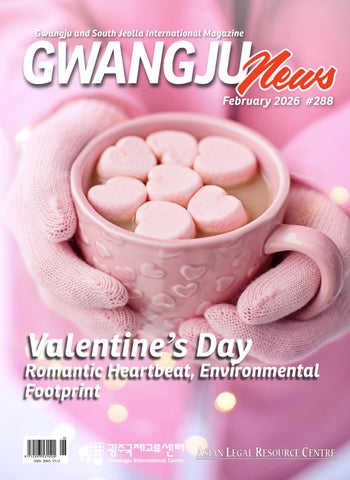
Cover Photo
JillWellington on Pixabay

It still feels as though we’re on the cusp of a new and exciting year, even though January 1st passed a full month ago. (Catch the Jan. 1 sunrise in Photo of the Month.) And why should we not have that sense of the new year still being on the verge of breaking when Korea’s lunar new year is still waiting to take center stage later this month. It’s the Year of the Fire Horse; read what that entails in our article of the same name. Also read one expat’s perspective on Seollal, Lunar New Year’s Day, in History and Tradition.
Publisher Dr. Shin Gyonggu
Editor-in-Chief & Copy-Editing
Dr. David E. Shaffer
Layout Editor & Online Editor
Johanna
Lezada
The Gwangju News is the first English monthly magazine for the general public in Korea, first published in 2001. Each monthly issue covers local and regional issues, with a focus on the roles and activities of the international residents and local English-speaking communities.
Copyright ©2026 by the Gwangju International Center. All rights reserved. No part of this publication covered by this copyright may be reproduced in any form or by any means –graphic, electronic, mechanical, photocopying, recording, or otherwise – without the written consent of the publisher.
The Gwangju News is published by the Gwangju International Center: Jungang-ro 196-beon-gil 5 (Geumnam-ro 3-ga), Dong-gu, Gwangju 61475, South Korea
Tel: (+82)-62-226-2733
Fax: (+82)-62-226-2731
Website: www.gwangjunewsgic.com
Email: gwangjunews@gic.or.kr
Registration No 광주광역시 라 00145
ISSN 2093-5315
Registration Date: February 22, 2010
The Gwangju News is co-sponsored by Asian Legal Resource Centre (ALRC) Korea
Occurring also in February is arguably the most romantic day of the year – the 14th, Valentine’s Day. Read our article on where in the Jeolla area to go to spend a quiet, amorous day in the February air. See also our featured piece that reminds us of the less romantic side of the holiday. For places around Gwangju to visit on holidays, weekends, or any day, go to our Exploring Korea column. February is also the moving month for many attending university; get some tips on “Booking Movers.”
Our Global Focus this month is Ukraine’s agriculture struggles in time of war. Korea in Focus deals with Korea’s “ppalli-ppalli culture” (hurry-hurry to read this!). And our feature essay is on “Justice in the City,” problems confronting urban areas the world over.
In Teaching and Learning, we have an expat writing on learning Korean as well as one on a Korean learning Chinese. The Our Planet column introduces an ongoing exhibition: “Earth in Crisis, SOS.” And our Science and Technology section presents two interesting articles: one on security of smart home devices and the other on the human component to the medical robot.
We have a chock-full Culture and the Arts section: an article comparing the art of Kim Whanki with that of Abanindranath Tagore, a cultural comparison of Korea with Bangladesh, an ongoing Helga Stentzel exhibition in Yeosu, and a review of Han Kang’s book Greek Lessons
Food and Beverage focuses on two cafés: Chaeum and Gosari. Our sports section brings you two articles on Gwangju’s pro teams’ off-season activities: player cuts, salary cuts, new contracts. And checkout the upcoming February exhibition, performance, theater, and concert events, including the four-day Grand Orchestra Week at the Gwangju Arts Center.
Enjoy February with the Gwangju News!
David E. Shaffer Editor-in-Chief Gwangju
News


Witnessing the first sunrise of 2026 felt like a blessing, its light revealing the promise of what lies ahead.
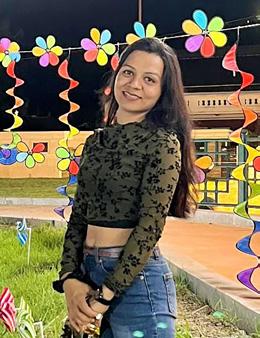
The Photographer
Neha Bisht is a native of India, pursuing her PhD at Chonnam National University. She loves to travel and likes capturing the historic and scenic views in her memories.
This photograph was shot at Hyangil-am, a hermitage at Impo village near Yeosu at the dawning of the new year.
(Photo of the Month submissions are open to all readers: gwangjunews@gic.or.kr)
03 From the Editor
Photo of the Month
Gwangju City News
09 Valentine’s Day: Love, Money, and the Planet 12 Justice in the City: Refugee Children, Mothers, and Urban Life
GLOBAL FOCUS
15 The Price of Bread: Attacks on Ukraine’s Fields Impact the World
KOREA IN FOCUS
18 Life in Overdrive: Understanding the Korean Phrase “Ppalli-Ppalli!”
HISTORY & TRADITION
20 Cherishing Seollal: An Indian’s Perspective on Korea’s Lunar New Year
TRAVEL & DISCOVERY 22 Exploring Korea: Gwangju Weekends –Art, History, and Everyday Joys
25 Romance in Jeolla’s February Air: Quiet Moments, Shared Rituals, and an Atmosphere of Love COMMUNITY
27 It’s That Time of the Year: Booking Movers in Korea
TEACHING & LEARNING
29 From Survival to Confidence: A Journey in Learning Korean
31 What’s It Like to Learn Chinese in China?: A Vivid Month-Long Experience
OUR PLANET
34 The Environment: “Earth in Crisis, SOS”: Special Exhibition at the National Science Museum
SCIENCE & TECHNOLOGY
36 How Safe Are Your Smart Home Devices?: A Simple Guide to IoT Security and Awareness
38 Medical Robots: Who’s Really Holding the Knife?
CULTURE AND THE ARTS
41 2026, Year of the Fire Horse?: What Your Zodiac Sign Really Means in Korea
43 Essay: Across Empires and Aesthetics – Abanindranath Tagore and Kim Whanki in Conversation
47 Cultural Parallels: South Korea and Bangladesh
48 A Unique Art Experience at Aqua Planet Yeosu: The Playful World of Helga Stentzel
50 Book Review: Han Kang’s Greek Lessons
FOOD & BEVERAGE
51 D’s Café Column: Gallery Café Chaeum – Where Coffee Meets Art
52 Gosari: A Cozy Corner in Downtown Gwangju
SPORTS & ENTERTAINMENT
53 Sports Focus: Pay Cuts, Caps, and Caution – How Gwangju's Three Pro Teams Are Recalculating Value
55 Area Sports Round-Up
57 February Upcoming Events

Gwangju is rapidly emerging as the core nerve center for South Korea’s system semiconductor industry. Following a landmark agreement between the South Korean government and British chip architecture giant Arm, the Gwangju Institute of Science and Technology (GIST) has been designated as the primary hub for the new “Arm School,” a move set to reshape the region’s industrial landscape.
On December 19, 2025, Mayor Kang Gi-jung announced a major internal reorganization of Gwangju City’s civil service as part of the city’s long-term plan to become a “future city.” The city will reassign existing staff from sectors considered to be in decline to areas seen as strategic for Gwangju’s future.
In practice, this shift is meant to strengthen projects related to artificial intelligence (AI), smart mobility, and large-scale urban transformation. These include the creation of an AI innovation hub, preparations for relocating the military air base, and mobility projects connected to the national K-AI Cities initiative. The reorganization will also support preparations for the 2028 National Sports Festival and the establishment of an independent human-rights ombudsman.
The mayor emphasized that the total number of civil servants will remain frozen at 4,186. The goal is not expansion but efficiency – redirecting administrative capacity toward areas expected to shape Gwangju’s economic, technological, and social future.
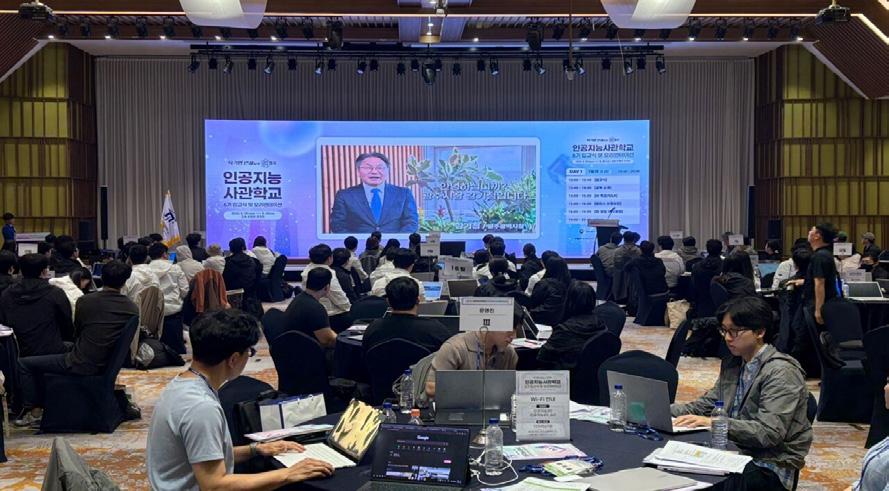
Under the terms of the December 2025 agreement, the new institution aims to train approximately 1,400 elite semiconductor design specialists over the next five years. While South Korea dominates the global memory chip market, it has historically lagged in system semiconductors and fabless design – sectors where Arm holds a nearmonopoly on intellectual property.
To maximize the impact, Gwangju is orchestrating a “Semiconductor Joint College” initiative. This consortium connects GIST with Chonnam National University and KENTECH (Korea Institute of Energy Technology), allowing resources and educational benefits from the Arm School to flow throughout the region.
“The establishment of the Arm School is the final piece of the puzzle in making Gwangju the ‘brain’
of Korea’s AI and semiconductor industries,” a city official stated. “We are committing all available administrative and financial resources to ensure that talent can learn, grow, and settle right here in Gwangju.”
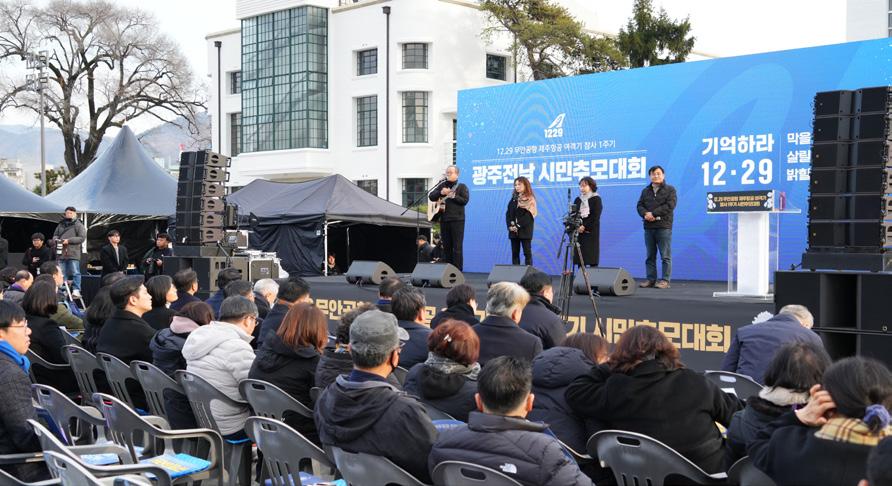
At 9:03 a.m. on December 29, 2025, an emergency alert sounded across Gwangju to mark one year since the plane accident at Muan Airport, which claimed the lives of 29 passengers. The alert invited residents to pause and observe a moment of silence in remembrance of the victims.
Approximately one hour later, a memorial ceremony was held at the airport site. Attendees included representatives from national and local governments, members of the National Assembly, emergency response personnel, bereaved families, and members of the public. The event focused on honoring those who lost their lives and acknowledging the ongoing impact of the tragedy on families and communities.
For many residents in Gwangju and South Jeolla Province, the anniversary served as a moment of collective remembrance, as well as a reminder of the importance of aviation safety and crisis response systems. City officials stated that the commemoration was intended to express public condolences and ensure that the victims are not forgotten.
CES 2026 officially opened on January 6 in Las Vegas, United States, bringing together companies, startups, and governments from around the world to present the latest developments in technology. This year, Gwangju City supported the participation of 17 Korean companies and startups, which joined the event through the Gwangju Joint Pavilion and the national K-Startup Pavilion.

Mayor Kang Gi-jung attended the opening ceremony online and delivered remarks highlighting Gwangju’s ambitions in artificial intelligence (AI), smart mobility, and future industries. CES (Consumer Electronics Show), widely regarded as the world’s largest technology exhibition, focuses on areas such as information technology, home appliances, mobility, healthcare, and emerging digital solutions.
For Gwangju, participation in CES was not only about showcasing products. City officials described it as an opportunity to promote the region itself as a growing innovation hub. During the event, several international trade agencies expressed interest in Gwangju’s AI and mobility projects, suggesting potential future cooperation and investment.
For residents, especially students and professionals interested in technology and startups, the city’s presence at CES signals continued efforts to position Gwangju on the global innovation map.
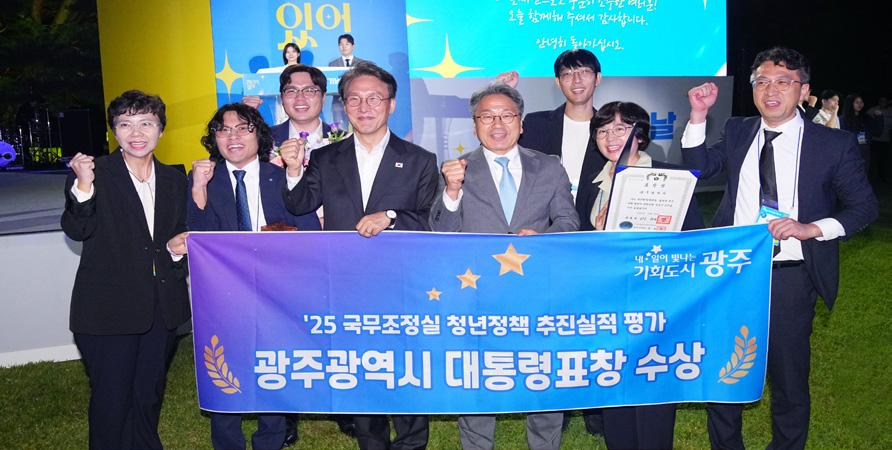
In 2025, Gwangju recorded its strongest performance to date in national evaluations and awards. Over the course of the year, the city received seven Presidential Citations, two Prime Minister Awards, and a total of 68 institutional recognitions for policies across multiple sectors.
Key areas of recognition included youth and education, where Gwangju achieved top ratings in the Regional Innovation-Oriented University Support System (RISE) and earned an A grade in evaluations of specialized “glocal” universities. In welfare policy, the city’s flagship “GwangjuStyle Integrated Care” program gained national attention, alongside the city’s certification as a UNICEF Child-Friendly City.
Gwangju was also recognized for its performance in safety and disaster response, and environmental and climate policy – including ranking first nationwide in the Carbon Neutrality Point System – and administrative innovation through data-driven governance. City officials noted that these awards reflect not only central government efforts but also collaboration with local institutions and organizations.
This recognition offers a snapshot of where Gwangju stands nationally and which policy areas the city is likely to continue prioritizing in the coming years.
Discussions on integrating Gwangju City and South Jeolla Province moved forward in early January, following a joint announcement by the mayor of Gwangju and the governor of South Jeolla on January 2. The proposal aims to create a unified regional government, potentially in time for the June 3 local elections.
To move forward, the two governments plan to submit a special law to the National Assembly by the end of February. If approved, voters in both areas would elect joint leadership under a new administrative structure. The final name and legal status of the integrated region – such as a “special metropolitan city” or a “super-metropolitan special self-governing province” – will depend on the wording of the law.
Supporters argue that integration could reduce administrative overlap, lower costs, and promote more balanced regional development. Critics, however, warn that pushing the process too quickly could create governance challenges and confusion for residents.
With apparent support from the national administration and coordination between the two local governments, the proposal remains a key political issue to watch in the coming months, especially as it may reshape regional governance in southwestern Korea.
Luis Andrés González is a Mexican GKS scholar and master’s student in cultural anthropology at Chonnam National University.
Amy Park is a coordinator at Asia Legal Resource Center Korea. She is currently living and learning in Gwangju with her son.
By Neha Bisht
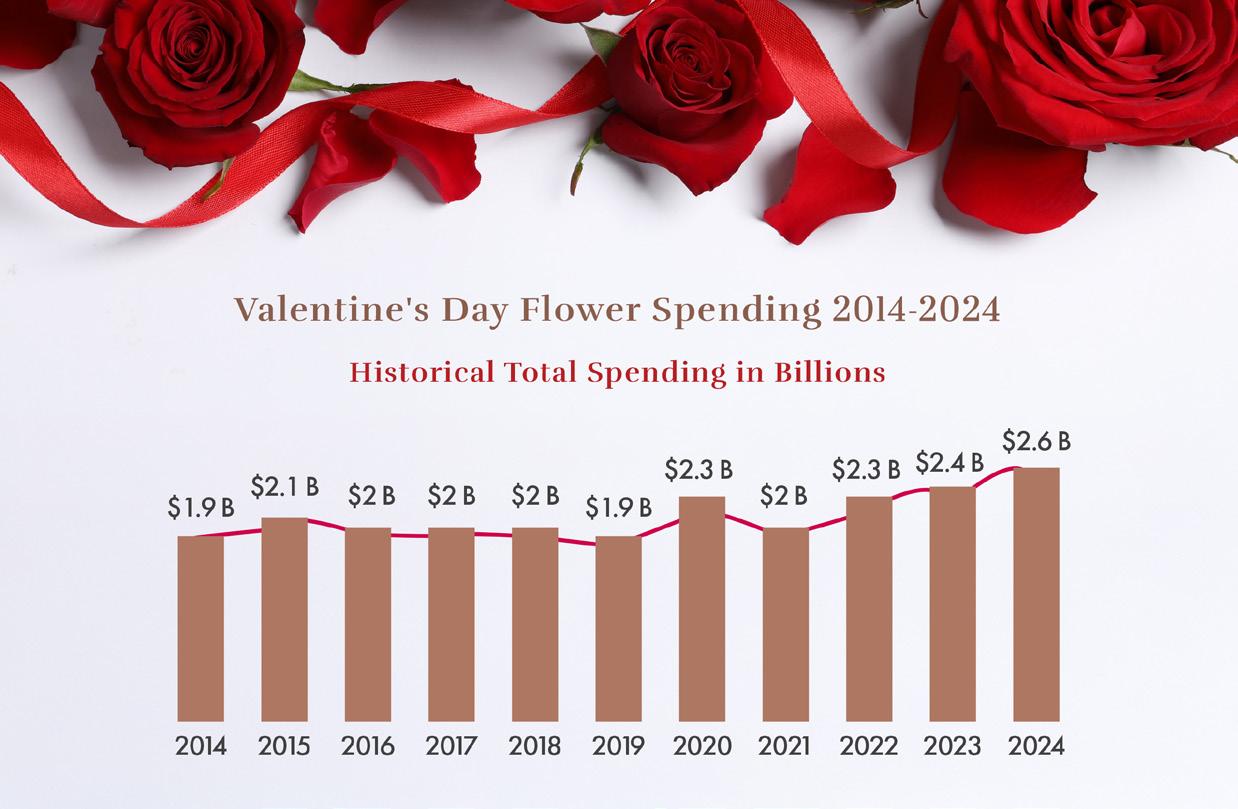
(https://www.rioroses.com/valentines-day-spending-trends-what-the-numbersmean-for-your-floral-business/)
Every year on February 14, hearts, roses, chocolates, and candlelit dinners take center stage across continents. Valentine’s Day, often seen simply as a celebration of romance, has quietly grown into a powerful global economic event – one that moves billions of dollars, sustains industries across regions, and leaves a visible environmental footprint. Behind the sweetness lies a complex story of global trade, consumer behavior, and environmental responsibility.
What appears to be a single-day celebration now functions as a multi-billion-dollar global economic engine, with distinct roles played by different regions across the world.
In the United States, Valentine’s Day represents the largest single-market spending surge globally.
According to a 2025 National Retail Federation survey, Americans were estimated to spend around USD 27.5 billion on the holiday, with average per-person expenditure approaching USD 180–190. Spending is concentrated on jewelry, dining, flowers, chocolates, and experiential gifts, making Valentine’s Day a strong indicator of discretionary consumer confidence.
Across Europe, spending is more fragmented but remains substantial. Countries such as the United Kingdom, France, and Germany collectively contribute billions of euros each year. According to Forbes, the UK alone was expected to generate over £1.3 billion in Valentine’s-related sales, while average per-person spending across Western Europe ranges from €80 to €110. European consumers increasingly prioritize experiences –romantic dinners, short trips, and cultural events – over purely material gifts, reflecting broader lifestyle and sustainability trends.
In Asia, Valentine’s Day spending is lower in absolute terms than in Western economies, but it is growing at a significantly faster pace. Countries such as Japan, South Korea, China, and India have adapted the holiday to local customs, often extending it into multi-day or multi-stage celebrations. While per-capita spending remains modest, the region shows double-digit annual growth rates of approximately 12–15%, driven by urban youth culture, rapid e-commerce expansion, and Western cultural influence. In many Asian economies, Valentine’s Day remains an emerging commercial opportunity rather than a mature consumer market.
In South Korea, Valentine’s Day has become a noticeable commercial event, particularly among younger urban consumers. Spending is largely focused on chocolates, flowers, dining, and shared experiences, rather than luxury gifts. South Korea’s floriculture sector depends on a mix of domestic production and imports, with imported flowers accounting for around 30 percent of total flower consumption. During Valentine’s Day, demand for imported roses and cut flowers rises, linking Korean consumers to global supply chains – particularly to South America.
Compared with Japan and China, where Valentine’s Day has expanded into multi-stage, high-volume gift economies, South Korea’s market remains smaller and more restrained, characterized by lower per-capita spending but a similarly strong reliance on imported flowers and chocolates.
While North America, Europe, and parts of Asia dominate Valentine’s Day consumption, Africa and South America form the production backbone of the global celebration.
In Africa, particularly Kenya and Ethiopia, floriculture plays a critical economic role.
During the 2025 Valentine’s Day season, Kenya exported approximately 4,200 metric tons of roses, generating hundreds of millions of dollars in export revenue. Valentine’s Day represents a crucial income period for the African flower industry, supporting tens of thousands of workers, many of them women. In addition to floriculture, West African countries such as Côte d’Ivoire and Ghana play an indirect but essential role by supplying cocoa used in Valentine’s Day chocolate production worldwide.
South America plays a similarly vital role as a producer. Colombia and Ecuador rank among the world’s largest exporters of cut flowers, supplying the majority of roses to the United States and Europe during the Valentine’s Day season. According to FloralDaily, Colombia exported approximately 59,000 metric tons of cut flowers during the 2024 Valentine’s Day period, with the United States accounting for nearly 76 percent of total shipments. Colombian flowers also reached other key markets, including the United Kingdom (5%), Canada (3%), the Netherlands (3%), and Japan (3%), as well as more than 100 additional countries worldwide.
Furthermore, according to Floriexpo, FedEx Corporation, one of the world’s largest logistics companies, announced that it expected to transport around 800,000 kilograms of flowers from Colombia and more than 290,000 kilograms from Ecuador during February 2025, highlighting the scale of South America’s contribution to Valentine’s Day supply chains.
Although Valentine’s Day is celebrated locally in both regions, consumer spending remains modest compared to Western markets, with greater emphasis placed on dining, social gatherings, and shared experiences rather than high-value gifts.
Together, these regions illustrate how Valentine’s Day links producers in the Global South with consumers in wealthier economies through highly globalized and time-sensitive supply chains.

Delivery impact on the environment during the Valentine season.
Behind the economic boost lies a less romantic reality. Valentine’s Day carries a significant environmental footprint:
• Carbon emissions increase due to air freight transporting flowers from Africa and South America to Europe, North America, and Asia.
• Flower cultivation requires intensive water use, fertilizers, and pesticides, placing stress on local ecosystems, particularly in water-scarce regions.
• Packaging waste, including plastic wraps, decorative boxes, ribbons, and greeting cards, often becomes single-use landfill waste.
• Chocolate production, driven by seasonal demand, has been linked to deforestation and biodiversity loss when cocoa supply chains lack sustainability safeguards.
In this way, a celebration intended to express love can unintentionally contribute to environmental degradation – a lack of love for our planet.
Encouragingly, consumer behavior is beginning to evolve. Across the U.S., Europe, Asia, and emerging urban markets, people are increasingly choosing more conscious expressions of love, such as locally grown or seasonal flowers, fair-trade chocolates supporting cocoa farmers, recyclable
or minimal packaging, and experience-based gifts over material excess.
Producers and retailers are also responding by adopting ethical labor certifications, waterefficient farming methods, and lower-carbon logistics.
Valentine’s Day now reflects the realities of a deeply interconnected world economy. A bouquet exchanged in New York may be grown in Colombia, while chocolates shared in Paris may trace their origins to cocoa farms in West Africa. These connections reveal both the economic opportunities and environmental responsibilities embedded in modern romance.
As Valentine’s Day continues to evolve, its future may depend less on how much is spent and more on how thoughtfully love is expressed – toward partners, communities, and the planet itself. After all, care that endures is the most meaningful form of love.

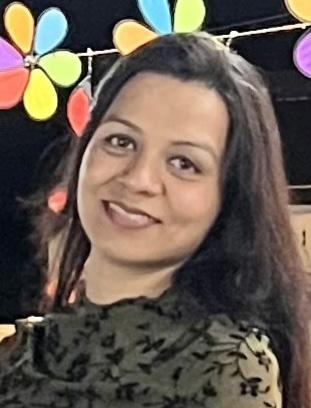
A native of India, Neha Bisht is pursuing her PhD research at Chonnam National University’s School of Materials Science and Engineering. She loves to meet new people and make new friends. Neha endeavors to contribute to the well-being of society in whatever way she can.
By Reeti Roy
Urban life offers both sanctuary and marginalization. For refugee children and their mothers, cities can be places of safety, but they can also be spaces where exclusion, precarity, and uncertainty shape the everyday. This article draws on my work with refugee children in London, my training in social anthropology, and my wider engagement with policy and human-centered programs to examine how justice is lived and contested in the city, and what urban actors can do to strengthen protection, dignity, and inclusion.
When I first began volunteering as a play worker with the British Refugee Council, my journals quickly filled with observations that illustrated the complexity of urban life for displaced families. Anthropologist Liisa Malkki (1995) observed that displacement unsettles everyday categories of belonging. In London’s shelters and day centers, I saw this unfold in real time: children navigating a city not built with them in mind, yet inventing moments of joy within it.
Many of the children I met wanted what any child wants: a school to attend, friends to play with, a safe place to imagine their future. Yet they were often moved from one shelter to another, their routines repeatedly disrupted by the demands of displacement and urban precarity.
The mothers who brought their children to the Day Centre carried immense burdens. Many had fled persecution tied to political dissent,
sexuality, or religion. They faced legal uncertainty, restrictions on work, and the exhaustion of navigating social services. Research consistently highlights the gendered labor of survival during displacement (UNHCR, 2020), and I witnessed that labor daily.
Despite barriers to welfare, healthcare, and education, mothers created routines, formed informal support networks, and advocated fiercely for their children’s well-being. Justice in the city requires making this invisible labor visible and reducing the structural pressures that demand it.
In the UK today, approximately 515,700 refugees live in the country, around one per cent of the population (UNHCR UK Data Portal, 2024). In the year ending March 2025, 109,343 people claimed asylum (UK Home Office, 2025). These numbers shape local service provision, school availability, and the pressure on temporary accommodation.
Common barriers faced by asylum-seeking children include delays in school enrollment, isolation due to accommodation location, language barriers in healthcare, limited parental ability to work, and financial stress affecting nutrition and stability. Cities must recognize that these barriers are structural, produced by policy design rather than personal failure.
Cities are celebrated for opportunity, yet for many displaced families, infrastructure amplifies vulnerability. Research on right to the city frameworks (Harvey, 2003) reminds us that access is not merely about physical proximity but about practical usability.
For refugee families, a school may exist but be unreachable without transport subsidies. A park may be nearby but feel unsafe due to policing or discrimination. A clinic may be open yet inaccessible without interpretation.
AbdouMaliq Simone’s (2004) notion of people as infrastructure is particularly useful here. Refugee mothers act as infrastructural agents, navigating, negotiating, and stitching together fragile networks of safety across the city.
My training in social anthropology has shaped how I observe, listen, and translate lived realities into policy insights. Participant observation allows attention to the small details: how children reclaim space through play, how mothers share information in waiting rooms, how families negotiate uncertainty over months or years.
Anthropological methods help identify gaps often overlooked by quantitative assessments, offering what Veena Das (2007) described as the anthropology of the everyday, where suffering and repair coexist. This approach is essential for designing interventions that reflect real needs.
My work with Dr. Shashi Tharoor, member of Parliament and former UN under-secretarygeneral, demonstrated how laws and policies shape the lives of displaced communities. I worked on the National Commission for Minorities and aided him in research pertaining to the UNHCR in my capacity as legislative assistant (legislative aide) to a member of Parliament. Legal frameworks can protect but can also generate exclusion if they fail to account for lived realities.
Today, as CEO of Aglet Ink, I design humancentered programs informed by research, field observation, and community engagement. Across contexts, one truth remains clear: Justice requires systems that listen before they legislate.
Stories reveal the emotional and social dimensions of displacement. In the Day Centre, I met a young man who longed for university but was denied stable education due to years of temporary accommodation. Such stories show how urban systems determine futures.
As NGOs increasingly use narratives for advocacy (UNICEF, 2021), storytelling becomes a tool for visibility, ensuring that policymaking reflects lived experience rather than abstract categories.
1. Accessibility must replace theoretical availability.
Interpretation services, transport support, and decentralized information points are essential. Without these, access remains symbolic.
2. Reduce legal and welfare precarity. Shorter asylum timeframes, expanded work rights, and strengthened welfare support directly improve children’s well-being.
3. Create inclusive, trauma-sensitive public spaces.
Urban planning must include child-friendly design and safe community spaces, particularly
for women and children affected by displacement.
These principles align with existing urban inclusion frameworks (UN-Habitat, 2022) and require collaboration between local authorities, civil society, urban planners, and displaced communities themselves.
Cities reflect the decisions of those who build, govern, and navigate them. For refugee children and mothers, justice in the city is found not only in policy but in daily life: the route to school, the safety of a shelter, the ability to play, and the reliability of welfare support.
The lesson I carry from my work is simple: Observe, listen, understand, and act. When cities prioritize their most vulnerable residents, they become more humane, more just, and more livable for everyone.
References
Das, V. (2007). Life and words: Violence and the descent into the ordinary. University of California Press.
Harvey, D. (2003). The right to the city. International Journal of Urban and Regional Research, 27(4), 939–941.
Malkki, L. (1995). Purity and exile: Violence, memory, and national cosmology among Hutu refugees in Tanzania. University of Chicago Press.
Simone, A. (2004). People as infrastructure: Intersecting fragments in Johannesburg. Public Culture, 16(3), 407–429.
UN-Habitat. (2022). Inclusive cities: Policies for social cohesion
UNHCR. (2020). Women on the move: Refugee women and gendered survival strategies.
UNHCR UK Data Portal. (2024). UK refugee statistics. UNHCR.
UK Home Office. (2025). Asylum statistics, year ending March 2025.
UNICEF. (2021). Storytelling for social change.
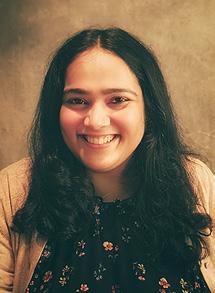
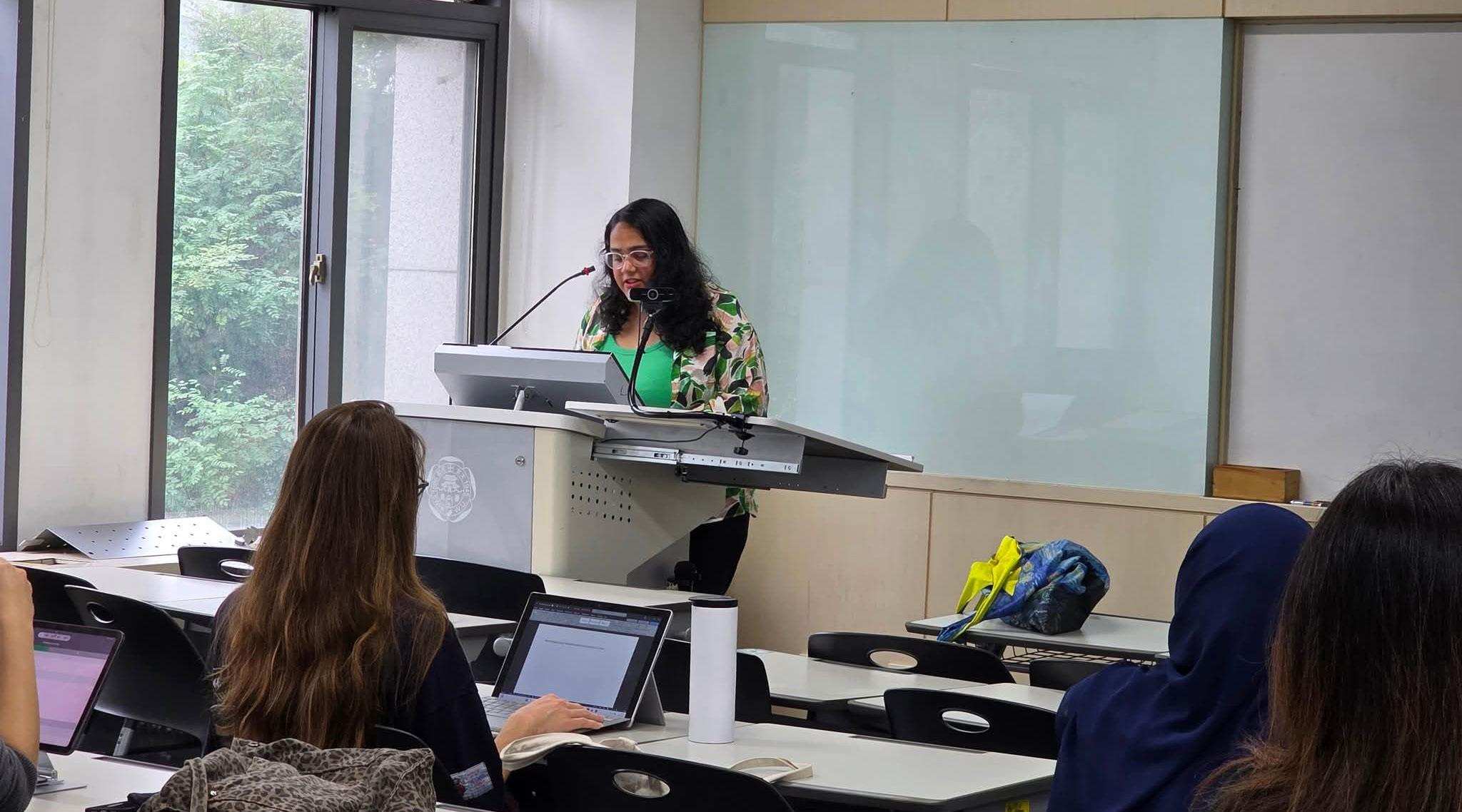
Reeti Roy is a writer and researcher with a master’s degree in social anthropology from the London School of Economics, where her thesis examined refugees, internally displaced persons, and narratives of trauma. This article is based on a September 2025 guest lecture delivered at Ewha Womans University.
Photographs courtesy of Reeti Roy.
By Andriievska Anastasiia

Ukraine continues to rank among the world’s top ten suppliers of agricultural products, holding fourth place in corn exports and sixth place in wheat exports. In December 2025, 86% of Ukrainian wheat was exported to North Africa and the Middle East, amounting to approximately 335.5 thousand tons. In addition, Ukraine exports grain to European and Asian countries. Due to Russia’s full-scale invasion, Ukraine was unable to supply grain to other countries for a certain period, which led to serious shortages in many regions, especially in the Middle East and Africa. As a result, bread production and the production of other bakery products significantly declined, while bread prices rose sharply.
On December 19, 2025, Russia shelled a grain port in the Odesa region, where grain intended for export was being stored. Truck drivers who
were waiting for the grain to be loaded were killed. A day earlier, Russia carried out several days of massive attacks on a bridge in the Odesa region used by trucks transporting grain to Europe. This bridge is a key route to Bessarabia and is located near the border crossing with Moldova. As a result of strikes by Russian UAVs (unmanned aerial vehicles, drones) and ballistic missiles, a woman was killed and her three children were injured.
In addition, Ukraine is the world’s leading exporter of sunflower oil, exporting millions of tons annually, with export revenues exceeding $5 billion in 2024 and accounting for approximately 37–40% of the global market. Although exports declined to 4.73 million tons in the 2024–2025 season due to seasonal factors, Ukraine remains a key global supplier, exporting sunflower oil to India, Spain, Italy, and other countries despite
ongoing challenges. In 2025, Russia captured approximately 0.72% of the entire territory of Ukraine. In total, from January 1, 2023, to January 1, 2026, the increase in Russian-occupied territory was 7,463 square kilometers or 1.28% of the entire territory of Ukraine. Overall, as of early 2026, 19.25% of Ukraine’s territory, or 116,165 square kilometers, remains under occupation. A significant portion of this land consists of agricultural fields in which Ukrainian farmers cultivated various crops before the full-scale invasion. Farmers risk their lives every day to feed not only Ukraine but the entire world.
Ukraine is now one of the most minecontaminated countries in the world, according to the Parliamentary Committee on Agrarian and Land Policy. The Office of the United Nations High Commissioner for Refugees (UNHCR) reported that land contamination with explosive remnants of war in Ukraine threatens the lives and health of approximately 6.37 million people. Since February 2022, farmers have been particularly affected by landmines, with 128 farmers killed. According to the Ukrainian Association of Deminers, the most severe mine contamination remains in Kherson, Kharkiv, Mykolaiv, and Donetsk regions.
“Russia also deliberately targets agricultural fields just before harvest to intentionally destroy crops.”
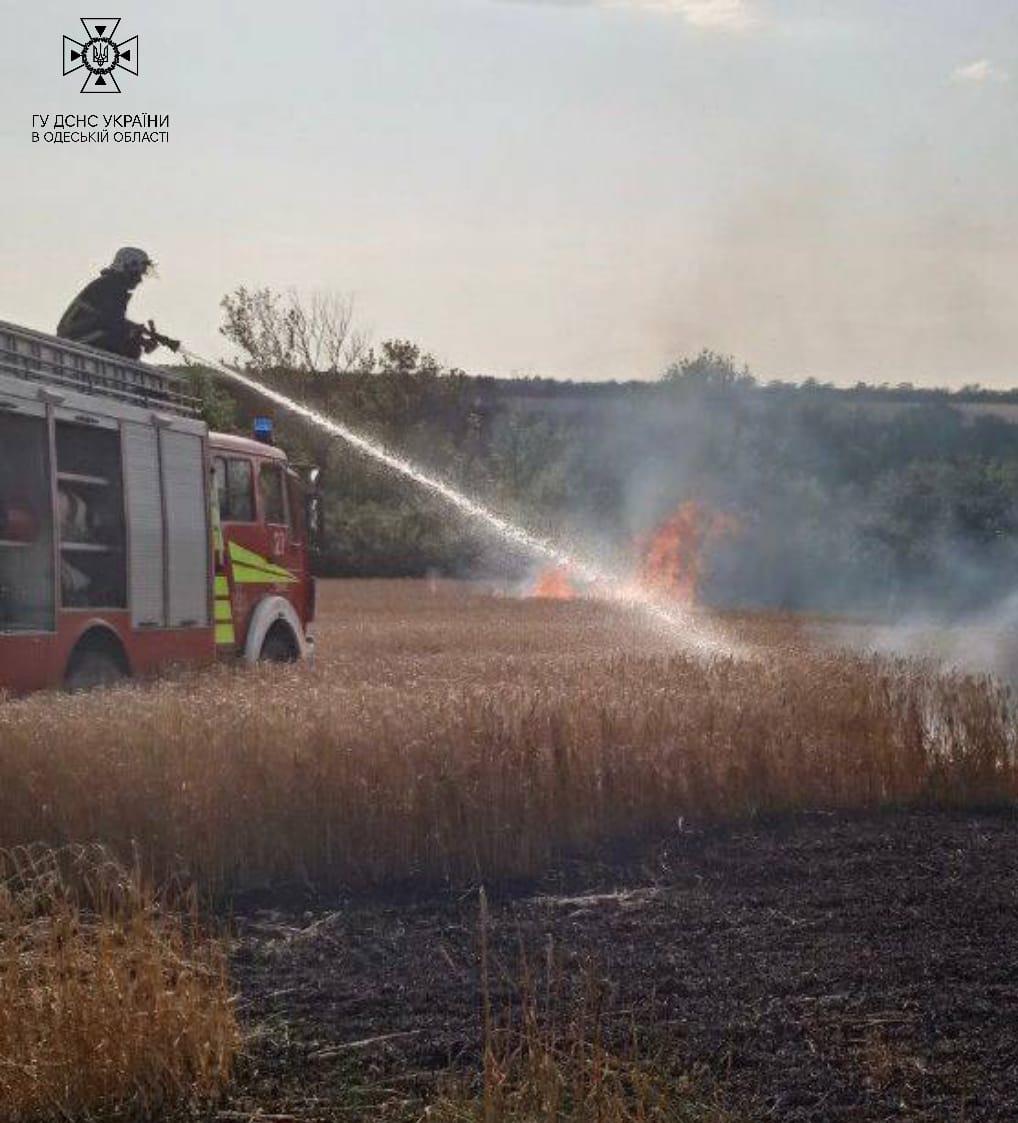
The Food and Agriculture Organization of the United Nations (FAO) reported that Ukrainian agricultural enterprises in crop and livestock production managing up to 250 hectares suffered losses of $3.85 billion as a result of Russia’s full-scale invasion. Due to constant shelling and fragments of missiles and drones hitting farmland, toxic substances are released into the soil, making crop cultivation impossible. Russia also deliberately targets agricultural fields just
before harvest to intentionally destroy crops. Not only fields burn, so do nearby forest areas and buildings, as farmland is often located close to residential areas. At the same time, air raid alerts in rural areas do not always activate, especially in frontline zones where warnings often fail to sound in time.
Ukraine’s losses are not limited to contaminated or occupied farmland – they also include the loss of farmers’ lives. In the Kherson region, a 58-year-old farmer named Oleksandr was killed by a Russian drone attack. On the morning of September 5, 2025, an enemy UAV struck the vehicle in which he was working in the field. Oleksandr had been engaged in agriculture for over thirty years. He owned a farming enterprise and headed the regional association of farmers and private landowners. He spoke publicly about how, despite shelling and drone attacks, he defended his fields with a shotgun. According to him, farmers independently carried out demining efforts and removed around 5,000 antitank mines from their fields.
These are not isolated cases. Numerous video recordings show Russian drones deliberately targeting farmers, aiming not only to destroy crops and farmland but also to kill farmers themselves. On January 6, 2026, an enemy strike UAV attacked the territory of an agricultural enterprise in the Sumy region and, fortunately, did not explode upon impact. A similar incident occurred on October 7, 2024, in the Odesa region, where a farmer discovered a drone in his field that, fortunately, did not explode and did not destroy the entire harvest. Movement both within and between settlements is extremely dangerous, as a drone can strike at any moment, with a damage radius ranging from 100 to 500 meters or more.
Losses are also not limited to unharvested crops. Russia continuously launches massive attacks on enterprises that produce sunflower oil and process grain. On the night of December 24–25, 2025, Russia carried out a large-scale attack on the Odesa region, damaging an oil and fat processing
plant where sunflower seeds are processed and sunflower oil is produced. As a result of a UAV strike, an oil storage tank was damaged, causing a large-scale fire and oil leakage. The fire spread across the production facilities, posing a serious threat to infrastructure and personnel. UAV debris also damaged part of the production block. Notably, December 25 is Christmas, celebrated by Ukrainians and much of the world. Nothing stops Russia – not even Christmas – from destroying everything Ukrainian.
Earlier, on October 30, a grain processing plant was struck, partially destroying the facility. As a result, fuel oil (a petroleum product) leaked into a local reservoir used by residents as a source of drinking water. In addition to the damage to critical infrastructure, civilian homes were also affected. Tragically, a seven-year-old girl was killed; doctors attempted to save her after the attack, but her injuries were too extensive.
Furthermore, constant attacks on Ukraine’s energy infrastructure cause severe damage to enterprises, particularly in the production and storage of food products. The destruction of power plants, substations, and energy networks leads
to frequent and unpredictable power outages, making stable economic activity impossible. For food-related enterprises, uninterrupted electricity supply is critically important. Without power, refrigeration equipment and storage systems cannot function properly, causing food to spoil rapidly. This results in significant financial losses and reduced production volumes.
“Nothing stops Russia – not even Christmas –from destroying everything Ukrainian.”
To mitigate risks, enterprises are forced to reduce inventories, alter logistics, and operate under constant uncertainty. Additional expenses for alternative power sources, including generators and fuel, significantly increase production costs. Small and medium-sized enterprises are especially vulnerable, as they lack sufficient financial reserves. An unstable energy supply affects not only internal business processes but also the market as a whole. Supply chains are disrupted, product availability decreases, and prices rise for consumers. In some cases, enterprises are forced to temporarily suspend operations, negatively affecting regional economic stability.
Ukraine is one of the world’s largest grain exporters, but Russia’s full-scale invasion has threatened global food security. Nevertheless, despite blockades, shelling of port infrastructure, and the mining of agricultural land, agricultural exports continue, and Ukraine continues to “feed the world.”

Andriievska Anastasiia was a Global Korea Scholarship student from Vinnytsia, Ukraine, in 2024 and 2025. She is now an active Ukrainian and international volunteer.
By Murdock O’Mooney
If you’ve visited South Korea, you’ve probably observed the ppalli-ppalli (Hurry, hurry) culture in action. Buses take off suddenly, tossing passengers down the aisle; taxi drivers honk and race to their destinations; and even a doctor’s visit might only last a few minutes –there are just too many patients to see! From a romanticized perspective, the concept of ppallippalli (빨리빨리) translates as energy, efficiency, and extreme diligence. In reality, the concept can create dangerous situations, avoidable mistakes, and generate copious amounts of unnecessary stress. Regardless of your position on the phrase, it inarguably holds a lot of meaning and relevance in Korean culture and society.
According to the 2018 BBC article “South Korea’s Unstoppable Taste for Haste,” Gary Rector, a naturalized Korean citizen, said that when he first came to South Korea as a U.S. Peace Corps volunteer in 1967, he expected to find the stereotypical Eastern zenned-out populous but was instead surprised to find “people my age –and I was 24 years old – were very busy rushing around trying to improve their lifestyle.” Rector also made the point that the older generations seemed to be slower and more deliberate in their movement and approach to life.
While the philosophy of ppalli-ppalli has its roots in post-Korean War industrialization known as “the Miracle of the Han,” earlier references of Koreans rushing about are plentiful. Korea’s beloved King Sejeong of the Joseon Dynasty once said about his own people, “Our people tend to be in a rush on every occasion, so they lack precision.” Even the founder of North Korea, Kim Il Sung, encouraged haste, telling citizens to work
at “Chollima speed,” which references a mythical horse that could fly 1,000 ri (천리, 400 km) in a day. The current supreme leader, Kim Jong Eun, increased this to “Mallima speed” (만리마), or 10 times faster.
It’s also no secret that South Korea’s rapid economic growth is nothing short of miraculous. Some insightful statistics include going from an average annual income of $57 in 1957 to $33,475 in 2023, and being the first aid-recipient country to become a donor for the OECD’s Development Assistance Committee (DAC). Beyond this, South Korea is also the fourth largest economy in Asia and thirteenth largest in the world, despite having a population of only 50 million. It also took just twelve years to complete the 300 kph KTX bullet train, first beginning operation in 2004 from Seoul to Busan, which required drilling tunnels through 38 mountains! Should
Korea attribute this rapid development to ppallippalli, or are there other contributing factors?
The Korean War certainly helped establish ppallippalli as a default modus operandi. Beyond ripping the country apart, civilians were rapidly displaced, often seeking refuge from fighting, taking nothing more than what they could carry with them. After WWII, Korea was divided with the Soviet Union controlling the north, and the United States and UN controlling the south. After fighting broke out, control of Seoul changed hands four times: first North Korea took control, then the UN recapture, then a Chinese capture, and finally a UN recapture when fighting ceased in 1953. Once the South Koreans had their country back, it was time to get to work. This is where ppalli-ppalli found its footing.
When asked about ppalli-ppalli, my Korean mother-in-law, Jeong-sun, said, “The word originated from the image of a diligent people who woke up at dawn and worked in the fields.” She continued with “It is a word that is absolutely used with a positive meaning, but it is also used when one is faced with dangerous or urgent situations.”
I know what Jeong-sun means. Once, while coming from Incheon Airport to Seoul, I thought I was going to die because our taxi driver was speeding along at 160 kph on the expressway. When I asked him to slow down, he replied with, “Korean ppalli-ppalli, very fast and good service.” While the service was no doubt fast, and the driver no doubt dedicated, I was terrified and stressed, which made the ride unpleasant.
In an article for Newsweek, tech CEO Jae-il Shin of Agility Systems claims that the spirit of ppalli-ppalli is shaping global business and thinks of the phrase as a mantra. The way Shin sees it, ppalli-ppalli can be understood to mean “move fast, innovate faster, and never waste time,” in reference to South Korea’s prominence in logistics, AI, drone technology, construction, and battery manufacturing. Conveniently, Shin left out the part about making mistakes.
In his best-selling 2015 book, Burnout Society, South Korean philosopher Byung-Chul Han takes a different stance claiming that Korea’s achievement-based approach that places emphasis on speed, performance, and selfexploitation, creates burnout and a lack of genuine contemplation of life. Han goes on to explain that excessive speed in daily life focuses on “doing rather than being.” To combat the ppalli-ppalli mindset, Han encourages slowness, rest, and contemplation to help find meaning, as well as promote a healthier lifestyle.
There’s no easy way to understand ppallippalli from a philosophical, cultural, or social perspective – it’s a complex phrase, for sure. And whether it’s seen as a positive or negative might depend on the individual. For me, I see ppallippalli as a defining trait of the Korean people. And like many things in life, when applied in the correct amount (whatever this might be), ppallippalli is a blessing. When abused, it might be a curse. But that’s just one person’s opinion.
Sources
Crawford, M. C. (2018, July 9). South Korea’s unstoppable taste for haste. BBC. https://www.bbc.com/travel/ article/20180708-south-koreas-unstoppable-tastefor-haste
de Bomford, D., & Lange, Q. (n.d.). Agility as strategy: How Korea’s “ppalli-ppalli” spirit is shaping global business. Worldfolio. https://d.newsweek.com/en/ file/478459/what-makes-koreas-business-agilitypowerful-lever-global-success.pdf
Greenspan, J. (2025). 8 things you should know about the Korean War. History, A&E Television Networks. https:// www.history.com/news/8-things-you-should-knowabout-the-korean-war
Maden, J. (2023). Byung-Chul Han’s burnout society: Our only imperative is to achieve. Philosophy Break. https:// philosophybreak.com/articles/byung-chul-hanburnout-society-our-only-imperative-is-to-achieve/ Republic of Korea: Overview. (2025, December 3). The World Bank. https://www.worldbank.org/en/country/ korea/overview
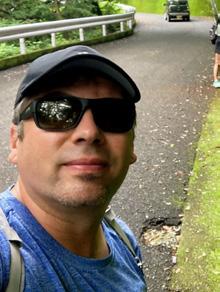
Murdock O’Mooney is an educator and writer based in Albuquerque, New Mexico, USA. He lived in Gwangju, and worked at Chosun University, from 2015 to 2022. He’s interested in geopolitics, education, and trying to help build a more just world.
By Siddhant Kumar
“Seollal
is the rare moment when time slows enough for Koreans to remember that the present stands on borrowed ground” — Kim Young-ha, Author
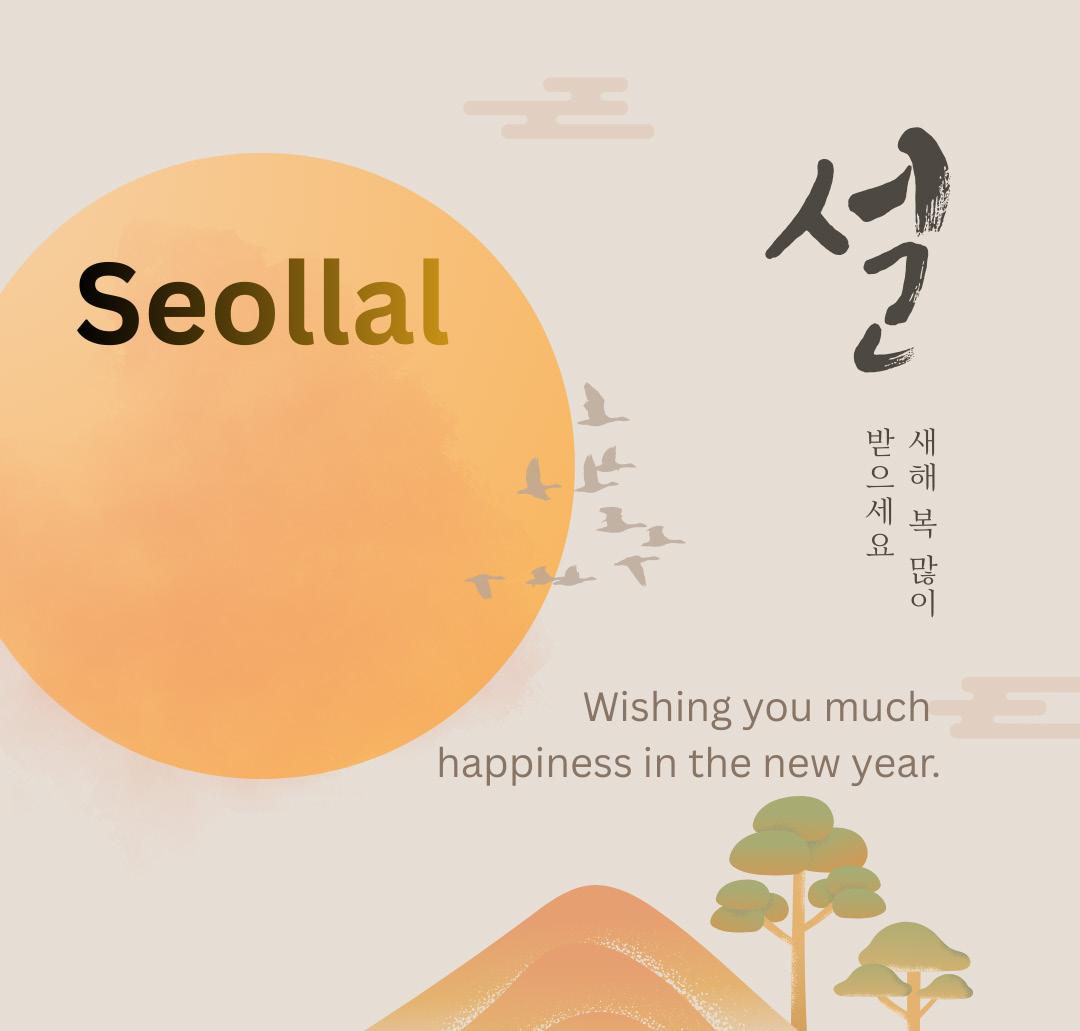
Every year, when Korea celebrates its traditional new year, Seollal, it is easy to think of it as only a cultural festival: family gatherings, a homely dinner, and quiet winter warmth. But beneath the long-standing culture lies a deeper and more fundamental reason, connected to history and science, beginning on the new moon, a precise moment when the moon aligns between the earth and the sun. Seollal emerged gradually from ancient agrarian society on the Korean Peninsula, shaped by moon–sun observations and later formalized through Chinese-influenced lunisolar calendrical systems. By the Three Kingdoms period (57 BCE
to 668 CE), celebrating the new year at this winter new moon was already established as state and household culture. Confucian philosophy during the subsequent Goryeo and Joseon Dynasties then codified it into the ancestor-focused, familycentered observance as familiar today.
As an Indian living in Korea, this feels warmly familiar. India and Korea have a lot more in common culturally than one would expect. Traditional Indian calendars are also lunisolar, governed by moon phases for months and the sun for seasons. Different regions of India choose different starting points, or new year’s day; some begin the year after a new moon, others with a solar transition.
“India and Korea have a lot more in common culturally than one would expect.”
Last year, I experienced Seollal in Jinju, and it was memorable in ways I did not expect. The winter air was as sharp as the atmosphere in the streets, and the festival felt intimate and grand at the same time. Families traveled home, city
noise softened, and time bent inward toward ancestry and continuity. Elders bowed before memorial tables, younger members performed sebae (formal bows to elders) with practiced sincerity, and kitchens filled with the slow, deliberate labor of preparing tteokguk (rice cake soup). Traditional hanbok apparel appeared as lived heritages, while games, shared meals, and long conversations replaced the usual urgency of modern life. Coming from India, where festivals are often vibrant, celebratory, and overflowing with color, the Seollal festival in Jinju reminded me of home. Watching Seollal unfolding under a new moon felt like watching the same cosmic clock that governs Diwali, Ugadi, or Gudi Padwa back home.
“Across Asia, cultures looked up … and built calendars from the same repeating dance of the moon and sun.”
That realization stayed with me. Across Asia, cultures looked up, tracked shadows, counted days, and built calendars from the same repeating dance of the moon and sun. Different traditions emerged, but the physics remained constant. Seollal is a reminder that before borders, before languages, humanity shared the sky as its first calendar.
Academically, in the middle of an intense research routine, deadlines, data, and the quiet pressure to always be producing, Seollal arrives as a rare and necessary interruption. The pause feels legitimate, as laboratories slow down, emails go quieter, and the usual academic urgency briefly disappears. Stepping away from constant analysis
and expectation allowed my thoughts to settle in a way that ordinary weekends never quite manage to do. The simplicity of the holiday offered muchneeded mental clarity and no distractions. For someone like me, who is working in a high-stress research environment, Seollal is not just rest; it is recalibration, a reminder that sustained inquiry depends as much on moments of stillness as it does on relentless focus.
As this year’s Seollal approaches on February 17, I find myself genuinely looking forward to the celebration again, both as a participant and as an observer. To celebrate Seollal as an Indian in Korea is to feel connected twice over: culturally welcomed on Earth and astronomically synchronized under the same moon.
Wishing You Many New Year Blessings

The Author

Siddhant Kumar is a geochemical oceanographer and researcher at TMBL at the Gwangju Institute of Science and Technology (GIST). His work focuses on marine minerals, sediment chemistry, and paleoenvironmental change. He is passionate about communicating ocean science to broader communities in Korea.
By Neha Bisht
Gwangju may not always be the first city foreigners think of when planning a weekend in South Korea, but those who spend time here quickly discover its quiet charm, cultural depth, and surprisingly diverse leisure options. From vibrant downtown streets and gaming zones to peaceful parks and riverside cycling tracks, Gwangju offers a balanced mix of urban fun and relaxed outdoor living – perfect for an enjoyable weekend.
One of the first things many foreigners notice in Gwangju is Korea’s strong gaming culture. Arcades and gaming zones are popular weekend hangouts, especially around downtown areas.
Game centers offer everything from classic claw machines and rhythm games to racing simulators and VR experiences. PC bang (gaming cafés) are also widely available and remain social spaces where friends gather for multiplayer games or esports sessions. Many of these venues stay open late, making them ideal for relaxed evening outings.
Downtown Gwangju comes alive on weekends, especially around Chungjang Street, the city’s main commercial and social hub. Cafés, dessert shops, street food stalls, shopping areas, and occasional street performances make it a lively place to explore both day and night.
Movie lovers are well catered for, with major cinema chains such as CGV, Megabox, and Lotte Cinema operating across the city. These theaters
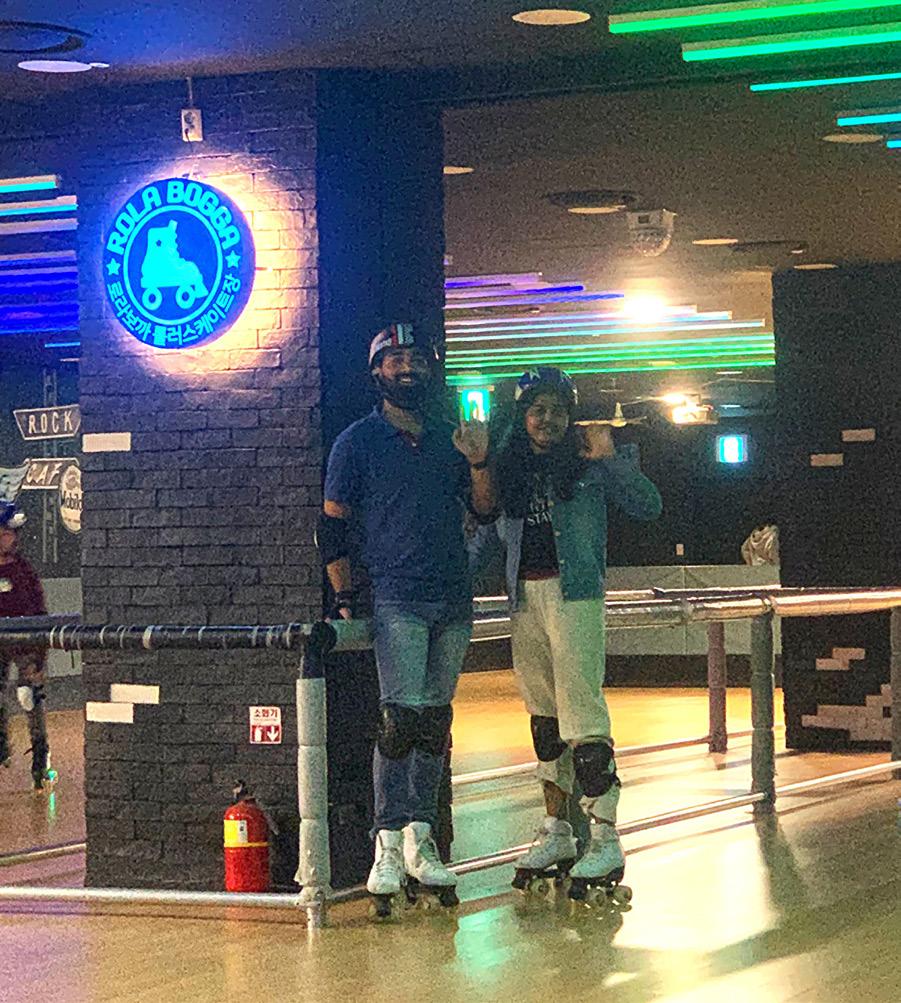
Skating and gaming zones inhabit the downtown area.
regularly screen international films, often with English subtitles, making movie nights an easy and popular option for foreigners.
In addition, smaller local theaters and cultural cinemas sometimes host independent, international, or festival films, particularly during special events and film seasons. Watching a movie followed by dinner downtown is a classic and easy weekend plan in Gwangju.
For those who enjoy staying active, Gwangju offers plenty of indoor recreation options. Ice skating rinks and roller skating (normal skating) venues are popular group activities suitable for beginners and experienced skaters alike. Bowling
alleys are lively social spaces, often combined with arcades, billiard halls, and snack bars.
Indoor sports centers also provide table tennis, darts, and pool, making them great choices for rainy days or colder seasons.
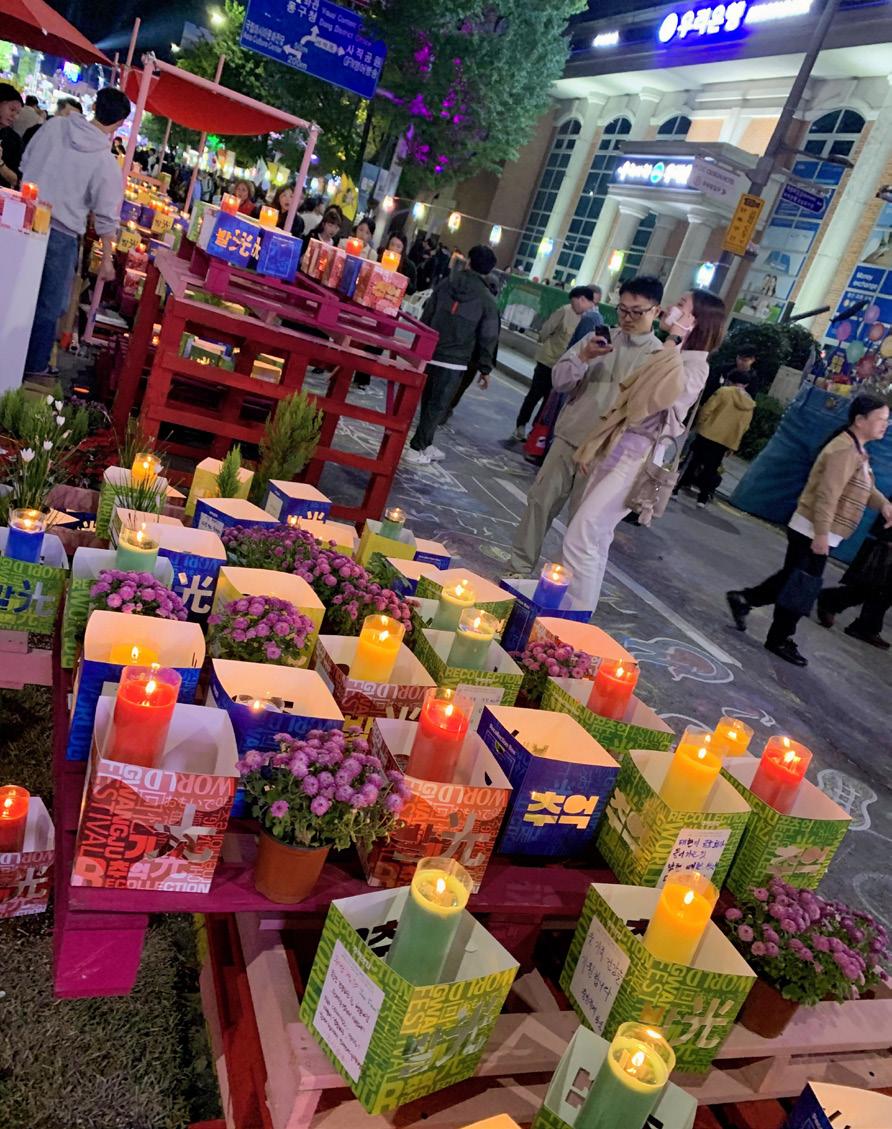
lively Geumnam Street glowing with candles and festival energy.
Gwangju is widely recognized as one of Korea’s cultural cities, and weekends are the best time to experience its artistic side.
The Asia Culture Center (ACC) is the city’s cultural centerpiece, hosting exhibitions, performances, film screenings, and interactive workshops throughout the year. Many events are free or low-cost, and English information is commonly available, making it especially welcoming for foreigners.
Gwangju is also internationally known for the Gwangju Biennale, one of Asia’s most important
contemporary art exhibitions. Held biannually, it attracts artists, curators, and visitors from around the world and reinforces the city’s reputation as a hub for global artistic dialogue.
Beyond these major institutions, smaller galleries, live-music venues, and independent cultural spaces – often near downtown and university areas – showcase both Korean and international artists. Seasonal festivals and pop-up art events frequently add to the weekend atmosphere.
No cultural experience in Gwangju is complete without understanding its modern history. The May 18 Archives (5.18 민주화운동기록관) tells the powerful story of the 1980 Gwangju Democratic Movement, a defining moment in South Korea’s struggle for democracy. Through photographs, documents, personal testimonies, and multimedia exhibits, the museum explains the sacrifices made by citizens and the movement’s lasting national impact. English explanations are available, making it accessible for foreign visitors.
Nearby memorial spaces provide quiet areas for reflection and help visitors understand why Gwangju is often described as the moral and democratic heart of Korea.
A short distance away, Penguin Village (펭귄마을) offers a very different but equally meaningful experience. Revitalized by elderly residents using recycled materials, murals, and playful penguinthemed art, the village tells stories of memory, everyday life, and resilience. It is a favorite spot for photography, slow walks, and experiencing Gwangju’s strong sense of community.
When you need a break from the city’s energy, Gwangju’s green spaces offer calm and fresh air.
Uchi Park (우치공원) is a favorite among locals and foreigners alike. With wide walking paths,
open lawns, and nearby attractions such as a zoo and small amusement rides, it’s perfect for relaxed strolls, casual picnics, or easy weekend outings.
Sajik Park (사직공원) is especially loved for its elevated viewpoints. Located close to the city center, it offers walking paths, shaded seating areas, and panoramic views of Gwangju’s skyline – particularly beautiful at sunset and at night.
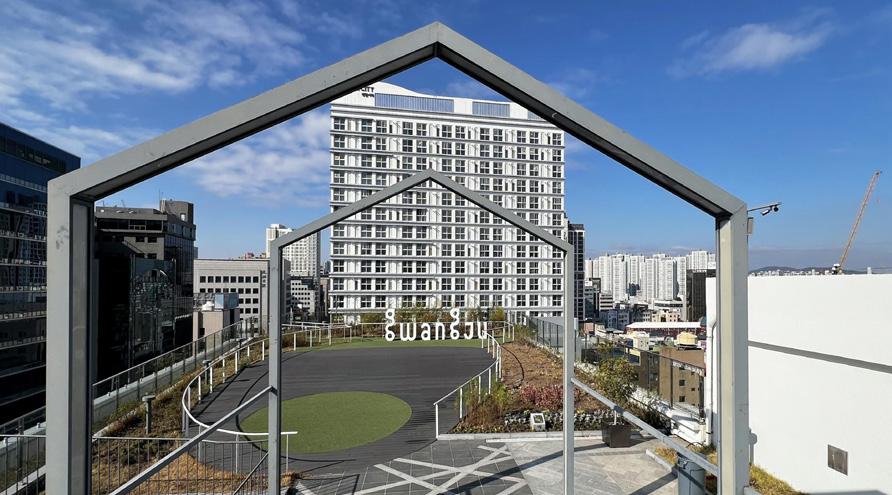
For nature lovers, Mudeungsan National Park provides scenic hiking trails and breathtaking views just outside the city. Lake Park (호수공원) offers a peaceful setting for jogging, cycling, or evening walks.
Cycling enthusiasts can explore the Yeongsan River Bike Routes, part of Korea’s national cycling network, which passes through Gwangju and offers long, scenic riverside routes. A more local favorite is the Seomjin River cycling track, a wellmaintained path popular for cycling, jogging, and leisurely walks. Its relaxed atmosphere makes it a natural meeting place for locals, students, and foreigners.
Weekends in Gwangju are never complete without good food. The city is especially famous for tteok-galbi (grilled short rib patties), a signature Gwangju dish known for its rich, smoky flavor. Other local specialties are ori-tang (duck soup) and duck barbecue, which are widely enjoyed in Gwangju and Jeonnam Province for their deep, herbal taste and nourishing qualities.
Traditional Korean BBQ, kimchi-based stews, and spicy street snacks are also must-tries. Markets and small neighborhood restaurants
serve hearty, affordable meals – perfect after a full day of activities.
International cuisine is also growing in popularity. From Western comfort food to Middle Eastern, South Asian, and fusion options, foreigners can find familiar flavors, especially near university areas.
• Language: English signage is common downtown, but learning a few basic Korean phrases goes a long way.
• Support & Community: The Gwangju International Center (GIC) is a valuable resource for foreigners. It offers Korean language classes, cultural programs, legal and saenghwal (daily life) support, and regular social events that help newcomers connect with both locals and the international community.
• Media & Culture: The UCC (Universal Culture Center) and local university hubs often host cultural talks, performances, film screenings, and student-led events. These spaces are great for experiencing local culture and meeting people in an open, friendly environment.
• Meetups & Events: Check local Facebook groups, GIC notice boards, and university community pages for language exchanges, weekend meetups, and cultural activities.
Whether you’re looking for excitement, cultural inspiration, new friendships, or a peaceful escape, Gwangju offers a well-balanced weekend experience. From arcades and cinemas to art exhibitions, cycling tracks, and mountain trails, the city proves that meaningful weekends don’t always require big crowds or famous landmarks – sometimes, they’re found in places that quietly grow on you.
Author
A native of India, Neha Bisht is pursuing her PhD research at Chonnam National University’s School of Materials Science and Engineering. She loves to meet new people and make new friends. Neha endeavors to contribute to the well-being of society in whatever way she can.
Photographs by Neha Bisht.
By Châu Lê
February, the month of Valentine’s Day, in South Jeolla is not about big gestures. It is about small, shared moments: walking slowly, warming hands around a cup, tasting something together. Romance here is experienced not only through places, but through what couples share: warmth, flavor, and time.
Quiet Romance – Tea, Slow Walks, Soft Conversations. In February, Boseong feels hushed and personal. The morning mist drifts across empty tea paths, and couples are able to walk without urgency, letting silence speak. Romance here is not expressive; it is calm and secure. After a casual walk, sitting down together for tea feeels like a shared ritual rather than a break, natural and unhurried. With fewer visitors in winter, couples can enjoy uninterrupted views, soft conversations, and the rare feeling that the landscape exists only for them.
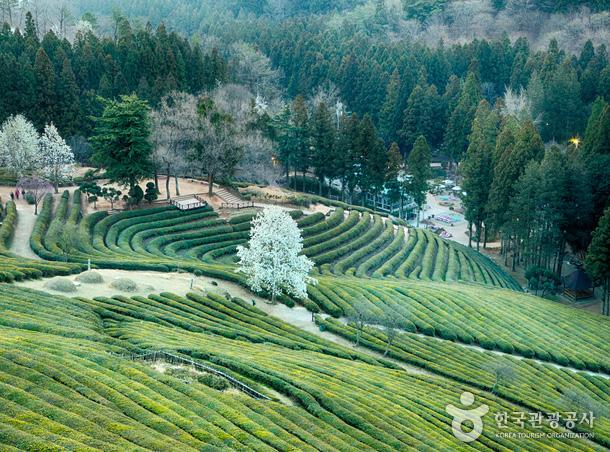
Moments to Share
• Warm green tea or green-tea latte to gently warm the body
• Green-tea rice cakes or roll cake – slightly sweet, never overwhelming
• Best enjoyed slowly, without phones, while watching the fog lift
Gentle Romance – Gardens, Silence, and Shared Time. Suncheon Bay Garden in February offers space – physical and emotional. Couples can walk without rushing, sometimes without talking, letting shared time do the work. Romance here feels steady and reassuring, especially as the winter sunset softens the landscape. February brings a rare calm to the garden, allowing couples to experience it without distraction. The absence of crowds turns simple walks into meaningful shared time, where quiet companionship becomes more memorable than mere words.
• Hot Americano or café latte in a quiet café after the walk
• Simple brunch dishes (toast, soup, light pasta) rather than heavy meals
• Sitting by a window, watching the garden fade into evening
Timeless Romance – Love Beyond Time. Walking through the Nagan-eupseong Folk Village in February feels like stepping into a quieter dimension of love. Stone walls, thatched roofs, and narrow paths slow the pace, inviting couples to walk hand in hand without distraction. Here, romance is shaped by tradition – by deep-seated values of commitment, family, and shared
responsibility that have endured for generations. In the stillness of winter, love feels less about excitement and more about intention, reminding couples that lasting relationships are built over time, through patience and everyday care.
Moments
• Traditional tea served warm in a traditional hanok setting
• Simple Korean snacks or traditional sweets
• Eating slowly, surrounded by history
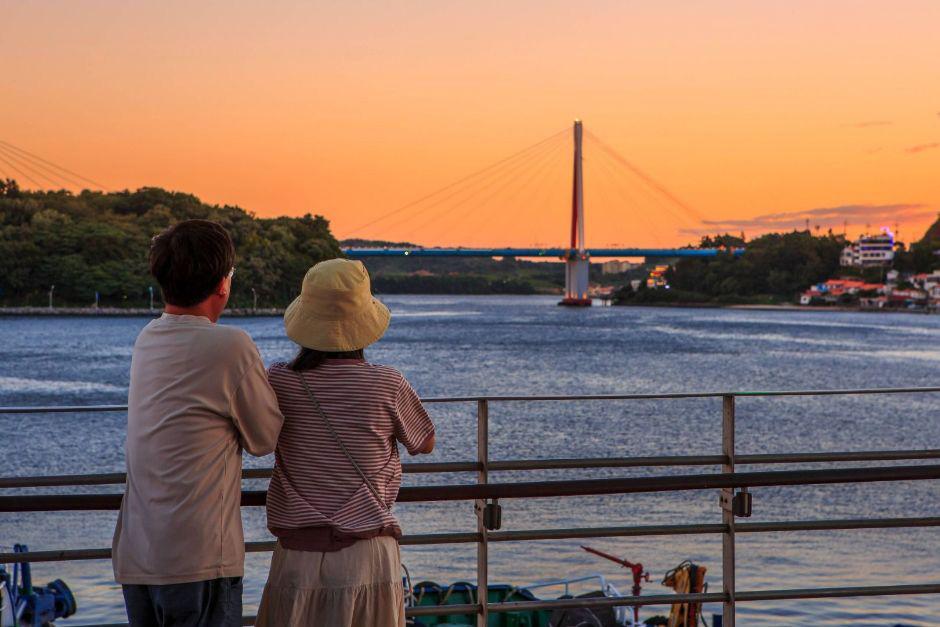
Yeosu
Passionate Romance – Night Sea, Lights, and Promises. Yeosu’s romance belongs to the night. The sea reflects the city lights, the wind sharpens emotions, and couples sit close – not sightseeing, just feeling present. Dinner here is part of the romance, not necessarily the highlight. What matters is sharing warmth before stepping back into the cool night air together. In these quiet moments by the sea, couples often find themselves making small promises – promises to return together, to protect this closeness, or simply to keep choosing each other beyond the night.
Moments
• Fresh seafood dinner (grilled fish, shellfish, or seafood stew)
• Hot soup to balance the cool February air
• Finish with warm street snacks or fishcake before a night walk
In winter, couples naturally gather around warmth – warm drinks, warm meals, warm conversations. In South Jeolla, or anywhere, for that matter, romance tastes as much as it is seen. A cup of tea slows time. A hot cup of coffee extends the conversation. A seafood dinner warms before a brisk night walk. And traditional flavors connect the present with both the past and the future.
This February, romance is not so much about where you go; it’s about what you quietly share together.
Sources
Henderson, E. (2025, October 5). An overnight trip to Boseong tea field. Stars and Stripes. https://korea. stripes.com/travel/an-overnight-trip-to-boseong-teafield-korea.html
Linda. (2020, July 7). Boseong Green Tea Fields: How and when to visit. Linda Goes East. https:// lindagoeseast.com/2020/07/07/boseong-green-teafields/
VisitKorea. (2023, September 6). Travel highlights: Boseong green tea field travel information. https://english. visitkorea.or.kr/svc/contents/infoHtmlView. do?vcontsId=175963
Bradley, H. (2024, February 12). Unveiling the charm of Suncheon Bay National Garden: A guide. The Soul of Seoul. https://thesoulofseoul.net/suncheon-baynational-garden-guide/
Jeong, E. (2024, December 18). Suncheon Bay National Garden. VisitKorea. https://english.visitkorea.or.kr/svc/ contents/contentsView.do?dataSetId=150&menuSn=95 8&vcontsId=218428

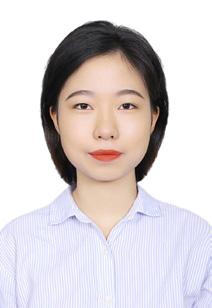
Châu Lê, a Vietnameses student in South Jeolla, reflects on how quiet landscapes and everyday moments create meaningful connections. Through Yeosu, Suncheon, and Boseong, she shows that shared time, warmth, and atmosphere deepen relationships and bring people, cultures, and countries closer. (Silhouette image by Freepik.)
By Dhivyaa S. P.
After spending two and a half years living in the Chonnam National University dormitory, my roommate and I finally decided it was time to move into a house. Over those years, we had accumulated far more belongings than we had expected; especially in my case, as someone who tends to buy “unnecessary” items each season purely for aesthetic reasons.
Even though our new house was located less than three kilometers from the university, the amount of stuff we owned made moving a bigger task than anticipated. This led me to search for affordable and reliable moving services using the Naver app.
While browsing, I came across the Soomgo (숨고) website, a popular Korean platform for hiring various services, including movers. The site requires logging in using a Kakao ID. After signing in, I filled out a simple inquiry form to request a moving quote.
Initially, the move was only for a single item: a queen-size bed. I had gotten this bed for free from the Carrot app (a small win worth mentioning!). The bed needed to be moved from an apartment near U-Square to our soon-to-be house.
Once I submitted the request, I received multiple quotes from different moving companies. I contacted each one to confirm whether they could disassemble, transport, and reassemble the bed, as well as to check availability for my preferred date and time. Some companies responded quickly, while others were slow or unresponsive. After about 30 minutes of comparing options, I booked a mover for 60,000 won.
“Overall, the entire moving process was smooth, efficient, and stress-free.”
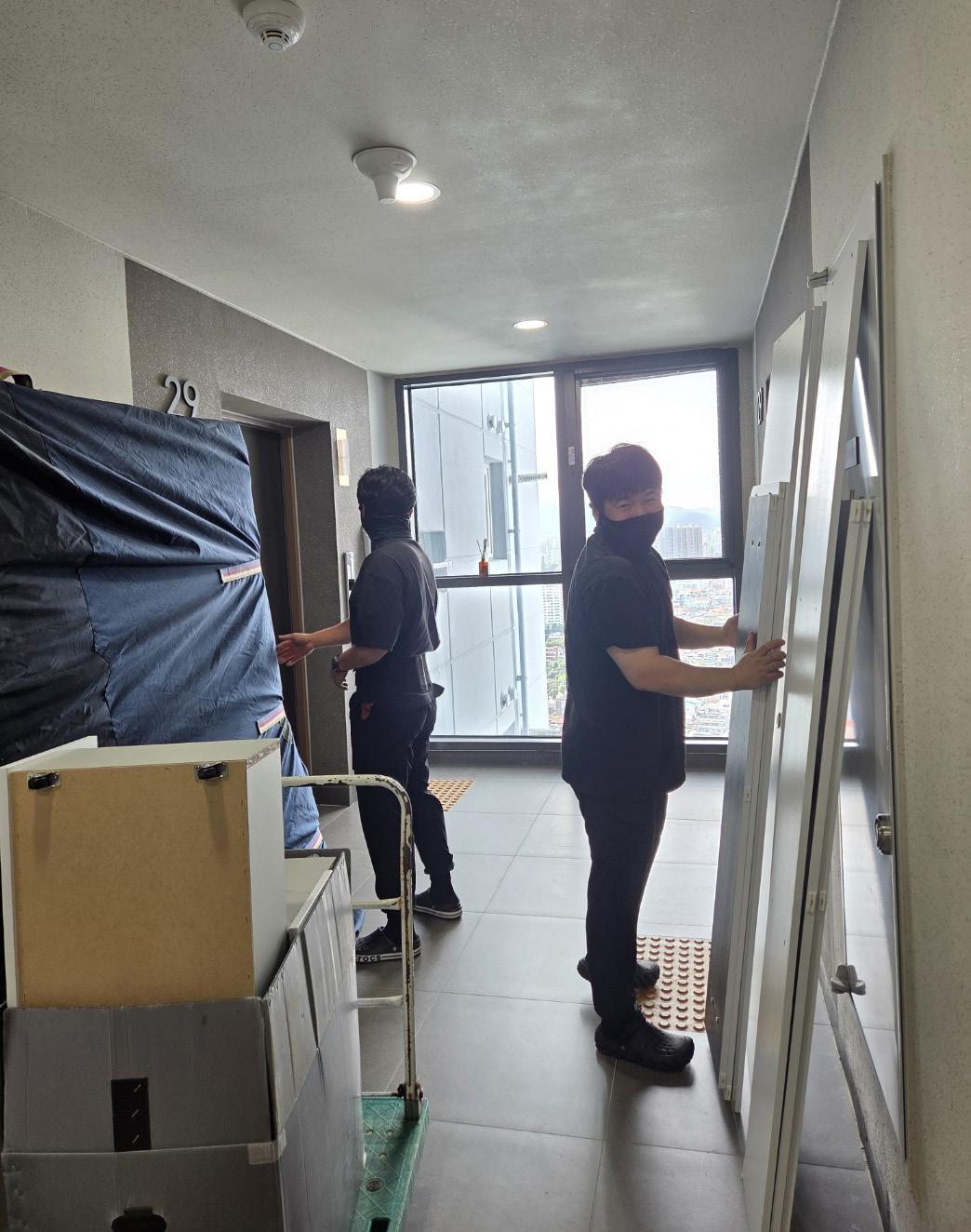
On the day of the move, the movers arrived exactly on time with a large truck and all necessary equipment. They brought their own boxes, trolleys, and protective covers for the bed. Their professionalism was impressive. One passenger was also allowed to travel in the truck to the destination, which was very convenient.
Due to time constraints, I couldn’t get the bed assembled on the same day. Without hesitation,
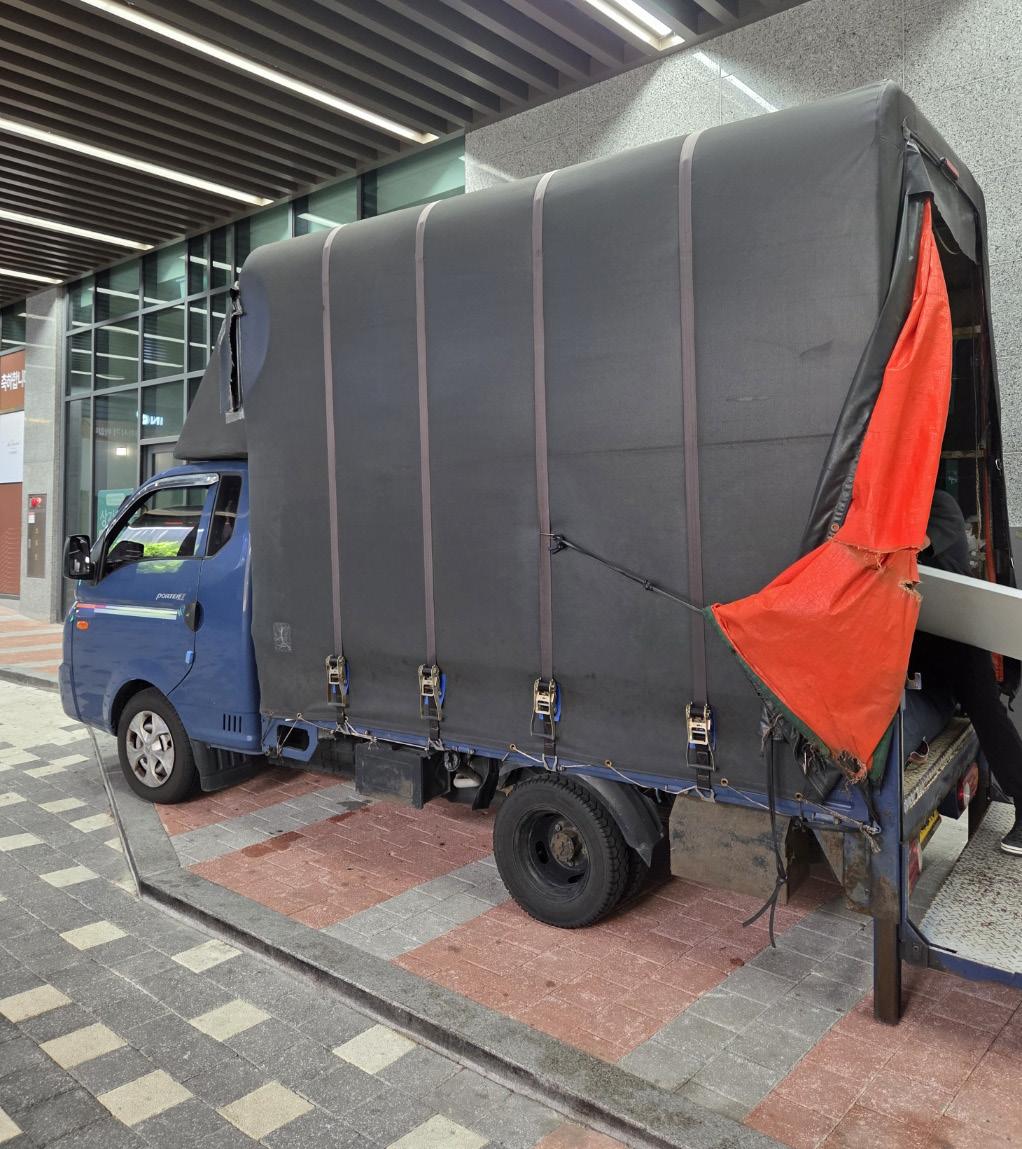
the movers offered to return on another day to assemble it at no extra cost. This level of service left a strong impression.
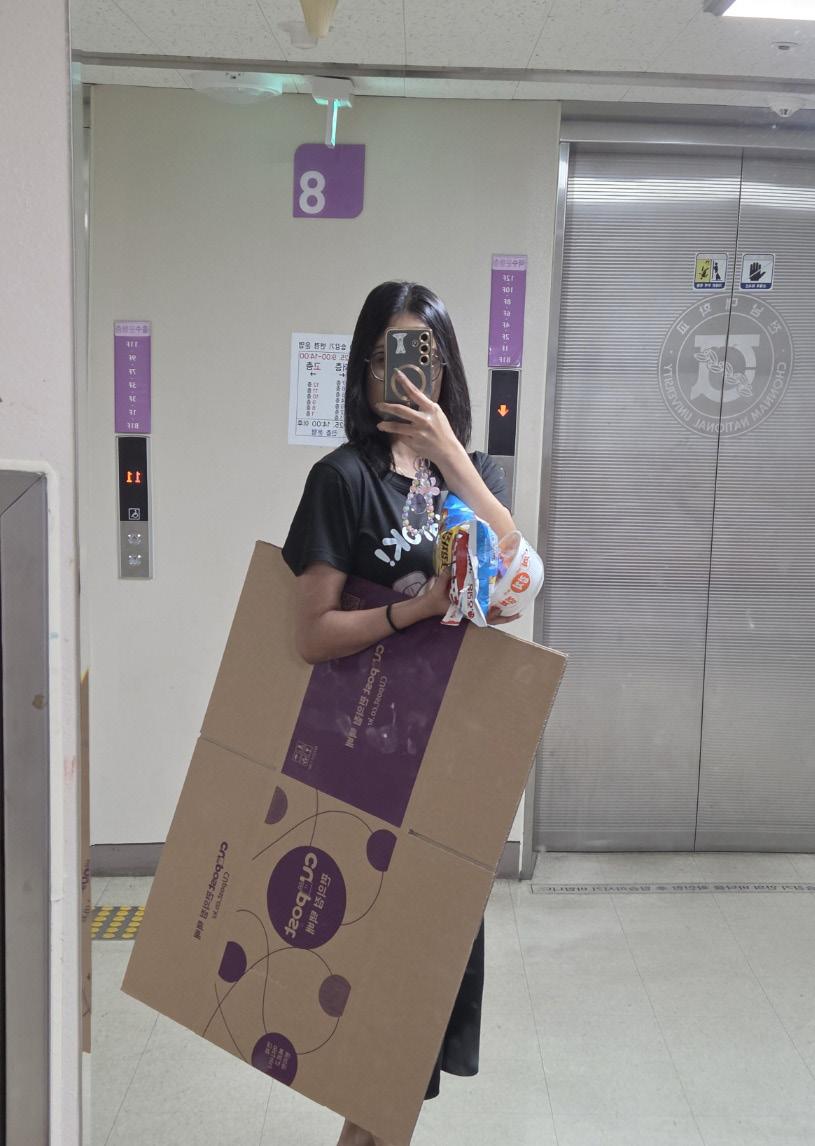
Because of this positive experience, we decided to book the same movers again for our main move from the dormitory to the house. By then, we had more than 15 boxes, five trolleys, and several loose items. All we needed to do was pack everything and place it outside our dorm room.
The movers handled the rest. They transported everything from the eighth floor of the dormitory to the second floor of our house. Since the house didn’t have an elevator, the movers had to climb the stairs repeatedly with heavy boxes. We were extremely grateful for their hard work. Including a tip, the total cost came to around 80,000 won.
Overall, the entire moving process was smooth, efficient, and stress-free. The only challenge was the language barrier. The Soomgo website (https:// soomgo.com/) is completely in Korean, and most movers communicate only in Korean as well. Using a translation app is highly recommended for non-Korean speakers.
Later on, one of my friends also used KakaoTalk to book a moving truck, which is another commonly used option in South Korea.
If you’re a student or foreign resident planning a move in Korea, local platforms like these can be affordable and surprisingly reliable – as long as you’re prepared to navigate through the process with a bit of Korean.
The Author
Dhivyaa believes that every action, no matter how small, contributes to a bigger change. February has always been her busy month of the year with travel and international conference deadlines. Up Next: Affordable. Attractions. In Port City!
Photographs by Dhivyaa S. P.
By Muhammad Umar Tahir
Idid not realize how important the Korean language was until a bus driver at Incheon Airport looked at me, spoke rapidly in Korean, and waited for an answer I could not give.
It was my first day in Korea. I was traveling to Gwangju by bus and needed a ticket receipt as proof of travel. Without a local bank card, cash was my only option. The driver explained something in Korean, adding hand gestures that somehow made everything more confusing. I smiled, nodded, opened my translation app, typed quickly, and still failed to understand what he was trying to tell me.
This was during the COVID period. Seats were empty, people were distant, and there was no bilingual stranger nearby to rescue me. After a while, the bus departed. I sat by the window, enjoying Korea’s scenery for the first time, hoping my next conversation would be easier than the first.
Fortunately, near my destination, a passenger who spoke a little English helped me get the ticket receipt. It felt like a small victory and a big reminder that life in Korea would be easier with the Korean language.
At the time, I convinced myself that English was enough. Inside the university (GIST), it usually was. Classes, research meetings, presentations, and emails all ran smoothly in English, making the compulsory Korean course feel optional. Unlike programs such as GKS (Global Korea Scholarship), where students receive dedicated time for language learning, most international graduate students juggle heavy coursework, research pressure, and deadlines. Learning
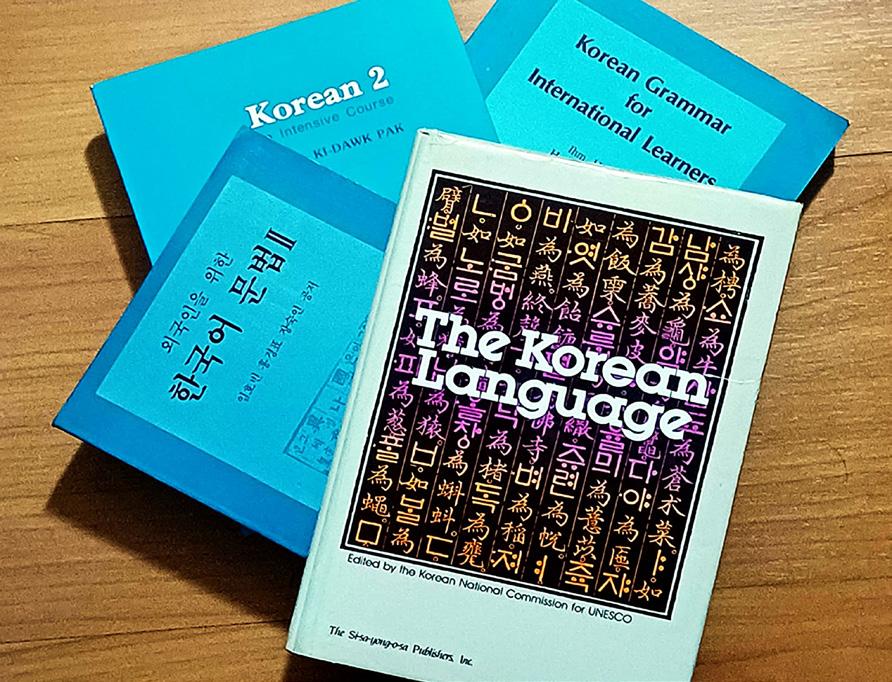
Korean becomes something we plan to do later. Unfortunately, “later” keeps moving further away.
Things changed once life moved beyond the campus. After marriage and moving into family life, Korean stopped being a language I could avoid. Hospitals, childcare centers, government offices, markets, and transportation became part of daily life. Suddenly, English was no longer enough.
I remember visiting the Damyang Bamboo Forest, still one of my favorite places in Korea. There was an option to rent a small cart to explore the area. I wanted to try it badly. I stood there smiling, listening carefully, understanding nothing, and eventually walked away without asking again. It was a small moment, but it stayed with me. Language barriers do not only block big opportunities. Sometimes, they even quietly steal away simple joys.
Later, during hospital visits and medical situations, the importance of Korean became even more obvious. In stressful moments, relying entirely on translation apps feels risky. And beyond serious
situations, daily life itself demands some Korean. Even ordering food can turn into an adventure if you are not prepared. One can only survive so long as pointing at menus and smiling politely is effective. Soon one begins to wonder if learning the language might actually be easier.
That realization pushed me to take Korean seriously. I joined the Korean Immigration and Integration Program, known as KIIP, expecting something similar to university language classes. Instead, everything was conducted in Korean! Instructions, explanations, discussions. All in Korean. On the first day, I barely understood anything and silently questioned my life choices.
Most participants seemed comfortable. Many were industry workers or spouses of Korean nationals who had regular exposure to native Korean speakers. Daily conversation came naturally to them. As an international graduate student living mostly in an English-speaking academic environment, I felt far behind. Listening was difficult. Speaking felt embarrassing. Responding felt almost impossible.
But one important lesson became clear early on: Perfection is not required to start.
I continued KIIP while adding small learning habits that fit into a busy academic schedule. Short daily practice, conversation apps, Korean dramas with subtitles, and conversation groups where we forced ourselves to speak only Korean even when it felt uncomfortable. Many times, I managed to say my sentence clearly, only to freeze completely when the reply came back. I smiled, nodded, and quietly thought, “What just happened?”
Still, something slowly changed.
I started listening to Korean radio while driving. I watched Korean movies more intentionally. Sometimes, I even took taxis just to practice talking to drivers in Korean, even though I owned a car. Occasionally, the driver was not interested in conversation, which made things awkward. Most of the time, though, it turned into a friendly and unexpected learning moment. Scenario-
based practice, listening carefully, and speaking without fear made a real difference.
Technology today makes life easier. Translation apps are improving. Interpretation services are available. More institutions now offer English support, and Korea itself is gradually becoming more English-friendly.
Yet, for confidence, independence, and a sense of belonging, learning Korean remains powerful. Helping other international students by translating or assisting them in Korean has also strengthened my own skills. The joy of helping others, surprisingly, became another motivation to keep learning. Whether someone plans to stay in Korea long term or eventually leave, learning the language always pays back. It makes daily life smoother, interactions warmer, and experiences richer. When learned smartly, with realistic expectations and consistent effort, it never becomes a waste of time.
Korea is a country rich in science, technology, and innovation. As international graduates, making the effort to move one step toward the Korean language is also a way of giving something back. It allows us to participate more fully, contribute more meaningfully, and connect more deeply with the society around us.
Today, I am not fluent. But I am confident. I can manage daily conversations, navigate life with less stress, and yes, confidently reorder side dishes at restaurants without pointing at pictures. Learning Korean did not just change how I communicate. It changed how I live, and it can potentially change your life as well.
The Author
Muhammad Umar Tahir is an electrical engineer pursuing his PhD in the Artificial Intelligence Convergence Department at Gwangju Institute of Science and Technology (GIST). He is interested in applying AI to healthcare devices, particularly in advancing medical imaging technologies and brain stimulation. Outside research, he enjoys exploring new places, meeting people, and exchanging ideas on how innovation can improve the quality of life.
By Park Yeonju
In July of 2025, I left for Weihai in Shandong Province of China to study Chinese. On a day when the hot sunlight beat down, I set off for nearby China with a heart full of excitement. It was about a one-hour flight. Over the wide ocean, land began to appear little by little, signaling the opening of a new page in my summer.
Writing Chinese characters was fun, and Chinese felt appealing to me. The interest I had studying since childhood naturally led to a double major in university. I still could not speak fluently, but in the China I had vaguely pictured since I was young, I wanted to spend some time – at least once. Even if for only a short time having the experience and being able to say even one more sentence would make a huge difference. With curiosity about China and a desire to improve my Chinese, I took my first steps in Weihai.
The first sight of China did not feel very unfamiliar. Since Korea is also part of the Chinese-character cultural sphere, it was simply fascinating that everything was written in Chinese characters. It did not feel foreign. However, China uses simplified Chinese characters rather than the traditional Chinese characters used in Korea. Because of this, the form of the character was often different from the form I was used to. If it was a character I had studied, no problem. If not, I had to infer the meaning from a simplified shape that looked similar to the traditional characters I already knew. They matched fairly often. Still, because simplified characters often have clear differences in form, I sometimes struggled.
However, if I had not known the traditional Chinese characters used in Korea, there were times when I wouldn’t have been able to even
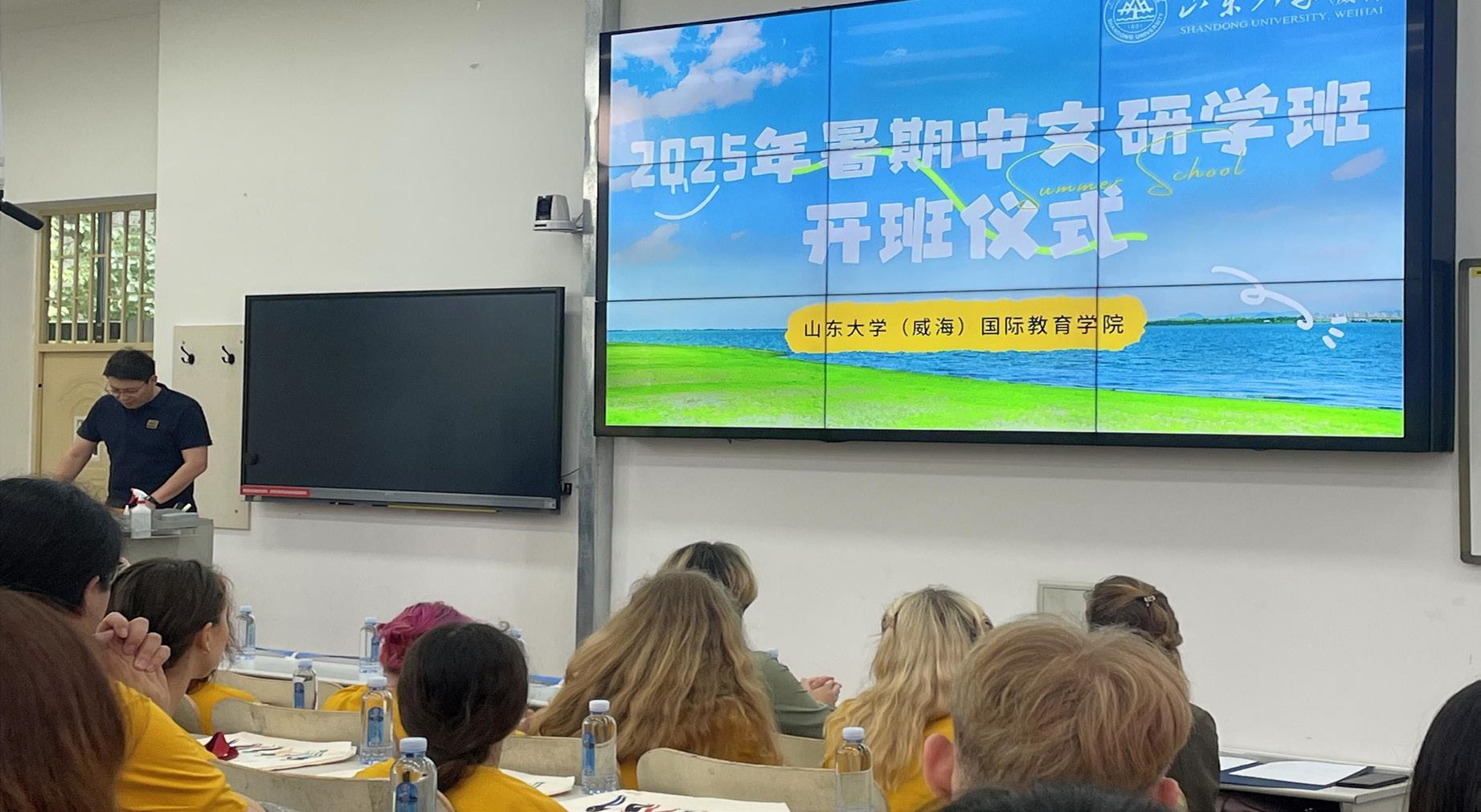
Orientation session for all program participants.
make a guess. So whenever I studied Chinese, I kept reminding myself that I should neglect neither simplified nor traditional characters. Once you know traditional characters to a certain degree, simplified characters become easier to understand as well. On top of this, Taiwan uses traditional characters, the same system used in Korea. China and Tiawan are two places that share the same language but use different scripts.
Another feature of Chinese is that even if you don’t know what a character means, you can still pronounce it. Chinese has three components you need to learn: the characters themselves; Hanyu Pinyin, which displays the pronunciation in the Roman alphabet; and the four tones that distinguish meaning by pitch. Because you have to memorize all three, Chinese can feel like it has a higher barrier to entry than other languages. Even when you learn a single Chinese word, it takes time to be able to use all three parts smoothly.
Think about Korean. Even if you do not know a word’s meaning, as long as you know vowels and consonants you can still pronounce it. So, does that mean you cannot pronounce a Chinese word you have never learned? Not necessarily. Because Chinese characters are pictographs, there are many characters that look similar. They are clearly different characters, yet they often share a visual component that is the same. In these cases, the meaning may differ but the pronunciation is often the same, or very close. If you use this strategy, even when you meet an unfamiliar character, you can make an educated guess at the pronunciation, thinking, “Maybe it is pronounced like this,” and little by little you train yourself to pronounce Chinese characters.
When I first stepped out onto the street after arriving in China, I felt nervous and excited. I was thrilled that I could finally use Chinese in real life, after learning it only from books and school classes in Korea. It was not anything grand. Still, when I used simple Chinese to place an order, the whole process felt amazing. They understood my
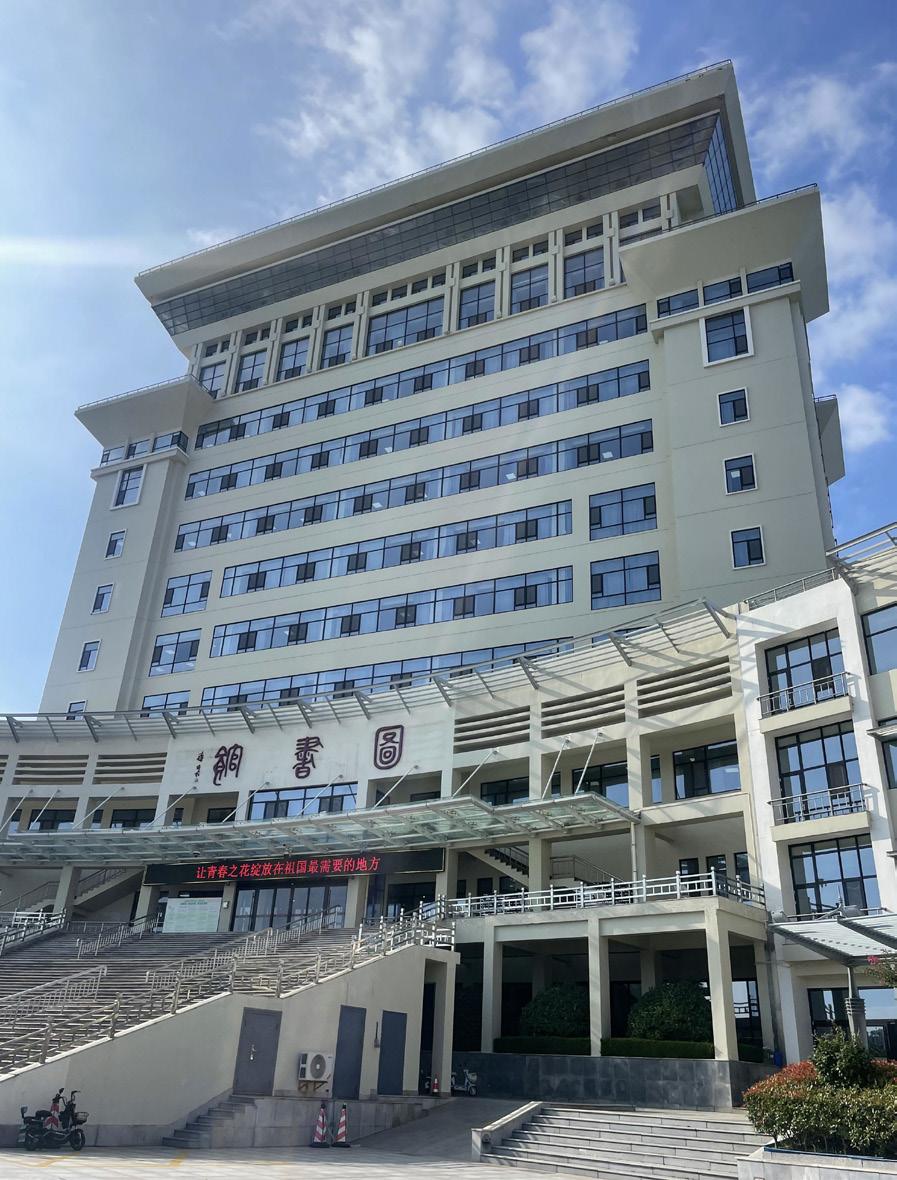
words and served me the food. Every step of it was fascinating. I started communicating with a simple mindset: I may be lacking, but I will use as much Chinese as I need to get my meaning across. As I kept trying, I gradually became more interested in Chinese.
Even though I might not have known a word in Chinese, I didn’t feel too discouraged. I looked it up in a dictionary or boldly used a digital translator. Even if I did not know much, I reminded myself that I was learning new words and sentences in that moment. That made my fear of communicating disappear. After that, even when I could not fully understand what people were saying, I could roughly understand it through key words and be able to handle the situation. That was when the saying “Even if the language is difficult, experience it on site first” truly felt real.
Because the Chinese I learned at school in Korea was taught mainly through textbooks, the
focus in China was on learning how to speak for specific situations. There were several class levels. In the beginner class, we learned Chinese through English. From the intermediate level, the teacher taught Chinese using only Chinese. As an intermediate student, I worried at first about whether I could keep up. But as I listened to Chinese for several hours every day, it felt like my ears were opening up. Frequently used words and expressions were absorbed naturally, and I became able to use them.
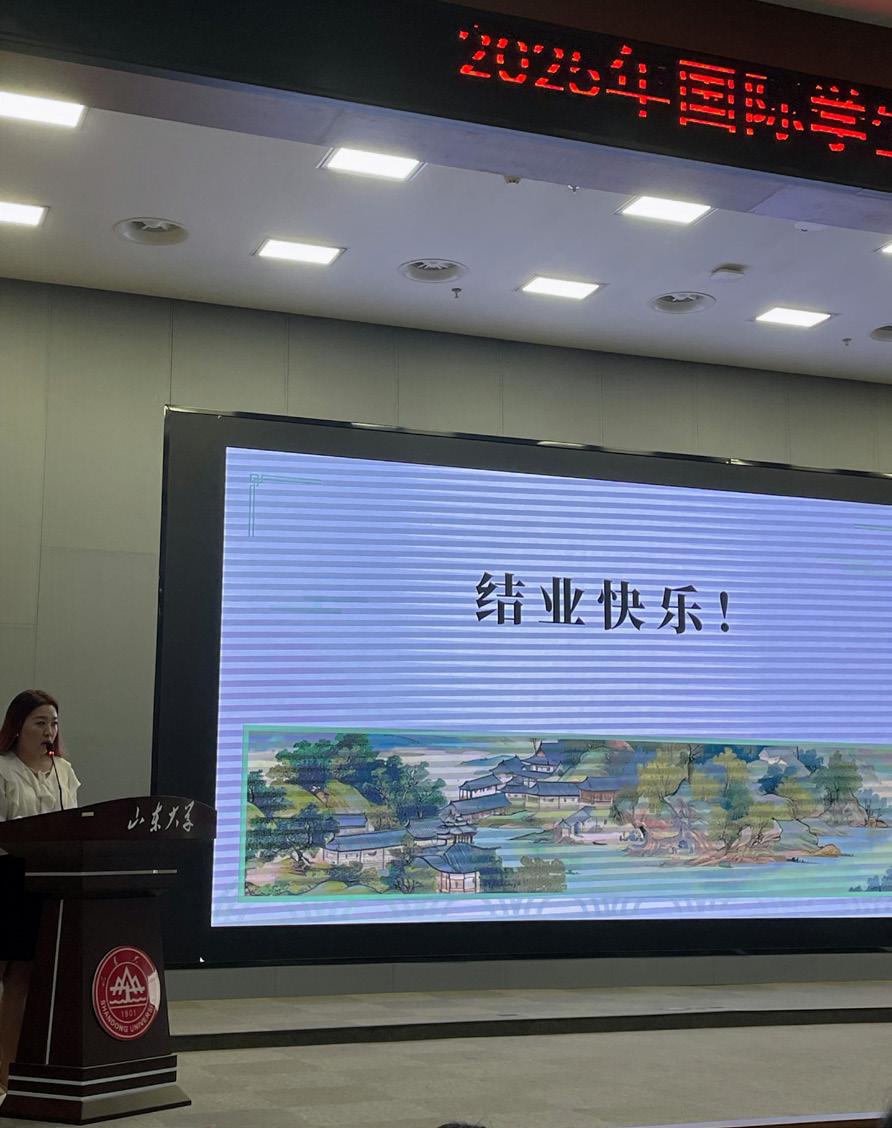
At first, of course, I couldn’t follow everything quickly. Still, the teacher’s repeated practice and the way students had to say example sentences and present them gradually built my confidence. It was okay to make mistakes. The teacher corrected my errors.
In Korea, I had learned Chinese in a class of Korean students. Once I came to the Chinese school, there were many Russian students as well. It was my first time to meet Russians. During our breaks, we sometimes spent time talking about
“K-culture” and about each other’s countries. Hearing about Korean culture and K-pop from people in other countries made me feel proud. It also made me realize how strong Korea’s soft power is.
That month-long experience was incredibly precious, and it is still quite vivid in my thoughts. It was a time that changed how I will think and study from now on. Of course, you can study Chinese well enough in Korea. There are plenty of learning materials and a wide range of online lessons. Still, I recommend studying in the country where Chinese lives at least once. It helps you reconnect with why you are learning Chinese in the first place. It also helps you approach the language with more enjoyment. As you travel and slowly get to know the place, you start to want more.
You want to raise your Chinese level and open the door to more diverse experiences. I also promised myself that when I returned to Korea, I would use the time as nourishment and take one more step closer to Chinese. When I used to study only through books, I often put off studying when it felt difficult. But now it is different. I’ve brought so many good memories back. Sometimes I take out the photos from my experience in China and steady myself for a wider view of the world.
My month in Weihai is still shining. Now I can think more independently. What part of China should I travel to next? What phrases do locals use most often? Where will my next destination be?

Park Yeonju is an undergraduate at Chonnam National University, majoring in political science and diplomacy as well as Chinese language and literature. Her third specialization is international development cooperation studies. She was born and raised in Gwangju and wants to promote the colorfulness of the city. It is her dream to become a true journalist by inheriting the spirit of May 18.
Photographs by Park Yeonju.
By Chung Hyunhwa
In our November issue, I introduced the Gwangju National Science Museum and at the time learned that there would be a special climate and endangerment exhibition – “Earth in Crisis, SOS” – to be held from November 28 to March 2. I knew I would have to return to visit. It was a Saturday when a friend of my son’s visited from Busan. We all went.
The first part of the SOS exhibition, “The Approaching Sixth Mass Extinction,” displays how 80 percent of the earth’s species disappeared during each of the past five mass extinctions, alerting us to the sixth mass extinction crises we are now facing. You can also see a specimen of a Dodo bird, which has disappeared forever due to the greed of humans.
The next part of the exhibition, “The Climate System and Global Warming,” shows how today’s rapid climate change is related to the greenhouse gases that we release. You can visually see where we are in terms of global warming through its various displays.
The third part, “The Endangered Biotic Variety,” is rather artistic. You can see 37 specimens of natural treasures and endangered wild animals. There is also a display by paper artist Lee Jaehyeok. He created an incredibly realistic and beautiful display of endangered birds, sending

us a strong message of which amazing creatures we could lose when we blindly follow economic logic alone, without recognizing other precious values. His birds are astonishingly realistic, so I was tempted to touch them to check if their feathers were really made only of paper. They made a very strong impression on me because I am a bird lover as well.
The last section of the exhibition is titled “The Sustainable Earth” to show hope and solutions. It highlights how tidal mudflats, such as those Korea has on the west coast, could act as “carbon reservoirs” to absorb greenhouse gases. In one corner, there is a food store experience section one should not miss. If you get a basket, put in the foods you usually buy, and check out at the counter, you can see if you will have those food items in 2050. None of the foods I usually get were available in the future. I thought it was one of the best experiential displays in the exhibition to make you realize what the actual reality will be if we don’t do anything about climate change.
One display that you cannot just pass by is a 1.8-meter-diameter earth globe with four projectors projecting onto it. You can spin the earth with the controller yourself, and check the climate phenomena with one of your fingers. It is really cool.
According to Director Lee Jeong-gu during an interview with CBS, the exhibition was designed not only to deliver scientific facts but also to let visitors really feel the climate change on the earth with their five senses. He also would like to stress that the extinction of animals could affect the existence of the human race due to the ecological imbalance that it would cause. So, we should not forget that it is not just about preserving the environment – it has to do with our own survival.
The exhibition runs until the 2nd of March, so there is still time to go and see it. My overall impression was that I could see the effort made to deliver the unavoidable facts through beautiful artistic displays. I hope that more people, especially families with kids, can go and check it out. Tickets to the special exhibition are 6,000 won, and 8,000 won for the triple package that includes the regular exhibitions as well.
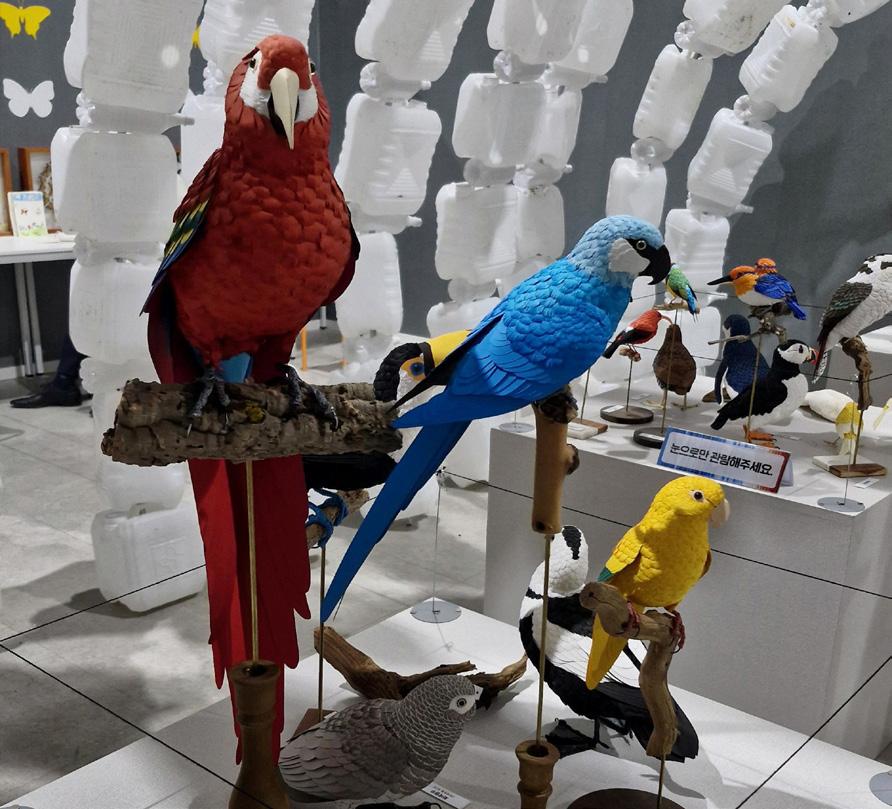
Additionally, on this visit, I had a chance to check out the Space 360 special theater to watch two short movies. The theater itself was a big hollow globe, and the audience watched from the bridge in its center. The entire inner side of the globe was the screen, so you could watch a whale pass over you as if you were deep inside the ocean while your eyes followed it overhead, or you could see a herd of running dinosaurs rushing overhead. I thought it was absorbing and as enjoyable as any IMAX movie would be. I recommend Space 360 not only to families with kids but also to adult science lovers. It is one of the rare, surreally happy moments that 3,000 won can bring you. I absolutely recommend it. I envied the children there because I didn’t have this opportunity when young, but fortunately it served to awaken the child inside of me.
Chung Hyunhwa, a native of Gwangju, recently worked for a local horticultural company. She led the international eco-hike group Gwangju Hikers at the GIC in 2020 and 2021. Previously, she taught English at Yantai American School and Yantai Korean School in China and worked in school administration at Branksome Hall Asia in Jeju. She holds a master’s degree in TESOL from TCNJ in the U.S. and has a license to teach Korean. She loves plants, birds, and repurposing items creatively.
Photographs by Chung Hyunhwa.
By Saqib Sharif
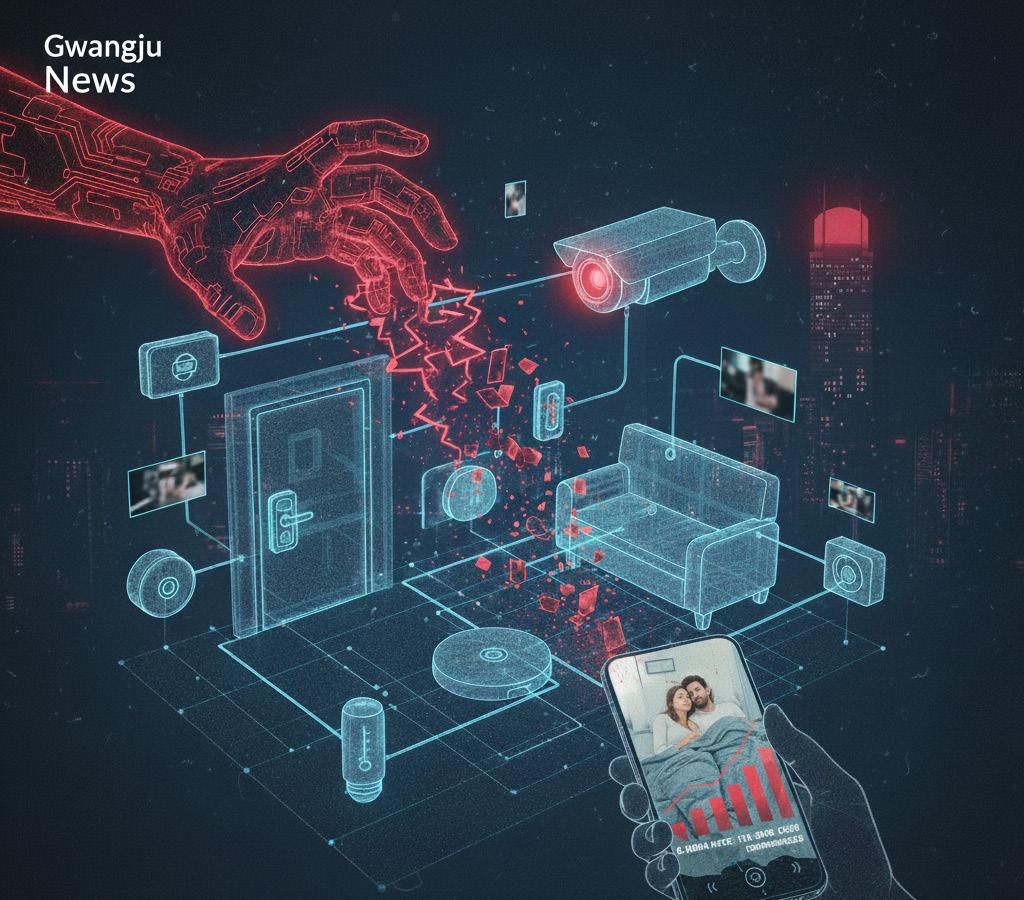
Over 120,000 home cameras in South Korea were hacked, with attackers gaining access to private footage and using it for illegal purposes, including distributing intimate recordings. This BBC story serves as a stark warning about how easily everyday internetconnected devices can be compromised when they are not properly secured, and how deeply such breaches can affect people’s privacy and safety.
Smart home gadgets, cameras, sensors, locks, light bulbs, and more are all part of the so-called Internet of Things (IoT). These devices are meant to make life more convenient by connecting to the internet or to each other so you can control them with an app or voice commands. But while convenience is great, it comes with a trade-off: Every device you connect to your network is a potential door into your home for cybercriminals.
Research by security experts shows that attacks against IoT devices are rising rapidly, with millions of attempts to exploit weak devices around the world every day. Many smart devices do not use Wi-Fi alone to talk to each other. Instead, a popular way for them to communicate is through ZigBee, a wireless system designed specifically for small, low-power devices that need to send simple messages like “turn on,” “light is on,” or “motion detected.” ZigBee is popular because it uses very little power; tiny sensors can run for long periods without frequent battery changes. It also supports something called a mesh network, which quietly connects many devices together so that signals can hop from one to another until they reach their destination.
A ZigBee network works almost like a team passing messages along. One device in your home, usually the main smart hub, acts as the coordinator. It is the central point that manages the ZigBee system and links it to your wider home network and the internet. Around it are devices that act as routers; these are typically things that are always powered, like smart plugs or wall switches. They help forward messages across the network so devices that are far away from the hub can still communicate. Then there are the smaller end devices, such as sensors and buttons. These send and receive messages but do not pass them on to others. Together, all these connections form the ZigBee network map, where each device is like a dot linked to others: Messages take the best available path to reach the hub and then the internet. This makes the system flexible and reliable, even in large homes.
One of the best things about ZigBee is that it uses encryption, a kind of secret code, to protect communication between devices much like banks use encryption to protect financial data. But this protection can only work well if all the devices in the network are secure. If one device has weak security, outdated software, or a default password that’s easy to guess, it breaks the chain of trust. A hacker might be able to join the ZigBee mesh through that weak device and start listening to traffic or even sending their own commands.
“Private footage can be stolen, personal routines exposed, and sensitive information misused.”
This is especially risky when you add thirdparty devices; that is, gadgets made by a different company than your main smart hub brand. These products are often cheaper or promise extra features, but they may not have strong security practices. Because ZigBee devices automatically trust others once they join the network, a poorly secured third-party device is like a poorly locked window in your house. An attacker might not immediately take over everything, but they can use that access point to watch activity, intercept communication, or look for other weaknesses in your network that let them go further.
Once a device becomes part of the network, even if it only exchanges small, encrypted messages, it can still leak useful information. Security researchers have shown that attackers do not always need to read the actual data. By simply watching when devices communicate, how often they send messages, and which devices respond, it is sometimes possible to guess what is happening inside a home. Over time, this can expose daily routines and behavior patterns without ever breaking the encryption itself. Because of this risk, it is always recommended to avoid ultra-cheap online IoT devices that seem
too inexpensive for the features and services they promise, as such products often cut corners on security to reduce costs.
The South Korean camera hack shows how serious these risks can be in real life. When cameras or other home devices are compromised, the impact goes beyond annoying pop-up ads or glitches. Private footage can be stolen, personal routines exposed, and sensitive information misused. This isn’t just theoretical; real people have had their privacy violated and suffered emotional and personal consequences as a result.
Understanding how ZigBee and other IoT networks work helps explain why these systems need better security. Each device you add increases the size of your network and the number of potential weak points. Convenience shouldn’t mean that privacy and safety are ignored. Choosing reputable devices, keeping them updated, changing default passwords, and thinking carefully before adding random products to your smart home can make a meaningful difference in protecting your digital life.
Sources
Butler, G. (2025, December 1). More than 120,000 home cameras in South Korea hacked to record “sexploitation” footage. BBC News. https://www.bbc.com/news/ articles/cj01q6p7ndlo
Seals, T. (2015, August 7). #BlackHat: Critical ZigBee flaw compromises smart home devices. Infosecurity Magazine. https://www.infosecurity-magazine.com/ news/blackhatcritical-zigbee-flaw-smart/ Connectivity Standards Alliance. (n.d.). The full-stack solution for all smart devices. https://csa-iot.org/allsolutions/zigbee/
The Author
Saqib Sharif is a robotics engineer with a PhD in mechanical engineering, specializing in the design of smart healthcare devices and microrobots. With a strong background in medical technology and innovation, he is passionate about creating solutions that enhance smart healthcare. Dr. Sharif has been living in Gwangju for the past ten years. Currently, he serves as a senior researcher at Shinsung Tech Pvt. Ltd., Gwangju.
By Farrukh Anique
“Iwould never trust an AI-driven car to drive me anywhere. It is like putting my life in the hands of a machine,” a friend told me recently. Interestingly, he is a medical robotics researcher, busy designing a robot that slips a needle into the spinal canal to deliver painrelieving drugs. Ironic, is it not?
So, when we agree to a medical or surgical procedure done with robotic assistance, are we really handing our lives over to machines? How safe are these steel “hands” we invite so close to our bodies? Let us look beneath the smooth plastic covers to see how medical robots actually work and how they are designed to protect the very lives they seem to threaten.
When someone says “robot,” most of us picture the same thing: a metal human with two arms, two legs, a pair of shiny eyes, maybe even a friendly, or slightly creepy, face. But that cartoon in our heads is almost never what real robots look like. Surgical robots are, in essence, sophisticated tools that try to imitate the precision of human hands during an operation. They do not need faces or fingers to do that. If you walk through a hospital, most of the devices you see will just look like machines: boxes, arms, cables, screens.
That is exactly what my friend meant when he said he could not trust his life to “a machine.” But when you are lying on an operating table and a robotic system is working a few centimeters under your skin, you are not truly trusting the machine. You are trusting the person behind it –the surgeon at the console, who sees your organs magnified on a screen and directs every tiny movement. Medical robots do not decide what treatment you receive, and they do not write the

plan for your surgery. They simply carry out the strategy your doctors have already designed after thinking, debating, and worrying over your case in a very human way.
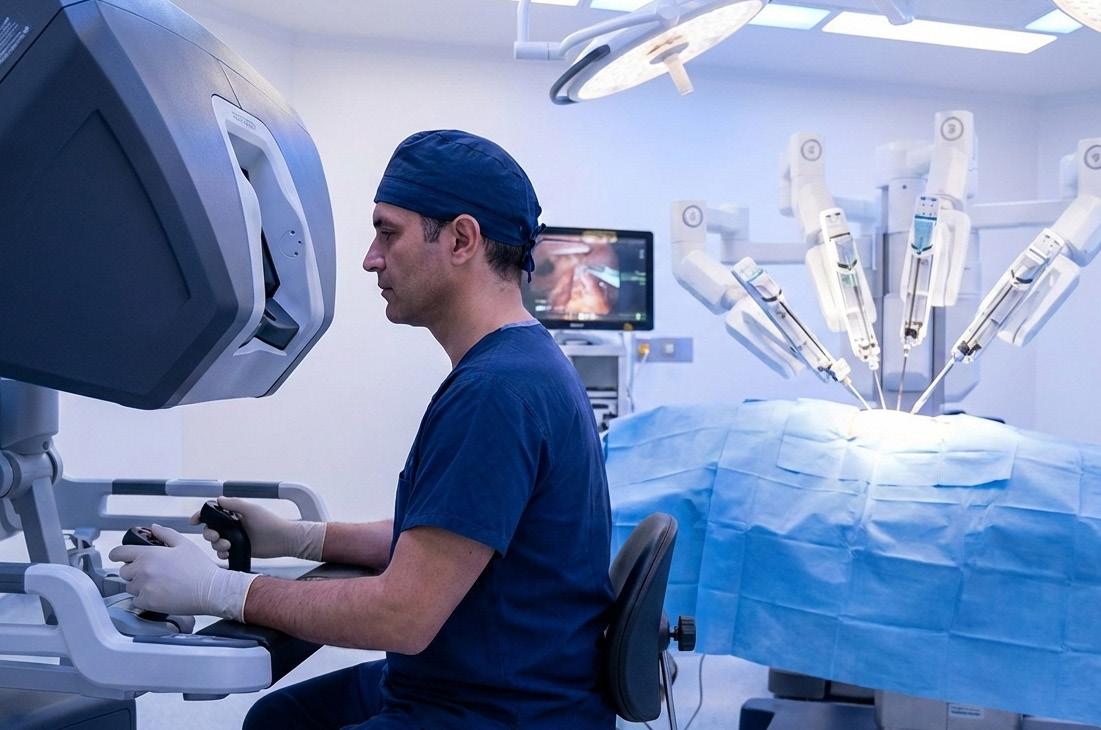
Every medical robot is built from a handful of basic parts, and it makes sense to start with the one that matters the most to the patient and to the designers as well. Engineers call it the “end effector,” but you can think of it as the robot’s hand, the part that actually touches the body. This hand can take many forms. In one procedure it might be a fine needle, in another a tiny scalpel, in another a delicate gripper with small jaws. Depending on the surgery, the end effector may cut and dissect, place stitches, take a biopsy sample, inject or remove fluids, steer catheters and guidewires through blood vessels, or hold an ultrasound probe in just the right position on your stomach. All the motors, sensors, and software exist for one purpose: to guide this small, specialized tool so it can do its job with as much precision and as little damage as possible.
During surgical procedures, surgeons usually control the motion of the end effector with
a primary device, often called the “master controller.” It might look like a joystick, a pen, or a small pistol-shaped handle dotted with buttons. The surgeon’s hands stay on this master controller, making calm, deliberate movements, and the end effector (the slave side) quietly follows. But it is not a simple one-to-one copy. Between master and slave, the motion is cleaned and refined: Tiny hand tremors and sudden jerks are filtered out, movements are scaled down so a big sweep of the hand becomes a tiny shift at the instrument tip, invisible boundaries and pivot points are enforced so the tool pivots safely at the entry point, and both force and speed are carefully controlled. In other words, the robot does not make the surgeon superhuman, it simply helps their human hands behave at their very best where it matters most.
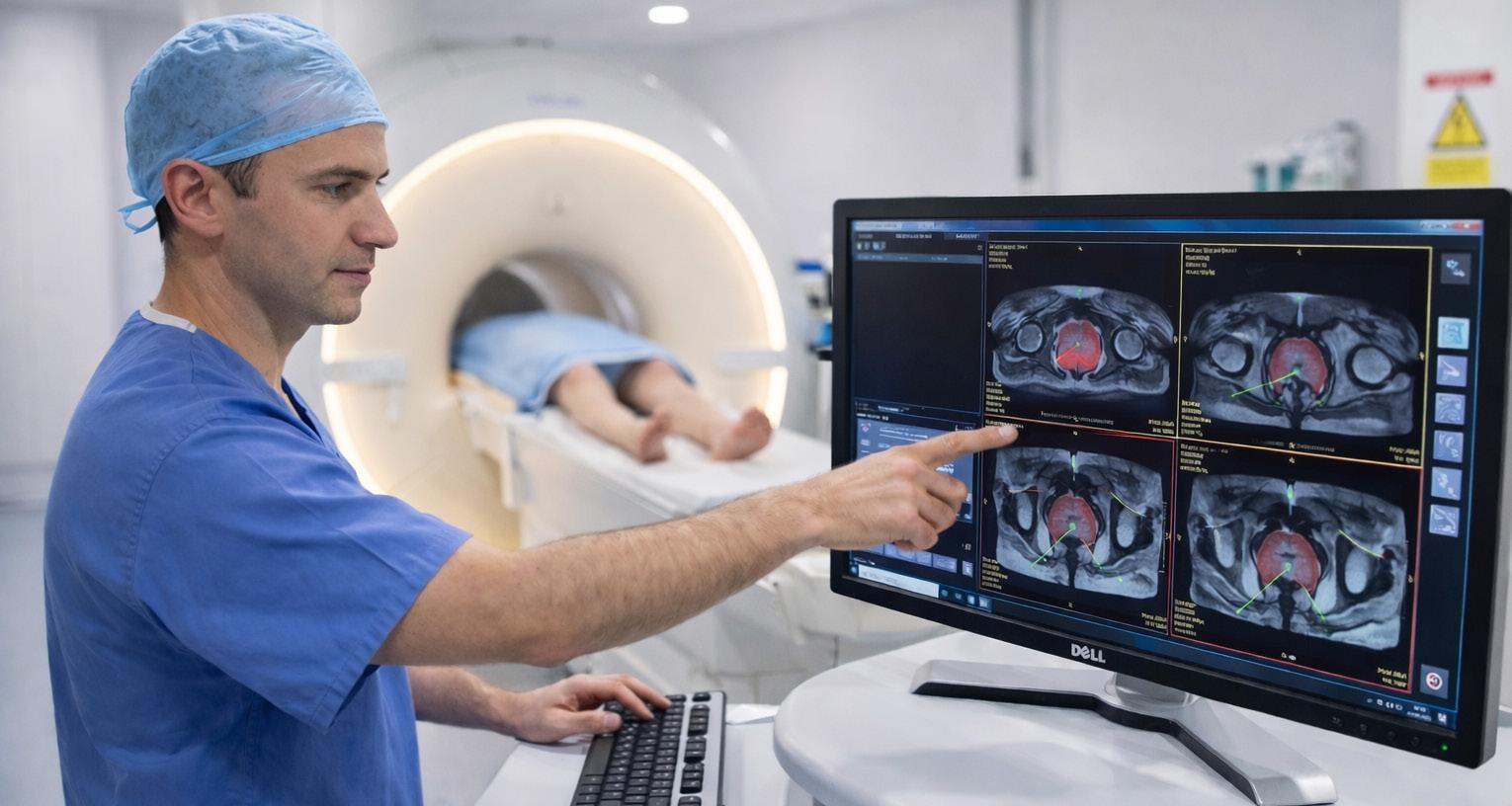
To truly see what they are doing, surgeons need more than steady hands, they need good eyes, and in modern operating rooms, those eyes are electronic. An imaging device, such as a camera, CT scanner, ultrasound probe, or MRI, feeds pictures to a monitor, giving the surgeon a window into the body. Before those images appear on the screen, they are often processed and enhanced: Contrast is adjusted, noise is reduced, and important structures are made clearer.
Today’s imaging systems can even blend different types of images and use image processing techniques to highlight suspicious areas, such as potential cancer nodules. On the screen, the surgeon can mark target regions directly, sketch possible paths, and plan safe trajectories with a
precision that would be impossible by touch and intuition alone. In a sense, the imaging system turns the patient’s hidden anatomy into a map that the surgeon and the robot can read together.
Every active robot needs a way to move, and that job belongs to its “actuators,” the muscles of the robot. These may be electric motors, fluidpowered actuators, smart flexible materials, or other clever mechanisms. They draw energy from one of various kinds of sources and turn it into exactly the kind of mechanical motion the task demands. Modern actuators can be astonishingly precise, delivering tiny, smooth movements deep inside the body – motions so controlled and delicate that no human hand, however skilled, could ever quite match them.
As the robot works, the surgeon must stay aware of what is happening inside the patient, inside the machine, and right at that fragile contact point between metal and tissue. That is where sensors step in. They are the eyes and ears of the robot, and in a way, borrowed senses for the surgeon. They reach beyond the limits of human sight and touch, streaming back information no naked eye or fingertip could ever provide.
Sensors track the position and motion of tools and tissues, and they measure the forces and
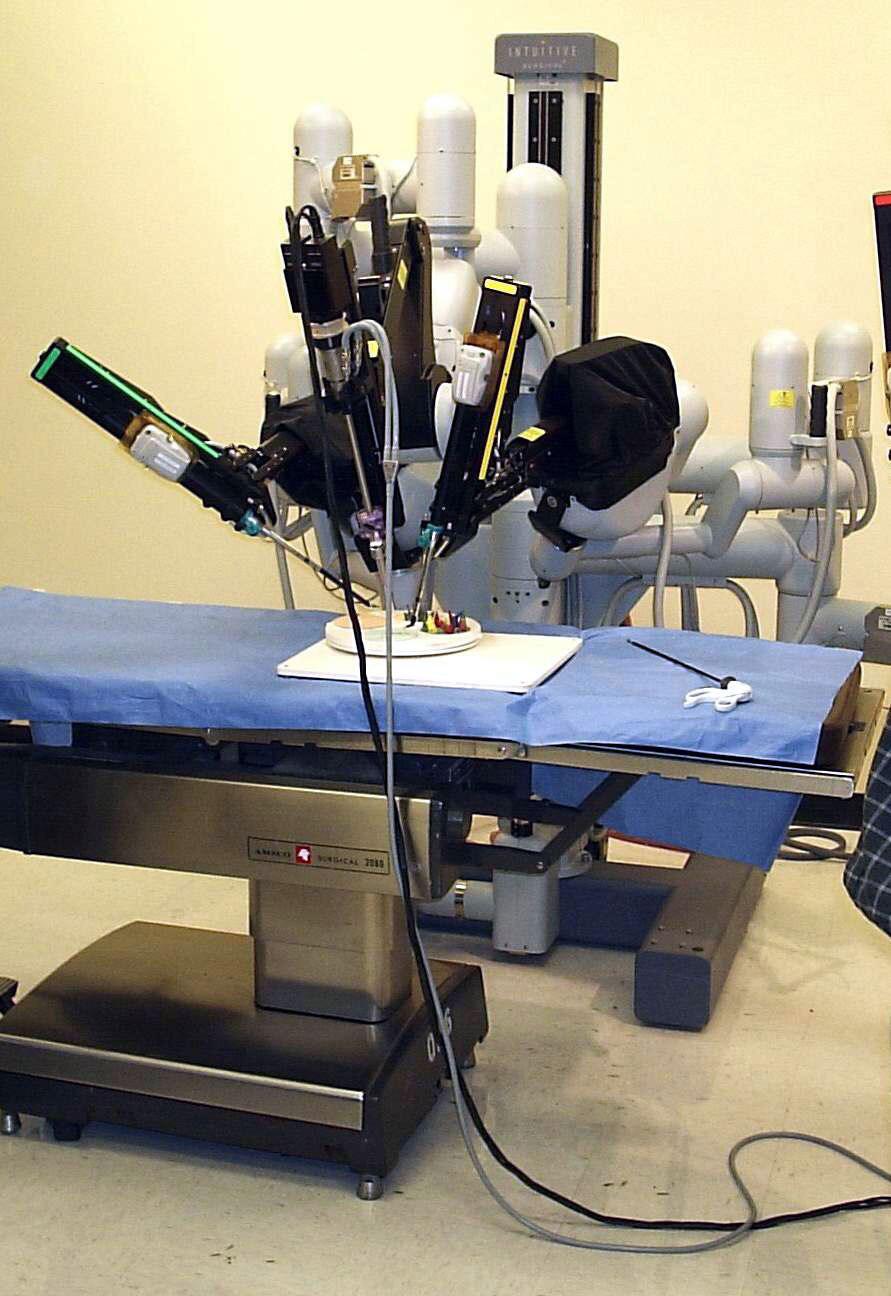
torques where they meet. Others watch over the robot’s own health, monitoring temperature, current, and pressure, while cameras and other imaging sensors capture pictures and video for processing and presentation. Together, they allow the system to regulate the robot’s performance and the team to monitor the patient’s condition at the same time.
Then comes another crucial component: the control system. This is the software, the brain of the robot. Inside it lives the code for everything the robot is designed to do, from how it should perform its tasks to how it should react if something unexpected goes wrong. It talks to the actuators, listens to the sensors, and makes sure the robot moves exactly as it is supposed to.
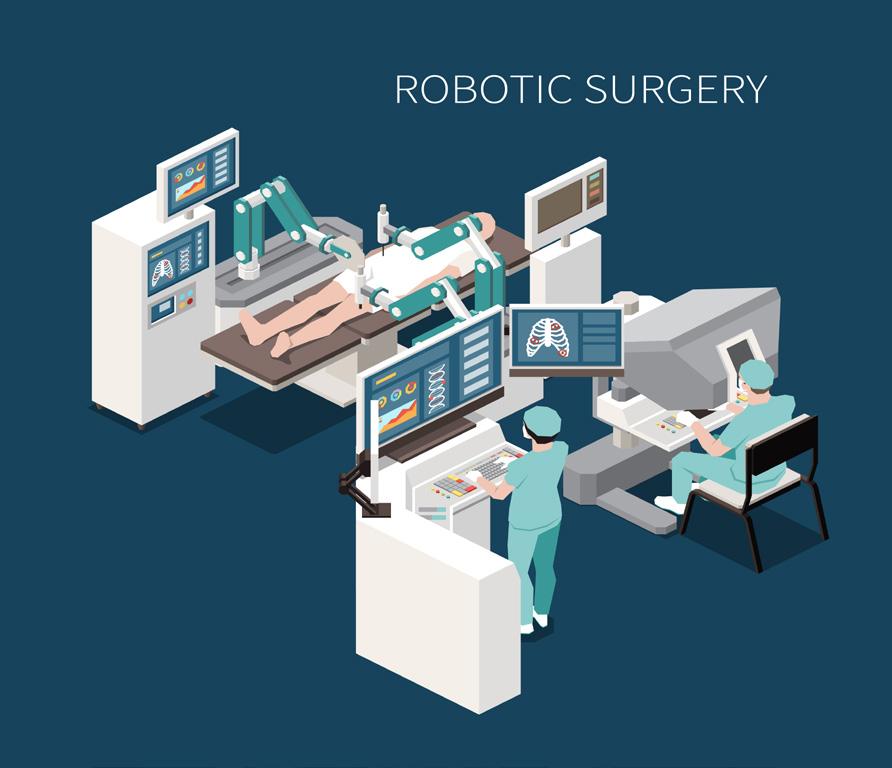
(Macrovector)
The control system also draws the safety boundaries and refuses to cross them. Even if a human makes an error in judgment or pushes the controls in the wrong direction, the software can step in, limit the motion, and prevent the robot from doing something that could harm the patient.
When you put all of this together, the picture becomes much clearer. The end effector may be the part that touches your body, but it does so only under the watchful eyes of sensors, the steady muscles of actuators, and the strict rules of the control system. Behind them stand engineers who test every line of code, doctors who refine
procedures, and regulators who demand proof that the whole system behaves safely, even when something unexpected happens. Patient safety is not left to a single clever gadget, it is built up in layers, from mechanics to electronics to software to the careful people who design, test, and use these machines.
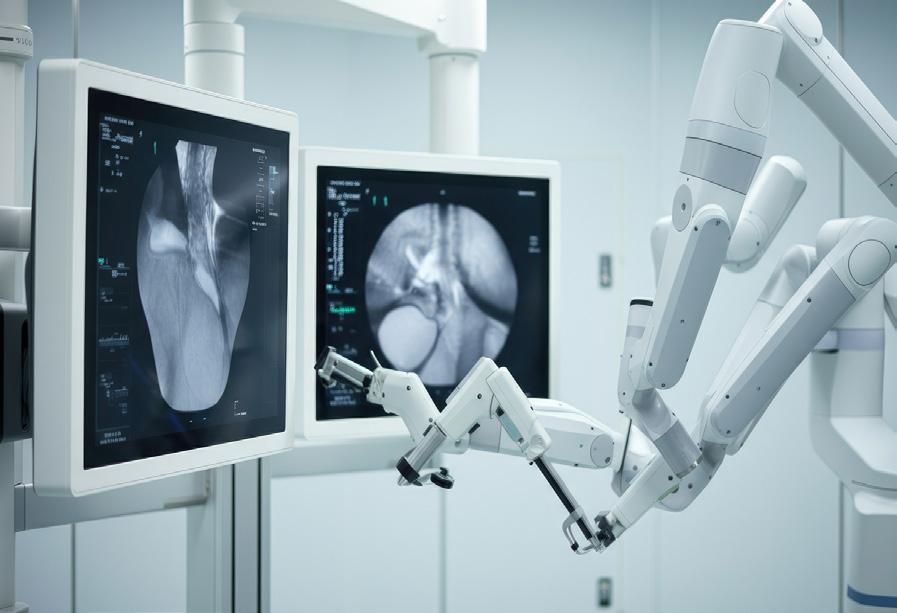
So, who is really holding the knife in a robotassisted surgery? In a narrow sense, it is a steel instrument guided by motors and algorithms. In a deeper sense, it is still the surgeon, supported by a quiet crowd of sensors, actuators, control systems, and unseen researchers who have spent countless days and nights making sure that every motion is as safe and effective as possible. The robot is not there to replace human care but to give careful hands better tools. As patients, we are not trusting our lives to a cold machine running on ones and zeros; we are trusting a very human team that has chosen to work through these ones and zeros in order to harm less, see more, and heal better.
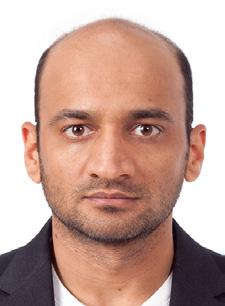
Farrukh Anique is a PhD student immersed in mechanical engineering at Chonnam National University. Originally from Pakistan, he’s not all about gears and equations though. He’s got a real love for the performing arts, culture, literature, and languages. He is an amateur theater actor, a short-story writer, and he speaks five languages. In his spare time, he dives into Korean culture and history, soaking up the vibrant traditions and stories that spark his curiosity. Oh, and he absolutely loves strawberries.
By Luis Andrés
These days in Korea, asking someone about their MBTI feels natural. It serves as a casual icebreaker, a quick way to understand personality, and sometimes even a soft filter for compatibility. But before MBTI took over cafés, classrooms, and dating apps, people often asked another common question: What’s your blood type? And even prior to that, and still quietly present today, there was another layer of identity at play: your zodiac sign.
Depending on where you come from, the question “What’s your sign?” can have very different meanings. In many Western countries, it usually refers to the Western zodiac, based on the positions of constellations: Aries, Libra, Aquarius, and so on. Ask a foreigner in Korea, and you might get one of those responses. However, in Korea, that same question carries more cultural significance than it at first seems to.
Although both systems are simply translated as “zodiac” in English, they are clearly distinguished in Korean. The Western zodiac is called byeoljari (별자리), which means “star constellation.”
The Oriental zodiac, based on a twelve-year cycle of animals, is known as tti (띠) or sibi-jisin (십이지신). When someone asks “What is your tti?” they are rarely just making small talk.
In Korea and across East Asia, the zodiac is closely linked to how time has traditionally been understood and measured. The twelve-animal cycle – rat, ox, tiger, rabbit, dragon, snake, horse, goat, monkey, rooster, dog, pig – repeats every twelve years. Because of this, zodiac signs have long served as a way to mark time.
Asking about someone’s zodiac sign can be a polite way to estimate their age without directly
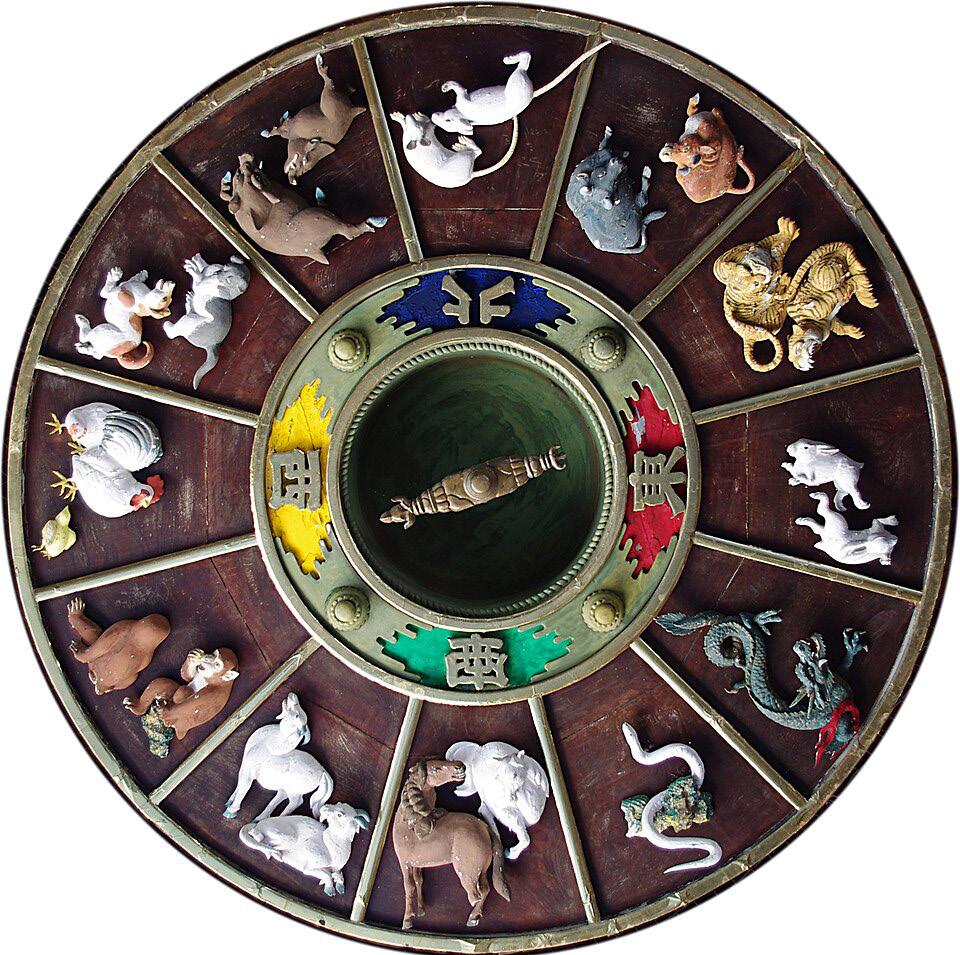
asking – especially helpful in a society where age influences language and social hierarchy. Knowing someone’s tti quickly pinpoints their birth year if you can gauge the correct twelve-year range. It might be challenging to be sure whether someone is in their early twenties or thirties, but generally you can tell once you know their sign.
Historically, this system was also practical. Saying that an event happened “in the year of the Earth Dragon,” for example, was often enough to place it roughly in time because such combinations repeat themselves only once every 60 years. The zodiac was not mystical decoration; it provided a shared cultural framework for understanding history and daily life.
There is a deeper cultural meaning in the zodiac when we think about calendars. The modern Gregorian calendar, used worldwide today, is based in Christian tradition and was standardized under Pope Gregory VIII in 1582, framing time
around the supposed birth of Jesus. We now call this period the 21st century. In contrast, lunar calendars, like the one that spread from China throughout East Asia, operate under a different logic of time. By that count, we are living in a much later century – 76th in some traditions.
In Korea, this is not just historical trivia. The lunar calendar still shapes daily life, especially through Seollal, the Lunar New Year, and other very important holidays like Chuseok (Korean Harvest Moon Festival). The ongoing relevance of the zodiac and lunar calendar in Korea shows not nostalgia but the persistence of living traditions that coexist with modern systems rather than vanishing under them.

Of course, there is also a symbolic – or even mystical – aspect to the zodiac, though it is often more structured and precise than people tend to assume. For starters, the Oriental zodiac does not align neatly with the solar calendar, which can create some confusion for people born early in the year. For example, someone born in early 2026, before Seollal, would technically still belong to the previous year’s sign. However, for practical purposes, people usually refer to the sign corresponding to the year in which most of the calendar falls.
Additionally, each year combines an animal sign with one of the Five Elements (wood, fire, earth, metal, water) and a yin or yang orientation. These distinctions shape interpretations of personality and group energy. A “fire” year under yin influence is associated with calm, introspection, and depth, while a yang fire year emphasizes movement, action, and visibility.
On February 17, 2026, the lunar calendar will mark the beginning of the Year of the Yang Fire Horse. Traditionally, the horse symbolizes energy, independence, popularity, and freedom. Combined with the intensity of fire and the outward orientation of yang, the year is often described as dynamic and transformative.
However, this energy is not always chaotic. Yang fire is seen as focused rather than explosive – a flame that illuminates instead of consumes. Under a broad, non-deterministic view, 2026 is imagined as a year of momentum balanced with direction, intensity guided by purpose.
Whether one believes in zodiac interpretations or not, dismissing them as unimportant misses the point. In Korea, Seollal, the lunar calendar, and the zodiac are not just about belief. They represent cultural memory, social communication, and alternative ways of understanding time.
So, the next time someone casually asks, “What’s your zodiac sign?” it may be worth pausing before you answer. Behind that seemingly simple question lies a dense network of history, tradition, and meaning, quietly reminding us that not all ways of measuring the world fit neatly into a calendar app.
The Author

Luis Andrés González is a Mexican GKS scholar and master’s student in cultural anthropology at Chonnam National University. He advocates for LGBTQ+ rights and gender equality, and explores global affairs through pop culture. He is the founder of Erreizando, a digital magazine. Instagram: @luisin97 / @erreizando
By Reeti Roy
My fascination with India’s Abanindranath Tagore and Korea’s Kim Whanki began at very different moments in my life. I first encountered Abanindranath in a Class I textbook when I was just six years old. Kim Whanki arrived much later, through an unexpected pop cultural doorway when RM of BTS spoke publicly about his love for art. His references encouraged many young people, including me, to look more closely at Korean modern art. As I explored Kim Whanki’s works, I found myself noticing surprising parallels between him and Abanindranath Tagore. Although they belonged to different cultures and different periods, the two artists share a deep ideological kinship shaped
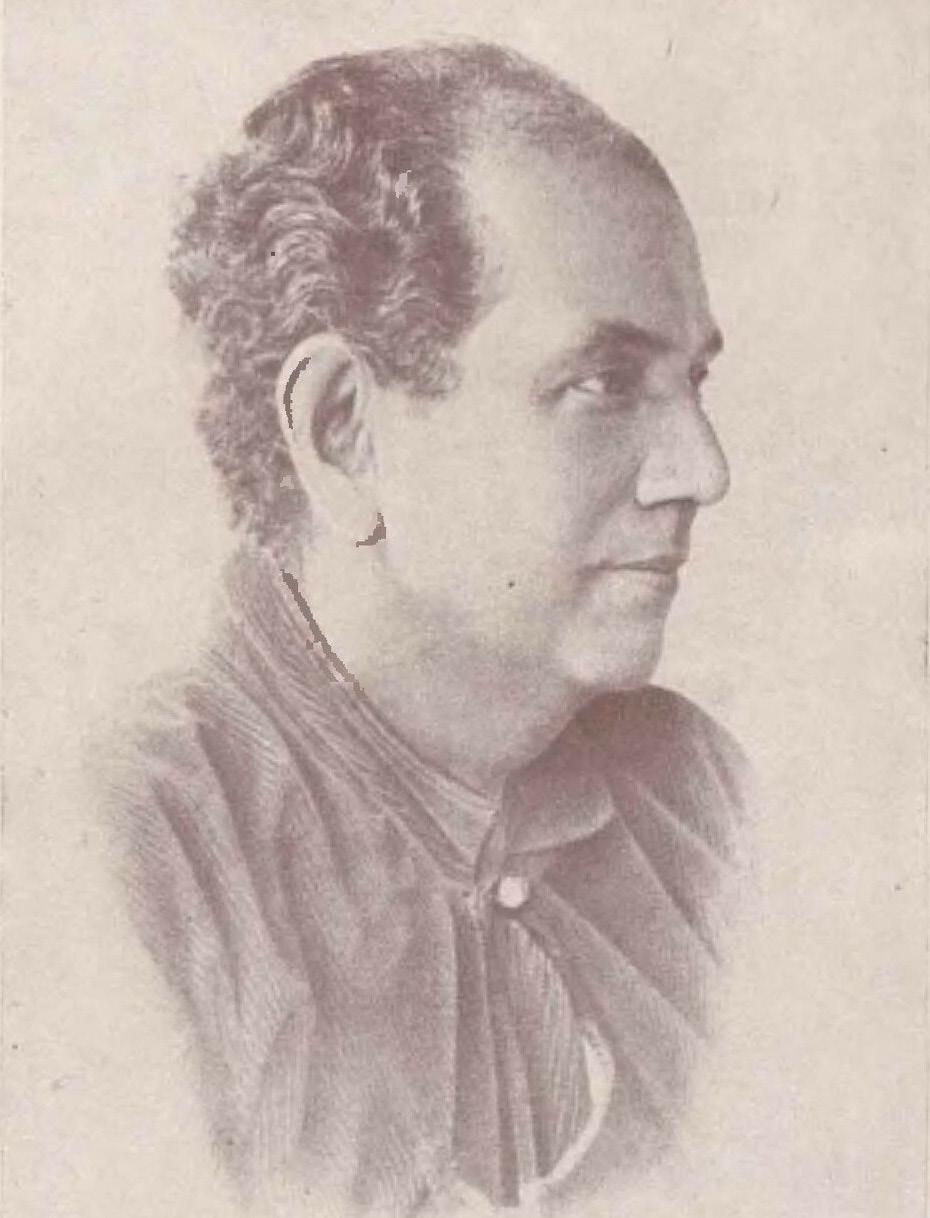
by empire, national identity, and the longing for cultural renewal.
Both artists confronted similar questions. How does one create under political pressure. How can tradition serve modern needs. And how does art become a vessel for memory, identity, and quiet resistance. Their answers, expressed through their paintings, form the heart of this comparative exploration.
The late nineteenth and early twentieth centuries were transformative for both India and Korea. India struggled under British colonial rule. Korea faced Japanese annexation in 1910. Intellectuals, writers, and artists in both countries responded by turning to their own languages, rituals, and visual traditions. They were not looking inward to retreat. They were looking inward to rebuild.
Independence arrived in 1945 for Korea and in 1947 for India. The fact that August 15 marks liberation for both countries is a symbolic reminder of their parallel histories. Abanindranath Tagore was born in 1871 and lived until 1951, which means he witnessed the full arc of India’s freedom movement and the birth of a new nation. Kim Whanki was born in 1913 during colonial rule and became one of the most important artists shaping post liberation Korean art. Even though the two men were not contemporaries, they lived in worlds influenced by modernity, empire, and the search for cultural self-definition. Their works become two different but related responses to these shared historical pressures.
Abanindranath Tagore is often remembered as the founder of the Bengal School of Art. At a time when British-administered art schools promoted European academic realism, he looked back to India’s own traditions. Mughal and Rajput miniatures, Persian manuscripts, and local folk forms entered his visual language. He was part of a larger cultural awakening that sought to revive Indian aesthetics at a moment when colonial rule had marginalized indigenous art.
A signature element of his work is the wash technique. Soft contours, translucent layers, and delicate lines create an atmosphere that feels gentle, lyrical, and introspective. This technique was influenced by Indo–Japanese exchanges at the turn of the century. Japanese artists visited Calcutta, shared their approaches, and created a moment of Asian artistic dialogue that helped shape the Bengal School.
Two of Abanindranath’s paintings illustrate his ideas particularly well.
The Passing of Shah Jahan (1902)
This painting shows the Mughal emperor Shah Jahan at the end of his life. He looks toward the Taj Mahal, the monument he built for his beloved wife. The painting is quiet and contemplative. The emperor’s gaze becomes a metaphor for loss and longing. On the surface it is a historical
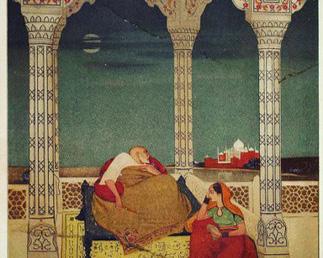
moment. Beneath the surface it reflects the grief of a colonized society living through cultural displacement.
The Dreamer (1925)
In this work a lone figure sits in a state of stillness. The atmosphere is serene and introspective. The wash technique creates a dreamlike quality. Here contemplation becomes a form of quiet resistance. Abanindranath’s art suggests that selfknowledge and inner life can become forms of strength during political upheaval.
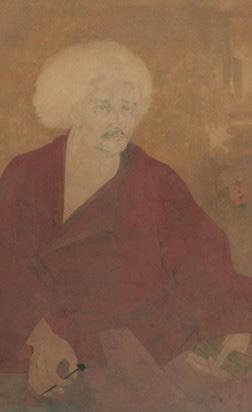
While India saw the rise of the Bengal School, Korea was moving through its own intellectual and artistic transformations. Newspapers, modern schools, and Hangul-based literature flourished during the Gaehwa, or Enlightenment, movement. After Korea’s annexation, art became a space where identity was negotiated and sometimes even quietly protected.
Kim Whanki was born into a prosperous landowning family in South Jeolla Province. In his later years, Kim developed a profound special
interest in Korean ceramics. These shapes and colors inspired his lifelong artistic vocabulary.
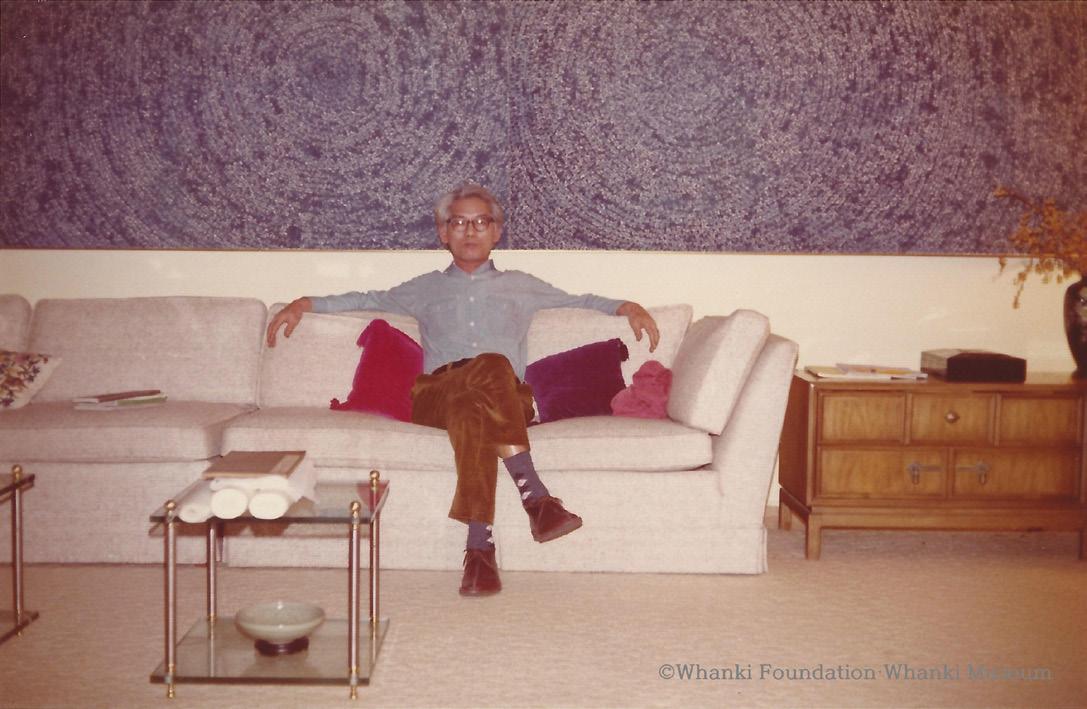
Kim studied in Tokyo. However, it was his exposure to the artistry of Korea’s Goryeo and Joseon Dynasties from which his soft touch and painting technique were influenced. When he returned to Korea, he taught at Seoul National University. His early works often featured

familiar Korean motifs such as plum blossoms, moon jars, mountains, and rivers. Later, when he moved to New York, he developed his wellknown dot-based abstractions, which continue to be celebrated worldwide. Each dot was painted by hand. The resulting canvases feel meditative, rhythmic, and almost cosmic.
Two of his works highlight the emotional depth of his art.
This monumental painting is composed of thousands of small dots. Each dot feels like a breath or a moment of longing. The work radiates a sense of yearning and contemplation. Many viewers read it as a record of memory, loss, and hope. It is both deeply personal and deeply tied to Korean history. Kim’s own experiences of migration and homesickness blend with larger questions about cultural identity.
Plum Blossoms and Jar (1957)
Kim interprets a traditional Korean jar, a form known for purity, simplicity, and restraint. His
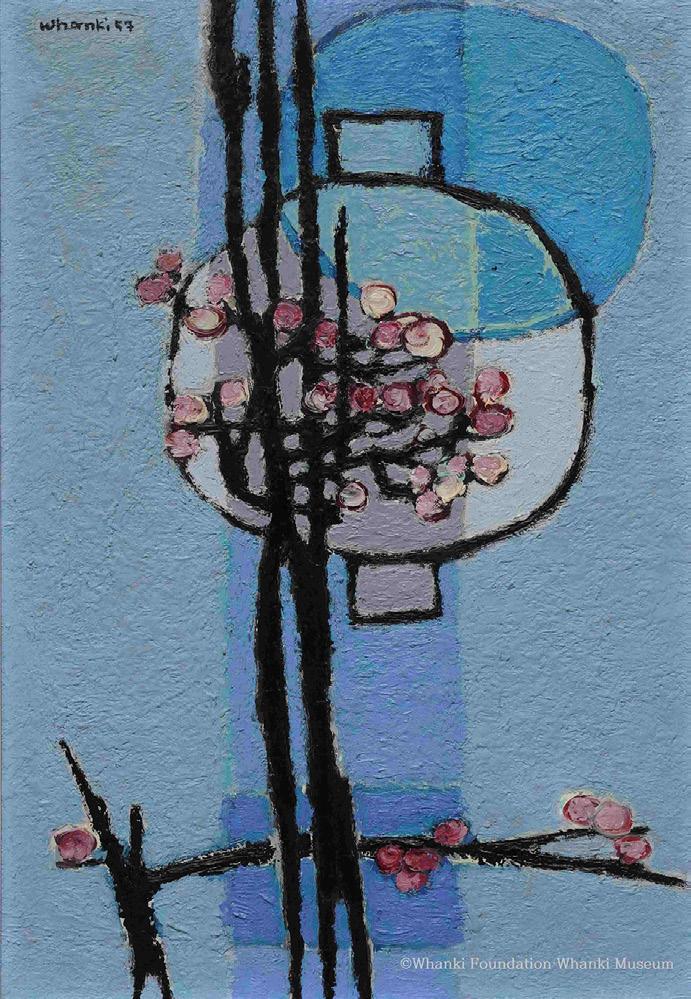
brushwork and composition give it a modern visual language. The jar acts as a symbolic anchor. The plum blossoms add fleeting beauty and a sense of renewal. By pairing permanence with transience, tradition with innovation, Kim turns a still-life motif into a meditative space where cultural memory and contemporary aesthetics meet and coexist.
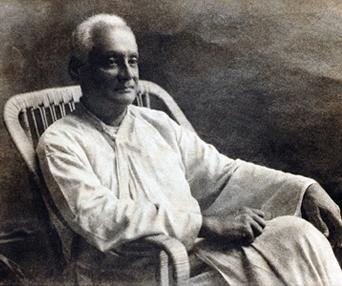
To understand the diversity of artistic modernism in India, it is useful to consider Gaganendranath Tagore, the elder brother of Abanindranath. While Abanindranath’s modernism was lyrical and rooted in tradition, Gaganendranath experimented with Cubism, satire, and social commentary.
In works such as Pratima Visarjan and his Cubist sketches, he combined local rituals with global modernist forms. The fractured planes and angular lines of Cubism allowed him to depict traditional ceremonies in new and striking ways. His art shows how Indian modernism was never a single story. It was a conversation between tradition and experimentation. His presence in the Tagore family reminds us that artistic innovation often comes from within the same household, shaped by shared cultures but expressed through different sensibilities.
When we view the works of Abanindranath Tagore, Kim Whanki, and Gaganendranath Tagore side by side, an important truth becomes clear. Art in both India and Korea during the early twentieth century was never only about aesthetics. It was a means of survival. Their art preserved cultural memory. It protected dignity in the face of empire. It expressed longing for belonging and freedom. It created space for imagination during times of constraint.
Abanindranath responded to colonial rule with lyricism, introspection, and a revival of traditional Indian forms. Kim Whanki responded to historical rupture with abstraction, rhythm, and a cosmic sense of space. Both turned to tradition, not for nostalgia but for strength. Both artists show that creativity can hold history inside it. Their works remind us that art is not just about beauty. It is also about courage.
For me, whether encountered in a childhood classroom in India or through the voice of a Korean musician reflecting on art, these artists offer a shared message. In moments of upheaval, art becomes a quiet but enduring form of resistance. It becomes a reminder of who we are and who we hope to be.

Reeti Roy is a writer, cultural commentator, and creative entrepreneur whose work explores memory, art, identity, and social justice. She holds a BA in English literature from Jadavpur University and an MSc in social anthropology from the London School of Economics. Her essays and criticism have appeared in numerous publications, including Korean media. In September 2025, she had several international engagements in South Korea, including as keynote speaker at KOTE, Insa-dong, and at the Yeosu Egg Gallery.
By Rifa Tasnia Oishe
In a world often divided by language and history, when we look beyond the lines delineating borders, we find cultural threads that bind us. As a Bangladeshi student deeply engaged in literature and cultural studies, I have long been fascinated by the cultural resonance between my homeland, Bangladesh, and South Korea due to community values, reverence for tradition, and respect to elders.
At the heart of both societies lies family. This inter-generational bond serves as a defining feature of both societies, with respect toward one’s elders playing a central role. In South Korea, bowing, using honorific language, and hierarchical etiquette shape daily interaction. Meanwhile in Bangladesh, the Korean concept of hyo (효, filial piety) finds a natural echo in the practice of shroddha, a moral compass of deep respect for elders. Though people express it differently, the sentiment is still the same.
Despite being a thousand kilometers apart, Korean and Bangladeshi cuisines share surprising similarities. Both cultures’ common daily meal is rice. Fermented dishes like Korea’s jeotgal (젓갈) and Bangladesh’s shutki reflect the tradition of food preservation. The shared practice of gathering around the table and preserving culinary heritage through generations reflects both cultures belief that food tastes better when shared.
The festivals of Chuseok in South Korea and Nabanna in Bangladesh are celebrations of the harvest that center around family and gratitude. Both are marked by traditional attire, folk music, and vibrant community gatherings. During these festivals Koreans prepare special dishes made from freshly harvested rice, including the popular songpyeon, a sweet and chewy half-moon
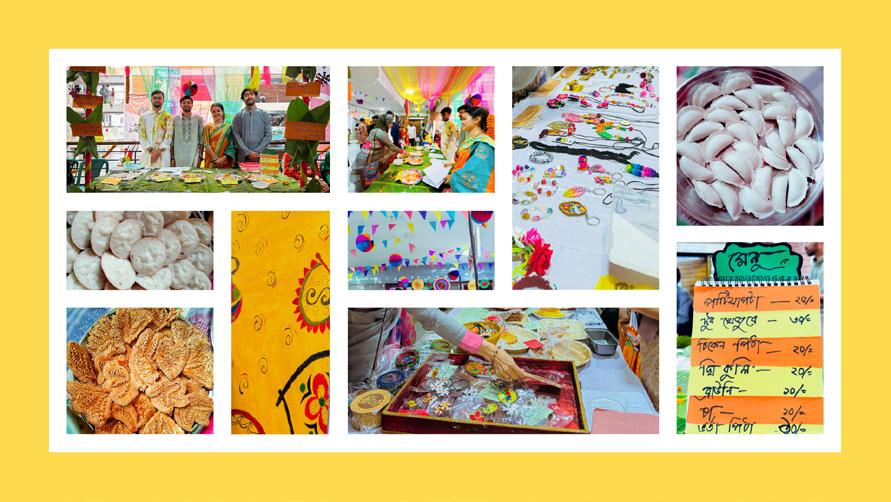
rice cake. On the other hand, in Bangladesh we make pitha, a traditional Bengali rice snack made with rice flour and payesh, which is basically a rice pudding. Two different cultures, but these foods carry the same meaning of reminding one of their roots and reflecting the shared human joy of celebrating abundance and togetherness.
I wrote this article based on my personal encounters with Korean culture after trying Korean foods, watching Korean dramas, and meeting Koreans at a Korean language institute, which led me to learning more about Korean language and culture. These experiences ignited my curiosity to explore the cultural similarities between these two nations. This article is a reflection of that discovery, which made me realize that cultural understanding grows from shared experiences and from the simple joys that bring people together across borders.
The Author

Rifa Tasnia Oishe is currently pursuing an MA in English literature and cultural studies. She loves exploring culture, community stories, and traditions that shape our identities. Rifa is passionate about promoting inclusive education through research, writing, and crosscultural projects.
By Arifa Batool
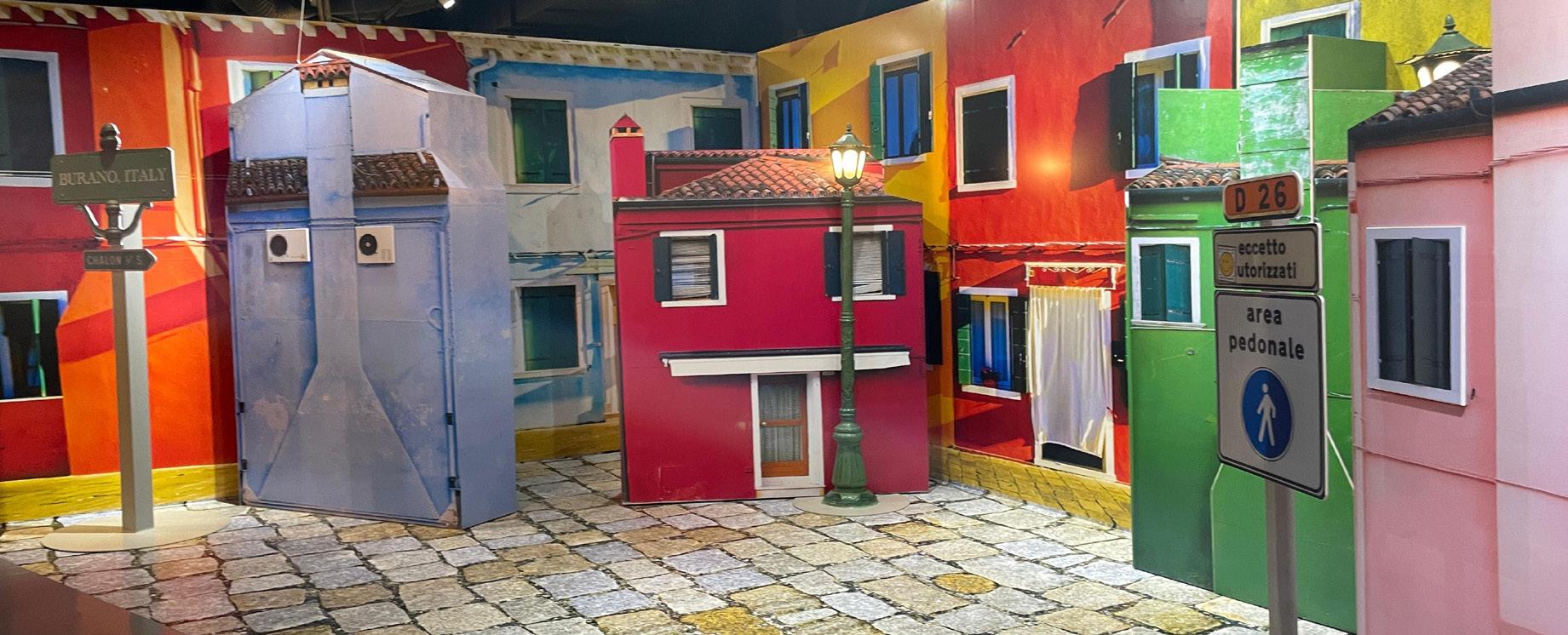
Art often surprises us when we least expect it. During a visit to Aqua Planet Yeosu, an ordinary trip to an aquarium turned into a meaningful cultural experience through a unique art exhibition featuring the work of artist Helga Stentzel. She is a British artist known for turning ordinary household items into fun and creative artworks, inspired by animals, nature, and everyday objects. Set within an aquatic
environment, the ongoing exhibition offers visitors a fresh way to engage with contemporary art.
The main purpose of Helga Stentzel’s art is to share meaningful ideas in an effortless way. Her playful and imaginative works, inspired by animals and everyday scenes, help the audience reconnect with childhood memories. At the same time, the
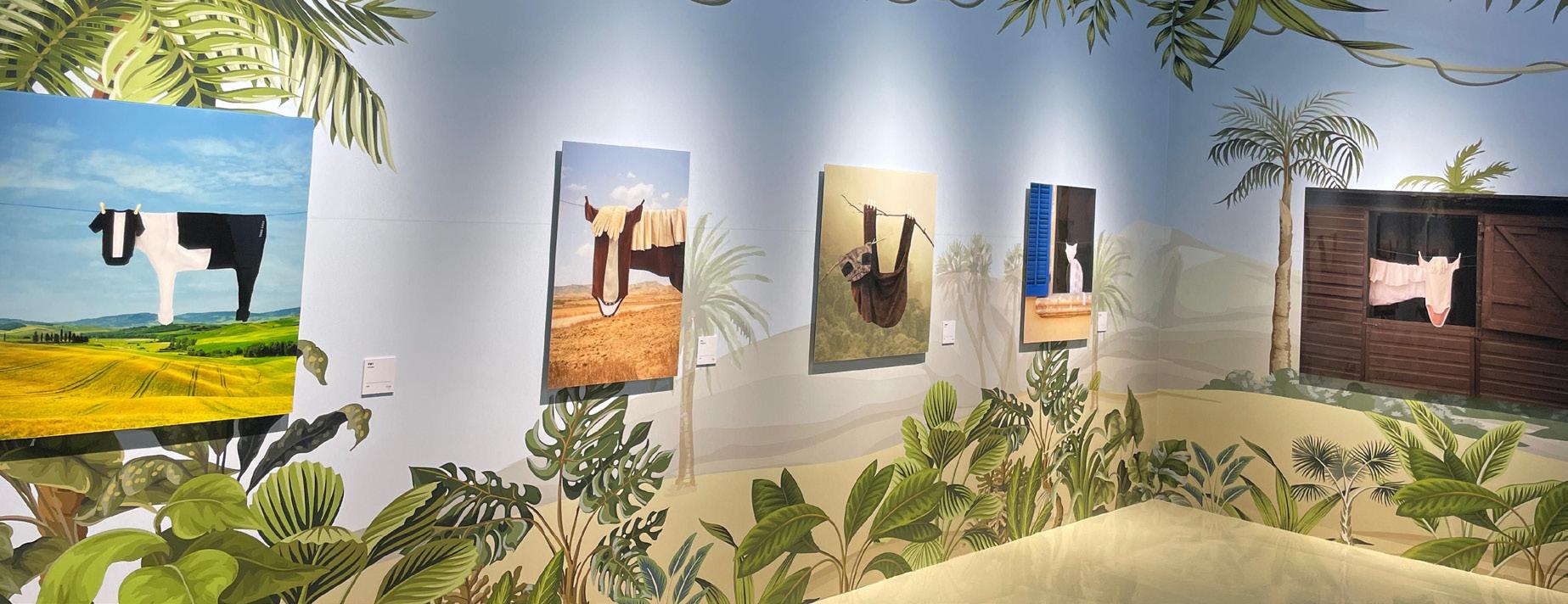
artworks gently encourage reflection on human behavior and our relationship with nature.
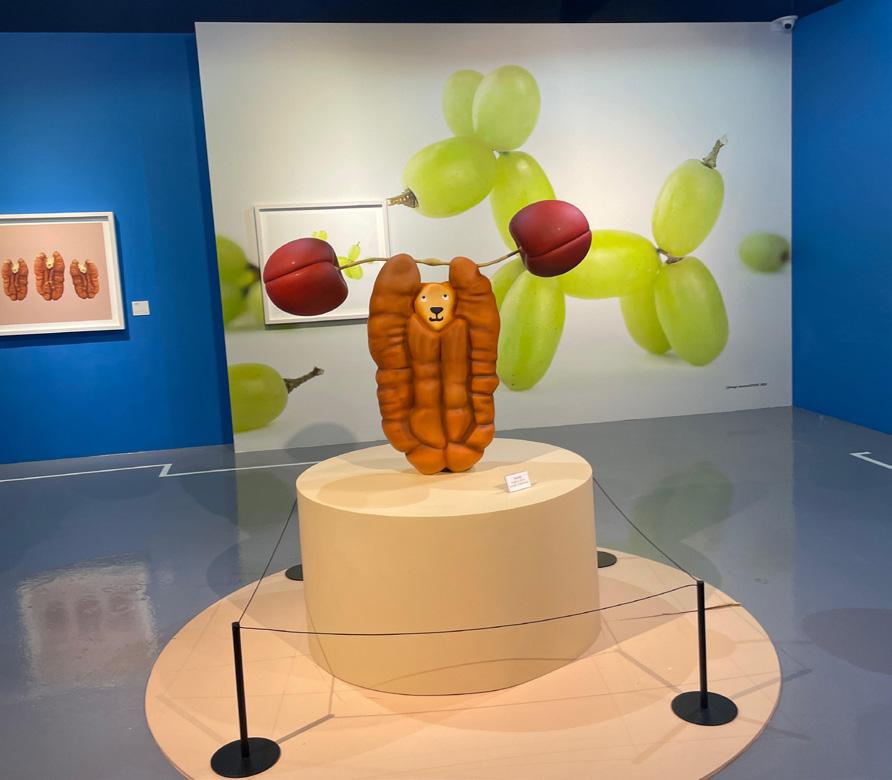
Rather than relying on complex concepts, the exhibition emphasizes accessibility. The familiar forms and light tone of the artworks invite viewers of all ages to engage freely. Children are drawn to the colorful and creative figures, while adults find space for quiet reflection. The exhibition naturally encourages conversation, photography, and shared interpretation among visitors.
Right away, the bright blue gallery walls grabbed us. There stood a fluffy puppy made entirely from bright green cabbage leaves, framed neatly like a precious painting. Nearby, a chestnut podturned-lion grinned cheekily between clusters of plump green grapes. And around the corner,
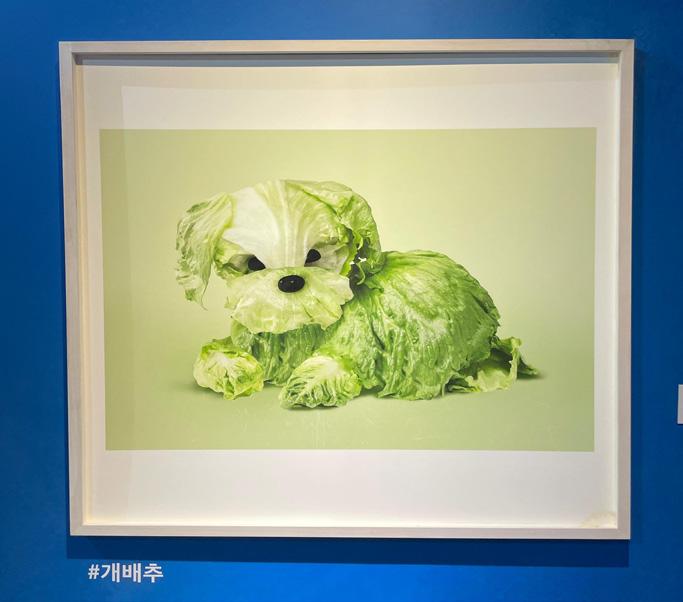
dreamy cow portraits grazed golden fields under tropical palms – it felt like a meeting point between farm and fantasy.
Helga Stentzel takes simple ingredients –cabbage, chestnuts, grapes – and reshapes them into creatures full of personality. The cabbage puppy’s floppy ears and curious eyes made from layered leaves were so lifelike, you half-expected it to wag its tail. The chestnut lion, bold on its pedestal, mixed humor with nature’s odd genius. The piece turns attention to village life, showing daily routines and a deep sense of community.
What hit me most was how these artworks started conversations. They made us wonder if we often miss beauty in everyday things and whether vegetables and nuts carry stories we rarely notice. As we left, our group was still chatting and smiling, showing how good art can touch both the heart and the mind.
Yeosu’s just a short ride from Gwangju, perfect for a morning adventure. We wrapped up with coffee nearby, still chatting about the exhibit’s charm. For anyone in Gwangju craving fresh inspiration, Helga Stentzel’s world proves that creativity hiding in the simplest shapes. It reminds us that playfulness can quietly change how we look at the world.
Address: 61-11 Odongdo-ro, Yeosu, Jeollanam-do
Hours: Open daily 9:30 a.m. to 7:00 p.m.
Phone: 1833-7001
The Author
Arifa Batool is a researcher and writer based in Gwangju. An anthropologist by profession, she has published multiple research articles in her field. She has been living in Gwangju for a year, following several earlier visits. With a passion for exploring culture and community life, she enjoys documenting unique local experiences and uncovering hidden stories that connect history, art, and everyday life.
Photographs by Arifa Batool.
Reviewed by Michael Attard
Greek Lessons: A Novel
By Han Kang (Deborah Smith & e. yaewon, Trans.)
192 pages, Hogarth, 2023
Han Kang began her writing career in the 1990s as a poet. In 2024, she won the Nobel Prize for Literature. She is the first Korean writer and the eighteenth woman to achieve the award. The Nobel committee stated that she was given the honor in recognition of “her intense poetic prose that confronts historical traumas and exposes the fragility of human life.” Her novel Greek Lessons was published in South Korea in 2011. The English-language release was in April 2023.
The reader is never given a name for the woman in the story. We can determine her age as late thirties or early forties by the fact that she has an eight-year-old son. But through divorce, she has lost primary custody of the boy. It becomes clear that this traumatic privation is fundamental in her loss of speech. And to stress the point, it needs to be plainly stated that her muteness is not by her own volition; there is a real psychological/ physiological condition rooted in her trauma. And even deeper, she thinks, it deduces down to “the question of whether she really had any claim to existence.”
Nevertheless, the woman is a strong character; she wants to change her situation. “She has chosen to learn ancient Greek … because she wants to regain language of her own volition.” But why, specifically, Greek? For the woman, Ancient Greek is a dead but perfect language. She cannot speak the language of life and intimacy. When the silence had taken hold of her, “she no
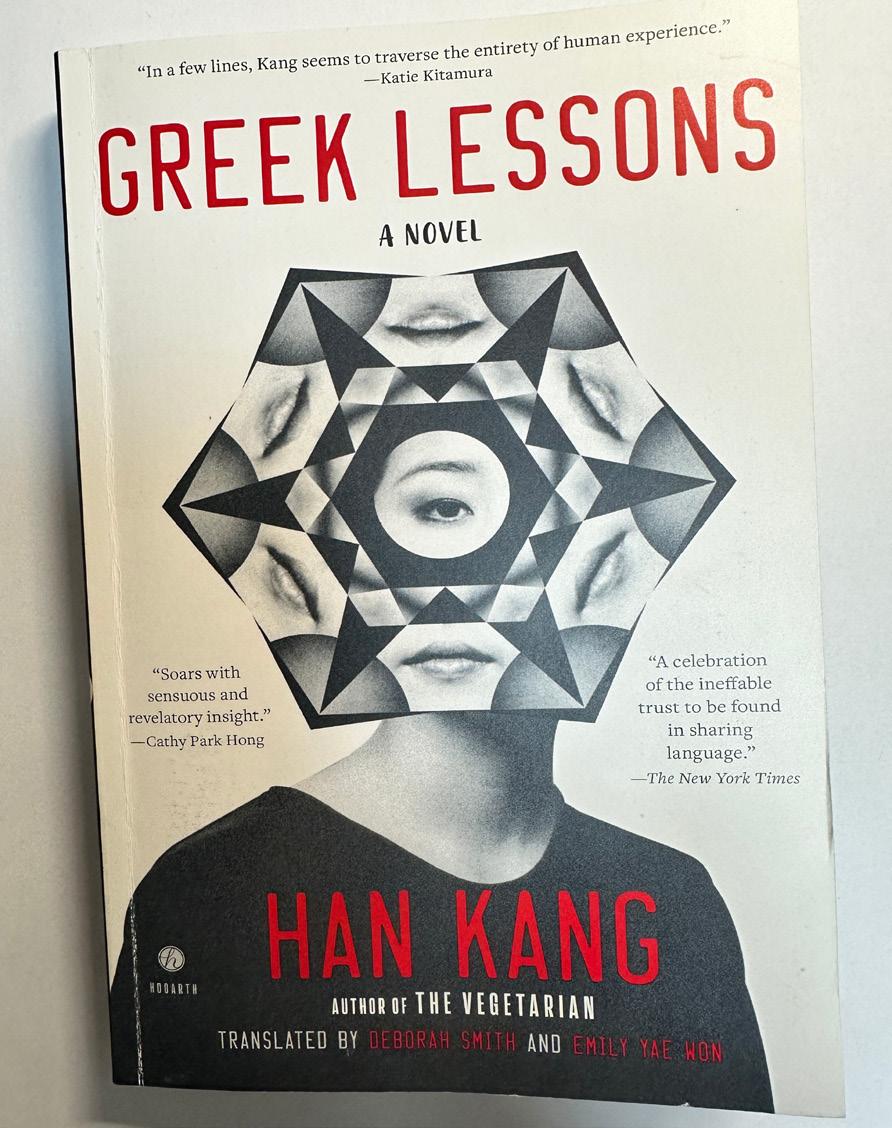
longer thought in language. She moved without language and understood without language – as it had been before she learned to speak.”
It appears that the woman has some apprehension about the capacity or potency of any language. In the second chapter, titled “Silence,” the nature of words opposite in meaning seem to shock her with overwhelming sensory stimuli. “Even the most nondescript phrase outlined completeness and incompleteness, truth and lies, beauty and
ugliness, with the cold clarity of ice.” Her struggle appears to be an attempt at crafting a delicate equilibrium.
The teacher giving the Greek lessons is a man, somewhere in his late thirties. His personal struggles and trauma are more easily understood. He has a genetic disorder, and he has been slowly but inexorably going blind for many years. As of yet, with thick lenses, he can get by, but just barely. He knows that the woman is not deaf, her muteness is not misunderstood. He accepts her silence. They both know that their respective losses do not eliminate personal life and its meaning.
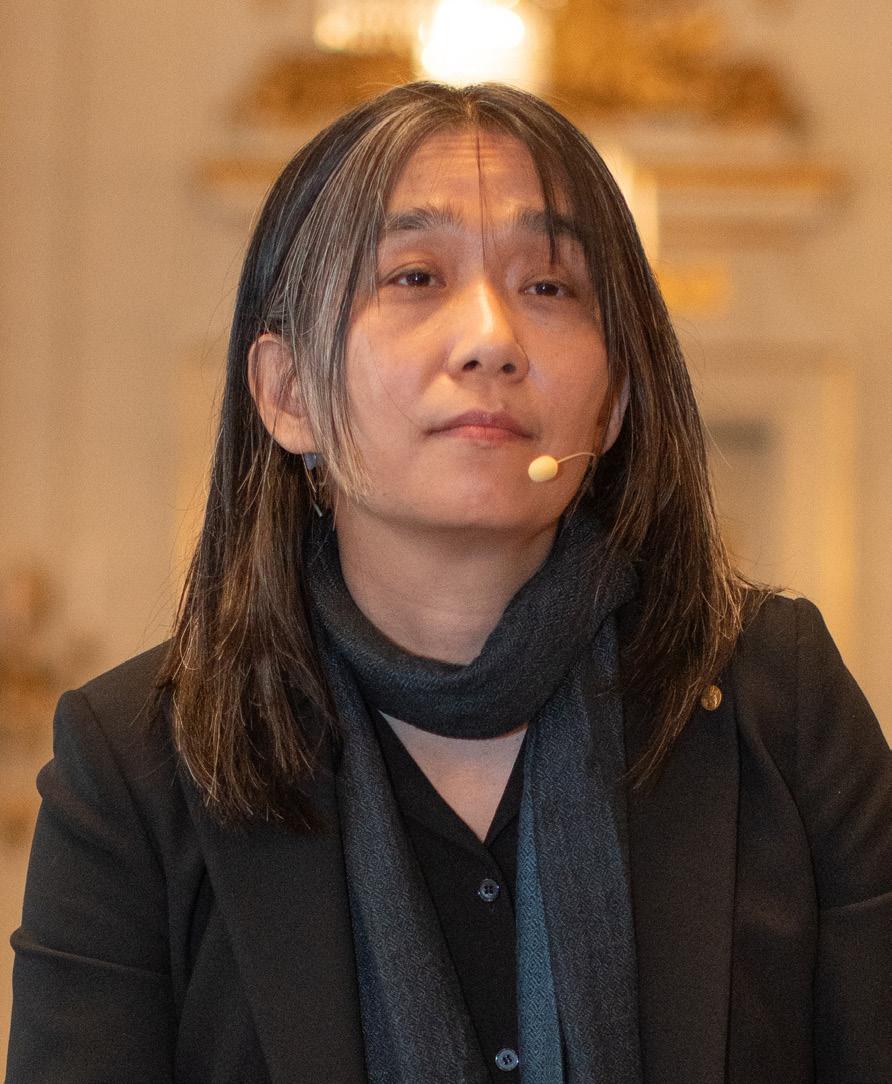
The man has other issues besides his blindness. He was born in Korea but spent seventeen years of his youth in Germany. Now, living in Korea for the last three years, he has not fully acculturated. He says, “To be honest, there are times when I feel envious watching the students. Of their certainty, their unwavering firmness, perhaps – something only those whose life, language, and culture have never been broken in two.”
In my opinion, the teacher is not a strong character. He tells us a lot about the past, but does appear unaccepting of the present, and unwilling to prepare for the future. A close friend bluntly told him, “If I were you, I’d learn Braille ahead of time, to be prepared. And get used to walking around outside with a white cane. I’d get a wonderful, well-trained retriever…” He says that this “privately injured me.”
“He knows that the woman is not deaf, her muteness is not misunderstood.”
For most of the story, there is virtually no social exchange between the man and the woman. It is not until a minor accident leaves the teacher’s glasses broken that the reader gains a sense of human contact. He talks, she listens, and she helps him. And then the story ends.
Are the man and woman tragic characters? I don’t think so. They have their flaws, but admirable qualities are less obvious. True, fate has dealt them suffering, but I can’t see what they have overcome or come to recognize. On the other hand, we have an insightful portrayal of the human condition, fragile and lonely. After all, the story of life need not always be one of recovery. So much of life is about possibility.

Michael Attard is a Canadian citizen but has lived in Gwangju for over twenty years. He has taught English as a second language in academies and within the public school system. He is officially retired and spends time reading, writing, hiking, and spending time with friends.
By Dhivyaa S. P.
It’s already February! Hope you’ve taken a look at your goals for the year. No rush, slow but steady wins. And speaking of slow and steady moments, how about a café visit?
Gallery Café Chaeum (chae-um), in Ullimdong of Gwangju’s Dong-gu, isn’t just for coffee lovers. It’s for anyone who likes a place that feels a bit magical, almost like stepping into a mini art museum.
The moment you enter, you’ll see why the name “Gallery Café” fits perfectly. Paintings hang on every wall, sculptures sit quietly beside tables, and even the chairs look like they have a story to tell. Most of the furniture and art pieces are real antiques, over 100 years old.
I read in a blog that the owner of this café personally brings them back from historic cities across England, France, and Italy. Just sitting in this café feels like time traveling through Europe’s old salons. Also, the owner once said he prefers to call this place a salon or drawing room, not just a café.
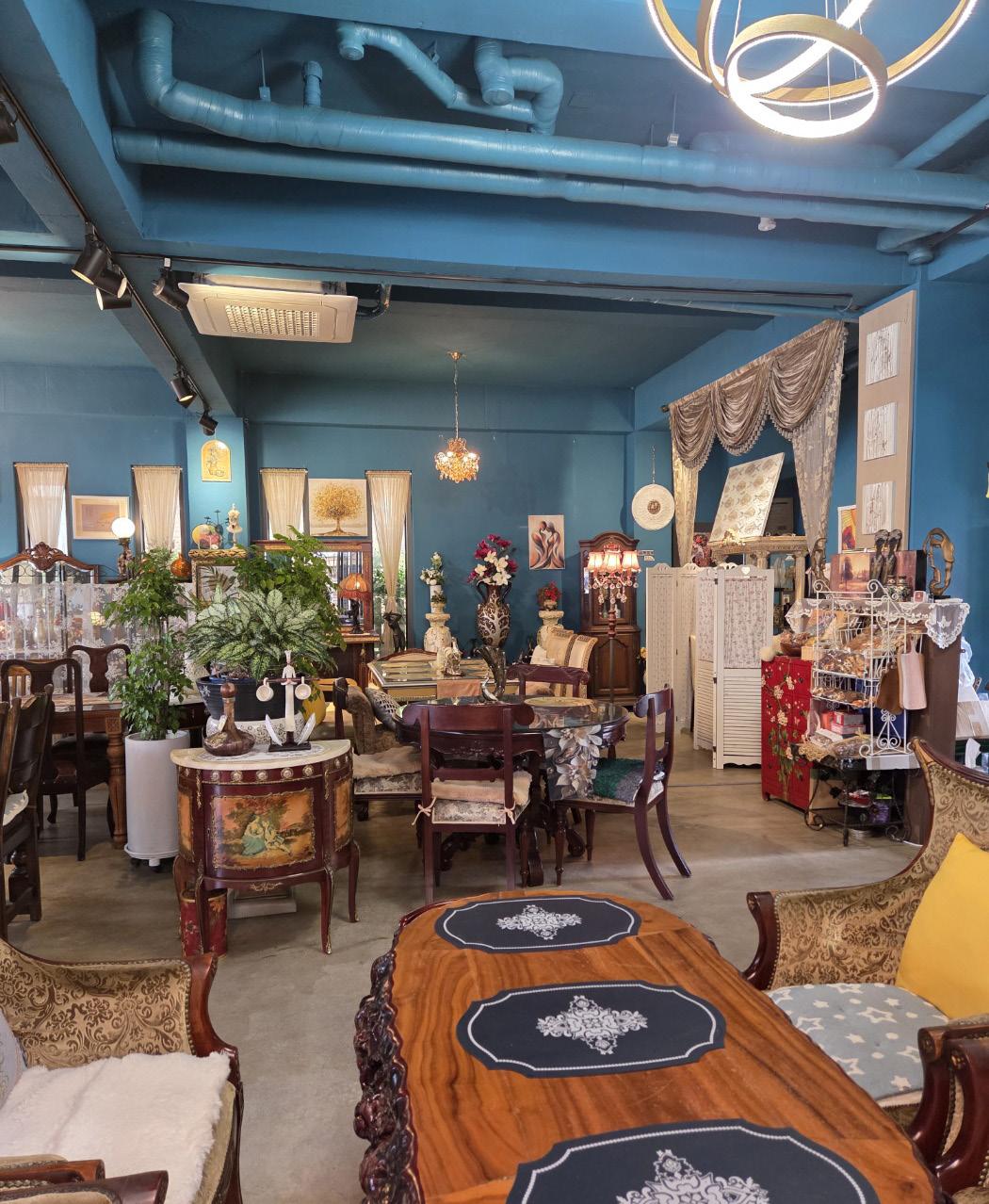
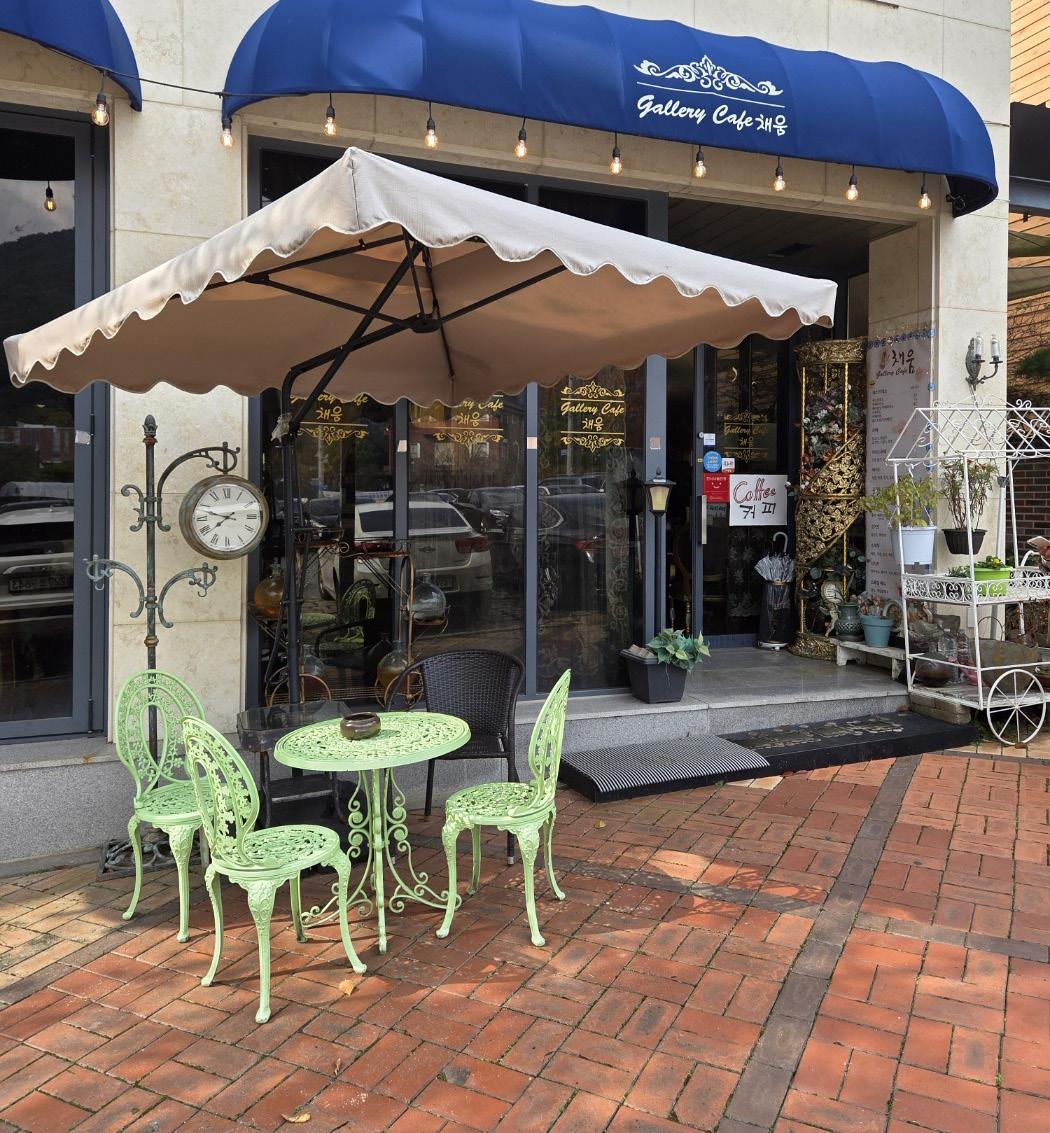
It’s more than a place to drink coffee. It’s a cultural space where art, conversation, and music meet. Many middle-aged regulars seem to enjoy the atmosphere and coffee deeply, like old friends returning home. Even the bathroom has artworks hanging inside. This place does not skip a corner.
Outdoor seating is available, soft and romantic –perfect for spring or sunny winter days. Inside, it feels like sitting in an elegant living room of a wealthy European family but with Korean snacks and coffee using beans from Brazil, Kenya, Vietnam, and Ethiopia.
As if time rewinds, the space takes you back through art and history. A treat for anyone who loves antiques and art!
P.S. We ate at Sujata (a vegetarian buffet), had coffee at Chaeum, and took a riverside walk on the Jungsim-sa temple course.
Naver Map Location
Gallery Café Chaeum
668-2 Ullim-dong Dong-gu Gwangju
URL: https://naver.me/F2iI5sw3
The Author
Dhivyaa is drawn to Korea’s café culture, often finding comfort in quiet corners where she can reflect, observe, or simply get lost in her research over a warm drink.
Photograph by Dhivyaa S. P.
By Jo Lezada
Gosari is one of the coffee shops that caught my eye last November at Dongmyeongdong’s Coffee Walk. What piqued my interest at the time was the pastry they featured at the event: a heart-shaped marshmallow cake. Never had I heard of such a thing in all my thirteen years of living here in Gwangju, so I just had to search out their establishment and experience the café for myself.
Near the back gate of the Asia Culture Center was where the café resided, perched on the third floor of an aging building. The first time I visited was at around two in the afternoon; almost all of the seats were filled, giving me a good idea of the coffee shop’s reputation.
As for the place itself, it reminded me of that one, cute pension house my family stayed at on a vacation trip seven years ago. The café’s interior was modest, the decorations were minimal, which I personally wasn’t used to, but the place grew on me as soon as I realized the ambience was just right for reading and studying. Most of the seats were by the windows, overlooking Dongmyeong-dong and adding to the coziness of the place. With the limited seating, it wasn’t too noisy even at its busiest.
Now, on to the main attraction: my thoughts on the marshmallow cake. Contrary to my presumption, the cake was not made entirely of marshmallow, which may be good news for some of you. It was a fluffy chocolate cake coated with a thin marshmallow layer, topped with just enough coconut shavings for added texture – and it was delicious! The chocolate cake itself was not too sweet, and every bite felt like eating an edible pillow of sorts, a small delight to experience. I will say it is a little on the pricier side at 8,000 won, but if you have the means, I recommend it to experience a different texture from your standard cake.
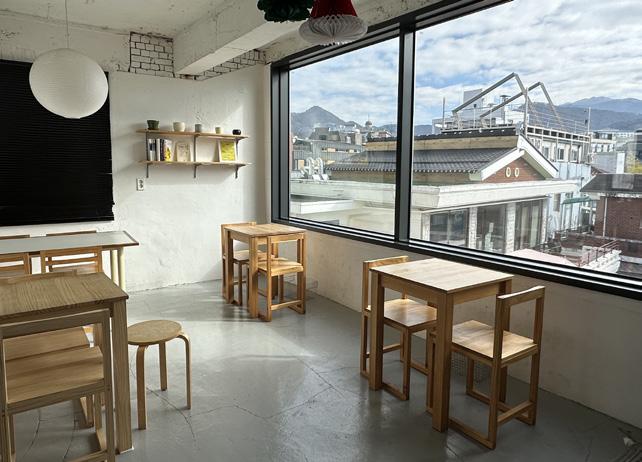
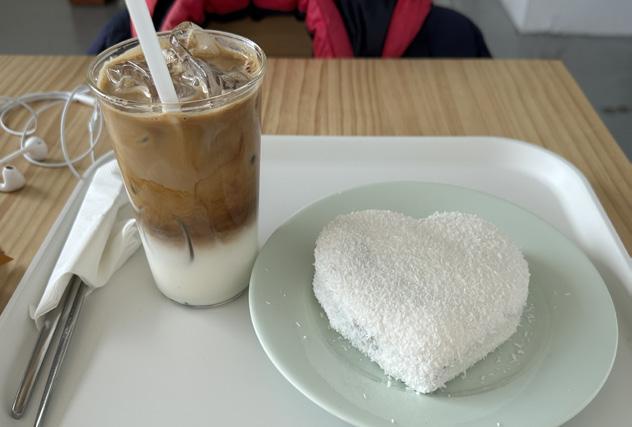
Overall, my time at Gosari was pleasant. The minimal interior design helped me to focus better on my work and writing this article. I’m so happy I decided to check this place out. So, if you would like a smaller, cozier coffee shop where you can wind down, look out the window, study, read a book, or all of these things, Gosari may be just the place for you.
GOSARI / 고사리
Hours: 12:00 noon – 8:00 p.m.
Address: 3rd floor, 8-1 Dongmyeong-ro, Dong-gu, Gwangju / 광주 동구 동명로 8-1 (3층) Phone: 0503-7153-7905
The Author
Johanna Lezada is a Filipino living in Gwangju who aspires to pursue a PhD in paleontology, hoping to uncover the histories and mysteries of the ages engraved in the stones of the earth! She is also a devout Christian, president of the Gwangju Toastmasters club at the GIC, and is the current layout editor of the Gwangju News
Photographs by Jo Lezada.
By Zhang Jiuzhou (Julius)

Recent salary-related developments across Gwangju’s three major professional teams – the Kia Tigers, Gwangju FC, and the AI Peppers – highlight a shared shift in philosophy. Despite competing in different leagues and sports, all three organizations are being pushed toward the same conclusion: Sustainability, availability, and cost efficiency now outweigh reputation and past success.
The most eye-catching case involves Kia Tigers star Kim Do-yeong, whose 2026 salary is set to
drop to 250 million won, a 50 percent cut from last season. The reduction is jarring given his historic 2024 campaign (a .347 batting average, 38 home runs, 109 RBIs, and 40 stolen bases), which earned him league MVP honors and helped deliver a championship.
Yet Kim appeared in only 30 games this past season due to recurring hamstring injuries. In today’s KBO, even generational talents are not immune to strict scrutiny if they cannot stay on the field. The debate around Kim’s pay cut mirrors
a broader reality faced by Gwangju’s teams: Performance is no longer judged in isolation from durability.
From a business perspective, however, Kim’s value extends far beyond his salary. He remains Kia’s most powerful commercial asset, accounting for over 40 percent of the club’s jersey sales. Industry insiders widely believe that a healthy Kim entering free agency could command a total value exceeding 16 billion won, and MLB scouts continue to monitor him closely for his rare blend of power, speed, and infield versatility.
Health, therefore, has become the decisive currency – not just for Kim but across Gwangju professional sports.
“Sustainability, availability, and cost efficiency now outweigh reputation and past success.”
That same principle underpins Gwangju FC’s financial reset. According to the K League’s 2025 salary expenditure report, the club reduced its total payroll by 23.7 percent, from 9.66 billion won in 2024 to 7.38 billion won this past season. The move followed sanctions for breaching financial sustainability rules and forced the club to abandon high-risk spending in favor of restraint.
Crucially, the cutbacks did not trigger a collapse. Gwangju FC finished seventh in the league, reached the ACL Elite quarterfinals, and placed second in the Korea Cup – results that suggest efficiency and stability can offset reduced investment. Like Kia’s approach with Kim Do-yeong, Gwangju FC is betting that
disciplined management will protect long-term competitiveness.
In women’s volleyball, the AI Peppers face a parallel challenge under even tighter constraints. Veteran outside hitter Park Jeong-ah, once known as a “championship machine,” signed a high-profile deal worth 775 million won per year in 2023. At the time, the struggling franchise needed star power to establish credibility.
Two seasons later, the calculus has changed. Park’s scoring efficiency has dropped below 30 percent, and her long-standing weakness in serve reception has become more pronounced. Meanwhile, the Korea Volleyball Federation has announced that the individual salary cap will fall sharply to 540 million won beginning with the 2026–27 season – just as Park’s contract expires.
Like Kim Do-yeong, Park now stands at a crossroads where past achievements collide with present limitations and future rules. For both athletes, health and adaptability will define their next contracts more than name value alone.
Across baseball, football, and volleyball, Gwangju’s three teams are converging on the same reality. Injuries, financial regulations, and structural caps are reshaping how success is measured. In this new environment, availability, efficiency, and long-term planning have become the common ground – binding together three very different teams under a single, increasingly cautious economic logic.
Author Zhang Jiuzhou (Julius) is from Harbin, China. He began writing in 2022 and has contributed to the Chinese media in Gwangju. Julius currently serves at a sports data company and is pursuing a master’s degree in media and communications. He is also responsible for the Chinese Students Association at Chonnam National University.
By Zhang Jiuzhou (Julius)
Kia Tigers Lock in Foreign Core: Oller Returns, Castro Joins

The Kia Tigers finalized their foreign player roster on Christmas Eve, re-signing righthanded pitcher Adam Oller on a one-year deal worth USD 1.2 million. With the move, the Tigers confirmed that the familiar foreign duo of James Naile and Oller will once again shoulder the heaviest responsibility in the 2026 season.
Expectations for the domestic rotation remain cautious. Veteran Yang Hyeon-jong is nearing 40, while Lee Eui-lee is expected to improve on last season but is far from a certainty. Although several pitchers are competing for the fifth starter’s role, none has clearly separated themself, making the performances of Naile and Oller all the more critical.
Following the signing, Oller appeared in a short video released on the club’s official YouTube
channel, saying, “It’s an honor to pitch again at the Kia Tigers’ home stadium next season. I’m really looking forward to fighting alongside my teammates. Just thinking about having duck soup in Gwangju again makes my heart race.”
Kia’s remaining priority was a foreign hitter. The club decided not to renew Patrick Wisdom’s contract despite his 35 home runs, which ranked third in the league. Wisdom struggled with consistency, finishing with a .236 batting average – the lowest among foreign players – along with a .321 on-base percentage and a .207 average with runners in scoring position.
To fill the void left by the departures of Park Chan-ho and Choi Hyeong-woo, Kia signed Harold Castro for USD 1 million. The club described Castro as a versatile player capable of defending both infield and outfield positions, praising his contact skills, clutch hitting, and extra-base potential.
If Castro can also cover shortstop following Park’s exit, Kia’s options would expand further. Although Australian national team infielder Jared Dale has already been brought in under the Asian player quota, Castro’s defensive flexibility could significantly strengthen the Tigers’ roster depth across multiple positions.
Gwangju FC are entering one of the most turbulent periods in club history as they begin full-scale preparations for the 2026 season. During the offseason, Head Coach Lee Jung-hyo,
who led the club through its most successful era, departed along with several key staff members, while the squad itself underwent major changes.
Despite the crisis, Gwangju has begun planting seeds for renewal. The club has added several new players, who are expected to join training with the first team from June. The aim is to help them quickly gain experience and adapt to match tempo.
Veterans Ju Se-jong, Kim Kyeong-min, and Anh Young-gyu have committed to staying, continuing to form the backbone of the squad. Other retained players are working to adjust to the tactical demands of the new coaching staff.
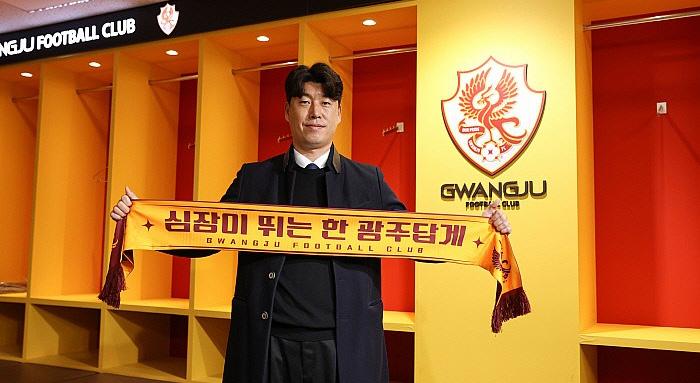
Head Coach Lee Jeong-kyu now faces the greatest challenge of his career. His task is to preserve Gwangju’s tactical identity while finding the best balance between new staff and players –an effort complicated further by administrative restrictions stemming from FIFA sanctions. His ability to unify the team quickly may determine the outcome of the 2026 season.
Lee served as an assistant coach under Lee Junghyo from 2022 to 2024 and is widely regarded as the coach who best understands his predecessor’s philosophy. While Gwangju remains committed to its distinctive “Gwangju-style football,” reality presents obstacles. The club is unable to register new players during the winter transfer window, meaning internal resources must sustain the team for the time being.
Still, the 2026 season is not without hope. Gimcheon Sangmu will be automatically relegated
following the expiration of their home stadium contract, and with K League 1 expanding to 14 teams from 2027, only one team will be relegated in 2026. For Gwangju FC, simply avoiding last place may be enough to survive.
Withthe season already past its midpoint, the Pepper Savings Bank AI Peppers women’s volleyball team are finding their goal of 20 wins increasingly difficult to achieve. In retrospect, the most painful and decisive setback was a ninematch losing streak that stretched from the latter half of Round 2 into Round 3.
After an impressive start to the season, the AI Peppers were derailed by injuries to key players, declining physical condition, and increasingly targeted opposition tactics. The resulting string of defeats left lasting damage. Had the team managed to secure even a few more wins during that period, the second half of the season would have looked far more manageable.
Ultimately, the key lies in whether the team can quickly rediscover its early-season cohesion. Tactical adjustments are essential, including redistributing the offensive load away from Zoe Weatherington and toward Shimamura Haruyo, Park Jeong-ah, and Park Eun-seo. At the same time, securing victories at home and steadily accumulating points remain critical if the AI Peppers hope to revive their season.
Whether the team can overcome these challenges and reestablish itself as a competitive force will determine how the remainder of the season is remembered.
Zhang Jiuzhou (Julius) is a dedicated follower of Gwangju’s sports scene. He regularly attends games of the Kia Tigers, Gwangju FC, and AI Peppers, and closely observes the unique identity and competitive spirit each team brings to the city. He hopes to see all three clubs continue to grow sustainably and attract even more supporters.
EXHIBITION
Exhibition
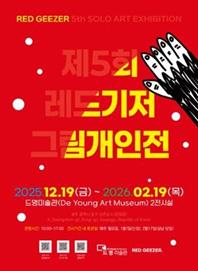
Dates: December 19, 2025 –February 19, 2026
Time: 10:00 a.m. – 5:00 p.m.
Venue: De Young Art Museum, Exhibition Room 2
Admission: Free; no reservation needed Inquiries: 062-223-6515

Date: February 28 (Thu.)
Time: 11:00 a.m., 1:00 p.m., 3:00 p.m.
Venue: May 18 Memorial Cultural Center, Democracy Hall
Ticket Price: 10,000 won Admissions: Must be 2 or older
Reservations: TicketLink Inquiries: 1588-7890
Lim Jae-beom 40th Anniversary
Concert: “I Am Lim Jae-beom”
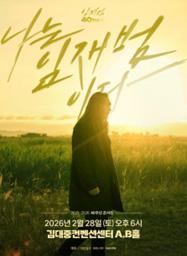
Date: February 28 (Sat.)
Time: 6:00 p.m.
Venue: Kim Daejung Convention Center, Halls A & B
Reservations: TicketLink Inquiries: 1522-4248

Dates: February 20 & 21 (Fri. & Sat.)
Times: Friday 7:00 p.m.; Saturday 2:00 & 5:00 p.m.
Venue: Bitgoeul Citizen’s Cultural Center
Ticket Price: 33,000 to 66,000 won
Admissions: Must be 12 or older
Reservations: Yes24 Inquiries: 1551-7122

Date: February 28 (Sat.)
Times: 11:00 a.m., 2:00 & 4:00 p.m.
Venue: Gwangsan Cultural Arts Center
Ticket Price: 9,500 to 13,500 won
Admissions: Must be 24 months or older
Reservations: NOL Interpark Inquiries: 053-423-1219

Date: March 7 (Sat.)
Times: 11:00 a.m., 2:00 & 4:30 p.m.
Venue: Chosun Univeristy, Haeoreum Hall
Ticket Price: 66,000 won
Admissions: Must be 24 months or older
Reservations: TicketLink Inquiries: 1522-7176
2026 Grand Orchestra Week at Gwangju Arts Center
Celebrating the Gwangju Arts Center’s 35th anniversary, this major classical festival features world-class orchestras and ensembles from both Korea and abroad.
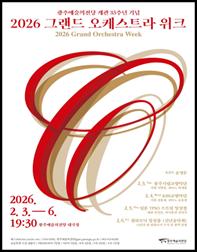
Dates: February 3–6 (Tue.–Fri.)
Time: 7:30 p.m.
Venue: Grand Theater, Gwangju Arts Center
Inquiries: 062-613-8236
Orchestra: 403rd Regular Concert, Nr. 2
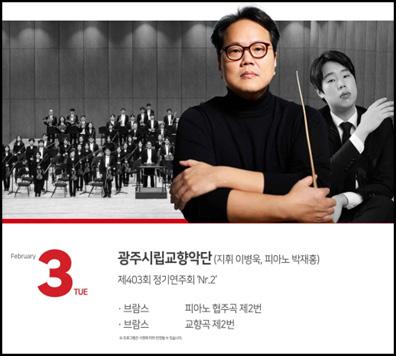
Brahms Piano
Concerto No.2
Brahms Symphony No.2
*Program subject to change.
Date: February 3 (Tue.)
Performance Time: 110 min. (including 20-min. intermission)
Inquiries: 010-4649-5595 (Fantasia)
2: KBS Symphony
Special Performance
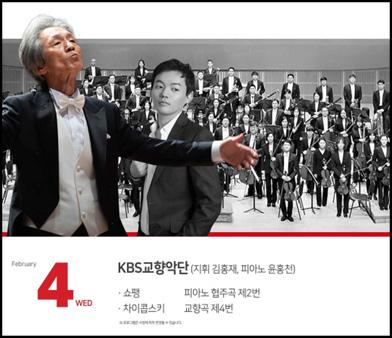
Piano: Yoon Hong-cheon
Date: February 4 (Wed.)
Chopin Piano
Concerto No. 2
Tchaikovsky
Symphony No. 4
*Program subject to change.
Conductor: Kim Hong-jae
Performance Time: 120 min. (including 15-min. intermission)
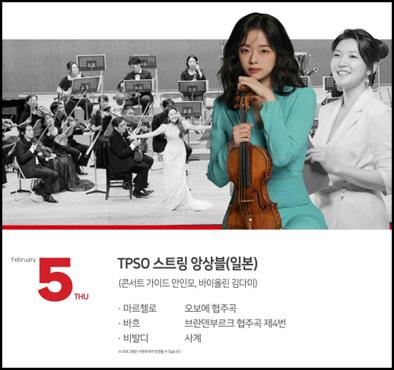
Concert Guide: Ahn Inmo
Violinist: Kim Da-mi
Date: February 5 (Thu.)
Marcello Oboe
Concerto
Bach Brandenburg
Concerto No.4
Vivaldi: The Four Seasons
*Program subject to change.
Performance Time: 90 minutes (including 15-minute intermission)
The Philharmonic Ensemble: 13 principal and active members of the Vienna Philharmonic present the grand finale of the 2026 Grand Orchestra Week, capturing the festive spirit and tradition of a New Year’s concert.
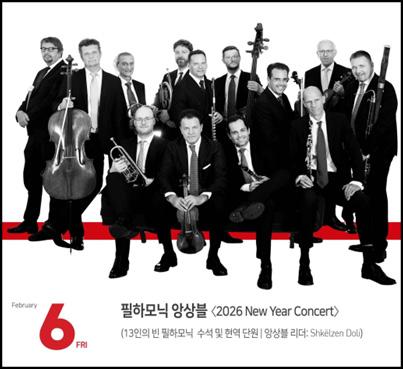
Program Highlights
• Viennese Classics: Upbeat waltzes, polkas, and operettas featuring Johann Strauss II and Franz Lehár
• Emotional Depth: Works by Hellmesberger and Sieczynski evoke Viennese nostalgia
• Modern & Tango: The second half features Bizet’s Carmen Fantasy, Shostakovich’s Waltz No. 2, and Piazzolla’s Oblivion.
Ensemble Leader: Shkёlzen Doli Date: February 6 (Fri.)
Performance Time: 85 min. (including 15-min. intermission)
The Compilers
Luis Andrés González is a Mexican GKS scholar and master’s student in cultural anthropology at Chonnam National University.
Amy Park is a coordinator at Asia Legal Resource Center Korea. She is currently living and learning in Gwangju with her son.
Chonnam National University Graduate School of Business
Key Highlights
100% English Instruction
Global Field Study: On-site learning at overseas partner universities (Expenses mostly covered by GSB)
Admission Schedule
No Thesis Required: Focus on practical learning (45 credits for graduation)
Dual Degree Program: Earn two degrees from the CNU and the University of Missouri-St. Louis (USA)
Flexible Schedule: Day and evening classes available for diverse needs
Generous Scholarship Support: Comprehensive tuition support and TA positions for international students
Application Period: April 20 – May 22, 2026
How to Apply: Visit the link below or scan the QR code � https://mba.jnu.ac.kr/mba_eng/15104/subview.do
Scan for More Details

E-mail:gsbmba@jnu.ac.kr Phone:+82-62-530-1502
Website:https://mba.jnu.ac.kr/mba_eng/index.do