Gwangju and South Jeolla International Magazine
January 2026 #287
KOICA
Sharing Globally
3 Gwangju & South Jeolla International Magazine
January 2026, Issue 287 Published: January 1, 2026
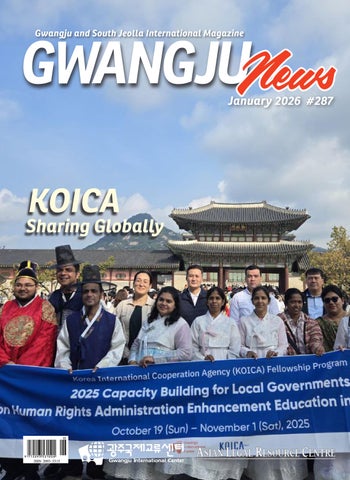
Cover Photo KOICA Fellowship Program Participants Courtesy of KOICA.
Publisher
Dr. Shin Gyonggu
Editor-in-Chief & Copy-Editing Dr. David E. Shaffer Layout Editor & Online Editor Johanna Lezada The Gwangju News is the first English monthly magazine for the general public in Korea, first published in 2001. Each monthly issue covers local and regional issues, with a focus on the roles and activities of the international residents and local English-speaking communities. Copyright ©2026 by the Gwangju International Center. All rights reserved. No part of this publication covered by this copyright may be reproduced in any form or by any means – graphic, electronic, mechanical, photocopying, recording, or otherwise – without the written consent of the publisher.
From the Editor
T
he days have gotten short and the mercury has dropped lower. Dongji (the winter solstice) has slipped by almost unnoticed; Christmas sailed by oh-so quickly. And before we knew it, we were at the end December, at the end of 2025. We are happy to have provided you with twelve issues of the Gwangju News over the past year, now at 60 succulent pages monthly. I would like to express my sincere gratitude to all our writers and production staff who have made our past year of publication possible. But let us not dwell too much on the past. As we move into the new year, our magazine’s team remains in tact to provide you with a rich assortment of articles over the coming twelve months. We shall strive to maintain the quality that you have come to expect from this periodical. Speaking of this periodical, our January feature is on the recently completed KOICA Fellowship Program for international administrators that the Gwangju International Center (GIC) has been deeply involved with. Our Global Focus is on the schooling situation in wartime Ukraine. And our Ponderings and Contemplations is on Gwangju as being a beacon for justice. January’s Travel and Discovery section takes us on a trip to the Muju Ski Resort. We are also given a tour of the little-known museum at Incheon Airport. And a third trip is to Namwon to the Seed of Hope Farm – a goat farm, a rarity in Korea. In our Community section we have a report on the recent performance of the GIC Citizen Choir and the recent Gwangju Queer Festival. We also have an article on one of Gwangju’s “friendship cities” – Qingdao, the beer capital of China. For the scientific and techie-minded, we have an article on innovations in healthcare devices and about the harmful mercury content in our seas and fish. The Culture section opens with an essay on the “polite violence” of collectivism. A second essay muses on leaving Korea after three short years. We have a movie review of A Taxi Driver and a book review of Being Mortal.
Tel: (+82)-62-226-2733 Fax: (+82)-62-226-2731 Website: www.gwangjunewsgic.com Email: gwangjunews@gic.or.kr
Our food and beverage reviews this month include two on cafés – Overleaf and Cheenus – and two on restaurants: High Street for Mexican and Al-Aziz for Central Asian cuisine. In the well-being realm, we have a piece that discusses overcoming loneliness by connecting with the self.
Registration No. 광주광역시 라. 00145 ISSN 2093-5315 Registration Date: February 22, 2010 New co-sponsor of the Gwangju News Asian Legal Resource Centre (ALRC) Korea
Don’t miss our Gwangju sports updates on baseball, football, and volleyball, and check out all the upcoming events for the month. Enjoy!
David E. Shaffer Editor-in-Chief Gwangju News
GWANGJU NEWS, JANUARY 2026
The Gwangju News is published by the Gwangju International Center: Jungang-ro 196-beon-gil 5 (Geumnam-ro 3-ga), Dong-gu, Gwangju 61475, South Korea
GWANGJU NEWS, JANUARY 2026
4
PHOTO OF THE MONTH
Winter may pause the water, but spring always returns. Life may feel cold and unmoving now, but beneath the surface, resilience is being built. Happy 2026! The Photographer Dhivyaa S. P. is one of the regular writers for Gwangju News. If you want to know more about her, check out her article on Incheon Airport Museum and D's Cafe column in this issue. The photograph was taken at Gyeonghoe-ru in Gyeongbok-gung Palace, 161 Sajik-ro, Jongno-gu, Seoul, South Korea
5 January 2026
CONTENTS
03 From the Editor 04 Photo of the Month 06 Gwangju City News FEATURE 09 The 2025 KOICA Fellowship Program: Strengthening Local Human Rights Administration Across Asia
ISSUE 287
SCIENCE & TECHNOLOGY 29 The Future of Smart Healthcare: Shinsung Tech – From Precision Manufacturing to Smart Medical Innovation 31 The Silent Poision in Our Seas: Why Fish Have More Mercury HEALTH & WELL-BEING 33 From Loneliness to Self-Connection: Finding a Path Back to Ourselves
GLOBAL FOCUS 13 Sirens Instead of Bells: The New Reality of Ukrainian Schools HISTORY & TRADITION 15 Ponderings & Contemplations: Gwangju – On the Forefront of Justice TRAVEL & DISCOVERY 18 Exploring Korea: Frozen Footsteps – Along a Snow-White Road to Adventure 20 More Than Duty-Free: A Cultural Layover at Incheon Airport 22 A Story of Hope and Rural Craftsmanship: Namwon’s Seed of Hope Farm
Photo Credit 09 KOICA
FOOD & BEVERAGE 46 D’s Café Column: Morning Run? Coffee Stop! – Overleaf Café 47 Sweet Treats, Immersive Ambience: Taking a Break with Cheenus 49 Restaurant Review: Flavors, Colors, and Nostalgia of Home – High Street in Dongmyeong-dong 51 Restaurant Review: Al-Aziz – A Taste of Central Asia in the Heart of Gwangju SPORTS & ENTERTAINMENT 53 Sports Focus: As Autumn Quietly Passes – Kia Enters a New Area of Uncertainty 55 Area Sports Round-Up 57 December Upcoming Events 59 Music: HAZUE The Kid: From Vietnam to Korea-Inspired Beats
GWANGJU NEWS, JANUARY 2026
COMMUNITY 24 A Return to Pride: Gwangju Queer Festival Marches After Three Years 26 Friendship Cities: City-to-City Cooperation – Gwangju and Qingdao 28 Life Is Like Music: The 4th Concert of the GIC Citizen Choir
CULTURE AND THE ARTS 35 The Polite Violence of Collectivism: Parallel Social Architectures in Korea and Bengal 39 Conclusion: 3 Years in 18 Minutes 41 Movie Review: A Taxi Driver – A May 18 Film 44 Book Review: Being Mortal
6
GWANGJU CITY NEWS
Gwangju City News One Year Anniversary of Illegal Martial Law
Academic Bullying Under Further Investigation The investigation into the supervisors and co-researchers of the Chonnam National University graduate student who died by suicide in July has identified multiple forms of academic abuse. Recent findings show that personal and group messages from a professor and several supervisors included unreasonable expectations, inappropriate language, late-night communication, and personal requests unrelated to research duties.
Gwangju Mayor Kang Gi-jung speaks at the “Gwangju Citizens’ Emergency Assembly” held at May 18 Democracy Square on December 4 of last year. (Gwangju City)
On December 3, South Korea marked one year since the attempted illegal martial law declared by former president Yoon Suk Yeol. President Lee Jae-myeong announced that the date will now be observed as “National Sovereignty Day,” while investigations and trials involving former senior officials continue.
GWANGJU NEWS, JANUARY 2026
Gwangju played an active role in responding to the event at the time. By 00:30 on December 4, 2024, City Hall had opened an emergency response meeting to officially reject the order. Local civic groups and residents also joined demonstrations in Gwangju and Seoul, maintaining public pressure until Yoon was removed from office in April. To commemorate the anniversary, the Mayor of Gwangju hosted the “Revolution of Light: Democracy Week” during the first half of December at City Hall. Activities in the city included a documentary screening of author Han Kang’s works at the Gwangju City Cinema and an exhibition at the Asia Culture Center highlighting the contributions of Nobel laureates Han Kang and former President Kim Dae-jung to democracy and human rights.
Chonnam National University has since expanded its mental-health support efforts and encouraged students to seek assistance. The case has drawn broader attention to Korea’s ongoing mental-health challenges, particularly the intense academic and familial pressures faced by young people.
Six New Projects for the Asian Cultural Hub Initiative On November 25, 2025, Gwangju City confirmed six new projects under its long-term plan to develop the city as an Asian Cultural Hub, bringing the total to 67 initiatives. The new projects include the establishment of an Asian Cultural Inclusion District, a K-Culture Content Tech Town, a startup support program for Asian content-tech companies, a webtoon creation community hub, an Asian art creator exchange platform, and an Asian sound-exchange platform. Ongoing projects expected by 2027 continue to strengthen the city’s cultural infrastructure, including the construction of the new Gwangju Biennale Exhibition Hall, development of humanities walking trails, creation of an Asian character theme park, support for virtual content production, and improvements to the ACC Art Avenue.
GWANGJU CITY NEWS
7
Gwangju City News The final plan was submitted to the Ministry of Culture, Sports, and Tourism at the end of November and is expected to receive approval by March 2026.
Budget Secured for KTX Honam Line Upgrade Gwangju City announced that the 2026 national budget includes 10 billion won to upgrade power substations needed to increase the KTX Honam Line service. The funding aims to prepare the infrastructure required to expand operations of the KTX-Cheongnyong trains. The budget allocation follows continued advocacy by Gwangju City, local lawmakers, and civic groups. The Ministry of Land, Infrastructure, and Transport and Korail also reviewed the need after a 2023 test run of the dual-set KTXCheongnyong showed a power overload at the Noryeong substation. Once partial upgrades are completed by May 2026, dual-set KTX-Cheongnyong trains will be able to operate, increasing capacity to over 1,000 seats per train – about 300 more than current KTX-Sancheon dual-set operations. This is expected to ease chronic seat shortages for Gwangju travelers.
to 58 organizations, including the Gwangju International Residents Center (GIRC), district family centers, and foreigner-friendly hospitals. It is also available online as an e-book through the city website and at gwangjuguide.or.kr. The guide is offered in 10 languages (Korean, English, Chinese, Vietnamese, Russian, Thai, Khmer, Mongolian, Indonesian, and Nepali), reflecting the growing diversity of Gwangju’s foreign population. This year’s edition expanded language coverage and added QR codes to improve accessibility. Contents include information on registration and stay procedures, national health insurance, childcare and schooling, legal rights, Koreanlanguage education, emergency contacts, and support services. Additional sections cover labor rights for foreign workers, waste-disposal rules, drug-safety guidelines, disaster-alert apps, and resources for international students. City officials stated that the guide will continue to be updated to help foreign residents settle comfortably and access essential services in Gwangju.
Gwangju Secures Record National Budget
Additional substation upgrades along the Honam high-speed line will continue through 2028 to support long-term service expansion.
Gwangju City has released a new edition of the Gwangju Living Guide to support foreign residents, containing practical information on daily life and including visa procedures, healthcare, legal services, education, and local resources. The guide was distributed in October
Mayor Kang Gi-jung holds a press conference on the 2026 national budget at City Hall on December 3, 2025. (Gwangju City)
Gwangju Metropolitan city has secured a recordbreaking 3.95 trillion won in national funding
GWANGJU NEWS, JANUARY 2026
Updated Multilingual Living Guide for Foreign Residents
8
GWANGJU CITY NEWS
Gwangju City News for the 2026 government budget. This budget is earmarked for intensive investment in advanced strategic industries such as AI, semiconductors, and future mobility, as well as fostering the startup ecosystem. Mayor Kang Gi-jung has declared 2026 as the foundational year for the emergence of a “Prosperous Gwangju,” emphasizing that the secured funds will serve as the bedrock for translating democratic values into growth opportunities.
Gwangju Sangsaeng Card Discount Sale Resumption Planned
The Gwangju Sangsaeng (Mutual Benefit) Card discount sales, which ended early on December 1 due to exhausted funds, are planned to resume on January 1, 2026, with a new budget secured for the new year. This remains a core policy for local economic recovery. January 2026 marks a crucial period for Gwangju Metropolitan City, as it begins a major leap into future industries like AI and mobility, utilizing a large secured budget, and implementing substantial welfare and economic policies for its citizens.
Launch Payload Satellite Competition supported by the Korea Aerospace Research Institute (KARI) and hosted by the Korea AeroSpace Administration (KASA). GameSat is being developed through a collaborative system among industry, academia, research, and government, hosted by Gwangju City, with Chosun University in charge of its development, and with the participation of local innovation organizations. The satellite will be launched from the Naro Space Center in Goheung, Jeollanam-do, through the 6th launch of Nuriho, and is scheduled to enter a sunsynchronous orbit at an altitude of approximately 530 kilometers. Gwangju City plans to utilize the core data collected from this satellite mission to develop environmental prediction and operation optimization models for next-generation AI mobility technologies. This is expected to strengthen the connection between the local AI and mobility industries and the aerospace industry, leading to synergistic effects.
GWANGJU NEWS, JANUARY 2026
Gwangju AI Mobility Satellite. (Gwangju City)
Gwangju City to Send AI Mobility Satellite into Space The Gwangju AI Mobility Satellite (GameSat), an artificial intelligence-based cube satellite being developed by Gwangju City, will head into space in 2027. Gwangju City announced on December 4 that GameSat was selected for the Nuriho 6th
Compiled by Luis Andrés González and Amy Park.
Luis Andrés González is a Mexican GKS scholar and master’s student in cultural anthropology at Chonnam National University. He is the founder of Erreizando, a digital magazine. Instagram: @luisin97 / @erreizando Amy Park is a coordinator at Asia Legal Resource Center Korea. She is currently living and learning in Gwangju with her son.
FEATURE
9
The 2025 KOICA Fellowship Program Strengthening Local Human Rights Administration Across Asia
The KOICA Fellowship Program participants: government officials from five Asian countries.
uilding on the momentum created during the first year of the 2024–2026 KOICA Fellowship Program titled “Capacity Building for Local Governments on Human Rights Administration Enhancement in Asia” (see Gwangju News, September 2024), the Gwangju International Center (GIC) welcomed a new cohort of fifteen public officials from Bangladesh, Sri Lanka, Pakistan, Kyrgyzstan, and Turkmenistan for the second year of the training program, held in Seongnam and Gwangju from October 19 to November 1, 2025.
While the previous year’s program targeted highlevel officials and encouraged each country team to define broad institutional goals related to human rights administration capacity building, this year, the program placed emphasis on providing middle-level officials from both local and central governments with the tools, skills, and confidence needed to translate human rights principles into practical public policy at the local level. The program was designed not only to raise awareness and deepen theoretical understanding, but also to address the persistent implementation
GWANGJU NEWS, JANUARY 2026
B
By Jana Milosavljevic
10
FEATURE
gap many countries face when integrating human rights into everyday governance. Over the course of two weeks, the participants engaged in a comprehensive curriculum that combined lectures led by Korean and overseas experts on topics ranging from AI ethics to climate change and human rights administration, along with study visits and extracurricular cultural activities. The training program opened with country report presentations, where teams of three representatives from each country shared the human rights challenges and institutional realities of their local administrations related to human rights sensitivity. This exchange laid the foundation for collaborative learning, helping participants situate their work within a broader regional context while identifying common challenges. The key component and main output of the program was the development of an action plan in which participants designed improvement strategies aligned with the human rights conditions and needs of their respective countries, as identified through the country report presentations.
GWANGJU NEWS, JANUARY 2026
“Seeing how theoretical concepts are applied in actual institutions helped me understand their relevance and feasibility.” Through a series of Action Plan Workshops, each team refined its plan with a strong focus on feasibility and practical execution, drawing on the guidance provided by the program’s facilitators coming from the GIC’s long-lasting partners – Morten Kjærum, adjunct professor at the Raoul Wallenberg Institute of Human Rights and Humanitarian Law, and Janica Puisto, human rights officer at the United Nations Office of the High Commissioner for Human Rights (UN OHCHR). By incorporating the experts’ feedback, participants strengthened and advanced their
plans, laying the foundation for integrating them into real policy processes and ensuring that the program yields concrete, sustainable outcomes, reinforcing its overall purpose. Outside of the lectures, as part of hands-on learning, the participants visited Seoul City Hall, the 5.18 Archives, the Environmental Corporation of Gwangju, and Gwangju City Hall. These field trips offered a firsthand look at Korea’s local-level human rights practices, from historical memory preservation to public transparency, environmental management, and civil participation. The move from Seoul to Gwangju, Korea’s internationally recognized human rights city, allowed participants to experience the city’s unique legacy and ongoing commitment to democratic values. Across both cities, the participants demonstrated strong engagement in the program, raising questions, actively participating in discussions, and applying the facilitators’ feedback with diligence and creativity. Their final action plan presentations reflected not only improved technical knowledge but also a deepened sense of responsibility as agents of change capable of strengthening rights-based governance in their home countries. To better understand how the program shaped their perspectives, I spoke with representatives from each of the five participating countries who presented their country team’s action plans at the end of the course. Jana Milosavljevic (JM): What was the most meaningful change in your understanding of human rights and local governance after participating in this program? Maharage Dishna Yasanthi Dharmasekara (Additional Secretary, Provincial Council and Local Government Division, Ministry of Public Administration, Provincial Councils and Local Government, Sri Lanka): It was realizing how closely human rights and local governance are
FEATURE
connected in daily life. Before the training, I viewed human rights mainly as broad, high-level principles. After the program, I understood that local decisions on services, safety, education, healthcare, and complaint handling directly influence whether people actually experience those rights. I also learned that protecting human rights is not only the role of national institutions but also of local officers, political authorities, community leaders, and citizens. This shifted my view from seeing human rights as a legal concept to a practical, everyday responsibility. JM: Which lecture, field trip, or activity had the greatest impact on you, and why?
11
dialogue, and accountability. This visit reaffirmed that human rights are most effective when they are institutionalized, visible, and rooted in shared public memory. Mahym Saparova (Second Secretary, AsiaPacific Countries Department, Ministry of Foreign Affairs of Turkmenistan): Overall, the field trips were the most impactful part of the program for me. They provided practical, realworld exposure and allowed us to interact directly with experts who work on human rights issues at the local level. Seeing how theoretical concepts are applied in actual institutions helped me understand their relevance and feasibility. Also, the lectures delivered by the international experts exceeded my expectations. They deepened my understanding of the history, philosophy, and core principles of human rights, especially the indivisibility and interdependence of rights, and helped me become more aware of current global and local human-rights challenges. JM: What insights did you gain from collaborating with participants from other countries?
Morten Kjærum (RWI) and Janica Puisto (UN OHCHR) led the Action Plan Workshops.
JM: After returning home, what are your next steps for advancing or implementing your action plan within your local government? Kamalidin Nuramidin Uulu (Chief Specialist, Department of International Cooperation and Organizational Work, State Agency for
GWANGJU NEWS, JANUARY 2026
Muhammad Naeem (Additional Secretary, Coordination Wing, Services and General Administration Department, Government of Punjab, Civil Secretariat, Pakistan): The field trip to Gwangju City Hall had the most powerful impact on me. The deputy mayor’s briefing beautifully illustrated how Gwangju transformed its historical struggle for democracy into a living, institutionalized model of human rights governance. The Democracy, Human Rights, and Peace Bureau showcased practical tools such as monitoring systems, education programs, and complaint-handling mechanisms as part of daily administration. It was inspiring to see how a local government can lead national change by strengthening community participation, civic
Md Al Yasa Rahman Tapader (Administrator, Local Government Division, Ministry of Local Government, Rural Development, and Cooperatives, Bangladesh): The insights I gained from collaborating with participants from other countries are understanding common issues involving human rights and the way they are working on them, how they approach human rights education, how different countries have different but enforceable human rights mechanisms, and the impact of climate change on human rights.
FEATURE
12
Program participants visit Gyeongbok Palace.
GWANGJU NEWS, JANUARY 2026
Civil Service and Local Government Affairs under the Cabinet of Ministers of the Kyrgyz Republic): Since our action plan was related to the bullying of children in schools, our next step is to cooperate with the Ministry of Education of the Kyrgyz Republic. I have already had the opportunity to speak one-on-one with the Minister of Education of the Kyrgyz Republic, Ms. Dogdurkul Kendirbaeva. She said that we can contact the relevant department in the ministry regarding our action plan. After all, it is the ministry that deals directly with the issue of bullying in schools. Muhammad Naeem: Upon returning home, my priority is to translate our action plan into concrete steps within the local government system. I will initiate consultations with the Human Rights and Minorities Affairs Department, District Human Rights Committees, and relevant stakeholders to launch capacity-building programs for Human Rights Defenders at the Union Council level. This includes drafting SOPs for documentation and referrals and developing standardized training modules. I also plan to establish a physical or virtual human rights library, starting with a dedicated human rights corner at the Quaidi-Azam Library in Lahore. This space will also
showcase materials on Gwangju’s evolution as a human rights city, serving as a bridge for continued learning and collaboration. The third and final year of the 2024–2026 KOICA Fellowship Program will bring together workinglevel local government officials from the same five countries – Kyrgyzstan, Bangladesh, Sri Lanka, Pakistan, and Turkmenistan. The program will be tailored to participants’ positions and expertise, and once again, through lectures, field trips, and related activities, will focus on strengthening their understanding of human rights and supporting the development of practical action plans to improve human rights administration in their respective countries and institutions.
The Author
Jana Milosavljevic was born and raised in Serbia. She currently lives in Boseong, where she works as a freelance translator and interpreter. She enjoys exploring new places, learning about different cultures, and meeting new people. If you are up for a chat, she can talk to you in Serbian, English, Korean, Japanese, or German. Photographs courtesy of the Gwangju International Center.
GLOBAL FOCUS
13
Sirens Instead of Bells
The New Reality of Ukrainian Schools By Andriievska Anastasiia
S
of damaged or destroyed schools since the escalation of the war in February 2022 has risen to 1,611. As these are only UN-verified cases, the actual number is likely higher.
As of November 26, 2025, Kyiv reported that over 340 educational institutions in Ukraine have been damaged or destroyed this year alone due to the war, disrupting the learning process for children and denying them their right to a normal education. Moreover, the total number
This school year, 4.6 million children in Ukraine face barriers to education as they endure their fourth academic year under full-scale war conditions. Relentless attacks damage or destroy schools and threaten children’s lives. Air raid alerts disrupt classes. Many schools, particularly in frontline areas, remain closed due to hostilities or the lack of proper shelters, forcing nearly one million children to study online. For those studying in a blended format or fully online, the
ince the beginning of the full-scale invasion, the reality of education in Ukrainian schools has changed drastically. This affects not only the students themselves but also their parents and teachers. In this article, I aim to highlight the realities of schooling in Ukraine from the perspectives of students, teachers, and parents alike.
GWANGJU NEWS, JANUARY 2026
For Ukrainian school children, classes continue in the school shelter during an air raid alert.
14
GLOBAL FOCUS lack of in-person interaction with teachers and peers affects their ability to learn and exacerbates the emotional toll of the war. Furthermore, constant missile attacks by the Russian Federation on critical infrastructure (water, gas, electricity, communications) complicate the learning process not only in schools but also at home. Since power can be out for days and internet connectivity is consequently unstable and very poor, it becomes impossible for Ukrainian schoolchildren to acquire knowledge even through online learning. On December 12, 2025, Russia launched a massive attack on Odesa. An energy infrastructure facility in the Odesa district was damaged. The attack paralyzed the regional center. Thousands of homes affecting 90,000 people were left without electricity, water, and communications. Yet, not all parents have the means to move to safer regions, due to a lack of funds and available housing.
GWANGJU NEWS, JANUARY 2026
Due to remote learning, parents cannot work normally to support their families, simply because there is no one else to supervise their children. Moreover, in Ukraine, if an air raid alert begins before the school day starts, parents cannot take their children to school, as it is unsafe. Consequently, parents shift their working hours until the alert ends, and then they can drop their children off at their school. There is also constant anxiety for their children, as danger lurks not only within the school walls, due to the threat of air attacks, but also on the way to and from school. But what about the teachers? A teacher’s workday might begin not with a bell but with an air raid siren. Teachers know exactly how many minutes the class has to get to the shelter, always carrying the “class register” with full information on each student for emergencies. Sometimes a lesson takes place between two all-clear signals; sometimes it is conducted in a shelter, where children have chairs to sit on and still raise their hands to answer. It is not unusual for half the class to be “absent,” not because of truancy but because of power outages at home or lost internet connection. These are realities not written in any teacher’s manual.
In addition, there is a catastrophic shortage of teachers. As a result, educators are overworked, facing immense workloads without enough time for proper rest. During the academic year, they work even on weekends to grade notebooks and prepare lessons. Yet, there are joyful, incredibly genuine moments. When a lesson in the shelter ends in laughter because someone made a joke. When a child, after a long absence, says, “I’m back in class!” When a class collects aid for the military, and teachers see them maturing beyond their years with dignity. When the classroom lights go out and the class continues with flashlights because knowledge is more powerful than darkness. * * * * * Editor’s Note: This article was late in being submitted, missing several deadlines do to attacks on civilian energy infrastructure in the author’s area, disrupting energy supply and internet connectivity. It is not just the frontline that is being attacked; the whole of Ukraine suffers from the destruction of war. School children and school teachers, as well as the children’s parents and this article’s author, must be commended for their heroic efforts with the ravages of war mercilessly continuing around them.
Ukrainian children in the school shelter during air raid alert.
The Author Anastasiia Andriievska was a Global Korea Scholarship student from Vinnytsia, Ukraine, in 2024 and 2025. She is now an active Ukrainian and international volunteer. Photographs courtesy of Anastasiia Andriievska.
HISTORY & TRADITION: Ponderings & Contemplations
15
Gwangju: On the Forefront of Justice By Park Nahm-Sheik
G
wangju has consistently been on the vanguard of freedom, justice, and sovereignty for Korea. It has eloquently demonstrated time and again that freedom is anything but free. We may cite the May 18 Democratic Movement as a case in point. The citizen soldiers of Gwangju rose up on May 18,
1980, to keep their hometown and the rest of their homeland free forever. Had it not been for those daring souls, democracy in Korea may not have stood a chance of surviving, not to mention thriving. They could have been easily trampled to suffocation under the combat boots of, say, Chun Doo-hwan’s underlings.
GWANGJU NEWS, JANUARY 2026
The Gwangju Student Independence Movement Commemorative Obelisk. (KOGL)
16
HISTORY & TRADITION: Ponderings & Contemplations
GWANGJU NEWS, JANUARY 2026
Indeed, the priceless lesson of the May 18 Movement is that there is no such thing as a free lunch. The heroes of the May 18 uprising made a triple demand that (a) martial law be lifted, (b) Kim Daejung be released, and (c) Chun Doohwan be held to account. The May 18 incident “officially” claimed 165 innocent civilian lives and resulted in an additional 65 citizens missing, all of whom are yet to be accounted for. Shall we dub this incident “Mayteenth,” after “Juneteenth” referencing the announced freedom of the last enslaved people of Texas in the United States in 1865? By the way, Gwangju’s struggle for freedom, justice, and independence in Korea had its seeds sown in the late-1920s. It started out in the broader Gwangju-Jeonnam region in early November 1929. Gwangju’s fight against Japanese intervention in Korea’s internal affairs formally got under way around that time. It burst out on a massive scale as high schoolers from all over the city flooded onto the main streets of the city in flash mobs, protesting Japanese rule. The students marched all over, ready to fight to the last drop of their blood. The demonstration was led by students from all over the Gwangju-Jeonnam region. They were mostly from Gwangju Public High School, the predecessor of the present-day Gwangju Jeil High School. It drew quite a few participants from Gwangju Normal School, Gwangju Sungil School, and Gwangju Agriculture School, however. Female students also contributed their share to this patriotic campaign from the very beginning. A majority of them were from Chonnam Girls High School and Gwangju Speer Girls High School. These students launched a strong united front, complying with a loud and clear rallying cry from all around. Japan was then totally uncontrollable, picking Korea’s identity to tatters. The students just couldn’t stand by while their motherland was being violently vandalized by the brutes from the other side of the East Sea. What lit the fuse to this
uprising was an incident involving harassment committed by Japanese male students on Korean students of the other gender when they arrived at Naju aboard a commuter train from Gwangju. A Japanese student, being impudent and fondling a girl student’s braided hair in public, was far and away out of line. In plain English, his action flew in the face of decency and the traditional norms of Korean society at that time.
“Gwangju’s struggle for freedom, justice, and independence in Korea had its seeds sown in the late-1920s.” However you cut it, the issue was certainly a highly volatile one, quite liable to touch off a tidal wave of hatred against Japan. It took place on October 30, 1929, and made for the pivotal inflection with the situation already hurtling down to a destination of no return. Japanophobia in the country climaxed around November 3. Naturally, this date came to mark a major inflection point for contemporary Korea. This is the backdrop against which the date was later set aside for the whole country to remember the 1929 historic student uprising against Japan. The Naju commuter train incident is permanently engraved into our collective memory. In a twist of the times, though, the status of November 3 as a national holiday was summarily nullified during the Park Chung-hee regime in the early 1960s. Park Chung-hee and his staff apparently orchestrated the whole thing as if it was not that big of a deal. What could be more becoming them than offering themselves as warped minds behind such an awful affront to Korea’s national identity?! The wrongs those villains have mindlessly done to the country must be undone somehow or
HISTORY & TRADITION: Ponderings & Contemplations
other before it is too late. To that end, we should try and place November 3 back where it belongs as a national holiday. And we must get it done at any cost. The sooner, the better. Time is of the essence.
the Korean diaspora in neighboring countries like China and Russia. It also gained quite a bit of traction across ethnic Korean communities in Japan and the United States, snowballing into a de facto global phenomenon before long.
Park Chung-hee and his underlings did their utmost to keep in check the stir-crazy hawkish students of those bygone days. Freedom-loving citizens ready to stand up and fight for democracy must have struck near phobic fear into the heart of every power-thirsty dictator like Park. He would never have knowingly let freedom fighters lay claim to an eye-catching stage and command serious popular attention. Likewise, Chun Doohwan must have been just as wary of students taking to the streets, especially in crowded public spaces.
The Monument to the Gwangju Students Struggle Against Japanese Colonialism stands tall and proud to this day on the campus of Gwangju Jeil High school! We can go pay homage to the heroes of the movement any time we choose, simply by visiting this iconic monument in downtown Gwangju. It may be no coincidence that this pinnacle of a monument in the shape of an obelisk soars overhead straight into the Gwangju firmament with such solemnity and majesty.
Both Park Chung-hee and Chun Doo-hwan apparently bought their time in power by cowing people into submission with the threat of martial law constantly looming in the back of their minds. Should it have been at all possible, they would have chosen to forever mothball the slightest prodemocracy stirrings of any kind before they got on the cusp of bursting out into the open.
This outcry traveled far and wide, way beyond the city limits of Gwangju. It continued gaining ground, growing persistently louder and clearer until it eventually turned into a near global call to action. It got propagated abroad, not just into
Shall we close here with a round of three cheers for the courageous citizen warriors of Gwangju for what they have done on behalf of justice, freedom, and sovereignty for all of us? We shall all remain forever in debt to the brave citizenstudent warriors of Gwangju. They did all of us proud. So very inexplicably proud!
The Author
Park Nahm-Sheik is a native of Gwangju. After graduating from Chonnam National University, he went on to receive a master’s degree at the University of Hawaii and a PhD (applied linguistics) at Georgetown University, both in the U.S. Upon completing an illustrious career at Seoul National University, Prof. Park served as president of the International Graduate School of English.
GWANGJU NEWS, JANUARY 2026
We might as well note that this November 1929 student uprising against Japan owed a great deal to grassroots civilian support in and around the city of Gwangju. On the 3rd of November in 1929, Gwangju did indeed stage a sui-generis resistance front against Japan. Led mostly by students, this street-to-street resistance spread over the whole city. People from all walks of life participated in the march against Japanese colonialism. “United, we stand; divided we fall” could have been a fitting rallying cry that would have suited those student freedom fighters of Gwangju to a T.
17
TRAVEL & DISCOVERY: Exploring Korea
18
Frozen Footsteps Along a Snow-White Road to Adventure By Neha Bisht
E
very winter in South Korea brings its own kind of magic, but nothing compares to the charm of the Hwacheon Sancheoneo Ice Festival. Tucked away in the chilly valleys of Gangwon-do, Hwacheon transforms into a glittering winter playground where thousands gather to celebrate snow, ice, and the star of the season: sancheoneo, the local mountain trout. Last winter, I set out to experience the festival for myself, not just as a visitor but as someone eager to dive into the cold, the culture, and the adventure it promised.
The Journey: A Snow-White Road to Winter Fun
I left early in the morning with my friends, wrapped in layers to fight the harsh winter chill. Outside, the world was covered in snow, and the cold breeze felt sharp on our skin. Along the way, we stopped to warm ourselves with hot drinks and snacks – small comforts that made the freezing morning more bearable.
GWANGJU NEWS, JANUARY 2026
The drive itself was magical. Every tree and road along the route was covered in white snow, turning the whole landscape into a winter postcard. As we got closer to Hwacheon, our excitement grew with every snowy turn.
Arrival: Stepping into a Frozen Festival World
Once we reached the festival grounds, the destination looked even more incredible than I had expected. The Hwacheon River was completely frozen over, and many round holes were carved into the ice where visitors could try their luck at catching the famous local trout. The area was full of people, and from the festival
The festival ground full of people trying to catch fish and enjoying the winter.
ground up to the main road, you could see a lively crowd enjoying the winter festivities. On the other side, a lively sliding zone was set up with different snowy activities. The air was filled with laughter, excitement, and the sound of winter adventure. Before jumping into the fun, we bought our festival tickets, and then headed straight to the game zones. We tried the snow sleigh, ice sliding, ice skating, and the snow zipline. Each activity brought endless fun. We screamed, we laughed, and we slipped and fell on the ice together. Despite the freezing air, our energy and joy kept us warm.
Barehanded Fishing: The Coldest Adventure of All
Then came the highlight – and the wildest challenge – catching fish with your bare hands in icy cold water. It was an individual challenge: whoever caught the most fish got to keep them.
TRAVEL & DISCOVERY: Exploring Korea
19
My friends bravely joined the competition. Watching them jump into the freezing water made me shiver from the sidelines. It was incredibly hard to catch the slippery trout, especially while your hands felt like ice. Still, my friends didn’t give up. After multiple attempts, they proudly managed to catch one fish, while some experienced participants caught two or three. Once the competition was over, the participants were treated to hot coffee and a warm water bath to help their bodies recover from the extreme cold. This barehanded fishing event truly stood out as the unique main attraction of the entire festival.
Food, Warmth, and Winter Comforts
After all the excitement – and with our bodies shivering from the cold – we headed to the food zone. A long row of local food stalls filled the air with warm, inviting smells. We tried their tteokbokki and some hot beverages, perfect for melting the cold away. My friends grilled and ate the fish they had won in the challenge, enjoying it with great pride. The combination of warmth, food, and shared laughter created a cozy moment in the middle of the icy festival grounds.
Final Reflections: A Winter Memory for a Lifetime
As we left the festival grounds, the streets of Hwacheon welcomed us with a breathtaking sight. The entire area was decorated with magical
lights – twinkling like stars and shaped like sparkling fish floating across the night sky. The roads themselves looked mesmerizing, glowing softly under the winter air. Nearby, the night market was just beginning to set up, filling the streets with warm lights and the promise of more delicious food and winter fun. We truly wanted to stay longer, but we had to head back to Gwangju – and honestly, we had no energy left to keep our bodies warm after an entire day of icy adventures. The festival was so amazing that none of us wanted to leave, but our situation didn’t allow us to stay any longer. Still, as we walked away, I felt deeply grateful for the memories we created together. Korea’s winters may be cold, but places like Hwacheon fill them with warmth, laughter, and stories worth remembering. This year the Hwacheon Sancheoneo Ice Festival runs from January 10 to February 1. For more details visit https://www.narafestival.com
The Author
A native of India, Neha Bisht is pursuing her PhD research at Chonnam National University’s School of Materials Science and Engineering. She loves to meet new people and make new friends. Neha endeavors to contribute to the well-being of society in whatever way she can. Photographs by Neha Bisht.
GWANGJU NEWS, JANUARY 2026
After enjoying the food and warming our bodies, we headed to the indoor ice sculpture plaza, which was also a part of the Hwacheon festival. Inside the museum, all the sculptures were made entirely of ice – carved into beautiful shapes of monuments, idols, characters, and other artistic forms. The place was even colder than the festival grounds, so we walked around quickly, admired the icy artwork, took a few pictures, and then hurried back out to get warm with another cup of hot coffee.
Night lights turning an ordinary road into a magical tunnel.
TRAVEL & DISCOVERY
20
More Than Duty-Free
A Cultural Layover at Incheon Airport By Dhivyaa S. P.
I
t’s winter vacation! I hope you’re spending a warm time with friends, family, or simply enjoying slow mornings with a hot drink. And guess what: Lunar New Year is just around the corner. Many of us are already booking flights, planning trips abroad, or going home to celebrate. And that means one thing we all know too well: Incheon Airport will be busy. As usual, people might arrive extra early, sometimes four to five hours ahead just to be safe. But once you’ve checked in, passed security, and found your gate, the question arises every time… What now? Wander duty-free shops? Sit and scroll on your phone? Grab something to eat?
GWANGJU NEWS, JANUARY 2026
All classics. But this time, let me share something different. What if I told you that you could experience Korean culture inside Incheon Airport while waiting for your flight? And the best part, it’s free.
Last October, when I flew to India, my flight departed from the Concourse Terminal instead of the main terminal. It was my first time exploring that part of the airport. It felt calmer, less crowded, less noisy but still full of shops and restaurants like the main area. And then, as soon as I stepped off the escalator, something interesting caught my eye. Right there, just a short walk to the right was “Incheon Airport Museum.”
Incheon Airport Museum.
When I visited, they were holding an exhibition called “Hip, Korea,” showing traditional Korean crafts and cultural items, such as beautiful dragon-engraved cauldrons, metalwork pieces, elegant brooches, wooden crafts, and many items that felt like history standing still. It felt like stepping into a mini gallery, right between boarding gates and coffee shops.
TRAVEL & DISCOVERY
21
But that wasn’t all. Next to the museum was another surprise, the “Sarang Korean Traditional Culture Center.” Here, travelers could join cultural experiences while waiting for their flight. Activities included • making a bojagi keyrings (Only this experience was available at that time!), • trying on traditional Korean clothing, complete with a gat hat and accessories, and • AR Taekwondo, where you can learn taekwondo skills in a fun interactive setup. The staff were kind and welcoming. One staff member handed me a tablet with English instructions for the craft workshop, which made things easy even for beginners. It was simple, fun, and a lovely way to spend my spare time instead of just waiting at the gate. The AR Taekwondo experience.
travel ritual, completed with something new and memorable. If you ever fly through Incheon, especially during busy seasons, keep this in mind: You don’t always have to wait; you can make a small memory instead. So next time you travel, check your gate area. Take the escalator. Turn right. Maybe you’ll find a museum waiting for you. And who knows? You might leave Korea with a handmade souvenir too. P.S. Visit this museum only if your gate is at the Concourse. As I remember, you can’t return to Terminal 1 once you enter the Concourse.
Honestly, it felt special. Like a cultural pit stop before leaving Korea. After the activity, I planned to eat lunch but most restaurants were already full. Maybe everyone else had the same idea first! So, I walked to CU, grabbed a few snacks, banana milk, and bought a short story book to read on the flight. A simple
The Author
Dhivyaa believes that every action, no matter how small, contributes to a bigger change. New year, new place yet Gwangju remains close to her heart. She is currently in Australia, facing the blazing summer heat (which she still doesn’t love, by the way!). Even so, she sends warm wishes for a bright and joyful 2026 to all Gwangju News readers. Up Next: Boxes. Pack. Move. Photographs by Dhivyaa S. P.
GWANGJU NEWS, JANUARY 2026
The Korean traditional hanbok experience.
TRAVEL & DISCOVERY
22
A Story of Hope and Rural Craftsmanship Namwon’s Seed of Hope Farm By Yousra Feriel Drioua
Yousra with one of the Seed of Hope Farm’s goats.
GWANGJU NEWS, JANUARY 2026
T
ucked into the quiet foothills of Jirisan, Seed of Hope Farm (희망씨앗농장) is the kind of place that slows the world down the moment you arrive. I visited in late November with Ttobagi (토바기), a governmentsupported program designed to revitalize rural communities by connecting participants with local farms, village experiences, and small agricultural businesses across Korea. I expected the usual qualities of a livestock farm – the earthy smell, the bustle, the sense of activity – but what surprised me first was the absence of any unpleasant odor. Instead, the air was crisp and clean. If anything, the lack of smell said more about the farm than any brochure could; the goats here are clearly well taken care of. They’re gentle, curious, and welcoming, even when you step inside their enclosure.
The name “Seed of Hope Farm” isn’t just branding; it’s a philosophy deeply woven into the farm’s identity. Officially known as “Seed of Hope Farm – Agricultural Cooperative Corp.” (희망씨앗농장 영농조합법인), the farm began as a returning farmer’s dream, one of those quiet, determined visions of starting anew in the countryside. It grew into a “6th-industry” farm, combining primary production (raising dairy goats), processing (goat milk, yogurt, cheese), and experiential programs for visitors. Their mission reflects a simple idea: that farms can be places of healing, community, and shared happiness, not just production units. Walking through the wide green space, that ethos feels real. Nothing about the farm rushes you. Nothing feels transactional. Unlike the fast rhythm of animal cafés or commercialized experience centers, this place moves at the natural pace of the land itself.
TRAVEL & DISCOVERY
Our visit began with pizza-making, a warm, communal activity that somehow feels perfect for a farm surrounded by mountains. We received a round ball of dough, pressed and stretched it, added toppings, and placed it in a small indoor oven. The result was simple but delicious, the kind of food that tastes better because you witnessed every step. Afterwards, we wandered to the goats. Each of us received a handful of herbs, and soon we were surrounded by goats softly nudging for attention, posing unintentionally for photos, and in one case, persistently sniffing the pocket of my jacket. Living in the big city, it’s easy to forget how grounding it is to share space with animals. There’s something deeply human about feeding them, hearing their soft bleats, and watching them move freely against the slopes. The final activity was making goat-milk ice cream by hand; a tedious yet rewarding process involving ice, salt, constant shaking, and a surprising amount of teamwork. But when the mixture finally thickened into real ice cream, it felt like magic. The flavor was clean, light, and
not overwhelmingly sweet, refreshing in a way commercial ice cream rarely is. Watching how goat milk became yogurt, cheese, or ice cream gave me a deeper appreciation for the craft of small farms. Nothing here is massproduced or automated. Everything is deliberate, hands-on, and grounded in care. It made me reflect on sustainability, not as a trend, but as a way of living and consuming with awareness. Places like Seed of Hope Farm show that not everything needs to become a chain or a corporate brand. Their authenticity comes from staying connected to the land, and crafting things at a human pace. It’s a place that allocates time for you to look at the open sky, the trees, and the mountain landscape. If it could be described in a sentence, I would call it a healing space for the tired soul.
Seed of Hope Farm (희망씨앗농장) / 희망씨앗농장 영농조합법인 Address: 36 Jeonchon-gil, Unbong-eup, Namwon, Jeollabuk-do (전라북도 남원시 운봉읍 전촌길 36) Programs: Goat-feeding, goat interaction, pizza-making, goat-milk yogurt/cheese/icecream workshops Hours: 09:00–18:00. Call ahead for bookings: (063) 636-1033 Website: artcheese.com
Yousra Feriel Drioua is a freelance writer and activist with an MA in media communication and journalism. She’s an Algerian citizen residing in South Korea and aspires to be someone of benefit to society. In her free time, she’s a barista! Instagram: @myyigli Photographs by Yousra Feriel Drioua.
GWANGJU NEWS, JANUARY 2026
The Author
Pizza-making experience.
23
COMMUNITY
24 24
A Return to Pride
Gwangju Queer Festival Marches After Three Years By Luis Andrés
LGBT+ people and allies, ready to march under different causes and colors.
GWANGJU NEWS, JANUARY 2026
O
n November 29, 2025 – on one of those Gwangju days when the cold season has technically begun but the sun keeps spirits warm – the Gwangju Queer Festival returned to the streets between Geumnam-ro 4-ga and 5-ga. And what a comeback it was. After three years without an official (in-person) Pride Parade, the city once again lived up to its reputation as Korea’s capital of democracy, hosting a festival that was as joyful as it was reflective. From early in the morning, booths of every kind were already buzzing. Some offered Pride merchandise; others provided information about the ongoing struggle against homophobia, transphobia, and discrimination toward sexual minorities. Community spaces invited visitors
to make friendship bracelets, pull a tarot card, or simply meet new people. Most activities were free, and those that weren’t were raising funds for ongoing projects supporting the LGBTQ+ community – proof that solidarity can be both fun and sustainable. There had been some anticipation surrounding the event. Reports of potential protests by religious and conservative groups raised concerns among organizers, attendees, and even city officials, who worried about confrontations like those that have occurred in other regions of Korea. In the end, only a handful of counterprotesters and one overly theatrical detractor appeared, quickly overshadowed by the sheer positivity of the festival. Even so, the organizing
COMMUNITY
25
Political allies in the city and organizers reasure their committment to sexual minorities.
committee had prepared a trained ally-staff team, and the Gwangju Metropolitan Police ensured a peaceful atmosphere throughout. The parade itself began at 4 p.m., departing from the festival grounds toward the Asia Culture Center before looping around the downtown area and re-entering the venue from the other side. To the rhythm of “Into the New World” by Girls’ Generation – an anthem of hope for many here – and under streams of rainbow flags and flags representing Gwangju’s democratic legacy, participants marched to call attention to issues such as marriage equality, protections for LGBTQ+ youth, and the recognition of diverse families.
After returning to the venue, festivalgoers continued singing, dancing, and simply being together – a reminder that community itself is a form of resistance.
Gwangju showed once again that democracy is lived not only in memory, but in action – with rainbow flags fluttering right alongside those symbols of May 18. The Author
Luis Andrés González is a Mexican GKS scholar and master’s student in cultural anthropology at Chonnam National University. He advocates for LGBTQ+ rights and gender equality, and explores global affairs through pop culture. He is the founder of Erreizando, a digital magazine. Instagram: @luisin97 / @erreizando Photographs by Luis Andrés.
GWANGJU NEWS, JANUARY 2026
“Continued awareness, advocacy, and solidarity in every sphere of society remain essential.”
Above all, events like this one make visible what is so often pushed into the invisible: sexual minorities exist, live here, work here, and are ready to march for their rights. And although the festival was peaceful and the opposition small, the daily struggles faced by LGBTQ+ people extend far beyond a single weekend. Gwangju, with its progressive spirit and strong civic history, offers a space where many can gather proudly in the streets – but many others across the country cannot. This is precisely why continued awareness, advocacy, and solidarity in every sphere of society remain essential.
COMMUNITY: Friendship Cities
26
City-to-City Cooperation Gwangju and Qingdao By Li Aoding
I
n November of 2024, the Gwangju government signed a friendly cooperation agreement with Qingdao (aka Tsingtao), a historic coastal city with a profound cultural heritage. This agreement completed Qingdao’s partnerships with all six major South Korean metropolitan cities. Qingdao is a major seaport and naval base in East China’s Shandong Province, as well as a commercial and financial center. Meanwhile, Qingdao is also one of the world’s top 50 cities for global scientific research as tracked by the Nature Index.
GWANGJU NEWS, JANUARY 2026
In 1897, Qingdao was occupied by Germany, which greatly influenced the city’s architecture and culture. The Germans built roads, churches, and the famous Tsingtao Brewery. After World War I, Qingdao was returned to China, and since then it has grown into a modern, international port city, known for its unique mix of Chinese and Western styles. One of the city’s most iconic symbols is Tsingtao Beer, which was first brewed by German settlers in 1903. Today, it remains one of the best-known Chinese brands around the world. The Tsingtao Beer Museum is one of Qingdao’s most popular attractions, where visitors can learn about the beer-making process, see old brewing equipment, and experience the evolution of the Tsingtao brand over more than a century. The tour ends with a tasting session, where guests can enjoy freshly brewed beer straight from the factory. Every summer, the Qingdao International Beer Festival attracts visitors from across the globe. During the festival, the city turns into a lively sea of laughter, music, and beer tents, where people can enjoy fresh local brews and international favorites by the seaside.
The famous Tsingtao Brewery museum in Qingdao. (Lennartbj, CC BY-SA 4.0)
Qingdao’s food culture is another highlight. Fresh seafood, dishes such as stir-fried clams, grilled squid, spoon worm topping rice, sea food dumplings, and steamed prawns are local favorites. In the traditional markets and small seaside restaurants, you can find authentic Shandong-style cooking that emphasizes freshness and natural flavors. Pairing seafood with a cold glass of Tsingtao beer and swimming in the sea has become a must-try experience for any visitor. For those who love nature and history, Laoshan Mountain on the city’s outskirts is a must-see. Known as one of the birthplaces of Taoism, it offers beautiful hiking trails, ancient temples, and panoramic sea views. The area combines a spiritual atmosphere with breathtaking landscapes.
COMMUNITY: Friendship Cities
27
Qingdao Port, on the Yellow Sea and near to Korea, is one of the ten busiest ports in the world. (xiquinhosilva, CC BY 2.0)
Qingdao is easily accessible from South Korea, with several direct flights operating daily between major Korean cities and Qingdao Liuting International Airport. The flight takes about oneand-a-half hours, making Qingdao one of the closest Chinese destinations for Korean travelers. In addition to air travel, there are also regular ferry services connecting Incheon and Busan with Qingdao Port, offering a scenic and relaxing way to travel across the Yellow Sea. The convenient transportation has helped strengthen cultural and economic exchanges between Qingdao and South Korea. Since China introduced a visa-free policy for South Korean travelers, Qingdao has become one of the most popular destinations among Korean tourists. Thanks to its short flight distance, rich seafood cuisine, and cultural similarities, the city attracts a growing number of visitors from South Korea every year.
With its rich history, vibrant cultural scene, stunning coastal landscapes, and world-famous cuisine and beer, Qingdao offers a unique experience that blends tradition and modernity. The close partnership between Qingdao and Gwangju continues to strengthen people-topeople connections, economic cooperation, and cultural exchange. As more visitors from South Korea and around the world discover Qingdao’s charm, this city-to-city relationship serves not only as a bridge of friendship but also as a platform for shared growth, mutual understanding, and lasting collaboration. Whether for tourism, business, or cultural exploration, Qingdao warmly welcomes everyone to experience its sea, food, and history firsthand.
The Author Li Aoding, originally from China, is a PhD student at CNU. She loves to live a vivid life and cares about lives. She has lived in South Korea for more than seven years, and she lives a happy life with four cats.
GWANGJU NEWS, JANUARY 2026
Today we live in a world where people can communicate, travel, and migrate to all corners of the world, while sister-city relationships have traditionally been developed for diplomatic, cultural, or educational purposes, in today’s economic climate, there is a growing need for cities to expand and leverage partnerships for economic development. Known as the city of culture and arts in South Korea, Gwangju was designated as South Korea’s cultural capital by the South Korean Ministry of Culture, Sports, and Tourism in 2004. Since 2011, Qingdao and Gwangju have interacted frequently, with rich exchanges in economy, trade, environmental protection, and culture.
Cooperation is also taking place in the area of academia, with Gwangju University and Qingdao Binhai University having an academic exchange agreement, and in the medical sector, Gwangju Metropolitan City and Chonnam National University have participated in a joint mission to Qingdao in 2024 to promote medical exchanges.
COMMUNITY
28
Life is Like Music
The 4th Concert of the GIC Citizen Choir By Bianca Hill
I
Projection slide opener to the concert.
n my time at the Gwangju International Center (GIC), I have spent long stretches listening to the GIC Citizen Choir practice together. Often as I shelve books, the sound of singing will filter upstairs, and I find myself stopping to just take it in for a while. As it turns out, the choir had been practicing for their fourth concert.
GWANGJU NEWS, JANUARY 2026
On the evening of the October 25, I made my way to the Gwangju Metropolitan Office of Student Education and Culture Center. When I arrived, there were many people standing around, reading programs, and chatting about the upcoming performance. The doors to the auditorium opened at 7:00 p.m. sharp. More and more people came and soon many seats were filled. At 7:30, the lights dimmed and the concert began. The MC of the evening was Diary from Senegal. Dressed in lovely, glittering gowns and sharp, dapper suits, the choir was a picture of elegance and sophistication. The choir was accompanied by Jang Hyo-jung on piano and expertly led by Jin Seong-in. Their songs ranged from English poems such as “Life” by Charlotte Brontë and “For the Beauty of the Earth” by Folliott S. Pierpoint, to a medley from The Sound of Music, and finally to Korean poems such as “The Flowing Days”
by Gwon Seon-ok and “Song of the Wind” by Kim Jeong-uk. There was also a special guest appearance partway through the concert. Lee Minseo, a graduate of the Department of Music at Chonnam University, sang “Chi il bel sogno di Doretta” from Puccini’s opera La Rondine, followed by a stunning rendition of “Miryang Arirang” (밀양 아리랑). I am certain I saw a few people wiping away a tear here and there throughout the evening. The concert ended with a special song: “Bridge Over Troubled Water” by Paul Simon. This was such a timeless, beautiful way to end the concert as the lyrics convey a feeling of comfort and connection. To me, music is one of the purest forms of connection, so this felt like a very profound way to close what was such a peaceful experience. I certainly look forward to seeing what the GIC Citizen Choir has in store next.
The Author
Bianca Hill, a South African native, has been living in Gwangju since March. She has a background in English literature, psychology, and library studies. When she is not teaching English, she is learning Korean and hoarding secondhand books. Photographs by Bianca Hill.
SCIENCE & TECHNOLOGY
29
The Future of Smart Healthcare Shinsung Tech: From Precision Manufacturing to Smart Medical Innovation
A
By Saqib Sharif
round the world, the healthcare industry is undergoing the most profound transformation in its history. Artificial intelligence, data-driven decision systems, and connected IoT (the internet of things) medical devices are reshaping how hospitals operate and how patients receive care. As populations age and chronic diseases rise, healthcare providers can no longer rely solely on manual processes or traditional equipment. Instead, the future demands precision, automation, and intelligent monitoring technologies that improve safety, reduce medical errors, and allow medical staff to focus on higher-level clinical care. Among the regions of the country, leading this technological shift is Gwangju, a city that has rapidly evolved into a hub of advanced manufacturing, AI research, and smart healthcare development. With strong academic institutions, industrial infrastructure, and government initiatives, Gwangju is becoming a critical center for Korea’s next-generation healthcare technologies.
At the center of this movement stands Shinsung Tech, led by its forward-looking CEO, Lim Eunsuab. Originally rooted in the high-precision automotive components industry, Shinsung has successfully transformed itself into one of Gwangju’s most promising smart healthcare innovators. Founded on years of experience producing brake systems, steering mechanisms, and mechanical assemblies for major automakers, Shinsung Tech built its reputation on accuracy, reliability, and manufacturing excellence. These qualities, once essential for automotive safety, are now being redirected toward devices that protect something even more valuable: human life. CEO Lim recognized early that the same engineering discipline required for automotive components could elevate healthcare technology. Under his leadership, Shinsung Tech has embraced a clear mission: Use precision engineering to protect patients, support medical staff, and improve care through smart technology. This transition marks a bold strategic shift, one that aligns perfectly with global healthcare trends requiring automation, real-time monitoring, and patient-safety enhancements.
Pill-mate: Smart Medication Dispenser.
The company’s flagship healthcare product, iRinger, is Korea’s first IoT-based smart infusion monitoring system. When patients receive intravenous fluids in hospitals, iRinger monitors the remaining fluid volume, the infusion rate and total infusion time, and the status of infusion (on/ off). It then transmits real-time data via wireless network to smartphones or PC dashboards used by nurses or medical staff. If the infusion rate is
GWANGJU NEWS, JANUARY 2026
iRinger: The First Step Toward Smart Healthcare
30
SCIENCE & TECHNOLOGY abnormal, too fast or too slow, or if the infusion stops unexpectedly, iRinger triggers alerts (sound/vibration), giving medical personnel early warning and preventing possible medical accidents. By detecting anomalies early and giving oversight at scale (e.g., across a ward), iRinger reduces the manual burden on staff, improves patient safety, and establishes a new standard for infusion management. This represents a clear instance of “precision manufacturing meets patient care.” Shinsung Tech has showcased iRinger internationally, including at a major Middle East medical-device exhibition, where the technology attracted interest from overseas partners and investors. The company does not plan to stop with infusion monitoring. Shinsung Tech aims to evolve into a comprehensive smart healthcare platform, investing in remote monitoring systems that track not only IV infusion but also vital signs (e.g., body temperature, pulse), environmental conditions (e.g., temperature, humidity), and other patient parameters such as urine volume. This vision reflects a broader trend in healthcare: integrating IoT, AI, and remote monitoring to support both in-hospital treatment and homebased chronic care.
GWANGJU NEWS, JANUARY 2026
Pillbox: Smart Medication Dispenser
Building on the same philosophy, Shinsung Tech is working on Pillbox, a smart medication dispenser for chronic patients. Given the company’s capability in IoT-based monitoring (proven with iRinger), Pillbox is a natural extension, offering scheduled automatic pill dispensing, digital reminders (app alerts, device alarms), dose-history tracking and logging, remote monitoring by caregivers/family via network, and refill reminders and potentially automated supply ordering. Such a device would complement iRinger: While iRinger ensures safe fluid infusion in hospitals, Pillbox helps manage long-term oral medication adherence at home. Together, these devices could become part of Shinsung Tech’s larger smart healthcare ecosystem.
Why This Matters: Significance in Smart Healthcare
As hospitals worldwide struggle with staffing shortages and high workloads, systems like iRinger automate monitoring – reducing risk and freeing up medical staff for more critical tasks. For elderly or chronically ill patients in home care, a “Pillbox + remote-monitoring” solution could dramatically improve medication adherence, reduce hospitalizations, and enable safer discharge or at-home care. By combining IoT, data tracking, and user-friendly design, Shinsung Tech reflects the shift from “medical equipment as hardware” to “medical care as a connected, data-driven service.” From automotive precision to lifesaving medical devices, Shinsung Tech is proving that technology, when aimed at people, becomes more than innovation. It becomes care. As healthcare moves toward a future defined by AI, automation, and continuous monitoring, Shinsung Tech is positioning itself at the center of this transformation. With innovations like iRinger and the upcoming Pill-mate, the company is building the foundation for fully connected, data-driven patient care. By advancing smart devices that integrate seamlessly into hospitals and homes, Shinsung Tech reflects the direction in which global healthcare is headed. The future of medicine will rely on intelligent systems – and Shinsung is helping shape that future today. Web Sources ACN Newswire. (2020, April 24). Shinsung TK Co., Ltd. participates in “Arab Health 2020,” the largest medical device exhibition in the Middle East. https://tinyurl.com/acnnews Linkonbiz. (2021). i-Ringer, IoT-based smart sap monitoring system. https://linkonbiz.com/en/product/2062
The Author
Saqib Sharif is a robotics engineer with a PhD in mechanical engineering, specializing in the design of smart healthcare devices and microrobots. With a strong background in medical technology and innovation, he is passionate about creating solutions that enhance smart healthcare. Dr. Sharif has been living in Gwangju for the past ten years. Currently, he serves as a senior researcher at Shinsung Tech Pvt. Ltd., Gwangju. Image courtesy of Saqib Sharif.
SCIENCE & TECHNOLOGY
31
The Silent Poison in Our Seas Why Fish Have More Mercury
M
By Siddhant Kumar
ercury (Hg) is not something most people think about when they look out at pristine blue coastlines. Yet this invisible metal is quietly making its way into the Korean natural waters, settling into the mud, and crawling up the food chain. Oceanographers warn that it is becoming one of the most persistent threats to marine life and the seafood communities that depend on it. Air pollution has been identified as the largest source of mercury entering the Korean oceans. Easterlies, winds blowing eastward, carry industrial emissions from other parts of Asia, and eventually the Korean peninsula receives much of this airborne mercury during dusty spring storms (hwangsa) and seasonal rains. Once it reaches Korean waters, rivers such as the Han, Nakdong, and Geum deliver even more mercury runoff from cities, farms, and older mining districts. These combined inputs concentrate most strongly along the western and southern coasts. Harbors near major industrial zones, including Ulsan, Busan, Gwangyang, and Incheon, often show the highest levels in seafloor sediments.
We at the Trace Metal Biogeochemistry Laboratory at the Gwangju Institute of Science
and Technology focus on quantifying how mercury is transported, transformed, and bioaccumulated across connected systems – from the atmosphere to lakes, rivers, estuaries, and coastal seas. In practice, this means we run a longterm, nationwide mercury monitoring program on Korean lakes and rivers, measuring total mercury and methylmercury in water, suspended particles, sediments, and biota, and using these data to design a national observation network for Minamata Convention implementation. We also operate one of Korea’s wet-deposition stations within the Asia-Pacific Mercury Monitoring Network, where we collect rainfall and snow, determine mercury fluxes, and analyze how seasonal climate patterns and pollution events control atmospheric inputs. In parallel, we develop and calibrate passive samplers and other field devices to estimate the bioavailable fraction
GWANGJU NEWS, JANUARY 2026
When mercury settles into the mud, the problem does not end there. In low-oxygen conditions, sulfur-reducing and iron-reducing naturally occurring bacteria can turn mercury into methylmercury, a far more toxic form that accumulates in marine animals. This is why larger fish can contain higher levels than the smaller species they eat, that is, bioaccumulation.
Mercury cycling pathways in aquatic environments. (USGS, Science for a Changing World)
32
SCIENCE & TECHNOLOGY
of dissolved metals, and we carry out laboratory and field experiments to determine methylation and demethylation rate constants, redoxdriven speciation changes, and the efficiency of engineered remediation materials such as zerovalent iron for contaminated groundwater and waste streams.
local food webs. These estuarine and coastal data sets, combined with our inland and atmospheric monitoring work, provide the process-level basis for explaining why some reaches of the Yellow Sea coast show elevated methylmercury exposure risk while less enriched South Sea sites remain comparatively closer to background conditions. The movement of mercury in lakes, rivers, and oceans is quite complicated. Different types of mercury can change from one form to another, and the most dangerous change is when it turns into methylmercury (CH₃Hg⁺), a highly toxic substance. Over time, mercury can settle into sediments, build up in fish and other wildlife, or escape back into the air. Although mercury pollution is not always visible, its impacts are real. Fish and shellfish play a central role in Korean cuisine, and protecting marine health is important not only for ecosystems but also for public well-being. Oceanographers have started claiming that climate-driven warming and declining oxygen levels in some coastal waters may increase the amount of mercury that becomes biologically active and can be consumed by the organisms that end up on our dinner plates.
GWANGJU NEWS, JANUARY 2026
Mercury Food Chain. (Bretwood Higman / Ground Truth Trekking)
Within Korean coastal and estuarine environments, our current projects target the sediment biogeochemistry of mercury in offshore aquaculture sites and in contaminated river estuaries such as the Hyeongsan River. There, we couple vertical pore-water profiles, solidphase speciation, and benthic flux measurements with microbial and redox indicators (iron, sulfur, methane) to resolve how organicrich, low-oxygen muds promote mercury methylation beneath fish and shellfish farms. We then construct site-specific mass budgets for methylmercury, using measured concentration gradients and rate constants to separate in situ production in sediments from upstream riverine inputs, and identify the dominant sources feeding
Understanding how this metal moves from air to sea and from sediment to seafood is increasingly important. Ongoing research from several institutes, including our TMBL at GIST, is providing clearer evidence of how mercury travels through the marine environment and where efforts should focus to keep coastal waters safe in the years ahead.
The Author
Siddhant Kumar is a geochemical oceanographer and researcher at TMBL at the Gwangju Institute of Science and Technology (GIST). His work focuses on marine minerals, sediment chemistry, and paleoenvironmental change. He is passionate about communicating ocean science to broader communities in Korea.
HEALTH & WELL-BEING
33
From Loneliness to Self-Connection Finding a Path Back to Ourselves By Er va Ozkan
W
hen I was a kid, I could wander in and out of our neighbors’ homes, playing with their children. They fed me, cared for me, and treated me like one of their own. Sometimes all the families in our neighborhood gathered to spend the evening together, full of chatter and laughter. That sense of belonging did not need planning or permission. It was simply part of everyday life. Now, we are often afraid to knock on someone’s door or even say hello. I remember calling friends with a single phone call. Today, we need to schedule everything in advance: the exact date, time, and often even the place. Yes, the world is changing. Everything is faster than it used to be.
Where Loneliness Shows Up
Loneliness can appear in any stage of life and in any environment. Sometimes the environment we live or work in simply does not allow us to connect genuinely with others. In some workplaces, strict rules and unspoken expectations make it difficult to express our true feelings. Being honest or vulnerable can even create conflict in career advancement. That kind of environment can make us feel lonely and it is not easy to change. There are also moments when we simply cannot find people who share our values. People tend to connect for a reason: similar beliefs; similar interests; or simply the sense of being heard, seen, and understood. When that is missing, loneliness becomes almost inevitable. Modern living adds another complicating factor. Constant scrolling on social media fills time but rarely satisfies the deeper human need for connection. It creates comparison, self-doubt, and a subtle pressure to perform happiness rather than experience it. We might see hundreds of
GWANGJU NEWS, JANUARY 2026
What we once held onto – genuine connection – is being replaced by material goals. The desire to become something, to own something, is settling deeply into our lives. And while there is nothing wrong with ambition or achievement, a material-driven life often loosens our connection to others, to the world, and most importantly, to ourselves. We may be surrounded by people and still feel lonelier than ever. Loneliness has many definitions. One commonly used description says it is an “unpleasant emotional response to
perceived or actual isolation.” It is often gloomy, heavy, and depressive. However, it can be converted in a way that serves us.
HEALTH & WELL-BEING
34
people online in a single day and yet speak to no one meaningfully. The mind receives stimulation without nourishment. There are also life transitions that make loneliness more visible. Moving to a new country, starting a new job, or entering a different cultural environment can shift life from a blooming phase to a rooting phase. In blooming, connection feels natural and supported. In rooting, we are trying to establish belonging from the beginning again. The familiar becomes distant, and the ordinary becomes uncertain. We may long for relationships that do not yet exist, which deepens the feeling of being alone. Such circumstances make loneliness even more noticeable. In these periods, it becomes clear that loneliness is not only about being physically alone, it is about the absence of meaningful understanding and emotional presence.
Loneliness Happens – But Chronic Loneliness Needs Attention
GWANGJU NEWS, JANUARY 2026
Loneliness is a part of life. Short periods of loneliness can even lead to reflection and growth. But chronic loneliness deserves attention because it affects emotional, psychological, and physical well-being. Research links chronic loneliness to high stress, sleep problems, and reduced immune function. As an expat, I have learned this many times. Yet now, I am grateful for the opportunity it gave me: to embrace loneliness and reconnect with my authentic self. The process is ongoing and sometimes uncomfortable, but it is also rewarding. It taught me that loneliness can be a signal, not just a problem. Recognizing loneliness is only the beginning. The next question becomes “How do we work with it instead of against it?”
Acceptance
The first step is accepting loneliness as it is. Whether it is a fact or a feeling, unacknowledged loneliness is painful. But when we welcome it
with awareness, we create space around it. The tightness in the chest becomes softer. We can even say to ourselves, “Yes, I feel lonely, and it is not really pleasant right now.” Acceptance turns loneliness from something overwhelming into something observable.
Understanding the Circumstances
The next step is to explore what is happening to us? What factors brought us here: Work culture? Cultural differences? Personal beliefs or values? Relocation or life transitions? There is usually a practical reality beneath the emotion.
Understanding Our Needs
Then we might ask ourselves, “Where does this loneliness come from?” Is it a need to be heard? To be understood? To be seen? To belong? Loneliness often hides a simple, honest need. Identifying the underlying need gives direction to healing. Thriving Through Self-Connection When we know what we need, we can direct our attention inward with clarity. Building a true connection with ourselves becomes easier. Selfreflection, mindful presence, keeping routines that support us, or simply giving ourselves permission to rest – these are small acts of selfsupport that create big changes over time. From that grounded place, we can meet others more genuinely – not from fear or desperation, but from presence and wholeness. In that sense, loneliness can become a pathway. A quiet doorway back to our inner life. A reminder that the most reliable connection we will ever have is the one we build with ourselves.
The Author
Erva Ozkan is a human being exploring the human experience. Drawing on years abroad, she reflects on resilience, connection, and growth, sharing insights with humility and thoughtfulness while seeking to understand life’s challenges and joys. You can find more of her work on Instagram: @ervaozzkan
CULTURE & THE ARTS: Essay
35
The Polite Violence of Collectivism Parallel Social Architectures in Korea and Bengal An Examination of Body, Memory, and Resistance in the Works of Han Kang, Mahasweta Debi, and Ashapurna Debi By Reeti Roy
S
eparated by thousands of miles and shaped by different political histories, the cultures of Korea and Bengal reveal a striking resemblance in their underlying social structures. Korea draws from a Confucian world shaped by hierarchy, filial duty, and social harmony. Bengal draws from an Indic moral universe structured by karma, caste, and a deeply embedded collective ethos. Although these foundations differ, the two societies meet at shared points. Both show a preoccupation with fate, both prioritize collective stability over individual expression, and both use linguistic hierarchy to regulate behavior. In such environments, harmony becomes more important than selfhood. Politeness becomes the medium through which power circulates, and obedience is internalized.
Reading the Cosmic Dice: Destiny, Ritual, and Moral Debt Both Korean and Bengali cultures place extraordinary importance on destiny. Korea speaks of unmyeong (운명), while Bengal speaks of karmaphol. In both worlds, the child is imagined as entering life with a script that precedes choice, yet this script is reinforced through ceremonies that invite the community to interpret the child’s future.
GWANGJU NEWS, JANUARY 2026
This essay reads these structures through the works of Han Kang, Mahasweta Debi, and Ashapurna Debi. Their texts reveal the fractures beneath the façade of harmony and the quiet or violent struggles that occur when the collective tries to contain the individual. Through their writing, the body becomes an instrument of protest, memory becomes resistance, and the home becomes a political space in which women negotiate freedom inch by inch.
Ashapurna Debi.
36
CULTURE & THE ARTS: Essay
Umyeong and Karmaphol: Two Cosmologies of Fate In Korea, umyeong refers to a preordained fate. The idea suggests that a person’s life is already set in a broad direction. Individual effort, or noryeok, is admired, but it operates within boundaries that feel predetermined. Life resembles a road already laid down, and the individual must walk it with dignity and perseverance. In Bengal, karmaphol is not a fixed script. It is shaped by moral action. Destiny is imagined as a ledger that can be altered through decisions, effort, and devotion. This worldview becomes visible in the hatekhori ceremony, where a child writes their first letters before Goddess Saraswati. The ceremony suggests that learning provides a path for transformation. Knowledge becomes a tool through which fate can be negotiated rather than merely endured.
“Harmony without justice is only a polite cover for violence.”
shaped by an economy driven by visibility and competition. As Han Byung-Chul argues, modern achievement culture turns ambition into moral duty. The child’s future becomes a project of optimization shaped by market desire.
The Tyranny of the Collective: Harmony Over the Individual Self The Emotional Logic of Jeong and Han In Korean society, relationality is not optional. Jeong (정) is the emotional surplus that arises from long-term bonds. It can be affectionate and nurturing, but it also binds people through obligation. When the self is repeatedly silenced, the residue of that suppression transforms into Han (한), a deep sorrow that accumulates across generations. Bengal possesses a parallel emotional vocabulary. Obhimaan is a dignified form of hurt containing disappointment, moral injury, and silence. It is not expressed through confrontation but through withdrawal. In the jounto poribar, or joint family, obhimaan becomes a way to register protest without disturbing the façade of harmony.
Family as Contract and Containment
GWANGJU NEWS, JANUARY 2026
The Child’s Choice as a Collective Aspiration
The Bengali joint family once served as an economic and moral unit. Even as nuclear
Both cultures express these cosmologies through rituals of selection. In Korea, the doljabi invites the child to choose an object representing a possible future occupation. In Bengal, families often place pens, grain, or money before the child and observe the selection with similar expectation. These ceremonies are community performances. The child’s gesture becomes an index of collective aspiration rather than personal desire. In contemporary Korea, doljabi objects often include microphones, cameras, or dance shoes. These choices reflect Hallyu-era dreams
Mahasweta Debi. (Paris Review)
CULTURE & THE ARTS: Essay
families rise, the psychological structure persists. Education, marriage, and career decisions are often evaluated through a familial filter. Autonomy is treated with suspicion. In such a world, obedience becomes the grammar of affection. A similar pattern appears in the Confucian family system in Korea. The authority of the eldest male still shapes expectations. In both cultures, women face tighter constraints. Their choices are assessed through the lens of honor, sacrifice, and collective propriety.
Language as Architecture: Deference, Attachment, and Social Control Korean and Bengali are agglutinative languages, which means they create meaning by attaching particles and endings. This structure subtly trains speakers to think relationally. Sentences must attach correctly, just as individuals must position themselves correctly within hierarchy.
“The body is not simply biological matter but a site where political structures, expectations, and private grief converge.” Honorific Systems as Maps of Social Position
Bengali’s system of pronouns – tui, tumi, and apni – maps intimacy and hierarchy with equal
precision. Moving from tumi to apni signals distance and respect. Moving from apni to tumi signals emotional closeness or equality. A single shift in pronoun can change an entire relationship dynamic. Both languages therefore generate linguistic anxiety. Every sentence requires attention to hierarchy, intimacy, and propriety. Even linguistic outbursts, such as the Korean daebak or the Bengali durdanto, appear like flashes of rebellion within cultures that otherwise value restraint.
The Polite Surface and the Violence Beneath The greatest contradiction in both societies lies in the coexistence of extreme politeness and profound violence. Harmony is preserved not through the absence of conflict but through the containment of conflict. In Korea, the Gwangju Uprising was suppressed in the name of restoring order. Resistance was portrayed as a threat to national unity. In Bengal, the micro-violences faced by women are justified as necessary for family reputation or social stability. In both cultures, violence emerges whenever the individual risks destabilizing the collective’s self-image.
Wounds That Refuse to Heal: Body, Memory, and Resistance The works of Han Kang, Mahasweta Debi, and Ashapurna Debi expose the cost of collectivist logic. Their writing shows that the body is not simply biological matter but a site where political structures, expectations, and private grief converge.
Han Kang: The Body as Quiet Rebellion In The Vegetarian, Yeong-hye’s refusal of meat becomes a refusal of social expectation. Her family interprets her choice as betrayal because it disrupts the harmony they believe they must
GWANGJU NEWS, JANUARY 2026
Korean jondaen-mal (존댓말) is not simply polite speech. It is a system that signals respect, humility, and awareness of hierarchy. A simple ending such as -yo can shift the emotional temperature of an interaction. Speech becomes a performance of respect.
37
38
CULTURE & THE ARTS: Essay
maintain. Her turn to silence and later to vegetal existence becomes a radical gesture. If society demands conformity, she chooses an existence that cannot be disciplined. In Human Acts, Han Kang reveals how memory becomes a battleground. The fragmented structure of the novel mirrors the fragmented body of the nation. Remembering Gwangju becomes resistance against state-sanctioned forgetting.
Mahasweta Debi: The Body as Indictment Mahasweta Debi confronts the violence of state power. In Draupadi, the nakedness of the protagonist (Dopdi Mehjen) after torture is not a sign of shame. It is a declaration that the state cannot strip her of dignity. Her body becomes an accusation against the officers and against the middle-class Bengali society that benefits from the oppression of Adivasi communities.
Ashapurna Debi: The Home as a Site of Revolution Ashapurna Debi reveals how resistance grows quietly within the home. In Pratham Pratisruti, the domestic sphere becomes the ground on which women claim the right to literacy, thought, and selfhood. Her characters challenge rituals and steadily open cracks within the patriarchal household.
Memory, Justice, and the Fragile Architecture of Harmony Han Kang asks what survives after violence. Mahasweta Debi asks who pays the price for collective order. Ashapurna Debi asks how freedom can grow inside a household built on obedience. Together, these writers reveal the fragile foundations of collectivist harmony. Silence, suppression, and social discipline maintain the structure, yet they also generate deep fractures. Across their works, every act of remembering becomes resistance. Every refusal becomes a step toward freedom. These texts remind us that harmony without justice is only a polite cover for violence. True community requires the courage to confront its wounds.
GWANGJU NEWS, JANUARY 2026
The Author
Han Kang. (John Sears, CC BY-SA 4.0)
Reeti Roy is a writer, cultural commentator, and creative entrepreneur whose work explores memory, art, identity, and social justice. She holds a BA in English literature from Jadavpur University and an MSc in social anthropology from the London School of Economics. Her essays and criticism have appeared in numerous publications, including Korean media. In September 2025, she had several international engagements in South Korea, including as keynote speaker at KOTE, Insa-dong, and at the Yeosu Egg Gallery.
CULTURE & THE ARTS: Essay
39
Conclusion 3 Years in 18 Minutes By Francesca Duong
T
he Gangneung water was radiating blue with leftover heat from the summer, and people were enjoying stamping footprints in the sand before winter took over the country. From the fifth floor of a café, I could see a family resting on the beach and groups of students taking photos together. However, between the sips of the café’s signature coffee, my gaze kept drifting down to the bottom right corner of my view.
There it stood. A bright, yellow tent with “보트 타는 것” plastered in large, handwritten font – A
place to ride boats. Rows of red chairs were neatly aligned in front of the tent, filled with waiting passengers decorated with orange life jackets.
The bittersweet coffee clung onto its last life in the cup as I watched the boat return from its trip. New passengers sprang out of their chairs eager to taste the experience of exploring the waves. The boat departed at incredible speed, leaving behind a trail of water that shot high into the air and fell back into its home. It sped out of sight faster than the way my time in Korea had vanished. After exiting the café, I found myself being pushed by the ocean breeze salted with curiosity towards the yellow tent. It was strange, this magnetic pull. While I had come to Gangneung three years before, I did not recall seeing this structure. Yet, the version of myself three years ago would have never dared. The version of myself three years ago was someone who had barely dipped her toes into Korea. The version of myself three years ago was someone who stayed safely within the lines and held on too tightly to predictability.
*****
18 minutes.
I did not know how I was supposed to start the article that punctuated the sudden conclusion of my time in South Korea. There were so many possibilities I could talk about, but choosing one to etch into ink seemed like an impossible task. How can someone boil three years into one piece? How can someone capture the joys, the
GWANGJU NEWS, JANUARY 2026
And yet, time can redraw a person so thoroughly that even their past self feels like a rumor. Like a before-and-after picture, I can only grasp at the memories of what the “before” used to be.
CULTURE & THE ARTS: Essay
40
hardships, and the growth that one experiences in just two pages? There was a phrase that my friends and I loathed hearing when we first arrived in 2023: “It depends on the person.” This statement, while spoken with good intentions, was recycled endlessly. As people who had just stepped foot into the country, we wanted to grip tightly onto tidbits of information that could help provide a semblance of predictability. Yet, every time we heard those five words, it felt like a betrayal. It took me three years to understand the nuance to those words. Each person arrives in Korea with a different background. Each person comes with their own skills, experience, and baggage. There is no cookie-cutter path that can be predicted from how living in a foreign country can change us. Perhaps the greatest lesson I have taken from these years is how to live with uncertainty. There is a quiet charm in surrendering to the ride.
As we drove farther and farther away from the shore, I loosened my clenched grip and twisted my face over my shoulder. The dock and yellow tent grew smaller and smaller as it faded into the haze of water kicked up by the motor. My heart was buzzing with adrenaline as we hopped over waves and zoomed deep into the ocean. After countless twists and turns, the boat’s speed slowed and the sounds of reality started to overpower the sounds of the motor. It was now the end of the journey. As we returned back to the calm shores, the man next to me glanced at the clock on his phone and made a comment. We had been on the boat ride for a full eighteen minutes. Oh… Eighteen minutes. Three years. It seems like time has slipped past me again.
*****
GWANGJU NEWS, JANUARY 2026
I strongly believe in honesty. And honestly, one or two tears trickled down my face, glamorously reflecting the sunlight as I gripped onto the rails of the boat. We moved at the mercy of the calm waters. As it tipped a few centimeters to the right, my heart lunged a few meters in the same direction as well. However, in this overimaginative panic, a steady excitement was building. As someone who trembled at the sight of a roller coaster growing up, the sudden courage came with a surge of pride. The driver cranked the engine, causing our bodies to slam forward. My hands were wrapped around the cold metal bar, and my forearms burned from the strength poured into my grip. It felt dangerous. And it felt free.
Moments after returning from the trip, sitting in the boat, staring back at the calm shore and yellow tent.
The Author
As a writer, Francesca Duong strongly believes in the power of narrative as a platform for truth and discussion. She loves lengthy conversations, being involved in the community, and discovering delicious foods. Photographs by Francesca Duong.
CULTURE & THE ARTS: Movie Review
41
A Taxi Driver A May 18 Film
By Farrukh Anique
O
n an evening in October 1979, South Korea’s former-military president Park Chung-hee was sent to his grave in the midst of an elegant dinner, killed by his intelligence chief, Kim Jae-gyu. The investigation into his assassination was entrusted to a major general named Chun Doo-hwan. Chun declared Kim Jae-gyu deserving of the death penalty for the president’s murder and had him hanged a few months later. In the meantime, Chun’s influence grew to such an extent that he took the reins of the state into his own hands and, on December 12, declared martial law.
As told in A Taxi Driver, in May 1980, a protest that began at the main gate of Chonnam National University spread across the city, reaching, among other places, the Jeollanam-do Provincial Office. The media in Gwangju was forbidden to report these protests without heavy censorship. All roads into and out of the city were sealed. To the rest of the country, only one message was allowed through: that people with communist leanings were rioting in Gwangju, and that harsh measures to quell them were sadly unavoidable.
At this point, a widowed father of an eleven-yearold girl, an ordinary man of modest education,
who knew only two or three words of English, allowed greed to get the better of him. By a trick, he managed to seat the German in his own taxi and set off. As they left Seoul, neither of them had the faintest idea into what calamity they were about to thrust their lives. When they found the main entrance to Gwangju blocked, a chill ran through the driver. But at the reporter’s insistence, he asked directions from local farmers and turned off onto rough back roads leading toward the city. In Gwangju, they came across a student who could speak English and who dreamed of becoming a guitarist. They met a beautiful, warm-hearted woman who gave them, free of charge, the most delicious jumeok-bap, simple balls of boiled rice with anchovies and laver, and thanked them for coming from so far away to carry the voice of the struggle for democracy into the outside world. They met several taxi drivers who were ferrying the wounded to hospital without taking a single won, who stripped parts from their own cars to help their guest taxi driver, and who all longed to see democracy in their country. They met
GWANGJU NEWS, JANUARY 2026
At that moment, a German journalist based in Japan got wind of what was happening. He flew at once to Seoul and sought out a journalist friend to ask what was really going on in Gwangju. His friend told him that no news was allowed to leave the city, so it was impossible to say with certainty what was taking place there. Apart from a few unverified rumors, he had nothing concrete to offer. The German reporter decided to find an English-speaking taxi driver for just one day, go to Gwangju himself, survey the situation by evening, and return the same day.
A Taxi Driver movie poster.
42
CULTURE & THE ARTS: Movie Review
another taxi driver who, when their car broke down, sheltered them in his home for the night. His wife made kimchi from leafy greens for which she had no equal. After dinner in that house, they listened to the young student sing, and then all of them danced together. In only a few moments more, flames would be leaping from the offices of a distant newspaper office, bright enough to be seen miles away. Then, suddenly, the crack of gunfire would begin to ring out, a sound that would refuse to fall silent, not even the next afternoon. That simple taxi driver, his heart burning with anxiety for the little daughter waiting alone at home; that playful young student, laughing at everything, his fingers itching to dance across a guitar; that frail, middle-aged taxi driver, cradling his baby in his arms as he asked his wife to widen the table for the unexpected guests; and that German journalist, sitting silently in a foreign land across seven seas, surrounded by people speaking a foreign tongue, his thoughts with his own children far away, what message was tomorrow’s sun bringing for them all? Which of them would live to witness whose final breath? Which of them would make it safely home? Unaware of all this, they went on laughing and dancing to an off-key song. In the silent, deserted street beyond, their laughter echoed far into the distance.
GWANGJU NEWS, JANUARY 2026
* * * * * In 2003, the Korean government awarded the German journalist, Jürgen Hinzpeter, the Song Gun-ho Press Award for risking his life to bring to the world the story of that historic uprising and the atrocities committed in Gwangju. From 1980 until his last breath in 2016, he searched tirelessly for the taxi driver who had taken him there. He made videos about him again and again, and had articles printed in the press, but that nameless hero never stepped into the public eye. After the release of A Taxi Driver in 2017, a young man from Daegu contacted the media and said
that the taxi driver shown in the film was his late father. His father’s name was exactly the one the German journalist had given, and in 1980 he had indeed driven a taxi in Seoul. Yet he had never spoken of those events to anyone, not even to his own family. Perhaps he had done all that for his homeland, for his children and their future, no desire for fame or honor. Or perhaps he had simply been afraid of how the regime might treat him if his role ever came to light; we can never know for certain. Thanks to the courage of that unsung hero, the events of May 1980 reached the whole world, a chapter in Korea’s history that lit such a fire for democracy in the hearts of its people that, in 2024, when President Yoon Suk Yeol declared martial law, the resulting protests were so vast that this martial law survived only six hours. After the National Assembly passed a resolution, it died a democratic death. A Taxi Driver deals with such a decisive milestone in Korea’s struggle for democracy that its very context is inherently compelling and inspiring; in a sense, it was almost destined to be a success. On top of that, it features Song Kang-ho – of Parasite and Memories of Murder – in the lead role. He plays a seemingly selfish taxi driver who, almost in spite of himself, discovers a braver and more selfless side he did not know he possessed. He performs the role with extraordinary skill and once again proves there is very little he cannot do as an actor. Even so, his character could have been written with a smoother, less abrupt arc; the transformation feels somewhat overly dramatic at times. In general, the screenplay is not exceptional, but it does contain some truly remarkable scenes. One such scene is the dinner at the local taxi driver’s home, where the Seoul driver and his German passenger are treated as guests. It is shot with great care. A modest dining table is stretched to accommodate visitors who understand and respect their cause; an offbeat song is sung; clumsy dancing and unrestrained laughter fill the small room. Together these details create
CULTURE & THE ARTS: Movie Review
a perfect slice of domestic life, embodying that sense of community that has long been at the heart of Korean society. The film lets us rest in this warmth just long enough for the viewer to breathe out emotionally. Then, suddenly, there is a fire at the newspaper office, and tragedy crashes down without warning, reminding both the characters and the audience that this is not a love story and that it will not end happily. The tone of the film shifts in an instant. The director accomplishes all this through blocking, reaction shots, and carefully chosen camera angles, without the need for heavy-handed dialogue. Then there is the massacre scene, which can be considered the emotional and cinematic peak of the film. When the soldiers open fire on the protesters, the camera stays close to the ground. Rather than offering a detached, distant view of “war,” the film shows tight, focused shots of people being shot, ordinary citizens and young students in blood-soaked clothes collapsing in the very streets they had called home only a day earlier. Taxis race in to pick up the wounded, their back seats already stained, and weave through a landscape of bodies to get them to the hospital. The editing alternates rapidly between short, disorienting fragments of gunfire and panic, and slightly longer shots of the cars breaking through barricades. Close-ups of the protagonist’s face capture his internal shift from “I just want my money and to get back to my daughter” to “these are my people they are shooting, and I must save them, even if it means driving into flying bullets.” The whole sequence distills the chaos and terror into something almost unbearable to watch.
There are certainly moments in the film that feel over-dramatized, but it is, after all, a work of cinema. It must weave together elements of entertainment and suspense with the historical truth it is trying to convey. In that balancing act, despite its flaws, the film succeeds often enough to leave a deep and lingering impression. Before watching the film, I had already read a great deal about the Gwangju Uprising. I imagined I was simply going to see a historical drama: that my knowledge of the event would deepen and that I would pick up a few new words in the local Gwangju dialect along the way. But once the film began, the scenes on the screen pulled me back to the massacre at Jallianwala Bagh in British India, which we learned about in school. I felt as though I were watching the story of my own city. The unarmed people being gunned down were my own people. The blood-soaked bodies of students lying under white sheets in the hospital were my classmates, my friends. The old woman wandering from bed to bed searching for her grandson was my grandmother. The journalist being beaten in the newsroom was the neighbor from my street who always says hello when he sees me with a serious face. After watching this film, my feelings at the annual May 18 commemorations will be utterly and irrevocably changed. If you want to understand why the martial law declared in Korea in 2024 could not survive more than six hours, A Taxi Driver must be on your watch list. The martyrs of May 18 watered Korean democracy with their blood, and that sacrifice will keep it alive and green for a very, very long time.
The Author
Farrukh Anique is a PhD student immersed in mechanical engineering at Chonnam National University. Originally from Pakistan, he’s not all about gears and equations though. He’s got a real love for the performing arts, culture, literature, and languages. He is an amateur theater actor, short-story writer and speaks five languages. In his spare time, he dives into Korean culture and history, soaking up the vibrant traditions and stories that spark his curiosity. Oh, and he absolutely loves strawberries.
GWANGJU NEWS, JANUARY 2026
In this scene, collective heroism is depicted with particular force. There is no single savior. People fall, their friends scream for the soldiers to stop, taxi drivers lift the injured and place them in already bloody seats, and the German reporter continues to film. Everyone in the frame is a hero in their own way. It is the kind of scene that makes you forget to breathe and helps you understand why May 18 appears in every serious discussion of modern Korean history.
43
CULTURE & THE ARTS: Book Review
44
Being Mortal Reviewed by Michael Attard Being Mortal: Medicine and What Matters in the End By Atul Gawande 304 pages, Metropolitan Books, 2014 ISBN-10: 9780805095159; ISBN-13: 978-0805095159
F
GWANGJU NEWS, JANUARY 2026
rom the beginning of time, humankind has understood that mortality is part of our nature. And for thousands of years, except for the last couple of centuries, death was often like falling off a cliff. Whether a person was young or old, they could appear healthy one day, and then be dead a couple of days later. As modern science progressed, the graph of death became less precipitous. Doctors equipped with drugs and new surgical methods could keep us alive longer, even if it was a bumpy ride to death. But nowadays, many of those bumps of varying degrees of health have been smoothed out. The end of life, and the road to inexorable death, for many, has become a slow fade. The issue at hand, which the author, Doctor Atul Gawande addresses, is modern medical practice’s failure to adapt its care to those living longer along a slow route of diminishing abilities. He argues that doctors with a focus on survival are actually often working against the well-being of patients. Older people are not getting the care they require. He attributes a great deal of this to training, or perhaps more apt, lack of training. With regard to his personal experience, he relates, “Our textbooks had almost nothing on aging or frailty or dying.” Thus, in order to confront this issue, he has written this book. He states, “This is a book about the modern experience of mortality ... how medicine has changed the experience and how it hasn’t, … where our ideas about how to deal with our finitude have got the reality wrong.” He goes on to ask, “What if there are better approaches?”
Atul Gawande’s Being Mortal. (Michael Attard)
The book is replete with true stories of elderly individuals combined with accounts of how pioneers in the field of elderly care have made progress toward the enhancement of individuals’ well-being. One way in which the author highlights his points is to break down the timeline moving toward mortality. In the first chapter, entitled “The Independent Self,” he points out that social changes have altered the way older people see themselves, but this has happened without the medical profession responding accordingly. The old and elderly, just like other
CULTURE & THE ARTS: Book Review
45
cohorts of society, value the independent self. If the medical profession fails to recognize the need to respect the independent self, then the wellbeing of the individual will suffer. Perhaps the most salient anecdotal refrain illustrating lack of respect – even in the nicest of nursing homes – is the complaint “It just isn’t home.” And how can it feel like home, when the door is always open, nurses and staff walk in without knocking and a daily regimen of eating and sleeping is always exact to the minute?
director of a nursing home, everything he saw within those walls contradicted his notion of self-sufficiency. He wanted to attack the three plagues of nursing homes: boredom, loneliness, and helplessness. Artificial plants were replaced with living plants. A couple of cats and dogs were brought into the home, and everyone got a parakeet. Of course, not everything went smoothly, but in the end, the well-being of the residents had been greatly improved. Cultural inertia had been overcome.
The author provides interesting historical context that elucidates the evolution of elderly care. He gives us a fair assessment of the challenges and refrains from attributing blame to anyone for lack of progress. Throughout the book, he is not pointing his finger at anyone but rather is attempting to show a better way. Unfortunately, some of the past implementations in elderly care weigh heavily upon our ability to change. For example, while nursing homes were miles ahead of early 20th-century poorhouses, they were not built and run with the well-being of the people who lived there as a priority. Rather, “They were created to clear out hospital beds.”
The latter parts of the book direct us toward the final point of our mortality. Chapter 6 is entitled “Letting Go,” and Chapter 7 is “Hard Conversations.” Even with an emphasis on wellbeing, we may not be able to escape the question: “When should we try to fix and when should we not?” The conversation then moves to hospice care. This is also referred to as palliative care, an interdisciplinary caregiving approach with the purpose of optimizing quality of life while mitigating suffering with respect to terminal illness. Here, a clear take-away is a reminder that “people with serious illness have priorities besides simply prolonging their lives … concerns include, avoiding suffering, strengthening relationships with family and friends, being mentally aware, not being a burden on others, and achieving a sense that their life is complete.”
The author tells us the story of Bill Thomas, a pioneer and hero in the evolution of nursing home reform. Bill had grown up believing in self-sufficiency, and when he became the medical
There is an alternative to withering away, dying alone and broken in an institution. Modern medicine has done an amazing job of staving off death, but we are well beyond the time of making well-being a co-partner in the evolution of longevity. The Reviewer
Michael Attard is a Canadian citizen but has lived in Gwangju for over twenty years. He has taught English as a second language in academies and within the public school system. He is officially retired and spends time reading, writing, hiking, and spending time with friends. Photograph by Michael Attard.
GWANGJU NEWS, JANUARY 2026
The concept of assisted living has been a boon to the improvement of the elderly’s well-being. In part of the book, the author follows the end years of a man named Lou. Lou had passed from independence to dependence to a stage of assistance. For Lou and others, assisted living allowed him to accept – even if reluctantly – his dependence. Furthermore, there was a bonus for the family as they were freed from an “agonized responsibility.” The author refers us to various studies aimed at improving wellbeing through assisted living. Results included self-reporting of greater satisfaction with their lives, improved cognitive functioning, the use of fewer prescription drugs, and fewer trips to the hospital.
FOOD & BEVERAGE: D’s Café Column
46
Morning Run? Coffee Stop! Overleaf Café
D
By Dhivyaa S. P.
ear Reader, Happy New Year, 2026!! It’s cold out there; hope you’re surviving winter with warm drinks and cozy blankets! This month in D’s Café Column, I stopped by Overleaf Café in Dong-gu, Gwangju, right next to Green Road Fountain Park (푸른길 분수공원). If you like walking or jogging through the park, this place is the perfect spot to rest your feet. Overleaf is easy to find, and the atmosphere is friendly from the moment you step inside. The café has two floors, with many different seats, big tables for groups and small tables for two when you want a quiet moment. Sunlight fills the room during the day, making the space feel bright and fresh. It’s the kind of place where you can chat with friends, read a book, or just enjoy the calm vibe.
GWANGJU NEWS, JANUARY 2026
Now, let’s talk coffee! Their Americano has a strong, rich flavor without acidity – smooth but bold enough to wake you up. And don’t forget to try the cinnamon roll, one of their most popular desserts. It’s a comfortable stop after a run, a walk, or when you simply want a break from daily life. A cup of coffee, a good dessert, and a bright space. Sometimes that’s all we need. So, if you’re around Dong-gu, drop by Overleaf Café and treat yourself. New year, new café experience! Why not start with a delicious one?! P.S. Thanks to my lab mate Park SangBum, I discovered this cozy café where we sipped warm drinks and talked about our research.
Entrance of Overleaf Café.
Naver Map Location
Overleaf Café
676-6 Jisan-dong, Dong-gu, Gwangju URL: https://naver.me/F2ZT4WHY Phone: 0507-1348-2135 Instagram: @ooverleaf
The Author
Dhivyaa is drawn to Korea’s café culture, often finding comfort in quiet corners where she can reflect, observe, or simply get lost in her research over a warm drink. Photograph by Dhivyaa S. P.
FOOD & BEVERAGE: Café Review
47
Sweet Treats, Immersive Ambience Taking a Break with Cheenus By Jo Lezada
I
n a recent issue, I wrote about my time at Gwangju’s annual Coffee Walk, and now I wish to introduce to you the first coffee shop my brother and I decided to check out at the event: the Cheenus Dessert Café (치너스 디저트 맛집) of Dongmyeong-dong. What caught our attention about this coffee shop was their signature Cheenus Brûlée: a cute and soft yellow pastry topped with melted brown sugar, displayed on their roadside stand while we were browsing at the Coffee Walk. My brother and I loved hanging out at our regular coffee shops, but we came to this event to explore new options. Seeing as we had never tried a crème
brûlée, plus it being priced reasonably at 4,700 won, we agreed to give this café a shot after our time at the Walk. With its orange, white, and black interior color scheme, I expected the second floor to match its entrance, but just like the Coffee Walk pleasantly surprised me, this dessert café’s ambience took the words out of my mouth. It was like walking into a section of the Yeosu Art Expo, and for those unfamiliar with that art museum, it was a dark place where vibrant projections of 3D animated artworks came to life and filled the room no matter where you went. To
GWANGJU NEWS, JANUARY 2026
A look into the café’s art room.
48
FOOD & BEVERAGE Café Review
A Cheenus Brûlée, paired with a hot cup of vanilla latte against a seafoam backdrop.
see a piece of that experience in a dessert café of all places blew me away! The ambient images would shift from calming seashores to cloudy, muted skies with just the right music to compliment the atmosphere. As I sat down with my coffee and crème brûlée, I had to stop to process that I was still in a café.
GWANGJU NEWS, JANUARY 2026
With all my thirteen years here in Korea, I am frankly perturbed that I didn’t discover this place sooner, and even as I’m writing this, I’m beginning to doubt if the place I’m describing was ever real. Thankfully, I took pictures to snap me out of that Mandela effect! And to top all of that off, the Cheenus Brûlée itself was so soft, just the right amount of sweetness, and not too heavy on the stomach. I tend to be picky with what desserts go best with my coffee, but this one paired with my drink so well, I still had my appetite left for dinner. I even wanted to go back downstairs and buy another one, and I never do that with desserts! Whether it was the dessert itself being so good or the ambience lulling me into a false sense of financial security, I was more than willing to return later for more. With all this said, I would be remiss to not inform you that this isn’t the best place to pull out your books or notebooks to read or study. The place
is that dim, and I wouldn’t want anyone to strain their eyes. However, I would recommend you visiting the café to rest your busy mind and give yourself a little treat after a long day’s work, or for a date with a friend in ambient surroundings! Whatever the reason may be, I hope you visit Cheenus to enjoy this little escape just as much as I have.
Cheenus Dessert Café
Open Hours Tuesday to Saturday: 11:00 a.m. – 2:00 a.m. Sundays: 11:00 a.m. – 11:00 p.m. National holidays: 11:00 a.m. – 10:00 p.m. Address: 23-6 Jangdong-ro, Dong-gu, Gwangju (광주 동구 장동로 23-6) Mobile: 010-5768-5202
The Author
Johanna Lezada is a Filipino living in Gwangju who aspires to be a paleontologist, all the while developing her webcomic series about sentient dinosaurs that are in search of the meaning of growth and evolution. She is also a devout Christian, president of the Gwangju Toastmasters club at the GIC, and is the current layout editor of the Gwangju News. Photographs by Jo Lezada.
FOOD & BEVERAGE: Restaurant Review
49
Flavors, Colors, and Nostalgia of Home High Street in Dongmyeong-dong By Jacqueline L. Becerra
A
s a Mexican-American with a lifetime experience of eating Mexican cuisine, I am often wary of any Mexican food I find abroad. In the duration of my time in Korea, I have seen a fair share of fusion, from standard Tex-Mex to omakase-style dining around Seoul. Yet, as I look back, I never tried any of the Mexican food from Gwangju until just recently. After a friend, who is an avid Mexican food enthusiast, highly praised the restaurant High Street, my curiosity piqued. This was the first time I heard such a comment for a Mexican restaurant in Gwangju, and thus I made my way over to its main branch in Dongmyeong-dong. Tucked away off the main road, my friends and I walked past High Street twice before finding a tiny illuminated yellow sign with the bold text: Taqueria High Street Tacos. From such a signboard, one would say that it’s hidden, but as you get closer to the establishment its bright yellow paint makes its presence known. Arriving around early dinner time, there was no wait and the three of us were easily able to be seated. Since then, I have also gone during lunch time where, despite a waiting list, we were quickly accommodated by staff.
More Than a Restaurant
stickers, and pictures plastered along the walls reminded me of traditional stores I grew up with displaying similar cultural mementos. Even the plastic chair seating was reminiscent of outdoor family gatherings or backyard cookouts. The entire restaurant embodies Mexico’s iconic maximalist and colorful visual aesthetics. Along with the background music alternating between traditional classics from Jenni Rivera to Mexican renditions of Christmas songs, the energy was lively, a variety of conversations taking place at each table. Thus, you can get the feeling that High Street is a curated space that seeks to share a cultural experience.
The Food
A preview of the menu is displayed at the front of the restaurant, but if you scan the Toss QR code on the table, the full extensive menu will be available on your screen to order directly. No pressure to perfect your initial order as payment is done afterwards, so you can freely order multiple
GWANGJU NEWS, JANUARY 2026
From the exterior of the building, I had seen typical typography styles used in Mexican markets and stores, and upon opening the door, I was immediately greeted with teal walls. At a glance, I could see iconic memorabilia of figures such as María Sabina Magdalena García, La Virgen de Guadalupe or Virgin Mary, and one of Mexico’s most beloved soccer players from the 2010s, Javier Hernández Balcázar, known more as “Chicharito.” Small knick-knacks,
The tiny restaurant sign that we kept missing.
50
FOOD & BEVERAGE: Restaurant Review
dishes throughout your meal. High Street boasts a large menu, not only of tacos (if they are not already sold out) but also quesadillas, burritos, burrito bowls, sides, and drinks (from soft drinks to alcohol). With a kid’s menu, vegetarian options, and being able to make additions or requests (to those wanting more lime or no cilantro) through the link, High Street makes it easier to meet your specific needs. My friends and I started off with a personalized set for 2–3 people, selecting an appetizer, two types of tacos, a quesadilla, and a drink. Looking through the choices, we settled for the carnitas and al pastor tacos with a chicken quesadilla and loaded nachos. Soon, we were called to pick up our food – the vibrance of fresh green cilantro, yellow corn tortillas, and red-orange salsa seeping onto white paper plates creating a nostalgic picture of the foods I grew up eating.
GWANGJU NEWS, JANUARY 2026
Crisp tortilla chips coated with a bed of fresh toppings: tomatoes, cilantro, and jalapenos with cheese sauce and sour cream to the grease of the chorizo meat; slightly toasted flour tortillas in a layer of cheese and chicken; handmade weighty corn tortillas paired with soft meat and salsas; all tasted as delicious as they looked. These were familiar flavors, though Korea had made them a rarity to find. Though I was welcomed by a taste of home, I realized there was no platter of salsas, meaning that the salsa you get is what you have. I have yet to see if this can perhaps be adjusted by requesting directly, but you can initially expect a decent amount of salsa to be provided. For me, the tacos were substantial by themselves, but it did feel like something was missing. Although that might be due to my habit of drenching my tacos in salsa. My friends and I, with our hungry appetites, swiftly ate all of our dishes to eventually add on another order of mini quesadillas from the kid’s menu. I had expected a smaller version of the original, but was pleasantly surprised to find the flour tortillas swapped to corn. While I am used to flour quesadillas, I do have a soft spot for corn tortillas, so this ended up being my favorite out of the whole meal.
Our first order: al pastor and carnitas tacos, loaded nachos, and a quesadilla.
My Final Verdict
Many reviews on Naver write High Street as having an authentic and traditional taste of Mexico, yet I think that undersells it. High Street establishes itself as a Mexican-American restaurant, priding itself on its Mexican-American ownership on social media. And through my visit, I saw the influence of this through a variety of menu options like loaded fries or old-time American snacks, as well as the design elements honoring Mexican-American culture. High Street is not only located in a central area in Gwangju but has the classic staples of Mexican food at a reasonable price. So, I recommend you check out High Street if you haven’t done so already.
High Street
Open: 7 days a week (12:00–3:00 p.m., 5:00– 10:00 p.m.) Address: Dongmyeong-ro 7-3, Gwangju Phone: 062-710-0323 Email: highstreetkorea@gmail.com Instagram: @highstreetkr
The Author
Jacqueline Becerra is a past Critical Language Scholarship recipient at Chonnam National University and reminisces back on those memories of humid summer nights. Through her writing at the Gwangju News, she wishes to convey the same fondness the city has given her. Photographs by Jacqueline Becerra.
FOOD & BEVERAGE: Restaurant Review
51
Al-Aziz
A Taste of Central Asia in the Heart of Gwangju By Neha Bisht something far more unique – authentic Central Asian comfort food prepared with heart. Walking into Al-Aziz feels like entering a small cultural crossroads. The atmosphere is simple and unpretentious, yet warm, with the gentle aroma of grilled meat and spices filling the air. The staff greet diners with genuine friendliness – a quality that makes the place feel instantly inviting to both Korean locals and the growing international community around the university.
Flavors That Travel
I visited Al-Aziz with my friends to experience Central Asian cuisine. As a vegetarian, finding suitable food options is often a challenge, but I still decided to join them. To my surprise, the menu offered far more variety than I had expected. It features a wide range of dishes, including soups, assorted platters, salads, cakes, kebabs, and juices, making it appealing to diners with diverse preferences.
T
ucked away on a quiet street near Chonnam National University, Al-Aziz is one of those rare culinary finds that surprises you the moment you step inside. In a district filled with trendy cafés and Korean eateries, this modest Uzbek restaurant stands out by offering
My friends ordered kapsa and kebabs, which brought bold, hearty flavors to the table – perfect for a chilly Gwangju evening. The meats were
GWANGJU NEWS, JANUARY 2026
The Al-Aziz storefront.
The menu at Al-Aziz is a true celebration of Uzbek and broader Middle Eastern cuisine. Their well-known dishes include beshbarmoq (square noodles served with meat), osh or pilov (traditional rice pilaf cooked with meat, vegetables, and spices), kapsa (fragrant rice with meat and a unique blend of spices), tandir somsa (a savory pastry filled with tender meat and onions, baked in a traditional tandir oven), and manti (steamed beef dumplings).
FOOD & BEVERAGE: Restaurant Review
52
A tableful of Uzbek cuisine ready to feast on.
well-seasoned and tender, and the portions were generous, staying true to Central Asian dining culture. Simple yet fresh vegetarian sides helped balance the richness of the main dishes. One of the most pleasant surprises was the restaurant’s willingness to accommodate vegetarian requests. When I asked if they could prepare a vegetarian rice, they happily agreed and served it fresh. Along with the rice, I also tried salad, french fries, and cheese balls – all of which were simple, well-prepared, and satisfying. While Central Asian cuisine is typically meatheavy, Al-Aziz offers thoughtful vegetarianfriendly options, such as fresh salads, cheesebased snacks, and vegetable dishes, making it an enjoyable experience even for non-meat eaters.
GWANGJU NEWS, JANUARY 2026
A Hub for International Diners
Given its halal-friendly options and diverse menu, Al-Aziz has become a small but important culinary hub for foreign residents and travelers in Gwangju. Students from Chonnam National University often drop in for a taste of home or to enjoy flavors they might not find elsewhere in the city.
Final Thoughts
If you’re craving something beyond the usual Korean fare or simply want to explore new
culinary borders, Al-Aziz is a must-visit. With its generous portions, friendly service, and a menu that transports you straight to the heart of Uzbekistan, it’s a delightful reminder that great food often comes from the most unexpected places. Perfect for adventurous eaters, international students, halal-friendly dining, and anyone looking for warm, hearty comfort food in Gwangju.
Al-Aziz / 알아지즈 Seoljuk-ro 202-beon-gil 49, Buk-gu, Gwangju (광주광역시 북구 설죽로 202번길 49) Open Hours: 11:00 a.m. – 9:30 p.m. Instagram: @al_aziz_restaurant_
The Author
A native of India, Neha Bisht is pursuing her PhD research at Chonnam National University’s School of Materials Science and Engineering. She loves to meet new people and make new friends. Neha endeavors to contribute to the well-being of society in whatever way she can. Photographs by Neha Bisht.
SPORTS & ENTERTAINMENT: Sports Focus
53
As Autumn Quietly Passes Kia Enters a New Era of Uncertainty By Zhang Jiuzhou (Julius)
T
Pitcher Yang Hyeon-jong in action during a game. (Kia Tigers)
In December, Yang signed a 4.5-billion-won contract to remain in Gwangju, preserving a bond that has defined both the club and his career. Industry analysts widely agree that, in terms of value, Kia Tiger’s offer showed genuine respect for a pitcher who has given everything to the franchise. “Yang Hyeon-jong and the Tigers
both understood their mutual importance,” a club official said. “At no point did we imagine a scenario where he would leave us.” Following the signing, Yang expressed deep gratitude through the club: “I want to thank our fans for their unwavering support. Every time I’ve stepped onto the mound, their cheers have pushed me forward. I’m also grateful to the organization for believing in me and giving me this opportunity.” He added, “Although I have won championships and set a fair number of records in a Tigers uniform, my challenge is far from over. Until the day I retire, I want to provide stability and excitement for our fans.” Yang also emphasized his role as a veteran leader: “I will do everything I can to fulfill my
GWANGJU NEWS, JANUARY 2026
he roaring cheers of autumn baseball have faded, replaced by the cold, mechanical tapping of calculators. As contract negotiations settle across the league, another Kia Tigers legend is now poised to have his jersey retired. Had he left for another club, such an honor might never have come. But for the Tigers, “the living legend” Yang Hyeon-jong is more than just a player – he is part of the club’s identity.
54
SPORTS & ENTERTAINMENT: Sports Focus
responsibilities. As a senior player, I plan to share my experience generously with the younger guys and work with the team to bring the Tigers back to the top.”
Choi signed a two-year, 2.6-billion-won deal with the Samsung Lions, ending his nine-year stay in Gwangju. Fans appeared even more stunned by Choi’s departure than by Park’s.
Yang Hyeon-jong – regarded as one of the greatest pitchers in KBO history – holds numerous records: most career starts (442), most wins (184), most strikeouts, and the second-most innings pitched. With his new contract running through 2028, he now aims to surpass the 3,000-inning milestone, becoming only the second pitcher in league history to do so, while also chasing the alltime records for wins and innings.
Choi was far more than a run-producer. As a veteran leader, he mentored younger players and helped awaken what many called Kia’s dormant “championship DNA.” Since his arrival, the club captured two Korean Series titles (2017 and 2024), marking the Tigers’ “V12” renaissance.
The deal was possible largely because Yang remains an essential part of the starting rotation. Behind the foreign pitchers, Kia’s domestic starters face numerous uncertainties: Lee Eui-lee is still regaining command after elbow surgery, while Yoon Young-cheol continues his recovery and cannot yet guarantee a double-digit win season. For now, imagining a Kia rotation without Yang Hyeon-jong is difficult.
GWANGJU NEWS, JANUARY 2026
From personal milestones to the challenge of reviving a once-dominant franchise that collapsed late this season, Yang still has much to accomplish in the twilight of his career. What new history he and the Tigers will write together remains a compelling storyline. “Each free agent has a separate budget,” a Tigers official said. “Failing to sign one player does not mean that money carries over to someone else. While we’re not planning to overspend this winter, we haven’t offered any unreasonable deal to any player.” That policy contributed to two emotional departures. Most observers expected a fierce bidding war for infielder Park Chan-ho. But few predicted that Kia would also lose Choi Hyeong-woo – a symbolic figure of the franchise’s modern era.
Kia’s hesitation was not distrust but caution. Regardless of his strong 2024 performance, a player past 40 remains a risk for the following season. The club also faces real roster constraints: Choi was locked into the designated hitter role. Meanwhile, Na Sung-bum – also aging and with narrowing fielding range – may soon require DH duties as well. Kim Seon-bin is in a similar situation. Eventually, the club would have had more DH candidates than available spots. Even if Choi Hyeong-woo had stayed, the Tigers would eventually need to prepare for life without him. His departure does not doom the team, but it intensifies the pressure. The long-anticipated Gwangju retirement ceremony for Choi will not take place, and the club now enters a new era – a future filled with question marks and anxieties. At this juncture, no clear successor has emerged to fill the void left by one of the greatest hitters in Kia franchise history.
The Author
Zhang Jiuzhou (Julius) is from Harbin, China. He began writing in 2022 and has contributed to the Chinese media in Gwangju. Julius currently serves at a sports data company and is pursuing a master’s degree in media and communications. He is also responsible for the Chinese Students Association at Chonnam National University.
SPORTS & ENTERTAINMENT
55
Area Sports Round-Up Baseball – Soccer – Volleyball By Zhang Jiuzhou (Julius)
Kia Tigers Contract Resolution Nears as Key Veterans Depart
Choi Hyeong-woo celebrates after hitting a single. (Kia Tigers)
T
he Kia Tigers’ offseason contract saga is nearing its conclusion. Following the departures of Park Chan-ho to the Doosan Bears and Choi Hyeong-woo to the Samsung Lions, the club announced that it has reached a new agreement with veteran left-hander Yang Hyeon-jong – keeping alive the possibility that his number will eventually be retired by the organization at the end of his career.
From the outset, Kia pursued a dual-track strategy: leaving the door open to re-sign Wisdom while simultaneously entering the market for a new foreign hitter. The Tigers are evaluating candidates, including an MLB-
During the team’s camp in Okinawa, Kia tested candidates for its Asian player slot. The group included Japanese pitcher Nobutaka Imamura and Australian national team infielder Jared Dale. The club is seriously evaluating whether to move forward with either player. Meanwhile, the Korea Baseball Organization announced the initial roster for the 2026 World Baseball Classic training camp on December 3, with Kia infielder Kim Do-yeong included. A Tigers official said Kim’s condition has steadily improved and that he has been conducting light batting and defensive work at the Hampyeong training facility and Gwangju-Kia Champions Field since mid-November. If his progress continues, he is expected to participate in the WBC this March.
Gwangju FC Falls Short in Korea Cup Final
G
wangju FC suffered a 1–2 defeat to Jeonbuk Hyundai Motors in the 2025 Korea Cup final held on December 6 at Seoul World Cup Stadium, missing out on qualification for next season’s ACL League. A victory would have secured their continental berth; instead, they finished runnersup and watched the opportunity slip away. The match turned into a fierce, physical battle. Heavy challenges prompted a flurry of yellow cards, and tensions spiked on the sidelines
GWANGJU NEWS, JANUARY 2026
According to KBO sources, Kia did not include Patrick Wisdom on its 2026 reserve list for foreign players. After re-signing right-hander James Naile, the statuses of Adam Oller and Wisdom remained unresolved. Only Oller appeared on the reserve list, meaning he remains eligible for a new contract. Wisdom, however, is no longer protected and is now free to negotiate with other KBO clubs.
experienced outfielder and a first baseman. Though negotiations may take time, the club is said to be pleased to have parted ways with Wisdom amicably, avoiding unnecessary conflict.
SPORTS & ENTERTAINMENT
56
as Head Coach Lee Jung-hyo was sent off for protesting a referee’s decision. Defender Cho Sung-gwan also received a red card after a heated confrontation with Jeonbuk’s Lee Seung-woo. The most concerning moment came when defender Kwon Sung-yun collided head-on with Lee Seung-woo, collapsing to the ground before being transported to the hospital by ambulance – a frightening scene that briefly silenced the stadium. Despite the bitter ending, Gwangju FC immediately shifted into preparation mode for next year. The club has injected new energy by signing several young prospects. Gwangju officially announced the professional signing of forward Kim Yun-ho. Three players from the club’s youth affiliate, Kumho High School – center backs Kong Bae-hyeon and Kim Yonghyuk, and midfielder Jeon Gyu-min – have also been promoted to the senior squad. The arrival of four young players is set to expand Gwangju’s tactical options. The team, traditionally built around ground-based combination play, has recently strengthened its aerial presence and added taller attacking profiles. Analysts expect Gwangju to diversify beyond its historic possession-heavy approach and transition toward a more multi-layered, adaptable attack next season.
AI Peppers Struggle as Rivals Neutralize Star Hitter Simamura
GWANGJU NEWS, JANUARY 2026
T
he AI Peppers’ recent slump has been attributed to opposing teams successfully deciphering the attacking tendencies of Simamura Haruyo. A central figure in the club’s early-season resurgence, Simamura has been the focal point of the offense, excelling in quick attacks and dynamic movements. Recently, however, she has been repeatedly disrupted at the net and frequently blocked. With Simamura heavily marked, the pressure shifted to domestic hitters. Park Eun-seo, Park Jeong-ah, and Ko Ye-rim struggled to deliver the
AI Peppers volleyballers celebrate their home victory over GS Caltex. (KOVO)
needed offensive output, drawing criticism that the team’s overall scoring firepower has declined. Adjusting the offensive system has become essential moving forward. Concerns extend to the setter position as well. Starting setter Park Sa-rang has shown inconsistent form in recent matches. Although backup setter Park Su-bin has demonstrated flashes of promise, her lack of experience has led to unstable distribution at key moments. Head Coach Chang So-yun stressed that rebuilding team spirit is the first priority. “Atmosphere is everything,” she said. “The players need to lift themselves emotionally to carry that energy onto the court. I’ve been emphasizing the need for tension not only in matches but also in training. The staff and players must overcome this together.” For the AI Peppers to make the leap to genuine title contention, the team must prove it can withstand adversity. Whether they can break free from their current downhill slide and rise among the league’s elite remains to be seen. The Author
Zhang Jiuzhou (Julius) is a dedicated follower of Gwangju’s sports scene. He regularly attends games of the Kia Tigers, Gwangju FC, and AI Peppers, and closely observes the unique identity and competitive spirit each team brings to the city. He hopes to see all three clubs continue to grow sustainably and attract even more supporters.
ENTERTAINMENT
57
January Upcoming Events THEATER
LECTURE / TALK
Musical: Mamma Mia
Manifesto of Spring: Talk with Seo Dong-jin and Ho Rui An
Dates: January 9–11 (Fri.–Sun.) Times: Friday 19:30, Saturday 14:00 & 19:00, Sunday 14:00 Venue: Gwangju Culture and Arts Center, Grand Theater Ticket Prices: 80,000 to 160,000 won Admission: Must be 8 or older Reservations: TicketLink (1588-7890)
Forest of Memories Dates: January 8 – February 15 Times: Weekdays 19:30, Saturday 15:00 & 18:00, Sunday 14:00 & 17:00 Venue: Feel Good Theater Ticket Price: 40,000 won Admission: Must be 14 or older Reservations: TicketLink Inquiries: 1600-6689
Choi Chi-hyun Piano Recital Date: January 10 (Sat.) Time: 19:30 Venue: Gwangju Culture and Arts Center, Small Theater Ticket Price: Free Admission: Must be 5 or older Reservations: No reservation needed Inquiries: 010-5663-0704 (Yena Entertainment)
EXHIBITIONS
Bang Jeong A: Ask Dates: November 21 – January 18 Time: 10:00–18:00 Venue: Gwangju Museum of Art, Exhibition Halls 5&6 Ticket Price: Free Admission: All admitted, no reservation needed Inquiries: 062-613-7100 (Gwangju Museum of Art) GWANGJU NEWS, JANUARY 2026
CLASSICAL
Date: January 17 (Sat.) Time: 14:00–16:00 Venue: Asia Culture Center, B3, Theater 3 Ticket Price: Free Admission: All admitted Reservations: Google Form application Inquiries: alstn@korea.kr & 1899-5566
ENTERTAINMENT
58
THEATER
CONCERTS
Kim Han-yong Archive Photo Exhibition: “Records of Dreams”
Kang Seung Yoon: Passage #2
Dates: September 15 – March 15 Time: Tue.–Sun. 10:00– 18:00, Wed. & Sat. 10:00– 20:00, Closed Mon. Venue: Asia Culture Center, Special Exhibition Hall Ticket Price: Free Admission: All admitted, no reservation needed Inquiries: 1899-5566
GWANGJU NEWS, JANUARY 2026
PERFORMANCE Because Joo-sang Wants to Perform: Kim Joo-sang’s Piano Recital
Date: January 15 (Thu.) Time: 19:30 Venue: Gwangju Culture and Arts Center, Small Theater Ticket Price: 20,000 won Admission: Must be 7 or older Reservations: TicketLink (1588-7890) Inquiries: 010-4649-5595 (Fantasia)
Date: January 24, 2026 Venue: Chosun University, Haeoreum-gwan, Main Hall Admission: 17 or older Ticketing: tickets.interpark .com Inquiries: 02-512-9496
Cho Yong Pil & The Great Birth: National Tour Concert Date: January 3 (Sat.) Time: 18:00 Venue: Kim Daejung Convention Center, Exhibition Hall Inquiries: 1544-1555 Compiled by Luis Andrés González and Amy Park.
Luis Andrés González is a Mexican GKS scholar and master’s student in cultural anthropology at Chonnam National University. He is the founder of Erreizando, a digital magazine. Instagram: @luisin97 / @erreizando Amy Park is a coordinator at Asia Legal Resource Center Korea. She is currently living and learning in Gwangju with her son.
MUSIC
PROMOTION
59
HAZUE The Kid: From Vietnam to Korea-Inspired Beats A New Artist Finds His Voice
M
y name is “HAZUE The Kid,” born on March 4, 2005, in Kien Giang, western Vietnam. I began making music about four years ago, back in high school during the COVID-19 pandemic. My first attempts were simple – short rap verses for fun, rough recordings, loose lyrics, and free YouTube beats. I kept writing and sharing drafts with friends, and although they encouraged me, I know now those early songs were just the beginning. Everything changed at the end of 2023. While studying information technology in Ho Chi Minh City, I discovered a performance of “ASAP” by NewJeans. In that moment, I realized I truly loved music and wanted to pursue it seriously. I began teaching myself beat-making and instruments like guitar and piano. Convincing my parents was the hardest part. They worried about the risks, and the stress took a toll on me, but eventually my mother supported my decision, and I returned to Kien Giang to focus on music. My father took longer to convince, but near the end of 2024 – just before my birthday – he finally approved. It remains one of the most meaningful moments of my life.
My latest release, Amourphous, comes straight from the heart. The title, from amorphous –
Thank you for reading my story, and give my music a listen. I hope Amourphous brings you beautiful, meaningful feelings and a love as honest as the one that inspired it. _________________ Listen to Amourphous on all major music platforms. Find on Spotify: HAZUE The Kid Instagram: instagram.com/ hazuehazuethekid.205 Email: hlblack205@gmail.com
GWANGJU NEWS, JANUARY 2026
I later began learning Korean so I could rap and sing in the language. Creating music in my own style has brought me real happiness, and the support from friends and seniors keeps me going. Even when some people try to bring me down, I stay focused on making good music and spreading positive energy.
“without clear shape” – reflects the nature of “love” (amour in French): sometimes joyful, sometimes painful, always complex. The album follows that emotional journey, from longing and shyness to romance, letting go, and eventually finding peace. A track I’m especially proud of is “For the Rest of My Life,” about a boy promising to protect the girl he loves and give her his best.
Photo: Neha Bisht