

SIM CAREER GUIDE 2026


Shape Your Future With Moore Singapore
Helping you thrive in a changing world
Moore Singapore has been established for more than 30 years. We are a member firm of Moore Global Network Limited, which is regarded as one of the world's leading accounting and consulting association with approximately 563 offices in across 116 countries throughout the world, incorporating 37,199 people and with fees of more than US$5.1 billion per annum.








Perform planning and execution of audit engagements of both private and listed entities in various industries work with different engagement managers and team members
A career that gives you
Knowledge
Interested
Position: Audit Associate, Assurance & Advisory


Focus on self-development and self-enhancement of professional skill sets for career progression under a mentored learning and development programme
Job Requirements & Details

Working
Part-time




Inside This Guide
Career Connect Prepares You
How to Market Yourself to Employers
Jobs and Internships
(Company number: 200301978M) 3023 Ubi Road 3 #02-08/09 UbiPlex 1 Singapore 408663 T + (65) 6294 6505 F + (65) 6294 1043
Editorial Dawn
Design &
Clarisa Lizanne, A’liah Abdul Rahim
Advertising
Ron Ong, The GTI Media sales team
Client Relations
Eileen Ang, Rochelle Ngoi
Marketing & Distribution
Bestina Tan, Amelia Woo
Publisher
Isaac Hee
Printer
Times Printer Pte Ltd. 18 Tuas Ave 5 Singapore 639342
Asia Pte Ltd, February 2026
All rights reserved. No part of this publication may be reproduced by any means including, but not limited to, photocopying or storage in a retrieval system in any form without prior written consent of GTI. The views expressed in the articles are those of authors and their publication does not necessarily imply that such views are shared by GTI. Whilst every care has been taken in the compilation of this publication, the publishers cannot accept responsibility for any inaccuracies, or for consequential loss arising from such inaccuracies, or for any loss, direct or consequential, arising in connection with information in this publication.
Produced by
A Message for Our Students

HAY Lee Keng Director, Learner Advisory & Career Centre Singapore Institute of Management
As you pursue your studies, remember that learning goes far beyond the classroom. Today’s job market is evolving rapidly—competition is intense, and many young graduates find it challenging to secure their first ideal job. Artificial intelligence and automation are transforming industries, reshaping the skills that employers value. In this changing world, your ability to gain practical experience through internships and work placements will give you a critical edge. These experiences help you bridge theory and practice, build confidence, and discover what truly motivates you. I would like to share three advices with you.
Be proactive. Do not wait for opportunities to come to you—create them. Attend career fairs, speak with employers, and apply early for internships, even if you are unsure of the outcome. Each experience allows you to test your interests, build your network, and develop professional habits that will serve you well in any career.
Be brave and take risks. The future belongs to those who dare to step out of their comfort zones. You may encounter challenges or uncertainty, but these moments often lead to the greatest growth. Employers look for graduates who can adapt, think critically, and solve problems creatively— qualities that are honed when you take on real-world experiences, even those that stretch you.
Stay curious and keep learning. The rise of AI means that technical skills can quickly become outdated, but curiosity, creativity, and emotional intelligence will remain in demand. Ask questions, seek feedback, and explore new ideas. Whether through internships, volunteering, or networking, every experience helps you stay agile and ready for the future of work. Remember, your career is not a fixed path—it is a journey shaped by the courage to explore and the curiosity to keep growing.
This edition of the Career Guide aims to equip you with the knowledge and resources to navigate your career journey— from understanding how Career Connect supports your development, to exploring career possibilities and positioning yourself effectively for future opportunities. I encourage you to read through the guide for insights and inspiration, and to make an appointment with us at the Career Connect to begin charting your path forward.
Enjoy the read and wishing you the very best in your adventure!
Your SIM Student Journey
Hello, Trailblazer!
YOUR CAREER IS PART OF YOUR LIFE’S ADVENTURE
YOUR CAREER ROADMAP AT SIM
Start Here
Start with Clarity
What journey is ahead of me? What career adventures are out there for me?
Build your Competence
How do I get to where I want to go? What skills can I put into my Career Toolkit?
Grow your Confidence
Whose stories am I inspired by?
How can I be resilient and confident through ups and downs?
WHERE ARE YOU ON YOUR CAREER JOURNEY?
I’m an Explorer
Every adventure begins with a first step. Come talk to us about where to begin.
I’m an Adventurer
Discover your Career Values, Interests, Personality and Skills.
Time to level up your career readiness!
I’m a Ranger
Time to gain a competitive edge, fill those skill gaps, and ace the job-search process. Let us empower you, ranger!





































Journey Continues
Spark Your Curiosity
Which industry interests me? What job roles excite me?
Shape-Up for Success
What skills do I lack to ace the interview? How can I be the best version of myself?
Sharpen your Edge
How can I land that dream job? Who can I learn from to widen my perspective?

MAKE THE MOST OF YOUR CAREER TOOLKIT.
Career Coaching
Quick and easy booking for career coaching and advice.
Personality Profiling
Discover your Career Interests
Career Values
Personality & Skills
Winning Workshops
There is a workshop to boost your internship and career readiness to support every stage of your learning journey.
Connections to Employers
Secure valuable internships and job opportunities to kickstart your career.



















































How Career Connect Can Help You
The job market is no longer what it used to be—the world of work is changing.
In the past, success often meant landing a full-time job right after graduation, preferably in a stable, well-known company. But in today’s fast-changing world, the traditional path no longer guarantees success, and it is no longer the only path. With companies shifting towards skills-based hiring and embracing flexible work arrangements, your degree is just the beginning. Employers today look beyond paper qualifications. The real-world experience, adaptability, and initiative are the new benchmarks.
According to the Singapore Manpower Research and Statistics Department (2024), 66% of employers are prioritising candidates with relevant experience, while 36% of employers are focusing on skills-based hiring. This clearly signals a shift in the job landscape. In response, many companies are increasingly offering contract roles and graduate internships as part of their hiring strategies.
At Career Connect, we are here to help you navigate through the outdated assumptions and embrace today’s evolving career realities. By breaking career myths and equipping you with future-ready skills, we provide practical strategies, personal stories, and timely insights to help you standout in a competitive, AI-driven market.
Let us reshape what success looks like!

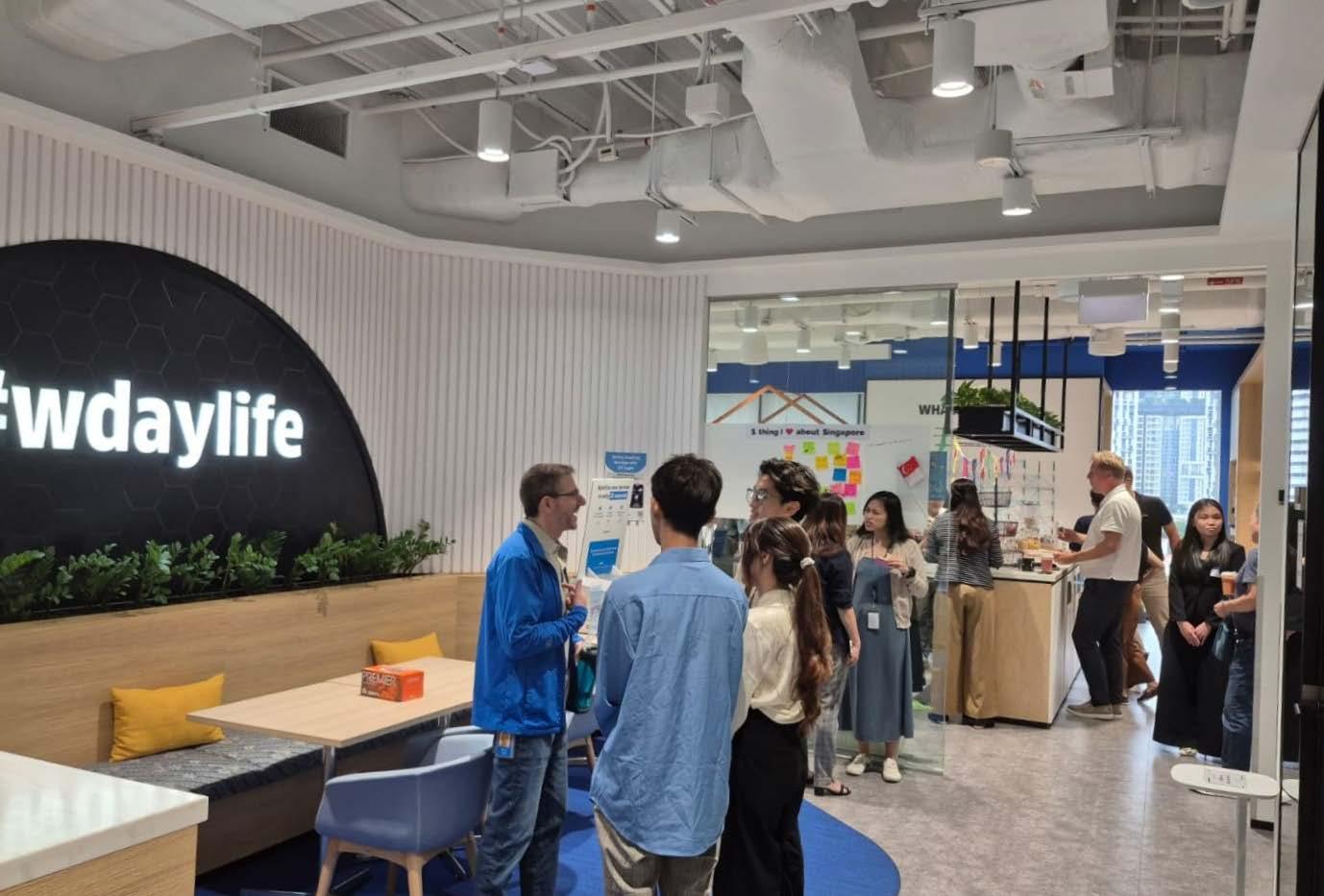
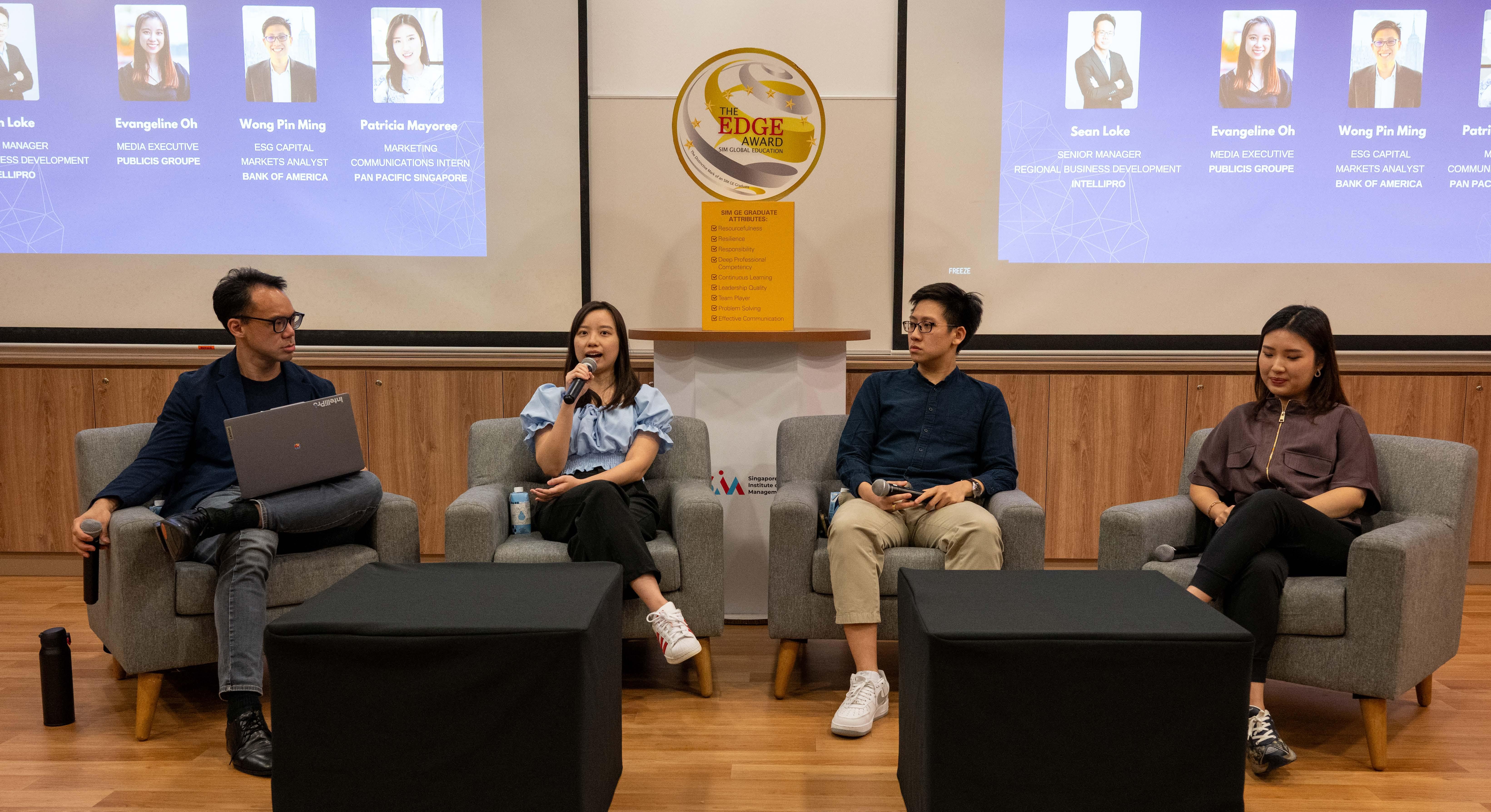
Career Guidance Session
Young Graduate Career Forum
Meet Industry Professionals @ Workday
Unlocking Doors – Career Competitive Edge
Career Connect offers a wide range of services to support your career development, including personalised career coaching, profiling tools, hands-on workshops, and company visits. These initiatives are designed to equip SIM students with the skills, confidence, and exposure needed to thrive in today’s evolving job market.
Career Coaching and Profiling
Our career coaches provide tailored guidance through:
• Refining cover letters and resumes
• Strategic career planning and job search support
• Insights on industry trends and practices
• Career Advisory with Industry Experts—opportunities to engage professionals for role-specific advice
Profiling tools such as the Myers-Briggs Type Indicator (MBTI®) and Career SUPERDRIVE™ Boardgame are available to help students discover their strengths, understand preferences to make informed career decisions.
Career Workshops and Programmes
A degree lays the foundation, but today’s employers seek more—graduates who can adapt, collaborate, and communicate effectively. That is where our Hire-Me-Series makes the difference.
The workshops focus on two key areas:
1. Career Preparation
Focused on building essential skills to help you enter the job market with confidence. Topics include self-management, communication and presentation, critical and creative thinking, problem-solving, collaboration, resume writing, interview techniques, and personal branding.
2. Career-Readiness
Designed to help you thrive beyond your first role by strengthening leadership and teamwork skills, deepening understanding of functional roles (pre-onboarding), developing emerging skills, and broadening global perspectives.
These workshops sharpen your Mindset, Heartset, and Skillset, building the confidence, connections, and skills that carry you beyond your first job—preparing you for lifelong growth and success.
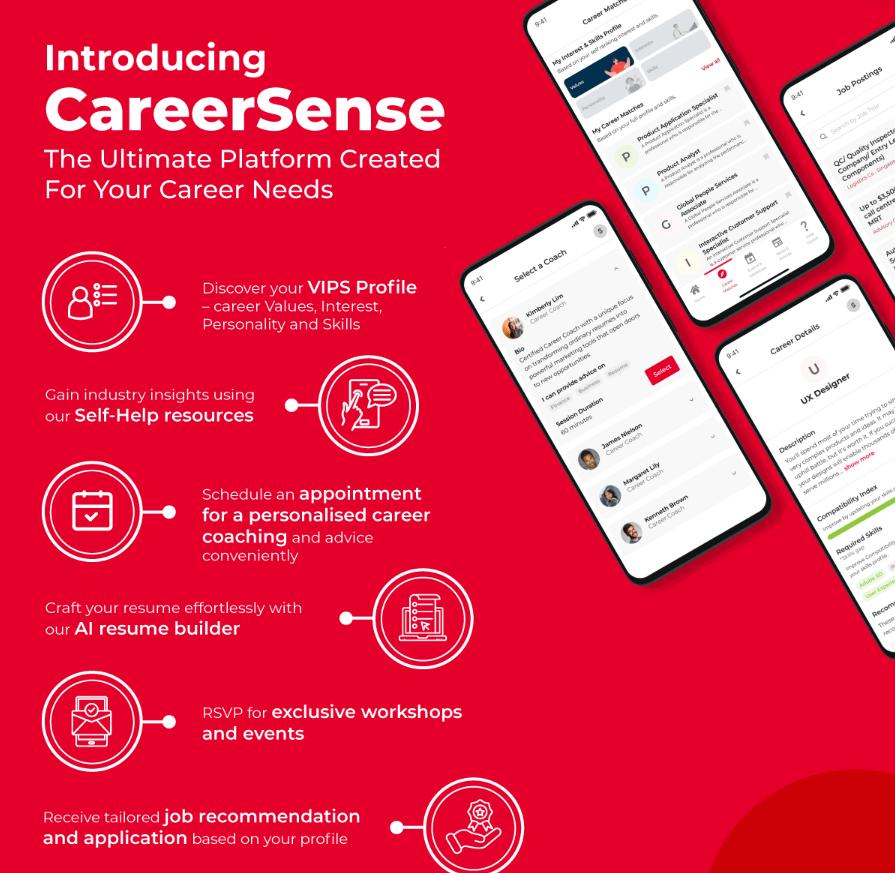
CareerSense App
It is a one-stop platform offering SIM learners key resources for their career journey, including:
• Discover Career Values, Interests, Personality and Skills (VIPS)
• Apply for job roles that resonate with VIPS profile
• Explore course recommendations to build new skills
• Book appointments with career coaches
• Access digital library with career tips and self-help resources
• Craft resume with AI Resume Builder
SIM Learners can download the app at http://qrco.de/CareerSense
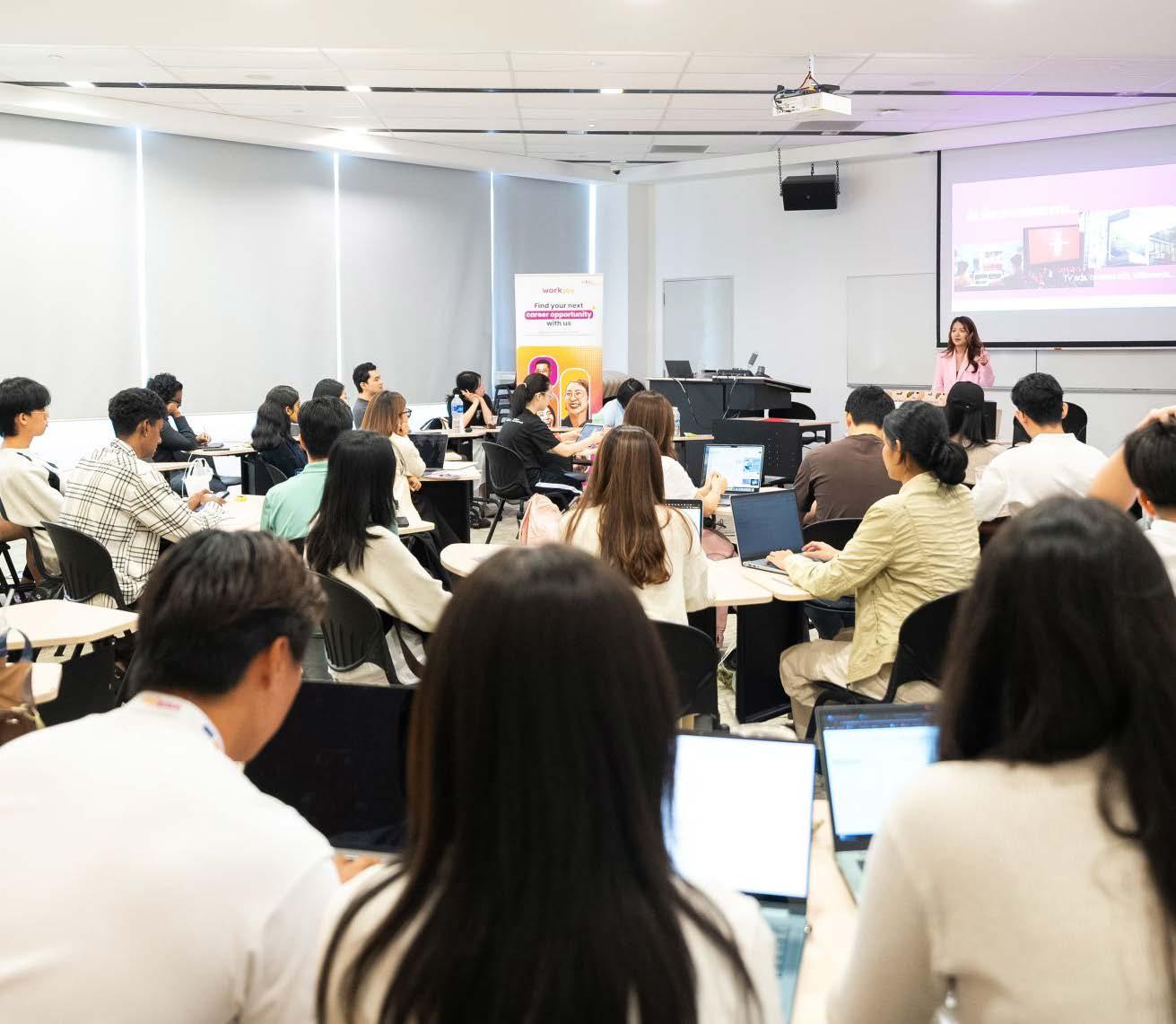
Workshop
Building Bridges – Networking and Professional Connections
Career and Internship Fairs
Career Connect hosts two flagship Career & Internship Fairs each year—DREAMS in February and IGNITE in September, where students can connect with employers, explore companies and discover career paths. Additionally, EMBARK International Career & Internship Fairs further helps students, especially international students, explore global opportunities.
Career Talks and Learning Journeys
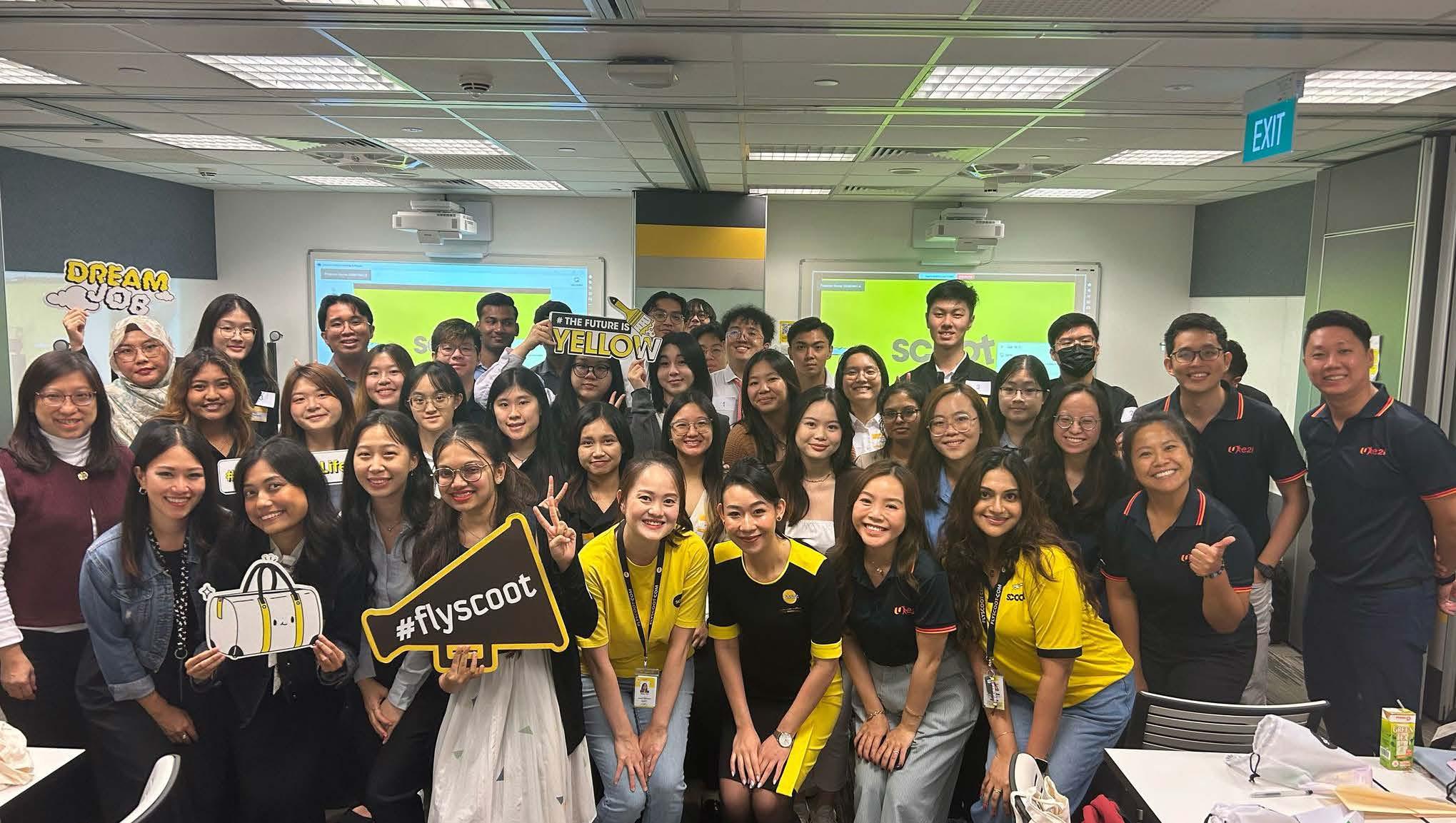
Tours to companies such as Scoot and FDM Group, provide students valuable exposure into industry-leading environments and technologies. These visits allow students to witness the practical application of advanced concepts, gain insights into innovative processes, experience corporate cultures and build professional connections that can benefit their future careers.
Global Exposure
Career Connect’s exclusive Global Exposure Programme equips students with international networks and future-ready experiences. Through overseas immersion, students gain insider perspectives from leading companies, connect with industry professionals and alumni aboard, and explore career pathways beyond Singapore.
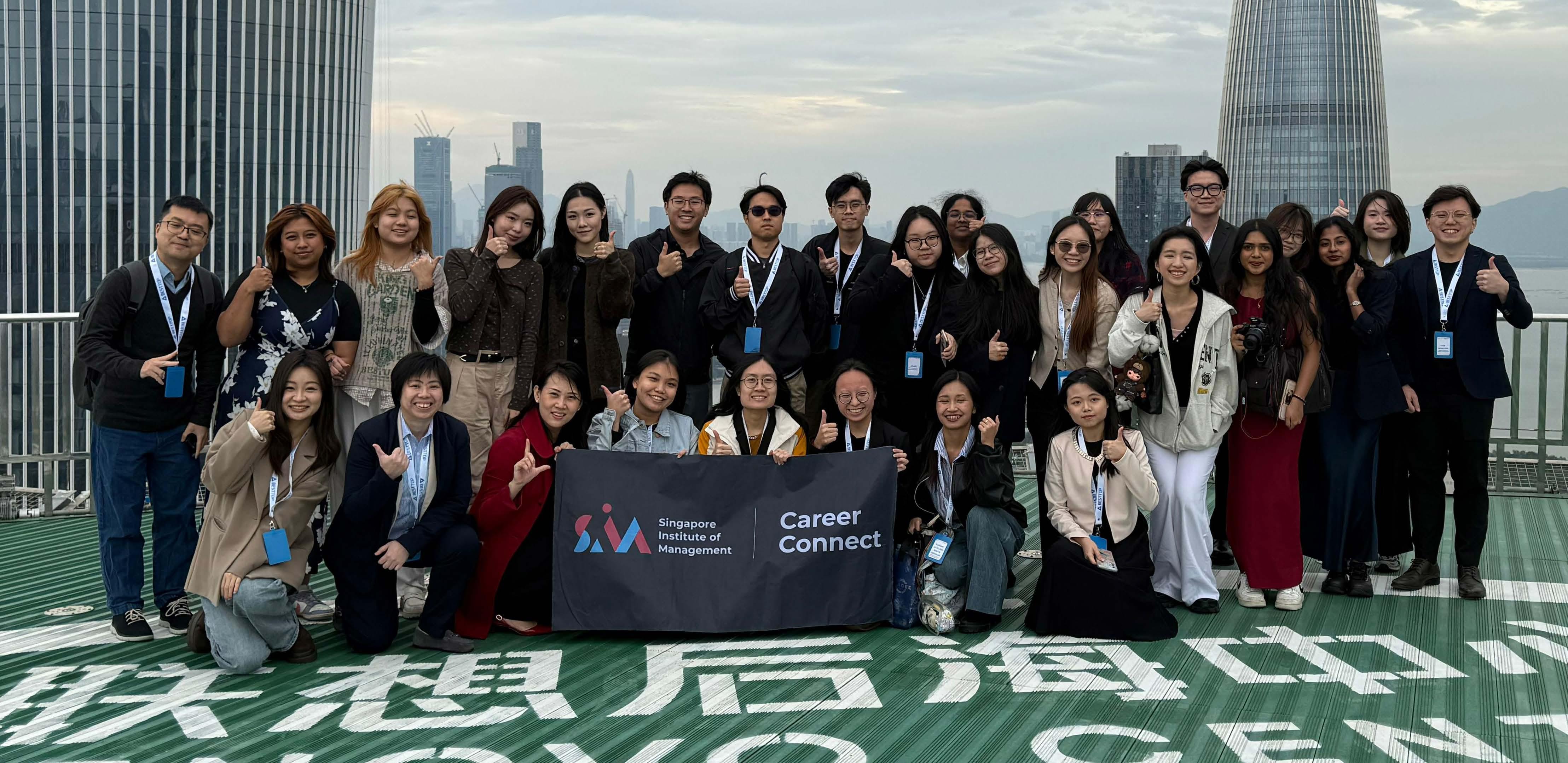
Shenzhen Career Exploration Journey
Scoot Company Visit







SIM Career & Internship Fair 2025
Every career journey begins with a connection, and for many SIM students, this first step happens at the SIM Career and Internship Fairs. More than just a recruitment event, the fair is a dynamic platform where students meet employers, explore opportunities, and discover the skills needed to thrive in this evolving job market.
With the growing demand for tech talent in today’s AI-driven world, this year’s fairs welcomed more technology companies, including TDCX and eClerx, while also featuring opportunities in hospitality, finance, media and other sectors. A key highlight was the participation of government statutory boards such as the Ministry of Foreign Affairs and IRAS, joining a diverse line-up of industry players.
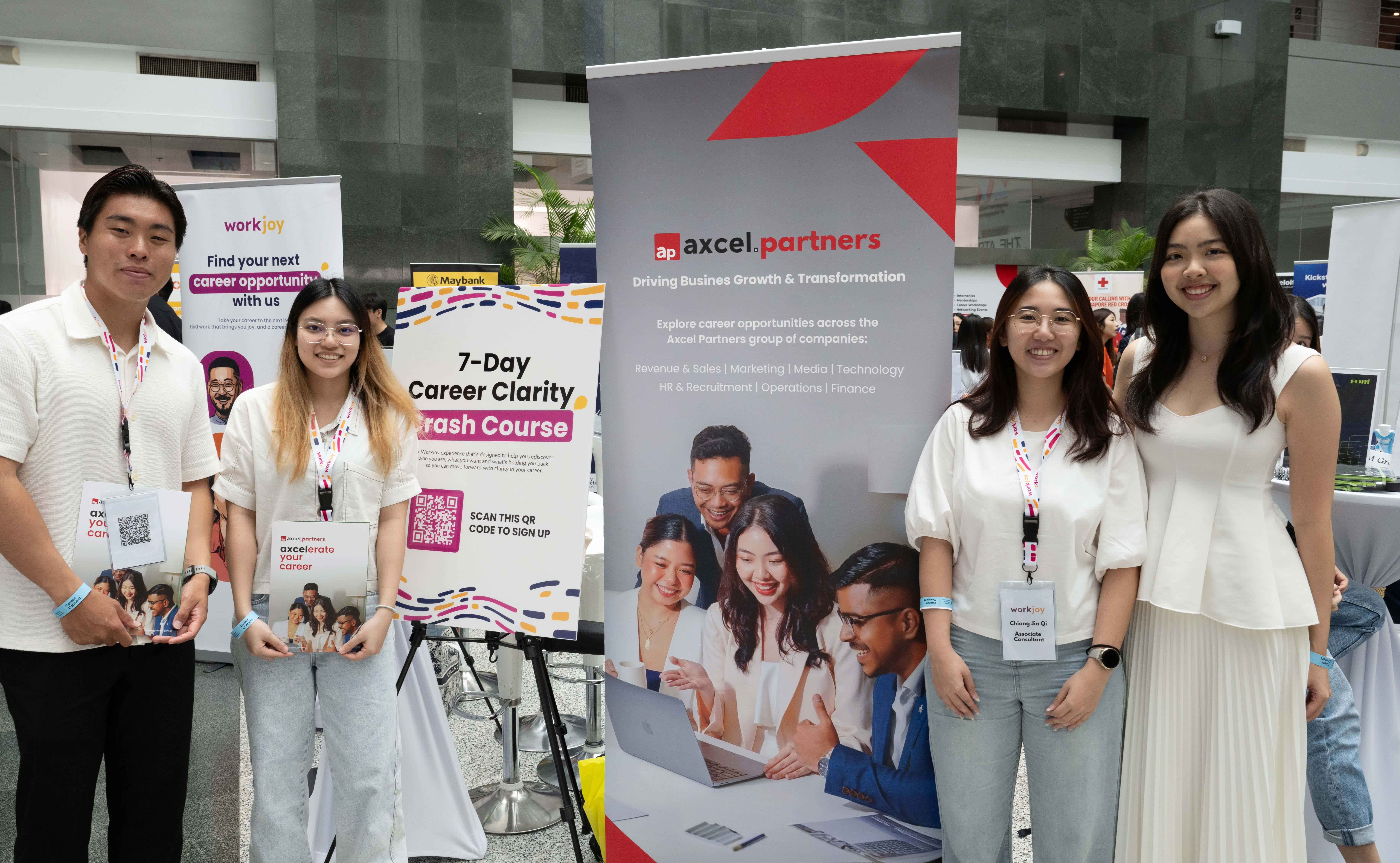
The DREAMS & IGNITE Career and Internship Fair proudly welcomed up to 60 companies, marking a record turnout since the fair resumed after COVID—including L’Oréal, PwC, EY, TATA Consultancy, TÜV SÜD, UOB, and Cognizant. Students engaged directly with company representatives, explored roles aligned with their ambitions, and gained valuable insights into workplace culture.
More than an event, the fair is a launchpad for career exploration, empowering students to build networks and step confidently into the workforce.
Look out for our annual Career Fairs in February and October—Your gateway to explore, connect and IGNITE your Career DREAMS!
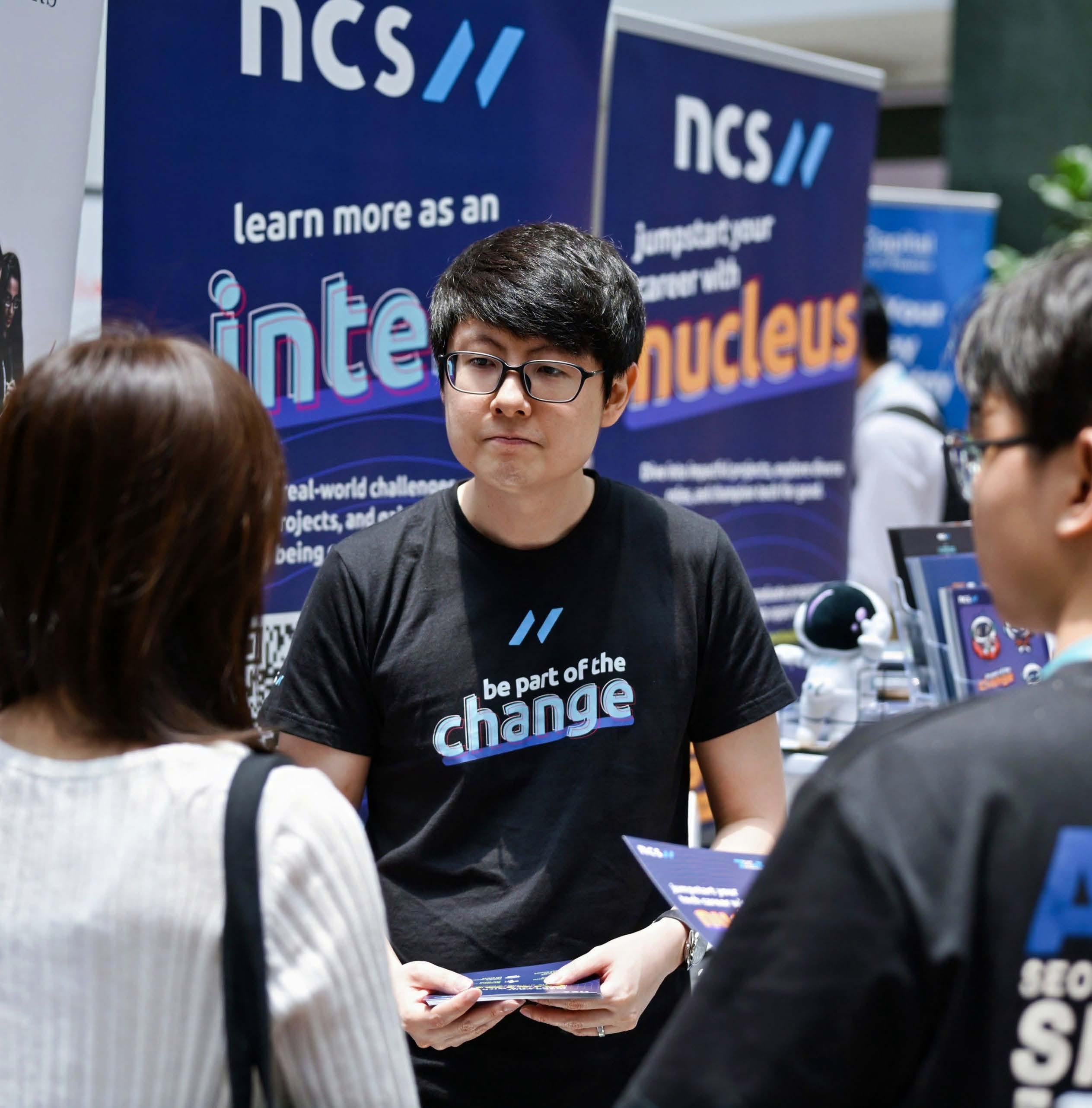
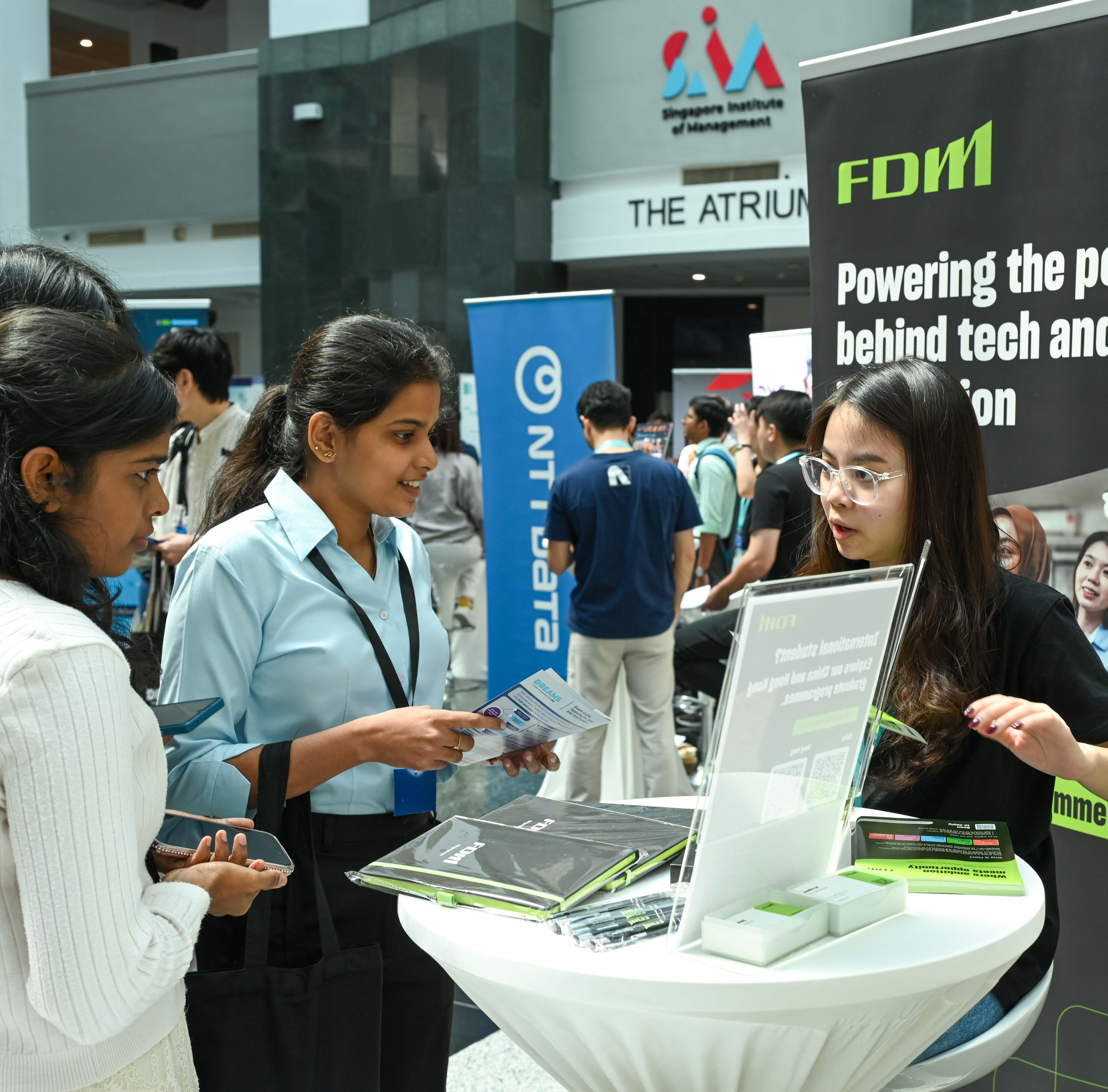
The SIM Career Fair was a well-organised event with excellent setup and clear communication. We were impressed by the diversity of talents and the curiosity of the students, who actively explored internship opportunities and showed genuine interest in learning about the businesses of participating employers. It was a meaningful platform for connecting with motivated individuals and sharing future opportunities. We certainly look forward to the next SIM Career Fair.
The Career Fair was a wonderful experience, seamlessly organised by the SIM Career Connect team. We connected with many bright and enthusiastic students from diverse fields of study and various universities, many arriving wellprepared with thoughtful questions and resumes. Their curiosity, professionalism, and eagerness to explore industry opportunities made every interaction meaningful. The positive follow-up engagements after the fair further reinforced the value of this initiative. We are grateful for the opportunity and look forward to participating in future collaborations with the organising team.
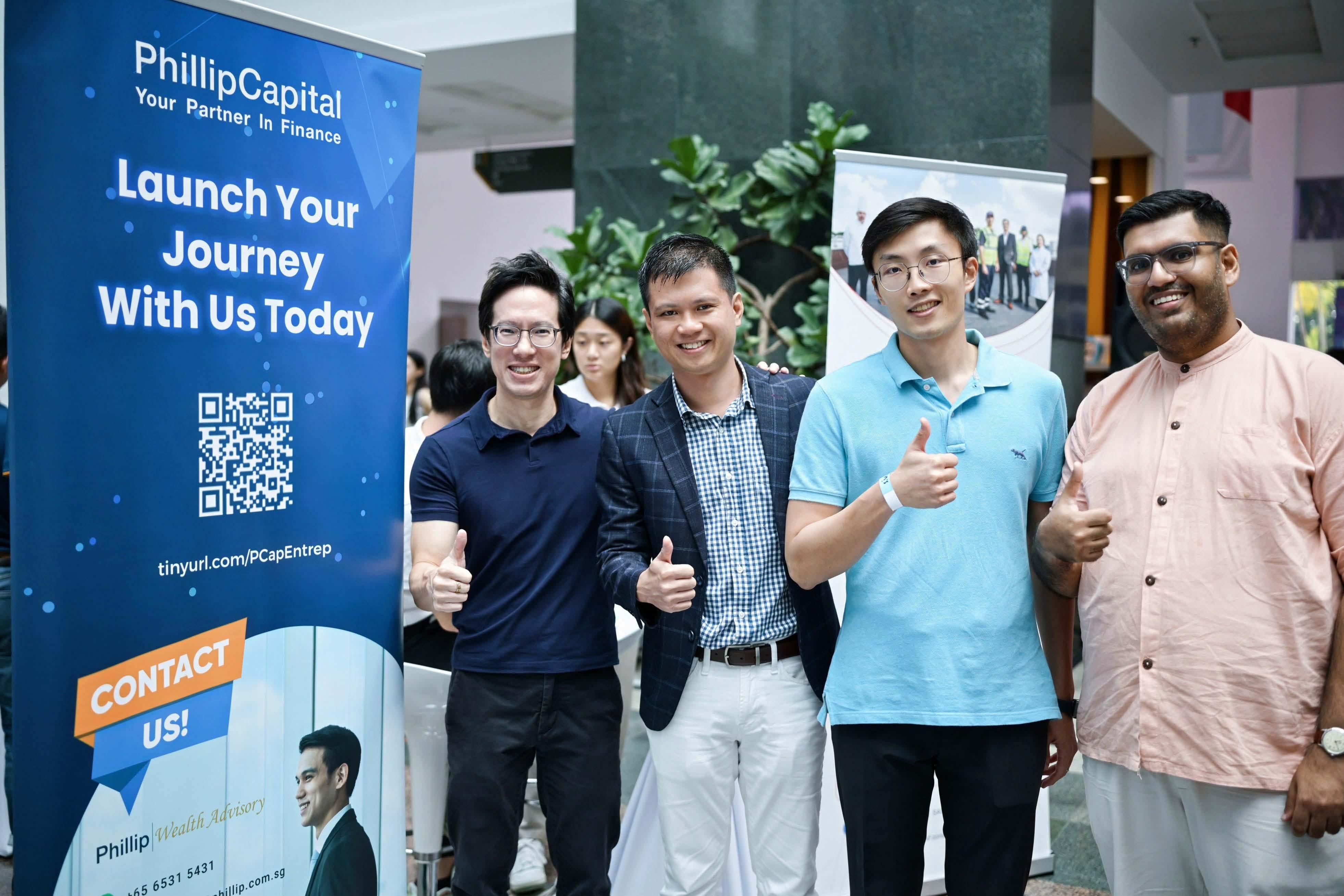
- Ng Kwong Yee, Senior Manager, Talent Acquisition PhillipCapital
- Renae Chen, Talent Acquisition Lead, Axcel Partners
Meet Our Team
At SIM Learner Advisory & Career Centre (Career Connect), we are dedicated to empower students and alumni to navigate their careers with confidence and purpose. We provide access to resources, guidance, and industry networks that help you build a competitive edge and achieve your career aspirations. We support your journey towards sustainable employability and success in a global workforce.
Reach out to us at Career Connect office located at SIM HQ, Block B Level 1 (Opposite Food Fest). You may also contact us directly by phone at 6248 0281 or via email:
• For Students: careerconnect@sim.edu.sg
• For Alumni: gealumni@sim.edu.sg
• For Employers: employerengage@sim.edu.sg
We create purposeful and engaging career preparation experiences that contribute to the students’ development and enhance their employability. Our aim is to equip students with the right career-ready skills to effectively leverage opportunities in an evolving job market.
These efforts are achieved through personalised career guidance, profiling sessions, resume reviews, and mock interviews. A range of focused career-related workshops are organised to help students gain a practical understanding and equip them with the skills needed to succeed in the workplace.
We foster lifelong learning and create enduring connections between SIM and graduates through actively engaging alumni, encouraging them to contribute and share their expertise, provide support and build networks, while establishing a lasting bond with the institute and wider community.
We focus on building and strengthening strategic partnerships with corporates and enterprises to enhance students employability and career opportunities.
To foster meaningful engagement, we create diverse platforms for interaction between industry partners and students. Including networking events, industry panel-sharing, career fairs, recruitment talks, company visits and etc.
We conduct and execute surveys to obtain data on graduate employability, alumni career progression, and employers feedback, enabling us to monitor learner outcomes. The findings are analysed and presented to guide the development of strategies for continuous improvement in the learner experience. In addition, we monitor and gather job market intelligence to strengthen the career guidance and advisory provided to both learners and employers.
Research
Employer Engagement
Alumni Relations
Career Guidance
A Message from the Team
Career Guidance
















Kay Hui Min
Priscillia Lee
Samantha Cheng
Sarah Kiu
Luo Jiantong
Calvin Kong
Christopher Tan Jean Lee
Julia Kek
Research
Suriani Binte Jamil
Employer Engagement
Karen Tang
Pauline Ang
Orianna Fang
Darren Tan
Learner Advisory
Alumni Relations
Chiew Jia Ying
Rachel Eng
Talent Development Programme (TDP)
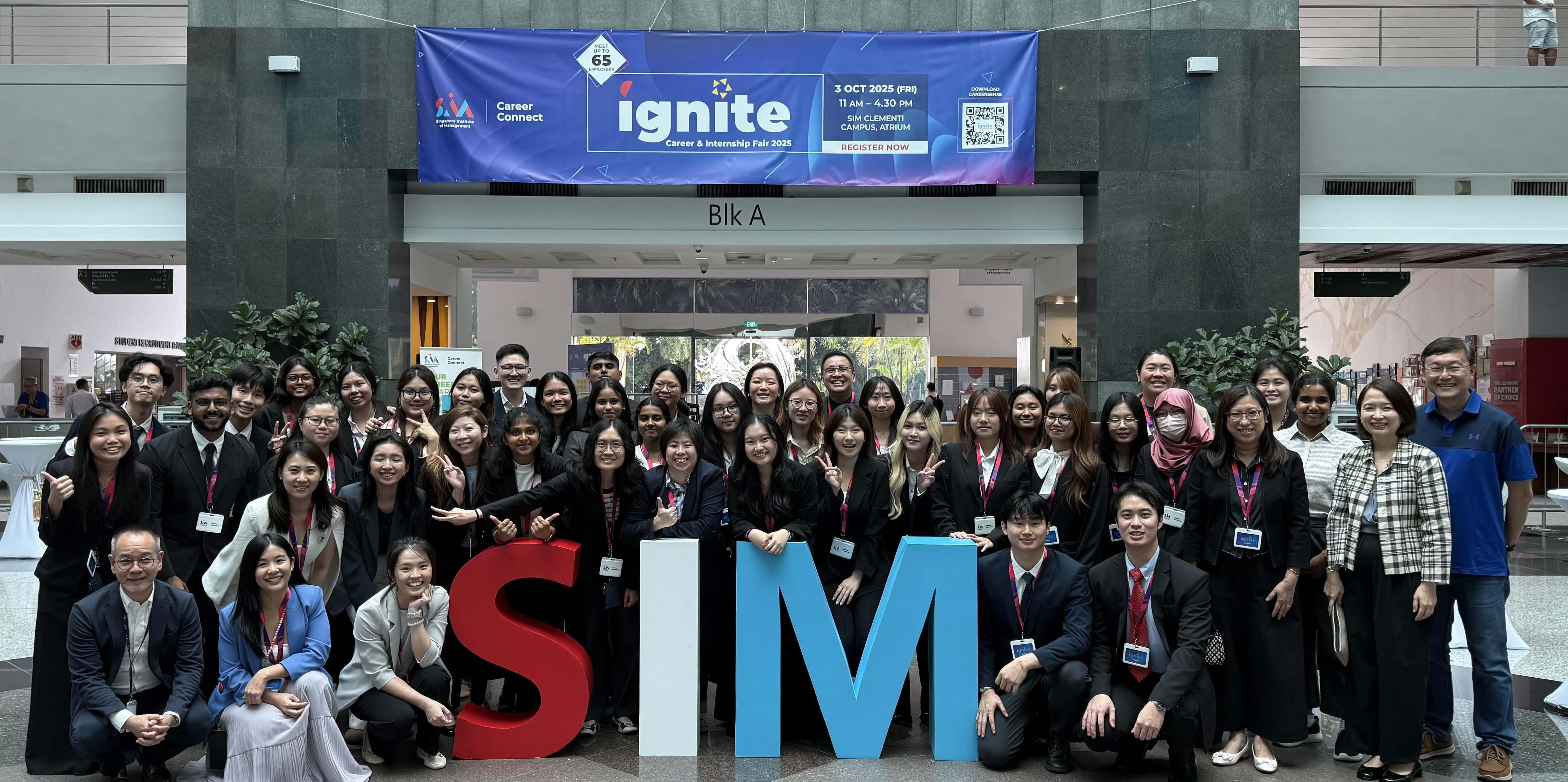
The Talent Development Programme (TDP) is a structured in-house internship by SIM Career Connect that equips students with essential skills and experiences for the corporate world. Through hands-on projects, training workshops, and networking opportunities, interns gain valuable exposure to real-world challenges while building professional confidence and connections.
More than 300 interns have benefited from TDP since its launch in 2015, many of whom have gone on to secure internships and full-time roles at leading organisations such as Google, J.P. Morgan, TikTok, VISA, L’Oréal, and PwC. Beyond professional growth, TDP also offers a supportive community where like-minded students learn, collaborate, and grow together.
TDP Departments, Roles and Responsibilities
Headquarters
• Support recruitment, selection and onboarding of new interns
• Plan and support interns’ career development and progression
• Execute marketing and outreach campaigns
• Develop marketing collaterals for various career initiatives
• Manage Career Connect social media platforms
Business Development
• Engage employers on collaboration and training partnerships
• Conduct industry research
• Plan and organise career events
Common Roles & Duties
• Participating in event and project taskforces, taking on roles such as Project IC or supporting marketing, operations, and logistics
• Serving as emcee for events and presentations involving internal and external stakeholders
• Managing and responding to students’ enquiries related to Career Connect initiatives
Testimonies from Graduates of TDP

Luo Qiheng
• Learning and Development Associate @ Frasers Property Limited
• Bachelor of Science in Business and Management
• SIM – University of London
• Previous Role: Cluster Leader, Intake 27
There were moments when I felt lost and uncertain, but TDP reminded me that with the right mindset and perseverance, everything eventually falls into place. The programme, which focuses on marketing, HR, and business development, offered the perfect opportunity for me to gain hands-on experience aligned with my HR career goals.
Even if your interests lie beyond these fields, TDP equips you with valuable transferable skills—from communication and teamwork to leadership—and meaningful friendships that make the journey fulfilling. The experiences I gained through TDP shaped my personal and professional growth, helping me tell my story with confidence and ultimately land my first full-time role. I am truly grateful for how this programme has shaped my path.

Anthony Yap
• Data Analyst @ AirTrunk Singapore Pte Ltd
• Bachelor of Science in Data Science and Business Analytics
• SIM – University of London
• Previous Role: Youth Director, Intake 19
I joined TDP in my first year to gain early real-world exposure, which quickly became a meaningful part of my student life. Through TDP, I worked with peers, explored industries and gained insights from employers about essential skills, which sharpened my career direction and awareness of my strengths.
TDP was an excellent platform to develop leadership and teamwork skills, where I learned the importance of communication, adaptability, and collaboration—skills that continue to benefit me professionally. I am grateful for the supportive and inspiring environment, the friendships formed, and the resources and networks that helped me secure an internship. My advice: take ownership of your growth, stay open-minded, and make the most of opportunities like TDP.
SIM Career Champs
Career Champs is an international student-led body under SIM Career Connect dedicated to empowering the international student community in their career journey. Designed by international students, for international students, it serves as a bridge to career opportunities and helps them navigate the professional landscape in Singapore with confidence.
Through initiatives such as career fairs, forums, and workshops, Career Champs equips international students with essential skills and insights for a successful career transition. It also provides a platform for them to connect with peers, share experiences, and support one another in achieving their career goals in a foreign environment.
At its heart, Career Champs embodies the spirit of students supporting students — inspiring one another to take charge of their own employability journey.
Career Champs Departments, Roles and Responsibilities
Marketing and Communication
This division manages the club’s outreach and visibility. Members develop marketing strategies, design publicity materials, oversee social media communication, and liaise with stakeholders across the SIM community to promote Career Champs initiatives effectively.
Events and Logistics
Responsible for bringing ideas to life, this division plans and executes Career Champs events from concept to completion. The team manages event rundowns, logistics, and post-event reviews to ensure every activity runs smoothly and delivers meaningful engagement.
Talent Curation
Central to sustaining Career Champs, this division recruits, onboards, and nurtures new members and executive committees. The team manages Project Potential participation, event rosters, and reports, ensuring continuity and growth within the club’s leadership pipeline.
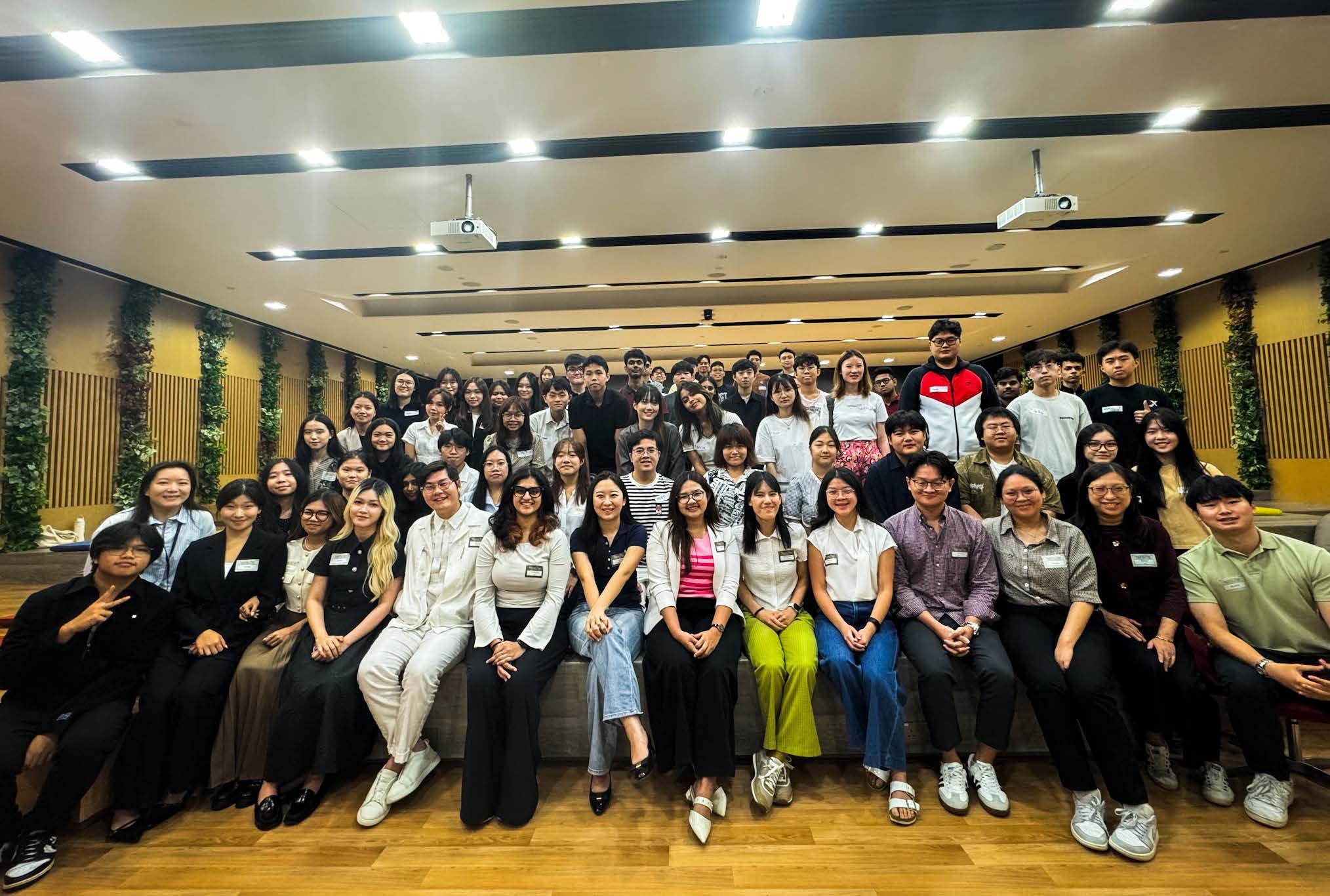
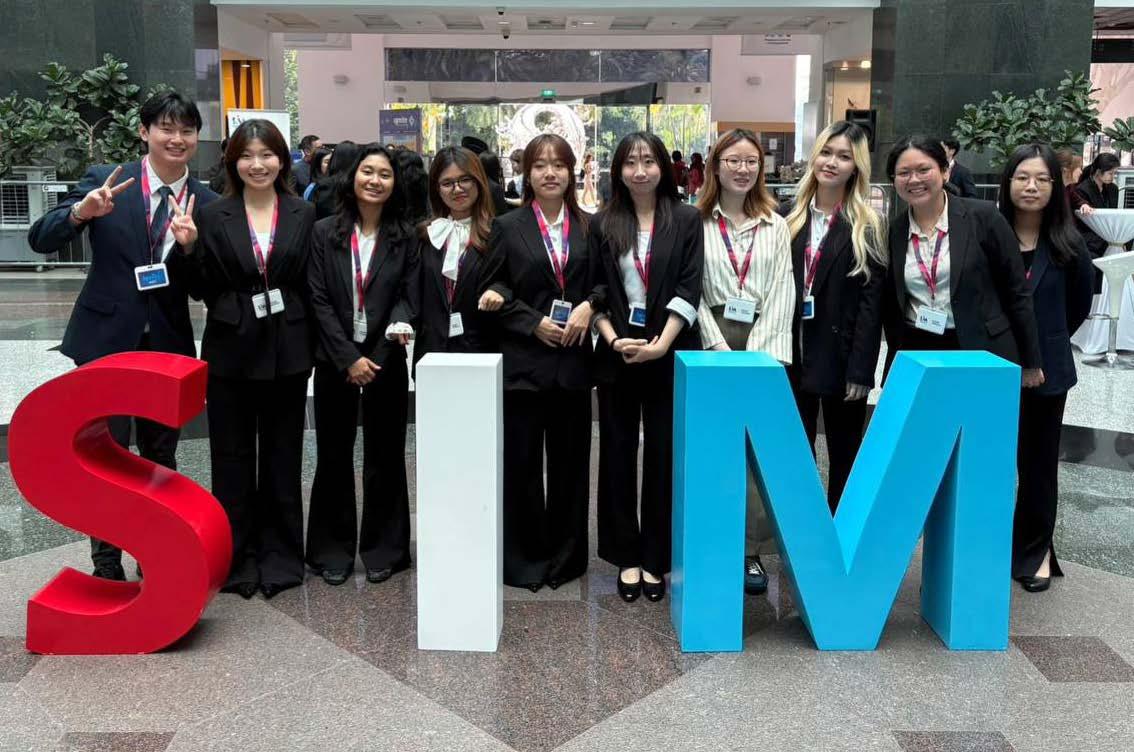
IGNITE Career & Internship Fair 2025
International Students Career Forum 2025
Testimonies from Past Career Champs EXCO

Kelly He Wang
• Bachelor of Science in Accounting & Finance
• SIM – University of London, Class of 2025
• Previous Role: President
Serving as the President of Career Champs has been one of the most transformative experiences in my student journey. Leading the team honoured my leadership, communication, and decision-making skills, while teaching me the importance of balancing guiding and active listening. I learnt that effective leadership is not just about making decisions, but about valuing diverse perspectives and making thoughtful, collective decisions that move the team forward.
Regular interactions with employers during various events also gave me valuable insights into the qualities most desired in today’s job market—adaptability, professionalism, and teamwork. These experiences strengthened my confidence in professional settings and enhanced my ability to connect with people from different backgrounds. Overall, Career Champs has shaped me into a more empathetic, strategic, and career-ready individual, equipping me with both the mindset and skill set to thrive in future professional environments.

Aisha Sabreen
• Bachelor of Science in Accounting & Finance
• SIM – University of London, Class of 2026
• Previous Role: Vice-President
Joining Career Champs as my first club with SIM Career Connect was one of the best decisions I have made. Started out as the Events and Logistics Director and later progressed serving as Vice President gave me countless opportunities to grow both personally and professionally as a leader. Through these roles, I learned to communicate with confidence, network with industry professionals and alumni, and manage large scale events alongside a dedicated and supportive team. Together, we worked hard to organise meaningful initiatives that empowered our peers with their career journeys.
Looking back, Career Champs was more than just an extracurricular activity—it was a close-knit community that shaped my university experience. The lessons I learned, the friendships I built, and the experiences I gained have all played a significant role in who I am today. I am truly grateful to have been part of the team.
Project Potential
Project Potential is a dynamic initiative led by the SIM Career Champs, aiming to empower SIM’s international students through practical, real-world learning experiences. The programme connects students with project owners across diverse areas such as business development, human capital, marketing, and creative design, enabling them to engage in collaborative, hands-on projects that enhance their understanding of professional practices.
To date, the initiative has partnered with project owners on a pro-bono basis—including SIM’s Regional Marketing and Content Creation team, offering over 10 projects to more than 40 student participants.
As it continues to expand, Project Potential seeks to grow its network of project partners and provide more students with enriching project-based learning opportunities to deepen their technical knowledge and develop essential soft skills in teamwork and communication.
Testimonies

Clarybel Putri Sutanto
• Bachelor of Science in Management and Digital Innovation
• SIM – University of Wollongong, Class of 2025
• Project: SIM Regional Marketing; Axcel Partners WorkJoy Group
I joined the SIM Regional Marketing Team, where I managed camera setups, supported behind-the-scenes operations, and helped ensure smooth production. This experience strengthened my communication skills and taught me to deliver quality work professionally. My steepest learning curve came from working with WorkJoy Group, Axcel Partners, where I gained hands-on B2B marketing experience through stakeholder liaison, social media management, and understanding how brands grow from concept to execution.
As an international student, standing out in a new environment can be challenging, but Project Potential gave me the platform to grow, learn, and contribute confidently within Singapore’s business landscape. It is truly an initiative where you can discover your strengths and bloom at the right time.

Myat Thinzar Lin (Stacy)
• Graduate Diploma in Business Analytics
• SIM – University of London, Class of 2025
• Project: SIM Regional Marketing
Participating in the SIM Regional Marketing Project was a valuable experience that allowed me to drive brand awareness and student engagement in the Myanmar market. I produced short-form social media videos independently, managing the entire process from concept to final edits, with several of my videos ranking among the top-performing posts in monthly reports.
Through this project, I developed skills in end-to-end content creation process and gained a better understanding of Singapore’s professional working culture. It also enhanced my communication, creativity, and teamwork abilities. This experience has contributed greatly to my personal and professional growth, giving me greater confidence to take on new challenges in marketing and digital content creation.

SINGAPORE’S LEADING RECRUITMENT & OUTSOURCING FIRM

W HY MC I ?
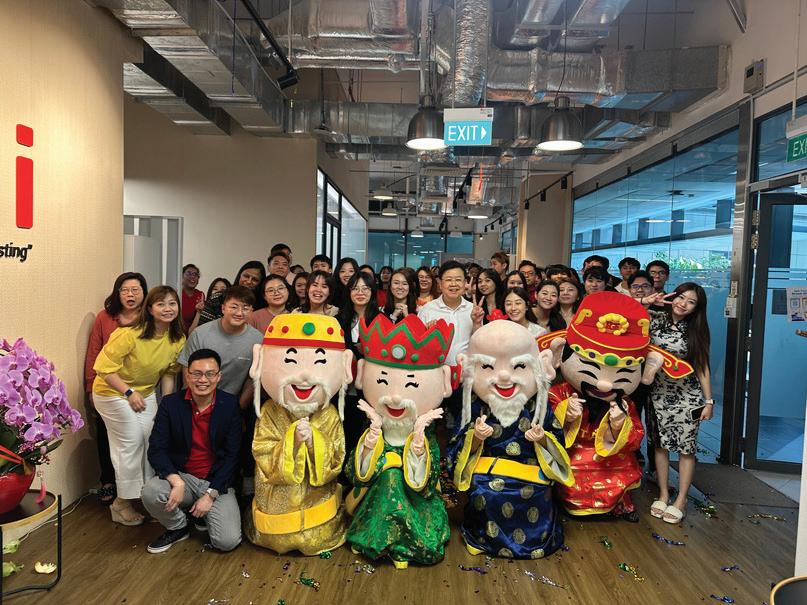

L I F E AT MC I ?
Overseas Incentive Trip
Attractive Remuneration Package
Birthday Leave & Celebration
Festive Leave (CNY, Christmas)
BE PART OF TEAM MCI TODAY!
Scan the QR code of our website and explore the different job opportunities available. Start Making Careers Impactful with us, one placement at a time.




Work Hard, Play Hard Supportive, People-First Culture Empowered to take initiative Clear Career Progression






"A
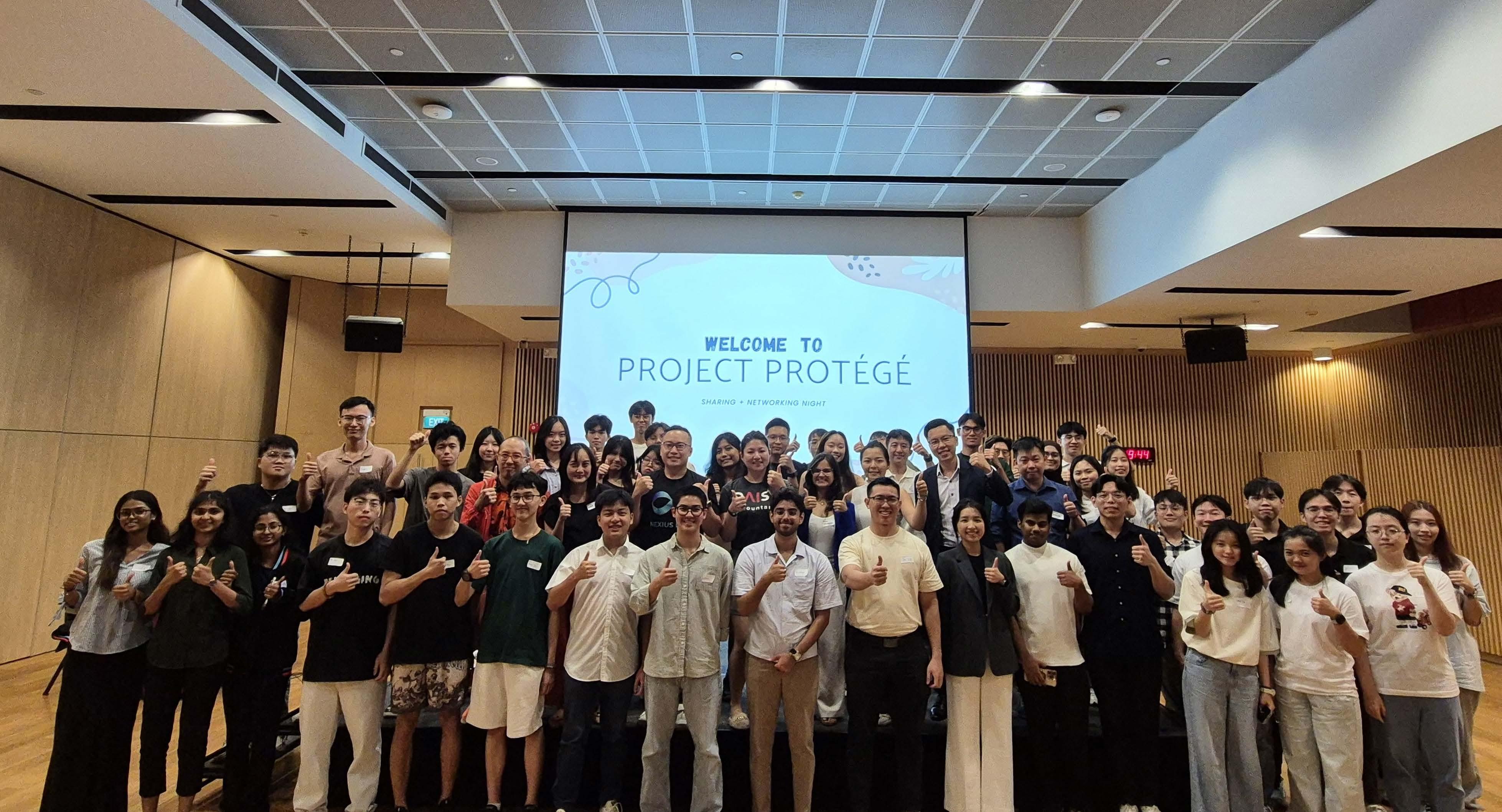
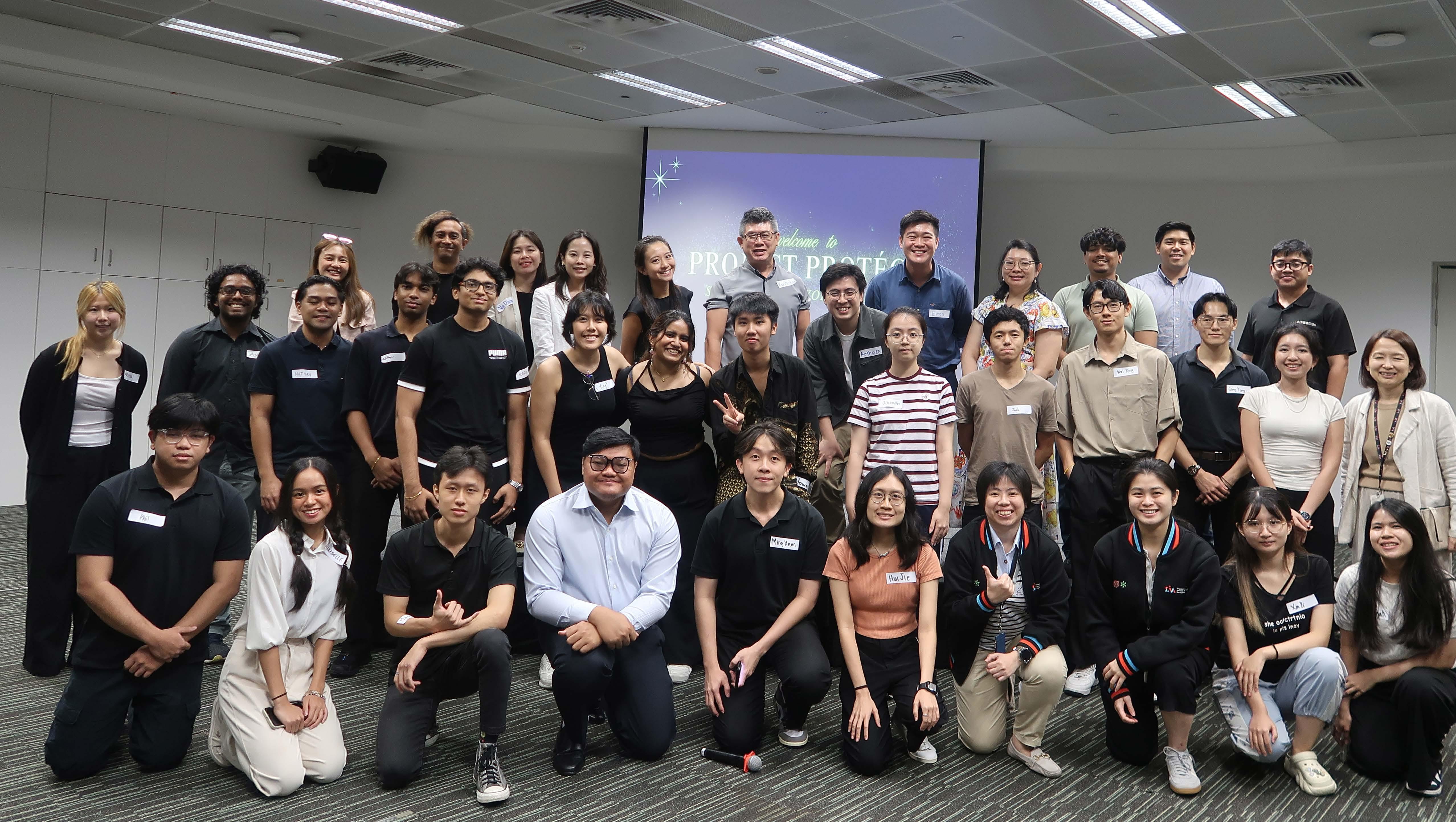
Project Protégé
mentor is someone who sees more talent and ability within you, than you see in yourself, and
helps bring it out of you.” – Bob Proctor
Project Protégé is a four-month mentorship programme that connects students with SIM Alumni and industry professionals from diverse backgrounds. The programme offers mentees opportunities to develop skills and explore career pathways, while mentors provide guidance, industry insights, and practical advice, contributing back to SIM and create a positive impact to the community. The online platform creates a structured and engaging mentorship experience that benefits both mentors and mentees.
Scan to participate as a Mentee or Mentor

https://qrco.de/SIMPP

Anson Wong
• UOB
Isaiah Chua Mentor
• Credit Structuring, Investment Finance, Investment Products & Solutions
I joined Project Protégé as a mentor because I remember what it felt like to start out not knowing where my career would take me. Having someone to share honest advice and perspective would have made a big difference back then, so I wanted to give that to others.
Over the past term, I have worked with students on building confidence, preparing for interviews, and making sense of their career choices. Watching them grow and find clarity has been really rewarding. What surprised me was how much I have learned in return. Mentoring has reminded me of the challenges fresh graduates face today, and it has also helped me become a better listener and communicator.
To anyone thinking of giving mentoring a try, I would say go for it. You will not only help shape someone else’s journey but also gain new perspective on your own as well.
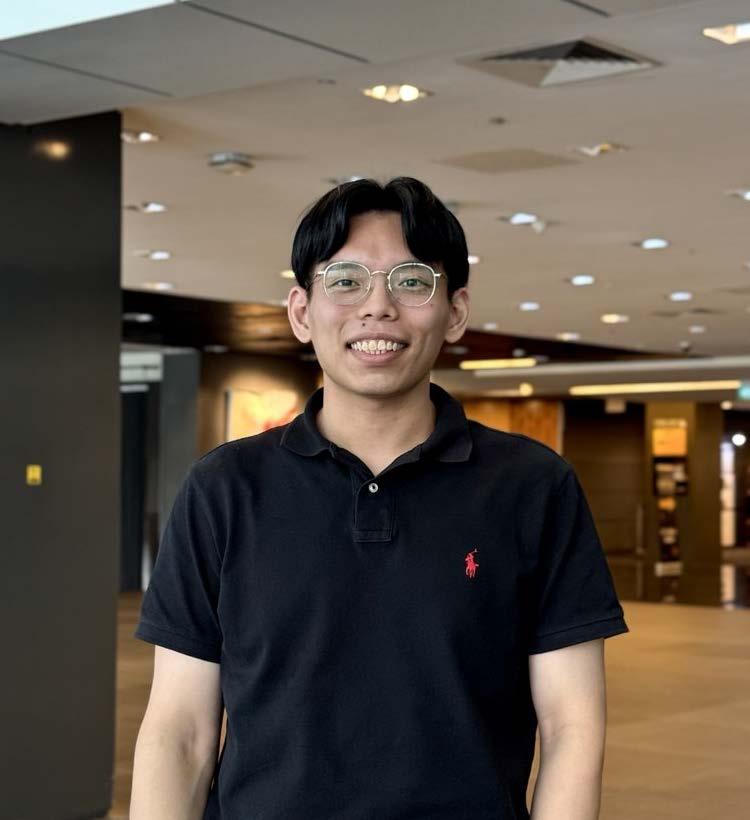
• Bachelor of Science in Business and Management
• SIM – University of London
“Those who ask, learn. Those who do not, stay where they are.”
That belief guided me to join Project Protégé — initially to expand my network and gain industry insights. What I did not expect was how much it would transform me personally and professionally.
Through my mentor’s guidance, I discovered that mentorship is not about ready-made answers. It is about asking sharper questions, embracing new perspectives, and building connections that push you to grow. These lessons gave me clarity in my career direction, the adaptability to navigate change, and the confidence to approach challenges with purpose.
To students considering Project Protégé: take the leap. Sometimes a single conversation can shift how you see yourself — and that shift can spark opportunities far greater than you imagined.

Soni Devanshi
Kim Seulkichan Mentor
• Sustainable Living Lab Group
• Sustainability Consultant
My journey with Project Protégé began as a mentee. At that time, I was uncertain about my path, and the advice and encouragement I received made a lasting impact on my confidence and career. That experience motivated me to return as a mentor and support others the way I was once supported.
I have been meeting my mentee, who is also an international student, over coffee to share lessons I learned as a student: how to build a resume, get involved in co-curricular activities, grow a network, and prepare for the job search after graduation. These were once overwhelming for me, so breaking them into practical steps feels like I am passing on the guidance I once received.
To my fellow alumni: becoming a mentor is one of the most rewarding experiences. It is a chance to make a real difference in someone’s life and rediscover the importance of community and support.

• Bachelor of Science (Business Administration)
• SIM – University at Buffalo
The opportunity to connect with an industry professional in my field of interest was too good to pass up, Project Protégé stood out for its accessibility and wide range of mentors across different industries. To me, it is a low-risk, high-reward programme that offers meaningful insights and guidance.
I was fortunate to be paired with Ms Soni, a sustainability consultant and recent SIM graduate. As the sustainability sector continues to grow in Singapore, hearing her firsthand experiences and advice on building a strong, tailored portfolio has been invaluable.
Being an international student myself, I found Soni’s guidance especially reassuring—her insights helped ease many of my concerns and motivated me to channel my energy into developing my portfolio more effectively. I strongly believe that gaining diverse perspectives is essential in university, and Project Protégé provides SIM students with an excellent platform to do so through meaningful mentor-mentee connections.















































































































































































360° Development Programme
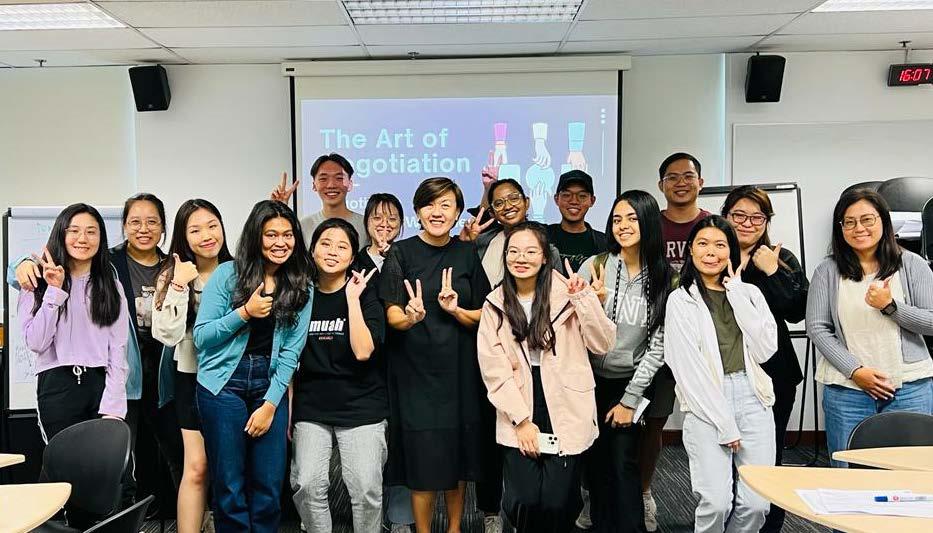
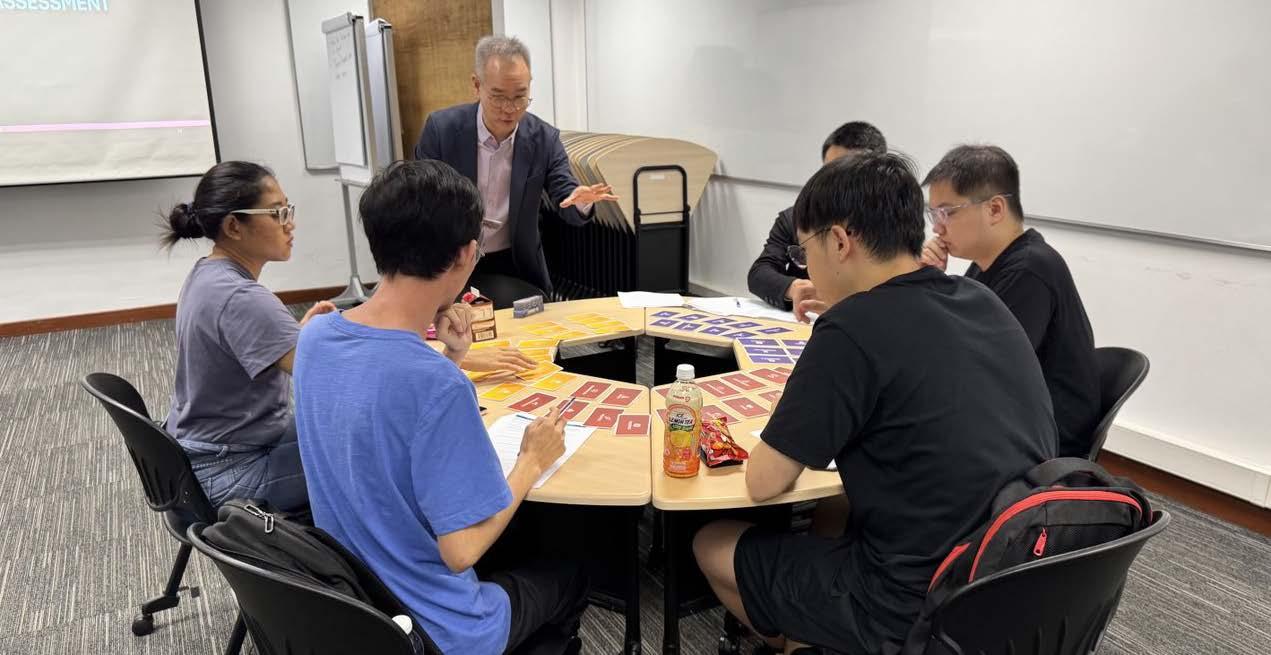
The 360° Development Programme provides a structured pathway to support both personal and professional growth, helping students develop essential skills across mindset, heartset, and skillset to enter the workforce as confident and capable individuals. The programme also fosters excellence, builds character, and enhances communication skills, equipping students with a well-rounded profile that gives them a competitive edge.
Participants engage in compulsory career development workshops to expand their knowledge, connect with industry professionals, and gain practical exposure through networking. Dedicated career coaches provide guidance on career planning and preparation, ensuring students are ready to navigate the workforce and position themselves as preferred candidates for future opportunities.



MICHELLE SOH
• Audit Associate @ EY Singapore
• Bachelor of Accounting
• SIM – RMIT University
This Programme was an eye-opening experience that helped me grow beyond academics and prepare for the professional world. Through its workshops and mentorship, I gained valuable skills in resume writing, interviewing, and networking, while also developing soft skills such as communication, teamwork, and leadership. The mentors’ guidance and insights deeply inspired my outlook on career development.
My advice to students is to start early, explore CCAs that align with your interests, and actively leverage the opportunities and support provided by Career Connect. Stay curious, keep learning, and maintain a balance between academics and CCA to be a confident, and well-rounded individual.
TAN ZHEN WEN
• Product Security Intern @ Univers Pte Ltd
• Bachelor of Computer Science in Cyber Security
• SIM – University of Wollongong
Participating in the Programme was a transformative experience that enhanced both my career readiness and professional growth. It taught me how to refine my interview techniques and tailor my resume to align with specific job roles. With the guidance of my mentor, I built the confidence and communication skills that helped me secure my current internship at Univers Pte Ltd.
For students who may feel uncertain about their direction, I encourage embracing new opportunities—through volunteering, leadership roles, hackathons, and networking events. These experiences offer valuable exposure and perspective. Equally important, remember to rest and pursue hobbies to maintain balance and well-being.
SALSABILLA WAHYU DYAH PASHA
• Bachelor of Science in Business Management
• SIM – University of Birmingham
When I first entered the workforce after polytechnic, I found the fastpaced environment overwhelming. Returning to university, I joined this programme to better prepare for my career. It strengthened my soft skills — from conflict management to communication and interview techniques — and taught me how to build meaningful professional relationships. The programme gave me the structure, tools, and confidence to re-enter the workforce with clarity.
I would encourage students to embrace new opportunities: explore CCAs, volunteer, and take initiative in projects. Focus on growth, integrity, and building strong relationships, as these qualities shape a well-rounded and trusted leader.
The SIM EDGE Award
Launched in 2017, the SIM EDGE Award is a prestigious award developed in partnership with employers to recognise students’ cumulative achievements throughout their learning journey.
Through your journey at SIM, we aim to provide a conducive and supportive environment by creating many opportunities to foster:
• Core attributes of resourcefulness, resilience and responsibility;
• Deep professional competencies in your chosen disciplines and equip you with the ability to continue learning throughout your lives; and
• Corporate-readiness by being confident leaders in your own right, being good team-players, taking the initiative to solve problems, and being able to communicate effectively across all levels.
To attain the Award, applicants are required to demonstrate learning across the following five broad categories:
1. University Involvement
2. Community Engagement
3. Work/Voluntary Experience
4. Global Awareness
5. Additional Skills
While the opportunity is open only to final-year undergraduate students, they are encouraged to begin building their portfolio from their first day on campus, allowing them to consolidate their best experiences.
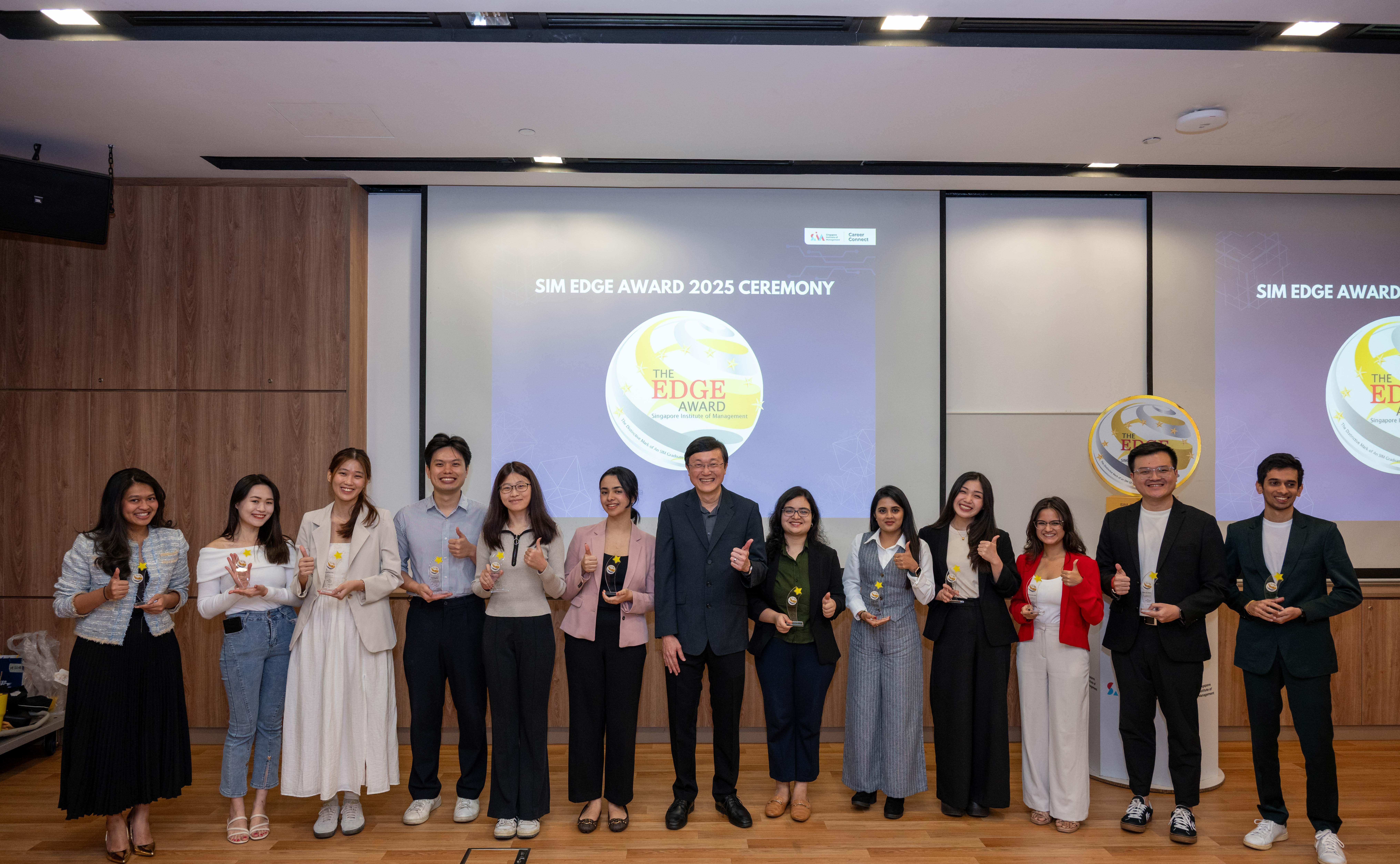

Zwe Lin Htet (Freddy)
Bachelor of Science in Data Science and Business Analytics
SIM
– University of London
Freddy has held multiple leadership roles, including President of the SIM Student Ambassador programme, President of the SIM Myanmar Community, and Project Director at SIM iCare. He also served as a Peer-Assisted Learning (PAL) Leader, supporting diploma students in their academic journey. Currently, Freddy works as a Specialist in Regional Recruitment (Student Recruitment) at the Singapore Institute of Management, where he is responsible for market research and business development for new regional markets.
1. Your motivation in applying for the Award

As an international student navigating a new environment, I consistently pushed myself beyond my comfort zone. Taking on various leadership roles allowed me to grow into a more confident and purpose-driven leader. Applying for the SIM EDGE Award was my way of celebrating that journey—not just the milestones, but also the challenges that shaped me. I saw the award as a meaningful opportunity to reflect on how far I have come in both my educational and leadership journey at SIM.
2. One quality that you feel made you stand out from the rest of the applicants
I would say it is the combination of resilience and self-confidence. Balancing academic performance with active leadership in student life was not always easy, but I approached challenges with a positive mindset and a strong belief in my abilities. Whether managing deadlines or leading projects, I stayed focused and adaptable. My resilience helped me remain consistent under pressure, while my confidence gave me the courage to take initiative and support others.
3. How do you think this Award is able to give you a competitive edge?
The SIM EDGE Award affirmed that leadership is not about titles, but about meaningful action. It gave me credibility when stepping into professional spaces and helped me communicate my value more effectively. Employers recognised more than just my resume—they saw my commitment, initiative, and the impact I had made throughout my journey at SIM. This award gave me the confidence to speak up, lead with purpose, and demonstrate my ability to thrive in diverse environments.
4. My advice for future applicants
To students considering applying: do not be afraid to try. It is never too late, and the application process itself is a journey of selfdiscovery. Taking this leap can reveal new strengths and help you grow beyond your expectations. Embrace the challenge, stay authentic, and use the opportunity to push your limits. You will not regret the experience.

Clarinda Ong
Bachelor of Science (Business Administration)
SIM – University at Buffalo
Clarinda’s journey at SIM was defined by a commitment to holistic growth, balancing rigorous academics with a vibrant extracurricular life. She delved into strategic business thinking through her involvement with BizStrat and contribution to the campus community as a dedicated member of the Student Council. Beyond these enriching experiences, Clarinda simultaneously undertook demanding internships at leading companies such as Amazon, BNP Paribas, IBM, and Circles.Life. This dynamic chapter at SIM not only reinforced her academic foundation but also equipped her with valuable real-world experience and a diverse skill set, preparing her for the challenges of the professional landscape.
1. Your motivation in applying for the Award
I applied for this award with a strong desire to share my personal story and journey. My motivation was to set an example that, through hard work and unwavering dedication, success is attainable—regardless of one’s background or the institution they come from. I believe that by sharing my experiences, I can inspire others to pursue their ambitions with tenacity and to recognise that their efforts can indeed lead them far in life.
2. One quality that you feel made you stand out from the rest of the applicants
I believe the quality that truly set me apart from other applicants was my maturity. This was not merely a matter of age, but rather my ability to navigate complex situations, take initiative, and maintain a clear perspective—even while managing multiple demanding commitments. My experiences in leadership roles within student organizations, along with high-pressure corporate internships, cultivated a strong sense of responsibility and foresight that I believe distinguished my application.
3. How do you think this award is able to give you a competitive edge?
This award has significantly enhanced my competitive edge by making me a more outstanding individual. It is not just a recognition of past achievements, but a powerful affirmation of my capabilities and potential. This honour serves as tangible proof of my dedication and multifaceted skills, distinguishing me in a competitive environment. It reinforces my credibility and opens doors to new opportunities, allowing me to pursue my aspirations with greater confidence and leverage.
4. My advice for future applicants
My advice for future applicants is straightforward: if you want to succeed in life, you must put in the hard work and not be afraid of it. Success is not a byproduct of luck; it is the direct result of consistent effort, resilience in the face of challenges, and a willingness to step outside your comfort zone. Embrace the grind, learn from every experience, and never shy away from the dedication required to achieve your goals.
SIM Alumni
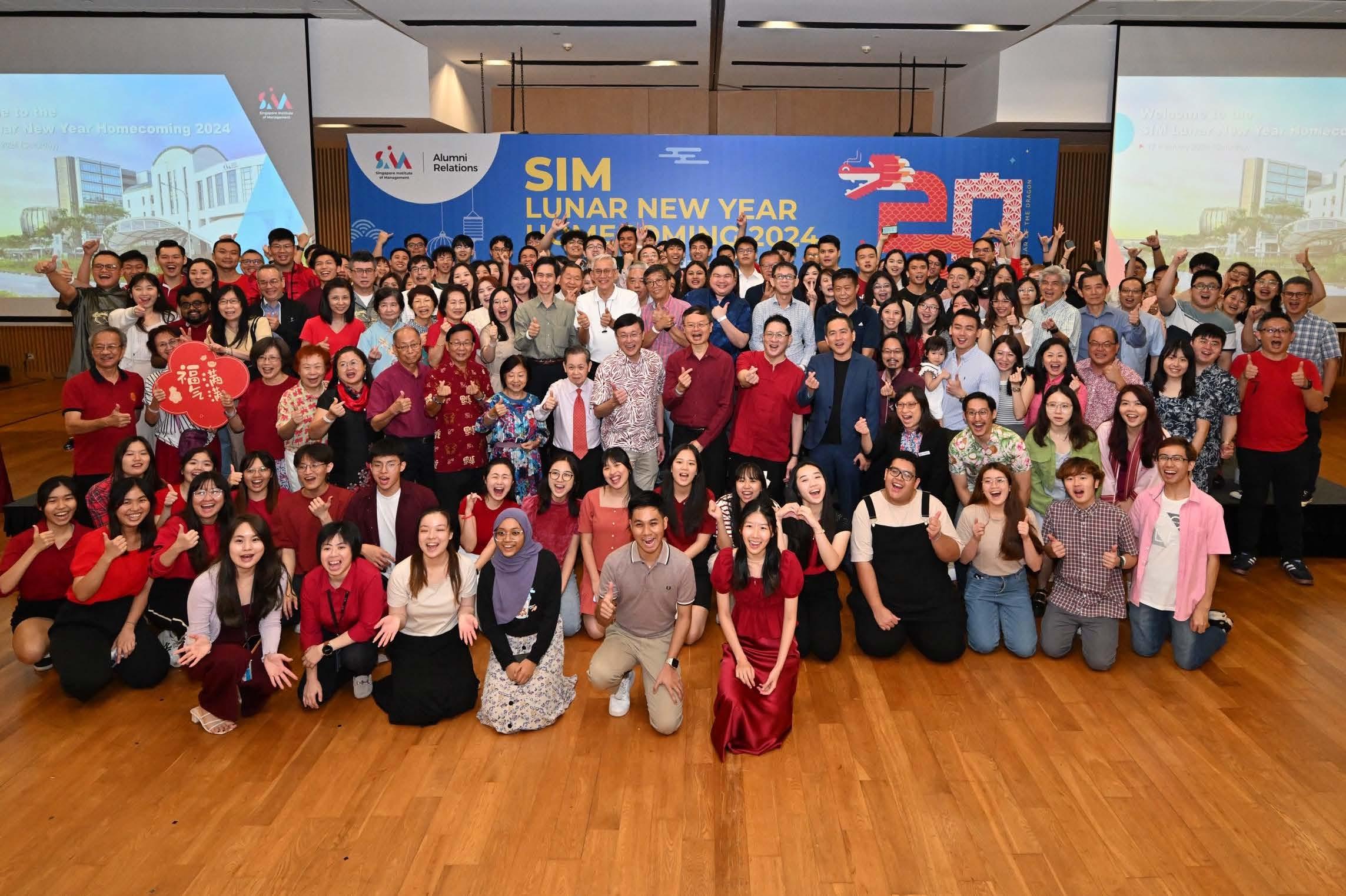
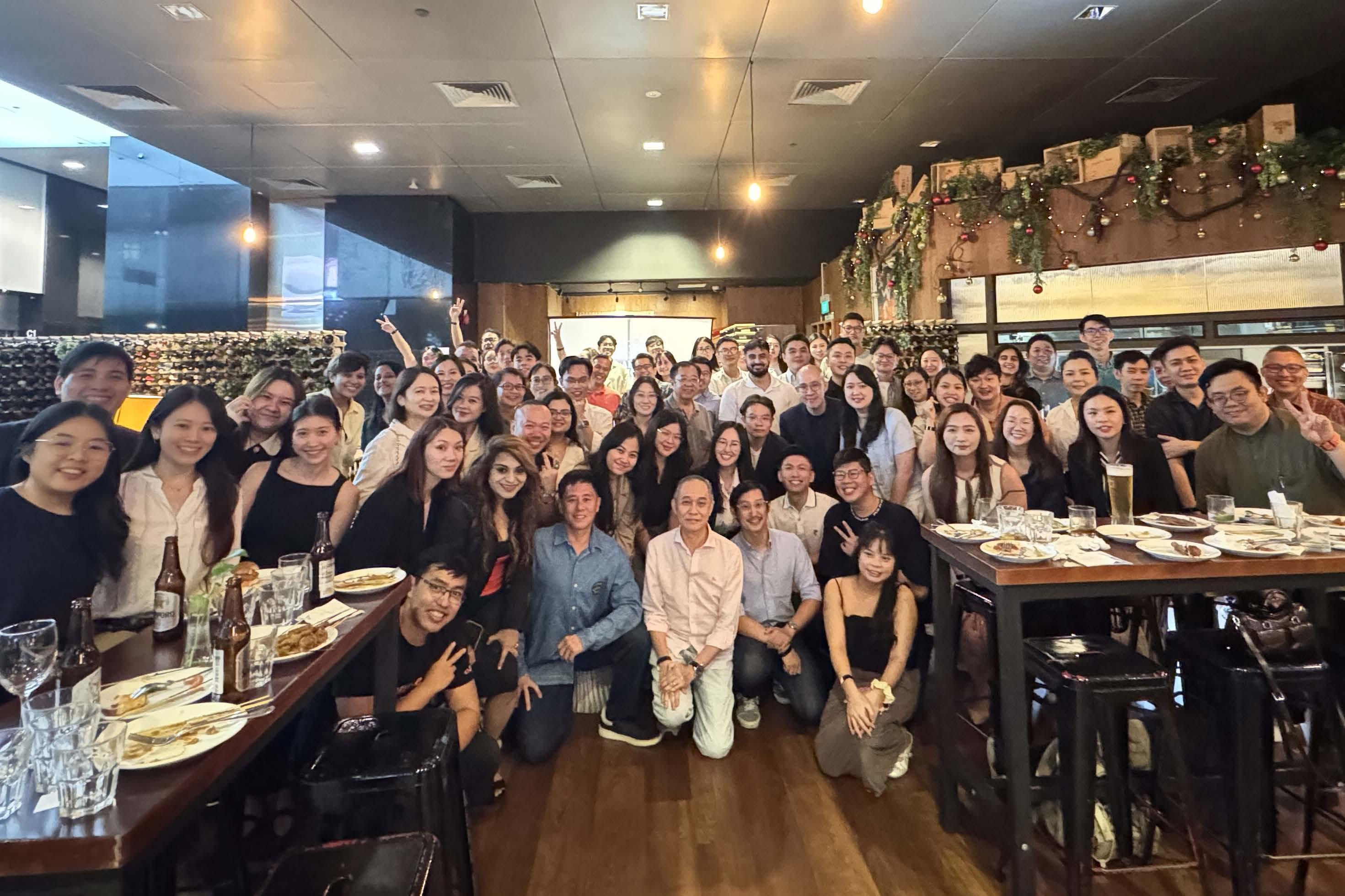
SIM alumni enjoy a wide range of complimentary services upon graduation, from lifetime access to career support initiatives and skills workshops, to networking events and use of campus facilities. You may stay connected through our signature events such as the Annual Homecoming and Movie Night. Alumni based overseas may also join our events and gatherings through our vibrant Overseas Alumni Chapters.
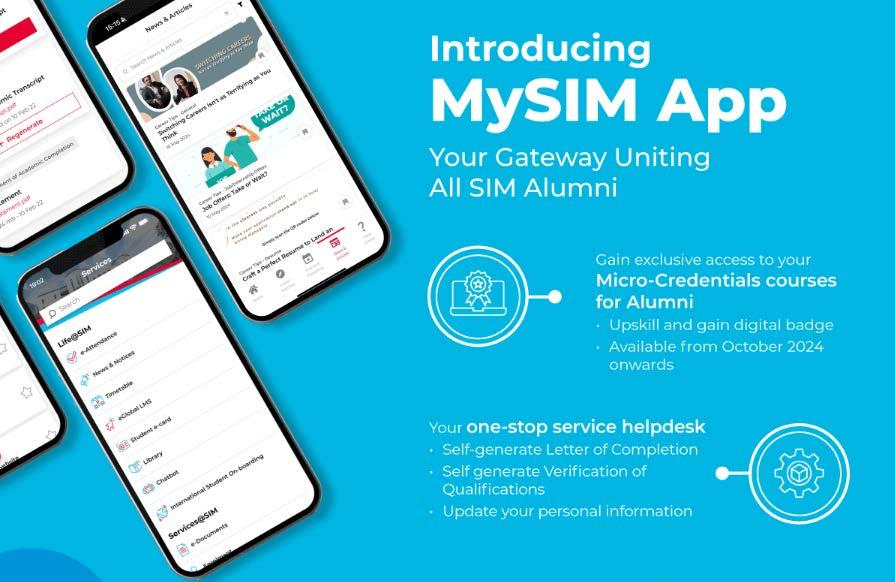
All our programmes are designed to build a lifelong relationship with you, through providing learning opportunities and career support that will help stay ahead in your game and achieve your career aspirations. Alumni can now easily access these benefits at their fingertips through the MySIM App and CareerSense App. These apps allow alumni to stay connected and updated with the latest SIM news.
At SIM, we’re always looking for ways to listen, connect, and celebrate our alumni community. If you know a fellow schoolmate with an inspiring story to tell, tag us on Instagram @simgealumni. We’d love to hear from you!
Industry Insights
Discover the possibilities that lie within the numerous industries you can venture into.
Accountancy and Financial Management
This field is incredibly diverse, and holding the right qualifications can open many different doors. Opportunities can be found in both large companies (such as the “Big Four”) and smaller, niche firms as well, offering services that include auditing, taxes and legal advisory.
The increasing adoption of new technologies is also rampant here as legacy systems are replaced with more modern software. With cloud computing and data analytics quickly becoming sector staples, professionals need to bolster their existing capabilities with new skills like digital CFO services and cloud accounting.
On top of these new services, companies in accounting and financial management typically offer auditing solutions, consulting, assurance management, risk assessment, corporate recovery, tax services, and forensic accounting. Due to the expansive array of services and the sensitive nature of the job, employers look for candidates who are meticulous, have good analytical skills, and can present well.
The career pathway for graduates usually begins at the trainee phase, where they are expected to build a strong foundational understanding of the job’s inner workings. They also need to advance their qualifications to climb the corporate ladder, acquiring necessary certifications like the Certified Public Accountant (CPA) and Association of Chartered Certified Accountants (ACCA), which will allow them to practise in Singapore.
Job areas include
• Accounting
• Actuary
• Auditing
• Budget analysis
Analytics
At its core, data analytics is about collecting, analysing and organising raw data to draw conclusions, infer trends and make future predictions. These insights help companies make smarter, more-informed decisions and are typically shared with stakeholders through reports, dashboards, or presentations.
With the increased prevalence of AI tools in the industry, companies have started adapting them into a wide range of data processing tasks, such as anomaly detection and predictive maintenance. Additionally, as economies and markets grow more competitive, being able to make timely, informed decisions instantly has become a necessity rather than a luxury. This is especially so for time-sensitive industries such as healthcare and finance, where snap decisions are often commonplace.
Job areas include
• Analytics project manager
• Business analyst
• Data engineer
• Market research analyst
• Risk analyst Skills required
• Analytical skills
• Attention to detail
• Good communication skills
• Logical thinking and pragmatism
• Problem-solving
Job
hunting tips
• Analytical skills
• Financial consulting Skills required
• Commercial awareness
• Decision-making skills
• Numerical skills
• Strategic planning
Job hunting tips
• Get the right licenses, keep honing your skills and updating your professional network.
• Most employers use online application forms and conduct competency-based interviews, so prepare yourself in advance.
• Having a background in mathematics and statistical analysis, while valued by employers, is not mandatory. Rather, focus on upgrading your technical skills, such as machine learning and structure query language (SQL).
• Get yourself acquainted with business intelligence platforms, such as Power BI and Tableau. Additionally, it is a good idea to familiarise yourself with navigating databases.
Aviation, Transport and Supply Chain Banking and Finance
The supply chain sector is a complex logistics system that involves the production and delivery of products and/or services around the work. This is achieved in conjunction with transport and aviation services to move goods and materials via land, air, and sea, ensuring the efficiency of the entire logistics sector.
As the industry shifts towards digitalisation, businesses are adopting more cutting-edge technologies to strengthen their capabilities, improve consumer experience and increase resilience. Dubbed Industry 4.0, such movements include the use of Artificial Intelligence (AI), cybernetics like autonomous robotics and 3D printing have a significant impact on both organisations and employees alike.
Job areas include
• Air cargo officer
• Fleet and transportation manager
• Inventory manager
• Logistics maintenance administrator
• Systems engineer
Job hunting tips
Skills required
• Business analysis
• Contract negotiation
• Digital and automation skills
• Interpersonal skills
• Third party logistics and vendor management
• While there are no specific qualifications required to join this sector, some employers may still prefer candidates with business or supply chain-related degrees. Having the right skills is more important, though; be prepared to enhance your existing skill set to match the job’s requirements, which may include obtaining certain qualifications.
• Applicants can expect to apply online, go through psychometric tests, video interviews, and evaluation at assessment centres.
As one of the key pillars of Singapore’s success, the high pressure and fast-paced environment of the banking and finance industry is the place to be for those who have strong problem-solving capabilities, organisational skills, a drive to excel, and a good mathematical foundation.
With plenty of different roles and positions that includes hedge fund management, private and commercial banking, risk management, investments, and asset management, candidates have a wide range of occupations to choose from.
On top of traditional finance and banking roles, the sector’s adoption and cultivation of next-generation technology like cloud computing is driving demand for individuals with computer engineering and scientific skills to help develop, test, implement, and maintain new virtual systems.
Potential applicants should consider taking on internships before applying for any full-time roles to furnish themselves with foundational skills, a good understanding of the sector’s inner workings, and much needed experience valued highly by employers.
Job areas include
• Accountants
• Financial advisors
• Foreign exchange trading
• Investment banking
• Wealth management
Job
hunting tips
Skills required
• Interest in mathematics and numbers
• Numerical and analytical skills
• Problem-solving
• Resilience
• Strong understanding of financial markets
• Gain relevant experience via internships.
• Build a strong network with a wide variety of connections.
• Research potential employers and send in your applications early.
• Graduate recruitment programmes typically involve multi-stage processes, including online applications, psychometric testing, assessment centres, and interviews. Companies without structured graduate programmes generally rely on interviews for their selection.
There is a wide variety of career paths to choose from in the consulting sector. These typically include human resources (HR), management, integrated solutions, or strategy advisory positions. There are also specialist roles in areas like information technology (IT) or finance, which includes the job of financial consultant, a popular option for new hires.
This sector is dynamic, with many different employers that offer enhancement programmes that train employees in specialised skills. Such programmes require teamwork under the supervision of a mentor, and aim to give participants a hands-on approach to learning new skills and gaining experience. There are even opportunities to move around the industry to try different roles and overseas travel, which is invaluable for fresh graduates.
It is important to note however that the field of consulting is a fast-paced, high-pressure environment. This means that entrants will need to rely on strong communication skills, staying organised, and their problem-solving abilities to actively and effectively engage clients.
There may also be a need to obtain relevant professional certification or licences in certain roles, so it is critical to research and prepare for the job beforehand.
Job areas include
• Finance consulting
• Human resources
• Integrated solutions
• Management
• Strategy advisory
Skills required
• Commercial awareness
• Excellent interpersonal and communication skills
• Numerical and analytical skills
• Persuasion and negotiation skills
• Self-assurance
Job
hunting tips
• Consulting is a fast-paced and constantly evolving corporate career that requires driven personalities and self-starters with nimble minds.
• Practise case studies prior to applying to ensure you are well-prepared for your interview. These often determine the success of applications.
• Stay updated with business pages for commercial awareness. Look out for successful or innovative advertising and branding campaigns, and analyse them.
Also known as electronic or internet commerce, this involves the buying and selling of products and services to consumers and businesses. The transfer of money and data to complete transactions falls into this category as well.
Overall, there are three main types of e-commerce: businessto-business (B2B), business-to-consumer (B2C) and consumerto-consumer (C2C). B2B typically occurs on an industrial scale and is aimed at increasing consumer reach while driving costs down for businesses. These could be the mass purchase of office equipment or a software upgrade for an organisation’s computer systems.
B2C, on the other hand, is targeted at consumer directly. The products and services appeal directly to customers on an individual level, and this model is used by various companies like Amazon, and Netflix.
Lastly, C2C is the sale or trade of items between two consumer parties. Such transactions typically occur on platforms like eBay or Carousell, where a consumer puts a product up on the open market for other consumers to buy.
Job areas include
• Business analysis
• Customer service
• Digital analytics
• Project management
• SEO content creation
• Web development
Skills required
• Adaptability
• Commercial awareness
• Commitment
• Loyalty
• Online merchandising
• Self-motivation
• Understanding of online consumers
• User experience
• Willingness to learn
Job hunting tips
• Stay abreast of the latest developments in this sector through industry events and reading materials.
• Competition is stiff within the industry, hence, landing an internship is the key to getting your foot through the door.
Education and Training
Despite requiring long hours and dedication, the field of education is one of the most fulfilling industries to work in. Key players like the Ministry of Education (MOE), and other private schools are institutions that are responsible for shaping future generations to come.
There are plenty of roles to select from as well, which include career counselling, educational psychology, administrative roles, and even tutoring.
In general, qualifications are essential in this line of work. Educators will need to have a bachelor’s degree in a relevant course, along with teaching experience to qualify. This includes early childhood education, where potential hires will need to have a Certificate or Diploma in Early Childhood Care and Education (ECCE).
The industry does have plenty of programmes for those who wish to upgrade themselves, with courses like Postgraduate Diploma in Education (PGDE) to help increase the prospects of employees.
Job areas include
• Career counselling
• Early childhood education
• Education assessment
• Education psychology
• Primary, secondary and tertiary education
• Teaching English as a Foreign Language (TEFL)
Job hunting tips
Skills required
• A strong belief in education
• Effective interpersonal and communication skills
• Organisational and management skills
• Passion
• Gain some teaching experience as a tutor, volunteer teacher, or substitute teacher.
• While not necessary, having experience is highly valuable as it exposes you to different student behaviours and helps you cultivate your own teaching style in the classroom.
• MOE typically allocates teaching subjects based on the needs of the school and the teacher’s academic qualifications.
• Private education providers tend to use more specialised, low-key recruitment efforts.
• Approach campus career centres or be proactive throughout your hunt for openings.
FFast-Moving Consumer Goods (FMCG)
ast-Moving Consumer Goods, or FMCG, is a sector that includes products with a quick shelf turnover. These products range from toiletries and cosmetics to processed food and plastic goods, among others.
Many individuals are drawn to careers in this sector due to its potential for continuous growth in the consumer market, indicating ample opportunities for advancement. FMCG companies seek graduates from various disciplines due to the diversity of roles available.
Job areas include
• Food technology (developing and improving existing food products)
• Human resources
• Marketing
• Research and development
• Sales
• Supply chain management
Job hunting tips
Skills required
• Commercial awareness
• Communication skills
• Good interpersonal skills
• Problem-solving ability
• Willingness to be a team player
• Upon identifying the companies of interest, conduct research on their individual brands.
• Pay special attention to advertising campaigns and make sure you have a good understanding of all the company’s products before applying.
Financial Technology (Fintech) Healthcare
Fintech is one of the rapidly evolving industries that emphasises innovation and cutting-edge technology. Aimed at transforming traditional financial systems, fintech is being used by almost all fiscal firms, both old and new, with the former upgrading their legacy platforms to streamline its services.
Since Singapore is one of the world’s top financial hubs, fintech is a thriving sector that is growing exponentially in popularity and scale. This has even been adopted by fields like business management, wealth and investment management, and robo-advisory services; far from its roots in trading.
Demand for employees with skills like cybersecurity, UX/UI design, digital project management, and data analytics is high, with plenty of them paying handsomely in jobs both within the financial sector and beyond.
Job areas include
• Blockchain development
• Cybersecurity
• Data scientist
• Programming
• Quantitative analysis
• UX/UI Designers
• Vulnerability management
Skills required
• A legal background (for roles in cybersecurity)
• Adaptability
• Awareness of current trending technologies and financial services
• Detail-oriented
• Strong logical and critical thinking abilities
• Strong passion for technology and financial services
Singapore is well known for having one of the best healthcare systems in the world, boasting high-tech facilities and an ample access to resources. As the population continues to age, the need for more healthcare workers becomes more evident as well as the need for innovation in the field across all potential career paths.
In addition, other opportunities like in healthcare management, medical technology, and pharmaceuticals are equally in demand. These fields are critical in shaping Singapore’s healthcare landscape, driving advancements in patient care and medical research.
Graduates looking to enter the healthcare sector can pursue specialisations in nursing, allied health, healthcare IT, or even become a medical doctor. Both academic qualifications and hands-on experience are vital, which is why internship programmes with MOH or SingHealth are valuable entry points to begin with.
Job areas include
• Hospital clinician
• Medical consultant
• Medical laboratory assistant
• Occupational/Speech therapist
• Paediatric consultant
• Physiotherapist
• Staff nurse
Job hunting tips
Skills required
• Cooperation and teamwork
• Excellent communication and interpersonal skills
• Patience and empathy
• Stress and time management
• Strong work ethic
Job hunting tips
• Constantly re-skill and stay on top of trending technologies.
• Have a strong technical portfolio.
• Having the right qualifications is critical, especially for specific jobs. Do your research and be prepared to go back to school if necessary.
• While there are non-clinical roles available, they will often still require additional certification and training.
Hospitality, Tourism and Event Management
Singapore tourism and hospitality sector is one of the biggest contributors to the country’s success. With millions of visitors every year, this industry offers a wide array of career paths for graduates, including roles in hotel and event management, as well as support functions like IT, marketing, and support roles.
The sector spans businesses such as hotels, restaurants, travel agencies, attractions, and transport services. This also includes events, both local and on a global scale. This can range from concerts, plays, and even sporting events like the annual Formula One night race, which drives the growth of the event management field, and its need for more hires.
Though shift work and peak season hours are common, the industry is progressive and dynamic, and graduates should take on internships or scholarships with the STB before joining the workforce.
Job areas include
• Food and beverage (F&B) industry
• Hotels and resorts
• Leisure and recreation management
• MICE (Meetings, Incentives, Conventions, and Exhibitions)
• Spa and wellness management
• Tourism and attractions
Job hunting tips
Skills required
• Attention to detail
• Client-facing skills
• Excellent communication and interpersonal skills
• Knowledge of trends and events in the industry
• Leadership skills
• Organisational skills
• Patience
• Problem-solving ability
• Service-oriented
• Willingness to be a team player
• Hone your soft skills, such as customer service, social skills, time-management skills, as these are crucial for the industry.
• Utilise your multilingual skills to your advantage.
• Be knowledgeable about major, recurring events, as well as important conferences.
NHuman Resources (HR)
o matter the industry, human resources (HR) is an integral department consisting of managers, specialists, and coordinators who manage the concerns and needs of employees. They are also responsible for the recruiting, onboarding of new hires, and managing the orientation process.
HR is also in charge of matters like resolving workplace disputes, and leading the programme that ensures an organisation is diverse, fair for all, and inclusive. Specialised roles include payroll management, benefits administration, and employee training and development.
As the professional landscape is being reshaped by new technologies like artificial intelligence (AI), HR personnel will require training in areas like data analytics and systems management on top of their existing skill sets. This is to ensure that they remain adaptable as remote work and the adoption of AI in work processes change the way organisations recruit, train and manage their employees.
Job areas include
• Administration and management
• Employee relations management
• Human resource manager
• Human resources information system (HRIS) software specialisation
• Recruitment consultancy and specialisation
• Training coordination
Job hunting tips
Skills required
• Adaptability
• Attention to detail
• Leadership skills
• Solid communication and interpersonal skills
• Sourcing and recruitment analytics
• Technical ability
• Time management
• An undergraduate degree is a prerequisite for a HR position. Some companies may consider applicants without a degree if they possess significant relevant work experience. Having a degree in psychology or business administration might give you an advantage.
• Market knowledge, whether in growth industries or identifying talent gaps, is key.
• Enhance your skills by obtaining various certifications to add value to your work.
Investment Banking and Investment Management
The sub sector of investment banking specialises in creating financial capital for a wide range of clients, such as public and private companies, institutions, and governments. There are three tiers in its operations, starting from the front office (financing, sales, trading, research), the middle office (risk management, strategy, compliance), and the back office (operations and technology).
The role of investment managers is to ensure that their client’s money is well-protected and managed. Such duties extend to roles like asset management, hedge funds, private equity and wealth management. The clientele for these roles is also incredibly diverse, including sovereign wealth funds and pension funds to insurance companies, financial advisors, charities, as well as individual investors.
While these sectors may welcome employees with different degrees, having a strong academic background with the right credentials and skills in mathematics and physics is key, since the job relies heavily on numerical capabilities and financial literacy.
Job areas include
• Accounting
• Client relationship or client services management
• Fund administration
• Portfolio management
• Research analytics
• Support functions
Skills required
• Adaptability
• Analytical thinking
• Commercial awareness
• Good interpersonal skills
• Highly motivated
• Numeracy skills
• Resilience and tenacity
• Understanding of international market trends
Job hunting tips
• Investment banks typically conduct on-campus recruitment once or twice a year, so keep your eyes peeled!
• Demonstrate your familiarity with investment information and showcase your knowledge of industry news and current trends.
• Dabble in the stock market or keep tabs on it.
• Internships are vital to get into investment banking, so develop your knowledge of the financial industry early.
BIT and Technology
eing a global IT hub, many technology firms have established their offices in Singapore. The IT and technology industry in Singapore includes infocommunication, software and hardware sectors, playing a vital role in the country's transition to becoming a Smart Nation.
However, aside from the tech sector, IT professionals are also needed in non-IT industries such as finance, health, media, and legal services. Some of the more popular roles graduates can consider include technology consulting, systems analysis, network engineering, software testing, and technical sales.
Given the universal need for IT and technology, graduates can anticipate a wide range of opportunities. Financial and banking institutions require the maintenance of IT infrastructures, insurance companies have embraced the digital transformation, and the defence and aerospace sectors are rapidly expanding, necessitating passionate IT professionals to safeguard Singapore’s defences.
This is a sector with continuous innovation and significant growth prospects. Prospective candidates can explore graduate programmes if they are interested in applying to major organisations. However, smaller employers often prefer to hire directly.
Job areas include
• Cloud innovation
• Data analytics
• E-commerce
• Infrastructure
• Information security
• Project management
• Systems administration
• Web and app developer
Job hunting tips
Skills required
• Adaptability
• Commercial awareness
• Organisational skills
• Problem-solving ability
• Technical proficiency
• Time management
• Choose a specialisation in which you can hone relevant technical skills and gain professional experience. This niche could set you apart from other candidates.
• Apply for internship positions in technology companies to develop your technical skills.
• Obtain industry certifications that can add value to your undergraduate degree.
• Build and develop your technical portfolio.
Logistics and Supply Chain
As a critical component in the FMCG and retail industries, new hires that join the logistics and supply chain sector will be tasked to work with advanced technologies like the Internet of Things (IoT), cutting edge robotics, artificial intelligence, and software management.
These tools are essential to the sector’s ability to deliver goods and services effectively and efficiently. This is achieved by managing inventory, overseeing the distribution of products, managing costs, and boosting productivity.
The sector is also open to a wide variety of academic backgrounds and certification. This is due to the fact that many companies offer training programmes that include job rotations, and upskilling opportunities, which allow new employees to develop a comprehensive understanding of the job scope.
Job areas include
• Customs management
• Demand planning analyst
• Distribution centre supervisor
• E-commerce
• Freight or Global forwarding
• Logistics
• Operations management
• Procurement manager
• Supply chain management and service
• Supply optimisation
• Transport management
Job hunting tips
Skills required
• Ability to communicate effectively across all levels
• Budgeting and accounting experience
• Demonstrate leadership qualities
• Detail-oriented
• Good at problem-solving
• In-depth understanding of the market
• Project management
• Some mathematical and statistical knowledge
• Although some employers may favour business or supply chain-related degrees, positions are open to applicants from various disciplines.
• Graduates who thrive in high-pressure and fast-paced environments will be suited to this sector.
• This is also an ideal industry for those who are meticulous with numbers, are analytical and excel in problem-solving.
FMarketing and Content Creation
or most businesses, both marketing and content creation play key roles in how they communicate efficiently with their target audience, whether this means building up their brand recognition or maintaining it. Specifically, content creators focus on producing content that resonates with their target audience, while marketers drive engagement through strategic campaigns and well-planned content calendars. Depending on the line of work, graduates will find themselves working directly with stakeholders and audiences, or providing support.
In recent years, there has been a shift from general marketers to more specialist roles, according to data from Randstad Singapore. Particularly, there has been an increased demand for professionals well-versed in managing social media, SEO and content creation, with a focus on candidates able to produce more immediate results as compared to long-term brand building.
Job areas include
• Advertising
• Copywriting
• Digital or web marketing
• Events management
• Film or stage production
• Graphic design
• Journalism
• Social media management
Job hunting tips
Skills required
• Ability to cooperate with others
• Commercial awareness
• Creativity and innovation
• Project management
• Strong communication skills
• A strong, comprehensive portfolio is the best way to demonstrate your ability and get your foot in the door for an interview.
• Networking is particularly helpful here, especially if you can secure recommendations from your connections.
• To build up these assets, take up as many relevant parttime or internship roles as you can. Alternatively, if you are on the creative side, you can consider gig work as well to gain experience.
NGOs and Non-Profit Organisations
Non-governmental and non-profit organisations aim to tackle social, humanitarian, and environmental issues that the less fortunate face on a daily basis, which makes this a good choice for those looking to make a meaningful impact on society.
Specialised skills may be required based on the job scope that you select. This is due to the wide-ranging nature of the sector, which is why many take on volunteering or internships in order to find the right roles for them. While it is good to have strong academic credentials like a master’s degree in a related field, employers are looking for people who are genuinely passionate and dedicated to their cause.
Job areas include
• Community relations
• Environmental
• Services (children, youth, family, elderly, special needs, and healthcare)
• Social work
• Volunteer development
Job hunting tips
Skills required
• Communication skills
• Organisation skills
• Problem-solving ability
• Technical skills (depending on the role)
• Enrol in relevant online courses or training to understand how NGOs work.
• Identify organisations of interest and reach out to them even if they do not appear to be hiring.
TProperty and Real Estate
he real estate and property industry covers a number of different jobs like sales and leasing to property management and consultancy. This extends to investments in residential, commercial, industrial properties, as well as future developments.
For those interested in joining this sector, having degrees in business, economics, law, construction, and engineering will get you off to a good start, however certain roles will still require specific qualifications based on local regulations.
Jobs like property surveyors or real estate agents must be registered with the Land Surveyors Board (LSB) or the Council for Estate Agencies (CEA). Agents will also need to get a Level 5 and above in the Workplace Literacy and Numeracy (WPLN) assessment, complete the Real Estate Salesperson (RES) course (approximately $850), and pass two exams (around $500) before registering, with licensing costs potentially reaching $3,000.
Job areas include
• Auctioneering
• Sales, lettings and acquisitions
• Property management
• Valuation
Skills required
• Detail-oriented
• Discipline
• Commercial awareness
• Communication skills
• Good interpersonal skills
• Problem-solving ability
Job hunting tips
• Large companies may hold recruitment talks and career fairs when seeking potential candidates.
• When selecting an estate agency, look for one with a robust team culture.
• The real estate agency operates in an unpredictable market; therefore, discipline is key to maintaining a consistent stream of commission.
• Do take note that as a new agent entering the business, you will need to invest money to make money. This spending covers your courses and exams, as well as your application and registration fees.
• Always keep up-to-date with property trends.
Public Sector
This sector is Singapore’s largest employer with approximately 150,000 public officers employed across 16 ministries and more than 50 statutory boards. The subsect of this industry is the Civil Service, working across various schemes, such as the administrative service, legal, education, police and civil defence.
Often dubbed as “the iron rice bowl”, the public sector is considered a stable career path. In addition, you can look forward to subsidised training or degree courses and access to facilities such as the Civil Service Club (CSC) Changi chalets. However, graduates need to be aware that peak periods mean longer working hours, especially before project deadlines and launches of new initiatives.
Roles, job scopes and skills hinge on the ministry that you are hired into. In general, all public sector employees must possess a passion for serving the community, and have good teamwork and communication skills. Maturity in order to draw up and execute national policies is vital as well.
Graduates usually enter the public sector through graduate programmes organised by the individual bodies, but departments and organisations also hire graduates directly. If you are keen to work for the public sector, check in with the ministries that you are interested in for available positions.
Job areas include
• Government agencies
• Ministries
• Statutory boards
• Uniformed groups
Job hunting tips
Skills required
• Communication skills
• Good interpersonal skills
• Organisational skills
• Willingness to be a team player
• Research and identify the fields of work which interest you. Be prepared for a series of interviews and assessments as well.
• The public sector usually accepts candidates from all disciplines for general positions. However, for specialised fields, such as accountancy, legal, and medical services, you will need a professional degree in the relevant field of study.
• Preparation is key during the interview stage. Panel interviews are commonplace in the public sector.
• Identify your values and decide whether they align with the organisation you are interested in applying for.
SSales and Marketing
ales and marketing are rewarding if you find satisfaction in working with customers, and if you thrive by helping businesses with their growth and development. Professionals in this field aim to generate revenue for companies that offer goods and services.
While marketing creates awareness to attract customers to a company’s product or service, sales persuade people to buy them. Both work in tandem to increase the revenue a company generates through its products.
There are a wide range of careers in sales and marketing. Regardless of the role, whether in sales or marketing, both require some knowledge of the other department. Marketing careers also require some expertise in content creation, managing a brand, and building customer relations.
Job areas include
• Account executive
• Customer access manager
• Digital strategist
• Director of sales
• Marketing executive
• Social media marketing coordinator
Skills required
• Adaptability
• Business acumen
• Communication skills
• Digital marketing
• Negotiation
• Objecting management
• Pitching
• Product knowledge
• Search Engine Optimisation (SEO)
• Self-assurance
• Time management
Job hunting tips
• Candidates should possess a balance of both hard skills, such as digital marketing and analytics, and soft skills, such as self-assurance and communication.
• Research employers and their products thoroughly before applying. There is a good chance you will be given case studies and role plays during interviews.
• Practise marketing yourself. The ability to market oneself is a reflection of your ability to market a product. Be confident and showcase your capacity to think out of the box with concrete examples from past experiences.
Sustainability
Since the launch of the Sustainable Singapore Blueprint in 2009, Singapore has since established itself as a hub for sustainable development in the Asia-Pacific region. Amid rising concerns towards global issues such as the looming climate crisis, this sector is ideal for those looking to make a difference in not just protecting the environment, but also to create a more sustainable and equitable future for both current and future generations.
Jobs here are generally multidisciplinary, covering a wide range of industries including in energy, transportation, and even less conventional ones like fashion. Regardless of the career path chosen, interested graduates will want to prioritise cultivating green skills. These skills can range from technical skills like clean energy engineering to soft skills like scientific understanding and diverse thinking.
Job areas include
• Corporate social responsibility
• Ecologist
• Environmental scientist
• Sustainability consultant
• Analytical skills
• Problem-solving
• Project management
• Strategic thinking
• Urban planner Skills required
• Strong communication skills
Job hunting tips
• While it can help, qualifications in environmental engineering is not necessary to join this sector. Instead, it is more important to build up a strong understanding of sustainability topics.
• Seek out internships at environmental organisations or those with a strong focus on sustainability. Alternatively, you can take part in related projects to gain experience.
What Suits Me? MNCs, SMEs or Startups
Finding the right fit is key to kick-starting your career.
Companies are generally classified into multinational corporations (MNCs), small- to medium-sized enterprises (SMEs), and startups. Each company has its own character and disposition, so finding the right workplace is vital when you are just getting started on your career journey.
1. Multinational Corporations (MNCs)
MNCs are large firms that have one global head office and maintain facilities and assets in numerous countries other than their home ground. They are typically well-renowned with large operation bases and revenue, as well as a strong and reputable brand value. Google and Deloitte are two examples of such organisations.
Things to consider Pros
MNCs have a global presence, providing opportunities for international travel and diverse collaboration. Plus, you can also potentially rotate between departments internally, and the path to career progression is often clear and straightforward.
Being part of a multi-national corporation means more chances to interact with colleagues from different backgrounds and even countries. For those interested in working abroad, an international network can provide valuable insights and perspectives to support future career planning.
Maintaining a shared culture can be difficult for companies that operate across multiple countries. Rules and regulations are thus standardised to ensure consistency. As you adapt to them, you may find yourself aligning more closely to the company's norms and practises.
Additionally, while cross-departmental tasks do exist, many employees primarily stay within their own job scope and may have limited interaction with other departments.
As job scopes are more likely to be fixed, you will have the chance to cultivate your expertise in one area of work as training. Opportunities to upskill are often provided, as well.
Standard operating procedures (SOPs), workflows and structures in MNCs can be quite lengthy and inflexible. The multiple layers of management also mean that it can take much longer to receive approval for business decisions and proposals.
MNCs are highly competitive, with experienced job seekers and fresh graduates jostling for limited positions. Competition among co-workers within large companies can be just as intense, and with countless job seekers raring to join MNCs, a single mistake might impact your career.
2. Small- to Medium-Sized Enterprises (SMEs)
Companies with less than $100 million in yearly sales turnover or a total employee headcount not exceeding 200 people are considered SMEs. These enterprises contribute more than 50% to Singapore’s GDP and provide almost 70% of employment.
Things to consider Pros
Experience
SMEs have a higher chance of having graduates be involved in multiple departments. Due to the lower specifications of their job roles, cross-functional tasks may be common as well. This exposes you to a wide variety of tasks and help you grow beyond your assigned role.
Visible impact
In smaller businesses, your achievements will often have a stronger impact on the company overall. As such, you are more likely to experience higher levels of recognition for your efforts.
Culture and environment
SMEs tend to have flat hierarchies, with employees encouraged to interact directly with senior management, even as new hires. Deep bonds are common, so expect to join a close-knit team of colleagues. Most managers would know employees by name, and there are more chances to interact with co-workers from different departments.
Resources and job scopes
SMEs typically operate with smaller teams and more limited resources. As such, you may find yourself taking on a wider range of responsibilities, leading to heavier workloads. The need to wear many hats here can also make specialisation difficult to achieve.
Training
Formal training programmes are uncommon among SMEs. Rather, you will likely find yourself learning on-the-job from colleagues and managers alike.
Career progression and growth
While there might be less competition for promotions, a smaller company means less roles available for grabs. As a result, career progression can feel limited, and you may find yourself working the same position for years with little room for progress.
3. Startups
As businesses that have not yet hit the five-year mark, startups depend on scalable business models. They have also established a reputation for offering goods or services that cannot be found anywhere else on the market. Most of the time, people who join startups are considered the most talented and respected in their respective fields.
Things to consider Pros
Creative and innovative
Work environments in startups tend to be innovative and dynamic, as they are always looking to break into new territory. You will have the space to create and innovate, and the next new fresh design or concept could even come from you.
Career progression and recognition
You will likely work with minimal supervision, and be trusted with a myriad of responsibilities – while the onus also remains on you to take charge of steering your own progress. Plus, while the learning curve can be steep, the chance of recognition for a job well done is high.
Opportunities and experience
Startups grant you the opportunity to forge your own path rather than follow an established route. Most startups focus on your skills and not your experience, seeing as you will do a lot of learning on the job. You will also have the chance to work with other skilled entrepreneurs.
Job stability and uncertainty
The first few years for a startup can be unpredictable as it works to establish itself in the market. For those who prefer stability and long-term career planning, this could be a drawback.
Structure and responsibilities
In startups, job roles may not as as clearly defined as in larger companies. Having to work on tasks outside your job scope may be expected, which can be confusing and frustrating to some.
Work-life balance
Startups will need to keep up with trends quickly to grow and remain relevant in the market. As such, this can lead to heavier workloads and longer work hours.
Exploring Internships
For many employers, work experience is the best indicator of a candidate’s skills and suitability for a job. This explains why plenty of job listings ask for about one to two years of experience, but how are you supposed to get it as a fresh graduate? This is where internships come in.
1. To gain relevant skills
Apart from gaining valuable, hands-on experience, an internship can help you develop the skills necessary for the workplace. This can include technical skills, such as learning how to use Photoshop, or soft skills like time management or thinking quickly on your feet. These latter skills are often best learned through real-life exposure, and will help improve your employability among recruiters.
What better way to explore a career or industry than by experiencing it first-hand?
An internship not only offers a glimpse into working life, but also gives you a more realistic idea of how what you have learned in school apply to real-world scenarios. It also helps you set more realistic expectations for when you eventually step into the workforce.
Whether it is to gain work experience in your dream industry, or to explore a specific job role you are interested in, you should have a clear idea of what you want out of your internship. So, think about your long-term goals and find internships that are relevant to them.
Sometimes, who you know can go a long way in helping you seek out internship opportunities. These can include your seniors, alumni and employers you may meet at networking events, career fairs or even online on LinkedIn. So long as you are polite about it, they will likely be more than open to sharing advice, provide references or even recommend you for opportunities.
If you perform well enough as an intern, you may be asked by the company to stay on or even return as a full-time hire after graduation. In fact, many employers see internships as a pipeline for new hires, since they can review potential candidates in a real work setting and see if they mesh well with the company’s culture.
While interning, you will have the chance to meet and work with people in the industry, making this a golden opportunity to build up your professional network. For example, you can take advantage of any company or industry events to socialise and connection with others. If done right, these relationships can help you later down the line, whether as mentors, references or recommendations for future job opportunities.
3. To get your foot in the door Check out the career centre
When it comes to finding internships and getting advice on securing them, there are few people better qualified to help you out than your career coaches. If you have not booked an appointment with them yet, now is the time to do so.
This may feel like an unconventional approach, but taking the initiative may help you uncover hidden internship opportunities. If you have your eye on a specific industry or employer, consider reaching out directly. You can try sending in your cover letter and resume for their consideration to get your foot in the door.

Greg Lau
Bachelor of Business (Finance) SIM – RMIT University Finance Intern
Louis Vuitton (Singapore) Pte Ltd
My role
During my 6-month tenure as a Finance Intern at Louis Vuitton, my main responsibilities included supporting the transition to a new Warehouse Management System through User Acceptance Testing to validate accurate financial postings within the ERP system. I was also responsible for updating Accounts Receivables and Inventory entries to support month-end closing activities for the Le Chocolat Maxime Frédéric at Louis Vuitton Store. Additionally, I assisted the Inventory Controls Function by investigating stock discrepancies between systems to ensure the integrity of Financial and Inventory records.
How did I stand out from other applicants?
In preparation for the interview, I reflected on how my academic background and previous experiences could directly benefit the role. Prior internships gave me relevant experience in User Acceptance Testing and business process improvement, which I highlighted as a strength during the interview. I further shared my interest in streamlining business processes through RPA automation, demonstrating how I could contribute to the business meaningfully in improving efficiency in repetitive tasks.
My takeaways
The Internship brought growth not only to my technical skills but also my personal development. I was exposed to different enterprise software which helped me understand how the technological infrastructure supported financial and operational processes. I was also able to become more proactive and confident in the workplace. Rather than waiting for tasks to be assigned, I learnt to take initiative, seek out ways to contribute and be more comfortable speaking up and connecting with people at work. It was a valuable lesson in confidence and communication.
My advice
Internships offer learning experiences that extend beyond the classroom, allowing us to apply theory in real-world settings and develop practical skills through hands-on exposure. It is important to approach each opportunity with a positive and open mindset. The workplace differs greatly from school, so being receptive to feedback, staying humble, curious, and willing to learn from colleagues—who will share valuable experience and insights beyond textbooks, allow us to learn the most. Lastly, do leverage on the services at SIM Career Connect, as they have excellent resources for internships preparation. Opportunities are always around us, but it is up to us to take initiative to seek them out and make the most of them.
My role
Balasubramanian Harshini
Bachelor of Computer Science (Big Data & Cybersecurity) SIM – University of Wollongong Data Scientist Intern Munich RE
As a Data Scientist Intern at Monich RE, I was responsible to work on real-world data science projects that involved data cleaning, exploratory data analysis, building predictive models, and implementing AI solutions to support business decision-making. I collaborated with senior data scientists to optimise workflows and apply machine learning techniques to complex datasets, contributing to data driven strategies within the organisation.
How did I stand out from other applicants?
I believe what sets me apart is my initiative to go beyond classroom learning. I have earned an AWS certification with a perfect score, won hackathons, pursued additional data science certifications, and SIM CMC courses. Alongside that, I actively practice self-learning to build skills essential for internships, while balancing my academic workload. To prepare for the interview, I revised core data science concepts, reflected on my project experiences, and reviewed relevant case studies to confidently connect my technical skills with real-world applications.
My takeaways
A major challenge I faced was juggling multiple commitments, including managing my FYP, exams preparation, responsibilities as Director of SAS, and keeping up with internship deliverables. By practicing effective time management and prioritisation, I was able to overcome these challenges. This experience strengthened my resilience, adaptability, and the ability to manage academic, leadership, and professional responsibilities effectively.
My advice
My advice to students is to start early and be proactive. It is never too late to begin building the skills required for your desired role. Focus on certifications, practical projects, hackathons, and self-learning to strengthen both your technical expertise and problem-solving skills. Investing in skills now can lead to greater opportunities and rewards in the future. By staying consistent, disciplined, and focused on skill-building, you set yourself up for greater opportunities and long-term success. Invest time in self-learning, it may feel challenging at first, but it is the most valuable habit you can build for your future career.
My role

Kenneth Chan
Bachelor of Arts in Marketing SIM – University of Stirling Social Media Marketing Intern ShopBack Singapore
As a Social Media Marketing Intern, I supported the Financial Services team—comprising Business Development, Key Account, and Campaign Managers, in executing end-to-end social media campaigns for merchants such as Starbucks, iShopChangi, and Tim Hortons. I coordinated with media agencies and Key Opinion Leaders to align marketing mechanics and develop campaign collaterals. On a daily basis, I scheduled posts for maximum reach, managed campaigns, and analysed performance data to generate actionable insights. These experiences strengthened my understanding of data-driven creativity and contributed to achieving the team’s KPIs.
How did I stand out from other applicants?
I believe I stood out for clear communication, adaptability, and authentic energy. Before the interview, I curated case studies from past social media projects that showcased analytics, problem-solving, and creativity. Beyond rehearsing answers, I focused on building genuine rapport—because while hard skills earn attention, soft skills sustain opportunity. My hiring manager even shared that my enthusiasm and energy made our conversation flow naturally. My passion for storytelling and volunteering also aligned with ShopBack’s collaborative culture, allowing me to connect both professionally and personally.
My takeaways
This internship taught me that social media is where strategy meets creativity—a message can reach the multitudes when projected through creative lens. I realised that every voice, whether intern or full-timer, contributes meaningfully to the bigger picture. Initially, I viewed internships as being focused on routine tasks, but my team encouraged me to think boldly and take ownership. Supporting back-to-back campaigns helped me stay organised under pressure, and turn mistakes into learning opportunities. This experience reshaped my perspective on collaboration, creativity, and leadership—strengthening my communication, adaptability and time management skills.
My advice
Approach every internship with curiosity and humility. Be proactive- ask questions, pitch ideas, and step beyond your comfort zone. Do not fear mistakes; they are the price of growth. Balancing work and study takes grit, but staying purpose-driven keeps you grounded. Remember: your internship is not an exam, it is a rehearsal for your career. Say yes, learn fast, and grow forward.
My role

Adeline Tan
Bachelor of Art (Communication) SIM – University at Buffalo
Content Planning Intern WPP Media
At WPP Media, as a Content Planning Intern, I developed campaign proposals and pitched content ideas for major clients like UOB and Royal Caribbean. My day-to-day responsibilities include supporting collaboration across stakeholders by conducting content marketing research and influencer performance analysis using WPP Media’s brand proprietary data-driven platform to bring campaigns to life. Beyond client work, I also contributed as a writer for a Beauty Whitepaper and strengthened team cohesion by co-leading a team bonding event at Sentosa for 22 colleagues!
How did I stand out from other applicants?
I believe that my diverse leadership as the AY 23/24 ViceCaptain of SIM Taekwondo and Cluster Leader of the Marketing and Human Resource Interns at SIM-LACC Talent Development Programme, alongside my work experiences as a SIM Student Learning Assistant and Marketing Intern helped me stand out. Through these roles, I demonstrated my ability to work effectively in a team and my soft skills beyond my academics. Before my interview, I prepared thoroughly by researching the latest content ideas on social media and different advertising campaigns to showcase my passion and knowledge in the field.
My takeaways
Balancing a full-time university schedule while interning taught me to manage my time efficiently by prioritising tasks and taking accountability for my work. Through this internship, I gained insights into the fast-paced advertising world and experienced how cross-functional collaboration drives a campaign from concept to execution. One of the highlights of my internship was seeing the campaign I contributed to for Royal Caribbean being published on Mothership in May 2025.
Most importantly, the greatest takeaway would be the relationships that I formed with my colleagues and networking with professionals in the industry through attending events like the Meta Marketing Summit.
My advice
For students who are starting their internship applications, the process may seem daunting but do not give up! Set a clear goal for yourself and give it your best shot. Once you begin your internship, be proactive and do not be afraid to ask questions! Internships are not just about building a resume. They provide valuable opportunities for you to build relationships, gain exposure in the industry, and discover where you fit professionally. Stay curious, adaptable, and receptive to feedback. These qualities will help you grow and make the most of your internship journey!
Bachelor
Dexter Kwan
of Science in Accounting and Finance
SIM – University of London
Strategy and Transactions Intern EY-Parthenon
My role
As a Strategy and Transactions Intern at EY-Parthenon, I supported government and public sector projects across Southeast Asia, advising on transport, energy transition, and digital infrastructure. I contributed to feasibility studies through market analysis, economic impact assessments, and capital raising solutions to determine the viability and sustainability of major projects. For instance, I conducted a research paper for an ASEAN ministry on global best practices for green shipping corridors, including bunkering infrastructure, alternative fuels, and port readiness, alongside cap-and-trade policy evaluation to support the development of a national implementation roadmap for sustainable maritime.
How did I stand out from other applicants?
I believe my case practice and networking helped me stand out. To prepare for consulting interviews, I practiced a wide range of cases studies—from market entry to profitability strategy, which strengthened my ability to break down problems and communicate solutions clearly. I attended networking events listed on company career page to meet recruiters and managers to gain insights into their expectations. I also connected with friends from other university consulting clubs and alumni in the industry to practise cases and refine how I position my experiences on my resume. Many case study resources I used are shared on my LinkedIn newsletter.
My takeaways
I learned to tackle complex topics by structuring my thinking, performing market research, and problem solving to distill insights into clear, actionable recommendations that support decision-making. Working in a fast-paced environment also taught me the importance of asking the right questions, staying adaptable, and and being open to feedback to refine my work.
My advice
Invest time in both preparation and relationships-building. Practising a variety of case studies builds problem solving and communication skills that consulting firms value, while networking helps you stay top of mind with recruiters when opportunities arise. Attend career talks or webinars on company websites, and do not hesitate to reach out to alumni or peers in the industry. You do not need to have all the answers, what matters is showing curiosity and willingness to learn.
My role
Justin Fung
Bachelor of Business
SIM
– RMIT University
Business and Corporate Banking Intern HL Bank Singapore
I interned as a Business and Corporate Banking (BCB) with Products team at HL Bank. During my internship, I supported two major projects—the BCB Digital Onboarding Platform and BCB Day. The digital onboarding platform aims to enable new customers to open bank accounts seamlessly, while BCB Day focuses on streamlining departmental workflows to enhance efficiency. In addition, I gained exposure to compliance processes, including customer due diligence and Know Your Customer (KYC) checks.
How did I stand out from other applicants?
Although I had no prior banking or finance experience, I used my first year of university to actively build my career skills and knowledge. I attended Career Connect workshops, joined extracurriculars, and earned micro-credentials to strengthen my foundation. Before the interview, I researched HL Bank thoroughly, especially its banking products, which turned out to be a key discussion topic. In general, be ready to “defend” every line of your resume, understand the job description and role clearly, and trust your preparation with confidence.
My takeaways
The experience helped me bridge the gap between theory and practice. I gained exposure to product development, compliance, and customer onboarding processes, which deepened my appreciation of how different functions work together within a bank. I also learned to balance multiple priorities under time pressure, from supporting departmental initiatives to ensuring compliance accuracy. Overall, it sharpened my professional skills and provided greater clarity on the diverse career paths available in the financial sector.
My advice
It is important to stay proactive, curious and with an openminded. Treat every task—big or small—as an opportunity to learn and demonstrate your reliability. Ask questions, seek feedback and talk to the colleagues to gain deeper insights. At the same time, be adaptable, as not everything will go according to plan, and how you respond often leaves a strong impression. The more effort you invest in learning, the more meaningful and rewarding your internship experience will be.
Chew Shu Ting
Bachelor of Science in Business and Management
SIM – University of London Comms and Marketing Intern NEA (National Environment Agency)
My
role
During my internship at the Centre for Climate Research Singapore (CCRS) under the National Environment Agency, I supported various communications and marketing initiatives, including branding design, brochure development, and creating event visuals. I collaborated with vendors on video production, managed event logistics, and drove post-launch publicity to strengthen outreach. In addition, I contributed to business development initiatives, supporting partnership efforts with various stakeholders. This experience gave me valuable exposure to stakeholder engagement and crossfunctional collaboration in advancing climate science and research innovation.
How did I stand out from other applicants?
With three years of experience in Design, Advertising, and Marketing, I collaborated with high-profile clients including Eu Yan Sang, NUHS, and SingHealth, giving me a strong professional foundation. Most recently, as a Business Development Intern with SIM Career Connect’s Talent Development Programme (TDP), I enhanced my skills in project management, stakeholder collaboration, and strategic initiatives. To prepare for the interview, I researched the company and their initiatives, anticipated potential questions, and focused on presenting genuine interest, a passion for new challenges, and a proactive learning attitude.
My takeaways
During my internship, I had the opportunity to engage directly with stakeholders from other academic institutions, which was initially intimidating but ultimately rewarding. I learned to adapt quickly to evolving priorities and developed skills in coordinating with diverse teams, managing complex projects, and building interpersonal relationships. Balancing multiple tasks and tight deadlines strengthening my time management and prioritisation. Overall, the experience enhanced my confidence, proactive learning attitude, and ability to build and maintain strategic partnerships, providing a foundation that I am eager to explore further.
My
advice
Ensure your resume is polished and impactful, as it creates your first impression with employers—attending resume workshops can be very helpful. During your internship, being proactive is crucial for growth: ask questions, seek feedback, and propose new ideas. Building rapport with mentors and colleagues is equally important, as it provides learning opportunities, guidance, and might lead to full-time opportunities. Maintaining a curious, engaged, and professional attitude will help you gain the most from your internship experience.
My role
Aloysius Ni
Bachelor of Business (Management) SIM – RMIT University
Talent Acquisition Intern
In my role as Talent Acquisition Intern, I oversaw the company’s internship recruitment operations, from sourcing candidates to coordinating interviews, sending offers, and facilitating onboarding. Beyond recruitment, I supported employer branding initiatives by attending career fairs and engaging with potential candidates to highlight the company’s roles and culture. I also conducted activities to ensure other interns had a holistic learning experience beyond their daily tasks in the company, which helped me to develop event management skills and gain confidence in public speaking.
How did I stand out from other applicants?
I came prepared by researching the company, understanding its operations, and identifying areas I am passionate about. I showcased my passion by exploring the latest HR initiatives, which can be found through relevant ministries or news sources. Use this knowledge strategically during the interview to highlight topics you genuinely care about, as it leaves a strong impression on the interviewer. From a recruiter's perspective, ensure your resume is clear and easy to read. A helpful tip: place your best and most recent achievements at the top of each relevant section.
My takeaways
I gained valuable experience handling situations filled with ambiguity and uncertainty, which strengthened my confidence in navigating complex circumstances. I also developed stakeholder management skills, serving as the company’s internship liaison for various institutions. In this role, I managed expectations by being transparent about candidates’ suitability for roles. I also worked closely with hiring managers, ensuring their expectations were aligned with the recruitment process, requiring clear communication and careful management to maintain smooth collaboration.
My advice
Clean up and tidy your resume–A neat resume makes it easier for recruiters to identify your key strengths. When you come across a recently posted role on platforms such as LinkedIn or Jobstreet, and it aligns with your values or passion, apply for it. Build connections at school—you will never know which friendships might help you land an internship. If you lack professional experience, highlight your passion for the role by researching similar job postings and demonstrating your enthusiasm and commitment to learning.
My role

Shweta Amba Alagan
Bachelor of Business (Marketing) SIM – RMIT University
Brand & Communications Intern
Mandai Wildlife Group
As a Communications Intern at Mandai Wildlife Group, I monitored media and KOL coverage, drafted event information guides, supported filming facilitations, and assisted in event rehearsals and recces. The role strengthened my communication skills across diverse groups, and deepened my understanding of media relations. I contribute to events that align with the company’s mission, ensuring the brand’s purpose—to inspire wildlife protection—was accurately conveyed.
How did I stand out from other applicants?
My passion for conservation and wildlife drives me to work harder and stay motivated. Joining Mandai Wildlife Group aligns with my values of supporting conservation and protecting wildlife, while also providing valuable corporate experience. To prepare for the interview, I focused on presenting my authentic self, reflecting on my strengths and areas for growth, and conducting thorough researching on the company to gain a deeper understanding of its mission, operations, and values.
My takeaways
My biggest takeaway was adaptability. Coming from a marketing background, I learned that communications is not about promoting but also informing with accuracy. I had to shift my mindset from persuasive marketing to factual communication, which helped me approach tasks from multiple perspectives. This experience highlighted how marketing and communications, though different, complement each other. It broadened my perspective, enhanced my analytical thinking, and strengthened my writing skills, allowing me to create content that is both informative and impactful.
My advice
If there is something you genuinely want to try, go for it, even if it is outside your comfort zone or an uncommon career pathway. Do thorough research on the company before applying and stay adaptable to new situations. Every opportunity, including internship, can offer you valuable lessons and contributes to personal and professional growth. Embrace challenges, approach them as learning opportunities, and give yourself time to develop.
My role
Linus Phoon
Bachelor of Science in Business and Management SIM – University of London
Human Resources intern Lenovo Singapore
As a Human Resources Intern at Lenovo Singapore, I gained hands-on experience in HR operations, employee engagement initiatives, and workforce analytics. This experience gave me practical exposure across multiple HR functions and strengthened my passion for using data-driven approaches and collaboration to drive impactful HR initiatives within the organisation.
How did I stand out from other applicants?
I discovered and secured this role through LinkedIn, emphasising the value of leveraging professional platforms effectively. Thorough interview preparation is essential, not only researching the company but also clearly articulating your strengths and the value you can bring. Standing out in a competitive field requires confidence, clarity, and authenticity. I also recommend keeping your LinkedIn profile up to date with relevant experiences, skills, and achievements, as it reflects your personal brand and can leave a strong impression on potential employers or recruiters.
My takeaways
My internship was a valuable learning journey where I gained both strategic and operational HR functions. From developing event proposals and managing procurement to collaborating with regional teams across APAC, I learned how to align engagement efforts with business goals. Building Power BI and Excel dashboards taught me how data can drive impactful decisions, while supporting onboarding and communications strengthened my soft skills. Balancing these responsibilities with university studies was challenging but it pushed me to become more adaptable, resilient, and self-directed, a growth that has shaped my passion for HR and my confidence moving forward.
My advice
Personally, I believe in being open to learning beyond your job scope. It is important to be resourceful. Pick up tools like Gantt charts, Canva, or Power BI to improve efficiency. Strengthen communication and networking through corporate events or festivities. Be proactive; do not wait for answers. Do your research and solve problems independently. If you have doubts, think through and prepare your questions before approaching your manager.
Converting an Internship into a Full-Time Job
My
role
As a Sales Intern with the Telco+, Media, Entertainment & Technology (MET) team at NCS, I supported account managers by preparing tender documentation, proposals, and pitch decks. I gathered information from various business units, built sales pipelines, assisting with events and forecasting. I am now a Junior Sales Executive in the Nucleus Graduate Programme, my role combines consultancy and tech sales, giving me full ownership of accounts and opportunities and allowing me to develop both strategic and client-facing skills.
My transition from internship to current role
The internship provided valuable exposure to NCS’s sales processes, client engagement, and bid management. Working closely with account managers taught me to coordinate across teams, prepare professional proposals, and manage deadlines effectively. I gained familiarity with internal systems and built strong working relationships, boosting my confidence before joining Gov+. While government deals differ from commercial work, the organisational skills, attention to detail, and clientfocused mindset I developed in Telco+ helped me to adapt quickly and meet the demands of my full-time role.
How I secured my conversion
I approached my internship as a long-term opportunity, taking on extra responsibilities, stay proactive, and seeking feedback to improve. I focused on understanding end-to-end processes and sales cycle while building rapport with colleagues and stakeholders. This combination of technical knowledge, teamwork, and consistent performance helped me stand out despite a stringent interview process for the Programme. By showing adaptability, professionalism, and genuine interest in the business, I was able to show that I could contribute meaningfully from day one.
James
Ian
Hakim Bachelor of Science in Business
Management with Communications SIM – University of Birmingham
NCS Pte Ltd
Previous role:
Tech Sales Intern
Current role:
Junior Sales Executive
The impact of my non-academic involvement in SIM
As President of SIM Business Strategy (BizStrat), I led consultingstyle projects, organised large-scale events, and managed a diverse team. This developed my leadership, problem-solving, and stakeholder management skills, which mirrored the fastpaced and high-pressure nature of my internship. I learned how to balance priorities, communicate clearly, and work effectively with different personalities. These experiences demonstrated my ability to take initiative and manage responsibilities, which reassured my managers that I could handle the demands of a full-time role in sales.
My advice
Treat your internship as more than a list of tasks. Be curious, ask questions to understand the bigger picture behind your work. Build genuine connections, offer help where possible, and embrace both successes and mistakes as learning opportunities. Stay flexible when priorities change and consistently deliver your best effort. Demonstrating professionalism, enthusiasm, and a willingness to learn will help you stand out and can even turn an internship into a full-time opportunity.

My role
During my internship as a Digital Designer Intern at the Singapore Red Cross (SRC), I supported social media design, campaign visuals, and marketing materials, focusing on smaller projects such as event posts and merchandise design. Transitioning into my full-time role as a Senior Marketing Assistant, I took on greater responsibilities, managing the social media account and larger-scale campaigns from conceptualisation to execution. A key project was leading the “#srcinthezone” Day in the Life video series, where I developed the brand identity, prepared shot lists and storyboards, coordinated filming, and handled postproduction for social media.
My transition from internship to current role
My internship helped me gain a clear understanding of SRC’s branding, services, and workflow. Managing the social media account now, I regularly post about our various services, and the experience as an intern helped me familiarise myself with the organisation’s goals, cultures and processes, which I incorporate into content planning. By learning expectations and processes during my internship, I transitioned smoothly into my full-time role, gaining the confidence to take on greater responsibilities and contribute effectively.
How I secured my conversion
I believe bringing new perspectives to the table was what I value added to SRC. Whether it was suggesting TikTok angles for fundraising campaigns or designing visuals for our marketing resources, I approached each project with curiosity and strived to defy the norms. That mix of creativity and doing my best showed I could add long-term value.
Yap Yee Wen Bachelor of Design (Communication Design)
SIM – RMIT University
Singapore Red Cross
Previous role:
Digital Designer Intern
Current role:
Senior Management Assistant
The impact of my non-academic involvement in SIM
During my studies, I had the chance to travel to Melbourne for a study trip, where I explored art and culture through a Singaporean perspectives. We were assigned to create a zine about the history of a specific location, combining research, copywriting, and design. This taught me how to tell meaningful stories visually while ensuring information accuracy. Similarly, in my current NGO work, I apply the same thoughtful approach— creating engaging and truthful content that connects with people and respects the stories we share.
My advice
I would like to advise them that stepping into the corporate world can feel scary but that is where they will grow the most. If opportunities come their way, do not avoid them as they contribute to their holistic growth. Most importantly, have fun while navigating the corporate world. The skills gained will be valuable, but the friendships and memories made can be just as rewarding!

My role
I began as a cloud intern, assisting the team in researching and developing a full-stack application from scratch, which exposed me to various technologies and required me to adapt quickly. Now as a statistician, my responsibilities focus more on data engineering, including researching and developing data pipelines for the team. Building on my internship experience, I work on creating efficient data workflows and ensuring data quality across our systems.
My transition from internship to current role
My internship provided a strong foundation in technical skills and workplace dynamics, making the transition to full-time much smoother. I learned to handle complex projects independently while collaborating effectively with my team. The hands-on experience with full-stack development gave me confidence in tackling diverse technical challenges. Most importantly, I developed problem-solving abilities and the ability to pick up new technologies quickly, which has been invaluable in my current role. Gaining insight into how different departments work together also helped me adapt more easily as I moved into a full-time position.
How I secured my conversion
I believe the key factor that helped me secure the conversion was my ability to operate independently and learn quickly. Many of the skills needed for the internship project were things I had to research and pick up on the spot. My supervisors noticed that I did not wait for detailed instructions but took initiative to understand requirements, find solutions, and consistently deliver quality work while identifying improvements. I also demonstrated genuine curiosity about the business beyond my tasks, demonstrating my commitment to contributing meaningfully to the organisation’s goals.
Darren Chua Bachelor of Science in Computer Science
SIM – University of London
Singapore Department of Statistics
Previous role:
Software Development Intern
Current role:
Statistician
The impact of my non-academic involvement in SIM I believe my leadership roles in school contributed significantly to my conversion, they allowed me to demonstrate the impact I created in co-curricular communities and the tangible outcomes achieved through my involvement. These experiences demonstrated my ability to work with diverse teams, manage projects, and drive results beyond academic settings. Additionally, my participation in the SIM Career Connect’s Talent Development Programme (TDP) and external internships highlighted my adaptability, strong work ethic, and commitment to continuous learning, proving that I could add value in any environment or industry.
My advice
Have grit and confidence in yourself, but remember that learning never stops. Approach every task with curiosity, take initiative beyond your assigned responsibilities, and do not hesitate to ask questions or suggest improvements. Show genuine interest in understanding the bigger picture and build strong relationships with colleagues by being reliable, collaborative, and contributing useful insights. Most importantly, view challenges as opportunities for growth. The skills you develop during your internship go beyond technical knowledge—you’re also building resilience, adaptability, and professional judgment that will support you throughout your career.
Internship in Home Country
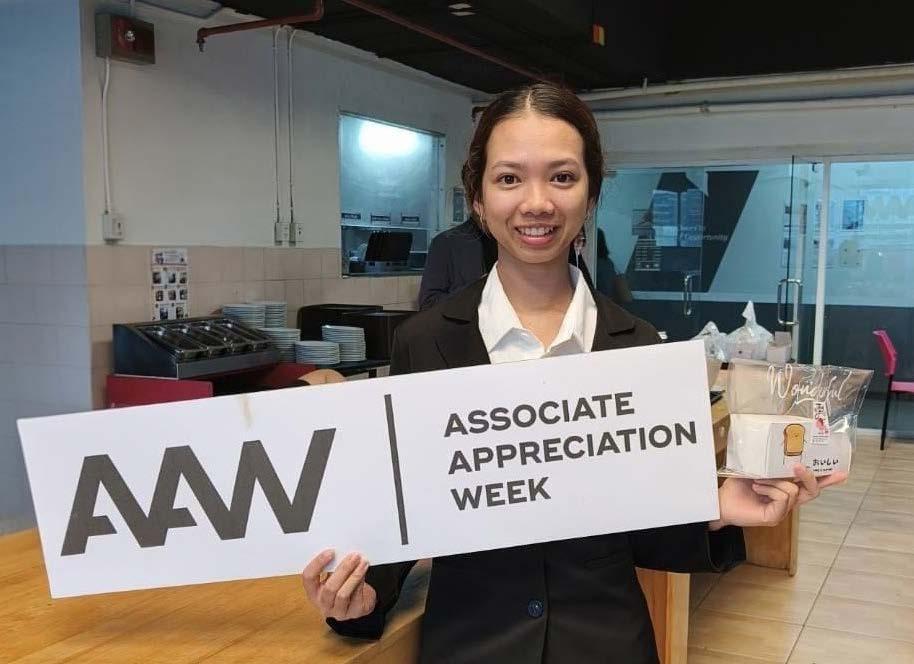
My role
As an Accounting Intern at JW Marriott Bangkok, I supported the finance team by organising and processing outlet bills, assisting with payment preparation, and maintaining accurate financial records. I also verified revenue data, reviewed supporting documents such as discount approvals, and flagged discrepancies. This hands-on experience provided me with insights into real-world finance operations within the hospitality industry and enhanced my attention to detail and efficiency in managing daily tasks.
Motivation for interning in my home country
Being an international student on a student visa in Singapore, I was unable to take up local internships. Therefore, I returned to my home country during school breaks to gain practical experience. I believed doing an internship would help me develop professionally, strengthen my resume, and prepare myself for full-time roles after graduation, and also applying the knowledge and skills I had acquired in school to real-world work settings.
My takeaway
A standout aspect of my internship was the warm and supportive work culture. I felt genuinely welcomed, built meaningful friendships, and enjoyed participating in events such as Pride Month and Associate Appreciation Week. Adapting to a new work environment taught me to be more flexible and professional. These experiences contributed to my personal and professional growth, and reminded me the importance of staying open, positive, and proactive when navigating a new setting.
Toolaya Sosaman
Bachelor of Accounting
SIM – RMIT University
Accounting Trainee Intern
JW Marriott Bangkok
How this experience prepared me for the working world
My internship taught me how to apply academic knowledge to real-world tasks. I learned to adapt to company standards, manage responsibilities in a fast-paced environment, and communicate effectively across departments. The experience improved my problem-solving abilities and boosted my confidence to take initiative. Working in an international setting also sharpened my cultural awareness and teamwork skills. Overall, the internship has left me feeling better prepared and motivated to pursue a career in accounting after graduation.
My advice
Start planning early and do not be afraid to reach out to companies directly. Be open-minded and flexible, as working abroad can be very different, but that is also what makes it rewarding. You will encounter new challenges, which will help you adapt, build confidence, and gain valuable global exposure. Do not hesitate to ask questions, connect with others, and fully enjoy the experience. It is one of the best ways to prepare for the professional world while also growing personally and broadening your perspective.

My role
As part of my internship, I collaborated with the global engineering team to develop an intelligent chatbot web application to enhance organisational communication and automation. I built responsive React.js UI components, integrating RESTful APIs, implementing CRUD operations, and ensured robust error handling. I also explored advanced concepts such as RetrievalAugmented Generation (RAG) models and deployed the chatbot to Microsoft Teams with Azure Bot Services. This experience provided me with end-to-end experience in real world software development, from design to final deployment.
Motivation for interning in my home country
Undertaking a remote internship with an organization from my home country provided an invaluable opportunity to engage in professional work beyond geographical boundaries. Collaborating with professionals from diverse cultural and technical backgrounds appealed to me, as it broadened my perspective and enhanced my adaptability in varied work environmentsI was also eager to gain insight into the operation of large-scale software projects in real-world settings beyond academia. SIM’s flexible schedule was instrumental in enabling me to balance my academic and professional commitments effectively.
My takeaway
This internship was filled with memorable moments and valuable lessons. A major challenges was adapting to asynchronous communication in a fully remote setting, where clarity and consistency became essential. I learned to document my work thoroughly, ask thoughtful questions, and actively participate in discussions. The guidance from my teammates was invaluable. This experience taught me that effective software engineering extends beyond coding, it requires teamwork, adaptability, and empath to succeed in real-world projects.
Goyal Manya Amit
Bachelor of Science in Computer Science SIM – University of London
Software Engineer Intern RxBenefits, Inc (India)
How this experience prepared me for the working
world
This remote internship allowed me to gain hands-on exposure to agile methodologies, version control, and deployment pipelines, all essential components of modern software engineering. I developed skills in collaborating across time zones, managing my time independently, and communicating effectively with professionals from diverse backgrounds. These skills are essential for today’s globalised tech industry.
My advice
To students considering an overseas or remote internship, I would say: go for it. Stay curious, take initiative, and do not hesitate to ask questions. These experiences offer more than just technical skills; they will help you grow in confidence, adaptability, and a broader global perspective. With the right mindset and approach, such opportunities can have a lasting impact, shaping both your personal growth and professional development.
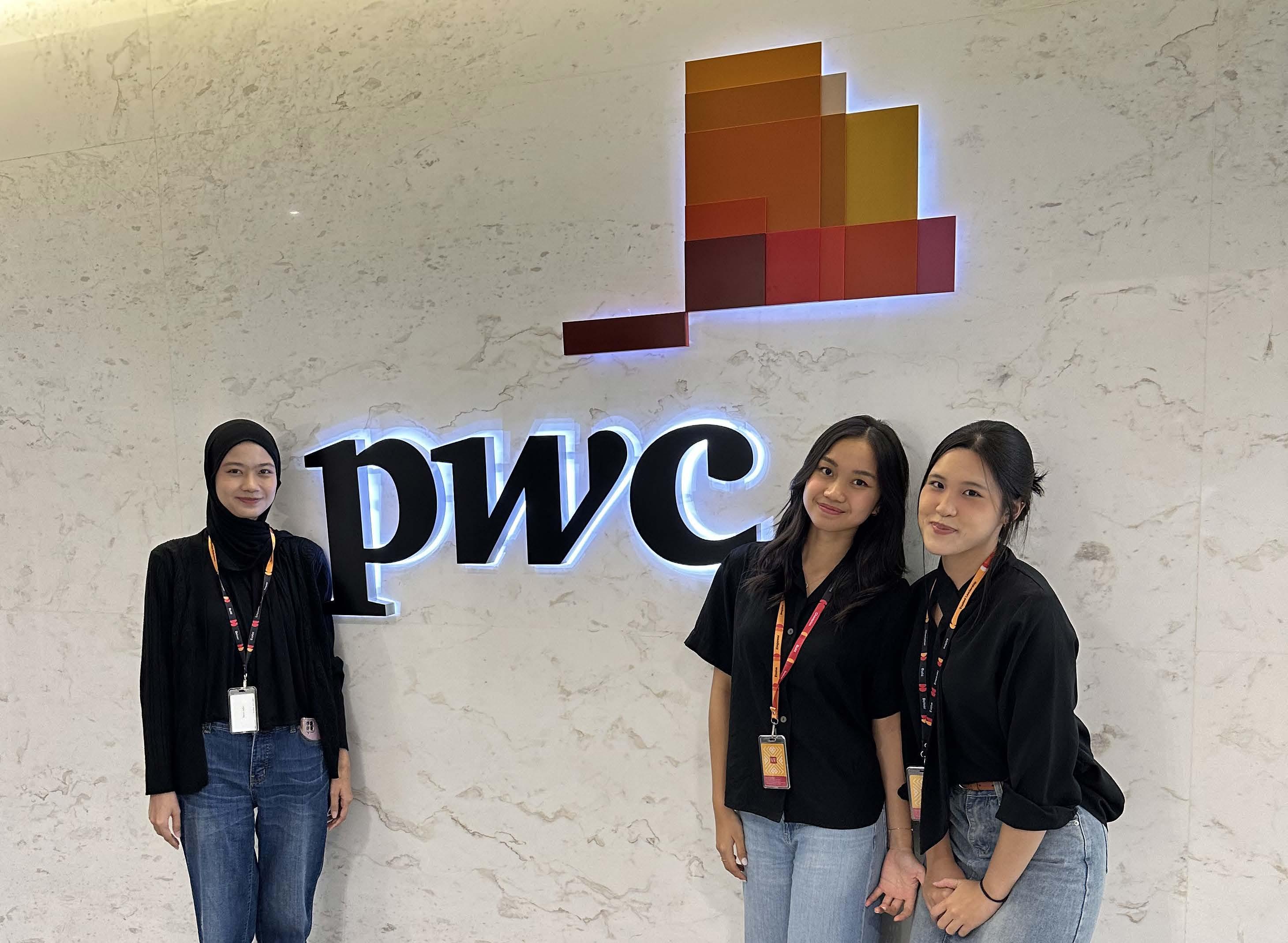
My role
During my internship, I supported a sell side M&A mandate in the multifinance sector by drafting the Information Memorandum, turning Excel analyses into coherent PowerPoint narratives. I created charts that linked policy rates to funding costs, highlighted loan growth trends, quantified banks’ lending shares, showcased multifinance’s strong growth and margins, and tied CPO and coal indices to finance lease demand. I performed DCF modelling, trading and transaction comps, ratio analysis, and supported Business Development through sector scans, pipeline mapping, and target screening using primary and secondary research.
Motivation for interning in my home country
I wanted to transform classroom theory into real world impact. A four-month summer break provided enough time to contribute meaningfully rather than just handling short tasks. By choosing to intern in my home country, I was able to deepen my understanding of the local market, build a diverse professional network, and connect with peers from both Indonesia and abroad.
My takeaway
The most memorable part of my internship was the work environment itself. As someone who values building genuine relationships, forming meaningful connections with colleagues made the experience deeply rewarding. I also appreciated how associates and managers guided me through tasks patiently, explaining objectives and showing how my work contributed to the next actionable step. The steep learning curve was remarkable—looking back, I can see how much my knowledge and confidence grew over just three months.
Karen Gozali (Right)
Bachelor of Science in Accounting and Finance
SIM –University of London
Corporate Finance Advisory Intern
PwC (Jakarta)
How this experience prepared me for the working world
This internship connected me with like-minded peers and mentors who inspired me to explore corporate finance as a career. While I had initially considered consulting, working on live M&A deals and seeing how analysis drives strategic decisions, deepened my interest in this field. The experience also gave me clarity on where to focus my efforts and motivated me to build expertise in corporate finance while continuing to learn from experienced professionals.
My
advice
Be curious! If something interests you, explore it and ask questions. At work, it is okay not to know everything and to make mistakes. What really matters is the willingness to learn, ask thoughtful questions when the timing is right, seek constructive feedback, and treat every task and challenge as an opportunity to grow and develop your skills.








Discover what it’s like working at Changi Airport Group, where we make magic happen in every aspect of our business – turning different airport touchpoints into seamless experiences with innovation and technology.







Overseas Exposure
A change of pace through an overseas internship might be the right choice, especially if you are looking for a different work environment.
Internships are the next big step in a soon-to-be graduate’s life. While some might stick close to home, others may opt for a change of pace or even a change of environment. An internship abroad allows you to gain practical work experience, expands your knowledge in a field you are passionate about, and builds your independence and confidence.
Why take up a global internship
One valuable aspect of a global internship is the opportunity to work with professionals from different cultures and nationalities. In particular, business etiquette can differ from country to country; understanding how these practices work and how they differ from those in your home country is always a useful skill, especially if your industry requires you to work with international clients and colleagues.
2. Expand your global network
As a fresh graduate, you should be eager to learn and connect with like-minded individuals. Doing an internship abroad allows you to meet professionals from around the world. This global network will help you with future job placements or professional advice you may need, no matter where you choose to go next.
Tips for a successful overseas internship
• Communicate effectively
Cultural nuances can impact communication, even when exchanges are done in the same language. Pay attention and be prepared to adjust your communication style accordingly!
• Be proactive
Ask questions and take initiative. Doing both is a good way to leave a positive and lasting impression on your supervisors.
• Be adaptable and open-minded
Treat this opportunity as one big learning experience. Take in all you can, and avoid making negative comparisons between your home and host country!
Going overseas for an internship means working (and living) in a completely new environment. While challenging, learning to move out of your comfort zone is often an excellent catalyst for growth. Notably, candidates who undertake global internships often come out more adaptable and independent, traits that are often popular among employers.
1. A unique working experience 3. Personal growth
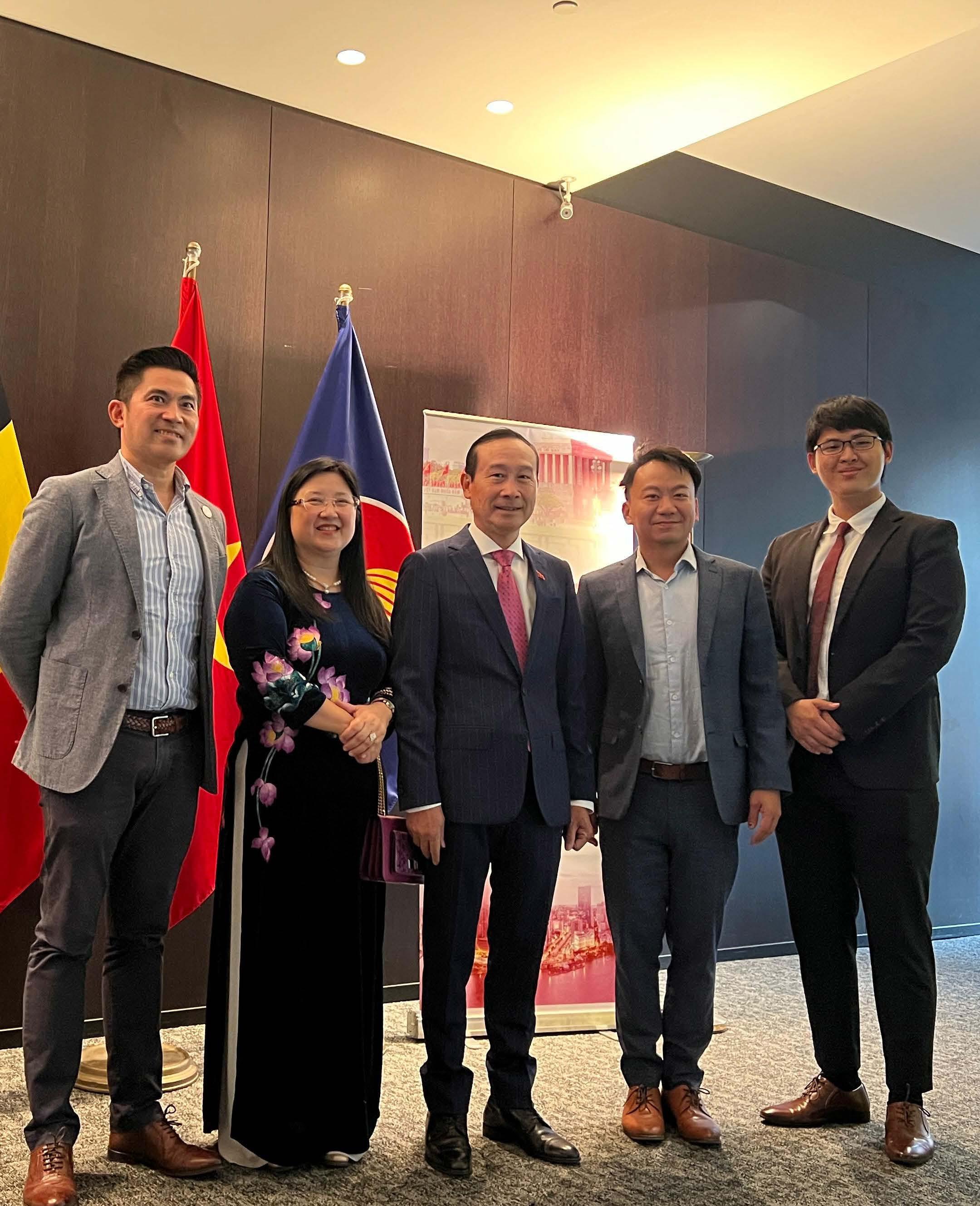
Marcus Tan (1st from Right)
Bachelor of Arts in Economics
SIM – University at Buffalo Research Assistant Intern ASEAN Chamber of Commerce EU (Brussels, Belgium)
My role
As a Junior Research Officer, I supported policy advocacy and stakeholder engagement between ASEAN and European partners. I conducted policy analysis, monitored regulatory developments, and prepared reports on emerging economic trends. I also worked on external communication materials and helped coordinate involving embassies, trade promotion agencies, and multinational firms. The experience offered a close-up view of how policy research and business diplomacy work in tandem to strengthen regional cooperation.
Motivation for pursuing an overseas internship
I wanted to challenge myself and explore how economics and policy intersect in an international context. While most of my previous internships focused on research and public policy, interning abroad allowed me to experience the practical side of international cooperation. Through my internship in Brussels, I learned to navigate new people and work cultures while gaining firsthand insight into international cooperation.
My takeaway
I used to be shy and found it challenging to approach unfamiliar people in professional settings. During my internship, interacting with senior officials at a diplomatic reception pushed me out of my comfort zone. By observing my supervisors, I learned that sincerity matters more than perfect phrasing. Over time, I learned to approach people more naturally and to see every interaction as an opportunity to connect, not to perform.
How this global experience prepared me for the working world
Having completed several policy and economics internships in Singapore, I assumed regional research in Brussels would be similar. I set an ambitious goal to map all EU-ASEAN trade and investment flows in a month, but my supervisor highlighted that it would realistically require at least six months. I attempted the task and realised its scale—data, institutions, and agreements multiplied exponentially—offering a humbling lesson on the complexity of international trade and the importance of learning from experience.
Advice for students exploring overseas internships
Start early—ideally six to nine months before your intended start date—as many programmes, especially in Europe, open applications well in advance. For social science students, paid opportunities are concentrated in Germany and France but remain limited and competitive for non-EU residents. Explore roles at major universities, think-tanks, and non-profits, and do not hesitate to cold email organisations you are genuinely interested in—that is how I secured mine. Closer to home, strong options include Taiwan’s TEEP, IIPP, ITRI, NHRI, and Thailand’s Asia Center, TDRI, and UNESCAP.

Howard Lee
Bachelor of Science in International Business SIM – University of Birmingham Entrepreneur in Residence Intern Startupbootcamp (Melbourne, Australia)
My role
My internship role was initially described as advising startups and supporting business strategy development in accelerator programmes, but I quickly recognised that providing strategic advice was not feasible as a new intern. Instead, I focused on assisting advisers and consultants with research and slide preparation. Identifying an opportunity to improve efficiency, I transitioned into software development and over five months, successfully streamlined the company’s research and presentation processes by building tools that significantly enhanced workflow productivity.
Motivation for pursuing an overseas internship
Pursuing an overseas internship was a deliberate step to test my adaptability in a new environment. I wanted to step beyond my comfort zone and prove that I could contribute meaningfully without a safety net. I chose Australia for its vibrant startup ecosystem, drawn by the opportunity to immerse myself in a new culture while developing professionally. This experience provided the exact career growth and challenge I had been seeking.
My takeaway
This internship showed me that disciplinary boundaries are blurring—my transition to software developer illustrates that career paths are no longer limited by one degree; success depends on acquiring and applying knowledge effectively. Adapting to the fast-paced, diverse environment of the internship was a significant challenge, but through self-directed learning, I was able to thrive. It reinforced my belief that adaptability and a willingness to learn are essential for success.
How this global experience prepared me for the working world
This experience transformed my perspective, turning what once felt like a distant professional world into a space where I could contribute meaningfully. It also taught me to be proactive and resourceful. I identified inefficiencies in slide preparation and took the initiative to solve them, even beyond my job description. This hands-on experience strengthened my confidence to tackle global opportunities and add value in any setting, simply by being willing to learn.
Advice for students exploring overseas internships
My advice: go for it and do not be intimidated. While it may feel daunting, it offers opportunity to stand independently without the safety net of home. Start your search early through university career centres, online job boards, and professional networking sites, and do not hesitate to reach out directly to companies you admire. Be ready to learn and adapt. The personal and professional growth gained is immense, making an overseas internship an invaluable step towards thriving in a globalised workforce.
Beyond Borders
A global exploration programme, Beyond Borders offers students hands-on international exposure, connecting them with industry professionals around the world while experiencing global workplaces. This programme is designed to spark new career aspirations, strengthen cross-cultural understanding, and open doors to diverse pathways beyond Singapore.
Beyond Borders: Shenzhen Career Exploration Journey
In November 2025, 24 students ventured on a Career Exploration Journey to Shenzhen—China’s “Silicon Valley” and hub of leading tech innovations. Through company visits such as Lenovo, Astribot, and CGL Consulting, students gained direct insights into China’s dynamic technology landscape while expanding their professional networks.
Training workshops deepened their understanding of the local market, and a networking session with SIM alumni provided valuable career perspectives. The cultural visits further enriched the experience, allowing students to experience Shenzhen’s vibrant mix of modern innovation and historical heritage.
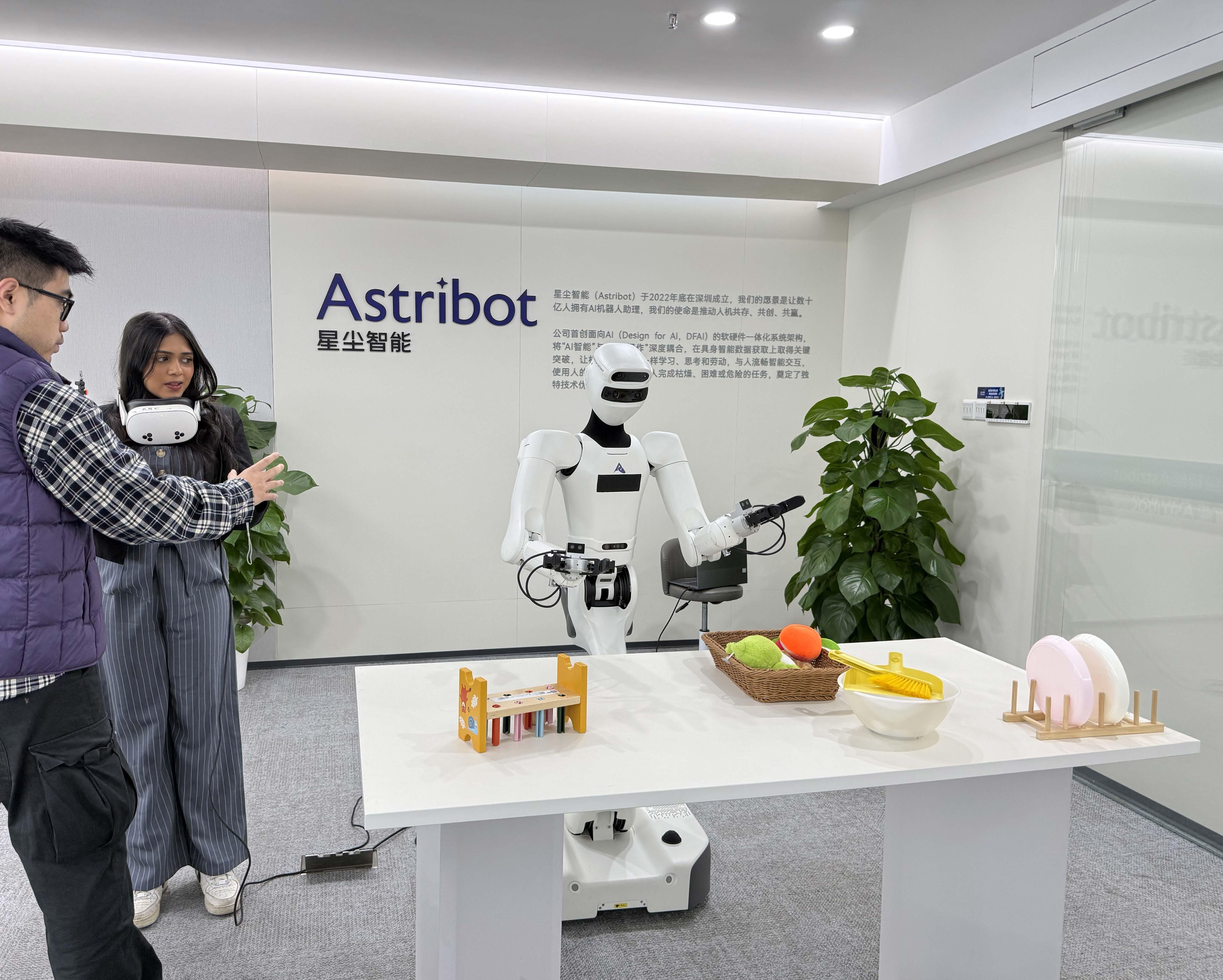
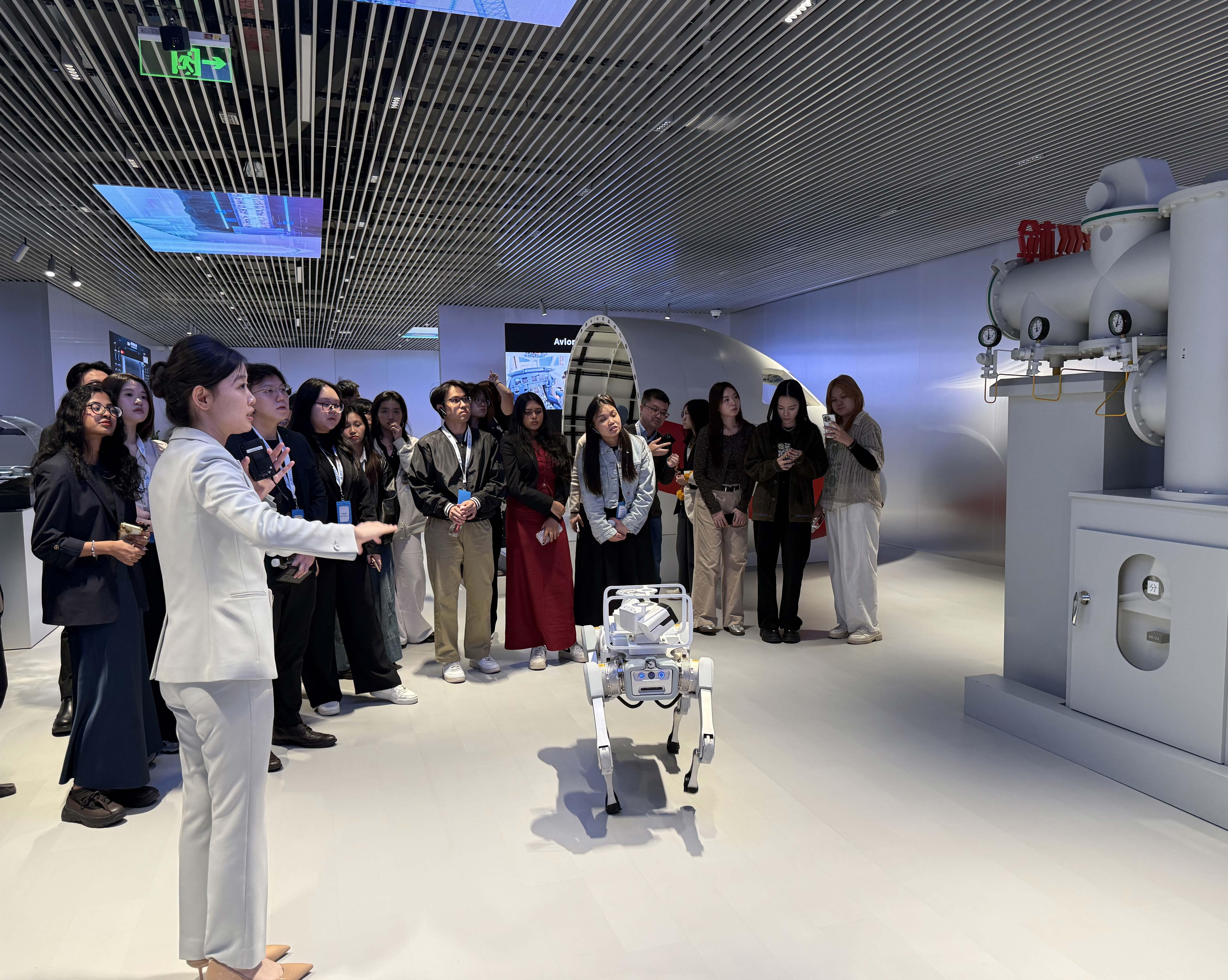
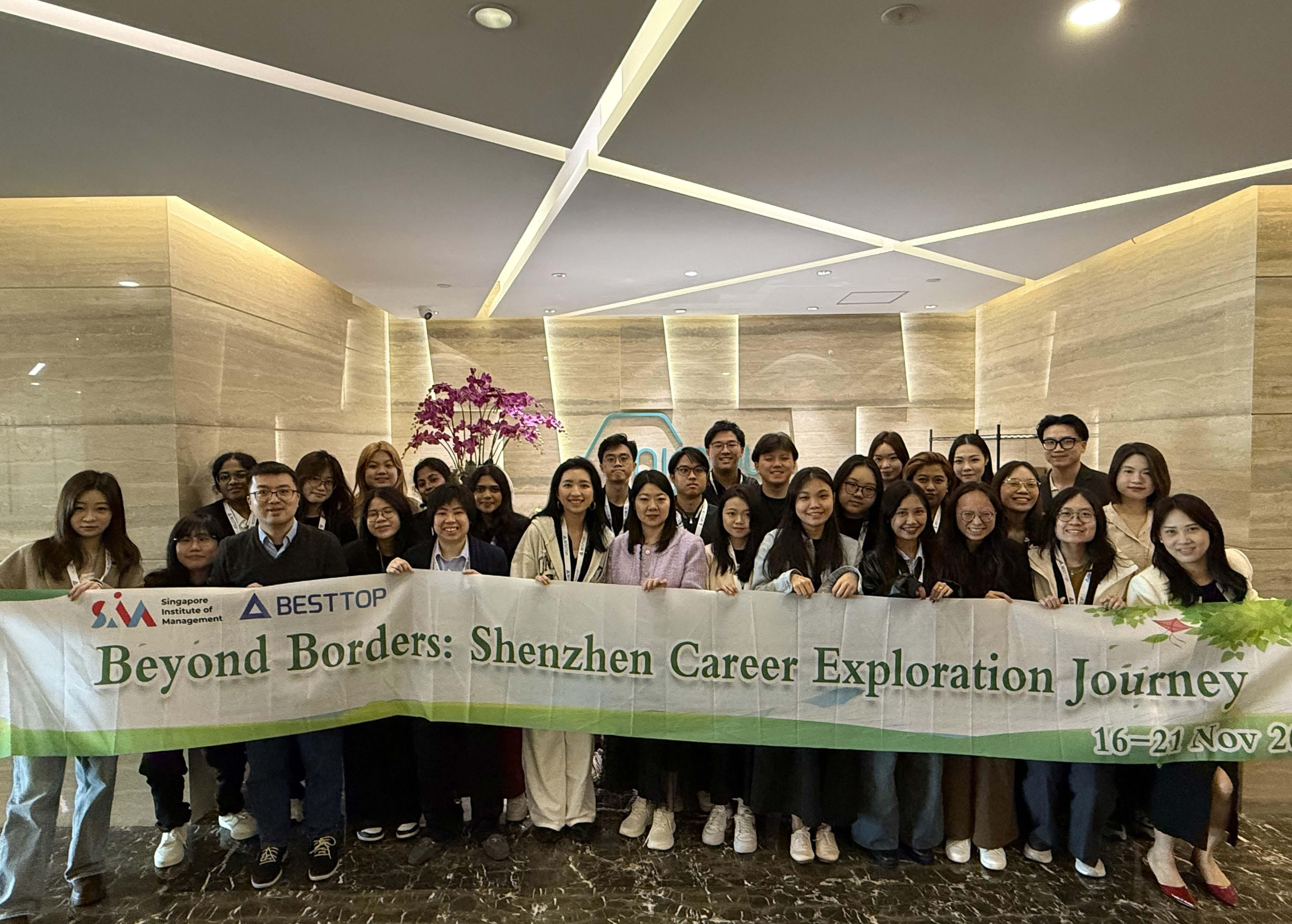

Chester Low
Bachelor of Science in Computer Science (Machine Learning and Artificial Intelligence)
SIM – University of London
I joined the career exploration trip to gain firsthand exposure to China’s rapidly evolving technology landscape and to understand how AI and innovation are applied in real-world industry settings. The thoughtfully curated itinerary, which included company visits, cultural explorations, training workshops, and networking session with SIM alumni—provided valuable insights into China’s workplace culture and the skills needed to thrive in a competitive global environment.
This transformative experience broadened my understanding of AI-driven industries and strengthened my ambition to pursue a global career in tech. It also reshaped my perspective on crosscultural collaboration, motivating me to become more adaptable and open to emerging technological trends.
This trip offers unique cultural immersion and industry exposure that no classroom can replicate. If you want to broaden your horizons, expand your network, and accelerate your personal growth, these exploration journeys are truly worth taking.

Golden Sim
Bachelor of Business (Event Management)
SIM – La Trobe University
This Career Exploration Journey made my SIM experience more memorable, giving me the chance to connect with peers from various schools and courses while immersing myself in a new cultural environment. In this trip, I gained valuable exposure through company visits, workshops, industry talks, and networking sessions that are not easily accessible in our usual school setting. Observing the differences between China’s and Singapore’s working cultures broadened my global outlook, while conversations with industry professionals encouraged me to adopt a stronger growth mindset.
Visiting companies such as Lenovo and seeing their technology up close gave me deeper insight into how creativity, technology, and innovation work together to shape sustainable and futureready business practices. Joining the Career Exploration Journey can be an excellent opportunity to step out of your comfort zone, keep an open mind, and expand your professional network— opening doors to wider possibilities in your future career.
AIESEC is a global youth-led organisation in over 120 countries and territories, developing leadership through cross-cultural exchanges that advance the UN Sustainable Development Goals (SDGs). Leadership is fostered in challenging environments, where young people step out of their comfort zones to learn, act, and create impact. Guided by the Golden Circle—why it strives for peace, how it activates leadership through experiences; and what it does through global volunteering and professional exchanges— AIESEC empowers youth to become leaders driving positive change worldwide.
Learn more by sending a DM to @aiesecinsim_ on Instagram.

Valerie Lim
Bachelor of Science in Management and Digital Innovation
SIM – University of London
AIESEC Global Volunteer at Turkey
My overseas experience with AIESEC
I participated in an AIESEC Global Volunteer project in Turkey, teaching English and promoting cross-cultural understanding at an early childhood education institution. My responsibilities included planning and executing summer programmes, facilitating their execution, and actively engaging with educators and children. Inspired by my former LCVP and motivated to gain international exposure, I embraced this experience as a valuable opportunity for personal growth, professional development, and building meaningful global connections.
My takeaway
A key takeaway from this experience was the meaningful connections I built with fellow AIESECers and my host family, with whom I still keep in touch. Collaborating with people from diverse backgrounds broadened my perspective and strengthened my adaptability. Despite language barriers, I engaged effectively with local educators and children, fostering a supportive learning environment. Learning basic Turkish and Arabic enriched my cultural experience, making the experience memorable and impactful for my personal and professional growth.
How has this global exposure shaped my career readiness?
This global experience greatly enhanced my readiness for the professional world by strengthening key personal and professional skills. Planning and delivering educational programmes boosted my confidence in public speaking and presentations. It improved my communication and interpersonal skills. Adapting to a new and fast-paced environment taught me flexibility and resourcefulness. These experiences equipped me to thrive in dynamic and multicultural settings.
My advice
I strongly encourage students to step out of their comfort zone and explore overseas opportunities that align with their interests and goals. Approaching these experiences with curiosity, allows them appreciate diverse cultures, perspectives, and working styles. Beyond personal growth, such opportunities build essential skills—global awareness, adaptability, and interpersonal skills—while providing valuable professional development, preparing them to thrive in today’s interconnected and dynamic world.
SIM AIESEC
Venturing into a Job Beyond Your Field of Study
This is not a foolish undertaking, as it can boost your career opportunities and enhance your self-development.
As you went through university, the idea of picking up an internship, or role, unrelated to your field of study might have sounded entirely impossible, or at least something you might be better off not dabbling in… right?
Although there is some truth in that, the flip side is that while you may not be building specific knowledge, you will have the chance to pick up other skills and valuable experience you may not have the chance to otherwise.
The thing is, internships and jobs take you out of academia and bring you into corporate life, where you learn to network, gain working experience and pick up numerous professional opportunities to broaden your experiences.
These are just a few of the benefits of doing an internship, or getting a role, outside your field of study, so read on to get to know more of them!
Experiment with your interests and passion
If you are having second thoughts about whether you want to continue in a field related to your studies post-graduation, internships and part-time roles can act as an ideal safety net to test the waters. There is nothing wrong with using the time spent as an intern or part-time employee as a platform to explore other options open to you!
For example, if you are studying graphic design but maintain a blog on the side, you can consider internship or temporary roles in publishing houses that entail editing, copyediting, or content creation.
Alternatively, if you enjoy a broad range of music, you can ponder the option to join radio stations where your knowledge of artists and songs can come in handy.
Ultimately, take the chance to pursue your interests and passion – unrelated to your studies or not – and see if they can work out as a viable area of work for you as a fullfledged employee in the future.
The chance to acquire new skills
When you take on an internship or job unrelated to what you studied, you are going to pick up a completely new set of skills unique to the area you are in. Although some skills may be more niche and specific, you will pick up transferable skills.
For instance, as you will have to learn on the job or take cues from colleagues on how to recognise and resolve problems, practically, you will build problem-solving, teamwork and communication skills. Moreover, just moving into a completely unknown field is already a study in adaptability.
Add these new skills to the skill set you already have courtesy of your field of study, and you will have an edge over other candidates in the future!
Strengthen your resume
Even if you are not thinking of pursuing a multifaceted career in the future, a range of core skills listed on your resume will not hurt your chances of successfully landing a role. Employers are always on the lookout for candidates who show potential to be all-rounders, so your resume will help you stand out from your peers with your variety of skills and experiences!
Broaden your horizons
The job-seeking landscape has become incredibly competitive over the past few years, and the uncertainty brought about by the pandemic and possible upcoming recession has had a hand in heightening it, as well. Instead of competing for a single area of work, you can create more options for yourself by choosing an internship or role not necessarily related to your field of study. On top of that, in a time when many internships and roles are being introduced or newly defined, you will find that your experience in different areas and a wide variety of skills will come in handy!
Employers prefer candidates who have broader perspectives and can focus more on building their capabilities, as they do not need to spend the time and resources training them.
Opportunity
to build a diverse network
Creating and maintaining a mutually beneficial network is crucial in any industry, and it is impossible to stress the importance of building connections. The broader your professional network is, the more valuable tips and opinions you can get to improve yourself in the future. Moreover, you will be able to leverage your contacts to keep abreast of market trends and industry developments. You can even ask around for different perspectives and insights into various areas of work. Your network may even help you land opportunities you may have no access to otherwise!
Although the decision to pursue an internship or job outside your field of study may be a smart one, it requires you to be brave enough to venture out of your comfort zone. Chances are, if you are willing to grab the bull by its horns and charge ahead while giving your all, you will benefit from the experience and boost your self-development after graduation!

1. My role
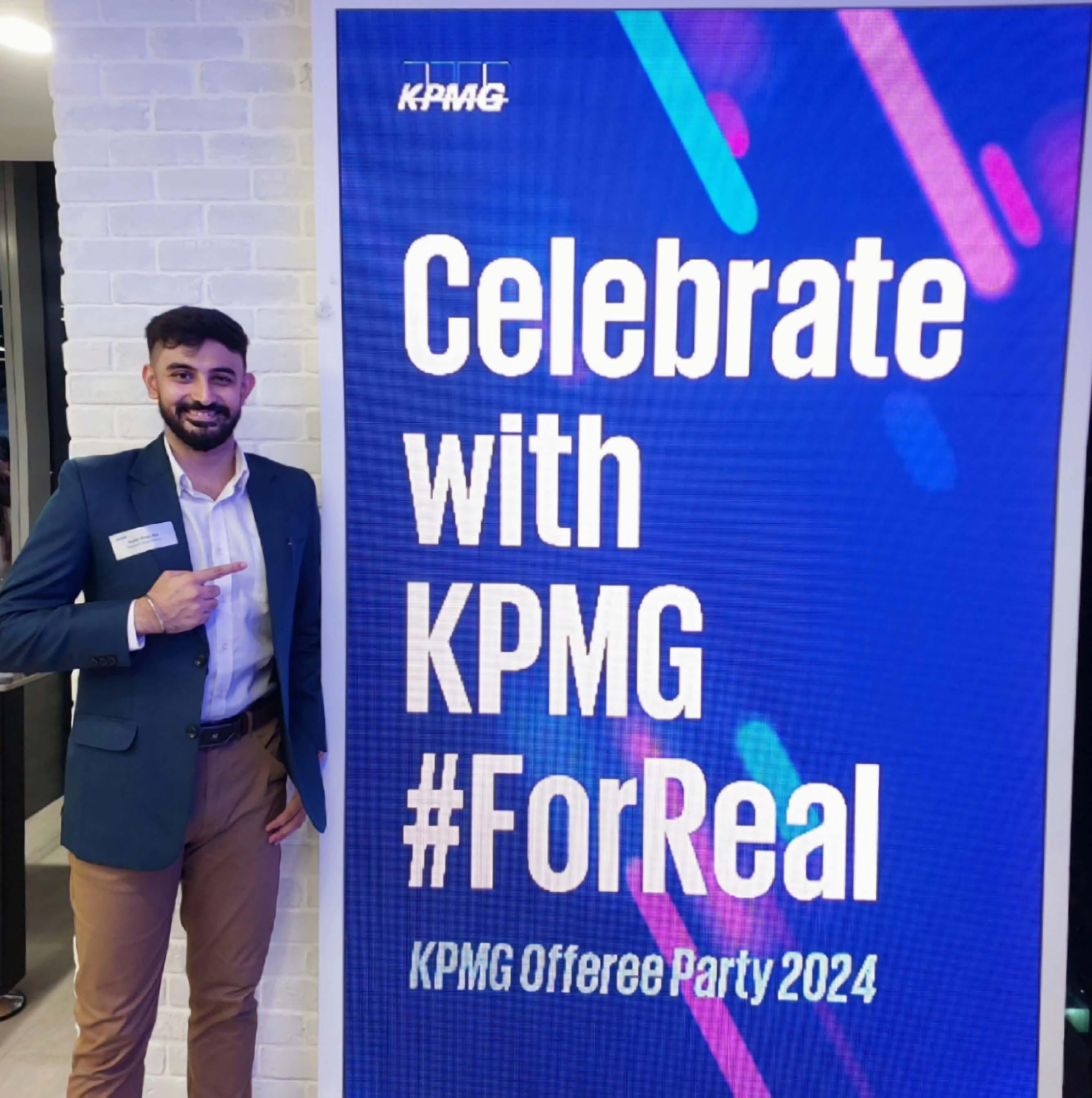
Rajbir Singh Bal
Explore Programme
KPMG Singapore
Bachelor of Art (Psychology)
SIM – University at Buffalo
I am currently part of KPMG’s Explore Programme, an inaugural programme where I will rotate across different departments (i.e. Audit, Tax, and Advisory) to gain hands-on experience in the Professional Services. The role entails supporting client projects, analysing data, and learn how financial and strategic decisions shape businesses. The programme also includes extensive training in each area. It has been exciting to see how different teams collaborate to solve real business challenges, while I continue building my strong foundation in Professional Services and Advisory.
2. From psychology to finance industry: my decision to switch fields
I have always been fascinated by how people think, decide and behave. Psychology gave me that lens, but I wanted to apply it where decisions drive real impact. I developed interest in Finance and Professional Services, especially Consulting, through extensive research, networking, professional courses, and internships. The finance industry blends logic with people; it is fast-paced, analytical, and strategic. Joining KPMG allows me to bridge both worlds and challenge myself beyond what I studied.
3. Overcoming challenges in a new field
Coming from a non-finance background, I had to pick up financial concepts and technical jargon fast. It was intimidating at first, especially given the programme’s competitiveness, but I approached it as a learning curve. I always stayed curious, asked questions, and learned proactively. Before starting the role, I took short finance and accounting courses, a business module as an elective, and sought guidance from mentors and my networks. Every challenge feels daunting at the start, it is about taking the first step.
4. How has my non-academic journey shaped my readiness for this career switch?
Real growth happens beyond the classroom. My previous internship experiences gave me firsthand insight into how organisations operate and how people drive results, while providing a strong foundation and technical exposure that I still drawn upon today. My leadership roles and involvement in my university clubs further strengthened my communication, presentation, management skills, and developed my confidence and composure in diverse settings. These experiences equipped me with essential skills that naturally translate into the corporate world.
5. My advice to students venturing beyond their field of study
Do not box yourself to your degree or major—skills are transferable if you stay open to learning and adapting. Say yes to challenges and opportunities that may appear daunting; they are often the ones that stretch you the most. Be curious, take initiative, and trust that every experience, even outside your "field", adds something valuable to your journey. Seek mentors, build network meaningfully, and seize every opportunity to explore areas that interest you. While our degrees equip us with knowledge, our true potential goes far beyond what is written on our certificates.

Rachel Kong
Technology Research Analyst
ABI Research Singapore Pte Ltd
Bachelor of Science in Economics and Politics
SIM – University of London
1.
My role
I am a technology research analyst specialising in the space and satellite industry. My role involves conducting primary and secondary research interviews with companies, writing comprehensive analytical reports, developing market and demand forecasts, managing the research service, and contributing to thought leadership initiatives by speaking at or moderating industry events and panel discussions.
2. From economics and politics to tech industry: my decision to switch fields
Although my degree is in Economics and Politics, I have always embraced opportunities beyond my field. The skills I developed—critical thinking, analytical reasoning, and a broad understanding of global affairs—are highly transferable across industries. When the opportunity arose to become a technology research analyst, it presented an exciting entry into the fast-paced and evolving tech sector. The intersection of economics, finance, geopolitics, and technology allows me to leverage my academic background directly to analyse how global trends shape technological advancements and market dynamics.
3. Overcoming challenges in a new field
Transitioning into a completely new field came with challenges. While some skills are transferable, areas like market forecasting and modelling were initially difficult, requiring analysis of market trends and company data to predict future growth. The learning curve was steep, but my supportive colleagues, curiosity, and asking helped me navigate it. By getting involved in projects and embracing mistakes, I gradually gained confidence. I continue to learn every day and have realised that curiosity, proactiveness, and openness are key to growth and success in any field.
4. How has my non-academic journey shaped my readiness for this career switch?
Before entering the tech industry, I interned with the U.S. Embassy’s Commercial Service, gaining handson experience in trade events, client interactions, and research across sectors such as Environmental and Aerospace. This developed both my soft and technical skills and provided insight into how industries operate in practice. I have always valued real-world experience, regardless of direct relevance to my studies, paired with a learning mindset. Attending industry events and listening to senior speakers also helped me understand emerging trends, challenges, and strategies, shaping my early perspective on the evolving tech landscape.
5. My advice to students venturing beyond their field of study
Go for it, especially if it sparks your curiosity or seems promising! Every internship or job, whether related to your field, offers valuable experience and transferable skills. Stay proactive, ask questions, and learn from those around you. Even if it turns out not to be the right fit, the experience is still worthwhile—you gain real-world exposure, professional skills, a broader network, and clarity on your interests. In the grand scheme of things, taking a few months or years to explore different paths and find out what you actually like is a small investment in your journey.
Is a Graduate Internship Your Next Big Move?
Before applying for that graduate internship, take some time to reflect on these pros and cons.
If you lack any work experience, jumping right into a full-time job might not be the best idea, as employers may hesitate hiring an applicant without prior work. Plus, without any exposure to the industry or job you are applying for, you may find yourself having a rough time of it. For example, you might realise halfway through that the job is not what you want!
One way to navigate this is by starting with a graduate internship—a way to test the waters. But before deciding, consider both the benefits and drawbacks.
The pros: Why you should do it
To get your foot in the door
• For many employers, former interns are ideal candidates for full-time hires, as they already know the company culture and have proven their skills
• As such, you can treat the internship as a long-term strategy; perform well, and you might be offered a fulltime position at its end!
• Even if you do not get hired after, you will still walk away with new skills, relevant skills and possibly a glowing review from your employers, which will look great on your resume!
To get an insider’s point of view
• A graduate internship can help you figure out what jobs or industry best fit your interests, skills and long-term career goals
• However, the onus is on you to be proactive and make use of the resources available. For example, you can seek out a mentor within your company, or speak with your colleagues on their insights regarding the company, job or industry
To expand your professional network
• Internships are a useful way to develop your professional network, especially when you are first starting out in your career
• Not only will you be able to bulk up your network, but these new connections will absolutely be a big help for your future job search
• Make the most of your internship by taking part in company events, workshops and team outings. Alternatively, you can arrange one-on-one meetings with your colleagues.
Get a notebook and jot down your objectives as an intern at the beginning of your internship, as well as your achievements over its course. This will make it easier for you when you update your resume and cover letter. You can also earn some brownie points by mentioning them during your job interviews as well!
The cons: What you should consider
The pay
• Unfortunately, interns do get paid significantly less compared to full-timers, so do consider your financial situation before opting to take an internship
• For example, if you have pending student loans to pay back, or have family requiring financial assistance, you may want to seek other better-paying opportunities
The role
• Interns often have to handle a variety of tasks that may be outside of their expected job scope. This can make it tough to develop key industry skills
• If you feel like you are not gaining the exposure you want, consider speaking to your manager or colleague to have them assign more relevant tasks. Doing so can indicate your willingness to take initiative, too
• Remember, you have rights as an intern. Work hard and do your best, but make sure you are being treated fairly at your company as well
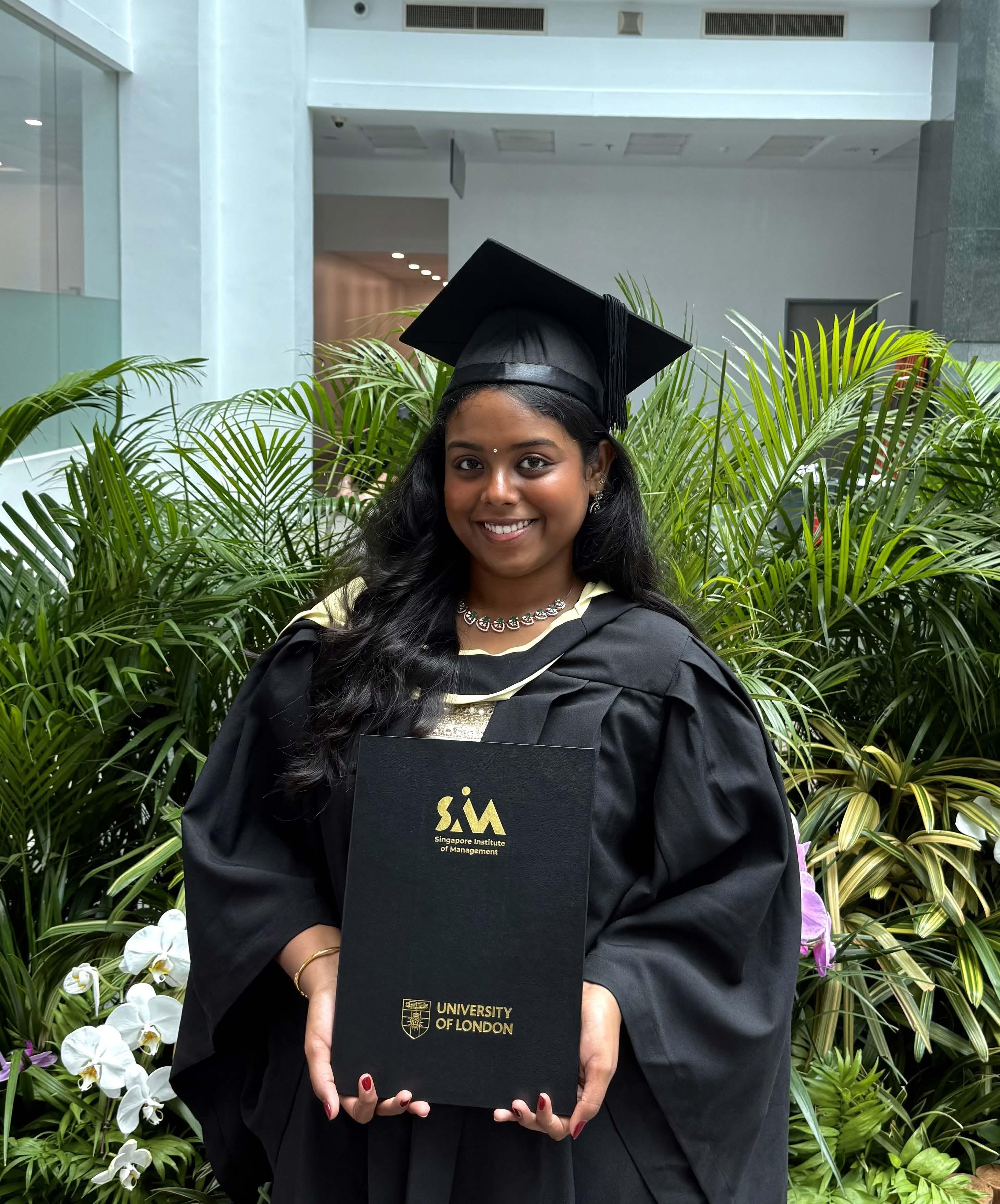
Shambhavi Palanisamy
Bachelor of Science in Computer Science
SIM – University of London Business Analyst Intern Accenture Singapore
My
role
During my internship, I collaborated with developers on software testing, created test scenarios, and documented daily progress. I liaised with clients to gather feedback, define new module requirements, and ensured alignment between their expectations and the developer’s output. I also managed bug reports, tracked fixes, tested updates, and communicated resolutions to clients. Acting as a bridge between the technical team and clients, I helped ensure clear communication and the successful delivery of high-quality software.
Why I chose an internship over a full-time role I chose to undertake an internship to gain practical experience and clarity on my career direction, as I was still exploring potential paths. While it was initially challenging seeing peers secure full-time roles quickly, I realised the internship has given me a valuable insight into corporate life. After completing the internship, I took a short break to travel. Having recently returned, I am now actively seeking for full-time opportunities.
My takeaway
This internship helped me recognise both the roles and work environments that suit me. It taught me the importance of resilience, professionalism, and maintaining a growth mindset when things do not align perfectly. I also developed practical skills in testing, documentation, and client communication that will be useful in any future role. Most importantly, the experience provided me clarity and direction for my career moving forward.
Challenges faced
The biggest challenge I faced was staying motivated. Although the work was not difficult, I struggled to connect with my teammates and realised the role was not something I wanted in long-term. To stay focused, I reframed the experience as a learning opportunity to better understand what I did not want in a career. I concentrated on building transferable skills, remained professional, and approached each task as a steppingstone toward discovering my ideal path. This mindset helped me push through and completed the internship with purpose.
My advice
Take time to reflect on your interests and goals before applying, as choosing an internship that aligns with them helps prevent burnout. Avoid comparing your journey with others—everyone progress differently. Treat each internship as a chance to explore, learn, and grow. Focus on building connections, as networking can opens doors beyond qualifications. Even if things do not go as planned, do not give up. Every experience, including the challenging ones, offers valuable lessons that bring you closer to discovering what truly suits you.

Gokul Senthilkumar
Bachelor of Computer Science (Digital Systems Security and Cyber Security)
SIM – University of Wollongong Cyber Consulting Intern Deloitte Singapore
My
role
My primary responsibilities included preparing detailed penetration testing and vulnerability assessment reports. I reviewed testing results, documented key findings, and drafted professional client reports outlining risks and remediation steps. Additionally, I assisted consultants with project coordination and data validation to ensure consistency and accuracy in deliverables. This experience deepened my understanding of how clear documentation and effective communication are essential in cybersecurity consulting and client engagement.
Why I chose an internship over a full-time role
I transitioned from a full-time role to pursue my interest in cybersecurity, and this internship at Deloitte offered the perfect opportunity to make that shift. It provided hands-on exposure to the consulting environment and valuable guidance from experienced cybersecurity professionals. I saw it as a chance to build credibility, strengthen my technical and reporting skills, and understand how cybersecurity projects operate in real client settings. While leaving a stable role was challenging, the long-term growth made it worthwhile.
My Takeaway
This internship taught me that effective reporting and communication are just as important as technical expertise in cybersecurity. I learned to translate technical findings into actionable business insights and how professional and clear documentation builds client trust. The experience sharpened my attention to detail, writing precision and understanding of consulting projects structures. It reaffirmed my interest to pursue a career in cybersecurity advisory and penetration testing.
Challenges faced
A key challenge was meeting the high expectations for report quality and consistency. Producing professional, concise findings under tight deadlines demanded careful review and coordination. I overcame this by seeking mentors feedback, analysing past reports and maintaining a structured workflow for documentation. Over time, this approach significantly improved my confidence and efficiency in preparing reports.
My advice
Approach your internship with curiosity. Even if your role focuses more on documentation than hands-on testing, reporting is a core part of cybersecurity consulting. Building good habits in writing, attention to detail, and teamwork is key. Take initiative to learn from your seniors and use the internship to identify your strengths and career direction within cybersecurity.
Budding Entrepreneurs
Pursuing entrepreneurship can be a challenge, but it can also be highly rewarding for those who are willing to put in the effort.
Got a great idea for a business? Looking to turn your passions into a meaningful career for yourself? If so, becoming an entrepreneur could be something worth considering, especially with the rise of the gig economy and e-commerce making it easier than ever to start your own business. In fact, starting off as a student entrepreneur presents some unique benefits and opportunities you might not get as a graduate or an established professional.
The benefits of entrepreneurship
• Fresh innovation
Compared to more experienced workers, students are more likely to approach problems with more creativity and in turn, come up with new, unconventional solutions.
• Hands-on learning
Starting a business allows students to apply the theories they have learned in class to real-life scenarios, while also developing transferable skills like problem-solving and time management.
• Freedom to experiment
Being a student entrepreneur means being able to test ideas while enjoying the safety net of being a student. Plus, universities often offer a range of resources and networks they can tap into for assistance when needed.
Potential challenges
• Limited resources
Running a business does not come cheap. Students will need to build up a sizable foundation for it to fall back on in case of emergencies.
• More time management
Having to juggle both the business and your studies often means neither will get the luxury of your full focus and attention, which can result in poor results in either (or worse, both) endeavors.
• Higher risk of stress
School can already hectic enough, but adding a full business on an already busy schedule can be stressful to handle. Fail to manage your stress levels and burnout is all but guaranteed.

Nigel Tan
Bachelor of Business (Finance)
SIM-RMIT University
Founder, YFB Finance
What is your motivation behind starting your own business?
Reading “The Courage to Be Disliked” shifted how I viewed potential—the idea that “it is not what one is born with, but what use one makes of that equipment” really spoke to me. It pushed me to stop waiting for the perfect moment or resources and instead, challenge myself with what I already had. Starting my finance education business was a way to apply that mindset— to turn a personal interest into something purposeful. It allowed me to grow as a leader, educate others, and take ownership of my development through real-world experience.
How has your time in SIM prepared you for this journey?
One of the biggest challenges is staying competitive. I constantly remind myself that someone out there is learning faster, working harder, or building something better. That mindset keeps me sharp. I treat free time as a gift, not a break—every hour is a chance to move forward. Elon Musk once said, “You get 24 hours in a day, just like anyone else.” That stuck with me. Managing a business, internship, and full-time studies forces me to prioritise, stay disciplined, and make the most of every moment—even when it means sacrificing comfort.
What are the benefits and challenges of managing your own business?
Balancing business, internships, and studies has sharpened my time management and taught me how to stay focused under pressure. I have learned to identify market gaps and respond with innovative, practical solutions that meet real needs. This journey has also instilled in me a strong sense of grit—pushing through challenges even when results are not immediate. At the same time, it has taught me to stay humble and always be open to learning. Every project, meeting, or class is an opportunity to improve, and I now carry that mindset into everything I do.

Your Finance Brother (YFB Finance) is a finance education platform I founded to help young individuals better understand and navigate the world of investing. Focused on trading strategies, market insights, and financial literacy, YFB aims to make complex financial concepts accessible and practical. Through one-on-one coaching, interactive webinars, and community-driven learning, we support aspiring traders and investors in building confidence and competence. At its core, YFB is about being a relatable and reliable financial guide—like a brother you can turn to—bridging the gap between curiosity and actionable knowledge.
What are some tips for students who want to become future entrepreneurs?
Start by identifying a real problem and focus on building one good solution. You do not need a full product line or flashy branding at the start—just create something that genuinely solves a need and keep refining it. While doing that, never overlook how you treat the people around you—from clients to teammates, and even the vendor who prints your merch. Kindness, respect, and professionalism go a long way in building lasting relationships. People remember how you made them feel, and that can often be more powerful than the product itself.

Keane Low
Bachelor of Science in Economics and Management
SIM-University of London Founder, Wildlife Warriors Forest School
What is your motivation behind starting your own business?
Wildlife Warriors was founded in 2022, inspired by my experience as a part-time outdoor educator. During that time, I saw how nature-based learning brought out confidence, teamwork, and curiosity in children. This experience motivated me to create a space where children could grow holistically beyond the classroom. My goal is to build something meaningful—a forest school that provides real value to both children and parents through hands-on, child-led exploration, while offering a safe and enriching environment that supports children’s development.
How has your time in SIM prepared you for this journey?
As a founder, you do not simply run the business—you carry it. From coaching to logistics, marketing, and parent communication, every responsibility falls on your shoulders. One of the biggest challenges is that you cannot choose which problems to solve, sometimes you face issues that push you beyond your comfort zone. Balancing these with studies and internships requires constant mindset shifts and careful management of limited energy. It is challenging, but the experience and personal growth make it totally worth it!
What are the benefits and challenges of managing your own business?
Balancing these responsibilities taught me to prioritise and adapt quickly. I have grown more disciplined, decisive, and better at managing uncertainty. It also strengthened my communication skills and ability to lead others with clarity. One key insight I have gained is the value of asking for help—seeking advice from mentors, friends, or partners is not a weakness, it helps you make better decisions and continue growing both personally and professionally.

Wildlife Warriors is a forest school based in Singapore that offers nature-based forest school programs for children aged 4 to 12. We run weekly sessions, holiday camps, and also conduct school visits and workshops. Our approach focuses on holistic, childled development through activities like bushcraft, nature play, and outdoor survival. We work with multiple partner organisations including Woodlands Botanical Gardens, Tuition Centres and STEM learning organisation which aims to help children build confidence, curiosity, resilience, and a strong connection to the natural world.
What are some tips for students who want to become future entrepreneurs?
Start even you do not feel completely ready. Begin small, test frequently, and learn as you go. Do not worry about perfection—focus on the progress. Also, do not be afraid to seek guidance. Having mentors, peers, or simply people to bounce ideas off can make a significant difference. Most importantly, choose something you genuinely care about because that passion will fuel and sustain you through the challenging moments.
















Discover growth and mentorship opportunities with HRnetGroup.












Growth Path






Training & Mentorship
Transparent KPIs for career progression

360° Exposure
From candidates to clients, experience the full suite of HR solutions

Receive personalised mentorship tailored to your growth and learning

Hands-on Experience
Practical skills in sourcing, interviewing, & candidate management
VIPS: Your Career Compass
A good career plan begins with understanding yourself and what you truly want in a job.
Starting your career can be overwhelming, especially if you are unsure about what you want to do or where you see yourself going in your career journey. It can be tempting to just accept the first offer that comes your way, and hope that you will figure things as you go
However, jumping into job-hunting without knowing what motivates you or what you want out of your career can lead to issues in the long run, as well as unnecessary suffering. You might find yourself in ill-suited roles or work environments that stifle you, leaving you unfulfilled, frustrated or even burned out.
This is where your VIPS – values, interests, personality and skills – come in. Think of them as guiding principles that can help you determine what matters to you career-wise. This way, you will be better equipped to seek out a job that you will thrive in.
1. Values: What do you care about? Getting To Know Your VIPS
When it comes to your job, your values will decide what parts of it matters most to you, and what your best motivators are. For some, this might mean autonomy and flexibility, while others may prefer a career that has structure and prestige. Finding a job that aligns with your core values increases your chances of staying motivated and satisfied in the long run.
Questions to ask yourself:
- What would my ideal workplace look like?
- What motivates me, and why?
2. Interests: What are you passionate about?
One of the best ways to ensure job satisfaction is to find one that aligns with your interests. One way to do this is to list down the things you enjoy, are passionate about or want to explore, and match them to prospective careers. For example, if you have a passion for volunteer work, you could consider looking into working with non-profits or charities, or companies that put a strong emphasis on corporate social responsibility.
Questions to ask yourself:
- If money was of no issue, what would I pursue?
- Are there any activities or hobbies I enjoy doing?
3. Personality: What are your strengths and weaknesses?
This refers to your traits, preferences, and habits, from how you work with others to how you deal with highstress situations. This will help you determine the kind of roles and environments that you would best thrive in. For example, one person might prefer the spontaneity of a start-up, while another would prefer a more traditional company with clearly-defined roles.
Questions to ask yourself:
- Do I enjoy working with a team or by myself?
- Am I comfortable with a dynamic work schedule?
- How would I like to contribute in my career?
4. Skills: What are you good at?
Whether technical or soft, your current skill set is a good way to identify potential roles that you could excel in. Of course, this is something that you can actively work on too – employers are always on the lookout for work-ready candidates who are ready to upskill themselves. So, work on your employability by embracing continuous learning both in and outside of school.
Questions to ask yourself:
- What have people praised or recognised me for in the past?
- What skills are important in the industries I am interested in?
The better you know yourself and your priorities, the better you can determine the best career fit for you. However, remember that your VIPs are not set in stone. Like you, they can evolve and change over time as you gain more experiences, which can unfortunately mean that a job you once saw as your dream career may no longer feel fulfilling. But rather than beat yourself up about it, take it as an opportunity to reassess your VIPs and make any adjustments as needed. Your career journey will be a lifelong one, so it is important that the direction it takes is one that you truly want for yourself.
Ready to kickstart your career?
Check out SIM’s CareerSense at qrco.de/CareerSense to discover your VIPS profile, get industry insights and more!
Jobs, and Where to Find Them
Ready to look for your first job, but have no idea where to start?
Job-hunting can be an intimidating affair, especially when you are only just starting out. Thankfully, finding your dream career is not as scary as you think, especially now that there are multiple routes you can explore at your own pace.
Considered the most common option when job-hunting, one method to improve your odds is to register for career portals that suit you best. For example, gradsingapore.com curates both full-time roles and internships specifically for fresh graduates, as well as provides resources for those in the early stages of their career.
Alternatively, you can check out company websites and their social media platforms. Apart from occasionally advertising job openings, they also offer a glimpse into their company culture. Posts on LinkedIn may also offer insider information about a company’s recruitment process, depending on who you follow and connect with.
If you are feeling completely lost about what to do, consider making a visit to the Career Connect offices. There, a career coach may be able to offer advice, insights and resources that best match your course of study and/or career goals.
In addition, Career Services does occasionally host career events such as mentoring or networking sessions, so do consider attending them whenever possible.
Drop by the Career Connect office at SIM HQ, Block B Level 1 (Opposite Foodfest) on weekdays, from 9AM to 5PM
While some fairs are industry-specific, others, like SIM’s DREAMS and IGNITE career fairs, are more generalised. Should you choose to attend, it is a good idea to read up on which organisations will be in attendance.
From there, pick out those that interest you, have your resume (and name cards, if you have any) prepared, and get ready to sell yourself. If you make any connections, be sure to follow up with them afterwards via email.
1. Going online
3. Visiting career fairs
2. Consulting with career services
4. Networking
Sometimes, finding a good job is not about what you know, but who you know. Consider joining professional groups on LinkedIn, attending networking events and connecting (respectfully) with professionals in fields or roles you are interested in. Creating and fostering bonds with your connections can be an optimal way to not only gain insight on certain industries, but also potential opportunities and referrals if you play your cards right.
5. Internships
Work placements and internships can be a great way to get your foot in the door, as well as for you to test the waters on whether a specific industry or job is a good fit for you. In addition, should you prove yourself to be a good fit for the company and do exceptionally well at your job, you may receive an offer to convert to a full-time hire.
6. Applying speculatively
Enquiring with a company about an available job position, or applying speculatively, has the potential to show that you have a strong interest in the company.
However, you would still need to indicate your understanding of the field, as well as demonstrate that you are a good candidate for the position.
Networking and Branding: A Primer
Networking and personal branding often go hand-in-hand when it comes to building your career, so it is a good idea to know how to do both.
Networking is an essential part of your career; the more people you know, the more likely you are to be clued in on industry trends, job opportunities and insights.
However, it takes more than just exchanging pleasantries and hoping for the best. You also need to communicate your value to your potential connections and get them interested in you as a professional. This is where personal branding can help you.
Building up your personal brand
For those just starting their career, a personal brand can be helpful when networking with others. Think of it like your professional identity: your unique combination of skills, experiences and personality. By clearly communicating all of this and what you can do, you make it easier for others to remember you as a potential connection and/or candidate.
Fortunately, making a personal brand is relatively simple:
What do you want to show through your personal brand? Your motivations will have an impact on the way you present it, whether it is to reach recruiters, industry thought leaders or to improve your entrepreneurial efforts?
Everyone has something unique to bring to the table, and your goal is to show yours in a way that makes you stand out from the rest. These should form the foundation of your personal brand.
While your goal is to stand out, there is nothing wrong with taking inspiration from what is already there. Check out how and what experts are saying online, and take notes on what works and what does not.
Whether through social media, a dedicated web domain or even an app, a portfolio is a great way to give potential employers a clear, visual representation of your skills, creativity, and style.
1. Figure out your aim
3. Do your research
2. Pick out your best traits and talents
4. Build up a portfolio
Expanding your network
Connections can be found everywhere; from adding your classmates and lecturers as connections on LinkedIn to people you meet during career fairs and industry-specific seminars. But to establish these connections, you will need to be prepared to make the first move.
Thankfully, the skill of making small talk and networking can be learned. You can start by practising with your friends, people you meet during student club activities or recruiters at career fairs. Alternatively, the careers service centre may offer workshops or courses on networking, which you can utilise. Ultimately, keep rehearsing until you feel comfortable (or at least okay) enough to carry a conversation during a networking session.
Tips for networking
• Come prepared with a well-prepared elevator pitch. This can be used as an ice-breaker during networking events, or a conversation lead when meeting prospective connections
• Authenticity is key when it comes to making meaningful connections. Embrace your individuality and be yourself with speaking to people
• Always remember to follow up on a new connection after the event. You can do this by sending them an email or message via LinkedIn thanking them for their time and insights
Building digital networks
Alternatively, consider networking virtually, such as via LinkedIn (or other professional platforms) or during virtual networking events and seminars. However, while it might seem easier than doing it in-person (sending a message can feel a lot less daunting than speaking aloud), you should not take virtual networking any less seriously or strategically.
1. Update your platforms
The last thing you want is for potential connections to click into a bare-bones, empty profile. Make sure that your LinkedIn profile is updated with your most recent roles and qualifications, along with a professional-looking headshot, introduction, and banner.
2. Respect online networking etiquette
Having good manners matter when networking, and doing so online is no exception. For example, when sending a connection request to someone, put yourself in your recipient’s shoes when writing your message. Reaching out to someone online is no excuse to speak too candidly, or worse, rudely!
3. Make your greetings personal
When receiving a connection request online, the first thing people will ask themselves is: “Do I know this person?” Use the 300 characters provided to introduce yourself and explain your intentions: having some context on why you are reaching out can help increase your chances of your recipient accepting your request.
4. Maintain and strengthen your connections
Establishing connections with others is not the end of the story; you also need to build up your relationship with your network. You can start small by interacting with them online, such as congratulating them on career milestones or leaving comments on their posts.
How to Increase Your Chances of Getting Hired
By doing the necessary groundwork, you boost your chances of standing out in the job hunt.
The easiest part of the job hunt process is scouring the internet and job portals. Attracting recruiters and successfully getting hired is a different ball game altogether. In addition to having an impressive set of qualifications, you need thorough preparation and planning before applying for any job to ensure you have increased your chances of landing that first job.
RULE 1
Preparing early
Landing a job does not happen overnight. Simply churning out applications to prospective employers will not effectively capture their attention. Job hunt preparation should ideally begin while you are still in school since it is a time-consuming process. Not only do you have to gain industry knowledge, you also have to build the right connections. These two factors are crucial in helping you get hired.
Research matters
• Start your research long before the application process is underway. By starting early, you can maximise as many sources as possible. For instance, you can talk to seniors who are already in the workforce to gain some insight into their experience
• Understand the job market and manage your expectations across different roles. This will help you plan your education and career, especially when applying for internships or even when picking your majors
• Be knowledgeable about local and international current affairs as well as industry-specific news. This awareness will demonstrate your genuine enthusiasm for the job during the recruitment process
RULE 2
Build your network
Networking is one of the most efficient ways to learn about a particular industry and scout around for job opportunities that may not be openly advertised. It is also an excellent way to meet like-minded individuals sharing the same passion, professional interests, and career goals.
Widen your network
• Families and friends are the easiest way to start growing your network. Discuss your career plans with them, and who knows, they might connect you with someone who could assist with your application
• Stay connected with contacts from past work experiences or internships via LinkedIn or even through email
• Attend networking sessions, be a part of student clubs or societies, organise, and peruse event platforms that promote sessions based on collective interests
Expand your job search
Avoid limiting yourself to specific employers or roles. Instead, be open to different job opportunities and stay optimistic throughout your job hunt. Keep in mind that your choice should still align with your overall career goals.
Broaden your job hunt
• Do not put all your eggs in one basket. Consider applying to both big and small companies. As a fresh graduate, aim to accumulate as much experience and skills as you can. This can be acquired no matter the size of the company
• Consider different roles with a similar job scope or those that may help you develop skills you are keen on picking up. List them down for reference as you browse through job sites while doing your research
• Not all job vacancies are advertised, so explore beyond job portals and look for leads on employers’ websites. You can also submit speculative applications to showcase your interest in working for a specific company
Be proactive
Job opportunities will not be handed to you on a silver platter. Be proactive and put yourself out there to be noticed. Work hard, and do not let opportunities slip away from you.
Persevere and follow-up
• Remain positive about your job hunt, even if it is a timeconsuming process
• Follow up with emails after a meeting or networking session with a potential employer. This can influence a recruiter’s decision to shortlist you as a potential candidate
• Reply to prospective employers promptly as some may be rushing to fill the position
RULE 3
RULE 4
Finding Your Way Around the Applicant Tracking System (ATS)
Navigate the ATS skilfully to avoid your well-written applications from slipping under the radar.
Despite your best efforts, you never seem to hear anything back after sending out countless applications and resumes. But before you start doubting yourself, take a deep breath. Sometimes, the problem can be an external one. Namely: the Application Tracking System (ATS) is working against you. An automated program designed to scan and filter resumes based on an employer’s requirements, it ensures that only candidates that matches said criteria make it to the hands of a human recruiter, with the rest being discarded without a second glance.
What is an ATS?
An automated program designed to scan and filter resumes based on an employer’s requirements. By scoring and ranking candidates based on how well they meet said standards, this system ensures that only those who fit the criteria reach a human recruiter, while the rest are filtered out without a second look.
Why use an ATS?
An ATS allows companies to streamline their recruitment process by helping them manage larger volumes of applications received while also highlighting candidates that best match the job they are hiring for. More advanced ATS are even able to analyse content, rank soft skills and even assess tone in written responses.
However, the ATS does have its flaws. Because it only looks out for specific keywords, this means that otherwise well-written, quality resumes can fall through the cracks simply because they fail to use those exact keywords or in some cases, were saved in a format that could not be parsed by the ATS.
Creating an ATS-friendly resume
Despite its shortcomings, bypassing the ATS is completely do-able, so long as you understand its requirements. Follow the checklist on the next page to help you pass the bots and get your resume into the hands of a human recruiter.
The
ATS-friendly checklist
Are you using the right format?
A fancy-looking template from Canva might look nice on the eyes, but not to an ATS. In fact, some systems may have trouble reading it, leading to the ATS discarding it completely. Instead, opt for a simple, one-column layout and stick to standard fonts like Arial or Calibri.
Are you using relevant keywords in your resume?
Before submitting your application, read through the job description carefully. Employers will generally include a list of skills and experiences they are looking for, and thus are keywords that you should consider putting in your resume, so long as they apply to you.
Are your headers clear and easy to understand for the ATS?
Most ATS systems look out for common headings to identify and sort resume sections. Stick to the standard resume template and use common headings and keywords such as ‘Professional Experience’ and ‘Skills’.
Is your resume saved in the correct format?
While PDF files are generally accepted, it is still safer to submit resumes in Microsoft Word (unless stated otherwise), as they are often processed more accurately compared to most other formats.
Did you check your resume for spelling, grammatical or punctuation errors?
Remember, the ATS is looking out for specific, exact keywords. While a simple typo or two could be forgiven by a human recruiter, ATS systems cannot recognise misspelled words and may misinterpret your resume.
Remember, the goal here is to make your resume readable, relevant, and well-structured for both the ATS and the human recruiter reading it. If you encounter trouble drafting your resume and need assistance, you can always reach out to your Career Coaches.
Alternatively, you can contact a recruiter or hiring manager directly if they are contacts within your network. This can potentially help you bypass the entire process and reduce the concern of dealing with the ATS.
Crafting Effective Resumes
Here is a guide to writing effective resumes and putting together applications that work.
Considering the sheer volume of resumes they have to look through every day, most hiring managers only have enough time to glance through each one before deciding if it is worth reading or not. Your goal is to get their attention and intrigue them enough take a second look at your resume.
Recruiters are always looking out for candidates that best fit the role they are hiring for. If you want to have any chance of standing out, you will need to tailor your resume to be the perfect fit for it.
You can do this by looking through the job role’s description, and picking out what they are looking for specifically. You can then add them into your career objectives and skill sets, which can be done using tools such as VMock. However, keep your resume honest, so no fabricating!
For every job listed, there often comes a list of skills employers are looking out for specifically. Treat them like keywords, and insert them into your resume if you have them.
These include past internships, part-time jobs, freelance work, or co-curricular activities. Even if they are not directly relevant to the job you want, they can still be valuable to employers as they can demonstrate transferable soft skills. For example, working a retail job shows your ability to work with customers, handle pressure and collaborate with teammates, skills that are applicable to any workplace.
You can apply this to other kinds of achievements too. If you tutor, mention what areas you helped your students improved in, as well as their growth via their grades. If you have done school projects in the past, talk about its objectives, and what you did to achieve them. This tells employers that you are not just a doer, but a thinker too. 1. Understand the role you are applying for
For example, if you are applying for a marketing position, highlight any relevant expertise you have, such as market research, business development or corresponding with clients and vendors.
Including metrics and figures is a great way to quantify your achievements and helps recruiters visualise the extent of your skills. For example, if you helped improve client sales in your previous job, be specific by stating the number of clients you managed to onboard within a set period.
5. Showcase your uniqueness
Why should they hire you? What makes you so special from the other applicants?
Aside from having the skills they want, your unique skills could be the deciding factor for employers to seriously consider you as a potential hire. For example, being fluent in multiple languages could be appealing for companies looking to break into global markets, while graphic design skills are always welcome for a variety of industries.
6. Time your submissions
Submit your applications as early as possible, especially if the position you are after is a popular one. After all, every vacancy filled means one less for you to fight for, so the sooner you can secure an interview, the better!
Enhancing your resume with AI
While you can use tools like ChatGPT to enhance your resume, it is a bad idea to blindly rely on them. Most recruiters can now identify AI-generated resumes, and will likely discard them. As such, here are a few things to keep in mind:
• Use AI-generated content as a starting point or as references. Avoid copying the generated results wordfor-word whenever possible
• Proofread your content for spelling and grammatical errors, as well as for inaccuracies and repeated points
• Consider running your resume through plagiarism checkers

DAVID SUM
EDUCATION
SIM Global Education – University of London BSc in Business and Management
Aug 2022 – May 2025 (expected graduation)
• Recipient of Commendation Award for excellent academic achievements in 2020 Singapore Polytechnic Diploma in Business Analytics
FeynM Company
Customer Service Officer
• Provide support in several investment projects
• Liaise directly with customers in order to assist in better understanding their needs
• Assist customers with relevant queries on products
• Conduct market research on client portfolios Prepare service and product recommendations reports for clients MNF Company Intern
• Assisted on customising investment analytics suites for clients
• Coded programs to filter and analyse gathered data
• Communicated directly with senior management during the customisation process
Singapore Institute of Management Team Captain, Soccer
• Represent SIM in the first division and led the team to win the inter-university Lion Cup in 2021
• Lead and conduct bi-weekly training sessions for 30 members, motivating team members and ensuring their welfare
• Liaise with team captains at other universities to coordinate practise and friendly matches
• Oversee the recruitment and selection process of new members Singapore Institute of Management Secretary, Economics Society
• Led a group of 8 committee members to publicise events, which successfully increased club membership by 20%
• Encouraged club members to actively participate and help out in club events Managed the club’s budget and resources
Youth Corps Singapore Youth Leader
• Mentor and provide guidance for new batches of youth leaders Initiate, propose and execute workshops and events to increase awareness of mental health amongst youths
SKILLS/CERTIFICATIONS
• Proficient in Microsoft Office
• Proficient in Excel VBA and pivot tables
• Knowledge in programming languages such as C++, Python, SQL, R Programming, Java
• Basic knowledge in Tableau Certified in Basic First Aid + AED
• Fluent in written and spoken English and Chinese
• Currently self-learning Korean
Make your resume stand out
David used a different font size for his name, and enlarged and bolded it. This ensures that it is the first thing a recruiter sees when they pick up his resume. Putting it in uppercase was a good move too, as it will make his resume easy to find amidst a stack of other documents.
2
Verbs are your best friends
David used action verbs that focused on his role and the results he achieved.
Results speak for themselves
David’s resume is effective in that it lets his results speak for themselves in solid terms (i.e. numbers and percentages). 3
Be more than a worker
David also used his resume to reveal the breadth and depth of his skills, interests and hobbies that frame him positively. He also did not let his resume exceed two pages.
BAD SAMPLE
DAVID SUM
+65 9876 5432 | david.sum11@gmail.com | www.linkedin.com/in/davidsum11 | davidsum.wixsite.com
EDUCATION
SIM Global Education – University of London BSc in Business and Management
Aug 2022 – May 2025 (expected graduation)
Recipient of Commendation Award for excellent academic achievements in 2020 Singapore Polytechnic Diploma in Business Analytics
FeynM Company
Customer Service Officer
• Provide support in several investment projects
Liaise directly with customers in order to assist in better understanding their needs
• Assist customers with relevant queries on products
• Conduct market research on client portfolios
• Prepare service and product recommendations reports for clients MNF Company
Intern
• Assisted on customising investment analytics suites for clients
• Coded programs that helped in filtering data
• Communicated directly with senior management during the customisation process
Singapore Institute of Management Team Captain, Soccer
• Represent SIM in the first division and led the team to win the inter-university Lion Cup in 2021
• Lead and conduct bi-weekly training sessions for 30 members, motivating team members and ensuring their welfare
• Liaise with team captains at other universities to coordinate practise and friendly matches
• Oversee the recruitment and selection process of new members
Singapore Institute of Management Secretary, Economics Society
I worked closely with some society members to successfully increase club membership
• Encouraged club members to actively participate and help out in club events
• Managed the club’s budget and resources
• Proficient in Microsoft Office Knowledge in programming languages such as C++, Python, SQL, R Programming, Java
• Basic knowledge in Tableau
• Fluent in written and spoken English and Chinese
• Enjoys outdoor sports, particularly soccer and Ultimate Frisbee. Actively participates in marathons
• Enjoys volunteer work
1 2
Name fails to stand out Lack of powerful verbs
David’s name does not stand out on his resume, so there is a chance employers will either overlook it or miss it altogether, especially if it is in a stack of other documents.
David displays some uncertainty, and shows a lack of action and achievement.
Results are unclear
This is just blatant self-promotion on David’s part. There is also no solid indication of results. 3
David presents only one part of himself
David is more than just a potential employee. In this case, he could have used his resume to reveal the true breadth and depth of his skills, interests and hobbies, and use it to frame himself positively.
Missed opportunity to showcase his passion
David should elaborate on his volunteer work experiences to show his dedication and involvement in activities he cares about.
What Makes a Good Cover Letter
If an employer requests a resume, they usually want a cover letter, too. Do not let go of this opportunity to showcase your skills and enthusiasm — it can make a big difference to the success of your job application!
Aconvincing cover letter should always accompany your resume when you apply for a graduate job. It is an extra opportunity to highlight your most relevant skills to recruiters and demonstrate your motivation and enthusiasm for the job. Here is our four-step guide to effectively sell your skills through your cover letter!
STEP #1:
Get your opening right
After greeting the recruiter, introduce yourself and state the position you are applying for, as well as where you got it from. If you have a referral or spoke to someone from the company, you can mention it here too.
STEP #3:
Then, answer the question: “Why them?”
Next, express your interest in not just the job, but the company as well. What is it about them that appealed to you? This is where you can add some personality into the cover letter by linking the company’s qualities to your own interests and goals. Try to be as specific as you can: a vague statement about its prestige or popularity is not likely to impress any recruiter!
STEP #4:
STEP #2: Keep the ending short and sweet
Answer the question: “Why you?”
The next couple of paragraphs should be about you and what you can bring to the table as a potential hire. You can use the job’s description (and your own research) to determine what the employer is looking for in a candidate, and emphasise on how you have them via your personal experiences.
You can refer to your resume, but avoid copying from it wordfor-word. Instead, think about how you can expand on your experiences, and how they relate to the job you are applying for. This is your chance to provide more details, or emphasis on certain achievements or impacts.
Recap what you can offer to the company, and reaffirm your interest in the position. Afterwards, thank the recruiter for their consideration. Keep your tone positive and enthusiastic, but also polite as well.
David Sum 17 Brooke Road Singapore 421564
Jonathan Han Recruitment Manager
HR Department
AX Bank 38 Marina Boulevard Singapore 018598 17 March 2025
Dear Mr Han
I am applying for a position in your graduate management programme, as advertised on AX Bank’s website. I will graduate in April 2025 with a Bachelor of Science in Business Analytics (Hons) from SIM-University of London and a projected CGPA of 3.5. I was encouraged to apply after speaking to Ms Tan, your Recruitment Executive, at a talk given at my university.
My interest in business analytics was greatly increased during my second-year internship with MNF Company, a local SME that specialises in bespoke analytics. The stint was an eye-opener that exposed me to the variants of analytics theories and models used in the industry, such as investment analytics and enterprise optimisation. I further developed my expertise by attending various lecture series and panel talks organised by the university, such as those given by Bruce Bueno de Mesquita and Doug Laney in the “Big Data, Game Theory, and Business Analytics Today” lecture series.
My part-time role as a customer service officer at FeynM Co. has also equipped me with good PR, communication and negotiation skills. As a project support in several investment projects, I was given the opportunity to liaise directly with customers and to assist in understanding their needs. Most memorable was my involvement in preparing a service and product recommendation report for a notable client after researching their portfolio. The skills I picked up and refined over the course of my part-time job will certainly lend themselves to the position in question.
I am also deeply involved in the Economics Society, where I work closely with a team of eight people to organise and execute promotional campaigns for our society’s events. My position as treasurer in the society also allowed me to develop and showcase my numerical abilities and understanding of business, especially in terms of financial planning and resource management.
I am sincerely excited to work for AX Bank because of your commitment to socially responsible investments, which I myself strongly believe in. I believe I will also benefit greatly from the rotational approach of your graduate management trainee programme as well as the overseas placements it offers.
Attached is my resume for your consideration. I am sure that you will find me to be an asset to your company. I look forward to hearing from you in due course.
Thank you.
Yours sincerely
David Sum
1 2 3 4 5 6
Find out who you should address your cover letter to. Otherwise, refer to the recipient with their job title (e.g. “To the Recruitment Manager”).
Introduce yourself clearly in the first paragraph. State the exact position that you are applying for.
If you have a referral or have spoken to someone from the company, mention them by name.
Always mention specifics when promoting your skills and experiences. In this case, David gave some examples of analytics theories that proves his competency.
Use jargon and names of industrial figures sparingly, unless they are extremely wellknown.
While he has to be selectively vague here due to project confidentiality, David is still able to boost his credibility by providing details about his role.
David Sum 17 Brooke Road Singapore 421564
Jonathan Han Recruitment Manager
HR Department
AX Bank
38 Marina Boulevard Singapore 018598 17 March 2025
To Whom It May Concern
I am applying for a position in your graduate management programme, as advertised on AX Bank’s website. I will graduate in April 2025 with a Bachelor of Science in Business Analytics (Hons) from SIM-University of London and a projected CGPA of 3.5. I was encouraged to apply after speaking to one of your representatives at a talk given at my university.
My interest in business analytics was greatly increased during my second-year internship with MNF Company, a local SME that specialises in bespoke analytics. The stint was an eye-opener that exposed me to the variants of analytics theories and models used in the industry. I further developed my expertise by attending various lecture series and panel talks organised by the university, such as those given by Bruce Bueno de Mesquita and Doug Laney in the “Big Data, Game Theory, and Business Analytics Today” lecture series.
My part-time role as a customer service officer at FeynM Co. has also equipped me with good PR, communication, and negotiation skills. As a project support in several investment projects, I was given the opportunity to liaise directly with customers and to assist in understanding their needs. Most memorable was my involvement in preparing a report for MC Company after researching their portfolio.
I am also deeply involved in the Economics Society, where I work closely with a team of eight people to organise and execute promotional campaigns for our society’s events. My position as treasurer in the society also allowed me to develop and showcase my numerical abilities and understanding of business, especially in terms of financial planning and resource management.
I am sincerely excited to work for AX Bank because of your commitment to socially responsible investments, which I myself strongly believe in. I believe I will also benefit greatly from the rotational approach of your graduate management trainee programme as well as the overseas placements it offers.
Attached is my resume for your consideration. I’m sure that you’ll find me to be a committed, driven individual who can become an asset to your company. I look forward to hearing from you in due course.
Thank you.
Yours sincerely David Sum
Using this as a greeting is not recommended, as it not only feels impersonal, but can indicate a lack of effort in doing research.
It is better to name-drop if you have had prior contact with the company’s representatives as this shows continuous interest.
Be specific when mentioning your skills and experiences.
Protect the confidentiality of past clients and projects by not mentioning their names. Instead, David should have focused more on his credibility in the role he played in the project by offering details. It will also be more effective if he could link it to the skills that he had listed before.
Cover letters should be treated as a formal business correspondence. Avoid contractions at all times, and get someone to proofread your letter for errors. Also, try to omit clichés such as “committed, driven individual”.
Common blunders
• Using your cover letter to flatter recruiters and hardsell yourself
• Writing only one generic cover letter for multipurpose use. Each job posting has its own unique requirements, and you have to show that you have the relevant skills and experience
• Including cliché or umbrella statements
• Not mentioning your motivations or reasons behind pursuing the position you are applying for
• Leaving out past quantifiable results you have from past projects or internships
• Talking about what the company can do for you, and not how you can value-add and contribute to the company


How to Write a Professional Email
When contacting recruiters, you should always use effective, simple and natural language to come off as mature and graceful. Follow this guide to use the email medium with elegance.

1. Use an appropriate
If you do not have a professional-sounding email address hosted on a credible domain, it is time to create a new account. The new email address will need to contain your initials, either your surname or full name, and be free from references to your favourite puns, cartoons, or games.

2. Write a clear
A good subject line states the purpose of the email with the recipient in mind. An ideal subject line will be “Application for (Role) – (Your Name)”. Make sure you do not have typos in the subject line as that will make a very bad first impression!

3. Address your email
Before sending out your email, you can either call the company or find out online who you should address the email to, instead of just stating “Dear Sir/ Madam” or “To Whom It May Concern”. Most of the time, though, the name of the hiring manager is often on the job description and hiring notice.

4. Keep your message

5. Check for errors
8. Craft an effective signature attachments effectively brief and professional to the right person subject line email address
Your email should be succinct. Avoid smileys, emojis and exclamation marks in your emails to recruiters and prospective managers, even though you may be excited about applying for your dream job. Keep the note brief, respectful and professional. Be sure to avoid using acronyms like “btw” and “FYI”, as well.
Do not just rely on autocorrect to spot your typos! Always reread your email draft for grammatical mistakes. Also, read it out loud while putting yourself in the recipient’s shoes.

6. Manage your email
Remember to enclose your attachments, whether they are your cover letter, resume, or other documents requested for! When it comes to sending out a few large attachments, you can place them in a zip folder, or create links for downloads.

7. Follow up promptly
Besides replying to emails from prospective employers swiftly, you should send them a follow-up note if you have not heard from them within the stated period in which you are expecting a reply. Similarly, you do not want to miss out on an interview opportunity or potential job offer just because you forgot to check your inbox!

Lastly, your email signature should contain a link to your LinkedIn profile or online portfolio as well as your mobile number, especially for the first email to any professional contact.
To: jhan@axbank.com
From: david.sum11@gmail.com
Subject: Application for the graduate management programme – David Sum
Dear Mr Han,
I am interested in the graduate management programme at AX Bank, as advertised on LinkedIn. I have a 6-month internship experience at MNF Company, and related experience at FeynM Company. My attached resume and cover letter outline my qualifications for the role. Thank you very much for your consideration. I hope to hear from you soon.
Yours sincerely, David +65 9876 5432
LinkedIn: @david_sum
David’s email is concise and to the point, yet professional and mature
David also points out why he is a good match for the role
The subject line is clear, and lets the recruiter know that he is applying for the position in a decisive manner
David’s signature is effective in letting the recruiter know alternative contact details, and where he can be found on social media
To: jhan@axbank.com
From: david.sum11@gmail.com
Subject: Applying for the graduate management programme
Dear Mr Han,
I want to apply for the graduate management programme at AX Bank, as advertised on LinkedIn. I think I am one of the best candidates for this position, as I have internship and other related experiences. My resume and cover letter are attached and show that I am qualified. Thank you, and I hope to hear from you sometime.
Yours sincerely,
David
Although David’s email is short and does not ramble, it is too casual and unprofessional
David states that he is a good match for the role, but does not discuss why
While the subject line lets the recruiter know that he is applying for the role, his manner of doing so is indecisive. The email also may not catch the recruiter’s eye, as David did not add his name to help it stand out
David’s signature does not include alternative contact details, or whether he has a LinkedIn account or not. The recruiter may not want to go through the trouble of trying to find him on a social media platform
EXAMPLE OF A GOOD EMAIL
EXAMPLE OF A BAD EMAIL
Style that Speaks
Wearing the right attire for different scenarios will help you feel more prepared and boost your confidence, especially during interviews or on your first day at your new job.
No doubt both your resume and skill sets are important. However, bear in mind that first impressions carry just as much. From your posture to your handshake, the initial moments upon meeting someone could make or break your chance to an interviewer or recruiter.
These first impressions often stick and can be formed through various ways: from attire to appearance, and even the way you approach others. Recruiters often assess your suitability for the job right from the start. Here are some grooming and style tips to portray you as a put-together individual who is driven and ready to take on the workforce.
General Guide
Hair and makeup
• Hair should be as natural as possible, and avoid eye-catching colours
• Brush out your hair or retain it in a neat updo
• Ensure your fringe is not falling into your eyes by styling or pinning it back
• Keep makeup natural
• Opt for dark pant or skirt suits, or modest dresses with hemlines just above the knee
• Complete your look with a blazer or jacket
• Stick to neutral colours. Avoid sheer fabrics, bright tones or low necklines
• Make sure your outfit fits you well; you should be able to sit comfortably
• Keep your hair well-groomed, with your fringe out of your eyes
• Avoid dyeing your hair in any bright colours
• Nails should be clean and trimmed
• Keep facial hair neatly trimmed or clean-shaven
• Keep it sophisticated with a fitted collared shirt, suit, and a tie. Match your ensemble with plain dark socks and shoes
• Make sure the jacket of your two-piece suit fits your shoulders and waist snugly
• Classic black-and-white colour combinations work, but you can opt for navy blue or grey as well
Accessories
• Simple studs as earrings will suffice
• Opt for comfortable shoes like flats or low heels in plain colours
• Avoid backpacks and clutches and opt for messenger, satchel, or tote bags instead
• Ensure the colour of your shoes match your belt, and that your belt buckle is of a simple design
• Wear dark- or neutral-coloured ties that do not fall past your belt when worn
• Do not wear more than one ring, and stay away from earrings or studs completely
Her Him
Attire
Dressing for the right occasion
Smart Casual
When an occasion does not call for formal attire but requires you to look presentable, follow this dress code. It is common in the engineering and IT industries, most startups, as well as R&D roles.
Him Her
• Dresses (can be in fun colours or prints)
• Button-down shirts or blouses
• Skirts or jeans
• Wedges, flats, low-to-medium heels, loafers or sneakers
Business Casual
• Polo tees or shirts
• Pants, jeans or chinos
• Dress shoes or loafers
This dress code caters to people from the public sector, media, and FMCG industries, among others. Those with client-facing roles typically wear this attire.
Him Her
• Dresses (neutral colours)
• Blouses or shirts with three-quarter or long sleeves
• A-line or pencil skirts
• Dress pants
• Wedges, flats, or low-to-medium heels
Business Formal
• Long-sleeved shirts
• Pants
• Dress shoes
• Cufflinks, tie, and jacket if desired
Usually found in industries such as the banking and finance sector. Follow this style of dress for networking sessions and job interviews with potential employers, as well.
Him Her
• Work dresses
• Tops or shirts with long- or three-quarter-sleeves
• Pencil skirts
• Dress pants
• Flats or low-to-medium heels
• Business suits or blazers
• Long-sleeved shirts
• Pants
• Dress shoes
• Cufflinks
• Plain ties
• Dark-coloured suits
Facing the Interview: What Awaits You
Job interviews can come in various formats; here are the most common ones to prepare for.

One-on-one interviews
Also known as face-to-face interviews, this is arguably the most common type of interview you will face. Here, a single interviewer will sit down with you and asking a series of questions testing your suitability for the job. These interviews can be done inperson or virtually, depending on the circumstances.
Interview tips
• Show your interest in the role by asking relevant questions, such as about its day-today responsibilities, career progression or the company culture
• Describe how the role aligns with your aspirations, career plans, and relevant interests
• Demonstrate specific examples of skills required for the role you are applying for, and discuss relevant transferable skills you obtained from your experiences
• Positive body language matters here. Maintain a decent level of eye contact throughout the interview, sit up straight and remember to smile!

Video interviews
Offering more flexibility and convenience for both parties, video interviews are still a popular option for companies when reviewing candidates. These can be conducted either “live” via videoconferencing platforms (e.g. Zoom, Microsoft Teams) or require candidates to submit pre-recorded interviews for review.
Interview tips
• Practice makes perfect: get yourself used to being on-screen by recording yourself and watching it back
• Find a quiet space with no interruptions for the interview. Keep your backdrop neat and professional-looking
• Make sure you have a strong internet connection, and that your device is plugged in
• Even if the meeting is virtual, dress for the occasion from head to toe

Panel interviews
For graduate positions, panel interviews will usually have three interviewers, who can include HR managers, department heads or specialists. These will test not only your communication skills, but also your ability to handle multiple conversations at once.
Interview tips
• Avoid focusing on just one interviewer during the interview. Everyone’s opinion of you will matter here, so build rapport with all of the panel members
• Keep the interviewers’ names in mind during the interview. If you received their business cards at the start of the interview, arrange them in front of you according to their seating arrangement. Alternatively, write down their names and positions on a piece of paper
• If one member of the panel looks bored, do not panic. With their different backgrounds, not every interviewer will be interested in your response to a specific question

Phone interviews
These are often used to shortlist candidates who meet the minimum requirements for the job. As implied by its name, they take place over the phone and typically last no longer than 30 minutes. Making a good impression on the recruiter could securing a proper interview, so do not let your guard down if you get a call from them!
Interview tips
• It is okay to request for a reschedule if the call comes at an inconvenient time for you. As long as you are polite about it, most employers are willing to accommodate
• Most of the employer’s impression of you will be through your voice, so be attentive and enthusiastic when taking the call
• Choose a quiet, distraction-free location for the interview. This helps you stay focused and hear the interviewer clearly
• During the interview, try to have a copy of your resume and the job’s description on-hand so that you can refer to it easily
Common Interview Questions (And How to Answer Them)
There is always a reason behind every interview question.
Ar ecruiter can ask you many questions during a job interview – with some being more common than others. Here is a list of common ones you that interviewers love to use, why they ask them, and how you should prepare for them.
“Tell me about yourself.”
• Often used as a starting question, this is your chance to make an impactful first impression on the interviewer.
• Skip the biographical information. Focus your answer on giving a summary of your past experiences, and how they have led you to this point.
• If you have an elevator pitch prepared, this is a good time to use it!
“How did you find this position?”
• For employers, this is their opportunity to learn about your motivations behind applying to their company, as well as which avenues work the best when promoting their jobs.
• Significantly, saying that you heard about the opening via following the company or via a current employee can give you a competitive edge.
• If you can, be as specific as possible, such as the person’s name or the website you found the job at.
Sample answer:
“I am a final-year Communications student at SIM, specifically from the University at Buffalo. Previously I have taken an internship in graphic design and copywriting, where I oversaw handling marketing collaterals and social media. From there, I realised how much I enjoyed creating content, which is why I have been looking to join a company that will challenge my creativity.”
“I actually heard about it from Elizabeth Zhu from sales. We were in the same cohort in university as well as student club. She felt that I would be a good fit for the company, and that my creative talents in social media would be a great asset for the marketing team.” 1 3 2
Sample answer:
“Why do you want to work with us?”
• With this question, employers want to know if you are genuinely interested in them, your willingness to stick around long-term and if you could fit into the company’s culture.
• Focus your answer on two points: why you want this particular job, and how your career goals align with the company’s.
• Generic and empty compliments will impress no-one, so do your homework on the company in advance.
Sample answer:
“Fashion has always been a passion of mine, and this company has produced many inspiring and critical pieces on the different fashion trends around the world. I believe my writing skills and fresh perspectives can benefit the company, and I want to bring my passion to greater heights.”
“Why should we hire you?”
• Sometimes, recruiters will get straight to the point and want to know why you think you deserve the job more than other applicants.
• While intimidating, this is your chance to sell your skills and personality, and how they make you a good fit for the company.
Sample answer:
“While I lack professional experience, I make up for it with my ability to learn quickly, and being adaptable. Moreover, as someone who enjoys staying updated on the latest trends, I believe I would be able to bring fresh ideas for the company’s branding and future campaigns.”
“What do you think are your strengths?”
• You will want to show employers that you are not only confident in your abilities, but also the evidence to back them up.
• Narrow them down to about two to three, ideally ones that are relevant to the job position.
• A good variety of hard and soft skills is recommended!
Sample answer:
“I consider myself a quick learner. As a fresh graduate entering the workforce, I am eager to absorb new information and skills. I have also found that my ability to grasp concepts swiftly allows me to contribute effectively to projects and adapt to new responsibilities.”
“What do you think are your weaknesses?”
“I consider myself to be quite shy, so I sometimes find it difficult to communicate with others. However, I have been working on this by attending workshops on public speaking, and I have also joined one of my university’s volunteer groups to increase my opportunities to speak with people from all walks of life.” 4 5 6
• When answering this question, it is more about showing that you are self-aware and willing to address your shortcomings.
• Mention a weakness that is realistic, but not something that would disqualify you from the job.
• Avoid giving cliché answers, such as claiming you ‘work too hard’ or framing strengths as weaknesses.
Sample answer:
“Tell me about your greatest achievement or project.”
• This is another opportunity for you to show the employer your capabilities and prove to them that you could be a good fit for the job role.
• Just like how you describe your strengths, it should align with the role’s key requirements.
• Use the STAR (Situation, Task, Action, Result) approach when giving your answer, and give more focus on how you resolved the problem.
Sample answer:
“During my first internship, I was tasked with designing a special newspaper feature to commemorate ASEAN’s 50th anniversary. As I did not have much experience with layout designs, I took the initiative to consult with rest of the design team and took their feedback to heart throughout the process. In the end, the feature turned out well, and even contributed to about 10% in readership.” 7
“Tell me about a challenge you had to deal with, and how you handled it.”
• Conflicts and problems can and will happen at work, which is why employers are looking for candidate who are able to deal with them effectively.
• Once again, use the STAR method to explain yourself.
• Avoid lying, or attempting to shift blame on others.
Sample answer:
“During my final year, I had a groupmate fail to contribute during a group project. While I admit that I initially panicked, I calmed myself down and tried to check on them while reallocating tasks within the group to cover the gap. In addition, I made sure to notify my lecturer and kept them updated on our progress. Fortunately, we were able submit the project on time and still received a good score, but the experience really taught me a lot about crisis management.”
“Truthfully, while I do not have a concrete path planned out yet, I am currently looking to improve my current skills in marketing, project management and leadership, as I am interested in taking up a managerial role in the future and being able to lead and inspire a team.“ 8 9
“Where do you see yourself in about five years?”
• Do not worry if you do not know exactly where you want to be by that point. Rather, recruiters want to know if the job on offer is aligned with your long-term goals.
• The best way to answer this question is to consider where the position could take you, and respond along those lines.
• For example, you can mention how the job and the experience will provide you the skills needed to pursue your future career goals.
Sample answer:
“Do you have any questions for us?”
• Whatever you do, do not say no to this question, as it can indicate disinterest from you.
• Use open-ended questions and use this opportunity to learn more about the company and job role. Alternatively, you can ask the interviewer about their own personal experience at the company.
• Avoid asking about salary and benefits, at least not until you actually get a job offer.
Sample answer:
“I am really excited about being considered for the position, but I would like to know more about what it is like working here. As someone who has been here for a few years, would it be already to share your experience with me?”
A Minute to Pitch It
Make a good first impression in under a minute.
Trying to network, but get tongue-tied when introducing yourself to potential connections? It is tough enough to make a good impression and pique their interest in you, but in less than a minute? It can feel impossible. Fortunately, this is where an elevator pitch can come in handy.

What is it?
Simply put, this is a short, yet powerful introduction of yourself and what you do that usually lasts between 30 to 60 seconds. Despite its moniker, it can be used in a variety of situations, such as at career fairs and interviews.
Its aim? To get people curious enough to find out more about you.
Making your own pitch
Ready to craft your own elevator pitch? Here are a few guidelines on how to make it memorable.
Tailor it based on the situation
While there is nothing wrong with referring to templates or example pitches online, it is still important to customise and tailor it to your target audience. For example, if you are looking to take up a position in sales, focus your pitch on your capabilities and experiences in sales or marketing.
Keep things simple and brief
Resist the temptation to cram as many words as you can into your pitch. Making it too long can cause you to ramble, hurting its impact. Instead, choose your words carefully and avoid oversharing. Your pitch should be a conversation-starter, not the conversation itself!
Avoid using jargon or technical language
You may think this might make you sound smart, but using business-specific terms and language is pointless if your audience does not understand them. Instead, it is best to speak in layman terms.
Practise makes perfect
Keep rehearsing your pitch until you sound natural doing it. To take it a step further, consider doing so with someone else, such as a friend or even a career coach. They can provide valuable feedback on your pitch, and can even help simulate potential scenarios for you to improvise.
Make sure you have a call to action
What do you want from your audience? Whether it is setting up a future meeting, exchanging contact information or inviting them to learn more about you, make it clear at the end of your pitch.
Remember, the pitch should be about you!
There is nothing wrong with using templates, but remember to put in elements of yourself into the final pitch. After all, you are here to promote yourself, and the more people know about you, the better!
Preparing for Assessment Centres
Sometimes, you may be requested to attend an assessment centre as part of a company’s application process. What should you expect, and how can you ace it?
Assessment centres are a common practice used by many companies during their recruitment process, thanks to its ability to determine a candidate’s suitability for the job via a series of tailored tests, interviews and exercises. Compared to traditional interviews, these are considered a more holistic and effective way to shortlist potential new hires.
What to expect
Typically, these activities are tailored to suit both the company and the role they are hiring for, and it is rare for two companies to deploy the same types of tests. That said, they usually fall into the one of the following categories:
Types of tests
Group exercises
Test your teamwork, communication, and adaptability with others.
Written exercises
Assess clarity in writing, grammar, problem-solving, and critical thinking.
Live presentations
Evaluates how well you organise and present information confidently.
Situational/In-tray/E-tray exercises
Measures your aptitude for time management and task prioritisation under pressure.
Case studies
Tests your ability to analyse a scenario and propose practical solutions.
Psychometric tests
Gauge your aptitude, personality, and key soft skills like resilience. Sometimes, you may be asked to complete these tests before attending the assessment centre.
So you have been invited to take part in an assessment centre. How should you get yourself ready?
Now that you have arrived at the centre, here are a few things you should keep in mind during your time there. Getting prepared Acing the assessment centre
Most centres offer practice sessions for assessment centres, such as for group exercises, psychometric tests, and presentations.
1. Reach out to the career centre 1. Be professional 2. Read through all materials sent by the employer carefully
This includes practical information like the assessment centre’s location and start time. Occasionally, you may be provided a schedule for the day’s events, which can help you better prepare in advance.
3. Check if you need to do any homework
Some assessment centres may ask you to complete some tasks in advance, such as a psychometric test or to prepare a presentation in advance.
4. Get yourself in good shape
Get enough sleep the night before and do your best to settle your nerves. Staying composed will help you think clearly and perform at your best.
Arrive on time, and present yourself professionally in both attire and attitude. When speaking to other candidates, be friendly, but polite.
2. Be a team player
While the recruiters are reviewing your overall performance, remember that also includes your teamworking skills, too! Strike a balance between standing out and cooperating with your team members; it is important to show leadership skills, but it should not come at the expense of overshadowing others!
3. Do not be afraid to voice out
Being able to effectively communicate is essential in any workplace. Show that you are willing to engage, learn, and work to solve problems with others by speaking up and seeking clarification when necessary.
4. Believe in your capabilities
By this point, you should have gained skills from both school and internships, and now is the time to show them off. Use them confidently to demonstrate your strengths and eagerness to contribute meaningfully.
Getting Through Aptitude Tests
Aptitude tests are a common method among employers to scope out potential hires. Here is what you need to know about them.
Employers are not just looking for skilled candidates, they also want people who fit the company’s goals and work culture. But sometimes, there is only so much that they can glean from your resume and/or interview. This is where aptitude tests come in during the hiring process. These standardised tests are designed to help recruiters gauge an applicant’s suitability for a specific job, such as how they might handle certain tasks or handle different work challenges.
Types of aptitude tests
This format has you understand, analyse, and interpret data from charts, tables and other mathematical layouts. This type of test is common in job roles that require the handling of data, such as in finance, engineering, and IT.
reasoning
Why use aptitude tests?
• Can potentially uncover hidden strengths and weaknesses
• Filters out unsuitable candidates early
• Helps with candidate’s onboarding, training, and development
• Most accurate predictor of job performance
• Offer career progression guidance to management for current employees
These tests are relatively common during the hiring process, and you may be asked to complete one ahead of time or even as part of an assessment centre. As such, it is a good idea to get familiar with them, and learn how to handle them with flying colours.
Tests your problem-solving abilities, and how well you can understand and interpret patterns. Questions can be presented both verbally and non-verbally, so candidates should be prepared to deal with both numerical and written information.
Analyses your ability to read and understand written information. This test is administered through a read and answer style format to assess verbal comprehension, critical thinking, and reasoning.
4. Personality
Evaluates various aspects of your personality, behaviour and overall personality. Common formats include questionnaires, rating scales and assessments, and helps recruiters decide how compatible you are with both the company and the job role.
Examines your judgement and decision-making skills in a real-world setting using hypothetical situations and roleplay. From a given work-related scenario, you will need to choose the best course of action from a list of provided options.
6. SHL Occupational Personality Questionnaire (OPQ)
Launched by Saville and Holdsworth Ltd. in 1984, the SHL OPQ is a set of questions that help employers determine if your personality traits and workplace behaviour align with the company’s culture. It also evaluates your thinking style, skills and preferences.
Numerical
Verbal reasoning
Situational judgement
Logical
General tips for tackling aptitude tests
• Based on the role and company, do your research and figure out which tests you are likely to take ahead of time. This lets you narrow down the types of tests you need to practise.
• There are many online resources offering a variety of aptitude test materials tailored to different skill levels. Take advantage of them to get an idea of what to expect.
• Most of these tests will be done under timed conditions, so time management is key if you want to complete them on time. Divide your time between reading and answering questions.
• If you find yourself stuck on a particularly hard question, there is no harm skipping it (or making an educated guess) for the time being. Just remember to go back to it once you are done with everything else.
• If possible, seek out feedback on your test results, such as with a career coach or mentors. They can help identify areas for improvement or provide advice in approaching specific questions or tests.
• Regardless of what happens, it is important to stay calm. Coming into the test anxious and frazzled will only hurt your score, regardless of your preparation levels.
Looking to get some practice in?
Check out SIM’s Graduates First portal, which gives you access to over 70 industry-standard assessments, aptitude tests and more.
Visit qrco.de/SIMGRADFIRST and register now for free!
Managing (and Juggling)
Job
Offers
Whether it is one or even several, job offers should be handled with care.
The good news: after all your hard work, you got an offer letter, or maybe even a few. But once the excitement fades, you may find yourself at a loss of what to do next.
Maybe you realised that the offered salary is lower than expected, the benefits are lacking, or that you need to work on weekends. This can leave you conflicted: should you hold out for something better, or just take it given the current job market?
Whether you have one offer or several, it is important to review the details and weigh your options. Knowing how to evaluate, accept, or politely decline an offer is key to starting your career on the right foot.
Read through your offers
First, do not feel pressured to respond to any offers immediately. Instead, take the time to review the offer letters carefully. In particular, pay attention to the following:
• Job title and responsibilities
• Salary and benefits
• Working hours
• Start date and probation period
• Notice period
Once signed, an offer letter is a binding agreement, so it is crucial that you take the time to think. If you have any questions or require clarifications from the employer, now is the time to do it.
Tip: Ask for more time if you need it
Most employers will allow you time to decide whether the offer is right or not for you, which also helps if you are pending responses from other companies. Just be polite about it, offer a reasonable extension and remember to send over a reply before said deadline!
Weigh out the pros and cons
Here are a few factors to consider before deciding on an offer:
Reason for accepting Reasons for rejecting
To gain relevant experience
Even if the job is not a perfect match, it may still align with your long-term goals. Taking it could serve as a valuable stepping stone toward your dream job, while gaining relevant experience along the way.
To get your finances in order
If finances are an on-going concern, there is nothing wrong with taking up a job solely for its salary. By keeping your savings buoyed, you will be better equipped to continue jobhunting later.
To explore your career options
It is normal to be unsure about what you want out of your career. Still, this is a good time for you test the waters and try out jobs you may be interested in (especially if they match your current interests), while gaining valuable work experience.
Accepting job offers
If you are happy with the job offer, go ahead and sign your acceptance.
• Express your appreciation and enthusiasm about the job, while still keeping your tone professional
• You can use this opportunity to confirm the offer’s details, such as your start date or where to report to on your first day
• Once done, wait for the employer to follow up on the next steps
• Consider sending over thank-you notes to those who have helped you out, such as your referees or your career coach
Declining job offers
Even if you decide that the job is not for you, it is still important to know how to reject offers gracefully so as to avoid burning any bridges with the employer.
• Notify the employer promptly once you have made your decision
• Be honest and polite, and always keep your tone professional
• Provide a brief, but authentic reason for rejecting the job offer
• Thank them for the opportunity, and offer to keep in touch
The job does not match your long-term goals
If you already have a plan in mind, it is okay to reject an offer if it does not support your direction or aspirations in any way.
Some aspects of the job are a dealbreakers
Maybe the company’s culture does not gel with you, or the commute is genuinely difficult to work with. Such factors can hurt your job satisfaction and well-being.
The job offers little to no value to you
Taking a job that brings you no growth or joy can lead to burnout. If the position turns out to be very different from what was originally described, you are within your rights to walk away.
What if I have multiple job offers?
While this is a good problem to have, it does not change the fact that you will need to manage them tactfully.
• If all your offers are in, compare your options carefully. Think about what matters most to you in a job, and settle on what you are most comfortable with
• If you have one offer but are still waiting on more, be honest about your situation. Politely ask the offering company if a deadline extension is feasible, but be prepared to make a prompt decision if they decline
• Do not renege on a signed offer. Backing out after confirming your acceptance is considered highly unprofessional, and can lead you to getting blacklisted
• Avoid pitting multiple offers against each other. This can backfire and lead to all your offers being withdrawn completely
Graduating into a Tight Market
With economic shifts and hiring trends evolving rapidly, today’s graduates are entering a very different job market, with new trends and new challenges ahead.
There is no denying that the past several years has been a series of serious upheaval and change. From weathering a five-yearlong global pandemic, to the rapid rise of accessible AI tools and increasing geopolitical tensions, it would be difficult to call the current job market anything but unpredictable at this point, as companies grow more cautious and reconsider their hiring strategies.
But that does not mean all hope is lost. In fact, it is even more reason to stay informed about the current trends and developments in the working world so that you can plan ahead and take charge of your career. Here are a few key trends to keep an eye on, and what you can do about it.
Current work trends to know
The rise of contract jobs and the gig economy
1 2
Increasing reliance on AI tools
A 2025 JobStreet report found that more employers are offering freelance work, including temporary roles and short-term contracts. This trend is especially common among SMEs and project-based roles, as it provides a more cost-effective way to tap into specialised skills. On the other hand, contract jobs and gigs can offer employees more flexibility with their work hours, as well as opportunities to earn extra income, considerable boons with the rising costs of living.
What can I do about this?
• While they may not offer the same stability as fulltime positions, temporary jobs have their benefits, so they are worth considering while you search for fulltime employment.
• In fact, having just started your career journey, this is the best time for you to explore your options, pick up in-demand skills and build up your portfolio/network.
• Plus, do well enough and there is always the possibility of you getting converted into a full-timer!
In recent years, more companies have been turning to AI for a variety of tasks, from streamlining recruitment to improving efficiency. However, with this growing reliance on AI comes a lot of uncertainty among employees, its impact on their jobs, and whether it could lead to the eventual death of entry-level jobs.
What can I do about this?
• Rather than trying to compete with AI, consider utilising it to your advantage.
• For example, it can help with more routine or repetitive work while you focus on higher-valued projects and responsibilities.
• Soft skills are now more important than ever. Some you can prioritise developing include critical thinking, creativity and emotional intelligence.
3
Skill-based hiring
Rather than focusing on a candidate’s academic qualifications, companies are now putting more emphasis on their skills and abilities. This shift in hiring benefits both recruiters and graduates: companies can better address talent shortages and reduces the risk of skill mismatches during the hiring process. As for graduates, this approach means more available opportunities, even for roles they may be overlooked for in the past.
What can I do about this?
• While your degree will still matter, it is still important for you to diversify your skill sets!
• Start building up a portfolio to show off your best works and projects.
• Apart from technical skills, work on your soft skills. The former can be picked up through courses, while the latter are best learned on the job or via extracurricular activities.
The state of job-hopping
4
Once, job-hopping was something considered unheard of. But now, it is considered a common strategy for young professionals everywhere, whether it is to try new things, pursue better opportunities or to broaden their professional network.
While employers still value long-term loyalty, the good news is that job-hopping is no longer an automatic red flag. That said, the onus is on you to be upfront about your work history and clearly explain your reasons for moving between roles.
What can I do about this?
• Job-hopping may no longer be a red flag to employers, doing so frequently is still considered a big career nono!
• While you do not need to overexplain your reasons for leaving jobs, avoid badmouthing any of your former employers during the interview.
• When explaining your job history, focus on the skills and experience you gained during each position.
Top Skills in 2026
Supplement your degree with the relevant skills to impress your prospective employees.
In today’s job climate, having a diverse skill set has become more crucial than ever, especially soft skills and those that can be utilised in today’s tech-driven workplace. Here are a few to consider if you are looking to upskill:
5 emerging soft skills to pick up
Why it matters:
Communication skills
• While it can work with simple and basic conversations, AI tools tend to fall flat when handling sensitive or complex topics.
• It cannot understand or replicate emotional intelligence, nuance and tact; skills that are uniquely human.
Adaptability and resilience
Why it matters:
• Sometimes, things will not go the way you want them to, or you may find yourself having to deal with a particularly nasty issue at work.
• Being able to persevere through adversity and adapt to change are key elements in not just making it through the storm, but can also be a catalyst for growth.
Curiosity and lifelong learning
Why it matters:
Critical thinking
• While AI tools are trained on a large amount of data, it can only make predictions based on said data, which can include biases that can warp or even make up false results.
• Critical thinking allows us to assess information and determine its accuracy and reliability, allowing us to make smarter decisions in the long run.
Creative thinking
Why it matters:
• Being able to think outside the box is a valuable skill in the workplace, where new ideas are often sought after for companies to stay competitive and relevant in today’s dynamic market.
• It lets you work smarter, uncover potential opportunities for yourself and drive innovation.
Why it matters:
• Learning does not stop the moment you complete your formal education. On the contrary, the desire to keep learning and stay curious is an essential part of personal and professional development.
• From keeping up with industry trends and staying relevant by upskilling, these qualities will help you stay on top in today’s fast-paced world.
Why it matters:
• If you are looking to publish content online, learning how to code websites and programs is one way to make your portfolio truly shine. After all, why rely on templates and presets when you can create things the way you want them to be?
• Plus, being able to read coding languages like Python and HTML can be appealing to employers who are looking for candidates aware about how apps and websites work.
Data management and analysis
Why it matters:
• No matter the industry, knowing your way around data analytics is good skill to have.
• It helps you parse through large amounts of data, infer insights and quantify work.
Why it matters:
• Also known as programmatic thinking, this relies on data analysis, organisation and reasoning to solve problems.
• A common method in the IT sector, but also popular in other industries like marketing and advertising.
• A rational thinker able to come up with logical solutions will be a welcome asset at work.
Data visualisation
Why it matters:
• Data visualisation requires a solid understanding of both the data itself and how to best present it to a target audience.
• Being able to present complex data in an easy-to-understand format is highly valuable, especially for jobs in sales and research.
4 technical skills to consider picking up
Coding Computational thinking
Staying Resilient in the Job Market
Having stellar grades or a degree does not always equate to getting your dream job or a successful career. With skill-based hiring on the rise, a change of strategy might be needed.
These days, landing a job is less about what qualifications you have, but rather what you can actually do. Known as skillsbased hiring, this emphasis on skills can be a win-win situation: it gives candidates a better shot at roles they may have been overlooked for in the past, while employers gain employees that best match the company’s needs.
So, knowing that the playing field has changed, your job-hunting strategy will need some tweaking too. Here are a few ways to stay adaptable in this changing job market.
Highlight your skills
While browsing job listings, pay attention to their descriptions and requirements. If you have any of the skills they want, mention them in your resume, LinkedIn and cover letter.
That said, do not, in any capacity, lie about your skills! Stretching the truth about your capabilities can backfire on you and cost you the opportunity or worse, be blacklisted from the company.
Check in with your network
What better way to know what skills are hot in the working world than to ask those who are already in it? Being experienced working professionals, your connections will likely not only have deeper insights on their industry, but may be able to point you to opportunities and resources you can utilise.
Create a portfolio
A portfolio helps give recruiters a tangible sense of not just what you can do, but is also a good way to compile your best works, testimonies and achievements. While there is no single correct way to design your portfolio, make sure that it caters to the job and/or industry you intend on applying to.
Keep learning and upskilling yourself
Remember, learning does not stop after graduation. In fact, with skill-based hiring on the rise, it is all the more reason for you to constantly keep yourself updated. Take advantage of subsidised courses and workshops, as well as online classes to learn new skills and update existing ones.
In fact, if there are skills gaps in what you can do versus what your dream job requires, consider it as motivation to find means and ways to help you develop and demonstrate what you are missing.
Power up your skills with microcredentials!
Short on time but still want to upskill? Get certified fast with SIM’s Centre for Micro-credentials (CMC), where you can pick up industry-specific skills via bite-sized training courses, workshops and online modules!
For more information, visit us at cmc.sim.edu.sg!
#1 #2
#3
#4
Postgrad Programmes in SIM

SIM offers a suite of postgraduate programmes as below:
Part-Time
• Graduate Certificate in Business Analytics
Full-Time and Part-Time
• Graduate Diploma in Business Analytics
• Graduate Diploma in Human Resource Management
With the Graduate Diploma in Business Analytics / Human Resource Management, you can apply Singapore University of Social Sciences (SUSS): Master of Management (Management track)
• Entitled of 10 units of Credit Recognition with CGPA 2.4 and above, and meeting institution’s admission requirements
With the Graduate Diploma in Business Analytics, you can apply to: University of Wollongong (UOW): Master of Computing (Data Analytics)
For more information on the above programmes, visit https:// www.sim.edu.sg/?discipline=business-programmes&academic_ level=postgraduate
“My purpose for upskilling is to close skill gaps in today’s world by accelerating my learning curve and developing business insights through a data-driven approach.
The GDBA programme provides a framework for students to comprehend, formulate, and apply relevant data science modelling techniques and tools for business analytics problems. This was a good fit for my learning needs. With my newfound knowledge and hands-on experience, I can now handle, visualise, and predict data more efficiently, as well as present analysis in a more professional manner.
If you are looking to learn how to handle big data and investigate business operational data, the GDBA programme is a great place to start.”
Gayathriy Rajoo Muthukrishnan Graduate Diploma in Business Analytics, Class of 2022 Manager, Operational AI Singapore
The University of Birmingham was founded in 1900 and is now one of the largest in the UK, offering degrees across a wide range of disciplines. It is a major centre of research and academic study with an established international reputation for excellence.
• Ranked 76th in the world (QS World University Rankings 2025)
• Top 14 universities in UK (The Complete University Guide 2025)
• Most frequently targeted university for graduate employment among UK’s top employers (The Graduate Market in 2021, High Fliers Research)
• Gold rating for consistently outstanding teaching and learning in the UK (Teaching Excellence Framework 2017 –2020)
• A member of the prestigious Russell Group of 24 UK researchled universities. Ranked equal 10th amongst Russell Group universities and equal 13th in the UK for research excellence by Times Higher Education (Research Excellence Framework REF 2021)
A range of full-time postgraduate programmes are available at SIM. These are developed, fully taught and awarded by the Birmingham Business School.
Master of Science
• Financial Management
• International Business
For more information on the above programmes, visit https:// www.sim.edu.sg/?finder_university=university-of-birmingham
“My experience so far has been highly rewarding, with rigorous coursework that has enhanced my analytical and financial skills. The supportive faculty and diverse student body have also enriched my learning journey. The programme has broadened my career perspectives and provided me with valuable insights into international finance and management. I believe the knowledge and network I have gained here will continue to support my professional growth in the future.”
Gao, Yuan (with Distinction)
UOB MSc Financial Management Graduate from China
“Studying in the MSc International Business programme awarded by University of Birmingham in SIM was an eyeopening experience where I could learn global business concepts and meet amazing friends from different countries. We supported each other through the learning journey, and that made the whole experience unforgettable.”
Lee, I-Ting (with Merit)
UOB MSc International Business Graduate from Taiwan
The University of London (UOL), established in 1836, stands as one of the oldest and largest universities in the UK. As a federation of 17 prestigious members, including UCL, LSE, and Goldsmiths, UOL has a rich academic heritage.
University College London (UCL), founded in 1826, is a leading multidisciplinary institution, securing the 9th position in the 2025 QS World University Rankings. UCL oversees the academic direction for SIM’s Master of Science in Professional Accountancy and in Accounting and Financial Management programmes. The former caters to chartered accountants, while the latter is tailored for nonaccounting graduates.
The London School of Economics and Political Science (LSE) holds the 50th position in the 2025 QS World University Rankings. LSE excels in offering a diverse array of undergraduate and Graduate Diploma programmes in Economics, Management, Finance, and the Social Sciences. Individuals with a degree can enroll in a one-year Graduate Diploma in Business Analytics, Data Science, Economics, Finance, or Management. This programme can serve as a precursor to advanced studies at the master’s level or act as a bridge for those transitioning into a new and related field.
Goldsmiths, renowned for its pioneering work in creative applications for computing technology, is ranked 60th in the UK according to The Complete University Guide 2025. Goldsmiths leads a suite of one-year Graduate Diploma and six-month Graduate Certificate programmes in hot areas such as Machine Learning and Artificial Intelligence, Mobile Development, Internet of Things and User Experience. Virtual Reality is available exclusively as a Graduate Diploma. These specialised programmes are designed for IT graduates seeking to enhance their skills and earn an additional qualification from University of London.
In recognition of this longstanding collaboration, SIM has been awarded the UOL International Partner status affirming its commitment to providing world-class education in Singapore for 40 years since 1986.
“The UOL MSc in Professional Accountancy programme has developed my advanced analytical skills through case studies, qualitative and quantitative research, and critical literature review. It deepened my understanding of theories and their real-world impact. The research elements also strengthened my ability to manage ambiguity, present evidence-based arguments, and make strategic decisions, which promotes leading transformation rather than mere compliance. This experience has positioned me as a strategic advisor and data-informed decision-maker in today’s evolving financial landscape.”
Ong Lee Chin MSc in Professional Accountancy, 2025 Team Leader, RSM Singapore
“Studying the UOL Graduate Diploma in Management and Digital Innovation at SIM was a transformative experience that shaped both my academic and professional journey. The rigorous curriculum deepened my understanding of digital transformation and sharpened my analytical skills. Being recognised as the World Top Scorer in the Digital Infrastructure for Business module and receiving the Academic Achievement Award were proud milestones that reinforced my passion for innovation. The programme gave me the confidence, discipline, and skillset to navigate complex challenges and contribute meaningfully to realworld transformation—equipping me to grow quickly in my career and take on leadership responsibilities early on.”
Tannistha Majumder
Graduate Diploma in Management and Digital Innovation, 2024 Product Analyst (Wealth Management) at RAKBANK (Dubai)
The University of Stirling is an international university with pioneering spirit and a global reputation for high-quality teaching and research. They are passionate about creating impact in everything they do. The University of Stirling has been awarded 5 stars in the areas of Teaching, Employability, Internationalisation, Research, Facilities, Programme Strength and Environmental Impact by QS Stars University Rankings 2024.
• Top 5 in Scotland and Top 20 in the UK for Social Policy (The Complete University Guide 2025)
• Top 5 in Scotland for Sociology (The Complete University Guide 2025)
• 4th in Scotland and 43rd in the UK for research impact (Research Excellence Framework 2021)
• Top 20 in the UK for postgraduate teaching Postgraduate Taught Experience Survey 2022
• The University of Stirling is home to the Dementia Services Development Centre, an international Centre of knowledge and expertise dedicated to improving dementia care by advising for governments, academic institutions across the UK, Europe, China, and Australia and providing training and consultancy for private sector.
Master of Science
• Gerontology and Global Aging
















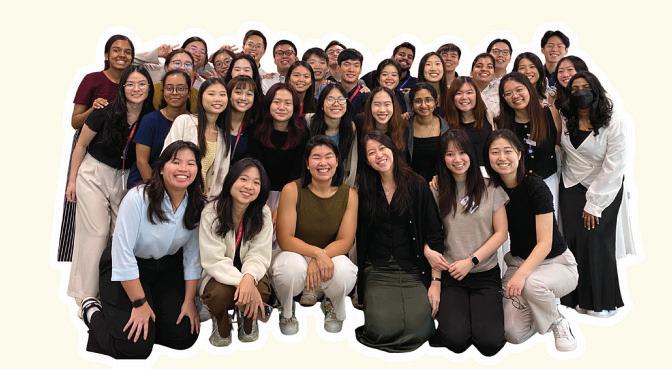
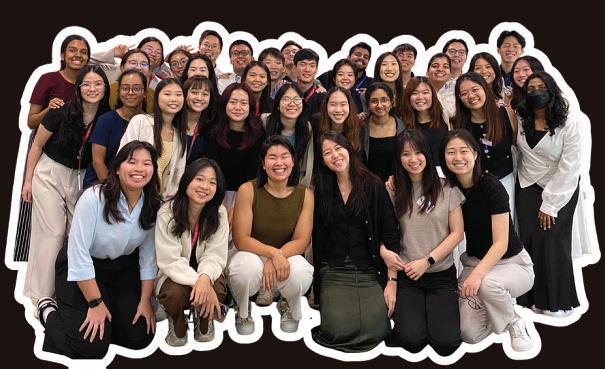
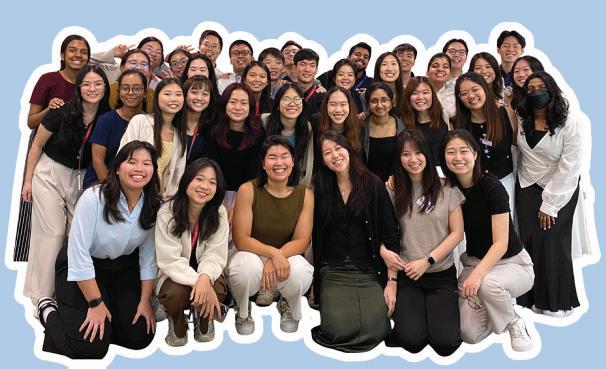






Prioritising Your Mental Health
It is normal to feel overwhelmed during the transition from graduate to working adult. However, prioritising your mental health and well-being is critical in the long run.
Mental health is an integral part of your life, yet it is not freely discussed in the workplace. It is not limited to mental health issues, such as depression or anxiety, but the absence of mental health simply means the absence of positive characteristics. For instance, in a professional setting, a positive characteristic for mental health is a good work-life balance. Fortunately, there is rising mental health awareness and more graduates are turning to employers who offer a good worklife balance and mental health support. There are multiple ways to manage your mental health at work, whether you are working from home or in the office.
Make “to-do” lists
Aside from dealing with being the new kid in the office, you feel the need to get up to speed with your new job. In turn, you might not have as much experience as your peers around you, and you are pushing yourself to complete a list of tasks given by a certain deadline.
Although the offer of help is typically extended to new hires, you will still likely feel as if you are buried under a mountain of work. This overwhelming feeling will likely be accompanied by constant flitting from task to task as you finish one and try to decide what to focus on next.
Instead of succumbing to the emotion, make “to-do” lists. You will be able to get your thoughts in order and feel accomplished everytime you check something off that list.
Consider
Keep your “to-do” list simple and specific. Include a time frame for every task and reward yourself every time you meet it. Remember to tick them off when completed.
Avoid gossip at work
At first glance, gossip can seem like free entertainment at work, and could be a way to bond with colleagues. However, it can cause conflicts and disrupt team harmony if you are not careful. If you are facing issues with a colleague at work, speak directly to the person. This will reduce miscommunication – which often results in frustration and poorer mental health – and may lead to a quick resolution with minimal stress. Consider getting your supervisor or manager involved as a mediator if required.
Consider
Diplomatically avoid such situations by smoothly changing the subject, and focusing on ‘non-gossip’ bits of the conversation. You can also consider steering away from the topic by revisiting a previous talking point. If that fails, simply walk away and concentrate on your work.
Take breaks
Exploring a new place over the weekend and letting a part of your mind rest is a break. But a five-minute jaunt to the kitchen or pantry for some snacks constitutes a break, as well. A few minutes taken here and there will be enough to let you unwind and destress a little before you jump back to the demands of your “to-do” list. To ensure you are getting enough “me time” to keep yourself mentally buoyed and healthy, though, you can schedule 25-minute work blocks, with five-minute breaks in between.
Consider
Scrolling through the news feed and reading something unrelated to your work. Alternatively, you can sit still for a few minutes, or take a walk around the office.
Look out for warning signs
When your mental health starts slipping, you might find yourself feeling ‘off’, whether it is struggling to focus, feeling more tired, or having trouble focusing on simple tasks. It may be tempting to just shrug it off, but doing so will likely make things worse instead. So do not ignore the signs: recognise it, and do what you need to help yourself bounce back.
Consider
Simple habits like getting enough sleep, eating well, and spending time outdoors can help restore balance. Even small breaks, like a short walk or a few minutes of mindfulness, can give your mind the reset it needs.
Decorate your workstation
Looking at little personal touches at the desk you are assigned in the office can help you destress when working life threatens to overtake you. These little decorations can help you re-centre yourself and recall positive memories that will keep your mental health up. Remember to check with your company on any guidelines they might have.
If decorations are allowed, take note to not clutter your desk with too many pictures or reminders of your hobbies. At the end of the day, you are still a working professional in a corporate space.
Consider
Decorating your desk with a pillow for comfort, or bringing a jacket for warmth. Other options include framed inspirational quotes to motivate you, or even pictures of your pets and family.
Reach out if you need it
No man is an island; there is no shame in asking for help. Even something simple like talking things out with a trusted friend can be a big relief when times are tough. Plus, you could come out of these conversations with more clarity about your problems, or even solutions that could help you out.
Consider
Consider connecting with support groups, who can connect you with other people in similar predicaments. Alternatively, you can consider using counselling services, like anonymous hotlines or more professional services, if you want 100% confidentiality.
Scholarship, Bursary & Crisis Fund
For students who have excelled in academic studies, sports or arts related accomplishments, the SIM Scholarship & Bursaries Admin team offers Scholarship as a recognition of your achievement. The Scholarship not only serve as an encouragement, but it is also a beacon which potential employers gravitate towards and helps facilitate career successes for our students.
We also believe everyone deserves a chance to get the best possible education at SIM. If you are seeking financial assistance, we are offering SIM GE Bursary and SIM GE Crisis Fund to students who are genuinely in need of financial support.
For more information, please visit our websites at:
• Scholarship – https://www.sim.edu.sg/degrees-diplomas/ admissions/scholarships
• Bursary - https://www.sim.edu.sg/degrees-diplomas/ admissions/bursaries-and-financial-aids/sim-globaleducation-bursary
• Crisis Fund - https://www.sim.edu.sg/degrees-diplomas/ admissions/bursaries-and-financial-aids/sim-ge-crisis-fund


ANG HUI HSIEN JAMIE
Bachelor of Arts (Psychology)
SIM-University at Buffalo
SIM GE Scholar (Academic Excellence and Leadership)
About yourself
I am Jamie, a recent Psychology graduate from the University at Buffalo, where I was honored to be the Valedictorian for the SIMUB Class of 2025. Beyond my academic pursuits, I’m also a National Finswimming athlete. When not training or working, you will likely find me binge-watching K-dramas, keeping up with the latest K-pop news, or battling it out in Pokémon on my Nintendo Switch.
Why did you apply for the scholarship?
While easing the financial burden on my parents was one motivation, my main reason for applying for the scholarship was to take a step toward independence. I saw it as an opportunity to prove that I was capable of taking on more responsibilities, being accountable, and striving toward my goals on my own merit.
Share your experience on how you work towards obtaining the scholarship
Fun fact: I was awarded the scholarship on my third attempt! The journey was not easy – excelling academically was just one part of the criteria. I realized I needed to grow in other areas too, so I actively sought opportunities to strengthen my leadership and interpersonal skills. I served as President of both the SIM Psychology Society and the SIM Swimming & Lifesaving Club, which honed my abilities in leadership, organisation, communication, and team management.
One of the biggest lessons I learned was that there’s always room for improvement. While it’s important to acknowledge and celebrate how far you have come, there will always be new opportunities for growth if you are willing to seek them out.
How has the scholarship further developed/ helped you?
Receiving the scholarship affirmed my potential beyond academics – it showed me that I could excel in other aspects of personal and professional development. Being a scholar gave me the confidence to engage more deeply with the student community, even as someone who is naturally introverted. I was pushed to think creatively, collaborate with diverse groups, and develop what I like to call an “on-off social switch” to adapt to different settings.
These experiences have been invaluable in shaping who I am today. As I graduate, I am grateful to SIM-UB for the opportunities and support I have received, and I look forward to giving back to the community that has helped me grow.

MUHAMMAD SYAFIQ BIN ASARAF ALI
Bachelor of Arts in Sports Studies and Marketing
SIM-University of Stirling
SIM GE Scholar (Sports & Artistic Talent)
About yourself
My name is Muhammad Syafiq, and I recently completed my Bachelor of Arts in Marketing and Sports Studies (Honours) at the University of Stirling in SIM.
Why did you apply for the scholarship?
I applied for the scholarship because I wanted to challenge the common perception that footballers cannot balance academics with sporting commitments. Through my journey, I hoped to show that it is possible to excel in both.
Share your experience on how you work towards obtaining the scholarship
Being the captain of the SIM football team while also playing for a Singapore Premier League club taught me valuable lessons in discipline, leadership, and time management. Balancing highlevel football with academic deadlines was never easy, but it strengthened my resilience and communication skills.
How has the scholarship further developed/ helped you?
Receiving this scholarship motivated me to push even harder in my final year, where I achieved a distinction for my final report. Beyond academics, the award also helped ease financial pressures, allowing me to focus more on my growth as both a student and an athlete.
Currently, I am a Business Development Manager in a construction firm while also playing for Lion City Sailors 2 in the Singapore Premier League 2. The skills and experiences I gained during my time in SIM — from leadership and communication to balancing multiple commitments — have been invaluable in shaping both my professional career and sporting journey.
I am truly grateful for this opportunity, and I hope to inspire future scholars to pursue their passions wholeheartedly while striving for academic and personal excellence.
Jobs and Internships


AIRES APPLIED QUANTUM TECHNOLOGY
LTC Building B, 12 Arumugam Road, #02-06, Singapore 409958
TEL (+65) 8022 8688
EMAIL contact@airesatech.com
WEB www.airesatech.com
LOCATION(S)
• Singapore
BUSINESS FACTS
Aires Applied Quantum Technology is a research & development firm launched in 2021 initiated to build the latest innovative technologies and Applications in Quantum for the Community.
We aim to create Accessible Quantum Safe Applications and Solutions for the People and Community, to Promote Quantum Awareness, to Educate and provide the necessary Certifications for Quantum Literacy-competence, to create a thriving ecosystem and platforms for the development of Quantum Technology.
At Aires, we foster a collaborative and innovative environment that inspires creativity, shared learning, and forward-thinking ideas. We believe that true progress in quantum technology stems from a shared vision for the future. Join us to shape a world ready for the quantum era.

@airesappliedquantum @airesappliedquantumtechnology
CAREER SECTOR(S)
• IT and Technology
JOB ROLES
• ●Business Associate
• ●Computer Engineer
• ●Software Developer
APPLICATION PROCEDURE(S)
Let’s build the future together! Send your resume to contact@airesatech.com

BAKER TILLY
600 North Bridge Road, #05-01, Parkview Square, Singapore 188778
TEL (+65) 6336 2828
EMAIL hr@bakertilly.sg
WEB https://www.bakertilly.sg/careers
LOCATION(S)
• Singapore
• International - Global network of 143 territories
BUSINESS FACTS
Baker Tilly is a full-service accounting and business advisory firm offering industryspecialised services in assurance, tax and advisory.
As a member of our team, you will work on projects that make a real impact on our clients’ businesses. Join us and gain access to knowledge and expertise that fuel personal and professional development, empowering you to confidently forge your career path.
We encourage our people not only to pursue meaningful work and rewarding careers, but also to develop their personal interests through participation in interest groups focused on sports, games, and volunteer work.
Baker Tilly is an independent member of Baker Tilly International, one of the world’s 10 largest accounting and business advisory networks.
Baker Tilly has been named amongst TIME's World Best Companies of 2025.
CAREER SECTOR(S)
• Accountancy and Financial Management
• Consulting

@BakerTillySG
@BakerTillySG
@BakerTillySingapore
JOB ROLES
At Baker Tilly Singapore, we offer a diverse range of career opportunities for graduates across multiple areas of specialisation within the professional services sector. Graduates can apply for roles in the following key areas:
• Assurance
• Tax
• Governance & Risk
• ESG & Sustainability
• Deal Advisory
• Restructuring & Recovery
• Corporate Solutions
• Digital Solutions & Transformation
We welcome highly motivated graduates who are passionate about building a career in professional services. As an accredited training organisation, Baker Tilly provides a structured learning environment, mentorship, and development pathways to help our people grow both professionally and personally.
To explore current vacancies and learn more about life at Baker Tilly, please visit our Careers Page at bakertilly.sg/careers.
APPLICATION PROCEDURE(S)
Elevate your career with Baker Tilly – Submit your resume to hr@bakertilly.sg and join us in making a difference in the world of business.
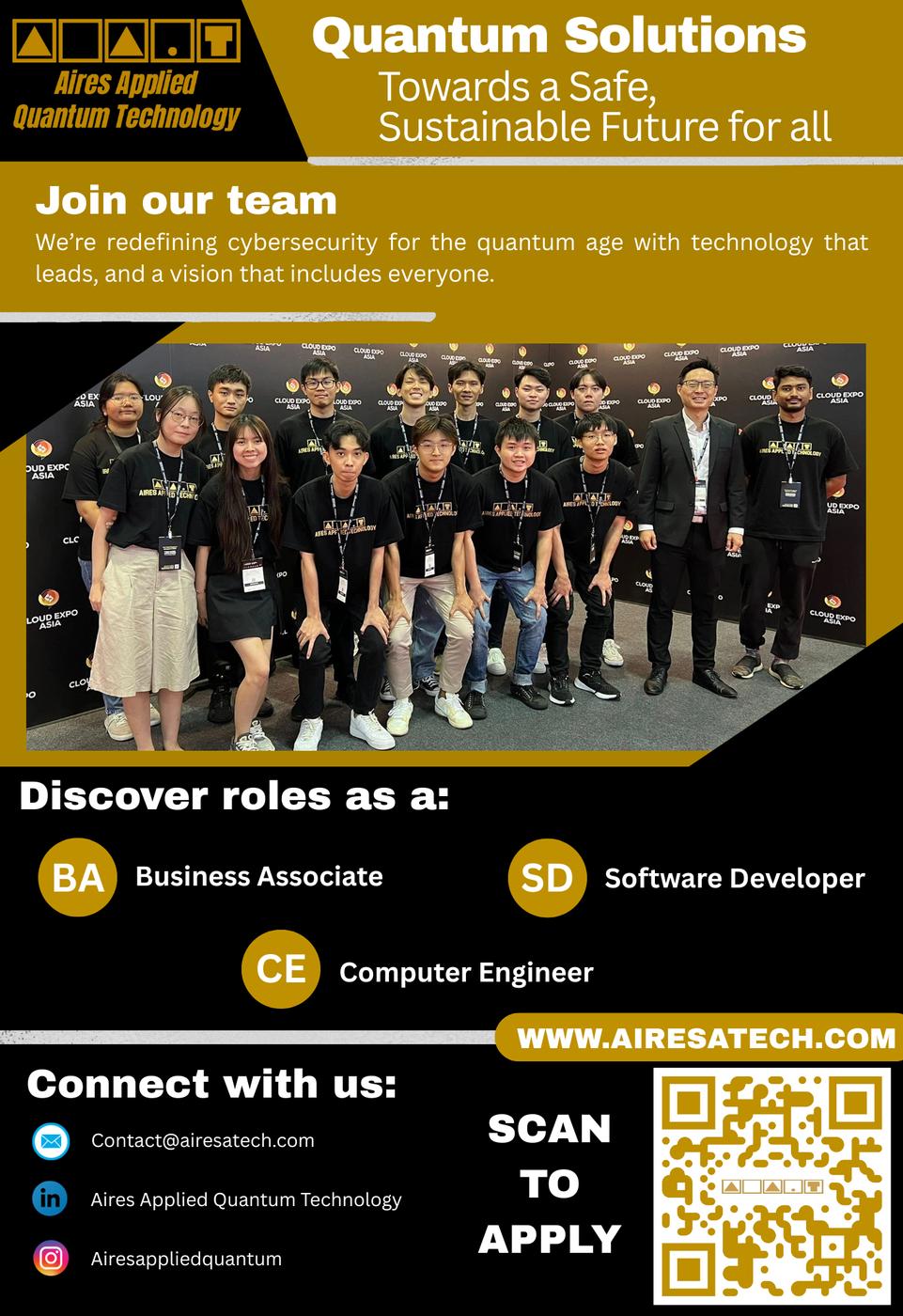

BDO SINGAPORE
600 North Bridge Road, #23-01, Parkview Square, Singapore 188778
TEL (+65) 6828 9118
EMAIL career@bdo.com.sg
WEB www.bdo.com.sg/en-gb/careers
LOCATION(S)
• Singapore
BUSINESS FACTS
BDO Singapore is a full-service professional services firm deeply rooted in serving small and medium-sized enterprises, large privately held businesses, and multinationals across diverse industries in Singapore. Our clientele spans various sectors: consumer and retail, financial services, education, F&B, manufacturing, real estate and construction, logistics, healthcare, public sector, professional services, transport, technology, media, and telecommunications.
BDO Singapore is an independent member firm of BDO International. Established in 1972, we have evolved into one of Singapore's leading and highly respected accounting and business advisory firms, with over 650 employees. We offer an extensive and comprehensive suite of professional services encompassing audit, business advisory, tax and business services outsourcing.
As a forward-thinking, digital-focused firm that sees digital as a cornerstone of excellence, we are proud of our partners and directors who consistently earn the trust of our clients and the market by delivering ideas that create value. We take pride in our dedicated team's pivotal role in helping our clients grow, flourish, and transform. We cultivate a culture that transcends office boundaries, fostering collaboration and community engagement within and beyond our workplace.
CHANGI
AIRPORT GROUP (SINGAPORE) PTE LTD
60 Airport Boulevard, #04-08, Changi Airport Terminal 2, Singapore 819643
WEB careers.changiairport.com
@changiairport
@changiairport
LOCATION(S)
• Singapore
BUSINESS FACTS
Changi Airport Group is first and foremost a service company. We operate Singapore Changi Airport, the world’s most awarded airport, and help develop and manage airports worldwide. Our people are our most important asset in our mission to be a global leading airport company, anchored in the heart of Asia, pioneering safe, secure, sustainable and vibrant air hubs, ready for our future.
We aspire to build a company where ordinary people achieve extraordinary results. Our people have a passion for service and are committed to teamwork, integrity and excellence. Working together with our colleagues and partners to achieve the best outcome, we deliver innovative services and create a world-class experience for our customers.
@BDOSingapore @bdosg @bdo-singapore
CAREER SECTOR(S)
• Accountancy and Financial Management
• Consulting JOB ROLES
• Accounting
• Business Administration
• Finance APPLICATION PROCEDURE(S)
If you believe you have the right values and attitude in wanting to be part of our big BDO family, send in your detailed resume and a recent photograph to career@bdo.com.sg
@Changi Airport Group
@changiairport
@changiairport
Changi Airport Group offers a unique work environment in a global, vibrant and exciting airport community. With a set-up of multiple businesses, you will embark on a multi-faceted career of diverse business functions in the dynamic and fastgrowing aviation industry - where we make magic happen in every aspect of our business, turning different airport touchpoints into seamless experiences with innovation and technology.
Come make MAGIC with us.
CAREER SECTOR(S)
• Aviation, Transport and Supply Chain
• Hospitality, Leisure and Tourism
APPLICATION PROCEDURE(S)
Apply online at careers.changiairport.com





FAR EAST HOSPITALITY

6 Eu Tong Sen Street, #04-28, The Central, Singapore 059817
TEL (+65) 9824 3629
WEB https://www.fareasthospitality.com/en/joinus
EMAIL hospitalitycareer@fareast.com
LOCATION(S)
• Singapore
BUSINESS FACTS
Far East Hospitality is a regional hospitality owner and operator with a diverse portfolio of 12 unique and complementary brands – Oasia, Quincy, Rendezvous, Village, Far East Collection, A by Adina, Adina Hotels, Vibe Hotels, Travelodge Hotels, TFE Hotels Collection, The Interlude, and MM:NT.
Far East Hospitality owns more than 10 hospitality assets and operates a combined portfolio of over 17,000 rooms under its management across over 100 hotels and serviced residences in 10 countries – Australia, Austria, Denmark, Germany, Hungary, Japan, Malaysia, New Zealand, Singapore, and Switzerland, with more in its development pipeline.
@Far East Hospitality
@fareasthospitality
@Far East Hospitality Management (S) Pte Ltd
@Far East Hospitality
CAREER SECTOR(S)
• Hospitality, Leisure and Tourism
JOB ROLES
• Assistant/Sales Manager
• Guest Service Officer
• Reservation Sales Executive
• Senior/Guest Service Executive
APPLICATION PROCEDURE(S)
Submit your application through https://careers.fareast.com/go/ Hospitality/3503501/ or email your resume, salary expectations, and contact details to hospitalitycareer@fareast.com.

MY JOB
PURSUING ASPIRATIONS
Name: Chen Clyde
Degree: Bachelor of Tourism & Hospitality Management, Singapore Institute of Management, 2023
Role: Senior Guest Service Executive
Employer: Far East Hospitality
In my role as a Senior Guest Service Executive, my daily responsibilities extend beyond just conducting guest check-ins. I strive to deliver exceptional service while overseeing the hotel's overall operations. This involves coordinating with various departments to ensure a seamless experience for our guests, addressing any concerns that arise, and maintaining a welcoming environment. I take pride in creating memorable experiences for each guest, contributing to the hotel's reputation for excellence.
HOW I GOT MY JOB
The interview and selection process for my current position was both thorough and engaging. It began with a series of initial screenings, including a phone interview that focused on my background and motivations. This was followed by an in-person interview, which provided valuable insights into the job functions and roles. This stage allowed me to better understand the expectations of the position and demonstrate my enthusiasm for contributing to the team.
The most difficult component of the entire process was answering a situational question that called for quick thinking and demonstrated my ability to solve problems. I took advantage of this chance to emphasise my background in managing difficult guest scenarios.
THE HIGHS AND LOWS
Helping others locate information, and solve problems is what I love most about my job. Seeing how I can help with everything from sourcing information to picking up new knowledge is satisfying. The variety of interactions and the ongoing chance to pick up knowledge from people I meet with are what inspire me.
MY HAPPIEST MOMENT AT WORK
One of my biggest achievements has been being named Employee of the Month in August, which really highlighted my commitment to providing excellent service. Additionally, I have received multiple glowing reviews on TripAdvisor, showcasing the positive impact I’ve had on guests' experiences. What is truly special is that some guests have even returned specifically to find me, often bringing thoughtful gifts as a token of appreciation. These connections make my work incredibly rewarding!
SOME ADVICE
One key piece of advice I would give to students who want to pursue a similar career path to follow their passions and stay true to their aspirations. Recall that beginning at the bottom is only a portion of the journey; all experiences help you develop. Accept every chance as a learning experience and do not be scared to adjust and change as you go. Your perseverance and commitment will eventually pay off!

HRNETGROUP
391A Orchard Road, Ngee Ann City Tower A, #23-03, Singapore 238873
EMAIL hrcorp@hrnetgroup.com
WEB http://www.hrnetgroup.com/
LOCATION(S)
• Singapore
• International - Malaysia, Thailand, Indonesia, South Korea, Hong Kong, Taiwan, China, Vietnam, Japan
BUSINESS FACTS
HRnetGroup is a Singapore-headquartered talent solutions provider with operations across major Asian cities. Established in 1992, the Group delivers a full suite of services including executive search, permanent placement, flexible staffing, HR outsourcing, and workforce technology solutions.
With 20 brand units across 18 Asian cities, HRnetGroup operates through wellrecognised banners such as HRnetOne, PeopleSearch, RecruitFirst, CREW, and Octomate. Together, these business units support organisations across public agencies, healthcare, technology, logistics, consumer industries, and more.
The organisation fosters a performance-driven yet collaborative culture, emphasising professional development, mentorship, and structured training. HRnetGroup is committed to developing the next generation of talent and works closely with education institutions to provide students with meaningful exposure to HR, recruitment, technology, and people operations.

LALAMOVE SINGAPORE
60 Ubi Crescent, #01-02, Singapore 408569
EMAIL talent.sg@lalamove.com
WEB https://www.lalamove.com/career-listing
LOCATION(S)
• Singapore
• International - we operate in more than 10 markets around the world
BUSINESS FACTS
Lalamove is disrupting the logistics industry by connecting customers and drivers directly through our technology. We provide a fast, convenient way to book delivery and moving services anytime, anywhere. People talk about O2O, we live it!
As a leading global on-demand delivery platform, Lalamove serves millions of orders daily with millions of delivery partners. With 1600+ employees spread across SEA and LATAM, our 10-year old company has reached unicorn status in 2018, is well funded by prominent VCs and has kept growing at tremendous speed since.
We believe in the power of community. Every day, drivers and customers use our platform to move what matters, quickly and simply. Our vision is to bring communities closer and make city life easier through fast, convenient circulation of goods. Using a ‘glocal’ approach, we adapt our operations to local networks while building a global brand with an expanding international presence. Delivery is what we do best, and we are committed to making it seamless, reliable, and impactful everywhere we operate.
@HRnetGroup
CAREER SECTOR(S)
• Consulting
JOB ROLES
• Marketing and Communications Intern
• Recruitment Intern (Staffing)
• Talent Acquisition Associate (Executive Search)
• Talent Acquisition Intern (Executive Search)
• Recruitment Associate (Staffing)
APPLICATION PROCEDURE(S)
Please send your CV to hrcorp@hrnetgroup.com.
@Lalamovesg @Lalamove @Lalamove
CAREER SECTOR(S)
• Aviation, Transport and Supply Chain
JOB ROLES
• Business Development
• Driver Operations
• Finance
• Marketing
• People Operations
APPLICATION PROCEDURE(S)
Be part of Lalamove’s journey to shape the future of delivery! Apply with us at https://www.lalamove.com/career-listing.




As Singapore’s leading deliver y solution provider, with a global presence in 11 markets across Asia and Latin America, we revolutionise the logistics industry with innovative ser vices and by fulfilling customers’ needs & empowering drivers.
Our groundbreaking mobile and desktop platform connects thousands of customers with professional motorcycle, car, MPV, van, and lorr y drivers.
Business Development
Driver Operations
Finance
Marketing
People Operations




MCI GROUP OF COMPANIES
80 Jurong East St 21, #04-02, #05-02, Devan Nair Institute, Singapore 609607
TEL (+65) 6990 0402
EMAIL recruitment@mci.com.sg
WEB www.mci.com.sg
LOCATION(S)
• Singapore
• Interational - Malaysia
BUSINESS FACTS
With over 18 years of proven experience, MCI stands as a trusted leader in recruitment and workforce solutions, empowering businesses and individuals to thrive in a rapidly evolving economy. Recognized as the 12th largest HR firm in Singapore by the Ministry of Manpower, MCI proudly manages over 1,000 temporary employees across diverse industries at any given time. As the only recruitment agency with an official MOU with NTUC’s e2i, we play an active role in driving national workforce development and advancing meaningful employment opportunities. Our reputation for excellence is backed by numerous industry accolades — including being named among the Top 500 High-Growth Companies in Asia-Pacific and the Top 100 Fastest Growing Companies in Singapore (2024). We are also a four-time Enterprise 50 (E50) Award winner, most recently ranking 24th in 2023, and the proud recipient of Gold for Best Recruitment Firm at the HRM Asia Readers’ Choice Awards 2023. At MCI, we go beyond recruitment, we’re redefining the future of work. Through integrity, innovation, and a people-first approach, we continue to set new benchmarks in HR excellence, helping our partners build agile, future-ready teams for sustainable success.
MINISTRY OF DEFENCE
WEB www.mindef.gov.sg/dxo
@Ministry of Defence, Singapore (MINDEF) @mindefsg @Ministry of Defence of Singapore
LOCATION(S)
• Singapore BUSINESS FACTS
The mission of MINDEF and the Singapore Armed Forces is to enhance Singapore's peace and security through deterrence and diplomacy, and should these fail, to secure a swift and decisive victory over the aggressor.
Integral to MINDEF, the Defence Executive Officer (DXO) scheme enables you to contribute towards Singapore's security as a non-uniformed defence professional.
You can contribute in a wide range of roles critical to defence, such as defence policy, strategic communications, human resources, finance, logistics, cyber security, psychology, business digitalisation and more.
CAREER SECTOR(S)
• Public Sector
@mcigroupofcompanies @wearemcisg
CAREER SECTOR(S)
• Consulting
JOB ROLES
• Business Development
• Client Relations Executive
• Talent Acquisition
APPLICATION PROCEDURE(S)
Send us your resume at recruitment@mci.com.sg and indicate the role you are applying for.
For more information about the roles, visit www.mci.com.sg/join-us.
@mindefsg @mindefsg
JOB ROLES
• Corporate & Logistics
• Manager (Contract Execution)
• Manager (Contract Management)
• Manager (Material Provisioning)
• Manager (Logistics)
• Defence Policy & Communications
• Defence Psychology & Allied Health
• Information & Communications Technology (ICT)
• Intelligence
• Training & Safety
APPLICATION PROCEDURE(S)
Apply here:
1. Website: www.mindef.gov.sg/dxo
2. MINDEF Careers@Gov: https://go.gov.sg/dxo-careers
3. MINDEF LinkedIn: https://go.gov.sg/mindefsg-linkedin
MINISTRY OF FOREIGN AFFAIRS
1 Sherwood Road, Singapore 248163
TEL (+65) 6379 8000

EMAIL mfa_career@mfa.gov.sg
WEB www.mfa.gov.sg/career
LOCATION(S)
• Singapore
BUSINESS FACTS
A Foreign Service career is more than just a job. To be effective, Foreign Service Officers (FSOs) need to have a good grasp of world affairs and a firm understanding of Singapore’s position. You will be involved in the formulation, review and implementation of policies related to your assigned portfolio. You must be versatile and have the ability to analyse issues critically, strategise and achieve outcomes. You need to be able to persuade, assert and cultivate good interpersonal relations while keeping Singapore’s interests at heart.
With over 50 Overseas Missions around the world, a career with MFA offers unique opportunities and rewards. Throughout your career as an FSO, you will alternate between serving in Singapore (HQ) and our Overseas Missions.
Depending on your competencies and inclination, you can develop your career either in the Functional and Corporate track, or the Political and Economic track. As you progress within the Ministry, a series of varied enriching assignments and milestone programmes will groom you for future leadership roles.
An exciting career of unparalleled opportunities on the frontline of global development awaits. If you are up for the challenge, come join us at MFA.

MOORE SINGAPORE
10 Anson Rd, #29-15, International Plaza, Singapore 079903
TEL (+65) 6221 3771
EMAIL hrdepartment@moorestephens.com.sg
WEB https://www.mooresingapore.com/careers/vacancies
LOCATION(S)
• Singapore
BUSINESS FACTS
Moore Stephens LLP (“Moore Singapore”) is a well-established assurance and advisory firm set up in Singapore 35 years ago. We are a member of Moore Global Network Limited, one of the world’s leading accounting and advisory networks, with a history spanning some 120 years. The network comprises approximately 563 offices across 116 countries, with more than 37,000 professionals and annual fees exceeding US$5.1 billion.
In 2025, Moore Global was named Network of the Year at the International Accounting Forum & Awards - a recognition of the quality, dedication, and collaboration that defines our global network.
We provide services to a diverse range of clients, including listed companies, large corporations, private businesses, entrepreneurs, and individuals—across a wide spectrum of industries. Our expertise covers more than 15 sectors and in the shipping sector we are acknowledged as one of the leading firms.
@SingaporeMFA
@mfa_sg
@Ministry of Foreign Affairs Singapore (MFA)
@MFAsg
@MFASingapore
CAREER SECTOR(S)
• Public Sector
JOB ROLES
• Foreign Service Officer (Political and Economic)
• Foreign Service Officer (Functional and Corporate)
• Foreign Service Administration Specialist
APPLICATION PROCEDURE(S)
Submit applications on Careers@Gov.
@MooreSingapore
@moore_sg
@mooresingapore
@mooresingapore6429
CAREER SECTOR(S)
• Accountancy and Financial Management
JOB ROLES
• Audit Associate
• Assurance & Advisory (Full-time/Part-time)
APPLICATION PROCEDURE(S)
Visit our career opportunities website at: https://www.mooresingapore.com/careers/vacancies
Or send your resume to hrdepartment@moorestephens.com.sg indicating your interest to join us.

NHG HEALTH
1 Mandalay Road, Singapore 308205
TEL (+65) 6496 6000 / Fax: 6496 6870
EMAIL nhggroup.healthcaremap@nhghealth.com.sg
LOCATION(S)
• Singapore
Participating Institutions – NHG Health Group Office, Tan Tock Seng Hospital, Khoo Teck Puat Hospital, Yishun Community Hospital, Woodlands Hospital, Institute of Mental Health, National Skin Centre, Population Health, Centre for Healthcare and Innovation
BUSINESS FACTS
NHG Health is a leading public healthcare provider in Singapore recognised for delivering quality patient care and enabling healthier lives. Our clinical services are provided through an integrated system of primary care polyclinics, hospitals and national specialty centres. As Regional Health Manager for Central and North Singapore, we partner with general practices and health and social care agencies to support the wellbeing of patients and residents in the community.
As a learning organisation, we drive clinical excellence, advance research, foster healthcare innovation and grow academic partnerships. Together, we are committed to building healthier and resilient communities and Adding Years of Healthy Life to the people we serve.
@nhghmap @NHG Health
As part of building a strong pipeline of healthcare leaders, the Healthcare Management Associate Programme (HMAP) is a 2-year programme aimed at grooming graduates with outstanding leadership qualities for challenging and fulfilling careers in NHG Health. MAs can look forward to a month-long orientation programme, cross-functional rotations and engagement with senior leaders. Upon graduation, they will have opportunities to continue their leadership development journey across NHG Health Institutions.
CAREER SECTOR(S)
• Healthcare and Pharmaceutical
JOB ROLES
• Good Honours degree from any discipline
• Excellent CCA Track Record
• Fresh graduates, and graduates with less than 2 years of working experience
• Have a desire to build a career in healthcare
We are looking for individuals who are humble and have an insatiable hunger to learn. If you are analytical, with a creative penchant for problem solving and possess excellent communication skills, join us to make a difference to the public healthcare industry today.
APPLICATION PROCEDURE(S)
Expression of Interest Form: https://form.gov.sg/65ceed9576f141cbca6c52ed

MY JOB
EMBRACING GROWTH THROUGH CHALLENGES
Name: N Nivashini
Degree: Bachelor's in Business Management, Singapore Institute of Management, Royal Melbourne Institute of Technology, 2024
Role: Management Associate
Employer: NHG Health
As a Management Associate based at Woodlands Hospital as my home institution, I initially rotated to Human Resources, contributing to cluster-level medical recruitment and assisting the engagement and wellness team. Currently at Tan Tock Seng Hospital's Food Beverage Service department, I provide behind-thescenes operational support. Daily responsibilities include coordinating outsourced vendor relationships, managing patient experience enhancement projects, and addressing operational challenges in the kitchen environment.
HOW I GOT MY JOB
The recruitment followed a comprehensive three-phase approach: online application stage; assessment centre and interviews. This thorough four-month process was challenging, but my personal attributes, healthcare enthusiasm, and strong interpersonal communication skills helped me stand out amongst the candidates.
THE HIGHS AND LOWS
The transition from corporate HR to support operations required significant adaptation, but HMAP's rotation structure helped me explore areas and identify genuine interests. Working in support operations, I'm energised by handson work where each day brings fresh challenges and varied responsibilities. Though demanding with lengthy days, I have discovered real passion for support operations. Through rotations, I've expanded healthcare knowledge, grown individually, learned effective cross-team communication, developed adaptable working styles, and appreciate diverse organisational perspectives.
MY HAPPIEST MOMENT AT WORK
What I value most are the exceptional people I have worked with. I am grateful for wonderful teams where colleagues generously shared knowledge. Beyond professional support, human connections made this experience special through celebrating festivals, birthdays, and coordinating work outfits. These thoughtful gestures created a warm, supportive environment. The camaraderie enriched my experience, highlighting workplace culture's importance for growth and fulfilment. Additionally, there's satisfaction from completing projects successfully, where hard work culminates in accomplishment making challenges worthwhile.
SOME ADVICE
For someone considering joining HMAP, I wholeheartedly encourage embracing this opportunity with an open mind and genuine curiosity. The rotation structure is invaluable, offering chances to explore different healthcare areas and discover what resonates with your interests and strengths. Do not fear stepping outside your comfort zone. Each rotation challenges you differently, but this is where growth happens. Remember to celebrate small victories along the way!

PWC SINGAPORE
7 Straits View, Marina One, Singapore 018936
TEL (+65) 6236 3388
EMAIL sg_graduate_recruitment@pwc.com
WEB https://www.pwc.com/sg/en/careers/students.html
LOCATION(S)
• Singapore
• International BUSINESS FACTS
PwC is a tech-forward, people-empowered network.
With deep expertise and advanced capabilities, PwC helps clients harness technology, make smart investments, and prepare for the future. Across audit and assurance, tax and legal, deals, and consulting, PwC brings together the teams, resources, and alliances necessary to act boldly and achieve real results. PwC supports clients in meeting the demands of an ever-changing world with consistent quality and objective advice.
PwC recognizes that it is at its best when it brings together different perspectives, experiences, and skills. The network-wide Inclusion First strategy focuses on fostering a culture where everyone is included, everyone belongs, and everyone can thrive— reflecting PwC’s belief that inclusion is about each individual.
This approach means PwC embraces differences, develops the skills needed to work and lead inclusively, and cultivates a breadth of abilities that deliver unexpected insights and solve complex challenges facing both business and society.
Joining PwC offers individuals the chance to grow their potential, collaborate with leading professionals, and drive meaningful change. With innovation, impact, and bold action, PwC shapes the future.

MY JOB
@PwC Singapore
@pwc_singapore
@PwC Singapore
@pwc_singapore
@pwc_singapore
@PwCSingapore1
CAREER SECTOR(S)
• Accountancy and Financial Management
• Banking and Financial Services
• Consulting
• Insurance and Risk Management
JOB ROLES
PwC Singapore offers a wide range of career opportunities for graduates across our lines of service (Assurance, Risk Services, Tax, Deals, Consulting, Internal Firm Services) these roles include, but are not limited to:
• General Assurance Associate
• Financial Services Assurance Associate
• Regulatory Risk and Compliance Associate
• Digital Audit Associate
• Governance Risk and Compliance Associate
• Tax Associate
Visit our careers page to view all openings.
APPLICATION PROCEDURE(S)
Interested applicants may apply via PwC Singapore’s career page.
TRANSFORMING CHALLENGES INTO SOLUTIONS
Name: Oor Jia Jian
Degree: Bachelor of Science, Accounting and Finance (Second Upper Honours), SIM-UOL, 2015
Role: Senior Manager, General Assurance
Employer: PwC Singapore
My day starts at 8AM clearing admin tasks and emails that keep projects moving. Then it is back-to-back meetings to drive decisions and tackle issues. Between sessions, I review my team’s work to ensure quality and progress. Leading different teams and managing stakeholders are central to my role, and I thrive on turning challenges into solutions.
HOW I GOT MY JOB
I recall my interview for the Year 2 Associate role to be rather straightforward. I needed to show the right attitude and character. The hardest part was explaining my one year of prior experience, as there is only so much exposure in that time. What set me apart was being open and authentic. I spoke up, shared honest views, and stayed real, which helped me stand out from the rest.
THE HIGHS AND LOWS
I value the flexibility and trust to manage my time and deliver results my way. Each engagement brings growth, with opportunities beyond audit, like proposals and capital market transactions. These challenges push me to adapt and handle complexity better. It is a continuous learning journey that keeps me motivated, even when the workload is intense at times. Success takes effort, but focusing on the end goal makes it all worthwhile.
MY HAPPIEST MOMENT AT WORK
Every project has been memorable, each offering unique takeaways. One highlight was being part of the organising committee for the Asia Pacific Real Estate Summit 2025 hosted by PwC Singapore, where I had the privilege of being the emcee for an audience of over 300 attendees. It was an eye-opening experience that pushed me beyond my comfort zone and strengthened my confidence in ways I truly value.
SOME ADVICE
Stay consistent and resilient. Keep showing up, work hard and smart, and take ownership of every task. Do not be afraid to speak up and share your thoughts; your voice matters. Build genuine relationships with those around you because teamwork is everything. It will not happen overnight, but if you keep learning and pushing forward, one day you’ll look back and realise it all came together.

SATS LTD.
20 Airport Boulevard, Singapore 819659
WEB https://www.sats.com.sg/careers
LOCATION(S)
• Singapore
• International – 225 stations in 27 countries.
BUSINESS FACTS
Headquartered in Singapore, SATS Ltd. (SGX stock code: S58) is one of the world’s largest providers of air cargo handling services and Asia’s leading airline caterer. SATS Gateway Services provides airfreight and ground handling services including passenger services, ramp and baggage handling, aviation security services, aircraft cleaning and aviation laundry. SATS Food Solutions serves airlines and institutions, and operates central kitchens with large-scale food production and distribution capabilities for a wide range of cuisines. SATS is present in the Asia-Pacific, the Americas, Europe, the Middle East and Africa, powering an interconnected world of trade, travel and taste. Following the acquisition of Worldwide Flight Services (WFS) in 2023, the combined SATS and WFS network operates over 225 stations in 27 countries. These cover trade routes responsible for more than 50% of global air cargo volume. SATS has been listed on the Singapore Exchange since May 2000. For more information, please visit www.sats.com.sg
@The SATS Group
@SATS Ltd
@SATS Group
CAREER SECTOR(S)
• Aviation, Transport and Supply Chain
JOB ROLES
• Open to all fields
APPLICATION PROCEDURE(S)
Apply online at https://www.sats.com.sg/careers
Applications open from December 2025 till March 2026.
SINGAPORE PRISON SERVICE
980 Upper Changi Road North, Singapore 507708
TEL 1800 774 7667
WEB https://www.sps.gov.sg/careers/
LOCATION(S)
• Singapore
BUSINESS FACTS
Singapore Prison Service (SPS), a uniformed organisation instituted in 1946, is one of the 11 Agencies under the Ministry of Home Affairs (MHA).
SPS staff, who are known as Captains of Lives (COLs), are highly engaged and work in an organisation recognised as one of Singapore’s Best Employers. SPS’s tagline: ‘Rehab, Renew, Restart’ emphasises our commitment to rehabilitate offenders who desire to change, renew and restart their lives for the better, with the support of the community.
Step into a world that calls for nerves of steel, and a lot of heart, where every interaction is an opportunity to impact lives. Join us as Captains of Lives, where we empower change and transform lives, creating a safer and more inclusive Singapore.
@SingaporePrisonService
@SingaporePrisonService
@SingaporePrisonService
@SingaporePrisonService
CAREER SECTOR(S)
• Public Sector
JOB ROLES
• Senior Prison Officer – A leadership role in SPS where one leads a team of like-minded and highly skilled junior officers to ensure the safe and secure custody of inmates, as well as their successful rehabilitation and reintegration into society.
APPLICATION PROCEDURE(S)
Head on to SPS career website (https://www.sps.gov.sg/careers/) for the application link through Career@Gov.









SINGAPORE RED CROSS
15 Penang Ln, Singapore 238486
TEL (+65) 6664 0500
EMAIL humanresources@redcross.sg
WEB https://redcross.sg/career-opportunities.html
LOCATION(S)
• Singapore
BUSINESS FACTS
Singapore Red Cross is a homegrown humanitarian organisation dedicated to relieving human suffering, protecting lives and dignity, and responding to emergencies since 1949. We serve the vulnerable through our blood donor programme, home and day activity centres for the disabled, senior services, community outreach for families, children and migrants, and civil response operations. We build capacity and resilience in the community through our training academy, as well as volunteer and youth development.
Beyond our shores, we mobilise and translate contributions from the donor community towards relief and recovery, rehabilitation and reconstruction efforts, with the aim of helping communities affected by disasters.
Behind these services is a diverse and dedicated workforce of programme teams and corporate professionals across human resources, finance, partnerships, marketing and communications, working in close partnership to strengthen Singapore’s humanitarian ecosystem. We invest deeply in training and career development, empowering our people to lead, innovate and grow while delivering meaningful social impact.
@sgredcrosshq
@sgredcross
@Singapore Red Cross
@SGRedCross
@Singapore Red Cross
Guided by our values of passion, compassion and professionalism, our people are empowered to maximise their potential and innovate with purpose, while making a tangible difference through life-saving solutions as we Shape the Future of Humanitarian Work.
CAREER SECTOR(S)
• Social Service
JOB ROLES
• Intern, Marketing & Communications
• Intern, Events
• Intern, Singapore Red Cross Academy
• Intern, Global Engagement
• Project Coordinator (local programmes)
• Executive (local programmes)
• Executive (corporate roles)
APPLICATION PROCEDURE(S)
Interested applicants may email humanresources@redcross.sg with the job role and their resume, referencing positions listed at Red Cross career opportunities (https:// redcross.sg/career-opportunities.html).

ST.HUA PTE. LTD.
131 Jurong Gateway Road, #04-241, Singapore 600131
TEL (+65) 6561 3877
EMAIL enquiry@sthua.edu.sg
WEB www.sthua.com
LOCATION(S)
• Singapore
BUSINESS FACTS
St.Hua Pte. Ltd. is a consultancy solutions and technical training provider with over thirty years of experience.
CAREER SECTOR(S)
• Consulting
• Healthcare and Pharmaceutical
JOB ROLES
• Administrative Executive
• Business Development Executive
• Coordinator Executive
• Marketing Executive
• Sales Executive
APPLICATION PROCEDURE(S)
Interested applicants may email your Resume / CV to: admin@sthua.com.sg

UNITED OVERSEAS BANK LIMITED
UOB Plaza, 80 Raffles Place, Singapore 048624
WEB https://www.uobgroup.com/careers/early-careers/index.page
LOCATION(S)
• Singapore
• International (Mainly ASEAN Countries) - Australia, Brunei, Canada, Mainland China, France, Hong Kong, India, Indonesia, Japan, Malaysia, Myanmar, Philippines, Singapore, South Korea, Taiwan, Thailand, United Kingdom, United States of America, Vietnam
BUSINESS FACTS
United Overseas Bank Limited (UOB) is a leading bank in Asia with a global network of more than 500 branches and offices in 19 countries and territories in Asia Pacific, Europe and North America. In Asia, we operate through our head office in Singapore and banking subsidiaries in China, Indonesia, Malaysia and Thailand, as well as branches and offices. Our history spans more than 80 years. Over this time, we have been guided by our values – Honorable, Enterprising, United and Committed. This means we always strive to do what is right, build for the future, work as one team and pursue long-term success. It is how we work, consistently, be it towards the company, our colleagues or our customers.
CAREER SECTOR(S)
• Banking and Financial Services
JOB ROLES
• Personal Wealth Executive
• Business Financial Manager
• Service Executive
• Bancassurance Specialist
• Mortgage Specialist
• Card Insurance Specialist – Credit Sure Plus
• Contact Centre
APPLICATION PROCEDURE(S)
Apply directly via UOB Career Portal > HR screening call > interviews > offer
























































































































What is WILL about?
SIM Work-Integrated Learning for Life Award aims to provide real-world learning experiences where SIM students can develop holistically, and deepen their cognitive (Head), affective (Heart), and psychomotor (Hands) capacities for good work. It does this through offering a variety of high-quality opportunities for workintegrated learning.
Apply now on SIMConnect!