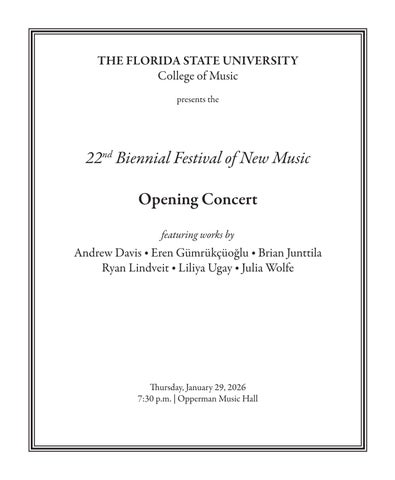
PROGRAM
Retrieve (2016)
Things You Can Magnetize (2024)
Greg Sauer, cello; George Speed, contrabass
Nikkie Galindo and Jordi Banitt, flute fixed media
Mother Tales (2021)
I. croon
II. perpetual delight
Deep Summer Folklore (2023)
Ex Antiphonis Unitas ()
Benjamin Sung, violin; Liliya Ugay, piano
Burgin String Quartet
Masayoshi Arakawa and Ioana Popescu, violin
Jeremy Hill, viola; Thu Vo, cello
Kaeden Parks, alto saxophone
Eren Gümrükçüoğlu, electronics
Sebastian and Venus (2025)
I. Sandro’s St. Sebastian
II. Venus of Willendorf
Cha (2015)
Sarah Ward, oboe; Dawson Huynh, clarinet
Nicholas Mackley, bass clarinet; Jennifer Fuentes, alto saxophone
Susanna Campbell, bassoon
AJ Nguyen, soprano saxophone; Raymond Wilkerson, alto saxophone
Julia Wolfe
Brian Junttila
Liliya Ugay
Davis
Eren Gümrükçüoğlu
Ryan Lindveit
Julia Wolfe
Ashton Stewart, tenor saxophone; Zachary Matthews, baritone saxophone
Andrew
Liliya Ugay: Mother Tales
Mother Tales was inspired by the early parenthood routine, much of which consists of putting the child to sleep and playing. The first movement is a lullaby that starts from humming and turns into expression of mother’s thoughts, both excitement and fear of the future unknown mixed with tenderness and vulnerability this little world embodies. The second movement, perpetual delight, plays with tiny, tinkly, twinkly, rattly, and shaker-y toys that become a world of discoveries for a new curious mind. Composer-mothers have been vastly underrepresented throughout the history of music. The restricted timing of female physicality and intensity of professional activity that is necessary to sustain one’s composition career force many composers to choose between childbirth and dedication to their profession. Ironically, nearly all music we know that was inspired by parenthood and/or young children was composed by men. The lack of mothers in this field led to the huge gap in representation that does not fairly reflect the reality of our world. Mother Tales was composed for the wonderful duo Sunmi Chang and Clara Yang, who premiered at University of North Carolina, Chapel Hill, in April 2022, and who subsequently recorded it on Navona Records.
Liliya Ugay is Associate Professor of Composition at Florida State University and serves as director of Polymorphia, FSU’s new music ensemble. Her work focuses on exploration of immigrant experience, female physicality, and motherhood, often through storytelling and drawing inspiration from material tools, such as folk instruments and children’s toys, and has been described as “evocative” (The Washington Post), “exquisite and heartwarming” (Navona), “assertive, steely...[then] lovely and supple writing” (The Wall Street Journal) that “tugs at our heart strings” (OperaGene). She was commissioned and performed by Yale Philharmonia, Nashville and Albany Symphonies, American Composers Orchestra, New England Philharmonic, Raleigh Civic Symphony, The Next Festival of Emerging Artists; ensembles such as Aspen Contemporary Music Ensemble, icarus Quartet, Victory Players, Unheard-Of//Ensemble, Music from Copland House, Molinari Quartet, Ensemble Flageolet, ensemble vim, Antico Moderno, Omnibus, and Convergence; and soloists such as Paul Neubauer, Andrea Lam, Noël Wan, Sunmi Chang, Clara Yang, Melvin Chen, Robert Fleitz, and Min Kwon. Among the festivals that featured her compositions are Aspen, Norfolk, Chelsea, Darmstadt, New York Electroacoustic, American Composers Festival, MIFA, Boston New Music Initiative, Convergence, and Venice Biennale. Most recently she has worked with activist opera company White Snake Projects on the virtual opera “Fractured Mosaics” uncovering the experiences of Asian-Americans and the series “Let’s Celebrate” creating an opera about Nowruz (Persian New Year), as well as completing commissions for Borealis Wind Quintet and Redlands Symphony. Her operatic collaborations also include Washington National Opera and American Lyric Theater, for which she was a commissioned composer-in-residence. Ugay was a recipient of the awards from Music Teachers National Association (Distinguished Composer of the Year 2024), American Academy of Arts and Letters (2016), ASCAP Morton Gould (2019), International Alliance of Women in Music (2024), and grants from Opera America (2021) and National Endowment of the Arts (2020). Originally from Uzbekistan, she graduated from Yale University (‘16MM; ‘22DMA), receiving mentorship from Aaron Kernis, Martin Bresnick, Christopher Theofanidis, Han Lash, and David Lang.
Andrew Davis: Deep Summer Folklore
I wrote Deep Summer Folklore over the summer of 2023 for my friends in the Daedalus Quartet. At the time, I had been thinking about the relationship between instruments and genre. What kind of music do we hear when we think of a particular instrument? Something like the oboe feels firmly rooted in Classical music, for instance. But string instruments, especially the violin, occupy several spaces. The violin has an incredibly rich history in Classical music, but it is also an important folk instrument and has crossed over into other genres such as blues, hip hop, and rock. This piece draws on the stylistic eclecticism of string instruments, incorporating elements from various musical genres. The folk and rock influences are quite strong and overt, and several of the parts were originally written for electric guitar. These varied elements all coalesce – hopefully – to form a driving and effervescent piece that goes through various distinct but related sections.
Andrew Davis is a composer and electric guitarist from Columbia, MD who has written for a variety of media both acoustic and electroacoustic. His works have been performed by groups such as the JACK Quartet, PRISM Quartet, Alarm Will Sound, Daedalus Quartet, the Argento Ensemble, loadbang, the Boston New Music Initiative, the Luna Nova Ensemble, the University of Texas Wind Ensemble, the Yale Concert Band, the Florida State University Wind Ensemble, and the University of Texas New Music Ensemble. He has received honors from ASCAP, BMI, The Lyra Society, and ISCM-Texas among others. Additionally, his music has been heard at a variety of festivals, including the TUTTI Festival, RED NOTE Music Festival, Mizzou New Music International Composers Festival, New Music on the Point, and SEAMUS. He has held residencies at Atlantic Center for the Arts and ACRE. He currently teaches at Ursinus College.
Eren Gümrükçüoğlu: Ex Antiphonis
Unitas
Ex Antiphonis Unitas explores the relationship between humanity and the cosmos through the interplay of alto saxophone and electronics. The saxophone embodies the human voice—fragile, lyrical, and searching—while the electronics evoke the overwhelming vastness of space. What begins as contrast and dialogue gradually transforms into belonging, as the human voice is absorbed into the electronic fabric. By the end, saxophone and cosmos converge, speaking together with a unified presence that suggests harmony between the individual and the infinite.
Eren Gümrükçüoğlu, Assistant Professor of Composition at Florida State University, is a composer and improviser of acoustic/electroacoustic music and a music technologist. His research explores the dynamics of interaction between electronics and live instruments, generative systems, the utilization of non-western elements in concert music, jazz improvisation, and genre divisions with an emphasis on listening practices. He has collaborated with leading ensembles and performers including the JACK Quartet, Mivos Quartet, Semiosis Quartet, Conrad Tao, Ensemble Suono Giallo, Quince Ensemble, Deviant Septet, yMusic Ensemble, New York Polyphony, Quince Ensemble, Istanbul State Symphony Orchestra, and Metropole Orkest among others. His music has been performed around the globe and featured in national and international conferences and festivals such as June in Buffalo, SICPP, ilSUONO Contemporary Music Week, Taproot New Music, ROCC Conference, and SCI. In addition to his academic work, he composed, arranged, performed, and recorded music for film and TV in Hollywood and in Turkey. His studies and years of professional experience in the global music industry span film scoring, jazz composition and improvisation, live performance/touring, audio engineering, and all aspects of music production. His scores are published by Babel Scores, Paris.
Ryan Lindveit: Sebastian and Venus
Sebastian and Venus: I was remarkably surprised and moved by my first encounter with Sandro Botticelli’s painting of Saint Sebastian (1474) in the Gemäldegalerie in Berlin because unlike many other Sebastian paintings, Botticelli’s Sebastian betrays no sense of pain, and in fact he peers out at the viewer confidently, perhaps even imperiously. The music in this reed quintet is inspired by my complicated emotional experience of encountering Botticelli’s intense and beautiful painting, which engendered feelings of empathetic suffering, pity, admiration, and desire. The Venus of Willendorf is a 30,000-year-old, 4.4-inch carved limestone figure found in Austria and currently exhibited in the Natural History Museum Vienna. The origins of the Venus figurine are mysterious, as is its meaning, though some scholars theorize that it is associated with fertility, growth, and vitality.
Ryan Lindveit is an American composer who takes inspiration from nature, art, science, technology, and personal experience in order to craft colorful and emotionally vivid musical journeys. Lindveit is grateful to his early musical mentors in the public school system in Texas as well as for the mentorship he received during his musical training in higher education at the University of Southern California (BM), Yale University (MM, MMA), and the University of Michigan (DMA). A committed educator, he has taught composition, music theory, orchestration, arranging, film music, and music technology privately and at the collegiate level. He currently serves on the faculty of the Natalie L. Haslam College of Music at the University of Tennessee, Knoxville as Teaching Assistant Professor of Music Theory and Composition.