tH e A mer ICA
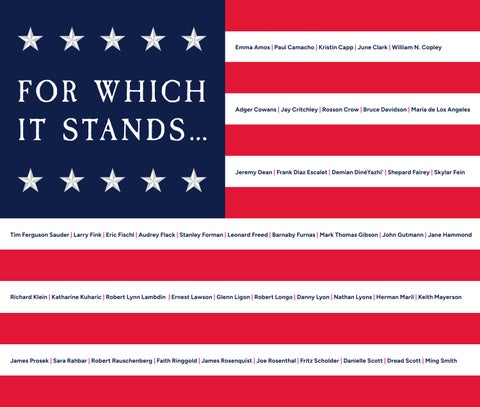
n F l A g : For WHA t d oes I t s tA nd?
Flags originally served as a rallying point in warfare, and it’s interesting that at an early date it was discovered that having a flag carrier who had no weapons, whose sole function was to hold a flag, served a useful military role. We can trace this practice back to the Eagle standards that rallied the Roman legions, and then forward a few thousand years to the national flags that marshalled troops at Austerlitz, Leipzig, and Waterloo. From this sort of practical function, a country’s flag developed a larger symbolic function as a rallying point for the crowds who gather at ceremonies and parades, or even as a symbolic rallying point for a nation at large. Flags became something to proudly display in shops and homes, over entrances to homes and on barn doors, and to add a touch of nobility and glamor to daily life.
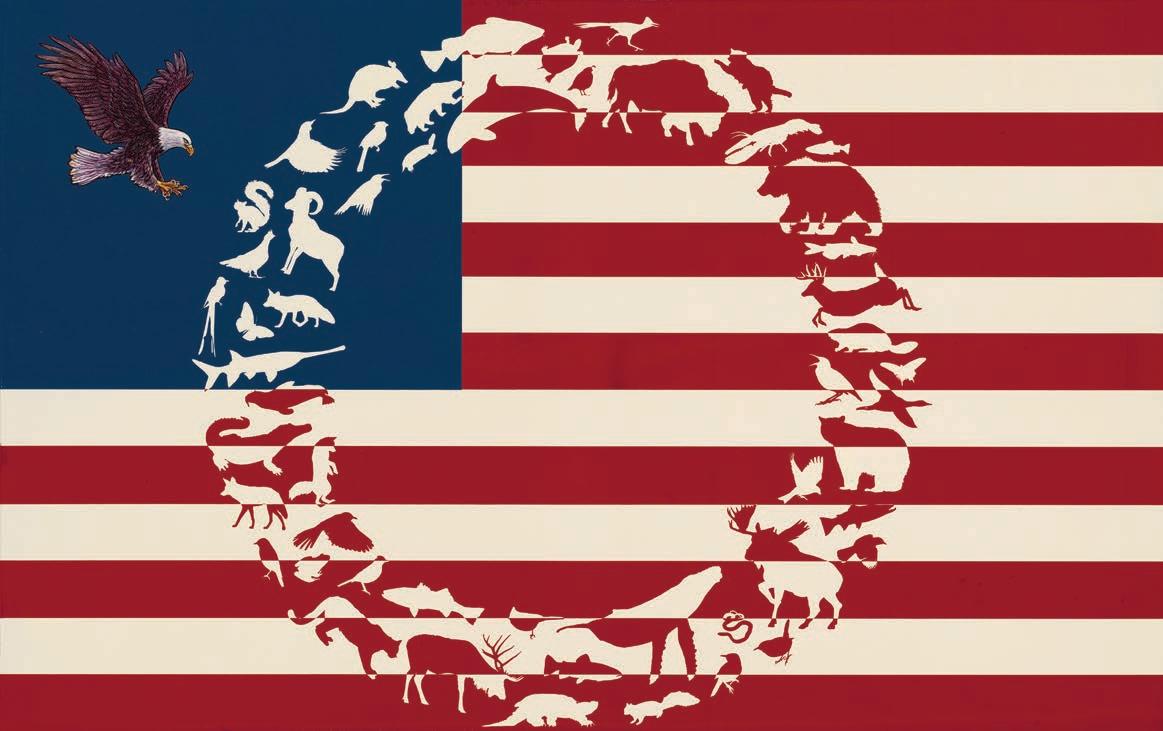
The American flag is an unusual one. Most national flags are symmetrical or feature a central motif such as a lion or an eagle or the rising sun of Japan. The American flag has a little blue rectangle on the upper left that is off center, and it is unusually busy in its design, with its 13 alternating red and white stripes and the rectangle crowded with a constellation of white stars.
There are symbolic reasons for this which we tend to forget, for the American flag was adopted when America had not yet achieved independence from England, and ten years before the Constitution of the United States was ratified. When the American flag was adopted in 1777, the United States was not yet united but was a loose confederation of independent states, closer in character to the common market that exists in Europe today than to a unified country.
Even after the Constitution was adopted, it took many years for the federal government to exert any sort of control over this disorderly confederation, and to establish the powers necessary to raise taxes, build an army and navy, and establish national laws that applied to the whole terrain. One of the curious characteristics of the American flag, as well, is that while most national flags are fixed, the American flag keeps changing. Originally it had 13 stripes and 13 stars, one for each of the American colonies. As it developed it kept the 13 stripes but kept changing the number of stars, which at this point have reached 50, and someday may number even more.
In this regard, the changing form of the American flag serves as a sort of chronicle—a tabulation of the progress of America’s growth—as the nation expanded from a thin strip along the Eastern seaboard to a continental empire. Built into the American flag is the notion of continuous change and growth. It’s a celebration of progress—a notion that became a central element of American identity and an essential part of the American dream.
From an aesthetic standpoint, it seems to me that the American flag is very much open to criticism if we consider it as a flat design. But when it flutters in the wind such criticism seems beside the point. The profusion of stripes and stars creates a rich array of patterns that are constantly changing, like the changing patterns of a kaleidoscope. To view the American flag in the wind is a mesmerizing experience.
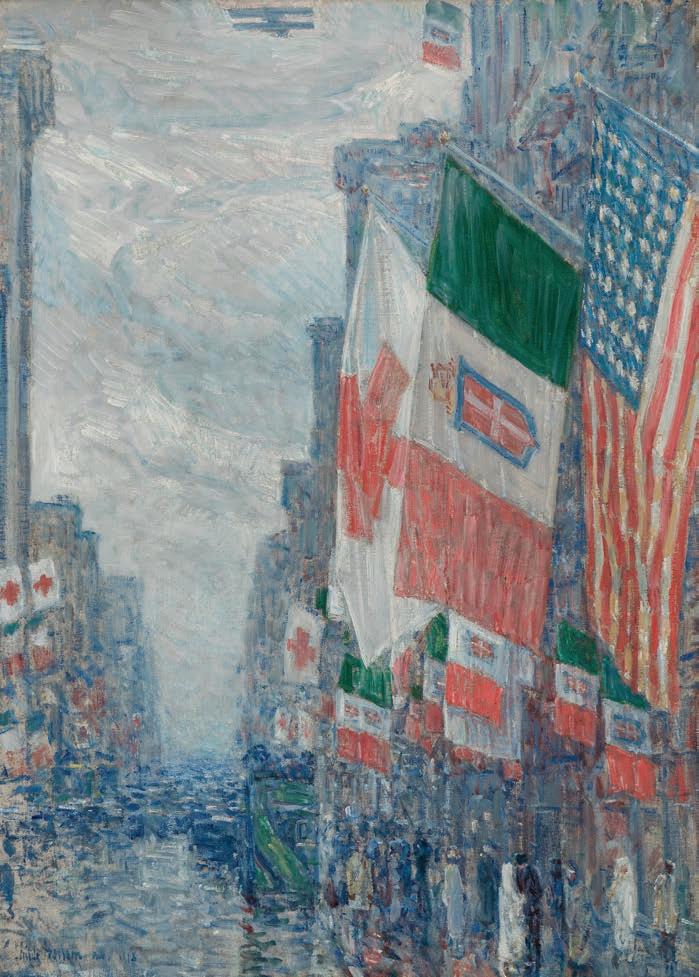
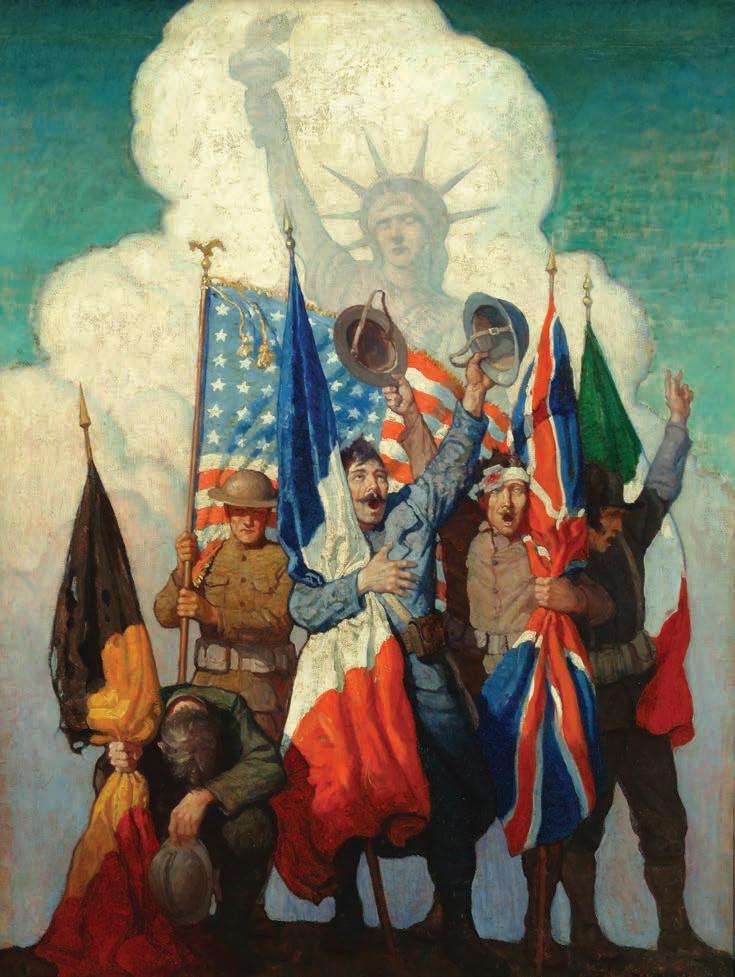
Some of the most remarkable paintings of the late 19 th century celebrate this fact, with an innocence that is hard to recapture today. Figures such as N. C. Wyeth (cat. 3, pg. 28) treated the American flag in a purely celebratory way, delighting in the parades and the pomp and pageantry that naturally formed around it. For figures such as Childe Hassam, the American flag became a near-abstract patch of color that gave life and color to a gray city street. Notably, for figures like these the American flag stood for deeper values as well. It stood for American values that were exceptional, that had a
sacred character, that had a sort of moral and religious holiness. For when the United States was formed it not only had an unusual flag but a form of government that was unusual in fundamental ways—a fact that we tend to forget today since this new form of government has since become rather standard.
Two of these ways stand out: First, at a time when most of the world lived under the sway of hereditary rulers, it was a democracy—a form of government that existed in some of the territories of ancient Greece, but had not been practiced for about two thousand years (outside of a few tiny city-states, such as the Republic of San Marino). Second, it was also a constitutional form of government, which is to say that it was based on a single written contract, rather than a haphazard collection of precedents. The role of men was to play by the rules rather than to make up the rules to bolster their own interests, and the underlying foundation for this form of governance was the democratic belief that all men should live free and that all men had equal rights under the law.
These two features gave American nationhood a somewhat peculiar character, since “Americanness” was not simply a matter of protecting American boundaries. It was the belief in the natural rights of all humankind, and it included the hope that eventually these rights would extend to the entire globe. In short, to an unusual degree, the American flag symbolized not only patriotism, but a commitment to an unusually demanding moral framework of equal rights for all.
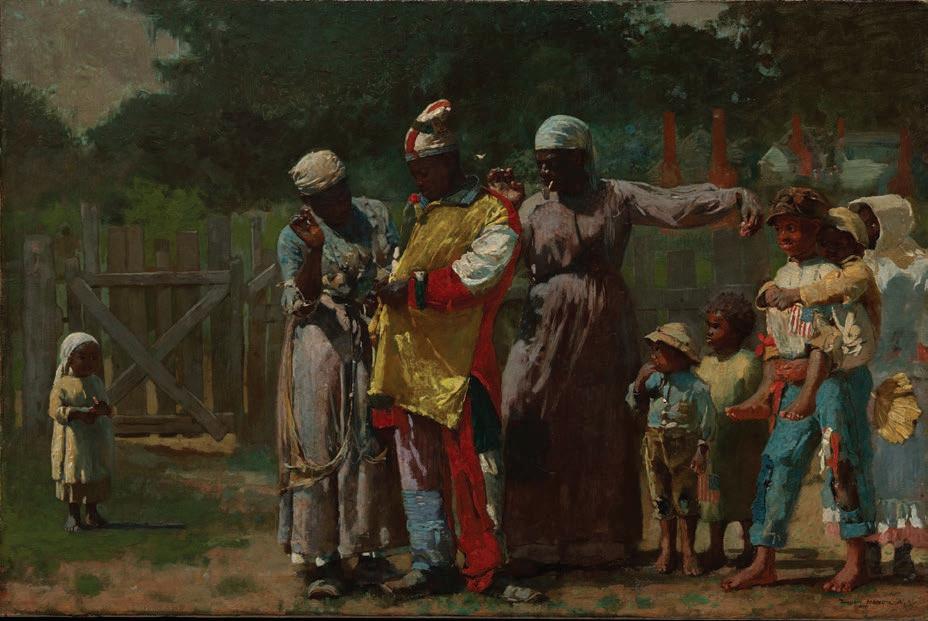
No human society has ever quite attained this ideal, and from the moment of its founding, the United States was saddled with the uncomfortable paradox that many of those, such as George Washington and Thomas Jefferson—who campaigned so earnestly for the cause of freedom and are widely revered as leading “founding fathers” of this country—were in fact slaveholders, seemingly oblivious in real life of the human rights they celebrated in their rhetoric. Winslow Homer’s painting Dressing for Carnival (1877, Metropolitan Museum of Art) for example, uses an American flag to drive this point home. It depicts a black man being costumed for the Jonkonnu festival—a celebration originating in the British West Indies, with roots in West African culture, that was adapted by enslaved people in the southern United States. Originally a Christmas day celebration, after the Civil War its forms and costumes were adopted for Fourth of July and Emancipation Day festivities. Homer’s painting emphasizes the very dark skin of the celebrants and the exotic nature of their costumes, but one of the children in the scene proudly displays an American flag. Surely the painting poses the question of whether these individuals, who had just been technically granted their freedom, would actually enjoy the same freedoms as those enjoyed by white people, or if they would be treated with repugnance, as sub-human outcasts.
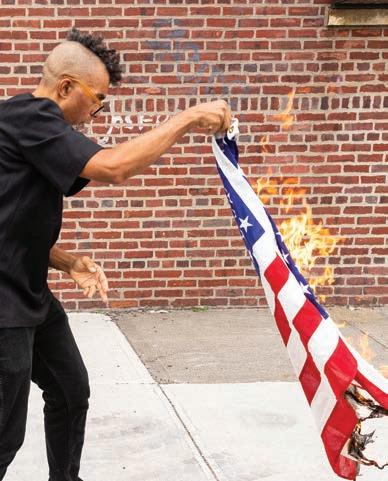
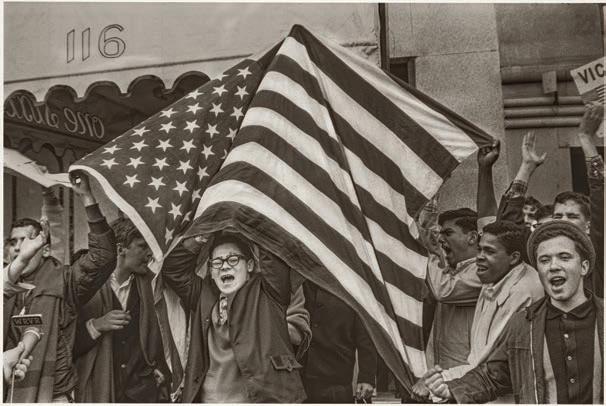
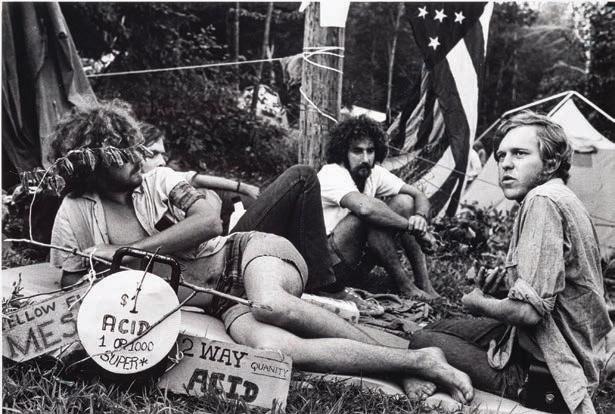
For all its critical edge, Homer’s painting does not question the noble qualities associated with the flag itself. This did become a central theme in much of the imagery of the 1960s and 1970s, when episodes such as the brutal My Lai massacre of completely unarmed women and small children led many to question whether the war in Vietnam was serving the cause of human freedom or of dictatorial, totalitarian rule. During this period, the American flag was often deliberately burned and desecrated in protests, as well as flaunted in a mocking way by hippies and drug dealers.
Since that period, it seems that the American flag has never quite recovered its innocence. Plastered on cars, barns, and houses, it has come to carry implications that are rude and in-your-face rather than polite or high-minded. It seems to symbolize disdain for a pluralistic society, and an embrace of right-wing values. Strikingly, if you’re driving down the highway and spot a truly enormous American flag, it’s generally not one that serves to mark a school, a hospital, or an art museum,
but instead to advertise an auto dealer and to serve as a ploy to sell cars. The flag has become a symbol of divisiveness and shifty salesmanship rather than of the qualities of honor, diversity, variety, and multi-culturalism that it once celebrated— those invoked in the American shield’s motto, E Pluribus Unum —“Out of many, one.”
Its innocence sullied, it has become a tarnished symbol of the fractured society we live in today. Will it remain tarnished? Or can it serve again, as it did in Winslow Homer’s painting, as an invocation to do a better job of living up to our ideals?
~
Henry
Adams,
PhD Ruth Coulter Heede Professor of Art History, Case Western Reserve University
Winslow Homer (American, 1836-1910), Dressing for Carnival, 1877, oil on canvas. The Metropolitan Museum of Art, Amelia B. Lazarus Fund, 1922
1. Childe Hassam (American, 1859-1935)
Italian Day, May 1918, 1918
Oil on canvas
36 x 26 inches
Art Bridges
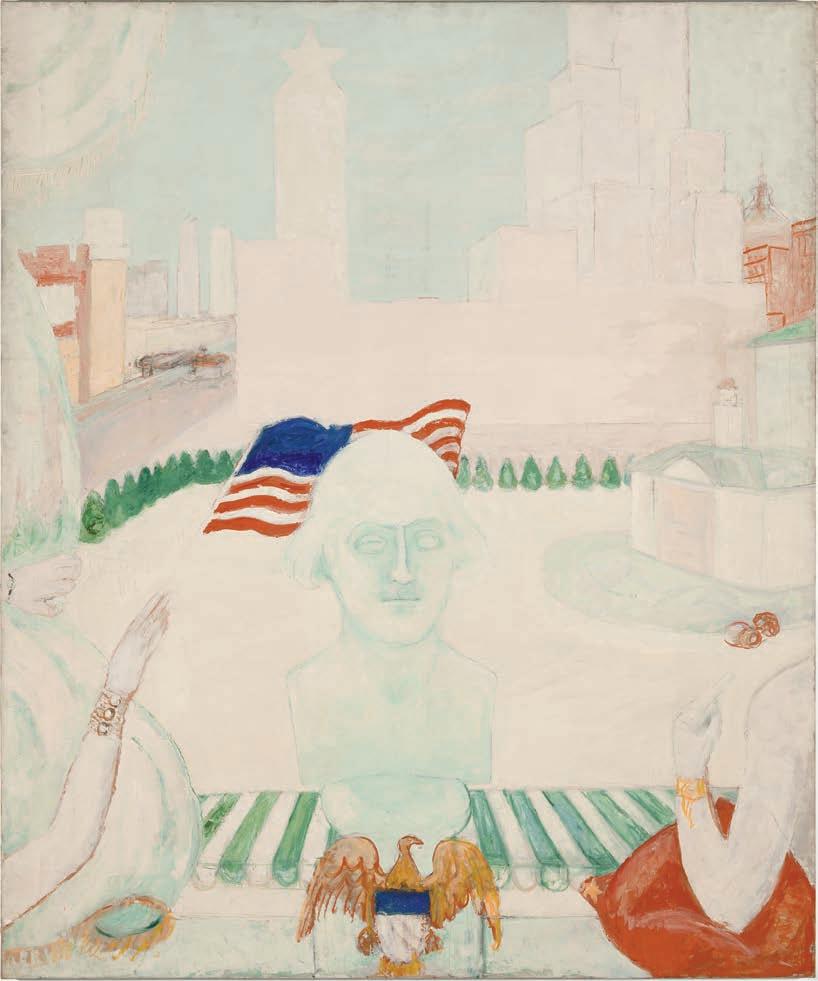
2 . Florine Stettheimer (American, 1871-1944)
George Washington in New York, ca. 1932-1933
Oil and mixed media on canvas
60 x 49 7/8 inches
Art Properties, Avery Architectural & Fine Arts Library, Columbia University in the City of New York, Gift of the Estate of Ettie Stettheimer
3 . N . C. Wyeth (American, 1882-1945)
The Victorious Allies, 1918
Cover of The Red Cross Magazine, May 1919
Oil on canvas
45 ¼ × 34 ¼ inches
Delaware Museum of Art, Gift of the Bank of Delaware, 1989
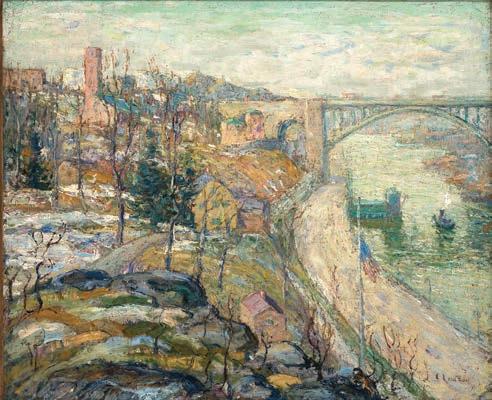
4. Ernest Lawson (American, 1873-1939)
Washington Bridge, New York City, ca. 1915-1925
Oil on canvas
25 ¼ x 30 ¼ inches
Delaware Museum of Art, Gift of the Friends of Art, 1964
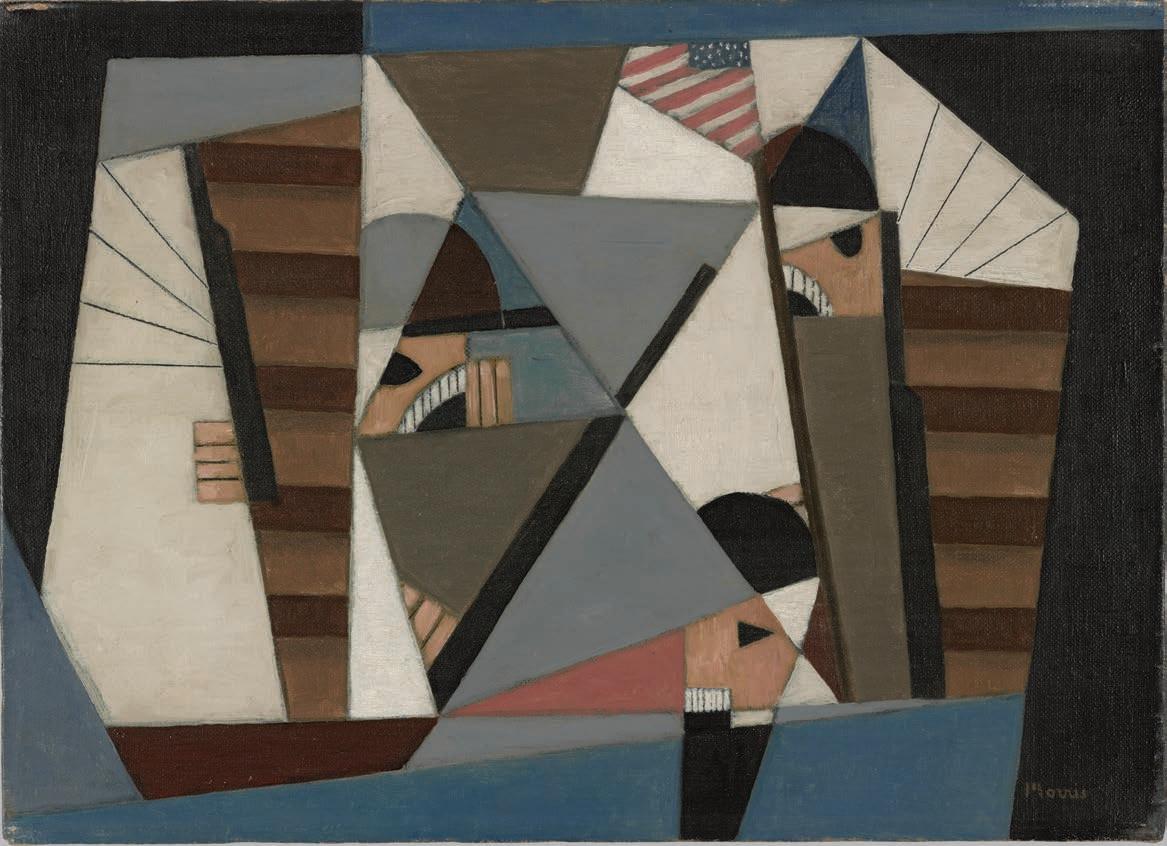
5. G eorge L. K. Morris (American, 1905-1975)
Invasion Barge, 1943
Oil on canvas
10 x 14 inches
Yale University Art Gallery, Purchased with The Iola S. Haverstick Fund for American Art in honor of Professor Alexander Nemerov, Ph.D. 1992
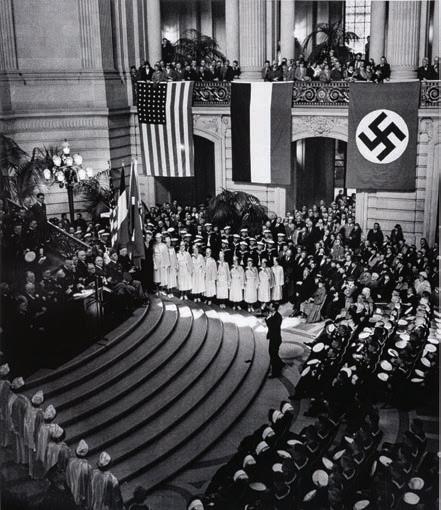
6 . John Gutmann (American, born Germany, 1905-1998)
The News Photographer, San Francisco City Hall, 1935
Gelatin silver print
14 x 11 inches
Private Collection, New York
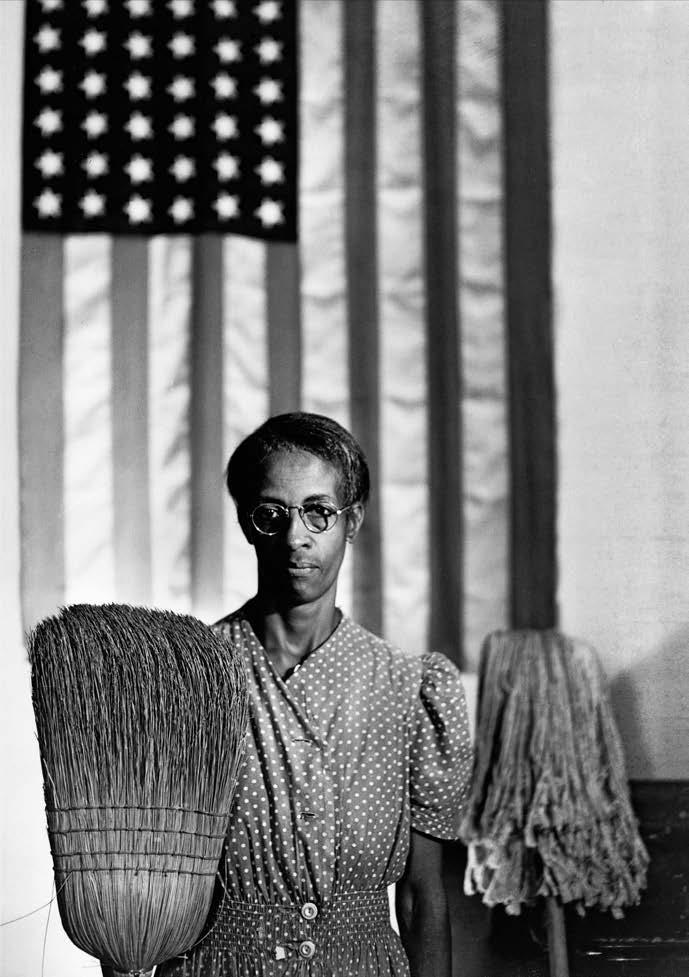
7. G ordon Parks (American, 1912-2006)
American Gothic, Washington D.C., 1942
Gelatin silver print (exhibition print)
20 x 16 inches
Collection of the Gordon Parks Foundation
8. Herman Maril (American, 1908-1986)
Old Glory, 1943
Watercolor on paper
10 ½ x 14 inches
The Herman Maril Foundation, Courtesy of Debra Force Fine Art, New York
9. Barnaby Furnas (American, born 1973)
Untitled (Iwo Jima), 2000
Watercolor on paper
11 x 8 ¾ inches
Richard and Monica Segal
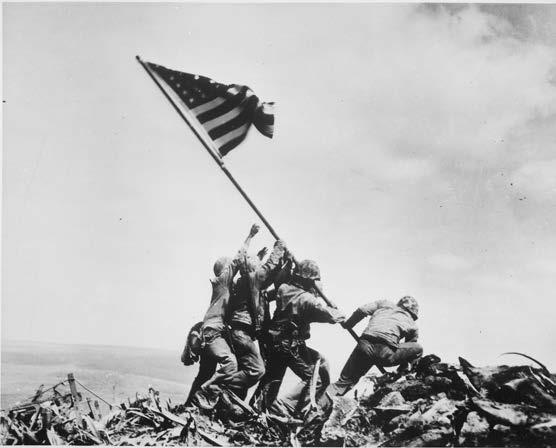
10. Joe Rosenthal (American, 1911-2006)
Raising the Flag on Iwo Jima, 1945
Gelatin silver print
9 7/16 x 7 11/16 inches
Lent by the Estate of Hanns & Patricia Kohl
11. Robert Lynn Lambdin (American, 1886-1981)
[Heroes of World War II], 1958
Oil on canvas
80 ¼ x 105 inches
Bridgeport Public Library Collections
12. Al Hirschfeld (American, 1903-2003)
Eisenhower’s Inauguration, After Covarrubias
Published in Vogue, February 1, 1953
Gouache on board
19 x 25 inches
Collection of the Al Hirschfeld Foundation
13. Faith Ringgold (American, 1930-2024)
The People’s Flag Show Poster, 1970
Offset lithograph
18 x 24 inches
Courtesy of ACA Galleries, New York
14. Paul Camacho (Puerto Rican, 1929-1989)
American Beauty, 1966
Oil on canvas
31 x 25 inches
Westport Public Art Collections
15. Jasper Johns (American, born 1930)
Flag I, 1960
Lithograph
Printed and published by ULAE, West Islip, New York
21 7/8 x 29 ¾ inches
Edition: 23, plus artist’s proofs
Susan Sheehan Gallery, New York
16. James Rosenquist (American, 1933-2017)
Mirrored Flag, from the Cold Light Suite (G.37), 1971
Color lithograph with mirrored-Mylar foil
Printed and published by Graphicstudio/ University of South Florida
29 x 22 3/8 inches
Edition: 70, plus artist’s proofs
Fairfield University Art Museum, Museum Purchase, 2024.29.01
17. Jane Hammond (American, born 1950)
Untitled (28, 157, 272, 179, 64, 95, 45, 244, 247, 109, 146, 185, 9, 234, 207), 1993
Oil on canvas with metal leaf
70 x 80 inches
Collection of the Orlando Museum of Art.
Purchased with funds provided by the Acquisition Trust
© Jane Hammond
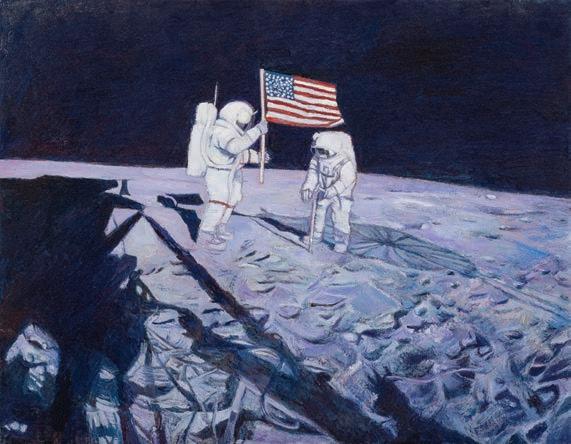
18. Keith Mayerson (American, born 1966)
First Men on the Moon, 2012
Oil on linen
28 x 36 inches
Fairfield University Art Museum, Gift of Avo Samuelian and Hector Manuel Gonzalez, 2023, 2023.25.10
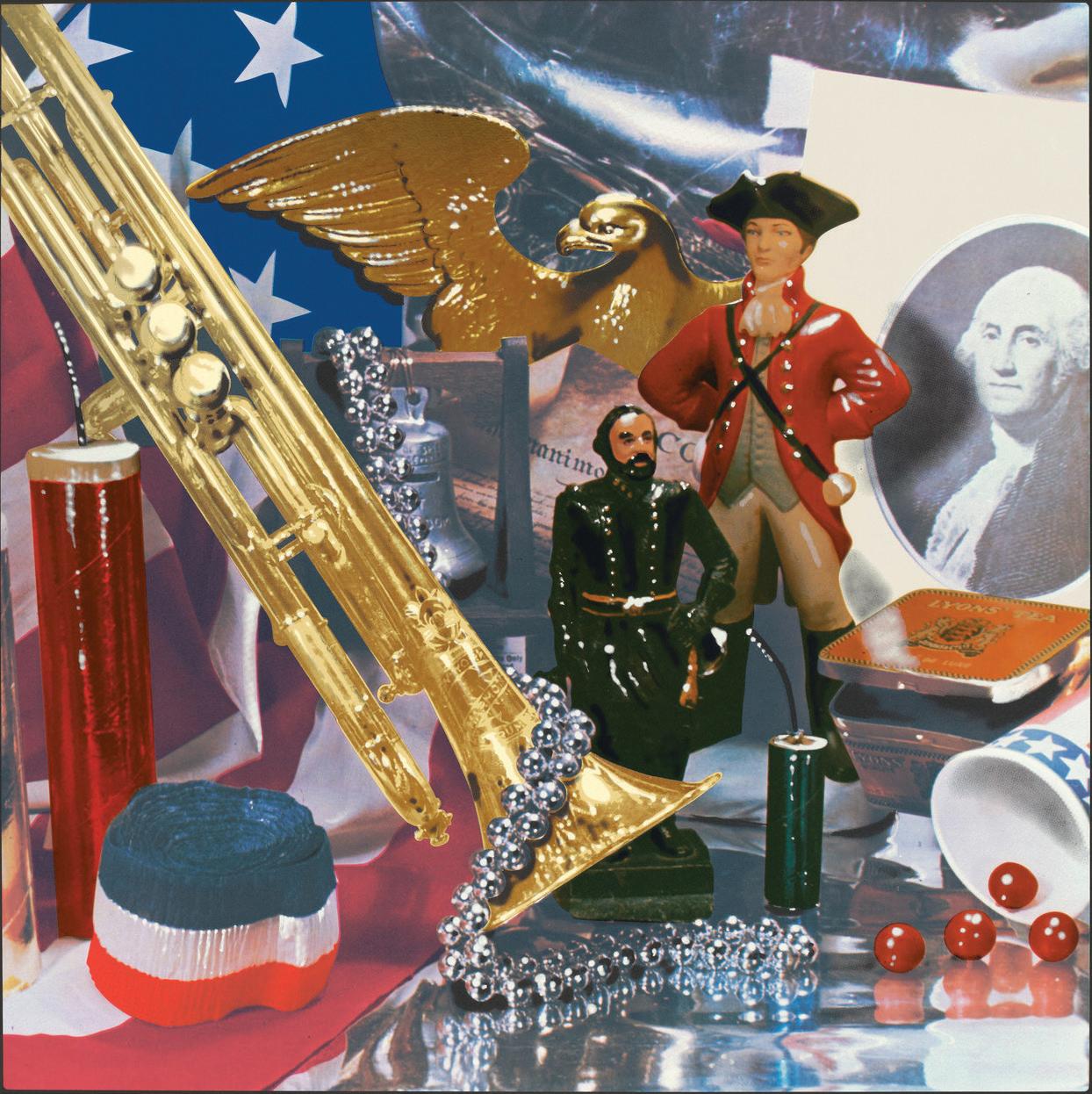
19. Audrey Flack (American, 1931-2024)
Fourth of July Still Life, from the Kent Bicentennial
Portfolio: Spirit of Independence, 1975
16-color screenprint with stencil, die-cutting, and lamination
Printed by Lorillard Co., published by Styria Studio
40 x 40 inches
Edition: 125, plus 10 artist’s proofs
Fairfield University Art Museum, Gift of Audrey Flack, 2023, 2023.29.01
20. Ming Smith (American, born 1947)
America Seen Through Stars and Stripes (New York), 1976
Archival pigment print
40 x 60 inches
Edition: 5, 1 artist’s proof
© Ming Smith. Courtesy of the artist and Nicola Vassell Gallery
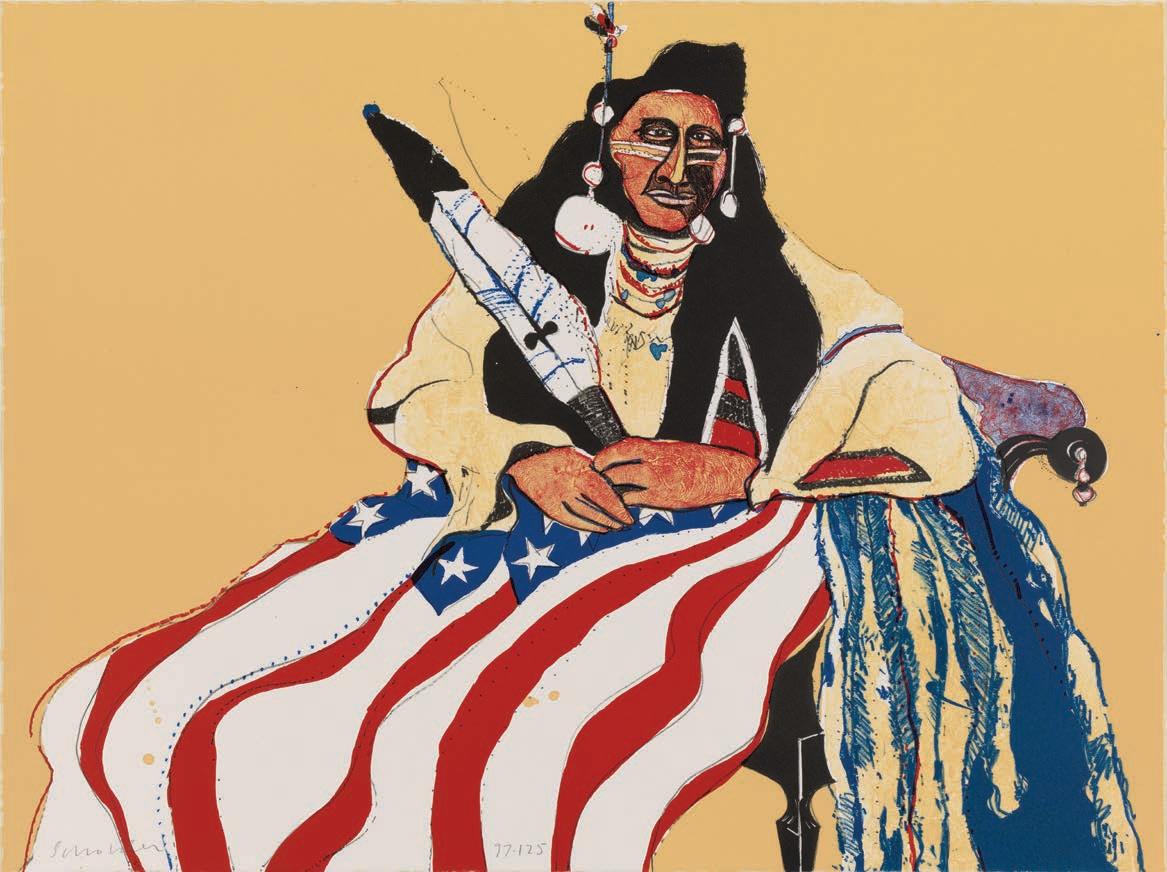
21. Fritz Scholder (Luiseño and American, 1937-2005)
Bicentennial Indian, from the Kent Bicentennial Portfolio: Spirit of Independence, 1974
Color lithograph
22 ¼ × 29 ¾ inches
Printed by Lorillard Co., published by Styria Studio
Edition: 125
Yale University Art Gallery, Gift of the Lorillard Company
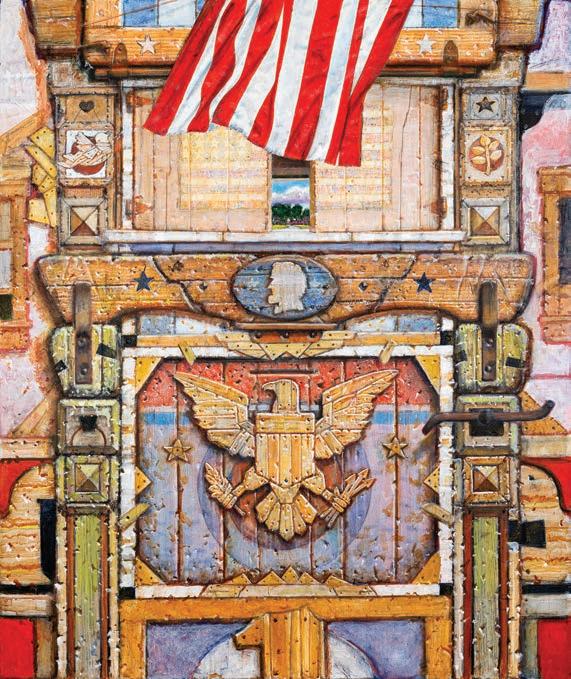
22. Fred Otnes (American, 1925-2015)
America: A Nostalgic View, 1975
Mixed media on wood
31 x 32 inches
Fairfield University Art Museum, Gift of the Robert K. Otnes Trust, in Memory of Fred Otnes, 2021, 2021.07.127
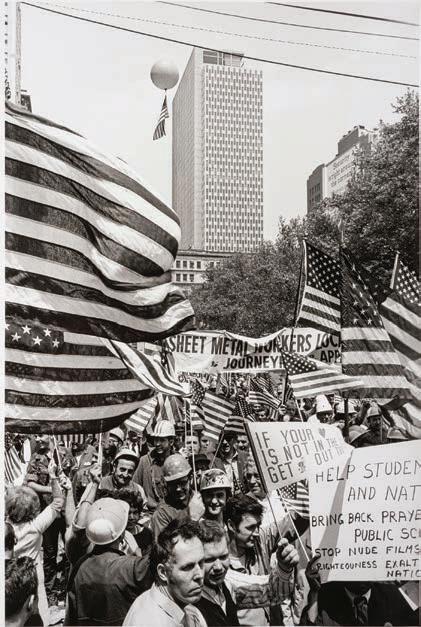
23. Leonard Freed (American, 1929-2006)
Support America’s Policy in Vietnam. Hard Hat Rally in Downtown Manhattan, 1970
Gelatin silver print
9 7/8 x 7 7/8 inches
Fairfield University Art Museum, Gift of anonymous benefactors, 2025, 2025.35.80
24. L arry Fink (American, 1941-2023)
Vietnam Demonstrations, photographed April 1967, printed 2019
Archival pigment print
12 7/8 x 19 1/16 inches
Art Properties, Avery Architectural & Fine Arts Library, Columbia University in the City of New York, Gift of Ron Sadi
25. William N. Copley (American, 1919-1996)
Untitled (Think/flag), part of the series Artists and Writers Protest Against the War in Viet Nam, 1967
Screenprint
Printed by Chiron Press Inc., published by Artists and Writers Protest, Inc.
20 7/8 x 25 ¾ inches
Edition: 100
Courtesy of David Nolan Gallery
26. Artist unknown
Gather for Victory March: Marchers gather near the Capitol today for a demonstration calling for a military victory in Vietnam, Washington, D.C., October 3, 1970, 1970
Associated Press wire photo
9 ¾ x 6 inches
Private Collection, New York
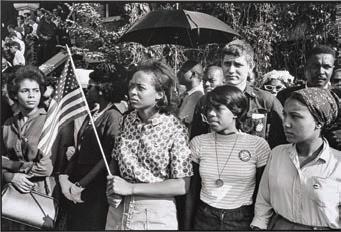
27. Danny Lyon (American, born 1942)
SNCC workers stand outside the funeral: Emma Bell, Dorie Ladner, Dona Richards, Sam Shirah, and Doris Derby, Birmingham, 1963
Gelatin silver print, printed later 11 x 14 inches
Private Collection, New York
28. Adger Cowans (American, born 1936)
Mississippi, 1963
Gelatin silver print
14 x 11 inches
Courtesy of the artist
29. Leonard Freed (American, 1929-2006)
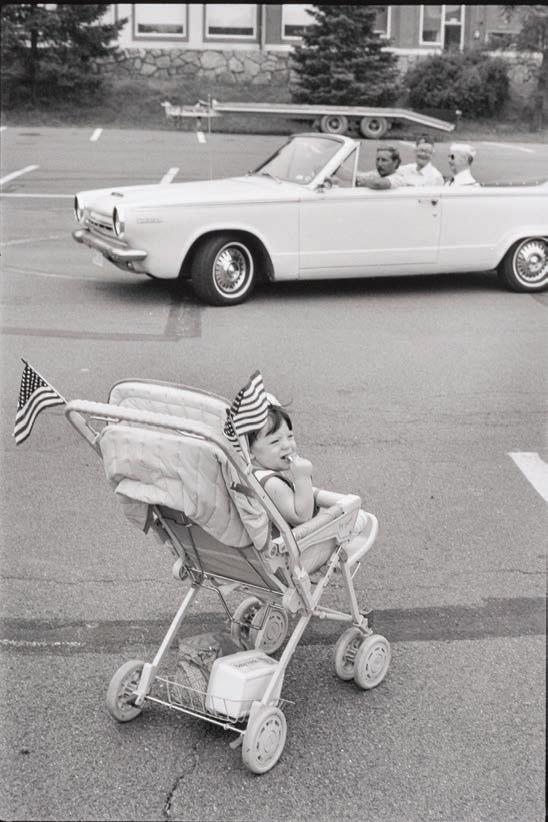
A baby sits in a stroller adorned with American flags, 1989
Gelatin silver print
9 ¼ x 6 inches
Private Collection, New York
30. Leonard Freed (American, 1929-2006)
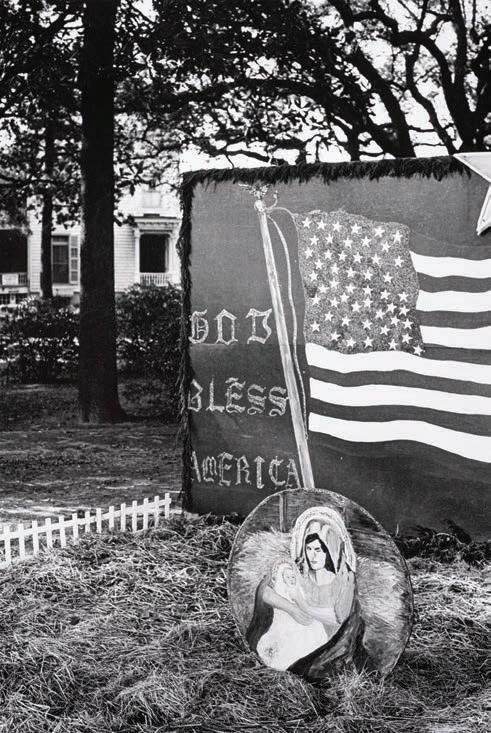
God Bless America—sign in private garden in South Carolina, 1964
Gelatin silver print
8 ¼ x 5 ½ inches
Fairfield University Art Museum, Gift of anonymous benefactors, 2025, 2025.35.95
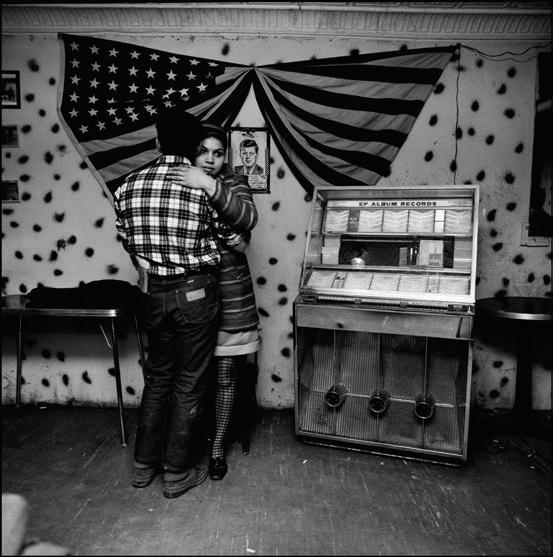
31. B ruce Davidson (American, born 1933)
Untitled, from the series East 100th Street, photographed 1966-68, printed 2014
Archival pigment print
15 x 15 inches
Art Properties, Avery Architectural & Fine Arts Library, Columbia University in the City of New York, Gift of Hugh and Sandra Lawson
32. Leonard Freed (American, 1929-2006)
Drug dealers advertising acid for $1 at the Powder Ridge Rock Festival, Connecticut, 1970
Gelatin silver print
6 ¼ x 9 ½ inches
Private Collection, New York
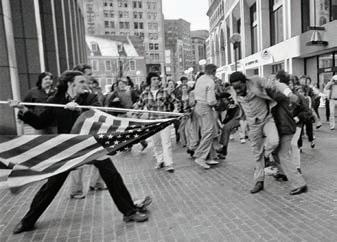
33. Stanley Joseph Forman (American, born 1945)
The Soiling of Old Glory, photographed 1976, printed in 1982
Gelatin silver print
11 x 14 inches
Fairfield University Art Museum, Museum purchase, 2024, 2024.32.01
34. Leandro Joo (Cuban, born 1957)
Y lo que nos une sellama estrella Selladora, 1998
( And what unites us is called Star Sealing Machine)
Gelatin silver print
10 ½ x 7 inches
Courtesy of Benjamin Ortiz and Victor Torchia, Jr.
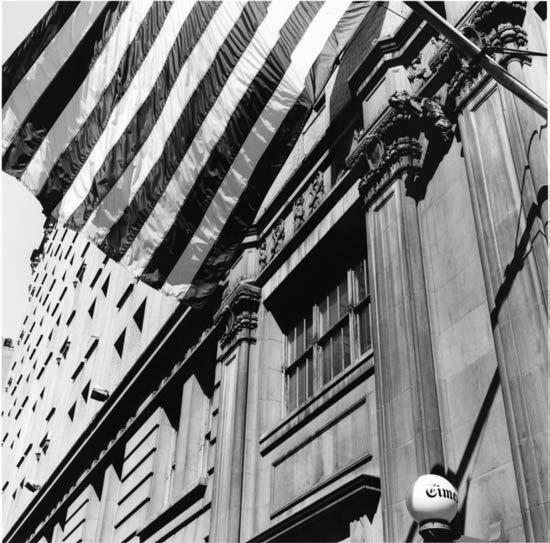
35. Philip Trager (American, born 1935)
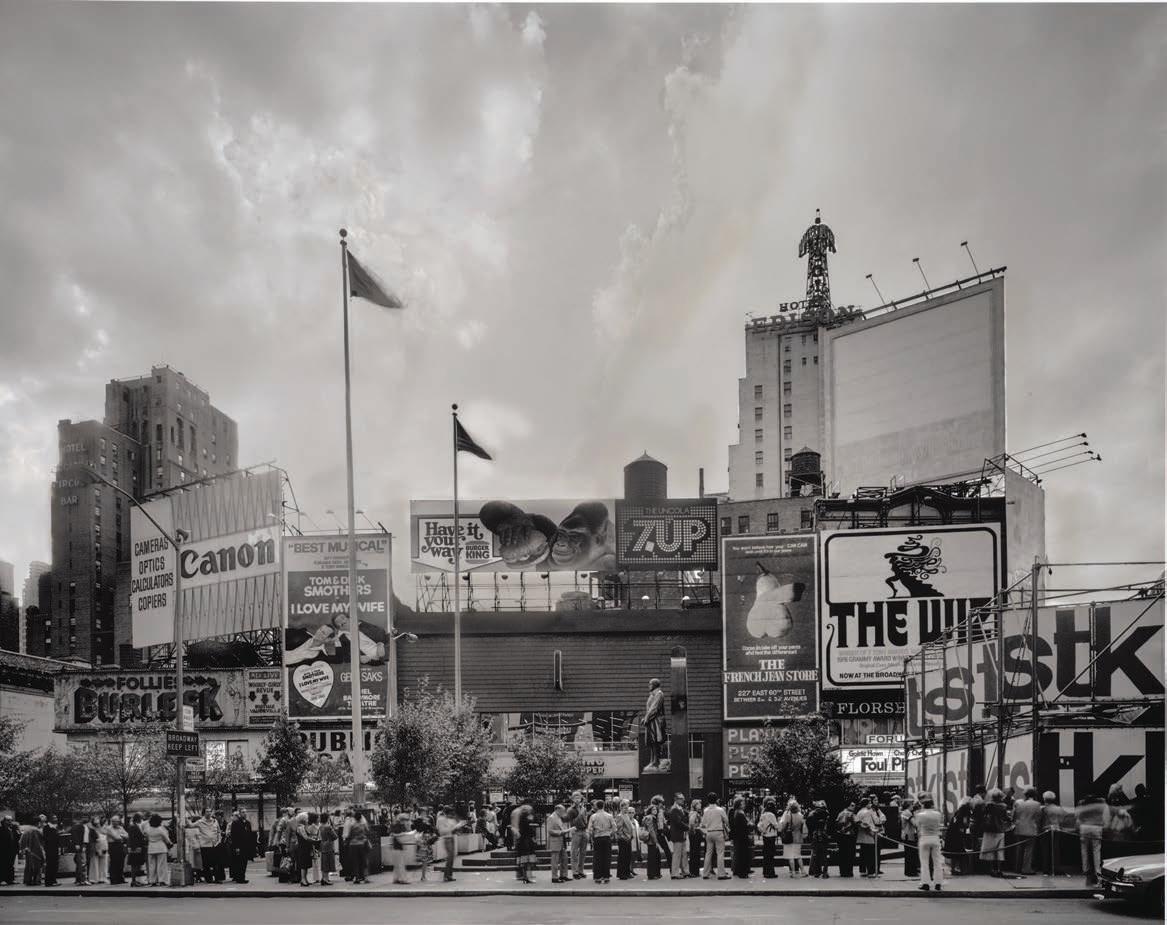
Times Square at Duffy Square, from 7th Avenue between West Forty-sixth and West Forty-seventh, 1977-1979
Archival pigment print
29 7/8 x 37 ¾ inches
Fairfield University Art Museum, 2024, Gift of Philip and Ina Trager, 2024, 2024.28.03
36. Robert Longo (American, born 1953)
Black Flag, 1990
Lithograph in black ink on wove paper
Published by Bill Bradley for U.S. Senate
22 3/8 x 30 inches
Edition: 50, plus 14 artist’s proofs
Lent by Adam Reich and Clare Walker
37. Adger Cowans (American, born 1936)
South Ferry, Coenties Slip, ca. 1980
Gelatin silver print
16 x 20 inches
Courtesy of the artist
38. Robert Rauschenberg (American, 1925-2008)
Kennedy Campaign Print, 1994
Color offset lithograph
Printed and published by ULAE, West Islip, New York
28 ½ x 20 ½ inches
Edition: 100
Lent by Heather and David Joinnides
Cat. 31
Cat. 29
Cat. 30
Cat. 32
39. David Hammons (American, born 1943)
African American Flag, 1990
Dyed cotton
96 × 60 inches
Courtesy of the New School Art Collection
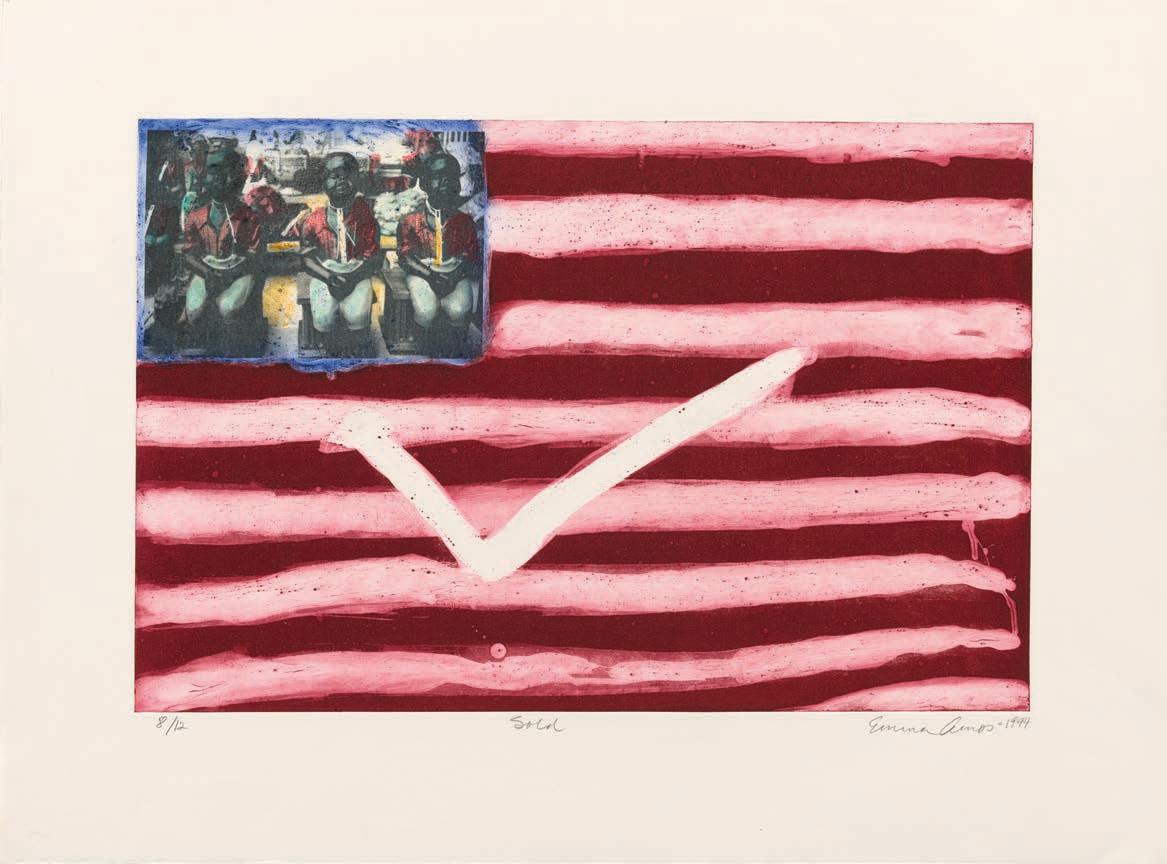
40. Emma Amos (American, 1937-2020)
Sold, 1994
Color silk aquatint with photo transfer
K. Caraccio Studio, printer and publisher
15 x 22 13/16 inches
Edition: 12
Yale University Art Gallery, Gift of Jean and Robert E. Steele, M.P.H. 1971, M.S. 1974, Ph.D. 1975
41. Danielle Scott (American, born 1978)
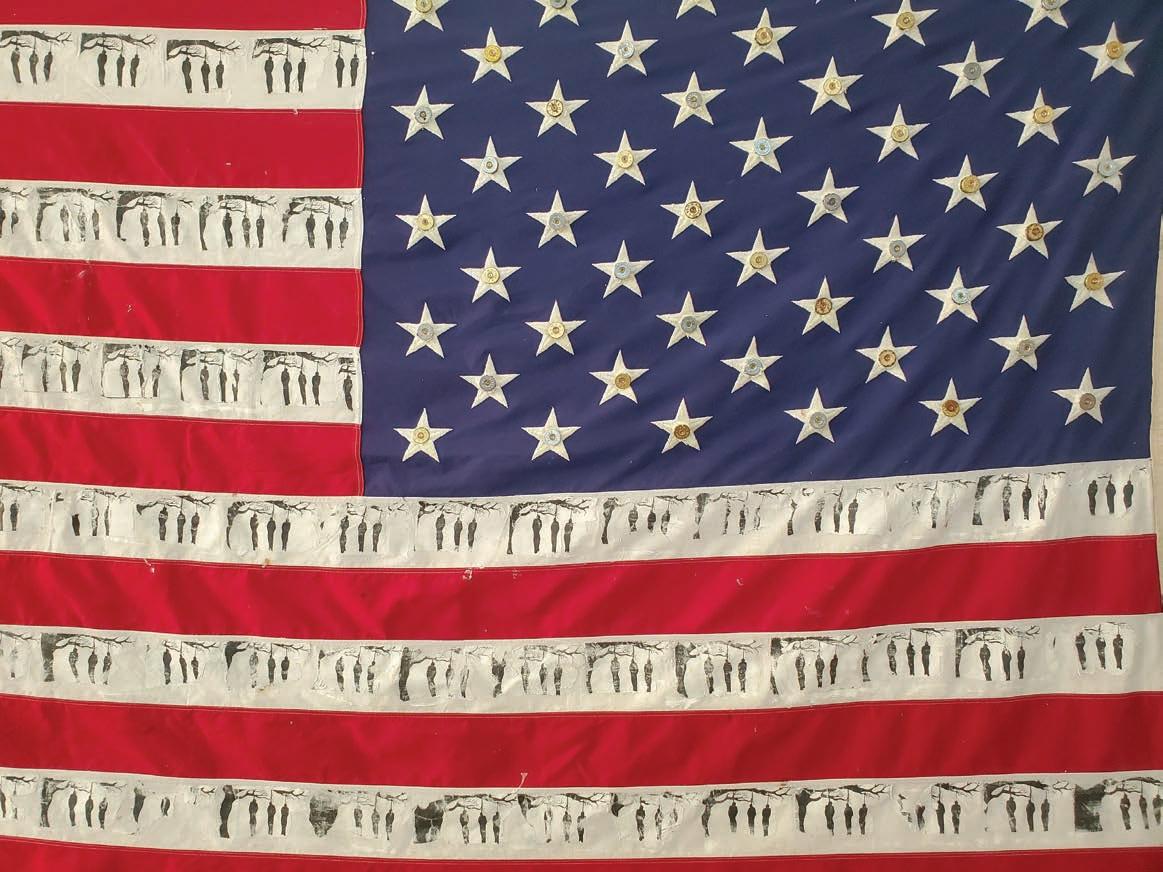
False Flag, 2020
Photo transfer and found objects (shotgun shells) on U.S. flag
48 x 96 inches
Courtesy of the artist
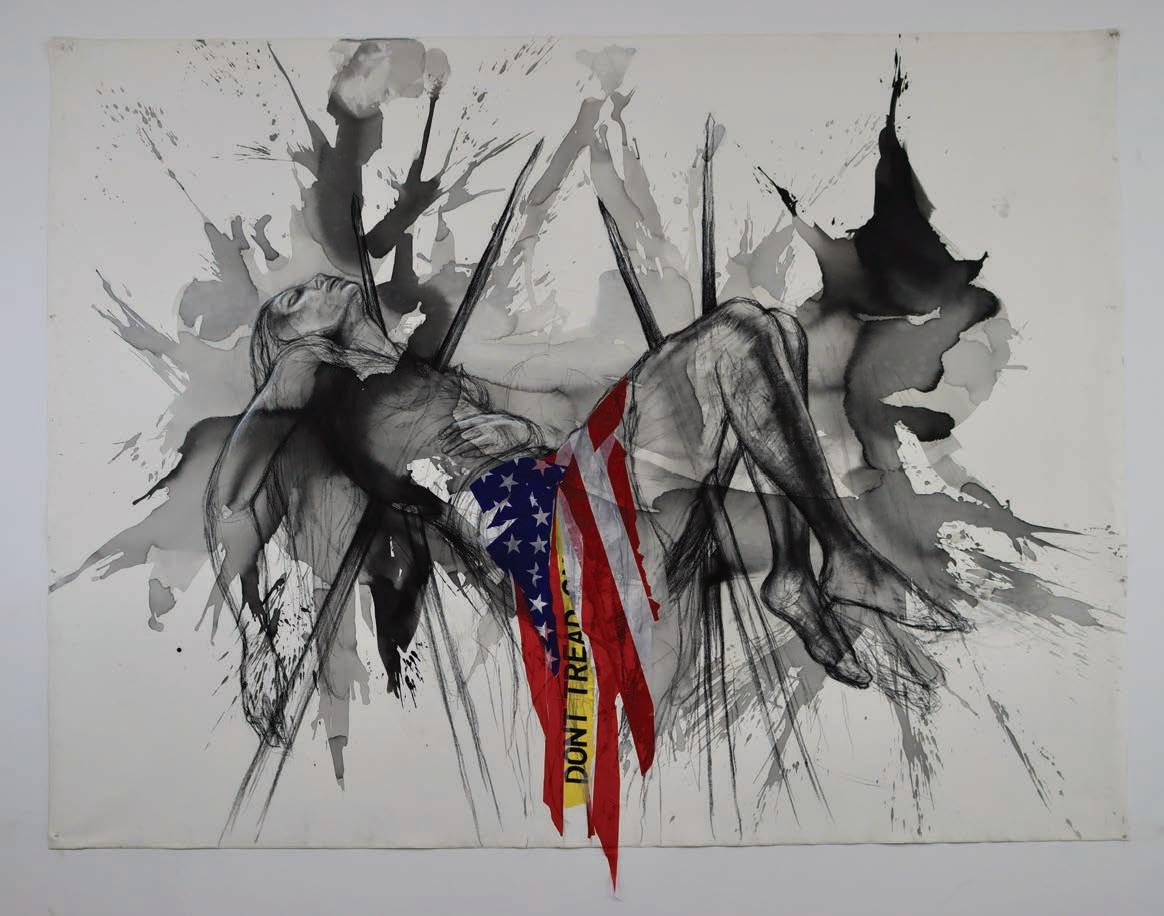
42. Imo Nse Imeh (American, born Nigeria, 1980)
and i’ll be there with you, 2021
Charcoal, India ink, and conte crayon on unstretched canvas
84 x 108 inches
Courtesy of the artist
43. Sara Rahbar (American, born Iran, 1976)
I don’t trust you anymore, Flag #59, 2019
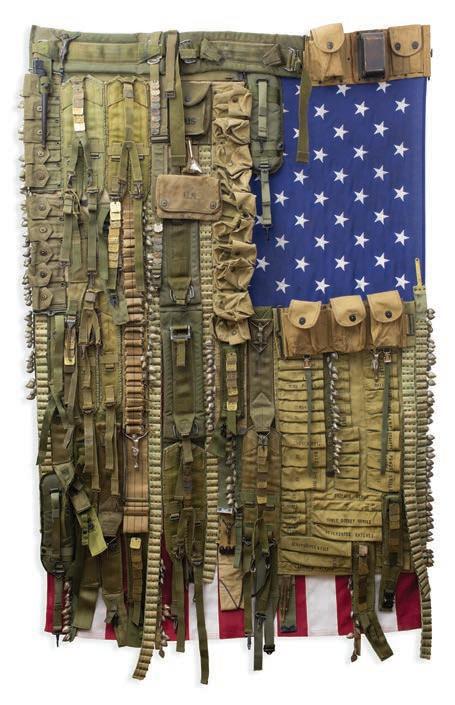
Mixed media, collected vintage objects, on vintage U.S. flag
78 x 48 inches
Courtesy of Sara Rahbar
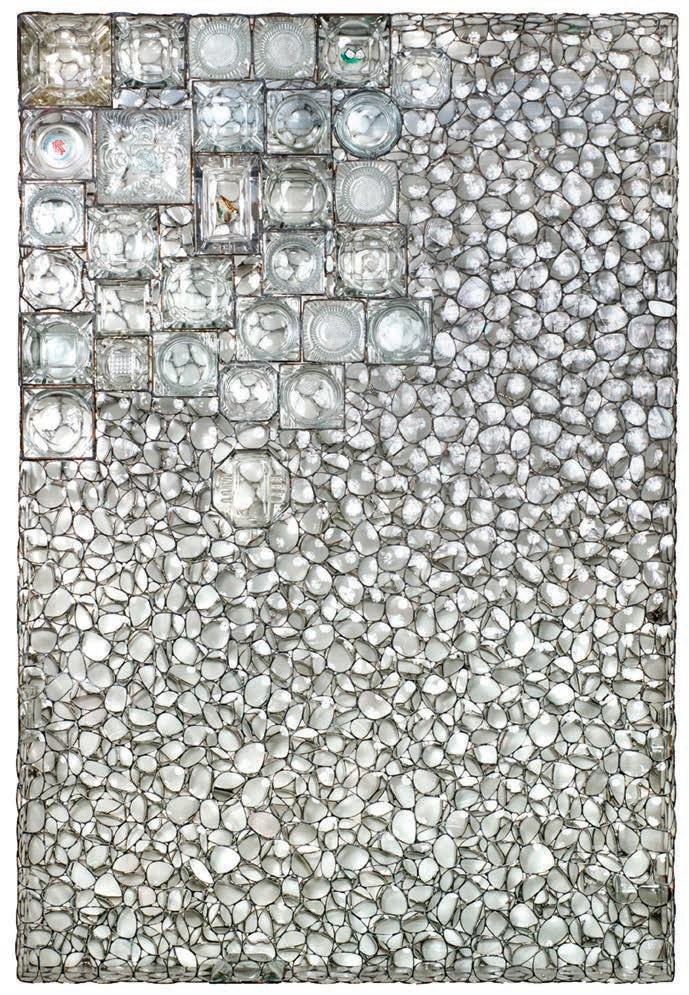
44. Richard Klein (American, born 1955)
Transparency, 2007
Eyeglasses, ashtrays, glass jars, brass
62 x 42 ½ x 5 ½ inches
Courtesy of the Connecticut Artists Collection, Connecticut Office of the Arts
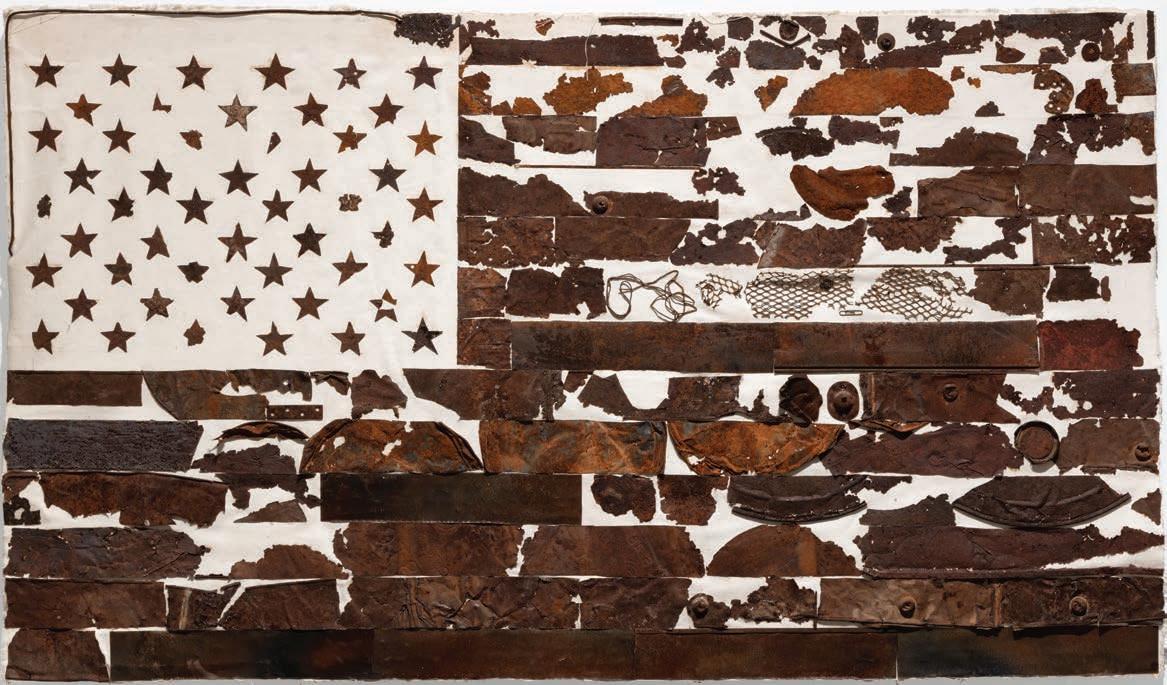
45. June Clark (Canadian, born USA, 1941)
Dirge, 2003-2004
Oxidized metal on canvas
36 x 51 ¼ inches
Collection Art Gallery of Ontario, Toronto. Purchase, with funds by exchange, and funds from Joyce and Fred Zemans, 2021
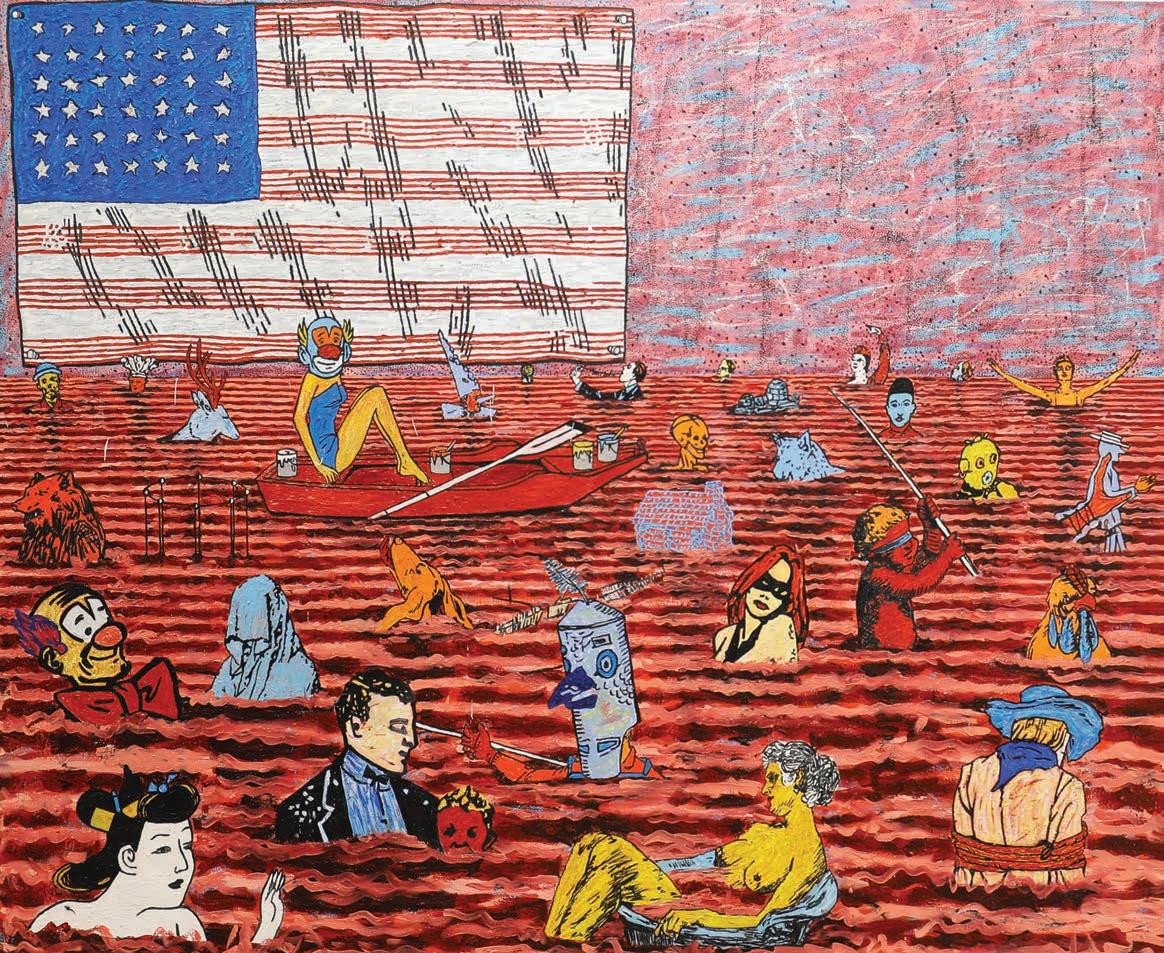
46. Rosson Crow (American, born 1982)
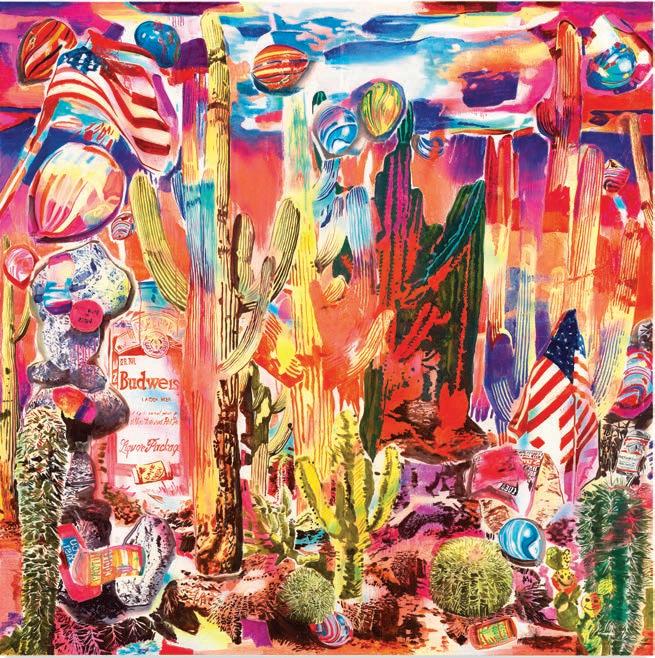
Fragility (Pax Americana), 2023
Acrylic, spray paint, photo transfer, and oil on canvas
67 x 67 inches
Courtesy of the artist and Miles McEnery Gallery
47. Eric Fischl (American, born 1948)
You Don’t Need a Weatherman…, 2022
Acrylic on linen
75 x 65 inches
Courtesy of the artist and Skarstedt Gallery
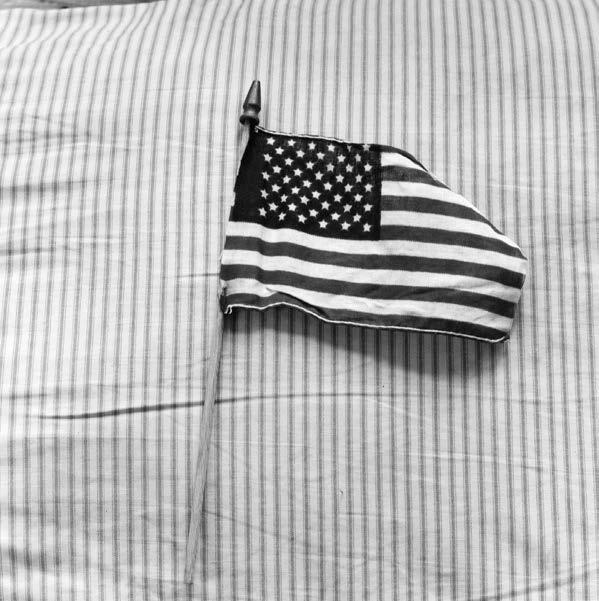
48. Jeannette Montgomery Barron (American, born 1956)
Flag #1, July 2000, CT, 2000
Gelatin silver print
11 x 14 inches
Edition: 8/25
Courtesy of the artist, and James Barron Fine Art
49. Skylar Fein (American, born 1968)
White Flag for Franklin Rosemont (small), 2019
Acrylic on plaster and wood, ink and encaustic 11 x 18 inches
Courtesy of Ferrara Showman Gallery, New Orleans
50. Marina Kamena (French, born Yugoslavia, 1945)
We the People, 2023
Acrylic on canvas mounted on aluminum stretchers, encased in wood crate
72 ¼ x 68 ¼ x 12 inches
Courtesy of the artist
51. Liu Zhong (Chinese, born 1969)
Ting Fēng (Listening to the Wind), 2014
Ink on paper
53 9/16 x 26 ¾ inches
Fairfield University Art Museum,
Gift of Steven C. Rockefeller, Jr. ’85 and Kimberly Rockefeller ’85, 2024, 2024.33.01
52. Katharine Kuharic (American, born 1962)
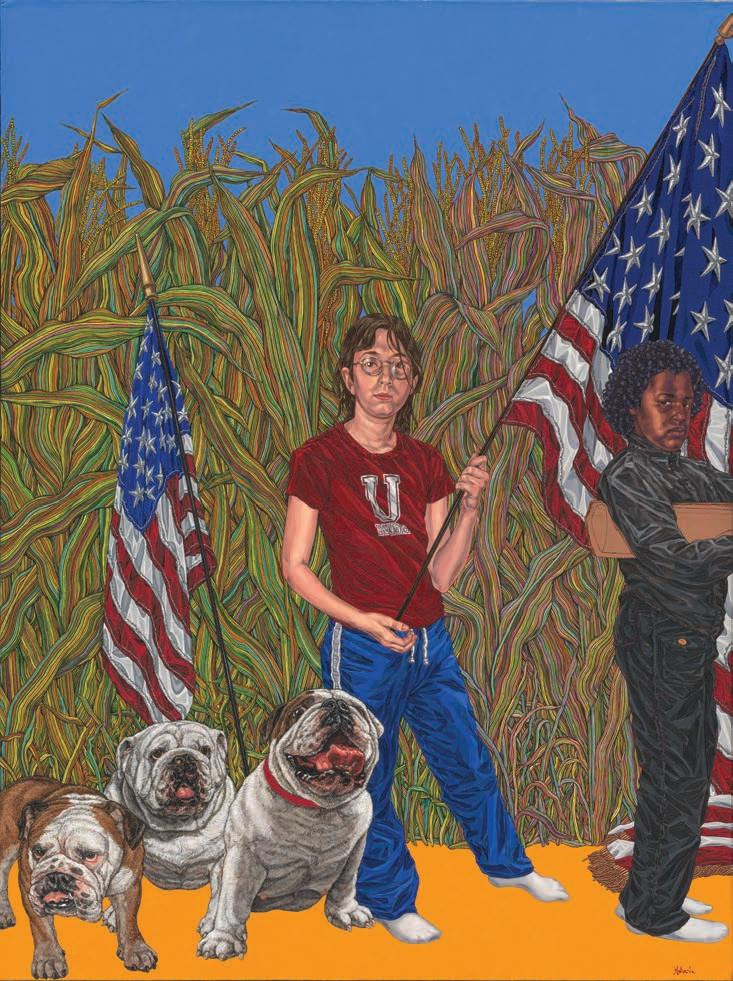
Girl’s Army – the bitches, 2003
Oil on linen
60 x 40 inches
Courtesy of the artist and P.P.O.W., New York
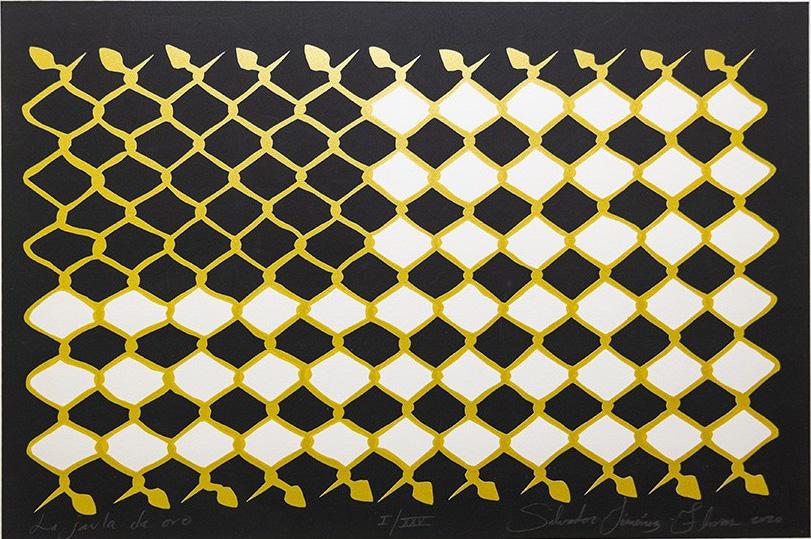
53. Salvador Jiménez-Flores
(American, born Mexico, 1985)
La Jaula de Oro (The Golden Cage), 2020
Color screenprint
12 x 18 inches
Edition: 25
Mattatuck Museum, Waterbury, Connecticut, Museum Purchase, Acquisitions Fund, 2022, 2022.31.1
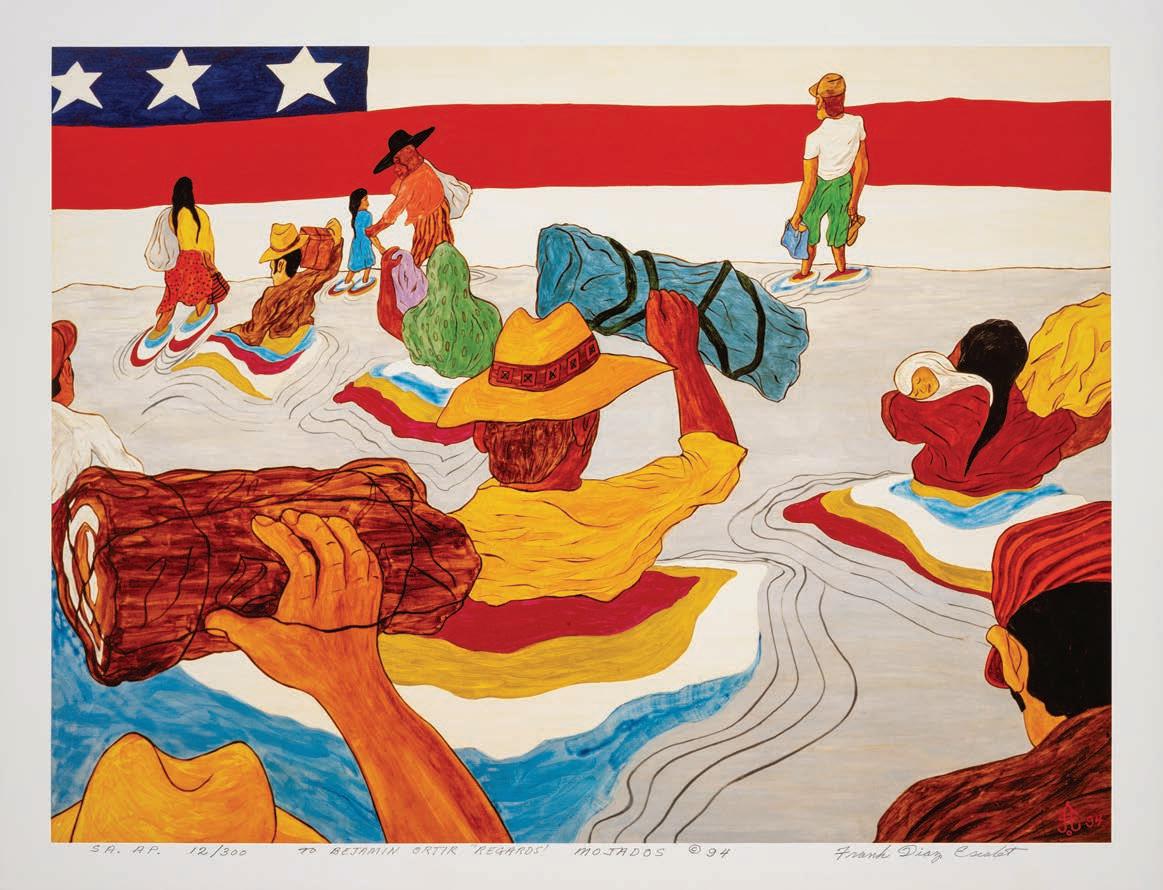
54. Frank Diaz Escalet (Puerto Rican, 1930-2012)
Mojados, 1994
Color offset print
18 x 24 inches
Edition: 300, plus artist’s proofs
Fairfield University Art Museum, Gift of Ben Ortiz and Victor Torchia, Jr., 2024, 2024.34.03
55. James Prosek (American, born 1975)
Invisible Boundaries, 2021
Acrylic on panel
22 7/8 x 36 inches
Courtesy of the artist and Waqas Wajahat, New York
56. Jeremy Dean (American, born 1977)
Executive Order 13769, USA, 2018
From the Rended series
Flag threads, 3,000 needles
24 x 27 x 5 inches
Lent by Gabrielle Selz
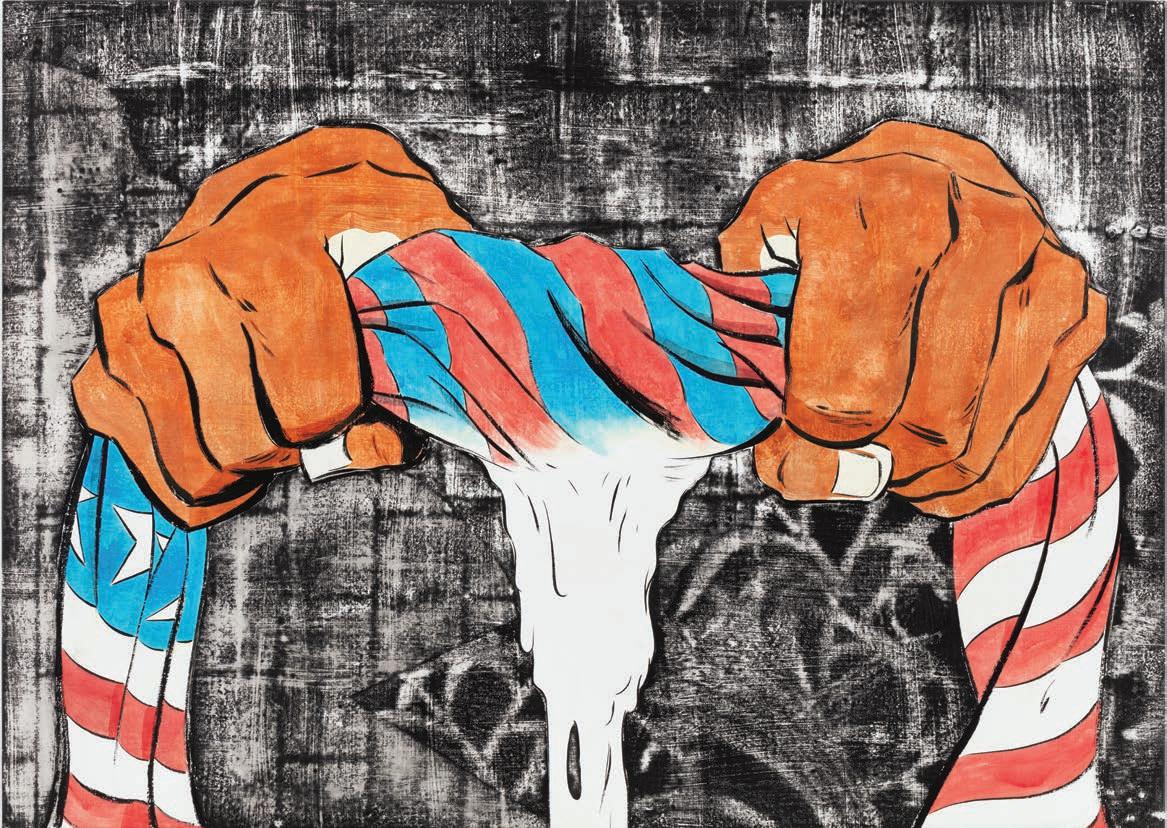
57. Mark Thomas Gibson (American, born 1980)
The Wringer, 2021
Ink on canvas
45 ½ x 64 inches
The Collection of Michael Citrone
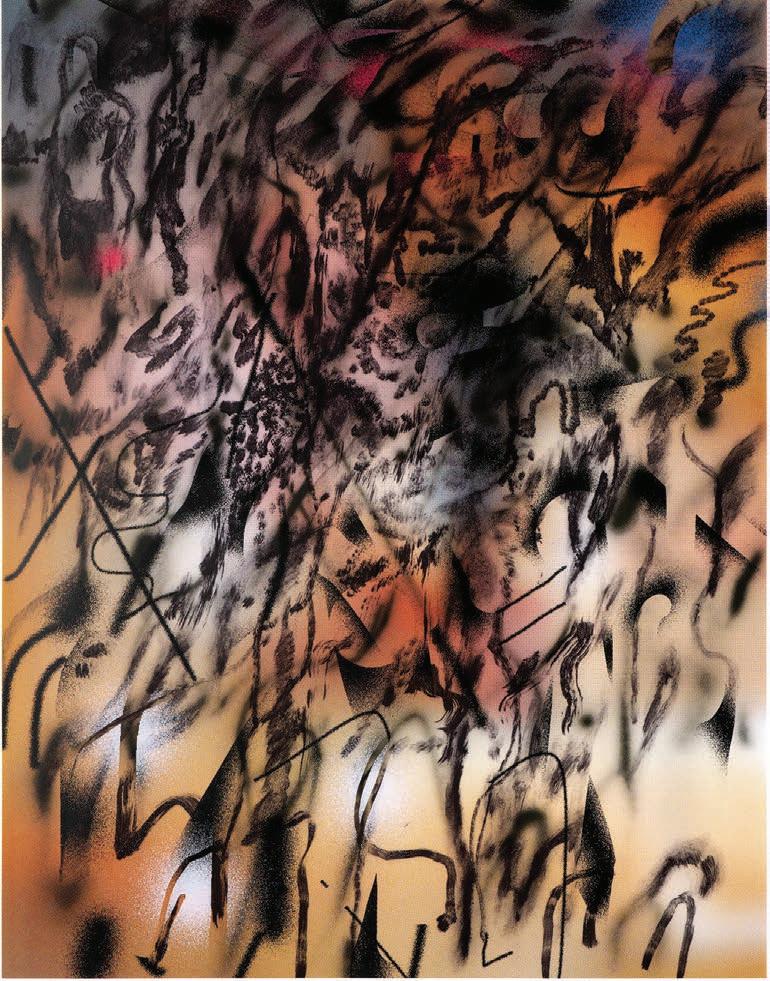
58. Ju lie Mehretu (American, born 1970)
Corner of Lake and Minnehaha, 2022
17-run color screenprint on white Coventry Rag paper
Co-published by Highpoint Editions and the Walker Art Center
47 x 37 inches
Edition: 45
© 2022 Julie Mehretu, courtesy of the artist, Highpoint Editions, and the Walker Art Center
59. Tim Ferguson Sauder (American, born 1972)
Return Design Lab, Olin College
American Flag 5, 2019 [Nature, VT + Honorary Heather Heyer Way, Charlottesville, VA],
Plywood with gathered marks, fixative
25 ½ x 37 ½ inches
Courtesy of the artist
60. D read Scott (American, born 1965)
Emancipation Proclamation, 2020
Pigment print
20 x 16 3/8 inches
Edition: 2/4, with 1 artist’s proof
Courtesy of the artist and Cristin Tierney Gallery
61. G lenn Ligon (American, born 1960)
Untitled, 2002-2024
Digital pigment print on Canson Platine paper
16 1/8 x 24 ¼ inches
Edition of 7 and 3 APs
Courtesy of the artist
62. Shepard Fairey (American, born 1970)
American Rage, 2020
Offset lithograph on Speckletone paper
36 x 24 inches
Fairfield University Art Museum, Museum Purchase, 2023, 2023.03.01
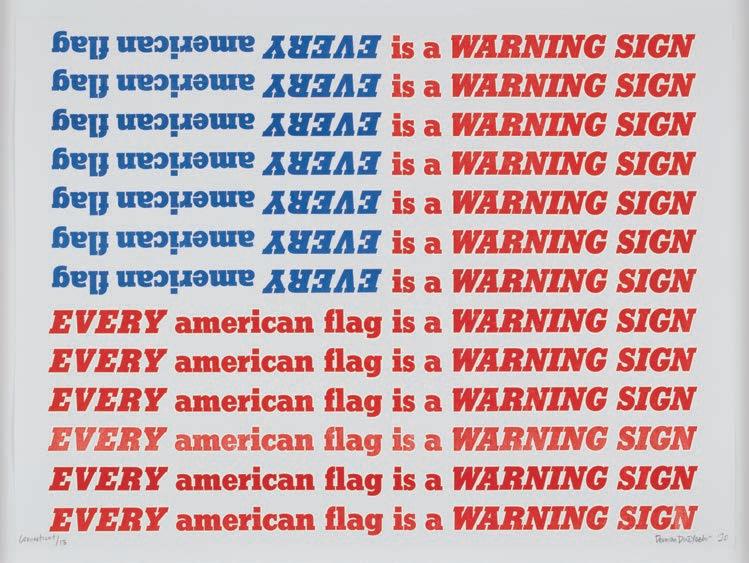
63. Demian DinéYazhi’ (Diné, born 1983)
My Ancestors Will Not Let Me Forget This, 2020
Letterpress print
18 x 24 inches
Forge Project Collection, traditional lands of the Moh-He-Con-Nuck
64. Stephanie Syjuco (American, born Philippines, 1974)
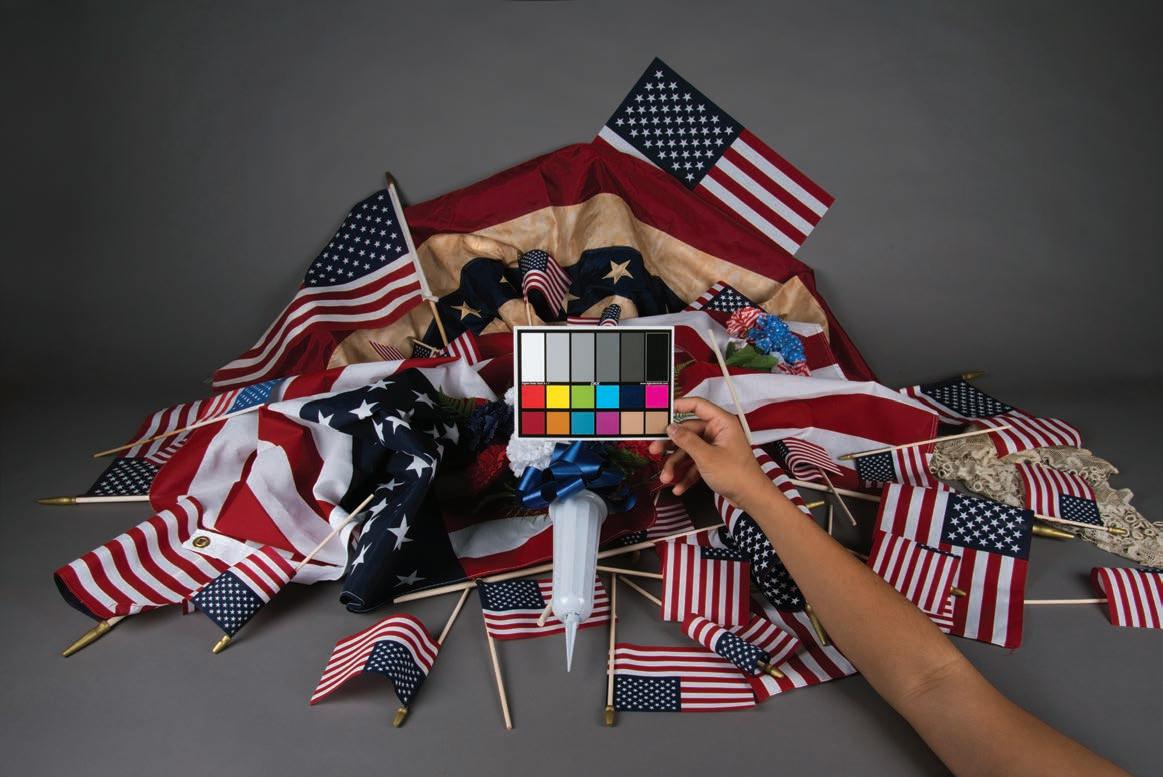
Color Checker (Pileup), 2019
Archival pigment print
26 ½ x 40 inches
Edition: 8
© Stephanie Syjuco. Courtesy of the artist; Catharine Clark Gallery, CA; and RYAN LEE Gallery, New York.
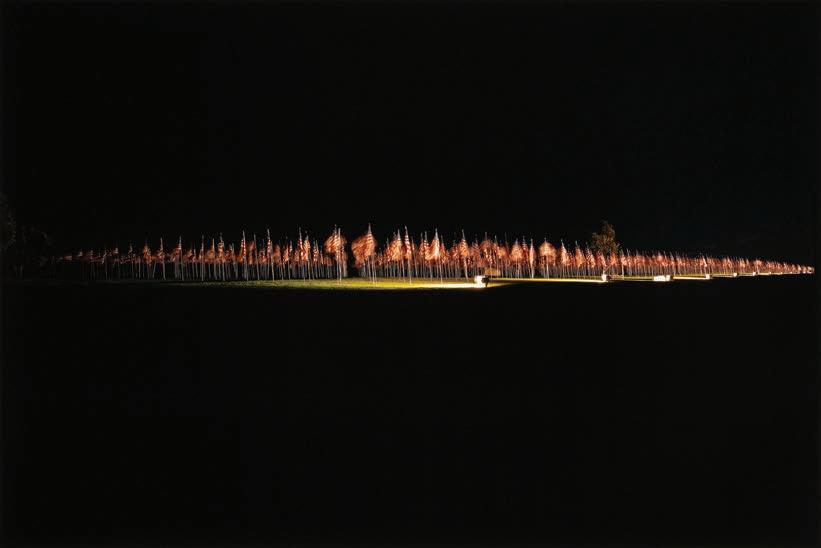
65. Robert von Sternberg (American, born 1939)
9/11 Flags, Pepperdine University, Malibu, California, 2012
Archival inkjet print
11 x 16 ½ inches
Fairfield University Art Museum, Gift of the artist, 2025, 2025.09.04
66. James Prez (American, born 1953)
Twin Towers: Everyday’s A Bonus, September 15, 2001
Acrylic on wood panel
9 ¼ x 10 1/8 inches
Mattatuck Museum, Waterbury, Connecticut, Gift of Benjamin Ortiz and Victor Torchia, Jr., 2023, 2024.9.2
67. Nathan Lyons (American, 1930-2016)
Untitled [2 flags over God Bless America poster], from the series After 9/11, 2001
Gelatin silver print
4 ½ x 6 ¾ inches
Yale University Art Gallery, Purchased with the Leonard C. Hanna, Jr., Class of 1913, Fund and gifts from Arthur Fleischer, Jr., B.A. 1953, LL.B. 1958 and Betsy Karel
68. Kristin Capp (American, born 1964)
West 43 rd Street, New York, 1998
Gelatin silver print
16 x 20 inches
Edition: 2/25
Fairfield University Art Museum, Gift of the artist, 2025, 2025.42.01
69. Morton Kaish (American, 1927-2025)
Stars and Stripes, 1996 (completed 2021)
Acrylic on linen
78 x 66 inches
Collection of the Kaish Family Art Project
70. H ank Willis Thomas (American, born 1976)
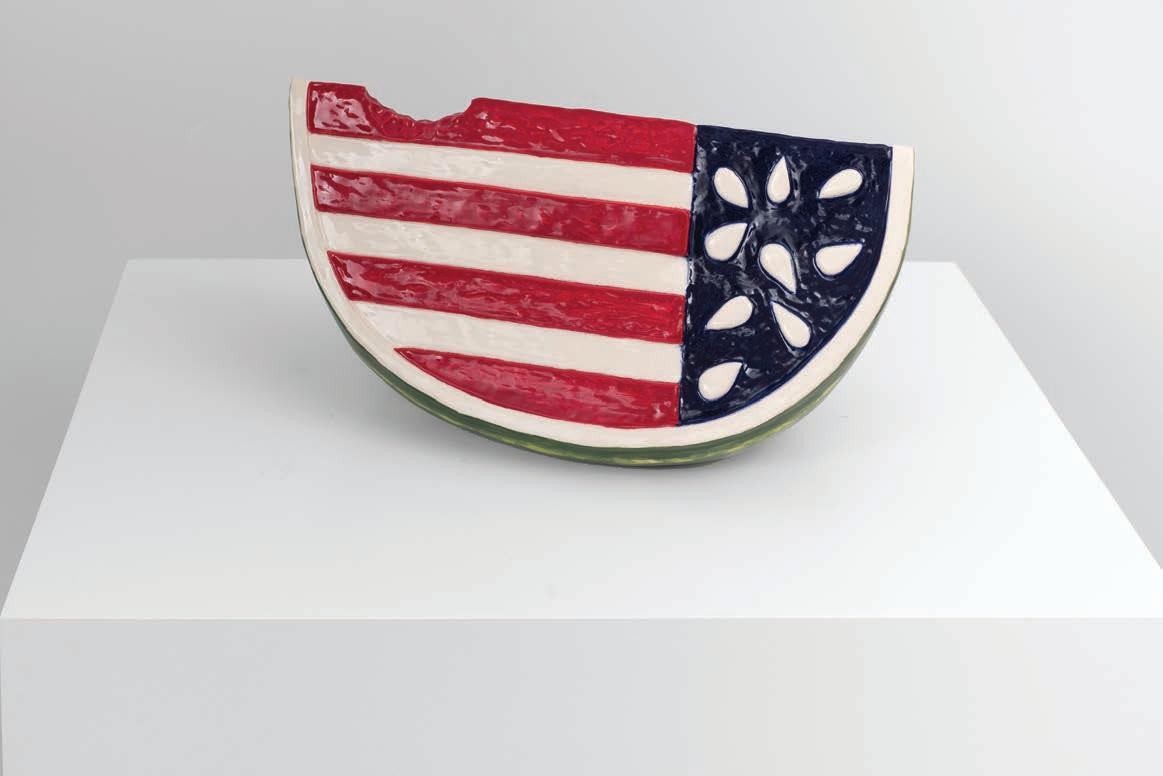
This Ain’t America, You Can’t Fool Me, 2020
Hand-glazed porcelain
9 x 15 x 6 inches
Edition: 5/5, with 2 artist’s proofs
© Hank Willis Thomas. Courtesy of the artist and Jack Shainman Gallery, New York
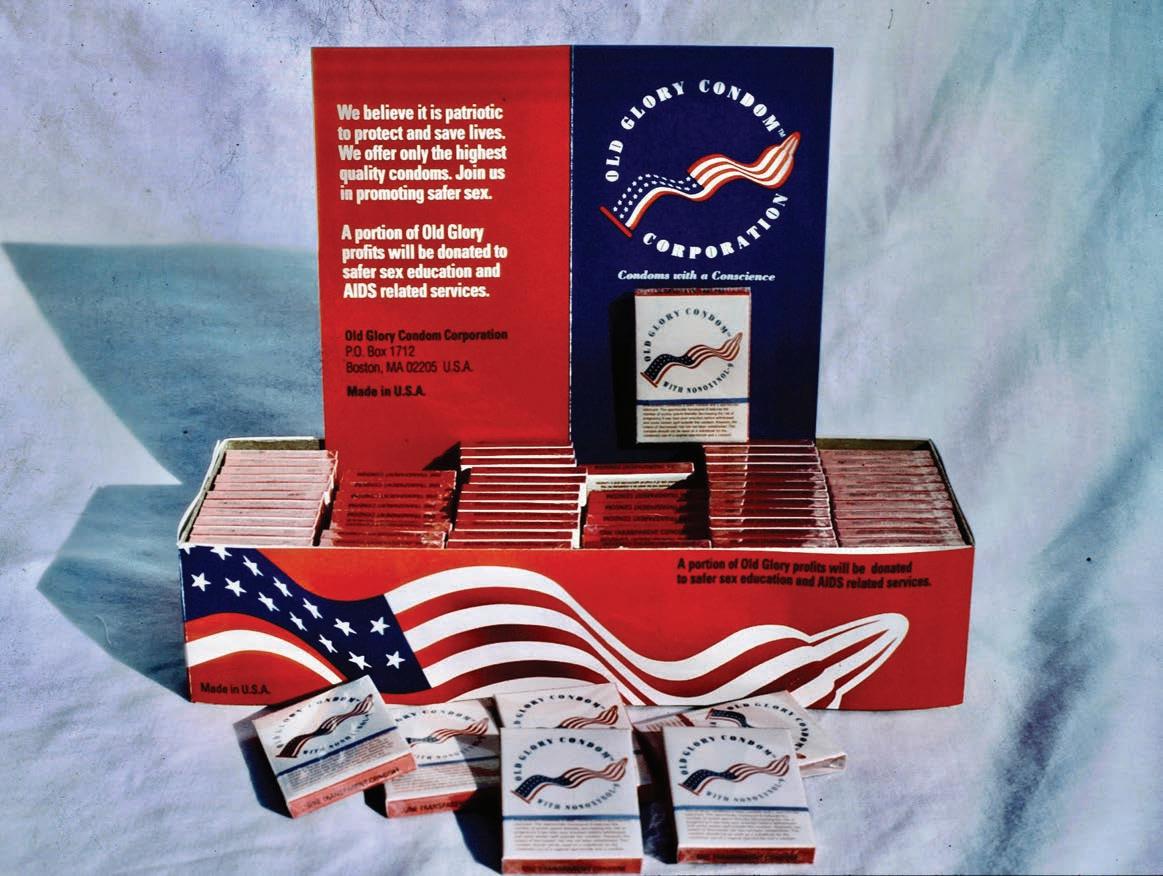
71. Jay Critchley (American, born 1947)
Old Glory Condom Corporation condom package display, 1990
Cardboard box with condom packages
8 x 9 ½ x 3 inches (box), 2 x 1 ½ x ¼ inches (each condom package)
Courtesy of the artist
72. Maria de Los Angeles (American, born Mexico, 1988)
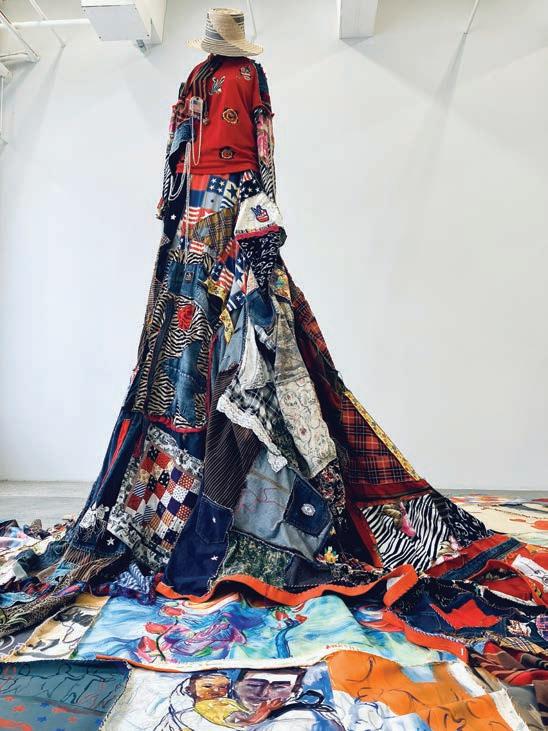
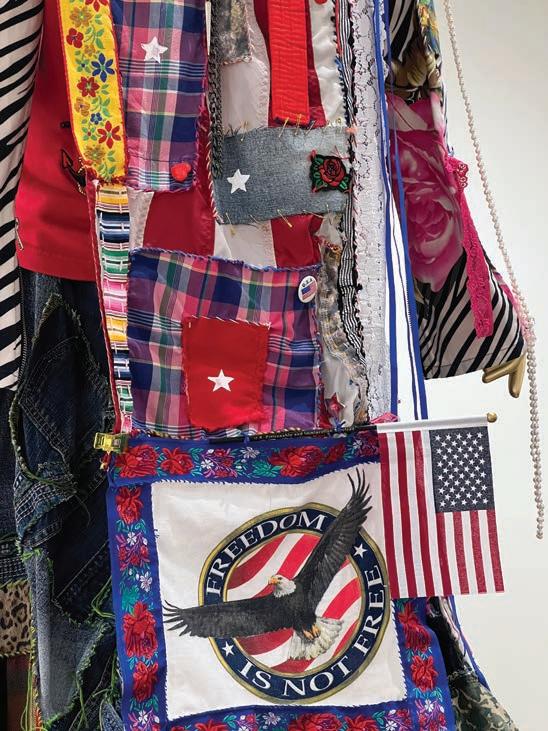
Freedom Is Not Free?, 2025-2026
Mixed media textile, painting, drawing, collage, American Flag, Mexican Flag, self-made flags, painting fragments
Contributions by workshop participants, embroidery by Marina Cisneros
Size variable
Courtesy of the artist
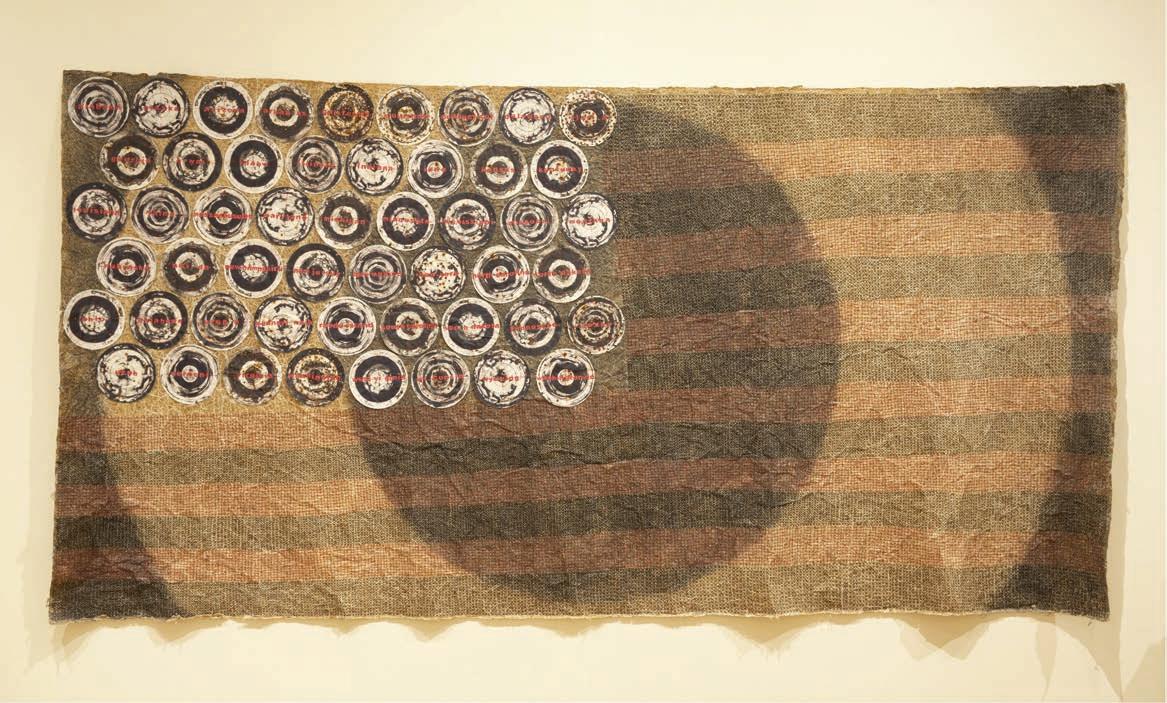
73. Deborah Nehmad (American, born 1952)
old glory?, 2017
Waxed handmade Nepalese paper, hand stitching, pigmented prints, pyrography, collage
58 x 116 inches
Courtesy of Deborah G. Nehmad
74. Joseph Smolinski (American, born 1975)
Thin Ice, 2020
Digital animation
6:30
Courtesy of the artist
Cat. 68
Cat. 69
Events listed below with a location are live, in-person programs. When possible, those events will also be streamed on Arts & Minds Live and the recordings posted to the Museum’s YouTube channel.
Register at: fuam.eventbrite.com
Thursday, January 22, 5:30 p.m.
Opening Night Lecture: For Which It Stands…
Aaron Q. Weinstein, PhD (Assistant Professor of Politics, Fairfield University, and Exhibition Faculty Liaison)
Regina A. Quick Center for the Arts, Kelley Theatre and streaming
Thursday, January 22, 6:30 p.m.
Opening Reception: For Which It Stands…
Bellarmine Hall, Great Hall and Bellarmine Hall Galleries (the Walsh Gallery will also be open for viewing)
Thursday, January 29, 7:30 p.m.
Short Film Screening and Panel Discussion:
Reclaim the Flag (2025), with filmmaker
Alexis Bittar, chaired by Sean Edgecomb, PhD (Associate Professor of Theatre and Women, Gender, and Sexuality Studies, Fairfield University Department of Visual & Performing Arts) with additional panelists Luchina Fisher (Visiting Assistant Professor of Film, Fairfield University Department of Visual & Performing Arts) and Shane Vogel, PhD (Professor of English and Black Studies, and Chair of Theater, Dance, and Performance Studies, Yale University)
Regina A. Quick Center for the Arts, Kelley Theatre (co-sponsored by FUAM)
Free; tickets required via QCA Box Office
Thursday, February 26, 5 p.m.
Lecture: American Art at the Crossroads: Between WPA
Realism and Post-War Abstraction
Viviana Bucarelli, PhD (Independent Scholar)
Bellarmine Hall, Diffley Board Room and streaming
Part of the Edwin L. Weisl, Jr. Lectureships in Art History, funded by the Robert Lehman Foundation
Thursday, March 19, 5:30 p.m.
Lecture: The Soiling of Old Glory: The Story of a Photograph That Shocked America
Louis P. Masur, PhD (Distinguished Professor of American Studies and History, Rutgers University)
Dolan School of Business Event Hall
Note: this event will not be livestreamed
Thursday, April 9, 6 p.m.
Art Speaks! Campus and community members are invited to share their own responses to the For Which It Stands… exhibition through works of poetry and short prose.
Regina A. Quick Center for the Arts, Walsh Gallery
Thursday, April 16, 5:30 p.m.
Lecture: Florine Stettheimer and Americana
Barbara Bloemink, PhD
Bellarmine Hall, Diffley Board Room and streaming
Part of the Edwin L. Weisl, Jr. Lectureships in Art History, funded by the Robert Lehman Foundation e x HI b I t I on P rogr A ms
Thursday, February 12, 5:30 p.m.
Lecture: Pictures and Progress: The Path of Black Liberation in American Photography
Sarah Churchill, PhD (Adjunct Faculty, Art History, Fairfield University Department of Visual & Performing Arts)
Regina A. Quick Center for the Arts, Wien Experimental Theatre and streaming
CURATOR’S TOURS
Limited to 25 participants; registration required
• Thursday, March 26, 5:30 p.m.: Bellarmine Hall Galleries
• Thursday, April 30, noon: Bellarmine Hall Galleries
• Thursday, April 30, 5:30 p.m.: Regina A. Quick Center for the Arts, Walsh Gallery
• Wednesday, May 27, noon: Regina A. Quick Center for the Arts, Walsh Gallery
• Thursday, June 18, 5:30 p.m.: Bellarmine Hall Galleries
GALLERY TALKS
Regina A. Quick Center for the Arts, Walsh Gallery
• Thursday, March 5, 5:30 p.m.: Sara Rahbar and Maria de Los Angeles
• Tuesday, April 14, noon: Richard Klein and James Prosek
• Thursday, April 23, 5:30 p.m.: Danielle Scott and Imo Nse Imeh
ART IN FOCUS
In-person, select Thursdays at noon and streaming at 1 p.m.
• February 12: Childe Hassam, Italian Day, May 1918, 1918, oil on canvas
• March 12: Jane Hammond, Untitled, 1993, oil on canvas with metal leaf
• April 9: Julie Mehretu, Corner of Lake and Minnehaha, 2022, color screenprint
• May 7: Rosson Crow, Fragility (Pax Americana), 2023, acrylic, spray paint, photo transfer, and oil on canvas
FAMILY DAYS
Select Saturdays, 12:30-2 p.m. and 2:30-4 p.m. (Space limited; registration required)
• Saturday, January 24: Stars, Stripes & Brushstrokes: American Impressionism Workshop
Bellarmine Hall, Museum Classroom
• Saturday, February 21: Red, White, and YOU!: A Comics Workshop
Regina A. Quick Center for the Arts, Lobby
• Saturday, March 28: Stitching Stories: Design Your Family Flag
Bellarmine Hall, Museum Classroom
• Saturday, April 25: Bits & Pieces, Stars & Stripes: Reimagined Flags from Recycled Finds
Regina A. Quick Center for the Arts, Lobby
fairfield.edu/museum/for-which-it-stands
P H otogr APHIC C red I ts
Pg. 3, cat. 45: © June Clark, courtesy of the artist and Daniel Faria Gallery. Photo: LF Documentation. 2020/137
Pg. 6, cat. 42: © Imo Nse Imeh
Pg. 8, cat. 65: © Robert von Sternberg
Pg. 9, cat. 1: Childe Hassam (1859-1935), Italian Day, May 1918, 1918, oil on canvas, 36 x 26 in. Art Bridges
Pg. 12, cat. 10: © Joe Rosenthal
Pg. 12, cat. 18: © 2012 Keith Mayerson
Pg. 13, cat. 23: © Leonard Freed / Magnum Photos
Pg. 14, cat. 60: Courtesy of the Artist and Cristin Tierney Gallery, New York
Pg. 14, cat. 24: Photograph © Larry Fink/MUUS Collection. Art Properties, Avery Architectural & Fine Arts Library, Columbia University in the City of New York, Gift of Ron Sadi
Pg. 15, cat. 43: © Sara Rahbar
Pg. 16, cat. 41: © Danielle Scott
Pg. 17, cat. 63: Forge Project Collection, traditional lands of the Moh-He-Con-Nuck
Pg. 18, cat. 6: Photograph by John Gutmann. © Center for Creative Photography, Arizona Board of Regents
Pg. 18, cat. 27: © Danny Lyon / Magnum Photos. www.bleakbeauty.com.
Instagram: @dannylyonphotos2
Pg. 18, cat. 33: © Stanley Forman
Pg. 19, cat. 55: © James Prosek
Pg. 20, cat. 72: © Maria de Los Angeles
Pg. 27, cat. 4: Ernest Lawson (1873-1939), Washington Bridge, New York City, c. 1915-1925. Oil on canvas. 25 1/4 x 30 1/4 in. (64.1 x 76.8 cm).
Delaware Art Museum, Gift of the Friends of Art, 1964
Pg. 28, cat. 3: N. C. Wyeth (1882-1945), The Victorious Allies, 1918. Oil on canvas. 45 1/4 × 34 1/4 in. (114.9 × 87 cm). Delaware Art Museum, Gift of the Bank of Delaware, 1989
Pg. 29, cat. 2: Art Properties, Avery Architectural & Fine Arts Library, Columbia University in the City of New York, Gift of the Estate of Ettie Stettheimer
Pg. 30, cat. 6: © Frelinghuysen Morris House & Studio, Lenox, Massachusetts. Yale University Art Gallery. Purchased with The Iola S. Haverstick Fund for American Art in honor of Professor Alexander Nemerov, Ph.D. 1992
Pg. 31, cat. 7: Courtesy of and copyright The Gordon Parks Foundation
Pg. 32, cat. 21: © Fritz Scholder. Courtesy the estate of the artist and
Garth Greenan Gallery, New York, New York. Yale University Art Gallery, Gift of the Lorillard Company
Pg. 33, cat. 19: © Audrey Flack Foundation
Pg. 34, cat. 21: © Bruce Davidson / Magnum Photos. Art Properties, Avery Architectural & Fine Arts Library, Columbia University in the City of New York, Gift of Hugh and Sandra Lawson
Pg. 34, cat. 29: © Leonard Freed / Magnum Photos
Pg. 35, cat. 30: © Leonard Freed / Magnum Photos
Pg. 35, cat. 32: © Leonard Freed / Magnum Photos
Pg. 39, cat. 46: Courtesy of the artist and Miles McEnery Gallery, New York, NY
Pg. 40, cat. 71: © Jay Critchley
Pg. 41, cat. 40: © 2025 Emma Amos / Licensed by VAGA at Artists Rights Society (ARS), NY, Yale University Art Gallery, Gift of Jean and Robert E. Steele, M.P.H. 1971, M.S. 1974, Ph.D. 1975
Pg. 42, cat. 54: © Frank Diaz Escalet
Pg. 43, cat. 53: © 2025 Salvador Jiménez-Flores. Collection of the Mattatuck Museum, Museum Purchase, Acquisitions Fund, 2022
Pg. 44, cat. 68: © Kristin Capp
Pg. 44, cat. 69: © 2026 Morton Kaish / Artists Rights Society (ARS), New York
Pg. 45, cat. 73: © Deborah G. Nehmad
Pg. 46, cat. 44: © Richard Klein
Pg. 47, cat. 52: © Katharine Kuharic. Courtesy of the artist and P.P.O.W., New York
Pg. 48, cat. 49: © Skylar Fein
Pg. 49, cat. 64: © Stephanie Syjuco. Courtesy of the artist; Catharine Clark Gallery, CA; and RYAN LEE Gallery, New York
Pg. 50, cat. 70: © Hank Willis Thomas. Courtesy of the artist and Jack Shainman Gallery, New York
Pg. 51, cat. 58: © Julie Mehretu. Image Courtesy of Highpoint Editions and Julie Mehretu
Pg. 55, cat. 17: © Jane Hammond. Courtesy Galerie Lelong
Pg. 58, cat. 48: © Jeannette Montgomery Barron
Pg. 59, cat. 57: © Mark Thomas Gibson. Photo Credit: M+B
Pg. 61, cat. 35: © Philip Trager
A C knoW ledgements
For Which It Stands… is the centerpiece of the Museum’s year-long programming focused on the commemoration of the U.S. Semiquincentennial. This exhibition is the product of great goodwill and generosity by many people.
The invaluable collaboration of numerous colleagues at Fairfield University is gratefully acknowledged: Christine Siegel, Provost; Richard Greenwald, Dean of the John Charles Meditz College of Arts & Sciences; and Geri Derbyshire, Senior Vice President for University Advancement, as well as museum staff members Michelle DiMarzo, Curator of Education and Academic Engagement; Megan Paqua, Registrar; Heather Coleman, Museum Assistant; and Elizabeth Vienneau, Museum Educator. Further acknowledgement is due to Marie-Laure Kugel, Edmund Ross, Jennifer Anderson, Susan Cipollaro, Kiersten Bjork, Jackie Bertolone, Katy Reed, Julie Peters, Alistair Highet, Tess Long, Charlie McMahon, Lisa Thornell, Keith Broderick, Lori Jones, Katie Lang, Russ Nagy, Dan Vasconez, and Robert Bove.
We especially thank Aaron Weinstein, faculty liaison to the exhibition and assistant professor of Politics, for his contribution of the essay in this catalogue entitled “American Canvas: The Flag, Art, and Contested Meaning in U.S. Politics,” and for his opening night lecture. The Museum is also grateful to Fairfield University President Mark R. Nemec and Henry Adams for their thoughtful essays.
The majority of the “traditional” wall labels were written by Emily Handlin, and we are grateful for her precision, promptness, and collegiality. Those wall labels are enriched by a variety of faculty and staff from across the University, who contributed additional wall labels, each contextualizing a particular artwork within the framework of their own disciplinary lens or personal experience. The Museum is so appreciative of the University community members who contributed their unique voices to this project: Gayle A. Alberda, Peter L. Bayers, Suzanne Chamlin, Joanna Chang, Sarah Churchill, Jennifer Cook, Ive E. Covaci, Erin S. Craw, Sean F. Edgecomb, Cheryl Yun Edwards, Philip I. Eliasoph, Johanna Garvey, Richard A. Greenwald, Kim Gunter, Phil Klay, Danke Li, Julie Leavitt Learson, Silvia Marsans-Sakly, Meryl C. O’Connor, Marice Rose, Gavriel D. Rosenfeld, Gabriel Sacco, L. Kraig Steffen, Lisa Thornell, Andrew Farinholt Ward, Brian Walker, Aaron Q. Weinstein, Lydia Willsky-Ciollo, and Jo Yarrington.
In addition, we are indebted to the Museum’s Collections Committee for their wisdom and support: Nora Daley, Mike Goss, John Meditz, Suzanne Nemec, Benjamin Ortiz, Russell Panczenko, Christine Siegel, Christopher Steiner, Diallo Simon-Ponte, Michael Vigario, and Matthieu Waldemar.
Finally, the Museum acknowledges with gratitude the many generous lenders (and donors of artworks) to this exhibition, without whom it would not have been possible:
ACA Galleries, New York
Adger Cowans and Bruce Silverstein Gallery, New York
Al Hirschfeld Foundation
Art Bridges
Art Gallery of Ontario and June Clark
Jeanette Montgomery Barron and James Barron Fine Art
Bridgeport Public Library Collections
Kristin Capp
Michael Citrone
Jay Critchley ’69
Columbia University, Avery Architectural & Fine Arts Library
Rosson Crow and Miles McEnery Gallery
Delaware Museum of Art
Skylar Fein and Ferrara Showman Gallery, New Orleans
Eric Fischl and Skarstedt Gallery
Forge Project Collection
Audrey Flack
Imo Nse Imeh
Glenn Ligon and Hauser & Wirth, New York
Kaish Family Art Project
Marina Kamena
Estate of Hanns and Patricia Kohl
Heather and David Joinnides
Katharine Kuharic and P.P.O.W Gallery, New York
Maria de Los Angeles
Herman Maril Foundation and Debra Force Fine Art, New York
Mattatuck Museum
Julie Mehretu, Highpoint Editions, and the Walker Art Center
Deborah G. Nehmad
The New School Art Collection
David Nolan Gallery, New York
Orlando Museum of Art
Benjamin Ortiz and Victor Torchia, Jr.
Robert K. Otnes Trust
Gordon Parks Foundation
James Prosek and Waqas Wajahat, New York
Sara Rahbar
Adam Reich and Clare Walker
Steven C. Rockefeller, Jr. ’85 and Kimberly Rockefeller ’85
Avo Samuelian and Hector Manuel Gonzalez
Tim Ferguson Sauder
Danielle Scott
Dread Scott and Cristin Tierney Gallery
Richard and Monica Segal
Gabrielle Selz
Susan Sheehan Gallery, New York
Ming Smith, Mingus Murray, and Nicola Vassell Gallery
Joseph Smolinski
Stephanie Syjuco and Ryan Lee Gallery, New York
Philip and Ina Trager
State of Connecticut, CT Artists Collection, Office of the Arts
Hank Willis Thomas and Jack Shainman Gallery, New York
Robert von Sternberg
Westport Public Art Collections
Demian DinéYazhi’ and Forge Project Collection
Yale University Art Gallery
Support for this exhibition and related programs has been generously provided by:
National Endowment for the Humanities
Horizon Kinetics
Maximilian E. & Marion O. Hoffman Foundation, Inc.
Connecticut Humanities
Art Bridges
The Robert Lehman Foundation
Delamar Southport
Aquarion Water Company
Media Sponsors
WSHU/Public Radio
Westport Journal
Fairfield University Arts Institute
Berggruen Gallery
Kaish Family Art Project
Michael Vigario ’08
Diana Bowes
Patricia and Joseph Sacco P’13
Anonymous Donors
The Fairfield University Art Museum is deeply grateful to the following corporations, foundations, and government agencies for their generous support of this year’s exhibitions and programs. We also acknowledge the generosity of the Museum’s 2010 Society members, together with the many individual donors who are keeping our excellent exhibitions and programs free and accessible to all and who support our efforts to build and diversify our permanent collection.
Maximilian E. & Marion O. Hoffman Foundation
Arts Institute
Julie Mehretu | Jeannette Montgomery Barron | George L. K. Morris | Deborah Nehmad | Imo Nse Imeh | Fred Otnes | Gordon Parks | James Prez
David Hammons | Childe Hassam | Al Hirschfeld | Salvador Jiménez-Flores | Jasper Johns | Leandro Joo | Morton Kaish | Marina Kamena
Joseph Smolinski | Florine Stettheimer | Stephanie Syjuco | Philip Trager | Robert von Sternberg | Hank Willis Thomas
N. C. Wyeth | Liu Zhong