Make ever y epic writing journey a cosy one Hobbiton handcraft from the makers of the world’s most magical pens.
Nestled by the coast of Lusail sits the splendor of Raf es and Fairmont Doha, where luxury is rooted in even the smallest details. Open the doors to mesmerizing hospitality and make memories in a world of sophistication.
BOLD FOR THE BOLD
↑ María Paula Rodríguez, Senior Business Innovation Manager at Luker Chocolate
BUSINESS UNUSUAL
40 2026 will be the year of ‘Quiet Climate’ What does that mean for founders?
42 Tony Matharu: Planting Trees for the LongTerm Insights from the city guide his longterm vision
56 Building a Business Case for Decarbonisation
Action
STARTUP SPOTLIGHT
60 Chipping in for the Planet CHIPX rethinks tech for lower impact 63 Start-ups are already building Britain’s green future The country must catch up
Prosperity or the planet?
48 Net Zero Britain Ambition meets delivery
52 Governance is the New Green Environmentally driven businesses can lead markets 54 The Cost of Exclusion Why ignoring racial equality hurts the bottom line
FEATURES EDITOR Patricia Cullen patricia.cullen@bncb2b.com
CEO Wissam Younane wissam@bncpublishing.net
MANAGING DIRECTOR Rabih Najm rabih@bncpublishing.net
ART DIRECTOR Simona El Khoury
EDITORIAL TEAM Tamara Pupic, Aalia Mehreen Ahmed
MEDIA SALES MANAGER Olha Kovalova olha.kovalova@bncb2b.com
GENERAL MANAGER Daniel Malins daniel@bncb2b.com
REGIONAL DIRECTOR Andy B. andy@bncb2b.com
CONTRIBUTING EDITOR Omar Hamdi
CONTRIBUTING WRITERS
Alice Veldtman, Juliette Devillard, Charlotte Keenan, Dr Marcelle Moncrieffe-Newman, Sam Stark, Goutam Challagalla, Frederic Dalsace, Pip Wilkins and James Mesina SUBSCRIBE
Contact subscriptions@bncb2b.com to receive Entrepreneur United Kingdom every issue. COMMERCIAL ENQUIRIES sales@bncb2b.com
Access fresh content daily on our website
RETHINKING BUSINESS, TECHNOLOGY, AND A GREEN ECONOMY
Entrepreneur United Kingdom
Welcome to the February issue of Entrepreneur UK magazine, which asks how business and technology are changing not just what we do, but how we see and understand the world around us.
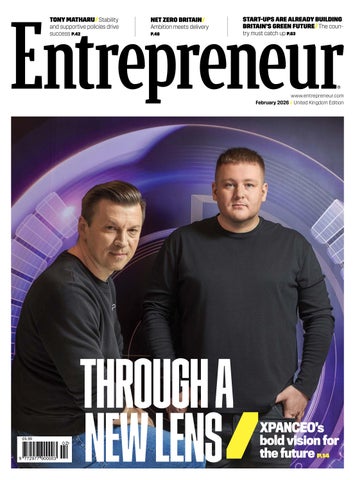
Through a New Lens, our cover story, takes that question literally. XPANCEO is a deep-tech company developing an invisible, weightless smart contact lens as the next generation of computing and interface between humans and technology. We trace the work of founders Roman Axelrod and Dr. Valentyn Volkov, who are not merely innovating, but shaping how humans experience and connect with technology. That same spirit of rethinking runs through the rest of this issue. The green economy is no longer abstract; it is a
practical, urgent concern for business and policy alike. This edition examines how companies can take tangible, responsible actions to address environmental challenges.
The analysis of Unilever’s sustainability strategy shows how even well-intentioned approaches can falter under organisational complexity and market pressures, offering lessons for leaders seeking to embed environmental responsibility at the core of decision-making.
Entrepreneur UK talks to Tony Matharu, founder of Integrity International Group and Blue Orchid Hotels, whose hotel developments and initiatives like Here to Help London show that business success and civic responsibility can grow together. Additionally, Hannah Gilbert, director of sustainability at the British Business Bank, emphasises the role of finance in scaling innovation and enabling smaller firms to participate meaningfully in the net zero transition. In her feature, Charlotte Keenan, global head of corporate engagement at Goldman Sachs, shows how small businesses are thriving despite economic challenges and offers strategies readers can apply to grow their own. Across founders, financiers and sustainability leaders, the stories in this issue make a clear point: decarbonisation is not a symbolic gesture but a structural, strategic imperative.
Taken together, the features in this month’s issue ask readers to look beyond conventional measures of progress, showing that innovation isn’t simply about new tools - it’s about new ways of seeing, acting, and challenging the rules we’ve long accepted.
Thanks for reading.
Patricia Cullen Features Editor, Entrepreneur United Kingdom
REGISTRATION IS NOW LIVE
LENS THROUGH A NEW
XPANCEO’s bold vision for the future
by PATRICIA CULLEN
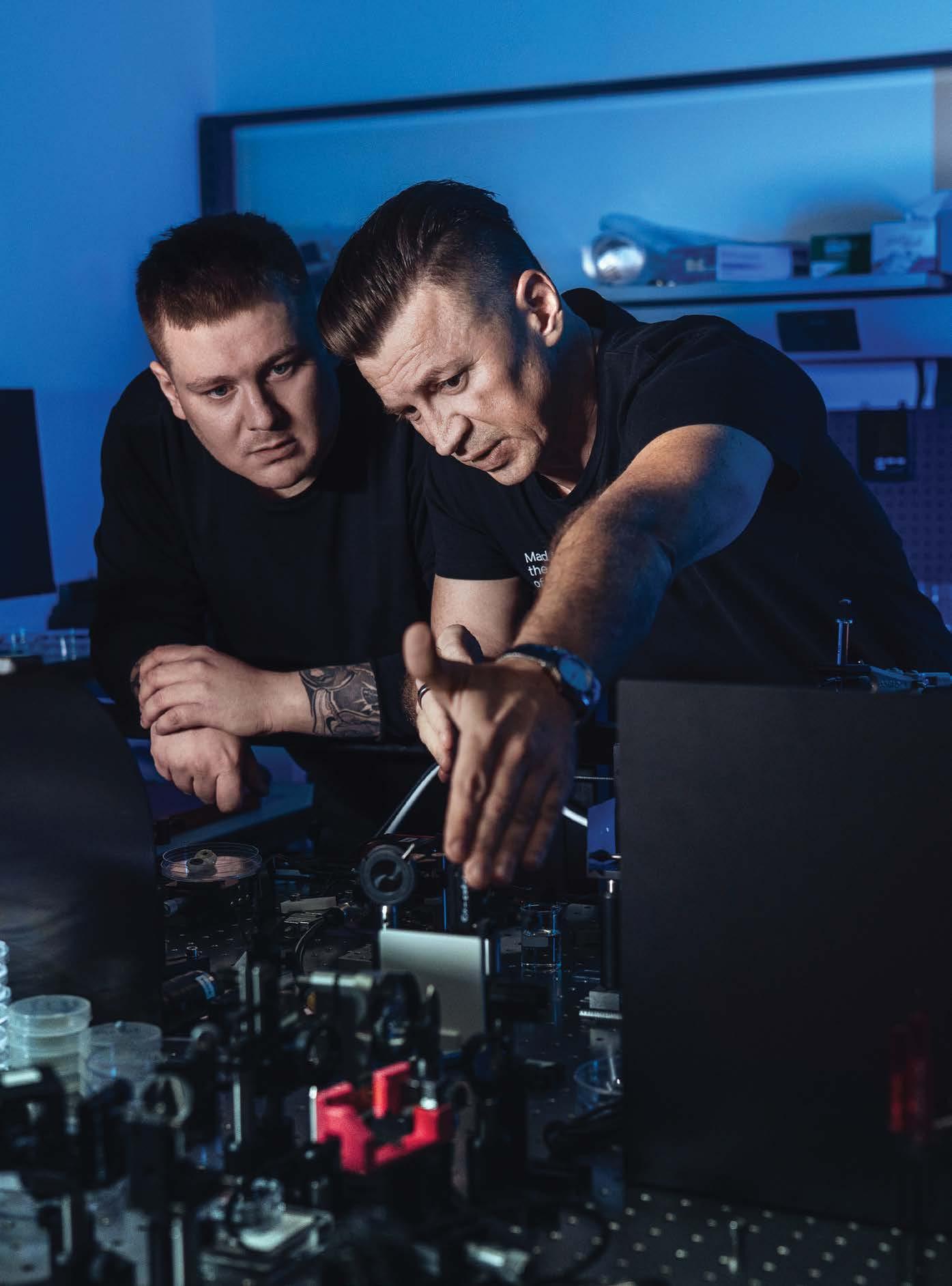
XPANCEO forward: Founders Roman Axelrod and Dr Valentyn Volkov
→ Smart Contact
prototype
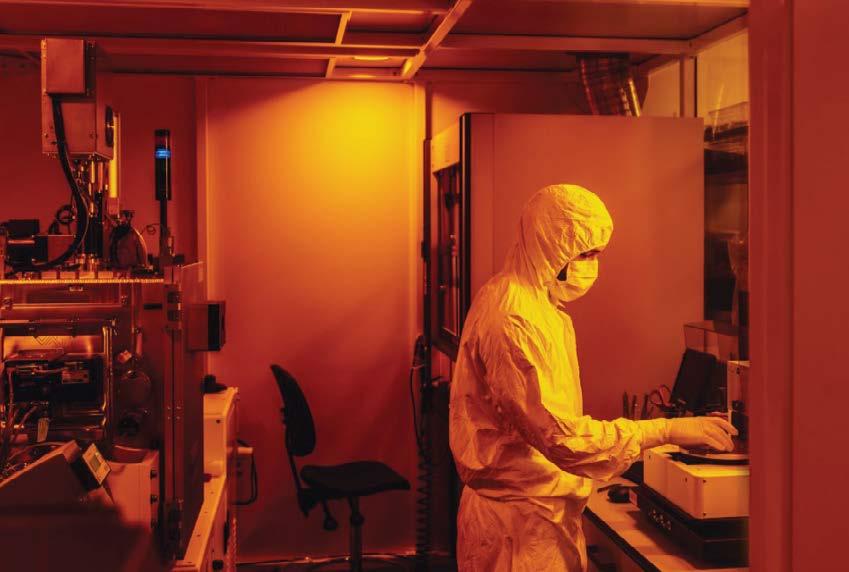
As technology advances at an unprecedented rate, few companies are on the verge of reshaping daily life as radically as XPANCEO. Founded in 2021 by entrepreneur Roman Axelrod and scientist Dr. Valentyn Volkov, this Dubai-based deep-tech firm is breaking new ground in human-technology interaction. XPANCEO is developing a smart contact lens for AI-powered XR computing — delivering visuals directly to the retina, without screens, frames, or headsets. With capabilities like XR vision, real-time health monitoring, colour correction, and next-gen biometric verification, this invisible lens could redefine content consumption, social media, industrial applications, sports, and healthcare.
EXPANSION IS WHAT DRIVES ME. EXPANSION OF HUMAN CAPABILITIES, PERCEPTION, INTELLIGENCE, AND PRESENCE IN THE UNIVERSE. THIS IDEA BECAME SO CENTRAL THAT MY WIFE CAME UP WITH THE PORTMANTEAU
The genesis of XPANCEO
The concept behind XPANCEO was born from an unexpected moment of reflection. Axelrod, in the final stages of selling his previous company, found himself at a crossroads. “I finally had the space to think about the mission of my life, and I formulated it as exploring the unknown,” he said, “like the moment in a computer game when you step into an unexplored grey area on the map and realise that there are no hints, no instructions, and no guarantees. You either move forward and open something new, or you stay where you are.” Axelrod decided on the former. This period of introspection led to a realisation: human potential could be expanded by connecting people with an intuitive, ever-present cognitive layer - deeply embedded in daily life - that acts as a personal assistant always at hand. “AI wasn’t much back then, but I was sure, intuitive, omnipresent assistance would come. The question was: where should it live?” Axelrod’s worldview is deeply influenced by transhu-
manism. He sees the fusion of humans and technology as inevitable - it’s the next evolutionary step for both civilization and computing. The outcome, greater than the sum of its parts, will be a new kind of human - capable of truly controlling AI and using it for good. The form it takes, however, remains a choice.
“Expansion is what drives me”, says Axelrod. “Expansion of human capabilities, perception, intelligence, and presence in the universe. This idea became so central that my wife came up with the portmanteau “XPANCEO.” I felt such a strong connection to it that it became my Instagram handle. And the funniest thing. When we decided to start the project, we needed a name for a pitch deck. We tried to come up with something new, but nothing felt right or truthful. Eventually, we decided to simply use my username.”
Axelrod believes technology should enhance, not hinder, the human experience. “The current generation of gadgets does not fit that future,” he says. “Phones, laptops and tablets pull our attention away from reality, harm our health, and deteriorate the quality of everyday life. More importantly, they are fundamentally unsuitable for humanity’s long-term goals. You cannot explore Mars, build complex off-planet systems, live longer, healthier lives, or coexist with advanced intelligence while relying on devices designed for scrolling and tapping,” he adds. This led him to see the human eye as the perfect interface for a new habitat for intelligence. A moment of
WE’VE BEEN RECOGNISED BY NATURE INDEX AS ONE OF THE TOP THREE START-UPS GLOBALLY IN PHYSICS, BUILT 26 FUNCTIONAL PROTOTYPES, AND FILED 19 PATENT-PENDING APPLICATIONS. THIS LEVEL OF DEMONSTRATED PROGRESS SENDS A CLEAR SIGNAL TO INVESTORS”
inspiration - a Pinterest image of a woman astronaut with unusually vivid eyes - convinced him that vision was the most authentic and intuitive place to start.
It was at this juncture that XPANCEO was born. However, creating a smart contact lens - a device capable of embedding technology into the human body - was not just an act of innovation; it was a technical challenge that required unprecedented breakthroughs in materials science, biotechnology, and AI systems. For this,
Axelrod needed to find a partner who could turn the vision into reality.
The Scientific Challenge
Enter Dr. Valentyn Volkov, a physicist with extensive experience in advanced materials science and nano-optics.
Volkov had spent more than 20 years working in some of the most prestigious research laboratories in Europe, leading high-level scientific teams focused on novel materials. Initially, Volkov was reluctant to leave academia and join a start-up. However, after
several discussions with Axelrod, Volkov recognised the enormity of the challenge and the potential impact the smart contact lens could have on society.
“When Axelrod first approached me with the idea, I didn’t say yes immediately. But at some point my impression shifted from he might be crazy to he definitely has an unusual idea,” Volkov says. The more they discussed it, the more the partners realised that this wasn’t just about creating a product - it was about advancing fundamental science
and tackling problems no one had even imagined. The collaboration between Axelrod and Volkov set the stage for XPANCEO to begin its journey of deep-tech development. The first task was to build the first prototype of the smart contact lens - no small feat, given the numerous scientific and engineering hurdles involved. Traditional electronics and displays couldn’t fit into such a tiny, flexible form factor, so the team had to look beyond existing solutions.
“Our journey began by breaking the problem down to its fundamental principles,” says Volkov. “Instead of following existing solutions,
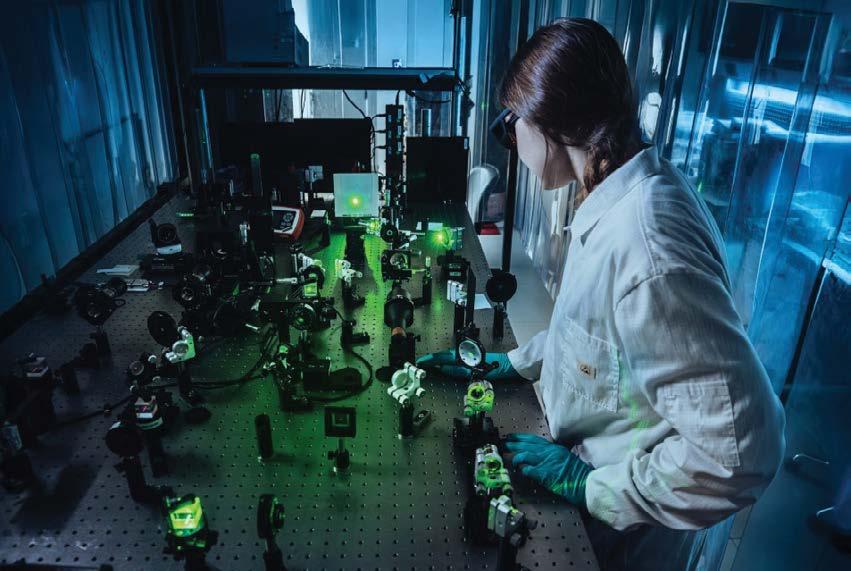
→ XPANCEO Laboratory
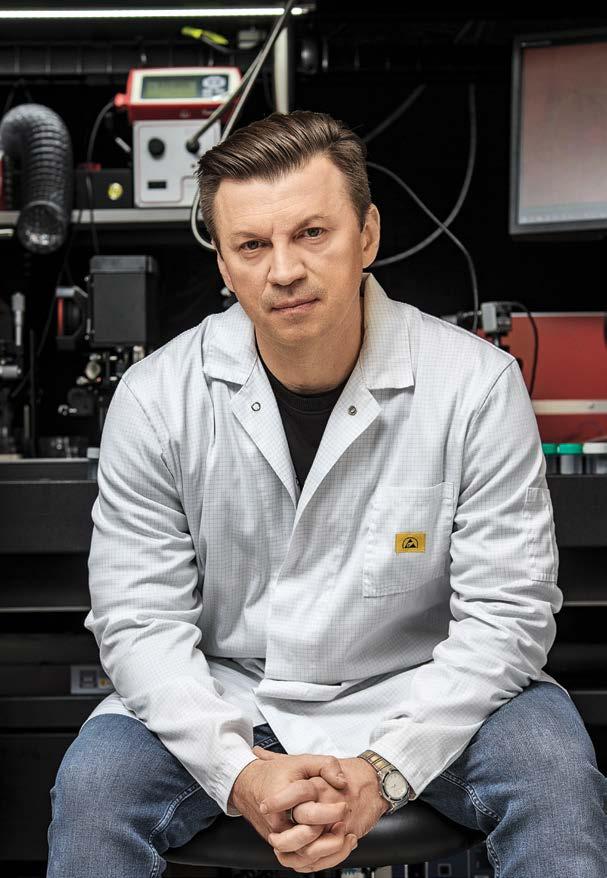
→ Dr Valentyn Volkov, founder and CTO of XPANCEO
we engineered the lens from scratch, grounded in core physics and materials science. The first challenge was to develop flexible electronics that could be both thin and transparent. At the same time we needed to rethink how optics, biosensing, and data processing could be embedded into something as small and delicate as a contact lens.”
Over the years, XPANCEO developed cutting-edge technologies, including quasi-2D materials for transparent conductors, micro-optical projection systems, and biosensing technologies capable of tracking health data through the wearer’s tears. The result is 26 prototypes that demonstrate visual AR interface, wireless data and power transfer, several approaches for detection of vital biomarkers such as glucose, for diabetes patients and others requiring continuous blood sugar monitoring, IOP (Intra-Ocular Pressure) for glaucoma treatment and prevention, and vision enhancement such as color correction for those with color blindness. This research does not come cheap. “We had to prove to the
“XPANCEO CHANGES THE WAY PEOPLE RELATE TO TECHNOLOGY AT A VERY FUNDAMENTAL LEVEL”
world that what we’re building is not only possible but will inevitably change the world,” the partners emphasise. “Not just as a concept, but as something investors could believe in, something that could be funded and built at scale. And it worked. First, we raised $40m, then 250m at a $1.35bn valuation.” Volkov says the funding doesn’t alter the company’s roadmap but instead reinforces it, noting that key prototypes for most planned features are already in place. “What the funding does is remove friction. We managed to expand our team with Nobel-class scientists and engineers, bringing new state-of-the-art equipment, growing our capabilities,” he says. Their lab team has already doubled. The funding will allow them to conduct the necessary human and medical trials. “This is all on the timeline we’d mapped out from the beginning,” he adds
XPANCEO’s rapid rise in the deep-tech landscape has been underscored by successful funding rounds. “Our recent funding is the largest Series A round in the MENA region across all industries, and worldwide in AR/VR/XR and wearables. But most importantly, it shows tangible progress” highlights Axelrod. “We’ve been recognised by Nature Index as one of the top three start-ups globally in physics, built 26 functional prototypes, and filed 19 patent-pending applications. This level of demonstrated progress sends a clear signal to investors. When they see a team that’s not just ambitious but actually delivering at this pace, capital follows.”
This valuation places XPANCEO among the ranks of highly coveted unicorns, companies that have attracted significant investor confidence despite the long development timelines and technical risks that characterise deep-tech ventures. But for Axelrod and Volkov, the funding isn’t just a validation of their vision - it’s a tool that removes
→ XPANCEO Laboratory
friction from their development roadmap. The investment has allowed them to expand their R&D teams, accelerate development, and scale their laboratory capabilities, moving closer to their ultimate goal. “By the end of 2026, we aim to integrate everything we’re working on into a single prototype, showcasing the range of main features: image projection, health monitoring, and wireless power. That was always the plan,” the founders say.
A Paradigm Shift in Human-Technology Interaction
The implications of XPANCEO’s smart contact
phones, laptops, and wearables. However, we still interact with this intelligence through screens, keyboards, and headsets, which disrupt our connection to the real world. “Today, technology constantly asks for our attention. We look down at screens, switch between devices, and mentally separate the digital world from the real one. Over time, this creates friction, distraction, and cognitive overload. Our goal is to
technology to consumer markets, XPANCEO has been strategic in first testing the lens in high-stakes B2B environments, such as aerospace, healthcare, and industrial sectors. These demanding fields provide an ideal proving ground for the lens’s capabilities.
Market Applications
The real-world applications for the smart contact lens are wide-ranging. By being placed directly on the eye, it ensures a wider, unobstruct-
lens extend far beyond the realm of personal convenience. While other companies are working to bring AR to market through smart glasses or headsets, XPANCEO is pushing the envelope by developing a technology that is fundamentally invisible, ambient, and non-invasive. “XPANCEO changes the way people relate to technology at a very fundamental level,” Axelrod explains. In the 20th century, computers were standalone devices, containing all their processing power and connecting externally only for specific tasks. By the 21st century, computing evolved into a cloud-based ecosystem, accessed via
remove that friction.”
At the heart of XPANCEO’s philosophy is a shift in the human-technology interactions. The company believes that true human-AI symbiosis can only be achieved when technology is seamlessly integrated into the human body and our daily experiences. While the ultimate goal is to bring this
ed experience - ideal for piloting vehicles, highspeed movement, sport performance, space, and aviation. In healthcare, the lens could become nextgeneration personal lab and hospital located directly on the cornea, shifting from episodic doctor visits to continuous monitoring of glucose, intraocular
→ Roman Axelrod, founder and managing partner of XPANCEO
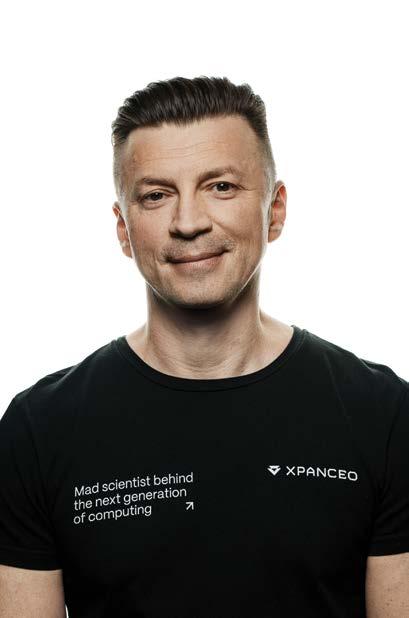
→ Dr Valentyn Volkov, founder and CTO of XPANCEO
BY THE END OF 2026, WE AIM TO INTEGRATE EVERYTHING WE’RE WORKING ON INTO A SINGLE PROTOTYPE, SHOWCASING THE RANGE OF MAIN FEATURES: IMAGE
PROJECTION, HEALTH MONITORING, AND WIRELESS POWER”
pressure, and other biomarkers in tear fluid, while dispensing medications in precise doses and delivering AR-guided medical instructions in real time. But the optical system can be used not only in lenses, but also in the implant for vision restoration that XPANCEO has developed together with Intra-Ker, which uses similar technology of image projection that are used in our contact lenses.
“Our prototype addresses corneal blindness by bypassing damaged or opaque corneas entirely,” Valentyn says. “Our implant uses the same microdisplay technology we’re exploring for the smart contact lenses, but this time embedded in place of the damaged cornea, delivering visual information directly to the retina. We’ve already tested a proof of concept in a donor human eye, and it successfully delivered sharp visual content to the retina.”
Space is the ultimate test for any technology. If it works there, it can work anywhere. In aerospace, the
smart contact lens could revolutionise the way astronauts interact with their environment. Today, astronauts rely on bulky systems to access mission-critical data. XPANCEO’s technology would provide a hands-free, AR interface, allowing astronauts to access real-time data without compromising their focus on the task at hand. “We’ve developed a projection system prototype integrated into a real spacesuit, aligned with our collaboration with the Mohammed Bin Rashid Space Centre in the UAE,” the founders explain. “These developments push the limits of human interfaces in the most demanding environments imaginable.”
The potential for other environments - from elite sports to industrial applications - also looms large. In these fields, the ability to provide real-time, unobtrusive data to users who cannot afford distractions is invaluable. For instance, a surgeon could wear the smart lens during an operation to access critical data
without taking their hands off the tools, while a pilot could benefit from enhanced navigation assistance during high-speed flights in low-visibility conditions.
Future focus
With its clear vision and cutting-edge technology, XPANCEO is on the cusp of a major paradigm shift. Looking to the future, Axelrod says they are focused on refining the smart contact lenses for use in a variety of real-life scenarios, building on the B2B collaborations they’ve already been testing across different sectors.
“Success in those applications will prove that society is ready for smart contact lenses to be used in real life,” he adds. The world may still be several years away from fully embracing smart contact lenses as the primary interface for AI-powered XR, but XPANCEO’s commitment to pushing the boundaries of human-machine integration positions it as a pioneer in the next wave of computing.
In the Loop /
BUILDING THE GREEN FUTURE
Inside the Minds of Sustainability Entrepreneurs
by PATRICIA CULLEN
Across industries and continents, sustainability has moved from optional virtue signaling to an urgent business imperative. Yet as companies chase green credentials, the path from innovation to real-world impact is rarely straightforward. Five leaders, each tackling environmental challenges from cocoa farms in Colombia to the skies above, from skincare jars in the UK to off-grid Himalayan schools, reveal what it truly takes to transform ideas into systems, impact, and jobs—and the barriers that still hinder meaningful change.
TURNING WASTE INTO VALUE
In the sun-baked cocoa fields of Colombia, the majority of the fruit -the pods, pulp, and husks - is discarded. For many, this is a byproduct of inefficiency. For London based María Paula Rodríguez, Senior Business Innovation Manager at Luker Chocolate, a Colombian B Corp chocolate manufacturer, it is an opportunity. “Turning a significant industry waste issue - the 81.7% of the cocoa pod that is usually wastedinto economic and environmental value,” she says, is the core of her work.
At Luker, a B Corp producing cocoa for some of the world’s leading chocolate brands,
Rodríguez has overseen the transformation of this waste into ingredients for the food and beverage sector. “This came from sustained R&D, pilot testing at one of our own farms, and working with partners beyond the chocolate sector - and it’s now in the market thanks to the creativity of a number of clients.”
Her approach embodies a principle that resonates across sectors: sustainability cannot be an afterthought. “Sustainability is something you always design into the system, not something you add on later,” she asserts.
Beyond the chocolate factory, her ambition is systemic: “A real shift would be farmers benefiting from more of what
Senior Business
→ María Paula Rodríguez,
Innovation Manager at Luker Chocolate
→ Andrew Symes, CEO of OXCCU
The players I respect most in this space are converging on the same playbook: electrify what you can, generate clean power on-site where it reduces risk and cost, and instrument everything so performance is visible and financeable”
they grow, so that cocoa remains a viable livelihood despite mounting climate and economic pressure.” By finding ways to use the whole cocoa fruit, Rodríguez is helping create models where economic and environmental benefits are more evenly shared, while consumers gain the ability to choose products reflecting sustainable practices, not just taste.
Aviation’s Green Horizon
From the fields of Colombia to the high skies, Andrew Symes, CEO of OXCCU, a University of Oxford spin-out developing scalable sustainable aviation fuel, is tackling a different challenge: the carbon footprint of aviation. “The most meaningful impact has been taking years of academic research and progressing it into a technology that can be tested and validated beyond the lab,” he explains. OXCCU is developing sustainable aviation fuel (SAF) from waste carbon. The OX1
demonstration plant has already generated operating data for the larger OX2 facility, set to produce fuel for further testing this year. Symes emphasises that aviation decarbonisation depends on scalable, credible solutions. “Each stage of development is grounded in evidence and can support the next step towards commercial deployment,” he says. Transparency, he notes, is key: “Being open about both progress and remaining challenges builds trust, and that trust allows partners, investors and policymakers to get behind the technology and move it forward.”
His vision for the next decade is ambitious: “I would like to see sustainable aviation fuel treated as essential infrastructure rather than a constrained alternative.” He welcomes regulatory expansion into pathways such as power-to-liquids and gasification, which promise greater resource availability. For Symes, the lesson is clear: systemic, evidence-driven
In the Loop /
innovation, coupled with long-term regulatory support, is what distinguishes temporary trends from transformative outcomes.
Rethinking Beauty: Education and Sustainability in Skincare
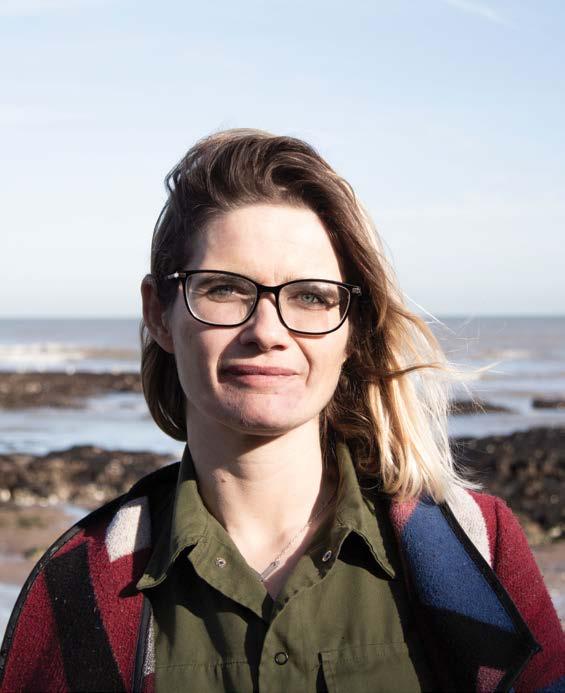
While Symes focuses on the skies, Julie Macken is revolutionising what people put on their faces. In an industry dominated by over-formulation and marketing hype, Macken, founder of Neve’s Bees, a natural skincare brand, advocates for simplicity and education. “Most skincare products are around 80% water, plus processing chemicals used to keep that water stable. Water isn’t a moisturiser -it evaporatesand many of the added emulsifiers, preservatives and stabilisers can actually disrupt the skin barrier,” she says. Her innovation lies in concentrated, waterless formulations that treat skin as a living organ. “The most meaningful impact of my work has been educating
people about waterless skincare and redefining what healthy skin really is,” Macken explains. By promoting barrier health and simpler routines, she reduces both environmental waste and unrealistic beauty pressures.
away from over-formulation, unrealistic beauty standards, and misleading marketing toward skin literacy and thoughtful product design. For Macken, sustainable entrepreneurship is inseparable from consumer empowerment.
highlights systemic failures in the UK’s approach to decarbonising buildings. “We are actively investing in infrastructure that produces vast amounts of usable waste heat, especially data centres. Failing to connect that heat to homes and communities
Everything she does starts with education: “If people understand why something works -and why it mattersthey make better choices without needing to be persuaded.” Over the next decade, she hopes the industry will mirror the scrutiny applied to ultraprocessed food, moving
Heating Homes with Waste Heat: The Long Game for Net Zero
Back on the ground, Simon Kerr, Head of Heat Networks at EnergiRaven, an energy management company and platform focused on helping organisations monitor, analyse, and optimise energy use,
is a missed opportunity,” he warns. The UK’s Future Homes Standard, once a potential turning point for green housing, has been diluted, and even small measures like mandated batteries risk rollback. Heating buildings remains the UK’s largest single source of carbon emissions,
↑ Julie Macken, founder of Neve’s Bees
→ Nick Spicer, CEO of Your Eco
If people understand why something works -and why it matters - they make better choices without needing to be persuaded”
yet massive investments in data centres and industry could provide abundant usable waste heat. Kerr argues for treating heat as core infrastructure: “A Net Zero built environment would look like homes and neighbourhoods heated by clean, locally sourced heat.
→ Simon Kerr, Head of Heat Networks at EnergiRaven
Gas boilers would increasingly disappear, replaced by Heat Interface Units connected to publicly owned heat networks.”
Crucially, financing must be patient and long-term. “Small, fragmented projects struggle to attract serious capital, whereas large, coordinated schemes can unlock institutional investment and deliver impact at pace,” Kerr explains. For him, the challenge is less technological than systemic: aligning finance, regulation, and planning to ensure that climate-positive projects are investable and scalable.
Power to the People
Nick Spicer, CEO of Your Eco, a renewable energy company, extends this focus on systemic solutions into humanitarian terrain. In the Himalayas, he reconnected a school cut off after an earthquake; in the Caribbean, he supported an off-grid media centre,
opened by Richard Branson. “The most meaningful impact has been using clean infrastructure to restore capability and dignity where energy access is the difference between opportunity and isolation,” he reflects.
For Spicer, sustainability scales only when treated as core infrastructure. “The players I respect most in this space are converging on the same playbook: electrify what you can, generate clean power on-site where it reduces risk and cost, and instrument everything so performance is visible and financeable.” His vision extends beyond individual projects: smarter grids, integrated design, and robust delivery frameworks could generate thousands of skilled green jobs while reducing global emissions.
A Pattern Emerges: Systems, Patience, and Scale
Across these diverse sectors, a pattern emerges. Innovation alone is insufficient. Real change demands:
} Integration: Sustainability must be designed into systems, whether a chocolate supply chain, an aviation fuel process, or a heating network.
} Evidence and Transparency: Symes’ SAF plant and Rodríguez’s cocoa upcycling are grounded in pilot data and R&D, building credibility that attracts investment.
} Patient Capital: Kerr’s heat networks and Spicer’s renewable projects highlight the need for long-term
financing rather than short-term gains.
} Education and Trust: Macken’s waterless skincare demonstrates that consumers and communities can be allies, not passive recipients, if equipped with understanding.
Yet obstacles persist. Policy inconsistency, regulatory fragmentation, short-term finance, and cultural inertia continue to slow adoption. Rodríguez notes that for cocoa farmers, climate and economic pressures threaten livelihoods; Kerr warns of diluted home-building standards; Spicer stresses that infrastructure projects fail without disciplined delivery and alignment. Even with clear solutions, translating ambition into action remains a struggle. For these entrepreneurs, sustainability is not a marketing slogan or a CSR checkbox - it is a framework for reshaping value, infrastructure, and opportunity. Across sectors - from upcycling cocoa waste to producing sustainable aviation fuel, from redesigning skincare to building resilient energy systems - the lesson is consistent: meaningful environmental change demands systems thinking, long-term commitment, and disciplined execution. In their hands, sustainability becomes more than a technical or commercial challenge; it is a blueprint for resilient economies, empowered communities, and a planet better equipped to face the decades ahead.
Middle Managers: The Unsung Heroes of the Net Zero Transition?
by ALICE VELDTMAN
Net zero commitments are now a common feature of business strategy. Across all sectors organisations are developing decarbonisation plans in response to investor expectations, regulatory pressure and other demands. In the UK, the consequences of climate change, particularly vulnerability to storms and flooding, pose a material risk to business. Conversely, cutting emissions is often motivated by opportunities to drive cost efficiencies and enhance brand reputation. Yet although net zero ambitions are widespread and the risks and opportunities are clear, achieving it is not easy. Whilst technology and data are important for measuring, reducing and reporting emissions, reaching net zero requires organisational change management, for which middle managers play an essential but often overlooked role.
Net zero: strategy is easy, execution is hard
Setting a net zero target is a strategic decision. Delivering it requires organisations to rethink how they manufacture products, manage supply chains, allocate capital and make every day operational decisions. Transformation at this scale aligns with the definition of change management, yet net zero is rarely cited as a reason for enacting strategic change programmes.
Classic strategic change models, emphasise the need to create urgency and mobilise leadership coalitions as a first two steps for driving successful
transition. However, research also warns that urgency alone can backfire if leadership teams lack the capacity or capability to guide change initiatives. This tension is especially felt when it comes to sustainability. Despite calls for urgent global action to mitigate the climate crisis within the business context, achieving net zero by 2050 may feel like a distant ‘nice to do’ versus commercial pressures prioritised in the shortterm.
However, with the net zero goals set, responsibility for “making it happen” typically falls to those tasked with translating strategy into action: middle managers.
Why middle managers matter more than most leaders realise
There is a wide body of research acknowledging the importance of middle managers for delivering strategic change. Positioned between top managers and frontline employees, middle managers occupy a central position to be able to make sense of change directed by senior managers Additionally, they are often more immersed in operational understanding allowing them to “sense give” on the implementation of change to wider employees.
Middle managers are central to:
}Making sense of strategic intent and translating new ideas
}Adapting messages to engage different audiences
on change
}Building informal networks that help mobilise support for change
}Informal knowledge sharing, which supports organisational learning
Much of this influence happens outside formal governance structures, through everyday decisions, peer-to-peer conversations and what some researchers describe as “water cooler learning”. This makes the contribution of middle managers both powerful and easy to overlook. When it comes to delivering sustainability targets research found conflicting rationales between profit and purpose goals can create challenges. Middle managers are often the ones required to reconcile these tensions in practice. One study found middle managers cope by mentally separating the individual requirements of commercial and social goals then integrate and sense-make, requiring emotional and behavioural capabilities.
Middle Managers can be powerful accelerators for achieving net zero
For entrepreneurs and business leaders serious about net zero, the opportunity is clear. Middle managers can play a powerful role in accelerating changes required to meet net zero goals, depending on how they are engaged and supported.
Research points to several practical priorities:
}Involve middle managers early in shaping strategic change required to reach net zero.
}Align incentives and performance measures to reduce conflicts between commercial and environmental goals.
}Invest in capability-building, through targeted recruitment, or training particularly in carbon management or climate literacy and change leadership.
}Create psychological safety allowing honest communication about capacity trade-offs and conflicting goals.
}Build broad guiding coalitions at all levels to mobilise change.
}Align ethical values to unite sensemaking across the business and help deliver non-profit goals.
By embedding sustainability into the organisation’s purpose, values and operating model, rather than treating it as an add-on, middle managers can be better equipped to help deliver change across the organisation.
The real opportunity in the net zero transition
Net zero will not be delivered through targets, dashboards or annual reports alone. It will be delivered, or not, through thousands of everyday decisions made across the organisation.
Middle managers sit at the point where ambition meets reality. They translate strategy into action, navigate competing
“For entrepreneurs and business leaders serious about net zero, the opportunity is clear. Middle managers can play a powerful role in accelerating changes required to meet net zero goals, depending on how they are engaged and supported ”
demands and shape how employees experience change. They are often the unsung heroes of transformation.
For leaders willing to recognise and invest in this role, the net zero transition is not just a compliance exercise, it is an opportunity to build more resilient, adaptive and future-ready organisations.
Alice Veldtman, Carbon Management Consultant,
Nottingham Business School, Nottingham Trent University.
In the Loop / Why Tech Show London Matters in the Age of Intelligent Scale
by JAMES MESINA
Technology leaders are operating in a moment of contradiction. Innovation is accelerating. AI is reshaping decision-making at speed. Expectations around performance, resilience, and sustainability continue to rise. At the same time, trust in systems, data, and the institutions that deploy them is under greater scrutiny than ever.
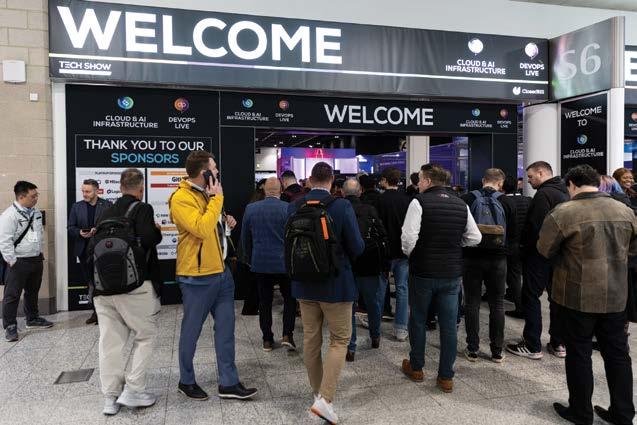
This is the context in which Tech Show London has become increasingly important. More than a technology exhibition, Tech Show London reflects the reality facing modern organisations. Progress today sits at the intersection of ambition and responsibility. Leaders are no longer asking what is possible. They are asking what is scalable, secure, and sustainable. Across cloud, data, cybersecurity, infrastructure, and DevOps, the challenges shaping enterprise strategy are converging. AI performance depends on resilient infrastructure. Digital trust relies on secure, sovereign systems. Data-driven insight requires governance that enables innovation rather than constraining it. These are not siloed issues. They demand joined-up thinking.
That is why Tech Show London’s approach extends beyond technology alone. Its 2026 programme brings together technical expertise with broader perspectives on power, ethics, and human impact. For senior leaders, this is what sets Tech Show London apart. It is a space to step back from day-to-day execution and engage with the wider forces shaping technology decisions. These include responsible AI, cyber resilience, infrastructure sustainability, and organisational culture. Performance still matters. ROI still matters. But organisations that will lead over the next decade are those that treat trust as a strategic asset. It is something built deliberately and protected as they scale.
Tech Show London exists to support that shift. Not by prescribing answers, but by creating the conditions for better conversations. Conversations that are informed, challenging, and grounded in real-world leadership. In an era where technology decisions shape business outcomes and societal impact alike, Tech Show London
“MORE THAN A TECHNOLOGY EXHIBITION, TECH SHOW LONDON REFLECTS THE REALITY FACING MODERN ORGANISATIONS”
is no longer just a date in the calendar. It is a moment of reflection and direction.
To find out more, visit https://www.techshowlondon.co.uk/
James Mesina is a Marketing Executive at Tech Show London, playing a key role in shaping campaigns that connect global technology leaders with innovative audiences. With a passion for digital marketing, events, and emerging tech, Mesina helps drive engagement and amplify the voice of one of the UK’s leading technology events.
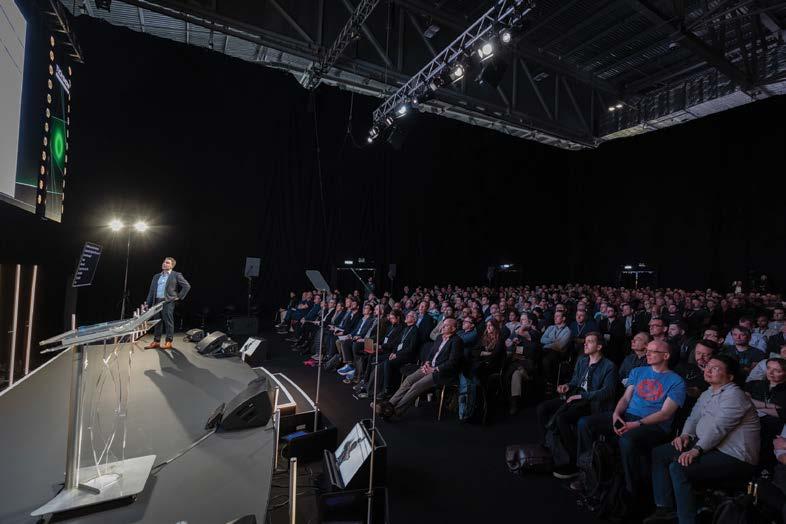
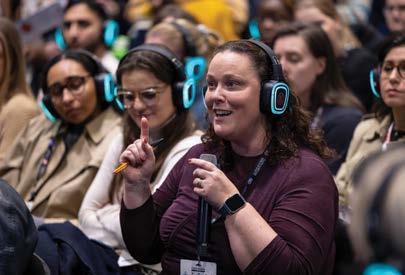
→ Delegates at Tech Show London 2025
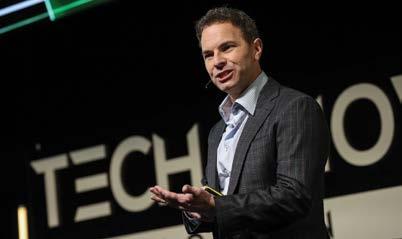
→ Tech Show London Highlights
→ Inside a previous Tech Show London event
GREEN GAINS
The billion-dollar business strategy of the future by ENTREPRENEUR UK STAFF
As geopolitical tensions escalate and economic uncertainty grips global markets, the role of environmental action in business strategy has evolved from an ethical consideration to a driver of resilience, capital allocation, and long-term competitiveness. The latest findings from the CDP Corporate Health Check 2026 reveal a compelling truth: companies that prioritise environmental leadership
aren’t just protecting the planetthey’re securing their financial futures. The study, conducted in partnership with Oliver Wyman, highlights how a select group of global companies is seizing the opportunity presented by environmental responsibility, unlocking a staggering US$218bn in financial value in just the past year. These leaders are cutting emissions at four times the rate of their peers, proving that the link between sustainability and profitability is no longer a theoretical ideal but a hard reality for businesses who understand the power of environmental stewardship.
A NEW WAVE OF ENVIRONMENTAL LEADERSHIP
The findings from CDP’s 2026 analysis indicate that just 15% of companies worldwide are now embracing environmental action as a core business strategy. This cohort is leading the charge on climate, water, and forest issues, setting an ambitious pace that is, in many cases, outpacing traditional financial metrics.
Companies in this group reduced their emissions at an average compound annual growth rate (CAGR) of 4%, compared to only 1% among those in the lower-performing category. This is a staggering difference in progress - one that speaks volumes about the long-term viability of aligning corporate performance with the planet’s wellbeing. Sherry Madera, CEO
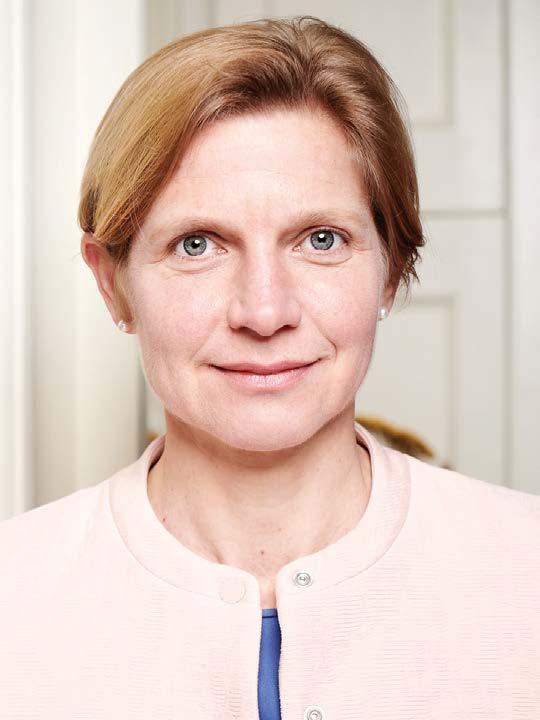
→ CDP's CEO, SHERRY MADERA
of CDP, aptly puts it: “Climate and nature loss are no longer distant risks - they are already reshaping markets, supply chains, and investment decisions.” This shift is more than a trend. It’s a transformation in how companies are thinking about their bottom line. As the study suggests, the competitive advantage now lies with those who have integrated climate, water, and forest considerations into their core strategies, using them as levers to not only reduce risks but also drive financial opportunity.
THE RISING ECONOMIC CASE FOR SUSTAINABILITY
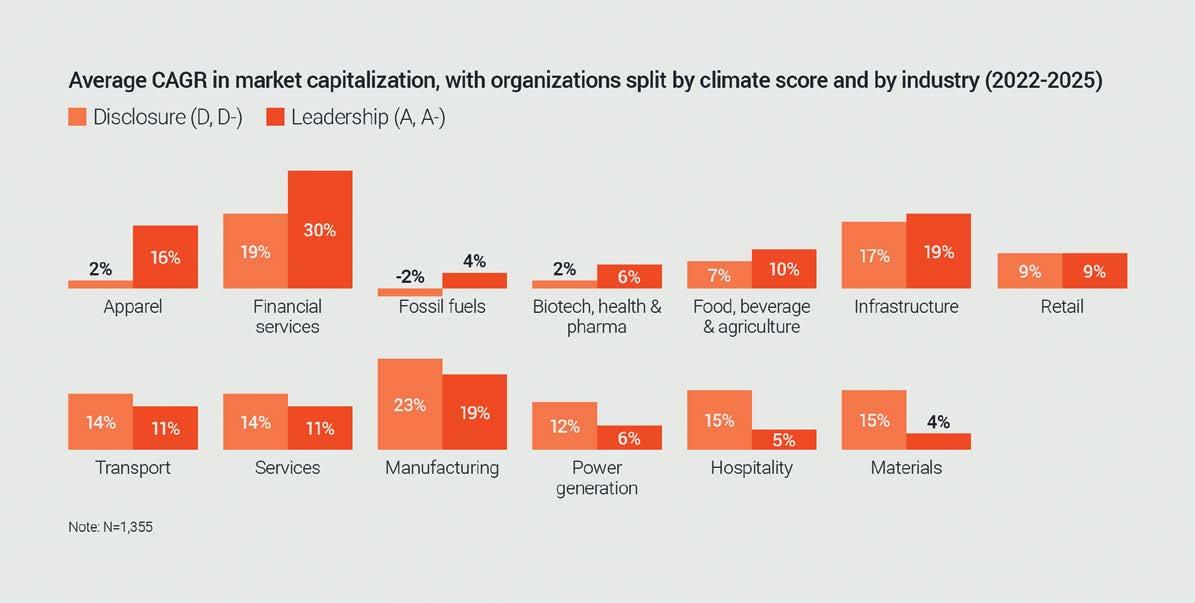
The report is clear: there is undeniable economic value in environmental action. Sectors such as financial services, infrastructure, and apparel have seen stronger market capitalisation growth among environmen-
“CLIMATE AND NATURE LOSS ARE NO LONGER DISTANT RISKS - THEY ARE ALREADY RESHAPING MARKETS, SUPPLY CHAINS, AND INVESTMENT DECISIONS”
dividends in the form of market share, stronger brand reputation, and resilience to shocks. This shift in perspective is reshaping entire industries and forcing a rethinking of how businesses engage with environmental data.
REGIONAL DIVERGENCE: A TALE OF TWO MARKETS
tal leaders compared to their less proactive peers.
For example, financial services companies that lead on sustainability have outperformed their competitors by 30% versus 19% in market growth since 2022. In the infrastructure sector, the difference stands at 19% versus 17%, and in apparel, the environmental
leaders have grown 16% while others have barely moved the needle at 2%.
This underscores a pivotal point: environmental performance is no longer an ancillary factor in a company’s success. It is central to its financial outcomes. Sustainability isn’t a cost to be managed but an investment that pays
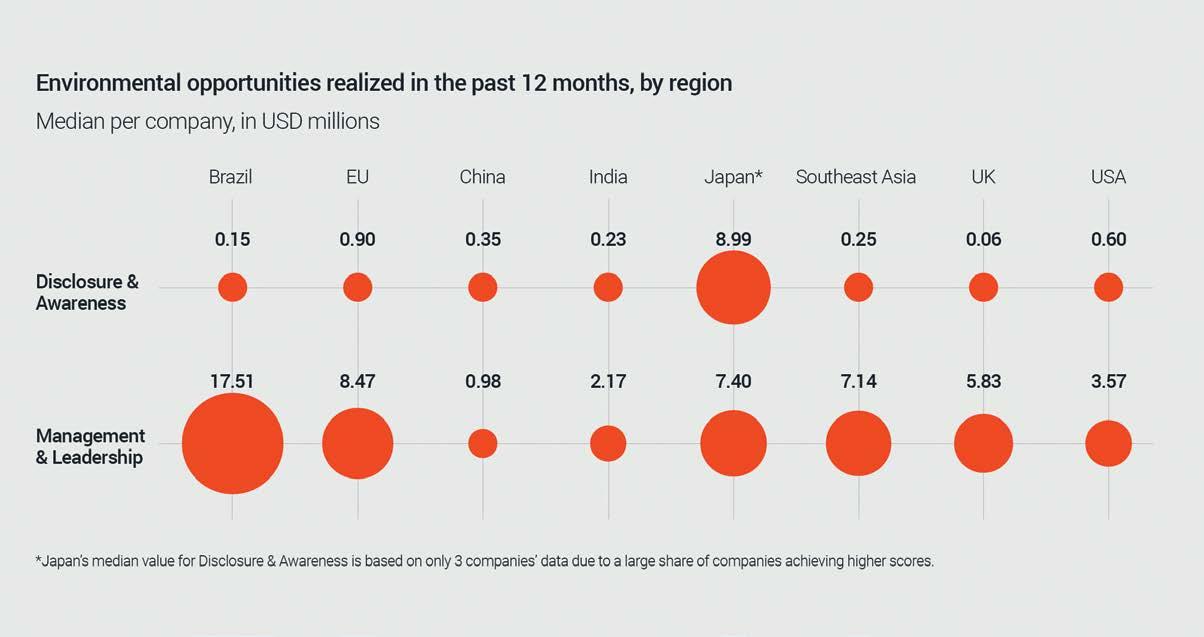
While environmental leadership is growing, the pace of progress varies significantly across regions. In particular, Japan stands out as the clear global leader, with 22% of Japanese companies achieving leadership status on climate action. This contrasts sharply with the US, where only 5% of companies are meeting top-tier environmental standards.
Europe continues to perform strongly, with 52% of companies in the EU27
“MOMENTUM FOR THE TRANSITION IS UNDENIABLE, YET
BUSINESSES FACE A
LEVEL OF POLITICAL AND MACROECONOMIC
UNCERTAINTY
NOT SEEN IN A GENERATION”
reaching the top two performance levels in environmental metrics, compared to just 31% in the US. However, the study also highlights the growing momentum in China and
Southeast Asia, where companies are beginning to catch up rapidly. In fact, China has now surpassed the US in terms of environmental leadership, with 54% of Chinese companies
reporting strong performance across climate, water, and forests. The findings suggest a clear need for regional collaboration and innovation if the global business community is to bridge the environmental divide. As Nick Studer, CEO of Oliver Wyman, notes, “Momentum for the transition is undeniable, yet businesses face a level of political and macroeconomic uncertainty not seen in a generation.” In such a volatile environment, businesses that remain firmly committed to environmental goals are showing that resilience and foresight are just as important as short-term profit margins.
WHAT NEXT?
While mitigation efforts, reducing emissions and protecting ecosystems, are
the focus of most companies at present, adaptation is quickly emerging as the next frontier of environmental action. According to the report, businesses have identified US$1.47tn in physical environmental risks, with more than a quarter of those risks materialising in the near term. Despite this, only US$84.5bn has been invested in adaptation efforts, underscoring the significant opportunity that still exists for businesses to safeguard their operations against the physical impacts of climate change. Companies that invest in climate adaptation are better positioned to protect their value in the face of extreme weather, resource scarcity, and shifting regulatory environments. The report suggests that those who fail to act may find themselves
exposed to greater financial instability, making proactive resilience strategies not just a moral imperative, but a financial one as well.
INCENTIVISING ENVIRONMENTAL LEADERSHIP
One of the most significant findings of the report is the role of governance in driving environmental performance. The most successful companies are linking executive pay directly to environmental outcomes, with 78% of water and forest leaders aligning compensation with sustainability targets. This ensures that environmental objectives are integrated into the very fabric of corporate decision-making, creating an intrinsic motivation for leaders to push the boundaries of what’s possible in terms of emissions reductions and resource management. Moreover, the research shows that companies with clear transition plans aligned to 1.5°C targets are not only
reducing their environmental footprint but also creating a blueprint for other businesses to follow. By adopting robust environmental strategies that consider both the risks and opportunities of climate change, these companies are securing long-term profitability in an increasingly complex global market.
THE FUTURE OF ENVIRONMENTAL BUSINESS STRATEGY
The key takeaway from the CDP Corporate Health Check 2026 is that environmental action is no longer peripheral to business strategy; it is now a core driver of competitiveness and financial performance. As Sherry Madera so aptly puts it, “Earth-positive is no longer peripheral to business strategy; it is becoming a core driver of long-term competitiveness.” Companies that integrate sustainability into their DNA -whether through emissions reductions, value-chain engage-
“EARTH-POSITIVE IS NO LONGER PERIPHERAL TO BUSINESS STRATEGY; IT IS BECOMING A CORE DRIVER OF LONG-TERM COMPETITIVENESS. THE CHALLENGE NOW IS SCALE –MAKING THIS THE NORM RATHER THAN EXCEPTION”
ment, or adaptation investments -are positioning themselves not just for survival, but for success in the new green economy.
As we look to the future, the challenge is not just for businesses to act on these insights, but for them to scale their efforts. As the global economy continues to face unpredictable headwinds, the companies that thrive will be those that recognise environmental leadership as an opportunity to build resilience, drive growth, and create lasting value for both shareholders and society. It is no longer about doing less harm -it is about doing more good. Environmental action is now more than just a risk management strategy; it is a competitive edge that defines the next generation of corporate leadership.
In the Loop / Greener Pastures
The
UK’s next growth story by
PATRICIA CULLEN
→ Hannah Gilbert, Director of Sustainability at the British Business Bank
With renewable energy and clean tech leading the charge, Entrepreneur UK speaks to Hannah Gilbert, Director of Sustainability at the British Business Bank.
Which green sectors show the strongest growth potential for UK businesses, based on current economic data?
The Office for National Statistics (ONS) publishes
data on the environmental goods and service sector (EGSS), which shows economic activity (as measured by Gross Value Added- GVA) has doubled between 2010 and 2022 (100% increase).
Specific EGSS sectors have grown even more including renewable energy (140% increase), environmental education (347% increase) and low emission vehicles, carbon capture and storage, and inspections and control (109% increase). The number of jobs in EGSS
sectors have also increased by 37% to 479,800 in 2022. Despite a slowdown in equity funding conditions over recent years, investors still see potential for investing in the clean tech sector. 43% of UK VC fund managers surveyed in our latest UK VC Financial Returns report currently consider investing in clean energy. The Bank’s UK Business angel survey also shows a shift in business angel investor preferences towards the clean tech sector. The proportion of business angels investing in energy, environment and clean tech increased from 20% in 2019 to 35% in 2025. Our Small Business Equity Tracker 2024 report looked at equity investment and comparisons between the UK and US across sectors. It found that the UK’s relative position in green tech sectors has improved significantly in recent years, with the UK share of the global market increasing from 2.6% to 4.5% over the past decade.
What trends are you seeing in SME access to finance for green initiatives?
Our recently published ‘SMEs and Net Zero’ report explores in detail the extent to which smaller businesses in the UK understand and are engaged with net zero. The research shows that a
majority of SMEs (57%) see a lack of available finance or grants as a key barrier for progressing to net zero. The Bank’s own SME finance survey suggests the proportion of firms who prioritise environmental sustainability reporting access to external finance as a barrier to becoming environmentally sustainable has been largely flat over the last few years, with between 26-28% of those firms prioritising environmental sustainability reporting access to finance to be a barrier in 2022-2024 surveys. The SMEs and Net Zero report findings also showed that demand for finance for green initiatives remains muted among smaller businesses as they face many near-term competing priorities. Whilst smaller businesses generally perceive there to be benefits to their organisation of progressing towards net zero (63% see at least one benefit), transitioning to net zero is a low priority for most smaller businesses over the next 12 months, including most of those in high-emitting sectors. 6% of SMEs are currently accessing green finance or grants and a further 9% have plans to access green finance or grants in the future. This rises to 14% among medium-sized businesses with a further
15% of medium-sized businesses planning to access green finance or grants in the future. Smaller businesses in the utilities, waste and energy supply sectors are the most likely to prioritise working towards net zero with 39% of businesses in these sectors stating achieving net zero was a high priority and a further 33% stating it is a medium priority.
How is the UK financial system adapting to support sustainable innovation?
The UK is consistently ranked first in the world for sustainable finance. Supporting British industry and creating good, skilled jobs up and up down the country is core to the government’s industrial strategy and plan to grow the economy, ensuring businesses can take
THE NUMBER OF JOBS IN EGSS SECTORS HAVE ALSO INCREASED BY 37% TO 479,800 IN 2022. DESPITE A SLOWDOWN IN EQUITY FUNDING CONDITIONS OVER RECENT YEARS, INVESTORS STILL SEE POTENTIAL FOR INVESTING IN THE CLEAN TECH SECTOR.
THE UK IS CONSISTENTLY RANKED FIRST IN THE WORLD FOR SUSTAINABLE FINANCE”
advantage of the transition to new low carbon technologies as they reduce their emissions and that
they have the finance to innovate, adopt and enable the opportunities in the transition to net zero. As
noted earlier, we have already seen a high number of new jobs created in EGSS sectors. Our research shows that investment value and investor appetite has risen in green sectors, including clean tech, green tech and energy-related industries in the last few years:
} Our Small Business Equity Tracker reports look at equity finance for smaller businesses in the UK. The report published in 2023 looks specifically at clean tech companies and shows that equity investment in clean tech companies in the UK has been on the rise the last few years to reach a record £0.9bn in 2022, though it
has since reversed some of this progress in recent years. The Bank welcomes the growth of the clean tech industry in the UK given the scale of investment that is needed for the transition to a net zero economy.
} Our Small Business Equity Tracker 2024 report looked at equity investment and comparisons between the UK and US across sectors. It found that the UK’s relative position in green tech sectors has improved significantly in recent years, with its share of the global market increasing from 2.6% to 4.5% over the past decade. The report also found green tech-focused companies are more likely
In the Loop /
to raise follow on funding than companies in the overall UK equity market (49% of green tech focused companies raised a second round of funding compared to 45% for the overall market), which was an improvement compared to previous start up cohorts.
} However, the report also found that deal sizes to green tech-focused companies are not scaling up to the same extent as businesses in other sectors. Average deal sizes for green tech focused companies are larger than the overall equity market over the first three funding rounds. Over rounds four to six though, green tech-focused deals are smaller than comparable deals in the overall equity market which could signify a possible funding gap as this sector is generally more capital intensive than other sectors.
} Our latest Small Business Equity Tracker report, published in 2025, shows that there is also an increased focus from angel investors on energyrelated industries. The proportion of angel investors surveyed investing in energy, environment and cleantech rose from 20% to 35% between 2019 and 2025, whilst 43% of UK VC fund managers surveyed in our UK VC Financial Returns 2025 report currently consider investing in clean energies.
From an economic perspective, how resilient are UK green businesses to market shocks?
It is not possible to assess how resilient UK green businesses are to market shocks compared to other sectors, as no data source covers this information, though there are some indications from bank surveys. For example, a recent survey undertaken by Rabobank among its SME customers found that SMEs with low ESG performance were about twice as likely as high performers to run into arrears over the year. The SME Finance monitor survey suggests around 22% of SMEs overall in H1 2025 described themselves as struggling, with revenue falling short of
WE EXPECT THE BRITISH BUSINESS BANK’S INDUSTRIAL STRATEGY GROWTH CAPITAL TO THEREFORE DELIVER AROUND £16BN OF CAPITAL TO INVEST ACROSS THE EIGHT SECTORS OVER THE NEXT FOUR YEARS.
outgoings. Over time, the proportion of SMEs reporting that they are struggling has increased from 18% in Q1 2023 to 24% in Q2 2025.
Which government policies or programs are proving most effective at stimulating green entrepreneurship?
The Government announced its Modern Industrial Strategy in 2025, setting out eight growth-driving sectors. Four of these sectors are -vital to stimulating green entrepreneurshipClean Energy, Advanced Manufacturing, Digital and Technologies and Financial Services, which includes sustainable finance. As part of the Government’s announcement, the British Business Bank will be committing £4bn across the eight sectors,
crowding in c. £12bn of private capital. We expect the British Business Bank’s Industrial Strategy Growth Capital to therefore deliver around £16bn of capital to invest across the eight sectors over the next four years.
Looking at the data, what key indicators should entrepreneurs track when building a sustainable business? From an entrepreneur’s perspective, relevant key indicators will depend on the size of the business, funding stage, sector and business model. We supported a toolkit for start-ups and their investors last year, which helps businesses to understand and improve their ESG performance and includes a free library of resources. You can find the toolkit here: toolkit.esgvc.co.uk/
Accelerating Growth in 2026
Three Lessons from Thriving Entrepreneurs. by CHARLOTTE KEENAN
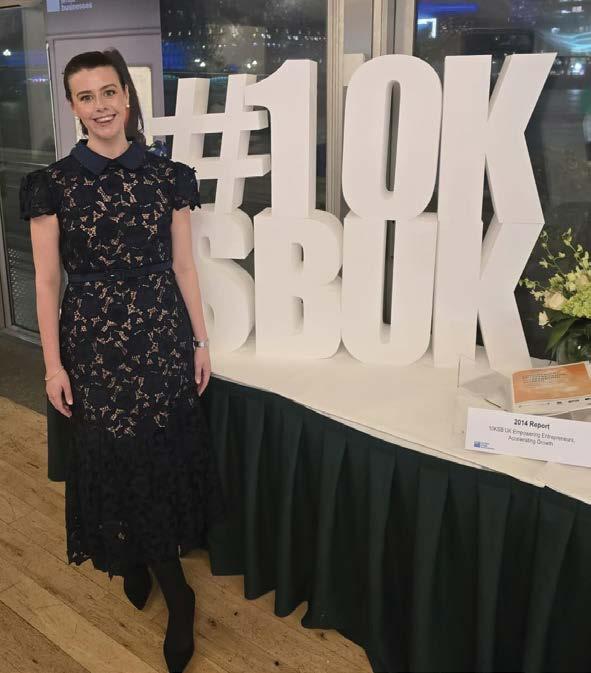
While headlines focus on economic headwinds, thousands of small businesses across Britain are quietly defying the trend. They’re growing faster, hiring more people, and achieving higher productivity than their peers. Goldman Sachs has had a front-row seat to more than 2,500 of these success stories, as we enter the sixteenth year of our 10,000 Small Businesses (10KSB) UK programme. In our latest Impact Report, published in December, the Enterprise Research Centre at Aston University examined the trajectories of the 2,509 high-growth businesses that have graduated from 10KSB UK and compared them to businesses of a similar size and growth profile. The findings are striking. Within three years of completing
Pair learning with real-world guidance
The 10KSB UK programme centres on globally renowned business education delivered by Oxford University’s Saïd Business School – it is essentially a mini-MBA-style programme delivered over three months and refined over 15 years designed to equip small business owners with the frameworks to understand markets, manage finances, and develop a strategy for growth. But what transforms this education into results is pairing it with individualised support. Each participant works with a dedicated “Growth Expert” – experienced business practitioners who help apply classroom frameworks to real challenges. While a module might cover market entry strategy, a
10KSB UK, our alumni outperform their peers by increasing their revenues by 43% and number of people employed by 35% on average, as well as achieving approximately 14% higher productivity. If this effect was replicated for all 153,000 comparable businesses across the UK, then we could see almost one million new jobs created and over £100bn in estimated additional revenue. We’ve learned that this success rests on three pillars: combining rigorous business education with tailored, one-to-one support; building networks that can create lasting commercial value; and creating the space for strategic thinking. These lessons offer a roadmap not just for 10KSB UK alumni, but for any business owner seeking to accelerate their own growth in 2026 and beyond.
FOR 2026, BUSINESS OWNERS SHOULD ACTIVELY PRIORITISE INVESTING IN THESE PEER RELATIONSHIPS – WHETHER THROUGH BUSINESS EDUCATION, ATTENDING INDUSTRY GROUPS, OR WORKING WITH OTHERS TO CREATE PEER ADVISORY CIRCLES”
Growth Expert helps you navigate entering your specific market with your particular constraints.
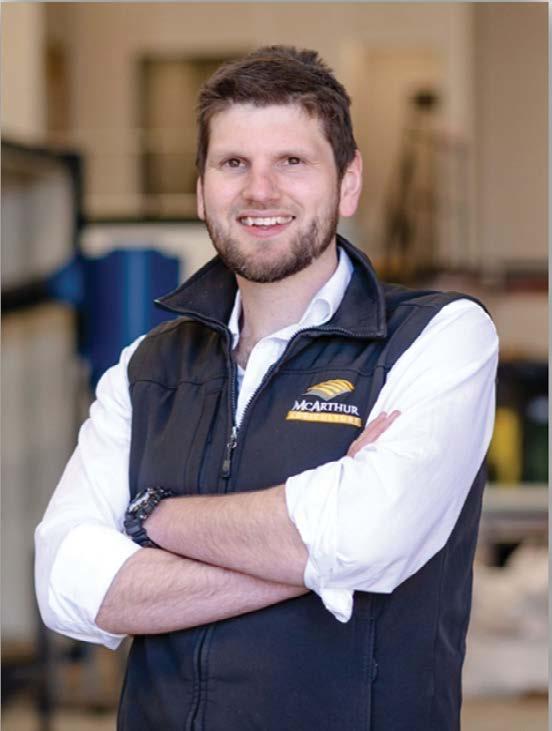
John McArthur, whose company McArthur BDC designs grain storage systems for cereal farmers and distillers, credits this combination with transforming his business.
“Without the financial organisation I learnt, we’d have been flailing during Covid,” he says. “The access to finance information and grant application
advice meant we were wellstructured and stayed financially robust.” The programme also gave him confidence to pursue acquisitions, buying both a supplier and a customer, with one of his advisors from the programme still sitting on his board. For any entrepreneur, it’s a demonstration that structured learning matters, but so does having someone who can help you translate general principles
→ John McArthur, founder of McArthur BDC
into specific actions. Seek out mentors or advisors who know your industry and can provide practical guidance on applying what you’re learning to the particular challenges your business faces.
Build networks to open new doors
10KSB UK graduates consistently report that relationships formed during the programme prove as valuable as the education. Businesses from their cohort become customers, suppliers, and collaborators. They recommend each other’s services and sometimes launch ventures together.
Paris Blackwell, who runs Pario Holiday Parks in
“INVEST IN STRUCTURED LEARNING AND FIND ADVISORS WHO CAN HELP YOU APPLY IT. BUILD NEW RELATIONSHIPS WITH FELLOW ENTREPRENEURS WHO UNDERSTAND YOUR CHALLENGES. AND CARVE OUT TIME TO STEP BACK AND THINK STRATEGICALLY ABOUT WHERE YOUR BUSINESS IS HEADING”
North Wales, exemplifies the lasting power of these connections. “Eight years after our time on the 10KSB UK programme,
our cohort are still in regular communication. We ask questions and share stresses that other entrepreneurs can relate to.”
These aren’t just professional contacts –they’re personal relationships built on shared entrepreneurial experience. And increasingly, they extend internationally.
Connections with our US and French programmes have opened export markets and cross-border relationships for UK alumni, creating opportunities they wouldn’t have discovered in isolation.
There is so much value in connecting with people who understand your challenges and can become collaborators or guides into new markets. For 2026, business owners should actively prioritise investing in these peer
→ Paris Blackwell, Director at Pario Holiday Parks
→ Naynesh Karia, Co-founder of Food Attraction Limited
relationships – whether through business education, attending industry groups, or working with others to create peer advisory circles.
Make time to work on your business rather than in it
The 10KSB UK programme also creates dedicated time for business owners to step back and think strategically. When you’re immersed in daily operations it can be difficult to maintain the broader perspective needed to spot bottlenecks, identify growth opportunities, or develop coherent plans.
Naynesh Karia discovered this when he joined the programme in 2016. His family food business, Food Attraction, had £2.5m in annual sales and 25 staff, but was hitting a ceiling. “The opportunity came just at the right time. It gave me the mental capacity to be pragmatic and realise we needed to start hiring to grow.”
Stepping back allowed him to see that he couldn’t be an expert in everything. He recruited key
managers and formed a board of senior management, freeing himself and his brother to focus on marketing and product development. Today the business employs 130 people with £15m in revenues.
Creating this space deliberately is something all entrepreneurs should seek to do. Block out time regularly – monthly or quarterly – to work on your business rather than in it. Use it to assess what’s working, identify constraints, and explore opportunities you’ve been too busy to consider.
Three things you can control
The year ahead will bring challenges no business owner can predict or control. But amid the unpredictability, there are concrete actions you can take right now. Invest in structured learning and find advisors who can help you apply it. Build new relationships with fellow entrepreneurs who understand your challenges. And carve out time to step back and think strategically
about where your business is heading. These three priorities won’t insulate you from every headwind, but the evidence from 2,500 growing businesses shows they can put you in a stronger position to navigate whatever 2026 brings. The businesses most likely to thrive this year will be the ones that start now.
Charlotte Keenan is the Head of the Office of Corporate Engagement International at Goldman Sachs and leads Goldman Sachs 10,000 Small Businesses UK, a programme which provides business and management training to highgrowth small businesses in the UK to create jobs and economic opportunity. The information and statistics in this article are drawn from the Impact Report. The case studies and examples set forth herein are for illustrative purposes only and should not be considered a prediction or assurance of future performance, nor a guarantee of actual results.
2026 will be the year of Climate’‘Quiet
What does that mean for founders?
by JULIETTE DEVILLARD
Something shifted for climate founders over the past year. In 2024, building a “climate tech” company was, in itself, a strong positioning. It helped attract talent, capital, and attention. It signalled ambition and values. For a while, that was enough to open doors. In 2025, that changed. With Trump’s election, the rollback of climate policy in the US and a growing backlash against ESG, many companies quietly softened their language on net zero or stepped back from public sustainability commitments altogether. As political will waned, funding became tighter, both from investors and potential customers.
The need for climate action didn’t stop, but leading with climate became harder. As the start-up world continues to adapt, I predict that 2026 will be the year of “Quiet Climate”. Quiet Climate doesn’t mean building different solutions. It means talking about them differently. Founders will keep working on electrification, efficiency, resilience, low-carbon materials and cleaner infrastructure. However, fewer decks will open with the word “climate”; they’ll instead open with margins, efficiency, payback periods and risk reduction.
For years, climate innovation was often pitched as being mission-first. The assumption was that customers would pay a premium for sustainability, or that being greener was, on its own, a competitive advantage. In today’s economy, that assumption no longer holds. When budgets are under pressure, businesses buy what saves them money and what reduces risk - what helps them deliver on their core objectives. That doesn’t make climate solutions less relevant, but it does change how they need to be sold.
The strongest climate-driven businesses won’t ask customers to make a values-based choice. They’ll offer a clear upgrade, lower energy costs, more reliable operations, faster deployment or easier compliance, or all of the above. Emissions reduction is now the outcome of a better product, not the headline. This is especially important for mission-driven founders to internalise because most climate startups aren’t selling to sustainability teams. They’re selling to CFOs, operations leaders and procurement teams. These buyers care about cost, reliability and performance. If a business’ solution delivers on those metrics, decarbonisation becomes a powerful added benefit. It may feel painful to be inwardly motivated by impact, but outwardly selling efficiency, but this shift is now a necessity.
This trend has already played out in venture. Funds that once branded themselves explicitly as “climate” are now leaning into adopting language like “efficiency”, “industrial innovation”, “deep tech” or “energy security”. The portfolios of start-ups they invest in still look
strikingly similar, but the framing has changed because the market has changed.
Founders are making the same move. Pitch decks that once led with tonnes of CO2 saved now lead with unit economics. Case studies that used to highlight emissions reductions now open with cost savings and operational impact. The climate story is still there, but it’s no longer doing the heavy lifting on its own. There’s a resilience benefit here too. Businesses that can clearly articulate their commercial value are less exposed to political cycles or public backlash. If a solution stands up on cost and performance alone, it’s harder to dismiss.
→ Juliette Devillard, founder, Climate Connect
However, Quiet Climate comes with a real risk. We can’t allow this “quiet” era to become an excuse to stop measuring, stop reporting or stop being honest about the climate impact of these products. If the startup world teaches us anything, it’s that attention moves in cycles. Climate will return to the centre of public conversation, and the work done now needs to be robust enough to stand up to scrutiny when it does. If we care about long-term impact, Quiet Climate needs to be about message discipline, not lower standards.
So what should founders be doing in practice in 2026? First, pressure-test value propositions. If the climate benefit disappeared from a startups’ pitch, would the offer still be compelling? If not, founders need to find the hook. That might be energy cost, reliability, compliance, throughput, waste reduction, safety or labour constraints. Second, build
“
Businesses that can clearly articulate their commercial value are less exposed to political cycles or public backlash. If a solution stands up on cost and performance alone, it’s harder to dismiss”
for adoption, not applause. At the early stage, many startups optimise for winning awards or sounding good on stage - not surprisingly given this can help attract angels and early funders. With scale though, the focus needs to shift away from shiny awards, and towards the mundane but essential task of fitting seamlessly into customer procurement processes. These include fast integration, clear ROI and credible case studies over vanity metrics. Third, learn to be bilingual. Founders need to speak “customer” and “climate” fluently without mixing the messages. Customers want operational outcomes. Investors, regulators and strategic partners want credible data. Teams still want purpose. Surviving and thriving in an era of Quiet Climate means knowing which language to use, and when. Fourth, don’t worry about the labels. Whether the market calls it climate tech, energy tech, resilience tech or industrial innovation, the underlying opportunity is the same: rebuilding how the world makes, moves and powers things. Finally, don’t quit. The toughest years are when the future gets decided. When easy money disappears and scrutiny increases, genuinely strong solutions have room to stand out. The founders and investment funds who stick with climate during this downturn are the ones who will shape the next cycle of growth.
The climate crisis remains a multi-decade challenge that will reshape supply chains, infrastructure, insurance markets and geopolitics. Businesses will keep needing cleaner power, more efficient operations and more resilient systems. Those forces are bigger than any election cycle, so let’s not let ourselves be sidetracked by a single climatedenying President.
Juliette is a climate connector and ecosystem builder. Prior to founding Climate Connect, she spent 4 years in the US working in early-stage startup creation at the intersection of climate and deep tech. Juliette is also a public speaking coach, leadership coach, and mental health awareness advocate.
TONY MATHARU: Planting Trees for the Long Term
WHEN THE PANDEMIC EMPTIED LONDON’S STREETS AND SILENCED ITS THEATRES, CAFES, AND BARS, IT REVEALED A TRUTH OFTEN OVERLOOKED: THE CITY’S VITALITY DEPENDS AS MUCH ON HUMAN MOBILITY AS ON THE GRANDEUR OF ITS ARCHITECTURE. FEW UNDERSTOOD THIS MORE VISCERALLY THAN TONY MATHARU, THE BRITISH PROPERTY DEVELOPER AND ENTREPRENEUR WHOSE WORK SPANS HOTELS, HOSPITALITY GROUPS, AND COMMUNITY INITIATIVES.
My initial interest in starting a business,”
Matharu recalls, “began as a small seed that germinated in an environment created and nurtured by my mother who encouraged me to start something of my own, since there was no family business existing.” That first venture blossomed into a chain of 18 hotels in central London. Growth brought new opportunities and challenges: ultimately a difference of vision and ambition with minority shareholders led Tony to restructure, step away, and embark on a fresh chapter unencumbered by con-
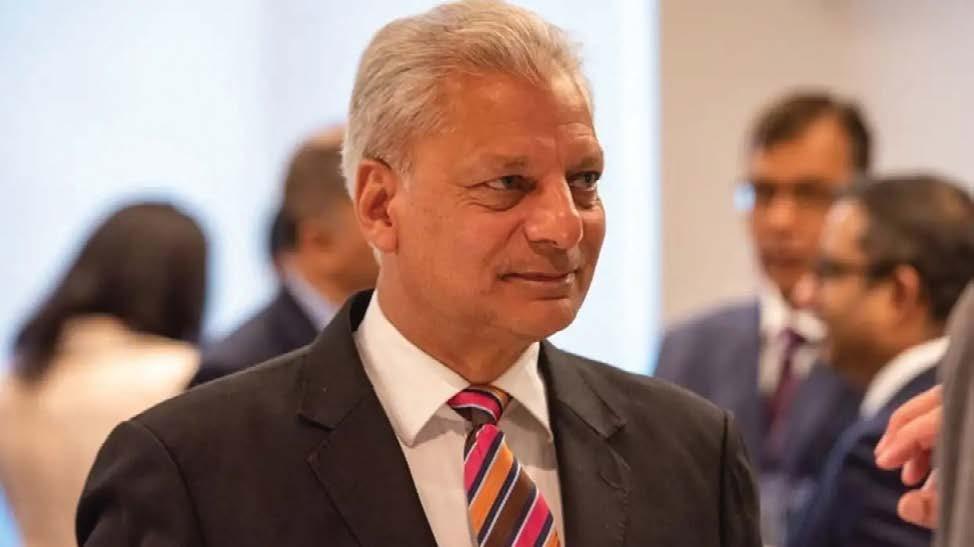
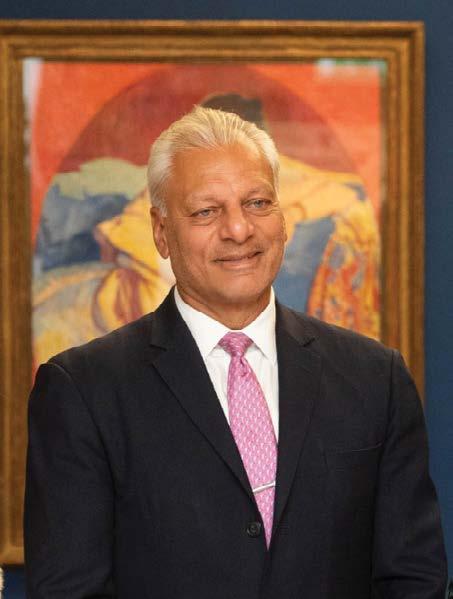
→ Tony Matharu, Board Member of the London Chamber of Commerce and Industry and Chairman of its Asian Business Association
straints imposed by others. From that transition emerged the Integrity International Group and its multi award winning Blue Orchid Hospitality subsidiary, models of resilience and longterm strategic thinking. Matharu says his philosophy mirrors
that of Warren Buffett: thinking longterm and ‘planting trees.’ The benefits of shade and protection others enjoy, he notes, come from investments nurtured over time. In practical terms, this means patient, deliberate growth: acquiring sites, navigating planning,
developing buildings, stabilising income streams and creating long term value. These are stages measured not in quarters but in years.
The arrival of COVID-19 provided an unexpected test of this philosophy.
Central London’s vibrancy is predicated on movement: office workers commuting, tourists wandering, theatregoers gathering, diners circulating. Without that mobility, the city’s economy stalled. “Just take the Square Mile,”
Matharu explains, “five or six hundred thousand people coming into that one square mile every day… when they’re not coming in, there’s an impact… the whole infrastructure shudders to a halt.”
In response, he founded Here to Help London, a charitable initiative aimed at alleviating lockdown hardships, which then evolved into the Central London Alliance, a community interest company. It was a recognition that the private sector, par-
→ The Rochester, a luxury hotel in London, included in the Blue Orchid Hospitality portfolio
→ Atlas House, a Grade II‑listed historic office building in the City of London
ticularly hospitality, has obligations beyond profit.
“When you start a business, you’re part of a multifaceted interdependent community,” Matharu notes. Hotels, pubs, and restaurants are not mere commercial entities; they are nodes in a social network, providing employment, culture, and cohesion.
Matharu’s reflections extend beyond London’s streets to the broader ethos of entrepreneurship. Public goodwill, he observes, has the capacity to sustain cities in ways government interventions cannot. From the volunteers of London 2012 to the frontline responders applauded during the pandemic, civic spirit underpins resilience. “Human beings are generally well meaning and public spirited… but some-
times this gets pushed to the background.” His vision for business is similarly integrative: profitability should serve society, not merely shareholders. This sense of social responsibility is rooted in Matharu’s personal values, particularly the Sikh principle of seva - “doing something positive for somebody or some group of people every day without seeking selfbenefit or self-aggrandisement.” He has woven this ethos into his business philosophy, seeing no contradiction between generating profit and promoting social good. “Many people regard doing good as good for business… but
if you’re still doing good, that’s a positive thing, even if individual or collective rewards might also result” he notes. In a city that thrives on mobility, diversity, and culture, such an approach may be the most sustainable investment of all. “Entrepreneurs just want the right environment to create and scale their businesses and to generate value. It’s not too much to ask, is it?”
Sustainability has also become a strategic priority. In an era of carbon-conscious development, Matharu favours retrofitting over demolition wherever feasible. “The local planning authorities are
→ The Wellington, a Westminster‑based boutique hotel is part of Tony Matharu’s Blue Orchid Hospitality portfolio
now adopting a retrofit-first approach… rather than demolish and destroy, one can take benefit from the quality of the historic fabric and materials.” The decision is never binary: market needs, regulations, and building characteristics determine whether retrofitting is viable, but the guiding principle remains - extract life from existing structures before creating new ones.
For aspiring entrepreneurs, Matharu offers practical counsel. Understanding demand and aligning supply is fundamental. If you understand the market’s needs and can meet them profitably, you’ve solved the first puzzle of entrepreneurship.” Equally critical is removing obstacles. “Anything that quells or inhibits ambition is counterproductive and you need a “stable and certain environment to stimulate and reward risk.” Excessive taxation, complex
“MANY PEOPLE REGARD DOING GOOD AS GOOD FOR BUSINESS… BUT IF YOU’RE STILL DOING GOOD, THAT’S A POSITIVE THING, EVEN IF INDIVIDUAL OR COLLECTIVE REWARDS MIGHT ALSO RESULT”
regulations, and volatile policy environments can discourage investment and scaling. Matharu does not mince words: “Why take risks, borrow lots of money, invest your time and other resources, when at the end all of that the value you have created and possibly more will simply be removed and given to the tax man?” Business rates, stamp duties, and inheritance taxes can collectively erode the rationale for growth, prompting entrepreneurs to scale back or sell, reducing employment and competition in the process.
Undeterred by these pressures, Matharu is advancing a robust pipeline of developments. He is developing another all suite apartment hotel in the City of London, with a hundred apartments,
alongside a boutique Grade II-listed hotel near Guildhall and Bank, complete with spa and pool. He has also secured a site in St James’s Park for over 500 rooms with extensive facilities. “I have at least five years of development in place and I am determined to continue, although the environment is more challenging than I can ever remember,” he admits. The challenges he cites are not abstract. London’s hospitality sector faces disproportionate burdens: business rates for hotels in the UK are set to increase by an average of 115% and more in London, according to UK Hospitality, while restaurants, venues and pubs have also faced steep rises. Energy costs, employment taxes, increased employment regulation,
“THE GOVERNMENT MAY HAVE BACKTRACKED ON CERTAIN PLANS BUT A DECISIVE U-TURN IS STILL NEEDED ON THE ‘21ST CENTURY WINDOW TAX’ WHICH IS TODAY’S BUSINESS RATES REGIME AND ON THE PROPOSED REMOVAL OF BUSINESS
PROPERTY RATES RELIEF/ INHERITANCE TAX”
and other regulatory measures compound the strain. Matharu sees these pres-
sures as potentially calamitous. “UK hospitality is on the brink - approximately
six hospitality businesses are set to go under every day. Independent operators are disappearing, leaving the field to global brands who do not have the same community and long term interests as independent concerns and especially family owned businesses, and they do not have to factor in or consider inheritance taxes, for example. We need to do far better.” Inheritance tax is critical looming threat. “If 20% to 40% of your total asset base is subject to inheritance tax as a result of the proposed removal of
business property tax relief, it becomes the opposite of scaling. Heirs would potentially be forced to sell and break up carefully curated businesses. This affects independent familyowned enterprises just like the farmers where careful assembly and stewardship of assets is being punished by the removal of agricultural property tax relief. Many are rightly alarmed - without intervention, we face disaster: reduced investment, scaled-back operations, and fewer jobs with less money in the Treasury coffers.” With the
UK’s wealthiest being driven to Dubai and elsewhere to avoid what they consider is a punitive tax regime, “what’s left is 100% of nothing” and zero tax receipts from those future and past wealth creators.
Yet, despite these hurdles, Matharu remains committed to the long game. His investments are calculated, patient, and informed by both commercial and social principles. “I’m still sticking to the Warren Buffett articulated long-term plans,” he says, underscoring the interplay between vision and pragmatism. His portfolio exemplifies how entrepreneurship can combine profit, sustainability, and community engagement - if given the right environment. “Entrepreneurs are typically survivors - we are used to being flexible, hardy and resilient. We are used to managing risk and the volatility imposed by the global order, but we could do without incoherent and unnecessary domestic disturbance.”
For the next generation of entrepreneurs, Matharu’s advice is clear: understand your market,
anticipate demand, invest thoughtfully, and embed social and environmental considerations into your business model. Yet he cautions that ambition alone is insufficient; external conditions - the fiscal, regulatory, and social environment - must enable growth. “You need stability and less uncertainty to stimulate ambition… once you’ve got the ambition, then you need the opportunity and the right environment to flourish”
In many ways, Matharu embodies the duality of London itself: resilient and innovative, yet vulnerable to policy shifts and economic shocks. His career traces the arc from small beginnings to large-scale operations, always anchored by a long-term philosophy and a belief in community responsibility. Whether refurbishing a historic hotel or fostering public engagement during lockdown, his work illustrates that entrepreneurship is as much about stewardship as expansion.
As London navigates post-pandemic recovery, his reflections are a reminder that business, society,
and environment are intertwined. The commercial and economic logic of scaling runs directly counter to policies that discourage investment, he warns. Without supportive policies, independent businesses will falter, diversity will shrink, and employment will decline. Yet with vision, patience, and the right incentives, entrepreneurs like Matharu can continue to plant trees whose shade will benefit many - a lesson for London, and perhaps for any city seeking to combine economic vitality with social cohesion.
Matharu insists that the UK must do better. “The government may have backtracked on certain plans but a decisive U-turn is still needed on the ‘21st Century window tax’ which is today’s business rates regime and on the proposed removal of business property rates relief/inheritance tax - and it can be done without embarrassment. In a shifting global order, we have the opportunity to rethink our approach, adapt our priorities, and create a framework that supports growth rather than stifles it. That is the change I would like to see.”
→ Tony Matharu acquired The Crescent, a collection of Georgian buildings
Net Zero Britain
Ambition meets delivery.
by PATRICIA CULLEN
The UK likes to think of itself as a pioneer in the climate arena. From hosting COP26 to championing green finance, it has earned plaudits for ambition. Yet ambition is a slippery commodity: talk of climate leadership is abundant, while tangible progress often lags. The UK’s clean-tech sector brims with innovation, but translating that brilliance into real-world deployment remains a delicate balancing act. As one industry leader put it, the country risks “talking the talk on climate leadership while slumping in delivery
or outsourcing it.” That observation, by Dr. Liz Gilligan, CEO and co-founder of Material Evolution, a company creating sustainable materials from bio-based and recycled sources, strikes at the heart of Britain’s green paradox: world-class ideas, but an infrastructure and procurement system that struggles to convert them into everyday practice.
Where the UK Excels
There is no shortage of reasons to be cautiously optimistic. The UK enjoys pockets of genuine leadership in clean technology and climate-related finance. Catalina Valentino, Group CEO of ELIXR, a smart city
innovator, observes that the nation “is genuinely leading in climate finance structuring, regulation frameworks, and early-stage innovation.” From digital twins to ESG reporting, British firms are building sophisticated capabilities in green finance and early-stage technological development. Pilot projects abound, promising glimpses of a carbonconscious urban future.
Similarly, the UK’s material science sector holds considerable promise. Gilligan notes that “the fundamentals for leadership remain solid: worldclass innovation, growing investor appetite and increasing client focus on embodied carbon.” In the context
second-to-none,” particularly in retrofitting existing commercial assets - a critical area given that 80% of today’s buildings will still be in use by 2050. Across materials, finance, technology, and professional expertise, the UK’s capability foundation is undeniably strong.
The Gap Between Ambition and Delivery
For all its innovation, Britain remains at risk of over-promising. Gilligan warns that unless procurement evolves, “we will end up exporting innovation, talent and industrial capability to countries more willing to back their climate ambitions with action.” In other words, brilliant ideas will leave home to find executionfriendly environments abroad. Valentino echoes this concern in the realm of urban technology: “Too much clean tech and proptech stops at pilots, PDFs, or planning-stage ambition. Retrofit is a clear example: we talk at scale but deploy in fragments, with no national execution engine.” Britain excels at “designing the future” but struggles with “building it repeatedly, cheaply, and fast.” In short, ambition without execution risks remaining a digital sketch rather than a lived reality.
of construction, where demand for concrete has fallen to its lowest level in over 60 years, the opportunity to reset long-standing industrial practices is unprecedented. Low-carbon manufacturing, she stresses, must be treated not as a line item in procurement but as “the mast of strategic national infrastructure.” Carbon capture and the circular economy form another front of UK innovation. Dr. Shiladitya Ghosh, Chief Operating Officer of Mission Zero Technologies, a carbon-capture company, highlights the importance of early-stage investment: “Capitalintensive solutions have greatly
benefitted from leading programmes such as the Net Zero Innovation
Portfolio, which oversaw £1.3bn spent on cultivating and piloting various innovations.” Yet he cautions that domestic scale-up remains constrained by regulatory and infrastructural gaps.
Meanwhile, the engineering profession is quietly advancing decarbonisation in a pragmatic, technically rigorous fashion. Guy Willis-Robb, director at Harley Haddow, an engineering consultancy focused on sustainable and Net Zero solutions, remarks that “the knowledge base and skillset of professionals in the industry are
The gap is not merely conceptual; it is financial and regulatory. Ghosh notes that the high cost of domestic electricity blocks many domestic projects from achieving cost competitiveness, pushing firms to consider opportunities abroad. Similarly, planning and infrastructure misalignment creates a systemic drag. “Overhauling the power networks and energy infrastructure across the UK would tremendously accelerate climate-positive development,” he observes. Yet the perceived costs and long timelines have left deployment opportunities “paralysed.”
Even where regulatory mechanisms exist, they are not always aligned with technological progress. Willis-Robb points out that while instruments such as the Minimum Energy Efficiency CAPITAL-INTENSIVE
→ Dr. Liz Gilligan, CEO and co founder of Material Evolution
‘T/Cleantech
→ Catalina Valentino, Group CEO of ELIXR
Standards (MEES) are forcing property owners to act, the underlying methodologies “need to move with the technological advances.” Compliance minimums remain a conservative baseline rather than a driver of transformative action.
Capital, Regulation, and Planning: The Hidden Levers
A recurring theme across all four voices is the misalignment of capital, regulation, and planning. Valentino frames it succinctly: “Planning approvals don’t align with funding timelines. Regulation doesn’t align with how assets are financed. And capital doesn’t align with how towns actually regenerate; which is over decades, not funding cycles.” In other words, the machinery of climate action is fragmented: ambitious targets exist, but the mechanisms to deliver them are mis-synchronised.
Financiers are eager for climate-positive assets, yet they “wait for perfect certainty,” as Valentino notes. Public policy tries to mitigate risk but often adds friction, creating a classic Catch-22. Meanwhile, infrastructure and energy costs, highlighted by Ghosh, further raise the barrier for domestic deployment. In construction, Gilligan notes that policy ambition has “often moved faster than procurement rules, while capital has tended to chase the lowest upfront cost rather than the lowest-carbon outcome,” leaving low-carbon solutions underutilized.
Yet not all is doom-laden. Public funding schemes, such as the Public Sector Decarbonisation Scheme, have successfully unlocked projects that might otherwise have stalled. Regulatory pressure can accelerate change where properly designed, while early-stage venture capital ensures that the front of the solutions funnel remains “healthy and thriving,” according to Ghosh. When aligned, these levers can transform policy into practice.
The Net Zero Built Environment Today
So, what would a Net Zero UK look like - not in 2050, but on streets and balance sheets today? Across interviews, a consensus emerges: it would not appear futuristic, but operational and measurable. Valentino emphasises visibility: “Buildings would be measurably more efficient, not just EPC-compliant. Energy systems would be local, monitored, and optimised in real time. Retrofit would be phased and financed like infrastructure, not home improvement.” She frames Net Zero not as a destination, but as “a functioning system… if it’s not visible in cashflow, comfort, and construction pace today, it’s not real yet.” Ghosh underscores the invisible side of progress: homes and streets would be built with circular materials or CO2-infused construction components, yet appear outwardly identical. Heat pumps and improved insulation would deliver comfort at lower cost and far fewer emissions. Meanwhile, WillisRobb adds that measured performance should replace assumption-heavy EPC compliance: “Net Zero seen as asset future-proofing, not cost… services-led decarbonisation first, fabric upgrades where they genuinely add value.” Materials, too, play a central role. Gilligan highlights the opportunity to reset supply chains: “Given the low levels of UK concrete demand, this is a rare opening to reset the system rather than default to business as usual.” Anchoring fiscal and procurement policies around verified low-carbon materials can move innovations from early adoption to commercial norm, strengthening the entire industry. On balance sheets, Net Zero manifests as reduced operating costs, longer asset life, and lower risk exposure. On the street, it manifests as warmer homes, cleaner air, and reliable energy systems. In effect, Net Zero is less about abstract targets and more about practical, measurable improvements.
Policy and Financial Levers for Scaling
Turning ambition into scale requires a careful alignment of incentives, finance, and regulatory clarity. Valentino argues that “data needs to sit at the centre of delivery, not reporting… Live performance data should de-risk finance, unlock insurance, and verify outcomes.” Gilligan adds that low-carbon manufacturing should be elevated to the status of “strategic national infrastructure,” implying that policy and procurement must reflect its centrality to national resilience. Finance, too, must evolve. Early-stage capital is abundant,
but blended finance models capable of pricing risk dynamically are essential for large-scale deployment. Ghosh stresses the importance of aligning incentives across the circular economy: suppliers, manufacturers, and end-users must move in concert, rather than being simultaneously rewarded and penalized by outdated frameworks. Planning reform is equally critical. Willis-Robb argues that infrastructure and grid readiness must keep pace with electrification, particularly outside London. A coherent, expedited planning process that integrates sustainability, finance, and technical feasibility is essential to prevent projects from dying slowly in approval pipelines.
From Theory to Practice
Across all four interviews, one theme is clear: the
UK’s leadership remains theoretical until it is embodied in the everyday built environment. Innovation is necessary but insufficient. Policy, finance, engineering, and procurement must move from parallel tracks to a single, coordinated highway. When this alignment occurs, Net Zero ceases to be an aspirational target and becomes part of the operational, financial, and social fabric of the country. Indeed, the UK now sits at a critical inflection point. With low levels of concrete demand, strong technical expertise, growing capital appetite, and emerging regulatory clarity, it could pioneer a globally replicable model of Net Zero delivery. The alternative -continued reliance on pilots, fragmented deployment, and exported talent - is one the country can ill afford if it hopes to
maintain credibility as a climate leader.
Ambition Anchored in Delivery
Net Zero Britain will not be built on ambition alone. It will be forged in the detail of procurement choices, the rigor of planning, the discipline of finance, and the clever
outcomes - warm, energy-efficient homes, resilient infrastructure, and financially sound assets. If it succeeds, the country can demonstrate that climate leadership is not merely a promise for 2050, but a present-day achievement, visible on streets, balance sheets, and in the lives of citizens.
deployment of technology.
As Gilligan observes, “Until procurement evolves to reflect that reality, these advantages remain theoretical.” Valentino concurs: “Net Zero happens when assets become bankable, repeatable products, not one-off showcases.”
The UK has the tools, talent, and innovation to lead. The question is whether it can convert these into tangible
If not, the gap between ambition and action will widen, leaving the UK’s much-vaunted green credentials grounded more in rhetoric than reality.
In the end, Net Zero is less a destination than a system - operational, measurable, and practical. Britain’s opportunity is to build that system today, before the global race to a carbon-neutral economy leaves it playing catch-up.
→ Dr. Shiladitya Ghosh, Chief Operating Officer of Mission Zero Technologies
→ Guy Willis-Robb, director at Harley Haddow
‘T/Governance
Governance is the New Green
Peter Wirtz, Professor of Corporate Governance at emlyon business school, uncovers groundbreaking research showing that green ventures can outpace their competitors in the long run - but only when backed by strong governance frameworks. by
PATRICIA CULLEN
In an era where sustainability is at the forefront of investment decisions, Peter Wirtz’s research Fundraising, Governance and Environmental Ethics: Evidence from Equity Crowdfunding, uncovers an intriguing insight into the intersection of ethics and finance. Partnering with his colleague Silvio Vismara, they discovered that while green ventures often outperform others, their long-term success hinges on one crucial factor: strong corporate governance. In this Entrepreneur UK interview, Wirtz explores the pivotal role corporate governance plays in turning environmental promises into real capital.
→ Peter Wirtz, Professor of Corporate Governance at emlyon business school
What does your research reveal about how environmental commitments influence earlystage investment in UK start-ups?
With my colleague, Silvio Vismara, we were interested in finding out if ethical values of sustainability are compatible with shareholder value for early stage investors. We were able to access a very large data-set of such early stage investments on UK-based equity crowd-funding platforms. As a result, we could observe that green ventures significantly outperform other early stage ventures, but only under very specific conditions related to the corporate governance model adopted by the ventures. The strong performance we observed for the ventures with effective corporate governance appeared to be not only a short-term advantage but remained present over the long run. Equity investors perceive significantly higher value in green ventures compared to others when the right corporate governance is in place.
Why is strong corporate governance the deciding factor that turns sustainability pledges into real capital?
The explanation is actually quite intuitive. Strong governance creates trust in that it minimizes the risk of a mission drift. If a young
GREEN VENTURES SIGNIFICANTLY OUTPERFORM OTHER EARLY STAGE VENTURES, BUT ONLY UNDER VERY SPECIFIC CONDITIONS RELATED TO THE CORPORATE GOVERNANCE MODEL ADOPTED BY THE VENTURES”
start-up declares to be on a mission to support the environment, this may only be cheap talk and greenwashing. So investors who invest their money for reasons related to sustainability must be convinced that effective controls are in place to guarantee that they will get what . That comes at a cost. We were able to confirm this intuition empirically and showed that the most effective governance for crowdfunded ventures consists of bundling the control rights at the level of the crowdfunding platform.
The direct ownership model proposed by some equity crowdfunding platforms leads to a dispersion of control and, hence, to relatively weaker governance.
Your findings show well-governed green ventures outperform competitors long termwhat’s driving that advantage?
The positive impact of governance in this case is related to concentrating the ownership control rights of the investing crowd at the level of the crowdfunding platform.
Platforms can serve as effective control agents if they develop the right skills. A platform can acquire expertise in effective sustainable governance. The platform has also an economic interest in doing so since this can be a reputational asset and competitive advantage in the dynamic market of equity crowdfunding solutions.
Why do green start-ups continue to succeed despite growing political pushback and waning enthusiasm for sustainability?
Because green business is not only about ethical values and warm glow. It also spurs innovation and opens new business opportunities. One thing we show in our research is that good ethics in the pursuit of saving the planet is also good business over the long run.
What do these findings suggest about the future resilience and growth of the UK’s green economy?
The right entrepreneurial ecosystem is an important determinant of the resilience and dynamics of the green economy. Early-stage investors are a part of this ecosystem provided they put in place the corporate governance solutions to effectively minimize the risks of greenwashing and mission drift.
The Cost Of Exclusion
Why ignoring racial equality hurts the bottom line.
by DR MARCELLE MONCRIEFFE-NEWMAN
Look at any glossy annual report and you will see confident statements about “our people” being the organisation’s greatest asset. Yet when you examine who gets hired, promoted and paid fairly, especially when it comes to Black talent, the numbers tell a much harsher story. That gap between rhetoric and reality is not just a moral failure; it is a material, measurable drag on productivity, innovation and growth.
The numbers don’t lie: Black talent is stuck at the bottom Black professionals are almost absent from senior leadership, holding only around 1.5% of roles; if representation reflected the wider population, that figure would be closer to three times higher, and strikingly, this percentage has barely shifted in a decade. In the public sector, Black workers are highly represented on the frontline, around 44% in some areas of education and healthcare, yet their representation in senior posts has declined in several sectors while stalling in others, at the same time Black unemployment runs at more than twice the rate of White unemployment despite similar or higher qualifications. This is less a pipeline issue than a progression problem: research in my book ‘One Step Forward Two Steps Black’ shows that Black employees are motivated and qualified but face ongoing
barriers to promotion. Recruitment agencies and internal practices reinforce bias, limiting advancement and keeping Black talent clustered at the bottom rather than the top.
Nepotism, bias and the myth of meritocracy
Everyday practices, rather than a lack of talent, sit behind the UK’s racial leadership gaps. Nepotism and reliance on personal networks in hiring and promotion quietly sideline more qualified candidates, including many Black professionals, entrenching homogenous leadership teams, eroding trust and damaging morale among those who can see that meritocracy is more myth than reality. Major reviews have shown that formal fixes like blind CVs and written equality policies have not dismantled structural racism: the Runnymede Trust documented compounded sexism and racism for Black and ethnically diverse women throughout recruitment and progression, while the Lammy Review linked fair employment to reduced reoffending. Corporate data tell the same story: although almost all FTSE 100 companies now have at least one ethnically diverse director, only about 1% of FTSE 100 and under 2% of FTSE 250 directorships are held by Black people, revealing how far there still is to go. Put simply: while diversity targets may show modest progress on paper, Black leaders are still the exception rather than a normal, visible part of organisational leadership.
The ethnicity pay gap: a recurring warning signal
The ethnicity pay gap is a persistent warning sign that racial inequality is deeply embedded in the UK labour market. Trade union analysis has shown a large gap for years, for example, a 23% hourly pay difference between Black and White workers in 2018, with Black people holding A-levels paid 14% less than equally qualified White peers and some London public sector roles seeing pay deficits of more than a third. More recent government data reinforces this picture, showing that graduates in the “Black other” group earn around £19,400 one year after graduation and Black Caribbean graduates about £19,800, among the lowest earnings of any ethnic group. The McGregorSmith Review estimated that closing progression gaps for Black and other ethnically diverse workers could add £24bn a year to the UK economy, roughly 1.3% of GDP, simply by allowing ethnically diverse talent to progress at the same rate as White colleagues. Yet despite this compelling business case, progress has been painfully slow: recommendations such as mandatory ethnicity pay gap reporting languished for years, and even with a new draft Equality (Race and Disability) Bill on the table, it remains unclear whether the reforms will be enforced robustly enough to shift outcomes into practice.
→ Dr. Marcelle Moncrieffe-
highlights how unlocking diverse talent strengthens the foundations of a sustainable economy
Culture, silence and the “stiff upper lip”
Culture amplifies or neutralises these structural issues. British workplaces are still shaped by the legacy of the “stiff upper lip”: a deep-seated norm of emotional restraint, keeping your head down and not making a fuss. In practice, this often means that employees who experience racism, bias or exclusion feel pressure to stay silent for fear of being labelled “difficult” or harming their careers. Complaints processes are seen as risky and slow, and successful, non-careerending outcomes are rare. The result is a toxic loop. Racially unequal outcomes are treated as unfortunate but inevitable; leaders assume that if things were truly bad, people would say so; and those most affected learn that speaking out rarely leads to change and often comes at personal cost. This reality corrodes trust, increases turnover among high-potential Black and ethnically diverse staff, and prevents organisations from learning from their own data and experience.
Why this is a business problem, not just a moral one
The evidence is clear: discrimination and structural racism in the UK labour market are not marginal issues. They depress wages, restrict progression, distort hiring, and cost the economy billions in lost potential every year. For individual businesses, the cost shows up in slower growth, weaker decision-making, higher churn and reputational risk. The opportunity is equally clear. Organisations that take racial equality seriously, not as PR, but as a core design principle, stand to gain access to a deeper talent pool, richer ideas and more resilient teams. They are better placed to serve diverse markets, navigate social change and attract the next generation of employees, who increasingly treat equity as non-negotiable. For entrepreneurs and founders, these national patterns show up daily inside their own organisations. The choice for entrepreneurs is not whether to “do EDI”
because it is politically fashionable. The choice is whether to keep paying the hidden tax of exclusion, or to redesign workplaces so that Black and ethnically diverse talent can thrive, and in doing so, unlock both justice and growth.
What entrepreneurs can do differently
Ignoring racial equality is expensive; doing it well means rebuilding how a business runs, not just adding a slogan. Entrepreneurs should begin by interrogating their own data on representation, recruitment, progression and pay by specific ethnic groups, then pairing these numbers with honest conversations that reveal lived experience behind the metrics. From there, the real work is systemic: redesigning hiring, promotion and performance processes that currently reward familiar networks and nepotism, making promotion routes and stretch opportunities transparent, and treating ethnicity pay and progression gaps as board-level priorities with clear accountability and timelines. Racial equality is not an ethical add-on; it is a core driver of productivity and growth, and a litmus test of whether organisations are truly serious about performance in the real world.
Dr Marcelle MoncrieffeNewman is the author of the new book One Step Forward, Two Steps Black: Navigating Anti-Black Workplace Culture, out now.
Newman
/Strategy
Building a Business Case for Decarbonisation
by SAM STARK
One of the most challenging jobs shared by sustainability professionals across the board is to increase buy-in for decarbonisation on all levels of the business – and a huge part of this is creating a business case for net zero. A recent report by EY suggests that only two-thirds of businesses have climate action plans. Companies are making progress, however Scope 3 emissions remain the toughest – and most expensive – to get a handle on. Value chain emissions represent around 90% of a company’s total footprint and are difficult to address due to challenges in engaging stakeholders, high reduction costs and shortages of highly trained experts.
However, not having buy-in from the supply chain can create additional hurdles, such as insuffi-
cient climate reporting data. This can lead to poor operational decisions and negatively impact a
business’ overall adaptability and resilience. This can often create hesitation at an investor level. A recent MIT report found that over half of businesses struggle to justify emissions reductions due to unclear returns on investment, while EY’s analysis highlights the financial consequences of delay, estimating that climate inaction could reduce annual revenues by up to 15%. This underlines the need for sustainability leaders to create a strong business case for climate action to manage long-term risk and avoid revenue losses.
The risks of inaction
There are incentive-based ‘carrot’ approaches that centre around value creation rather than risk avoidance. As customers, investors and partners
increasingly demand evidence of low carbon performance, organisations that can demonstrate tangible progress are better positioned to retain trust and win new business. In addition, credible decarbonisation strategies can help build investor confidence by increasing transparency and reducing future exposure to carbonrelated costs.
Crucially, this incentive-led approach gives the impetus to establish a robust business case for climate action. By linking decarbonisation to outcomes such as revenue resilience, access to capital and strategic relevance in a lower-carbon economy, the focus shifts away from ambition alone towards measurable value creation. While incentives can motivate action, many organisations only move at pace when faced with the financial and operational consequences of inaction. Running a business is ultimately about the bottom line and that is where the stick comes in.
Inaction exposes companies to growing financial, legislative and competitive risks. The impact of delayed action is felt differently across functions. For leadership teams, postponing decarbonisation increases financial,
→ Sam Stark is the CEO and founder of Green Project Technologies
reputational and regulatory exposure while competitors move ahead. For finance teams, rising carbon costs and penalties make inaction increasingly expensive, particularly as tax incentives and internal carbon pricing mechanisms become more widespread. For legal teams, regulatory and compliance risks are mounting as reporting requirements expand and enforcement intensifies. For procurement, insufficient progress on decarbonisation can weaken supplier resilience, increase disruption risk and reduce negotiating
DELAYING DECARBONISATION NOT ONLY INCREASES RISK BUT ALSO RESULTS IN MISSED OPPORTUNITIES FOR VALUE CREATION AND COMPETITIVE ADVANTAGE. FOR THIS REASON, BUSINESSES CANNOT AFFORD TO WAIT FOR PERFECT DATA OR FULLY MATURE PLANS BEFORE STARTING TO TAKE ACTION.”
leverage. For IT, the longer action is delayed, the harder it becomes to address gaps in data quality, infrastructure and analytical capability. Ultimately, the most successful approach to decarbonisation balances both push and pull forces. While the ‘carrot’ illustrates long-term value, the ‘stick’ highlights the escalating cost of inaction. Integrating these perspectives relies on having full visibility into the overall emissions and progress across the business, enabling stakeholders to identify opportunities and mitigate both short- and longer-term risks.
Building a business case
Once you’ve identified the key stakeholders that you’ll need to get on board, you need to be selective with your arguments and tailor them to each stakeholder’s priorities and potential risk points. The same reasoning for IT may not land for procurement, while the legal team might have a slightly different perspective than the CEO.
At this stage having a more centralised approach to sustainability data can play an important role. By moving away from fragmented spreadsheet-based reporting, it becomes easier to meet reporting requirements
while ensuring data is relevant and actionable for different functions. IT departments focus on enhancing data integrity, facilitating system integration and filling the gap in emissions reporting. Whereas procurement teams focus on supplier performance, improving visibility into Scope 3 emissions and addressing emissions-related challenges with suppliers. Furthermore, decarbonisation isn’t just about compliance, it also represents a revenue growth opportunity. The strongest business cases connect decarbonisation to financial value. At the macro level, what’s good for the planet is good for business. In order to address the concerns around the costs of decarbonisation, quantifying the business benefits and cost savings will help make the business case – especially for leadership and finance teams. Measuring metrics such as carbon cost savings, revenue growth and compliance readiness, will help build a case for decarbonisation by painting a more vivid picture of the short- and longer-term benefits.
Creating an action plan
No business case is complete without a clear implementation plan, which outlines how the decarbonisation strategy
will be implemented over time. This plan should define specific targets and explain how they will be achieved. It should include the data needed, how it will be collected, and what technology or expertise will be brought in for data management, collection and analysis. It should also outline how suppliers will be engaged and supported in reducing their emissions, as well as how internal stakeholders across functions will be involved to make the plan a success.
Prioritising action over perfection
Delaying decarbonisation not only increases risk but also results in missed opportunities for value creation and competitive advantage. For this reason, businesses cannot afford to wait for perfect data or fully mature plans before starting to take action.
Even small, early steps can deliver meaningful progress, particularly in the beginning stages of implementing a decarbonisation plan. Prioritising action over perfection enables companies to build momentum, strengthen capabilities, lead their industries, protect and grow profits and stay ahead of shifting regulations.
Sam Stark is the CEO and founder of Green Project Technologies
‘T/Sustainability
How Unilever’s Sustainability Strategy Went Wrong
and What Business Leaders Can Learn From It
by GOUTAM CHALLAGALLA & FREDERIC DALSACE
For more than a decade, Unilever was held up as the gold standard of sustainable business. It was global, profitable, admired, and unapologetically ambitious about its social and environmental role. In boardrooms, business schools, and executive programs (including our own at IMD), Unilever was regularly cited as proof that companies could “do well by doing good.” That reputation did not emerge by accident. Under former CEO Paul Polman, Unilever positioned itself as a pioneer of purpose-driven capitalism, embedding sustainability deep into its strategy and culture. The company
attracted talent, won accolades, and for a time delivered strong financial performance alongside bold environmental and social commitments.
Yet in recent years, a more sobering picture has emerged. Unilever’s growth faltered, its share price stagnated, and investor patience wore thin. What had once been framed as a competitive advantage increasingly looked like a strategic distraction. The company’s new leadership has since walked back several of its most ambitious commitments around sustainability, conceding that the promised link between purpose and performance had not materialised as expected. Unilever’s experience does not suggest that sustainability is a mistake. But it does illustrate how even the most wellintentioned strategies can go wrong
when they lose sight of customers, trade-offs, and value creation. For executives navigating today’s sustainability backlash, the lessons are both timely and uncomfortable.
The rise of an icon
Unilever’s sustainability journey began in earnest in 2009, when Paul Polman took over as CEO. On his first day, Polman scrapped quarterly earnings guidance, arguing that short-term financial pressure undermined long-term value creation. The following year, he launched the Unilever Sustainable Living Plan (USLP), one of the most ambitious corporate sustainability programs ever attempted. The plan set out a sweeping agenda. Unilever would decouple growth from environmental impact, halve the footprint of making and using its products, improve the livelihoods of hundreds of thousands of people across its supply chain and, along the way, double the size of the business. These were not incremental goals. They reflected a conviction that consumer preferences were shifting decisively toward ethical, responsible products, and that companies aligning with those values would be rewarded with growth and loyalty. Sustainability, in this view, was not a cost or constraint, but a growth engine. For a time, the evidence seemed to support the thesis. Unilever reported that its “sustainable living brands” were growing significantly faster than the rest of the portfolio. The company topped global sustainability rankings year after year and became a darling of ESG-minded investors and policymak-
→ Goutam Challagalla, Dentsu Group Chair of Sustainable Strategy & Marketing at IMD, and Frédéric Dalsace, Professor of Marketing & Strategy at IMD.
ers alike. From the outside, it appeared that Unilever had cracked the code.
When purpose outran performance
But strategic narratives are only as strong as their long-term results. After Polman stepped down in 2018, Unilever’s performance became increasingly volatile. Revenue growth slowed, margins came
were only loosely connected to what customers actually valued or were willing to pay for.
Sustainability goals multiplied across brands and geographies, often without clear prioritization or accountability. The result was strategic diffusion: attention was spread thinly, trade-offs were obscured, and core consumer value fundamentals - price,
become too aspirational and too diffuse. Sustainability is important but not before “unmissable product superiority.” The current Unilever CEO, Fernando Fernandez, seems to subscribe to these ideas too. This was not a rejection of sustainability, but a rejection of the assumption that more sustainability automatically leads to more value.
UNILEVER’S EXPERIENCE DOES NOT SUGGEST THAT SUSTAINABILITY IS A MISTAKE. BUT IT DOES ILLUSTRATE HOW EVEN THE MOST WELL-INTENTIONED STRATEGIES CAN GO WRONG WHEN THEY LOSE SIGHT OF CUSTOMERS, TRADE-OFFS, AND VALUE CREATION”
under pressure, and the share price drifted. By the early 2020s, investor frustration was hard to miss.
Some critics were blunt. Terry Smith, CEO of Fundsmith and one of Unilever’s largest shareholders, accused the company of prioritizing sustainability “virtue signaling” over product quality and competitiveness. He raised uncomfortable questions like ‘does Helmann’s mayo really need a purpose?” His comments were deliberately provocative but they forced a rethink. Our research suggests that Unilever’s problem was not sustainability per se, but how it pursued it. Sustainability had become a dominant managerial mindset rather than a disciplined strategic choice. The company accumulated a growing number of long-term commitments, targets, and partnerships, many of which
performance, convenience - received less focus than they required. At the same time, market conditions shifted. Inflation and cost-of-living pressures made consumers more price-sensitive, not less. In many categories, Unilever’s more overtly “sustainable” brands struggled to compete with cheaper private labels and fast-moving challengers. Good intentions did not translate into pricing power.
A strategic reset
When Hein Schumacher took over as CEO in mid-2023, he moved quickly to recalibrate.
Company-wide sustainability targets were scaled back or revised. Responsibility for sustainability metrics was pushed down to divisions and brand teams, rather than imposed centrally. Schumacher was unusually candid about the rationale. Sustainability goals, he told investors, had
What executives should take away
Unilever’s experience offers several lessons for leaders grappling with how to position sustainability in their own strategies.
First, sustainability is not a substitute for strategy. It cannot compensate for weak product positioning, unclear differentiation, or cost disadvantages. Customers may express concern for social and environmental issues, but in most categories they still prioritize price, quality, and convenience.
Second, ambition must be matched with focus. Chasing too many sustainability targets dilutes managerial attention and obscures trade-offs. Companies need to choose where sustainability genuinely creates customer value, and where it does not.
Third, purpose does not eliminate accountability. Long-term commitments are meaningful only if they are tied to near-term decisions, incentives, and performance metrics. Otherwise, they risk becoming symbolic rather than strategic.
Finally, doing good and doing well are not automatically aligned. Sometimes they reinforce each other. Often they do not. Pretending otherwise is not visionary — it is irresponsible.
In our forthcoming book, Clean Winners: Sustainability Strategy That Puts Customers First (Harvard Business Review Press, March 2026), we argue that the next phase of sustainability strategy will belong to companies that treat sustainability not as an ideology, but as a customer value challenge: where can environmental or social benefits be delivered in ways that customers genuinely value and that businesses can profitably sustain? Unilever’s story matters because it shows what happens when that discipline is lost and why getting it right is now more important than ever.
Goutam Challagalla is the Dentsu Group Chair of Sustainable Strategy and Marketing at IMD business school. Frédéric Dalsace is a professor of marketing and strategy at IMD. They are co-authors of Clean Winners: Sustainability Strategy That Puts Customers First
Chipping in for the Planet
UK start-up CHIPX is redesigning semiconductors and data-centre tech to cut energy, reduce harmful chemicals, and boost efficiency. by
PATRICIA CULLEN
CHIPX is tackling the hidden environmental costs of computing. By creating energy-efficient, PFAS-free chips and cooler-running infrastructure, the UK-based start-up delivers high performance without compromising sustainability. With a systems-level approach, CHIPX aims to set a global benchmark for green digital technology. Entrepreneur UK talks to CEO and founder, Chinmoy Baruah, to find out more.
What inspired you to tackle this environmental challenge in the UK?
I’ve been in the energy and semiconductor sectors for almost a decade and completed my postgraduate Chemistry and Materials Science at the University of Manchester. I’ve always
had a deep interest in both technology and the sustainability challenges facing the industry, and a strong desire to address the structural issues holding it back. What’s clear is that balancing tech output and environmental commitments don’t need to come at a premium. The conversation of the environmental impact of data centre infrastructure is usually framed around water, CO2 and precious metals, but that view misses a deeper, structural issue. Modern semiconductors and data-centre systems rely heavily on PFAS (forever chemicals) and energy-intensive processes that require high operating temperatures to deliver performance. The UK’s ambition to lead in AI, advanced manufacturing and clean growth meant that rethinking the traditional approach to building data centres was imperative to success. However, this isn’t just a UK challenge, it’s global. By redesigning the materials and architectures at the source, CHIPX saw an opportunity to deliver the same, or greater, compute output while running infrastructure at significantly lower temperatures and power levels.
What’s been your biggest lesson navigating the UK startup landscape?
Navigating the UK start-up landscape has reinforced the importance of systems-level innovation. Currently CHIPX is part of a forward-looking start-up incubator. This has been essential in learning from other startups and the investor community as we grow our global footprint. “This ecosystem values
→ Chinmoy Baruah, CEO and founder, CHIPX
“SUSTAINABILITY ISN’T COMPROMISED IN FAVOUR OF OUTPUT; IT’S THE MECHANISM THAT DRIVES EXPANSION AS THE BUSINESS GROWS”
solutions that address root causes rather than surface symptoms. In deep tech, it’s not enough to optimise software or bolt sustainability onto existing systems. This means that redesigning materials, chips and packaging ensuring that performance, energy efficiency and environmental
responsibility are established as priorities at the outset. It should go without saying, however, long-term thinking that is both strategic and effective needs to resonate more across the tech industry, including the research and policy fronts.
How do you measure the real-world impact of your solution in a UK context?
We measure impact through tangible reductions in energy demand, waste heat and material toxicity across semiconductor manufacturing and data-centre operations. That said, our sustainability mission is inherently global. The UK plays a critical role not as a boundary, but as a benchmark.
Our technologies enable highperformance components to operate at lower ambient temperatures, directly reducing cooling requirements and power consumption without trading off compute output. Combined with reducing PFAS-dependent processes through alternatives like green hydrogen and recyclable materials, we aim to create an infrastructure that is more energy efficient, resilient, transparent and aligned with future UK sustainability standards.
How do you plan to balance profitability and sustainability as your business grows?
We operate under the understanding that sustainability is of equal importance as performance and profitability. Systems that require less energy and generate less heat are inherently more cost-effective to run and easier to scale. By developing chips and infrastructure components that can deliver high output without extreme thermal loads we reduce operating costs, extend hardware lifespan and improve yields – on top of removing reliance on harmful chemicals. This means sustainability isn’t compromised in favour of output;
it’s the mechanism that drives expansion as the business grows.
What unique edge will help your UK-based solution thrive in the future?
CHIPX combines advanced materials, PFAS-free processes, energy-efficient chip design and packaging that produces semiconductors that have ambient or near-ambient operating temperatures. Rather than being a purely UK-centric solution, our strength lies in supporting the UK’s role within a global semiconductor value chain. By addressing chemical dependency, thermal efficiency and performance simultaneously, we help ensure organisations have reliable access to high-performance, sustainable compute infrastructure. Very few companies take this integrated, system-level approach, which allows us to deliver compounding efficiency gains rather than incremental improvements as AI and data-centre demand continues to accelerate.
What’s your vision for how your start-up could shape the UK green economy in the next 5–10 years?
Over the next decade, the definition of sustainable digital infrastructure will expand beyond carbon metrics to include material responsibility, thermal efficiency and long-term environmental impact. CHIPX aims to help set that standard, proving that innovation should not depend on toxic materials or excessive energy use. Our vision is to help build a global value chain that includes the UK as an active participant in delivering clean, responsible compute. Working alongside the UK’s green technology ecosystem, including start-up incubators and academic institutions, we aim to put these principles into practice at scale and influence how future data centres and advanced technologies are built in the UK and beyond.
Start-ups are already building Britain’s green future
The UK climate targets are no longer abstract ambitions. They are deadlines, and the country is drifting past them. Emissions remain stubborn, infrastructure creaks under demand, and the window for keeping global warming within manageable limits is narrowing fast. If the UK is serious about meeting its climate commitments, it must stop pretending that incremental reform will suffice - and start backing the people already building alternatives.
Those people are start-up founders. As Dr. Karim Bahou, Head of Innovation at Sister, a climate tech hub supporting start-ups to scale green innovations, argues, “In 2026, start-ups will continue to spearhead green tech in the UK and lead innovation in this sector.” This is not speculative optimism. There are “almost 16,000 green tech companies across the country, with the majority being in the seed (31%) or venture stage (24%), who are leading the way in developing unique and innovative solutions to the climate crisis.” The UK is not short of ideas. But it is short of follow-through. The stakes could not be higher. “We need these
businesses now more than ever,” Bahou warns, “especially when global warming is predicted to reach as high as 3°C – double the Net Zero target of 1.5°C agreed by global nations.” At 3°C, climate disruption is no longer a future risk but a present condition, with consequences that will define economic and political life for decades. Technology alone will not avert this outcome, but without rapid innovation, the path back becomes increasingly implausible. Start-ups are uniquely placed to move quickly, challenge legacy systems and test new models. As Bahou puts it, “Innovative
start-ups will create the solutions to help get us back on track.” Yet Britain’s long-standing weakness lies not in invention but in scale. Too many promising companies stall at precisely the moment they should be expanding, constrained by funding gaps, high operating costs and limited access to markets. This is where government and industry must intervene. “They need better access to funding to overcome barriers to scaling, such as high operational costs,” Bahou says. Without that support, innovation risks becoming a revolving door - incubated domestically, then exported elsewhere when growth
becomes too difficult at home.
There are models that work. “Part of the solution is encouraging further collaboration between start-ups and innovative energy providers such as Octopus Energy to develop their solutions at competitive prices.” At Sister, “an innovation district that is home to Sustainable Ventures’ northern climate tech hub,” start-ups are being connected “with established organisations, investors, and industry experts who can accelerate their growth.” These ecosystems shorten the distance between idea and implementation. They are not luxuries; they are infrastructure.
The conclusion is unavoidable. “If the UK wants to be a leader in the clean energy transition, it must act now to help start-ups reach their full potential.” The UK does not lack talent, research or ambition. What it lacks is urgency in turning innovation into national capability. The climate clock is already ticking. The solutions are emerging. The question is whether the country is prepared to move fast enough to keep them here - and let them grow.
The country must catch up by ENTREPRENEUR UK STAFF
→ Dr. Karim Bahou, Head of Innovation at Sister
Prosperity or the planet? A false choice
by CHRIS BRADLEY, MARC CANAL, AND SUHAYL CHETTIH
The climate debate is often framed as a choice between growth and sustainability -but that’s misleading. Limiting growth would hinder millions’ aspirations and weaken political support for climate action. In reality, economic growth provides the capital, technology, and innovation needed for a low-emissions future. As the newest McKinsey Global Institute book A Century of Plenty argues, the best path to a sustainable world is to direct the gains from growth toward it; constraining growth can pose a greater risk to the climate.
Energy makes the world go round
There are no rich countries with low energy consumption. High living standards go hand in hand with it. South Korea’s income per person has increased 22-fold rise since 1965, paralleling a 26-fold increase in energy use. But in Egypt, income per person increased only seven times and energy use three times. It is true that countries become more energy-efficient over time, particularly as they become predominantly focused on services rather than manufacturing. And yet richer countries still consume far more energy per person than poorer ones. Spreading prosperity relies on there being enough energy, and there isn’t. 60% of the global population, some
→ Chris Bradley, McKinsey senior partner and MGI director,
five billion people, use less than the global average of 77 gigajoules per year, about what a mid-size SUV consumes annually. In 2022, 760m people mostly living in SubSaharan Africa and South Asia had no access to electricity at all. These under-energised regions need an expansion of energy supply. In advanced economies too, an energy affordability crisis and surging AI demand point in the same direction: more power supply.
In our book, we propose an experiment: imagine that by 2100 even the poorest country in the world can match, and others surpass, today’s living standards in Switzerland. This may sound radical, but it would entail global income per capita growth
unit of energy, while enabling zero-emissions generation. But we’ll need a lot of it: to reach this plentiful, clean, electric future we need to grow low-emissions electricity between 20 and 30 times.
Economic growth to protect the planet
Why do we say economic growth is not only essential to power prosperity, but to protect the climate? There are two main reasons. Economic progress is our best way to mitigate rising temperatures and adapt to climate hazards.
Mitigation, our capacity to reduce emissions to limit how much temperatures rise, requires investment at scale. Building vast amounts of clean power, electrifying transport and industry, retrofitting
possibilities while reducing trade-offs. A stagnant economy has much harder choices to make between investing in energy, healthcare, or housing, to name a few. Adaptation matters just as much. Even with rapid decarbonisation, climate impacts could intensify for decades. Protecting people from heat, wildfires, drought, and flooding requires investments in air conditioning, irrigation, and coastal defenses. At 2°C of warming, the benefits of adaptation outweigh costs by seven to one. The past shows how economic growth helps us adapt: global deaths from natural disasters have plummeted from more than 500,000 per year in the 1920s to fewer than 40,000 annually by the 2020s with four times
THERE ARE NO RICH COUNTRIES WITH LOW ENERGY CONSUMPTION. HIGH LIVING STANDARDS GO HAND IN HAND WITH IT”
rates similar to the past century’s. By 2100, the global economy would be about 8.5 times larger. What would that mean for energy? We estimate this world of plenty would need two to three times more energy. How can we get 8.5 times larger with only two to three times more energy?
Electrification allows far more economic output per
buildings, or developing next-generation technologies demands capital, skills, and innovation ecosystems that only growing economies can sustain. As societies become wealthier, they can afford cleaner technologies, stronger regulations, and better enforcement. Growth expands the menu of feasible climate
more people. New MGI research shows the world currently spends $190bn annually on protection against extreme weather for 1.2bn people in developed economies. Providing a similar level of protection for all 4.1bn people living in places exposed to climate hazards, who today may face trade-offs and challenges in
adapting, would cost $540bn. Financing mitigation and adaptation is much easier in a world of rising incomes and productivity than in one constrained by scarcity and stagnation.
Less dread, more decoupling
Energy production is, indeed, the source of more than 85% of global emissions of carbon dioxide. But if we want a more prosperous and cleaner world, we should redouble our focus on decoupling growth from emissions. The good news is that this has already been happening in much of the world for years. Since 2015, Europe’s GDP has grown by 15%, while emissions fell by 9%. The United States grew its economy by 21%, but emissions also fell by 5%. Even in China, where emissions did not fall yet, the economy grew by 56%, while emissions grew much less at 24%, and
↑Marc Canal
THEORISING IS NOT ENOUGH. WE NEED TO BUILD THIS SYSTEM. A CENTURY OF PLENTY OFFERS A MODEST PROPOSAL: 40% FROM SOLAR AND WIND, 40% FROM NUCLEAR, AND THE REST FROM GAS WITH CARBON CAPTURE, HYDRO, GEOTHERMAL, AND BIOFUELS - BY 2100”
may have plateaued in 2025.
Efficiency gains and cleaner energy generation are driving lower emissions. Electrification represents a major leap forward, with electric powertrains converting up to 90% of energy into motion, compared with around 45% for diesel engines. Over time, economies have also decoupled growth from energy use: in 1970, producing the same GDP required more than twice the energy used today. Ways of generating energy have also contributed to decoupling. Natural gas produces less emissions than coal; and solar, wind and nuclear, less than gas. Solar costs have fallen by 90%in the last decade, onshore wind by 70%, and batteries by 90 percent. As new technologies scale and become more affordable, we emit less.
Global emissions have risen each year since the Paris Accords, though growth has slowed. If current trends continue, temperatures could rise 2.2–2.6°C by 2100 (we’re already at 1.2°C). However, by pairing economic growth with faster decoupling, warming could be limited to 1.9–2.2°C - still above 1.5°C, but an improvement over the current path without triggering runaway climate change.
Building the future we imagine
Theorising is not enough.
We need to build this system. A Century of Plenty offers a modest proposal: 40% from solar and wind, 40% from nuclear, and the rest from gas with carbon capture, hydro, geothermal, and biofuels - by 2100. This is, of course, one possibility among an infinite number, and we will surely be precisely wrong. But a specific proposal allows us to test whether it is feasible. Is it?
Achieving this will take effort, but it’s far from unprecedented. Today, the world uses ten times more energy than in 1925. Solar capacity added in 2022–23 exceeded all previous cumulative installations, China has expanded electricity generation tenfold in 25 years, and France built 50 nuclear reactors in 15 years after 1973. Shale went from negligible to surpassing conventional US oil and gas by 2000. Scaling total energy twoto threefold and clean energy twenty- to thirtyfold over 75 years is ambitious, but achievable. A world of plenty lets people thrive - and thriving requires abundant energy. Clean, low-emission energy is possible; the challenge is to envision and build it, starting now.
Chris Bradley is a senior partner at McKinsey & Company and a director of the McKinsey Global Institute where Marc Canal is a senior fellow and Suhayl Chettih is a fellow.