THE QUEEN BEE /Deborah Mitchell’s skincare fit for royalty P.52
THE 2026 EDGE / Inside the AI revolution reshaping Britain’s tech scene P.8
THE MILLION-POUND MINDSET/ How
Timothy Armoo turned “I don’t belong here” into “I have to make this work” P.44
www.entrepreneur.com January 2026 United Kingdom Edition
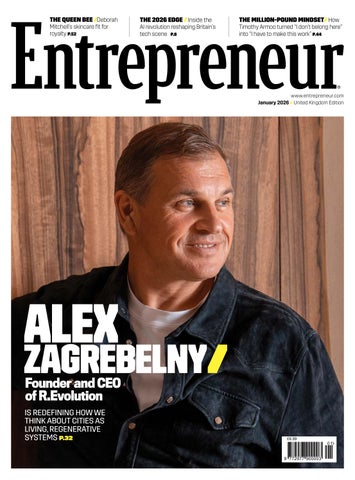
ALEX
ZAGREBELNY/ Founder and CEO of R.Evolution
IS REDEFINING HOW WE THINK ABOUT CITIES AS LIVING, REGENERATIVE SYSTEMS P.32
£6.99 £6.99
BOLD BOLD FOR THE
UNITED KINGDOM
Contents/
January 2026
FEATURES
→ Alex Zagrebelny, the founder and CEO of R · Evolution Group
P.32
EYWA and the Regenerative Age: Building Living Cities with Alex Zagrebelny HOW R.EVOLUTION’S DESIGN-LED APPROACH FUSES WELLNESS, LONGEVITY, AND ARCHITECTURE TO HEAL PLACES—AND PEOPLE.
January 2026 / E N T R E P R E N E U R . C O M / 3
Out now in the UK
DOWNLOAD YOUR DIGITAL EDITION HERE
UNITED KINGDOM
Contents /
January 2026
→ Dr Elizabeth
Young, Investment Manager at PXN Group
FEATURES EDITOR Patricia Cullen patricia.cullen@bncb2b.com
CEO Wissam Younane wissam@bncpublishing.net MANAGING DIRECTOR Rabih Najm rabih@bncpublishing.net ART DIRECTOR Simona El Khoury EDITORIAL TEAM
Tamara Pupic, Aalia Mehreen Ahmed MEDIA SALES MANAGER
Olha Kovalova olha.kovalova@bncb2b.com CONTENT MANAGER
Viktoria Walkowiak viktoria@bncb2b.com REGIONAL DIRECTOR Andy B.
BUSINESS UNUSUAL
STARTUP SPOTLIGHT
24 How to Expand Your Business in 2026 Without Expanding Your Headaches
60 Can Logistics Keep Up with Innovation?
26 How to Disrupt an Industry from the Inside Out Ben Branson reimagines sober drinks
52 Queen Bee
Deborah Mitchell on building a royal-worthy skincare legacy
Isabella Wayte on transforming the sector
51 Quantum Computing is About to Change How Entrepreneurs Handle Chaos Quantum maps where risks collide
66 Paying Attention
The 2026 start-up shift to profit and sustainability
Business Development Director
Andy Soulahian andy.soulahian@bncpublishing.net
CONTRIBUTING WRITERS
Pip Wilkins, Jamie Sarah, Andrew Watkinson, Roxana Mohammadian-Molina and Oliver Spence
SUBSCRIBE
Contact subscriptions@bncb2b.com to receive Entrepreneur United Kingdom every issue.
COMMERCIAL ENQUIRIES sales@bncb2b.com
WWW.ENTREPRENEUR.COM/EN-GB Access fresh content daily on our website
‘TREPONOMICS 22 Inside 2026 Tech
UK’s fastest-growing database company predicts 2026
23 Five Pillars of Brand Growth
Here are the elements that matter
29 What a ‘2026-Ready’ SME Really Looks Like… …And How to Become One
68 Hedge Fund to AI
Samantha McBride is using AI to transform financial advice
entrepreneurMediaUK
entrepreneurmedia-uk
entrepreneurUK
entrepreneurmedia.uk
70 Scaling a Start-up
From inception to investment 20 Wenlock Road, London, N1 7GU
IN THE LOOP 12 Game Changers
Why prioritising difference-makers will define leadership
All Rights Reserved 2025. Opinions expressed are solely those of the contributors. Entrepreneur United Kingdom is officially licensed exclusively to BNC B2B In United Kingdom by Entrepreneur Media Inc. No part of this magazine may be reproduced or transmitted in any form or by any means without written permission of the publisher. Images used in Entrepreneur United Kingdom are credited when necessary. Attributed use of copyrighted images with permission. All images not credited otherwise Shutterstock.
January 2026 / E N T R E P R E N E U R . C O M / 5
Editor’s Note / YOUR GUIDE TO LEADERSHIP, STRATEGY AND SUCCESS IN 2026 Entrepreneur United Kingdom
I
always find the first issue of the year the hardest to write. Not because there’s nothing to say, but because there’s too much. January arrives heavy with hope, pressure and unfinished business from the year before - something every founder knows well. However, this Entrepreneur UK issue isn’t about grand resolutions or clean slates. It’s about continuation: the small decisions, the focus and the action that will carry your business forward in 2026. Our cities are getting bigger, faster, and shinier - but are they making us well? Our January cover star Alex Zagrebelny, founder of R·Evolution Group, a European boutique developer, thinks not. Across Europe and the Middle East, his project Eywa is redefining luxury property by asking a radical question: what if buildings could heal, uplift, and sustain the people who live in them? From high-end towers to innovative offices, Zagrebelny proves that architecture can be as regenerative as it is ambitious - turning urban life from a source of stress into a source of wellbeing.
6 / E N T R E P R E N E U R . C O M / January 2026
Timothy Armoo’s story, featured elsewhere in this issue, hits close to home for many founders right now. He learned by doing, by taking risks, by backing himself when it would have been easier not to. In our conversation, he talks about where he came from, what success really cost him, and the small decisions and daily mantras that made the biggest difference. His new book, What’s Stopping You?, is out now - and it’s worth sitting with that question for a while. I was also struck by what Dr Christian Marcolli told us. His focus is simple: how to lead your best people, your game changers. Then there’s Deborah Mitchell, founder of Heaven Skincare and facialist to Queen Consort Camilla Parker Bowles. Her business didn’t come from chasing trends or scaling at all costs. It came from belief in a product, care for customers and turning up, year after year. Beyond the interviews, this Entrepreneur UK issue looks forward. What does a 2026-ready SME really look like? Who is reshaping logistics behind the scenes? What are investors watching closely this year? And how might technologies like quantum computing, as explained by Roxana Mohammadian-Molina, help entrepreneurs make sense of complexity rather than add to it? This issue is jam-packed with predictions, tips and strategies to help you hit the ground running in 2026. From scaling your business and staying ahead of trends to practical advice on leadership, sustainability and innovation, we’ve gathered insights from founders, investors and industry experts to give you the tools and ideas you need to make this year count. Another year is underway. No clean slates - just another chance to build something better. Thanks for reading.
Patricia Cullen Features Editor, Entrepreneur United Kingdom
EMPOWERING THE VISIONARIES OF THE UNITED KINGDOM
UNITED KINGDOM
In the Loop / → Cien Solon, founder
of LaunchLemonade
The 2026 Edge Inside the autonomous-AI revolution reshaping Britain’s tech scene - from trust-driven commerce to founder-friendly finance, and why 2026 will reward the leanest, fastest, most transparent companies ever built. b y PAT R I C I A C U L L E N
I
n 2026, Britain’s start-ups face a turning point on the scale of the mobile computing revolution. After a decade of venture-fuelled growth and rapid digital change, artificial intelligence (AI) is poised to shed its role as a glossy efficiency tool and become the very engine driving the UK’s most ambitious new companies. Across sectors, founders, investors and technologists agree: start-ups in 2026 will be shaped above all by the rise of autonomous operations, the democratisation of AI, and a new competitive era defined by trust, transparency and capital efficiency. AI will no longer be a single tool or function; it will be an organisational architecture. Meanwhile, trust - in lending, payments and security - will become a currency as valuable as capital. In a market where uncertainty persists, capital is
8 / E N T R E P R E N E U R . C O M / January 2026
more selective, and customers are more sceptical than ever. The UK’s next generation of high-growth companies will be built very differently from those before them. They will be leaner. Faster. More autonomous. And more transparent. The ground is shifting. And the start-ups that fail to adapt risk being left behind. The 2026 Breakout Trend “We’re moving beyond AI as a productivity layer and into AI as an operational layer,” says Cien Solon, founder of LaunchLemonade, a no-code AI platform that enables businesses to build and monetise intelligent workflow agents. “Key functions like customer support, payments workflows, compliance checks, sales enablement, and internal coordination can run autonomously with human oversight.” It’s a seismic change - because it transforms not just what companies can do, but who can build them. “This will lower the cost of launching and scaling a business, enabling teams of five to operate with the output of fifty,” Solon says. Start-ups that build themselves around AI-native processes, rather than bolting AI onto outdated workflows, “will grow faster, adapt quicker, and become far more capital efficient.” This is the heart of the 2026 transformation: autonomous operations are becoming the new organisational norm. Early data suggests that start-ups designed from day one around autonomous processes automatic lead qualification, self-updating financial models, AI-driven onboarding, agentled customer support - are scaling with roughly 40–60% fewer staff than equivalent companies founded ten years ago. The playing field, in other
words, is being completely recalibrated. The Democratisation of AI Inside the Start-Up If 2023–24 were the years of the AI engineer, 2026 will be the year that every employee becomes an AI operator. “By 2026, the defining trend shaping UK startups will be the democratisation of AI, where each employee can create and test AI agents without the need for technical expertise,” says Mikael Landau, co-founder and CTO of the healthtech scaleup Semble. Landau believes this shift will fundamentally alter the speed and nature of ingenuity. “Start-ups that embed this approach will thrive,” he says. “Innovation moves from being an isolated concept to a companywide culture, embedded in everyday workflows, where every team member is empowered to contribute.” It is, essentially, the migration of innovation from the tech team to the whole company. “As barriers to experimentation lower, companies can deliver technology that scales and drives truly meaningful impact,” Landau adds. And crucially, he sees this as an area in which Britain can lead the world. “The UK has the opportunity to become the global benchmark for AI, not just in developing the technology but in adopting it at every level of the organisation.” This is a competitive advantage the UK has not enjoyed since the early fintech boom. If it is realised, the UK could reclaim a clear European lead. Trust: The New Battleground in Digital Commerce But behind the AI revolution lies another force reshaping UK start-ups: the crisis of trust in online commerce. “Over the coming year, trust will become an even more decisive competitive edge,” says Justin Pike, founder and CEO of Burbank, a company specialising in secure payment technologies. His company’s
Make Trust Pay research with YouGov shows a stark trend: customers are no longer abandoning purchases because of price - but because checkout experiences feel unsafe. “Only a small fraction of consumers feel very comfortable entering card details online,” Pike says. “Older adults with the greatest spending power remain the least confident at checkout.” For earlystage companies, this represents a profound shift. “In 2026, the startups that grow fastest will be those that rebuild trust into every moment of the payment journey,” Pike explains. “Clear security cues, simple identity checks and checkout flows designed for confidence rather than speed will become the new baseline.” This marks a turn away from the “frictionless UX at all costs” ideology that dominated the last decade. The next generation of winners will treat trust as an }}
“IN 2026, THE START-UPS THAT GROW FASTEST WILL BE THOSE THAT REBUILD TRUST INTO EVERY MOMENT OF THE PAYMENT JOURNEY. CLEAR SECURITY CUES, SIMPLE IDENTITY CHECKS AND CHECKOUT FLOWS DESIGNED FOR CONFIDENCE RATHER THAN SPEED WILL BECOME THE NEW BASELINE”
→ Mikael Landau,
co-founder and CTO of Semble
}}
January 2026 / E N T R E P R E N E U R . C O M / 9
In the Loop / → Friends in founder → Justin Pike,
business: and CEO of Burbank balancing trust, dreams, and challenges.
→ JOSEPH VALENTE
and ANT MIDDLETON, best selling author of Military Mindset and leadership expert.
“ THE BUSINESSES THAT GROW FASTEST WILL BE THOSE THAT GIVE FOUNDERS CONFIDENCE IN EVERY DECISION. IF THE ECOSYSTEM COMMITS TO CLARITY AND TRANSPARENCY, THE UK CAN STRENGTHEN ITS POSITION AS THE MOST SUPPORTIVE ENVIRONMENT IN EUROPE FOR EARLY-STAGE GROWTH” 10 / E N T R E P R E N E U R . C O M / January 2026
engineering challenge, not just a marketing message. Pike predicts that the UK - a global payments hub - will become a centre for trust-led checkout innovation, with new layers of visible security, fraud prediction, and identity-aware commerce. As AI and autonomous operations accelerate everything else, trust becomes the governor, the stabilising layer that determines whether customers stay or stray. Why Start-Ups Are Rejecting Traditional Lending While AI transforms operations and trust reshapes commerce, yet another shift will define 2026: founders are prioritising financial certainty. “The biggest trend shaping start-ups in 2026 will be the demand for clearer, more understandable guidance around lending,” says Katherine Chan, CEO and co-founder of Juice, a financial services company
dedicated to providing growth capital for digital-first businesses. Her company’s Blind the Gap report highlights a surprising finding: founders are not avoiding funding because capital is scarce - they’re avoiding it because the system is ambiguous.“They are turning away because the information is confusing, the terms feel opaque and the advice is difficult to trust,” Chan says. In 2026, she predicts, start-ups will increasingly favour lenders, tools and platforms that translate borrowing into plain language. “The businesses that grow fastest will be those that give founders confidence in every decision,” she explains. Chan also sees Britain’s tech ecosystem entering a more practical, problem-solving phase, with the biggest gains coming from tools that improve SME financial capability. “If the ecosystem commits to clarity and transparency, the UK can strengthen its position as the most supportive environment in Europe for early-stage growth,” she says. The message is consistent across founders: AI makes operations fast, but transparency makes them sustainable. Partner Ecosystems: The Strategic Engine of Growth In a world where customer acquisition costs are rising and trust is harder to win, partner ecosystems are becoming the strategic backbone of growth. “In 2026, partner programmes will shift from helpful growth levers to essential revenue engines,” says Jon Mead, founder and CEO of PartnerBridge, a platform that helps SaaS and growth-stage businesses build impactful partnerships. The economic logic is overwhelming: Partnersourced deals close faster, convert at higher rates and deliver higher contract values. “With rising acquisition costs and economic volatility, businesses
will need to pay particular attention to growth prospects rather than relying on sales alone,” Mead explains. AI will intensify this shift, allowing companies to manage more complex partner channels without increasing headcount.“Companies that invest early in a partner ecosystem strategy will see lower CAC, faster sales cycles, stronger retention and stable expansion,” he says. Those that don’t risk falling behind faster-moving competitors. Across Europe, sector-focused funds and corporate venture arms are leaning heavily into partnerships - a trend that will accelerate as autonomous operations increase the leverage of each partnership.
“ COMPANIES THAT INVEST EARLY IN A PARTNER ECOSYSTEM STRATEGY WILL SEE LOWER CAC, FASTER SALES CYCLES, STRONGER RETENTION AND STABLE EXPANSION” global capital of trust-driven payments and commerce. 3/ Transparency in finance
Founders will favour clarity over complexity. Tools that simplify money will scale fastest. The UK - if it embraces transparency - could dominate early-stage lending in Europe.
The UK’s 2026 Tech Outlook: Leaner, Smarter, More Autonomous Taken together, these trends suggest that Britain’s tech future will be defined by three forces:
↑Jon Mead, founder and CEO of PartnerBridge ← Katherine Chan, CEO and
co-founder of Juice. 1/ The rise of autonomous operations
Teams of five will achieve what once required fifty. Processes will run themselves. Start-ups will become AI-native, not AI-adjacent. 2/ Trust as the new competitive advantage
AI will make everything faster - but only trust will convert. The UK could become the
A New Kind of Start-Up Is Emerging The UK’s start-ups of 2026 will not look like the VCfuelled unicorns of the 2010s. They will be smaller but more powerful, more autonomous yet more trusted, more agile but more transparent. They will be: - AI-native - Autonomous - Partner-driven - Trust-focused - Capital-efficient - Transparent This year, the start-up ecosystem will focus on intelligence and trust, not just numbers or empty promises. In a market where both investors and consumers demand more rigour, the best founders are choosing to build leaner and smarter - not bigger. For the first time in years, the UK has the opportunity to lead, not just with capital, but through trust, innovation, and inclusive growth.
January 2026 / E N T R E P R E N E U R . C O M / 11
B/
Leadership
GAME CHANGERS
How focusing on difference-makers could define the next decade of leadership. b y PAT R I C I A C U L L E N
→ Dr Christian Marcolli, founder and CEO of Marcolli Executive Excellence AG
12 / E N T R E P R E N E U R . C O M / January 2026
A
t 18, Dr Christian Marcolli, founder and CEO of Marcolli Executive Excellence AG, thought talent was enough. “I used to be a professional footballer,” he says, remembering the harsh dressing room culture. “The team was dysfunctional, the environment toxic, and I lacked the mental toughness to thrive and show what I was capable of.” What followed was the kind of formative trauma that can either crush a career or become its engine. For Marcolli, it was both. “I over-trained and had severe knee injuries because of the over-training. My response was, ‘you have to work harder if you want to stand out.’ It didn’t work,” he says. “It led to a very brutal ending of my career as a professional footballer. I was probably one of the biggest talents in the country. And five years later, I was the guy who never really made it.” That collapse would eventually shape Marcolli’s life’s work:
he rose to become one of the world’s leading performance psychologists and executive coaches, advising CEOs, Olympic champions, and, famously, Roger Federer in his early career. It also inspired his provocative new book, Winning Match: Leadership for Game Changers, which argues that many business leaders have it completely the wrong way round. Rather than pouring energy into low performers, Marcolli says, they should focus on identifying, nurturing, and “sparring” with the handful of true difference-makers - those with what he calls “game-changing potential.” From failure to focus The lessons of Marcolli’s early football career lingered long after the final whistle. He spent years reflecting on what that experience could teach others striving to realise their potential. First: “Build the mental toughness and emotional resilience to show what you’re capable of in adverse environments.” Second: “Help leaders build healthy, high-performance cultures where people don’t have to struggle to show their true potential.”
Shaped by the pressures of his years in professional sports, he now advises executives and leaders on how to develop and empower rising talent. “That’s my mission: to help leaders become Leadership Champions, so that they enable true high performance and make their best people even better.” At its core Marcolli has spent over two decades working with CEOs and major companies, and the patterns he has observed are unmistakable. “The big breakthrough stuff really comes from very few people.” Yet the systems organisations build very often don’t reflect this. “The performance management processes are often designed to manage lower performers more systematically than top talent.” He emphasises that he’s not advocating abandoning weaker team members; only that leaders must face a reality: “Even if you bring people up to speed, you’re not getting the extraordinary out of that. The extraordinary you get from very few people with game-changing potential.” The mistakes leaders
make, he argues, are twofold. First, believing that hiring the best people means that they can now completely step aside. “In my experience, people with gamechanging potential need a strong sparring partner - someone who is consistently there to challenge, support and show they expect something great.” Second, overloading these individuals. “Because some of these game changers are producing great results, they just get more and more on their plate. When they are overloaded with work that doesn’t really move the business forward, they cannot produce the extraordinary.” What he wants is a radical shift from business leaders: “Take a fresh look at how you lead your best people so that they can bring that potential and create that exceptional value, by making them even better.” }}
“THAT’S MY MISSION: TO HELP LEADERS BECOME LEADERSHIP CHAMPIONS, SO THAT THEY ENABLE TRUE HIGH PERFORMANCE AND MAKE THEIR BEST PEOPLE EVEN BETTER” January 2026 / E N T R E P R E N E U R . C O M / 13
B/
Leadership
organisations - rare, but immensely valuable. The surprising power of ‘sparring’ One of the most striking ideas in Winning Match is Marcolli’s argument that leaders need to “spar” with their top talent. The metaphor comes from sport. “I still do a lot of work in elite sports. I was in Roger Federer’s team for two years in his early career.” In tennis, like in boxing, sparring is intense but contained - a practice arena where pressure shapes performance rather than destroys it. “It’s a form of interaction, where the other person challenges you without hurting you. But the intensity of the interaction is there, almost like high-intense competition, but in a safe space.” He has seen athletes grow the most in those intense moments. For competitors, “everything came together” during sparring, and
THE PERFORMANCE MANAGEMENT PROCESSES ARE OFTEN DESIGNED TO MANAGE LOWER PERFORMERS MORE SYSTEMATICALLY THAN TOP TALENT. EVEN IF YOU BRING PEOPLE UP TO SPEED, YOU’RE NOT GETTING THE EXTRAORDINARY OUT OF THAT. THE EXTRAORDINARY YOU GET FROM VERY FEW PEOPLE WITH GAME-CHANGING POTENTIAL”
How to recognise a game changer Every leader asks: “Who can change the game, and how do I find them?” According to Marcolli, the first marker is a strong, relentless drive to do things properly - a passion for excellence. The second is an insatiable hunger for input and feedback; they want to hear the unvarnished truth. The third trait is decisive action:
game changers often need just one conversation - once the input makes sense, they move immediately, saying, “Let’s go. Let’s do it.” And fourth, they have the resilience to perform under pressure, with the mental toughness to stay composed and deliver when it truly matters. Marcolli stresses that these individuals “are within the one-digit percentage” in most
14 / E N T R E P R E N E U R . C O M / January 2026
Marcolli brought that insight into leadership. Leaders, he says, should create similar situations with employees - interactions that are challenging but respectful, intense but safe, and built on trust. You signal to them, “I know you can do this, and I’m going to support you and challenge your thinking.” When handled well, it builds the
confidence that game changers need to create real value. After all, what could be more motivating than a leader saying, “I know you have it in you, I will support you so that you’re going to make this happen for us”? In Winning Match, Marcolli presents five must-have sparring principles for leaders. But sparring is not a technique leaders can deploy in isolation. First, leaders must shift from self-focus to service. “You have to stay focused on creating value and success for everyone - not simply for yourself.” Second, leaders must embrace what he calls ’maximum generosity’. “Everything you’ve learned as a leader, your expertise, your knowledge, but also your network, doesn’t belong to you alone.” He describes a kind of unconditional giving: “Don’t expect a direct payback. Don’t even expect to be named as the one who made it accessible.” This runs counter to the subtle transactionality of corporate environments. But to unlock potential, especially in the rare few with game-changing ability, Marcolli insists generosity is non-negotiable. The cost of getting it wrong When leaders fail their top talent, he says, it usually comes down to three things. First, ego - the instinct to seek personal benefit from the interaction. Second, abandoning high performers under the guise of empowerment; the idea of ‘hire the best people and get out of their way’ is, he argues, a mistake, because
even the best individuals with game-changer potential need to be supported, challenged and reassured, ‘I believe in you and I’m behind you.’ And finally, there’s the mismanagement of priorities: leaders overload them with everyday tasks that don’t move the needle, leaving them with no time and space to create the extraordinary. The result is a kind of organisational tragedy: untapped potential. The leadership shift So what next? Marcolli
offers both hope and a warning. “Leadership conceptually has been explored a lot in the last couple of decades, but this angle, how to lead your best people, has not been developed enough.” Most organisations don’t access their true potential by overlooking this aspect of who and what really moves the needle. If leaders can learn to spot game-changing potential more clearly and steward it more intentionally, “it will disproportionately create value and an advantage compared to
the competitors.” Marcolli is shaping the future of leadership by directing attention to the individuals who have the potential to drive outstanding results and create the extraordinary, and to what those individuals require to thrive. At the heart of Marcolli’s thinking is a transformation that began on the football pitch decades ago. The young man who crumbled under pressure now helps others withstand it. The player who lacked the right
leadership now teaches leaders how to provide it. His own story might be the best argument for his philosophy: talent is a seed, but leadership is the environment. Game changers bloom - or wither - depending on who is tending them. And ultimately, Marcolli says too many organisations fail to recognise the people and efforts that deliver real impact. Those who do so systematically, however, can unlock hidden potential and gain a clear advantage over the competition.
January 2026 / E N T R E P R E N E U R . C O M / 15
CAPITAL GAINS The future of UK venture investing b y PAT R I C I A C U L L E N
T A
he UK’s venture capital (VC) market enters 2026 at a pivotal moment. AI, deep tech, health, fintech, and climate continue to draw strong investor interest, cementing the country’s position as a hub for early-stage innovation. Amid more cautious fundraising and selective deal-making, new opportunities are emerging for founders and investors who can navigate a market defined by both risk and potential
ccording to Alastair Moore, Investment Director at PXN Ventures, the leading venture capital firm for the North of England, Scotland, and Northern Ireland, the VC market in the UK has experienced a clear shift toward sectors like AI and deep tech. “AI has been a huge draw for UK VC this year, attracting about 30% of investment in H1, but other areas like health, fintech, climate, and deep tech are holding strong,” Moore says. “Deep tech, in particular, is seeing real growth because it taps into the UK’s industrial strategy and a strong talent base.” For Moore, the key factor driving the investment boom in deep tech is the UK’s strong industrial base and its ability to foster a talented workforce capable of scaling innovative solutions. He highlights that, despite global uncertainty, the UK remains a preferred destination for investors seeking to fund companies with a solid vision and scalable technolo-
16 / E N T R E P R E N E U R . C O M / January 2026
gies. “Deal flow is getting stronger, especially at pre-seed and seed stages, with companies often raising bigger rounds earlier through syndicates of investors.” The increasing deal flow and the ability for companies to secure larger rounds at earlier stages signals a healthy and competitive market. “Investors are backing companies that have a clear story and strong sector focus,” Moore continues. “For instance, PXN recently closed a complex £7m investment in just 10 weeks - proof that good companies with a compelling narrative can move quickly.” As we look towards the broader venture capital environment, it’s clear that sector-focused funds and corporate VCs are becoming increasingly active. “Across Europe, sector-focused funds and corporate VCs are active, and many companies are looking to scale closer to home given uncertainty in the US,” Moore observes. While the international landscape remains fluid, the UK’s venture capital scene is holding its own, proving its resilience and capacity for growth.
A more cautious investor sentiment Despite signs of growth in certain sectors, particularly with increased interest from US-based investors, Rahul Parekh, Partner at 2150, a VC firm investing in technology companies that seek to sustainably reimagine and reshape cities and the industries that power them, offers a more cautious outlook for UK VC. He explains that, while there are still high-quality opportunities, the overall sentiment from limited partners (LPs) has become more conservative in recent months. “There’s a much more cautious LP sentiment around fundraising. Capital is flowing more slowly into the market with a greater emphasis on quality and focus on exits,” Parekh says. “The bar for new funds seems higher than before.” This cautious shift is echoed by Nicole Lowe, Head of Emerging Giants at KPMG UK, who notes that “LPs are becoming more discerning, prioritising quality over quantity in their investment strategies and emphasizing thorough due diligence and risk assessment.” She adds, “We’re seeing increased focus on clear pathways to profitability and much longer DD processes.” Despite this more cautious stance, Lowe points out that this is occurring alongside a boost in the future of UK VC investment, as evidenced by KPMG’s latest report revealing a major rise in interest from US-based investors due to the market’s growing “attractiveness.” Parekh’s comments reflect a broader trend seen across the UK in 2023, as fundraising has slowed significantly. A recent report by S&P indicated that UK-based private equity and venture capital funds raised more than 50% less in 2025 compared
→ Alastair Moore, Investment Director at PXN Ventures
to the previous year. “The pace of fundraising has slowed in the UK,” Parekh explains. “However, the performance of UK funds remains in line with peers in Europe, and there seems to be signs of optimism returning to the market. In our view, exit conditions are improving, and we see high-quality investment opportunities.” This shift in sentiment is also visible in the broader deal activity within the UK. Parekh points to a marked decline in the volume of deals, particularly those in later-stage growth sectors. “In parallel with fundraising activity, deal activity has also dropped in the UK this year. We have seen a significant drop in overall deal volume and valuations, particularly in later-stage growth deals. For example, the total transaction value in venture capital and private equity deals in the UK has fallen over 45% in 2025.” The more cautious approach among investors can be seen in the increasing selectivity of VC funds. Parekh adds, “There seems to be a more selective environment
currently. We have certainly been practicing much more discipline around investing, and we have seen most other funds do the same. VCs seem more discriminating, focused on companies with stronger fundamentals and clearer potential.” Despite the drop in later-stage deal activity, early-stage investments, particularly in the seed and Series A stages, are still holding strong. “As always, the early stage (e.g., seed-Series A) still seems active and resilient in terms of valuation in 2025,” Parekh notes, indicating that while the overall deal environment has become more challenging, there are still attractive opportunities for early-stage ventures with strong potential. Adding further nuance to this picture, Dr Elizabeth Young, Investment Manager at PXN Group, highlights early signs of recovery in fundraising conditions, particularly in technical and university-incubated innovation.“Fundraising conditions are beginning to recover, and we’re seeing }} January 2026 / E N T R E P R E N E U R . C O M / 17
↑ Rahul Parekh, Partner at 2150
significantly more Series A opportunities this year compared with last. At the pre-seed stage, PXN is also encountering a strong pipeline of deep, technical opportunities that have been carefully incubated within universities. That said, a gap still
“ AI has been a huge draw for UK VC this year,
attracting about 30% of investment in H1, but other areas like health, fintech, climate, and deep tech are holding strong. Deep tech, in particular, is seeing real growth because it taps into the UK’s industrial strategy and a strong talent base”
18 / E N T R E P R E N E U R . C O M / January 2026
exists at pre-seed, particularly for certain sectors.” She also notes that despite stabilising valuations, founders are still navigating extended fundraising processes. “Valuations have settled between the highs of 2021 and the recent downturn. Many rounds remain flat or are extensions aimed at bridging to external capital. Founders continue to face longer transaction timelines due to a hesitance among investors to lead. Encouragingly, co-investment and syndication are becoming more common, which we welcome.” Young adds that limited partner focus remains skewed toward later-stage activity, though deep-tech investment vehicles are creating new momentum at earlier stages.“General LP sentiment remains focused on later-stage opportunities, largely reflecting current market dynamics for follow-on funding. We are, however,
seeing a rise in vertical-specific funds - particularly in deep tech - which bring more hands-on LP involvement at earlier stages. We’d like to see similar momentum in life sciences, where recovery has been slower.”
Bifurcation in VC Erkko Autio, Chair in Technology Venturing and Entrepreneurship at Imperial Business School, observes that the UK’s VC market is becoming increasingly bifurcated. “There is everything AI-related and then there is everything else,” he says. “What I mean by this is that deep tech and generative AI (specifically infrastructure, data centres, and applicationlayer innovators) are absorbing the vast majority of capital. Investors are aggressively competing for access, leading to pre-emptive term sheets and accelerated deal velocity.” Autio’s comments reflect a growing trend where AI and deep tech are driving the lion’s share of VC investment. “In contrast, everything else seems to freeze,” he adds. “For traditional B2B SaaS and consumer start-ups, deal flow has slowed significantly. The ‘growth at all costs’ model seems dead. Investors are no longer funding good ideas with high burn rates; they are funding efficient execution.” The shift toward a more selective, efficiency-driven investment landscape is reshaping the priorities of investors. Autio also highlights that sectors outside AI and deep tech, such as defense and climate resilience, are seeing steady capital flow, largely driven by geopolitical instability and
→ Dr Elizabeth
Young, Investment Manager at PXN Group
energy transition mandates. “These areas should see continued growth in the coming years, especially in Europe,” he predicts.
The road to liquidity Alongside the bifurcation between AI and other sectors, Autio points to another key trend: the shift in investor mindset towards liquidity. “The investor mindset appears to be shifting from internal rates of return (IRR) to distributions to paid-in capital,” he explains. “Investors are less keen to pursue paper gains (IRR) and are increasingly demanding cash returns before committing to new funds.” This has led to more ‘acqui-hires’ and consolidation deals, where start-ups are acquired primarily for their engineering talent or intellectual property (IP) rather than for revenue multiples. “We’re seeing more consolidation plays, especially in the tech space, where companies are being acquired not for growth but for their }} January 2026 / E N T R E P R E N E U R . C O M / 19
→ Erkko Autio, Chair in
Technology Venturing and Entrepreneurship at Imperial Business School
“THE PERFORMANCE OF UK FUNDS REMAINS IN LINE WITH PEERS IN EUROPE, AND THERE SEEMS TO BE SIGNS OF OPTIMISM RETURNING TO THE MARKET. EXIT CONDITIONS ARE IMPROVING, AND WE SEE HIGH-QUALITY INVESTMENT OPPORTUNITIES” talent or IP,” Autio says. Moreover, the emphasis on liquidity appears to be impacting the fundraising landscape as well. “VCs seem to be struggling a bit to fundraise, which is reflected in a gradual reduction in the overall number of active investors in the market,” he adds. This reduction in investor activity may pose a challenge for companies that have relied on a consistent flow of capital to fund their operations and growth.
Optimism and resilience amidst market uncertainty Despite the cautious sentiment in VC and private equity markets, Tom Whelan, Partner at Reed Smith, an international law firm, points to growing optimism in the M&A and private equity landscape. “It’s notable that the total value of domestic M&A has increased despite the lowest number of transactions taking place since Q4 2017. The fall in deals is likely due to the market working through the impacts of recent tariff and trade changes internationally,” Whelan explains. Whelan attributes some of the deal slowdown to macroeconomic factors like uncertainty surrounding the Autumn Budget and global trade dynamics. However, he anticipates that pent-up 20 / E N T R E P R E N E U R . C O M / January 2026
demand will drive future deal activity. “Uncertainty around the Autumn Budget may have also caused some short-term trepidation in the run-up, but this should translate into a release of pent-up demand now that it’s past,” he adds. Notably, Whelan observes that the industrial sector is experiencing a rebound, following a slow period earlier in the year. “There has been a notable shift in the market recently, and there are growing signs of optimism. In particular, the industrial sector is seeing an uptick in deals, which had been otherwise lethargic for most of this year.” He also notes that AI, tech, and digital infrastructure remain prime areas of investor focus, while healthcare and consumer-facing businesses continue to draw consistent interest. “If these positive signs continue, it bodes well for the market going into 2026,” Whelan concludes. As for the private equity market, Whelan highlights a trend toward continuation vehicles, where funds are holding onto assets in anticipation of greater returns. “Funds are making greater use of these continuation vehicles as they allow them to defer selling assets at the end of the fund’s term when managers are anticipating greater return prospects in the near future,” he explains. The demand for such deals is expected to remain strong as we approach the new year, contributing to an overall positive outlook.
“ There has been a notable shift in the market recently, and there are growing signs of optimism. In particular, the industrial sector is seeing an uptick in deals, which had been otherwise lethargic for most of this year”
Structural challenges in UK VC Finally, Martin Rigby, Executive Director at ET Capital, a Cambridge based investment firm, offers insight into the structural challenges impacting UK VC, drawing on more than three decades of experience in the Cambridge ecosystem. Rigby identifies two main factors affecting the UK VC landscape. “First, constrained deal flow is a key issue,” he explains. “Early-stage investors continue to focus heavily on trying to ‘pick winners’; perfect teams, flawless technology, and fully-formed products. This labour-intensive approach often overlooks strong businesses that fall outside current investor fashions or preferences. It also makes it tougher for newer investors to judge early-stage companies, especially in deep tech and science, and that’s played a big part in the ongoing shortage of capital in those areas.” Rigby highlights that while the venture capital community remains focused on
←Tom Whelan, Partner at Reed Smith
identifying the next big success, this narrow selection process limits the pool of investable companies. “It’s difficult to find companies that meet the ideal criteria, and it’s creating a bottleneck in early-stage funding, particularly for science- and technology-based businesses that may not fit traditional molds,” he adds. The second structural challenge, Rigby notes, is the uncertainty surrounding returns. Early-stage ventures are inherently volatile, making returns difficult to predict. This unpredictability has led to hesitation among individual investors and institutions alike. “Uncertainty puts off many individual investors, and even some institutions, who often prefer asset classes with clearer and more stable outcomes,” Rigby explains. “Despite the growth of angel networks and equitycrowdfunding platforms, this structural issue continues to shape how much capital flows into the sector.” This uncertainty is compounded by broader market conditions, which can exacerbate the risk-averse behavior of investors. However, Rigby remains optimistic about the future of venture capital in the UK, especially in sectors like deep tech and life sciences, where long-term growth potential continues to be strong.
A market in flux but full of potential The UK VC landscape is undeniably complex, shaped by a mixture of caution, growing optimism, and sectorspecific booms. While AI and deep tech are leading the charge, with increased investment and a focus on efficiency, there is also a noticeable shift in investor behavior, as funds seek liquidity and prioritize profitable exits. M&A activity remains subdued but resilient, with sectors like industrial, healthcare, and consumer businesses showing signs of growth. At the same time, challenges persist in the form of constrained deal flow and the unpredictable nature of early-stage returns. As investors become more selective, a narrowing of the pool of viable start-ups is becoming apparent, particularly in sectors that require heavy innovation or longer development times, like science and life sciences. Yet, the UK remains a leading hub for early-stage investments, and as long as the ecosystem continues to nurture high-quality ventures and attract capital - particularly in deep tech, AI, and climate resilience - the country’s VC market is well-positioned to adapt and thrive in the face of ongoing uncertainty. As Whelan, Moore, Parekh, Autio, Rigby, and Young all note, the landscape may be shifting, but the opportunities for strategic, high-value investments remain ripe for those able to navigate this evolving terrain. January 2026 / E N T R E P R E N E U R . C O M / 21
‘T/
Predictions
Prediction 2: Cloud Costs and Architecture Complexity Will Stall Adoption Even as AI adoption accelerates, Hitchcock warns that costs and complexity remain major barriers. “Whichever way we look at AI, it’s costly,” he says. “Running complex AI projects in the cloud is expensive. Migrating back in-house is also a challenge unless organisations are certain it’s the right strategy. The uncertainty around selecting the right technical framework, combined with potential high costs, will slow adoption.” Yet, he notes, companies are eager to experiment. “Organisations want to push the boundaries of AI faster than competitors. Many will iterate quickly with cloud providers first before committing to a long-term strategy.”
Inside 2026 Tech
The fastest-growing database company in the UK shares its 2026 predictions
From Family Start-up to Industry Disruptor Tobie Morgan Hitchcock is not your typical tech CEO. As co-founder and CEO of SurrealDB, a UK-based, family-run start-up, Hitchcock has overseen the meteoric rise of what is now considered the fastest-growing database in the world. SurrealDB’s unique multi-model, AI-native database has put the company at the forefront of a rapidly evolving tech landscape. As we enter 2026, Hitchcock offers a set of predictions for the future of AI, cloud computing, and enterprise technology. Here’s what he foresees. Prediction 1: 2026 – The Year Hyperscale AI Comes Home Hitchcock predicts a major shift for enterprise AI: bringing hyperscale AI processing back in-house. “Teams want to gain tighter control over AI models and GPUs,” Hitchcock explains. “We’ll see a move back to the datacentre for the largest companies. It’s a cost-control issue: cloud charges for large-scale AI projects can rival revenue for AI assistant companies, so managing these workloads locally makes financial sense.” This trend is already visible in the GPU space. With companies like Nvidia investing heavily in novel GPU technologies, Hitchcock expects a surge in on-premise and co-located AI deployments in 2026, as enterprises seek both cost savings and operational control. 22 / E N T R E P R E N E U R . C O M / January 2026
Prediction 3: Reproducibility and Accuracy Will Define AI Success in Finance For financial institutions, the stakes are even higher. Hitchcock points to accuracy and reproducibility as the next big hurdle. “Banks have plenty of AI agent PoCs and pilots, but few move to production,” he observes. “The challenge is ensuring AI agents can reason intelligently with customers, providing consistent, accurate answers. Multiple databases – duckDB, Postgres, Snowflake, InfluxDB – can create flexibility but also introduce risks to accuracy.” Hitchcock sees a solution in AI-native, multi-model databases, which allow teams to combine data from various formats—time series, relational, graph—into a single, context-aware system. “This makes AI agents more accurate and contextual, providing immediate value while the technology continues to evolve.” 2026 promises a year of strategic recalibration for AI and enterprise technology. From bringing AI in-house to overcoming cloud complexity and improving financial AI reliability, Hitchcock believes that the companies who thrive will be those who balance experimentation with precision, control, and a forward-thinking approach to data architecture.
Five Pillars of Brand Growth by JAIMIE SARAH
F
or founders, CEOs, and business owners, your brand isn’t just your colours, fonts, or logo. These make up about 1% of your brand. Your brand is the emotional, energetic, and commercial ecosystem that customers, partners, and employees associate with you. Most businesses don’t fail because their products are weak, but because their brand is inconsistent, confusing, or stretched too thin. Here are the five components that matter most…
1/Clear Positioning and Messaging Know and communicate the problem you solve and for whom. Weak positioning is one of the fastest ways to blend into the noise. Strong positioning is one of the fastest ways to create traction, trust and demand. Positioning is the intersection of: • what you’re exceptionally good at • who you genuinely want to work with • the problem you solve When your positioning is unclear, everything wobbles: your messaging, your offers, your pricing, your confidence, your sales. When it’s sharp, everything clicks into place. 2/ A Consistent, Distinctive Brand Voice Be recognisable everywhere. Your brand voice is the personality of your business. Inconsistent voice = inconsistent brand. A strong voice, used consistently, creates familiarity, emotional connection and trust. The strongest brands feel like a person you know, quirks and all - not a different
version of themselves every week. 3/ A Strategic Content Ecosystem Posting randomly is not a strategy. A strong brand grows through a content ecosystem designed with intention: • Short-form content builds familiarity • Long-form content builds authority • Testimonials and case studies build proof • Personal storytelling builds connection • Educational content builds trust Your content should move people from awareness › interest › decision › loyalty 4/ Relational Capital Relationships expand your reach, credibility and opportunities long before paid media or scaling systems ever kick in. Your brand grows at the pace of: • the rooms you’re in • the people who associate you with excellence • the partnerships you nurture • the networks that trust you • the communities that
“ Strong positioning is one of the fastest ways to create traction, trust and demand” hear from you Relational capital isn’t fluffy. It’s strategic infrastructure. It’s also the thing that will sustain your brand when visibility fluctuates, platforms change, or your business goes through a season of reinvention. 5/ A Cohesive Brand Experience Deliver what you promise, every time. People don’t remember the onboarding form or the email sequence. They remember how they felt during every interaction. Your brand experience includes: • the clarity of your sales process • how clients feel during delivery • your responsiveness • how your team shows up • the transformation clients walk away with
Brand is a long game - but it pays like a smart long game A strong brand isn’t built by going viral or having a clever tagline. It’s built by combining strategic clarity with long-term consistency. - Positioning. - Voice. - Content. - Relationships. - Experience. Get these five right, and your brand becomes an asset that compounds in value every year. It becomes easier to sell, easier to scale, easier to maintain, and easier to evolve. Jaimie Sarah is a Fractional CMO and Brand Advisor. She is also the founder of Clear Cut Consultants, a strategic growth advisory firm working with highgrowth companies across the UK, US and Europe.
January 2026 / E N T R E P R E N E U R . C O M / 23
B/
Franchise
How to Expand Your Business in 2026 Without Expanding Your Headaches by PIP WILKINS
A
s we enter Q1 of 2026, most businesses will be setting new goals, new targets and hoping for maximum growth in this exciting new year. But what if you are struggling to achieve the growth you want? What if you have big plans and dreams but lack of hours in the day, capital and the very real threat of burnout are getting in the
24 / E N T R E P R E N E U R . C O M / January 2026
way? Have you ever considered the franchise route? Franchising is a faster way to expand your business, with cash inputs from people who have a vested interest in seeing it succeed.
Why franchise? There is a good reason some of the largest brands in the world use the franchise model - because it works. Here are just a few of the 300+ brands who are current members of the BFA (British Franchise Association):
McDonald’s, Burger King, Subway, Domino’s, Costa, Co-op, Anytime Fitness, Kumon, TaxAssist Accountants, Right at Home, Caremark, Stagecoach Performing Arts, Snap-on Tools, Creams, German Doner Kebab, Papa Johns, Belvoir. Aside from being hugely successful brands, they all have one thing in common: they’re all franchises.
Small is beautiful Don’t panic if the size of these brands feels too big to emulate; we also have
hundreds of members who are much smaller and probably more like the size of your business. All franchises start the same way, a successful business with a desire to expand.
Low failure rate Before you dip your toe in the water you’ll want to make sure the industry is a safe place to do business and luckily, the answer is yes. One of our favourite figures we like to quote is that, according to our latest survey, sponsored by NIC Local, franchised units (franchisees) have a ‘forced failure rate’ of less than 6% and have done so for over 20 years. When you compare this to the national average of 50% of all start ups failing within three years of opening, you’ll begin to appreciate why we are so proud of it. Why is franchising so safe? In a nutshell, two things; a tried and tested business model and extensive training and support, that helps franchisees avoid costly mistakes. It is this combination of the franchisor sharing their operational secrets with the franchisee, training them to run the business and supporting them at every step of the way, that makes it a safer way of doing business for everyone involved. Can a franchise fail? Of course, as can any business and one of the purposes of the BFA (British Franchise Association) is to stop that
“ONE OF OUR FAVOURITE FIGURES WE LIKE TO QUOTE IS THAT, ACCORDING TO OUR LATEST SURVEY, SPONSORED BY NIC LOCAL, FRANCHISED UNITS (FRANCHISEES) HAVE A ‘FORCED FAILURE RATE’ OF LESS THAN 6% AND HAVE DONE SO FOR OVER 20 YEARS” happening. We exist to set the standards in British franchising, meaning franchise businesses are more likely to succeed.
Who are the BFA? We are the voice of the British franchise industry. In 1977 some of the largest franchise brands in the industry formed the association to differentiate themselves from rogue operators. We have a Code of Ethics for Franchising, based on the European Code of Ethics, which all our members pledge to adhere to and uphold. Our members are thoroughly audited before membership is granted, to ensure every aspect of their business meets our standards for ethical franchising, from their marketing material and training and support to their business accounts and franchise agreement, everything must comply. We offer extensive continuous training to our members through our Academy, to keep them developing their skills, improving their
operations and staying ahead in a fast-moving sector. We’re members of the European and the World Franchise Federation and we regularly support and advise other countries on launching and running their own franchise associations. A British franchisor, Right at Home, is currently the European Franchise Association’s (EFF) Franchisor of the Year.
How does franchising make expansion easier? When you want to expand your own business, you need to generate enough income to open another office or branch, which as you know, can take years. With a franchise business you sell a franchisee the right to run their own exclusive territory of your business, for a contracted term and in return they pay you one lump sum and an ongoing percentage of their monthly profit. So, you receive one large cash injection and regular small cash deposits. They are literally paying you to expand your brand. They
also bring with them very useful knowledge of their local area and are very motivated to make their investment work.
Faster national coverage. Obviously, this means you can scale up across the country relatively quickly. Whilst growth may not be rapid it will be much faster than organic growth. Next steps If franchising sounds as if it could be something that could help you grow your business, your first port of call should be to the BFA website reading the multiple pages of information about franchising your business and booking yourself on to our monthly ‘Franchise your Business’ course. Your best friend in franchising The franchising world is notoriously friendly – almost family like, with franchisors in competing businesses collaborating for the good of the sector. Consider the BFA your best friend in franchising, here to explain what franchising is, decide if it is right for you and show you the route to take to create an ethical, professional franchise. If you would like to explore franchising further as a way to grow your business, get in touch, we’d love to hear from you soon. Pip Wilkins QFP, CEO, The BFA (British Franchise Association)
January 2026 / E N T R E P R E N E U R . C O M / 25
B/
How to
E
very January, millions take part in Dry January, a monthlong challenge to skip alcohol and reset. As demand for non-alcoholic drinks rises, Ben Branson’s businesses are offering something more than simple substitutes. Seedlip, Sylva, and his other ventures aren’t just about replacing alcohol - they’re about creating entirely new categories. Branson’s goal is simple: to offer something complex and satisfying without the booze. Branson’s approach is rooted in a family history of agriculture and timber that spans nine generations. But it’s his unconventional, patient process that has defined his success. “I’ve never started with a business idea,” he says. “It’s always been about experimenting, listening, spotting patterns, and trusting my gut.” His ventures don’t come from market research or strategic planning - they emerge from curiosity and the pursuit of something that’s missing. “My family has been in agriculture and timber for over 300 years,” he explains. “This legacy of problemsolving and doing things differently is at the heart of everything I do.” Branson’s work doesn’t rush to fill gaps in the market; instead, he asks what’s missing and why.
→ BEN BRANSON,
founder, Seedlip
How to Disrupt an Industry from the Inside Out b y PAT R I C I A C U L L E N
26 / E N T R E P R E N E U R . C O M / January 2026
Creating New Categories Seedlip, the world’s first distilled non-alcoholic spirit, wasn’t born from a desire to enter drinks culture - it came from noticing a void. “Seedlip was born from my experiments with herbs, a little copper still, and a book from 1651 called ‘The Art of Distillation.’” At the time, there were no sophisticated, alcohol-free options. Branson didn’t follow consumer behavior- he reframed it. This pattern continued with SEASN, Branson’s 0.0% cocktail bitters. The project began not from a business strategy but from necessity. “I was asked to create recipes for the World’s 50 Best Bar Awards, but all
the bitters contained alcohol,” Branson recalls. “So, I spent years making over 80 different plant extracts.” It wasn’t just play - it was a deep dive into what was missing in a market dominated by alcohol-heavy ingredients. Branson’s most recent venture, Sylva, pushes this philosophy even further. It’s a line of aged nonalcoholic spirits made from wood - designed to be sipped slowly like whisky. “Sylva takes my love of trees and process to the extreme,” Branson says. “We’re discovering how much flavour is actually in wood, using a pioneering distillation and maturation process to create nonalcoholic spirits.” Sylva is
“I’VE NEVER STARTED WITH A BUSINESS IDEA. IT’S ALWAYS BEEN ABOUT EXPERIMENTING, LISTENING, SPOTTING PATTERNS, AND TRUSTING MY GUT” more than just a drink. It’s an argument: that flavour doesn’t need to rely on alcohol, and that time can be honoured without intoxication as its carrier.
It reflects Branson’s dedication to restraint and patience. The Myth of the Formula Despite the cohesion
across his brands, Branson resists the idea of a replicable formula. “I wish I had an easy formula! Seedlip took two years to create, SEASN took seven, and Sylva took 12.” For Branson, a crucial part of the process is the brief. A well-defined brief isn’t just about what the brand should be, but what it shouldn’t be. “If you’re struggling to define your brand, I find it helpful to define first what you aren’t. Design is about honouring the product, translating it into an aesthetic that doesn’t let it down but does distill down what’s important.” Branson’s designs don’t exist for decoration - they’re a means of expressing the
January 2026 / E N T R E P R E N E U R . C O M / 27
B/
How to
teams. “I’ve learned a lot about my brain in the last few years,” he says. “I’m always trying to harness my strengths and improve on my challenges.” Branson’s businesses and charity are intentionally neuro-inclusive, with a focus on creating environments where neurodivergent employees can thrive. “I’m curious about how my colleagues work best,” he says. “What adjustments can we make? When we’re open about how we work, it creates a culture of safety and curiosity.”
brand’s core philosophy. Seedlip’s guiding mantra was “The Art of Nature,” while Sylva’s muse is “Aesop in Japan.” These references are meant to guide, not embellish. The Hidden 20% In 2022, Branson was diagnosed with autism and ADHD. This revelation reframed not only his understanding of himself, but of leadership and neurodiversity in the workplace. “I was amazed at how much unnecessary suffering there is due to a lack of understanding and support for neurodivergent people,” he says. The diagnosis led to the creation of The Hidden 20%, a media-led neurodiversity charity. Its mission is to educate and
“I’M CURIOUS ABOUT HOW MY COLLEAGUES WORK BEST. WHAT ADJUSTMENTS CAN WE MAKE? WHEN WE’RE OPEN ABOUT HOW WE WORK, IT CREATES A CULTURE OF SAFETY AND CURIOSITY” change perceptions around ADHD, autism, and dyslexia. “Our aim is to break the cycle of shame and suffering for neurodivergent people by using media to change perception,” Branson
28 / E N T R E P R E N E U R . C O M / January 2026
explains. The charity has already built a community of 150,000 people and reaches 3m people a week globally. Branson’s commitment to neurodiversity extends into how he builds his
Making Space for What Comes Next Across Seedlip, SEASN, Sylva, and The Hidden 20%, a common thread runs through each of Branson’s ventures: restraint, patience, and an unwavering commitment to meaning. He’s not building businesses to fill a market need; he’s creating space for new rituals, new identities, and new ways of thinking. Branson’s work suggests that the most radical thing an entrepreneur can do today is slow down, listen, and trust what doesn’t yet have a category. Perhaps that’s why his ideas feel inevitable only in hindsight. They were always there - someone just had to notice. What would 2026 Ben tell 2016 Ben about navigating success, pressure, and purpose? “Strap in, feet on the floor, head in the clouds, keep going, you’re in for the ride of your life!”
What a ‘2026-Ready’ SME Really Looks Like… …And How to Become One b y A N D R E W WAT K I N S O N
N
ow that 2026 is here, UK SMEs face pressure from all sides, including volatile markets, tariffs and new government measures. The Autumn 2025 Budget did, in reality, little to relieve this pressure, with major tax and NI thresholds frozen to 2031, and the National Living Wage for over-21s jumping 4.1% to £12.71/hour from April 2026. Even trade reliefs only go so far - under the new UK-US deal most British exports still face a 10% US tariff, and high duties on cars and steel remain. SMEs can’t wait for better trade terms, more focused government policy or cheaper inputs. They must build resilience from the inside out. FROM EXTERNAL THREATS TO INTERNAL READINESS For years, SMEs have learnt to react to external shocks (Brexit tariffs, pandemic supply disruptions, energy spikes). But the bigger risk now is internal: poor data, outdated
systems and siloed teams. Many firms simply don’t have real time visibility or scenario models to react quickly. Meanwhile, costs are rising on all fronts. The Budget did extend investment reliefs (e.g. 100% first-year write-offs and a new 40% allowance on machinery) and fully funded training for under-25 apprentices. These are welcome, but only help if companies have the tools and skills to use them. In practice, hundreds of SMEs enter 2026 with fragmented finance systems and limited forecasting - a recipe for “managed fragility” when conditions change. WHAT A 2026-READY SME LOOKS LIKE The firms that thrive won’t be the luckiest, but the best-prepared. A 2026-ready SME must have built three core capabilities: }Clear Financial Visibility: To track up-to-date data and can }}
January 2026 / E N T R E P R E N E U R . C O M / 29
‘T/
Resilience
project any “what-if ”. For example, it can model the impact of a 10% tariff increase or a 4% wage hike on cash flow and margins. (Under the new rules, smart companies would immediately see
that investing in efficiency pays off: full expensing means qualifying machinery or IT upgrades get 100% tax relief now.) Such firms replace spreadsheets with dashboards and leverage any available tax or grant schemes, for example, using the advanced R&D assurance pilot launching in Spring 2026 to secure innovation credits. }Digital Confidence: All key systems must be integrated. Data isn’t stuck in silos. Finance teams automate routine tasks, so staff focus on insight. Machine learning or simple automation does reconciliations, freeing analysts to interpret trends. The 30 / E N T R E P R E N E U R . C O M / January 2026
FOR YEARS, SMES HAVE LEARNT TO REACT TO EXTERNAL SHOCKS (BREXIT TARIFFS, PANDEMIC SUPPLY DISRUPTIONS, ENERGY SPIKES). BUT THE BIGGER RISK NOW IS INTERNAL: POOR DATA, OUTDATED SYSTEMS AND SILOED TEAMS”
2026-ready firm views AI, cloud ERP and business intelligence not as buzzwords but as daily tools. (Importantly, it uses government investment incentives, e.g. first-year allowance, to finance these tech upgrades.) }Organisational Agility: Its finance, sales, operations and supply-chain functions work as one. When costs or customer demand change, this company adapts fast, it doesn’t have to “get board approval” on every pivot. Decision-making is streamlined and cross-functional. Leaders hold joint scenario-planning sessions so that if raw material costs jump or a key contract is lost, the response is immediate and coordinated. These
firms are not rigid; they “flex” with the market because they have empowered people and processes in place now. BEYOND BELT-TIGHTENING Cutting costs alone won’t make an SME robust, especially not under this Budget’s rules. With tax bands frozen and living wages rising, simply shrinking headcount or delaying investment will erode capacity. Instead, smart investment is needed. For example, the Budget’s capital allowances regime lets SMEs deduct much more capital spend immediately: 100% first-year relief on qualifying plant and machinery remains in place, and a new 40% write-off applies to most other
machinery from January 2026. These allow an upgraded factory or modern software system to pay for itself in tax savings. Similarly, raising funds has become easier: the Enterprise Management Incentive share‑scheme cap doubled (asset cap £120m, more employees) and Venture Capital tax-advantage limits were lifted from April 2026. Exporters can apply tariff quotas under the US deal (e.g. 100,000 cars at 10%), and R&D claims can get advance clearance in the new pilot. On the cost side, employers do face higher bills paying NIC on pension contributions and higher NLW mean at least a 6-7% rise in payroll costs but those are offset by new support. For instance, 2026’s changes will mean full funding of training for any apprentice under 25 at an SME, effectively slashing the expense of hiring junior talent. The key message: productive investment, not austerity, is required. Firms should use these reliefs and grants to modernise technology, upskill people, and lock in efficiency. Freezing on the sidelines will only cede ground, rising external costs mean you’ll have to produce more even to stand still. BUILDING A SELF-RELIANT SME With government support increasingly targeted, internal readiness is the new safety net and should be the de facto position for SMEs in 2026. Now is the time to act. For example:
}Audit your financial
systems: Do you have tools that can simulate next year’s quarters under different assumptions? If not, upgrade or integrate your ERP/BI now.
} Tap all available reliefs
and grants: Plan capital expenditure to exploit allowances. Invest in electric or zero-emission equipment. Hire apprentices under 25 and reap fully funded training. Even if innovation projects seem risky, the new R&D advance-assurance pilot can give you greater certainty in claims. }Automate and upskill: If
your team is still doing month-end by hand, bring in automation. Free staff from data-entry so they can become analysts. (After all, a quarter of firms report that finance staff lack data skills, fix that through training and better tools.)
DON’T WAIT FOR THE STORM TO PASS Whether 2026’s headwinds come from policy changes, new tariffs or tech disruptions, one truth remains: the firms best positioned to weather them have already built agility. There are hopefully helpful policies ahead e.g. cheaper industry power by 2027, but you can’t bank on timing. The strongest SMEs will be those that strengthened themselves first. By acting now to gain clarity, speed and flexibility in finance and operations, you won’t need to wait for budget bills or tariff promises to change. You’ll already be ready. Andrew Watkinson, Managing Director of CPiO, one of the UK’s longest-standing Sage partners.
“THE KEY MESSAGE: PRODUCTIVE INVESTMENT, NOT AUSTERITY, IS REQUIRED. FIRMS SHOULD USE THESE RELIEFS AND GRANTS TO MODERNISE TECHNOLOGY, UPSKILL PEOPLE, AND LOCK IN EFFICIENCY”
}Collaborate across
departments: Break down silos. Bring finance, sales and operations together in planning. Shared insight means faster decisions when markets shift. For example, if raw material costs spike, a joined-up team can quickly switch suppliers or adjust pricing decisions that are impossible if finance is working with stale numbers alone.
Each of these steps uses many resources already in reach. Don’t wait for another relief package; reshape your own processes.
January 2026 / E N T R E P R E N E U R . C O M / 31
→ Alex Zagrebelny, the founder and CEO of R · Evolution Group
EYWA AND THE
REGENERATIVE
AGE:
Building Living Cities with
Alex Zagrebelny
HOW R.EVOLUTION’S DESIGN-LED APPROACH FUSES WELLNESS, LONGEVITY, AND ARCHITECTURE TO HEAL PLACES—AND PEOPLE.
32 / E N T R E P R E N E U R . C O M / January 2026
January 2026 / E N T R E P R E N E U R . C O M / 33
R
EVOLUTION positions itself as a design-led, valuesdriven developer—what originally motivated you to approach real estate in this way? Nowadays we live in a world where numbers dominate our thinking: revenue, returns, indices. Cities lose their authenticity, the soulfulness of architecture fades behind glass and concrete. Distances grow not just in kilometers but in attention—between people, between us and nature. We are no longer grounded. The imbalance of energies in our
34 / E N T R E P R E N E U R . C O M / January 2026
buildings exacts a quiet toll on mental health, seeding discord in our relationships with ourselves and with those we love. The air we breathe, the water we drink, the spaces we inhabit—too often—feel toxic. Strong artificial electromagnetic fields, relentless urban logistics, gadgets and social media draining our time and attention. Looking at my wife and children, I asked myself a question: do I want such a world for them and their children? Ask yourself the same: do you want this life for your loved ones? For almost three decades I’ve worked in real estate, a field tradi-
tionally measured by numbers—meters, margins, growth. Yet a deeper question has guided me: what if the spaces we build do more than shelter us? What if they heal, elevate, and sustain the life around us? Through decades of yoga and a lifelong study of ancient wisdom alongside modern science, I began to see buildings as living systems—balanced, healthy ecosystems that support how we live, love, and work. This is the seed of a new paradigm: regeneration over sustainability. We once built to shelter the body. Then we built to express power, beauty, and production. Now we build to restore the Earth, nourish
“ Eywa is a multi-platform ecosystem for designing human life. In essence, Eywa unites space, science, and society to cultivate healthier, longer-lasting lives”
the soul, and awaken the human spirit. Our Eywa signals a new species of architecture—a living, breathing, remembering, evolving presence. Every home becomes a sanctuary of vitality, legacy, and love; every beam carries intention, every drop of water and breath of air is part of a sacred code. You are not a guest of the universe—you are its architect.
rather than undermining them. The mistake many developers make is thinking only short-term: optimising for the moment of sale instead of the life of the building. At Eywa, we consider how a building will perform emotionally, environmentally, and operationally over decades. That long horizon changes the conversation. Investment in design, materials, and spatial intelligence ceases to be a cost and becomes risk management—an essential part of delivering durable, value-rich places. Sustainability and wellbeing are central to your projects—how do these principles translate into real construction and design decisions? For us, sustainability and wellbeing start from one core belief: humans are
biological beings, not machines. If a building ignores that, no amount of technology can compensate. From the earliest design concepts, Eywa has been conceived so wellness is not an add-on but the starting point. We draw on ancient wisdom such as Vastu Shastra, apply regenerative design principles, and couple them with modern engineering to create something genuinely distinctive in the region. Practically speaking, that means advanced ventilation and filtration systems that deliver purified, oxygen-rich air; abundant natural light calibrated to support circadian health; and biophilic interiors using regenerative materials that reduce stress and enhance focus. Spatial design is informed by ancient geometries to
As a developer, how do you balance architectural ambition with commercial viability? I don’t see them as opposing forces. In my experience, they only clash when architecture is treated as an indulgence rather than a discipline. Architectural ambition is about clarity of thought: good design solves problems early, reduces friction, and improves longevity, avoiding compromises that become expensive over time. When ambition is rooted in purpose, it strengthens commercial outcomes
January 2026 / E N T R E P R E N E U R . C O M / 35
foster a sense of harmony and balance. We integrate hydroponic greenery and natural ecosystems so nature becomes part of daily life, not something you seek out. We create distinct zones for different human needs: quiet spaces for rest and reflection, communal areas for connection, environments designed for movement, and spaces that offer sensory calm. This isn’t about an occasional escape from daily life; it’s about designing a daily life that doesn’t require escaping. Wellbeing, to me, should feel effortless. Residents shouldn’t have to manage their environment to feel good—the building should do it
quietly in the background, regulating, supporting, and restoring. Sustainability works the same way: when systems are integrated, efficiency becomes passive rather than performative. Your developments often feel more experiential than conventional luxury real estate—what does “experience-led development” mean to you? For me, experience-led development begins with a mindset shift: we’re not
36 / E N T R E P R E N E U R . C O M / January 2026
designing objects, we’re shaping lived moments. Luxury real estate has often focused on what you can see—finishes, views, brands, scale. Experience-led development is about what you feel, often beneath the surface, over time: how your body responds to a space in the morning, how quickly you relax when you come home, how connected you feel to yourself, to nature, and to the people around you. At Eywa, this thinking is informed by ancient wisdom that we can measure scientifically today: humans function best when in harmony with natural systems. Concepts like biophilia, energy flow, balance, and
rhythm aren’t abstract ideas here; they are practical design guides. What’s different now is that technology lets us translate that wisdom into living environments. Regenerative architecture enables us not just to minimise harm but to actively support well-being through advanced air and water purification, electromagnetic protection, intelligent materials, and systems that respond to human needs rather than forcing adaptation. Experience-led development means
every design decision is filtered through the end user’s daily life: how spaces restore rather than stimulate, how they foster presence rather than distraction. Eywa is a multi-platform ecosystem for designing human life. Architecture becomes a carrier of health, turning space into a living prescription. Technologies amplify ancient wisdom, translating timetested insight into modern capability. Data becomes a new form of wisdom, informing choices with depth and precision. Wellbeing is a measurable asset, quantifiable and optimisable through design, science, and feedback. Community stands as the ecosystem’s protective layer, enriching resilience and shared purpose. Intellectual property is recognised as a scalable value, enabling creativity and impact to grow without compromising
“ Ultra-luxury projects built with the finest materials, bespoke detailing, and a commitment to longevity tend to command stronger demand, longer lifespans, and enduring desirability, translating into durable value” integrity. In essence, Eywa unites space, science, and society to cultivate healthier, longer-lasting lives. When you get this right, luxury stops being about excess. It becomes about depth. And that, to me, is where real value—human and commercial—is created.
How involved are you personally in the design and creative direction of each project? I’m deeply involved in every project, from the very first sketch to the final vase on the windowsill. To me, each Eywa project is like a child: it deserves attention, nurture, and a clear sense of
identity at every stage. I’m not a distant overseer; I’m a hands-on participant who believes the design voice should be coherent from day one and stay consistent through the finish. From the outset, I immerse myself in the core idea, testing concepts against how people will
live, breathe, and move through the space. I choreograph the narrative that binds architecture, engineering, and wellbeing, ensuring the philosophy of regenerative design threads through every decision. I’m involved in shaping material palettes, light and acoustics, and environmental systems because these details determine whether a building feels truly alive or merely inhabited. During early stages, I’m in the room for workshops, conformance checks, and design reviews with the team, translating intuition into tangible criteria and measurable goals. As the project matures, I remain engaged—testing prototypes, scrutinising finishes, auditing sustainability performance, and ensuring that operational realities align with the original vision. Even at the final touches, I’m attentive to the little moments that define daily life: the way a handrail feels, the cadence of a corridor, the resonance of a lobby light. That level of personal involvement isn’t about micro-management; it’s about stewardship. It’s about preserving a consistent Eywa DNA—climate responsiveness, human-centric wellbeing, and a respect for the social fabric—while allowing expert collaborators to bring their specialised excellence to bear. The result is a collection of spaces that carries a single, honest voice across scales and disciplines, and feels authentic to those who inhabit them.
January 2026 / E N T R E P R E N E U R . C O M / 37
Third, reliability and risk management beat novelty for longevity. The most resilient schemes are built on robust, replicable systems that stand the test of decades, not one-off gimmicks. We prioritise modular, scalable solutions that can evolve with future needs while delivering consistent performance. Fourth, trust between stakeholders is fundamental. Success hinges on clear alignment with investors, regulators, design teams, and communities in each country. That requires transparent governance, rigorous cost–benefit thinking, and a collaborative process that respects local procurement, supply
What lessons from developing in multiple international markets have most influenced your approach? For almost three decades in the development business, my work has spanned Latvia, Germany, Spain, and the UAE. Those four markets have shaped four core lessons that guide our practice today. First, local culture cannot be an afterthought. Even with a universal design philosophy, the success of a project hinges on understanding how people live, perceive space, and engage with community in a given place. Immersing ourselves in local rituals, climate, regulatory nuances, and
market expectations from the outset—and translating them into design principles rather than a checklist—has been essential in each country. Second, climate and physiology drive performance. The best spaces adapt to their environment and to human rhythms. What works in Riga won’t translate directly to Dubai, Barcelona, or Abu Dhabi. We tailor ventilation strategies, daylighting, materials, and landscape integration to local conditions, validating choices with measurable outcomes—air quality, thermal comfort, light levels, and occupant wellbeing.
38 / E N T R E P R E N E U R . C O M / January 2026
“I see buildings as living systems - balanced, healthy ecosystems that support how we live, love, and work. This is the seed of a new paradigm: regeneration over sustainability”
chains, and decision-making cultures. When you build that trust, innovation becomes feasible rather than contested. Eywa isn’t just a concept—it’s a practical framework that translates climate, culture, and care into built form. Today, we have four Eywa-branded buildings under construction: two residential towers in Dubai—Eywa Tree of Life and Eywa Way of Water—and two flexible-office schemes in Barcelona—Eywa Bac de Roda and Eywa 22Palms. Our Maldives hospitality project and ongoing Dubai developments sit alongside. The aim remains constant: regenerative design that works with climate, culture, and community to deliver environments that quietly support wellbeing, resilience, and longevity. Projects like Eywa challenge traditional notions of luxury—how receptive are buyers and investors to this philosophy? When Eywa launched in the UAE, we deliberately stepped away from conventional luxury—the glass towers and marble lobbies that saturate skylines. Yet we are unapologetically ultraluxury in our own right: we combine the finest luxury materials, artisanal detailing, and curated sensory environments with spaces that are intelligent, purposeful, and aligned with how people actually want to live now and into the
future. The opulence is real, but it’s governed by a discipline—every surface, system, and spatial decision is chosen to support long-term health, comfort, and resilience. It’s natural to pause at first. Reframing luxury from conspicuous excess to wellbeing and longevity asks
buyers to reassess value. But once people experience the philosophy—seeing how premium materials meet regenerative design, how lighting, acoustics, climate, and air quality are engineered for comfort—the feedback tends to be transformative: this makes sense; why wouldn’t every
“I hope that R.Evolution’s mark is one of care for people, for place, and for the future, and that this care quietly raises the standard for what thoughtful development can be” luxury project prioritise these elements? Eywa resonates with buyers and investors who value health, craftsmanship, and exclusivity. For them, luxury isn’t about ostentation; it’s about alignment—between body, space, and environment, rendered in exceptional materials and immersive experiences. From an investment perspective, regenerative, wellbeing-focused design isn’t a deviation from performance; it
enhances it. Ultra-luxury projects built with the finest materials, bespoke detailing, and a commitment to longevity tend to command stronger demand, longer lifespans, and enduring desirability, translating into durable value. Yes, the market is ready—and, in truth, it has been waiting. Eywa has been the catalyst, proving that sustainability, wellbeing, and commercial viability can grow together without compromise, even at the highest echelons of luxury. Can you tell us what else is in the pipeline for the Eywa brand? Eywa is the world’s first regenerative civilisation platform—a typology of buildings that can be deployed across residential, hospitality, commercial, and educational sectors. From the outset, Eywa was conceived as a living philosophy, one that can evolve, deepen, and respond to different facets of human well-being and longevity over time. It’s not a single project but an Eywa Movement, with four buildings already under construction: two residential towers in Dubai—Eywa Tree of Life and Eywa Way of Water—and two flexible-office buildings in Barcelona—Eywa Bac de Roda and Eywa 22Palms. Our huge Maldives hospitality project is progressing,
January 2026 / E N T R E P R E N E U R . C O M / 39
alongside a Dubai villa community and a Dubai mixed-use tower at various stages of planning. If Eywa Tree of Life grounds itself in biophilia and nature, the second Dubai chapter, Eywa Way of Water tests a complementary, equally vital element: water. Water is a source of life, balance, and regeneration, and we’re exploring how its presence
shapes architecture and the human nervous system—calm, restoration, and longevity when thoughtfully integrated into daily living. Each Eywa project is a distinct expression of the same core principles, interpreted through its own lens. Ancient wisdom continues to inform our thinking, but it sits alongside modern science,
40 / E N T R E P R E N E U R . C O M / January 2026
technology, and engineering to create environments that work quietly and effectively on multiple levels—physically, emotionally, and environmentally—without feeling forced. As Eywa expands, our aim remains to translate bold ideas into durable, place-specific realities that elevate everyday life, upheld by sustainability, wellbeing,
and longevity. We stay true to our regeneration ethos: regenerative development for the planet, for communities, and for people. What are the biggest risks developers face today, and how do you mitigate them? The biggest risk today isn’t volatility; it’s short-term thinking in a long-term
business. Developers operate in a landscape shaped by geopolitical uncertainty, climate pressures, shifting demographics, and rising expectations around health and sustainability. None of these trends is temporary, and the real danger is planning projects as if conditions will revert to those of ten or fifteen years ago. One major risk is creating assets that age too quickly—physically, environmentally, or emotionally. Projects designed for speed or lowest initial cost often become liabilities within a single cycle. Our mitigation is simple in principle but demanding in practice: design for longevity from day one. That means flexible layouts that can evolve, durable materials and systems that resist obsolescence, and architecture that supports adaptability rather than forcing a single use. A second risk is treating sustainability as a compliance checkbox rather than a core strategic driver. Regulations will tighten, markets will demand higher performance, and tenants will expect more than token green credentials. At Eywa, we embed regenerative thinking at the outset—not as a trend, but as essential risk management. This translates into holistic strategies: regenerative design, resilient energy and water systems, and living environments that support
health, productivity, and well-being over decades. A third area of risk is misalignment among stakeholders—investors, regulators, communities, and design teams.
changing conditions. Ultimately, the best defence is an integrated, future-facing discipline: blend long-lived architectural decisions with adaptable technology,
is evolving from builder to conductor of ecosystems. As cities prioritise sustainability, wellness, and community, we’re increasingly stewards who align financial viability
Ambition can outpace execution if governance isn’t clear and collaborative. Our approach is transparent, structured, and locally informed: we establish shared objectives early, maintain rigorous cost-benefit discipline, and foster ongoing dialogue with procurement ecosystems to ensure decisions hold up under
embed sustainability as a driving value, and embed governance that can steer projects through uncertainty while preserving human-centric outcomes.
with social and environmental value. Sustainability is no longer an optional add-on but the core logic of every project. Investors and regulators expect performance that exceeds compliance, with regenerative systems, circular materials, and long-term resilience built in from the outset. Climate resilience, energy and water
How do you see the role of the developer evolving as cities prioritise sustainability, wellness, and community? The role of the developer
January 2026 / E N T R E P R E N E U R . C O M / 41
stewardship, and compatibility with smart grids sit in the design from day one, not as retrofits. Wellbeing has become a design imperative that shapes daily life. Projects are conceived around how people actually live, work, move, and rest—air quality, daylight, acoustics, and stress reduction inform every decision. This demands multidisciplinary collaboration from concept to operation, with measurable wellbeing outcomes guiding progress. Community sits at the heart of value creation. Developments are designed to energise neighbourhoods, blending housing, work, hospitality, and public spaces in ways that foster connection, safety, and shared identity. Building strong relationships with local stakeholders and adopting adaptable planning and use strategies helps communities evolve with the project over time. Technology and nature are no longer in tension but in dialogue. Intelligent materials, regenerative design, and data-driven insights are used to harmonise with natural systems and human rhythms, enabling environments that quietly regulate comfort, health, and energy use so people can thrive. Trust remains the currency of success. Transparent governance, rigorous cost– benefit thinking, and a long-term view of value over short-term wins build credibility with investors, regulators, and communities. When trust underpins every decision, the outcome is healthier cities, more vibrant
42 / E N T R E P R E N E U R . C O M / January 2026
communities, and durable, responsible assets that endure. Today, we see development shift from merely delivering spaces to shaping environments that support daily life, connection, and resilience—because that’s where lasting value lives. For a company like R.Evolution, this evolution feels natural. Our footprint may be selective rather than expansive, but that allows us to work deeply to collaborate closely with cities, designers, and communities, and to treat each project as a long-term contribution rather than a standalone product. Looking ahead, what legacy do you want REvolution to leave on the cities and communities it helps shape? I hope the legacy is subtle, but lasting. Not a signature style or a collection of landmarks, but a shift in expectations, a sense that buildings can, and should, give more back than they take. If people move through a city and feel calmer, more connected, or more grounded without quite knowing why, that’s meaningful to me. At a practical level, I’d like R.Evolution to be remembered for proving that long-term thinking works. That developments rooted in wellbeing, regenerative design, and respect for context are not idealistic, they’re resilient, commercially sound, and deeply relevant to how cities need to evolve. But legacy isn’t only physical. It’s also cultural. If we’ve encouraged other developers, architects, or decisionmakers to slow down, ask better questions, and treat their work as a responsibility rather than a transaction, then we’ve contributed something worthwhile. Cities are collective efforts. No single project defines them. But each one leaves a mark. I hope that R.Evolution’s mark is one of care for people, for place, and for the future, and that this care quietly raises the standard for what thoughtful development can be. www.eywa.ae
January 2026 / E N T R E P R E N E U R . C O M / 43
→ Timothy Armoo
with his new book, What's Stopping You?
44 / E N T R E P R E N E U R . C O M / January 2026
THE MILLIONPOUND MINDSET INSIDE THE THINKING THAT TURNED A TEENAGE IDEA INTO A GLOBAL EMPIRE b y PAT R I C I A C U L L E N
B
efore Timothy Armoo had an eight-figure exit, he had a habit of slipping into Claridge’s to picture the life he wanted. His real starting line was far less plush: a fourth-floor council flat in South London, a teenage bet with a friend, and a black Mercedes that cost vastly more than he imagined. “I wish I could tell you some incredible story, like I had this vision and everything just fell into place,” he says. “The truth is, I was a poor kid, and I knew that business was going to be the way I change my life.” By 14, Armoo had launched his first venture: a tutoring business. He was good at maths, and when a friend bet him he couldn’t make £500 before turning 18, Armoo saw the challenge as an opportunity. “I went online and realised one of the big things was to build a business around your skills and strengths. I was pretty good at maths, so I started teaching it. And then I got other tutors involved. Suddenly, I had a tutoring business and I was making money. It was absolutely crazy.” }} January 2026 / E N T R E P R E N E U R . C O M / 45
→ Armoo is also a
speaker and thought leader in influencer marketing
“
That early taste of success set the tone for what would become a meteoric rise. By the time he was 21 and in his second year at university, Armoo had founded Fanbytes, a company helping brands like Nike, Samsung, and the UK government win the hearts of Gen Z through influencer marketing. Within five years, he scaled the company to 75 employees and an eight-figure acquisition, marking his second business exit - the first being Horizon Media at just 17. Yet behind the numbers and the headlines lies a story shaped by loss, encouragement and daily rituals that grounded a young entrepreneur in a world that often seemed stacked against him. “Before Fanbytes, my dad passed away,” he recalls. “I was 21, grew up with him on a South London council estate, and he’d just passed from a stroke. Three days before he died, he had seen an article about 46 / E N T R E P R E N E U R . C O M / January 2026
Fanbytes beginning. He said he was proud of me. That was so unusual - African parents aren’t often expressive - and shortly after, he passed away. I realised then, I had to make this work. It was both a push and a pull.” Armoo’s mindset, he explains, is shaped by both visualisation and a deliberate shaping of his environment. Every day, he would walk up the four flights of stairs to his flat, repeating to himself, “I don’t belong here.” It was a simple, almost primitive mantra to reinforce that he was destined for something bigger. On weekends, he would sit in the lobby of Claridge’s in Mayfair, working and observing, a quiet ritual to normalise success. “I wanted to create an environment where it was normal to be successful. Growing up around gang activity and limited opportunity, I had to first mentally create the environment I wanted to live in.” }}
“ I wish I could
tell you some incredible story, like I had this vision and everything just fell into place. The truth is, I was a poor kid, and I knew that business was going to be the way I change my life”
→ Timothy
Armoo, founder of Fanbytes, a Gen Z influencer marketing platform
”
}}
January 2026 / E N T R E P R E N E U R . C O M / 47
“ THAT FIRST £500 I MADE TUTORING WAS WHEN IT CLICKED. IF I CAN GET ONE STRANGER, I CAN GET TEN. TEN TURNS INTO A HUNDRED. EVENTUALLY, YOU WAKE UP AND HAVE THOUSANDS PAYING YOU. THAT SIMPLICITY - IT’S NOT ONE MASSIVE MOMENT, IT’S POSSIBLE FOR EVERYONE” 48 / E N T R E P R E N E U R . C O M / January 2026
Armoo’s philosophy blends practicality with mental resilience. He cites Tony Robbins’ idea that people are either pushed away from something or pulled toward it. For him, it was both: pulled towards the opportunity he saw in Gen Z influencer marketing, pushed by the urgency of personal circumstances. “That first £500 I made tutoring,” he says, “was when it clicked. I thought, hang on, I can do this. I’m the sort of person who can get strangers to pay me for something. If I can get one stranger, I can get ten. Ten turns into a hundred.
Eventually, you wake up and have thousands paying you. That simplicity - it’s not one massive moment, it’s possible for everyone.” It’s this grounded outlook that informs his new book, What’s Stopping You?, out now. Structured as 11 cheat codes, it combines practical advice with mental frameworks designed to help earlystage founders navigate self-doubt, build networks, and scale ideas. Armoo recounts investors pulling out at the last minute or campaigns that seemed
doomed - experiences he now frames as lessons in perspective. “There was an investor ready to put half a million into Fanbytes,” he says. “In the final hour, he called me and said he can’t invest.” Armoo initially feared the situation could destroy the business, but then he thought, ‘It’s not that deep,’ and trusted that he would figure it out. The book is aimed at the early-stage entrepreneur grappling with fear and doubt. “It’s like an arm around your shoulder,” he explains. “This is going to be different from anything you’ve done before, but here are the playbooks. Follow these, and you can get to your end goal faster.” Underlying Armoo’s
approach is a simple yet powerful philosophy, one he learned from his mother: “Do they have two heads?” she would ask whenever he admired someone successful. The point was clear: no, they don’t. Success isn’t some rare talent or cosmic luck - it’s persistence, learning, and action. This belief in attainable success extends to the UK ecosystem. Despite headlines that highlight doom, gloom, and complex tax codes, Armoo remains optimistic. “We are living in the greatest time to build a business ever,” he says. “We literally have this all-knowing superpower in our pockets - our phones. You can do it in the UK, Sweden, Slovakia, Ghana,
anywhere. Type on your phone, build skills, build a business. I refuse to believe the negativity.” His own story is proof. Fanbytes was built on spotting opportunities in a market others dismissed. “We sometimes over-glamorise having a unique idea,” he notes. “I saw it work in the US, and thought, maybe that should be in the UK. I’m the biggest advocate for copy. Execution matters more than originality.” Yet Armoo doesn’t just preach hustle; he stresses self-care and reflection. Visualisation exercises, weekly rituals like Claridge’s, and moments of pause were as critical as market strategy. “Growing up, my environment didn’t
“I wanted to create an environment where it was normal to be successful. Growing up around gang activity and limited opportunity, I had to first mentally create the environment I wanted to live in” say, ‘Hey, you can be successful,’” he reflects. “So I had to mentally create that environment where it was normal to succeed. And it really worked.” His early life also instilled a hunger for knowledge. Born in Hackney but raised partly in Ghana, his mother ensured he had books delivered to him in West Africa and even paid him to read them. “She went to the airport, found anyone going to Ghana, and gave them Mr. Men books for me. And she paid me to read them. That’s the level of care and }}
January 2026 / E N T R E P R E N E U R . C O M / 49
“WHATEVER THE EXTERNAL WORLD THROWS AT YOU, THE BEST ENTREPRENEURS ARE THOSE WHO SAY, BRING IT ON AND THEY WIN ANYWAY” commitment she showed. I hope my book can have the same effect for someone, and encourage that profound change.” Armoo’s insights are practical and achievable. For budding entrepreneurs daunted by the idea of raising capital or scaling a business, he has a mantra: start small. “Don’t think about the billion-dollar business. Get one person to pay you. If one pays, ten will. Then a hundred. Eventually, 10,000. It’s achievable for everyone.” He also highlights the mental side of entrepreneurship. Cheat code number one in What’s Stopping You? is “We are the stories we tell ourselves.” He encourages founders to rewrite their self-identity, overcome self-doubt, and internalise resilience. “You look at someone successful and think, there must be something different about them. The truth is, there isn’t. They just got on with it, same as you can.” Armoo’s success also underscores the evolving power of digital tools. Social media, content creation, and Gen Z trends are not just business opportunities; they are global equalisers. “We all have the power to learn, create, and scale, from anywhere. The only limit is how you approach it,” he says. In his journey from a South London council flat to international exits, Armoo represents a new archetype of entrepreneur: young, digitally fluent, 50 / E N T R E P R E N E U R . C O M / January 2026
unafraid of failure, and deeply aware of the mental frameworks that shape achievement. His story is not merely one of wealth or business savvy, but of deliberate choices, the careful shaping of his surroundings, and the determination to mould his own mindset. “Whatever the external world throws at you, the best entrepreneurs are those who say, bring it on - and they win anyway,” he says, a statement that perfectly encapsulates his approach. Timothy Armoo reminds us that entrepreneurship is rarely about sudden breakthroughs or flashes of genius. It is forged through small, deliberate steps, the courage to begin, and the determination to keep going. Even from the humblest beginnings, remarkable impact is possible. What lingers after speaking to Armoo isn’t the valuation of Fanbytes or the scale of his exits, but the sense of someone who built a mental world long before the material one caught up. The rituals, the reading, the insistence on imagining himself elsewhere - these were the foundations long before the investors arrived. And as the UK debates whether its entrepreneurial spirit is thinning, Armoo stands as proof that talent still emerges from unexpected places, not because the path is smooth, but because some people walk it anyway. The rest of us, he suggests, might do well to start simply by taking the first step.
January 2026 / E N T R E P R E N E U R . C O M / 51
QUEEN BEE Deborah Mitchell reflects on building a skincare legacy fit for royalty. b y PAT R I C I A C U L L E N
D
eborah Mitchell - best known as the Queen Consort’s facialist and the force behind Heaven Skincare - has spent the better part of two decades turning a personal passion with skincare into an international brand. It’s a trajectory that begins, improbably, in a converted disabled toilet pressed into service as her first treatment room and reaches, nearly twenty years on, a royal warrant for her work and brand. What’s driven her forward is not luck but an ability to spot openings, act quickly and embrace risks others might avoid. “My journey into skincare began, paradoxically, with no particular obsession for it,” she tells me, reflecting on the early days of her career. “It began simply as something I needed to do alongside modelling - just an extra job. But once I started training, I felt like I’d come home. There was this feeling that reverberated through me, unlike anything I’d known before. Looking back, I realise it was the sense of being in exactly the right place. And it’s a feeling that’s returned at different points in my life since” That early sense of belonging stayed with Mitchell as she began treating high-profile clients, including Camilla Parker-Bowles before she became Queen Consort. “When I began working with Camilla Parker Bowles, she had not yet become Queen Consort. I was used to treating celebrities - and they
52 / E N T R E P R E N E U R . C O M / January 2026
loved my products. For example, I found myself flying all over the world with Duran Duran, giving treatments wherever we went.” Despite her early success, Mitchell recalls the challenges of scaling her business internationally, including a shipment to Hong Kong, where the handmade bottles leaked slightly. Even with demand for her products growing , Mitchell found herself confronting unexpected obstacles. “I thought I can’t sell these to the people who want them,” she recalls. The worry wasn’t about the customers - it was the practicalities: fragile handmade bottles, long flights, and the fear of not doing it perfectly. She realised she had been putting blocks in the way of her own success. “If I had just gone for it, I would have fixed any problems along the way. Now I just go for it. It’s far better than wondering what could
↓ Deborah Mitchell, founder, Heaven Skincare
“WHEN I STARTED WORKING WITH CAMILLA PARKER-BOWLES, SHE WASN’T THE QUEEN YET. I WAS USED TO TREATING CELEBRITIES - AND THEY LOVED MY PRODUCTS. FOR EXAMPLE, I FOUND MYSELF FLYING ALL OVER THE WORLD WITH DURAN DURAN, GIVING TREATMENTS WHEREVER WE WENT” have been.” That approach - taking action despite fear - didn’t just shape her own path; it continues to guide how she runs the business today. Her philosophy goes beyond the practicalities of running a business, extending to the mindset needed to lead in an unpredictable market. She talks about the need for an internal shift, acknowledging that people - even ourselves - can be prone to negativity. “When you’re striving to achieve something, it’s hard to step back and simply let things be,” she says. For her, courage, persistence and the willingness to act first and adapt along the way are not just strategies - they are the principles that shape every decision, and the foundation on which the business continues to grow. “After years of building Heaven Skincare from the ground up, Mitchell is now watching the next generation take the reins. With her daughter Ella Cox taking over much of the day-to-day operations, Mitchell reflects on the dynamics of generational succession. “I’m still the CEO and founder, but she’s running the day-to-day, and Ella is just incredible. }} January 2026 / E N T R E P R E N E U R . C O M / 53
→ Deborah Mitchell,
with Queen Camilla
“ IF I HAD JUST GONE FOR IT, I WOULD HAVE FIXED ANY PROBLEMS ALONG THE WAY. NOW I JUST GO FOR IT. IT’S FAR BETTER THAN WONDERING WHAT COULD
HAVE BEEN”
54 / E N T R E P R E N E U R . C O M / January 2026
→ Deborah
Mitchell, with her daughter Ella Cox
She amazes me in every way. I can’t believe how naturally she’s taken to it - I’m not showing her to follow my path, yet she does it effortlessly. She genuinely wants to take on these responsibilities, and she comes up with the most brilliant ideas.”
Passing the baton to the next generation brings its own lessons. Mitchell has learned the value of letting her daughter find her own way, allowing room for mistakes without setting her up to fail. If Ella is adamant about a
particular approach, Mitchell steps back and lets it play out. Inevitably, she says, her daughter comes back with a new perspective: “Then she says, ‘Let’s do it your way this time, Mom.’” It’s a delicate balance of guidance and freedom that has become a defining part of how she mentors the next generation.” From the very beginning, Mitchell has built her business on bold choices and uncompromising standards. Risk-taking has always been at the heart of Mitchell’s approach to business. “If I hadn’t created my bee venom mask, I wouldn’t have become a multimillionaire with customers all over the world. I just thought, ‘I’m going to do it.’ And it turned out incredibly well.” Her commitment to quality ingredients remains unwavering. “The one thing I insist on is that every product I make is the very best, suitable for anyone. I never, ever choose a cheaper ingredient - there are plenty of cheaper products out there, but they don’t deliver the results.” The bee venom mask quickly became a defining moment for Mitchell’s business. Not only did it boost skin vitality and youthful radiance, but it also showed remarkable effects on conditions like eczema. People with eczema - sometimes
“ The mistake isn’t in taking action; the mistake is listening to everybody else. I use that approach for everything. I can consider other people’s opinions, but if they’re wrong, then I’m wrong twice”
their skin would clear in seconds, right before your eyes, because bee venom has this incredible healing effect. Seeing the results on clients was truly amazing.” Word of Mitchell’s transformative treatments spread quietly at first, whispered among celebrities - until it reached the royal household. “People started noticing something had changed with Camilla Parker-Bowles. She looked years younger. Soon, the palace was getting calls asking, ‘Does Deborah Mitchell do her facials?’ The palace never lies, though, and they confirmed it: yes.” Yet even in the face of such high-profile success, Mitchell has maintained a careful, deliberate approach. “I still am solely owned. So there’s no investment in my company by anybody else.” That independence has allowed her to make bold product choices, scale globally, and retain complete control over the brand’s identity.
Mitchell draws on years of hard-earned experience to share two principles that have guided her career. The first she calls the “George Clooney effect,” a lesson in persistence. Clooney worked steadily for years without making a mark, only breaking through at 33. “He had to have those failures before he succeeded,” she says - a reminder that early setbacks are often stepping stones. Her second principle is trusting her own judgment. “The mistake isn’t in taking action; the mistake is listening to everybody else. I use that approach for everything. I can consider other people’s opinions, but if they’re wrong, then I’m wrong twice.” For Mitchell, success isn’t just about talent - it’s about learning from failure and having the courage to follow your own instincts. Mitchell has forged more than a skincare brand. Royal recognition may mark the milestones, but it is her judgment, daring and relentless pursuit of excellence that truly reign. January 2026 / E N T R E P R E N E U R . C O M / 55
‘T/
Forecast
Predictions for 2026 Big opportunities in navigating the AI-driven future. b y PAT R I C I A C U L L E N
A
s we enter 2026, the landscape for startups, particularly those in the tech and artificial intelligence (AI) sectors, is set to undergo profound changes. The evolution of autonomous AI agents, the increasing demand for secure, efficient systems, and the need for an entirely new infrastructure to support AI-driven commerce are just a few of the trends emerging in the next few years. But as the opportunities become clearer, so too do the challenges that will test the resilience and adaptability of the UK’s entrepreneurial ecosystem. Three leading figures from the venture capital world share their thoughts on what lies ahead, shedding light on both the bright spots and the obstacles that will shape the start-up world this year.
← Adam French, Partner at Antler
56 / E N T R E P R E N E U R . C O M / January 2026
Autonomous AI: From Prototypes to Enterprise Solutions For Adam French, Partner at Antler, a global VC firm that partners with early-stage founders to build, launch and scale high impact tech start-ups, 2026 will mark a pivotal moment in the evolution of AI. He predicts a clear shift on the horizon. “AI agents move from prototypes to production,” he notes, highlighting that 2026 will be the year when fully autonomous AI agents begin to deliver tangible business value. “Adoption moves beyond pilots into enterprise workflows, regulated sectors, and consumer applications.” The potential impact of this transformation is especially acute in healthcare, where demand for AI-driven clinical decision support, diagnostics, workflow automation, and remote care infrastructure is on the rise, particularly as the NHS remains under pressure. French remains optimistic about the regulatory landscape catching up to demand: “Regulatory clarity is improving, and APIs are opening up, enabling a wave of new entrants. The UK remains Europe’s most attractive market for building globally exportable health tech.” However, the road ahead is far from smooth. French points to a critical challenge: “The talent gap in applied AI widens. Demand for AI engineers, product builders, and domain specialists far outstrips supply. UK founders will struggle to hire the people needed to ship AI-native products quickly enough.” Compounding this
HELPING FOUNDERS PUSH AS HARD AS THEY CAN TO COMPETE GLOBALLY WAS KEY. 2025 WAS THE YEAR WHERE SPEED MATTERED MORE THAN EVER. THE COMPANIES WINNING ARE THE ONES MOVING FASTEST AND AIMING FAR BEYOND THE LOCAL MARKET”
→}Nick Thompson, CEO Hannah
ofLeach, BOW, leveraged Sheffield’s robotics and Partner at manufacturing Antler strengths to build a cost-efficient, innovation-driven startup.
issue is policy uncertainty. “Changes in AI, entrepreneurial, pension, and R&D incentives create planning complexity,” French
observes. “Founders may lose confidence in long-term policy direction even as the UK aims to be globally competitive.” Looking back
to 2025, French notes the emphasis on speed in the start-up ecosystem. “Helping founders push as hard as they can to compete }}
January 2026 / E N T R E P R E N E U R . C O M / 57
‘T/
Forecast
asserts, underlining the importance of creating real, lasting value.
→ Dan Buckley,
CEO of Cognexo, } Sarah embraced Finegan, Leeds’ vibrant Associate tech ecosystem Partner at and skilled Antler talent pool to drive innovation beyond the capital.
IN 2026, WE’LL SEE A BIG SHIFT IN E-COMMERCE TOWARDS AGENTIC COMMERCE — PEOPLE PURCHASING THROUGH LLMS, PLATFORMS OPTIMISING DISCOVERY IN LLMS, AGENT-TO-AGENT COMMERCE, HYPERPERSONALISED DISCOVERY AND CUSTOMER PROFILING” globally was key. 2025 was the year where speed mattered more than ever. The companies
winning are the ones moving fastest and aiming far beyond the local market.” In his view, the central
58 / E N T R E P R E N E U R . C O M / January 2026
challenge for many start-ups is finding balance. “Growth without retention is not product-market fit,” he
Geopolitical Shifts and Global E-Commerce Disruption Hannah Leach, also a Partner at Antler, identifies the ongoing war in Ukraine as a key factor influencing global venture capital trends. “More capital is being raised around dual-use and defense,” she notes, adding that NATO and western governments are becoming more receptive to AI-driven software and streamlined procurement processes. “We will likely see more founders building in dual-use and defense sectors.” For Leach, hardware remains an area of focus. “Hardware will continue to have its moment,” she says, predicting that the relationship between hardware and software will evolve: “We’ll perhaps see increased decoupling between hardware and software, with more focus on software-for-hardware.” At the same time, the world of e-commerce is poised for dramatic change. “In 2026, we’ll see a big shift in e-commerce towards agentic commerce - people purchasing through LLMs, platforms optimising discovery in LLMs, agent-to-agent commerce, hyper-personalised discovery and customer profiling.” On the consumer side, Leach points to the ongoing struggles within the healthcare sector, but notes a growing awareness around underfunded issues, particularly women’s health.
“A continued emphasis on female health - areas that have to date been overlooked and underfunded,” she says. Yet it is the intersection of AI and healthcare that she finds most exciting. “What level of analytics, data, and insights can AI unlock? And what improvements can it lead to on the predictive health front?” Leach is also attuned to the rising wave of cyberattacks and believes there will be a corresponding surge in cybersecurity efforts. “We will see renewed efforts and energy being focused on cybersecurity, especially in highly-regulated and consumerfacing industries.” However, she acknowledges that there may be hesitation in some quarters. “At a corporate and VC level, there will be hesitation around AI... Will the purchases made to date have been ‘AI panic purchases’ with no proper strategic intent or ROI?” The result, she predicts, will be longer sales cycles and a greater focus on founders proving their value. Looking ahead, Leach anticipates some hurdles. “Continued challenges around raising growth capital in the UK/ Europe, and potentially moving goalposts around ARR and growth milestones required to raise If ChatGPT becomes a major point of discovery and distribution, we will see a huge number of ecommerce/ consumer-facing brands fall off a cliff,” she concludes. The Rebuilding of Infrastructure for AI Agents For Sarah Finegan, Associate Partner at Antler, 2026 presents a unique opportunity: the overhaul of infrastructure needed to support AI agents. “AI agents are forcing a fundamental rebuild of infrastructure across multiple industries,” Finegan explains. “Today’s systems, payments, identity, compliance, procurement, logistics, were all built assuming humans would be operating them. Agents work differently. They process continuously, make decisions in microseconds, and coordinate at machine
“INVESTORS HAVE FIGURED OUT THAT NOT ALL AI COMPANIES ARE CREATED EQUAL. IN 2026, FOUNDERS BUILDING THIN WRAPPERS AROUND FOUNDATION MODELS WILL STRUGGLE, WHILE THOSE SOLVING GENUINE INFRASTRUCTURE PROBLEMS WILL FIND CAPITAL AND CUSTOMERS” scale. The infrastructure can’t keep up, and that gap is creating enormous market opportunity.” The need for new payment rails, identity systems, and compliance frameworks is evident, Finegan argues. “The opportunity in 2026 is the infrastructure rebuild that AI agents are demanding. This means new payment rails, new identity systems, new compliance frameworks, and new expectations for how money should move.” Europe, she believes, is uniquely positioned to lead the way. “Europe’s regulatory expertise and enterprise relationships make this our opportunity to own. The next wave of category leaders will build for agents first, humans second.” However, Finegan is quick to point out that it is not a simple task. “The market is splitting. Investors have figured out that not all AI companies are created equal,” she notes. “In 2026, founders building thin wrappers around foundation models will struggle, while those solving genuine infrastructure problems will find capital and customers.” Founders, she adds, will need to stay grounded and avoid being swept up in the hype. “We spent months challenging
founders on fundamentals: Do you have the domain expertise to win in your vertical? Where’s your unique access? Who’s your actual first customer, and why will they pay you?” Navigating the Opportunities and Obstacles of 2026 Starting 2026, there is no shortage of excitement about what lies ahead. AI continues to evolve, with new opportunities emerging across sectors from healthcare and defense to e-commerce. However, the path forward will not be without its challenges. Talent shortages, policy uncertainty, and a fragmented market will require founders to remain focused on the fundamentals of building a successful business. The start-ups that thrive this year will be those that embrace the future not merely as a trend but as a genuine opportunity to reshape industries. By focusing on creating real value, developing infrastructure that supports AI at scale, and navigating the complexities of a shifting global landscape, founders will define the winners of the year ahead. The opportunities are there. It’s up to the founders and investors to seize them.
January 2026 / E N T R E P R E N E U R . C O M / 59
S/
Gender
Can Logistics Keep Up with Innovation? Isabella Wayte on driving innovation to transform a sector ready for smarter technology and better customer experiences. b y PAT R I C I A C U L L E N
I
sabella Wayte is a name that carries weight in the UK logistics sector. As the Managing Director (MD) of XDP and the cofounder of YOVOY, she has spent over a decade steering one of the few remaining independent parcel carriers in the UK. Yet, despite her success in this male-dominated industry, she is not resting on her laurels. In fact, she’s setting out to disrupt the logistics space with YOVOY, a new tech-driven platform she believes will bring about much-needed change. Her journey from leading a successful logistics company to challenging the sector itself has been anything but conventional. Throughout our conversation, Wayte’s passion for innovation and digital transformation shines through. Her experience as both a leader and a visionary reveals deep insights into the logistics industry, gender dynamics, and the power of risk-taking.
A Family Legacy, a New Challenge Wayte’s connection to the logistics industry runs deep. As the daughter of XDP’s founder, her ties to the company are personal, but it is her commitment to driving change that makes her stand out. She describes her role as MD of XDP as a constant balancing act: leading an independent carrier in a landscape increasingly dominated by industry giants such as DPD and DHL, while also driving technological change in a sector known for its resistance to innovation. “I’ve been doing this for 13 years in a very male-dominated industry,” she says. “It’s unusual, as there are not many other women in my role. I feel that we’ve been very 60 / E N T R E P R E N E U R . C O M / January 2026
successful in what we’ve achieved. We work with the largest retailers now in terms of your final mile delivery.” Despite her success at XDP, Wayte knew there were gaps in the market - especially in the “same-day” delivery sector. Her father had been involved in the same-day market since the 1970s, and Wayte quickly noticed that it had barely evolved since then. “Every other part of e-commerce, the way people want to move goods, is moving on,” she reflects. “But the industry is archaic by nature. The options are limited, and they’re not well marketed. It’s an area that is desperately in need of transformation.” This realisation sparked the creation of YOVOY, a
↑ Isabella Wayte, Managing Director of XDP and co-founder of YOVOY
technology platform designed to connect senders directly with drivers. For Wayte, it wasn’t just about disrupting the market - it was about addressing a fundamental issue that many small and mediumsized enterprises (SMEs) face: access to affordable, reliable, and flexible delivery solutions. “Employees and customers are stuck working with outdated systems or unreliable courier services. What YOVOY does is give them the control back.” The Power of Technology to Empower At its core, YOVOY is a tech-driven platform that puts the power of delivery logistics directly in the hands of the customer. Instead of relying on multiple intermediaries and manual processes, YOVOY allows users to select drivers based on ratings, pricing, and other factors. The result is a more streamlined, cost-effective delivery process where the sender has full control. “We just facilitate it,” Wayte
“ I’M VERY PASSIONATE ABOUT BRINGING WOMEN INTO LOGISTICS. MOST OF MY SENIOR TEAM ARE WOMEN, AND THAT’S NOT BY DESIGN. IT’S BECAUSE THEY’RE THE BEST PEOPLE FOR THE ROLE” explains. “The driver earns more, the sender pays less, and they control the entire experience.” This idea came from her own experiences at XDP, where she frequently had to turn down potential customers because they didn’t align commercially
with the business. She also saw firsthand the frustrations of SMEs that were stuck with high prices, damaged goods, or unreliable service, particularly around peak times like Black Friday and Cyber Monday. “There was an unsolved
problem,” she says. “People are frustrated with the existing solutions, but many don’t realise that better options already exist. That’s the challenge we set out to solve.” Indeed, getting people to embrace change has been one of the most
significant barriers Wayte has faced. Logistics is an industry that has operated in much the same way for decades. The reluctance to adopt new ways of doing business is palpable. Wayte attributes this to people’s desire to stick with what they know, despite the inefficiencies. “The biggest barrier is people want to do things the way they’ve always done things,” she says. “The logistics sector is busy, but people are wasting time doing things the oldfashioned way.” This resistance to change is not unique to the logistics sector. Wayte sees this in }}
January 2026 / E N T R E P R E N E U R . C O M / 61
S/
Gender
many industries, particularly when they’re asked to consider new tech solutions that challenge the status quo. But she remains undeterred, committed to educating the industry and showing the benefits of a more streamlined, digital approach. “The mission is to educate, inform, and give people back the control they don’t have right now,” she explains. Championing Women in Logistics One of the most refreshing aspects of Wayte’s leadership style is her commitment to bringing more women into the logistics sector. In an industry traditionally dominated by men, Wayte has been a trailblazer for female talent. She credits her success at XDP and now YOVOY, in part, to the strength of her team - and, notably, the number of women in leadership positions. “I’m very passionate about bringing women into logistics,” she shares. “Most of my senior team are women, and that’s not by design. It’s because they’re the best people for the role. Women bring so much to the table - multitasking, organisation, communication and emotional intelligence. These are all key qualities that make for great leaders.” Wayte recognised that she had encountered gender-based challenges, especially early in her career, and felt that some industry players did not take her seriously because of her gender. But she insists that these obstacles never deterred her. “It made me more passionate about wanting to make a difference,” she says. “I’m not here to prove a point about being a woman in logistics. I’m here because I’m a strong leader, and I know how to get things done.” Disrupting a Reluctant Industry Launching YOVOY was not without its risks. For Wayte, balancing her time between two businesses - one that’s been successful for 30 years and a new venture - was a significant challenge. She admits to moments of
62 / E N T R E P R E N E U R . C O M / January 2026
doubt but insists that she never let fear hold her back. “It’s always risky doing something new because of the investment, time, and uncertainty. But I’ve always believed in myself. And when you have the right people around you, the risk is minimised,” she says. That mindset has served her well, especially in an industry as resistant to change as logistics. Despite the industry’s often slow adoption of new technologies, Wayte is confident that the future belongs to those who embrace the digital transformation happening in sectors like e-commerce. “If you don’t have the tech to perform in the logistics sector, you’ll get left behind,” she
“ IT’S ALL ABOUT THE PEOPLE YOU BRING ALONG WITH YOU. BUILD A TEAM THAT’S AS PASSIONATE AS YOU ARE, AND TOGETHER, YOU’LL SUCCEED”
warns. “The market is consolidating year after year, and the room for specialists -those who can offer something different - is growing.” What’s Next? Looking ahead to the next five or ten years, Wayte sees major shifts on the horizon. The logistics sector, she believes, will become increasingly tech-driven, with a focus on speed and convenience, driven by changing consumer expectations. The younger generation, accustomed to ondemand services, will demand faster and more reliable deliveries. “We’re going to see a shift in the market,” she predicts. “People want things now, and they’re willing to pay for it. The tech is going to need to support that on-demand, urgent need for control.” For Wayte, the future of logistics is not just about keeping up with technological trends; it’s about staying ahead of them. She is dedicated to creating a platform that not only addresses current challenges, but anticipates future needs. “This is about being agile,” she says. “If you’re not willing to change and innovate, you’ll get left behind.” When asked what advice she would give to entrepreneurs looking to disrupt established industries, Wayte is direct: “You’re going to make mistakes. You’re going to get things wrong. But learn fast, and don’t be shy. Be bold. Don’t be afraid to make mistakes. Learn from them, but learn quickly.” The key to success in any sector is surrounding yourself with the right people - those who believe in your vision and are ready to work hard to make it happen. “It’s all about the people you bring along with you,” she concludes. “Build a team that’s as passionate as you are, and together, you’ll succeed.” From steering XDP to launching YOVOY, Wayte has made a career of challenging conventions. With technology at the heart of her vision, she is not merely keeping pace with the logistics industry - she is reshaping it.
S/
Risk
A
few years ago, I asked a serial entrepreneur - the co-founder of one of the UK’s fastest-growing digital banks how his team managed complex, interconnected, black-swan type of risks – like a cyberattack on a third-party vendor that cascades through your entire customer journey. His answer was basically that there are a myriad of risks that could hit organisations from different angles, and that while risk teams nowadays are generally very good at managing single risks, what’s way harder is understanding how they connect - that’s where traditional enterprise risk management (ERM) models start to struggle.
Quantum Computing is About to Change How Entrepreneurs Handle Chaos
Start-ups don’t fail from one risk - they fail when ten collide. Quantum can finally map the connections. b y R O X A N A M O H A M M A D I A N - M O L I N A
The truth is that most enterprise risk frameworks were built for a world where risk came in separate boxes: credit, operational, regulatory, reputational. But today’s crises rarely travel alone and modern organisations don’t face isolated risks - they face chain reactions. A cyberattack triggers a supply-chain failure that in turn locks customers out of their accounts, forces manual remediation, draws the attention of the FCA, and threatens the next funding round; an ESG scandal wipes billions off market value overnight, leading to customer }}
January 2026 / E N T R E P R E N E U R . C O M / 63
S/
Risk
backlash, brand-partner withdrawals, and regulators stepping in to reassess disclosures, each move compounding the pressure on the balance sheet. In a world that’s becoming more fragmented, more fragile, and, frankly, more unpredictable, companies are no longer dealing with single-issue risks - they are increasingly facing layered, intertwined shocks that collide and compound in real time. The quantum difference For years, quantum computing lived at the edge of the tech narrative, the quiet presence nobody quite knew what to do with. Now, the fog is slowly lifting on what it can actually do. And as that picture emerges, one area stands out more than most: quantum’s potential to transform how organisations understand and
64 / E N T R E P R E N E U R . C O M / January 2026
RUNNING A MODERN ORGANISATION IS LIKE MAINTAINING A COMPLEX NETWORK. NOTHING MOVES IN NEAT, ISOLATED LINES; EVERYTHING IS INTERCONNECTED. CHANGE ONE FEATURE, AND THREE OTHER SYSTEMS WOBBLE. PUSH FOR GROWTH, AND SUDDENLY COMPLIANCE, CUSTOMER SERVICE, AND LIQUIDITY ALL FEEL THE STRAIN”
manage risk. Where quantum matters for entrepreneurs and CROs isn’t simply in pure speed; it’s in the way the machine thinks. Traditional computers process data in a strict sequence - one scenario at a time. Quantum machines operate differently. Their qubits can hold multiple states at once. That means they can explore multiple overlapping scenarios at the same time, spotting patterns, correlations, and subtle links between risks that would never surface through linear modelling. Put simply, while today’s risk models ask,
“What if X happens?”, quantum models can ask, “What if X, Y and Z happen together - in dozens of different configurations - and the underlying data mutates halfway through?” And frankly, that’s a game-changer for ERM where the real challenge isn’t just identifying risk, but understanding how one shock amplifies another. From spreadsheets to systems thinking Running a modern organisation is like maintaining a complex network. Nothing moves in neat, isolated lines; everything is interconnected. Change one feature, and three other systems wobble. Push for growth, and suddenly compliance, customer service, and liquidity all feel the strain. Traditional ERM treats each function like a separate dashboard product risk, operational risk, regulatory risk. You can monitor each, but you rarely see how they influence each other until something goes awfully wrong. Quantum computing, by contrast, thinks in terms of systems. It studies all those moving parts at once - the feedback loops, the hidden tensions, the chain reactions that only become obvious in hindsight. The day to day implications are huge. A quantumenabled risk model could, for instance, have mapped the full chain reaction triggered when Synapse - a major Banking-as-a-Service provider - ran into trouble in 2024, leaving multiple FinTechs scrambling as customer accounts were frozen, partner banks pulled back, and regulators stepped in. A traditional model would look at and assess each of those risks separately. But a quantum model would show things
“ NO ONE GETS AHEAD
ALONE IN THIS FIELD, SO PARTNERSHIPS BECOME PART OF THE JOURNEY. THE MOST SUCCESSFUL EARLY MOVERS WORK WITH UNIVERSITIES, START-UPS AND FINTECH LABS ALREADY TESTING QUANTUM IDEAS IN RISK, OPTIMISATION AND LOGISTICS”
like how operational dependency, liquidity stress, customer behaviour, and regulatory escalation interact simultaneously - and where a start-up sits in that web. Similarly, a quantum-powered model could have mapped the full chain reaction behind recent GPU shortages showing how a spike in global demand would ripple through cloud costs, onboarding timelines, customer churn, investor confidence and regulatory scrutiny around AI energy usage - all in parallel - long before the bottleneck hit the headlines. That could have then allowed an AI star0-tup to simulate how its rapid user growth would collide with a sudden constraint in GPU supply - something that caught dozens of fast-growth AI companies off guard when demand for NVIDIA chips surged globally. Why it matters for the boardroom Three conversations are usually happening at once in boardrooms:
Where do we invest? How do we stay compliant? How do we protect reputation and growth? Quantum computing offers the chance to connect these dots. By analysing thousands of interdependent variables, it could help companies allocate capital not just efficiently, but intelligently - balancing profit, purpose and policy in real time. Imagine being able to see how a decision to expand into a new market affects not just financial exposure, but also your ESG score, your media risk, and your regulatory capital. Where to begin Quantum may feel like futuristic buzz, but taking the first steps into it is firmly rooted in today’s practical realities. It starts with curiosity: a small taskforce inside the business asking where today’s models consistently fall short, whether in stress-testing portfolios or understanding how regulatory shifts collide with supply-chain risks. Those cracks point directly to the places where quantum tools could make the biggest difference. From there, experimentation matters more than hardware. Quantum-inspired algorithms - now available through mainstream cloud platforms - let
teams test new ways of modelling complexity without needing an actual quantum computer. No one gets ahead alone in this field, so partnerships become part of the journey. The most successful early movers work with universities, start-ups and FinTech labs already testing quantum ideas in risk, optimisation and logistics. And finally, the data foundation must evolve. Quantum thrives on connected information - financial, operational, behavioural - all flowing into a single architecture rather than sitting in silos. Build that, and you’re already halfway to the future. Quantum may not yet be mainstream, but when it is, the organisations that already speak its language will be those steering the conversation - and the markets. Roxana Mohammadian-Molina is a global tech investor and strategic board advisor, with a career at the intersection of finance, technology, and real estate. She serves as Vice Chair of the Saudi British Joint Business Council, is a member of the Advisory Board of Women in Finance and contributes as an Industry Expert to the University of Oxford’s Saïd Business School FinTech Program.
January 2026 / E N T R E P R E N E U R . C O M / 65
S/
Realignement
Paying Attention The 2026 start-up shift to profit and sustainability. b y E N T R E P R E N E U R U K S TA F F
A
s we enter 2026, the start-up world is at a crossroads. The rapid growth of the past decade, fueled by cheap capital and a ‘growth at all costs’ mentality, is giving way to a more measured approach. Today, the most successful start-ups are those that can adapt to new realities: streamlining their operations, embracing profitability, and incorporating sustainability not just as a buzzword, but as a core part of their business model. In the coming years, three trends will dominate the start-up landscape: the rise of unified payment ecosystems, a return to profitability over unchecked expansion, and the increasing emphasis on sustainability as a fundamental business value. The Payment Ecosystem Revolution The fragmented world of payments is finally on its way out. Start-ups that once juggled multiple providers for everything from legal compliance to transaction processing are now realising the unsustainable cost of this complexity. According to Serhii Zakharov, founder of PayDo, 2026 will see the rise of integrated payment
→ Serhii Zakharov,
→ Will Hoyer Millar,
founder of PayDo
co-founder of Installio
66 / E N T R E P R E N E U R . C O M / January 2026
ecosystems that simplify operations for growing companies. “The coming year will be defined by the industry-wide shift from fragmented payment stacks to unified ecosystems,” Zakharov explains. “Start-ups are realising that the operational burden of managing 10+ providers - from legal onboarding and compliance nightmares to fragmented data visibility - is holding them back. The cost of this fragmentation is simply too high in terms of resources, strategic focus, and conversion.” For Zakharov, the future of payments lies in platforms that combine multiple functions into a single, cohesive experience. “The winners in 2026 will be those who adopt ecosystem-driven payment platforms that solve specific industry problems,” he says. By
consolidating multiple services into a single contract, one onboarding, and one integration, start-ups can free up valuable resources, allowing them to focus on scaling their businesses, enhancing customer experience, and driving revenue. Profitability Over Growth at All Costs The shift from growth at any cost to profitability and operational efficiency is another critical trend reshaping the start-up ecosystem. Will Hoyer Millar, co-founder of Installio, has seen this transformation firsthand. For him, the current moment represents a return to sanity in the start-up world - a focus on building businesses that are financially sustainable from the start. “The biggest trend shaping UK start-ups in 2026 is the shift away from ‘growth at all costs’ and back towards building real, profitable companies,” Hoyer Millar says. “The cheap capital era is over, and the businesses doing well now are the ones solving practical problems with good software, sensible use of AI and solid execution.” Reflecting on his previous ventures, Hoyer Millar draws a clear contrast between past and present approaches. “In my first two scales, profitability was something we assumed would come later. This time, it was the starting point.” His current venture, Installio - a company focused on
clean-energy transition technologies -was built on a foundation of strong operational models and a clear path to profitability. “I kept seeing Pimlico Plumbers vans everywhere and thought: you can run an operationally excellent field business, and you can do it better by wiring it with technology from day one,” he says. For Hoyer Millar, the focus on profitability from the outset has not only made the venture more sustainable but also more enjoyable as a founder. “Building something that makes money and turns a profit early is far more enjoyable as a founder,” he adds. Sustainability as a Core Value In the biotech sector, a similar shift is taking place, with sustainability
→ Nix Hall,
co-founder and CTO of New Wave Biotech
moving beyond marketing jargon to become a concrete, measurable objective. Nix Hall, co-founder and CTO of New Wave Biotech, a UK-based start-up developing AI-powered bioprocess simulation software, is at the forefront of this change. “One of the biggest trends we’re seeing in the biotech sector is that sustainability is no longer just a marketing claim - it’s becoming concrete,” Hall says. “People aren’t simply asking if something is sustainable anymore, they’re asking how much, compared to what, and what does that actually mean in practice?” In response to this growing demand for tangible sustainability, companies like New Wave Biotech are using digital tools to balance not only yield and cost but also environmen-
tal impact from the outset of product development. “This is pushing companies to think about sustainability much earlier in development,” Hall explains. “With a focus on sustainability right from the start - using digital tools to understand and balance their processes not only in terms of yield and cost, but also environmental footprint.” For Hall, the start-ups that will succeed in the next decade will be the ones that can balance the competing demands of product quality, cost, and sustainability. “Ultimately, those who will succeed in the coming years are those who can thread the needle of product quality, cost, and sustainability,” she says. The Road Ahead As we enter 2026, it’s clear that the startup ecosystem is evolving in response to new challenges and opportunities. Startups that were once solely focused on rapid expansion are now embracing a more sustainable, responsible approach to growth. The winners will be those who can streamline their operations, integrate payment processes, and build businesses that focus not just on scaling, but on creating real, long-term value. For Zakharov, Hoyer Millar, and Hall, the future of startups lies in balancing innovation with responsibility. Whether through integrating payment ecosystems, prioritizing profitability from day one, or embedding sustainability into their DNA, the startups that embrace these changes will be the ones leading the way in 2026 and beyond.
January 2026 / E N T R E P R E N E U R . C O M / 67
S/
Technology
Hedge Fund to AI
Samantha McBride swapped a lucrative career in finance for the start-up world. Now, she’s using AI to revolutionise the financial advisory industry - making it faster, more efficient, and accessible. b y PAT R I C I A C U L L E N
F
rom managing hedge funds to founding Ani Tech, Samantha McBride’s journey into AI began with a New Year’s resolution and a love for coding. Now, with nearly all of Ani Tech’s AI layer built by McBride herself, she’s transforming financial advisory through technology. Here, she talks about the challenges of building an AI workforce, the future of financial advice, and her role in leading the charge for female founders in AI. Entrepreneur UK finds out more… You went from hedge fund manager to AI start-up founder. What was the tipping point that made you switch careers? I swapped a lucrative career in banking for the rollercoaster ride of start-up life because I fell in love with coding. The financial advice industry is fundamentally broken for the average person as it simply costs too much money to serve ordinary people effectively. I realised that AI was going to transform the industry in a way that could be really positive. So I decided to build something that could use AI agents to make financial advice more accessible and efficient. In lots of ways being a hedge fund manager is great practice for being a founder. Long hours, high pressure, high stress - all conditions that every founder can relate to. How has your background in finance influenced the development of AI agents for financial advisers? My background means I understand the operational heaviness of the industry. Today, advisers spend up to 26 hours onboarding a single new client, dealing with everything from gathering pension details to writing regulated suitability letters. Because I know these workflows intimately, I didn’t just build a chatbot; I
68 / E N T R E P R E N E U R . C O M / January 2026
→ Samantha McBride,
founder of Ani Tech
built an entire AI workforce to cut 20 hours of manual work out of that process. And this isn’t just about speed. Efficiency in finance is about compliance and scalability. That’s why our agents don’t just “help”, they monitor progress, flag risks, and execute tasks autonomously.
“ IT STARTED AS A NEW YEAR’S RESOLUTION WITH MY MUM AND AUNT TO SIGN UP FOR AN ONLINE PYTHON COURSE. FROM THAT MOMENT, I FELL IN LOVE WITH CODING”
As one of the few women in AI, what challenges have you faced, and how have you navigated them? There is a real energy and renewed sense of optimism about homegrown AI companies in the UK and across Europe. But none of the breakout success stories from the last 12 months have a female founder. There is a new wave of female AI founders coming through and I’m proud to be part of that. It’s important that women are writing the code and guardrails for AI technology as well as men. For me personally, being a woman hasn’t really been an issue. I came from a finance background, so I was used to male-dominated environments long before I got into tech. If anything, I think the less talked-about barrier is class – the tech and VC world is still heavily dominated by people who
had to make the difficult decision to rebuild our entire stack from scratch to support a fully agentic architecture. It taught me that while many companies are “agent-washing”, marketing simple chatbots as intelligent agents, building a system where AI workers actually talk to each other and self-correct requires a completely different technical foundation. Where do you see AI in financial advising going? I think 2026 is the year when financial advisors that aren’t using AI will really start to get left behind. The functionality and capabilities of AI are reaching a level where they can make a massive difference to the day to day work of advisors and the quality of service received by their clients. For financial advice, AI is now able to analyse and automate
THE FINANCIAL ADVICE INDUSTRY IS FUNDAMENTALLY BROKEN FOR THE AVERAGE PERSON AS IT SIMPLY COSTS TOO MUCH MONEY TO SERVE ORDINARY PEOPLE EFFECTIVELY. I REALISED THAT AI WAS GOING TO TRANSFORM THE INDUSTRY IN A WAY THAT COULD BE REALLY POSITIVE”
Coding with your mum as a New Year’s resolution is an unusual start. How did that moment shape your path into tech? This was the pivotal moment that started my journey to become a tech founder. It started as a New Year’s resolution with my mum and aunt to sign up for an online Python course. From that moment, I fell in love with coding. It wasn’t just a hobby; it empowered me to understand technology deeply. It’s what I wanted to dedicate my career to and I have now personally coded nearly 100% of Ani Tech’s AI layer.
went to private school, and state school kids like me don’t arrive with a ready-made network. I navigate this by sticking to my own leadership style. I don’t try to fit the “tech bro” stereotype; I’m just calm, analytical, and data-driven. And let the results speak for themselves. What’s been the toughest lesson in scaling your AI startup? The toughest lesson was accepting that you cannot “plug” true AI agents into old infrastructure. I wanted to create an AI workforce that financial advisors could use, but realised that our old platform couldn’t make them work. We
a significant portion of the workflows to support clients. If you take onboarding new clients as one example, that is a process that historically takes 26 hours per client. AI can automate so much of that process that it takes just 6 hours for a human to complete the process. That means financial advisors can start offering a service that is 75% cheaper to deliver. We are moving toward an era of proactive advice, where AI doesn’t just wait for instructions but alerts advisers when a client falls off track or needs attention. Ultimately, humans will focus on the relationship, while AI orchestrates the work. January 2026 / E N T R E P R E N E U R . C O M / 69
S/
Scale
Scaling a Start-up From Inception to Investment. b y O L I V E R S P E N C E
Plan ahead, but stay flexible There’s no one-size-fits-all way to grow a business. Founders often begin with grand, detailed plans, but the truth is that growth requires adaptability. Markets shift. Customers evolve. Teams expand. Strategies must be capable of moving with them. While it’s important to have goals and ambition, planning everything out in meticulous detail isn’t necessary, and can actually hinder progress. Organisations must adapt to the environments they operate in as this can introduce new opportunities and necessitate the organisation to change direction. Establishing a roadmap, even just for your next quarter, will provide a structure, allowing you to conduct regular reviews, track progress, and ultimately get a sense of where the business should head for a successful future. Using a quarterly plan, you can prioritise and ask important questions, such as what you need to do to reach certain milestones, within a given timeframe.
E
very entrepreneur eventually faces the same pivotal question: how do I scale the business I’ve built? Since starting CybaVerse in 2018, my co-founder, Gemma Blake, and I have successfully scaled our business from two people to 40 employees, with one acquisition under our belt, and millions secured in investment over two funding rounds, with our latest Series A netting £5m. It’s been an incredible and rewarding journey, but not without its obstacles. There are a lot of aspects of scaling a business you can’t be taught – like raising a child - that only comes with experience. So, here are a few important lessons I’ve learned to help other aspiring entrepreneurs turn their own dreams into successful realities.
70 / E N T R E P R E N E U R . C O M / January 2026
Fundraising: Prepare for perseverance Fundraising is long, rarely straightforward, and requires real perseverance. When you pitch a business to investors, you’re subjecting it to a large amount of scrutiny, often from domain experts who are hungry for returns. You need to be prepared for many of them to push back, and be willing to have an open mind if and when they question what you’re doing. Equally,
meeting investors and establishing a clear understanding of each other’s expectations is critical. As with customers, you need to establish your idea of an ideal investor. What interest do they have in the business? What sort of returns are they expecting? It’s tempting to simply go out and pitch to anyone and everyone, but building up an understanding of your ideal investor will help direct your efforts towards the people who truly matter. You want investors who understand your business, where you’re taking it, and who share a sense of alignment with you. You also want to know that you can work together and that the relationship won’t be one-sided. You must also be willing to talk openly and directly. Keep investors happy, without going crazy Getting investors onboard is time-consuming. Securing investment won’t happen overnight, no matter the interest you have. Set expectations early so you don’t drain time, energy or capital assuming deals will close quickly. I thought I could bypass the months-long funding process because I already had some level of interest, and with a bit of hard work closing deals would take weeks. In reality, our seed and Series A both lasted around six months from start to finish. This was a valuable experience for me: it taught me that when starting fresh, you need to have a realistic understanding of the time frames you’ll
“ FOR ENTREPRENEURS TAKING THEIR FIRST STEPS, REMEMBER: SCALING ISN’T JUST ABOUT BUILDING A LARGER COMPANY, IT’S ABOUT BUILDING THE ENDURANCE, PERSPECTIVE AND CONFIDENCE TO MAKE THAT GROWTH POSSIBLE AND LASTING” be working over. You may be able to fundraise in a stricter time window with a prior network and track record, but when starting from the ground up, you will spend a large amount of time reaching out to investors, pitching to them, gauging interest, all while continuing to run your business. My rule of thumb is to take the amount of time in which you’re expecting to raise funds,
and triple it. Do you think it will take you a month to lock in fundraising? Prepare for three. That way, you’re setting a timeframe in which you can juggle your pitch effort, while continuing to drive the business. Staying resilient Ultimately, growing a business is about resilience: having the ability to deal with unexpected problems,
commitment in the face of rejection, and having the patience to stick it out and keep yourself aiming for growth. As with people, no one business is the same, and every business has different needs and faces different circumstances. Your resilience is key. It’s also safe to say, it’s worth it. Seeing what we have achieved at CybaVerse over the last few years is incredible, and as a fellow entrepreneur, there is nothing more rewarding than seeing your ambition turn into a highly successful reality. For entrepreneurs taking their first steps, remember: scaling isn’t just about building a larger company, it’s about building the endurance, perspective and confidence to make that growth possible and lasting. Oliver Spence, the CEO and founder of CybaVerse
January 2026 / E N T R E P R E N E U R . C O M / 71
S/
Sustainability
→ Indrek
Petjärv, CEO and co-founder of Vok Bikes
Shifting into Green Gear
As London battles congestion and rising urban delivery costs, Vok Bikes is accelerating the transition from vans to cargo bikes, offering businesses a faster, greener, and more costeffective solution for last-mile logistics. b y E N T R E P R E N E U R U K S TA F F
L
ondon’s streets are congested, and the costs of electric vans are climbing. In this exclusive Entrepreneur UK interview with Indrek Petjärv, CEO and co-founder of Vok Bikes, we explore how this innovative company is helping businesses make the leap from gas-guzzling vans to efficient, eco-friendly cargo bikes.
How does the Renault partnership transform Vok’s presence in the UK and Europe in 2026? The partnership with Renault Group’s Refactory is a step-change for Vok’s European footprint. By moving mass production to Flins, near Paris, we increase our production capacity tenfold and bring manufacturing much closer to Western European markets where demand is growing significantly – including the UK, France, and Benelux. This dramatically shortens lead times, reduces transport emissions, and allows us to deploy fleets much more quickly in cities such as London, Paris, Brussels, and Rome. In practical terms, it means Vok can scale at the pace the market demands and significantly strengthen our presence across the region.
72 / E N T R E P R E N E U R . C O M / January 2026
Can Vok accelerate the shift from vans to cargo bikes in cities like London? Absolutely, that is the mission. London is one of the cities where the shift is already happening fast. London is Europe’s most congested city, and from 2026, even electric vans will be subject to the congestion charge. That fundamentally changes the economics of urban delivery. As Financial Times has recently highlighted, EV ownership is becoming financially unsustainable for many London drivers once you add up new taxes, congestion charges and rising charging costs. For the first time, electric cars and vans will be paying £13.50 a day just to access the city centre – on top of all the usual running costs Cargo bikes offer a way out of that trap. They are faster, cheaper and more flexible in dense
areas, helping businesses avoid gridlock, rising fees and delivery delays. These new costs highlight a simple truth: electric cars and vans still carry the cost and congestion footprint of a car. Commercial cargo bikes don’t. For thousands of London-based businesses, the wise response isn’t going back to petrol or simply switching fuel types – it’s switching vehicle categories entirely, to solutions that are actually designed for dense cities. Transport for London predicts that cargo bikes could replace 17% of van journeys by 2030, and we believe that figure can be even higher in the most congested districts. With our new production capacity and rapidly growing UK customer base, Vok is now positioned to accelerate that shift significantly. If EV cars and vans are becoming too expensive to operate in cities, commercial cargo bikes – like Vok, already adopted by hundreds of London businesses – are the logical next step, capable of replacing a large share of shortdistance commercial trips. When did you realise Vok had become a serious alternative to traditional urban delivery vans? The realisation goes back to the very beginning of Vok. Before building cargo bikes, the three founders – all former Formula Student electric race car engineers – ran a product development and engineering agency
focused on micromobility. Working closely with scooter fleet operators gave us a deep understanding of the realities of urban mobility and revealed a major gap: cities had plenty of transport options for people but almost none for businesses. Electric cars and vans were presented as the “sustainable” solution, yet they still suffered from congestion, traffic delays and high operating costs. They didn’t solve the core issue. That insight pushed us to build the first Vok prototype – a vehicle designed from scratch for commercial operators. We launched pilots with two important early partners: a national postal service and an international food delivery company. It was during those pilots that the shift became undeniable. Vok outperformed vans in dense urban environments by 40–70% in delivery speed, was up to 60% more cost-efficient, and still provided the cargo capacity businesses needed. Operators told us they were completing more deliveries per hour, avoiding congestion, and cutting running costs dramatically. Today, Vok vehicles have ridden millions of kilometres across Europe’s major cities, in every kind of weather and terrain. As time goes on, they continue to prove themselves across a growing range of use cases – from logistics and last-mile delivery to wholesalers, tradespeople,
hospitality and campus operations. That real-world performance has made it clear: Vok isn’t just an alternative to vans, but for many businesses, it’s a fundamentally better tool for city logistics. What sets Vok apart from other e-cargo bikes in terms of performance, safety, and ease of use? Vok is not a modified consumer bike. It’s a new vehicle category built from the ground up for commercial use. Our four-wheel platform delivers stability, large cargo capacity and automotive-grade durability. The in-wheel motors provide hightorque Four Wheel Drive with traction control, supported by an anti-lock braking system for safe operation in busy city conditions. Riders consistently tell us Vok vehicles are easier to operate than traditional cargo bikes, making the role accessible to more people – including those with no driver’s licence or mobility concerns. For businesses, that translates to safer fleets, higher productivity and greater reliability. How do Vok Bikes contribute to reducing carbon emissions and supporting the green economy in urban logistics? Cargo bikes are among the most effective tools cities have to reduce urban emissions. By replacing vans – which are costly, congesting and still
restricted even when electric – Vok removes polluting trips from dense city centres and helps operators avoid idling in traffic, access fees and time restrictions. Manufacturing closer to key markets through our French production line further reduces transport emissions. For businesses, this means meeting sustainability targets while lowering operational costs. For cities, it supports cleaner air, quieter streets and more efficient use of urban space. With cities targeting fewer vans on the road, how can Vok help businesses meet sustainability goals while maintaining efficiency? Vok helps businesses reduce emissions without compromising delivery speed or capacity. Our vehicles bypass congestion using cycling infrastructure, avoid rising van-related charges, and allow operators to complete more deliveries per hour in dense areas. Because they require no licence in many markets and offer a stable, easy-to-use platform, companies can onboard riders faster and keep fleets running more consistently. For many operators – from major logistics firms to small local businesses – Vok has become a practical, scalable way to meet sustainability commitments while improving day-to-day efficiency.
January 2026 / E N T R E P R E N E U R . C O M / 73
‘T/
Leadership
How to Build This Crucial Leadership Skill this Year Decisiveness is a muscle From 25 years working alongside leaders from fast-growth scale-ups to global corporations, one pattern stands out: decisiveness only emerges when three underlying capabilities are built deliberately.
↑ Charlie Curson is a strategic
advisor, accredited leadership coach and the author of Be More Strategic
D
ecisiveness is often spoken about as if it’s a character trait. Some leaders ‘just have it’; others don’t. But the evidence tells a different story. No one is born decisive. Decisiveness is built; it is also learnable. And in today’s environment of relentless uncertainty and rapid change, it has become one of the most essential – and sought after – strategic skills a leader can develop in 2026. The leaders we admire for their clarity under pressure weren’t confident because they always knew the answer. They became confident because they learned how to navigate not knowing.
#1/ Emotional steadiness People often think decisionmaking is purely cognitive. It’s not. It’s emotional first, cognitive second. If a leader’s nervous system is overloaded, even subtly - from day-to-day stresses, looming deadlines, internal politics, or the fear of failure – the brain shifts into threat mode. The decisive leaders are therefore not calmer because they make better decisions; they make better decisions because they are calmer. Simple practices make the difference: structured reflection, self-awareness routines, slowing down before speeding up, naming fears and emotions rather than suppressing them. These are not ‘soft skills’. They are the psychological infrastructure for gaining more strategic clarity. Though she had her critics, the former Prime Minister for New Zealand, Jacinda Ardern, demonstrated this repeatedly in crisis moments – a
74 / E N T R E P R E N E U R . C O M / January 2026
by CHARLIE CURSON
combination of emotional steadiness, empathy and clarity that enabled rapid, values-led decision-making under intense pressure.
} What trade-offs are we willing to make? When leaders define these early, decisions become much easier.
#2/ A wider lens on the future The most decisive leaders cultivate curiosity ruthlessly. They scan widely. They listen far more than they speak. And they ask a question that sits at the heart of all strategic leadership: ‘What would have to be true for this to succeed?’ Decisiveness, at its core, is a future-focused act of imagination. By contrast, companies such as Boeing offer a cautionary tale of what happens when pressure, pace and short-termism replace curiosity and rigour. Planning becomes a proxy for strategy — and the consequences speak for themselves.
If decisiveness is a skill, it can be learned by anyone The leaders who master this skill practise three habits consistently: } They pause before reacting. } They zoom out before zooming in. } They communicate decisions as commitments, not predictions. In a world where volatility is the only constant, decisive leadership is not about being right. It’s about being ready, open-minded and humble. And since no one is born with decisiveness, that means every leader can absolutely build it. If we want more decisive leaders, we need to stop waiting for them to appear and start teaching the strategic, emotional, and cognitive practices that create them.
#3/ Clarity of direction Indecision often masks a deeper issue: leaders are unclear on the criteria by which decisions should be made. In high-performing teams, within and outside the business world, direction is explicit. Not a 200-page plan, but simple, strategic anchors: } Where are we going? } What matters most?
Charlie Curson is a strategic advisor, accredited leadership coach and the author of Be More Strategic: 12 Essential Practices for the Life and Career You Want. He advises founders, leaders and teams on strategy, leadership and growth, and is an angel investor in early-stage businesses.
YOUR ENTREPRENEURIAL JOURNEY STARTS HERE FOLLOW ENTREPRENEUR UNITED KINGDOM ON SOCIAL MEDIA
entrepreneurMediaUK entrepreneurUK
UNITED KINGDOM
entrepreneurmedia-uk entrepreneurmedia.uk