Heraldo USA Lunes 26 de enero de 2026

Page 1


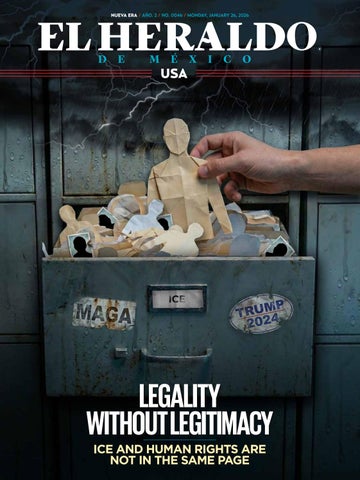
ICE AND HUMAN RIGHTS ARE NOT IN THE SAME PAGE
With Venezuelan support gone, Cuba faces a worsening energy crisis under the renewed U.S. policy of “maximum pressure.” In this context, Mexico struggles between ideological loyalty and economic risk, while Russia confirms its support will remain symbolic and not go beyond mere survival.

CUBA AMID THE COLLAPSE

NERGY CONTEXT: THE SEARCH FOR SURVIVAL AFTER LOSING VENEZUELAN CRUDE

The detention of Nicolás Maduro on January 3, 2026, and the subsequent U.S. control over Petróleos de Venezuela (PDVSA) have dealt a fatal blow to Cuba’s logistics. The island has permanently lost its lifeline: the preferential hydrocarbon supply that supported the regime for decades.

The White House’s approach has been precise. In a clear statement, Donald Trump announced the end of an era: “There will be no more oil or money for Cuba—zero. I urge you to reach a deal before it’s too late.” This remark is not just rhetoric; it forms the basis of a financial pressure strategy aimed at forcing change through the collapse of essential services. At this point, the island’s future hinges on two parties with conflicting agendas.

A. MEXICO: THE DISPUTED NEW “LIFELINE” Under Claudia Sheinbaum's administration, Mexico solidified its position in 2025 as the island’s key supplier. Through Pemex and its subsidiary Gasolinas Bienestar, about 17,200 barrels per day (bpd) have been exported. However, this number is only a temporary solution when compared to Cuba’s operational situation.

• Minimum operational demand: 110,000 bpd

• Domestic production: 40,000 barrels per day (heavy, high-sulfur crude)

• Structural deficit: 70,000 bpd Without this external flow, the National Electric System experiences blackouts that last over 20 hours a day, stopping industries and essential services. For Mexico, this aid has gone from being a diplomatic gesture to a costly bilateral friction point.

Trump has called Pemex’s support “direct interference” in his national security strategy. Pressure on the Mexican government is complex: Washington ties the continued supply to the renegotiation of the USMCA, controlling irregular migration, and cooperation in fighting fentanyl. Mexico now faces a choice—protect its political sovereignty or maintain economic stability with its main trading partner.

B. RUSSIA: A LIMITED STRATEGIC PARTNER Moscow now functions as a “last-resort protector,” but its support is more symbolic than substantive. Vladimir Putin’s ability to fill the gap left by Maduro is limited by a war economy and overextended logistics.

Although agreements to modernize industry have been signed, the reality is clear: Russia guarantees only a small part of the oil Cuba requires. Rosneft shipments, while consistent, total barely 30,000 bpd and are still affected by complicated payment systems and the threat of naval sanctions.

After the intervention in Venezuela—where losing Cuban advisers, especially intelligence personnel, marked a turning point—Russia’s presence in the Caribbean has changed. Moscow uses Cuba as a tool to distract Washington psychologically, while avoiding a larger military deployment that could provoke a deadly response from the Trump administration. With Russia’s 2026 budget focused on Ukraine and domestic inflation rising, the Kremlin cannot afford to bring back Soviet-era subsidies. Russian support is essential to prevent immediate collapse but not enough to keep the state afloat.

CONCLUSION

From a strategic intelligence perspective, Cuba is experiencing a state of technical paralysis, which directly threatens the regime’s political stability. The interaction of three factors will determine the outcome of this crisis this year.

The killing of a U.S. citizen during an ICE operation in Minneapolis has sparked renewed debate over migration as an internal security threat in the United States. The case highlights deep tensions between federal authorities, local officials, and the country’s longstanding human rights principles.

On January 7, 2026, during an operation by U.S. Immigration and Customs Enforcement (ICE) in Minneapolis, Minnesota, a federal agent shot and killed Renée Nicole Good, a U.S. citizen. The U.S. government justified the incident as an act of self-defense, sparking social protests and a heated public debate over the use of force by federal agencies. This raises an unavoidable question: was this an isolated incident, or does it indicate a new security policy?

To address this, it is useful to note that under the slogan “Make America Great Again” (MAGA), Donald Trump carried out a series of actions both inside and outside the United States starting in 2017. Some of these actions were questioned for possibly violating human rights and for increasing international tensions.

During Trump’s first term (2017–2021), ICE deported about 935,000 migrants, including minors who were separated from their families and held in questionable conditions. By 2025, deportations were estimated at around 200,000 people.

When comparing these figures with the nation’s history, it is clear that the United States has been a stage for major strug-

Minneapolis, Homeland Security, and Human Rights:

THE US’ INTERNAL STRUGGLE

gles to promote human rights. Landmark decisions like Brown v. Board of Education (1954), the civil resistance led by Rosa Parks, and, more recently, the Black Lives Matter movement demonstrate how the law has been used to limit power. Yet this legacy starkly contrasts with the current trend of normalizing state violence against vulnerable populations.

The examples provided are enough to warn that people living in the United States today face a more complicated situation.

The MAGA slogan has shifted from a campaign message to become the main idea of a political plan that jeopardizes the integrity, freedom, and lives of migrant communities.

According to the Center for

actions should be seen as part of a strategy that views national security not only as an external issue but also as an internal fight against perceived threats, such as migration. Consequently, this perspective securitizes migration and stops treating it as a social or humanitarian issue, instead framing it as a structural risk like espionage and terrorism.

This suggests that migration is viewed as a threat to national security, normalizing state violence and allowing it to infiltrate the domestic sphere. Consequently, immigration agencies shift from administrative roles to instruments of force without immediate oversight, creating a situation prone to abuse.

What happened in Minneapolis in early January of this year confirms this pattern and shows that neither the local population nor the local government supports these excessive measures. For example, Minneapolis Mayor Jacob Frey spoke out against the killing of Renée Nicole Good, as did Minnesota Governor Tim Walz. On Friday, January 16, 2026, the U.S. Department of Justice launched an investigation into whether both authorities obstructed federal security actions, including the possibility that they interfered with immigration agents during the protests and the local response to the ongoing operation.

Meanwhile, District Judge Katherine Menendez, citing the First Amendment, ruled that ICE cannot restrict individuals’ right to protest during peaceful demonstrations. The order bans the use of pepper spray without reasonable cause and prevents arbitrary arrests of those exercising their right to free expression and peaceful assembly. Donald Trump’s response was quick. He threatened to invoke the Insurrection Act, which allows the president to deploy military forces to stop a state’s rebellion against the U.S. government.

The United States is at a pivotal point. The current administration has redefined national security as an internal struggle, viewing migration as a threat rather than as a social phenomenon that helped shape the nation. In response, judges, local officials, and various sectors of society have started to establish institutional limits. The outcome of this conflict will determine not only immigration policy but also the true scope of human rights within U.S. territory.

* Head of the Research, Development, and Innovation Group: Rule of Law, Justice, and

at Universidad La Salle;

in

ART: IVAN BARRERA

A dark ship-to-ship (STS) transfer is a secret maritime operation where two ships come alongside each other in international waters to transfer cargo—usually oil or refined products— while deliberately turning off their AIS.

Recently, due to the situation involving Venezuela, an obscure but significant phenomenon in oil geopolitics and maritime trade has gained attention: the existence of so-called shadow fleets, or dark fleets, of vessels.

from monitoring systems, acting as “shadows” in global maritime trade.

WHY DO THESE VESSELS EXIST?

The shadow fleet isn’t a coincidence. It’s a direct response to economic sanctions, especially those restricting oil exports and access to the international financial system.

certain countries’ access to international markets.

2. ACTIVE AND COERCIVE ENFORCEMENT

In recent years, the U.S. has shifted from primarily using financial sanctions to taking direct enforcement actions, including:

• Listing and sanctioning vessels.

• Pressuring insurers and ports.

• Seizing ships and cargo.

THE “SHADOW FLEET”

These are ships—mainly oil tankers—that operate outside traditional, regulated maritime transport networks, bypassing international sanctions and financial controls. They are now central to diplomatic and strategic tensions among major powers.

WHAT ARE THE “SHADOW FLEET” OR “DARK FLEET”?

The rise of the shadow fleet demonstrates how sanctioned countries keep oil flowing through secret maritime networks that evade controls. Beyond energy, it exposes a quiet geopolitical battle over power, sovereignty, and global trade routes.

The shadow fleet refers to a group of vessels used to secretly transport oil and other energy products in violation of economic sanctions imposed by the United States and its allies. These ships are often linked to sanctioned countries or intermediaries that facilitate the export of restricted crude oil through covert methods and practices designed to make tracking difficult. They are also used for arms smuggling and other illegal goods.

Although it isn’t a formal legal term, the phrase is commonly used to describe a hidden maritime network functioning outside the official international system.

The phrase “shadow fleet” describes the tactics these ships use to literally disappear from regulatory radar.

• Manipulating the Automatic Identification System (AIS), which is necessary for identifying and tracking vessel locations.

• Frequently changing the ship’s name and flag, which makes legal identification more difficult.

• Using shell companies, often registered in countries with lax oversight.

• Conducting cargo transfers in international waters, outside any national jurisdiction, to conceal the true origin of the oil.

These practices allow ships to come and go

MARITIME INTERDICTION:

A naval operation conducted in international waters to stop, board, inspect, and, if necessary, seize vessels to enforce laws or sanctions.

For countries relying heavily on oil revenues, sanctions result in:

• Loss of traditional markets.

• Difficulty in securing vessels and cargo.

• Financial isolation.

In this context, the shadow fleet helps sustain the economy by allowing export flows to continue, even though it involves higher risks and costs.

WHICH COUNTRIES USE THESE PRACTICES?

Venezuela: Sanctions on its oil industry resulted in widespread use of opaque vessels to export crude, mainly to Asian markets, thus bypassing restrictions on PDVSA and its partners.

Iran: The country has built a highly sophisticated secret maritime transport network over the years, frequently changing flags, names, and routes to sustain crude exports.

Russia: after Western energy sanctions, significantly increased its use of tankers outside traditional routes to continue supplying clients in Asia and other non-aligned markets.

While not the only ones, these countries have attracted the most attention in recent months.

In all cases, the pattern remains similar: aging ships, opaque legal structures, and alternative routes to sustain energy trade.

Beyond economics, the shadow fleet also functions as a geopolitical instrument to resist external pressure and reshape power balances.

THE ROLE OF THE UNITED STATES

The United States occupies a crucial position for two main reasons:

1. ARCHITECT OF THE SANCTIONS SYSTEM Washington leads the creation and enforcement of financial, energy, and trade sanctions that limit

• Naval and diplomatic collaboration with allies.

These actions aim to disrupt hidden energy trade routes and send a warning to sanctioned states and private intermediaries.

An obvious example is the tanker “Bella 1,” later renamed “Marinera,” which became the focus of one of the largest maritime tracking and interdiction operations in recent years in international waters. Sanctioned by U.S. authorities for transporting restricted crude from countries like Iran and Venezuela, the vessel initially evaded boarding in the Caribbean, crossed the Atlantic while changing course, and shut down its transponders. AIS data had previously tracked it loitering near Iranian waters, with many suspicious encounters and long signal outages. During the pursuit, the vessel changed its flag from Panama to Russia and altered its name—movements documented by maritime tracking services and confirmed by platforms such as TankerTrackers.com. On January 7, U.S. forces, with support from the United Kingdom, seized the “Marinera” in international waters after a lengthy air and naval operation.

A QUIET WAR ON THE SEA

The

BY: CLAUDIA LOZANO ARTWORK: DANTE ESCOBAR

TO THE USMCA AND MEXICO TRUMP’S APPROACH

Donald Trump’s rhetoric about the USMCA focuses more on gaining leverage than on trade itself. By applying pressure, Washington seeks to reshape North American integration, weaken Mexico’s industrial sector, and reduce China’s influence in the region.

USMCA RHETORIC USED AS A PRESSURE TACTIC

When Donald Trump claims that the United States does not need the USMCA, he is not making an economic argument. He is signaling a negotiating tactic. The goal is not to scrap the agreement but to make it seem like withdrawal is an option.

This posture increases leverage. It allows Washington to negotiate through pressure rather than cooperation. It is not a typical negotiation; it resembles coercion. The message is clear: accept the new conditions or face consequences.

Mexico has responded cautiously, aware that many interests are at stake. U.S. companies are among the strongest supporters of the USMCA. If the agreement collapses, it will greatly disrupt their operations.

The automotive industry illustrates this truth. Supply chains are tightly interconnected across North America. A U.S. withdrawal would raise costs, disrupt production, and harm American companies as much as Mexican ones. This business pressure acts as an internal counterbalance to Trump’s rhetoric.

Trump has repeatedly urged companies to bring factories back to U.S. soil. However, this is much more complex than campaign slogans suggest.

Not only manufacturing, but also agriculture and logistics depend on cross-border connections that can’t be reversed overnight.

THE TRUE GOALS BEHIND THE PRESSURE

The real risk isn’t withdrawing from the USMCA but changing it. Trump might attempt to modify the deal so that U.S. companies gain the most, while Mexico’s industrial base weakens. Mexico’s industrial policy is already fragile. Further pressure could weaken “Plan México,” a crucial part of President Claudia Sheinbaum’s economic plan. The goal is to shift negotiations so that U.S. companies set the terms for production and investment.

From a critical perspective, it must also be acknowledged that neither NAFTA nor the USMCA has brought widespread prosperity to Mexico. Although certain sectors expanded, poverty did not decline as promised. Instead, Mexico depended more on low wages to attract investment. Labor insecurity increased, and the benefits of integration became uneven. These structural issues now make the country more susceptible to external pressures.

THE GEOPOLITICAL REASONING BEHIND TRUMPISM Trump’s approach mirrors a wider worldview. Undermining allies isn’t accidental; it’s a deliberate tactic. Trumpism stresses U.S. dominance, even if it damages long-standing alliances. This explains Trump’s rejection of free trade. He has openly argued that supporting free trade is equivalent to supporting China. This marks a significant shift from the system that the United States itself helped establish.

Free trade was based on the idea that the U.S. would always be in control. But China rose as a competitor and used those same principles to expand. In several key industries, the U.S. can no longer compete on equal footing.

Trump’s response isn’t reform; it’s retreat. The logic is simple: if you’re losing the game, change the rules or walk away.

THE CHINA FACTOR AND REGIONAL CONTROL

China is a key part of Washington’s strategic plans. Unable to beat China economically, the U.S. seeks to restrict its access to essential regions and resources. According to this view, the “West” is considered to belong to Washington, including Europe and the Americas. The implication is that the U.S. should have the authority to decide who can trade with whom and under what conditions. This creates serious geopolitical tension. Excluding China from the Americas isn’t simple. China has become a major trading partner for much of the world, often outside formal trade agreements. Mexico serves as a crucial gateway for Chinese goods entering North America. While Canada has strengthened its connections with China, Mexico feels greater pressure to align exclusively with Washington.

The reason is strategic resources. Oil in Venezuela, minerals in Mexico, and lithium in South America are all crucial to U.S. interests. Preventing Chinese access to these resources is a top priority. This same logic also explains U.S. interest in places like Greenland.

MEXICAN TARIFFS ON CHINA: A BALANCING ACT OR CAPITULATION?

Mexico’s tariffs on Chinese goods can be viewed in two ways. On one hand, they address a real economic problem. Mexico imports much more from China than it exports. Fixing this imbalance is key to a healthier relationship. Chinese products often compete under more flexible regulatory conditions. Strengthening

Eduardo García is a proud Mexican who continues his family’s tradition of handcrafted paletas from Jalisco, now with five locations in Texas. He keeps alive the heritage of Mexticacán, known as “the birthplace of the paleta.”

At 29 years old, Eduardo García and his family share their story in an interview with Heraldo USA—a story of hard work, perseverance, and pride. Helados La Azteca is a small piece of Mexico in Texas, a direct link to Mexticacán, Jalisco, the town famously known as the cradle of the paleta. What began as a family distribution business in the 1990s has grown into five successful paleterías that preserve a key element of Mexican culture in Texas.

THE BEGINNING

“My name is Eduardo García. My father is Alfredo García, and we own Helados La Azteca in Waco, Temple, and College Station, Texas. My dad arrived in 1990, five years before I was born. Like many others, he crossed the border without documents at first; later, he was able to regularize his status. He came here when he was 20. I was born in Los Angeles, California, and we moved to Waco from there. I’m 29 years old.”

WHERE DOES YOUR FAMILY’S TRADITION OF MAKING PALETAS ORIGINATE FROM?

“My parents are from Mexticacán, Jalisco, a very small town. The great thing is that it’s literally known as the birthplace of the paleta because so many paleteros come from there. That’s what happened with my dad and my uncles. I have two uncles who are paleteros, my dad, cousins, my brother — we’re many from there.”

WHAT WAS YOUR EXPERIENCE LIKE GROWING UP BETWEEN TWO CULTURES?

“We return every Christmas and nearly every summer to Mexticacán or Guadalajara. We learned Spanish first. consider myself 100% Mexican. Paletería helped me understand that. When was a kid, many people were embarrassed to say they were Mexican. But once I really

From humble beginnings to five stores, the

is rooted in work, faith, and family.

A

TASTE OF

MEXICO

Unique flavors like mamey, tequila, and Gansito preserve recipes passed down through generations.

got involved in the paletería and saw how beautiful it is to express ourselves through our food, I understood there’s no reason to hide our roots. Now I’m always very proud to be Mexican and to be from Jalisco.”

HOW DID HELADOS LA AZTECA COME TO BE?

“It was founded by my dad and two of my uncles, Javier and Arturo García. At first, we made paletas for over 20 or 30 stores in Dallas. We didn’t have our own storefront yet. My dad stayed here and said, ‘We have to grow. “I officially joined the business in 2019. Parents usually tell you, ‘You have to go to school,’ and I believed that until was 21. One day, I was driving past a small, newly remodeled building and thought, ‘A paletería should be there.’ I talked to my dad, and he said, ‘Why not?’ He supported me a lot. In 2019, we opened the second location. After a few social media posts, the business took off. My parents didn’t realize how many people were looking for us. That’s when I knew I wanted to be a paletero for the rest of my life.”

FLAVORS: THE KEY

“Our flavors are truly unique. You won’t find mamey, tequila, or Gansito flavors just anywhere. These are recipes my dad learned and passed on to me, and one day I’ll teach them to my son. They haven’t changed since he started. For me, that’s what makes them special: time and genuine, oneof-a-kind flavors.”

For many customers, each paleta feels like home, memory, music, and Mexican identity.

Beyond success, the brand represents pride, resilience, and hope for Latino communities.

HOW HAS THE AMERICAN PUBLIC REACTED?

“I often compare our product to a small piece of Mexico. Some people can’t go back, and when they come here, it’s like a little piece of home. Others have never been to Mexico, but when they visit us, they get to taste a bit of it—the music, the piñatas, people speaking Spanish, the paletas, the aguas frescas. That’s the beauty of our food: it brings many people together through flavor.”

MORE THAN JUST A PALETA: A SOURCE OF PRIDE DURING TOUGH TIMES

“It’s a source of pride to say we are Mexican and to support our people, especially right now when we’re being attacked so harshly. My dad feels it even more because he went through all of that and still does. I’ve always been very proud and very grateful to our entire community for supporting us. We can say there’s no reason to be afraid, no reason to hide. We never imagined being in this position—having more than a million followers and being featured by Forbes. It’s an achievement we reached together.”

A MESSAGE FOR THE MEXICAN AND LATINO COMMUNITY

IN TEXAS

“Don’t give up. My dad arrived with nothing—no money, no language. After a lot of hard work and effort, we owe where we are to him for never giving up. He took a leap and came from Mexico with nothing, so we could have a better life. Today, thanks to him and my mom, I was able to carry on his dream. You always must struggle first—but don’t quit. Keep moving forward.”

A family from Jalisco transforms handcrafted paletas into a cultural link across Texas communities.
Helados La Azteca continues Mexticacán’s legacy as the birth place of the paleta.
story

The neighborhood where Mexico welcomes returning residents

Little L.A., a small neighborhood in Mexico City, has become a refuge for deported Mexicans and dreamers rebuilding their lives. Amid barbershops, food stands, and community support, it tells a story of loss, resilience, and new beginnings on the other side of the border.

In the heart of Mexico City, between busy streets and historic buildings, there’s a small neighborhood that speaks two languages and carries two kinds of longing. Locals call it Little L.A., even though it is still officially part of the Tabacalera district.

It’s an urban strip that smells of coffee, tattoo ink, California-style burgers, and stories drifting in from the north, bringing dust from miles away. A refuge for those who once crossed into the United States chasing a dream—only to find themselves back again, without warning, without papers, without certainty, starting over from scratch. Tabacalera has always carried a somber feeling. Since the late 1800s, when Porfirio Díaz planned to build his grand Legislative Palace there, and through the post-revolution era that left the building unfinished—today the Monument to the Revolution—this neighborhood has harbored memories of being broken and rebuilt. Now, its story is changing once again: old buildings are being restored, cafés and streetfood stalls are multiplying, and at the same time, thousands of repatriated Mexicans, dreamers, and bilingual young people are beginning to arrive—searching for a place where they might belong after leaving behind, sometimes by force, the life they built in the United States. Little L.A. feels different. On its streets, Spanish blends with English and Spanglish, a border-born language that, for many, is the only tongue that feels like home. American accents mix with Mexican laughter. And although

a distracted visitor might see just another city neighborhood, it takes only a moment of listening to realize worlds collide here: young people talking about their life “on the other side,” customers asking for a “fade cut” or an “army style,” vendors greeting “la raza,” and volunteers offering a hand to those who arrived with no idea where to start.

DON PEPE AND EDWIN: A BARBER’S CHAIR AS A BRIDGE

Inside the Alameda barbershop, the mirror reflects more than just haircuts. There is Don Pepe, an 84-year-old barber who has watched entire generations walk through his door. Among those who have come and gone is Edwin Malagón, who grew up in Atlanta from the age of twelve and returned to Mexico after being deported.

At first, Edwin felt like he didn’t belong anywhere—until the day he nervously asked if he could rent a chair on weekends.

“They helped me integrate,” he says. And it’s true: the barbershop became a living library for him. Clients who found out he had grown up in the U.S. would share stories about a city he barely knew. Between clippers and conversations, Edwin rediscovered his own country.

Over time, don Pepe sold him part of the business, and now they work side by side, serving a clientele that comes in for a haircut but finds conversation, companionship, and a place where nothing needs to be explained. ISRAEL

Little L.A. in Mexico City blends languages, memories, and second chances for returned migrants.

supports repatriated migrants, dreamers, and binational families who return with fear, wounds, and uncertainty. He understands the migrant experience firsthand: he lived in Texas since childhood, studied there, started a business, married, and became a father—then everything fell apart after a traffic stop. He spent two years in jail for refusing to sign his deportation order. He was kidnapped upon arriving in Mexico and started from zero.

That is why his project was started as a personal mission: to make sure no migrant faces deportation alone. Since 2015, New Comienzos has assisted more than 5,000 people with temporary shelter, legal advice, emotional support, English certification, and job placement. Its philosophy is both simple and deep: “returning is not giving up—it is starting again.”

For many re-entering migrants, arriving in Mexico City is an overwhelming shock: language barriers, discrimination, bureaucratic chaos, insecurity. Israel and his team—200 volunteers who share the same experience—are an essential support. In their small office, the smell of coffee mixes with Texan accents and the nervous smiles of those arriving in Mexico for the first time in their lives.

There, they also distribute Dream in Mexico kits that guide returnees through their first 60 days: the essentials of navigating a country they legally belong to but often barely know.

HUGE BURRITOS AND CALIFORNIA-STYLE BURGERS

On a corner of Ponciano Arriaga stands Uriel Esquivel, 25, who crossed into the U.S. without

papers and drifted from job to job for five years. When he was deported in 2015, he decided his life would have to be reinvented from scratch.

Now he runs a street-food stand selling giant burritos, barbecue-sauce burgers, and tacos cooked “for la raza”—for those who come back with northern cravings. His family in Mexico helped him start the business; the migrant community helps keep it going.

Uriel claims he doesn’t miss the U.S.—or at least that’s what he says—though he admits he earned more and worked less there. In Little L.A., he’s dreaming of turning his stand into a franchise. As he tends the grill, he listens to others’ stories: returns, losses, children left behind, siblings still trying to cross. Every customer offers a different slice of California.

MARCO ANTONIO AND THE NOSTALGIA ETCHED ON SKIN

A few blocks away, Marco Antonio Ballesteros balances a call center job and tattooing. He moved to the U.S. at age four, stayed there for 28 years, and was deported to Tijuana with no papers, no money, and nobody to call.

In Tijuana, they stop you for anything—and they torture you,” he recalls. That’s why Mexico City feels oddly relieving: a place where, as he says, “at least the laws are respected.” Spanish still struggles with his language, but tattooing helps him. Each line tells a story about identity, loss, and memory. Marco hopes to see his son again someday, though he knows returning to the U.S. is nearly impossible. For now, he tattoos clients in makeshift apartments and volunteers with New Comienzos. Opening a

Barbershops, food stands, and NGOs turn Tabacalera into a place to rebuild identity and a sense of belonging.

proper studio remains out of reach; paperwork has trapped him in a maze of requirements he never encountered before.

OTHER RETURNS, NEW BEGINNINGS

Edwin Sánchez spent more than twenty years in Wyoming and eventually chose to return voluntarily after seeing no clear path to citizenship. Today, he manages a bank and speaks about freedom — finally feeling able to pursue his dreams in his own country.

Daniel Iniesta arrived in the U.S. at six years old, grew up in Virginia and Oregon, but lost his dreamer status and was deported. Now he walks through Tabacalera, repeating a phrase that sounds like both comfort and conviction: “Mexico is a perfect place to be; it’s good to be back home.”Mauricio López, meanwhile, self-deported in 2017. In Mexico, he opened an English school and a coffee stand, and now he dreams of becoming the country’s first dreamer congressman. Different stories, all linked by the same fracture: the wound of uprooting.

Little L.A. isn’t a major tourist destination or a neighborhood with flashy signs. There are no bright marquees like in Koreatown or themed restaurants such as in the Zona Rosa. Its presence is quieter and more personal: a bilingual menu written in black marker; a stand supporting “la comunidad binacional”; a barbershop where English mixes with army-style cuts; a quiet shelter where each bed holds a paused, unfinished past.

But it is real. It exists. It grows. And each day offers a new opportunity to begin again.

BY: OSO OSEGUERA
PHOTOART: IVÁN BARRERA

THE LIMITS OF TECHNOLOGY

IN THE CREATIVE REALMS OF A FILM REVOLUTION

Cameron’s career has always revolved around a single obsession: scale with purpose. From oceans to outer space, from sinking ships to rising civilizations, his films insist that spectacle must earn its place. Fire and Ash promises exactly that—beauty under pressure, myth under stress, and a world forced to confront its own shadow.

At this stage, Cameron is not longer proving he can make hits. He is testing whether cinema can still function as modern mythology. Pandora was never just a visual playground; it was always conceived as a moral ecosystem. In Fire and Ash, that ecosystem fractures. Fire enters a world defined by balance, and

ash settles where innocence once lived. The brilliance of Cameron lies in his refusal to romanticize conflict. Fire is not merely destruction—it is transformation. Ash is not an ending—it is memory. This chapter signals a tonal shift in the Avatar saga: less wonder as escape, more confrontation. Cameron seems to ask a dangerous question— what happens when even paradise must choose sides?

Unlike many franchise filmmakers, Cameron understands time. He waits. He engineers. He obsesses. And then he releases a film that feels less like content and more like an event. Avatar: Fire and Ash is positioned not as a sequel, but as a reckoning—both for Pandora and for the audience that once saw it as a simple environmental fable. What makes this chapter compelling is its implied discomfort. Fire suggests

James Cameron has never been interested in small ideas. He doesn’t knock on the door of cinema; he builds a new house beside it and invites everyone to move in. With Avatar: Fire and Ash, Cameron returns to Pandora not to repeat himself, but to burn away comfort, certainty, and the illusion that harmony is permanent.

rage, rebellion, and cultural collision. Ash suggests aftermath. Together, they hint at a story willing to challenge the moral clarity of earlier films. Cameron is not interested in easy villains anymore. He’s interested in consequences and, mainly, how does consequences affect relatable characters.

“As a writer director, I come into every movie from a standpoint of character and narrative, right?”, Cameron explains. “I work with the actors for a year and a half. I don’t think about camera. I don’t think about camera movement, lighting or any of that stuff that one would normally be working on in a live action film. I just push that all into a separate phase of the production that doesn’t involve the actor”, continues.

In an industry chasing algorithms and opening-weekend validation, Cameron continues to operate like a filmmaker from another era—one who believes cinema should leave a mark, not just a footprint. With Avatar: Fire and Ash he is not expanding a universe; he is deepening it, darkening it, and daring it to evolve.And although evolution in filmmaking does rely in technological milestones, which Cameron embraces me even pursues, he has a very clear vision on where he must draw the limits of those tech advances and where not to cross the line into the creative and artistic process, mainly when AI technologies are menacing the work of artists.

“I See our process on an Avatar film as being almost the opposite end of the spectrum”, Cameron explains. “The problem is that people don’t understand. They hear that it involves technology and computers and then it all turns into, like a bunch of melted ice cream, where the chocolate and the vanilla are all mixed together and they can’t tell

James Cameron reflects on filmmaking creativity, and responsibility in shaping stories for the world”

what’s what. For me, I draw the line at replacing writers and replacing directors. Because when you’re replacing writers or you’re replacing actors, you’re really replacing most of what a director actually does. I work with the best artists in the world. The world-building process in Avatar is not the challenging part of these films. The challenging part is getting the human truth at the heart of it”, the Academy Award winning director says.

Opposite to other filmmakers who use technological advantages as shortcuts to avoid processes or save money, Cameron prefers taking risks and not playing it safe. In that sense, Avatar: Fire and Ash is James Cameron at his most dangerous—and therefore, his most interesting.

As other successful filmmakers like Guillermo Del Toro, who still rely on classical techniques and storytelling structures like pillars for innovating projects, James Cameron considers himself a romantic.

“Do you know what’s the difference between me and my friend Guillermo?”, Cameron asks smiling when talking about his mexican friend. “He always say to me: Jaimito, you have no sense of irony. You’re so earnest”. And maybe that lack or irony is what keeps him a romantic in an era where cynicism prevails and technology draws a line between innovation and sensibility.

“We bring a sensibility and a lens that’s unique to every artist. It is unique”, Cameron confesses. “Filmmakers like us have our own quirks and our own ideas. And generative AI can only give you kind of the average, or the blend and the merge of everything that’s ever been done. It can’t give you the unique thing, so there’ll be an inherent mediocrity”.

Turn static files into dynamic content formats.

Create a flipbook
Issuu converts static files into: digital portfolios, online yearbooks, online catalogs, digital photo albums and more. Sign up and create your flipbook.