



“The only way you can in these things is by being corrupt”
By Amira Benjamin and Shaaranki Kulenthirarasa
The Elections & Referenda Committee (ERC) of Toronto Metropolitan Students’ Union (TMSU) ruled that only the executive vote of the 2025 fall byelection was null and void, and published unofficial vote counts for the faculty director elections.
The publication was made over email, Instagram and on their website, detailing the disqualification of two slates.
According to the TMSU complaint rulings, both the Students Leading Tomorrow (SLT) and Team Forward slates were disqualified, resulting in the null and voiding of the executive vote.
Under the Elections Procedural Code (EPC), 8.5.3.2, the Chief Returning Officer (CRO) or ERC may declare an election void, “should the violation be sufficiently severe.”
These are the rulings:
Students Leading Tomorrow – 744 demerit points
The SLT slate received over 50 complaints across the three-day voting period of the by-election.
Allegations involving the slate included “providing inaccurate or misleading information about candidates or voting,” “harassment” and “soliciting votes for SLT and/or individual SLT candidates.”
Many complaints also submitted photo and video evidence.
SLT received 744 demerit points, resulting in a slate disqualification under Section 8.38. An executive candidate with more than 35 demerit points is automatically disqualified.
Ruling #FBE2025-025
A total of 45 complaints were combined into this ruling.
Alleged EPC violations included crosscampaigning (s.8.1.31); current and prior TMSU Executives and/or board members are not eligible to serve as Campaign Managers (s.6.3.2.); conduct that persistently undermines the authority of the CRO (s.8.1.16).
There were seven “credible accounts” of unsolicited campaigning for SLT occur -
ring in restricted areas, such as the library and academic buildings.
The CRO also considered additional evidence to support these violations, such as their direct observations, a report by MNP and the rulings of #2025FBE-024.
MNP, the accounting firm investigating allegations of fraud and corruption within the former 2024-25 TMSU executives, filed a report to the CRO and ERC. The ruling claimed that MNP investigators “received a series of audio recordings from a whistleblower.”
In two of the recordings, former TMSU executives Nadir Janjua and Muhammad Awais can be heard covertly coordinating with volunteers and selecting Koby Biya as the presidential candidate.
The MNP report also concluded that Ali Yousaf, a former TMSU president, was involved with SLT’s campaign. The report stated Yousaf “instructed Hafsa Iqbal to walk around so that other slates would follow her and the volunteers would get votes more easily.”
The CRO also observed that SLT engaged in few formal campaigning activities. For example, the ruling states the CRO identified an SLT-associated Instagram account on Nov. 20.
...(SLT) and Team Forward slates were disqualified, resulting in the null and voiding of the executive vote
This account was not disclosed or approved by the CRO, as per ERC guidelines, and remained private for the entire election.
The CRO also stated SLT did not provide them a list of volunteers for their campaign team, as per ERC guidelines. SLT was found violating several ERC codes multiple times, including campaigning during the voting period, campaigning in restricted areas, cross campaigning, undermining authority of the CRO and any attempt to undermine the electoral process.
Ruling #FBE2025-026
The second SLT ruling deals with complaints regarding harassment and sabotag-
ing another candidate’s campaign.
Complainants from different slates allege several SLT candidates were following them, threatening them and making them uncomfortable, or recording them. The CRO also believed that SLT had a “campaign strategy” to target Ali Paracha, a candidate for the Guardians slate, by randomly calling university security complaints on them.
The CRO issued SLT 51 demerit points in this ruling.SLT filed an appeal but the CRO ultimately upheld their rulings and demerit points.
Team Forward – 151 demerit points
The Team Forward slate received 27 complaints over the three-day voting period. The allegations that slate members received include asking for votes or organizing groups to ask for votes at Pitman Hall and across campus outside of the campaign period. Some of the complaints were submitted with video evidence.
Team Forward received 151 demerit points, resulting in a slate disqualification under Section 8.38.
Ruling #2025FBE-28
Alleged EPC violations included campaigning in restricted areas (s.8.1.32).
The CRO interviewed many of the complainants, used photos and videos from complainants and the conversation with Faizan Ansari as evidence that individuals under this slate violated rules.
There were 13 first-hand accounts of Team Forward trying to obtain votes at Pitman Hall, a restricted area.
Multiple photos and videos that complainants provided showed Team Forward candidates using QR codes to get students to vote for them.
The CRO met with Ansari and confirmed that he sent messages offering money to a student who would vote for him. This was appealed by Ansari to the ERC. When the ERC briefly left, Ansari told the CRO that “the only way you can win these elections is by being corrupt.”
Ruling #2025FBE-027
This ruling dealt with multiple complaints
alleging that independent candidate for vice-president student life, Vinayak Mathur, was soliciting votes, approaching students across campus during the voting period, and linking his candidacy with SLT candidates.
Some of the complaints were accompanied by video and photo recordings. Mathur has responded to the complaints in the CRO rulings, denying his affiliation with SLT and any attempt to solicit votes.
Although the CRO did not find the candidate in violation of the EPC and did not issue any demerit points, they did determine that voter solicitation occurred “in which Candidate was named or promoted, and that this activity occurred during the Voting Period.”
“The only way you can win these elections is by being corrupt”
The CRO said actions proven in this ruling and Ruling 25 “substantially undermined the fairness of the election, and in particular the fairness of the vote for the Executive Candidate positions.”
Scott Miller Berry, chair of the ERC and interim co-executive director of the TMSU, said the organization will continue to ensure the electoral process remains fair and that candidates follow the rules.
“Since arriving recently, myself and [interim co-director Sally] Lee have met so many inspiring students and remain committed to working with the ERC and the CRO to ensure a fair and open process that will inspire all candidates and voters to bring out and expect the best from themselves and their peers,” he said.
In the statement published on their website, Berry stated that the by-election vote will not be redone and a new executive will be elected in the upcoming winter general elections.
According to the email statement, the director’s election is still moving forth. The selected candidates are available on the TMSU’s website. Miller Berry said the TMSU will hold a meeting in early February to confirm this.
By Molly Simpson
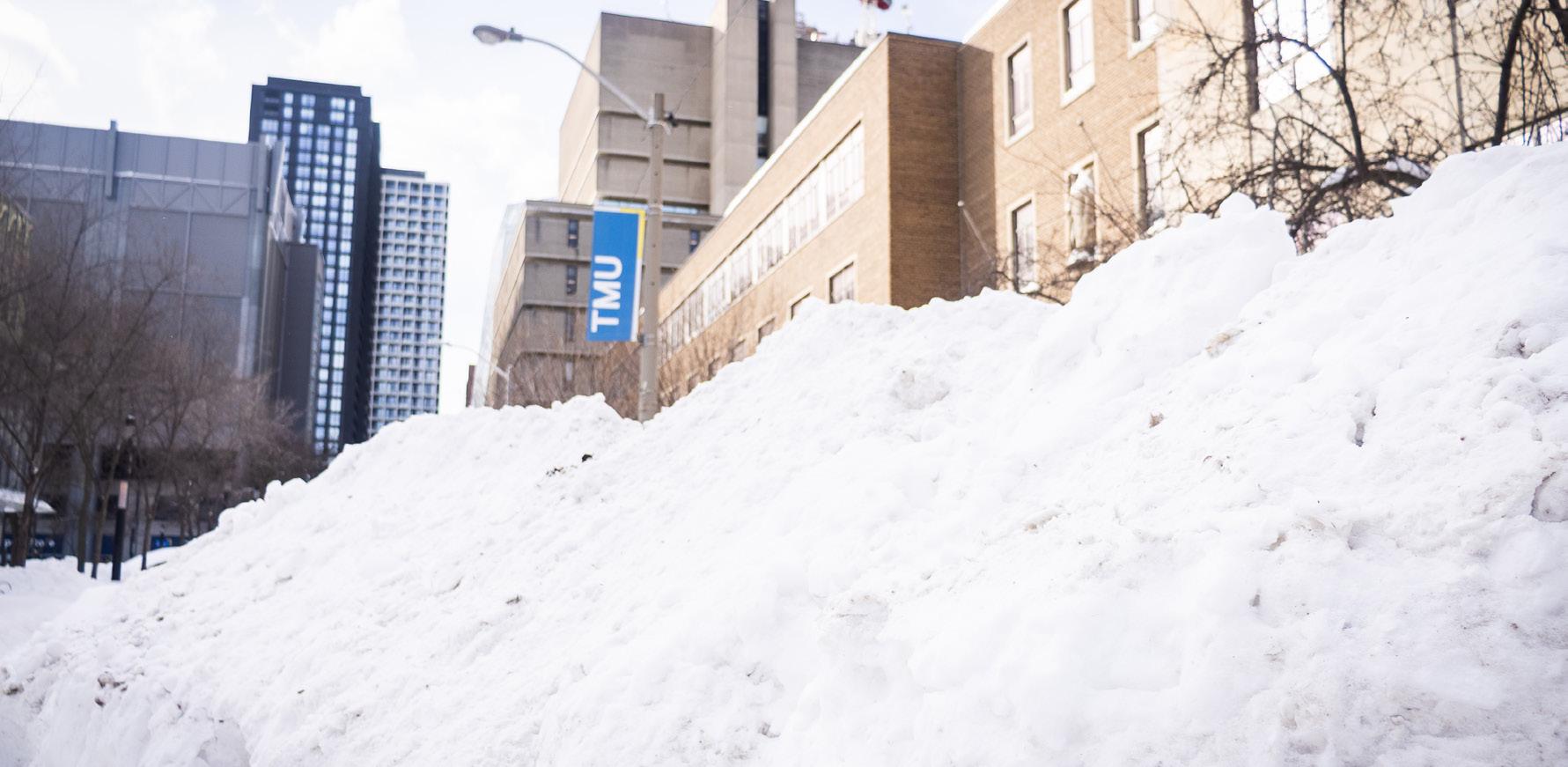
Students and staff at Toronto Metropolitan University (TMU) say heavy snowfall may render the city inaccessible, despite the city’s new efforts.
Toronto saw its largest single-day snowfall in history on Sunday, causing all Greater Toronto Area (GTA) schools and universities to declare Monday a “snow day.”
Ishaan Bassi, a first-year business management student, said he’s noticed campus roads aren’t always cleared after a snowstorm.
“That intersection on Yonge and Gould…there’s always so much slush…it’s annoying to cross the street there,” he said.
Sricamalan Pathmanathan, cochair of Employees with Disabilities Community Network said in an email to The Eyeopener that commuting for Wheel-Trans users is his biggest concern.
Wheel-Trans is Toronto’s paratransit service that provides transportation for people with disabilities.
He said heavy snowfall can disrupt the typically reliable WheelTrans door-to-door service.
“When snow is piled up on the curb between the road and sidewalk, it makes it difficult or almost impossible to safely exit vehicles, especially when getting dropped off by Wheel-Trans,” Pathmanathan said.
When Wheel-Trans is delayed or stopped and cannot pick up its
commuters, TMU has options for hybrid arrangements and he said “leaders are expected to be considerate and flexible when addressing these situations.”
Pathmanathan added he believes snow removal from places used often by people with disabilities—including the School of Disability Studies and the library—should be a priority.
“That intersection on Yonge and Gould… there’s always so much slush...”
Lalianna Preston, a first-year psychology student saw two students slip on slush on Gould Street.
“I feel like since it’s on campus, it could have been taken…better
care of by the school,” she said.
Gould Street is a public street and the City of Toronto is responsible for snow removal.
Preston, a commuter, said her ability to access campus has been hindered by traffic in her home city.
She drives to Barrie before catching the GO train and finishes her commute on the subway.
“People aren’t really too comfortable driving in the snow,” Preston said.
She noted that compared to the sidewalks, Toronto transit routes are fairly cleared.
Toronto’s new major snow event response was put into effect after heavy snowfall on Jan. 15.
The news release laid out steps like deploying 200 support staff and 75 pieces of equipment to
help during snow clearing, inspections and towing.
“I feel like since it’s on campus, it could have been taken…better care of by the school”
The city is also exploring temporary parking options for residents due to snowbanks on the side of the road. They will also review the city snow dumps and consider more efficient snow melting technologies.
In the news release, the city recommended that residents take public transit instead of driving during extreme weather conditions and encouraged them to “remain patient” during the snow removal process.
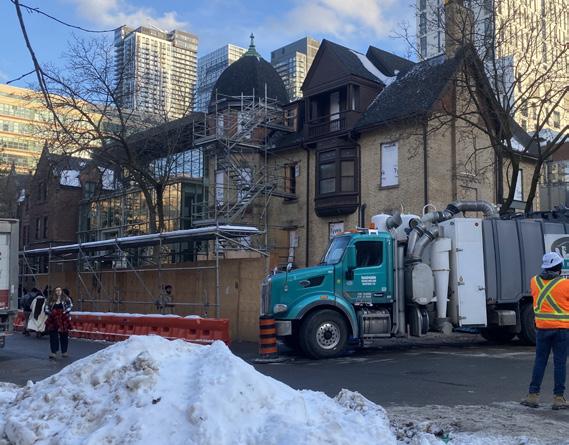
Image of the construction of the Nadir Mohamed Centre for Student Wellbeing. (VANESSA KAUK/THE EYEOPENER)

“I’m walkin’ here!” Just outside of the Student Campus Centre, there sits a tiny make-shift, sorry excuse for a walkway while the sidewalk is closed for the construction the brand-spankin’ new Centre for Student Wellbeing.
Construction is inevitable in Toronto, but this one is putting students at risk. Many of us opt to walk in the street, putting us in danger of being hit by a car. When it’s been raining, the leaky plywood roof drips dirty water on heads and down backs. Many students also walk side by side with their friends and don’t move over for those coming in the other direction. This awful walkway is another stressor on students who are simply trying to get from one side of campus to another. So until Lachemi decides to stop comissioning new buildings left and right, I guess we’ll keep dealing with it. I have no constructive feedback here, I don’t like it, it’s bad, I prefer to walk on the street.
Sincerely,
The annoying talking coffee mug
By Daniyah Yaqoob
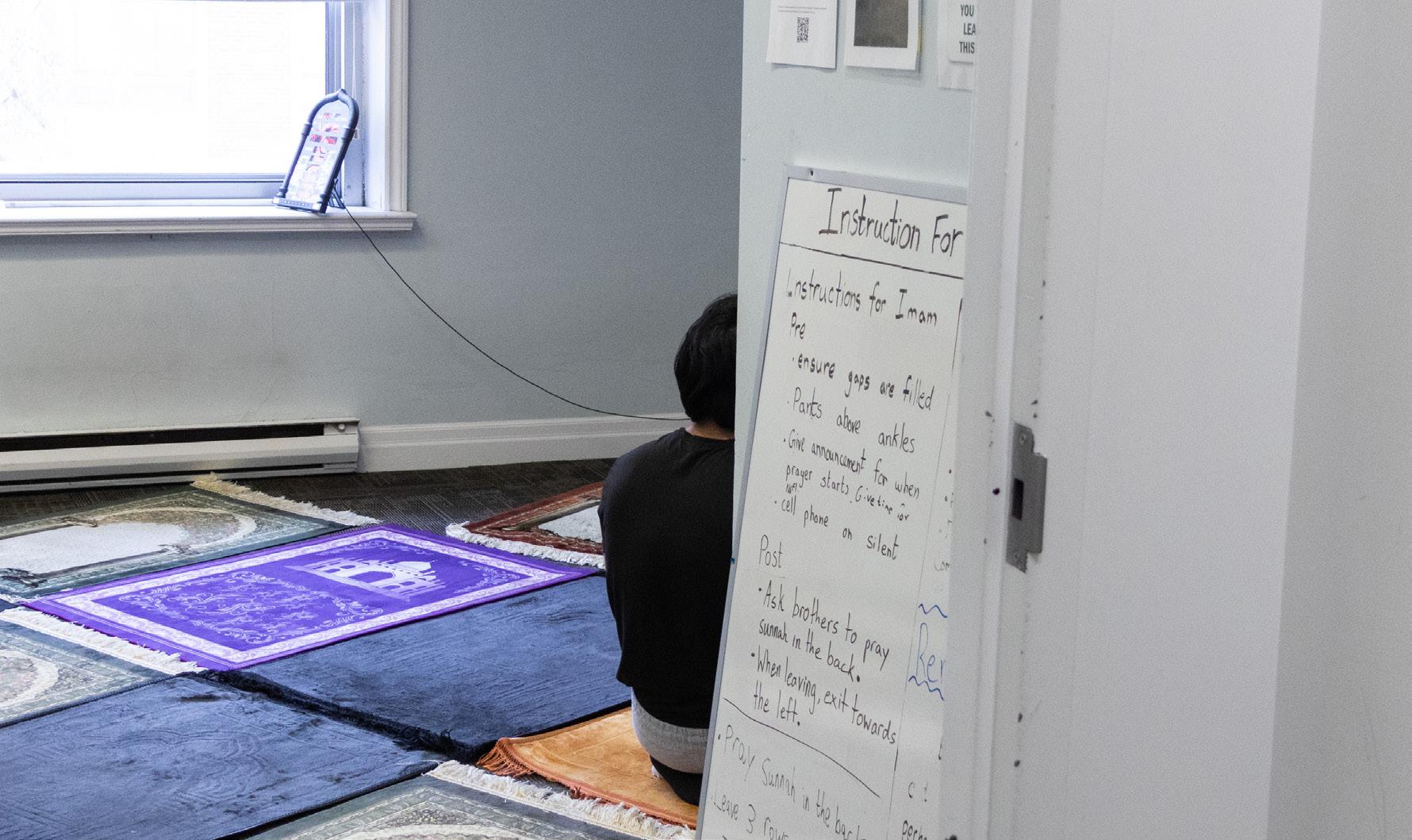
New rules are in store for the prayer room on the third floor of Toronto Metropolitan University’s (TMU) Student Campus Centre (SCC), leading to mixed reactions from students who use the space.
The multi-faith prayer space was closed for the duration of the winter break for “much needed repairs and cleaning,” the TMU Student Centre (TMU-SC) told The Eyeopener in an emailed statement. It was reopened on Jan. 12.
When students returned to the space, it had been reorganized with “additional storage for items used in different religious/wellbeing practices.”
According to posters plastered around the prayer space, there was also a new daily schedule in place, with curtains dividing the space pulled back for “open practice” from 9 a.m. to 11 a.m., and closed from 11 a.m. to 9 p.m. for “multifaith practice.”
TMU-SC said the schedule was created in collaboration with the Muslim Student Association at the university.
New rules also stipulate that the space can’t be used for sleeping, eating, socializing and cannot be used for long periods of time beyond prayer.
A post on Reddit gathered mixed reactions, with some students lamenting the new rules as restrictive towards their practices.
Others said the rules were good for reinforcing the space as a prayer space only.
Navaal Ala, a second-year occupational health and safety student, said she uses the prayer space every time she’s on campu campus— it has become a hub for the Muslim community at TMU.
Her first time there after the winter break, she felt a sense of discomfort, particularly over the new curtain which replaced the previous divider.
Muslims often pray in spaces segregated between men and
women—the gaps the new curtain leaves between the two spaces made her uncomfortable.
“When I walk into a space that I’m comfortable in, it’s much easier to create that connection [with
God],” Ala said. However, Ala said she understands the desire to cater the space to people of other religions, and said it could have been done even with the old room divider.
“If other religious students were to come in and add in their own prayers or their books and stuff, I don’t think anyone would have anything against it,” she said.
The Eyeopener Masthead

Editor-in-Chief
Negin “Asterisk” Khodayari
News Editors
Shaaranki “Eyeflash” Kulenthirarasa Vihaan “Yes Boss” Bhatnagar
Amira “Plot Thickens” Benjamin
Arts & Culture Editor
Sophie “Opinionated” Wallace
Business & Technology Editor
Aditi “Yahoo” Roy
Communities Editor
Daniel “Vamos A La Playa” Opasinis
Features Editor
Edward “Saturday!!!” Lander
Fun & Satire Editor
Dylan “Ow my...!” Marks
Sports Editors
Jonathan “Yes Ma’am” Reynoso
Victoria “Presale” Cha
Production Editors
Jasmine “Bored” Makar
Sarah “Word of the Week” Grishpul
Photo Editors
Ava “Snow Day!” Whelpley
Saif-Ullah “IllustrATE” Khan
Pierre-Philipe “Collage King” Wanya-Tambwe
Media Editors
Divine “DoNt YoU” Amayo Lucas “ForGet aBouT mE” Bustinski
Digital Producer
Anthony “Tuesday Section”
Lippa-Hardy
General Manager
Liane “Board Meeting Thursday” McLarty
Design Director
Vanessa “I Don’t Like It” Kauk
Contributors
Moyo “Present!” Lawuyi
Yusra “Good Work” Khan
Gregory “Source Scout” Burkell
Eunice “RIP the Bills” Soriano
Hannah “Left On Seen” Thompson
MJ “ASAP” Młot
Mishael “Banana Split” Taruc
Shadi “Scream Queen” Rasoulzadeh Baghmisheh
Charlotte “Adulting” Ligtenberg
Myrtle “r/Contrib” Manicad
Yeganeh “On the Grind” Shajari
Sophia “Rich!” Shahani Durán
Liana “21m in BTM” Yadav
Rosemary “Acprob” Gill
Stanley “Yellow Spotted Lizard” Yelnats
Steve “#1 Answer” Harvey
Harry “Pee Occasionally” Styles
Daniyah “The Star” Yaqoob
Molly “Build a Snowman” Simpson
Marcus “Horizontal” Ho
Address
55
By Sophie Wallace
Disclaimer: This piece mentions overdose and substance abuse.
“Be careful, there are a lot of crackheads around.”
I looked back in surprise at the well-meaning student who uttered these words. I had met him at a protest at Toronto Metropolitan University. From first impressions, he was kind, left-leaning, progressive. But apparently, these ideals don’t always stretch to include everyone.
There is an irony to the phrase “visible homelessness.” I have lost count of the number of times I have been on the subway, the streetcar or walking down Yonge Street and heard people crying out for help, for a dollar or in one particularly disturbing incident, for someone to come and end it all. No one stops, looks, helps. The stigma goes beyond even what I have seen in my home country. And that bar is a low one—the U.K. is not well known for its humanitarian social policies.
The pervasive narrative about substance users is that they are dangerous, dirty and unpredictable. We do not wish to bear witness to the suffering of the marginalised ‘other’, whose behaviour and appearance violates the norm. It is us and them, and they make us uncomfortable.
Is the fear and discomfort of shar-
ing public spaces proportionate to the risk of harm? Would the risks perhaps dissipate if the city shared a collective responsibility of care to its most vulnerable residents?
The lack of safety net is at best, inadequate, and at worst, criminal negligence
Since moving here last August, I have noticed that two Torontos exist in parallel. Downtown restaurants are lit warmly from the inside, office workers buy $9 coffee on their morning commutes and condominium buildings stand tall and shining. Concurrently, people sleep on top of the subway vents for warmth or, with nowhere safe to go, overdose—slouched in doorways.
The Ford government is slowly eroding the support once available to Toronto’s most vulnerable. The closure of Ontario’s safe drug consumption sites has only exacerbated stigma against users, despite data showing that crime was lower in neighbourhoods with these sites than in the rest of the city.
With the U.S. trade war and soaring cost of living, more and more people are falling into poverty and the ones in charge are doing little to catch them. For people without a leg up in life, the situation really is impossible. The lack of safety net is at
best, inadequate and at worst, criminal negligence. Let’s examine it. The average monthly rent in Toronto for a one-bedroom apartment is $1,715. According to Stefanie Cepuch, the program coordinator at Avenue Road Foodbank, in some cases, people working full-time on minimum wage spend between 50 and 100 per cent of their income on rent. If unable to work, or find work, people are eligible to receive a maximum of $1,408 per month through the Ontario Disability Support Program (ODSP), or $733 per month through the Ontario Works benefit.
Thus for many residents, private rentals are inconceivable. As an alternative, the City of Toronto has a number of subsidized, Rent-Gearedto-Income properties. The waitlist has increased by 23.3 per cent in the past two years alone, to over 100,000 people. The expected wait time is up to 15 years.
I am asking you to consider an alternative narrative
The lack of housing options is demonstrated in the high number of individuals relying on Toronto’s shelter system. According to data from the City of Toronto, almost all shelters in the GTA are operating at 95 to 100 per cent capacity. Over two thirds of the homeless
By Negin Khodayari
If you spend any time online during moments of global crisis, you already know the routine. A tragedy happens. Timelines flood with posts, stories, statements and graphics. Then comes the second wave: the scrutiny. Who posted fast enough? Who posted at all? Who posted the “right” thing? And who stayed silent?
Somewhere along the way, we decided caring looks one specific way—usually an Instagram story—and that anything outside of that is suspicious. Caring has become something you’re expected to prove publicly. If you don’t, you’re complicit. Your morality is questioned.
But movements were never meant to function like this.
Social media is a tool, not a moral compass. Posting doesn’t automatically make someone informed, ethical or effective. And choosing not to post doesn’t mean someone doesn’t care. People engage in movements
in wildly different ways. Some organize on the ground. Some donate. Some are educating themselves. Some are having conversations offline, supporting friends or doing community work that doesn’t photograph well. Some people are exhausted, grieving or simply trying to survive their own lives.
Somewhere along the way, we decided caring looks one specific way
None of that fits neatly into a 24-hour story—but it still matters. What’s especially damaging is how quickly this turns into comparing tragedies. We start measuring suffering against suffering, arguing over which injustice deserves more attention. As if empathy is something we’ll run out of if we acknowledge more than one pain at a time. As if caring about one thing means you must be silent about another.
This kind of thinking doesn’t
population are “chronically homeless”, meaning they spend at least six months per year on the streets. There is a complex and multifaceted relationship between homelessness and substance use. Whilst the two are not mutually exclusive, and there are a plethora of reasons why someone might misuse drugs or alcohol, housing instability has been linked with substance use and worse physical and mental health outcomes. What does it do to a person when the world has no space for them? The vicious cycle continues. It is near impossible to stop using when not in a supportive environment, and as anyone who has ever been in the throes of addiction will know, helping yourself is sometimes the hardest thing imaginable.
Maybe you’re someone who understands how broken the system is, but you feel powerless in the face of it. To that, I ask: keep spare change in your pocket, for when you come across the diabetic man begging on the corner of Bloor West and Spadina. Carry naloxone. Question people when you hear them use stigmatizing language, and gently point them back to their humanity. I am asking you to consider an alternative narrative. One where, whilst the authorities continue to harm through systemic neglect, we as individuals make the world a slightly kinder place.
challenge power. It mirrors it. Instead of directing our anger at systems that perpetuate violence and inequality, we turn on each other. We dissect language. We algorithmize grief. We accuse people of not doing enough, not caring enough, not performing correctly. Calling each other out online replaces human conversations. Nuance gets labeled as indifference. And honestly? It’s exhausting. Performatism thrives in this environment. It rewards certainty, even if wrong, over curiosity and outrage over understanding. It’s easy to post something that signals you’re “on the right side.” It’s much harder to sit with complexity, to admit gaps in knowledge or to stay engaged when there’s no applause for it. When no one’s liking your stories in awe.
Nuance gets labeled as indifference
What gets lost is empathy— both for the people directly im-
pacted by tragedy and for each other. We forget that people carry different capacities, fears, and responsibilities. We forget that not everyone feels safe speaking publicly. We forget that patience is not the same as apathy.
Movements don’t fall apart because people care too little. They fall apart because we start believing care has to look identical. If we want real change, we need to stop treating activism like a performance and start treating each other like humans. That means offering empathy instead of suspicion. Patience instead of instant judgment. It means trusting that people can show up differently and still be aligned in values.
Unity doesn’t mean everyone posting the same thing at the same time. It means resisting the urge to attack each other online and remembering why we’re here in the first place. Not to win arguments. Not to look morally superior. But to push for a world that’s actually more just—together.
By Yusra Khan
After weeks of anti-regime protests in Iran and an internet shutdown, Iranian students at Toronto Metropolitan University (TMU) are raising their voices in support.
The protests against the Islamic Republic (IR) came after the most severe economic collapse in recent Iranian history, with frustrated citizens taking to the streets to once again demand regime change.
Ghazal (Eden) Faridi Haftkhani, a second-year psychology student at TMU felt that call to action as well. “People just can’t take it anymore, people are hungry,” she said. “I think this has left a scar that will never truly heal.”
Born and raised in Iran until she was 18 years old, Faridi Haftkhani said the unrest has limited her contact with her parents.
As of publication,* connection throughout the region is actively being restored but remains unreliable for many. According to the CBC, activists in the region estimate over 5,000 people have been killed by the IR in the recent protests, while Time Magazine says local health officials are estimating a death toll of over 30,000.
“My mom and I ended up making a little pact that she calls me at 10 a.m. every morning so I know that at least they’re okay. We don’t really get to talk for long,” said Faridi Haftkhani, adding that so far, her family says they’re safe and fed.
“In a way I’m incredibly grateful, and in another way I just think about how much this regime has taken away from me,” she said.
Faridi Haftkhani said seeing people educate themselves and campaign on social media has been encourag-
ing. “It personally has made me feel heard, I know that not everybody is able to and the stuff that comes out of there is quite triggering,” she said. “But lending an ear always helps.”
First-year English student Nadya Rose Torabi lost a family friend in Iran, killed during protests in 2022. In late-2022, protests errupted in Iran and the diaspora after Mahsa (Jhina) Amini was detained and killed in the IR’s ‘morality police’—a force tasked with enforcing decency laws—custody. What is recognized as the ‘Woman, life, Freedom” movement also saw brutal crackdowns at the hands of the government.
“I don’t know if everybody’s safe,” Torabi said about today’s protests. “It’s so scary to know you could just get a call randomly and I might find out that a family member passed.”
One of Torabi’s biggest concerns is the potential for the loss of Persian identity due to the IR’s attempts to divide the Iranian community.
“I think this has left a scar that will never truly heal”
“A lot of people just want this to be over, they want their country to see freedom,” she said.
“We don’t want more separation and we don’t want the country to lose more of its identity than it already has,” she said. “There are lots of Persians that haven’t been able to return to Iran…We’re losing that cultural connection.”
But still, Torabi said she thinks freedom is close if momentum stays consistent.
“If it gets really big in TMU or if it gets bigger outside of just the Persian community,” she said. “I think it’s really important to step up.”

Arman Naderi, the executive officer for the TMU Iranian Students’ Association (ISAMET) echoed a similar message.
“We have a responsibility towards our people to be their voice,” said Naderi. “We have a responsibility to spread the news in a very respectful manner which doesn’t really take sides and stays loyal to the truth, and we take that responsibility very seriously.”
Yasna Moghei, social media director of the ISAMET shares Naderi’s views. “I think what people are demanding is a guaranteed future where they can think past tomorrow, where they have goals for their future, where they can have a peaceful protest like we have here,” she said.
“We have the freedom of speech. We have the freedom to protest. That’s not something we should
look away from easily and right now I think these are the most important concepts that people are fighting for,” said Moghei. “People want to be able to say what they think, say what they believe and not be at gunpoint for that.”
“...we don’t want the country to lose more of its identity than it already has”
Naderi said something Iranian students would benefit from right now is support from TMU’s administration such as waiving late tuition fees and emergency bursaries for international students who may not have contact with family or access to funds back home.
Moghei recalled the government’s approach last time. “During
the Mahsa Amini protests it took [the Canadian government] maybe half a year when they negotiated and set the rules for free work permits for Iranians,” but she doesn’t see time for that now.
“It’s really moving because the other day my grandma was asking me to teach her how to use X so she could comment and support people. You know, that’s what unity means,” Moghei said.
“People, despite all the bloodshed in the streets, they are still hopeful. For the first time I think after 47 years they think they have a brighter future tomorrow and that is the most important thing.”
*The government-mandated internet blackout across Iran remains a developing issue. Our facts are relevant as of our publication date of Jan. 28.
By Gregory Burkell
2026 has already been an eventful year. The U.S. federal government captured Venezuelan president Nicolás Maduro, with Trump announcing the next day that his administration would “run the country.”
Four days later, ICE officer Jona-
Toronto Metropolitan University (TMU) students and staff are hesitant to travel to the U.S. after the Trump administration’s deployment of Immigration and Customs Enforcement (ICE) officers in cities across the country.

than Ross shot Minneapolis resident, writer and mother Renée Good, killing her in broad daylight. The secretary of homeland security later labelled Good as a “domestic terrorist.”
Keira Ciobanu, a third-year urban and regional planning student at TMU lived in Houston, Texas their whole life until moving to Canada five years ago. “I see ICE as no different from policing that’s allowed to vocally target minorities instead of subtly targeting minorities,” she said.
Ciobanu said when they heard about Good’s murder they were “shocked but not surprised.”
ICE’s stated mission is to “protect America through criminal investigations and enforcing immigration laws to preserve national security and public safety,” according to their website. Despite this, a report from ProPublica found more than 170 U.S. citizens have been detained by ICE agents, with a record of
70,000 detainees total, per CBS reporting.
Ciobanu is concerned for their family in the U.S. Their father immigrated to the U.S. from Romania. “I would be worried in some regard because he has an accent,” they said.
Theo Sucharov, a third-year philosophy student at TMU moved to Canada from Brazil while his grandparents currently live in Colorado. “They have visas and that could get taken away,” he said. “My grandma can’t speak English fully, like she understands and she speaks a little bit, but she can’t pass for an American.”
Sucharov regularly visits family in Colorado, but now he’d think twice about visiting again. “Even with being a Canadian in the U.S., I still feel some sort of unsafety,” he said.
Associate professor Rob Goodman of TMU’s Department of Politics & Public Administration said he’s really cut down his visits. Goodman grew up in Indiana, studying at Duke Uni-
versity before working as a speechwriter in the U.S. House and Senate.
Goodman still plans to see his family but he’ll be visiting less than usual. “It’s simply the case that I don’t want my money to be supporting the economy of an authoritarian state right now,” he said.
The Trump administration has been making threats to Canadian sovereignty since the beginning of his term in January 2025, with talks of Canada becoming the 51st state.
“It’s really hard to imagine treating the [U.S.] as a normal country to go vacationing in when it’s a country that poses such a direct threat to the place where I live,” said Goodman.
Ciobanu intends to continue visiting family but they say if things get worse they might have to stop altogether. They think the safest thing for their family is to leave the country entirely.
“I’m trying to convince them: sell the house and move somewhere else,” they said.
When course materials moved online during the pandemic, ditching class and still succeeding became easier—now it might be getting out of hand. By Moyo Lawuyi
Photo by Pierre-Philipe Wanya-Tambwe
FOR KHEARA RAMSAHOI, a secondyear psychology student at Toronto Metropolitan University (TMU), skipping class is like playing a sport.
“You just gotta know when to skip, how to skip, which course you're gonna skip and how you're gonna do it,” she says.
One of the first classes Ramsahoi skipped was a first-year philosophy class. She says she recognizes it was a bad choice but the professor talked a lot, often digressing from the day's lecture to other topics. The class was also at 10 a.m., and while she lived in residence, when she learned that the friend she usually walked to class with wouldn’t be coming, she decided not to go either.
She
only came for the final exam and, in her words, “aced
that shit”
Though the class had long, heavy lectures with few slides—meaning students were expected to take their own notes—she wasn’t bothered. Since her friend knew people in the course, Ramsahoi figured she could get the notes anyway.
“When it comes to skipping, you gotta be smart about how you do it,” she says. “You can’t be skipping a class where there’s literally no PowerPoint, no nothing and the teacher is just yapping at you.”
This wasn’t the first or last time Ramsahoi would skip a class. That same semester she was absent from her intro-level psychology class every single week after the midterm— she says she already had a background in psychology and knew the material. She only came for the final exam and, in her words, “aced that shit.”
DURING THE PANDEMIC, every part of university moved online—and even six years later, much of it has remained there. It wasn’t very long ago that virtual course shells didn’t exist, syllabuses were pieces of
p.m. tutorial, where the class was smaller, attendance was taken and participation counted.
The time of the class wasn’t too early. I lived on campus and the Architecture Building was only a five-minute walk. Skipping had simply become a habit and it was just more convenient to stay in bed. Still, like Ramsahoi, I did well in the course in the end.
Whether or not skipping class affects academic performance is debatable. Stories like Ramsahoi’s and my own experiences suggest it doesn’t. Many students also skip class to use the time to teach themselves or work on assignments.
"I began to notice the gaps in the room—gaps that increased after the mid-class break"
ment also strongly determines whether they’ll show up for a class.
Christopher says her open elective class felt disorganized and didn’t follow a syllabus. Finally, the day came when she was too fed up to go. That was the first time she remembers skipping a class at TMU—and while she felt guilty, she was confident she wasn’t missing much.
paper and handing in an assignment was a physical task—one that could rarely be done at 11:59 p.m.
While the shift online may have boosted convenience, it also meant skipping class and still succeeding was much, much easier. When lecture slides are available at all hours and quizzes can be done from home, the need to get out of bed, commute and attend your course can feel like an unnecessary chore.
Since the pandemic, absence rates in Ontario high schools and elementary schools have jumped significantly. According to a 2025 report by CBC, some school boards have seen the number of students chronically absent—those who miss more than 10 per cent of the school year—double. In 2024, the Toronto Catholic District School Board reported a staggering 35 per cent of students were chronically absent. The problem goes beyond Ontario too. In 2023, UNESCO said prioritizing learning postpandemic is necessary to avoid a "generational catastrophe."
Unlike in high school, skipping class in university doesn’t always come with consequences, making the impulse to ditch even stronger. While there’s no publicly available data on how often TMU students—or any Ontario post-secondary students, for that matter—skip class or what courses have the highest rates of absenteeism, the Office of the Ombudsperson states on its website that students should at least be courteous enough to let their instructor know in advance if they are missing a class. But they don’t always do.
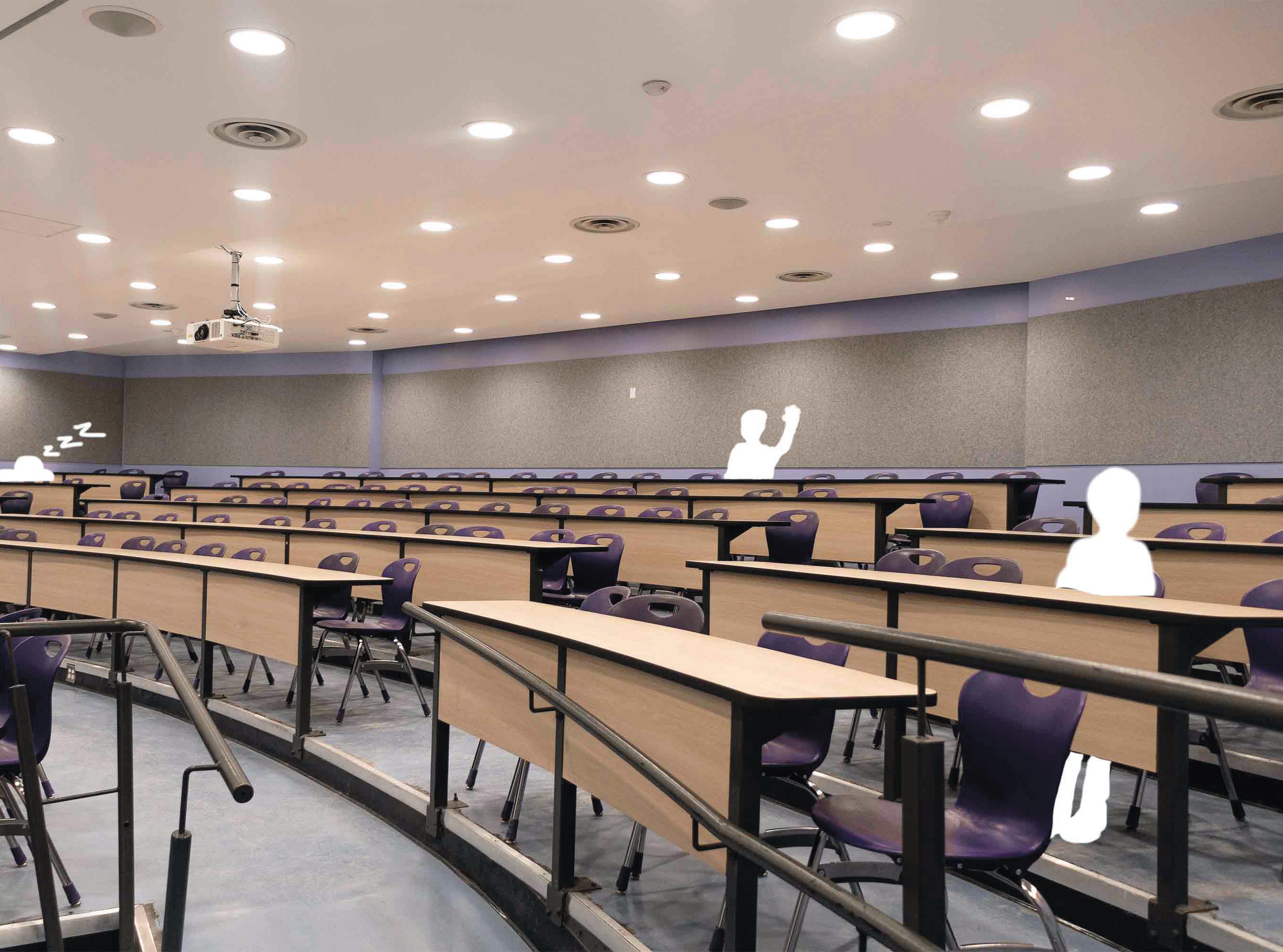
Ramsahoi’s story was familiar to me. In my first year, I took an introductory politics course and on the first day, I was genuinely excited. I wanted to sit near the front, raise my hand, ask questions and contribute. But when I walked into the classroom, a large lecture hall in the Architecture Building that curved downward like a colosseum, I settled for an aisle seat in a far back row.
After a few more classes, I began to notice the gaps in the room—gaps that increased after the mid-class break. Eventually, I stopped going altogether. I showed up only for the 12
On the other hand, a study in the journal Assessment and Evaluation in Higher Education suggests that skipping class negatively impacts performance, even if it’s only a small one. According to the study, this is primarily due to students who don’t attend class missing out on the opportunity for engagement, which the study says is the actual engine driving better grades.
In other words, when students skip, they miss out on the opportunity to actively participate, which, in turn, leads to lower scores. But, if you attend class and don't pay attention or engage with the material, the benefit of being there disappears. So, perhaps it’s possible for an absent student to be just as engaged—if not more—as one who attends every lecture.
Skipping doesn’t happen for no reason. While students who skip for pleasure or leisure surely exist, students’ time is increasingly being taken up by all sorts of matters—jobs (and second jobs), long commutes and a coterie of competing responsibilities. This, combined with the fact many are still able to do well, begs the question: should attending lectures even be tied to being a good student?
IT'S THE FALL OF 2024 and Ely
Christopher has just started university. She’s excited and, like most first years, has high expectations. She’s studying environmental and urban sustainability and apart from her mandatory courses, she has to take an open elective. She enrolls in something she has a genuine curiosity for. But after the thrill of a new semester subsides, every Monday when the time for her class nears, she sighs at the thought of attending.
"...I’ll probably skip to take up a shift"
For Christopher, her own motivation to attend is only half the equation. “[Coming to university] I expected the teachers to be more engaging in the way that they help us interact with the work, especially since it's a larger group of students you're trying to connect with,” she says. Instead, Christopher says many of her professors would just read off the slides.
While speaking to other students like Christopher, I found the professor’s engage-
Another week, she decided to give the class another chance but discovered her classmates had also tapped out. In a class of around 50 people, Christopher says she saw 10.
Now, in her second year, she tries not to skip class too often, especially since she’s an international student paying almost $37,000 annually. But disengaged professors and boring lectures make achieving her goal difficult.
“If I'm enjoying what I'm learning, I'm there. I won't skip,” says Christopher. “If it's like a class where the prof is bad, the work might be interesting, but it's not interesting enough to encourage me to get up and listen…I might not go, or I might go and leave early.”

Money is a factor in more ways than one. Many students skip because they’d rather pick up a shift to cope with Toronto’s high cost of living.
The province’s minimum wage is $17.60, yet a 2024 report from urban health research hub, the Wellesley Institute, says a single working adult needs $61,654 after taxes annually to be able to thrive in the GTA. Throw tuition on top of that and the need to work can overrule the need to attend class.
Statistics Canada data shows that in the 2023-24 year, 35 per cent of university students aged 18 were working. For students aged 22, that jumps to 52 per cent.
“[If it’s] at the end of the semester, and we’re just going through practice questions that I already have done before, I’ll probably skip to take up a shift,” says Christopher.
Commuting long distances to class is another factor.
According to a 2019 study, 77 per cent of students use local and regional transit as their primary mode of transportation to TMU’s campus. Valentina Capurri, a contract lecturer in the Department of Geography and Environmental Studies, believes the hassle of commuting is a significant reason students are not coming to class.
“The cost of public transit is fairly high…
but also it's the distance [and] the time you have to spend travelling just to come to campus,” she said.
Capurri has been teaching in the department since 2011 and says even though her upper-liberal studies courses are more “focused and intellectually demanding,” she
“It's like you pay for booking a restaurant, and then you don't show up"
still experiences low attendance in them.
Capurri made clear this was something she had observed over time, not just in a single class. Her wisdom is as follows: attendance often drops after midterms, students are more likely to show up for a straight three-hour lecture than a course split into a two-hour and one-hour session on separate days and there really is a strong connection between attendance and better grades.
When I asked her about students who skip class without a good reason, she shook her head in disappointment, noting that they were missing out—especially given how much they're paying for their education.
“It's like you pay for booking a restaurant
and then you don't show up. I mean, you're making a big loss, at least you enjoy the food if you go,” she says.
What stood out to me during our conversation was how understanding she was. I was expecting her to lament declining attendance and frustrations with absent students, but she spoke with a genuine awareness of what it means to be a student in Toronto today—one who may not always be able to make it to class.
“I do think that not attending any lecture is very problematic, but I also do not want to put this label like you are not a good student if you are missing some lectures, because, yes, students have a responsibility to come to class but life happens,” said Capurri.
JOSEPHINE MILLARD couldn’t skip her core courses even if she wanted to. She’s in TMU’s performance dance program and finds her classes to be extremely rigorous. Ballet one day, then human modern right after that and jazz the next. A day with rehearsals can run from 10 a.m. to 8 p.m., so one can imagine there isn’t much choice to pick an afternoon bird course as an elective.
“I just find taking electives outside of the dance program, really, it feels very unnecessary,” says Millard. “I feel like it's in our already busy schedules, just an extra thing
that's there to stress us out.”
So if she’s drained after rehearsals or needs to practice more, she will skip her elective class. Those are the only classes she ever skips, and it doesn’t matter if they have mandatory attendance.
“I'll just take the worst grade of my elective if it means I'll do better in my dance classes.”
She’s tried to be courteous as the university says she should, telling professors in advance when she won’t be able to make it and why. However, she says that because some professors hold biases against certain programs like hers, they tend not to take her explanations for missing class seriously, ignoring or dismissing her.
“I'm not saying it's like the hardest program in the world and stuff, but it definitely does require a lot of physical and mental stamina, and it's very time-consuming, and it is hard to have that within a university,” said Millard.
In the same vein, she also wishes the university had policies to better accommodate absences with good reason. She recognizes she could take summer classes but since she’s based in B.C., the time difference makes it challenging. Instead, she wants the university to offer more asynchronous courses during the school year that would benefit students like her.
According to 2023 findings from the Canadian Journal for the Scholarship of Teaching and
Learning, giving students the option to learn in person or virtually would not adversely affect engagement or academic success. However, at TMU, recorded lectures and uploaded slides vary from course to course. The university, through academic accommodation support, provides peer note-takers, but this is only available to registered students who have it as an enhanced service accommodation, not to students who skip class. TMU’s Chang School of Continuing Education also offers several accelerated classes, which usually take place during reading week and can provide students with full course credits in as little as one week.
“I think maybe if [TMU] had classes that you could kind of just do at your own pace, it would be a bit easier, and I probably would not pull so much weight to stay on top of all my work,” Millard says.
Towards the end of my interview with Ramsahoi, we discussed whether skipping class makes you irresponsible or someone who’s going to have a lackadaisical attitude to life in their future. For many students, missing a lecture isn’t a choice but a consequence of circumstance—of living in Toronto, juggling work, commuting and managing the realities of everyday life.
She decided she’d changed her mind about comparing skipping class to a sport. At the end of our conversation, she told me skipping is more like a trade—it’s giving up one
By Eunice Soriano
When the halftime buzzer sounds at the Mattamy Athletic Centre (MAC), a group of vibrant dancers sporting their signature blue sweat ers with the Toronto Metropolitan University (TMU) Bold logo take to the court where each step onto the hardwood brings the crowd to life.
But beyond the lively hip hop performances on the MAC court, the TMU DancePak carries their diverse array of talent, energy and dynamics to a grander stage.
Founded by alum Krista Speller, the DancePak has served as the school’s official competitive dance team since 2004.
This year, DancePak captain Ruby Kawam and assistant captains Jaclyn Wong and Alessia Di Santo are leading the biggest group of dancers in the team’s history.
Since the start of the season, they have been hard at work juggling their jazz, contemporary and hiphop lines, while also preparing their lyrical and tap small group numbers.
Coming off of massive wins from last year’s Be U: Varsity Challenge, View Dance Competi tion and Strive Dance Competi tion, the DancePak has shown no signs of slowing down.
Wong, a fourth year graphic com munications management student, said their hunger to win manifests itself in countless hours of training in TMU’s Recreation and Athletic Centre (RAC).
While balancing time in the studio, Wong and her fellow cap tains are also actively organizing their budget, registration and costumes before the competition season commences.
First year psychology student
Pia Ghostine expressed how rely ing on her captains has helped her integrate into the DancePak com munity, especially as a newcomer.
“[Kawam], [Di Santo] and [Wong], they’re really great cap tains, amazing leaders…They defi nitely keep up a great support sys tem,” Ghostine said.
In the heat of the intense prac tices, Wong emphasized the impor tance of discussing mental health and fostering a positive environ ment for all their dancers.
“We’re very much looking at the bigger picture of how competitive dance should be fun. We have really brought it back to the root of why we are dancing because we love it, not because it’s something we have to do,” Wong said.
Wong explained how she cher ishes performing in the studio and on stage as a way to shed her emotions.
“I was stressed about assignments, family issues, whatever. And it was just a place for me to be emotionally vulnerable, where my friends were and where I could just kind of move freely,” said Wong.
With the hope that she would pick up any sport, Ghostine’s par ents enrolled her in dance classes when she was two years old.
She expressed how she always leaned on dance for solace, nurs ing that passion throughout her teenage years and now on the DancePak team.
“I’m a naturally really anxious person, but for whatever reason when I dance and stuff, that tends to just go away.”
During the school week, when she’s not sitting in lecture halls or hanging out with her friends, she is at the studio rehearsing with her fellow DancePak members—

learning new choreography and polishing their other routines.
She spoke to the intensity of their Sunday practice sessions dedicated to a plethora of tech nique classes, running through the pep rally routines and taking inspiration from guest choreog raphers to elevate their sequences.
“It can get a little strict at times, but that’s what comes with being on a competitive team. And we all know there’s like a goal we all want to do amazing at competi tion…and represent our school to the best of our abilities,” she said.
Whenever the exhaustion settles in, Ghostine reminds herself of the immense progress she has made throughout the few months at TMU.
“A big thing that a bunch of the girls worry about [is that] being in a university dance team is like losing the skill you once had when you were at your prime as an early teenager,” Ghostine said. “But I honestly feel myself progressing every week. And I love that I can still learn new things while being a university student.”
By Hannah Thompson
As the 2026 regular season heats up, the Toronto Metropolitan Univer sity (TMU) Bold basketball, hockey and volleyball teams are fighting to secure playoff spots. Here’s a look at where each team stands, what they need to improve and which play ers and strategies could define their postseason runs.
Women’s Basketball
The TMU Bold women’s basketball team has been one of the Ontario University Athletics (OUA)’s most dominant squads this season, riding a long winning streak and sitting near the top of the standings as they enter the late regular season. The Bold opened 2025‑26 with at least 10 straight wins. Decisive wins including a 96‑52 victory over the Nipissing Lakers and a 75‑55 win over the Wilfrid Laurier Golden Hawks upon returning from the
winter break, showcasing both offensive balance and defensive intensity. Their success has come from consistent scoring by multiple contributors and strong rebound ing, helping them stay competitive in every quarter.
Head coach Carly Clarke high lighted the team’s growth, saying, “Our individuals have worked hard on improving and our connection and chemistry has improved as well.” She emphasized their defen sive disruption, fast pace and joy in playing together, noting that daily improvement is key as the Bold head into the season’s final games. To secure a playoff spot, they must keep winning against conference rivals and maintain their depth and intensity.
Men’s Basketball
The TMU Bold men’s basketball team has been a strong contender in the OUA Central this season, hold
ing a 10–4 record and riding mo mentum through the mid‑season stretch. After a competitive 2025 campaign, the Bold have shown resilience and depth, with multiple players stepping up to make key con tributions in wins and close games. Their balanced approach on both of fence and defence has kept them in the hunt for a high seed as the regular season enters its final stretch.
In a past interview with The Eyeopener, head coach David DeAveiro said the Bold have “fo cused on film” to bounce back af ter tough losses, relying on strong defence and turnovers rather than a few star players. Growth comes from learning together, a mindset that will be crucial heading into the playoffs. To solidify their position, the gold and blue must continue closing out tight games and defend ing top conference opponents. With shared responsibility and adaptabil ity at the core of their identity, the
While newer members like Ghos tine are navigating the university competition scene for the first time, Wong and many other fourth years are gearing up for their last perfor mances on the collegiate stage.
For Wong, the prospect of be ing a part of the DancePak played a major influence in her decision to attend TMU.
Throughout the past three years, she has leapt into different roles, from general member to me dia coordinator and now dancing her last year as assistant captain.
As she moves onto the next chapter of her life, she said it sad dens her to part ways with the team but she will undoubtedly come back and visit in the future.
“Dance is one of those sports that you don’t really grow out of. I feel like a lot of other athletes that I knew when I was younger quit before high school, whereas dance, I feel like you foster such a close community with your team that when you graduate, it’s genuinely heartbreaking,” said Wong.
Ghostine added that she values the team bonding days that have allowed her to connect with the other dancers who are now some of her closest friends.
“At first when rookies join the team, there’s that sense of ‘I don’t know if I’m going to get along with everybody. I don’t know how they’re going to treat us,’ but that instantly went away after the first day,” Ghostine said. “It gives us a chance to get along and real ly, like, understand us at the root [of] who we are, rather than just like us as dancers.”
Counting down the days un til competition season, Wong is filled with gratitude as she looks back on all her dances and the impactful people she has met through the DancePak.
“I feel like the sense of com munity is never lost, even though the people are constantly changing…I hope that all of the current and future members of DancePak feel just as fulfilled as I did,” Wong said.

missed scoring opportunities, which have prevented them from climbing higher in the standings.
Women’s Hockey
The TMU Bold women’s hockey team has shown it can compete with tough opponents but currently sits sixth in the OUA East with a 5–13 record, leaving them on the playoff bubble. In 2024–25, the Bold finished 11–15 and clinched a postseason spot, proving they can challenge top teams when they play at their best. This sea son, flashes of strong play have been countered by defensive lapses and
To reach the postseason, TMU will need to tighten defensive coverage, capitalize on scoring chances, and sustain offensive pressure against East division ri vals in the final stretch. Strong goaltending and disciplined play will be critical as the Bold aim to turn their season around and se cure a playoff spot.
Read more at theeyeopener.com
By Mishael Taruc
Fourth-year Toronto Metropolitan University acting students took what co-producer Arjun Kalra called “a dime and a dream” to bring their ideas from drawing board to reel. After long production days, the cohort celebrated three short films featuring deeply personal stories and positively Gen Z sensibilities.
The 18 soon-to-be graduating students, along with their friends and families, came to The Image Centre on Jan. 17 for an intimate screening of the titles in the 2026 New Voices Film Festival.
Despite their limited budget, the cohort’s creativity and resourcefulness guided their projects to fruition, said Kalra, clad in purple and sparkles—the event’s dress code.
“If [you] work together and have
a good team on your side, anything is possible,” he said.
Fueled with the drive to laugh at her pain and own experience of rejection, Mase Otubu wrote and directed Lesbihonest as a “love letter” to herself. Her comedy centred on queer womanhood, unrequited love and moving on.
When asked what she gained from producing the film, Otubu said, “nothing.”
“It wasn’t therapeutic or anything. It didn’t heal me. It was just fun—stressful and time-consuming but fun,” she said, earning a chuckle from the audience.
The laughter turned to quiet tears with The Pickle Bird , a film depicting conversations about grief and life after loss. Writer and director Joshua Mehr said his own grief after his older

brother’s passing in 2024 inspired the story.
Before his film played, Mehr shifted the spotlight from himself to his late brother. He read aloud a letter his then nine-year-old brother wrote for him days after his birth.
“I love Joshua. And I hope that his life goes as amazing as mine has for the first nine years,” the letter read.
The festival ended with The Devil’s Lettuce, a horror-comedy exploring themes of escapism and letting loose from writer-director Lauren Brown.
“I love stoner comedies. I love horror. When you get high, you

By MJ Młot
Architecture students at Toronto Metropolitan University (TMU) took part in an unusual four-day intensive from Jan. 5 to 8. The course, hosted by sessional instructors Vlad Amiot and Kristofer Kelly-Frere, encouraged students to ditch their academic discipline and embrace “radical hospitality.”
Amiot, a Calgary-based designer and queer theorist, described the course as an exercise in letting go of “hyper-competitive individualism.”
“It’s about reaching out to the other generously and joyfully, in order to foster a kind of environment of collectivity,” he said.
Lisa Landrum, professor and chair of the TMU Department of Architectural Science, said the students “were invited to use the architecture building as a different kind of environment.”
“The students had the experience of using their regular lecture space as a dance floor…use the gallery, not just for exhibiting precious objects, but as a dining space,” she said. Stu-
dents also built a race track around the architecture studios, and raced their profs in wheelie chairs.
Students got the opportunity to question the socially-conditioned ways we normally exist in spaces.
“Part of having a dance party at school is an act of resistance. I get to move my body differently in this place that is against the script,” said Amiot.
Students were invited to create wearable costumes out of food as one exercise; from there, they were tasked with having a photoshoot wearing their costumes in their local grocery stores. During one of these shoots, store management asked the students to leave.
“In the end, it was really the most productive thing that could have happened because you could have a tangible conversation about what are the invisible networks of power that operate in architecture that we never actually think about,” Amiot said.
Amiot describes his teachings as being inspired by the concept of “productive stupidity” which evolved from queer theory, shar-
ing that architecture is more political than people think.
“If we think about how we usually script architecture, it’s through labels…It’s a kind of ‘thou shalt’ language; thou shalt sleep here, thou shalt study here, thou shalt eat here,” he said. “And this is not about thou shalt, but, what could be…The stupidity is about what else architecture needs to think about.”
Landrum added, “There’s a way to think about architecture, not just in its physicality, but as a kind of a social infrastructure.”
“All the environments we’re in, why are they so meaningful? It’s because they support us as human beings, as social creatures,” she said.
Amiot explained that human beings defer our own joy. “If I work hard enough, I’ll get good grades, and if I get good grades, I’ll have a job, and if I get a job, I’ll be paid well, and maybe then I’ll be happy,” he said.
“If we can be happy in the now by a sort of collective joy, or just—you know—being stupid, then that sort of frees us from the grasp of this future-oriented happiness.”
watch one or the other, so why not mash them together?” she said.
Brown and her team turned the budget restraint into an opportunity. She said the visually “low-budget” look of some parts of the film evokes the effect of horror and the uncanny they were aiming for.
Sharing advice for other young creatives, Brown said, “If they don’t give you the space to do it, make your own.”
“If you have a pen and if you have an idea, your idea needs to be heard. Sure, it might not be developed, but it can be,” said Otubu.
Chatters of gratitude and pride from the attendees—who braved the snow and the long commute to the city—punctuated the night.
Brown said she wished the festival would extend to other programs at The Creative School, so more students could have a platform to show their work and tell their story.
Mehr values opportunities to make films that impact people in the same way that art moves him. “It’s so important to be a part of stories and to share stories. It’s what runs the world and what turns people into the people they become,” he said.

By Milla Ewart
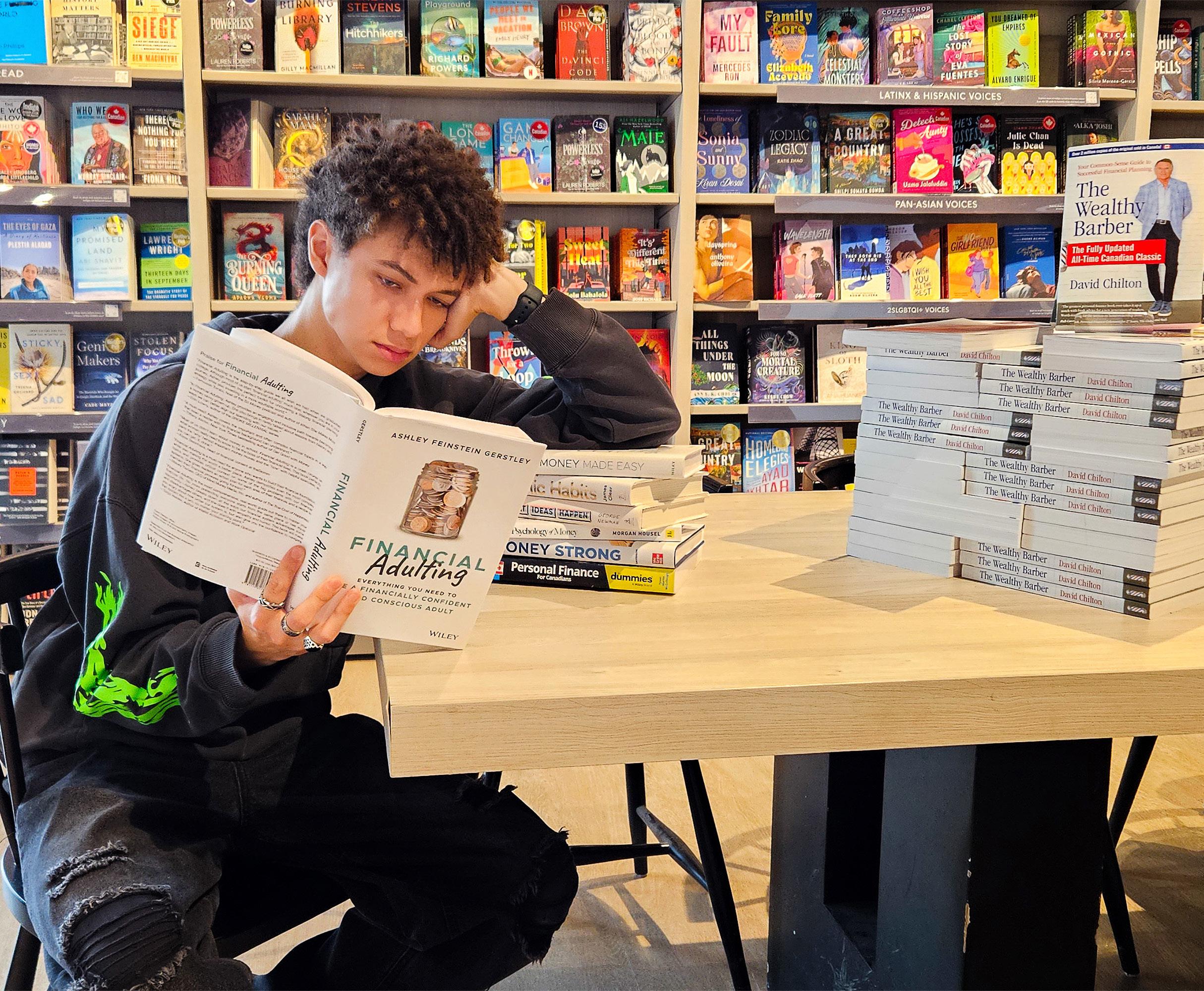
Even with increased access to information, some Toronto Metropolitan University (TMU) students feel apprehensive about their financial literacy, while others remain confident.
Financial experts attribute the growing gap to information overload, lack of mandatory financial education and limited financial conversations. A 2025 survey from Wallet Hub reports more than one-quarter of Gen Z said they lack confidence in their financial knowledge.
To assess TMU students’ financial literacy, TheEyeopenersampled eight students at the Ted Rogers School of Management and at the Student Learning Center to answer the “Big Three” questionnaire, a standardized test created by economists Annamaria Lusardi and Olivia Mitchell, covering interest rates, inflation and risk diversification.
The small survey suggests that despite possessing basic financial understanding, many are uncertain about their literacy. All students surveyed answered at least two questions correctly, but most rated their financial literacy as weak.
All students surveyed said they have felt financial pressure in their life within the last year.
Rebekah Smylie, a certified financial counsellor and program manager for financial empowerment at West Neighbourhood House, sees the overwhelming access to information as the issue that inhibits students from learning about money management.
“Gen Z’s are sitting in a space where they are having to pick through all of that [information] and decide what is true and what is fiction—that is really hard,” she said.
Smylie’s statement holds true for TMU students, as all the survey participants gathered financial information and advice from different mediums.
Sarah Matthews, a first-year performance production student said “It’s mostly my family giving me [financial] advice.”
Third-year business management student Sebastian Kokalo gains his knowledge from academic and news sources. “I have been watching Bloomberg [TV] for the past three years, looking at economic reports, how the economy moves and reading books,” he said.
Smylie also points to Gen Z’s “apprehension and a fear to participate,” saying that uncertainty and limited understanding often discourage financial engagement.
Anna Mukendi, a first-year performance production stu -
dent was discouraged by negative interactions with financial managers. “The way I saw it was, he sees a young girl opening up her first account, and then [proceeds to] mansplain everything,” she said in reference to a banking manager who unknowingly discouraged her from attaining more financial knowledge.
Ari Robinson, a fourth-year environmental and urban studies major, felt unequipped to manage his finances strategically. “I set up budgets for how much I am gonna spend on groceries,
but I feel like every time I do it, it’s always wrong,” she said.
Chad Izatt, manager of digital media and programming for the Canadian Foundation for Economic Education (CFEE), is working alongside the Department of Education across Canada, to reintegrate financial education into school curriculums.
“Gen X and millennials had access to different information— that doesn’t help Gen Z,” he said, describing the need to implement a curriculum that is relevant to the recent economic climate.
The Ontario Ministry of Education introduced a new financial literacy graduation requirement as part of the Grade 10 curriculum. The requirement is scheduled to take effect in high schools in September 2026.
While Gen Z missed out on foundational financial education in school, Smylie emphasizes the need for them to discuss money in day-to-day life.
“It has been historically taboo to talk about money, but it’s so important, talk about what you’re learning,” said Smylie.
By Riddhi Dhingra
American Express cards have gained traction with Gen Z, having a long standing history of being synonymous with luxury, the company has become successful in adapting to a new younger customer base.
A report from Yahoo Finance states that in 2023, 75 per cent of new customers were Gen Z and millennials.
Liz Fromet from The Financial Brand attributes its growth to the company’s new strategy of catering the rewards program to Gen Z’s interest—premium experiences and more advanced digital capabilities. The company has partnered with brands like Disney+, Hulu and Uber—even popular festivals like Coachella. Some Toronto Metropolitan University (TMU) students are choosing to hop on the Amex bandwagon, signing up for entry-level cards.
Students are becoming Amex cardholders in hopes of attaining invite-only premium cards and cashing in on travel dis -
counts. Financial experts say the brand’s marketing strategy is the reason for its success among younger generations.
Second-year aerospace engineering student Arshdeep Singh received his Amex card in midDecember 2025. He aims to eventually qualify for the inviteonly American Express Centurion card.“I have almost 3,000 or 4,000 points…I am trying to gather these points and use them for [travel] tickets,” he said.
First-year biomedical science student Dhyanesh Doctor, a recent Amex member, notes that even the entry-level Amex is superior to other cards on the market. “You can take it as cash back, air points or even points for hotels…so it’s kind of flexible,” he said, compared to other companies where you are limited to choosing one form of reward.
Richard Delerk, an adjunct professor at the Ted Rogers School of Management, said he was surprised by the growing number of young Amex members. “I’m not a big fan of paying to use an Amex card…I don’t think

there’s a big benefit,” he said.
Delerk says that Amex’s marketing tactics are the main reason young people have signed up. “When you’re taking out your girlfriend or boyfriend and you whip down the plastic and, [its like] oh wow, you got an Amex,” he said. “Amex looks a little classier than your Visa and Mastercard,” he added.
Delerk, as a former Amex user, recognizes the benefits of
the card for frequent travelers. He recalls cashing in on the high credit limits, free weekends trips, attending concerts and securing upgrades to suites and lounges. “Right now I am not travelling anywhere so I would not get the full benefits of an Amex…it’s not great if you don’t use it,” he says.
Despite Singh’s loyalty to the company, he recognizes the limitation of using the card in Canada.
“The downside…is that some shops don’t accept this card,” Singh says.
Doctor echoes the same sentiment “It’s not that useful in Canada,”he said, adding that the card holds more value in the United States. Despite the challenges, he still intends to keep his card “almost everyone has it…because it has all of these benefits,” he said, noting the rise of Amex among his peers.
By Liana Yadav
Disclaimer: This story is purely fictional, much like your Friday night plans.
Friendship is hard to come by. It takes time for love and care to foster and turn into a bond that holds two people together. Research suggests that it takes 50200 hours of quality time to move from becoming a casual acquaintance to a genuine friend.
Unless you’re at Toronto Metropolitan University (TMU), where all you need is unrestricted internet access, slim self-esteem and four hours a day spent questioning your life choices as a train hauls you to and from places in Ontario you definitely do not want to be in. Students all over campus are typing away passionately on their screens, their thumbs twiddling as each tap uncovers the promise of a great friendship. A friendship for the books, the kind they make movies about, the kind that their children will hear of.
You know, the kind that begins on Reddit.
Those are the expectations with which students enter the subreddit r/TorontoMetU. To learn more about this unconventional
method, The Eyeopener reached out to a student who authored such a post themself. Historians will likely look at this as the most accurate description of modern communication:
“Im 21m in btm nd ive no friends even tho I never leave my room or go2 any class or tell anyone my name. Why does this keep happening to me my life sux does anyone want to be friends?”
Upon further contact with the account u/lonerstoner41, he confirmed his identiy as third-year business technology management student, Rhett Cluse. When asked about the kind of people he met through his post, Cluse said the only meaningful conversation he had was with a first-year student under the account name u/devodweller69.. .
“Everything about him seemed legit, until he said that he had always wanted to meet a real BTM boy and that he couldn’t wait to shake my hand until his skin and mine became one,” Cluse said. “He also kept going on and on about his pet homunculus and I wasn’t really sure what that was.”
Cluse shared a snippet of the full conversation that had taken place over Reddit: CLUSE: So what brings you to r/TorontoMetU?

devodweller69: The same as you, my new best friend, to find my best friend. And methinks I seem to have succeeded! I promise I am a good time, we can hang out in my gooning cavern!
CLUSE: Right… devodweller69: We’re going to meld into one person and then all of our belongings will become both of our belongings.
Following the troubling exchanges between the two, Cluse
chose to speak to the head of relationship studies at the department of psychology Medulla Oblongata about what was going wrong.
“Social anxiety has increased ten-fold in the last few years. Not at TMU though, here everyone seems to be in the chokehold of stupid anxiety. It’s the kind of stupidity that makes you anxious… or the kind of anxiety that makes you stupid, it’s really up to you,” said Oblongata.
When asked if there are any technical differences between the two, she added, “To me, the more anxiety the better. I love reading these posts on Reddit. Sure, I have to teach in the Kerr Hall basement like a gremlin everyday but at least I am not 21m looking for BTM friends on Reddit, you know?”
*Following our interview with Rhett Cluse he mysteriously disappeared
By Rosemary Gill
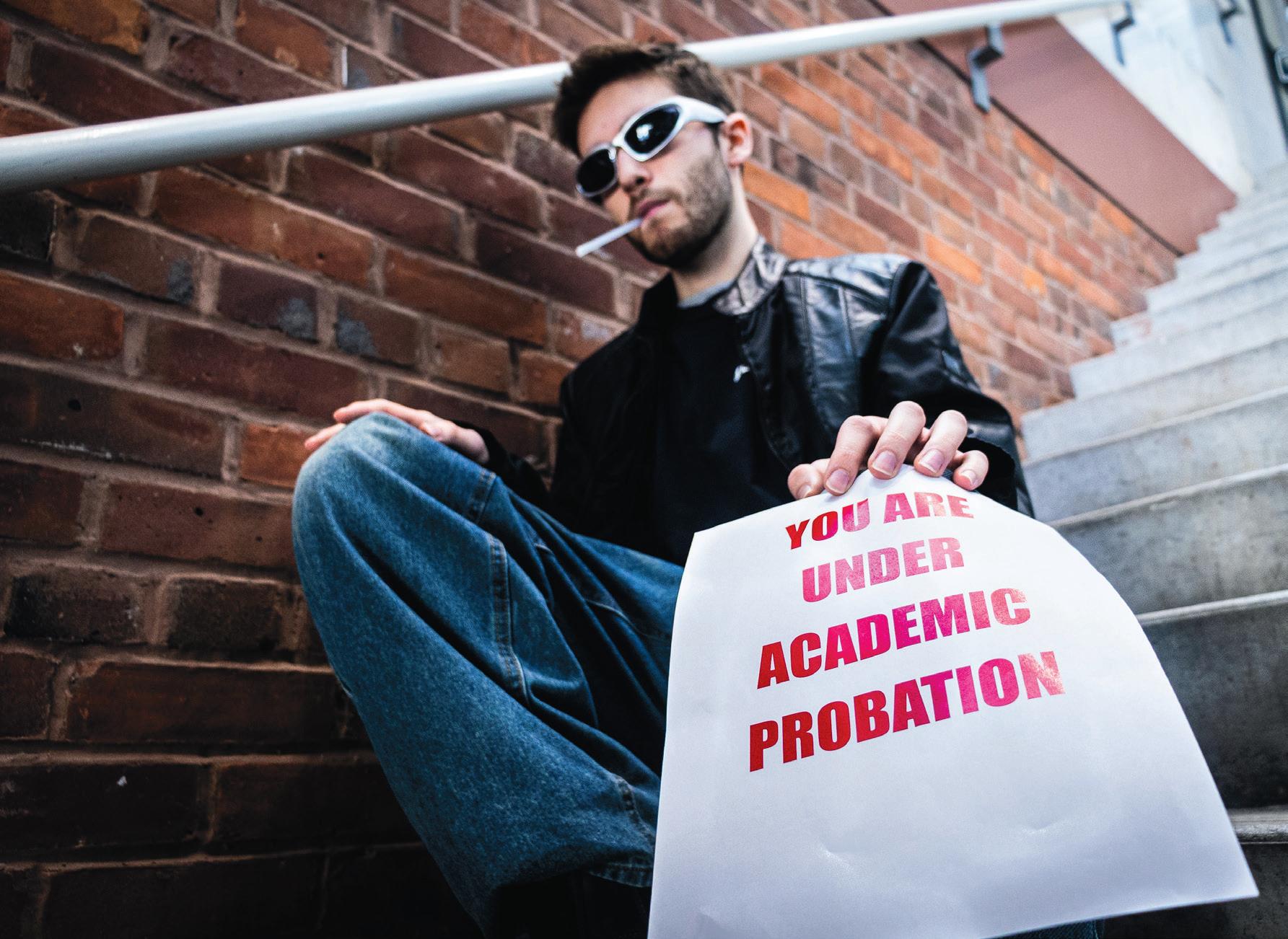
Disclaimer: While academic probation isn’t actually the hottest trend this semester, somehow tons of students seems to be participating in it.
Toronto Metropolitan University (TMU) students are back in the swing of things and are begin -
ning to find out that spending the entire first semester pounding back Twisted Teas and huffing from the Geek Bar may just catch up to them academically.
The name of the game is academic probation, offering what no extracurricular can: mandatory weekly visits with a Student Success Officer.
For current students however, the threat of academic probation may not be seen as a bad thing but rather as this semester’s newest and hottest trend.
“It’s kinda like anybody who’s anybody at TMU is on acprob, which is what we’re calling it now,” said a third-year history student. “And if you’re not on
acprob then you’re some kind of book nerd that reads books and understands long sentences.”
For those lucky enough to have a GPA in what’s known as the “acprob sweet spot”, below 1.67 but above zero, admission to the top trend is automatic with no application slowing you down.
In terms of details, acprob has three levels of probation: AP1, AP2 and AP3.
AP1 demands only one monthly appointment, which is less bang for your student buck and allows you ample time to attend your lectures—boring!
AP2 gets you more meetings, less class time and an even better social status. AP3 gets you daily meetings, no class time, any romantic partner you desire and all the beer in the Northern Hemisphere.
“I’m a part of AP3 now and I can’t stop getting laid,” said one fifth-year mechanical engineering student. “I may never graduate or get a job but I can butt chug a party keg faster than any 4.0 GPA-having sucker out there.”
While the potential for a probationary student to be expelled for failing to improve is high, there is the much worse fate of a rising GPA that would curtail a student’s
probation enjoyment by throwing them back into the regular life of a responsible academic not living the #acproblife.
For the trendsetters who work hard enough to keep themselves in the cross-hairs of the academic powers that be, the prize is something far beyond “being cool.”
“The best part about living the acprob lifestyle is the freedom. After I eventually drop out of school in academic disgrace, not only will I not be able to get any job I want, I also won’t be able to afford basic living necessities, it’s friggin’ sweet,” said a fourth-year medicine student.
A representative from the resident’s office has confirmed that they are currently dealing with an unprecedented influx of requests from students asking to be put on probation.
“Some students with high GPAs and actual care for their schoolwork are now aware of this new trend and are frantically asking that we drop their A’s to F’s faster than they drop their core electives,” said the representative.
When asked how he feels about the newest trend, President & Vice-Chancellor Mohamed Lachemi noted, “all my students are idiots so frankly, I couldn’t give less of a fuck what they get up to.”
The Eyeopener is giving away two $25 gift cards to The Oakham Cafe and/or The Met Campus Pub
Find the giveaway rules through the link in our Instagram bio.
1. Complete the maze! Only 100 per cent accurate mazes will be accepted.
2. Complete the Google Form via the QR code on the page and add a photo of your completed maze!
3. Await an email! The form will close end-of-day on Feb. 1 and winners will be contacted shortly afterwards and asked to come into our office for photos!
Submit Completed Maze Here

DOWN
1. Italian dish with layers of pasta, sauce and cheese
3. Creamy dip made from chickpeas
4. Sweet sauce made from maple tree sap
5. Green vegetable that looks like a tiny tree
6. Fruit that tends to keep the doctor away
ACROSS
2. Long, thin pasta often served with meatballs
5. Yellow fruit monkeys love
7. Breakfast food that comes from chickens
8. Thin pancakes often rolled with filling
What blood type are newspaper editors?
Typo Negative
President’s Corner: Ask Lachemi
LOWLY STUDENT: President Mohamed, as a student at your fine institution I have been struggling with how to find love in hopeless places. Being that I, a lowly student, am completely in love with you, how can I manage to engage in a modern day “situationship” with one at the helm of the highest authority (which gets me harder than an engineering exam?) Let me in, let me in, let me in, let me in.
DR. M. LACHEMI PhD: While I appreciate your offer and am always happy to hear from my horny little students, I’ve got to decline. To quote the man I respect most in the world: I’ve got more than enough to eat at home.

TV GUIDE
What to watch now...
STRANGER THINGS 5
Your favourite D&D-playing kids are back—and all grown up—for a disgusting studiomandated fifth season! There’s THREE demogorgons now. More demogorgons=better television.
HEATED RIVALRY
Crave’s salacious new series has found a way to finally get CanCon in front of American audience: with softcore gay porn. Why didn’t we try this earlier??
THE MASKED SINGER
This show is still on TV. Maybe your mom is watching? I hear the Owl is Jada Pinkett Smith.

Bond Street is closed
It is imperative this work is completed. Patience please.
By Stanley Yelnats
1. There’s a broken streetlight down there and we had to take it back to the North Pole to get fixed.
2. There’s treasure under the street. Finders keepers!
3. The workers wanted to try out their new tools.
4. We need room to park the excavators and wrecking balls for destroying the Imperial Pub.
5. It was too accessible.
6. Ontario Line construction.
7. We thought it was the ‘Ring of Fire.’
8. The boys at Camp Green Lake needed to dig somewhere.
9. Umm…it’s none of your business?
What do you call an illegally parked frog?
Toad
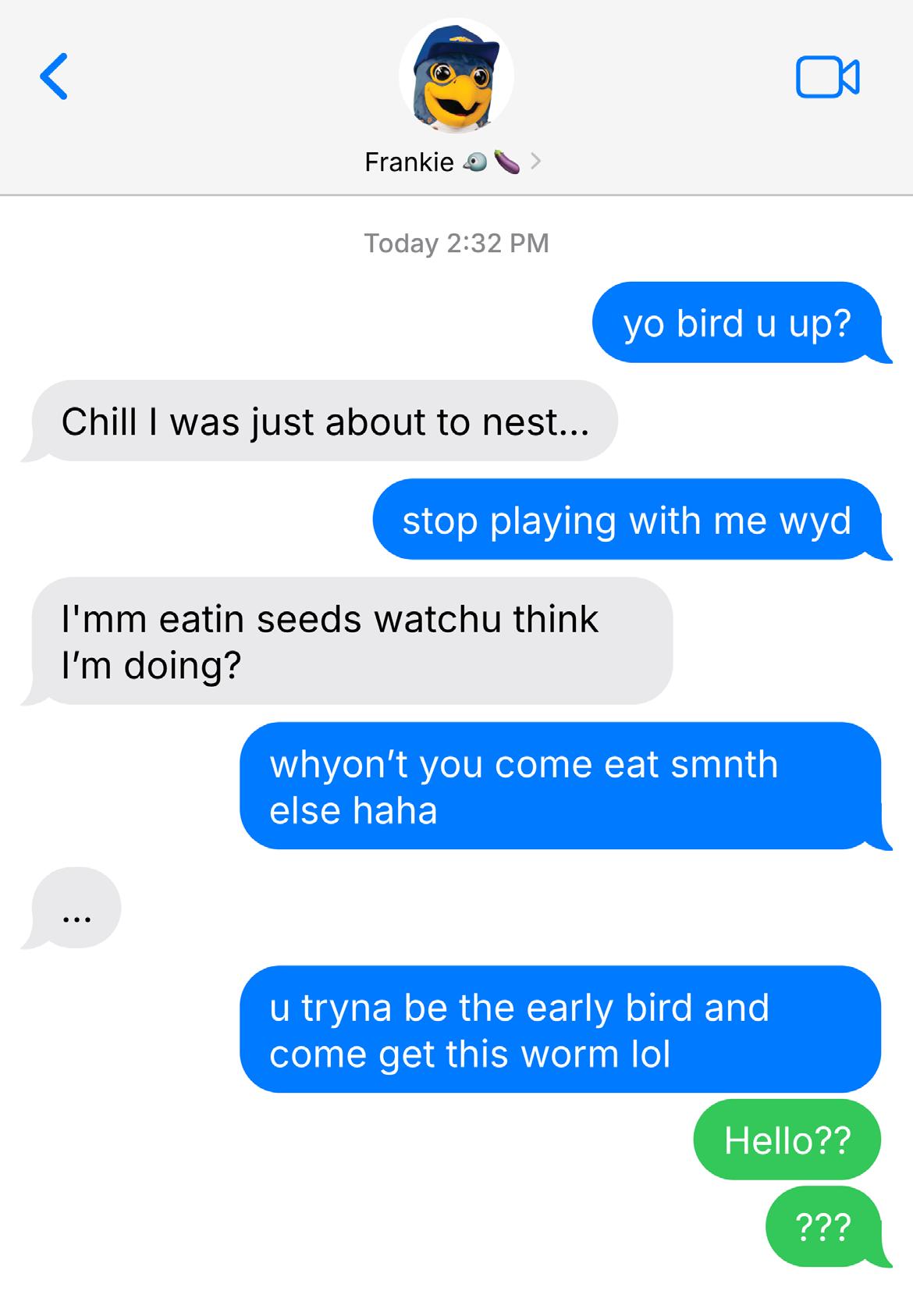
Big Eye-dea #1: Hens on campus. What if we want eggs and we are in class and we can’t get eggs? The answer: hens on campus.
Big Eye-dea #2: Underwear vending machines. What if a fart turns to poop mid class and we need a new pair of underwears to wear under our pair of balls: underwear vending machines.
Big Eye-dea #3: Cheeseburgers with lemon slices instead of cheese. When life gives you lemons, make cheeseburgers with lemon slices instead of cheese.

Aries: March 21–April 19 - You’re gonna die tomorrow.
Taurus: April 20–May 20 - Get your affairs in order.
Gemini: May 21–June 21 - You’ll expire in the next 24 hours.
Cancer: June 22–July 22 - Book a one-way ticket to the grave.
Leo: July 23–August 22 - You’re gonna die tomorrow.
Virgo: August 23–September 22 - It’s lights out tomorrow.
Libra: September 23–October 23 - That’s all folks!
Scorpio: October 24–November 21 - Today is your last.
Sagittarius: November 22–December 21 - Ya done for.
Capricornus: December 22–January 19 - It’s joever.
Aquarius: January 20–February 18 - End of the road for you.
Pisces: February 19–March 20 - Start crossing off that bucket list.